Franz Kafka
Background, style, and The
Metamorphosis
Biography
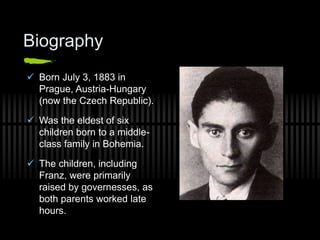
 Born July 3, 1883 in
Prague, Austria-Hungary
(now the Czech Republic).
 Was the eldest of six
children born to a middle-
class family in Bohemia.
 The children, including
Franz, were primarily
raised by governesses, as
both parents worked late
hours.
Biography
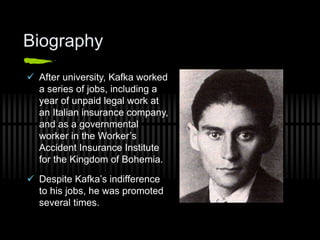
 After university, Kafka worked
a series of jobs, including a
year of unpaid legal work at
an Italian insurance company,
and as a governmental
worker in the Worker’s
Accident Insurance Institute
for the Kingdom of Bohemia.
 Despite Kafka’s indifference
to his jobs, he was promoted
several times.
Biography
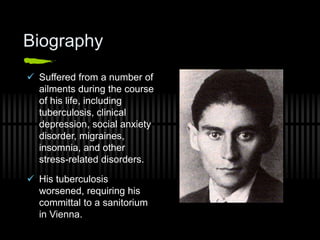
 Suffered from a number of
ailments during the course
of his life, including
tuberculosis, clinical
depression, social anxiety
disorder, migraines,
insomnia, and other
stress-related disorders.
 His tuberculosis
worsened, requiring his
committal to a sanitorium
in Vienna.
Biography
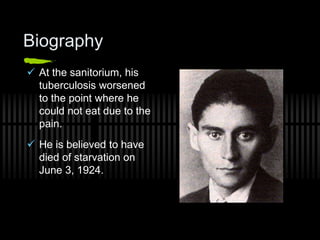
 At the sanitorium, his
tuberculosis worsened
to the point where he
could not eat due to the
pain.
 He is believed to have
died of starvation on
June 3, 1924.
Setting the Scene
 The protagonist of the story is Gregor Samsa, who is
the son of middle-class parents in Prague.
 Gregor’s father lost most of his money about five
years earlier, causing Gregor to take a job with one of
his father's creditors as a travelling salesman.
 Gregor provides the sole support for his family (father,
mother, and sister), and also found them their current
lodgings in Prague.
 When the story begins, Gregor is spending a night at
home before embarking upon another business trip.
Characters: Gregor Samsa:
 Gregor is the main character of the story, a young
traveling salesman working tirelessly to support his
parents and sister.
 One morning he wakes up late for work and
discovers that he’s no longer human. Instead, he is
a huge insect.
 He lives rest of his life reflecting on his former
existence, trying to avoid his overbearing father
and crawling the walls of his bedroom as his family
eventually tires of him.
Characters: Grete Samsa:
 Gregor’s sister. Grete treats her brother with kindness
and compassion.
 When she realizes he is a bug she feeds him and
attempts to figure out his needs, but she later comes to
resent his inability to work and provide for their family.
 Eventually begins to implore her family to do something
about her brother, who she now refers to as “it”.
 Grete does not know that while working as a salesman
Gregor was saving up to pay for her violin lessons.
Characters: Mr. Samsa:
 The father of Gregor and Grete and husband of Mrs.
Samsa.
 Retired from a failed business, Mr. Samsa rarely leaves
the flat and relies on his son to provide for the family.
 From the get-go he has no patience for his son’s
predicament, losing his temper and injuring Gregor in his
rage.
 When forced to return to work, however Mr. Samsa’s vigor
seems to return
Characters: Mrs. Samsa:
 Gregor’s as frail and aging mother, Mrs. Samsa stays in
the background but expresses her emotions when she
comes to know about her son’s transformation.
 Although she loves her son, she doesn’t visit his room.
She thinks that his sudden transformation may someday
reverse.
 However, as a mother she has expressed her worry over
this sudden transformation of her son.
 She becomes pliable when she comes to know that the
situation has changed and adapts herself to the new
circumstances.
Themes in The Metamorphosis:
1. Transformation
2. Alienation
3. Responsibility
4. Free Will
Themes in The Metamorphosis:
 Transformation: The first and most important theme in
The Metamorphosis is transformation. The primary
transformation in the novel is that of Gregor, a human
man, into a large insect.
 As the novel progresses, Gregor struggles to hang
onto his humanity. It slips from him as he turns to the
things that bring him pleasure in his new form.
 He finds sanctuary in dark places, joy in crawling on
the ceilings and the walls, and is only able to stomach
rotten food.
Themes in The Metamorphosis:
 Alienation: Gregor is alienated because he becomes
physical isolated in his room as a large bug. He has no
loving interaction with his family and can no longer go
to work or go to the outside world with his new
physicality.
 However, even before his transformation, he felt
alienated. Before his transformation, he had little
connection with his parents and sister, who became a
familial and financial obligation. He also had no desire
to go to work or interact with his boss.
Themes in The Metamorphosis:
 Responsibility: When Gregor first discovers that he’s
no longer in his human body, his first thought is for his
family. He worries immediately that he’s not going to be
able to get to work on time and is going to lose his job.
 The first pages of the novel are devoted to Gregor’s
struggle to force his new body to do what his old one
could easily.
 He cares about the responsibility he has to his family,
to pay off his father’s debts and support his sister and
mother.
Themes in The Metamorphosis:
 Free Will: Happy humans are able to feel a sense of
freedom, including free will and free choice.
 From the very beginning, Gregor does not show much
free will. He suffers from his lack of freedom in his daily
life and complains about the food he has no free choice
over.
 His feelings of being "stuck" are exaggerated when he
wakes up semi-immobile in an insect’s body.
Lost in Translation?
 English translators have often sought to
render the word Ungeziefer as “insect,” but
this is not entirely accurate, as, in German,
Ungeziefer literally means “vermin” and is
sometimes used colloquially to mean "bug,“
which is a much vaguer term than “insect.”
 Why might “vermin” actually be more
appropriate?
Lost in Translation?
“Vermin” can either be defined as a
parasite feeding off the living (Such as
Gregor's family feeding off him), or a
vulnerable entity that scurries away upon
another’s approach, as Gregor does for
most of the narrative after his
transformation.
Style
 Translations of Kafka’s work can be difficult due to a
syntactical idiosyncrasy of the German language; the
sentences will often span paragraphs, even pages,
delivering the impact at the end of the sentence.
 The first sentence of The Metamorphosis is an
example of this difficulty.
 In addition, he frequently uses diction that, in the
original German, has multiple meanings, allowing for
the layering of meaning within a sentence. These
layers can be lost in English.
Style
 Stylistically, Kafka’s work shows the influence
of a number of schools of philosophical
thought, primarily existentialism. Kafka’s
work is also considered modernist, absurdist,
and a precursor for the style “magical
realism.”
Existentialism
 This story is one that encompasses the philosophy of
existentialism. Its adherents believe that individuals
create the meaning in their lives.
 Existentialism is the belief that human beings have the
inherent ability to think and act based on their free
choice as individuals.
 However, some people may be limited on the choices
that they can make because of their situations.
Existentialism
 Existentialism is generally atheistic, believing that the
individual is entirely free from any external forces (ie:
gods, deities), making him or her responsible for the
events of his or her life. It is only through this self-
determination that we can rise above the absurd
conditions of humanity, such as suffering and death.
 Existentialists believe that the “meaning” humans seek
in life is ultimately unknowable.
Existentialism
 Existentialism is therefore opposed to philosophies such
as rationalism and empiricism, which attempt to discover
an order in the structure of the universe.
 Popular existential topics include “dread”, “boredom”,
“alienation”, “the absurd”, “freedom”, “commitment”, and
“nothingness”.
 The absurd, in particular, is important to surrealism. The
universe, to existentialists, is indifferent, objective, and
ambiguous; there is no order save that which we
perceive and interpret.
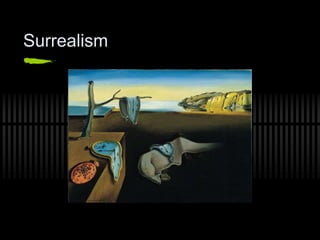
Surrealism
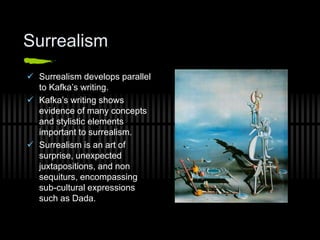
 Surrealism develops parallel
to Kafka’s writing.
 Kafka’s writing shows
evidence of many concepts
and stylistic elements
important to surrealism.
 Surrealism is an art of
surprise, unexpected
juxtapositions, and non
sequiturs, encompassing
sub-cultural expressions
such as Dada.
Surrealism
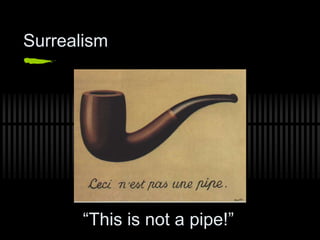
“This is not a pipe!”
Surrealism
Modernism
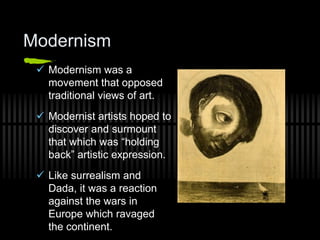
 Modernism was a
movement that opposed
traditional views of art.
 Modernist artists hoped to
discover and surmount
that which was “holding
back” artistic expression.
 Like surrealism and
Dada, it was a reaction
against the wars in
Europe which ravaged
the continent.
Modernism
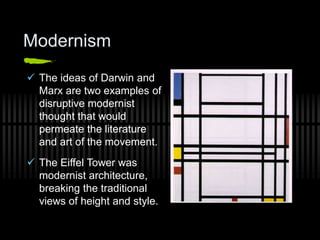
 The ideas of Darwin and
Marx are two examples of
disruptive modernist
thought that would
permeate the literature
and art of the movement.
 The Eiffel Tower was
modernist architecture,
breaking the traditional
views of height and style.
The Metamorphosis
 The ambiguity of Kafka’s prose has led to
innumerable interpretations of the novella.
Freudians, Symbolists, Marxists, Absurdists,
Surrealists; for every “-ist” and “-ian”, there is
an interpretation.
 The structure of the story is straightforward; it
begins with the climax, and, in many senses,
consists entirely of denoument and resolution.
The Metamorphosis
 There are heavy autobiographical elements
contained within the novella. For example,
Kafka’s relationship with his father is evident in
Gregor’s; Gregor’s hideous transformation
represents Kafka’s insecurity with his
appearance; the menial existence of a
traveling salesman his father lived; the
absurdity of existence evident in Kafka’s
existentialist views.

6b - Metamorphosis Presentation.pptx

  • 1.
    Franz Kafka Background, style,and The Metamorphosis
  • 2.
    Biography  Born July3, 1883 in Prague, Austria-Hungary (now the Czech Republic).  Was the eldest of six children born to a middle- class family in Bohemia.  The children, including Franz, were primarily raised by governesses, as both parents worked late hours.
  • 3.
    Biography  After university,Kafka worked a series of jobs, including a year of unpaid legal work at an Italian insurance company, and as a governmental worker in the Worker’s Accident Insurance Institute for the Kingdom of Bohemia.  Despite Kafka’s indifference to his jobs, he was promoted several times.
  • 4.
    Biography  Suffered froma number of ailments during the course of his life, including tuberculosis, clinical depression, social anxiety disorder, migraines, insomnia, and other stress-related disorders.  His tuberculosis worsened, requiring his committal to a sanitorium in Vienna.
  • 5.
    Biography  At thesanitorium, his tuberculosis worsened to the point where he could not eat due to the pain.  He is believed to have died of starvation on June 3, 1924.
  • 6.
    Setting the Scene The protagonist of the story is Gregor Samsa, who is the son of middle-class parents in Prague.  Gregor’s father lost most of his money about five years earlier, causing Gregor to take a job with one of his father's creditors as a travelling salesman.  Gregor provides the sole support for his family (father, mother, and sister), and also found them their current lodgings in Prague.  When the story begins, Gregor is spending a night at home before embarking upon another business trip.
  • 7.
    Characters: Gregor Samsa: Gregor is the main character of the story, a young traveling salesman working tirelessly to support his parents and sister.  One morning he wakes up late for work and discovers that he’s no longer human. Instead, he is a huge insect.  He lives rest of his life reflecting on his former existence, trying to avoid his overbearing father and crawling the walls of his bedroom as his family eventually tires of him.
  • 8.
    Characters: Grete Samsa: Gregor’s sister. Grete treats her brother with kindness and compassion.  When she realizes he is a bug she feeds him and attempts to figure out his needs, but she later comes to resent his inability to work and provide for their family.  Eventually begins to implore her family to do something about her brother, who she now refers to as “it”.  Grete does not know that while working as a salesman Gregor was saving up to pay for her violin lessons.
  • 9.
    Characters: Mr. Samsa: The father of Gregor and Grete and husband of Mrs. Samsa.  Retired from a failed business, Mr. Samsa rarely leaves the flat and relies on his son to provide for the family.  From the get-go he has no patience for his son’s predicament, losing his temper and injuring Gregor in his rage.  When forced to return to work, however Mr. Samsa’s vigor seems to return
  • 10.
    Characters: Mrs. Samsa: Gregor’s as frail and aging mother, Mrs. Samsa stays in the background but expresses her emotions when she comes to know about her son’s transformation.  Although she loves her son, she doesn’t visit his room. She thinks that his sudden transformation may someday reverse.  However, as a mother she has expressed her worry over this sudden transformation of her son.  She becomes pliable when she comes to know that the situation has changed and adapts herself to the new circumstances.
  • 11.
    Themes in TheMetamorphosis: 1. Transformation 2. Alienation 3. Responsibility 4. Free Will
  • 12.
    Themes in TheMetamorphosis:  Transformation: The first and most important theme in The Metamorphosis is transformation. The primary transformation in the novel is that of Gregor, a human man, into a large insect.  As the novel progresses, Gregor struggles to hang onto his humanity. It slips from him as he turns to the things that bring him pleasure in his new form.  He finds sanctuary in dark places, joy in crawling on the ceilings and the walls, and is only able to stomach rotten food.
  • 13.
    Themes in TheMetamorphosis:  Alienation: Gregor is alienated because he becomes physical isolated in his room as a large bug. He has no loving interaction with his family and can no longer go to work or go to the outside world with his new physicality.  However, even before his transformation, he felt alienated. Before his transformation, he had little connection with his parents and sister, who became a familial and financial obligation. He also had no desire to go to work or interact with his boss.
  • 14.
    Themes in TheMetamorphosis:  Responsibility: When Gregor first discovers that he’s no longer in his human body, his first thought is for his family. He worries immediately that he’s not going to be able to get to work on time and is going to lose his job.  The first pages of the novel are devoted to Gregor’s struggle to force his new body to do what his old one could easily.  He cares about the responsibility he has to his family, to pay off his father’s debts and support his sister and mother.
  • 15.
    Themes in TheMetamorphosis:  Free Will: Happy humans are able to feel a sense of freedom, including free will and free choice.  From the very beginning, Gregor does not show much free will. He suffers from his lack of freedom in his daily life and complains about the food he has no free choice over.  His feelings of being "stuck" are exaggerated when he wakes up semi-immobile in an insect’s body.
  • 16.
    Lost in Translation? English translators have often sought to render the word Ungeziefer as “insect,” but this is not entirely accurate, as, in German, Ungeziefer literally means “vermin” and is sometimes used colloquially to mean "bug,“ which is a much vaguer term than “insect.”  Why might “vermin” actually be more appropriate?
  • 17.
    Lost in Translation? “Vermin”can either be defined as a parasite feeding off the living (Such as Gregor's family feeding off him), or a vulnerable entity that scurries away upon another’s approach, as Gregor does for most of the narrative after his transformation.
  • 18.
    Style  Translations ofKafka’s work can be difficult due to a syntactical idiosyncrasy of the German language; the sentences will often span paragraphs, even pages, delivering the impact at the end of the sentence.  The first sentence of The Metamorphosis is an example of this difficulty.  In addition, he frequently uses diction that, in the original German, has multiple meanings, allowing for the layering of meaning within a sentence. These layers can be lost in English.
  • 19.
    Style  Stylistically, Kafka’swork shows the influence of a number of schools of philosophical thought, primarily existentialism. Kafka’s work is also considered modernist, absurdist, and a precursor for the style “magical realism.”
  • 20.
    Existentialism  This storyis one that encompasses the philosophy of existentialism. Its adherents believe that individuals create the meaning in their lives.  Existentialism is the belief that human beings have the inherent ability to think and act based on their free choice as individuals.  However, some people may be limited on the choices that they can make because of their situations.
  • 21.
    Existentialism  Existentialism isgenerally atheistic, believing that the individual is entirely free from any external forces (ie: gods, deities), making him or her responsible for the events of his or her life. It is only through this self- determination that we can rise above the absurd conditions of humanity, such as suffering and death.  Existentialists believe that the “meaning” humans seek in life is ultimately unknowable.
  • 22.
    Existentialism  Existentialism istherefore opposed to philosophies such as rationalism and empiricism, which attempt to discover an order in the structure of the universe.  Popular existential topics include “dread”, “boredom”, “alienation”, “the absurd”, “freedom”, “commitment”, and “nothingness”.  The absurd, in particular, is important to surrealism. The universe, to existentialists, is indifferent, objective, and ambiguous; there is no order save that which we perceive and interpret.
  • 23.
    Surrealism  Surrealism developsparallel to Kafka’s writing.  Kafka’s writing shows evidence of many concepts and stylistic elements important to surrealism.  Surrealism is an art of surprise, unexpected juxtapositions, and non sequiturs, encompassing sub-cultural expressions such as Dada.
  • 24.
  • 25.
  • 26.
    Modernism  Modernism wasa movement that opposed traditional views of art.  Modernist artists hoped to discover and surmount that which was “holding back” artistic expression.  Like surrealism and Dada, it was a reaction against the wars in Europe which ravaged the continent.
  • 27.
    Modernism  The ideasof Darwin and Marx are two examples of disruptive modernist thought that would permeate the literature and art of the movement.  The Eiffel Tower was modernist architecture, breaking the traditional views of height and style.
  • 28.
    The Metamorphosis  Theambiguity of Kafka’s prose has led to innumerable interpretations of the novella. Freudians, Symbolists, Marxists, Absurdists, Surrealists; for every “-ist” and “-ian”, there is an interpretation.  The structure of the story is straightforward; it begins with the climax, and, in many senses, consists entirely of denoument and resolution.
  • 29.
    The Metamorphosis  Thereare heavy autobiographical elements contained within the novella. For example, Kafka’s relationship with his father is evident in Gregor’s; Gregor’s hideous transformation represents Kafka’s insecurity with his appearance; the menial existence of a traveling salesman his father lived; the absurdity of existence evident in Kafka’s existentialist views.