GSM BSS Network KPI (MOS) Optimization Manual                         INTERNAL


                  Product Name                                         Confidentiality Level
                    GSM BSS                                               INTERNAL
                 Product Version                                         Total 36 pages
             V00R01


                 GSM BSS Network KPI (MOS) Optimization
                                                    Manual


                                                For internal use only


Prepared by              GSM&UMTS Network                  Dong         Date        2008-2-21
                         Performance Research              Xuan
                         Department
Reviewed by                                                             Date        yyyy-mm-dd
Granted by                                                              Date        yyyy-mm-dd


                                           Huawei Technologies Co., Ltd.


                                                 All rights reserved


2011-08-04                         Huawei Technologies Proprietary                               Page 1 of 36
GSM BSS Network KPI (MOS) Optimization Manual          INTERNAL


                               Revision Record
    Date      Revision               Change Description               Author
              Version
2008-1-21    0.9                   Draft completed.                 Dong Xuan
2008-3-20    1.0                   The document is modified         Wang Fei
                                   according to review comments.


2011-08-04                 Huawei Technologies Proprietary                      Page 2 of 36
GSM BSS Network KPI (MOS) Optimization Manual                   INTERNAL


   GSM BSS Network KPI (MOS) Optimization Manual
             Key words: MOS, interference, BER, C/I, power control, DTX, frequency hopping,
             PESQ, PSQM /PSQM+, PAMS

             Abstract: With the development of the radio network, mobile operators become more
             focused on end users’ experience instead of key performance indicators (KPIs). The
             improvement of the end users’ experience and the improvement of the network capacity
             are regarded as KPIs. Therefore, Huawei must pay close attention to the improvement of
             the soft capability of the network quality as well as the fulfillment of KPIs. At present,
             there are three methods of evaluating the speech quality: subjective evaluation, objective
             evaluation, and estimation. Among the three methods, objective evaluation is the most
             accurate. The PESQ algorithm defined by the ITU can objectively evaluate the speech
             quality of the communication network. This document uses the mean opinion score
             (MOS) to label the speech quality after objective evaluation.

             This document describes the factors of MOS, the impact of each factor on the MOS, and
             the methods of improving the network QoS and then the speech quality. It also describes
             the attention points during the test of speech quality of the existing network and the
             device capability value of the lab test. In addition, this document introduces the
             differences between the speech test tools. The methods and principles of using the test
             tools are omitted. This document serves as a reference to the acceptance of network
             KPIs and the marketing bidding.


             References: ITU-T P.800 ITU-T P.830 ITU-T P.861 ITU-T P.862ITU-T P.853


             List of acronyms:

           Acronym                                           Expansion
         MOS                     Mean Opinion Score
         PESQ                    Perceptual Evaluation of Speech Quality
         PSQM                    Perceptual Speech Quality Measurement
         PAMS                    Perceptual Analyse Measurement Sytem


2011-08-04                          Huawei Technologies Proprietary                           Page 3 of 36
GSM BSS Network KPI (MOS) Optimization Manual                                            INTERNAL


                                                            Contents
1 Basic Principles of MOS..................................................................................................................8
  1.1 Subjective Speech Quality Evaluation......................................................................................8
  1.2 Objective Speech Quality Evaluation.....................................................................................9
1.2.1 PSQM (P.861) Recommendation or Algorithm.........................................................9
1.2.2 PESQ (P.862) Recommendation or Algorithm.........................................................9
1.2.3 P862.1 Recommendation (Mapping Function for Transforming)...........................10
1.2.4 P.563 Recommendation.........................................................................................11
  1.3 Speech Processing of Involved NEs.....................................................................................12
1.3.2 MS 13
1.3.3 BTS 13
1.3.4 BSC 13
1.3.5 UMG14
2 Factors That Affect the MOS in GSM.........................................................................................15
  2.1 Introduction to GSM Speech Acoustic Principles................................................................15
  2.2 Impact of Field Intensity and C/I on the Speech Quality.....................................................16
  2.3 Impact of Handover on the Speech Quality..........................................................................16
  2.4 Impact of DTX on the Speech Quality..................................................................................17
  2.5 Impact of Speed (Frequency Deviation) on the Speech Quality..........................................17
  2.6 Impact of Speech Coding Rate on the Speech Quality.........................................................18
  2.7 Impact of Transmission Quality on the Speech Quality.......................................................18
3 Method of Analyzing the Problem of Low MOS........................................................................19
  3.1 Process of Analyzing the Problem of Low MOS..................................................................19
  3.2 Method of Solving the Problem of Low MOS......................................................................21
3.2.1 Consistency Check and Sample Check.................................................................21
3.2.2 Um Interface Check................................................................................................22
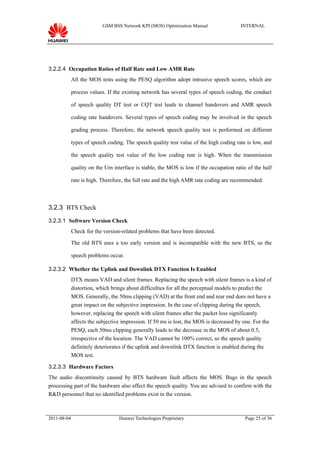
3.2.3 BTS Check.............................................................................................................25
3.2.4 Abis Transmission Check.......................................................................................26
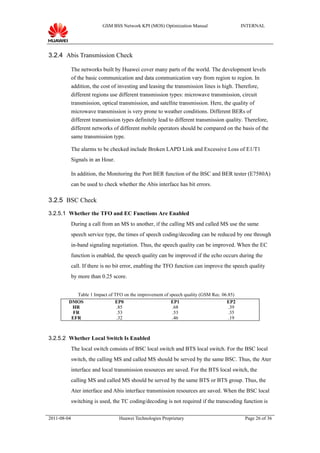
3.2.5 BSC Check.............................................................................................................26
3.2.6 A Interface Transmission Check.............................................................................27
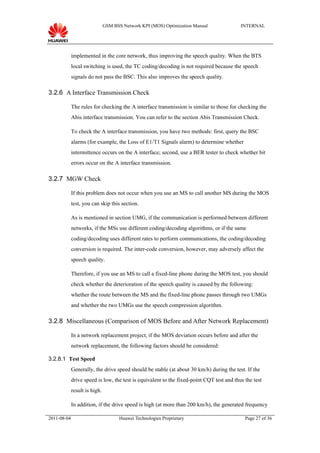
3.2.7 MGW Check...........................................................................................................27
3.2.8 Miscellaneous (Comparison of MOS Before and After Network Replacement).....27
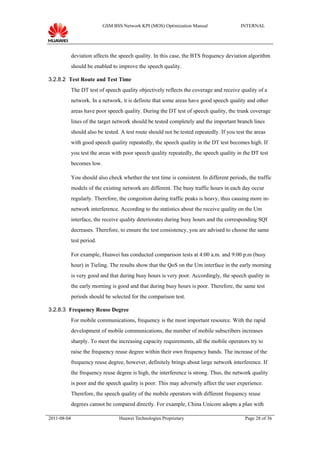
4 Test Methods and Suggestions.....................................................................................................29
  4.1 Test Tool Selection and Test Suggestions............................................................................29
  4.2 Suggestions on the Test of the Existing Network.................................................................29
5 MOS Cases...................................................................................................................................30
  5.1 Differences Between Speech Signal Process and Signaling Process...................................30
5.1.1 GSM Speech Signal Process.................................................................................30
5.1.2 Signaling Process...................................................................................................30
  5.2 Identified MOS Problems......................................................................................................31
2011-08-04                                   Huawei Technologies Proprietary                                                    Page 4 of 36
GSM BSS Network KPI (MOS) Optimization Manual                                        INTERNAL


6 Feedback on MOS or Speech Problems.......................................................................................33
  6.1 Test Requirements.................................................................................................................33
  6.2 Requirements for Configuration Data in Existing Network.................................................35


2011-08-04                                 Huawei Technologies Proprietary                                                Page 5 of 36
GSM BSS Network KPI (MOS) Optimization Manual                                     INTERNAL


                                                                 Tables
Table 1Relations between the quality grade, score, and listening effect scale...................................8
Table 1Impact of DTX on the speech quality...................................................................................17
Table 1Mapping between the speech coding scheme and the MOS value.......................................18
Table 1Mapping between speech sample and MOS.........................................................................21
Table 1Impact of TFO on the improvement of speech quality (GSM Rec. 06.85)..........................26
Table 1Identified MOS problems.....................................................................................................31
Table 1Network configuration parameters to be provided...............................................................35


2011-08-04                                Huawei Technologies Proprietary                                             Page 6 of 36
GSM BSS Network KPI (MOS) Optimization Manual                                          INTERNAL


                                                                    Figures
Figure 1PESQ process.......................................................................................................................10
Figure 1Mapping between P862 and P862.1....................................................................................11
Figure 1Overall speech quality prediction of P.563.........................................................................11
Figure 1Typical MOS test process....................................................................................................13
Figure 1Speech processing on the MS side......................................................................................13
Figure 1Speech processing on the BTS side.....................................................................................13
Figure 1Handling process in the GTCS............................................................................................14
Figure 1Codec cascading..................................................................................................................15
Figure 1Fault location flow...............................................................................................................21
Figure 1Speech data transmission on the Um interface (schematic drawing)..................................23
Figure 1BSC6000 speech signal process..........................................................................................30


2011-08-04                                  Huawei Technologies Proprietary                                                  Page 7 of 36
GSM BSS Network KPI (MOS) Optimization Manual                         INTERNAL


1 Basic Principles of MOS
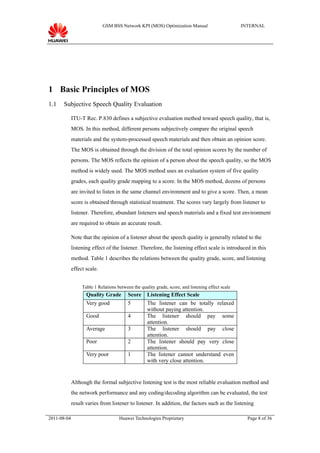
1.1   Subjective Speech Quality Evaluation

             ITU-T Rec. P.830 defines a subjective evaluation method toward speech quality, that is,
             MOS. In this method, different persons subjectively compare the original speech
             materials and the system-processed speech materials and then obtain an opinion score.
             The MOS is obtained through the division of the total opinion scores by the number of
             persons. The MOS reflects the opinion of a person about the speech quality, so the MOS
             method is widely used. The MOS method uses an evaluation system of five quality
             grades, each quality grade mapping to a score. In the MOS method, dozens of persons
             are invited to listen in the same channel environment and to give a score. Then, a mean
             score is obtained through statistical treatment. The scores vary largely from listener to
             listener. Therefore, abundant listeners and speech materials and a fixed test environment
             are required to obtain an accurate result.

             Note that the opinion of a listener about the speech quality is generally related to the
             listening effect of the listener. Therefore, the listening effect scale is introduced in this
             method. Table 1 describes the relations between the quality grade, score, and listening
             effect scale.


                  Table 1 Relations between the quality grade, score, and listening effect scale
                    Quality Grade         Score     Listening Effect Scale
                    Very good             5         The listener can be totally relaxed
                                                    without paying attention.
                    Good                  4         The listener should pay some
                                                    attention.
                    Average               3         The listener should pay close
                                                    attention.
                    Poor                  2         The listener should pay very close
                                                    attention.
                    Very poor             1         The listener cannot understand even
                                                    with very close attention.


             Although the formal subjective listening test is the most reliable evaluation method and
             the network performance and any coding/decoding algorithm can be evaluated, the test
             result varies from listener to listener. In addition, the factors such as the listening

2011-08-04                           Huawei Technologies Proprietary                                 Page 8 of 36
GSM BSS Network KPI (MOS) Optimization Manual                   INTERNAL


             environment, listeners, and speech materials should be strictly controlled during the test.
             As a result, this method consumes a lot of time and money. Therefore, several objective
             evaluation methods, such as PSQM, PESQ, and P862.1, are introduced. For details
             about the objective evaluation methods, see the next section.


1.2 Objective Speech Quality Evaluation

1.2.1 PSQM (P.861) Recommendation or Algorithm

             The perceptual speech quality measurement (PSQM) recommendation or algorithm

             introduces the system of five quality grades, with each grade further classified in the

             form of percentages through the %PoW (Percent Poor or Worse) and %GoB (Percent

             Good or Better) scales. Although the PSQM involves subclassification, it is still one of

             the subjective evaluation methods. At present, someone uses a computer to generate a

             wave file. Through the changes in the wave file before and after network transmission,

             the quality grade is obtained to evaluate the speech quality. In 1996, the PSQM was

             accepted as Recommendation P.861 by the ITU-T. In 1998, an optional system based on

             measuring normalizing blocks (MNBs) was added to P.861 as an attachment.


1.2.2 PESQ (P.862) Recommendation or Algorithm

             Jointly developed by British Telecom and KPN, the Perceptual Evaluation of Speech

             Quality (PESQ) was accepted as ITU-T Recommendation P.862 in 2001. The PESQ

             compares an original signal with a degraded signal and then provides an MOS. The

             MOS is similar to the result of a subjective listening test. The PESQ is an intrusive test

             algorithm. The algorithm is powerful enough to test both the performance of a network

             element (NE) such as decoder and end-to-end speech quality. In addition, the algorithm

             can give test results by degradation causes, such as codec distortion, error, packet loss,

             delay, jitter, and filtering. The PESQ is the industry’s best standard algorithm that has

             been commercially used.

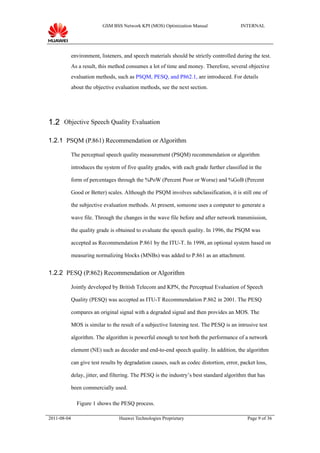
               Figure 1 shows the PESQ process.

2011-08-04                         Huawei Technologies Proprietary                            Page 9 of 36
GSM BSS Network KPI (MOS) Optimization Manual                   INTERNAL


                                        Figure 1 PESQ process


             For both the PSQM and the PAMS, a speech reference signal should be transmitted on

             the telephone network. At the other end of the network, the sample signal and the

             received signal should be compared through the use of digit signal processing so that the

             speech quality of the network can be estimated. The PESQ incorporates the advantages

             of both the PSQM and the PAMS. It improves the VoIP and hybrid end-to-end

             applications and modifies the MOS and MOS-LQ calculation methods. Initially, these

             methods are used to measure the coding algorithm. Afterwards, they are also used to

             measure the VoIP network system.


1.2.3 P862.1 Recommendation (Mapping Function for Transforming)

             The perceptual evaluation of speech quality (PESQ) is a method of objectively

             evaluating the speech quality of the communication network. It is developed on the basis

             of the PSQM+ and PAMS. In February 2001, the PESQ was accepted as ITU-T

             Recommendation P.862. Afterwards, P.862.1 (mapping function for transforming) was

             added. Not an independent protocol, P.862.1 is only the mapping of P862. P.862.1

             simulates the human ear’s perception of speech more exactly than P.862. Therefore,

             P.862.1 is more comparable to a subjective listening test than P.862. The high scores

             obtained according to P.862.1 are higher than those obtained according to P.862. The

             low scores obtained according to P.862.1 are lower than those obtained according to

             P.862. The watershed is at the score of 3.4. Therefore, according to P.862.1, the

             percentage of MOSs above 3.4 should be increased to enhance end users’ experience.

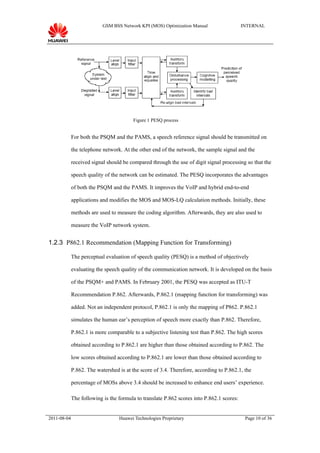
             The following is the formula to translate P.862 scores into P.862.1 scores:


2011-08-04                        Huawei Technologies Proprietary                           Page 10 of 36
GSM BSS Network KPI (MOS) Optimization Manual                     INTERNAL


                                          4.999 − 0.999
                y = 0.999 +
                                       1 + e −1.4945 *x +4.6607

                             5
                            4.5
                             4
                            3.5
             Mapped P.862


                             3
                            2.5
                             2
                            1.5
                             1
                            0.5
                             0
                                  –1        0            1          2             3           4      5
                                                                  P.862
                                                                                                  P.862.1_F1


                                           Figure 1 Mapping between P862 and P862.1


1.2.4 P.563 Recommendation

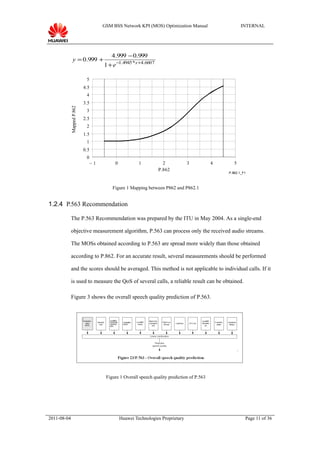
             The P.563 Recommendation was prepared by the ITU in May 2004. As a single-end

             objective measurement algorithm, P.563 can process only the received audio streams.

             The MOSs obtained according to P.563 are spread more widely than those obtained

             according to P.862. For an accurate result, several measurements should be performed

             and the scores should be averaged. This method is not applicable to individual calls. If it

             is used to measure the QoS of several calls, a reliable result can be obtained.

             Figure 3 shows the overall speech quality prediction of P.563.


                                        Figure 1 Overall speech quality prediction of P.563


2011-08-04                                      Huawei Technologies Proprietary                            Page 11 of 36
GSM BSS Network KPI (MOS) Optimization Manual                INTERNAL


1.3 Speech Processing of Involved NEs
             This section introduces the speech processing of all the involved network elements
             (NEs): MS, BTS, BSC, and UMG. Faulty speech processing of any one of the NEs will
             affect the speech quality.

             Accordingly, four transmission procedures are involved in the transmission of speech
             signals. The transmission procedures are Um-interface transmission, Abis-interface
             transmission, Ater-interface transmission, and A-interface transmission. Faults in any
             one of the transmission procedures will lead to bit errors. Therefore, if a speech-related
             problem occurs, the four NEs and the four transmission procedures should be
             troubleshoot.

             If the problem occurs on the Um interface, the transmission quality on the Um interface
             should be optimized. If the problem occurs on the other interfaces, the fault should be
             located on the basis of the bit error rate (BER). The BSC6000 can perform BER
             detection.

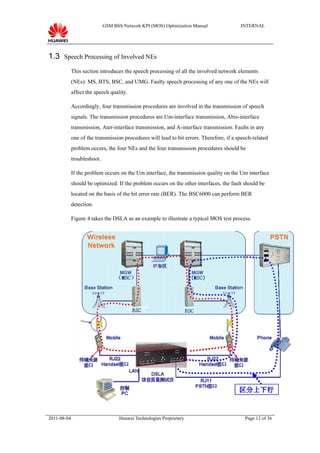
             Figure 4 takes the DSLA as an example to illustrate a typical MOS test process.


2011-08-04                          Huawei Technologies Proprietary                         Page 12 of 36
GSM BSS Network KPI (MOS) Optimization Manual                  INTERNAL


                                   Figure 1 Typical MOS test process


1.3.2 MS

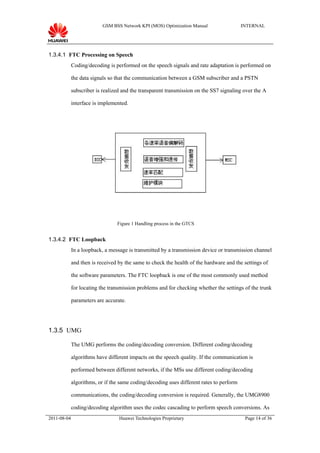
             Figure 5 shows the speech processing on the MS side.


      Session                      A/D     and      D/A                     Speech
      processing                   conversions                              coding/decoding, DTX


                                Figure 1 Speech processing on the MS side


1.3.3 BTS

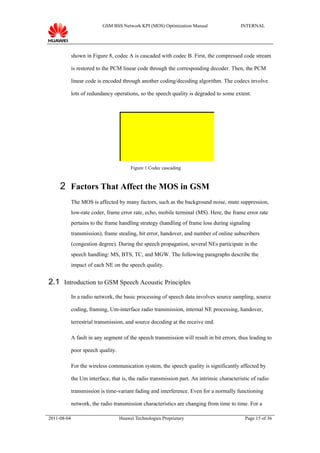
             On the BTS side, the TMU performs speech exchange with the BSC, and the DSP

             performs speech coding/decoding. Figure 6 shows the speech processing on the BTS

             side.


                               Figure 1 Speech processing on the BTS side


1.3.4 BSC

             The BSC modules other than the GTCS perform transparent transmission on the speech
             signals. Instead of participating in the speech coding/decoding, these modules are only
             responsible for the establishment of the speech channel, wiring, and speech connection.
             For the transparent transmission process, see the BSC6000 speech process figure.
2011-08-04                        Huawei Technologies Proprietary                           Page 13 of 36
GSM BSS Network KPI (MOS) Optimization Manual                  INTERNAL


1.3.4.1 FTC Processing on Speech
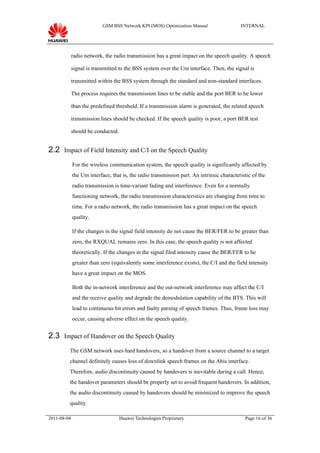
             Coding/decoding is performed on the speech signals and rate adaptation is performed on

             the data signals so that the communication between a GSM subscriber and a PSTN

             subscriber is realized and the transparent transmission on the SS7 signaling over the A

             interface is implemented.


                                 Figure 1 Handling process in the GTCS


1.3.4.2 FTC Loopback
             In a loopback, a message is transmitted by a transmission device or transmission channel

             and then is received by the same to check the health of the hardware and the settings of

             the software parameters. The FTC loopback is one of the most commonly used method

             for locating the transmission problems and for checking whether the settings of the trunk

             parameters are accurate.


1.3.5 UMG

             The UMG performs the coding/decoding conversion. Different coding/decoding

             algorithms have different impacts on the speech quality. If the communication is

             performed between different networks, if the MSs use different coding/decoding

             algorithms, or if the same coding/decoding uses different rates to perform

             communications, the coding/decoding conversion is required. Generally, the UMG8900

             coding/decoding algorithm uses the codec cascading to perform speech conversions. As
2011-08-04                        Huawei Technologies Proprietary                          Page 14 of 36
GSM BSS Network KPI (MOS) Optimization Manual                   INTERNAL


             shown in Figure 8, codec A is cascaded with codec B. First, the compressed code stream

             is restored to the PCM linear code through the corresponding decoder. Then, the PCM

             linear code is encoded through another coding/decoding algorithm. The codecs involve

             lots of redundancy operations, so the speech quality is degraded to some extent.


                                                                Decoder A
                                         Figure 1 Codec cascading


     2 Factors That Affect the MOS in GSM
             The MOS is affected by many factors, such as the background noise, mute suppression,
             low-rate coder, frame error rate, echo, mobile terminal (MS). Here, the frame error rate
             pertains to the frame handling strategy (handling of frame loss during signaling
             transmission), frame stealing, bit error, handover, and number of online subscribers
             (congestion degree). During the speech propagation, several NEs participate in the
             speech handling: MS, BTS, TC, and MGW. The following paragraphs describe the
             impact of each NE on the speech quality.


2.1 Introduction to GSM Speech Acoustic Principles
             In a radio network, the basic processing of speech data involves source sampling, source

             coding, framing, Um-interface radio transmission, internal NE processing, handover,

             terrestrial transmission, and source decoding at the receive end.

             A fault in any segment of the speech transmission will result in bit errors, thus leading to

             poor speech quality.


                                                                Encoder A
             For the wireless communication system, the speech quality is significantly affected by

             the Um interface, that is, the radio transmission part. An intrinsic characteristic of radio

             transmission is time-variant fading and interference. Even for a normally functioning

             network, the radio transmission characteristics are changing from time to time. For a

2011-08-04                          Huawei Technologies Proprietary                           Page 15 of 36
GSM BSS Network KPI (MOS) Optimization Manual                   INTERNAL


             radio network, the radio transmission has a great impact on the speech quality. A speech

             signal is transmitted to the BSS system over the Um interface. Then, the signal is

             transmitted within the BSS system through the standard and non-standard interfaces.

             The process requires the transmission lines to be stable and the port BER to be lower

             than the predefined threshold. If a transmission alarm is generated, the related speech

             transmission lines should be checked. If the speech quality is poor, a port BER test

             should be conducted.


2.2 Impact of Field Intensity and C/I on the Speech Quality
             For the wireless communication system, the speech quality is significantly affected by
             the Um interface, that is, the radio transmission part. An intrinsic characteristic of the
             radio transmission is time-variant fading and interference. Even for a normally
             functioning network, the radio transmission characteristics are changing from time to
             time. For a radio network, the radio transmission has a great impact on the speech
             quality.

             If the changes in the signal field intensity do not cause the BER/FER to be greater than
             zero, the RXQUAL remains zero. In this case, the speech quality is not affected
             theoretically. If the changes in the signal filed intensity cause the BER/FER to be
             greater than zero (equivalently some interference exists), the C/I and the field intensity
             have a great impact on the MOS.

             Both the in-network interference and the out-network interference may affect the C/I
             and the receive quality and degrade the demodulation capability of the BTS. This will
             lead to continuous bit errors and faulty parsing of speech frames. Thus, frame loss may
             occur, causing adverse effect on the speech quality.


2.3 Impact of Handover on the Speech Quality
         The GSM network uses hard handovers, so a handover from a source channel to a target
         channel definitely causes loss of downlink speech frames on the Abis interface.
         Therefore, audio discontinuity caused by handovers is inevitable during a call. Hence,
         the handover parameters should be properly set to avoid frequent handovers. In addition,
         the audio discontinuity caused by handovers should be minimized to improve the speech
         quality.

2011-08-04                          Huawei Technologies Proprietary                          Page 16 of 36
GSM BSS Network KPI (MOS) Optimization Manual                INTERNAL


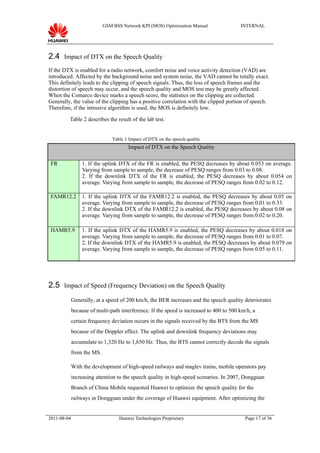
2.4 Impact of DTX on the Speech Quality
If the DTX is enabled for a radio network, comfort noise and voice activity detection (VAD) are
introduced. Affected by the background noise and system noise, the VAD cannot be totally exact.
This definitely leads to the clipping of speech signals. Thus, the loss of speech frames and the
distortion of speech may occur, and the speech quality and MOS test may be greatly affected.
When the Comarco device marks a speech score, the statistics on the clipping are collected.
Generally, the value of the clipping has a positive correlation with the clipped portion of speech.
Therefore, if the intrusive algorithm is used, the MOS is definitely low.

         Table 2 describes the result of the lab test.


                                Table 1 Impact of DTX on the speech quality
                                       Impact of DTX on the Speech Quality

 FR              1. If the uplink DTX of the FR is enabled, the PESQ decreases by about 0.053 on average.
                 Varying from sample to sample, the decrease of PESQ ranges from 0.03 to 0.08.
                 2. If the downlink DTX of the FR is enabled, the PESQ decreases by about 0.054 on
                 average. Varying from sample to sample, the decrease of PESQ ranges from 0.02 to 0.12.

 FAMR12.2        1. If the uplink DTX of the FAMR12.2 is enabled, the PESQ decreases by about 0.05 on
                 average. Varying from sample to sample, the decrease of PESQ ranges from 0.01 to 0.33.
                 2. If the downlink DTX of the FAMR12.2 is enabled, the PESQ decreases by about 0.08 on
                 average. Varying from sample to sample, the decrease of PESQ ranges from 0.02 to 0.20.

 HAMR5.9         1. If the uplink DTX of the HAMR5.9 is enabled, the PESQ decreases by about 0.018 on
                 average. Varying from sample to sample, the decrease of PESQ ranges from 0.01 to 0.07.
                 2. If the downlink DTX of the HAMR5.9 is enabled, the PESQ decreases by about 0.079 on
                 average. Varying from sample to sample, the decrease of PESQ ranges from 0.05 to 0.11.


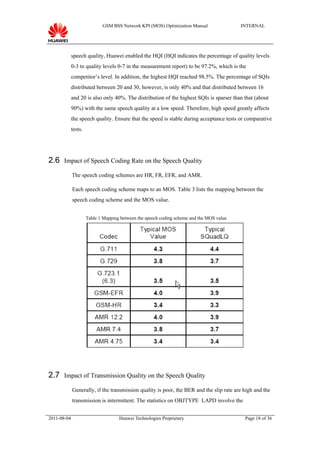
2.5 Impact of Speed (Frequency Deviation) on the Speech Quality
             Generally, at a speed of 200 km/h, the BER increases and the speech quality deteriorates
             because of multi-path interference. If the speed is increased to 400 to 500 km/h, a
             certain frequency deviation occurs in the signals received by the BTS from the MS
             because of the Doppler effect. The uplink and downlink frequency deviations may
             accumulate to 1,320 Hz to 1,650 Hz. Thus, the BTS cannot correctly decode the signals
             from the MS.

             With the development of high-speed railways and maglev trains, mobile operators pay
             increasing attention to the speech quality in high-speed scenarios. In 2007, Dongguan
             Branch of China Mobile requested Huawei to optimize the speech quality for the
             railways in Dongguan under the coverage of Huawei equipment. After optimizing the


2011-08-04                         Huawei Technologies Proprietary                         Page 17 of 36
GSM BSS Network KPI (MOS) Optimization Manual                 INTERNAL


             speech quality, Huawei enabled the HQI (HQI indicates the percentage of quality levels
             0-3 to quality levels 0-7 in the measurement report) to be 97.2%, which is the
             competitor’s level. In addition, the highest HQI reached 98.5%. The percentage of SQIs
             distributed between 20 and 30, however, is only 40% and that distributed between 16
             and 20 is also only 40%. The distribution of the highest SQIs is sparser than that (about
             90%) with the same speech quality at a low speed. Therefore, high speed greatly affects
             the speech quality. Ensure that the speed is stable during acceptance tests or comparative
             tests.


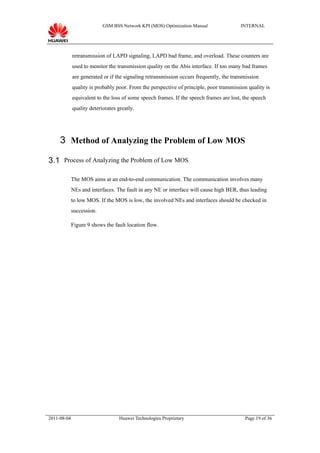
2.6 Impact of Speech Coding Rate on the Speech Quality
             The speech coding schemes are HR, FR, EFR, and AMR.

             Each speech coding scheme maps to an MOS. Table 3 lists the mapping between the
             speech coding scheme and the MOS value.


                      Table 1 Mapping between the speech coding scheme and the MOS value


2.7 Impact of Transmission Quality on the Speech Quality
             Generally, if the transmission quality is poor, the BER and the slip rate are high and the
             transmission is intermittent. The statistics on OBJTYPE LAPD involve the


2011-08-04                           Huawei Technologies Proprietary                        Page 18 of 36
GSM BSS Network KPI (MOS) Optimization Manual                INTERNAL


             retransmission of LAPD signaling, LAPD bad frame, and overload. These counters are
             used to monitor the transmission quality on the Abis interface. If too many bad frames
             are generated or if the signaling retransmission occurs frequently, the transmission
             quality is probably poor. From the perspective of principle, poor transmission quality is
             equivalent to the loss of some speech frames. If the speech frames are lost, the speech
             quality deteriorates greatly.


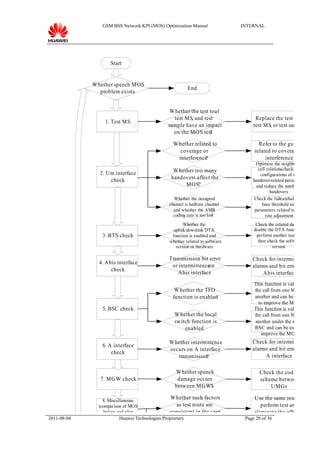
     3 Method of Analyzing the Problem of Low MOS

3.1 Process of Analyzing the Problem of Low MOS

             The MOS aims at an end-to-end communication. The communication involves many
             NEs and interfaces. The fault in any NE or interface will cause high BER, thus leading
             to low MOS. If the MOS is low, the involved NEs and interfaces should be checked in
             succession.

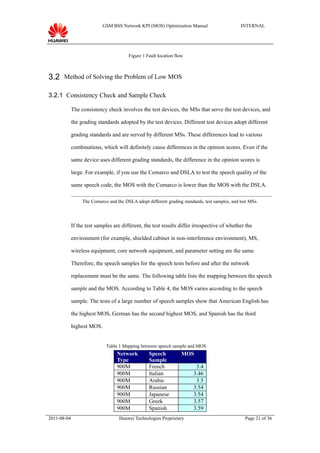
             Figure 9 shows the fault location flow.


2011-08-04                        Huawei Technologies Proprietary                         Page 19 of 36
GSM BSS Network KPI (MOS) Optimization Manual                 INTERNAL


                     Start


             W hether speech MOS
                                                          End
                problem exists


                                                 W hether the test tool
                                                                     ,
                                                  test MS, and test                 Replace the test tool
                                                                                                        ,
                  1. Test MS
                                                sample have an impact              test MS, or test sample
                                                  on the MOS test  ?

                                                   W hether related to                Refer to the guide
                                                      coverage or                   related to coverage or
                                                     interference?                       interference
                                                                                     Optimize the neighboring
                                                   W hether too many                  cell relations check the
                                                                                                   ,
               2. Um interface                                                         configurations of the
                   check                          handovers affect the             handover-related parameters   ,
                                                        MOS?                         and reduce the number of
                                                                                             handovers
                                                   Whether the occupied             Check the full-rate/half-rate
                                                 channel is halfrate channel
                                                               -                        busy threshold and
                                                   and whether the AMR              parameters related to AMR
                                                   coding rate is too low
                                                                        ?                 rate adjustment
                                                       Whether the                  Check the related data and
                                                  uplink/downlink DTX              disable the DTX function to
                 3. BTS check                     function is enabled and            perform another testand
                                                                                                        ,
                                                 whether related to software          then check the software
                                                   version or hardware                       version

                                                 Transmission bit error            Check for intermittence
               4. Abis interface
                                                  or intermittenceon               alarms and bit errors on
                    check
                                                     Abis interface                    Abis interface
                                                                                    This function is valid for
                                                    W hether the TFO                the call from one MS to
                                                   function is enabled              another and can be used
                                                                                      to improve the MOS
                 5. BSC check                                                       This function is valid for
                                                   W hether the local               the call from one MS to
                                                   switch function is               another under the same
                                                       enabled                      BSC and can be used to
                                                                                       improve the MOS
                                                 W hether intermittence            Check for intermittence
                 6. A interface
                                                 occurs on A interface             alarms and bit errors on
                     check
                                                    transmission?                       A interface

                                                    W hether speech                   Check the coding
                7. MGW check                         damage occurs                    scheme between
                                                    between MGW?  s                       UMGs

                 8. Miscellaneous
                                                 W hether such factors              Use the same route to
               (comparison of MOS                      as test route are               perform test and
                  before and after                  consistent in the case          eliminate the effect of
2011-08-04     network replacement
                          Huawei )                   of comparison test
                                   Technologies Proprietary              ?      Page 20 different factors
                                                                                        of 36

                                                                                    Use the same test speed in
                                                  W hether test speed              the case of comparison test
                                                                                                             .
                                                 (frequency deviation)               The frequency deviation
                                                    has an impact on               algorithm should be enabled
                                                                                     for the BTS if test speed
GSM BSS Network KPI (MOS) Optimization Manual                       INTERNAL


                                        Figure 1 Fault location flow


3.2 Method of Solving the Problem of Low MOS

3.2.1 Consistency Check and Sample Check

             The consistency check involves the test devices, the MSs that serve the test devices, and

             the grading standards adopted by the test devices. Different test devices adopt different

             grading standards and are served by different MSs. These differences lead to various

             combinations, which will definitely cause differences in the opinion scores. Even if the

             same device uses different grading standards, the difference in the opinion scores is

             large. For example, if you use the Comarco and DSLA to test the speech quality of the

             same speech code, the MOS with the Comarco is lower than the MOS with the DSLA.

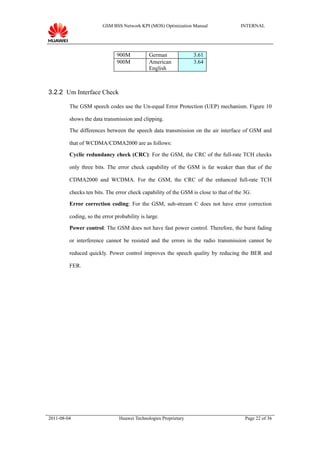
                  The Comarco and the DSLA adopt different grading standards, test samples, and test MSs.


             If the test samples are different, the test results differ irrespective of whether the

             environment (for example, shielded cabinet in non-interference environment), MS,

             wireless equipment, core network equipment, and parameter setting are the same.

             Therefore, the speech samples for the speech tests before and after the network

             replacement must be the same. The following table lists the mapping between the speech

             sample and the MOS. According to Table 4, the MOS varies according to the speech

             sample. The tests of a large number of speech samples show that American English has

             the highest MOS, German has the second highest MOS, and Spanish has the third

             highest MOS.


                             Table 1 Mapping between speech sample and MOS
                                   Network         Speech          MOS
                                   Type            Sample
                                   900M            French                 3.4
                                   900M            Italian               3.46
                                   900M            Arabic                 3.5
                                   900M            Russian               3.54
                                   900M            Japanese              3.54
                                   900M            Greek                 3.57
                                   900M            Spanish               3.59
2011-08-04                          Huawei Technologies Proprietary                               Page 21 of 36
GSM BSS Network KPI (MOS) Optimization Manual                 INTERNAL


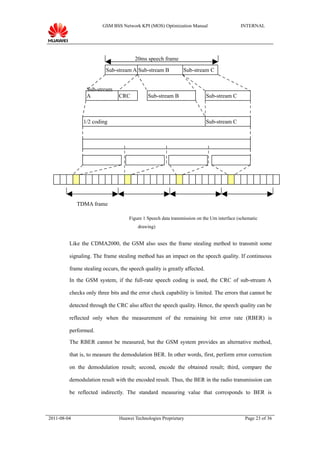
                               900M           German              3.61
                               900M           American            3.64
                                              English


3.2.2 Um Interface Check

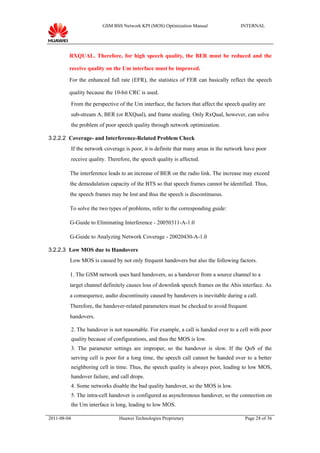
         The GSM speech codes use the Un-equal Error Protection (UEP) mechanism. Figure 10

         shows the data transmission and clipping.

         The differences between the speech data transmission on the air interface of GSM and

         that of WCDMA/CDMA2000 are as follows:

         Cyclic redundancy check (CRC): For the GSM, the CRC of the full-rate TCH checks

         only three bits. The error check capability of the GSM is far weaker than that of the

         CDMA2000 and WCDMA. For the GSM, the CRC of the enhanced full-rate TCH

         checks ten bits. The error check capability of the GSM is close to that of the 3G.

         Error correction coding: For the GSM, sub-stream C does not have error correction

         coding, so the error probability is large.

         Power control: The GSM does not have fast power control. Therefore, the burst fading

         or interference cannot be resisted and the errors in the radio transmission cannot be

         reduced quickly. Power control improves the speech quality by reducing the BER and

         FER.


2011-08-04                      Huawei Technologies Proprietary                         Page 22 of 36
GSM BSS Network KPI (MOS) Optimization Manual                      INTERNAL


                                       20ms speech frame

                         Sub-stream A Sub-stream B             Sub-stream C


                Sub-stream
                A              CRC           Sub-stream B                 Sub-stream C


               1/2 coding                                                 Sub-stream C


             TDMA frame

                                    Figure 1 Speech data transmission on the Um interface (schematic
                                        drawing)


         Like the CDMA2000, the GSM also uses the frame stealing method to transmit some

         signaling. The frame stealing method has an impact on the speech quality. If continuous

         frame stealing occurs, the speech quality is greatly affected.

         In the GSM system, if the full-rate speech coding is used, the CRC of sub-stream A

         checks only three bits and the error check capability is limited. The errors that cannot be

         detected through the CRC also affect the speech quality. Hence, the speech quality can be

         reflected only when the measurement of the remaining bit error rate (RBER) is

         performed.

         The RBER cannot be measured, but the GSM system provides an alternative method,

         that is, to measure the demodulation BER. In other words, first, perform error correction

         on the demodulation result; second, encode the obtained result; third, compare the

         demodulation result with the encoded result. Thus, the BER in the radio transmission can

         be reflected indirectly. The standard measuring value that corresponds to BER is


2011-08-04                     Huawei Technologies Proprietary                               Page 23 of 36
GSM BSS Network KPI (MOS) Optimization Manual                 INTERNAL


         RXQUAL. Therefore, for high speech quality, the BER must be reduced and the

         receive quality on the Um interface must be improved.

         For the enhanced full rate (EFR), the statistics of FER can basically reflect the speech

         quality because the 10-bit CRC is used.

             From the perspective of the Um interface, the factors that affect the speech quality are
             sub-stream A, BER (or RXQual), and frame stealing. Only RxQual, however, can solve
             the problem of poor speech quality through network optimization.

3.2.2.2 Coverage- and Interference-Related Problem Check
             If the network coverage is poor, it is definite that many areas in the network have poor
             receive quality. Therefore, the speech quality is affected.

         The interference leads to an increase of BER on the radio link. The increase may exceed
         the demodulation capacity of the BTS so that speech frames cannot be identified. Thus,
         the speech frames may be lost and thus the speech is discontinuous.

         To solve the two types of problems, refer to the corresponding guide:

         G-Guide to Eliminating Interference - 20050311-A-1.0

         G-Guide to Analyzing Network Coverage - 20020430-A-1.0

3.2.2.3 Low MOS due to Handovers
         Low MOS is caused by not only frequent handovers but also the following factors.

         1. The GSM network uses hard handovers, so a handover from a source channel to a
         target channel definitely causes loss of downlink speech frames on the Abis interface. As
         a consequence, audio discontinuity caused by handovers is inevitable during a call.
         Therefore, the handover-related parameters must be checked to avoid frequent
         handovers.

             2. The handover is not reasonable. For example, a call is handed over to a cell with poor
             quality because of configurations, and thus the MOS is low.
             3. The parameter settings are improper, so the handover is slow. If the QoS of the
             serving cell is poor for a long time, the speech call cannot be handed over to a better
             neighboring cell in time. Thus, the speech quality is always poor, leading to low MOS,
             handover failure, and call drops.
             4. Some networks disable the bad quality handover, so the MOS is low.
             5. The intra-cell handover is configured as asynchronous handover, so the connection on
             the Um interface is long, leading to low MOS.

2011-08-04                         Huawei Technologies Proprietary                         Page 24 of 36
GSM BSS Network KPI (MOS) Optimization Manual                 INTERNAL


3.2.2.4 Occupation Ratios of Half Rate and Low AMR Rate
             All the MOS tests using the PESQ algorithm adopt intrusive speech scores, which are

             process values. If the existing network has several types of speech coding, the conduct

             of speech quality DT test or CQT test leads to channel handovers and AMR speech

             coding rate handovers. Several types of speech coding may be involved in the speech

             grading process. Therefore, the network speech quality test is performed on different

             types of speech coding. The speech quality test value of the high coding rate is low, and

             the speech quality test value of the low coding rate is high. When the transmission

             quality on the Um interface is stable, the MOS is low if the occupation ratio of the half

             rate is high. Therefore, the full rate and the high AMR rate coding are recommended.


3.2.3 BTS Check

3.2.3.1 Software Version Check
             Check for the version-related problems that have been detected.

             The old BTS uses a too early version and is incompatible with the new BTS, so the

             speech problems occur.

3.2.3.2 Whether the Uplink and Downlink DTX Function Is Enabled
             DTX means VAD and silent frames. Replacing the speech with silent frames is a kind of
             distortion, which brings about difficulties for all the perceptual models to predict the
             MOS. Generally, the 50ms clipping (VAD) at the front end and rear end does not have a
             great impact on the subjective impression. In the case of clipping during the speech,
             however, replacing the speech with silent frames after the packet loss significantly
             affects the subjective impression. If 50 ms is lost, the MOS is decreased by one. For the
             PESQ, each 50ms clipping generally leads to the decrease in the MOS of about 0.5,
             irrespective of the location. The VAD cannot be 100% correct, so the speech quality
             definitely deteriorates if the uplink and downlink DTX function is enabled during the
             MOS test.

3.2.3.3 Hardware Factors
The audio discontinuity caused by BTS hardware fault affects the MOS. Bugs in the speech
processing part of the hardware also affect the speech quality. You are advised to confirm with the
R&D personnel that no identified problems exist in the version.


2011-08-04                        Huawei Technologies Proprietary                         Page 25 of 36
GSM BSS Network KPI (MOS) Optimization Manual                  INTERNAL


3.2.4 Abis Transmission Check

             The networks built by Huawei cover many parts of the world. The development levels
             of the basic communication and data communication vary from region to region. In
             addition, the cost of investing and leasing the transmission lines is high. Therefore,
             different regions use different transmission types: microwave transmission, circuit
             transmission, optical transmission, and satellite transmission. Here, the quality of
             microwave transmission is very prone to weather conditions. Different BERs of
             different transmission types definitely lead to different transmission quality. Therefore,
             different networks of different mobile operators should be compared on the basis of the
             same transmission type.

             The alarms to be checked include Broken LAPD Link and Excessive Loss of E1/T1
             Signals in an Hour.

             In addition, the Monitoring the Port BER function of the BSC and BER tester (E7580A)
             can be used to check whether the Abis interface has bit errors.

3.2.5 BSC Check

3.2.5.1 Whether the TFO and EC Functions Are Enabled
             During a call from an MS to another, if the calling MS and called MS use the same
             speech service type, the times of speech coding/decoding can be reduced by one through
             in-band signaling negotiation. Thus, the speech quality can be improved. When the EC
             function is enabled, the speech quality can be improved if the echo occurs during the
             call. If there is no bit error, enabling the TFO function can improve the speech quality
             by more than 0.25 score.


            Table 1 Impact of TFO on the improvement of speech quality (GSM Rec. 06.85)
         DMOS                 EP0                        EP1                       EP2
          HR                   .85                       .68                        .39
          FR                   .53                       .53                        .35
          EFR                  .32                       .46                        .19


3.2.5.2 Whether Local Switch Is Enabled
             The local switch consists of BSC local switch and BTS local switch. For the BSC local
             switch, the calling MS and called MS should be served by the same BSC. Thus, the Ater
             interface and local transmission resources are saved. For the BTS local switch, the
             calling MS and called MS should be served by the same BTS or BTS group. Thus, the
             Ater interface and Abis interface transmission resources are saved. When the BSC local
             switching is used, the TC coding/decoding is not required if the transcoding function is

2011-08-04                         Huawei Technologies Proprietary                          Page 26 of 36
GSM BSS Network KPI (MOS) Optimization Manual               INTERNAL


             implemented in the core network, thus improving the speech quality. When the BTS
             local switching is used, the TC coding/decoding is not required because the speech
             signals do not pass the BSC. This also improves the speech quality.

3.2.6 A Interface Transmission Check

             The rules for checking the A interface transmission is similar to those for checking the
             Abis interface transmission. You can refer to the section Abis Transmission Check.
             To check the A interface transmission, you have two methods: first, query the BSC
             alarms (for example, the Loss of E1/T1 Signals alarm) to determine whether
             intermittence occurs on the A interface; second, use a BER tester to check whether bit
             errors occur on the A interface transmission.

3.2.7 MGW Check

             If this problem does not occur when you use an MS to call another MS during the MOS
             test, you can skip this section.

             As is mentioned in section UMG, if the communication is performed between different
             networks, if the MSs use different coding/decoding algorithms, or if the same
             coding/decoding uses different rates to perform communications, the coding/decoding
             conversion is required. The inter-code conversion, however, may adversely affect the
             speech quality.

             Therefore, if you use an MS to call a fixed-line phone during the MOS test, you should
             check whether the deterioration of the speech quality is caused by the following:
             whether the route between the MS and the fixed-line phone passes through two UMGs
             and whether the two UMGs use the speech compression algorithm.

3.2.8 Miscellaneous (Comparison of MOS Before and After Network Replacement)

             In a network replacement project, if the MOS deviation occurs before and after the
             network replacement, the following factors should be considered:

3.2.8.1 Test Speed
             Generally, the drive speed should be stable (at about 30 km/h) during the test. If the
             drive speed is low, the test is equivalent to the fixed-point CQT test and thus the test
             result is high.

             In addition, if the drive speed is high (at more than 200 km/h), the generated frequency

2011-08-04                            Huawei Technologies Proprietary                        Page 27 of 36
GSM BSS Network KPI (MOS) Optimization Manual                  INTERNAL


             deviation affects the speech quality. In this case, the BTS frequency deviation algorithm
             should be enabled to improve the speech quality.

3.2.8.2 Test Route and Test Time
             The DT test of speech quality objectively reflects the coverage and receive quality of a
             network. In a network, it is definite that some areas have good speech quality and other
             areas have poor speech quality. During the DT test of speech quality, the trunk coverage
             lines of the target network should be tested completely and the important branch lines
             should also be tested. A test route should not be tested repeatedly. If you test the areas
             with good speech quality repeatedly, the speech quality in the DT test becomes high. If
             you test the areas with poor speech quality repeatedly, the speech quality in the DT test
             becomes low.

             You should also check whether the test time is consistent. In different periods, the traffic
             models of the existing network are different. The busy traffic hours in each day occur
             regularly. Therefore, the congestion during traffic peaks is heavy, thus causing more in-
             network interference. According to the statistics about the receive quality on the Um
             interface, the receive quality deteriorates during busy hours and the corresponding SQI
             decreases. Therefore, to ensure the test consistency, you are advised to choose the same
             test period.

             For example, Huawei has conducted comparison tests at 4:00 a.m. and 9:00 p.m (busy
             hour) in Tieling. The results show that the QoS on the Um interface in the early morning
             is very good and that during busy hours is very poor. Accordingly, the speech quality in
             the early morning is good and that during busy hours is poor. Therefore, the same test
             periods should be selected for the comparison test.

3.2.8.3 Frequency Reuse Degree
             For mobile communications, frequency is the most important resource. With the rapid
             development of mobile communications, the number of mobile subscribers increases
             sharply. To meet the increasing capacity requirements, all the mobile operators try to
             raise the frequency reuse degree within their own frequency bands. The increase of the
             frequency reuse degree, however, definitely brings about large network interference. If
             the frequency reuse degree is high, the interference is strong. Thus, the network quality
             is poor and the speech quality is poor. This may adversely affect the user experience.
             Therefore, the speech quality of the mobile operators with different frequency reuse
             degrees cannot be compared directly. For example, China Unicom adopts a plan with

2011-08-04                         Huawei Technologies Proprietary                           Page 28 of 36
GSM BSS Network KPI (MOS) Optimization Manual               INTERNAL


             high frequency reuse degree to reach the same cell configuration of BTSs for China
             Mobile, so the speech quality of China Unicom is definitely lower than that of China
             Mobile. In a word, if the frequency reuse degree is high, the test MOS is low.

3.2.8.4 Engineering Installation Quality Issues
             According to the experience, check that the connector (on the DDF) on each
             transmission segment is properly connected and that there are no exposed stubs. For
             optical transmission, check that optical connector is clean and that the transmission BER
             is not high.
             The poor engineering quality in the antenna system also causes the MOS to decrease.
             The speech quality may deteriorate because of errors in engineering installation, for
             example, loose connector, misconnection, or poor coverage.


     4 Test Methods and Suggestions

4.1 Test Tool Selection and Test Suggestions

             1. Normally, the test tools are selected according to the requirements of the mobile
             operators. At present, China Mobile accepts the PESQ as the evaluation standard of the
             existing network and Ding Li or Hua Xing as the test tool. The overseas mobile
             operators use different evaluation standards and use such test tools as DSLA, Cormarco,
             and QVOICE.
             2. During the bidding, the acceptance standard, test tool, speech sample, acceptance area
             (recommended to exclude the suburb areas with poor coverage), calling method, test
             duration, test time, and test route are determined for the convenience of future
             acceptance.


4.2 Suggestions on the Test of the Existing Network

             1.   It is recommended that you use short call samples as the test samples to avoid some
                  blind areas or poor-coverage areas. For the network that has good coverage and that
                  does not require frequent handovers, long call samples are recommended.
             2.   Both Nokia6680 and Samsung zx10 can be used as the test MSs. Note that
                  Nokia6680 does not support half rate and has outdoor antenna (no vehicle body
                  loss) and that Samsung zx10 supports half rate and does not have outdoor antenna.
                  In the case of outdoor antenna (vehicle body loss should be considered), it is
                  recommended that Nokia6680 be used as the test MS.

2011-08-04                         Huawei Technologies Proprietary                        Page 29 of 36
GSM BSS Network KPI (MOS) Optimization Manual                 INTERNAL


             3.   The areas with good coverage and only a few handovers should be selected as the
                  test routes.
             4.   During the test, it is recommended that you use an MS to call a fixed-line phone.
                  Thus, the MOS is high.
             5.   The DTX function should be disabled.
             6.   The drive speed during the drive test should not be too high.
             7.   It is recommended that the idle hours be selected as the test time. Thus, the network
                  C/I is high.
             8.   During the test, it is recommended that the channels with good speech coding
                  quality be occupied, for example, EFR and AMR full-rate channels.
             9.   The TFO function should be enabled if the version is correct. Note that the TFO
                  function is valid only for the call from an MS to another.


     5 MOS Cases
5.1 Differences Between Speech Signal Process and Signaling Process
5.1.1 GSM Speech Signal Process

             MS-BTS - GEIUB-GTNU-GEIUT-GEIUT- GTNU-GDSUC-GTNU-GEIUA-MSC…

             MS


                                 Figure 1 BSC6000 speech signal process


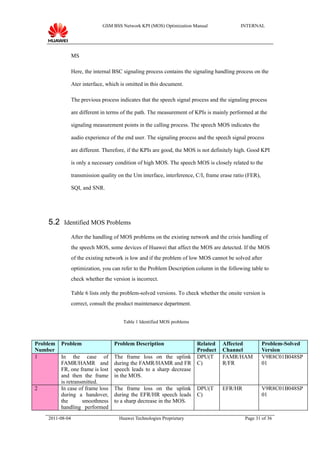
5.1.2 Signaling Process

             MS-BTS - GEIUB-GGNU-GXPUM -GGNU-GEIUT-GEIUT-GTNU-GEIUA –MSC…


2011-08-04                        Huawei Technologies Proprietary                          Page 30 of 36
GSM BSS Network KPI (MOS) Optimization Manual                 INTERNAL


                 MS

                 Here, the internal BSC signaling process contains the signaling handling process on the

                 Ater interface, which is omitted in this document.

                 The previous process indicates that the speech signal process and the signaling process

                 are different in terms of the path. The measurement of KPIs is mainly performed at the

                 signaling measurement points in the calling process. The speech MOS indicates the

                 audio experience of the end user. The signaling process and the speech signal process

                 are different. Therefore, if the KPIs are good, the MOS is not definitely high. Good KPI

                 is only a necessary condition of high MOS. The speech MOS is closely related to the

                 transmission quality on the Um interface, interference, C/I, frame erase ratio (FER),

                 SQI, and SNR.


    5.2 Identified MOS Problems
                 After the handling of MOS problems on the existing network and the crisis handling of
                 the speech MOS, some devices of Huawei that affect the MOS are detected. If the MOS
                 of the existing network is low and if the problem of low MOS cannot be solved after
                 optimization, you can refer to the Problem Description column in the following table to
                 check whether the version is incorrect.

                 Table 6 lists only the problem-solved versions. To check whether the onsite version is
                 correct, consult the product maintenance department.


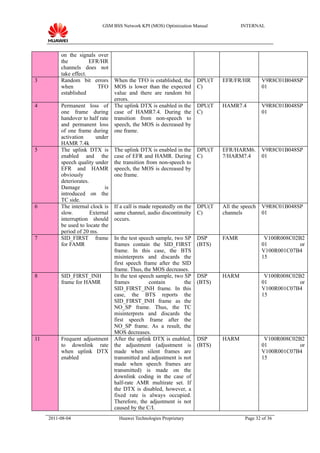
                                        Table 1 Identified MOS problems


Problem   Problem                   Problem Description                   Related   Affected             Problem-Solved
Number                                                                    Product   Channel              Version
1         In the case of            The frame loss on the uplink          DPU(T     FAMR/HAM             V9R8C01B048SP
          FAMR/HAMR and             during the FAMR/HAMR and FR           C)        R/FR                 01
          FR, one frame is lost     speech leads to a sharp decrease
          and then the frame        in the MOS.
          is retransmitted.
2         In case of frame loss     The frame loss on the uplink          DPU(T     EFR/HR               V9R8C01B048SP
          during a handover,        during the EFR/HR speech leads        C)                             01
          the       smoothness      to a sharp decrease in the MOS.
          handling performed
    2011-08-04                        Huawei Technologies Proprietary                          Page 31 of 36
GSM BSS Network KPI (MOS) Optimization Manual              INTERNAL


          on the signals over
          the          EFR/HR
          channels does not
          take effect.
3         Random bit errors        When the TFO is established, the      DPU(T   EFR/FR/HR        V9R8C01B048SP
          when            TFO      MOS is lower than the expected        C)                       01
          established              value and there are random bit
                                   errors.
4         Permanent loss of        The uplink DTX is enabled in the      DPU(T   HAMR7.4          V9R8C01B048SP
          one frame during         case of HAMR7.4. During the           C)                       01
          handover to half rate    transition from non-speech to
          and permanent loss       speech, the MOS is decreased by
          of one frame during      one frame.
          activation      under
          HAMR 7.4k
5         The uplink DTX is        The uplink DTX is enabled in the      DPU(T   EFR/HARM6.       V9R8C01B048SP
          enabled and the          case of EFR and HAMR. During          C)      7/HARM7.4        01
          speech quality under     the transition from non-speech to
          EFR and HAMR             speech, the MOS is decreased by
          obviously                one frame.
          deteriorates.
          Damage              is
          introduced on the
          TC side.
6         The internal clock is    If a call is made repeatedly on the   DPU(T   All the speech   V9R8C01B048SP
          slow.         External   same channel, audio discontinuity     C)      channels         01
          interruption should      occurs.
          be used to locate the
          period of 20 ms.
7         SID_FIRST frame          In the test speech sample, two SP     DSP     FAMR              V100R008C02B2
          for FAMR                 frames contain the SID_FIRST          (BTS)                    01           or
                                   frame. In this case, the BTS                                   V100R001C07B4
                                   misinterprets and discards the                                 15
                                   first speech frame after the SID
                                   frame. Thus, the MOS decreases.
8         SID_FIRST_INH            In the test speech sample, two SP     DSP     HARM              V100R008C02B2
          frame for HAMR           frames          contain        the    (BTS)                    01           or
                                   SID_FIRST_INH frame. In this                                   V100R001C07B4
                                   case, the BTS reports the                                      15
                                   SID_FIRST_INH frame as the
                                   NO_SP frame. Thus, the TC
                                   misinterprets and discards the
                                   first speech frame after the
                                   NO_SP frame. As a result, the
                                   MOS decreases.
11        Frequent adjustment      After the uplink DTX is enabled,      DSP     HARM              V100R008C02B2
          to downlink rate         the adjustment (adjustment is         (BTS)                    01           or
          when uplink DTX          made when silent frames are                                    V100R001C07B4
          enabled                  transmitted and adjustment is not                              15
                                   made when speech frames are
                                   transmitted) is made on the
                                   downlink coding in the case of
                                   half-rate AMR multirate set. If
                                   the DTX is disabled, however, a
                                   fixed rate is always occupied.
                                   Therefore, the adjustment is not
                                   caused by the C/I.
     2011-08-04                      Huawei Technologies Proprietary                      Page 32 of 36
GSM BSS Network KPI (MOS) Optimization Manual                 INTERNAL


12        Reporting       of         During       the      synchronous    DSP         All the speech      V100R008C02B2
          HO_DET ahead of            handover, the HO_DET is              (BTS)       channels           01           or
          time        during         reported ahead of time. Thus, the                                   V100R001C07B4
          synchronous                uplink speech frames on the old                                     15
          handover                   channel are lost and the handover
                                     disruption     is    long.    The
                                     occurrence possibility of this
                                     problem during the lab test is
                                     about 5%-10%.
13        One speech frame           During        the       intra-BSC    DSP         All the speech      V100R008C02B2
          lost on old channel        asynchronous handover, one           (BTS)       channels           01           or
          during asynchronous        frame out of the uplink speech                                      V100R001C07B4
          handover                   frames is lost. This problem                                        15
                                     occurs on the three types of MSs.
                                     The occurrence possibility of this
                                     problem during the lab test is
                                     about 30%-50%.


          6 Feedback on MOS or Speech Problems
                  To better compare the network quality before and after the network replacement, a
                  comprehensive test should be conducted before the network replacement and the trunk
                  roads, important branch roads, and important public places in the original network must
                  be tested. A test report on the original network should be provided. The test report
                  should include the following contents: RxQual (including the mean values, peak values,
                  and mean square errors), SQI (including the mean values, peak values, and mean square
                  errors), C/I (including the mean values, peak values, and mean square errors), test route
                  and speed, and dotted output figure (the dotted contents should be provided on the basis
                  of the previous three counters).


     6.1 Test Requirements
              1. Test time and periods: The test must be conducted at 9:00-12:00 and 17:00-20:00 on

                     workdays (Monday through Friday).

              2. The test routes must evenly cover the trunk roads in the urban areas without repeated

                     coverage. The round-the-city express ways, viaducts, and roads between the urban

                     areas and the air port must be tested.


     2011-08-04                        Huawei Technologies Proprietary                          Page 33 of 36
GSM BSS Network KPI (MOS) Optimization Manual                  INTERNAL


         3. In the urban areas, the test speed should equal the normal drive speed. No limitation

             is set on the test speed.

         4. Irrespective of the traffic, the city with a population of more than 500 thousand

             should be tested for three days and the city with a population of more than 200

             thousand should be tested for two days. The test should last six hours for each test

             day.

         5. Dialing requirements:

                        The test MSs should be located inside the vehicle and both the calling
                    MS and called MS should be connected to the test instruments. The GPS
                    receiver should be connected to conduct the test.
                        Both the GSM calling MS and called MS for the test should be of auto
                    dualband.
                        The MSs should be dialed mutually. The dialing, answering, and onhook
                    of the MSs should be automatic. Each call should last 180 seconds with a call
                    interval of 20 seconds. If call failure or call drop occurs, another call attempt
                    should be made after 20 seconds. The call interval is set according to the
                    requirements of the mobile operator.
         6. Daemon data analysis: All the tests must use the same test instruments and Daemon

             data processing software.

         7. Normally, the test tools are selected according to the requirements of the mobile

             operators. At present, China Mobile accepts the PESQ as the evaluation standard of

             the existing network and Hua Xing as the test tool. The overseas mobile operators

             use different evaluation standards and use such test tools as SwissQual, QVoice, and

             Cormarco.


         8. The evaluation of the Um interface on the existing network should be complete and
             the statistics on RxQual, C/I, and SQI should be provided. The three counters should
             have the mean values, peak values, mean square errors in different periods, and
             distribution interval list of different values. During the test, the GPS should be
             dotted and the log files of the TEMS test should be archived.

         9. When the network of several cities is replaced, the speech problems should be


2011-08-04                      Huawei Technologies Proprietary                          Page 34 of 36
GSM BSS Network KPI (MOS) Optimization Manual                 INTERNAL


             reported. For different cities, the test should be conducted according to the different

             requirements mentioned in this chapter. The test reports should be archived. The dot

             information about the local e-map should be provided for the future network

             optimization of the areas with poor quality.

             During each test, the mean speed per hour should be recorded and archived. Dot

             statistics can be performed on the GPS.


6.2 Requirements for Configuration Data in Existing Network
             The QoS of the existing Huawei network varies according to the economic
             development degree, network coverage, network user density, network density,
             network planning, frequency reuse degree, and external interference in the local
             area. Networks with different QoSs have different configurations and different
             configurations have different impacts on the network. For the R&D personnel to
             learn the existing network, the configurations of the existing network should be
             provided.

             Table 7 lists the network configuration parameters that should be provided.


                      Table 1 Network configuration parameters to be provided
                Network Configuration                                  Test Result
                Uplink/downlink DTX
                UL PC Allowed
                       DL PC Allowed

                       Radio frequency hopping
                       Baseband frequency hopping
              Transmit diversity
              TFO
              EC
              Whether the core network uses IP bearing
              Transmission mode of each interface
                       Frequency resources
                       Configuration of main BTS models
                       Setting of the handover threshold


2011-08-04                     Huawei Technologies Proprietary                         Page 35 of 36
GSM BSS Network KPI (MOS) Optimization Manual   INTERNAL


                      Setting of the power control threshold
             Setting of the coding rate and the use proportion
             RxQual in the drive test of the entire network
             SQI in the drive test of the entire network
             C/I in the drive test of the entire network


2011-08-04                   Huawei Technologies Proprietary           Page 36 of 36

61607619

  • 1.
    GSM BSS NetworkKPI (MOS) Optimization Manual INTERNAL Product Name Confidentiality Level GSM BSS INTERNAL Product Version Total 36 pages V00R01 GSM BSS Network KPI (MOS) Optimization Manual For internal use only Prepared by GSM&UMTS Network Dong Date 2008-2-21 Performance Research Xuan Department Reviewed by Date yyyy-mm-dd Reviewed by Date yyyy-mm-dd Granted by Date yyyy-mm-dd Huawei Technologies Co., Ltd. All rights reserved 2011-08-04 Huawei Technologies Proprietary Page 1 of 36
  • 2.
    GSM BSS NetworkKPI (MOS) Optimization Manual INTERNAL Revision Record Date Revision Change Description Author Version 2008-1-21 0.9 Draft completed. Dong Xuan 2008-3-20 1.0 The document is modified Wang Fei according to review comments. 2011-08-04 Huawei Technologies Proprietary Page 2 of 36
  • 3.
    GSM BSS NetworkKPI (MOS) Optimization Manual INTERNAL GSM BSS Network KPI (MOS) Optimization Manual Key words: MOS, interference, BER, C/I, power control, DTX, frequency hopping, PESQ, PSQM /PSQM+, PAMS Abstract: With the development of the radio network, mobile operators become more focused on end users’ experience instead of key performance indicators (KPIs). The improvement of the end users’ experience and the improvement of the network capacity are regarded as KPIs. Therefore, Huawei must pay close attention to the improvement of the soft capability of the network quality as well as the fulfillment of KPIs. At present, there are three methods of evaluating the speech quality: subjective evaluation, objective evaluation, and estimation. Among the three methods, objective evaluation is the most accurate. The PESQ algorithm defined by the ITU can objectively evaluate the speech quality of the communication network. This document uses the mean opinion score (MOS) to label the speech quality after objective evaluation. This document describes the factors of MOS, the impact of each factor on the MOS, and the methods of improving the network QoS and then the speech quality. It also describes the attention points during the test of speech quality of the existing network and the device capability value of the lab test. In addition, this document introduces the differences between the speech test tools. The methods and principles of using the test tools are omitted. This document serves as a reference to the acceptance of network KPIs and the marketing bidding. References: ITU-T P.800 ITU-T P.830 ITU-T P.861 ITU-T P.862ITU-T P.853 List of acronyms: Acronym Expansion MOS Mean Opinion Score PESQ Perceptual Evaluation of Speech Quality PSQM Perceptual Speech Quality Measurement PAMS Perceptual Analyse Measurement Sytem 2011-08-04 Huawei Technologies Proprietary Page 3 of 36
  • 4.
    GSM BSS NetworkKPI (MOS) Optimization Manual INTERNAL Contents 1 Basic Principles of MOS..................................................................................................................8 1.1 Subjective Speech Quality Evaluation......................................................................................8 1.2 Objective Speech Quality Evaluation.....................................................................................9 1.2.1 PSQM (P.861) Recommendation or Algorithm.........................................................9 1.2.2 PESQ (P.862) Recommendation or Algorithm.........................................................9 1.2.3 P862.1 Recommendation (Mapping Function for Transforming)...........................10 1.2.4 P.563 Recommendation.........................................................................................11 1.3 Speech Processing of Involved NEs.....................................................................................12 1.3.2 MS 13 1.3.3 BTS 13 1.3.4 BSC 13 1.3.5 UMG14 2 Factors That Affect the MOS in GSM.........................................................................................15 2.1 Introduction to GSM Speech Acoustic Principles................................................................15 2.2 Impact of Field Intensity and C/I on the Speech Quality.....................................................16 2.3 Impact of Handover on the Speech Quality..........................................................................16 2.4 Impact of DTX on the Speech Quality..................................................................................17 2.5 Impact of Speed (Frequency Deviation) on the Speech Quality..........................................17 2.6 Impact of Speech Coding Rate on the Speech Quality.........................................................18 2.7 Impact of Transmission Quality on the Speech Quality.......................................................18 3 Method of Analyzing the Problem of Low MOS........................................................................19 3.1 Process of Analyzing the Problem of Low MOS..................................................................19 3.2 Method of Solving the Problem of Low MOS......................................................................21 3.2.1 Consistency Check and Sample Check.................................................................21 3.2.2 Um Interface Check................................................................................................22 3.2.3 BTS Check.............................................................................................................25 3.2.4 Abis Transmission Check.......................................................................................26 3.2.5 BSC Check.............................................................................................................26 3.2.6 A Interface Transmission Check.............................................................................27 3.2.7 MGW Check...........................................................................................................27 3.2.8 Miscellaneous (Comparison of MOS Before and After Network Replacement).....27 4 Test Methods and Suggestions.....................................................................................................29 4.1 Test Tool Selection and Test Suggestions............................................................................29 4.2 Suggestions on the Test of the Existing Network.................................................................29 5 MOS Cases...................................................................................................................................30 5.1 Differences Between Speech Signal Process and Signaling Process...................................30 5.1.1 GSM Speech Signal Process.................................................................................30 5.1.2 Signaling Process...................................................................................................30 5.2 Identified MOS Problems......................................................................................................31 2011-08-04 Huawei Technologies Proprietary Page 4 of 36
  • 5.
    GSM BSS NetworkKPI (MOS) Optimization Manual INTERNAL 6 Feedback on MOS or Speech Problems.......................................................................................33 6.1 Test Requirements.................................................................................................................33 6.2 Requirements for Configuration Data in Existing Network.................................................35 2011-08-04 Huawei Technologies Proprietary Page 5 of 36
  • 6.
    GSM BSS NetworkKPI (MOS) Optimization Manual INTERNAL Tables Table 1Relations between the quality grade, score, and listening effect scale...................................8 Table 1Impact of DTX on the speech quality...................................................................................17 Table 1Mapping between the speech coding scheme and the MOS value.......................................18 Table 1Mapping between speech sample and MOS.........................................................................21 Table 1Impact of TFO on the improvement of speech quality (GSM Rec. 06.85)..........................26 Table 1Identified MOS problems.....................................................................................................31 Table 1Network configuration parameters to be provided...............................................................35 2011-08-04 Huawei Technologies Proprietary Page 6 of 36
  • 7.
    GSM BSS NetworkKPI (MOS) Optimization Manual INTERNAL Figures Figure 1PESQ process.......................................................................................................................10 Figure 1Mapping between P862 and P862.1....................................................................................11 Figure 1Overall speech quality prediction of P.563.........................................................................11 Figure 1Typical MOS test process....................................................................................................13 Figure 1Speech processing on the MS side......................................................................................13 Figure 1Speech processing on the BTS side.....................................................................................13 Figure 1Handling process in the GTCS............................................................................................14 Figure 1Codec cascading..................................................................................................................15 Figure 1Fault location flow...............................................................................................................21 Figure 1Speech data transmission on the Um interface (schematic drawing)..................................23 Figure 1BSC6000 speech signal process..........................................................................................30 2011-08-04 Huawei Technologies Proprietary Page 7 of 36
  • 8.
    GSM BSS NetworkKPI (MOS) Optimization Manual INTERNAL 1 Basic Principles of MOS 1.1 Subjective Speech Quality Evaluation ITU-T Rec. P.830 defines a subjective evaluation method toward speech quality, that is, MOS. In this method, different persons subjectively compare the original speech materials and the system-processed speech materials and then obtain an opinion score. The MOS is obtained through the division of the total opinion scores by the number of persons. The MOS reflects the opinion of a person about the speech quality, so the MOS method is widely used. The MOS method uses an evaluation system of five quality grades, each quality grade mapping to a score. In the MOS method, dozens of persons are invited to listen in the same channel environment and to give a score. Then, a mean score is obtained through statistical treatment. The scores vary largely from listener to listener. Therefore, abundant listeners and speech materials and a fixed test environment are required to obtain an accurate result. Note that the opinion of a listener about the speech quality is generally related to the listening effect of the listener. Therefore, the listening effect scale is introduced in this method. Table 1 describes the relations between the quality grade, score, and listening effect scale. Table 1 Relations between the quality grade, score, and listening effect scale Quality Grade Score Listening Effect Scale Very good 5 The listener can be totally relaxed without paying attention. Good 4 The listener should pay some attention. Average 3 The listener should pay close attention. Poor 2 The listener should pay very close attention. Very poor 1 The listener cannot understand even with very close attention. Although the formal subjective listening test is the most reliable evaluation method and the network performance and any coding/decoding algorithm can be evaluated, the test result varies from listener to listener. In addition, the factors such as the listening 2011-08-04 Huawei Technologies Proprietary Page 8 of 36
  • 9.
    GSM BSS NetworkKPI (MOS) Optimization Manual INTERNAL environment, listeners, and speech materials should be strictly controlled during the test. As a result, this method consumes a lot of time and money. Therefore, several objective evaluation methods, such as PSQM, PESQ, and P862.1, are introduced. For details about the objective evaluation methods, see the next section. 1.2 Objective Speech Quality Evaluation 1.2.1 PSQM (P.861) Recommendation or Algorithm The perceptual speech quality measurement (PSQM) recommendation or algorithm introduces the system of five quality grades, with each grade further classified in the form of percentages through the %PoW (Percent Poor or Worse) and %GoB (Percent Good or Better) scales. Although the PSQM involves subclassification, it is still one of the subjective evaluation methods. At present, someone uses a computer to generate a wave file. Through the changes in the wave file before and after network transmission, the quality grade is obtained to evaluate the speech quality. In 1996, the PSQM was accepted as Recommendation P.861 by the ITU-T. In 1998, an optional system based on measuring normalizing blocks (MNBs) was added to P.861 as an attachment. 1.2.2 PESQ (P.862) Recommendation or Algorithm Jointly developed by British Telecom and KPN, the Perceptual Evaluation of Speech Quality (PESQ) was accepted as ITU-T Recommendation P.862 in 2001. The PESQ compares an original signal with a degraded signal and then provides an MOS. The MOS is similar to the result of a subjective listening test. The PESQ is an intrusive test algorithm. The algorithm is powerful enough to test both the performance of a network element (NE) such as decoder and end-to-end speech quality. In addition, the algorithm can give test results by degradation causes, such as codec distortion, error, packet loss, delay, jitter, and filtering. The PESQ is the industry’s best standard algorithm that has been commercially used. Figure 1 shows the PESQ process. 2011-08-04 Huawei Technologies Proprietary Page 9 of 36
  • 10.
    GSM BSS NetworkKPI (MOS) Optimization Manual INTERNAL Figure 1 PESQ process For both the PSQM and the PAMS, a speech reference signal should be transmitted on the telephone network. At the other end of the network, the sample signal and the received signal should be compared through the use of digit signal processing so that the speech quality of the network can be estimated. The PESQ incorporates the advantages of both the PSQM and the PAMS. It improves the VoIP and hybrid end-to-end applications and modifies the MOS and MOS-LQ calculation methods. Initially, these methods are used to measure the coding algorithm. Afterwards, they are also used to measure the VoIP network system. 1.2.3 P862.1 Recommendation (Mapping Function for Transforming) The perceptual evaluation of speech quality (PESQ) is a method of objectively evaluating the speech quality of the communication network. It is developed on the basis of the PSQM+ and PAMS. In February 2001, the PESQ was accepted as ITU-T Recommendation P.862. Afterwards, P.862.1 (mapping function for transforming) was added. Not an independent protocol, P.862.1 is only the mapping of P862. P.862.1 simulates the human ear’s perception of speech more exactly than P.862. Therefore, P.862.1 is more comparable to a subjective listening test than P.862. The high scores obtained according to P.862.1 are higher than those obtained according to P.862. The low scores obtained according to P.862.1 are lower than those obtained according to P.862. The watershed is at the score of 3.4. Therefore, according to P.862.1, the percentage of MOSs above 3.4 should be increased to enhance end users’ experience. The following is the formula to translate P.862 scores into P.862.1 scores: 2011-08-04 Huawei Technologies Proprietary Page 10 of 36
  • 11.
    GSM BSS NetworkKPI (MOS) Optimization Manual INTERNAL 4.999 − 0.999 y = 0.999 + 1 + e −1.4945 *x +4.6607 5 4.5 4 3.5 Mapped P.862 3 2.5 2 1.5 1 0.5 0 –1 0 1 2 3 4 5 P.862 P.862.1_F1 Figure 1 Mapping between P862 and P862.1 1.2.4 P.563 Recommendation The P.563 Recommendation was prepared by the ITU in May 2004. As a single-end objective measurement algorithm, P.563 can process only the received audio streams. The MOSs obtained according to P.563 are spread more widely than those obtained according to P.862. For an accurate result, several measurements should be performed and the scores should be averaged. This method is not applicable to individual calls. If it is used to measure the QoS of several calls, a reliable result can be obtained. Figure 3 shows the overall speech quality prediction of P.563. Figure 1 Overall speech quality prediction of P.563 2011-08-04 Huawei Technologies Proprietary Page 11 of 36
  • 12.
    GSM BSS NetworkKPI (MOS) Optimization Manual INTERNAL 1.3 Speech Processing of Involved NEs This section introduces the speech processing of all the involved network elements (NEs): MS, BTS, BSC, and UMG. Faulty speech processing of any one of the NEs will affect the speech quality. Accordingly, four transmission procedures are involved in the transmission of speech signals. The transmission procedures are Um-interface transmission, Abis-interface transmission, Ater-interface transmission, and A-interface transmission. Faults in any one of the transmission procedures will lead to bit errors. Therefore, if a speech-related problem occurs, the four NEs and the four transmission procedures should be troubleshoot. If the problem occurs on the Um interface, the transmission quality on the Um interface should be optimized. If the problem occurs on the other interfaces, the fault should be located on the basis of the bit error rate (BER). The BSC6000 can perform BER detection. Figure 4 takes the DSLA as an example to illustrate a typical MOS test process. 2011-08-04 Huawei Technologies Proprietary Page 12 of 36
  • 13.
    GSM BSS NetworkKPI (MOS) Optimization Manual INTERNAL Figure 1 Typical MOS test process 1.3.2 MS Figure 5 shows the speech processing on the MS side. Session A/D and D/A Speech processing conversions coding/decoding, DTX Figure 1 Speech processing on the MS side 1.3.3 BTS On the BTS side, the TMU performs speech exchange with the BSC, and the DSP performs speech coding/decoding. Figure 6 shows the speech processing on the BTS side. Figure 1 Speech processing on the BTS side 1.3.4 BSC The BSC modules other than the GTCS perform transparent transmission on the speech signals. Instead of participating in the speech coding/decoding, these modules are only responsible for the establishment of the speech channel, wiring, and speech connection. For the transparent transmission process, see the BSC6000 speech process figure. 2011-08-04 Huawei Technologies Proprietary Page 13 of 36
  • 14.
    GSM BSS NetworkKPI (MOS) Optimization Manual INTERNAL 1.3.4.1 FTC Processing on Speech Coding/decoding is performed on the speech signals and rate adaptation is performed on the data signals so that the communication between a GSM subscriber and a PSTN subscriber is realized and the transparent transmission on the SS7 signaling over the A interface is implemented. Figure 1 Handling process in the GTCS 1.3.4.2 FTC Loopback In a loopback, a message is transmitted by a transmission device or transmission channel and then is received by the same to check the health of the hardware and the settings of the software parameters. The FTC loopback is one of the most commonly used method for locating the transmission problems and for checking whether the settings of the trunk parameters are accurate. 1.3.5 UMG The UMG performs the coding/decoding conversion. Different coding/decoding algorithms have different impacts on the speech quality. If the communication is performed between different networks, if the MSs use different coding/decoding algorithms, or if the same coding/decoding uses different rates to perform communications, the coding/decoding conversion is required. Generally, the UMG8900 coding/decoding algorithm uses the codec cascading to perform speech conversions. As 2011-08-04 Huawei Technologies Proprietary Page 14 of 36
  • 15.
    GSM BSS NetworkKPI (MOS) Optimization Manual INTERNAL shown in Figure 8, codec A is cascaded with codec B. First, the compressed code stream is restored to the PCM linear code through the corresponding decoder. Then, the PCM linear code is encoded through another coding/decoding algorithm. The codecs involve lots of redundancy operations, so the speech quality is degraded to some extent. Decoder A Figure 1 Codec cascading 2 Factors That Affect the MOS in GSM The MOS is affected by many factors, such as the background noise, mute suppression, low-rate coder, frame error rate, echo, mobile terminal (MS). Here, the frame error rate pertains to the frame handling strategy (handling of frame loss during signaling transmission), frame stealing, bit error, handover, and number of online subscribers (congestion degree). During the speech propagation, several NEs participate in the speech handling: MS, BTS, TC, and MGW. The following paragraphs describe the impact of each NE on the speech quality. 2.1 Introduction to GSM Speech Acoustic Principles In a radio network, the basic processing of speech data involves source sampling, source coding, framing, Um-interface radio transmission, internal NE processing, handover, terrestrial transmission, and source decoding at the receive end. A fault in any segment of the speech transmission will result in bit errors, thus leading to poor speech quality. Encoder A For the wireless communication system, the speech quality is significantly affected by the Um interface, that is, the radio transmission part. An intrinsic characteristic of radio transmission is time-variant fading and interference. Even for a normally functioning network, the radio transmission characteristics are changing from time to time. For a 2011-08-04 Huawei Technologies Proprietary Page 15 of 36
  • 16.
    GSM BSS NetworkKPI (MOS) Optimization Manual INTERNAL radio network, the radio transmission has a great impact on the speech quality. A speech signal is transmitted to the BSS system over the Um interface. Then, the signal is transmitted within the BSS system through the standard and non-standard interfaces. The process requires the transmission lines to be stable and the port BER to be lower than the predefined threshold. If a transmission alarm is generated, the related speech transmission lines should be checked. If the speech quality is poor, a port BER test should be conducted. 2.2 Impact of Field Intensity and C/I on the Speech Quality For the wireless communication system, the speech quality is significantly affected by the Um interface, that is, the radio transmission part. An intrinsic characteristic of the radio transmission is time-variant fading and interference. Even for a normally functioning network, the radio transmission characteristics are changing from time to time. For a radio network, the radio transmission has a great impact on the speech quality. If the changes in the signal field intensity do not cause the BER/FER to be greater than zero, the RXQUAL remains zero. In this case, the speech quality is not affected theoretically. If the changes in the signal filed intensity cause the BER/FER to be greater than zero (equivalently some interference exists), the C/I and the field intensity have a great impact on the MOS. Both the in-network interference and the out-network interference may affect the C/I and the receive quality and degrade the demodulation capability of the BTS. This will lead to continuous bit errors and faulty parsing of speech frames. Thus, frame loss may occur, causing adverse effect on the speech quality. 2.3 Impact of Handover on the Speech Quality The GSM network uses hard handovers, so a handover from a source channel to a target channel definitely causes loss of downlink speech frames on the Abis interface. Therefore, audio discontinuity caused by handovers is inevitable during a call. Hence, the handover parameters should be properly set to avoid frequent handovers. In addition, the audio discontinuity caused by handovers should be minimized to improve the speech quality. 2011-08-04 Huawei Technologies Proprietary Page 16 of 36
  • 17.
    GSM BSS NetworkKPI (MOS) Optimization Manual INTERNAL 2.4 Impact of DTX on the Speech Quality If the DTX is enabled for a radio network, comfort noise and voice activity detection (VAD) are introduced. Affected by the background noise and system noise, the VAD cannot be totally exact. This definitely leads to the clipping of speech signals. Thus, the loss of speech frames and the distortion of speech may occur, and the speech quality and MOS test may be greatly affected. When the Comarco device marks a speech score, the statistics on the clipping are collected. Generally, the value of the clipping has a positive correlation with the clipped portion of speech. Therefore, if the intrusive algorithm is used, the MOS is definitely low. Table 2 describes the result of the lab test. Table 1 Impact of DTX on the speech quality Impact of DTX on the Speech Quality FR 1. If the uplink DTX of the FR is enabled, the PESQ decreases by about 0.053 on average. Varying from sample to sample, the decrease of PESQ ranges from 0.03 to 0.08. 2. If the downlink DTX of the FR is enabled, the PESQ decreases by about 0.054 on average. Varying from sample to sample, the decrease of PESQ ranges from 0.02 to 0.12. FAMR12.2 1. If the uplink DTX of the FAMR12.2 is enabled, the PESQ decreases by about 0.05 on average. Varying from sample to sample, the decrease of PESQ ranges from 0.01 to 0.33. 2. If the downlink DTX of the FAMR12.2 is enabled, the PESQ decreases by about 0.08 on average. Varying from sample to sample, the decrease of PESQ ranges from 0.02 to 0.20. HAMR5.9 1. If the uplink DTX of the HAMR5.9 is enabled, the PESQ decreases by about 0.018 on average. Varying from sample to sample, the decrease of PESQ ranges from 0.01 to 0.07. 2. If the downlink DTX of the HAMR5.9 is enabled, the PESQ decreases by about 0.079 on average. Varying from sample to sample, the decrease of PESQ ranges from 0.05 to 0.11. 2.5 Impact of Speed (Frequency Deviation) on the Speech Quality Generally, at a speed of 200 km/h, the BER increases and the speech quality deteriorates because of multi-path interference. If the speed is increased to 400 to 500 km/h, a certain frequency deviation occurs in the signals received by the BTS from the MS because of the Doppler effect. The uplink and downlink frequency deviations may accumulate to 1,320 Hz to 1,650 Hz. Thus, the BTS cannot correctly decode the signals from the MS. With the development of high-speed railways and maglev trains, mobile operators pay increasing attention to the speech quality in high-speed scenarios. In 2007, Dongguan Branch of China Mobile requested Huawei to optimize the speech quality for the railways in Dongguan under the coverage of Huawei equipment. After optimizing the 2011-08-04 Huawei Technologies Proprietary Page 17 of 36
  • 18.
    GSM BSS NetworkKPI (MOS) Optimization Manual INTERNAL speech quality, Huawei enabled the HQI (HQI indicates the percentage of quality levels 0-3 to quality levels 0-7 in the measurement report) to be 97.2%, which is the competitor’s level. In addition, the highest HQI reached 98.5%. The percentage of SQIs distributed between 20 and 30, however, is only 40% and that distributed between 16 and 20 is also only 40%. The distribution of the highest SQIs is sparser than that (about 90%) with the same speech quality at a low speed. Therefore, high speed greatly affects the speech quality. Ensure that the speed is stable during acceptance tests or comparative tests. 2.6 Impact of Speech Coding Rate on the Speech Quality The speech coding schemes are HR, FR, EFR, and AMR. Each speech coding scheme maps to an MOS. Table 3 lists the mapping between the speech coding scheme and the MOS value. Table 1 Mapping between the speech coding scheme and the MOS value 2.7 Impact of Transmission Quality on the Speech Quality Generally, if the transmission quality is poor, the BER and the slip rate are high and the transmission is intermittent. The statistics on OBJTYPE LAPD involve the 2011-08-04 Huawei Technologies Proprietary Page 18 of 36
  • 19.
    GSM BSS NetworkKPI (MOS) Optimization Manual INTERNAL retransmission of LAPD signaling, LAPD bad frame, and overload. These counters are used to monitor the transmission quality on the Abis interface. If too many bad frames are generated or if the signaling retransmission occurs frequently, the transmission quality is probably poor. From the perspective of principle, poor transmission quality is equivalent to the loss of some speech frames. If the speech frames are lost, the speech quality deteriorates greatly. 3 Method of Analyzing the Problem of Low MOS 3.1 Process of Analyzing the Problem of Low MOS The MOS aims at an end-to-end communication. The communication involves many NEs and interfaces. The fault in any NE or interface will cause high BER, thus leading to low MOS. If the MOS is low, the involved NEs and interfaces should be checked in succession. Figure 9 shows the fault location flow. 2011-08-04 Huawei Technologies Proprietary Page 19 of 36
  • 20.
    GSM BSS NetworkKPI (MOS) Optimization Manual INTERNAL Start W hether speech MOS End problem exists W hether the test tool , test MS, and test Replace the test tool , 1. Test MS sample have an impact test MS, or test sample on the MOS test ? W hether related to Refer to the guide coverage or related to coverage or interference? interference Optimize the neighboring W hether too many cell relations check the , 2. Um interface configurations of the check handovers affect the handover-related parameters , MOS? and reduce the number of handovers Whether the occupied Check the full-rate/half-rate channel is halfrate channel - busy threshold and and whether the AMR parameters related to AMR coding rate is too low ? rate adjustment Whether the Check the related data and uplink/downlink DTX disable the DTX function to 3. BTS check function is enabled and perform another testand , whether related to software then check the software version or hardware version Transmission bit error Check for intermittence 4. Abis interface or intermittenceon alarms and bit errors on check Abis interface Abis interface This function is valid for W hether the TFO the call from one MS to function is enabled another and can be used to improve the MOS 5. BSC check This function is valid for W hether the local the call from one MS to switch function is another under the same enabled BSC and can be used to improve the MOS W hether intermittence Check for intermittence 6. A interface occurs on A interface alarms and bit errors on check transmission? A interface W hether speech Check the coding 7. MGW check damage occurs scheme between between MGW? s UMGs 8. Miscellaneous W hether such factors Use the same route to (comparison of MOS as test route are perform test and before and after consistent in the case eliminate the effect of 2011-08-04 network replacement Huawei ) of comparison test Technologies Proprietary ? Page 20 different factors of 36 Use the same test speed in W hether test speed the case of comparison test . (frequency deviation) The frequency deviation has an impact on algorithm should be enabled for the BTS if test speed
  • 21.
    GSM BSS NetworkKPI (MOS) Optimization Manual INTERNAL Figure 1 Fault location flow 3.2 Method of Solving the Problem of Low MOS 3.2.1 Consistency Check and Sample Check The consistency check involves the test devices, the MSs that serve the test devices, and the grading standards adopted by the test devices. Different test devices adopt different grading standards and are served by different MSs. These differences lead to various combinations, which will definitely cause differences in the opinion scores. Even if the same device uses different grading standards, the difference in the opinion scores is large. For example, if you use the Comarco and DSLA to test the speech quality of the same speech code, the MOS with the Comarco is lower than the MOS with the DSLA. The Comarco and the DSLA adopt different grading standards, test samples, and test MSs. If the test samples are different, the test results differ irrespective of whether the environment (for example, shielded cabinet in non-interference environment), MS, wireless equipment, core network equipment, and parameter setting are the same. Therefore, the speech samples for the speech tests before and after the network replacement must be the same. The following table lists the mapping between the speech sample and the MOS. According to Table 4, the MOS varies according to the speech sample. The tests of a large number of speech samples show that American English has the highest MOS, German has the second highest MOS, and Spanish has the third highest MOS. Table 1 Mapping between speech sample and MOS Network Speech MOS Type Sample 900M French 3.4 900M Italian 3.46 900M Arabic 3.5 900M Russian 3.54 900M Japanese 3.54 900M Greek 3.57 900M Spanish 3.59 2011-08-04 Huawei Technologies Proprietary Page 21 of 36
  • 22.
    GSM BSS NetworkKPI (MOS) Optimization Manual INTERNAL 900M German 3.61 900M American 3.64 English 3.2.2 Um Interface Check The GSM speech codes use the Un-equal Error Protection (UEP) mechanism. Figure 10 shows the data transmission and clipping. The differences between the speech data transmission on the air interface of GSM and that of WCDMA/CDMA2000 are as follows: Cyclic redundancy check (CRC): For the GSM, the CRC of the full-rate TCH checks only three bits. The error check capability of the GSM is far weaker than that of the CDMA2000 and WCDMA. For the GSM, the CRC of the enhanced full-rate TCH checks ten bits. The error check capability of the GSM is close to that of the 3G. Error correction coding: For the GSM, sub-stream C does not have error correction coding, so the error probability is large. Power control: The GSM does not have fast power control. Therefore, the burst fading or interference cannot be resisted and the errors in the radio transmission cannot be reduced quickly. Power control improves the speech quality by reducing the BER and FER. 2011-08-04 Huawei Technologies Proprietary Page 22 of 36
  • 23.
    GSM BSS NetworkKPI (MOS) Optimization Manual INTERNAL 20ms speech frame Sub-stream A Sub-stream B Sub-stream C Sub-stream A CRC Sub-stream B Sub-stream C 1/2 coding Sub-stream C TDMA frame Figure 1 Speech data transmission on the Um interface (schematic drawing) Like the CDMA2000, the GSM also uses the frame stealing method to transmit some signaling. The frame stealing method has an impact on the speech quality. If continuous frame stealing occurs, the speech quality is greatly affected. In the GSM system, if the full-rate speech coding is used, the CRC of sub-stream A checks only three bits and the error check capability is limited. The errors that cannot be detected through the CRC also affect the speech quality. Hence, the speech quality can be reflected only when the measurement of the remaining bit error rate (RBER) is performed. The RBER cannot be measured, but the GSM system provides an alternative method, that is, to measure the demodulation BER. In other words, first, perform error correction on the demodulation result; second, encode the obtained result; third, compare the demodulation result with the encoded result. Thus, the BER in the radio transmission can be reflected indirectly. The standard measuring value that corresponds to BER is 2011-08-04 Huawei Technologies Proprietary Page 23 of 36
  • 24.
    GSM BSS NetworkKPI (MOS) Optimization Manual INTERNAL RXQUAL. Therefore, for high speech quality, the BER must be reduced and the receive quality on the Um interface must be improved. For the enhanced full rate (EFR), the statistics of FER can basically reflect the speech quality because the 10-bit CRC is used. From the perspective of the Um interface, the factors that affect the speech quality are sub-stream A, BER (or RXQual), and frame stealing. Only RxQual, however, can solve the problem of poor speech quality through network optimization. 3.2.2.2 Coverage- and Interference-Related Problem Check If the network coverage is poor, it is definite that many areas in the network have poor receive quality. Therefore, the speech quality is affected. The interference leads to an increase of BER on the radio link. The increase may exceed the demodulation capacity of the BTS so that speech frames cannot be identified. Thus, the speech frames may be lost and thus the speech is discontinuous. To solve the two types of problems, refer to the corresponding guide: G-Guide to Eliminating Interference - 20050311-A-1.0 G-Guide to Analyzing Network Coverage - 20020430-A-1.0 3.2.2.3 Low MOS due to Handovers Low MOS is caused by not only frequent handovers but also the following factors. 1. The GSM network uses hard handovers, so a handover from a source channel to a target channel definitely causes loss of downlink speech frames on the Abis interface. As a consequence, audio discontinuity caused by handovers is inevitable during a call. Therefore, the handover-related parameters must be checked to avoid frequent handovers. 2. The handover is not reasonable. For example, a call is handed over to a cell with poor quality because of configurations, and thus the MOS is low. 3. The parameter settings are improper, so the handover is slow. If the QoS of the serving cell is poor for a long time, the speech call cannot be handed over to a better neighboring cell in time. Thus, the speech quality is always poor, leading to low MOS, handover failure, and call drops. 4. Some networks disable the bad quality handover, so the MOS is low. 5. The intra-cell handover is configured as asynchronous handover, so the connection on the Um interface is long, leading to low MOS. 2011-08-04 Huawei Technologies Proprietary Page 24 of 36
  • 25.
    GSM BSS NetworkKPI (MOS) Optimization Manual INTERNAL 3.2.2.4 Occupation Ratios of Half Rate and Low AMR Rate All the MOS tests using the PESQ algorithm adopt intrusive speech scores, which are process values. If the existing network has several types of speech coding, the conduct of speech quality DT test or CQT test leads to channel handovers and AMR speech coding rate handovers. Several types of speech coding may be involved in the speech grading process. Therefore, the network speech quality test is performed on different types of speech coding. The speech quality test value of the high coding rate is low, and the speech quality test value of the low coding rate is high. When the transmission quality on the Um interface is stable, the MOS is low if the occupation ratio of the half rate is high. Therefore, the full rate and the high AMR rate coding are recommended. 3.2.3 BTS Check 3.2.3.1 Software Version Check Check for the version-related problems that have been detected. The old BTS uses a too early version and is incompatible with the new BTS, so the speech problems occur. 3.2.3.2 Whether the Uplink and Downlink DTX Function Is Enabled DTX means VAD and silent frames. Replacing the speech with silent frames is a kind of distortion, which brings about difficulties for all the perceptual models to predict the MOS. Generally, the 50ms clipping (VAD) at the front end and rear end does not have a great impact on the subjective impression. In the case of clipping during the speech, however, replacing the speech with silent frames after the packet loss significantly affects the subjective impression. If 50 ms is lost, the MOS is decreased by one. For the PESQ, each 50ms clipping generally leads to the decrease in the MOS of about 0.5, irrespective of the location. The VAD cannot be 100% correct, so the speech quality definitely deteriorates if the uplink and downlink DTX function is enabled during the MOS test. 3.2.3.3 Hardware Factors The audio discontinuity caused by BTS hardware fault affects the MOS. Bugs in the speech processing part of the hardware also affect the speech quality. You are advised to confirm with the R&D personnel that no identified problems exist in the version. 2011-08-04 Huawei Technologies Proprietary Page 25 of 36
  • 26.
    GSM BSS NetworkKPI (MOS) Optimization Manual INTERNAL 3.2.4 Abis Transmission Check The networks built by Huawei cover many parts of the world. The development levels of the basic communication and data communication vary from region to region. In addition, the cost of investing and leasing the transmission lines is high. Therefore, different regions use different transmission types: microwave transmission, circuit transmission, optical transmission, and satellite transmission. Here, the quality of microwave transmission is very prone to weather conditions. Different BERs of different transmission types definitely lead to different transmission quality. Therefore, different networks of different mobile operators should be compared on the basis of the same transmission type. The alarms to be checked include Broken LAPD Link and Excessive Loss of E1/T1 Signals in an Hour. In addition, the Monitoring the Port BER function of the BSC and BER tester (E7580A) can be used to check whether the Abis interface has bit errors. 3.2.5 BSC Check 3.2.5.1 Whether the TFO and EC Functions Are Enabled During a call from an MS to another, if the calling MS and called MS use the same speech service type, the times of speech coding/decoding can be reduced by one through in-band signaling negotiation. Thus, the speech quality can be improved. When the EC function is enabled, the speech quality can be improved if the echo occurs during the call. If there is no bit error, enabling the TFO function can improve the speech quality by more than 0.25 score. Table 1 Impact of TFO on the improvement of speech quality (GSM Rec. 06.85) DMOS EP0 EP1 EP2 HR .85 .68 .39 FR .53 .53 .35 EFR .32 .46 .19 3.2.5.2 Whether Local Switch Is Enabled The local switch consists of BSC local switch and BTS local switch. For the BSC local switch, the calling MS and called MS should be served by the same BSC. Thus, the Ater interface and local transmission resources are saved. For the BTS local switch, the calling MS and called MS should be served by the same BTS or BTS group. Thus, the Ater interface and Abis interface transmission resources are saved. When the BSC local switching is used, the TC coding/decoding is not required if the transcoding function is 2011-08-04 Huawei Technologies Proprietary Page 26 of 36
  • 27.
    GSM BSS NetworkKPI (MOS) Optimization Manual INTERNAL implemented in the core network, thus improving the speech quality. When the BTS local switching is used, the TC coding/decoding is not required because the speech signals do not pass the BSC. This also improves the speech quality. 3.2.6 A Interface Transmission Check The rules for checking the A interface transmission is similar to those for checking the Abis interface transmission. You can refer to the section Abis Transmission Check. To check the A interface transmission, you have two methods: first, query the BSC alarms (for example, the Loss of E1/T1 Signals alarm) to determine whether intermittence occurs on the A interface; second, use a BER tester to check whether bit errors occur on the A interface transmission. 3.2.7 MGW Check If this problem does not occur when you use an MS to call another MS during the MOS test, you can skip this section. As is mentioned in section UMG, if the communication is performed between different networks, if the MSs use different coding/decoding algorithms, or if the same coding/decoding uses different rates to perform communications, the coding/decoding conversion is required. The inter-code conversion, however, may adversely affect the speech quality. Therefore, if you use an MS to call a fixed-line phone during the MOS test, you should check whether the deterioration of the speech quality is caused by the following: whether the route between the MS and the fixed-line phone passes through two UMGs and whether the two UMGs use the speech compression algorithm. 3.2.8 Miscellaneous (Comparison of MOS Before and After Network Replacement) In a network replacement project, if the MOS deviation occurs before and after the network replacement, the following factors should be considered: 3.2.8.1 Test Speed Generally, the drive speed should be stable (at about 30 km/h) during the test. If the drive speed is low, the test is equivalent to the fixed-point CQT test and thus the test result is high. In addition, if the drive speed is high (at more than 200 km/h), the generated frequency 2011-08-04 Huawei Technologies Proprietary Page 27 of 36
  • 28.
    GSM BSS NetworkKPI (MOS) Optimization Manual INTERNAL deviation affects the speech quality. In this case, the BTS frequency deviation algorithm should be enabled to improve the speech quality. 3.2.8.2 Test Route and Test Time The DT test of speech quality objectively reflects the coverage and receive quality of a network. In a network, it is definite that some areas have good speech quality and other areas have poor speech quality. During the DT test of speech quality, the trunk coverage lines of the target network should be tested completely and the important branch lines should also be tested. A test route should not be tested repeatedly. If you test the areas with good speech quality repeatedly, the speech quality in the DT test becomes high. If you test the areas with poor speech quality repeatedly, the speech quality in the DT test becomes low. You should also check whether the test time is consistent. In different periods, the traffic models of the existing network are different. The busy traffic hours in each day occur regularly. Therefore, the congestion during traffic peaks is heavy, thus causing more in- network interference. According to the statistics about the receive quality on the Um interface, the receive quality deteriorates during busy hours and the corresponding SQI decreases. Therefore, to ensure the test consistency, you are advised to choose the same test period. For example, Huawei has conducted comparison tests at 4:00 a.m. and 9:00 p.m (busy hour) in Tieling. The results show that the QoS on the Um interface in the early morning is very good and that during busy hours is very poor. Accordingly, the speech quality in the early morning is good and that during busy hours is poor. Therefore, the same test periods should be selected for the comparison test. 3.2.8.3 Frequency Reuse Degree For mobile communications, frequency is the most important resource. With the rapid development of mobile communications, the number of mobile subscribers increases sharply. To meet the increasing capacity requirements, all the mobile operators try to raise the frequency reuse degree within their own frequency bands. The increase of the frequency reuse degree, however, definitely brings about large network interference. If the frequency reuse degree is high, the interference is strong. Thus, the network quality is poor and the speech quality is poor. This may adversely affect the user experience. Therefore, the speech quality of the mobile operators with different frequency reuse degrees cannot be compared directly. For example, China Unicom adopts a plan with 2011-08-04 Huawei Technologies Proprietary Page 28 of 36
  • 29.
    GSM BSS NetworkKPI (MOS) Optimization Manual INTERNAL high frequency reuse degree to reach the same cell configuration of BTSs for China Mobile, so the speech quality of China Unicom is definitely lower than that of China Mobile. In a word, if the frequency reuse degree is high, the test MOS is low. 3.2.8.4 Engineering Installation Quality Issues According to the experience, check that the connector (on the DDF) on each transmission segment is properly connected and that there are no exposed stubs. For optical transmission, check that optical connector is clean and that the transmission BER is not high. The poor engineering quality in the antenna system also causes the MOS to decrease. The speech quality may deteriorate because of errors in engineering installation, for example, loose connector, misconnection, or poor coverage. 4 Test Methods and Suggestions 4.1 Test Tool Selection and Test Suggestions 1. Normally, the test tools are selected according to the requirements of the mobile operators. At present, China Mobile accepts the PESQ as the evaluation standard of the existing network and Ding Li or Hua Xing as the test tool. The overseas mobile operators use different evaluation standards and use such test tools as DSLA, Cormarco, and QVOICE. 2. During the bidding, the acceptance standard, test tool, speech sample, acceptance area (recommended to exclude the suburb areas with poor coverage), calling method, test duration, test time, and test route are determined for the convenience of future acceptance. 4.2 Suggestions on the Test of the Existing Network 1. It is recommended that you use short call samples as the test samples to avoid some blind areas or poor-coverage areas. For the network that has good coverage and that does not require frequent handovers, long call samples are recommended. 2. Both Nokia6680 and Samsung zx10 can be used as the test MSs. Note that Nokia6680 does not support half rate and has outdoor antenna (no vehicle body loss) and that Samsung zx10 supports half rate and does not have outdoor antenna. In the case of outdoor antenna (vehicle body loss should be considered), it is recommended that Nokia6680 be used as the test MS. 2011-08-04 Huawei Technologies Proprietary Page 29 of 36
  • 30.
    GSM BSS NetworkKPI (MOS) Optimization Manual INTERNAL 3. The areas with good coverage and only a few handovers should be selected as the test routes. 4. During the test, it is recommended that you use an MS to call a fixed-line phone. Thus, the MOS is high. 5. The DTX function should be disabled. 6. The drive speed during the drive test should not be too high. 7. It is recommended that the idle hours be selected as the test time. Thus, the network C/I is high. 8. During the test, it is recommended that the channels with good speech coding quality be occupied, for example, EFR and AMR full-rate channels. 9. The TFO function should be enabled if the version is correct. Note that the TFO function is valid only for the call from an MS to another. 5 MOS Cases 5.1 Differences Between Speech Signal Process and Signaling Process 5.1.1 GSM Speech Signal Process MS-BTS - GEIUB-GTNU-GEIUT-GEIUT- GTNU-GDSUC-GTNU-GEIUA-MSC… MS Figure 1 BSC6000 speech signal process 5.1.2 Signaling Process MS-BTS - GEIUB-GGNU-GXPUM -GGNU-GEIUT-GEIUT-GTNU-GEIUA –MSC… 2011-08-04 Huawei Technologies Proprietary Page 30 of 36
  • 31.
    GSM BSS NetworkKPI (MOS) Optimization Manual INTERNAL MS Here, the internal BSC signaling process contains the signaling handling process on the Ater interface, which is omitted in this document. The previous process indicates that the speech signal process and the signaling process are different in terms of the path. The measurement of KPIs is mainly performed at the signaling measurement points in the calling process. The speech MOS indicates the audio experience of the end user. The signaling process and the speech signal process are different. Therefore, if the KPIs are good, the MOS is not definitely high. Good KPI is only a necessary condition of high MOS. The speech MOS is closely related to the transmission quality on the Um interface, interference, C/I, frame erase ratio (FER), SQI, and SNR. 5.2 Identified MOS Problems After the handling of MOS problems on the existing network and the crisis handling of the speech MOS, some devices of Huawei that affect the MOS are detected. If the MOS of the existing network is low and if the problem of low MOS cannot be solved after optimization, you can refer to the Problem Description column in the following table to check whether the version is incorrect. Table 6 lists only the problem-solved versions. To check whether the onsite version is correct, consult the product maintenance department. Table 1 Identified MOS problems Problem Problem Problem Description Related Affected Problem-Solved Number Product Channel Version 1 In the case of The frame loss on the uplink DPU(T FAMR/HAM V9R8C01B048SP FAMR/HAMR and during the FAMR/HAMR and FR C) R/FR 01 FR, one frame is lost speech leads to a sharp decrease and then the frame in the MOS. is retransmitted. 2 In case of frame loss The frame loss on the uplink DPU(T EFR/HR V9R8C01B048SP during a handover, during the EFR/HR speech leads C) 01 the smoothness to a sharp decrease in the MOS. handling performed 2011-08-04 Huawei Technologies Proprietary Page 31 of 36
  • 32.
    GSM BSS NetworkKPI (MOS) Optimization Manual INTERNAL on the signals over the EFR/HR channels does not take effect. 3 Random bit errors When the TFO is established, the DPU(T EFR/FR/HR V9R8C01B048SP when TFO MOS is lower than the expected C) 01 established value and there are random bit errors. 4 Permanent loss of The uplink DTX is enabled in the DPU(T HAMR7.4 V9R8C01B048SP one frame during case of HAMR7.4. During the C) 01 handover to half rate transition from non-speech to and permanent loss speech, the MOS is decreased by of one frame during one frame. activation under HAMR 7.4k 5 The uplink DTX is The uplink DTX is enabled in the DPU(T EFR/HARM6. V9R8C01B048SP enabled and the case of EFR and HAMR. During C) 7/HARM7.4 01 speech quality under the transition from non-speech to EFR and HAMR speech, the MOS is decreased by obviously one frame. deteriorates. Damage is introduced on the TC side. 6 The internal clock is If a call is made repeatedly on the DPU(T All the speech V9R8C01B048SP slow. External same channel, audio discontinuity C) channels 01 interruption should occurs. be used to locate the period of 20 ms. 7 SID_FIRST frame In the test speech sample, two SP DSP FAMR V100R008C02B2 for FAMR frames contain the SID_FIRST (BTS) 01 or frame. In this case, the BTS V100R001C07B4 misinterprets and discards the 15 first speech frame after the SID frame. Thus, the MOS decreases. 8 SID_FIRST_INH In the test speech sample, two SP DSP HARM V100R008C02B2 frame for HAMR frames contain the (BTS) 01 or SID_FIRST_INH frame. In this V100R001C07B4 case, the BTS reports the 15 SID_FIRST_INH frame as the NO_SP frame. Thus, the TC misinterprets and discards the first speech frame after the NO_SP frame. As a result, the MOS decreases. 11 Frequent adjustment After the uplink DTX is enabled, DSP HARM V100R008C02B2 to downlink rate the adjustment (adjustment is (BTS) 01 or when uplink DTX made when silent frames are V100R001C07B4 enabled transmitted and adjustment is not 15 made when speech frames are transmitted) is made on the downlink coding in the case of half-rate AMR multirate set. If the DTX is disabled, however, a fixed rate is always occupied. Therefore, the adjustment is not caused by the C/I. 2011-08-04 Huawei Technologies Proprietary Page 32 of 36
  • 33.
    GSM BSS NetworkKPI (MOS) Optimization Manual INTERNAL 12 Reporting of During the synchronous DSP All the speech V100R008C02B2 HO_DET ahead of handover, the HO_DET is (BTS) channels 01 or time during reported ahead of time. Thus, the V100R001C07B4 synchronous uplink speech frames on the old 15 handover channel are lost and the handover disruption is long. The occurrence possibility of this problem during the lab test is about 5%-10%. 13 One speech frame During the intra-BSC DSP All the speech V100R008C02B2 lost on old channel asynchronous handover, one (BTS) channels 01 or during asynchronous frame out of the uplink speech V100R001C07B4 handover frames is lost. This problem 15 occurs on the three types of MSs. The occurrence possibility of this problem during the lab test is about 30%-50%. 6 Feedback on MOS or Speech Problems To better compare the network quality before and after the network replacement, a comprehensive test should be conducted before the network replacement and the trunk roads, important branch roads, and important public places in the original network must be tested. A test report on the original network should be provided. The test report should include the following contents: RxQual (including the mean values, peak values, and mean square errors), SQI (including the mean values, peak values, and mean square errors), C/I (including the mean values, peak values, and mean square errors), test route and speed, and dotted output figure (the dotted contents should be provided on the basis of the previous three counters). 6.1 Test Requirements 1. Test time and periods: The test must be conducted at 9:00-12:00 and 17:00-20:00 on workdays (Monday through Friday). 2. The test routes must evenly cover the trunk roads in the urban areas without repeated coverage. The round-the-city express ways, viaducts, and roads between the urban areas and the air port must be tested. 2011-08-04 Huawei Technologies Proprietary Page 33 of 36
  • 34.
    GSM BSS NetworkKPI (MOS) Optimization Manual INTERNAL 3. In the urban areas, the test speed should equal the normal drive speed. No limitation is set on the test speed. 4. Irrespective of the traffic, the city with a population of more than 500 thousand should be tested for three days and the city with a population of more than 200 thousand should be tested for two days. The test should last six hours for each test day. 5. Dialing requirements:  The test MSs should be located inside the vehicle and both the calling MS and called MS should be connected to the test instruments. The GPS receiver should be connected to conduct the test.  Both the GSM calling MS and called MS for the test should be of auto dualband.  The MSs should be dialed mutually. The dialing, answering, and onhook of the MSs should be automatic. Each call should last 180 seconds with a call interval of 20 seconds. If call failure or call drop occurs, another call attempt should be made after 20 seconds. The call interval is set according to the requirements of the mobile operator. 6. Daemon data analysis: All the tests must use the same test instruments and Daemon data processing software. 7. Normally, the test tools are selected according to the requirements of the mobile operators. At present, China Mobile accepts the PESQ as the evaluation standard of the existing network and Hua Xing as the test tool. The overseas mobile operators use different evaluation standards and use such test tools as SwissQual, QVoice, and Cormarco. 8. The evaluation of the Um interface on the existing network should be complete and the statistics on RxQual, C/I, and SQI should be provided. The three counters should have the mean values, peak values, mean square errors in different periods, and distribution interval list of different values. During the test, the GPS should be dotted and the log files of the TEMS test should be archived. 9. When the network of several cities is replaced, the speech problems should be 2011-08-04 Huawei Technologies Proprietary Page 34 of 36
  • 35.
    GSM BSS NetworkKPI (MOS) Optimization Manual INTERNAL reported. For different cities, the test should be conducted according to the different requirements mentioned in this chapter. The test reports should be archived. The dot information about the local e-map should be provided for the future network optimization of the areas with poor quality. During each test, the mean speed per hour should be recorded and archived. Dot statistics can be performed on the GPS. 6.2 Requirements for Configuration Data in Existing Network The QoS of the existing Huawei network varies according to the economic development degree, network coverage, network user density, network density, network planning, frequency reuse degree, and external interference in the local area. Networks with different QoSs have different configurations and different configurations have different impacts on the network. For the R&D personnel to learn the existing network, the configurations of the existing network should be provided. Table 7 lists the network configuration parameters that should be provided. Table 1 Network configuration parameters to be provided Network Configuration Test Result Uplink/downlink DTX UL PC Allowed DL PC Allowed Radio frequency hopping Baseband frequency hopping Transmit diversity TFO EC Whether the core network uses IP bearing Transmission mode of each interface Frequency resources Configuration of main BTS models Setting of the handover threshold 2011-08-04 Huawei Technologies Proprietary Page 35 of 36
  • 36.
    GSM BSS NetworkKPI (MOS) Optimization Manual INTERNAL Setting of the power control threshold Setting of the coding rate and the use proportion RxQual in the drive test of the entire network SQI in the drive test of the entire network C/I in the drive test of the entire network 2011-08-04 Huawei Technologies Proprietary Page 36 of 36