Team Members
Garima Jha
NidhiSaxena
Milisha Kishore
Suhani Verma
Bhoomi Gupta
TEAM NAME:
INVISIO
College/University:
Banasthali Vidyapith
Track: Internet Of
Things [IOT]
2.
Problem Statement
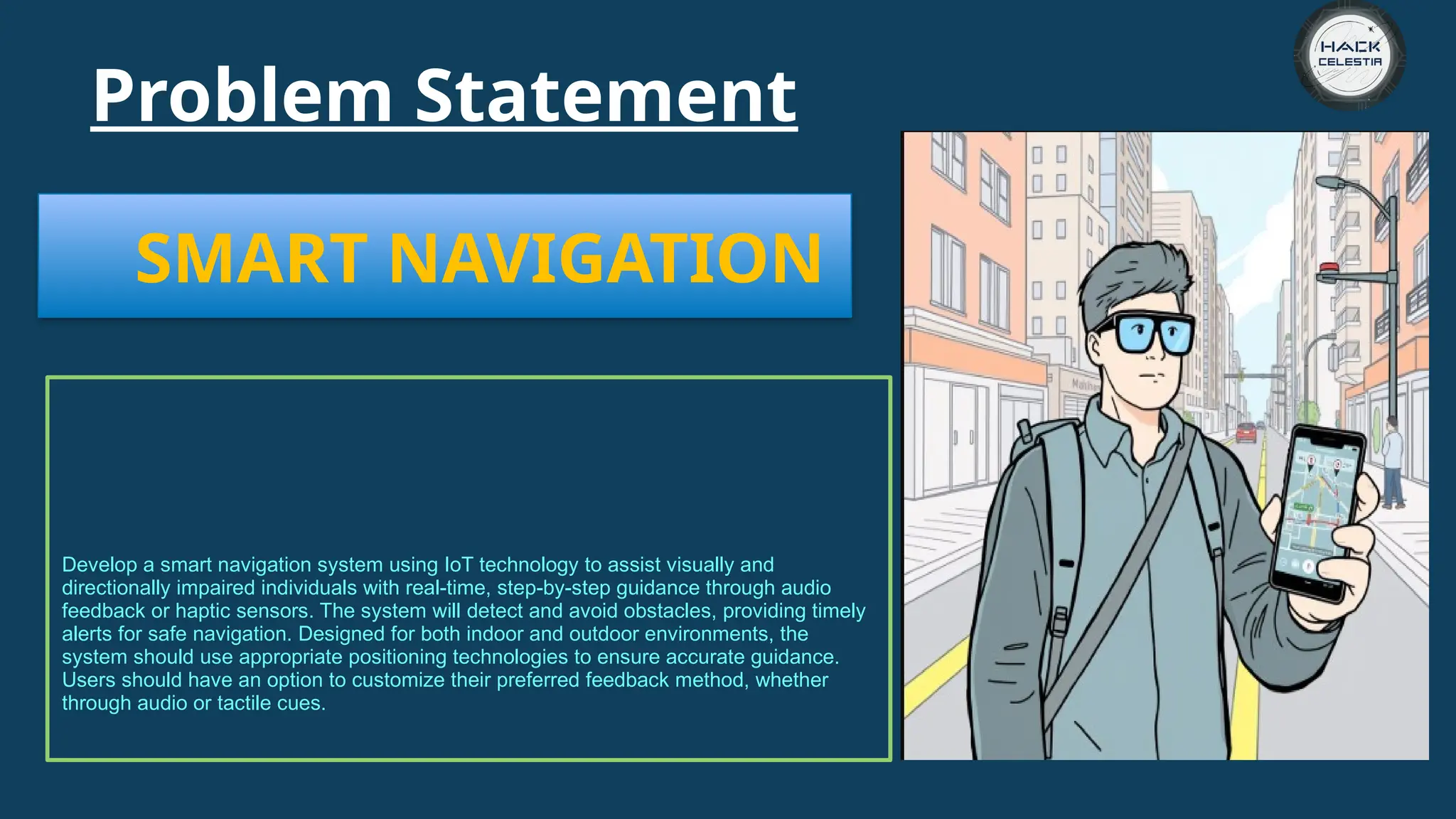
Develop asmart navigation system using IoT technology to assist visually and
directionally impaired individuals with real-time, step-by-step guidance through audio
feedback or haptic sensors. The system will detect and avoid obstacles, providing timely
alerts for safe navigation. Designed for both indoor and outdoor environments, the
system should use appropriate positioning technologies to ensure accurate guidance.
Users should have an option to customize their preferred feedback method, whether
through audio or tactile cues.
SMART NAVIGATION
3.
SOLUTION/ TECHNICAL APPROACH
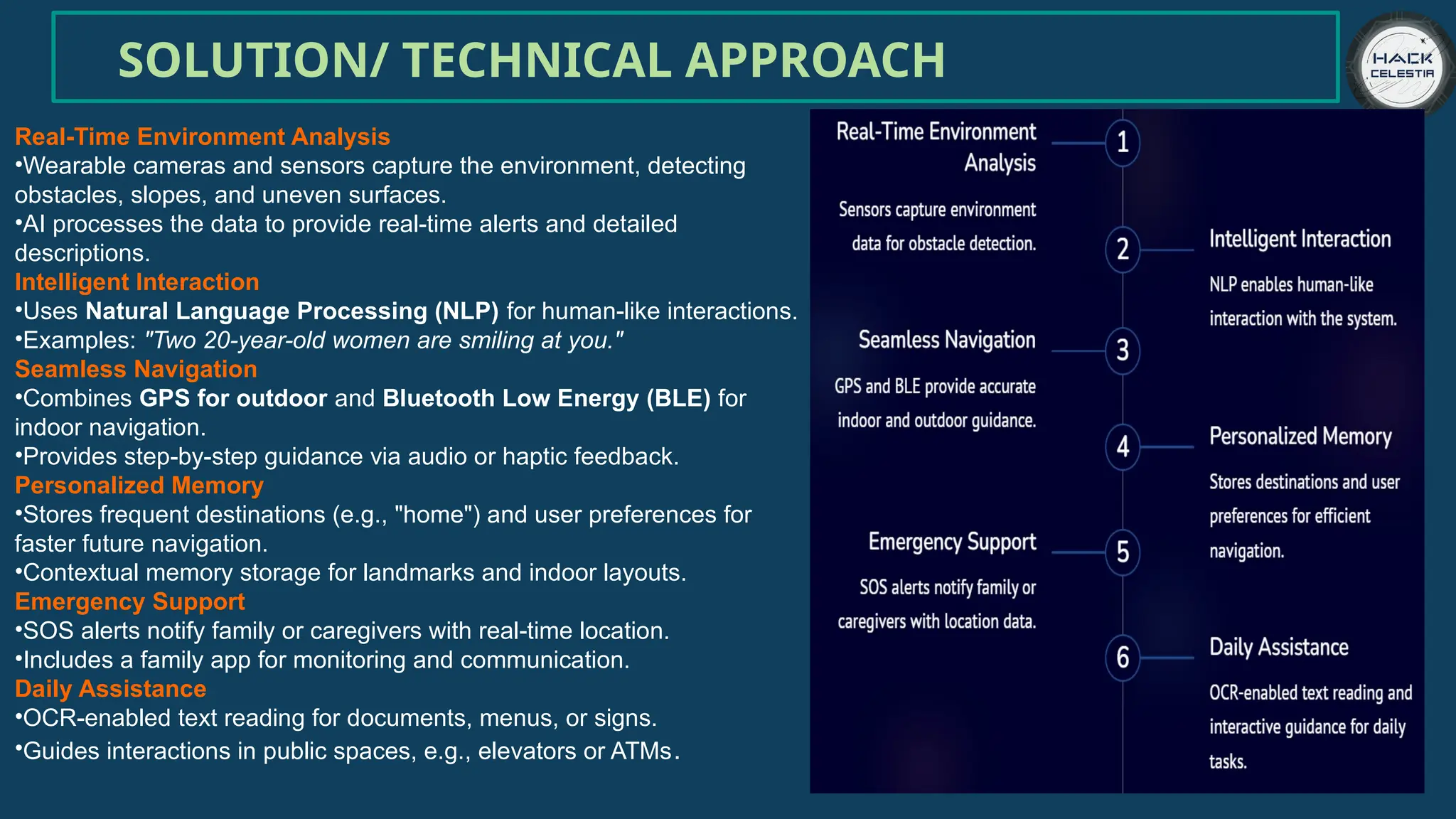
Real-TimeEnvironment Analysis
•Wearable cameras and sensors capture the environment, detecting
obstacles, slopes, and uneven surfaces.
•AI processes the data to provide real-time alerts and detailed
descriptions.
Intelligent Interaction
•Uses Natural Language Processing (NLP) for human-like interactions.
•Examples: "Two 20-year-old women are smiling at you."
Seamless Navigation
•Combines GPS for outdoor and Bluetooth Low Energy (BLE) for
indoor navigation.
•Provides step-by-step guidance via audio or haptic feedback.
Personalized Memory
•Stores frequent destinations (e.g., "home") and user preferences for
faster future navigation.
•Contextual memory storage for landmarks and indoor layouts.
Emergency Support
•SOS alerts notify family or caregivers with real-time location.
•Includes a family app for monitoring and communication.
Daily Assistance
•OCR-enabled text reading for documents, menus, or signs.
•Guides interactions in public spaces, e.g., elevators or ATMs.
4.
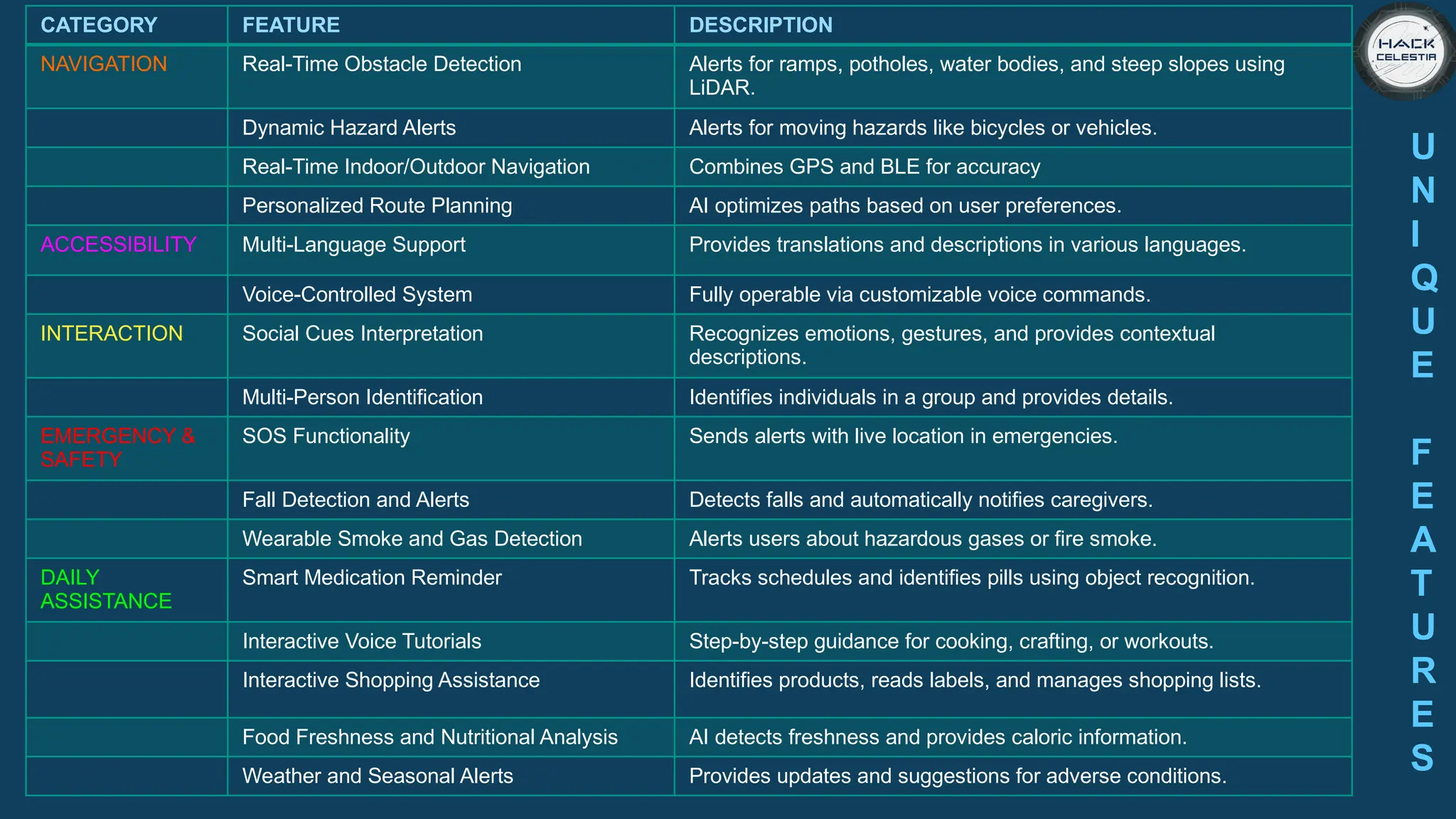
CATEGORY FEATURE DESCRIPTION
NAVIGATIONReal-Time Obstacle Detection Alerts for ramps, potholes, water bodies, and steep slopes using
LiDAR.
Dynamic Hazard Alerts Alerts for moving hazards like bicycles or vehicles.
Real-Time Indoor/Outdoor Navigation Combines GPS and BLE for accuracy
Personalized Route Planning AI optimizes paths based on user preferences.
ACCESSIBILITY Multi-Language Support Provides translations and descriptions in various languages.
Voice-Controlled System Fully operable via customizable voice commands.
INTERACTION Social Cues Interpretation Recognizes emotions, gestures, and provides contextual
descriptions.
Multi-Person Identification Identifies individuals in a group and provides details.
EMERGENCY &
SAFETY
SOS Functionality Sends alerts with live location in emergencies.
Fall Detection and Alerts Detects falls and automatically notifies caregivers.
Wearable Smoke and Gas Detection Alerts users about hazardous gases or fire smoke.
DAILY
ASSISTANCE
Smart Medication Reminder Tracks schedules and identifies pills using object recognition.
Interactive Voice Tutorials Step-by-step guidance for cooking, crafting, or workouts.
Interactive Shopping Assistance Identifies products, reads labels, and manages shopping lists.
Food Freshness and Nutritional Analysis AI detects freshness and provides caloric information.
Weather and Seasonal Alerts Provides updates and suggestions for adverse conditions.
U
N
I
Q
U
E
F
E
A
T
U
R
E
S
5.
USE CASE
IndependentDaily Living
•Guides users through daily tasks like cooking, shopping, and self-
care.
•Ensures confidence in navigating public spaces.
Enhanced Social Interaction
•Helps users recognize people, interpret emotions, and respond
appropriately.
•Converts gestures into speech for inclusive communication.
Emergency Handling
•Monitors user safety through fall detection and SOS functionality.
•Family app ensures caregivers can track and assist the user
promptly.
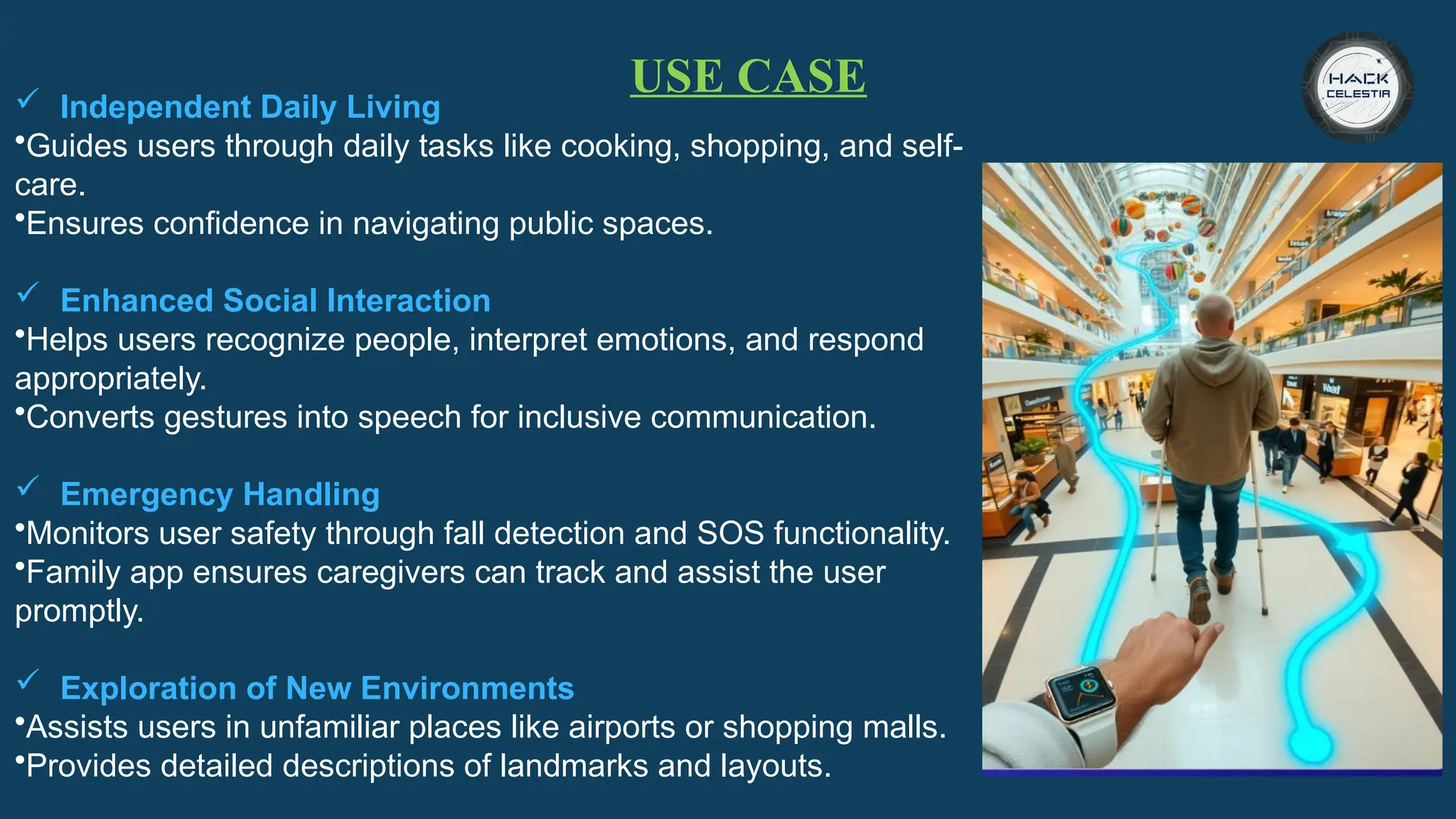
Exploration of New Environments
•Assists users in unfamiliar places like airports or shopping malls.
•Provides detailed descriptions of landmarks and layouts.
6.
FEASIBILITY & VIABILITY
TechnicalFeasibility
• Modular architecture ensures adaptability
and scalability for adding new features.
• Proven technologies like LiDAR, NLP, and
computer vision make implementation
practical and effective.
• Lightweight and wearable components
improve user comfort and usability.
Market Feasibility
• Growing global awareness and demand for
accessibility technologies.
• Wide target audience of approximately 295
million visually impaired individuals
worldwide.
Operational Feasibility
• Real-time support through mobile apps
ensures constant user assistance.
• Cloud-backed memory storage and
computational tasks minimize device-side
complexity.
Social Impact
Positive Outcomes:
• Empowers visually impaired individuals with greater
independence.
• Reduces reliance on human assistance, fostering
confidence and dignity.
• Promotes inclusivity in public spaces and
workplaces.
Potential Concerns:
• Accessibility of the technology in low-income areas.
Solutions:
• Partner with governments and NGOs to subsidize
costs for underprivileged users.
Environmental Viability
Strengths:
• Use of sustainable materials for wearables.
• Energy-efficient design reduces environmental
impact.
Impact Goals:
• Promote green initiatives by leveraging solar-
powered charging docks for wearable
7.
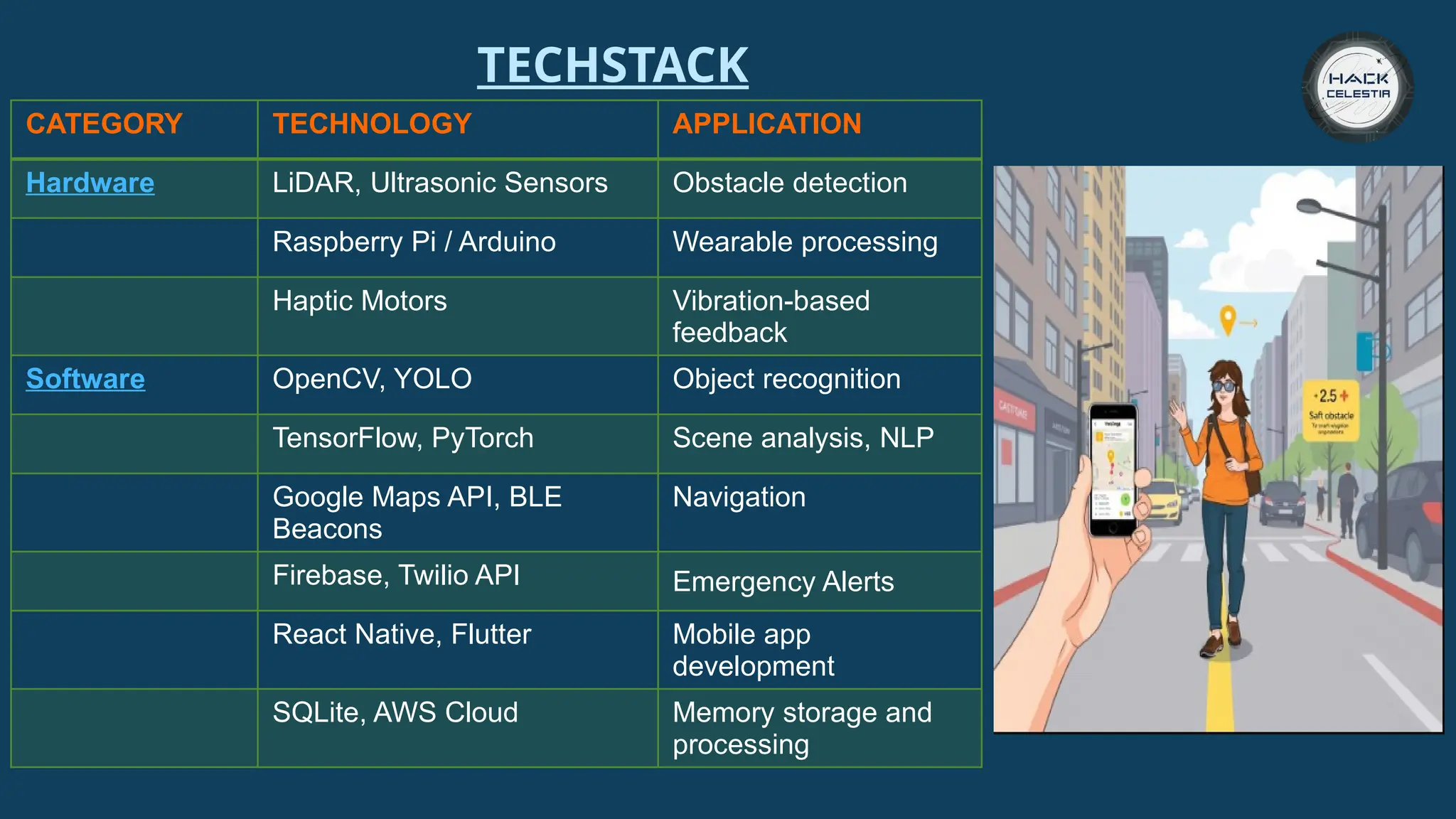
TECHSTACK
CATEGORY TECHNOLOGY APPLICATION
HardwareLiDAR, Ultrasonic Sensors Obstacle detection
Raspberry Pi / Arduino Wearable processing
Haptic Motors Vibration-based
feedback
Software OpenCV, YOLO Object recognition
TensorFlow, PyTorch Scene analysis, NLP
Google Maps API, BLE
Beacons
Navigation
Firebase, Twilio API Emergency Alerts
React Native, Flutter Mobile app
development
SQLite, AWS Cloud Memory storage and
processing
8.
REFERENCES
1. A SmartPersonal AI Assistant for Visually Impaired People: IEEE Explore
https://ieeexplore.ieee.org/document/8553750
2. Artificial intelligence for visually impaired : ScienceDirect
https://www.sciencedirect.com/science/article/pii/S0141938223000240
3.An intelligent Assistant for the Visually Impaired & blind people using machine learning:
YResearch Gate
https://www.researchgate.net/publication/
342561852_An_intelligent_Assistant_for_the_Visually_Impaired_blind_people_using_m
achine_learning
![Team Members
Garima Jha
Nidhi Saxena
Milisha Kishore
Suhani Verma
Bhoomi Gupta
TEAM NAME:
INVISIO
College/University:
Banasthali Vidyapith
Track: Internet Of
Things [IOT]](https://image.slidesharecdn.com/60bcc43f-f916-4c1a-b5ad-a808d3275093-251104080339-5578283c/75/60bcc43f-f916-4c1a-b5ad-a808d3275093-pptx-doc-1-2048.jpg)


![FYP_proposal[1] tamplate for students.pptx](https://cdn.slidesharecdn.com/ss_thumbnails/fypproposal1-250908180009-69ecc82c-thumbnail.jpg?width=640&height=640&fit=bounds)


![[DSC Europe 25] Behzad Hosseini - AI Agents in the Wild: Deploying Models tha...](https://cdn.slidesharecdn.com/ss_thumbnails/3qtejajvsjqrzwfept2c-10-251212103250-7f2b1068-thumbnail.jpg?width=640&height=640&fit=bounds)
![[DSC Europe 25] Jakub Stech - AI for Public Good: How Data and AI Can Transfo...](https://cdn.slidesharecdn.com/ss_thumbnails/ayuupcru6ggr9f7vbp0q-1-251215095918-7b7334a3-thumbnail.jpg?width=640&height=640&fit=bounds)
![[DSC Europe 25] Velibor Ilic - Autonomous Driving - How AI Shapes Technical ...](https://cdn.slidesharecdn.com/ss_thumbnails/gwu9aqths9ovngsrhidc-3-velibor-ilic-autonomous-driving-how-ai-shapes-technical-challenges-251219150035-7436923a-thumbnail.jpg?width=640&height=640&fit=bounds)
![[DSC Europe 25] Djordje Hirs - Revolutionizing Telco Customer Experience with...](https://cdn.slidesharecdn.com/ss_thumbnails/zif75aur3qscnckv6tnc-djordje-hirs-cc-dsc2025-1-251219145617-679178aa-thumbnail.jpg?width=640&height=640&fit=bounds)
![[DSC Europe 25] Danica Soc - The Science Behind Marketing: Experimentation me...](https://cdn.slidesharecdn.com/ss_thumbnails/c0nofsggs9gw5ucmallr-3-251216103155-56bd64d1-thumbnail.jpg?width=640&height=640&fit=bounds)
![[DSC Europe 25] Marko Djordjevic - AI can help Agriculture.pptx](https://cdn.slidesharecdn.com/ss_thumbnails/c0huq0ztiubmgccem2hc-marko-djordjevic-ai-can-help-agriculture-251218125253-7606f036-thumbnail.jpg?width=640&height=640&fit=bounds)


![[DSC Europe 25] Nikolay Burlutskiy - Best Practices for Building Enterprise M...](https://cdn.slidesharecdn.com/ss_thumbnails/uirvaiuvq8y1w8hzd9tx-7-251212103249-2619edb4-thumbnail.jpg?width=640&height=640&fit=bounds)
![[DSC Europe 25] Kaja Kandare - LLM as a judge.pptx](https://cdn.slidesharecdn.com/ss_thumbnails/arxyccaxsdsd1ba99wjw-7-251212104007-2b4e3f64-thumbnail.jpg?width=640&height=640&fit=bounds)


![[DSC Europe 25] Jean Del Rosario - How to Reduce GenAI Costs up to 73.45%.pptx](https://cdn.slidesharecdn.com/ss_thumbnails/zjehcwqsiwjisav1znml-5-251217093201-eae4440a-thumbnail.jpg?width=640&height=640&fit=bounds)


![[DSC Europe 25] Katherine Forrest - AI NOW: Understanding the Velocity of Cha...](https://cdn.slidesharecdn.com/ss_thumbnails/wvvbruqfrci0sfq9xwgb-4-251212104007-e5ad1987-thumbnail.jpg?width=640&height=640&fit=bounds)

