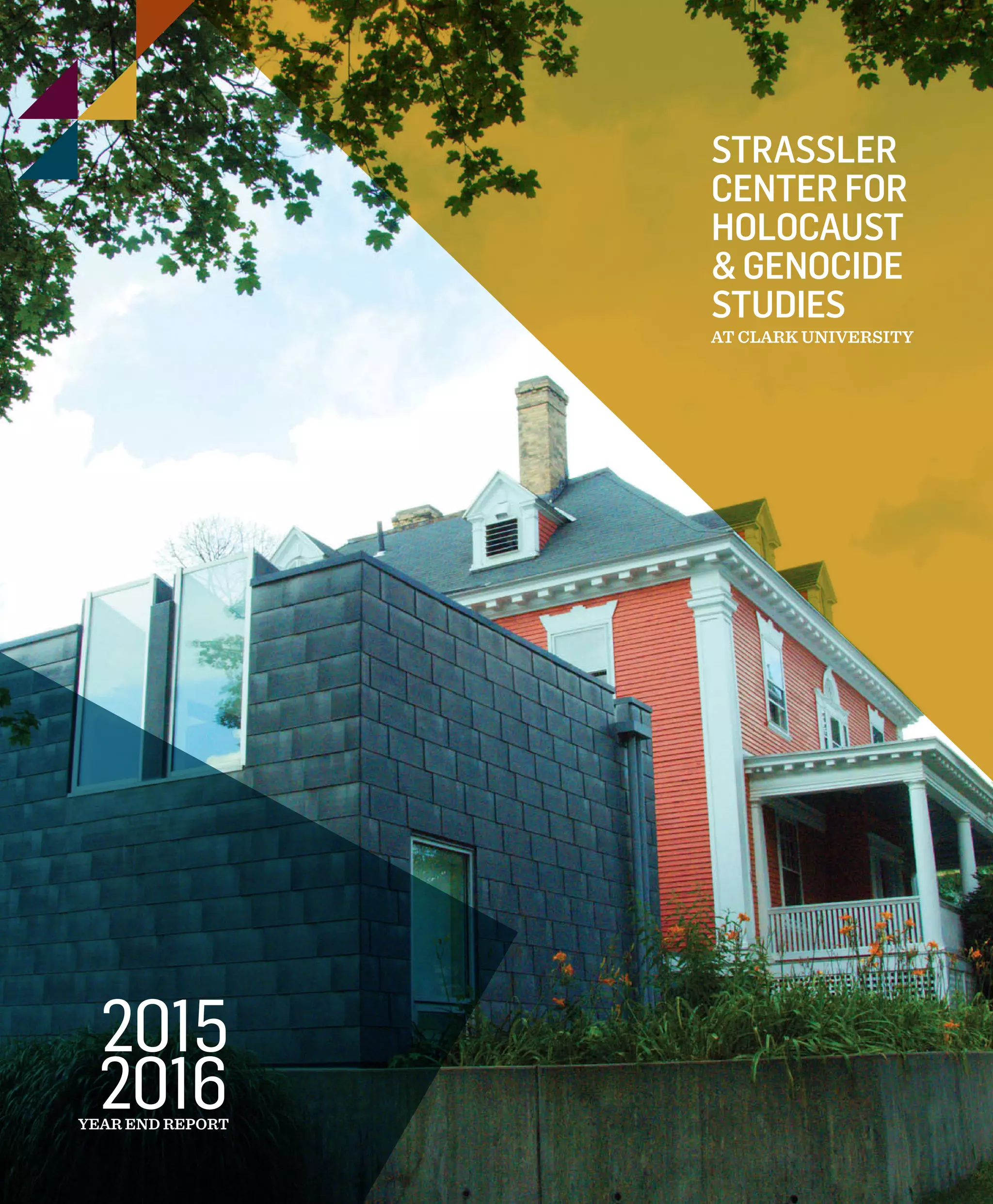
STRASSLER
CENTER FOR
HOLOCAUST
& GENOCIDE
STUDIES
AT CLARK UNIVERSITY
2015
2016YEAR END REPORT
603064.indd 1 11/30/16 7:39 AM
–thewisdomofthesages–thewisdomofthesages
WhoeverWhoever
failstofailsto
increaseincrease
knowledge,
decreases
knowledge.knowledge.
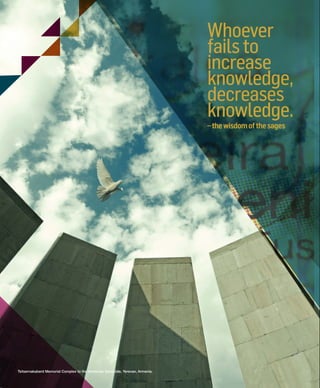
Tsitsernakaberd Memorial Complex to the Armenian Genocide, Yerevan, Armenia.
603064.indd 2 11/30/16 7:39 AM
1
Dear Friends,
As I write my final letter as Director of the Strassler Center, the
words of the renowned Supreme Court Justice Louis Brandeis
reverberate. “Most of the things worth doing in the world had been
declared impossible before they were done.” In the case of a Cen-
ter for Holocaust and Genocide Studies, no one had declared it
impossible – because no one had contemplated it at all. No such
institution was on anyone’s mental map,
but mine. And it was my good fortune to
meet David Strassler and communicate
that vision to him.
Warsaw. July 1993. The Jewish Foun-
dation for Christian Rescuers (now the Jew-
ish Foundation for the Righteous) hosted a
conference to explore wartime rescue oper-
ations and to honor the rescuers who, at
that time, remained reluctant to be identified
as people who had helped Jews during the
Holocaust years. I was one of the invited
scholars. After the conference, the speak-
ers and the JFCR board went by bus from
Warsaw to Auschwitz. Everyone switched
seats; everyone spoke to everyone. A man
sat next to me. “Where would a young person go to earn a doctoral
degree in Holocaust history to become a scholar like you?” he
asked.
I had hoped for years that someone would ask that question.
Indeed, the United States Holocaust Memorial Museum had just
opened that April, and the matter had become more urgent. Art
museum curators are expected to have earned a PhD in art history.
Was the Holocaust less important than art? Shouldn’t Holocaust
museum curators have earned doctorates in Holocaust history?
“Nowhere,” I answered. “Those of us who work in this field came
to it by happenstance, not training.” “Is that true?” he asked in dis-
belief. “Yes. Unfortunately.” And I launched into why this was a
problem. Not then, while survivors still lived. But in the future,
when they would no longer be with us.
To his credit, upon his return from Europe the fellow told then
ADL National Director Abe Foxman that he’d heard the craziest
thing from a woman on a bus from Warsaw to Auschwitz, and was
it true? To Abe’s credit, he checked and got back to say indeed it
was. And to my credit, I had been a true reporter.
That man was David Strassler, then president of the board of
trustees of Clark University. He brought the matter to the attention
of then president Dick Traina. And thus, when two brothers, Sid-
ney and Ralph Rose, walked into President Traina’s office prepared
to make a gift in memory of their relatives
murdered by the Germans in Lida, Poland,
he asked them if they would consider sup-
porting the nation’s first fulltime, fully
endowed professorship in Holocaust His-
tory, indeed the first such chair outside of
Israel.
They were. And I was recruited as the
Rose Professor in 1996 to build the
Strassler Center, dedicated to scholarship,
teaching, and public service. Now a flour-
ishing enterprise, the Strassler Center is
the international address for doctoral train-
ing in Holocaust History and Genocide
Studies. This past year, two students
earned their doctoral degrees specializing
in the study of the Armenian Genocide, the first two to do so. One
student earned her degree with a dissertation on the 1994 Geno-
cide in Rwanda, our first in that subfield. And four were the recipi-
ents of doctoral degrees in Holocaust History.
Dr Mary Jane Rein and Professor Thomas Kühne, the new
co-directors of the Strassler Center, will grow the institution in
fresh directions. I am delighted to continue to serve as Rose Pro-
fessor under their leadership and eager to participate in their
plans. Please join me in supporting the Strassler Center and them.
Please give as generously as you are able.
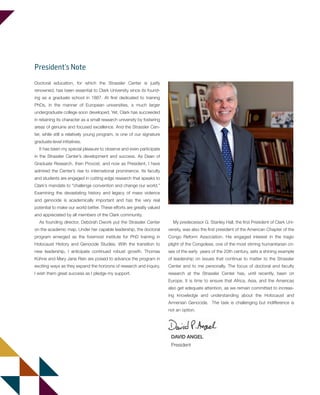
DEBÓRAH DWORK
Rose Professor of Holocaust History
Director, Strassler Center for Holocaust and Genocide Studies
603064.indd 1 11/18/16 11:01 AM
Doctoral education, for which the Strassler Center is justly
renowned, has been essential to Clark University since its found-
ing as a graduate school in 1887. At first dedicated to training
PhDs, in the manner of European universities, a much larger
undergraduate college soon developed. Yet, Clark has succeeded
in retaining its character as a small research university by fostering
areas of genuine and focused excellence. And the Strassler Cen-
ter, while still a relatively young program, is one of our signature
graduate-level initiatives.
It has been my special pleasure to observe and even participate
in the Strassler Center’s development and success. As Dean of
Graduate Research, then Provost, and now as President, I have
admired the Center’s rise to international prominence. Its faculty
and students are engaged in cutting edge research that speaks to
Clark’s mandate to “challenge convention and change our world.”
Examining the devastating history and legacy of mass violence
and genocide is academically important and has the very real
potential to make our world better. These efforts are greatly valued
and appreciated by all members of the Clark community.
As founding director, Debórah Dwork put the Strassler Center
on the academic map. Under her capable leadership, the doctoral
program emerged as the foremost institute for PhD training in
Holocaust History and Genocide Studies. With the transition to
new leadership, I anticipate continued robust growth. Thomas
Kühne and Mary Jane Rein are poised to advance the program in
exciting ways as they expand the horizons of research and inquiry.
I wish them great success as I pledge my support.
DAVID ANGEL
President
President’s Note
My predecessor G. Stanley Hall, the first President of Clark Uni-
versity, was also the first president of the American Chapter of the
Congo Reform Association. His engaged interest in the tragic
plight of the Congolese, one of the most stirring humanitarian cri-
ses of the early years of the 20th century, sets a shining example
of leadership on issues that continue to matter to the Strassler
Center and to me personally. The focus of doctoral and faculty
research at the Strassler Center has, until recently, been on
Europe. It is time to ensure that Africa, Asia, and the Americas
also get adequate attention, as we remain committed to increas-
ing knowledge and understanding about the Holocaust and
Armenian Genocide. The task is challenging but indifference is
not an option.
603064.indd 2 11/18/16 11:01 AM
3
The proverb “it is better to light a candle than to curse the dark-
ness” is often attributed to Eleanor Roosevelt. In fact, the American
politician and diplomat Adlai Stevenson aptly used it in praise of the
First Lady, to honor her humanity and efforts on behalf of world
peace. It might serve equally well in reference to our colleague
Debórah Dwork who stepped down as director of the Strassler
Center on June 1. The candle is now passed to us and we will carry
it together as Director and Executive Director and use its light to
advance the frontiers of knowledge and scholarship through our
landmark PhD program and rich undergraduate concentration,
through our international conferences and public events.
The Strassler Center was established in 1996, shortly after
genocide returned to the headlines as the result of mass atrocities
perpetrated in Bosnia and Rwanda. Initially dedicated to research
and doctoral training about the Holocaust, those more recent
cases underlined the importance of a comparative approach to
studying genocide. Over the past two decades, the Strassler Cen-
ter has matured into the foremost institution committed to doc-
toral training about an ever-growing range of genocidal cases.
Recently, the vision of comparative study was actualized as the
first PhDs were awarded to students of the Armenian genocide
and the Rwanda genocide, respectively. And the 1971 genocide
in Bangladesh became the first Asian case added to the Center’s
research portfolio as the subject of a dissertation.
During its first two decades, the Strassler Center claimed a
place at the leading edge of the field of genocide studies. That
work continues but we will also contemplate other tragic histories
that remain shrouded in darkness. Our shared commitment is to
secure the resources needed to expand our program to include
significant historical events that deserve sober examination. One
priority is to lighten the American past, in particular the shameful
history of violence and dislocation perpetrated against Native
Americans. Cases of genocide and mass violence in Africa, Asia,
and throughout the Americas demand consideration. To do so will
require additional faculty expertise, greater support for graduate
studies, and expanded public programming. We are dedicated to
establishing these resources.
Our plans are ambitious and we are grateful for the opportunity to
realize them. We look to our colleagues at the Strassler Center as
well as to faculty and administrators across the Clark campus to
collaborate in these efforts. Partnerships and linkages with institu-
tions at home and abroad will become increasingly significant. While
the doctoral program and undergraduate concentration have been
interdisciplinary from the start, history has been the dominant per-
spective in the training the Strassler Center provides. Deeper and
broader engagement with a range of disciplines will bring fresh
approaches and new insights.
We invite alumni, friends, donors, and scholars to follow our
progress as we embark upon the challenges of planning for the
Center’s third decade. Please come to our events, help celebrate
our milestones, and join us as we take pride in the accomplish-
ments of our students, graduates, and faculty.
Opening Letter
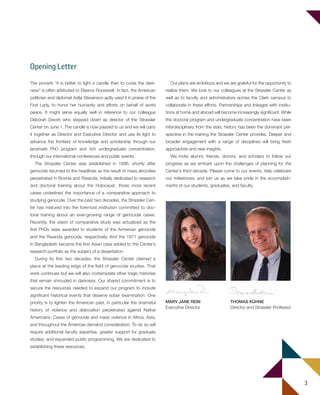
THOMAS KÜHNE
Director and Strassler Professor
MARY JANE REIN
Executive Director
603064.indd 3 11/18/16 11:01 AM
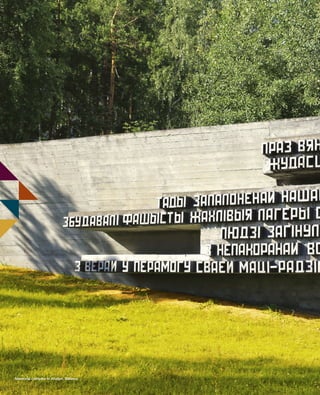
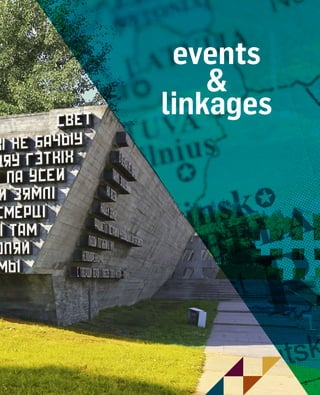
Memorial complex in Khatyn, Belarus
603064.indd 4 11/18/16 11:01 AM
5
events
&
linkages
603064.indd 5 11/30/16 7:39 AM
EVENTS AND LINKAGES
Strassler Center for Holocaust & Genocide Studies6
Robert Williams, “Cold War Influences on Holocaust Silence
in the Occupied German Press”
7 OCTOBER 2015
Robert Williams serves as Director of Development and New Initiatives
in the Jack, Joseph, and Morton Mandel Center for Advanced Holo-
caust Studies at the United States Holocaust Memorial Museum. He
also represents the United States at the International Holocaust
Remembrance Alliance, as does Center Director Debórah Dwork. Wil-
liams, whose many research interests include the politics of the United
States, Germany, and the Soviet Union as well as contemporary
antisemitism, spoke to a table brimming with Center faculty, graduate
students, and undergraduate concentrators about the ways in which
Cold War influences shaped discourse about the Holocaust in the
German press. Williams’s research examines how German newspa-
pers used Holocaust memory to advance specific political ideologies
in the contentious Cold War climate. He argued that the “arrested
development of Holocaust discourse” following the war’s end was
not representative of German understanding of the genocide; rather it
spoke to the occupiers’ aims. Williams focused on a range of popular
news outlets from both the US and Soviet occupied territories: Tägli-
che Rundschau, Deutsche Volkszeitung, Neues Deutschland, Frank-
furter Rundschau, and Die Neue Zeitung. Political needs shaped
reporting on three particular areas of post-war discussion: Nazi war
crimes, military tribunals, and antisemitism.
Press coverage of Nazi war crimes was manipulated either to hin-
der or encourage democratic and capitalist development. In East
Germany, collective guilt for Nazi crimes was used to purge Nazi
elements as well as to draw parallels between the capitalism of the
Third Reich and the United States, thus shaping public opinion about
the American economy. Soviet newspapers also minimized Russian
culpability by focusing media attention on Nazi crimes against the
Red Army. The press thus succeeded in illustrating the victimization
of the Soviets while making an enemy of the United States. West Ger-
many, on the other hand, followed the American model with its sober
emphasis on factual evidence rather than opinion pieces. The United
States claimed that excessive moralizing about Nazi crimes would be
“counterproductive to democratic development.”
In Williams’s view, the International Military Tribunal at Nuremberg
served as the perfect “propaganda tool” for the Americans and Sovi-
ets. Both powers aimed to placate Germany while stoking aversion to
Nazism, both politically and culturally. Yet, neither power succeeded
in separating trial discourse from politics. Williams’s analysis of arti-
cles published during the trial demonstrate that coverage lagged in
East and West Germany as the proceedings advanced, only resurg-
ing once decisions had been reached. His analysis also showed that,
while the occupation-era press sought to critique Nazism, it did not
suppress antisemitism. The newspapers published numerous nega-
tive articles about displaced persons camps and their inhabitants,
especially in the American occupied zone. Indeed, by the end of
1946, antisemitic sentiment had risen significantly across zones.
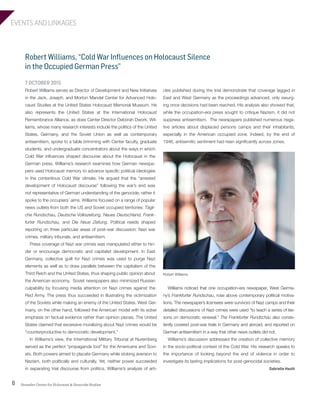
Robert Williams
Williams noticed that one occupation-era newspaper, West Germa-
ny’s Frankfurter Rundschau, rose above contemporary political motiva-
tions. The newspaper’s licensees were survivors of Nazi camps and their
detailed discussions of Nazi crimes were used “to teach a series of les-
sons on democratic renewal.” The Frankfurter Rundschau also consis-
tently covered post-war trials in Germany and abroad, and reported on
German antisemitism in a way that other news outlets did not.
Williams’s discussion addressed the creation of collective memory
in the socio-political context of the Cold War. His research speaks to
the importance of looking beyond the end of violence in order to
investigate its lasting implications for post-genocidal societies.
Gabrielle Hauth
603064.indd 6 11/18/16 11:01 AM
EVENTS AND LINKAGES
7
17-20 OCTOBER 2015
The second Israel Academic Exchange (IAE) workshop,
presented with the Avraham Harman Institute of Contem-
porary Jewry at the Hebrew University of Jerusalem,
examined transitional justice in post-genocidal societies.
Co-chairs Raz Segal PhD ’13 and Professor Ken
MacLean organized panels around questions of victim-
hood and perpetration and how these roles are linked.
Participants from Hebrew University, Al-Quds University,
Ben-Gurion University, Tel Aviv University, the Van Leer
Jerusalem Institute, and European and US institutions
explored societal transition, national identity, memory,
and models of reconciliation. Drawing on historical and
legal perspectives, as well as philosophical and cultural
approaches, they discussed reparations, public apolo-
gies, and international and local tribunals. They addressed
reconciliation in cases where perpetrators deny past
crimes and societies that have silenced violent events in
the name of peace and social stability.
The co-chairs opened with a general discussion about
transitional justice. Do international courts view the Holocaust as a para-
digmatic case through which to assess other genocides? What do survi-
vors consider appropriate reparation? How do genocidal societies view
truth commissions? The first panel considered legal perspectives on
transitional justice, the meaning and impact of tribunals, trials, and sen-
tences. Central questions included the effectiveness of one-sided pro-
cesses, the aftermath of reconciliation, and the legacy of the Nuremberg
trials, conflicting narratives, and whether to advocate for peace or justice.
The connection between mass violence, state building, and social
relations was the subject of the second panel. What is the link between
processes of national identity building and genocide? How can stable
post-genocidal societies integrate survivors and perpetrators? What
can be done to address state sponsored mass violence in protracted
conflicts? Shifting to victims’ perspectives, the third panel examined
survivors. How do they integrate into post-genocidal societies or as
immigrants in new societies? The speakers considered the use of sur-
vivor testimony and questioned the ways jurisdictions, sentencing, and
punishments vary between post-genocidal societies.
Prevention was the theme of the fourth panel. Presenters questioned
how to define victims, perpetrators, and bystanders. They discussed
intimacy in perpetration, efforts to prevent mass violence,
and challenges in conceptualizing genocide. Debates
about hierarchies of suffering and the question of agency
versus “pure victimhood” were raised in connection with
prevention and reconciliation. Social re-organization and
population exchange were the subjects of the fifth panel.
Discussants probed the value of reparations in such
cases. Different categories of victimhood, while problem-
atic to define, could suggest reparation types: collective,
individual, monetary, or cultural. What is the value of trials
that punish one or a few arch criminals and what do these
trials mean for survivor dignity and faith in the process?
The sixth panel focused on global trends in transitional
justice, including post-colonial societies dealing with past
violence as well as current cases of reconciliation and
ongoing mass violence. The speakers explored memory
versus oblivion and the politics that promote these
responses in contemporary conflicts. How can western
societies’ attempts to promote reconciliation be trusted
when they remain guilty of neglecting their own past? Do group narra-
tives and perceptions about their status as victims or perpetrators help
or impede processes of reconciliation, transitional justice, and acknowl-
edgement of past crimes and current wrong-doing?
The concluding panel summarized the conference findings. Selected
participants pondered how to integrate memory, traumatic experiences,
and transitional justice. Amos Goldberg (Hebrew University), Sigall
Horowitz (International Nuremberg Principles Academy and Hebrew Uni-
versity), Dirk Moses (European University Institute), and Nadera Shal-
houb-Kevorkian (Hebrew University) discussed how to build effective
legal mechanisms. They debated the “threshold of genocide,” querying
the methods and perceptions involved in defining genocide as opposed
to “mere state criminality,” and the ways in which these definitions affect
reconciliation and the rehabilitation of societies.
Seeking to extend the discussion about mass violence into the US
context, a field trip to the Brown University Center for the Study of Slav-
ery and Justice had been planned. Regrettably, they cancelled for politi-
cal reasons. But the opportunity that the IAE workshop offered to
examine the legacy of genocide and mass violence proved incredibly rich
for all who attended. MaayanArmelin
Israel Academic Exchange Workshop: “Post-Genocide Societies”
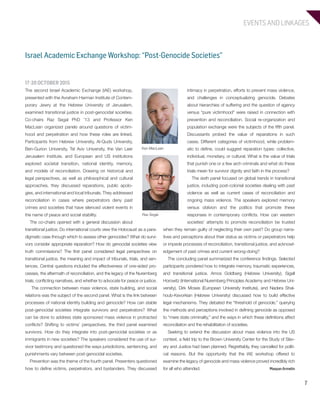
Ken MacLean
Raz Segal
603064.indd 7 11/29/16 7:32 AM
EVENTS AND LINKAGES
Strassler Center for Holocaust & Genocide Studies8
Panel Discussion: “Empire, Nation State, and Genocide”
context of their affective disposition, or emotional understanding,
which constructed the Armenians as an existential threat to the future
survival of the empire. It was the conjunction of that affective disposi-
tion toward unfolding events – World War I and Enver’s defeat in the
Battle of Sarikamish, in particular – which shaped the choices the
CUP made that led to genocide and catastrophe for the Ottoman
Armenians.
Holquist responded both to Suny’s book and to his distinction
between empire and nation state. He held that an overly schematic
model of an empire in decline and its inevitable replacement by a series
of nation-state proxies overlooks the re-articulation of imperial identity
in the late imperial period. Thus, he complicated the binary of “nation or
empire”and proposed a triple model: ancient empire, modernizing
empire, and nation state. This morphology introduced a distinction
between imperial subject and imperial citizen. He also contrasted the
Young Turks’ genocidal policies with plans developed in the Russian
Empire and offered his explanation for why Russia’s phantasmagoric
projects both against Jews in Galicia and against Muslims in Kars and
Batum were not carried out in the form of genocide.
In his role as moderator, Akçam urged the participants to go
beyond concepts of empire vs. nation-state and their relationship to
genocide. He raised another question central to genocide scholar-
ship: whether historians should treat the mass slaughters and geno-
cides that occurred in the Russian, Austro-Hungarian, German, and
Ottoman empires in the late 19th and early 20th centuries as isolated
domestic cases that share a common perspective on the position of
minority subject populations, or try to explain these
cases with reference to the structural dynamics of
empires. “This means we have to establish certain
intrinsic and structural connections between these
empires and their policies,”Akçam argued, citing
Mark Levene’s recent scholarship.
The audience of students, professors, and guests
responded with a number of insightful questions that
allowed the speakers to elaborate on their explana-
tions of the concepts “empire” and “nation-state”
and drill down on the details and particularities of
Russian and Ottoman imperial policies.
Asya Darbinyan
23 OCTOBER 2015
Panelists Ronald Suny, William H. Sewell Jr. Distinguished University
Professor of History (University of Michigan), and Peter Holquist,
Associate Professor of Russian and European History (University of
Pennsylvania), compared late Ottoman Turkey and Imperial Russia in
a discussion of “Empire, Nation-State and Genocide.” Kaloosdian
Mugar Professor Taner Akçam moderated the panel. He introduced
the topic by presenting the thesis commonly accepted among Arme-
nian Genocide scholars that the Committee of Union and Progress
(CUP) party aimed to establish a Turkish nation-state. The CUP-led
government, known as the Young Turks, sought to homogenize Ana-
tolia along cultural and religious lines by destroying the Christian pop-
ulation through deportation and mass killing. According to Akҫam,
“the empire was to continue but in a new form appropriate for the
modern age, what has been called the age of nationalism and nation-
states, but more accurately should be referred to as the age of
empires.”
Drawing upon his recently published work, They Can Live in the
Desert but Nowhere Else: A History of the Armenian Genocide (2015),
Suny argued that the Young Turks, the leaders of the CUP, were never
purely Turkish ethno-nationalists. In his view, while the emergence of
subject nations looks inevitable now, the actors of the day sought the
best ways to save their empire. Thus, the Young Turks saw the Arme-
nians as traitorous even though most were not separatists but were
interested in reforms and some degree of autonomy. Yet, their legiti-
mate goals were understood as subversive and a danger to national
security. Suny explained the genocidal policies of the Ottomans in the
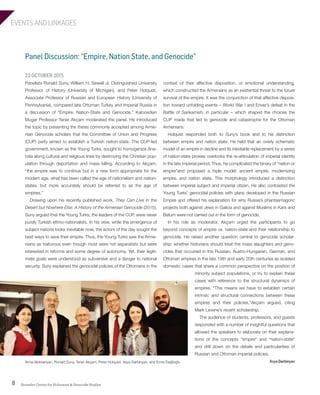
Anna Aleksanyan, Ronald Suny, Taner Akçam, Peter Holquist, Asya Darbinyan, and Emre Dağlioğlu
603064.indd 8 11/29/16 7:32 AM
EVENTS AND LINKAGES
9
Samuel Moyn, “Human Rights and the Holocaust: A Belated Entanglement“
In the mid-1970s, the “humanitarian stage” commenced. The
human rights agenda moved its focus from quality of life, to life itself—
the plight of people whom society insisted deserved to live. The expe-
rience of decolonization led to a realization that the state cannot
guarantee absolute protection, prompting the shift from welfare promo-
tion to atrocity consciousness. At the same time, Holocaust memory
entered the fray, as children of survivors began to explore and relate
their parents’ stories. This new consciousness coincided with the rise
of the human rights paradigm as concerns over colonial atrocity merge
with efforts to remember Nazi atrocity.
Moyn, who worked at the White House
during the Bosnian genocide, concluded by
reflecting on the implications of the transi-
tion—from the “welfarist ideal” of human rights
to atrocity prevention. We know what we have
gained from this shift, but have we lost any-
thing along the way? Citing the damage
wrought by NATO’s intervention in Libya,
Moyn called for critical reflection on the norms
that guide humanitarian policies. He also
observed that the grander ideals that once
informed our discourse—premised on the
desire to build just societies—have fallen
away. Instead, we are busy—rightly busy—
assuring that people do not die.
Moyn asked whether atrocity con-
sciousness is enough. We might also pon-
der its implicit corollary: has the default assumption of this
normative consciousness diminished its potency? Is it easier to
ignore atrocities once we have named them? The celebrated
Israeli poet, Yehuda Amichai, reflected on the subtle danger of the
hyper-saturation of Holocaust memory in Israel: “Let the memorial
hill remember instead of me, that’s what it’s here for.” Do we build
memorial hills to elude the responsibility of memory? The spirit of
Amichai’s words sharpen Moyn’s charge: reject the impulse to qui-
etly displace the mandate of human rights in the 21st century. That
requires us to ask what the mandate ought to be, and to repeat-
edly pose the question anew.
Simon Goldberg
26 OCTOBER 2015
Invited to Clark by Leir Professor Robert Tobin, Samuel Moyn, Harvard
Professor of Law and History, presented a fascinating lecture in which
he challenged the belief that human rights discourse emerged in
response to the Holocaust. Author of The Last Utopia: Human Rights
in History (2010), Moyn acknowledged the association between the
Holocaust and human rights. He nodded to the widely-held belief that
the Universal Declaration of Human Rights, ratified by the United
Nations in December 1948, was conceived to guard against mass
atrocities such as those committed by the Nazi regime and its allies.
But Moyn argued that Holocaust memory materialized decades after
the war and thus played a more nuanced role in
the evolution of human rights consciousness.
Moyn presented a three-phase typology of
the public conceptualization of human rights.
The first, rooted in a movement for “welfarism,”
began during World War II. The prospect of a
new welfare state—premised on a definition of
national citizenship that granted social and politi-
cal rights to all—became the foremost cause
around which citizens rallied. Arguments for
rights concerned the nation and political free-
dom. Even those who experienced the Holo-
caust were not committed to a movement to
fight international atrocity, but preferred to
respond to a world in which economic depres-
sion leads to war. The welfare state would pre-
vent the election of dictators.
Phase two began in the 1950s, when human rights were equated
with the anti-colonial struggle. Not all empires had collapsed with the
close of World War II, but decolonization soon heightened the urgency
for self-determination. National groups feared the emergence of new
empires and sought “welfarism” on their own terms and free of interfer-
ence. To sharpen the contrast between this genre of rights discourse
and the one commonly ascribed to Holocaust memory, Moyn noted
that, in the anti-colonial context, the project was to strengthen, rather
than undermine, state sovereignty. Anti-colonialism established a shield
against intervention, whereas the 1948 UN Genocide Convention
defined the limits of state sovereignty, mandating the intervention of the
international community in the event of its failure.
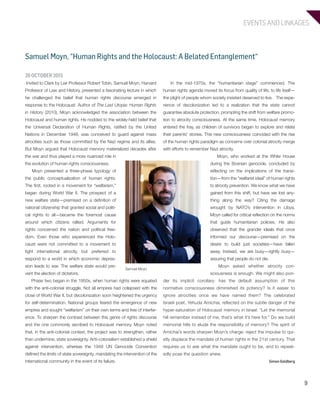
Samuel Moyn
603064.indd 9 11/18/16 11:01 AM
EVENTS AND LINKAGES
Strassler Center for Holocaust & Genocide Studies10
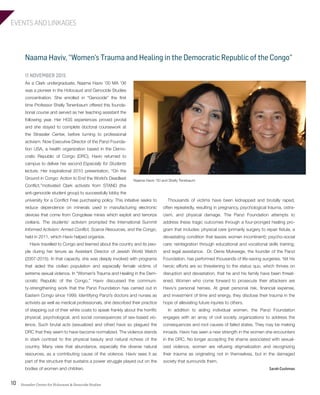
Naama Haviv, “Women’s Trauma and Healing in the Democratic Republic of the Congo”
Thousands of victims have been kidnapped and brutally raped,
often repeatedly, resulting in pregnancy, psychological trauma, ostra-
cism, and physical damage. The Panzi Foundation attempts to
address these tragic outcomes through a four-pronged healing pro-
gram that includes: physical care (primarily surgery to repair fistula, a
devastating condition that leaves women incontinent); psycho-social
care; reintegration through educational and vocational skills training;
and legal assistance. Dr. Denis Mukwege, the founder of the Panzi
Foundation, has performed thousands of life-saving surgeries. Yet his
heroic efforts are so threatening to the status quo, which thrives on
disruption and devastation, that he and his family have been threat-
ened. Women who come forward to prosecute their attackers are
Haviv’s personal heroes. At great personal risk, financial expense,
and investment of time and energy, they disclose their trauma in the
hope of alleviating future injuries to others.
In addition to aiding individual women, the Panzi Foundation
engages with an array of civil society organizations to address the
consequences and root causes of failed states. They may be making
inroads. Haviv has seen a new strength in the women she encounters
in the DRC. No longer accepting the shame associated with sexual-
ized violence, women are refusing stigmatization and recognizing
their trauma as originating not in themselves, but in the damaged
society that surrounds them.
Sarah Cushman
11 NOVEMBER 2015
As a Clark undergraduate, Naama Haviv ’00 MA ’06
was a pioneer in the Holocaust and Genocide Studies
concentration. She enrolled in “Genocide” the first
time Professor Shelly Tenenbaum offered this founda-
tional course and served as her teaching assistant the
following year. Her HGS experiences proved pivotal
and she stayed to complete doctoral coursework at
the Strassler Center, before turning to professional
activism. Now Executive Director of the Panzi Founda-
tion USA, a health organization based in the Demo-
cratic Republic of Congo (DRC), Haviv returned to
campus to deliver her second Especially for Students
lecture. Her inspirational 2010 presentation, “On the
Ground in Congo: Action to End the World’s Deadliest
Conflict,”motivated Clark activists from STAND (the
anti-genocide student group) to successfully lobby the
university for a Conflict Free purchasing policy. This initiative seeks to
reduce dependence on minerals used in manufacturing electronic
devices that come from Congolese mines which exploit and terrorize
civilians. The students’ activism prompted the International Summit
Informed Activism: Armed Conflict, Scarce Resources, and the Congo,
held in 2011, which Haviv helped organize.
Haviv travelled to Congo and learned about the country and its peo-
ple during her tenure as Assistant Director of Jewish World Watch
(2007-2015). In that capacity, she was deeply involved with programs
that aided the civilian population and especially female victims of
extreme sexual violence. In “Women’s Trauma and Healing in the Dem-
ocratic Republic of the Congo,” Haviv discussed the communi-
ty-strengthening work that the Panzi Foundation has carried out in
Eastern Congo since 1999. Identifying Panzi’s doctors and nurses as
activists as well as medical professionals, she described their practice
of stepping out of their white coats to speak frankly about the horrific
physical, psychological, and social consequences of sex-based vio-
lence. Such brutal acts (sexualized and other) have so plagued the
DRC that they seem to have become normalized. The violence stands
in stark contrast to the physical beauty and natural richess of the
country. Many view that abundance, especially the diverse natural
resources, as a contributing cause of the violence. Haviv sees it as
part of the structure that sustains a power struggle played out on the
bodies of women and children.
Naama Haviv ‘00 and Shelly Tenebaum
603064.indd 10 11/18/16 11:01 AM
EVENTS AND LINKAGES
11
Panel discussion: “Recognizing Painful Legacies through Memorial Construction”
legacy of racism and to contemporary human trafficking. Today, 27
million people worldwide are affected by present day forms of bond-
age. He envisaged his monument as a space for reflection and a
trigger to engender civic engagement and human rights activism.
For the memorial in Nantes, a port from which hundreds of Atlantic
slave-trading expeditions set forth, Bonder opted against traditional
forms of representation. In particular, he decided to avoid images of
bodies in pain. Instead, his team uncovered the underground residual
space below the quay, a product of construction of the embankment
between the 18th and 20th centuries. Plaques with the names of slave
ships are embedded into the walkway along the riverfront and literally
stop passersby in their tracks. As slaves left few written records, water
symbolically constitutes the primary witness and vault for their memo-
ries. Every 10 years, the underground exhibition space will flood and
the river will metaphorically bring the experiences of slaves into the
memorial. Another powerful symbolic device is the narrow window
which offers a view of the Palace of Justice on the opposite riverbank.
Although not explicitly instructed, the hope is that visitors will find them-
selves reflecting on issues of justice and the continued struggle for
human rights.
The panel, organized in partnership with the Departments of Geog-
raphy and Visual Arts, brought varied disciplinary perspectives into
conversation. In her response, geographer Deborah Martin addressed
the ways geographers study memory through landscape and the
human-environment relationship. She described her
research on the memory of the Civil War on south-
ern university campuses. Art historian Kristina Wil-
son considered how different forms of monuments
convey narrative. Using the Vietnam Veterans
Memorial in Washington, DC as an example, she
pondered the value of abstraction versus figuration
in representing history and suffering.
In the lively discussion that followed, Clark stu-
dents and faculty responded to Bonder’s work
and shared their experiences visiting memorials.
As both memorials and research on cultural mem-
ory proliferate, including projects undertaken by
Strassler Center doctoral students, the discussion
proved insightful and inspiring.
Alicja Podbielska
18 NOVEMBER 2015
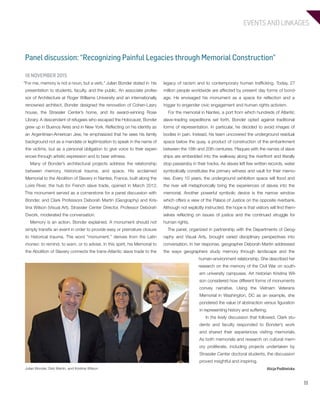
“For me, memory is not a noun, but a verb,” Julian Bonder stated in his
presentation to students, faculty, and the public. An associate profes-
sor of Architecture at Roger Williams University and an internationally
renowned architect, Bonder designed the renovation of Cohen-Lasry
house, the Strassler Center’s home, and its award-winning Rose
Library. A descendant of refugees who escaped the Holocaust, Bonder
grew up in Buenos Aires and in New York. Reflecting on his identity as
an Argentinian-American Jew, he emphasized that he sees his family
background not as a mandate or legitimization to speak in the name of
the victims, but as a personal obligation to give voice to their experi-
ences through artistic expression and to bear witness.
Many of Bonder’s architectural projects address the relationship
between memory, historical trauma, and space. His acclaimed
Memorial to the Abolition of Slavery in Nantes, France, built along the
Loire River, the hub for French slave trade, opened in March 2012.
This monument served as a cornerstone for a panel discussion with
Bonder, and Clark Professors Deborah Martin (Geography) and Kris-
tina Wilson (Visual Art). Strassler Center Director, Professor Debórah
Dwork, moderated the conversation.
Memory is an action, Bonder explained. A monument should not
simply transfix an event in order to provide easy or premature closure
to historical trauma. The word “monument,” derives from the Latin
moneo: to remind, to warn, or to advise. In this spirit, his Memorial to
the Abolition of Slavery connects the trans-Atlantic slave trade to the
Julian Bonder, Deb Martin, and Kristina Wilson
603064.indd 11 11/29/16 7:32 AM
EVENTS AND LINKAGES
Strassler Center for Holocaust & Genocide Studies12
Bradley Simpson, “The Ghosts of Indonesia:
The 1965 Genocide in Historical Perspective”
of Indonesian military personnel kidnapped
and executed six generals on 30 September
1965. General Suharto, commander of the
army’s strategic reserve, blamed the com-
munists for their deaths despite evidence
that the army had planned to seize power.
The statist narrative of the September 30th
Movement, perpetuated in monuments and
movies, glorified the army’s role in protecting
the nation through ensuing atrocities.
The Indonesian army killed an estimated
500,000 to 1,000,000 civilians and impris-
oned a million Indonesians for alleged com-
munist activity. They dehumanized the communists and sexualized
the execution of the generals as an excuse for targeting women in the
PKI. Analyzing diplomatic correspondence, Simpson showed that the
US had full knowledge of these atrocities and provided medical, mili-
tary, communication, and propaganda support. After President
Sukarno was ousted, General Suharto became president and the
principal US ally in Southeast Asia for his 32-year rule. As the perpe-
trators were not held accountable, the Indonesian army was embold-
ened to participate in further atrocities in East Timor, West Papua and
Aceh that resulted in another estimated 300,000 deaths.
Post-Suharto developments, over the last decade, have chal-
lenged the government-sanctioned narrative and advanced reconcili-
ation efforts. President Abdurrahman Wahid apologized for the
participation of Muslim militias. Despite enormous challenges, human
rights organizations, young researchers, and genocide victims are
engaged in efforts to examine the past. Steps toward justice include
the introduction of a truth and reconciliation bill, publication of the
Komnas Ham Report describing state atrocities as crimes against
humanity, and the people’s tribunal at The Hague.
Simpson concluded with comments about Joshua Oppenheimer’s
award winning film The Act of Killing, later screened for students and
the community. As many victims were unwilling to speak, the film
focuses on perpetrator accounts of their actions and the legacy of
impunity, which continues to have a powerful effect on the lives of
contemporary Indonesians.
Mohammad Sajjadur Rahman
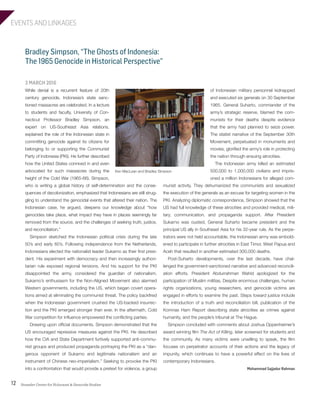
3 MARCH 2016
While denial is a recurrent feature of 20th
century genocide, Indonesia’s state sanc-
tioned massacres are celebrated. In a lecture
to students and faculty, University of Con-
necticut Professor Bradley Simpson, an
expert on US-Southeast Asia relations,
explained the role of the Indonesian state in
committing genocide against its citizens for
belonging to or supporting the Communist
Party of Indonesia (PKI). He further described
how the United States connived in and even
advocated for such massacres during the
height of the Cold War (1965-66). Simpson,
who is writing a global history of self-determination and the conse-
quences of decolonization, emphasized that Indonesians are still strug-
gling to understand the genocidal events that altered their nation. The
Indonesian case, he argued, deepens our knowledge about “how
genocides take place, what impact they have in places seemingly far
removed from the source, and the challenges of seeking truth, justice,
and reconciliation.”
Simpson sketched the Indonesian political crisis during the late
50’s and early 60’s. Following independence from the Netherlands,
Indonesians elected the nationalist leader Sukarno as their first presi-
dent. His experiment with democracy and then increasingly authori-
tarian rule exposed regional tensions. And his support for the PKI
disappointed the army, considered the guardian of nationalism.
Sukarno’s enthusiasm for the Non-Aligned Movement also alarmed
Western governments, including the US, which began covert opera-
tions aimed at eliminating the communist threat. The policy backfired
when the Indonesian government crushed the US-backed insurrec-
tion and the PKI emerged stronger than ever. In the aftermath, Cold
War competition for influence empowered the conflicting parties.
Drawing upon official documents, Simpson demonstrated that the
US encouraged repressive measures against the PKI. He described
how the CIA and State Department furtively supported anti-commu-
nist groups and produced propaganda portraying the PKI as a “dan-
gerous opponent of Sukarno and legitimate nationalism and an
instrument of Chinese neo-imperialism.” Seeking to provoke the PKI
into a confrontation that would provide a pretext for violence, a group
Ken MacLean and Bradley Simpson
603064.indd 12 11/18/16 11:01 AM
EVENTS AND LINKAGES
13
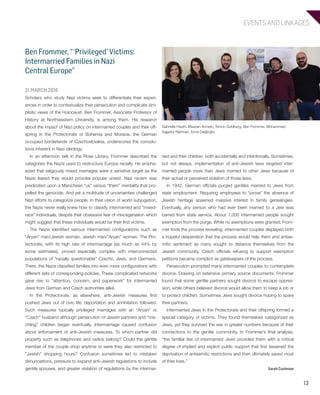
Ben Frommer, “‘Privileged’ Victims:
Intermarried Families in Nazi
Central Europe”
21 MARCH 2016
Scholars who study Nazi victims seek to differentiate their experi-
ences in order to contextualize their persecution and complicate sim-
plistic views of the Holocaust. Ben Frommer, Associate Professor of
History at Northwestern University, is among them. His research
about the impact of Nazi policy on intermarried couples and their off-
spring in the Protectorate of Bohemia and Moravia, the German
occupied borderlands of Czechoslovakia, underscores the convolu-
tions inherent in Nazi ideology.
In an afternoon talk in the Rose Library, Frommer described the
categories the Nazis used to restructure Europe racially. He empha-
sized that religiously mixed marriages were a sensitive target as the
Nazis feared they would provoke popular unrest. Nazi racism was
predicated upon a Manichean “us” versus “them” mentality that pro-
pelled the genocide. And yet a multitude of uncertainties challenged
Nazi efforts to categorize people. In their vision of world subjugation,
the Nazis never really knew how to classify intermarried and “mixed-
race” individuals, despite their obsessive fear of miscegenation which
might suggest that these individuals would be their first victims.
The Nazis identified various intermarried configurations such as
“Aryan” man/Jewish woman, Jewish man/”Aryan” woman. The Pro-
tectorate, with its high rate of intermarriage (as much as 44% by
some estimates), proved especially complex with interconnected
populations of “racially questionable” Czechs, Jews, and Germans.
There, the Nazis classified families into even more configurations with
different sets of corresponding policies. These complicated networks
gave rise to “attention, concern, and paperwork” for intermarried
Jews from German and Czech authorities alike.
In the Protectorate, as elsewhere, anti-Jewish measures first
pushed Jews out of civic life; deportation and annihilation followed.
Such measures typically privileged marriages with an “Aryan” or
“Czech” husband although persecution of Jewish partners and “mis-
chling” children began eventually. Intermarriage caused confusion
about enforcement of anti-Jewish measures. To which partner did
property such as telephones and radios belong? Could the gentile
member of the couple shop anytime or were they also restricted to
“Jewish” shopping hours? Confusion sometimes led to mistaken
denunciations, pressure to expand anti-Jewish regulations to include
gentile spouses, and greater violation of regulations by the intermar-
Gabrielle Hauth, Maayan Armelin, Simon Goldberg, Ben Frommer, Mohammad
Sajjadur Rahman, Emre Dağlioğlu
ried and their children, both accidentally and intentionally. Sometimes,
but not always, implementation of anti-Jewish laws targeted inter-
married people more than Jews married to other Jews because of
their actual or perceived violation of those laws.
In 1942, German officials purged gentiles married to Jews from
state employment. Requiring employees to “prove” the absence of
Jewish heritage spawned massive interest in family genealogies.
Eventually, any person who had ever been married to a Jew was
barred from state service. About 1,000 intermarried people sought
exemption from the purge. While no exemptions were granted, From-
mer finds the process revealing: intermarried couples displayed both
a hopeful desperation that the process would help them and antise-
mitic sentiment as many sought to distance themselves from the
Jewish community. Czech officials refusing to support exemption
petitions became complicit as gatekeepers of the process.
Persecution prompted many intermarried couples to contemplate
divorce. Drawing on extensive primary source documents, Frommer
found that some gentile partners sought divorce to escape oppres-
sion, while others believed divorce would allow them to keep a job or
to protect children. Sometimes Jews sought divorce hoping to spare
their partners.
Intermarried Jews in the Protectorate and their offspring formed a
special category of victims. They found themselves categorized as
Jews, yet they survived the war in greater numbers because of their
connections to the gentile community. In Frommer’s final analysis,
“the familial ties of intermarried Jews provided them with a critical
degree of implied and explicit public support that first lessened the
deprivation of antisemitic restrictions and then ultimately saved most
of their lives.”
Sarah Cushman
603064.indd 13 11/18/16 11:01 AM
EVENTS AND LINKAGES
Strassler Center for Holocaust & Genocide Studies14
Symposium: “Genocide against Native Americans?
Indigenous Identity and Mass Violence in North America”
indigenous women to maintain its hold over formerly indigenous lands
and resources. Criminologist Alex Alvarez opened with a critical
question: “How do we acknowledge the suffering, the trauma, the
injustice perpetrated against entire populations? How do we grieve
the inhumanity of mass atrocity yet at the same time debate the
meaning of genocide? This is the challenge.” Psychologist Joseph
Gone examined historical trauma and how it marks Native identity
despite diverse indigenous experiences. He offered a microhistorical
analysis of deadly intertribal warfare to complicate sweeping attribu-
tions of genocide that result in binaries of native victimization and
white perpetration.
In the final talk of the day, poet and traditional knowledge keeper
Margo Tamez declaimed about a space of loss across time and place.
Beginning with the protocols of gratitude, respect, and recognition from
the Ndé people’s tradition, she welcomed and oriented the audience to
her talk. Tamez recounted the self-recognizing reparations process that
many tribes have adopted with the understanding that no one will come
to repair the harm they have suffered, and so they must do it themselves.
Professor Ken Maclean synthesized the symposium’s proceedings in
the concluding panel. He identified genocide, denial, identity politics,
sovereignty, and translation as touchstones connecting the presenta-
tions. Maclean’s thoughtful comments prompted fruitful discussion.
The enormity of the question the conference posed, its possibilities and
problems, resonated among the participants. At the Strassler Center,
we continue to sit with this question in our hearts and our minds. And
we look to the future, to what we can and will do for our part in the long
struggle towards justice. Abigail Miller
15-17 APRIL
Hitler’s Europe. Rwanda. Cambodia. Armenia. These places are con-
nected in our cultural memories with the crime of genocide. But the
United States? Canada? Many wouldn’t make that association. Pro-
fessor Thomas Kühne organized the symposium Indigenous Identity
and Mass Violence in North America to examine the sustained con-
tact between European settlers and America’s native populations that
resulted in the latter’s near annihilation. Yale University historian Ned
Blackhawk delivered the keynote, Colonial Genocides in Native North
America – Varying Methods and Approaches, co-sponsored by Clark
University President David Angel and Clark alumni Ellen Carno ’79
and Neil Leifer ’76.
A member of the Te-Moak Tribe of Western Shoshone Indians, Black-
hawk described native suffering, denial, and “scholarly discomfort” with
the concept of North American genocide. But alongside his criticism of
the American education system, the academy, and anti-genocide cru-
saders such as Samantha Power, Blackhawk provided a framework for
understanding violence perpetrated against indigenous Americans as
genocide. With the United Nations 1948 Convention on the Prevention
and Punishment of the Crime of Genocide as foundation, he urged
research into individual incidents and larger patterns of violence. Black-
hawk implored listeners to challenge the ongoing erasure of this topic in
historiography as well as in public awareness and education. As a histo-
rian and coordinator of the Yale Group for the Study of Native America,
Blackhawk emphasized that education is at the crux of progress and
justice, but he also encouraged individuals to support local tribes as
allies, advocates, and supporters.
A full-day symposium followed Blackhawk’s lecture. Invited speak-
ers included an anthropologist, a criminologist, an historian, a legal
scholar, a poet, and a psychologist. Legal scholar Angelique Eagle-
Woman dismissed the question mark in the symposium’s title, firmly
stating that not only had genocide occurred against Native Americans
but that it is ongoing. She lamented the erasure of Native American
history from classrooms, pointing to ignorance as the impediment to
genocide recognition. Historian Karl Jacoby acknowledged that histori-
ans had served to justify genocide, which had doubly wronged the
native population. And he charged scholars to identify instances of
genocide in the American past and to call them by their rightful name.
Anthropologist Audra Simpson employed a gendered analysis to
describe the cost of settler sovereignty in Canada. She offered the
bold claim that Canada requires the disappearance and death of
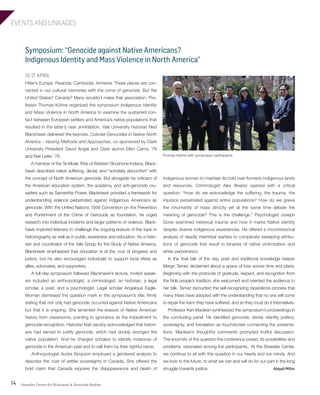
Thomas Kühne with symposium participants
603064.indd 14 11/18/16 11:01 AM
EVENTS AND LINKAGES
15
Educational Outreach
Developing relationships with secondary school teachers and stu-
dents is central to the Strassler Center’s public mandate. During the
past academic year, the Center advanced these efforts with the gen-
erous support of the Melvin S. Cutler Charitable Foundation. Building
on Summer Institute 2015, I organized the second Holocaust seminar
for secondary educators. Professor Katerine Bielaczyc, Director of
the Hiatt Center for Urban Education, and I served as instructors in a
week-long institute, during which teachers explored Holocaust his-
tory and developed powerful classroom practices. Using knowl-
edge-building community models and problem-based learning,
participants developed lesson plans designed to teach students to
engage with historical issues, hone reading and writing skills, critically
navigate 21st century media, and analyze primary documents.
Unpublished material from Professor Debórah Dwork’s Holocaust
Letters Project provided valuable content. The letters are part of a
private collection of correspondence exchanged between parents
and children separated by the Holocaust. Elisabeth Luz, a Swiss
woman who took advantage of her country’s neutrality to circumvent
wartime censors, ensured familial correspondence and connection by
serving as an intermediary. Entitled Dear Tante Elisabeth, the collec-
tion will eventually be posted online as a digital archive. An anony-
mous grant funded translation and transcription of French and
German letters into English, initial editing of the collection, and devel-
opment of a proto-website. Dwork aims to to make the entire collec-
tion available to scholars, teachers, students, and the public in a
searchable and interactive format. Ultimately, the collection and an
array of educational tools and activities will be available online.
Partnering with the Worcester Public Schools, I collaborated with
the entire team of senior class English Language Arts teachers at
North High School to develop an eight-week Holocaust curriculum,
the final English unit before graduation. The course was the first
in-depth, long-term partnership between the Strassler Center and a
public school. Phyllis Goldstein, North High’s Focused Instructional
Coach, conceived and nurtured the project in order to provide every
senior with a serious introduction to Holocaust history and literature.
Furthering their professional development, our doctoral students
taught lessons and honed their classroom skills. The endeavor culmi-
nated with projects in which students synthesized what they learned.
Senior Alvaro Garcia commented, “I have seen my peers really
engage in this topic. Having the speakers come into our school has
been such an amazing and interesting experience that really informed
our senior class and taught us things we hadn’t learned.” Kesia Baah
endorsed the goal of continued collaboration: “In my opinion, the
Holocaust Studies unit should be a vital part of the senior curriculum.
It served as a source of enlightenment for all of us. It has taught me to
never blindly follow the crowd.”
For the second year, Strassler Center doctoral students connected
with Woodstock Academy in partnership with Temple Beth Israel Pres-
ervation Society. In lectures open to the entire Woodstock community,
doctoral students lectured about their dissertation research and then
visited high school classrooms to facilitate discussion. Finally, I contin-
ued to use distance learning technology for the third year, delivering an
introductory lecture and participating in question and answer sessions
with 10th grade students at Lee’s Summit High School in Missouri.
Both students and teachers appreciated the experience. As teacher
Marc Russell observed, “This is one of my favorite activities of the year
and I am so glad you are so willing to work with these students.”
We appreciate opportunities to bring knowledge about these diffi-
cult subjects to all of these students and schools as part of our
mandate to educate the public. Developing best pedagogical prac-
tices and providing serious content and instruction are central to
these efforts.
Sarah Cushman
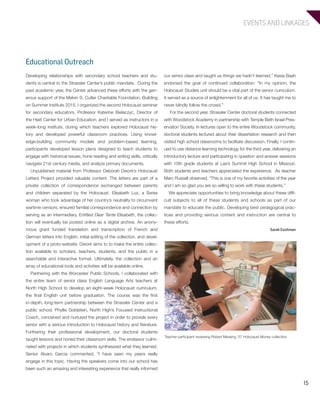
Teacher participant reviewing Robert Messing ‘57 Holocaust Money collection
603064.indd 15 11/29/16 7:32 AM
EVENTS AND LINKAGES
Strassler Center for Holocaust & Genocide Studies16
Linkages
Europe and the United States. Professor Ken MacLean and Raz
Segal PhD ’13 organized a workshop on post-genocide societies,
calling for critical engagement with “transitional” assumptions embed-
ded in such work and examination of how these assumptions may
both illuminate and obfuscate justice. Cooperation with Israeli institu-
tions and colleagues continues in spring 2017, when we will host
Chen Bram as the Dana and Yossie Hollander Visiting Professor in
the next phase of the IAE.
Generation of ideas is not exclusive to higher education or to
experts. This recognition drives our connections with local secondary
schools, educators, and students. Building on its first iteration in 2015
and with the support of the Melvin S. Cutler Charitable Foundation, the
Holocaust Summer Institute gathered teachers to explore Holocaust
history and develop powerful classroom practices. In addition to
exploring ways for teachers to engage their students in historical
issues, hone reading and writing skills, critically navigate 21st century
media, and write lesson plans for the upcoming academic year, partici-
pants studied unpublished letters exchanged between parents and
children during the Holocaust, generating discussion about how to use
them in a classroom context.
The Center enjoys meaningful connections with individuals and
institutions that expand our reach and expertise. We thank all those
with whom we connect for energizing our mission. Sarah Cushman
While the Strassler Center’s objective of training the next generation of
Holocaust and genocide scholars endures, ways to fulfill that objective
continue to evolve. A case in point: the Center’s First International Con-
ference for Graduate Students in Holocaust and Genocide Studies,
held in 2009. The cooperation of the Danish Institute for International
Studies and the support of the Louis and Anne Kulin Fund, established
by Howard and Hanne Kulin, ensured broad participation and success.
The conference became a triennial staple and inspired another innova-
tive conference for young scholars and new professionals and practi-
tioners, Emerging Expertise: Holding Accountability Accountable, to
take place in April 2017.
Supported by the Charles E. Scheidt Family Foundation, Emerging
Expertise will open new opportunities for collaboration. Participants will
include early career academics (advanced doctoral students, post-doc-
toral fellows, assistant professors), professionals (lawyers, educators,
policy makers, journalists), and practitioners (NGO workers, civil ser-
vants) who are working on issues germane to the aftermath of mass
violence. Participants will explore “accountability” as a theoretical con-
cept, methodological concern, moral principle, legal demand, and form
of ethical engagement in order to generate novel ideas about preven-
tion, recovery, and justice.
A common response to mass violence is denial. Denial and indiffer-
ence characterize present-day attitudes toward atrocity that took place
on American soil, slavery and genocide alike. Many scholars research
North American Indians, but few focus on the destruction of tribal life
and cultures. Yet the consequences of sustained contact between
European settlers and America’s native populations include massacre,
displacement, and cultural obliteration. The Strassler Center has long
engaged in pioneering research about genocides that occurred in loca-
tions far from home. This year, we began to address local issues on
land once inhabited by the Nipmuc people, hosting a symposium in
April that will lead to deeper engagement. Last summer, the Mashan-
tucket Pequot Museum and Research Center in Connecticut hosted an
HGS undergraduate internship. We look forward to continued cooper-
ation with the museum and other organizations that engage with this
tragic history.
In fall 2015, the second iteration of the Israel Academic Exchange
(IAE) brought together scholars from the Avraham Harman Institute of
Contemporary Jewry at the Hebrew University of Jerusalem, Al-Quds
University, Ben-Gurion University of the Negev, Tel Aviv University, and
the Van Leer Jerusalem Institute, as well as a number of universities in
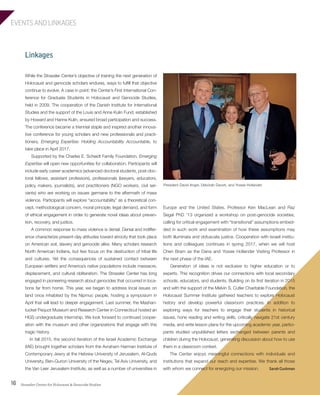
President David Angel, Debórah Dwork, and Yossie Hollander
603064.indd 16 11/30/16 7:40 AM
17
Anti-Defamation League
The Armenian Genocide Museum Institute
Armenian National Institute
Armenocide
Auschwitz Institute for Peace and Reconciliation
Center for Humanistic Education, Ghetto Fighters’ Museum
Center for Holocaust, Human Rights & Genocide Education,
Brookdale Community College, NJ
Conference on Material Claims against Germany
Danish Institute for International Studies
Hadassah Brandeis Institute
Haigazian University, Beirut
Holocaust Educational Foundation
Hrant Dink Foundation
Institute for Contemporary Jewry, Hebrew University
International Holocaust and Remembrance Alliance
The Jewish Foundation for the Righteous
Leo Baeck Institute
Memorial Foundation for Jewish Culture
Mgrublian Center for Human Rights
The Museum of Jewish Heritage – A Living Memorial to the Holocaust
National Association for Armenian Studies and Research
Per Ahlmark Foundation, Stockholm
Polin, Museum of the History of Polish Jews
Radio La Benevolencija Humanitarian Tools Foundation
Rodgers Center for Holocaust Education, Chapman University
Salzburg Global Seminar
School of Historical Studies, Tel Aviv University
Seyfo Center, Assyrian Genocid Research Center
Shoah Foundation Institute
United States Holocaust Memorial and Museum
Yad Vashem
YIVO Institute for Jewish Research
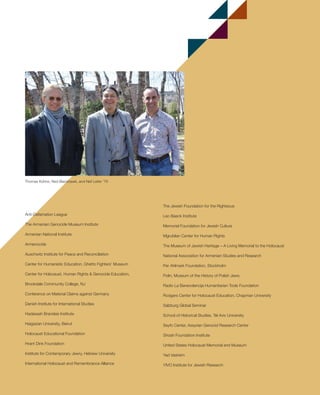
Thomas Kühne, Ned Blackhawk, and Neil Leifer ’76
603064.indd 17 11/18/16 11:01 AM
Towers of the Holocaust Memorial, Boston, MA
603064.indd 18 11/30/16 7:40 AM
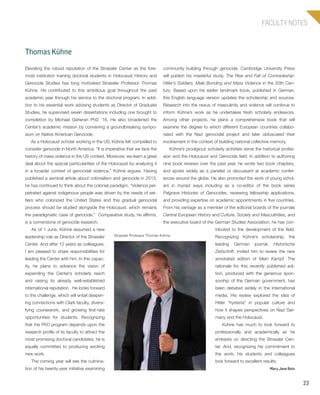
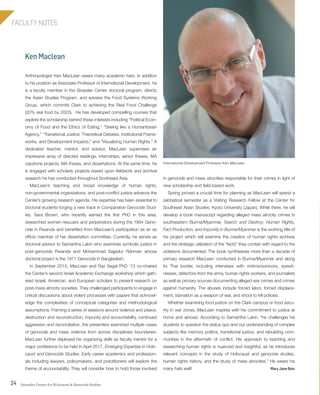
faculty
notes
603064.indd 19 11/30/16 7:40 AM
Strassler Center for Holocaust & Genocide Studies20
FACULTY NOTES
Debórah Dwork
Committed to growing the scope of doctoral study to
other genocides, the Strassler Center admitted Sara
Brown, who focused on the 1994 Genocide in Rwanda.
Writing her dissertation on Gender and Agency: Women
Rescuers and Perpetrators during the Genocide in
Rwanda, Brown flew through her defense in May.
Dwork chaired her committee, joined by Yale University
professor David Simon and Clark’s own professor
emerita, internationally renowned feminist scholar Cyn-
thia Enloe.
2015-16 was thus a milestone year for the Center,
and the superb quality of the dissertations is the happy
expression of our aspirations to extend our scholarly
compass. Nor was there any diminution of activity in
the Holocaust history stream. No fewer than three of
Dwork’s doctoral candidates in that track successfully
defended their theses. (“With a total of five of my stu-
dents bringing their dissertations to closure, I always
had someone’s work and my blue pen in hand. Multiple
drafts of every chapter – and in the end, all a joy to
read.”) Jeff Koerber, whose committee comprised Kate
Brown, professor of history at UMBC; Wendy Lower,
the John K. Roth Professor of History, Claremont McK-
enna College; and Dwork as chair, wrote an elegant
and probing study, Born in the Borderlands: Jewish
Youth and their Response to Oppression and Genocide, 1933-1948.
Elizabeth Anthony’s haunting dissertation, Return Home: Holocaust
Survivors Reestablishing Lives in Postwar Vienna, brimmed with
insights, which her committee – Dwork, joined by Atina Grossman,
professor of modern European history at Cooper Union and Marsha
Rozenblit, Meyerhoff Professor of Modern Jewish History, University of
Maryland – appreciated. Joanna Sliwa’s thesis, Concealed Presence:
Jewish Children in German-Occupied Kraków, was ready for prime
time, too. Her committee, Jan Gross (the Norman B. Tomlinson Profes-
sor of War and Society, Princeton University), Sam Kassow (Charles H.
Northam Professor of History, Trinity College), and again Dwork as
chair, was delighted by the wealth of sources upon which she drew as
she pieced together an utterly unknown history. As Dwork happily
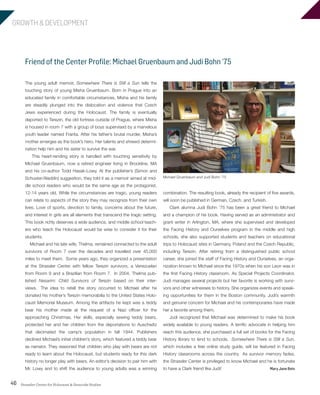
pointed out, a fourth Holocaust history stream student, Michael Gehe-
ran, supervised by Professor Thomas Kühne, defended a splendid dis-
sertation on Betrayed Comradeship: German-Jewish WWI Veterans
under Hitler. Omer Bartov (John P. Birkelund Distinguished Professor of
“What a fantastic final year as director of the Strassler Center!” Debórah
Dwork exclaimed. “These past twelve months have seen the actualiza-
tion of core Center ambitions.” Founded as an institute with a doctoral
program in Holocaust history, the Center eagerly expanded its reach
(2002) to the history of the Armenian Genocide. Two students earned
their PhDs in that track this year. With his dissertation on Genocide
and Humanitarian Resistance in Ottoman Syria, Khatchig Mouradian
was the first ever, and he was co-supervised by Dwork and Professor
Taner Akçam. Professor Raymond Kevorkian, Director of the Nubarian
Library in Paris, served as the third member of his committee. Ümit
Kurt followed, with a dissertation on Aintab elites’ seizure of Armenian
property, 1915 - 1922. His committee included Akçam as chair, Rich-
ard Hovannisian, UCLA professor emeritus, and Hans-Lukas Kieser,
professor of modern history at the University of Zurich. The willingness
of all of these eminent scholars to serve as mentors to Center doctoral
students reflects the excellence of the candidates, and is an expression
of the Center’s rich intellectual network.
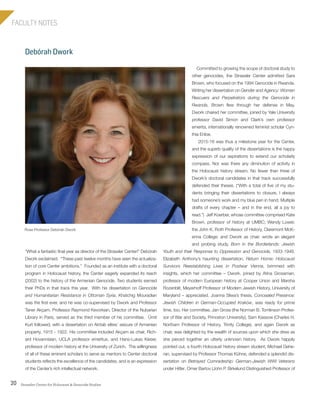
Rose Professor Debórah Dwork
603064.indd 20 11/18/16 11:01 AM
21
FACULTY NOTES
Holocaust? undertaken by the University College London Centre for
Holocaust Education, and to submit her critical assessment for publi-
cation in a special issue of Holocaust Studies. Dwork’s perspective
was enriched by her participation on the steering committee of a huge,
multi-national project to identify and analyze empirical research carried
out in fifteen languages on Holocaust pedagogy. Conducted under the
auspices of the 31-state International Holocaust Remembrance Alli-
ance (IHRA), this education research project absorbed Dwork’s atten-
tion this year. She was delighted when the study Report was posted on
the IHRA website in January, followed by a concluding International
Research Conference on Education about the Holocaust held in
Lucerne, Switzerland, at which she held several key roles.
Dwork sees such projects as both intellectually engaging and a form
of scholarly service. Indeed, she lends her expertise – and boundless
energy and enthusiasm – to a variety of pedagogical initiatives. These
include her role as consultant historian on a permanent exhibition envi-
sioned and mounted by the Center for Holocaust, Human Rights &
Genocide Education (Chhange) at Brookdale Community College (N.J.)
to open in March 2017; her (now former!) students Sara Brown,
Khatchig Mouradian, and Naama Haviv brought their scholarship to the
exhibit as well. “The Chhange leadership embraced their advice and
expertise,” Dwork beamed. Dwork also offered her expertise on film,
interviewed by a Facing History and Ourselves team working on docu-
mentaries for classroom use. But, she says, words -- printed and spo-
ken -- remain her medium. And thus it is no surprise that she could be
found at a lectern in public and academic venues coast to coast and
across Europe throughout the past year. Indeed, even at the United
Nations! Mary Jane Rein
European History, Brown University) and Geoff Megargee (Applied
Research Scholar, USHMM) served on his committee.
In Dwork’s view, the sparkling array of scholars who participate in
the Center’s doctoral program speaks to the nature of education in this
field. “No university, no matter how wealthy, has the resources to sup-
port the full range of professorial expertise Holocaust history and geno-
cide studies requires. Thus, I developed another model: the Center
Without Walls.” It worked. “Time is the coin of our realm, and these
scholars have chosen to spend that currency on our students. Their
decision to invest in our students signals the esteem our doctoral pro-
gram has earned.” Twenty years after she came to Clark and eighteen
after the first doctoral students were admitted, Dwork continues to
exult over the PhD program. It is a special joy for her that the number
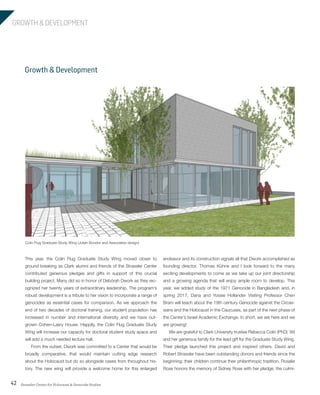
of students has outstripped the premises, and award-winning architect
Julian Bonder (who designed the Rose Library and Cohen Lasry House
renovations) has returned to the Center to design the new Colin Flug
Graduate Study Wing to house them.
Mentoring doctoral students is merely one aspect of Dwork’s
dynamic professional life. In anticipation of her sabbatical and, as she
says, “transition to civilian life as a typical professor,” Dwork jumped
into the research for another book. Dear Tante Elisabeth draws upon a
cache of over a thousand letters written by Jewish parents to their chil-
dren and from the children to their parents. Sent through Elisabeth Luz
who, in neutral Switzerland, served as a go-between in the tangle of
wartime postal restrictions, these letters offer a lens on families rent
asunder. Recognizing the significance of this bilateral correspondence,
Dwork and Sarah Cushman PhD ’10 sought and were awarded a gen-
erous grant to make it available as an online archive. With transcription,
translation, and encoding underway, Dwork has turned to analysis, and
Cushman to using the letters as primary materials for documents-based
middle and high school Holocaust history curricula.
“Writing is all about working out ideas,” Dwork explained. She had a
lot of ideas this year. Writing the Introduction to survivor Nate
Leipciger’s memoir, The Weight of Freedom, Dwork explored the issue
of sexual abuse during the Holocaust. Contributing a chapter on
“Flight and Exile” to an edited volume allowed her to think anew about
refugees – their routes to safety and their circumstances upon arrival –
a subject that has long claimed her scholarly attention. Increasingly
engaged with Holocaust education (“does learning about the Holo-
caust serve as a vaccine against prejudice and racism?”), Dwork was
invited to deliver the keynote address at the launch of a major English
national study, What do Students Know and Understand about the
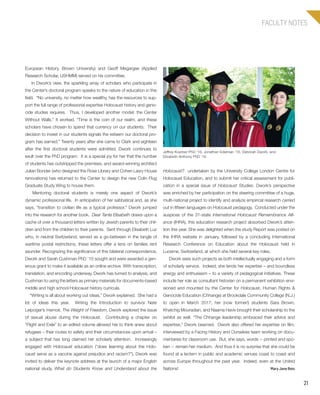
Jeffrey Koerber PhD ’16, Jonathan Edelman ’16, Debórah Dwork, and
Elizabeth Anthony PhD ’16
603064.indd 21 11/18/16 11:01 AM
Strassler Center for Holocaust & Genocide Studies22
FACULTY NOTES
Taner Akçam
clearly and definitively that the Ottoman Turkish Government engaged
in a planned and centrally organized effort to annihilate innocent
Armenians and other Ottoman Christians.
The first phase of the project entailed scanning thousands of doc-
uments and translating them from Ottoman Turkish. During the fall,
Akçam collaborated with PhD students Anna Aleksanyan and Emre
Dağlioğlu to compile an index that will allow
the archive to be fully searchable. A spring
semester sabbatical afforded him time to
embark on a book project (published in
Turkish in fall 2016) that utilizes the archive
to establish evidence of the Ottoman gov-
ernment’s organization of the Armenian
Genocide. With free and easy access to
these materials, Turkish citizens will finally
have the opportunity to honestly assess
their history. And this development has the
potential to transform Turkish society into a
more open and democratic system where
citizens hold their government to account
for their actions.
Publishing archival findings that establish
details of the Armenian Genocide underlies
much of Akçam’s scholarship. Having
uncovered protocols from the League of
Nations archive that preserve the testimonies of Armenian Genocide
survivors, he published a selection of them in the electronic archive
Armenocide, These documents are the basis for yet another book
project, The League of Nations in Aleppo: Armenian Women and Chil-
dren Survivors, 1921-1927.
A remarkably productive scholar, Akçam published The Spirit of
the Laws: The Plunder of Wealth in the Armenian Genocide, in fall
2015, co-authored with his doctoral student Ümit Kurt. He also
supervised research conducted by Burçin Gerçek that identified
Turkish and Kurdish rescuers of Armenians during the Genocide.
Completed on behalf of the International Raoul Wallenberg Founda-
tion, the results are available electronically and in multiple languages.
No stranger to public recognition, Akçam was honored at a Sep-
tember ceremony that paid tribute to the project. In the end, the
greatest reward is that Gerçek will continue her research as Akçam’s
newest student in the Armenian Genocide doctoral track.
Mary Jane Rein
“The more academics we have working in this field, the less oxygen
denialism receives. Education is where the real investment needs to be
made,” Professor Taner Akçam declared to hundreds of Armenian
Church leaders on the occasion of his recognition as a “Friend of the
Armenians.” In awarding him this honor, the Diocesan Council praised
Akçam’s “lifelong effort to reveal and defend historical truth through
scholarship.” Citing the importance of educa-
tion about the Armenian Genocide in his
acceptance remarks, Akçam, the Robert
Aram, Marianne Kaloosdian and Stephen
and Marian Mugar Professor, highlighted his
deep commitment to mentoring students.
“We need to train dozens of young academics
who can express the truth not as an emo-
tional plea but as a scholarly fact. The giants
in the field, like Dadrian and Hovannisian,
have retired and we desparately need to find
their replacements,” Akçam proclaimed.
If training young scholars is needed,
Akçam is making excellent strides in prepar-
ing them. In January, Khatchig Mouradian
defended his dissertation to become the
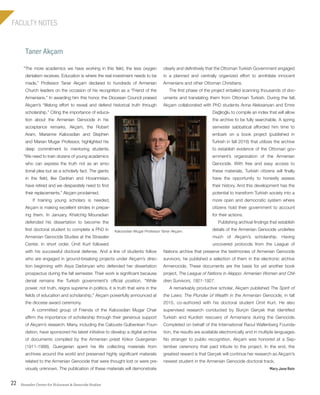
first doctoral student to complete a PhD in
Armenian Genocide Studies at the Strassler
Center. In short order, Ümit Kurt followed
with his successful doctoral defense. And a line of students follow
who are engaged in ground-breaking projects under Akçam’s direc-
tion beginning with Asya Darbinyan who defended her dissertation
prospectus during the fall semester. Their work is significant because
denial remains the Turkish government’s official position. “While
power, not truth, reigns supreme in politics, it is truth that wins in the
fields of education and scholarship,” Akçam powerfully announced at
the diocese award ceremony.
A committed group of Friends of the Kaloosdian Mugar Chair
affirm the importance of scholarship through their generous support
of Akçam’s research. Many, including the Calouste Gulbenkian Foun-
dation, have sponsored his latest initiative to develop a digital archive
of documents compiled by the Armenian priest Krikor Guergerian
(1911-1988). Guergerian spent his life collecting materials from
archives around the world and preserved highly significant materials
related to the Armenian Genocide that were thought lost or were pre-
viously unknown. The publication of these materials will demonstrate
Kaloosdian Mugar Professor Taner Akçam.
603064.indd 22 11/18/16 11:01 AM
23
FACULTY NOTES
Thomas Kühne
community building through genocide. Cambridge University Press
will publish his masterful study, The Rise and Fall of Comradeship:
Hitler’s Soldiers, Male Bonding and Mass Violence in the 20th Cen-
tury. Based upon his earlier landmark book, published in German,
this English language version updates the scholarship and sources.
Research into the nexus of masculinity and violence will continue to
inform Kühne’s work as he undertakes fresh scholarly endeavors.
Among other projects, he plans a comprehensive book that will
examine the degree to which different European countries collabo-
rated with the Nazi genocidal project and later obfuscated their
involvement in the context of building national collective memory.
Kühne’s prodigious scholarly activities serve the historical profes-
sion and the Holocaust and Genocide field. In addition to authoring
nine book reviews over the past year, he wrote two book chapters,
and spoke widely as a panelist or discussant at academic confer-
ences around the globe. He also promoted the work of young schol-
ars in myriad ways including as a co-editor of the book series
Palgrave Histories of Genocides, reviewing fellowship applications,
and providing expertise on academic appointments in five countries.
From his vantage as a member of the editorial boards of the journals
Central European History and Culture, Society and Masculinities, and
the executive board of the German Studies Association, he has con-
tributed to the development of the field.
Recognizing Kühne’s scholarship, the
leading German journal, Historische
Zeitschrift, invited him to review the new
annotated edition of Mein Kampf. The
rationale for this recently published edi-
tion, produced with the generous spon-
sorship of the German government, has
been debated widely in the international
media. His review explored the idea of
Hitler “hysteria” in popular culture and
how it shapes perspectives on Nazi Ger-
many and the Holocaust.
Kühne has much to look forward to
professionally and academically as he
embarks on directing the Strassler Cen-
ter. And, recognizing his commitment to
the work, his students and colleagues
look forward to excellent results.
Mary Jane Rein
Elevating the robust reputation of the Strassler Center as the fore-
most institution training doctoral students in Holocaust History and
Genocide Studies has long motivated Strassler Professor Thomas
Kühne. He contributed to this ambitious goal throughout the past
academic year through his service to the doctoral program. In addi-
tion to his essential work advising students as Director of Graduate
Studies, he supervised seven dissertations including one brought to
completion by Michael Geheran PhD ’16. He also broadened the
Center’s academic mission by convening a groundbreaking sympo-
sium on Native American Genocide.
As a Holocaust scholar working in the US, Kühne felt compelled to
consider genocide in North America. “It is imperative that we face the
history of mass violence in the US context. Moreover, we learn a great
deal about the special particularities of the Holocaust by analyzing it
in a broader context of genocidal violence,” Kühne argues. Having
published a seminal article about colonialism and genocide in 2013,
he has continued to think about the colonial paradigm. “Violence per-
petrated against indigenous people was driven by the needs of set-
tlers who colonized the United States and this gradual genocidal
process should be studied alongside the Holocaust, which remains
the paradigmatic case of genocide.” Comparative study, he affirms,
is a cornerstone of genocide research.
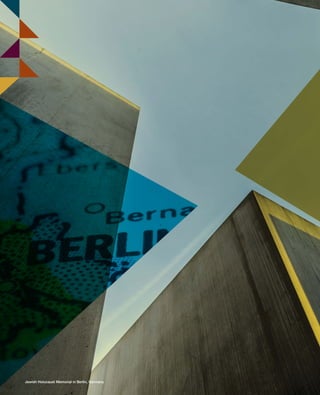
As of 1 June, Kühne assumed a new
leadership role as Director of the Strassler
Center. And after 12 years as colleagues,
I am pleased to share responsibilities for
leading the Center with him. In this capac-
ity, he plans to advance the vision of
expanding the Center’s scholarly reach
and raising its already well-established
international reputation. He looks forward
to the challenge, which will entail deepen-
ing connections with Clark faculty, diversi-
fying coursework, and growing first-rate
opportunities for students. Recognizing
that the PhD program depends upon the
research profile of its faculty to attract the
most promising doctoral candidates, he is
equally committed to producing exciting
new work.
The coming year will see the culmina-
tion of his twenty-year initiative examining
Strassler Professor Thomas Kühne.
603064.indd 23 11/18/16 11:01 AM
Strassler Center for Holocaust & Genocide Studies24
FACULTY NOTES
Ken Maclean
in genocide and mass atrocities responsible for their crimes in light of
new scholarship and field-based work.
Spring proved a crucial time for planning as MacLean will spend a
sabbatical semester as a Visiting Research Fellow at the Center for
Southeast Asian Studies, Kyoto University (Japan). While there, he will
develop a book manuscript regarding alleged mass atrocity crimes in
southeastern Burma/Myanmar. Search and Destroy: Human Rights,
Fact Production, and Impunity in Burma/Myanmar is the working title of
his project which will examine the creation of human rights archives
and the strategic utilization of the “facts” they contain with regard to the
violations documented. The book synthesizes more than a decade of
primary research MacLean conducted in Burma/Myanmar and along
its Thai border, including interviews with victims/survivors, eyewit-
nesses, defectors from the army, human rights workers, and journalists
as well as primary sources documenting alleged war crimes and crimes
against humanity. The abuses include forced labor, forced displace-
ment, starvation as a weapon of war, and shoot to kill policies.
Whether examining food justice on the Clark campus or food secu-
rity in war zones, MacLean inspires with his commitment to justice at
home and abroad. According to Samantha Lakin, “he challenges his
students to question the status quo and our understanding of complex
subjects like memory politics, transitional justice, and rebuilding com-
munities in the aftermath of conflict. His approach to teaching and
researching human rights is nuanced and insightful, as he introduces
relevant concepts in the study of Holocaust and genocide studies,
human rights history, and the study of mass atrocities.” He wears his
many hats well! Mary Jane Rein
Anthropologist Ken MacLean wears many academic hats. In addition
to his position as Associate Professor of International Development, he
is a faculty member in the Strassler Center doctoral program, directs
the Asian Studies Program, and advises the Food Systems Working
Group, which commits Clark to achieving the Real Food Challenge
(20% real food by 2020). He has developed compelling courses that
explore the scholarship behind these interests including “Political Econ-
omy of Food and the Ethics of Eating,” “Seeing like a Humanitarian
Agency,” “Transitional Justice: Theoretical Debates, Institutional Frame-
works, and Development Impacts,” and “Visualizing Human Rights.” A
dedicated teacher, mentor, and advisor, MacLean supervises an
impressive array of directed readings, internships, senior theses, MA
capstone projects, MA theses, and dissertations. At the same time, he
is engaged with scholarly projects based upon fieldwork and archival
research he has conducted throughout Southeast Asia.
MacLean’s teaching and broad knowledge of human rights,
non-governmental organizations, and post-conflict justice advance the
Center’s growing research agenda. His expertise has been essential to
doctoral students forging a new track in Comparative Genocide Stud-
ies. Sara Brown, who recently earned the first PhD in this area,
researched women rescuers and perpetrators during the 1994 Geno-
cide in Rwanda and benefited from MacLean’s participation as an ex
officio member of her dissertation committee. Currently, he serves as
doctoral advisor to Samantha Lakin who examines symbolic justice in
post-genocide Rwanda and Mohammad Sajjadur Rahman whose
doctoral project is the 1971 Genocide in Bangladesh.
In September 2015, MacLean and Raz Segal PhD ’13 co-chaired
the Center’s second Israel Academic Exchange workshop which gath-
ered Israeli, American, and European scholars to present research on
post-mass atrocity societies. They challenged participants to engage in
critical discussions about violent processes with papers that acknowl-
edge the complexities of conceptual categories and methodological
assumptions. Framing a series of sessions around violence and peace,
destruction and reconstruction, impunity and accountability, continued
aggression and reconciliation, the presenters examined multiple cases
of genocide and mass violence from across disciplinary boundaries.
MacLean further deployed his organizing skills as faculty mentor for a
major conference to be held in April 2017, Emerging Expertise in Holo-
caust and Genocide Studies. Early career academics and profession-
als including lawyers, policymakers, and practitioners will explore the
theme of accountability. They will consider how to hold those involved
International Development Professor Ken MacLean
603064.indd 24 11/18/16 11:01 AM
Program FacultyProgram Faculty
We are grateful to the following faculty for their contributions of scholarship, expertise, and teaching.
Srinivasan Sitaraman, PhD, Political Science Department
Associate Professor of Political Science
Valerie Sperling, PhD, Political Science Department
Professor of Political Science
Shelly Tenenbaum, PhD, Sociology Department
Coordinator, HGS Undergraduate Activities
Professor of Sociology
Robert Tobin, PhD, Department of Language,
Literature and Culture
Henry J. Leir Professor of Foreign Languages and Cultures
Johanna Ray Vollhardt, PhD, Francis L. Hiatt
School of Psychology
Director, Social Psychology Program
Associate Professor of Psychology
Kristen Williams, PhD, Political Science Department
Professor of Political Science
Taner Akçam, PhD, History Department
Kaloosdian Mugar Professor of Armenian Genocide Studies
and Modern Armenian History
Katerine Bielaczyc, PhD, Department of Education
Director of the Hiatt Center for Urban Education
Associate Professor of Education
Debórah Dwork, PhD, History Department
Director, Strassler Center for Holocaust and Genocide Studies
Rose Professor of Holocaust History
Jody Emel, PhD, Graduate School of Geography
Professor of Geography
Anita Fábos, PhD, Department of International
Development, Community, and Environment
Associate Professor of International Development
and Social Change
Everett Fox, PhD, Department of Language,
Literature and Culture
Director, Jewish Studies Concentration
Allen M. Glick Professor of Judaic and Biblical Studies
Thomas Kühne, PhD, History Department
Strassler Professor of Holocaust History
Olga Litvak, PhD, History Department
Michael and Lisa Leffell Professor of Modern Jewish History
Ken MacLean, PhD, Department of International Development,
Community, and Environment
Director, Asian Studies
Associate Professor of International Development
and Social Change
Marianne Sarkis, PhD, Department of International
Development, Community, and Environment
Assistant Professor of International Development
and Social Change
25
603064.indd 25 11/30/16 7:40 AM
Jewish Holocaust Memorial in Berlin, Germany
603064.indd 26 11/30/16 7:40 AM
student
& alumni
news
603064.indd 27 11/18/16 11:02 AM
Strassler Center for Holocaust & Genocide Studies28
STUDENT & ALUMNI NEWS
Graduate Center’s interdisciplinary conference in the humanities, War
and Sexual Violence, she presented “Ritualized Rapes and Body
Destruction of Armenian Women during the Genocide,” which will be
included in the conference proceedings. In London, Aleksanyan deliv-
ered a paper, “Aid to Armenia: Armenia and Armenians in International
History,” at Birkbeck College, University of London.
In June, Aleksanyan was part of a Strassler Center student delega-
tion at the Fifth International Conference on Genocide organized by
the International Network of Genocide Scholars (INOGS) in Jerusa-
lem. She collaborated with fellow students on the panel, “Gendered
Aspects of Genocide.” Following the conference, she remained in
Jerusalem to conduct research in the Armenian Patriarchate archive.
Her schedule of conferences concluded in Salzburg at the confer-
ence, Children and War: Past and Present, where she presented her
research on Armenian girl orphans after World War I.
This year, Claims Conference Fellow Maayan Armelin broadened
her expertise regarding the historical background and social processes
pertaining to her dissertation, “Follow Me into Genocide”: Social
Dynamics and Leadership Styles in the SS-Einsatzgruppen, which deals
with the operations of the SS-Einsatzgruppen in the Nazi-occupied
Soviet Union. In coursework and research projects, she also studied
European history in the twentieth century, the history of the Soviet
Union, and the development of transitional justice mechanisms and pro-
cesses of reconciliation in post conflict societies after occurrences of
genocide and mass violence. Her research focused on perpetrator
relations with regimes and the experiences of face-to-face perpetrators
while they were fulfilling orders and operating on the ground.
Armelin analyzed the primary source materials gathered from
research previously conducted in the national German archive in Lud-
wigsburg. These include trial testimonies that shed light on the lead-
Graduate Student News
Second-year doctoral student Anna Aleksanyan proudly holds the
Harry and Ovsanna Chitjian Fellowship. For her dissertation, Gender
Aspects of the Armenian Genocide, Aleksanyan researches the geno-
cidal experiences of Armenian women as well as efforts to recover their
identity in the aftermath. For men, the genocide entailed physical elim-
ination, but for women and children the situation was quite different.
Exiled to the desert, they were subject to mass humiliation, rape, star-
vation, and killings. In many cases, women and girls were forced to
marry their “rescuers” or become their slaves. After World War I, Arme-
nian and foreign organizations and individuals made every effort to
emancipate these women from Muslim harems and return them to their
Armenian identity. Liberators rescued them by paying ransom or even
through abduction, and yet some women refused to return out of
humiliation or loyalty to new families.
Working under the supervision of Professor Taner Akçam, Aleksanyan
participated in his Krikor Guergerian project, which preserves essential
documentary evidence regarding the Armenian genocide. As part of her
work with Akçam, she is preparing special guidelines and an article
about the Armenian sources of the archive. She attended a spring
workshop in Istanbul dedicated to findings from the archive.
Aleksanyan had multiple opportunities to speak and to present
papers at conferences both here and abroad throughout the spring
and summer. In March, she presented “From Adana to Bolis: Zabel
Yesayan’s Letters to Tigran Yesayan in 1909” at the conference
Empire, Politics, and War: The Armenian Genocide within the Context
of the Ottoman Empire, sponsored by the Armenian Studies Program
of California State University, Fresno. Her paper will be included in a
special conference publication. Genocide commemoration events
brought her to Worcester’s Armenian Orthodox Church and the Arme-
nian Museum of America, Watertown, where she presented “Armenian
Women during the Genocide: A General Overview.” At the CUNY
Diverse questions animate doctoral projects at the Strassler Center. PhD students from around the globe deploy well-established and innova-
tive historical methods, as well as approaches drawn from anthropology, geography, legal theory, political science, psychology, and sociology
to answer compelling research questions. They examine the economic dimensions of genocide, transnationalism, inter-ethnic violence, mem-
ory studies, gender theory, refugee issues, the psychology of perpetrators and victims, the role of bystanders, the dynamics of rescue, sexual-
ity, genocidal continuity, and victimhood in post-genocidal societies. Current doctoral projects explore genocide, its causes, conduct, and
aftermath in Argentina, Armenia, Bangladesh, Germany, Iran, Israel, Poland, Romania, Russia, Rwanda, Turkey, and Ukraine. During the 2015-
16 academic year, Center doctoral students conducted their work with passion and dedication as they explored archives, participated in con-
ferences, presented their research, visited schools, and labored for countless hours at their desks in the Tobak offices on the third floor of
Cohen-Lasry House, among the bookshelves of the Rose Library, and in their seats in the Kent seminar room and other classrooms. A sum-
mary of their activities follows.
603064.indd 28 11/18/16 11:02 AM
29
STUDENT & ALUMNI NEWS
the Harvard University Library) have already proved useful. A grant
from the Calouste Gulbenkian Foundation supported further research
in archives during the summer months. He also carried out prelimi-
nary research in the Ottoman Archive of the Prime Ministry in Istanbul
and the Foreign Office Archives of the United Kingdom in London.
Dağlioğlu serves as the project coordinator for Professor Taner
Akçam’s Guerguerian Archive initiative. Six team members have steadily
indexed many of the documents related to the Armenian Genocide col-
lected by the Armenian Catholic priest and amateur historian Krikor
Guerguerian. Among the materials in the Guerguerian Archive are
documents that pertain to the 1919 Yozgat and Trabzon court martial
trials held in Istanbul. Dağlioğlu presented early results of his research
on this material at the June INOGS conference in Jerusalem.
In April, Dağlioğlu presented “Re-Shaped Identity of Armenians in
Turkey under the Conditions of the Cold War” at the University of
Michigan-Dearborn conference, The Armenians and the Cold War.
He is now working on editing this paper for publication in a special
issue of The Armenian Review, one of the most prestigious journals in
the Armenian studies field. Finally, during the summer, Dağlioğlu fur-
ther developed the language skills needed for his primary research.
He attended the summer intensive course in Western Armenian
offered by the Hrant Dink Foundation in Istanbul. He also began to
study Ottoman-Turkish to support further archival work.
T. McBane Fellow Asya Darbinyan sailed through her compre-
hensive oral exams and the defense of her doctoral prospectus. She
is now dedicated to full-time research on her dissertation, Russian
Humanitarian Responses to the Armenian Genocide. She explores
the humanitarian assistance provided by Russian organizations to
Armenian refugees and orphans on the Caucasus frontline of World
ership styles of Einsatzgruppen officers and social dynamics among
Einsatzgruppen members while they were committing mass murder.
During a return visit to the Ludwigsburg archive, she gathered further
evidence that will advance her insights on these matters. As she con-
tinued to develop her dissertation proposal, she composed her bibli-
ography for the project and wrote an extensive literature review on
SS-Einsatzgruppen social dynamics and leadership styles. In addition
to her primary advisor, Professor Thomas Kühne, she has secured
top experts in the field for her dissertation committee, Professor Mark
Rosemann (Indiana State University) and Dr. Jürgen Matthäus (United
States Holocaust Memorial Museum).
Armelin took advantage of the opportunity to attend international
conferences to share her research findings. In April, she participated in
a workshop at the University of Utrecht in the Netherlands, Teaching
about Perpetrators that examined methodologies and pedagogical
approaches at the high school and university level. Her presentation on
masculinities and hyper-masculinities among face-to-face perpetrators
received positive responses. In June, she attended the INOGS confer-
ence, Intersections: Holocaust Scholarship, Genocide Research, and
History of Mass Violence, organized by the Hebrew University. Armelin
presented “Hyper-masculinities, Leadership Styles, and Violence
among SS-Einsatzgruppen,” on the panel “Gendered Aspects of
Genocide.” Organized with fellow Strassler Center doctoral students,
the panel examined the different experiences of men and women, both
perpetrators and victims, during genocide. Armelin’s paper explored
the impact of societal expectations of men on male perpetrators’ vio-
lent choices and behavior during mass violence.
Emre Can Dağlioğlu holds the Agnes Manoogian Hausrath Fel-
lowship in Armenian Genocide Studies. He begins his doctoral work
having served as a journalist and editor for Agos Weekly, the bilingual
Turkish-Armenian newspaper based in Istanbul. He also earned an
MA in Cultural Studies from Bilgi University, Istanbul, where he
researched minority issues.
For his dissertation, Dağlioğlu looks at the impact of Hamidian era
reforms on the decision-making of the central government and local
notables with regard to massacres carried out against Ottoman
Armenians from 1895 to 1896. He examines the extent to which
political interplay and international pressure against the Ottoman
Empire contributed to these violent events. Records of American
Protestant missionaries who worked in Anatolia under the name of
the American Board of Commissioners for Foreign Missions (held at
Current PhD students with Debórah Dwork
603064.indd 29 11/18/16 11:02 AM
Strassler Center for Holocaust & Genocide Studies30
STUDENT & ALUMNI NEWS
enced, as well as questions concerning the perpetrators’ deceptive
tactics and deportees’ awareness of their intended fate. Goldberg’s
MA thesis was the basis for his presentation at the INOGS conference.
He discussed deportees’ expressions of agency on the trains and
used Pagis’ poem to highlight the role of deportations in propelling the
collapse of the family unit.
For his dissertation, Goldberg will investigate the ways that Jews
gathered, shared, and interpreted information in real time. While histori-
ans have documented the perpetrators’ coordinated secrecy around the
Final Solution, the dynamics governing the flow of information and
knowledge-production within wartime Jewish communities have gar-
nered little attention. Goldberg will examine how information—in the form
of rumors, reports, and eyewitness accounts—transformed into knowl-
edge about the war and the Final Solution, and how the acquisition of
such knowledge was mediated by psychological and sociological pro-
cesses. Goldberg will focus on wartime Lithuania, particularly Vilna,
Kovno, and Shavli. To that end, he began to survey the archives of the
USHMM and the YIVO Institute for Jewish Research.
In order to work with primary source material, he attended a winter
Yiddish Immersion Program. He further advanced his Yiddish profi-
ciency at the Naomi Prawer Kadar International Yiddish Summer
Program at Tel Aviv University. While in Israel, he visited the Yad
Vashem archives in search of wartime diaries and letters written in
Poland and the occupied Soviet Union, particularly in 1941 and 1942
as information about mass murder began circulating in Jewish com-
munities. Returning to the US, he attended the 2016 Dissertation and
Thesis Development Workshop at the USHMM. Finally, in late sum-
War I. The various governmental and non-governmental organizations
she studies include the All-Russian Union of Towns and All-Russian
Union of Zemstvos, the Tatiana Committee, and the Russian Red
Cross, among others.
With the support of a Calouste Gulbenkian Foundation grant for
Armenian Studies and funding from the Friends of the Kaloosdian
Mugar Professorship, Darbinyan spent the spring in Moscow. She
conducted research in various library archives, the State Archive of the
Russian Federation (GARF), and the Russian State Military Historic
Archive. At the Russian Public Historical Library, she found Russian
imperial newspapers published during the Great War. The archives of
the Russian State Library contained important publications of the Tati-
ana Committee and the All-Russian Union of Towns. At the GARF, she
discovered materials describing Tsar Nikolai’s trip to Tiflis, Kars, Sarika-
mish, and other towns in the Caucasus in November 1914. During this
tour, the Tsar visited infirmaries and shelters for the wounded and sick
run by state and private organizations. He also met with representa-
tives of Armenian and other local organizations. Immediately after this
trip, Nikolai allocated 25,000 rubles in assistance to people in need in
the Caucasus. The Russian State Library yielded a beautifully illustrated
poster produced in 1915 and used by Russian relief organizations for a
fundraising campaign aimed at securing aid for refugees and children,
as well as several postcards issued for the same purpose.
Spring and summer offered opportunities to share preliminary
research findings. Darbinyan presented a paper on conflicting narra-
tives about Russia’s policy towards the Armenians from 1914 to 1917
at the conference, Mass Violence and Memory, organized by O. P.
Jindal Global University in India. At the INOGS conference in Jerusa-
lem, she discussed Armenian refugees in Imperial Russia. Finally,
Armenian orphans in the aftermath of the genocide was the subject
of her presentation at the conference, Children and War: Past and
Present, held at the University of Salzburg, Austria.
Claims Conference Fellow Simon Goldberg began doctoral stud-
ies this year after serving as Education Director at the Hong Kong
Holocaust and Tolerance Centre. He also earned an MA from Haifa
University, where he researched Holocaust victims’ deportation expe-
riences. Looking at transport through both a historical and a literary
lens, he examined letters written on trains en route to concentration
and death camps alongside Israeli Dan Pagis’ iconic poem, “Written in
Pencil in the Sealed Railway Car.” His study yielded insights about
deportees’ responses to the bodily and sensory assaults they experi-
Anna Aleksanyan, Emre Dağlioğlu, and Judy Saryan (Editor and Publisher of the
Zabel Yessayan project at the Armenian International Women’s Association)
603064.indd 30 11/29/16 7:32 AM
31
STUDENT & ALUMNI NEWS
insights into the importance of family bonds, age, and gender during
the flight and their stay in refugee camps in Teheran, as well as how
their experience shaped their later life in Israel. In addition to her dis-
sertation research, Haurand has written an online article on the situa-
tion of Jewish refugees in Iran during World War II for the Fondation
pour la Mémoire de la Shoah. Another article on the general situation
of Jews in Teheran during World War II is forthcoming in the online
edition of Medaon: Journal for Jewish Life in Research and Education.
Gabrielle Hauth, recipient of the Richard P. Cohen ’71 MD Fellow-
ship, examines intimate relations during the Holocaust within the con-
text of concentration camps. She focuses on the history of
Ravensbrück, a camp that held both male and female prisoners
during the latter part of the war. She explores how intimacy func-
tioned in that violent atmosphere and how it affected the everyday
experiences of prisoners and perpetrators. Her work seeks to chal-
lenge the binaries that often define sexual activity (consensual/forced,
wanted/unwanted, etc.). In doing so, she aims to develop a more
complex picture of the sexual environment that illuminates the roles of
agency and power in camp society. Hauth will examine camp prison-
ers as well as camp guards in these settings— their relationships with
those of their own group as well as relationships between members
of different groups.
Hauth’s sources include published memoirs, unpublished prisoner
testimony, and trial records. At the USHMM in December, she exam-
ined documents from the first trial of Ravensbrück perpetrators. The
information she gathered illuminates important aspects of perpetrator
sexuality and the link between power, violence, and sexual behavior.
Further inspection of these types of sources will enrich her project
and provide material with which to analyze different relationship
dynamics. Hauth has begun to delve into the interviews that David
Boder conducted with survivors in European displaced persons’
camps. These interviews, available online, are highly important as
they were collected immediately following the liberation of the camps
in 1946; the experiences described are less likely to have been
affected by the passage of time or by the memories of other survi-
vors. Hauth also examined Loretta Waltz’s interviews with Ravens-
brück survivors collected in the “Die Fraun von Ravensbrück” online
video archive. Waltz’s interviews highlight the experiences of
non-Jewish survivors and address intimate aspects of women’s lives.
Hauth was pleased to lead two classes at North High School in
Worcester, where she discussed Weimar era sexual culture and
mer, having been awarded a Wexner Graduate Fellowship in Jewish
Studies, Goldberg attended his first Wexner Summer Institute, in
Stowe, Vermont.
During the academic year, Goldberg discussed his research at a
Jewish Federation of Central Massachusetts educational program,
alongside Holocaust survivor Thea Ashkenase. He was invited to
present at the University of Cambridge conference Places of Amne-
sia: Interdisciplinary Perspectives on Forgotten Pasts. He also partici-
pated in the Strassler Center’s 8-week Holocaust curriculum at
Worcester’s North High School, where he facilitated conversations
about Holocaust poetry and photographs.
Kathrin Haurand held the Shirley and Ralph Rose Fellowship as
she continued her dissertation research on Teheran as a place of ref-
uge during World War II. Initially collaborating with Nazi Germany in
politics, culture, and economy, Iran emerged as a safe haven for refu-
gees after the Anglo-Soviet invasion of Iran on 25 August 1941.
Investigating along chronological, geographical parameters, and
biographical narratives, Haurand traces how Jewish refugees pur-
sued a path forward after their experiences of loss and trauma during
their flight to Iran. She drills down on the role and function of national-
ity, class, education, religion, political affiliation, age, and gender in
shaping the émigrés’ adjustment to their new environment. Her
research also charts the aid networks, and governmental organiza-
tions that enabled refugees safe passage to Iran, and from there to
Mandate Palestine. Thus her research aligns with recent studies on
places of refuge with a focus on the Middle and Near East.
To support her study of Iran during World War II, Haurand has
researched archival collections in Germany, and Israel over the last
months. She recovered material that revealed the extent of collabora-
tion between Iran and Germany on economic, cultural, and ideological
levels. In French archives, she collected documents on the previously
unknown scope of operations of the Free French Forces in World War
II era Iran, including their involvement in helping to integrate Jewish
refugees into their organization. In Israel, Haurand discovered materi-
als that document the participation of Jewish organizations like the
Jewish Agency and the Jewish labor movements in assisting and
organizing the rescue of refugees from the Soviet Union through Iran
and on to Mandate Palestine.
Haurand continues to interview adult survivors of the “Teheran Chil-
dren,” orphans who fled through Teheran to Mandate Palestine. She
has approached survivors of that refugee group to gain deeper
603064.indd 31 11/18/16 11:02 AM
Strassler Center for Holocaust & Genocide Studies32
STUDENT & ALUMNI NEWS
for culturally and symbolically appropriate preservation.
In June, she visited Northern Uganda with the Refugee Law Proj-
ect of Makerere University School of Law. She facilitated a workshop
for 15 staff members at the National Peace and Memory Documenta-
tion Centre in Kitgum, North Uganda. But her first task was to tour
the post-conflict areas of Gulu and Kitgum affected by violence from
the Lord’s Resistance Army commanded by rebel leader Joseph
Kony. She met with community members and leaders about the vio-
lence they experienced and how they document and memorialize
these events. Her visit to Uganda served as a scouting project for
comparative aspects of her dissertation project.
Abigail Miller, recipient of the Tapper Fellowship and the Samuel
and Anna Jacobs research award, enjoyed a full year that culminated
with her successful oral exams and dissertation prospectus defense.
Her doctoral project, The Transmission of Holocaust Memory in Argen-
tina: From the Refugee Survivors to the Generation of the Disappeared,
looks at Argentina as a place of refuge for Jewish survivors during and
after the Holocaust with a particular interest in the transmission and
manifestations of Holocaust memory among the refugee-survivors and
their children. Her research follows the Argentine Jewish refugees into
the postwar decades, specifically looking at the ways in which Holo-
caust memory and trauma affected their resettlement and lives in
Argentina.
Miller explores the narratives of loss testified about by Jewish refu-
gees in Argentina. She considers how these losses and attempts to
repair them affected the refugees after they settled in Argentina.
non-Jewish victims of the Holocaust. She also continued her extra-
curricular education, completing an online Yiddish course at The
Workmen’s Circle of Boston and continuing with the Naomi Prawer
Kadar International Yiddish Summer Program at Tel Aviv University.
While in Israel, Hauth presented a paper on “Problematizing Male and
Female Sexual Behavior during the Holocaust” in a panel organized
with Clark colleagues at the INOGS conference. She discussed gen-
dered persecution in Nazi concentration camps and the different
responses of male and female prisoners.
Cummings Foundation Fellow Samantha Lakin studies the after-
math of mass atrocities and genocide in Rwanda. Framing her
research within the context of transitional justice theory, she examines
victim and survivor attitudes toward justice and the meaning of
memorialization. Through her fieldwork, she questions assumptions
by documenting and analyzing local opinions about symbolic justice.
The Western community often defines justice, yet local conceptions
of justice for genocide survivors may differ from this prescribed
notion. She seeks to challenge universally applied ideas about transi-
tional justice to aid countries emerging from conflict by incorporating
perspectives from local individuals and key informants who experi-
enced the genocide and have been involved in preserving its memory.
At the INOGS conference in Jerusalem, she presented aspects of her
research in a paper, “Gender Justice: A Gender-Balanced Approach
to the Reparations Agenda in Rwanda.”
During spring, Lakin carried out field research with support from
donors Deborah and Ronald Ratner. In Rwanda, she conducted three
interviews, including one with Antoine Mugesera, a former Senator
and one of the founders of IBUKA, the umbrella group for genocide
survivor organizations in Rwanda. She also provided cultural and
anthropological consulting about memorialization and memorial sites
to a group of preservationists from the University of Pennsylvania.
This work was conducted through the non-governmental organiza-
tions Big Future Group and PennPraxis, the United States Embassy,
and the Rwandan Government. The US Ambassador’s Fund for Cul-
tural Preservation and the Ford Foundation provided funding for the
project. She also joined a team of preservationists who are training
Rwandan staff members and memorial site guides at the National
Commission for the Fight against Genocide in Rwanda on how to
preserve victims’ clothing and the memorial church in Nyamata, site
of a Tutsi massacre. As a member of the consulting team, Lakin
briefed the US Ambassador to Rwanda, Erica Barks-Ruggles, about
the condition of the site as well as the challenges and opportunities
Samantha Lakin
603064.indd 32 11/18/16 11:02 AM
33
STUDENT & ALUMNI NEWS
nities for international conferences and research. Miller travelled to
Bayreuth, Germany to participate in the Trans-Atlantic Summer Insti-
tute, Reframing Mass Violence in Europe and the Americas: The Holo-
caust and Global Memory Constellations. From there, she went to
Jerusalem for the INOGS conference. She remained in Jerusalem for
two weeks to conduct research in the archives of Yad Vashem.
Claims Conference Fellow Alicja Podbielska researches popular
memory of aid offered to Jews by ethnic Poles during the Holocaust.
Additional support was provided by the Samuel and Anna Jacobs
research award. Podbielska analyzes the shifting Polish narrative of
rescue from the immediate postwar years, through the communist
period and democratization, to the present, tracing the development
of the popular myth of Polish rescuers as altruistic and representative
of the whole of Polish society’s wartime attitudes. Contrasting that
construct with the picture that has emerged from recent historiogra-
phy suggesting that rescuers may also have acted from self-interest,
she explores generalizations, omissions, and concealments within
memory discourse. To reveal them, she juxtaposes Jewish and Polish
narratives. She also compares the highly ritualized public discourse
of heroism with the “raw,” unscripted private memory that emerges in
oral testimonies narrated by elderly rescuers, their families, and other
inhabitants in rural areas of Poland.
After successfully completing her comprehensive examinations and
dissertation prospectus, Podbielska returned to her native Poland to
research her topic full-time. In January, she received the European
Holocaust Research Infrastructure Fellowship in support of archival
Looking at the situation of Jewish Argentinians, she investigates
whether Jewish refugees assumed any defense mechanisms or
activism as a result of the Holocaust memory/legacy. This question
takes on particular meaning in the context of the dictatorship. Did
memory of the Holocaust affect their political activities? By examining
Jewish refugee-survivors and their descendants in Argentina, Miller
seeks to deepen understanding of how the memory of genocide
impacts refugee communities’ response to state-sponsored threats
and violence. She is interested in the potential to connect such histor-
ical research to current policymaking for refugee victims of genocide
and mass atrocity.
Miller has conducted archival research at the USHMM, the Ameri-
can Jewish Joint Distribution Committee archives in New York, and
the DAIA archives in Buenos Aires. She returned to Buenos Aires in
fall 2015 to conduct six oral history interviews with Holocaust survi-
vors. While there, she attended the conference, The Holocaust and
Argentina: History, Memory, and Uses of the Past, convened by the
Center for Jewish Studies at the Institute of Economic and Social
Development.
Valuable teaching opportunities dominated the spring semester.
Miller taught “Holocaust and Film” at Trinity College and “Responses to
the Holocaust” at the University of Hartford. She also participated in
outreach to local high schools, including facilitating a classroom dis-
cussion at Woodstock Academy on “Race, Class, Gender, and Privi-
lege.” In July, Miller was pleased to advance her engagement with
secondary education by helping to facilitate a summer teacher institute
at the Strassler Center. The summer also provided important opportu-
Gabrielle Hauth, Abigail Miller, Asya Darbinyan, and Alicja Podbielska Alicja Podbielska with her dissertation committee (Professors Debórah Dwork,
Barbara Kirshenblatt-Gimblett, and Jan Gross)
603064.indd 33 11/29/16 7:32 AM
Strassler Center for Holocaust & Genocide Studies34
STUDENT & ALUMNI NEWS
individuals implemented the Holocaust, but many others tolerated the
violence. While the extent of involvement may have differed from coun-
try to country, bystanders throughout Europe joined the main perpetra-
tors in their anti-Jewish actions. Romanians, during the Antonescu
regime, were no exception.
In his first chapter, Poliec focuses on spontaneous killings and
instances of physical violence. Having already collected extensive
archival materials, he revisited the USHMM archives to investigate the
War Crimes Investigation and Trial Records from the Republic of Mol-
dova, 1944-1955. It contains documents in Russian related to crimi-
nal investigations into war crimes and civilian collaboration in Moldova
and Transnistria. He is also analyzing witness testimonies included in
the Moldova Documentation Project as well as survivor testimonies
from the USC Shoah Foundation’s Holocaust Testimonies. He is
reviewing them with an eye toward finding relevant accounts con-
cerning the participation of civilians in anti-Jewish violence in
Bessarabia and Bukovina.
Poliec was honored to have been awarded a Saul Kagan Fellowship
in Advanced Shoah Studies from the Conference on Material Claims
against Germany for the academic year 2016-2017. As a fellowship
recipient, he was pleased to attend the 7th Annual Saul Kagan Sum-
mer Workshop, held at Yad Vashem in June. July brought him to Lon-
don, where he was selected to participate in the annual Summer
Institute on the Holocaust and Jewish Civilization, organized by the
Holocaust Research Center at Royal Holloway, University of London.
First-year doctoral student Mohammad Sajjadur Rahman holds
the Fromson Fellowship. Prior to his doctoral studies at the Strassler
Center, he worked with the newly established Centre for Genocide
Studies at the University of Dhaka, Bangladesh to develop its post-
graduate diploma program. An established academic in Bangladesh,
Rahman taught International Relations at the University of Chittagong
for nine years and was an adjunct faculty member at the Independent
University, Bangladesh from 2014-15. He and Professor Ali Riaz co-ed-
ited The Routledge Handbook of Contemporary Bangladesh, which
was published in April 2016. His scholarship on such topics as nation-
alism, secularism, and terrorism has been widely published in journals,
edited volumes, and encyclopedias.
Rahman studies the 1971 Genocide in Bangladesh, during which
anywhere from one to three million people died. The legacy of the war
with Pakistan and collective memory of genocide continues to shape
work at the Jewish Historical Institute in Warsaw. Residence in Poland
also provided opportunities for participant observation and analysis of
the Polish memorial landscape. Podbielska visited memorial sites and
attended commemorative events such as the opening of an exhibition
on rescuers in the Polish Parliament, a new museum devoted to the
Ulma family in the village of Markowa, and the premiere of the movie,
The Righteous. She also interviewed key actors involved in the com-
memoration of rescuers. Research in the Polish Television Archive and
the National Digital Archive in Warsaw yielded many video and sound
recordings about rescuers from Polish television and radio that com-
plement Podbielska’s examination of printed media. In the archives of
the Polish Sejm, Podbielska studied a parliamentary discussion from
the early 1990s on awarding state benefits to the Polish Righteous rec-
ognized by Yad Vashem.
Podbielka’s fieldwork reveals heightened political tensions sur-
rounding rescue since the recent election of a right-wing government
in Poland. Even more than before, there are conscious efforts by the
authorities to promote the story of rescuers, while, at the same time,
suppressing voices critical of such one-sided representations of past
Polish-Jewish relations. Her research has led Podbielska to identify
several case studies that will form her dissertation, including the
memorialization of Irena Sendler, rescuer of children from the Warsaw
ghetto, Jan Karski and his attempts to inform the Western allies of the
Holocaust, and the Ulma family, a Catholic peasant family murdered
together with Jews they sheltered.
Sidney and Rosalie Rose Fellow Mike Poliec researches civilian com-
plicity in the Holocaust in Bukovina and Bessarabia after July 1941,
when Romania re-annexed the two territories from the Soviet Union. He
studies the role bystanders played in the violence carried out by military
authorities against the local Jewish population. And he seeks to identify
the range of factors that prompted the local population to assist in the
implementation of anti-Jewish measures by the army and gendarmerie
as well as to initiate independent acts of violence.
Poliec examines the degree to which bystanders in Bukovina and
Bessarabia exercised agency and how their agency influenced the out-
come of state-sponsored anti-Jewish violence. Were the accomplices
of the same ethnic, religious, or cultural background as the main perpe-
trators? How much access to power and authority did they have?
What motivational forces were at work? Under what circumstances did
the bystanders become accomplices and then perpetrators? Some
603064.indd 34 11/18/16 11:02 AM
35
STUDENT & ALUMNI NEWS
region. Polish and Ukrainian partisans instituted their own policies of
ethnic cleansing, manipulating the German occupational authorities to
further their own ethno-nationalist aims in the region. Tingler explores
the impact of the German occupation on these ethnic relations to
determine how the region’s historical multiethnic diversity came to an
end.
Tingler has been reviewing the relevant files of the Polish Under-
ground to ascertain what these records reveal about contemporary
Polish attitudes toward the Holocaust. The Underground was well
informed about Nazi killings and persecution of Jews and was some-
times candid about Polish complicity in such activities. In these col-
lections, Tingler discovered the wartime writings of a Polish bishop
who deplored the spread of “immorality” in Polish society, which he
blamed on the hardships of the Nazi occupation. Rather than criticize
Polish society, the bishop bemoaned the participation of drunken Pol-
ish youth in the killing of local Jews.
Tingler also researches postwar trials and Jewish testimonies that
document the activity of “Special Commando 1005” in the Chełm
region. “Operation 1005,” the secret Nazi operation to destroy all
physical evidence of the murder of European Jews, was part of the
final phase of the Holocaust and was the last Nazi brutality the Jews of
Chełm endured before liberation. A newly formed SS unit collected
some of the last remaining Jews who were chained and forced to
exhume mass graves located in the region and to cremate the remains.
Nearby Polish villagers had difficulty breathing from the putrid smells
yet none helped the enslaved Jews. Of the many Jews who tried to
escape before the operation was complete, only two succeeded.
contemporary politics in Bangladesh. Some of the major collabora-
tors and alleged war criminals became influential leaders in Islamist
politics and right wing parties. The denialism of the collaborators and
the failure to bring the perpetrators to justice for decades have trig-
gered intense debates over issues of restorative and juridical justice.
Since the genocide, Bangladesh has witnessed a series of socio-po-
litical and cultural movements for justice. The latest, the “Shahbagh
Movement,” confirms the power of collective memory in reshaping
discourse about the 1971 war.
During the summer, Rahman conducted archival research at the
National Archives of Bangladesh, the Press Institute of Bangladesh,
and the library of the Liberation War Museum in Dhaka. He studied
Hindi in order to carry out research in the Indian national archives and
to interview key players. In addition, he conducted an extensive
review of the literature on the 1971 war (memoirs, newspapers,
books) and examined official documents that address attempts to
bring the perpetrators to justice. In addition to archival research, Rah-
man is developing a database about the 1971 war, drawing on four
Bangladeshi newspapers.
Rahman is currently working on two other edited volumes. One of
them is about the impact of neoliberal polices on various sectors in
Bangladesh and how Bangladeshis are resisting those initiatives. The
book is part of an ActionAid project and a number of renowned
scholars have contributed to the volume. The second volume deals
with globalization and identity politics. University Press Limited, a
leading Bangladeshi publisher, is scheduled to issue both volumes.
Jason Tingler, a Claims Conference Fellow examines the Holo-
caust and other forms of ethnic violence in the Chełm region of occu-
pied Poland. Analyzing the violent interaction between groups, Tingler
views this region, located in the eastern part of the Lublin District, as a
microcosm of wartime events in Eastern Europe. The region housed
the Sobibor death camp and Stalag 319, the former well-known for its
approximately 170,000 Jewish victims and the latter often overlooked
despite its death toll of more than 100,000 (mostly Soviet) prisoners of
war. Several Jewish ghettos and labor camps were also located in
Chełm, and the region was witness to harsh deportations and death
marches of local Jewish civilians. Yet the Germans were not the only
perpetrators in the district. After centuries of relatively peaceful coexis-
tence, Polish and Ukrainian residents committed deadly acts of vio-
lence against each other as well as against surviving Jews in the
Mohammad Sajjadur Rahman, Mayan Armelin, and Emre Dağlioğlu
603064.indd 35 11/29/16 7:32 AM
Strassler Center for Holocaust & Genocide Studies36
STUDENT & ALUMNI NEWS
efforts against genocide, and the Complex Crises Fund, which affords
the US the reserves needed to respond to emergency situations
around the globe. During spring term, STAND sponsored a lecture by
Carl Wilkens, the only American to remain in Rwanda during the 1994
Genocide. He discussed this experience and described how to build
bridges between communities. The talk concluded with a televised
name reading ceremony for the victims of the genocide, which STAND
leaders hope to develop into a national twenty-four hour ceremony.
Study abroad enriches the concentration, too. This year, HGS con-
Undergraduate News
Over nearly two decades, Sociology Professor Shelly
Tenenbaum, has nurtured the undergraduate concen-
tration in Holocaust and Genocide Studies (HGS).
Launched in 1998, the concentration has flourished
under Tenenbaums’ dedicated direction. During the
2016-17 academic year, sixteen undergraduates con-
centrated in HGS. At first based primarily in history, the
concentration has grown into a rich multidisciplinary
program that draws on coursework offered in the
Departments of Comparative Literature, Geography,
International Development, Psychology, Political Sci-
ence, and Sociology. The wide breadth of offerings
ensure that students graduate with a strong under-
standing of the circumstances that lead to and cause
genocide, the violent processes that unfold, and the
efforts towards reconciliation in the aftermath.
As a complement to classroom learning, Tenen-
baum organizes a series of Especially for Students
lectures and events that address undergraduate inter-
ests and concerns. In past years, she has invited survi-
vors of the 1994 Genocide in Rwanda to share their
stories, visiting scholars and activists to lecture on cul-
tural trauma and moral responsibility, and organized
multimedia exhibitions. This year, Tenenbaum hosted
Naama Haviv ’00, M.A. ’06, who holds an MA in Com-
parative Genocide from the Strassler Center. Enrolled
in Tenenbaum’s “Genocide” course the first time she
taught it, Haviv was among the first HGS concentra-
tors. She has since served as the Assistant Director of
Jewish World Watch and is now Executive Director
of Panzi Foundation USA, founded to support victims,
raise awareness, and advocate for an end to sexualized
violence in Congo. Haviv discussed sexual trauma, healing, and her
work in the Democratic Republic of the Congo, which has been
referred to as the rape capital of the world.
Tenenbaum’s HGS work includes advising STAND, the undergradu-
ate anti-genocide coalition. In summer 2015, concentrator Zachary
Peloquin ’16 was elected regional organizer for STAND. Ater participat-
ing in a retreat in Washington D.C., Peloquin helped to plan the national
conference held in November. At that gathering, students championed
the Atrocity Prevention Board, which helps coordinate US government
Sociology Professor Shelly Tenenbaum
603064.indd 36 11/18/16 11:02 AM
37
STUDENT & ALUMNI NEWS
tion in HGS and Law and Society, I can attest to the rigor of the
courses. I am proud to have been admitted into Clark’s chapter of
Phi Beta Kappa, the nation’s oldest honors society, which recognizes
students who demonstrate high academic achievement in a demand-
ing program of study across a wide breadth of disciplines. Exemplify-
ing their outstanding work, both Natale and Bellesis submitted papers
to the 2nd International Scholars’ Workshop, Medicine in the Holo-
caust and Beyond to be held in Israel in May 2017.
Jonathan Edelman reflects, “The many courses I have taken through
HGS, the guidance given to me, and true inspiration that Professor
Tenenbaum and the other HGS professors have provided, all have con-
tributed to the next chapter of my life.” His words, and the robust activ-
ities and honors of the HGS concentrators stand testament to
Professor Tenenbaum’s unflagging work as an educator, advisor, and
scholar. Under her tutelage, a uniquely rich undergraduate program
has emerged from Cohen Lasry House, its roots permeate Clark Uni-
versity and its branches touch countless other academic and humani-
tarian institutions.
Jake Dinerman ’16
centrator Casey Pimental ’17 spent the fall
semester in the Netherlands. While there, she
applied and was accepted into the Auschwitz
Jewish Center Program which she attended
during the summer. Pimental described how
the program provided meaningful opportuni-
ties to engage intensively with pre-war Jewish
history, the Holocaust, and contemporary
Jewish life in Poland. She visited Krakow and
Oświęcim, worked with scholars, toured Aus-
chwitz-Birkenau, studied survivor testimony,
and engaged in meaningful discussions. The
pinnacle of her experience was studying the
testimony of a Polish gentile whose family took
in a Jewish girl, saving her from deportation.
The testimony was rife with descriptions of
rape and other violent abuses by the authori-
ties and, at the same time, detailed examples
of perseverance, bravery, and love. Pimental
will “carry the words with her for a long time to come, especially to
her HGS classes”.
The opportunity to intern with related organizations is also a vital
aspect of the HGS undergraduate concentration. Tenenbaum has
developed an extensive list of internships that have led to student
experiences around the globe, including in Bosnia, Cambodia, the
Czech Republic, Guatemala, Poland, Rwanda, and Sweden. Tenen-
baum oversees a competitive awards process for stipend support,
thanks to generous endowments established by Ina and Haskell Gor-
don and the Belfer family, as well as an anonymous internship in
memory of German Jewish refugee Doris Tager. This year, Hannah
King ’19 and Spencer Cronin ’18 were selected. King and Cronin
interned at Facing History and Ourselves in Brookline, MA. A case in
point illustration of the value of internships is Jonathan Edelman ’16.
Having served as a summer intern twice at the U.S. Holocaust
Memorial Museum in Washington D.C., he secured a full-time posi-
tion as a curatorial assistant.
HGS concentrators have thrived on campus and beyond. Marisa
Natale ’17, who spent the spring semester studying in Jordan, was
awarded the prestigious Phi Beta Kappa Sophomore Prize. Fellow
concentrator Andrew Bellesis ’16 was last year’s recipient of this
prestigious award. As a Psychology major with a double concentra-
Debórah Dwork, Anne Marie Goguen ’16, and Sarah Cushman
603064.indd 37 11/30/16 7:40 AM
Strassler Center for Holocaust & Genocide Studies38
STUDENT & ALUMNI NEWS
Life after the Center
ies. The granting of this first degree is the fulfillment
of her vision to foster research and scholarship
about this history. The fall 2016 semester finds
Mouradian at California State University in Fresno,
where he holds the Henry S. Khanzadian Kazan
Visiting Professorship.
Ümit Kurt completed the second PhD in the
Armenian Genocide track. His dissertation, Destruc-
tion of Aintab Armenians and Emergence of the
New Wealthy Class: Plunder of Armenian Wealth in
Aintab (1890s–1920s), also written under Akçam’s
supervision, is a microhistory of Armenians in the
city of Aintab in southeastern Turkey. Kurt will spend
the 2016-17 academic year as a post-doctoral fel-
low at the Center for Middle Eastern Studies at Har-
vard University. Mouradian and Kurt were both
Agnes Manoogian Hausrath fellows, supported by
the endowment that Bill Hausrath ’53 established in memory of his late
wife. While Bill, who passed away last year, did not witness these grad-
uations, his pride in the inaugural Hausrath fellows inspired them and
his generosity remains an example to others.
With the completion of her landmark dissertation about the 1994
Genocide in Rwanda, Sara Brown propelled the Strassler Center to
another pivotal moment in its academic development. Supported by a
Stern Family fellowship, Brown wrote Gender and Agency: Women
Rescuers and Perpetrators during the Genocide in Rwanda under the
direction of Rose Professor Debórah Dwork. Members of the Stern
family, whose relatives include many victims of Nazism, are committed
to fostering scholarship that brings understanding gained about the
Holocaust to bear on other instances of mass violence and genocide,
particularly in Africa. In celebrating the Strassler Center’s first PhD
awarded for a dissertation on a genocide in Africa, Dwork commented
on the success of Brown’s defense, “After much lively discussion, the
focus of the discussion turned to revision for publication as a book, and
which presses would be best suited!” In addition to working on her
book manuscript, Brown will continue to lecture at Mt. San Jacinto Col-
lege and San Diego State University.
The 2015-16 academic year proved especially fruitful, yielding a
remarkable seven PhD graduates. Several of them earned the first-ever
doctoral degrees in the Armenian Genocide and Comparative Geno-
cide tracks, expanding the scholarly scope of the Strassler Center. The
completion of these innovative degrees fulfills the program’s vision to
investigate genocides around the globe and throughout history. As this
new cadre of freshly minted graduates takes up positions at institutions
across the United States, they will advance research in these important
subfields of Genocide Studies.
In a major milestone for the Strassler Center, Khatchig Mouradian
defended his dissertation, “Genocide and Humanitarian Assistance in
Ottoman Syria (1915-1917), under the direction of Kaloosdian Mugar
Professor Taner Akçam. “This graduation marks a historic turning point
in Armenian Genocide research,” Akçam remarked. “Mouradian is not
only the first Doctor of our Armenian Genocide track but his is also the
first doctorate in North America after so many years of silence in the
field.” Carolyn Mugar was on hand to celebrate this achievement at a
party held in the Rose Library. Her momentous gift, contributed
together with her late husband, John O’Connor ’78, laid the ground for
a pioneering professorship and program in Armenian Genocide Stud-
Carolyn Mugar (center) with Taner Akçam and his doctoral students
603064.indd 38 11/29/16 7:33 AM
39
The Strassler Center is committed to helping graduates of the doc-
toral program secure meaningful employment. Four more newly gradu-
ated students have obtained exceptional positions. Elizabeth Anthony
completed her dissertation, Return Home: Holocaust Survivors Rees-
tablishing Lives in Postwar Vienna. Dwork, her advisor, reported that
“her committee loved the manuscript – and so will the readers of her
book to come.” In the meantime, Anthony continues her work at the
United States Holocaust Memorial Museum (USHMM), where she
holds a key position as Information Tracing Service Staff Scholar at the
Jack, Joseph and Morton Mandel Center for Advanced Holocaust
Studies. Another Dwork advisee, Jeffrey Koerber, submitted Born in
the Borderlands: The Response of Jewish Youth to Oppression and
Genocide, 1933-1948, in completion of his degree. Committee mem-
ber Wendy Lower, Interim Director of the USHMM’s Mandel Center,
called it “a splendid dissertation.” Dwork agreed that it was “Ready for
some presses straight away; a bit more work and the majors are in
sight.” Koerber is now an Assistant Professor of Holocaust History at
Chapman University in California.
Michael Geheran’s Betrayed Comradeship: German-Jewish WWI
Veterans under Hitler is “a model of a dissertation,” his dissertation
advisor, Strassler Professor Thomas Kühne, proclaimed. Geheran is
as an adjunct history professor at Boston University and brings his
positive experiences as a doctoral student to his interim position as
Manager of Academic Programs at the Strassler Center. Finally,
Joanna Sliwa’s committee extoled her for her excellent dissertation,
which benefited from the support of a Saul Kagan Fellowship. Having
submitted Jewish Children in Nazi-Occupied Kraków to the delight of
Dwork, her committee chair, Sliwa turns her attention to her position
as Archives Project Specialist at the American Jewish Joint Distribu-
tion Committee.
The accomplishments of the growing group of alumni reflect the
strength of the program. As graduates obtain positions at archives,
museums, memorials, and universities, they inspire and help their
junior colleagues. Reuniting at conferences, workshops, and histori-
cal sites around the globe, they are building a powerful network of
professionals that enhances and reinforces the reputation of the
Strassler Center.
Kim Allar (ABD), Saul Kagan Claims
Conference Academic Fellow for
Advanced Shoah Studies (until June
2016); Instructor, Tsinghua University,
Beijing (as of September 2016)
Elizabeth Anthony PhD ’16,
Information Tracing Service Staff
Scholar, Jack, Joseph and Morton
Mandel Center for Advanced Holocaust
Studies, U.S. Holocaust Memorial
Museum
Cristina Andriani PhD ’13,
Psychotherapist, Private Practice
Sara Elise Brown PhD ’16, Lecturer,
Mt. San Jacinto College and San Diego
State University
Beth Cohen PhD ’03,
Lecturer, California State University,
Northridge; Research Associate,
The Berenbaum Group
Sarah Cushman PhD ’10, Head of
Educational Programs, Strassler Center
(until August 2016); Director, Holocaust
Educational Foundation, Northwestern
University (as of September 2016)
Emily Dabney (ABD), Program
Assistant, Institute for the Study of
Modern Israel, Emory University
Tiberiu Galis Ph.D. ’15, Executive
Director, Auschwitz Institute for Peace
and Reconciliation
Michael Geheran PhD ’16, Lecturer,
Boston University and Clark University;
Academic Program Manager, Strassler
Center (as of August 2016)
Adara Goldberg, Ph.D. ’12, Director
of Education, Vancouver Holocaust
Education Centre (until October 2015);
Azrieli Post-doctoral Fellow, Avraham
Harman Institute of Contemporary
Jewry, Hebrew University (as of
September 2016)
Naama Haviv MA ’06, Executive
Director, Panzi Hospital and
Foundation, USA
Alexis Herr PhD ’15, Lecturer,
Keene State College, Cohen Center
for Holocaust and Genocide Studies
(until May 2016); Pearl Resnick Fellow,
USHMM
Stefan Ionescu PhD ’13,
Fellow, Research Institute of the
University of Bucharest Judith B. and
Burton P. Resnick Fellow, USHMM
Jeffrey Koerber PhD ’16,
Assistant Professor of Holocaust
History, Chapman University
Ümit Kurt PhD ’16, Post-doctoral
Fellow, Center for Middle Eastern
Studies, Harvard University (as of
September 2016)
Natalya Lazar (ABD), Program
Director, Initiative on Ukrainian-Jewish
Shared History and the Holocaust in
Ukraine, USHMM
Beth Lilach (ABD), Senior Director of
Education and Community Affairs,
Holocaust Memorial and Tolerance
Center of Nassau County
Jody Russell Manning (ABD),
Instructor, Rowan University (as of
September 2016)
Khatchig Mouradian PhD ’16
Coordinator, Armenian Genocide
Program at the Center for the Study of
Genocide and Human Rights, Rutgers
University and Adjunct Professor,
Worcester State University (until May
2016); Henry S. Khanzadian Kazan
Visiting Professor, California State
University, Fresno (fall semester 2016)
Michael Nolte (ABD), E-Learning
Training Coordinator, Sodexo
Ilana F. Offenberger PhD ’10,
Lecturer, University of Massachusetts,
Dartmouth
Christine Schmidt PhD ’03, Deputy
Director and Head of Research, Wiener
Library for the Study of the Holocaust
and Genocide, London
Raz Segal PhD ’13, Thomas Arthur
Arnold Postdoctoral Fellow, The Zvi
Yavetz Graduate School of Historical
Studies, Tel Aviv University (until May
2016); Assistant Professor of Holocaust
and Genocide Studies, Sara and Sam
Schoffer Professor of Holocaust
Studies, Stockton University (as of
September 2016)
Joanna Sliwa PhD ’16, Saul Kagan
Claims Conference Academic Fellow for
Advanced Shoah Studies and Faculty
Advisor, Master Teacher Institute in
Holocaust Education, Joan and Allen
Bildner Center for the Study of Jewish
Life, Rutgers University; Archives Project
Specialist, American Jewish Joint
Distribution Committee (as of April 2016)
Lotta Stone PhD ’10, Historian and
Research Associate, Middleton Place
Foundation, Charleston, South Carolina
603064.indd 39 11/18/16 11:02 AM
603064.indd 40 11/30/16 7:40 AM
The Srebrenica-Potocari memorial and cemetery for the victims of the 1995 genocide, Bosnia
growth &
development
603064.indd 41 11/30/16 7:40 AM
Strassler Center for Holocaust & Genocide Studies42
GROWTH & DEVELOPMENT
endeavor and its construction signals all that Dwork accomplished as
founding director. Thomas Kühne and I look forward to the many
exciting developments to come as we take up our joint directorship
and a growing agenda that will enjoy ample room to develop. This
year, we added study of the 1971 Genocide in Bangladesh and, in
spring 2017, Dana and Yossie Hollander Visiting Professor Chen
Bram will teach about the 19th century Genocide against the Circas-
sians and the Holocaust in the Caucuses, as part of the next phase of
the Center’s Israel Academic Exchange. In short, we are here and we
are growing!
We are grateful to Clark University trustee Rebecca Colin (PhD) ’89
and her generous family for the lead gift for the Graduate Study Wing.
Their pledge launched this project and inspired others. David and
Robert Strassler have been outstanding donors and friends since the
beginning; their children continue their philanthropic tradition. Rosalie
Rose honors the memory of Sidney Rose with her pledge, the culmi-
Growth & Development
This year, the Colin Flug Graduate Study Wing moved closer to
ground breaking as Clark alumni and friends of the Strassler Center
contributed generous pledges and gifts in support of this crucial
building project. Many did so in honor of Debórah Dwork as they rec-
ognized her twenty years of extraordinary leadership. The program’s
robust development is a tribute to her vision to incorporate a range of
genocides as essential cases for comparison. As we approach the
end of two decades of doctoral training, our student population has
increased in number and international diversity and we have out-
grown Cohen-Lasry House. Happily, the Colin Flug Graduate Study
Wing will increase our capacity for doctoral student study space and
will add a much needed lecture hall.
From the outset, Dwork was committed to a Center that would be
broadly comparative, that would maintain cutting edge research
about the Holocaust but do so alongside cases from throughout his-
tory. The new wing will provide a welcome home for this enlarged
Colin Flug Graduate Study Wing (Julian Bonder and Associates design)
603064.indd 42 11/18/16 11:02 AM
43
GROWTH & DEVELOPMENT
parative Genocide. Khatchig Mouradian PhD ’16 and Umit Kürt PhD
’16 carried out their doctoral research on the Armenian Genocide as
Agnes Manoogian Hausrath Fellows. They studied with Taner Akçam
who holds a pioneering professorship established by Carolyn Mugar
and her late husband John O’Connor ’78 along with Robert Aram
Kaloosdian ’52 and the many donors they inspired. Sara Brown PhD
’16 held the Stern Family Fellowship in Comparative Genocide Stud-
ies as she conducted groundbreaking dissertation
research on the 1994 Genocide in Rwanda. Financial
support that opens new fields of study is the most
difficult to secure. We are grateful to the late Bill
Hausrath ’53, Stephanie Rein and Edward Stern, and
the Family Robert Weil Foundation for recognizing
the importance of doctoral research that blazes new
paths forward.
Finally, the Colin Flug Wing will include a lecture
hall that will be the venue for the innovative confer-
ences which are crucial to expanding the Center’s
intellectual reach. This year Ellen Carno ’79 and Neil
Leifer ’76 contributed funding for a conference on
Native American Genocide. The Charles E. Scheidt Family Founda-
tion provided terrific support for a conference to be held in spring
2017 that will gather emerging scholars from around the world who
work in many disciplines and on many different cases of genocide
and mass violence to consider how we hold perpetrators account-
able for atrocities. In future, we will host such events in our lecture
hall (name to be determined should readers wish to contribute a
noteworthy gift). In 2018, we will inaugurate the space with a major
conference celebrating a landmark anniversary: the first PhD students
entered the program in fall 1998 and launched two decades of inno-
vative doctoral training.
Donors to the Strassler Center light the way toward a better future.
The many contributions they made during the academic year 2015-
16 funded important research carried out by our students and faculty;
donor support for public events and activities advanced our under-
standing of genocide and mass atrocities in significant ways. The
accomplishments described in this report are a testament to the gen-
erosity of those listed here. We are grateful to all of them.
Mary Jane Rein
nation of magnificent support that began with the foundational gift of
the Rose Professorship. New friends and longstanding supporters
stepped up to fund student offices. They include Stephen Corman in
memory of his dear wife Betsy; Lisa ’82 and Michael ’81 Leffell;
Stephanie Rein and Edward Stern and the family and friends of the
late Herbert Rein; Erica Rhine ’67; and Al Tapper. The estate of Diana
Bartley, who built our library collection book by book over a decade,
will provide new shelves to accommodate her col-
lection. Betty ’50 and Ira Dyer (of blessed memory),
Robert J. Katz, Carl Klorman ’71, Roxanne Kupfer,
Ellen Lautenberg ’80, Joan and Michael Marek,
Jacob Nyman ’01, Dianne Parrotte, Debra Raskin
and Michael Young, Fran Snyder and David Vorem-
berg ’72 and many others answered the call to rec-
ognize Debórah Dwork’s many achievements. We
are grateful to them and everyone who contributed
to this building project.
Bricks and mortar are, in the end, an expression
of program. And our program is dedicated to train-
ing doctoral students. Thus, we are extremely
grateful to the many funders who provide student fellowships. Our
focus on preparing scholars in Holocaust History and Genocide Stud-
ies continues to set the Strassler Center apart as a singular institution
for PhD education in this field. The Hilda and Al Kirsch award, funded
by Penny ’68 and Bruce ’66 Wein, funds student research. So, too,
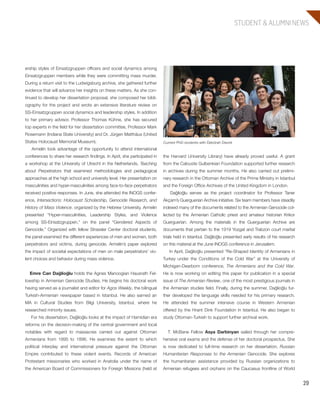
does the Samuel and Anna Jacobs award, established by Ernest
Rubenstein and the trustees of the Jacobs Foundation. The Confer-
ence on Material Claims against Germany, Robin Heller Moss and the
trustees of the Buster Foundation, Sara Chitjian and the Harry and
Ovsanna Chitjian Foundation, the Cummings Foundation in support
of comparative genocide, and an anonymous donor in honor of
beloved teacher T. McBane funded current use fellowships during the
past academic year. Endowments established by Howard Fromson,
Bill Hausrath ’53, Leslie and Glenn ’71 Parish, Marlene and David
Persky, Rosalie and Sidney Rose, Al Tapper, and the children of Shir-
ley and Ralph Rose have established permanent fellowship funds for
which we are especially grateful.
This year, the Strassler Center awarded doctoral degrees for the
first time ever in the fields of Armenian Genocide Studies and Com-
Rebecca Colin (PhD) ’89
603064.indd 43 11/18/16 11:02 AM
Strassler Center for Holocaust & Genocide Studies44
GROWTH & DEVELOPMENT
Friends ($1,000 to $4,999)
Melvin S. Cutler Charitable Foundation
Joyce and George Aghjayan
Anonymous
Barrington Foundation
Ellen Carno ’79 and Neil Leifer ’76
Dorothy and Herbert Carver
Alan Edelman and Debbie Sosland-Edelman
Philanthropic Fund of the Jewish Community
Foundation of Greater Kansas City
Elaine ’63 and David Feingold
Susan G. ’60 and Martin A. ’58 Fischer
Carol Bolton Kappel ’85 and Jonathan Kappel ’81
Jeffrey Kraines
The William P. Goldman and Brothers Foundation
Roxanne Kupfer
Ellen S. Lautenberg ’80
The Lautenberg Foundation
Leroy and Morton Productions
Carolynn Levy and Alan B. Sharaf ’72 MA ’76 PhD ’78
Joan G. and Michael S. Marek
In honor of Debórah Dwork
Kenneth Marek
In honor of Debórah Dwork
The Shelley & Donald Meltzer Family Foundation
Linda and Robert Meditz
Leonard Mushin
Mary and Stephen B. ’68 Novak
Jacob Nyman ’01
Leslie and Glenn Parish ’71
Dianne M. Parrotte
Deborah and Ronald Ratner
Elizabeth Tromovitch ’56
Fran Snyder and David Voremberg ’72
Penny ’68 and Bruce ’66 Wein
Supporters ($500 to $999)
Libby ’72 and Richard ’71 Cohen
Laura and Wayne Glazier
Barry J. Glick
Emily and William’92 Gottlieb
Ruth Lander
Barbara Landau
Herman O. Stekler ’55
Paula and James E. Tashjian
Ardemis and Sarkis ’58 Teshoian
Dianna Singer
Patricia Spargo and Mark Tobak
Donor Honor Roll
The following list includes outright gifts and pledge payments made between 1 June 2015 and 31 May 2016
Principal Benefactors ($100,000 and up)
Charles E. Scheidt Family Foundation
Rebecca Colin (PhD) ‘89
Simon and Eve Colin Foundation
Golden Benefactors ($50,000to $99,999)
Anonymous
Conference on Jewish Material
Claims against Germany
Stephen Corman
In memory of Betsy Corman
Thomas McBane Armenian Fellowship
Anonymous
Benefactors ($25,000 to $49,999)
Cummings Foundation
Calouste Gulbenkian Foundation
Robin Heller Moss
The Buster Foundation
Nazar and Artemes Nazarian
Al M. Tapper
In honor of Debórah Dwork
Patrons ($10,000 to $24,999)
Barrington Foundation
Betty ’50 and Ira *Dyer
Robert J. Katz
In honor of Debórah Dwork
Lisa ’82 and Michael ’81 Leffell
Ovsanna Y. ’58 and R. Mihran MA ’58 Mooradian
National Association for Armenian Studies
and Research
Jerair Nishanian Foundation
David and Marlene Persky
Joseph Persky Foundation
Erica S. Rhine ’67
Susser Family Trust
Suzanne and Harry Toufayan
Sponsors ($5,000 to $9,999)
Sara Chitjian
Harry & Ovsanna Chitjian Family Foundation
Melvin S. Cutler Charitable Foundation
Peter and Stacy Hochfelder
Marianne and Robert A. ’52 Kaloosdian
Carl Klorman ’71
In memory of David and Frances Klorman
Debra Raskin and Michael Young
603064.indd 44 11/18/16 11:02 AM
45
GROWTH & DEVELOPMENT
George H. Sogigian
Shaké Sulikyan ’01
Elissa S. Tessler
Marilyn Thypin
Margaret W. Traina
Judith Wasserheit
Contributors (Up to $100)
Ivan A. Backer
Beth B. Cohen PhD ’03
Jennifer DeFronzo ’97
Martin Demoorjian
Richard K. Dinjian ’76
Thomas Geiger
Norman Gluckstein
Michael Gruenbaum
Jennifer K. Dowdle
In Memory of Katie Kavorkian
Katherine M. Horigan ’13
Ralph V. Hovanesian
Betty R. Jaffe
Edward S. Kersch
Amy Kizirian ’92
Elaine Klein ’65
Carl S. Klorman ’71
Rise A. Liskov ’72
Richard D. Mangerian ’53
Mark R. Milner
Michael A. Mooney ’93
Maxine ’83 and Leonard Morse
Marisa G. Natale ’17
Susan Rein
In honor of Barbara and
Edward Simpson
Ian Rosenbluth ’01
Ruth and Allen* Rubin
Joshua L. Segal
Naomi K. Skriloff
Selden K. Smith
Joanne Tuck and
Stuart R. Freedman ’62
Anna Voremberg ’13
Melvin L. Zwillenberg
*Deceased
Suzanne Tobak
Sharon M. Weinstein
In honor of Dr. Richard P. Cohen ’71
Donors ($100 to $499)
Ani Aprahamian ’80
Richard C. Bedrosian
Selwin Belofsky
Tina Bilazarian
Kara E. Brickman ’97
Fay and Julian Bussgang
Cutler Capital Management
In honor of Al Tapper
Virginian and H. Martin* ’47 Deranian
Laurie and Michael Derian
Albert J. Glassman
Louise H. Harootunian’53
Alan J. Holz ’85
Gerald I. Kheboian ’74
Robert G. Kinosian ’68
Lisa ’92 and Andrew ’92 Koenig
Daphne and Arnold G. Konheim ’63
Nancy and Michael Leavitt
Pamela and David Levine
Pamela and Arnold ’65 Loeb
Charles Margosian ’72
Anne L. McKinnon ’83
Amy ’72 and Robert ’59 Messing
Susan and Frank Minasian ’61
Debra Pemstein and Dean Vallas
Cynthia Normandie ’83
Mary Jane Rein
In honor of Robin Heller Moss
In honor of Rebecca Colin
In memory of Linda Robbins
Nathan Robbins
Meryl Shahun Rosen
In honor of Glen and Leslie Parish
Celia Schulhoff ’54
Ferenc & Ilona Czigler Family
Endowed Fellowship
Paula Shamoian
Contance Sherman
In honor of Glen and Leslie Parish
Beth and Derrek ’90 Shulman
To donate by phone: 508.793.8897
Online: https://clarkconnect.clarku.edu/give/CHGS
Or by check payable to: Clark University
(indicate the Strassler Center in the memo line)
Please mail to: 950 Main Street Worcester, MA 01610
603064.indd 45 11/18/16 11:02 AM
Strassler Center for Holocaust & Genocide Studies46
GROWTH & DEVELOPMENT
combination. The resulting book, already the recipient of five awards,
will soon be published in German, Czech, and Turkish.
Clark alumna Judi Bohn ’75 has been a great friend to Michael
and a champion of his book. Having served as an administrator and
grant writer in Arlington, MA, where she supervised and developed
the Facing History and Ourselves program in the middle and high
schools, she also supported students and teachers on educational
trips to Holocaust sites in Germany, Poland and the Czech Republic,
including Terezin. After retiring from a distinguished public school
career, she joined the staff of Facing History and Ourselves, an orga-
nization known to Michael since the 1970s when his son Leon was in
the first Facing History classroom. As Special Projects Coordinator,
Judi manages several projects but her favorite is working with survi-
vors and other witnesses to history. She organizes events and speak-
ing opportunities for them in the Boston community. Judi’s warmth
and genuine concern for Michael and his contemporaries have made
her a favorite among them.
Judi recognized that Michael was determined to make his book
widely available to young readers. A terrific advocate in helping him
reach this audience, she purchased a full set of books for the Facing
History library to lend to schools. Somewhere There is Still a Sun,
which includes a free online study guide, will be featured in Facing
History classrooms across the country. As survivor memory fades,
the Strassler Center is privileged to know Michael and he is fortunate
to have a Clark friend like Judi! Mary Jane Rein
The young adult memoir, Somewhere There is Still a Sun tells the
touching story of young Misha Gruenbaum. Born in Prague into an
educated family in comfortable circumstances, Misha and his family
are steadily plunged into the dislocation and violence that Czech
Jews experienced during the Holocaust. The family is eventually
deported to Terezin, the old fortress outside of Prague, where Misha
is housed in room 7 with a group of boys supervised by a marvelous
youth leader named Franta. After his father’s brutal murder, Misha’s
mother emerges as the book’s hero. Her talents and shrewd determi-
nation help him and his sister to survive the war.
This heart-rending story is handled with touching sensitivity by
Michael Gruenbaum, now a retired engineer living in Brookline, MA
and his co-author Todd Hasak-Lowy. At the publisher’s (Simon and
Schuster/Aladdin) suggestion, they told it as a memoir aimed at mid-
dle school readers who would be the same age as the protagonist,
12-14 years old. While the circumstances are tragic, young readers
can relate to aspects of the story they may recognize from their own
lives. Love of sports, devotion to family, concerns about the future,
and interest in girls are all elements that transcend the tragic setting.
This book richly deserves a wide audience, and middle school teach-
ers who teach the Holocaust would be wise to consider it for their
students.
Michael and his late wife, Thelma, remained connected to the adult
survivors of Room 7 over the decades and travelled over 45,000
miles to meet them. Some years ago, they organized a presentation
at the Strassler Center with fellow Terezin survivors, a Venezuelan
from Room 9 and a Brazilian from Room 7. In 2004, Thelma pub-
lished Nesarim: Child Survivors of Terezin based on their inter-
views. The idea to retell the story occurred to Michael after he
donated his mother’s Terezin memorabilia to the United States Holo-
caust Memorial Museum. Among the artifacts he kept was a teddy
bear his mother made at the request of a Nazi officer for the
approaching Christmas. Her skills, especially sewing teddy bears,
protected her and her children from the deportations to Auschwitz
that decimated the camp’s population in fall 1944. Publishers
declined Michael’s initial children’s story, which featured a teddy bear
as narrator. They reasoned that children who play with bears are not
ready to learn about the Holocaust, but students ready for this dark
history no longer play with bears. An editor’s decision to pair him with
Mr. Lowy and to shift the audience to young adults was a winning
Friend of the Center Profile: Michael Gruenbaum and Judi Bohn ’75
Michael Gruenbaum and Judi Bohn ‘75
603064.indd 46 11/18/16 11:02 AM
47
GROWTH & DEVELOPMENT
Excellent job with efforts pulling together the Strassler Center Year
End report…..very detailed, very informative and good coverage
across the undergrad and graduate student sectors. Our photo in
the rear of the report is a good close to our memorial and
commemorative efforts for our centennial acknowledgement.
There is still a lot more work to do but I’m comforted in knowing that
the Strassler Center is keeping this issue front and center in the
Diaspora and across the globe.
Steve Migridichian, Chair, Friends of the Kaloosdian Mugar Professorship
to Mary Jane Rein, Executive Director
It was a very important and engaging symposium (Genocide of
Native Americans? A Symposium on Indigenous Identity and Mass
Violence in North America). I was honored to participate and
commend you and the others at the Strassler Center for your work
in this field.
Angelique EagleWoman, Professor of Law, Native American Law
Program, University of Idaho College of Law to Strassler Professor
Thomas Kühne
Ixe’he to you and the Strassler Center for your warmth and
generosity extended. The keynote and symposium provided a space
for critical, intercultural exchange. I’m delighted to know that the
Center is interested in including indigenous genocide as a
programmatic theme. I look forward to learning more.
Margo Tamez, Assistant Professor, Indigenous Studies Program,
Irving K. Barber School of Arts & Sciences, The University of British
Columbia, Okanagan to Strassler Professor Thomas Kühne
I want to thank you again for this special workshop (Israel Academic
Exchange). It was one of the best conferences I have ever attended,
stimulating, and truly meaningful on various levels. Thanks for
including me.
Professor Alon Confino, University of Virginia to
Rose Professor Debórah Dwork
The Israel Academic Exchange was one of the most interesting,
well-run conferences I have ever attended. Congratulations to all of
you for a job well done! I was honored to be a part.
Professor Nancy L. Combs, Ernest W. Goodrich Professor of Law and
Director, Human Security Law Center, William and Mary Law School
to Rose Professor Debórah Dwork
Thank you very much for the invitation to come, as well as for your
generosity and friendship. As I said, I am very impressed by what
you have created at Clark and know it will be essential for our field
for generations to come. It was my honor to speak to your students,
and I hope it was valuable to them.
Robert Williams, PhD, Director of Development and New Initiatives,
United States Holocaust Memorial Museum, Jack, Joseph and Morton
Mandel Center for Advanced Holocaust Studies to Rose Professor
Debórah Dwork
Center in the Mail
Simon Goldberg and Maayan Armelin with Holocaust survivor Roman Kent
(outside the Kent seminar room)
603064.indd 47 11/29/16 7:33 AM
Strassler Center for Holocaust & Genocide Studies48
GROWTH & DEVELOPMENT
In Memoriam: H. Martin Deranian ’47
Dr. Hagop Martin Deranian, known as Martin, was a proud Arme-
nian-American whose passing is a great loss to the Strassler Center
community. A Clark University alumnus who practiced dentistry in
downtown Worcester for many decades, he was an avid amateur
historian whose many publications document the experiences of
Armenians in America. Deranian’s impulse to research and write
about this history was motivated by a deep desire to understand
what happened to his family in the Genocide and especially to know
more about his mother, who survived the brutal deportation march.
Interviewed for a Clark News profile in 2013, Deranian disclosed,
“There is no vocabulary to describe what happened during this geno-
cide; there is no lexicon. If I captured my mother’s story, traumatic as it
was, I felt I should do that. I didn’t want to end my time on earth with-
out addressing this issue.” Varter Deranian was pregnant and a mother
to five young children when she was forced from her comfortable
home following her husband’s murder. All of her children perished
during the journey. She eventually found her way to Worcester where
she married and began a new family. Sadly, she died when her only
American child was just 7 years old and Deranian only learned about
her harsh experiences through research he pursued as an adult.
A dedicated friend to the Armenian Genocide program, Deranian
frequented the Strassler Center, attending lectures, conferences,
even presenting original research. “And to imagine my alma mater,
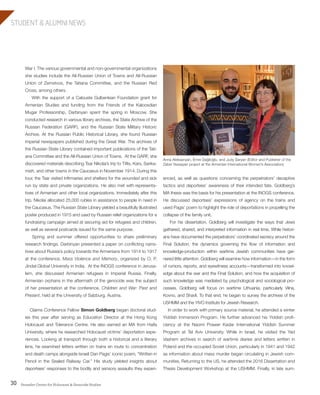
Clark University, has become the center for the study of the Arme-
nian Genocide is just too much to hope for. It almost seems meant to
be,” he declared to Jim Keogh in his Clark News profile, written after
the Strassler Center hosted a reading of Deported/A Dream Play.
Written by Joyce Van Dyke, the play is based on the friendship
between Deranian’s mother, Varter, and the playwright’s grand-
mother, Elmas Sarajian, close friends who were deported together.
Decades earlier, Deranian had asked a clergyman who had known
both women to travel to Fresno, CA to interview Elmas. The tragic
details of their deportation emerged and Van Dyke transformed them
into a theatrical piece at Deranian’s urging.
In 2014, Deranian presented a new project to the Strassler Center
community. The subject was a beautiful rug then languishing in
obscurity in the White House. Deranian described a magnificent rug
woven by Armenian orphans who were the beneficiaries of American
aid. In gratitude, the orphans created this special rug as a gift for the
American people, which was given to President Calvin Coolidge. Fol-
lowing his presidency, Coolidge brought the rug from the White
House to his home in Vermont. In a 2014 afternoon talk for students
and faculty, Deranian explained that he visited Coolidge’s son in Ver-
mont and persuaded him to return the rug to the White House where
it was quietly held in storage. Plans to display the rug at a Smithso-
nian event celebrating Deranian’s publication of President Calvin
Coolidge and the Armenian Orphan Rug were derailed by a White
House decision not to loan it. Gradually, thanks to Deranian’s advo-
cacy, the White House ultimately decided to display the rug.
Ever dedicated to remembrance, scholarship, and research, Dr.
Deranian enriched the Strassler Center’s Armenian Genocide Pro-
gram. But his legacy persists in our library which holds the many
books he wrote:
The Village of Hussenig: Memories of the Heart and Hearth (1981);
Hussenig: The Origin, History, and Destruction of an Armenian Town
(1994); Worcester is America: The Story of Worcester’s Armenians,
The Early Years (1995); Miracle Man of the Western Front: Dr. Varaz-
tad H. Kazanjian, Pioneer Plastic Surgeon (2007); President Calvin
Coolidge & The Armenian Orphan Rug (2013, 2014); Hagop Bogi-
gian; Armenian American Pioneer & Philanthropist (2016).
Mary Jane Rein
Best-selling author Chris Bohjalian and Dr. H. Martin Deranian ’47
603064.indd 48 11/30/16 7:40 AM
Authors:
Anna Aleksanyan, Maayan Armelin,
Sarah Cushman PhD ’10,
Asya Darbinyan, Jake Dinerman ’16,
Simon Goldberg, Gabrielle Hauth,
Samantha Lakin, Abigail Miller,
Alicja Podbielska,
Mohammad Sajjadur Rahman,
Mary Jane Rein
Editor-in-Chief: Mary Jane Rein
Photography:
Spencer Cronin ’18,
Jacob Dinerman ’16,
Jonathan Edelman ’16,
Steven King
Design: Kaajal S. Asher
Printer: Kirkwood Printing
“Honor others for what they are,” the Wisdom of the Sages
urges. “But honor them more for what they do.” Looking
back at my 20-year tenure as Director of the Strassler
Center, I am struck anew by the generosity of the Clark
community. For two decades, I have been supported by
the rich array of skills and competencies offered by staff
and faculty at the Center and across campus. It is my
great pleasure to have this opportunity to thank them for
their crucial participation in our joint project of growing
and running the Strassler Center.
I am grateful to Center staff, past and present, for the
critically important institutional infrastructure they have
provided. First, administrative assistant Margaret Hil-
lard and now Jean Hearns. Bookkeeper Ghi Vaughn
(past) and our present budget manager Angela San-
tamaria. Executive Director Dr Mary Jane Rein who,
together with Professor Thomas Kühne, now leads the
Center forward. Head of Educational Programming – a
position that morphed over the years, shaped by the in-
cumbents’ strengths: Dr Tatyana Macaulay; Dr Mikaela
Luttrell-Rowland (now Director of the Women’s Center
at Franklin and Marshall); and, most recently, Dr Sarah
Cushman (now Director of the Holocaust Educational
Foundation at Northwestern University). Librarian Robyn
Conroy. And the Center’s outstanding student workers.
As the Year End Reports from 1996-97 through 2015-
16 note, the Center hosts a robust calendar of public and
scholarly events. Each called upon the services of mul-
tiple departments at Clark, and our consistent success
is a reflection of their willing readiness as well as their
expertise. Many thanks to, again past and present: Jim
Cormier and Terri Guttormsen in Media Services; Brenda
Nieszyewski in Physical Plant; Cheryl Turner Elwell, Greg-
ory Geiger, Jim Hilow, and Pennie Turgeon in Informa-
tion Technology Services; Angela Bazydlo, Keith Carville,
Paula David, Lorinda Fearebay, Jim Keogh, Deirdre Ni
Chonaill, and Jane Salerno in Marketing and Commu-
nications; Michelle Bates, Kathy Cannon, Linda Cote,
and Tammy Hearnlye in Business and Financial Services;
and Kim McElroy in Dining Services. A word about Jim:
tasked with addressing faculty needs, especially Mac us-
ers, Jim won the title of my Technology Hero. And while
neither Michelle nor Kathy should have had to deal with
me at all, both proved unflagging partners.
I am delighted to express my appreciation for my
academic colleagues at Clark throughout the past two
decades in whose scholarship, teaching, and mentor-
ship the Strassler Center glories: Taner Akçam; Cecilie
Stokholm Banke; Yehuda Bauer; Anthony Bebbington;
Katerine Bielacycz; Anita Fabós; Barbara Harff; Thom-
as Kühne; Nina Kushner; Ken MacLean; Deb Martin;
Dyan Mazurana; Jens Meierhenrich; Bob Melson; Simon
Payaslian; Ousmane Power-Green; Srini Sitariman; Val-
erie Sperling; Marianne Sarkis; Shelly Tenenbaum; Bob
Tobin; Jaan Valsiner; Johanna Vollhardt; Kristina Wilson.
Permanent faculty and visiting professors, they grew the
Center’s intellectual reach and fostered fresh lines of
scholarly investigation doctoral students pursued.
I thank, too, my fellow Center and Institute directors,
from whose perspectives and experiences I learned:
Katerine Bielacycz, Tom Del Prete, Ron Eastman, Jim
Gomes, Rob Johnston, and Amy Richter.
It has been a pleasure to work collaboratively with the
History Department chairperson (Janette Greenwood,
Amy Richter, and Wim Klooster over the years). I am
grateful to our colleagues in University Advancement,
LaDona Fazio, Jeff Gillooly, Lisa Hernandez, Jenn Hitt,
Jonathan Kappel, Paul Milionis, Susan Puryear, and Fred
Regan. And it has been my good fortune to report to
Dean of Research/Associate Provost Nancy Budwig,
and to Clark’s President David Angel; they supported
both the Center and me.
If it seems that I am thanking a universe of people: I
am. The Center drew upon the gifts of each and every
one. And I am grateful to all.
DEBÓRAH DWORK
STRASSLER CENTER FOR
HOLOCAUST & GENOCIDE STUDIES
CLARK UNIVERSITY
950 MAIN STREET
WORCESTER, MA 01610-1477
phone 508.793.8897
fax 508.793.8827
email CHGS@CLARKU.EDU
web CLARKU.EDU/DEPARTMENTS/
HOLOCAUST
603064.indd 4 11/30/16 7:40 AM

603064Strassler2015-16YearEndReport_web

  • 1.
    STRASSLER CENTER FOR HOLOCAUST & GENOCIDE STUDIES ATCLARK UNIVERSITY 2015 2016YEAR END REPORT 603064.indd 1 11/30/16 7:39 AM
  • 2.
  • 3.
    1 Dear Friends, As Iwrite my final letter as Director of the Strassler Center, the words of the renowned Supreme Court Justice Louis Brandeis reverberate. “Most of the things worth doing in the world had been declared impossible before they were done.” In the case of a Cen- ter for Holocaust and Genocide Studies, no one had declared it impossible – because no one had contemplated it at all. No such institution was on anyone’s mental map, but mine. And it was my good fortune to meet David Strassler and communicate that vision to him. Warsaw. July 1993. The Jewish Foun- dation for Christian Rescuers (now the Jew- ish Foundation for the Righteous) hosted a conference to explore wartime rescue oper- ations and to honor the rescuers who, at that time, remained reluctant to be identified as people who had helped Jews during the Holocaust years. I was one of the invited scholars. After the conference, the speak- ers and the JFCR board went by bus from Warsaw to Auschwitz. Everyone switched seats; everyone spoke to everyone. A man sat next to me. “Where would a young person go to earn a doctoral degree in Holocaust history to become a scholar like you?” he asked. I had hoped for years that someone would ask that question. Indeed, the United States Holocaust Memorial Museum had just opened that April, and the matter had become more urgent. Art museum curators are expected to have earned a PhD in art history. Was the Holocaust less important than art? Shouldn’t Holocaust museum curators have earned doctorates in Holocaust history? “Nowhere,” I answered. “Those of us who work in this field came to it by happenstance, not training.” “Is that true?” he asked in dis- belief. “Yes. Unfortunately.” And I launched into why this was a problem. Not then, while survivors still lived. But in the future, when they would no longer be with us. To his credit, upon his return from Europe the fellow told then ADL National Director Abe Foxman that he’d heard the craziest thing from a woman on a bus from Warsaw to Auschwitz, and was it true? To Abe’s credit, he checked and got back to say indeed it was. And to my credit, I had been a true reporter. That man was David Strassler, then president of the board of trustees of Clark University. He brought the matter to the attention of then president Dick Traina. And thus, when two brothers, Sid- ney and Ralph Rose, walked into President Traina’s office prepared to make a gift in memory of their relatives murdered by the Germans in Lida, Poland, he asked them if they would consider sup- porting the nation’s first fulltime, fully endowed professorship in Holocaust His- tory, indeed the first such chair outside of Israel. They were. And I was recruited as the Rose Professor in 1996 to build the Strassler Center, dedicated to scholarship, teaching, and public service. Now a flour- ishing enterprise, the Strassler Center is the international address for doctoral train- ing in Holocaust History and Genocide Studies. This past year, two students earned their doctoral degrees specializing in the study of the Armenian Genocide, the first two to do so. One student earned her degree with a dissertation on the 1994 Geno- cide in Rwanda, our first in that subfield. And four were the recipi- ents of doctoral degrees in Holocaust History. Dr Mary Jane Rein and Professor Thomas Kühne, the new co-directors of the Strassler Center, will grow the institution in fresh directions. I am delighted to continue to serve as Rose Pro- fessor under their leadership and eager to participate in their plans. Please join me in supporting the Strassler Center and them. Please give as generously as you are able. DEBÓRAH DWORK Rose Professor of Holocaust History Director, Strassler Center for Holocaust and Genocide Studies 603064.indd 1 11/18/16 11:01 AM
  • 4.
    Doctoral education, forwhich the Strassler Center is justly renowned, has been essential to Clark University since its found- ing as a graduate school in 1887. At first dedicated to training PhDs, in the manner of European universities, a much larger undergraduate college soon developed. Yet, Clark has succeeded in retaining its character as a small research university by fostering areas of genuine and focused excellence. And the Strassler Cen- ter, while still a relatively young program, is one of our signature graduate-level initiatives. It has been my special pleasure to observe and even participate in the Strassler Center’s development and success. As Dean of Graduate Research, then Provost, and now as President, I have admired the Center’s rise to international prominence. Its faculty and students are engaged in cutting edge research that speaks to Clark’s mandate to “challenge convention and change our world.” Examining the devastating history and legacy of mass violence and genocide is academically important and has the very real potential to make our world better. These efforts are greatly valued and appreciated by all members of the Clark community. As founding director, Debórah Dwork put the Strassler Center on the academic map. Under her capable leadership, the doctoral program emerged as the foremost institute for PhD training in Holocaust History and Genocide Studies. With the transition to new leadership, I anticipate continued robust growth. Thomas Kühne and Mary Jane Rein are poised to advance the program in exciting ways as they expand the horizons of research and inquiry. I wish them great success as I pledge my support. DAVID ANGEL President President’s Note My predecessor G. Stanley Hall, the first President of Clark Uni- versity, was also the first president of the American Chapter of the Congo Reform Association. His engaged interest in the tragic plight of the Congolese, one of the most stirring humanitarian cri- ses of the early years of the 20th century, sets a shining example of leadership on issues that continue to matter to the Strassler Center and to me personally. The focus of doctoral and faculty research at the Strassler Center has, until recently, been on Europe. It is time to ensure that Africa, Asia, and the Americas also get adequate attention, as we remain committed to increas- ing knowledge and understanding about the Holocaust and Armenian Genocide. The task is challenging but indifference is not an option. 603064.indd 2 11/18/16 11:01 AM
  • 5.
    3 The proverb “itis better to light a candle than to curse the dark- ness” is often attributed to Eleanor Roosevelt. In fact, the American politician and diplomat Adlai Stevenson aptly used it in praise of the First Lady, to honor her humanity and efforts on behalf of world peace. It might serve equally well in reference to our colleague Debórah Dwork who stepped down as director of the Strassler Center on June 1. The candle is now passed to us and we will carry it together as Director and Executive Director and use its light to advance the frontiers of knowledge and scholarship through our landmark PhD program and rich undergraduate concentration, through our international conferences and public events. The Strassler Center was established in 1996, shortly after genocide returned to the headlines as the result of mass atrocities perpetrated in Bosnia and Rwanda. Initially dedicated to research and doctoral training about the Holocaust, those more recent cases underlined the importance of a comparative approach to studying genocide. Over the past two decades, the Strassler Cen- ter has matured into the foremost institution committed to doc- toral training about an ever-growing range of genocidal cases. Recently, the vision of comparative study was actualized as the first PhDs were awarded to students of the Armenian genocide and the Rwanda genocide, respectively. And the 1971 genocide in Bangladesh became the first Asian case added to the Center’s research portfolio as the subject of a dissertation. During its first two decades, the Strassler Center claimed a place at the leading edge of the field of genocide studies. That work continues but we will also contemplate other tragic histories that remain shrouded in darkness. Our shared commitment is to secure the resources needed to expand our program to include significant historical events that deserve sober examination. One priority is to lighten the American past, in particular the shameful history of violence and dislocation perpetrated against Native Americans. Cases of genocide and mass violence in Africa, Asia, and throughout the Americas demand consideration. To do so will require additional faculty expertise, greater support for graduate studies, and expanded public programming. We are dedicated to establishing these resources. Our plans are ambitious and we are grateful for the opportunity to realize them. We look to our colleagues at the Strassler Center as well as to faculty and administrators across the Clark campus to collaborate in these efforts. Partnerships and linkages with institu- tions at home and abroad will become increasingly significant. While the doctoral program and undergraduate concentration have been interdisciplinary from the start, history has been the dominant per- spective in the training the Strassler Center provides. Deeper and broader engagement with a range of disciplines will bring fresh approaches and new insights. We invite alumni, friends, donors, and scholars to follow our progress as we embark upon the challenges of planning for the Center’s third decade. Please come to our events, help celebrate our milestones, and join us as we take pride in the accomplish- ments of our students, graduates, and faculty. Opening Letter THOMAS KÜHNE Director and Strassler Professor MARY JANE REIN Executive Director 603064.indd 3 11/18/16 11:01 AM
  • 6.
    Memorial complex inKhatyn, Belarus 603064.indd 4 11/18/16 11:01 AM
  • 7.
  • 8.
    EVENTS AND LINKAGES StrasslerCenter for Holocaust & Genocide Studies6 Robert Williams, “Cold War Influences on Holocaust Silence in the Occupied German Press” 7 OCTOBER 2015 Robert Williams serves as Director of Development and New Initiatives in the Jack, Joseph, and Morton Mandel Center for Advanced Holo- caust Studies at the United States Holocaust Memorial Museum. He also represents the United States at the International Holocaust Remembrance Alliance, as does Center Director Debórah Dwork. Wil- liams, whose many research interests include the politics of the United States, Germany, and the Soviet Union as well as contemporary antisemitism, spoke to a table brimming with Center faculty, graduate students, and undergraduate concentrators about the ways in which Cold War influences shaped discourse about the Holocaust in the German press. Williams’s research examines how German newspa- pers used Holocaust memory to advance specific political ideologies in the contentious Cold War climate. He argued that the “arrested development of Holocaust discourse” following the war’s end was not representative of German understanding of the genocide; rather it spoke to the occupiers’ aims. Williams focused on a range of popular news outlets from both the US and Soviet occupied territories: Tägli- che Rundschau, Deutsche Volkszeitung, Neues Deutschland, Frank- furter Rundschau, and Die Neue Zeitung. Political needs shaped reporting on three particular areas of post-war discussion: Nazi war crimes, military tribunals, and antisemitism. Press coverage of Nazi war crimes was manipulated either to hin- der or encourage democratic and capitalist development. In East Germany, collective guilt for Nazi crimes was used to purge Nazi elements as well as to draw parallels between the capitalism of the Third Reich and the United States, thus shaping public opinion about the American economy. Soviet newspapers also minimized Russian culpability by focusing media attention on Nazi crimes against the Red Army. The press thus succeeded in illustrating the victimization of the Soviets while making an enemy of the United States. West Ger- many, on the other hand, followed the American model with its sober emphasis on factual evidence rather than opinion pieces. The United States claimed that excessive moralizing about Nazi crimes would be “counterproductive to democratic development.” In Williams’s view, the International Military Tribunal at Nuremberg served as the perfect “propaganda tool” for the Americans and Sovi- ets. Both powers aimed to placate Germany while stoking aversion to Nazism, both politically and culturally. Yet, neither power succeeded in separating trial discourse from politics. Williams’s analysis of arti- cles published during the trial demonstrate that coverage lagged in East and West Germany as the proceedings advanced, only resurg- ing once decisions had been reached. His analysis also showed that, while the occupation-era press sought to critique Nazism, it did not suppress antisemitism. The newspapers published numerous nega- tive articles about displaced persons camps and their inhabitants, especially in the American occupied zone. Indeed, by the end of 1946, antisemitic sentiment had risen significantly across zones. Robert Williams Williams noticed that one occupation-era newspaper, West Germa- ny’s Frankfurter Rundschau, rose above contemporary political motiva- tions. The newspaper’s licensees were survivors of Nazi camps and their detailed discussions of Nazi crimes were used “to teach a series of les- sons on democratic renewal.” The Frankfurter Rundschau also consis- tently covered post-war trials in Germany and abroad, and reported on German antisemitism in a way that other news outlets did not. Williams’s discussion addressed the creation of collective memory in the socio-political context of the Cold War. His research speaks to the importance of looking beyond the end of violence in order to investigate its lasting implications for post-genocidal societies. Gabrielle Hauth 603064.indd 6 11/18/16 11:01 AM
  • 9.
    EVENTS AND LINKAGES 7 17-20OCTOBER 2015 The second Israel Academic Exchange (IAE) workshop, presented with the Avraham Harman Institute of Contem- porary Jewry at the Hebrew University of Jerusalem, examined transitional justice in post-genocidal societies. Co-chairs Raz Segal PhD ’13 and Professor Ken MacLean organized panels around questions of victim- hood and perpetration and how these roles are linked. Participants from Hebrew University, Al-Quds University, Ben-Gurion University, Tel Aviv University, the Van Leer Jerusalem Institute, and European and US institutions explored societal transition, national identity, memory, and models of reconciliation. Drawing on historical and legal perspectives, as well as philosophical and cultural approaches, they discussed reparations, public apolo- gies, and international and local tribunals. They addressed reconciliation in cases where perpetrators deny past crimes and societies that have silenced violent events in the name of peace and social stability. The co-chairs opened with a general discussion about transitional justice. Do international courts view the Holocaust as a para- digmatic case through which to assess other genocides? What do survi- vors consider appropriate reparation? How do genocidal societies view truth commissions? The first panel considered legal perspectives on transitional justice, the meaning and impact of tribunals, trials, and sen- tences. Central questions included the effectiveness of one-sided pro- cesses, the aftermath of reconciliation, and the legacy of the Nuremberg trials, conflicting narratives, and whether to advocate for peace or justice. The connection between mass violence, state building, and social relations was the subject of the second panel. What is the link between processes of national identity building and genocide? How can stable post-genocidal societies integrate survivors and perpetrators? What can be done to address state sponsored mass violence in protracted conflicts? Shifting to victims’ perspectives, the third panel examined survivors. How do they integrate into post-genocidal societies or as immigrants in new societies? The speakers considered the use of sur- vivor testimony and questioned the ways jurisdictions, sentencing, and punishments vary between post-genocidal societies. Prevention was the theme of the fourth panel. Presenters questioned how to define victims, perpetrators, and bystanders. They discussed intimacy in perpetration, efforts to prevent mass violence, and challenges in conceptualizing genocide. Debates about hierarchies of suffering and the question of agency versus “pure victimhood” were raised in connection with prevention and reconciliation. Social re-organization and population exchange were the subjects of the fifth panel. Discussants probed the value of reparations in such cases. Different categories of victimhood, while problem- atic to define, could suggest reparation types: collective, individual, monetary, or cultural. What is the value of trials that punish one or a few arch criminals and what do these trials mean for survivor dignity and faith in the process? The sixth panel focused on global trends in transitional justice, including post-colonial societies dealing with past violence as well as current cases of reconciliation and ongoing mass violence. The speakers explored memory versus oblivion and the politics that promote these responses in contemporary conflicts. How can western societies’ attempts to promote reconciliation be trusted when they remain guilty of neglecting their own past? Do group narra- tives and perceptions about their status as victims or perpetrators help or impede processes of reconciliation, transitional justice, and acknowl- edgement of past crimes and current wrong-doing? The concluding panel summarized the conference findings. Selected participants pondered how to integrate memory, traumatic experiences, and transitional justice. Amos Goldberg (Hebrew University), Sigall Horowitz (International Nuremberg Principles Academy and Hebrew Uni- versity), Dirk Moses (European University Institute), and Nadera Shal- houb-Kevorkian (Hebrew University) discussed how to build effective legal mechanisms. They debated the “threshold of genocide,” querying the methods and perceptions involved in defining genocide as opposed to “mere state criminality,” and the ways in which these definitions affect reconciliation and the rehabilitation of societies. Seeking to extend the discussion about mass violence into the US context, a field trip to the Brown University Center for the Study of Slav- ery and Justice had been planned. Regrettably, they cancelled for politi- cal reasons. But the opportunity that the IAE workshop offered to examine the legacy of genocide and mass violence proved incredibly rich for all who attended. MaayanArmelin Israel Academic Exchange Workshop: “Post-Genocide Societies” Ken MacLean Raz Segal 603064.indd 7 11/29/16 7:32 AM
  • 10.
    EVENTS AND LINKAGES StrasslerCenter for Holocaust & Genocide Studies8 Panel Discussion: “Empire, Nation State, and Genocide” context of their affective disposition, or emotional understanding, which constructed the Armenians as an existential threat to the future survival of the empire. It was the conjunction of that affective disposi- tion toward unfolding events – World War I and Enver’s defeat in the Battle of Sarikamish, in particular – which shaped the choices the CUP made that led to genocide and catastrophe for the Ottoman Armenians. Holquist responded both to Suny’s book and to his distinction between empire and nation state. He held that an overly schematic model of an empire in decline and its inevitable replacement by a series of nation-state proxies overlooks the re-articulation of imperial identity in the late imperial period. Thus, he complicated the binary of “nation or empire”and proposed a triple model: ancient empire, modernizing empire, and nation state. This morphology introduced a distinction between imperial subject and imperial citizen. He also contrasted the Young Turks’ genocidal policies with plans developed in the Russian Empire and offered his explanation for why Russia’s phantasmagoric projects both against Jews in Galicia and against Muslims in Kars and Batum were not carried out in the form of genocide. In his role as moderator, Akçam urged the participants to go beyond concepts of empire vs. nation-state and their relationship to genocide. He raised another question central to genocide scholar- ship: whether historians should treat the mass slaughters and geno- cides that occurred in the Russian, Austro-Hungarian, German, and Ottoman empires in the late 19th and early 20th centuries as isolated domestic cases that share a common perspective on the position of minority subject populations, or try to explain these cases with reference to the structural dynamics of empires. “This means we have to establish certain intrinsic and structural connections between these empires and their policies,”Akçam argued, citing Mark Levene’s recent scholarship. The audience of students, professors, and guests responded with a number of insightful questions that allowed the speakers to elaborate on their explana- tions of the concepts “empire” and “nation-state” and drill down on the details and particularities of Russian and Ottoman imperial policies. Asya Darbinyan 23 OCTOBER 2015 Panelists Ronald Suny, William H. Sewell Jr. Distinguished University Professor of History (University of Michigan), and Peter Holquist, Associate Professor of Russian and European History (University of Pennsylvania), compared late Ottoman Turkey and Imperial Russia in a discussion of “Empire, Nation-State and Genocide.” Kaloosdian Mugar Professor Taner Akçam moderated the panel. He introduced the topic by presenting the thesis commonly accepted among Arme- nian Genocide scholars that the Committee of Union and Progress (CUP) party aimed to establish a Turkish nation-state. The CUP-led government, known as the Young Turks, sought to homogenize Ana- tolia along cultural and religious lines by destroying the Christian pop- ulation through deportation and mass killing. According to Akҫam, “the empire was to continue but in a new form appropriate for the modern age, what has been called the age of nationalism and nation- states, but more accurately should be referred to as the age of empires.” Drawing upon his recently published work, They Can Live in the Desert but Nowhere Else: A History of the Armenian Genocide (2015), Suny argued that the Young Turks, the leaders of the CUP, were never purely Turkish ethno-nationalists. In his view, while the emergence of subject nations looks inevitable now, the actors of the day sought the best ways to save their empire. Thus, the Young Turks saw the Arme- nians as traitorous even though most were not separatists but were interested in reforms and some degree of autonomy. Yet, their legiti- mate goals were understood as subversive and a danger to national security. Suny explained the genocidal policies of the Ottomans in the Anna Aleksanyan, Ronald Suny, Taner Akçam, Peter Holquist, Asya Darbinyan, and Emre Dağlioğlu 603064.indd 8 11/29/16 7:32 AM
  • 11.
    EVENTS AND LINKAGES 9 SamuelMoyn, “Human Rights and the Holocaust: A Belated Entanglement“ In the mid-1970s, the “humanitarian stage” commenced. The human rights agenda moved its focus from quality of life, to life itself— the plight of people whom society insisted deserved to live. The expe- rience of decolonization led to a realization that the state cannot guarantee absolute protection, prompting the shift from welfare promo- tion to atrocity consciousness. At the same time, Holocaust memory entered the fray, as children of survivors began to explore and relate their parents’ stories. This new consciousness coincided with the rise of the human rights paradigm as concerns over colonial atrocity merge with efforts to remember Nazi atrocity. Moyn, who worked at the White House during the Bosnian genocide, concluded by reflecting on the implications of the transi- tion—from the “welfarist ideal” of human rights to atrocity prevention. We know what we have gained from this shift, but have we lost any- thing along the way? Citing the damage wrought by NATO’s intervention in Libya, Moyn called for critical reflection on the norms that guide humanitarian policies. He also observed that the grander ideals that once informed our discourse—premised on the desire to build just societies—have fallen away. Instead, we are busy—rightly busy— assuring that people do not die. Moyn asked whether atrocity con- sciousness is enough. We might also pon- der its implicit corollary: has the default assumption of this normative consciousness diminished its potency? Is it easier to ignore atrocities once we have named them? The celebrated Israeli poet, Yehuda Amichai, reflected on the subtle danger of the hyper-saturation of Holocaust memory in Israel: “Let the memorial hill remember instead of me, that’s what it’s here for.” Do we build memorial hills to elude the responsibility of memory? The spirit of Amichai’s words sharpen Moyn’s charge: reject the impulse to qui- etly displace the mandate of human rights in the 21st century. That requires us to ask what the mandate ought to be, and to repeat- edly pose the question anew. Simon Goldberg 26 OCTOBER 2015 Invited to Clark by Leir Professor Robert Tobin, Samuel Moyn, Harvard Professor of Law and History, presented a fascinating lecture in which he challenged the belief that human rights discourse emerged in response to the Holocaust. Author of The Last Utopia: Human Rights in History (2010), Moyn acknowledged the association between the Holocaust and human rights. He nodded to the widely-held belief that the Universal Declaration of Human Rights, ratified by the United Nations in December 1948, was conceived to guard against mass atrocities such as those committed by the Nazi regime and its allies. But Moyn argued that Holocaust memory materialized decades after the war and thus played a more nuanced role in the evolution of human rights consciousness. Moyn presented a three-phase typology of the public conceptualization of human rights. The first, rooted in a movement for “welfarism,” began during World War II. The prospect of a new welfare state—premised on a definition of national citizenship that granted social and politi- cal rights to all—became the foremost cause around which citizens rallied. Arguments for rights concerned the nation and political free- dom. Even those who experienced the Holo- caust were not committed to a movement to fight international atrocity, but preferred to respond to a world in which economic depres- sion leads to war. The welfare state would pre- vent the election of dictators. Phase two began in the 1950s, when human rights were equated with the anti-colonial struggle. Not all empires had collapsed with the close of World War II, but decolonization soon heightened the urgency for self-determination. National groups feared the emergence of new empires and sought “welfarism” on their own terms and free of interfer- ence. To sharpen the contrast between this genre of rights discourse and the one commonly ascribed to Holocaust memory, Moyn noted that, in the anti-colonial context, the project was to strengthen, rather than undermine, state sovereignty. Anti-colonialism established a shield against intervention, whereas the 1948 UN Genocide Convention defined the limits of state sovereignty, mandating the intervention of the international community in the event of its failure. Samuel Moyn 603064.indd 9 11/18/16 11:01 AM
  • 12.
    EVENTS AND LINKAGES StrasslerCenter for Holocaust & Genocide Studies10 Naama Haviv, “Women’s Trauma and Healing in the Democratic Republic of the Congo” Thousands of victims have been kidnapped and brutally raped, often repeatedly, resulting in pregnancy, psychological trauma, ostra- cism, and physical damage. The Panzi Foundation attempts to address these tragic outcomes through a four-pronged healing pro- gram that includes: physical care (primarily surgery to repair fistula, a devastating condition that leaves women incontinent); psycho-social care; reintegration through educational and vocational skills training; and legal assistance. Dr. Denis Mukwege, the founder of the Panzi Foundation, has performed thousands of life-saving surgeries. Yet his heroic efforts are so threatening to the status quo, which thrives on disruption and devastation, that he and his family have been threat- ened. Women who come forward to prosecute their attackers are Haviv’s personal heroes. At great personal risk, financial expense, and investment of time and energy, they disclose their trauma in the hope of alleviating future injuries to others. In addition to aiding individual women, the Panzi Foundation engages with an array of civil society organizations to address the consequences and root causes of failed states. They may be making inroads. Haviv has seen a new strength in the women she encounters in the DRC. No longer accepting the shame associated with sexual- ized violence, women are refusing stigmatization and recognizing their trauma as originating not in themselves, but in the damaged society that surrounds them. Sarah Cushman 11 NOVEMBER 2015 As a Clark undergraduate, Naama Haviv ’00 MA ’06 was a pioneer in the Holocaust and Genocide Studies concentration. She enrolled in “Genocide” the first time Professor Shelly Tenenbaum offered this founda- tional course and served as her teaching assistant the following year. Her HGS experiences proved pivotal and she stayed to complete doctoral coursework at the Strassler Center, before turning to professional activism. Now Executive Director of the Panzi Founda- tion USA, a health organization based in the Demo- cratic Republic of Congo (DRC), Haviv returned to campus to deliver her second Especially for Students lecture. Her inspirational 2010 presentation, “On the Ground in Congo: Action to End the World’s Deadliest Conflict,”motivated Clark activists from STAND (the anti-genocide student group) to successfully lobby the university for a Conflict Free purchasing policy. This initiative seeks to reduce dependence on minerals used in manufacturing electronic devices that come from Congolese mines which exploit and terrorize civilians. The students’ activism prompted the International Summit Informed Activism: Armed Conflict, Scarce Resources, and the Congo, held in 2011, which Haviv helped organize. Haviv travelled to Congo and learned about the country and its peo- ple during her tenure as Assistant Director of Jewish World Watch (2007-2015). In that capacity, she was deeply involved with programs that aided the civilian population and especially female victims of extreme sexual violence. In “Women’s Trauma and Healing in the Dem- ocratic Republic of the Congo,” Haviv discussed the communi- ty-strengthening work that the Panzi Foundation has carried out in Eastern Congo since 1999. Identifying Panzi’s doctors and nurses as activists as well as medical professionals, she described their practice of stepping out of their white coats to speak frankly about the horrific physical, psychological, and social consequences of sex-based vio- lence. Such brutal acts (sexualized and other) have so plagued the DRC that they seem to have become normalized. The violence stands in stark contrast to the physical beauty and natural richess of the country. Many view that abundance, especially the diverse natural resources, as a contributing cause of the violence. Haviv sees it as part of the structure that sustains a power struggle played out on the bodies of women and children. Naama Haviv ‘00 and Shelly Tenebaum 603064.indd 10 11/18/16 11:01 AM
  • 13.
    EVENTS AND LINKAGES 11 Paneldiscussion: “Recognizing Painful Legacies through Memorial Construction” legacy of racism and to contemporary human trafficking. Today, 27 million people worldwide are affected by present day forms of bond- age. He envisaged his monument as a space for reflection and a trigger to engender civic engagement and human rights activism. For the memorial in Nantes, a port from which hundreds of Atlantic slave-trading expeditions set forth, Bonder opted against traditional forms of representation. In particular, he decided to avoid images of bodies in pain. Instead, his team uncovered the underground residual space below the quay, a product of construction of the embankment between the 18th and 20th centuries. Plaques with the names of slave ships are embedded into the walkway along the riverfront and literally stop passersby in their tracks. As slaves left few written records, water symbolically constitutes the primary witness and vault for their memo- ries. Every 10 years, the underground exhibition space will flood and the river will metaphorically bring the experiences of slaves into the memorial. Another powerful symbolic device is the narrow window which offers a view of the Palace of Justice on the opposite riverbank. Although not explicitly instructed, the hope is that visitors will find them- selves reflecting on issues of justice and the continued struggle for human rights. The panel, organized in partnership with the Departments of Geog- raphy and Visual Arts, brought varied disciplinary perspectives into conversation. In her response, geographer Deborah Martin addressed the ways geographers study memory through landscape and the human-environment relationship. She described her research on the memory of the Civil War on south- ern university campuses. Art historian Kristina Wil- son considered how different forms of monuments convey narrative. Using the Vietnam Veterans Memorial in Washington, DC as an example, she pondered the value of abstraction versus figuration in representing history and suffering. In the lively discussion that followed, Clark stu- dents and faculty responded to Bonder’s work and shared their experiences visiting memorials. As both memorials and research on cultural mem- ory proliferate, including projects undertaken by Strassler Center doctoral students, the discussion proved insightful and inspiring. Alicja Podbielska 18 NOVEMBER 2015 “For me, memory is not a noun, but a verb,” Julian Bonder stated in his presentation to students, faculty, and the public. An associate profes- sor of Architecture at Roger Williams University and an internationally renowned architect, Bonder designed the renovation of Cohen-Lasry house, the Strassler Center’s home, and its award-winning Rose Library. A descendant of refugees who escaped the Holocaust, Bonder grew up in Buenos Aires and in New York. Reflecting on his identity as an Argentinian-American Jew, he emphasized that he sees his family background not as a mandate or legitimization to speak in the name of the victims, but as a personal obligation to give voice to their experi- ences through artistic expression and to bear witness. Many of Bonder’s architectural projects address the relationship between memory, historical trauma, and space. His acclaimed Memorial to the Abolition of Slavery in Nantes, France, built along the Loire River, the hub for French slave trade, opened in March 2012. This monument served as a cornerstone for a panel discussion with Bonder, and Clark Professors Deborah Martin (Geography) and Kris- tina Wilson (Visual Art). Strassler Center Director, Professor Debórah Dwork, moderated the conversation. Memory is an action, Bonder explained. A monument should not simply transfix an event in order to provide easy or premature closure to historical trauma. The word “monument,” derives from the Latin moneo: to remind, to warn, or to advise. In this spirit, his Memorial to the Abolition of Slavery connects the trans-Atlantic slave trade to the Julian Bonder, Deb Martin, and Kristina Wilson 603064.indd 11 11/29/16 7:32 AM
  • 14.
    EVENTS AND LINKAGES StrasslerCenter for Holocaust & Genocide Studies12 Bradley Simpson, “The Ghosts of Indonesia: The 1965 Genocide in Historical Perspective” of Indonesian military personnel kidnapped and executed six generals on 30 September 1965. General Suharto, commander of the army’s strategic reserve, blamed the com- munists for their deaths despite evidence that the army had planned to seize power. The statist narrative of the September 30th Movement, perpetuated in monuments and movies, glorified the army’s role in protecting the nation through ensuing atrocities. The Indonesian army killed an estimated 500,000 to 1,000,000 civilians and impris- oned a million Indonesians for alleged com- munist activity. They dehumanized the communists and sexualized the execution of the generals as an excuse for targeting women in the PKI. Analyzing diplomatic correspondence, Simpson showed that the US had full knowledge of these atrocities and provided medical, mili- tary, communication, and propaganda support. After President Sukarno was ousted, General Suharto became president and the principal US ally in Southeast Asia for his 32-year rule. As the perpe- trators were not held accountable, the Indonesian army was embold- ened to participate in further atrocities in East Timor, West Papua and Aceh that resulted in another estimated 300,000 deaths. Post-Suharto developments, over the last decade, have chal- lenged the government-sanctioned narrative and advanced reconcili- ation efforts. President Abdurrahman Wahid apologized for the participation of Muslim militias. Despite enormous challenges, human rights organizations, young researchers, and genocide victims are engaged in efforts to examine the past. Steps toward justice include the introduction of a truth and reconciliation bill, publication of the Komnas Ham Report describing state atrocities as crimes against humanity, and the people’s tribunal at The Hague. Simpson concluded with comments about Joshua Oppenheimer’s award winning film The Act of Killing, later screened for students and the community. As many victims were unwilling to speak, the film focuses on perpetrator accounts of their actions and the legacy of impunity, which continues to have a powerful effect on the lives of contemporary Indonesians. Mohammad Sajjadur Rahman 3 MARCH 2016 While denial is a recurrent feature of 20th century genocide, Indonesia’s state sanc- tioned massacres are celebrated. In a lecture to students and faculty, University of Con- necticut Professor Bradley Simpson, an expert on US-Southeast Asia relations, explained the role of the Indonesian state in committing genocide against its citizens for belonging to or supporting the Communist Party of Indonesia (PKI). He further described how the United States connived in and even advocated for such massacres during the height of the Cold War (1965-66). Simpson, who is writing a global history of self-determination and the conse- quences of decolonization, emphasized that Indonesians are still strug- gling to understand the genocidal events that altered their nation. The Indonesian case, he argued, deepens our knowledge about “how genocides take place, what impact they have in places seemingly far removed from the source, and the challenges of seeking truth, justice, and reconciliation.” Simpson sketched the Indonesian political crisis during the late 50’s and early 60’s. Following independence from the Netherlands, Indonesians elected the nationalist leader Sukarno as their first presi- dent. His experiment with democracy and then increasingly authori- tarian rule exposed regional tensions. And his support for the PKI disappointed the army, considered the guardian of nationalism. Sukarno’s enthusiasm for the Non-Aligned Movement also alarmed Western governments, including the US, which began covert opera- tions aimed at eliminating the communist threat. The policy backfired when the Indonesian government crushed the US-backed insurrec- tion and the PKI emerged stronger than ever. In the aftermath, Cold War competition for influence empowered the conflicting parties. Drawing upon official documents, Simpson demonstrated that the US encouraged repressive measures against the PKI. He described how the CIA and State Department furtively supported anti-commu- nist groups and produced propaganda portraying the PKI as a “dan- gerous opponent of Sukarno and legitimate nationalism and an instrument of Chinese neo-imperialism.” Seeking to provoke the PKI into a confrontation that would provide a pretext for violence, a group Ken MacLean and Bradley Simpson 603064.indd 12 11/18/16 11:01 AM
  • 15.
    EVENTS AND LINKAGES 13 BenFrommer, “‘Privileged’ Victims: Intermarried Families in Nazi Central Europe” 21 MARCH 2016 Scholars who study Nazi victims seek to differentiate their experi- ences in order to contextualize their persecution and complicate sim- plistic views of the Holocaust. Ben Frommer, Associate Professor of History at Northwestern University, is among them. His research about the impact of Nazi policy on intermarried couples and their off- spring in the Protectorate of Bohemia and Moravia, the German occupied borderlands of Czechoslovakia, underscores the convolu- tions inherent in Nazi ideology. In an afternoon talk in the Rose Library, Frommer described the categories the Nazis used to restructure Europe racially. He empha- sized that religiously mixed marriages were a sensitive target as the Nazis feared they would provoke popular unrest. Nazi racism was predicated upon a Manichean “us” versus “them” mentality that pro- pelled the genocide. And yet a multitude of uncertainties challenged Nazi efforts to categorize people. In their vision of world subjugation, the Nazis never really knew how to classify intermarried and “mixed- race” individuals, despite their obsessive fear of miscegenation which might suggest that these individuals would be their first victims. The Nazis identified various intermarried configurations such as “Aryan” man/Jewish woman, Jewish man/”Aryan” woman. The Pro- tectorate, with its high rate of intermarriage (as much as 44% by some estimates), proved especially complex with interconnected populations of “racially questionable” Czechs, Jews, and Germans. There, the Nazis classified families into even more configurations with different sets of corresponding policies. These complicated networks gave rise to “attention, concern, and paperwork” for intermarried Jews from German and Czech authorities alike. In the Protectorate, as elsewhere, anti-Jewish measures first pushed Jews out of civic life; deportation and annihilation followed. Such measures typically privileged marriages with an “Aryan” or “Czech” husband although persecution of Jewish partners and “mis- chling” children began eventually. Intermarriage caused confusion about enforcement of anti-Jewish measures. To which partner did property such as telephones and radios belong? Could the gentile member of the couple shop anytime or were they also restricted to “Jewish” shopping hours? Confusion sometimes led to mistaken denunciations, pressure to expand anti-Jewish regulations to include gentile spouses, and greater violation of regulations by the intermar- Gabrielle Hauth, Maayan Armelin, Simon Goldberg, Ben Frommer, Mohammad Sajjadur Rahman, Emre Dağlioğlu ried and their children, both accidentally and intentionally. Sometimes, but not always, implementation of anti-Jewish laws targeted inter- married people more than Jews married to other Jews because of their actual or perceived violation of those laws. In 1942, German officials purged gentiles married to Jews from state employment. Requiring employees to “prove” the absence of Jewish heritage spawned massive interest in family genealogies. Eventually, any person who had ever been married to a Jew was barred from state service. About 1,000 intermarried people sought exemption from the purge. While no exemptions were granted, From- mer finds the process revealing: intermarried couples displayed both a hopeful desperation that the process would help them and antise- mitic sentiment as many sought to distance themselves from the Jewish community. Czech officials refusing to support exemption petitions became complicit as gatekeepers of the process. Persecution prompted many intermarried couples to contemplate divorce. Drawing on extensive primary source documents, Frommer found that some gentile partners sought divorce to escape oppres- sion, while others believed divorce would allow them to keep a job or to protect children. Sometimes Jews sought divorce hoping to spare their partners. Intermarried Jews in the Protectorate and their offspring formed a special category of victims. They found themselves categorized as Jews, yet they survived the war in greater numbers because of their connections to the gentile community. In Frommer’s final analysis, “the familial ties of intermarried Jews provided them with a critical degree of implied and explicit public support that first lessened the deprivation of antisemitic restrictions and then ultimately saved most of their lives.” Sarah Cushman 603064.indd 13 11/18/16 11:01 AM
  • 16.
    EVENTS AND LINKAGES StrasslerCenter for Holocaust & Genocide Studies14 Symposium: “Genocide against Native Americans? Indigenous Identity and Mass Violence in North America” indigenous women to maintain its hold over formerly indigenous lands and resources. Criminologist Alex Alvarez opened with a critical question: “How do we acknowledge the suffering, the trauma, the injustice perpetrated against entire populations? How do we grieve the inhumanity of mass atrocity yet at the same time debate the meaning of genocide? This is the challenge.” Psychologist Joseph Gone examined historical trauma and how it marks Native identity despite diverse indigenous experiences. He offered a microhistorical analysis of deadly intertribal warfare to complicate sweeping attribu- tions of genocide that result in binaries of native victimization and white perpetration. In the final talk of the day, poet and traditional knowledge keeper Margo Tamez declaimed about a space of loss across time and place. Beginning with the protocols of gratitude, respect, and recognition from the Ndé people’s tradition, she welcomed and oriented the audience to her talk. Tamez recounted the self-recognizing reparations process that many tribes have adopted with the understanding that no one will come to repair the harm they have suffered, and so they must do it themselves. Professor Ken Maclean synthesized the symposium’s proceedings in the concluding panel. He identified genocide, denial, identity politics, sovereignty, and translation as touchstones connecting the presenta- tions. Maclean’s thoughtful comments prompted fruitful discussion. The enormity of the question the conference posed, its possibilities and problems, resonated among the participants. At the Strassler Center, we continue to sit with this question in our hearts and our minds. And we look to the future, to what we can and will do for our part in the long struggle towards justice. Abigail Miller 15-17 APRIL Hitler’s Europe. Rwanda. Cambodia. Armenia. These places are con- nected in our cultural memories with the crime of genocide. But the United States? Canada? Many wouldn’t make that association. Pro- fessor Thomas Kühne organized the symposium Indigenous Identity and Mass Violence in North America to examine the sustained con- tact between European settlers and America’s native populations that resulted in the latter’s near annihilation. Yale University historian Ned Blackhawk delivered the keynote, Colonial Genocides in Native North America – Varying Methods and Approaches, co-sponsored by Clark University President David Angel and Clark alumni Ellen Carno ’79 and Neil Leifer ’76. A member of the Te-Moak Tribe of Western Shoshone Indians, Black- hawk described native suffering, denial, and “scholarly discomfort” with the concept of North American genocide. But alongside his criticism of the American education system, the academy, and anti-genocide cru- saders such as Samantha Power, Blackhawk provided a framework for understanding violence perpetrated against indigenous Americans as genocide. With the United Nations 1948 Convention on the Prevention and Punishment of the Crime of Genocide as foundation, he urged research into individual incidents and larger patterns of violence. Black- hawk implored listeners to challenge the ongoing erasure of this topic in historiography as well as in public awareness and education. As a histo- rian and coordinator of the Yale Group for the Study of Native America, Blackhawk emphasized that education is at the crux of progress and justice, but he also encouraged individuals to support local tribes as allies, advocates, and supporters. A full-day symposium followed Blackhawk’s lecture. Invited speak- ers included an anthropologist, a criminologist, an historian, a legal scholar, a poet, and a psychologist. Legal scholar Angelique Eagle- Woman dismissed the question mark in the symposium’s title, firmly stating that not only had genocide occurred against Native Americans but that it is ongoing. She lamented the erasure of Native American history from classrooms, pointing to ignorance as the impediment to genocide recognition. Historian Karl Jacoby acknowledged that histori- ans had served to justify genocide, which had doubly wronged the native population. And he charged scholars to identify instances of genocide in the American past and to call them by their rightful name. Anthropologist Audra Simpson employed a gendered analysis to describe the cost of settler sovereignty in Canada. She offered the bold claim that Canada requires the disappearance and death of Thomas Kühne with symposium participants 603064.indd 14 11/18/16 11:01 AM
  • 17.
    EVENTS AND LINKAGES 15 EducationalOutreach Developing relationships with secondary school teachers and stu- dents is central to the Strassler Center’s public mandate. During the past academic year, the Center advanced these efforts with the gen- erous support of the Melvin S. Cutler Charitable Foundation. Building on Summer Institute 2015, I organized the second Holocaust seminar for secondary educators. Professor Katerine Bielaczyc, Director of the Hiatt Center for Urban Education, and I served as instructors in a week-long institute, during which teachers explored Holocaust his- tory and developed powerful classroom practices. Using knowl- edge-building community models and problem-based learning, participants developed lesson plans designed to teach students to engage with historical issues, hone reading and writing skills, critically navigate 21st century media, and analyze primary documents. Unpublished material from Professor Debórah Dwork’s Holocaust Letters Project provided valuable content. The letters are part of a private collection of correspondence exchanged between parents and children separated by the Holocaust. Elisabeth Luz, a Swiss woman who took advantage of her country’s neutrality to circumvent wartime censors, ensured familial correspondence and connection by serving as an intermediary. Entitled Dear Tante Elisabeth, the collec- tion will eventually be posted online as a digital archive. An anony- mous grant funded translation and transcription of French and German letters into English, initial editing of the collection, and devel- opment of a proto-website. Dwork aims to to make the entire collec- tion available to scholars, teachers, students, and the public in a searchable and interactive format. Ultimately, the collection and an array of educational tools and activities will be available online. Partnering with the Worcester Public Schools, I collaborated with the entire team of senior class English Language Arts teachers at North High School to develop an eight-week Holocaust curriculum, the final English unit before graduation. The course was the first in-depth, long-term partnership between the Strassler Center and a public school. Phyllis Goldstein, North High’s Focused Instructional Coach, conceived and nurtured the project in order to provide every senior with a serious introduction to Holocaust history and literature. Furthering their professional development, our doctoral students taught lessons and honed their classroom skills. The endeavor culmi- nated with projects in which students synthesized what they learned. Senior Alvaro Garcia commented, “I have seen my peers really engage in this topic. Having the speakers come into our school has been such an amazing and interesting experience that really informed our senior class and taught us things we hadn’t learned.” Kesia Baah endorsed the goal of continued collaboration: “In my opinion, the Holocaust Studies unit should be a vital part of the senior curriculum. It served as a source of enlightenment for all of us. It has taught me to never blindly follow the crowd.” For the second year, Strassler Center doctoral students connected with Woodstock Academy in partnership with Temple Beth Israel Pres- ervation Society. In lectures open to the entire Woodstock community, doctoral students lectured about their dissertation research and then visited high school classrooms to facilitate discussion. Finally, I contin- ued to use distance learning technology for the third year, delivering an introductory lecture and participating in question and answer sessions with 10th grade students at Lee’s Summit High School in Missouri. Both students and teachers appreciated the experience. As teacher Marc Russell observed, “This is one of my favorite activities of the year and I am so glad you are so willing to work with these students.” We appreciate opportunities to bring knowledge about these diffi- cult subjects to all of these students and schools as part of our mandate to educate the public. Developing best pedagogical prac- tices and providing serious content and instruction are central to these efforts. Sarah Cushman Teacher participant reviewing Robert Messing ‘57 Holocaust Money collection 603064.indd 15 11/29/16 7:32 AM
  • 18.
    EVENTS AND LINKAGES StrasslerCenter for Holocaust & Genocide Studies16 Linkages Europe and the United States. Professor Ken MacLean and Raz Segal PhD ’13 organized a workshop on post-genocide societies, calling for critical engagement with “transitional” assumptions embed- ded in such work and examination of how these assumptions may both illuminate and obfuscate justice. Cooperation with Israeli institu- tions and colleagues continues in spring 2017, when we will host Chen Bram as the Dana and Yossie Hollander Visiting Professor in the next phase of the IAE. Generation of ideas is not exclusive to higher education or to experts. This recognition drives our connections with local secondary schools, educators, and students. Building on its first iteration in 2015 and with the support of the Melvin S. Cutler Charitable Foundation, the Holocaust Summer Institute gathered teachers to explore Holocaust history and develop powerful classroom practices. In addition to exploring ways for teachers to engage their students in historical issues, hone reading and writing skills, critically navigate 21st century media, and write lesson plans for the upcoming academic year, partici- pants studied unpublished letters exchanged between parents and children during the Holocaust, generating discussion about how to use them in a classroom context. The Center enjoys meaningful connections with individuals and institutions that expand our reach and expertise. We thank all those with whom we connect for energizing our mission. Sarah Cushman While the Strassler Center’s objective of training the next generation of Holocaust and genocide scholars endures, ways to fulfill that objective continue to evolve. A case in point: the Center’s First International Con- ference for Graduate Students in Holocaust and Genocide Studies, held in 2009. The cooperation of the Danish Institute for International Studies and the support of the Louis and Anne Kulin Fund, established by Howard and Hanne Kulin, ensured broad participation and success. The conference became a triennial staple and inspired another innova- tive conference for young scholars and new professionals and practi- tioners, Emerging Expertise: Holding Accountability Accountable, to take place in April 2017. Supported by the Charles E. Scheidt Family Foundation, Emerging Expertise will open new opportunities for collaboration. Participants will include early career academics (advanced doctoral students, post-doc- toral fellows, assistant professors), professionals (lawyers, educators, policy makers, journalists), and practitioners (NGO workers, civil ser- vants) who are working on issues germane to the aftermath of mass violence. Participants will explore “accountability” as a theoretical con- cept, methodological concern, moral principle, legal demand, and form of ethical engagement in order to generate novel ideas about preven- tion, recovery, and justice. A common response to mass violence is denial. Denial and indiffer- ence characterize present-day attitudes toward atrocity that took place on American soil, slavery and genocide alike. Many scholars research North American Indians, but few focus on the destruction of tribal life and cultures. Yet the consequences of sustained contact between European settlers and America’s native populations include massacre, displacement, and cultural obliteration. The Strassler Center has long engaged in pioneering research about genocides that occurred in loca- tions far from home. This year, we began to address local issues on land once inhabited by the Nipmuc people, hosting a symposium in April that will lead to deeper engagement. Last summer, the Mashan- tucket Pequot Museum and Research Center in Connecticut hosted an HGS undergraduate internship. We look forward to continued cooper- ation with the museum and other organizations that engage with this tragic history. In fall 2015, the second iteration of the Israel Academic Exchange (IAE) brought together scholars from the Avraham Harman Institute of Contemporary Jewry at the Hebrew University of Jerusalem, Al-Quds University, Ben-Gurion University of the Negev, Tel Aviv University, and the Van Leer Jerusalem Institute, as well as a number of universities in President David Angel, Debórah Dwork, and Yossie Hollander 603064.indd 16 11/30/16 7:40 AM
  • 19.
    17 Anti-Defamation League The ArmenianGenocide Museum Institute Armenian National Institute Armenocide Auschwitz Institute for Peace and Reconciliation Center for Humanistic Education, Ghetto Fighters’ Museum Center for Holocaust, Human Rights & Genocide Education, Brookdale Community College, NJ Conference on Material Claims against Germany Danish Institute for International Studies Hadassah Brandeis Institute Haigazian University, Beirut Holocaust Educational Foundation Hrant Dink Foundation Institute for Contemporary Jewry, Hebrew University International Holocaust and Remembrance Alliance The Jewish Foundation for the Righteous Leo Baeck Institute Memorial Foundation for Jewish Culture Mgrublian Center for Human Rights The Museum of Jewish Heritage – A Living Memorial to the Holocaust National Association for Armenian Studies and Research Per Ahlmark Foundation, Stockholm Polin, Museum of the History of Polish Jews Radio La Benevolencija Humanitarian Tools Foundation Rodgers Center for Holocaust Education, Chapman University Salzburg Global Seminar School of Historical Studies, Tel Aviv University Seyfo Center, Assyrian Genocid Research Center Shoah Foundation Institute United States Holocaust Memorial and Museum Yad Vashem YIVO Institute for Jewish Research Thomas Kühne, Ned Blackhawk, and Neil Leifer ’76 603064.indd 17 11/18/16 11:01 AM
  • 20.
    Towers of theHolocaust Memorial, Boston, MA 603064.indd 18 11/30/16 7:40 AM
  • 21.
  • 22.
    Strassler Center forHolocaust & Genocide Studies20 FACULTY NOTES Debórah Dwork Committed to growing the scope of doctoral study to other genocides, the Strassler Center admitted Sara Brown, who focused on the 1994 Genocide in Rwanda. Writing her dissertation on Gender and Agency: Women Rescuers and Perpetrators during the Genocide in Rwanda, Brown flew through her defense in May. Dwork chaired her committee, joined by Yale University professor David Simon and Clark’s own professor emerita, internationally renowned feminist scholar Cyn- thia Enloe. 2015-16 was thus a milestone year for the Center, and the superb quality of the dissertations is the happy expression of our aspirations to extend our scholarly compass. Nor was there any diminution of activity in the Holocaust history stream. No fewer than three of Dwork’s doctoral candidates in that track successfully defended their theses. (“With a total of five of my stu- dents bringing their dissertations to closure, I always had someone’s work and my blue pen in hand. Multiple drafts of every chapter – and in the end, all a joy to read.”) Jeff Koerber, whose committee comprised Kate Brown, professor of history at UMBC; Wendy Lower, the John K. Roth Professor of History, Claremont McK- enna College; and Dwork as chair, wrote an elegant and probing study, Born in the Borderlands: Jewish Youth and their Response to Oppression and Genocide, 1933-1948. Elizabeth Anthony’s haunting dissertation, Return Home: Holocaust Survivors Reestablishing Lives in Postwar Vienna, brimmed with insights, which her committee – Dwork, joined by Atina Grossman, professor of modern European history at Cooper Union and Marsha Rozenblit, Meyerhoff Professor of Modern Jewish History, University of Maryland – appreciated. Joanna Sliwa’s thesis, Concealed Presence: Jewish Children in German-Occupied Kraków, was ready for prime time, too. Her committee, Jan Gross (the Norman B. Tomlinson Profes- sor of War and Society, Princeton University), Sam Kassow (Charles H. Northam Professor of History, Trinity College), and again Dwork as chair, was delighted by the wealth of sources upon which she drew as she pieced together an utterly unknown history. As Dwork happily pointed out, a fourth Holocaust history stream student, Michael Gehe- ran, supervised by Professor Thomas Kühne, defended a splendid dis- sertation on Betrayed Comradeship: German-Jewish WWI Veterans under Hitler. Omer Bartov (John P. Birkelund Distinguished Professor of “What a fantastic final year as director of the Strassler Center!” Debórah Dwork exclaimed. “These past twelve months have seen the actualiza- tion of core Center ambitions.” Founded as an institute with a doctoral program in Holocaust history, the Center eagerly expanded its reach (2002) to the history of the Armenian Genocide. Two students earned their PhDs in that track this year. With his dissertation on Genocide and Humanitarian Resistance in Ottoman Syria, Khatchig Mouradian was the first ever, and he was co-supervised by Dwork and Professor Taner Akçam. Professor Raymond Kevorkian, Director of the Nubarian Library in Paris, served as the third member of his committee. Ümit Kurt followed, with a dissertation on Aintab elites’ seizure of Armenian property, 1915 - 1922. His committee included Akçam as chair, Rich- ard Hovannisian, UCLA professor emeritus, and Hans-Lukas Kieser, professor of modern history at the University of Zurich. The willingness of all of these eminent scholars to serve as mentors to Center doctoral students reflects the excellence of the candidates, and is an expression of the Center’s rich intellectual network. Rose Professor Debórah Dwork 603064.indd 20 11/18/16 11:01 AM
  • 23.
    21 FACULTY NOTES Holocaust? undertakenby the University College London Centre for Holocaust Education, and to submit her critical assessment for publi- cation in a special issue of Holocaust Studies. Dwork’s perspective was enriched by her participation on the steering committee of a huge, multi-national project to identify and analyze empirical research carried out in fifteen languages on Holocaust pedagogy. Conducted under the auspices of the 31-state International Holocaust Remembrance Alli- ance (IHRA), this education research project absorbed Dwork’s atten- tion this year. She was delighted when the study Report was posted on the IHRA website in January, followed by a concluding International Research Conference on Education about the Holocaust held in Lucerne, Switzerland, at which she held several key roles. Dwork sees such projects as both intellectually engaging and a form of scholarly service. Indeed, she lends her expertise – and boundless energy and enthusiasm – to a variety of pedagogical initiatives. These include her role as consultant historian on a permanent exhibition envi- sioned and mounted by the Center for Holocaust, Human Rights & Genocide Education (Chhange) at Brookdale Community College (N.J.) to open in March 2017; her (now former!) students Sara Brown, Khatchig Mouradian, and Naama Haviv brought their scholarship to the exhibit as well. “The Chhange leadership embraced their advice and expertise,” Dwork beamed. Dwork also offered her expertise on film, interviewed by a Facing History and Ourselves team working on docu- mentaries for classroom use. But, she says, words -- printed and spo- ken -- remain her medium. And thus it is no surprise that she could be found at a lectern in public and academic venues coast to coast and across Europe throughout the past year. Indeed, even at the United Nations! Mary Jane Rein European History, Brown University) and Geoff Megargee (Applied Research Scholar, USHMM) served on his committee. In Dwork’s view, the sparkling array of scholars who participate in the Center’s doctoral program speaks to the nature of education in this field. “No university, no matter how wealthy, has the resources to sup- port the full range of professorial expertise Holocaust history and geno- cide studies requires. Thus, I developed another model: the Center Without Walls.” It worked. “Time is the coin of our realm, and these scholars have chosen to spend that currency on our students. Their decision to invest in our students signals the esteem our doctoral pro- gram has earned.” Twenty years after she came to Clark and eighteen after the first doctoral students were admitted, Dwork continues to exult over the PhD program. It is a special joy for her that the number of students has outstripped the premises, and award-winning architect Julian Bonder (who designed the Rose Library and Cohen Lasry House renovations) has returned to the Center to design the new Colin Flug Graduate Study Wing to house them. Mentoring doctoral students is merely one aspect of Dwork’s dynamic professional life. In anticipation of her sabbatical and, as she says, “transition to civilian life as a typical professor,” Dwork jumped into the research for another book. Dear Tante Elisabeth draws upon a cache of over a thousand letters written by Jewish parents to their chil- dren and from the children to their parents. Sent through Elisabeth Luz who, in neutral Switzerland, served as a go-between in the tangle of wartime postal restrictions, these letters offer a lens on families rent asunder. Recognizing the significance of this bilateral correspondence, Dwork and Sarah Cushman PhD ’10 sought and were awarded a gen- erous grant to make it available as an online archive. With transcription, translation, and encoding underway, Dwork has turned to analysis, and Cushman to using the letters as primary materials for documents-based middle and high school Holocaust history curricula. “Writing is all about working out ideas,” Dwork explained. She had a lot of ideas this year. Writing the Introduction to survivor Nate Leipciger’s memoir, The Weight of Freedom, Dwork explored the issue of sexual abuse during the Holocaust. Contributing a chapter on “Flight and Exile” to an edited volume allowed her to think anew about refugees – their routes to safety and their circumstances upon arrival – a subject that has long claimed her scholarly attention. Increasingly engaged with Holocaust education (“does learning about the Holo- caust serve as a vaccine against prejudice and racism?”), Dwork was invited to deliver the keynote address at the launch of a major English national study, What do Students Know and Understand about the Jeffrey Koerber PhD ’16, Jonathan Edelman ’16, Debórah Dwork, and Elizabeth Anthony PhD ’16 603064.indd 21 11/18/16 11:01 AM
  • 24.
    Strassler Center forHolocaust & Genocide Studies22 FACULTY NOTES Taner Akçam clearly and definitively that the Ottoman Turkish Government engaged in a planned and centrally organized effort to annihilate innocent Armenians and other Ottoman Christians. The first phase of the project entailed scanning thousands of doc- uments and translating them from Ottoman Turkish. During the fall, Akçam collaborated with PhD students Anna Aleksanyan and Emre Dağlioğlu to compile an index that will allow the archive to be fully searchable. A spring semester sabbatical afforded him time to embark on a book project (published in Turkish in fall 2016) that utilizes the archive to establish evidence of the Ottoman gov- ernment’s organization of the Armenian Genocide. With free and easy access to these materials, Turkish citizens will finally have the opportunity to honestly assess their history. And this development has the potential to transform Turkish society into a more open and democratic system where citizens hold their government to account for their actions. Publishing archival findings that establish details of the Armenian Genocide underlies much of Akçam’s scholarship. Having uncovered protocols from the League of Nations archive that preserve the testimonies of Armenian Genocide survivors, he published a selection of them in the electronic archive Armenocide, These documents are the basis for yet another book project, The League of Nations in Aleppo: Armenian Women and Chil- dren Survivors, 1921-1927. A remarkably productive scholar, Akçam published The Spirit of the Laws: The Plunder of Wealth in the Armenian Genocide, in fall 2015, co-authored with his doctoral student Ümit Kurt. He also supervised research conducted by Burçin Gerçek that identified Turkish and Kurdish rescuers of Armenians during the Genocide. Completed on behalf of the International Raoul Wallenberg Founda- tion, the results are available electronically and in multiple languages. No stranger to public recognition, Akçam was honored at a Sep- tember ceremony that paid tribute to the project. In the end, the greatest reward is that Gerçek will continue her research as Akçam’s newest student in the Armenian Genocide doctoral track. Mary Jane Rein “The more academics we have working in this field, the less oxygen denialism receives. Education is where the real investment needs to be made,” Professor Taner Akçam declared to hundreds of Armenian Church leaders on the occasion of his recognition as a “Friend of the Armenians.” In awarding him this honor, the Diocesan Council praised Akçam’s “lifelong effort to reveal and defend historical truth through scholarship.” Citing the importance of educa- tion about the Armenian Genocide in his acceptance remarks, Akçam, the Robert Aram, Marianne Kaloosdian and Stephen and Marian Mugar Professor, highlighted his deep commitment to mentoring students. “We need to train dozens of young academics who can express the truth not as an emo- tional plea but as a scholarly fact. The giants in the field, like Dadrian and Hovannisian, have retired and we desparately need to find their replacements,” Akçam proclaimed. If training young scholars is needed, Akçam is making excellent strides in prepar- ing them. In January, Khatchig Mouradian defended his dissertation to become the first doctoral student to complete a PhD in Armenian Genocide Studies at the Strassler Center. In short order, Ümit Kurt followed with his successful doctoral defense. And a line of students follow who are engaged in ground-breaking projects under Akçam’s direc- tion beginning with Asya Darbinyan who defended her dissertation prospectus during the fall semester. Their work is significant because denial remains the Turkish government’s official position. “While power, not truth, reigns supreme in politics, it is truth that wins in the fields of education and scholarship,” Akçam powerfully announced at the diocese award ceremony. A committed group of Friends of the Kaloosdian Mugar Chair affirm the importance of scholarship through their generous support of Akçam’s research. Many, including the Calouste Gulbenkian Foun- dation, have sponsored his latest initiative to develop a digital archive of documents compiled by the Armenian priest Krikor Guergerian (1911-1988). Guergerian spent his life collecting materials from archives around the world and preserved highly significant materials related to the Armenian Genocide that were thought lost or were pre- viously unknown. The publication of these materials will demonstrate Kaloosdian Mugar Professor Taner Akçam. 603064.indd 22 11/18/16 11:01 AM
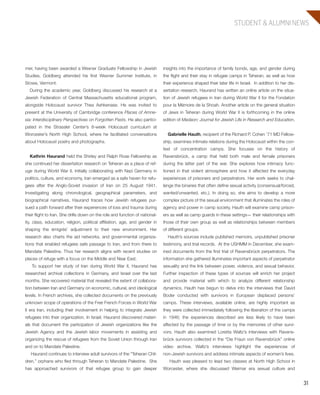
  • 25.
    23 FACULTY NOTES Thomas Kühne communitybuilding through genocide. Cambridge University Press will publish his masterful study, The Rise and Fall of Comradeship: Hitler’s Soldiers, Male Bonding and Mass Violence in the 20th Cen- tury. Based upon his earlier landmark book, published in German, this English language version updates the scholarship and sources. Research into the nexus of masculinity and violence will continue to inform Kühne’s work as he undertakes fresh scholarly endeavors. Among other projects, he plans a comprehensive book that will examine the degree to which different European countries collabo- rated with the Nazi genocidal project and later obfuscated their involvement in the context of building national collective memory. Kühne’s prodigious scholarly activities serve the historical profes- sion and the Holocaust and Genocide field. In addition to authoring nine book reviews over the past year, he wrote two book chapters, and spoke widely as a panelist or discussant at academic confer- ences around the globe. He also promoted the work of young schol- ars in myriad ways including as a co-editor of the book series Palgrave Histories of Genocides, reviewing fellowship applications, and providing expertise on academic appointments in five countries. From his vantage as a member of the editorial boards of the journals Central European History and Culture, Society and Masculinities, and the executive board of the German Studies Association, he has con- tributed to the development of the field. Recognizing Kühne’s scholarship, the leading German journal, Historische Zeitschrift, invited him to review the new annotated edition of Mein Kampf. The rationale for this recently published edi- tion, produced with the generous spon- sorship of the German government, has been debated widely in the international media. His review explored the idea of Hitler “hysteria” in popular culture and how it shapes perspectives on Nazi Ger- many and the Holocaust. Kühne has much to look forward to professionally and academically as he embarks on directing the Strassler Cen- ter. And, recognizing his commitment to the work, his students and colleagues look forward to excellent results. Mary Jane Rein Elevating the robust reputation of the Strassler Center as the fore- most institution training doctoral students in Holocaust History and Genocide Studies has long motivated Strassler Professor Thomas Kühne. He contributed to this ambitious goal throughout the past academic year through his service to the doctoral program. In addi- tion to his essential work advising students as Director of Graduate Studies, he supervised seven dissertations including one brought to completion by Michael Geheran PhD ’16. He also broadened the Center’s academic mission by convening a groundbreaking sympo- sium on Native American Genocide. As a Holocaust scholar working in the US, Kühne felt compelled to consider genocide in North America. “It is imperative that we face the history of mass violence in the US context. Moreover, we learn a great deal about the special particularities of the Holocaust by analyzing it in a broader context of genocidal violence,” Kühne argues. Having published a seminal article about colonialism and genocide in 2013, he has continued to think about the colonial paradigm. “Violence per- petrated against indigenous people was driven by the needs of set- tlers who colonized the United States and this gradual genocidal process should be studied alongside the Holocaust, which remains the paradigmatic case of genocide.” Comparative study, he affirms, is a cornerstone of genocide research. As of 1 June, Kühne assumed a new leadership role as Director of the Strassler Center. And after 12 years as colleagues, I am pleased to share responsibilities for leading the Center with him. In this capac- ity, he plans to advance the vision of expanding the Center’s scholarly reach and raising its already well-established international reputation. He looks forward to the challenge, which will entail deepen- ing connections with Clark faculty, diversi- fying coursework, and growing first-rate opportunities for students. Recognizing that the PhD program depends upon the research profile of its faculty to attract the most promising doctoral candidates, he is equally committed to producing exciting new work. The coming year will see the culmina- tion of his twenty-year initiative examining Strassler Professor Thomas Kühne. 603064.indd 23 11/18/16 11:01 AM
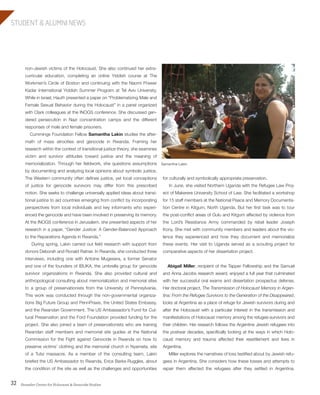
  • 26.
    Strassler Center forHolocaust & Genocide Studies24 FACULTY NOTES Ken Maclean in genocide and mass atrocities responsible for their crimes in light of new scholarship and field-based work. Spring proved a crucial time for planning as MacLean will spend a sabbatical semester as a Visiting Research Fellow at the Center for Southeast Asian Studies, Kyoto University (Japan). While there, he will develop a book manuscript regarding alleged mass atrocity crimes in southeastern Burma/Myanmar. Search and Destroy: Human Rights, Fact Production, and Impunity in Burma/Myanmar is the working title of his project which will examine the creation of human rights archives and the strategic utilization of the “facts” they contain with regard to the violations documented. The book synthesizes more than a decade of primary research MacLean conducted in Burma/Myanmar and along its Thai border, including interviews with victims/survivors, eyewit- nesses, defectors from the army, human rights workers, and journalists as well as primary sources documenting alleged war crimes and crimes against humanity. The abuses include forced labor, forced displace- ment, starvation as a weapon of war, and shoot to kill policies. Whether examining food justice on the Clark campus or food secu- rity in war zones, MacLean inspires with his commitment to justice at home and abroad. According to Samantha Lakin, “he challenges his students to question the status quo and our understanding of complex subjects like memory politics, transitional justice, and rebuilding com- munities in the aftermath of conflict. His approach to teaching and researching human rights is nuanced and insightful, as he introduces relevant concepts in the study of Holocaust and genocide studies, human rights history, and the study of mass atrocities.” He wears his many hats well! Mary Jane Rein Anthropologist Ken MacLean wears many academic hats. In addition to his position as Associate Professor of International Development, he is a faculty member in the Strassler Center doctoral program, directs the Asian Studies Program, and advises the Food Systems Working Group, which commits Clark to achieving the Real Food Challenge (20% real food by 2020). He has developed compelling courses that explore the scholarship behind these interests including “Political Econ- omy of Food and the Ethics of Eating,” “Seeing like a Humanitarian Agency,” “Transitional Justice: Theoretical Debates, Institutional Frame- works, and Development Impacts,” and “Visualizing Human Rights.” A dedicated teacher, mentor, and advisor, MacLean supervises an impressive array of directed readings, internships, senior theses, MA capstone projects, MA theses, and dissertations. At the same time, he is engaged with scholarly projects based upon fieldwork and archival research he has conducted throughout Southeast Asia. MacLean’s teaching and broad knowledge of human rights, non-governmental organizations, and post-conflict justice advance the Center’s growing research agenda. His expertise has been essential to doctoral students forging a new track in Comparative Genocide Stud- ies. Sara Brown, who recently earned the first PhD in this area, researched women rescuers and perpetrators during the 1994 Geno- cide in Rwanda and benefited from MacLean’s participation as an ex officio member of her dissertation committee. Currently, he serves as doctoral advisor to Samantha Lakin who examines symbolic justice in post-genocide Rwanda and Mohammad Sajjadur Rahman whose doctoral project is the 1971 Genocide in Bangladesh. In September 2015, MacLean and Raz Segal PhD ’13 co-chaired the Center’s second Israel Academic Exchange workshop which gath- ered Israeli, American, and European scholars to present research on post-mass atrocity societies. They challenged participants to engage in critical discussions about violent processes with papers that acknowl- edge the complexities of conceptual categories and methodological assumptions. Framing a series of sessions around violence and peace, destruction and reconstruction, impunity and accountability, continued aggression and reconciliation, the presenters examined multiple cases of genocide and mass violence from across disciplinary boundaries. MacLean further deployed his organizing skills as faculty mentor for a major conference to be held in April 2017, Emerging Expertise in Holo- caust and Genocide Studies. Early career academics and profession- als including lawyers, policymakers, and practitioners will explore the theme of accountability. They will consider how to hold those involved International Development Professor Ken MacLean 603064.indd 24 11/18/16 11:01 AM
  • 27.
    Program FacultyProgram Faculty Weare grateful to the following faculty for their contributions of scholarship, expertise, and teaching. Srinivasan Sitaraman, PhD, Political Science Department Associate Professor of Political Science Valerie Sperling, PhD, Political Science Department Professor of Political Science Shelly Tenenbaum, PhD, Sociology Department Coordinator, HGS Undergraduate Activities Professor of Sociology Robert Tobin, PhD, Department of Language, Literature and Culture Henry J. Leir Professor of Foreign Languages and Cultures Johanna Ray Vollhardt, PhD, Francis L. Hiatt School of Psychology Director, Social Psychology Program Associate Professor of Psychology Kristen Williams, PhD, Political Science Department Professor of Political Science Taner Akçam, PhD, History Department Kaloosdian Mugar Professor of Armenian Genocide Studies and Modern Armenian History Katerine Bielaczyc, PhD, Department of Education Director of the Hiatt Center for Urban Education Associate Professor of Education Debórah Dwork, PhD, History Department Director, Strassler Center for Holocaust and Genocide Studies Rose Professor of Holocaust History Jody Emel, PhD, Graduate School of Geography Professor of Geography Anita Fábos, PhD, Department of International Development, Community, and Environment Associate Professor of International Development and Social Change Everett Fox, PhD, Department of Language, Literature and Culture Director, Jewish Studies Concentration Allen M. Glick Professor of Judaic and Biblical Studies Thomas Kühne, PhD, History Department Strassler Professor of Holocaust History Olga Litvak, PhD, History Department Michael and Lisa Leffell Professor of Modern Jewish History Ken MacLean, PhD, Department of International Development, Community, and Environment Director, Asian Studies Associate Professor of International Development and Social Change Marianne Sarkis, PhD, Department of International Development, Community, and Environment Assistant Professor of International Development and Social Change 25 603064.indd 25 11/30/16 7:40 AM
  • 28.
    Jewish Holocaust Memorialin Berlin, Germany 603064.indd 26 11/30/16 7:40 AM
  • 29.
  • 30.
    Strassler Center forHolocaust & Genocide Studies28 STUDENT & ALUMNI NEWS Graduate Center’s interdisciplinary conference in the humanities, War and Sexual Violence, she presented “Ritualized Rapes and Body Destruction of Armenian Women during the Genocide,” which will be included in the conference proceedings. In London, Aleksanyan deliv- ered a paper, “Aid to Armenia: Armenia and Armenians in International History,” at Birkbeck College, University of London. In June, Aleksanyan was part of a Strassler Center student delega- tion at the Fifth International Conference on Genocide organized by the International Network of Genocide Scholars (INOGS) in Jerusa- lem. She collaborated with fellow students on the panel, “Gendered Aspects of Genocide.” Following the conference, she remained in Jerusalem to conduct research in the Armenian Patriarchate archive. Her schedule of conferences concluded in Salzburg at the confer- ence, Children and War: Past and Present, where she presented her research on Armenian girl orphans after World War I. This year, Claims Conference Fellow Maayan Armelin broadened her expertise regarding the historical background and social processes pertaining to her dissertation, “Follow Me into Genocide”: Social Dynamics and Leadership Styles in the SS-Einsatzgruppen, which deals with the operations of the SS-Einsatzgruppen in the Nazi-occupied Soviet Union. In coursework and research projects, she also studied European history in the twentieth century, the history of the Soviet Union, and the development of transitional justice mechanisms and pro- cesses of reconciliation in post conflict societies after occurrences of genocide and mass violence. Her research focused on perpetrator relations with regimes and the experiences of face-to-face perpetrators while they were fulfilling orders and operating on the ground. Armelin analyzed the primary source materials gathered from research previously conducted in the national German archive in Lud- wigsburg. These include trial testimonies that shed light on the lead- Graduate Student News Second-year doctoral student Anna Aleksanyan proudly holds the Harry and Ovsanna Chitjian Fellowship. For her dissertation, Gender Aspects of the Armenian Genocide, Aleksanyan researches the geno- cidal experiences of Armenian women as well as efforts to recover their identity in the aftermath. For men, the genocide entailed physical elim- ination, but for women and children the situation was quite different. Exiled to the desert, they were subject to mass humiliation, rape, star- vation, and killings. In many cases, women and girls were forced to marry their “rescuers” or become their slaves. After World War I, Arme- nian and foreign organizations and individuals made every effort to emancipate these women from Muslim harems and return them to their Armenian identity. Liberators rescued them by paying ransom or even through abduction, and yet some women refused to return out of humiliation or loyalty to new families. Working under the supervision of Professor Taner Akçam, Aleksanyan participated in his Krikor Guergerian project, which preserves essential documentary evidence regarding the Armenian genocide. As part of her work with Akçam, she is preparing special guidelines and an article about the Armenian sources of the archive. She attended a spring workshop in Istanbul dedicated to findings from the archive. Aleksanyan had multiple opportunities to speak and to present papers at conferences both here and abroad throughout the spring and summer. In March, she presented “From Adana to Bolis: Zabel Yesayan’s Letters to Tigran Yesayan in 1909” at the conference Empire, Politics, and War: The Armenian Genocide within the Context of the Ottoman Empire, sponsored by the Armenian Studies Program of California State University, Fresno. Her paper will be included in a special conference publication. Genocide commemoration events brought her to Worcester’s Armenian Orthodox Church and the Arme- nian Museum of America, Watertown, where she presented “Armenian Women during the Genocide: A General Overview.” At the CUNY Diverse questions animate doctoral projects at the Strassler Center. PhD students from around the globe deploy well-established and innova- tive historical methods, as well as approaches drawn from anthropology, geography, legal theory, political science, psychology, and sociology to answer compelling research questions. They examine the economic dimensions of genocide, transnationalism, inter-ethnic violence, mem- ory studies, gender theory, refugee issues, the psychology of perpetrators and victims, the role of bystanders, the dynamics of rescue, sexual- ity, genocidal continuity, and victimhood in post-genocidal societies. Current doctoral projects explore genocide, its causes, conduct, and aftermath in Argentina, Armenia, Bangladesh, Germany, Iran, Israel, Poland, Romania, Russia, Rwanda, Turkey, and Ukraine. During the 2015- 16 academic year, Center doctoral students conducted their work with passion and dedication as they explored archives, participated in con- ferences, presented their research, visited schools, and labored for countless hours at their desks in the Tobak offices on the third floor of Cohen-Lasry House, among the bookshelves of the Rose Library, and in their seats in the Kent seminar room and other classrooms. A sum- mary of their activities follows. 603064.indd 28 11/18/16 11:02 AM
  • 31.
    29 STUDENT & ALUMNINEWS the Harvard University Library) have already proved useful. A grant from the Calouste Gulbenkian Foundation supported further research in archives during the summer months. He also carried out prelimi- nary research in the Ottoman Archive of the Prime Ministry in Istanbul and the Foreign Office Archives of the United Kingdom in London. Dağlioğlu serves as the project coordinator for Professor Taner Akçam’s Guerguerian Archive initiative. Six team members have steadily indexed many of the documents related to the Armenian Genocide col- lected by the Armenian Catholic priest and amateur historian Krikor Guerguerian. Among the materials in the Guerguerian Archive are documents that pertain to the 1919 Yozgat and Trabzon court martial trials held in Istanbul. Dağlioğlu presented early results of his research on this material at the June INOGS conference in Jerusalem. In April, Dağlioğlu presented “Re-Shaped Identity of Armenians in Turkey under the Conditions of the Cold War” at the University of Michigan-Dearborn conference, The Armenians and the Cold War. He is now working on editing this paper for publication in a special issue of The Armenian Review, one of the most prestigious journals in the Armenian studies field. Finally, during the summer, Dağlioğlu fur- ther developed the language skills needed for his primary research. He attended the summer intensive course in Western Armenian offered by the Hrant Dink Foundation in Istanbul. He also began to study Ottoman-Turkish to support further archival work. T. McBane Fellow Asya Darbinyan sailed through her compre- hensive oral exams and the defense of her doctoral prospectus. She is now dedicated to full-time research on her dissertation, Russian Humanitarian Responses to the Armenian Genocide. She explores the humanitarian assistance provided by Russian organizations to Armenian refugees and orphans on the Caucasus frontline of World ership styles of Einsatzgruppen officers and social dynamics among Einsatzgruppen members while they were committing mass murder. During a return visit to the Ludwigsburg archive, she gathered further evidence that will advance her insights on these matters. As she con- tinued to develop her dissertation proposal, she composed her bibli- ography for the project and wrote an extensive literature review on SS-Einsatzgruppen social dynamics and leadership styles. In addition to her primary advisor, Professor Thomas Kühne, she has secured top experts in the field for her dissertation committee, Professor Mark Rosemann (Indiana State University) and Dr. Jürgen Matthäus (United States Holocaust Memorial Museum). Armelin took advantage of the opportunity to attend international conferences to share her research findings. In April, she participated in a workshop at the University of Utrecht in the Netherlands, Teaching about Perpetrators that examined methodologies and pedagogical approaches at the high school and university level. Her presentation on masculinities and hyper-masculinities among face-to-face perpetrators received positive responses. In June, she attended the INOGS confer- ence, Intersections: Holocaust Scholarship, Genocide Research, and History of Mass Violence, organized by the Hebrew University. Armelin presented “Hyper-masculinities, Leadership Styles, and Violence among SS-Einsatzgruppen,” on the panel “Gendered Aspects of Genocide.” Organized with fellow Strassler Center doctoral students, the panel examined the different experiences of men and women, both perpetrators and victims, during genocide. Armelin’s paper explored the impact of societal expectations of men on male perpetrators’ vio- lent choices and behavior during mass violence. Emre Can Dağlioğlu holds the Agnes Manoogian Hausrath Fel- lowship in Armenian Genocide Studies. He begins his doctoral work having served as a journalist and editor for Agos Weekly, the bilingual Turkish-Armenian newspaper based in Istanbul. He also earned an MA in Cultural Studies from Bilgi University, Istanbul, where he researched minority issues. For his dissertation, Dağlioğlu looks at the impact of Hamidian era reforms on the decision-making of the central government and local notables with regard to massacres carried out against Ottoman Armenians from 1895 to 1896. He examines the extent to which political interplay and international pressure against the Ottoman Empire contributed to these violent events. Records of American Protestant missionaries who worked in Anatolia under the name of the American Board of Commissioners for Foreign Missions (held at Current PhD students with Debórah Dwork 603064.indd 29 11/18/16 11:02 AM
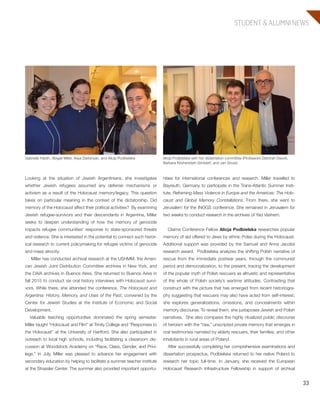
  • 32.
    Strassler Center forHolocaust & Genocide Studies30 STUDENT & ALUMNI NEWS enced, as well as questions concerning the perpetrators’ deceptive tactics and deportees’ awareness of their intended fate. Goldberg’s MA thesis was the basis for his presentation at the INOGS conference. He discussed deportees’ expressions of agency on the trains and used Pagis’ poem to highlight the role of deportations in propelling the collapse of the family unit. For his dissertation, Goldberg will investigate the ways that Jews gathered, shared, and interpreted information in real time. While histori- ans have documented the perpetrators’ coordinated secrecy around the Final Solution, the dynamics governing the flow of information and knowledge-production within wartime Jewish communities have gar- nered little attention. Goldberg will examine how information—in the form of rumors, reports, and eyewitness accounts—transformed into knowl- edge about the war and the Final Solution, and how the acquisition of such knowledge was mediated by psychological and sociological pro- cesses. Goldberg will focus on wartime Lithuania, particularly Vilna, Kovno, and Shavli. To that end, he began to survey the archives of the USHMM and the YIVO Institute for Jewish Research. In order to work with primary source material, he attended a winter Yiddish Immersion Program. He further advanced his Yiddish profi- ciency at the Naomi Prawer Kadar International Yiddish Summer Program at Tel Aviv University. While in Israel, he visited the Yad Vashem archives in search of wartime diaries and letters written in Poland and the occupied Soviet Union, particularly in 1941 and 1942 as information about mass murder began circulating in Jewish com- munities. Returning to the US, he attended the 2016 Dissertation and Thesis Development Workshop at the USHMM. Finally, in late sum- War I. The various governmental and non-governmental organizations she studies include the All-Russian Union of Towns and All-Russian Union of Zemstvos, the Tatiana Committee, and the Russian Red Cross, among others. With the support of a Calouste Gulbenkian Foundation grant for Armenian Studies and funding from the Friends of the Kaloosdian Mugar Professorship, Darbinyan spent the spring in Moscow. She conducted research in various library archives, the State Archive of the Russian Federation (GARF), and the Russian State Military Historic Archive. At the Russian Public Historical Library, she found Russian imperial newspapers published during the Great War. The archives of the Russian State Library contained important publications of the Tati- ana Committee and the All-Russian Union of Towns. At the GARF, she discovered materials describing Tsar Nikolai’s trip to Tiflis, Kars, Sarika- mish, and other towns in the Caucasus in November 1914. During this tour, the Tsar visited infirmaries and shelters for the wounded and sick run by state and private organizations. He also met with representa- tives of Armenian and other local organizations. Immediately after this trip, Nikolai allocated 25,000 rubles in assistance to people in need in the Caucasus. The Russian State Library yielded a beautifully illustrated poster produced in 1915 and used by Russian relief organizations for a fundraising campaign aimed at securing aid for refugees and children, as well as several postcards issued for the same purpose. Spring and summer offered opportunities to share preliminary research findings. Darbinyan presented a paper on conflicting narra- tives about Russia’s policy towards the Armenians from 1914 to 1917 at the conference, Mass Violence and Memory, organized by O. P. Jindal Global University in India. At the INOGS conference in Jerusa- lem, she discussed Armenian refugees in Imperial Russia. Finally, Armenian orphans in the aftermath of the genocide was the subject of her presentation at the conference, Children and War: Past and Present, held at the University of Salzburg, Austria. Claims Conference Fellow Simon Goldberg began doctoral stud- ies this year after serving as Education Director at the Hong Kong Holocaust and Tolerance Centre. He also earned an MA from Haifa University, where he researched Holocaust victims’ deportation expe- riences. Looking at transport through both a historical and a literary lens, he examined letters written on trains en route to concentration and death camps alongside Israeli Dan Pagis’ iconic poem, “Written in Pencil in the Sealed Railway Car.” His study yielded insights about deportees’ responses to the bodily and sensory assaults they experi- Anna Aleksanyan, Emre Dağlioğlu, and Judy Saryan (Editor and Publisher of the Zabel Yessayan project at the Armenian International Women’s Association) 603064.indd 30 11/29/16 7:32 AM
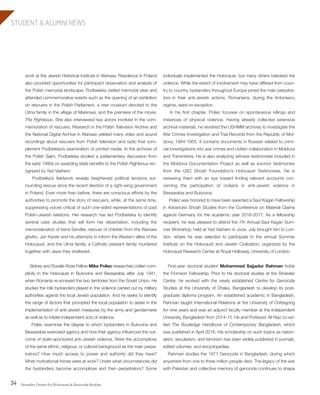
  • 33.
    31 STUDENT & ALUMNINEWS insights into the importance of family bonds, age, and gender during the flight and their stay in refugee camps in Teheran, as well as how their experience shaped their later life in Israel. In addition to her dis- sertation research, Haurand has written an online article on the situa- tion of Jewish refugees in Iran during World War II for the Fondation pour la Mémoire de la Shoah. Another article on the general situation of Jews in Teheran during World War II is forthcoming in the online edition of Medaon: Journal for Jewish Life in Research and Education. Gabrielle Hauth, recipient of the Richard P. Cohen ’71 MD Fellow- ship, examines intimate relations during the Holocaust within the con- text of concentration camps. She focuses on the history of Ravensbrück, a camp that held both male and female prisoners during the latter part of the war. She explores how intimacy func- tioned in that violent atmosphere and how it affected the everyday experiences of prisoners and perpetrators. Her work seeks to chal- lenge the binaries that often define sexual activity (consensual/forced, wanted/unwanted, etc.). In doing so, she aims to develop a more complex picture of the sexual environment that illuminates the roles of agency and power in camp society. Hauth will examine camp prison- ers as well as camp guards in these settings— their relationships with those of their own group as well as relationships between members of different groups. Hauth’s sources include published memoirs, unpublished prisoner testimony, and trial records. At the USHMM in December, she exam- ined documents from the first trial of Ravensbrück perpetrators. The information she gathered illuminates important aspects of perpetrator sexuality and the link between power, violence, and sexual behavior. Further inspection of these types of sources will enrich her project and provide material with which to analyze different relationship dynamics. Hauth has begun to delve into the interviews that David Boder conducted with survivors in European displaced persons’ camps. These interviews, available online, are highly important as they were collected immediately following the liberation of the camps in 1946; the experiences described are less likely to have been affected by the passage of time or by the memories of other survi- vors. Hauth also examined Loretta Waltz’s interviews with Ravens- brück survivors collected in the “Die Fraun von Ravensbrück” online video archive. Waltz’s interviews highlight the experiences of non-Jewish survivors and address intimate aspects of women’s lives. Hauth was pleased to lead two classes at North High School in Worcester, where she discussed Weimar era sexual culture and mer, having been awarded a Wexner Graduate Fellowship in Jewish Studies, Goldberg attended his first Wexner Summer Institute, in Stowe, Vermont. During the academic year, Goldberg discussed his research at a Jewish Federation of Central Massachusetts educational program, alongside Holocaust survivor Thea Ashkenase. He was invited to present at the University of Cambridge conference Places of Amne- sia: Interdisciplinary Perspectives on Forgotten Pasts. He also partici- pated in the Strassler Center’s 8-week Holocaust curriculum at Worcester’s North High School, where he facilitated conversations about Holocaust poetry and photographs. Kathrin Haurand held the Shirley and Ralph Rose Fellowship as she continued her dissertation research on Teheran as a place of ref- uge during World War II. Initially collaborating with Nazi Germany in politics, culture, and economy, Iran emerged as a safe haven for refu- gees after the Anglo-Soviet invasion of Iran on 25 August 1941. Investigating along chronological, geographical parameters, and biographical narratives, Haurand traces how Jewish refugees pur- sued a path forward after their experiences of loss and trauma during their flight to Iran. She drills down on the role and function of national- ity, class, education, religion, political affiliation, age, and gender in shaping the émigrés’ adjustment to their new environment. Her research also charts the aid networks, and governmental organiza- tions that enabled refugees safe passage to Iran, and from there to Mandate Palestine. Thus her research aligns with recent studies on places of refuge with a focus on the Middle and Near East. To support her study of Iran during World War II, Haurand has researched archival collections in Germany, and Israel over the last months. She recovered material that revealed the extent of collabora- tion between Iran and Germany on economic, cultural, and ideological levels. In French archives, she collected documents on the previously unknown scope of operations of the Free French Forces in World War II era Iran, including their involvement in helping to integrate Jewish refugees into their organization. In Israel, Haurand discovered materi- als that document the participation of Jewish organizations like the Jewish Agency and the Jewish labor movements in assisting and organizing the rescue of refugees from the Soviet Union through Iran and on to Mandate Palestine. Haurand continues to interview adult survivors of the “Teheran Chil- dren,” orphans who fled through Teheran to Mandate Palestine. She has approached survivors of that refugee group to gain deeper 603064.indd 31 11/18/16 11:02 AM
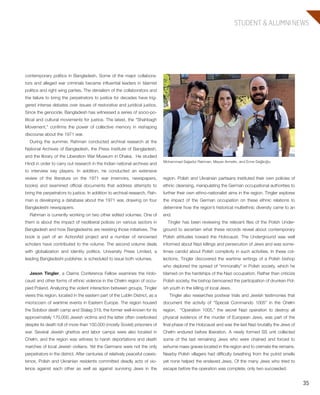
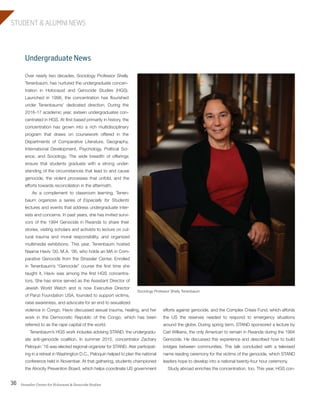
  • 34.
    Strassler Center forHolocaust & Genocide Studies32 STUDENT & ALUMNI NEWS for culturally and symbolically appropriate preservation. In June, she visited Northern Uganda with the Refugee Law Proj- ect of Makerere University School of Law. She facilitated a workshop for 15 staff members at the National Peace and Memory Documenta- tion Centre in Kitgum, North Uganda. But her first task was to tour the post-conflict areas of Gulu and Kitgum affected by violence from the Lord’s Resistance Army commanded by rebel leader Joseph Kony. She met with community members and leaders about the vio- lence they experienced and how they document and memorialize these events. Her visit to Uganda served as a scouting project for comparative aspects of her dissertation project. Abigail Miller, recipient of the Tapper Fellowship and the Samuel and Anna Jacobs research award, enjoyed a full year that culminated with her successful oral exams and dissertation prospectus defense. Her doctoral project, The Transmission of Holocaust Memory in Argen- tina: From the Refugee Survivors to the Generation of the Disappeared, looks at Argentina as a place of refuge for Jewish survivors during and after the Holocaust with a particular interest in the transmission and manifestations of Holocaust memory among the refugee-survivors and their children. Her research follows the Argentine Jewish refugees into the postwar decades, specifically looking at the ways in which Holo- caust memory and trauma affected their resettlement and lives in Argentina. Miller explores the narratives of loss testified about by Jewish refu- gees in Argentina. She considers how these losses and attempts to repair them affected the refugees after they settled in Argentina. non-Jewish victims of the Holocaust. She also continued her extra- curricular education, completing an online Yiddish course at The Workmen’s Circle of Boston and continuing with the Naomi Prawer Kadar International Yiddish Summer Program at Tel Aviv University. While in Israel, Hauth presented a paper on “Problematizing Male and Female Sexual Behavior during the Holocaust” in a panel organized with Clark colleagues at the INOGS conference. She discussed gen- dered persecution in Nazi concentration camps and the different responses of male and female prisoners. Cummings Foundation Fellow Samantha Lakin studies the after- math of mass atrocities and genocide in Rwanda. Framing her research within the context of transitional justice theory, she examines victim and survivor attitudes toward justice and the meaning of memorialization. Through her fieldwork, she questions assumptions by documenting and analyzing local opinions about symbolic justice. The Western community often defines justice, yet local conceptions of justice for genocide survivors may differ from this prescribed notion. She seeks to challenge universally applied ideas about transi- tional justice to aid countries emerging from conflict by incorporating perspectives from local individuals and key informants who experi- enced the genocide and have been involved in preserving its memory. At the INOGS conference in Jerusalem, she presented aspects of her research in a paper, “Gender Justice: A Gender-Balanced Approach to the Reparations Agenda in Rwanda.” During spring, Lakin carried out field research with support from donors Deborah and Ronald Ratner. In Rwanda, she conducted three interviews, including one with Antoine Mugesera, a former Senator and one of the founders of IBUKA, the umbrella group for genocide survivor organizations in Rwanda. She also provided cultural and anthropological consulting about memorialization and memorial sites to a group of preservationists from the University of Pennsylvania. This work was conducted through the non-governmental organiza- tions Big Future Group and PennPraxis, the United States Embassy, and the Rwandan Government. The US Ambassador’s Fund for Cul- tural Preservation and the Ford Foundation provided funding for the project. She also joined a team of preservationists who are training Rwandan staff members and memorial site guides at the National Commission for the Fight against Genocide in Rwanda on how to preserve victims’ clothing and the memorial church in Nyamata, site of a Tutsi massacre. As a member of the consulting team, Lakin briefed the US Ambassador to Rwanda, Erica Barks-Ruggles, about the condition of the site as well as the challenges and opportunities Samantha Lakin 603064.indd 32 11/18/16 11:02 AM
  • 35.
    33 STUDENT & ALUMNINEWS nities for international conferences and research. Miller travelled to Bayreuth, Germany to participate in the Trans-Atlantic Summer Insti- tute, Reframing Mass Violence in Europe and the Americas: The Holo- caust and Global Memory Constellations. From there, she went to Jerusalem for the INOGS conference. She remained in Jerusalem for two weeks to conduct research in the archives of Yad Vashem. Claims Conference Fellow Alicja Podbielska researches popular memory of aid offered to Jews by ethnic Poles during the Holocaust. Additional support was provided by the Samuel and Anna Jacobs research award. Podbielska analyzes the shifting Polish narrative of rescue from the immediate postwar years, through the communist period and democratization, to the present, tracing the development of the popular myth of Polish rescuers as altruistic and representative of the whole of Polish society’s wartime attitudes. Contrasting that construct with the picture that has emerged from recent historiogra- phy suggesting that rescuers may also have acted from self-interest, she explores generalizations, omissions, and concealments within memory discourse. To reveal them, she juxtaposes Jewish and Polish narratives. She also compares the highly ritualized public discourse of heroism with the “raw,” unscripted private memory that emerges in oral testimonies narrated by elderly rescuers, their families, and other inhabitants in rural areas of Poland. After successfully completing her comprehensive examinations and dissertation prospectus, Podbielska returned to her native Poland to research her topic full-time. In January, she received the European Holocaust Research Infrastructure Fellowship in support of archival Looking at the situation of Jewish Argentinians, she investigates whether Jewish refugees assumed any defense mechanisms or activism as a result of the Holocaust memory/legacy. This question takes on particular meaning in the context of the dictatorship. Did memory of the Holocaust affect their political activities? By examining Jewish refugee-survivors and their descendants in Argentina, Miller seeks to deepen understanding of how the memory of genocide impacts refugee communities’ response to state-sponsored threats and violence. She is interested in the potential to connect such histor- ical research to current policymaking for refugee victims of genocide and mass atrocity. Miller has conducted archival research at the USHMM, the Ameri- can Jewish Joint Distribution Committee archives in New York, and the DAIA archives in Buenos Aires. She returned to Buenos Aires in fall 2015 to conduct six oral history interviews with Holocaust survi- vors. While there, she attended the conference, The Holocaust and Argentina: History, Memory, and Uses of the Past, convened by the Center for Jewish Studies at the Institute of Economic and Social Development. Valuable teaching opportunities dominated the spring semester. Miller taught “Holocaust and Film” at Trinity College and “Responses to the Holocaust” at the University of Hartford. She also participated in outreach to local high schools, including facilitating a classroom dis- cussion at Woodstock Academy on “Race, Class, Gender, and Privi- lege.” In July, Miller was pleased to advance her engagement with secondary education by helping to facilitate a summer teacher institute at the Strassler Center. The summer also provided important opportu- Gabrielle Hauth, Abigail Miller, Asya Darbinyan, and Alicja Podbielska Alicja Podbielska with her dissertation committee (Professors Debórah Dwork, Barbara Kirshenblatt-Gimblett, and Jan Gross) 603064.indd 33 11/29/16 7:32 AM
  • 36.
    Strassler Center forHolocaust & Genocide Studies34 STUDENT & ALUMNI NEWS individuals implemented the Holocaust, but many others tolerated the violence. While the extent of involvement may have differed from coun- try to country, bystanders throughout Europe joined the main perpetra- tors in their anti-Jewish actions. Romanians, during the Antonescu regime, were no exception. In his first chapter, Poliec focuses on spontaneous killings and instances of physical violence. Having already collected extensive archival materials, he revisited the USHMM archives to investigate the War Crimes Investigation and Trial Records from the Republic of Mol- dova, 1944-1955. It contains documents in Russian related to crimi- nal investigations into war crimes and civilian collaboration in Moldova and Transnistria. He is also analyzing witness testimonies included in the Moldova Documentation Project as well as survivor testimonies from the USC Shoah Foundation’s Holocaust Testimonies. He is reviewing them with an eye toward finding relevant accounts con- cerning the participation of civilians in anti-Jewish violence in Bessarabia and Bukovina. Poliec was honored to have been awarded a Saul Kagan Fellowship in Advanced Shoah Studies from the Conference on Material Claims against Germany for the academic year 2016-2017. As a fellowship recipient, he was pleased to attend the 7th Annual Saul Kagan Sum- mer Workshop, held at Yad Vashem in June. July brought him to Lon- don, where he was selected to participate in the annual Summer Institute on the Holocaust and Jewish Civilization, organized by the Holocaust Research Center at Royal Holloway, University of London. First-year doctoral student Mohammad Sajjadur Rahman holds the Fromson Fellowship. Prior to his doctoral studies at the Strassler Center, he worked with the newly established Centre for Genocide Studies at the University of Dhaka, Bangladesh to develop its post- graduate diploma program. An established academic in Bangladesh, Rahman taught International Relations at the University of Chittagong for nine years and was an adjunct faculty member at the Independent University, Bangladesh from 2014-15. He and Professor Ali Riaz co-ed- ited The Routledge Handbook of Contemporary Bangladesh, which was published in April 2016. His scholarship on such topics as nation- alism, secularism, and terrorism has been widely published in journals, edited volumes, and encyclopedias. Rahman studies the 1971 Genocide in Bangladesh, during which anywhere from one to three million people died. The legacy of the war with Pakistan and collective memory of genocide continues to shape work at the Jewish Historical Institute in Warsaw. Residence in Poland also provided opportunities for participant observation and analysis of the Polish memorial landscape. Podbielska visited memorial sites and attended commemorative events such as the opening of an exhibition on rescuers in the Polish Parliament, a new museum devoted to the Ulma family in the village of Markowa, and the premiere of the movie, The Righteous. She also interviewed key actors involved in the com- memoration of rescuers. Research in the Polish Television Archive and the National Digital Archive in Warsaw yielded many video and sound recordings about rescuers from Polish television and radio that com- plement Podbielska’s examination of printed media. In the archives of the Polish Sejm, Podbielska studied a parliamentary discussion from the early 1990s on awarding state benefits to the Polish Righteous rec- ognized by Yad Vashem. Podbielka’s fieldwork reveals heightened political tensions sur- rounding rescue since the recent election of a right-wing government in Poland. Even more than before, there are conscious efforts by the authorities to promote the story of rescuers, while, at the same time, suppressing voices critical of such one-sided representations of past Polish-Jewish relations. Her research has led Podbielska to identify several case studies that will form her dissertation, including the memorialization of Irena Sendler, rescuer of children from the Warsaw ghetto, Jan Karski and his attempts to inform the Western allies of the Holocaust, and the Ulma family, a Catholic peasant family murdered together with Jews they sheltered. Sidney and Rosalie Rose Fellow Mike Poliec researches civilian com- plicity in the Holocaust in Bukovina and Bessarabia after July 1941, when Romania re-annexed the two territories from the Soviet Union. He studies the role bystanders played in the violence carried out by military authorities against the local Jewish population. And he seeks to identify the range of factors that prompted the local population to assist in the implementation of anti-Jewish measures by the army and gendarmerie as well as to initiate independent acts of violence. Poliec examines the degree to which bystanders in Bukovina and Bessarabia exercised agency and how their agency influenced the out- come of state-sponsored anti-Jewish violence. Were the accomplices of the same ethnic, religious, or cultural background as the main perpe- trators? How much access to power and authority did they have? What motivational forces were at work? Under what circumstances did the bystanders become accomplices and then perpetrators? Some 603064.indd 34 11/18/16 11:02 AM
  • 37.
    35 STUDENT & ALUMNINEWS region. Polish and Ukrainian partisans instituted their own policies of ethnic cleansing, manipulating the German occupational authorities to further their own ethno-nationalist aims in the region. Tingler explores the impact of the German occupation on these ethnic relations to determine how the region’s historical multiethnic diversity came to an end. Tingler has been reviewing the relevant files of the Polish Under- ground to ascertain what these records reveal about contemporary Polish attitudes toward the Holocaust. The Underground was well informed about Nazi killings and persecution of Jews and was some- times candid about Polish complicity in such activities. In these col- lections, Tingler discovered the wartime writings of a Polish bishop who deplored the spread of “immorality” in Polish society, which he blamed on the hardships of the Nazi occupation. Rather than criticize Polish society, the bishop bemoaned the participation of drunken Pol- ish youth in the killing of local Jews. Tingler also researches postwar trials and Jewish testimonies that document the activity of “Special Commando 1005” in the Chełm region. “Operation 1005,” the secret Nazi operation to destroy all physical evidence of the murder of European Jews, was part of the final phase of the Holocaust and was the last Nazi brutality the Jews of Chełm endured before liberation. A newly formed SS unit collected some of the last remaining Jews who were chained and forced to exhume mass graves located in the region and to cremate the remains. Nearby Polish villagers had difficulty breathing from the putrid smells yet none helped the enslaved Jews. Of the many Jews who tried to escape before the operation was complete, only two succeeded. contemporary politics in Bangladesh. Some of the major collabora- tors and alleged war criminals became influential leaders in Islamist politics and right wing parties. The denialism of the collaborators and the failure to bring the perpetrators to justice for decades have trig- gered intense debates over issues of restorative and juridical justice. Since the genocide, Bangladesh has witnessed a series of socio-po- litical and cultural movements for justice. The latest, the “Shahbagh Movement,” confirms the power of collective memory in reshaping discourse about the 1971 war. During the summer, Rahman conducted archival research at the National Archives of Bangladesh, the Press Institute of Bangladesh, and the library of the Liberation War Museum in Dhaka. He studied Hindi in order to carry out research in the Indian national archives and to interview key players. In addition, he conducted an extensive review of the literature on the 1971 war (memoirs, newspapers, books) and examined official documents that address attempts to bring the perpetrators to justice. In addition to archival research, Rah- man is developing a database about the 1971 war, drawing on four Bangladeshi newspapers. Rahman is currently working on two other edited volumes. One of them is about the impact of neoliberal polices on various sectors in Bangladesh and how Bangladeshis are resisting those initiatives. The book is part of an ActionAid project and a number of renowned scholars have contributed to the volume. The second volume deals with globalization and identity politics. University Press Limited, a leading Bangladeshi publisher, is scheduled to issue both volumes. Jason Tingler, a Claims Conference Fellow examines the Holo- caust and other forms of ethnic violence in the Chełm region of occu- pied Poland. Analyzing the violent interaction between groups, Tingler views this region, located in the eastern part of the Lublin District, as a microcosm of wartime events in Eastern Europe. The region housed the Sobibor death camp and Stalag 319, the former well-known for its approximately 170,000 Jewish victims and the latter often overlooked despite its death toll of more than 100,000 (mostly Soviet) prisoners of war. Several Jewish ghettos and labor camps were also located in Chełm, and the region was witness to harsh deportations and death marches of local Jewish civilians. Yet the Germans were not the only perpetrators in the district. After centuries of relatively peaceful coexis- tence, Polish and Ukrainian residents committed deadly acts of vio- lence against each other as well as against surviving Jews in the Mohammad Sajjadur Rahman, Mayan Armelin, and Emre Dağlioğlu 603064.indd 35 11/29/16 7:32 AM
  • 38.
    Strassler Center forHolocaust & Genocide Studies36 STUDENT & ALUMNI NEWS efforts against genocide, and the Complex Crises Fund, which affords the US the reserves needed to respond to emergency situations around the globe. During spring term, STAND sponsored a lecture by Carl Wilkens, the only American to remain in Rwanda during the 1994 Genocide. He discussed this experience and described how to build bridges between communities. The talk concluded with a televised name reading ceremony for the victims of the genocide, which STAND leaders hope to develop into a national twenty-four hour ceremony. Study abroad enriches the concentration, too. This year, HGS con- Undergraduate News Over nearly two decades, Sociology Professor Shelly Tenenbaum, has nurtured the undergraduate concen- tration in Holocaust and Genocide Studies (HGS). Launched in 1998, the concentration has flourished under Tenenbaums’ dedicated direction. During the 2016-17 academic year, sixteen undergraduates con- centrated in HGS. At first based primarily in history, the concentration has grown into a rich multidisciplinary program that draws on coursework offered in the Departments of Comparative Literature, Geography, International Development, Psychology, Political Sci- ence, and Sociology. The wide breadth of offerings ensure that students graduate with a strong under- standing of the circumstances that lead to and cause genocide, the violent processes that unfold, and the efforts towards reconciliation in the aftermath. As a complement to classroom learning, Tenen- baum organizes a series of Especially for Students lectures and events that address undergraduate inter- ests and concerns. In past years, she has invited survi- vors of the 1994 Genocide in Rwanda to share their stories, visiting scholars and activists to lecture on cul- tural trauma and moral responsibility, and organized multimedia exhibitions. This year, Tenenbaum hosted Naama Haviv ’00, M.A. ’06, who holds an MA in Com- parative Genocide from the Strassler Center. Enrolled in Tenenbaum’s “Genocide” course the first time she taught it, Haviv was among the first HGS concentra- tors. She has since served as the Assistant Director of Jewish World Watch and is now Executive Director of Panzi Foundation USA, founded to support victims, raise awareness, and advocate for an end to sexualized violence in Congo. Haviv discussed sexual trauma, healing, and her work in the Democratic Republic of the Congo, which has been referred to as the rape capital of the world. Tenenbaum’s HGS work includes advising STAND, the undergradu- ate anti-genocide coalition. In summer 2015, concentrator Zachary Peloquin ’16 was elected regional organizer for STAND. Ater participat- ing in a retreat in Washington D.C., Peloquin helped to plan the national conference held in November. At that gathering, students championed the Atrocity Prevention Board, which helps coordinate US government Sociology Professor Shelly Tenenbaum 603064.indd 36 11/18/16 11:02 AM
  • 39.
    37 STUDENT & ALUMNINEWS tion in HGS and Law and Society, I can attest to the rigor of the courses. I am proud to have been admitted into Clark’s chapter of Phi Beta Kappa, the nation’s oldest honors society, which recognizes students who demonstrate high academic achievement in a demand- ing program of study across a wide breadth of disciplines. Exemplify- ing their outstanding work, both Natale and Bellesis submitted papers to the 2nd International Scholars’ Workshop, Medicine in the Holo- caust and Beyond to be held in Israel in May 2017. Jonathan Edelman reflects, “The many courses I have taken through HGS, the guidance given to me, and true inspiration that Professor Tenenbaum and the other HGS professors have provided, all have con- tributed to the next chapter of my life.” His words, and the robust activ- ities and honors of the HGS concentrators stand testament to Professor Tenenbaum’s unflagging work as an educator, advisor, and scholar. Under her tutelage, a uniquely rich undergraduate program has emerged from Cohen Lasry House, its roots permeate Clark Uni- versity and its branches touch countless other academic and humani- tarian institutions. Jake Dinerman ’16 centrator Casey Pimental ’17 spent the fall semester in the Netherlands. While there, she applied and was accepted into the Auschwitz Jewish Center Program which she attended during the summer. Pimental described how the program provided meaningful opportuni- ties to engage intensively with pre-war Jewish history, the Holocaust, and contemporary Jewish life in Poland. She visited Krakow and Oświęcim, worked with scholars, toured Aus- chwitz-Birkenau, studied survivor testimony, and engaged in meaningful discussions. The pinnacle of her experience was studying the testimony of a Polish gentile whose family took in a Jewish girl, saving her from deportation. The testimony was rife with descriptions of rape and other violent abuses by the authori- ties and, at the same time, detailed examples of perseverance, bravery, and love. Pimental will “carry the words with her for a long time to come, especially to her HGS classes”. The opportunity to intern with related organizations is also a vital aspect of the HGS undergraduate concentration. Tenenbaum has developed an extensive list of internships that have led to student experiences around the globe, including in Bosnia, Cambodia, the Czech Republic, Guatemala, Poland, Rwanda, and Sweden. Tenen- baum oversees a competitive awards process for stipend support, thanks to generous endowments established by Ina and Haskell Gor- don and the Belfer family, as well as an anonymous internship in memory of German Jewish refugee Doris Tager. This year, Hannah King ’19 and Spencer Cronin ’18 were selected. King and Cronin interned at Facing History and Ourselves in Brookline, MA. A case in point illustration of the value of internships is Jonathan Edelman ’16. Having served as a summer intern twice at the U.S. Holocaust Memorial Museum in Washington D.C., he secured a full-time posi- tion as a curatorial assistant. HGS concentrators have thrived on campus and beyond. Marisa Natale ’17, who spent the spring semester studying in Jordan, was awarded the prestigious Phi Beta Kappa Sophomore Prize. Fellow concentrator Andrew Bellesis ’16 was last year’s recipient of this prestigious award. As a Psychology major with a double concentra- Debórah Dwork, Anne Marie Goguen ’16, and Sarah Cushman 603064.indd 37 11/30/16 7:40 AM
  • 40.
    Strassler Center forHolocaust & Genocide Studies38 STUDENT & ALUMNI NEWS Life after the Center ies. The granting of this first degree is the fulfillment of her vision to foster research and scholarship about this history. The fall 2016 semester finds Mouradian at California State University in Fresno, where he holds the Henry S. Khanzadian Kazan Visiting Professorship. Ümit Kurt completed the second PhD in the Armenian Genocide track. His dissertation, Destruc- tion of Aintab Armenians and Emergence of the New Wealthy Class: Plunder of Armenian Wealth in Aintab (1890s–1920s), also written under Akçam’s supervision, is a microhistory of Armenians in the city of Aintab in southeastern Turkey. Kurt will spend the 2016-17 academic year as a post-doctoral fel- low at the Center for Middle Eastern Studies at Har- vard University. Mouradian and Kurt were both Agnes Manoogian Hausrath fellows, supported by the endowment that Bill Hausrath ’53 established in memory of his late wife. While Bill, who passed away last year, did not witness these grad- uations, his pride in the inaugural Hausrath fellows inspired them and his generosity remains an example to others. With the completion of her landmark dissertation about the 1994 Genocide in Rwanda, Sara Brown propelled the Strassler Center to another pivotal moment in its academic development. Supported by a Stern Family fellowship, Brown wrote Gender and Agency: Women Rescuers and Perpetrators during the Genocide in Rwanda under the direction of Rose Professor Debórah Dwork. Members of the Stern family, whose relatives include many victims of Nazism, are committed to fostering scholarship that brings understanding gained about the Holocaust to bear on other instances of mass violence and genocide, particularly in Africa. In celebrating the Strassler Center’s first PhD awarded for a dissertation on a genocide in Africa, Dwork commented on the success of Brown’s defense, “After much lively discussion, the focus of the discussion turned to revision for publication as a book, and which presses would be best suited!” In addition to working on her book manuscript, Brown will continue to lecture at Mt. San Jacinto Col- lege and San Diego State University. The 2015-16 academic year proved especially fruitful, yielding a remarkable seven PhD graduates. Several of them earned the first-ever doctoral degrees in the Armenian Genocide and Comparative Geno- cide tracks, expanding the scholarly scope of the Strassler Center. The completion of these innovative degrees fulfills the program’s vision to investigate genocides around the globe and throughout history. As this new cadre of freshly minted graduates takes up positions at institutions across the United States, they will advance research in these important subfields of Genocide Studies. In a major milestone for the Strassler Center, Khatchig Mouradian defended his dissertation, “Genocide and Humanitarian Assistance in Ottoman Syria (1915-1917), under the direction of Kaloosdian Mugar Professor Taner Akçam. “This graduation marks a historic turning point in Armenian Genocide research,” Akçam remarked. “Mouradian is not only the first Doctor of our Armenian Genocide track but his is also the first doctorate in North America after so many years of silence in the field.” Carolyn Mugar was on hand to celebrate this achievement at a party held in the Rose Library. Her momentous gift, contributed together with her late husband, John O’Connor ’78, laid the ground for a pioneering professorship and program in Armenian Genocide Stud- Carolyn Mugar (center) with Taner Akçam and his doctoral students 603064.indd 38 11/29/16 7:33 AM
  • 41.
    39 The Strassler Centeris committed to helping graduates of the doc- toral program secure meaningful employment. Four more newly gradu- ated students have obtained exceptional positions. Elizabeth Anthony completed her dissertation, Return Home: Holocaust Survivors Rees- tablishing Lives in Postwar Vienna. Dwork, her advisor, reported that “her committee loved the manuscript – and so will the readers of her book to come.” In the meantime, Anthony continues her work at the United States Holocaust Memorial Museum (USHMM), where she holds a key position as Information Tracing Service Staff Scholar at the Jack, Joseph and Morton Mandel Center for Advanced Holocaust Studies. Another Dwork advisee, Jeffrey Koerber, submitted Born in the Borderlands: The Response of Jewish Youth to Oppression and Genocide, 1933-1948, in completion of his degree. Committee mem- ber Wendy Lower, Interim Director of the USHMM’s Mandel Center, called it “a splendid dissertation.” Dwork agreed that it was “Ready for some presses straight away; a bit more work and the majors are in sight.” Koerber is now an Assistant Professor of Holocaust History at Chapman University in California. Michael Geheran’s Betrayed Comradeship: German-Jewish WWI Veterans under Hitler is “a model of a dissertation,” his dissertation advisor, Strassler Professor Thomas Kühne, proclaimed. Geheran is as an adjunct history professor at Boston University and brings his positive experiences as a doctoral student to his interim position as Manager of Academic Programs at the Strassler Center. Finally, Joanna Sliwa’s committee extoled her for her excellent dissertation, which benefited from the support of a Saul Kagan Fellowship. Having submitted Jewish Children in Nazi-Occupied Kraków to the delight of Dwork, her committee chair, Sliwa turns her attention to her position as Archives Project Specialist at the American Jewish Joint Distribu- tion Committee. The accomplishments of the growing group of alumni reflect the strength of the program. As graduates obtain positions at archives, museums, memorials, and universities, they inspire and help their junior colleagues. Reuniting at conferences, workshops, and histori- cal sites around the globe, they are building a powerful network of professionals that enhances and reinforces the reputation of the Strassler Center. Kim Allar (ABD), Saul Kagan Claims Conference Academic Fellow for Advanced Shoah Studies (until June 2016); Instructor, Tsinghua University, Beijing (as of September 2016) Elizabeth Anthony PhD ’16, Information Tracing Service Staff Scholar, Jack, Joseph and Morton Mandel Center for Advanced Holocaust Studies, U.S. Holocaust Memorial Museum Cristina Andriani PhD ’13, Psychotherapist, Private Practice Sara Elise Brown PhD ’16, Lecturer, Mt. San Jacinto College and San Diego State University Beth Cohen PhD ’03, Lecturer, California State University, Northridge; Research Associate, The Berenbaum Group Sarah Cushman PhD ’10, Head of Educational Programs, Strassler Center (until August 2016); Director, Holocaust Educational Foundation, Northwestern University (as of September 2016) Emily Dabney (ABD), Program Assistant, Institute for the Study of Modern Israel, Emory University Tiberiu Galis Ph.D. ’15, Executive Director, Auschwitz Institute for Peace and Reconciliation Michael Geheran PhD ’16, Lecturer, Boston University and Clark University; Academic Program Manager, Strassler Center (as of August 2016) Adara Goldberg, Ph.D. ’12, Director of Education, Vancouver Holocaust Education Centre (until October 2015); Azrieli Post-doctoral Fellow, Avraham Harman Institute of Contemporary Jewry, Hebrew University (as of September 2016) Naama Haviv MA ’06, Executive Director, Panzi Hospital and Foundation, USA Alexis Herr PhD ’15, Lecturer, Keene State College, Cohen Center for Holocaust and Genocide Studies (until May 2016); Pearl Resnick Fellow, USHMM Stefan Ionescu PhD ’13, Fellow, Research Institute of the University of Bucharest Judith B. and Burton P. Resnick Fellow, USHMM Jeffrey Koerber PhD ’16, Assistant Professor of Holocaust History, Chapman University Ümit Kurt PhD ’16, Post-doctoral Fellow, Center for Middle Eastern Studies, Harvard University (as of September 2016) Natalya Lazar (ABD), Program Director, Initiative on Ukrainian-Jewish Shared History and the Holocaust in Ukraine, USHMM Beth Lilach (ABD), Senior Director of Education and Community Affairs, Holocaust Memorial and Tolerance Center of Nassau County Jody Russell Manning (ABD), Instructor, Rowan University (as of September 2016) Khatchig Mouradian PhD ’16 Coordinator, Armenian Genocide Program at the Center for the Study of Genocide and Human Rights, Rutgers University and Adjunct Professor, Worcester State University (until May 2016); Henry S. Khanzadian Kazan Visiting Professor, California State University, Fresno (fall semester 2016) Michael Nolte (ABD), E-Learning Training Coordinator, Sodexo Ilana F. Offenberger PhD ’10, Lecturer, University of Massachusetts, Dartmouth Christine Schmidt PhD ’03, Deputy Director and Head of Research, Wiener Library for the Study of the Holocaust and Genocide, London Raz Segal PhD ’13, Thomas Arthur Arnold Postdoctoral Fellow, The Zvi Yavetz Graduate School of Historical Studies, Tel Aviv University (until May 2016); Assistant Professor of Holocaust and Genocide Studies, Sara and Sam Schoffer Professor of Holocaust Studies, Stockton University (as of September 2016) Joanna Sliwa PhD ’16, Saul Kagan Claims Conference Academic Fellow for Advanced Shoah Studies and Faculty Advisor, Master Teacher Institute in Holocaust Education, Joan and Allen Bildner Center for the Study of Jewish Life, Rutgers University; Archives Project Specialist, American Jewish Joint Distribution Committee (as of April 2016) Lotta Stone PhD ’10, Historian and Research Associate, Middleton Place Foundation, Charleston, South Carolina 603064.indd 39 11/18/16 11:02 AM
  • 42.
  • 43.
    The Srebrenica-Potocari memorialand cemetery for the victims of the 1995 genocide, Bosnia growth & development 603064.indd 41 11/30/16 7:40 AM
  • 44.
    Strassler Center forHolocaust & Genocide Studies42 GROWTH & DEVELOPMENT endeavor and its construction signals all that Dwork accomplished as founding director. Thomas Kühne and I look forward to the many exciting developments to come as we take up our joint directorship and a growing agenda that will enjoy ample room to develop. This year, we added study of the 1971 Genocide in Bangladesh and, in spring 2017, Dana and Yossie Hollander Visiting Professor Chen Bram will teach about the 19th century Genocide against the Circas- sians and the Holocaust in the Caucuses, as part of the next phase of the Center’s Israel Academic Exchange. In short, we are here and we are growing! We are grateful to Clark University trustee Rebecca Colin (PhD) ’89 and her generous family for the lead gift for the Graduate Study Wing. Their pledge launched this project and inspired others. David and Robert Strassler have been outstanding donors and friends since the beginning; their children continue their philanthropic tradition. Rosalie Rose honors the memory of Sidney Rose with her pledge, the culmi- Growth & Development This year, the Colin Flug Graduate Study Wing moved closer to ground breaking as Clark alumni and friends of the Strassler Center contributed generous pledges and gifts in support of this crucial building project. Many did so in honor of Debórah Dwork as they rec- ognized her twenty years of extraordinary leadership. The program’s robust development is a tribute to her vision to incorporate a range of genocides as essential cases for comparison. As we approach the end of two decades of doctoral training, our student population has increased in number and international diversity and we have out- grown Cohen-Lasry House. Happily, the Colin Flug Graduate Study Wing will increase our capacity for doctoral student study space and will add a much needed lecture hall. From the outset, Dwork was committed to a Center that would be broadly comparative, that would maintain cutting edge research about the Holocaust but do so alongside cases from throughout his- tory. The new wing will provide a welcome home for this enlarged Colin Flug Graduate Study Wing (Julian Bonder and Associates design) 603064.indd 42 11/18/16 11:02 AM
  • 45.
    43 GROWTH & DEVELOPMENT parativeGenocide. Khatchig Mouradian PhD ’16 and Umit Kürt PhD ’16 carried out their doctoral research on the Armenian Genocide as Agnes Manoogian Hausrath Fellows. They studied with Taner Akçam who holds a pioneering professorship established by Carolyn Mugar and her late husband John O’Connor ’78 along with Robert Aram Kaloosdian ’52 and the many donors they inspired. Sara Brown PhD ’16 held the Stern Family Fellowship in Comparative Genocide Stud- ies as she conducted groundbreaking dissertation research on the 1994 Genocide in Rwanda. Financial support that opens new fields of study is the most difficult to secure. We are grateful to the late Bill Hausrath ’53, Stephanie Rein and Edward Stern, and the Family Robert Weil Foundation for recognizing the importance of doctoral research that blazes new paths forward. Finally, the Colin Flug Wing will include a lecture hall that will be the venue for the innovative confer- ences which are crucial to expanding the Center’s intellectual reach. This year Ellen Carno ’79 and Neil Leifer ’76 contributed funding for a conference on Native American Genocide. The Charles E. Scheidt Family Founda- tion provided terrific support for a conference to be held in spring 2017 that will gather emerging scholars from around the world who work in many disciplines and on many different cases of genocide and mass violence to consider how we hold perpetrators account- able for atrocities. In future, we will host such events in our lecture hall (name to be determined should readers wish to contribute a noteworthy gift). In 2018, we will inaugurate the space with a major conference celebrating a landmark anniversary: the first PhD students entered the program in fall 1998 and launched two decades of inno- vative doctoral training. Donors to the Strassler Center light the way toward a better future. The many contributions they made during the academic year 2015- 16 funded important research carried out by our students and faculty; donor support for public events and activities advanced our under- standing of genocide and mass atrocities in significant ways. The accomplishments described in this report are a testament to the gen- erosity of those listed here. We are grateful to all of them. Mary Jane Rein nation of magnificent support that began with the foundational gift of the Rose Professorship. New friends and longstanding supporters stepped up to fund student offices. They include Stephen Corman in memory of his dear wife Betsy; Lisa ’82 and Michael ’81 Leffell; Stephanie Rein and Edward Stern and the family and friends of the late Herbert Rein; Erica Rhine ’67; and Al Tapper. The estate of Diana Bartley, who built our library collection book by book over a decade, will provide new shelves to accommodate her col- lection. Betty ’50 and Ira Dyer (of blessed memory), Robert J. Katz, Carl Klorman ’71, Roxanne Kupfer, Ellen Lautenberg ’80, Joan and Michael Marek, Jacob Nyman ’01, Dianne Parrotte, Debra Raskin and Michael Young, Fran Snyder and David Vorem- berg ’72 and many others answered the call to rec- ognize Debórah Dwork’s many achievements. We are grateful to them and everyone who contributed to this building project. Bricks and mortar are, in the end, an expression of program. And our program is dedicated to train- ing doctoral students. Thus, we are extremely grateful to the many funders who provide student fellowships. Our focus on preparing scholars in Holocaust History and Genocide Stud- ies continues to set the Strassler Center apart as a singular institution for PhD education in this field. The Hilda and Al Kirsch award, funded by Penny ’68 and Bruce ’66 Wein, funds student research. So, too, does the Samuel and Anna Jacobs award, established by Ernest Rubenstein and the trustees of the Jacobs Foundation. The Confer- ence on Material Claims against Germany, Robin Heller Moss and the trustees of the Buster Foundation, Sara Chitjian and the Harry and Ovsanna Chitjian Foundation, the Cummings Foundation in support of comparative genocide, and an anonymous donor in honor of beloved teacher T. McBane funded current use fellowships during the past academic year. Endowments established by Howard Fromson, Bill Hausrath ’53, Leslie and Glenn ’71 Parish, Marlene and David Persky, Rosalie and Sidney Rose, Al Tapper, and the children of Shir- ley and Ralph Rose have established permanent fellowship funds for which we are especially grateful. This year, the Strassler Center awarded doctoral degrees for the first time ever in the fields of Armenian Genocide Studies and Com- Rebecca Colin (PhD) ’89 603064.indd 43 11/18/16 11:02 AM
  • 46.
    Strassler Center forHolocaust & Genocide Studies44 GROWTH & DEVELOPMENT Friends ($1,000 to $4,999) Melvin S. Cutler Charitable Foundation Joyce and George Aghjayan Anonymous Barrington Foundation Ellen Carno ’79 and Neil Leifer ’76 Dorothy and Herbert Carver Alan Edelman and Debbie Sosland-Edelman Philanthropic Fund of the Jewish Community Foundation of Greater Kansas City Elaine ’63 and David Feingold Susan G. ’60 and Martin A. ’58 Fischer Carol Bolton Kappel ’85 and Jonathan Kappel ’81 Jeffrey Kraines The William P. Goldman and Brothers Foundation Roxanne Kupfer Ellen S. Lautenberg ’80 The Lautenberg Foundation Leroy and Morton Productions Carolynn Levy and Alan B. Sharaf ’72 MA ’76 PhD ’78 Joan G. and Michael S. Marek In honor of Debórah Dwork Kenneth Marek In honor of Debórah Dwork The Shelley & Donald Meltzer Family Foundation Linda and Robert Meditz Leonard Mushin Mary and Stephen B. ’68 Novak Jacob Nyman ’01 Leslie and Glenn Parish ’71 Dianne M. Parrotte Deborah and Ronald Ratner Elizabeth Tromovitch ’56 Fran Snyder and David Voremberg ’72 Penny ’68 and Bruce ’66 Wein Supporters ($500 to $999) Libby ’72 and Richard ’71 Cohen Laura and Wayne Glazier Barry J. Glick Emily and William’92 Gottlieb Ruth Lander Barbara Landau Herman O. Stekler ’55 Paula and James E. Tashjian Ardemis and Sarkis ’58 Teshoian Dianna Singer Patricia Spargo and Mark Tobak Donor Honor Roll The following list includes outright gifts and pledge payments made between 1 June 2015 and 31 May 2016 Principal Benefactors ($100,000 and up) Charles E. Scheidt Family Foundation Rebecca Colin (PhD) ‘89 Simon and Eve Colin Foundation Golden Benefactors ($50,000to $99,999) Anonymous Conference on Jewish Material Claims against Germany Stephen Corman In memory of Betsy Corman Thomas McBane Armenian Fellowship Anonymous Benefactors ($25,000 to $49,999) Cummings Foundation Calouste Gulbenkian Foundation Robin Heller Moss The Buster Foundation Nazar and Artemes Nazarian Al M. Tapper In honor of Debórah Dwork Patrons ($10,000 to $24,999) Barrington Foundation Betty ’50 and Ira *Dyer Robert J. Katz In honor of Debórah Dwork Lisa ’82 and Michael ’81 Leffell Ovsanna Y. ’58 and R. Mihran MA ’58 Mooradian National Association for Armenian Studies and Research Jerair Nishanian Foundation David and Marlene Persky Joseph Persky Foundation Erica S. Rhine ’67 Susser Family Trust Suzanne and Harry Toufayan Sponsors ($5,000 to $9,999) Sara Chitjian Harry & Ovsanna Chitjian Family Foundation Melvin S. Cutler Charitable Foundation Peter and Stacy Hochfelder Marianne and Robert A. ’52 Kaloosdian Carl Klorman ’71 In memory of David and Frances Klorman Debra Raskin and Michael Young 603064.indd 44 11/18/16 11:02 AM
  • 47.
    45 GROWTH & DEVELOPMENT GeorgeH. Sogigian Shaké Sulikyan ’01 Elissa S. Tessler Marilyn Thypin Margaret W. Traina Judith Wasserheit Contributors (Up to $100) Ivan A. Backer Beth B. Cohen PhD ’03 Jennifer DeFronzo ’97 Martin Demoorjian Richard K. Dinjian ’76 Thomas Geiger Norman Gluckstein Michael Gruenbaum Jennifer K. Dowdle In Memory of Katie Kavorkian Katherine M. Horigan ’13 Ralph V. Hovanesian Betty R. Jaffe Edward S. Kersch Amy Kizirian ’92 Elaine Klein ’65 Carl S. Klorman ’71 Rise A. Liskov ’72 Richard D. Mangerian ’53 Mark R. Milner Michael A. Mooney ’93 Maxine ’83 and Leonard Morse Marisa G. Natale ’17 Susan Rein In honor of Barbara and Edward Simpson Ian Rosenbluth ’01 Ruth and Allen* Rubin Joshua L. Segal Naomi K. Skriloff Selden K. Smith Joanne Tuck and Stuart R. Freedman ’62 Anna Voremberg ’13 Melvin L. Zwillenberg *Deceased Suzanne Tobak Sharon M. Weinstein In honor of Dr. Richard P. Cohen ’71 Donors ($100 to $499) Ani Aprahamian ’80 Richard C. Bedrosian Selwin Belofsky Tina Bilazarian Kara E. Brickman ’97 Fay and Julian Bussgang Cutler Capital Management In honor of Al Tapper Virginian and H. Martin* ’47 Deranian Laurie and Michael Derian Albert J. Glassman Louise H. Harootunian’53 Alan J. Holz ’85 Gerald I. Kheboian ’74 Robert G. Kinosian ’68 Lisa ’92 and Andrew ’92 Koenig Daphne and Arnold G. Konheim ’63 Nancy and Michael Leavitt Pamela and David Levine Pamela and Arnold ’65 Loeb Charles Margosian ’72 Anne L. McKinnon ’83 Amy ’72 and Robert ’59 Messing Susan and Frank Minasian ’61 Debra Pemstein and Dean Vallas Cynthia Normandie ’83 Mary Jane Rein In honor of Robin Heller Moss In honor of Rebecca Colin In memory of Linda Robbins Nathan Robbins Meryl Shahun Rosen In honor of Glen and Leslie Parish Celia Schulhoff ’54 Ferenc & Ilona Czigler Family Endowed Fellowship Paula Shamoian Contance Sherman In honor of Glen and Leslie Parish Beth and Derrek ’90 Shulman To donate by phone: 508.793.8897 Online: https://clarkconnect.clarku.edu/give/CHGS Or by check payable to: Clark University (indicate the Strassler Center in the memo line) Please mail to: 950 Main Street Worcester, MA 01610 603064.indd 45 11/18/16 11:02 AM
  • 48.
    Strassler Center forHolocaust & Genocide Studies46 GROWTH & DEVELOPMENT combination. The resulting book, already the recipient of five awards, will soon be published in German, Czech, and Turkish. Clark alumna Judi Bohn ’75 has been a great friend to Michael and a champion of his book. Having served as an administrator and grant writer in Arlington, MA, where she supervised and developed the Facing History and Ourselves program in the middle and high schools, she also supported students and teachers on educational trips to Holocaust sites in Germany, Poland and the Czech Republic, including Terezin. After retiring from a distinguished public school career, she joined the staff of Facing History and Ourselves, an orga- nization known to Michael since the 1970s when his son Leon was in the first Facing History classroom. As Special Projects Coordinator, Judi manages several projects but her favorite is working with survi- vors and other witnesses to history. She organizes events and speak- ing opportunities for them in the Boston community. Judi’s warmth and genuine concern for Michael and his contemporaries have made her a favorite among them. Judi recognized that Michael was determined to make his book widely available to young readers. A terrific advocate in helping him reach this audience, she purchased a full set of books for the Facing History library to lend to schools. Somewhere There is Still a Sun, which includes a free online study guide, will be featured in Facing History classrooms across the country. As survivor memory fades, the Strassler Center is privileged to know Michael and he is fortunate to have a Clark friend like Judi! Mary Jane Rein The young adult memoir, Somewhere There is Still a Sun tells the touching story of young Misha Gruenbaum. Born in Prague into an educated family in comfortable circumstances, Misha and his family are steadily plunged into the dislocation and violence that Czech Jews experienced during the Holocaust. The family is eventually deported to Terezin, the old fortress outside of Prague, where Misha is housed in room 7 with a group of boys supervised by a marvelous youth leader named Franta. After his father’s brutal murder, Misha’s mother emerges as the book’s hero. Her talents and shrewd determi- nation help him and his sister to survive the war. This heart-rending story is handled with touching sensitivity by Michael Gruenbaum, now a retired engineer living in Brookline, MA and his co-author Todd Hasak-Lowy. At the publisher’s (Simon and Schuster/Aladdin) suggestion, they told it as a memoir aimed at mid- dle school readers who would be the same age as the protagonist, 12-14 years old. While the circumstances are tragic, young readers can relate to aspects of the story they may recognize from their own lives. Love of sports, devotion to family, concerns about the future, and interest in girls are all elements that transcend the tragic setting. This book richly deserves a wide audience, and middle school teach- ers who teach the Holocaust would be wise to consider it for their students. Michael and his late wife, Thelma, remained connected to the adult survivors of Room 7 over the decades and travelled over 45,000 miles to meet them. Some years ago, they organized a presentation at the Strassler Center with fellow Terezin survivors, a Venezuelan from Room 9 and a Brazilian from Room 7. In 2004, Thelma pub- lished Nesarim: Child Survivors of Terezin based on their inter- views. The idea to retell the story occurred to Michael after he donated his mother’s Terezin memorabilia to the United States Holo- caust Memorial Museum. Among the artifacts he kept was a teddy bear his mother made at the request of a Nazi officer for the approaching Christmas. Her skills, especially sewing teddy bears, protected her and her children from the deportations to Auschwitz that decimated the camp’s population in fall 1944. Publishers declined Michael’s initial children’s story, which featured a teddy bear as narrator. They reasoned that children who play with bears are not ready to learn about the Holocaust, but students ready for this dark history no longer play with bears. An editor’s decision to pair him with Mr. Lowy and to shift the audience to young adults was a winning Friend of the Center Profile: Michael Gruenbaum and Judi Bohn ’75 Michael Gruenbaum and Judi Bohn ‘75 603064.indd 46 11/18/16 11:02 AM
  • 49.
    47 GROWTH & DEVELOPMENT Excellentjob with efforts pulling together the Strassler Center Year End report…..very detailed, very informative and good coverage across the undergrad and graduate student sectors. Our photo in the rear of the report is a good close to our memorial and commemorative efforts for our centennial acknowledgement. There is still a lot more work to do but I’m comforted in knowing that the Strassler Center is keeping this issue front and center in the Diaspora and across the globe. Steve Migridichian, Chair, Friends of the Kaloosdian Mugar Professorship to Mary Jane Rein, Executive Director It was a very important and engaging symposium (Genocide of Native Americans? A Symposium on Indigenous Identity and Mass Violence in North America). I was honored to participate and commend you and the others at the Strassler Center for your work in this field. Angelique EagleWoman, Professor of Law, Native American Law Program, University of Idaho College of Law to Strassler Professor Thomas Kühne Ixe’he to you and the Strassler Center for your warmth and generosity extended. The keynote and symposium provided a space for critical, intercultural exchange. I’m delighted to know that the Center is interested in including indigenous genocide as a programmatic theme. I look forward to learning more. Margo Tamez, Assistant Professor, Indigenous Studies Program, Irving K. Barber School of Arts & Sciences, The University of British Columbia, Okanagan to Strassler Professor Thomas Kühne I want to thank you again for this special workshop (Israel Academic Exchange). It was one of the best conferences I have ever attended, stimulating, and truly meaningful on various levels. Thanks for including me. Professor Alon Confino, University of Virginia to Rose Professor Debórah Dwork The Israel Academic Exchange was one of the most interesting, well-run conferences I have ever attended. Congratulations to all of you for a job well done! I was honored to be a part. Professor Nancy L. Combs, Ernest W. Goodrich Professor of Law and Director, Human Security Law Center, William and Mary Law School to Rose Professor Debórah Dwork Thank you very much for the invitation to come, as well as for your generosity and friendship. As I said, I am very impressed by what you have created at Clark and know it will be essential for our field for generations to come. It was my honor to speak to your students, and I hope it was valuable to them. Robert Williams, PhD, Director of Development and New Initiatives, United States Holocaust Memorial Museum, Jack, Joseph and Morton Mandel Center for Advanced Holocaust Studies to Rose Professor Debórah Dwork Center in the Mail Simon Goldberg and Maayan Armelin with Holocaust survivor Roman Kent (outside the Kent seminar room) 603064.indd 47 11/29/16 7:33 AM
  • 50.
    Strassler Center forHolocaust & Genocide Studies48 GROWTH & DEVELOPMENT In Memoriam: H. Martin Deranian ’47 Dr. Hagop Martin Deranian, known as Martin, was a proud Arme- nian-American whose passing is a great loss to the Strassler Center community. A Clark University alumnus who practiced dentistry in downtown Worcester for many decades, he was an avid amateur historian whose many publications document the experiences of Armenians in America. Deranian’s impulse to research and write about this history was motivated by a deep desire to understand what happened to his family in the Genocide and especially to know more about his mother, who survived the brutal deportation march. Interviewed for a Clark News profile in 2013, Deranian disclosed, “There is no vocabulary to describe what happened during this geno- cide; there is no lexicon. If I captured my mother’s story, traumatic as it was, I felt I should do that. I didn’t want to end my time on earth with- out addressing this issue.” Varter Deranian was pregnant and a mother to five young children when she was forced from her comfortable home following her husband’s murder. All of her children perished during the journey. She eventually found her way to Worcester where she married and began a new family. Sadly, she died when her only American child was just 7 years old and Deranian only learned about her harsh experiences through research he pursued as an adult. A dedicated friend to the Armenian Genocide program, Deranian frequented the Strassler Center, attending lectures, conferences, even presenting original research. “And to imagine my alma mater, Clark University, has become the center for the study of the Arme- nian Genocide is just too much to hope for. It almost seems meant to be,” he declared to Jim Keogh in his Clark News profile, written after the Strassler Center hosted a reading of Deported/A Dream Play. Written by Joyce Van Dyke, the play is based on the friendship between Deranian’s mother, Varter, and the playwright’s grand- mother, Elmas Sarajian, close friends who were deported together. Decades earlier, Deranian had asked a clergyman who had known both women to travel to Fresno, CA to interview Elmas. The tragic details of their deportation emerged and Van Dyke transformed them into a theatrical piece at Deranian’s urging. In 2014, Deranian presented a new project to the Strassler Center community. The subject was a beautiful rug then languishing in obscurity in the White House. Deranian described a magnificent rug woven by Armenian orphans who were the beneficiaries of American aid. In gratitude, the orphans created this special rug as a gift for the American people, which was given to President Calvin Coolidge. Fol- lowing his presidency, Coolidge brought the rug from the White House to his home in Vermont. In a 2014 afternoon talk for students and faculty, Deranian explained that he visited Coolidge’s son in Ver- mont and persuaded him to return the rug to the White House where it was quietly held in storage. Plans to display the rug at a Smithso- nian event celebrating Deranian’s publication of President Calvin Coolidge and the Armenian Orphan Rug were derailed by a White House decision not to loan it. Gradually, thanks to Deranian’s advo- cacy, the White House ultimately decided to display the rug. Ever dedicated to remembrance, scholarship, and research, Dr. Deranian enriched the Strassler Center’s Armenian Genocide Pro- gram. But his legacy persists in our library which holds the many books he wrote: The Village of Hussenig: Memories of the Heart and Hearth (1981); Hussenig: The Origin, History, and Destruction of an Armenian Town (1994); Worcester is America: The Story of Worcester’s Armenians, The Early Years (1995); Miracle Man of the Western Front: Dr. Varaz- tad H. Kazanjian, Pioneer Plastic Surgeon (2007); President Calvin Coolidge & The Armenian Orphan Rug (2013, 2014); Hagop Bogi- gian; Armenian American Pioneer & Philanthropist (2016). Mary Jane Rein Best-selling author Chris Bohjalian and Dr. H. Martin Deranian ’47 603064.indd 48 11/30/16 7:40 AM
  • 51.
    Authors: Anna Aleksanyan, MaayanArmelin, Sarah Cushman PhD ’10, Asya Darbinyan, Jake Dinerman ’16, Simon Goldberg, Gabrielle Hauth, Samantha Lakin, Abigail Miller, Alicja Podbielska, Mohammad Sajjadur Rahman, Mary Jane Rein Editor-in-Chief: Mary Jane Rein Photography: Spencer Cronin ’18, Jacob Dinerman ’16, Jonathan Edelman ’16, Steven King Design: Kaajal S. Asher Printer: Kirkwood Printing “Honor others for what they are,” the Wisdom of the Sages urges. “But honor them more for what they do.” Looking back at my 20-year tenure as Director of the Strassler Center, I am struck anew by the generosity of the Clark community. For two decades, I have been supported by the rich array of skills and competencies offered by staff and faculty at the Center and across campus. It is my great pleasure to have this opportunity to thank them for their crucial participation in our joint project of growing and running the Strassler Center. I am grateful to Center staff, past and present, for the critically important institutional infrastructure they have provided. First, administrative assistant Margaret Hil- lard and now Jean Hearns. Bookkeeper Ghi Vaughn (past) and our present budget manager Angela San- tamaria. Executive Director Dr Mary Jane Rein who, together with Professor Thomas Kühne, now leads the Center forward. Head of Educational Programming – a position that morphed over the years, shaped by the in- cumbents’ strengths: Dr Tatyana Macaulay; Dr Mikaela Luttrell-Rowland (now Director of the Women’s Center at Franklin and Marshall); and, most recently, Dr Sarah Cushman (now Director of the Holocaust Educational Foundation at Northwestern University). Librarian Robyn Conroy. And the Center’s outstanding student workers. As the Year End Reports from 1996-97 through 2015- 16 note, the Center hosts a robust calendar of public and scholarly events. Each called upon the services of mul- tiple departments at Clark, and our consistent success is a reflection of their willing readiness as well as their expertise. Many thanks to, again past and present: Jim Cormier and Terri Guttormsen in Media Services; Brenda Nieszyewski in Physical Plant; Cheryl Turner Elwell, Greg- ory Geiger, Jim Hilow, and Pennie Turgeon in Informa- tion Technology Services; Angela Bazydlo, Keith Carville, Paula David, Lorinda Fearebay, Jim Keogh, Deirdre Ni Chonaill, and Jane Salerno in Marketing and Commu- nications; Michelle Bates, Kathy Cannon, Linda Cote, and Tammy Hearnlye in Business and Financial Services; and Kim McElroy in Dining Services. A word about Jim: tasked with addressing faculty needs, especially Mac us- ers, Jim won the title of my Technology Hero. And while neither Michelle nor Kathy should have had to deal with me at all, both proved unflagging partners. I am delighted to express my appreciation for my academic colleagues at Clark throughout the past two decades in whose scholarship, teaching, and mentor- ship the Strassler Center glories: Taner Akçam; Cecilie Stokholm Banke; Yehuda Bauer; Anthony Bebbington; Katerine Bielacycz; Anita Fabós; Barbara Harff; Thom- as Kühne; Nina Kushner; Ken MacLean; Deb Martin; Dyan Mazurana; Jens Meierhenrich; Bob Melson; Simon Payaslian; Ousmane Power-Green; Srini Sitariman; Val- erie Sperling; Marianne Sarkis; Shelly Tenenbaum; Bob Tobin; Jaan Valsiner; Johanna Vollhardt; Kristina Wilson. Permanent faculty and visiting professors, they grew the Center’s intellectual reach and fostered fresh lines of scholarly investigation doctoral students pursued. I thank, too, my fellow Center and Institute directors, from whose perspectives and experiences I learned: Katerine Bielacycz, Tom Del Prete, Ron Eastman, Jim Gomes, Rob Johnston, and Amy Richter. It has been a pleasure to work collaboratively with the History Department chairperson (Janette Greenwood, Amy Richter, and Wim Klooster over the years). I am grateful to our colleagues in University Advancement, LaDona Fazio, Jeff Gillooly, Lisa Hernandez, Jenn Hitt, Jonathan Kappel, Paul Milionis, Susan Puryear, and Fred Regan. And it has been my good fortune to report to Dean of Research/Associate Provost Nancy Budwig, and to Clark’s President David Angel; they supported both the Center and me. If it seems that I am thanking a universe of people: I am. The Center drew upon the gifts of each and every one. And I am grateful to all. DEBÓRAH DWORK
  • 52.
    STRASSLER CENTER FOR HOLOCAUST& GENOCIDE STUDIES CLARK UNIVERSITY 950 MAIN STREET WORCESTER, MA 01610-1477 phone 508.793.8897 fax 508.793.8827 email CHGS@CLARKU.EDU web CLARKU.EDU/DEPARTMENTS/ HOLOCAUST 603064.indd 4 11/30/16 7:40 AM