GRADES 1 to 12
DAILY LESSON LOG
School: Sugpon National High School Grade Level: 9
Teacher: Milagros C. Bautista Learning Area: SCIENCE
Teaching Dates and Time: February 19-23, 2024/8:30-9:30 (Acacia) & 9:30-10:30 (Cashew) Quarter: Third (Week 4)
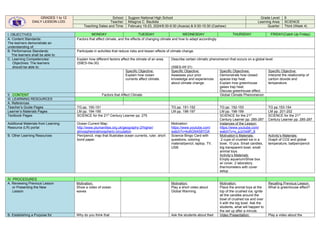
I. OBJECTIVES MONDAY TUESDAY WEDNESDAY THURSDAY FRIDAY(Catch Up Friday)
A. Content Standards:
The learners demonstrate an
understanding of:
Factors that affect climate, and the effects of changing climate and how to adapt accordingly.
B. Performance Standards:
The learners shall be able to:
Participate in activities that reduce risks and lessen effects of climate change.
C. Learning Competencies/
Objectives: The learners
should be able to:
Explain how different factors affect the climate of an area.
(S9ES-IIIe-30)
Describe certain climatic phenomenon that occurs on a global level.
(S9ES-IIIf-31)
Specific Objective:
Explain how ocean
currents affect climate.
Specific Objective:
Assesses your prior
knowledge and experiences
about climate change.
Specific Objectives:
Demonstrate how closed
spaces trap heat.
Explain how greenhouse
gases trap heat.
Discuss greenhouse effect.
Specific Objective:
Interpret the relationship of
carbon dioxide and
temperature.
II. CONTENT Factors that Affect Climate Global Climate Phenomenon
III. LEARNING RESOURCES
A. References
Teacher’s Guide Pages TG pp. 150-151 TG pp. 151-152 TG pp. 152-153 TG pp.153-154
Learner’s Materials Pages LM pp. 194-195 LM pp. 196-197 LM pp. 198-199 LM pp. 201-202
Textbook Pages SCIENCE for the 21st
Century Learner pp. 275 SCIENCE for the 21st
Century Learner pp. 285-287
SCIENCE for the 21st
Century Learner pp. 285-287
Additional Materials from Learning
Resource (LR) portal
Ocean Current Map:
http://www.plumanities,org.uk/geography-2/higher/
atmosphere/atmospheric-circulation
Motivation:
https://www.youtube.com/
watch?v=ko6GNA58YOA
Instances of the Lesson:
https://www.youtube.com/
watch?v=x_sJzVe9P_8
B. Other Learning Resources Pen/pencil, map that illustrates ocean currents, ruler, short
bond paper.
Science Bingo Card with
questions, coloring
material/pencil, laptop, TV,
USB
Motivation’s Materials:
2 cups of crushed ice in a
bowl, 10 pcs. Small candles,
big transparent bowl, small
animal toys.
Activity’s Materials:
Empty aquarium/Shoe box
w/ cover, 2 laboratory
thermometers with cover
setup
Activity’s Materials:
Graph of CO2 and global
temperature, ballpen/pencil
IV. PROCEDURES
A. Reviewing Previous Lesson
or Presenting the New
Lesson
Motivation:
Show a video of ocean
waves
Motivation:
Play a short video about
Global Warming.
Motivation:
Place the animal toys at the
top of the crushed ice; ignite
all the candles around the
bowl of crushed ice and over
it with the big bowl. Ask the
students, what will happen to
the set up after a minute.
Recalling Previous Lesson:
What is greenhouse effect?
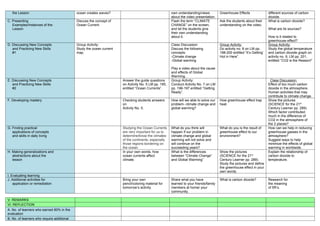
B. Establishing a Purpose for Why do you think that Ask the students about their Video Presentation: Play a video about the
the Lesson ocean creates waves? own understanding/views
about the video presentation.
Greenhouse Effects different sources of carbon
dioxide.
C. Presenting
Examples/Instances of the
Lesson
Discuss the concept of
Ocean Current.
Flash the term “CLIMATE
CHANGE” on the screen,
and let the students give
their own understanding
about it.
Ask the students about their
understanding on the video.
What is carbon dioxide?
What are its sources?
How is it related to
greenhouse effect?
D. Discussing New Concepts
and Practicing New Skills
#1
Group Activity:
Study the ocean current
map.
Class Discussion:
Discuss the following
concepts:
-Climate change
-Global warming
Play a video about the cause
and effects of Global
Warming.
Group Activity:
Do activity no. 8 on LM pp.
198-200 entitled “It’s Getting’
Hot in Here”.
Group Activity:
Study the global temperature
and carbon dioxide graph on
activity no. 9, LM pp. 201,
entitled “CO2 is the Reason!”
E. Discussing New Concepts
and Practicing New Skills
#2
Answer the guide questions
on Activity No. 5 LM pp. 195,
entitled “Ocean Currents”.
Group Activity:
Conduct Activity No. 7 on LM
pp. 196-197 entitled “Getting
Ready”.
Class Discussion:
Effect of too much carbon
dioxide in the atmosphere.
Human activities that may
contribute to climate change.
F. Developing mastery Checking students answers
on
Activity No. 5.
How will we able to solve our
problem- climate change and
global warming?
How greenhouse effect trap
heat.
Show the pictures
(SCIENCE for the 21st
Century Learner pp. 289).
Which factor contributed
much in the difference of
CO2 in the atmosphere of
the 2 places?
G. Finding practical
applications of concepts
and skills in daily living
Studying the Ocean Currents
are very important for us to
determine/know the climates
of the continents, especially
those regions bordering on
the ocean.
What do you think will
happen if our problem in
climate change and global
warming will not solve and
will continue on the
succeeding years?
What do you is the result of
greenhouse effect to our
environment?
How can we help in reducing
greenhouse gasses in the
atmosphere?
Suggest ways to help
minimize the effects of global
warming in worldwide.
H. Making generalizations and
abstractions about the
lesson
In your own words, how
ocean currents affect
climate.
What is the differences
between “Climate Change”
and Global Warming”
Show the pictures
(SCIENCE for the 21st
Century Learner pp. 289).
Study the pictures and define
the greenhouse effect in your
own words.
Explain the relationship of
carbon dioxide to
temperature.
I. Evaluating learning
J. Additional activities for
application or remediation
Bring your own
pencil/coloring material for
tomorrow’s activity.
Share what you have
learned to your friends/family
members at home/ your
community.
What is carbon dioxide? Research for
the meaning
of 5R’s.
V. REMARKS
VI. REFLECTION
A. No. of learners who earned 80% in the
evaluation
B. No. of learners who require additional
activities for remediation
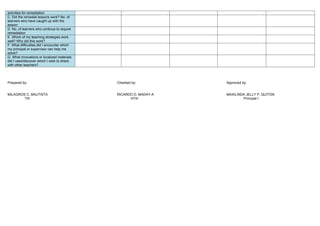
C. Did the remedial lessons work? No. of
learners who have caught up with the
lesson
D. No. of learners who continue to require
remediation
E. Which of my teaching strategies work
well? Why did this work?
F. What difficulties did I encounter which
my principal or supervisor can help me
solve?
G. What innovations or localized materials
did I used/discover which I wish to share
with other teachers?
Prepared by: Checked by: Approved by:
MILAGROS C. BAUTISTA RICARDO D. MADAY-A MAXILINDA JELLY P. QUITON
TIII HTIII Principal I

5TH WEEK.docx third quarter grade nine science

  • 1.
    GRADES 1 to12 DAILY LESSON LOG School: Sugpon National High School Grade Level: 9 Teacher: Milagros C. Bautista Learning Area: SCIENCE Teaching Dates and Time: February 19-23, 2024/8:30-9:30 (Acacia) & 9:30-10:30 (Cashew) Quarter: Third (Week 4) I. OBJECTIVES MONDAY TUESDAY WEDNESDAY THURSDAY FRIDAY(Catch Up Friday) A. Content Standards: The learners demonstrate an understanding of: Factors that affect climate, and the effects of changing climate and how to adapt accordingly. B. Performance Standards: The learners shall be able to: Participate in activities that reduce risks and lessen effects of climate change. C. Learning Competencies/ Objectives: The learners should be able to: Explain how different factors affect the climate of an area. (S9ES-IIIe-30) Describe certain climatic phenomenon that occurs on a global level. (S9ES-IIIf-31) Specific Objective: Explain how ocean currents affect climate. Specific Objective: Assesses your prior knowledge and experiences about climate change. Specific Objectives: Demonstrate how closed spaces trap heat. Explain how greenhouse gases trap heat. Discuss greenhouse effect. Specific Objective: Interpret the relationship of carbon dioxide and temperature. II. CONTENT Factors that Affect Climate Global Climate Phenomenon III. LEARNING RESOURCES A. References Teacher’s Guide Pages TG pp. 150-151 TG pp. 151-152 TG pp. 152-153 TG pp.153-154 Learner’s Materials Pages LM pp. 194-195 LM pp. 196-197 LM pp. 198-199 LM pp. 201-202 Textbook Pages SCIENCE for the 21st Century Learner pp. 275 SCIENCE for the 21st Century Learner pp. 285-287 SCIENCE for the 21st Century Learner pp. 285-287 Additional Materials from Learning Resource (LR) portal Ocean Current Map: http://www.plumanities,org.uk/geography-2/higher/ atmosphere/atmospheric-circulation Motivation: https://www.youtube.com/ watch?v=ko6GNA58YOA Instances of the Lesson: https://www.youtube.com/ watch?v=x_sJzVe9P_8 B. Other Learning Resources Pen/pencil, map that illustrates ocean currents, ruler, short bond paper. Science Bingo Card with questions, coloring material/pencil, laptop, TV, USB Motivation’s Materials: 2 cups of crushed ice in a bowl, 10 pcs. Small candles, big transparent bowl, small animal toys. Activity’s Materials: Empty aquarium/Shoe box w/ cover, 2 laboratory thermometers with cover setup Activity’s Materials: Graph of CO2 and global temperature, ballpen/pencil IV. PROCEDURES A. Reviewing Previous Lesson or Presenting the New Lesson Motivation: Show a video of ocean waves Motivation: Play a short video about Global Warming. Motivation: Place the animal toys at the top of the crushed ice; ignite all the candles around the bowl of crushed ice and over it with the big bowl. Ask the students, what will happen to the set up after a minute. Recalling Previous Lesson: What is greenhouse effect? B. Establishing a Purpose for Why do you think that Ask the students about their Video Presentation: Play a video about the
  • 2.
    the Lesson oceancreates waves? own understanding/views about the video presentation. Greenhouse Effects different sources of carbon dioxide. C. Presenting Examples/Instances of the Lesson Discuss the concept of Ocean Current. Flash the term “CLIMATE CHANGE” on the screen, and let the students give their own understanding about it. Ask the students about their understanding on the video. What is carbon dioxide? What are its sources? How is it related to greenhouse effect? D. Discussing New Concepts and Practicing New Skills #1 Group Activity: Study the ocean current map. Class Discussion: Discuss the following concepts: -Climate change -Global warming Play a video about the cause and effects of Global Warming. Group Activity: Do activity no. 8 on LM pp. 198-200 entitled “It’s Getting’ Hot in Here”. Group Activity: Study the global temperature and carbon dioxide graph on activity no. 9, LM pp. 201, entitled “CO2 is the Reason!” E. Discussing New Concepts and Practicing New Skills #2 Answer the guide questions on Activity No. 5 LM pp. 195, entitled “Ocean Currents”. Group Activity: Conduct Activity No. 7 on LM pp. 196-197 entitled “Getting Ready”. Class Discussion: Effect of too much carbon dioxide in the atmosphere. Human activities that may contribute to climate change. F. Developing mastery Checking students answers on Activity No. 5. How will we able to solve our problem- climate change and global warming? How greenhouse effect trap heat. Show the pictures (SCIENCE for the 21st Century Learner pp. 289). Which factor contributed much in the difference of CO2 in the atmosphere of the 2 places? G. Finding practical applications of concepts and skills in daily living Studying the Ocean Currents are very important for us to determine/know the climates of the continents, especially those regions bordering on the ocean. What do you think will happen if our problem in climate change and global warming will not solve and will continue on the succeeding years? What do you is the result of greenhouse effect to our environment? How can we help in reducing greenhouse gasses in the atmosphere? Suggest ways to help minimize the effects of global warming in worldwide. H. Making generalizations and abstractions about the lesson In your own words, how ocean currents affect climate. What is the differences between “Climate Change” and Global Warming” Show the pictures (SCIENCE for the 21st Century Learner pp. 289). Study the pictures and define the greenhouse effect in your own words. Explain the relationship of carbon dioxide to temperature. I. Evaluating learning J. Additional activities for application or remediation Bring your own pencil/coloring material for tomorrow’s activity. Share what you have learned to your friends/family members at home/ your community. What is carbon dioxide? Research for the meaning of 5R’s. V. REMARKS VI. REFLECTION A. No. of learners who earned 80% in the evaluation B. No. of learners who require additional
  • 3.
    activities for remediation C.Did the remedial lessons work? No. of learners who have caught up with the lesson D. No. of learners who continue to require remediation E. Which of my teaching strategies work well? Why did this work? F. What difficulties did I encounter which my principal or supervisor can help me solve? G. What innovations or localized materials did I used/discover which I wish to share with other teachers? Prepared by: Checked by: Approved by: MILAGROS C. BAUTISTA RICARDO D. MADAY-A MAXILINDA JELLY P. QUITON TIII HTIII Principal I