GRADES 1 to 12
DAILY LESSON LOG
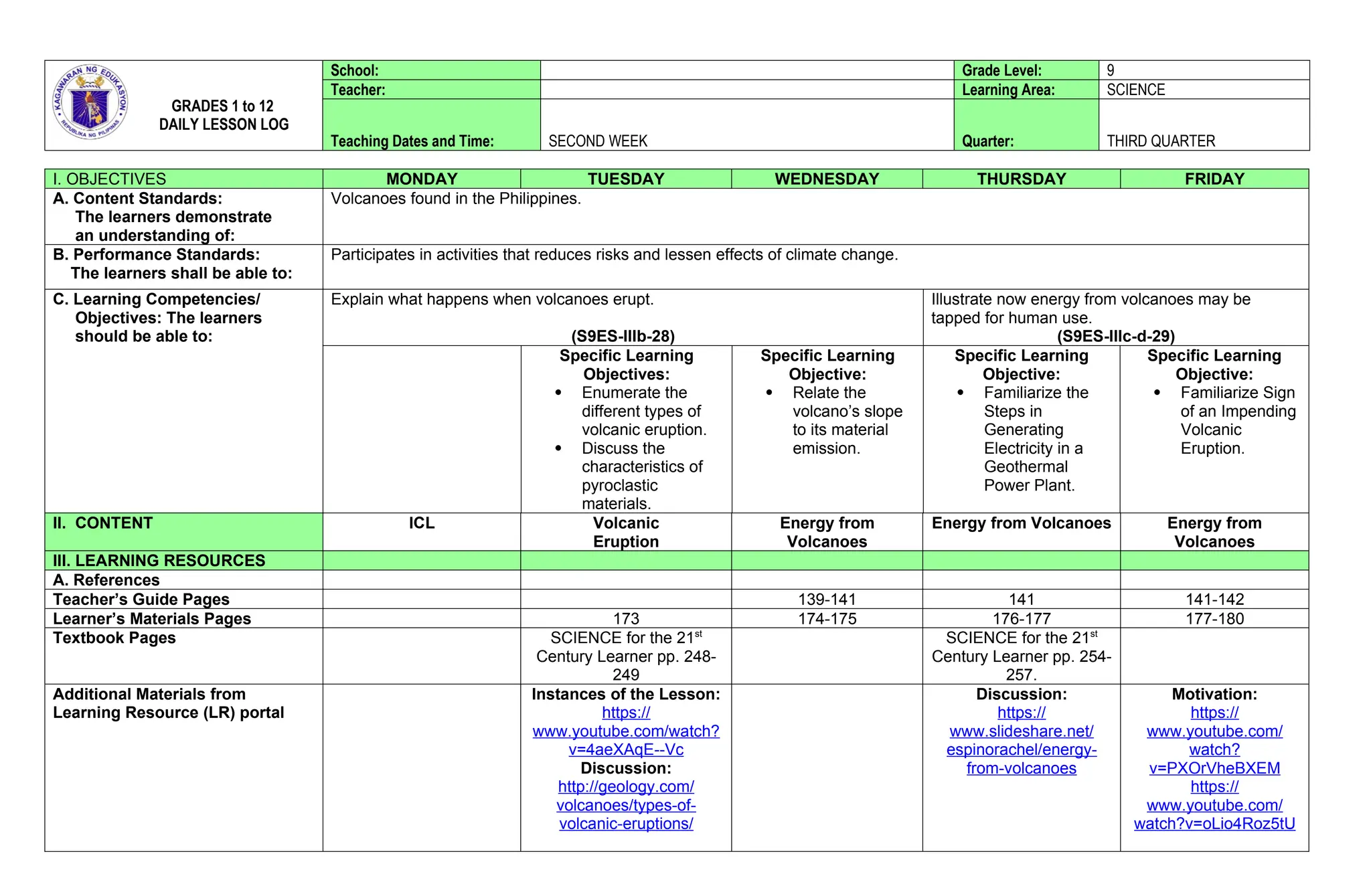
School: Grade Level: 9
Teacher: Learning Area: SCIENCE
Teaching Dates and Time: SECOND WEEK Quarter: THIRD QUARTER
I. OBJECTIVES MONDAY TUESDAY WEDNESDAY THURSDAY FRIDAY
A. Content Standards:
The learners demonstrate
an understanding of:
Volcanoes found in the Philippines.
B. Performance Standards:
The learners shall be able to:
Participates in activities that reduces risks and lessen effects of climate change.
C. Learning Competencies/
Objectives: The learners
should be able to:
Explain what happens when volcanoes erupt.
(S9ES-IIIb-28)
Illustrate now energy from volcanoes may be
tapped for human use.
(S9ES-IIIc-d-29)
Specific Learning
Objectives:
 Enumerate the
different types of
volcanic eruption.
 Discuss the
characteristics of
pyroclastic
materials.
Specific Learning
Objective:
 Relate the
volcano’s slope
to its material
emission.
Specific Learning
Objective:
 Familiarize the
Steps in
Generating
Electricity in a
Geothermal
Power Plant.
Specific Learning
Objective:
 Familiarize Sign
of an Impending
Volcanic
Eruption.
II. CONTENT ICL Volcanic
Eruption
Energy from
Volcanoes
Energy from Volcanoes Energy from
Volcanoes
III. LEARNING RESOURCES
A. References
Teacher’s Guide Pages 139-141 141 141-142
Learner’s Materials Pages 173 174-175 176-177 177-180
Textbook Pages SCIENCE for the 21st
Century Learner pp. 248-
249
SCIENCE for the 21st
Century Learner pp. 254-
257.
Additional Materials from
Learning Resource (LR) portal
Instances of the Lesson:
https://
www.youtube.com/watch?
v=4aeXAqE--Vc
Discussion:
http://geology.com/
volcanoes/types-of-
volcanic-eruptions/
Discussion:
https://
www.slideshare.net/
espinorachel/energy-
from-volcanoes
Motivation:
https://
www.youtube.com/
watch?
v=PXOrVheBXEM
https://
www.youtube.com/
watch?v=oLio4Roz5tU
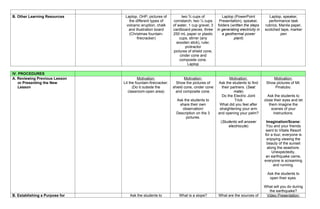
B. Other Learning Resources Laptop, OHP, pictures of
the different types of
volcanic eruption, chalk
and illustration board
(Christmas fountain-
firecracker)
two ¾ cups of
cornstarch, two ¼ cups
of water, 1 cup gravel, 3
cardboard pieces, three
250 mL paper or plastic
cups, stirrer (any
wooden stick), ruler,
protractor
pictures of shield cone,
cinder cone and
composite cone.
Laptop
Laptop (PowerPoint
Presentation), speaker,
folders (written the steps
in generating electricity in
a geothermal power
plant)
Laptop, speaker,
performance task
rubrics, Manila paper,
scotched tape, marker
pen
IV. PROCEDURES
A. Reviewing Previous Lesson
or Presenting the New
Lesson
Motivation:
Lit the fountain-firecracker.
(Do it outside the
classroom-open area)
Motivation:
Show the pictures of
shield cone, cinder cone
and composite cone.
Ask the students to
share their own
observation/
Description on the 3
pictures.
Motivation:
Ask the students to find
their partners. (Seat
mate)
Do the Electric Joint
Trick
What did you feel after
straightening your arm
and opening your palm?
(Students will answer
electrocute)
Motivation:
Show pictures of Mt.
Pinatubo.
Ask the students to
close their eyes and let
them imagine the
scenes of your
instructions.
Imagination/Scene:
You and your friends
went to Vitalis Resort
for a tour; everyone is
enjoying viewing the
beauty of the sunset
along the seashore.
Unexpectedly,
an earthquake came,
everyone is screaming
and running.
Ask the students to
open their eyes.
What will you do during
the earthquake?
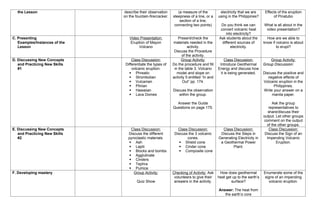
B. Establishing a Purpose for Ask the students to What is a slope? What are the sources of Video Presentation:
the Lesson describe their observation
on the fountain-firecracker.
(a measure of the
steepness of a line, or a
section of a line,
connecting two points)
electricity that we are
using in the Philippines?
Do you think we can
convert volcanic heat
into electricity?
Effects of the eruption
of Pinatubo
What is all about in the
video presentation?
C. Presenting
Examples/Instances of the
Lesson
Video Presentation:
Eruption of Mayon
Volcano
Present/check the
materials needed in the
activity.
Discuss the Procedure
of the activity.
Ask students about the
different sources of
electricity.
How are we able to
know if volcano is about
to erupt?
D. Discussing New Concepts
and Practicing New Skills
#1
Class Discussion:
Differentiate the types of
volcanic eruption.
 Phreatic
 Strombolian
 Vulcanian
 Plinian
 Hawaiian
 Lava Domes
Group Activity:
Do the procedure and fill
in the table 3. Volcano
model and slope on
activity 5 entitled “In and
Out” pp. 174.
Discuss the observation
within the group.
Answer the Guide
Questions on page 175.
Class Discussion:
Introduce Geothermal
Energy and discuss how
it is being generated.
Group Activity:
Group Discussion:
Discuss the positive and
negative effects of
Volcanic eruption in the
Philippines.
Write your answer on a
manila paper.
Ask the group
representatives to
share/discuss their
output. Let other groups
comment on the output
of the other groups.
E. Discussing New Concepts
and Practicing New Skills
#2
Class Discussion:
Discuss the different
pyroclastic materials.
 Ash
 Lapili
 Blocks and bombs
 Agglutinate
 Cinders
 Tephra
 Pumice
Class Discussion:
Discuss the 3 volcanic
cones.
 Shield cone
 Cinder cone
 Composite cone
Class Discussion:
Discuss the Steps in
Generating Electricity in
a Geothermal Power
Plant.
Class Discussion:
Discuss the Sign of an
Impending Volcanic
Eruption.
F. Developing mastery Group Activity:
Quiz Show
Checking of Activity: Ask
volunteers to give their
answers in the activity.
How does geothermal
heat get up to the earth’s
surface?
Answer: The heat from
the earth’s core
Enumerate some of the
signs of an impending
volcanic eruption.
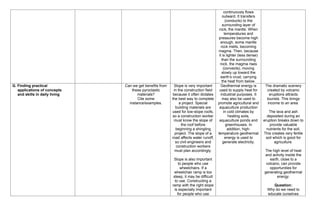
continuously flows
outward. It transfers
(conducts) to the
surrounding layer of
rock, the mantle. When
temperatures and
pressures become high
enough, some mantle
rock melts, becoming
magma. Then, because
it is lighter (less dense)
than the surrounding
rock, the magma rises
(convects), moving
slowly up toward the
earth’s crust, carrying
the heat from below.
G. Finding practical
applications of concepts
and skills in daily living
Can we get benefits from
these pyroclastic
materials?
Cite some
instance/examples.
Slope is very important
in the construction field
because it often dictates
the best way to complete
a project. Special
building materials are
used for low-slope roofs,
so a construction worker
must know the slope of
the roof before
beginning a shingling
project. The slope of a
road affects water runoff,
so civil engineers and
construction workers
must plan accordingly.
Slope is also important
to people who use
wheelchairs. If a
wheelchair ramp is too
steep, it may be difficult
to use. Constructing a
ramp with the right slope
is especially important
for people who use
Geothermal energy is
used to supply heat for
industrial purposes. It
may also be used to
promote agricultural and
aquaculture production
in cold climates by
heating soils,
aquaculture ponds and
greenhouses. In
addition, high-
temperature geothermal
energy is used to
generate electricity.
The dramatic scenery
created by volcanic
eruptions attracts
tourists. This brings
income to an area.
The lava and ash
deposited during an
eruption breaks down to
provide valuable
nutrients for the soil.
This creates very fertile
soil which is good for
agriculture.
The high level of heat
and activity inside the
earth, close to a
volcano, can provide
opportunities for
generating geothermal
energy.
Question:
Why do we need to
educate ourselves
manual wheelchairs
instead of power
wheelchairs.
about the volcanoes?
What is the importance
of knowing the signs of
an impending volcanic
eruption?
H. Making generalizations and
abstractions about the
lesson
Describe the different
eruptive styles of a
volcano.
Describe the slope of the
Pinatubo Volcano? Infer
the type of materials
from which it was
formed.
What is geothermal
energy and what is its
source?
How can we reduce the
negative effects of
disasters to reduce loss
and save lives?
I. Evaluating learning Flash on the screen the
different pictures of the
different types of volcanic
eruption and let the
students identify its
name/classification. Write
the answers in a ¼ sheet
of paper.
Differentiate the e types
of volcanic cones.
Write the answers in a ¼
sheet of paper.
Enumerate the steps in
Generating Electricity in
a Geothermal Power
Plant.
Write the answers in a ½
sheet of paper.
True or False:
Write FACT if the
statement if correct, and
BLUFF if it is not.
(Enumerate
scenarios/statements
about the true and not
true signs of an
impending volcanic
eruption)
J. Additional activities for
application or remediation
Review lesson at home. Have an advance
reading about
geothermal energy.
Have an advance
reading about the signs
of an impending volcanic
eruption.
Do the Performance
Task on LM page 179.
Read the Criteria for
giving score.
(Script Writing)
Prepare your
presentation next
meeting.
V. REMARKS
VI. REFLECTION
A. No. of learners who earned
80% in the evaluation
B. No. of learners who require
additional activities for
remediation
C. Did the remedial lessons
work? No. of learners who
have caught up with the
lesson
D. No. of learners who
continue to require
remediation
E. Which of my teaching
strategies work well? Why
did these work?
F. What difficulties did I
encounter which my
principal or supervisor can
help me solve?
G. What innovations or
localized materials did I
used/discover which I wish
to share with other
teachers?

2ND WEEK.docx in grade science 9 quarter

  • 1.
    GRADES 1 to12 DAILY LESSON LOG School: Grade Level: 9 Teacher: Learning Area: SCIENCE Teaching Dates and Time: SECOND WEEK Quarter: THIRD QUARTER I. OBJECTIVES MONDAY TUESDAY WEDNESDAY THURSDAY FRIDAY A. Content Standards: The learners demonstrate an understanding of: Volcanoes found in the Philippines. B. Performance Standards: The learners shall be able to: Participates in activities that reduces risks and lessen effects of climate change. C. Learning Competencies/ Objectives: The learners should be able to: Explain what happens when volcanoes erupt. (S9ES-IIIb-28) Illustrate now energy from volcanoes may be tapped for human use. (S9ES-IIIc-d-29) Specific Learning Objectives:  Enumerate the different types of volcanic eruption.  Discuss the characteristics of pyroclastic materials. Specific Learning Objective:  Relate the volcano’s slope to its material emission. Specific Learning Objective:  Familiarize the Steps in Generating Electricity in a Geothermal Power Plant. Specific Learning Objective:  Familiarize Sign of an Impending Volcanic Eruption. II. CONTENT ICL Volcanic Eruption Energy from Volcanoes Energy from Volcanoes Energy from Volcanoes III. LEARNING RESOURCES A. References Teacher’s Guide Pages 139-141 141 141-142 Learner’s Materials Pages 173 174-175 176-177 177-180 Textbook Pages SCIENCE for the 21st Century Learner pp. 248- 249 SCIENCE for the 21st Century Learner pp. 254- 257. Additional Materials from Learning Resource (LR) portal Instances of the Lesson: https:// www.youtube.com/watch? v=4aeXAqE--Vc Discussion: http://geology.com/ volcanoes/types-of- volcanic-eruptions/ Discussion: https:// www.slideshare.net/ espinorachel/energy- from-volcanoes Motivation: https:// www.youtube.com/ watch? v=PXOrVheBXEM https:// www.youtube.com/ watch?v=oLio4Roz5tU
  • 2.
    B. Other LearningResources Laptop, OHP, pictures of the different types of volcanic eruption, chalk and illustration board (Christmas fountain- firecracker) two ¾ cups of cornstarch, two ¼ cups of water, 1 cup gravel, 3 cardboard pieces, three 250 mL paper or plastic cups, stirrer (any wooden stick), ruler, protractor pictures of shield cone, cinder cone and composite cone. Laptop Laptop (PowerPoint Presentation), speaker, folders (written the steps in generating electricity in a geothermal power plant) Laptop, speaker, performance task rubrics, Manila paper, scotched tape, marker pen IV. PROCEDURES A. Reviewing Previous Lesson or Presenting the New Lesson Motivation: Lit the fountain-firecracker. (Do it outside the classroom-open area) Motivation: Show the pictures of shield cone, cinder cone and composite cone. Ask the students to share their own observation/ Description on the 3 pictures. Motivation: Ask the students to find their partners. (Seat mate) Do the Electric Joint Trick What did you feel after straightening your arm and opening your palm? (Students will answer electrocute) Motivation: Show pictures of Mt. Pinatubo. Ask the students to close their eyes and let them imagine the scenes of your instructions. Imagination/Scene: You and your friends went to Vitalis Resort for a tour; everyone is enjoying viewing the beauty of the sunset along the seashore. Unexpectedly, an earthquake came, everyone is screaming and running. Ask the students to open their eyes. What will you do during the earthquake? B. Establishing a Purpose for Ask the students to What is a slope? What are the sources of Video Presentation:
  • 3.
    the Lesson describetheir observation on the fountain-firecracker. (a measure of the steepness of a line, or a section of a line, connecting two points) electricity that we are using in the Philippines? Do you think we can convert volcanic heat into electricity? Effects of the eruption of Pinatubo What is all about in the video presentation? C. Presenting Examples/Instances of the Lesson Video Presentation: Eruption of Mayon Volcano Present/check the materials needed in the activity. Discuss the Procedure of the activity. Ask students about the different sources of electricity. How are we able to know if volcano is about to erupt? D. Discussing New Concepts and Practicing New Skills #1 Class Discussion: Differentiate the types of volcanic eruption.  Phreatic  Strombolian  Vulcanian  Plinian  Hawaiian  Lava Domes Group Activity: Do the procedure and fill in the table 3. Volcano model and slope on activity 5 entitled “In and Out” pp. 174. Discuss the observation within the group. Answer the Guide Questions on page 175. Class Discussion: Introduce Geothermal Energy and discuss how it is being generated. Group Activity: Group Discussion: Discuss the positive and negative effects of Volcanic eruption in the Philippines. Write your answer on a manila paper. Ask the group representatives to share/discuss their output. Let other groups comment on the output of the other groups. E. Discussing New Concepts and Practicing New Skills #2 Class Discussion: Discuss the different pyroclastic materials.  Ash  Lapili  Blocks and bombs  Agglutinate  Cinders  Tephra  Pumice Class Discussion: Discuss the 3 volcanic cones.  Shield cone  Cinder cone  Composite cone Class Discussion: Discuss the Steps in Generating Electricity in a Geothermal Power Plant. Class Discussion: Discuss the Sign of an Impending Volcanic Eruption. F. Developing mastery Group Activity: Quiz Show Checking of Activity: Ask volunteers to give their answers in the activity. How does geothermal heat get up to the earth’s surface? Answer: The heat from the earth’s core Enumerate some of the signs of an impending volcanic eruption.
  • 4.
    continuously flows outward. Ittransfers (conducts) to the surrounding layer of rock, the mantle. When temperatures and pressures become high enough, some mantle rock melts, becoming magma. Then, because it is lighter (less dense) than the surrounding rock, the magma rises (convects), moving slowly up toward the earth’s crust, carrying the heat from below. G. Finding practical applications of concepts and skills in daily living Can we get benefits from these pyroclastic materials? Cite some instance/examples. Slope is very important in the construction field because it often dictates the best way to complete a project. Special building materials are used for low-slope roofs, so a construction worker must know the slope of the roof before beginning a shingling project. The slope of a road affects water runoff, so civil engineers and construction workers must plan accordingly. Slope is also important to people who use wheelchairs. If a wheelchair ramp is too steep, it may be difficult to use. Constructing a ramp with the right slope is especially important for people who use Geothermal energy is used to supply heat for industrial purposes. It may also be used to promote agricultural and aquaculture production in cold climates by heating soils, aquaculture ponds and greenhouses. In addition, high- temperature geothermal energy is used to generate electricity. The dramatic scenery created by volcanic eruptions attracts tourists. This brings income to an area. The lava and ash deposited during an eruption breaks down to provide valuable nutrients for the soil. This creates very fertile soil which is good for agriculture. The high level of heat and activity inside the earth, close to a volcano, can provide opportunities for generating geothermal energy. Question: Why do we need to educate ourselves
  • 5.
    manual wheelchairs instead ofpower wheelchairs. about the volcanoes? What is the importance of knowing the signs of an impending volcanic eruption? H. Making generalizations and abstractions about the lesson Describe the different eruptive styles of a volcano. Describe the slope of the Pinatubo Volcano? Infer the type of materials from which it was formed. What is geothermal energy and what is its source? How can we reduce the negative effects of disasters to reduce loss and save lives? I. Evaluating learning Flash on the screen the different pictures of the different types of volcanic eruption and let the students identify its name/classification. Write the answers in a ¼ sheet of paper. Differentiate the e types of volcanic cones. Write the answers in a ¼ sheet of paper. Enumerate the steps in Generating Electricity in a Geothermal Power Plant. Write the answers in a ½ sheet of paper. True or False: Write FACT if the statement if correct, and BLUFF if it is not. (Enumerate scenarios/statements about the true and not true signs of an impending volcanic eruption) J. Additional activities for application or remediation Review lesson at home. Have an advance reading about geothermal energy. Have an advance reading about the signs of an impending volcanic eruption. Do the Performance Task on LM page 179. Read the Criteria for giving score. (Script Writing) Prepare your presentation next meeting. V. REMARKS VI. REFLECTION A. No. of learners who earned 80% in the evaluation B. No. of learners who require additional activities for remediation C. Did the remedial lessons work? No. of learners who have caught up with the lesson D. No. of learners who
  • 6.
    continue to require remediation E.Which of my teaching strategies work well? Why did these work? F. What difficulties did I encounter which my principal or supervisor can help me solve? G. What innovations or localized materials did I used/discover which I wish to share with other teachers?