5th Normal Form (5NF) in DBMS
• Database Management Systems | Data
Normalization
Introduction to Normalization
• - What is Normalization?
• Process of organizing data to reduce
redundancy and improve data integrity.
• - Why Normalize?
• - Minimize duplication
• - Ensure data consistency
• - Facilitate efficient data management
Quick Recap of Previous Normal
Forms
• - 1NF: Eliminate repeating groups
• - 2NF: Remove partial dependencies
• - 3NF: Remove transitive dependencies
• - BCNF: A stricter version of 3NF
• - 4NF: Remove multi-valued dependencies
What is 5th Normal Form (5NF)?
• - Also known as Project-Join Normal Form
(PJNF)
• - A table is in 5NF if:
• - It is in 4NF
• - It cannot be further non-loss decomposed
into smaller tables
Key Concept Behind 5NF
• - Deals with join dependency and lossless
decomposition.
• - Decomposition should not result in loss of
information when tables are joined back.
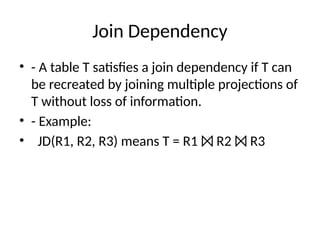
Join Dependency
• - A table T satisfies a join dependency if T can
be recreated by joining multiple projections of
T without loss of information.
• - Example:
• JD(R1, R2, R3) means T = R1 R2 R3
⨝ ⨝
When is 5NF Needed?
• - Complex relationships involving multi-
attribute dependencies.
• - Rare in practice but critical in certain
business databases (e.g., contract
management, supplier-part-project).
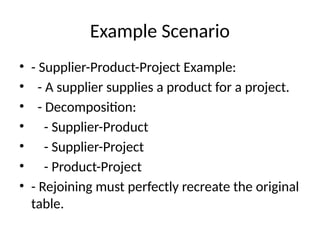
Example Scenario
• - Supplier-Product-Project Example:
• - A supplier supplies a product for a project.
• - Decomposition:
• - Supplier-Product
• - Supplier-Project
• - Product-Project
• - Rejoining must perfectly recreate the original
table.
Importance of 5NF
• - Eliminates redundancy caused by join
dependencies.
• - Ensures data integrity for complex scenarios.
• - Helps in very fine-grained database design.
Summary
• - 5NF = Handling join dependencies
• - Ensures complete, lossless data
decompositions
• - Mostly applicable in complex relationship
settings
References
• - Database System Concepts – Silberschatz,
Korth
• - Fundamentals of Database Systems – Elmasri
& Navathe

5NF_DBMS_Presentation5NF_DBMS_Example_Presentation.pptx

  • 1.
    5th Normal Form(5NF) in DBMS • Database Management Systems | Data Normalization
  • 2.
    Introduction to Normalization •- What is Normalization? • Process of organizing data to reduce redundancy and improve data integrity. • - Why Normalize? • - Minimize duplication • - Ensure data consistency • - Facilitate efficient data management
  • 3.
    Quick Recap ofPrevious Normal Forms • - 1NF: Eliminate repeating groups • - 2NF: Remove partial dependencies • - 3NF: Remove transitive dependencies • - BCNF: A stricter version of 3NF • - 4NF: Remove multi-valued dependencies
  • 4.
    What is 5thNormal Form (5NF)? • - Also known as Project-Join Normal Form (PJNF) • - A table is in 5NF if: • - It is in 4NF • - It cannot be further non-loss decomposed into smaller tables
  • 5.
    Key Concept Behind5NF • - Deals with join dependency and lossless decomposition. • - Decomposition should not result in loss of information when tables are joined back.
  • 6.
    Join Dependency • -A table T satisfies a join dependency if T can be recreated by joining multiple projections of T without loss of information. • - Example: • JD(R1, R2, R3) means T = R1 R2 R3 ⨝ ⨝
  • 7.
    When is 5NFNeeded? • - Complex relationships involving multi- attribute dependencies. • - Rare in practice but critical in certain business databases (e.g., contract management, supplier-part-project).
  • 8.
    Example Scenario • -Supplier-Product-Project Example: • - A supplier supplies a product for a project. • - Decomposition: • - Supplier-Product • - Supplier-Project • - Product-Project • - Rejoining must perfectly recreate the original table.
  • 9.
    Importance of 5NF •- Eliminates redundancy caused by join dependencies. • - Ensures data integrity for complex scenarios. • - Helps in very fine-grained database design.
  • 10.
    Summary • - 5NF= Handling join dependencies • - Ensures complete, lossless data decompositions • - Mostly applicable in complex relationship settings
  • 11.
    References • - DatabaseSystem Concepts – Silberschatz, Korth • - Fundamentals of Database Systems – Elmasri & Navathe