Active filter
Purpose of the experiment
Be familiar with the characteristics of active low pass filter and high pass
filter, and learn to measure the amplitude frequency characteristics of active
filter.
Experimental principle
The function of the filter is to make the signal of a specific frequency pass
through and suppress (attenuate) the signal of other frequencies.
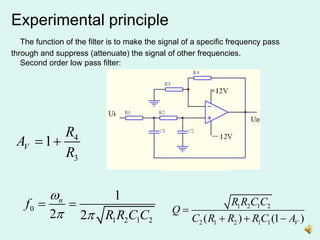
Second order low pass filter:
0
1 2 1 2
1
2 2
n
f
R R C C

 
  1 2 1 2
2 1 2 1 1
( ) (1 )
V
R R C C
Q
C R R R C A

  
4
3
1
V
R
A
R
 
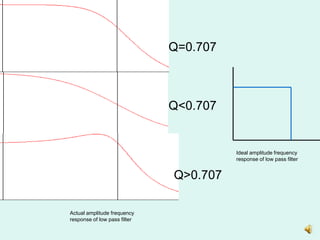
Ideal amplitude frequency
response of low pass filter
Q=0.707
Q<0.707
Q>0.707
Actual amplitude frequency
response of low pass filter
The steps of determining filter parameters are as follows:
According to the functional requirements, the characteristic frequency of
the filter is determined.
The Q value should be close to 0.707 as far as possible, which can be
slightly smaller.
The parameters are determined according to the formula and series
values of resistance and capacitance.
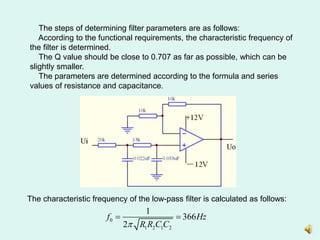
The characteristic frequency of the low-pass filter is calculated as follows:
0
1 2 1 2
1
366
2
f Hz
R R C C

 
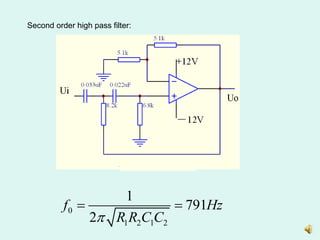
Second order high pass filter:
0
1 2 1 2
1
791
2
f Hz
R R C C

 
Experiment content
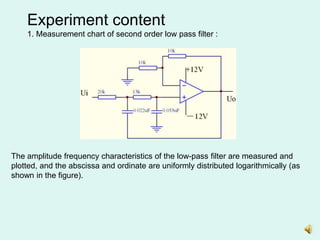
1. Measurement chart of second order low pass filter :
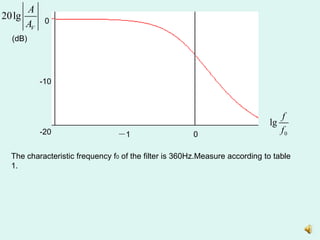
The amplitude frequency characteristics of the low-pass filter are measured and
plotted, and the abscissa and ordinate are uniformly distributed logarithmically (as
shown in the figure).
20lg
V
A
A
0
lg
f
f
0
-10
-20 -1 0
(dB)
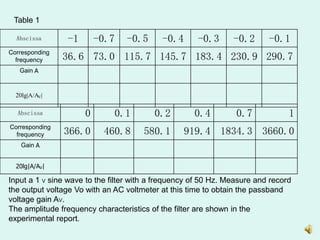
The characteristic frequency f0 of the filter is 360Hz.Measure according to table
1.
Abscissa -1 -0.7 -0.5 -0.4 -0.3 -0.2 -0.1
Corresponding
frequency 36.6 73.0 115.7 145.7 183.4 230.9 290.7
Gain A
20lg|A/AV|
Abscissa 0 0.1 0.2 0.4 0.7 1
Corresponding
frequency 366.0 460.8 580.1 919.4 1834.3 3660.0
Gain A
20lg|A/AV|
Table 1
Input a 1 V sine wave to the filter with a frequency of 50 Hz. Measure and record
the output voltage Vo with an AC voltmeter at this time to obtain the passband
voltage gain AV.
The amplitude frequency characteristics of the filter are shown in the
experimental report.
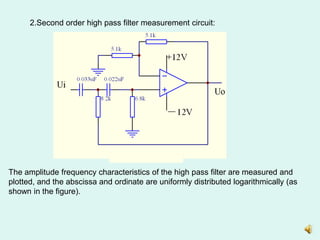
2.Second order high pass filter measurement circuit:
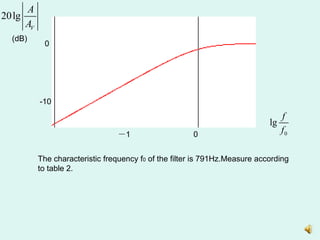
The amplitude frequency characteristics of the high pass filter are measured and
plotted, and the abscissa and ordinate are uniformly distributed logarithmically (as
shown in the figure).
20lg
V
A
A
0
lg
f
f
(dB)
0
-10
-1 0
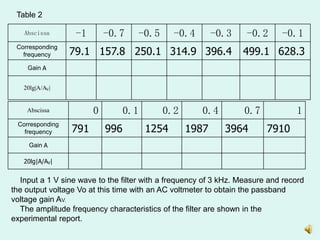
The characteristic frequency f0 of the filter is 791Hz.Measure according
to table 2.
Abscissa -1 -0.7 -0.5 -0.4 -0.3 -0.2 -0.1
Corresponding
frequency 79.1 157.8 250.1 314.9 396.4 499.1 628.3
Gain A
20lg|A/AV|
Abscissa 0 0.1 0.2 0.4 0.7 1
Corresponding
frequency 791 996 1254 1987 3964 7910
Gain A
20lg|A/AV|
Table 2
Input a 1 V sine wave to the filter with a frequency of 3 kHz. Measure and record
the output voltage Vo at this time with an AC voltmeter to obtain the passband
voltage gain AV.
The amplitude frequency characteristics of the filter are shown in the
experimental report.

5active filter.ppt

  • 1.
  • 2.
    Purpose of theexperiment Be familiar with the characteristics of active low pass filter and high pass filter, and learn to measure the amplitude frequency characteristics of active filter.
  • 3.
    Experimental principle The functionof the filter is to make the signal of a specific frequency pass through and suppress (attenuate) the signal of other frequencies. Second order low pass filter: 0 1 2 1 2 1 2 2 n f R R C C      1 2 1 2 2 1 2 1 1 ( ) (1 ) V R R C C Q C R R R C A     4 3 1 V R A R  
  • 4.
    Ideal amplitude frequency responseof low pass filter Q=0.707 Q<0.707 Q>0.707 Actual amplitude frequency response of low pass filter
  • 5.
    The steps ofdetermining filter parameters are as follows: According to the functional requirements, the characteristic frequency of the filter is determined. The Q value should be close to 0.707 as far as possible, which can be slightly smaller. The parameters are determined according to the formula and series values of resistance and capacitance. The characteristic frequency of the low-pass filter is calculated as follows: 0 1 2 1 2 1 366 2 f Hz R R C C   
  • 6.
    Second order highpass filter: 0 1 2 1 2 1 791 2 f Hz R R C C   
  • 7.
    Experiment content 1. Measurementchart of second order low pass filter : The amplitude frequency characteristics of the low-pass filter are measured and plotted, and the abscissa and ordinate are uniformly distributed logarithmically (as shown in the figure).
  • 8.
    20lg V A A 0 lg f f 0 -10 -20 -1 0 (dB) Thecharacteristic frequency f0 of the filter is 360Hz.Measure according to table 1.
  • 9.
    Abscissa -1 -0.7-0.5 -0.4 -0.3 -0.2 -0.1 Corresponding frequency 36.6 73.0 115.7 145.7 183.4 230.9 290.7 Gain A 20lg|A/AV| Abscissa 0 0.1 0.2 0.4 0.7 1 Corresponding frequency 366.0 460.8 580.1 919.4 1834.3 3660.0 Gain A 20lg|A/AV| Table 1 Input a 1 V sine wave to the filter with a frequency of 50 Hz. Measure and record the output voltage Vo with an AC voltmeter at this time to obtain the passband voltage gain AV. The amplitude frequency characteristics of the filter are shown in the experimental report.
  • 10.
    2.Second order highpass filter measurement circuit: The amplitude frequency characteristics of the high pass filter are measured and plotted, and the abscissa and ordinate are uniformly distributed logarithmically (as shown in the figure).
  • 11.
    20lg V A A 0 lg f f (dB) 0 -10 -1 0 The characteristicfrequency f0 of the filter is 791Hz.Measure according to table 2.
  • 12.
    Abscissa -1 -0.7-0.5 -0.4 -0.3 -0.2 -0.1 Corresponding frequency 79.1 157.8 250.1 314.9 396.4 499.1 628.3 Gain A 20lg|A/AV| Abscissa 0 0.1 0.2 0.4 0.7 1 Corresponding frequency 791 996 1254 1987 3964 7910 Gain A 20lg|A/AV| Table 2 Input a 1 V sine wave to the filter with a frequency of 3 kHz. Measure and record the output voltage Vo at this time with an AC voltmeter to obtain the passband voltage gain AV. The amplitude frequency characteristics of the filter are shown in the experimental report.