Operations Management
Lect. 1 “Introduction of Operation Management and
Decisions Analysis”
1
Dr: Aly Hassan Elbatran
Head of Mechanical Engineering
Faculty of Engineering, Arab Academy for Science
and Technology and Maritime Transport, Egypt
Aly Elbatran
Course Outlines
2
Introduction of Operation Management
Decisions Analysis
Operations Strategy
Product Design and Process Selection
Supply Chain Management
Total Quality Management
Just-in-Time and Lean Systems
Forecasting
Facility Layout
Inventory Planning
Aggregate planning
Scheduling
Aly Elbatran
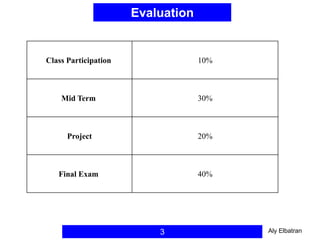
Evaluation
3
Class Participation 10%
Mid Term 30%
Project 20%
Final Exam 40%
Aly Elbatran
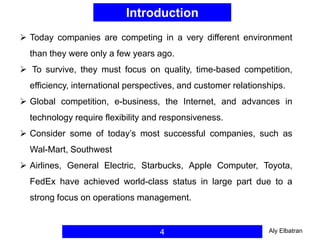
Introduction
4
 Today companies are competing in a very different environment
than they were only a few years ago.
 To survive, they must focus on quality, time-based competition,
efficiency, international perspectives, and customer relationships.
 Global competition, e-business, the Internet, and advances in
technology require flexibility and responsiveness.
 Consider some of today’s most successful companies, such as
Wal-Mart, Southwest
 Airlines, General Electric, Starbucks, Apple Computer, Toyota,
FedEx have achieved world-class status in large part due to a
strong focus on operations management.
Aly Elbatran
Introduction
5
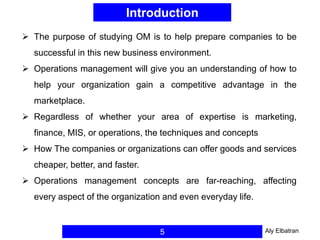
 The purpose of studying OM is to help prepare companies to be
successful in this new business environment.
 Operations management will give you an understanding of how to
help your organization gain a competitive advantage in the
marketplace.
 Regardless of whether your area of expertise is marketing,
finance, MIS, or operations, the techniques and concepts
 How The companies or organizations can offer goods and services
cheaper, better, and faster.
 Operations management concepts are far-reaching, affecting
every aspect of the organization and even everyday life.
Aly Elbatran
Business Functions
6
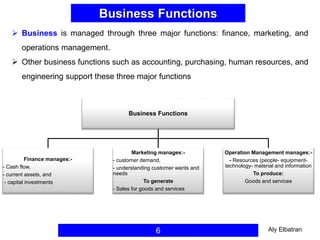
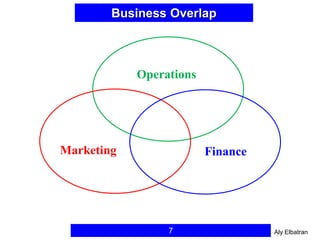
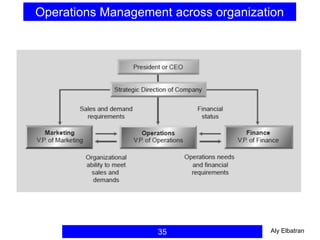
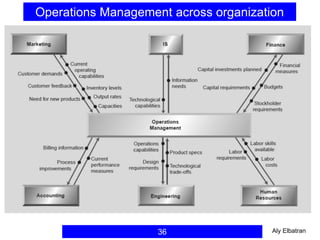
 Business is managed through three major functions: finance, marketing, and
operations management.
 Other business functions such as accounting, purchasing, human resources, and
engineering support these three major functions
Business Functions
Finance manages:-
- Cash flow,
- current assets, and
- capital investments
Marketing manages:-
- customer demand,
- understanding customer wants and
needs
To generate
- Sales for goods and services
Operation Management manages:-
- Resources (people- equipment-
technology- material and information
To produce:
Goods and services
Aly Elbatran
Marketing
Operations
Finance
Business Overlap
7 Aly Elbatran
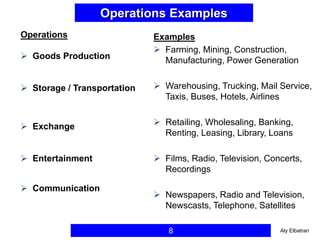
Operations
 Goods Production
 Storage / Transportation
 Exchange
 Entertainment
 Communication
Examples
 Farming, Mining, Construction,
Manufacturing, Power Generation
 Warehousing, Trucking, Mail Service,
Taxis, Buses, Hotels, Airlines
 Retailing, Wholesaling, Banking,
Renting, Leasing, Library, Loans
 Films, Radio, Television, Concerts,
Recordings
 Newspapers, Radio and Television,
Newscasts, Telephone, Satellites
Operations Examples
8 Aly Elbatran
Operations Management Definitions
9
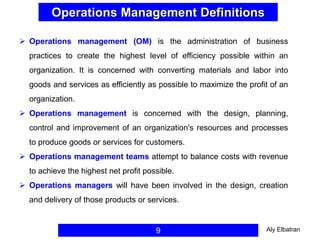
 Operations management (OM) is the administration of business
practices to create the highest level of efficiency possible within an
organization. It is concerned with converting materials and labor into
goods and services as efficiently as possible to maximize the profit of an
organization.
 Operations management is concerned with the design, planning,
control and improvement of an organization's resources and processes
to produce goods or services for customers.
 Operations management teams attempt to balance costs with revenue
to achieve the highest net profit possible.
 Operations managers will have been involved in the design, creation
and delivery of those products or services.
Aly Elbatran
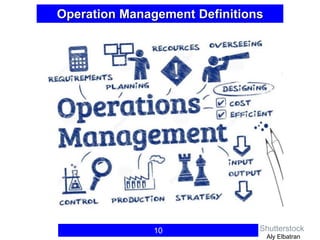
Operation Management Definitions
10 Shutterstock
Aly Elbatran
Role of Operations Management
11
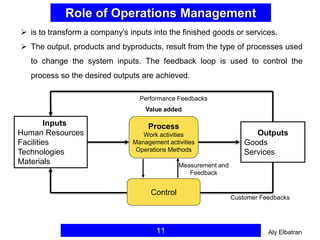
 is to transform a company’s inputs into the finished goods or services.
 The output, products and byproducts, result from the type of processes used
to change the system inputs. The feedback loop is used to control the
process so the desired outputs are achieved.
Process
Work activities
Management activities
Operations Methods
Outputs
Goods
Services
Inputs
Human Resources
Facilities
Technologies
Materials
Customer Feedbacks
Performance Feedbacks
Control
Measurement and
Feedback
Value added
Aly Elbatran
12
Role of Operations Management
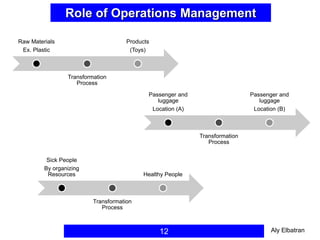
Raw Materials
Ex. Plastic
Transformation
Process
Products
(Toys)
Passenger and
luggage
Location (A)
Transformation
Process
Passenger and
luggage
Location (B)
Sick People
By organizing
Resources
Transformation
Process
Healthy People
Aly Elbatran
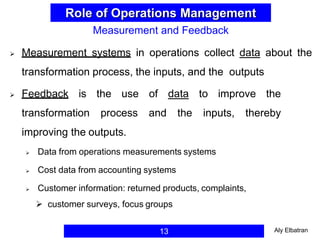
 Measurement systems in operations collect data about the
transformation process, the inputs, and the outputs
 Feedback is the use of data to improve the
transformation process and the inputs, thereby
improving the outputs.
 Data from operations measurements systems
 Cost data from accounting systems
 Customer information: returned products, complaints,
 customer surveys, focus groups
Role of Operations Management
Measurement and Feedback
13 Aly Elbatran
14
Role of Operations Management
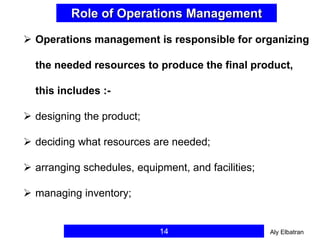
 Operations management is responsible for organizing
the needed resources to produce the final product,
this includes :-
 designing the product;
 deciding what resources are needed;
 arranging schedules, equipment, and facilities;
 managing inventory;
Aly Elbatran
15
Role of Operations Management
 controlling quality;
 designing the jobs to make the product;
 designing work methods.
 Basically, operations management is responsible for all
aspects of the process of transforming inputs into
outputs.
 Improving operations management is often the fastest
way to reduce costs and increase profits.
Aly Elbatran
Examples
16 Aly Elbatran
Successful Operation Management
17
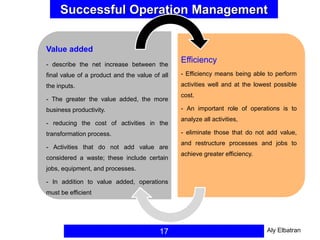
Value added
- describe the net increase between the
final value of a product and the value of all
the inputs.
- The greater the value added, the more
business productivity.
- reducing the cost of activities in the
transformation process.
- Activities that do not add value are
considered a waste; these include certain
jobs, equipment, and processes.
- In addition to value added, operations
must be efficient
Efficiency
- Efficiency means being able to perform
activities well and at the lowest possible
cost.
- An important role of operations is to
analyze all activities,
- eliminate those that do not add value,
and restructure processes and jobs to
achieve greater efficiency.
Aly Elbatran
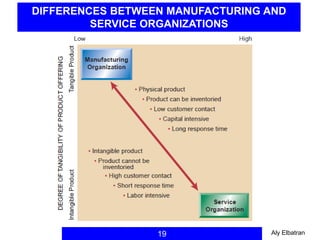
DIFFERENCES BETWEEN MANUFACTURING AND
SERVICE ORGANIZATIONS
18
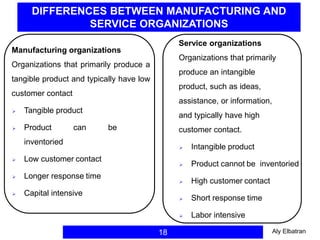
Service organizations
Organizations that primarily
produce an intangible
product, such as ideas,
assistance, or information,
and typically have high
customer contact.
 Intangible product
 Product cannot be inventoried
 High customer contact
 Short response time
 Labor intensive
Manufacturing organizations
Organizations that primarily produce a
tangible product and typically have low
customer contact
 Tangible product
 Product can be
inventoried
 Low customer contact
 Longer response time
 Capital intensive
Aly Elbatran
19
DIFFERENCES BETWEEN MANUFACTURING AND
SERVICE ORGANIZATIONS
Aly Elbatran
20
DIFFERENCES BETWEEN MANUFACTURING AND
SERVICE ORGANIZATIONS
Aly Elbatran
21
DIFFERENCES BETWEEN MANUFACTURING AND
SERVICE ORGANIZATIONS
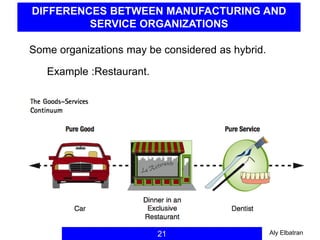
Some organizations may be considered as hybrid.
Example :Restaurant.
Aly Elbatran
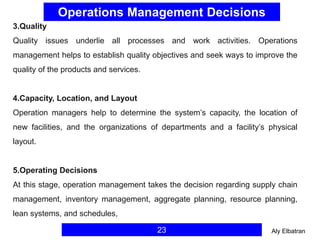
Operations Management Decisions
22
Decision making, both strategic and tactical, is an essential aspect of all
management activities, including operation management. The types of Operating
Management decisions can be divided into 5 main categories:-
1.Strategic choice
Operation management helps to determine the company’s global strategies and
competing priorities and how best to design processes that fit with its competitive
priorities.
2.Process
A Process is fundamental to all activities that produce goods and services. Ex:
Operation Management make process decisions about the types of work to be
done in house, the amount of automation to use and methods of improving
existing processes.
Aly Elbatran
Operations Management Decisions
23
3.Quality
Quality issues underlie all processes and work activities. Operations
management helps to establish quality objectives and seek ways to improve the
quality of the products and services.
4.Capacity, Location, and Layout
Operation managers help to determine the system’s capacity, the location of
new facilities, and the organizations of departments and a facility’s physical
layout.
5.Operating Decisions
At this stage, operation management takes the decision regarding supply chain
management, inventory management, aggregate planning, resource planning,
lean systems, and schedules,
Aly Elbatran
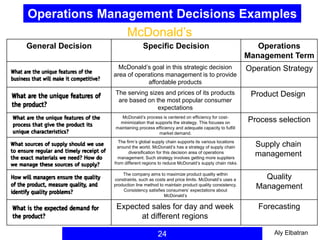
Operations Management Decisions Examples
24
General Decision Specific Decision Operations
Management Term
McDonald’s goal in this strategic decision
area of operations management is to provide
affordable products
Operation Strategy
The serving sizes and prices of its products
are based on the most popular consumer
expectations
Product Design
McDonald’s process is centered on efficiency for cost-
minimization that supports the strategy. This focuses on
maintaining process efficiency and adequate capacity to fulfill
market demand.
Process selection
The firm’s global supply chain supports its various locations
around the world. McDonald’s has a strategy of supply chain
diversification for this decision area of operations
management. Such strategy involves getting more suppliers
from different regions to reduce McDonald’s supply chain risks.
Supply chain
management
The company aims to maximize product quality within
constraints, such as costs and price limits. McDonald’s uses a
production line method to maintain product quality consistency.
Consistency satisfies consumers’ expectations about
McDonald’s
Quality
Management
Expected sales for day and week
at different regions
Forecasting
McDonald’s
Aly Elbatran
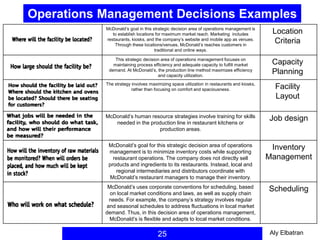
Operations Management Decisions Examples
25
McDonald’s goal in this strategic decision area of operations management is
to establish locations for maximum market reach. Marketing includes
restaurants, kiosks, and the company’s website and mobile app as venues.
Through these locations/venues, McDonald’s reaches customers in
traditional and online ways.
Location
Criteria
This strategic decision area of operations management focuses on
maintaining process efficiency and adequate capacity to fulfill market
demand. At McDonald’s, the production line method maximizes efficiency
and capacity utilization.
Capacity
Planning
The strategy involves maximizing space utilization in restaurants and kiosks,
rather than focusing on comfort and spaciousness. Facility
Layout
McDonald’s human resource strategies involve training for skills
needed in the production line in restaurant kitchens or
production areas.
Job design
McDonald’s goal for this strategic decision area of operations
management is to minimize inventory costs while supporting
restaurant operations. The company does not directly sell
products and ingredients to its restaurants. Instead, local and
regional intermediaries and distributors coordinate with
McDonald’s restaurant managers to manage their inventory.
Inventory
Management
McDonald’s uses corporate conventions for scheduling, based
on local market conditions and laws, as well as supply chain
needs. For example, the company’s strategy involves regular
and seasonal schedules to address fluctuations in local market
demand. Thus, in this decision area of operations management,
McDonald’s is flexible and adapts to local market conditions.
Scheduling
Aly Elbatran
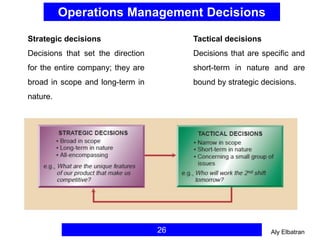
Operations Management Decisions
26
Strategic decisions
Decisions that set the direction
for the entire company; they are
broad in scope and long-term in
nature.
Tactical decisions
Decisions that are specific and
short-term in nature and are
bound by strategic decisions.
Aly Elbatran
Operations Management Decisions
27 Aly Elbatran
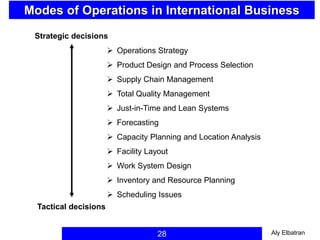
Modes of Operations in International Business
28
 Operations Strategy
 Product Design and Process Selection
 Supply Chain Management
 Total Quality Management
 Just-in-Time and Lean Systems
 Forecasting
 Capacity Planning and Location Analysis
 Facility Layout
 Work System Design
 Inventory and Resource Planning
 Scheduling Issues
Strategic decisions
Tactical decisions
Aly Elbatran
29
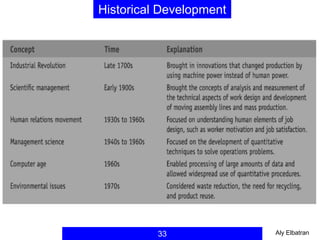
 Adam Smith in 1776 published “The Wealth of Nations”, introduced the concept
of division of labor.
 In 1790, Eli Whitney introduced the concept of interchangeable parts.
 “Scientific management” was an approach to management promoted by
Frederick W. Taylor. An approach to management that focused on improving
output by redesigning job and determining acceptable levels of worker output.
 The scientific management approach was popularized by Henry Ford, who used
the techniques in his factories. Combining technology with scientific
management, Ford introduced the moving assembly line to produce Ford cars.
 Ford also combined scientific management with the division of labor and
interchangeable parts to develop the concept of “mass production”.
 Hawthorne studies (1930):- The studies responsible for creating the human
relations movement, which focused on giving more consideration to workers’
needs.
Historical Development
Aly Elbatran
30
Historical Development
 Human relations movement: A philosophy based on the recognition that factors
other than money can contribute to worker productivity.
 Management science focused on developing quantitative techniques for solving
operations problems. The first mathematical model for inventory management
was developed by F.W. Harris in 1913.
 The Computer Age: In the 1970s the use of computers in business became
widespread. With computers, many of the quantitative models developed by
management science could be employed on a larger scale.
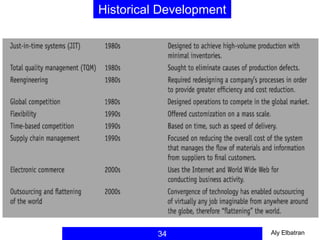
 Just-in-time (JIT) is a major operations management philosophy, developed in
Japan in the 1980s, that is designed to achieve high-volume production using
minimal amounts of inventory.
 Total quality management (TQM) (1980s-1990s): Philosophy that seeks to
improve quality by eliminating causes of product defects and by making quality
the responsibility of everyone in the organization.
Aly Elbatran
31
Historical Development
 Business process reengineering means redesigning a company’s processes
to increase efficiency, improve quality, and reduce costs.
 Flexibility: An organizational strategy in which the company attempts to offer a
greater variety of product choices to its customers.
 Time-based competition: An organizational strategy focusing on efforts to
develop new products and deliver them to customers faster than competitors.
 Supply chain management (SCM) involves managing the flow of materials
and information from suppliers and buyers of raw materials all the way to the
final customer.
 Global marketplace: A trend in business focusing on customers, suppliers,
and competitors from a global perspective.
Aly Elbatran
32
Historical Development
 Electronic commerce (e-commerce) is the use of the Internet for conducting
business activities, such as communication, business transactions, and data
transfer. The Internet, developed from a government network called ARPANET
created in 1969 by the U.S. Defense Department, has become an essential
business medium since the late 1990s, enabling efficient communication between
manufacturers, suppliers, distributors, and customers.
 Outsourcing is obtaining goods or services from an outside provider. This can
range from outsourcing of one aspect of the operation, such as shipping, to
outsourcing an entire part of the manufacturing process.
 Nowadays, many companies are implementing a concept called lean systems
which take a total system approach to creating an efficient operation and pull
together best practice concepts, including JIT, TQM, continuous improvement,
resource planning, and (SCM). The need for efficiency has also led many
companies to implement large information systems called enterprise resource
planning (ERP).
Aly Elbatran
Historical Development
33 Aly Elbatran
Historical Development
34 Aly Elbatran
35
Operations Management across organization
Aly Elbatran
36
Operations Management across organization
Aly Elbatran
THANK YOU
37 Aly Elbatran

566064486-Operation-Management-Lecture-1.pdf

  • 1.
    Operations Management Lect. 1“Introduction of Operation Management and Decisions Analysis” 1 Dr: Aly Hassan Elbatran Head of Mechanical Engineering Faculty of Engineering, Arab Academy for Science and Technology and Maritime Transport, Egypt Aly Elbatran
  • 2.
    Course Outlines 2 Introduction ofOperation Management Decisions Analysis Operations Strategy Product Design and Process Selection Supply Chain Management Total Quality Management Just-in-Time and Lean Systems Forecasting Facility Layout Inventory Planning Aggregate planning Scheduling Aly Elbatran
  • 3.
    Evaluation 3 Class Participation 10% MidTerm 30% Project 20% Final Exam 40% Aly Elbatran
  • 4.
    Introduction 4  Today companiesare competing in a very different environment than they were only a few years ago.  To survive, they must focus on quality, time-based competition, efficiency, international perspectives, and customer relationships.  Global competition, e-business, the Internet, and advances in technology require flexibility and responsiveness.  Consider some of today’s most successful companies, such as Wal-Mart, Southwest  Airlines, General Electric, Starbucks, Apple Computer, Toyota, FedEx have achieved world-class status in large part due to a strong focus on operations management. Aly Elbatran
  • 5.
    Introduction 5  The purposeof studying OM is to help prepare companies to be successful in this new business environment.  Operations management will give you an understanding of how to help your organization gain a competitive advantage in the marketplace.  Regardless of whether your area of expertise is marketing, finance, MIS, or operations, the techniques and concepts  How The companies or organizations can offer goods and services cheaper, better, and faster.  Operations management concepts are far-reaching, affecting every aspect of the organization and even everyday life. Aly Elbatran
  • 6.
    Business Functions 6  Businessis managed through three major functions: finance, marketing, and operations management.  Other business functions such as accounting, purchasing, human resources, and engineering support these three major functions Business Functions Finance manages:- - Cash flow, - current assets, and - capital investments Marketing manages:- - customer demand, - understanding customer wants and needs To generate - Sales for goods and services Operation Management manages:- - Resources (people- equipment- technology- material and information To produce: Goods and services Aly Elbatran
  • 7.
  • 8.
    Operations  Goods Production Storage / Transportation  Exchange  Entertainment  Communication Examples  Farming, Mining, Construction, Manufacturing, Power Generation  Warehousing, Trucking, Mail Service, Taxis, Buses, Hotels, Airlines  Retailing, Wholesaling, Banking, Renting, Leasing, Library, Loans  Films, Radio, Television, Concerts, Recordings  Newspapers, Radio and Television, Newscasts, Telephone, Satellites Operations Examples 8 Aly Elbatran
  • 9.
    Operations Management Definitions 9 Operations management (OM) is the administration of business practices to create the highest level of efficiency possible within an organization. It is concerned with converting materials and labor into goods and services as efficiently as possible to maximize the profit of an organization.  Operations management is concerned with the design, planning, control and improvement of an organization's resources and processes to produce goods or services for customers.  Operations management teams attempt to balance costs with revenue to achieve the highest net profit possible.  Operations managers will have been involved in the design, creation and delivery of those products or services. Aly Elbatran
  • 10.
    Operation Management Definitions 10Shutterstock Aly Elbatran
  • 11.
    Role of OperationsManagement 11  is to transform a company’s inputs into the finished goods or services.  The output, products and byproducts, result from the type of processes used to change the system inputs. The feedback loop is used to control the process so the desired outputs are achieved. Process Work activities Management activities Operations Methods Outputs Goods Services Inputs Human Resources Facilities Technologies Materials Customer Feedbacks Performance Feedbacks Control Measurement and Feedback Value added Aly Elbatran
  • 12.
    12 Role of OperationsManagement Raw Materials Ex. Plastic Transformation Process Products (Toys) Passenger and luggage Location (A) Transformation Process Passenger and luggage Location (B) Sick People By organizing Resources Transformation Process Healthy People Aly Elbatran
  • 13.
     Measurement systemsin operations collect data about the transformation process, the inputs, and the outputs  Feedback is the use of data to improve the transformation process and the inputs, thereby improving the outputs.  Data from operations measurements systems  Cost data from accounting systems  Customer information: returned products, complaints,  customer surveys, focus groups Role of Operations Management Measurement and Feedback 13 Aly Elbatran
  • 14.
    14 Role of OperationsManagement  Operations management is responsible for organizing the needed resources to produce the final product, this includes :-  designing the product;  deciding what resources are needed;  arranging schedules, equipment, and facilities;  managing inventory; Aly Elbatran
  • 15.
    15 Role of OperationsManagement  controlling quality;  designing the jobs to make the product;  designing work methods.  Basically, operations management is responsible for all aspects of the process of transforming inputs into outputs.  Improving operations management is often the fastest way to reduce costs and increase profits. Aly Elbatran
  • 16.
  • 17.
    Successful Operation Management 17 Valueadded - describe the net increase between the final value of a product and the value of all the inputs. - The greater the value added, the more business productivity. - reducing the cost of activities in the transformation process. - Activities that do not add value are considered a waste; these include certain jobs, equipment, and processes. - In addition to value added, operations must be efficient Efficiency - Efficiency means being able to perform activities well and at the lowest possible cost. - An important role of operations is to analyze all activities, - eliminate those that do not add value, and restructure processes and jobs to achieve greater efficiency. Aly Elbatran
  • 18.
    DIFFERENCES BETWEEN MANUFACTURINGAND SERVICE ORGANIZATIONS 18 Service organizations Organizations that primarily produce an intangible product, such as ideas, assistance, or information, and typically have high customer contact.  Intangible product  Product cannot be inventoried  High customer contact  Short response time  Labor intensive Manufacturing organizations Organizations that primarily produce a tangible product and typically have low customer contact  Tangible product  Product can be inventoried  Low customer contact  Longer response time  Capital intensive Aly Elbatran
  • 19.
    19 DIFFERENCES BETWEEN MANUFACTURINGAND SERVICE ORGANIZATIONS Aly Elbatran
  • 20.
    20 DIFFERENCES BETWEEN MANUFACTURINGAND SERVICE ORGANIZATIONS Aly Elbatran
  • 21.
    21 DIFFERENCES BETWEEN MANUFACTURINGAND SERVICE ORGANIZATIONS Some organizations may be considered as hybrid. Example :Restaurant. Aly Elbatran
  • 22.
    Operations Management Decisions 22 Decisionmaking, both strategic and tactical, is an essential aspect of all management activities, including operation management. The types of Operating Management decisions can be divided into 5 main categories:- 1.Strategic choice Operation management helps to determine the company’s global strategies and competing priorities and how best to design processes that fit with its competitive priorities. 2.Process A Process is fundamental to all activities that produce goods and services. Ex: Operation Management make process decisions about the types of work to be done in house, the amount of automation to use and methods of improving existing processes. Aly Elbatran
  • 23.
    Operations Management Decisions 23 3.Quality Qualityissues underlie all processes and work activities. Operations management helps to establish quality objectives and seek ways to improve the quality of the products and services. 4.Capacity, Location, and Layout Operation managers help to determine the system’s capacity, the location of new facilities, and the organizations of departments and a facility’s physical layout. 5.Operating Decisions At this stage, operation management takes the decision regarding supply chain management, inventory management, aggregate planning, resource planning, lean systems, and schedules, Aly Elbatran
  • 24.
    Operations Management DecisionsExamples 24 General Decision Specific Decision Operations Management Term McDonald’s goal in this strategic decision area of operations management is to provide affordable products Operation Strategy The serving sizes and prices of its products are based on the most popular consumer expectations Product Design McDonald’s process is centered on efficiency for cost- minimization that supports the strategy. This focuses on maintaining process efficiency and adequate capacity to fulfill market demand. Process selection The firm’s global supply chain supports its various locations around the world. McDonald’s has a strategy of supply chain diversification for this decision area of operations management. Such strategy involves getting more suppliers from different regions to reduce McDonald’s supply chain risks. Supply chain management The company aims to maximize product quality within constraints, such as costs and price limits. McDonald’s uses a production line method to maintain product quality consistency. Consistency satisfies consumers’ expectations about McDonald’s Quality Management Expected sales for day and week at different regions Forecasting McDonald’s Aly Elbatran
  • 25.
    Operations Management DecisionsExamples 25 McDonald’s goal in this strategic decision area of operations management is to establish locations for maximum market reach. Marketing includes restaurants, kiosks, and the company’s website and mobile app as venues. Through these locations/venues, McDonald’s reaches customers in traditional and online ways. Location Criteria This strategic decision area of operations management focuses on maintaining process efficiency and adequate capacity to fulfill market demand. At McDonald’s, the production line method maximizes efficiency and capacity utilization. Capacity Planning The strategy involves maximizing space utilization in restaurants and kiosks, rather than focusing on comfort and spaciousness. Facility Layout McDonald’s human resource strategies involve training for skills needed in the production line in restaurant kitchens or production areas. Job design McDonald’s goal for this strategic decision area of operations management is to minimize inventory costs while supporting restaurant operations. The company does not directly sell products and ingredients to its restaurants. Instead, local and regional intermediaries and distributors coordinate with McDonald’s restaurant managers to manage their inventory. Inventory Management McDonald’s uses corporate conventions for scheduling, based on local market conditions and laws, as well as supply chain needs. For example, the company’s strategy involves regular and seasonal schedules to address fluctuations in local market demand. Thus, in this decision area of operations management, McDonald’s is flexible and adapts to local market conditions. Scheduling Aly Elbatran
  • 26.
    Operations Management Decisions 26 Strategicdecisions Decisions that set the direction for the entire company; they are broad in scope and long-term in nature. Tactical decisions Decisions that are specific and short-term in nature and are bound by strategic decisions. Aly Elbatran
  • 27.
  • 28.
    Modes of Operationsin International Business 28  Operations Strategy  Product Design and Process Selection  Supply Chain Management  Total Quality Management  Just-in-Time and Lean Systems  Forecasting  Capacity Planning and Location Analysis  Facility Layout  Work System Design  Inventory and Resource Planning  Scheduling Issues Strategic decisions Tactical decisions Aly Elbatran
  • 29.
    29  Adam Smithin 1776 published “The Wealth of Nations”, introduced the concept of division of labor.  In 1790, Eli Whitney introduced the concept of interchangeable parts.  “Scientific management” was an approach to management promoted by Frederick W. Taylor. An approach to management that focused on improving output by redesigning job and determining acceptable levels of worker output.  The scientific management approach was popularized by Henry Ford, who used the techniques in his factories. Combining technology with scientific management, Ford introduced the moving assembly line to produce Ford cars.  Ford also combined scientific management with the division of labor and interchangeable parts to develop the concept of “mass production”.  Hawthorne studies (1930):- The studies responsible for creating the human relations movement, which focused on giving more consideration to workers’ needs. Historical Development Aly Elbatran
  • 30.
    30 Historical Development  Humanrelations movement: A philosophy based on the recognition that factors other than money can contribute to worker productivity.  Management science focused on developing quantitative techniques for solving operations problems. The first mathematical model for inventory management was developed by F.W. Harris in 1913.  The Computer Age: In the 1970s the use of computers in business became widespread. With computers, many of the quantitative models developed by management science could be employed on a larger scale.  Just-in-time (JIT) is a major operations management philosophy, developed in Japan in the 1980s, that is designed to achieve high-volume production using minimal amounts of inventory.  Total quality management (TQM) (1980s-1990s): Philosophy that seeks to improve quality by eliminating causes of product defects and by making quality the responsibility of everyone in the organization. Aly Elbatran
  • 31.
    31 Historical Development  Businessprocess reengineering means redesigning a company’s processes to increase efficiency, improve quality, and reduce costs.  Flexibility: An organizational strategy in which the company attempts to offer a greater variety of product choices to its customers.  Time-based competition: An organizational strategy focusing on efforts to develop new products and deliver them to customers faster than competitors.  Supply chain management (SCM) involves managing the flow of materials and information from suppliers and buyers of raw materials all the way to the final customer.  Global marketplace: A trend in business focusing on customers, suppliers, and competitors from a global perspective. Aly Elbatran
  • 32.
    32 Historical Development  Electroniccommerce (e-commerce) is the use of the Internet for conducting business activities, such as communication, business transactions, and data transfer. The Internet, developed from a government network called ARPANET created in 1969 by the U.S. Defense Department, has become an essential business medium since the late 1990s, enabling efficient communication between manufacturers, suppliers, distributors, and customers.  Outsourcing is obtaining goods or services from an outside provider. This can range from outsourcing of one aspect of the operation, such as shipping, to outsourcing an entire part of the manufacturing process.  Nowadays, many companies are implementing a concept called lean systems which take a total system approach to creating an efficient operation and pull together best practice concepts, including JIT, TQM, continuous improvement, resource planning, and (SCM). The need for efficiency has also led many companies to implement large information systems called enterprise resource planning (ERP). Aly Elbatran
  • 33.
  • 34.
  • 35.
    35 Operations Management acrossorganization Aly Elbatran
  • 36.
    36 Operations Management acrossorganization Aly Elbatran
  • 37.