Compliance and Regulatory
• Compliance and regulatory means correct coding strictly adhering to
the rules and guidelines
Compliance and Regulatory Syllabus
• 5 Questions in total
1. Medicare Parts A,B,C and D
2. Applying coding to payment policy
3. POS or place Of service reporting
4. Fraud and Abuse
5. NCCI edits
6. NCD/LCD
7. HIPAA
8. ABN
9. RVU
• Medicare
• Federal Government Insurance(US government)
Medicare Eligibilty Criteria
- For People who are 65 year older
- For younger people with disabilities
- ESRD patients/ kidney transplantation/persons
requiring dialysis
• Medicare Part A
-covers hospital stays,hospice care and skilled nursing care
- You will automatically be enrolled in Part A
• Medicare Part B
-covers doctor visits
-lab tests
-diagonostic tests
-medical equipment
-ambulance transportation
-other outpatient services
Medicare Part C
-Medicare Advantage Plan
-Private health insurance alternative to Medicare
Medicare Part D
-Prescription Drug Plan
-Part of Medicare that pays for some of your prescription drugs.
- Buys through a private insurer.
Examples for Private Insurances
UHC,Humana,Aetna,Cigna Healthcare etc.
2. Applying Coding to payment policy
“Back to Basics”(Guidelines)
When submitting medical claims not only you need to give the codes
right but you have to apply the right rules.
3. POS /place of service reporting
Two digit codes placed on claims to indicate a setting in which a service
was provided
Eg: POS code POS Name
02 Telehealth
03 School
4.Fraud and Abuse
• Fraud is an intentional deception or misrepresentation with
knowledge that the information is false.
• Abuse is payment for items / services that are billed by mistake by the
providers
• Examples if fraud:
1. Submitting claims for services not provided or used
2. Misrepresenting dates
3. Billing for services at a higher level than provided or necessary
4. Falsifying the eligibility
5. Bribery/Kickbacks
6. Billing for wrong services
• Examples of Abuse
1. Failure to maintain adequate medical or financial records
2. Billing for services not medically necessary
3. Refused to allow access to medical records
4. Improper billing practices.
Medicaid
• Administered by states according to the federal requirements
• Eligibility: low income adults,children,pregnant women,elderly adults
• “Payer of last resort”
5.NCCI Edits
-National Correct Coding Initiative
-PTP edits or Procedure to procedure edits
- To prevent improper payment when incorrect code combinations are
reported.
6.NCD/LCD
They are administrative and educational tools to assist providers in
submitting correct claims for reimbursement.
NCD- National Coverage Determination
LCD- Local Coverage Determination
NCD
US nationwide determination of whether Medicare will pay for an item
or service (National Level)
LCD
is determination by a Medicare Administrative Contractor(MAC)
whether to cover a particular service on locality basis or MAC level
basis
- Medicare Contractors develop LCD’s when there are no NCD’s
ABN
“Advance Beneficiary Notice”
-A notice that a doctor /supplier should give a Medicare beneficiary
when furnishing an item or service for which Medicare is expected to
deny payment
- If you do not get an ABN before you get the service from your doctor
or supplier, and Medicare doesnot pay for it,then you probably do not
have to pay for it.
- If the doctor or supplier does give you an ABN that you sign before
you get the service and Medicare doesnot pay for it then you will
have to pay your doctor or supplier for it.
- Only apply if you are in the Original Medicare plan
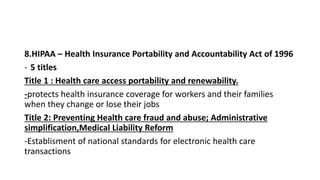
8.HIPAA – Health Insurance Portability and Accountability Act of 1996
- 5 titles
Title 1 : Health care access portability and renewability.
-protects health insurance coverage for workers and their families
when they change or lose their jobs
Title 2: Preventing Health care fraud and abuse; Administrative
simplification,Medical Liability Reform
-Establisment of national standards for electronic health care
transactions
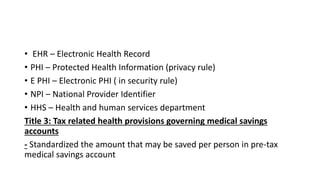
• EHR – Electronic Health Record
• PHI – Protected Health Information (privacy rule)
• E PHI – Electronic PHI ( in security rule)
• NPI – National Provider Identifier
• HHS – Health and human services department
Title 3: Tax related health provisions governing medical savings
accounts
- Standardized the amount that may be saved per person in pre-tax
medical savings account
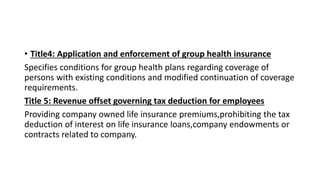
• Title4: Application and enforcement of group health insurance
Specifies conditions for group health plans regarding coverage of
persons with existing conditions and modified continuation of coverage
requirements.
Title 5: Revenue offset governing tax deduction for employees
Providing company owned life insurance premiums,prohibiting the tax
deduction of interest on life insurance loans,company endowments or
contracts related to company.
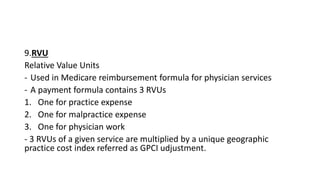
9.RVU
Relative Value Units
- Used in Medicare reimbursement formula for physician services
- A payment formula contains 3 RVUs
1. One for practice expense
2. One for malpractice expense
3. One for physician work
- 3 RVUs of a given service are multiplied by a unique geographic
practice cost index referred as GPCI udjustment.
- The sum of 3 geographically weighted RVU value is then multiplied by
Medicare Conversion Factor to obtain a final price.
Medical Necessity
- When submitting claims for payment the diagonosis codes reported
with service tells the payer why a service was performed.
- For a service to be considered medically necessary it must be
reasonable and necessary to diagonose or treat a patient’s medical
condition
- For eg: a patient presents to the office with chest pain and the
physician orders an electrocardiogram
Covered Entities(under HIPAA)
- Individuals / entities that transmit PHI for transactions for which the
department of HHS has adopted standards.
- Covered entities under HIPAA includes health plans,health care
provider s,and health care clearing houses.
• EOB/Explanation of Benefits
An explanation of benefits is a statement sent by a health insurance
company to covered individuals explaining what medica treatments or
service s were paid on their behalf
• Managed Care Plans
Type of health insurance.They have contracts with healthcare providers
and medical facilities to provide care for members at reduced costs
Types of managed care plans:
1. HMO
2. POS
3.PPO
HMO/Health Maintenance Organization
HMO s will give you a list of doctors from which you need to choose a
primary care doctor.
Some HMOs require no payment when you visit their in network
providers
But if you go to an outof network provider you pay the bill
• Point of Service /POS
Allows members to refer themselves outside the HMO network and still get
some coverage
If the PCP makes referral outside of the network of providers,the plan pays
all or most of the bill.
If you refer yourself to a provider outside the network and the service is
covered by the plan you will have to pay a percentage of the bill.This is
known as coinsurance
• PPO/Preferred Provider Organization
Plan members can generally refer themselves to other doctors including ones
outside the plan.
• Closest to a free for service situation
• Copay /Coinsurne of less charges to be be paid if you go outside the
network

5_6253745474176549975.pptx

  • 1.
  • 2.
    • Compliance andregulatory means correct coding strictly adhering to the rules and guidelines
  • 3.
    Compliance and RegulatorySyllabus • 5 Questions in total 1. Medicare Parts A,B,C and D 2. Applying coding to payment policy 3. POS or place Of service reporting 4. Fraud and Abuse 5. NCCI edits 6. NCD/LCD 7. HIPAA 8. ABN 9. RVU
  • 4.
    • Medicare • FederalGovernment Insurance(US government) Medicare Eligibilty Criteria - For People who are 65 year older - For younger people with disabilities - ESRD patients/ kidney transplantation/persons requiring dialysis
  • 5.
    • Medicare PartA -covers hospital stays,hospice care and skilled nursing care - You will automatically be enrolled in Part A • Medicare Part B -covers doctor visits -lab tests -diagonostic tests
  • 6.
    -medical equipment -ambulance transportation -otheroutpatient services Medicare Part C -Medicare Advantage Plan -Private health insurance alternative to Medicare Medicare Part D -Prescription Drug Plan -Part of Medicare that pays for some of your prescription drugs.
  • 7.
    - Buys througha private insurer. Examples for Private Insurances UHC,Humana,Aetna,Cigna Healthcare etc. 2. Applying Coding to payment policy “Back to Basics”(Guidelines) When submitting medical claims not only you need to give the codes right but you have to apply the right rules.
  • 8.
    3. POS /placeof service reporting Two digit codes placed on claims to indicate a setting in which a service was provided Eg: POS code POS Name 02 Telehealth 03 School 4.Fraud and Abuse • Fraud is an intentional deception or misrepresentation with knowledge that the information is false.
  • 9.
    • Abuse ispayment for items / services that are billed by mistake by the providers • Examples if fraud: 1. Submitting claims for services not provided or used 2. Misrepresenting dates 3. Billing for services at a higher level than provided or necessary 4. Falsifying the eligibility 5. Bribery/Kickbacks 6. Billing for wrong services
  • 10.
    • Examples ofAbuse 1. Failure to maintain adequate medical or financial records 2. Billing for services not medically necessary 3. Refused to allow access to medical records 4. Improper billing practices. Medicaid • Administered by states according to the federal requirements
  • 11.
    • Eligibility: lowincome adults,children,pregnant women,elderly adults • “Payer of last resort” 5.NCCI Edits -National Correct Coding Initiative -PTP edits or Procedure to procedure edits - To prevent improper payment when incorrect code combinations are reported.
  • 12.
    6.NCD/LCD They are administrativeand educational tools to assist providers in submitting correct claims for reimbursement. NCD- National Coverage Determination LCD- Local Coverage Determination NCD US nationwide determination of whether Medicare will pay for an item or service (National Level)
  • 13.
    LCD is determination bya Medicare Administrative Contractor(MAC) whether to cover a particular service on locality basis or MAC level basis - Medicare Contractors develop LCD’s when there are no NCD’s ABN “Advance Beneficiary Notice” -A notice that a doctor /supplier should give a Medicare beneficiary when furnishing an item or service for which Medicare is expected to deny payment
  • 14.
    - If youdo not get an ABN before you get the service from your doctor or supplier, and Medicare doesnot pay for it,then you probably do not have to pay for it. - If the doctor or supplier does give you an ABN that you sign before you get the service and Medicare doesnot pay for it then you will have to pay your doctor or supplier for it. - Only apply if you are in the Original Medicare plan
  • 15.
    8.HIPAA – HealthInsurance Portability and Accountability Act of 1996 - 5 titles Title 1 : Health care access portability and renewability. -protects health insurance coverage for workers and their families when they change or lose their jobs Title 2: Preventing Health care fraud and abuse; Administrative simplification,Medical Liability Reform -Establisment of national standards for electronic health care transactions
  • 16.
    • EHR –Electronic Health Record • PHI – Protected Health Information (privacy rule) • E PHI – Electronic PHI ( in security rule) • NPI – National Provider Identifier • HHS – Health and human services department Title 3: Tax related health provisions governing medical savings accounts - Standardized the amount that may be saved per person in pre-tax medical savings account
  • 17.
    • Title4: Applicationand enforcement of group health insurance Specifies conditions for group health plans regarding coverage of persons with existing conditions and modified continuation of coverage requirements. Title 5: Revenue offset governing tax deduction for employees Providing company owned life insurance premiums,prohibiting the tax deduction of interest on life insurance loans,company endowments or contracts related to company.
  • 18.
    9.RVU Relative Value Units -Used in Medicare reimbursement formula for physician services - A payment formula contains 3 RVUs 1. One for practice expense 2. One for malpractice expense 3. One for physician work - 3 RVUs of a given service are multiplied by a unique geographic practice cost index referred as GPCI udjustment.
  • 19.
    - The sumof 3 geographically weighted RVU value is then multiplied by Medicare Conversion Factor to obtain a final price. Medical Necessity - When submitting claims for payment the diagonosis codes reported with service tells the payer why a service was performed. - For a service to be considered medically necessary it must be reasonable and necessary to diagonose or treat a patient’s medical condition
  • 20.
    - For eg:a patient presents to the office with chest pain and the physician orders an electrocardiogram Covered Entities(under HIPAA) - Individuals / entities that transmit PHI for transactions for which the department of HHS has adopted standards. - Covered entities under HIPAA includes health plans,health care provider s,and health care clearing houses.
  • 21.
    • EOB/Explanation ofBenefits An explanation of benefits is a statement sent by a health insurance company to covered individuals explaining what medica treatments or service s were paid on their behalf • Managed Care Plans Type of health insurance.They have contracts with healthcare providers and medical facilities to provide care for members at reduced costs Types of managed care plans: 1. HMO
  • 22.
    2. POS 3.PPO HMO/Health MaintenanceOrganization HMO s will give you a list of doctors from which you need to choose a primary care doctor. Some HMOs require no payment when you visit their in network providers But if you go to an outof network provider you pay the bill
  • 23.
    • Point ofService /POS Allows members to refer themselves outside the HMO network and still get some coverage If the PCP makes referral outside of the network of providers,the plan pays all or most of the bill. If you refer yourself to a provider outside the network and the service is covered by the plan you will have to pay a percentage of the bill.This is known as coinsurance • PPO/Preferred Provider Organization Plan members can generally refer themselves to other doctors including ones outside the plan.
  • 24.
    • Closest toa free for service situation • Copay /Coinsurne of less charges to be be paid if you go outside the network