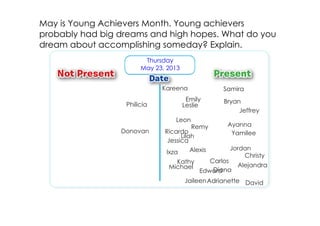
Christy
Samira
Leon
Kareena
Philicia
Ayanna
Lilah
Remy
Donovan
Michael
Yamilee
Jessica
Leslie
Carlos
Bryan
Ricardo
Alexis
David
Jordan
Alejandra
Kathy
Diana
Ixza
Emily
Jaileen
Jeffrey
Thursday
May 23, 2013
May is Young Achievers Month. Young achievers
probably had big dreams and high hopes. What do you
dream about accomplishing someday? Explain.
Edward
Adrianette
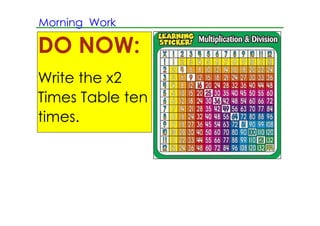
DO NOW:
Write the x2
Times Table ten
times.
Morning Work
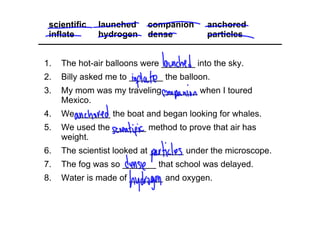
1. The hot­air balloons were _______ into the sky.
2. Billy asked me to _______ the balloon.
3. My mom was my traveling _______ when I toured 
Mexico.
4. We _______ the boat and began looking for whales.
5. We used the _______ method to prove that air has 
weight.
6. The scientist looked at _______ under the microscope.
7. The fog was so _______ that school was delayed.
8. Water is made of _______ and oxygen.
scientific launched companion anchored
inflate hydrogen dense particles
Reading
Aim: Balloon
Flight (p. 710)
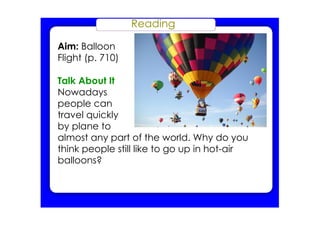
Talk About It
Nowadays
people can
travel quickly
by plane to
almost any part of the world. Why do you
think people still like to go up in hot­air
balloons?
Something that is launched is started in
motion or sent off.
Particles are small bits or pieces of an
element.
Things that are dense are thick or packed
closely together.
Inflate means to cause to swell by filling
with air or gas.
Anchored means held firmly in place.
Hydrogen is a light gas that burns easily.
Scientific means having to do with or used
in science.
A companion is a person or animal who
keeps somebody company.
Reading
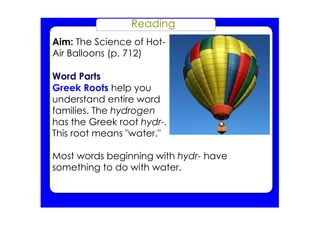
Aim: The Science of Hot­
Air Balloons (p. 712)
Word Parts
Greek Roots help you
understand entire word
families. The hydrogen
has the Greek root hydr­.
This root means "water."
Most words beginning with hydr­ have
something to do with water.
Reading
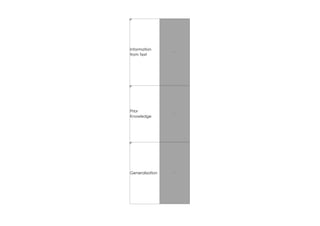
Monitor Comprehension
Make Generalizations
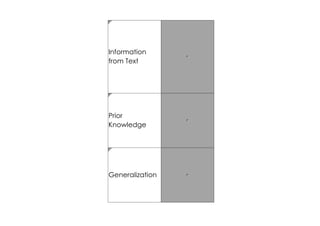
A Generalizations Chart helps
you make broad statements
that describe ideas or events.
This will help you monitor your
comprehension or
understanding of what you read. To make
generalizations, combine key facts from the
text and your prior knowledge.
Information
from Text
Prior Knowledge
Generalization
Information
from Text
Prior
Knowledge
Generalization
Reading
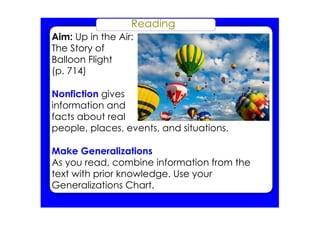
Aim: Up in the Air:
The Story of
Balloon Flight
(p. 714)
Nonfiction gives
information and
facts about real
people, places, events, and situations.
Make Generalizations
As you read, combine information from the
text with prior knowledge. Use your
Generalizations Chart.
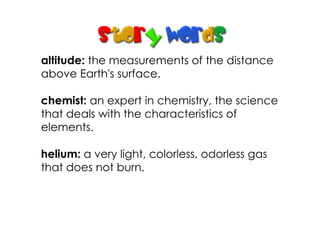
altitude: the measurements of the distance
above Earth's surface.
chemist: an expert in chemistry, the science
that deals with the characteristics of
elements.
helium: a very light, colorless, odorless gas
that does not burn.
Information
from Text
Prior
Knowledge
Generalization
Reading Homework
Summarize
Who was responsible for the first
five balloon flights, and when
did they take place? Identify
each flight and explain what
made it special.
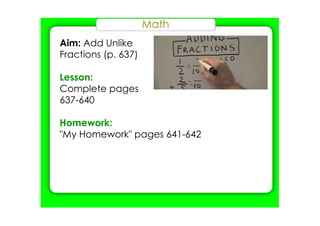
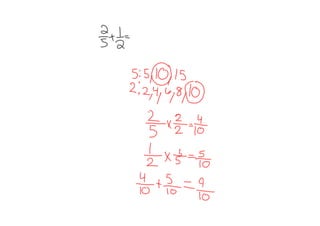
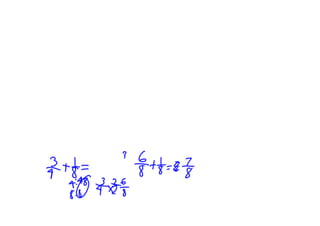
Math
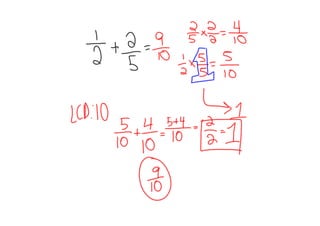
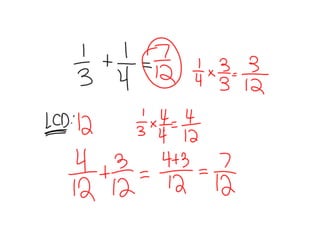
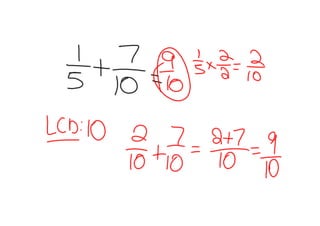
Aim: Add Unlike
Fractions (p. 637)
Lesson:
Complete pages
637­640
Homework:
"My Homework" pages 641­642
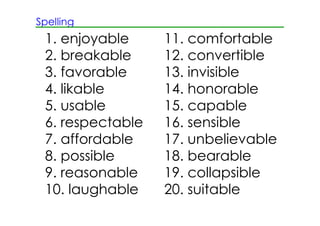
Spelling
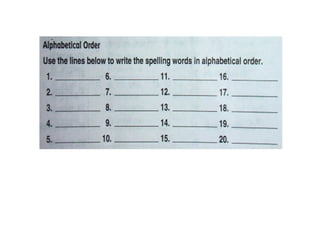
1. enjoyable 11. comfortable
2. breakable 12. convertible
3. favorable 13. invisible
4. likable 14. honorable
5. usable 15. capable
6. respectable 16. sensible
7. affordable 17. unbelievable
8. possible 18. bearable
9. reasonable 19. collapsible
10. laughable 20. suitable
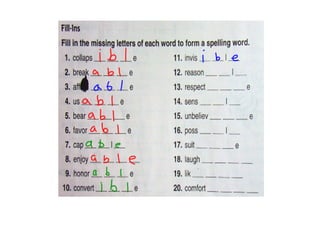
Spelling
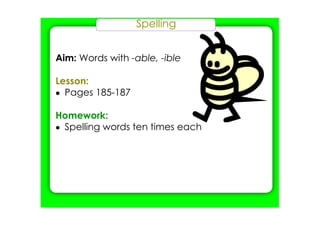
Aim: Words with ­able, ­ible
Lesson:
• Pages 185­187
Homework:
• Spelling words ten times each
Language Arts
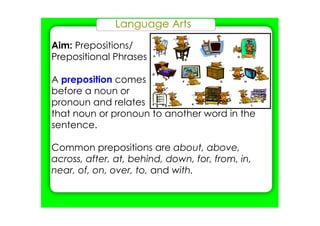
Aim: Prepositions/
Prepositional Phrases
A preposition comes
before a noun or
pronoun and relates
that noun or pronoun to another word in the
sentence.
Common prepositions are about, above,
across, after, at, behind, down, for, from, in,
near, of, on, over, to, and with.
Language Arts
Class work
• Grammar Practice Book, page 179
1. The balloon flew above the village.
2. Jean­Pierre Blanchard floated over the English 
Channel.
3. A duck, a rooster, and a sheep rode in the basket of the 
balloon.
4. The balloon rose to a height of one hundred feet.
5. They floated in a new direction.
6. Weather balloons give us information about the 
atmosphere.
7. Buoyancy keeps balloons in the air.
8. Bertrand Piccard stayed in a balloon for 20 days.
9. The balloon dropped gently from the sky.
10. The balloon landed in a forest behind a field.
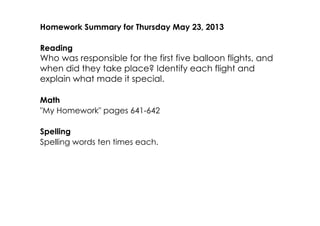
Homework Summary for Thursday May 23, 2013
Reading
Who was responsible for the first five balloon flights, and
when did they take place? Identify each flight and
explain what made it special.
Math
"My Homework" pages 641­642
Spelling
Spelling words ten times each.
Attachments
1314158
Analogies TTT.notebook

5.23.13 classwork thursday

  • 1.
    Christy Samira Leon Kareena Philicia Ayanna Lilah Remy Donovan Michael Yamilee Jessica Leslie Carlos Bryan Ricardo Alexis David Jordan Alejandra Kathy Diana Ixza Emily Jaileen Jeffrey Thursday May 23, 2013 Mayis Young Achievers Month. Young achievers probably had big dreams and high hopes. What do you dream about accomplishing someday? Explain. Edward Adrianette
  • 2.
    DO NOW: Write thex2 Times Table ten times. Morning Work
  • 3.
    1. The hot­air balloons were _______ into the sky. 2. Billy asked me to _______ the balloon. 3.My mom was my traveling _______ when I toured  Mexico. 4. We _______ the boat and began looking for whales. 5. We used the _______ method to prove that air has  weight. 6. The scientist looked at _______ under the microscope. 7. The fog was so _______ that school was delayed. 8. Water is made of _______ and oxygen. scientific launched companion anchored inflate hydrogen dense particles
  • 4.
    Reading Aim: Balloon Flight (p.710) Talk About It Nowadays people can travel quickly by plane to almost any part of the world. Why do you think people still like to go up in hot­air balloons?
  • 5.
    Something that islaunched is started in motion or sent off. Particles are small bits or pieces of an element. Things that are dense are thick or packed closely together. Inflate means to cause to swell by filling with air or gas.
  • 6.
    Anchored means heldfirmly in place. Hydrogen is a light gas that burns easily. Scientific means having to do with or used in science. A companion is a person or animal who keeps somebody company.
  • 7.
    Reading Aim: The Scienceof Hot­ Air Balloons (p. 712) Word Parts Greek Roots help you understand entire word families. The hydrogen has the Greek root hydr­. This root means "water." Most words beginning with hydr­ have something to do with water.
  • 8.
    Reading Monitor Comprehension Make Generalizations AGeneralizations Chart helps you make broad statements that describe ideas or events. This will help you monitor your comprehension or understanding of what you read. To make generalizations, combine key facts from the text and your prior knowledge. Information from Text Prior Knowledge Generalization
  • 9.
  • 10.
    Reading Aim: Up inthe Air: The Story of Balloon Flight (p. 714) Nonfiction gives information and facts about real people, places, events, and situations. Make Generalizations As you read, combine information from the text with prior knowledge. Use your Generalizations Chart.
  • 12.
    altitude: the measurementsof the distance above Earth's surface. chemist: an expert in chemistry, the science that deals with the characteristics of elements. helium: a very light, colorless, odorless gas that does not burn.
  • 13.
  • 14.
    Reading Homework Summarize Who wasresponsible for the first five balloon flights, and when did they take place? Identify each flight and explain what made it special.
  • 15.
    Math Aim: Add Unlike Fractions(p. 637) Lesson: Complete pages 637­640 Homework: "My Homework" pages 641­642
  • 21.
    Spelling 1. enjoyable 11.comfortable 2. breakable 12. convertible 3. favorable 13. invisible 4. likable 14. honorable 5. usable 15. capable 6. respectable 16. sensible 7. affordable 17. unbelievable 8. possible 18. bearable 9. reasonable 19. collapsible 10. laughable 20. suitable
  • 24.
    Spelling Aim: Words with­able, ­ible Lesson: • Pages 185­187 Homework: • Spelling words ten times each
  • 25.
    Language Arts Aim: Prepositions/ PrepositionalPhrases A preposition comes before a noun or pronoun and relates that noun or pronoun to another word in the sentence. Common prepositions are about, above, across, after, at, behind, down, for, from, in, near, of, on, over, to, and with.
  • 26.
    Language Arts Class work •Grammar Practice Book, page 179 1. The balloon flew above the village. 2. Jean­Pierre Blanchard floated over the English  Channel. 3. A duck, a rooster, and a sheep rode in the basket of the  balloon. 4. The balloon rose to a height of one hundred feet. 5. They floated in a new direction. 6. Weather balloons give us information about the  atmosphere. 7. Buoyancy keeps balloons in the air. 8. Bertrand Piccard stayed in a balloon for 20 days. 9. The balloon dropped gently from the sky. 10. The balloon landed in a forest behind a field.
  • 27.
    Homework Summary forThursday May 23, 2013 Reading Who was responsible for the first five balloon flights, and when did they take place? Identify each flight and explain what made it special. Math "My Homework" pages 641­642 Spelling Spelling words ten times each.
  • 28.