Chapter 7

Pressure
At the end of this chapter,
you should be able to
   Define pressure in terms of force
    and area and recall the relationship:
    Pressure = Force/Area
   Apply the relationship between
    pressure, force and area to new
    situations or to solve related
    problems.
Quiz Time
   Why do camels have large flat feet?
   Why do eskimos wear snow shoes?
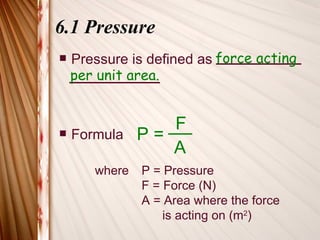
6.1 Pressure
   Pressure is defined as force acting
    per unit area.


 Formula P =
              F
              A
       where   P = Pressure
               F = Force (N)
               A = Area where the force
                   is acting on (m2)
6.1 Pressure
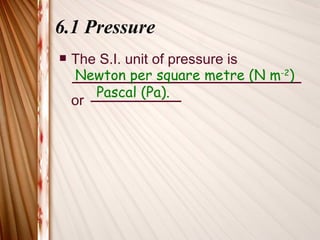
   The S.I. unit of pressure is
    Newton per square metre (N m-2)
       Pascal (Pa).
    or
Quiz Time
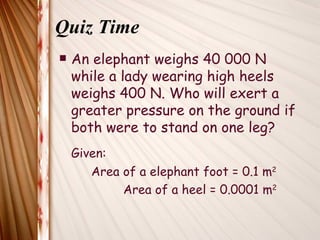
   An elephant weighs 40 000 N
    while a lady wearing high heels
    weighs 400 N. Who will exert a
    greater pressure on the ground if
    both were to stand on one leg?
    Given:
       Area of a elephant foot = 0.1 m2
            Area of a heel = 0.0001 m2
Quiz Time
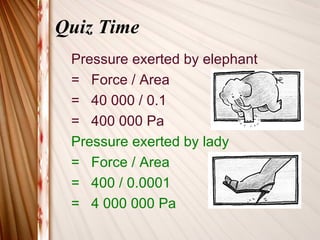
 Pressure exerted by elephant
 = Force / Area
 = 40 000 / 0.1
 = 400 000 Pa
 Pressure exerted by lady
 = Force / Area
 = 400 / 0.0001
 = 4 000 000 Pa
Quiz Time
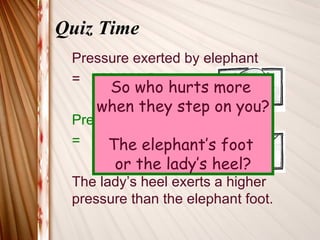
 Pressure exerted by elephant
 = 400 000 Pa
     So who hurts more
    when they step on you?
 Pressure exerted by lady
      The elephant’s foot
 = 4 000 000 Pa
       or the lady’s heel?
 The lady’s heel exerts a higher
 pressure than the elephant foot.
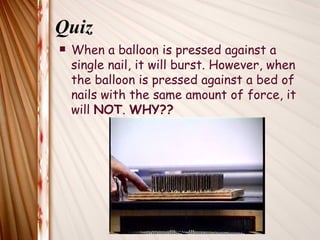
Quiz
   When a balloon is pressed against a
    single nail, it will burst. However, when
    the balloon is pressed against a bed of
    nails with the same amount of force, it
    will NOT. WHY??
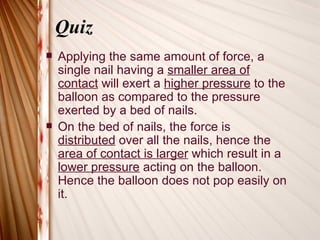
Quiz
   Applying the same amount of force, a
    single nail having a smaller area of
    contact will exert a higher pressure to the
    balloon as compared to the pressure
    exerted by a bed of nails.
   On the bed of nails, the force is
    distributed over all the nails, hence the
    area of contact is larger which result in a
    lower pressure acting on the balloon.
    Hence the balloon does not pop easily on
    it.
6.1 Pressure
   In conclusion,
    To increase pressure, we can either
     Increase the force applied.
     Decrease the area of contact.
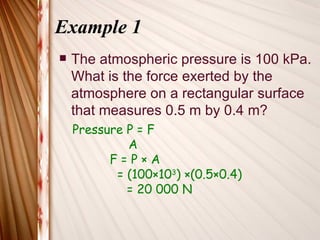
Example 1
   The atmospheric pressure is 100 kPa.
    What is the force exerted by the
    atmosphere on a rectangular surface
    that measures 0.5 m by 0.4 m?
    Pressure P = F
             A
          F=P×A
           = (100×103) ×(0.5×0.4)
             = 20 000 N
Example 2
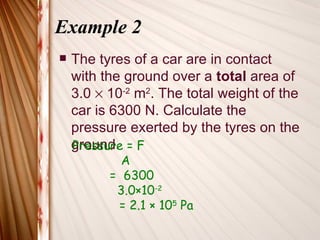
   The tyres of a car are in contact
    with the ground over a total area of
    3.0 × 10⁻² m2. The total weight of the
    car is 6300 N. Calculate the
    pressure exerted by the tyres on the
    ground. = F
    Pressure
            A
          = 6300
           3.0×10-2
           = 2.1 × 10⁵ Pa
Example 3
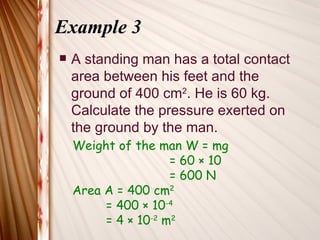
   A standing man has a total contact
    area between his feet and the
    ground of 400 cm2. He is 60 kg.
    Calculate the pressure exerted on
    the ground by the man.
    Weight of the man W = mg
                     = 60 × 10
                     = 600 N
    Area A = 400 cm2
         = 400 × 10-4
         = 4 × 10⁻² m2
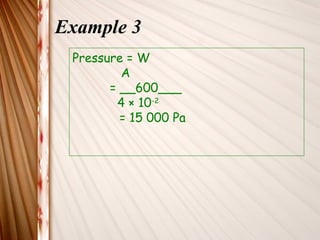
Example 3
 Pressure = W
         A
       = __600___
        4 × 10-2
         = 15 000 Pa

5116 pressure slides ed

  • 1.
  • 2.
    At the endof this chapter, you should be able to  Define pressure in terms of force and area and recall the relationship: Pressure = Force/Area  Apply the relationship between pressure, force and area to new situations or to solve related problems.
  • 3.
    Quiz Time  Why do camels have large flat feet?  Why do eskimos wear snow shoes?
  • 4.
    6.1 Pressure  Pressure is defined as force acting per unit area.  Formula P = F A where P = Pressure F = Force (N) A = Area where the force is acting on (m2)
  • 5.
    6.1 Pressure  The S.I. unit of pressure is Newton per square metre (N m-2) Pascal (Pa). or
  • 6.
    Quiz Time  An elephant weighs 40 000 N while a lady wearing high heels weighs 400 N. Who will exert a greater pressure on the ground if both were to stand on one leg? Given: Area of a elephant foot = 0.1 m2 Area of a heel = 0.0001 m2
  • 7.
    Quiz Time Pressureexerted by elephant = Force / Area = 40 000 / 0.1 = 400 000 Pa Pressure exerted by lady = Force / Area = 400 / 0.0001 = 4 000 000 Pa
  • 8.
    Quiz Time Pressureexerted by elephant = 400 000 Pa So who hurts more when they step on you? Pressure exerted by lady The elephant’s foot = 4 000 000 Pa or the lady’s heel? The lady’s heel exerts a higher pressure than the elephant foot.
  • 9.
    Quiz  When a balloon is pressed against a single nail, it will burst. However, when the balloon is pressed against a bed of nails with the same amount of force, it will NOT. WHY??
  • 10.
    Quiz  Applying the same amount of force, a single nail having a smaller area of contact will exert a higher pressure to the balloon as compared to the pressure exerted by a bed of nails.  On the bed of nails, the force is distributed over all the nails, hence the area of contact is larger which result in a lower pressure acting on the balloon. Hence the balloon does not pop easily on it.
  • 11.
    6.1 Pressure  In conclusion, To increase pressure, we can either  Increase the force applied.  Decrease the area of contact.
  • 12.
    Example 1  The atmospheric pressure is 100 kPa. What is the force exerted by the atmosphere on a rectangular surface that measures 0.5 m by 0.4 m? Pressure P = F A F=P×A = (100×103) ×(0.5×0.4) = 20 000 N
  • 13.
    Example 2  The tyres of a car are in contact with the ground over a total area of 3.0 × 10⁻² m2. The total weight of the car is 6300 N. Calculate the pressure exerted by the tyres on the ground. = F Pressure A = 6300 3.0×10-2 = 2.1 × 10⁵ Pa
  • 14.
    Example 3  A standing man has a total contact area between his feet and the ground of 400 cm2. He is 60 kg. Calculate the pressure exerted on the ground by the man. Weight of the man W = mg = 60 × 10 = 600 N Area A = 400 cm2 = 400 × 10-4 = 4 × 10⁻² m2
  • 15.
    Example 3 Pressure= W A = __600___ 4 × 10-2 = 15 000 Pa