







Meet us at Event Title!
Donec rhoncus eu ipsum in auctor. Nulla facilisi. Nunc facilisis neque non turpis
euismod, sit amet tempor mi hendrerit.
CALL TO ACTION
Booth #7803
Event Logo
Dr. Rado Kotorov, Chief Innovation Officer
Information Builders
5 Hot Trends for Data
and Analytics in 2017
#DataTrends
The New Business Reality
2
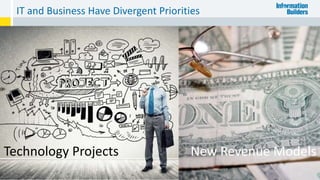
IT and Business Have Divergent Priorities
3
Technology Projects New Revenue Models
Why Didn’t IT Invent UBER?
4
Business Is Asking: Why Do We Miss Opportunities?
5
Change the Mindset: Manage Cyber Assets
6
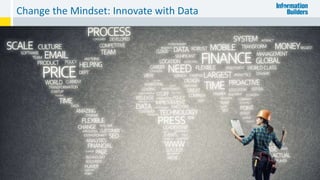
Change the Mindset: Innovate with Data
7
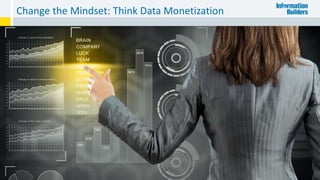
Change the Mindset: Think Data Monetization
8
Success Requires IT and Business Partnership
9
Trend 1
10
Industry 4.0: Building the new digital enterprise using automation
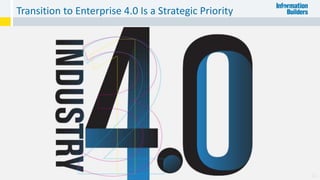
Transition to Enterprise 4.0 Is a Strategic Priority
11
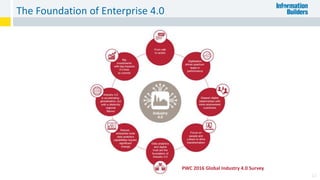
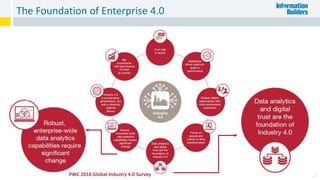
The Foundation of Enterprise 4.0
12
PWC 2016 Global Industry 4.0 Survey
The Foundation of Enterprise 4.0
13PWC 2016 Global Industry 4.0 Survey
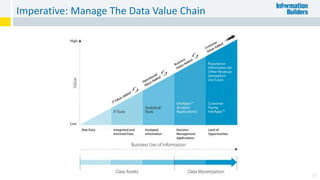
Imperative: Manage The Data Value Chain
14
Trend 2
15
Analytics in the Digital Culture Revolution: Democratizing BI for
fact-based decision making
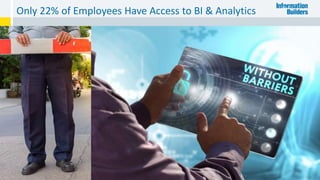
Only 22% of Employees Have Access to BI & Analytics
16
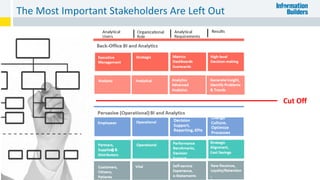
The Most Important Stakeholders Are Left Out
Cut Off
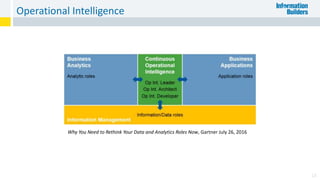
Operational Intelligence
18
Why You Need to Rethink Your Data and Analytics Roles Now, Gartner July 26, 2016
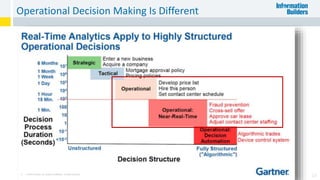
Operational Decision Making Is Different
19
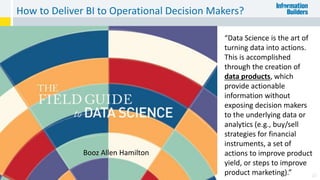
How to Deliver BI to Operational Decision Makers?
20
“Data Science is the art of
turning data into actions.
This is accomplished
through the creation of
data products, which
provide actionable
information without
exposing decision makers
to the underlying data or
analytics (e.g., buy/sell
strategies for financial
instruments, a set of
actions to improve product
yield, or steps to improve
product marketing).”
Booz Allen Hamilton
21
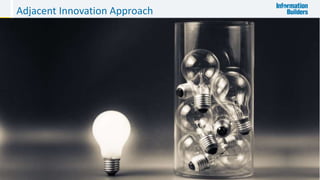
Adjacent Innovation Approach
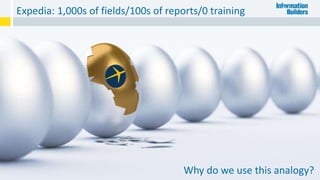
Expedia: 1,000s of fields/100s of reports/0 training
22
Why do we use this analogy?
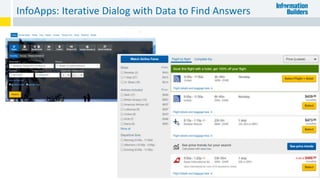
InfoApps: Iterative Dialog with Data to Find Answers
23
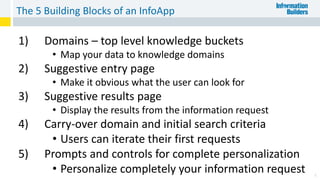
The 5 Building Blocks of an InfoApp
24
1) Domains – top level knowledge buckets
• Map your data to knowledge domains
2) Suggestive entry page
• Make it obvious what the user can look for
3) Suggestive results page
• Display the results from the information request
4) Carry-over domain and initial search criteria
• Users can iterate their first requests
5) Prompts and controls for complete personalization
• Personalize completely your information request
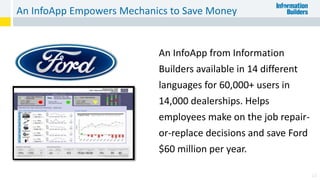
An InfoApp Empowers Mechanics to Save Money
25
An InfoApp from Information
Builders available in 14 different
languages for 60,000+ users in
14,000 dealerships. Helps
employees make on the job repair-
or-replace decisions and save Ford
$60 million per year.
Trend 3
26
Report Consolidation: Cutting costs, improving BI adoption, and
moving from reports to InfoApps™
Report Rich, Information Poor
27
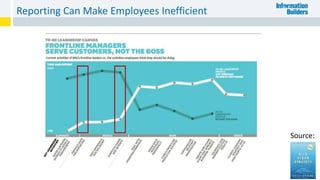
Reporting Can Make Employees Inefficient
28
Source:
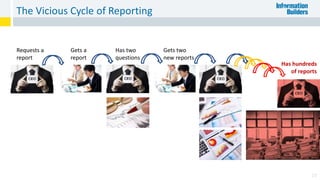
The Vicious Cycle of Reporting
29
Requests a
report
Gets a
report
Has two
questions
Gets two
new reports
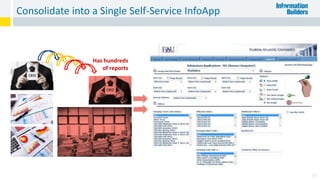
Has hundreds
of reports
Consolidate into a Single Self-Service InfoApp
30
Has hundreds
of reports
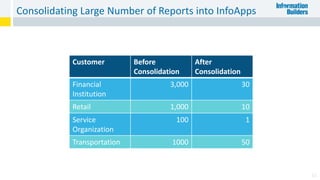
Consolidating Large Number of Reports into InfoApps
31
Customer Before
Consolidation
After
Consolidation
Financial
Institution
3,000 30
Retail 1,000 10
Service
Organization
100 1
Transportation 1000 50
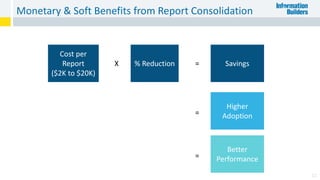
Monetary & Soft Benefits from Report Consolidation
32
% Reduction
Cost per
Report
($2K to $20K)
X Savings=
Higher
Adoption=
Better
Performance=
Trend 4
33
The Rise of Customer-Facing Analytics: Monetizing data and
consumerizing analytics
Productizing & Consumerizing
34
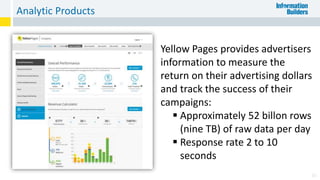
Analytic Products
35
Yellow Pages provides advertisers
information to measure the
return on their advertising dollars
and track the success of their
campaigns:
 Approximately 52 billon rows
(nine TB) of raw data per day
 Response rate 2 to 10
seconds
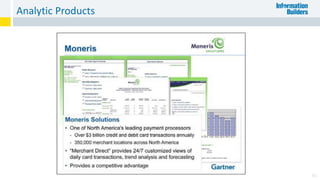
Analytic Products
36
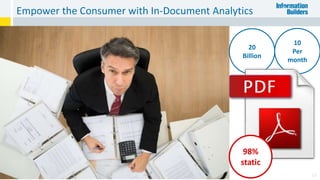
Empower the Consumer with In-Document Analytics
37
20
Billion
10
Per
month
98%
static
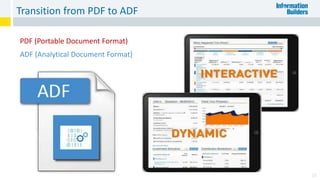
Transition from PDF to ADF
38
PDF (Portable Document Format)
ADF (Analytical Document Format)
Trend 5
39
Data Management in the Digital Enterprise: Master data
management (MDM), data quality, and governance
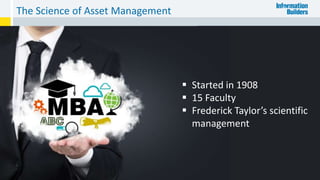
The Science of Asset Management
40
 Started in 1908
 15 Faculty
 Frederick Taylor’s scientific
management
ISO 55000
41
 ISO 55000 is an international standard covering
management of physical assets.
42
 Launched in January 2014
An asset management system provides a structured, best practice approach to
managing the lifecycle of assets.
 Reduced risks associated with ownership of assets – anything from unnecessary
maintenance costs and inefficiency to accident prevention (explosions at gas
plants for example)
 Improved quality assurance for customers/regulators – where assets play a key
role in the provision and quality of products and services
 New business acquisition - stakeholders gain confidence from the knowledge
that a strategy is in place to ensure assets meet the necessary safety and
performance requirements
 Supports international business growth – demonstrating that the requirements
of an internationally recognized asset management system are being met
43
Source: www.bsigroup.com
Did They Miss the News?
44
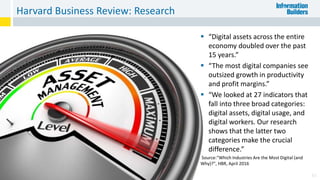
Harvard Business Review: Research
45
 “Digital assets across the entire
economy doubled over the past
15 years.”
 “The most digital companies see
outsized growth in productivity
and profit margins.”
 “We looked at 27 indicators that
fall into three broad categories:
digital assets, digital usage, and
digital workers. Our research
shows that the latter two
categories make the crucial
difference.”
Source:“Which Industries Are the Most Digital (and
Why)?”, HBR, April 2016
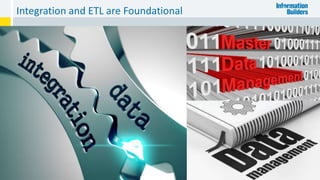
Integration and ETL are Foundational
46
Meet us at Event Title!
Donec rhoncus eu ipsum in auctor. Nulla facilisi. Nunc facilisis neque non turpis
euismod, sit amet tempor mi hendrerit.
CALL TO ACTION
Booth #7803
Event Logo
Thank you!
#DataTrends
Full Screen Capture Page

5 Hot Trends for Data Analytics in 2017

  • 1.
    Meet us atEvent Title! Donec rhoncus eu ipsum in auctor. Nulla facilisi. Nunc facilisis neque non turpis euismod, sit amet tempor mi hendrerit. CALL TO ACTION Booth #7803 Event Logo Dr. Rado Kotorov, Chief Innovation Officer Information Builders 5 Hot Trends for Data and Analytics in 2017 #DataTrends
  • 2.
  • 3.
    IT and BusinessHave Divergent Priorities 3 Technology Projects New Revenue Models
  • 4.
    Why Didn’t ITInvent UBER? 4
  • 5.
    Business Is Asking:Why Do We Miss Opportunities? 5
  • 6.
    Change the Mindset:Manage Cyber Assets 6
  • 7.
    Change the Mindset:Innovate with Data 7
  • 8.
    Change the Mindset:Think Data Monetization 8
  • 9.
    Success Requires ITand Business Partnership 9
  • 10.
    Trend 1 10 Industry 4.0:Building the new digital enterprise using automation
  • 11.
    Transition to Enterprise4.0 Is a Strategic Priority 11
  • 12.
    The Foundation ofEnterprise 4.0 12 PWC 2016 Global Industry 4.0 Survey
  • 13.
    The Foundation ofEnterprise 4.0 13PWC 2016 Global Industry 4.0 Survey
  • 14.
    Imperative: Manage TheData Value Chain 14
  • 15.
    Trend 2 15 Analytics inthe Digital Culture Revolution: Democratizing BI for fact-based decision making
  • 16.
    Only 22% ofEmployees Have Access to BI & Analytics 16
  • 17.
    The Most ImportantStakeholders Are Left Out Cut Off
  • 18.
    Operational Intelligence 18 Why YouNeed to Rethink Your Data and Analytics Roles Now, Gartner July 26, 2016
  • 19.
  • 20.
    How to DeliverBI to Operational Decision Makers? 20 “Data Science is the art of turning data into actions. This is accomplished through the creation of data products, which provide actionable information without exposing decision makers to the underlying data or analytics (e.g., buy/sell strategies for financial instruments, a set of actions to improve product yield, or steps to improve product marketing).” Booz Allen Hamilton
  • 21.
  • 22.
    Expedia: 1,000s offields/100s of reports/0 training 22 Why do we use this analogy?
  • 23.
    InfoApps: Iterative Dialogwith Data to Find Answers 23
  • 24.
    The 5 BuildingBlocks of an InfoApp 24 1) Domains – top level knowledge buckets • Map your data to knowledge domains 2) Suggestive entry page • Make it obvious what the user can look for 3) Suggestive results page • Display the results from the information request 4) Carry-over domain and initial search criteria • Users can iterate their first requests 5) Prompts and controls for complete personalization • Personalize completely your information request
  • 25.
    An InfoApp EmpowersMechanics to Save Money 25 An InfoApp from Information Builders available in 14 different languages for 60,000+ users in 14,000 dealerships. Helps employees make on the job repair- or-replace decisions and save Ford $60 million per year.
  • 26.
    Trend 3 26 Report Consolidation:Cutting costs, improving BI adoption, and moving from reports to InfoApps™
  • 27.
  • 28.
    Reporting Can MakeEmployees Inefficient 28 Source:
  • 29.
    The Vicious Cycleof Reporting 29 Requests a report Gets a report Has two questions Gets two new reports Has hundreds of reports
  • 30.
    Consolidate into aSingle Self-Service InfoApp 30 Has hundreds of reports
  • 31.
    Consolidating Large Numberof Reports into InfoApps 31 Customer Before Consolidation After Consolidation Financial Institution 3,000 30 Retail 1,000 10 Service Organization 100 1 Transportation 1000 50
  • 32.
    Monetary & SoftBenefits from Report Consolidation 32 % Reduction Cost per Report ($2K to $20K) X Savings= Higher Adoption= Better Performance=
  • 33.
    Trend 4 33 The Riseof Customer-Facing Analytics: Monetizing data and consumerizing analytics
  • 34.
  • 35.
    Analytic Products 35 Yellow Pagesprovides advertisers information to measure the return on their advertising dollars and track the success of their campaigns:  Approximately 52 billon rows (nine TB) of raw data per day  Response rate 2 to 10 seconds
  • 36.
  • 37.
    Empower the Consumerwith In-Document Analytics 37 20 Billion 10 Per month 98% static
  • 38.
    Transition from PDFto ADF 38 PDF (Portable Document Format) ADF (Analytical Document Format)
  • 39.
    Trend 5 39 Data Managementin the Digital Enterprise: Master data management (MDM), data quality, and governance
  • 40.
    The Science ofAsset Management 40  Started in 1908  15 Faculty  Frederick Taylor’s scientific management
  • 41.
  • 42.
     ISO 55000is an international standard covering management of physical assets. 42  Launched in January 2014
  • 43.
    An asset managementsystem provides a structured, best practice approach to managing the lifecycle of assets.  Reduced risks associated with ownership of assets – anything from unnecessary maintenance costs and inefficiency to accident prevention (explosions at gas plants for example)  Improved quality assurance for customers/regulators – where assets play a key role in the provision and quality of products and services  New business acquisition - stakeholders gain confidence from the knowledge that a strategy is in place to ensure assets meet the necessary safety and performance requirements  Supports international business growth – demonstrating that the requirements of an internationally recognized asset management system are being met 43 Source: www.bsigroup.com
  • 44.
    Did They Missthe News? 44
  • 45.
    Harvard Business Review:Research 45  “Digital assets across the entire economy doubled over the past 15 years.”  “The most digital companies see outsized growth in productivity and profit margins.”  “We looked at 27 indicators that fall into three broad categories: digital assets, digital usage, and digital workers. Our research shows that the latter two categories make the crucial difference.” Source:“Which Industries Are the Most Digital (and Why)?”, HBR, April 2016
  • 46.
    Integration and ETLare Foundational 46
  • 47.
    Meet us atEvent Title! Donec rhoncus eu ipsum in auctor. Nulla facilisi. Nunc facilisis neque non turpis euismod, sit amet tempor mi hendrerit. CALL TO ACTION Booth #7803 Event Logo Thank you! #DataTrends
  • 48.