5 Best Practices for
Identifying Potential Leaders
How the right talent investments now
create leaders for a successful tomorrow
©Development Dimensions International, Inc., 2018. All rights reserved.1
©Development Dimensions International, Inc., 2018. All rights reserved.
2
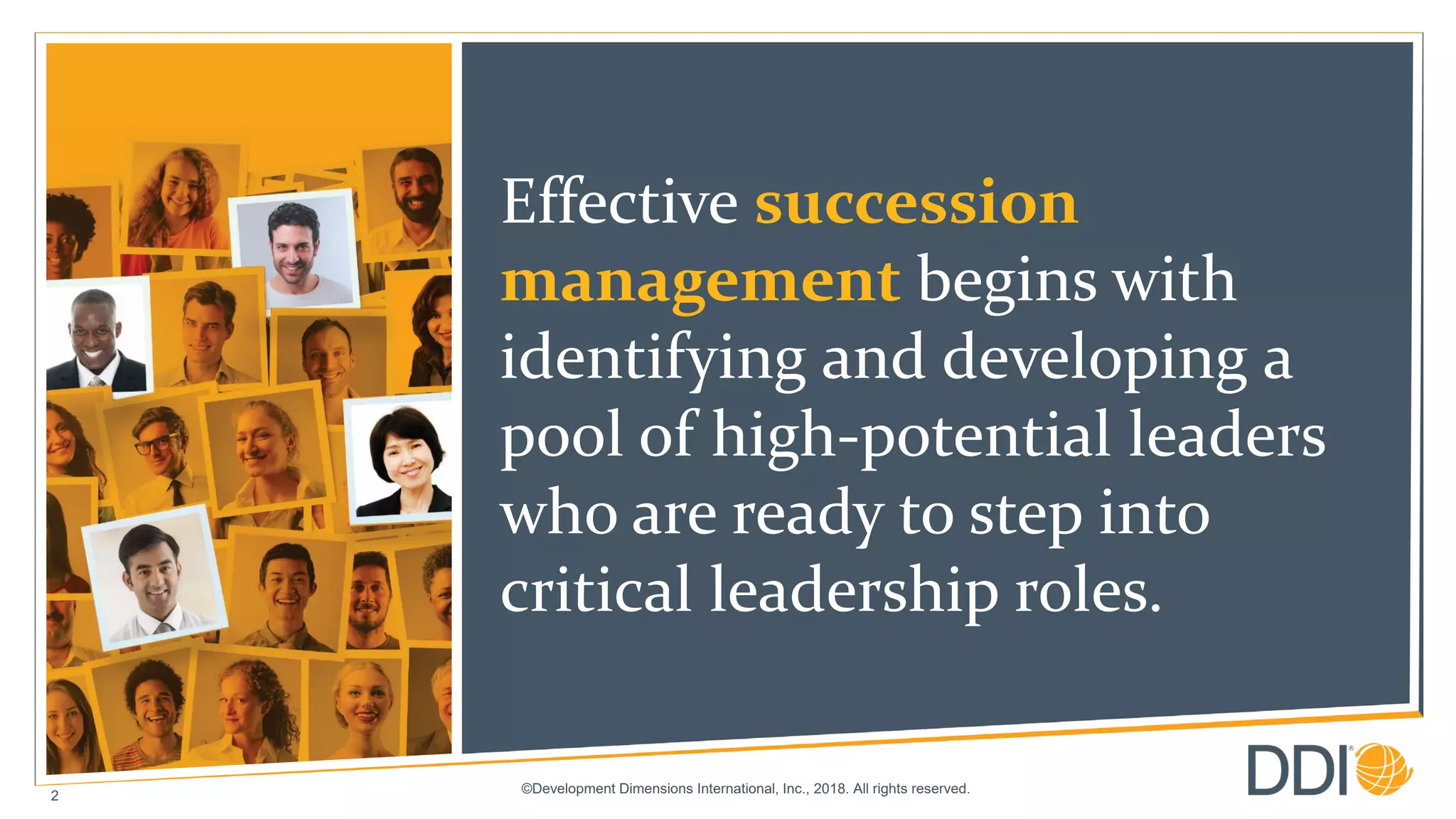
Effective succession
management begins with
identifying and developing a
pool of high-potential leaders
who are ready to step into
critical leadership roles.
©Development Dimensions International, Inc., 2018. All rights reserved.
3
High potentials, also known as
“top talent,” “high flyers,” or
“acceleration pool members,”
are believed to have the best chance
to rapidly grow their capabilities and
fill critical roles in the near future.
©Development Dimensions International, Inc., 2018. All rights reserved.
4
By most definitions, an acceleration
pool of leaders represents a critical
investment of time and resources.
©Development Dimensions International, Inc., 2018. All rights reserved.
5
Much like a personal decision to
invest in a stock or mutual fund, the
process for identifying high potentials
requires FOUR Absolutes.
©Development Dimensions International, Inc., 2018. All rights reserved.
6
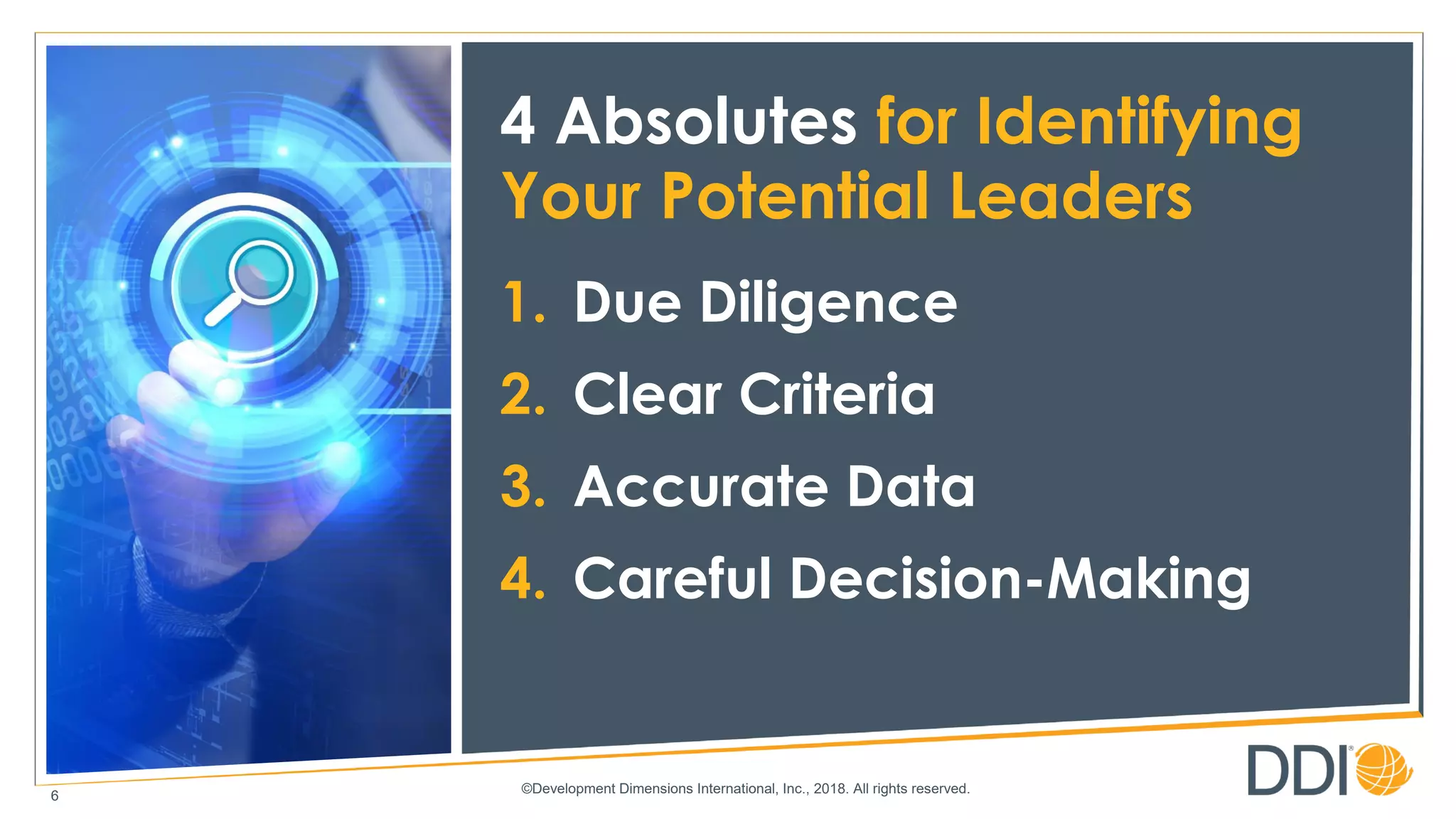
4 Absolutes for Identifying
Your Potential Leaders
1. Due Diligence
2. Clear Criteria
3. Accurate Data
4. Careful Decision-Making
©Development Dimensions International, Inc., 2018. All rights reserved.
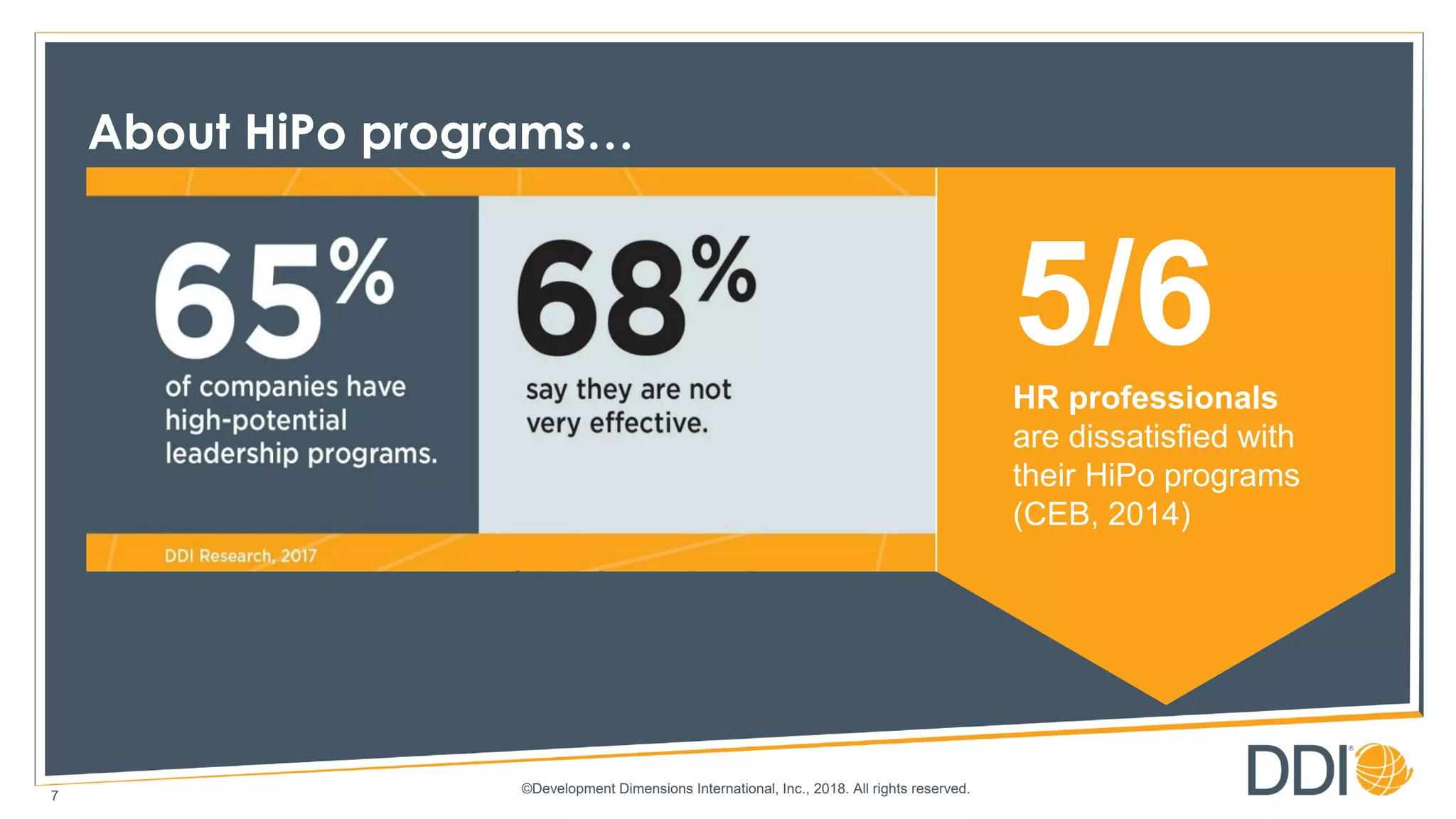
About HiPo programs…
7
5/6HR professionals
are dissatisfied with
their HiPo programs
(CEB, 2014)
©Development Dimensions International, Inc., 2018. All rights reserved.
8
Here are 5 Best Practices for making the right
talent investments in your organization:
1. Don’t shortchange high-potential nominations.
2. Define potentially consistently.
3. Ensure your pool includes diverse skill sets and
mindsets.
4. Separate potential from performance from
readiness.
5. Equip managers to become talent scouts.
©Development Dimensions International, Inc., 2018. All rights reserved.
9
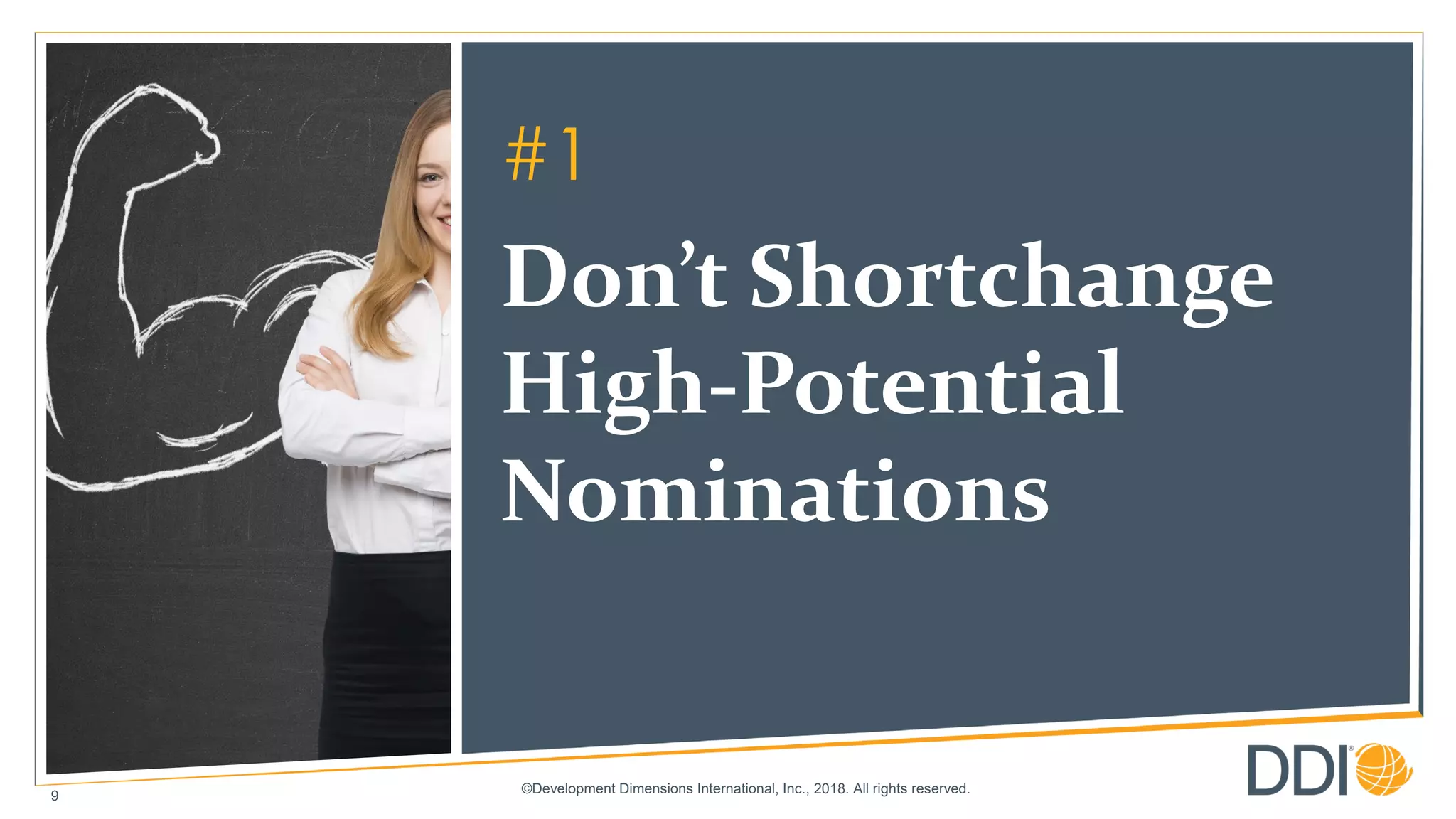
#1
Don’t Shortchange
High-Potential
Nominations
©Development Dimensions International, Inc., 2018. All rights reserved.
10
The evaluation and nomination of
high potentials is often embedded as
a component of a larger talent review
process at top levels of the
organization, and doesn’t always get
the proper emphasis.
©Development Dimensions International, Inc., 2018. All rights reserved.
11
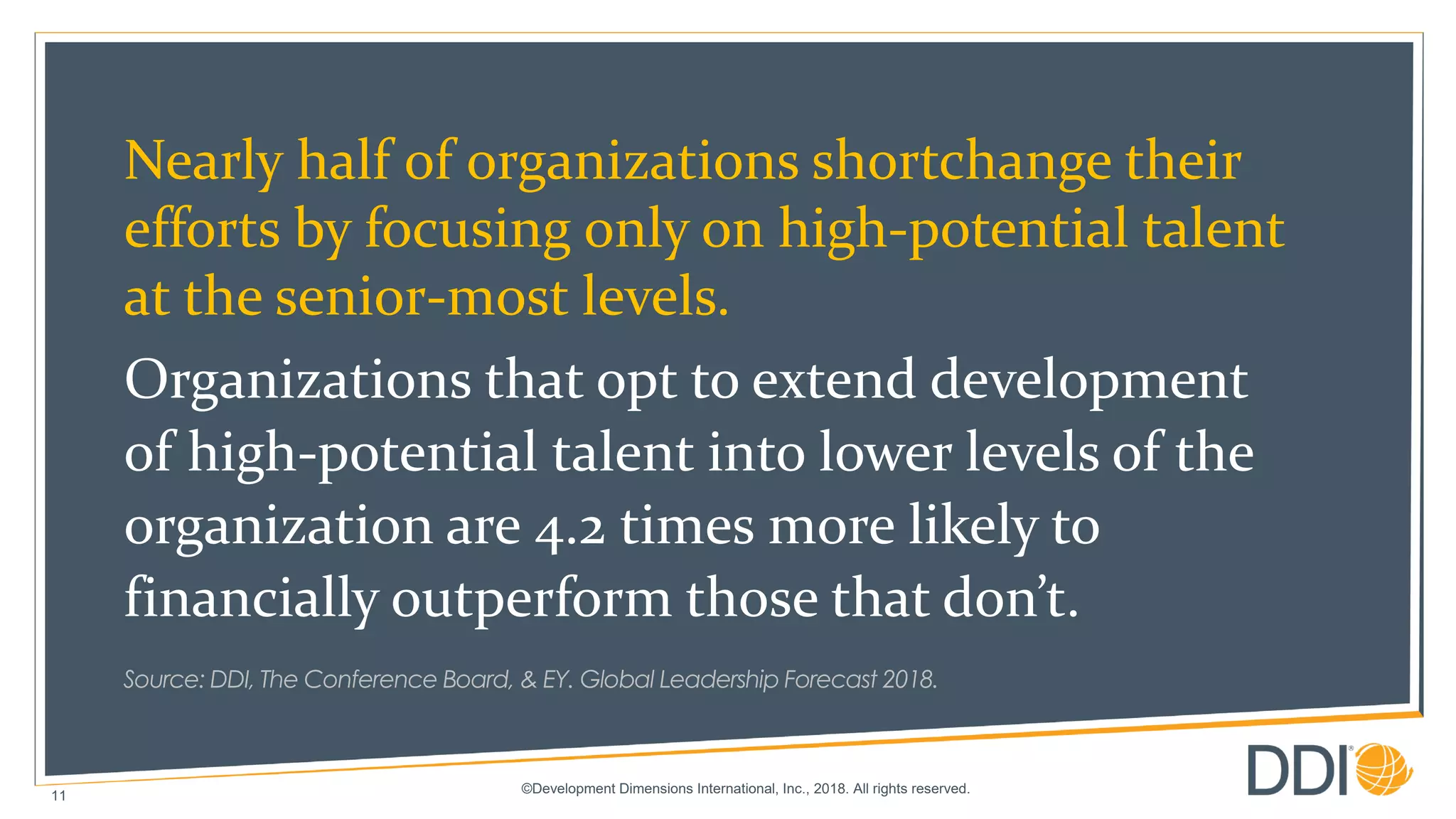
Nearly half of organizations shortchange their
efforts by focusing only on high-potential talent
at the senior-most levels.
Organizations that opt to extend development
of high-potential talent into lower levels of the
organization are 4.2 times more likely to
financially outperform those that don’t.
Source: DDI, The Conference Board, & EY. Global Leadership Forecast 2018.
©Development Dimensions International, Inc., 2018. All rights reserved.
12
Create focus and rigor by:
• Using objective assessments to identify potential.
• Giving managers clear direction for evaluating
and nominating high potentials.
• Taking a full-pipeline approach to build a strong
pool of leaders from frontline to executive.
©Development Dimensions International, Inc., 2018. All rights reserved.
13
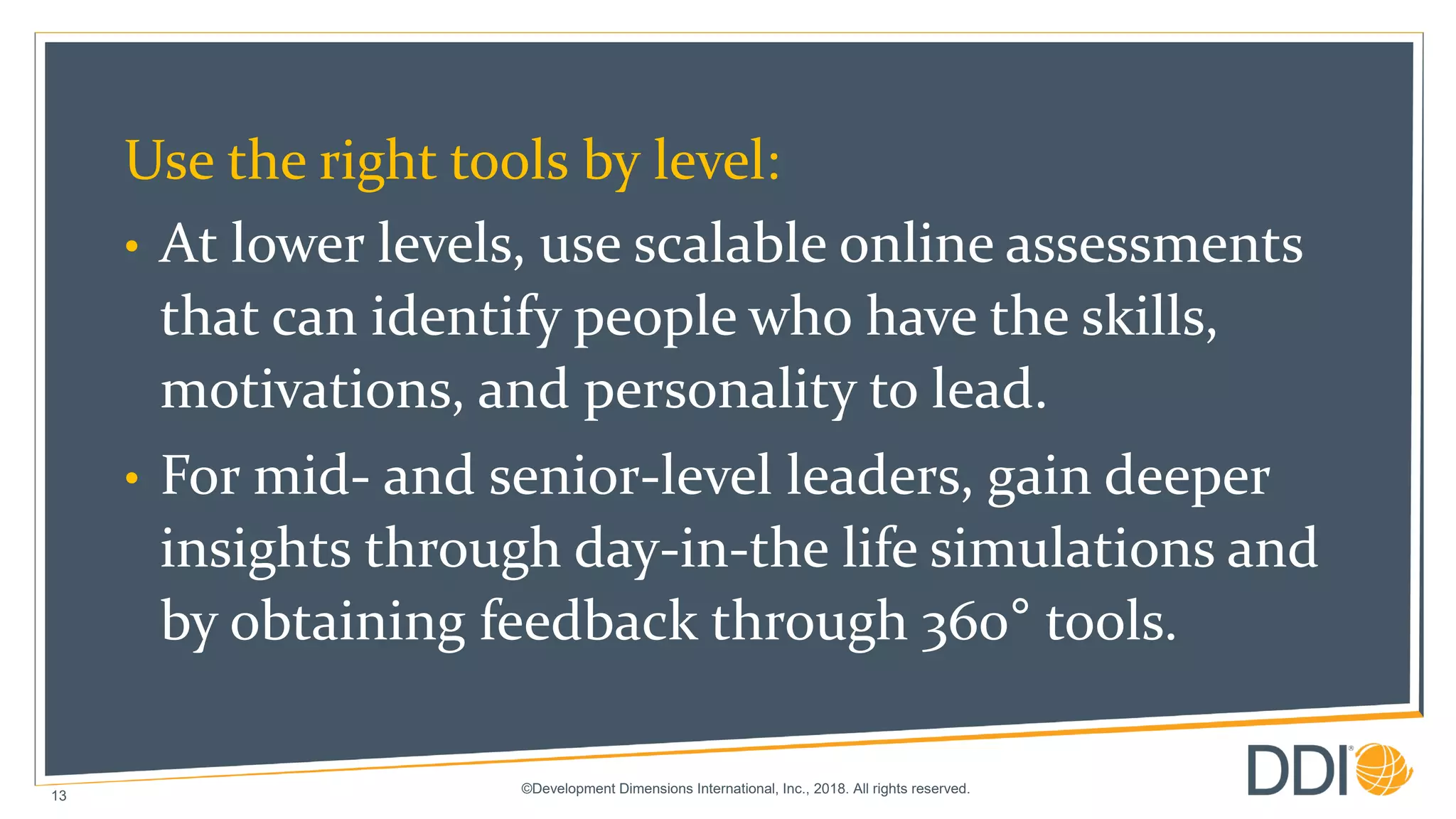
Use the right tools by level:
• At lower levels, use scalable online assessments
that can identify people who have the skills,
motivations, and personality to lead.
• For mid- and senior-level leaders, gain deeper
insights through day-in-the life simulations and
by obtaining feedback through 360° tools.
©Development Dimensions International, Inc., 2018. All rights reserved.
14
#2
Define Potential
Consistently
©Development Dimensions International, Inc., 2018. All rights reserved.
15
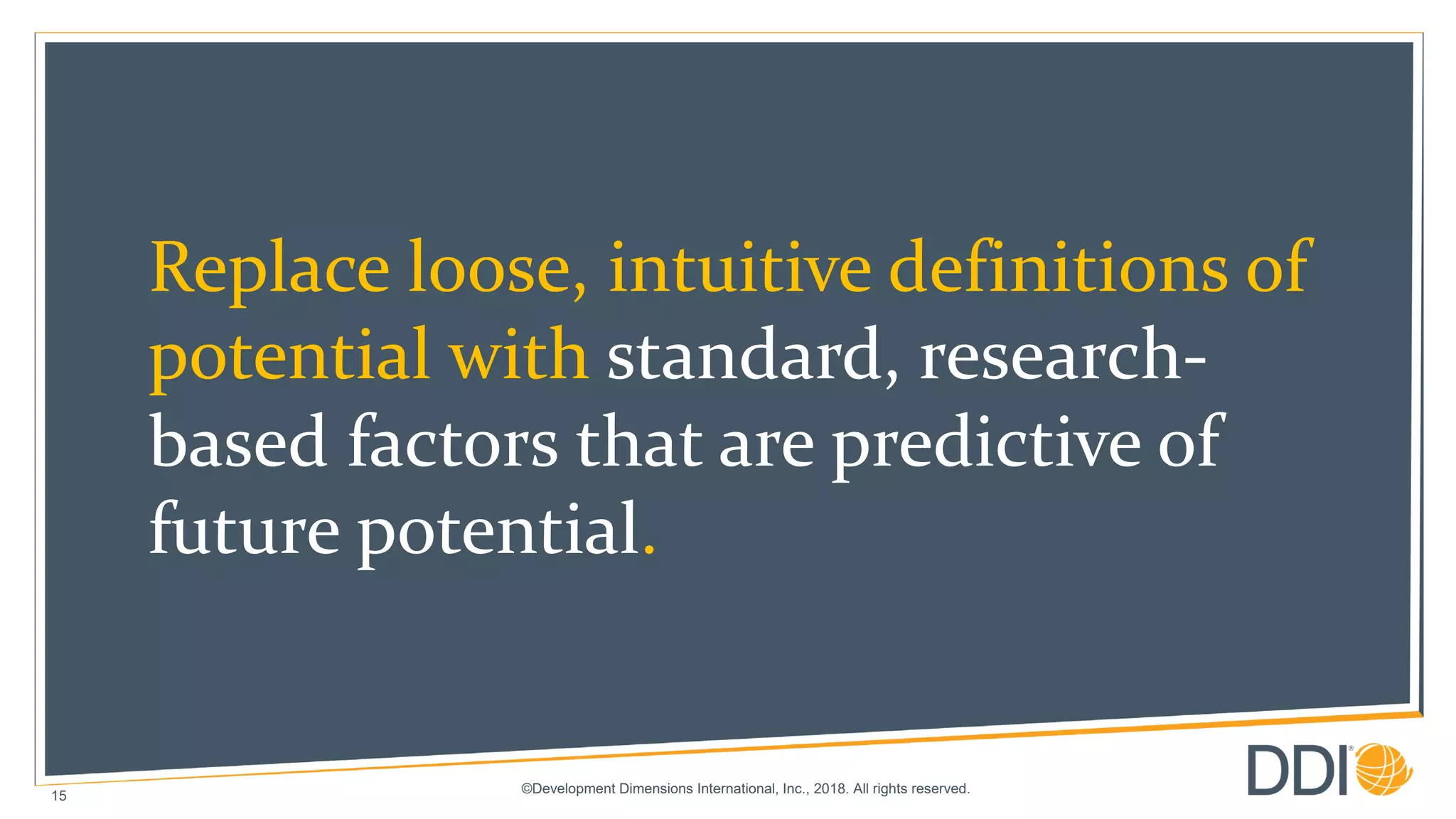
Replace loose, intuitive definitions of
potential with standard, research-
based factors that are predictive of
future potential.
©Development Dimensions International, Inc., 2018. All rights reserved.
16
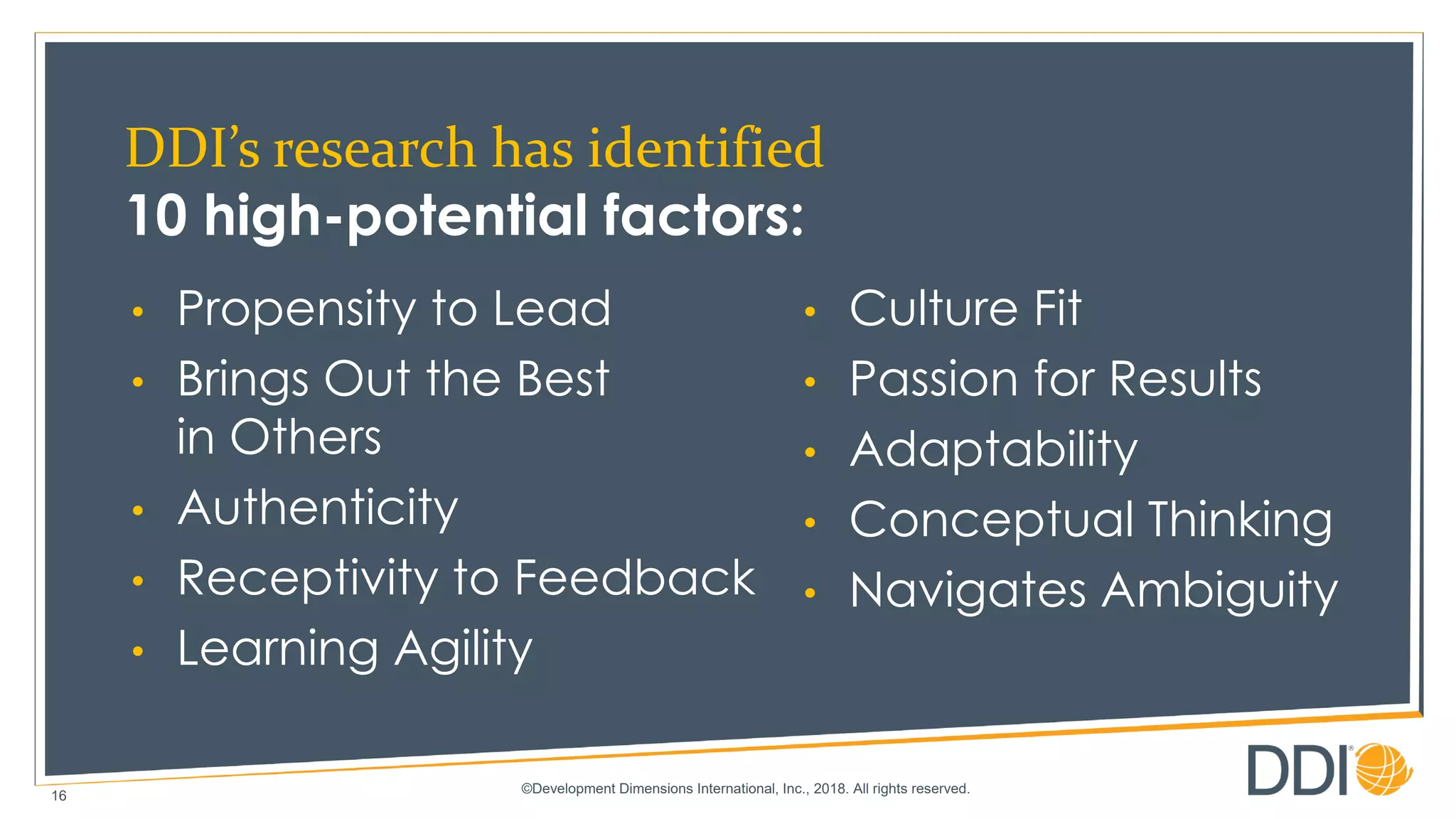
DDI’s research has identified
10 high-potential factors:
• Propensity to Lead
• Brings Out the Best
in Others
• Authenticity
• Receptivity to Feedback
• Learning Agility
• Culture Fit
• Passion for Results
• Adaptability
• Conceptual Thinking
• Navigates Ambiguity
©Development Dimensions International, Inc., 2018. All rights reserved.
17
Nomination must first confirm a
solid track record of past
performance, but these 10 factors are
the real differentiators for potential
in accelerated development.
©Development Dimensions International, Inc., 2018. All rights reserved.
18
Taken as a whole, they address
motivations, learning orientation,
and propensity to lead with the
increasingly ambiguous, complex, and
dynamic nature of strategic roles.
Motivation + Learning Orientation
©Development Dimensions International, Inc., 2018. All rights reserved.
19
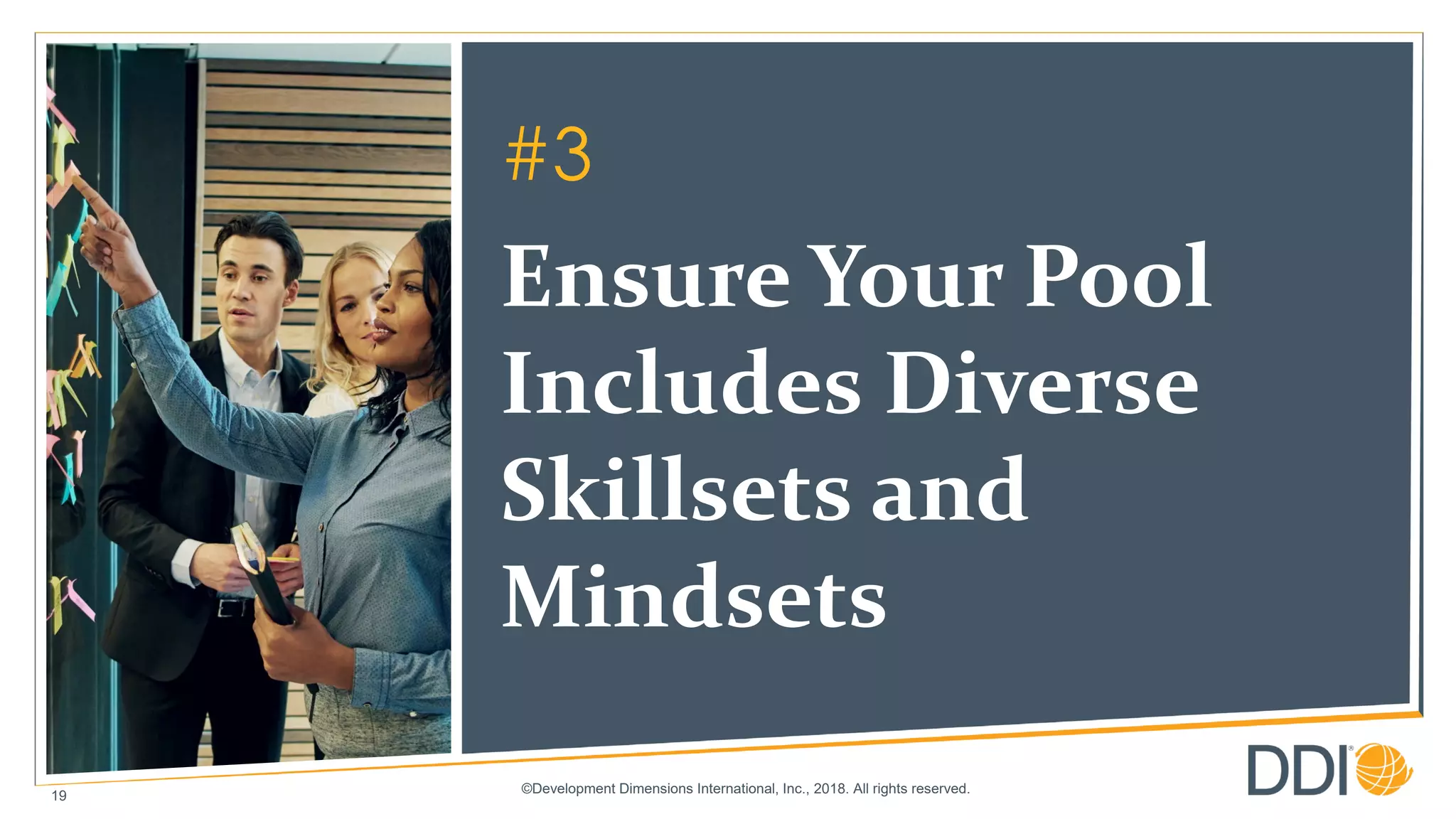
#3
Ensure Your Pool
Includes Diverse
Skillsets and
Mindsets
©Development Dimensions International, Inc., 2018. All rights reserved.
20
In many organizations, identifying
leadership potential starts with
looking for people who are most
similar to the organization’s current
leaders.
©Development Dimensions International, Inc., 2018. All rights reserved.
21
But because of the rapidly changing business
environment, the types of leaders you need in
the future may be very different than the
leaders you have today.
A strong high-potential pool should include
people with a broad range of skillsets and
mindsets.
©Development Dimensions International, Inc., 2018. All rights reserved.
22
The goal is to create a pool of people
who represent a broad range of skills
and perspectives to quickly step into
leadership roles to help the
organization innovate and adapt to
rapidly shifting business challenges.
©Development Dimensions International, Inc., 2018. All rights reserved.
23
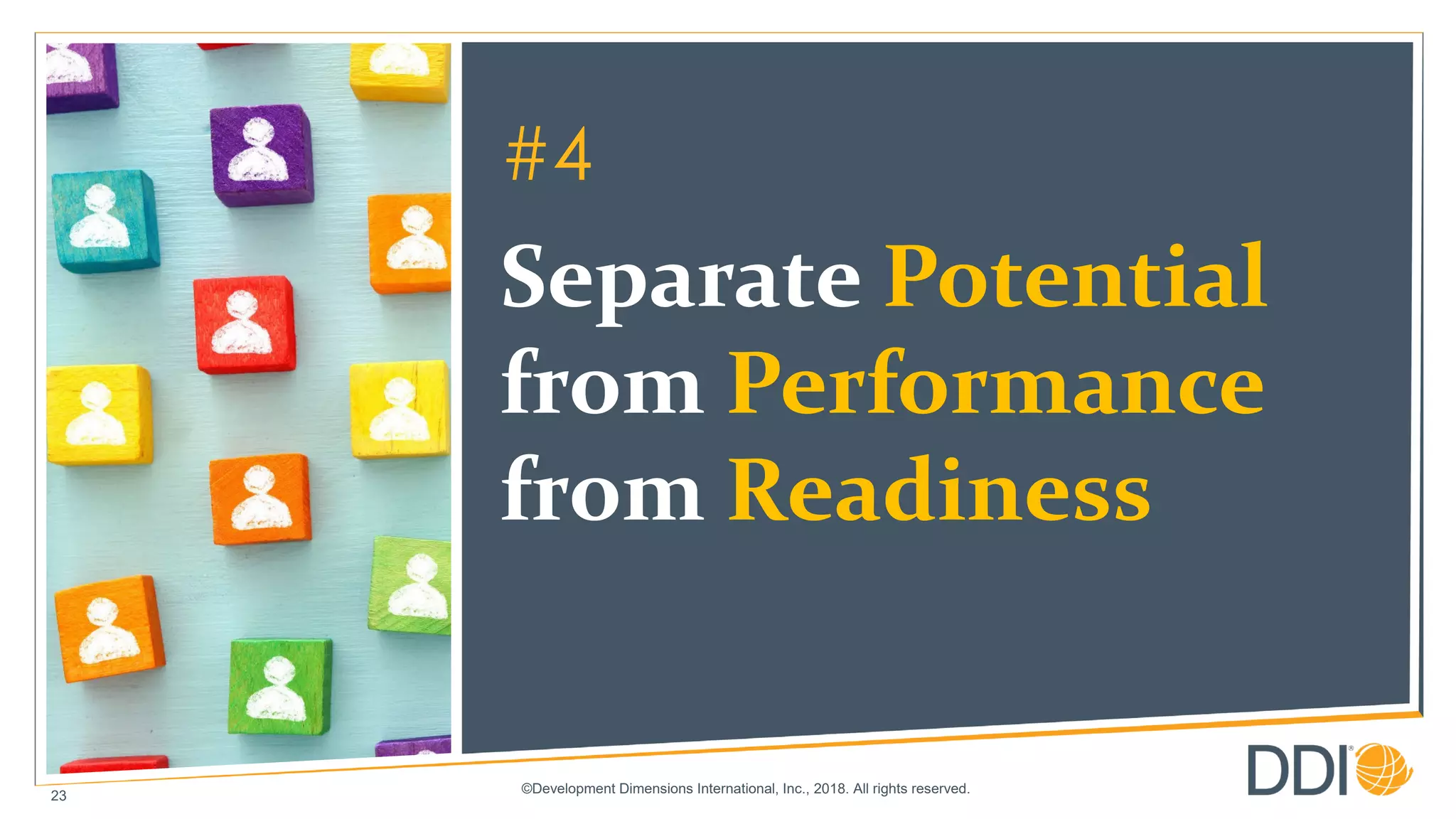
#4
Separate Potential
from Performance
from Readiness
©Development Dimensions International, Inc., 2018. All rights reserved.
24
These three concepts – performance,
potential, and readiness – are often
confused.
©Development Dimensions International, Inc., 2018. All rights reserved.
25
Potential = The likelihood that an individual can develop
into a successful leader with significantly expanded,
higher-level leadership responsibilities.
Performance = An individual’s level of success in
executing objectives in one’s current (or past) roles.
Includes demonstration of required competencies.
Readiness = The degree to which an individual’s
competencies, experiences, knowledge, and personal
attributes meet the requirements for a role or job family.
©Development Dimensions International, Inc., 2018. All rights reserved.
26
Past performance is a predictor of
future performance, but only when the
challenges and roles remain consistent.
©Development Dimensions International, Inc., 2018. All rights reserved.
27
Since significantly new and different
challenges lie ahead for high
potentials, it is critical to differentiate
and evaluate potential and readiness.
©Development Dimensions International, Inc., 2018. All rights reserved.
28
#5
Equip Managers to
Become Talent
Scouts
©Development Dimensions International, Inc., 2018. All rights reserved.
29
Engage leaders and managers
from the start.
Communication is vital to attain
buy-in, set expectations, and
establish processes, roles,
accountabilities, and metrics.
©Development Dimensions International, Inc., 2018. All rights reserved.
30
Managers, as guardians of the
enterprise’s talent, can serve as
“talent scouts” at other times
during the year.
©Development Dimensions International, Inc., 2018. All rights reserved.
31
Talent Scout workshops for managers
can help build a shared understanding
of potential, address biases, and
confirm accountabilities.
©Development Dimensions International, Inc., 2018. All rights reserved.
32
Sometimes, this means uncovering
hidden talent that wouldn’t
otherwise be discovered by only
thinking of potential once a year.
©Development Dimensions International, Inc., 2018. All rights reserved.
33
In Review
©Development Dimensions International, Inc., 2018. All rights reserved.
34
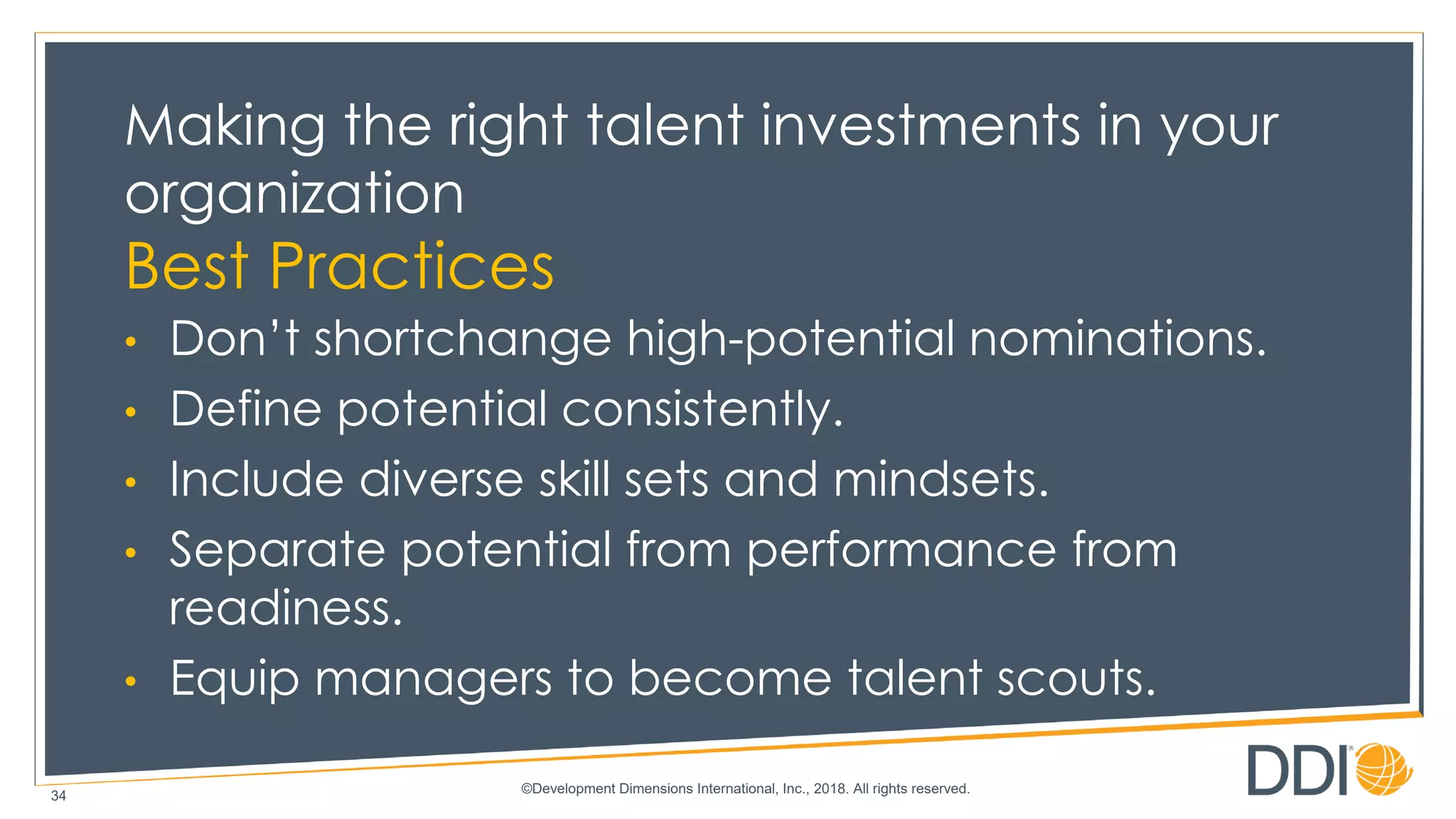
Making the right talent investments in your
organization
Best Practices
• Don’t shortchange high-potential nominations.
• Define potential consistently.
• Include diverse skill sets and mindsets.
• Separate potential from performance from
readiness.
• Equip managers to become talent scouts.
©Development Dimensions International, Inc., 2018. All rights reserved.
35
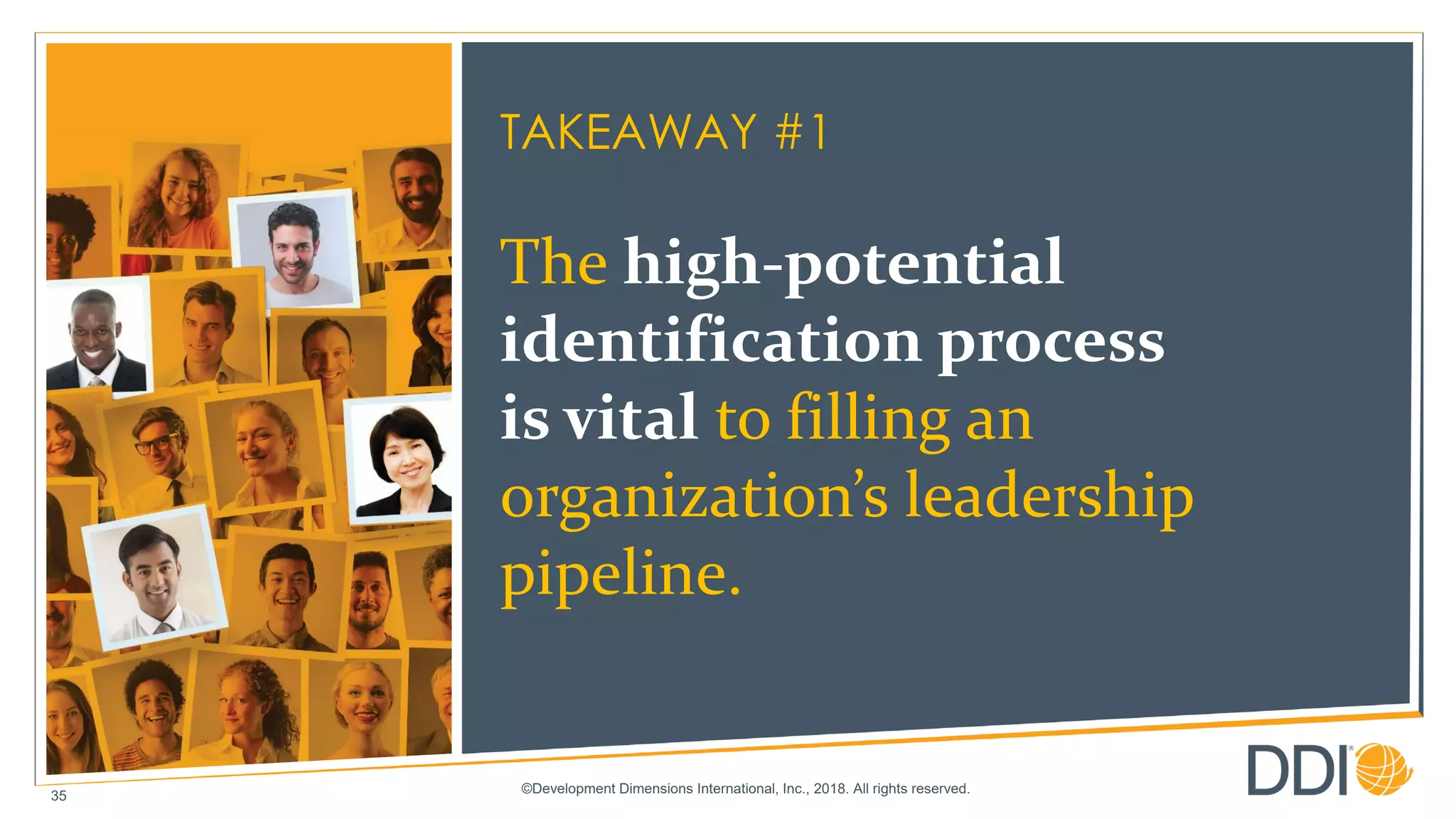
TAKEAWAY #1
The high-potential
identification process
is vital to filling an
organization’s leadership
pipeline.
©Development Dimensions International, Inc., 2018. All rights reserved.
36
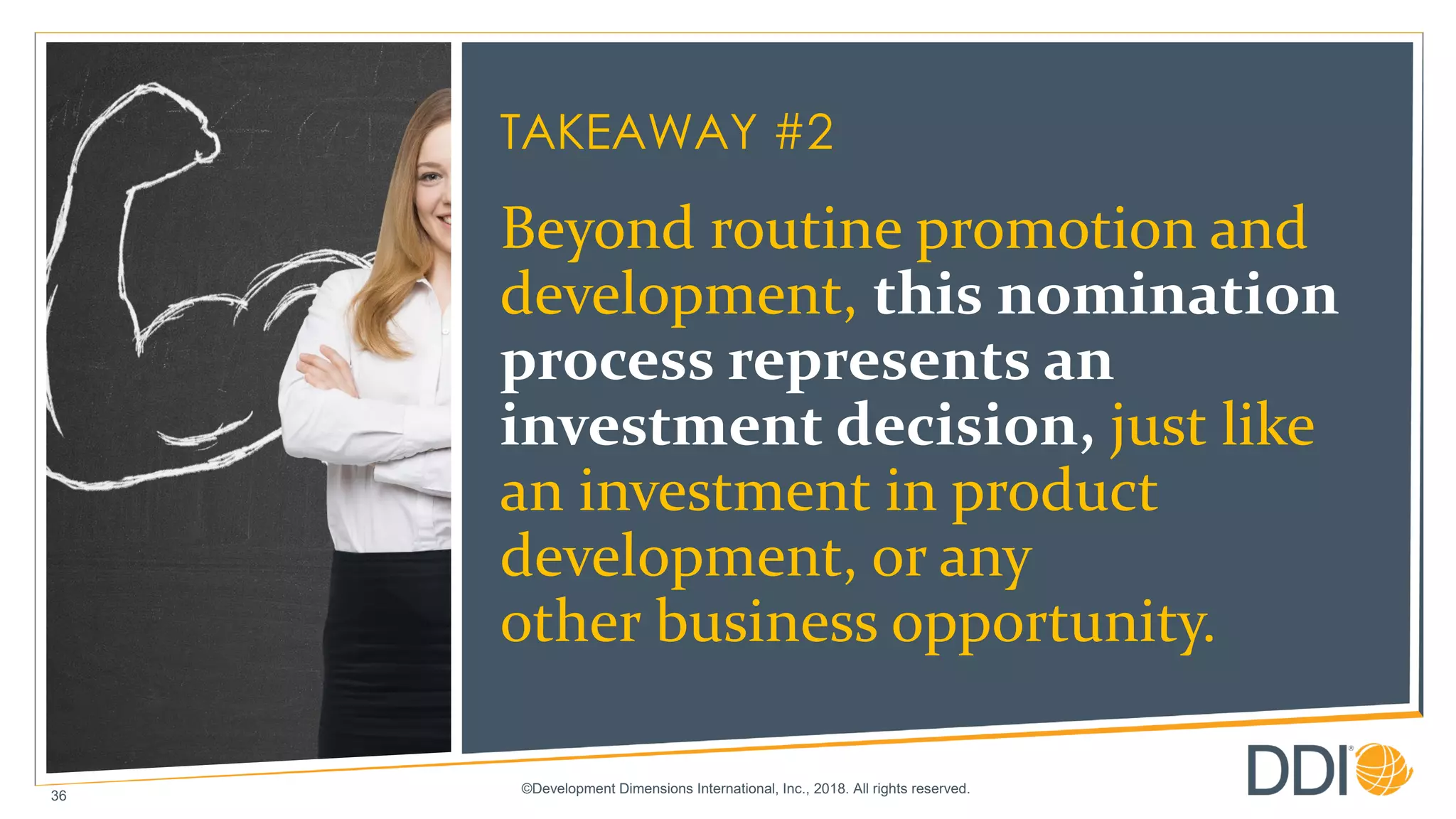
TAKEAWAY #2
Beyond routine promotion and
development, this nomination
process represents an
investment decision, just like
an investment in product
development, or any
other business opportunity.
©Development Dimensions International, Inc., 2018. All rights reserved.
37
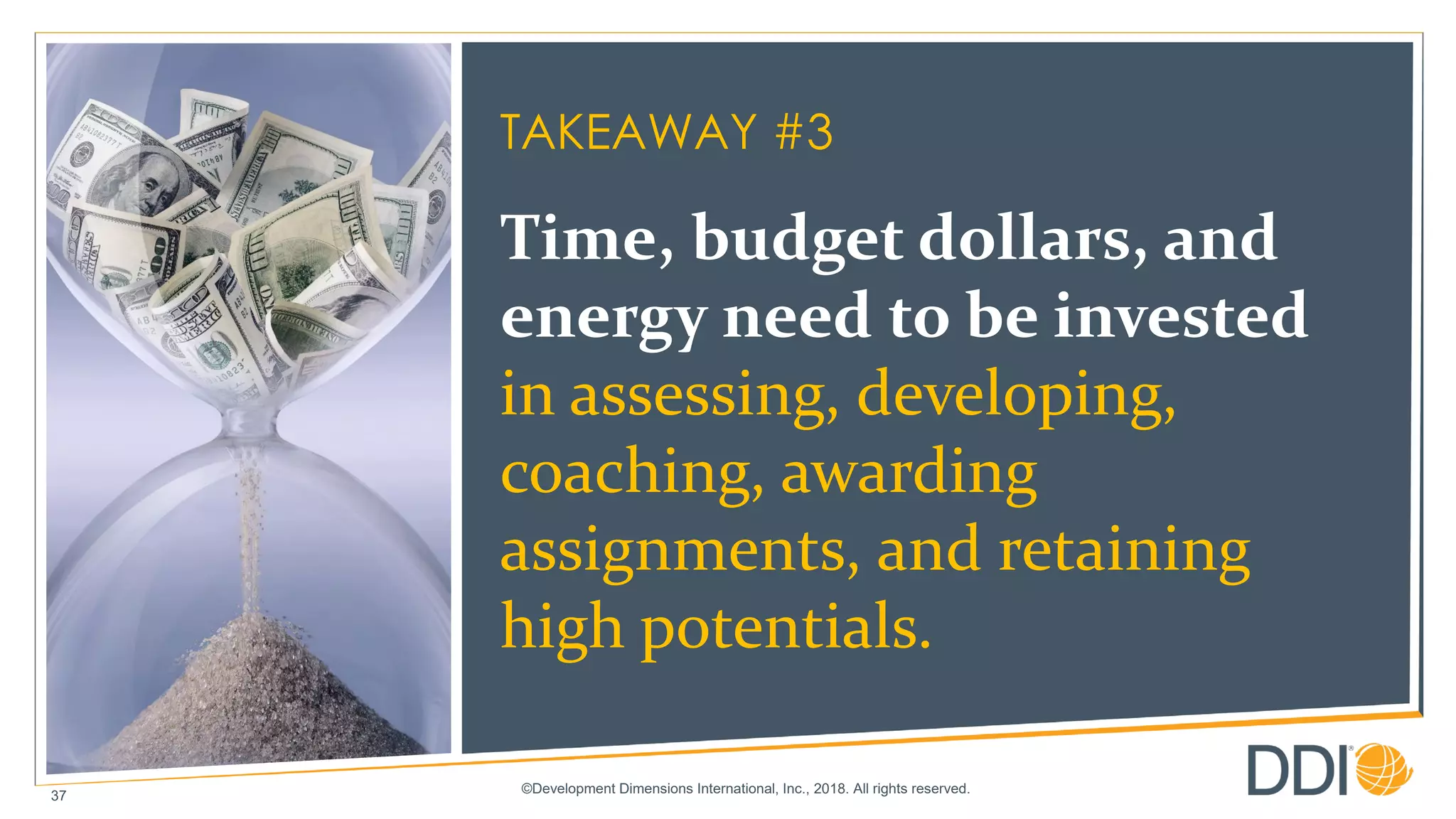
TAKEAWAY #3
Time, budget dollars, and
energy need to be invested
in assessing, developing,
coaching, awarding
assignments, and retaining
high potentials.
©Development Dimensions International, Inc., 2018. All rights reserved.
38
TAKEAWAY #4
Ensuring that you perform
due diligence to accurately
and objectively identify a
diverse pool of high-
potential leaders will
determine the return on the
high-potential investment.
©Development Dimensions International, Inc., 2018. All rights reserved.
Succession experts are standing by at 800.933.4463 or
info@ddiworld.com to help guide your initiatives.
39
Ready to identify
your potential future
leaders?

5 Best Practices for Identifying Potential Leaders

  • 1.
    5 Best Practicesfor Identifying Potential Leaders How the right talent investments now create leaders for a successful tomorrow ©Development Dimensions International, Inc., 2018. All rights reserved.1
  • 2.
    ©Development Dimensions International,Inc., 2018. All rights reserved. 2 Effective succession management begins with identifying and developing a pool of high-potential leaders who are ready to step into critical leadership roles.
  • 3.
    ©Development Dimensions International,Inc., 2018. All rights reserved. 3 High potentials, also known as “top talent,” “high flyers,” or “acceleration pool members,” are believed to have the best chance to rapidly grow their capabilities and fill critical roles in the near future.
  • 4.
    ©Development Dimensions International,Inc., 2018. All rights reserved. 4 By most definitions, an acceleration pool of leaders represents a critical investment of time and resources.
  • 5.
    ©Development Dimensions International,Inc., 2018. All rights reserved. 5 Much like a personal decision to invest in a stock or mutual fund, the process for identifying high potentials requires FOUR Absolutes.
  • 6.
    ©Development Dimensions International,Inc., 2018. All rights reserved. 6 4 Absolutes for Identifying Your Potential Leaders 1. Due Diligence 2. Clear Criteria 3. Accurate Data 4. Careful Decision-Making
  • 7.
    ©Development Dimensions International,Inc., 2018. All rights reserved. About HiPo programs… 7 5/6HR professionals are dissatisfied with their HiPo programs (CEB, 2014)
  • 8.
    ©Development Dimensions International,Inc., 2018. All rights reserved. 8 Here are 5 Best Practices for making the right talent investments in your organization: 1. Don’t shortchange high-potential nominations. 2. Define potentially consistently. 3. Ensure your pool includes diverse skill sets and mindsets. 4. Separate potential from performance from readiness. 5. Equip managers to become talent scouts.
  • 9.
    ©Development Dimensions International,Inc., 2018. All rights reserved. 9 #1 Don’t Shortchange High-Potential Nominations
  • 10.
    ©Development Dimensions International,Inc., 2018. All rights reserved. 10 The evaluation and nomination of high potentials is often embedded as a component of a larger talent review process at top levels of the organization, and doesn’t always get the proper emphasis.
  • 11.
    ©Development Dimensions International,Inc., 2018. All rights reserved. 11 Nearly half of organizations shortchange their efforts by focusing only on high-potential talent at the senior-most levels. Organizations that opt to extend development of high-potential talent into lower levels of the organization are 4.2 times more likely to financially outperform those that don’t. Source: DDI, The Conference Board, & EY. Global Leadership Forecast 2018.
  • 12.
    ©Development Dimensions International,Inc., 2018. All rights reserved. 12 Create focus and rigor by: • Using objective assessments to identify potential. • Giving managers clear direction for evaluating and nominating high potentials. • Taking a full-pipeline approach to build a strong pool of leaders from frontline to executive.
  • 13.
    ©Development Dimensions International,Inc., 2018. All rights reserved. 13 Use the right tools by level: • At lower levels, use scalable online assessments that can identify people who have the skills, motivations, and personality to lead. • For mid- and senior-level leaders, gain deeper insights through day-in-the life simulations and by obtaining feedback through 360° tools.
  • 14.
    ©Development Dimensions International,Inc., 2018. All rights reserved. 14 #2 Define Potential Consistently
  • 15.
    ©Development Dimensions International,Inc., 2018. All rights reserved. 15 Replace loose, intuitive definitions of potential with standard, research- based factors that are predictive of future potential.
  • 16.
    ©Development Dimensions International,Inc., 2018. All rights reserved. 16 DDI’s research has identified 10 high-potential factors: • Propensity to Lead • Brings Out the Best in Others • Authenticity • Receptivity to Feedback • Learning Agility • Culture Fit • Passion for Results • Adaptability • Conceptual Thinking • Navigates Ambiguity
  • 17.
    ©Development Dimensions International,Inc., 2018. All rights reserved. 17 Nomination must first confirm a solid track record of past performance, but these 10 factors are the real differentiators for potential in accelerated development.
  • 18.
    ©Development Dimensions International,Inc., 2018. All rights reserved. 18 Taken as a whole, they address motivations, learning orientation, and propensity to lead with the increasingly ambiguous, complex, and dynamic nature of strategic roles. Motivation + Learning Orientation
  • 19.
    ©Development Dimensions International,Inc., 2018. All rights reserved. 19 #3 Ensure Your Pool Includes Diverse Skillsets and Mindsets
  • 20.
    ©Development Dimensions International,Inc., 2018. All rights reserved. 20 In many organizations, identifying leadership potential starts with looking for people who are most similar to the organization’s current leaders.
  • 21.
    ©Development Dimensions International,Inc., 2018. All rights reserved. 21 But because of the rapidly changing business environment, the types of leaders you need in the future may be very different than the leaders you have today. A strong high-potential pool should include people with a broad range of skillsets and mindsets.
  • 22.
    ©Development Dimensions International,Inc., 2018. All rights reserved. 22 The goal is to create a pool of people who represent a broad range of skills and perspectives to quickly step into leadership roles to help the organization innovate and adapt to rapidly shifting business challenges.
  • 23.
    ©Development Dimensions International,Inc., 2018. All rights reserved. 23 #4 Separate Potential from Performance from Readiness
  • 24.
    ©Development Dimensions International,Inc., 2018. All rights reserved. 24 These three concepts – performance, potential, and readiness – are often confused.
  • 25.
    ©Development Dimensions International,Inc., 2018. All rights reserved. 25 Potential = The likelihood that an individual can develop into a successful leader with significantly expanded, higher-level leadership responsibilities. Performance = An individual’s level of success in executing objectives in one’s current (or past) roles. Includes demonstration of required competencies. Readiness = The degree to which an individual’s competencies, experiences, knowledge, and personal attributes meet the requirements for a role or job family.
  • 26.
    ©Development Dimensions International,Inc., 2018. All rights reserved. 26 Past performance is a predictor of future performance, but only when the challenges and roles remain consistent.
  • 27.
    ©Development Dimensions International,Inc., 2018. All rights reserved. 27 Since significantly new and different challenges lie ahead for high potentials, it is critical to differentiate and evaluate potential and readiness.
  • 28.
    ©Development Dimensions International,Inc., 2018. All rights reserved. 28 #5 Equip Managers to Become Talent Scouts
  • 29.
    ©Development Dimensions International,Inc., 2018. All rights reserved. 29 Engage leaders and managers from the start. Communication is vital to attain buy-in, set expectations, and establish processes, roles, accountabilities, and metrics.
  • 30.
    ©Development Dimensions International,Inc., 2018. All rights reserved. 30 Managers, as guardians of the enterprise’s talent, can serve as “talent scouts” at other times during the year.
  • 31.
    ©Development Dimensions International,Inc., 2018. All rights reserved. 31 Talent Scout workshops for managers can help build a shared understanding of potential, address biases, and confirm accountabilities.
  • 32.
    ©Development Dimensions International,Inc., 2018. All rights reserved. 32 Sometimes, this means uncovering hidden talent that wouldn’t otherwise be discovered by only thinking of potential once a year.
  • 33.
    ©Development Dimensions International,Inc., 2018. All rights reserved. 33 In Review
  • 34.
    ©Development Dimensions International,Inc., 2018. All rights reserved. 34 Making the right talent investments in your organization Best Practices • Don’t shortchange high-potential nominations. • Define potential consistently. • Include diverse skill sets and mindsets. • Separate potential from performance from readiness. • Equip managers to become talent scouts.
  • 35.
    ©Development Dimensions International,Inc., 2018. All rights reserved. 35 TAKEAWAY #1 The high-potential identification process is vital to filling an organization’s leadership pipeline.
  • 36.
    ©Development Dimensions International,Inc., 2018. All rights reserved. 36 TAKEAWAY #2 Beyond routine promotion and development, this nomination process represents an investment decision, just like an investment in product development, or any other business opportunity.
  • 37.
    ©Development Dimensions International,Inc., 2018. All rights reserved. 37 TAKEAWAY #3 Time, budget dollars, and energy need to be invested in assessing, developing, coaching, awarding assignments, and retaining high potentials.
  • 38.
    ©Development Dimensions International,Inc., 2018. All rights reserved. 38 TAKEAWAY #4 Ensuring that you perform due diligence to accurately and objectively identify a diverse pool of high- potential leaders will determine the return on the high-potential investment.
  • 39.
    ©Development Dimensions International,Inc., 2018. All rights reserved. Succession experts are standing by at 800.933.4463 or info@ddiworld.com to help guide your initiatives. 39 Ready to identify your potential future leaders?