Magnetic and Gold
Nanoparticle Interactions
for Rapid Diagnostics
ALBERT NGUYEN, CHENKAI LU, COLLIN WATERTON JR., SNIGDHA
KANUPARTHY
Specific Aims
• Cheap and easy to use/ minimal training
• Ensure aggregation between mNP-AuNP-
copolymer complex
• Effective in detecting malaria, HIV, Sepsis
biomarkers
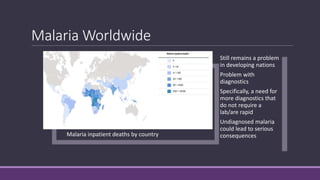
Malaria Worldwide
Malaria inpatient deaths by country
Still remains a problem
in developing nations
Problem with
diagnostics
Specifically, a need for
more diagnostics that
do not require a
lab/are rapid
Undiagnosed malaria
could lead to serious
consequences
HIV Worldwide
Incidence of HIV Worldwide
Burden of HIV borne
most by nations in
Africa
Developing nations
may not have access to
resources to rapidly
detect and diagnose
HIV/AIDS
Undiagnosed HIV/AIDS
can lead to further
complications
Sepsis Worldwide
1
• Afflicts 18 million people worldwide per year
2
• Incidence of sepsis has doubled in the past ten years
3
• If left unrecognized and untreated, has the possibility to
progress to septic shock (50%)
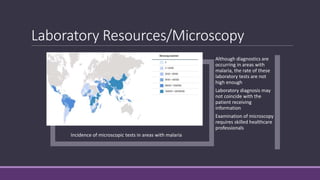
Laboratory Resources/Microscopy
Incidence of microscopic tests in areas with malaria
Although diagnostics are
occurring in areas with
malaria, the rate of these
laboratory tests are not
high enough
Laboratory diagnosis may
not coincide with the
patient receiving
information
Examination of microscopy
requires skilled healthcare
professionals
Chosen Labs
Yager:
• Microfluidics
• Immunoassays
• Point-of-care diagnostics
• Global health
Stayton:
• Nanomedicine
• Nanotechnology
• Molecular engineering
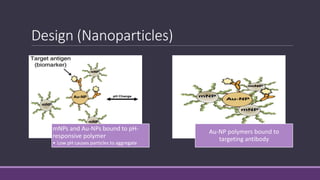
Design (Nanoparticles)
mNPs and Au-NPs bound to pH-
responsive polymer
• Low pH causes particles to aggregate
Au-NP polymers bound to
targeting antibody
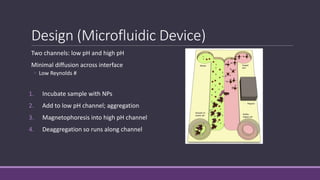
Design (Microfluidic Device)
Two channels: low pH and high pH
Minimal diffusion across interface
â—¦ Low Reynolds #
1. Incubate sample with NPs
2. Add to low pH channel; aggregation
3. Magnetophoresis into high pH channel
4. Deaggregation so runs along channel
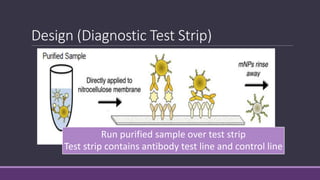
Design (Diagnostic Test Strip)
Run purified sample over test strip
Test strip contains antibody test line and control line
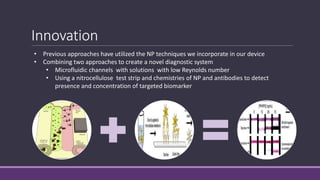
Innovation
• Previous approaches have utilized the NP techniques we incorporate in our device
• Combining two approaches to create a novel diagnostic system
• Microfluidic channels with solutions with low Reynolds number
• Using a nitrocellulose test strip and chemistries of NP and antibodies to detect
presence and concentration of targeted biomarker
Significance
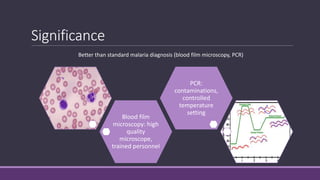
Blood film
microscopy: high
quality
microscope,
trained personnel
PCR:
contaminations,
controlled
temperature
setting
Better than standard malaria diagnosis (blood film microscopy, PCR)
Anticipated Problems
1 • NP’s don’t aggregate/deaggregate in initial pH levels
2 • NP size issues based on pH changes with new complex
3
• New complex may need a stronger magnet than initially
proposed
4
• Purification percentages may not be high enough initially
with new complex
5
• Fabrication issues
• Leaking
• Issues with CAD transfer to fabrication device

487Final Project Presentation

  • 1.
    Magnetic and Gold NanoparticleInteractions for Rapid Diagnostics ALBERT NGUYEN, CHENKAI LU, COLLIN WATERTON JR., SNIGDHA KANUPARTHY
  • 2.
    Specific Aims • Cheapand easy to use/ minimal training • Ensure aggregation between mNP-AuNP- copolymer complex • Effective in detecting malaria, HIV, Sepsis biomarkers
  • 3.
    Malaria Worldwide Malaria inpatientdeaths by country Still remains a problem in developing nations Problem with diagnostics Specifically, a need for more diagnostics that do not require a lab/are rapid Undiagnosed malaria could lead to serious consequences
  • 4.
    HIV Worldwide Incidence ofHIV Worldwide Burden of HIV borne most by nations in Africa Developing nations may not have access to resources to rapidly detect and diagnose HIV/AIDS Undiagnosed HIV/AIDS can lead to further complications
  • 5.
    Sepsis Worldwide 1 • Afflicts18 million people worldwide per year 2 • Incidence of sepsis has doubled in the past ten years 3 • If left unrecognized and untreated, has the possibility to progress to septic shock (50%)
  • 6.
    Laboratory Resources/Microscopy Incidence ofmicroscopic tests in areas with malaria Although diagnostics are occurring in areas with malaria, the rate of these laboratory tests are not high enough Laboratory diagnosis may not coincide with the patient receiving information Examination of microscopy requires skilled healthcare professionals
  • 7.
    Chosen Labs Yager: • Microfluidics •Immunoassays • Point-of-care diagnostics • Global health Stayton: • Nanomedicine • Nanotechnology • Molecular engineering
  • 8.
    Design (Nanoparticles) mNPs andAu-NPs bound to pH- responsive polymer • Low pH causes particles to aggregate Au-NP polymers bound to targeting antibody
  • 9.
    Design (Microfluidic Device) Twochannels: low pH and high pH Minimal diffusion across interface â—¦ Low Reynolds # 1. Incubate sample with NPs 2. Add to low pH channel; aggregation 3. Magnetophoresis into high pH channel 4. Deaggregation so runs along channel
  • 10.
    Design (Diagnostic TestStrip) Run purified sample over test strip Test strip contains antibody test line and control line
  • 11.
    Innovation • Previous approacheshave utilized the NP techniques we incorporate in our device • Combining two approaches to create a novel diagnostic system • Microfluidic channels with solutions with low Reynolds number • Using a nitrocellulose test strip and chemistries of NP and antibodies to detect presence and concentration of targeted biomarker
  • 12.
    Significance Blood film microscopy: high quality microscope, trainedpersonnel PCR: contaminations, controlled temperature setting Better than standard malaria diagnosis (blood film microscopy, PCR)
  • 13.
    Anticipated Problems 1 •NP’s don’t aggregate/deaggregate in initial pH levels 2 • NP size issues based on pH changes with new complex 3 • New complex may need a stronger magnet than initially proposed 4 • Purification percentages may not be high enough initially with new complex 5 • Fabrication issues • Leaking • Issues with CAD transfer to fabrication device