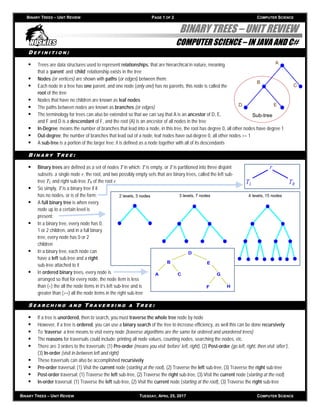
BINARY TREES – UNIT REVIEW PAGE 1 OF 2 COMPUTER SCIENCE
BINARY TREES – UNIT REVIEW TUESDAY, APRIL 25, 2017 COMPUTER SCIENCE
D E F I N I T I O N :
 Trees are data structures used to represent relationships, that are hierarchical in nature, meaning
that a ‘parent’ and ‘child’ relationship exists in the tree
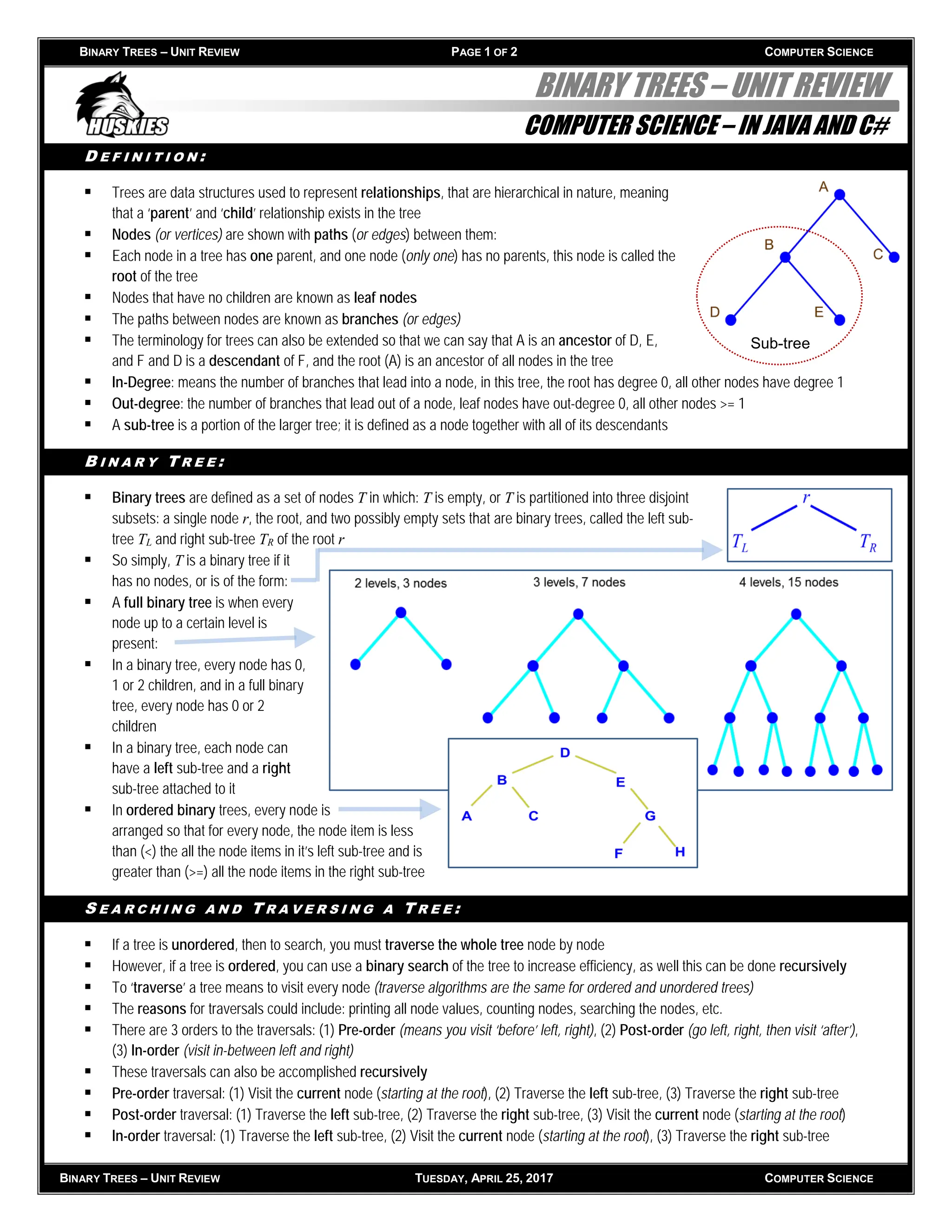
 Nodes (or vertices) are shown with paths (or edges) between them:
 Each node in a tree has one parent, and one node (only one) has no parents, this node is called the
root of the tree
 Nodes that have no children are known as leaf nodes
 The paths between nodes are known as branches (or edges)
 The terminology for trees can also be extended so that we can say that A is an ancestor of D, E,
and F and D is a descendant of F, and the root (A) is an ancestor of all nodes in the tree
 In-Degree: means the number of branches that lead into a node, in this tree, the root has degree 0, all other nodes have degree 1
 Out-degree: the number of branches that lead out of a node, leaf nodes have out-degree 0, all other nodes >= 1
 A sub-tree is a portion of the larger tree; it is defined as a node together with all of its descendants
B I N A R Y T R E E :
 Binary trees are defined as a set of nodes T in which: T is empty, or T is partitioned into three disjoint
subsets: a single node r, the root, and two possibly empty sets that are binary trees, called the left sub-
tree TL and right sub-tree TR of the root r
 So simply, T is a binary tree if it
has no nodes, or is of the form:
 A full binary tree is when every
node up to a certain level is
present:
 In a binary tree, every node has 0,
1 or 2 children, and in a full binary
tree, every node has 0 or 2
children
 In a binary tree, each node can
have a left sub-tree and a right
sub-tree attached to it
 In ordered binary trees, every node is
arranged so that for every node, the node item is less
than (<) the all the node items in it’s left sub-tree and is
greater than (>=) all the node items in the right sub-tree
S E A R C H I N G A N D T R A V E R S I N G A T R E E :
 If a tree is unordered, then to search, you must traverse the whole tree node by node
 However, if a tree is ordered, you can use a binary search of the tree to increase efficiency, as well this can be done recursively
 To ‘traverse’ a tree means to visit every node (traverse algorithms are the same for ordered and unordered trees)
 The reasons for traversals could include: printing all node values, counting nodes, searching the nodes, etc.
 There are 3 orders to the traversals: (1) Pre-order (means you visit ‘before’ left, right), (2) Post-order (go left, right, then visit ‘after’),
(3) In-order (visit in-between left and right)
 These traversals can also be accomplished recursively
 Pre-order traversal: (1) Visit the current node (starting at the root), (2) Traverse the left sub-tree, (3) Traverse the right sub-tree
 Post-order traversal: (1) Traverse the left sub-tree, (2) Traverse the right sub-tree, (3) Visit the current node (starting at the root)
 In-order traversal: (1) Traverse the left sub-tree, (2) Visit the current node (starting at the root), (3) Traverse the right sub-tree
COMPUTER SCIENCE – IN JAVA AND C#
BINARY TREES – UNIT REVIEW
Sub-tree
BINARY TREES – UNIT REVIEW PAGE 2 OF 2 COMPUTER SCIENCE
BINARY TREES – UNIT REVIEW TUESDAY, APRIL 25, 2017 COMPUTER SCIENCE
I N S E R T I N G A N D R E M O V I N G F R O M A T R E E :
 If a tree is unordered, then to search, you must traverse the whole
tree node by node
 With an unordered tree, you can insert a node anywhere you have a
null
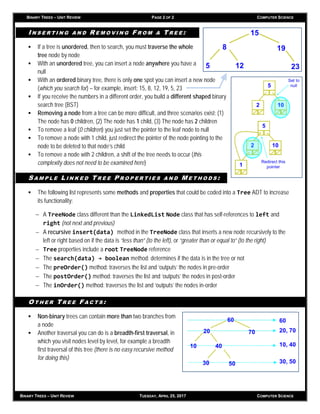
 With an ordered binary tree, there is only one spot you can insert a new node
(which you search for) – for example, insert: 15, 8, 12, 19, 5, 23
 If you receive the numbers in a different order, you build a different shaped binary
search tree (BST)
 Removing a node from a tree can be more difficult, and three scenarios exist: (1)
The node has 0 children, (2) The node has 1 child, (3) The node has 2 children
 To remove a leaf (0 children) you just set the pointer to the leaf node to null
 To remove a node with 1 child, just redirect the pointer of the node pointing to the
node to be deleted to that node’s child
 To remove a node with 2 children, a shift of the tree needs to occur (this
complexity does not need to be examined here)
S A M P L E L I N K E D T R E E P R O P E R T I E S A N D M E T H O D S :
 The following list represents some methods and properties that could be coded into a Tree ADT to increase
its functionality:
− A TreeNode class different than the LinkedList Node class that has self-references to left and
right (not next and previous)
− A recursive insert(data) method in the TreeNode class that inserts a new node recursively to the
left or right based on if the data is “less than” (to the left), or “greater than or equal to” (to the right)
− Tree properties include a root TreeNode reference
− The search(data) → boolean method: determines if the data is in the tree or not
− The preOrder() method: traverses the list and ‘outputs’ the nodes in pre-order
− The postOrder() method: traverses the list and ‘outputs’ the nodes in post-order
− The inOrder() method: traverses the list and ‘outputs’ the nodes in-order
O T H E R T R E E F A C T S :
 Non-binary trees can contain more than two branches from
a node
 Another traversal you can do is a breadth-first traversal, in
which you visit nodes level by level, for example a breadth
first traversal of this tree (there is no easy recursive method
for doing this)

481803111-Trees-Unit-Review-pdf - Copy.pdf

  • 1.
    BINARY TREES –UNIT REVIEW PAGE 1 OF 2 COMPUTER SCIENCE BINARY TREES – UNIT REVIEW TUESDAY, APRIL 25, 2017 COMPUTER SCIENCE D E F I N I T I O N :  Trees are data structures used to represent relationships, that are hierarchical in nature, meaning that a ‘parent’ and ‘child’ relationship exists in the tree  Nodes (or vertices) are shown with paths (or edges) between them:  Each node in a tree has one parent, and one node (only one) has no parents, this node is called the root of the tree  Nodes that have no children are known as leaf nodes  The paths between nodes are known as branches (or edges)  The terminology for trees can also be extended so that we can say that A is an ancestor of D, E, and F and D is a descendant of F, and the root (A) is an ancestor of all nodes in the tree  In-Degree: means the number of branches that lead into a node, in this tree, the root has degree 0, all other nodes have degree 1  Out-degree: the number of branches that lead out of a node, leaf nodes have out-degree 0, all other nodes >= 1  A sub-tree is a portion of the larger tree; it is defined as a node together with all of its descendants B I N A R Y T R E E :  Binary trees are defined as a set of nodes T in which: T is empty, or T is partitioned into three disjoint subsets: a single node r, the root, and two possibly empty sets that are binary trees, called the left sub- tree TL and right sub-tree TR of the root r  So simply, T is a binary tree if it has no nodes, or is of the form:  A full binary tree is when every node up to a certain level is present:  In a binary tree, every node has 0, 1 or 2 children, and in a full binary tree, every node has 0 or 2 children  In a binary tree, each node can have a left sub-tree and a right sub-tree attached to it  In ordered binary trees, every node is arranged so that for every node, the node item is less than (<) the all the node items in it’s left sub-tree and is greater than (>=) all the node items in the right sub-tree S E A R C H I N G A N D T R A V E R S I N G A T R E E :  If a tree is unordered, then to search, you must traverse the whole tree node by node  However, if a tree is ordered, you can use a binary search of the tree to increase efficiency, as well this can be done recursively  To ‘traverse’ a tree means to visit every node (traverse algorithms are the same for ordered and unordered trees)  The reasons for traversals could include: printing all node values, counting nodes, searching the nodes, etc.  There are 3 orders to the traversals: (1) Pre-order (means you visit ‘before’ left, right), (2) Post-order (go left, right, then visit ‘after’), (3) In-order (visit in-between left and right)  These traversals can also be accomplished recursively  Pre-order traversal: (1) Visit the current node (starting at the root), (2) Traverse the left sub-tree, (3) Traverse the right sub-tree  Post-order traversal: (1) Traverse the left sub-tree, (2) Traverse the right sub-tree, (3) Visit the current node (starting at the root)  In-order traversal: (1) Traverse the left sub-tree, (2) Visit the current node (starting at the root), (3) Traverse the right sub-tree COMPUTER SCIENCE – IN JAVA AND C# BINARY TREES – UNIT REVIEW Sub-tree
  • 2.
    BINARY TREES –UNIT REVIEW PAGE 2 OF 2 COMPUTER SCIENCE BINARY TREES – UNIT REVIEW TUESDAY, APRIL 25, 2017 COMPUTER SCIENCE I N S E R T I N G A N D R E M O V I N G F R O M A T R E E :  If a tree is unordered, then to search, you must traverse the whole tree node by node  With an unordered tree, you can insert a node anywhere you have a null  With an ordered binary tree, there is only one spot you can insert a new node (which you search for) – for example, insert: 15, 8, 12, 19, 5, 23  If you receive the numbers in a different order, you build a different shaped binary search tree (BST)  Removing a node from a tree can be more difficult, and three scenarios exist: (1) The node has 0 children, (2) The node has 1 child, (3) The node has 2 children  To remove a leaf (0 children) you just set the pointer to the leaf node to null  To remove a node with 1 child, just redirect the pointer of the node pointing to the node to be deleted to that node’s child  To remove a node with 2 children, a shift of the tree needs to occur (this complexity does not need to be examined here) S A M P L E L I N K E D T R E E P R O P E R T I E S A N D M E T H O D S :  The following list represents some methods and properties that could be coded into a Tree ADT to increase its functionality: − A TreeNode class different than the LinkedList Node class that has self-references to left and right (not next and previous) − A recursive insert(data) method in the TreeNode class that inserts a new node recursively to the left or right based on if the data is “less than” (to the left), or “greater than or equal to” (to the right) − Tree properties include a root TreeNode reference − The search(data) → boolean method: determines if the data is in the tree or not − The preOrder() method: traverses the list and ‘outputs’ the nodes in pre-order − The postOrder() method: traverses the list and ‘outputs’ the nodes in post-order − The inOrder() method: traverses the list and ‘outputs’ the nodes in-order O T H E R T R E E F A C T S :  Non-binary trees can contain more than two branches from a node  Another traversal you can do is a breadth-first traversal, in which you visit nodes level by level, for example a breadth first traversal of this tree (there is no easy recursive method for doing this)