www.planning.org
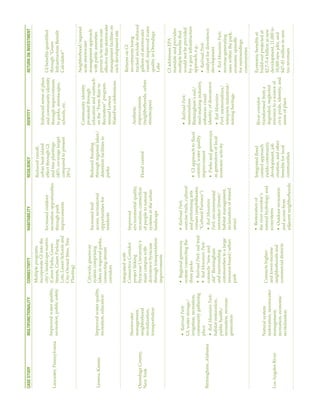
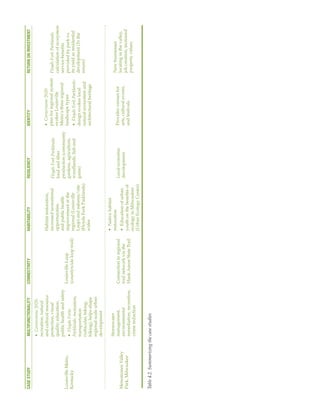
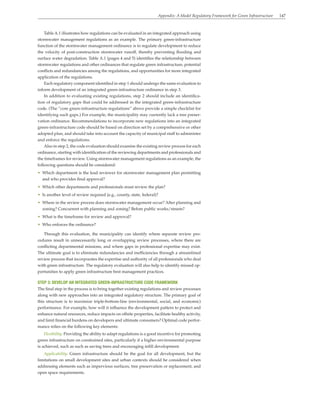
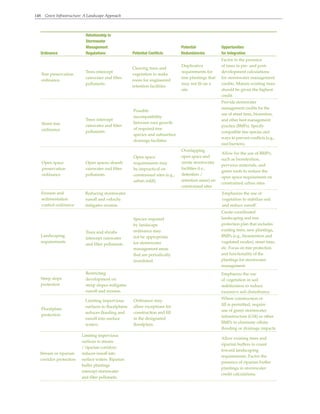
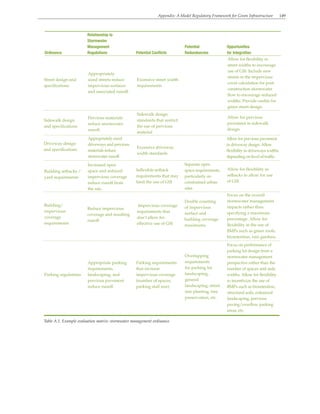
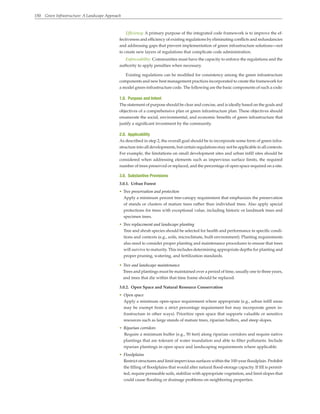
David C. Rouse, aicp, and Ignacio F. Bunster-Ossa
American Planning Association
Planning Advisory Service
Report Number 571
Green Infrastructure:
A Landscape Approach
Green
Infrastructure                
A
merican
Planning
Association
PAS
Report
Number
571  
The Planning Advisory Service is a subscription service offered by the Research Department of the
American Planning Association. Four reports are produced each year. Subscribers also receive PAS
Memo and PAS QuickNotes, and they have access to the Inquiry Answering Service and other valuable
benefits. To learn more, visit www.planning.org/pas/index.htm.
W. Paul Farmer, faicp, Chief Executive Officer; Sylvia Lewis, Director of Publications; William R. Klein,
aicp, Director of Research.
Planning Advisory Service Reports are produced in the Research Department of APA. Timothy Mennel,
Editor; Lisa Barton, Design Associate.
Missing and damaged print issues: Contact Customer Service, American Planning Association, 205 N.
Michigan Ave., Suite 1200, Chicago, IL 60601 (312-431-9100 or customerservice@planning.org) within 90
days of the publication date. Include the name of the publication, year, volume and issue number or month,
and your name, mailing address, and membership number if applicable.
© January 2013 by the American Planning Association.
APA’s publications office is at 205 N. Michigan Ave., Suite 1200, Chicago, IL 60601–5927.
APA headquarters office is at 1030 15th St., NW, Suite 750 West, Washington, DC 20005–1503.
E-mail: pasreports@planning.org
David C. Rouse, aicp, is a planner and landscape architect at Wallace, Roberts & Todd (WRT) in
Philadelphia. His projects include comprehensive plans for cities, counties, and regions; parks
and open space system plans; urban design plans; and zoning and development regulations.
Rouse is an active participant in national initiatives of the American Planning Association
and speaks across the country on topics ranging from the role of planning and design in pub-
lic health to green infrastructure and urban forestry.
Ignacio F. Bunster-Ossa is a landscape architect and urban designer whose work is consistently
recognized for design innovation. He is a leading practitioner of Landscape Urbanism, an
approach to urban design based on the fusion of ecology, community identity, infrastruc-
ture, recreation, and public art. Bunster-Ossa directs WRT’s landscape architecture studio
in Philadelphia as well as many of the firm’s large-scale landscape projects. He is a Harvard
Loeb Fellow and periodically lectures, teaches, writes, and serves on design award juries.
Contributors
Bj Adigun is program coordinator at CH2M Hill in Syracuse, New York. Patrice Carroll is
senior planner for the City of Seattle. Bill Cesanek, aicp, is vice president in the Edison, New
Jersey, office of CDM Smith. Andrew Dobshinsky, aicp, is an associate at WRT in Philadelphia.
Greg Dorolek is senior associate and landscape architect at Wenk Associates in Denver. Dave
LaClergue is an urban designer for the City of Seattle. Tom Leader is principal of Tom Leader
Studio in Berkeley, California. Mia Lehrer is president of Mia Lehrer + Associates in Los
Angeles. Brian Marengo is senior water resources technologist in the Philadelphia office of
CH2M Hill. Dee Merriam works on the relationship between health and the built environ-
ment; she has a particular interest in developing synergies between water management and
public access to outdoor space. Leah Rominger is staff consultant and landscape designer in the
Philadelphia office of CH2M Hill. Terry Schwarz, aicp, is the director of Kent State University’s
Cleveland Urban Design Collaborative. Eric Tamulonis is a landscape architect at WRT in
Philadelphia who focuses on the planning and design of parks and open space systems, as
well as institutional, historical, and academic landscapes. Nancy Templeton, aicp, is an associ-
ate at WRT in Philadelphia. Karen Walz, faicp, is principal of Strategic Community Solutions,
a consulting firm based in Dallas. Bill Wenk is founder and president of Wenk Associates in
Denver.
Cover design by Lisa Barton; this report is printed on recyclable paper.
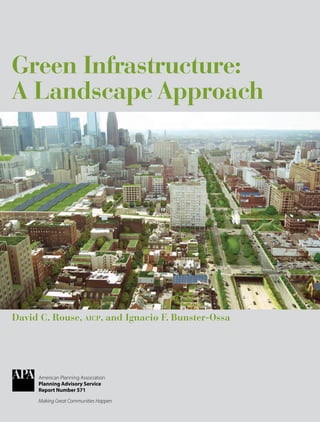
Cover image: Aerial visualization of green infrastructure practices in Philadelphia, as envisioned by
the Philadelphia Water Department’s Green City Clean Waters Program. Prepared by WRT
GREEN INFRASTRUCTURE:
A LANDSCAPE APPROACH
Chapter 1: Introduction................................................................................................................ 1
Chapter 2: Landscape Planning, Design, and Green Infrastructure........................................... 5
Historic Antecedents......................................................................................................6
Definitions of Landscape and Green Infrastructure................................................10
Key Concepts................................................................................................................. 11
Chapter 3: Green Infrastructure in Practice.............................................................................. 17
Planning and Design Principles..................................................................................18
Scales of Planning Practice..........................................................................................22
Green Infrastructure in the Planning Process...........................................................28
Landscape Architecture and Green Infrastructure...................................................36
Conclusion.....................................................................................................................41
Chapter 4: Case Studies............................................................................................................. 47
Green Infrastructure at the Regional Scale
Cleveland and Northeast Ohio: Green Infrastructure for a City in Transition....48
North Texas: Returning to the Trinity........................................................................56
Green Infrastructure in Large Cities
Philadelphia: Making the Greenest City in America...............................................68
Seattle: A City’s Journey toward Sustainability........................................................76
Green Infrastructure in Smaller Communities
Lancaster, Pennsylvania: Managing Stormwater Pollution and
Enhancing Community through Green Infrastructure........................................84
Lenexa, Kansas: Rain to Recreation............................................................................93
Onondaga County, New York: Save the Rain.........................................................100
Parks, Greenways, and River Corridors as Green Infrastructure
Birmingham, Alabama: A Green Infrastructure Movement.................................107
Los Angeles River: Using Green Infrastructure to Revitalize a City................... 118
Louisville Metro, Kentucky: Application of Green Infrastructure
from Region to Site.................................................................................................125
Menomonee Valley Park and Redevelopment, Milwaukee..................................135
Summarizing the Case Studies.......................................................................................141
Appendix: A Model Regulatory Framework for Green Infrastructure..................................... 145
References................................................................................................................................ 155
David C. Rouse, aicp, and Ignacio F. Bunster-Ossa
TA B L E O F C O N T E N T S
1
In recent years the term “green infrastructure” has assumed a lead-
ing position in the lexicon of planners and designers. At the city
and regional scales, it has been defined as a multifunctional open-
space network. At the local and site scales, it has been defined as a
stormwater management approach that mimics natural hydrologic
processes. This PAS Report explores the unifying concept of land-
scape as green infrastructure—the visible expression of natural and
human ecosystem processes that work across scales and contexts to
provide multiple benefits for people and their environments.
CHAPTER 1
Introduction
▲
2 Green Infrastructure: A Landscape Approach
Infrastructure is commonly defined as the facilities and services necessary
for a society, community, or economy to function. In this definition, facilities
and services can be grouped into two broad categories: “hard” and “soft”
infrastructure. Hard infrastructure generally refers to transportation (roads,
mass transit, etc.), utilities (water, sewer, etc.), and other physical networks.
Soft infrastructure encompasses the institutional systems (education, health
care, governance, etc.) that are required to meet the economic, social, and
other needs of a community. While green infrastructure has an important
role to play as soft infrastructure (e.g., by building capacity—improved
health, job opportunities, community cohesion, etc.), this report addresses
it primarily in the context of hard infrastructure.
In the 20th century, hard infrastructure most often referred to the physical
or “gray” systems engineered and constructed by humans, such as roads,
utilities, and flood control works. In this paradigm, natural or “green” sys-
tems and the services they provide for society were treated separately. Today,
however, our green infrastructure lens views “gray” and “green” systems
as interconnected ones that must be considered together to sustain a func-
tioning society, community, or economy. In particular, the “green” systems
are active, visible, and integrated into the
human-shaped landscape—a fundamental
paradigm shift.
This broader view recalls an earlier
time when natural factors determined the
trajectory of a civilization and its built infra-
structure. From the beginning of recorded
history, the natural environment shaped
where people chose to settle. Early towns
and cities were built on sites where natural
features provided key advantages, such as
access to a navigable river or harbor, pro-
tection from attack, or efficient disposal of
waste and effluent. Where the terrain was
accessible, roadways and aqueducts were
built to connect settlements and sustain
them with water. Urban development
often flourished where such advantages
coalesced.
Over time, infrastructure evolved from
being primarily the work of nature (landscape conditions influenced by
people to meet their needs) to the work of humankind. Constructed infra-
structure proliferated with the Industrial Revolution, as more sophisticated
water supply and waste disposal works were needed to support growing
urban populations and as new forms of transportation—first the railroad
and then the automobile—led to metropolitan expansion. By the middle of
the 20th century, engineered infrastructure had eclipsed landscape (in its role
as nature-based infrastructure) as the primary driver of urban development.
The availability of transportation, utility, and other gray infrastructure
systems enabled accelerated metropolitan expansion in the post–World War
II era. Between 1950 and 2000, the U.S. population increased by 80 percent
while the nation’s urban land area, following auto-oriented development
patterns, increased at a much greater rate (over 400 percent by one measure).
Awareness of the environmental impacts of this urbanization—industrial
pollution, resource depletion, degraded air and water quality, and so on—­
increased during the 1960s; in 1969 a “tipping point” was reached when an
oil slick and debris on the Cuyahoga River in Cleveland caught fire, attracting
national attention. Soon after, the first Earth Day was celebrated onApril 22,
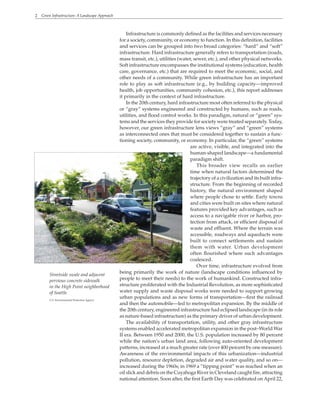
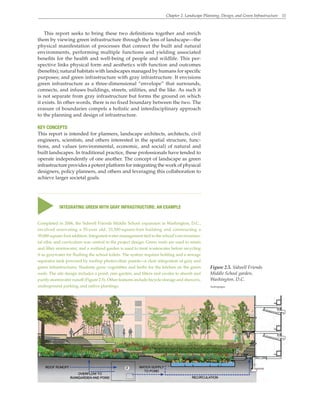
Streetside swale and adjacent
pervious concrete sidewalk
in the High Point neighborhood
of Seattle
U.S. Environmental Protection Agency
Chapter 1. Introduction 3
1970, marking the germination of the contemporary environmental move-
ment and a growing chorus of citizen concerns about issues such as loss of
open space, traffic congestion, and urban decline. State and local govern-
ments have as a result undertaken comprehensive planning and growth
management initiatives, with planners playing key roles.
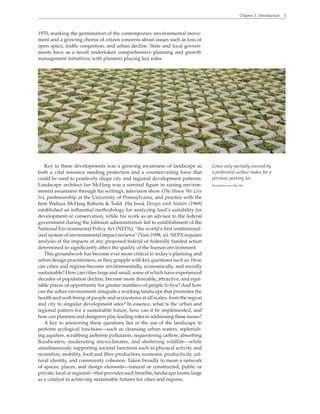
Grass only partially covered by
a perforated surface makes for a
pervious parking lot.
iStockphoto.com/Oks_Mit
Key to these developments was a growing awareness of landscape as
both a vital resource needing protection and a countervailing force that
could be used to positively shape city and regional development patterns.
Landscape architect Ian McHarg was a seminal figure in raising environ-
mental awareness through his writings, television show (The House We Live
In), professorship at the University of Pennsylvania, and practice with the
firm Wallace McHarg Roberts & Todd. His book Design with Nature (1969)
established an influential methodology for analyzing land’s suitability for
development or conservation, while his work as an advisor to the federal
government during the Johnson administration led to establishment of the
National Environmental Policy Act (NEPA), “the world’s first institutional-
ized system of environmental impact reviews” (Yaro 1998, xi). NEPArequires
analysis of the impacts of any proposed federal or federally funded action
determined to significantly affect the quality of the human environment.
This groundwork has become ever more critical to today’s planning and
urban design practitioners, as they grapple with key questions such as: How
can cities and regions become environmentally, economically, and socially
sustainable? How can cities large and small, some of which have experienced
decades of population decline, become more desirable, attractive, and equi-
table places of opportunity for greater numbers of people to live? And how
can the urban environment integrate a working landscape that promotes the
health and well-being of people and ecosystems at all scales, from the region
and city to singular development sites? In essence, what is the urban and
regional pattern for a sustainable future, how can it be implemented, and
how can planners and designers play leading roles in addressing these issues?
A key to answering these questions lies in the use of the landscape to
perform ecological functions—such as cleansing urban waters, replenish-
ing aquifers, scrubbing airborne pollutants, sequestering carbon, absorbing
floodwaters, moderating microclimates, and sheltering wildlife—while
simultaneously supporting societal functions such as physical activity and
recreation, mobility, food and fiber production, economic productivity, cul-
tural identity, and community cohesion. Taken broadly to mean a network
of spaces, places, and design elements—natural or constructed, public or
private, local or regional—that provides such benefits, landscape looms large
as a catalyst to achieving sustainable futures for cities and regions.
4 Green Infrastructure: A Landscape Approach
This report explores the concept of landscape as green infrastructure—
the physical manifestation of complex, multifunctional systems that span
disciplines (planning and design); contexts (urban, suburban, and rural);
and scales (region, city, neighborhood, and site). Chapter 2 elaborates on
the evolution and basic attributes of this concept. Chapter 3 addresses its
implications for practitioners, with a focus on integrating the work of urban
planners and landscape architects. It lays out a set of unifying principles
that can be used by different professions to advance green infrastructure
solutions. Chapter 4 presents case studies drawn from communities across
the United States that are implementing these principles through green
infrastructure initiatives in a variety of contexts and across scales.
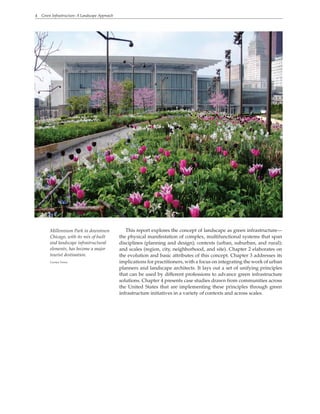
Millennium Park in downtown
Chicago, with its mix of built
and landscape infrastructural
elements, has become a major
tourist destination.
Carolyn Torma
5
What is a “landscape” approach to green infrastructure? How is it
more than just implementing green infrastructure measures at vari-
ous scales, from green roofs and rain gardens to regional greenways
and open space? The answer lies in conceiving of landscape as an
integrated whole, as the “scene” across the land that encapsulates
the adaptation and manipulation of natural form and processes for
the purpose of human habitation. A landscape approach to green
infrastructure entails a design vision that translates planning strat-
egy into physical reality while heeding the ecological and cultural
characteristics of a particular locale—whether a region or an indi-
vidual building site. It is, by necessity, an approach that involves
aesthetics: what a place should look like as informed by the people
who live on the land, their past, and their aspirations.
CHAPTER 2
Landscape Planning, Design,
and Green Infrastructure
▲
6 Green Infrastructure: A Landscape Approach
In this context, green infrastructure becomes both “effective” as an agent
of environmental quality and “affective” as an expression of local conditions.
A landscape approach to green infrastructure requires considering not only
how infrastructure could improve water or air quality but also how, say, a
rain garden, constructed wetland, or greenway might engender a sense of
community identity. It raises the question: How and where should green
infrastructure be placed on the land? It is more than a strictly functional
question, as it both enriches and complicates practice.
This chapter provides an overview of the evolution of the idea of land-
scape as green infrastructure, followed by a discussion of key concepts
explored in Chapters 3 and 4.
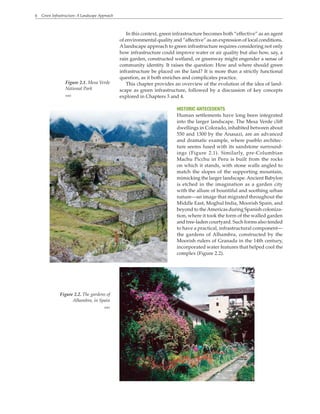
HISTORIC ANTECEDENTS
Human settlements have long been integrated
into the larger landscape. The Mesa Verde cliff
dwellings in Colorado, inhabited between about
550 and 1300 by the Anasazi, are an advanced
and dramatic example, where pueblo architec-
ture seems fused with its sandstone surround-
ings (Figure 2.1). Similarly, pre-Columbian
Machu Picchu in Peru is built from the rocks
on which it stands, with stone walls angled to
match the slopes of the supporting mountain,
mimicking the larger landscape.Ancient Babylon
is etched in the imagination as a garden city
with the allure of bountiful and soothing urban
nature—an image that migrated throughout the
Middle East, Moghul India, Moorish Spain, and
beyond to theAmericas during Spanish coloniza-
tion, where it took the form of the walled garden
and tree-laden courtyard. Such forms also tended
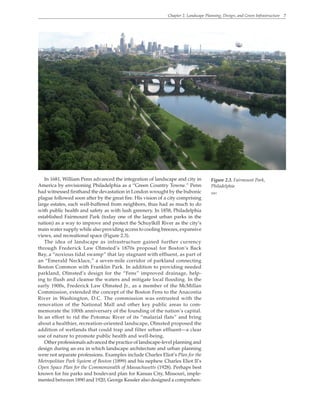
to have a practical, infrastructural component—
the gardens of Alhambra, constructed by the
Moorish rulers of Granada in the 14th century,
incorporated water features that helped cool the
complex (Figure 2.2).
Figure 2.2. The gardens of
Alhambra, in Spain
WRT
Figure 2.1. Mesa Verde
National Park
WRT
Chapter 2. Landscape Planning, Design, and Green Infrastructure 7
In 1681, William Penn advanced the integration of landscape and city in
America by envisioning Philadelphia as a “Green Country Towne.” Penn
had witnessed firsthand the devastation in London wrought by the bubonic
plague followed soon after by the great fire. His vision of a city comprising
large estates, each well-buffered from neighbors, thus had as much to do
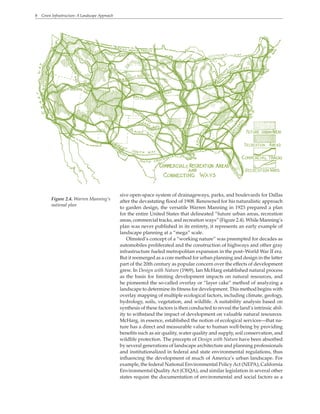
with public health and safety as with lush greenery. In 1858, Philadelphia
established Fairmount Park (today one of the largest urban parks in the
nation) as a way to improve and protect the Schuylkill River as the city’s
main water supply while also providing access to cooling breezes, expansive
views, and recreational space (Figure 2.3).
The idea of landscape as infrastructure gained further currency
through Frederick Law Olmsted’s 1870s proposal for Boston’s Back
Bay, a “noxious tidal swamp” that lay stagnant with effluent, as part of
an “Emerald Necklace,” a seven-mile corridor of parkland connecting
Boston Common with Franklin Park. In addition to providing needed
parkland, Olmsted’s design for the “Fens” improved drainage, help-
ing to flush and cleanse the waters and mitigate local flooding. In the
early 1900s, Frederick Law Olmsted Jr., as a member of the McMillan
Commission, extended the concept of the Boston Fens to the Anacostia
River in Washington, D.C. The commission was entrusted with the
renovation of the National Mall and other key public areas to com-
memorate the 100th anniversary of the founding of the nation’s capital.
In an effort to rid the Potomac River of its “malarial flats” and bring
about a healthier, recreation-oriented landscape, Olmsted proposed the
addition of wetlands that could trap and filter urban effluent—a clear
use of nature to promote public health and well-being.
Other professionals advanced the practice of landscape-level planning and
design during an era in which landscape architecture and urban planning
were not separate professions. Examples include Charles Eliot’s Plan for the
Metropolitan Park System of Boston (1899) and his nephew Charles Eliot II’s
Open Space Plan for the Commonwealth of Massachusetts (1928). Perhaps best
known for his parks and boulevard plan for Kansas City, Missouri, imple-
mented between 1890 and 1920, George Kessler also designed a comprehen-
Figure 2.3. Fairmount Park,
Philadelphia
WRT
8 Green Infrastructure: A Landscape Approach
sive open-space system of drainageways, parks, and boulevards for Dallas
after the devastating flood of 1908. Renowned for his naturalistic approach
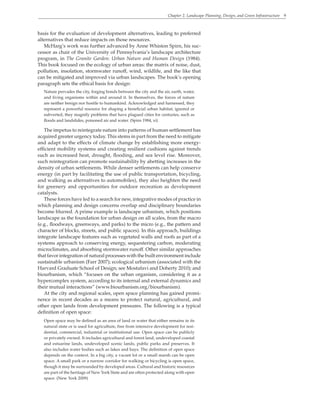
to garden design, the versatile Warren Manning in 1923 prepared a plan
for the entire United States that delineated “future urban areas, recreation
areas, commercial tracks, and recreation ways” (Figure 2.4). While Manning’s
plan was never published in its entirety, it represents an early example of
landscape planning at a “mega” scale.
Olmsted’s concept of a “working nature” was preempted for decades as
automobiles proliferated and the construction of highways and other gray
infrastructure fueled metropolitan expansion in the post–World War II era.
But it reemerged as a core method for urban planning and design in the latter
part of the 20th century as popular concern over the effects of development
grew. In Design with Nature (1969), Ian McHarg established natural process
as the basis for limiting development impacts on natural resources, and
he pioneered the so-called overlay or “layer cake” method of analyzing a
landscape to determine its fitness for development. This method begins with
overlay mapping of multiple ecological factors, including climate, geology,
hydrology, soils, vegetation, and wildlife. A suitability analysis based on
synthesis of these factors is then conducted to reveal the land’s intrinsic abil-
ity to withstand the impact of development on valuable natural resources.
McHarg, in essence, established the notion of ecological services—that na-
ture has a direct and measurable value to human well-being by providing
benefits such as air quality, water quality and supply, soil conservation, and
wildlife protection. The precepts of Design with Nature have been absorbed
by several generations of landscape architecture and planning professionals
and institutionalized in federal and state environmental regulations, thus
influencing the development of much of America’s urban landscape. For
example, the federal National Environmental Policy Act (NEPA), California
Environmental Quality Act (CEQA), and similar legislation in several other
states require the documentation of environmental and social factors as a
Figure 2.4. Warren Manning’s
national plan
Chapter 2. Landscape Planning, Design, and Green Infrastructure 9
basis for the evaluation of development alternatives, leading to preferred
alternatives that reduce impacts on those resources.
McHarg’s work was further advanced by Anne Whiston Spirn, his suc-
cessor as chair of the University of Pennsylvania’s landscape architecture
program, in The Granite Garden: Urban Nature and Human Design (1984).
This book focused on the ecology of urban areas: the matrix of noise, dust,
pollution, insolation, stormwater runoff, wind, wildlife, and the like that
can be mitigated and improved via urban landscapes. The book’s opening
paragraph sets the ethical basis for design:
Nature pervades the city, forging bonds between the city and the air, earth, water,
and living organisms within and around it. In themselves, the forces of nature
are neither benign nor hostile to humankind. Acknowledged and harnessed, they
represent a powerful resource for shaping a beneficial urban habitat; ignored or
subverted, they magnify problems that have plagued cities for centuries, such as
floods and landslides, poisoned air and water. (Spirn 1984, xi)
The impetus to reintegrate nature into patterns of human settlement has
acquired greater urgency today. This stems in part from the need to mitigate
and adapt to the effects of climate change by establishing more energy-
efficient mobility systems and creating resilient cushions against trends
such as increased heat, drought, flooding, and sea level rise. Moreover,
such reintegration can promote sustainability by abetting increases in the
density of urban settlements. While denser settlements can help conserve
energy (in part by facilitating the use of public transportation, bicycling,
and walking as alternatives to automobiles), they also heighten the need
for greenery and opportunities for outdoor recreation as development
catalysts.
These forces have led to a search for new, integrative modes of practice in
which planning and design concerns overlap and disciplinary boundaries
become blurred. A prime example is landscape urbanism, which positions
landscape as the foundation for urban design on all scales, from the macro
(e.g., floodways, greenways, and parks) to the micro (e.g., the pattern and
character of blocks, streets, and public spaces). In this approach, buildings
integrate landscape features such as vegetated walls and roofs as part of a
systems approach to conserving energy, sequestering carbon, moderating
microclimates, and absorbing stormwater runoff. Other similar approaches
that favor integration of natural processes with the built environment include
sustainable urbanism (Farr 2007); ecological urbanism (associated with the
Harvard Graduate School of Design; see Mostafavi and Doherty 2010); and
biourbanism, which “focuses on the urban organism, considering it as a
hypercomplex system, according to its internal and external dynamics and
their mutual interactions” (www.biourbanism.org/biourbanism).
At the city and regional scales, open space planning has gained promi-
nence in recent decades as a means to protect natural, agricultural, and
other open lands from development pressures. The following is a typical
definition of open space:
Open space may be defined as an area of land or water that either remains in its
natural state or is used for agriculture, free from intensive development for resi-
dential, commercial, industrial or institutional use. Open space can be publicly
or privately owned. It includes agricultural and forest land, undeveloped coastal
and estuarine lands, undeveloped scenic lands, public parks and preserves. It
also includes water bodies such as lakes and bays. The definition of open space
depends on the context. In a big city, a vacant lot or a small marsh can be open
space. A small park or a narrow corridor for walking or bicycling is open space,
though it may be surrounded by developed areas. Cultural and historic resources
are part of the heritage of New York State and are often protected along with open
space. (New York 2009)
10 Green Infrastructure: A Landscape Approach
In contemporary planning practice, open space plans and variations such
as parks and recreation plans, resource conservation plans, and greenway
and trail plans are prepared either as stand-alone documents or as topical
elements of comprehensive plans. Greenways—linear open-space corridors
like those along watercourses and abandoned rail lines that provide multiple
ecological, recreational, economic, and cultural / historic values—have seen
a rise in interest in recent decades. Open space and greenway plans are in-
creasingly being repurposed as green infrastructure plans that emphasize
the environmental, economic, and social benefits provided by physical re-
source networks. At area and site scales, the term “green infrastructure” is
often used to refer to stormwater management practices that mimic natural
hydrological processes as opposed to “hard” engineered solutions. These
two definitions of green infrastructure are discussed below.
DEFINITIONS OF LANDSCAPE AND GREEN INFRASTRUCTURE
Landscape has traditionally been defined as an aesthetic resource, such as an
expanse of scenery, or as the overall geography of a region. In the words of
theAmerican Society of LandscapeArchitects (ASLA), “landscape architects
design the built environment of neighborhoods, towns and cities while also
protecting and managing the natural environment, from its forests and fields
to rivers and coasts. Members of the profession have a special commitment
to improving the quality of life through the best design of places for people
and other living things” (www.asla.org/nonmembers/What_is_Asla.cfm).
Green infrastructure is relatively new to the lexicon of urban plan-
ning and landscape design. According to Firehock (2010), the term was
first used in a 1994 report on land conservation strategies by the Florida
Greenways Commission. The intent was to elevate the societal value and
functions of natural lands and systems to the same level of importance as
gray infrastructure:
The Commission’s vision for Florida represents a new way of looking at conser-
vation, an approach that emphasizes the interconnectedness of both our natural
systems and our common goals and recognizes that the state’s ‘green infrastructure’
is just as important to conserve and manage as our built infrastructure. (Florida
Greenways Commission 1994)
Mark Benedict and Ed McMahon (2006) of the Conservation Fund defined
green infrastructure as
a strategically planned and managed network of wilderness, parks, greenways,
conservation easements, and working lands with conservation value that supports
native species, maintains natural ecological processes, sustains air and water re-
sources, and contributes to the health and quality of life forAmerica’s communities
and people.
More recently, a second definition of green infrastructure evolved from
the need to address the water-quality impacts of urban stormwater runoff in
response to the Clean WaterAct and related regulatory mandates.According
to the U.S. Environmental Protection Agency (EPA; www.epa.gov/owow/
NPS/lid), green infrastructure refers to “systems and practices that use
or mimic natural processes to infiltrate, evapotranspirate (the return of
water to the atmosphere either through evaporation or by plants), or reuse
stormwater or runoff on the site where it is generated.” While the Florida
Greenways Commission and Conservation Fund definitions emphasize large
landscape elements such as parks, natural areas, greenways, and working
(agricultural and forest) lands, the EPA identifies smaller-scale features in
urban contexts—green roofs, trees, rain gardens, vegetated swales, pocket
wetlands, infiltration planters, vegetated median strips, and so on—as typi-
cal components of green infrastructure.
As professions, planning and land-
scape architecture share common roots.
Founded in 1900, the nation’s first
Department of LandscapeArchitecture at
Harvard University’s Graduate School of
Design addressed a wide range of scales
and included what may have been the first
course in city planning. Over time, how-
ever, a split between design and planning
occurred within the department, with
landscape architects focusing on smaller-
scale design (e.g., of country estates) while
the nation’s first Department of City and
Regional Planning was founded in 1923
to address large-scale physical planning
(Steiner 2010). The bifurcation of the fields
foreshadowed a broader societal trend in
the 20th century toward specialization
and separation of professional disciplines.
In the 21st century, interrelated problems
such as automobile dependency and traf-
fic congestion, combined sanitary and
storm sewer overflows, degraded air
and water quality, and chronic diseases
related to lifestyle (e.g., obesity and dia-
betes) are making the limitations of “silo”
thinking increasingly apparent. Because
of its multifunctional, integrative nature,
green infrastructure can play a major role
in addressing these problems. Compared
to other, more specialized professions,
planners and landscape architects are es-
pecially well-suited to bring holistic green
infrastructure solutions to the planning
and design of cities, neighborhoods, and
other aspects of the physical environment.
In doing so, they can reestablish the com-
mon ground of the two professions.
▲ GREEN INFRASTRUCTURE
AND THE PROFESSIONS OF
PLANNING AND LANDSCAPE
ARCHITECTURE
▲
Chapter 2. Landscape Planning, Design, and Green Infrastructure 11
This report seeks to bring these two definitions together and enrich
them by viewing green infrastructure through the lens of landscape—the
physical manifestation of processes that connect the built and natural
environments, performing multiple functions and yielding associated
benefits for the health and well-being of people and wildlife. This per-
spective links physical form and aesthetics with function and outcomes
(benefits); natural habitats with landscapes managed by humans for specific
purposes; and green infrastructure with gray infrastructure. It envisions
green infrastructure as a three-dimensional “envelope” that surrounds,
connects, and infuses buildings, streets, utilities, and the like. As such it
is not separate from gray infrastructure but forms the ground on which
it exists. In other words, there is no fixed boundary between the two. The
erasure of boundaries compels a holistic and interdisciplinary approach
to the planning and design of infrastructure.
KEY CONCEPTS
This report is intended for planners, landscape architects, architects, civil
engineers, scientists, and others interested in the spatial structure, func-
tions, and values (environmental, economic, and social) of natural and
built landscapes. In traditional practice, these professionals have tended to
operate independently of one another. The concept of landscape as green
infrastructure provides a potent platform for integrating the work of physical
designers, policy planners, and others and leveraging this collaboration to
achieve larger societal goals.
▲
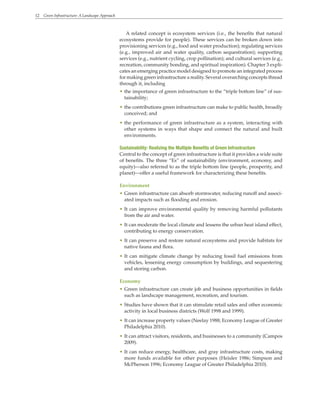
Completed in 2006, the Sidwell Friends Middle School expansion in Washington, D.C.,
involved renovating a 55-year old, 33,500-square-foot building and constructing a
39,000-square-foot addition. Integrated water management tied to the school’s environmen-
tal ethic and curriculum was central to the project design. Green roofs are used to retain
and filter stormwater, and a wetland garden is used to treat wastewater before recycling
it as graywater for flushing the school toilets. The system requires holding and a sewage
separator tank powered by rooftop photovoltaic panels—a clear integration of gray and
green infrastructures. Students grow vegetables and herbs for the kitchen on the green
roofs. The site design includes a pond, rain garden, and filters and swales to absorb and
purify stormwater runoff (Figure 2.5). Other features include bicycle storage and showers,
underground parking, and native plantings.
INTEGRATING GREEN WITH GRAY INFRASTRUCTURE: AN EXAMPLE
▲
Figure 2.5. Sidwell Friends
Middle School garden,
Washington, D.C.
Andropogon
12 Green Infrastructure: A Landscape Approach
A related concept is ecosystem services (i.e., the benefits that natural
ecosystems provide for people). These services can be broken down into
provisioning services (e.g., food and water production); regulating services
(e.g., improved air and water quality, carbon sequestration); supporting
services (e.g., nutrient cycling, crop pollination); and cultural services (e.g.,
recreation, community bonding, and spiritual inspiration). Chapter 3 expli-
cates an emerging practice model designed to promote an integrated process
for making green infrastructure a reality. Several overarching concepts thread
through it, including
• the importance of green infrastructure to the “triple bottom line” of sus-
tainability;
• the contributions green infrastructure can make to public health, broadly
conceived; and
• the performance of green infrastructure as a system, interacting with
other systems in ways that shape and connect the natural and built
environments.
Sustainability: Realizing the Multiple Benefits of Green Infrastructure
Central to the concept of green infrastructure is that it provides a wide suite
of benefits. The three “Es” of sustainability (environment, economy, and
equity)—also referred to as the triple bottom line (people, prosperity, and
planet)—offer a useful framework for characterizing these benefits.
Environment
• Green infrastructure can absorb stormwater, reducing runoff and associ-
ated impacts such as flooding and erosion.
• It can improve environmental quality by removing harmful pollutants
from the air and water.
• It can moderate the local climate and lessens the urban heat island effect,
contributing to energy conservation.
• It can preserve and restore natural ecosystems and provide habitats for
native fauna and flora.
• It can mitigate climate change by reducing fossil fuel emissions from
vehicles, lessening energy consumption by buildings, and sequestering
and storing carbon.
Economy
• Green infrastructure can create job and business opportunities in fields
such as landscape management, recreation, and tourism.
• Studies have shown that it can stimulate retail sales and other economic
activity in local business districts (Wolf 1998 and 1999).
• It can increase property values (Neelay 1988; Economy League of Greater
Philadelphia 2010).
• It can attract visitors, residents, and businesses to a community (Campos
2009).
• It can reduce energy, healthcare, and gray infrastructure costs, making
more funds available for other purposes (Heisler 1986; Simpson and
McPherson 1996; Economy League of Greater Philadelphia 2010).
Chapter 2. Landscape Planning, Design, and Green Infrastructure 13
Community
• Green infrastructure can promote healthy lifestyles by providing outdoor
recreation opportunities and enabling people to walk or bike as part of
their daily routines.
• It can improve environmental conditions (e.g., air and water quality) and
their effects on public health.
• It can promote environmental justice, equity, and access for underserved
populations.
• It can provide places for people to gather, socialize, and build community
spirit.
• It can improve the aesthetic quality of urban and suburban development.
• It can provide opportunities for public art and expression of cultural values.
• It can connect people to nature. Studies have shown that better health
outcomes, improved educational performance, and reduced violence can
be among the resulting benefits (Ulrich 1984; Kaplan 1995; Berman et al.
2008; Kuo and Sullivan 1996, 2001a, and 2001b).
• It can yield locally produced resources (food, fiber, and water).
Akey question for planners and designers is: How can we measure these
benefits to demonstrate the value green infrastructure brings to society?
Indicators are quantitative or qualitative measurement tools that track prog-
ress toward goals and objectives. They are useful in characterizing complex
system changes over time in relatively simple terms. Early indicator systems
were developed largely to address human impacts on natural ecosystems, but
their scope has broadened to encompass other dimensions of sustainability,
often structured around the triple bottom line. Many of the above benefits
lend themselves to quantitative measurement, for example:
• Environmental Indicators: stormwater volume reduction, harmful pol-
lutants removed from the air, tree canopy coverage, carbon storage and
sequestration, etc.
• Economic Indicators: jobs created, property values increased, reductions in
building energy use, etc.
• Social (Community) Indicators: parks and open space access (typically
measured in terms of walking distance to the nearest resource), parks and
open space equity (typically measured in terms of distribution relative to
demographics), public health outcomes, etc.
Other benefits, such as improved aesthetic quality, support of public art,
and facilitation of cultural expression, are harder to measure, though they are
central to the practice of landscape architects and other design professionals.
Thus, an important challenge is to develop meaningful ways to define the
qualitative benefits provided by landscape as green infrastructure.
Public Health: Expanding the Scope of Green Infrastructure
Public health is an overarching concern that cuts across the triple bottom line
of sustainability. It has become an increasingly important issue for society as
health-care costs have escalated and awareness has grown of the broader im-
pacts of environment, lifestyle, and community conditions on health. Marya
Trees are arguably the largest structural
component of green infrastructure. Their
habitats range from naturally occurring
forests and managed timber stands to the
physical fabric of suburban and urban
communities, where they are planted or
regenerate in private yards and vacant
lots, on institutional campuses, along
streets, in parks and preserves, and
elsewhere. The National Urban and
Community Forestry Advisory Council
(NUCFAC) defines urban forestry as “the
art, science, and technology of managing
trees and forest resources in and around
urban community ecosystems for the
physiological, sociological, economic, and
aesthetic benefits trees provide society”
(NUCFAC 2004).
Schwab (2009) describes the environ-
mental, economic, and social benefits of
the urban forest, defining general and
design principles, and presenting case
studies illustrating how an effective urban
forestry program can be part of a “new
planning agenda.” That report empha-
sizes the importance of valuing the urban
forest as an investment that makes sense
from a triple-bottom-line perspective.
One valuable tool in this area is i-
Tree, a suite of free software programs
developed by the U.S. Forest Service with
cooperating partners. I-Tree can be used
by communities of all sizes to inventory,
evaluate, and quantify the benefits of their
urban forest resources (www.itreetools.
org). I-Tree uses field data from complete
inventories or randomly located plots
to calculate the dollar value of benefits
provided by a community’s urban for-
est, such as pollution removal, carbon
storage and sequestration, and structural
(replacement) value.
▲
THE URBAN FOREST: A KEY
COMPONENT OF THE URBAN
LANDSCAPE AND GREEN
INFRASTRUCTURE
▲
14 Green Infrastructure: A Landscape Approach
Morris (2006) refers to the “social”—as opposed to the “medical”—model
of health, under which public health addresses the health of the community
as a whole, rather than focusing on symptoms and diseases suffered by in-
dividuals. The health of a community is inextricably linked to the health of
its environment as reflected in the landscape, and green infrastructure can
bring important public health benefits. Examples of these benefits include:
• Green infrastructure can improve environmental conditions such as air
and water quality and their associated impacts on human health (exposure
to hazardous substances, asthma, etc.).
• It can encourage walking, biking, and other forms of outdoor activity.1
• It can improve health by bringing people into contact with nature. Richard
Louv (2011) proposes a “Natural Health Care System” to capitalize on the
restorative effects of such experiences on physical and mental health. For
example, many health care professionals are issuing “park” or “nature”
prescriptions for their patients to exercise outdoors in parks or on trails.
Another example is the Medical Mile greenway trail in downtown Little
Rock, Arkansas. Created through a collaboration among parks, recreation,
and public health organizations, it is both a walking / biking trail and an
outdoor “health museum” designed to encourage people to make healthy
living choices.
• It can provide a safer environment for outdoor activity through design,
thus counterbalancing crime, traffic, and other deterrents.
• It can improve conditions in poor and marginalized communities that
too often bear a disproportionate burden from environmental and health
hazards (thus addressing the equity component of the three “Es”). Green
infrastructure can provide a range of health benefits for the residents of
such communities, including improved water quality, reduced air pollu-
tion, increased opportunities for physical exercise, and access to locally
grown food (Dunn 2010).
Green Infrastructure and Systems Thinking
Green infrastructure lends itself to an integrated, systems-thinking approach,
one that overcomes the limitations of more specialized or “silo” methods of
problem-solving. Whereas traditional, mechanistic analysis dissects a system
into individual pieces, systems analysis focuses on how the pieces interact to
produce the behavior of a system (Aronson 1996–1998).2
Aparticular system
can, in turn, be both influenced by the behavior of smaller subsystems and
nested within a larger system (a concept referred to as “systems hierarchy”).
From this perspective, systems defined by separate structures, functions,
and processes intersect in the landscape, working together to determine its
overall behavior as green infrastructure.
But how does such an approach apply in practice and what are its implica-
tions for planners and designers? Recognizing the boundary of the system
in question—the sphere of influence of a specific problem—is the first step
in a systems-thinking approach. Next, tracing connections to other systems
inevitably widens the context of the problem. It is this focus on interactions
that defines a systems approach.
To delve further into the topic, it is useful to understand the basic char-
acteristics of systems. Noted scientist, author, and systems analyst Donella
Meadows defined a system as “A set of elements or parts that is coherently
organized or interconnected in a pattern or structure that produces a char-
acteristic set of behaviors, often classified as its ‘function’ or ‘purpose’”
Chapter 2. Landscape Planning, Design, and Green Infrastructure 15
(Meadows 2008, 188). Applying this definition, green infrastructure is a
system that comprises constituent parts (e.g., trees, soil, and constructed
infrastructure); that is organized into a pattern (the landscape); and that
performs functions (e.g., stormwater management and the removal of air
and water pollutants) that have a purpose (the benefits described above).
Moreover, green infrastructure is part of a hierarchy: it incorporates multiple
subsystems (e.g., hydrology, vegetation, and movement) and in turn is a sub-
system within a larger system (e.g., region, city, or neighborhood), where it
interacts with other systems (e.g., transportation, economy, and governance).
The following are additional attributes of systems:
• Interconnections are relationships that hold the parts of a system together.
Examples include flows of resources (e.g., water or energy); flows of infor-
mation (e.g., the communication of knowledge); and interactions among
functional subsystems (e.g., intermodal connections among forms of
transportation such as walking, biking, driving, and transit).
• Astock is the material or information that has accumulated over time from
flows through the system (e.g., the biomass within a mature forest).
• Afeedback loop is a circular (as opposed to linear) pathway formed by an effect
returning to its cause and generating either more or less of the same effect.
A balancing feedback loop tends to counteract or resist any small change in
system behavior (e.g., by keeping the system’s stock within a stable range,
thus maintaining its equilibrium over time).Areinforcing feedback loop tends
to enhance or augment any small change in system behavior in a positive or
negative direction (e.g., a disturbance that causes the system to cross a critical
“threshold” beyond which it is unable to return to its previous condition).
• A leverage point occurs when a targeted intervention results in a significant
change in the behavior of the system. For green infrastructure, this implies
that a solution that addresses multiple problems and “leverages” improve-
ment throughout a system can be more effective than one dealing with a
problem in isolation (e.g., maintaining or restoring the natural hydrologic
processes of a river and floodplain system rather than piecemeal construc-
tion of flood protection devices).
• Resilience is the ability of a system to recover from or adapt to disturbance
or change. (See Walker and Salt 2006.) First developed by ecologists to help
understand the dynamics of natural ecosystems, this concept has broad
implications for planning practice. For example, a city with a diverse eco-
nomic base is less vulnerable to a sudden economic downturn than one that
relies on a single large employer or industry cluster, just as a diverse plant
community is more resistant to insects and disease than a monoculture.
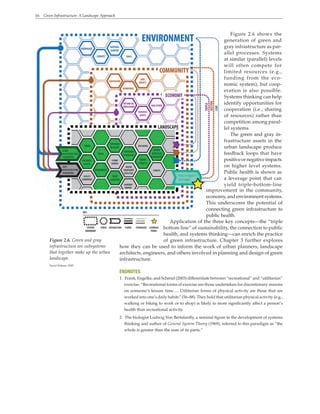
Figure 2.6 conceptualizes how green infrastructure operates as part of a hi-
erarchy of nested systems, each of which contains stocks of assets held together
by interconnections (flows and interactions between systems). In this diagram,
green and gray infrastructure are shown as subsystems that together make
up the urban landscape. Landscape is a system that bridges multiple levels
of scale across higher-level systems: environment, community, and economy.
Flows of resources (e.g., energy, materials, and information) are drawn
from the higher-level systems into interactions that generate the various
stocks of assets that make up the landscape (green infrastructure compo-
nents such as trees and rain gardens; gray infrastructure components such
as buildings and streets). While for diagrammatic purposes green and gray
infrastructure are shown as separate, interlocking systems, in reality they
can overlap in design elements such as green buildings and green streets.
16 Green Infrastructure: A Landscape Approach
Figure 2.6 shows the
generation of green and
gray infrastructure as par-
allel processes. Systems
at similar (parallel) levels
will often compete for
limited resources (e.g.,
funding from the eco-
nomic system), but coop-
eration is also possible.
Systems thinking can help
identify opportunities for
cooperation (i.e., sharing
of resources) rather than
competition among paral-
lel systems.
The green and gray in-
frastructure assets in the
urban landscape produce
feedback loops that have
positiveornegativeimpacts
on higher level systems.
Public health is shown as
a leverage point that can
yield triple-bottom-line
Figure 2.6. Green and gray
infrastructure are subsystems
that together make up the urban
landscape.
David Witham, WRT
improvement in the community,
economy, and environment systems.
This underscores the potential of
connecting green infrastructure to
public health.
Application of the three key concepts—the “triple
bottom line” of sustainability, the connection to public
health, and systems thinking—can enrich the practice
of green infrastructure. Chapter 3 further explores
how they can be used to inform the work of urban planners, landscape
architects, engineers, and others involved in planning and design of green
infrastructure.
ENDNOTES
1. Frank, Engelke, and Schmid (2003) differentiate between “recreational” and “utilitarian”
exercise: “Recreational forms of exercise are those undertaken for discretionary reasons
on someone’s leisure time…. Utilitarian forms of physical activity are those that are
worked into one’s daily habits” (56–88). They hold that utilitarian physical activity (e.g.,
walking or biking to work or to shop) is likely to more significantly affect a person’s
health than recreational activity.
2. The biologist Ludwig Von Bertalanffy, a seminal figure in the development of systems
thinking and author of General System Theory (1969), referred to this paradigm as “the
whole is greater than the sum of its parts.”
17
CHAPTER 3
Green Infrastructure in Practice
▲
The practice of green infrastructure falls under the purview of vari-
ous professions, including urban planning, landscape architecture,
civil engineering, parks and recreation, and architecture. To suc-
cessfully create green infrastructure at the landscape scale, these
professions must transcend conventional “silo” modes of thinking
and instead pursue an integrated approach to planning, design, and
implementation. This chapter explores how the concepts introduced
in Chapters 1 and 2 can be incorporated into planning and landscape
architecture practice to realize the triple-bottom-line potential of
green infrastructure.
18 Green Infrastructure: A Landscape Approach
While the landscape approach integrates green and gray infrastructures
across scales from site design to regional planning, conventional public- and
private-sector organizational structures do not lend themselves to this holistic
approach. In the public sector, planners address infrastructure to varying
degrees through their core functions of long-range planning at the district,
citywide, and regional scales; codification of zoning and development regula-
tions; and review of current development applications for conformance with
those regulations. Meanwhile, engineers usually housed in a separate depart-
ment such as public works or utilities design hard infrastructure systems
for transportation, utilities, and stormwater, and they review development
drawings for compliance with engineering standards. Landscape architects
most often work in a parks and recreation department, where they design
parks, streetscapes, and other landscape elements. Because they have differ-
ent training, typically work in separate departments with singular missions,
and deal with dissimilar types and scales of projects, opportunities for these
professionals to work together to achieve broader goals are often limited.
In the private sector, consulting firms typically have core specialties such
as planning, landscape architecture, engineering, or architecture. Where
multiple disciplines are housed in one firm, or when firms with different
specialties form teams to pursue project opportunities, the opportunity for
collaboration across disciplines is greater. However, similar barriers to those
encountered in the public sector (different professional training, project types
and scales, etc.) make a truly integrated approach to planning and design
more difficult. Some of the most successful examples of disciplinary integra-
tion have come when an agency specifies in a request for proposals (RFP)
or a design competition for a project such as a park master plan, corridor /
streetscape improvement, or revitalization plan that it seeks to harness the
triple-bottom-line outcomes of a green infrastructure approach.
So what, specifically, can planners do to promote green infrastructure?
Internally within their organization (e.g., a municipality or private consult-
ing firm), they can build connections across different types of programs and
projects (e.g., from comprehensive planning goals and policies to site-level
design), with other departments (public works, transportation, watersheds,
etc.), and with other professionals (engineers, landscape architects, architects,
etc.). They can also collaborate with outside partners that deal with issues
related to green infrastructure, such as sewer and water authorities charged
with addressing Clean Water Act mandates, regional land-conservation
organizations, and park districts or agencies. The key is to find common
interests across disciplinary and organizational boundaries to make green
infrastructure a vital part of the fabric of our communities and landscapes.
This chapter defines a set of unifying principles intended to accomplish this.
It indicates how green infrastructure can be woven into the established mis-
sions, services, and methods of planning and other professions.
PLANNING AND DESIGN PRINCIPLES
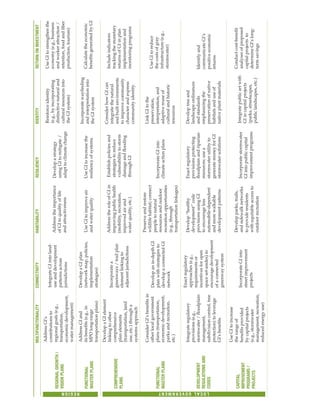
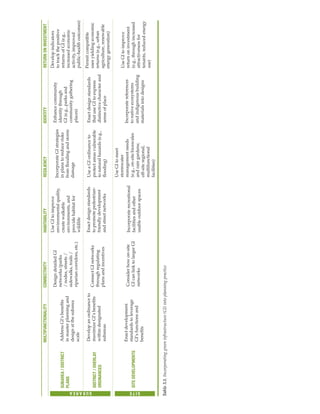
Six principles inform the planning and design of green infrastructure across
different disciplines and scales of professional practice:
1. Multifunctionality
2. Connectivity
3. Habitability
4. Resiliency
5. Identity
6. Return on investment
While this report primarily addresses the
workofplannersandlandscapearchitects,
civil engineers have an important role to
play in advancing green infrastructure
solutions through the design of storm-
water and other infrastructure systems.
The Zofnass Program for Sustainable
Infrastructure at the Harvard Graduate
School of Design and the Institute for
Sustainable Infrastructure (founded by
the American Society of Civil Engineers,
the American Council of Engineering
Companies, and the American Public
Works Association) have taken an im-
portant step in this direction by de-
veloping the Envision Rating System.
Envision provides a holistic framework
for evaluating and rating the community,
environmental, and societal impacts and
benefits of transportation, water supply,
wastewater treatment, and other types of
civil infrastructure projects. Credits used
to develop numeric ratings of projects are
grouped into five categories:
• Quality of Life (benefits to and impacts
on communities affected by the project)
• Leadership (communication and col-
laboration in project development)
• Resource Allocation (quantity, source,
and characteristics of materials and
other resources used in project con-
struction and operations)
• Natural World (impacts on natural
systems)
• Climate and Risk (resiliency vis-à-vis
short-term hazards such as flooding
and long-term changes such as sea
level rise)
Examples of specific credits relevant to
green infrastructure include encouraging
alternative modes of transportation (i.e.,
trails, bikeways, transit, etc.—Quality
of Life), managing stormwater (Natural
World), and managing heat island effects
(Climate and Risk). See www.asce.org
/Sustainability/ISI-Rating-System.
▲ GREEN INFRASTRUCTURE
AND THE PROFESSIONS OF
PLANNING AND LANDSCAPE
ARCHITECTURE
▲
Chapter 3. Green Infrastructure in Practice 19
Multifunctionality
This principle builds on the concept of the triple bottom line—the environ-
mental, economic, and community benefits provided by green infrastructure.
Also called ecosystem services, these benefits derive from the multiple and
overlapping functions provided across the different systems—hydrology,
transportation, energy, economy, and so on—that can intersect in green infra-
structure. The multifunctionality principle calls on planners and designers to
maximize value for the communities they serve by using green infrastructure
to achieve seemingly disparate goals such as flood control, reduced depen-
dence on imported energy, and improved public-health outcomes.
Spanning more than 15 years of plan-
ning and design, the Trinity River
Corridor Project seeks to transform
the 2,300-acre floodway of the Trinity
River near downtown Dallas into
a sustainable, city-building green
infrastructure catalyst (Figure 3.1).
The project is guided by five interre-
lated and overlapping improvement
strands—flood control, environ-
ment, recreation, transportation,
and economic development—woven
into the overriding goal of maximiz-
ing the value of new infrastructure.
The project will achieve this goal by
modifying existing levees to achieve
greater flood protection and reliev-
ing downtown traffic congestion through construction of a new toll road, while inducing
the level of green amenity and environmental health necessary to spur a new generation
of sustainable development in the city’s core. The linkage between green amenity and
infrastructure has been established, for example, by sizing and configuring on-site “bor-
row areas” (from which fill materials needed for the expanded levees and toll road are
extracted) into recreational lakes laced with marshlands and dotted with “floating wet-
lands” (rings of suspended aquatic vegetation)—features that provide water cleansing,
aquatic habitat, and recreational value. In this and other ways the floodway will emerge
as a massive public work of green infrastructure, changing the function and identity of
a heretofore little-seen and even less-used public resource. (See the related case study of
the North Texas region in Chapter 4.)
▲
THE MULTIFUNCTIONALITY PRINCIPLE AT WORK: TRINITY RIVER CORRIDOR
PROJECT, DALLAS
▲
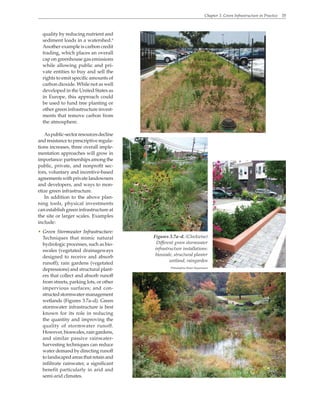
Figure 3.1. The Trinity River
Corridor Project, Dallas
WRT
Connectivity
This principle means that green infrastructure is most effective in provid-
ing services and benefits when it is part of a physically connected system
across the landscape (e.g., a natural reserve or a park). For example, a natural
reserve that is connected to others by a corridor of native vegetation (e.g.,
along a river or stream) is more valuable (all other factors being equal) than
one surrounded by urban development because it allows for wildlife move-
ment between different habitat areas. Similarly, a park that is connected to
other parks via a regional hiking or biking trail serves more people than one
surrounded by a local residential neighborhood.
20 Green Infrastructure: A Landscape Approach
To create a connected green infrastructure system at the landscape scale,
planners and designers should establish physical and functional linkages
across urban, suburban, and rural landscapes and across scales to connect
site, neighborhood, city, and region. For example, vegetated corridors along
major watercourses can connect rural, suburban, and urban areas within a
region, providing multiple benefits such as wildlife habitat, recreation, and
management of water quantity and quality. The form of this corridor may
vary, taking shape as a native riparian woodland in a rural (agricultural)
context, more actively managed landscape plantings in a suburban context,
or intensively designed landscape treatments that function as movement
corridors and gathering spaces in an urban context. Green boulevards and
streets that incorporate native or indigenous plantings to benefit wildlife,
natural stormwater management features, and safe accommodations for pe-
destrians and bicyclists can serve as green infrastructure connections in more
densely developed suburban and urban areas. In creating connected green
infrastructure systems, planners and designers can draw on basic concepts
of landscape ecology (patch, corridor, edge, and matrix as the large-scale
structural components of landscapes).
Habitability
The habitability principle positions green infrastructure as visible space
that provides outdoor habitat for people, flora, and fauna. The mission of
the public health profession—to foster conditions in which people can be
healthy—is central to the idea of habitable green infrastructure. Examples of
green infrastructure planning and design outcomes that advance this prin-
ciple include improved air and water quality (resulting in improved health
of humans and ecosystems), increased opportunity for outdoor recreation
and exercise, and restoration of native habitats.
Resiliency
Defined as the ability to recover from or adapt to disturbance and change,
resiliency is particularly relevant in a time when natural and human eco-
systems are experiencing accelerating change and instability, ranging from
higher energy prices to economic shocks to the projected effects of climate
change. Examples of how green infrastructure can increase community
resiliency across scales include:
• Trees and green roofs can counteract the urban heat island effect at the
city scale and reduce the cooling needs of individual buildings.
• A community can reduce its vulnerability to storms and the cost of pro-
tective gray infrastructure by maintaining the natural flood absorption
capacity of coastal or riparian wetlands and floodplain areas.
• Tree plantings, green and “blue” roofs, permeable pavement, rain gardens,
and other techniques that absorb rainfall on-site can reduce the impacts
of urban runoff during storms (e.g., overburdened storm sewers, street
flooding, and combined sanitary / storm sewer overflows into rivers and
streams).1
Green infrastructure can increase community resiliency over short and
long timeframes (e.g., reduced damage and faster recovery from natural
disasters, increased ability to adapt to climate change). One study concluded
that green infrastructure treatments (increased tree cover, green roofs, etc.)
could significantly reduce the stormwater runoff and surface temperature
increases projected in the 2080s as a result of greenhouse gas emissions (Gill
et al. 2007).
LANDSCAPE ECOLOGY
TERMS, CONNECTIVITY, AND
GREEN INFRASTRUCTURE
Commonly referred to as a “hub” or
“node” by planners and designers of
green infrastructure systems, a “patch”
is defined by landscape ecologists as a
discrete area of the landscape that differs
from its surroundings (e.g., a park or
natural reserve). A “corridor” is a linear
element that links natural habitat patches.
Riparian habitat along a river or stream
is a common example, while roadways
are important corridors in urban and
suburban landscapes. An “edge” is the
transition area between different land-
scape elements (e.g., patches and corri-
dors). Finally, the “matrix” is the overall
landscape structure or pattern within
which patches, corridors, and edges are
embedded. While green infrastructure
network design typically focuses on
creating hubs and connecting corridors
(often called links), the role of the matrix
in fostering connectivity—e.g., an urban
or suburban community with a healthy
urban forest—should not be overlooked.
From a systems perspective, connectivity
encompasses both natural ecological func-
tions such as providing habitat routes for
wildlife and human ones such as promot-
ing social equity by connecting people to
green infrastructure.
One good working definition of land-
scape ecology overall is: “The study of
native landscape structure, function, and
change at the scale of the entire landscape,
as well as the application of the results
to the design and management of both
natural and human dominated areas”
(Benedict and McMahon 2006, 283).
▲
▲
Chapter 3. Green Infrastructure in Practice 21
Identity
Design of landscape elements to
create a perceptible identity and
sense of place is a central moti-
vation of landscape architects.
Planners often use the term “com-
munity character” to express the
special and valued attributes that
make a place desirable to live in
or visit. The identity principle
addresses the potential of green
infrastructure to contribute to the
visual definition of a place. A tree,
for example, can act as a carbon sink
and, through shading, contribute
to energy conservation, both of
which functions can be quantified.
But what kind of tree is it and in
what location? Is it appropriate for
the native terrain, vegetation, and
climate? What added recreational
or spiritual benefit does it provide?
Does it have any aesthetic or cultur-
ally significant effect?
In this context, the integration
of art within the public sphere
becomes a relevant consideration.
In recent decades Ecological Art
or “Eco-Art” has emerged as a
distinctive genre within the field of
public art.2
One early practitioner
is Seattle artist Buster Simpson,
whose work “Beckoning Cistern”
captures roof stormwater from
a loft building and directs it via
inventive scuppers and storage
tanks to streetside rain gardens.
This project fully captures the
potential of green infrastructure to
engender a unique sense of place.
Thinking across scales, could a
recurring motif expressed through
stormwater or other forms of green
infrastructure help visually define
a neighborhood, city, or region?
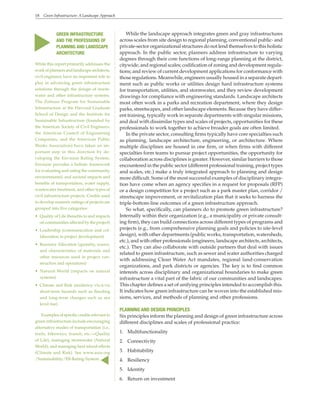
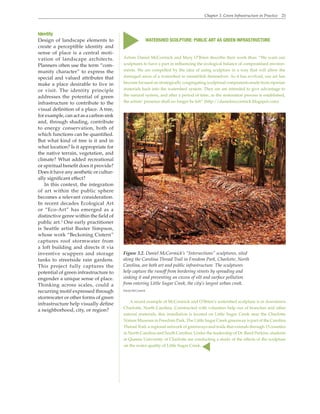
WATERSHED SCULPTURE: PUBLIC ART AS GREEN INFRASTRUCTURE
Artists Daniel McCormick and Mary O’Brien describe their work thus: “We want our
sculptures to have a part in influencing the ecological balance of compromised environ-
ments. We are compelled by the idea of using sculpture in a way that will allow the
damaged areas of a watershed to reestablish themselves. As it has evolved, our art has
become focused on strategically congregating sculptural components made from riparian
materials back into the watershed system. They are are intended to give advantage to
the natural system, and after a period of time, as the restoration process is established,
the artists’ presence shall no longer be felt” (http://danielmccormick.blogspot.com).
A recent example of McCormick and O’Brien’s watershed sculpture is in downtown
Charlotte, North Carolina. Constructed with volunteer help out of branches and other
natural materials, this installation is located on Little Sugar Creek near the Charlotte
Nature Museum in Freedom Park. The Little Sugar Creek greenway is part of the Carolina
Thread Trail, a regional network of greenways and trails that extends through 15 counties
in North Carolina and South Carolina. Under the leadership of Dr. Reed Perkins, students
at Queens University of Charlotte are conducting a study of the effects of the sculpture
on the water quality of Little Sugar Creek.
Figure 3.2. Daniel McCormick’s “Intersections” sculptures, sited
along the Carolina Thread Trail in Freedom Park, Charlotte, North
Carolina, are both art and public infrastructure. The sculptures
help capture the runoff from bordering streets by spreading and
sinking it and preventing an excess of silt and surface pollution
from entering Little Sugar Creek, the city’s largest urban creek.
Daniel McCormick
▲
▲
22 Green Infrastructure: A Landscape Approach
Return on Investment
In a time of scarce financial resources, this principle calls on plan-
ners and designers to demonstrate how green infrastructure can
reduce costs and yield positive financial outcomes for govern-
ments, institutions, businesses, and citizens. Examples of ways
that green infrastructure can generate monetary value include
increasing land values, providing a catalyst for economic devel-
opment, lessening energy consumption, and reducing gray infra-
structure costs. Planners and designers should use cost-benefit
analyses to justify green infrastructure approaches, to plan and
design green infrastructure components to achieve goals such
as reduced energy use and increased revenue, and to establish
targets and indicators to monitor whether these goals are being
met in implementation.
SCALES OF PLANNING PRACTICE
Planners and designers of the physical environment can apply
the green infrastructure principles to achieve triple-bottom-line
benefits at different scales in different contexts. While important
work has been done at the state level, we focus here on four in-
terrelated scales: regional, local government, subarea / district /
neighborhood, and site.3
• At the regional scale, green infrastructure can help shape the
pattern and form of development to promote outcomes such
as urban revitalization, rural land preservation, reduced costs
of publicly provided infrastructure and services, and increased
opportunities for walking, biking, and transit use.
• At the scale of the local government, planning policy, regula-
tions, and capital investments can be used to incorporate
communitywide green infrastructure systems such as parks
and greenways, a healthy urban forest, and green streets and
boulevards into the physical fabric of existing and new devel-
opment.
• The district, subarea, or neighborhood scale lends itself to use of
green infrastructure features (green streetscapes, community
parks and gathering places, etc.) in master planning and urban
design to achieve local benefits such as enhanced air and water
quality, greater recreational opportunity, an improved business
climate, and increased social interaction and exchange.
• At the site scale, housing or mixed use developments, campuses,
parks and public places, and other project types can incorporate
green infrastructure design interventions such as green storm-
water infrastructure, green roofs, living walls, and so on.
Planners can to help the communities they serve achieve the
triple-bottom-line benefits provided by green infrastructure by
consistently applying the six guiding principles across diverse
scales and project types. Table 3.1 (pp. 24–25) provides illustra-
tive examples of how the principles can be applied in different
contexts.
EXAMPLES OF THE RETURN-ON-
INVESTMENT PRINCIPLE AT WORK
• The triple-bottom-line analysis conducted for
Green City Clean Waters, the Philadelphia Water
Department’s Long-Term Control Plan Update
(Philadelphia 2009), found that green stormwater
infrastructure investments (green streets, green
roofs, pervious pavement, etc.) would yield a $2.2
billion return on $1.01 billion spent over a 40-year
period. Monetary values were calculated for eight
different factors, yielding projected benefits such
as roughly 250 people employed in green jobs, one
million or more additional recreational user-days,
six million fewer kilowatt-hours of electricity and
eight billion fewer BTUs of fuel used annually, and
about 140 fewer heat-related deaths over 40 years.
(Green City Clean Waters is included as a case study
in Chapter 4.)
• According to Economy League of Greater
Philadelphia et al. (2010), protected open space
in southeastern Pennsylvania adds $16.3 billion
to housing property values, generates $240 mil-
lion annually in local property tax revenues, and
generates more than 6,900 jobs and $299 million
in annual earnings. In addition, health-related cost
savings (avoided workers’ compensation costs
and productivity losses) from physical activity on
protected open space total $1.3 billion per year.)
• Many studies have documented the positive eco-
nomic impacts of trails at regional and larger scales.
For example, on the Great Allegheny Passage—
a150-miletrailbetweenPittsburghandCumberland,
Maryland—the “Trail Towns” program aims to
realize the economic potential of the trail, which
has been calculated to generate over $40 million
in annual direct spending by users and $7.5 mil-
lion in annual wages attributed to trail businesses.
Approximately 40 percent of trail users plan an
overnight stay, averaging 30 to 40 miles and $98 in
spending a day (Campos 2009).
• The Trinity River Corridor in Dallas is envisioned
as the catalyst for the potential redevelopment of a
square mile of adjoining lands, mostly older ware-
housing and small-scale industrial uses. The value
of such redevelopment could ultimately reach $8
billion, depending on density, building typologies,
and use—tenfold the projected cost of the corridor’s
green infrastructure improvements. The return on
investment will be compounded by energy savings
and health benefits accruing from denser develop-
ment supported by public transit in close proximity
to the city’s downtown.
▲
▲
Chapter 3. Green Infrastructure in Practice 23
Regional Scale
At the scale of the metropolitan region, planning for green infrastructure can
make connections (e.g., regional greenway and trail systems) and address
natural landscape features (e.g., watersheds and ecological zones) across
jurisdictional boundaries. Planners and policy makers can promote green
infrastructure at the regional level by:
• Integrating green infrastructure with regional patterns of growth and
conservation
• Directing investments in regional systems such as transportation, storm-
water drainage, and open space toward green infrastructure
• Facilitating partnerships among public agencies, nonprofit land conserva-
tion organizations, institutions, businesses, and developers who stand to
benefit from green infrastructure solutions
• Leveraging resources for implementation (e.g., by tapping public and
private funding streams for green infrastructure projects and programs)
In the United States, regions are typically defined to include a core city
(or cities) and surrounding suburban and rural communities, with in some
cases a metropolitan planning organization (MPO) or council of govern-
ments serving as a regional planning agency. Formal regional governance
models are generally limited to combined city-county governments (e.g.,
Indianapolis and Marion County, Louisville Metro) and special legislative
entities established to manage land use and protect high-quality resources
within designated areas (e.g., the Lake Tahoe Regional PlanningAgency and
New Jersey Pinelands Commission). While MPOs focus on transportation
GREEN INFRASTRUCTURE AND THE TRANSECT
Under the landscape approach, green infrastructure assumes different typologies and physical characteristics in urban, suburban, and
rural contexts and the transitions among them. This continuum is analogous to the rural-to-urban transect planning model promulgated
by planning firm Duany Plater-Zyberk and Company (DPZ). The Transect consists of six zones of increasing density with associated
design standards: Rural Preserve, Rural Reserve, Sub-Urban, General Urban, Urban Center, and Urban Core (downtown or central
business district) (www.dpz.com/transect.aspx). Using this analogy, green infrastructure in rural contexts corresponds to either the
Rural Preserve (as wilderness) or to the Rural Reserve (as “working lands with conservation value” [Benedict and McMahon 2006]). In
more-developed suburban contexts, green infrastructure takes on forms such as nature preserves surrounded by development, parks
with active recreational facilities, and private gardens. Green infrastructure merges with the built environment in dense urban contexts
(Urban Center and Urban Core), where it is expressed in streetscapes, urban parks and public gathering spaces, green stormwater
infrastructure, and so on.
▲
▲
Figure 3.3. The Transect
Duany Plater-Zyberk and Company
MULTIFUNCTIONALITY
CONNECTIVITY
HABITABILITY
RESILIENCY
IDENTITY
RETURN
ON
INVESTMENT
Address
GI’s
contributions
to
regional
goals
(e.g.,
transportation,
economic
development,
water
management)
REGIONAL
GROWTH
/
VISION
PLANS
Integrate
GI
into
land-
use
and
development
patterns
across
jurisidictions
Address
the
importance
of
GI
to
quality
of
life
and
attractiveness
Develop
a
strategy
using
GI
to
mitigate
/
adapt
to
climate
change
Reinforce
identity
(e.g.,
by
incorporating
distinctive
natural
and
cultural
resources
into
the
GI
system)
Use
GI
to
strengthen
the
economy
(e.g.,
business
and
worker
attraction
/
retention,
food
and
fiber
production,
tourism)
FUNCTIONAL
MASTER
PLANS
Address
GI
and
its
benefits
(e.g.,
in
MPO
long-range
transportation
plans)
Develop
a
GI
plan
(network
map,
policies,
implementation
strategies)
Use
GI
to
increase
the
resiliency
of
systems
Incorporate
wayfinding
and
interpretation
into
the
GI
system
Calculate
the
economic
benefits
generated
by
GI
Use
GI
to
improve
air
and
water
quality
R
E
G
I
O
N
COMPREHENSIVE
PLANS
Develop
a
GI
element
linking
to
other
comprehensive
plan
elements
(transportation,
land
use,
etc.)
through
a
systems
approach
Incorporate
a
greenways
/
trail
plan
element
linking
to
adjacent
jurisdictions
Address
the
role
of
GI
in
improving
public
health
(mobility,
recreation,
improved
air
and
water
quality,
etc.)
Consider
how
GI
can
integrate
the
natural
and
built
environments
to
improve
community
character
and
express
community
identity
Include
indicators
tracking
the
monetary
returns
of
GI
in
plan
implementation
and
monitoring
programs
Establish
policies
and
strategies
to
reduce
vulnerability
to
storm
damage
and
flooding
through
GI
FUNCTIONAL
MASTER
PLANS
Consider
GI’s
benefits
in
other
local
government
plans
(transportation,
economic
development,
parks
and
recreation,
etc.)
Develop
an
in-depth
GI
plan
with
strategies
to
develop
a
connected
GI
network
Preserve
and
restore
wildlife
habitat;
connect
people
to
natural
resources
and
outdoor
recreation
opportunities
(e.g.,
through
transportation
linkages)
Incorporate
GI
into
climate
action
plans
Link
GI
to
the
preservation,
interpretation,
and
adaptive
reuse
of
cultural
and
historic
resources
Use
GI
to
reduce
the
costs
of
gray
infrastructure
(e.g.,
stormwater)
DEVELOPMENT
REGULATIONS
AND
CODES
Integrate
regulatory
provisions
(e.g.,
stormwater
/
floodplain
management,
subdivision
control,
tree
protection)
to
leverage
GI’s
benefits
Enact
regulatory
approaches
(e.g.,
requirements
or
incentives
for
open
space
set-asides)
to
encourage
development
of
a
connected
greenway
system
Develop
“healthy
development”
code
provisions
using
GI
to
encourage
less
automobile-dependent
and
more
walkable
development
patterns
Enact
regulatory
provisions
protecting
floodplain
and
riparian
resources;
use
a
stormwater
utility
to
generate
money
for
GI
stormwater
solutions
Develop
tree
and
landscape
ordinances
and
standards
emphasizing
the
preservation
of
native
habitats
and
use
of
native
plant
materials
Identify
and
communicate
GI’s
positive
economic
returns
CAPITAL
IMPROVEMENT
PROGRAMS
/
PROJECTS
Use
GI
to
increase
the
range
of
benefits
provided
by
capital
projects
(e.g.,
stormwater
management,
recreation,
reduced
energy
use)
Incorporate
GI
into
street
improvement
projects
Develop
parks,
trails,
and
sidewalk
networks
to
provide
residents
with
equitable
access
to
outdoor
recreation
Incorporate
stormwater
GI
into
public
capital
improvement
programs
Integrate
public
art
with
GI
in
capital
projects
(parks,
streetscapes,
public
landscapes,
etc.)
Conduct
cost-benefit
analyses
of
proposed
capital
projects
to
determine
GI’s
long-
term
savings
L
O
C
A
L
G
O
V
E
R
N
M
E
N
T
MULTIFUNCTIONALITY
CONNECTIVITY
HABITABILITY
RESILIENCY
IDENTITY
RETURN
ON
INVESTMENT
Permit
compatible
uses
yielding
economic
returns
(e.g.,
urban
agriculture,
renewable
energy
generation)
Use
GI
to
improve
return
on
investment
(e.g.,
through
increased
attractiveness
for
tenants,
reduced
energy
use)
DISTRICT
/
OVERLAY
ORDINANCES
Develop
an
ordinance
to
maximize
GI’s
benefits
within
designated
subareas
Connect
GI
networks
through
regulating
plans
and
incentives
Enact
design
standards
to
promote
pedestrian-
friendly
development
and
street
networks
Use
a
GI
ordinance
to
protect
areas
vulnerable
to
natural
hazards
(e.g.,
flooding)
Enact
design
standards
that
use
GI
to
express
distinctive
character
and
sense
of
place
SITE
DEVELOPMENTS
Enact
development
standards
to
leverage
GI’s
functions
and
benefits
Consider
how
on-site
GI
can
link
to
larger
GI
networks
Incorporate
recreational
facilities
and
other
usable
outdoor
spaces
Use
GI
to
meet
stormwater
management
needs
(e.g.,
on-site
bioswales
and
rain
gardens;
off-site
regional,
multifunctional
facilities)
Incorporate
references
to
native
ecosystems
and
indigenous
building
materials
into
designs
Table
3.1.
Incorporating
green
infrastructure
(GI)
into
planning
practice
S
U
B
A
R
E
A S
I
T
E
SUBAREA
/
DISTRICT
PLANS
Address
GI’s
benefits
in
master
planning
and
design
at
the
subarea
scale
Design
detailed
GI
networks
(parks
/
nodes,
streets
/
sidewalks,
trails
/
riparian
corridors,
etc.)
Use
GI
to
improve
environmental
quality,
create
walkable
environments,
and
provide
habitat
for
wildlife
Incorporate
GI
strategies
in
plans
to
reduce
risks
from
flooding
and
storm
damage
Enhance
community
identity
through
GI
(e.g.,
parks
and
community
gathering
places)
Develop
indicators
to
track
the
positive
returns
of
GI
(e.g.,
increased
economic
activity,
improved
public-health
outcomes)
26 Green Infrastructure: A Landscape Approach
planning, since they are conduits for federal funding of transportation proj-
ects and programs, in recent years many have broadened their purviews to
address other regional issues. For example, the Mid-Ohio Regional Planning
Commission, the MPO for the Greater Columbus region, has established a
Center for Energy and Environment that administers programs on topics
such as greenways and water quality, sustainable growth, local foods, and
energy efficiency.
Some regional planning agencies have launched initiatives specifically
focused on green infrastructure. There are two general types of these initia-
tives: comprehensive regional plans (e.g., Vision North Texas; see Chapter 4)
and functional master plans that address specific systems such as transporta-
tion, housing, or natural resources and open space. Examples of functional
planning for green infrastructure at the regional level include:
• The Hudson Valley Regional Council is leading a green infrastructure plan-
ning project to protect and restore watersheds in the Hudson Valley region
of New York State (https://sites.google.com/site/greeninfrastructure
planning).
• In North Carolina, the Land-of-Sky Regional Council’s green infrastruc-
ture initiative establishes “a regional framework for conservation and
development that will strategically guide future growth for Madison,
Buncombe, Henderson, and Transylvania counties while respecting the
integrity of the region’s ecosystems” (www.landofsky.org/planning
/p_linking_lands.html).
• The Richmond and Crater Planning District Commissions (Virginia) part-
neredona“blue-green”infrastructureinitiative,RegionalBlue-GreenInfra-
structure Project: Green Infrastructure Planning Tools for Connected Com-
munities (www.richmondregional.org/planning/green%20infrastructure
.htm).
The federal Sustainable Communities Partnership, which includes the U.S.
Department of Housing and Urban Development (HUD), the Department of
Transportation, and the EPA, has provided a new impetus for regional plan-
ning. In 2010 and 2011, HUD awarded grants to regions across the country
to develop Regional Plans for Sustainable Development. Led by Regional
Consortiums comprising public, private, and nonprofit sector partners,
these plans are intended to integrate and coordinate housing, transporta-
tion, economic development, environmental quality, and land-use decision
making at the regional level.
Local Government Scale
Units of local government have the primary legal authority for planning,
regulation, and public capital investment within their jurisdictions. Local
governmental planning can address green infrastructure by:
• Setting policy direction for decision makers in long-range planning
documents
• Incorporating green infrastructure into capital improvement programs
and projects
• Enacting regulatory requirements and incentives for green infrastructure
(e.g., ordinances protecting sensitive environmental resources or increased
density for subdivisions that maintain valuable open space and greenway
connections)
• Establishing partnerships and leveraging resources for implementation
Chapter 3. Green Infrastructure in Practice 27
While the local governmental scale
facilitates direct implementation of green
infrastructure through actions such as capital
improvements and changes to development
regulations, it does not necessarily address
how green infrastructure within a jurisdic-
tion fits into a regional system (e.g., by con-
necting to greenway and trail networks in
adjacent communities).
Local governments can address green
infrastructure through a variety of planning
applications. The comprehensive plan (re-
ferred to as the general plan in California and
master plan in New Jersey) is the primary
policy document of local governments and
as such is the perhaps the best mechanism for
promoting the triple bottom line of sustain-
ability: economic prosperity, environmental
quality, and social equity. Comprehensive
plans are typically organized into functional
elements such as land use, transportation,
housing, and economic development, but a
more integrated approach treats these ele-
ments as interrelated systems rather than as
separate topics (Godschalk and Anderson
2012). Because it connects multiple systems
and functions, green infrastructure is an
obvious candidate to help implement such
an approach. For example, comprehensive
plans can include green infrastructure as a
core element (in place of a more traditional
open space and natural resources element)
and identify connections with land use,
transportation, and other elements in the
plan goals, policies, strategies, and imple-
mentation actions. (On developing a green
infrastructure element in a comprehensive
plan, see the appendix to Schwab 2009.)
Planning for communitywide functions
(systems) such as housing and transporta-
tion is another planning responsibility of
local jurisdictions.Anumber of counties and
municipalities have developed stand-alone
plans that address green infrastructure as a
communitywide system. County plans typi-
cally follow the model of green infrastructure
as a large-scale, predominantly natural
landscape network. Examples include
Kingston-Lenoir County and Lancaster
County, Pennsylvania; Prince George’s
County, Maryland; and Saratoga County,
NewYork. Green infrastructure plans by mu-
nicipalities such as Philadelphia, Lancaster,
Pennsylvania (see Chapter 4), and New York
City typically focus on green stormwater
infrastructure.
GREENSCAPES: LANCASTER COUNTY GREEN
INFRASTRUCTURE PLAN
Located in southeastern Pennsylvania about 40 miles west of Philadelphia,
Lancaster County is renowned for its agricultural landscape and the cultural
heritage of its Plain Sect (Amish and Mennonite) communities (Figure 3.4).
Its 944 square miles encompass 60 municipalities and a population of 519,445
as of 2010. In 2009 the Lancaster County Board of Commissioners adopted
Greenscapes to replace the 1992 Regional Open Space Plan as an official element
of the Lancaster County Comprehensive Plan.
Lancaster County’s rich natural resources have been extensively altered by
agriculture (accounting for approximately 54 percent of the county’s land area) and
residential, commercial, and industrial development (approximately 18 percent).
Greenscapes complements the growth management element of the comprehen-
sive plan, which establishes goals, strategies, and tools for municipalities to use
in managing growth and land preservation in designated urban and rural areas.
Greenscapes defines green infrastructure as “Lancaster County’s essential natural
life support system … a network of natural areas, green spaces, and greenways
Figure 3.4. Lancaster County, Pennsylvania, landscape
WRT
in rural, suburban, and urban areas that sustains ecological functions and values
and provides a broad array of benefits for the people of Lancaster County and the
surrounding region.” The plan describes the basic structural components of the
network using landscape ecology concepts: hubs (core natural habitat areas) and
majorgreenwayconnectorsatthecountywidescale;nodesandlinks(smallersystem
components) at the intermediate to local scale; and the matrix of urban, suburban,
and rural landscapes within which these components are located. It establishes
goals, objectives, and strategies for the green infrastructure system based on four
primary system functions: preservation of exceptional natural resources (e.g.,
rare, threatened, and endangered species habitat); conservation or stewardship
of important natural resources (e.g., forests) and the essential life support services
they provide; restoration of natural resource systems and ecological connections
(e.g., riparian vegetation along stream corridors through agricultural and urban
areas); and recreation and improved community health (e.g., development of a
countywide trail network). Finally, it identifies an action plan with specific tools in
four categories—policy and planning, regulation, capital investment, and educa-
tion and outreach—that the County, municipalities, and private and public-sector
partners can employ to realize the goals, objectives, and strategies.
▲
▲
28 Green Infrastructure: A Landscape Approach
The opportunity to include green infrastructure approaches in other
functional plans should not be overlooked. For example, green stormwater
infrastructure, “complete street” concepts, and trail / greenway systems
can be incorporated into transportation plan goals, objectives, strategies,
and actions.4
The implementation elements of comprehensive and functional plans
should specify actions, priorities, and responsibilities for implementing green
infrastructure approaches. Development regulations and codes can promote
green infrastructure in private development (e.g., stormwater management
ordinances requiring green approaches; green building incentives; and re-
quirements or incentives for open space set-asides and protection of natural
resources). Capital improvement programming and project planning (e.g.,
for parks, trails, green streets, and green stormwater infrastructure) provide
another means for local governments to implement green infrastructure.
Subarea / District / Neighborhood Scale
Similar to the way that a regional plan can set the framework for planning
at the local governmental scale, a communitywide comprehensive plan,
functional plans, and development ordinance can set the framework for
more detailed planning, design, and implementation of green infrastructure
within smaller geographic areas of a jurisdiction. Planning applications at
this scale include subarea or district plans (referred to as specific plans in
California) and district or overlay regulations (e.g., a form-based or regu-
lating code that addresses a defined district or an overlay ordinance that
addresses a specific resource type, such as riparian zones).
Site Scale
Approaches such as green stormwater infrastructure, green roofs and building
treatments, and dedicated open space and recreation areas become physical
reality at the site scale. While landscape architects, engineers, and architects are
the primary designers at this scale, planners set important design parameters
for their work by administering development regulations, standards, and
review of subdivisions, site plans, and planned unit developments.
GREEN INFRASTRUCTURE IN THE PLANNING PROCESS
Landscapearchitects,civilengineers,andalliedprofessionalsimplementgreen
infrastructure through site planning and project design. Planners can play an
equally vital role by integrating green infrastructure concepts and approaches
into all levels of planning, from visioning to plan and policy development to
implementation mechanisms such as regulations and capital improvement
programs. This does not require radically different ways of planning, but it
does mean that planners should stress integrating green with gray and other
conventional approaches; optimizing triple-bottom-line results; and using sys-
tems thinking to create connections and synergies across project types, scales,
and disciplines. The six planning and design principles provide a framework
and direction for applying green infrastructure in planning practice.
Given their responsibilities to the communities and elected officials they
serve, planners have a responsibility to raise awareness of the value of green
infrastructure, which is a term not all laypersons will recognize. Emphasizing
the tangible benefits green infrastructure can provide is key to success-
fully communicating its importance. For example, the Philadelphia Water
Department’s Green City, Clean Waters website includes a page describing
how residents, businesses, schools, and community groups can benefit from
green infrastructure projects and programs (www.phillywatersheds.org/
whats_in_it_for_you). The national success rate of voter referendums for
open space protection indicates broad public understanding of the value of
Chapter 3. Green Infrastructure in Practice 29
green infrastructure investments.5
In the current economic climate, where
priorities compete for scarce fiscal resources, the multifunctionality and
return-on-investment principles in particular can be used to justify and build
support for community green infrastructure initiatives.
One place where many municipalities can begin is with stormwater infra-
structure. For municipalities, institutions, and developers, federal, state, and
local regulatory requirements increasingly position green stormwater infra-
structure as a viable and preferable alternative to conventional engineering
solutions. The Federal Water Pollution ControlAmendments of 1972 and 1977
(the Clean Water Act) established a basic structure for regulating pollutant
discharges by “point” sources (e.g., pipes and drains) under the National
Pollutant Discharge Elimination System (NPDES). The Water Quality Act
of 1987 expanded the NPDES permit requirements to apply to “nonpoint”
(dispersed) sources. The requirements were issued in two parts. Phase 1
(1990) requires municipalities of 100,000 or more, industrial dischargers,
and construction sites of at least five acres to obtain NPDES permits. Phase 2
(1999) extends the requirements to municipalities with populations between
50,000 and 100,000 and a density of at least 1,000 persons per square mile,
construction sites of one or more acres, and large property owners such as
hospitals, universities, and school districts.
The Environmental Protection Agency (EPA), which is responsible for
Clean Water Act administration and enforcement, “strongly encourages”
the use of green infrastructure to fulfill NPDES permit requirements and to
address water-quality violations caused by combined sanitary and sewer
overflows (CSO; see the Cleveland and Philadelphia case studies in Chapter
4). The EPA has released a series of policy memos and fact sheets on incor-
porating green infrastructure into NPDES and CSO programs, and in July
2012 it announced the selection of 17 communities in 16 states to receive a
total of $950,000 in technical assistance for projects including code review,
green infrastructure design, and cost-benefit assessments (http://water.epa
.gov/infrastructure/greeninfrastructure/gi-support.cfm).
At the state and local levels, many jurisdictions have promulgated storm-
water regulations that encourage green infrastructure approaches, along
with code requirements protecting natural green infrastructure components
such as wetlands, floodplains, stream buffers, and mature trees. Maryland’s
Stormwater Management Act of 2007, for example, “requires that environ-
mental site design (ESD), through the use of nonstructural best management
practices and other better site design techniques, be implemented to the maxi-
mum extent practicable.” ESD is defined as “using small-scale stormwater
management practices, nonstructural techniques, and better site planning to
mimic natural hydrologic runoff characteristics and minimize the impacts
of land impact on water resources” (an approach commonly referred to as
“low-impact development”).
Abroader approach is also possible, such as in Atlanta, which has enacted
a suite of environmental regulations. Befitting a city that places a high value
on its urban forest as central to its identify and sense of place, Atlanta’s tree
ordinance is one of the strictest of any major American city. Administered
by the Arborist Division of the Department of Planning and Community
Development, the ordinance’s stated purpose is to achieve “no net loss” of
trees. Private property owners are required to obtain permits to remove trees
above a minimum size (six-foot diameter at breast height [dbh] for hardwoods
and12-inchdbhforpines).OtherenvironmentalregulationsinAtlantainclude:
• APostdevelopment Stormwater Management Ordinance that encourages the
use of nonstructural stormwater management and site design practices,
including “the preservation of greenspace and other conservation areas
to the maximum extent practicable.”
30 Green Infrastructure: A Landscape Approach
• Flood Area Regulations that prohibit new construction within the 100-year
floodplain.
• Riparian Buffer Requirements that maintain a 75-foot buffer from the top
of stream banks.
• Wetland Protection Regulations that supplement U.S. Army Corps of Engi-
neers requirements for wetlands that fall under the jurisdiction of Section
404 of the Clean Water Act.
The value green infrastructure can create for private and public develop-
ment projects goes beyond compliance with stormwater and other regulatory
requirements. Over the last decade, green building (a corollary of green
infrastructure) has evolved from being a product that was seen as expensive
and limited to one that commands a premium in a competitive market. As
one consultant has noted, “Green buildings return higher rents, offer faster
letting, secure greater occupancy, and generate higher resale values. In an
economic environment where quality is foremost, green buildings offer
higher quality at modest additional cost” (Yudelson 2009).
The market advantages of green buildings are well documented and in-
clude life-cycle building and energy cost savings; reduced operating costs of
buildings and landscapes; higher property values; healthier, more productive
occupants; and public relations and marketing advantages for developers and
owners (www.ecomanor.com/copy/leeds.pdf). In keeping with the view of
green infrastructure as a system connecting the built and natural environ-
ment, a significant proportion of green building value can come from tree and
landscape plantings, green roofs and walls, and rainwater collection systems.
Further, many federal, state, and local agencies and institutions are requir-
ing LEED certification or the equivalent in their development projects. LEED,
developed by the U.S. Green Building Council (USGBC), is the most popu-
lar green building–rating system. LEED for Neighborhood Development
(LEED-ND), a recent version of LEED developed by the USGBC in part-
nership with the Congress for New Urbanism and the Natural Resources
Defense Council, identifies green infrastructure and buildings as one of five
categories in which to measure results.
Interventions in the Planning Process
Clearly, green infrastructure has important contributions to make in address-
ing many of the planning issues with which today’s communities grapple.
Thus planners should consider how to bring green infrastructure concepts
and solutions to bear on all aspects of the planning process. What follows
focuses on planning at the communitywide scale (comprehensive plans and
functional master plans). Similar concepts apply at other scales of practice
(e.g., regional and subarea planning).
Data Inventory and Analysis. Compiling good baseline information on
existing resources that have high existing or potential value as green infra-
structure is a prerequisite to addressing green infrastructure in the planning
process. GIS and other data sources are generally available for natural sys-
tems (forests, other vegetated cover, riparian resources such as floodplains
and wetlands, etc.), agriculture and other “working lands,” and parks, open
space, and undeveloped lands in urban environments. It is also important to
gather information on relevant aspects of the built environment: transporta-
tion systems, stormwater management, tree canopy conditions, and so on.
Community Engagement / Visioning. The success rate of open-space bond
referenda is one indication of how the value of green infrastructure can
resonate with citizens who are likely not familiar with the technical term.
Visioning and other public planning processes provide good opportunities
Chapter 3. Green Infrastructure in Practice 31
for residents to discuss the benefits of green infrastructure and consider how
a green infrastructure network fits into their overall vision for the future. To
inform this discussion, planners should present their inventories and analyses
of existing and potential green infrastructure resources within the community,
the benefits they provide, and threats they may be experiencing, framed in
terms that can be readily understood by the particular audience. Positioning
green infrastructure at the forefront of the planning process emphasizes that
it is not just an amenity but essential to the functioning of the community.
Defining the Green Infrastructure Network. Comprehensive plans typi-
cally contain future land use, transportation, and other maps depicting the
physical dimensions of plan policies, strategies, and actions. A green infra-
structure network map should be included to illustrate the desired future
pattern of green infrastructure lands and how they relate to other components
of the community’s spatial vision. (Green infrastructure functional plans pre-
pared separately from comprehensive plans should, of course, also include
a green infrastructure network map.) The data inventory and mapping of
existing and potential green infrastructure resources provide the basis for
this map. Because the information tends to be complex, it generally makes
sense for this map to be separate from the others; however, the overall form
of the green infrastructure network should also be included on the future
land-use map to show its relationship to existing and future development
patterns. (See the example from Lancaster County in Figure 3.5.)
Figure 3.5. “Hubs and
Greenways” concept map, from
the Lancaster County Green
Infrastructure Plan
WRT / Lancaster County Planning Commission
32 Green Infrastructure: A Landscape Approach
Chapter 5 of Benedict and McMahon (2006) describes a comprehensive ap-
proach to designing a green infrastructure network. Modeled after statewide
green infrastructure planning in Maryland and Florida, this approach uses
natural ecosystem values and functions as the primary criteria to identify
network components. The basic building blocks are hubs (defined to include
the largest, highest-quality areas of natural habitat) and links (the connec-
tions that tie the green infrastructure network together). These features are
analogous to the “patch” and “corridor” concepts used by landscape ecolo-
gists. While the examples provided by Benedict and McMahon emphasize
large, relatively undisturbed habitat (Maryland’s Green Infrastructure
Assessment, for example, defined hubs as a minimum of 250 acres in size
and links as a minimum of 1,100 feet in width), the authors note that smaller,
lower-quality natural areas or land used for purposes such as recreation can
be included in the network.
This approach is well suited for jurisdictions and regions with relatively
intact natural resource lands. In cities and other more densely developed
contexts, network design must go farther and address how green infrastruc-
ture functions and values can be integrated into the built environment (i.e.,
the “urban matrix” in landscape ecological terms). For example, many cities
are setting tree-canopy coverage targets to maximize urban forest benefits
such as improved air quality, reduced stormwater runoff, attenuation of the
heat island effect, and carbon storage and sequestration. By definition, the
urban forest includes not only trees within a green infrastructure network
(e.g., parks or other preserved lands) but also on private properties, within
street rights-of-way, on institutional campuses, and elsewhere. While the
notion of hubs and links as the core spatial components of the network
can be applied to both urban and less-developed landscapes, their form
will vary with context. For example, urban parks and campuses may serve
as the primary hubs in cities while stream corridors with highly modi-
fied watersheds or transportation corridors may serve as links. Resource
restoration (e.g., “daylighting” an underground stream in an urban area
or reestablishing riparian habitat in an area of intensive agriculture) as-
sumes greater importance in landscapes that have been highly modified
by human activity.
Plan Goals and Policies. Comprehensive plans and functional master
plans generally lay out some combination of goals defining the vision that
a community seeks to achieve; objectives setting the direction for achieving
the goals; policies to guide decision making; and implementation strategies
and actions. Such plans can establish a healthy, robust green infrastructure
network as an overall goal, supported by objectives, policies, strategies, and
actions to achieve this goal, on equal footing and integrated with other plan
goals and policies such as land use and transportation. Plans can also be
designed to create synergies between green infrastructure and other com-
munity systems (utility infrastructure, community facilities and services,
etc.) for more effective implementation. For example, a comprehensive plan
can identify and propose coordinated implementation of strategies and
actions contained in the green infrastructure element and others. Relevant
green infrastructure strategies and actions can also be incorporated into an
element such as transportation and vice versa. Development of a “complete
street” network incorporating green stormwater-management infrastructure
and accommodations for pedestrian and bicycle users is an example of an
implementation strategy that connects green infrastructure and transporta-
tion systems.
Chapter 3. Green Infrastructure in Practice 33
Implementation and Monitoring. For its vision to become reality, a com-
prehensive plan or functional plan must include an effective implementation
program that establishes clear action priorities, timelines, and accountability
(responsible parties and indicators of progress). No single policy, program,
or action can create a green infrastructure network. Green infrastructure
implementation tools fall into four general categories: land dedication,
regulations, incentives, and physical investments.
Land dedication implementation tools are used to secure permanent pro-
tection of environmentally valuable lands as part of the green infrastructure
network. These include:
• Land Acquisition: Fee-simple purchase of land by a public entity or private
land-conservation organization
MOUNTAIN TO RIVER: A GREEN INFRASTRUCTURE PLAN FOR EL PASO
Located in West Texas along the Rio Grande
River, El Paso had a population of 649,121
in 2010. The city is surrounded by the
Chihuahuan Desert and has an average an-
nual precipitation of 9.4 inches (Figure 3.6).
Despite its arid climate, El Paso is subject
to severe rainstorms during the “monsoon”
season (June 15 to September 30). During
the summer of 2006, it experienced wide-
spread flooding when more than 15 inches
of rain fell in a week.
Mountain to River: A Green
Infrastructure Plan for El Paso is a func-
tional plan that was adopted by City
Council in 2007 and incorporated by
reference into Plan El Paso, the city’s 2012
comprehensive plan. The website of the
city’s Parks and Recreation Department
describes green infrastructure as a net-
work of hubs, links, and sites that connect ecosystems and landscapes (www.elpasotexas
.gov/parks/green_introduction.asp). The Green Infrastructure Plan’s vision states that “the
Franklin Mountains and Rio Grande River Corridor will be at the heart of a densely intercon-
nected network of trails, parks and natural areas covering our entire City. Critical arroyos,
irrigation canals and drainage features will serve as green infrastructure arterials with links to
neighborhoods, schools, libraries, museums, public transit terminals, workplaces, shopping
areas, parks, native habitat preserves and grand open spaces.” The plan identifies arroyos,
drainage washes, drainage channels, detention areas, the Rio Grande river corridor, and
river bottomlands as open space opportunities that if preserved would maximize the flood
control potential of the green infrastructure network while providing other benefits such
as recreation and wildlife habitat. The implementation section of the plan identifies four
general “methods” of preserving open space for incorporation into the network: regulation
(subdivision and zoning requirements); acquisition (cash purchase, trade, or donation);
incentives (development bonuses or trades); and conservation (acquisition of development
rights). Specific actions with time frames are identified for each of the four methods (e.g.,
creation of an open space zoning category under regulation).
▲
▲
Figure 3.6. Desert landscape near
El Paso, Texas
Vladimir-911
34 Green Infrastructure: A Landscape Approach
• Conservation Easement: Voluntary dedication of the development rights
on privately owned lands to a public entity or private land-conservation
organization
• Purchase of Development Rights: Acquisition of the right to develop the
land, binding the landowner and his or her successors to maintain the
property as open space in perpetuity
Examples of regulatory tools that can be used to create green infrastruc-
ture include:
• Conservation Zoning: A zoning district with a large minimum-lot size de-
signed to help preserve sensitive environmental features such as wooded
hillsides
• Natural Resource Protection Ordinances: An ordinance defining standards
beyond other zoning or development regulations to protect a specific
natural resource type (e.g., floodplains, stream buffers, steep slopes,
woodlands, and wetlands)
• Conservation Subdivision Design:Aresidential development approach that
preserves valuable open space and natural resource areas by concentrating
homes on a portion of the property. A density bonus can be provided as
an incentive for developers to choose this option.
• Transfer of Development Rights:An ordinance allowing owners of property
zoned for low-density development or conservation (sending areas) to sell
development rights to owners of properties in areas designated for higher
density development (receiving areas)
Regulatory tools can incorporate incentives such as density bonuses to
preserve or create green infrastructure. Examples of incentive-based tools
include:
• Tax Incentives: Reduced federal, state, or local taxes on a landowner who
voluntarily agrees to maintain open space or valuable natural resources,
thus reducing the market value of his or her property. Conservation ease-
ments are a form of tax incentive.
• Estate Management Strategies: Agreements executed with a landowner or
his or her heirs, often through a nonprofit land-conservation trust, that
preserve open space in perpetuity while reducing property tax burdens.
For example, limited development plans provide for lesser amounts of
development than permitted by the underlying zoning. This allows the
landowner to meet financial objectives while permanently protecting
portions of the property that have valuable natural resources through
conservation easements.
• Technical Assistance: Grants and other forms of assistance provided by
governmental agencies or nonprofit organizations to support implementa-
tion of green infrastructure approaches. For example, the federal Natural
Resources Conservation Service has programs to help farmers reduce soil
erosion, enhance groundwater recharge, improve water quality, increase
wildlife habitat, and reduce flood damage. One example is the Conser-
vation Reserve Program, a cost-share program that encourages farmers
to convert highly erodible cropland or other environmentally sensitive
acreage to vegetative cover.
• Market-Based Approaches:Approaches that monetize the economic values
of green infrastructure by creating public or private markets for them.
For example, nutrient trading uses market mechanisms to improve water
Chapter 3. Green Infrastructure in Practice 35
quality by reducing nutrient and
sediment loads in a watershed.6
Another example is carbon credit
trading, which places an overall
cap on greenhouse gas emissions
while allowing public and pri-
vate entities to buy and sell the
rights to emit specific amounts of
carbon dioxide. While not as well
developed in the United States as
in Europe, this approach could
be used to fund tree planting or
other green infrastructure invest-
ments that remove carbon from
the atmosphere.
Aspublic-sectorresourcesdecline
and resistance to prescriptive regula-
tions increases, three overall imple-
mentation approaches will grow in
importance: partnerships among the
public, private, and nonprofit sec-
tors, voluntary and incentive-based
agreementswithprivatelandowners
and developers, and ways to mon-
etize green infrastructure.
In addition to the above plan-
ning tools, physical investments
can establish green infrastructure at
the site or larger scales. Examples
include:
• Green Stormwater Infrastructure:
Techniques that mimic natural
hydrologic processes, such as bio-
swales (vegetated drainageways
designed to receive and absorb
runoff); rain gardens (vegetated
depressions) and structural plant-
ers that collect and absorb runoff
from streets, parking lots, or other
impervious surfaces; and con-
structed stormwater-management
wetlands (Figures 3.7a–d). Green
stormwater infrastructure is best
known for its role in reducing
the quantity and improving the
quality of stormwater runoff.
However, bioswales, rain gardens,
and similar passive rainwater-
harvesting techniques can reduce
water demand by directing runoff
tolandscapedareasthatretainand
infiltrate rainwater, a significant
benefit particularly in arid and
semi-arid climates.
Figures 3.7a–d. (Clockwise)
Different green stormwater
infrastructure installations:
bioswale, structural planter
wetland, raingarden
Philadelphia Water Department
36 Green Infrastructure: A Landscape Approach
• Tree Planting: Planting of trees at scales ranging from individual sites to
corridors, neighborhoods, communities, and regions. At the site scale,
trees and other landscape plantings can provide benefits such as shade
for buildings and parking lots, reduced energy consumption, intercep-
tion of rainfall, and enhanced sense of place. Streetscapes with trees can
provide similar benefits along corridors while improving conditions for
pedestrians and bicyclists. There are numerous examples of tree planting
and urban greening initiatives at the neighborhood, city, and regional
levels, for example: MillionTreesNYC, a public-private program to plant
and care for one million new trees across New York City over the next
decade; and TreeVitalize, a similar program launched in southeastern
Pennsylvania in 2004 and since expanded to metropolitan areas through-
out the state.
• Ecological Restoration: As defined by the Society for Ecological Restora-
tion, “the process of assisting the recovery of an ecosystem that has been
degraded, damaged, or destroyed.” Examples of green infrastructure ap-
plications include replanting of native riparian vegetation along stream
corridors (e.g., in rural landscapes where they have been impacted by
agriculture); “daylighting” of streams that have been diverted to under-
ground culverts or pipes in urban landscapes; and removal of invasive
species that negatively impact native plant communities.
• Green Building: The EPA defines green buildings in terms of outcomes:
they are designed to reduce the overall impact of the built environment
on human health and the natural environment by efficiently using energy,
water, and other resources; protecting occupant health and improving
employee productivity; and reducing waste, pollution, and environmental
degradation. From the perspective of green infrastructure as an integration
of natural and built systems, examples of design interventions that can
contribute to achieving this outcome include green roofs, green walls (i.e.,
that are wholly or partially covered by vegetation), and “active” rainwater
harvesting techniques such as rain barrels, above-ground cisterns, and
below-ground storage tanks for later use.
LANDSCAPE ARCHITECTURE AND GREEN INFRASTRUCTURE
The American Society of Landscape Architects calls landscape architecture
“one of the most diversified of the design professions.” According to the
ASLA, this practice encompasses a quality-of-life commitment “to the
built environment of neighborhoods, towns and cities while also protect-
ing and managing the natural environment, from its forests and fields to
rivers and coasts.” Addressing large-scale concerns of land use and envi-
ronment are, therefore, as much the purview of landscape architecture as
the design of specific sites. Because of its breadth, the profession tends to
attract practitioners with diverse backgrounds ranging from architecture
and art to social and environmental science. Landscape architects are as
likely to work on planning assignments involving land-use policy and
management as on design projects involving construction. It is also com-
mon for landscape architects to collaborate with planners. A parks and
open space plan, for example, may well involve the visualization of a
greenway, trail, or park as a community engagement tool or as a way to
attract implementation funds.
Landscape architects focus on the physical quality of place based on
functional and aesthetic considerations. Addressing these often requires
considering the perceived links among a place’s history, ecology, and culture
from a design perspective. Daylighting a piped stream to abet the biofiltra-
tion of urban effluent and increase biodiversity is a clear green infrastructure
Chapter 3. Green Infrastructure in Practice 37
measure, but it might also restore a historical drainage pattern as a visible
landscape, clearly influencing a site’s sense of place and community identity.
To landscape architects, the study of a locale from an ecological and cultural
perspective is crucial in determining the program of a public space, leading
ultimately to a uniquely appropriate formal and material arrangement. (See
Lippard 1997.) Landscape architects do not necessarily view green infra-
structure measures as end results but as opportunities to create culturally
rooted and meaningful places, whether or not green infrastructure is the
focus of a landscape project.
Green Infrastructure in the Design Process
Landscape architects often join with planners on teams of consultants that
may also include civil, structural, mechanical, electrical, and traffic engineers;
ecologists; specialists in lighting, water features, graphics, and cultural
heritage; as well as artists and experts in public outreach. Three basic fac-
tors influence how the team begins to address the design problem at hand:
program, site, and ethic.
• Program entails the development or confirmation of the client’s vision,
goals, and needs: a “nature-oriented” school playground, a streetscape
for a commercial thoroughfare, a community park that can facilitate a
weekend farmers market, and so on. The design of this program is then
validated through the process of stakeholder engagement (whether public,
private, or institutional) and the process of technical review and approval
(building permits, environmental mitigation, code compliance, etc.).
• Site concerns the biocultural attributes of a project’s specific boundary and
area of influence (neighbors, community, and beyond). These attributes
include ecological factors—from geology and hydrology to fauna, flora,
and climate—as well as the history and social makeup of the intended
project users. Ian McHarg used to press his students to begin the design
process by answering the questions “Why are people here, what are they
doing, where are they going?”
• Aproject’s Ethic encompasses the attitude or guiding principles through
which the program and site take shape through design. An ethic can
be introduced as the normative position of the client or designer (firm
or individual), or it can emerge through collective discussions among
team members, the client, and project users. It could, for example, be
an overriding focus on the conservation of cultural resources or, con-
versely, their reinterpretation through evocation or abstraction (art).
Processes of consultant selection invariably test how well the client’s
or community’s vision, goals, and needs align with the ethic of a pro-
spective design team.
To advance green infrastructure solutions, the six planning and de-
sign principles—multifunctionality, connectivity, habitability, resiliency,
identity, and return on investment—must be incorporated as part of the
project program and embraced as guiding ethics. The client (in the project
program and statement of purpose) and the team of consultants (in their
experience and technical knowhow) must converge in determining the
extent to which the six principles can be implemented. Such determination
typically occurs through the design process itself: site analysis, evaluation
of opportunities and constraints, preparation of preliminary design alter-
natives, and the refinement of a preferred design, leading ultimately to the
preparation of technical documents suitable for bidding and construction.
Through this process, programmatic conflicts, permitting hurdles, and cost
38 Green Infrastructure: A Landscape Approach
can influence the incorporation of green infrastructure benefits in the final
design. Not every project, however, can achieve the same level or kind of
green infrastructure benefits. As an example, carbon sequestration will
render more significant results in projects that provide both sufficient
land area and a program supporting the planting of a large number of
trees or creation of a substantial wetland. Similarly, social capital—the
ability of people at the community level to organize themselves for the
common good—will be more easily facilitated by projects that elicit ex-
tended community participation, such as a neighborhood park. It is as
important in landscape architecture as in planning to consider the scale
of the work as well as the project type when examining the application
of green infrastructure.
Scales of Landscape Architectural Practice
As with planning, we focus here on four distinct scales of landscape ar-
chitectural practice: region, municipality, neighborhood, and site. Within
each realm, there are distinct project types, based on the fit between scale
and program (a highway, for example, will normally traverse municipali-
ties, becoming regional in scale). Project types at the regional scale include
resource-based parks, river or stream corridors, greenways, and highways
and parkways. Project types at the municipal scale include urban parks,
waterfronts, boulevards, and plazas and squares. Project types at the neigh-
borhood scale include local parks, education grounds, Main Streets, and local
streets. Project types at the site scale include yards and gardens, courtyards,
parking areas, and building envelopes.
Regional Scale
Resource-Based Parks.Areas offering passive and active recreation directly
related to unique natural features, such as whitewater kayaking, rock climb-
ing, mountain biking, zip lines, paragliding, and so on. Examples include
the New River Gorge National River in West Virginia (Figure 3.8), managed
by the National Park Service, and the Parklands of Floyds Fork, under de-
velopment by 21st Century Parks in Louisville, Kentucky.
THE SUSTAINABLE SITES
INITIATIVE
The Sustainable Sites Initiative (SSI) is
a voluntary national program devel-
oped jointly by the American Society
of Landscape Architects, the Lady
Bird Johnson Wildflower Center at the
University of Texas–Austin, and the U.S.
Botanical Garden. Its purpose is to pro-
mote, guide, and certify the application of
green infrastructure in site planning and
design, similar to the U.S. Green Building
Council’s LEED certification program for
buildings.
The SSI’s key areas of concern are
greenhouse gases, urban climate, water
quality, and energy conservation. While
the initiative addresses these issues at
the site scale, they are also paramount at
larger scales, reinforcing the importance
of connecting and integrating planning
and design practices to advance green
infrastructure.
As of December 2012, 11 projects had
been certified during the SSI’s two-year
pilot program. These include Novus
Headquarters Campus, St. Charles,
Missouri; The Green at College Park at
the University of Texas–Arlington; and
WoodlandDiscoveryPlaygroundatShelby
Farms Park, Memphis, Tennessee.
▲
▲
Figure 3.8. New River Gorge National River, West Virginia
WRT
Chapter 3. Green Infrastructure in Practice 39
River or Stream Corridors. Waterways that
drainaregionalwatershed,coursingthrough
rural or urban terrain. Examples include the
AnacostiaRiverinMarylandandWashington,
D.C.; Rock Creek Park in Washington, D.C.;
and the Susquehanna River in New York,
Pennsylvania, and Maryland.
Greenways. Nonvehicular corridors con-
nectingregionalnaturalareas,parks,orcivic
destinations through trails or watercourses.
The Sand Creek Regional Greenway in
the Denver Metro area and the Schuylkill
River Greenway (Figure 3.9) in southeast-
ern Pennsylvania (a designated National
Heritage Area) are examples.
Highways and Parkways. Major, lim-
ited-access intercity vehicular corridors.
Landscape architects played a major role
in shaping the aesthetics of the nation’s
first highways (often called “parkways”).
Municipal Scale
Urban Parks. Municipally managed
parks serving city or regional recreational
needs by providing facilities and ameni-
ties such as athletic fields, amphitheaters,
decorative or interactive water features,
major works of art, playhouses, historic
features, and so on. Examples include
Central Park, New York City; Fairmount
Park, Philadelphia; and Millennium Park,
Chicago (Figure 3.10).
Figure 3.9. Schuylkill River Greenway, Philadelphia
Photo: WRT
Figure 3.10. Millennium Park, Chicago
J. Crocker
40 Green Infrastructure: A Landscape Approach
Waterfronts. Publicly accessible land facing a major body of water (ocean,
bay, river, or lake), offering cultural and recreational attractions in the context
of mixed use, water-oriented development. Examples include Baltimore’s
Inner Harbor, the Chattanooga, Tennessee, Riverfront, and the San Francisco
Embarcadero.
Boulevards. Landscape ve-
hicular and pedestrian cor-
ridors, typically containing
a median and functioning
as an intracity arterial. A
number of early park plans
by landscape architects such
as Frederick Law Olmsted
in Louisville, Kentucky, and
George Kessler in Kansas
City, Missouri, established
systems of boulevards (also
called parkways) connecting
major parks. Boulevard exam-
ples include Commonwealth
Avenue, Boston (part of
Olmsted’sEmeraldNecklace);
Turtle Creek Boulevard,
Dallas (Figure 3.11); and
Ward Parkway, Kansas City,
Missouri.
Plazas and Squares. Urban
spaces that are integrated
with development and programmed and designed for multiple activities
and uses. Such uses can include outdoor relaxation and play; concerts, per-
formances, and special events; dining and lounging; and so on. Examples
include Rockefeller Plaza, New York City; Pioneer Courtyard Square,
Portland, Oregon; and Love Park, Philadelphia.
Neighborhood Scale
Local Parks. Neighborhood-based green
spaces containing areas for informal play,
playgrounds, group gatherings, picnick-
ing, walkways and bike paths, temporary
performances, and farmers markets.
Education Grounds. Open areas associated
with institutions for learning, from elemen-
tary schools to college campuses (Figure
3.12). Also included are playgrounds, play-
fields, and other features serving students,
faculty, staff, and residents of the surround-
ing community.
Main Streets. Community-serving re-
tail and services corridors, including also
mixed use development and defined by a
pedestrian-scale environment with ameni-
ties such as shaded sidewalks, bike racks,
benches, and lighting. Examples include
Main Street, Speedway, Indiana; Raritan
Avenue, Highland Park, New Jersey; and
West Union, Iowa.7
Figure 3.11. Turtle Creek
Boulevard, Dallas
MVVA; photo: WRT
Figure 3.12. Penn Park,
Philadelphia
MVVA; photo: WRT
Chapter 3. Green Infrastructure in Practice 41
Figure 3.13. (Above)
Portland Mew: an
American version of a
woonerf
W. Kyle Gradinger
Figure 3.14. (Center) A
courtyard
WRT
Figure 3.15. (Left) A green
wall
WRT
LocalStreets.Low-trafficvolume
rights-of-way serving residential
neighborhoods; also known as
woonerven (Figure 3.13).
Site Scale
Yards and Gardens. Setbacks
or easements between buildings
or between buildings and public
rights-of-way.
Courtyards. Open areas within
building compounds, offering
resident-serving amenities such
as gardens, seating areas, water
features, and play equipment
(Figure 3.14).
Parking Areas. Surface or struc-
tured parking facilities. While
typically considered to be gray
infrastructure, parking lots can
(like buildings) incorporate green
infrastructure features such as tree
plantings, bioswales, and porous
pavement.
Building Envelopes. Exterior wall
surfaces (including terraces and
balconies) and roofscapes. These
can incorporate green infrastruc-
ture treatments in the form of green
walls and green roofs (Figure 3.15).
Range of Uses
Similar to planners, landscape
architects can apply the six guid-
ing principles across different
scales and project types. Table 3.2
(pp. 42–43) provides examples of
triple-bottom-line benefits that can
accrue from application of these
principles across scales of practice.
CONCLUSION
While planners and landscape ar-
chitects work on different types of
projects, at different scales, using
different methodologies, there are
obvious commonalities between
the two professions—their intellec-
tual roots, missions, and aspects of
their practices—that can coalesce
around green infrastructure. With
planners building community
consensus, setting priorities for
implementation, and aligning
funding sources, and with land-
scape architects translating those
MULTIFUNCTIONALITY
CONNECTIVITY
HABITABILITY
RESILIENCY
IDENTITY
RETURN
ON
INVESTMENT
Wildlife
conservation;
CO
2
storage
and
sequestration;
aquifer
recharge
RESOURCE-BASED
PARKS
Migratory
bird
flyway
Nature-based
recreation
and
education
(bird-
watching,
nature
centers)
Food
and
fiber
production
through
low-impact
agriculture
Preservation
and
access
to
valued
cultural
resources
(e.g.,
historic
settlements)
Ecotourism
RIVER
AND
STREAM
CORRIDORS
Aquatic
habitat;
flood
control;
energy
generation
through
tidal
action
/
microhydroturbines
Habitat
linkages
(wildlife
corridors
between
landscape
“patches”)
Integrated
biological
wastewater
treatment
where
adjoining
development
Showcase
for
natural
physiography
and
hydrology
through
river
/
stream
corridor
conservation
and
restoration
Recreation-based
business
opportunities
(boating,
fishing,
etc.)
Fishing
and
boating
R
E
G
I
O
N
GREENWAYS
Attraction
of
residents
and
visitors;
mitigation
of
noise
and
air
pollution
where
adjoining
roadways;
improved
public
health
Linkages
from
communities
to
resource-based
parks
and
natural
preserves
Active
recreation
(cycling,
jogging)
Cultural
site
access;
historic
interpretation
Mobility
cost-savings
Active
mobility
commuting
alternative
HIGHWAYS
AND
PARKWAYS
Energy
generation
through
wind
turbines
and
photovoltaic
panels
along
medians
and
sound
walls
Linkages
from
urban
parks
to
urban
centers
Landscaped
settings
for
recreational
and
commuter
mobility
Flood
mitigation
through
retention
and
biofiltration
in
roadway
buffer
areas
Expression
of
regional
culture
through
highway
/
parkway
architecture
Ecosystem
services
provided
by
urban
forestry
and
vegetated
buffer
areas
URBAN
PARKS
CO
2
sequestration
through
urban
forestry;
biodiversity
enhancements
through
ecological
restoration
Community
connectivity
through
paths
and
trails
Recreation,
entertainment,
and
learning
through
cultural
and
performance
venues
Shelter
and
civic
emergency
support;
water
storage
through
lakes
and
reservoirs
Places
for
public
art
(permanent
and
temporary
installations)
Attraction
of
residents
and
visitors
WATERFRONTS
Water
quality
and
aquatic
habitat
improvement
through
bio-engineered
revetments
and
wetlands
Regional
linkages
through
trails
and
water
transit
Marine
recreation
(fishing
facilities,
boat
ramps)
Flood
protection
through
floodplain
management
or
man-
made
structures
Places
for
civic
festivals
and
celebrations
Tourism
destination
L
O
C
A
L
G
O
V
E
R
N
M
E
N
T
BOULEVARDS
Biodiversity
enhancement
through
urban
forestry;
stormwater
management
through
bioretention
Urban
center
connectivity
through
public
transit,
sidewalks,
and
bikeways
Passive
recreation
(walking,
seating
areas,
small
playgrounds)
Disaster
evacuation
route
Urban
district
definition
through
distinctive
landscape
treatment
Increased
property
values
of
adjacent
commercial
and
residential
development
PLAZAS
AND
SQUARES
Water
retention
and
harvesting
through
rain
gardens
and
cisterns;
places
for
geothermal
energy
generation;
community
gathering
places
Hub
for
multimodal
transportation
Places
for
social
and
civic
life
through
recreation,
exhibits,
performances,
water
features,
etc.
Flood
mitigation
through
underground
stormwater
storage
Places
for
public
art
and
historic
interpretation
Catalyst
for
surrounding
mixed
use
development
MULTIFUNCTIONALITY
CONNECTIVITY
HABITABILITY
RESILIENCY
IDENTITY
RETURN
ON
INVESTMENT
More
efficient
recreational
use
(esp.
where
integrated
with
community
parks);
improved
academic
performance
Enhanced
local
business
through
improved
outdoor
environment
and
interface
with
retail
uses
EDUCATION
GROUNDS
Environmental
education
through
native
landscapes
and
gardening;
stormwater
BMPs
on
play
courts
and
parking
areas
Small-patch
wildlife
connectivity
through
ecological
restoration
Active
recreation;
neighborhood
cohesion
through
after-school
programs
Water
and
energy
conservation
through
biological
wastewater
treatment
Expression
of
local
heritage
through
public
art
and
architecture
MAIN
STREETS
Mitigation
of
heat
island
effect
through
urban
forestry;
integrated
stormwater
BMPs
Home-to-work
connectivity
through
integrated
transit
service
(“complete
streets”)
Places
for
community
events
and
festivities
through
“flex”
streetscape
design
Pre-
and
postdisaster
staging
Enhanced
community
identity
through
distinctive
landscape
treatment
Table
3.2.
Incorporating
green
infrastructure
(GI)
into
landscape
architecture
practice
S
U
B
A
R
E
A
LOCAL
PARKS
CO
2
sequestration
and
VOC
mitigation
through
urban
forestry;
stormwater
management
through
bio-swales
and
drain
fields
Neighborhood
connectivity
through
sidewalks
and
trails
Places
for
community
activities
(flea
/
farmers
markets,
art
fairs,
festivals)
Food
production
through
community
gardening
Civic
capital
through
community
engagement
in
planning
and
design
Increased
property
values
of
surrounding
residential
and
commercial
development
LOCAL
STREETS
Reduced
stormwater
runoff,
microclimate
mitigation
through
urban
forestry
Enhanced
walkability
through
shaded
sidewalks
and
traffic-
calming
devices
Localized
sidewalk
play
and
social
exchange
Microscale
stormwater
retention
and
filtration
Enhanced
neighborhood
identity
through
distinctive
landscape
treatments
Increased
property
values
YARDS
AND
GARDENS
Enhanced
biodiversity
though
native
landscaping
Through-block
connectivity
via
garden
paths
Enhanced
sociability
as
interface
between
private
and
public
realms
Food
and
fiber
production
through
“edible”
landscaping
Expression
of
native
/
indigenous
ecosystems
through
landscaping
Reduced
energy
costs
through
shading
and
improved
ventilation
COURTYARDS
Energy
conservation
through
cross
ventilation,
enhanced
outdoor
livability
Enhanced
walkability
through
integrated
vertical
circulation
Places
for
cooperative
exchange
and
community
events
Livable
outdoor
space
counteracting
urban
heat
island
effect
Places
for
the
integration
of
art
and
architecture
and
expression
of
community
identity
within
mixed
use
developments
Increased
value
of
development
PARKING
AREAS
BMPs
through
porous
paving;
photovoltaic
energy
generation
through
overhead
structures
Potential
grade-
separated
pedestrian
connectivity
where
associated
with
parking
structures
Active
recreation
support
through
use
as
play
space
during
off-hours
Reduced
flooding
through
stormwater
detention
and
harvesting
Improved
community
character
through
lot
design
Water
treatment
cost
savings
where
providing
BMP
functions
BUILDING
ENVELOPE
(ROOF,
WALLS,
AND
TERRACES)
Energy
and
water
conservation
through
green
roofs
and
vegetated
walls;
enhanced
biodiversity
Microscale
wildlife
connectivity
through
vegetated
roofscapes
Enhanced
sociability
through
habitable
rooftops
Reduced
heat
island
effect,
improved
local
air
quality
through
vegetated
surfaces
Expression
of
community
commitment
to
green
building
Reduced
energy
costs
due
to
efficient
envelope
S
I
T
E
44 Green Infrastructure: A Landscape Approach
directives and resources into physical form, the opportunity for collabora-
tion clearly exists. The challenge lies in fostering meaningful collaboration
among these professions and others—such as civil engineering—that are
trained to think in different ways, address different sets of problems, and
operate independently. Using the six planning and design principles as a
unifying direction, these professions can leverage their combined expertise
to plan and implement green infrastructure solutions at all scales of practice.
There are many resources available to organizations that have limited
capacity and technical expertise in house. For example, the EPA makes a
variety of resource materials available through its website (http://water.epa
.gov/infrastructure/greeninfrastructure) and provides technical assistance
grants to local communities. Information and resources on green infrastruc-
ture are also available from various nonprofit organizations, including the
Conservation Fund (www.greeninfrastructure.net/resources) and the Green
Infrastructure Center (www.gicinc.org/resources.htm).
Building community support will depend on a consistent effort to com-
municate what green infrastructure is and the benefits it can provide in
terms that people can understand. Planners should seek opportunities to
employ green infrastructure in ways that can provide catalysts for achieving
broader community goals (e.g., by creating opportunities for recreation and
improved community health). Doing so will help develop a constituency
for green infrastructure approaches, and ideally “champions” will emerge
from the community and its stakeholder organizations.
Chapter 4 provides case studies of communities across the country in
which planners, landscape architects, engineers, and others are building
community support for green infrastructure initiatives that implement the
key concepts and guiding principles laid out in this report.
ENDNOTES
1. Blue roofs use downspout valves, gutters, and cisterns to retain runoff and store it for
nonpotable uses such as irrigation. They are less expensive to build than green roofs
and can achieve similar reductions in runoff from rainfall (about 50 percent yearly),
but they do not reduce roof surface temperatures or energy consumption (Cho 2012).
2. There are multiple definitions of Eco-Art. One is “a contemporary form of environ-
mental art created by artists who are concerned about local and global environmental
situations, and who take art making to a functional format” (www.cynthiarobinson
.net/ecoart.html).
3. Florida and Maryland were early leaders in applying the concept of green infrastructure.
As noted in Chapter 1, the Florida Greenways Commission in 1994 recommended land
conservation strategies to establish a statewide green infrastructure network. In the
mid-1990s, the Maryland Department of Natural Resources initiated a statewide green
infrastructure assessment using GIS tools to identify and prioritize environmentally
valuable lands for acquisition, protection, or restoration. Several other states have
initiated programs to conserve green infrastructure resources at the statewide level
(e.g., Delaware’s Green Infrastructure Program and Pennsylvania’s Growing Greener
Program).
4. The National Complete Streets Coalition defines a complete street as one that is “de-
signed and operated to enable safe access and travel for all users, including pedestrians,
bicyclists, motorists, and transit riders of all ages and abilities.” This definition can
be expanded to include green infrastructure as an integral component of a complete
street, for example: tree plantings to create a safer and more attractive environment
for pedestrians and bicyclists, and green stormwater infrastructure to absorb runoff
and reduce flooding.
Chapter 3. Green Infrastructure in Practice 45
5. The Trust for Public Lands maintains a database of voter referendums sponsored by
state and local governments to raise funds for land conservation (www.landvote.org).
According to this database, from 1988 to 2011 1,755 out of 2,326 such referendums (75
percent) were approved, yielding approximately $57.5 billion.
6. Maryland, Pennsylvania, Virginia, and West Virginia have developed nutrient-trading
programs within the Chesapeake Bay watershed to help meet federal requirements
under the U.S. Clean Water Act and the Chesapeake Bay program. As an example
of how this approach can be used to promote green infrastructure, the Pennsylvania
Department of Environmental Protection allows farms that establish permanent veg-
etated buffers at least 50 feet wide along stream corridors to sell credits to municipal
sewage treatment plants to help them meet state effluent discharge requirements.
7. West Union is implementing green infrastructure improvements to its main street
through the Iowa Department of Economic Development’s Green Pilot Program.
47
Communities across the nation are carrying out green infrastructure
initiatives in different contexts and at different scales to achieve
a range of environmental, economic, and community goals. This
chapter presents case studies of such initiatives—written by plan-
ners, landscape architects, and engineers—that illustrate how the
concepts and principles of this report are being applied in practice.
The case studies are divided into four categories:
Green Infrastructure at the Regional Scale: Cleveland (Northeast
Ohio) and North Texas are regions with multifaceted programs
that are advancing green infrastructure solutions.
Green Infrastructure in Large Cities: Philadelphia and Seattle are
integrating green infrastructure into a variety of city initiatives
to achieve sustainability goals.
Smaller Communities and Green Infrastructure: Lancaster,
Lenexa, and Onondaga County (Syracuse) are using green in-
frastructure to address stormwater issues and leverage benefits
such as recreation and community revitalization.
Parks, Greenways, and River Corridors as Green Infrastructure:
Birmingham, Los Angeles, Louisville, and Milwaukee provide
examples of how the landscape architecture and planning pro-
fessions are coalescing around green infrastructure across scales
of practice.
Thechapterconcludeswithatablesummarizinghowthe11casestud-
ies apply the six planning and design principles described in Chapter 3.
CHAPTER 4
Case Studies
▲
48 Green Infrastructure: A Landscape Approach
As an older industrial city in the Great Lakes basin, Cleveland is grappling
with population decline, aging infrastructure, and dwindling tax revenues.
At its peak in the 1950s, Cleveland had a population of 918,000. By 2010,
population had dwindled to 397,000. Not surprisingly, population decline
has been accompanied by a dramatic increase in vacant buildings and land
within the city limits. The city currently has over 20,000 vacant lots (more
than 3,700 acres in total) along with an estimated 8,000–10,000 buildings
awaiting demolition.
The news is not all bad, however. Although total population continues to
decline, Cleveland’s downtown core is in the midst of a growth spurt. The
city’s 10,000 downtown housing units are nearly 100 percent occupied, with
new housing development projects planned or underway throughout the
center city. Cleveland is home to world-class cultural institutions, thriving
businesses and industries (most notably in the biomedical sector), and an
extensive, efficient public transit system. Situated at the edge of Lake Erie,
Cleveland is part of a region that has access to an ample supply of fresh
water and an extensive network of parks and green spaces, anchored by the
Cleveland Metroparks system.
The city aims to manage the current situation of decline in ways that sta-
bilize city neighborhoods and populations while creating opportunities for
future development within a more sustainable framework. Cleveland’s gray
infrastructure is firmly in place, having been developed and expanded over
the past 200 years. Retrofitting the city for green infrastructure is a complex
and painstaking process, but one that will ultimately yield a healthier and
more resilient city. Green infrastructure can help address the city’s many
challenges, including public health concerns, air and water quality issues,
numerous brownfield sites, and a depleted urban tree canopy.
There are many definitions for “green infrastructure” in Northeast Ohio.
The Northeast Ohio Regional Sewer District (NEORSD) uses the term exclu-
sively in the context of combined sewer overflow (CSO) issues, described
below. But the overall concept of green infrastructure includes a broader
range of priorities such as health, recreation, biodiversity, carbon seques-
tration, and restoration of urban ecosystems. Within this more expansive
definition, green infrastructure becomes a valuable tool for urban adapta-
tion and regeneration, with an emphasis on long-term sustainability and
interconnectivity between built and natural systems.
This case study will outline several planning initiatives aimed at reclaim-
ing the city and region through green infrastructure.
Project Clean Lake and the Regional Stormwater Management Program
are two related initiatives of the Northeast Ohio Regional Sewer District
(NEORSD). Project Clean Lake focuses on reducing CSO volumes, which oc-
cur primarily within city limits, while the Regional Stormwater Management
Program applies throughout NEORSD’s entire service area, including the City
of Cleveland and all or part of 61 suburban municipalities across four counties.
Project Clean Lake. The City of Cleveland and several inner-ring suburbs
have combined sewers, mostly built in the early 19th century, in which the
same trench conveys both stormwater and sanitary sewage. During heavy
rains, the combined sewers frequently overflow, discharging a mixture of
untreated stormwater and sanitary sewage directly into Lake Erie and its
tributaries. Cleveland’s CSO area covers 75 square miles, and more than 51
percent of its surfaces are impervious (Figure 4.1).
CLEVELAND AND NORTHEAST OHIO:
GREEN INFRASTRUCTURE FOR A CITY IN TRANSITION
s
Chapter 4. Case Studies 49
In order to comply with the federal Clean Water Act and address water-
quality issues caused by CSO discharges, NEORSD has committed $3 billion
to Project Clean Lake. The program will be implemented over the next 25
years and will meet a federal mandate to reduce the current CSO volume of
4.5 billion gallons per year to fewer than 0.5 billion gallons per year.
The CSO program for Cleveland is a hybrid approach, combining gray
and green infrastructure. The majority of the $3 billion investment in Project
Clean Lake will fund construction of seven tunnels up to 24 feet in diameter,
ranging from two to five miles in length, as much as 300 feet underground.
However, per NEORSD’s consent decree, at least $42 million of the Project
Clean Lake budget will be earmarked for green infrastructure; a small but
potentially impactful component of Project Clean Lake will be implemented
aboveground in parks, streetscapes, private-sector development projects,
and vacant properties in strategic locations throughout the city. These green
infrastructure components are being designed in 2013, with implementation
to begin in the same year; projects must capture at least 44 million gallons of
CSO volume and be completed within an eight-year window.
An important provision of the consent decree is that, beyond the initial
$42 million investment in green infrastructure, NEORSD has the flexibility to
substitute green infrastructure for gray infrastructure to resolve CSO issues
anywhere in the system. The extent to which NEORSD will take advantage
of this flexibility is still to be determined.
The green infrastructure component of Project Clean Lake has the potential
to create green spaces, wetlands, and other features that function as public
amenities and increase the vibrancy and economic potential of Cleveland’s
neighborhoods. Beyond reducing pollution in Lake Erie, the program could
become a catalyst for redevelopment in the city. But this potential will be fully
realized only if NEORSD’s green infrastructure investments are designed as
an interconnected system where individual projects interact to offer multiple
benefits. This is very difficult to achieve in a Cleveland context. Since the
gray infrastructure components of Project Clean Lake will handle about 98
percent of the CSO problem, there are a limited number of places in the city
where green infrastructure can be located to capture additional CSO volume.
Project Clean Lake must therefore focus on finding individual locations for
green infrastructure projects, rather than taking a more holistic and systematic
approach as is the case in Philadelphia (see pp. 68–75).
Figure 4.1. Map of CSO area and
impervious surfaces, Cleveland
Northeast Ohio Regional Sewer District
50 Green Infrastructure: A Landscape Approach
Two other factors will impact the outcomes of Project Clean Lake. Despite
their large numbers, vacant properties are scattered throughout the city and
it can be difficult to assemble multiple sites in the exact places where they
are most needed for green infrastructure projects. In addition, the future is
uncertain for many Cleveland neighborhoods. While there is an immediate
desire to repurpose growing inventories of vacant land for green space, parks,
agriculture, and other green infrastructure uses, there is also a long-term
need to accommodate future
development and renewed
density in parts of the
city, and it is difficult
to predict where de-
velopment demand is
most likely to emerge.
The Cleveland City
Planning Commission
has developed a con-
ceptual plan to help
anticipate the locations in the city
where future development is likely to
be viable (Figure 4.2). The plan estab-
lishes a range of indicators—including
access to transit, proximity to parks,
and recent public and private invest-
ments—that help delineate parts of
the city where existing, walkable
urban neighborhoods re-
main largely intact and
density should be main-
tained or reinforced. The
city intends to preserve
vacant land for future
real-estate develop-
ment in these areas, but elsewhere in the city, greening projects and other
efforts that reduce overall density are permissible.
This has implications for Project Clean Lake. The city would like to avoid
making a permanent shift in land use for green infrastructure projects in
neighborhoods where other redevelopment opportunities remain viable.
Green infrastructure does not preclude future development, since green
infrastructure practices can be incorporated into buildings, public spaces,
and traditional real estate–development projects. However, market demand
in Cleveland is generally weak and there are not many development proj-
ects in the city that will take shape during the eight years NEORSD has to
complete its initial $42 million of investments.
The success of Project Clean Lake will depend on the extent to which the
City of Cleveland and NEORSD can work together effectively. NEORSD has
the mandate and the city has the land (through the land bank) and zoning
control. The sewer district and the city will need to collaborate in order to
achieve green infrastructure goals. Project Clean Lake will require a focused
planning effort, sensitivity toward urban design issues, and extensive com-
munity engagement in order to produce a green infrastructure program that
is thoroughly integrated into the fabric of Cleveland’s neighborhoods. The
initial $42 million in green infrastructure investments, along with future
projects made possible by substituting green infrastructure for gray in ac-
cordance with NEORSD’s consent decree, could vastly improve the quality
of life for current and future residents.
Figure 4.2. Sustainable patterns
of development, Cleveland
City of Cleveland
Chapter 4. Case Studies 51
Regional Stormwater Management Program. In addition to Project Clean
Lake, NEORSD has established a new Regional Stormwater Management
Program to address some of the regional problems that occur when large
volumes of rain, melted snow, and ice flow from one community to another.
The program is designed to reduce flooding of homes and streets, erosion
of roads, bridges, and stream banks, and the flow of surface pollution into
Lake Erie and local creeks and streams. Property owners in NEORSD’s
service area will be assessed a fee based on the area of impervious surfaces
(roofs, pavement, driveways, etc.) found on their properties. Average home
owners will pay about $60 per year, but can reduce this amount by adopting
green infrastructure practices such as rain gardens, rain barrels, green roofs,
and other techniques. The fees for commercial, institutional, and industrial
properties will be significantly higher, based on their amount of impervi-
ous surface, since these uses tend to have parking lots and larger expanses
of roof area.
The Regional Stormwater Management Program has proven to be con-
troversial, however, and has been under appeal. NEORSD has prevailed
throughout the litigation and intends to begin billing for the program in
January 2013. The program will provide an estimated $35 million per year for
regional stormwater-management investments including stream restoration,
culvert repairs, technical guidance to communities, and public education.
The Regional Stormwater Management Program has the potential to
support green infrastructure investments for water quality improvements
throughout the region. It offers greater flexibility than Project Clean Lake
because it was created in response to local conditions and concerns rather
than as a result of a federal mandate to mitigate CSOs. Local officials and
community residents will have a greater say in determining how green
infrastructure practices will be deployed in their neighborhoods, as 25
percent of the revenues derived from the program will be available to mu-
nicipalities and townships for community-specific projects. The remainder
of the funds will be used by NEORSD to address regional issues affecting
multiple communities.
Re-imagining a [Greater] Cleveland
Re-imagining a [Greater] Cleveland is a strategy for the management and reuse
of vacant properties in Cleveland and Cuyahoga County. It has become a
nationally recognized model for the ecological, economic, and social regen-
eration of older industrial cities. Its primary partners include the City of
Cleveland, LAND Studio, Neighborhood Progress, Inc., and the Kent State
University Cleveland Urban Design Collaborative. The Re-imagining effort
aims to transform the growing liability of vacant land into a regional asset
by stabilizing an increasingly dysfunctional regional real-estate market;
creating new opportunities for economic development; restoring damaged
urban ecosystems; and improving the health and well-being of residents in
the City of Cleveland and throughout Cuyahoga County.
The Re-imagining initiative identifies a series of principles to promote the
strategic reuse of vacant urban land and defines three broad categories of
vacant land reuse: (1) stabilization and holding strategies for areas of the
city where new development is anticipated; (2) green space expansion and
green infrastructure to improve ecological systems, increase access to parks
and amenities, and improve public health; and (3) productive strategies
(including urban agriculture and the generation of alternative energy) as a
means to extract an economic benefit from vacant land.
To test these principles, in 2010 and 2011 the City of Cleveland and
Neighborhood Progress, Inc. (NPI), funded 56 vacant-land pilot projects
across the city, chosen through a competitive, neighborhood-based review
52 Green Infrastructure: A Landscape Approach
process. These projects constitute green infrastructure in the broadest in-
terpretation of that term, including community gardens and small-scale
farming operations, native landscapes and pocket parks, soil remediation
experiments, and stormwater management projects (Figure 4.3). The pilot
projects provide an important outlet for community engagement and dem-
onstrate the inherent value of vacant land at the neighborhood scale. They
also provide a means to evaluate various alternatives for vacant land reuse;
the most successful and effective projects can be scaled up to help repurpose
the city’s growing inventory of vacant property. Re-imagining establishes a
guiding framework so that, over time, hundreds and thousands of individual
actions at the neighborhood scale will form an interconnected network that
benefits the city and the region.
In 2010, Re-imagining expanded beyond the city limits into surrounding
Cuyahoga County, which has its share of vacant houses, building demoli-
tions, and empty lots. A series of countywide land-use overlays delineate
optimal areas for specific vacant-land reuse strategies, including agriculture,
stormwater management, and energy generation. At the citywide scale,
similar overlays identify areas most suitable for redevelopment and priority
areas for land stabilization efforts. This information is intended to guide the
disposition process for properties within the City of Cleveland’s land bank
and those acquired by the Cuyahoga County Land Reutilization Corporation.
Re-imagining is now focused on
larger-scale signature projects. While
the earlier pilot projects affect the
neighborhoods in which they are
located, the signature projects are in-
tended to address underlying systems
and set the stage for land reclamation
and green infrastructure efforts across
the city and county. The unifying goals
of this work are to restore the county’s
watersheds and urban ecosystems
through the strategic reclamation of
vacant land and to establish sustain-
able land-use patterns that support
future development.
One example of a signature project
is the Urban Agriculture Innovation
Zone (UAIZ) in the lower Kinsman
neighborhood on Cleveland’s east
side, an area with a high degree of
vacancy and abandonment (Figure
4.4). The project is located in a green
infrastructure target area established
by NEORSD’s Project Clean Lake and
includes approximately 26 acres of vacant land on multiple sites, much
of which has no immediate prospects for redevelopment. The UAIZ is
intended to capture stormwater runoff before it reaches the combined
sewer system and aims to demonstrate the multifunctionality of green
infrastructure. Currently, it includes two major agriculture uses: the
nonprofit Rid-All Farm and Ohio State University’s Urban Agriculture
Incubator, which provides land and training to agriculture entrepreneurs.
Burten, Bell, Carr, the neighborhood’s community development corpora-
tion, is working to attract additional agriculture uses and businesses to
the UAIZ so the vision of an ecologically and economically productive
district can be realized.
Figure 4.3. One site in
Cleveland’s vacant-land
pilot project
Helen Liggett
Chapter 4. Case Studies 53
Northeast Ohio Ecological Consortium / Urban Long Term Research Area
Exploratory Program
The Northeast Ohio Ecological Consortium (NEO ECO) was created through
funding from the National Science Foundation as part of the Urban Long
Term ResearchArea Exploratory (ULTRAEx) program. NEO ECO is a group
of scientists, researchers, and planners building research capacity in order
to better understand the potential of vacant urban land to provide a range
of ecosystem services. The work of NEO ECO also examines the effective-
ness and social acceptance of green infrastructure in an urban context, in
conjunction with Project Clean Lake and Re-imagining a [Greater] Cleveland.
The scientific research supported through NEO ECO examines the reemer-
gence of biophysical controls in natural processes and ways to harness them
for the benefit of people in cities. The organizing idea is that the restoration
of healthy urban ecosystems will support stable and resilient urban com-
munities. NEO ECO research includes vacant land stabilization practices,
vacant site restoration and landscape succession in Cleveland’s Slavic Village
neighborhood, assessment of the quality and quantity of ecosystem services
in support of urban agriculture on vacant lots, and development of a Vacant
Land Rapid Assessment Procedure.
Of these research efforts, the Vacant Land Rapid Assessment Procedure
(VL-RAP) has the most direct implications for green infrastructure policies.
The VL-RAP offers a way to screen and evaluate vacant sites using basic
ecological and ecosystem principles to determine their potentials for green
infrastructure uses such as wildlife habitat, stormwater management, parks,
and gardens. This provides a counterpoint to more typical site-assessment
procedures that evaluate the potential of a site primarily from the perspec-
tive of traditional real-estate development.
The VL-RAP is a user-friendly questionnaire that evaluates five metrics:
(1) existing and realistic potential size of the site, (2) landscape position and
connectivity to existing habitats, (3) soil as a dominant factor in the potential
for the reuse of urban vacant land, (4) existing economic redevelopment po-
tential, and (5) current and potential ecological condition of the vacant land
if passive uses are implemented. Upon completion, the VL-RAP provides a
single score designed to help users make relative comparisons and decide
whether a lot should be considered for green infrastructure uses rather than
Figure 4.4. Urban Agriculture
Innovation Zone, preliminary
concept plan
Northeast Ohio Regional Sewer District
54 Green Infrastructure: A Landscape Approach
traditional development. Initial evaluation of the procedure showed that
the VL-RAP is capable of differentiating at least three use classes: (1) land
that may be considered for more “active” redevelopment; (2) land that may
have good potential for green space uses if size, connectivity, habitat, and
neighborhood acceptance are improved; and (3) land that has high potential
for green space uses. (See Figure 4.5.)
Other Green Infrastructure Efforts in Cleveland and Northeast Ohio
Cuyahoga County Green Print. In 2002, the Cuyahoga County Planning
Commission prepared a countywide green-space plan that identified the
locations of existing and planned parks, forests, and other green spaces, along
with trails, paths, and bikeways, to connect these amenities to each other
and to local schools, business districts, and population centers. Currently,
the Green Print is being updated as a web-based mapping tool to help plan-
ners and policymakers understand underlying watersheds, soil ecosystems,
drainage patterns, vegetative cover, and other natural-system functions
throughout the county.
Cleveland Complete and Green Streets Ordinance. Cleveland has adopted
a law, effective January 1, 2012, requiring 20 percent of funds spent on all
road projects (federal, state, county, city, or private) in the public right-of-way
to be used for features such as bike-only lanes, crosswalks, energy-efficient
lighting, and porous pavement. The law caps the extra cost at $1 million.
The city has established an advisory committee that can approve exemp-
tions for safety, financial hardship, or other reasons. The new ordinance is
anticipated to reduce public costs for sewage treatment and electricity and
benefit the city’s growing population of bicyclists.
Cleveland Metroparks Strategic Plan. Cleveland Metroparks is a 21,000-
acre regional park district serving Cleveland, Cuyahoga County, and part of
Medina County. Anticipating the 100th anniversary of the system’s found-
ing in 1917, Metroparks embarked on a strategic planning effort in 2010.
Building on the park district’s commitment to conservation, education,
and recreation, the strategic plan establishes a new vision for Cleveland
Metroparks to become “a national leader for sustainable green infrastructure
that provides essential environmental, economic, and community benefits
for people in its core service area and the surrounding region.” It identifies
strategies and tactics to expand and enhance access for people to nature
Figure 4.5. Students
completing the VL-RAP; John
Mack, its creator, is second
from the left.
Michael Walton
Chapter 4. Case Studies 55
conservation, education, and outdoor recreation in northeast Ohio. Plan
priorities include enhancing the health of urban watersheds through green
infrastructure, strengthening Cleveland Metroparks’ role in urban areas,
and completing a connected, regional greenway system.
Lessons from Cleveland and Northeast Ohio
Momentum is building around green infrastructure in the city and region
and there are several lessons that can be taken from the city’s initial efforts.
Cross-Sector Collaboration Is Important. Cross-sector collaboration is
essential to green infrastructure programs. Over the next five to ten years, a
regional green infrastructure network will begin to take shape through the
integration of planning, research, and public policy.
Vacant Land Presents Challenges and Opportunities. Retrofitting green
systems into existing urban neighborhoods can be difficult, even in a city
like Cleveland where an abundance of vacant land offers potential locations
for green infrastructure projects. The challenge of vacant land is that it tends
to be distributed unevenly throughout the city in numerous small parcels.
Land consolidation is critical for larger green infrastructure projects, while
scattered-site green infrastructure projects can be tackled at the neighbor-
hood scale by individuals and grassroots organizations.
Scientific Research Plays a Role. Scientific research can offer value and
credibility to green infrastructure programs by documenting and measuring
the impacts and benefits of specific interventions.
Long-Term Vision Is Key. Long-range planning and ongoing public in-
volvement in green infrastructure projects is critical to their effectiveness
and success.
—Terry Schwarz, aicp
The Cleveland Metroparks Strategic Plan defines green infrastructure as a regional resource
providing “triple bottom line” benefits as follows:
Green infrastructure is the region’s natural life support system, a network of parks,
greenways, trees, wetlands, and other green resources that provide essential environmental,
economic, and community benefits and ecosystem services for the people of Northeast Ohio.
A “TRIPLE BOTTOM LINE” DEFINITION OF GREEN INFRASTRUCTURE
s
s
Environmental Benefits
• Maintains/restores habitat
• Mitigates stormwater/flooding
• Improves watershed health/water
quality
• Improves air quality
• Regulates climate
• Sequesters carbon
Economic Benefits
• Attracts businesses and workers
• Generates revenue
• Provides access to local businesses
• Increases property values
• Lowers energy costs
• Lowers healthcare costs
Community Benefits
• Enables recreation
• Improves public health
• Promotes equity and access
• Fosters community
• Provides gathering spaces
• Connects people with nature
Source: Cleveland Metroparks Strategic Plan, 2011
56 Green Infrastructure: A Landscape Approach
s
NORTH TEXAS: RETURNING TO THE TRINITY
North Texas is the fourth-largest metropolitan region in the nation. Its
early settlements were located along the Trinity River (Figure 4.6). The
region’s rapid growth since World War II was characterized by the same
dynamics seen in many Sunbelt regions—massive investment in the “gray
infrastructure” of highways, water, and wastewater systems that supported
construction of neighborhoods and business areas extending far beyond
the region’s older communities. Today, initiatives at the regional and
metropolitan levels are bringing the Trinity
River and other “green infrastructure” back
to prominence in shaping a 21st-century
approach to continued urban growth. The
experience in this region offers a relevant
example for other communities whose cur-
rent urban patterns relate more directly to
postwar highway systems than to historic
areas or natural features.
This case study begins with an overview
of the North Texas region, followed by brief
discussions of key green infrastructure initia-
tives in this region. It then examines the way
these North Texas projects apply the green
infrastructure concepts discussed in Chapter
2. The case study concludes with a set of six
lessons learned from these initiatives.
Overview of the North Texas Region
The North Texas State Planning Region is a 16-county region served by the
North Central Texas Council of Governments (NCTCOG). It covers almost
12,800 square miles, an area larger than the state of Massachusetts (see Vision
North Texas Partnership 2008). The region spans two of Texas’ major ecore-
gions—the Blackland Prairies and the Cross Timbers and Prairies. Most of
the region is in the Trinity River basin, though parts of the region are in the
Brazos, Sabine, or Sulphur river basins (Figures 4.7 and 4.8).
Figure 4.6. The Trinity River in
downtown Fort Worth, by the
Main Street Bridge
Karen S. Walz
Figure 4.7. The 16 counties
included in the North Central
Texas Council of Governments’
planning area
North Central Texas Council of Governments
Chapter 4. Case Studies 57
At 715 miles long, the Trinity is one of the longest rivers in the United States.
Its watershed includes nearly 18,000 square miles of land, all within the state
of Texas (Trinity River Authority 2010). In 2001, approximately 15 percent of
the land within the region had been developed with urban or suburban uses.
Like its natural features, North Texas’s governance is extremely diverse.
Within the region’s 16 counties there are more than 150 cities, including 12
that have more than 100,000 residents each. For this reason, most major
initiatives involve multiple jurisdictions and thus require some degree of
collaboration or partnership to succeed.
North Texas is an attractive region to many people and businesses. In 2000
it was home to 5.3 million people, but by 2010, the population had reached
6.5 million, making it one of the fastest-growing large regions in the nation
during this decade. And North Texas is expected to continue growing rap-
idly—population projections by NCTCOG and Vision North Texas suggest
the region could have 9.5 million people by 2030 and 11.7 million by 2050.
Initiatives Related to Green Infrastructure
The North Texas region does not have a specific plan, project, or agency
responsible for green infrastructure. Instead, a number of collaborative ini-
tiatives are using green infrastructure to shape the growth expected in the
coming decades. In this case study, five key initiatives are summarized. Two of
them—VisionNorthTexasandtheTrinityRiverCOMMONVISION—involve
voluntary partnerships among key entities and have created frameworks for
landscape and green infrastructure at the regional scale. The Greenprinting
initiative applies these regional principles to major watersheds, which are at
an intermediate scale between the region and the individual municipality.
An integrated stormwater management program (iSWM) provides a regional
methodology that is applied and implemented at the local scale. Finally, the
local scale is the focus of initiatives by individual North Texas cities that incor-
porate the Trinity River and its landscape in their green infrastructure systems.
Vision North Texas. Vision North Texas is a private, public, and aca-
demic partnership focused on addressing the region’s anticipated growth
in a successful and sustainable way. The partnership is led by three charter
sponsors: the Urban Land Institute North Texas District Council (for the
private sector), NCTCOG (for the public sector), and the University of
Texas–Arlington (for the academic sector). Many individual cities, coun-
ties, businesses, professional associations, community groups, and other
Figure 4.8. The many watersheds
and subbasins indicate ecological
complexity in the region.
North Central Texas Council of Governments
58 Green Infrastructure: A Landscape Approach
Figure 4.9. Regional stakeholders
work together to create a vision
that achieves their goals while
accommodating significant
growth.
Vision North Texas
stakeholders including interested individuals have partnered with these
charter sponsors throughout this effort.
Vision North Texas began in 2005 with a one-day visioning workshop that
brought together leaders and stakeholders (Figure 4.9). They used interactive
exercises and facilitated discussion to define visions for the region’s future and
allocations of expected growth (in jobs and households) across the region.At the
end of this session, participants agreed the effort should continue. For the next
several years, the partnership focused on education and outreach, conducting
additional workshops and holding a leadership summit for elected officials.
Beginninginlate2007,theVisionNorthTexaspartnershipconducted
research and held discussions that led to the release of North Texas
2050 in March 2010. This document is a vision and action package that
describes how the region can accommodate growth through 2050 and
achieve a future that is better than the one expected under “business
as usual.” North Texas 2050 was recognized by theAmerican Planning
AssociationwithanInnovationinSustainingPlacesawardinApril2011.
North Texas 2050 includes a broad vision statement and a set of
twelve guiding principles for the region’s growth. It describes a “pre-
ferred future” that does a better job of addressing this vision (and
stakeholders’ desires) than current plans (Figure 4.10). Policy recom-
mendations to achieve this future are organized geographically (by
“policy areas” and “centers”) and topically (by “investment areas”).
Lastly, action tools are presented to help responsible entities create this vision
through their own decisions.
Two of the document’s designated investment areas are Regional Ecosystem
and Water. The Trinity River, its tributaries, and the open spaces that surround
them are key determinants that shape the preferred future. The guiding prin-
ciples, policy recommendations, and action tools included in this document all
supporttheroleoftheselandscapesascriticalpartsoftheregion’sinfrastructure,
character, and future.
Greenprinting. One
of the first action items
to implement North
Texas 2050 is focused
directly on the role
of green infrastruc-
ture in North Texas.
“Greenprinting” is a
process developed by
the Trust for Public Land
that uses stakeholder input to
define goals and priorities for
natural assets in a particular
community. It then assembles
data on these natural assets in
a computer-based geographic
information system that layers
thisinformationwithdataabout
other geographic character-
istics such as the location of
roadways, existing land use,
population density, and other
factors. The natural assets are
weighted based on stakeholder priori-
ties. The result of a greenprinting effort is a
series of maps showing top priorities for land conservation or
protection to achieve stakeholder goals.
Figure 4.10. The North Texas
2050 vision and action package
includes this diagram illustrating
the regional characteristics of the
preferred future growth pattern.
Vision North Texas
Key
Mixed Use Centers
Regional Center
Metropolitan Center
Policy Areas
Natural
Separate Communities
Inner Tier
Outer Tier
Rural
Chapter 4. Case Studies 59
Using a grant provided by the U.S. Environmental Protection
Agency (EPA) through the Texas Commission on Environmental
Quality (TCEQ), NCTCOG contracted with the Trust for Public Land to
carry out greenprint projects for two important watersheds within the
region. Both greenprints focused on the primary objective of protect-
ing water quality in the lakes that are water-supply reservoirs for the
region. The LakeArlington watershed includes 89,185 acres in Tarrant
and Johnson counties; it contains parts of the cities of Arlington, Fort
Worth, Everman, Kennedale, Crowley, Burleson, Briar Oaks, Cross
Timber, and Joshua. It is largely developed, with opportunities for
redevelopment and more intensive land use in the future. The Lake
Lewisville East watershed includes 51,746 acres in Collin and Denton
counties; it contains parts of the cities of Lewisville, Frisco, Plano,
The Colony, Hackberry, Little Elm, and
McKinney. It is currently experiencing
rapid growth and has substantial areas
that have not yet been urbanized.
The planning process was led by Vision
North Texas and the Trust for Public Land.
Meetings with a broad range of stake-
holders and professionals throughout the
16-county region were conducted in 2010
and 2011. Through this process, the par-
ticipants determined goals and priorities,
defined the data to be collected, and re-
viewedthe resultsoftheanalysis.Mapping
addressed six criteria: land use and natural
vegetated cover; proximity to streams; wa-
tererosionpotential;floodplains;proximity
to the reservoir; and proximity to ponds
and wetlands.
The two greenprints identified 5,768
acres that were of highest priority to pro-
tect lake water quality (Figures 4.11 and 4.12). This amount is only 4.1
percent of the total area in these two watersheds. The project demon-
strated that constructive action to address water quality protection
could focus on a relatively small amount of land within these two
Figure 4.11. Lake Arlington’s watershed
is largely urbanized.
North Central Texas Council of Governments
Figure 4.12. The Lake Lewisville
watershed includes more land that
is not yet urbanized.
North Central Texas Council of Governments
60 Green Infrastructure: A Landscape Approach
watersheds. Of the highest priority areas, only 18.9 percent are currently
protected, so the greenprint identified 4,677 acres that should receive the
highest priority for conservation action. It provides a tangible and fact-based
approach to investment.
These greenprint results were presented to regional stakeholders during
the Vision North Texas Regional Summit in October 2011. Stakeholders from
other parts of the region were interested in greenprinting their own areas,
and some participants recommended that the entire region be greenprinted.
The greenprint information is expected to be used in environmental assess-
ments for regional transportation projects, as the basis for land conservation
initiatives by individual cities, and as part of the region’s overall efforts to
maintain the quality of water in its reservoirs.
Integrated Storm Water Management. The Integrated Storm Water
Management (iSWM) Program is a cooperative initiative that assists North
Texas cities and counties in achieving their goals of water quality protec-
tion, streambank protection, and flood mitigation. It also helps communi-
ties meet their construction and post-construction obligations under state
stormwater permits.
Development of the first iSWM manual began in 2002 as an effort to create
a comprehensive stormwater manual for the North Central Texas region.
Local government representatives worked with NCTCOG and consulting
firm Freese and Nichols to compile a regional document that would set
stormwater design standards and methodology as well as provide guidance
in meeting EPA and TCEQ regulations. The first manual was completed
in 2006 and was updated in 2009 based on user experience and feedback.
iSWM provides important tools for individual
communities interested in using a green infra-
structure approach to stormwater management
(NWTCOG 2009). It contains four key compo-
nents: (1) the iSWM Criteria Manual that cities
and counties can adopt and enforce; (2) the iSWM
Technical Manual, which provides technical guid-
ance for project designers; (3) the iSWM Tools,
web-served training guides, examples, design
tools, and other items that may be useful dur-
ing project design; and (4) the iSWM Program
Guidance document, which guides the program-
matic planning for iSWM use—the processes
necessary to develop, adopt, and use iSWM in a
particular community. (See Figure 4.13.)
One benefit of iSWM is that it provides a com-
mon approach that can be used throughout the
North Texas region—a consistent methodology
for designing subdivisions’ stormwater management systems; a coordinated
approach to address water quality protection, streambank protection, and
flood mitigation and conveyance; and a recommended process for ordinance
adoption. At the same time, the iSWM program recognizes that individual
cities and counties have their own existing development-review processes
and may have unique natural and development characteristics. To account
for this, iSWM builds in flexibility by including “local provision boxes”
throughout the iSWM Criteria Manual that allow a city or county to custom-
ize the manual to fit their own circumstances.
Since completion of the initial iSWM manual in 2006, 13 cities have ad-
opted stormwater management regulations based on the iSWM program, and
as of summer 2011 approximately 20 more jurisdictions are considering its
adoption. Momentum is building as additional cities adopt iSWM and more
Figure 4.13. The four components of the integrated
Storm Water Management (iSWM) program
North Central Texas Council of Governments
Chapter 4. Case Studies 61
projects using its techniques are built that
can serve as examples for future develop-
ment. For example, the developer of one
large project that utilized iSWM features
is now planning a major development
in another city that has adopted iSWM
and will employ lessons learned from
the initial project. Integrated Stormwater
Management has become the standard
for green infrastructure design in North
Central Texas. Its use will expand as the
region gains experience with this new
stormwater management paradigm.
Trinity River COMMON VISION. The
Trinity River COMMON VISION program
is centered on the opportunities and chal-
lenges of the Trinity, the most significant
natural resource in North Central Texas.
Begun in the mid-1980s, the COMMON
VISION is a partnership among nine cit-
ies, three counties, the Tarrant Regional
Water District, the Trinity RiverAuthority,
and NCTCOG. It is composed of these
elements:
• a SAFE Trinity River, with stabilization
and reduction of flooding risks,
• a CLEAN Trinity River, with fishable
and swimmable waters,
• an ENJOYABLE Trinity River, with rec-
reational opportunities linked by a trails
system within a world-class greenway,
• a NATURAL Trinity River, with preser-
vation and restoration of riparian and
cultural resources, and
• a DIVERSE Trinity River, with local and
regional economic, transportation and
other public needs addressed (NCTCOG
n.d.).
The COMMON VISION demonstrates
the benefit of local government coopera-
tion and partnership among all levels of
government—local, state, and federal.
Among its products are the innovative
and locally-driven Trinity River Corridor
Development Certificate (CDC) process to
regulate development in floodplains, the
250-mile long Trinity Trails System (Figure
4.15), and the ongoing Upper Trinity River
Feasibility Study with the U.S. Army
Corps of Engineers. The vision and this
partnership have also been the foundation
for collaborative grant applications.
Figure 4.14. The
Trinity River’s
natural beauty
is unknown to
many Dallas
residents.
Karen S. Walz
Figure 4.15. Public agencies throughout the region are creating and
maintaining portions of the Trinity Trails System.
North Central Texas Council of Governments
62 Green Infrastructure: A Landscape Approach
Local Trinity-Related Initiatives. The COMMON VISION creates an
umbrella of overall green infrastructure policy for the entire region. Within
that broad policy, most cities that are part of the Trinity River COMMON
VISION partnership have taken steps to include this green infrastructure
asset in their own development plans, infrastructure designs, and invest-
ment policies.
Many cities use the Trinity River natural areas to provide trails, open
space, and environmental education. Coordinated initiatives along the Trinity
mean that these individual city resources contribute to a regional network
of green assets. In the city of Arlington, the River Legacy Parks include over
1,000 acres of open space along the Trinity River. Trails run the length of the
river through Arlington, and a sustainably designed Living Science Center
provides a location for education and enjoyment of nature. In the city of
Carrollton, the 40-acre Elm Fork Nature Preserve contains woodlands and
trails along the Elm Fork of the Trinity. The Dimension Tract adds 38 acres
of forest and wetland area along the Elm Fork, and includes trails and a
canoe and kayak launch. In the city of Farmers Branch, a nature trail pro-
vides access to the John F. Burke Nature Preserve, 40 acres of upland forest
and wetland along the Elm Fork. And in the city of Irving, the Campion
Trail system follows the Trinity River through the city. Seven miles of trails
are now complete, and the system has been master-planned to ultimately
include 22 miles of trails.
The region’s two largest cities have gone further in their integration of the
Trinity River in infrastructure design and urban development. The Trinity
River Corridor Project is the most complex urban development and infra-
structure project in the city of Dallas. It combines action to improve flood
protection with efforts to provide additional transportation capacity, support
community and economic development, preserve natural assets, and create
new recreational opportunities. It addresses an area of approximately 44,000
acres along approximately 20 miles of the Trinity River. Within the Trinity
River corridor, the Trinity River Audubon Center is an interpretive center
located adjacent to the river and to the Great Trinity Forest, the largest urban
hardwood forest in the nation.
In the city of Fort Worth, the Trinity River Vision is “a plan to preserve
and enhance the Trinity River and its corridors so they remain essential
greenways for open space, trails, neighborhood focal points, wildlife and
special recreation areas.” The vision, which is guiding implementation by the
City of Fort Worth, the U.S. Army Corps of Engineers, private developers,
and others, addresses 88 miles of the Trinity River and its tributaries. It uses
these natural green corridors to connect neighborhoods throughout the city.
The Trinity Landscape: Green Infrastructure from the Past and for the Future
The Trinity River, its tributaries, and their surrounding landscape formed
the original infrastructure system for North Texas, providing transporta-
tion within the region; a source for building materials, fuel, food, and other
necessities; a water supply; storm drainage; and other benefits (Figure 4.16).
But during the postwar development boom, the region turned its back on
this infrastructure and perceived this landscape as a location for industrial
activity, a hazard to be tamed and managed, and an undesirable place to
spend time.
North Texas’s return to its original Trinity-based natural infrastructure
began in the late 1980s and early 1990s, before the term “green infrastructure”
was commonly used. Starting with the Trinity River COMMON VISION,
the region’s initiatives have brought the river and its landscape back to
prominence in the region’s identity. These initiatives have strengthened
the role of this landscape as infrastructure and as an economically valuable
Chapter 4. Case Studies 63
asset (Figure 4.17). Together, they provide an example of landscape as green
infrastructure in a region where the natural landscape has often been over-
whelmed by the buildings and pavement of postwar urban development.
Chapter 2 of this report identifies three key concepts that set the green
infrastructure approach apart
from more typical urban de-
velopment patterns:
• An emphasis on landscape’s
contributiontosustainability;
• Inclusion of public health as
a major concern related to
people and ecosystems; and
• The performance of green
infrastructure as a system,
instead of analysis and deci-
sion making in separate silos.
Within the broad concept
of sustainability, green infra-
structure contributes in three
ways. First, sustainable com-
munities are those that have
lasting appeal—they continue
growing because they remain
desirable over the long term.
Communities designed ac-
cording to the principles of
green infrastructure are likely to remain attractive because they have incorpo-
rated unique natural assets into their urban forms. They create places that are
not generic but rather offer distinct experiences and strengthen residents’ con-
nectionstotheircommunities’identities.Second,theuseofgreeninfrastructure
to provide ecosystem services means more cost-effective service provision and
more resilience, since the services do not require investment in technologies
that become dated or expensive to operate as conditions change. Third, green
infrastructure scores high on the “triple bottom line,” which reflects the no-
Figure 4.16. A railroad crossing
upstream of the bluff on which the
original Fort Worth military outpost
was located.
Karen S. Walz
Figure 4.17. A March 2012 street
fair celebrating the opening of
the Santiago Calatrava–designed
Margaret Hunt Hill Bridge
in Dallas marks an important
turning point for the river’s role in
the life of the city.
Karen S. Walz
64 Green Infrastructure: A Landscape Approach
tion that investments should be evaluated based on their impacts on people
and the planet’s natural assets, as well as their returns on capital investment,
because it explicitly considers all three factors in its design.
The North Texas initiatives summarized in this case study illustrate the
application of each of these concepts to a rapidly growing region. Table 4.1
shows the relationship between these concepts and the North Texas initia-
tives. The discussion that follows explains this relationship for the selected
applications highlighted in the table.
Table 4.1. North Texas initiatives
and sustainability concepts
North Texas Vision North			 Trinity River Local Trinity-
Initiative Texas Greenprinting iSWM COMMON VISION Related Initiatives
Sustainability:
Lasting Appeal					
Sustainability:
Ecosystem
Services					
Sustainability:
Triple Bottom Line					
Public Health					
Systems Approach					
❋ ❋ ❋ ❋
❋ ❋ ❋
❋ ❋ ❋
❋
❋ ❋ ❋
❋
Sustainability: Making Communities with Lasting Appeal. The North
Texas 2050 vision and action package developed by the Vision North Texas
partnership emphasizes sustainability throughout its recommendations.
The vision statement describes a future that is sustainable in terms of the
region’s people, its environment, and its economy. Research demonstrated
that the region could not sustain growth if it occurred in the “business as
usual” pattern. Stakeholder discussion and analysis of alternative scenarios
considered factors such as the scenarios’ impacts on natural assets and how
efficiently they utilized limited resources.
Sustainability: Providing Ecosystem Services. The basic tenet of the
iSWM program is that stormwater management can be accomplished
more effectively through a “green infrastructure” approach than through a
more traditional system of culverts, pipes, and pumps. iSWM has created
a consistent methodology that can be used by individual cities and coun-
ties throughout the region. It provides standard language for ordinances to
establish and oversee these designs. Its web-based tools and the examples
found in its technical manual give cities and developers specific design
details, ensuring that the ecosystem services for managing stormwater are
realized from the design of development projects.
Sustainability: Improving the Triple Bottom Line. The fourth element
of the Trinity River COMMON VISION clearly includes the environmental
benefits of green infrastructure—preservation and restoration of riparian
resources. The community benefits of green infrastructure are reflected in the
first three elements of this program, which focus on the need for the Trinity
to be safe, clean, and enjoyable. The economic benefits of green infrastructure
are represented in the program’s final element of diversity.
The programs that have carried out this vision over the past 20 years ad-
dressallpartsofthetriplebottomline.Forexample,theCorridorDevelopment
Certificate process regulates floodplain development so it provides safety to
the community, does not impair the environmental processes of the river, and
prevents loss of the economic value of buildings from flooding and erosion.
North Texas is recognized worldwide
as a region that sustains its economic
success and vitality because it contains
many distinctive and highly desirable
communities, supports innovative people
and businesses and nurtures its varied
natural assets.
• It contains diverse neighborhoods,
mixed use centers and communities
that appeal to people of all income
levels and at all stages of their lives.
• It is a preferred location for the em-
ployees and businesses that comprise
the broad-based and innovative local
economy.
• It offers residents and businesses access
to resources and opportunities that lead
to their long-term success.
• It protects, manages, and enhances
critical natural areas and uses energy
and natural resources responsibly.
• It supports resilient and effective re-
sponsestochange throughcollaboration
and cooperation within the region.
s
NORTH TEXAS 2050 VISION
STATEMENT
s
Chapter 4. Case Studies 65
Public Health. The guiding principles in North Texas 2050 build upon a
set of “Principles of Development Excellence” developed by NCTCOG in
2001. At workshops and other sessions throughout the Vision North Texas
process, stakeholders were asked to consider these principles and provide
feedback on them. One consistent comment was that health concerns were
missing and should be included. As a result, one of the guiding principles
in North Texas 2050 addresses healthy communities: “Identify and sup-
port functional, sustainable infrastructure and institutions that offer North
Texans access to affordable, nutritious foods, opportunities for physical
activity, and access to wellness and primary care services.” Health is one of
the eight “investment areas” for which North Texas 2050 provides specific
recommendations for action by decision makers and stakeholders.
The public health community was involved in Vision North Texas activi-
ties that created this document. The Tarrant County health director assembled
and led a Health Research Team for Vision North Texas. The team included
leaders from public health, insurance, hospital, medical research, and other
aspects of the health care field, and was responsible for analyzing the health
implications of the alternative scenarios and for drafting the policy recom-
mendations for this investment area. It continues to participate in projects
that implement these recommendations.
Systems Approach.Asystems approach counters the tendency to evaluate
and solve challenges in issue-based silos that are isolated from one another by
institutional structures. One advantage of silo thinking is that it can focus on
designing a particular solution to a problem defined within a single frame of
reference or area of expertise. But action bound by individual silos is unlikely
to create an appealing and successful community, and it is even less likely
to succeed in a context of revitalization, where existing investments and
perspectives are shaped by the complex fabric of current and past settlement.
Both of the major cities in North Texas have local Trinity projects under
way that apply systems thinking to the role of landscape in revitalization
and reinvestment. The two projects—Trinity River Vision in Fort Worth and
the Trinity River Corridor Project in Dallas—both use the river as the spine
and focal point for new urban communities. To achieve this objective, the
projects integrate actions related to flood control, stormwater management,
mobility, economic development, parks and recreation, environmental res-
toration, community revitalization, and urban design. In each case, the need
to address all these concerns simultaneously and in a coordinated way has
created challenges for designers, residents, property owners, and city offi-
cials. Despite these challenges, both Dallas and Fort Worth have completed
overall plans to guide future investment along the Trinity. Implementation to
date includes bridge construction, creation of wetland areas for stormwater
detention, construction of trails and interpretive centers, and new private
development that is transforming the central cores of the region.
Conclusion and Lessons from North Texas
An urban area’s landscape contributes to its identity and image. The recent
understanding of the landscape as part of urban infrastructure adds value
and emphasis to the role this landscape can play in creating sustainable
and desirable urban places, communities, and regions. In North Texas, the
green infrastructure of the Trinity River and its landscape are once again
contributing to the quality of life and character of the region. This region’s
experience offers an example for other regions seeking to shift from a post-
war, auto-focused urban design to a design for growth that emphasizes the
value of natural assets and landscapes. By taking North Texas back to its
origins at the Trinity River, green infrastructure is giving residents the ability
to achieve their preferred future for the 21st century.
66 Green Infrastructure: A Landscape Approach
The experience summarized in this North Texas case study demonstrates
six key lessons about the relationship of the landscape and green infrastruc-
ture to metropolitan development patterns.
Landscape Shapes Development. The landscape of a region or community
has always played a role in shaping the area’s physical development. In the
postwar era, this role has often been limited to an aesthetic value—areas with
rolling hills or views of water have been seen as more desirable. Recognizing
the landscape as infrastructure emphasizes the larger set of benefits it
brings, particularly when its role as a green infrastructure system reduces
the life-cycle costs of gray infrastructure that must otherwise be provided
to a growing community. As regions seek to become more sustainable, the
landscape’s role as green infrastructure becomes even more valuable.
North Texas has experienced the same shift in focus seen in much of the
U.S. development since World War II. Green infrastructure and sustainability
are bringing the region back to its origins at the Trinity River.
Terminology May Vary. The term “green infrastructure” is useful because
it emphasizes the construction and economic values of landscape. But many
initiatives that embrace the natural landscape and these benefits are not
specifically labeled in this way. These North Texas examples demonstrate
this role of landscape without explicitly using this term.
Landscape can play a significant infrastructure role in all communities.
But each community or region must decide how to describe the projects so
they receive local support. The use of the term “green infrastructure” is not
essential to success.
Plan at the Regional Scale for Maximum Benefit. Planning and implemen-
tation at a regional scale maximizes the role of landscape as green infrastruc-
ture and is sensible because most of these landscape systems are regional (or
larger) in scale. Having regional initiatives also provides a framework and a
context for finer-grained projects at the scale of an individual municipality
or development project.
The experience in North Texas demonstrates that partnerships among
interested stakeholders can be very successful in creating such regional
frameworks. It also illustrates success in connecting these regional initiatives
to action at the local municipal scale.
Multiple Disciplines Bring Challenges and Rewards. Successful green
infrastructure systems and projects are difficult to accomplish for the very
reasons they are so valuable. Since they are multidisciplinary, they must in-
corporate the objectives, methodologies, values, and institutional structures
of the many different (and sometimes competing) disciplines that must be
included. Often, their geographic scale requires coordinated multijurisdic-
tional action by elected and appointed officials whose primary allegiance
is to their own communities and whose interest are shaped by their own
urban, suburban, or rural contexts.
This collaboration is vital to green infrastructure success. It is worth the
time and effort it usually takes.
Finding Funding Can Be Difficult. Securing support—and funding—for
green infrastructure can be a greater challenge than for comparable gray
infrastructure, even though the green investment will probably provide
greater long-term returns on the funds invested. Many funding sources
are limited to a specific type of capital project, so a green infrastructure
project may require funding from multiple sources with differing applica-
tion requirements, timelines, and design criteria. Also, to the extent a green
infrastructure project simply retains an existing natural area, it may create
fewer construction jobs and thus may find less support among large corpora-
tions who can influence the priorities within government capital programs.
Chapter 4. Case Studies 67
To take maximum advantage of landscape as green infrastructure, fund-
ing programs should be restructured so they support integrated, multidis-
ciplinary plans and projects.
Look to the Long Term and Large Scale. Effective green infrastructure
initiatives must make connections and address consequences that vary over
time. Within a watershed (or similar area), some property owners and mu-
nicipalities are focused on initial urban development where the landscape
can play a dominant role. Others are seeking to revitalize areas developed
in the past without this focus. These properties and developments, though
at different stages in their urban lives, can affect one another because of the
downstream (or other external) impact one project may have on the rest of
the watershed area. Since integrated green infrastructure approaches are
relatively new, the first efforts may cause unanticipated impacts because of
these differences in context or stage of development.
A regional framework or shared methodology offers the greatest chance
for success in making these connections and avoiding unintended conse-
quences in other parts of a region or community. Even within this framework,
the experience of the iSWM program shows the importance of refining and
updating the framework to correct or improve its results.
—Karen S. Walz, faicp
Assistance for this case study was provided by
Jack E. Tidwell Jr., aicp, manager of environmental programs
for the North Central Texas Council of Governments.
• North Central Texas Council of Governments (NCTCOG): www.nctcog.org
• Vision North Texas: www.visionnorthtexas.org
• Urban Land Institute North Texas District Council: http://northtexas.uli.org
• The University of Texas at Arlington: www.uta.edu
• Center of Development Excellence, NTCTOG: http://developmentexcellence.com
• Greenprint Projects: www.nctcog.org/envir/SEEscg/REF/Greenprint.asp
• The Trust for Public Land: www.tpl.org
• Integrated Storm Water Management: http://iswm.nctcog.org
• River Legacy Foundation, Arlington: http://riverlegacy.org/
• The Center for Metropolitan Density, University of Texas–Arlington: www.uta.edu/
architecture/research/cfmd.php
• Trinity River Corridor Project, City of Dallas: http://trinityrivercorridor.com
• Trinity River Vision Authority, Fort Worth: www.trinityrivervision.org/Home.aspx
• Trinity Uptown, Fort Worth: www.uptownfortworth.com/trinityriver.htm
s
NORTH TEXAS ONLINE REFERENCES AND RESOURCES
s
68 Green Infrastructure: A Landscape Approach
In his inaugural address, Philadelphia mayor Michael Nutter put forth a vi-
sion to make Philadelphia the greenest city in America. To make this vision
a reality, the mayor appointed a director of sustainability who embarked on
a process to create an action plan for sustainability. This plan, Greenworks
Philadelphia, elevated and integrated the multiple sustainability efforts
that were already underway and set 15 sustainability targets in the areas of
energy, environment, equity, economy, and engagement.
Greenworks Philadelphia joined together the efforts of many city depart-
ments, including the Philadelphia Water Department and the Department of
Parks and Recreation, creating an integrated and focused effort to transform
Philadelphia. The effort drew on the collective talents and expertise of virtu-
ally all government departments, the residents and workers of Philadelphia,
and an extensive array of nonprofits, neighborhood organizations, utility
companies, and the private sector.
The five core Greenworks goals are:
• Energy: Philadelphia reduces its vulnerability to rising energy prices.
• Environment: Philadelphia reduces its environmental footprint.
• Equity:Philadelphiadeliversmoreequitableaccesstohealthyneighborhoods.
• Economy: Philadelphia creates a competitive advantage from sustainability.
• Engagement: Philadelphians unite to build a sustainable future.
Each of these goals is supported by targets
that specify measurable changes. Green infra-
structure is mentioned in a number of targets,
from the equity targets of managing stormwater
to meet federal standards and providing park
and recreation resources within 10 minutes of
75 percent of residents to the economy target of
doubling the number of green jobs. The targets set
in Greenworks Philadelphia were chosen with a
horizon year of 2015 so that Mayor Nutter could
demonstrate measurable progress by the end of
his administration.
There are multiple efforts under way to expand
green infrastructure in Philadelphia (Figure 4.18).
There has been positive energy and cooperation
among city departments and agencies to achieve
the “greenest city” goal. The Department of Parks and Recreation and the Water
Department, for example, have worked together to achieve mutual benefits
throughout their capital improvements process.
Green Infrastructure in Philadelphia
There is no single definition of sustainability or green infrastructure in
Philadelphia, although there are overlapping definitions that are used con-
currently. The definition of sustainability is best captured in the following
definition from Zoning Matters, the official website of Philadelphia’s zoning
code commission:
The goal of a sustainable design is to create a product, packaging, building or even
an entire community in a way that minimizes negative environmental impacts,
reduces the use of non-renewable resources, and connects people with the natural
environment.
s
PHILADELPHIA: MAKING THE GREENEST CITY IN AMERICA
Figure 4.18. Timeline of
Philadelphia planning initiatives
supporting green infrastructure
WRT
Chapter 4. Case Studies 69
“Green infrastructure” is used broadly, as in the city’s comprehensive
open space plan, GreenPlan Philadelphia, to refer to the entirety of the city’s
open space network. The term is also used as shorthand in Philadelphia for
green stormwater infrastructure, which is designed to capture and man-
age stormwater at the source. Greenworks Philadelphia recommends that
“the natural links between land and water be reconnected and that green
infrastructure—trees, vegetation and soil—become the City’s preferred
stormwater management system” (Philadelphia 2009a). The Philadelphia
Water Department is currently working to promote and implement green
stormwater infrastructure as part of its Green City, Clean Waters program
to reduce combined sewer overflows (CSOs). This case study will examine
GreenPlan Philadelphia and Green City, Clean Waters in more detail.
Making the Case for Green Infrastructure: GreenPlan Philadelphia
GreenPlan Philadelphia, the city’s guide to creating sustainable open space,
takes an approach to open space planning that sets it apart from typical
open space plans (Figure 4.19). Typically, open space plans focus on specific
elements (parks) or specific issues (recreation). GreenPlan Philadelphia
makes the case for investment in open space by highlighting the necessary
and irreplaceable benefits it provides to the city’s environment, economy,
and quality of life.
Physical Framework. “Green Elements” and “Green Places” form the
plan’s physical foundation. Elements of Green Places include trees, green
stormwater management tools, meadows, trails, bikeways, wetlands, urban
agriculture, community gardens, high-performance (pervious and reflective)
surfaces, and renewable energy. While elements provide benefits themselves,
more benefits are achieved when they are combined into green places. Green
Places include parks and recreation spaces, green schoolyards, vacant land
opportunities, waterfronts, green streets, green development, plazas and
auxiliary spaces, and rail and utility corridors.
Network of Benefits. The network of benefits, based on the triple-
bottom-line triad of environment, economy, and quality of life,
establishes a common language for illuminating the benefits of
sustainable open space and for measuring progress toward a
greener, more sustainable Philadelphia (Figure
4.20). It provides the city a framework to
clearlycommunicategoals,justifyspending,
objectively prioritize projects, and report
progress.
Environment
• Clean Air – filtering airborne particulates
• Healthy Watersheds – managing stormwa-
ter, recharging groundwater, improving
ecosystem quality
• Robust Wildlife Habitat – providing
shelter for a wide spectrum of avian,
terrestrial, and aquatic species
• Hospitable Climate – providing shade,
blocking wind
Figure 4.19. GreenPlan
Philadelphia
WRT for the City of Philadelphia
Figure 4.20. GreenPlan Philadelphia’s
benefits matrix / benefits network
WRT for the City of Philadelphia
70 Green Infrastructure: A Landscape Approach
Economy
• Efficient Energy Use – reducing electricity demand by increasing shaded
and reflective environments
• Valuable Properties – increasing value through proximity to open space
and improved aesthetics
• Productive Land Use – repurposing vacant and underutilized land
• Competitive Economy – attracting businesses and residents to a greener,
healthier environment
Quality of Life
• Fresh, Local Produce – supporting local urban agriculture and fresh
food supplies
• Convenient RecreationAccess – bringing open space closer to residents
• Healthy Residents – providing opportunities for exercise, including
walking and biking
• Strong, Safe Neighborhoods – fostering community and engagement
in more natural settings
Measurability.GreenPlanPhiladelphiasetsattainabletargetsandrecommen-
dations for incorporating open space planning into private and public projects
and assigns agencies responsible for implementation. Targets include achieving
30 percent tree cover in every neighborhood; 10 acres of parkland per thousand
residents; 100 additional green schoolyards; 1,400 miles of green streets; and a
trail within a half-mile of all residents.Additional targets and recommendations
address funding, management, operations,
maintenance, education, and outreach.
To reach these targets, Philadelphia’s
open space network must grow. GreenPlan
Philadelphia identifies and maps opportu-
nities to achieve a greener urban landscape.
(See Figures 4.21a–b and 4.22a–b.)
Figures 4.21a–b. A before-and-after depiction
of ways that green infrastructure might
transform part of South Philadelphia
WRT for the City of Philadelphia
Chapter 4. Case Studies 71
The network of benefits allows progress to be tracked and communicated
to the public. Indicators draw on data to track, for example, acres of man-
aged meadow (robust habitat); percentage of lots and structures not vacant
(productive land use); number of urban agriculture businesses (fresh, local
produce); and percentage of the city managing the first inch of rainfall (healthy
watersheds).
Implementation Strategy. Also tied to the network of benefits are project
objectives that help the city maximize return on investment. These objectives
form a checklist that encourages transparent decision making. Objectives
include determining if the project manages stormwater with green infra-
structure (healthy watersheds); creates or enhances a tourist destination
(competitive economy); and is within an area underserved by parks and
recreation (convenient recreation access).
GreenPlan Philadelphia affects all neighborhoods
and residents of Philadelphia. It incorporated ideas from
regional, city, and neighborhood plans and served as
a foundational document for subsequent planning ef-
forts—providing open-space targets and guidance for
Greenworks Philadelphia and Philadelphia 2035, the city’s
comprehensive plan, among others.
Since GreenPlan Philadelphia’s completion, the city has
taken a number of steps toward implementing the plan’s
recommendations. Philadelphia’s Department of Parks and Recreation used
those recommendations in developing Green2015, a short-term action plan
for adding 500 acres of open space to the city by 2015. The Philadelphia Water
Department developed its Green City, Clean Waters strategy—discussed
in detail below—pioneering the use of green infrastructure on public and
private property as the primary means of expanding stormwater manage-
ment capacity and improving water quality.
Citizen Participation. Civic engagement was core to GreenPlan
Philadelphia’s development. The City sought input from a wide range of resi-
dents to ensure needs were well represented. Efforts included forums, partner
sessions, a website, surveys, neighborhood toolkits, newspaper features, speak-
ingengagements,andcommunitymeetings.Morethan2,000residentsattended
18 community meetings, and hundreds attended speaking engagements. Topic
forums,includingtheBusinessLeadershipDialogue,RiversForum,TreeCanopy
Forum, and Youth Summit, attracted additional community members.
Transferability. GreenPlan Philadelphia’s recommendations are sup-
ported by research of existing conditions, peer-city benchmarks, cost/
Figures 4.22a–b. A depiction of
the potential transformation of a
Philadelphia schoolyard
WRT for the City of Philadelphia
72 Green Infrastructure: A Landscape Approach
benefit analyses, and national best practices.
While GreenPlan Philadelphia is tailored to
Philadelphia, the plan’s collaborative process,
robust framework, thoughtful analysis, rich
content, and clear, understandable graphics can
be a model for other plans. (See Figures 4.23a–b.)
Figures 4.23a–b. A possible
revitalization of Lehigh Avenue near
the Delaware River
WRT for the City of Philadelphia
Stormwater Management: GreenPlan meets Green City, Clean Waters
In a predevelopment natural, vegetated state, about half the rain that falls
during each storm will infiltrate into the ground, 40 percent evaporates,
and 10 percent runs off. In an urban setting like Philadelphia, where 70 to
100 percent of lot surface area is impervious, only 15 percent of the water
infiltrates into the ground, while 30 percent evaporates and 55 percent
falls on impervious surfaces and runs off roofs, streets, and parking lots
as stormwater into storm and combined sewers. This water ends up in the
city’s streams and rivers.
Federal and state mandates related to clean waterways have required
that the city, through the Philadelphia Water Department (PWD), develop
a strategy to better manage the discharge of pollutants into streams via
stormwater. PWD has embraced this challenge and is striving to become
America’s model of a 21st-century urban water utility. Clean water is the
goal, but PWD realizes that greening the city’s streets and lands is the key to
fishable, swimmable, safe, attractive, and accessible rivers and streams. Green
City, Clean Waters is PWD’s strategy for managing stormwater primarily
through the expanded implementation of green stormwater infrastructure.
Like many older cities in the United States, 60 percent of Philadelphia is
served by combined sewers, which carry both sanitary waste and stormwater
in the same pipes during rainfall events. The other 40 percent of the city is
served by a separate storm-sewer system. Both storm sewers and combined
sewers can create problems on both ends of the pipe. If inlets are clogged
or pipes are at capacity, stormwater trying to enter backed-up sewers can
cause street and basement flooding.And, as stormwater rushes into the city’s
creeks and rivers, water levels rise, flooding adjacent land, scouring stream
banks, and eroding valuable aquatic and riparian habitat. Stormwater and
Chapter 4. Case Studies 73
especially CSOs threaten the water quality in the city’s two main rivers—the
Delaware and the Schuylkill—which also happen to be the sources of the
city’s drinking water.
A Green Stormwater Management Approach. The National Combined
Sewer Overflow Control Policy requires that every city with combined
sewer overflows must create a Long Term Control Plan to comply with the
Clean WaterAct. To reduce CSOs, cities must better manage
stormwater flowing into combined sewers.
The conventional approach to CSO storm-
water management is to build additional
sewer infrastructure with greater capacity
to collect larger volumes of stormwater and
then pipe it to deep tanks and tunnels during
the storm event. After the storm is over, and
combined sewer flows return to normal, the
sewage that was stored during the storm is
then pumped back into the sewer system for
treatment at the wastewater treatment plant. Because
of the high amount of impervious surface in most cities, and
the tremendous volume of runoff that occurs during rainfall
events, underground tanks and tunnels to store such runoff
temporarily are huge, both in size and cost.
PWD’s Green City, Clean Waters approach proposes
to rely primarily on a citywide green stormwater infra-
structure system with urban streets and lands designed
to allow rainfall to infiltrate, evaporate, and be reused
where it falls (Figure 4.24). Managing stormwater at the
source keeps it out of the combined sewer system, elimi-
nating the need to increase the system’s storage and treatment capacity.
Green Infrastructure Benefits. There are numerous major advantages of
the Green City, Clean Waters strategy. The large, centralized tunnels and tanks
needed with the traditional infrastructure approach require a long time to
construct and are unavailable until they are complete. Hence, the city’s rivers
continue to experience CSOs during the long construction period. Further, the
underground tanks and tunnels require significant energy to construct as well
as to pump the stored CSOs back to the wastewater treatment plant. Because
the green stormwater infrastructure approach is distributed throughout the
city, there are immediate improvements as smaller, individual projects are
implemented and less energy is required long-term for operation.
Traditional “gray” infrastructure succeeds at piping stormwater from city
streets to rivers (or storage tunnels), but that is the only function it provides.
The green infrastructure approach manages and improves the water quality
of stormwater while contributing to the economic, environmental, and social
sustainability of the city through a greener city landscape. PWD is looking
to receive the greatest return on investment for its stormwater-management
investment dollars by choosing to invest in infrastructure that both manages
stormwater and provides many corollary sustainable benefits.
These benefits are economic, social, and environmental. Green stormwater
infrastructure reduces the social cost of poverty by creating jobs that require
limited experience and are therefore suitable for individuals who might be other-
wise unemployed and living in poverty. It manages stormwater runoff naturally
without the cost of expensive pumping and wastewater treatment investments.
Green stormwater infrastructure enhancements improve visual amenity, reduce
heat island effects, provide cleaner water quality, and provide opportunities to
createmoredesirableoutdoorspacesforthepublic.Treesandparkscantransform
neighborhoods into exciting and more comfortable places to live, work, and play.
Green stormwater infrastructure also reduces the severity of extreme heat events
Figure 4.24. A visualization of a
greened Philadelphia street
WRT for the City of Philadelphia
74 Green Infrastructure: A Landscape Approach
bycreatingshade,reducingtheamount
of heat-absorbing pavement and roof-
tops, and emitting water vapor—all of
which cool hot air. Through these cool-
ingeffects,andbyreducingthevolume
of water that needs to be stored, piped,
and treated, green stormwater infra-
structure reduces energy use, fuel use,
and carbon emissions.
Infiltrating rainfall on site and
directing it along greenways to
the city’s rivers and streams helps
restore the water cycle and reduce
the large fluctuations in flows. Last,
but not least, green stormwater sig-
nificantly improves the quality of the
stormwater runoff to city streams.
Implementation. PWD has already
implemented a number of projects
on public property across the city
that demonstrate the feasibility of
constructing green stormwater infra-
structure.Thelong-termsuccessofthe
overall green infrastructure approach
will require the implementation of
green stormwater infrastructure on
bothpublicandprivatepropertyinthe
future. This is being achieved through
projects on public property, a new rate
structure for stormwater runoff, and
developer and landowner incentives
for good stormwater management on
private property.
Stormwater regulations adopted
by Philadelphia in 2006 require that
new development and redevelop-
ment projects address water quality
and quantity through stormwater
management plans and site designs.
Regulations describe the volume of
rainfall that must be managed on site
as well as the rate at which stormwa-
ter can be released from the site. A
development review process has been
establishedforPWDtoensurethatde-
velopment follows these regulations.
PWD also modified the way it
charges customers for stormwater
management. Traditionally, storm-
water management fees were based
on the size of the site’s water meter
(a historical convenience). Under this
system, 40,000 stormwater custom-
ers, including, for example, parking
lots, were not billed because many
didn’t have a water meter. With
• Streetscape/ROW plantings/Street canopy trees: tree trenches and street planters
along the street edge to collect and infiltrate street runoff
• Pervious pavement design: asphalt pavement placed on roads, alleys, and recreation
surfaces that allows infiltration of rainwater and runoff through the asphalt matrix
into subsurface soils
• Rain gardens: garden plantings and surface grading and treatment to collect and
redirect rainfall to vegetated areas and allow for recharge to subsurface soils
• Green roof gardens: rooftop gardens created to contain rainfall, hydrate plantings,
and reduce the amount of hardened, heat-absorbing surfaces
• Recreation areas/plazas with recharge gardens: regraded drainage networks for larger
areas, flowing to large planting and subsurface soil-recharge locations
• Stream restoration: new habitats and ecosystem complexes along waterways created
by adding wetlands, stormwater detention, and naturalized vegetated streambanks
• Wetland creation and improvement: new hydrologically saturated areas along wa-
terways that provide flood-flow storage and water quality–improvement functions
through the presence of wetland vegetation and water storage
• Stormwater detention facilities: depressions in the landscape created to temporarily
store high rainfall runoff and slowly release accumulated waters to nearby waterways
• Development incentives for onsite stormwater management: reductions in stormwater
discharge fees for measures taken by property owners to reduce stormwater runoff
such as constructing green roofs, disconnecting gutter downspouts from the sewer
system, and installing rain gardens.
• Parks: enhanced green spaces on parks and recreation lands, especially to collect runoff
from impervious park surfaces and adjacent streets
• Trails:pervious asphalt on paved trails, drainage pathways for compacted soil surfaces
to adjacent rain gardens and natural swales
sTYPES OF GREEN STORMWATER
INFRASTRUCTURE
s
Figure 4.25. A depiction of stormwater management components
WRT for the City of Philadelphia
Chapter 4. Case Studies 75
PWD’s rate reallocation, stormwater charges are based on the amount of
runoff from the property, using the gross size of the property and the imper-
viousness of the land cover—directly tying the amount of runoff produced
on a property to the stormwater charge it pays. By implementing green
stormwater infrastructure, a land owner can reduce the stormwater fee.
Measuring Progress. The two primary metrics for measuring the success
of Green City, Clean Waters implementation are the volume of combined
sewer overflows that continue to occur, and the number of “greened acres,”
a measure of the stormwater volume managed by green stormwater infra-
structure. (See sidebar.)
Since 2006, stormwater regulations have reduced runoff by over 1.5 bil-
lion gallons per year. As the pace of construction of green infrastructure
increases in the upcoming years, Philadelphia anticipates fully managing
combined sewer overflows and achieving considerable improvement in the
water quality of its streams and rivers, with correspondent benefits to the
aesthetics, economy, health, and quality of life in the city.
Lessons Learned
Leadership and Vision Are Key. This is particularly important in creat-
ing essential change in city workflow and fostering interaction among city
departments. Though efforts to plan for and implement green infrastructure
started before Mayor Nutter took office, with his leadership on sustainability
and the development of Greenworks Philadelphia there has been greater
motivation to pursue green infrastructure and sustainability goals.
Green Infrastructure Requires Partnerships. Because green infrastructure,
to be effective, needs to be geographically distributed, it is necessary for city
departments to work with one another, and for planners, landscape architects,
engineers, business owners, developers, and the community to gain buy-in
for including green infrastructure in public and private projects.
Multiple Benefits Are a Plus. One of green infrastructure’s greatest selling
points is that it provides multiple benefits.At a time when budgets are tight,
it is important that infrastructure investments can serve multiple benefits.
The economic, environmental, and social advantages of green infrastructure
are numerous, and those benefits must be communicated.
Passion and Patience Are Needed. Managing change can be challeng-
ing. Green infrastructure practices must be fully integrated into day-to-day
business processes and work activities. They need to become “business as
usual.” When embarking on a program that diverges from traditional paths
and changes established standards, the reasons for change must be constantly
reinforced and change cannot be expected to occur immediately.
Allow Flexible Approaches. Changes in regulatory review processes
and new workflows among city departments may take time, so flexibility
is needed to accommodate innovation . Examples include identifying mul-
tiple implementation pathways to meet green infrastructure goals and being
flexible about pursuing and shifting these pathways. It is very difficult to
anticipate all the possible impediments to green infrastructure planning
and implementation; having alternative program elements lets you move
forward on some program elements while conflict resolution occurs for
other program elements.
Back It Up with Research and Data. There are many intuitive and quali-
tative benefits to green infrastructure, but getting people to choose green
infrastructure over traditional infrastructure can hinge on demonstrating
quantitative benefits and the advantages of a green infrastructure approach.
—Andrew Dobshinsky, aicp, and Bill Cesanek, aicp
The Philadelphia Water Department
defined a new unit for measuring the
stormwater management impacts of
green infrastructure rather than using
gallons of stormwater managed or acres
of land managed, which each only tell
part of the stormwater management
story (Figure 4.26). From “Green City,
Clean Waters”:
s
GREENED ACRES
s
Figure 4.26. “Greened acres” in
Philadelphia
City of Philadelphia
An important performance goal used
throughout this document is the achieve-
ment of a Greened Acre. Each Greened
Acre represents an acre of impervious
cover within the combined sewer service
area that has at least the first inch of
runoff managed by stormwater infra-
structure. This includes the area of the
stormwater management feature itself
and the area that drains to it. One acre
receives one million gallons of rainfall
each year. Today, if the land is impervi-
ous, all the rainwater runs off into the
sewer and becomes polluted. A Greened
Acre will stop 80 to 90 percent of this
pollution from occurring.
76 Green Infrastructure: A Landscape Approach
s
SEATTLE: A CITY’S JOURNEY TOWARD SUSTAINABILITY
Seattle, known for its spectacular natural setting, progressive politics, strong
neighborhoods, high-tech jobs, and coffee culture, has been on the upswing
since the early 1980s. Located in western Washington on Puget Sound, Seattle
is the largest city in the state, with a population of 608,660. It is the regional
center of King County and the surrounding metropolitan area of over 3.5
million people. City Planning, a division of the Department of Planning and
Development, is responsible for the comprehensive plan, develops citywide
land-use policy, and maintains the land-use code.
ANative American proverb—“Every decision must take into account its
effect on the next seven generations”—continues to inspire Seattle’s journey
towards sustainability. The breadth of the city’s sustainable policies and
practices landed Seattle at the top of 2012’s Corporate Knights Magazine
/ Tufts University Greenest Cities in America ranking—it had already
implemented 35 of the 38 best-practice municipal policies and programs
assessed. Surrounded by water and working hard to protect and restore
salmon habitat, Seattle looks to green stormwater infrastructure (GSI) as
an important piece of its sustainability strategy.
Beyond the direct water-quality and fish-habitat benefits, Seattle uses
GSI to make compact urban neighborhoods more attractive, walkable, and
livable. GSI is integrated into streetscape projects as traffic-calming features
or sightline improvements that increase pedestrian safety. The community-
engaged process of planning GSI projects brings community members
together to make positive change, building social capital and a sense of
place. GSI projects save energy and carbon emissions because stormwater
is cleansed as it infiltrates slowly through planting and soil layers, rather
than being pumped and treated at a wastewater treatment facility. GSI proj-
ects also preserve existing pipe capacity, making the drainage system more
resilient—better able to absorb future (uncertain) system disturbances like
increased runoff from wetter winters due to climate change or increased
impervious surface.
Seattle’s focus on GSI is apparent in long-range policy, codes and regula-
tion, capital projects, and other implementation programs. The city often
uses pilot or demonstration projects to test new GSI ideas and approaches,
and if successful expands them to other areas or applies them citywide. GSI
is integrated into the city’s fabric at a variety of scales and implemented by
multiple city agencies and departments in both the public and private realms:
• Long-range planning policy in the comprehensive plan provides a foun-
dation for implementing GSI broadly.
• The Green Factor, a flexible point-based landscaping standard in the land-
use code, is designed to encourage the use of GSI landscape features to
satisfy landscaping and stormwater management requirements of city
codes.
• Capital projects implemented by Seattle Parks and Recreation and the
Seattle Department of Transportation (SDOT) incorporate GSI.
• Drainage fees for stormwater management services encourage property
owners to reduce impervious surface. Fees are based on each property’s
estimated impact on the city’s drainage system and appear as a separate
line item on King County property-tax statements.
• SDOT’s Right-of-Way Improvements Manual provides guidance to ap-
plicants required or interested in GSI or Natural Drainage System (NDS)
designs as part of right-of-way improvement projects.
Chapter 4. Case Studies 77
Figure 4.27. Seattle Green Factor
is leading design teams to think
creatively about fitting landscape
features onto structures. This
has resulted in more plantings
integrated in rooftop or balcony
amenity areas, often including
opportunities for food cultivation.
City of Seattle
• SDOT’s Complete Streets Checklist includes specific questions about GSI.
The checklist, used to evaluate larger capital projects, is a tool to collect
information about the street, its surroundings, and details of the project.
It helps to identify specific improvements that can be incorporated into
the project.
• Community-initiated projects funded through Parks and Greenspace Levy
Opportunity Fund, Neighborhood Matching Fund, and Neighborhood
Street Fund frequently include rain gardens and other GSI features. Scor-
ing criteria among programs vary, but typically include some criteria for
“sustainable” building practices.
• City actions to increase tree canopy include an updated Urban Forest
Management Plan with an overall tree-canopy goal, proposed changes to
the land-use code to strengthen the regulation of private trees, a two-to-one
replacement policy for all city-maintained trees, and various tree-planting
programs for street trees, yard trees, and natural areas.
Planning Context
In 1994 the city adopted Toward a Sustainable Seattle, its first comprehensive
plan under Washington’s Growth Management Act (GMA), which required
counties to establish an urban growth boundary and direct large portions
of the region’s growth to designated urban centers. The plan promotes a
development pattern called the urban village strategy—new household and
employment growth is directed to places designated as either urban centers
or urban villages. These polices have enabled Seattle and King County to
preserve green spaces, forests, and farmlands outside of the urban growth
area, an essential component of regional GSI.
Numerous comprehensive plan goals and policies refer to low-impact
development, green space, green building, and reduced impervious surface—
evidence of the city’s commitment to the principles of GSI. For example, a
measurable 40 percent goal for overall tree canopy is part of this 20-year
statutory plan. Environmental policies underscore the ecological and social
function of forests, parks, open space, and other natural systems, highlighting
not only their capacities to help manage stormwater but also the additional
public benefits that accrue with their integration
into city fabric.
Although the city does not have a dedicated
“green infrastructure” plan, the comprehensive
plan and other long-range policies (climate action
plan, food policy plan, urban forestry plan, parks
and open space plan) support the aggressive imple-
mentation of GSI through regulations and project
development and delivery. The following sections
provide details of two approaches pioneered by
Seattle: the Seattle Green Factor and GSI for Natural
Drainage and CSO Reduction.
Seattle Green Factor
Administered by the Seattle Department of
Planning and Development (DPD), the Seattle
Green Factor is an innovative landscape requirement for private develop-
ment designed to increase the amount and quality of new landscapes in
dense urban areas while allowing increased flexibility for developers and
designers (Figure 4.27). It was the first building-code regulation in the
U.S. to require a minimum “score” for landscapes based on a weighted
point system.
78 Green Infrastructure: A Landscape Approach
Figure 4.28. Because Seattle Green
Factor allows applicants to count
landscaping in the right-of-way adjacent
to development, it encourages more
layered plantings along the sidewalk.
Where bare, five-by-five-foot tree pits
used to be the norm, planting strips now
tend to be larger and include understory
plantings.
City of Seattle
When a new development is proposed in a zone where the Seattle Green
Factor applies, applicants must demonstrate how they will meet this land-
scaping requirement. An online interactive scoresheet helps applicants cal-
culate their score and test alternative approaches. The scoresheet includes
conventional landscaping elements as well as green roofs and walls, perme-
able paving, tree preservation, and water features. Elements are weighted
according to relative aesthetic and functional values as determined through
the best available science and professional judgment. For example, canopy
area of a preserved tree earns 0.8 points while a newly planted tree only
earns 0.4. Green roofs have a factor of 0.7 while permeable paving, lacking
the same levels of aesthetic, energy, and habitat benefits, is multiplied by
0.4. Layering vegetation enhances the score—a tree with an understory of
shrubs is worth more than a tree by itself. This leads to more lushly planted
designs, which typically look better and provide greater ecological value.
Seattle Green Factor offers bonuses for drought-tolerant or native species,
harvested rainwater used for irrigation, food cultivation, and landscaping
visible to the public. Landscaping in the right-of-way is scored the same way
as landscaping on private property, which encourages greater investment
in streetscape improvements. (See Figure 4.28.)
Inspired by Berlin’s Biotope Area Factor and Malmö‘s Green Space
Factor, the Seattle Green Factor was first adopted in 2006 as part of the
Neighborhood Business District Strategy. Initially it applied to new com-
mercial development outside of downtown. In 2009 the city expanded the
Green Factor requirement to multifamily residential zones and SoDo, a
district just south of downtown. It is currently considering a Green Factor
requirement for commercial or retail development of more than 4,000 square
feet in industrial zones.
As regulations took effect in early 2007, the city launched a series of Seattle
Green Factor workshops for designers, developers, and other professionals.
Chapter 4. Case Studies 79
Workshops offered tips, tricks, and how-tos, as well as technical sessions on
the design of specific features. The last session, a “pub quiz” night, tested
participants’ knowledge in a fun, interactive program. DPD’s website has a
variety of downloadable tools for ongoing assistance, including a scoresheet,
worksheet, rainwater-harvesting calculation tool, landscaping director’s rule,
sample landscape-management plan, and plant lists.
Since its introduction, the Seattle Green Factor has been successively
refined to make the process easier to use, add eligible features, and adjust
scoring to improve outcomes. Refinements were based on real experience—
the results of a preliminary audit of built projects and feedback from users
including landscape design professionals, developers, and DPD staff.
Overall, the response has been positive. Some lament it burdens an
already-complex approval process, but most appreciate the goals and the
results. Because the Seattle Green Factor starts in the initial stages of site
planning, it encourages more collaboration between design professionals.
The resulting landscapes are more attractive and better integrated into site
programs and amenity areas.As the number of Seattle Green Factor projects
increase and built landscapes mature, valuable feedback and evaluation will
continue. Future changes could also be spurred by new materials, technolo-
gies, and best practices for sustainable landscapes.
City staff, designers, academics, and others continue to suggest areas for
improvement and expansion, such as:
• Adjust credits to encourage more efficient water use
• Allow additional planting locations such as walls of abutting properties,
building setbacks
• Apply to new development in additional zones
• Improve review and approval through city agency coordination
• Harmonize with Crime Prevention through Environmental Design
(CPTED) principles
• Consider cost impacts on affordable housing projects
• Monitor and evaluate required landscape-management plans
The first generation of Seattle Green Factor projects demonstrated that
well-crafted regulations can produce better streetscapes that provide a range
of environmental, economic, and social benefits.At its best, the Green Factor
creates landscapes that are ecologically functional, enhance neighborhoods
and business districts, and provide community space for gathering and so-
cializing. It is a tool that other cities can use to improve the beauty and func-
tion of their designed landscapes. Following Seattle’s lead, Fife, Washington,
and Washington, D.C., have implemented the Green Factor. Portland and
Chicago are working to adopt similar standards. The Seattle Green Factor
has been recognized by theAmerican Society of LandscapeArchitects Honor
Award and the U.S. Conference of Mayors Livability Award.
GSI for Natural Drainage and CSOs
The Seattle Stormwater Code is jointly administered by Seattle Public Utilities
(SPU) and the Department of Planning and Development (DPD). The code,
updated in 2009, now requires projects of a given scale to implement GSI to
the maximum extent feasible. The code defines GSI as “a drainage control
facility that uses infiltration, evapotranspiration, or stormwater reuse.”
Examples of GSI noted in the code include permeable pavement, bioreten-
tion / raingardens, and green roofs. Some landscape design features satisfy
code requirements for both the Green Factor and GSI.
80 Green Infrastructure: A Landscape Approach
Figure 4.29. SEA (Street Edge
Alternative) Street was Seattle’s
first natural drainage project. This
prototype project demonstrated a
range of unique drainage and street
design innovations.
City of Seattle
Seattle has been on the leading edge of GSI for more than a decade. The
Natural Drainage Systems Program, created in the late 1990s, demonstrated
that GSI could be used to protect small creeks from the damaging effects of
polluted stormwater runoff. Most of the areas where natural-system drainage
projects were initially implemented do not have piped drainage systems.
Early projects were designed to convey, slow, and clean stormwater. Initially,
projects relied on homeowners’ willingness to provide or supplement city
maintenance. Long-term success meant GSI projects had to be experienced
by the residents as a landscape amenity. Currently, SPU maintains projects
to ensure system functionality and encourages adjacent property owners
to add to this minimum standard in order to achieve their desired level of
aesthetics.
The following are some examples of GSI implementation in Seattle.
Street Edge Alternative (SEA) Streets. Seattle’s first natural drainage
project, completed in 2001, included a redesign of two blocks of a residential
street. Design features included a narrowed, meandering roadway lined with
wide vegetated swales and detention areas. The design not only achieved an
unprecedented 99 percent reduction in runoff volume but also calmed traffic
and created a new neighborhood amenity.
(See Figure 4.29.)
Viewlands Cascade. A “Cascade” pro-
totype is a natural drainage design used
on steep residential streets. The 1,400-foot-
long project, completed in 2003, included
a series of stair-stepped natural pools that
slow damaging stormwater flows, reduce
flooding, and trap pollutants before they
reach Pipers Creek. Monitoring showed up
to a 74 percent reduction in runoff volume,
and levels of pollutants like lead, copper,
and zinc were reduced by up to 90 percent.
Green Grid. The Green Grid is a larger-
scale application of the natural drainage
system concept. Green Grid projects were
constructed in two neighborhoods between
2003 and 2005—15 blocks in the Broadview neighborhood and 12 blocks in
the Pinehurst neighborhood. The projects were designed to eliminate spot
flooding, improve conveyance, and manage stormwater runoff volume, as
well as improve the neighborhoods with landscaping, new street paving, and
traffic calming. SPU partnered with SDOT to design a system using swales,
cascades, small wetland ponds, larger landscaped areas, and smaller paved
areas to reduce the quantity and speed of runoff and improve wildlife habitat
in the Thornton and Pipers Creek watersheds. The Pinehurst Green Grid
project, for example, collected and treated stormwater from 49 acres and re-
duced this area’s runoff volume by 82 percent. Slowing the water down also
gives maximum opportunity for stormwater to infiltrate back into the soil
and the water table, helping sustain the creeks in the dry summer months.
High Point. High Point, a 129-acre mixed-income development con-
structed between 2005 and 2009, features the largest natural drainage system
project undertaken by the city to date (Figure 4.30). Designed in partnership
with the Seattle HousingAuthority as part of a HOPE VI redevelopment, the
system treats about 10 percent of the watershed feeding Longfellow Creek,
one of Seattle’s priority watersheds. The project, totaling 1,600 residential
mixed-income housing units, included 15,000 lineal feet of vegetated and
grassy swales with engineered soil.
Chapter 4. Case Studies 81
Figure 4.30. Highpoint, a HOPE VI
redevelopment of a Seattle Housing
Authority site, features the largest
natural drainage system project
undertaken by the city to date.
City of Seattle
This natural drainage system within the street right-of-way retains and
slows stormwater runoff while bringing aesthetic value to the neighborhood.
Multifunctional open spaces, including a new pond park, pocket parks,
and areas for children to play, also serve as underground water storage.
Street widths were trimmed from 32 to 25 feet to reduce impervious areas
and porous concrete pavement was used on two city-street sections, half
of the public sidewalks, and for parking and access on many of the private
properties. In an effort to not only limit waste but also to mimic a forest’s
natural duff layer, the project has used on-site wood chips from trees and
vegetation to protect the critical root zone of the trees that will be preserved.
Amended soils were required throughout the project site to increase the rate
of infiltration and water-holding capacity.
Ballard Roadside Rain Gardens. Seattle is now applying its experience
with natural drainage systems to another challenge. The city’s latest com-
bined sewer overflow reduction plan is piloting additional GSI projects and
approaches to reduce the amount of stormwater that enters the sewer sys-
tem. These GSI projects focus on areas with fully combined sewer systems.
Technologies employed will include roadside rain gardens and possibly
permeable pavement in alleys. Initial projects are located in the Ballard
neighborhood / drainage basin, and may expand to additional neighbor-
hoods / basins in coming years.
Beginning in June 2010, rain gardens were installed within existing
planting strips across ten city blocks. The rain gardens are designed with
engineered soils and densely planted vegetation to infiltrate and filter
stormwater flowing from the roadway while providing attractive landscap-
ing. Rain gardens were funded with a combination of city capital funds and
federal stimulus funding.
Some rain gardens did not perform as expected. The city worked closely
with the community to evaluate, modify, and in some cases, remove rain
gardens that were not performing as designed. The knowledge gained in
82 Green Infrastructure: A Landscape Approach
this pilot project is being used to refine the city’s approach to roadside rain
gardens for CSO control in other uncontrolled CSO basins across Seattle.
Rain Wise: GSI for Private Property. Seattle has also established the Rain
Wise program to assist homeowners and businesses who want to install
GSI on their properties. Rain Wise promotes simple, voluntary GSI projects
that do not require a permit: planting trees, improving soil with compost,
reducing pavement and exploring permeable paving options, disconnect-
ing downspouts, installing cisterns, building and maintaining rain gardens,
installing rock-filled trenches. The city hosts workshops for contractors and
maintains a list of contractors, noting those who have attended a workshop.
In targeted combined sewer basins, the city provides rebates to residents
to cover the cost of installing cisterns and rain gardens. Outreach to maximize
participation in targeted neighborhoods has relied on a range of strategies:
direct mail to eligible households four times per year, e-mail listservs,
local media, point-of-sale promotions at local businesses, information at
local farmers markets, demonstration projects at community centers and
schools, and partnerships with local environmental organizations such as
Groundswell and Sustainable Ballard.
Lessons Learned
The city’s experience implementing GSI through policy, codes, and on-the-
ground projects has led to the following lessons learned:
Beware of Sustainability Scope Creep. Advocates wanted to expand the
Green Factor to include additional sustainable features and practices (e.g.,
wind turbines, composting) that achieve different sustainability goals. This
would have diluted the Green Factor’s focus on landscape function and
aesthetics.
Provide Training for Staff. When instituting new development regulations
like the Green Factor, work with staff responsible for reviewing projects.
If staff are not adequately prepped, they may defer to the expertise of the
project designer.
Incorporate Feedback. Make sure there are adequate resources during
pilot or demonstration phases to monitor and learn from the experience.
Get broad feedback from people involved in all aspects of the project—
approval,design,construction—andthecommunity.Eachwillbringadifferent
experience and perspective that can improve project outcomes in the future.
Collect Data. Collect and track data on built projects. If possible, record
GSI as part of the property records so future redevelopment will include
replacement GSI.
Keep Multifunctionality in Mind. Carefully consider and design for
the social value, as well as the ecological value, of GSI at the site, block,
and neighborhood scales. Variables at the site scale may include planting
choices, rain garden depth and drainage rate, street furniture, and parking
egress design. Variables at the block scale may include traffic-calming op-
portunities and cohesive tree-canopy goals. Variables at the neighborhood
scale may include intentional integration with walking or biking routes or
safe routes to school.
Don’t Neglect Aesthetics. Aesthetics matter. Beauty is a type of function
and a source of value. Budget for beauty.
Respect Residents. Be aware that residents have strong place attachments
to the rights-of-way in front of or near their homes. GSI projects should ul-
timately represent a positive change to these cherished places. This means
weighing tradeoffs like parking loss, project cost, materials choice, and
overall level of intervention to optimize a siting plan and design.
Chapter 4. Case Studies 83
• Greenest Cities in America 2012: www.corporateknights.com/report/2012-
greenest-cities-america-0
• Toward a Sustainable Seattle: www.seattle.gov/dpd/Planning/Seattle_s
_Comprehensive_Plan/Overview
• Seattle Green Factor: www.seattle.gov/dpd/Permits/GreenFactor/Overview
• Stormwater Code: www.seattle.gov/util/myservices/drainagesewer/projects
/greenstormwaterinfrastructure/stormwatercode
• Seattle Public Utilities Green Stormwater Infrastructure: www.seattle.gov/util
/EnvironmentConservation/Projects/DrainageSystemGreenStormwaterInfrastructure
/index.htm
• RainWise: https://rainwise.seattle.gov/city/seattle/overview
• Green Seattle Partnership: http://greenseattle.org
• Urban Forest Management Plan: http://seattle.gov/trees/management.htm
• Green Stormwater Infrastructure in the Right-of-Way: www.seattle.gov/transportation
/rowmanual/manual/6_4.asp
• Green Roofs in Seattle: www.seattle.gov/dpd/greenbuilding/resources/technicalbriefs
/dpds_009485.asp
• Complete Streets Checklist: www.seattle.gov/transportation/docs/ctac/2011_04
_19Final%20Draft%20Checklist.pdf.
s
SEATTLE ONLINE RESOURCES
s
Understand Seasonal and Long-Term Changes. Communicate clearly
that GSI engages living plant-soil systems that change over time. A project
will look and function differently at installation than it will three years after
installation. The appearance of rain gardens will change with the seasons.
Take Advantage of Local Knowledge. When piloting novel designs or
new applications of GSI, ask for and listen to local knowledge and input.
For example, request information about known, preexisting drainage issues
or concerns. And work closely with the community to resolve any missteps
or issues quickly.
—Dave LaClergue and Patrice Carroll
84 Green Infrastructure: A Landscape Approach
s
LANCASTER, PENNSYLVANIA: MANAGING STORMWATER POLLUTION
AND ENHANCING COMMUNITY THROUGH GREEN INFRASTRUCTURE
“Mayor Gray Goes Green” proclaimed the cover story headline in one of
Lancaster’s publications last summer (Figure 4.31).As the mayor’s last name
is the same as the industry phrase for conventional stormwater infrastructure,
it could be considered ironic that this 7.4-square-mile city of 59,000, located
65 miles west of Philadelphia and more readily associated with Amish
farmland, has become a forerunner of green infrastructure implementation.
The City of Lancaster’s green infrastructure program is considered a
model for other Pennsylvania cities of comparable size and population.
Funded by a Pennsylvania Department of Conservation and Natural
Resources (PADCNR) Growing Greener grant, the city’s green infrastructure
program kicked off in April 2009 with a community-based planning effort.
Serving as a framework for current and future design projects in the city, the
Green Infrastructure (GI) Plan (2011) utilized a GIS-based technical founda-
tion, urban hydrology and engineering principles, watershed management
concepts, and a strong landscape-based vision. Synthesizing this approach
with design and construction expertise, along with a public-outreach com-
ponent to gather early public support, resulted in an integrated plan for the
City of Lancaster that is strongly focused on measurable implementation
and outcomes.
Origin of Lancaster’s Green Infrastructure Plan
Like many historic cities that rely on a combined sewer system, the City of
Lancaster was responsible for releasing approximately one billion gallons
of untreated wastewater each year into the Conestoga River, which empties
into the Chesapeake Bay (Figure 4.32). Federal,
state, and regional attention has been focused on
strengthening the water quality of the bay and its
network of streams and rivers, and this became
one of the main drivers behind development
of the city’s green infrastructure plan. The U.S.
Environmental Protection Agency (EPA) was in
the process of mandating a Total Maximum Daily
Load (TMDL) for the bay tributary, effectively
creating limits on nutrient and sediment pollu-
tion for communities within the 64,000–square
mile Chesapeake Bay watershed. Each state was
required to prepare a Watershed Implementation
Plan (WIP) setting forth a plan for fully restoring
the health of the bay by 2025, with 60 percent of
restorative actions required to be implemented
by 2017. As an urban center in the Pennsylvania
portion of the Chesapeake Bay watershed with
45 percent of the city served by combined sew-
ers, Lancaster and its urban stormwater runoff
was a major contributing factor to bay pollution.
Figure 4.31. Mayor Gray and
other City of Lancaster officials
are leaders in the implementation
of green infrastructure as an
integrated solution to combined
sewer overflows and community
enhancements.
Net Zero
Figure 4.32. The City of Lancaster is
in the Conestoga watershed, a tributary
of the Susquehanna River watershed.
The Susquehanna River is the largest
major tributary in the Chesapeake Bay
Watershed.
Susquehanna River Basin Commission
Chapter 4. Case Studies 85
The city’s amended Long Term Combined Sewer Overflow (CSO) Control
Plan provided another incentive to consider green infrastructure as a solution
to the stormwater pollution problem. Cost estimates for gray infrastruc-
ture, including storage tanks and other capital investments, topped $250
million. City leaders realized that the economic investment in a gray-only
approach would only solve one problem, and it was an expensive solution.
An integrated green infrastructure approach would meet broader economic,
environmental, and social goals and have a greater return on investment.
In short, the GI Plan consists of a two-pronged approach towards tackling
stormwater issues in the city. First, aging gray infrastructure is slated to re-
ceive much-needed upgrades to increase the efficiency and capacity of the
system. Second, new green infrastructure methods of stormwater manage-
ment will occur on various scales throughout the city. The GI Plan became
an opportunity for the city to analyze and present a set of sustainable and
cost-effective strategies to comply with overlapping environmental regula-
tions, key regulatory drivers, and community-based needs.
Green Infrastructure Plan: Mission and Goals
The plan clearly articulates a vision for the City of Lancaster with its mis-
sion statement: “To provide more livable, sustainable neighborhoods for
City residents and reduce combined sewer overflows and nutrient loads.”
The goals of the GI Plan emphasize multifunctionality, return on invest-
ment, and a variety of anticipated economic, social, and environmental
benefits.
1. Strengthen the City’s economy and improve the health and quality of life
for its residents by linking clean water solutions to community improve-
ments.
2. Create GI programs that respond comprehensively to the multiple water
quality drivers to maximize the value of City investments.
3. Use GI to reduce pollution and erosive flows from urban stormwater and
combined sewer overflows to support the attainment of the Watershed
Implementation Plan for the Chesapeake Bay and to improve water
quality in the Conestoga River.
4. Achieve lower cost and higher benefit from the City’s infrastructure
investments.
5. Establish Lancaster City as a national and statewide model in green
infrastructure implementation.
Integrating with Existing Planning Frameworks
Published in 2011, the GI Plan built upon and integrated several existing
planning efforts. By leveraging the city’s previous investments and integrat-
ing GI technologies into planned municipal upgrades, the implementation
plan serves multiple functions.
Examples of some important existing planning frameworks include:
City of Lancaster Urban Park, Recreation & Open Space Plan (UPROSP).
The UPROSP, released in 2009, featured conceptual redevelopment plans for
30 unique park sites within the city taking into account programmatic needs,
facility upgrades, and landscaping and beautification strategies. The GI Plan
highlighted green infrastructure techniques that could be incorporated into
the redevelopment efforts of six parks that had received state funding for
design and construction.
Lancaster County Comprehensive Plan: Greenscapes, the Green Infra­
structure Element. Greenscapes, an element of the Lancaster County
86 Green Infrastructure: A Landscape Approach
Comprehensive Plan, establishes a countywide framework for green infra-
structure. The City of Lancaster’s GI Plan aligns very closely with the goals
and objectives of Greenscapes. A primary goal of Greenscapes is to “restore
ecological connections and natural resource systems throughout Lancaster
County’s urban, suburban, and rural areas.” One objective specific to that
goal is to incorporate green elements throughout the built environment. A
second objective to the county’s goal is to “enhance the quality of surface
and groundwater resources.”
Planning Process
The planning approach undertaken for the GI Plan used a GIS-based geo-
spatial assessment, an engineer-based hydrologic analysis, and a conceptual
plan development methodology. This resulted in a plan that was being put
into action before the planning was complete (see Sixth Ward Park Case
Study sidebar).
Sixth Ward Park is one of the first of many stormwater retrofit projects implemented in
the City of Lancaster, which were originally proposed as part of the Green Infrastructure
Plan that CH2M Hill helped to prepare for the city in 2011. Envisioned, planned, designed,
and installed in 2010, this project evolved as a way to introduce sustainable stormwater
management techniques into needed improvements in Lancaster’s city parks. CH2M
Hill worked on the design of green infrastructure in collaboration with a local landscape
architecture firm redesigning the park’s circulation and landscape features.
For this project, the existing pool needed to be replaced and the entire park was in need
of repairs. Sixth Ward Park became the ideal opportunity for the city to showcase how to
improve the environmental performance of the park while enhancing the overall quality
of life for city residents and providing public amenities.
The renovated park features a new basketball court paved with porous asphalt, which
captures and infiltrates stormwater runoff (Figure 4.33). A new drainage system directs
stormwater from adjacent streets to an infiltration bed located underneath the basketball
court. The park redesign also features new landscape elements, a spray pool, and play-
ground area.
s
GREEN INFRASTRUCTURE PLAN: SIXTH WARD PARK CASE STUDY
By integrating green stormwater infrastructure into a capital improvement project,
the city was able to maximize the benefit of the public investment and effectively manage
runoff at less than half the anticipated cost of using conventional grey infrastructure. The
green infrastructure elements of Sixth Ward Park will manage over one inch of runoff
from 38,400 square feet of impervious areas within and surrounding the park, which
amounts to approximately 825,000 gallons of stormwater removed from the combined
sewer system per year.
Figure 4.33. The reconstruction of
Sixth Ward Park, one of the first
green infrastructure park retrofits
in the city, featured a porous
asphalt basketball court that
manages runoff from an adjacent
roadway.
CH2M Hill
s
Chapter 4. Case Studies 87
Figure 4.34. An impervious cover
GIS layer helps identify potential
green infrastructure project sites.
CH2M Hill
Figure 4.35. CH2M Hill mapped
potential green infrastructure
sites and developed concepts
for 20 demonstration project
sites included in the 2011 Green
Infrastructure Plan.
CH2M Hill
CH2M Hill used a GIS data
layer based on impervious cover
data from 2001 to 2008 to assess the
components of the built landscape
and determine runoff characteris-
tics (Figures 4.34 and 4.35). This
analysis showed that buildings
cover the most land area at 42 per-
cent of the total impervious area,
parking lots comprise more than 31
percent of the city’s built features,
and roadways cover 25 percent of
the land area. Parcel-based owner-
ship, in conjunction with impervi-
ous surface data, was then charac-
terized. Only 13 percent of the city
is owned by public entities, with
the majority of ownership residing
in the private sector. Public parcels
were evaluated for the potential to
incorporate green infrastructure
into existing planned municipal
retrofit and restoration projects.
Private parcels represented op-
portunities to engage and devise
incentives for private-property
owners to participate in their own
green infrastructure installations
or upgrades.
The intersection of land-cover
types and ownership provided for
specific implementation strategies,
described below. For example,
green streets are a GI solution to
roadway impervious areas, and
green parking lots are a solution to
private and publicly owned park-
ing lot impervious areas.
88 Green Infrastructure: A Landscape Approach
In addition, CH2M Hill developed an engineering-based “Green
Infrastructure Benefit Calculator” for the city to analyze the benefits and
cost effectiveness of implementing GI over 5-year and 25-year timeframes.
The calculator tool provided estimates of the total impervious area to be
managed, total annual stormwater runoff by impervious area type, annual
stormwater runoff reduced by each GI program, unit stormwater benefits by
GI type, cost / benefit comparisons, marginal and total costs, and pollutant
removals. The calculator tool helped assess achievable runoff reductions on
a systemwide basis for a wide range of implementation approaches for both
public and private lands.
Once the initial analyses were completed, preliminary results were re-
viewed by the Green Infrastructure (GI) Steering Committee, which consisted
of city, county, state, and regional experts, and preparation of the Green
Infrastructure Plan as an official planning document was well under way.
As described, the GI Plan was the city’s first planning document to identify
specific GI project locations to reduce runoff volume and therefore pollutants
discharged from the city’s CSO system. The GI Plan featured conceptual
plans showing the impervious drainage area and location of GI technologies
for over 55 demonstration sites across the city, and these conceptual plans
proved to be significant factors in acquiring over $10 million in grant fund-
ing for implementation. Twenty-five different types of GI technologies and
applications, including rain gardens, green streets, and pervious pavements,
were applied in the conceptual design projects featured in the GI Plan. Many
of these projects, as previously mentioned, were intentionally designed to
be multifunctional and were combined with planned upgrades for existing
parks, roadways, playgrounds, and public spaces.
Finally, a multicriteria prioritization was performed on 20 of the short-
listed demonstration projects to determine the relative importance of each
project for the implementation phase. The prioritization effort took into
account four criteria: (1) external funding, (2) integrated infrastructure, (3)
public acceptance and education, and (4) cost efficiency. Each criterion was
weighted by the team and results were normalized to a 100-point scale.
The result of the process was a ranking of each project according to a “ben-
efit score” from which the city could implement a capital program for GI
implementation.
Implementation Strategies
The GI Plan is divided into seven implementation strategies, or programs,
which can be accomplished on both public and privately owned land.
The Green Parks program builds upon design concepts drafted in the
2009 Urban Park, Recreation and Open Space Plan. The city obtained
funding through several state and federal grants and low-interest loans to
reconstruct five parks. The first project, Brandon Park, was identified as a
priority in the GI Plan; the final design will manage more than four million
gallons per year of stormwater runoff from adjacent streets while providing
traffic calming,ADAaccessibility, and aesthetic improvements to the nearby
neighborhood (Figure 4.36). Porous pavements, vegetated curb extensions,
and bioretention facilities were added to the existing park master plan and
allowed the integration of green infrastructure within the city’s original vi-
sion for the park’s restoration.
The Green Streets program focuses on retrofitting city streets and alleys,
many of which are in poor condition, with porous pavement and other GI
elements. Under this program, standard design details and paving contracts
were modified to allow for green infrastructure to be integrated into the over-
all street-improvement capital program. The first green-alley project added
pervious pavers with a subsurface infiltration trench to an already identi-
Chapter 4. Case Studies 89
fied alley reconstruction in 2012. The cost of making this alley “green” by
enabling it to capture one inch of runoff (approximately 200,000 gallons per
year) was only 20 percent more than standard conventional reconstruction.
The Green Parking Lots program will not only manage stormwater runoff
but also increase tree canopy, reduce the urban heat island effect, improve aes-
thetics, remedy poor pavement conditions, and enhance public safety. Four
City-owned parking-lot projects underwent green infrastructure upgrades
during the summer of 2012, receiving new porous-pavement technology,
attractive rain gardens, tree plantings, and a more efficient striping layout
(Figures 4.37a–b). All together, the four lots will manage over 2 million gal-
lons of runoff per year.
Figure 4.36. Outreach posters
featuring high-quality renderings
help to successfully communicate
the benefits of green infrastructure
projects to the public. Brandon
Park will manage runoff from
upland streets in a series of rain
gardens and porous-pavement
parking areas.
CH2M Hill
Figures 4.37a–b.
Green parking
lots, such as the
Mifflin Street Lot
(constructed July
2012), feature
attractive rain
gardens that
manage runoff,
porous pavement
technologies, and a
more efficient striping
layout.
CH2M Hill
90 Green Infrastructure: A Landscape Approach
The Green Schools and City-
Owned Sites program has the
potential to create highly visible
and educational green infrastruc-
ture design features. An example
of a project that falls under this
program is the Lancaster Public
Library. The conceptual design for
the library features a bioretention
area to treat rooftop runoff, rain
barrels to provide educational
opportunities while supporting ir-
rigation of the landscape, and tree
trenches adjacent to the alley and
parking lot.
Privately owned parcels make
up the majority of land in the city
(87 percent), which results in a
distinctive set of challenges for
green infrastructure implementa-
tion. Three programs that target or
affect private-property owners—
Green Roofs, Private Downspout
Disconnection, and Enhanced Tree
Plantings—require an outreach
component that goes far beyond
any outreach needed for city proj-
ects or right-of-way projects. To
date, the city has more than one
square foot of green rooftops in-
stalled for every resident and,
through the work of local nonprofit
advocacy group LIVE Green (dis-
cussed in detail below), residents
have already installed over 300 rain
barrels in the city. LIVE Green com-
munity education and outreach ef-
forts have helped with many green
infrastructure installations on both
private and public parcels in the
city. (See Figures 4.38a–c.)
Special Features of Lancaster’s Green
Infrastructure Program
There are several features of green
infrastructure implementation
that are distinctive to Lancaster,
primarily the public advocacy and
community outreach efforts of
LIVE Green as well as the innova-
tive funding sources utilized by
the City to launch implementation
soon after the plan was released in
April 2011.
The success of green infrastruc-
ture implementation in Lancaster
Figures 4.38a–c. Implementation
of green infrastructure on
privately owned parcels, which
make up the majority of land in
the city, require significant public
outreach and education. The work
of LIVE Green has helped with
the installation of green roofs
on private properties and the
distribution of rain barrels to home
owners throughout the city.
LIVE Green
Chapter 4. Case Studies 91
Figure 4.39. The “Save It
Lancaster!” website is a
clearinghouse for information
on city projects and tips for
home owners on both small and
large ways they can contribute
to improving the Chesapeake
Bay Watershed by using water-
management best practices.
City of Lancaster
City is due in large part to the work of LIVE Green, a local nonprofit com-
munity green-advocacy group. LIVE Green prepares and presents outreach
materials for individual GI projects prior to groundbreaking and discusses
conceptual designs with potentially affected
neighbors. It has launched a website cam-
paignforthecity’soverarchingGIprogram
called “Save It Lancaster!” (Figure
4.39) while also creating marketing
videos, writing articles, and work-
ing to garner public support and
foster public understanding of
green infrastructure and its im-
portance to Lancaster’s future.
Additionally,LIVEGreeniscrit-
ical to grant writing and devel-
opment of funding sources for
program implementation, and,
according to public works di-
rector Charlotte Katzenmoyer,
the organization has been “a
valuable partner” in educating
residents about the GI Plan and
mobilizing cityresidentstohelp
meet U.S. EPA requirements.
In terms of financial back-
ing, the city has received $11.5
million in grant funding since
the GI Plan was completed.
Of significant note, it secured a $7 million loan from the Pennsylvania
Infrastructure Investment Authority (PennVEST) program, which provides
low-interest loans for design, engineering, and construction of publicly and
privately owned drinking water, stormwater, and wastewater facilities. The
loan will help fund construction of approximately 40 public and private
projects between 2012 and 2014. Both the substantial grant funding and the
PennVEST loan have helped to support rapid implementation of the GI Plan.
Future Efforts of Green Infrastructure Implementation Program
Long-term maintenance is critical to the long-term functioning of any
green infrastructure system. The City will need to develop a robust green-
infrastructure maintenance program tailored to specific projects in order to
keep the system operating at full performance. In addition, as Lancaster is
in the early stages of program implementation, it will take some time to be
able to monitor project success and report on measurable outcomes.
Another distinctive feature of Lancaster’s program is the Green
Infrastructure Advisory Committee, a group of city officials and involved
individuals that meet regularly to advise the city on implementation strate-
gies and future GI efforts. Stormwater utility and impervious cover–based
rate allocations are currently being studied and will likely be implemented
in the near future. The impervious cover–based stormwater rate would equi-
tably apportion the true cost of wet-weather controls and act as an incentive
to residential and commercial property owners to reduce their impervious
cover and manage their stormwater sustainably.
Finally, Lancaster’s GI program is strongly linked to the goals of the
city’s Shade Tree Program. Following last year’s tree canopy study by
Pennsylvania’s Department of Conservation and Natural Resources, the
city is currently conducting a citywide tree inventory. In association with
92 Green Infrastructure: A Landscape Approach
the GI Plan’s Enhanced Tree Planting program, a significant replanting is
under way throughout the city to improve canopy coverage from 28 percent
to 40 percent and reap the associated environmental, social, and economic
benefits that a healthy tree canopy provides to an urban area.
Lessons Learned
Even though Lancaster’s Green Infrastructure Plan was just adopted in May
2011, implementation of the program is being undertaken at a high rate and
with full support of the city’s leadership and public works staff. Evaluation
of the program is occurring during the implementation phase, and lessons
learned are being adopted and integrated into all activities. Key lessons
relevant to the City of Lancaster’s successful adoption and implementation
of the GI Plan can be summarized as the following:
City Leadership Must Engage. City leadership must be supportive of the
general goals of a green infrastructure program yet also educated in techni-
cal details of the issues. City leadership must be on board and committed to
green infrastructure as an integrated solution for reducing combined sewer
overflows while providing community enhancements.
Partnerships Are Important. Partnerships with policy makers, funders,
designers, contractors, residents, etc., are key to long-term success. In the
case of Lancaster, private properties make up the majority of land in the city;
therefore, outreach and public education have been crucial for a successful
implementation program. LIVE Green’s work in Lancaster demonstrates the
value of having a committed, enthusiastic green-advocacy group to conduct
outreach and garner publicity.
Multifunctionality Promotes Success. The most successful green infra-
structure projects are multifunctional, relate to their context, and provide
a significant return on investment. In Lancaster, the Green Park and Green
Street retrofit programs build upon planned capital improvements and
provide benefits such as new play amenities and traffic calming in addition
to stormwater capture at a low cost and high capture volume (high cost
efficiency).
Don’t Forget about Maintenance. Construction of green infrastructure
projects is the first part of the success story; long-term maintenance is the
second critical and often-overlooked aspect of green infrastructure imple-
mentation. The city is now folding green infrastructure maintenance into the
responsibilities of city staff. For example, Parks staff members are learning
to incorporate bioretention maintenance into their standard landscape-
maintenance routines, and the city has purchased a new street sweeper that
does double duty vacuuming porous pavement areas.
—Charlotte Katzenmoyer, Leah Rominger,
Courtney Finneran, and Brian Marengo
Chapter 4. Case Studies 93
s LENEXA, KANSAS: RAIN TO RECREATION
Lenexa, Kansas, is a suburb of the Kansas City metropolitan area with a
land area of 34.4 square miles. In 2000 its population was 40,238, and by
2010 it had grown by nearly 20 percent to 48,190. In 1996, the suburbs of
Kansas City were experiencing growth pressures. As a result, the City of
Lenexa initiated a citizen-driven long-range plan, Vision 2020. Surveys and
discussions indicated strong support for a program that incorporated water
management and outdoor recreation.
In 1998, this part of the Kansas City metropolitan area experienced
heavy flooding made worse by episodes of flash floods that resulted
in the loss of life. At the same time, the city became aware of the U.S.
Environmental Protection Agency’s concern with water quality and
anticipated National Pollutant Discharge Elimination System Phase II
(NPDES) regulations that would require a greater focus on this issue.
The Parks Department held land that could be leveraged to create re-
gional parks with lakes serving as regional retention facilities. Such lakes
could be used to reduce flooding and manage major storm events while
providing educational, environmental, and recreational opportunities.
These factors contributed to an initiative that combined recreation and
water management in a new program.
The program, “Rain to Recreation” (www.raintorecreation.org), was born
within the Public Works Department in 2000. The approach has resulted in
multiple techniques designed to achieve cross-cutting community goals.
These goals explicitly address quality-of-life needs including environment,
recreation, education, and access to outdoor space. The techniques include
planning, policy, organizational structure, regulation, inspections, outreach,
and programs. The program is supported through multiple funding streams:
the community’s general fund (for the first six years), 10 years’ worth of sales
tax revenues, a stormwater utility fee, and development impact fees, combined
with county, state, and federal funds.
The Lenexa green infrastructure concepts were articulated in a multifac-
eted way through the city’s Vision 2020 plan and the desire to proactively
address NPDES Phase II requirements. The city’s subsequent strategic plan,
Vision 2030, continued to emphasize sustainable, high-quality growth and
the preservation of Lenexa’s environmental resources. Early successes grew
out of the direction and goals established in the community-driven recom-
mendations. Surveys indicated that 80 percent of respondents would sup-
port—and pay for—a systems approach to stormwater management that
included access to trails and parks to reduce flooding, conserve water quality,
restore and protect the natural environment, and provide for recreational
and educational opportunities.
City staff note that it was important to create a comprehensive stream-
setback plan based on a stream inventory and opportunities to create parks
and greenways. The adopted map, which identifies a greenway system and
priority sites, provides guidance for the review of development proposals
and targets sites for direct acquisition (Figure 4.40, p. 94). Coupled with
supporting regulations and incentives, it serves as a tool for methodically
building a greenspace system.
The map is fundamental to the program’s success because it allows devel-
opers to know where streams are to be protected and regional facilities are
to be located. As a result, developers can design public space and amenities
that connect to adjacent properties, knowing that eventually these spaces will
become a part of the larger system and increase the value of their project. Open
spaceisrequiredaspartofsubdivisiondevelopmentandtheParksDepartment
94 Green Infrastructure: A Landscape Approach
evaluates opportunities
to improve visibility and
access to recreation areas.
As part of the program,
awareness of green infra-
structure issues has been
integrated into the city’s
development review pro-
cess. To begin, developers
may take advantage of a
free consultation that al-
lows departments from
acrossthecitytoflagissues
and opportunities when
the project concept is un-
der development. The city
planner looks for both wa-
ter quality and park needs.
Next, a preliminary re-
view begins the formal re-
view process. Developers must submit letters that confirm their contact with state
and federal agencies responsible for environment reviews. Survey information
identifyingthethreestream-setbackzones(seebelow)isalsorequiredatthistime.
A final review requires official environmental responses to the proposed
development. Ultimately, the granting of building occupancy occurs only
after stormwater infrastructure is inspected and approved or a letter of credit
for the cost of facility construction has been submitted to the city.
Organizational Structure
The “Rain to Recreation” concept views stormwater as an amenity, not a li-
ability, and it focuses on green infrastructure solutions to prevent pollution
and reduce runoff, achieving compliance through community commitment
(Lenexa n.d.). This underlying policy guides the city’s actions and supports
opportunities to leverage multiple community services. The city created
a Watershed Management Division within its Public Works Department
in 2000 and charged it with the establishment of the Rain to Recreation
program. Initially it oversaw land acquisition, project management, adop-
tion of regulations, public outreach and education, site inspections, and
system management. Since that time, the Planning and Development and
Public Works departments have been reorganized into the Community
Development and Municipal Services departments. This, along with the
changing economy, has shifted the program focus from development of
facilities to management and maintenance.
Because the city is small, its staff comes into regular contact with each
other. There are informal opportunities for them to learn about the goals and
challenges of other departments. Much of the communication required to co-
ordinate initiatives occurs due to collaborative relationships. Vision 2020 and
the creation of a Watershed Management Division within the Public Works
Department were citywide events, and all staff were familiar with the Rain
to Recreation concept. Even so, staff directly charged with its implementa-
tion and management make it a point not only to be accessible but also to
provide regular training and awareness programs targeting internal staff.
Regulations
The Rain to Recreation program and an 0.125 percent sales tax enacted in
2000 gave the city the clear direction to create a water management sys-
Figure 4.40. Lenexa’s
stream type map
City of Lenexa
Chapter 4. Case Studies 95
tem that integrated opportunities for outdoor recreation. Nevertheless, it
understood that supportive regulations would also be required to create
a connected system, and so it adopted a series of regulations designed to
promote the system.
The city’s Stream Setback Ordinance, based on an inventory and evalu-
ation of stream quality, requires a minimum 50-foot setback on all streams
and provides for wider setbacks for priority streams (Figure 4.41). The 50-
foot minimum setback is divided between a 25-foot streambank buffer and
another 25-foot buffer outside of the floodplain. Sandwiched between the
25-foot streamside buffer and the 25-foot outer zone, the middle zone varies
in width but expands to encompass both floodplains and slopes exceeding
15 percent. The outer zone allows passive recreational uses but no paving
or structures greater than 200 square feet. Unpaved trails are allowed in
the 25-foot streamside zone and paved trails are allowed in the middle and
Figure 4.41. Lenexa’s Stream
Corridor Zones guidelines
City of Lenexa
outer zones. As a result, the ordinance protects the city’s floodplains and
establishes space for recreation facilities such as trails.
In addition, city staff, representatives from other municipalities, consult-
ing firms, and professional organizations worked together under the leader-
ship of the Heartland Chapter of theAmerican Public WorksAssociation and
the Mid-America Regional Council (the Kansas City metropolitan planning
agency) to create a stormwater best-management-practices manual that pro-
vides guidance on techniques that reduce stormwater runoff, promote the
filtering of nonpoint source pollutants, and encourage groundwater recharge.
This is used in conjunction with a
unified development code (Title 4 of
the City of Lenexa Municipal Code,
www.lenexa.com/commdev/index
.html) that mandates the on-site
treatment of low-level storms.
In interviews, city staff empha-
sized the need to inspect both public
and private water-quality stormwa-
ter installations on a regular basis.
New techniques for filtering water
through bioswales and rain gardens
require reinforcement and training
before property owners and main-
tenance crews become accustomed
Figure 4.42. A rain garden
in Lenexa
City of Lenexa
96 Green Infrastructure: A Landscape Approach
to the care of these facilities (Figure 4.42). Private development projects are
rigorously reviewed prior to installation, are subject to inspections both
during construction and again one year following installation, and then
transition to inspections every three years in perpetuity. Without account-
ability it is unlikely that best practices would be installed and maintained.
Land Acquisition
Although Lenexa’s Rain to Recreation program has been focused on
stormwater and was originally managed as a capital program within the
public works department, it was structured to acquire
property that could be leveraged to support parks and
trails. The 25-foot minimum “outer zone” beyond the
floodplain along all streams required by the Stream
Setback Ordinance provides space for trails and other
recreation amenities that enhance the stream corridors,
integrating them into the community. With public
access the streams become visible, and because they
are accessible they become a part of daily life. In ad-
dition, the city anticipated the creation of parks that
would hold regional stormwater lakes, and therefore
it acquired amounts of land significantly greater than
strictly required to support the lakes and forebay-filter
areas, thus assuring space for public amenities. For ex-
ample, the 240 acres acquired for the city’s Black Hoof
Park contains the 35-acre Lake Lenexa (Figure 4.43),
now a focal point for the community.
As of 2012, two lakes, Mize Lake and Lake Lenexa,
have been constructed and function as regional stormwater detention facili-
ties. The designs for both lakes include water-quality features (specifically
wetlands, forebays, and bioretention cells) to treat water before it enters the
lakes. Recreational uses of the lake include fishing, no-wake or nonmotor-
ized boating, hiking perimeter trails, bird watching, and photography. No
swimming is allowed. Plans for a third lake are on hold due to the slowed
economy.
Stream corridors have been established as greenways and protected from
inappropriate development. Stream setback areas are established based
on the parameters in the stream setback ordinance. Surveyed locations
Figure 4.43. Lake Lenexa
City of Lenexa
Figure 4.44. Guidelines for the
design of multipurpose trails in
Lenexa’s stream corridors
City of Lenexa
Chapter 4. Case Studies 97
of all three required setback zones must be included on preliminary and
final plan submittals, as well as subsequent permit application documents.
Land is dedicated to the city’s greenway system as part of the development
process. Developers are open to the idea of donating this land to the city
because they do not have to pay tax on otherwise undevelopable land. The
city plans to build multipurpose trails within these corridors (Figure 4.44).
In many neighborhoods the greenways are cherished assets. The program’s
role is evolving into site maintenance. The city has positioned itself to receive
multiple benefits from its investments in water management by using those
sites to support opportunities for recreation.
Outreach
Once the concept of Rain to Recreation was estab-
lished, staff took care to explain the benefits to the
general public and key stakeholders. The city held
its first WaterFest to make the connection between
water and public amenities prior to the 2000 vote on
the sales tax (Figure 4.45). It has held the celebration,
which has been featured in a best-practice publi-
cation on community promotions and marketing
(Bono et al. 2007), annually ever since.
In addition, the city targeted stakeholders, such
as the Home Builders Association, to make sure
they both understood and had compelling reasons
to support the initiative. The development com-
munity supported stormwater impact fees and
the stormwater utility with an understanding that
managing major storms with neighborhood and regional facilities that also
provided public amenities was more cost effective than on-site facilities sized
for rare 100-year storm events. City staff coordinates the dissemination of
information through various mediums and helps organize educational pro-
grams and events in collaboration with the Parks Department. The conscious
use of community events, education programs, and media keep Rain to
Recreation goals and opportunities fresh and relevant for Lenexa’s citizens.
Funding
The city provided funds for the Rain to Recreation program out of its general
fund until 2006 and through a dedicated sales tax until 2010. The program
currently receives funds from several sources, including a stormwater utility,
and impact fees (a capital recovery fee). For more information on Lenexa’s
funding of stormwater management, see U.S. EPA 2008.
Sales tax initiatives passed by wide margins in 2000 and again in 2004. In
place through 2010, they were the primary source of funds for the acquisi-
tion and development of the system and were critical in allowing the city
to acquire land and develop the appropriate regional infrastructure prior
to development.
The city’s stormwater utility was established in 2000. It charges fees to
property owners based on the amount of a site’s impervious surface. The
funds go to the Municipal Services Department to support only the water
management aspects of the system, not recreational uses per se. The Parks
Department is anticipating the need to use proceeds from a separate sales
tax (approved by voters in 2008 for streets and parks) to support the devel-
opment of recreational components.
In 2004 the estimated capital cost of “built-out” water management re-
quired by the city’s impervious surfaces was $61,000,000. This figure was
used to generate a “system build-out” charge, calculated using an estimate
Figure 4.45. Outreach at the 2010
Lenexa WaterFest
City of Lenexa
98 Green Infrastructure: A Landscape Approach
of increased runoff generated by impervious surface areas associated with
equivalent dwelling units (Beezhold and Brown 2006). The cost of land and
infrastructure required to manage the stormwater generated by major storms
was explored with the development community. When given the choice of
creating and managing on-site facilities designed to handle major storms
within individual projects or contributing funds toward the creation of a
regional system that included community amenities, developers supported
the payment of an impact fee at the time building permits are issued.
Lessons from Lenexa
The community used systems thinking backed up by cross-sector collabo-
rations to establish a greenway plan prior to development. As a result it
has been able to connect individual projects that over time will become a
robust greenway system. Lenexa’s integrated approach to coupling water
management and outdoor recreation required a vision, a plan, funding,
organizational structure, regulations, inspections, community outreach,
and regular community contact that emphasized the benefits of the system.
The City of Lenexa’s experience offers several useful lessons for planners
interested in successfully developing multifunctional stormwater manage-
ment systems for their communities.
Find a Good Slogan. A great slogan or tag line can go a long way in
establishing a program. Lenexa’s “From Rain to Recreation” captured the
community’s imagination and articulated a broad, integrated vision.
Comprehensive Plans Provide Important Guidance. A comprehensive
plan is a critical requirement for building a system of diverse parts. By
mapping sensitive lands for protection and adding buffers that both protect
streams and create opportunities for recreation, the plan provides clarity as
to which lands should be targeted for inclusion in the greenway system. This
understanding is important because opportunities to leverage stormwater
management and recreation are often missed during concept-development
reviews. In hindsight, Lenexa’s provision of recreational opportunities could
have been further strengthened by adding an accessibility component to
both the plan and reviews.
Create Enthusiasm Through Events. Events, programs, and education
both provide a better understanding of environmental issues and maintain
community enthusiasm for green infrastructure projects.
Educate Staff. Cross training tailored for various city departments includ-
ing planning, development, parks, and public works is needed to ensure that
all staff members understand green infrastructure concepts and how their
work supports the city’s goals. Similarly, private developers, management,
and maintenance companies need regular retraining on how to manage
on-site rain gardens and bioswales.
Engage the Development Community.Achieving support from those most
affected by changing regulations is critical. The development community
supported a stormwater impact fee once it understood how it would benefit
from the fee. Not only did the creation of a regional stormwater management
system reduce developers’ on-site stormwater management requirements,
it provided amenities that added value to their projects. It made economic
sense to pay into a system for managing large storms rather than creating
small ponds within each development. Instead of on-site detention ponds,
the community enjoys greenways and regional lakes as local amenities.
Chapter 4. Case Studies 99
Encourage Cross-Departmental Collaboration. The collaboration between
parks, planning, and public works was a key to the program’s success.
Planning reviews of development projects against the city’s adopted green-
way plan early in the design process allowed for changes in project designs
that reinforced broad community goals and opportunities to leverage incen-
tives for the creation of a connected greenway system. Other communities
might establish a green infrastructure utility charged with the acquisition
and management of parks, trails, sidewalks, street trees, and water manage-
ment. Having these community goals sharing a revenue stream might serve
to institutionalize such collaboration and assure that broad community goals
are addressed in a synergistic fashion.
Support from the Top Is Essential. Long-term support from the Lenexa
City Council and administration was critical for program development and
sustained implementation.
—Dee Merriam
100 Green Infrastructure: A Landscape Approach
ONONDAGA COUNTY, NEW YORK: SAVE THE RAIN
s
Located in the center of New York State,
Onondaga County contains the city of Syracuse.
The county has a land area of 793.5 square
miles and a 2010 population of 467,026. It is the
location of Syracuse University and is home
to Onondaga Lake and its approximately
285-square-mile watershed (Figure 4.46).
Onondaga Lake thrived as a commercial and
resort destination for the region in the early 20th
century. Over many decades, the subsequent
growth of the city and diverse industrial devel-
opment led to significant pollution. This became
such a problem that by 1940 swimming had been
prohibited, followed by a ban on fishing in 1970.
According to the U.S. EPA, by the
mid-1980sthelakehadthedubious
distinction of being one of the most
polluted in the world.
One of the primary sources of Onondaga Lake’s
pollution was the treatment practices of the county’s main wastewater treat-
ment facility, known as METRO (Figure 4.47). High levels of both ammonia
and phosphorus remained in the wastewater that METRO discharged. Over
time, these high levels contributed to the degradation of water quality.
Another source of pollution was the county’s combined sewer overflow
(CSO) system, which directly discharged mixtures of stormwater runoff
and untreated wastewater into Onondaga Lake and tributary water bodies
during storm events.
Figure 4.46. Onondaga County,
New York
Onondaga County
Road to Recovery
In 1988, the State of New York, the New York State Department of
Environmental Conservation (DEC), and theAtlantic States Legal Foundation
(ASLF) filed a federal lawsuit against Onondaga County alleging violations
of state and federal water-pollution control laws. The suit was settled in 1989
in an agreement between the county and the litigating parties that established
an Amended Consent Judgment (ACJ) order. The ACJ required Onondaga
County to perform a series of engineering and scientific studies to evaluate
upgrades at the METRO facility as well as develop a remediation plan for
CSOs in the METRO service area.
Figure 4.47. The Syracuse Metropolitan
Wastewater Treatment Facility
(METRO)
Department of Water Environment Protection, Onondaga County
Chapter 4. Case Studies 101
By 1997, the evaluation had resulted in the creation of an action plan to
reduce wastewater pollution to the lake and its tributaries through several
methods: improving and upgrading the METRO facility; eliminating or
decreasing the effects of CSO discharges to the lake and its tributaries; and
establishing a monitoring program designed to evaluate the effects of the
improvement projects on the water quality of the lake and tributary streams.
From 1999 to 2008, the County developed an implementation plan for
ACJ compliance that centered primarily on improvements to the METRO
facility combined with an extensive gray infrastructure program. Under this
phase of the plan the county completed dozens of projects, including repair
of aging sewer infrastructure, construction of separate storm and sanitary
sewers where appropriate, and the construction of the Midland Regional
Treatment Facility (RTF). The Midland RTF—one of four proposed for the
city—was intended to give captured stormwater a low level of treatment
before discharging it into local waterways.
The initial phase of the implementation plan resulted in water quality
improvements in the lake and its tributaries but also led to controversy
within the community.At issue was the impact of constructing a wastewater
treatment plant in a low-income residential neighborhood. The community
considered the Midland RTF to be an undue burden on a disadvantaged
section of the city. The construction also proved to be very disruptive to the
neighborhood. This, coupled with the negative stigma associated with the
facility, inspired the community to urge lawmakers to seek a new plan to
meet ACJ requirements.
A New Approach
In 2008, the newly elected county executive, Joanne M. Mahoney, halted the
construction of the three additional RTFs in the city and commissioned a re-
view of the plan to identify alternative methods to satisfyACJ requirements.
The intent was to revise the plan to incorporate a more environmentally
friendly approach to mitigate stormwater runoff pollution.
Green infrastructure (GI) planning was considered a viable approach to
meet the court mandates for the reduction of stormwater runoff. In November
2009, the federal courts approved a new comprehensive plan that utilized
gray storage facilities to address wet-weather flow in the combined system
and innovative GI to prevent wet-weather flow from entering the system.
The revised plan requires the county to capture approximately 250 mil-
lion gallons annually through new GI projects. The inclusion of GI into the
overall stormwater management program will help the county reach 95
percent capture of total CSO volume by 2018. The plan incorporates GI into
long-term planning and made Onondaga County the first jurisdiction in the
country required to implement GI as part of a consent order.
Green Infrastructure Plan
In 2010, the county unveiled a new stormwater management plan labeled
Save the Rain while completing comprehensive planning efforts for full-scale
CSO reduction implementation in 2011 (Figure
4.48). The new program incorporates GI into
multifunctional infrastructure planning to
reduce the impact of stormwater runoff and
CSO pollution. Another key element of the
program is support of neighborhood revitalization through the use of GI.
Working closely with community development organizations, Save the Rain
is able to introduce GI as an alternative to traditional construction practices.
Large-scale neighborhood planning that once focused on asphalt and con-
crete now includes natural elements in design concepts.
Figure 4.48
102 Green Infrastructure: A Landscape Approach
The planning phase of the program produced an analysis of impervious
surfaces, which is used to develop potential GI technology strategies. This GI
plan focused on the city of Syracuse and listed various potential GI project
opportunities including green streets, urban forestry, parks and open space,
rooftops, public facilities, and private property projects, in addition to revi-
sions of existing ordinances. Planning for the initial implementation strategy
resulted in the identification of well over 100 candidate projects across multiple
land-use parcels.
With these projects identified, the county integrated an aggressive construc-
tion plan to kick-start the program. In March 2011, County Executive Mahoney
announced the Save the Rain “Project 50” campaign to construct 50 separate
and distinct GI projects during the calendar year. The plan would feature
an assortment of GI project types, including several signature projects such
as the 66,000-square-foot green-roof system installed by the county on the
Onondaga County Convention Center (Figure 4.49). The green roof captures
approximately one million gallons of stormwater annually and is one of the
largest green roofs in the United States.
The county also installed an innovative stormwater capture and reuse sys-
tem inside a historic structure, the Onondaga County War MemorialArena in
downtown Syracuse. The project utilizes a cistern system that can collect up to
15,000 gallons of stormwater runoff from the roof of the arena. The stormwater
is filtered, disinfected, and then reused to make ice for the Syracuse Crunch
minor-league hockey team. The state-of-the-art project made the Crunch the
first hockey team in the country to skate on recycled stormwater.
TheProject50campaignexceededexpectations,with60projectsimplemented.
The campaign generated substantial local, state, and national interest. Project 50
established Onondaga County as a leader in green infrastructure and also laid
the foundation for an aggressive implementation plan for the rest of the program.
City-County Collaboration
One of the key strategies of the program is to implement projects on publicly
owned property. Early in the program, many demonstration projects were
conducted on county-owned property. While this strategy proved to be ef-
fective, county officials recognized the importance of integrating GI into
already-established systemic planning efforts. To achieve this goal, the County
Figure 4.49. The green-roof
system on the Onondaga County
Convention Center
Madison Quinn, Onondaga County
Chapter 4. Case Studies 103
recognized the need for a strong partnership with the City of Syracuse,
since most of the publicly held lands in the ACJ coverage are owned by the
City. Soon after announcing plans for the Save the Rain program, County
Executive Mahoney enlisted the support of City mayor Stephanie Miner to
facilitate cooperation between the jurisdictions.
The partnership was to prove beneficial in a number of ways. For the
county, it would allow access to city-owned properties for constructing
GI to meet ACJ requirements and reduce stormwater pollution to the lake
and its tributaries. For the city, the partnership would allow infrastructure
revitalization to include GI as a key component of planning. And for the
general community, GI work conducted in roadways, parks, and other
publicly owned land would improve neighborhood aesthetics, provide
additional recreational and transportation opportunities, introduce nature
to urban landscape settings, and affect public health through improved air
and water quality in local communities.
The county / city partnership resulted in the completion of dozens of GI
projects ranging from green streets to extensive renovations in city parks. One
of the first collaborations between the county and the city was the completion
of a commercial green street located on the 300 block of Water Street in the
heart of downtown Syracuse (Figures 4.50a–b). The project consists of several
green infrastructure types including porous-paver parking lanes, infiltration
trenches and planters adjacent to the sidewalk with enhanced landscaping,
and tree plantings in the right-of-way. The Water Street project illustrates the
dramatic difference green elements can have on urban settings. A corridor
once known for its hard lines and concrete received a facelift highlighted
by sustainable approaches that not only capture stormwater but soften the
streetscape for commuters and patrons.
Figures 4.50a–b. A before-and-
after visualization of Water Street in
downtown Syracuse
(a) Google Earth Images; (b) Sean Skehan, CH2M Hill, New York
The partnership between the
county and the city continues to pay
huge dividends for the program.
Representatives from each jurisdic-
tion meet regularly to coordinate
workonexistingprojectsandidentify
new potential projects. In April 2011,
theU.S.EPAdesignatedSyracuseand
Onondaga County as one of only 10
modelGIcommunitiesinthecountry,
a designation due in large part to the
close working relationship between
the county and the city.
Vital Partnerships
While a significant portion of the
program relies on the construction
of GI on publicly held land, the
104 Green Infrastructure: A Landscape Approach
county has also focused a considerable amount of attention on building
relationships with private property owners. The county has taken several
steps to develop meaningful relationships with the private sector, including
the establishment of a program called the Green Improvement Fund, which
offers grant funding for the use of GI on private property. Grant funding is
limited to specific areas in the city to support the reduction of stormwater
runoff in strategic CSO sewershed locations.
The program is an investment of county dollars on private lands to help
reach private-sector redevelopment while simultaneously establishing a
culture in which GI is an accepted practice. To
date, nearly 100 applications have been submitted
for funding, and more than 30 projects have been
completed. (See Figures 4.51a–b.) The program has
become a model for other municipalities.
In addition to the Green Improvement Fund,
the county has worked to partner with various
organizations on behalf of the Save the Rain pro-
gram. From local universities to not-for-profits, the
county has engaged many different constituencies
to incorporate GI into existing construction proj-
ects. One such collaboration among Save the Rain,
the City of Syracuse, and Syracuse University has
Figures 4.51a–b.
Installation of a green
roof on the privately
held Monroe Building in
downtown Syracuse
Madison Quinn, Onondaga County
taken place on the Connective Corridor project, an extensive transporta-
tion redevelopment that will connect the university’s main campus with
downtown Syracuse (Figure 4.52). The largest public-works project in the
city in more than 30 years, it aims to revitalize the urban landscape with
bike lanes, enhanced street lighting, and wayfinding systems for commut-
ers. The Save the Rain program was able to work with the city and the
university to add substantial GI elements. The GI portion of the Connective
Corridor project includes subsurface infiltration, porous pavement, and
landscaping with bioretention features. The GI enhancements fit nicely
with the redeveloped landscape and greatly improve the aesthetic quality
of the project, which will provide significant stormwater capture of almost
six million gallons annually.
Another partnership developed with the program is the Courts4Kids
Chapter 4. Case Studies 105
Figure 4.52. Part of the Connective
Corridor project linking downtown
Syracuse to Syracuse Unviersity
Sean Skehan, CH2M Hill, New York
campaign. Courts4Kids is an initiative created by Syracuse University men’s
basketball coach Jim Boeheim and NBA star Carmelo Anthony that has re-
developed several basketball courts in the city over the past four years. The
Jim and Julie Boeheim and Carmelo K. Anthony foundations have worked
with the city’s Parks Department to identify outdoor public basketball courts
in the parks system in need of infrastructure improvements. The founda-
tions provide funding and work closely with the city on the construction
of the new courts.
In 2011, the Save the Rain program joined the Courts4Kids team and added
GI elements to the basketball court at Skiddy Park on the west side of the
city. In lieu of traditional asphalt, the courts at Skiddy Park were constructed
using porous asphalt. The project will capture approximately 350,000 gallons
of stormwater each year and established a partnership with the Courts4Kids
program that will lead to several additional projects in coming years.
Partnerships like the Courts4Kids collaboration and Connective Corridor
project are key components of long-term planning for the program. As eco-
nomic development in the city grows, opportunities for GI enhancements
will continue to increase.
Lessons Learned
Wet-weather events are very common in Onondaga County. With close to
40 inches of precipitation and an average snowfall of nearly 100 inches each
year, managing stormwater runoff is constant concern in the region. Yet the
management of wet weather often goes unnoticed. In many ways, the Save
the Rain program introduced wet-weather management to the community
consciousness.
As noted, Onondaga County was the first jurisdiction to include GI in
a consent order. Under the previous version of the action plan, the county
was able to improve water quality in the lake and its tributaries through
traditional construction methods. Many viewed the inclusion of GI as a
distraction from the overall goals outlined in the consent order, while others
106 Green Infrastructure: A Landscape Approach
expressed concerns about whether GI was an effective alternative method
to reduce wet-weather flow. During the early stages of the program, many
concerns surfaced, including the following:
• Community buy-in for a program that would be instituted in neighbor-
hoods across the city
• Performance of green infrastructure in a cold-weather climate
• Financial implications of large-scale construction of GI
• Policy shift in accepting GI as standard practice in redevelopment projects
• Operations and maintenance for a decentralized infrastructure program
• Paradigm shift away from traditional wet-weather solutions
While these concerns could be addressed theoretically, the county felt
the best approach was to illustrate GI in practical ways. By constructing
several demonstration projects, the program gave the community real-life
examples of GI in practice. The county also invested in educating the public
through extensive marketing and public education and outreach campaigns.
Demonstration projects in the community combined with informational
seminars, presentations on GI planning, and neighborhood involvement
alleviated some of the skepticism and set the stage to aggressively pursue
full-scale implementation.
Another prevailing issue was the administration of GI projects through
the county’s competitive-bid process, which while effective for long-duration
construction projects (such as gray infrastructure) lacked the flexibility
needed to implement a comprehensive GI program. For instance, under
the previous plan, a typical construction-year procurement schedule would
include as many as 10 gray infrastructure projects in a construction season.
Under the new plan, dozens of projects would have to be bid, awarded,
and contracted at an accelerated rate to ensure completion during the
construction season. It took some time for the county to put in place the
proper procedures and policies to effectively manage the dramatic increase
in volume of projects.
As the program moves forward, the county adapts policies and procedures
to improve operational efficiency and address unforeseen issues. Many of
the challenges Onondaga County face are natural growing pains that come
with implementing a robust program in an urban setting. The county views
these challenges as opportunities to learn and help other municipalities in
their pursuits of sustainable approaches.
The Work Ahead
The success of the Save the Rain program can be measured in many ways.
Whether it is gallons captured or properties transformed, the impact of the
program can be seen in the local community. As residents continue to see
significant investments in their neighborhoods, they will also benefit from
improved water quality in Onondaga Lake.
The Save the Rain program is firmly established as a national leader in
the implementation of green infrastructure. Each new GI project brings the
community closer to a cleaner lake, a cleaner environment, and a bright future
for one of the region’s most precious resources. For more information on the
Onondaga County Save the Rain program, please visit www.savetherain.us.
—Bj Adigun
• Onondaga County, New York: www
.ongov.net
• Save the Rain: www.savetherain.us
• Onondaga Lake Partnership: www
.onlakepartners.org
• U.S. EPA Onondaga Lake site: www
.epa.gov/region2/water/lakes
/onondaga.htm
• New York State, Department of
Environmental Conservation,
Onondaga Lake information: www
.dec.ny.gov/chemical/8668.html and
www.dec.ny.gov/docs/regions_pdf
/oltimeline.pdf
• Onondaga County Department of
Water Environment Protection: www
.ongov.net/wep/index.html
s ONONDAGA COUNTY
ONLINE REFERENCES AND
RESOURCES
s
Chapter 4. Case Studies 107
BIRMINGHAM, ALABAMA: A GREEN INFRASTRUCTURE MOVEMENT
s
Birmingham’s recent development of greenways and parks shows how a
green infrastructure approach can work at both regional and site scales. At
the regional scale, Birmingham and surrounding Jefferson County complied
with the Clean WaterAct by building sewage treatment plants and developing
a regional greenways plan. At the site scale, three major park-development
projects emerged from a combination of circumstances to become the defining
green spaces for the region and the most visible symbols of the local green
movement. The case study will examine the greenways plan and two of the
major parks, Railroad Park and Red Mountain Park, followed by conclusions
and lessons learned.
Birmingham has struggled with the effects of four major challenges that
have affected its social, environmental, and economic sustainability. First
came the postwar decline of the iron and steel industry that had begun
and had fueled Birmingham’s rapid growth. Second was the 1960s civil
rights conflict that struck deep at the city’s societal well-being. Third has
been a century of environmental degradation due to development, indus-
trial pollution, and substandard sewage treatment. Fourth was a costly
solution to the 2001 EPA consent decree, described below. Birmingham
has found a way forward from these challenges through the health care
and banking sectors, higher education, and the subject of this discussion,
green infrastructure.
Regional Greenways Plan
In 2001, Birmingham and surrounding Jefferson County began working
on a regional commitment to green infrastructure. Their efforts started as
a solution to court-mandated regulatory compliance with water-quality
requirements and grew into a way to redefine the region by improving the
quality of life for residents, appealing to existing and prospective businesses,
and bolstering the region’s economic outlook while building both popular
and political support.
In 1996, the U.S. Environmental Protection Agency’s enforcement of the
Clean Water Act led to a federal consent decree directing Jefferson County
to construct a large number of sewage treatment plants at a cost of $3.3
billion. The county sold bonds to pay for this, and ensuing mismanage-
ment of this financing and its repercussions led the county and its sewer
district to declare bankruptcy in 2011. Despite these financial problems,
the treatment plants had the intended effect of improving water quality
and focusing attention on the broader issue of environmental quality of
stream corridors.
In addition to the “gray” infrastructural solution to water treatment, the
consent decree also stipulated the use of nonstructural solutions to safeguard
water quality. This took the form of designating protective and restorative
greenways along the key polluted creek watersheds to address water quality
through a regional green infrastructure approach. The greenway program,
originally funded at $30 million, was administered by court order via a spe-
cially designated nonprofit organization, the Freshwater Land Trust (FWLT),
which continues to manage the program.
The FWLT undertook planning and development of several greenways
through the county on the creeks in the most environmentally degraded
watersheds. This placed FWLT in the position of countywide environmental
steward, and gave it a role in the open space component of regional planning
along with the Birmingham Regional Planning Commission and the city and
county planning departments.
108 Green Infrastructure: A Landscape Approach
Building on the success of the greenways planning and
the “three parks initiative” described below, FWLT
turned to the availability of stimulus funding via
public health as a way to extend the
regional green infrastructure system.
It partnered with the county health
department to address the
deep concern about public
health in the county, espe-
cially obesity and related
problems, and won a Communities
Putting Prevention to Work grant
from the Centers for Disease
Control. This funded a plan for a
regional greenway trail network
to promote healthy lifestyles,
leading to creation of a countywide trail
plan for which $10 million in TIGER grant
funding has since been secured (Figure 4.53).
The Three Parks Initiative
Against the backdrop of early regional green infra-
structure planning, three projects and one particular
event catalyzed efforts and transformed a series of
independent actions into a more coherent strategy and an organized
green movement. The three projects were Railroad Park; Red Mountain
Park, which grew out of U.S. Steel’s bargain land sale of more than 1,000
acres to the Freshwater Land Trust; and Ruffner Mountain Nature Preserve,
created from another tract of more than 1,000 acres along the same ridge.
Uniting these three projects in the public eye was the “rediscovery” by the
Birmingham Historical Society and the Regional Planning Commission of the
city’s legacy of 1920s civic planning as an inspiration for the contemporary ef-
forts. Plans by Warren Manning and Frederick Law Olmsted’s successor office
reflected the era’s interest in civic improvements. The plans demonstrated the
ambitions of Birmingham’s earlier leaders to position the city on a par with
other cities nationally, cities whose parks and open spaces helped define their
quality and success. Publication in 2006 of the Olmsted office’s plan document
from 1925 and an exhibition helped raise public consciousness of the merits
of regional thinking about green space. This added recreational and scenic
interest, substantiated by historic legacy, to the environmental compliance
thrust of the consent decree–mandated greenway system.
This evidence of the city’s capability to think big and think green inspired
a broader commitment to green space as a possible civic differentiator for
Birmingham. It also helped regional leaders to move forward into a more
positive future and leave behind the city’s complex and challenging civil
rights–era image.
As the full potential of these projects became evident, financial support
became a regional imperative of the Community Foundation of Greater
Birmingham (CFGB) and Region 2020, a community development group.
In 2008 the CFGB launched a $17.35 million fundraising program, the Three
Parks Initiative. This concluded in 2008, at which time fundraising responsi-
bilities shifted to the individual projects.As Railroad Park moved to comple-
tion, Ruffner Mountain completed its capital construction project, and Red
Mountain Park concluded conceptual design, regional green infrastructure
took center stage again. In 2011 FWLT developed a regional trail plan that
proposed connections in greenway corridors along creeks and on streets
throughout the county, linking the three parks to the larger community.
Figure 4.53 Birmingham’s
regional greenway trail network
Freshwater Land Trust
Chapter 4. Case Studies 109
Rails to Swales: Railroad Park as Urban Green Infrastructure
Railroad Park is a 19-acre urban park occupying the seam historically created
by a rail viaduct that bisects Birmingham’s downtown (Figure 4.54). It creates
a new topography that carves the site for a lake and stream, providing flood
protection and biofiltration. A range of knolls allows viewers to experience
train traffic firsthand, creating a “trainfront” park, and gives shape to a range
of festival and performance spaces.
Birmingham has long lacked a strong body of policy or roadmap regarding
civic growth priorities, and green infrastructure projects have not been high
on the city’s agenda until recently. Like many other cities, it experienced a
“white flight” to the suburbs in the late 1960s and 1970s that left parts of the
downtown core vacant or underutilized. This stood as a psychological bar-
rier to its ability to organize and make significant change happen. However,
municipal interest in sustainable landscape infrastructure has been spurred
by the completion of Railroad Park.
Railroad Park was the culmination
of a thoughtful and strategic series
of studies initiated by Bill Gilchrist,
director of the Birmingham City
Planning Department. Gilchrist com-
missioned an Urban Land Institute
study of the entire downtown, fol-
lowed by a new downtown master
plan identifying key initiatives for
growth and improvement. Emerging
from this work was a consensus that
a major downtown park on this site
would help organize and stimulate
growth in the southern half of the
downtown, providing a new iden-
tity based on open space rather than
structures. The park would serve
to make this emerging area of the
downtown more habitable for new
residents and generate value and in-
centive for future development—the
keystones of open space as an “urban
catalyst.” (See Figure 4.55.)
Figure 4.54. Railroad Park,
Birmingham
Tom Leader Studio
Figure 4.55. Recreational activities
in Railroad Park
Tom Leader Studio
110 Green Infrastructure: A Landscape Approach
The Railroad Park site is a four-block-long segment of what was known as
the“RailroadReservation”—amajorcorridorofrailroadtracksandwarehouses
that served the steel-making industry and in many ways provided the lifeblood
to sustain the city in its early years. The park site adjoins a 15-foot-high rail
viaduct with 11 active tracks; hence its name. This is the lowest area in the
city, once home to a marsh that was filled for construction of the warehouses,
brickyards, and rail sidings. The new design of the park reclaims some of this
history in making use of water for the project. The park’s low
elevation also makes it a logical place to store water from the
immediate watershed and to provide emergency flood pro-
tection during periodic heavy rains that can plague the city’s
storm infrastructure. For these reasons, along with a lean
recession-era budget, topography became the central means
of organizing the park and structuring these water flows.
To create the park, the south side of the previously flat
site was excavated for a new lake and stream system and
the excavated material was pushed north to create a series
of knolls. A wetland pond at the east end of the park col-
lects runoff from the surrounding knoll and amphitheater
topography and forms the headwaters of the system. This
wetland then spills into the first of two interconnected lake
cells, which feature an extensive aerating feature: lake water
is pumped to the handrail of a crossing pedestrian bridge,
creating a rain curtain 15 feet high by 80 feet long and lit by
colored LED lights at night (Figure 4.56). The stream system
begins at the lake spillway and descends westward across
the park. Aseries of check dams creates a network of small
pools, which along with the meandering stream and islands
filter storm runoff along the entire length of the park (Figure 4.57). The stream
edges on the south are anchored with reused granite street curbs and the bot-
tom is planted extensively with local emergent wetland species. The edges of
the lakes are also planted with biofiltration wetlands.
Figure 4.56. The rain curtain
in Railroad Park
Tom Leader Studio
Figure 4.57. Railroad Park’s
meandering stream
Tom Leader Studio
Chapter 4. Case Studies 111
In the summer, water is pumped from the terminal pond back to the
lake and the stream system becomes a recirculating fountain feature. The
lake is also used as a reservoir for on-site summer irrigation needs, pre-
venting the need to draw on city water supplies. It is recharged both by
rains within the park watershed as well as an onsite well. The presence of
this large body of water brings a cooling presence to the downtown. The
open-air Eastgate Pavilion was positioned to receive breezes across the
water, making the park more habitable on hot summer days that normally
send Birmingham residents fleeing for air conditioning.
The stream system begins at a lake spillway and descends westward
across the park, pooling several times and threading around islands.
During the winter it carries significant storm flows, and in the summer
water is pumped from the terminal pond back to
the lake and recirculated as a fountain feature that
flows approximately four inches deep. On hot days
many people are found with their feet in the water
under the shade of the river birch groves. Flocks of
children frequently wade the length of the steam,
splashing and getting soaked. The stream creates
the most popular and significant children’s play
feature in the park.
The lake plays a key role in urban scenography
as it creates a flattering visual ground and reflecting
surface for the downtown towers beyond as well as
the stacks of the historic brick steam plant adjacent to
the park (Figure 4.58). Many park visitors comment
that “downtown never looked so good.”
Excavated material from the south side of the
park was pushed to the north side and built up into
a series of sculpted knolls. The Rail Trail connects these knolls with a series
of bridges to create a continuous, elevated train-watching platform and
exercise circuit with many access ramps and stairs along its length. This
elevated trail is threaded through the topography for the entire length of the
park. The knolls are shaped to support a variety of uses and create outdoor
performance spaces, including a sculpted green amphitheater seating 3,000
people (Figure 4.59).
Figure 4.58. View of the steam
plant that abuts Railroad Park
Tom Leader Studio
Figure 4.59. The amphitheater in
Railroad Park
Tom Leader Studio
112 Green Infrastructure: A Landscape Approach
The Powell Street Promenade bisects the park east to west and is framed
by shade tree “islands” which project into the adjacent lake as well as display
gardens filled with seasonal crops, perennial herbs, and cut flowers. This
linear connector extends beyond the park to provide future connections
through the planned Railroad Reservation Park District to Sloss Furnace, a
National Historic Landmark preserving Birmingham’s steel-making heritage.
Between Sloss Furnace and Railroad Park lies a brick steam plant soon
to go out of service and a city parking lot, the future site of the “Cultural
Furnace.” This proposed major creative and cultural enterprise will join
private developers with local planners to create a mixed use project focus-
ing on creative work, art, food, and business propagation. The Birmingham
Community Foundation sponsored a design competition called “Prize to the
Future” to choose the development team.
Since Railroad Park has opened, it has given rise to the construction of
a minor league ballpark at the park’s western end, bringing the historic
Birmingham Barons home from suburban exile.At the east end, the developer
design competition for the “Cultural Furnace” is under way. New develop-
ment and loft conversions are sprouting around the park perimeter and,
even more important, the park has become the most racially integrated and
heavily used space in the entire city.
Red Mountain, Green Ribbon
Red Mountain Park, one of the largest urban parks in the country, is being
reclaimed from a landscape devastated by a century of mining. The park’s role
in the region’s green infrastructure story is threefold: a clear transformation
from industrial wasteland to new green, recreational landscape; a ridgetop
complement to the stream valley greenways; and a site to dramatize and
heighten the interest in the
ways large-scale mining has
shaped the landscape. The
land was clear-cut, graded,
terraced, and tunneled
through to reach the large
and highly profitable iron ore
seam within the ridge.
The 1,200-acre park will
connect the new and old
Birmingham, revitalizing the
long-disadvantaged northern
community left in the wake
of mining. Located along
a ridgeline referred to in
the local press as the “Great
Divide,” a leftover symbol of
the city’s formerly divisive
historic racial and economic
conditions, the park will link
Birmingham’s older, histori-
cally African American communities north of the mountain to newly devel-
oping areas south of it. Features include over 40 miles of trails, including a
10-mile rail trail and a four-mile highline trail on an elevated rail grade, a
45-acre commons, a 20-acre lake, and various active recreation areas (Figure
4.60).. In addition, nine historic mine openings will be interpreted, with one
mine as the park’s interpretive and development focus. Greenway links reach
well beyond the park boundary to connect to adjacent areas, improving the
long-term sustainability of the site and the larger community.
Figure 4.60. Red Mountain
Park is six miles from downtown
Birmingham, within city limits,
and adjacent to very dense
neighborhoods that served the
mines and blast furnaces.
WRT
Chapter 4. Case Studies 113
Careful design has transformed a hidden archaeological relic into a vital,
living attraction. The design extends the underground mine geometry to the
surface, providing the basis for the vectors and patterns that shape park circu-
lation and features (Figure 4.61). Strong compositions reposition the cultural
resources (mines, railroads) as focal points of recreation and touchstones of
history. The intent is to shape a positive and transformative image for an
abused landscape both to inspire public interest and catalyze fundraising.
As noted, the site was formerly owned by U.S. Steel, and the entire story
of resource extraction from mining to processing can be told from its slopes,
which lie several miles from the company’s major blast furnaces. Six themes
organize the park’s program and layout: Vitality (public health and recre-
ation), Heritage (industrial history), Renewal (environmental restoration),
Connection (greenway and community links), Partnership (neighborhood
revitalization, new development partnerships), and Management (steward-
ship and green building / operations).
Environmental sustainability is framed first in the context of EPA’s defini-
tion of “mine-scarred land,” and is demonstrated by reclamation from bare
dirt and rock to a mature forest and the protection of the parkland from
private development. The Renewal theme includes plans for long-term
forest and habitat management and reclamation of disturbed areas. The
Management theme employs bioengineering techniques to highlight upper
watershed water-quality improvement, invasive species removal (kudzu and
Chinese privet), a transmission line ecomanagement plan, and commitment
to LEED and Sustainable Sites Initiative standards for new construction.
Social sustainability is demonstrated by four themes: the Vitality theme
enhances public health through active recreation (Figure 4.62), the Heritage
theme bolsters community identity, and the Connection and Partnership
Figure 4.61. Once a haulage trail
for iron ore and now reclaimed
by successional vegetation, the
Mine 10 cut will be repurposed
to connect both sides of the
mountain and create a central
armature of experience.
WRT
114 Green Infrastructure: A Landscape Approach
themes secure social equity. The healing process is begun by using the park to
link two very different communities divided by the mountain. The northern
communities, historically black company towns developed by the mining
company, struggled with mine closings in the mid-20th century and have
had no relationship to the abandoned mine lands, which as private corporate
holdings were sealed to public access. In contrast, the southern communities
represent the region’s most ambitious growth, with golf courses, signature
hotels, planned communities, and office parks. The park master plan uses
park planning, physical design, and programming to break down barriers
and to organize a neighborhood stabilization, historic preservation, and
improvement plan to help preserve the community identity of the former
company towns still inhabited by original miners and
their descendants.
Economic sustainability is a key factor
for the region’s acceptance of green
infrastructure as a central community investment target, demonstrated here
by the Partnership and Management themes. The Red Mountain Greenway
and Recreational Area Commission is exploring a park-related development
such as a hotel or conference retreat center on a key site within the park.
Adjacent lands with strategic economic value are under consideration for
acquisition as generators of revenue to assure the park’s long-term viability
and accelerate construction of capital improvements. Several opportunities
for park-specific revenue include a sliding-scale gate fee, rentals, and equip-
ment, tour, and food concessions. The park is anticipated to economically
benefit the northern communities by spurring a strong increase in property
values, providing additional spinoff retail opportunities, and supporting,
in concert with a local community college, a park-operations employment
training program. An economic impact report by ConsultEcon, developed
in 2007 and revised in 2012, projects a total annual impact of nearly $20.7
million in expenditures, of which $7.0 million will be in wages generated;
287 total jobs will be supported in the state. The management and operation
of the associated real estate could create an additional total annual impact
of nearly $18.7 million in expenditures.
Figure 4.62. The north face of
the mountain is punctuated
with remnants of the mine
landscape that will become
centers of interpretation, sites
for picnicking, and locations
of active recreation.
WRT
Chapter 4. Case Studies 115
The project is currently in the early stages of development, with access,
trails, heritage feature stabilization, invasive vegetation removal, and adven-
ture programming constituting the first actions.
Urban Industrial Nature Parks as Green Infrastructure
Together, these two parks—Railroad Park and Red Mountain Park—show how
a community’s industrial past can be transformed into a green future. This is
an important story that applies to many postindustrial communities and one
that helps to destigmatize the concept of industrial decline.
Railroad Park can be viewed as a classic urban park—located within the
city, bounded by streets, and easily comprehended. Red Mountain Park is
more akin to a county or state park in its topography and visual character. Yet
both are examples of two new, distinctly nontraditional forms of urban open
space that bring special value to the discussion of green infrastructure at a
site scale. They represent two types of “industrial nature parks” as we know
them today. Red Mountain Park’s antecedents are the parklands in Germany’s
Ruhr valley, a former industrial corridor of factories, mines, furnaces, and rail
infrastructure that has been reclaimed for public recreation and ecological
reclamation on a vast scale. In contrast, Railroad Park is an invention based
on and inspired by rail heritage but not dependent on its exact forms.
The question of how we use the nation’s abandoned iron, steel, coal, stone,
industry, and rail infrastructure remains a topic of debate. Pittsburgh has
largely erased its industrial legacy in pursuit of new visions. Yet some of the
most compelling urban landscapes are the result of clever reuse, be it New
York City’s High Line, the reuse of an elevated rail line; Duisburg Nord,
which is a successful reuse of a former iron furnace complex in Germany;
Orange County Great Park, which is a reuse of a former Marine Air Force
base in Irvine, California; or Fresh Kills Park in Staten Island, which is the
proposed reuse of a landfill site.
“Urban wildscapes” and “third wilderness” are two concepts from England
and Germany, respectively, that are applicable to the discussion.According to
Anna Jorgenson of the University of Sheffield, urban wildscapes are “both val-
ued and feared . . . but, in addition to their vital ecological and environmental
role within urban green networks, they present the urban dweller with an alter-
native to the overly homogenous, mono-functional, sanitised and potentially
excluding environments that are the mainstay of much contemporary urban
development” (Jorgensen and Keenan 2011). Sabine Hofmeister, a professor
of environmental planning at Germany’s Leuphana University, researches
social ecology and sustainable spatial development. She uses the term “third
wilderness” to define the new landscape emerging from abandoned develop-
ment, particularly in cities. Both point to a new frontier of green infrastructure
that is affecting older, formerly industrialized urban areas in Rust Belt cities
in particular and as such invites further investigation.
Just over a decade after the first concerns about county water quality
triggered a new regional and environmental outlook, Birmingham and
Jefferson County are united with a greenway system under construction
that will help to shape the health and well-being of the community well into
the future. In Railroad Park, Birmingham’s downtown, the epicenter of civil
rights struggles, now has a truly 21st-century signature urban park that is
a mixing ground for all citizens and connects them with nature. The park
has also attracted new investment in a formerly undistinguished district.
For its achievements in social, environmental, and economic sustainability,
Railroad Park won the prestigious Urban Land Institute Amanda Burden
Open Space Award for 2012. Red Mountain Park, still in its early develop-
ment, has received a national honor award from the American Society of
Landscape Architects for its master plan.
116 Green Infrastructure: A Landscape Approach
Lessons Learned
A number of lessons can be learned from the story of Birmingham and
Jefferson County’s approach to green infrastructure:
Serendipity Can Build a Plan. In the case of Birmingham, opportunistic
actions shaped a course that has moved the community forward as well as
a well-mapped plan would have. In some planning-friendly communities,
implementation begins after a well-considered and long-anticipated course of
action.Adjusting the mode of action to the community temperament helped
to achieve positive results in Birmingham, a community that required the
victories of specific project implementation such as Railroad Park to raise
confidence in larger visions.
Regulatory Compliance Can Equal Opportunity. In Jefferson County,
EPA’s penalty was turned into a regionally scaled civic virtue. Coupling
hard-piped sewage with green infrastructure has enabled the community
to solve long-standing problems well beyond the core value of improved
water quality. This clearly illustrates the advantages of multifunctional
infrastructure investments.
Green Infrastructure by Any Other Name Would Be as . . . Green. Call
it what you will, the results meet the definition of regional and site green
infrastructure. Projects are called by names that matter to those affected by
them: parks, trails, greenways, nature centers, stream restoration projects. For
instance, the major regional trail planning project in the county was first called
“Our One Mile” to emphasize to residents that each of the many constituent
communities would have a claim to its own stretch of trail to benefit its com-
munity health program. The system’s final, community-generated name, the
Red Rock Ridge and Valley Trail System, makes clear that the system is also
interconnected and comprehensive. While the term “green infrastructure” was
not used as the driving force of the development of the elements described
above, the outcome is clearly green infrastructure as defined in this report.
Green Infrastructure Can Contribute to Regional Identity. Elected of-
ficials, along with staff of the Regional Planning Commission of Greater
Birmingham and the Community Foundation of Greater Birmingham, among
other regional leadership vision entities, have agreed that support for the
projects described above—which equate to a regional green infrastructure
system—is important to help redefine Birmingham’s identity as a community
of choice for residents, visitors, and potential businesses and institutions
that might consider locating here.
Evolving Partnerships Are Key to Success. The list of interlocking partner-
ships involved in Birmingham and Jefferson County’s efforts is impressive—
industry, health care, education, government at all levels, corporate bodies,
philanthropic institutions, nonprofits, and private citizens all have played
roles in the development of regional and site projects. U.S. Steel stands out
as an unconventional partner, and the health community is a recent addition
to this and other open space initiatives. The Freshwater Land Trust—born
of the EPA consent decree—has sought out innovative partners to make
its case for support, most notably involving the faith-based community in
support of open space preservation.
Critical Mass Equals Political Clout. The sum of the individual efforts
and projects described above created a powerful and compelling record of the
community’s integrated accomplishments and vision. This played a key role
in the mayor’s appeal to the U.S. Department of Transportation for TIGER
funding. The greenway trails and health projects, coupled with requests
for disaster relief reconstruction funding after the devastating tornadoes of
2011, made the successful case for federal funding.
Chapter 4. Case Studies 117
Harness History That Points to the Future. The community made good
use of past visionary plans, albeit largely unimplemented ones, to make the
case for seizing a lost opportunity to create part of an earlier regional vision
for parks and open space that was the precursor to today’s regional green
infrastructure thinking. This effort places today’s actions in perspective
against the past heyday of the city, a time of optimism appealing to current
leaders attempting to advance the community’s well-being.
Integrate Green Infrastructure with Community Planning and
Development. The county and city have not yet been able to align their
land use, transportation, zoning, and investment priorities with the new
green infrastructure system. Some efforts are under way and show signs of
future success, including a road corridor plan that links to the greenways
and trails system, and the planning taking place for the corridor extending
from Railroad Park to the Sloss Furnace development area. But by and large,
the full potential of the transformative effect of green infrastructure has not
yet been leveraged by the system.
—Tom Leader and Eric Tamulonis
Railroad Park, Birmingham
Tom Leader Studio
118 Green Infrastructure: A Landscape Approach
LOS ANGELES RIVER: USING GREEN INFRASTRUCTURE
TO REVITALIZE A CITY
s
The LosAngeles River Revitalization Master Plan represents the culmination
of more than 10 years of river activism, bringing together public agencies
and stakeholders toward a common goal. The plan shapes a bold vision to
transform a channelized flood-control conveyance into a significant regional
recreational and ecological resource. The master plan signals a new era for Los
Angeles, replacing gray infrastructure designed for drainage, automobiles,
and urban development with a public
corridor embodying green infrastruc-
ture and a new vision of an integrated,
denser city (Figures 4.63a–b).
The River’s Past: The History of Water
Issues in Los Angeles
Existing as a result of engineering
and the water laws and policies cre-
ated on its behalf, Los Angeles today
is an immense urban laboratory and
the second-largest metropolis in the
country. It is constantly challenged by
the rapid growth and development of
its more than 4,000 square miles and
an ever-increasing population of 10
million. With its desert climate and
Figures 4.63a–b. The Los Angeles
River today and a vision for its
future
City of Los Angeles
subsequent history of water shortage, water supply, management, and
distribution are vital elements to its success. From its dependence on the
increasingly arid Owens Lake to the enclosed drinking-water reservoirs
and fenced-off concrete channel of the Los Angeles River, the city is a prime
example of problematic water-management practices and their associated
issues and outcomes.
Los Angeles is often referred to as the “infrastructural city,” and the Los
Angeles River provides the backbone to its heavily disputed water sup-
ply through an extensive network of canals, tunnels, tributaries, buried
conduits, siphons, pumping stations, and reservoirs. It was originally a
rich riparian corridor with diverse plant and animal species, and first the
Chapter 4. Case Studies 119
Native Americans and later the Spanish built the city’s earliest settlements
along its banks. In the 19th and 20th centuries, the river powered the city’s
industries and served as an important transportation corridor, creating
economic value and growth.
While the Los Angeles River is the original source of life for the city of
Los Angeles, there is little or no natural flow from June to October; it is es-
sentially a “dry river,” with water flow occurring only in the rainy season
from November to May (Figure 4.64). Out of ignorance, extensive building
campaigns encroached into the river’s floodplain, and inevitable damage
from floods occurred on numerous occasions in the first half of the 20th
century. In 1914, 1934, and 1938, devastating floods prompted the U.S.Army
Corps of Engineers and the Los Angeles County Flood Control District to
construct the concrete-lined channel that now conveys the river for most of
its 51-mile length.
Over time, with the railyards, warehouses, and other industrial uses that
line its edge, the river has become both literally and figuratively isolated
from most people and communities. Today, with every portion altered
and engineered, the Los Angeles River is unrecognizable from its native
state and is no longer capable of recharging the aquifers underlying its
path. Instead, it discharges its water unobstructed and unused into the
Pacific Ocean.
While it is impossible to undo what has been done in the six decades of
water management practices since the river was first channelized, the City of
Los Angeles faces an unprecedented opportunity to reverse the past and re-
envision the river. The LosAngeles River Revitalization Master Plan outlines
a hopeful future for perhaps the single-largest water infrastructure network
and the most important potential public space in southern California. It con-
tributes to redefining citywide strategies for sustainable water management
practices; sets the groundwork for democratizing the water infrastructure
system, transforming the river into a new amenity and a source of socioeco-
nomic revitalization; and represents a crucial step in restoring green space
and providing opportunities for connection in the city of sprawl.
Figure 4.64. The “dry”
Los Angeles River
City of Los Angeles
120 Green Infrastructure: A Landscape Approach
Creating Momentum
Over the past two decades, Los Angeles’s communities, with many local,
state, and federal government agencies and nongovernmental organizations,
have engaged in efforts to revitalize the LosAngeles River and its watershed.
The city has invested in parks, bike paths, bridges, street improvements, and
other projects. In 1996, the first Los Angeles River Master Plan was adopted
by the County Board of Supervisors. The plan created a list of issues to con-
sider, including aesthetics, economic development, environmental quality,
flood management, jurisdiction and public involvement, and recreation.
In addition, California’s conservancies and the state park system have
fostered the creation of numerous new open space amenities in the river
corridor—notably the establishment of the Los Angeles State Historic Park
and the Rió de Los Angeles State Park. The U.S. Army Corps of Engineers
is engaged in several studies to restore a functioning ecosystem within se-
lected areas of the channel. Many nonprofit groups, including the Friends
of the Los Angeles River (FoLAR), Tree People, North East Trees, the River
Project, the LosAngeles and San Gabriel Rivers Watershed Council, the Trust
for Public Land, and others have worked tirelessly to raise public and civic
awareness of the river’s potential and to implement revitalization projects.
Several research endeavors and associated data have been made available
by educational institutions, including the University of Southern California
Center for Sustainable Cities’s GreenVisions program and the University of
California at Los Angeles’s Institute of the Environment.
In June 2002, the Los Angeles City Council approved establishment of the
Ad Hoc Committee on the Los Angeles River to focus on the revitalization
of the river and its tributaries. The committee coordinates and partners with
other stakeholders on major revitalization efforts, identifies linkages between
projects and communities, recommends policy changes, and creates a city role
for river revitalization. It has focused on major revitalization issues, including
opportunities for implementing projects, such as bridges, parks, bicycle paths,
pedestrian trails, and other recreational amenities, and programs to encour-
age public education, litter removal, job creation, community development,
tourism, civic pride, and improved water quality. Together these actions have
served to bring value to neglected spaces and foster a sense of place along the
river throughout the city (Figure 4.65).
Figure 4.65. A reclaimed section
of the riverfront
City of Los Angeles
Chapter 4. Case Studies 121
In 2005, Mayor Antonio Villaraigosa formally endorsed the city council’s
motion to adopt a LosAngeles River Revitalization Master Plan (LARRMP).
The LARRMP represents a milestone achievement for the city in its mas-
sive scope—coalescing diverse stakeholders around a revitalization agenda
for the still often-overlooked river. The LARRMP addresses key issues in
more depth than the original Los Angeles River Master Plan, and its river
management framework is intended to be a 25- to 50-year blueprint for
implementing a variety of comprehensive improvements that would make
the river one of the city’s most treasured landmarks and a catalyst for a
sustainable environment.
Establishing Green Infrastructure Initiatives and Groundwork for Implementation
In its early stages, the Ad Hoc River Committee established broad goals for
the Los Angeles River Master Plan, all of which relate to values endemic to
green infrastructure: establishing environmentally sensitive urban design,
land use, and development guidelines; enhancing water quality and improv-
ing the ecological functioning of the river; providing public access to the
water; sheltering wildlife; preserving and enhancing flood-control features;
and fostering the growth of community awareness.
At the onset of the planning process, extensive analysis included re-
searching transportation infrastructure, land use, the existing open space
network, hydrology, and demographics, as well as pedestrian, bicycle, and
equestrian connectivity issues. After collecting and synthesizing this data,
the team confirmed the need for an urban design framework consisting of
revitalized communities that include parks and a comprehensive open-space
network identifying opportunities to completely transform the river into a
green living system.
In addition, staff visited Denver and Washington, D.C., to study prec-
edents of urban river restoration projects and gain a better sense of the natural
and economic revitalization potential. GIS systems were implemented to
examine opportunities for connectivity and open-space distribution. An
integrated and collaborative team approach was then developed to address
flood control, governance, natural systems, and public open space while
maximizing potential benefits.
Outreach: Connecting with Communities
While the Los Angeles River flows through higher-income areas and com-
mercial districts into impoverished neighborhoods, crossing geographical,
economic, and social boundaries, it has been treated as a single-purpose
flood-control device with little variation in its infrastructural character.
Little had been done to enhance the river for community access in any part
of the city.
In order to create green infrastructure with true social benefits, it was
important to involve the public and, most important, the people in closest
proximity to the waterway.As part of the master planning process, staff held
public workshops along the length of the river at the public parks, schools,
community centers, and other public facilities in closest proximity to the
water, with as many stakeholders as possible. Participants gained a better
understanding of their relationships to the river and the part it could play in
providing much-needed open space, recreation, and economic revitalization
while maintaining its flood-control functions.
Meetings were held with all interested public agencies, neighborhood
councils, community groups, and nonprofits to maintain a dialogue and
provide education about potential river-revitalization benefits. Staff viewed
communication as the best antidote to presumptions of private development
and gentrification agendas. The project included a peer-review committee
122 Green Infrastructure: A Landscape Approach
of highly qualified nationally and internationally recognized leaders in
landscape architecture, architecture, urban design, and water-resource en-
gineering, as well as an advisory committee with members from more than
30 agencies and organizations representing academic institutions, cultural
organizations, state agencies, preservation organizations, and private-sector
economists.
In response to community feedback, the design team highlighted oppor-
tunities for a revitalized river master plan. Following the development of the
planning goals, staff selected 20 “Community Opportunity Areas” along the
river corridor to illustrate various improvement scenarios at scales ranging from
large-scale mixed use district redevelopment to site-specific park development
(Figures 4.66a–b). The concepts and images generated from these design studies
have been instrumental in changing public per-
ception and visions for the Los Angeles River.
Recalibrating the River:
The Los Angeles River Revitalization Master Plan
The Los Angeles River Revitalization Master
Plan aims to transform 32 miles of concrete-
lined river—from Canoga Park through
downtown LA—into public green space in the
heart of one of America’s most populated cit-
ies. The plan presents a vision for transforming
the river over several generations, creating a
significant public legacy for the children and
grandchildren of those who will witness its
implementation. A bold commitment is made to natural system restoration,
treatment of stormwater runoff, and the reconnection of park-poor neighbor-
hoods to river green space.
The master plan—developed by a team of engineers (prime consul-
tants Tetratech), landscape architects and urban designers (Civitas, Wenk
Associates, and Mia Lehrer +Associates), community activists, and special-
ists—lays out the following goals with recommendations to implement a
long-term, phased approach.
Figures 4.66a–b. Today’s river
and a visualization of its potential
City of Los Angeles
Chapter 4. Case Studies 123
Revitalize the River. Emphasize water quality through (1) enhanced
flood storage, to slow flow velocities to enable reintroduction of vegetation;
(2) enhanced water quality, through regional-scale stormwater treatment at
river confluences and localized “treatment terraces” at storm drain outfalls;
(3) enhanced public access within the channel via terraces and ramps, small
pocket parks, and ponded areas; and (4) a restored riparian ecosystem.
These guidelines for stormwater management and sustainable building will
advance the city’s “green agenda.”
Green the Neighborhoods. Extend the river’s influence into adjacent neigh-
borhoods via five goals: (1) create a continuous river greenway that serves
as the city’s “green spine”; (2) reconnect neighborhoods to the river through
a system of “green streets”; (3) recapture underutilized or brownfield sites
in park-poor areas as neighborhood parkland, and incorporate stormwater
management practices into all public landscapes; (4) enhance river identity
through signature bridges and gateways and through programmed events;
and (5) incorporate public art along the river.
Capture Community Opportunities and Create Value. Create value by re-
defining the river as a green and accessible open space, thereby transforming
an undervalued asset into a valued amenity. Estimates of economic benefits
accruing to the proposed revitalization concepts for five of the Opportunity
Areas (combined, at full build-out) range from $2.7 to $5.4 billion in new
development, 11,000 to 18,000 new jobs, and a long-term tax-revenue increase
ranging from $47 to $81 million annually.
Develop Community Planning Frameworks Based on the River. Propose
and adopt a new governance structure to oversee a highly divided system
of river management—a critical precursor to change. Since the completion
of the master plan, the Bureau of Engineering has established a River Project
Office tasked with implementing the master plan goals. The City Planning
Department administers the River Improvement Overlay (RIO), as well as
district design and environmental guideline requirements for developers
with property adjacent to the river. All projects must get approval from the
RIO prior to obtaining a building permit. Projects are evaluated for their
watershed, urban design, and mobility factors. This will enable the city to
better coordinate land-use development along the 32-mile river corridor.
Create a River Management Framework. Form a corporation as the entre-
preneurial entity to direct public and private financing for river-related and
neighborhood revitalization projects. The main functions of this entity are
river-related improvements, economic development, public space manage-
ment, and maintenance. Last, a foundation is to be formed as a philanthropic
not-for-profit organization to seek grants, donations, and partnerships to
further consideration of environmental, educational, cultural, social justice,
and sustainability issues for the river and adjacent communities.
Current Status
Since the adoption of the LARRMP in 2007, funding from several city and
state grants has spurred several projects including habitat restoration initia-
tives, parks, and bikeways, putting this plan into action. In 2010, the EPA
deemed a portion of the river navigable, putting it under the protection of
the Clean Water Act. In 2011, Los Angeles was awarded federal funds under
the America’s Great Outdoors initiative to revitalize the urban waterway
and its surrounding community.
Another important step in moving forward is the Los Angeles River
ecosystem study conducted by the U.S. Army Corp of Engineers, which
investigates the feasibility of restoring ecosystems and implementing
flood-control measures, as well as other aspects of the revitalization of the
river. The study acknowledges the federal government’s responsibility and
124 Green Infrastructure: A Landscape Approach
collaboration in taking into consideration the objectives of city and state
agencies and the environmental communities. Through the cooperation and
work of several public and private agencies and organizations, grants and
subsequent projects continue to surface, creating opportunities to positively
affect and reconnect the city through what has the potential to become one
of the most notable contributions of urban green infrastructure in our time.
Lessons Learned
Strong Leadership Is Important. Leadership and vision is critical in
gaining the momentum needed to create a comprehensive plan, implement
supportive policy, secure funding opportunities, and keep the project mov-
ing forward.
Policy Plays a Guiding Role. Creating a comprehensive plan supported
by policy that articulates a strategic approach is imperative in providing
guidance for practitioners, facilitating ongoing communication between
partners and the community, and securing support from funding institutions
while promoting cost-effective green infrastructure practices.
Collaboration Is Key. Encouraging cross-agency engagement and cre-
ating public-private partnerships is instrumental in executing successful
projects. These collaborations are beneficial in communicating incentives
and values across the involved communities, diversifying funding sources,
and expanding the knowledge base of possible solutions.
Community Engagement Is Required for Success. Ensuring participation
from the community is critical in promoting awareness while establish-
ing the needs and preferred outcomes of different community groups. It
is imperative to encourage a rich set of activities and programming that
reflects the community so that green infrastructure’s spaces are integrated
into public life.
Different Scales Open Possibilities. Retrofitting existing infrastructure
provides a framework for spatial planning from large-scale to more local
green spaces, all offering opportunities for infrastructural enhancement at
several scales. With a plan of this magnitude, it is important to be open to
different opportunities and circumstances and allow for projects at varying
scales depending on presented conditions.
Don’t Forget about Maintenance. Outside of design and construction
costs, there is a need for funding the life-cycle or long-term maintenance
costs of implementing green infrastructure solutions. This cost should be
included in initial strategies.
Tackle Large Projects in Phases. Re-envisioning existing infrastructure
in a major city or highly populated region while ensuring that regulatory,
management, and funding institutions are working in concert is challeng-
ing. One approach for achieving this is to implement a phasing plan and
groundwork for completion, such as the river management framework laid
out in the LARRMP.
Terminology Tells a Story. As it is becoming more widely understood
and accepted, the term “green infrastructure” is a useful tool in framing
the multifaceted economic and social value it creates for our communi-
ties to potential funding institutions and stakeholders. The estimates of
the economic benefits from revitalizing five of the Opportunity Areas are
powerful examples.
—Mia Lehrer
Chapter 4. Case Studies 125
LOUISVILLE METRO, KENTUCKY: APPLICATION OF GREEN INFRASTRUCTURE
FROM REGION TO SITE
s
Figure 4.67. A sketch from
Frederick Law Olmsted’s master
plan for Louisville’s park system
Courtesy of Olmsted Parks Conservancy
Louisville is a city of 253,000 located in northwestern Kentucky along the
Ohio River. In the 1990s, the city merged with surrounding Jefferson County
to become the Louisville–Jefferson County Metropolitan Planning District
(Louisville Metro), population 1,307,000. This merger was preceded by a com-
bined city-county comprehensive planning process called Cornerstone 2020.
This case study examines how Louisville and its metro region has planned
and developed the community’s green infrastructure from the regional scale
to the site scale. The intention is to show how the alignment of vision, policy,
and projects leads to well-integrated green infrastructure. The study begins
by describing the historical development of Louisville’s park system, the
core of Metro’s green infrastructure. It then describes how the park and open
space and greenways master plans that resulted from the Cornerstone 2020
comprehensive plan expand on Louisville’s historic park system to create a
metrowide green infrastructure system. It concludes by describing the key
open space recommendations, focusing on the green infrastructural features
of the major new park called The Parklands of Floyds Fork.
Historic Context of Louisville’s Development and Green Infrastructure
Founded at the Falls of the Ohio as a trading post and transshipment depot
for barges trading along the river, Louisville grew quickly into an economic
generator and magnet for new residents. In the mid-to-late 19th century,
Louisville, like many American cities, had reached a critical mass and
looked to public parks to both improve quality of life and increase economic
competitiveness. The city’s newfound wealth and ambition, along with
America’s growing awareness of the cultural quality of major European cit-
ies, led Louisville’s leaders to consider competiveness and quality of life in
comparison with other regional cities. They determined that new parkland
could improve adjacent real-estate values, attract
and retain skilled labor, and provide health ben-
efits for local citizens, setting the stage for the
city’s future development (Wiser n.d.).
The city leaders published a report
in 1887 recommending the pur-
chase and development of land for
three major parks that became the
pride of the city’s public realm:
Shawnee, Cherokee, and Iroquois
parks. In 1891 the Board of Parks
Commissioners hired Frederick
Law Olmsted to prepare a master
plan for the city’s park system,
with the three parks as the foun-
dation. The plan was completed
in 1897 and became the guiding
force in Louisville’s park develop-
ment for the next several decades
(Figure 4.67).
AftertheoriginalOlmstedsystemwasbuiltout,
several park movements that evolved in the 20th century further
influenced the park system and strengthened the city and surround-
ing area’s green infrastructure. Beginning with the recreational park
movement, the focus of park development was reoriented from large pastoral
parks and civic squares to active facility- and program-based recreation parks
126 Green Infrastructure: A Landscape Approach
for nearby residents. Responding to postwar growth directed toward the sub-
urbs, other large parks were developed in the surrounding Jefferson County
area by the county and state.
As the park system increased focus on delivery of recreation services and
parks outside of the city’s historic core, concern for historic preservation led to
increased care for Olmsted’s legacy. Moreover, the environmental movement
of the 1970s focused attention on water quality and resource protection along
waterways. This interest in the environmental quality of open space, coupled
with the rails-to-trails movement and federal funding for trails as transpor-
tation enhancements, evolved into the greenway movement that informed
plans for the Ohio River and stream corridors in the region. In recognition
of the value of cultural landscapes, Metro Parks prepared a master plan for
the Olmsted parks in 1994. Together the actions resulting from these various
park and open space movements led to the beginnings of a connected regional
green infrastructure system.
In 1993, Louisville and Jefferson County began the process of merging
into a single metropolitan government. This triggered the need to develop
a comprehensive plan to guide the integration of planning efforts. As with
the 1897 parks plan, it was a chance to reflect on how best to provide green
space in the coming century for a community in the process of change.
Cornerstone 2020: Contemporary Regional Green Infrastructure Planning
The Cornerstone 2020 comprehensive plan, adopted in 2000, integrated the
ingredients of green infrastructure in its Livability Strategy and the elements
of Community Form and Livability and the Environment. Two master plans
grew out of the Cornerstone 2020 process: the Parks and Open Space Master
Plan (July 1995) and the Multi-objective Greenway and Stream Corridor
Plan. These plans provided the opportunity to consolidate the Olmsted
parks legacy with the various park and open space developments that had
evolved since. The Parks and Open Space Master Plan critically assessed
the state of Metro’s collected parks and open spaces:
The concept of an open space system is not one which has guided the development of Jefferson
County [author’s emphasis]. Olmsted laid out a system consisting of three major
parks and connecting parkways which helped define the recreational and aesthetic
qualities of part of the City of Louisville. However, the parks and linking parkway
approach was not extended out into Jefferson County. Parkland acquisition in the
County during the 1960’s was guided by the “Chain of Rainbow Parks” concept…
but the chain concept reflected the idea of a ring of parks in the urbanizing fringe
rather than one of physical linkage by parkways, greenways or other open space. The
County has accomplished important parkland acquisitions, including the Jefferson
County Memorial Forest, but the only major open space program implemented in
the County was the acquisition by the Community Improvement District (CID).
(Wallace Roberts & Todd 1995)
This set the stage for the new park and open space plan to take a broad
systemwide approach with the vision and ambition of the Olmsted plan. The
goals of the resulting plan, listed below, reflect the systems-based thinking
of the landscape approach to green infrastructure described in Chapter 3
of this report:
• Asystem of well-maintained parks and recreation facilities that meets the
needs of the residents of Louisville and Jefferson County
• Anetwork of open spaces and greenway corridors that protects significant
natural resources
• Aparks and open space system that preserves and enhances visual quality,
protects historic and archaeological resources, and provides opportunities
for education
Chapter 4. Case Studies 127
Figure 4.68. Part of Louisville’s
1995 Parks and Open Space
Master Plan
WRT
• An open space network that incorporates land needed to protect public
health and safety
The principles of the Parks and Open Space Master Plan—recreational
diversity, interconnection and multiple functions, defined development
pattern and community character, distinctive design of park and open
space, and sustainability and conservation of natural and cultural re-
sources—focus on multifunctional qualities of the proposed system of
parks, open space, and greenways. The three ideas of system, integration,
and multifunctionality are further emphasized in this text from the plan:
The concept of an integrated system implies that the various functions of open space
will be planned for simultaneously, with each part of the future open space system
contributing to multiple functional objectives. For example CID lands were acquired
with the single objective of flood control.Asimilar land acquisition program in the
future would be organized to serve many functions in addition to flood control, such
as public recreation, development of a pedestrian and bicycle network to provide
an alternative to use of the automobile conservation of natural habitat, and the
provision of buffers to organize urban development and to manage the quality
of stormwater runoff. Each future open space, greenway or parkland acquisition
would be conceived from an integrated, multifunctional perspective. The concept
of an interconnected system implies that the various components of the parks and
open space system will be geographically linked.
By focusing on the park and open space plan as a system with the
attributes highlighted above, the plan positions parks, open space, and
greenways as the building blocks in a regional green infrastructure strategy.
Three Key Recommendations: The Outer Landscapes, the Countywide Loop Trail,
and the Parklands of Floyds Fork
The Parks and Open Space Master Plan included three foundational recom-
mendations that have shaped the metro system.
First, the plan adopted an approach to the overall conception of open
space in the Metro area that paralleled Olmsted’s initial plan. The Olmsted
plan was an elegant translation of the city leaders’ vision: a three-park
framework in which the parks within the city preserved and connected
three regionally distinctive landscapes. In this framework, the features
of this outer landscape system were the Ohio River (as represented by
Shawnee Park), a bluegrass valley (Cherokee Park), and one of the nearby
hills referred to as “the Knobs” (Iroquois Park), all connected by three
proposed parkways (Figure 4.68).
The Parks and Open Space
Master Plan expanded and
adapted this model to the larger
regional landscapes encom-
passed by the new Metro vision
and growth models. The Parks
and Open Space Master Plan
proposed a comparable three-part
outer landscape framework with a county-wide
loop trail to connect the region’s three land-
scape types: the Riverfront (including the sig-
nature Waterfront Park), the Knobs (Jefferson
Memorial Forest), and a larger bluegrass valley
(Floyds Fork, a creek).
Second, the Park and Open Space Master
Plan recommended a “countywide loop
trail” 100 miles long, connecting the three
128 Green Infrastructure: A Landscape Approach
outer landscapes around the pe-
rimeter of the county. Reflecting
Louisville’s ambitious 1891 vi-
sion for the city proper, the trail
brought the next generation of
thinking—connectivity, natu-
ral systems, and community
development—to shape the
Metro’s open space system at
the regional scale. Now called
the Louisville Loop (following
a public naming competition),
it provides a focus for park and
trail development and connects
the major regional open spaces
and communities of the Metro
area (Figure 4.69). The loop con-
cept has catalyzed or played a
major role in the development of
facilities around its length including
river trails and parks, a new plan for
Jefferson Memorial Forest, the Pond Creek
watershed, and street-focused ac-
tions in developed areas.
With the three outer land-
scapes and Louisville Loop as the
system’s skeleton, the Park and Open Space
Master Plan’s needs analysis found deficits in
open space based on population growth projections throughout the county
amounting to approximately 5,000 acres. The deficit was divided into 33
acres of neighborhood parks, 94 acres of community parks, 506 acres of major
urban parks, and 4,808 acres of regional parkland. The plan recommended
a greenway strategy that concentrated most of the future regional parkland
acquisition along a creek corridor called Floyds Fork in the eastern Jefferson
County, an area of projected growth with little parkland. This provided the
impetus and justification for creating a new major park, The Parklands of
Floyds Fork, as one of the big three regional landscape parks.
While the Metro plans were under way, a redevelopment corporation
model emerged to address a different type of park development in down-
town Louisville, on industrial and underused land and the remnants left by
1960s–1980s interstate highway development. After decades of advocacy to
reconnect the city to the river, a signature park was created from a former
scrap yard in 1998 as a centerpiece of the city’s urban revitalization. The
resulting park, Waterfront Park, is a private nonprofit venture that provided
a new model for major public open space development and management.
This model enabled private-sector support and funding to jump-start proj-
ects and help surmount the perennial challenge of parks vying for funds in
competition with other public services. Waterfront Park pointed the way for
an alternative approach to developing The Parklands of Floyds Fork, which
evolved into a public-private partnership.
The Parklands of Floyds Fork
The Parklands of Floyds Fork is a municipal park of 4,000 acres in the
less-developed eastern part of the Louisville–Jefferson County Metro area,
beyond I-265, the region’s outer beltway. In 1993, the Future Fund land trust
began acquiring land along Floyds Fork to protect the area from develop-
Figure 4.69. Louisville’s County
Perimeter Loop Trail
WRT
Chapter 4. Case Studies 129
ment impacts. Negotiations among the land trust, Metro Parks, and a local
philanthropic family led to the decision to create the large regional park along
Floyds Fork that was recommended in the Park and Open Space Master Plan
(Figure 4.70). The family, headed by Humana Healthcare cofounder David
Jones and his son Dan, formed a nonprofit organization, 21st Century Parks,
to serve as a development and management entity. 21st Century Parks, along
with Metro Parks and the Future Fund, negotiated an agreement on the
purchase, ownership, management, and development of the park. All three
entities have an ownership interest in various properties, and 21st Century
Parks is the primary developer and manager of the project.
Figure 4.70. The framework plan of the
The Parklands of Floyds Fork
WRT
130 Green Infrastructure: A Landscape Approach
The Parklands is one of the largest of the new group of American mega-
parks, defined as signature parks, frequently more than 1,000 acres, which
are intended to have a multipurposed, regional impact. Twenty-seven
miles long and up to one mile wide, it is best described as a string of four
large parks of more than 500 acres each. The four parks are linked by the
Louisville Loop, a water trail, and park road, all lying within a greenway
mosaic of forests, meadows, fields, and farmland. The parks are largely
habitat-centered landscapes with focal areas of recreational development,
including community and environmental education buildings, large event
lawns, signature promenades, playgrounds, picnic shelters, dog parks, play-
ing fields, community gardens, and maintenance facilities.
In addition to its regional role as one of three major outer landscapes
along the Louisville Loop, The Parklands is conceived as a tool to proactively
guide the metro area’s future growth. By serving as an open-space focus
and amenity for adjacent neighborhood development, much as the original
Olmsted parks did, The Parklands will shape the form of urban development
in the eastern Metro area for decades to come.
To address the park’s role in neighborhood development, and to help
assure a healthy context for The Parklands’ future, the park master plan
includes a long-term strategy for close in-
tegration with surrounding communities
and natural spaces. This “parks without
borders” concept extends the influence
of the park and links future community
development to the park along Floyds
Fork’s tributaries, connecting roadways,
and other intermediate points of access. In
this way, The Parklands will be connected
outside its borders to smaller community
and neighborhood parks via a pedestrian/
cyclist-oriented system of trails and to
nearby habitat patches via riparian and
forest habitat corridors.
This approach of integrating public and
private open space connections is a promis-
ing way to ensure the extension of regional
green infrastructure through to the neigh-
borhood and site levels. 21st Century Parks
isproactivelyengagedinhelpingtoleadthe
way in this regard. The organization has
purchased two failing land subdivision projects and is working to develop them
in a way that is sympathetic with and connected to The Parklands.
The park plan includes over 145 miles of trails, roads, and watercourses for
hikers,bikers,horsebackriders,andboaters.TheLouisvilleLoop,a12-foot-wide
paved trail, connects to most parking areas and serves as a distributor spine to
the lower-impact trails. Signature trails lead to major programmatic features in
the designed landscapes, and gravel excursion trails provide easy access to the
transitional landscapes near the features. Low-impact natural surface hiking
and biking trails extend into the backcountry, allowing for different degrees
of challenge, exposure, and isolation for the park visitors (Figure 4.71). The
continuous water trail provides seasonal paddling with six watercraft access
points for trips of various length in different water-level conditions.
The built form of The Parklands reflects the dynamic, water-shaped eco-
system of Floyds Fork and its valley, and the Kentucky bluegrass–country
architectural heritage that flavors the region. The shapes of roads and paths,
the design of buildings and bridges, and the park’s topography and plantings
Figure 4.71. Visualization of one
of The Parklands trails
WRT
Chapter 4. Case Studies 131
merges these two aspects, reinforcing the guiding principle of The Parklands
that humans and nature are intertwined and not separate opposing forces.
The design of pathways and layout of buildings reflects the fluid ac-
tion of water, with its myriad forms of turbulence and waves. In addition,
the architectural features reflect the region’s rural heritage, with walls of
stacked stone and dark stained-wood siding.
Plantings and the edges of habitat areas are
shaped to address these forms, and create a
richly shaped middle ground between forest
edge and buildings.
Three major focal points add contrast to
the natural and fluid systems: the Egg Lawn,
a 20-acre clearing in the woods (Figure 4.72);
the Grand Allee, a half-mile promenade and
linear garden; and the Arc Walk, a 1
⁄3-mile
curved hedgerow garden. Each provides
space for large gatherings of people and a
more urbane, programmatic counterpoint
to the surrounding wilds of forest and
meadows.
Productive landscape features include a
community garden, hundreds of acres of agricultural fields, thousands of
acres of woodland, ponds, and the creek. Walnut and other woods are po-
tentially available for sustained harvesting, and a forest management plan is
under development. 21st Century Parks is exploring the range of sustainable
agricultural measures to be used on its farm fields.
The master plan allocates 80 percent of the roughly 4,000 acres to natu-
ral habitats including forests, meadows, and wetlands. Water quality and
habitat value drive the park’s environmental management plan, which
calls for expanding and enhancing the filtration capacity and habitat value
of the riparian buffer along the Fork and tributaries, restoring connectivity,
and adding more ecologically productive area to the park’s natural habi-
tats. Canopy forest will be the dominant landscape, with selected areas of
recreation, agriculture, or meadow managed as open land. Initial develop-
ment of trails, roads, and fields will begin the transition from the present
discontinuous landscape; from that point, reforestation, conversion of lawn
to meadow, and sustainable management of farm fields are the three major
actions proposed to increase environmental health (Figure 4.73).
Figure 4.72. The Egg Lawn, in
The Parklands of Floyds Fork
WRT
Figure 4.73. Visualization of
a reclaimed wetland in The
Parklands of Floyds Fork
WRT
132 Green Infrastructure: A Landscape Approach
All natural areas will be man-
aged for optimum ecological
productivity in environmentally
friendly ways. Pesticides, herbi-
cides, and chemical fertilizers will
be eliminated or reduced to im-
prove soil and water quality. New
plantings will be comprised of all
native species for reforestation,
meadows, and riparian settings,
and designed landscapes, such
as the Grand Allee, will feature
mostly low-maintenance native
plants.
The Parklands addresses a
range of public health concerns,
including healthy local foods, ac-
tive lifestyles, and mitigation of
the broad range of environmental
effects of urbanization. To ad-
dress nature-deficit disorder, 21st
Century Parks is creating an am-
bitious nature-based curriculum
to engage students at the region’s
K–12 schools through hands-on
science and natural history educa-
tion. Consumption of healthy local
foods will be encouraged by The
Parklands’ community gardens
and sustainable agriculture pro-
gram. The broad range of physical
fitness challenges offered by The
Parklands’ trail systems, sport
fields, playgrounds, and adventure
sports hubs will encourage physi-
cal health, especially cardiovascu-
lar health, for people of all ages
and abilities. The improvement of
Floyds Fork’s water quality, reduc-
tion of heat island effect, filtration
of pollutants, carbon sequestration,
and habitat protection and enhancement provided by the park all contribute
to broader, regionwide environmental health.
The Parklands is a dynamic project, both in terms of land area and its
ongoing design, construction, and management, so attempts to measure its
sustainability can only be relative to its status at a given point in time. Given
this, an attempt was made at the master planning stage to measure the net
benefits of the environmental actions and determine a rough estimate of The
Parklands’ ecosystem services and carbon footprint (Figure 4.74).
The primary sustainability achievement of The Parklands is the preserva-
tion of 4,000 acres of land kept in a largely undisturbed or enhanced eco-
logical state in a developing metropolitan area. The proposed plan yielded
$18.5 million in ecosystem benefits, roughly three times the base value of
$5.6 million if the land were developed as residential subdivisions. Further,
the project was estimated to yield $1.9 million in potential carbon sequestra-
Figure 4.74
WRT
Chapter 4. Case Studies 133
tion credits, compared to $1.6 million for the land in its unenhanced state,
or less if developed. A work in progress, the project is under development
at present with a target of 2015 for completion of the bulk of circulation and
recreational improvements.
Conclusion
Green infrastructure in the Louisville metro area has evolved from its be-
ginnings with Frederick Law Olmsted’s park system plan to a present-day
countywide system that integrates parks, open space, and greenways. In
addition, in 2011 the Metropolitan Sewer District (MSD), long an advocate
for green infrastructural solutions in the Metro area, published a guide de-
tailing best practices for low-impact development. The Green Infrastructure
Design Manual made regional green infrastructure more detailed and project-
specific. For instance, the manual interconnects with Cornerstone 2020’s
green infrastructure strategy in ways such as the use of Parklands riparian
buffer enhancements to improve water quality in Floyds Fork.
The efforts along Floyds Fork dovetailed with Metro Parks’ plans to im-
prove the park system, culminating in a major regional commitment to park
improvements that prompted the name “City of Parks.” Looking back to the
Olmsted era and its effect on the green infrastructure approach, Olmsted’s
vision for the Louisville park system of being “recreative…exertive…and
gregarious” echoes the tenets of a landscape approach to green infrastructure.
Together, the Cornerstone 2020 parks plan, the City of Parks implemen-
tation plan, MSD’s green design manual and strategies, and the Complete
Streets program adopted by the Metro government are all opportunities to
enhance the region’s green infrastructure. As of this writing, however, there
is not an overarching plan to coordinate these efforts in a way that makes
them greater than the sum of their parts.
Lessons Learned
The following are a series of observations about the successes and chal-
lenges of the process of regional and site application of green infrastructural
principles for Cornerstone 2020 and The Parklands of Floyds Fork projects.
Comprehensive Planning Presents Opportunities. The comprehensive
planning process and merger was a good opportunity to step back from the
independent city and county approach and apply systems thinking to green
infrastructure in the combined jurisdictions.
Planning Leads to Funding. Louisville Metro’s park-system planning laid
the key groundwork for The Parklands and was instrumental in attracting
the interest of 21st Century Parks and federal and state funding.
Public-Private Partnerships Are Key. The combination of public sec-
tor (Louisville Metro), nonprofit (21st Century Parks), and land trust (The
Future Fund) allowed each party to make best use of their advantages and
strengthen the reach of each other’s green infrastructure interests.
A Landscape Approach Is Still Elusive. While the metro parks, open
space, and greenways master plan emphasizes a systems-based approach,
it does not move beyond the notion of using greenways as a connective
fabric. The approach used was a step forward beyond typical municipal in-
terdepartmental silos by anticipating some of the open space impact of other
programmatic infrastructure actions. According to this approach, the park,
open space, and greenways network envisioned by Cornerstone 2020 would
be improved by being fully integrated with other infrastructural systems
such as roads, transit, water, sewer, power, telecommunication, zoning and
land-use development, and schools and other institutions.
134 Green Infrastructure: A Landscape Approach
Proactive Conservation or Sprawl Catalyst? The Parklands’ developers
describe the project as “preemptive and anticipatory conservation” (Jones
2006). “Proactive” green infrastructure—i.e., land acquisition to protect areas
beyond urban centers—can be seen as a forward-thinking approach to land
preservation and community development. However, if it is not integrated
into the community planning and development framework, it may have the
unintended consequence of encouraging sprawl by creating an attractive
magnet for development. With the master plan for The Parklands now com-
plete, it is possible to adapt metro community planning to this new feature.
Until then, the outcome of The Parklands’ long-term effect on development
has yet to be determined.
Tradeoffs: Green Actions versus Programs. Land development projects
such as The Parklands face similar challenges to green building projects that
seek to balance the three parameters of budget, project scope / program,
and green best practices. In the case of The Parklands, the park developer
believed that the most important green opportunities were the big actions
to preserve the land and to protect water quality through purchase of land
and reforestation. Further, the funding strategy favored recreational facili-
ties for people and trees for reforestation rather than green building actions
such as those in the LEED or Sustainable Sites programs. This points out the
challenge of balancing priorities.
Integrate Proactive Preservation and Cooperative Land Development. A
goal for the park is to plan for future connections to adjacent development,
and by doing so, extend the benefits of the park to adjacent communities,
thereby adding the benefits of additional green space to The Parklands’ sys-
tems. The Parklands’ master-plan approach challenges the typical boundaries
of land development and public land management by attempting to blur
the line between the two.
Innovative Funding Practices Create Challenges. 21st Century Parks
has acquired adjacent lands whose development plans have failed with the
intent of developing them as model subdivisions and using the proceeds to
improve the park. This simple concept challenges the more usual separation
of public and private interests.
—Eric Tamulonis
Chapter 4. Case Studies 135
MENOMONEE VALLEY PARK AND REDEVELOPMENT, MILWAUKEE
s
Wisconsin’s Menomonee River Valley has long served as a gathering place
for the people of Milwaukee. NativeAmerican tribes lived there, and the first
trading post in the state was established on the valley’s bluff. The site was
a wetland until the late 1870s, when engineers developing the Milwaukee
Road created 60 acres of land by moving the Menomonee River and filling
in more than a square mile of wetlands, producing a prime location for in-
dustry. One company, Milwaukee Road Shops, began building railcars and
locomotives there in 1879. After becoming one of the largest employers in
Milwaukee, it eventually closed in 1985, leaving dozens of vacant and dilapi-
dated buildings and 140 acres of contaminated land. The demise of industry
in the Valley resulted in hard times for several working-class neighborhoods
whose residents traditionally walked to work there.
The Challenges to Redevelopment
After almost two decades of inactivity, the city, led by Mayor John Norquist,
condemned and acquired the property. Along with multiple committed
citizens and organizations, the city initiated a process of redevelopment
that would enhance the area’s social and economic viability and livability
through an integrated strategy for redevelopment. Key to the city’s strategy
was the development of job-rich light industrial businesses. The strategy also
included development of open space, parks, and trails for park-deficient
adjacent neighborhoods; restoration of the Menomonee River; and treatment
of stormwater runoff from the redevelopment area as important parts of a
broader citywide river restoration and water-quality improvement program.
Any redevelopment faced a number of complex challenges. Since the site
had been intensively used for manufacturing for more than 125 years and
abandoned for another 20 years, it posed risks that often keep the private sec-
tor from acquiring and redeveloping brownfield sites. The site was contami-
nated, primarily with petroleum and arsenic, but the costs of environmental
remediation were unknown. It was also within the 100-year floodplain;
the soil would not likely support building loads without pile
foundations. In addition, any successful redevelopment had to
solve these contamination and stormwater management issues
within the financial constraints of future tax revenue that the
city could reasonably expect.
Moreover, while the city sought to enhance pedestrian and
bicycle connectivity to the Valley and create regional trails to
reestablish connections to adjacent neighborhoods, providing
these connections would be physically challenging. There was
no safe access for pedestrians or bicyclists into the site, and
extreme topography separates the neighborhoods on the bluffs
from the valley floor 60 feet below. To the north and south are
close-knit, single-family neighborhoods such as Merrill Park
and Piggsville that are the most dense, ethnically diverse, and
poorest neighborhoods of any in the state. But Interstate 94
creates a barrier between the site and the neighborhoods to the
north, while active rail lines divide the valley from the neigh-
borhoods to the south. There is limited vehicular access; two large viaducts
(27th Street and 35th Street) span the site from north to south, but few roads
descend into the valley (Figure 4.75). Very few residents adjacent to the site
had a relationship with the Menomonee River, which flows through the
project site, and many in the younger generations didn’t even know it existed.
Figure 4.75. One of the imposing
viaducts that span the Menomonee
Valley
Wenk Associates
136 Green Infrastructure: A Landscape Approach
An Integrated Strategy for Redevelopment
The vision for redevelopment was created over several years through mul-
tiple planning efforts that valued public involvement and collaboration in
charting the project’s direction from the outset. Aseries of design charrettes
held in 1999 were central among the many opportunities for public engage-
ment, which have continued throughout implementation of the project’s
various stages. Menomonee Valley Partners (MVP) was created in 1999 to
guide public-private partnerships in the Valley and redevelopment of the site.
MVP comprises a diverse group of community partners, including design
professionals, government agencies, business leaders, and nonprofit orga-
nizations whose mission is to promote redevelopment of the Menomonee
Valley for the benefit of the entire Milwaukee community.
In 2002, the Menomonee River Valley National Design Competition:
Natural Landscapes for Living Communities was organized by the 16th
Street Health Center, a nonprofit organization committed to the health and
wellness of inner-city residents. The center reasoned that if residents had jobs,
better access to recreation, and cleaner water, they would be healthier. The
effort was supported by multiple public and nonprofit agencies, including
MVP, the City of Milwaukee, the Milwaukee Metropolitan Sewerage District,
Milwaukee County, and the Wisconsin Department of Natural Resources.
The winning design by Wenk Associates was selected because of its in-
tegration of elements for redevelopment to meet economic, environmental,
and community enhancement goals—including restoring native species,
filtering stormwater runoff, and providing community access—as well as
recreation, habitat creation, and aesthetic goals. That strategy introduced a
framework plan of roads, development sites, and a surface stormwater sys-
tem integrated into parks and open spaces at the heart of the development,
thus establishing a multifunctional infrastructure (Figure 4.76).
Figure 4.76. A visualization of
the overall Menomonee plan
Wenk Associates
Chapter 4. Case Studies 137
Following the competition, WenkAssociates was retained as the lead plan-
ner and landscape architect for the site. Milwaukee Transportation Partners
(MTP), a joint venture between CH2M Hill and HNTB, led environmental
remediation as well as civil and transportation engineering. Alfred Benesch
and Company led the civil and structural engineering for the restoration
of Airline Yards and pedestrian bridges. MVP and the city’s Economic
Development Department acted as the core client group throughout the
planning, design, and construction of the project.
Planning Approach, Concepts, and Design
The plan for redevelopment proposed a multifunctional approach; many of
the site’s needs and functions serve multiple roles. In this way, the city was
able to combine several large infrastructure projects (remediation, roads, and
sewer) and leverage costs in order to support projects that were mutually
beneficial to the community such as parks, open space, and environmental
cleanup and restoration.
At the forefront of this multifunctional approach was the concept of cre-
ating green infrastructure to manage stormwater quality and flooding. The
plan combined the stormwater management needs from future development
sites in a central location, creating Menomonee Valley Park, which would
become the centerpiece of the new development.
The project team developed several innovative approaches to address
the issues of contamination, including a fill management program that caps
contaminated soils to assure public safety, support stormwater management
goals, reintroduce indigenous landscapes, and remove suitable redevelop-
ment parcels from the floodplain.
The urban design for the proposed redevelopment incorporates higher
densities and a number of smart-growth planning principles. A key goal
was to create a walkable environment while still meeting the needs of new
light-industrial businesses. Development parcels are oriented to a new
“valley grid” that reflects the scale of surrounding neighborhoods. The plan
yields one million square feet of building area, with the smallest lot being 1.5
acres. Urban design guidelines require that new buildings front on streets
and encourage the use of shared driveways between neighboring properties
to limit curb cuts. In addition, the plan limits large surface parking lots by
creating nearly 200 on-street parking spaces.
Three new pedestrian bridges will connect the development with the
neighborhoods surrounding the valley, which contain the target workforce
for valley business owners.Ahistoric tunnel under the railroad that once pro-
vided access to the valley for thousands of workers was reopened. The project
further helps to reconnect the valley by extending Canal Street, the valley’s
east-west main street, through the site, providing access to redevelopment
sites and allowing for increased public transportation service throughout the
valley. Canal Street shares the right-of-way with a new section of the Hank
Aaron State Trail, which provides access through the park for pedestrians
and bicycles and completes a larger regional network that makes connec-
tions to the north and the south sides of the city. The roadway alignment
provides significant views of the river, the park, and the new industrial area.
Menomonee Valley Park and Stormwater Treatment
Menomonee Valley Park forms an open space spine crossed by the
Menomonee River, connecting the north and south sides of the city to the
valley. The park’s sweeping paths and forms take inspiration from the former
rail spurs that once brought cars into the Milwaukee Road Shops service
buildings. It provides opportunities for athletic fields and court games
beneath the 35th Street viaduct. It also is a space for arts, cultural events,
138 Green Infrastructure: A Landscape Approach
and festivals, as well as more informal park uses. In addition, the park will
provide a retreat for employees, making this an attractive site for any busi-
ness locating in the Menomonee Valley. These aspects of the plan made the
Shops development site attractive to potential owners and allowed the city
to be competitive with greenfield sites elsewhere.
To further promote development, the park is also the site of all the storm-
water treatment in the redevelopment area, thus eliminating the need for
detention ponds and other land-intensive uses on individual properties and
allowing owners to gain a higher development yield for their properties.
Natural wetlands and ponds make up the stormwater treatment area and
contribute to the restoration of native ecologies. The wetlands contrast with
the park’s more formal landscapes and provide structure for trails and more
passive user experiences.
The wetlands are an integral part of the stormwater treatment system,
functioning to cleanse stormwater runoff of pollutants in three basic steps.
Stormwater is first collected at the redevelopment site and piped to the six
storm outfalls in the park. There, large particulates settle in small ponds
located at the base of the outfall. From there, stormflows spread out evenly
across broad, shallow wetland meadows where water is transpired through
plant material or infiltrates through the soil substrate. This water is collected
in an “infiltration gallery”—a two-foot-deep layer of recycled crushed con-
crete that sits below the soil and plant-rooting zone. The concrete, which
came to the project courtesy of the demolition and reconstruction of a large
highway interchange in downtown Milwaukee, was crushed into pieces
ranging from eight to 24 inches in diameter. The infiltration gallery has
excess flood-storage capacity to manage larger storm events. From there,
the water is conveyed to a swamp forest.
The subsurface construction of the infiltration gallery is key to the suc-
cess of the wetland restoration, as it enables the surface detention areas to
remain very shallow, with maximum ponding depths of a few feet. Keeping
the detention-area depth shallow allows wetland plant species to thrive,
achieving much greater plant diversity and species richness than that of
typical detention ponds, which are generally deep basins that have limited
recreational or ecological value.
At the southernmost end of the site, a large lawn opens up onto a stone
river terrace. The terrace acts as an overflow area for the stormwater manage-
ment wetlands and allows people to get to the edge of the Menomonee River,
something that has not been possible in past decades. This area includes
river point bars, small dike structures that extend into the river, re-creating
the river’s natural processes and creating aquatic habitat. These structures
will also allow human and nonmotorized boat access to the river.
A pedestrian bridge spans the river, connecting the Shops site with the
Airline Yards site south of the river. Airline Yards, an abandoned 22-acre
former rail switchyard, is extremely isolated, sandwiched among the river,
active rail lines, and bluffs that rise up at the edge of the valley. The plan
here restores ecological communities native to southern Wisconsin. It lays
out access points for canoeing and fishing, wetland boardwalks, commu-
nity gardens, and a variety of hiking and biking trails. Nearly 300,000 cubic
yards of contaminated debris from the Shops demolition was moved to this
site and capped, covered, and shaped to recall the area’s glacial heritage.
These landforms, including drumlins, kames, and eskers—some as tall as
60 feet—assist in making critical pedestrian and bike connections between
the adjacent neighborhoods and park as well as expanding the Hank Aaron
State Trail network into downtown Milwaukee (Figure 4.77). From their
heights, two pedestrian bridges span the active rail lines and touch down
in the neighborhoods on the bluffs.
Chapter 4. Case Studies 139
The Urban Ecology Center, a local nonprofit, opened a Menomonee Valley
site in September 2012 at Airline Yards, where they will educate more than
70,000 inner-city youth annually on the benefits of ecology in Milwaukee
(Figure 4.78).
Figure 4.77. The Airline Yards site
and the Hank Aaron State Trail
Wenk Associates
Benefits, Effectiveness, and Results
TheMenomoneeRiverParkprojecthasbroughtarangeofbenefitstotheareaand
its neighboring communities. The neighborhoods surrounding the valley have
had minimal access to parks and greenspace, and although they are located close
to the Menomonee River, decades of railway use and private industrial uses had
limited their contact with it. This has changed with the development of the park.
Figure 4.78. Schoolchildren
at the Menomonee River
Wenk Associates
140 Green Infrastructure: A Landscape Approach
The planning for the redevelopment of the Milwaukee Road Shops site
occurred at a time when the city and county of Milwaukee could not afford
to construct or manage public parks. Using the multifunctional approach,
however, the city was able to leverage funds from other large infrastruc-
ture projects in the valley in order to build Menomonee Valley Park; there
was very little money added to the project to construct traditional park
and open space amenities. The park was an outcome of careful planning,
design, and programming of infrastructure. The community gained a
much-valued asset that balances more than 60 acres of active and passive
recreational areas and provides public access to the Menomonee River for
the first time in more than 50 years.
The plan for Menomonee Valley Park and redevelopment is still is
yet to be fully realized, with phases currently under construction and
ongoing development of new programs. Still, there have been many
measurable results. The redevelopment has created 80 acres of light-
industrial development with nearly 2,000 family-supporting jobs, $1 mil-
lion in new property taxes, nearly 60 acres of public park with restored
wetlands and riverbanks, over three miles of regional bike trails, and a
native prairie, savanna, and forest restoration. Between 2002 and 2009,
60 acres of Shops property increased from $1.2 million to $36 million
in assessed value—a 2,900 percent increase. Many new area employees
can be seen biking to work from the neighborhoods surrounding the
valley. Neighborhood schoolchildren have been active in planting trees
and establishing wetland plants in the park—more than 70 percent of
the trees in the park have been planted by schools, local community
members, and advocacy groups.
The Menomonee Valley Park and redevelopment have brought tre-
mendous environmental benefits to the region. The plan has created more
than 45 acres of native plant restoration within the site and along the
Menomonee River (Figure 4.79). The treatment wetlands for the redevelop-
Figure 4.79. New plantings in
the former brownfield site
Wenk Associates
Chapter 4. Case Studies 141
SUMMARIZING THE CASE STUDIES
s
ment sites infiltrate and store more than two million gallons of stormwater
annually. The Shops site is said to be 13 to 17 degrees cooler on the warmest
summer days than it was previously. And finally, it is estimated that the
carbon dioxide sequestered as a result of the plan is equal to taking 140,000
cars off the road every year.
Lessons Learned
The following are key lessons that can be gained from Menomonee Valley
Park.
It Takes a Community. No one person can carry the torch for compre-
hensive green infrastructure development; implementation of a plan takes
many champions in local government and the community. The city, the state,
local business leaders, and community advocates shared a common vision
for a green infrastructure project that would support broader economic,
environmental, and social outcomes. From concept through construction,
these champions were critical in order to keep plans that required approval
from many different city departments and state agencies moving forward.
Scale Makes a Difference. Understanding the scale of the project is critical
when making decisions related to the multifunctional uses of green infra-
structure. The Menomonee Valley Park and redevelopment site is neither
regional in scale nor a “site” scale typical of individual redevelopment
projects. At 140 acres, the site might be better labeled a district, and its size
allows the plan to achieve multifunctional benefits and amenities, such as
nature parks and trails, that cannot be achieved by implementing low-impact
development (LID) strategies on a site-by-site basis.
Partnerships and Coordination Are Key. Implementation requires public-
private partnerships as well as interdepartmental coordination within
city government. In this case, the City was the single landowner, perhaps
making the project less difficult to implement. However, the Menomonee
Valley Park and redevelopment offers a valuable precedent that can be used
for cities with emerging development or neighborhood districts that need
to strengthen communities while also repairing or rebuilding outdated
infrastructure. There are tremendous economic, social, and environmental
efficiencies and benefits that can be gained through a district-scale approach
to green infrastructure. These can be realized if landowners, developers,
and city departments understand a common vision and work through the
common roadblocks and red tape that often arise from individual depart-
ments’ agendas.
—Bill Wenk and Greg Dorolek
Table 4.2. (pp. 142–44) shows how the case studies in this chapter embody
the principles laid out earlier in this report.
CASE
STUDY
MULTIFUNCTIONALITY
CONNECTIVITY
HABITABILITY
RESILIENCY
IDENTITY
RETURN
ON
INVESTMENT
Cleveland
and
Northeast
Ohio
Multiple
functions
come
together
in
landscape-scale
GI
–
environmental
improvement
(water
quality,
habitat,
etc.),
recreation,
transportation,
etc.
•
Cuyahoga
County
Green
Print,
Cleveland
Metroparks
Strategic
Plan:
regional/county
GI
system
•
Re-imagining
a
[Greater]
Cleveland,
Cleveland
Complete
and
Green
Streets
Ordinance:
integrate
GI
into
Cleveland’s
urban
fabric
Improved
environmental
quality,
outdoor
recreation,
and
restoration
of
native
habitats
through
GI
Re-imagining
a
[Greater]
Cleveland:
urban
agriculture
Re-imagining
a
[Greater]
Cleveland:
vacant
land
pilot
projects
provide
a
catalyst
for
building
neighborhood-level
capacity
and
identity
•
Re-imagining
a
[Greater]
Cleveland:
economic
development/
real
estate
market
stabilization
•
Cleveland
Metroparks
Strategic
Plan:
identifies
economic
benefits
provided
by
GI
North
Texas
Environmental
restoration,
recreation,
mobility,
community
revitalization,
etc.
Trinity
River
corridor
as
the
“spine”
of
a
regional
GI
system
Trinity
River
COMMON
VISION
and
related
initiatives:
natural
habitat
restoration,
environmental
restoration,
outdoor
recreation
opportunities
•
Flood
control
•
Cost
effectiveness
of
GI
compared
to
technologies
that
become
outdated
and
expensive
to
operate
and
maintain
over
time
Trinity
River
COMMON
VISION
and
related
initiatives:
create
a
new
source
of
community
identity
through
an
environmental
and
recreational
resource
connected
to
adjacent
development
Trinity
River
Corridor
in
Dallas
as
a
catalyst
for
up
to
$8
billion
in
redevelopment
of
mostly
older
industrial/
warehouse
uses
(more
than
10x
return
on
investment
in
GI
improvements)
Philadelphia
GreenPlan
Philadelphia,
Green
City,
Clean
Waters:
define
benefits
based
on
the
triple
bottom
line,
e.g.:
clean
air
and
water,
climate
amelioration
(environment);
increased
property
values,
job
creation
(economy);
and
improved
public
health,
recreation
(community).
GI
incorporated
into
the
city’s
landscape
matrix
through
multiple
interventions
•
GreenPlan
Philadelphia:
tree
planting,
green
schoolyards,
parks
and
recreation
spaces,
etc.
•
Green
City,
Clean
Waters:
green
streets,
rain
gardens,
stormwater
wetlands,
etc.
Environmental
quality
(air
and
water),
recreation,
and
public
health
improvement
Reduced
energy
consumption,
locally
based
jobs
Contributions
to
community
and
sense
of
place
at
the
neighborhood
scale
Green
City,
Clean
Waters:
projects
$2.2
billion
return
on
investment
from
$1.01
billion
spent
on
GI
over
a
40-year
period
Seattle
•
Multifunctional
open
spaces
integrate
stormwater
management
with
recreational
use
•
Streets
integrate
stormwater
management
with
traffic
calming/
improved
public
safety
and
an
enhanced
pedestrian
realm
GI
incorporated
into
the
city’s
landscape
matrix
through
multiple
interventions
(landscape
treatments
per
the
Green
Factor,
“Green
Grid”,
green
streets,
rain
gardens,
etc.)
Improved
environmental
quality,
more
attractive
neighborhoods
and
business
districts
Flood
control
•
GI’s
contributions
to
attractive,
walkable
neighborhoods
and
business
districts
•
Improved
aesthetics
as
an
important
GI
outcome
Reduced
stormwater
runoff,
improved
water
quality
quantified
for
GI
projects
CASE
STUDY
MULTIFUNCTIONALITY
CONNECTIVITY
HABITABILITY
RESILIENCY
IDENTITY
RETURN
ON
INVESTMENT
Lancaster,
Pennsylvania
Improved
water
quality,
recreation,
public
safety
Multiple
programs
incorporate
GI
into
the
city’s
landscape
matrix
(Green
Parks,
Green
Streets,
Green
Parking
Lots,
Green
Schools
and
City-Owned
Sites,
Tree
Planting)
Increased
outdoor
recreation
opportunities
through
park
improvements
Reduced
runoff,
urban
heat
island
effect
through
GI
and
tree
plantings
(40%
coverage
target
compared
to
present
28%)
Enhanced
sense
of
place
and
community
identity
through
improvements
to
parks,
streetscapes,
schools,
etc.
GI
benefits
quantified
through
“Green
Infrastructure
Benefit
Calculator”
Lenexa,
Kansas
Improved
water
quality,
recreation,
education
Citywide
greenway
system
comprising
lakes
in
regional
parks,
connecting
stream
corridors
Increased
trail
access,
recreational
opportunities
for
residents
Reduced
flooding
through
regional
lakes/
detention
facilities
in
parks
Community
identity
promoted
through
education
and
outreach
on
the
“From
Rain
to
Recreation”
program,
annual
Lenexa
WaterFest
celebrations
Neighborhood/regional
scale
stormwater
management
approach
with
public
amenities
proven
to
be
more
cost-
effective
than
stormwater
management
facilities
on
each
development
site
Onondaga
County,
New
York
Stormwater
management,
neighborhood
revitalization,
transportation
Integrated
with
Connective
Corridor
project
linking
Syracuse
University’s
main
campus
with
downtown
Syracuse
through
transportation
improvements
Improved
environmental
quality,
recreation,
connection
of
people
to
natural
systems
in
the
urban
landscape
Flood
control
Aesthetic
improvements
(neighborhoods,
urban
streetscapes)
Returns
on
GI
investments
being
tracked
include
reduced
gallons
of
stormwater
runoff,
improved
water
quality
in
Onondaga
Lake
Birmingham,
Alabama
•
Railroad
Park:
GI,
water
storage/
irrigation,
recreation,
community
gathering
place
•
Red
Mountain
Park:
habitat
restoration,
public
health/
recreation,
revenue
generation
•
Regional
greenway
system
connecting
the
three
parks
•
Railroad
Park:
rail
trail
•
Red
Mountain
Park:
connects
“new
and
old”
Birmingham
and
surrounding
communities
to
a
large
resource-based/urban
park
•
Railroad
Park:
exercise
trails,
cultural
and
performing
arts
venues
(amphitheater,
“Cultural
Furnace”)
•
Red
Mountain
Park:
environmental
restoration
(forest/
habitat
management,
reclamation
of
mined
areas)
•
GI
approach
to
flood
control,
water
quality
improvement
•
Parks
and
greenways
as
generators
of
local
economic
activity
•
Railroad
Park:
memorializes
Birmingham’s
rail/
steel-making
industry,
enhances
visual
identity
of
downtown
•
Red
Mountain
Park:
memorializes/
interprets
industrial/
mining
heritage
GI
addresses
EPA
mandate
and
provides
multiple
benefits
that
would
not
be
provided
by
a
gray
infrastructure
approach,
e.g.:
•
Railroad
Park:
catalyst
for
downtown
development
•
Red
Mountain
Park:
revenue-generating
uses
within
the
park,
economic
spinoffs
for
surroundings
communities
Los
Angeles
River
Natural
system
restoration,
stormwater
management,
recreation,
economic
revitalization
Connects
higher-
and
lower-income
neighborhoods
and
commercial
districts
•
Restoration
of
the
river
corridor’s
natural
hydrology
and
ecosystems
•
Outdoor
recreation
and
access
from
adjacent
neighborhoods
Integrated
flood
control
approach
yields
community
development,
job
creation,
and
other
benefits
for
local
communities
River
corridor
transformed
from
a
degraded,
neglected
resource
to
a
source
of
civic
pride,
identity,
and
sense
of
place
Economic
benefits
at
build-out
projected
at
$2.7–5.4
billion
in
new
development,
11,000
to
18,000
new
jobs,
and
$47–81
million
in
new
tax
revenues
CASE
STUDY
MULTIFUNCTIONALITY
CONNECTIVITY
HABITABILITY
RESILIENCY
IDENTITY
RETURN
ON
INVESTMENT
Louisville
Metro,
Kentucky
•
Cornerstone
2020:
recreation,
natural
and
cultural
resource
protection,
visual
quality,
education,
public
health
and
safety
•
Floyds
Forks
Parklands:
recreation,
transportation
(vehicular,
biking,
hiking),
helps
shape
regional-scale
urban
development
Louisville
Loop
(countywide
loop
trail)
Habitat
restoration,
increased
recreational
opportunities,
and
public
health
improvement
at
the
regional
(Louisville
Loop)
and
subarea/site
(Floyds
Fork
Parklands)
scales
Floyds
Fork
Parklands:
food
and
fiber
production
(community
gardens,
agriculture,
woodlands,
fish
and
game)
•
Cornerstone
2020:
plan
for
regional
system
evokes
Louisville
Metro’s
three
regional
landscape
types
•
Floyds
Fork
Parklands:
design
evokes
local
natural
ecosystem
and
architectural
heritage
Floyds
Fork
Parklands:
calculation
of
ecosystem
service
benefits
provided
by
park
vs.
its
yield
as
residential
development
(3x
the
return)
Menomonee
Valley
Park,
Milwaukee
Stormwater
management,
environmental
remediation,
recreation,
crime
reduction
Connection
to
regional
trail
network
via
the
Hank
Aaron
State
Trail
•
Native
habitat
restoration
•
Education
of
urban
youth
on
the
benefits
of
ecology
in
Milwaukee
(Urban
Ecology
Center)
Local
economic
development
Provides
venues
for
arts,
cultural
events,
and
festivals
New
businesses
locating
in
the
valley,
job
creation,
increased
property
values
Table
4.2.
Summarizing
the
case
studies
145
Green infrastructure encompasses the naturally occurring and human-built features that
manage stormwater, remove pollutants, conserve energy, and provide other ecological,
cost-effective, and environmentally sustainable services (Vibrant Cities & Urban Forests
Task Force 2011). The regulation of development practices that impact green infrastructure
fall under the purview of a number of different codes and ordinances, such as stormwater
management, tree protection, open space preservation, erosion control, and zoning and
subdivision controls.
These codes and ordinances are often developed and enforced separately by various
municipal professionals and departments, resulting in a “silo” approach to the development
review process. For example, planners typically address infrastructure by codifying zoning
and development regulations and reviewing development applications for conformance
with those regulations. Meanwhile, engineers in public works or utilities departments
review development drawings for compliance with engineering standards. Landscape
architects most often work in a parks and recreation department, where they design parks,
streetscapes, and other landscape elements. Because these various professionals typically
have different training, work in separate departments with singular missions, and deal
with varying scales of projects, there is too often limited opportunity or motivation for
them to collaborate on a broader mission.
To overcome these traditional silos, this appendix proposes an integrated regulatory
and management framework that brings together existing regulations and review processes
with new approaches to optimize the interactions between natural and built systems in
an integrated green-infrastructure framework. This framework is developed through a
three-step process:
1. Inventory existing regulations that address green infrastructure.
2. Evaluate how the existing regulations work together to promote green infrastructure
and where gaps exist.
3. Create an integrated green-infrastructure code that maximizes the social, environmental,
and economic benefits that green infrastructure can provide to communities.
STEP 1: INVENTORY REGULATIONS THAT ADDRESS GREEN INFRASTRUCTURE
The process of developing an integrated green-infrastructure code begins with an inventory
of all codes and regulations that address the core elements of green infrastructure. These
include utilizing landscape elements to limit impervious surfaces; providing stormwater
interception, absorption, and filtration; sequestering carbon emissions; mitigating the
urban heat island effect; and other elements.
To maintain a focus on the functional components of landscape and green infrastruc-
ture, the inventory of codes and regulations should be limited to those elements that
directly address the interaction of the built and natural environment with regard to natu-
ral resource preservation, landscape treatment, and limitations on impervious surfaces.
Thus, topics such as renewable energy (wind turbines or solar arrays), energy-efficient
building construction, and recycling of building materials are not considered as part of
the framework. On the other hand, green roofs are included because they involve the use
of landscape elements to reduce impervious surface runoff, provide natural cooling, and
deliver other benefits.
APPENDIX
A Model Regulatory Framework
for Green Infrastructure
146 Green Infrastructure: A Landscape Approach
The core green-infrastructure regulations typically found in municipal codes include
the following:
• Stormwater management ordinance
• Tree protection ordinance
• Street tree ordinance
• Open space preservation ordinance
• Erosion and sedimentation control ordinance
• Steep slope protection ordinance
• Floodplain protection ordinance
• Stream or riparian corridor protection ordinance
• Zoning ordinance
* Landscaping requirements
* Building setbacks / yard requirements
* Building coverage requirements
* Parking regulations
* Impervious coverage limits
• Subdivision and land development ordinance
* Street design and specifications
* Sidewalk design and specifications
* Driveway design and specifications
• Building code requirements that regulate the conveyance of stormwater from the build-
ing to the site, particularly those that address green roofs
• Optional or overlay ordinances that can be applied to individual development projects,
such as Conservation (Cluster) Subdivision and Low Impact Development (LID)
The above regulations are typically contained in separate ordinances or in different
chapters of the same ordinance (e.g., zoning) that may or may not have consistent stan-
dards for similar elements. For example, impervious coverage limits may conflict with the
number of required parking spaces and minimum aisle widths, and minimum building
setback requirements may inhibit the ability to meet tree preservation regulations. Most
ordinances, rather than identifying and addressing conflicting standards, include a proviso
that where conflicts exist, the most restrictive regulation applies. This may provide an
adequate solution; in some cases, however, the more restrictive regulation could eliminate
the flexibility needed to achieve green infrastructure benefits.
Stand-alone ordinances typically have separate review processes and reviewers, which
complicates the ability to integrate regulations to yield a cohesive development plan that
maximizes the benefits provided by green infrastructure. The inventory should thus in-
clude the various departments and personnel responsible for administering the different
regulations and their individual permitting and enforcement procedures. For example,
a development plan typically undergoes several reviews and receives multiple permits
before construction can commence. The different departments and reviewers (planning,
water and sewer, streets, arborist, parks, etc.) may only review elements of the code that
pertain to their individual permitting process without considering the cumulative impacts
on the green infrastructure network.
STEP 2: EVALUATE EXISTING CODES AND REVIEW PROCESSES THAT ADDRESS
GREEN INFRASTRUCTURE
The next step in the process is to evaluate the existing regulations and review processes
together to identify areas of inconsistency or conflicting standards, overlapping provi-
sions, gaps, and opportunities for regulations to work together and provide incentives
for achieving maximum benefits.
Appendix: A Model Regulatory Framework for Green Infrastructure 147
Table A.1 illustrates how regulations can be evaluated in an integrated approach using
stormwater management regulations as an example. The primary green-infrastructure
function of the stormwater management ordinance is to regulate development to reduce
the velocity of post-construction stormwater runoff, thereby preventing flooding and
surface water degradation. Table A.1 (pages 4 and 5) identifies the relationship between
stormwater regulations and other ordinances that regulate green infrastructure, potential
conflicts and redundancies among the regulations, and opportunities for more integrated
application of the regulations.
Each regulatory component identified in step 1 should undergo the same evaluation to
inform development of an integrated green-infrastructure ordinance in step 3.
In addition to evaluating existing regulations, step 2 should include an identifica-
tion of regulatory gaps that could be addressed in the integrated green-infrastructure
code. (The “core green-infrastructure regulations” above provide a simple checklist for
identifying such gaps.) For example, the municipality may currently lack a tree preser-
vation ordinance. Recommendations to incorporate new regulations into an integrated
green-infrastructure code should be based on direction set by a comprehensive or other
adopted plan, and should take into account the capacity of municipal staff to administer
and enforce the regulations.
Also in step 2, the code evaluation should examine the existing review process for each
ordinance, starting with identification of the reviewing departments and professionals and
the timeframes for review. Using stormwater management regulations as an example, the
following questions should be considered:
• Which department is the lead reviewer for stormwater management plan permitting
and who provides final approval?
• Which other departments and professionals must review the plan?
• Is another level of review required (e.g., county, state, federal)?
• Where in the review process does stormwater management occur? After planning and
zoning? Concurrent with planning and zoning? Before public works/streets?
• What is the timeframe for review and approval?
• Who enforces the ordinance?
Through this evaluation, the municipality can identify where separate review pro-
cedures result in unnecessarily long or overlapping review processes, where there are
conflicting departmental missions, and where gaps in professional expertise may exist.
The ultimate goal is to eliminate redundancies and inefficiencies through a streamlined
review process that incorporates the expertise and authority of all professionals who deal
with green infrastructure. The regulatory evaluation will also help to identify missed op-
portunities to apply green infrastructure best management practices.
STEP 3: DEVELOP AN INTEGRATED GREEN-INFRASTRUCTURE CODE FRAMEWORK
The final step in the process is to bring together existing regulations and review processes
along with new approaches into an integrated regulatory structure. The primary goal of
this structure is to maximize triple-bottom-line (environmental, social, and economic)
performance. For example, how will it influence the development pattern to protect and
enhance natural resources, reduce impacts on offsite properties, facilitate healthy activity,
and limit financial burdens on developers and ultimate consumers? Optimal code perfor-
mance relies on the following key elements:
Flexibility: Providing the ability to adapt regulations is a good incentive for promoting
green infrastructure on constrained sites, particularly if a higher environmental purpose
is achieved, such as such as saving trees and encouraging infill development.
Applicability: Green infrastructure should be the goal for all development, but the
limitations on small development sites and urban contexts should be considered when
addressing elements such as impervious surfaces, tree preservation or replacement, and
open space requirements.
148 Green Infrastructure: A Landscape Approach
Relationship to
Stormwater
Management 		 Potential Opportunities
Ordinance Regulations Potential Conflicts Redundancies for Integration
Tree preservation
ordinance
Trees intercept
rainwater and filter
pollutants.
Clearing trees and
vegetation to make
room for engineered
retention facilities
Duplicative
requirements for
tree plantings that
may not fit on a
site
Factor in the presence
of trees in pre- and post-
development calculations
for stormwater management
credits. Mature existing trees
should be given the highest
credit.
Street tree
ordinance
Trees intercept
rainwater and filter
pollutants.
Possible
incompatibility
between root growth
of required tree
species and subsurface
drainage facilities
Provide stormwater
management credits for the
use of street trees, biorention,
and other best management
practice (BMPs). Specify
compatible tree species and
ways to prevent conflicts (e.g.,
root barriers).
Open space
preservation
ordinance
Open spaces absorb
rainwater and filter
pollutants.
Open space
requirements may
be impractical on
constrained sites (e.g.,
urban infill)
Overlapping
open space and
onsite stormwater
facilities (i.e.,
detention /
retention areas) on
constrained sites
Allow for the use of BMPs,
such as bioretention,
pervious materials, and
green roofs to reduce the
open space requirement on
constrained urban sites.
Erosion and
sedimentation
control ordinance
Reducing stormwater
runoff and velocity
mitigates erosion.
Emphasize the use of
vegetation to stabilize soil
and reduce runoff.
Landscaping
requirements
Trees and shrubs
intercept rainwater
and filter pollutants.
Species required
by landscape
ordinance may
not be appropriate
for stormwater
management areas
that are periodically
inundated.
Create coordinated
landscaping and tree
protection plan that includes
existing trees, new plantings,
BMPs (e.g., bioretention and
vegetated swales), street trees,
etc. Focus on tree protection
and functionality of the
plantings for stormwater
management.
Steep slope
protection
Restricting
development on
steep slopes mitigates
runoff and erosion.
Emphasize the use
of vegetation in soil
stabilization to reduce
excessive soil disturbance.
Floodplain
protection
Limiting impervious
surfaces in floodplains
reduces flooding and
runoff into surface
waters.
Ordinance may
allow exceptions for
construction and fill
in the designated
floodplain.
Where construction or
fill is permitted, require
use of green stormwater
infrastructure (GSI) or other
BMPs to eliminate offsite
flooding or drainage impacts.
Stream or riparian
corridor protection
Limiting impervious
surfaces in stream
/ riparian corridors
reduces runoff into
surface waters. Riparian
buffer plantings
intercept stormwater
and filter pollutants.
Allow existing trees and
riparian buffers to count
toward landscaping
requirements. Factor the
presence of riparian buffer
plantings in stormwater
credit calculations.
Appendix: A Model Regulatory Framework for Green Infrastructure 149
Relationship to
Stormwater
Management 		 Potential Opportunities
Ordinance Regulations Potential Conflicts Redundancies for Integration
Street design and
specifications
Appropriately
sized streets reduce
impervious surfaces
and associated runoff.
Excessive street width
requirements
Allow for flexibility in
street widths to encourage
use of GSI. Include new
streets in the impervious
cover calculation for post-
construction stormwater
flow to encourage reduced
widths. Provide credits for
green street design.
Sidewalk design
and specifications
Pervious materials
reduce stormwater
runoff.
Sidewalk design
standards that restrict
the use of pervious
material
Allow for pervious
pavement in sidewalk
design.
Driveway design
and specifications
Appropriately sized
driveways and pervious
materials reduce
stormwater runoff.
Excessive driveway
width standards
Allow for pervious pavement
in driveway design. Allow
flexibility in driveways widths
depending on level of traffic.
Building setbacks /
yard requirements
Increased open
space and reduced
impervious coverage
reduce runoff from
the site.
Inflexible setback
requirements that may
limit the use of GSI
Separate open
space requirements,
particularly on
constrained urban
sites
Allow for flexibility in
setbacks to allow for use
of GSI.
Building/
impervious
coverage
requirements
Reduce impervious
coverage and resulting
runoff.
Impervious coverage
requirements that
don’t allow for
effective use of GSI
Double counting
of impervious
surface and
building coverage
maximums
Focus on the overall
stormwater management
impacts rather than
specifying a maximum
percentage. Allow for
flexibility in the use of
BMPs such as green roofs,
bioretention, rain gardens.
Parking regulations
Appropriate parking
requirements,
landscaping, and
pervious pavement
reduce runoff.
Parking requirements
that increase
impervious coverage
(number of spaces,
parking stall size)
Overlapping
requirements
for parking lot
landscaping,
general
landscaping, street
tree planting, tree
preservation, etc.
Focus on performance of
parking lot design from a
stormwater management
perspective rather than the
number of spaces and aisle
widths. Allow for flexibility
to incentivize the use of
BMPs such as bioretention,
structural soils, enhanced
landscaping, pervious
paving/overflow parking
areas, etc.
Table A.1. Example evaluation matrix: stormwater management ordinance
150 Green Infrastructure: A Landscape Approach
Efficiency: A primary purpose of the integrated code framework is to improve the ef-
fectiveness and efficiency of existing regulations by eliminating conflicts and redundancies
and addressing gaps that prevent implementation of green infrastructure solutions—not
to create new layers of regulations that complicate code administration.
Enforceability: Communities must have the capacity to enforce the regulations and the
authority to apply penalties when necessary.
Existing regulations can be modified for consistency among the green infrastructure
components and new best management practices incorporated to create the framework for
a model green-infrastructure code. The following are the basic components of such a code:
1.0. Purpose and Intent
The statement of purpose should be clear and concise, and is ideally based on the goals and
objectives of a comprehensive plan or green infrastructure plan. These objectives should
enumerate the social, environmental, and economic benefits of green infrastructure that
justify a significant investment by the community.
2.0. Applicability
As described in step 2, the overall goal should be to incorporate some form of green infra-
structure into all developments, but certain regulations may not be applicable in all contexts.
For example, the limitations on small development sites and urban infill sites should be
considered when addressing elements such as impervious surface limits, the required
number of trees preserved or replaced, and the percentage of open space required on a site.
3.0. Substantive Provisions
3.0.1. Urban Forest
• Tree preservation and protection
Apply a minimum percent tree-canopy requirement that emphasizes the preservation
of stands or clusters of mature trees rather than individual trees. Also apply special
protections for trees with exceptional value, including historic or landmark trees and
specimen trees.
• Tree replacement and landscape planting
Tree and shrub species should be selected for health and performance in specific condi-
tions and contexts (e.g., soils, microclimate, built environment). Planting requirements
also need to consider proper planting and maintenance procedures to ensure that trees
will survive to maturity. This includes determining appropriate depths for planting and
proper pruning, watering, and fertilization standards.
• Tree and landscape maintenance
Trees and plantings must be maintained over a period of time, usually one to three years,
and trees that die within that time frame should be replaced.
3.0.2. Open Space and Natural Resource Conservation
• Open space
Apply a minimum open-space requirement where appropriate (e.g., urban infill areas
may be exempt from a strict percentage requirement but may incorporate green in-
frastructure in other ways). Prioritize open space that supports valuable or sensitive
resources such as large stands of mature trees, riparian buffers, and steep slopes.
• Riparian corridors
Require a minimum buffer (e.g., 50 feet) along riparian corridors and require native
plantings that are tolerant of water inundation and able to filter pollutants. Include
riparian plantings in open space and landscaping requirements where applicable.
• Floodplains
Restrict structures and limit impervious surfaces within the 100-year floodplain. Prohibit
the filling of floodplains that would alter natural flood-storage capacity. If fill is permit-
ted, require permeable soils, stabilize with appropriate vegetation, and limit slopes that
could cause flooding or drainage problems on neighboring properties.
Appendix: A Model Regulatory Framework for Green Infrastructure 151
• Steep slopes
Limit disturbance on slopes greater than 15 percent and protect trees in steep slope areas
to stabilize the soil and prevent erosion. Include steep slopes in open space requirements
where applicable.
• Fee-in-lieu option
Incorporate flexibility in the ordinance to address sites that are physically constrained
and cannot accommodate the required tree, landscaping, or open space coverage.
In such cases, a fee-in-lieu option is an effective approach that allows developers to
compensate for lost trees and open space by paying into a fund, which can be used
for a variety of ecological management functions, such as planting and maintenance
of trees, maintenance of open space, administrative enforcement, and even education
and outreach programs.
3.0.3. Green Streets Design
Streets are the largest contributor to stormwater runoff in a community, but are often not
accounted for in impervious surface calculations in the development review process. Green
street-design standards can drastically reduce stormwater runoff.
• Reduced street widths
Allow for reduced street widths that are appropriate for the street classification. For
example, local residential streets typically do not need to be wider than about 26 feet,
depending on the volume of traffic and accommodations for on-street parking.
• Green design elements
Many emergency-service providers require wider streets to accommodate their vehicles.
This should be considered on a case-by-case basis, but the impervious surface impacts
may be offset through street trees and other landscaping and stormwater management
techniques, including:
• Curbless streets
• Curb cut-outs with landscaped bioretention islands
• Landscaped median strips
Include green street design in the landscaping requirements described in the Urban
Forest and Green Stormwater Management regulations described in this section.
3.0.4. Green Stormwater Management
The following regulatory structure is modeled after the City of Philadelphia Stormwater
Management Guidance Manual (www.pwdplanreview.org/StormwaterManual.aspx),
which describes a process for integrated stormwater project design that prioritizes reduc-
ing stormwater runoff through natural feature preservation and reduction of impervious
surface, followed by structural controls that treat water quality and manage remaining
stormwater.
• Protect natural landscape features
Refer to the requirements under Urban Forest and Open Space and Natural Resource
Conservation to meet the standards for protecting natural landscape features.
• Limit impervious surfaces
* Reduce impervious surfaces in project design through the following strategies:
* Allow for reductions in parking requirements subject to administrative review.
* Apply green street-design standards (refer to Green Streets Design section above).
* Apply standards for green roofs and porous paving materials. Include a design manual
for construction and continued maintenance of such facilities.
• Manage remaining stormwater
To manage remaining stormwater after utilizing existing site features and reducing
impervious cover, structural controls can be used to collect and infiltrate the first
inch of runoff from impervious surfaces, which accounts for the majority of the annual
rainfall volume and typically carries the majority of pollutants. Infiltration practices
include vegetation, bioretention, planter boxes, bioswales, berms, subsurface infiltra-
152 Green Infrastructure: A Landscape Approach
tion, and porous pavement. Where infiltration is determined to be infeasible due to
soil limitations or other issues, apply volume-reducing stormwater management
controls, including detention basins, constructed wetlands, bioretention, rain barrels,
and cisterns. Provide a design manual for construction and continued maintenance
of such facilities.
Optimal stormwater control includes a required storage volume, a volume to be infil-
trated, and an acceptable release rate. Combining the various stormwater-management
design components will achieve the desired level of control depending on the configu-
ration of the site.
• Erosion and sedimentation control
Limit land disturbance and grading to the extent possible. Give preference for the
use of trees and plantings as a mechanism to stabilize soil and prevent sedimentation
(rather than engineered erosion-control methods).
• Postconstruction runoff calculations
Most stormwater management ordinances include a computation sheet for deter-
mining runoff coefficients and site discharge that focuses primarily on the amount
of impervious coverage pre- and post-construction to determine compliance with
stormwater requirements. Modify these calculations to factor in best management
practices such as green roofs and porous pavement that reduce impervious coverage.
Provide credits for the amount of vegetation on a site, with higher credits awarded
for mature trees, deep-rooted trees, and vegetation that is highly tolerant to inunda-
tion and pollutants.
3.0.5. Scoring
The integrated green-infrastructure code can incorporate an approach similar to the Seattle
Green Factor (www.seattle.gov/dpd/permits/greenfactor), which uses a scoring system
for private development designed to increase the amount and quality of new landscapes
in commercial zones through green infrastructure practices. Seattle’s zoning ordinance
requires a minimum score for each applicable zoning district. The scoring system tests
alternative approaches to meeting landscaping requirements, which can be further
adapted to address broader green-infrastructure goals, including reduced stormwater
runoff, filtered stormwater pollutants, and protected natural features.
When a new development is proposed, the applicant must demonstrate how the green
infrastructure requirements will be met using a system that calculates the quality of
elements such as tree preservation, open space preservation, green roofs, permeable
paving, and others. The elements are weighted according to relative functional and
performance values. For example, the canopy area of a preserved tree earns 0.8 points
while a newly planted tree earns only 0.4 points. Green roofs have a factor of 0.7 while
permeable paving, which does not provide the same level of aesthetic, energy, and
habitat benefits, is multiplied by 0.4. To apply this basic concept elsewhere, the scoring
system could be modified to address goals and conditions in individual municipalities
and contexts (e.g., urban, rural, and suburban). Figure A.1. is an example scoresheet
from Seattle Green Factor.
4.0. Administrative Provisions
4.0.1. Review Period
If the current development-review process requires a separate review timeline for differ-
ent departments (e.g., 30 days for planning and zoning, followed by 30 days for public
works), consider combining the review process into one review period (e.g., 30 to 45 days).
When an application is submitted, it should be circulated to all reviewing departments at
the same time and at least one internal team meeting between all reviewing departments
should be conducted midway through the review period to coordinate comments. The
final recommendation for approval or denial should incorporate all departmental com-
ments and reasons for the final decision.
Appendix: A Model Regulatory Framework for Green Infrastructure 153
Figure A.1
154 Green Infrastructure: A Landscape Approach
4.0.2. Enforcement and Penalties
When developing green infrastructure regulations, municipalities should revisit their goals
and determine how much capacity they have to commit to enforcement. The regulations
should be clearly tied to the objectives of the community and should be enforced by profes-
sionals with sufficient expertise (e.g., planners, engineers, arborists, foresters, landscape
architects) and authority to apply and enforce penalties.
CONCLUSION
As environmental regulations become more advanced and increasingly tied to economic
and social benefits, municipalities have a wider array of regulatory tools at their disposal
to guide development in sustainable directions. The ability to regulate development to
promote green infrastructure is a valuable community tool that has many applications,
including ordinances addressing tree preservation, landscaping, open space preservation,
erosion control, riparian buffer protection, and stormwater management. However, these
ordinances are typically developed and enforced in “silos,” an approach that doesn’t ad-
equately address the interaction of all of the elements that comprise the green infrastructure
network. The model green-infrastructure framework presented in this paper provides a
guide that can be used to integrate existing regulations and review processes with new
approaches and best management practices to optimize the triple-bottom-line benefits
green infrastructure can provide for communities.
—Nancy Templeton, aicp
155
Aronson, Daniel. 1996–1998. “Introduction to Systems Thinking.” Available at www
.thinking.net/Systems_Thinking/Intro_to_ST/intro_to_st.html.
Beezhold, Michael T., and Donald W. Baker. 2006. “Rain to Recreation: Making the Case for
a Stormwater Capital Recovery Fee.” Presentation at the Water Environment Federation
technical exhibition and conference.Available at www.environmental-expert.com/Files
%5C5306%5Carticles%5C11741%5C299.pdf.
Benedict, Mark, and Ed McMahon. 2006. Green Infrastructure: Linking Landscapes and Com-
munities. Washington, D.C.: Island Press.
Berman, Marc G., John Jonides, and Stephen Kaplan. 2008. “The Cognitive Benefits of
Interacting with Nature.” Psychological Science 19(12).
Bono, M. Michelle, Linda Harris, Jeff Hobbs, Lyn Menne, Susanne Neely, and Shelly Schulz.
2007. “Practical Promotion: How to Make Your Community a Winner with Citizens.”
ICMA Press IQ Report no. 39. November 1. Available at http://bookstore.icma.org
/freedocs/Pages%20from%20E-43443.pdf.
Campos. 2009. The Great Allegheny Passage Economic Impact Study (2007–2008). Prepared
for the Progress Fund’s Trail Town Program, Laurel Highlands Visitors Bureau, and
Allegheny TrailAlliance.August 7.Available at www.atatrail.org/docs/GAPeconomic
ImpactStudy200809.pdf.
Cho, Renee. 2012. “Building NYC’s Resilience to Climate Change with Green Infrastruc-
ture.” State of the Planet blog, Earth Institute, Columbia University, New York. January
13.Available at http://blogs.ei.columbia.edu/2012/01/13/building-nyc%E2%80%99s-
resilience-to-climate-change-with-green-infrastructure.
ConsultEcon. 2010. Red Mountain Park Master Plan—Business Plan and Economic Impacts
Update. Red Mountain Greenway and Recreational Area Commission.
Dunn, Alexandra Dapolita. 2010. Siting Green Infrastructure: Legal and Policy Solutions to
Alleviate Urban Poverty and Promote Healthy Communities. Pace University Law Faculty
Publications Paper no. 559. New York: Pace University.
Economy League of Greater Philadelphia et al. 2011. Return on Environment: The Economic
Value of Protected Open Space in Southeastern Pennsylvania. November.Available at http://
economyleague.org/files/Protected_Open_Space_SEPA_2-11.pdf.
Farr, Douglas. 2007. Sustainable Urbanism: Urban Design with Nature. Hoboken, N.J.: John
Wiley and Sons.
Firehock, Karen. 2010. “A Short History of the Term Green Infrastructure and Selected
Literature.” January. Available at www.gicinc.org/PDFs/GI%20History.pdf.
References
156 Green Infrastructure: A Landscape Approach
Florida Greenways Commission. 1994. Creating a Statewide Greenways System: for People…
for Wildlife…for Florida. Report to the governor.
Frank, Lawrence, Peter Engelke, and Thomas Schmid. 2003. Health and Community Design.
Washington, D.C.: Island Press.
Gill, S. E., J. F. Handley, A. R. Ennos, and S. Pauleit. 2007. “Adapting Cities for Climate
Change: The Role of the Green Infrastructure.” Built Environment 33(1): 115–33.
Godschalk, David R., and William R. Anderson. 2012. Sustaining Places: The Role of the
Comprehensive Plan. PAS Report no. 567. Chicago: American Planning Association.
Heisler, G. M. 1986. “Energy Savings with Trees.” Journal of Arboriculture 12(5): 113–25.
Hofmeister, Sabine. 2009. “Natures Running Wild: A Social-Ecological Perspective on
Wilderness.” Nature and Culture 4(3): 293–315.
Jones, David A. 2006. “21st Century Parks: A Legacy for the Future.” Sustain, no. 14.
Kentucky Institute for the Environment and Sustainable Development, University of
Louisville, summer.
Jorgensen, Anna, and Richard Keenan, eds. 2012. Urban Wildscapes. New York: Routledge.
Kaplan, Stephen. 1995. “The Restorative Benefits of Nature: Toward an Integrative Frame-
work.” Journal of Environmental Psychology 15.
Kuo, F. E., and W. C. Sullivan. 2001a. “Aggression and Violence in the Inner City: Effects
of Environment vs. Mental Fatigue.” Environment and Behavior 33(4): 543–71.
———. 2001b. “Environment and Crime in the Inner City: Does Vegetation Reduce Crime?”
Environment and Behavior 33(3): 343–67.
Lenexa (Kansas), City of. n.d. “Rain to Recreation.” Available at www.lenexa.com/rainto
recreation/index.html.
Lippard, Lucy R. 2007. The Lure of the Local. New York: New Press.
Louv, Richard. 2011. The Nature Principle. Chapel Hill, N.C.: Algonquin Books.
McHarg, Ian L. 1969. Design with Nature. Garden City, N.Y.: Natural History Press.
Meadows, Donella H. 2008. Thinking in Systems: A Primer. Ed. Diana Wright. White River
Junction, Vt.: Chelsea Green.
Morris, Marya, ed. 2006. Integrating Planning and Public Health: Tools and Strategies to Cre-
ate Healthy Places PAS Report no. 539/540. Chicago: American Planning Association.
Mostafavi, Mohsen, and Gareth Doherty, eds. 2010. Ecological Urbanism. Zurich: Lars Müller.
National Urban and Community ForestryAdvisory Council. 2004. ANational Research Plan
for Urban Forestry, 2005–2015. Sugarloaf, Calif.: USDA Forest Service.
Neelay, D., ed. 1988. Valuation of Landscape Trees, Shrubs, and Other Plants, 7th ed. Council
of Tree and Landscape Appraisers, International Society of Arboriculture.
New York, State of. 2009. Open Space Conservation Plan. Available at www.dec.ny.gov/
docs/lands_forests_pdf/osp09complete.pdf.
North Central Texas Council of Governments (NCTCOG). 2009. iSWM Criteria Manual for
Site Development and Construction.Arlington, Tex.: NCTCOG.Available at http://iswm
.nctcog.org/criteria_manual.asp.
———. n.d. “Floodplain Management: Trinity River COMMON VISION Program.”Avail-
able at www.nctcog.org/envir/SEEsafe/fpm/index.asp.
Philadelphia, City of. 2009a. Greenworks Philadelphia. Mayor’s Office of Sustainability.Avail-
able at www.phila.gov/green/greenworks/pdf/Greenworks_OnlinePDF_FINAL.pdf.
———. 2009b. Philadelphia Combined Sewer Overflow Long Term Control Plan Update, sup.
vol. 2: Triple Bottom Line Analysis. Available at www.phillywatersheds.org/ltcpu
/Vol02_TBL.pdf.
Philadelphia Water Department. 2011. City of Philadelphia Stormwater Management Guidance
Manual. Available at www.pwdplanreview.org/StormwaterManual.aspx.
References 157
Schwab, James C., ed. 2009. Planning the Urban Forest: Ecology, Economy, and Community
Development. PAS Report no. 555. Chicago: American Planning Association.
Seattle, City of, Department of Planning and Development. 2011. “Seattle Green Fac-
tor.” Available at www.seattle.gov/dpd/Permits/GreenFactor/WhereDoesitApply/
default.asp.
Simpson, J. R., and E. G. McPherson. 1996. “Potential of Tree Shade for Reducing Residential
Energy Use in California.” Journal of Arboriculture 22(1): 10–18.
Spirn, Anne Whiston. 1984. The Granite Garden: Urban Nature and Human Design. New
York: Basic Books.
Steiner, Frederick. 2010. “Matters of Scale: LandscapeArchitects Define Their Future When
They Define the Scope of Their Work.” Landscape Architecture, September.
Sullivan, W. C., and Kuo, F. E. 1996. “Do Trees Strengthen Urban Communities, Reduce
Domestic Violence?” Human Environment Research Laboratory, Dept. of Natural
Resources and Environmental Sciences, University of Illinois–Urbana-Champaign.
Forestry report R8-FR56.
Templeton, Nancy, and David Rouse. 2012. “The Role of Tree Preservation Ordinances in
Green Infrastructure.” Zoning Practice, September.
Trinity River Authority of Texas.2010. Trinity River Basin Master Plan. Available at www
.trinityra.org/downloads/Master%20Plan%20Justified%20REV.pdf.
Ulrich, R. 1984. “View through Window May Influence Recovery from Surgery.” Science
224: 420–21.
U.S. Environmental ProtectionAgency. 2008. Managing Wet Weather with Green Infrastructure
Municipal Handbook: Funding Options. EPA-833-F-08-007. Washington, D.C.: EPA.Avail-
able at www.dep.wv.gov/WWE/Programs/stormwater/MS4/guidance/handbooks
/Documents/Funding%20Options%20Municipal%20Handbook.pdf.
Vibrant Cities & Urban Forests Task Force. 2011. Vibrant Cities & Urban Forests: A National
Call to Action. New York: New York Restoration Project. Available at http://vcuf.files
.wordpress.com/2012/11/vcuf_report.pdf.
Vision North Texas Partnership. 2008. Regional Choices for North Texas. Available at www
.visionnorthtexas.org/regionalchoices/regionalchoices.html.
Walker, Brian, and David Salt. 2006. Resilience Thinking: Sustaining Ecosystems and People in
a Changing World. Washington, D.C.: Island Press.
Wallace Roberts & Todd. 1995. Park and Open Space Master Plan. Cornerstone 2020. Louis-
ville and Jefferson County. See www.wrtdesign.com/projects/detail/louisville-and-
jefferson-county-parks-master-plan/169.
Wiser, Steven. n.d. “Before Olmsted: Inspiration behind the Louisville Parks System.”
Includes a transcription from the Louisville Courier-Journal, June 5, 1887. Available at
www.wiserdesigns.com/uploads/Before_Olmsted.pdf.
Wolf, K. L. 1998. “Trees in Business Districts: Positive Effects on Consumer Behavior!” Fact
Sheet no. 5. Seattle: University of Washington, College of Forest Resources, Center for
Urban Horticulture.
———. 1999. “Nature and Commerce: Human Ecology in Business Districts.” In Building
Cities of Green: Proceedings of the Ninth National Urban Forest Conference, ed. C. Kollin.
Washington, D.C.: American Forests.
Yaro, Robert. 1998. “Foreword.” In To Heal the Earth: Selected Writings of Ian L. McHarg, ed.
Ian L. McHarg and Frederick R. Steiner. Washington, D.C.: Island Press.
Yudelson, Jerry. 2009. “The Business Case for Green Buildings.” Union Real Estate Invest-
ment, Hamburg, Germany. September 29. Available at www.greenbuildconsult.com
/pdfs/PPA-Yudelson.pdf.
529/530. Planning for Wildfires. James Schwab and Stuart
Meck. February 2005. 126pp.
531. Planning for the Unexpected: Land-Use Development
and Risk. Laurie Johnson, Laura Dwelley Samant, and Su-
zanne Frew. February 2005. 59pp.
532. Parking Cash Out. Donald C. Shoup. March 2005. 119pp.
533/534. Landslide Hazards and Planning. James C. Schwab,
Paula L. Gori, and Sanjay Jeer, Project Editors. September
2005. 209pp.
535. The Four Supreme Court Land-Use Decisions of 2005:
Separating Fact from Fiction. August 2005. 193pp.
536. Placemaking on a Budget: Improving Small Towns, Neigh-
borhoods, and Downtowns Without Spending a Lot of Money.
Al Zelinka and Susan Jackson Harden. December 2005. 133pp.
537. Meeting the Big Box Challenge: Planning, Design, and
Regulatory Strategies. Jennifer Evans-Cowley. March 2006.
69pp.
538. Project Rating/Recognition Programs for Supporting
Smart Growth Forms of Development. Douglas R. Porter
and Matthew R. Cuddy. May 2006. 51pp.
539/540. Integrating Planning and Public Health: Tools and
Strategies To Create Healthy Places. Marya Morris, General
Editor. August 2006. 144pp.
541. An Economic Development Toolbox: Strategies and
Methods. Terry Moore, Stuart Meck, and James Ebenhoh.
October 2006. 80pp.
542. Planning Issues for On-site and Decentralized Waste­
water Treatment. Wayne M. Feiden and Eric S. Winkler. No-
vember 2006. 61pp.
543/544. Planning Active Communities. Marya Morris, Gen-
eral Editor. December 2006. 116pp.
545. Planned Unit Developments. Daniel R. Mandelker.
March 2007. 140pp.
546/547. The Land Use/Transportation Connection. Terry
Moore and Paul Thorsnes, with Bruce Appleyard. June 2007.
440pp.
548. Zoning as a Barrier to Multifamily Housing Devel­
op­
ment. Garrett Knaap, Stuart Meck, Terry Moore, and Robert
Parker. July 2007. 80pp.
549/550. Fair and Healthy Land Use: Environmental Jus­
tice
and Planning. Craig Anthony Arnold. October 2007. 168pp.
551. From Recreation to Re-creation: New Directions in
Parks and Open Space System Planning. Megan Lewis, Gen-
eral Editor. January 2008. 132pp.
RECENT PLANNING ADVISORY SERVICE REPORTS
American Planning Association
Making Great Communities Happen
The American Planning Association provides lead-
ership in the development of vital communities by
­
advocating excellence in community planning, pro-
moting education and citizen empowerment, and
providing the tools and support necessary to effect
­positive change.
For price information, please go to APAPlanningBooks.com or call 866-620-6945.
552. Great Places in America: Great Streets and Neigh­
bor­
hoods, 2007 Designees. April 2008. 84pp.
553. Planners and the Census: Census 2010, ACS, Fact-
finder, and Understanding Growth. Christopher William-
son. July 2008. 132pp.
554. A Planners Guide to Community and Regional Food
Planning: Transforming Food Environments, Facilitating
Healthy Eating. Samina Raja, Branden Born, and Jessica Ko-
zlowski Russell. August 2008. 112pp.
555. Planning the Urban Forest: Ecology, Economy, and
Community Development. James C. Schwab, General Editor.
January 2009. 160pp.
556. Smart Codes: Model Land-Development Regulations.
Marya Morris, General Editor. April 2009. 260pp.
557. Transportation Infrastructure: The Challenges of Re-
building America. Marlon G. Boarnet, Editor. July 2009.
128pp.
558. Planning for a New Energy and Climate Future. Scott Shu-
ford, Suzanne Rynne, and Jan Mueller. February 2010. 160pp.
559. Complete Streets: Best Policy and Implementation
Practices. Barbara McCann and Suzanne Rynne, Editors.
March 2010. 144pp.
560. Hazard Mitigation: Integrating Best Practices into
Planning. James C. Schwab, Editor. May 2010. 152 pp.
561. Fiscal Impact Analysis: Methodologies for Planners.
L. Carson Bise II. September 2010. 68pp.
562. Planners and Planes: Airports and Land-Use Compat-
ibility. Susan M. Schalk, with Stephanie A. D. Ward. Novem-
ber 2010. 72pp.
563. Urban Agriculture: Growing Healthy, Sustainable
Places. Kimberley Hodgson, Marcia Caton Campbell, and
Martin Bailkey. January 2011. 148pp.
564. E-Government (revised edition). Jennifer Evans-Cowley
and Joseph Kitchen. April 2011. 108pp.
565. Assessing Sustainability: A Guide for Local Govern-
ments. Wayne M. Feiden, with Elisabeth Hamin. July 2011.
108pp.
566. Planning for Wind Energy. Suzanne Rynne, Larry Flow-
ers, Eric Lantz, and Erica Heller, Editors. November 2011. 140pp.
567. Sustaining Places: The Role of the Comprehensive
Plan. David R. Godschalk and William R. Anderson. January
2012. 104pp.
568. Cities in Transition: A Guide for Practicing Planners.
Joseph Schilling and Alan Mallach. April 2012. 168pp.
569. Planning and Broadband: Infrastructure, Policy, and
Sustainability. Kathleen McMahon, Ronald L. Thomas, and
Charles Kaylor. July 2012. 76pp.
570. The Rules That Shape Urban Form. Donald L. Elliott,
Matthew Goebel, and Chad Meadows. October 2012. 124pp.
571. Green Infrastructure: A Landscape Approach. David C.
Rouse and Ignacio F. Bunster-Ossa. January 2013. 160pp.
of
special
interest
Planning the Urban Forest
PAS 555. James C. Schwab, ed. 2009. 160 pp. $60
Trees, especially as part of a regional or urban green
ecosystem, help create a better quality of life. Urban
forests act as green infrastructure that conserves
natural ecosystems and sustains clean air and water.
This report, prepared by APA in collaboration with
the International Society of Arboriculture (ISA) and
American Forests (AF), and supported by the U.S. Forest
Service, addresses the need for planners to adopt a
green infrastructure approach and presents the technical
means to incorporate trees into planning. Find out how
From Recreation to Re-Creation
PAS 551. Megan Lewis, General Editor. 2008. 132 pp. $15
Parks are more than just playgrounds. In fact, they’re just one
component of a system that also may include recreation facilities,
natural resource sites, cultural and historic sites, forests, farms,
and streetscapes. The authors—planners and park professionals—
combined their expertise to offer guidance on planning for
parks and open space systems in a manner similar to planning
for other community resources. From Recreation to Re-Creation
explains how to plan for parks that protect wildlife, help manage
stormwater, and allow residents to connect with nature.
Assessing Sustainability
PAS 565. Wayne M. Feiden, faicp, with Elisabeth Hamin. 2011.
108 pp. $48.
Do a web search for “sustainable development” and you get millions of
hits. Everyone wants sustainability; green is the new black. The word
is so overused it means everything and nothing. In 1987 the United
Nations said sustainable development “meets the needs of the present
without compromising the ability of future generations to meet their
own needs.” But in recent years, greenwashing has made the term
ubiquitous—and suspect. This PAS Report tackles two of the biggest
questions facing planners today: What is sustainable development, and
how do we know when it’s working? Does it benefit the environment?
Planning Issues for On-site and Decentralized
Wastewater Treatment
PAS 542. Wayne M. Feiden, faicp, and Eric S. Winkler. 2006.
61 pp. $15.
This report explains how planners can address
wastewater treatment to help their communities meet
goals for growth and protect drinking water and other
natural resources. The authors present a balanced,
insightful, and technically rigorous explanation of how
these systems need to be sited, designed, and managed.
Build community equity? Boost the economy? This report strips away the rhetoric to show how local
communities can benchmark sustainability and make it a measurable goal.
communities can develop urban forestry programs to capture the social and environmental
benefits of trees. Urban forestry professionals and advocates will learn how to interface
with the urban planning process to maximize green infrastructure and reduce gray
infrastructure costs. Thirteen case studies illustrate best practices in planning for urban and
community forestry.
www.planning.org
David C. Rouse, aicp, and Ignacio F. Bunster-Ossa
American Planning Association
Planning Advisory Service
Report Number 571
Green Infrastructure:
A Landscape Approach
Green
Infrastructure                
A
merican
Planning
Association
PAS
Report
Number
571  

46.GREEN-INFRAESTRUCTURE david rouse 2015.pdf

  • 1.
    www.planning.org David C. Rouse,aicp, and Ignacio F. Bunster-Ossa American Planning Association Planning Advisory Service Report Number 571 Green Infrastructure: A Landscape Approach Green Infrastructure                 A merican Planning Association PAS Report Number 571  
  • 2.
    The Planning AdvisoryService is a subscription service offered by the Research Department of the American Planning Association. Four reports are produced each year. Subscribers also receive PAS Memo and PAS QuickNotes, and they have access to the Inquiry Answering Service and other valuable benefits. To learn more, visit www.planning.org/pas/index.htm. W. Paul Farmer, faicp, Chief Executive Officer; Sylvia Lewis, Director of Publications; William R. Klein, aicp, Director of Research. Planning Advisory Service Reports are produced in the Research Department of APA. Timothy Mennel, Editor; Lisa Barton, Design Associate. Missing and damaged print issues: Contact Customer Service, American Planning Association, 205 N. Michigan Ave., Suite 1200, Chicago, IL 60601 (312-431-9100 or customerservice@planning.org) within 90 days of the publication date. Include the name of the publication, year, volume and issue number or month, and your name, mailing address, and membership number if applicable. © January 2013 by the American Planning Association. APA’s publications office is at 205 N. Michigan Ave., Suite 1200, Chicago, IL 60601–5927. APA headquarters office is at 1030 15th St., NW, Suite 750 West, Washington, DC 20005–1503. E-mail: pasreports@planning.org David C. Rouse, aicp, is a planner and landscape architect at Wallace, Roberts & Todd (WRT) in Philadelphia. His projects include comprehensive plans for cities, counties, and regions; parks and open space system plans; urban design plans; and zoning and development regulations. Rouse is an active participant in national initiatives of the American Planning Association and speaks across the country on topics ranging from the role of planning and design in pub- lic health to green infrastructure and urban forestry. Ignacio F. Bunster-Ossa is a landscape architect and urban designer whose work is consistently recognized for design innovation. He is a leading practitioner of Landscape Urbanism, an approach to urban design based on the fusion of ecology, community identity, infrastruc- ture, recreation, and public art. Bunster-Ossa directs WRT’s landscape architecture studio in Philadelphia as well as many of the firm’s large-scale landscape projects. He is a Harvard Loeb Fellow and periodically lectures, teaches, writes, and serves on design award juries. Contributors Bj Adigun is program coordinator at CH2M Hill in Syracuse, New York. Patrice Carroll is senior planner for the City of Seattle. Bill Cesanek, aicp, is vice president in the Edison, New Jersey, office of CDM Smith. Andrew Dobshinsky, aicp, is an associate at WRT in Philadelphia. Greg Dorolek is senior associate and landscape architect at Wenk Associates in Denver. Dave LaClergue is an urban designer for the City of Seattle. Tom Leader is principal of Tom Leader Studio in Berkeley, California. Mia Lehrer is president of Mia Lehrer + Associates in Los Angeles. Brian Marengo is senior water resources technologist in the Philadelphia office of CH2M Hill. Dee Merriam works on the relationship between health and the built environ- ment; she has a particular interest in developing synergies between water management and public access to outdoor space. Leah Rominger is staff consultant and landscape designer in the Philadelphia office of CH2M Hill. Terry Schwarz, aicp, is the director of Kent State University’s Cleveland Urban Design Collaborative. Eric Tamulonis is a landscape architect at WRT in Philadelphia who focuses on the planning and design of parks and open space systems, as well as institutional, historical, and academic landscapes. Nancy Templeton, aicp, is an associ- ate at WRT in Philadelphia. Karen Walz, faicp, is principal of Strategic Community Solutions, a consulting firm based in Dallas. Bill Wenk is founder and president of Wenk Associates in Denver. Cover design by Lisa Barton; this report is printed on recyclable paper. Cover image: Aerial visualization of green infrastructure practices in Philadelphia, as envisioned by the Philadelphia Water Department’s Green City Clean Waters Program. Prepared by WRT
  • 3.
    GREEN INFRASTRUCTURE: A LANDSCAPEAPPROACH Chapter 1: Introduction................................................................................................................ 1 Chapter 2: Landscape Planning, Design, and Green Infrastructure........................................... 5 Historic Antecedents......................................................................................................6 Definitions of Landscape and Green Infrastructure................................................10 Key Concepts................................................................................................................. 11 Chapter 3: Green Infrastructure in Practice.............................................................................. 17 Planning and Design Principles..................................................................................18 Scales of Planning Practice..........................................................................................22 Green Infrastructure in the Planning Process...........................................................28 Landscape Architecture and Green Infrastructure...................................................36 Conclusion.....................................................................................................................41 Chapter 4: Case Studies............................................................................................................. 47 Green Infrastructure at the Regional Scale Cleveland and Northeast Ohio: Green Infrastructure for a City in Transition....48 North Texas: Returning to the Trinity........................................................................56 Green Infrastructure in Large Cities Philadelphia: Making the Greenest City in America...............................................68 Seattle: A City’s Journey toward Sustainability........................................................76 Green Infrastructure in Smaller Communities Lancaster, Pennsylvania: Managing Stormwater Pollution and Enhancing Community through Green Infrastructure........................................84 Lenexa, Kansas: Rain to Recreation............................................................................93 Onondaga County, New York: Save the Rain.........................................................100 Parks, Greenways, and River Corridors as Green Infrastructure Birmingham, Alabama: A Green Infrastructure Movement.................................107 Los Angeles River: Using Green Infrastructure to Revitalize a City................... 118 Louisville Metro, Kentucky: Application of Green Infrastructure from Region to Site.................................................................................................125 Menomonee Valley Park and Redevelopment, Milwaukee..................................135 Summarizing the Case Studies.......................................................................................141 Appendix: A Model Regulatory Framework for Green Infrastructure..................................... 145 References................................................................................................................................ 155 David C. Rouse, aicp, and Ignacio F. Bunster-Ossa TA B L E O F C O N T E N T S
  • 5.
    1 In recent yearsthe term “green infrastructure” has assumed a lead- ing position in the lexicon of planners and designers. At the city and regional scales, it has been defined as a multifunctional open- space network. At the local and site scales, it has been defined as a stormwater management approach that mimics natural hydrologic processes. This PAS Report explores the unifying concept of land- scape as green infrastructure—the visible expression of natural and human ecosystem processes that work across scales and contexts to provide multiple benefits for people and their environments. CHAPTER 1 Introduction ▲
  • 6.
    2 Green Infrastructure:A Landscape Approach Infrastructure is commonly defined as the facilities and services necessary for a society, community, or economy to function. In this definition, facilities and services can be grouped into two broad categories: “hard” and “soft” infrastructure. Hard infrastructure generally refers to transportation (roads, mass transit, etc.), utilities (water, sewer, etc.), and other physical networks. Soft infrastructure encompasses the institutional systems (education, health care, governance, etc.) that are required to meet the economic, social, and other needs of a community. While green infrastructure has an important role to play as soft infrastructure (e.g., by building capacity—improved health, job opportunities, community cohesion, etc.), this report addresses it primarily in the context of hard infrastructure. In the 20th century, hard infrastructure most often referred to the physical or “gray” systems engineered and constructed by humans, such as roads, utilities, and flood control works. In this paradigm, natural or “green” sys- tems and the services they provide for society were treated separately. Today, however, our green infrastructure lens views “gray” and “green” systems as interconnected ones that must be considered together to sustain a func- tioning society, community, or economy. In particular, the “green” systems are active, visible, and integrated into the human-shaped landscape—a fundamental paradigm shift. This broader view recalls an earlier time when natural factors determined the trajectory of a civilization and its built infra- structure. From the beginning of recorded history, the natural environment shaped where people chose to settle. Early towns and cities were built on sites where natural features provided key advantages, such as access to a navigable river or harbor, pro- tection from attack, or efficient disposal of waste and effluent. Where the terrain was accessible, roadways and aqueducts were built to connect settlements and sustain them with water. Urban development often flourished where such advantages coalesced. Over time, infrastructure evolved from being primarily the work of nature (landscape conditions influenced by people to meet their needs) to the work of humankind. Constructed infra- structure proliferated with the Industrial Revolution, as more sophisticated water supply and waste disposal works were needed to support growing urban populations and as new forms of transportation—first the railroad and then the automobile—led to metropolitan expansion. By the middle of the 20th century, engineered infrastructure had eclipsed landscape (in its role as nature-based infrastructure) as the primary driver of urban development. The availability of transportation, utility, and other gray infrastructure systems enabled accelerated metropolitan expansion in the post–World War II era. Between 1950 and 2000, the U.S. population increased by 80 percent while the nation’s urban land area, following auto-oriented development patterns, increased at a much greater rate (over 400 percent by one measure). Awareness of the environmental impacts of this urbanization—industrial pollution, resource depletion, degraded air and water quality, and so on—­ increased during the 1960s; in 1969 a “tipping point” was reached when an oil slick and debris on the Cuyahoga River in Cleveland caught fire, attracting national attention. Soon after, the first Earth Day was celebrated onApril 22, Streetside swale and adjacent pervious concrete sidewalk in the High Point neighborhood of Seattle U.S. Environmental Protection Agency
  • 7.
    Chapter 1. Introduction3 1970, marking the germination of the contemporary environmental move- ment and a growing chorus of citizen concerns about issues such as loss of open space, traffic congestion, and urban decline. State and local govern- ments have as a result undertaken comprehensive planning and growth management initiatives, with planners playing key roles. Grass only partially covered by a perforated surface makes for a pervious parking lot. iStockphoto.com/Oks_Mit Key to these developments was a growing awareness of landscape as both a vital resource needing protection and a countervailing force that could be used to positively shape city and regional development patterns. Landscape architect Ian McHarg was a seminal figure in raising environ- mental awareness through his writings, television show (The House We Live In), professorship at the University of Pennsylvania, and practice with the firm Wallace McHarg Roberts & Todd. His book Design with Nature (1969) established an influential methodology for analyzing land’s suitability for development or conservation, while his work as an advisor to the federal government during the Johnson administration led to establishment of the National Environmental Policy Act (NEPA), “the world’s first institutional- ized system of environmental impact reviews” (Yaro 1998, xi). NEPArequires analysis of the impacts of any proposed federal or federally funded action determined to significantly affect the quality of the human environment. This groundwork has become ever more critical to today’s planning and urban design practitioners, as they grapple with key questions such as: How can cities and regions become environmentally, economically, and socially sustainable? How can cities large and small, some of which have experienced decades of population decline, become more desirable, attractive, and equi- table places of opportunity for greater numbers of people to live? And how can the urban environment integrate a working landscape that promotes the health and well-being of people and ecosystems at all scales, from the region and city to singular development sites? In essence, what is the urban and regional pattern for a sustainable future, how can it be implemented, and how can planners and designers play leading roles in addressing these issues? A key to answering these questions lies in the use of the landscape to perform ecological functions—such as cleansing urban waters, replenish- ing aquifers, scrubbing airborne pollutants, sequestering carbon, absorbing floodwaters, moderating microclimates, and sheltering wildlife—while simultaneously supporting societal functions such as physical activity and recreation, mobility, food and fiber production, economic productivity, cul- tural identity, and community cohesion. Taken broadly to mean a network of spaces, places, and design elements—natural or constructed, public or private, local or regional—that provides such benefits, landscape looms large as a catalyst to achieving sustainable futures for cities and regions.
  • 8.
    4 Green Infrastructure:A Landscape Approach This report explores the concept of landscape as green infrastructure— the physical manifestation of complex, multifunctional systems that span disciplines (planning and design); contexts (urban, suburban, and rural); and scales (region, city, neighborhood, and site). Chapter 2 elaborates on the evolution and basic attributes of this concept. Chapter 3 addresses its implications for practitioners, with a focus on integrating the work of urban planners and landscape architects. It lays out a set of unifying principles that can be used by different professions to advance green infrastructure solutions. Chapter 4 presents case studies drawn from communities across the United States that are implementing these principles through green infrastructure initiatives in a variety of contexts and across scales. Millennium Park in downtown Chicago, with its mix of built and landscape infrastructural elements, has become a major tourist destination. Carolyn Torma
  • 9.
    5 What is a“landscape” approach to green infrastructure? How is it more than just implementing green infrastructure measures at vari- ous scales, from green roofs and rain gardens to regional greenways and open space? The answer lies in conceiving of landscape as an integrated whole, as the “scene” across the land that encapsulates the adaptation and manipulation of natural form and processes for the purpose of human habitation. A landscape approach to green infrastructure entails a design vision that translates planning strat- egy into physical reality while heeding the ecological and cultural characteristics of a particular locale—whether a region or an indi- vidual building site. It is, by necessity, an approach that involves aesthetics: what a place should look like as informed by the people who live on the land, their past, and their aspirations. CHAPTER 2 Landscape Planning, Design, and Green Infrastructure ▲
  • 10.
    6 Green Infrastructure:A Landscape Approach In this context, green infrastructure becomes both “effective” as an agent of environmental quality and “affective” as an expression of local conditions. A landscape approach to green infrastructure requires considering not only how infrastructure could improve water or air quality but also how, say, a rain garden, constructed wetland, or greenway might engender a sense of community identity. It raises the question: How and where should green infrastructure be placed on the land? It is more than a strictly functional question, as it both enriches and complicates practice. This chapter provides an overview of the evolution of the idea of land- scape as green infrastructure, followed by a discussion of key concepts explored in Chapters 3 and 4. HISTORIC ANTECEDENTS Human settlements have long been integrated into the larger landscape. The Mesa Verde cliff dwellings in Colorado, inhabited between about 550 and 1300 by the Anasazi, are an advanced and dramatic example, where pueblo architec- ture seems fused with its sandstone surround- ings (Figure 2.1). Similarly, pre-Columbian Machu Picchu in Peru is built from the rocks on which it stands, with stone walls angled to match the slopes of the supporting mountain, mimicking the larger landscape.Ancient Babylon is etched in the imagination as a garden city with the allure of bountiful and soothing urban nature—an image that migrated throughout the Middle East, Moghul India, Moorish Spain, and beyond to theAmericas during Spanish coloniza- tion, where it took the form of the walled garden and tree-laden courtyard. Such forms also tended to have a practical, infrastructural component— the gardens of Alhambra, constructed by the Moorish rulers of Granada in the 14th century, incorporated water features that helped cool the complex (Figure 2.2). Figure 2.2. The gardens of Alhambra, in Spain WRT Figure 2.1. Mesa Verde National Park WRT
  • 11.
    Chapter 2. LandscapePlanning, Design, and Green Infrastructure 7 In 1681, William Penn advanced the integration of landscape and city in America by envisioning Philadelphia as a “Green Country Towne.” Penn had witnessed firsthand the devastation in London wrought by the bubonic plague followed soon after by the great fire. His vision of a city comprising large estates, each well-buffered from neighbors, thus had as much to do with public health and safety as with lush greenery. In 1858, Philadelphia established Fairmount Park (today one of the largest urban parks in the nation) as a way to improve and protect the Schuylkill River as the city’s main water supply while also providing access to cooling breezes, expansive views, and recreational space (Figure 2.3). The idea of landscape as infrastructure gained further currency through Frederick Law Olmsted’s 1870s proposal for Boston’s Back Bay, a “noxious tidal swamp” that lay stagnant with effluent, as part of an “Emerald Necklace,” a seven-mile corridor of parkland connecting Boston Common with Franklin Park. In addition to providing needed parkland, Olmsted’s design for the “Fens” improved drainage, help- ing to flush and cleanse the waters and mitigate local flooding. In the early 1900s, Frederick Law Olmsted Jr., as a member of the McMillan Commission, extended the concept of the Boston Fens to the Anacostia River in Washington, D.C. The commission was entrusted with the renovation of the National Mall and other key public areas to com- memorate the 100th anniversary of the founding of the nation’s capital. In an effort to rid the Potomac River of its “malarial flats” and bring about a healthier, recreation-oriented landscape, Olmsted proposed the addition of wetlands that could trap and filter urban effluent—a clear use of nature to promote public health and well-being. Other professionals advanced the practice of landscape-level planning and design during an era in which landscape architecture and urban planning were not separate professions. Examples include Charles Eliot’s Plan for the Metropolitan Park System of Boston (1899) and his nephew Charles Eliot II’s Open Space Plan for the Commonwealth of Massachusetts (1928). Perhaps best known for his parks and boulevard plan for Kansas City, Missouri, imple- mented between 1890 and 1920, George Kessler also designed a comprehen- Figure 2.3. Fairmount Park, Philadelphia WRT
  • 12.
    8 Green Infrastructure:A Landscape Approach sive open-space system of drainageways, parks, and boulevards for Dallas after the devastating flood of 1908. Renowned for his naturalistic approach to garden design, the versatile Warren Manning in 1923 prepared a plan for the entire United States that delineated “future urban areas, recreation areas, commercial tracks, and recreation ways” (Figure 2.4). While Manning’s plan was never published in its entirety, it represents an early example of landscape planning at a “mega” scale. Olmsted’s concept of a “working nature” was preempted for decades as automobiles proliferated and the construction of highways and other gray infrastructure fueled metropolitan expansion in the post–World War II era. But it reemerged as a core method for urban planning and design in the latter part of the 20th century as popular concern over the effects of development grew. In Design with Nature (1969), Ian McHarg established natural process as the basis for limiting development impacts on natural resources, and he pioneered the so-called overlay or “layer cake” method of analyzing a landscape to determine its fitness for development. This method begins with overlay mapping of multiple ecological factors, including climate, geology, hydrology, soils, vegetation, and wildlife. A suitability analysis based on synthesis of these factors is then conducted to reveal the land’s intrinsic abil- ity to withstand the impact of development on valuable natural resources. McHarg, in essence, established the notion of ecological services—that na- ture has a direct and measurable value to human well-being by providing benefits such as air quality, water quality and supply, soil conservation, and wildlife protection. The precepts of Design with Nature have been absorbed by several generations of landscape architecture and planning professionals and institutionalized in federal and state environmental regulations, thus influencing the development of much of America’s urban landscape. For example, the federal National Environmental Policy Act (NEPA), California Environmental Quality Act (CEQA), and similar legislation in several other states require the documentation of environmental and social factors as a Figure 2.4. Warren Manning’s national plan
  • 13.
    Chapter 2. LandscapePlanning, Design, and Green Infrastructure 9 basis for the evaluation of development alternatives, leading to preferred alternatives that reduce impacts on those resources. McHarg’s work was further advanced by Anne Whiston Spirn, his suc- cessor as chair of the University of Pennsylvania’s landscape architecture program, in The Granite Garden: Urban Nature and Human Design (1984). This book focused on the ecology of urban areas: the matrix of noise, dust, pollution, insolation, stormwater runoff, wind, wildlife, and the like that can be mitigated and improved via urban landscapes. The book’s opening paragraph sets the ethical basis for design: Nature pervades the city, forging bonds between the city and the air, earth, water, and living organisms within and around it. In themselves, the forces of nature are neither benign nor hostile to humankind. Acknowledged and harnessed, they represent a powerful resource for shaping a beneficial urban habitat; ignored or subverted, they magnify problems that have plagued cities for centuries, such as floods and landslides, poisoned air and water. (Spirn 1984, xi) The impetus to reintegrate nature into patterns of human settlement has acquired greater urgency today. This stems in part from the need to mitigate and adapt to the effects of climate change by establishing more energy- efficient mobility systems and creating resilient cushions against trends such as increased heat, drought, flooding, and sea level rise. Moreover, such reintegration can promote sustainability by abetting increases in the density of urban settlements. While denser settlements can help conserve energy (in part by facilitating the use of public transportation, bicycling, and walking as alternatives to automobiles), they also heighten the need for greenery and opportunities for outdoor recreation as development catalysts. These forces have led to a search for new, integrative modes of practice in which planning and design concerns overlap and disciplinary boundaries become blurred. A prime example is landscape urbanism, which positions landscape as the foundation for urban design on all scales, from the macro (e.g., floodways, greenways, and parks) to the micro (e.g., the pattern and character of blocks, streets, and public spaces). In this approach, buildings integrate landscape features such as vegetated walls and roofs as part of a systems approach to conserving energy, sequestering carbon, moderating microclimates, and absorbing stormwater runoff. Other similar approaches that favor integration of natural processes with the built environment include sustainable urbanism (Farr 2007); ecological urbanism (associated with the Harvard Graduate School of Design; see Mostafavi and Doherty 2010); and biourbanism, which “focuses on the urban organism, considering it as a hypercomplex system, according to its internal and external dynamics and their mutual interactions” (www.biourbanism.org/biourbanism). At the city and regional scales, open space planning has gained promi- nence in recent decades as a means to protect natural, agricultural, and other open lands from development pressures. The following is a typical definition of open space: Open space may be defined as an area of land or water that either remains in its natural state or is used for agriculture, free from intensive development for resi- dential, commercial, industrial or institutional use. Open space can be publicly or privately owned. It includes agricultural and forest land, undeveloped coastal and estuarine lands, undeveloped scenic lands, public parks and preserves. It also includes water bodies such as lakes and bays. The definition of open space depends on the context. In a big city, a vacant lot or a small marsh can be open space. A small park or a narrow corridor for walking or bicycling is open space, though it may be surrounded by developed areas. Cultural and historic resources are part of the heritage of New York State and are often protected along with open space. (New York 2009)
  • 14.
    10 Green Infrastructure:A Landscape Approach In contemporary planning practice, open space plans and variations such as parks and recreation plans, resource conservation plans, and greenway and trail plans are prepared either as stand-alone documents or as topical elements of comprehensive plans. Greenways—linear open-space corridors like those along watercourses and abandoned rail lines that provide multiple ecological, recreational, economic, and cultural / historic values—have seen a rise in interest in recent decades. Open space and greenway plans are in- creasingly being repurposed as green infrastructure plans that emphasize the environmental, economic, and social benefits provided by physical re- source networks. At area and site scales, the term “green infrastructure” is often used to refer to stormwater management practices that mimic natural hydrological processes as opposed to “hard” engineered solutions. These two definitions of green infrastructure are discussed below. DEFINITIONS OF LANDSCAPE AND GREEN INFRASTRUCTURE Landscape has traditionally been defined as an aesthetic resource, such as an expanse of scenery, or as the overall geography of a region. In the words of theAmerican Society of LandscapeArchitects (ASLA), “landscape architects design the built environment of neighborhoods, towns and cities while also protecting and managing the natural environment, from its forests and fields to rivers and coasts. Members of the profession have a special commitment to improving the quality of life through the best design of places for people and other living things” (www.asla.org/nonmembers/What_is_Asla.cfm). Green infrastructure is relatively new to the lexicon of urban plan- ning and landscape design. According to Firehock (2010), the term was first used in a 1994 report on land conservation strategies by the Florida Greenways Commission. The intent was to elevate the societal value and functions of natural lands and systems to the same level of importance as gray infrastructure: The Commission’s vision for Florida represents a new way of looking at conser- vation, an approach that emphasizes the interconnectedness of both our natural systems and our common goals and recognizes that the state’s ‘green infrastructure’ is just as important to conserve and manage as our built infrastructure. (Florida Greenways Commission 1994) Mark Benedict and Ed McMahon (2006) of the Conservation Fund defined green infrastructure as a strategically planned and managed network of wilderness, parks, greenways, conservation easements, and working lands with conservation value that supports native species, maintains natural ecological processes, sustains air and water re- sources, and contributes to the health and quality of life forAmerica’s communities and people. More recently, a second definition of green infrastructure evolved from the need to address the water-quality impacts of urban stormwater runoff in response to the Clean WaterAct and related regulatory mandates.According to the U.S. Environmental Protection Agency (EPA; www.epa.gov/owow/ NPS/lid), green infrastructure refers to “systems and practices that use or mimic natural processes to infiltrate, evapotranspirate (the return of water to the atmosphere either through evaporation or by plants), or reuse stormwater or runoff on the site where it is generated.” While the Florida Greenways Commission and Conservation Fund definitions emphasize large landscape elements such as parks, natural areas, greenways, and working (agricultural and forest) lands, the EPA identifies smaller-scale features in urban contexts—green roofs, trees, rain gardens, vegetated swales, pocket wetlands, infiltration planters, vegetated median strips, and so on—as typi- cal components of green infrastructure. As professions, planning and land- scape architecture share common roots. Founded in 1900, the nation’s first Department of LandscapeArchitecture at Harvard University’s Graduate School of Design addressed a wide range of scales and included what may have been the first course in city planning. Over time, how- ever, a split between design and planning occurred within the department, with landscape architects focusing on smaller- scale design (e.g., of country estates) while the nation’s first Department of City and Regional Planning was founded in 1923 to address large-scale physical planning (Steiner 2010). The bifurcation of the fields foreshadowed a broader societal trend in the 20th century toward specialization and separation of professional disciplines. In the 21st century, interrelated problems such as automobile dependency and traf- fic congestion, combined sanitary and storm sewer overflows, degraded air and water quality, and chronic diseases related to lifestyle (e.g., obesity and dia- betes) are making the limitations of “silo” thinking increasingly apparent. Because of its multifunctional, integrative nature, green infrastructure can play a major role in addressing these problems. Compared to other, more specialized professions, planners and landscape architects are es- pecially well-suited to bring holistic green infrastructure solutions to the planning and design of cities, neighborhoods, and other aspects of the physical environment. In doing so, they can reestablish the com- mon ground of the two professions. ▲ GREEN INFRASTRUCTURE AND THE PROFESSIONS OF PLANNING AND LANDSCAPE ARCHITECTURE ▲
  • 15.
    Chapter 2. LandscapePlanning, Design, and Green Infrastructure 11 This report seeks to bring these two definitions together and enrich them by viewing green infrastructure through the lens of landscape—the physical manifestation of processes that connect the built and natural environments, performing multiple functions and yielding associated benefits for the health and well-being of people and wildlife. This per- spective links physical form and aesthetics with function and outcomes (benefits); natural habitats with landscapes managed by humans for specific purposes; and green infrastructure with gray infrastructure. It envisions green infrastructure as a three-dimensional “envelope” that surrounds, connects, and infuses buildings, streets, utilities, and the like. As such it is not separate from gray infrastructure but forms the ground on which it exists. In other words, there is no fixed boundary between the two. The erasure of boundaries compels a holistic and interdisciplinary approach to the planning and design of infrastructure. KEY CONCEPTS This report is intended for planners, landscape architects, architects, civil engineers, scientists, and others interested in the spatial structure, func- tions, and values (environmental, economic, and social) of natural and built landscapes. In traditional practice, these professionals have tended to operate independently of one another. The concept of landscape as green infrastructure provides a potent platform for integrating the work of physical designers, policy planners, and others and leveraging this collaboration to achieve larger societal goals. ▲ Completed in 2006, the Sidwell Friends Middle School expansion in Washington, D.C., involved renovating a 55-year old, 33,500-square-foot building and constructing a 39,000-square-foot addition. Integrated water management tied to the school’s environmen- tal ethic and curriculum was central to the project design. Green roofs are used to retain and filter stormwater, and a wetland garden is used to treat wastewater before recycling it as graywater for flushing the school toilets. The system requires holding and a sewage separator tank powered by rooftop photovoltaic panels—a clear integration of gray and green infrastructures. Students grow vegetables and herbs for the kitchen on the green roofs. The site design includes a pond, rain garden, and filters and swales to absorb and purify stormwater runoff (Figure 2.5). Other features include bicycle storage and showers, underground parking, and native plantings. INTEGRATING GREEN WITH GRAY INFRASTRUCTURE: AN EXAMPLE ▲ Figure 2.5. Sidwell Friends Middle School garden, Washington, D.C. Andropogon
  • 16.
    12 Green Infrastructure:A Landscape Approach A related concept is ecosystem services (i.e., the benefits that natural ecosystems provide for people). These services can be broken down into provisioning services (e.g., food and water production); regulating services (e.g., improved air and water quality, carbon sequestration); supporting services (e.g., nutrient cycling, crop pollination); and cultural services (e.g., recreation, community bonding, and spiritual inspiration). Chapter 3 expli- cates an emerging practice model designed to promote an integrated process for making green infrastructure a reality. Several overarching concepts thread through it, including • the importance of green infrastructure to the “triple bottom line” of sus- tainability; • the contributions green infrastructure can make to public health, broadly conceived; and • the performance of green infrastructure as a system, interacting with other systems in ways that shape and connect the natural and built environments. Sustainability: Realizing the Multiple Benefits of Green Infrastructure Central to the concept of green infrastructure is that it provides a wide suite of benefits. The three “Es” of sustainability (environment, economy, and equity)—also referred to as the triple bottom line (people, prosperity, and planet)—offer a useful framework for characterizing these benefits. Environment • Green infrastructure can absorb stormwater, reducing runoff and associ- ated impacts such as flooding and erosion. • It can improve environmental quality by removing harmful pollutants from the air and water. • It can moderate the local climate and lessens the urban heat island effect, contributing to energy conservation. • It can preserve and restore natural ecosystems and provide habitats for native fauna and flora. • It can mitigate climate change by reducing fossil fuel emissions from vehicles, lessening energy consumption by buildings, and sequestering and storing carbon. Economy • Green infrastructure can create job and business opportunities in fields such as landscape management, recreation, and tourism. • Studies have shown that it can stimulate retail sales and other economic activity in local business districts (Wolf 1998 and 1999). • It can increase property values (Neelay 1988; Economy League of Greater Philadelphia 2010). • It can attract visitors, residents, and businesses to a community (Campos 2009). • It can reduce energy, healthcare, and gray infrastructure costs, making more funds available for other purposes (Heisler 1986; Simpson and McPherson 1996; Economy League of Greater Philadelphia 2010).
  • 17.
    Chapter 2. LandscapePlanning, Design, and Green Infrastructure 13 Community • Green infrastructure can promote healthy lifestyles by providing outdoor recreation opportunities and enabling people to walk or bike as part of their daily routines. • It can improve environmental conditions (e.g., air and water quality) and their effects on public health. • It can promote environmental justice, equity, and access for underserved populations. • It can provide places for people to gather, socialize, and build community spirit. • It can improve the aesthetic quality of urban and suburban development. • It can provide opportunities for public art and expression of cultural values. • It can connect people to nature. Studies have shown that better health outcomes, improved educational performance, and reduced violence can be among the resulting benefits (Ulrich 1984; Kaplan 1995; Berman et al. 2008; Kuo and Sullivan 1996, 2001a, and 2001b). • It can yield locally produced resources (food, fiber, and water). Akey question for planners and designers is: How can we measure these benefits to demonstrate the value green infrastructure brings to society? Indicators are quantitative or qualitative measurement tools that track prog- ress toward goals and objectives. They are useful in characterizing complex system changes over time in relatively simple terms. Early indicator systems were developed largely to address human impacts on natural ecosystems, but their scope has broadened to encompass other dimensions of sustainability, often structured around the triple bottom line. Many of the above benefits lend themselves to quantitative measurement, for example: • Environmental Indicators: stormwater volume reduction, harmful pol- lutants removed from the air, tree canopy coverage, carbon storage and sequestration, etc. • Economic Indicators: jobs created, property values increased, reductions in building energy use, etc. • Social (Community) Indicators: parks and open space access (typically measured in terms of walking distance to the nearest resource), parks and open space equity (typically measured in terms of distribution relative to demographics), public health outcomes, etc. Other benefits, such as improved aesthetic quality, support of public art, and facilitation of cultural expression, are harder to measure, though they are central to the practice of landscape architects and other design professionals. Thus, an important challenge is to develop meaningful ways to define the qualitative benefits provided by landscape as green infrastructure. Public Health: Expanding the Scope of Green Infrastructure Public health is an overarching concern that cuts across the triple bottom line of sustainability. It has become an increasingly important issue for society as health-care costs have escalated and awareness has grown of the broader im- pacts of environment, lifestyle, and community conditions on health. Marya Trees are arguably the largest structural component of green infrastructure. Their habitats range from naturally occurring forests and managed timber stands to the physical fabric of suburban and urban communities, where they are planted or regenerate in private yards and vacant lots, on institutional campuses, along streets, in parks and preserves, and elsewhere. The National Urban and Community Forestry Advisory Council (NUCFAC) defines urban forestry as “the art, science, and technology of managing trees and forest resources in and around urban community ecosystems for the physiological, sociological, economic, and aesthetic benefits trees provide society” (NUCFAC 2004). Schwab (2009) describes the environ- mental, economic, and social benefits of the urban forest, defining general and design principles, and presenting case studies illustrating how an effective urban forestry program can be part of a “new planning agenda.” That report empha- sizes the importance of valuing the urban forest as an investment that makes sense from a triple-bottom-line perspective. One valuable tool in this area is i- Tree, a suite of free software programs developed by the U.S. Forest Service with cooperating partners. I-Tree can be used by communities of all sizes to inventory, evaluate, and quantify the benefits of their urban forest resources (www.itreetools. org). I-Tree uses field data from complete inventories or randomly located plots to calculate the dollar value of benefits provided by a community’s urban for- est, such as pollution removal, carbon storage and sequestration, and structural (replacement) value. ▲ THE URBAN FOREST: A KEY COMPONENT OF THE URBAN LANDSCAPE AND GREEN INFRASTRUCTURE ▲
  • 18.
    14 Green Infrastructure:A Landscape Approach Morris (2006) refers to the “social”—as opposed to the “medical”—model of health, under which public health addresses the health of the community as a whole, rather than focusing on symptoms and diseases suffered by in- dividuals. The health of a community is inextricably linked to the health of its environment as reflected in the landscape, and green infrastructure can bring important public health benefits. Examples of these benefits include: • Green infrastructure can improve environmental conditions such as air and water quality and their associated impacts on human health (exposure to hazardous substances, asthma, etc.). • It can encourage walking, biking, and other forms of outdoor activity.1 • It can improve health by bringing people into contact with nature. Richard Louv (2011) proposes a “Natural Health Care System” to capitalize on the restorative effects of such experiences on physical and mental health. For example, many health care professionals are issuing “park” or “nature” prescriptions for their patients to exercise outdoors in parks or on trails. Another example is the Medical Mile greenway trail in downtown Little Rock, Arkansas. Created through a collaboration among parks, recreation, and public health organizations, it is both a walking / biking trail and an outdoor “health museum” designed to encourage people to make healthy living choices. • It can provide a safer environment for outdoor activity through design, thus counterbalancing crime, traffic, and other deterrents. • It can improve conditions in poor and marginalized communities that too often bear a disproportionate burden from environmental and health hazards (thus addressing the equity component of the three “Es”). Green infrastructure can provide a range of health benefits for the residents of such communities, including improved water quality, reduced air pollu- tion, increased opportunities for physical exercise, and access to locally grown food (Dunn 2010). Green Infrastructure and Systems Thinking Green infrastructure lends itself to an integrated, systems-thinking approach, one that overcomes the limitations of more specialized or “silo” methods of problem-solving. Whereas traditional, mechanistic analysis dissects a system into individual pieces, systems analysis focuses on how the pieces interact to produce the behavior of a system (Aronson 1996–1998).2 Aparticular system can, in turn, be both influenced by the behavior of smaller subsystems and nested within a larger system (a concept referred to as “systems hierarchy”). From this perspective, systems defined by separate structures, functions, and processes intersect in the landscape, working together to determine its overall behavior as green infrastructure. But how does such an approach apply in practice and what are its implica- tions for planners and designers? Recognizing the boundary of the system in question—the sphere of influence of a specific problem—is the first step in a systems-thinking approach. Next, tracing connections to other systems inevitably widens the context of the problem. It is this focus on interactions that defines a systems approach. To delve further into the topic, it is useful to understand the basic char- acteristics of systems. Noted scientist, author, and systems analyst Donella Meadows defined a system as “A set of elements or parts that is coherently organized or interconnected in a pattern or structure that produces a char- acteristic set of behaviors, often classified as its ‘function’ or ‘purpose’”
  • 19.
    Chapter 2. LandscapePlanning, Design, and Green Infrastructure 15 (Meadows 2008, 188). Applying this definition, green infrastructure is a system that comprises constituent parts (e.g., trees, soil, and constructed infrastructure); that is organized into a pattern (the landscape); and that performs functions (e.g., stormwater management and the removal of air and water pollutants) that have a purpose (the benefits described above). Moreover, green infrastructure is part of a hierarchy: it incorporates multiple subsystems (e.g., hydrology, vegetation, and movement) and in turn is a sub- system within a larger system (e.g., region, city, or neighborhood), where it interacts with other systems (e.g., transportation, economy, and governance). The following are additional attributes of systems: • Interconnections are relationships that hold the parts of a system together. Examples include flows of resources (e.g., water or energy); flows of infor- mation (e.g., the communication of knowledge); and interactions among functional subsystems (e.g., intermodal connections among forms of transportation such as walking, biking, driving, and transit). • Astock is the material or information that has accumulated over time from flows through the system (e.g., the biomass within a mature forest). • Afeedback loop is a circular (as opposed to linear) pathway formed by an effect returning to its cause and generating either more or less of the same effect. A balancing feedback loop tends to counteract or resist any small change in system behavior (e.g., by keeping the system’s stock within a stable range, thus maintaining its equilibrium over time).Areinforcing feedback loop tends to enhance or augment any small change in system behavior in a positive or negative direction (e.g., a disturbance that causes the system to cross a critical “threshold” beyond which it is unable to return to its previous condition). • A leverage point occurs when a targeted intervention results in a significant change in the behavior of the system. For green infrastructure, this implies that a solution that addresses multiple problems and “leverages” improve- ment throughout a system can be more effective than one dealing with a problem in isolation (e.g., maintaining or restoring the natural hydrologic processes of a river and floodplain system rather than piecemeal construc- tion of flood protection devices). • Resilience is the ability of a system to recover from or adapt to disturbance or change. (See Walker and Salt 2006.) First developed by ecologists to help understand the dynamics of natural ecosystems, this concept has broad implications for planning practice. For example, a city with a diverse eco- nomic base is less vulnerable to a sudden economic downturn than one that relies on a single large employer or industry cluster, just as a diverse plant community is more resistant to insects and disease than a monoculture. Figure 2.6 conceptualizes how green infrastructure operates as part of a hi- erarchy of nested systems, each of which contains stocks of assets held together by interconnections (flows and interactions between systems). In this diagram, green and gray infrastructure are shown as subsystems that together make up the urban landscape. Landscape is a system that bridges multiple levels of scale across higher-level systems: environment, community, and economy. Flows of resources (e.g., energy, materials, and information) are drawn from the higher-level systems into interactions that generate the various stocks of assets that make up the landscape (green infrastructure compo- nents such as trees and rain gardens; gray infrastructure components such as buildings and streets). While for diagrammatic purposes green and gray infrastructure are shown as separate, interlocking systems, in reality they can overlap in design elements such as green buildings and green streets.
  • 20.
    16 Green Infrastructure:A Landscape Approach Figure 2.6 shows the generation of green and gray infrastructure as par- allel processes. Systems at similar (parallel) levels will often compete for limited resources (e.g., funding from the eco- nomic system), but coop- eration is also possible. Systems thinking can help identify opportunities for cooperation (i.e., sharing of resources) rather than competition among paral- lel systems. The green and gray in- frastructure assets in the urban landscape produce feedback loops that have positiveornegativeimpacts on higher level systems. Public health is shown as a leverage point that can yield triple-bottom-line Figure 2.6. Green and gray infrastructure are subsystems that together make up the urban landscape. David Witham, WRT improvement in the community, economy, and environment systems. This underscores the potential of connecting green infrastructure to public health. Application of the three key concepts—the “triple bottom line” of sustainability, the connection to public health, and systems thinking—can enrich the practice of green infrastructure. Chapter 3 further explores how they can be used to inform the work of urban planners, landscape architects, engineers, and others involved in planning and design of green infrastructure. ENDNOTES 1. Frank, Engelke, and Schmid (2003) differentiate between “recreational” and “utilitarian” exercise: “Recreational forms of exercise are those undertaken for discretionary reasons on someone’s leisure time…. Utilitarian forms of physical activity are those that are worked into one’s daily habits” (56–88). They hold that utilitarian physical activity (e.g., walking or biking to work or to shop) is likely to more significantly affect a person’s health than recreational activity. 2. The biologist Ludwig Von Bertalanffy, a seminal figure in the development of systems thinking and author of General System Theory (1969), referred to this paradigm as “the whole is greater than the sum of its parts.”
  • 21.
    17 CHAPTER 3 Green Infrastructurein Practice ▲ The practice of green infrastructure falls under the purview of vari- ous professions, including urban planning, landscape architecture, civil engineering, parks and recreation, and architecture. To suc- cessfully create green infrastructure at the landscape scale, these professions must transcend conventional “silo” modes of thinking and instead pursue an integrated approach to planning, design, and implementation. This chapter explores how the concepts introduced in Chapters 1 and 2 can be incorporated into planning and landscape architecture practice to realize the triple-bottom-line potential of green infrastructure.
  • 22.
    18 Green Infrastructure:A Landscape Approach While the landscape approach integrates green and gray infrastructures across scales from site design to regional planning, conventional public- and private-sector organizational structures do not lend themselves to this holistic approach. In the public sector, planners address infrastructure to varying degrees through their core functions of long-range planning at the district, citywide, and regional scales; codification of zoning and development regula- tions; and review of current development applications for conformance with those regulations. Meanwhile, engineers usually housed in a separate depart- ment such as public works or utilities design hard infrastructure systems for transportation, utilities, and stormwater, and they review development drawings for compliance with engineering standards. Landscape architects most often work in a parks and recreation department, where they design parks, streetscapes, and other landscape elements. Because they have differ- ent training, typically work in separate departments with singular missions, and deal with dissimilar types and scales of projects, opportunities for these professionals to work together to achieve broader goals are often limited. In the private sector, consulting firms typically have core specialties such as planning, landscape architecture, engineering, or architecture. Where multiple disciplines are housed in one firm, or when firms with different specialties form teams to pursue project opportunities, the opportunity for collaboration across disciplines is greater. However, similar barriers to those encountered in the public sector (different professional training, project types and scales, etc.) make a truly integrated approach to planning and design more difficult. Some of the most successful examples of disciplinary integra- tion have come when an agency specifies in a request for proposals (RFP) or a design competition for a project such as a park master plan, corridor / streetscape improvement, or revitalization plan that it seeks to harness the triple-bottom-line outcomes of a green infrastructure approach. So what, specifically, can planners do to promote green infrastructure? Internally within their organization (e.g., a municipality or private consult- ing firm), they can build connections across different types of programs and projects (e.g., from comprehensive planning goals and policies to site-level design), with other departments (public works, transportation, watersheds, etc.), and with other professionals (engineers, landscape architects, architects, etc.). They can also collaborate with outside partners that deal with issues related to green infrastructure, such as sewer and water authorities charged with addressing Clean Water Act mandates, regional land-conservation organizations, and park districts or agencies. The key is to find common interests across disciplinary and organizational boundaries to make green infrastructure a vital part of the fabric of our communities and landscapes. This chapter defines a set of unifying principles intended to accomplish this. It indicates how green infrastructure can be woven into the established mis- sions, services, and methods of planning and other professions. PLANNING AND DESIGN PRINCIPLES Six principles inform the planning and design of green infrastructure across different disciplines and scales of professional practice: 1. Multifunctionality 2. Connectivity 3. Habitability 4. Resiliency 5. Identity 6. Return on investment While this report primarily addresses the workofplannersandlandscapearchitects, civil engineers have an important role to play in advancing green infrastructure solutions through the design of storm- water and other infrastructure systems. The Zofnass Program for Sustainable Infrastructure at the Harvard Graduate School of Design and the Institute for Sustainable Infrastructure (founded by the American Society of Civil Engineers, the American Council of Engineering Companies, and the American Public Works Association) have taken an im- portant step in this direction by de- veloping the Envision Rating System. Envision provides a holistic framework for evaluating and rating the community, environmental, and societal impacts and benefits of transportation, water supply, wastewater treatment, and other types of civil infrastructure projects. Credits used to develop numeric ratings of projects are grouped into five categories: • Quality of Life (benefits to and impacts on communities affected by the project) • Leadership (communication and col- laboration in project development) • Resource Allocation (quantity, source, and characteristics of materials and other resources used in project con- struction and operations) • Natural World (impacts on natural systems) • Climate and Risk (resiliency vis-à-vis short-term hazards such as flooding and long-term changes such as sea level rise) Examples of specific credits relevant to green infrastructure include encouraging alternative modes of transportation (i.e., trails, bikeways, transit, etc.—Quality of Life), managing stormwater (Natural World), and managing heat island effects (Climate and Risk). See www.asce.org /Sustainability/ISI-Rating-System. ▲ GREEN INFRASTRUCTURE AND THE PROFESSIONS OF PLANNING AND LANDSCAPE ARCHITECTURE ▲
  • 23.
    Chapter 3. GreenInfrastructure in Practice 19 Multifunctionality This principle builds on the concept of the triple bottom line—the environ- mental, economic, and community benefits provided by green infrastructure. Also called ecosystem services, these benefits derive from the multiple and overlapping functions provided across the different systems—hydrology, transportation, energy, economy, and so on—that can intersect in green infra- structure. The multifunctionality principle calls on planners and designers to maximize value for the communities they serve by using green infrastructure to achieve seemingly disparate goals such as flood control, reduced depen- dence on imported energy, and improved public-health outcomes. Spanning more than 15 years of plan- ning and design, the Trinity River Corridor Project seeks to transform the 2,300-acre floodway of the Trinity River near downtown Dallas into a sustainable, city-building green infrastructure catalyst (Figure 3.1). The project is guided by five interre- lated and overlapping improvement strands—flood control, environ- ment, recreation, transportation, and economic development—woven into the overriding goal of maximiz- ing the value of new infrastructure. The project will achieve this goal by modifying existing levees to achieve greater flood protection and reliev- ing downtown traffic congestion through construction of a new toll road, while inducing the level of green amenity and environmental health necessary to spur a new generation of sustainable development in the city’s core. The linkage between green amenity and infrastructure has been established, for example, by sizing and configuring on-site “bor- row areas” (from which fill materials needed for the expanded levees and toll road are extracted) into recreational lakes laced with marshlands and dotted with “floating wet- lands” (rings of suspended aquatic vegetation)—features that provide water cleansing, aquatic habitat, and recreational value. In this and other ways the floodway will emerge as a massive public work of green infrastructure, changing the function and identity of a heretofore little-seen and even less-used public resource. (See the related case study of the North Texas region in Chapter 4.) ▲ THE MULTIFUNCTIONALITY PRINCIPLE AT WORK: TRINITY RIVER CORRIDOR PROJECT, DALLAS ▲ Figure 3.1. The Trinity River Corridor Project, Dallas WRT Connectivity This principle means that green infrastructure is most effective in provid- ing services and benefits when it is part of a physically connected system across the landscape (e.g., a natural reserve or a park). For example, a natural reserve that is connected to others by a corridor of native vegetation (e.g., along a river or stream) is more valuable (all other factors being equal) than one surrounded by urban development because it allows for wildlife move- ment between different habitat areas. Similarly, a park that is connected to other parks via a regional hiking or biking trail serves more people than one surrounded by a local residential neighborhood.
  • 24.
    20 Green Infrastructure:A Landscape Approach To create a connected green infrastructure system at the landscape scale, planners and designers should establish physical and functional linkages across urban, suburban, and rural landscapes and across scales to connect site, neighborhood, city, and region. For example, vegetated corridors along major watercourses can connect rural, suburban, and urban areas within a region, providing multiple benefits such as wildlife habitat, recreation, and management of water quantity and quality. The form of this corridor may vary, taking shape as a native riparian woodland in a rural (agricultural) context, more actively managed landscape plantings in a suburban context, or intensively designed landscape treatments that function as movement corridors and gathering spaces in an urban context. Green boulevards and streets that incorporate native or indigenous plantings to benefit wildlife, natural stormwater management features, and safe accommodations for pe- destrians and bicyclists can serve as green infrastructure connections in more densely developed suburban and urban areas. In creating connected green infrastructure systems, planners and designers can draw on basic concepts of landscape ecology (patch, corridor, edge, and matrix as the large-scale structural components of landscapes). Habitability The habitability principle positions green infrastructure as visible space that provides outdoor habitat for people, flora, and fauna. The mission of the public health profession—to foster conditions in which people can be healthy—is central to the idea of habitable green infrastructure. Examples of green infrastructure planning and design outcomes that advance this prin- ciple include improved air and water quality (resulting in improved health of humans and ecosystems), increased opportunity for outdoor recreation and exercise, and restoration of native habitats. Resiliency Defined as the ability to recover from or adapt to disturbance and change, resiliency is particularly relevant in a time when natural and human eco- systems are experiencing accelerating change and instability, ranging from higher energy prices to economic shocks to the projected effects of climate change. Examples of how green infrastructure can increase community resiliency across scales include: • Trees and green roofs can counteract the urban heat island effect at the city scale and reduce the cooling needs of individual buildings. • A community can reduce its vulnerability to storms and the cost of pro- tective gray infrastructure by maintaining the natural flood absorption capacity of coastal or riparian wetlands and floodplain areas. • Tree plantings, green and “blue” roofs, permeable pavement, rain gardens, and other techniques that absorb rainfall on-site can reduce the impacts of urban runoff during storms (e.g., overburdened storm sewers, street flooding, and combined sanitary / storm sewer overflows into rivers and streams).1 Green infrastructure can increase community resiliency over short and long timeframes (e.g., reduced damage and faster recovery from natural disasters, increased ability to adapt to climate change). One study concluded that green infrastructure treatments (increased tree cover, green roofs, etc.) could significantly reduce the stormwater runoff and surface temperature increases projected in the 2080s as a result of greenhouse gas emissions (Gill et al. 2007). LANDSCAPE ECOLOGY TERMS, CONNECTIVITY, AND GREEN INFRASTRUCTURE Commonly referred to as a “hub” or “node” by planners and designers of green infrastructure systems, a “patch” is defined by landscape ecologists as a discrete area of the landscape that differs from its surroundings (e.g., a park or natural reserve). A “corridor” is a linear element that links natural habitat patches. Riparian habitat along a river or stream is a common example, while roadways are important corridors in urban and suburban landscapes. An “edge” is the transition area between different land- scape elements (e.g., patches and corri- dors). Finally, the “matrix” is the overall landscape structure or pattern within which patches, corridors, and edges are embedded. While green infrastructure network design typically focuses on creating hubs and connecting corridors (often called links), the role of the matrix in fostering connectivity—e.g., an urban or suburban community with a healthy urban forest—should not be overlooked. From a systems perspective, connectivity encompasses both natural ecological func- tions such as providing habitat routes for wildlife and human ones such as promot- ing social equity by connecting people to green infrastructure. One good working definition of land- scape ecology overall is: “The study of native landscape structure, function, and change at the scale of the entire landscape, as well as the application of the results to the design and management of both natural and human dominated areas” (Benedict and McMahon 2006, 283). ▲ ▲
  • 25.
    Chapter 3. GreenInfrastructure in Practice 21 Identity Design of landscape elements to create a perceptible identity and sense of place is a central moti- vation of landscape architects. Planners often use the term “com- munity character” to express the special and valued attributes that make a place desirable to live in or visit. The identity principle addresses the potential of green infrastructure to contribute to the visual definition of a place. A tree, for example, can act as a carbon sink and, through shading, contribute to energy conservation, both of which functions can be quantified. But what kind of tree is it and in what location? Is it appropriate for the native terrain, vegetation, and climate? What added recreational or spiritual benefit does it provide? Does it have any aesthetic or cultur- ally significant effect? In this context, the integration of art within the public sphere becomes a relevant consideration. In recent decades Ecological Art or “Eco-Art” has emerged as a distinctive genre within the field of public art.2 One early practitioner is Seattle artist Buster Simpson, whose work “Beckoning Cistern” captures roof stormwater from a loft building and directs it via inventive scuppers and storage tanks to streetside rain gardens. This project fully captures the potential of green infrastructure to engender a unique sense of place. Thinking across scales, could a recurring motif expressed through stormwater or other forms of green infrastructure help visually define a neighborhood, city, or region? WATERSHED SCULPTURE: PUBLIC ART AS GREEN INFRASTRUCTURE Artists Daniel McCormick and Mary O’Brien describe their work thus: “We want our sculptures to have a part in influencing the ecological balance of compromised environ- ments. We are compelled by the idea of using sculpture in a way that will allow the damaged areas of a watershed to reestablish themselves. As it has evolved, our art has become focused on strategically congregating sculptural components made from riparian materials back into the watershed system. They are are intended to give advantage to the natural system, and after a period of time, as the restoration process is established, the artists’ presence shall no longer be felt” (http://danielmccormick.blogspot.com). A recent example of McCormick and O’Brien’s watershed sculpture is in downtown Charlotte, North Carolina. Constructed with volunteer help out of branches and other natural materials, this installation is located on Little Sugar Creek near the Charlotte Nature Museum in Freedom Park. The Little Sugar Creek greenway is part of the Carolina Thread Trail, a regional network of greenways and trails that extends through 15 counties in North Carolina and South Carolina. Under the leadership of Dr. Reed Perkins, students at Queens University of Charlotte are conducting a study of the effects of the sculpture on the water quality of Little Sugar Creek. Figure 3.2. Daniel McCormick’s “Intersections” sculptures, sited along the Carolina Thread Trail in Freedom Park, Charlotte, North Carolina, are both art and public infrastructure. The sculptures help capture the runoff from bordering streets by spreading and sinking it and preventing an excess of silt and surface pollution from entering Little Sugar Creek, the city’s largest urban creek. Daniel McCormick ▲ ▲
  • 26.
    22 Green Infrastructure:A Landscape Approach Return on Investment In a time of scarce financial resources, this principle calls on plan- ners and designers to demonstrate how green infrastructure can reduce costs and yield positive financial outcomes for govern- ments, institutions, businesses, and citizens. Examples of ways that green infrastructure can generate monetary value include increasing land values, providing a catalyst for economic devel- opment, lessening energy consumption, and reducing gray infra- structure costs. Planners and designers should use cost-benefit analyses to justify green infrastructure approaches, to plan and design green infrastructure components to achieve goals such as reduced energy use and increased revenue, and to establish targets and indicators to monitor whether these goals are being met in implementation. SCALES OF PLANNING PRACTICE Planners and designers of the physical environment can apply the green infrastructure principles to achieve triple-bottom-line benefits at different scales in different contexts. While important work has been done at the state level, we focus here on four in- terrelated scales: regional, local government, subarea / district / neighborhood, and site.3 • At the regional scale, green infrastructure can help shape the pattern and form of development to promote outcomes such as urban revitalization, rural land preservation, reduced costs of publicly provided infrastructure and services, and increased opportunities for walking, biking, and transit use. • At the scale of the local government, planning policy, regula- tions, and capital investments can be used to incorporate communitywide green infrastructure systems such as parks and greenways, a healthy urban forest, and green streets and boulevards into the physical fabric of existing and new devel- opment. • The district, subarea, or neighborhood scale lends itself to use of green infrastructure features (green streetscapes, community parks and gathering places, etc.) in master planning and urban design to achieve local benefits such as enhanced air and water quality, greater recreational opportunity, an improved business climate, and increased social interaction and exchange. • At the site scale, housing or mixed use developments, campuses, parks and public places, and other project types can incorporate green infrastructure design interventions such as green storm- water infrastructure, green roofs, living walls, and so on. Planners can to help the communities they serve achieve the triple-bottom-line benefits provided by green infrastructure by consistently applying the six guiding principles across diverse scales and project types. Table 3.1 (pp. 24–25) provides illustra- tive examples of how the principles can be applied in different contexts. EXAMPLES OF THE RETURN-ON- INVESTMENT PRINCIPLE AT WORK • The triple-bottom-line analysis conducted for Green City Clean Waters, the Philadelphia Water Department’s Long-Term Control Plan Update (Philadelphia 2009), found that green stormwater infrastructure investments (green streets, green roofs, pervious pavement, etc.) would yield a $2.2 billion return on $1.01 billion spent over a 40-year period. Monetary values were calculated for eight different factors, yielding projected benefits such as roughly 250 people employed in green jobs, one million or more additional recreational user-days, six million fewer kilowatt-hours of electricity and eight billion fewer BTUs of fuel used annually, and about 140 fewer heat-related deaths over 40 years. (Green City Clean Waters is included as a case study in Chapter 4.) • According to Economy League of Greater Philadelphia et al. (2010), protected open space in southeastern Pennsylvania adds $16.3 billion to housing property values, generates $240 mil- lion annually in local property tax revenues, and generates more than 6,900 jobs and $299 million in annual earnings. In addition, health-related cost savings (avoided workers’ compensation costs and productivity losses) from physical activity on protected open space total $1.3 billion per year.) • Many studies have documented the positive eco- nomic impacts of trails at regional and larger scales. For example, on the Great Allegheny Passage— a150-miletrailbetweenPittsburghandCumberland, Maryland—the “Trail Towns” program aims to realize the economic potential of the trail, which has been calculated to generate over $40 million in annual direct spending by users and $7.5 mil- lion in annual wages attributed to trail businesses. Approximately 40 percent of trail users plan an overnight stay, averaging 30 to 40 miles and $98 in spending a day (Campos 2009). • The Trinity River Corridor in Dallas is envisioned as the catalyst for the potential redevelopment of a square mile of adjoining lands, mostly older ware- housing and small-scale industrial uses. The value of such redevelopment could ultimately reach $8 billion, depending on density, building typologies, and use—tenfold the projected cost of the corridor’s green infrastructure improvements. The return on investment will be compounded by energy savings and health benefits accruing from denser develop- ment supported by public transit in close proximity to the city’s downtown. ▲ ▲
  • 27.
    Chapter 3. GreenInfrastructure in Practice 23 Regional Scale At the scale of the metropolitan region, planning for green infrastructure can make connections (e.g., regional greenway and trail systems) and address natural landscape features (e.g., watersheds and ecological zones) across jurisdictional boundaries. Planners and policy makers can promote green infrastructure at the regional level by: • Integrating green infrastructure with regional patterns of growth and conservation • Directing investments in regional systems such as transportation, storm- water drainage, and open space toward green infrastructure • Facilitating partnerships among public agencies, nonprofit land conserva- tion organizations, institutions, businesses, and developers who stand to benefit from green infrastructure solutions • Leveraging resources for implementation (e.g., by tapping public and private funding streams for green infrastructure projects and programs) In the United States, regions are typically defined to include a core city (or cities) and surrounding suburban and rural communities, with in some cases a metropolitan planning organization (MPO) or council of govern- ments serving as a regional planning agency. Formal regional governance models are generally limited to combined city-county governments (e.g., Indianapolis and Marion County, Louisville Metro) and special legislative entities established to manage land use and protect high-quality resources within designated areas (e.g., the Lake Tahoe Regional PlanningAgency and New Jersey Pinelands Commission). While MPOs focus on transportation GREEN INFRASTRUCTURE AND THE TRANSECT Under the landscape approach, green infrastructure assumes different typologies and physical characteristics in urban, suburban, and rural contexts and the transitions among them. This continuum is analogous to the rural-to-urban transect planning model promulgated by planning firm Duany Plater-Zyberk and Company (DPZ). The Transect consists of six zones of increasing density with associated design standards: Rural Preserve, Rural Reserve, Sub-Urban, General Urban, Urban Center, and Urban Core (downtown or central business district) (www.dpz.com/transect.aspx). Using this analogy, green infrastructure in rural contexts corresponds to either the Rural Preserve (as wilderness) or to the Rural Reserve (as “working lands with conservation value” [Benedict and McMahon 2006]). In more-developed suburban contexts, green infrastructure takes on forms such as nature preserves surrounded by development, parks with active recreational facilities, and private gardens. Green infrastructure merges with the built environment in dense urban contexts (Urban Center and Urban Core), where it is expressed in streetscapes, urban parks and public gathering spaces, green stormwater infrastructure, and so on. ▲ ▲ Figure 3.3. The Transect Duany Plater-Zyberk and Company
  • 28.
    MULTIFUNCTIONALITY CONNECTIVITY HABITABILITY RESILIENCY IDENTITY RETURN ON INVESTMENT Address GI’s contributions to regional goals (e.g., transportation, economic development, water management) REGIONAL GROWTH / VISION PLANS Integrate GI into land- use and development patterns across jurisidictions Address the importance of GI to quality of life and attractiveness Develop a strategy using GI to mitigate / adapt to climate change Reinforce identity (e.g., by incorporating distinctive natural and cultural resources into the GI system) Use GI to strengthen the economy (e.g., business and worker attraction / retention, food and fiber production, tourism) FUNCTIONAL MASTER PLANS Address GI and its benefits (e.g., in MPO long-range transportation plans) Develop a GI plan (network map, policies, implementation strategies) Use GI to increase the resiliency of systems Incorporate wayfinding and interpretation into the GI system Calculate the economic benefits generated by GI Use GI to improve air and water quality R E G I O N COMPREHENSIVE PLANS Develop a GI element linking to other comprehensive plan elements (transportation, land use, etc.) through a systems approach Incorporate a greenways / trail plan element linking to adjacent jurisdictions Address the role of GI in improving public health (mobility, recreation, improved air and water quality, etc.) Consider how GI can integrate the natural and built environments to improve community character and express community identity Include indicators tracking the monetary returns of GI in plan implementation and monitoring programs Establish policies and strategies to reduce vulnerability to storm damage and flooding through GI FUNCTIONAL MASTER PLANS Consider GI’s benefits in other local government plans (transportation, economic development, parks and recreation, etc.) Develop an in-depth GI plan with strategies to develop a connected GI network Preserve and restore wildlife habitat; connect people to natural resources and outdoor recreation opportunities (e.g., through transportation linkages) Incorporate GI into climate action plans Link GI to the preservation, interpretation, and adaptive reuse of cultural and historic resources Use GI to reduce the costs of gray infrastructure (e.g., stormwater) DEVELOPMENT REGULATIONS AND CODES Integrate regulatory provisions (e.g., stormwater / floodplain management, subdivision control, tree protection) to leverage GI’s benefits Enact regulatory approaches (e.g., requirements or incentives for open space set-asides) to encourage development of a connected greenway system Develop “healthy development” code provisions using GI to encourage less automobile-dependent and more walkable development patterns Enact regulatory provisions protecting floodplain and riparian resources; use a stormwater utility to generate money for GI stormwater solutions Develop tree and landscape ordinances and standards emphasizing the preservation of native habitats and use of native plant materials Identify and communicate GI’s positive economic returns CAPITAL IMPROVEMENT PROGRAMS / PROJECTS Use GI to increase the range of benefits provided by capital projects (e.g., stormwater management, recreation, reduced energy use) Incorporate GI into street improvement projects Develop parks, trails, and sidewalk networks to provide residents with equitable access to outdoor recreation Incorporate stormwater GI into public capital improvement programs Integrate public art with GI in capital projects (parks, streetscapes, public landscapes, etc.) Conduct cost-benefit analyses of proposed capital projects to determine GI’s long- term savings L O C A L G O V E R N M E N T
  • 29.
    MULTIFUNCTIONALITY CONNECTIVITY HABITABILITY RESILIENCY IDENTITY RETURN ON INVESTMENT Permit compatible uses yielding economic returns (e.g., urban agriculture, renewable energy generation) Use GI to improve return on investment (e.g., through increased attractiveness for tenants, reduced energy use) DISTRICT / OVERLAY ORDINANCES Develop an ordinance to maximize GI’s benefits within designated subareas Connect GI networks through regulating plans and incentives Enact design standards to promote pedestrian- friendly development and street networks Use a GI ordinance to protect areas vulnerable to natural hazards (e.g., flooding) Enact design standards that use GI to express distinctive character and sense of place SITE DEVELOPMENTS Enact development standards to leverage GI’s functions and benefits Consider how on-site GI can link to larger GI networks Incorporate recreational facilities and other usable outdoor spaces Use GI to meet stormwater management needs (e.g., on-site bioswales and rain gardens; off-site regional, multifunctional facilities) Incorporate references to native ecosystems and indigenous building materials into designs Table 3.1. Incorporating green infrastructure (GI) into planning practice S U B A R E A S I T E SUBAREA / DISTRICT PLANS Address GI’s benefits in master planning and design at the subarea scale Design detailed GI networks (parks / nodes, streets / sidewalks, trails / riparian corridors, etc.) Use GI to improve environmental quality, create walkable environments, and provide habitat for wildlife Incorporate GI strategies in plans to reduce risks from flooding and storm damage Enhance community identity through GI (e.g., parks and community gathering places) Develop indicators to track the positive returns of GI (e.g., increased economic activity, improved public-health outcomes)
  • 30.
    26 Green Infrastructure:A Landscape Approach planning, since they are conduits for federal funding of transportation proj- ects and programs, in recent years many have broadened their purviews to address other regional issues. For example, the Mid-Ohio Regional Planning Commission, the MPO for the Greater Columbus region, has established a Center for Energy and Environment that administers programs on topics such as greenways and water quality, sustainable growth, local foods, and energy efficiency. Some regional planning agencies have launched initiatives specifically focused on green infrastructure. There are two general types of these initia- tives: comprehensive regional plans (e.g., Vision North Texas; see Chapter 4) and functional master plans that address specific systems such as transporta- tion, housing, or natural resources and open space. Examples of functional planning for green infrastructure at the regional level include: • The Hudson Valley Regional Council is leading a green infrastructure plan- ning project to protect and restore watersheds in the Hudson Valley region of New York State (https://sites.google.com/site/greeninfrastructure planning). • In North Carolina, the Land-of-Sky Regional Council’s green infrastruc- ture initiative establishes “a regional framework for conservation and development that will strategically guide future growth for Madison, Buncombe, Henderson, and Transylvania counties while respecting the integrity of the region’s ecosystems” (www.landofsky.org/planning /p_linking_lands.html). • The Richmond and Crater Planning District Commissions (Virginia) part- neredona“blue-green”infrastructureinitiative,RegionalBlue-GreenInfra- structure Project: Green Infrastructure Planning Tools for Connected Com- munities (www.richmondregional.org/planning/green%20infrastructure .htm). The federal Sustainable Communities Partnership, which includes the U.S. Department of Housing and Urban Development (HUD), the Department of Transportation, and the EPA, has provided a new impetus for regional plan- ning. In 2010 and 2011, HUD awarded grants to regions across the country to develop Regional Plans for Sustainable Development. Led by Regional Consortiums comprising public, private, and nonprofit sector partners, these plans are intended to integrate and coordinate housing, transporta- tion, economic development, environmental quality, and land-use decision making at the regional level. Local Government Scale Units of local government have the primary legal authority for planning, regulation, and public capital investment within their jurisdictions. Local governmental planning can address green infrastructure by: • Setting policy direction for decision makers in long-range planning documents • Incorporating green infrastructure into capital improvement programs and projects • Enacting regulatory requirements and incentives for green infrastructure (e.g., ordinances protecting sensitive environmental resources or increased density for subdivisions that maintain valuable open space and greenway connections) • Establishing partnerships and leveraging resources for implementation
  • 31.
    Chapter 3. GreenInfrastructure in Practice 27 While the local governmental scale facilitates direct implementation of green infrastructure through actions such as capital improvements and changes to development regulations, it does not necessarily address how green infrastructure within a jurisdic- tion fits into a regional system (e.g., by con- necting to greenway and trail networks in adjacent communities). Local governments can address green infrastructure through a variety of planning applications. The comprehensive plan (re- ferred to as the general plan in California and master plan in New Jersey) is the primary policy document of local governments and as such is the perhaps the best mechanism for promoting the triple bottom line of sustain- ability: economic prosperity, environmental quality, and social equity. Comprehensive plans are typically organized into functional elements such as land use, transportation, housing, and economic development, but a more integrated approach treats these ele- ments as interrelated systems rather than as separate topics (Godschalk and Anderson 2012). Because it connects multiple systems and functions, green infrastructure is an obvious candidate to help implement such an approach. For example, comprehensive plans can include green infrastructure as a core element (in place of a more traditional open space and natural resources element) and identify connections with land use, transportation, and other elements in the plan goals, policies, strategies, and imple- mentation actions. (On developing a green infrastructure element in a comprehensive plan, see the appendix to Schwab 2009.) Planning for communitywide functions (systems) such as housing and transporta- tion is another planning responsibility of local jurisdictions.Anumber of counties and municipalities have developed stand-alone plans that address green infrastructure as a communitywide system. County plans typi- cally follow the model of green infrastructure as a large-scale, predominantly natural landscape network. Examples include Kingston-Lenoir County and Lancaster County, Pennsylvania; Prince George’s County, Maryland; and Saratoga County, NewYork. Green infrastructure plans by mu- nicipalities such as Philadelphia, Lancaster, Pennsylvania (see Chapter 4), and New York City typically focus on green stormwater infrastructure. GREENSCAPES: LANCASTER COUNTY GREEN INFRASTRUCTURE PLAN Located in southeastern Pennsylvania about 40 miles west of Philadelphia, Lancaster County is renowned for its agricultural landscape and the cultural heritage of its Plain Sect (Amish and Mennonite) communities (Figure 3.4). Its 944 square miles encompass 60 municipalities and a population of 519,445 as of 2010. In 2009 the Lancaster County Board of Commissioners adopted Greenscapes to replace the 1992 Regional Open Space Plan as an official element of the Lancaster County Comprehensive Plan. Lancaster County’s rich natural resources have been extensively altered by agriculture (accounting for approximately 54 percent of the county’s land area) and residential, commercial, and industrial development (approximately 18 percent). Greenscapes complements the growth management element of the comprehen- sive plan, which establishes goals, strategies, and tools for municipalities to use in managing growth and land preservation in designated urban and rural areas. Greenscapes defines green infrastructure as “Lancaster County’s essential natural life support system … a network of natural areas, green spaces, and greenways Figure 3.4. Lancaster County, Pennsylvania, landscape WRT in rural, suburban, and urban areas that sustains ecological functions and values and provides a broad array of benefits for the people of Lancaster County and the surrounding region.” The plan describes the basic structural components of the network using landscape ecology concepts: hubs (core natural habitat areas) and majorgreenwayconnectorsatthecountywidescale;nodesandlinks(smallersystem components) at the intermediate to local scale; and the matrix of urban, suburban, and rural landscapes within which these components are located. It establishes goals, objectives, and strategies for the green infrastructure system based on four primary system functions: preservation of exceptional natural resources (e.g., rare, threatened, and endangered species habitat); conservation or stewardship of important natural resources (e.g., forests) and the essential life support services they provide; restoration of natural resource systems and ecological connections (e.g., riparian vegetation along stream corridors through agricultural and urban areas); and recreation and improved community health (e.g., development of a countywide trail network). Finally, it identifies an action plan with specific tools in four categories—policy and planning, regulation, capital investment, and educa- tion and outreach—that the County, municipalities, and private and public-sector partners can employ to realize the goals, objectives, and strategies. ▲ ▲
  • 32.
    28 Green Infrastructure:A Landscape Approach The opportunity to include green infrastructure approaches in other functional plans should not be overlooked. For example, green stormwater infrastructure, “complete street” concepts, and trail / greenway systems can be incorporated into transportation plan goals, objectives, strategies, and actions.4 The implementation elements of comprehensive and functional plans should specify actions, priorities, and responsibilities for implementing green infrastructure approaches. Development regulations and codes can promote green infrastructure in private development (e.g., stormwater management ordinances requiring green approaches; green building incentives; and re- quirements or incentives for open space set-asides and protection of natural resources). Capital improvement programming and project planning (e.g., for parks, trails, green streets, and green stormwater infrastructure) provide another means for local governments to implement green infrastructure. Subarea / District / Neighborhood Scale Similar to the way that a regional plan can set the framework for planning at the local governmental scale, a communitywide comprehensive plan, functional plans, and development ordinance can set the framework for more detailed planning, design, and implementation of green infrastructure within smaller geographic areas of a jurisdiction. Planning applications at this scale include subarea or district plans (referred to as specific plans in California) and district or overlay regulations (e.g., a form-based or regu- lating code that addresses a defined district or an overlay ordinance that addresses a specific resource type, such as riparian zones). Site Scale Approaches such as green stormwater infrastructure, green roofs and building treatments, and dedicated open space and recreation areas become physical reality at the site scale. While landscape architects, engineers, and architects are the primary designers at this scale, planners set important design parameters for their work by administering development regulations, standards, and review of subdivisions, site plans, and planned unit developments. GREEN INFRASTRUCTURE IN THE PLANNING PROCESS Landscapearchitects,civilengineers,andalliedprofessionalsimplementgreen infrastructure through site planning and project design. Planners can play an equally vital role by integrating green infrastructure concepts and approaches into all levels of planning, from visioning to plan and policy development to implementation mechanisms such as regulations and capital improvement programs. This does not require radically different ways of planning, but it does mean that planners should stress integrating green with gray and other conventional approaches; optimizing triple-bottom-line results; and using sys- tems thinking to create connections and synergies across project types, scales, and disciplines. The six planning and design principles provide a framework and direction for applying green infrastructure in planning practice. Given their responsibilities to the communities and elected officials they serve, planners have a responsibility to raise awareness of the value of green infrastructure, which is a term not all laypersons will recognize. Emphasizing the tangible benefits green infrastructure can provide is key to success- fully communicating its importance. For example, the Philadelphia Water Department’s Green City, Clean Waters website includes a page describing how residents, businesses, schools, and community groups can benefit from green infrastructure projects and programs (www.phillywatersheds.org/ whats_in_it_for_you). The national success rate of voter referendums for open space protection indicates broad public understanding of the value of
  • 33.
    Chapter 3. GreenInfrastructure in Practice 29 green infrastructure investments.5 In the current economic climate, where priorities compete for scarce fiscal resources, the multifunctionality and return-on-investment principles in particular can be used to justify and build support for community green infrastructure initiatives. One place where many municipalities can begin is with stormwater infra- structure. For municipalities, institutions, and developers, federal, state, and local regulatory requirements increasingly position green stormwater infra- structure as a viable and preferable alternative to conventional engineering solutions. The Federal Water Pollution ControlAmendments of 1972 and 1977 (the Clean Water Act) established a basic structure for regulating pollutant discharges by “point” sources (e.g., pipes and drains) under the National Pollutant Discharge Elimination System (NPDES). The Water Quality Act of 1987 expanded the NPDES permit requirements to apply to “nonpoint” (dispersed) sources. The requirements were issued in two parts. Phase 1 (1990) requires municipalities of 100,000 or more, industrial dischargers, and construction sites of at least five acres to obtain NPDES permits. Phase 2 (1999) extends the requirements to municipalities with populations between 50,000 and 100,000 and a density of at least 1,000 persons per square mile, construction sites of one or more acres, and large property owners such as hospitals, universities, and school districts. The Environmental Protection Agency (EPA), which is responsible for Clean Water Act administration and enforcement, “strongly encourages” the use of green infrastructure to fulfill NPDES permit requirements and to address water-quality violations caused by combined sanitary and sewer overflows (CSO; see the Cleveland and Philadelphia case studies in Chapter 4). The EPA has released a series of policy memos and fact sheets on incor- porating green infrastructure into NPDES and CSO programs, and in July 2012 it announced the selection of 17 communities in 16 states to receive a total of $950,000 in technical assistance for projects including code review, green infrastructure design, and cost-benefit assessments (http://water.epa .gov/infrastructure/greeninfrastructure/gi-support.cfm). At the state and local levels, many jurisdictions have promulgated storm- water regulations that encourage green infrastructure approaches, along with code requirements protecting natural green infrastructure components such as wetlands, floodplains, stream buffers, and mature trees. Maryland’s Stormwater Management Act of 2007, for example, “requires that environ- mental site design (ESD), through the use of nonstructural best management practices and other better site design techniques, be implemented to the maxi- mum extent practicable.” ESD is defined as “using small-scale stormwater management practices, nonstructural techniques, and better site planning to mimic natural hydrologic runoff characteristics and minimize the impacts of land impact on water resources” (an approach commonly referred to as “low-impact development”). Abroader approach is also possible, such as in Atlanta, which has enacted a suite of environmental regulations. Befitting a city that places a high value on its urban forest as central to its identify and sense of place, Atlanta’s tree ordinance is one of the strictest of any major American city. Administered by the Arborist Division of the Department of Planning and Community Development, the ordinance’s stated purpose is to achieve “no net loss” of trees. Private property owners are required to obtain permits to remove trees above a minimum size (six-foot diameter at breast height [dbh] for hardwoods and12-inchdbhforpines).OtherenvironmentalregulationsinAtlantainclude: • APostdevelopment Stormwater Management Ordinance that encourages the use of nonstructural stormwater management and site design practices, including “the preservation of greenspace and other conservation areas to the maximum extent practicable.”
  • 34.
    30 Green Infrastructure:A Landscape Approach • Flood Area Regulations that prohibit new construction within the 100-year floodplain. • Riparian Buffer Requirements that maintain a 75-foot buffer from the top of stream banks. • Wetland Protection Regulations that supplement U.S. Army Corps of Engi- neers requirements for wetlands that fall under the jurisdiction of Section 404 of the Clean Water Act. The value green infrastructure can create for private and public develop- ment projects goes beyond compliance with stormwater and other regulatory requirements. Over the last decade, green building (a corollary of green infrastructure) has evolved from being a product that was seen as expensive and limited to one that commands a premium in a competitive market. As one consultant has noted, “Green buildings return higher rents, offer faster letting, secure greater occupancy, and generate higher resale values. In an economic environment where quality is foremost, green buildings offer higher quality at modest additional cost” (Yudelson 2009). The market advantages of green buildings are well documented and in- clude life-cycle building and energy cost savings; reduced operating costs of buildings and landscapes; higher property values; healthier, more productive occupants; and public relations and marketing advantages for developers and owners (www.ecomanor.com/copy/leeds.pdf). In keeping with the view of green infrastructure as a system connecting the built and natural environ- ment, a significant proportion of green building value can come from tree and landscape plantings, green roofs and walls, and rainwater collection systems. Further, many federal, state, and local agencies and institutions are requir- ing LEED certification or the equivalent in their development projects. LEED, developed by the U.S. Green Building Council (USGBC), is the most popu- lar green building–rating system. LEED for Neighborhood Development (LEED-ND), a recent version of LEED developed by the USGBC in part- nership with the Congress for New Urbanism and the Natural Resources Defense Council, identifies green infrastructure and buildings as one of five categories in which to measure results. Interventions in the Planning Process Clearly, green infrastructure has important contributions to make in address- ing many of the planning issues with which today’s communities grapple. Thus planners should consider how to bring green infrastructure concepts and solutions to bear on all aspects of the planning process. What follows focuses on planning at the communitywide scale (comprehensive plans and functional master plans). Similar concepts apply at other scales of practice (e.g., regional and subarea planning). Data Inventory and Analysis. Compiling good baseline information on existing resources that have high existing or potential value as green infra- structure is a prerequisite to addressing green infrastructure in the planning process. GIS and other data sources are generally available for natural sys- tems (forests, other vegetated cover, riparian resources such as floodplains and wetlands, etc.), agriculture and other “working lands,” and parks, open space, and undeveloped lands in urban environments. It is also important to gather information on relevant aspects of the built environment: transporta- tion systems, stormwater management, tree canopy conditions, and so on. Community Engagement / Visioning. The success rate of open-space bond referenda is one indication of how the value of green infrastructure can resonate with citizens who are likely not familiar with the technical term. Visioning and other public planning processes provide good opportunities
  • 35.
    Chapter 3. GreenInfrastructure in Practice 31 for residents to discuss the benefits of green infrastructure and consider how a green infrastructure network fits into their overall vision for the future. To inform this discussion, planners should present their inventories and analyses of existing and potential green infrastructure resources within the community, the benefits they provide, and threats they may be experiencing, framed in terms that can be readily understood by the particular audience. Positioning green infrastructure at the forefront of the planning process emphasizes that it is not just an amenity but essential to the functioning of the community. Defining the Green Infrastructure Network. Comprehensive plans typi- cally contain future land use, transportation, and other maps depicting the physical dimensions of plan policies, strategies, and actions. A green infra- structure network map should be included to illustrate the desired future pattern of green infrastructure lands and how they relate to other components of the community’s spatial vision. (Green infrastructure functional plans pre- pared separately from comprehensive plans should, of course, also include a green infrastructure network map.) The data inventory and mapping of existing and potential green infrastructure resources provide the basis for this map. Because the information tends to be complex, it generally makes sense for this map to be separate from the others; however, the overall form of the green infrastructure network should also be included on the future land-use map to show its relationship to existing and future development patterns. (See the example from Lancaster County in Figure 3.5.) Figure 3.5. “Hubs and Greenways” concept map, from the Lancaster County Green Infrastructure Plan WRT / Lancaster County Planning Commission
  • 36.
    32 Green Infrastructure:A Landscape Approach Chapter 5 of Benedict and McMahon (2006) describes a comprehensive ap- proach to designing a green infrastructure network. Modeled after statewide green infrastructure planning in Maryland and Florida, this approach uses natural ecosystem values and functions as the primary criteria to identify network components. The basic building blocks are hubs (defined to include the largest, highest-quality areas of natural habitat) and links (the connec- tions that tie the green infrastructure network together). These features are analogous to the “patch” and “corridor” concepts used by landscape ecolo- gists. While the examples provided by Benedict and McMahon emphasize large, relatively undisturbed habitat (Maryland’s Green Infrastructure Assessment, for example, defined hubs as a minimum of 250 acres in size and links as a minimum of 1,100 feet in width), the authors note that smaller, lower-quality natural areas or land used for purposes such as recreation can be included in the network. This approach is well suited for jurisdictions and regions with relatively intact natural resource lands. In cities and other more densely developed contexts, network design must go farther and address how green infrastruc- ture functions and values can be integrated into the built environment (i.e., the “urban matrix” in landscape ecological terms). For example, many cities are setting tree-canopy coverage targets to maximize urban forest benefits such as improved air quality, reduced stormwater runoff, attenuation of the heat island effect, and carbon storage and sequestration. By definition, the urban forest includes not only trees within a green infrastructure network (e.g., parks or other preserved lands) but also on private properties, within street rights-of-way, on institutional campuses, and elsewhere. While the notion of hubs and links as the core spatial components of the network can be applied to both urban and less-developed landscapes, their form will vary with context. For example, urban parks and campuses may serve as the primary hubs in cities while stream corridors with highly modi- fied watersheds or transportation corridors may serve as links. Resource restoration (e.g., “daylighting” an underground stream in an urban area or reestablishing riparian habitat in an area of intensive agriculture) as- sumes greater importance in landscapes that have been highly modified by human activity. Plan Goals and Policies. Comprehensive plans and functional master plans generally lay out some combination of goals defining the vision that a community seeks to achieve; objectives setting the direction for achieving the goals; policies to guide decision making; and implementation strategies and actions. Such plans can establish a healthy, robust green infrastructure network as an overall goal, supported by objectives, policies, strategies, and actions to achieve this goal, on equal footing and integrated with other plan goals and policies such as land use and transportation. Plans can also be designed to create synergies between green infrastructure and other com- munity systems (utility infrastructure, community facilities and services, etc.) for more effective implementation. For example, a comprehensive plan can identify and propose coordinated implementation of strategies and actions contained in the green infrastructure element and others. Relevant green infrastructure strategies and actions can also be incorporated into an element such as transportation and vice versa. Development of a “complete street” network incorporating green stormwater-management infrastructure and accommodations for pedestrian and bicycle users is an example of an implementation strategy that connects green infrastructure and transporta- tion systems.
  • 37.
    Chapter 3. GreenInfrastructure in Practice 33 Implementation and Monitoring. For its vision to become reality, a com- prehensive plan or functional plan must include an effective implementation program that establishes clear action priorities, timelines, and accountability (responsible parties and indicators of progress). No single policy, program, or action can create a green infrastructure network. Green infrastructure implementation tools fall into four general categories: land dedication, regulations, incentives, and physical investments. Land dedication implementation tools are used to secure permanent pro- tection of environmentally valuable lands as part of the green infrastructure network. These include: • Land Acquisition: Fee-simple purchase of land by a public entity or private land-conservation organization MOUNTAIN TO RIVER: A GREEN INFRASTRUCTURE PLAN FOR EL PASO Located in West Texas along the Rio Grande River, El Paso had a population of 649,121 in 2010. The city is surrounded by the Chihuahuan Desert and has an average an- nual precipitation of 9.4 inches (Figure 3.6). Despite its arid climate, El Paso is subject to severe rainstorms during the “monsoon” season (June 15 to September 30). During the summer of 2006, it experienced wide- spread flooding when more than 15 inches of rain fell in a week. Mountain to River: A Green Infrastructure Plan for El Paso is a func- tional plan that was adopted by City Council in 2007 and incorporated by reference into Plan El Paso, the city’s 2012 comprehensive plan. The website of the city’s Parks and Recreation Department describes green infrastructure as a net- work of hubs, links, and sites that connect ecosystems and landscapes (www.elpasotexas .gov/parks/green_introduction.asp). The Green Infrastructure Plan’s vision states that “the Franklin Mountains and Rio Grande River Corridor will be at the heart of a densely intercon- nected network of trails, parks and natural areas covering our entire City. Critical arroyos, irrigation canals and drainage features will serve as green infrastructure arterials with links to neighborhoods, schools, libraries, museums, public transit terminals, workplaces, shopping areas, parks, native habitat preserves and grand open spaces.” The plan identifies arroyos, drainage washes, drainage channels, detention areas, the Rio Grande river corridor, and river bottomlands as open space opportunities that if preserved would maximize the flood control potential of the green infrastructure network while providing other benefits such as recreation and wildlife habitat. The implementation section of the plan identifies four general “methods” of preserving open space for incorporation into the network: regulation (subdivision and zoning requirements); acquisition (cash purchase, trade, or donation); incentives (development bonuses or trades); and conservation (acquisition of development rights). Specific actions with time frames are identified for each of the four methods (e.g., creation of an open space zoning category under regulation). ▲ ▲ Figure 3.6. Desert landscape near El Paso, Texas Vladimir-911
  • 38.
    34 Green Infrastructure:A Landscape Approach • Conservation Easement: Voluntary dedication of the development rights on privately owned lands to a public entity or private land-conservation organization • Purchase of Development Rights: Acquisition of the right to develop the land, binding the landowner and his or her successors to maintain the property as open space in perpetuity Examples of regulatory tools that can be used to create green infrastruc- ture include: • Conservation Zoning: A zoning district with a large minimum-lot size de- signed to help preserve sensitive environmental features such as wooded hillsides • Natural Resource Protection Ordinances: An ordinance defining standards beyond other zoning or development regulations to protect a specific natural resource type (e.g., floodplains, stream buffers, steep slopes, woodlands, and wetlands) • Conservation Subdivision Design:Aresidential development approach that preserves valuable open space and natural resource areas by concentrating homes on a portion of the property. A density bonus can be provided as an incentive for developers to choose this option. • Transfer of Development Rights:An ordinance allowing owners of property zoned for low-density development or conservation (sending areas) to sell development rights to owners of properties in areas designated for higher density development (receiving areas) Regulatory tools can incorporate incentives such as density bonuses to preserve or create green infrastructure. Examples of incentive-based tools include: • Tax Incentives: Reduced federal, state, or local taxes on a landowner who voluntarily agrees to maintain open space or valuable natural resources, thus reducing the market value of his or her property. Conservation ease- ments are a form of tax incentive. • Estate Management Strategies: Agreements executed with a landowner or his or her heirs, often through a nonprofit land-conservation trust, that preserve open space in perpetuity while reducing property tax burdens. For example, limited development plans provide for lesser amounts of development than permitted by the underlying zoning. This allows the landowner to meet financial objectives while permanently protecting portions of the property that have valuable natural resources through conservation easements. • Technical Assistance: Grants and other forms of assistance provided by governmental agencies or nonprofit organizations to support implementa- tion of green infrastructure approaches. For example, the federal Natural Resources Conservation Service has programs to help farmers reduce soil erosion, enhance groundwater recharge, improve water quality, increase wildlife habitat, and reduce flood damage. One example is the Conser- vation Reserve Program, a cost-share program that encourages farmers to convert highly erodible cropland or other environmentally sensitive acreage to vegetative cover. • Market-Based Approaches:Approaches that monetize the economic values of green infrastructure by creating public or private markets for them. For example, nutrient trading uses market mechanisms to improve water
  • 39.
    Chapter 3. GreenInfrastructure in Practice 35 quality by reducing nutrient and sediment loads in a watershed.6 Another example is carbon credit trading, which places an overall cap on greenhouse gas emissions while allowing public and pri- vate entities to buy and sell the rights to emit specific amounts of carbon dioxide. While not as well developed in the United States as in Europe, this approach could be used to fund tree planting or other green infrastructure invest- ments that remove carbon from the atmosphere. Aspublic-sectorresourcesdecline and resistance to prescriptive regula- tions increases, three overall imple- mentation approaches will grow in importance: partnerships among the public, private, and nonprofit sec- tors, voluntary and incentive-based agreementswithprivatelandowners and developers, and ways to mon- etize green infrastructure. In addition to the above plan- ning tools, physical investments can establish green infrastructure at the site or larger scales. Examples include: • Green Stormwater Infrastructure: Techniques that mimic natural hydrologic processes, such as bio- swales (vegetated drainageways designed to receive and absorb runoff); rain gardens (vegetated depressions) and structural plant- ers that collect and absorb runoff from streets, parking lots, or other impervious surfaces; and con- structed stormwater-management wetlands (Figures 3.7a–d). Green stormwater infrastructure is best known for its role in reducing the quantity and improving the quality of stormwater runoff. However, bioswales, rain gardens, and similar passive rainwater- harvesting techniques can reduce water demand by directing runoff tolandscapedareasthatretainand infiltrate rainwater, a significant benefit particularly in arid and semi-arid climates. Figures 3.7a–d. (Clockwise) Different green stormwater infrastructure installations: bioswale, structural planter wetland, raingarden Philadelphia Water Department
  • 40.
    36 Green Infrastructure:A Landscape Approach • Tree Planting: Planting of trees at scales ranging from individual sites to corridors, neighborhoods, communities, and regions. At the site scale, trees and other landscape plantings can provide benefits such as shade for buildings and parking lots, reduced energy consumption, intercep- tion of rainfall, and enhanced sense of place. Streetscapes with trees can provide similar benefits along corridors while improving conditions for pedestrians and bicyclists. There are numerous examples of tree planting and urban greening initiatives at the neighborhood, city, and regional levels, for example: MillionTreesNYC, a public-private program to plant and care for one million new trees across New York City over the next decade; and TreeVitalize, a similar program launched in southeastern Pennsylvania in 2004 and since expanded to metropolitan areas through- out the state. • Ecological Restoration: As defined by the Society for Ecological Restora- tion, “the process of assisting the recovery of an ecosystem that has been degraded, damaged, or destroyed.” Examples of green infrastructure ap- plications include replanting of native riparian vegetation along stream corridors (e.g., in rural landscapes where they have been impacted by agriculture); “daylighting” of streams that have been diverted to under- ground culverts or pipes in urban landscapes; and removal of invasive species that negatively impact native plant communities. • Green Building: The EPA defines green buildings in terms of outcomes: they are designed to reduce the overall impact of the built environment on human health and the natural environment by efficiently using energy, water, and other resources; protecting occupant health and improving employee productivity; and reducing waste, pollution, and environmental degradation. From the perspective of green infrastructure as an integration of natural and built systems, examples of design interventions that can contribute to achieving this outcome include green roofs, green walls (i.e., that are wholly or partially covered by vegetation), and “active” rainwater harvesting techniques such as rain barrels, above-ground cisterns, and below-ground storage tanks for later use. LANDSCAPE ARCHITECTURE AND GREEN INFRASTRUCTURE The American Society of Landscape Architects calls landscape architecture “one of the most diversified of the design professions.” According to the ASLA, this practice encompasses a quality-of-life commitment “to the built environment of neighborhoods, towns and cities while also protect- ing and managing the natural environment, from its forests and fields to rivers and coasts.” Addressing large-scale concerns of land use and envi- ronment are, therefore, as much the purview of landscape architecture as the design of specific sites. Because of its breadth, the profession tends to attract practitioners with diverse backgrounds ranging from architecture and art to social and environmental science. Landscape architects are as likely to work on planning assignments involving land-use policy and management as on design projects involving construction. It is also com- mon for landscape architects to collaborate with planners. A parks and open space plan, for example, may well involve the visualization of a greenway, trail, or park as a community engagement tool or as a way to attract implementation funds. Landscape architects focus on the physical quality of place based on functional and aesthetic considerations. Addressing these often requires considering the perceived links among a place’s history, ecology, and culture from a design perspective. Daylighting a piped stream to abet the biofiltra- tion of urban effluent and increase biodiversity is a clear green infrastructure
  • 41.
    Chapter 3. GreenInfrastructure in Practice 37 measure, but it might also restore a historical drainage pattern as a visible landscape, clearly influencing a site’s sense of place and community identity. To landscape architects, the study of a locale from an ecological and cultural perspective is crucial in determining the program of a public space, leading ultimately to a uniquely appropriate formal and material arrangement. (See Lippard 1997.) Landscape architects do not necessarily view green infra- structure measures as end results but as opportunities to create culturally rooted and meaningful places, whether or not green infrastructure is the focus of a landscape project. Green Infrastructure in the Design Process Landscape architects often join with planners on teams of consultants that may also include civil, structural, mechanical, electrical, and traffic engineers; ecologists; specialists in lighting, water features, graphics, and cultural heritage; as well as artists and experts in public outreach. Three basic fac- tors influence how the team begins to address the design problem at hand: program, site, and ethic. • Program entails the development or confirmation of the client’s vision, goals, and needs: a “nature-oriented” school playground, a streetscape for a commercial thoroughfare, a community park that can facilitate a weekend farmers market, and so on. The design of this program is then validated through the process of stakeholder engagement (whether public, private, or institutional) and the process of technical review and approval (building permits, environmental mitigation, code compliance, etc.). • Site concerns the biocultural attributes of a project’s specific boundary and area of influence (neighbors, community, and beyond). These attributes include ecological factors—from geology and hydrology to fauna, flora, and climate—as well as the history and social makeup of the intended project users. Ian McHarg used to press his students to begin the design process by answering the questions “Why are people here, what are they doing, where are they going?” • Aproject’s Ethic encompasses the attitude or guiding principles through which the program and site take shape through design. An ethic can be introduced as the normative position of the client or designer (firm or individual), or it can emerge through collective discussions among team members, the client, and project users. It could, for example, be an overriding focus on the conservation of cultural resources or, con- versely, their reinterpretation through evocation or abstraction (art). Processes of consultant selection invariably test how well the client’s or community’s vision, goals, and needs align with the ethic of a pro- spective design team. To advance green infrastructure solutions, the six planning and de- sign principles—multifunctionality, connectivity, habitability, resiliency, identity, and return on investment—must be incorporated as part of the project program and embraced as guiding ethics. The client (in the project program and statement of purpose) and the team of consultants (in their experience and technical knowhow) must converge in determining the extent to which the six principles can be implemented. Such determination typically occurs through the design process itself: site analysis, evaluation of opportunities and constraints, preparation of preliminary design alter- natives, and the refinement of a preferred design, leading ultimately to the preparation of technical documents suitable for bidding and construction. Through this process, programmatic conflicts, permitting hurdles, and cost
  • 42.
    38 Green Infrastructure:A Landscape Approach can influence the incorporation of green infrastructure benefits in the final design. Not every project, however, can achieve the same level or kind of green infrastructure benefits. As an example, carbon sequestration will render more significant results in projects that provide both sufficient land area and a program supporting the planting of a large number of trees or creation of a substantial wetland. Similarly, social capital—the ability of people at the community level to organize themselves for the common good—will be more easily facilitated by projects that elicit ex- tended community participation, such as a neighborhood park. It is as important in landscape architecture as in planning to consider the scale of the work as well as the project type when examining the application of green infrastructure. Scales of Landscape Architectural Practice As with planning, we focus here on four distinct scales of landscape ar- chitectural practice: region, municipality, neighborhood, and site. Within each realm, there are distinct project types, based on the fit between scale and program (a highway, for example, will normally traverse municipali- ties, becoming regional in scale). Project types at the regional scale include resource-based parks, river or stream corridors, greenways, and highways and parkways. Project types at the municipal scale include urban parks, waterfronts, boulevards, and plazas and squares. Project types at the neigh- borhood scale include local parks, education grounds, Main Streets, and local streets. Project types at the site scale include yards and gardens, courtyards, parking areas, and building envelopes. Regional Scale Resource-Based Parks.Areas offering passive and active recreation directly related to unique natural features, such as whitewater kayaking, rock climb- ing, mountain biking, zip lines, paragliding, and so on. Examples include the New River Gorge National River in West Virginia (Figure 3.8), managed by the National Park Service, and the Parklands of Floyds Fork, under de- velopment by 21st Century Parks in Louisville, Kentucky. THE SUSTAINABLE SITES INITIATIVE The Sustainable Sites Initiative (SSI) is a voluntary national program devel- oped jointly by the American Society of Landscape Architects, the Lady Bird Johnson Wildflower Center at the University of Texas–Austin, and the U.S. Botanical Garden. Its purpose is to pro- mote, guide, and certify the application of green infrastructure in site planning and design, similar to the U.S. Green Building Council’s LEED certification program for buildings. The SSI’s key areas of concern are greenhouse gases, urban climate, water quality, and energy conservation. While the initiative addresses these issues at the site scale, they are also paramount at larger scales, reinforcing the importance of connecting and integrating planning and design practices to advance green infrastructure. As of December 2012, 11 projects had been certified during the SSI’s two-year pilot program. These include Novus Headquarters Campus, St. Charles, Missouri; The Green at College Park at the University of Texas–Arlington; and WoodlandDiscoveryPlaygroundatShelby Farms Park, Memphis, Tennessee. ▲ ▲ Figure 3.8. New River Gorge National River, West Virginia WRT
  • 43.
    Chapter 3. GreenInfrastructure in Practice 39 River or Stream Corridors. Waterways that drainaregionalwatershed,coursingthrough rural or urban terrain. Examples include the AnacostiaRiverinMarylandandWashington, D.C.; Rock Creek Park in Washington, D.C.; and the Susquehanna River in New York, Pennsylvania, and Maryland. Greenways. Nonvehicular corridors con- nectingregionalnaturalareas,parks,orcivic destinations through trails or watercourses. The Sand Creek Regional Greenway in the Denver Metro area and the Schuylkill River Greenway (Figure 3.9) in southeast- ern Pennsylvania (a designated National Heritage Area) are examples. Highways and Parkways. Major, lim- ited-access intercity vehicular corridors. Landscape architects played a major role in shaping the aesthetics of the nation’s first highways (often called “parkways”). Municipal Scale Urban Parks. Municipally managed parks serving city or regional recreational needs by providing facilities and ameni- ties such as athletic fields, amphitheaters, decorative or interactive water features, major works of art, playhouses, historic features, and so on. Examples include Central Park, New York City; Fairmount Park, Philadelphia; and Millennium Park, Chicago (Figure 3.10). Figure 3.9. Schuylkill River Greenway, Philadelphia Photo: WRT Figure 3.10. Millennium Park, Chicago J. Crocker
  • 44.
    40 Green Infrastructure:A Landscape Approach Waterfronts. Publicly accessible land facing a major body of water (ocean, bay, river, or lake), offering cultural and recreational attractions in the context of mixed use, water-oriented development. Examples include Baltimore’s Inner Harbor, the Chattanooga, Tennessee, Riverfront, and the San Francisco Embarcadero. Boulevards. Landscape ve- hicular and pedestrian cor- ridors, typically containing a median and functioning as an intracity arterial. A number of early park plans by landscape architects such as Frederick Law Olmsted in Louisville, Kentucky, and George Kessler in Kansas City, Missouri, established systems of boulevards (also called parkways) connecting major parks. Boulevard exam- ples include Commonwealth Avenue, Boston (part of Olmsted’sEmeraldNecklace); Turtle Creek Boulevard, Dallas (Figure 3.11); and Ward Parkway, Kansas City, Missouri. Plazas and Squares. Urban spaces that are integrated with development and programmed and designed for multiple activities and uses. Such uses can include outdoor relaxation and play; concerts, per- formances, and special events; dining and lounging; and so on. Examples include Rockefeller Plaza, New York City; Pioneer Courtyard Square, Portland, Oregon; and Love Park, Philadelphia. Neighborhood Scale Local Parks. Neighborhood-based green spaces containing areas for informal play, playgrounds, group gatherings, picnick- ing, walkways and bike paths, temporary performances, and farmers markets. Education Grounds. Open areas associated with institutions for learning, from elemen- tary schools to college campuses (Figure 3.12). Also included are playgrounds, play- fields, and other features serving students, faculty, staff, and residents of the surround- ing community. Main Streets. Community-serving re- tail and services corridors, including also mixed use development and defined by a pedestrian-scale environment with ameni- ties such as shaded sidewalks, bike racks, benches, and lighting. Examples include Main Street, Speedway, Indiana; Raritan Avenue, Highland Park, New Jersey; and West Union, Iowa.7 Figure 3.11. Turtle Creek Boulevard, Dallas MVVA; photo: WRT Figure 3.12. Penn Park, Philadelphia MVVA; photo: WRT
  • 45.
    Chapter 3. GreenInfrastructure in Practice 41 Figure 3.13. (Above) Portland Mew: an American version of a woonerf W. Kyle Gradinger Figure 3.14. (Center) A courtyard WRT Figure 3.15. (Left) A green wall WRT LocalStreets.Low-trafficvolume rights-of-way serving residential neighborhoods; also known as woonerven (Figure 3.13). Site Scale Yards and Gardens. Setbacks or easements between buildings or between buildings and public rights-of-way. Courtyards. Open areas within building compounds, offering resident-serving amenities such as gardens, seating areas, water features, and play equipment (Figure 3.14). Parking Areas. Surface or struc- tured parking facilities. While typically considered to be gray infrastructure, parking lots can (like buildings) incorporate green infrastructure features such as tree plantings, bioswales, and porous pavement. Building Envelopes. Exterior wall surfaces (including terraces and balconies) and roofscapes. These can incorporate green infrastruc- ture treatments in the form of green walls and green roofs (Figure 3.15). Range of Uses Similar to planners, landscape architects can apply the six guid- ing principles across different scales and project types. Table 3.2 (pp. 42–43) provides examples of triple-bottom-line benefits that can accrue from application of these principles across scales of practice. CONCLUSION While planners and landscape ar- chitects work on different types of projects, at different scales, using different methodologies, there are obvious commonalities between the two professions—their intellec- tual roots, missions, and aspects of their practices—that can coalesce around green infrastructure. With planners building community consensus, setting priorities for implementation, and aligning funding sources, and with land- scape architects translating those
  • 46.
    MULTIFUNCTIONALITY CONNECTIVITY HABITABILITY RESILIENCY IDENTITY RETURN ON INVESTMENT Wildlife conservation; CO 2 storage and sequestration; aquifer recharge RESOURCE-BASED PARKS Migratory bird flyway Nature-based recreation and education (bird- watching, nature centers) Food and fiber production through low-impact agriculture Preservation and access to valued cultural resources (e.g., historic settlements) Ecotourism RIVER AND STREAM CORRIDORS Aquatic habitat; flood control; energy generation through tidal action / microhydroturbines Habitat linkages (wildlife corridors between landscape “patches”) Integrated biological wastewater treatment where adjoining development Showcase for natural physiography and hydrology through river / stream corridor conservation and restoration Recreation-based business opportunities (boating, fishing, etc.) Fishing and boating R E G I O N GREENWAYS Attraction of residents and visitors; mitigation of noise and air pollution where adjoining roadways; improved public health Linkages from communities to resource-based parks and natural preserves Active recreation (cycling, jogging) Cultural site access; historic interpretation Mobility cost-savings Active mobility commuting alternative HIGHWAYS AND PARKWAYS Energy generation through wind turbines and photovoltaic panels along medians and sound walls Linkages from urban parks to urban centers Landscaped settings for recreational and commuter mobility Flood mitigation through retention and biofiltration in roadway buffer areas Expression of regional culture through highway / parkway architecture Ecosystem services provided by urban forestry and vegetated buffer areas URBAN PARKS CO 2 sequestration through urban forestry; biodiversity enhancements through ecological restoration Community connectivity through paths and trails Recreation, entertainment, and learning through cultural and performance venues Shelter and civic emergency support; water storage through lakes and reservoirs Places for public art (permanent and temporary installations) Attraction of residents and visitors WATERFRONTS Water quality and aquatic habitat improvement through bio-engineered revetments and wetlands Regional linkages through trails and water transit Marine recreation (fishing facilities, boat ramps) Flood protection through floodplain management or man- made structures Places for civic festivals and celebrations Tourism destination L O C A L G O V E R N M E N T BOULEVARDS Biodiversity enhancement through urban forestry; stormwater management through bioretention Urban center connectivity through public transit, sidewalks, and bikeways Passive recreation (walking, seating areas, small playgrounds) Disaster evacuation route Urban district definition through distinctive landscape treatment Increased property values of adjacent commercial and residential development PLAZAS AND SQUARES Water retention and harvesting through rain gardens and cisterns; places for geothermal energy generation; community gathering places Hub for multimodal transportation Places for social and civic life through recreation, exhibits, performances, water features, etc. Flood mitigation through underground stormwater storage Places for public art and historic interpretation Catalyst for surrounding mixed use development
  • 47.
    MULTIFUNCTIONALITY CONNECTIVITY HABITABILITY RESILIENCY IDENTITY RETURN ON INVESTMENT More efficient recreational use (esp. where integrated with community parks); improved academic performance Enhanced local business through improved outdoor environment and interface with retail uses EDUCATION GROUNDS Environmental education through native landscapes and gardening; stormwater BMPs on play courts and parking areas Small-patch wildlife connectivity through ecological restoration Active recreation; neighborhood cohesion through after-school programs Water and energy conservation through biological wastewater treatment Expression of local heritage through public art and architecture MAIN STREETS Mitigation of heat island effect through urban forestry; integrated stormwater BMPs Home-to-work connectivity through integrated transit service (“complete streets”) Places for community events and festivities through “flex” streetscape design Pre- and postdisaster staging Enhanced community identity through distinctive landscape treatment Table 3.2. Incorporating green infrastructure (GI) into landscape architecture practice S U B A R E A LOCAL PARKS CO 2 sequestration and VOC mitigation through urban forestry; stormwater management through bio-swales and drain fields Neighborhood connectivity through sidewalks and trails Places for community activities (flea / farmers markets, art fairs, festivals) Food production through community gardening Civic capital through community engagement in planning and design Increased property values of surrounding residential and commercial development LOCAL STREETS Reduced stormwater runoff, microclimate mitigation through urban forestry Enhanced walkability through shaded sidewalks and traffic- calming devices Localized sidewalk play and social exchange Microscale stormwater retention and filtration Enhanced neighborhood identity through distinctive landscape treatments Increased property values YARDS AND GARDENS Enhanced biodiversity though native landscaping Through-block connectivity via garden paths Enhanced sociability as interface between private and public realms Food and fiber production through “edible” landscaping Expression of native / indigenous ecosystems through landscaping Reduced energy costs through shading and improved ventilation COURTYARDS Energy conservation through cross ventilation, enhanced outdoor livability Enhanced walkability through integrated vertical circulation Places for cooperative exchange and community events Livable outdoor space counteracting urban heat island effect Places for the integration of art and architecture and expression of community identity within mixed use developments Increased value of development PARKING AREAS BMPs through porous paving; photovoltaic energy generation through overhead structures Potential grade- separated pedestrian connectivity where associated with parking structures Active recreation support through use as play space during off-hours Reduced flooding through stormwater detention and harvesting Improved community character through lot design Water treatment cost savings where providing BMP functions BUILDING ENVELOPE (ROOF, WALLS, AND TERRACES) Energy and water conservation through green roofs and vegetated walls; enhanced biodiversity Microscale wildlife connectivity through vegetated roofscapes Enhanced sociability through habitable rooftops Reduced heat island effect, improved local air quality through vegetated surfaces Expression of community commitment to green building Reduced energy costs due to efficient envelope S I T E
  • 48.
    44 Green Infrastructure:A Landscape Approach directives and resources into physical form, the opportunity for collabora- tion clearly exists. The challenge lies in fostering meaningful collaboration among these professions and others—such as civil engineering—that are trained to think in different ways, address different sets of problems, and operate independently. Using the six planning and design principles as a unifying direction, these professions can leverage their combined expertise to plan and implement green infrastructure solutions at all scales of practice. There are many resources available to organizations that have limited capacity and technical expertise in house. For example, the EPA makes a variety of resource materials available through its website (http://water.epa .gov/infrastructure/greeninfrastructure) and provides technical assistance grants to local communities. Information and resources on green infrastruc- ture are also available from various nonprofit organizations, including the Conservation Fund (www.greeninfrastructure.net/resources) and the Green Infrastructure Center (www.gicinc.org/resources.htm). Building community support will depend on a consistent effort to com- municate what green infrastructure is and the benefits it can provide in terms that people can understand. Planners should seek opportunities to employ green infrastructure in ways that can provide catalysts for achieving broader community goals (e.g., by creating opportunities for recreation and improved community health). Doing so will help develop a constituency for green infrastructure approaches, and ideally “champions” will emerge from the community and its stakeholder organizations. Chapter 4 provides case studies of communities across the country in which planners, landscape architects, engineers, and others are building community support for green infrastructure initiatives that implement the key concepts and guiding principles laid out in this report. ENDNOTES 1. Blue roofs use downspout valves, gutters, and cisterns to retain runoff and store it for nonpotable uses such as irrigation. They are less expensive to build than green roofs and can achieve similar reductions in runoff from rainfall (about 50 percent yearly), but they do not reduce roof surface temperatures or energy consumption (Cho 2012). 2. There are multiple definitions of Eco-Art. One is “a contemporary form of environ- mental art created by artists who are concerned about local and global environmental situations, and who take art making to a functional format” (www.cynthiarobinson .net/ecoart.html). 3. Florida and Maryland were early leaders in applying the concept of green infrastructure. As noted in Chapter 1, the Florida Greenways Commission in 1994 recommended land conservation strategies to establish a statewide green infrastructure network. In the mid-1990s, the Maryland Department of Natural Resources initiated a statewide green infrastructure assessment using GIS tools to identify and prioritize environmentally valuable lands for acquisition, protection, or restoration. Several other states have initiated programs to conserve green infrastructure resources at the statewide level (e.g., Delaware’s Green Infrastructure Program and Pennsylvania’s Growing Greener Program). 4. The National Complete Streets Coalition defines a complete street as one that is “de- signed and operated to enable safe access and travel for all users, including pedestrians, bicyclists, motorists, and transit riders of all ages and abilities.” This definition can be expanded to include green infrastructure as an integral component of a complete street, for example: tree plantings to create a safer and more attractive environment for pedestrians and bicyclists, and green stormwater infrastructure to absorb runoff and reduce flooding.
  • 49.
    Chapter 3. GreenInfrastructure in Practice 45 5. The Trust for Public Lands maintains a database of voter referendums sponsored by state and local governments to raise funds for land conservation (www.landvote.org). According to this database, from 1988 to 2011 1,755 out of 2,326 such referendums (75 percent) were approved, yielding approximately $57.5 billion. 6. Maryland, Pennsylvania, Virginia, and West Virginia have developed nutrient-trading programs within the Chesapeake Bay watershed to help meet federal requirements under the U.S. Clean Water Act and the Chesapeake Bay program. As an example of how this approach can be used to promote green infrastructure, the Pennsylvania Department of Environmental Protection allows farms that establish permanent veg- etated buffers at least 50 feet wide along stream corridors to sell credits to municipal sewage treatment plants to help them meet state effluent discharge requirements. 7. West Union is implementing green infrastructure improvements to its main street through the Iowa Department of Economic Development’s Green Pilot Program.
  • 51.
    47 Communities across thenation are carrying out green infrastructure initiatives in different contexts and at different scales to achieve a range of environmental, economic, and community goals. This chapter presents case studies of such initiatives—written by plan- ners, landscape architects, and engineers—that illustrate how the concepts and principles of this report are being applied in practice. The case studies are divided into four categories: Green Infrastructure at the Regional Scale: Cleveland (Northeast Ohio) and North Texas are regions with multifaceted programs that are advancing green infrastructure solutions. Green Infrastructure in Large Cities: Philadelphia and Seattle are integrating green infrastructure into a variety of city initiatives to achieve sustainability goals. Smaller Communities and Green Infrastructure: Lancaster, Lenexa, and Onondaga County (Syracuse) are using green in- frastructure to address stormwater issues and leverage benefits such as recreation and community revitalization. Parks, Greenways, and River Corridors as Green Infrastructure: Birmingham, Los Angeles, Louisville, and Milwaukee provide examples of how the landscape architecture and planning pro- fessions are coalescing around green infrastructure across scales of practice. Thechapterconcludeswithatablesummarizinghowthe11casestud- ies apply the six planning and design principles described in Chapter 3. CHAPTER 4 Case Studies ▲
  • 52.
    48 Green Infrastructure:A Landscape Approach As an older industrial city in the Great Lakes basin, Cleveland is grappling with population decline, aging infrastructure, and dwindling tax revenues. At its peak in the 1950s, Cleveland had a population of 918,000. By 2010, population had dwindled to 397,000. Not surprisingly, population decline has been accompanied by a dramatic increase in vacant buildings and land within the city limits. The city currently has over 20,000 vacant lots (more than 3,700 acres in total) along with an estimated 8,000–10,000 buildings awaiting demolition. The news is not all bad, however. Although total population continues to decline, Cleveland’s downtown core is in the midst of a growth spurt. The city’s 10,000 downtown housing units are nearly 100 percent occupied, with new housing development projects planned or underway throughout the center city. Cleveland is home to world-class cultural institutions, thriving businesses and industries (most notably in the biomedical sector), and an extensive, efficient public transit system. Situated at the edge of Lake Erie, Cleveland is part of a region that has access to an ample supply of fresh water and an extensive network of parks and green spaces, anchored by the Cleveland Metroparks system. The city aims to manage the current situation of decline in ways that sta- bilize city neighborhoods and populations while creating opportunities for future development within a more sustainable framework. Cleveland’s gray infrastructure is firmly in place, having been developed and expanded over the past 200 years. Retrofitting the city for green infrastructure is a complex and painstaking process, but one that will ultimately yield a healthier and more resilient city. Green infrastructure can help address the city’s many challenges, including public health concerns, air and water quality issues, numerous brownfield sites, and a depleted urban tree canopy. There are many definitions for “green infrastructure” in Northeast Ohio. The Northeast Ohio Regional Sewer District (NEORSD) uses the term exclu- sively in the context of combined sewer overflow (CSO) issues, described below. But the overall concept of green infrastructure includes a broader range of priorities such as health, recreation, biodiversity, carbon seques- tration, and restoration of urban ecosystems. Within this more expansive definition, green infrastructure becomes a valuable tool for urban adapta- tion and regeneration, with an emphasis on long-term sustainability and interconnectivity between built and natural systems. This case study will outline several planning initiatives aimed at reclaim- ing the city and region through green infrastructure. Project Clean Lake and the Regional Stormwater Management Program Project Clean Lake and the Regional Stormwater Management Program are two related initiatives of the Northeast Ohio Regional Sewer District (NEORSD). Project Clean Lake focuses on reducing CSO volumes, which oc- cur primarily within city limits, while the Regional Stormwater Management Program applies throughout NEORSD’s entire service area, including the City of Cleveland and all or part of 61 suburban municipalities across four counties. Project Clean Lake. The City of Cleveland and several inner-ring suburbs have combined sewers, mostly built in the early 19th century, in which the same trench conveys both stormwater and sanitary sewage. During heavy rains, the combined sewers frequently overflow, discharging a mixture of untreated stormwater and sanitary sewage directly into Lake Erie and its tributaries. Cleveland’s CSO area covers 75 square miles, and more than 51 percent of its surfaces are impervious (Figure 4.1). CLEVELAND AND NORTHEAST OHIO: GREEN INFRASTRUCTURE FOR A CITY IN TRANSITION s
  • 53.
    Chapter 4. CaseStudies 49 In order to comply with the federal Clean Water Act and address water- quality issues caused by CSO discharges, NEORSD has committed $3 billion to Project Clean Lake. The program will be implemented over the next 25 years and will meet a federal mandate to reduce the current CSO volume of 4.5 billion gallons per year to fewer than 0.5 billion gallons per year. The CSO program for Cleveland is a hybrid approach, combining gray and green infrastructure. The majority of the $3 billion investment in Project Clean Lake will fund construction of seven tunnels up to 24 feet in diameter, ranging from two to five miles in length, as much as 300 feet underground. However, per NEORSD’s consent decree, at least $42 million of the Project Clean Lake budget will be earmarked for green infrastructure; a small but potentially impactful component of Project Clean Lake will be implemented aboveground in parks, streetscapes, private-sector development projects, and vacant properties in strategic locations throughout the city. These green infrastructure components are being designed in 2013, with implementation to begin in the same year; projects must capture at least 44 million gallons of CSO volume and be completed within an eight-year window. An important provision of the consent decree is that, beyond the initial $42 million investment in green infrastructure, NEORSD has the flexibility to substitute green infrastructure for gray infrastructure to resolve CSO issues anywhere in the system. The extent to which NEORSD will take advantage of this flexibility is still to be determined. The green infrastructure component of Project Clean Lake has the potential to create green spaces, wetlands, and other features that function as public amenities and increase the vibrancy and economic potential of Cleveland’s neighborhoods. Beyond reducing pollution in Lake Erie, the program could become a catalyst for redevelopment in the city. But this potential will be fully realized only if NEORSD’s green infrastructure investments are designed as an interconnected system where individual projects interact to offer multiple benefits. This is very difficult to achieve in a Cleveland context. Since the gray infrastructure components of Project Clean Lake will handle about 98 percent of the CSO problem, there are a limited number of places in the city where green infrastructure can be located to capture additional CSO volume. Project Clean Lake must therefore focus on finding individual locations for green infrastructure projects, rather than taking a more holistic and systematic approach as is the case in Philadelphia (see pp. 68–75). Figure 4.1. Map of CSO area and impervious surfaces, Cleveland Northeast Ohio Regional Sewer District
  • 54.
    50 Green Infrastructure:A Landscape Approach Two other factors will impact the outcomes of Project Clean Lake. Despite their large numbers, vacant properties are scattered throughout the city and it can be difficult to assemble multiple sites in the exact places where they are most needed for green infrastructure projects. In addition, the future is uncertain for many Cleveland neighborhoods. While there is an immediate desire to repurpose growing inventories of vacant land for green space, parks, agriculture, and other green infrastructure uses, there is also a long-term need to accommodate future development and renewed density in parts of the city, and it is difficult to predict where de- velopment demand is most likely to emerge. The Cleveland City Planning Commission has developed a con- ceptual plan to help anticipate the locations in the city where future development is likely to be viable (Figure 4.2). The plan estab- lishes a range of indicators—including access to transit, proximity to parks, and recent public and private invest- ments—that help delineate parts of the city where existing, walkable urban neighborhoods re- main largely intact and density should be main- tained or reinforced. The city intends to preserve vacant land for future real-estate develop- ment in these areas, but elsewhere in the city, greening projects and other efforts that reduce overall density are permissible. This has implications for Project Clean Lake. The city would like to avoid making a permanent shift in land use for green infrastructure projects in neighborhoods where other redevelopment opportunities remain viable. Green infrastructure does not preclude future development, since green infrastructure practices can be incorporated into buildings, public spaces, and traditional real estate–development projects. However, market demand in Cleveland is generally weak and there are not many development proj- ects in the city that will take shape during the eight years NEORSD has to complete its initial $42 million of investments. The success of Project Clean Lake will depend on the extent to which the City of Cleveland and NEORSD can work together effectively. NEORSD has the mandate and the city has the land (through the land bank) and zoning control. The sewer district and the city will need to collaborate in order to achieve green infrastructure goals. Project Clean Lake will require a focused planning effort, sensitivity toward urban design issues, and extensive com- munity engagement in order to produce a green infrastructure program that is thoroughly integrated into the fabric of Cleveland’s neighborhoods. The initial $42 million in green infrastructure investments, along with future projects made possible by substituting green infrastructure for gray in ac- cordance with NEORSD’s consent decree, could vastly improve the quality of life for current and future residents. Figure 4.2. Sustainable patterns of development, Cleveland City of Cleveland
  • 55.
    Chapter 4. CaseStudies 51 Regional Stormwater Management Program. In addition to Project Clean Lake, NEORSD has established a new Regional Stormwater Management Program to address some of the regional problems that occur when large volumes of rain, melted snow, and ice flow from one community to another. The program is designed to reduce flooding of homes and streets, erosion of roads, bridges, and stream banks, and the flow of surface pollution into Lake Erie and local creeks and streams. Property owners in NEORSD’s service area will be assessed a fee based on the area of impervious surfaces (roofs, pavement, driveways, etc.) found on their properties. Average home owners will pay about $60 per year, but can reduce this amount by adopting green infrastructure practices such as rain gardens, rain barrels, green roofs, and other techniques. The fees for commercial, institutional, and industrial properties will be significantly higher, based on their amount of impervi- ous surface, since these uses tend to have parking lots and larger expanses of roof area. The Regional Stormwater Management Program has proven to be con- troversial, however, and has been under appeal. NEORSD has prevailed throughout the litigation and intends to begin billing for the program in January 2013. The program will provide an estimated $35 million per year for regional stormwater-management investments including stream restoration, culvert repairs, technical guidance to communities, and public education. The Regional Stormwater Management Program has the potential to support green infrastructure investments for water quality improvements throughout the region. It offers greater flexibility than Project Clean Lake because it was created in response to local conditions and concerns rather than as a result of a federal mandate to mitigate CSOs. Local officials and community residents will have a greater say in determining how green infrastructure practices will be deployed in their neighborhoods, as 25 percent of the revenues derived from the program will be available to mu- nicipalities and townships for community-specific projects. The remainder of the funds will be used by NEORSD to address regional issues affecting multiple communities. Re-imagining a [Greater] Cleveland Re-imagining a [Greater] Cleveland is a strategy for the management and reuse of vacant properties in Cleveland and Cuyahoga County. It has become a nationally recognized model for the ecological, economic, and social regen- eration of older industrial cities. Its primary partners include the City of Cleveland, LAND Studio, Neighborhood Progress, Inc., and the Kent State University Cleveland Urban Design Collaborative. The Re-imagining effort aims to transform the growing liability of vacant land into a regional asset by stabilizing an increasingly dysfunctional regional real-estate market; creating new opportunities for economic development; restoring damaged urban ecosystems; and improving the health and well-being of residents in the City of Cleveland and throughout Cuyahoga County. The Re-imagining initiative identifies a series of principles to promote the strategic reuse of vacant urban land and defines three broad categories of vacant land reuse: (1) stabilization and holding strategies for areas of the city where new development is anticipated; (2) green space expansion and green infrastructure to improve ecological systems, increase access to parks and amenities, and improve public health; and (3) productive strategies (including urban agriculture and the generation of alternative energy) as a means to extract an economic benefit from vacant land. To test these principles, in 2010 and 2011 the City of Cleveland and Neighborhood Progress, Inc. (NPI), funded 56 vacant-land pilot projects across the city, chosen through a competitive, neighborhood-based review
  • 56.
    52 Green Infrastructure:A Landscape Approach process. These projects constitute green infrastructure in the broadest in- terpretation of that term, including community gardens and small-scale farming operations, native landscapes and pocket parks, soil remediation experiments, and stormwater management projects (Figure 4.3). The pilot projects provide an important outlet for community engagement and dem- onstrate the inherent value of vacant land at the neighborhood scale. They also provide a means to evaluate various alternatives for vacant land reuse; the most successful and effective projects can be scaled up to help repurpose the city’s growing inventory of vacant property. Re-imagining establishes a guiding framework so that, over time, hundreds and thousands of individual actions at the neighborhood scale will form an interconnected network that benefits the city and the region. In 2010, Re-imagining expanded beyond the city limits into surrounding Cuyahoga County, which has its share of vacant houses, building demoli- tions, and empty lots. A series of countywide land-use overlays delineate optimal areas for specific vacant-land reuse strategies, including agriculture, stormwater management, and energy generation. At the citywide scale, similar overlays identify areas most suitable for redevelopment and priority areas for land stabilization efforts. This information is intended to guide the disposition process for properties within the City of Cleveland’s land bank and those acquired by the Cuyahoga County Land Reutilization Corporation. Re-imagining is now focused on larger-scale signature projects. While the earlier pilot projects affect the neighborhoods in which they are located, the signature projects are in- tended to address underlying systems and set the stage for land reclamation and green infrastructure efforts across the city and county. The unifying goals of this work are to restore the county’s watersheds and urban ecosystems through the strategic reclamation of vacant land and to establish sustain- able land-use patterns that support future development. One example of a signature project is the Urban Agriculture Innovation Zone (UAIZ) in the lower Kinsman neighborhood on Cleveland’s east side, an area with a high degree of vacancy and abandonment (Figure 4.4). The project is located in a green infrastructure target area established by NEORSD’s Project Clean Lake and includes approximately 26 acres of vacant land on multiple sites, much of which has no immediate prospects for redevelopment. The UAIZ is intended to capture stormwater runoff before it reaches the combined sewer system and aims to demonstrate the multifunctionality of green infrastructure. Currently, it includes two major agriculture uses: the nonprofit Rid-All Farm and Ohio State University’s Urban Agriculture Incubator, which provides land and training to agriculture entrepreneurs. Burten, Bell, Carr, the neighborhood’s community development corpora- tion, is working to attract additional agriculture uses and businesses to the UAIZ so the vision of an ecologically and economically productive district can be realized. Figure 4.3. One site in Cleveland’s vacant-land pilot project Helen Liggett
  • 57.
    Chapter 4. CaseStudies 53 Northeast Ohio Ecological Consortium / Urban Long Term Research Area Exploratory Program The Northeast Ohio Ecological Consortium (NEO ECO) was created through funding from the National Science Foundation as part of the Urban Long Term ResearchArea Exploratory (ULTRAEx) program. NEO ECO is a group of scientists, researchers, and planners building research capacity in order to better understand the potential of vacant urban land to provide a range of ecosystem services. The work of NEO ECO also examines the effective- ness and social acceptance of green infrastructure in an urban context, in conjunction with Project Clean Lake and Re-imagining a [Greater] Cleveland. The scientific research supported through NEO ECO examines the reemer- gence of biophysical controls in natural processes and ways to harness them for the benefit of people in cities. The organizing idea is that the restoration of healthy urban ecosystems will support stable and resilient urban com- munities. NEO ECO research includes vacant land stabilization practices, vacant site restoration and landscape succession in Cleveland’s Slavic Village neighborhood, assessment of the quality and quantity of ecosystem services in support of urban agriculture on vacant lots, and development of a Vacant Land Rapid Assessment Procedure. Of these research efforts, the Vacant Land Rapid Assessment Procedure (VL-RAP) has the most direct implications for green infrastructure policies. The VL-RAP offers a way to screen and evaluate vacant sites using basic ecological and ecosystem principles to determine their potentials for green infrastructure uses such as wildlife habitat, stormwater management, parks, and gardens. This provides a counterpoint to more typical site-assessment procedures that evaluate the potential of a site primarily from the perspec- tive of traditional real-estate development. The VL-RAP is a user-friendly questionnaire that evaluates five metrics: (1) existing and realistic potential size of the site, (2) landscape position and connectivity to existing habitats, (3) soil as a dominant factor in the potential for the reuse of urban vacant land, (4) existing economic redevelopment po- tential, and (5) current and potential ecological condition of the vacant land if passive uses are implemented. Upon completion, the VL-RAP provides a single score designed to help users make relative comparisons and decide whether a lot should be considered for green infrastructure uses rather than Figure 4.4. Urban Agriculture Innovation Zone, preliminary concept plan Northeast Ohio Regional Sewer District
  • 58.
    54 Green Infrastructure:A Landscape Approach traditional development. Initial evaluation of the procedure showed that the VL-RAP is capable of differentiating at least three use classes: (1) land that may be considered for more “active” redevelopment; (2) land that may have good potential for green space uses if size, connectivity, habitat, and neighborhood acceptance are improved; and (3) land that has high potential for green space uses. (See Figure 4.5.) Other Green Infrastructure Efforts in Cleveland and Northeast Ohio Cuyahoga County Green Print. In 2002, the Cuyahoga County Planning Commission prepared a countywide green-space plan that identified the locations of existing and planned parks, forests, and other green spaces, along with trails, paths, and bikeways, to connect these amenities to each other and to local schools, business districts, and population centers. Currently, the Green Print is being updated as a web-based mapping tool to help plan- ners and policymakers understand underlying watersheds, soil ecosystems, drainage patterns, vegetative cover, and other natural-system functions throughout the county. Cleveland Complete and Green Streets Ordinance. Cleveland has adopted a law, effective January 1, 2012, requiring 20 percent of funds spent on all road projects (federal, state, county, city, or private) in the public right-of-way to be used for features such as bike-only lanes, crosswalks, energy-efficient lighting, and porous pavement. The law caps the extra cost at $1 million. The city has established an advisory committee that can approve exemp- tions for safety, financial hardship, or other reasons. The new ordinance is anticipated to reduce public costs for sewage treatment and electricity and benefit the city’s growing population of bicyclists. Cleveland Metroparks Strategic Plan. Cleveland Metroparks is a 21,000- acre regional park district serving Cleveland, Cuyahoga County, and part of Medina County. Anticipating the 100th anniversary of the system’s found- ing in 1917, Metroparks embarked on a strategic planning effort in 2010. Building on the park district’s commitment to conservation, education, and recreation, the strategic plan establishes a new vision for Cleveland Metroparks to become “a national leader for sustainable green infrastructure that provides essential environmental, economic, and community benefits for people in its core service area and the surrounding region.” It identifies strategies and tactics to expand and enhance access for people to nature Figure 4.5. Students completing the VL-RAP; John Mack, its creator, is second from the left. Michael Walton
  • 59.
    Chapter 4. CaseStudies 55 conservation, education, and outdoor recreation in northeast Ohio. Plan priorities include enhancing the health of urban watersheds through green infrastructure, strengthening Cleveland Metroparks’ role in urban areas, and completing a connected, regional greenway system. Lessons from Cleveland and Northeast Ohio Momentum is building around green infrastructure in the city and region and there are several lessons that can be taken from the city’s initial efforts. Cross-Sector Collaboration Is Important. Cross-sector collaboration is essential to green infrastructure programs. Over the next five to ten years, a regional green infrastructure network will begin to take shape through the integration of planning, research, and public policy. Vacant Land Presents Challenges and Opportunities. Retrofitting green systems into existing urban neighborhoods can be difficult, even in a city like Cleveland where an abundance of vacant land offers potential locations for green infrastructure projects. The challenge of vacant land is that it tends to be distributed unevenly throughout the city in numerous small parcels. Land consolidation is critical for larger green infrastructure projects, while scattered-site green infrastructure projects can be tackled at the neighbor- hood scale by individuals and grassroots organizations. Scientific Research Plays a Role. Scientific research can offer value and credibility to green infrastructure programs by documenting and measuring the impacts and benefits of specific interventions. Long-Term Vision Is Key. Long-range planning and ongoing public in- volvement in green infrastructure projects is critical to their effectiveness and success. —Terry Schwarz, aicp The Cleveland Metroparks Strategic Plan defines green infrastructure as a regional resource providing “triple bottom line” benefits as follows: Green infrastructure is the region’s natural life support system, a network of parks, greenways, trees, wetlands, and other green resources that provide essential environmental, economic, and community benefits and ecosystem services for the people of Northeast Ohio. A “TRIPLE BOTTOM LINE” DEFINITION OF GREEN INFRASTRUCTURE s s Environmental Benefits • Maintains/restores habitat • Mitigates stormwater/flooding • Improves watershed health/water quality • Improves air quality • Regulates climate • Sequesters carbon Economic Benefits • Attracts businesses and workers • Generates revenue • Provides access to local businesses • Increases property values • Lowers energy costs • Lowers healthcare costs Community Benefits • Enables recreation • Improves public health • Promotes equity and access • Fosters community • Provides gathering spaces • Connects people with nature Source: Cleveland Metroparks Strategic Plan, 2011
  • 60.
    56 Green Infrastructure:A Landscape Approach s NORTH TEXAS: RETURNING TO THE TRINITY North Texas is the fourth-largest metropolitan region in the nation. Its early settlements were located along the Trinity River (Figure 4.6). The region’s rapid growth since World War II was characterized by the same dynamics seen in many Sunbelt regions—massive investment in the “gray infrastructure” of highways, water, and wastewater systems that supported construction of neighborhoods and business areas extending far beyond the region’s older communities. Today, initiatives at the regional and metropolitan levels are bringing the Trinity River and other “green infrastructure” back to prominence in shaping a 21st-century approach to continued urban growth. The experience in this region offers a relevant example for other communities whose cur- rent urban patterns relate more directly to postwar highway systems than to historic areas or natural features. This case study begins with an overview of the North Texas region, followed by brief discussions of key green infrastructure initia- tives in this region. It then examines the way these North Texas projects apply the green infrastructure concepts discussed in Chapter 2. The case study concludes with a set of six lessons learned from these initiatives. Overview of the North Texas Region The North Texas State Planning Region is a 16-county region served by the North Central Texas Council of Governments (NCTCOG). It covers almost 12,800 square miles, an area larger than the state of Massachusetts (see Vision North Texas Partnership 2008). The region spans two of Texas’ major ecore- gions—the Blackland Prairies and the Cross Timbers and Prairies. Most of the region is in the Trinity River basin, though parts of the region are in the Brazos, Sabine, or Sulphur river basins (Figures 4.7 and 4.8). Figure 4.6. The Trinity River in downtown Fort Worth, by the Main Street Bridge Karen S. Walz Figure 4.7. The 16 counties included in the North Central Texas Council of Governments’ planning area North Central Texas Council of Governments
  • 61.
    Chapter 4. CaseStudies 57 At 715 miles long, the Trinity is one of the longest rivers in the United States. Its watershed includes nearly 18,000 square miles of land, all within the state of Texas (Trinity River Authority 2010). In 2001, approximately 15 percent of the land within the region had been developed with urban or suburban uses. Like its natural features, North Texas’s governance is extremely diverse. Within the region’s 16 counties there are more than 150 cities, including 12 that have more than 100,000 residents each. For this reason, most major initiatives involve multiple jurisdictions and thus require some degree of collaboration or partnership to succeed. North Texas is an attractive region to many people and businesses. In 2000 it was home to 5.3 million people, but by 2010, the population had reached 6.5 million, making it one of the fastest-growing large regions in the nation during this decade. And North Texas is expected to continue growing rap- idly—population projections by NCTCOG and Vision North Texas suggest the region could have 9.5 million people by 2030 and 11.7 million by 2050. Initiatives Related to Green Infrastructure The North Texas region does not have a specific plan, project, or agency responsible for green infrastructure. Instead, a number of collaborative ini- tiatives are using green infrastructure to shape the growth expected in the coming decades. In this case study, five key initiatives are summarized. Two of them—VisionNorthTexasandtheTrinityRiverCOMMONVISION—involve voluntary partnerships among key entities and have created frameworks for landscape and green infrastructure at the regional scale. The Greenprinting initiative applies these regional principles to major watersheds, which are at an intermediate scale between the region and the individual municipality. An integrated stormwater management program (iSWM) provides a regional methodology that is applied and implemented at the local scale. Finally, the local scale is the focus of initiatives by individual North Texas cities that incor- porate the Trinity River and its landscape in their green infrastructure systems. Vision North Texas. Vision North Texas is a private, public, and aca- demic partnership focused on addressing the region’s anticipated growth in a successful and sustainable way. The partnership is led by three charter sponsors: the Urban Land Institute North Texas District Council (for the private sector), NCTCOG (for the public sector), and the University of Texas–Arlington (for the academic sector). Many individual cities, coun- ties, businesses, professional associations, community groups, and other Figure 4.8. The many watersheds and subbasins indicate ecological complexity in the region. North Central Texas Council of Governments
  • 62.
    58 Green Infrastructure:A Landscape Approach Figure 4.9. Regional stakeholders work together to create a vision that achieves their goals while accommodating significant growth. Vision North Texas stakeholders including interested individuals have partnered with these charter sponsors throughout this effort. Vision North Texas began in 2005 with a one-day visioning workshop that brought together leaders and stakeholders (Figure 4.9). They used interactive exercises and facilitated discussion to define visions for the region’s future and allocations of expected growth (in jobs and households) across the region.At the end of this session, participants agreed the effort should continue. For the next several years, the partnership focused on education and outreach, conducting additional workshops and holding a leadership summit for elected officials. Beginninginlate2007,theVisionNorthTexaspartnershipconducted research and held discussions that led to the release of North Texas 2050 in March 2010. This document is a vision and action package that describes how the region can accommodate growth through 2050 and achieve a future that is better than the one expected under “business as usual.” North Texas 2050 was recognized by theAmerican Planning AssociationwithanInnovationinSustainingPlacesawardinApril2011. North Texas 2050 includes a broad vision statement and a set of twelve guiding principles for the region’s growth. It describes a “pre- ferred future” that does a better job of addressing this vision (and stakeholders’ desires) than current plans (Figure 4.10). Policy recom- mendations to achieve this future are organized geographically (by “policy areas” and “centers”) and topically (by “investment areas”). Lastly, action tools are presented to help responsible entities create this vision through their own decisions. Two of the document’s designated investment areas are Regional Ecosystem and Water. The Trinity River, its tributaries, and the open spaces that surround them are key determinants that shape the preferred future. The guiding prin- ciples, policy recommendations, and action tools included in this document all supporttheroleoftheselandscapesascriticalpartsoftheregion’sinfrastructure, character, and future. Greenprinting. One of the first action items to implement North Texas 2050 is focused directly on the role of green infrastruc- ture in North Texas. “Greenprinting” is a process developed by the Trust for Public Land that uses stakeholder input to define goals and priorities for natural assets in a particular community. It then assembles data on these natural assets in a computer-based geographic information system that layers thisinformationwithdataabout other geographic character- istics such as the location of roadways, existing land use, population density, and other factors. The natural assets are weighted based on stakeholder priori- ties. The result of a greenprinting effort is a series of maps showing top priorities for land conservation or protection to achieve stakeholder goals. Figure 4.10. The North Texas 2050 vision and action package includes this diagram illustrating the regional characteristics of the preferred future growth pattern. Vision North Texas Key Mixed Use Centers Regional Center Metropolitan Center Policy Areas Natural Separate Communities Inner Tier Outer Tier Rural
  • 63.
    Chapter 4. CaseStudies 59 Using a grant provided by the U.S. Environmental Protection Agency (EPA) through the Texas Commission on Environmental Quality (TCEQ), NCTCOG contracted with the Trust for Public Land to carry out greenprint projects for two important watersheds within the region. Both greenprints focused on the primary objective of protect- ing water quality in the lakes that are water-supply reservoirs for the region. The LakeArlington watershed includes 89,185 acres in Tarrant and Johnson counties; it contains parts of the cities of Arlington, Fort Worth, Everman, Kennedale, Crowley, Burleson, Briar Oaks, Cross Timber, and Joshua. It is largely developed, with opportunities for redevelopment and more intensive land use in the future. The Lake Lewisville East watershed includes 51,746 acres in Collin and Denton counties; it contains parts of the cities of Lewisville, Frisco, Plano, The Colony, Hackberry, Little Elm, and McKinney. It is currently experiencing rapid growth and has substantial areas that have not yet been urbanized. The planning process was led by Vision North Texas and the Trust for Public Land. Meetings with a broad range of stake- holders and professionals throughout the 16-county region were conducted in 2010 and 2011. Through this process, the par- ticipants determined goals and priorities, defined the data to be collected, and re- viewedthe resultsoftheanalysis.Mapping addressed six criteria: land use and natural vegetated cover; proximity to streams; wa- tererosionpotential;floodplains;proximity to the reservoir; and proximity to ponds and wetlands. The two greenprints identified 5,768 acres that were of highest priority to pro- tect lake water quality (Figures 4.11 and 4.12). This amount is only 4.1 percent of the total area in these two watersheds. The project demon- strated that constructive action to address water quality protection could focus on a relatively small amount of land within these two Figure 4.11. Lake Arlington’s watershed is largely urbanized. North Central Texas Council of Governments Figure 4.12. The Lake Lewisville watershed includes more land that is not yet urbanized. North Central Texas Council of Governments
  • 64.
    60 Green Infrastructure:A Landscape Approach watersheds. Of the highest priority areas, only 18.9 percent are currently protected, so the greenprint identified 4,677 acres that should receive the highest priority for conservation action. It provides a tangible and fact-based approach to investment. These greenprint results were presented to regional stakeholders during the Vision North Texas Regional Summit in October 2011. Stakeholders from other parts of the region were interested in greenprinting their own areas, and some participants recommended that the entire region be greenprinted. The greenprint information is expected to be used in environmental assess- ments for regional transportation projects, as the basis for land conservation initiatives by individual cities, and as part of the region’s overall efforts to maintain the quality of water in its reservoirs. Integrated Storm Water Management. The Integrated Storm Water Management (iSWM) Program is a cooperative initiative that assists North Texas cities and counties in achieving their goals of water quality protec- tion, streambank protection, and flood mitigation. It also helps communi- ties meet their construction and post-construction obligations under state stormwater permits. Development of the first iSWM manual began in 2002 as an effort to create a comprehensive stormwater manual for the North Central Texas region. Local government representatives worked with NCTCOG and consulting firm Freese and Nichols to compile a regional document that would set stormwater design standards and methodology as well as provide guidance in meeting EPA and TCEQ regulations. The first manual was completed in 2006 and was updated in 2009 based on user experience and feedback. iSWM provides important tools for individual communities interested in using a green infra- structure approach to stormwater management (NWTCOG 2009). It contains four key compo- nents: (1) the iSWM Criteria Manual that cities and counties can adopt and enforce; (2) the iSWM Technical Manual, which provides technical guid- ance for project designers; (3) the iSWM Tools, web-served training guides, examples, design tools, and other items that may be useful dur- ing project design; and (4) the iSWM Program Guidance document, which guides the program- matic planning for iSWM use—the processes necessary to develop, adopt, and use iSWM in a particular community. (See Figure 4.13.) One benefit of iSWM is that it provides a com- mon approach that can be used throughout the North Texas region—a consistent methodology for designing subdivisions’ stormwater management systems; a coordinated approach to address water quality protection, streambank protection, and flood mitigation and conveyance; and a recommended process for ordinance adoption. At the same time, the iSWM program recognizes that individual cities and counties have their own existing development-review processes and may have unique natural and development characteristics. To account for this, iSWM builds in flexibility by including “local provision boxes” throughout the iSWM Criteria Manual that allow a city or county to custom- ize the manual to fit their own circumstances. Since completion of the initial iSWM manual in 2006, 13 cities have ad- opted stormwater management regulations based on the iSWM program, and as of summer 2011 approximately 20 more jurisdictions are considering its adoption. Momentum is building as additional cities adopt iSWM and more Figure 4.13. The four components of the integrated Storm Water Management (iSWM) program North Central Texas Council of Governments
  • 65.
    Chapter 4. CaseStudies 61 projects using its techniques are built that can serve as examples for future develop- ment. For example, the developer of one large project that utilized iSWM features is now planning a major development in another city that has adopted iSWM and will employ lessons learned from the initial project. Integrated Stormwater Management has become the standard for green infrastructure design in North Central Texas. Its use will expand as the region gains experience with this new stormwater management paradigm. Trinity River COMMON VISION. The Trinity River COMMON VISION program is centered on the opportunities and chal- lenges of the Trinity, the most significant natural resource in North Central Texas. Begun in the mid-1980s, the COMMON VISION is a partnership among nine cit- ies, three counties, the Tarrant Regional Water District, the Trinity RiverAuthority, and NCTCOG. It is composed of these elements: • a SAFE Trinity River, with stabilization and reduction of flooding risks, • a CLEAN Trinity River, with fishable and swimmable waters, • an ENJOYABLE Trinity River, with rec- reational opportunities linked by a trails system within a world-class greenway, • a NATURAL Trinity River, with preser- vation and restoration of riparian and cultural resources, and • a DIVERSE Trinity River, with local and regional economic, transportation and other public needs addressed (NCTCOG n.d.). The COMMON VISION demonstrates the benefit of local government coopera- tion and partnership among all levels of government—local, state, and federal. Among its products are the innovative and locally-driven Trinity River Corridor Development Certificate (CDC) process to regulate development in floodplains, the 250-mile long Trinity Trails System (Figure 4.15), and the ongoing Upper Trinity River Feasibility Study with the U.S. Army Corps of Engineers. The vision and this partnership have also been the foundation for collaborative grant applications. Figure 4.14. The Trinity River’s natural beauty is unknown to many Dallas residents. Karen S. Walz Figure 4.15. Public agencies throughout the region are creating and maintaining portions of the Trinity Trails System. North Central Texas Council of Governments
  • 66.
    62 Green Infrastructure:A Landscape Approach Local Trinity-Related Initiatives. The COMMON VISION creates an umbrella of overall green infrastructure policy for the entire region. Within that broad policy, most cities that are part of the Trinity River COMMON VISION partnership have taken steps to include this green infrastructure asset in their own development plans, infrastructure designs, and invest- ment policies. Many cities use the Trinity River natural areas to provide trails, open space, and environmental education. Coordinated initiatives along the Trinity mean that these individual city resources contribute to a regional network of green assets. In the city of Arlington, the River Legacy Parks include over 1,000 acres of open space along the Trinity River. Trails run the length of the river through Arlington, and a sustainably designed Living Science Center provides a location for education and enjoyment of nature. In the city of Carrollton, the 40-acre Elm Fork Nature Preserve contains woodlands and trails along the Elm Fork of the Trinity. The Dimension Tract adds 38 acres of forest and wetland area along the Elm Fork, and includes trails and a canoe and kayak launch. In the city of Farmers Branch, a nature trail pro- vides access to the John F. Burke Nature Preserve, 40 acres of upland forest and wetland along the Elm Fork. And in the city of Irving, the Campion Trail system follows the Trinity River through the city. Seven miles of trails are now complete, and the system has been master-planned to ultimately include 22 miles of trails. The region’s two largest cities have gone further in their integration of the Trinity River in infrastructure design and urban development. The Trinity River Corridor Project is the most complex urban development and infra- structure project in the city of Dallas. It combines action to improve flood protection with efforts to provide additional transportation capacity, support community and economic development, preserve natural assets, and create new recreational opportunities. It addresses an area of approximately 44,000 acres along approximately 20 miles of the Trinity River. Within the Trinity River corridor, the Trinity River Audubon Center is an interpretive center located adjacent to the river and to the Great Trinity Forest, the largest urban hardwood forest in the nation. In the city of Fort Worth, the Trinity River Vision is “a plan to preserve and enhance the Trinity River and its corridors so they remain essential greenways for open space, trails, neighborhood focal points, wildlife and special recreation areas.” The vision, which is guiding implementation by the City of Fort Worth, the U.S. Army Corps of Engineers, private developers, and others, addresses 88 miles of the Trinity River and its tributaries. It uses these natural green corridors to connect neighborhoods throughout the city. The Trinity Landscape: Green Infrastructure from the Past and for the Future The Trinity River, its tributaries, and their surrounding landscape formed the original infrastructure system for North Texas, providing transporta- tion within the region; a source for building materials, fuel, food, and other necessities; a water supply; storm drainage; and other benefits (Figure 4.16). But during the postwar development boom, the region turned its back on this infrastructure and perceived this landscape as a location for industrial activity, a hazard to be tamed and managed, and an undesirable place to spend time. North Texas’s return to its original Trinity-based natural infrastructure began in the late 1980s and early 1990s, before the term “green infrastructure” was commonly used. Starting with the Trinity River COMMON VISION, the region’s initiatives have brought the river and its landscape back to prominence in the region’s identity. These initiatives have strengthened the role of this landscape as infrastructure and as an economically valuable
  • 67.
    Chapter 4. CaseStudies 63 asset (Figure 4.17). Together, they provide an example of landscape as green infrastructure in a region where the natural landscape has often been over- whelmed by the buildings and pavement of postwar urban development. Chapter 2 of this report identifies three key concepts that set the green infrastructure approach apart from more typical urban de- velopment patterns: • An emphasis on landscape’s contributiontosustainability; • Inclusion of public health as a major concern related to people and ecosystems; and • The performance of green infrastructure as a system, instead of analysis and deci- sion making in separate silos. Within the broad concept of sustainability, green infra- structure contributes in three ways. First, sustainable com- munities are those that have lasting appeal—they continue growing because they remain desirable over the long term. Communities designed ac- cording to the principles of green infrastructure are likely to remain attractive because they have incorpo- rated unique natural assets into their urban forms. They create places that are not generic but rather offer distinct experiences and strengthen residents’ con- nectionstotheircommunities’identities.Second,theuseofgreeninfrastructure to provide ecosystem services means more cost-effective service provision and more resilience, since the services do not require investment in technologies that become dated or expensive to operate as conditions change. Third, green infrastructure scores high on the “triple bottom line,” which reflects the no- Figure 4.16. A railroad crossing upstream of the bluff on which the original Fort Worth military outpost was located. Karen S. Walz Figure 4.17. A March 2012 street fair celebrating the opening of the Santiago Calatrava–designed Margaret Hunt Hill Bridge in Dallas marks an important turning point for the river’s role in the life of the city. Karen S. Walz
  • 68.
    64 Green Infrastructure:A Landscape Approach tion that investments should be evaluated based on their impacts on people and the planet’s natural assets, as well as their returns on capital investment, because it explicitly considers all three factors in its design. The North Texas initiatives summarized in this case study illustrate the application of each of these concepts to a rapidly growing region. Table 4.1 shows the relationship between these concepts and the North Texas initia- tives. The discussion that follows explains this relationship for the selected applications highlighted in the table. Table 4.1. North Texas initiatives and sustainability concepts North Texas Vision North Trinity River Local Trinity- Initiative Texas Greenprinting iSWM COMMON VISION Related Initiatives Sustainability: Lasting Appeal Sustainability: Ecosystem Services Sustainability: Triple Bottom Line Public Health Systems Approach ❋ ❋ ❋ ❋ ❋ ❋ ❋ ❋ ❋ ❋ ❋ ❋ ❋ ❋ ❋ Sustainability: Making Communities with Lasting Appeal. The North Texas 2050 vision and action package developed by the Vision North Texas partnership emphasizes sustainability throughout its recommendations. The vision statement describes a future that is sustainable in terms of the region’s people, its environment, and its economy. Research demonstrated that the region could not sustain growth if it occurred in the “business as usual” pattern. Stakeholder discussion and analysis of alternative scenarios considered factors such as the scenarios’ impacts on natural assets and how efficiently they utilized limited resources. Sustainability: Providing Ecosystem Services. The basic tenet of the iSWM program is that stormwater management can be accomplished more effectively through a “green infrastructure” approach than through a more traditional system of culverts, pipes, and pumps. iSWM has created a consistent methodology that can be used by individual cities and coun- ties throughout the region. It provides standard language for ordinances to establish and oversee these designs. Its web-based tools and the examples found in its technical manual give cities and developers specific design details, ensuring that the ecosystem services for managing stormwater are realized from the design of development projects. Sustainability: Improving the Triple Bottom Line. The fourth element of the Trinity River COMMON VISION clearly includes the environmental benefits of green infrastructure—preservation and restoration of riparian resources. The community benefits of green infrastructure are reflected in the first three elements of this program, which focus on the need for the Trinity to be safe, clean, and enjoyable. The economic benefits of green infrastructure are represented in the program’s final element of diversity. The programs that have carried out this vision over the past 20 years ad- dressallpartsofthetriplebottomline.Forexample,theCorridorDevelopment Certificate process regulates floodplain development so it provides safety to the community, does not impair the environmental processes of the river, and prevents loss of the economic value of buildings from flooding and erosion. North Texas is recognized worldwide as a region that sustains its economic success and vitality because it contains many distinctive and highly desirable communities, supports innovative people and businesses and nurtures its varied natural assets. • It contains diverse neighborhoods, mixed use centers and communities that appeal to people of all income levels and at all stages of their lives. • It is a preferred location for the em- ployees and businesses that comprise the broad-based and innovative local economy. • It offers residents and businesses access to resources and opportunities that lead to their long-term success. • It protects, manages, and enhances critical natural areas and uses energy and natural resources responsibly. • It supports resilient and effective re- sponsestochange throughcollaboration and cooperation within the region. s NORTH TEXAS 2050 VISION STATEMENT s
  • 69.
    Chapter 4. CaseStudies 65 Public Health. The guiding principles in North Texas 2050 build upon a set of “Principles of Development Excellence” developed by NCTCOG in 2001. At workshops and other sessions throughout the Vision North Texas process, stakeholders were asked to consider these principles and provide feedback on them. One consistent comment was that health concerns were missing and should be included. As a result, one of the guiding principles in North Texas 2050 addresses healthy communities: “Identify and sup- port functional, sustainable infrastructure and institutions that offer North Texans access to affordable, nutritious foods, opportunities for physical activity, and access to wellness and primary care services.” Health is one of the eight “investment areas” for which North Texas 2050 provides specific recommendations for action by decision makers and stakeholders. The public health community was involved in Vision North Texas activi- ties that created this document. The Tarrant County health director assembled and led a Health Research Team for Vision North Texas. The team included leaders from public health, insurance, hospital, medical research, and other aspects of the health care field, and was responsible for analyzing the health implications of the alternative scenarios and for drafting the policy recom- mendations for this investment area. It continues to participate in projects that implement these recommendations. Systems Approach.Asystems approach counters the tendency to evaluate and solve challenges in issue-based silos that are isolated from one another by institutional structures. One advantage of silo thinking is that it can focus on designing a particular solution to a problem defined within a single frame of reference or area of expertise. But action bound by individual silos is unlikely to create an appealing and successful community, and it is even less likely to succeed in a context of revitalization, where existing investments and perspectives are shaped by the complex fabric of current and past settlement. Both of the major cities in North Texas have local Trinity projects under way that apply systems thinking to the role of landscape in revitalization and reinvestment. The two projects—Trinity River Vision in Fort Worth and the Trinity River Corridor Project in Dallas—both use the river as the spine and focal point for new urban communities. To achieve this objective, the projects integrate actions related to flood control, stormwater management, mobility, economic development, parks and recreation, environmental res- toration, community revitalization, and urban design. In each case, the need to address all these concerns simultaneously and in a coordinated way has created challenges for designers, residents, property owners, and city offi- cials. Despite these challenges, both Dallas and Fort Worth have completed overall plans to guide future investment along the Trinity. Implementation to date includes bridge construction, creation of wetland areas for stormwater detention, construction of trails and interpretive centers, and new private development that is transforming the central cores of the region. Conclusion and Lessons from North Texas An urban area’s landscape contributes to its identity and image. The recent understanding of the landscape as part of urban infrastructure adds value and emphasis to the role this landscape can play in creating sustainable and desirable urban places, communities, and regions. In North Texas, the green infrastructure of the Trinity River and its landscape are once again contributing to the quality of life and character of the region. This region’s experience offers an example for other regions seeking to shift from a post- war, auto-focused urban design to a design for growth that emphasizes the value of natural assets and landscapes. By taking North Texas back to its origins at the Trinity River, green infrastructure is giving residents the ability to achieve their preferred future for the 21st century.
  • 70.
    66 Green Infrastructure:A Landscape Approach The experience summarized in this North Texas case study demonstrates six key lessons about the relationship of the landscape and green infrastruc- ture to metropolitan development patterns. Landscape Shapes Development. The landscape of a region or community has always played a role in shaping the area’s physical development. In the postwar era, this role has often been limited to an aesthetic value—areas with rolling hills or views of water have been seen as more desirable. Recognizing the landscape as infrastructure emphasizes the larger set of benefits it brings, particularly when its role as a green infrastructure system reduces the life-cycle costs of gray infrastructure that must otherwise be provided to a growing community. As regions seek to become more sustainable, the landscape’s role as green infrastructure becomes even more valuable. North Texas has experienced the same shift in focus seen in much of the U.S. development since World War II. Green infrastructure and sustainability are bringing the region back to its origins at the Trinity River. Terminology May Vary. The term “green infrastructure” is useful because it emphasizes the construction and economic values of landscape. But many initiatives that embrace the natural landscape and these benefits are not specifically labeled in this way. These North Texas examples demonstrate this role of landscape without explicitly using this term. Landscape can play a significant infrastructure role in all communities. But each community or region must decide how to describe the projects so they receive local support. The use of the term “green infrastructure” is not essential to success. Plan at the Regional Scale for Maximum Benefit. Planning and implemen- tation at a regional scale maximizes the role of landscape as green infrastruc- ture and is sensible because most of these landscape systems are regional (or larger) in scale. Having regional initiatives also provides a framework and a context for finer-grained projects at the scale of an individual municipality or development project. The experience in North Texas demonstrates that partnerships among interested stakeholders can be very successful in creating such regional frameworks. It also illustrates success in connecting these regional initiatives to action at the local municipal scale. Multiple Disciplines Bring Challenges and Rewards. Successful green infrastructure systems and projects are difficult to accomplish for the very reasons they are so valuable. Since they are multidisciplinary, they must in- corporate the objectives, methodologies, values, and institutional structures of the many different (and sometimes competing) disciplines that must be included. Often, their geographic scale requires coordinated multijurisdic- tional action by elected and appointed officials whose primary allegiance is to their own communities and whose interest are shaped by their own urban, suburban, or rural contexts. This collaboration is vital to green infrastructure success. It is worth the time and effort it usually takes. Finding Funding Can Be Difficult. Securing support—and funding—for green infrastructure can be a greater challenge than for comparable gray infrastructure, even though the green investment will probably provide greater long-term returns on the funds invested. Many funding sources are limited to a specific type of capital project, so a green infrastructure project may require funding from multiple sources with differing applica- tion requirements, timelines, and design criteria. Also, to the extent a green infrastructure project simply retains an existing natural area, it may create fewer construction jobs and thus may find less support among large corpora- tions who can influence the priorities within government capital programs.
  • 71.
    Chapter 4. CaseStudies 67 To take maximum advantage of landscape as green infrastructure, fund- ing programs should be restructured so they support integrated, multidis- ciplinary plans and projects. Look to the Long Term and Large Scale. Effective green infrastructure initiatives must make connections and address consequences that vary over time. Within a watershed (or similar area), some property owners and mu- nicipalities are focused on initial urban development where the landscape can play a dominant role. Others are seeking to revitalize areas developed in the past without this focus. These properties and developments, though at different stages in their urban lives, can affect one another because of the downstream (or other external) impact one project may have on the rest of the watershed area. Since integrated green infrastructure approaches are relatively new, the first efforts may cause unanticipated impacts because of these differences in context or stage of development. A regional framework or shared methodology offers the greatest chance for success in making these connections and avoiding unintended conse- quences in other parts of a region or community. Even within this framework, the experience of the iSWM program shows the importance of refining and updating the framework to correct or improve its results. —Karen S. Walz, faicp Assistance for this case study was provided by Jack E. Tidwell Jr., aicp, manager of environmental programs for the North Central Texas Council of Governments. • North Central Texas Council of Governments (NCTCOG): www.nctcog.org • Vision North Texas: www.visionnorthtexas.org • Urban Land Institute North Texas District Council: http://northtexas.uli.org • The University of Texas at Arlington: www.uta.edu • Center of Development Excellence, NTCTOG: http://developmentexcellence.com • Greenprint Projects: www.nctcog.org/envir/SEEscg/REF/Greenprint.asp • The Trust for Public Land: www.tpl.org • Integrated Storm Water Management: http://iswm.nctcog.org • River Legacy Foundation, Arlington: http://riverlegacy.org/ • The Center for Metropolitan Density, University of Texas–Arlington: www.uta.edu/ architecture/research/cfmd.php • Trinity River Corridor Project, City of Dallas: http://trinityrivercorridor.com • Trinity River Vision Authority, Fort Worth: www.trinityrivervision.org/Home.aspx • Trinity Uptown, Fort Worth: www.uptownfortworth.com/trinityriver.htm s NORTH TEXAS ONLINE REFERENCES AND RESOURCES s
  • 72.
    68 Green Infrastructure:A Landscape Approach In his inaugural address, Philadelphia mayor Michael Nutter put forth a vi- sion to make Philadelphia the greenest city in America. To make this vision a reality, the mayor appointed a director of sustainability who embarked on a process to create an action plan for sustainability. This plan, Greenworks Philadelphia, elevated and integrated the multiple sustainability efforts that were already underway and set 15 sustainability targets in the areas of energy, environment, equity, economy, and engagement. Greenworks Philadelphia joined together the efforts of many city depart- ments, including the Philadelphia Water Department and the Department of Parks and Recreation, creating an integrated and focused effort to transform Philadelphia. The effort drew on the collective talents and expertise of virtu- ally all government departments, the residents and workers of Philadelphia, and an extensive array of nonprofits, neighborhood organizations, utility companies, and the private sector. The five core Greenworks goals are: • Energy: Philadelphia reduces its vulnerability to rising energy prices. • Environment: Philadelphia reduces its environmental footprint. • Equity:Philadelphiadeliversmoreequitableaccesstohealthyneighborhoods. • Economy: Philadelphia creates a competitive advantage from sustainability. • Engagement: Philadelphians unite to build a sustainable future. Each of these goals is supported by targets that specify measurable changes. Green infra- structure is mentioned in a number of targets, from the equity targets of managing stormwater to meet federal standards and providing park and recreation resources within 10 minutes of 75 percent of residents to the economy target of doubling the number of green jobs. The targets set in Greenworks Philadelphia were chosen with a horizon year of 2015 so that Mayor Nutter could demonstrate measurable progress by the end of his administration. There are multiple efforts under way to expand green infrastructure in Philadelphia (Figure 4.18). There has been positive energy and cooperation among city departments and agencies to achieve the “greenest city” goal. The Department of Parks and Recreation and the Water Department, for example, have worked together to achieve mutual benefits throughout their capital improvements process. Green Infrastructure in Philadelphia There is no single definition of sustainability or green infrastructure in Philadelphia, although there are overlapping definitions that are used con- currently. The definition of sustainability is best captured in the following definition from Zoning Matters, the official website of Philadelphia’s zoning code commission: The goal of a sustainable design is to create a product, packaging, building or even an entire community in a way that minimizes negative environmental impacts, reduces the use of non-renewable resources, and connects people with the natural environment. s PHILADELPHIA: MAKING THE GREENEST CITY IN AMERICA Figure 4.18. Timeline of Philadelphia planning initiatives supporting green infrastructure WRT
  • 73.
    Chapter 4. CaseStudies 69 “Green infrastructure” is used broadly, as in the city’s comprehensive open space plan, GreenPlan Philadelphia, to refer to the entirety of the city’s open space network. The term is also used as shorthand in Philadelphia for green stormwater infrastructure, which is designed to capture and man- age stormwater at the source. Greenworks Philadelphia recommends that “the natural links between land and water be reconnected and that green infrastructure—trees, vegetation and soil—become the City’s preferred stormwater management system” (Philadelphia 2009a). The Philadelphia Water Department is currently working to promote and implement green stormwater infrastructure as part of its Green City, Clean Waters program to reduce combined sewer overflows (CSOs). This case study will examine GreenPlan Philadelphia and Green City, Clean Waters in more detail. Making the Case for Green Infrastructure: GreenPlan Philadelphia GreenPlan Philadelphia, the city’s guide to creating sustainable open space, takes an approach to open space planning that sets it apart from typical open space plans (Figure 4.19). Typically, open space plans focus on specific elements (parks) or specific issues (recreation). GreenPlan Philadelphia makes the case for investment in open space by highlighting the necessary and irreplaceable benefits it provides to the city’s environment, economy, and quality of life. Physical Framework. “Green Elements” and “Green Places” form the plan’s physical foundation. Elements of Green Places include trees, green stormwater management tools, meadows, trails, bikeways, wetlands, urban agriculture, community gardens, high-performance (pervious and reflective) surfaces, and renewable energy. While elements provide benefits themselves, more benefits are achieved when they are combined into green places. Green Places include parks and recreation spaces, green schoolyards, vacant land opportunities, waterfronts, green streets, green development, plazas and auxiliary spaces, and rail and utility corridors. Network of Benefits. The network of benefits, based on the triple- bottom-line triad of environment, economy, and quality of life, establishes a common language for illuminating the benefits of sustainable open space and for measuring progress toward a greener, more sustainable Philadelphia (Figure 4.20). It provides the city a framework to clearlycommunicategoals,justifyspending, objectively prioritize projects, and report progress. Environment • Clean Air – filtering airborne particulates • Healthy Watersheds – managing stormwa- ter, recharging groundwater, improving ecosystem quality • Robust Wildlife Habitat – providing shelter for a wide spectrum of avian, terrestrial, and aquatic species • Hospitable Climate – providing shade, blocking wind Figure 4.19. GreenPlan Philadelphia WRT for the City of Philadelphia Figure 4.20. GreenPlan Philadelphia’s benefits matrix / benefits network WRT for the City of Philadelphia
  • 74.
    70 Green Infrastructure:A Landscape Approach Economy • Efficient Energy Use – reducing electricity demand by increasing shaded and reflective environments • Valuable Properties – increasing value through proximity to open space and improved aesthetics • Productive Land Use – repurposing vacant and underutilized land • Competitive Economy – attracting businesses and residents to a greener, healthier environment Quality of Life • Fresh, Local Produce – supporting local urban agriculture and fresh food supplies • Convenient RecreationAccess – bringing open space closer to residents • Healthy Residents – providing opportunities for exercise, including walking and biking • Strong, Safe Neighborhoods – fostering community and engagement in more natural settings Measurability.GreenPlanPhiladelphiasetsattainabletargetsandrecommen- dations for incorporating open space planning into private and public projects and assigns agencies responsible for implementation. Targets include achieving 30 percent tree cover in every neighborhood; 10 acres of parkland per thousand residents; 100 additional green schoolyards; 1,400 miles of green streets; and a trail within a half-mile of all residents.Additional targets and recommendations address funding, management, operations, maintenance, education, and outreach. To reach these targets, Philadelphia’s open space network must grow. GreenPlan Philadelphia identifies and maps opportu- nities to achieve a greener urban landscape. (See Figures 4.21a–b and 4.22a–b.) Figures 4.21a–b. A before-and-after depiction of ways that green infrastructure might transform part of South Philadelphia WRT for the City of Philadelphia
  • 75.
    Chapter 4. CaseStudies 71 The network of benefits allows progress to be tracked and communicated to the public. Indicators draw on data to track, for example, acres of man- aged meadow (robust habitat); percentage of lots and structures not vacant (productive land use); number of urban agriculture businesses (fresh, local produce); and percentage of the city managing the first inch of rainfall (healthy watersheds). Implementation Strategy. Also tied to the network of benefits are project objectives that help the city maximize return on investment. These objectives form a checklist that encourages transparent decision making. Objectives include determining if the project manages stormwater with green infra- structure (healthy watersheds); creates or enhances a tourist destination (competitive economy); and is within an area underserved by parks and recreation (convenient recreation access). GreenPlan Philadelphia affects all neighborhoods and residents of Philadelphia. It incorporated ideas from regional, city, and neighborhood plans and served as a foundational document for subsequent planning ef- forts—providing open-space targets and guidance for Greenworks Philadelphia and Philadelphia 2035, the city’s comprehensive plan, among others. Since GreenPlan Philadelphia’s completion, the city has taken a number of steps toward implementing the plan’s recommendations. Philadelphia’s Department of Parks and Recreation used those recommendations in developing Green2015, a short-term action plan for adding 500 acres of open space to the city by 2015. The Philadelphia Water Department developed its Green City, Clean Waters strategy—discussed in detail below—pioneering the use of green infrastructure on public and private property as the primary means of expanding stormwater manage- ment capacity and improving water quality. Citizen Participation. Civic engagement was core to GreenPlan Philadelphia’s development. The City sought input from a wide range of resi- dents to ensure needs were well represented. Efforts included forums, partner sessions, a website, surveys, neighborhood toolkits, newspaper features, speak- ingengagements,andcommunitymeetings.Morethan2,000residentsattended 18 community meetings, and hundreds attended speaking engagements. Topic forums,includingtheBusinessLeadershipDialogue,RiversForum,TreeCanopy Forum, and Youth Summit, attracted additional community members. Transferability. GreenPlan Philadelphia’s recommendations are sup- ported by research of existing conditions, peer-city benchmarks, cost/ Figures 4.22a–b. A depiction of the potential transformation of a Philadelphia schoolyard WRT for the City of Philadelphia
  • 76.
    72 Green Infrastructure:A Landscape Approach benefit analyses, and national best practices. While GreenPlan Philadelphia is tailored to Philadelphia, the plan’s collaborative process, robust framework, thoughtful analysis, rich content, and clear, understandable graphics can be a model for other plans. (See Figures 4.23a–b.) Figures 4.23a–b. A possible revitalization of Lehigh Avenue near the Delaware River WRT for the City of Philadelphia Stormwater Management: GreenPlan meets Green City, Clean Waters In a predevelopment natural, vegetated state, about half the rain that falls during each storm will infiltrate into the ground, 40 percent evaporates, and 10 percent runs off. In an urban setting like Philadelphia, where 70 to 100 percent of lot surface area is impervious, only 15 percent of the water infiltrates into the ground, while 30 percent evaporates and 55 percent falls on impervious surfaces and runs off roofs, streets, and parking lots as stormwater into storm and combined sewers. This water ends up in the city’s streams and rivers. Federal and state mandates related to clean waterways have required that the city, through the Philadelphia Water Department (PWD), develop a strategy to better manage the discharge of pollutants into streams via stormwater. PWD has embraced this challenge and is striving to become America’s model of a 21st-century urban water utility. Clean water is the goal, but PWD realizes that greening the city’s streets and lands is the key to fishable, swimmable, safe, attractive, and accessible rivers and streams. Green City, Clean Waters is PWD’s strategy for managing stormwater primarily through the expanded implementation of green stormwater infrastructure. Like many older cities in the United States, 60 percent of Philadelphia is served by combined sewers, which carry both sanitary waste and stormwater in the same pipes during rainfall events. The other 40 percent of the city is served by a separate storm-sewer system. Both storm sewers and combined sewers can create problems on both ends of the pipe. If inlets are clogged or pipes are at capacity, stormwater trying to enter backed-up sewers can cause street and basement flooding.And, as stormwater rushes into the city’s creeks and rivers, water levels rise, flooding adjacent land, scouring stream banks, and eroding valuable aquatic and riparian habitat. Stormwater and
  • 77.
    Chapter 4. CaseStudies 73 especially CSOs threaten the water quality in the city’s two main rivers—the Delaware and the Schuylkill—which also happen to be the sources of the city’s drinking water. A Green Stormwater Management Approach. The National Combined Sewer Overflow Control Policy requires that every city with combined sewer overflows must create a Long Term Control Plan to comply with the Clean WaterAct. To reduce CSOs, cities must better manage stormwater flowing into combined sewers. The conventional approach to CSO storm- water management is to build additional sewer infrastructure with greater capacity to collect larger volumes of stormwater and then pipe it to deep tanks and tunnels during the storm event. After the storm is over, and combined sewer flows return to normal, the sewage that was stored during the storm is then pumped back into the sewer system for treatment at the wastewater treatment plant. Because of the high amount of impervious surface in most cities, and the tremendous volume of runoff that occurs during rainfall events, underground tanks and tunnels to store such runoff temporarily are huge, both in size and cost. PWD’s Green City, Clean Waters approach proposes to rely primarily on a citywide green stormwater infra- structure system with urban streets and lands designed to allow rainfall to infiltrate, evaporate, and be reused where it falls (Figure 4.24). Managing stormwater at the source keeps it out of the combined sewer system, elimi- nating the need to increase the system’s storage and treatment capacity. Green Infrastructure Benefits. There are numerous major advantages of the Green City, Clean Waters strategy. The large, centralized tunnels and tanks needed with the traditional infrastructure approach require a long time to construct and are unavailable until they are complete. Hence, the city’s rivers continue to experience CSOs during the long construction period. Further, the underground tanks and tunnels require significant energy to construct as well as to pump the stored CSOs back to the wastewater treatment plant. Because the green stormwater infrastructure approach is distributed throughout the city, there are immediate improvements as smaller, individual projects are implemented and less energy is required long-term for operation. Traditional “gray” infrastructure succeeds at piping stormwater from city streets to rivers (or storage tunnels), but that is the only function it provides. The green infrastructure approach manages and improves the water quality of stormwater while contributing to the economic, environmental, and social sustainability of the city through a greener city landscape. PWD is looking to receive the greatest return on investment for its stormwater-management investment dollars by choosing to invest in infrastructure that both manages stormwater and provides many corollary sustainable benefits. These benefits are economic, social, and environmental. Green stormwater infrastructure reduces the social cost of poverty by creating jobs that require limited experience and are therefore suitable for individuals who might be other- wise unemployed and living in poverty. It manages stormwater runoff naturally without the cost of expensive pumping and wastewater treatment investments. Green stormwater infrastructure enhancements improve visual amenity, reduce heat island effects, provide cleaner water quality, and provide opportunities to createmoredesirableoutdoorspacesforthepublic.Treesandparkscantransform neighborhoods into exciting and more comfortable places to live, work, and play. Green stormwater infrastructure also reduces the severity of extreme heat events Figure 4.24. A visualization of a greened Philadelphia street WRT for the City of Philadelphia
  • 78.
    74 Green Infrastructure:A Landscape Approach bycreatingshade,reducingtheamount of heat-absorbing pavement and roof- tops, and emitting water vapor—all of which cool hot air. Through these cool- ingeffects,andbyreducingthevolume of water that needs to be stored, piped, and treated, green stormwater infra- structure reduces energy use, fuel use, and carbon emissions. Infiltrating rainfall on site and directing it along greenways to the city’s rivers and streams helps restore the water cycle and reduce the large fluctuations in flows. Last, but not least, green stormwater sig- nificantly improves the quality of the stormwater runoff to city streams. Implementation. PWD has already implemented a number of projects on public property across the city that demonstrate the feasibility of constructing green stormwater infra- structure.Thelong-termsuccessofthe overall green infrastructure approach will require the implementation of green stormwater infrastructure on bothpublicandprivatepropertyinthe future. This is being achieved through projects on public property, a new rate structure for stormwater runoff, and developer and landowner incentives for good stormwater management on private property. Stormwater regulations adopted by Philadelphia in 2006 require that new development and redevelop- ment projects address water quality and quantity through stormwater management plans and site designs. Regulations describe the volume of rainfall that must be managed on site as well as the rate at which stormwa- ter can be released from the site. A development review process has been establishedforPWDtoensurethatde- velopment follows these regulations. PWD also modified the way it charges customers for stormwater management. Traditionally, storm- water management fees were based on the size of the site’s water meter (a historical convenience). Under this system, 40,000 stormwater custom- ers, including, for example, parking lots, were not billed because many didn’t have a water meter. With • Streetscape/ROW plantings/Street canopy trees: tree trenches and street planters along the street edge to collect and infiltrate street runoff • Pervious pavement design: asphalt pavement placed on roads, alleys, and recreation surfaces that allows infiltration of rainwater and runoff through the asphalt matrix into subsurface soils • Rain gardens: garden plantings and surface grading and treatment to collect and redirect rainfall to vegetated areas and allow for recharge to subsurface soils • Green roof gardens: rooftop gardens created to contain rainfall, hydrate plantings, and reduce the amount of hardened, heat-absorbing surfaces • Recreation areas/plazas with recharge gardens: regraded drainage networks for larger areas, flowing to large planting and subsurface soil-recharge locations • Stream restoration: new habitats and ecosystem complexes along waterways created by adding wetlands, stormwater detention, and naturalized vegetated streambanks • Wetland creation and improvement: new hydrologically saturated areas along wa- terways that provide flood-flow storage and water quality–improvement functions through the presence of wetland vegetation and water storage • Stormwater detention facilities: depressions in the landscape created to temporarily store high rainfall runoff and slowly release accumulated waters to nearby waterways • Development incentives for onsite stormwater management: reductions in stormwater discharge fees for measures taken by property owners to reduce stormwater runoff such as constructing green roofs, disconnecting gutter downspouts from the sewer system, and installing rain gardens. • Parks: enhanced green spaces on parks and recreation lands, especially to collect runoff from impervious park surfaces and adjacent streets • Trails:pervious asphalt on paved trails, drainage pathways for compacted soil surfaces to adjacent rain gardens and natural swales sTYPES OF GREEN STORMWATER INFRASTRUCTURE s Figure 4.25. A depiction of stormwater management components WRT for the City of Philadelphia
  • 79.
    Chapter 4. CaseStudies 75 PWD’s rate reallocation, stormwater charges are based on the amount of runoff from the property, using the gross size of the property and the imper- viousness of the land cover—directly tying the amount of runoff produced on a property to the stormwater charge it pays. By implementing green stormwater infrastructure, a land owner can reduce the stormwater fee. Measuring Progress. The two primary metrics for measuring the success of Green City, Clean Waters implementation are the volume of combined sewer overflows that continue to occur, and the number of “greened acres,” a measure of the stormwater volume managed by green stormwater infra- structure. (See sidebar.) Since 2006, stormwater regulations have reduced runoff by over 1.5 bil- lion gallons per year. As the pace of construction of green infrastructure increases in the upcoming years, Philadelphia anticipates fully managing combined sewer overflows and achieving considerable improvement in the water quality of its streams and rivers, with correspondent benefits to the aesthetics, economy, health, and quality of life in the city. Lessons Learned Leadership and Vision Are Key. This is particularly important in creat- ing essential change in city workflow and fostering interaction among city departments. Though efforts to plan for and implement green infrastructure started before Mayor Nutter took office, with his leadership on sustainability and the development of Greenworks Philadelphia there has been greater motivation to pursue green infrastructure and sustainability goals. Green Infrastructure Requires Partnerships. Because green infrastructure, to be effective, needs to be geographically distributed, it is necessary for city departments to work with one another, and for planners, landscape architects, engineers, business owners, developers, and the community to gain buy-in for including green infrastructure in public and private projects. Multiple Benefits Are a Plus. One of green infrastructure’s greatest selling points is that it provides multiple benefits.At a time when budgets are tight, it is important that infrastructure investments can serve multiple benefits. The economic, environmental, and social advantages of green infrastructure are numerous, and those benefits must be communicated. Passion and Patience Are Needed. Managing change can be challeng- ing. Green infrastructure practices must be fully integrated into day-to-day business processes and work activities. They need to become “business as usual.” When embarking on a program that diverges from traditional paths and changes established standards, the reasons for change must be constantly reinforced and change cannot be expected to occur immediately. Allow Flexible Approaches. Changes in regulatory review processes and new workflows among city departments may take time, so flexibility is needed to accommodate innovation . Examples include identifying mul- tiple implementation pathways to meet green infrastructure goals and being flexible about pursuing and shifting these pathways. It is very difficult to anticipate all the possible impediments to green infrastructure planning and implementation; having alternative program elements lets you move forward on some program elements while conflict resolution occurs for other program elements. Back It Up with Research and Data. There are many intuitive and quali- tative benefits to green infrastructure, but getting people to choose green infrastructure over traditional infrastructure can hinge on demonstrating quantitative benefits and the advantages of a green infrastructure approach. —Andrew Dobshinsky, aicp, and Bill Cesanek, aicp The Philadelphia Water Department defined a new unit for measuring the stormwater management impacts of green infrastructure rather than using gallons of stormwater managed or acres of land managed, which each only tell part of the stormwater management story (Figure 4.26). From “Green City, Clean Waters”: s GREENED ACRES s Figure 4.26. “Greened acres” in Philadelphia City of Philadelphia An important performance goal used throughout this document is the achieve- ment of a Greened Acre. Each Greened Acre represents an acre of impervious cover within the combined sewer service area that has at least the first inch of runoff managed by stormwater infra- structure. This includes the area of the stormwater management feature itself and the area that drains to it. One acre receives one million gallons of rainfall each year. Today, if the land is impervi- ous, all the rainwater runs off into the sewer and becomes polluted. A Greened Acre will stop 80 to 90 percent of this pollution from occurring.
  • 80.
    76 Green Infrastructure:A Landscape Approach s SEATTLE: A CITY’S JOURNEY TOWARD SUSTAINABILITY Seattle, known for its spectacular natural setting, progressive politics, strong neighborhoods, high-tech jobs, and coffee culture, has been on the upswing since the early 1980s. Located in western Washington on Puget Sound, Seattle is the largest city in the state, with a population of 608,660. It is the regional center of King County and the surrounding metropolitan area of over 3.5 million people. City Planning, a division of the Department of Planning and Development, is responsible for the comprehensive plan, develops citywide land-use policy, and maintains the land-use code. ANative American proverb—“Every decision must take into account its effect on the next seven generations”—continues to inspire Seattle’s journey towards sustainability. The breadth of the city’s sustainable policies and practices landed Seattle at the top of 2012’s Corporate Knights Magazine / Tufts University Greenest Cities in America ranking—it had already implemented 35 of the 38 best-practice municipal policies and programs assessed. Surrounded by water and working hard to protect and restore salmon habitat, Seattle looks to green stormwater infrastructure (GSI) as an important piece of its sustainability strategy. Beyond the direct water-quality and fish-habitat benefits, Seattle uses GSI to make compact urban neighborhoods more attractive, walkable, and livable. GSI is integrated into streetscape projects as traffic-calming features or sightline improvements that increase pedestrian safety. The community- engaged process of planning GSI projects brings community members together to make positive change, building social capital and a sense of place. GSI projects save energy and carbon emissions because stormwater is cleansed as it infiltrates slowly through planting and soil layers, rather than being pumped and treated at a wastewater treatment facility. GSI proj- ects also preserve existing pipe capacity, making the drainage system more resilient—better able to absorb future (uncertain) system disturbances like increased runoff from wetter winters due to climate change or increased impervious surface. Seattle’s focus on GSI is apparent in long-range policy, codes and regula- tion, capital projects, and other implementation programs. The city often uses pilot or demonstration projects to test new GSI ideas and approaches, and if successful expands them to other areas or applies them citywide. GSI is integrated into the city’s fabric at a variety of scales and implemented by multiple city agencies and departments in both the public and private realms: • Long-range planning policy in the comprehensive plan provides a foun- dation for implementing GSI broadly. • The Green Factor, a flexible point-based landscaping standard in the land- use code, is designed to encourage the use of GSI landscape features to satisfy landscaping and stormwater management requirements of city codes. • Capital projects implemented by Seattle Parks and Recreation and the Seattle Department of Transportation (SDOT) incorporate GSI. • Drainage fees for stormwater management services encourage property owners to reduce impervious surface. Fees are based on each property’s estimated impact on the city’s drainage system and appear as a separate line item on King County property-tax statements. • SDOT’s Right-of-Way Improvements Manual provides guidance to ap- plicants required or interested in GSI or Natural Drainage System (NDS) designs as part of right-of-way improvement projects.
  • 81.
    Chapter 4. CaseStudies 77 Figure 4.27. Seattle Green Factor is leading design teams to think creatively about fitting landscape features onto structures. This has resulted in more plantings integrated in rooftop or balcony amenity areas, often including opportunities for food cultivation. City of Seattle • SDOT’s Complete Streets Checklist includes specific questions about GSI. The checklist, used to evaluate larger capital projects, is a tool to collect information about the street, its surroundings, and details of the project. It helps to identify specific improvements that can be incorporated into the project. • Community-initiated projects funded through Parks and Greenspace Levy Opportunity Fund, Neighborhood Matching Fund, and Neighborhood Street Fund frequently include rain gardens and other GSI features. Scor- ing criteria among programs vary, but typically include some criteria for “sustainable” building practices. • City actions to increase tree canopy include an updated Urban Forest Management Plan with an overall tree-canopy goal, proposed changes to the land-use code to strengthen the regulation of private trees, a two-to-one replacement policy for all city-maintained trees, and various tree-planting programs for street trees, yard trees, and natural areas. Planning Context In 1994 the city adopted Toward a Sustainable Seattle, its first comprehensive plan under Washington’s Growth Management Act (GMA), which required counties to establish an urban growth boundary and direct large portions of the region’s growth to designated urban centers. The plan promotes a development pattern called the urban village strategy—new household and employment growth is directed to places designated as either urban centers or urban villages. These polices have enabled Seattle and King County to preserve green spaces, forests, and farmlands outside of the urban growth area, an essential component of regional GSI. Numerous comprehensive plan goals and policies refer to low-impact development, green space, green building, and reduced impervious surface— evidence of the city’s commitment to the principles of GSI. For example, a measurable 40 percent goal for overall tree canopy is part of this 20-year statutory plan. Environmental policies underscore the ecological and social function of forests, parks, open space, and other natural systems, highlighting not only their capacities to help manage stormwater but also the additional public benefits that accrue with their integration into city fabric. Although the city does not have a dedicated “green infrastructure” plan, the comprehensive plan and other long-range policies (climate action plan, food policy plan, urban forestry plan, parks and open space plan) support the aggressive imple- mentation of GSI through regulations and project development and delivery. The following sections provide details of two approaches pioneered by Seattle: the Seattle Green Factor and GSI for Natural Drainage and CSO Reduction. Seattle Green Factor Administered by the Seattle Department of Planning and Development (DPD), the Seattle Green Factor is an innovative landscape requirement for private develop- ment designed to increase the amount and quality of new landscapes in dense urban areas while allowing increased flexibility for developers and designers (Figure 4.27). It was the first building-code regulation in the U.S. to require a minimum “score” for landscapes based on a weighted point system.
  • 82.
    78 Green Infrastructure:A Landscape Approach Figure 4.28. Because Seattle Green Factor allows applicants to count landscaping in the right-of-way adjacent to development, it encourages more layered plantings along the sidewalk. Where bare, five-by-five-foot tree pits used to be the norm, planting strips now tend to be larger and include understory plantings. City of Seattle When a new development is proposed in a zone where the Seattle Green Factor applies, applicants must demonstrate how they will meet this land- scaping requirement. An online interactive scoresheet helps applicants cal- culate their score and test alternative approaches. The scoresheet includes conventional landscaping elements as well as green roofs and walls, perme- able paving, tree preservation, and water features. Elements are weighted according to relative aesthetic and functional values as determined through the best available science and professional judgment. For example, canopy area of a preserved tree earns 0.8 points while a newly planted tree only earns 0.4. Green roofs have a factor of 0.7 while permeable paving, lacking the same levels of aesthetic, energy, and habitat benefits, is multiplied by 0.4. Layering vegetation enhances the score—a tree with an understory of shrubs is worth more than a tree by itself. This leads to more lushly planted designs, which typically look better and provide greater ecological value. Seattle Green Factor offers bonuses for drought-tolerant or native species, harvested rainwater used for irrigation, food cultivation, and landscaping visible to the public. Landscaping in the right-of-way is scored the same way as landscaping on private property, which encourages greater investment in streetscape improvements. (See Figure 4.28.) Inspired by Berlin’s Biotope Area Factor and Malmö‘s Green Space Factor, the Seattle Green Factor was first adopted in 2006 as part of the Neighborhood Business District Strategy. Initially it applied to new com- mercial development outside of downtown. In 2009 the city expanded the Green Factor requirement to multifamily residential zones and SoDo, a district just south of downtown. It is currently considering a Green Factor requirement for commercial or retail development of more than 4,000 square feet in industrial zones. As regulations took effect in early 2007, the city launched a series of Seattle Green Factor workshops for designers, developers, and other professionals.
  • 83.
    Chapter 4. CaseStudies 79 Workshops offered tips, tricks, and how-tos, as well as technical sessions on the design of specific features. The last session, a “pub quiz” night, tested participants’ knowledge in a fun, interactive program. DPD’s website has a variety of downloadable tools for ongoing assistance, including a scoresheet, worksheet, rainwater-harvesting calculation tool, landscaping director’s rule, sample landscape-management plan, and plant lists. Since its introduction, the Seattle Green Factor has been successively refined to make the process easier to use, add eligible features, and adjust scoring to improve outcomes. Refinements were based on real experience— the results of a preliminary audit of built projects and feedback from users including landscape design professionals, developers, and DPD staff. Overall, the response has been positive. Some lament it burdens an already-complex approval process, but most appreciate the goals and the results. Because the Seattle Green Factor starts in the initial stages of site planning, it encourages more collaboration between design professionals. The resulting landscapes are more attractive and better integrated into site programs and amenity areas.As the number of Seattle Green Factor projects increase and built landscapes mature, valuable feedback and evaluation will continue. Future changes could also be spurred by new materials, technolo- gies, and best practices for sustainable landscapes. City staff, designers, academics, and others continue to suggest areas for improvement and expansion, such as: • Adjust credits to encourage more efficient water use • Allow additional planting locations such as walls of abutting properties, building setbacks • Apply to new development in additional zones • Improve review and approval through city agency coordination • Harmonize with Crime Prevention through Environmental Design (CPTED) principles • Consider cost impacts on affordable housing projects • Monitor and evaluate required landscape-management plans The first generation of Seattle Green Factor projects demonstrated that well-crafted regulations can produce better streetscapes that provide a range of environmental, economic, and social benefits.At its best, the Green Factor creates landscapes that are ecologically functional, enhance neighborhoods and business districts, and provide community space for gathering and so- cializing. It is a tool that other cities can use to improve the beauty and func- tion of their designed landscapes. Following Seattle’s lead, Fife, Washington, and Washington, D.C., have implemented the Green Factor. Portland and Chicago are working to adopt similar standards. The Seattle Green Factor has been recognized by theAmerican Society of LandscapeArchitects Honor Award and the U.S. Conference of Mayors Livability Award. GSI for Natural Drainage and CSOs The Seattle Stormwater Code is jointly administered by Seattle Public Utilities (SPU) and the Department of Planning and Development (DPD). The code, updated in 2009, now requires projects of a given scale to implement GSI to the maximum extent feasible. The code defines GSI as “a drainage control facility that uses infiltration, evapotranspiration, or stormwater reuse.” Examples of GSI noted in the code include permeable pavement, bioreten- tion / raingardens, and green roofs. Some landscape design features satisfy code requirements for both the Green Factor and GSI.
  • 84.
    80 Green Infrastructure:A Landscape Approach Figure 4.29. SEA (Street Edge Alternative) Street was Seattle’s first natural drainage project. This prototype project demonstrated a range of unique drainage and street design innovations. City of Seattle Seattle has been on the leading edge of GSI for more than a decade. The Natural Drainage Systems Program, created in the late 1990s, demonstrated that GSI could be used to protect small creeks from the damaging effects of polluted stormwater runoff. Most of the areas where natural-system drainage projects were initially implemented do not have piped drainage systems. Early projects were designed to convey, slow, and clean stormwater. Initially, projects relied on homeowners’ willingness to provide or supplement city maintenance. Long-term success meant GSI projects had to be experienced by the residents as a landscape amenity. Currently, SPU maintains projects to ensure system functionality and encourages adjacent property owners to add to this minimum standard in order to achieve their desired level of aesthetics. The following are some examples of GSI implementation in Seattle. Street Edge Alternative (SEA) Streets. Seattle’s first natural drainage project, completed in 2001, included a redesign of two blocks of a residential street. Design features included a narrowed, meandering roadway lined with wide vegetated swales and detention areas. The design not only achieved an unprecedented 99 percent reduction in runoff volume but also calmed traffic and created a new neighborhood amenity. (See Figure 4.29.) Viewlands Cascade. A “Cascade” pro- totype is a natural drainage design used on steep residential streets. The 1,400-foot- long project, completed in 2003, included a series of stair-stepped natural pools that slow damaging stormwater flows, reduce flooding, and trap pollutants before they reach Pipers Creek. Monitoring showed up to a 74 percent reduction in runoff volume, and levels of pollutants like lead, copper, and zinc were reduced by up to 90 percent. Green Grid. The Green Grid is a larger- scale application of the natural drainage system concept. Green Grid projects were constructed in two neighborhoods between 2003 and 2005—15 blocks in the Broadview neighborhood and 12 blocks in the Pinehurst neighborhood. The projects were designed to eliminate spot flooding, improve conveyance, and manage stormwater runoff volume, as well as improve the neighborhoods with landscaping, new street paving, and traffic calming. SPU partnered with SDOT to design a system using swales, cascades, small wetland ponds, larger landscaped areas, and smaller paved areas to reduce the quantity and speed of runoff and improve wildlife habitat in the Thornton and Pipers Creek watersheds. The Pinehurst Green Grid project, for example, collected and treated stormwater from 49 acres and re- duced this area’s runoff volume by 82 percent. Slowing the water down also gives maximum opportunity for stormwater to infiltrate back into the soil and the water table, helping sustain the creeks in the dry summer months. High Point. High Point, a 129-acre mixed-income development con- structed between 2005 and 2009, features the largest natural drainage system project undertaken by the city to date (Figure 4.30). Designed in partnership with the Seattle HousingAuthority as part of a HOPE VI redevelopment, the system treats about 10 percent of the watershed feeding Longfellow Creek, one of Seattle’s priority watersheds. The project, totaling 1,600 residential mixed-income housing units, included 15,000 lineal feet of vegetated and grassy swales with engineered soil.
  • 85.
    Chapter 4. CaseStudies 81 Figure 4.30. Highpoint, a HOPE VI redevelopment of a Seattle Housing Authority site, features the largest natural drainage system project undertaken by the city to date. City of Seattle This natural drainage system within the street right-of-way retains and slows stormwater runoff while bringing aesthetic value to the neighborhood. Multifunctional open spaces, including a new pond park, pocket parks, and areas for children to play, also serve as underground water storage. Street widths were trimmed from 32 to 25 feet to reduce impervious areas and porous concrete pavement was used on two city-street sections, half of the public sidewalks, and for parking and access on many of the private properties. In an effort to not only limit waste but also to mimic a forest’s natural duff layer, the project has used on-site wood chips from trees and vegetation to protect the critical root zone of the trees that will be preserved. Amended soils were required throughout the project site to increase the rate of infiltration and water-holding capacity. Ballard Roadside Rain Gardens. Seattle is now applying its experience with natural drainage systems to another challenge. The city’s latest com- bined sewer overflow reduction plan is piloting additional GSI projects and approaches to reduce the amount of stormwater that enters the sewer sys- tem. These GSI projects focus on areas with fully combined sewer systems. Technologies employed will include roadside rain gardens and possibly permeable pavement in alleys. Initial projects are located in the Ballard neighborhood / drainage basin, and may expand to additional neighbor- hoods / basins in coming years. Beginning in June 2010, rain gardens were installed within existing planting strips across ten city blocks. The rain gardens are designed with engineered soils and densely planted vegetation to infiltrate and filter stormwater flowing from the roadway while providing attractive landscap- ing. Rain gardens were funded with a combination of city capital funds and federal stimulus funding. Some rain gardens did not perform as expected. The city worked closely with the community to evaluate, modify, and in some cases, remove rain gardens that were not performing as designed. The knowledge gained in
  • 86.
    82 Green Infrastructure:A Landscape Approach this pilot project is being used to refine the city’s approach to roadside rain gardens for CSO control in other uncontrolled CSO basins across Seattle. Rain Wise: GSI for Private Property. Seattle has also established the Rain Wise program to assist homeowners and businesses who want to install GSI on their properties. Rain Wise promotes simple, voluntary GSI projects that do not require a permit: planting trees, improving soil with compost, reducing pavement and exploring permeable paving options, disconnect- ing downspouts, installing cisterns, building and maintaining rain gardens, installing rock-filled trenches. The city hosts workshops for contractors and maintains a list of contractors, noting those who have attended a workshop. In targeted combined sewer basins, the city provides rebates to residents to cover the cost of installing cisterns and rain gardens. Outreach to maximize participation in targeted neighborhoods has relied on a range of strategies: direct mail to eligible households four times per year, e-mail listservs, local media, point-of-sale promotions at local businesses, information at local farmers markets, demonstration projects at community centers and schools, and partnerships with local environmental organizations such as Groundswell and Sustainable Ballard. Lessons Learned The city’s experience implementing GSI through policy, codes, and on-the- ground projects has led to the following lessons learned: Beware of Sustainability Scope Creep. Advocates wanted to expand the Green Factor to include additional sustainable features and practices (e.g., wind turbines, composting) that achieve different sustainability goals. This would have diluted the Green Factor’s focus on landscape function and aesthetics. Provide Training for Staff. When instituting new development regulations like the Green Factor, work with staff responsible for reviewing projects. If staff are not adequately prepped, they may defer to the expertise of the project designer. Incorporate Feedback. Make sure there are adequate resources during pilot or demonstration phases to monitor and learn from the experience. Get broad feedback from people involved in all aspects of the project— approval,design,construction—andthecommunity.Eachwillbringadifferent experience and perspective that can improve project outcomes in the future. Collect Data. Collect and track data on built projects. If possible, record GSI as part of the property records so future redevelopment will include replacement GSI. Keep Multifunctionality in Mind. Carefully consider and design for the social value, as well as the ecological value, of GSI at the site, block, and neighborhood scales. Variables at the site scale may include planting choices, rain garden depth and drainage rate, street furniture, and parking egress design. Variables at the block scale may include traffic-calming op- portunities and cohesive tree-canopy goals. Variables at the neighborhood scale may include intentional integration with walking or biking routes or safe routes to school. Don’t Neglect Aesthetics. Aesthetics matter. Beauty is a type of function and a source of value. Budget for beauty. Respect Residents. Be aware that residents have strong place attachments to the rights-of-way in front of or near their homes. GSI projects should ul- timately represent a positive change to these cherished places. This means weighing tradeoffs like parking loss, project cost, materials choice, and overall level of intervention to optimize a siting plan and design.
  • 87.
    Chapter 4. CaseStudies 83 • Greenest Cities in America 2012: www.corporateknights.com/report/2012- greenest-cities-america-0 • Toward a Sustainable Seattle: www.seattle.gov/dpd/Planning/Seattle_s _Comprehensive_Plan/Overview • Seattle Green Factor: www.seattle.gov/dpd/Permits/GreenFactor/Overview • Stormwater Code: www.seattle.gov/util/myservices/drainagesewer/projects /greenstormwaterinfrastructure/stormwatercode • Seattle Public Utilities Green Stormwater Infrastructure: www.seattle.gov/util /EnvironmentConservation/Projects/DrainageSystemGreenStormwaterInfrastructure /index.htm • RainWise: https://rainwise.seattle.gov/city/seattle/overview • Green Seattle Partnership: http://greenseattle.org • Urban Forest Management Plan: http://seattle.gov/trees/management.htm • Green Stormwater Infrastructure in the Right-of-Way: www.seattle.gov/transportation /rowmanual/manual/6_4.asp • Green Roofs in Seattle: www.seattle.gov/dpd/greenbuilding/resources/technicalbriefs /dpds_009485.asp • Complete Streets Checklist: www.seattle.gov/transportation/docs/ctac/2011_04 _19Final%20Draft%20Checklist.pdf. s SEATTLE ONLINE RESOURCES s Understand Seasonal and Long-Term Changes. Communicate clearly that GSI engages living plant-soil systems that change over time. A project will look and function differently at installation than it will three years after installation. The appearance of rain gardens will change with the seasons. Take Advantage of Local Knowledge. When piloting novel designs or new applications of GSI, ask for and listen to local knowledge and input. For example, request information about known, preexisting drainage issues or concerns. And work closely with the community to resolve any missteps or issues quickly. —Dave LaClergue and Patrice Carroll
  • 88.
    84 Green Infrastructure:A Landscape Approach s LANCASTER, PENNSYLVANIA: MANAGING STORMWATER POLLUTION AND ENHANCING COMMUNITY THROUGH GREEN INFRASTRUCTURE “Mayor Gray Goes Green” proclaimed the cover story headline in one of Lancaster’s publications last summer (Figure 4.31).As the mayor’s last name is the same as the industry phrase for conventional stormwater infrastructure, it could be considered ironic that this 7.4-square-mile city of 59,000, located 65 miles west of Philadelphia and more readily associated with Amish farmland, has become a forerunner of green infrastructure implementation. The City of Lancaster’s green infrastructure program is considered a model for other Pennsylvania cities of comparable size and population. Funded by a Pennsylvania Department of Conservation and Natural Resources (PADCNR) Growing Greener grant, the city’s green infrastructure program kicked off in April 2009 with a community-based planning effort. Serving as a framework for current and future design projects in the city, the Green Infrastructure (GI) Plan (2011) utilized a GIS-based technical founda- tion, urban hydrology and engineering principles, watershed management concepts, and a strong landscape-based vision. Synthesizing this approach with design and construction expertise, along with a public-outreach com- ponent to gather early public support, resulted in an integrated plan for the City of Lancaster that is strongly focused on measurable implementation and outcomes. Origin of Lancaster’s Green Infrastructure Plan Like many historic cities that rely on a combined sewer system, the City of Lancaster was responsible for releasing approximately one billion gallons of untreated wastewater each year into the Conestoga River, which empties into the Chesapeake Bay (Figure 4.32). Federal, state, and regional attention has been focused on strengthening the water quality of the bay and its network of streams and rivers, and this became one of the main drivers behind development of the city’s green infrastructure plan. The U.S. Environmental Protection Agency (EPA) was in the process of mandating a Total Maximum Daily Load (TMDL) for the bay tributary, effectively creating limits on nutrient and sediment pollu- tion for communities within the 64,000–square mile Chesapeake Bay watershed. Each state was required to prepare a Watershed Implementation Plan (WIP) setting forth a plan for fully restoring the health of the bay by 2025, with 60 percent of restorative actions required to be implemented by 2017. As an urban center in the Pennsylvania portion of the Chesapeake Bay watershed with 45 percent of the city served by combined sew- ers, Lancaster and its urban stormwater runoff was a major contributing factor to bay pollution. Figure 4.31. Mayor Gray and other City of Lancaster officials are leaders in the implementation of green infrastructure as an integrated solution to combined sewer overflows and community enhancements. Net Zero Figure 4.32. The City of Lancaster is in the Conestoga watershed, a tributary of the Susquehanna River watershed. The Susquehanna River is the largest major tributary in the Chesapeake Bay Watershed. Susquehanna River Basin Commission
  • 89.
    Chapter 4. CaseStudies 85 The city’s amended Long Term Combined Sewer Overflow (CSO) Control Plan provided another incentive to consider green infrastructure as a solution to the stormwater pollution problem. Cost estimates for gray infrastruc- ture, including storage tanks and other capital investments, topped $250 million. City leaders realized that the economic investment in a gray-only approach would only solve one problem, and it was an expensive solution. An integrated green infrastructure approach would meet broader economic, environmental, and social goals and have a greater return on investment. In short, the GI Plan consists of a two-pronged approach towards tackling stormwater issues in the city. First, aging gray infrastructure is slated to re- ceive much-needed upgrades to increase the efficiency and capacity of the system. Second, new green infrastructure methods of stormwater manage- ment will occur on various scales throughout the city. The GI Plan became an opportunity for the city to analyze and present a set of sustainable and cost-effective strategies to comply with overlapping environmental regula- tions, key regulatory drivers, and community-based needs. Green Infrastructure Plan: Mission and Goals The plan clearly articulates a vision for the City of Lancaster with its mis- sion statement: “To provide more livable, sustainable neighborhoods for City residents and reduce combined sewer overflows and nutrient loads.” The goals of the GI Plan emphasize multifunctionality, return on invest- ment, and a variety of anticipated economic, social, and environmental benefits. 1. Strengthen the City’s economy and improve the health and quality of life for its residents by linking clean water solutions to community improve- ments. 2. Create GI programs that respond comprehensively to the multiple water quality drivers to maximize the value of City investments. 3. Use GI to reduce pollution and erosive flows from urban stormwater and combined sewer overflows to support the attainment of the Watershed Implementation Plan for the Chesapeake Bay and to improve water quality in the Conestoga River. 4. Achieve lower cost and higher benefit from the City’s infrastructure investments. 5. Establish Lancaster City as a national and statewide model in green infrastructure implementation. Integrating with Existing Planning Frameworks Published in 2011, the GI Plan built upon and integrated several existing planning efforts. By leveraging the city’s previous investments and integrat- ing GI technologies into planned municipal upgrades, the implementation plan serves multiple functions. Examples of some important existing planning frameworks include: City of Lancaster Urban Park, Recreation & Open Space Plan (UPROSP). The UPROSP, released in 2009, featured conceptual redevelopment plans for 30 unique park sites within the city taking into account programmatic needs, facility upgrades, and landscaping and beautification strategies. The GI Plan highlighted green infrastructure techniques that could be incorporated into the redevelopment efforts of six parks that had received state funding for design and construction. Lancaster County Comprehensive Plan: Greenscapes, the Green Infra­ structure Element. Greenscapes, an element of the Lancaster County
  • 90.
    86 Green Infrastructure:A Landscape Approach Comprehensive Plan, establishes a countywide framework for green infra- structure. The City of Lancaster’s GI Plan aligns very closely with the goals and objectives of Greenscapes. A primary goal of Greenscapes is to “restore ecological connections and natural resource systems throughout Lancaster County’s urban, suburban, and rural areas.” One objective specific to that goal is to incorporate green elements throughout the built environment. A second objective to the county’s goal is to “enhance the quality of surface and groundwater resources.” Planning Process The planning approach undertaken for the GI Plan used a GIS-based geo- spatial assessment, an engineer-based hydrologic analysis, and a conceptual plan development methodology. This resulted in a plan that was being put into action before the planning was complete (see Sixth Ward Park Case Study sidebar). Sixth Ward Park is one of the first of many stormwater retrofit projects implemented in the City of Lancaster, which were originally proposed as part of the Green Infrastructure Plan that CH2M Hill helped to prepare for the city in 2011. Envisioned, planned, designed, and installed in 2010, this project evolved as a way to introduce sustainable stormwater management techniques into needed improvements in Lancaster’s city parks. CH2M Hill worked on the design of green infrastructure in collaboration with a local landscape architecture firm redesigning the park’s circulation and landscape features. For this project, the existing pool needed to be replaced and the entire park was in need of repairs. Sixth Ward Park became the ideal opportunity for the city to showcase how to improve the environmental performance of the park while enhancing the overall quality of life for city residents and providing public amenities. The renovated park features a new basketball court paved with porous asphalt, which captures and infiltrates stormwater runoff (Figure 4.33). A new drainage system directs stormwater from adjacent streets to an infiltration bed located underneath the basketball court. The park redesign also features new landscape elements, a spray pool, and play- ground area. s GREEN INFRASTRUCTURE PLAN: SIXTH WARD PARK CASE STUDY By integrating green stormwater infrastructure into a capital improvement project, the city was able to maximize the benefit of the public investment and effectively manage runoff at less than half the anticipated cost of using conventional grey infrastructure. The green infrastructure elements of Sixth Ward Park will manage over one inch of runoff from 38,400 square feet of impervious areas within and surrounding the park, which amounts to approximately 825,000 gallons of stormwater removed from the combined sewer system per year. Figure 4.33. The reconstruction of Sixth Ward Park, one of the first green infrastructure park retrofits in the city, featured a porous asphalt basketball court that manages runoff from an adjacent roadway. CH2M Hill s
  • 91.
    Chapter 4. CaseStudies 87 Figure 4.34. An impervious cover GIS layer helps identify potential green infrastructure project sites. CH2M Hill Figure 4.35. CH2M Hill mapped potential green infrastructure sites and developed concepts for 20 demonstration project sites included in the 2011 Green Infrastructure Plan. CH2M Hill CH2M Hill used a GIS data layer based on impervious cover data from 2001 to 2008 to assess the components of the built landscape and determine runoff characteris- tics (Figures 4.34 and 4.35). This analysis showed that buildings cover the most land area at 42 per- cent of the total impervious area, parking lots comprise more than 31 percent of the city’s built features, and roadways cover 25 percent of the land area. Parcel-based owner- ship, in conjunction with impervi- ous surface data, was then charac- terized. Only 13 percent of the city is owned by public entities, with the majority of ownership residing in the private sector. Public parcels were evaluated for the potential to incorporate green infrastructure into existing planned municipal retrofit and restoration projects. Private parcels represented op- portunities to engage and devise incentives for private-property owners to participate in their own green infrastructure installations or upgrades. The intersection of land-cover types and ownership provided for specific implementation strategies, described below. For example, green streets are a GI solution to roadway impervious areas, and green parking lots are a solution to private and publicly owned park- ing lot impervious areas.
  • 92.
    88 Green Infrastructure:A Landscape Approach In addition, CH2M Hill developed an engineering-based “Green Infrastructure Benefit Calculator” for the city to analyze the benefits and cost effectiveness of implementing GI over 5-year and 25-year timeframes. The calculator tool provided estimates of the total impervious area to be managed, total annual stormwater runoff by impervious area type, annual stormwater runoff reduced by each GI program, unit stormwater benefits by GI type, cost / benefit comparisons, marginal and total costs, and pollutant removals. The calculator tool helped assess achievable runoff reductions on a systemwide basis for a wide range of implementation approaches for both public and private lands. Once the initial analyses were completed, preliminary results were re- viewed by the Green Infrastructure (GI) Steering Committee, which consisted of city, county, state, and regional experts, and preparation of the Green Infrastructure Plan as an official planning document was well under way. As described, the GI Plan was the city’s first planning document to identify specific GI project locations to reduce runoff volume and therefore pollutants discharged from the city’s CSO system. The GI Plan featured conceptual plans showing the impervious drainage area and location of GI technologies for over 55 demonstration sites across the city, and these conceptual plans proved to be significant factors in acquiring over $10 million in grant fund- ing for implementation. Twenty-five different types of GI technologies and applications, including rain gardens, green streets, and pervious pavements, were applied in the conceptual design projects featured in the GI Plan. Many of these projects, as previously mentioned, were intentionally designed to be multifunctional and were combined with planned upgrades for existing parks, roadways, playgrounds, and public spaces. Finally, a multicriteria prioritization was performed on 20 of the short- listed demonstration projects to determine the relative importance of each project for the implementation phase. The prioritization effort took into account four criteria: (1) external funding, (2) integrated infrastructure, (3) public acceptance and education, and (4) cost efficiency. Each criterion was weighted by the team and results were normalized to a 100-point scale. The result of the process was a ranking of each project according to a “ben- efit score” from which the city could implement a capital program for GI implementation. Implementation Strategies The GI Plan is divided into seven implementation strategies, or programs, which can be accomplished on both public and privately owned land. The Green Parks program builds upon design concepts drafted in the 2009 Urban Park, Recreation and Open Space Plan. The city obtained funding through several state and federal grants and low-interest loans to reconstruct five parks. The first project, Brandon Park, was identified as a priority in the GI Plan; the final design will manage more than four million gallons per year of stormwater runoff from adjacent streets while providing traffic calming,ADAaccessibility, and aesthetic improvements to the nearby neighborhood (Figure 4.36). Porous pavements, vegetated curb extensions, and bioretention facilities were added to the existing park master plan and allowed the integration of green infrastructure within the city’s original vi- sion for the park’s restoration. The Green Streets program focuses on retrofitting city streets and alleys, many of which are in poor condition, with porous pavement and other GI elements. Under this program, standard design details and paving contracts were modified to allow for green infrastructure to be integrated into the over- all street-improvement capital program. The first green-alley project added pervious pavers with a subsurface infiltration trench to an already identi-
  • 93.
    Chapter 4. CaseStudies 89 fied alley reconstruction in 2012. The cost of making this alley “green” by enabling it to capture one inch of runoff (approximately 200,000 gallons per year) was only 20 percent more than standard conventional reconstruction. The Green Parking Lots program will not only manage stormwater runoff but also increase tree canopy, reduce the urban heat island effect, improve aes- thetics, remedy poor pavement conditions, and enhance public safety. Four City-owned parking-lot projects underwent green infrastructure upgrades during the summer of 2012, receiving new porous-pavement technology, attractive rain gardens, tree plantings, and a more efficient striping layout (Figures 4.37a–b). All together, the four lots will manage over 2 million gal- lons of runoff per year. Figure 4.36. Outreach posters featuring high-quality renderings help to successfully communicate the benefits of green infrastructure projects to the public. Brandon Park will manage runoff from upland streets in a series of rain gardens and porous-pavement parking areas. CH2M Hill Figures 4.37a–b. Green parking lots, such as the Mifflin Street Lot (constructed July 2012), feature attractive rain gardens that manage runoff, porous pavement technologies, and a more efficient striping layout. CH2M Hill
  • 94.
    90 Green Infrastructure:A Landscape Approach The Green Schools and City- Owned Sites program has the potential to create highly visible and educational green infrastruc- ture design features. An example of a project that falls under this program is the Lancaster Public Library. The conceptual design for the library features a bioretention area to treat rooftop runoff, rain barrels to provide educational opportunities while supporting ir- rigation of the landscape, and tree trenches adjacent to the alley and parking lot. Privately owned parcels make up the majority of land in the city (87 percent), which results in a distinctive set of challenges for green infrastructure implementa- tion. Three programs that target or affect private-property owners— Green Roofs, Private Downspout Disconnection, and Enhanced Tree Plantings—require an outreach component that goes far beyond any outreach needed for city proj- ects or right-of-way projects. To date, the city has more than one square foot of green rooftops in- stalled for every resident and, through the work of local nonprofit advocacy group LIVE Green (dis- cussed in detail below), residents have already installed over 300 rain barrels in the city. LIVE Green com- munity education and outreach ef- forts have helped with many green infrastructure installations on both private and public parcels in the city. (See Figures 4.38a–c.) Special Features of Lancaster’s Green Infrastructure Program There are several features of green infrastructure implementation that are distinctive to Lancaster, primarily the public advocacy and community outreach efforts of LIVE Green as well as the innova- tive funding sources utilized by the City to launch implementation soon after the plan was released in April 2011. The success of green infrastruc- ture implementation in Lancaster Figures 4.38a–c. Implementation of green infrastructure on privately owned parcels, which make up the majority of land in the city, require significant public outreach and education. The work of LIVE Green has helped with the installation of green roofs on private properties and the distribution of rain barrels to home owners throughout the city. LIVE Green
  • 95.
    Chapter 4. CaseStudies 91 Figure 4.39. The “Save It Lancaster!” website is a clearinghouse for information on city projects and tips for home owners on both small and large ways they can contribute to improving the Chesapeake Bay Watershed by using water- management best practices. City of Lancaster City is due in large part to the work of LIVE Green, a local nonprofit com- munity green-advocacy group. LIVE Green prepares and presents outreach materials for individual GI projects prior to groundbreaking and discusses conceptual designs with potentially affected neighbors. It has launched a website cam- paignforthecity’soverarchingGIprogram called “Save It Lancaster!” (Figure 4.39) while also creating marketing videos, writing articles, and work- ing to garner public support and foster public understanding of green infrastructure and its im- portance to Lancaster’s future. Additionally,LIVEGreeniscrit- ical to grant writing and devel- opment of funding sources for program implementation, and, according to public works di- rector Charlotte Katzenmoyer, the organization has been “a valuable partner” in educating residents about the GI Plan and mobilizing cityresidentstohelp meet U.S. EPA requirements. In terms of financial back- ing, the city has received $11.5 million in grant funding since the GI Plan was completed. Of significant note, it secured a $7 million loan from the Pennsylvania Infrastructure Investment Authority (PennVEST) program, which provides low-interest loans for design, engineering, and construction of publicly and privately owned drinking water, stormwater, and wastewater facilities. The loan will help fund construction of approximately 40 public and private projects between 2012 and 2014. Both the substantial grant funding and the PennVEST loan have helped to support rapid implementation of the GI Plan. Future Efforts of Green Infrastructure Implementation Program Long-term maintenance is critical to the long-term functioning of any green infrastructure system. The City will need to develop a robust green- infrastructure maintenance program tailored to specific projects in order to keep the system operating at full performance. In addition, as Lancaster is in the early stages of program implementation, it will take some time to be able to monitor project success and report on measurable outcomes. Another distinctive feature of Lancaster’s program is the Green Infrastructure Advisory Committee, a group of city officials and involved individuals that meet regularly to advise the city on implementation strate- gies and future GI efforts. Stormwater utility and impervious cover–based rate allocations are currently being studied and will likely be implemented in the near future. The impervious cover–based stormwater rate would equi- tably apportion the true cost of wet-weather controls and act as an incentive to residential and commercial property owners to reduce their impervious cover and manage their stormwater sustainably. Finally, Lancaster’s GI program is strongly linked to the goals of the city’s Shade Tree Program. Following last year’s tree canopy study by Pennsylvania’s Department of Conservation and Natural Resources, the city is currently conducting a citywide tree inventory. In association with
  • 96.
    92 Green Infrastructure:A Landscape Approach the GI Plan’s Enhanced Tree Planting program, a significant replanting is under way throughout the city to improve canopy coverage from 28 percent to 40 percent and reap the associated environmental, social, and economic benefits that a healthy tree canopy provides to an urban area. Lessons Learned Even though Lancaster’s Green Infrastructure Plan was just adopted in May 2011, implementation of the program is being undertaken at a high rate and with full support of the city’s leadership and public works staff. Evaluation of the program is occurring during the implementation phase, and lessons learned are being adopted and integrated into all activities. Key lessons relevant to the City of Lancaster’s successful adoption and implementation of the GI Plan can be summarized as the following: City Leadership Must Engage. City leadership must be supportive of the general goals of a green infrastructure program yet also educated in techni- cal details of the issues. City leadership must be on board and committed to green infrastructure as an integrated solution for reducing combined sewer overflows while providing community enhancements. Partnerships Are Important. Partnerships with policy makers, funders, designers, contractors, residents, etc., are key to long-term success. In the case of Lancaster, private properties make up the majority of land in the city; therefore, outreach and public education have been crucial for a successful implementation program. LIVE Green’s work in Lancaster demonstrates the value of having a committed, enthusiastic green-advocacy group to conduct outreach and garner publicity. Multifunctionality Promotes Success. The most successful green infra- structure projects are multifunctional, relate to their context, and provide a significant return on investment. In Lancaster, the Green Park and Green Street retrofit programs build upon planned capital improvements and provide benefits such as new play amenities and traffic calming in addition to stormwater capture at a low cost and high capture volume (high cost efficiency). Don’t Forget about Maintenance. Construction of green infrastructure projects is the first part of the success story; long-term maintenance is the second critical and often-overlooked aspect of green infrastructure imple- mentation. The city is now folding green infrastructure maintenance into the responsibilities of city staff. For example, Parks staff members are learning to incorporate bioretention maintenance into their standard landscape- maintenance routines, and the city has purchased a new street sweeper that does double duty vacuuming porous pavement areas. —Charlotte Katzenmoyer, Leah Rominger, Courtney Finneran, and Brian Marengo
  • 97.
    Chapter 4. CaseStudies 93 s LENEXA, KANSAS: RAIN TO RECREATION Lenexa, Kansas, is a suburb of the Kansas City metropolitan area with a land area of 34.4 square miles. In 2000 its population was 40,238, and by 2010 it had grown by nearly 20 percent to 48,190. In 1996, the suburbs of Kansas City were experiencing growth pressures. As a result, the City of Lenexa initiated a citizen-driven long-range plan, Vision 2020. Surveys and discussions indicated strong support for a program that incorporated water management and outdoor recreation. In 1998, this part of the Kansas City metropolitan area experienced heavy flooding made worse by episodes of flash floods that resulted in the loss of life. At the same time, the city became aware of the U.S. Environmental Protection Agency’s concern with water quality and anticipated National Pollutant Discharge Elimination System Phase II (NPDES) regulations that would require a greater focus on this issue. The Parks Department held land that could be leveraged to create re- gional parks with lakes serving as regional retention facilities. Such lakes could be used to reduce flooding and manage major storm events while providing educational, environmental, and recreational opportunities. These factors contributed to an initiative that combined recreation and water management in a new program. The program, “Rain to Recreation” (www.raintorecreation.org), was born within the Public Works Department in 2000. The approach has resulted in multiple techniques designed to achieve cross-cutting community goals. These goals explicitly address quality-of-life needs including environment, recreation, education, and access to outdoor space. The techniques include planning, policy, organizational structure, regulation, inspections, outreach, and programs. The program is supported through multiple funding streams: the community’s general fund (for the first six years), 10 years’ worth of sales tax revenues, a stormwater utility fee, and development impact fees, combined with county, state, and federal funds. The Lenexa green infrastructure concepts were articulated in a multifac- eted way through the city’s Vision 2020 plan and the desire to proactively address NPDES Phase II requirements. The city’s subsequent strategic plan, Vision 2030, continued to emphasize sustainable, high-quality growth and the preservation of Lenexa’s environmental resources. Early successes grew out of the direction and goals established in the community-driven recom- mendations. Surveys indicated that 80 percent of respondents would sup- port—and pay for—a systems approach to stormwater management that included access to trails and parks to reduce flooding, conserve water quality, restore and protect the natural environment, and provide for recreational and educational opportunities. City staff note that it was important to create a comprehensive stream- setback plan based on a stream inventory and opportunities to create parks and greenways. The adopted map, which identifies a greenway system and priority sites, provides guidance for the review of development proposals and targets sites for direct acquisition (Figure 4.40, p. 94). Coupled with supporting regulations and incentives, it serves as a tool for methodically building a greenspace system. The map is fundamental to the program’s success because it allows devel- opers to know where streams are to be protected and regional facilities are to be located. As a result, developers can design public space and amenities that connect to adjacent properties, knowing that eventually these spaces will become a part of the larger system and increase the value of their project. Open spaceisrequiredaspartofsubdivisiondevelopmentandtheParksDepartment
  • 98.
    94 Green Infrastructure:A Landscape Approach evaluates opportunities to improve visibility and access to recreation areas. As part of the program, awareness of green infra- structure issues has been integrated into the city’s development review pro- cess. To begin, developers may take advantage of a free consultation that al- lows departments from acrossthecitytoflagissues and opportunities when the project concept is un- der development. The city planner looks for both wa- ter quality and park needs. Next, a preliminary re- view begins the formal re- view process. Developers must submit letters that confirm their contact with state and federal agencies responsible for environment reviews. Survey information identifyingthethreestream-setbackzones(seebelow)isalsorequiredatthistime. A final review requires official environmental responses to the proposed development. Ultimately, the granting of building occupancy occurs only after stormwater infrastructure is inspected and approved or a letter of credit for the cost of facility construction has been submitted to the city. Organizational Structure The “Rain to Recreation” concept views stormwater as an amenity, not a li- ability, and it focuses on green infrastructure solutions to prevent pollution and reduce runoff, achieving compliance through community commitment (Lenexa n.d.). This underlying policy guides the city’s actions and supports opportunities to leverage multiple community services. The city created a Watershed Management Division within its Public Works Department in 2000 and charged it with the establishment of the Rain to Recreation program. Initially it oversaw land acquisition, project management, adop- tion of regulations, public outreach and education, site inspections, and system management. Since that time, the Planning and Development and Public Works departments have been reorganized into the Community Development and Municipal Services departments. This, along with the changing economy, has shifted the program focus from development of facilities to management and maintenance. Because the city is small, its staff comes into regular contact with each other. There are informal opportunities for them to learn about the goals and challenges of other departments. Much of the communication required to co- ordinate initiatives occurs due to collaborative relationships. Vision 2020 and the creation of a Watershed Management Division within the Public Works Department were citywide events, and all staff were familiar with the Rain to Recreation concept. Even so, staff directly charged with its implementa- tion and management make it a point not only to be accessible but also to provide regular training and awareness programs targeting internal staff. Regulations The Rain to Recreation program and an 0.125 percent sales tax enacted in 2000 gave the city the clear direction to create a water management sys- Figure 4.40. Lenexa’s stream type map City of Lenexa
  • 99.
    Chapter 4. CaseStudies 95 tem that integrated opportunities for outdoor recreation. Nevertheless, it understood that supportive regulations would also be required to create a connected system, and so it adopted a series of regulations designed to promote the system. The city’s Stream Setback Ordinance, based on an inventory and evalu- ation of stream quality, requires a minimum 50-foot setback on all streams and provides for wider setbacks for priority streams (Figure 4.41). The 50- foot minimum setback is divided between a 25-foot streambank buffer and another 25-foot buffer outside of the floodplain. Sandwiched between the 25-foot streamside buffer and the 25-foot outer zone, the middle zone varies in width but expands to encompass both floodplains and slopes exceeding 15 percent. The outer zone allows passive recreational uses but no paving or structures greater than 200 square feet. Unpaved trails are allowed in the 25-foot streamside zone and paved trails are allowed in the middle and Figure 4.41. Lenexa’s Stream Corridor Zones guidelines City of Lenexa outer zones. As a result, the ordinance protects the city’s floodplains and establishes space for recreation facilities such as trails. In addition, city staff, representatives from other municipalities, consult- ing firms, and professional organizations worked together under the leader- ship of the Heartland Chapter of theAmerican Public WorksAssociation and the Mid-America Regional Council (the Kansas City metropolitan planning agency) to create a stormwater best-management-practices manual that pro- vides guidance on techniques that reduce stormwater runoff, promote the filtering of nonpoint source pollutants, and encourage groundwater recharge. This is used in conjunction with a unified development code (Title 4 of the City of Lenexa Municipal Code, www.lenexa.com/commdev/index .html) that mandates the on-site treatment of low-level storms. In interviews, city staff empha- sized the need to inspect both public and private water-quality stormwa- ter installations on a regular basis. New techniques for filtering water through bioswales and rain gardens require reinforcement and training before property owners and main- tenance crews become accustomed Figure 4.42. A rain garden in Lenexa City of Lenexa
  • 100.
    96 Green Infrastructure:A Landscape Approach to the care of these facilities (Figure 4.42). Private development projects are rigorously reviewed prior to installation, are subject to inspections both during construction and again one year following installation, and then transition to inspections every three years in perpetuity. Without account- ability it is unlikely that best practices would be installed and maintained. Land Acquisition Although Lenexa’s Rain to Recreation program has been focused on stormwater and was originally managed as a capital program within the public works department, it was structured to acquire property that could be leveraged to support parks and trails. The 25-foot minimum “outer zone” beyond the floodplain along all streams required by the Stream Setback Ordinance provides space for trails and other recreation amenities that enhance the stream corridors, integrating them into the community. With public access the streams become visible, and because they are accessible they become a part of daily life. In ad- dition, the city anticipated the creation of parks that would hold regional stormwater lakes, and therefore it acquired amounts of land significantly greater than strictly required to support the lakes and forebay-filter areas, thus assuring space for public amenities. For ex- ample, the 240 acres acquired for the city’s Black Hoof Park contains the 35-acre Lake Lenexa (Figure 4.43), now a focal point for the community. As of 2012, two lakes, Mize Lake and Lake Lenexa, have been constructed and function as regional stormwater detention facili- ties. The designs for both lakes include water-quality features (specifically wetlands, forebays, and bioretention cells) to treat water before it enters the lakes. Recreational uses of the lake include fishing, no-wake or nonmotor- ized boating, hiking perimeter trails, bird watching, and photography. No swimming is allowed. Plans for a third lake are on hold due to the slowed economy. Stream corridors have been established as greenways and protected from inappropriate development. Stream setback areas are established based on the parameters in the stream setback ordinance. Surveyed locations Figure 4.43. Lake Lenexa City of Lenexa Figure 4.44. Guidelines for the design of multipurpose trails in Lenexa’s stream corridors City of Lenexa
  • 101.
    Chapter 4. CaseStudies 97 of all three required setback zones must be included on preliminary and final plan submittals, as well as subsequent permit application documents. Land is dedicated to the city’s greenway system as part of the development process. Developers are open to the idea of donating this land to the city because they do not have to pay tax on otherwise undevelopable land. The city plans to build multipurpose trails within these corridors (Figure 4.44). In many neighborhoods the greenways are cherished assets. The program’s role is evolving into site maintenance. The city has positioned itself to receive multiple benefits from its investments in water management by using those sites to support opportunities for recreation. Outreach Once the concept of Rain to Recreation was estab- lished, staff took care to explain the benefits to the general public and key stakeholders. The city held its first WaterFest to make the connection between water and public amenities prior to the 2000 vote on the sales tax (Figure 4.45). It has held the celebration, which has been featured in a best-practice publi- cation on community promotions and marketing (Bono et al. 2007), annually ever since. In addition, the city targeted stakeholders, such as the Home Builders Association, to make sure they both understood and had compelling reasons to support the initiative. The development com- munity supported stormwater impact fees and the stormwater utility with an understanding that managing major storms with neighborhood and regional facilities that also provided public amenities was more cost effective than on-site facilities sized for rare 100-year storm events. City staff coordinates the dissemination of information through various mediums and helps organize educational pro- grams and events in collaboration with the Parks Department. The conscious use of community events, education programs, and media keep Rain to Recreation goals and opportunities fresh and relevant for Lenexa’s citizens. Funding The city provided funds for the Rain to Recreation program out of its general fund until 2006 and through a dedicated sales tax until 2010. The program currently receives funds from several sources, including a stormwater utility, and impact fees (a capital recovery fee). For more information on Lenexa’s funding of stormwater management, see U.S. EPA 2008. Sales tax initiatives passed by wide margins in 2000 and again in 2004. In place through 2010, they were the primary source of funds for the acquisi- tion and development of the system and were critical in allowing the city to acquire land and develop the appropriate regional infrastructure prior to development. The city’s stormwater utility was established in 2000. It charges fees to property owners based on the amount of a site’s impervious surface. The funds go to the Municipal Services Department to support only the water management aspects of the system, not recreational uses per se. The Parks Department is anticipating the need to use proceeds from a separate sales tax (approved by voters in 2008 for streets and parks) to support the devel- opment of recreational components. In 2004 the estimated capital cost of “built-out” water management re- quired by the city’s impervious surfaces was $61,000,000. This figure was used to generate a “system build-out” charge, calculated using an estimate Figure 4.45. Outreach at the 2010 Lenexa WaterFest City of Lenexa
  • 102.
    98 Green Infrastructure:A Landscape Approach of increased runoff generated by impervious surface areas associated with equivalent dwelling units (Beezhold and Brown 2006). The cost of land and infrastructure required to manage the stormwater generated by major storms was explored with the development community. When given the choice of creating and managing on-site facilities designed to handle major storms within individual projects or contributing funds toward the creation of a regional system that included community amenities, developers supported the payment of an impact fee at the time building permits are issued. Lessons from Lenexa The community used systems thinking backed up by cross-sector collabo- rations to establish a greenway plan prior to development. As a result it has been able to connect individual projects that over time will become a robust greenway system. Lenexa’s integrated approach to coupling water management and outdoor recreation required a vision, a plan, funding, organizational structure, regulations, inspections, community outreach, and regular community contact that emphasized the benefits of the system. The City of Lenexa’s experience offers several useful lessons for planners interested in successfully developing multifunctional stormwater manage- ment systems for their communities. Find a Good Slogan. A great slogan or tag line can go a long way in establishing a program. Lenexa’s “From Rain to Recreation” captured the community’s imagination and articulated a broad, integrated vision. Comprehensive Plans Provide Important Guidance. A comprehensive plan is a critical requirement for building a system of diverse parts. By mapping sensitive lands for protection and adding buffers that both protect streams and create opportunities for recreation, the plan provides clarity as to which lands should be targeted for inclusion in the greenway system. This understanding is important because opportunities to leverage stormwater management and recreation are often missed during concept-development reviews. In hindsight, Lenexa’s provision of recreational opportunities could have been further strengthened by adding an accessibility component to both the plan and reviews. Create Enthusiasm Through Events. Events, programs, and education both provide a better understanding of environmental issues and maintain community enthusiasm for green infrastructure projects. Educate Staff. Cross training tailored for various city departments includ- ing planning, development, parks, and public works is needed to ensure that all staff members understand green infrastructure concepts and how their work supports the city’s goals. Similarly, private developers, management, and maintenance companies need regular retraining on how to manage on-site rain gardens and bioswales. Engage the Development Community.Achieving support from those most affected by changing regulations is critical. The development community supported a stormwater impact fee once it understood how it would benefit from the fee. Not only did the creation of a regional stormwater management system reduce developers’ on-site stormwater management requirements, it provided amenities that added value to their projects. It made economic sense to pay into a system for managing large storms rather than creating small ponds within each development. Instead of on-site detention ponds, the community enjoys greenways and regional lakes as local amenities.
  • 103.
    Chapter 4. CaseStudies 99 Encourage Cross-Departmental Collaboration. The collaboration between parks, planning, and public works was a key to the program’s success. Planning reviews of development projects against the city’s adopted green- way plan early in the design process allowed for changes in project designs that reinforced broad community goals and opportunities to leverage incen- tives for the creation of a connected greenway system. Other communities might establish a green infrastructure utility charged with the acquisition and management of parks, trails, sidewalks, street trees, and water manage- ment. Having these community goals sharing a revenue stream might serve to institutionalize such collaboration and assure that broad community goals are addressed in a synergistic fashion. Support from the Top Is Essential. Long-term support from the Lenexa City Council and administration was critical for program development and sustained implementation. —Dee Merriam
  • 104.
    100 Green Infrastructure:A Landscape Approach ONONDAGA COUNTY, NEW YORK: SAVE THE RAIN s Located in the center of New York State, Onondaga County contains the city of Syracuse. The county has a land area of 793.5 square miles and a 2010 population of 467,026. It is the location of Syracuse University and is home to Onondaga Lake and its approximately 285-square-mile watershed (Figure 4.46). Onondaga Lake thrived as a commercial and resort destination for the region in the early 20th century. Over many decades, the subsequent growth of the city and diverse industrial devel- opment led to significant pollution. This became such a problem that by 1940 swimming had been prohibited, followed by a ban on fishing in 1970. According to the U.S. EPA, by the mid-1980sthelakehadthedubious distinction of being one of the most polluted in the world. One of the primary sources of Onondaga Lake’s pollution was the treatment practices of the county’s main wastewater treat- ment facility, known as METRO (Figure 4.47). High levels of both ammonia and phosphorus remained in the wastewater that METRO discharged. Over time, these high levels contributed to the degradation of water quality. Another source of pollution was the county’s combined sewer overflow (CSO) system, which directly discharged mixtures of stormwater runoff and untreated wastewater into Onondaga Lake and tributary water bodies during storm events. Figure 4.46. Onondaga County, New York Onondaga County Road to Recovery In 1988, the State of New York, the New York State Department of Environmental Conservation (DEC), and theAtlantic States Legal Foundation (ASLF) filed a federal lawsuit against Onondaga County alleging violations of state and federal water-pollution control laws. The suit was settled in 1989 in an agreement between the county and the litigating parties that established an Amended Consent Judgment (ACJ) order. The ACJ required Onondaga County to perform a series of engineering and scientific studies to evaluate upgrades at the METRO facility as well as develop a remediation plan for CSOs in the METRO service area. Figure 4.47. The Syracuse Metropolitan Wastewater Treatment Facility (METRO) Department of Water Environment Protection, Onondaga County
  • 105.
    Chapter 4. CaseStudies 101 By 1997, the evaluation had resulted in the creation of an action plan to reduce wastewater pollution to the lake and its tributaries through several methods: improving and upgrading the METRO facility; eliminating or decreasing the effects of CSO discharges to the lake and its tributaries; and establishing a monitoring program designed to evaluate the effects of the improvement projects on the water quality of the lake and tributary streams. From 1999 to 2008, the County developed an implementation plan for ACJ compliance that centered primarily on improvements to the METRO facility combined with an extensive gray infrastructure program. Under this phase of the plan the county completed dozens of projects, including repair of aging sewer infrastructure, construction of separate storm and sanitary sewers where appropriate, and the construction of the Midland Regional Treatment Facility (RTF). The Midland RTF—one of four proposed for the city—was intended to give captured stormwater a low level of treatment before discharging it into local waterways. The initial phase of the implementation plan resulted in water quality improvements in the lake and its tributaries but also led to controversy within the community.At issue was the impact of constructing a wastewater treatment plant in a low-income residential neighborhood. The community considered the Midland RTF to be an undue burden on a disadvantaged section of the city. The construction also proved to be very disruptive to the neighborhood. This, coupled with the negative stigma associated with the facility, inspired the community to urge lawmakers to seek a new plan to meet ACJ requirements. A New Approach In 2008, the newly elected county executive, Joanne M. Mahoney, halted the construction of the three additional RTFs in the city and commissioned a re- view of the plan to identify alternative methods to satisfyACJ requirements. The intent was to revise the plan to incorporate a more environmentally friendly approach to mitigate stormwater runoff pollution. Green infrastructure (GI) planning was considered a viable approach to meet the court mandates for the reduction of stormwater runoff. In November 2009, the federal courts approved a new comprehensive plan that utilized gray storage facilities to address wet-weather flow in the combined system and innovative GI to prevent wet-weather flow from entering the system. The revised plan requires the county to capture approximately 250 mil- lion gallons annually through new GI projects. The inclusion of GI into the overall stormwater management program will help the county reach 95 percent capture of total CSO volume by 2018. The plan incorporates GI into long-term planning and made Onondaga County the first jurisdiction in the country required to implement GI as part of a consent order. Green Infrastructure Plan In 2010, the county unveiled a new stormwater management plan labeled Save the Rain while completing comprehensive planning efforts for full-scale CSO reduction implementation in 2011 (Figure 4.48). The new program incorporates GI into multifunctional infrastructure planning to reduce the impact of stormwater runoff and CSO pollution. Another key element of the program is support of neighborhood revitalization through the use of GI. Working closely with community development organizations, Save the Rain is able to introduce GI as an alternative to traditional construction practices. Large-scale neighborhood planning that once focused on asphalt and con- crete now includes natural elements in design concepts. Figure 4.48
  • 106.
    102 Green Infrastructure:A Landscape Approach The planning phase of the program produced an analysis of impervious surfaces, which is used to develop potential GI technology strategies. This GI plan focused on the city of Syracuse and listed various potential GI project opportunities including green streets, urban forestry, parks and open space, rooftops, public facilities, and private property projects, in addition to revi- sions of existing ordinances. Planning for the initial implementation strategy resulted in the identification of well over 100 candidate projects across multiple land-use parcels. With these projects identified, the county integrated an aggressive construc- tion plan to kick-start the program. In March 2011, County Executive Mahoney announced the Save the Rain “Project 50” campaign to construct 50 separate and distinct GI projects during the calendar year. The plan would feature an assortment of GI project types, including several signature projects such as the 66,000-square-foot green-roof system installed by the county on the Onondaga County Convention Center (Figure 4.49). The green roof captures approximately one million gallons of stormwater annually and is one of the largest green roofs in the United States. The county also installed an innovative stormwater capture and reuse sys- tem inside a historic structure, the Onondaga County War MemorialArena in downtown Syracuse. The project utilizes a cistern system that can collect up to 15,000 gallons of stormwater runoff from the roof of the arena. The stormwater is filtered, disinfected, and then reused to make ice for the Syracuse Crunch minor-league hockey team. The state-of-the-art project made the Crunch the first hockey team in the country to skate on recycled stormwater. TheProject50campaignexceededexpectations,with60projectsimplemented. The campaign generated substantial local, state, and national interest. Project 50 established Onondaga County as a leader in green infrastructure and also laid the foundation for an aggressive implementation plan for the rest of the program. City-County Collaboration One of the key strategies of the program is to implement projects on publicly owned property. Early in the program, many demonstration projects were conducted on county-owned property. While this strategy proved to be ef- fective, county officials recognized the importance of integrating GI into already-established systemic planning efforts. To achieve this goal, the County Figure 4.49. The green-roof system on the Onondaga County Convention Center Madison Quinn, Onondaga County
  • 107.
    Chapter 4. CaseStudies 103 recognized the need for a strong partnership with the City of Syracuse, since most of the publicly held lands in the ACJ coverage are owned by the City. Soon after announcing plans for the Save the Rain program, County Executive Mahoney enlisted the support of City mayor Stephanie Miner to facilitate cooperation between the jurisdictions. The partnership was to prove beneficial in a number of ways. For the county, it would allow access to city-owned properties for constructing GI to meet ACJ requirements and reduce stormwater pollution to the lake and its tributaries. For the city, the partnership would allow infrastructure revitalization to include GI as a key component of planning. And for the general community, GI work conducted in roadways, parks, and other publicly owned land would improve neighborhood aesthetics, provide additional recreational and transportation opportunities, introduce nature to urban landscape settings, and affect public health through improved air and water quality in local communities. The county / city partnership resulted in the completion of dozens of GI projects ranging from green streets to extensive renovations in city parks. One of the first collaborations between the county and the city was the completion of a commercial green street located on the 300 block of Water Street in the heart of downtown Syracuse (Figures 4.50a–b). The project consists of several green infrastructure types including porous-paver parking lanes, infiltration trenches and planters adjacent to the sidewalk with enhanced landscaping, and tree plantings in the right-of-way. The Water Street project illustrates the dramatic difference green elements can have on urban settings. A corridor once known for its hard lines and concrete received a facelift highlighted by sustainable approaches that not only capture stormwater but soften the streetscape for commuters and patrons. Figures 4.50a–b. A before-and- after visualization of Water Street in downtown Syracuse (a) Google Earth Images; (b) Sean Skehan, CH2M Hill, New York The partnership between the county and the city continues to pay huge dividends for the program. Representatives from each jurisdic- tion meet regularly to coordinate workonexistingprojectsandidentify new potential projects. In April 2011, theU.S.EPAdesignatedSyracuseand Onondaga County as one of only 10 modelGIcommunitiesinthecountry, a designation due in large part to the close working relationship between the county and the city. Vital Partnerships While a significant portion of the program relies on the construction of GI on publicly held land, the
  • 108.
    104 Green Infrastructure:A Landscape Approach county has also focused a considerable amount of attention on building relationships with private property owners. The county has taken several steps to develop meaningful relationships with the private sector, including the establishment of a program called the Green Improvement Fund, which offers grant funding for the use of GI on private property. Grant funding is limited to specific areas in the city to support the reduction of stormwater runoff in strategic CSO sewershed locations. The program is an investment of county dollars on private lands to help reach private-sector redevelopment while simultaneously establishing a culture in which GI is an accepted practice. To date, nearly 100 applications have been submitted for funding, and more than 30 projects have been completed. (See Figures 4.51a–b.) The program has become a model for other municipalities. In addition to the Green Improvement Fund, the county has worked to partner with various organizations on behalf of the Save the Rain pro- gram. From local universities to not-for-profits, the county has engaged many different constituencies to incorporate GI into existing construction proj- ects. One such collaboration among Save the Rain, the City of Syracuse, and Syracuse University has Figures 4.51a–b. Installation of a green roof on the privately held Monroe Building in downtown Syracuse Madison Quinn, Onondaga County taken place on the Connective Corridor project, an extensive transporta- tion redevelopment that will connect the university’s main campus with downtown Syracuse (Figure 4.52). The largest public-works project in the city in more than 30 years, it aims to revitalize the urban landscape with bike lanes, enhanced street lighting, and wayfinding systems for commut- ers. The Save the Rain program was able to work with the city and the university to add substantial GI elements. The GI portion of the Connective Corridor project includes subsurface infiltration, porous pavement, and landscaping with bioretention features. The GI enhancements fit nicely with the redeveloped landscape and greatly improve the aesthetic quality of the project, which will provide significant stormwater capture of almost six million gallons annually. Another partnership developed with the program is the Courts4Kids
  • 109.
    Chapter 4. CaseStudies 105 Figure 4.52. Part of the Connective Corridor project linking downtown Syracuse to Syracuse Unviersity Sean Skehan, CH2M Hill, New York campaign. Courts4Kids is an initiative created by Syracuse University men’s basketball coach Jim Boeheim and NBA star Carmelo Anthony that has re- developed several basketball courts in the city over the past four years. The Jim and Julie Boeheim and Carmelo K. Anthony foundations have worked with the city’s Parks Department to identify outdoor public basketball courts in the parks system in need of infrastructure improvements. The founda- tions provide funding and work closely with the city on the construction of the new courts. In 2011, the Save the Rain program joined the Courts4Kids team and added GI elements to the basketball court at Skiddy Park on the west side of the city. In lieu of traditional asphalt, the courts at Skiddy Park were constructed using porous asphalt. The project will capture approximately 350,000 gallons of stormwater each year and established a partnership with the Courts4Kids program that will lead to several additional projects in coming years. Partnerships like the Courts4Kids collaboration and Connective Corridor project are key components of long-term planning for the program. As eco- nomic development in the city grows, opportunities for GI enhancements will continue to increase. Lessons Learned Wet-weather events are very common in Onondaga County. With close to 40 inches of precipitation and an average snowfall of nearly 100 inches each year, managing stormwater runoff is constant concern in the region. Yet the management of wet weather often goes unnoticed. In many ways, the Save the Rain program introduced wet-weather management to the community consciousness. As noted, Onondaga County was the first jurisdiction to include GI in a consent order. Under the previous version of the action plan, the county was able to improve water quality in the lake and its tributaries through traditional construction methods. Many viewed the inclusion of GI as a distraction from the overall goals outlined in the consent order, while others
  • 110.
    106 Green Infrastructure:A Landscape Approach expressed concerns about whether GI was an effective alternative method to reduce wet-weather flow. During the early stages of the program, many concerns surfaced, including the following: • Community buy-in for a program that would be instituted in neighbor- hoods across the city • Performance of green infrastructure in a cold-weather climate • Financial implications of large-scale construction of GI • Policy shift in accepting GI as standard practice in redevelopment projects • Operations and maintenance for a decentralized infrastructure program • Paradigm shift away from traditional wet-weather solutions While these concerns could be addressed theoretically, the county felt the best approach was to illustrate GI in practical ways. By constructing several demonstration projects, the program gave the community real-life examples of GI in practice. The county also invested in educating the public through extensive marketing and public education and outreach campaigns. Demonstration projects in the community combined with informational seminars, presentations on GI planning, and neighborhood involvement alleviated some of the skepticism and set the stage to aggressively pursue full-scale implementation. Another prevailing issue was the administration of GI projects through the county’s competitive-bid process, which while effective for long-duration construction projects (such as gray infrastructure) lacked the flexibility needed to implement a comprehensive GI program. For instance, under the previous plan, a typical construction-year procurement schedule would include as many as 10 gray infrastructure projects in a construction season. Under the new plan, dozens of projects would have to be bid, awarded, and contracted at an accelerated rate to ensure completion during the construction season. It took some time for the county to put in place the proper procedures and policies to effectively manage the dramatic increase in volume of projects. As the program moves forward, the county adapts policies and procedures to improve operational efficiency and address unforeseen issues. Many of the challenges Onondaga County face are natural growing pains that come with implementing a robust program in an urban setting. The county views these challenges as opportunities to learn and help other municipalities in their pursuits of sustainable approaches. The Work Ahead The success of the Save the Rain program can be measured in many ways. Whether it is gallons captured or properties transformed, the impact of the program can be seen in the local community. As residents continue to see significant investments in their neighborhoods, they will also benefit from improved water quality in Onondaga Lake. The Save the Rain program is firmly established as a national leader in the implementation of green infrastructure. Each new GI project brings the community closer to a cleaner lake, a cleaner environment, and a bright future for one of the region’s most precious resources. For more information on the Onondaga County Save the Rain program, please visit www.savetherain.us. —Bj Adigun • Onondaga County, New York: www .ongov.net • Save the Rain: www.savetherain.us • Onondaga Lake Partnership: www .onlakepartners.org • U.S. EPA Onondaga Lake site: www .epa.gov/region2/water/lakes /onondaga.htm • New York State, Department of Environmental Conservation, Onondaga Lake information: www .dec.ny.gov/chemical/8668.html and www.dec.ny.gov/docs/regions_pdf /oltimeline.pdf • Onondaga County Department of Water Environment Protection: www .ongov.net/wep/index.html s ONONDAGA COUNTY ONLINE REFERENCES AND RESOURCES s
  • 111.
    Chapter 4. CaseStudies 107 BIRMINGHAM, ALABAMA: A GREEN INFRASTRUCTURE MOVEMENT s Birmingham’s recent development of greenways and parks shows how a green infrastructure approach can work at both regional and site scales. At the regional scale, Birmingham and surrounding Jefferson County complied with the Clean WaterAct by building sewage treatment plants and developing a regional greenways plan. At the site scale, three major park-development projects emerged from a combination of circumstances to become the defining green spaces for the region and the most visible symbols of the local green movement. The case study will examine the greenways plan and two of the major parks, Railroad Park and Red Mountain Park, followed by conclusions and lessons learned. Birmingham has struggled with the effects of four major challenges that have affected its social, environmental, and economic sustainability. First came the postwar decline of the iron and steel industry that had begun and had fueled Birmingham’s rapid growth. Second was the 1960s civil rights conflict that struck deep at the city’s societal well-being. Third has been a century of environmental degradation due to development, indus- trial pollution, and substandard sewage treatment. Fourth was a costly solution to the 2001 EPA consent decree, described below. Birmingham has found a way forward from these challenges through the health care and banking sectors, higher education, and the subject of this discussion, green infrastructure. Regional Greenways Plan In 2001, Birmingham and surrounding Jefferson County began working on a regional commitment to green infrastructure. Their efforts started as a solution to court-mandated regulatory compliance with water-quality requirements and grew into a way to redefine the region by improving the quality of life for residents, appealing to existing and prospective businesses, and bolstering the region’s economic outlook while building both popular and political support. In 1996, the U.S. Environmental Protection Agency’s enforcement of the Clean Water Act led to a federal consent decree directing Jefferson County to construct a large number of sewage treatment plants at a cost of $3.3 billion. The county sold bonds to pay for this, and ensuing mismanage- ment of this financing and its repercussions led the county and its sewer district to declare bankruptcy in 2011. Despite these financial problems, the treatment plants had the intended effect of improving water quality and focusing attention on the broader issue of environmental quality of stream corridors. In addition to the “gray” infrastructural solution to water treatment, the consent decree also stipulated the use of nonstructural solutions to safeguard water quality. This took the form of designating protective and restorative greenways along the key polluted creek watersheds to address water quality through a regional green infrastructure approach. The greenway program, originally funded at $30 million, was administered by court order via a spe- cially designated nonprofit organization, the Freshwater Land Trust (FWLT), which continues to manage the program. The FWLT undertook planning and development of several greenways through the county on the creeks in the most environmentally degraded watersheds. This placed FWLT in the position of countywide environmental steward, and gave it a role in the open space component of regional planning along with the Birmingham Regional Planning Commission and the city and county planning departments.
  • 112.
    108 Green Infrastructure:A Landscape Approach Building on the success of the greenways planning and the “three parks initiative” described below, FWLT turned to the availability of stimulus funding via public health as a way to extend the regional green infrastructure system. It partnered with the county health department to address the deep concern about public health in the county, espe- cially obesity and related problems, and won a Communities Putting Prevention to Work grant from the Centers for Disease Control. This funded a plan for a regional greenway trail network to promote healthy lifestyles, leading to creation of a countywide trail plan for which $10 million in TIGER grant funding has since been secured (Figure 4.53). The Three Parks Initiative Against the backdrop of early regional green infra- structure planning, three projects and one particular event catalyzed efforts and transformed a series of independent actions into a more coherent strategy and an organized green movement. The three projects were Railroad Park; Red Mountain Park, which grew out of U.S. Steel’s bargain land sale of more than 1,000 acres to the Freshwater Land Trust; and Ruffner Mountain Nature Preserve, created from another tract of more than 1,000 acres along the same ridge. Uniting these three projects in the public eye was the “rediscovery” by the Birmingham Historical Society and the Regional Planning Commission of the city’s legacy of 1920s civic planning as an inspiration for the contemporary ef- forts. Plans by Warren Manning and Frederick Law Olmsted’s successor office reflected the era’s interest in civic improvements. The plans demonstrated the ambitions of Birmingham’s earlier leaders to position the city on a par with other cities nationally, cities whose parks and open spaces helped define their quality and success. Publication in 2006 of the Olmsted office’s plan document from 1925 and an exhibition helped raise public consciousness of the merits of regional thinking about green space. This added recreational and scenic interest, substantiated by historic legacy, to the environmental compliance thrust of the consent decree–mandated greenway system. This evidence of the city’s capability to think big and think green inspired a broader commitment to green space as a possible civic differentiator for Birmingham. It also helped regional leaders to move forward into a more positive future and leave behind the city’s complex and challenging civil rights–era image. As the full potential of these projects became evident, financial support became a regional imperative of the Community Foundation of Greater Birmingham (CFGB) and Region 2020, a community development group. In 2008 the CFGB launched a $17.35 million fundraising program, the Three Parks Initiative. This concluded in 2008, at which time fundraising responsi- bilities shifted to the individual projects.As Railroad Park moved to comple- tion, Ruffner Mountain completed its capital construction project, and Red Mountain Park concluded conceptual design, regional green infrastructure took center stage again. In 2011 FWLT developed a regional trail plan that proposed connections in greenway corridors along creeks and on streets throughout the county, linking the three parks to the larger community. Figure 4.53 Birmingham’s regional greenway trail network Freshwater Land Trust
  • 113.
    Chapter 4. CaseStudies 109 Rails to Swales: Railroad Park as Urban Green Infrastructure Railroad Park is a 19-acre urban park occupying the seam historically created by a rail viaduct that bisects Birmingham’s downtown (Figure 4.54). It creates a new topography that carves the site for a lake and stream, providing flood protection and biofiltration. A range of knolls allows viewers to experience train traffic firsthand, creating a “trainfront” park, and gives shape to a range of festival and performance spaces. Birmingham has long lacked a strong body of policy or roadmap regarding civic growth priorities, and green infrastructure projects have not been high on the city’s agenda until recently. Like many other cities, it experienced a “white flight” to the suburbs in the late 1960s and 1970s that left parts of the downtown core vacant or underutilized. This stood as a psychological bar- rier to its ability to organize and make significant change happen. However, municipal interest in sustainable landscape infrastructure has been spurred by the completion of Railroad Park. Railroad Park was the culmination of a thoughtful and strategic series of studies initiated by Bill Gilchrist, director of the Birmingham City Planning Department. Gilchrist com- missioned an Urban Land Institute study of the entire downtown, fol- lowed by a new downtown master plan identifying key initiatives for growth and improvement. Emerging from this work was a consensus that a major downtown park on this site would help organize and stimulate growth in the southern half of the downtown, providing a new iden- tity based on open space rather than structures. The park would serve to make this emerging area of the downtown more habitable for new residents and generate value and in- centive for future development—the keystones of open space as an “urban catalyst.” (See Figure 4.55.) Figure 4.54. Railroad Park, Birmingham Tom Leader Studio Figure 4.55. Recreational activities in Railroad Park Tom Leader Studio
  • 114.
    110 Green Infrastructure:A Landscape Approach The Railroad Park site is a four-block-long segment of what was known as the“RailroadReservation”—amajorcorridorofrailroadtracksandwarehouses that served the steel-making industry and in many ways provided the lifeblood to sustain the city in its early years. The park site adjoins a 15-foot-high rail viaduct with 11 active tracks; hence its name. This is the lowest area in the city, once home to a marsh that was filled for construction of the warehouses, brickyards, and rail sidings. The new design of the park reclaims some of this history in making use of water for the project. The park’s low elevation also makes it a logical place to store water from the immediate watershed and to provide emergency flood pro- tection during periodic heavy rains that can plague the city’s storm infrastructure. For these reasons, along with a lean recession-era budget, topography became the central means of organizing the park and structuring these water flows. To create the park, the south side of the previously flat site was excavated for a new lake and stream system and the excavated material was pushed north to create a series of knolls. A wetland pond at the east end of the park col- lects runoff from the surrounding knoll and amphitheater topography and forms the headwaters of the system. This wetland then spills into the first of two interconnected lake cells, which feature an extensive aerating feature: lake water is pumped to the handrail of a crossing pedestrian bridge, creating a rain curtain 15 feet high by 80 feet long and lit by colored LED lights at night (Figure 4.56). The stream system begins at the lake spillway and descends westward across the park. Aseries of check dams creates a network of small pools, which along with the meandering stream and islands filter storm runoff along the entire length of the park (Figure 4.57). The stream edges on the south are anchored with reused granite street curbs and the bot- tom is planted extensively with local emergent wetland species. The edges of the lakes are also planted with biofiltration wetlands. Figure 4.56. The rain curtain in Railroad Park Tom Leader Studio Figure 4.57. Railroad Park’s meandering stream Tom Leader Studio
  • 115.
    Chapter 4. CaseStudies 111 In the summer, water is pumped from the terminal pond back to the lake and the stream system becomes a recirculating fountain feature. The lake is also used as a reservoir for on-site summer irrigation needs, pre- venting the need to draw on city water supplies. It is recharged both by rains within the park watershed as well as an onsite well. The presence of this large body of water brings a cooling presence to the downtown. The open-air Eastgate Pavilion was positioned to receive breezes across the water, making the park more habitable on hot summer days that normally send Birmingham residents fleeing for air conditioning. The stream system begins at a lake spillway and descends westward across the park, pooling several times and threading around islands. During the winter it carries significant storm flows, and in the summer water is pumped from the terminal pond back to the lake and recirculated as a fountain feature that flows approximately four inches deep. On hot days many people are found with their feet in the water under the shade of the river birch groves. Flocks of children frequently wade the length of the steam, splashing and getting soaked. The stream creates the most popular and significant children’s play feature in the park. The lake plays a key role in urban scenography as it creates a flattering visual ground and reflecting surface for the downtown towers beyond as well as the stacks of the historic brick steam plant adjacent to the park (Figure 4.58). Many park visitors comment that “downtown never looked so good.” Excavated material from the south side of the park was pushed to the north side and built up into a series of sculpted knolls. The Rail Trail connects these knolls with a series of bridges to create a continuous, elevated train-watching platform and exercise circuit with many access ramps and stairs along its length. This elevated trail is threaded through the topography for the entire length of the park. The knolls are shaped to support a variety of uses and create outdoor performance spaces, including a sculpted green amphitheater seating 3,000 people (Figure 4.59). Figure 4.58. View of the steam plant that abuts Railroad Park Tom Leader Studio Figure 4.59. The amphitheater in Railroad Park Tom Leader Studio
  • 116.
    112 Green Infrastructure:A Landscape Approach The Powell Street Promenade bisects the park east to west and is framed by shade tree “islands” which project into the adjacent lake as well as display gardens filled with seasonal crops, perennial herbs, and cut flowers. This linear connector extends beyond the park to provide future connections through the planned Railroad Reservation Park District to Sloss Furnace, a National Historic Landmark preserving Birmingham’s steel-making heritage. Between Sloss Furnace and Railroad Park lies a brick steam plant soon to go out of service and a city parking lot, the future site of the “Cultural Furnace.” This proposed major creative and cultural enterprise will join private developers with local planners to create a mixed use project focus- ing on creative work, art, food, and business propagation. The Birmingham Community Foundation sponsored a design competition called “Prize to the Future” to choose the development team. Since Railroad Park has opened, it has given rise to the construction of a minor league ballpark at the park’s western end, bringing the historic Birmingham Barons home from suburban exile.At the east end, the developer design competition for the “Cultural Furnace” is under way. New develop- ment and loft conversions are sprouting around the park perimeter and, even more important, the park has become the most racially integrated and heavily used space in the entire city. Red Mountain, Green Ribbon Red Mountain Park, one of the largest urban parks in the country, is being reclaimed from a landscape devastated by a century of mining. The park’s role in the region’s green infrastructure story is threefold: a clear transformation from industrial wasteland to new green, recreational landscape; a ridgetop complement to the stream valley greenways; and a site to dramatize and heighten the interest in the ways large-scale mining has shaped the landscape. The land was clear-cut, graded, terraced, and tunneled through to reach the large and highly profitable iron ore seam within the ridge. The 1,200-acre park will connect the new and old Birmingham, revitalizing the long-disadvantaged northern community left in the wake of mining. Located along a ridgeline referred to in the local press as the “Great Divide,” a leftover symbol of the city’s formerly divisive historic racial and economic conditions, the park will link Birmingham’s older, histori- cally African American communities north of the mountain to newly devel- oping areas south of it. Features include over 40 miles of trails, including a 10-mile rail trail and a four-mile highline trail on an elevated rail grade, a 45-acre commons, a 20-acre lake, and various active recreation areas (Figure 4.60).. In addition, nine historic mine openings will be interpreted, with one mine as the park’s interpretive and development focus. Greenway links reach well beyond the park boundary to connect to adjacent areas, improving the long-term sustainability of the site and the larger community. Figure 4.60. Red Mountain Park is six miles from downtown Birmingham, within city limits, and adjacent to very dense neighborhoods that served the mines and blast furnaces. WRT
  • 117.
    Chapter 4. CaseStudies 113 Careful design has transformed a hidden archaeological relic into a vital, living attraction. The design extends the underground mine geometry to the surface, providing the basis for the vectors and patterns that shape park circu- lation and features (Figure 4.61). Strong compositions reposition the cultural resources (mines, railroads) as focal points of recreation and touchstones of history. The intent is to shape a positive and transformative image for an abused landscape both to inspire public interest and catalyze fundraising. As noted, the site was formerly owned by U.S. Steel, and the entire story of resource extraction from mining to processing can be told from its slopes, which lie several miles from the company’s major blast furnaces. Six themes organize the park’s program and layout: Vitality (public health and recre- ation), Heritage (industrial history), Renewal (environmental restoration), Connection (greenway and community links), Partnership (neighborhood revitalization, new development partnerships), and Management (steward- ship and green building / operations). Environmental sustainability is framed first in the context of EPA’s defini- tion of “mine-scarred land,” and is demonstrated by reclamation from bare dirt and rock to a mature forest and the protection of the parkland from private development. The Renewal theme includes plans for long-term forest and habitat management and reclamation of disturbed areas. The Management theme employs bioengineering techniques to highlight upper watershed water-quality improvement, invasive species removal (kudzu and Chinese privet), a transmission line ecomanagement plan, and commitment to LEED and Sustainable Sites Initiative standards for new construction. Social sustainability is demonstrated by four themes: the Vitality theme enhances public health through active recreation (Figure 4.62), the Heritage theme bolsters community identity, and the Connection and Partnership Figure 4.61. Once a haulage trail for iron ore and now reclaimed by successional vegetation, the Mine 10 cut will be repurposed to connect both sides of the mountain and create a central armature of experience. WRT
  • 118.
    114 Green Infrastructure:A Landscape Approach themes secure social equity. The healing process is begun by using the park to link two very different communities divided by the mountain. The northern communities, historically black company towns developed by the mining company, struggled with mine closings in the mid-20th century and have had no relationship to the abandoned mine lands, which as private corporate holdings were sealed to public access. In contrast, the southern communities represent the region’s most ambitious growth, with golf courses, signature hotels, planned communities, and office parks. The park master plan uses park planning, physical design, and programming to break down barriers and to organize a neighborhood stabilization, historic preservation, and improvement plan to help preserve the community identity of the former company towns still inhabited by original miners and their descendants. Economic sustainability is a key factor for the region’s acceptance of green infrastructure as a central community investment target, demonstrated here by the Partnership and Management themes. The Red Mountain Greenway and Recreational Area Commission is exploring a park-related development such as a hotel or conference retreat center on a key site within the park. Adjacent lands with strategic economic value are under consideration for acquisition as generators of revenue to assure the park’s long-term viability and accelerate construction of capital improvements. Several opportunities for park-specific revenue include a sliding-scale gate fee, rentals, and equip- ment, tour, and food concessions. The park is anticipated to economically benefit the northern communities by spurring a strong increase in property values, providing additional spinoff retail opportunities, and supporting, in concert with a local community college, a park-operations employment training program. An economic impact report by ConsultEcon, developed in 2007 and revised in 2012, projects a total annual impact of nearly $20.7 million in expenditures, of which $7.0 million will be in wages generated; 287 total jobs will be supported in the state. The management and operation of the associated real estate could create an additional total annual impact of nearly $18.7 million in expenditures. Figure 4.62. The north face of the mountain is punctuated with remnants of the mine landscape that will become centers of interpretation, sites for picnicking, and locations of active recreation. WRT
  • 119.
    Chapter 4. CaseStudies 115 The project is currently in the early stages of development, with access, trails, heritage feature stabilization, invasive vegetation removal, and adven- ture programming constituting the first actions. Urban Industrial Nature Parks as Green Infrastructure Together, these two parks—Railroad Park and Red Mountain Park—show how a community’s industrial past can be transformed into a green future. This is an important story that applies to many postindustrial communities and one that helps to destigmatize the concept of industrial decline. Railroad Park can be viewed as a classic urban park—located within the city, bounded by streets, and easily comprehended. Red Mountain Park is more akin to a county or state park in its topography and visual character. Yet both are examples of two new, distinctly nontraditional forms of urban open space that bring special value to the discussion of green infrastructure at a site scale. They represent two types of “industrial nature parks” as we know them today. Red Mountain Park’s antecedents are the parklands in Germany’s Ruhr valley, a former industrial corridor of factories, mines, furnaces, and rail infrastructure that has been reclaimed for public recreation and ecological reclamation on a vast scale. In contrast, Railroad Park is an invention based on and inspired by rail heritage but not dependent on its exact forms. The question of how we use the nation’s abandoned iron, steel, coal, stone, industry, and rail infrastructure remains a topic of debate. Pittsburgh has largely erased its industrial legacy in pursuit of new visions. Yet some of the most compelling urban landscapes are the result of clever reuse, be it New York City’s High Line, the reuse of an elevated rail line; Duisburg Nord, which is a successful reuse of a former iron furnace complex in Germany; Orange County Great Park, which is a reuse of a former Marine Air Force base in Irvine, California; or Fresh Kills Park in Staten Island, which is the proposed reuse of a landfill site. “Urban wildscapes” and “third wilderness” are two concepts from England and Germany, respectively, that are applicable to the discussion.According to Anna Jorgenson of the University of Sheffield, urban wildscapes are “both val- ued and feared . . . but, in addition to their vital ecological and environmental role within urban green networks, they present the urban dweller with an alter- native to the overly homogenous, mono-functional, sanitised and potentially excluding environments that are the mainstay of much contemporary urban development” (Jorgensen and Keenan 2011). Sabine Hofmeister, a professor of environmental planning at Germany’s Leuphana University, researches social ecology and sustainable spatial development. She uses the term “third wilderness” to define the new landscape emerging from abandoned develop- ment, particularly in cities. Both point to a new frontier of green infrastructure that is affecting older, formerly industrialized urban areas in Rust Belt cities in particular and as such invites further investigation. Just over a decade after the first concerns about county water quality triggered a new regional and environmental outlook, Birmingham and Jefferson County are united with a greenway system under construction that will help to shape the health and well-being of the community well into the future. In Railroad Park, Birmingham’s downtown, the epicenter of civil rights struggles, now has a truly 21st-century signature urban park that is a mixing ground for all citizens and connects them with nature. The park has also attracted new investment in a formerly undistinguished district. For its achievements in social, environmental, and economic sustainability, Railroad Park won the prestigious Urban Land Institute Amanda Burden Open Space Award for 2012. Red Mountain Park, still in its early develop- ment, has received a national honor award from the American Society of Landscape Architects for its master plan.
  • 120.
    116 Green Infrastructure:A Landscape Approach Lessons Learned A number of lessons can be learned from the story of Birmingham and Jefferson County’s approach to green infrastructure: Serendipity Can Build a Plan. In the case of Birmingham, opportunistic actions shaped a course that has moved the community forward as well as a well-mapped plan would have. In some planning-friendly communities, implementation begins after a well-considered and long-anticipated course of action.Adjusting the mode of action to the community temperament helped to achieve positive results in Birmingham, a community that required the victories of specific project implementation such as Railroad Park to raise confidence in larger visions. Regulatory Compliance Can Equal Opportunity. In Jefferson County, EPA’s penalty was turned into a regionally scaled civic virtue. Coupling hard-piped sewage with green infrastructure has enabled the community to solve long-standing problems well beyond the core value of improved water quality. This clearly illustrates the advantages of multifunctional infrastructure investments. Green Infrastructure by Any Other Name Would Be as . . . Green. Call it what you will, the results meet the definition of regional and site green infrastructure. Projects are called by names that matter to those affected by them: parks, trails, greenways, nature centers, stream restoration projects. For instance, the major regional trail planning project in the county was first called “Our One Mile” to emphasize to residents that each of the many constituent communities would have a claim to its own stretch of trail to benefit its com- munity health program. The system’s final, community-generated name, the Red Rock Ridge and Valley Trail System, makes clear that the system is also interconnected and comprehensive. While the term “green infrastructure” was not used as the driving force of the development of the elements described above, the outcome is clearly green infrastructure as defined in this report. Green Infrastructure Can Contribute to Regional Identity. Elected of- ficials, along with staff of the Regional Planning Commission of Greater Birmingham and the Community Foundation of Greater Birmingham, among other regional leadership vision entities, have agreed that support for the projects described above—which equate to a regional green infrastructure system—is important to help redefine Birmingham’s identity as a community of choice for residents, visitors, and potential businesses and institutions that might consider locating here. Evolving Partnerships Are Key to Success. The list of interlocking partner- ships involved in Birmingham and Jefferson County’s efforts is impressive— industry, health care, education, government at all levels, corporate bodies, philanthropic institutions, nonprofits, and private citizens all have played roles in the development of regional and site projects. U.S. Steel stands out as an unconventional partner, and the health community is a recent addition to this and other open space initiatives. The Freshwater Land Trust—born of the EPA consent decree—has sought out innovative partners to make its case for support, most notably involving the faith-based community in support of open space preservation. Critical Mass Equals Political Clout. The sum of the individual efforts and projects described above created a powerful and compelling record of the community’s integrated accomplishments and vision. This played a key role in the mayor’s appeal to the U.S. Department of Transportation for TIGER funding. The greenway trails and health projects, coupled with requests for disaster relief reconstruction funding after the devastating tornadoes of 2011, made the successful case for federal funding.
  • 121.
    Chapter 4. CaseStudies 117 Harness History That Points to the Future. The community made good use of past visionary plans, albeit largely unimplemented ones, to make the case for seizing a lost opportunity to create part of an earlier regional vision for parks and open space that was the precursor to today’s regional green infrastructure thinking. This effort places today’s actions in perspective against the past heyday of the city, a time of optimism appealing to current leaders attempting to advance the community’s well-being. Integrate Green Infrastructure with Community Planning and Development. The county and city have not yet been able to align their land use, transportation, zoning, and investment priorities with the new green infrastructure system. Some efforts are under way and show signs of future success, including a road corridor plan that links to the greenways and trails system, and the planning taking place for the corridor extending from Railroad Park to the Sloss Furnace development area. But by and large, the full potential of the transformative effect of green infrastructure has not yet been leveraged by the system. —Tom Leader and Eric Tamulonis Railroad Park, Birmingham Tom Leader Studio
  • 122.
    118 Green Infrastructure:A Landscape Approach LOS ANGELES RIVER: USING GREEN INFRASTRUCTURE TO REVITALIZE A CITY s The LosAngeles River Revitalization Master Plan represents the culmination of more than 10 years of river activism, bringing together public agencies and stakeholders toward a common goal. The plan shapes a bold vision to transform a channelized flood-control conveyance into a significant regional recreational and ecological resource. The master plan signals a new era for Los Angeles, replacing gray infrastructure designed for drainage, automobiles, and urban development with a public corridor embodying green infrastruc- ture and a new vision of an integrated, denser city (Figures 4.63a–b). The River’s Past: The History of Water Issues in Los Angeles Existing as a result of engineering and the water laws and policies cre- ated on its behalf, Los Angeles today is an immense urban laboratory and the second-largest metropolis in the country. It is constantly challenged by the rapid growth and development of its more than 4,000 square miles and an ever-increasing population of 10 million. With its desert climate and Figures 4.63a–b. The Los Angeles River today and a vision for its future City of Los Angeles subsequent history of water shortage, water supply, management, and distribution are vital elements to its success. From its dependence on the increasingly arid Owens Lake to the enclosed drinking-water reservoirs and fenced-off concrete channel of the Los Angeles River, the city is a prime example of problematic water-management practices and their associated issues and outcomes. Los Angeles is often referred to as the “infrastructural city,” and the Los Angeles River provides the backbone to its heavily disputed water sup- ply through an extensive network of canals, tunnels, tributaries, buried conduits, siphons, pumping stations, and reservoirs. It was originally a rich riparian corridor with diverse plant and animal species, and first the
  • 123.
    Chapter 4. CaseStudies 119 Native Americans and later the Spanish built the city’s earliest settlements along its banks. In the 19th and 20th centuries, the river powered the city’s industries and served as an important transportation corridor, creating economic value and growth. While the Los Angeles River is the original source of life for the city of Los Angeles, there is little or no natural flow from June to October; it is es- sentially a “dry river,” with water flow occurring only in the rainy season from November to May (Figure 4.64). Out of ignorance, extensive building campaigns encroached into the river’s floodplain, and inevitable damage from floods occurred on numerous occasions in the first half of the 20th century. In 1914, 1934, and 1938, devastating floods prompted the U.S.Army Corps of Engineers and the Los Angeles County Flood Control District to construct the concrete-lined channel that now conveys the river for most of its 51-mile length. Over time, with the railyards, warehouses, and other industrial uses that line its edge, the river has become both literally and figuratively isolated from most people and communities. Today, with every portion altered and engineered, the Los Angeles River is unrecognizable from its native state and is no longer capable of recharging the aquifers underlying its path. Instead, it discharges its water unobstructed and unused into the Pacific Ocean. While it is impossible to undo what has been done in the six decades of water management practices since the river was first channelized, the City of Los Angeles faces an unprecedented opportunity to reverse the past and re- envision the river. The LosAngeles River Revitalization Master Plan outlines a hopeful future for perhaps the single-largest water infrastructure network and the most important potential public space in southern California. It con- tributes to redefining citywide strategies for sustainable water management practices; sets the groundwork for democratizing the water infrastructure system, transforming the river into a new amenity and a source of socioeco- nomic revitalization; and represents a crucial step in restoring green space and providing opportunities for connection in the city of sprawl. Figure 4.64. The “dry” Los Angeles River City of Los Angeles
  • 124.
    120 Green Infrastructure:A Landscape Approach Creating Momentum Over the past two decades, Los Angeles’s communities, with many local, state, and federal government agencies and nongovernmental organizations, have engaged in efforts to revitalize the LosAngeles River and its watershed. The city has invested in parks, bike paths, bridges, street improvements, and other projects. In 1996, the first Los Angeles River Master Plan was adopted by the County Board of Supervisors. The plan created a list of issues to con- sider, including aesthetics, economic development, environmental quality, flood management, jurisdiction and public involvement, and recreation. In addition, California’s conservancies and the state park system have fostered the creation of numerous new open space amenities in the river corridor—notably the establishment of the Los Angeles State Historic Park and the Rió de Los Angeles State Park. The U.S. Army Corps of Engineers is engaged in several studies to restore a functioning ecosystem within se- lected areas of the channel. Many nonprofit groups, including the Friends of the Los Angeles River (FoLAR), Tree People, North East Trees, the River Project, the LosAngeles and San Gabriel Rivers Watershed Council, the Trust for Public Land, and others have worked tirelessly to raise public and civic awareness of the river’s potential and to implement revitalization projects. Several research endeavors and associated data have been made available by educational institutions, including the University of Southern California Center for Sustainable Cities’s GreenVisions program and the University of California at Los Angeles’s Institute of the Environment. In June 2002, the Los Angeles City Council approved establishment of the Ad Hoc Committee on the Los Angeles River to focus on the revitalization of the river and its tributaries. The committee coordinates and partners with other stakeholders on major revitalization efforts, identifies linkages between projects and communities, recommends policy changes, and creates a city role for river revitalization. It has focused on major revitalization issues, including opportunities for implementing projects, such as bridges, parks, bicycle paths, pedestrian trails, and other recreational amenities, and programs to encour- age public education, litter removal, job creation, community development, tourism, civic pride, and improved water quality. Together these actions have served to bring value to neglected spaces and foster a sense of place along the river throughout the city (Figure 4.65). Figure 4.65. A reclaimed section of the riverfront City of Los Angeles
  • 125.
    Chapter 4. CaseStudies 121 In 2005, Mayor Antonio Villaraigosa formally endorsed the city council’s motion to adopt a LosAngeles River Revitalization Master Plan (LARRMP). The LARRMP represents a milestone achievement for the city in its mas- sive scope—coalescing diverse stakeholders around a revitalization agenda for the still often-overlooked river. The LARRMP addresses key issues in more depth than the original Los Angeles River Master Plan, and its river management framework is intended to be a 25- to 50-year blueprint for implementing a variety of comprehensive improvements that would make the river one of the city’s most treasured landmarks and a catalyst for a sustainable environment. Establishing Green Infrastructure Initiatives and Groundwork for Implementation In its early stages, the Ad Hoc River Committee established broad goals for the Los Angeles River Master Plan, all of which relate to values endemic to green infrastructure: establishing environmentally sensitive urban design, land use, and development guidelines; enhancing water quality and improv- ing the ecological functioning of the river; providing public access to the water; sheltering wildlife; preserving and enhancing flood-control features; and fostering the growth of community awareness. At the onset of the planning process, extensive analysis included re- searching transportation infrastructure, land use, the existing open space network, hydrology, and demographics, as well as pedestrian, bicycle, and equestrian connectivity issues. After collecting and synthesizing this data, the team confirmed the need for an urban design framework consisting of revitalized communities that include parks and a comprehensive open-space network identifying opportunities to completely transform the river into a green living system. In addition, staff visited Denver and Washington, D.C., to study prec- edents of urban river restoration projects and gain a better sense of the natural and economic revitalization potential. GIS systems were implemented to examine opportunities for connectivity and open-space distribution. An integrated and collaborative team approach was then developed to address flood control, governance, natural systems, and public open space while maximizing potential benefits. Outreach: Connecting with Communities While the Los Angeles River flows through higher-income areas and com- mercial districts into impoverished neighborhoods, crossing geographical, economic, and social boundaries, it has been treated as a single-purpose flood-control device with little variation in its infrastructural character. Little had been done to enhance the river for community access in any part of the city. In order to create green infrastructure with true social benefits, it was important to involve the public and, most important, the people in closest proximity to the waterway.As part of the master planning process, staff held public workshops along the length of the river at the public parks, schools, community centers, and other public facilities in closest proximity to the water, with as many stakeholders as possible. Participants gained a better understanding of their relationships to the river and the part it could play in providing much-needed open space, recreation, and economic revitalization while maintaining its flood-control functions. Meetings were held with all interested public agencies, neighborhood councils, community groups, and nonprofits to maintain a dialogue and provide education about potential river-revitalization benefits. Staff viewed communication as the best antidote to presumptions of private development and gentrification agendas. The project included a peer-review committee
  • 126.
    122 Green Infrastructure:A Landscape Approach of highly qualified nationally and internationally recognized leaders in landscape architecture, architecture, urban design, and water-resource en- gineering, as well as an advisory committee with members from more than 30 agencies and organizations representing academic institutions, cultural organizations, state agencies, preservation organizations, and private-sector economists. In response to community feedback, the design team highlighted oppor- tunities for a revitalized river master plan. Following the development of the planning goals, staff selected 20 “Community Opportunity Areas” along the river corridor to illustrate various improvement scenarios at scales ranging from large-scale mixed use district redevelopment to site-specific park development (Figures 4.66a–b). The concepts and images generated from these design studies have been instrumental in changing public per- ception and visions for the Los Angeles River. Recalibrating the River: The Los Angeles River Revitalization Master Plan The Los Angeles River Revitalization Master Plan aims to transform 32 miles of concrete- lined river—from Canoga Park through downtown LA—into public green space in the heart of one of America’s most populated cit- ies. The plan presents a vision for transforming the river over several generations, creating a significant public legacy for the children and grandchildren of those who will witness its implementation. A bold commitment is made to natural system restoration, treatment of stormwater runoff, and the reconnection of park-poor neighbor- hoods to river green space. The master plan—developed by a team of engineers (prime consul- tants Tetratech), landscape architects and urban designers (Civitas, Wenk Associates, and Mia Lehrer +Associates), community activists, and special- ists—lays out the following goals with recommendations to implement a long-term, phased approach. Figures 4.66a–b. Today’s river and a visualization of its potential City of Los Angeles
  • 127.
    Chapter 4. CaseStudies 123 Revitalize the River. Emphasize water quality through (1) enhanced flood storage, to slow flow velocities to enable reintroduction of vegetation; (2) enhanced water quality, through regional-scale stormwater treatment at river confluences and localized “treatment terraces” at storm drain outfalls; (3) enhanced public access within the channel via terraces and ramps, small pocket parks, and ponded areas; and (4) a restored riparian ecosystem. These guidelines for stormwater management and sustainable building will advance the city’s “green agenda.” Green the Neighborhoods. Extend the river’s influence into adjacent neigh- borhoods via five goals: (1) create a continuous river greenway that serves as the city’s “green spine”; (2) reconnect neighborhoods to the river through a system of “green streets”; (3) recapture underutilized or brownfield sites in park-poor areas as neighborhood parkland, and incorporate stormwater management practices into all public landscapes; (4) enhance river identity through signature bridges and gateways and through programmed events; and (5) incorporate public art along the river. Capture Community Opportunities and Create Value. Create value by re- defining the river as a green and accessible open space, thereby transforming an undervalued asset into a valued amenity. Estimates of economic benefits accruing to the proposed revitalization concepts for five of the Opportunity Areas (combined, at full build-out) range from $2.7 to $5.4 billion in new development, 11,000 to 18,000 new jobs, and a long-term tax-revenue increase ranging from $47 to $81 million annually. Develop Community Planning Frameworks Based on the River. Propose and adopt a new governance structure to oversee a highly divided system of river management—a critical precursor to change. Since the completion of the master plan, the Bureau of Engineering has established a River Project Office tasked with implementing the master plan goals. The City Planning Department administers the River Improvement Overlay (RIO), as well as district design and environmental guideline requirements for developers with property adjacent to the river. All projects must get approval from the RIO prior to obtaining a building permit. Projects are evaluated for their watershed, urban design, and mobility factors. This will enable the city to better coordinate land-use development along the 32-mile river corridor. Create a River Management Framework. Form a corporation as the entre- preneurial entity to direct public and private financing for river-related and neighborhood revitalization projects. The main functions of this entity are river-related improvements, economic development, public space manage- ment, and maintenance. Last, a foundation is to be formed as a philanthropic not-for-profit organization to seek grants, donations, and partnerships to further consideration of environmental, educational, cultural, social justice, and sustainability issues for the river and adjacent communities. Current Status Since the adoption of the LARRMP in 2007, funding from several city and state grants has spurred several projects including habitat restoration initia- tives, parks, and bikeways, putting this plan into action. In 2010, the EPA deemed a portion of the river navigable, putting it under the protection of the Clean Water Act. In 2011, Los Angeles was awarded federal funds under the America’s Great Outdoors initiative to revitalize the urban waterway and its surrounding community. Another important step in moving forward is the Los Angeles River ecosystem study conducted by the U.S. Army Corp of Engineers, which investigates the feasibility of restoring ecosystems and implementing flood-control measures, as well as other aspects of the revitalization of the river. The study acknowledges the federal government’s responsibility and
  • 128.
    124 Green Infrastructure:A Landscape Approach collaboration in taking into consideration the objectives of city and state agencies and the environmental communities. Through the cooperation and work of several public and private agencies and organizations, grants and subsequent projects continue to surface, creating opportunities to positively affect and reconnect the city through what has the potential to become one of the most notable contributions of urban green infrastructure in our time. Lessons Learned Strong Leadership Is Important. Leadership and vision is critical in gaining the momentum needed to create a comprehensive plan, implement supportive policy, secure funding opportunities, and keep the project mov- ing forward. Policy Plays a Guiding Role. Creating a comprehensive plan supported by policy that articulates a strategic approach is imperative in providing guidance for practitioners, facilitating ongoing communication between partners and the community, and securing support from funding institutions while promoting cost-effective green infrastructure practices. Collaboration Is Key. Encouraging cross-agency engagement and cre- ating public-private partnerships is instrumental in executing successful projects. These collaborations are beneficial in communicating incentives and values across the involved communities, diversifying funding sources, and expanding the knowledge base of possible solutions. Community Engagement Is Required for Success. Ensuring participation from the community is critical in promoting awareness while establish- ing the needs and preferred outcomes of different community groups. It is imperative to encourage a rich set of activities and programming that reflects the community so that green infrastructure’s spaces are integrated into public life. Different Scales Open Possibilities. Retrofitting existing infrastructure provides a framework for spatial planning from large-scale to more local green spaces, all offering opportunities for infrastructural enhancement at several scales. With a plan of this magnitude, it is important to be open to different opportunities and circumstances and allow for projects at varying scales depending on presented conditions. Don’t Forget about Maintenance. Outside of design and construction costs, there is a need for funding the life-cycle or long-term maintenance costs of implementing green infrastructure solutions. This cost should be included in initial strategies. Tackle Large Projects in Phases. Re-envisioning existing infrastructure in a major city or highly populated region while ensuring that regulatory, management, and funding institutions are working in concert is challeng- ing. One approach for achieving this is to implement a phasing plan and groundwork for completion, such as the river management framework laid out in the LARRMP. Terminology Tells a Story. As it is becoming more widely understood and accepted, the term “green infrastructure” is a useful tool in framing the multifaceted economic and social value it creates for our communi- ties to potential funding institutions and stakeholders. The estimates of the economic benefits from revitalizing five of the Opportunity Areas are powerful examples. —Mia Lehrer
  • 129.
    Chapter 4. CaseStudies 125 LOUISVILLE METRO, KENTUCKY: APPLICATION OF GREEN INFRASTRUCTURE FROM REGION TO SITE s Figure 4.67. A sketch from Frederick Law Olmsted’s master plan for Louisville’s park system Courtesy of Olmsted Parks Conservancy Louisville is a city of 253,000 located in northwestern Kentucky along the Ohio River. In the 1990s, the city merged with surrounding Jefferson County to become the Louisville–Jefferson County Metropolitan Planning District (Louisville Metro), population 1,307,000. This merger was preceded by a com- bined city-county comprehensive planning process called Cornerstone 2020. This case study examines how Louisville and its metro region has planned and developed the community’s green infrastructure from the regional scale to the site scale. The intention is to show how the alignment of vision, policy, and projects leads to well-integrated green infrastructure. The study begins by describing the historical development of Louisville’s park system, the core of Metro’s green infrastructure. It then describes how the park and open space and greenways master plans that resulted from the Cornerstone 2020 comprehensive plan expand on Louisville’s historic park system to create a metrowide green infrastructure system. It concludes by describing the key open space recommendations, focusing on the green infrastructural features of the major new park called The Parklands of Floyds Fork. Historic Context of Louisville’s Development and Green Infrastructure Founded at the Falls of the Ohio as a trading post and transshipment depot for barges trading along the river, Louisville grew quickly into an economic generator and magnet for new residents. In the mid-to-late 19th century, Louisville, like many American cities, had reached a critical mass and looked to public parks to both improve quality of life and increase economic competitiveness. The city’s newfound wealth and ambition, along with America’s growing awareness of the cultural quality of major European cit- ies, led Louisville’s leaders to consider competiveness and quality of life in comparison with other regional cities. They determined that new parkland could improve adjacent real-estate values, attract and retain skilled labor, and provide health ben- efits for local citizens, setting the stage for the city’s future development (Wiser n.d.). The city leaders published a report in 1887 recommending the pur- chase and development of land for three major parks that became the pride of the city’s public realm: Shawnee, Cherokee, and Iroquois parks. In 1891 the Board of Parks Commissioners hired Frederick Law Olmsted to prepare a master plan for the city’s park system, with the three parks as the foun- dation. The plan was completed in 1897 and became the guiding force in Louisville’s park develop- ment for the next several decades (Figure 4.67). AftertheoriginalOlmstedsystemwasbuiltout, several park movements that evolved in the 20th century further influenced the park system and strengthened the city and surround- ing area’s green infrastructure. Beginning with the recreational park movement, the focus of park development was reoriented from large pastoral parks and civic squares to active facility- and program-based recreation parks
  • 130.
    126 Green Infrastructure:A Landscape Approach for nearby residents. Responding to postwar growth directed toward the sub- urbs, other large parks were developed in the surrounding Jefferson County area by the county and state. As the park system increased focus on delivery of recreation services and parks outside of the city’s historic core, concern for historic preservation led to increased care for Olmsted’s legacy. Moreover, the environmental movement of the 1970s focused attention on water quality and resource protection along waterways. This interest in the environmental quality of open space, coupled with the rails-to-trails movement and federal funding for trails as transpor- tation enhancements, evolved into the greenway movement that informed plans for the Ohio River and stream corridors in the region. In recognition of the value of cultural landscapes, Metro Parks prepared a master plan for the Olmsted parks in 1994. Together the actions resulting from these various park and open space movements led to the beginnings of a connected regional green infrastructure system. In 1993, Louisville and Jefferson County began the process of merging into a single metropolitan government. This triggered the need to develop a comprehensive plan to guide the integration of planning efforts. As with the 1897 parks plan, it was a chance to reflect on how best to provide green space in the coming century for a community in the process of change. Cornerstone 2020: Contemporary Regional Green Infrastructure Planning The Cornerstone 2020 comprehensive plan, adopted in 2000, integrated the ingredients of green infrastructure in its Livability Strategy and the elements of Community Form and Livability and the Environment. Two master plans grew out of the Cornerstone 2020 process: the Parks and Open Space Master Plan (July 1995) and the Multi-objective Greenway and Stream Corridor Plan. These plans provided the opportunity to consolidate the Olmsted parks legacy with the various park and open space developments that had evolved since. The Parks and Open Space Master Plan critically assessed the state of Metro’s collected parks and open spaces: The concept of an open space system is not one which has guided the development of Jefferson County [author’s emphasis]. Olmsted laid out a system consisting of three major parks and connecting parkways which helped define the recreational and aesthetic qualities of part of the City of Louisville. However, the parks and linking parkway approach was not extended out into Jefferson County. Parkland acquisition in the County during the 1960’s was guided by the “Chain of Rainbow Parks” concept… but the chain concept reflected the idea of a ring of parks in the urbanizing fringe rather than one of physical linkage by parkways, greenways or other open space. The County has accomplished important parkland acquisitions, including the Jefferson County Memorial Forest, but the only major open space program implemented in the County was the acquisition by the Community Improvement District (CID). (Wallace Roberts & Todd 1995) This set the stage for the new park and open space plan to take a broad systemwide approach with the vision and ambition of the Olmsted plan. The goals of the resulting plan, listed below, reflect the systems-based thinking of the landscape approach to green infrastructure described in Chapter 3 of this report: • Asystem of well-maintained parks and recreation facilities that meets the needs of the residents of Louisville and Jefferson County • Anetwork of open spaces and greenway corridors that protects significant natural resources • Aparks and open space system that preserves and enhances visual quality, protects historic and archaeological resources, and provides opportunities for education
  • 131.
    Chapter 4. CaseStudies 127 Figure 4.68. Part of Louisville’s 1995 Parks and Open Space Master Plan WRT • An open space network that incorporates land needed to protect public health and safety The principles of the Parks and Open Space Master Plan—recreational diversity, interconnection and multiple functions, defined development pattern and community character, distinctive design of park and open space, and sustainability and conservation of natural and cultural re- sources—focus on multifunctional qualities of the proposed system of parks, open space, and greenways. The three ideas of system, integration, and multifunctionality are further emphasized in this text from the plan: The concept of an integrated system implies that the various functions of open space will be planned for simultaneously, with each part of the future open space system contributing to multiple functional objectives. For example CID lands were acquired with the single objective of flood control.Asimilar land acquisition program in the future would be organized to serve many functions in addition to flood control, such as public recreation, development of a pedestrian and bicycle network to provide an alternative to use of the automobile conservation of natural habitat, and the provision of buffers to organize urban development and to manage the quality of stormwater runoff. Each future open space, greenway or parkland acquisition would be conceived from an integrated, multifunctional perspective. The concept of an interconnected system implies that the various components of the parks and open space system will be geographically linked. By focusing on the park and open space plan as a system with the attributes highlighted above, the plan positions parks, open space, and greenways as the building blocks in a regional green infrastructure strategy. Three Key Recommendations: The Outer Landscapes, the Countywide Loop Trail, and the Parklands of Floyds Fork The Parks and Open Space Master Plan included three foundational recom- mendations that have shaped the metro system. First, the plan adopted an approach to the overall conception of open space in the Metro area that paralleled Olmsted’s initial plan. The Olmsted plan was an elegant translation of the city leaders’ vision: a three-park framework in which the parks within the city preserved and connected three regionally distinctive landscapes. In this framework, the features of this outer landscape system were the Ohio River (as represented by Shawnee Park), a bluegrass valley (Cherokee Park), and one of the nearby hills referred to as “the Knobs” (Iroquois Park), all connected by three proposed parkways (Figure 4.68). The Parks and Open Space Master Plan expanded and adapted this model to the larger regional landscapes encom- passed by the new Metro vision and growth models. The Parks and Open Space Master Plan proposed a comparable three-part outer landscape framework with a county-wide loop trail to connect the region’s three land- scape types: the Riverfront (including the sig- nature Waterfront Park), the Knobs (Jefferson Memorial Forest), and a larger bluegrass valley (Floyds Fork, a creek). Second, the Park and Open Space Master Plan recommended a “countywide loop trail” 100 miles long, connecting the three
  • 132.
    128 Green Infrastructure:A Landscape Approach outer landscapes around the pe- rimeter of the county. Reflecting Louisville’s ambitious 1891 vi- sion for the city proper, the trail brought the next generation of thinking—connectivity, natu- ral systems, and community development—to shape the Metro’s open space system at the regional scale. Now called the Louisville Loop (following a public naming competition), it provides a focus for park and trail development and connects the major regional open spaces and communities of the Metro area (Figure 4.69). The loop con- cept has catalyzed or played a major role in the development of facilities around its length including river trails and parks, a new plan for Jefferson Memorial Forest, the Pond Creek watershed, and street-focused ac- tions in developed areas. With the three outer land- scapes and Louisville Loop as the system’s skeleton, the Park and Open Space Master Plan’s needs analysis found deficits in open space based on population growth projections throughout the county amounting to approximately 5,000 acres. The deficit was divided into 33 acres of neighborhood parks, 94 acres of community parks, 506 acres of major urban parks, and 4,808 acres of regional parkland. The plan recommended a greenway strategy that concentrated most of the future regional parkland acquisition along a creek corridor called Floyds Fork in the eastern Jefferson County, an area of projected growth with little parkland. This provided the impetus and justification for creating a new major park, The Parklands of Floyds Fork, as one of the big three regional landscape parks. While the Metro plans were under way, a redevelopment corporation model emerged to address a different type of park development in down- town Louisville, on industrial and underused land and the remnants left by 1960s–1980s interstate highway development. After decades of advocacy to reconnect the city to the river, a signature park was created from a former scrap yard in 1998 as a centerpiece of the city’s urban revitalization. The resulting park, Waterfront Park, is a private nonprofit venture that provided a new model for major public open space development and management. This model enabled private-sector support and funding to jump-start proj- ects and help surmount the perennial challenge of parks vying for funds in competition with other public services. Waterfront Park pointed the way for an alternative approach to developing The Parklands of Floyds Fork, which evolved into a public-private partnership. The Parklands of Floyds Fork The Parklands of Floyds Fork is a municipal park of 4,000 acres in the less-developed eastern part of the Louisville–Jefferson County Metro area, beyond I-265, the region’s outer beltway. In 1993, the Future Fund land trust began acquiring land along Floyds Fork to protect the area from develop- Figure 4.69. Louisville’s County Perimeter Loop Trail WRT
  • 133.
    Chapter 4. CaseStudies 129 ment impacts. Negotiations among the land trust, Metro Parks, and a local philanthropic family led to the decision to create the large regional park along Floyds Fork that was recommended in the Park and Open Space Master Plan (Figure 4.70). The family, headed by Humana Healthcare cofounder David Jones and his son Dan, formed a nonprofit organization, 21st Century Parks, to serve as a development and management entity. 21st Century Parks, along with Metro Parks and the Future Fund, negotiated an agreement on the purchase, ownership, management, and development of the park. All three entities have an ownership interest in various properties, and 21st Century Parks is the primary developer and manager of the project. Figure 4.70. The framework plan of the The Parklands of Floyds Fork WRT
  • 134.
    130 Green Infrastructure:A Landscape Approach The Parklands is one of the largest of the new group of American mega- parks, defined as signature parks, frequently more than 1,000 acres, which are intended to have a multipurposed, regional impact. Twenty-seven miles long and up to one mile wide, it is best described as a string of four large parks of more than 500 acres each. The four parks are linked by the Louisville Loop, a water trail, and park road, all lying within a greenway mosaic of forests, meadows, fields, and farmland. The parks are largely habitat-centered landscapes with focal areas of recreational development, including community and environmental education buildings, large event lawns, signature promenades, playgrounds, picnic shelters, dog parks, play- ing fields, community gardens, and maintenance facilities. In addition to its regional role as one of three major outer landscapes along the Louisville Loop, The Parklands is conceived as a tool to proactively guide the metro area’s future growth. By serving as an open-space focus and amenity for adjacent neighborhood development, much as the original Olmsted parks did, The Parklands will shape the form of urban development in the eastern Metro area for decades to come. To address the park’s role in neighborhood development, and to help assure a healthy context for The Parklands’ future, the park master plan includes a long-term strategy for close in- tegration with surrounding communities and natural spaces. This “parks without borders” concept extends the influence of the park and links future community development to the park along Floyds Fork’s tributaries, connecting roadways, and other intermediate points of access. In this way, The Parklands will be connected outside its borders to smaller community and neighborhood parks via a pedestrian/ cyclist-oriented system of trails and to nearby habitat patches via riparian and forest habitat corridors. This approach of integrating public and private open space connections is a promis- ing way to ensure the extension of regional green infrastructure through to the neigh- borhood and site levels. 21st Century Parks isproactivelyengagedinhelpingtoleadthe way in this regard. The organization has purchased two failing land subdivision projects and is working to develop them in a way that is sympathetic with and connected to The Parklands. The park plan includes over 145 miles of trails, roads, and watercourses for hikers,bikers,horsebackriders,andboaters.TheLouisvilleLoop,a12-foot-wide paved trail, connects to most parking areas and serves as a distributor spine to the lower-impact trails. Signature trails lead to major programmatic features in the designed landscapes, and gravel excursion trails provide easy access to the transitional landscapes near the features. Low-impact natural surface hiking and biking trails extend into the backcountry, allowing for different degrees of challenge, exposure, and isolation for the park visitors (Figure 4.71). The continuous water trail provides seasonal paddling with six watercraft access points for trips of various length in different water-level conditions. The built form of The Parklands reflects the dynamic, water-shaped eco- system of Floyds Fork and its valley, and the Kentucky bluegrass–country architectural heritage that flavors the region. The shapes of roads and paths, the design of buildings and bridges, and the park’s topography and plantings Figure 4.71. Visualization of one of The Parklands trails WRT
  • 135.
    Chapter 4. CaseStudies 131 merges these two aspects, reinforcing the guiding principle of The Parklands that humans and nature are intertwined and not separate opposing forces. The design of pathways and layout of buildings reflects the fluid ac- tion of water, with its myriad forms of turbulence and waves. In addition, the architectural features reflect the region’s rural heritage, with walls of stacked stone and dark stained-wood siding. Plantings and the edges of habitat areas are shaped to address these forms, and create a richly shaped middle ground between forest edge and buildings. Three major focal points add contrast to the natural and fluid systems: the Egg Lawn, a 20-acre clearing in the woods (Figure 4.72); the Grand Allee, a half-mile promenade and linear garden; and the Arc Walk, a 1 ⁄3-mile curved hedgerow garden. Each provides space for large gatherings of people and a more urbane, programmatic counterpoint to the surrounding wilds of forest and meadows. Productive landscape features include a community garden, hundreds of acres of agricultural fields, thousands of acres of woodland, ponds, and the creek. Walnut and other woods are po- tentially available for sustained harvesting, and a forest management plan is under development. 21st Century Parks is exploring the range of sustainable agricultural measures to be used on its farm fields. The master plan allocates 80 percent of the roughly 4,000 acres to natu- ral habitats including forests, meadows, and wetlands. Water quality and habitat value drive the park’s environmental management plan, which calls for expanding and enhancing the filtration capacity and habitat value of the riparian buffer along the Fork and tributaries, restoring connectivity, and adding more ecologically productive area to the park’s natural habi- tats. Canopy forest will be the dominant landscape, with selected areas of recreation, agriculture, or meadow managed as open land. Initial develop- ment of trails, roads, and fields will begin the transition from the present discontinuous landscape; from that point, reforestation, conversion of lawn to meadow, and sustainable management of farm fields are the three major actions proposed to increase environmental health (Figure 4.73). Figure 4.72. The Egg Lawn, in The Parklands of Floyds Fork WRT Figure 4.73. Visualization of a reclaimed wetland in The Parklands of Floyds Fork WRT
  • 136.
    132 Green Infrastructure:A Landscape Approach All natural areas will be man- aged for optimum ecological productivity in environmentally friendly ways. Pesticides, herbi- cides, and chemical fertilizers will be eliminated or reduced to im- prove soil and water quality. New plantings will be comprised of all native species for reforestation, meadows, and riparian settings, and designed landscapes, such as the Grand Allee, will feature mostly low-maintenance native plants. The Parklands addresses a range of public health concerns, including healthy local foods, ac- tive lifestyles, and mitigation of the broad range of environmental effects of urbanization. To ad- dress nature-deficit disorder, 21st Century Parks is creating an am- bitious nature-based curriculum to engage students at the region’s K–12 schools through hands-on science and natural history educa- tion. Consumption of healthy local foods will be encouraged by The Parklands’ community gardens and sustainable agriculture pro- gram. The broad range of physical fitness challenges offered by The Parklands’ trail systems, sport fields, playgrounds, and adventure sports hubs will encourage physi- cal health, especially cardiovascu- lar health, for people of all ages and abilities. The improvement of Floyds Fork’s water quality, reduc- tion of heat island effect, filtration of pollutants, carbon sequestration, and habitat protection and enhancement provided by the park all contribute to broader, regionwide environmental health. The Parklands is a dynamic project, both in terms of land area and its ongoing design, construction, and management, so attempts to measure its sustainability can only be relative to its status at a given point in time. Given this, an attempt was made at the master planning stage to measure the net benefits of the environmental actions and determine a rough estimate of The Parklands’ ecosystem services and carbon footprint (Figure 4.74). The primary sustainability achievement of The Parklands is the preserva- tion of 4,000 acres of land kept in a largely undisturbed or enhanced eco- logical state in a developing metropolitan area. The proposed plan yielded $18.5 million in ecosystem benefits, roughly three times the base value of $5.6 million if the land were developed as residential subdivisions. Further, the project was estimated to yield $1.9 million in potential carbon sequestra- Figure 4.74 WRT
  • 137.
    Chapter 4. CaseStudies 133 tion credits, compared to $1.6 million for the land in its unenhanced state, or less if developed. A work in progress, the project is under development at present with a target of 2015 for completion of the bulk of circulation and recreational improvements. Conclusion Green infrastructure in the Louisville metro area has evolved from its be- ginnings with Frederick Law Olmsted’s park system plan to a present-day countywide system that integrates parks, open space, and greenways. In addition, in 2011 the Metropolitan Sewer District (MSD), long an advocate for green infrastructural solutions in the Metro area, published a guide de- tailing best practices for low-impact development. The Green Infrastructure Design Manual made regional green infrastructure more detailed and project- specific. For instance, the manual interconnects with Cornerstone 2020’s green infrastructure strategy in ways such as the use of Parklands riparian buffer enhancements to improve water quality in Floyds Fork. The efforts along Floyds Fork dovetailed with Metro Parks’ plans to im- prove the park system, culminating in a major regional commitment to park improvements that prompted the name “City of Parks.” Looking back to the Olmsted era and its effect on the green infrastructure approach, Olmsted’s vision for the Louisville park system of being “recreative…exertive…and gregarious” echoes the tenets of a landscape approach to green infrastructure. Together, the Cornerstone 2020 parks plan, the City of Parks implemen- tation plan, MSD’s green design manual and strategies, and the Complete Streets program adopted by the Metro government are all opportunities to enhance the region’s green infrastructure. As of this writing, however, there is not an overarching plan to coordinate these efforts in a way that makes them greater than the sum of their parts. Lessons Learned The following are a series of observations about the successes and chal- lenges of the process of regional and site application of green infrastructural principles for Cornerstone 2020 and The Parklands of Floyds Fork projects. Comprehensive Planning Presents Opportunities. The comprehensive planning process and merger was a good opportunity to step back from the independent city and county approach and apply systems thinking to green infrastructure in the combined jurisdictions. Planning Leads to Funding. Louisville Metro’s park-system planning laid the key groundwork for The Parklands and was instrumental in attracting the interest of 21st Century Parks and federal and state funding. Public-Private Partnerships Are Key. The combination of public sec- tor (Louisville Metro), nonprofit (21st Century Parks), and land trust (The Future Fund) allowed each party to make best use of their advantages and strengthen the reach of each other’s green infrastructure interests. A Landscape Approach Is Still Elusive. While the metro parks, open space, and greenways master plan emphasizes a systems-based approach, it does not move beyond the notion of using greenways as a connective fabric. The approach used was a step forward beyond typical municipal in- terdepartmental silos by anticipating some of the open space impact of other programmatic infrastructure actions. According to this approach, the park, open space, and greenways network envisioned by Cornerstone 2020 would be improved by being fully integrated with other infrastructural systems such as roads, transit, water, sewer, power, telecommunication, zoning and land-use development, and schools and other institutions.
  • 138.
    134 Green Infrastructure:A Landscape Approach Proactive Conservation or Sprawl Catalyst? The Parklands’ developers describe the project as “preemptive and anticipatory conservation” (Jones 2006). “Proactive” green infrastructure—i.e., land acquisition to protect areas beyond urban centers—can be seen as a forward-thinking approach to land preservation and community development. However, if it is not integrated into the community planning and development framework, it may have the unintended consequence of encouraging sprawl by creating an attractive magnet for development. With the master plan for The Parklands now com- plete, it is possible to adapt metro community planning to this new feature. Until then, the outcome of The Parklands’ long-term effect on development has yet to be determined. Tradeoffs: Green Actions versus Programs. Land development projects such as The Parklands face similar challenges to green building projects that seek to balance the three parameters of budget, project scope / program, and green best practices. In the case of The Parklands, the park developer believed that the most important green opportunities were the big actions to preserve the land and to protect water quality through purchase of land and reforestation. Further, the funding strategy favored recreational facili- ties for people and trees for reforestation rather than green building actions such as those in the LEED or Sustainable Sites programs. This points out the challenge of balancing priorities. Integrate Proactive Preservation and Cooperative Land Development. A goal for the park is to plan for future connections to adjacent development, and by doing so, extend the benefits of the park to adjacent communities, thereby adding the benefits of additional green space to The Parklands’ sys- tems. The Parklands’ master-plan approach challenges the typical boundaries of land development and public land management by attempting to blur the line between the two. Innovative Funding Practices Create Challenges. 21st Century Parks has acquired adjacent lands whose development plans have failed with the intent of developing them as model subdivisions and using the proceeds to improve the park. This simple concept challenges the more usual separation of public and private interests. —Eric Tamulonis
  • 139.
    Chapter 4. CaseStudies 135 MENOMONEE VALLEY PARK AND REDEVELOPMENT, MILWAUKEE s Wisconsin’s Menomonee River Valley has long served as a gathering place for the people of Milwaukee. NativeAmerican tribes lived there, and the first trading post in the state was established on the valley’s bluff. The site was a wetland until the late 1870s, when engineers developing the Milwaukee Road created 60 acres of land by moving the Menomonee River and filling in more than a square mile of wetlands, producing a prime location for in- dustry. One company, Milwaukee Road Shops, began building railcars and locomotives there in 1879. After becoming one of the largest employers in Milwaukee, it eventually closed in 1985, leaving dozens of vacant and dilapi- dated buildings and 140 acres of contaminated land. The demise of industry in the Valley resulted in hard times for several working-class neighborhoods whose residents traditionally walked to work there. The Challenges to Redevelopment After almost two decades of inactivity, the city, led by Mayor John Norquist, condemned and acquired the property. Along with multiple committed citizens and organizations, the city initiated a process of redevelopment that would enhance the area’s social and economic viability and livability through an integrated strategy for redevelopment. Key to the city’s strategy was the development of job-rich light industrial businesses. The strategy also included development of open space, parks, and trails for park-deficient adjacent neighborhoods; restoration of the Menomonee River; and treatment of stormwater runoff from the redevelopment area as important parts of a broader citywide river restoration and water-quality improvement program. Any redevelopment faced a number of complex challenges. Since the site had been intensively used for manufacturing for more than 125 years and abandoned for another 20 years, it posed risks that often keep the private sec- tor from acquiring and redeveloping brownfield sites. The site was contami- nated, primarily with petroleum and arsenic, but the costs of environmental remediation were unknown. It was also within the 100-year floodplain; the soil would not likely support building loads without pile foundations. In addition, any successful redevelopment had to solve these contamination and stormwater management issues within the financial constraints of future tax revenue that the city could reasonably expect. Moreover, while the city sought to enhance pedestrian and bicycle connectivity to the Valley and create regional trails to reestablish connections to adjacent neighborhoods, providing these connections would be physically challenging. There was no safe access for pedestrians or bicyclists into the site, and extreme topography separates the neighborhoods on the bluffs from the valley floor 60 feet below. To the north and south are close-knit, single-family neighborhoods such as Merrill Park and Piggsville that are the most dense, ethnically diverse, and poorest neighborhoods of any in the state. But Interstate 94 creates a barrier between the site and the neighborhoods to the north, while active rail lines divide the valley from the neigh- borhoods to the south. There is limited vehicular access; two large viaducts (27th Street and 35th Street) span the site from north to south, but few roads descend into the valley (Figure 4.75). Very few residents adjacent to the site had a relationship with the Menomonee River, which flows through the project site, and many in the younger generations didn’t even know it existed. Figure 4.75. One of the imposing viaducts that span the Menomonee Valley Wenk Associates
  • 140.
    136 Green Infrastructure:A Landscape Approach An Integrated Strategy for Redevelopment The vision for redevelopment was created over several years through mul- tiple planning efforts that valued public involvement and collaboration in charting the project’s direction from the outset. Aseries of design charrettes held in 1999 were central among the many opportunities for public engage- ment, which have continued throughout implementation of the project’s various stages. Menomonee Valley Partners (MVP) was created in 1999 to guide public-private partnerships in the Valley and redevelopment of the site. MVP comprises a diverse group of community partners, including design professionals, government agencies, business leaders, and nonprofit orga- nizations whose mission is to promote redevelopment of the Menomonee Valley for the benefit of the entire Milwaukee community. In 2002, the Menomonee River Valley National Design Competition: Natural Landscapes for Living Communities was organized by the 16th Street Health Center, a nonprofit organization committed to the health and wellness of inner-city residents. The center reasoned that if residents had jobs, better access to recreation, and cleaner water, they would be healthier. The effort was supported by multiple public and nonprofit agencies, including MVP, the City of Milwaukee, the Milwaukee Metropolitan Sewerage District, Milwaukee County, and the Wisconsin Department of Natural Resources. The winning design by Wenk Associates was selected because of its in- tegration of elements for redevelopment to meet economic, environmental, and community enhancement goals—including restoring native species, filtering stormwater runoff, and providing community access—as well as recreation, habitat creation, and aesthetic goals. That strategy introduced a framework plan of roads, development sites, and a surface stormwater sys- tem integrated into parks and open spaces at the heart of the development, thus establishing a multifunctional infrastructure (Figure 4.76). Figure 4.76. A visualization of the overall Menomonee plan Wenk Associates
  • 141.
    Chapter 4. CaseStudies 137 Following the competition, WenkAssociates was retained as the lead plan- ner and landscape architect for the site. Milwaukee Transportation Partners (MTP), a joint venture between CH2M Hill and HNTB, led environmental remediation as well as civil and transportation engineering. Alfred Benesch and Company led the civil and structural engineering for the restoration of Airline Yards and pedestrian bridges. MVP and the city’s Economic Development Department acted as the core client group throughout the planning, design, and construction of the project. Planning Approach, Concepts, and Design The plan for redevelopment proposed a multifunctional approach; many of the site’s needs and functions serve multiple roles. In this way, the city was able to combine several large infrastructure projects (remediation, roads, and sewer) and leverage costs in order to support projects that were mutually beneficial to the community such as parks, open space, and environmental cleanup and restoration. At the forefront of this multifunctional approach was the concept of cre- ating green infrastructure to manage stormwater quality and flooding. The plan combined the stormwater management needs from future development sites in a central location, creating Menomonee Valley Park, which would become the centerpiece of the new development. The project team developed several innovative approaches to address the issues of contamination, including a fill management program that caps contaminated soils to assure public safety, support stormwater management goals, reintroduce indigenous landscapes, and remove suitable redevelop- ment parcels from the floodplain. The urban design for the proposed redevelopment incorporates higher densities and a number of smart-growth planning principles. A key goal was to create a walkable environment while still meeting the needs of new light-industrial businesses. Development parcels are oriented to a new “valley grid” that reflects the scale of surrounding neighborhoods. The plan yields one million square feet of building area, with the smallest lot being 1.5 acres. Urban design guidelines require that new buildings front on streets and encourage the use of shared driveways between neighboring properties to limit curb cuts. In addition, the plan limits large surface parking lots by creating nearly 200 on-street parking spaces. Three new pedestrian bridges will connect the development with the neighborhoods surrounding the valley, which contain the target workforce for valley business owners.Ahistoric tunnel under the railroad that once pro- vided access to the valley for thousands of workers was reopened. The project further helps to reconnect the valley by extending Canal Street, the valley’s east-west main street, through the site, providing access to redevelopment sites and allowing for increased public transportation service throughout the valley. Canal Street shares the right-of-way with a new section of the Hank Aaron State Trail, which provides access through the park for pedestrians and bicycles and completes a larger regional network that makes connec- tions to the north and the south sides of the city. The roadway alignment provides significant views of the river, the park, and the new industrial area. Menomonee Valley Park and Stormwater Treatment Menomonee Valley Park forms an open space spine crossed by the Menomonee River, connecting the north and south sides of the city to the valley. The park’s sweeping paths and forms take inspiration from the former rail spurs that once brought cars into the Milwaukee Road Shops service buildings. It provides opportunities for athletic fields and court games beneath the 35th Street viaduct. It also is a space for arts, cultural events,
  • 142.
    138 Green Infrastructure:A Landscape Approach and festivals, as well as more informal park uses. In addition, the park will provide a retreat for employees, making this an attractive site for any busi- ness locating in the Menomonee Valley. These aspects of the plan made the Shops development site attractive to potential owners and allowed the city to be competitive with greenfield sites elsewhere. To further promote development, the park is also the site of all the storm- water treatment in the redevelopment area, thus eliminating the need for detention ponds and other land-intensive uses on individual properties and allowing owners to gain a higher development yield for their properties. Natural wetlands and ponds make up the stormwater treatment area and contribute to the restoration of native ecologies. The wetlands contrast with the park’s more formal landscapes and provide structure for trails and more passive user experiences. The wetlands are an integral part of the stormwater treatment system, functioning to cleanse stormwater runoff of pollutants in three basic steps. Stormwater is first collected at the redevelopment site and piped to the six storm outfalls in the park. There, large particulates settle in small ponds located at the base of the outfall. From there, stormflows spread out evenly across broad, shallow wetland meadows where water is transpired through plant material or infiltrates through the soil substrate. This water is collected in an “infiltration gallery”—a two-foot-deep layer of recycled crushed con- crete that sits below the soil and plant-rooting zone. The concrete, which came to the project courtesy of the demolition and reconstruction of a large highway interchange in downtown Milwaukee, was crushed into pieces ranging from eight to 24 inches in diameter. The infiltration gallery has excess flood-storage capacity to manage larger storm events. From there, the water is conveyed to a swamp forest. The subsurface construction of the infiltration gallery is key to the suc- cess of the wetland restoration, as it enables the surface detention areas to remain very shallow, with maximum ponding depths of a few feet. Keeping the detention-area depth shallow allows wetland plant species to thrive, achieving much greater plant diversity and species richness than that of typical detention ponds, which are generally deep basins that have limited recreational or ecological value. At the southernmost end of the site, a large lawn opens up onto a stone river terrace. The terrace acts as an overflow area for the stormwater manage- ment wetlands and allows people to get to the edge of the Menomonee River, something that has not been possible in past decades. This area includes river point bars, small dike structures that extend into the river, re-creating the river’s natural processes and creating aquatic habitat. These structures will also allow human and nonmotorized boat access to the river. A pedestrian bridge spans the river, connecting the Shops site with the Airline Yards site south of the river. Airline Yards, an abandoned 22-acre former rail switchyard, is extremely isolated, sandwiched among the river, active rail lines, and bluffs that rise up at the edge of the valley. The plan here restores ecological communities native to southern Wisconsin. It lays out access points for canoeing and fishing, wetland boardwalks, commu- nity gardens, and a variety of hiking and biking trails. Nearly 300,000 cubic yards of contaminated debris from the Shops demolition was moved to this site and capped, covered, and shaped to recall the area’s glacial heritage. These landforms, including drumlins, kames, and eskers—some as tall as 60 feet—assist in making critical pedestrian and bike connections between the adjacent neighborhoods and park as well as expanding the Hank Aaron State Trail network into downtown Milwaukee (Figure 4.77). From their heights, two pedestrian bridges span the active rail lines and touch down in the neighborhoods on the bluffs.
  • 143.
    Chapter 4. CaseStudies 139 The Urban Ecology Center, a local nonprofit, opened a Menomonee Valley site in September 2012 at Airline Yards, where they will educate more than 70,000 inner-city youth annually on the benefits of ecology in Milwaukee (Figure 4.78). Figure 4.77. The Airline Yards site and the Hank Aaron State Trail Wenk Associates Benefits, Effectiveness, and Results TheMenomoneeRiverParkprojecthasbroughtarangeofbenefitstotheareaand its neighboring communities. The neighborhoods surrounding the valley have had minimal access to parks and greenspace, and although they are located close to the Menomonee River, decades of railway use and private industrial uses had limited their contact with it. This has changed with the development of the park. Figure 4.78. Schoolchildren at the Menomonee River Wenk Associates
  • 144.
    140 Green Infrastructure:A Landscape Approach The planning for the redevelopment of the Milwaukee Road Shops site occurred at a time when the city and county of Milwaukee could not afford to construct or manage public parks. Using the multifunctional approach, however, the city was able to leverage funds from other large infrastruc- ture projects in the valley in order to build Menomonee Valley Park; there was very little money added to the project to construct traditional park and open space amenities. The park was an outcome of careful planning, design, and programming of infrastructure. The community gained a much-valued asset that balances more than 60 acres of active and passive recreational areas and provides public access to the Menomonee River for the first time in more than 50 years. The plan for Menomonee Valley Park and redevelopment is still is yet to be fully realized, with phases currently under construction and ongoing development of new programs. Still, there have been many measurable results. The redevelopment has created 80 acres of light- industrial development with nearly 2,000 family-supporting jobs, $1 mil- lion in new property taxes, nearly 60 acres of public park with restored wetlands and riverbanks, over three miles of regional bike trails, and a native prairie, savanna, and forest restoration. Between 2002 and 2009, 60 acres of Shops property increased from $1.2 million to $36 million in assessed value—a 2,900 percent increase. Many new area employees can be seen biking to work from the neighborhoods surrounding the valley. Neighborhood schoolchildren have been active in planting trees and establishing wetland plants in the park—more than 70 percent of the trees in the park have been planted by schools, local community members, and advocacy groups. The Menomonee Valley Park and redevelopment have brought tre- mendous environmental benefits to the region. The plan has created more than 45 acres of native plant restoration within the site and along the Menomonee River (Figure 4.79). The treatment wetlands for the redevelop- Figure 4.79. New plantings in the former brownfield site Wenk Associates
  • 145.
    Chapter 4. CaseStudies 141 SUMMARIZING THE CASE STUDIES s ment sites infiltrate and store more than two million gallons of stormwater annually. The Shops site is said to be 13 to 17 degrees cooler on the warmest summer days than it was previously. And finally, it is estimated that the carbon dioxide sequestered as a result of the plan is equal to taking 140,000 cars off the road every year. Lessons Learned The following are key lessons that can be gained from Menomonee Valley Park. It Takes a Community. No one person can carry the torch for compre- hensive green infrastructure development; implementation of a plan takes many champions in local government and the community. The city, the state, local business leaders, and community advocates shared a common vision for a green infrastructure project that would support broader economic, environmental, and social outcomes. From concept through construction, these champions were critical in order to keep plans that required approval from many different city departments and state agencies moving forward. Scale Makes a Difference. Understanding the scale of the project is critical when making decisions related to the multifunctional uses of green infra- structure. The Menomonee Valley Park and redevelopment site is neither regional in scale nor a “site” scale typical of individual redevelopment projects. At 140 acres, the site might be better labeled a district, and its size allows the plan to achieve multifunctional benefits and amenities, such as nature parks and trails, that cannot be achieved by implementing low-impact development (LID) strategies on a site-by-site basis. Partnerships and Coordination Are Key. Implementation requires public- private partnerships as well as interdepartmental coordination within city government. In this case, the City was the single landowner, perhaps making the project less difficult to implement. However, the Menomonee Valley Park and redevelopment offers a valuable precedent that can be used for cities with emerging development or neighborhood districts that need to strengthen communities while also repairing or rebuilding outdated infrastructure. There are tremendous economic, social, and environmental efficiencies and benefits that can be gained through a district-scale approach to green infrastructure. These can be realized if landowners, developers, and city departments understand a common vision and work through the common roadblocks and red tape that often arise from individual depart- ments’ agendas. —Bill Wenk and Greg Dorolek Table 4.2. (pp. 142–44) shows how the case studies in this chapter embody the principles laid out earlier in this report.
  • 146.
    CASE STUDY MULTIFUNCTIONALITY CONNECTIVITY HABITABILITY RESILIENCY IDENTITY RETURN ON INVESTMENT Cleveland and Northeast Ohio Multiple functions come together in landscape-scale GI – environmental improvement (water quality, habitat, etc.), recreation, transportation, etc. • Cuyahoga County Green Print, Cleveland Metroparks Strategic Plan: regional/county GI system • Re-imagining a [Greater] Cleveland, Cleveland Complete and Green Streets Ordinance: integrate GI into Cleveland’s urban fabric Improved environmental quality, outdoor recreation, and restoration of native habitats through GI Re-imagining a [Greater] Cleveland: urban agriculture Re-imagining a [Greater] Cleveland: vacant land pilot projects provide a catalyst for building neighborhood-level capacity and identity • Re-imagining a [Greater] Cleveland: economic development/ real estate market stabilization • Cleveland Metroparks Strategic Plan: identifies economic benefits provided by GI North Texas Environmental restoration, recreation, mobility, community revitalization, etc. Trinity River corridor as the “spine” of a regional GI system Trinity River COMMON VISION and related initiatives: natural habitat restoration, environmental restoration, outdoor recreation opportunities • Flood control • Cost effectiveness of GI compared to technologies that become outdated and expensive to operate and maintain over time Trinity River COMMON VISION and related initiatives: create a new source of community identity through an environmental and recreational resource connected to adjacent development Trinity River Corridor in Dallas as a catalyst for up to $8 billion in redevelopment of mostly older industrial/ warehouse uses (more than 10x return on investment in GI improvements) Philadelphia GreenPlan Philadelphia, Green City, Clean Waters: define benefits based on the triple bottom line, e.g.: clean air and water, climate amelioration (environment); increased property values, job creation (economy); and improved public health, recreation (community). GI incorporated into the city’s landscape matrix through multiple interventions • GreenPlan Philadelphia: tree planting, green schoolyards, parks and recreation spaces, etc. • Green City, Clean Waters: green streets, rain gardens, stormwater wetlands, etc. Environmental quality (air and water), recreation, and public health improvement Reduced energy consumption, locally based jobs Contributions to community and sense of place at the neighborhood scale Green City, Clean Waters: projects $2.2 billion return on investment from $1.01 billion spent on GI over a 40-year period Seattle • Multifunctional open spaces integrate stormwater management with recreational use • Streets integrate stormwater management with traffic calming/ improved public safety and an enhanced pedestrian realm GI incorporated into the city’s landscape matrix through multiple interventions (landscape treatments per the Green Factor, “Green Grid”, green streets, rain gardens, etc.) Improved environmental quality, more attractive neighborhoods and business districts Flood control • GI’s contributions to attractive, walkable neighborhoods and business districts • Improved aesthetics as an important GI outcome Reduced stormwater runoff, improved water quality quantified for GI projects
  • 147.
    CASE STUDY MULTIFUNCTIONALITY CONNECTIVITY HABITABILITY RESILIENCY IDENTITY RETURN ON INVESTMENT Lancaster, Pennsylvania Improved water quality, recreation, public safety Multiple programs incorporate GI into the city’s landscape matrix (Green Parks, Green Streets, Green Parking Lots, Green Schools and City-Owned Sites, Tree Planting) Increased outdoor recreation opportunities through park improvements Reduced runoff, urban heat island effect through GI and tree plantings (40% coverage target compared to present 28%) Enhanced sense of place and community identity through improvements to parks, streetscapes, schools, etc. GI benefits quantified through “Green Infrastructure Benefit Calculator” Lenexa, Kansas Improved water quality, recreation, education Citywide greenway system comprising lakes in regional parks, connecting stream corridors Increased trail access, recreational opportunities for residents Reduced flooding through regional lakes/ detention facilities in parks Community identity promoted through education and outreach on the “From Rain to Recreation” program, annual Lenexa WaterFest celebrations Neighborhood/regional scale stormwater management approach with public amenities proven to be more cost- effective than stormwater management facilities on each development site Onondaga County, New York Stormwater management, neighborhood revitalization, transportation Integrated with Connective Corridor project linking Syracuse University’s main campus with downtown Syracuse through transportation improvements Improved environmental quality, recreation, connection of people to natural systems in the urban landscape Flood control Aesthetic improvements (neighborhoods, urban streetscapes) Returns on GI investments being tracked include reduced gallons of stormwater runoff, improved water quality in Onondaga Lake Birmingham, Alabama • Railroad Park: GI, water storage/ irrigation, recreation, community gathering place • Red Mountain Park: habitat restoration, public health/ recreation, revenue generation • Regional greenway system connecting the three parks • Railroad Park: rail trail • Red Mountain Park: connects “new and old” Birmingham and surrounding communities to a large resource-based/urban park • Railroad Park: exercise trails, cultural and performing arts venues (amphitheater, “Cultural Furnace”) • Red Mountain Park: environmental restoration (forest/ habitat management, reclamation of mined areas) • GI approach to flood control, water quality improvement • Parks and greenways as generators of local economic activity • Railroad Park: memorializes Birmingham’s rail/ steel-making industry, enhances visual identity of downtown • Red Mountain Park: memorializes/ interprets industrial/ mining heritage GI addresses EPA mandate and provides multiple benefits that would not be provided by a gray infrastructure approach, e.g.: • Railroad Park: catalyst for downtown development • Red Mountain Park: revenue-generating uses within the park, economic spinoffs for surroundings communities Los Angeles River Natural system restoration, stormwater management, recreation, economic revitalization Connects higher- and lower-income neighborhoods and commercial districts • Restoration of the river corridor’s natural hydrology and ecosystems • Outdoor recreation and access from adjacent neighborhoods Integrated flood control approach yields community development, job creation, and other benefits for local communities River corridor transformed from a degraded, neglected resource to a source of civic pride, identity, and sense of place Economic benefits at build-out projected at $2.7–5.4 billion in new development, 11,000 to 18,000 new jobs, and $47–81 million in new tax revenues
  • 148.
    CASE STUDY MULTIFUNCTIONALITY CONNECTIVITY HABITABILITY RESILIENCY IDENTITY RETURN ON INVESTMENT Louisville Metro, Kentucky • Cornerstone 2020: recreation, natural and cultural resource protection, visual quality, education, public health and safety • Floyds Forks Parklands: recreation, transportation (vehicular, biking, hiking), helps shape regional-scale urban development Louisville Loop (countywide loop trail) Habitat restoration, increased recreational opportunities, and public health improvement at the regional (Louisville Loop) and subarea/site (Floyds Fork Parklands) scales Floyds Fork Parklands: food and fiber production (community gardens, agriculture, woodlands, fish and game) • Cornerstone 2020: plan for regional system evokes Louisville Metro’s three regional landscape types • Floyds Fork Parklands: design evokes local natural ecosystem and architectural heritage Floyds Fork Parklands: calculation of ecosystem service benefits provided by park vs. its yield as residential development (3x the return) Menomonee Valley Park, Milwaukee Stormwater management, environmental remediation, recreation, crime reduction Connection to regional trail network via the Hank Aaron State Trail • Native habitat restoration • Education of urban youth on the benefits of ecology in Milwaukee (Urban Ecology Center) Local economic development Provides venues for arts, cultural events, and festivals New businesses locating in the valley, job creation, increased property values Table 4.2. Summarizing the case studies
  • 149.
    145 Green infrastructure encompassesthe naturally occurring and human-built features that manage stormwater, remove pollutants, conserve energy, and provide other ecological, cost-effective, and environmentally sustainable services (Vibrant Cities & Urban Forests Task Force 2011). The regulation of development practices that impact green infrastructure fall under the purview of a number of different codes and ordinances, such as stormwater management, tree protection, open space preservation, erosion control, and zoning and subdivision controls. These codes and ordinances are often developed and enforced separately by various municipal professionals and departments, resulting in a “silo” approach to the development review process. For example, planners typically address infrastructure by codifying zoning and development regulations and reviewing development applications for conformance with those regulations. Meanwhile, engineers in public works or utilities departments review development drawings for compliance with engineering standards. Landscape architects most often work in a parks and recreation department, where they design parks, streetscapes, and other landscape elements. Because these various professionals typically have different training, work in separate departments with singular missions, and deal with varying scales of projects, there is too often limited opportunity or motivation for them to collaborate on a broader mission. To overcome these traditional silos, this appendix proposes an integrated regulatory and management framework that brings together existing regulations and review processes with new approaches to optimize the interactions between natural and built systems in an integrated green-infrastructure framework. This framework is developed through a three-step process: 1. Inventory existing regulations that address green infrastructure. 2. Evaluate how the existing regulations work together to promote green infrastructure and where gaps exist. 3. Create an integrated green-infrastructure code that maximizes the social, environmental, and economic benefits that green infrastructure can provide to communities. STEP 1: INVENTORY REGULATIONS THAT ADDRESS GREEN INFRASTRUCTURE The process of developing an integrated green-infrastructure code begins with an inventory of all codes and regulations that address the core elements of green infrastructure. These include utilizing landscape elements to limit impervious surfaces; providing stormwater interception, absorption, and filtration; sequestering carbon emissions; mitigating the urban heat island effect; and other elements. To maintain a focus on the functional components of landscape and green infrastruc- ture, the inventory of codes and regulations should be limited to those elements that directly address the interaction of the built and natural environment with regard to natu- ral resource preservation, landscape treatment, and limitations on impervious surfaces. Thus, topics such as renewable energy (wind turbines or solar arrays), energy-efficient building construction, and recycling of building materials are not considered as part of the framework. On the other hand, green roofs are included because they involve the use of landscape elements to reduce impervious surface runoff, provide natural cooling, and deliver other benefits. APPENDIX A Model Regulatory Framework for Green Infrastructure
  • 150.
    146 Green Infrastructure:A Landscape Approach The core green-infrastructure regulations typically found in municipal codes include the following: • Stormwater management ordinance • Tree protection ordinance • Street tree ordinance • Open space preservation ordinance • Erosion and sedimentation control ordinance • Steep slope protection ordinance • Floodplain protection ordinance • Stream or riparian corridor protection ordinance • Zoning ordinance * Landscaping requirements * Building setbacks / yard requirements * Building coverage requirements * Parking regulations * Impervious coverage limits • Subdivision and land development ordinance * Street design and specifications * Sidewalk design and specifications * Driveway design and specifications • Building code requirements that regulate the conveyance of stormwater from the build- ing to the site, particularly those that address green roofs • Optional or overlay ordinances that can be applied to individual development projects, such as Conservation (Cluster) Subdivision and Low Impact Development (LID) The above regulations are typically contained in separate ordinances or in different chapters of the same ordinance (e.g., zoning) that may or may not have consistent stan- dards for similar elements. For example, impervious coverage limits may conflict with the number of required parking spaces and minimum aisle widths, and minimum building setback requirements may inhibit the ability to meet tree preservation regulations. Most ordinances, rather than identifying and addressing conflicting standards, include a proviso that where conflicts exist, the most restrictive regulation applies. This may provide an adequate solution; in some cases, however, the more restrictive regulation could eliminate the flexibility needed to achieve green infrastructure benefits. Stand-alone ordinances typically have separate review processes and reviewers, which complicates the ability to integrate regulations to yield a cohesive development plan that maximizes the benefits provided by green infrastructure. The inventory should thus in- clude the various departments and personnel responsible for administering the different regulations and their individual permitting and enforcement procedures. For example, a development plan typically undergoes several reviews and receives multiple permits before construction can commence. The different departments and reviewers (planning, water and sewer, streets, arborist, parks, etc.) may only review elements of the code that pertain to their individual permitting process without considering the cumulative impacts on the green infrastructure network. STEP 2: EVALUATE EXISTING CODES AND REVIEW PROCESSES THAT ADDRESS GREEN INFRASTRUCTURE The next step in the process is to evaluate the existing regulations and review processes together to identify areas of inconsistency or conflicting standards, overlapping provi- sions, gaps, and opportunities for regulations to work together and provide incentives for achieving maximum benefits.
  • 151.
    Appendix: A ModelRegulatory Framework for Green Infrastructure 147 Table A.1 illustrates how regulations can be evaluated in an integrated approach using stormwater management regulations as an example. The primary green-infrastructure function of the stormwater management ordinance is to regulate development to reduce the velocity of post-construction stormwater runoff, thereby preventing flooding and surface water degradation. Table A.1 (pages 4 and 5) identifies the relationship between stormwater regulations and other ordinances that regulate green infrastructure, potential conflicts and redundancies among the regulations, and opportunities for more integrated application of the regulations. Each regulatory component identified in step 1 should undergo the same evaluation to inform development of an integrated green-infrastructure ordinance in step 3. In addition to evaluating existing regulations, step 2 should include an identifica- tion of regulatory gaps that could be addressed in the integrated green-infrastructure code. (The “core green-infrastructure regulations” above provide a simple checklist for identifying such gaps.) For example, the municipality may currently lack a tree preser- vation ordinance. Recommendations to incorporate new regulations into an integrated green-infrastructure code should be based on direction set by a comprehensive or other adopted plan, and should take into account the capacity of municipal staff to administer and enforce the regulations. Also in step 2, the code evaluation should examine the existing review process for each ordinance, starting with identification of the reviewing departments and professionals and the timeframes for review. Using stormwater management regulations as an example, the following questions should be considered: • Which department is the lead reviewer for stormwater management plan permitting and who provides final approval? • Which other departments and professionals must review the plan? • Is another level of review required (e.g., county, state, federal)? • Where in the review process does stormwater management occur? After planning and zoning? Concurrent with planning and zoning? Before public works/streets? • What is the timeframe for review and approval? • Who enforces the ordinance? Through this evaluation, the municipality can identify where separate review pro- cedures result in unnecessarily long or overlapping review processes, where there are conflicting departmental missions, and where gaps in professional expertise may exist. The ultimate goal is to eliminate redundancies and inefficiencies through a streamlined review process that incorporates the expertise and authority of all professionals who deal with green infrastructure. The regulatory evaluation will also help to identify missed op- portunities to apply green infrastructure best management practices. STEP 3: DEVELOP AN INTEGRATED GREEN-INFRASTRUCTURE CODE FRAMEWORK The final step in the process is to bring together existing regulations and review processes along with new approaches into an integrated regulatory structure. The primary goal of this structure is to maximize triple-bottom-line (environmental, social, and economic) performance. For example, how will it influence the development pattern to protect and enhance natural resources, reduce impacts on offsite properties, facilitate healthy activity, and limit financial burdens on developers and ultimate consumers? Optimal code perfor- mance relies on the following key elements: Flexibility: Providing the ability to adapt regulations is a good incentive for promoting green infrastructure on constrained sites, particularly if a higher environmental purpose is achieved, such as such as saving trees and encouraging infill development. Applicability: Green infrastructure should be the goal for all development, but the limitations on small development sites and urban contexts should be considered when addressing elements such as impervious surfaces, tree preservation or replacement, and open space requirements.
  • 152.
    148 Green Infrastructure:A Landscape Approach Relationship to Stormwater Management Potential Opportunities Ordinance Regulations Potential Conflicts Redundancies for Integration Tree preservation ordinance Trees intercept rainwater and filter pollutants. Clearing trees and vegetation to make room for engineered retention facilities Duplicative requirements for tree plantings that may not fit on a site Factor in the presence of trees in pre- and post- development calculations for stormwater management credits. Mature existing trees should be given the highest credit. Street tree ordinance Trees intercept rainwater and filter pollutants. Possible incompatibility between root growth of required tree species and subsurface drainage facilities Provide stormwater management credits for the use of street trees, biorention, and other best management practice (BMPs). Specify compatible tree species and ways to prevent conflicts (e.g., root barriers). Open space preservation ordinance Open spaces absorb rainwater and filter pollutants. Open space requirements may be impractical on constrained sites (e.g., urban infill) Overlapping open space and onsite stormwater facilities (i.e., detention / retention areas) on constrained sites Allow for the use of BMPs, such as bioretention, pervious materials, and green roofs to reduce the open space requirement on constrained urban sites. Erosion and sedimentation control ordinance Reducing stormwater runoff and velocity mitigates erosion. Emphasize the use of vegetation to stabilize soil and reduce runoff. Landscaping requirements Trees and shrubs intercept rainwater and filter pollutants. Species required by landscape ordinance may not be appropriate for stormwater management areas that are periodically inundated. Create coordinated landscaping and tree protection plan that includes existing trees, new plantings, BMPs (e.g., bioretention and vegetated swales), street trees, etc. Focus on tree protection and functionality of the plantings for stormwater management. Steep slope protection Restricting development on steep slopes mitigates runoff and erosion. Emphasize the use of vegetation in soil stabilization to reduce excessive soil disturbance. Floodplain protection Limiting impervious surfaces in floodplains reduces flooding and runoff into surface waters. Ordinance may allow exceptions for construction and fill in the designated floodplain. Where construction or fill is permitted, require use of green stormwater infrastructure (GSI) or other BMPs to eliminate offsite flooding or drainage impacts. Stream or riparian corridor protection Limiting impervious surfaces in stream / riparian corridors reduces runoff into surface waters. Riparian buffer plantings intercept stormwater and filter pollutants. Allow existing trees and riparian buffers to count toward landscaping requirements. Factor the presence of riparian buffer plantings in stormwater credit calculations.
  • 153.
    Appendix: A ModelRegulatory Framework for Green Infrastructure 149 Relationship to Stormwater Management Potential Opportunities Ordinance Regulations Potential Conflicts Redundancies for Integration Street design and specifications Appropriately sized streets reduce impervious surfaces and associated runoff. Excessive street width requirements Allow for flexibility in street widths to encourage use of GSI. Include new streets in the impervious cover calculation for post- construction stormwater flow to encourage reduced widths. Provide credits for green street design. Sidewalk design and specifications Pervious materials reduce stormwater runoff. Sidewalk design standards that restrict the use of pervious material Allow for pervious pavement in sidewalk design. Driveway design and specifications Appropriately sized driveways and pervious materials reduce stormwater runoff. Excessive driveway width standards Allow for pervious pavement in driveway design. Allow flexibility in driveways widths depending on level of traffic. Building setbacks / yard requirements Increased open space and reduced impervious coverage reduce runoff from the site. Inflexible setback requirements that may limit the use of GSI Separate open space requirements, particularly on constrained urban sites Allow for flexibility in setbacks to allow for use of GSI. Building/ impervious coverage requirements Reduce impervious coverage and resulting runoff. Impervious coverage requirements that don’t allow for effective use of GSI Double counting of impervious surface and building coverage maximums Focus on the overall stormwater management impacts rather than specifying a maximum percentage. Allow for flexibility in the use of BMPs such as green roofs, bioretention, rain gardens. Parking regulations Appropriate parking requirements, landscaping, and pervious pavement reduce runoff. Parking requirements that increase impervious coverage (number of spaces, parking stall size) Overlapping requirements for parking lot landscaping, general landscaping, street tree planting, tree preservation, etc. Focus on performance of parking lot design from a stormwater management perspective rather than the number of spaces and aisle widths. Allow for flexibility to incentivize the use of BMPs such as bioretention, structural soils, enhanced landscaping, pervious paving/overflow parking areas, etc. Table A.1. Example evaluation matrix: stormwater management ordinance
  • 154.
    150 Green Infrastructure:A Landscape Approach Efficiency: A primary purpose of the integrated code framework is to improve the ef- fectiveness and efficiency of existing regulations by eliminating conflicts and redundancies and addressing gaps that prevent implementation of green infrastructure solutions—not to create new layers of regulations that complicate code administration. Enforceability: Communities must have the capacity to enforce the regulations and the authority to apply penalties when necessary. Existing regulations can be modified for consistency among the green infrastructure components and new best management practices incorporated to create the framework for a model green-infrastructure code. The following are the basic components of such a code: 1.0. Purpose and Intent The statement of purpose should be clear and concise, and is ideally based on the goals and objectives of a comprehensive plan or green infrastructure plan. These objectives should enumerate the social, environmental, and economic benefits of green infrastructure that justify a significant investment by the community. 2.0. Applicability As described in step 2, the overall goal should be to incorporate some form of green infra- structure into all developments, but certain regulations may not be applicable in all contexts. For example, the limitations on small development sites and urban infill sites should be considered when addressing elements such as impervious surface limits, the required number of trees preserved or replaced, and the percentage of open space required on a site. 3.0. Substantive Provisions 3.0.1. Urban Forest • Tree preservation and protection Apply a minimum percent tree-canopy requirement that emphasizes the preservation of stands or clusters of mature trees rather than individual trees. Also apply special protections for trees with exceptional value, including historic or landmark trees and specimen trees. • Tree replacement and landscape planting Tree and shrub species should be selected for health and performance in specific condi- tions and contexts (e.g., soils, microclimate, built environment). Planting requirements also need to consider proper planting and maintenance procedures to ensure that trees will survive to maturity. This includes determining appropriate depths for planting and proper pruning, watering, and fertilization standards. • Tree and landscape maintenance Trees and plantings must be maintained over a period of time, usually one to three years, and trees that die within that time frame should be replaced. 3.0.2. Open Space and Natural Resource Conservation • Open space Apply a minimum open-space requirement where appropriate (e.g., urban infill areas may be exempt from a strict percentage requirement but may incorporate green in- frastructure in other ways). Prioritize open space that supports valuable or sensitive resources such as large stands of mature trees, riparian buffers, and steep slopes. • Riparian corridors Require a minimum buffer (e.g., 50 feet) along riparian corridors and require native plantings that are tolerant of water inundation and able to filter pollutants. Include riparian plantings in open space and landscaping requirements where applicable. • Floodplains Restrict structures and limit impervious surfaces within the 100-year floodplain. Prohibit the filling of floodplains that would alter natural flood-storage capacity. If fill is permit- ted, require permeable soils, stabilize with appropriate vegetation, and limit slopes that could cause flooding or drainage problems on neighboring properties.
  • 155.
    Appendix: A ModelRegulatory Framework for Green Infrastructure 151 • Steep slopes Limit disturbance on slopes greater than 15 percent and protect trees in steep slope areas to stabilize the soil and prevent erosion. Include steep slopes in open space requirements where applicable. • Fee-in-lieu option Incorporate flexibility in the ordinance to address sites that are physically constrained and cannot accommodate the required tree, landscaping, or open space coverage. In such cases, a fee-in-lieu option is an effective approach that allows developers to compensate for lost trees and open space by paying into a fund, which can be used for a variety of ecological management functions, such as planting and maintenance of trees, maintenance of open space, administrative enforcement, and even education and outreach programs. 3.0.3. Green Streets Design Streets are the largest contributor to stormwater runoff in a community, but are often not accounted for in impervious surface calculations in the development review process. Green street-design standards can drastically reduce stormwater runoff. • Reduced street widths Allow for reduced street widths that are appropriate for the street classification. For example, local residential streets typically do not need to be wider than about 26 feet, depending on the volume of traffic and accommodations for on-street parking. • Green design elements Many emergency-service providers require wider streets to accommodate their vehicles. This should be considered on a case-by-case basis, but the impervious surface impacts may be offset through street trees and other landscaping and stormwater management techniques, including: • Curbless streets • Curb cut-outs with landscaped bioretention islands • Landscaped median strips Include green street design in the landscaping requirements described in the Urban Forest and Green Stormwater Management regulations described in this section. 3.0.4. Green Stormwater Management The following regulatory structure is modeled after the City of Philadelphia Stormwater Management Guidance Manual (www.pwdplanreview.org/StormwaterManual.aspx), which describes a process for integrated stormwater project design that prioritizes reduc- ing stormwater runoff through natural feature preservation and reduction of impervious surface, followed by structural controls that treat water quality and manage remaining stormwater. • Protect natural landscape features Refer to the requirements under Urban Forest and Open Space and Natural Resource Conservation to meet the standards for protecting natural landscape features. • Limit impervious surfaces * Reduce impervious surfaces in project design through the following strategies: * Allow for reductions in parking requirements subject to administrative review. * Apply green street-design standards (refer to Green Streets Design section above). * Apply standards for green roofs and porous paving materials. Include a design manual for construction and continued maintenance of such facilities. • Manage remaining stormwater To manage remaining stormwater after utilizing existing site features and reducing impervious cover, structural controls can be used to collect and infiltrate the first inch of runoff from impervious surfaces, which accounts for the majority of the annual rainfall volume and typically carries the majority of pollutants. Infiltration practices include vegetation, bioretention, planter boxes, bioswales, berms, subsurface infiltra-
  • 156.
    152 Green Infrastructure:A Landscape Approach tion, and porous pavement. Where infiltration is determined to be infeasible due to soil limitations or other issues, apply volume-reducing stormwater management controls, including detention basins, constructed wetlands, bioretention, rain barrels, and cisterns. Provide a design manual for construction and continued maintenance of such facilities. Optimal stormwater control includes a required storage volume, a volume to be infil- trated, and an acceptable release rate. Combining the various stormwater-management design components will achieve the desired level of control depending on the configu- ration of the site. • Erosion and sedimentation control Limit land disturbance and grading to the extent possible. Give preference for the use of trees and plantings as a mechanism to stabilize soil and prevent sedimentation (rather than engineered erosion-control methods). • Postconstruction runoff calculations Most stormwater management ordinances include a computation sheet for deter- mining runoff coefficients and site discharge that focuses primarily on the amount of impervious coverage pre- and post-construction to determine compliance with stormwater requirements. Modify these calculations to factor in best management practices such as green roofs and porous pavement that reduce impervious coverage. Provide credits for the amount of vegetation on a site, with higher credits awarded for mature trees, deep-rooted trees, and vegetation that is highly tolerant to inunda- tion and pollutants. 3.0.5. Scoring The integrated green-infrastructure code can incorporate an approach similar to the Seattle Green Factor (www.seattle.gov/dpd/permits/greenfactor), which uses a scoring system for private development designed to increase the amount and quality of new landscapes in commercial zones through green infrastructure practices. Seattle’s zoning ordinance requires a minimum score for each applicable zoning district. The scoring system tests alternative approaches to meeting landscaping requirements, which can be further adapted to address broader green-infrastructure goals, including reduced stormwater runoff, filtered stormwater pollutants, and protected natural features. When a new development is proposed, the applicant must demonstrate how the green infrastructure requirements will be met using a system that calculates the quality of elements such as tree preservation, open space preservation, green roofs, permeable paving, and others. The elements are weighted according to relative functional and performance values. For example, the canopy area of a preserved tree earns 0.8 points while a newly planted tree earns only 0.4 points. Green roofs have a factor of 0.7 while permeable paving, which does not provide the same level of aesthetic, energy, and habitat benefits, is multiplied by 0.4. To apply this basic concept elsewhere, the scoring system could be modified to address goals and conditions in individual municipalities and contexts (e.g., urban, rural, and suburban). Figure A.1. is an example scoresheet from Seattle Green Factor. 4.0. Administrative Provisions 4.0.1. Review Period If the current development-review process requires a separate review timeline for differ- ent departments (e.g., 30 days for planning and zoning, followed by 30 days for public works), consider combining the review process into one review period (e.g., 30 to 45 days). When an application is submitted, it should be circulated to all reviewing departments at the same time and at least one internal team meeting between all reviewing departments should be conducted midway through the review period to coordinate comments. The final recommendation for approval or denial should incorporate all departmental com- ments and reasons for the final decision.
  • 157.
    Appendix: A ModelRegulatory Framework for Green Infrastructure 153 Figure A.1
  • 158.
    154 Green Infrastructure:A Landscape Approach 4.0.2. Enforcement and Penalties When developing green infrastructure regulations, municipalities should revisit their goals and determine how much capacity they have to commit to enforcement. The regulations should be clearly tied to the objectives of the community and should be enforced by profes- sionals with sufficient expertise (e.g., planners, engineers, arborists, foresters, landscape architects) and authority to apply and enforce penalties. CONCLUSION As environmental regulations become more advanced and increasingly tied to economic and social benefits, municipalities have a wider array of regulatory tools at their disposal to guide development in sustainable directions. The ability to regulate development to promote green infrastructure is a valuable community tool that has many applications, including ordinances addressing tree preservation, landscaping, open space preservation, erosion control, riparian buffer protection, and stormwater management. However, these ordinances are typically developed and enforced in “silos,” an approach that doesn’t ad- equately address the interaction of all of the elements that comprise the green infrastructure network. The model green-infrastructure framework presented in this paper provides a guide that can be used to integrate existing regulations and review processes with new approaches and best management practices to optimize the triple-bottom-line benefits green infrastructure can provide for communities. —Nancy Templeton, aicp
  • 159.
    155 Aronson, Daniel. 1996–1998.“Introduction to Systems Thinking.” Available at www .thinking.net/Systems_Thinking/Intro_to_ST/intro_to_st.html. Beezhold, Michael T., and Donald W. Baker. 2006. “Rain to Recreation: Making the Case for a Stormwater Capital Recovery Fee.” Presentation at the Water Environment Federation technical exhibition and conference.Available at www.environmental-expert.com/Files %5C5306%5Carticles%5C11741%5C299.pdf. Benedict, Mark, and Ed McMahon. 2006. Green Infrastructure: Linking Landscapes and Com- munities. Washington, D.C.: Island Press. Berman, Marc G., John Jonides, and Stephen Kaplan. 2008. “The Cognitive Benefits of Interacting with Nature.” Psychological Science 19(12). Bono, M. Michelle, Linda Harris, Jeff Hobbs, Lyn Menne, Susanne Neely, and Shelly Schulz. 2007. “Practical Promotion: How to Make Your Community a Winner with Citizens.” ICMA Press IQ Report no. 39. November 1. Available at http://bookstore.icma.org /freedocs/Pages%20from%20E-43443.pdf. Campos. 2009. The Great Allegheny Passage Economic Impact Study (2007–2008). Prepared for the Progress Fund’s Trail Town Program, Laurel Highlands Visitors Bureau, and Allegheny TrailAlliance.August 7.Available at www.atatrail.org/docs/GAPeconomic ImpactStudy200809.pdf. Cho, Renee. 2012. “Building NYC’s Resilience to Climate Change with Green Infrastruc- ture.” State of the Planet blog, Earth Institute, Columbia University, New York. January 13.Available at http://blogs.ei.columbia.edu/2012/01/13/building-nyc%E2%80%99s- resilience-to-climate-change-with-green-infrastructure. ConsultEcon. 2010. Red Mountain Park Master Plan—Business Plan and Economic Impacts Update. Red Mountain Greenway and Recreational Area Commission. Dunn, Alexandra Dapolita. 2010. Siting Green Infrastructure: Legal and Policy Solutions to Alleviate Urban Poverty and Promote Healthy Communities. Pace University Law Faculty Publications Paper no. 559. New York: Pace University. Economy League of Greater Philadelphia et al. 2011. Return on Environment: The Economic Value of Protected Open Space in Southeastern Pennsylvania. November.Available at http:// economyleague.org/files/Protected_Open_Space_SEPA_2-11.pdf. Farr, Douglas. 2007. Sustainable Urbanism: Urban Design with Nature. Hoboken, N.J.: John Wiley and Sons. Firehock, Karen. 2010. “A Short History of the Term Green Infrastructure and Selected Literature.” January. Available at www.gicinc.org/PDFs/GI%20History.pdf. References
  • 160.
    156 Green Infrastructure:A Landscape Approach Florida Greenways Commission. 1994. Creating a Statewide Greenways System: for People… for Wildlife…for Florida. Report to the governor. Frank, Lawrence, Peter Engelke, and Thomas Schmid. 2003. Health and Community Design. Washington, D.C.: Island Press. Gill, S. E., J. F. Handley, A. R. Ennos, and S. Pauleit. 2007. “Adapting Cities for Climate Change: The Role of the Green Infrastructure.” Built Environment 33(1): 115–33. Godschalk, David R., and William R. Anderson. 2012. Sustaining Places: The Role of the Comprehensive Plan. PAS Report no. 567. Chicago: American Planning Association. Heisler, G. M. 1986. “Energy Savings with Trees.” Journal of Arboriculture 12(5): 113–25. Hofmeister, Sabine. 2009. “Natures Running Wild: A Social-Ecological Perspective on Wilderness.” Nature and Culture 4(3): 293–315. Jones, David A. 2006. “21st Century Parks: A Legacy for the Future.” Sustain, no. 14. Kentucky Institute for the Environment and Sustainable Development, University of Louisville, summer. Jorgensen, Anna, and Richard Keenan, eds. 2012. Urban Wildscapes. New York: Routledge. Kaplan, Stephen. 1995. “The Restorative Benefits of Nature: Toward an Integrative Frame- work.” Journal of Environmental Psychology 15. Kuo, F. E., and W. C. Sullivan. 2001a. “Aggression and Violence in the Inner City: Effects of Environment vs. Mental Fatigue.” Environment and Behavior 33(4): 543–71. ———. 2001b. “Environment and Crime in the Inner City: Does Vegetation Reduce Crime?” Environment and Behavior 33(3): 343–67. Lenexa (Kansas), City of. n.d. “Rain to Recreation.” Available at www.lenexa.com/rainto recreation/index.html. Lippard, Lucy R. 2007. The Lure of the Local. New York: New Press. Louv, Richard. 2011. The Nature Principle. Chapel Hill, N.C.: Algonquin Books. McHarg, Ian L. 1969. Design with Nature. Garden City, N.Y.: Natural History Press. Meadows, Donella H. 2008. Thinking in Systems: A Primer. Ed. Diana Wright. White River Junction, Vt.: Chelsea Green. Morris, Marya, ed. 2006. Integrating Planning and Public Health: Tools and Strategies to Cre- ate Healthy Places PAS Report no. 539/540. Chicago: American Planning Association. Mostafavi, Mohsen, and Gareth Doherty, eds. 2010. Ecological Urbanism. Zurich: Lars Müller. National Urban and Community ForestryAdvisory Council. 2004. ANational Research Plan for Urban Forestry, 2005–2015. Sugarloaf, Calif.: USDA Forest Service. Neelay, D., ed. 1988. Valuation of Landscape Trees, Shrubs, and Other Plants, 7th ed. Council of Tree and Landscape Appraisers, International Society of Arboriculture. New York, State of. 2009. Open Space Conservation Plan. Available at www.dec.ny.gov/ docs/lands_forests_pdf/osp09complete.pdf. North Central Texas Council of Governments (NCTCOG). 2009. iSWM Criteria Manual for Site Development and Construction.Arlington, Tex.: NCTCOG.Available at http://iswm .nctcog.org/criteria_manual.asp. ———. n.d. “Floodplain Management: Trinity River COMMON VISION Program.”Avail- able at www.nctcog.org/envir/SEEsafe/fpm/index.asp. Philadelphia, City of. 2009a. Greenworks Philadelphia. Mayor’s Office of Sustainability.Avail- able at www.phila.gov/green/greenworks/pdf/Greenworks_OnlinePDF_FINAL.pdf. ———. 2009b. Philadelphia Combined Sewer Overflow Long Term Control Plan Update, sup. vol. 2: Triple Bottom Line Analysis. Available at www.phillywatersheds.org/ltcpu /Vol02_TBL.pdf. Philadelphia Water Department. 2011. City of Philadelphia Stormwater Management Guidance Manual. Available at www.pwdplanreview.org/StormwaterManual.aspx.
  • 161.
    References 157 Schwab, JamesC., ed. 2009. Planning the Urban Forest: Ecology, Economy, and Community Development. PAS Report no. 555. Chicago: American Planning Association. Seattle, City of, Department of Planning and Development. 2011. “Seattle Green Fac- tor.” Available at www.seattle.gov/dpd/Permits/GreenFactor/WhereDoesitApply/ default.asp. Simpson, J. R., and E. G. McPherson. 1996. “Potential of Tree Shade for Reducing Residential Energy Use in California.” Journal of Arboriculture 22(1): 10–18. Spirn, Anne Whiston. 1984. The Granite Garden: Urban Nature and Human Design. New York: Basic Books. Steiner, Frederick. 2010. “Matters of Scale: LandscapeArchitects Define Their Future When They Define the Scope of Their Work.” Landscape Architecture, September. Sullivan, W. C., and Kuo, F. E. 1996. “Do Trees Strengthen Urban Communities, Reduce Domestic Violence?” Human Environment Research Laboratory, Dept. of Natural Resources and Environmental Sciences, University of Illinois–Urbana-Champaign. Forestry report R8-FR56. Templeton, Nancy, and David Rouse. 2012. “The Role of Tree Preservation Ordinances in Green Infrastructure.” Zoning Practice, September. Trinity River Authority of Texas.2010. Trinity River Basin Master Plan. Available at www .trinityra.org/downloads/Master%20Plan%20Justified%20REV.pdf. Ulrich, R. 1984. “View through Window May Influence Recovery from Surgery.” Science 224: 420–21. U.S. Environmental ProtectionAgency. 2008. Managing Wet Weather with Green Infrastructure Municipal Handbook: Funding Options. EPA-833-F-08-007. Washington, D.C.: EPA.Avail- able at www.dep.wv.gov/WWE/Programs/stormwater/MS4/guidance/handbooks /Documents/Funding%20Options%20Municipal%20Handbook.pdf. Vibrant Cities & Urban Forests Task Force. 2011. Vibrant Cities & Urban Forests: A National Call to Action. New York: New York Restoration Project. Available at http://vcuf.files .wordpress.com/2012/11/vcuf_report.pdf. Vision North Texas Partnership. 2008. Regional Choices for North Texas. Available at www .visionnorthtexas.org/regionalchoices/regionalchoices.html. Walker, Brian, and David Salt. 2006. Resilience Thinking: Sustaining Ecosystems and People in a Changing World. Washington, D.C.: Island Press. Wallace Roberts & Todd. 1995. Park and Open Space Master Plan. Cornerstone 2020. Louis- ville and Jefferson County. See www.wrtdesign.com/projects/detail/louisville-and- jefferson-county-parks-master-plan/169. Wiser, Steven. n.d. “Before Olmsted: Inspiration behind the Louisville Parks System.” Includes a transcription from the Louisville Courier-Journal, June 5, 1887. Available at www.wiserdesigns.com/uploads/Before_Olmsted.pdf. Wolf, K. L. 1998. “Trees in Business Districts: Positive Effects on Consumer Behavior!” Fact Sheet no. 5. Seattle: University of Washington, College of Forest Resources, Center for Urban Horticulture. ———. 1999. “Nature and Commerce: Human Ecology in Business Districts.” In Building Cities of Green: Proceedings of the Ninth National Urban Forest Conference, ed. C. Kollin. Washington, D.C.: American Forests. Yaro, Robert. 1998. “Foreword.” In To Heal the Earth: Selected Writings of Ian L. McHarg, ed. Ian L. McHarg and Frederick R. Steiner. Washington, D.C.: Island Press. Yudelson, Jerry. 2009. “The Business Case for Green Buildings.” Union Real Estate Invest- ment, Hamburg, Germany. September 29. Available at www.greenbuildconsult.com /pdfs/PPA-Yudelson.pdf.
  • 162.
    529/530. Planning forWildfires. James Schwab and Stuart Meck. February 2005. 126pp. 531. Planning for the Unexpected: Land-Use Development and Risk. Laurie Johnson, Laura Dwelley Samant, and Su- zanne Frew. February 2005. 59pp. 532. Parking Cash Out. Donald C. Shoup. March 2005. 119pp. 533/534. Landslide Hazards and Planning. James C. Schwab, Paula L. Gori, and Sanjay Jeer, Project Editors. September 2005. 209pp. 535. The Four Supreme Court Land-Use Decisions of 2005: Separating Fact from Fiction. August 2005. 193pp. 536. Placemaking on a Budget: Improving Small Towns, Neigh- borhoods, and Downtowns Without Spending a Lot of Money. Al Zelinka and Susan Jackson Harden. December 2005. 133pp. 537. Meeting the Big Box Challenge: Planning, Design, and Regulatory Strategies. Jennifer Evans-Cowley. March 2006. 69pp. 538. Project Rating/Recognition Programs for Supporting Smart Growth Forms of Development. Douglas R. Porter and Matthew R. Cuddy. May 2006. 51pp. 539/540. Integrating Planning and Public Health: Tools and Strategies To Create Healthy Places. Marya Morris, General Editor. August 2006. 144pp. 541. An Economic Development Toolbox: Strategies and Methods. Terry Moore, Stuart Meck, and James Ebenhoh. October 2006. 80pp. 542. Planning Issues for On-site and Decentralized Waste­ water Treatment. Wayne M. Feiden and Eric S. Winkler. No- vember 2006. 61pp. 543/544. Planning Active Communities. Marya Morris, Gen- eral Editor. December 2006. 116pp. 545. Planned Unit Developments. Daniel R. Mandelker. March 2007. 140pp. 546/547. The Land Use/Transportation Connection. Terry Moore and Paul Thorsnes, with Bruce Appleyard. June 2007. 440pp. 548. Zoning as a Barrier to Multifamily Housing Devel­ op­ ment. Garrett Knaap, Stuart Meck, Terry Moore, and Robert Parker. July 2007. 80pp. 549/550. Fair and Healthy Land Use: Environmental Jus­ tice and Planning. Craig Anthony Arnold. October 2007. 168pp. 551. From Recreation to Re-creation: New Directions in Parks and Open Space System Planning. Megan Lewis, Gen- eral Editor. January 2008. 132pp. RECENT PLANNING ADVISORY SERVICE REPORTS American Planning Association Making Great Communities Happen The American Planning Association provides lead- ership in the development of vital communities by ­ advocating excellence in community planning, pro- moting education and citizen empowerment, and providing the tools and support necessary to effect ­positive change. For price information, please go to APAPlanningBooks.com or call 866-620-6945. 552. Great Places in America: Great Streets and Neigh­ bor­ hoods, 2007 Designees. April 2008. 84pp. 553. Planners and the Census: Census 2010, ACS, Fact- finder, and Understanding Growth. Christopher William- son. July 2008. 132pp. 554. A Planners Guide to Community and Regional Food Planning: Transforming Food Environments, Facilitating Healthy Eating. Samina Raja, Branden Born, and Jessica Ko- zlowski Russell. August 2008. 112pp. 555. Planning the Urban Forest: Ecology, Economy, and Community Development. James C. Schwab, General Editor. January 2009. 160pp. 556. Smart Codes: Model Land-Development Regulations. Marya Morris, General Editor. April 2009. 260pp. 557. Transportation Infrastructure: The Challenges of Re- building America. Marlon G. Boarnet, Editor. July 2009. 128pp. 558. Planning for a New Energy and Climate Future. Scott Shu- ford, Suzanne Rynne, and Jan Mueller. February 2010. 160pp. 559. Complete Streets: Best Policy and Implementation Practices. Barbara McCann and Suzanne Rynne, Editors. March 2010. 144pp. 560. Hazard Mitigation: Integrating Best Practices into Planning. James C. Schwab, Editor. May 2010. 152 pp. 561. Fiscal Impact Analysis: Methodologies for Planners. L. Carson Bise II. September 2010. 68pp. 562. Planners and Planes: Airports and Land-Use Compat- ibility. Susan M. Schalk, with Stephanie A. D. Ward. Novem- ber 2010. 72pp. 563. Urban Agriculture: Growing Healthy, Sustainable Places. Kimberley Hodgson, Marcia Caton Campbell, and Martin Bailkey. January 2011. 148pp. 564. E-Government (revised edition). Jennifer Evans-Cowley and Joseph Kitchen. April 2011. 108pp. 565. Assessing Sustainability: A Guide for Local Govern- ments. Wayne M. Feiden, with Elisabeth Hamin. July 2011. 108pp. 566. Planning for Wind Energy. Suzanne Rynne, Larry Flow- ers, Eric Lantz, and Erica Heller, Editors. November 2011. 140pp. 567. Sustaining Places: The Role of the Comprehensive Plan. David R. Godschalk and William R. Anderson. January 2012. 104pp. 568. Cities in Transition: A Guide for Practicing Planners. Joseph Schilling and Alan Mallach. April 2012. 168pp. 569. Planning and Broadband: Infrastructure, Policy, and Sustainability. Kathleen McMahon, Ronald L. Thomas, and Charles Kaylor. July 2012. 76pp. 570. The Rules That Shape Urban Form. Donald L. Elliott, Matthew Goebel, and Chad Meadows. October 2012. 124pp. 571. Green Infrastructure: A Landscape Approach. David C. Rouse and Ignacio F. Bunster-Ossa. January 2013. 160pp.
  • 163.
    of special interest Planning the UrbanForest PAS 555. James C. Schwab, ed. 2009. 160 pp. $60 Trees, especially as part of a regional or urban green ecosystem, help create a better quality of life. Urban forests act as green infrastructure that conserves natural ecosystems and sustains clean air and water. This report, prepared by APA in collaboration with the International Society of Arboriculture (ISA) and American Forests (AF), and supported by the U.S. Forest Service, addresses the need for planners to adopt a green infrastructure approach and presents the technical means to incorporate trees into planning. Find out how From Recreation to Re-Creation PAS 551. Megan Lewis, General Editor. 2008. 132 pp. $15 Parks are more than just playgrounds. In fact, they’re just one component of a system that also may include recreation facilities, natural resource sites, cultural and historic sites, forests, farms, and streetscapes. The authors—planners and park professionals— combined their expertise to offer guidance on planning for parks and open space systems in a manner similar to planning for other community resources. From Recreation to Re-Creation explains how to plan for parks that protect wildlife, help manage stormwater, and allow residents to connect with nature. Assessing Sustainability PAS 565. Wayne M. Feiden, faicp, with Elisabeth Hamin. 2011. 108 pp. $48. Do a web search for “sustainable development” and you get millions of hits. Everyone wants sustainability; green is the new black. The word is so overused it means everything and nothing. In 1987 the United Nations said sustainable development “meets the needs of the present without compromising the ability of future generations to meet their own needs.” But in recent years, greenwashing has made the term ubiquitous—and suspect. This PAS Report tackles two of the biggest questions facing planners today: What is sustainable development, and how do we know when it’s working? Does it benefit the environment? Planning Issues for On-site and Decentralized Wastewater Treatment PAS 542. Wayne M. Feiden, faicp, and Eric S. Winkler. 2006. 61 pp. $15. This report explains how planners can address wastewater treatment to help their communities meet goals for growth and protect drinking water and other natural resources. The authors present a balanced, insightful, and technically rigorous explanation of how these systems need to be sited, designed, and managed. Build community equity? Boost the economy? This report strips away the rhetoric to show how local communities can benchmark sustainability and make it a measurable goal. communities can develop urban forestry programs to capture the social and environmental benefits of trees. Urban forestry professionals and advocates will learn how to interface with the urban planning process to maximize green infrastructure and reduce gray infrastructure costs. Thirteen case studies illustrate best practices in planning for urban and community forestry.
  • 164.
    www.planning.org David C. Rouse,aicp, and Ignacio F. Bunster-Ossa American Planning Association Planning Advisory Service Report Number 571 Green Infrastructure: A Landscape Approach Green Infrastructure                 A merican Planning Association PAS Report Number 571