DIFFERENCES IN U.S. CONSUMER PREFERENCES
  FOR CERTIFIED PORK CHOPS WHEN FACING
     BRANDED VS. NON-BRANDED CHOICES
                 DAVID UBILAVA*, KENNETH A. FOSTER*, JAYSON L. LUSK*, TOMAS NILSSON*


      SELECTED PAPER PREPARED FOR PRESENTATION AT THE AMERICAN AGRICULTURAL ECONOMICS
                 ASSOCIATION ANNUAL MEETING, ORLANDO, FL, JULY 27-29, 2008.


ABSTRACT


Consumers' preferences for credence attributes of a product may differ from each other, when facing
the choices between branded and/or non-branded products. We test this hypothesis with conditional
and mixed logit regression using data obtained by choice experiment surveys. The results suggest that,
on average, consumers are willing to pay more for a certification attribute when the product is
branded. Additionally, greater variation in consumer willingness-to-pay is observed in the non-
branded case. This latter characteristic of the results may represent the increased uncertainty some
consumers internalize concerning quality consistency when brand information is not provided. These
results have interesting implications for producers, processors, retailers, and policy makers.


COPYRIGHT 2008 BY DAVID UBILAVA, KENNETH A. FOSTER, JAYSON L. LUSK, AND TOMAS NILSSON. ALL RIGHTS
RESERVED. READERS MAY MAKE VERBATIM COPIES OF THIS DOCUMENT FOR NON-COMMERCIAL PURPOSES BY ANY
MEANS, PROVIDED THAT THIS COPYRIGHT NOTICE APPEARS ON ALL SUCH COPIES.


* David Ubilava is a PhD candidate at the Department of Agricultural Economics, Purdue University; Ken

Foster is a Professor at the Department of Agricultural Economics, Purdue University; Jayson Lusk is a
Professor and Willard Sparks Endowed Chair at the Department of Agricultural Economics, Oklahoma State
University; and Tomas Nilsson is a Assistant Professor at the Department of Rural Economy, University of
Alberta
INTRODUCTION
Branding is a time honored tool that has successfully been used by producers and/or other supply
chain members to increase consumer awareness, loyalty, and, ultimately, willingness to pay for
their product. The goal of such marketing strategies is to convince consumers that the brand
name is a substitute, or proxy, for quality. The extent to which the brand is convincing in its
effort is known as the customer-based brand equity in the marketing literature and is formally
defined as the “differential effect of brand knowledge on consumer response to the marketing of
the brand.” Based on this definition, if consumers react more favorably to the marketing mix of
the brand, it is said to have positive brand equity (Keller, 1993).
         Alternatively, one might imagine that, while consumers generally prefer variety, once
they have had a positive consumption experience, then they behave in a risk averse manner and
consume a product that does not vary much from one consumption experience to another. The
result is a tendency on the part of consumers to remain loyal to the familiar brand rather than
choosing the uncertain alternative (Erdem and Keane, 1996). Branding may represent a
mechanism to address this risk-averse behavior by providing a guarantee that the product
consumed today will be essentially identical to the one the consumer sampled at some previous
time. Thus, the brand name may actually affect consumers' valuations of other informational
attributes of the product by reducing the marginal utility of these attributes. More specifically,
consumers’ valuations of certain product attributes may differ, whether the choice is made when
facing the branded alternatives or non-branded alternatives. This paper attempts to reveal and
compare representative consumer's willingness to pay for selected informational attributes of
branded and non-branded pork.
        During the last several decades a large number of consumer studies have been conducted
revealing and measuring consumers' preferences for different products and/or product attributes.
The earlier studies mainly concentrate on consumers' demand for nutritional and health issues
(e.g. Adrian and Daniel, 1974, Oral and Schmitz, 1991, etc.). The later studies attempt to reveal
consumers' preferences for factors such as country of origin labeling, food safety, producer
traceability, etc. (e.g. Caswell and Mojduszka, 1996, Loureiro and Umberger, 2003, etc.). During
the current decade studies about the demand for organic products have also been frequent (e.g.
Dhar and Foltz, 2005, Huffman, 2003, Nelson et al., 2004, Whitfield, 2002, etc.).
        Along with the studies discussed above, there is a growing interest in analyzing such
product specific factors as environmental friendly production, ethical treatment of animals, etc.
(e.g. Nilsson, Foster and Lusk, 2006). Concerns about these attributes, known also as credence
attributes (Darby and Karni, 1973, Mojduszka and Caswell, 2000, Nelson, 1970), may affect
consumers' demand for food products, via the expansion or contraction of substitution
possibilities (e.g., van Ravenswaay and Hoehn, 1996).
        The objective of this research is to examine the degree to which branding substitutes for,
or can replace other information about the product. The general hypothesis is that it does so
either because consumers trust the brand as a proxy, or because the brand reduces uncertainty
about product quality variation which, as an attribute, substitutes for other informational
attributes. We examine this in the context of pork chops in the domestic market of the U.S. The
credence attributes examined are environmentally friendly production, antibiotic use, and animal
welfare certification. The obtained results are analyzed in terms of willingness to pay for each
selected attribute, their substitutability and, eventually, the implications for the producers,
marketers, and policy makers.


METHODOLOGY AND THEORETICAL M ODEL
The theoretical background of this research is based on the Lancasterian view of utility.
Lancaster's approach to consumer theory was a break from the traditional approach that utility is
derived from goods and, instead, supposed that the properties or characteristics of the goods are
the sources of consumer utility (Lancaster, 1966). Therefore, the consumer, with specific
preferences for each of the product characteristics and a budget constraint, will choose the
bundle of attributes (product in total), that maximizes his/her utility.
        Another critical assumption of the most general Lancasterian model is that all consumers
view the characteristics possessed by a good (combination of goods) identically. Consequently,
given units of measurement, the characteristics are in the same “quantities” so that the personal
element in consumer choice arises in the choice between collections of characteristics only, not
in the allocation of characteristics to the goods (Lancaster, 1966). These assumptions have
endured as the underpinnings of attribute-based consumer demand studies.
        Keller (1993) distinguishes product-related and non-product related attributes of the
product. The former being necessary ingredients to perform product functions, and the latter
being external aspects, such as price, packaging, consumer characteristics, etc. Considering price
as an attribute is important, because consumers generally associate higher price to higher quality
of the product (Blattberg and Wisniewski, 1989).
        Product-related attributes on one side and non-product related attributes on the other side
make the prediction of the decision making process particularly complex for the researcher.
However, a pattern of choice that is shared by the majority of the consumers may be observable
in data from actual purchases or choice experiments.
        This research relies on the assumption that every individual (decision maker) has the goal
of achieving maximum utility subject to his or her resource allocations or budget constraint. The
Random Utility Maximization (RUM) represents one of the tools for analyzing consumer
preferences based on objective and/or subjective factors taken into account as well as assuming
some degree of heterogeneity among individuals.
        To develop the main idea of the RUM, we need to introduce the notation in terms of a
decision maker, n, facing a choice among j=1, …, J alternatives. The decision maker could attain
a certain level of utility from each alternative. Each derived utility can be denoted as Unj. The
assumed rational decision maker will choose the utility maximizing alternative. Thus, alternative
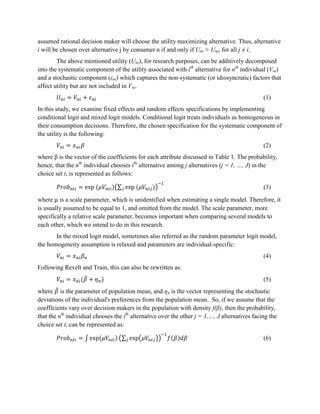
i will be chosen over alternative j by consumer n if and only if Uni > Unj, for all j ≠ i.
        The above mentioned utility (Uni), for research purposes, can be additively decomposed
into the systematic component of the utility associated with ith alternative for nth individual (Vni)
and a stochastic component (εni) which captures the non-systematic (or idiosyncratic) factors that
affect utility but are not included in Vni.
                                                                                               (1)
In this study, we examine fixed effects and random effects specifications by implementing
conditional logit and mixed logit models. Conditional logit treats individuals as homogeneous in
their consumption decisions. Therefore, the chosen specification for the systematic component of
the utility is the following:
                                                                                               (2)
where β is the vector of the coefficients for each attribute discussed in Table 1. The probability,
hence, that the nth individual chooses ith alternative among j alternatives (j = 1, …, J) in the
choice set t, is represented as follows:

                   exp           ∑ exp                                                         (3)

where μ is a scale parameter, which is unidentified when estimating a single model. Therefore, it
is usually assumed to be equal to 1, and omitted from the model. The scale parameter, more
specifically a relative scale parameter, becomes important when comparing several models to
each other, which we intend to do in this research.
       In the mixed logit model, sometimes also referred as the random parameter logit model,
the homogeneity assumption is relaxed and parameters are individual-specific:
                                                                                               (4)
Following Revelt and Train, this can also be rewritten as:
                                                                                               (5)
where is the parameter of population mean, and ηn is the vector representing the stochastic
deviations of the individual's preferences from the population mean. So, if we assume that the
coefficients vary over decision makers in the population with density f(β), then the probability,
that the nth individual chooses the ith alternative over the other j = 1,…, J alternatives facing the
choice set t, can be represented as:

                     exp           ∑ exp                                                       (6)
DATA
The research approach in this study uses a choice experiment to obtain the stated preferences of
individual U.S. consumers for such pork attributes as free of antibiotics (ANT), environmentally
certified (ENV), and livestock well-being (WEL). The main reason for using this approach is
that, these attributes are non-market, and a number of papers (e.g. Adamowicz, 2004, Carlsson,
Frykblom and Lagerkvist, 2004, Louviere, Hensher and Swait, 2000) have demonstrated the
efficiency of this method over other possible methods of data collection.
        The choice experiment approach implies providing the respondent with a set of
alternatives with different attributes, among which the subject chooses. In this way, a choice
experiment closely mimics the real purchase situation wherein the customer examines different
varieties of the product and then chooses one of them or none at all.
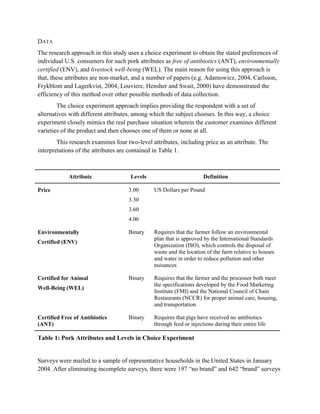
        This research examines four two-level attributes, including price as an attribute. The
interpretations of the attributes are contained in Table 1.


             Attribute               Levels                          Definition

Price                                3.00      US Dollars per Pound
                                     3.30
                                     3.60
                                     4.00

Environmentally                      Binary    Requires that the farmer follow an environmental
                                               plan that is approved by the International Standards
Certified (ENV)
                                               Organization (ISO), which controls the disposal of
                                               waste and the location of the farm relative to houses
                                               and water in order to reduce pollution and other
                                               nuisances

Certified for Animal                 Binary    Requires that the farmer and the processor both meet
                                               the specifications developed by the Food Marketing
Well-Being (WEL)
                                               Institute (FMI) and the National Council of Chain
                                               Restaurants (NCCR) for proper animal care, housing,
                                               and transportation

Certified Free of Antibiotics        Binary    Requires that pigs have received no antibiotics
(ANT)                                          through feed or injections during their entire life

Table 1: Pork Attributes and Levels in Choice Experiment


Surveys were mailed to a sample of representative households in the United States in January
2004. After eliminating incomplete surveys, there were 197 “no brand” and 642 “brand” surveys
available for analysis. In the case of branded surveys, an additional brand attribute was added to
the choice sets. This paper, however, analyzes the surveys without the brand attribute. Additional
to the choice experiment outcomes, the demographic information was also obtained. For
example, average age, household size, and presence of children (defined as under 18) in the
household in the sample are 53, 2.6, and 34 percent, respectively. Also, about 60 percent of the
respondents were female. These correspond well to U.S. Census data, implying that we have a
reasonably representative sample of the population.


EMPIRICAL MODEL AND ESTIMATION
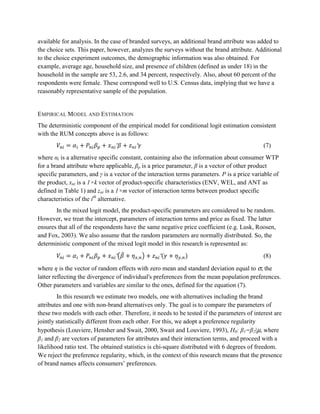
The deterministic component of the empirical model for conditional logit estimation consistent
with the RUM concepts above is as follows:
                                ′        ′                                                   (7)
where αi is a alternative specific constant, containing also the information about consumer WTP
for a brand attribute where applicable, βp is a price parameter, β is a vector of other product
specific parameters, and γ is a vector of the interaction terms parameters. P is a price variable of
the product, xni is a 1×k vector of product-specific characteristics (ENV, WEL, and ANT as
defined in Table 1) and zni is a 1×m vector of interaction terms between product specific
characteristics of the ith alternative.
       In the mixed logit model, the product-specific parameters are considered to be random.
However, we treat the intercept, parameters of interaction terms and price as fixed. The latter
ensures that all of the respondents have the same negative price coefficient (e.g. Lusk, Roosen,
and Fox, 2003). We also assume that the random parameters are normally distributed. So, the
deterministic component of the mixed logit model in this research is represented as:
                                ′        ,        ′        ,                                 (8)

where η is the vector of random effects with zero mean and standard deviation equal to σ, the
latter reflecting the divergence of individual's preferences from the mean population preferences.
Other parameters and variables are similar to the ones, defined for the equation (7).
        In this research we estimate two models, one with alternatives including the brand
attributes and one with non-brand alternatives only. The goal is to compare the parameters of
these two models with each other. Therefore, it needs to be tested if the parameters of interest are
jointly statistically different from each other. For this, we adopt a preference regularity
hypothesis (Louviere, Hensher and Swait, 2000, Swait and Louviere, 1993), H0: β1=β2|μ, where
β1 and β2 are vectors of parameters for attributes and their interaction terms, and proceed with a
likelihood ratio test. The obtained statistics is chi-square distributed with 6 degrees of freedom.
We reject the preference regularity, which, in the context of this research means that the presence
of brand names affects consumers’ preferences.
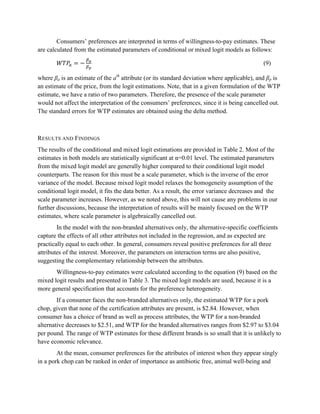
Consumers’ preferences are interpreted in terms of willingness-to-pay estimates. These
are calculated from the estimated parameters of conditional or mixed logit models as follows:

                                                                                             (9)

where βa is an estimate of the ath attribute (or its standard deviation where applicable), and βp is
an estimate of the price, from the logit estimations. Note, that in a given formulation of the WTP
estimate, we have a ratio of two parameters. Therefore, the presence of the scale parameter
would not affect the interpretation of the consumers’ preferences, since it is being cancelled out.
The standard errors for WTP estimates are obtained using the delta method.


RESULTS AND FINDINGS
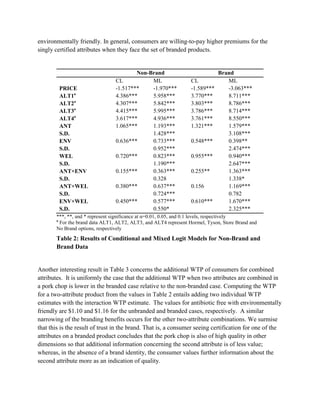
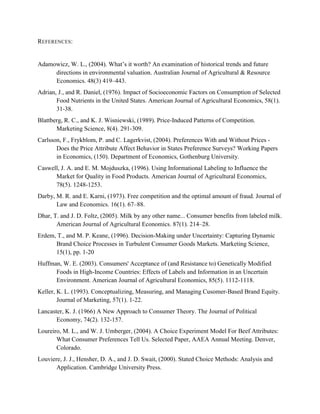
The results of the conditional and mixed logit estimations are provided in Table 2. Most of the
estimates in both models are statistically significant at α=0.01 level. The estimated parameters
from the mixed logit model are generally higher compared to their conditional logit model
counterparts. The reason for this must be a scale parameter, which is the inverse of the error
variance of the model. Because mixed logit model relaxes the homogeneity assumption of the
conditional logit model, it fits the data better. As a result, the error variance decreases and the
scale parameter increases. However, as we noted above, this will not cause any problems in our
further discussions, because the interpretation of results will be mainly focused on the WTP
estimates, where scale parameter is algebraically cancelled out.
        In the model with the non-branded alternatives only, the alternative-specific coefficients
capture the effects of all other attributes not included in the regression, and as expected are
practically equal to each other. In general, consumers reveal positive preferences for all three
attributes of the interest. Moreover, the parameters on interaction terms are also positive,
suggesting the complementary relationship between the attributes.
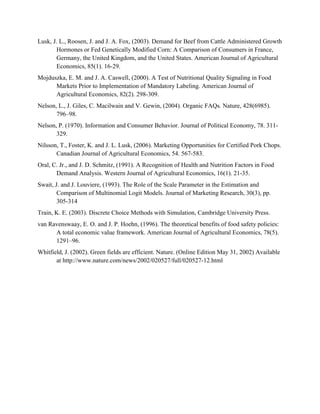
       Willingness-to-pay estimates were calculated according to the equation (9) based on the
mixed logit results and presented in Table 3. The mixed logit models are used, because it is a
more general specification that accounts for the preference heterogeneity.
        If a consumer faces the non-branded alternatives only, the estimated WTP for a pork
chop, given that none of the certification attributes are present, is $2.84. However, when
consumer has a choice of brand as well as process attributes, the WTP for a non-branded
alternative decreases to $2.51, and WTP for the branded alternatives ranges from $2.97 to $3.04
per pound. The range of WTP estimates for these different brands is so small that it is unlikely to
have economic relevance.
        At the mean, consumer preferences for the attributes of interest when they appear singly
in a pork chop can be ranked in order of importance as antibiotic free, animal well-being and
environmentally friendly. In general, consumers are willing-to-pay higher premiums for the
singly certified attributes when they face the set of branded products.


                                         Non-Brand                            Brand
                                 CL           ML                  CL             ML
         PRICE                   -1.517***    -1.970***           -1.589***      -3.063***
         ALT1a                   4.386***     5.958***            3.770***       8.711***
         ALT2a                   4.307***     5.842***            3.803***       8.786***
         ALT3a                   4.415***     5.995***            3.786***       8.714***
         ALT4a                   3.617***     4.936***            3.761***       8.550***
         ANT                     1.065***     1.193***            1.321***       1.579***
         S.D.                                 1.428***                           3.108***
         ENV                     0.636***     0.733***            0.548***       0.398**
         S.D.                                 0.952***                           2.474***
         WEL                     0.720***     0.823***            0.955***       0.940***
         S.D.                                 1.190***                           2.647***
         ANT×ENV                 0.155***     0.363***            0.255**        1.363***
         S.D.                                 0.328                              1.338*
         ANT×WEL                 0.380***     0.637***            0.156          1.169***
         S.D.                                 0.724***                           0.782
         ENV×WEL                 0.450***     0.577***            0.610***       1.670***
         S.D.                                 0.550*                             2.325***
       ***, **, and * represent significance at α=0.01, 0.05, and 0.1 levels, respectively
       a
         For the brand data ALT1, ALT2, ALT3, and ALT4 represent Hormel, Tyson, Store Brand and
       No Brand options, respectively
       Table 2: Results of Conditional and Mixed Logit Models for Non-Brand and
       Brand Data


Another interesting result in Table 3 concerns the additional WTP of consumers for combined
attributes. It is uniformly the case that the additional WTP when two attributes are combined in
a pork chop is lower in the branded case relative to the non-branded case. Computing the WTP
for a two-attribute product from the values in Table 2 entails adding two individual WTP
estimates with the interaction WTP estimate. The values for antibiotic free with environmentally
friendly are $1.10 and $1.16 for the unbranded and branded cases, respectively. A similar
narrowing of the branding benefits occurs for the other two-attribute combinations. We surmise
that this is the result of trust in the brand. That is, a consumer seeing certification for one of the
attributes on a branded product concludes that the pork chop is also of high quality in other
dimensions so that additional information concerning the second attribute is of less value;
whereas, in the absence of a brand identity, the consumer values further information about the
second attribute more as an indication of quality.
Large and statistically significant standard deviations emphasize the heterogeneity in
consumer preferences. The larger is the standard deviation estimate the more disperse are
consumers’ preferences. According to the obtained results, the variances in preferences for the
certification attributes are higher when facing only non-branded alternatives, compared to the set
of choices with branded products. In presence of the combined attributes, the variances in
consumer preferences are not symmetric between the non-branded and branded situations. When
consumers face the set of non-branded products there remains heterogeneity for combined
environmental and well-being attributes, and antibiotic-free and environmental attributes, but not
for the combined antibiotic and well-being attributes. Contrary to this, when they face the set of
branded products, only in case of the combined antibiotic-free and well-being attributes is
heterogeneity still observed.


                                                 WTPNB                    WTPB
              a
        ALT1                                     2.84***                  3.02***
        ALT2a                                    2.87***                  2.97***
        ALT3a                                    2.84***                  3.04***
        ALT4a                                    2.79***                  2.51***
        ANT                                      0.52***                  0.61***
        S.D.                                     1.01***                  0.73***
        ENV                                      0.13*                    0.37***
        S.D.                                     0.81***                  0.48***
        WEL                                      0.31***                  0.42***
        S.D.                                     0.86***                  0.60***
        ANT×ENV                                  0.45***                  0.18***
        S.D.                                     0.44*                    0.17
        ANT×WEL                                  0.38***                  0.32***
        S.D.                                     0.26                     0.37***
        ENV×WEL                                  0.55***                  0.29***
        S.D.                                     0.76***                  0.28
       ***, **, and * represent significance at α=0.01, 0.05, and 0.1 levels, respectively
       a
         For the brand data ALT1, ALT2, ALT3, and ALT4 represent Hormel, Tyson, Store Brand and
       No Brand options, respectively
       Table 3: WTP Estimates from Mixed Logit Models for Non-Branded and
       Branded Data


It is notable, that not all consumers are guaranteed to positively value each attribute. That is,
there is a fraction of the consumers who dislike these attributes. This outcome is due in part to
the assumption of a normal distribution for parameters (had we assumed triangular or lognormal
distribution, for example, we could have restricted parameters to fall into the positive range, but
that seems to be a strong, and unnecessary assumption for this model). This outcome, also,
agrees with Latent Class Model results presented by Nilsson, Foster and Lusk (2006), where they
find one class of consumers who do not value these attributes and may even gain disutility from
consuming them.


CONCLUSIONS
The main objective of this paper was to reveal the possible effect of branding on the differences
in values of selected informational attributes. In general, the results of the study agree with
theory and our expectations about the impact of branding. It magnifies the effect of other
informational attributes by increasing the marginal utility of such information, and its absence
tends to increase uncertainty for at least some significant groups of consumers.
        The results of the research suggest that on average consumers are willing to pay more for
the certification attributes if the product is branded but benefits to certification beyond one
attribute may yield lower benefits for branded products. Moreover, when heterogeneity of
preferences is assumed, we observe longer tails in parameter distributions in case of non-branded
data, compared to the branded data. That is, there is more uncertainty in consumer willingness-
to-pay for the considered informational attributes when dealing with non-branded products. This
result has interesting implications for policy makers, marketers, and pork producers. Branders of
pork products would appear to be in a better position to take advantage of the increasing
emphasis on attribute labeling and certification and would also be in a more favorable position to
mitigate the costs of complying with any government mandated certification programs. In
addition, it appears sellers of unbranded pork products can make up much of their disadvantages
(at the mean) by combining multiple attributes. This could be of particular importance to direct
marketers and independent grocers seeking a mechanism to compete in an increasingly brand
oriented market.
REFERENCES:


Adamowicz, W. L., (2004). What’s it worth? An examination of historical trends and future
     directions in environmental valuation. Australian Journal of Agricultural & Resource
     Economics. 48(3) 419–443.
Adrian, J., and R. Daniel, (1976). Impact of Socioeconomic Factors on Consumption of Selected
       Food Nutrients in the United States. American Journal of Agricultural Economics, 58(1).
       31-38.
Blattberg, R. C., and K. J. Wisniewski, (1989). Price-Induced Patterns of Competition.
       Marketing Science, 8(4). 291-309.
Carlsson, F., Frykblom, P. and C. Lagerkvist, (2004). Preferences With and Without Prices -
       Does the Price Attribute Affect Behavior in States Preference Surveys? Working Papers
       in Economics, (150). Department of Economics, Gothenburg University.
Caswell, J. A. and E. M. Mojduszka, (1996). Using Informational Labeling to Influence the
      Market for Quality in Food Products. American Journal of Agricultural Economics,
      78(5). 1248-1253.
Darby, M. R. and E. Karni, (1973). Free competition and the optimal amount of fraud. Journal of
       Law and Economics. 16(1). 67–88.
Dhar, T. and J. D. Foltz, (2005). Milk by any other name... Consumer benefits from labeled milk.
       American Journal of Agricultural Economics. 87(1). 214–28.
Erdem, T., and M. P. Keane, (1996). Decision-Making under Uncertainty: Capturing Dynamic
      Brand Choice Processes in Turbulent Consumer Goods Markets. Marketing Science,
      15(1), pp. 1-20
Huffman, W. E. (2003). Consumers' Acceptance of (and Resistance to) Genetically Modified
      Foods in High-Income Countries: Effects of Labels and Information in an Uncertain
      Environment. American Journal of Agricultural Economics, 85(5). 1112-1118.
Keller, K. L. (1993). Conceptualizing, Measuring, and Managing Cusomer-Based Brand Equity.
        Journal of Marketing, 57(1). 1-22.
Lancaster, K. J. (1966) A New Approach to Consumer Theory. The Journal of Political
       Economy, 74(2). 132-157.
Loureiro, M. L., and W. J. Umberger, (2004). A Choice Experiment Model For Beef Attributes:
       What Consumer Preferences Tell Us. Selected Paper, AAEA Annual Meeting. Denver,
       Colorado.
Louviere, J. J., Hensher, D. A., and J. D. Swait, (2000). Stated Choice Methods: Analysis and
       Application. Cambridge University Press.
Lusk, J. L., Roosen, J. and J. A. Fox, (2003). Demand for Beef from Cattle Administered Growth
       Hormones or Fed Genetically Modified Corn: A Comparison of Consumers in France,
       Germany, the United Kingdom, and the United States. American Journal of Agricultural
       Economics, 85(1). 16-29.
Mojduszka, E. M. and J. A. Caswell, (2000). A Test of Nutritional Quality Signaling in Food
      Markets Prior to Implementation of Mandatory Labeling. American Journal of
      Agricultural Economics, 82(2). 298-309.
Nelson, L., J. Giles, C. Macilwain and V. Gewin, (2004). Organic FAQs. Nature, 428(6985).
       796–98.
Nelson, P. (1970). Information and Consumer Behavior. Journal of Political Economy, 78. 311-
       329.
Nilsson, T., Foster, K. and J. L. Lusk, (2006). Marketing Opportunities for Certified Pork Chops.
       Canadian Journal of Agricultural Economics, 54. 567-583.
Oral, C. Jr., and J. D. Schmitz, (1991). A Recognition of Health and Nutrition Factors in Food
       Demand Analysis. Western Journal of Agricultural Economics, 16(1). 21-35.
Swait, J. and J. Louviere, (1993). The Role of the Scale Parameter in the Estimation and
        Comparison of Multinomial Logit Models. Journal of Marketing Research, 30(3), pp.
        305-314
Train, K. E. (2003). Discrete Choice Methods with Simulation, Cambridge University Press.
van Ravenswaay, E. O. and J. P. Hoehn, (1996). The theoretical benefits of food safety policies:
      A total economic value framework. American Journal of Agricultural Economics, 78(5).
      1291–96.
Whitfield, J. (2002). Green fields are efficient. Nature. (Online Edition May 31, 2002) Available
       at http://www.nature.com/news/2002/020527/full/020527-12.html

462361

  • 1.
    DIFFERENCES IN U.S.CONSUMER PREFERENCES FOR CERTIFIED PORK CHOPS WHEN FACING BRANDED VS. NON-BRANDED CHOICES DAVID UBILAVA*, KENNETH A. FOSTER*, JAYSON L. LUSK*, TOMAS NILSSON* SELECTED PAPER PREPARED FOR PRESENTATION AT THE AMERICAN AGRICULTURAL ECONOMICS ASSOCIATION ANNUAL MEETING, ORLANDO, FL, JULY 27-29, 2008. ABSTRACT Consumers' preferences for credence attributes of a product may differ from each other, when facing the choices between branded and/or non-branded products. We test this hypothesis with conditional and mixed logit regression using data obtained by choice experiment surveys. The results suggest that, on average, consumers are willing to pay more for a certification attribute when the product is branded. Additionally, greater variation in consumer willingness-to-pay is observed in the non- branded case. This latter characteristic of the results may represent the increased uncertainty some consumers internalize concerning quality consistency when brand information is not provided. These results have interesting implications for producers, processors, retailers, and policy makers. COPYRIGHT 2008 BY DAVID UBILAVA, KENNETH A. FOSTER, JAYSON L. LUSK, AND TOMAS NILSSON. ALL RIGHTS RESERVED. READERS MAY MAKE VERBATIM COPIES OF THIS DOCUMENT FOR NON-COMMERCIAL PURPOSES BY ANY MEANS, PROVIDED THAT THIS COPYRIGHT NOTICE APPEARS ON ALL SUCH COPIES. * David Ubilava is a PhD candidate at the Department of Agricultural Economics, Purdue University; Ken Foster is a Professor at the Department of Agricultural Economics, Purdue University; Jayson Lusk is a Professor and Willard Sparks Endowed Chair at the Department of Agricultural Economics, Oklahoma State University; and Tomas Nilsson is a Assistant Professor at the Department of Rural Economy, University of Alberta
  • 2.
    INTRODUCTION Branding is atime honored tool that has successfully been used by producers and/or other supply chain members to increase consumer awareness, loyalty, and, ultimately, willingness to pay for their product. The goal of such marketing strategies is to convince consumers that the brand name is a substitute, or proxy, for quality. The extent to which the brand is convincing in its effort is known as the customer-based brand equity in the marketing literature and is formally defined as the “differential effect of brand knowledge on consumer response to the marketing of the brand.” Based on this definition, if consumers react more favorably to the marketing mix of the brand, it is said to have positive brand equity (Keller, 1993). Alternatively, one might imagine that, while consumers generally prefer variety, once they have had a positive consumption experience, then they behave in a risk averse manner and consume a product that does not vary much from one consumption experience to another. The result is a tendency on the part of consumers to remain loyal to the familiar brand rather than choosing the uncertain alternative (Erdem and Keane, 1996). Branding may represent a mechanism to address this risk-averse behavior by providing a guarantee that the product consumed today will be essentially identical to the one the consumer sampled at some previous time. Thus, the brand name may actually affect consumers' valuations of other informational attributes of the product by reducing the marginal utility of these attributes. More specifically, consumers’ valuations of certain product attributes may differ, whether the choice is made when facing the branded alternatives or non-branded alternatives. This paper attempts to reveal and compare representative consumer's willingness to pay for selected informational attributes of branded and non-branded pork. During the last several decades a large number of consumer studies have been conducted revealing and measuring consumers' preferences for different products and/or product attributes. The earlier studies mainly concentrate on consumers' demand for nutritional and health issues (e.g. Adrian and Daniel, 1974, Oral and Schmitz, 1991, etc.). The later studies attempt to reveal consumers' preferences for factors such as country of origin labeling, food safety, producer traceability, etc. (e.g. Caswell and Mojduszka, 1996, Loureiro and Umberger, 2003, etc.). During the current decade studies about the demand for organic products have also been frequent (e.g. Dhar and Foltz, 2005, Huffman, 2003, Nelson et al., 2004, Whitfield, 2002, etc.). Along with the studies discussed above, there is a growing interest in analyzing such product specific factors as environmental friendly production, ethical treatment of animals, etc. (e.g. Nilsson, Foster and Lusk, 2006). Concerns about these attributes, known also as credence attributes (Darby and Karni, 1973, Mojduszka and Caswell, 2000, Nelson, 1970), may affect consumers' demand for food products, via the expansion or contraction of substitution possibilities (e.g., van Ravenswaay and Hoehn, 1996). The objective of this research is to examine the degree to which branding substitutes for, or can replace other information about the product. The general hypothesis is that it does so either because consumers trust the brand as a proxy, or because the brand reduces uncertainty
  • 3.
    about product qualityvariation which, as an attribute, substitutes for other informational attributes. We examine this in the context of pork chops in the domestic market of the U.S. The credence attributes examined are environmentally friendly production, antibiotic use, and animal welfare certification. The obtained results are analyzed in terms of willingness to pay for each selected attribute, their substitutability and, eventually, the implications for the producers, marketers, and policy makers. METHODOLOGY AND THEORETICAL M ODEL The theoretical background of this research is based on the Lancasterian view of utility. Lancaster's approach to consumer theory was a break from the traditional approach that utility is derived from goods and, instead, supposed that the properties or characteristics of the goods are the sources of consumer utility (Lancaster, 1966). Therefore, the consumer, with specific preferences for each of the product characteristics and a budget constraint, will choose the bundle of attributes (product in total), that maximizes his/her utility. Another critical assumption of the most general Lancasterian model is that all consumers view the characteristics possessed by a good (combination of goods) identically. Consequently, given units of measurement, the characteristics are in the same “quantities” so that the personal element in consumer choice arises in the choice between collections of characteristics only, not in the allocation of characteristics to the goods (Lancaster, 1966). These assumptions have endured as the underpinnings of attribute-based consumer demand studies. Keller (1993) distinguishes product-related and non-product related attributes of the product. The former being necessary ingredients to perform product functions, and the latter being external aspects, such as price, packaging, consumer characteristics, etc. Considering price as an attribute is important, because consumers generally associate higher price to higher quality of the product (Blattberg and Wisniewski, 1989). Product-related attributes on one side and non-product related attributes on the other side make the prediction of the decision making process particularly complex for the researcher. However, a pattern of choice that is shared by the majority of the consumers may be observable in data from actual purchases or choice experiments. This research relies on the assumption that every individual (decision maker) has the goal of achieving maximum utility subject to his or her resource allocations or budget constraint. The Random Utility Maximization (RUM) represents one of the tools for analyzing consumer preferences based on objective and/or subjective factors taken into account as well as assuming some degree of heterogeneity among individuals. To develop the main idea of the RUM, we need to introduce the notation in terms of a decision maker, n, facing a choice among j=1, …, J alternatives. The decision maker could attain a certain level of utility from each alternative. Each derived utility can be denoted as Unj. The
  • 4.
    assumed rational decisionmaker will choose the utility maximizing alternative. Thus, alternative i will be chosen over alternative j by consumer n if and only if Uni > Unj, for all j ≠ i. The above mentioned utility (Uni), for research purposes, can be additively decomposed into the systematic component of the utility associated with ith alternative for nth individual (Vni) and a stochastic component (εni) which captures the non-systematic (or idiosyncratic) factors that affect utility but are not included in Vni. (1) In this study, we examine fixed effects and random effects specifications by implementing conditional logit and mixed logit models. Conditional logit treats individuals as homogeneous in their consumption decisions. Therefore, the chosen specification for the systematic component of the utility is the following: (2) where β is the vector of the coefficients for each attribute discussed in Table 1. The probability, hence, that the nth individual chooses ith alternative among j alternatives (j = 1, …, J) in the choice set t, is represented as follows: exp ∑ exp (3) where μ is a scale parameter, which is unidentified when estimating a single model. Therefore, it is usually assumed to be equal to 1, and omitted from the model. The scale parameter, more specifically a relative scale parameter, becomes important when comparing several models to each other, which we intend to do in this research. In the mixed logit model, sometimes also referred as the random parameter logit model, the homogeneity assumption is relaxed and parameters are individual-specific: (4) Following Revelt and Train, this can also be rewritten as: (5) where is the parameter of population mean, and ηn is the vector representing the stochastic deviations of the individual's preferences from the population mean. So, if we assume that the coefficients vary over decision makers in the population with density f(β), then the probability, that the nth individual chooses the ith alternative over the other j = 1,…, J alternatives facing the choice set t, can be represented as: exp ∑ exp (6)
  • 5.
    DATA The research approachin this study uses a choice experiment to obtain the stated preferences of individual U.S. consumers for such pork attributes as free of antibiotics (ANT), environmentally certified (ENV), and livestock well-being (WEL). The main reason for using this approach is that, these attributes are non-market, and a number of papers (e.g. Adamowicz, 2004, Carlsson, Frykblom and Lagerkvist, 2004, Louviere, Hensher and Swait, 2000) have demonstrated the efficiency of this method over other possible methods of data collection. The choice experiment approach implies providing the respondent with a set of alternatives with different attributes, among which the subject chooses. In this way, a choice experiment closely mimics the real purchase situation wherein the customer examines different varieties of the product and then chooses one of them or none at all. This research examines four two-level attributes, including price as an attribute. The interpretations of the attributes are contained in Table 1. Attribute Levels Definition Price 3.00 US Dollars per Pound 3.30 3.60 4.00 Environmentally Binary Requires that the farmer follow an environmental plan that is approved by the International Standards Certified (ENV) Organization (ISO), which controls the disposal of waste and the location of the farm relative to houses and water in order to reduce pollution and other nuisances Certified for Animal Binary Requires that the farmer and the processor both meet the specifications developed by the Food Marketing Well-Being (WEL) Institute (FMI) and the National Council of Chain Restaurants (NCCR) for proper animal care, housing, and transportation Certified Free of Antibiotics Binary Requires that pigs have received no antibiotics (ANT) through feed or injections during their entire life Table 1: Pork Attributes and Levels in Choice Experiment Surveys were mailed to a sample of representative households in the United States in January 2004. After eliminating incomplete surveys, there were 197 “no brand” and 642 “brand” surveys
  • 6.
    available for analysis.In the case of branded surveys, an additional brand attribute was added to the choice sets. This paper, however, analyzes the surveys without the brand attribute. Additional to the choice experiment outcomes, the demographic information was also obtained. For example, average age, household size, and presence of children (defined as under 18) in the household in the sample are 53, 2.6, and 34 percent, respectively. Also, about 60 percent of the respondents were female. These correspond well to U.S. Census data, implying that we have a reasonably representative sample of the population. EMPIRICAL MODEL AND ESTIMATION The deterministic component of the empirical model for conditional logit estimation consistent with the RUM concepts above is as follows: ′ ′ (7) where αi is a alternative specific constant, containing also the information about consumer WTP for a brand attribute where applicable, βp is a price parameter, β is a vector of other product specific parameters, and γ is a vector of the interaction terms parameters. P is a price variable of the product, xni is a 1×k vector of product-specific characteristics (ENV, WEL, and ANT as defined in Table 1) and zni is a 1×m vector of interaction terms between product specific characteristics of the ith alternative. In the mixed logit model, the product-specific parameters are considered to be random. However, we treat the intercept, parameters of interaction terms and price as fixed. The latter ensures that all of the respondents have the same negative price coefficient (e.g. Lusk, Roosen, and Fox, 2003). We also assume that the random parameters are normally distributed. So, the deterministic component of the mixed logit model in this research is represented as: ′ , ′ , (8) where η is the vector of random effects with zero mean and standard deviation equal to σ, the latter reflecting the divergence of individual's preferences from the mean population preferences. Other parameters and variables are similar to the ones, defined for the equation (7). In this research we estimate two models, one with alternatives including the brand attributes and one with non-brand alternatives only. The goal is to compare the parameters of these two models with each other. Therefore, it needs to be tested if the parameters of interest are jointly statistically different from each other. For this, we adopt a preference regularity hypothesis (Louviere, Hensher and Swait, 2000, Swait and Louviere, 1993), H0: β1=β2|μ, where β1 and β2 are vectors of parameters for attributes and their interaction terms, and proceed with a likelihood ratio test. The obtained statistics is chi-square distributed with 6 degrees of freedom. We reject the preference regularity, which, in the context of this research means that the presence of brand names affects consumers’ preferences.
  • 7.
    Consumers’ preferences areinterpreted in terms of willingness-to-pay estimates. These are calculated from the estimated parameters of conditional or mixed logit models as follows: (9) where βa is an estimate of the ath attribute (or its standard deviation where applicable), and βp is an estimate of the price, from the logit estimations. Note, that in a given formulation of the WTP estimate, we have a ratio of two parameters. Therefore, the presence of the scale parameter would not affect the interpretation of the consumers’ preferences, since it is being cancelled out. The standard errors for WTP estimates are obtained using the delta method. RESULTS AND FINDINGS The results of the conditional and mixed logit estimations are provided in Table 2. Most of the estimates in both models are statistically significant at α=0.01 level. The estimated parameters from the mixed logit model are generally higher compared to their conditional logit model counterparts. The reason for this must be a scale parameter, which is the inverse of the error variance of the model. Because mixed logit model relaxes the homogeneity assumption of the conditional logit model, it fits the data better. As a result, the error variance decreases and the scale parameter increases. However, as we noted above, this will not cause any problems in our further discussions, because the interpretation of results will be mainly focused on the WTP estimates, where scale parameter is algebraically cancelled out. In the model with the non-branded alternatives only, the alternative-specific coefficients capture the effects of all other attributes not included in the regression, and as expected are practically equal to each other. In general, consumers reveal positive preferences for all three attributes of the interest. Moreover, the parameters on interaction terms are also positive, suggesting the complementary relationship between the attributes. Willingness-to-pay estimates were calculated according to the equation (9) based on the mixed logit results and presented in Table 3. The mixed logit models are used, because it is a more general specification that accounts for the preference heterogeneity. If a consumer faces the non-branded alternatives only, the estimated WTP for a pork chop, given that none of the certification attributes are present, is $2.84. However, when consumer has a choice of brand as well as process attributes, the WTP for a non-branded alternative decreases to $2.51, and WTP for the branded alternatives ranges from $2.97 to $3.04 per pound. The range of WTP estimates for these different brands is so small that it is unlikely to have economic relevance. At the mean, consumer preferences for the attributes of interest when they appear singly in a pork chop can be ranked in order of importance as antibiotic free, animal well-being and
  • 8.
    environmentally friendly. Ingeneral, consumers are willing-to-pay higher premiums for the singly certified attributes when they face the set of branded products. Non-Brand Brand CL ML CL ML PRICE -1.517*** -1.970*** -1.589*** -3.063*** ALT1a 4.386*** 5.958*** 3.770*** 8.711*** ALT2a 4.307*** 5.842*** 3.803*** 8.786*** ALT3a 4.415*** 5.995*** 3.786*** 8.714*** ALT4a 3.617*** 4.936*** 3.761*** 8.550*** ANT 1.065*** 1.193*** 1.321*** 1.579*** S.D. 1.428*** 3.108*** ENV 0.636*** 0.733*** 0.548*** 0.398** S.D. 0.952*** 2.474*** WEL 0.720*** 0.823*** 0.955*** 0.940*** S.D. 1.190*** 2.647*** ANT×ENV 0.155*** 0.363*** 0.255** 1.363*** S.D. 0.328 1.338* ANT×WEL 0.380*** 0.637*** 0.156 1.169*** S.D. 0.724*** 0.782 ENV×WEL 0.450*** 0.577*** 0.610*** 1.670*** S.D. 0.550* 2.325*** ***, **, and * represent significance at α=0.01, 0.05, and 0.1 levels, respectively a For the brand data ALT1, ALT2, ALT3, and ALT4 represent Hormel, Tyson, Store Brand and No Brand options, respectively Table 2: Results of Conditional and Mixed Logit Models for Non-Brand and Brand Data Another interesting result in Table 3 concerns the additional WTP of consumers for combined attributes. It is uniformly the case that the additional WTP when two attributes are combined in a pork chop is lower in the branded case relative to the non-branded case. Computing the WTP for a two-attribute product from the values in Table 2 entails adding two individual WTP estimates with the interaction WTP estimate. The values for antibiotic free with environmentally friendly are $1.10 and $1.16 for the unbranded and branded cases, respectively. A similar narrowing of the branding benefits occurs for the other two-attribute combinations. We surmise that this is the result of trust in the brand. That is, a consumer seeing certification for one of the attributes on a branded product concludes that the pork chop is also of high quality in other dimensions so that additional information concerning the second attribute is of less value; whereas, in the absence of a brand identity, the consumer values further information about the second attribute more as an indication of quality.
  • 9.
    Large and statisticallysignificant standard deviations emphasize the heterogeneity in consumer preferences. The larger is the standard deviation estimate the more disperse are consumers’ preferences. According to the obtained results, the variances in preferences for the certification attributes are higher when facing only non-branded alternatives, compared to the set of choices with branded products. In presence of the combined attributes, the variances in consumer preferences are not symmetric between the non-branded and branded situations. When consumers face the set of non-branded products there remains heterogeneity for combined environmental and well-being attributes, and antibiotic-free and environmental attributes, but not for the combined antibiotic and well-being attributes. Contrary to this, when they face the set of branded products, only in case of the combined antibiotic-free and well-being attributes is heterogeneity still observed. WTPNB WTPB a ALT1 2.84*** 3.02*** ALT2a 2.87*** 2.97*** ALT3a 2.84*** 3.04*** ALT4a 2.79*** 2.51*** ANT 0.52*** 0.61*** S.D. 1.01*** 0.73*** ENV 0.13* 0.37*** S.D. 0.81*** 0.48*** WEL 0.31*** 0.42*** S.D. 0.86*** 0.60*** ANT×ENV 0.45*** 0.18*** S.D. 0.44* 0.17 ANT×WEL 0.38*** 0.32*** S.D. 0.26 0.37*** ENV×WEL 0.55*** 0.29*** S.D. 0.76*** 0.28 ***, **, and * represent significance at α=0.01, 0.05, and 0.1 levels, respectively a For the brand data ALT1, ALT2, ALT3, and ALT4 represent Hormel, Tyson, Store Brand and No Brand options, respectively Table 3: WTP Estimates from Mixed Logit Models for Non-Branded and Branded Data It is notable, that not all consumers are guaranteed to positively value each attribute. That is, there is a fraction of the consumers who dislike these attributes. This outcome is due in part to the assumption of a normal distribution for parameters (had we assumed triangular or lognormal distribution, for example, we could have restricted parameters to fall into the positive range, but
  • 10.
    that seems tobe a strong, and unnecessary assumption for this model). This outcome, also, agrees with Latent Class Model results presented by Nilsson, Foster and Lusk (2006), where they find one class of consumers who do not value these attributes and may even gain disutility from consuming them. CONCLUSIONS The main objective of this paper was to reveal the possible effect of branding on the differences in values of selected informational attributes. In general, the results of the study agree with theory and our expectations about the impact of branding. It magnifies the effect of other informational attributes by increasing the marginal utility of such information, and its absence tends to increase uncertainty for at least some significant groups of consumers. The results of the research suggest that on average consumers are willing to pay more for the certification attributes if the product is branded but benefits to certification beyond one attribute may yield lower benefits for branded products. Moreover, when heterogeneity of preferences is assumed, we observe longer tails in parameter distributions in case of non-branded data, compared to the branded data. That is, there is more uncertainty in consumer willingness- to-pay for the considered informational attributes when dealing with non-branded products. This result has interesting implications for policy makers, marketers, and pork producers. Branders of pork products would appear to be in a better position to take advantage of the increasing emphasis on attribute labeling and certification and would also be in a more favorable position to mitigate the costs of complying with any government mandated certification programs. In addition, it appears sellers of unbranded pork products can make up much of their disadvantages (at the mean) by combining multiple attributes. This could be of particular importance to direct marketers and independent grocers seeking a mechanism to compete in an increasingly brand oriented market.
  • 11.
    REFERENCES: Adamowicz, W. L.,(2004). What’s it worth? An examination of historical trends and future directions in environmental valuation. Australian Journal of Agricultural & Resource Economics. 48(3) 419–443. Adrian, J., and R. Daniel, (1976). Impact of Socioeconomic Factors on Consumption of Selected Food Nutrients in the United States. American Journal of Agricultural Economics, 58(1). 31-38. Blattberg, R. C., and K. J. Wisniewski, (1989). Price-Induced Patterns of Competition. Marketing Science, 8(4). 291-309. Carlsson, F., Frykblom, P. and C. Lagerkvist, (2004). Preferences With and Without Prices - Does the Price Attribute Affect Behavior in States Preference Surveys? Working Papers in Economics, (150). Department of Economics, Gothenburg University. Caswell, J. A. and E. M. Mojduszka, (1996). Using Informational Labeling to Influence the Market for Quality in Food Products. American Journal of Agricultural Economics, 78(5). 1248-1253. Darby, M. R. and E. Karni, (1973). Free competition and the optimal amount of fraud. Journal of Law and Economics. 16(1). 67–88. Dhar, T. and J. D. Foltz, (2005). Milk by any other name... Consumer benefits from labeled milk. American Journal of Agricultural Economics. 87(1). 214–28. Erdem, T., and M. P. Keane, (1996). Decision-Making under Uncertainty: Capturing Dynamic Brand Choice Processes in Turbulent Consumer Goods Markets. Marketing Science, 15(1), pp. 1-20 Huffman, W. E. (2003). Consumers' Acceptance of (and Resistance to) Genetically Modified Foods in High-Income Countries: Effects of Labels and Information in an Uncertain Environment. American Journal of Agricultural Economics, 85(5). 1112-1118. Keller, K. L. (1993). Conceptualizing, Measuring, and Managing Cusomer-Based Brand Equity. Journal of Marketing, 57(1). 1-22. Lancaster, K. J. (1966) A New Approach to Consumer Theory. The Journal of Political Economy, 74(2). 132-157. Loureiro, M. L., and W. J. Umberger, (2004). A Choice Experiment Model For Beef Attributes: What Consumer Preferences Tell Us. Selected Paper, AAEA Annual Meeting. Denver, Colorado. Louviere, J. J., Hensher, D. A., and J. D. Swait, (2000). Stated Choice Methods: Analysis and Application. Cambridge University Press.
  • 12.
    Lusk, J. L.,Roosen, J. and J. A. Fox, (2003). Demand for Beef from Cattle Administered Growth Hormones or Fed Genetically Modified Corn: A Comparison of Consumers in France, Germany, the United Kingdom, and the United States. American Journal of Agricultural Economics, 85(1). 16-29. Mojduszka, E. M. and J. A. Caswell, (2000). A Test of Nutritional Quality Signaling in Food Markets Prior to Implementation of Mandatory Labeling. American Journal of Agricultural Economics, 82(2). 298-309. Nelson, L., J. Giles, C. Macilwain and V. Gewin, (2004). Organic FAQs. Nature, 428(6985). 796–98. Nelson, P. (1970). Information and Consumer Behavior. Journal of Political Economy, 78. 311- 329. Nilsson, T., Foster, K. and J. L. Lusk, (2006). Marketing Opportunities for Certified Pork Chops. Canadian Journal of Agricultural Economics, 54. 567-583. Oral, C. Jr., and J. D. Schmitz, (1991). A Recognition of Health and Nutrition Factors in Food Demand Analysis. Western Journal of Agricultural Economics, 16(1). 21-35. Swait, J. and J. Louviere, (1993). The Role of the Scale Parameter in the Estimation and Comparison of Multinomial Logit Models. Journal of Marketing Research, 30(3), pp. 305-314 Train, K. E. (2003). Discrete Choice Methods with Simulation, Cambridge University Press. van Ravenswaay, E. O. and J. P. Hoehn, (1996). The theoretical benefits of food safety policies: A total economic value framework. American Journal of Agricultural Economics, 78(5). 1291–96. Whitfield, J. (2002). Green fields are efficient. Nature. (Online Edition May 31, 2002) Available at http://www.nature.com/news/2002/020527/full/020527-12.html