Cell Cycle andits Control
Lecture 37 BSCI 420,421, 620 Nov 27,
2002
“ Cells come from previous cells” – R. Virchow
1. Intro to the cell cycle
2. The cell cycle control system
a. MPF in frogs
b. Cdc mutants in yeast
c. The mammalian cell cycle
2.
1. Intro tothe cell cycle
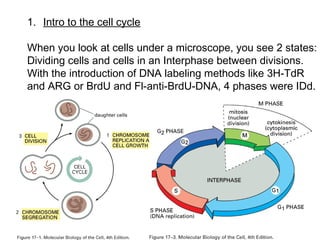
When you look at cells under a microscope, you see 2 states:
Dividing cells and cells in an Interphase between divisions.
With the introduction of DNA labeling methods like 3H-TdR
and ARG or BrdU and Fl-anti-BrdU-DNA, 4 phases were IDd.
3.
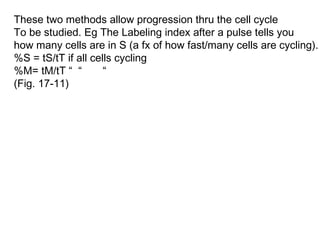
These two methodsallow progression thru the cell cycle
To be studied. Eg The Labeling index after a pulse tells you
how many cells are in S (a fx of how fast/many cells are cycling).
%S = tS/tT if all cells cycling
%M= tM/tT “ “ “
(Fig. 17-11)
4.
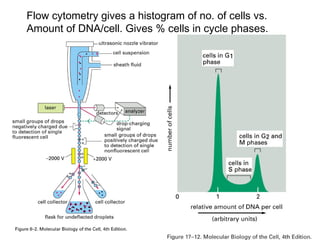
Flow cytometry givesa histogram of no. of cells vs.
Amount of DNA/cell. Gives % cells in cycle phases.
5.
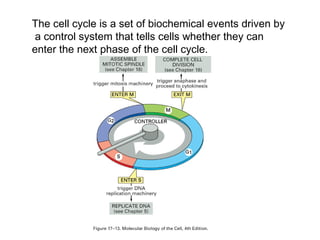
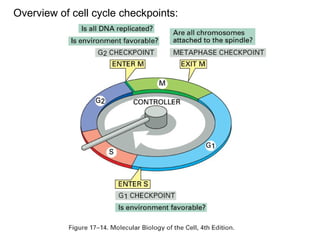
The cell cycleis a set of biochemical events driven by
a control system that tells cells whether they can
enter the next phase of the cell cycle.
6.
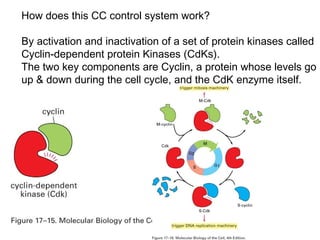
How does thisCC control system work?
By activation and inactivation of a set of protein kinases called
Cyclin-dependent protein Kinases (CdKs).
The two key components are Cyclin, a protein whose levels go
up & down during the cell cycle, and the CdK enzyme itself.
7.
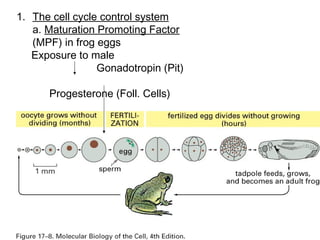
1. The cellcycle control system
a. Maturation Promoting Factor
(MPF) in frog eggs
Exposure to male
Gonadotropin (Pit)
Progesterone (Foll. Cells)
8.
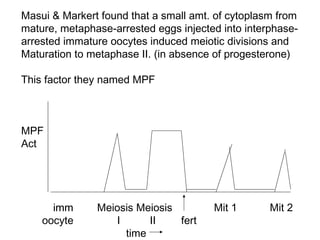
Masui & Markertfound that a small amt. of cytoplasm from
mature, metaphase-arrested eggs injected into interphase-
arrested immature oocytes induced meiotic divisions and
Maturation to metaphase II. (in absence of progesterone)
This factor they named MPF
MPF
Act
imm Meiosis Meiosis Mit 1 Mit 2
oocyte I II fert
time
9.
Using this activitywhen inj into imm oocytes as a Bioassay,
M & M purified MPF down to 2 proteins:
A 34 kD protein kinase that stays relatively constant &
A 56 kD protein that increases and decreases during cycle.
They named the cycling protein “Cyclin” & the enzyme CdK.
10.
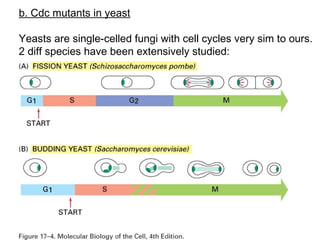
b. Cdc mutantsin yeast
Yeasts are single-celled fungi with cell cycles very sim to ours.
2 diff species have been extensively studied:
11.
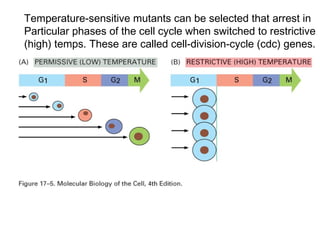
Temperature-sensitive mutants canbe selected that arrest in
Particular phases of the cell cycle when switched to restrictive
(high) temps. These are called cell-division-cycle (cdc) genes.
12.
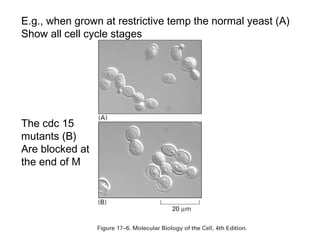
E.g., when grownat restrictive temp the normal yeast (A)
Show all cell cycle stages
The cdc 15
mutants (B)
Are blocked at
the end of M
13.
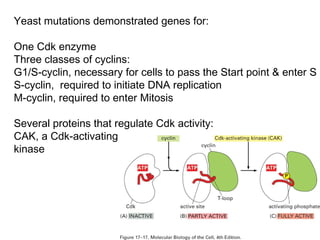
Yeast mutations demonstratedgenes for:
One Cdk enzyme
Three classes of cyclins:
G1/S-cyclin, necessary for cells to pass the Start point & enter S
S-cyclin, required to initiate DNA replication
M-cyclin, required to enter Mitosis
Several proteins that regulate Cdk activity:
CAK, a Cdk-activating
kinase
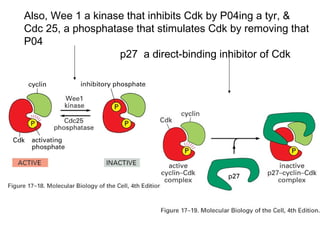
14.
Also, Wee 1a kinase that inhibits Cdk by P04ing a tyr, &
Cdc 25, a phosphatase that stimulates Cdk by removing that
P04
p27 a direct-binding inhibitor of Cdk
15.
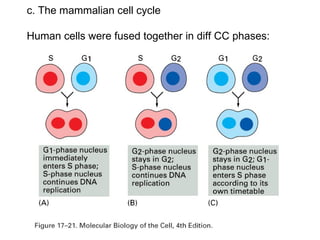
c. The mammaliancell cycle
Human cells were fused together in diff CC phases:



![Cell cycle. sgd[1]](https://cdn.slidesharecdn.com/ss_thumbnails/cellcycle-150228084926-conversion-gate01-thumbnail.jpg?width=640&height=640&fit=bounds)


![Polymer [ बहुलक ] Chemistry Notes PDF - Irfanullah Mehar - JJ Sir Chemistry.pdf](https://cdn.slidesharecdn.com/ss_thumbnails/polymerchemistrynotespdf-irfanullahmehar-jjsirchemistry-260210172118-3f9b37f7-thumbnail.jpg?width=640&height=640&fit=bounds)


