‫المركزة‬ ‫العناية‬ ‫محاضرة‬
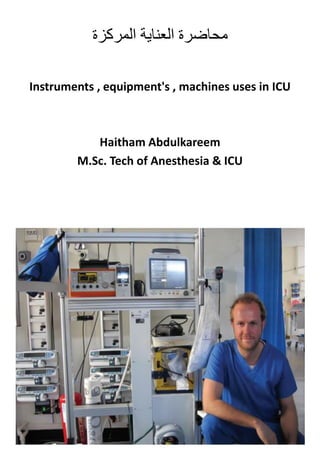
Instruments , equipment's , machines uses in ICU
Haitham Abdulkareem
M.Sc. Tech of Anesthesia & ICU
Common Equipment in the ICU
Respiratory Therapies
1. High Flow Nasal Cannula
High flow nasal prongs allow for high concentration of oxygen to be delivered to
patients comfortably. Something's this is used as a therapy of it’s own, or may be used
when the patient has a break from a tighter mask. The oxygen is routed through a
humidifier to ensure it is moist and does not dry the airways.
2. Non Invasive Ventilation (NIV)
Non Invasive Ventilation means the patient would be helped to breath, without any
tubes going into their mouth. “Non invasive” meaning nothing going in. A tight mask
usually covers the nose and mouth, and it is connected to a small machine which will
give extra oxygen or support with every breath.
3. Endotracheal tube (ET):
An ET tube is a tube that is inserted through the patients’ mouth into their wind pipe.
It is used in the ICU for patients who are having difficulty breathing because of a lung
problem, or for patients who are not awake enough to breathe for themselves. The ET
Tube is connected to tubing which is connected to a ventilator.
4. The Ventilator:
The ventilator has different settings and it is adjusted according to the needs of a
patient. Sometimes the patient is taking their own breaths and we support these, or
sometimes we need to set the ventilator to give them each breath.
5. Tracheostomy:
It’s is a surgical procedure where a hole is made in a patient’s neck and a small tube is
inserted into their windpipe. The tracheostomy tube is then attached to the ventilator,
or oxygen support.
Other equipment's
• Arterial line:
Intra-arterial blood pressure monitoring is more accurate than non- invasive devices
especially in critically ill patient.
• Indications:
1. Continuous BP monitoring in patient with hemodynamic
instability.
2. During and after cardiac surgery.
3. In patient who require frequent arterial blood sampling
(ABG).
4. In patient on vasoactive medications (vasopressors).
• Complications:
1. Hemorrhage
2. Vasospasm
3. Air embolism
4. Infection
• Monitoring device
This machine is at the head of the bed and looks like a TV with all different colours and
it is connected to the patient using wires and stickers. This shows the nurses and
doctors constant information about many things such as heart rate, blood pressure
and breathing.
• Infusion pumps
Majority of these patients will need these pumps. These are pumps that you will see
beside the patient and they control the amount of medication or fluid that a patient
receives and how fast or slow it can be given. The fluid or medication flows through
plastic lines and passes through the pump and into the patient.
• Central line :
It is a special catheter inserted into a large vein in the body.
 Different veins can be used for central line including jugular
vein, subclavian vein and femoral vein.
• Indication of cv line :
1. Difficult canulation: when the patient does not have adequate
veins in the arm.
2. When patient need special medications and parenteral
nutrition.
3. Central venous pressure used as a guide for fluid balance in
critically ill patient.
4. Determine the function of right side of the heart
• Complications :
1. Infection
2. Pneumothorax: collapse of the lung may occur and chest tube may be required for re-
expansion of the lung
3. Heamothorax
4. Air embolism and thrombosis
5. Cardiac arrhythmia
Nasogastric Tube (NG)
This tube goes through a patients nose and down into their stomach. It allows us to
feed them when they are too unwell to eat and drink as they normally would or when
their appetite is reduced due to illness. We can also give them medication through this
tube.
• Nasogastric (NG) Feed Pump
This purple machine will deliver feed to a patient at a set amount per hour. Most of
our patients will be continuously fed this way throughout their ICU admission. There
will be a bag of beige coloured liquid (feed) hanging above the pump with a thin
purple tube attached to it. This tube will go from the bag, through the pump and to
the patient where it is attached to a tube in the patients nose (NG).
• Total Parenteral Nutrition (TPN):
You may notice a green bag hanging near the patient. This bag contains white liquid
which is made up of all the nutrients a patient needs for their recovery. A pump will
continuously deliver a small amount to the patient.
• Thrombo-Embolic Deterrent Stockings (TEDS) :
You may notice the patient is wearing long green socks. These tight fitting socks help
prevent the development of blood clots in the legs.
• Intermittent Pneumatic Compression Machine ('flowtrons') :
a grey machine with a small screen on it hanging from the end of the patients bed with
clear plastic tubes leading to each of the patients legs. These tubes are attached to a
soft light blue wrap around each of the patients lower legs. keeping the blood moving
and preventing blood from pooling and forming clots.
• Pressure Relieving Mattress ('Air mattress'):
This mattress is used to prevent pressure injuries or 'bed sores'. Normally as we begin
to feel too much pressure against our skin we will move but patients in the ICU cannot
do this because they may unconscious or too unwell to move.
• Urinary Catheter :
a urinary catheter put in place to monitor an hourly output. This allows us to calculate
how much fluid is going in, versus how much is coming out. We can get ensure that we
prevent patients becoming fluid overloaded, or dehydrated.
• Scans: CT and MRI:
Patients in the intensive care unit may need further investigation in terms of a
computerised tomography scan (CT or CAT scan) or an MRI (Magnetic Resonance
Imaging) of their head, chest or abdomen.
• Ultrasound :
Ultrasound is a commonly used device in ICU. It is used to assist the doctor in inserting
lines, and also forms an easy and safe investigative tool. Most of the ultrasound
machines used in the intensive care are portable and could be used at the bedside.
The ultrasound machine has a probe attached to a monitor screen, and high frequency
sounds are emitted from the probe. The probe is placed on the part of the body to be
examined and images are obtained based on the density of the organ such as bone,
muscle or a blood vessel.
• Echocardiography :
This is a scan of the heart to look how it is functioning, identify leaky valves, looks for
any clots in the heart, and to guide treatment plans for the patient.
• ECG MACHINES :
ECG machines monitor the heart's electrical activity, like the rhythm and more. The
ECG test helps doctors diagnose and treat patients with heart conditions such as
arrhythmias, heart attacks, and heart failure.
Indications :
1. Monitoring of heart rate and rhythm
2. Detection of arrhythmias
3. Detection of myocardial ischemia
• HEMODIALYSIS MACHINES :
Hemodialysis machines remove waste and extra fluids from the blood of people
suffering from renal failure. These machines filter blood through a specific membrane
and return clean blood to the patient's body. Hemodialysis machines are critical for
acute kidney injury or end-stage renal disease patients.
• PATIENT BEDS :
Moving patients from room to operation room to ICU is common in hospitals. These
specialized beds can be adjusted to provide maximum comfort and safety.
• SUCTION MACHINES :
Suction machines remove secretions and other fluids from a patient's airway. These
machines are vital in managing patients with respiratory distress and are used to
prevent airway obstruction.
• DEFIBRILLATORS :
Defibrillators: device used to deliver an electric shock to the heart to restore its
normal rhythm in patients experiencing cardiac arrest.
Complication :
• skin irritation
• burn
• failure to return patient rhythm to normal
• Electroencephalograph (EEG) :
Technique of recording the electrical activity of brain in various conditions such as
seizure disorders (in epilepsy), head injury, stroke, brain tumor, etc.
• Intracranial pressure monitoring :
Patient with head injury or tumor is at the risk of increase intra cranial pressure which
is an emergency condition & may require immediate surgical intervention to prevent
permanent brain damage, Complication of ICP monitoring is bleeding and infection.
• Equipment Under General Critical Care Are:
Anesthesia Machine
ICU Bed
Respiratory Ventilator
Medical Stretcher
Infusion Pump
Syringe Pump
Ultrasound Machine
ECG Machine
Enteral Feeding Pump
Sequential Compression Device
Vital Signs Monitor
• Equipment Under Airway Management And Ventilator Accessories Are:
Breathing Circuits
Video Laryngoscopes
Endotracheal Tubes
Cannulas
Anesthesia Masks
Intubating Stylets
Laryngoscope Handles and Blades
Nasopharyngeal/ Oropharyngeal airway
Ambu-Bag
• Intensive care unit equipment's includes:
A. Patient monitoring devices.
B. Diagnostic devices.
C. Respiratory and cardiac support devices
D. Emergency resuscitation and life support devices
E. Pain management device.
A. Patient monitoring devices.
1.Blood pressure device (sphygmomanometer).
2. Blood pressure monitor.
3. Pulse oximeter.
4. Capnography.
5. Electrocardiograph (ECG machine).
6. Electroencephalograph (EEG).
7. Central venous pressure line (CVP).
8. Arterial line.
9. Intracranial pressure monitor.
10. Glucometer (sugar).
11. Temperature monitors probs.
12. Urinary output monitoring device (catheter and bag).
13. patient- weighting device.
• Disposable I. C. U equipment's includes :
1. Urinary catheter (folly's catheter).
2. Urinary drainage collector (bag).
3. Suction catheter.
4. Nasogastric catheter (NG tube).
5. Intravenous (I. V line) catheter.
6. Feeding tube.
7. Breathing tube (Endotracheal tube)
B. Diagnostic devices.
1. Mobile X- Ray unit and ultrasonography.
2. Portable clinical laboratory device.
3. Bronchoscope and endoscope.
C. Respiratory and cardiac support devices
• Respiratory monitoring:
1. Oxygen saturation (SPO2):
Using of finger probe measuring the proportion of
saturation of hemoglobin with oxygen, normally it is above 90 %.
2. Capnography: measuring CO2 concentration in expired air.
3. Arterial blood gases (ABG). Measure the acid- base balance,
PaO2, PaCO2, PH & HCO3 bicarbonate.
4. Lung function test's (LFT).
 Spirometry for lung volumes & capacities.
• Cardiovascular monitoring :
1. Blood pressure monitoring.
2. Arterial line catheter
3. Central line catheter: measuring central venous pressure
(CVP) through subclavian vein or internal jugular vein
reflecting right atrial pressure.
4. Pulmonary artery wedge pressure (PAWP) reflect left atrial
pressure.
5. ECG: monitor rate and rhythm of the heart.
6. Cardiac output (C.O) measured by pulmonary artery catheter
but can also measured by non invasive methods such as
trans-thoracicl echocardiography.
D. life support and emergency devices :
1. Airway control equipment's and ventilation device (AMBU-bag).
2. Oxygen source with concentration control.
3. Laryngoscope.
4. Suction apparatus
5. Mechanical ventilator
6. Infusion pump.
7. Crash cart.
8. Contentious positive airway pressure(PEEP) machine.
9. Defibrillator.
10. Intra-aortic balloon pump.
THANK YOU

عناية مركزة م4 غير مترجم.pdf

  • 1.
    ‫المركزة‬ ‫العناية‬ ‫محاضرة‬ Instruments, equipment's , machines uses in ICU Haitham Abdulkareem M.Sc. Tech of Anesthesia & ICU
  • 2.
    Common Equipment inthe ICU Respiratory Therapies 1. High Flow Nasal Cannula High flow nasal prongs allow for high concentration of oxygen to be delivered to patients comfortably. Something's this is used as a therapy of it’s own, or may be used when the patient has a break from a tighter mask. The oxygen is routed through a humidifier to ensure it is moist and does not dry the airways. 2. Non Invasive Ventilation (NIV) Non Invasive Ventilation means the patient would be helped to breath, without any tubes going into their mouth. “Non invasive” meaning nothing going in. A tight mask usually covers the nose and mouth, and it is connected to a small machine which will give extra oxygen or support with every breath. 3. Endotracheal tube (ET): An ET tube is a tube that is inserted through the patients’ mouth into their wind pipe. It is used in the ICU for patients who are having difficulty breathing because of a lung problem, or for patients who are not awake enough to breathe for themselves. The ET Tube is connected to tubing which is connected to a ventilator. 4. The Ventilator: The ventilator has different settings and it is adjusted according to the needs of a patient. Sometimes the patient is taking their own breaths and we support these, or sometimes we need to set the ventilator to give them each breath.
  • 3.
    5. Tracheostomy: It’s isa surgical procedure where a hole is made in a patient’s neck and a small tube is inserted into their windpipe. The tracheostomy tube is then attached to the ventilator, or oxygen support. Other equipment's • Arterial line: Intra-arterial blood pressure monitoring is more accurate than non- invasive devices especially in critically ill patient. • Indications: 1. Continuous BP monitoring in patient with hemodynamic instability. 2. During and after cardiac surgery. 3. In patient who require frequent arterial blood sampling (ABG). 4. In patient on vasoactive medications (vasopressors). • Complications: 1. Hemorrhage 2. Vasospasm 3. Air embolism 4. Infection
  • 4.
    • Monitoring device Thismachine is at the head of the bed and looks like a TV with all different colours and it is connected to the patient using wires and stickers. This shows the nurses and doctors constant information about many things such as heart rate, blood pressure and breathing. • Infusion pumps Majority of these patients will need these pumps. These are pumps that you will see beside the patient and they control the amount of medication or fluid that a patient receives and how fast or slow it can be given. The fluid or medication flows through plastic lines and passes through the pump and into the patient. • Central line : It is a special catheter inserted into a large vein in the body.  Different veins can be used for central line including jugular vein, subclavian vein and femoral vein. • Indication of cv line : 1. Difficult canulation: when the patient does not have adequate veins in the arm. 2. When patient need special medications and parenteral nutrition. 3. Central venous pressure used as a guide for fluid balance in critically ill patient. 4. Determine the function of right side of the heart • Complications : 1. Infection 2. Pneumothorax: collapse of the lung may occur and chest tube may be required for re- expansion of the lung 3. Heamothorax 4. Air embolism and thrombosis 5. Cardiac arrhythmia
  • 5.
    Nasogastric Tube (NG) Thistube goes through a patients nose and down into their stomach. It allows us to feed them when they are too unwell to eat and drink as they normally would or when their appetite is reduced due to illness. We can also give them medication through this tube. • Nasogastric (NG) Feed Pump This purple machine will deliver feed to a patient at a set amount per hour. Most of our patients will be continuously fed this way throughout their ICU admission. There will be a bag of beige coloured liquid (feed) hanging above the pump with a thin purple tube attached to it. This tube will go from the bag, through the pump and to the patient where it is attached to a tube in the patients nose (NG). • Total Parenteral Nutrition (TPN): You may notice a green bag hanging near the patient. This bag contains white liquid which is made up of all the nutrients a patient needs for their recovery. A pump will continuously deliver a small amount to the patient. • Thrombo-Embolic Deterrent Stockings (TEDS) : You may notice the patient is wearing long green socks. These tight fitting socks help prevent the development of blood clots in the legs. • Intermittent Pneumatic Compression Machine ('flowtrons') : a grey machine with a small screen on it hanging from the end of the patients bed with clear plastic tubes leading to each of the patients legs. These tubes are attached to a soft light blue wrap around each of the patients lower legs. keeping the blood moving and preventing blood from pooling and forming clots.
  • 6.
    • Pressure RelievingMattress ('Air mattress'): This mattress is used to prevent pressure injuries or 'bed sores'. Normally as we begin to feel too much pressure against our skin we will move but patients in the ICU cannot do this because they may unconscious or too unwell to move. • Urinary Catheter : a urinary catheter put in place to monitor an hourly output. This allows us to calculate how much fluid is going in, versus how much is coming out. We can get ensure that we prevent patients becoming fluid overloaded, or dehydrated. • Scans: CT and MRI: Patients in the intensive care unit may need further investigation in terms of a computerised tomography scan (CT or CAT scan) or an MRI (Magnetic Resonance Imaging) of their head, chest or abdomen. • Ultrasound : Ultrasound is a commonly used device in ICU. It is used to assist the doctor in inserting lines, and also forms an easy and safe investigative tool. Most of the ultrasound machines used in the intensive care are portable and could be used at the bedside. The ultrasound machine has a probe attached to a monitor screen, and high frequency sounds are emitted from the probe. The probe is placed on the part of the body to be examined and images are obtained based on the density of the organ such as bone, muscle or a blood vessel.
  • 7.
    • Echocardiography : Thisis a scan of the heart to look how it is functioning, identify leaky valves, looks for any clots in the heart, and to guide treatment plans for the patient. • ECG MACHINES : ECG machines monitor the heart's electrical activity, like the rhythm and more. The ECG test helps doctors diagnose and treat patients with heart conditions such as arrhythmias, heart attacks, and heart failure. Indications : 1. Monitoring of heart rate and rhythm 2. Detection of arrhythmias 3. Detection of myocardial ischemia • HEMODIALYSIS MACHINES : Hemodialysis machines remove waste and extra fluids from the blood of people suffering from renal failure. These machines filter blood through a specific membrane and return clean blood to the patient's body. Hemodialysis machines are critical for acute kidney injury or end-stage renal disease patients. • PATIENT BEDS : Moving patients from room to operation room to ICU is common in hospitals. These specialized beds can be adjusted to provide maximum comfort and safety.
  • 8.
    • SUCTION MACHINES: Suction machines remove secretions and other fluids from a patient's airway. These machines are vital in managing patients with respiratory distress and are used to prevent airway obstruction. • DEFIBRILLATORS : Defibrillators: device used to deliver an electric shock to the heart to restore its normal rhythm in patients experiencing cardiac arrest. Complication : • skin irritation • burn • failure to return patient rhythm to normal • Electroencephalograph (EEG) : Technique of recording the electrical activity of brain in various conditions such as seizure disorders (in epilepsy), head injury, stroke, brain tumor, etc. • Intracranial pressure monitoring : Patient with head injury or tumor is at the risk of increase intra cranial pressure which is an emergency condition & may require immediate surgical intervention to prevent permanent brain damage, Complication of ICP monitoring is bleeding and infection.
  • 9.
    • Equipment UnderGeneral Critical Care Are: Anesthesia Machine ICU Bed Respiratory Ventilator Medical Stretcher Infusion Pump Syringe Pump Ultrasound Machine ECG Machine Enteral Feeding Pump Sequential Compression Device Vital Signs Monitor • Equipment Under Airway Management And Ventilator Accessories Are: Breathing Circuits Video Laryngoscopes Endotracheal Tubes Cannulas Anesthesia Masks Intubating Stylets Laryngoscope Handles and Blades Nasopharyngeal/ Oropharyngeal airway Ambu-Bag • Intensive care unit equipment's includes: A. Patient monitoring devices. B. Diagnostic devices. C. Respiratory and cardiac support devices D. Emergency resuscitation and life support devices E. Pain management device. A. Patient monitoring devices. 1.Blood pressure device (sphygmomanometer). 2. Blood pressure monitor. 3. Pulse oximeter. 4. Capnography. 5. Electrocardiograph (ECG machine). 6. Electroencephalograph (EEG). 7. Central venous pressure line (CVP). 8. Arterial line. 9. Intracranial pressure monitor. 10. Glucometer (sugar). 11. Temperature monitors probs. 12. Urinary output monitoring device (catheter and bag). 13. patient- weighting device.
  • 10.
    • Disposable I.C. U equipment's includes : 1. Urinary catheter (folly's catheter). 2. Urinary drainage collector (bag). 3. Suction catheter. 4. Nasogastric catheter (NG tube). 5. Intravenous (I. V line) catheter. 6. Feeding tube. 7. Breathing tube (Endotracheal tube) B. Diagnostic devices. 1. Mobile X- Ray unit and ultrasonography. 2. Portable clinical laboratory device. 3. Bronchoscope and endoscope. C. Respiratory and cardiac support devices • Respiratory monitoring: 1. Oxygen saturation (SPO2): Using of finger probe measuring the proportion of saturation of hemoglobin with oxygen, normally it is above 90 %. 2. Capnography: measuring CO2 concentration in expired air. 3. Arterial blood gases (ABG). Measure the acid- base balance, PaO2, PaCO2, PH & HCO3 bicarbonate. 4. Lung function test's (LFT).  Spirometry for lung volumes & capacities.
  • 11.
    • Cardiovascular monitoring: 1. Blood pressure monitoring. 2. Arterial line catheter 3. Central line catheter: measuring central venous pressure (CVP) through subclavian vein or internal jugular vein reflecting right atrial pressure. 4. Pulmonary artery wedge pressure (PAWP) reflect left atrial pressure. 5. ECG: monitor rate and rhythm of the heart. 6. Cardiac output (C.O) measured by pulmonary artery catheter but can also measured by non invasive methods such as trans-thoracicl echocardiography. D. life support and emergency devices : 1. Airway control equipment's and ventilation device (AMBU-bag). 2. Oxygen source with concentration control. 3. Laryngoscope. 4. Suction apparatus 5. Mechanical ventilator 6. Infusion pump. 7. Crash cart. 8. Contentious positive airway pressure(PEEP) machine. 9. Defibrillator. 10. Intra-aortic balloon pump.
  • 12.