DSH NEWSLETTER FEBRUARY2016
“may your choices reflect your hopes, not your fears”
Nelson Mandela
What is the project all about?
DSH Positive Choices is a 2 year Erasmus+ funded
project (2015-2017) that is being coordinated by Plymouth
and District Mind.
The project aims to develop a comprehensive toolkit of
resources and training materials that can be used with
young people to enable them to become more
emotionally resilient, confident and self-aware.
The project is specifically aimed at supporting those young
people for whom their mental health is becoming, or has
already become an issue. In particular, we will be looking at
the issue of self-harm as a coping strategy.
About
Deliberate Self Harm (DSH):
Positive Choices
Europe 2020 – European platform against poverty and
social exclusion shows that 24% of all the EU population
(over 120 million people), are at risk of poverty or social
exclusion – this includes 27% of all children in Europe.
The Europe 2020 agenda has issues of early school
leaving and low educational achievement of young
people as a high priority.
ERASMUS+ STRATEGIC
PARTNERSHIPS IN THE
FIELD OF EDUCATION,
TRAINING AND YOUTH
http://ec.europa.eu/programmes
/erasmus-plus/
What’s Inside:
About DSH Positive
Choices
pages 1-2
The DSH partners
page 3
Third Meeting in Athens
page 3-4
Alexithymia. What is it and
what can I do
page 5
DSH Partnership Map
page 6
Over the 24 month duration of
the project we will:
• Deliver 72 workshops in the
field of youth to address
Alexithymia and DSH
• Translate materials for delivery
in own country
• Create volunteer committees
to monitor evaluation and
sustainability of the project
locally
• Evaluate the workshops and
project
There are 6 partners involved in the project.
They will take workshops back to their own
country to translate materials and deliver to
10+ people in the field of youth, and deliver
at least 1 relevant workshop to 10+ young
people locally.
It is important to include young people to get
their feedback and evaluation as to fitness
for purpose. All results will be presented at a
final international conference.
The most relevant topics addressed by our
project are
Early School Leaving and
Combating failure in education.
DSH Positive Choices is an Erasmus+ project coordinated by Plymouth & District Mind
Association (PADMA), United Kingdom. It addresses a known cause of social exclusion (with
progression pathways to early school leaving and low achievement): Alexithymia and
Deliberate Self Harm.
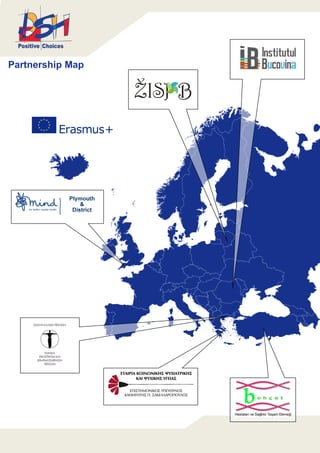
The DSH Positive Choices partnership includes 6 associations from all around
Europe. The project will be implemented in United Kingdom, Lithuania, Greece,
Turkey and Romania.
DSH Positive Choices will “foster quality improvements in youth work, in particular through
enhanced cooperation between organisations in the youth field and/or other stakeholders” (a
specific objective of Erasmus Plus Programme in the field of youth). The project will deliver a
series of workshops around promotion of emotional awareness, confidence building, self-
exploration for young people and self-harm awareness for all stakeholders. Collectively, they
will form an open training resource for all working in the field of youth, particularly with young
people who may be, or at risk of, experiencing symptoms of Alexithymia and/or any other
emotional distress.
Each partner will host a 3 day meeting and deliver 2 one day workshops around related themes
that can help young people build emotional resilience and train youth workers in skills to
recognize and deal with recognizable symptoms and how to empathically support the young
person in getting local professional help.
The
DSH Partners:
PADMA UK
Plymouth & District Mind
Association (PADMA) United
Kingdom
www.plymouthmind.com
ZISPB Lithuania
VsI Zmogiskuju istekliu
stebesenos ir pletros biuras
(ZISPB) Lithuania
www.zispb.lt
SSP&MH Greece
Society of social psychiatry
and mental health (SSP&MH)
Greece
www.ekpse.gr
BEHDER Turkey
Behcet Hastalari ve Saglikli
Yasam Dernegi (BEHDER)
Turkey
www.behder.net
Bucovina Institute
Romania
Asociatia Institutul pentru
Parteneriat Social Bucovina
(Bucovina Institute) Romania
www.bucovinainstitute.org
AUTH Greece
Aristotelio Panepistimio
Thessalonikis – Faculty of
Fine Arts (AUTH) Greece
www.auth.gr
The third meeting took place in Athens from 19th of January to
21st of January 2016
The Society of Social Psychiatry and Mental Health presented
the following topics
- Understanding emotions
- The crisis of adolescents
- The importance of empathy
- Ways of recognizing and dealing with feelings.
3rd Project Meeting in Athens,
GR 19-21 January 2016
Host:
The Society of Social Psychiatry and
Mental Health
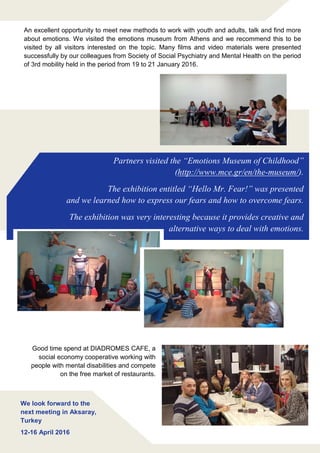
Partners visited the “Emotions Museum of Childhood”
(http://www.mce.gr/en/the-museum/).
The exhibition entitled “Hello Mr. Fear!” was presented
and we learned how to express our fears and how to overcome fears.
The exhibition was very interesting because it provides creative and
alternative ways to deal with emotions.
We look forward to the
next meeting in Aksaray,
Turkey
12-16 April 2016
An excellent opportunity to meet new methods to work with youth and adults, talk and find more
about emotions. We visited the emotions museum from Athens and we recommend this to be
visited by all visitors interested on the topic. Many films and video materials were presented
successfully by our colleagues from Society of Social Psychiatry and Mental Health on the period
of 3rd mobility held in the period from 19 to 21 January 2016.
Good time spend at DIADROMES CAFE, a
social economy cooperative working with
people with mental disabilities and compete
on the free market of restaurants.
Alexithymia. What is it and what can I do
Reading Novels: The language of describing thoughts, feelings,
moments and experiences is literally found in novels. Studies
suggest this is a great way to learn expressive language, develop the
muscle of receptive language and gain mastery in how to describe a
story or personal narrative
Alexithymia is a trait that makes it hard to find words for thoughts and feelings. It is
experienced by both children and adults and can come in mild, moderate and severe forms.
If you live with alexithymia, the goal is to strengthen your ability to identify and understand
feelings. Teaching yourself about the subjective experiences of others will be important too.
Keep in mind that stretching and learning emotional awareness can be a very challenging
journey. Here are some ways to broaden your skills:
(source http://blogs.scientificamerican.com/mind-guest-blog/the-emotional-blindness-of-
alexithymia/)
Watch this short video on the difference between empathy and sympathy
https://www.youtube.com/watch?v=1Evwgu369Jw
Watch this short lecture on alexithymia
https://www.youtube.com/watch?v=nDEYsgi5Cms
The Expressive Arts: Taking a more formal approach with an
acting, dance, art, music or movement therapy class has been
shown to help those with alexithymia recognize and externalize
feelings . Try signing up for courses offered in adult and child
education in your town, community programs or college workshops.
Partnership Map

3rd newsletter athens_january_2016

  • 1.
    DSH NEWSLETTER FEBRUARY2016 “mayyour choices reflect your hopes, not your fears” Nelson Mandela What is the project all about? DSH Positive Choices is a 2 year Erasmus+ funded project (2015-2017) that is being coordinated by Plymouth and District Mind. The project aims to develop a comprehensive toolkit of resources and training materials that can be used with young people to enable them to become more emotionally resilient, confident and self-aware. The project is specifically aimed at supporting those young people for whom their mental health is becoming, or has already become an issue. In particular, we will be looking at the issue of self-harm as a coping strategy. About Deliberate Self Harm (DSH): Positive Choices Europe 2020 – European platform against poverty and social exclusion shows that 24% of all the EU population (over 120 million people), are at risk of poverty or social exclusion – this includes 27% of all children in Europe. The Europe 2020 agenda has issues of early school leaving and low educational achievement of young people as a high priority. ERASMUS+ STRATEGIC PARTNERSHIPS IN THE FIELD OF EDUCATION, TRAINING AND YOUTH http://ec.europa.eu/programmes /erasmus-plus/ What’s Inside: About DSH Positive Choices pages 1-2 The DSH partners page 3 Third Meeting in Athens page 3-4 Alexithymia. What is it and what can I do page 5 DSH Partnership Map page 6
  • 2.
    Over the 24month duration of the project we will: • Deliver 72 workshops in the field of youth to address Alexithymia and DSH • Translate materials for delivery in own country • Create volunteer committees to monitor evaluation and sustainability of the project locally • Evaluate the workshops and project There are 6 partners involved in the project. They will take workshops back to their own country to translate materials and deliver to 10+ people in the field of youth, and deliver at least 1 relevant workshop to 10+ young people locally. It is important to include young people to get their feedback and evaluation as to fitness for purpose. All results will be presented at a final international conference. The most relevant topics addressed by our project are Early School Leaving and Combating failure in education. DSH Positive Choices is an Erasmus+ project coordinated by Plymouth & District Mind Association (PADMA), United Kingdom. It addresses a known cause of social exclusion (with progression pathways to early school leaving and low achievement): Alexithymia and Deliberate Self Harm. The DSH Positive Choices partnership includes 6 associations from all around Europe. The project will be implemented in United Kingdom, Lithuania, Greece, Turkey and Romania. DSH Positive Choices will “foster quality improvements in youth work, in particular through enhanced cooperation between organisations in the youth field and/or other stakeholders” (a specific objective of Erasmus Plus Programme in the field of youth). The project will deliver a series of workshops around promotion of emotional awareness, confidence building, self- exploration for young people and self-harm awareness for all stakeholders. Collectively, they will form an open training resource for all working in the field of youth, particularly with young people who may be, or at risk of, experiencing symptoms of Alexithymia and/or any other emotional distress. Each partner will host a 3 day meeting and deliver 2 one day workshops around related themes that can help young people build emotional resilience and train youth workers in skills to recognize and deal with recognizable symptoms and how to empathically support the young person in getting local professional help.
  • 3.
    The DSH Partners: PADMA UK Plymouth& District Mind Association (PADMA) United Kingdom www.plymouthmind.com ZISPB Lithuania VsI Zmogiskuju istekliu stebesenos ir pletros biuras (ZISPB) Lithuania www.zispb.lt SSP&MH Greece Society of social psychiatry and mental health (SSP&MH) Greece www.ekpse.gr BEHDER Turkey Behcet Hastalari ve Saglikli Yasam Dernegi (BEHDER) Turkey www.behder.net Bucovina Institute Romania Asociatia Institutul pentru Parteneriat Social Bucovina (Bucovina Institute) Romania www.bucovinainstitute.org AUTH Greece Aristotelio Panepistimio Thessalonikis – Faculty of Fine Arts (AUTH) Greece www.auth.gr The third meeting took place in Athens from 19th of January to 21st of January 2016 The Society of Social Psychiatry and Mental Health presented the following topics - Understanding emotions - The crisis of adolescents - The importance of empathy - Ways of recognizing and dealing with feelings. 3rd Project Meeting in Athens, GR 19-21 January 2016 Host: The Society of Social Psychiatry and Mental Health
  • 4.
    Partners visited the“Emotions Museum of Childhood” (http://www.mce.gr/en/the-museum/). The exhibition entitled “Hello Mr. Fear!” was presented and we learned how to express our fears and how to overcome fears. The exhibition was very interesting because it provides creative and alternative ways to deal with emotions. We look forward to the next meeting in Aksaray, Turkey 12-16 April 2016 An excellent opportunity to meet new methods to work with youth and adults, talk and find more about emotions. We visited the emotions museum from Athens and we recommend this to be visited by all visitors interested on the topic. Many films and video materials were presented successfully by our colleagues from Society of Social Psychiatry and Mental Health on the period of 3rd mobility held in the period from 19 to 21 January 2016. Good time spend at DIADROMES CAFE, a social economy cooperative working with people with mental disabilities and compete on the free market of restaurants.
  • 5.
    Alexithymia. What isit and what can I do Reading Novels: The language of describing thoughts, feelings, moments and experiences is literally found in novels. Studies suggest this is a great way to learn expressive language, develop the muscle of receptive language and gain mastery in how to describe a story or personal narrative Alexithymia is a trait that makes it hard to find words for thoughts and feelings. It is experienced by both children and adults and can come in mild, moderate and severe forms. If you live with alexithymia, the goal is to strengthen your ability to identify and understand feelings. Teaching yourself about the subjective experiences of others will be important too. Keep in mind that stretching and learning emotional awareness can be a very challenging journey. Here are some ways to broaden your skills: (source http://blogs.scientificamerican.com/mind-guest-blog/the-emotional-blindness-of- alexithymia/) Watch this short video on the difference between empathy and sympathy https://www.youtube.com/watch?v=1Evwgu369Jw Watch this short lecture on alexithymia https://www.youtube.com/watch?v=nDEYsgi5Cms The Expressive Arts: Taking a more formal approach with an acting, dance, art, music or movement therapy class has been shown to help those with alexithymia recognize and externalize feelings . Try signing up for courses offered in adult and child education in your town, community programs or college workshops.
  • 6.