Third generation
beta-blockers
in thetreatment of arterial hypertension
Kurt Stoschitzky, MD, FESC
Division of Cardiology
Department of Internal Medicine
Medical University, Graz, Austria
3.
2007 ESC Guidelinesfor the
management of arterial hypertension
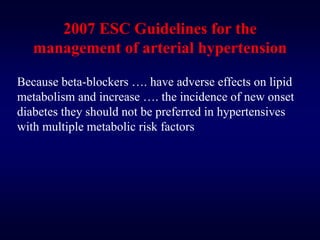
Because beta-blockers …. have adverse effects on lipid
metabolism and increase …. the incidence of new onset
diabetes they should not be preferred in hypertensives
with multiple metabolic risk factors
4.
2007 ESC Guidelinesfor the
management of arterial hypertension
Because beta-blockers …. have adverse effects on lipid
metabolism and increase …. the incidence of new onset
diabetes they should not be preferred in hypertensives
with multiple metabolic risk factors
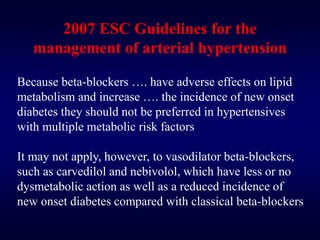
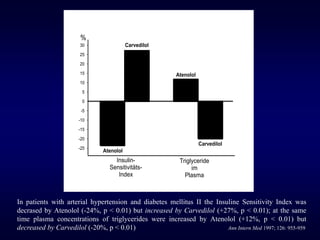
It may not apply, however, to vasodilator beta-blockers,
such as carvedilol and nebivolol, which have less or no
dysmetabolic action as well as a reduced incidence of
new onset diabetes compared with classical beta-blockers
5.
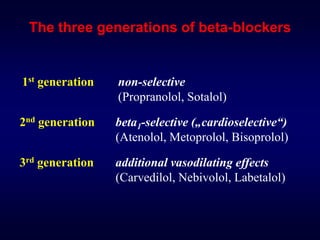
1st generation non-selective
(Propranolol,Sotalol)
The three generations of beta-blockers
2nd generation beta1-selective („cardioselective“)
(Atenolol, Metoprolol, Bisoprolol)
3rd generation additional vasodilating effects
(Carvedilol, Nebivolol, Labetalol)
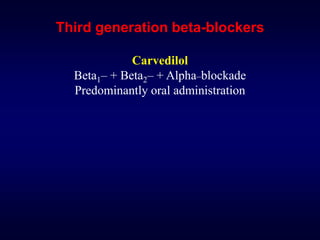
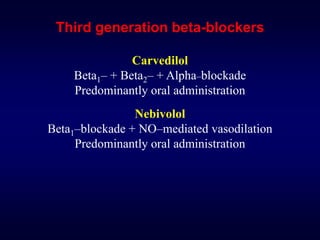
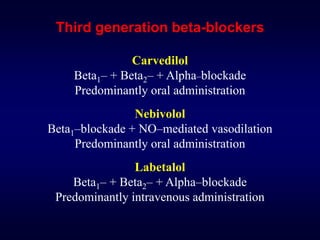
Third generation beta-blockers
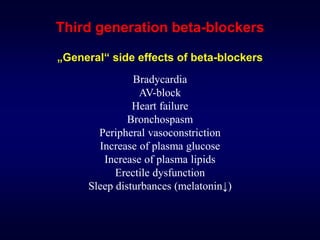
„General“side effects of beta-blockers
Bradycardia
AV-block
Heart failure
Bronchospasm
Peripheral vasoconstriction
Increase of plasma glucose
Increase of plasma lipids
Erectile dysfunction
Sleep disturbances (melatonin↓)
10.
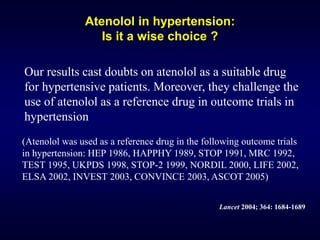
Atenolol in hypertension:
Isit a wise choice ?
Our results cast doubts on atenolol as a suitable drug
for hypertensive patients. Moreover, they challenge the
use of atenolol as a reference drug in outcome trials in
hypertension
Lancet 2004; 364: 1684-1689
(Atenolol was used as a reference drug in the following outcome trials
in hypertension: HEP 1986, HAPPHY 1989, STOP 1991, MRC 1992,
TEST 1995, UKPDS 1998, STOP-2 1999, NORDIL 2000, LIFE 2002,
ELSA 2002, INVEST 2003, CONVINCE 2003, ASCOT 2005)
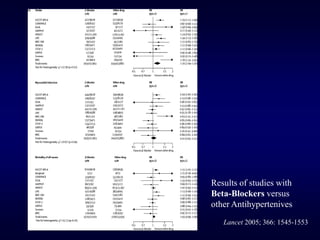
11.
Results of studieswith
Beta-Blockers versus
other Antihypertenives
Lancet 2005; 366: 1545-1553
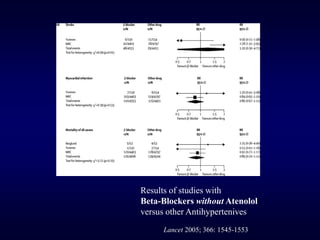
12.
Results of studieswith
Beta-Blockers without Atenolol
versus other Antihypertenives
Lancet 2005; 366: 1545-1553
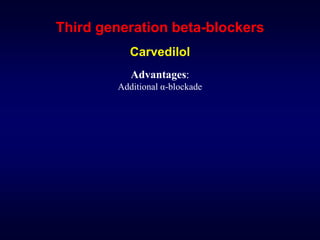
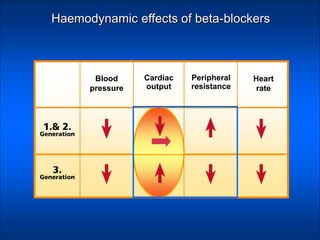
Third generation beta-blockers
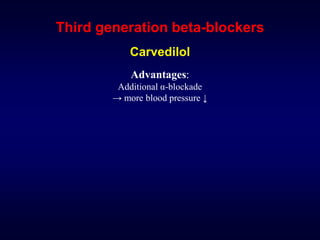
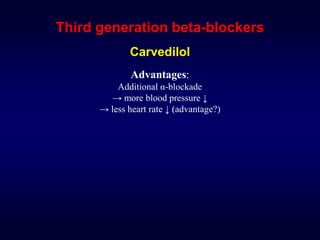
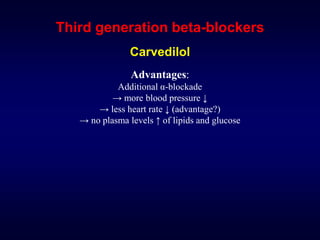
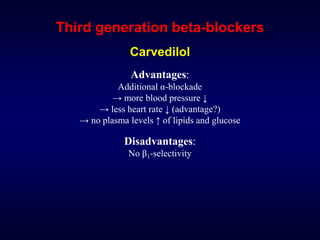
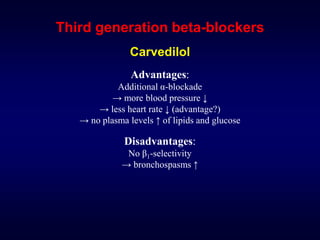
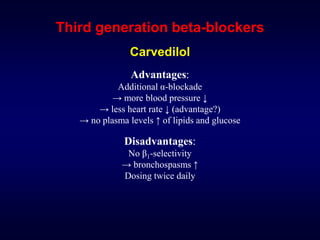
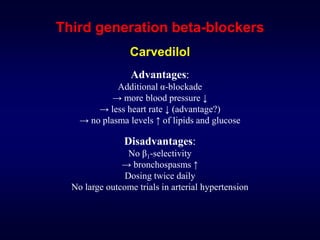
Carvedilol
Advantages:
Additionalα-blockade
→ more blood pressure ↓
→ less heart rate ↓ (advantage?)
→ no plasma levels ↑ of lipids and glucose
Disadvantages:
No β1-selectivity
→ bronchospasms ↑
Dosing twice daily
No large outcome trials in arterial hypertension
Third generation beta-blockers
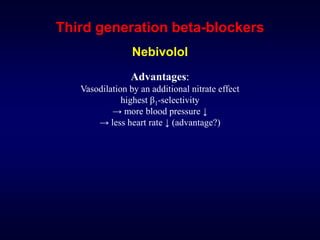
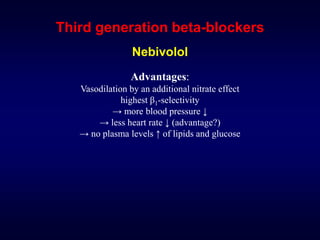
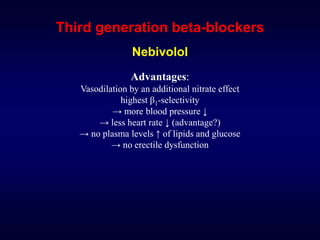
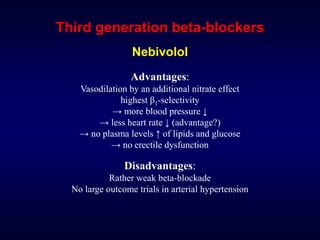
Nebivolol
Advantages:
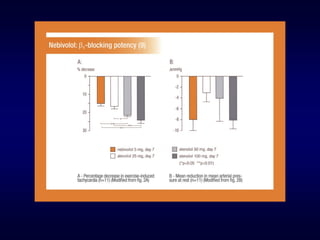
Vasodilationby an additional nitrate effect
highest β1-selectivity
→ more blood pressure ↓
→ less heart rate ↓ (advantage?)
→ no plasma levels ↑ of lipids and glucose
→ no erectile dysfunction
Disadvantages:
Rather weak beta-blockade
30.
Third generation beta-blockers
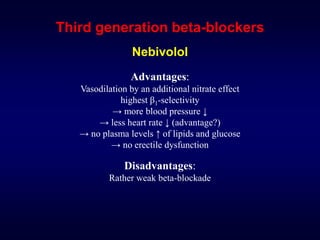
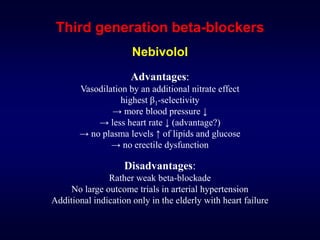
Nebivolol
Advantages:
Vasodilationby an additional nitrate effect
highest β1-selectivity
→ more blood pressure ↓
→ less heart rate ↓ (advantage?)
→ no plasma levels ↑ of lipids and glucose
→ no erectile dysfunction
Disadvantages:
Rather weak beta-blockade
No large outcome trials in arterial hypertension
31.
Third generation beta-blockers
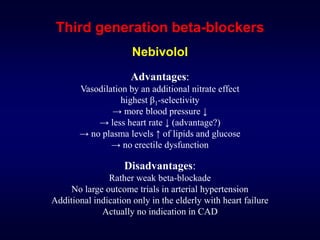
Nebivolol
Advantages:
Vasodilationby an additional nitrate effect
highest β1-selectivity
→ more blood pressure ↓
→ less heart rate ↓ (advantage?)
→ no plasma levels ↑ of lipids and glucose
→ no erectile dysfunction
Disadvantages:
Rather weak beta-blockade
No large outcome trials in arterial hypertension
Additional indication only in the elderly with heart failure
32.
Third generation beta-blockers
Nebivolol
Advantages:
Vasodilationby an additional nitrate effect
highest β1-selectivity
→ more blood pressure ↓
→ less heart rate ↓ (advantage?)
→ no plasma levels ↑ of lipids and glucose
→ no erectile dysfunction
Disadvantages:
Rather weak beta-blockade
No large outcome trials in arterial hypertension
Additional indication only in the elderly with heart failure
Actually no indication in CAD
35.
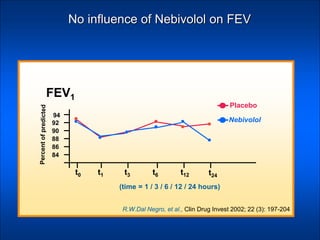
No influence ofNebivolol on FEV
94
t0 t1 t3 t6 t12 t24
92
90
88
86
84
Nebivolol
Placebo
FEV1
R.W.Dal Negro, et al., Clin Drug Invest 2002; 22 (3): 197-204
(time = 1 / 3 / 6 / 12 / 24 hours)
36.
Forearm
blood
flow
(ml
/
min
/
100
g)
0
1
2
3
4
5
6
Before After
iv Nitroglycerin
withPlacebo
Before After
iv Nitroglycerin
with Nebivolol
p < 0.05 p < 0.01
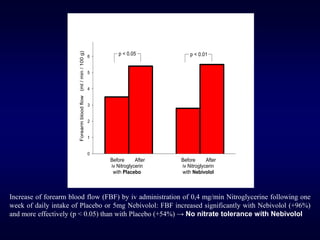
Increase of forearm blood flow (FBF) by iv administration of 0,4 mg/min Nitroglycerine following one
week of daily intake of Placebo or 5mg Nebivolol: FBF increased significantly with Nebivolol (+96%)
and more effectively (p < 0.05) than with Placebo (+54%) → No nitrate tolerance with Nebivolol
37.
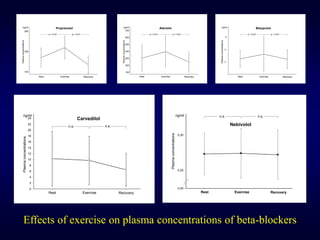
ng/ml
Rest Exercise Recovery
p< 0.01 p < 0.01
Plasma
concentrations
Propranolol
120
280
200
ng/ml
Rest Exercise Recovery
p < 0.01 p < 0.01
Plasma
concentrations
Atenolol
100
700
400
300
200
500
600
4
8
12
ng/ml
Rest Exercise Recovery
p < 0.01 p < 0.01
Plasma
concentrations
Bisoprolol
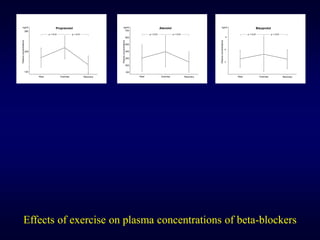
Effects of exercise on plasma concentrations of beta-blockers
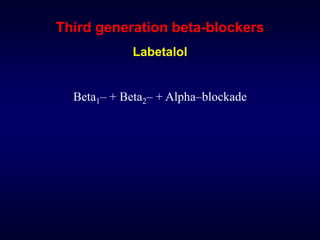
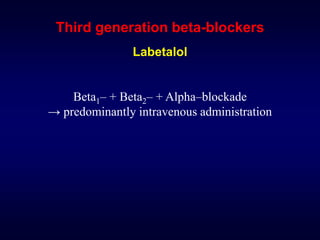
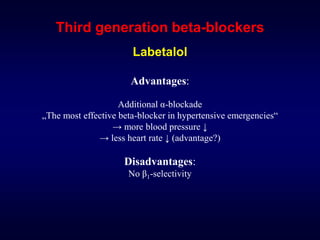
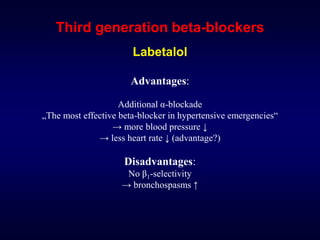
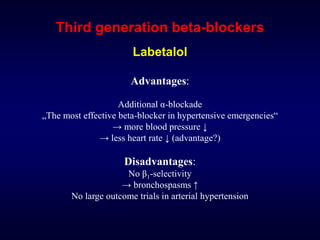
Third generation beta-blockers
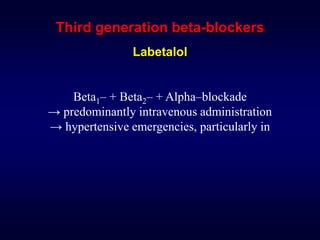
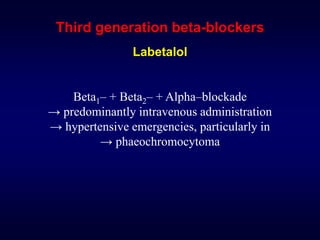
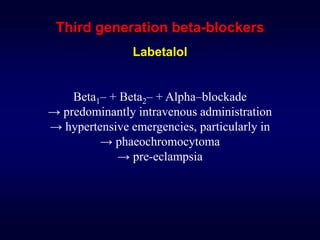
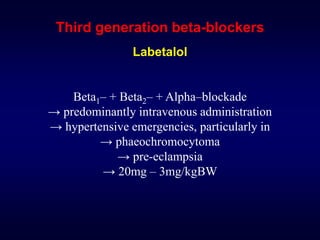
Labetalol
Advantages:
Additionalα-blockade
„The most effective beta-blocker in hypertensive emergencies“
→ more blood pressure ↓
→ less heart rate ↓ (advantage?)
Disadvantages:
No β1-selectivity
→ bronchospasms ↑
No large outcome trials in arterial hypertension
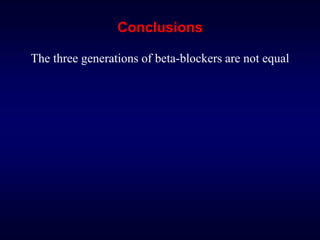
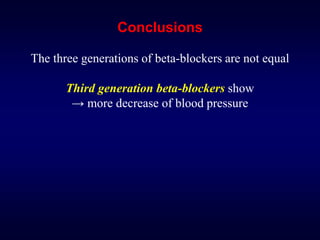
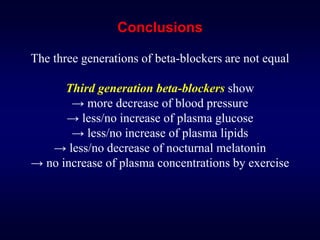
Conclusions
The three generationsof beta-blockers are not equal
Third generation beta-blockers show
→ more decrease of blood pressure
55.
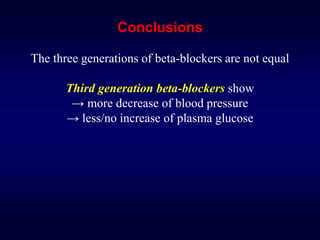
Conclusions
The three generationsof beta-blockers are not equal
Third generation beta-blockers show
→ more decrease of blood pressure
→ less/no increase of plasma glucose
56.
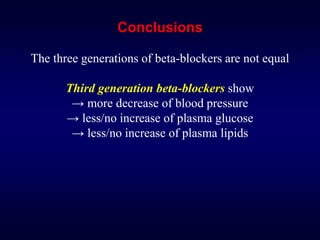
Conclusions
The three generationsof beta-blockers are not equal
Third generation beta-blockers show
→ more decrease of blood pressure
→ less/no increase of plasma glucose
→ less/no increase of plasma lipids
57.
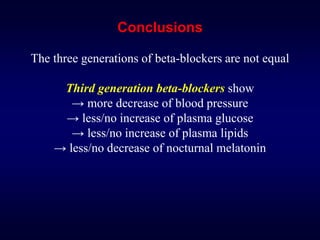
Conclusions
The three generationsof beta-blockers are not equal
Third generation beta-blockers show
→ more decrease of blood pressure
→ less/no increase of plasma glucose
→ less/no increase of plasma lipids
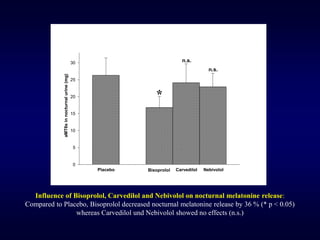
→ less/no decrease of nocturnal melatonin
58.
Conclusions
The three generationsof beta-blockers are not equal
Third generation beta-blockers show
→ more decrease of blood pressure
→ less/no increase of plasma glucose
→ less/no increase of plasma lipids
→ less/no decrease of nocturnal melatonin
→ no increase of plasma concentrations by exercise
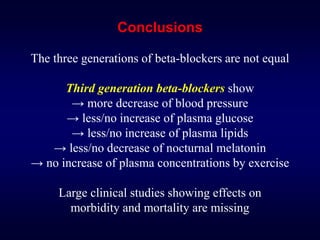
59.
Conclusions
The three generationsof beta-blockers are not equal
Third generation beta-blockers show
→ more decrease of blood pressure
→ less/no increase of plasma glucose
→ less/no increase of plasma lipids
→ less/no decrease of nocturnal melatonin
→ no increase of plasma concentrations by exercise
Large clinical studies showing effects on
morbidity and mortality are missing
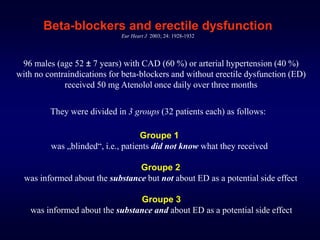
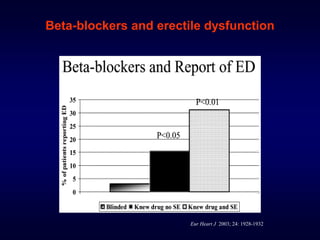
Beta-blockers and erectiledysfunction
Eur Heart J 2003; 24: 1928-1932
96 males (age 52 ± 7 years) with CAD (60 %) or arterial hypertension (40 %)
with no contraindications for beta-blockers and without erectile dysfunction (ED)
received 50 mg Atenolol once daily over three months
They were divided in 3 groups (32 patients each) as follows:
Groupe 1
was „blinded“, i.e., patients did not know what they received
Groupe 2
was informed about the substance but not about ED as a potential side effect
Groupe 3
was informed about the substance and about ED as a potential side effect
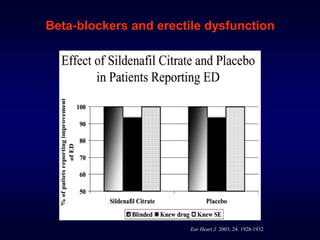
Beta-blockers and erectiledysfunction
Eur Heart J 2003; 24: 1928-1932
Patients who reported ED as a side effect received in a
2nd phase
50 mg Sildenafil (Viagra®) or Placebo
according to a double-blind, cross-over, placebo-controlled protocol
with ongoing treatment with 50 mg Atenolol once daily
in order to use it at least three times





![ANTIANGINAL DRUGS AND EVIDENCE OF THEIR USE IN [Autosaved].pptx](https://cdn.slidesharecdn.com/ss_thumbnails/antianginaldrugsandevidenceoftheiruseinautosaved-250909143324-412e49b1-thumbnail.jpg?width=640&height=640&fit=bounds)


