3G
V/S
WI-FI
Submitted By:
SIVA R
Content
■ Introduction.
■ What is 3G ?
■ What is Wi-Fi ?
■ How 3G works.
■ How Wi-Fi works.
■ How are Wi-Fi and 3G Same?
■ Difference between 3G & Wi-Fi.
■ Applications Using 3G
■ Applications Using WIFI
■ Conclusion.
Introduction
■ The 3G network is the third generation of mobile networking and
telecommunications. It features a wider range of services and
advances network capacity over the previous 2G (2nd
Generation)
network.
■ The 3G network also increases the rate of information transfer
known as spectral efficiency.
■ Wireless networking technology that uses radio waves to provide
wireless high-speed Internet and network connections.
■ The Wi-Fi Alliance, the organization that owns the Wi-Fi (registered
trademark) term specifically defines Wi-Fi as any "wireless local
area network”
What is 3G?
• 3G is a technology for mobile service providers.
• It is the upgrade from 2.5G and GPRS networks, for
faster data transfer speed. This is based on a set of
standards used for mobile devices and mobile
telecommunications[
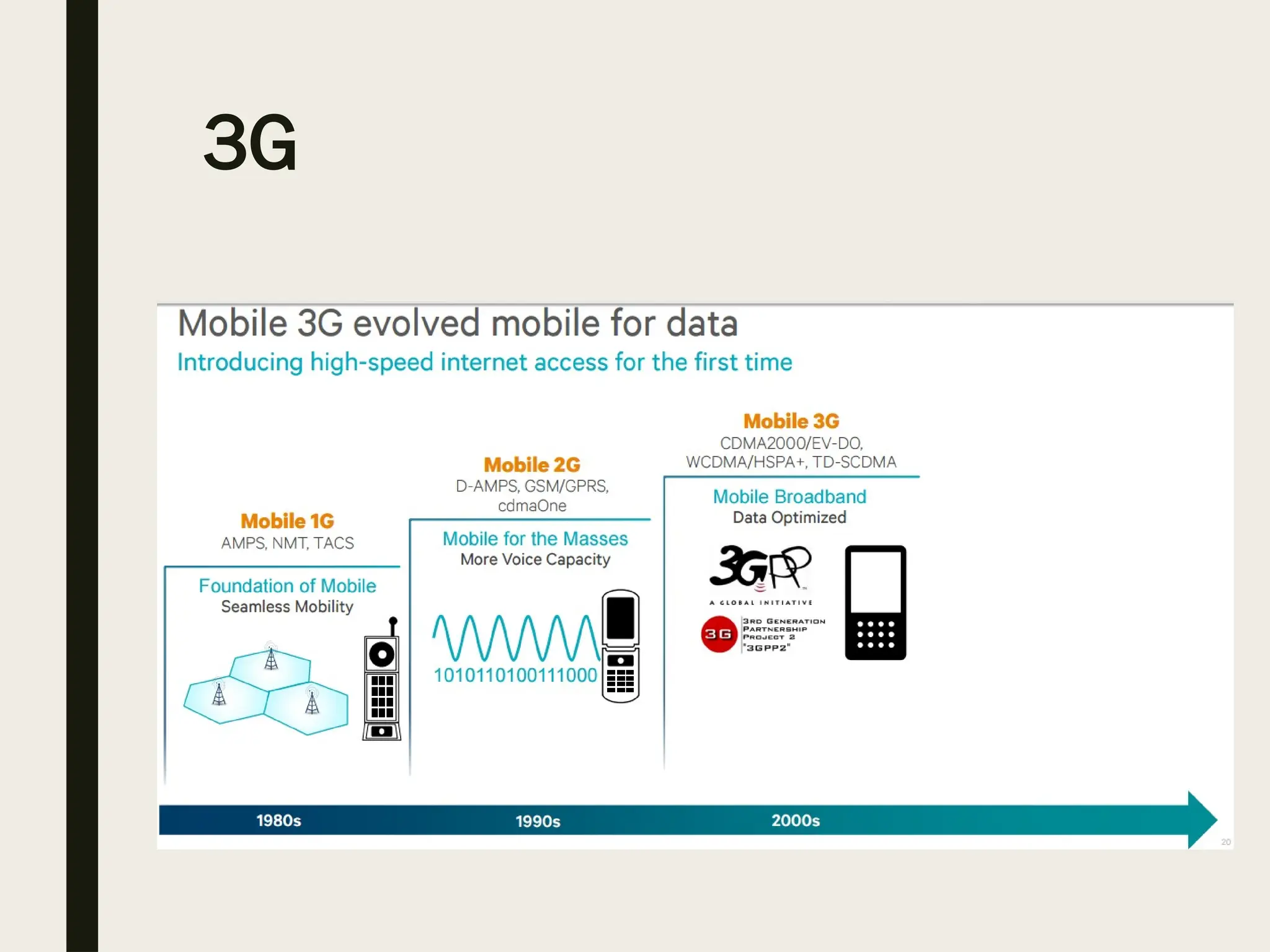
• 3G optimized mobile for data enabling mobile
broadband services, and is evolving for faster and
better connectivity.
• 3G service providers will have to upgrade their networks
to one of the 3G technologies which can support data
rates of from 384Kbps (Kilo byte per second) up to 2Mbps
(Mega byte per second)
3G
3G
What is Wi-Fi?
■ Wi-Fi is the popular name for the wireless Ethernet
802.11b standard for WLANs.
■ Operate using unlicensed spectrum in the 2.4 GHz
band.
■ The current generation of WLANs supports upto
11Mbps, data rates within 300 feet of the base
station.
■ WLAN technology was not designed to support
high-speed hand – off associated with users moving
between base station coverage areas.
Wi-Fi
How 3G works..
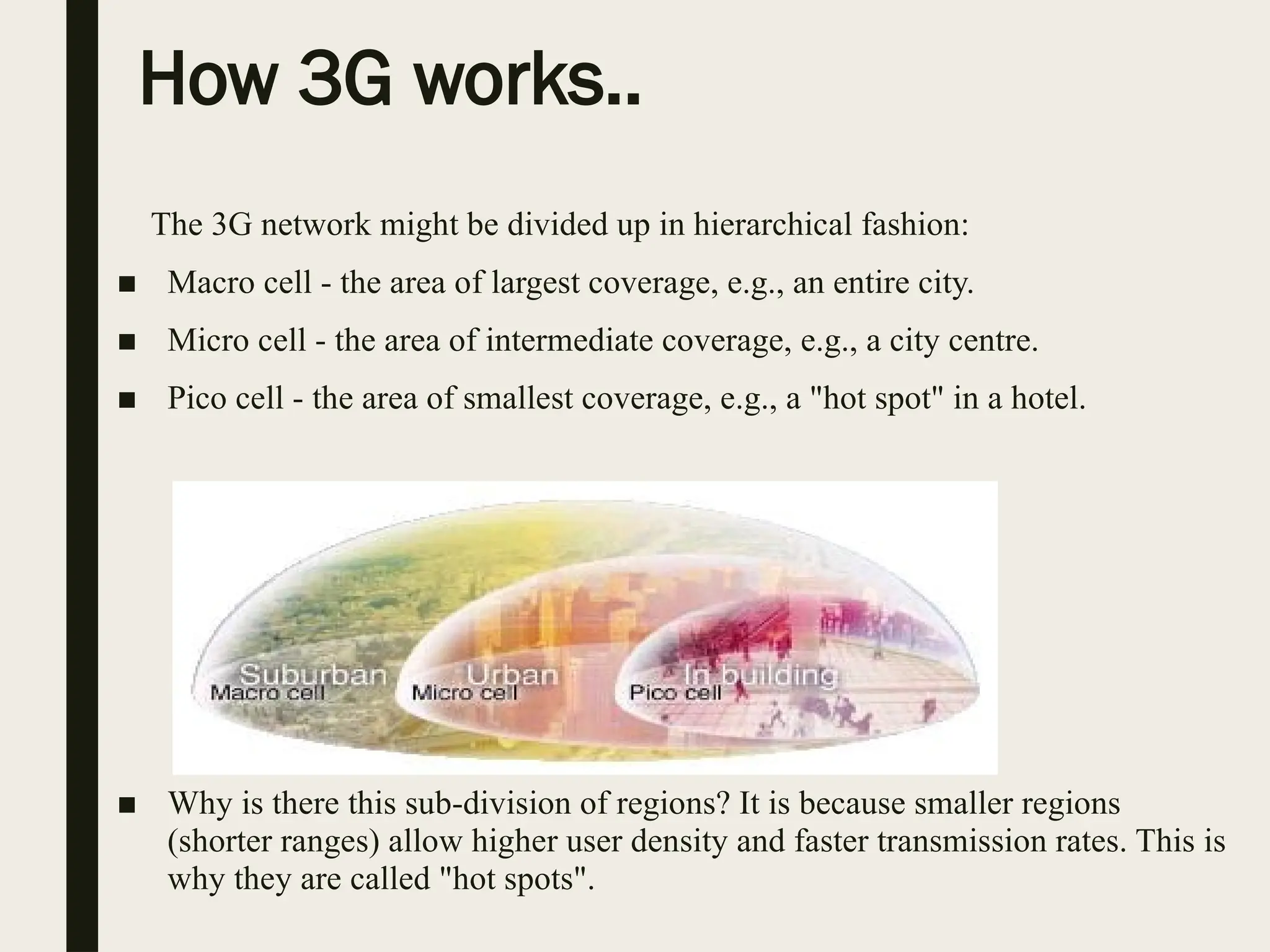
The 3G network might be divided up in hierarchical fashion:
■ Macro cell - the area of largest coverage, e.g., an entire city.
■ Micro cell - the area of intermediate coverage, e.g., a city centre.
■ Pico cell - the area of smallest coverage, e.g., a "hot spot" in a hotel.
■ Why is there this sub-division of regions? It is because smaller regions
(shorter ranges) allow higher user density and faster transmission rates. This is
why they are called "hot spots".
TDMA vs. CDMA
■ We have considered how a mobile phone can send
and receive calls at the same time (via an uplink and
a downlink). Now we will examine how many users
can be multiplexed into the same channel (i.e., share
the channel) without getting interference from other
users, a capability called multiple accesses.
■ For 3G technology, there are basically two competing
technologies to achieve multiple accesses: TDMA
and CDMA.
■ TDMA is Time Division Multiple Access. It works
by dividing a single radio frequency into many small
time slots. Each caller is assigned a specific time slot
for transmission.
■ CDMA is Code Division Multiple Access. CDMA
works by giving each user a unique code. The signals
from all the users can then be spread over a wide
frequency band. The transmitting frequency for any
one user is not fixed but is allowed to vary within the
limits of the band.
How Wi-Fi Technology works.
■ The wireless adapter of a computer translates data into radio
signals and transmits the signals over an antenna. The
transmitting antenna is generally connected to a DSL
(Digital Subscriber Line) or a LAN-based Internet
connection.
■ The Wi-Fi signals have a range of about 120 feet indoors and
300 feet outdoors. With an increase in the distance between
the user and the signal, the connection speed decreases. Wi-
Fi connections allow you to get rid of the clutter of wires.
■ The use of Wi-Fi technology for Internet access is on the
rise. Companies and households have begun opting for
wireless Internet access.
How are WiFi and 3G Same?
■ BOTH ARE WIRELESS
■ Avoids need to install cable drops to each device when compared
to wire line alternatives.
■ Facilities mobility.
■ BOTH ARE ACCESS TECHNOLOGIES
■ Both 3G and WiFi are access or edge/network technologies.
■ Wireless service are part of an end-to-end value chain that includes,
 The internet backbone ( the cloud )
 The second mile network providers
(ILEC ,mobile , cable, or a NextGen carrier)
■ BOTH OFFER BROADBAND DATA
SERVICE
■ Both 3G and WiFi support broadband data
service, although the data rate offered by WiFi
( 11Mbps ) is substantially higher than the
couple of hundred Kbps expected from 3G
services.
■ Both services will also support “always on “
connectivity which is another very important
aspect of broadband service .
Difference between 3G & Wi-Fi..
■ Current business
models/deployment are different.
■ As noted above 3G represents an extension of the mobile service
provider model. This is the technology of choice for upgrading existing
mobile telephone services to expand capacity and add enhanced
services.
■ In contrast, Wi-Fi comes out of the data communications industry
(LANs) which is a by-product of the computer industry. The basic
business model is one of equipment makers who sell boxes to
consumers. The services provided by the equipment are free to the
equipment owners.
Spectrum policy and management
■ One of the key distinctions between 3G and Wi-Fi that we
have only touched upon lightly thus far is that 3G and other
mobile technologies use licensed spectrum, while Wi-Fi uses
unlicensed shared spectrum. This has important implications
for
(1) Cost of service,
(2) Quality of Service (QoS) and Congestion
Management..
Applications Using 3G
Business services
 Mobile office
 Narrowcast business TV
 Virtual workgroups
 Expertise on tap
Entertainment
 Audio on demand
 Games
 Video clips
 Virtual sightseeing
Finance services
 Virtual banking
 On-line billing
 Universal USIM and credit card
Applications Using Wi-Fi
■ Home-based Wi-Fi enabled device helps you to
connect your PC, game console or laptop. If 2 or 3
members of your family have their own laptops they
would be able to share their data, files and photos.
■ There are no boundaries if you are using WiFi, you
move from one room to another or even away from
home you have the liberty to access internet within
the range of radial distance.
■ In an office set up, all the computers can be
interconnected and enable check and balance whether
employs are working or not. A project can be presented
to all the members whether in the form of excel sheet or
word document.
■ Many public places are also supplied with Wi-Fi
connectivity to access internet like café, restaurants, and
clubs to attract the clients. A prospect customer surely
appreciates your efficiency and awareness of the modern
fast-paced world.
■ Wi-Fi is not limited to private users or small-business
communities. Its future is predictable as Wi-Fi is
applicable in a versatile modes and profitable ways.
Conclusion
■ This article offers a qualitative comparison of two wireless technologies
that can be viewed simultaneously as substitute and / or complimentary
paths for evolving to broad band wireless access.
■ 3G - the preferred upgrade path for mobile providers.
■ Wi-Fi - one of the many WLAN technologies.
■ Both technologies are likely to succeed in the market place.
■ we expect 3G mobile providers to integrate Wi-Fi technology into their
networks thus expecting these two technologies to be complimentary in
their successful mass market deployment.
Reference
■ www.google.com
■ www.wikipedia.com
THANK YOU

3g-vs-wifi-200717095004hhjjajjajsjsjjjj.ppt

  • 1.
  • 2.
    Content ■ Introduction. ■ Whatis 3G ? ■ What is Wi-Fi ? ■ How 3G works. ■ How Wi-Fi works. ■ How are Wi-Fi and 3G Same? ■ Difference between 3G & Wi-Fi. ■ Applications Using 3G ■ Applications Using WIFI ■ Conclusion.
  • 3.
    Introduction ■ The 3Gnetwork is the third generation of mobile networking and telecommunications. It features a wider range of services and advances network capacity over the previous 2G (2nd Generation) network. ■ The 3G network also increases the rate of information transfer known as spectral efficiency. ■ Wireless networking technology that uses radio waves to provide wireless high-speed Internet and network connections. ■ The Wi-Fi Alliance, the organization that owns the Wi-Fi (registered trademark) term specifically defines Wi-Fi as any "wireless local area network”
  • 4.
    What is 3G? •3G is a technology for mobile service providers. • It is the upgrade from 2.5G and GPRS networks, for faster data transfer speed. This is based on a set of standards used for mobile devices and mobile telecommunications[ • 3G optimized mobile for data enabling mobile broadband services, and is evolving for faster and better connectivity. • 3G service providers will have to upgrade their networks to one of the 3G technologies which can support data rates of from 384Kbps (Kilo byte per second) up to 2Mbps (Mega byte per second)
  • 5.
  • 6.
  • 7.
    What is Wi-Fi? ■Wi-Fi is the popular name for the wireless Ethernet 802.11b standard for WLANs. ■ Operate using unlicensed spectrum in the 2.4 GHz band. ■ The current generation of WLANs supports upto 11Mbps, data rates within 300 feet of the base station. ■ WLAN technology was not designed to support high-speed hand – off associated with users moving between base station coverage areas.
  • 8.
  • 9.
    How 3G works.. The3G network might be divided up in hierarchical fashion: ■ Macro cell - the area of largest coverage, e.g., an entire city. ■ Micro cell - the area of intermediate coverage, e.g., a city centre. ■ Pico cell - the area of smallest coverage, e.g., a "hot spot" in a hotel. ■ Why is there this sub-division of regions? It is because smaller regions (shorter ranges) allow higher user density and faster transmission rates. This is why they are called "hot spots".
  • 10.
    TDMA vs. CDMA ■We have considered how a mobile phone can send and receive calls at the same time (via an uplink and a downlink). Now we will examine how many users can be multiplexed into the same channel (i.e., share the channel) without getting interference from other users, a capability called multiple accesses. ■ For 3G technology, there are basically two competing technologies to achieve multiple accesses: TDMA and CDMA.
  • 11.
    ■ TDMA isTime Division Multiple Access. It works by dividing a single radio frequency into many small time slots. Each caller is assigned a specific time slot for transmission. ■ CDMA is Code Division Multiple Access. CDMA works by giving each user a unique code. The signals from all the users can then be spread over a wide frequency band. The transmitting frequency for any one user is not fixed but is allowed to vary within the limits of the band.
  • 12.
    How Wi-Fi Technologyworks. ■ The wireless adapter of a computer translates data into radio signals and transmits the signals over an antenna. The transmitting antenna is generally connected to a DSL (Digital Subscriber Line) or a LAN-based Internet connection. ■ The Wi-Fi signals have a range of about 120 feet indoors and 300 feet outdoors. With an increase in the distance between the user and the signal, the connection speed decreases. Wi- Fi connections allow you to get rid of the clutter of wires. ■ The use of Wi-Fi technology for Internet access is on the rise. Companies and households have begun opting for wireless Internet access.
  • 13.
    How are WiFiand 3G Same? ■ BOTH ARE WIRELESS ■ Avoids need to install cable drops to each device when compared to wire line alternatives. ■ Facilities mobility. ■ BOTH ARE ACCESS TECHNOLOGIES ■ Both 3G and WiFi are access or edge/network technologies. ■ Wireless service are part of an end-to-end value chain that includes,  The internet backbone ( the cloud )  The second mile network providers (ILEC ,mobile , cable, or a NextGen carrier)
  • 14.
    ■ BOTH OFFERBROADBAND DATA SERVICE ■ Both 3G and WiFi support broadband data service, although the data rate offered by WiFi ( 11Mbps ) is substantially higher than the couple of hundred Kbps expected from 3G services. ■ Both services will also support “always on “ connectivity which is another very important aspect of broadband service .
  • 15.
    Difference between 3G& Wi-Fi.. ■ Current business models/deployment are different. ■ As noted above 3G represents an extension of the mobile service provider model. This is the technology of choice for upgrading existing mobile telephone services to expand capacity and add enhanced services. ■ In contrast, Wi-Fi comes out of the data communications industry (LANs) which is a by-product of the computer industry. The basic business model is one of equipment makers who sell boxes to consumers. The services provided by the equipment are free to the equipment owners.
  • 16.
    Spectrum policy andmanagement ■ One of the key distinctions between 3G and Wi-Fi that we have only touched upon lightly thus far is that 3G and other mobile technologies use licensed spectrum, while Wi-Fi uses unlicensed shared spectrum. This has important implications for (1) Cost of service, (2) Quality of Service (QoS) and Congestion Management..
  • 17.
    Applications Using 3G Businessservices  Mobile office  Narrowcast business TV  Virtual workgroups  Expertise on tap Entertainment  Audio on demand  Games  Video clips  Virtual sightseeing Finance services  Virtual banking  On-line billing  Universal USIM and credit card
  • 18.
    Applications Using Wi-Fi ■Home-based Wi-Fi enabled device helps you to connect your PC, game console or laptop. If 2 or 3 members of your family have their own laptops they would be able to share their data, files and photos. ■ There are no boundaries if you are using WiFi, you move from one room to another or even away from home you have the liberty to access internet within the range of radial distance.
  • 19.
    ■ In anoffice set up, all the computers can be interconnected and enable check and balance whether employs are working or not. A project can be presented to all the members whether in the form of excel sheet or word document. ■ Many public places are also supplied with Wi-Fi connectivity to access internet like café, restaurants, and clubs to attract the clients. A prospect customer surely appreciates your efficiency and awareness of the modern fast-paced world. ■ Wi-Fi is not limited to private users or small-business communities. Its future is predictable as Wi-Fi is applicable in a versatile modes and profitable ways.
  • 20.
    Conclusion ■ This articleoffers a qualitative comparison of two wireless technologies that can be viewed simultaneously as substitute and / or complimentary paths for evolving to broad band wireless access. ■ 3G - the preferred upgrade path for mobile providers. ■ Wi-Fi - one of the many WLAN technologies. ■ Both technologies are likely to succeed in the market place. ■ we expect 3G mobile providers to integrate Wi-Fi technology into their networks thus expecting these two technologies to be complimentary in their successful mass market deployment.
  • 21.
  • 22.