Symptoms of Respiratory Diseases
◼ Cardinal Symptoms
– Cough
– Sputum
– Hemoptysis
– Dyspnea
– Wheezes
– Chest pain
Symptoms of Respiratory Diseases
◼ Other presenting symptoms
– Apnea
– Hoarseness
– Stridor
– Snoring
– Fever
– Night sweating
– Weight loss
Symptoms of Respiratory Diseases
◼ Cough
◼ Cough is the most frequent symptom of respiratory
diseases
◼ Coughing is a forceful expiratory maneuver that expels
mucus and foreign material from the airways.
◼ Coughing usually occurs when irritant receptors are
stimulated by inflammation, mucus, foreign materials,
or noxious gases. Cough receptors are located primarily
in the larynx trachea, and larger bronchi.
◼ Inspiration is followed by an expiratory effort against a
closed glottis. Subsequent sudden opening of the glottis
with rapid expiratory flow produces the characteristic
sound.
Symptoms of Respiratory Diseases
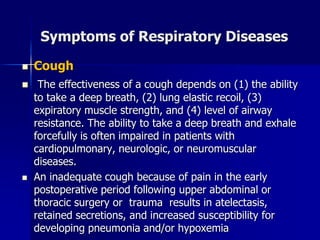
◼ Cough
◼ The effectiveness of a cough depends on (1) the ability
to take a deep breath, (2) lung elastic recoil, (3)
expiratory muscle strength, and (4) level of airway
resistance. The ability to take a deep breath and exhale
forcefully is often impaired in patients with
cardiopulmonary, neurologic, or neuromuscular
diseases.
◼ An inadequate cough because of pain in the early
postoperative period following upper abdominal or
thoracic surgery or trauma results in atelectasis,
retained secretions, and increased susceptibility for
developing pneumonia and/or hypoxemia
Symptoms of Respiratory Diseases
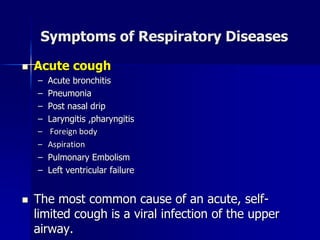
◼ Acute cough
– Acute bronchitis
– Pneumonia
– Post nasal drip
– Laryngitis ,pharyngitis
– Foreign body
– Aspiration
– Pulmonary Embolism
– Left ventricular failure
◼ The most common cause of an acute, self-
limited cough is a viral infection of the upper
airway.
Symptoms of Respiratory Diseases
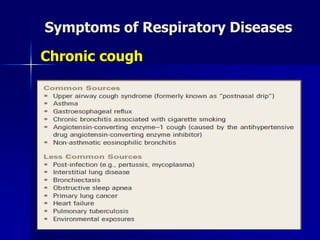
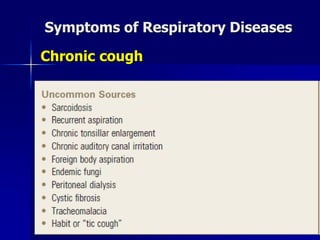
◼ Chronic cough
(4 weeks in children,8 weeks in adult )
Symptoms of Respiratory Diseases
Chronic cough
Symptoms of Respiratory Diseases
Chronic cough
Symptoms of Respiratory
Diseases
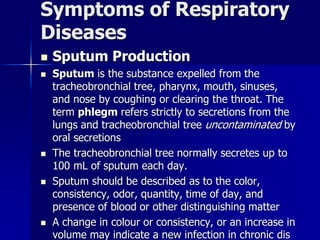
◼ Sputum Production
◼ Sputum is the substance expelled from the
tracheobronchial tree, pharynx, mouth, sinuses,
and nose by coughing or clearing the throat. The
term phlegm refers strictly to secretions from the
lungs and tracheobronchial tree uncontaminated by
oral secretions
◼ The tracheobronchial tree normally secretes up to
100 mL of sputum each day.
◼ Sputum should be described as to the color,
consistency, odor, quantity, time of day, and
presence of blood or other distinguishing matter
◼ A change in colour or consistency, or an increase in
volume may indicate a new infection in chronic dis
Symptoms of Respiratory
Diseases
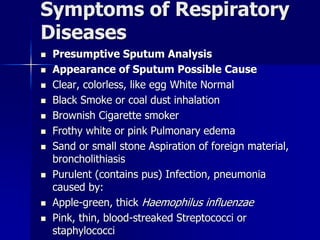
◼ Presumptive Sputum Analysis
◼ Appearance of Sputum Possible Cause
◼ Clear, colorless, like egg White Normal
◼ Black Smoke or coal dust inhalation
◼ Brownish Cigarette smoker
◼ Frothy white or pink Pulmonary edema
◼ Sand or small stone Aspiration of foreign material,
broncholithiasis
◼ Purulent (contains pus) Infection, pneumonia
caused by:
◼ Apple-green, thick Haemophilus influenzae
◼ Pink, thin, blood-streaked Streptococci or
staphylococci
Symptoms of Respiratory
Diseases
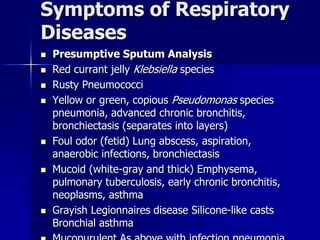
◼ Presumptive Sputum Analysis
◼ Red currant jelly Klebsiella species
◼ Rusty Pneumococci
◼ Yellow or green, copious Pseudomonas species
pneumonia, advanced chronic bronchitis,
bronchiectasis (separates into layers)
◼ Foul odor (fetid) Lung abscess, aspiration,
anaerobic infections, bronchiectasis
◼ Mucoid (white-gray and thick) Emphysema,
pulmonary tuberculosis, early chronic bronchitis,
neoplasms, asthma
◼ Grayish Legionnaires disease Silicone-like casts
Bronchial asthma
Symptoms of Respiratory Diseases
◼ Hemoptysis
◼ Coughing up blood, irrespective of the amount, is an
alarming symptom and patients nearly always seek
medical advice, must always be assumed to have a serious cause
until this is excluded.
◼ Massive >200 ml/episode, (400 mL in 3 hours
or more than 600 mL in 24 hours) is seen with
lung cancers, tuberculosis, bronchiectasis,
◼ and trauma.
Symptoms of Respiratory Diseases
◼ causes
◼ Bronchial disease
• Carcinoma*
• Bronchiectasis*
• Acute bronchitis*
• Bronchial adenoma
• Foreign body
◼ Parenchymal disease
• Tuberculosis*
• Suppurative pneumonia
• Parasites (e.g. hydatid disease, flukes)
• Lung abscess
• Trauma
• Actinomycosis
◼ • Mycetoma
Symptoms of Respiratory Diseases
◼ Lung vascular disease
• Pulmonary infarction*
• Goodpasture’s syndrome
• Polyarteritis nodosa
• Idiopathic pulmonary haemosiderosis
Cardiovascular disease
• Acute left ventricular failure*
• Mitral stenosis
• Aortic aneurysm
Blood disorders
• Leukaemia
• Haemophilia
• Anticoagulants
Symptoms of Respiratory Diseases
◼ management
severe acute haemoptysis
◼ the patient should be nursed upright (or on the side of the
bleeding, if this is known,
◼ give high-flow oxygen
◼ resuscitation.
◼ Bronchoscopy in the acute phase is difficult
◼ If radiology shows an obvious central cause, then rigid
bronchoscopy under general anaesthesia may allow
intervention to stop bleeding;
◼ if not visualised, Intubation with a divided endotracheal tube
◼ Bronchial arteriography and embolisation or
◼ even emergency surgery, can be life-saving .
Symptoms of Respiratory Diseases
◼ In non life threating (vast majority)
◼ Investigations
• chest X-ray,
• full blood count (FBC) and clotting screen
• bronchoscopy after acute bleeding has settled,
• CTPA, which may reveal underlying pulmonary
thromboembolic disease or alternative causes not
seen on the chest X-ray (e.g. pulmonary
arteriovenous malformation or small or hidden
tumours).
Symptoms of Respiratory Diseases
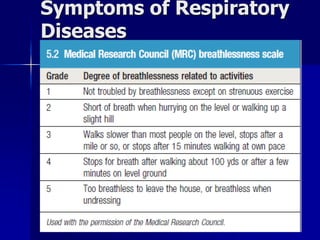
◼ Breathlessness
◼ Breathlessness or dyspnoea can be defined as the
feeling of an uncomfortable need to breathe. It is
unusual among sensations, as it has no defined
receptors, no localised representation in the brain,
and multiple causes both in health (e.g. exercise)
and in diseases of the lungs, heart or muscles.
Symptoms of Respiratory Diseases
◼ Pathophysiology
Respiratory diseases can stimulate breathing and
dyspnoea by:
◼ stimulating intrapulmonary sensory nerves (e.g.
pneumothorax, interstitial inflammation and
pulmonary embolus)
◼ increasing the mechanical load on the respiratory
muscles (e.g. airflow obstruction or pulmonary
fibrosis)
◼ causing hypoxia, hypercapnia or acidosis, which
stimulate chemoreceptors.
Symptoms of Respiratory Diseases
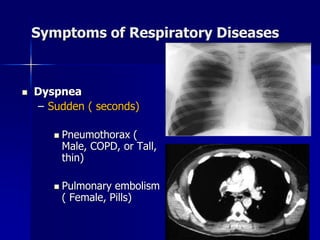
◼ Dyspnea
– Sudden ( seconds)
◼ Pneumothorax (
Male, COPD, or Tall,
thin)
◼ Pulmonary embolism
( Female, Pills)
Symptoms of Respiratory Diseases
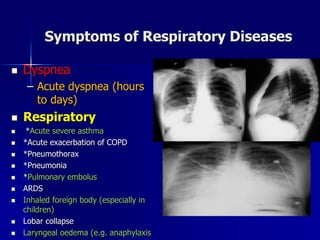
◼ Dyspnea
– Acute dyspnea (hours
to days)
◼ Respiratory
◼ *Acute severe asthma
◼ *Acute exacerbation of COPD
◼ *Pneumothorax
◼ *Pneumonia
◼ *Pulmonary embolus
◼ ARDS
◼ Inhaled foreign body (especially in
children)
◼ Lobar collapse
◼ Laryngeal oedema (e.g. anaphylaxis
Symptoms of Respiratory Diseases
◼ Cardiovascular
*Acute pulmonary oedema
◼ Others
◼ Metabolic acidosis (e.g. diabetic
ketoacidosis, lactic acidosis, uraemia,
overdose of salicylates, ethylene glycol
poisoning).
◼ Psychogenic hyperventilation (anxiety
or panic-related)
Symptoms of Respiratory Diseases
◼ Chronic dyspnea (months to Years)
◼ Respiratory
*COPD
*Chronic asthma
Bronchial carcinoma
Interstitial lung disease (sarcoidosis, fibrosing
alveolitis, extrinsic allergic alveolitis, pneumoconiosis)
Chronic pulmonary thromboembolism
Lymphatic carcinomatosis (may cause intolerable
breathlessness)
◼ Large pleural effusion(s)
Symptoms of Respiratory Diseases
◼ Cardiovascular
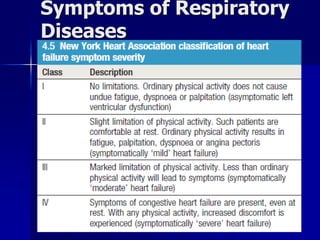
◼ Chronic heart failure
◼ Myocardial ischaemia (angina
equivalent
◼ Others
◼ Severe anaemia
◼ Obesity
◼ Deconditioning
Symptoms of Respiratory Diseases
◼ Factors suggesting psychogenichyperventilation
• Inability to take a deep breath’
• Frequent sighing/erratic ventilation at rest
• Short breath-holding time in the absence of severe
respiratory disease
• Difficulty in performing and/or inconsistent spirometry
measures
• High score (over 26) on Nijmegen questionnaire
• Induction of symptoms during submaximahyperventilation
• Resting end-tidal CO2 < 4.5%
• Associated digital paraesthesiae
Symptoms of Respiratory Diseases
◼ Types of dyspnea
– Paroxysmal dyspnea
◼ Bronchial asthma (wheezes, no crackles)
◼ Left ventricular failure (crackles,
cardiomegaly)
– Nocturnal dyspnea
◼ Bronchial asthma
◼ GERD
◼ LVF
Symptoms of Respiratory
Diseases
Symptoms of Respiratory
Diseases
Symptoms of Respiratory
Diseases
◼ Orthopnoea
• dyspnoea on lying flat
• It commonly occurs in patients with CHF, mitral
valve disease, bilateral diaphragm paralysis, and
superior vena cava syndrome.
• Paroxysmal nocturnal dyspnoea
• sudden breathlessness that wakes the patient from
sleep
◼ Platypneais dyspnea triggered by assuming the
upright position. seen in patients with right-to-left
intracardiac shunts from congenital heart disease
and in patients with venous-to-arterial shunts in the
lung related to severe lung disease or chronic liver
Symptoms of Respiratory Diseases
◼ Wheezes (Rhonchi)
– Bronchial asthma
– COPD
– Pulmonary embolism
– Lung cancer
– Bronchiectasis
– LVF
Symptoms of Respiratory Diseases
◼ Chest pain
◼ central
◼ Cardiac
• Myocardial ischaemia (angina)
• Myocardial infarction
• Myocarditis,Pericarditis
• Mitral valve prolapse syndrome
Aortic
• Aortic dissection • Aortic aneurysm
Oesophageal
Oesophagitis, Oesophageal spasm Mallory–Weiss syndrome
◼ Massive pulmonary embolus
◼ Mediastinal
• Tracheitis • Malignancy
◼ Anxiety/emotion1
Symptoms of Respiratory Diseases
◼ Peripheral
◼ Lungs/pleura
◼ • Pulmonary infarct
◼ • Pneumonia
◼ • Pneumothorax
◼ • Malignancy
◼ • Tuberculosis
◼ • Connective tissue disorders
◼ Musculoskeletal2
◼ • Osteoarthritis
◼ • Rib fracture/injury
◼ • Costochondritis (Tietze’s syndrome
◼ • Intercostal muscle injury
◼ • Epidemic myalgia (Bornholm disease
Symptoms of Respiratory Diseases
◼ Neurological
• Prolapsed intervertebral disc
• Herpes zoster
• Thoracic outlet syndrome
Symptoms of Respiratory
Diseases
◼ Stridor
◼ This harsh, grating respiratory sound is caused by
vibration of the walls of the trachea or major bronchi
when the airway lumen is critically narrowed by
compression, tumour or inhaled foreign material.
Inspiration lowers the pressure inside the
extrathoracic trachea, so critical narrowing here
leads to inspiratory stridor. In contrast, the
intrathoracic large airways are compressed during
expiration by positive pressure in the surrounding
lung, leading to fixed expiratory wheeze or stridor.
Large airway narrowing at the thoracic inlet (for
example, tracheal compression by a large goitre)
cause both inspiratory ,expiratory stridor
Symptoms of Respiratory
Diseases
◼ Edema
◼ is soft tissue swelling resulting from an abnormal
accumulation of fluid. It may be generalized
(anasarca), may appear only in dependent body
areas (feet and ankles in ambulatory patients or the
sacral area in patients on bed rest), or may be
limited to a single extremity or organ (such as
pulmonary edema).
◼ Edema is associated with kidney disease, liver
disease, cardiac and pulmonary disease, and
obstruction of venous or lymphatic drainage of an
extremity.
Symptoms of
Respiratory Diseases
Thank you

3-final syDDDDDDDDDDDDDDDDDDDDmptoms.pdf

  • 1.
    Symptoms of RespiratoryDiseases ◼ Cardinal Symptoms – Cough – Sputum – Hemoptysis – Dyspnea – Wheezes – Chest pain
  • 2.
    Symptoms of RespiratoryDiseases ◼ Other presenting symptoms – Apnea – Hoarseness – Stridor – Snoring – Fever – Night sweating – Weight loss
  • 3.
    Symptoms of RespiratoryDiseases ◼ Cough ◼ Cough is the most frequent symptom of respiratory diseases ◼ Coughing is a forceful expiratory maneuver that expels mucus and foreign material from the airways. ◼ Coughing usually occurs when irritant receptors are stimulated by inflammation, mucus, foreign materials, or noxious gases. Cough receptors are located primarily in the larynx trachea, and larger bronchi. ◼ Inspiration is followed by an expiratory effort against a closed glottis. Subsequent sudden opening of the glottis with rapid expiratory flow produces the characteristic sound.
  • 4.
    Symptoms of RespiratoryDiseases ◼ Cough ◼ The effectiveness of a cough depends on (1) the ability to take a deep breath, (2) lung elastic recoil, (3) expiratory muscle strength, and (4) level of airway resistance. The ability to take a deep breath and exhale forcefully is often impaired in patients with cardiopulmonary, neurologic, or neuromuscular diseases. ◼ An inadequate cough because of pain in the early postoperative period following upper abdominal or thoracic surgery or trauma results in atelectasis, retained secretions, and increased susceptibility for developing pneumonia and/or hypoxemia
  • 5.
    Symptoms of RespiratoryDiseases ◼ Acute cough – Acute bronchitis – Pneumonia – Post nasal drip – Laryngitis ,pharyngitis – Foreign body – Aspiration – Pulmonary Embolism – Left ventricular failure ◼ The most common cause of an acute, self- limited cough is a viral infection of the upper airway.
  • 6.
    Symptoms of RespiratoryDiseases ◼ Chronic cough (4 weeks in children,8 weeks in adult )
  • 7.
    Symptoms of RespiratoryDiseases Chronic cough
  • 8.
    Symptoms of RespiratoryDiseases Chronic cough
  • 9.
    Symptoms of Respiratory Diseases ◼Sputum Production ◼ Sputum is the substance expelled from the tracheobronchial tree, pharynx, mouth, sinuses, and nose by coughing or clearing the throat. The term phlegm refers strictly to secretions from the lungs and tracheobronchial tree uncontaminated by oral secretions ◼ The tracheobronchial tree normally secretes up to 100 mL of sputum each day. ◼ Sputum should be described as to the color, consistency, odor, quantity, time of day, and presence of blood or other distinguishing matter ◼ A change in colour or consistency, or an increase in volume may indicate a new infection in chronic dis
  • 10.
    Symptoms of Respiratory Diseases ◼Presumptive Sputum Analysis ◼ Appearance of Sputum Possible Cause ◼ Clear, colorless, like egg White Normal ◼ Black Smoke or coal dust inhalation ◼ Brownish Cigarette smoker ◼ Frothy white or pink Pulmonary edema ◼ Sand or small stone Aspiration of foreign material, broncholithiasis ◼ Purulent (contains pus) Infection, pneumonia caused by: ◼ Apple-green, thick Haemophilus influenzae ◼ Pink, thin, blood-streaked Streptococci or staphylococci
  • 11.
    Symptoms of Respiratory Diseases ◼Presumptive Sputum Analysis ◼ Red currant jelly Klebsiella species ◼ Rusty Pneumococci ◼ Yellow or green, copious Pseudomonas species pneumonia, advanced chronic bronchitis, bronchiectasis (separates into layers) ◼ Foul odor (fetid) Lung abscess, aspiration, anaerobic infections, bronchiectasis ◼ Mucoid (white-gray and thick) Emphysema, pulmonary tuberculosis, early chronic bronchitis, neoplasms, asthma ◼ Grayish Legionnaires disease Silicone-like casts Bronchial asthma
  • 12.
    Symptoms of RespiratoryDiseases ◼ Hemoptysis ◼ Coughing up blood, irrespective of the amount, is an alarming symptom and patients nearly always seek medical advice, must always be assumed to have a serious cause until this is excluded. ◼ Massive >200 ml/episode, (400 mL in 3 hours or more than 600 mL in 24 hours) is seen with lung cancers, tuberculosis, bronchiectasis, ◼ and trauma.
  • 13.
    Symptoms of RespiratoryDiseases ◼ causes ◼ Bronchial disease • Carcinoma* • Bronchiectasis* • Acute bronchitis* • Bronchial adenoma • Foreign body ◼ Parenchymal disease • Tuberculosis* • Suppurative pneumonia • Parasites (e.g. hydatid disease, flukes) • Lung abscess • Trauma • Actinomycosis ◼ • Mycetoma
  • 14.
    Symptoms of RespiratoryDiseases ◼ Lung vascular disease • Pulmonary infarction* • Goodpasture’s syndrome • Polyarteritis nodosa • Idiopathic pulmonary haemosiderosis Cardiovascular disease • Acute left ventricular failure* • Mitral stenosis • Aortic aneurysm Blood disorders • Leukaemia • Haemophilia • Anticoagulants
  • 15.
    Symptoms of RespiratoryDiseases ◼ management severe acute haemoptysis ◼ the patient should be nursed upright (or on the side of the bleeding, if this is known, ◼ give high-flow oxygen ◼ resuscitation. ◼ Bronchoscopy in the acute phase is difficult ◼ If radiology shows an obvious central cause, then rigid bronchoscopy under general anaesthesia may allow intervention to stop bleeding; ◼ if not visualised, Intubation with a divided endotracheal tube ◼ Bronchial arteriography and embolisation or ◼ even emergency surgery, can be life-saving .
  • 16.
    Symptoms of RespiratoryDiseases ◼ In non life threating (vast majority) ◼ Investigations • chest X-ray, • full blood count (FBC) and clotting screen • bronchoscopy after acute bleeding has settled, • CTPA, which may reveal underlying pulmonary thromboembolic disease or alternative causes not seen on the chest X-ray (e.g. pulmonary arteriovenous malformation or small or hidden tumours).
  • 17.
    Symptoms of RespiratoryDiseases ◼ Breathlessness ◼ Breathlessness or dyspnoea can be defined as the feeling of an uncomfortable need to breathe. It is unusual among sensations, as it has no defined receptors, no localised representation in the brain, and multiple causes both in health (e.g. exercise) and in diseases of the lungs, heart or muscles.
  • 18.
    Symptoms of RespiratoryDiseases ◼ Pathophysiology Respiratory diseases can stimulate breathing and dyspnoea by: ◼ stimulating intrapulmonary sensory nerves (e.g. pneumothorax, interstitial inflammation and pulmonary embolus) ◼ increasing the mechanical load on the respiratory muscles (e.g. airflow obstruction or pulmonary fibrosis) ◼ causing hypoxia, hypercapnia or acidosis, which stimulate chemoreceptors.
  • 19.
    Symptoms of RespiratoryDiseases ◼ Dyspnea – Sudden ( seconds) ◼ Pneumothorax ( Male, COPD, or Tall, thin) ◼ Pulmonary embolism ( Female, Pills)
  • 20.
    Symptoms of RespiratoryDiseases ◼ Dyspnea – Acute dyspnea (hours to days) ◼ Respiratory ◼ *Acute severe asthma ◼ *Acute exacerbation of COPD ◼ *Pneumothorax ◼ *Pneumonia ◼ *Pulmonary embolus ◼ ARDS ◼ Inhaled foreign body (especially in children) ◼ Lobar collapse ◼ Laryngeal oedema (e.g. anaphylaxis
  • 21.
    Symptoms of RespiratoryDiseases ◼ Cardiovascular *Acute pulmonary oedema ◼ Others ◼ Metabolic acidosis (e.g. diabetic ketoacidosis, lactic acidosis, uraemia, overdose of salicylates, ethylene glycol poisoning). ◼ Psychogenic hyperventilation (anxiety or panic-related)
  • 22.
    Symptoms of RespiratoryDiseases ◼ Chronic dyspnea (months to Years) ◼ Respiratory *COPD *Chronic asthma Bronchial carcinoma Interstitial lung disease (sarcoidosis, fibrosing alveolitis, extrinsic allergic alveolitis, pneumoconiosis) Chronic pulmonary thromboembolism Lymphatic carcinomatosis (may cause intolerable breathlessness) ◼ Large pleural effusion(s)
  • 23.
    Symptoms of RespiratoryDiseases ◼ Cardiovascular ◼ Chronic heart failure ◼ Myocardial ischaemia (angina equivalent ◼ Others ◼ Severe anaemia ◼ Obesity ◼ Deconditioning
  • 24.
    Symptoms of RespiratoryDiseases ◼ Factors suggesting psychogenichyperventilation • Inability to take a deep breath’ • Frequent sighing/erratic ventilation at rest • Short breath-holding time in the absence of severe respiratory disease • Difficulty in performing and/or inconsistent spirometry measures • High score (over 26) on Nijmegen questionnaire • Induction of symptoms during submaximahyperventilation • Resting end-tidal CO2 < 4.5% • Associated digital paraesthesiae
  • 25.
    Symptoms of RespiratoryDiseases ◼ Types of dyspnea – Paroxysmal dyspnea ◼ Bronchial asthma (wheezes, no crackles) ◼ Left ventricular failure (crackles, cardiomegaly) – Nocturnal dyspnea ◼ Bronchial asthma ◼ GERD ◼ LVF
  • 26.
  • 27.
  • 28.
    Symptoms of Respiratory Diseases ◼Orthopnoea • dyspnoea on lying flat • It commonly occurs in patients with CHF, mitral valve disease, bilateral diaphragm paralysis, and superior vena cava syndrome. • Paroxysmal nocturnal dyspnoea • sudden breathlessness that wakes the patient from sleep ◼ Platypneais dyspnea triggered by assuming the upright position. seen in patients with right-to-left intracardiac shunts from congenital heart disease and in patients with venous-to-arterial shunts in the lung related to severe lung disease or chronic liver
  • 29.
    Symptoms of RespiratoryDiseases ◼ Wheezes (Rhonchi) – Bronchial asthma – COPD – Pulmonary embolism – Lung cancer – Bronchiectasis – LVF
  • 30.
    Symptoms of RespiratoryDiseases ◼ Chest pain ◼ central ◼ Cardiac • Myocardial ischaemia (angina) • Myocardial infarction • Myocarditis,Pericarditis • Mitral valve prolapse syndrome Aortic • Aortic dissection • Aortic aneurysm Oesophageal Oesophagitis, Oesophageal spasm Mallory–Weiss syndrome ◼ Massive pulmonary embolus ◼ Mediastinal • Tracheitis • Malignancy ◼ Anxiety/emotion1
  • 31.
    Symptoms of RespiratoryDiseases ◼ Peripheral ◼ Lungs/pleura ◼ • Pulmonary infarct ◼ • Pneumonia ◼ • Pneumothorax ◼ • Malignancy ◼ • Tuberculosis ◼ • Connective tissue disorders ◼ Musculoskeletal2 ◼ • Osteoarthritis ◼ • Rib fracture/injury ◼ • Costochondritis (Tietze’s syndrome ◼ • Intercostal muscle injury ◼ • Epidemic myalgia (Bornholm disease
  • 32.
    Symptoms of RespiratoryDiseases ◼ Neurological • Prolapsed intervertebral disc • Herpes zoster • Thoracic outlet syndrome
  • 33.
    Symptoms of Respiratory Diseases ◼Stridor ◼ This harsh, grating respiratory sound is caused by vibration of the walls of the trachea or major bronchi when the airway lumen is critically narrowed by compression, tumour or inhaled foreign material. Inspiration lowers the pressure inside the extrathoracic trachea, so critical narrowing here leads to inspiratory stridor. In contrast, the intrathoracic large airways are compressed during expiration by positive pressure in the surrounding lung, leading to fixed expiratory wheeze or stridor. Large airway narrowing at the thoracic inlet (for example, tracheal compression by a large goitre) cause both inspiratory ,expiratory stridor
  • 34.
    Symptoms of Respiratory Diseases ◼Edema ◼ is soft tissue swelling resulting from an abnormal accumulation of fluid. It may be generalized (anasarca), may appear only in dependent body areas (feet and ankles in ambulatory patients or the sacral area in patients on bed rest), or may be limited to a single extremity or organ (such as pulmonary edema). ◼ Edema is associated with kidney disease, liver disease, cardiac and pulmonary disease, and obstruction of venous or lymphatic drainage of an extremity.
  • 35.