History of 3D Film.
Bwana Devil
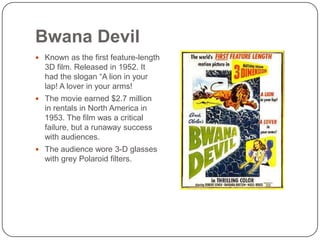
 Known as the first feature-length

3D film. Released in 1952. It
had the slogan “A lion in your
lap! A lover in your arms!
 The movie earned $2.7 million

in rentals in North America in
1953. The film was a critical
failure, but a runaway success
with audiences.
 The audience wore 3-D glasses

with grey Polaroid filters.
Bwana Devil
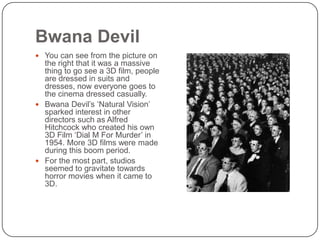
 You can see from the picture on

the right that it was a massive
thing to go see a 3D film, people
are dressed in suits and
dresses, now everyone goes to
the cinema dressed casually.
 Bwana Devil’s ‘Natural Vision’
sparked interest in other
directors such as Alfred
Hitchcock who created his own
3D Film ‘Dial M For Murder’ in
1954. More 3D films were made
during this boom period.
 For the most part, studios
seemed to gravitate towards
horror movies when it came to
3D.
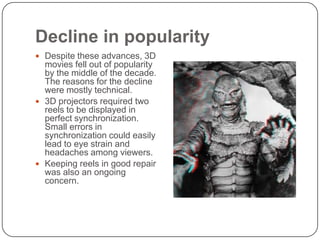
Decline in popularity
 Despite these advances, 3D

movies fell out of popularity
by the middle of the decade.
The reasons for the decline
were mostly technical.
 3D projectors required two
reels to be displayed in
perfect synchronization.
Small errors in
synchronization could easily
lead to eye strain and
headaches among viewers.
 Keeping reels in good repair
was also an ongoing
concern.
New ideas
 3D's second renaissance came

 A company called Stereovision

some time later when producer
Arch Gobler found a way to
eliminate the need for dual-reel
movies.

developed another new
technology in 1970.
Stereovision's 3D format
displayed reels side-by-side on
a single, anamorphic film strip.

 His new technique, Space-

Vision 3D, worked by overlaying
two stereoscopic images on a
single reel. As long as reels
were spliced properly during
printing, viewers no longer
needed to worry about syncing
issues.

 Many of these films in the '70s

and '80s were marketed
squarely at older viewers and
fans of violent horror films.
Criticisms
 Late film critic Late film

critic Roger Ebert
repeatedly criticized 3D
film as being "too
dim", sometimes
distracting or even
nausea-inducing, and
argued that it is an
expensive technology that
adds nothing of value to
the movie-going
experience (since 2-D
movies already provide a
sufficient illusion of 3D).

 A Film critic argued that

3D adds "not that much"
value to a film, and said
that, while he liked Avatar,
the many impressive
things he saw in the
movie had nothing to do
with 3D.

3D film

  • 1.
  • 2.
    Bwana Devil  Knownas the first feature-length 3D film. Released in 1952. It had the slogan “A lion in your lap! A lover in your arms!  The movie earned $2.7 million in rentals in North America in 1953. The film was a critical failure, but a runaway success with audiences.  The audience wore 3-D glasses with grey Polaroid filters.
  • 3.
    Bwana Devil  Youcan see from the picture on the right that it was a massive thing to go see a 3D film, people are dressed in suits and dresses, now everyone goes to the cinema dressed casually.  Bwana Devil’s ‘Natural Vision’ sparked interest in other directors such as Alfred Hitchcock who created his own 3D Film ‘Dial M For Murder’ in 1954. More 3D films were made during this boom period.  For the most part, studios seemed to gravitate towards horror movies when it came to 3D.
  • 4.
    Decline in popularity Despite these advances, 3D movies fell out of popularity by the middle of the decade. The reasons for the decline were mostly technical.  3D projectors required two reels to be displayed in perfect synchronization. Small errors in synchronization could easily lead to eye strain and headaches among viewers.  Keeping reels in good repair was also an ongoing concern.
  • 5.
    New ideas  3D'ssecond renaissance came  A company called Stereovision some time later when producer Arch Gobler found a way to eliminate the need for dual-reel movies. developed another new technology in 1970. Stereovision's 3D format displayed reels side-by-side on a single, anamorphic film strip.  His new technique, Space- Vision 3D, worked by overlaying two stereoscopic images on a single reel. As long as reels were spliced properly during printing, viewers no longer needed to worry about syncing issues.  Many of these films in the '70s and '80s were marketed squarely at older viewers and fans of violent horror films.
  • 6.
    Criticisms  Late filmcritic Late film critic Roger Ebert repeatedly criticized 3D film as being "too dim", sometimes distracting or even nausea-inducing, and argued that it is an expensive technology that adds nothing of value to the movie-going experience (since 2-D movies already provide a sufficient illusion of 3D).  A Film critic argued that 3D adds "not that much" value to a film, and said that, while he liked Avatar, the many impressive things he saw in the movie had nothing to do with 3D.