Framing Data Retention
Lennart Huizing
Freelance political advisor
@lennarthuizing
lennart@lennarthuizing.nl
Data retention
●
Current state of play
– ECJ
– EU
– The Netherlands
What is framing?
●
A coherent and appealing way to present your
argument
●
You help people make sense of a subject
●
You get to decide what vocabulary people use
●
You get to decide which cultural norms and
values are at stake
●
You get to choose who the hero is, who the
villain, and who the victim
What does a good frame do?
●
Changes the vocabulary
●
Forces your opponent to adopt your language
●
Imposes a specific set of possible courses of
action
●
Seduces the listener to expand on the
metaphor
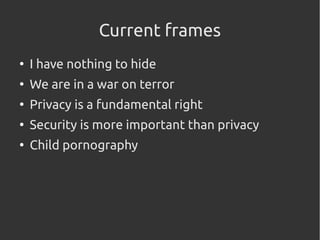
Current frames
●
I have nothing to hide
●
We are in a war on terror
●
Privacy is a fundamental right
●
Security is more important than privacy
●
Child pornography
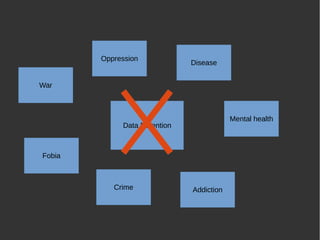
Data Retention
War
Fobia
Crime Addiction
Oppression
Disease
Mental health
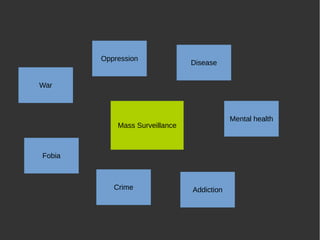
Mass Surveillance
War
Fobia
Crime Addiction
Oppression
Disease
Mental health
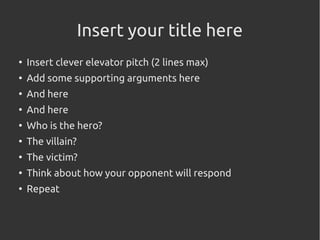
Insert your title here
●
Insert clever elevator pitch (2 lines max)
●
Add some supporting arguments here
●
And here
●
And here
●
Who is the hero?
●
The villain?
●
The victim?
●
Think about how your opponent will respond
●
Repeat
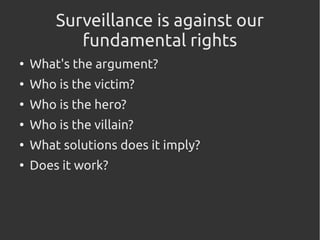
Surveillance is against our
fundamental rights
●
What's the argument?
●
Who is the victim?
●
Who is the hero?
●
Who is the villain?
●
What solutions does it imply?
●
Does it work?
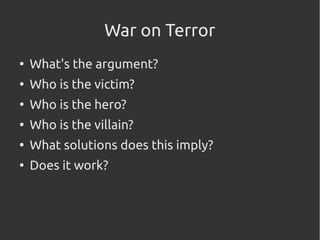
War on Terror
●
What's the argument?
●
Who is the victim?
●
Who is the hero?
●
Who is the villain?
●
What solutions does this imply?
●
Does it work?
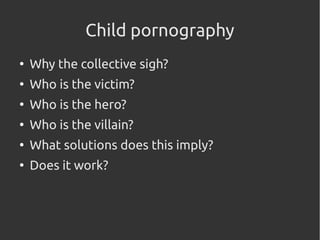
Child pornography
●
Why the collective sigh?
●
Who is the victim?
●
Who is the hero?
●
Who is the villain?
●
What solutions does this imply?
●
Does it work?
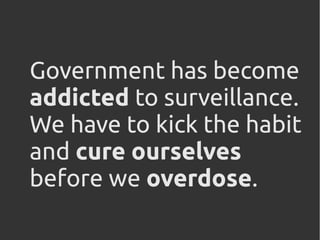
Government has become
addicted to surveillance.
We have to kick the habit
and cure ourselves
before we overdose.
Kick the Habit
●
We refuse to admit we might have a problem – 'we have
nothing to hide'
●
We rationalize our behaviour, but our arguments don't stand up
to scrutiny – 'I can't hear you, and anyway - LALALALALAAA'
●
Our addiction damages things that are valuable – 'we just need a
tiny little backdoor backdoor that security protocol, just to keep
you safe!'
●
We have a long, hard road ahead of us to cure ourselves from
our addiction
●
But we have to cure ourselves, because there's a perpetual risk
of relapse
Kick the Habit (again)
What is really nice about this frame:
– We get to be the hero – and everybody who gets into
the frame with us gets to be a hero too!
– The victim is government and society in general –
should be treated with care and patience, like any
mental health patient.
– The villain is the surveillance agencies, that are the
pushers of our drugs
– Almost any counter-argument can be met with simple
answers:
You are in denial
You need to accept you have a
problem in order to cure it
Don't you see you are hurting
people around you?
And yourself?
Kick the Habit (get over it)
●
An addiction needs to be cured
– But addiction can be cured
– The patient needs to come clean and confess
– The patient must follow a 12-step program
– The patient needs defenses against relapse
Kick the Habit (finally)
●
What are the weaknesses of this frame?
●
Is it appealing enough to engage the general
public?
●
Can civil society unify messaging around this,
or another central frame?
●
What new natural coalition partners come into
view?
●
Do we have a winner?

31c3 "Framing Data Retention"

  • 1.
    Framing Data Retention LennartHuizing Freelance political advisor @lennarthuizing lennart@lennarthuizing.nl
  • 2.
    Data retention ● Current stateof play – ECJ – EU – The Netherlands
  • 3.
    What is framing? ● Acoherent and appealing way to present your argument ● You help people make sense of a subject ● You get to decide what vocabulary people use ● You get to decide which cultural norms and values are at stake ● You get to choose who the hero is, who the villain, and who the victim
  • 4.
    What does agood frame do? ● Changes the vocabulary ● Forces your opponent to adopt your language ● Imposes a specific set of possible courses of action ● Seduces the listener to expand on the metaphor
  • 5.
    Current frames ● I havenothing to hide ● We are in a war on terror ● Privacy is a fundamental right ● Security is more important than privacy ● Child pornography
  • 6.
  • 7.
  • 8.
    Insert your titlehere ● Insert clever elevator pitch (2 lines max) ● Add some supporting arguments here ● And here ● And here ● Who is the hero? ● The villain? ● The victim? ● Think about how your opponent will respond ● Repeat
  • 9.
    Surveillance is againstour fundamental rights ● What's the argument? ● Who is the victim? ● Who is the hero? ● Who is the villain? ● What solutions does it imply? ● Does it work?
  • 10.
    War on Terror ● What'sthe argument? ● Who is the victim? ● Who is the hero? ● Who is the villain? ● What solutions does this imply? ● Does it work?
  • 11.
    Child pornography ● Why thecollective sigh? ● Who is the victim? ● Who is the hero? ● Who is the villain? ● What solutions does this imply? ● Does it work?
  • 12.
    Government has become addictedto surveillance. We have to kick the habit and cure ourselves before we overdose.
  • 13.
    Kick the Habit ● Werefuse to admit we might have a problem – 'we have nothing to hide' ● We rationalize our behaviour, but our arguments don't stand up to scrutiny – 'I can't hear you, and anyway - LALALALALAAA' ● Our addiction damages things that are valuable – 'we just need a tiny little backdoor backdoor that security protocol, just to keep you safe!' ● We have a long, hard road ahead of us to cure ourselves from our addiction ● But we have to cure ourselves, because there's a perpetual risk of relapse
  • 14.
    Kick the Habit(again) What is really nice about this frame: – We get to be the hero – and everybody who gets into the frame with us gets to be a hero too! – The victim is government and society in general – should be treated with care and patience, like any mental health patient. – The villain is the surveillance agencies, that are the pushers of our drugs – Almost any counter-argument can be met with simple answers:
  • 15.
    You are indenial
  • 16.
    You need toaccept you have a problem in order to cure it
  • 17.
    Don't you seeyou are hurting people around you? And yourself?
  • 18.
    Kick the Habit(get over it) ● An addiction needs to be cured – But addiction can be cured – The patient needs to come clean and confess – The patient must follow a 12-step program – The patient needs defenses against relapse
  • 19.
    Kick the Habit(finally) ● What are the weaknesses of this frame? ● Is it appealing enough to engage the general public? ● Can civil society unify messaging around this, or another central frame? ● What new natural coalition partners come into view? ● Do we have a winner?