01-02-2012


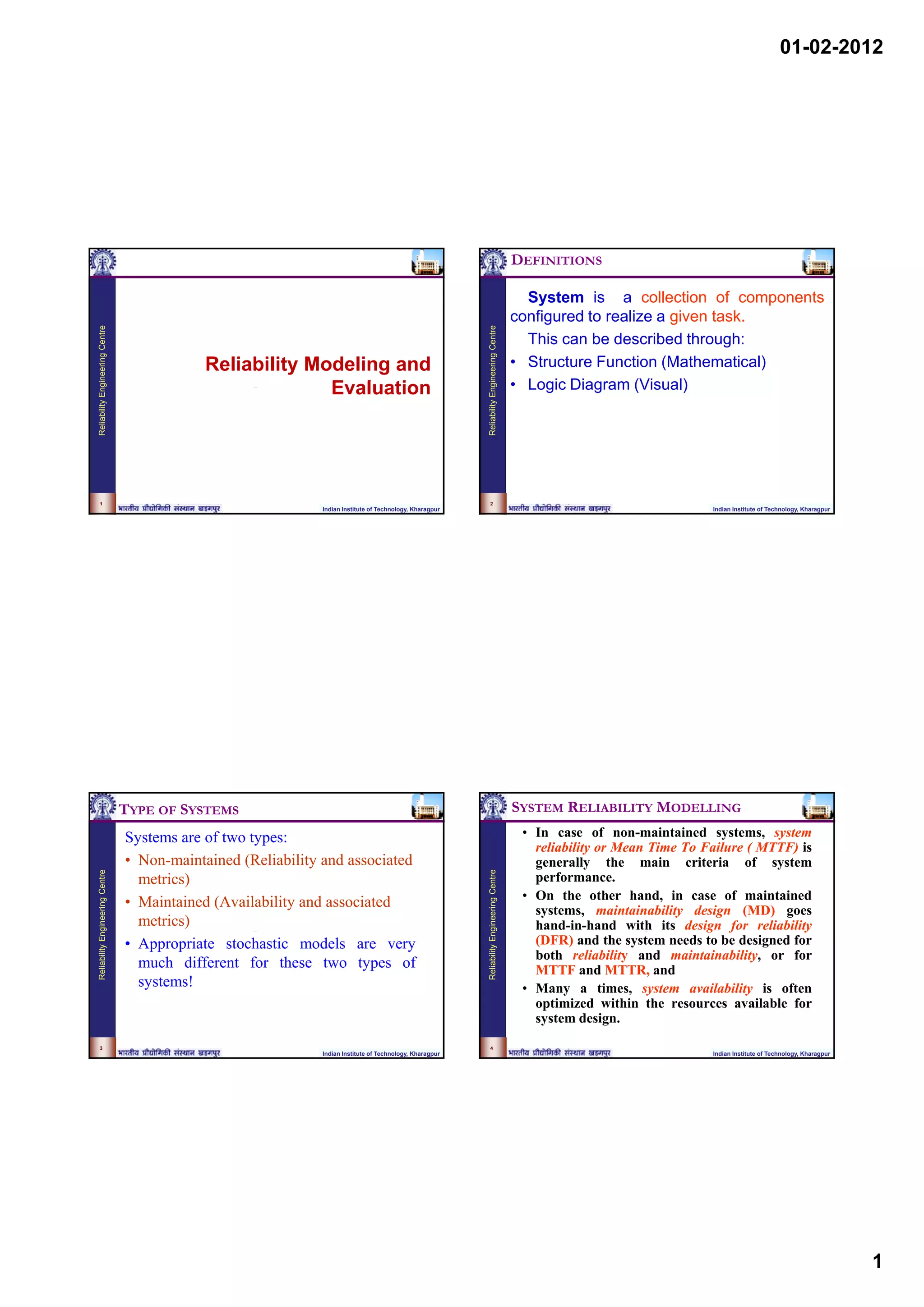
                                                                                                                                           DEFINITIONS

                                                                                                                                             System is a collection of components
                                                                                                                                           configured to realize a given task.
Reliability Engineering Centre


                                                                                                          Reliability Engineering Centre
                                                                                                                                             This can be described through:
                                             Reliability Modeling and                                                                      • Structure Function (Mathematical)
                                                           Evaluation
                                                           E l ti                                                                          • L i Di
                                                                                                                                             Logic Diagram (Vi(Visual)
                                                                                                                                                                    l)


        1                                                                                                         2
                                                              Indian Institute of Technology, Kharagpur                                                                    Indian Institute of Technology, Kharagpur


                                 TYPE OF SYSTEMS                                                                                           SYSTEM RELIABILITY MODELLING
                                 Systems are of two types:                                                                                  • In case of non-maintained systems, system
                                                                                                                                              reliability or Mean Time To Failure ( MTTF) is
                                 • Non-maintained (Reliability and associated                                                                 generally the main criteria of system
                                                                                                                                              performance.
Reliability Engineering Centre


                                                                                                          Reliability Engineering Centre


                                   metrics)
                                                                                                                                            • On the other hand, in case of maintained
                                 • Maintained (Availability and associated                                                                    systems, maintainability design (MD) goes
                                   metrics)                                                                                                   hand-in-hand
                                                                                                                                              hand in hand with its design for reliability
                                 • Appropriate stochastic models are very                                                                     (DFR) and the system needs to be designed for
                                                                                                                                              both reliability and maintainability, or for
                                   much different for these two types of                                                                      MTTF and MTTR, and
                                   systems!                                                                                                 • Many a times, system availability is often
                                                                                                                                              optimized within the resources available for
                                                                                                                                              system design.
        3                                                                                                         4
                                                              Indian Institute of Technology, Kharagpur                                                                    Indian Institute of Technology, Kharagpur


                                                                                                                                                                                                                       1
01-02-2012


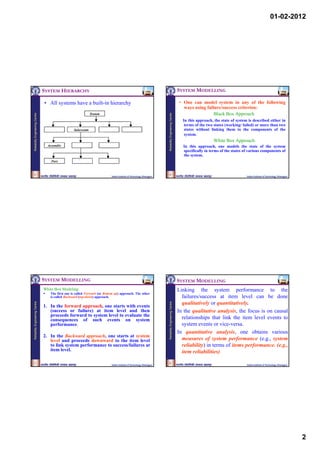
                                 SYSTEM HIERARCHY                                                                                                         SYSTEM MODELLING

                                 • All systems have a built-in hierarchy                                                                                  • One can model system in any of the following
                                                                                                                                                            ways using failure/success criterion:
                                                                                                                                                                           Black Box Approach
Reliability Engineering Centre


                                                                                                                         Reliability Engineering Centre
                                                                                                                                                            In this approach, the state of system is described either in
                                                                                                                                                             terms of the two states (working/ failed) or more than two
                                                                                                                                                             states without linking them to the components of the
                                                                                                                                                             system.
                                                                                                                                                                             White Box Approach
                                                                                                                                                            In this approach, one models the state of the system
                                                                                                                                                            specifically in terms of the states of various components of
                                                                                                                                                            the system.


        5                                                                                                                        6
                                                                             Indian Institute of Technology, Kharagpur                                                                           Indian Institute of Technology, Kharagpur


                                 SYSTEM MODELLING                                                                                                         SYSTEM MODELLING
                                 White Box Modeling:                                                                                                      Linking the system performance to the
                                    The first one is called Forward (or Bottom up) approach. The other
                                     is called Backward (top-down) approach.                                                                                failures/success at item level can be done
                                                                                                                                                            qualitatively or quantitatively.
Reliability Engineering Centre


                                                                                                                         Reliability Engineering Centre


                                 1. In the forward approach, one starts with events
                                    (success or failure) at item level and then                                                                           In the qualitative analysis, the focus is on causal
                                    proceeds forward to system level to evaluate the
                                    consequences of such events on system                                                                                   relationships that link the item level events to
                                    performance.                                                                                                            system events or vice-versa.
                                                                                                                                                          In quantitative analysis, one obtains various
                                 2. In the Backward approach, one starts at system
                                    level and proceeds downward to the item level                                                                           measures of system performance (e.g., system
                                    to link system performance to success/failures at                                                                       reliability) in terms of items performance. (e.g.,
                                    item level.                                                                                                             item reliabilities)
        7                                                                                                                        8
                                                                             Indian Institute of Technology, Kharagpur                                                                           Indian Institute of Technology, Kharagpur


                                                                                                                                                                                                                                             2
01-02-2012


                                                                                                                                                      BLOCK DIAGRAM OF A SYSTEM
                                           GRAPHICAL REPRESENTATION
                                                                                                                                                       • Since the system modeling is done on the basis of
                                 • There are two ways of graphically representing the                                                                    functional interrelationship of the constituent items
                                   functional relationship in a Qualitative analysis of a                                                                in relation to the overall functioning of the system,
Reliability Engineering Centre


                                                                                                                     Reliability Engineering Centre
                                   system. The first one is Block diagram or Reliability                                                                 one has to keep the hierarchy of the system in view.
                                   Logic Diagram (RLD) approach. An RLD indicates                                                                      • Therefore, we must consider the success of the
                                   which components of the system must operate for
                                                                                                                                                         system vis-à-vis the success of the constituent
                                                                                                                                                                  vis à vis
                                   successful operation of the system. The other approach
                                   involves indication of which components must fail                                                                     subsystems and then success of each subsystem is
                                   before the system fails. This graphical representation                                                                considered vis-a-vis the success of the constituting
                                   is done through Fault Tree Logic Diagram. Block                                                                       components. This exercise will eventually result in
                                   Diagram approach is optimistic approach of                                                                            a Block Diagram of the system.
                                   modelling whereas the FTA is pessimistic approach
                                   of Modelling.

                                                                         Indian Institute of Technology, Kharagpur                                                                       Indian Institute of Technology, Kharagpur


                                 RELIABILITY LOGIC/BLOCK/NETWORK DIAGRAM                                                                              BLOCK DIAGRAM OF A JET ENGINE
                                  • A diagram which shows the logical relationships of system                                                         • Jet Engine
                                    success (or failure) with success (or failure) of its
                                                                                                                                                        – Fuel Supply System
                                    constituent parts is termed as RLD/RBD/NRLD.
                                                                                                                                                           • Fuel Pump
Reliability Engineering Centre


                                                                                                                     Reliability Engineering Centre


                                                                                                                                                           • Fuel Filter
                                  • RLD indicates that which component(s) in a system must                                                              – Carburetor
                                    operate without any failure for successful operation of the                                                            • Jet
                                    system.
                                    system                                                                                                                 • Other Components
                                                                                                                                                        – Ignition System (2)
                                  • To develop RLD and reliability analysis thereof require                                                                • LV
                                    understanding and depiction of operational relationships or                                                            • HV
                                    logical interrelationships amongst its constituent items
                                    (subsystems, units or elements or parts.)


    11
                                                                         Indian Institute of Technology, Kharagpur                                                                       Indian Institute of Technology, Kharagpur


                                                                                                                                                                                                                                     3
01-02-2012


                                 ASSUMPTION IN MODELING                                                                                           INDEPENDENT FAILURES
                                  • All elements and systems can be either in operating                                                           • Failure times of components are influenced by
                                    or failed state, i.e., two state modeling.                                                                      environmental conditions. As the environment
                                  • All elements are in operating state initially except                                                            gets harsher, the time to failure of component
Reliability Engineering Centre


                                                                                                                 Reliability Engineering Centre
                                    possibly in the case of redundancy.                                                                             decreases.
                                  • States of all elements are statistically independent.                                                         • If the components of a system share the same
                                    (Failure of one element does not affect the probability                                                         environment, failure times of components
                                    of failure of other elements).                                                                                  become statistically dependent.
                                  • The reliabilities of all constituent components are                                                           • However, if the dependence is weak, or the
                                    known through some “reliability analysis”.                                                                      components are located far apart, one can
                                                                                                                                                    ignore dependence and treat the failure times as
                                                                                                                                                    being statistically independent.

    13
                                                                     Indian Institute of Technology, Kharagpur                                                                   Indian Institute of Technology, Kharagpur


                                 INDEPENDENT FAILURES

                                 • The advantage of this assumption is that
                                   the failure times of a component can be
Reliability Engineering Centre


                                                                                                                 Reliability Engineering Centre


                                   modelled separately using Univariate
                                   failure distribution functions.                                                                                            Reliability Models
                                 • If the dependence is significantsignificant,
                                   multivariate failure distributions must be
                                   used and the analysis becomes much more
                                   complicated.


                                                                                                                    16
                                                                     Indian Institute of Technology, Kharagpur                                                                   Indian Institute of Technology, Kharagpur


                                                                                                                                                                                                                             4
01-02-2012


                                 VARIOUS SYSTEM MODELS                                                                                                                  Series & Parallel Systems
                                  Now we will consider various system                                                                                             Series System                  Parallel System
                                  models that can be built for a given
                                                                                                                                                          non-redundant system              fully redundant system
                                  situation. Among these system models are
Reliability Engineering Centre


                                                                                                                         Reliability Engineering Centre
                                                                                                                                                          (all components must work for     (all components must fail for system
                                  series, parallel, series-parallel and                                                                                   system success)                   failure)

                                  parallel-series, k-out-of-m:G, standby,                                                                                           ,
                                                                                                                                                                 TR1, 10 kVA                          TR1, 20 kVA
                                  partial standby , non-series parallel model                                                                                                   15 kVA                                         15 kVA
                                  etc. We will consider these one by one and                                                                                                    Load                                           Load
                                  derive system reliability and system MTTF                                                                                      TR2, 10 kVA                          TR2, 20 kVA
                                  for these configurations.
                                                                                                                                                                                                               1
                                                                                                                                                                    1       2
                                                                                                                                                                                                               2
                                                                                                                                                                                                                          18

                                                                             Indian Institute of Technology, Kharagpur                                                                                Indian Institute of Technology, Kharagpur


                                                            Series System                                                                                 Example:
                                                                     Let R = P [Success]                                                                  A system consists of 10 identical components, all of
                                           1            2                Q = P [Failure]                                                                  which must work for system success. What is the
                                                                                                                                                          system reliability if each component has a reliability of
                                                                     R+Q=1
Reliability Engineering Centre


                                                                                                                         Reliability Engineering Centre


                                                                                                                                                          0.95?
                                      R s  R1  R 2
                                                 n                    Qs  1  R S                                                                          Component reliability,        R = 0.95
                                                Ri
                                                i 1
                                                                          1  R1  R 2                                                                     Number of components, n = 10
                                                                                                                                                                      components

                                 product rule of reliability              1 - (1 - Q1 )(1  Q 2 )
                                                                                                                                                          Using Product Rule of Reliability,
                                                                          Q1  Q 2  Q 1  Q 2
                                       S                                                                                                                  System Reliability, Rs = Rn
                                                                         S                                                                                                       = (0.95)10 = 0.5987
                                           R1          R2
                                                                              Q1             Q2

                                                                                                                                                                                                                                           20
                                                                                                  19

                                                                             Indian Institute of Technology, Kharagpur                                                                                Indian Institute of Technology, Kharagpur


                                                                                                                                                                                                                                                  5
01-02-2012


                                                             Series System                                                                                                                          Series Model
                                   If each component
                                   has a reliability of
                                   0.9.
                                                                                         1.0
                                                                                         0.9
                                                                                                                                               0.999
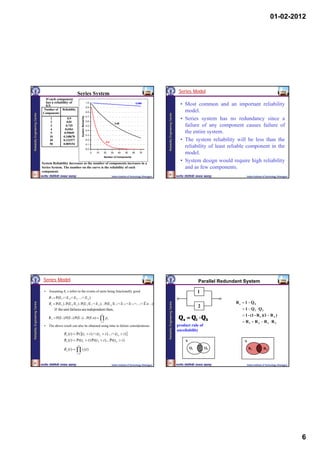
                                                                                                                                                                                                     • Most common and an important reliability
                                  Number of Reliability
                                 Components                                              0.8                                                                                                           model.
Reliability Engineering Centre


                                                                                                                                                                  Reliability Engineering Centre
                                                                                         0.7
                                                                                                                                                                                                     • Series system has no redundancy since a
                                                                       tem Reliability


                                       1              0.9
                                       2             0.81                                0.6
                                       3            0.729                                0.5
                                                                                                                           0.98
                                                                                                                                                                                                       failure of any component causes failure of
                                       4           0.6561
                                       5          0.59049
                                                  0 59049
                                                                                         0.4
                                                                                                                                                                                                                  system.
                                                                                                                                                                                                       the entire system
                                                                    Syst


                                                                                         0.3
                                      10         0.348678
                                      20         0.121577                                0.2
                                                                                                                0.9
                                                                                                                                                                                                     • The system reliability will be less than the
                                      50         0.005154                                0.1
                                                                                         0.0
                                                                                                                                                                                                       reliability of least reliable component in the
                                                                                               0   10        20       30     40    50     60      70                                                   model.
                                                                                                               Number of Components

                                 System Reliability decreases as the number of components increases in a
                                                                                                                                                                                                     • System design would require high reliability
                                 Series System. The number on the curve is the reliability of each                                                                                                     and as few components.
                                 component.
    21                                                                                                                                                               22
                                                                                                                      Indian Institute of Technology, Kharagpur                                                                          Indian Institute of Technology, Kharagpur


                                  Series Model                                                                                                                                                                   Parallel Redundant System
                                  • Assuming Ei s refers to the events of units being functionally good.                                                                                                         1
                                     R s  P(E 1  E 2  E 3 ...  E n )
                                     Rs  P(E 1 ) . P(E 2 /E1 ) . P(E 3 /E 1  E 2 )... P(E n /E 1  E 2  E 3  ...  E n  1)                                                                                                 Rs  1  QS
Reliability Engineering Centre


                                                                                                                                                                  Reliability Engineering Centre


                                                                                                                                                                                                                 2
                                           If the unit failures are independen t then,                                                                                                                                              1  Q1  Q 2
                                                                                                         n
                                                                                                                                                                                                                                    1 - (1 - R 1 )(1  R 2 )
                                     R s  P(E 1) P(E 2) P(E 3)... P(E n)   pi
                                                                                                        i 1                                                                                                                        R1  R 2  R1  R 2
                                  • The above result can also be obtained using time to failure considerations                                                                                     product rule of
                                                                                                                                                                                                   unreliability
                                                 Rs (t )  Pr(t1  t )  (t 2  t )...  (t n  t )
                                                 Rs (t )  Pr(t1  t ) Pr(t 2  t )... Pr(t n  t )                                                                                                     S                            S
                                                              n
                                                 Rs (t )   ri (t )                                                                                                                                        Q1       Q2                   R1             R2
                                                             i 1


    23                                                                                                                                                               24
                                                                                                                      Indian Institute of Technology, Kharagpur                                                                          Indian Institute of Technology, Kharagpur


                                                                                                                                                                                                                                                                                     6
01-02-2012


                                 Example:                                                                                                                                     Parallel System
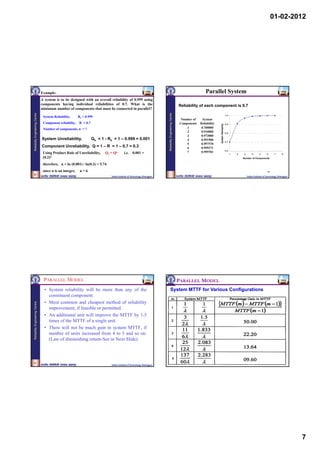
                                 A system is to be designed with an overall reliability of 0.999 using
                                 components having individual reliabilities of 0.7. What is the                                                             Reliability of each component is 0.7
                                 minimum number of components that must be connected in parallel?
Reliability Engineering Centre


                                                                                                                           Reliability Engineering Centre
                                                                                                                                                                                                             1.0
                                  System Reliability,      Rs = 0.999
                                                                                                                                                              Number of    System
                                  Component reliability,   R = 0.7                                                                                           Components   Reliability                        0.9


                                                                                                                                                                                                eliability
                                  Number of components, n = ?                                                                                                    1        0.700000
                                                                                                                                                                 2        0.910000
                                                                                                                                                                          0 910000


                                                                                                                                                                                        System Re
                                                                                                                                                                                                             0.8
                                                                                                                                                                 3        0.973000
                                 System Unreliability,               Qs = 1 - Rs = 1 – 0.999 = 0.001                                                             4        0.991900
                                                                                                                                                                                                             0.7
                                                                                                                                                                 5        0.997570
                                 Component Unreliability, Q = 1 – R = 1 – 0.7 = 0.3                                                                              6        0.999271
                                                                                                                                                                                                             0.6
                                  Using Product Rule of Unreliability,      Qs = Qn        i.e. 0.001 =                                                          7        0.999781
                                                                                                                                                                                                                   1   2   3       4       5       6      7       8
                                  (0.3)n                                                                                                                                                                                   Number of Components

                                  therefore, n = ln (0.001) / ln(0.3) = 5.74
                                  since n is an integer,    n=6                                                                                                                                                                                    26
    25
                                                                               Indian Institute of Technology, Kharagpur                                                                                                       Indian Institute of Technology, Kharagpur


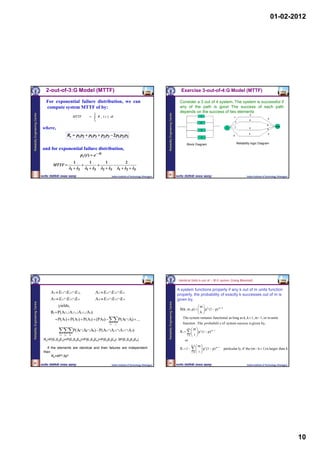
                                  PARALLEL MODEL                                                                                                            PARALLEL MODEL
                                   • System reliability will be more than any of the                                                   System MTTF for Various Configurations
                                     constituent component.
                                   • Most common and cheapest method of reliability
Reliability Engineering Centre


                                                                                                                           Reliability Engineering Centre


                                     improvement, if feasible or permitted.
                                   • An additional unit will improve the MTTF by 1.5
                                     times of the MTTF of a single unit.
                                                                    unit
                                   • There will not be much gain in system MTTF, if
                                     number of units increased from 4 to 5 and so on.
                                     (Law of diminishing return-See in Next Slide).


    27
                                                                               Indian Institute of Technology, Kharagpur                                                                                                       Indian Institute of Technology, Kharagpur


                                                                                                                                                                                                                                                                           7
01-02-2012


                                                          Series/Parallel Systems                                                                                   Example:

                                 Telcom. Repeater                          DG          Rectifier                                                                    Derive a general expression for the unreliability of the
                                 Station                                   2               3                                                                        model shown below, and hence evaluate the unreliability of
                                                                                                                   1                                                the system if all components have a reliability of 0.8.
Reliability Engineering Centre


                                                                                                                                   Reliability Engineering Centre
                                 Power Supply
                                                                                   4                               Cable
                                 System
                                                                            Battery Bank
                                 Network Reduction                                                                                                                                                                        p
                                                                                                                                                                                                                       Output
                                                                                                                                                                         input
                                 Technique
                                        RX = R2.R3                             X
                                                                                                               1
                                  QY = QX.Q4                                   4
                                  RY = 1 - QX.Q4                                                                                                                     Reliability Network Model (Reliability Block Diagram)
                                     = 1 – (1-RX).(1-R4)                                                                                                             of the System
                                                                                   Y                       1
                                    RS = RY.R1
                                                                                                           29                                                                                                                        30
    29                                                                                                                                30
                                                                                       Indian Institute of Technology, Kharagpur                                                                                 Indian Institute of Technology, Kharagpur


                                                                                                                                                                                       m out of n Systems
                                  Ri = 0.8 for i = 1 to 5                                                                                                                          partially redundant system
                                                                                                                                                                       TR1, 10 kVA
                                                                                                                                                                                                  If components are identical then
Reliability Engineering Centre


                                                                                                                                   Reliability Engineering Centre


                                                                                                                                                                                                         3   3   2       2   3
                                                                                                                                                                                          15 kVA (R + Q) = R + 3R Q + 3RQ + Q
                                                                                                                                                                                          Load Rs = R  3 + 3R2Q
                                                                                                                                                                        TR2, 10 kVA
                                                                                                                                                                                                  Qs = 3RQ2 + Q3 = 1 - Rs

                                                                                                                                                                        TR3, 10 kVA               If components are non-identical then
                                 Q 8 = Q 7 . Q5
                                     = (1 - R7). Q5                                                                                                                   2 out 3 system              R1  R2  R3
                                     = (1 - R1 . R2 . R6). Q5                                                                                                                            2/3
                                     = [1 - R1 . R2 . (1 - Q6)]. Q5                                                                                                            1                  Rs = R1 R2 R3 +
                                     = [1 - R1 . R2 . (1 - Q3 . Q4)]. Q5                                                                                                                               R1 R2 Q3 + R1 Q2 R3 + Q1 R2 R3
                                                                                                                                                                               2
                                 Q8 = [1 – 0.8 x 0.8 (1 – 0.2 x 0.2)]x 0.2 = 0.07712
                                                                                                           31                                                                  3                                                     32
    31                                                                                                                                32
                                                                                       Indian Institute of Technology, Kharagpur                                                                                 Indian Institute of Technology, Kharagpur


                                                                                                                                                                                                                                                             8
01-02-2012


                                 Example:                                                                                                                                                                        2/3
                                                                                                                                                                                                     4
                                                                                                                                                                                    2
                                 Derive a general expression for the unreliability of the system                                                                          1                          5

                                 whose reliability model is shown below. Consider the case in                                                                                       3                6
                                 which all parallel branches of this system are fully redundant                                                                           7
Reliability Engineering Centre


                                                                                                                         Reliability Engineering Centre
                                 with the exception of that consisting of components 4, 5 and 6 for
                                                                                                                                                                                                  Q8 = Q2 . Q3
                                 which any 2 of the branches are required for system success.
                                                                                                                                                                    1         8         9        If Components 4, 5 and 6 are identical, each with
                                                                                  2/3                                                                                                            reliability R, R9 = R3 + 3R2Q
                                                                      4
                                                        2                                                                                                           7
                                                                                                                                                                                                 Otherwise
                                              1                       5                                                                                                                          R 9 = R 4 R 5 R 6 + R 4 R 5 Q 6 + R 4 Q 5 R 6 + Q4 R 5 R 6
                                 input                  3                                 Output
                                                                      6                                                                                        10
                                                                                                                                                                                    R10 = R1 R8 R9
                                              7
                                                                                                                                                                7
                                                                                                                                                                          Qs = Q10 . Q7
                                                                                                                                                                             = (1 – R10). Q7
                                 Reliability Network Model (Reliability Block                                                                                                = (1 - R1 . R8 . R9). Q7
                                                                                                                                                               11            = [1 - R1 (1 – Q8).R9 ]. Q7
                                 Diagram) of the System
                                                                                                 33                                                                          = [1 - R1 (1 – Q2 .Q3). R4 R5 R6 + R4 R5 Q6 + R4 Q5 R6 + Q4 R5 R6 ]. Q7
                                                                                                                            34
                                                                             Indian Institute of Technology, Kharagpur                                                                                                 Indian Institute of Technology, Kharagpur


                                 2-out-of-3:G Model                                                                                                       RELIABILITY OF 2-OUT-OF-3:G SYSTEM
                                 The Reliability Logic Diagram and Fault Tree diagram for                                                                 Let us designate the paths in Block diagram as
                                 2-out-of-3:G system are shown below:                                                                                     Obviously,   T1 , T2 and T3 .
Reliability Engineering Centre


                                                                                                                         Reliability Engineering Centre


                                                                                                                                                          T1  E1  E 2 , T2  E1  E3 and T3  E 2  E3
                                                                                                                                                          where Ei is the event of unit i being good. Therefore,
                                                                                                                                                          system reliability is given by:
                                                                                                                                                               Rs  PrT1  T2  T3    PTi    PTi  T j    PTi  T j  Tk 
                                                                                                                                                                                          3

                                                                                                                                                                                        i 1       i j            i j k
                                                                                                                                                          where,
                                                                                                                                                                PT1  T2   PE1  E 2   E1  E3   PE1  E 2  E3 
                                                                                                                                                                           3
                                                                                                                                                                                     3                    3
                                                                                                                                                                    Rs   P Ti    P E1  E2  E3     PE1  E2  E3 
                                                                                                                                                                         i 1        2                    3
                                                                                                                                                                        R s  p1 p 2  p1 p 3  p 2 p 3  2 p1 p 2 p 3

    35
                                                                                                                                                                        or R s  3 p 2  2 p 3 .
                                                                             Indian Institute of Technology, Kharagpur                                                                                                 Indian Institute of Technology, Kharagpur


                                                                                                                                                                                                                                                                   9
01-02-2012


                                  2-out-of-3:G Model (MTTF)                                                                                                                      Exercise 3-out-of-4:G Model (MTTF)

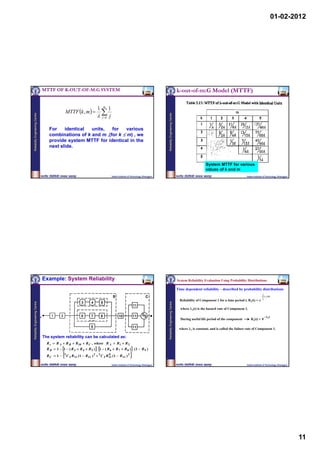
                                  For exponential failure distribution, we can                                                                                                  Consider a 3 out of 4 system. The system is successful if
                                  compute system MTTF of by:                                                                                                                    any of the path is good The success of each path
                                                                                                                                                                               depends on the success of two elements
Reliability Engineering Centre


                                                                                                                                              Reliability Engineering Centre
                                                                              
                                                                                                                                                                                                                                          2
                                                          MTTF                       R s ( t ) dt                                                                                               1                          1
                                                                                                                                                                                                                                                             3
                                                                                  0                                                                                                                                                       2
                                                                                                                                                                                                 2                             1
                                                                                                                                                                                                                                                            4
                                                                                                                                                                                                                            1                                        Out
                                 where,                                                                                                                                                          3
                                                                                                                                                                                                                      in                  3
                                                                                                                                                                                                                                                            4


                                                     Rs  p1 p2  p1 p3  p2 p3  2 p1 p2 p3                                                                                                     4
                                                                                                                                                                                                                           2
                                                                                                                                                                                                                                          3                  4


                                                                                                                                                                                     Block Diagram                              Reliability logic Diagram
                                 and for exponential failure distribution,
                                                                  p i ( t )  e  t
                                                          1               1                  1                  2
                                      MTTF                                                         
                                                     1  2          1  3             2  3         1  2  3
                                                                                                                                                 38
                                                                                                  Indian Institute of Technology, Kharagpur                                                                                             Indian Institute of Technology, Kharagpur


                                                                                                                                                                               Identical Units k-out of – M:G system (Using Binomial)


                                                                                                                                                                               A system functions properly if any k out of m units function
                                     A1  E1  E 2  E 3,                         A 2  E1  E 2  E 4                                                                         properly, the probability of exactly k successes out of m is
                                     A 3  E1  E 3  E 4                         A4  E 2 E3 E 4                                                                            given by,
Reliability Engineering Centre


                                                                                                                                              Reliability Engineering Centre


                                          yields,                                                                                                                                            m
                                                                                                                                                                                B(k; m, p)    p k (1  p) m  k
                                                                                                                                                                                              
                                     Rs  P(A1  A 2  A 3  A 4)                                                                                                                            k
                                         P(A1)  P(A2)  P(A3)  (PA4)  P(A Aj)  ...
                                           (       (       (      (          ( i                                                                                                 The system remains functional as long as k, k  1, m  1, or m units
                                                                                                 i   j                                                                          function . The probabilit y of system success is given by,

                                          P(AAA )  P(A A                                            A 3  A 4)                                                                    m
                                                                                                                                                                                       m
                                                              i       j       k              1        2                                                                         R s     p i (1  p) m  i
                                                                                                                                                                                           
                                           i   j    k                                                                                                                               ik  i 

                                 Rs=P(E1E2E3)+P(E1E2E4)+P(E1E3E4)+P(E2E3E4)- 3P(E1E2E3E4)                                                                                           or
                                                                                                                                                                                               
                                                                                                                                                                                          k 1 m
                                   If the elements are identical and their failures are independent                                                                             R s  1     p i (1  p) m  i
                                                                                                                                                                                                                  particular ly, if the (m  k  1) is larger than k
                                 then                                                                                                                                                     i0  i 
                                      Rs=4P3-3p4
    39                                                                                                                                           40
                                                                                                  Indian Institute of Technology, Kharagpur                                                                                             Indian Institute of Technology, Kharagpur


                                                                                                                                                                                                                                                                                    10
01-02-2012


                                 MTTF OF K-OUT-OF-M:G SYSTEM                                                                                                                 k-out-of-m:G Model (MTTF)

                                                                                 1   m
                                                                                            1
                                                MTTF k , m                      j
                                                                                 
Reliability Engineering Centre


                                                                                                                                            Reliability Engineering Centre
                                                                                     j k


                                    For    identical  units,   for    various
                                    combinations of k and m ,(for k  m) , we
                                    provide system MTTF for identical in the
                                    next slide.


                                                                                                                                                                                                 System MTTF for various
                                                                                                                                                                                                 values of k and m
                                                                                                Indian Institute of Technology, Kharagpur                                                                                     Indian Institute of Technology, Kharagpur


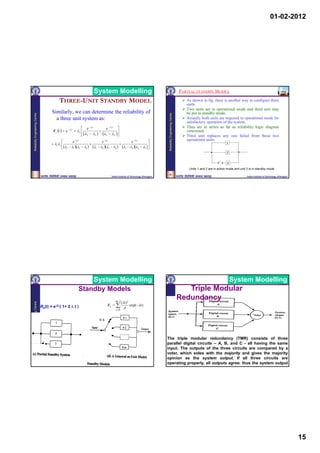
                                 Example: System Reliability                                                                                                                 System Reliability Evaluation Using Probability Distributions

                                                                                                                                                                             Time dependent reliability – described by probability distributions
                                                                                                                                                                                                                                              t

                                                                                                                                                                                                                                             
                                                                                                                                                                                                                                             λ1 (t)dt
                                                                                                                                                                               Reliability of Component 1 for a time period t, R1(t) = e     0
Reliability Engineering Centre


                                                                                                                                            Reliability Engineering Centre


                                                                                                                                                                               where (t) is the hazard rate of Component 1.
                                 Block
                                 A                                                                                                                                                                                                           e  λ 1t
                                                                      Rs  R A
                                                                                                                                                                               During useful life p
                                                                                                                                                                                    g                              p
                                                                                                                                                                                                  period of the component          ()
                                                                                                                                                                                                                                 R1(t) =

                                                                                                                                                                              where  is constant, and is called the failure rate of Component 1.

                                 The system reliability can be calculated as:
                                   R s  R A  R B  R 10  R C , where R A  R 1  R 2
                                   R B  1  1  ( R 3  R 4  R 5 )  1  ( R 6  R 7  R 8 )  ( 1  R 9 )
                                   RC  1    C3
                                                    2 R 11 ( 1    R 11 ) 2  3 C 3 R 11 ( 1  R 11 ) 3
                                                                                      0
                                                                                                                  
                                                                                                Indian Institute of Technology, Kharagpur                                                                                     Indian Institute of Technology, Kharagpur


                                                                                                                                                                                                                                                                          11
01-02-2012


                                                                        Series Systems                                                                                                                               Parallel Systems

                                                                                                                                                                                                       1
                                     1           2                            Rs = R1 . R2          product rule of reliability                                                                                             Qs = Q1 . Q2                   product rule of unreliability
                                                                                                                                                                                                       2
                                 Considering time dependent probabilities,
Reliability Engineering Centre


                                                                                                                                                      Reliability Engineering Centre
                                                                                                     t
                                                                                                     λ 1 (t)dt
                                                                                                                         t
                                                                                                                         λ 2 (t)dt
                                                                                                                                                                                       Considering time dependent probabilities,                                        t                     t
                                                                                                                                                                                                                                                                        λ 1 (t)dt           λ 2 (t)dt
                                                                 Rs(t) = R1(t). R2(t) = e            0
                                                                                                                   e     0
                                                                                                                                                                                                                             Qs(t) = Q1(t). Q2(t) = [1- e               0         ].[1- e     0
                                                                                                                                                                                                                                                                                                        ]

                                  For ‘n’ component series system with hazard rates 1(t), 2(t), …, n(t),                                                                            For ‘n’ component parallel system with hazard rates 1(t), 2(t), …, n(t),
                                                                                                                                                                                                                 t
                                          n          t                                                                                                                                                     n     λ i (t)dt
                                                                    also applicable if failure distributions for
                                                                                                                                                                                           Qs(t) =  [1 - e
                                                   λ i (t)dt
                                 Rs(t) =  e         0
                                                                    different components are different
                                                                                                                                                                                                                 0
                                                                                                                                                                                                                             ]
                                         i 1                                                                                                                                                          i 1

                                 During useful life period when component failures are exponentially                                                                                   During useful life period when component failures are exponentially
                                 distributed                                                                                                                                           distributed
                                                                                                                                            n                                                  n
                                                                                                                                                                                                                 cannot obtain equivalent hazard rate for
                                                                                                                                                                                       Qs(t) =  [1 - e i ]
                                                                    n
                                                                                                                                                                                                        λ t
                                                                                                                              
                                           n                        λit                    where equivalent hazard rate, e =  i
                                 Rs(t) =  e
                                                 λ it                                et                                                                                                                       exponential distribution
                                                          = e      i 1
                                                                              = e                                                                                                               i 1
                                          i 1
                                                                                             is also constant                 i 1

                                                                                                                                                                                       Therefore, resulting distribution for the system is non-exponential
                                                 i.e. resulting distribution for the system is also exponential                                                                        i.e. resulting hazard rate for the system is no longer constant, but a function
                                                                                                          Indian Institute of Technology, Kharagpur
                                                                                                                                                                                       of time                                            Indian Institute of Technology, Kharagpur


                                      Partially Redundant (m out of n) Systems                                                                                                                                                 Example:

                                   Apply Binomial Expansion                                                                                                                             A simple electronic circuit consists of 6 transistors each having a failure
                                                                                                                                                                                        rate of 10-6 f/hr, 4 diodes each having a failure rate of 0.5 x 10⁻⁶ f/hr, 3
                                                                          n                                                                                                             capacitors each having a failure rate of 0.2 x 10⁻⁶ f/hr, 10 resistors each
                                     [R(t) + Q(t)] n =  nCr R(t) n-r Q(t) r                                                                                                            having a failure rate of 5 x 10⁻⁶ f/hr and 2 switches each having a failure
Reliability Engineering Centre


                                                                                                                                                      Reliability Engineering Centre


                                                                        r0
                                                                                                                                                                                        rate of 2 x 10⁻⁶ f/hr. Assuming connectors and wiring are 100% reliable,
                                   During useful life period when component failures are                                                                                                evaluate the equivalent failure rate of the system and the probability of
                                                                                                                                                                                        the system surviving 1000 and 10000 hours if all components must
                                   exponentially distributed                                                                                                                            operate for system success.                        n

                                                          λt                                      eλt                                                                                  Equivalent failure rate of the system, e = i1
                                                                                                                                                                                                                                           i
                                         R(t) = e                   and          Q(t) = 1 -
                                                                                                                                                                                        = 6(10-6 ) + 4(0.5 x 10⁻⁶ ) + 3(0.2 x 10⁻⁶ ) + 10(5 x 10⁻⁶ ) + 2(2 x 10⁻⁶ ) = 6.26 x 10⁻⁵
                                                                                                                                                                                       f/hr
                                         Let see some simple examples.                                                                                                                                    t    6.26 x 10             6
                                                                                                                                                                                                                                             x1000
                                                                                                                                                                                          Rs(1000 hr) = e e = e                                      = 0.9393

                                                                                                                                                                                                                      et          6.26 x 10 6 x10000
                                                                                                                                                                                            Rs(10,000 hr) = e                = e                           = 0.5347


                                                                                                          Indian Institute of Technology, Kharagpur                                                                                                            Indian Institute of Technology, Kharagpur


                                                                                                                                                                                                                                                                                                            12
01-02-2012


                                                                  Example:
                                                                                                                                                                        Standby Model
                                 Consider a system comprising of 4 identical units each having a failure
                                                                                                                                                                         One or more units are in standby mode waiting to take over
                                 rate of 0.1 f/yr. Evaluate the probability of the system surviving 0.5 years
                                 and 5 years if at least two units must operate successfully.                                                                             the operation from the main operating unit as soon as the
                                                                                                                                                                          failure of the operating unit takes place.
Reliability Engineering Centre


                                                                                                                                       Reliability Engineering Centre
                                 Using Binomial Expansion,                                                                                                               Decision switch senses the failure of the basic unit.
                                 [R(t) + Q(t)] 4 = R4(t) + 4 R3(t)Q(t) + 6 R2(t)Q2(t) + 4 R(t)Q3(t) + Q4(t)                                                              It is assumed that the operation of failure sensing and
                                 where, R(t) = e
                                                     λt
                                                            and Q(t) = 1 -
                                                                                 eλt                                                                                     switching on to the standby unit is instantaneous, i.e.,
                                                                                                                                                                                                 operation.
                                                                                                                                                                          uninterrupted system operation
                                  For 2 out of 4 system,                                                                                                                 The standby system fails only when all the system units
                                  Rs(t) = R4(t) + 4 R3(t)Q(t) + 6 R2(t)Q2(t)                                                                                              including the standby units have failed.
                                                                                                                                                                         The reliability of such system will be higher than the
                                           4 λt      3 λt        λt      2 λt         λt 2
                                       =e        +4e        (1 - e ) + 6 e        (1 - e      )                                                                           parallel system with equal number of active units.
                                                                                                                                                                          (Conditions?).
                                 For t = 0.5 years, t = 0.1 x 0.5 = 0.05               Rs(0.5) = 0.9996

                                 For t = 5 years,          t = 0.1 x 5 = 0.5           Rs(5) = 0.8282

                                                                                                                                          50
                                                                                           Indian Institute of Technology, Kharagpur                                                                           Indian Institute of Technology, Kharagpur


                                 STANDBY MODELS                                                                                                                         STANDBY MODELS: MISSILE SYSTEM
Reliability Engineering Centre


                                                                                                                                       Reliability Engineering Centre


                                                                                           Indian Institute of Technology, Kharagpur                                                                           Indian Institute of Technology, Kharagpur


                                                                                                                                                                                                                                                           13
01-02-2012


                                                                              System Modelling                                                                                                                       System Modelling
                                                  Two Unit Standby Model                                                                                                                   Two Unit Standby Model
                                   Obviously, from the Fig (b), it
                                    can be seen easily that the                                                                                                                  Therefore, reliability for a two-unit standby
                                    system success would be                                                                                                                      system would be obtained as:
Reliability Engineering Centre


                                                                                                                                           Reliability Engineering Centre
                                    obtained:
                                 Either (i) when the primary unit #
                                                                                                                                                                                   Rs ( t )  Pr[(t1  t) {(t1  t) ( t 2  t  t1 )} ]
                                    1 continues to work beyond                                                                                                                  or                                   t
                                    the mission time t, i.e., t1 > t,                                                                                                                             p 1 t             f 1 t 1    p 2 t       t 1 dt        1
                                    where t1 is the time to failure                                                                                                                                                 0
                                    of unit # 1.
                                 or (ii) unit # 1 fails at time t1 (t1<                                                                                                              p1 t   e  1t   f 1 t1   1e  1t1          p 2 t  t1   e  2 t t1 
                                    t), and the standby unit ( unit
                                    # 2) comes into operation                                                                                                                                                                t
                                    immediately upon the failure                                                                                                                     R s t   R 1   R 2  e  1t        1 e
                                                                                                                                                                                                                                       1t
                                                                                                                                                                                                                                               e   2 t  t1 dt 1
                                    of unit #1 and continues to                                                                                                                                                              0
                                    work for t2 > (t-t1).                                 The system reliability                                                                                                 e 1t       e  2 t 
                                                                                          therefore can be given                                                                          Rs t   e 1t  1            
                                                                                          by:                                                                                                                    2  1  1  2 

                                          Rs ( t )  Pr[(t1  t){(t1  t)( t2  t  t1 )}]   Indian Institute of Technology, Kharagpur                                                                                               Indian Institute of Technology, Kharagpur


                                 STANDBY MODELS: IMPERFECT SWITCH                                                                                                           STANDBY MODELS: OTHER


                                  The function of decision switch (DS) is critical and the                                                                                  DS perfect but Degradation of standby unit
                                   success of a standby system to great extent depends                                                                                       in standby mode.
                                   upon the reliability of this decision switch.                                                                                             Combining degradation of standby unit and
Reliability Engineering Centre


                                                                                                                                           Reliability Engineering Centre


                                                                                                                                                                             Imperfect switching
                                  The reliability decision switch is driving the system
                                   reliability.
                                  Two-unit standby system ,

                                          Rs (t )  P[(t1  t )  {(t1  t )  (t ds  t1 )  (t 2  t  t1 )}]
                                                                          t
                                           R S ( t )  p 1 ( t )  p ds   
                                                                          0
                                                                              f 1 ( t 1 ) p 2 ( t  t1 ) dt 1

                                 tds       represents a random variable denoting the time to
                                       failure of the decision switch.

    55                                                                                                                                        56
                                                                                               Indian Institute of Technology, Kharagpur                                                                                               Indian Institute of Technology, Kharagpur


                                                                                                                                                                                                                                                                                   14
01-02-2012


                                                      System Modelling                                                                                             PARTIAL STANDBY MODEL

                                             THREE-UNIT STANDBY MODEL                                                                                                As shown in fig. there is another way to configure three
                                                                                                                                                                      units.
                                                                                                                                                                     Two units are in operational mode and third unit may
                                        Similarly, we can determine the reliability of                                                                                be put in standby mode.
Reliability Engineering Centre


                                                                                                                                  Reliability Engineering Centre
                                          a three unit system as:                                                                                                    Actually both units are required in operational mode for
                                                                                                                                                                      satisfactory operation of the system.
                                                                  e  1t       e  2t                                                                            Thus are in series as far as reliability logic diagram
                                         R s t   e  1t  1                                                                                                    concerned.
                                                                   2  1  1   2 
                                                                                                                                                                    Third unit replaces any one failed from these two
                                                       e 1t               e  2 t             e 3t                                                             operational units.
                                         12                                                                                                                                                  1
                                                2  1 3  1  1  2 3  2  1  3 2  3 
                                                                                                               
                                                                                                                                                                                                   2


                                                                                                                                                                                                   3

                                                                                                                                                                        Units 1 and 2 are in active mode and unit 3 is in standby mode
                                                                                                                                     58
                                                                                     Indian Institute of Technology, Kharagpur                                                                                    Indian Institute of Technology, Kharagpur


                                                                System Modelling                                                                                                                       System Modelling
                                                            Standby Models                                                                                            Triple Modular
                                                                                         m1
                                                                                                                                                                   Redundancy
                                                                                             (t ) i
Reliability Engineering Centre


                                                                                         
                                                                                                                                  Reliability Engineering Centre


                                 Rs(t) = e-2( 1+ 2  t )                         Rs                exp(t )
                                                                                         i 0 i!


                                                                                                                                 The triple modular redundancy (TMR) consists of three
                                                                                                                                 parallel digital circuits – A, B, and C - all having the same
                                                                                                                                 input. The outputs of the three circuits are compared by a
                                                                                                                                 voter, which sides with the majority and gives the majority
                                                                                                                                 opinion as the system output. If all three circuits are
                                                                                     Indian Institute of Technology, Kharagpur
                                                                                                                                 operating properly, all outputs agree; thus the system output
                                                                                                                                                                           Indian Institute of Technology, Kharagpur
                                                                                                                                 i        t


                                                                                                                                                                                                                                                              15
01-02-2012


                                                      System Modelling                                                                                                      System Modelling
              Triple Modular                                                                                                                 SHARED LOAD MODEL
       Redundancy
However, if one element has failed so that it has produced an                                                                                    A model in which the load on a member
incorrect output, the voter chooses the output of the two                                                                                         changes and consequently the hazard rate of
Reliability Engineering Centre


                                                                                                            Reliability Engineering Centre
good elements as the system output because they both                                                                                              the member also changes, as one or more
agree; thus the system output is correct. If two elements have                                                                                    member fail.
failed, the voter agrees with the majority (the two that have                                                                                    In this model all the units/sub-systems are
failed); thus the system output is incorrect. The system                                                                                          connected in parallel and each unit shares the
output is also incorrect if all three circuits have failed.                                                                                       load equally.
Actually, circuits-A, B, and C- in most cases are identical and                                                                                  After the failure of one or more units the
they are three replications of the same design. Using this                                                                                        remaining units share the load equally but with
assumption, and also assuming that the voter does not fail                                                                                        a higher value of hazard rate.
and all digital circuits are independent and identical with                                                                                      The levels of hazard rate change only when a
probability of success p,3the system reliability is given by:                                                                                     subsystem failure occurs.
R s    p 3 1  p     p 2 1  p   3 p  2 p  p 3  2 p
       3
                      0                1                           2           3        2
                                                                                                                                                 It is assumed that failure distribution of the
      3                2                                                                                                                      survivor subsystem after failure of a
                                                                Indian Institute of Technology, Kharagpur                                                                    Indian Institute of Technology, Kharagpur
                                                                                                                                                  subsystem does not depend on the interval of


                                                      System Modelling                                                                                                      System Modelling
                                 TWO UNIT SHARED LOAD MODEL                                                                                  TWO UNIT SHARED LOAD MODEL

                                 In this case, we will have two units sharing the                                                            Let,
Reliability Engineering Centre


                                                                                                            Reliability Engineering Centre


                                 given load equally however if one unit fails, the                                                           fh(t) : be the p.d.f. for time to failure of a unit
                                 total load will have to be take over by the single                                                               under      half load condition
                                 unit as shown in the following figure.                                                                      ff(t) : be the p.d.f. for time to failure of a unit
                                                                                                                                                  under full        load condition( this occurs
                                                    Half load
                                                                                                                                                  when one unit fails       and other unit is forced
                                                                                                                                                  to take the full load )
                                                    Half load
                                                                                                                                             Therefore the system is successful if,
                                                                                                                                             1. Both component remain operational until the
                                                                                                                                                  mission time. The probability of this is given
                                                    Full load                                                                                     by:
                                                                                                                                                  P[(t1>t)∩(t2>t)] = {ph(t)}2
                                                                                                                                                  Where, ph(t) is reliability of a unit under half
                                                                Indian Institute of Technology, Kharagpur                                         load                          Indian Institute of Technology, Kharagpur


                                                                                                                                                                                                                            16
01-02-2012


                                                              System Modelling                                                                                                           System Modelling
                                 TWO UNIT SHARED LOAD MODEL                                                                                                 TWO UNIT SHARED LOAD MODEL
                                 2. The first unit fails and the second unit survives and                                                                   Now the system reliability is found by adding the
Reliability Engineering Centre


                                                                                                                           Reliability Engineering Centre
                                    the takes the full load (after the failure of the first                                                                 probabilities of case 1 , case 2 and case 3 i.e.
                                    unit) until the time t, The probability of this
                                    operation is given by:

                                       P[(t1≤t, under half load)∩(t2>t1, under half load)∩                                                                  If we assume the failure distribution to the
                                                                                                                                                            exponential distribution for both the units and
                                     ( t2>t-t1, under full load)] =                                                                                         denote the failure rates at half and full load by λh
                                                                                                                                                            and λf respectively. Then the reliability expression
                                 3. This is identical to the case 2 the only difference is                                                                  can be written as,           t
                                                                                                                                                                                        2 h e f
                                                                                                                                                            R s t   e  2  h t 
                                    that here unit 2 fails and unit 1 take the full load(
                                    after failure of the second unit) and the probability                                                                                                            [1  e  ( 2  h   f ) t ]
                                    of this operation can be found by replacing t1 by t2 .                                                                                             (2 h   f )
                                        Incase both the units are same the probabilities
                                    in case 2 and case 3 turns out to Institute of Technology, Kharagpur
                                                                    Indian
                                                                           be same.                                                                                                                    Indian Institute of Technology, Kharagpur


                                             System Modelling                                                                                                           System Modelling
                                 THREE UNIT SHARED LOAD                                                                                                     THREE UNIT SHARED LOAD
                                 SYSTEMS                                                                                                                    SYSTEMS
                                 Similarly the reliability expression for the three                                                                         The diagrammatic representation of the load
Reliability Engineering Centre


                                                                                                                           Reliability Engineering Centre


                                 unit shared load model can be derived, the                                                                                 shifting is shown below,
                                                                                                                                                                                           1/3 load
                                 success probability versus time plot is shown
                                 below, #1
                                     Su
                                                          E1∩E2∩E3
                                                                                                                                                                                           1/3 load
                                      cce #2        E1∩E2∩E3                    

                                      ss                                        E 1  E 2  E3
                                                                                                                                                                                           1/3 load
                                                    E1∩E2∩E3        
                                      Pro #3                        E1 E 2  E 3
                                                                                                      
                                      ba                                                       E1  E 2  E 3                                                                              1/2 load
                                      bili
                                      ty                                                                                                                                                   1/2 load
                                                               t1                      t2
                                                                        Time                                           t
                                                                                                                                                                                           Full load

                                                                               Indian Institute of Technology, Kharagpur                                                                               Indian Institute of Technology, Kharagpur


                                                                                                                                                                                                                                                   17
01-02-2012


                                              System Modelling                                                                                                                          System Modelling
                                  THREE UNIT SHARED LOAD                                                                                                                    THREE UNIT SHARED LOAD
                                  SYSTEMS                                                                                                                                   SYSTEMS
                                        For three similar units the above possibilities                                                                                     P(#2) = 3P[(t1≤t,at 1/3 load)∩{(t2>t1) ∩(t3>t1), at 1/3
Reliability Engineering Centre


                                                                                                                                         Reliability Engineering Centre
                                           can be described as,                                                                                                                   load}∩          {(t2>t-t1) ∩(t3>t-t1), at ½ load}]
                                        1. All the three units operate until the mission                                                                                    And
                                           time and share the load equally.                                                                                                 P(#3) = 6P[(t1≤t, at 1/3 load) ∩{(t2>t1) ∩(t3>t1), at 1/3
                                        2. Unit #1 fails and the other two units survive                                                                                        }
                                                                                                                                                                            load}
                                           and share the load equally.                                                                                                            ∩{(t2≤t, at ½ load) ∩(t3>t2, at ½ load)} ∩
                                        3. Unit #1 and Unit #2 fail and Unit #3 operates                                                                                          {(t3>t-t1-t2), at full load}
                                                                                                                                                                            Now the reliability expression for the three unit shared load model can
                                           and is forced to take the full load.                                                                                             be written as,
                                               Let t1, t2 and t3 be the time to failure of the                                                                              Rs(t) = P(#1) + P(#2) + P(#)
                                           first, second and third unit respectively then
                                           the probabilities of the above possibilities can
                                           be written as,
                                           P(#1) = P[(t1>t)∩(t2>t) ∩(t3>t)] = [po(t)]3
                                                                                            Indian Institute of Technology, Kharagpur                                                                                Indian Institute of Technology, Kharagpur


                                              System Modelling                                                                                                                          System Modelling
                                  THREE UNIT SHARED LOAD                                                                                                                    THREE UNIT SHARED LOAD
                                  SYSTEMS                                                                                                                                   SYSTEMS
                                 In the integral form it can be written as,                                                                                                   The expression comes out to be,
Reliability Engineering Centre


                                                                                                                                         Reliability Engineering Centre


                                                                   t

                                 Rs(t) = [po(t)]3 + 3 f o t 1 { p o t 1 } { p h ( t  t 1 )} dt 1
                                                                  
                                                                                                 2                        2
                                                                                                                                                                                        3o
                                 +                   0                                                                                  Rs (t)  e3ot                                         (e3ot  e2ht ) 
                                    t                            t  t1
                                                                                                                                                                                     (2h 3o )
                                 6  f o t 1 { p o t 1 } 2    f      h   ( t 2 ) p h ( t 2 )p f ( t  t 1  t 2 )dt 2 dt 1
                                    0                              0
                                                                                                                                                                                  e3ot                 e2ht
                                  Now if we take the failure distribution to be                                                         6oh[                                                                          
                                  exponential distribution with failure rates λo, λh                                                                                      (3o  2h )(3o  f ) (2h 3o )(2h  f )
                                  and λf for the 1/3, ½ and full load respectively then
                                                                                                                                                                             t
                                  the reliability expression can be written as,                                                                e f
                                                                                                                                                              ]
                                                                                            Indian Institute of Technology, Kharagpur
                                                                                                                                        (f 3o )(f  2h )                                                        Indian Institute of Technology, Kharagpur


                                                                                                                                                                                                                                                                 18
01-02-2012


                                                   System Modelling                                                                                                                 COMPARISON OF DIFFERENT MODELS
                                       THREE UNIT SHARED LOAD
                                                                                                                                                                                    • Basis:
                                       SYSTEMS
                                        One very important thing to note is that,                                                                                                               – Assuming constant failure rate.
Reliability Engineering Centre


                                                                                                                                                   Reliability Engineering Centre
                                   •    If we put, λ1=2λh and λ2= λf in the two unit                                                                                                            – All elements or subsystems are identical with
                                        standby reliability expression we get the                                                                                                                 reliability, p.
                                        reliability expression for the two unit
                                        shared load model.
                                          h   dl d       d l
                                   •    Similarly if we put λ1=3λo, λ2=2λh and λ3=
                                        λf in three unit standby reliability
                                        expression we will end up with the
                                        reliability expression of three unit shared
                                        load model.
                                           Finally MTTF can be found by
                                        integrating the reliability of Technology, Kharagpur
                                                                 Indian Institute
                                                                                  expression                                                          74
                                                                                                                                                                                                                                                                                Indian Institute of Technology, Kharagpur
                                        between 0 and Infinity


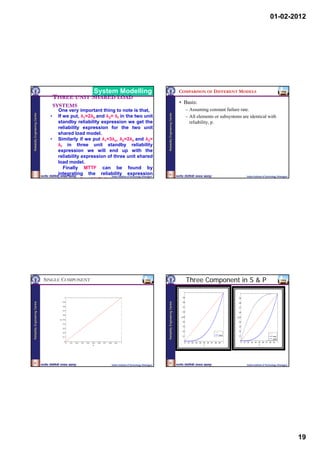
                                 SINGLE COMPONENT                                                                                                                                               Three Component in S & P
                                                                                                                                                                                        1                                                                         1

                                              1                                                                                                                                      0.9                                                                      0.9

                                             0.9
Reliability Engineering Centre


                                                                                                                                                   Reliability Engineering Centre


                                                                                                                                                                                     0.8                                                                      0.8
                                             0.8                                                                                                                                     0.7                                                                      0.7
                                             0.7
                                                                                                                                                                                     0.6                                                                      0.6
                                             0.6
                                                                                                                                                                                     0.5                                                                      0.5
                                                                                                                                                                                    R


                                                                                                                                                                                                                                                              R


                                             0.5
                                         R


                                                                                                                                                                                     0.4                                                                      0.4
                                             0.4
                                                                                                                                                                                     0.3                                                                      0.3
                                             0.3
                                                                                                                                                                                     0.2                                                                      0.2
                                             0.2

                                                                                                                                                                                     0.1                                                         Series       0.1
                                             0.1                                                                                                                                                                                                                                                                          Series
                                                                                                                                                                                                                                                                                                                          parallel
                                              0                                                                                                                                         0                                                                         0
                                                   0   0.1   0.2   0.3   0.4   0.5   0.6   0.7   0.8     0.9    1                                                                           0    0.1   0.2   0.3   0.4   0.5   0.6   0.7   0.8   0.9      1           0   0.1   0.2   0.3   0.4   0.5   0.6   0.7   0.8   0.9        1
                                                                                p                                                                                                                                         p                                                                        p


    75                                                                                                                                                76
                                                                                                       Indian Institute of Technology, Kharagpur                                                                                                                                Indian Institute of Technology, Kharagpur


                                                                                                                                                                                                                                                                                                                                         19
01-02-2012


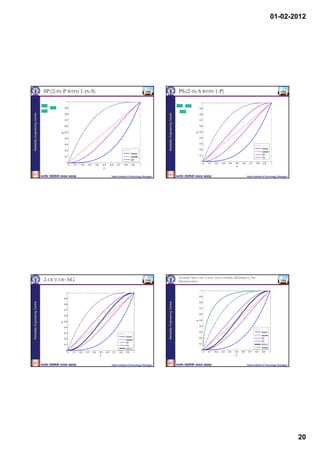
                                 SP:(2-IN-P WITH 1-IN-S)                                                                                                                                PS:(2-IN-S WITH 1-P)
                                              1                                                                                                                                                         1

                                            0.9                                                                                                                                                        0.9
Reliability Engineering Centre


                                                                                                                                                       Reliability Engineering Centre
                                            0.8                                                                                                                                                        0.8

                                            0.7                                                                                                                                                        0.7

                                            0.6                                                                                                                                                        0.6

                                            0.5
                                            05                                                                                                                                                         0.5
                                                                                                                                                                                                       05


                                                                                                                                                                                                   R
                                        R


                                            0.4                                                                                                                                                        0.4

                                            0.3                                                                                                                                                        0.3

                                                                                                                                                                                                       0.2                                                          Series
                                            0.2
                                                                                                                                                                                                                                                                    parallel
                                                                                                                                 Series
                                                                                                                                                                                                       0.1                                                          SP
                                            0.1                                                                                  parallel                                                                                                                           PS
                                                                                                                                 SP
                                                                                                                                                                                                        0
                                              0                                                                                                                                                              0   0.1   0.2   0.3   0.4   0.5   0.6     0.7    0.8     0.9          1
                                                  0    0.1    0.2     0.3         0.4         0.5         0.6     0.7     0.8    0.9        1
                                                                                                                                                                                                                                          p
                                                                                               p

    77                                                                                                                                                    78
                                                                                                           Indian Institute of Technology, Kharagpur                                                                                                 Indian Institute of Technology, Kharagpur


                                                                                                                                                                                        STANDBY WITH ONE ACTIVE AND 2-STNDBY, DS PERFECT, NO
                                 2-OUT-OF-3:G                                                                                                                                           DEGRADATION

                                                                                                                                                                                                        1
                                             1
                                                                                                                                                                                                       0.9
                                            0.9
                                                                                                                                                                                                       0.8
Reliability Engineering Centre


                                                                                                                                                       Reliability Engineering Centre


                                            0.8
                                                                                                                                                                                                       0.7
                                            0.7
                                                                                                                                                                                                       0.6
                                            0.6

                                                                                                                                                                                                       0.5
                                                                                                                                                                                                       05
                                                                                                                                                                                                   R


                                            0.5
                                        R


                                                                                                                                                                                                       0.4
                                            0.4

                                            0.3                                                                                                                                                        0.3                                                          Series
                                                                                                                                                                                                                                                                    parallel
                                                                                                                           Series
                                            0.2                                                                                                                                                        0.2                                                          SP
                                                                                                                           parallel
                                                                                                                                                                                                                                                                    PS
                                                                                                                           SP
                                            0.1                                                                                                                                                        0.1                                                          2O3:G
                                                                                                                           PS
                                                                                                                           2O3:G
                                                                                                                                                                                                                                                                    Stndby
                                             0                                                                                                                                                          0
                                                  0   0.1    0.2    0.3     0.4         0.5         0.6     0.7     0.8    0.9        1                                                                      0   0.1   0.2   0.3   0.4   0.5   0.6    0.7    0.8    0.9        1
                                                                                         p                                                                                                                                                p


    79                                                                                                                                                    80
                                                                                                           Indian Institute of Technology, Kharagpur                                                                                                 Indian Institute of Technology, Kharagpur


                                                                                                                                                                                                                                                                                                 20
01-02-2012


                                 WITH DS HAS HALF THE FR OF UNITS’ FR, NO DEGRADATION
                                                                                                                                                                                                    With DS has same FR of units’ FR, No Degradation

                                                         1
                                                                                                                                                                                                             1
                                                       0.9
                                                                                                                                                                                                            0.9
                                                       0.8
Reliability Engineering Centre


                                                                                                                                                               Reliability Engineering Centre
                                                                                                                                                                                                            0.8
                                                       0.7
                                                                                                                                                                                                            0.7
                                                       0.6
                                                                                                                                                                                                            0.6
                                                       0.5
                                                       05
                                                   R


                                                                                                                                                                                                            0.5


                                                                                                                                                                                                        R
                                                       0.4                                                                   Series
                                                                                                                             parallel                                                                       0.4                                                  Series
                                                       0.3                                                                   SP                                                                                                                                  parallel
                                                                                                                             PS
                                                                                                                                                                                                            0.3                                                  SP
                                                       0.2                                                                   2O3:G                                                                                                                               PS
                                                                                                                                                                                                            0.2                                                  2O3:G
                                                                                                                             Stndby
                                                       0.1                                                                                                                                                                                                       Stndby
                                                                                                                             StndbyDSFRH
                                                                                                                                                                                                            0.1                                                  StndbyDSFRH
                                                         0                                                                                                                                                                                                       StndbyDSFRF
                                                             0         0.1     0.2     0.3     0.4    0.5    0.6     0.7     0.8   0.9     1                                                                 0
                                                                                                       p                                                                                                          0   0.1   0.2   0.3   0.4   0.5   0.6   0.7    0.8    0.9      1
                                                                                                                                                                                                                                               p
    81                                                                                                                                                            82
                                                                                                                   Indian Institute of Technology, Kharagpur                                                                                         Indian Institute of Technology, Kharagpur


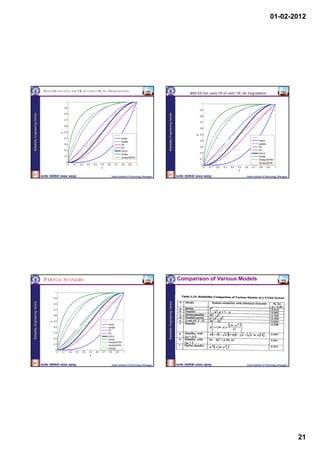
                                 PARTIAL STANDBY                                                                                                                                                Comparison of Various Models

                                          1

                                         0.9
Reliability Engineering Centre


                                                                                                                                                               Reliability Engineering Centre


                                         0.8

                                         0.7

                                         0.6

                                         0.5
                                         05
                                     R


                                                                                                             Series
                                         0.4                                                                 parallel
                                                                                                             SP
                                         0.3                                                                 PS
                                                                                                             2O3:G
                                         0.2                                                                 Stndby
                                                                                                             StndbyDSFRH
                                         0.1
                                                                                                             StndbyDSFRF
                                                                                                             Pstndby
                                          0
                                               0   0.1           0.2     0.3     0.4     0.5    0.6    0.7    0.8      0.9     1
                                                                                          p


    83
                                                                                                                   Indian Institute of Technology, Kharagpur                                                                                         Indian Institute of Technology, Kharagpur


                                                                                                                                                                                                                                                                                                 21
01-02-2012


                                  COMPARISON OF DIFFERENT MODELS                                                                                                 COMPARISON OF DIFFERENT MODELS

                                  • Series and standby provides the lowest and highest bounding curves.                                                          • Although, standby model offers best possible reliability. However, in
                                  • Reliability of partial standby and k-out-of-m for some values of p                                                             reality it may not be possible to introduce this kind of redundancy with
                                    (0<=p<=0.5) lie below the single component curve line and for higher                                                           all types of subsystems or elements.
Reliability Engineering Centre


                                                                                                                                Reliability Engineering Centre
                                    values of p lie above the single component line.                                                                             • Besides, the advantage will level off if DS is imperfect and has high
                                  • This implies that reliability of such model is worse than the reliability                                                      FR.
                                    of single component for some values of p close to 0 while same models                                                        • SO BE CAREFUL IN DESIGNING A SYSTEMS.
                                    offers better reliability for higher values of p.
                                  • SP/PS also would also exhibit similar characteristics for higher order
                                    systems.
                                  • k-out-of-m system invariably shows this characteristic.
                                  • Therefore, it is necessary to know the breakeven point for which a
                                    multi-component system has the same reliability as that of a single
                                    component.
                                  • The designer must ensure that the reliability of his system is better than
                                    this breakeven value while designing.

    85                                                                                                                             86
                                                                                    Indian Institute of Technology, Kharagpur                                                                                    Indian Institute of Technology, Kharagpur


                                  SHARED LOAD MODEL

                                  This model is considered in which load on a member changes and
                                   consequently the hazard rate of the member changes, as one or more                                                             If any one fails the remaining two will share the load of 100MW each
                                   members fail.                                                                                                                   to meet requirement , obviously now failure rate of the surviving
                                                                                                                                                                   generator s will be higher than before.
Reliability Engineering Centre


                                                                                                                                Reliability Engineering Centre


                                  In this model all the units or subsystem comprising the system are
                                   connected in parallel and each unit shares the load equally.                                                                   Therefore in this model the levels of hazard rate changes only when a
                                                                                                                                                                    subsystem failure occurs.
                                  If any of subsystem fails the surviving subsystems will share the load
                                                       fails,
                                   equally but with higher value of hazard rate.

                                  For example,
                                   If three generators of 110MW each, connected in parallel electricity and
                                   the load is 200MW, then each of these generators shares a load of
                                   66.67MW and at this load each generator has definite failure rate.


    87                                                                                                                             88
                                                                                    Indian Institute of Technology, Kharagpur                                                                                    Indian Institute of Technology, Kharagpur


                                                                                                                                                                                                                                                             22
01-02-2012


                                                                                                                                                                             The system will be good if:
                                  Two units shared load Model:
                                       Two units are sharing given
                                   load equally. However if a unit                                                                                                      1.    Both components remain in operational mode until the mission
                                   fails, the total load will have to be                                       E1∩E2                                                          time.
Reliability Engineering Centre


                                                                                                                                       Reliability Engineering Centre
                                                                                                 #1
                                   taken over by a single unit.
                                                                                   Success                            E1∩E2
                                                                                 probabilities
                                                                                                                                                                                The probability of this given by,
                                                                                                      E1∩E2
                                                                                                 #2
                                                                                                                                                                                                    P[t1>t∩t2>t]={ph (t)}2
                                          Let (t) be h d f for
                                          L fh( ) b the p.d.f. f                                                 t1             t
                                     time to failure of a unit under half                                       Time                                                              Where, ph (t) is reliability of a unit at half load condition
                                     load condition.                                                                                                                            i.e.                
                                                                                            Success probabilities of two unit
                                                                                                 shared load system                                                                         p h (t )    
                                                                                                                                                                                                         t
                                                                                                                                                                                                             f h ( u ) du

                                           Let ff(t)be the p.d.f. for time                                                                                                   t1 and t2 are time to failure of two units and the ‘t’ is mission time.
                                     to failure of a unit under full load
                                     condition.

    89                                                                                                                                    90
                                                                                           Indian Institute of Technology, Kharagpur                                                                                                Indian Institute of Technology, Kharagpur


                                                                                                                                                                        3    This is like 2 but instead of the first unit failing fist, the second
                                                                                                                                                                             unit is fails first and the other survives until time t.
                                 2     Unit 1 is failed at time t1 , and prior to this the units are taking
                                       half of the load each. After time t1 ,unit 2 alone takes the full
Reliability Engineering Centre


                                                                                                                                       Reliability Engineering Centre


                                       load until time t.                                                                                                                        the probability of this operation
                                      the probability of this operation ,
                                                                                                                                                                                     P[(t 2  t , under half load )  (t1  t 2 , under half load ) 
                                            P[( t1  t , under half load )  (t 2  t1 , under half load )                                                                             (t1  t  t 2 , under full load )]
                                                ( t 2  t  t1 , under full load )]                                                                                                     t
                                                                                                                                                                                       f h (t 2 ) ph (t 2 ) p f (t  t 2 ) dt 2
                                                        t
                                                                                                                                                                                        0
                                                       f h (t1 ) ph (t1 ) p f (t  t1 ) dt1
                                                        0                                                                                                               System Reliability = [ sum of the probabilities of earlier three
                                                                                                                                                                           equations]
                                      where p f (t )   f f (u ) d (u )                                                                                                                                       t
                                                            t
                                                                                                                                                                                    RS  [ ph (t )]2  2 f h (t1 ) ph (t1 ) p f (t  t1 ) dt1
                                                                                                                                                                                                               0
    91                                                                                                                                    92
                                                                                           Indian Institute of Technology, Kharagpur                                                                                                Indian Institute of Technology, Kharagpur


                                                                                                                                                                                                                                                                                23
01-02-2012

Reliability Engineering Centre


    93
                                 Indian Institute of Technology, Kharagpur


                                                                                    24

3. reliability modelling

  • 1.
    01-02-2012 DEFINITIONS System is a collection of components configured to realize a given task. Reliability Engineering Centre Reliability Engineering Centre This can be described through: Reliability Modeling and • Structure Function (Mathematical) Evaluation E l ti • L i Di Logic Diagram (Vi(Visual) l) 1 2 Indian Institute of Technology, Kharagpur Indian Institute of Technology, Kharagpur TYPE OF SYSTEMS SYSTEM RELIABILITY MODELLING Systems are of two types: • In case of non-maintained systems, system reliability or Mean Time To Failure ( MTTF) is • Non-maintained (Reliability and associated generally the main criteria of system performance. Reliability Engineering Centre Reliability Engineering Centre metrics) • On the other hand, in case of maintained • Maintained (Availability and associated systems, maintainability design (MD) goes metrics) hand-in-hand hand in hand with its design for reliability • Appropriate stochastic models are very (DFR) and the system needs to be designed for both reliability and maintainability, or for much different for these two types of MTTF and MTTR, and systems! • Many a times, system availability is often optimized within the resources available for system design. 3 4 Indian Institute of Technology, Kharagpur Indian Institute of Technology, Kharagpur 1
  • 2.
    01-02-2012 SYSTEM HIERARCHY SYSTEM MODELLING • All systems have a built-in hierarchy • One can model system in any of the following ways using failure/success criterion: Black Box Approach Reliability Engineering Centre Reliability Engineering Centre In this approach, the state of system is described either in terms of the two states (working/ failed) or more than two states without linking them to the components of the system. White Box Approach In this approach, one models the state of the system specifically in terms of the states of various components of the system. 5 6 Indian Institute of Technology, Kharagpur Indian Institute of Technology, Kharagpur SYSTEM MODELLING SYSTEM MODELLING White Box Modeling: Linking the system performance to the  The first one is called Forward (or Bottom up) approach. The other is called Backward (top-down) approach. failures/success at item level can be done qualitatively or quantitatively. Reliability Engineering Centre Reliability Engineering Centre 1. In the forward approach, one starts with events (success or failure) at item level and then In the qualitative analysis, the focus is on causal proceeds forward to system level to evaluate the consequences of such events on system relationships that link the item level events to performance. system events or vice-versa. In quantitative analysis, one obtains various 2. In the Backward approach, one starts at system level and proceeds downward to the item level measures of system performance (e.g., system to link system performance to success/failures at reliability) in terms of items performance. (e.g., item level. item reliabilities) 7 8 Indian Institute of Technology, Kharagpur Indian Institute of Technology, Kharagpur 2
  • 3.
    01-02-2012 BLOCK DIAGRAM OF A SYSTEM GRAPHICAL REPRESENTATION • Since the system modeling is done on the basis of • There are two ways of graphically representing the functional interrelationship of the constituent items functional relationship in a Qualitative analysis of a in relation to the overall functioning of the system, Reliability Engineering Centre Reliability Engineering Centre system. The first one is Block diagram or Reliability one has to keep the hierarchy of the system in view. Logic Diagram (RLD) approach. An RLD indicates • Therefore, we must consider the success of the which components of the system must operate for system vis-à-vis the success of the constituent vis à vis successful operation of the system. The other approach involves indication of which components must fail subsystems and then success of each subsystem is before the system fails. This graphical representation considered vis-a-vis the success of the constituting is done through Fault Tree Logic Diagram. Block components. This exercise will eventually result in Diagram approach is optimistic approach of a Block Diagram of the system. modelling whereas the FTA is pessimistic approach of Modelling. Indian Institute of Technology, Kharagpur Indian Institute of Technology, Kharagpur RELIABILITY LOGIC/BLOCK/NETWORK DIAGRAM BLOCK DIAGRAM OF A JET ENGINE • A diagram which shows the logical relationships of system • Jet Engine success (or failure) with success (or failure) of its – Fuel Supply System constituent parts is termed as RLD/RBD/NRLD. • Fuel Pump Reliability Engineering Centre Reliability Engineering Centre • Fuel Filter • RLD indicates that which component(s) in a system must – Carburetor operate without any failure for successful operation of the • Jet system. system • Other Components – Ignition System (2) • To develop RLD and reliability analysis thereof require • LV understanding and depiction of operational relationships or • HV logical interrelationships amongst its constituent items (subsystems, units or elements or parts.) 11 Indian Institute of Technology, Kharagpur Indian Institute of Technology, Kharagpur 3
  • 4.
    01-02-2012 ASSUMPTION IN MODELING INDEPENDENT FAILURES • All elements and systems can be either in operating • Failure times of components are influenced by or failed state, i.e., two state modeling. environmental conditions. As the environment • All elements are in operating state initially except gets harsher, the time to failure of component Reliability Engineering Centre Reliability Engineering Centre possibly in the case of redundancy. decreases. • States of all elements are statistically independent. • If the components of a system share the same (Failure of one element does not affect the probability environment, failure times of components of failure of other elements). become statistically dependent. • The reliabilities of all constituent components are • However, if the dependence is weak, or the known through some “reliability analysis”. components are located far apart, one can ignore dependence and treat the failure times as being statistically independent. 13 Indian Institute of Technology, Kharagpur Indian Institute of Technology, Kharagpur INDEPENDENT FAILURES • The advantage of this assumption is that the failure times of a component can be Reliability Engineering Centre Reliability Engineering Centre modelled separately using Univariate failure distribution functions. Reliability Models • If the dependence is significantsignificant, multivariate failure distributions must be used and the analysis becomes much more complicated. 16 Indian Institute of Technology, Kharagpur Indian Institute of Technology, Kharagpur 4
  • 5.
    01-02-2012 VARIOUS SYSTEM MODELS Series & Parallel Systems Now we will consider various system Series System Parallel System models that can be built for a given non-redundant system fully redundant system situation. Among these system models are Reliability Engineering Centre Reliability Engineering Centre (all components must work for (all components must fail for system series, parallel, series-parallel and system success) failure) parallel-series, k-out-of-m:G, standby, , TR1, 10 kVA TR1, 20 kVA partial standby , non-series parallel model 15 kVA 15 kVA etc. We will consider these one by one and Load Load derive system reliability and system MTTF TR2, 10 kVA TR2, 20 kVA for these configurations. 1 1 2 2 18 Indian Institute of Technology, Kharagpur Indian Institute of Technology, Kharagpur Series System Example: Let R = P [Success] A system consists of 10 identical components, all of 1 2 Q = P [Failure] which must work for system success. What is the system reliability if each component has a reliability of R+Q=1 Reliability Engineering Centre Reliability Engineering Centre 0.95? R s  R1  R 2 n Qs  1  R S Component reliability, R = 0.95  Ri i 1  1  R1  R 2 Number of components, n = 10 components product rule of reliability  1 - (1 - Q1 )(1  Q 2 ) Using Product Rule of Reliability,  Q1  Q 2  Q 1  Q 2 S System Reliability, Rs = Rn S = (0.95)10 = 0.5987 R1 R2 Q1 Q2 20 19 Indian Institute of Technology, Kharagpur Indian Institute of Technology, Kharagpur 5
  • 6.
    01-02-2012 Series System Series Model If each component has a reliability of 0.9. 1.0 0.9 0.999 • Most common and an important reliability Number of Reliability Components 0.8 model. Reliability Engineering Centre Reliability Engineering Centre 0.7 • Series system has no redundancy since a tem Reliability 1 0.9 2 0.81 0.6 3 0.729 0.5 0.98 failure of any component causes failure of 4 0.6561 5 0.59049 0 59049 0.4 system. the entire system Syst 0.3 10 0.348678 20 0.121577 0.2 0.9 • The system reliability will be less than the 50 0.005154 0.1 0.0 reliability of least reliable component in the 0 10 20 30 40 50 60 70 model. Number of Components System Reliability decreases as the number of components increases in a • System design would require high reliability Series System. The number on the curve is the reliability of each and as few components. component. 21 22 Indian Institute of Technology, Kharagpur Indian Institute of Technology, Kharagpur Series Model Parallel Redundant System • Assuming Ei s refers to the events of units being functionally good. 1 R s  P(E 1  E 2  E 3 ...  E n ) Rs  P(E 1 ) . P(E 2 /E1 ) . P(E 3 /E 1  E 2 )... P(E n /E 1  E 2  E 3  ...  E n  1) Rs  1  QS Reliability Engineering Centre Reliability Engineering Centre 2 If the unit failures are independen t then,  1  Q1  Q 2 n  1 - (1 - R 1 )(1  R 2 ) R s  P(E 1) P(E 2) P(E 3)... P(E n)   pi i 1  R1  R 2  R1  R 2 • The above result can also be obtained using time to failure considerations product rule of unreliability Rs (t )  Pr(t1  t )  (t 2  t )...  (t n  t ) Rs (t )  Pr(t1  t ) Pr(t 2  t )... Pr(t n  t ) S S n Rs (t )   ri (t ) Q1 Q2 R1 R2 i 1 23 24 Indian Institute of Technology, Kharagpur Indian Institute of Technology, Kharagpur 6
  • 7.
    01-02-2012 Example: Parallel System A system is to be designed with an overall reliability of 0.999 using components having individual reliabilities of 0.7. What is the Reliability of each component is 0.7 minimum number of components that must be connected in parallel? Reliability Engineering Centre Reliability Engineering Centre 1.0 System Reliability, Rs = 0.999 Number of System Component reliability, R = 0.7 Components Reliability 0.9 eliability Number of components, n = ? 1 0.700000 2 0.910000 0 910000 System Re 0.8 3 0.973000 System Unreliability, Qs = 1 - Rs = 1 – 0.999 = 0.001 4 0.991900 0.7 5 0.997570 Component Unreliability, Q = 1 – R = 1 – 0.7 = 0.3 6 0.999271 0.6 Using Product Rule of Unreliability, Qs = Qn i.e. 0.001 = 7 0.999781 1 2 3 4 5 6 7 8 (0.3)n Number of Components therefore, n = ln (0.001) / ln(0.3) = 5.74 since n is an integer, n=6 26 25 Indian Institute of Technology, Kharagpur Indian Institute of Technology, Kharagpur PARALLEL MODEL PARALLEL MODEL • System reliability will be more than any of the System MTTF for Various Configurations constituent component. • Most common and cheapest method of reliability Reliability Engineering Centre Reliability Engineering Centre improvement, if feasible or permitted. • An additional unit will improve the MTTF by 1.5 times of the MTTF of a single unit. unit • There will not be much gain in system MTTF, if number of units increased from 4 to 5 and so on. (Law of diminishing return-See in Next Slide). 27 Indian Institute of Technology, Kharagpur Indian Institute of Technology, Kharagpur 7
  • 8.
    01-02-2012 Series/Parallel Systems Example: Telcom. Repeater DG Rectifier Derive a general expression for the unreliability of the Station 2 3 model shown below, and hence evaluate the unreliability of 1 the system if all components have a reliability of 0.8. Reliability Engineering Centre Reliability Engineering Centre Power Supply 4 Cable System Battery Bank Network Reduction p Output input Technique RX = R2.R3 X 1 QY = QX.Q4 4 RY = 1 - QX.Q4 Reliability Network Model (Reliability Block Diagram) = 1 – (1-RX).(1-R4) of the System Y 1 RS = RY.R1 29 30 29 30 Indian Institute of Technology, Kharagpur Indian Institute of Technology, Kharagpur m out of n Systems Ri = 0.8 for i = 1 to 5 partially redundant system TR1, 10 kVA If components are identical then Reliability Engineering Centre Reliability Engineering Centre 3 3 2 2 3 15 kVA (R + Q) = R + 3R Q + 3RQ + Q Load Rs = R 3 + 3R2Q TR2, 10 kVA Qs = 3RQ2 + Q3 = 1 - Rs TR3, 10 kVA If components are non-identical then Q 8 = Q 7 . Q5 = (1 - R7). Q5 2 out 3 system R1  R2  R3 = (1 - R1 . R2 . R6). Q5 2/3 = [1 - R1 . R2 . (1 - Q6)]. Q5 1 Rs = R1 R2 R3 + = [1 - R1 . R2 . (1 - Q3 . Q4)]. Q5 R1 R2 Q3 + R1 Q2 R3 + Q1 R2 R3 2 Q8 = [1 – 0.8 x 0.8 (1 – 0.2 x 0.2)]x 0.2 = 0.07712 31 3 32 31 32 Indian Institute of Technology, Kharagpur Indian Institute of Technology, Kharagpur 8
  • 9.
    01-02-2012 Example: 2/3 4 2 Derive a general expression for the unreliability of the system 1 5 whose reliability model is shown below. Consider the case in 3 6 which all parallel branches of this system are fully redundant 7 Reliability Engineering Centre Reliability Engineering Centre with the exception of that consisting of components 4, 5 and 6 for Q8 = Q2 . Q3 which any 2 of the branches are required for system success. 1 8 9 If Components 4, 5 and 6 are identical, each with 2/3 reliability R, R9 = R3 + 3R2Q 4 2 7 Otherwise 1 5 R 9 = R 4 R 5 R 6 + R 4 R 5 Q 6 + R 4 Q 5 R 6 + Q4 R 5 R 6 input 3 Output 6 10 R10 = R1 R8 R9 7 7 Qs = Q10 . Q7 = (1 – R10). Q7 Reliability Network Model (Reliability Block = (1 - R1 . R8 . R9). Q7 11 = [1 - R1 (1 – Q8).R9 ]. Q7 Diagram) of the System 33 = [1 - R1 (1 – Q2 .Q3). R4 R5 R6 + R4 R5 Q6 + R4 Q5 R6 + Q4 R5 R6 ]. Q7 34 Indian Institute of Technology, Kharagpur Indian Institute of Technology, Kharagpur 2-out-of-3:G Model RELIABILITY OF 2-OUT-OF-3:G SYSTEM The Reliability Logic Diagram and Fault Tree diagram for Let us designate the paths in Block diagram as 2-out-of-3:G system are shown below: Obviously, T1 , T2 and T3 . Reliability Engineering Centre Reliability Engineering Centre T1  E1  E 2 , T2  E1  E3 and T3  E 2  E3 where Ei is the event of unit i being good. Therefore, system reliability is given by: Rs  PrT1  T2  T3    PTi    PTi  T j    PTi  T j  Tk  3 i 1 i j i j k where, PT1  T2   PE1  E 2   E1  E3   PE1  E 2  E3  3 3 3 Rs   P Ti    P E1  E2  E3     PE1  E2  E3  i 1 2 3 R s  p1 p 2  p1 p 3  p 2 p 3  2 p1 p 2 p 3 35 or R s  3 p 2  2 p 3 . Indian Institute of Technology, Kharagpur Indian Institute of Technology, Kharagpur 9
  • 10.
    01-02-2012 2-out-of-3:G Model (MTTF) Exercise 3-out-of-4:G Model (MTTF) For exponential failure distribution, we can Consider a 3 out of 4 system. The system is successful if compute system MTTF of by: any of the path is good The success of each path  depends on the success of two elements Reliability Engineering Centre Reliability Engineering Centre  2 MTTF  R s ( t ) dt 1 1 3 0 2 2 1 4 1 Out where, 3 in 3 4 Rs  p1 p2  p1 p3  p2 p3  2 p1 p2 p3 4 2 3 4 Block Diagram Reliability logic Diagram and for exponential failure distribution, p i ( t )  e  t 1 1 1 2 MTTF     1  2 1  3 2  3 1  2  3 38 Indian Institute of Technology, Kharagpur Indian Institute of Technology, Kharagpur Identical Units k-out of – M:G system (Using Binomial) A system functions properly if any k out of m units function A1  E1  E 2  E 3, A 2  E1  E 2  E 4 properly, the probability of exactly k successes out of m is A 3  E1  E 3  E 4 A4  E 2 E3 E 4 given by, Reliability Engineering Centre Reliability Engineering Centre yields, m B(k; m, p)    p k (1  p) m  k   Rs  P(A1  A 2  A 3  A 4) k  P(A1)  P(A2)  P(A3)  (PA4)  P(A Aj)  ... ( ( ( ( ( i The system remains functional as long as k, k  1, m  1, or m units i j function . The probabilit y of system success is given by, P(AAA )  P(A A  A 3  A 4) m m i j k 1 2 R s     p i (1  p) m  i   i j k ik  i  Rs=P(E1E2E3)+P(E1E2E4)+P(E1E3E4)+P(E2E3E4)- 3P(E1E2E3E4) or   k 1 m If the elements are identical and their failures are independent R s  1     p i (1  p) m  i   particular ly, if the (m  k  1) is larger than k then i0  i  Rs=4P3-3p4 39 40 Indian Institute of Technology, Kharagpur Indian Institute of Technology, Kharagpur 10
  • 11.
    01-02-2012 MTTF OF K-OUT-OF-M:G SYSTEM k-out-of-m:G Model (MTTF) 1 m 1 MTTF k , m   j  Reliability Engineering Centre Reliability Engineering Centre j k For identical units, for various combinations of k and m ,(for k  m) , we provide system MTTF for identical in the next slide. System MTTF for various values of k and m Indian Institute of Technology, Kharagpur Indian Institute of Technology, Kharagpur Example: System Reliability System Reliability Evaluation Using Probability Distributions Time dependent reliability – described by probability distributions t   λ1 (t)dt Reliability of Component 1 for a time period t, R1(t) = e 0 Reliability Engineering Centre Reliability Engineering Centre where (t) is the hazard rate of Component 1. Block A e  λ 1t Rs  R A During useful life p g p period of the component () R1(t) = where  is constant, and is called the failure rate of Component 1. The system reliability can be calculated as: R s  R A  R B  R 10  R C , where R A  R 1  R 2 R B  1  1  ( R 3  R 4  R 5 )  1  ( R 6  R 7  R 8 )  ( 1  R 9 ) RC  1  C3 2 R 11 ( 1  R 11 ) 2  3 C 3 R 11 ( 1  R 11 ) 3 0  Indian Institute of Technology, Kharagpur Indian Institute of Technology, Kharagpur 11
  • 12.
    01-02-2012 Series Systems Parallel Systems 1 1 2 Rs = R1 . R2  product rule of reliability Qs = Q1 . Q2  product rule of unreliability 2 Considering time dependent probabilities, Reliability Engineering Centre Reliability Engineering Centre t   λ 1 (t)dt t   λ 2 (t)dt Considering time dependent probabilities, t t   λ 1 (t)dt   λ 2 (t)dt Rs(t) = R1(t). R2(t) = e 0 e 0 Qs(t) = Q1(t). Q2(t) = [1- e 0 ].[1- e 0 ] For ‘n’ component series system with hazard rates 1(t), 2(t), …, n(t), For ‘n’ component parallel system with hazard rates 1(t), 2(t), …, n(t), t n t n   λ i (t)dt also applicable if failure distributions for Qs(t) =  [1 - e   λ i (t)dt Rs(t) =  e 0 different components are different 0 ] i 1 i 1 During useful life period when component failures are exponentially During useful life period when component failures are exponentially distributed distributed n n cannot obtain equivalent hazard rate for Qs(t) =  [1 - e i ] n λ t  n   λit where equivalent hazard rate, e =  i Rs(t) =  e λ it   et exponential distribution = e i 1 = e i 1 i 1 is also constant i 1 Therefore, resulting distribution for the system is non-exponential i.e. resulting distribution for the system is also exponential i.e. resulting hazard rate for the system is no longer constant, but a function Indian Institute of Technology, Kharagpur of time Indian Institute of Technology, Kharagpur Partially Redundant (m out of n) Systems Example: Apply Binomial Expansion A simple electronic circuit consists of 6 transistors each having a failure rate of 10-6 f/hr, 4 diodes each having a failure rate of 0.5 x 10⁻⁶ f/hr, 3 n capacitors each having a failure rate of 0.2 x 10⁻⁶ f/hr, 10 resistors each [R(t) + Q(t)] n =  nCr R(t) n-r Q(t) r having a failure rate of 5 x 10⁻⁶ f/hr and 2 switches each having a failure Reliability Engineering Centre Reliability Engineering Centre r0 rate of 2 x 10⁻⁶ f/hr. Assuming connectors and wiring are 100% reliable, During useful life period when component failures are evaluate the equivalent failure rate of the system and the probability of the system surviving 1000 and 10000 hours if all components must exponentially distributed operate for system success. n  λt eλt Equivalent failure rate of the system, e = i1  i R(t) = e and Q(t) = 1 - = 6(10-6 ) + 4(0.5 x 10⁻⁶ ) + 3(0.2 x 10⁻⁶ ) + 10(5 x 10⁻⁶ ) + 2(2 x 10⁻⁶ ) = 6.26 x 10⁻⁵ f/hr Let see some simple examples.  t  6.26 x 10 6 x1000 Rs(1000 hr) = e e = e = 0.9393  et  6.26 x 10 6 x10000 Rs(10,000 hr) = e = e = 0.5347 Indian Institute of Technology, Kharagpur Indian Institute of Technology, Kharagpur 12
  • 13.
    01-02-2012 Example: Standby Model Consider a system comprising of 4 identical units each having a failure  One or more units are in standby mode waiting to take over rate of 0.1 f/yr. Evaluate the probability of the system surviving 0.5 years and 5 years if at least two units must operate successfully. the operation from the main operating unit as soon as the failure of the operating unit takes place. Reliability Engineering Centre Reliability Engineering Centre Using Binomial Expansion,  Decision switch senses the failure of the basic unit. [R(t) + Q(t)] 4 = R4(t) + 4 R3(t)Q(t) + 6 R2(t)Q2(t) + 4 R(t)Q3(t) + Q4(t)  It is assumed that the operation of failure sensing and where, R(t) = e  λt and Q(t) = 1 - eλt switching on to the standby unit is instantaneous, i.e., operation. uninterrupted system operation For 2 out of 4 system,  The standby system fails only when all the system units Rs(t) = R4(t) + 4 R3(t)Q(t) + 6 R2(t)Q2(t) including the standby units have failed.  The reliability of such system will be higher than the  4 λt  3 λt  λt  2 λt  λt 2 =e +4e (1 - e ) + 6 e (1 - e ) parallel system with equal number of active units. (Conditions?). For t = 0.5 years, t = 0.1 x 0.5 = 0.05 Rs(0.5) = 0.9996 For t = 5 years, t = 0.1 x 5 = 0.5 Rs(5) = 0.8282 50 Indian Institute of Technology, Kharagpur Indian Institute of Technology, Kharagpur STANDBY MODELS STANDBY MODELS: MISSILE SYSTEM Reliability Engineering Centre Reliability Engineering Centre Indian Institute of Technology, Kharagpur Indian Institute of Technology, Kharagpur 13
  • 14.
    01-02-2012 System Modelling System Modelling Two Unit Standby Model Two Unit Standby Model Obviously, from the Fig (b), it can be seen easily that the Therefore, reliability for a two-unit standby system success would be system would be obtained as: Reliability Engineering Centre Reliability Engineering Centre obtained: Either (i) when the primary unit # Rs ( t )  Pr[(t1  t) {(t1  t) ( t 2  t  t1 )} ] 1 continues to work beyond or t the mission time t, i.e., t1 > t,  p 1 t   f 1 t 1  p 2 t  t 1 dt 1 where t1 is the time to failure 0 of unit # 1. or (ii) unit # 1 fails at time t1 (t1< p1 t   e  1t f 1 t1   1e  1t1 p 2 t  t1   e  2 t t1  t), and the standby unit ( unit # 2) comes into operation t immediately upon the failure R s t   R 1   R 2  e  1t   1 e  1t  e   2 t  t1 dt 1 of unit #1 and continues to 0 work for t2 > (t-t1). The system reliability  e 1t e  2 t  therefore can be given Rs t   e 1t  1   by:  2  1  1  2  Rs ( t )  Pr[(t1  t){(t1  t)( t2  t  t1 )}] Indian Institute of Technology, Kharagpur Indian Institute of Technology, Kharagpur STANDBY MODELS: IMPERFECT SWITCH STANDBY MODELS: OTHER  The function of decision switch (DS) is critical and the  DS perfect but Degradation of standby unit success of a standby system to great extent depends in standby mode. upon the reliability of this decision switch.  Combining degradation of standby unit and Reliability Engineering Centre Reliability Engineering Centre Imperfect switching  The reliability decision switch is driving the system reliability.  Two-unit standby system , Rs (t )  P[(t1  t )  {(t1  t )  (t ds  t1 )  (t 2  t  t1 )}] t R S ( t )  p 1 ( t )  p ds  0 f 1 ( t 1 ) p 2 ( t  t1 ) dt 1 tds represents a random variable denoting the time to failure of the decision switch. 55 56 Indian Institute of Technology, Kharagpur Indian Institute of Technology, Kharagpur 14
  • 15.
    01-02-2012 System Modelling PARTIAL STANDBY MODEL THREE-UNIT STANDBY MODEL  As shown in fig. there is another way to configure three units.  Two units are in operational mode and third unit may Similarly, we can determine the reliability of be put in standby mode. Reliability Engineering Centre Reliability Engineering Centre a three unit system as:  Actually both units are required in operational mode for satisfactory operation of the system.  e  1t e  2t   Thus are in series as far as reliability logic diagram R s t   e  1t  1   concerned.   2  1  1   2    Third unit replaces any one failed from these two  e 1t e  2 t e 3t  operational units.  12    1  2  1 3  1  1  2 3  2  1  3 2  3   2 3 Units 1 and 2 are in active mode and unit 3 is in standby mode 58 Indian Institute of Technology, Kharagpur Indian Institute of Technology, Kharagpur System Modelling System Modelling Standby Models Triple Modular m1 Redundancy (t ) i Reliability Engineering Centre  Reliability Engineering Centre Rs(t) = e-2( 1+ 2  t ) Rs  exp(t ) i 0 i! The triple modular redundancy (TMR) consists of three parallel digital circuits – A, B, and C - all having the same input. The outputs of the three circuits are compared by a voter, which sides with the majority and gives the majority opinion as the system output. If all three circuits are Indian Institute of Technology, Kharagpur operating properly, all outputs agree; thus the system output Indian Institute of Technology, Kharagpur i t 15
  • 16.
    01-02-2012 System Modelling System Modelling Triple Modular SHARED LOAD MODEL Redundancy However, if one element has failed so that it has produced an  A model in which the load on a member incorrect output, the voter chooses the output of the two changes and consequently the hazard rate of Reliability Engineering Centre Reliability Engineering Centre good elements as the system output because they both the member also changes, as one or more agree; thus the system output is correct. If two elements have member fail. failed, the voter agrees with the majority (the two that have  In this model all the units/sub-systems are failed); thus the system output is incorrect. The system connected in parallel and each unit shares the output is also incorrect if all three circuits have failed. load equally. Actually, circuits-A, B, and C- in most cases are identical and  After the failure of one or more units the they are three replications of the same design. Using this remaining units share the load equally but with assumption, and also assuming that the voter does not fail a higher value of hazard rate. and all digital circuits are independent and identical with  The levels of hazard rate change only when a probability of success p,3the system reliability is given by: subsystem failure occurs. R s    p 3 1  p     p 2 1  p   3 p  2 p  p 3  2 p  3 0   1 2 3 2  It is assumed that failure distribution of the 3 2 survivor subsystem after failure of a Indian Institute of Technology, Kharagpur Indian Institute of Technology, Kharagpur subsystem does not depend on the interval of System Modelling System Modelling TWO UNIT SHARED LOAD MODEL TWO UNIT SHARED LOAD MODEL In this case, we will have two units sharing the Let, Reliability Engineering Centre Reliability Engineering Centre given load equally however if one unit fails, the fh(t) : be the p.d.f. for time to failure of a unit total load will have to be take over by the single under half load condition unit as shown in the following figure. ff(t) : be the p.d.f. for time to failure of a unit under full load condition( this occurs Half load when one unit fails and other unit is forced to take the full load ) Half load Therefore the system is successful if, 1. Both component remain operational until the mission time. The probability of this is given Full load by: P[(t1>t)∩(t2>t)] = {ph(t)}2 Where, ph(t) is reliability of a unit under half Indian Institute of Technology, Kharagpur load Indian Institute of Technology, Kharagpur 16
  • 17.
    01-02-2012 System Modelling System Modelling TWO UNIT SHARED LOAD MODEL TWO UNIT SHARED LOAD MODEL 2. The first unit fails and the second unit survives and Now the system reliability is found by adding the Reliability Engineering Centre Reliability Engineering Centre the takes the full load (after the failure of the first probabilities of case 1 , case 2 and case 3 i.e. unit) until the time t, The probability of this operation is given by: P[(t1≤t, under half load)∩(t2>t1, under half load)∩ If we assume the failure distribution to the exponential distribution for both the units and ( t2>t-t1, under full load)] = denote the failure rates at half and full load by λh and λf respectively. Then the reliability expression 3. This is identical to the case 2 the only difference is can be written as,  t 2 h e f R s t   e  2  h t  that here unit 2 fails and unit 1 take the full load( after failure of the second unit) and the probability [1  e  ( 2  h   f ) t ] of this operation can be found by replacing t1 by t2 . (2 h   f ) Incase both the units are same the probabilities in case 2 and case 3 turns out to Institute of Technology, Kharagpur Indian be same. Indian Institute of Technology, Kharagpur System Modelling System Modelling THREE UNIT SHARED LOAD THREE UNIT SHARED LOAD SYSTEMS SYSTEMS Similarly the reliability expression for the three The diagrammatic representation of the load Reliability Engineering Centre Reliability Engineering Centre unit shared load model can be derived, the shifting is shown below, 1/3 load success probability versus time plot is shown below, #1 Su E1∩E2∩E3 1/3 load cce #2 E1∩E2∩E3  ss E 1  E 2  E3 1/3 load E1∩E2∩E3  Pro #3 E1 E 2  E 3   ba E1  E 2  E 3 1/2 load bili ty 1/2 load t1 t2 Time t Full load Indian Institute of Technology, Kharagpur Indian Institute of Technology, Kharagpur 17
  • 18.
    01-02-2012 System Modelling System Modelling THREE UNIT SHARED LOAD THREE UNIT SHARED LOAD SYSTEMS SYSTEMS For three similar units the above possibilities P(#2) = 3P[(t1≤t,at 1/3 load)∩{(t2>t1) ∩(t3>t1), at 1/3 Reliability Engineering Centre Reliability Engineering Centre can be described as, load}∩ {(t2>t-t1) ∩(t3>t-t1), at ½ load}] 1. All the three units operate until the mission And time and share the load equally. P(#3) = 6P[(t1≤t, at 1/3 load) ∩{(t2>t1) ∩(t3>t1), at 1/3 2. Unit #1 fails and the other two units survive } load} and share the load equally. ∩{(t2≤t, at ½ load) ∩(t3>t2, at ½ load)} ∩ 3. Unit #1 and Unit #2 fail and Unit #3 operates {(t3>t-t1-t2), at full load} Now the reliability expression for the three unit shared load model can and is forced to take the full load. be written as, Let t1, t2 and t3 be the time to failure of the Rs(t) = P(#1) + P(#2) + P(#) first, second and third unit respectively then the probabilities of the above possibilities can be written as, P(#1) = P[(t1>t)∩(t2>t) ∩(t3>t)] = [po(t)]3 Indian Institute of Technology, Kharagpur Indian Institute of Technology, Kharagpur System Modelling System Modelling THREE UNIT SHARED LOAD THREE UNIT SHARED LOAD SYSTEMS SYSTEMS In the integral form it can be written as, The expression comes out to be, Reliability Engineering Centre Reliability Engineering Centre t Rs(t) = [po(t)]3 + 3 f o t 1 { p o t 1 } { p h ( t  t 1 )} dt 1  2 2 3o + 0 Rs (t)  e3ot  (e3ot  e2ht )  t t  t1 (2h 3o ) 6  f o t 1 { p o t 1 } 2 f h ( t 2 ) p h ( t 2 )p f ( t  t 1  t 2 )dt 2 dt 1 0 0 e3ot e2ht Now if we take the failure distribution to be 6oh[   exponential distribution with failure rates λo, λh (3o  2h )(3o  f ) (2h 3o )(2h  f ) and λf for the 1/3, ½ and full load respectively then  t the reliability expression can be written as, e f ] Indian Institute of Technology, Kharagpur (f 3o )(f  2h ) Indian Institute of Technology, Kharagpur 18
  • 19.
    01-02-2012 System Modelling COMPARISON OF DIFFERENT MODELS THREE UNIT SHARED LOAD • Basis: SYSTEMS One very important thing to note is that, – Assuming constant failure rate. Reliability Engineering Centre Reliability Engineering Centre • If we put, λ1=2λh and λ2= λf in the two unit – All elements or subsystems are identical with standby reliability expression we get the reliability, p. reliability expression for the two unit shared load model. h dl d d l • Similarly if we put λ1=3λo, λ2=2λh and λ3= λf in three unit standby reliability expression we will end up with the reliability expression of three unit shared load model. Finally MTTF can be found by integrating the reliability of Technology, Kharagpur Indian Institute expression 74 Indian Institute of Technology, Kharagpur between 0 and Infinity SINGLE COMPONENT Three Component in S & P 1 1 1 0.9 0.9 0.9 Reliability Engineering Centre Reliability Engineering Centre 0.8 0.8 0.8 0.7 0.7 0.7 0.6 0.6 0.6 0.5 0.5 R R 0.5 R 0.4 0.4 0.4 0.3 0.3 0.3 0.2 0.2 0.2 0.1 Series 0.1 0.1 Series parallel 0 0 0 0 0.1 0.2 0.3 0.4 0.5 0.6 0.7 0.8 0.9 1 0 0.1 0.2 0.3 0.4 0.5 0.6 0.7 0.8 0.9 1 0 0.1 0.2 0.3 0.4 0.5 0.6 0.7 0.8 0.9 1 p p p 75 76 Indian Institute of Technology, Kharagpur Indian Institute of Technology, Kharagpur 19
  • 20.
    01-02-2012 SP:(2-IN-P WITH 1-IN-S) PS:(2-IN-S WITH 1-P) 1 1 0.9 0.9 Reliability Engineering Centre Reliability Engineering Centre 0.8 0.8 0.7 0.7 0.6 0.6 0.5 05 0.5 05 R R 0.4 0.4 0.3 0.3 0.2 Series 0.2 parallel Series 0.1 SP 0.1 parallel PS SP 0 0 0 0.1 0.2 0.3 0.4 0.5 0.6 0.7 0.8 0.9 1 0 0.1 0.2 0.3 0.4 0.5 0.6 0.7 0.8 0.9 1 p p 77 78 Indian Institute of Technology, Kharagpur Indian Institute of Technology, Kharagpur STANDBY WITH ONE ACTIVE AND 2-STNDBY, DS PERFECT, NO 2-OUT-OF-3:G DEGRADATION 1 1 0.9 0.9 0.8 Reliability Engineering Centre Reliability Engineering Centre 0.8 0.7 0.7 0.6 0.6 0.5 05 R 0.5 R 0.4 0.4 0.3 0.3 Series parallel Series 0.2 0.2 SP parallel PS SP 0.1 0.1 2O3:G PS 2O3:G Stndby 0 0 0 0.1 0.2 0.3 0.4 0.5 0.6 0.7 0.8 0.9 1 0 0.1 0.2 0.3 0.4 0.5 0.6 0.7 0.8 0.9 1 p p 79 80 Indian Institute of Technology, Kharagpur Indian Institute of Technology, Kharagpur 20
  • 21.
    01-02-2012 WITH DS HAS HALF THE FR OF UNITS’ FR, NO DEGRADATION With DS has same FR of units’ FR, No Degradation 1 1 0.9 0.9 0.8 Reliability Engineering Centre Reliability Engineering Centre 0.8 0.7 0.7 0.6 0.6 0.5 05 R 0.5 R 0.4 Series parallel 0.4 Series 0.3 SP parallel PS 0.3 SP 0.2 2O3:G PS 0.2 2O3:G Stndby 0.1 Stndby StndbyDSFRH 0.1 StndbyDSFRH 0 StndbyDSFRF 0 0.1 0.2 0.3 0.4 0.5 0.6 0.7 0.8 0.9 1 0 p 0 0.1 0.2 0.3 0.4 0.5 0.6 0.7 0.8 0.9 1 p 81 82 Indian Institute of Technology, Kharagpur Indian Institute of Technology, Kharagpur PARTIAL STANDBY Comparison of Various Models 1 0.9 Reliability Engineering Centre Reliability Engineering Centre 0.8 0.7 0.6 0.5 05 R Series 0.4 parallel SP 0.3 PS 2O3:G 0.2 Stndby StndbyDSFRH 0.1 StndbyDSFRF Pstndby 0 0 0.1 0.2 0.3 0.4 0.5 0.6 0.7 0.8 0.9 1 p 83 Indian Institute of Technology, Kharagpur Indian Institute of Technology, Kharagpur 21
  • 22.
    01-02-2012 COMPARISON OF DIFFERENT MODELS COMPARISON OF DIFFERENT MODELS • Series and standby provides the lowest and highest bounding curves. • Although, standby model offers best possible reliability. However, in • Reliability of partial standby and k-out-of-m for some values of p reality it may not be possible to introduce this kind of redundancy with (0<=p<=0.5) lie below the single component curve line and for higher all types of subsystems or elements. Reliability Engineering Centre Reliability Engineering Centre values of p lie above the single component line. • Besides, the advantage will level off if DS is imperfect and has high • This implies that reliability of such model is worse than the reliability FR. of single component for some values of p close to 0 while same models • SO BE CAREFUL IN DESIGNING A SYSTEMS. offers better reliability for higher values of p. • SP/PS also would also exhibit similar characteristics for higher order systems. • k-out-of-m system invariably shows this characteristic. • Therefore, it is necessary to know the breakeven point for which a multi-component system has the same reliability as that of a single component. • The designer must ensure that the reliability of his system is better than this breakeven value while designing. 85 86 Indian Institute of Technology, Kharagpur Indian Institute of Technology, Kharagpur SHARED LOAD MODEL  This model is considered in which load on a member changes and consequently the hazard rate of the member changes, as one or more  If any one fails the remaining two will share the load of 100MW each members fail. to meet requirement , obviously now failure rate of the surviving generator s will be higher than before. Reliability Engineering Centre Reliability Engineering Centre  In this model all the units or subsystem comprising the system are connected in parallel and each unit shares the load equally.  Therefore in this model the levels of hazard rate changes only when a subsystem failure occurs.  If any of subsystem fails the surviving subsystems will share the load fails, equally but with higher value of hazard rate.  For example, If three generators of 110MW each, connected in parallel electricity and the load is 200MW, then each of these generators shares a load of 66.67MW and at this load each generator has definite failure rate. 87 88 Indian Institute of Technology, Kharagpur Indian Institute of Technology, Kharagpur 22
  • 23.
    01-02-2012  The system will be good if:  Two units shared load Model: Two units are sharing given load equally. However if a unit 1. Both components remain in operational mode until the mission fails, the total load will have to be E1∩E2 time. Reliability Engineering Centre Reliability Engineering Centre #1 taken over by a single unit. Success E1∩E2 probabilities The probability of this given by, E1∩E2 #2 P[t1>t∩t2>t]={ph (t)}2 Let (t) be h d f for L fh( ) b the p.d.f. f t1 t time to failure of a unit under half Time Where, ph (t) is reliability of a unit at half load condition load condition. i.e.  Success probabilities of two unit shared load system p h (t )   t f h ( u ) du Let ff(t)be the p.d.f. for time t1 and t2 are time to failure of two units and the ‘t’ is mission time. to failure of a unit under full load condition. 89 90 Indian Institute of Technology, Kharagpur Indian Institute of Technology, Kharagpur 3 This is like 2 but instead of the first unit failing fist, the second unit is fails first and the other survives until time t. 2 Unit 1 is failed at time t1 , and prior to this the units are taking half of the load each. After time t1 ,unit 2 alone takes the full Reliability Engineering Centre Reliability Engineering Centre load until time t. the probability of this operation the probability of this operation , P[(t 2  t , under half load )  (t1  t 2 , under half load )  P[( t1  t , under half load )  (t 2  t1 , under half load )  (t1  t  t 2 , under full load )] ( t 2  t  t1 , under full load )] t   f h (t 2 ) ph (t 2 ) p f (t  t 2 ) dt 2 t 0   f h (t1 ) ph (t1 ) p f (t  t1 ) dt1 0 System Reliability = [ sum of the probabilities of earlier three  equations] where p f (t )   f f (u ) d (u ) t t RS  [ ph (t )]2  2 f h (t1 ) ph (t1 ) p f (t  t1 ) dt1 0 91 92 Indian Institute of Technology, Kharagpur Indian Institute of Technology, Kharagpur 23
  • 24.
    01-02-2012 Reliability Engineering Centre 93 Indian Institute of Technology, Kharagpur 24