DEVARAJAN.R
(RA1852001020082)
THIRD PARTY LOGISTICS
• Third-party logistics companies provide any number of services
having to do with the logistics of the supply chain. This includes
transportation, warehousing, picking and packing, inventory
forecasting, order fulfilment, packaging and freight forwarding.
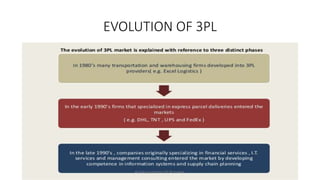
EVOLUTION OF 3PL
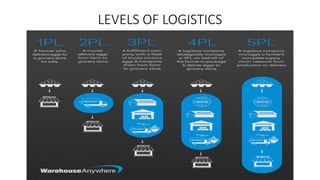
LEVELS OF LOGISTICS
CHARACTERISTICS
Characteristics of 3PL:
A 3PL may provide the warehousing, packing and even some of the inventory
management of your products and stock, depending on the needs of your business
and what has been agreed to be supplied. Perhaps the most important consideration is
that with a 3PL
Characteristics of 4PL:
A 4PL, on the other hand, offers all the same things that a 3PL provides, as well as
managing the overall supply chain, right down to the legal paperwork and
managerial decisions. In other words, when a business signs a contract with a 4PL
provider, they are signing over the complete control of their entire supply chain. This
means that the 4PL will use their own resources to ensure your business’s supply
chain needs are met, but that your business has no control over how that happens.
PROS OF 3PL
• Cost reduction. 3PLs have more leverage with freight companies than individual
shippers do. Working with carriers on behalf of multiple customers, 3PLs can
negotiate pricing based on volume and order frequency. Using a 3PL to manage
all or part of your supply chain also gives you the freedom to invest in other key
areas to grow and develop your business.
• Scale up or down as needed: Most businesses experience fluctuations
in demand throughout the year. Using a 3PL allows you to manage peaks and
troughs more effectively without having to commit to capital when you don’t
need to.
• Provide a better customer experience: Customers expect next-day or same-day
shipping as standard. Using a third-party logistics provider allows you to offer fast
shipping no matter where the order is being sent, thanks to having access to the
3PL’s wide distribution network.
• Test new markets: With an international 3PL, you have the flexibility to test the
waters in new markets without having to commitment to any major investments
like your own warehousing space or staff.
• Mitigate risk: Shipping delays can and do happen for a number of reasons. When
unforeseen circumstances pop up, a 3PL is responsible for making alternate arrangements
to fulfil your orders as quickly as possible. You’ll also be protected in the event of damage
or loss of goods.
• Gain instant expertise and knowledge in the field. Especially if you’re just starting out,
who better to take care of your logistics than a company that specializes in them?
Fulfilment, warehousing and shipping come with major challenges of their own, so
handing it off to the experts can really make a difference in the way you function - and it
leaves you to focus on increasing your overall value to your customers.
• Get a handle on international logistics. If you’re selling internationally, 3PLs can take
care of documentation, customs, duties and other issues that come up at the borders that
can delay your shipments and result in high costs if not done thoroughly. Plus, you save
time trying to work out complicated rules pertaining to different countries.
• Generate cost savings. When it comes to warehousing, not having to maintain your own
space and staff can be a big cost-saving measure. Also, companies that provide
good inventory forecasting can help optimize your inventory levels and save money
on inventory holding costs.
CONS OF 3PL
• Lesser control over the delivery process. With a third-party taking care of
your shipping, there can be challenges when there are delays or problems in
shipping a customer’s order. The customer will be looking at you for the
resolution, not your 3PL.
• Larger upfront investment. On the flip side of the cost issue, while hiring a
3PL can pay for itself in the long run, the investment can still be a large cost in
the beginning. If you don’t need a big warehouse or don’t have many orders,
the cost of a 3PL can be prohibitive.
• More distance between you and your product. The 3PL you choose may
position you far away from your products, which would be an inconvenience if
you run into quality control issues, or need to physically inspect your stock for
any reason.
THANK YOU

3 pl logistics

  • 1.
  • 2.
    THIRD PARTY LOGISTICS •Third-party logistics companies provide any number of services having to do with the logistics of the supply chain. This includes transportation, warehousing, picking and packing, inventory forecasting, order fulfilment, packaging and freight forwarding.
  • 3.
  • 4.
  • 5.
    CHARACTERISTICS Characteristics of 3PL: A3PL may provide the warehousing, packing and even some of the inventory management of your products and stock, depending on the needs of your business and what has been agreed to be supplied. Perhaps the most important consideration is that with a 3PL Characteristics of 4PL: A 4PL, on the other hand, offers all the same things that a 3PL provides, as well as managing the overall supply chain, right down to the legal paperwork and managerial decisions. In other words, when a business signs a contract with a 4PL provider, they are signing over the complete control of their entire supply chain. This means that the 4PL will use their own resources to ensure your business’s supply chain needs are met, but that your business has no control over how that happens.
  • 6.
    PROS OF 3PL •Cost reduction. 3PLs have more leverage with freight companies than individual shippers do. Working with carriers on behalf of multiple customers, 3PLs can negotiate pricing based on volume and order frequency. Using a 3PL to manage all or part of your supply chain also gives you the freedom to invest in other key areas to grow and develop your business. • Scale up or down as needed: Most businesses experience fluctuations in demand throughout the year. Using a 3PL allows you to manage peaks and troughs more effectively without having to commit to capital when you don’t need to. • Provide a better customer experience: Customers expect next-day or same-day shipping as standard. Using a third-party logistics provider allows you to offer fast shipping no matter where the order is being sent, thanks to having access to the 3PL’s wide distribution network. • Test new markets: With an international 3PL, you have the flexibility to test the waters in new markets without having to commitment to any major investments like your own warehousing space or staff.
  • 7.
    • Mitigate risk:Shipping delays can and do happen for a number of reasons. When unforeseen circumstances pop up, a 3PL is responsible for making alternate arrangements to fulfil your orders as quickly as possible. You’ll also be protected in the event of damage or loss of goods. • Gain instant expertise and knowledge in the field. Especially if you’re just starting out, who better to take care of your logistics than a company that specializes in them? Fulfilment, warehousing and shipping come with major challenges of their own, so handing it off to the experts can really make a difference in the way you function - and it leaves you to focus on increasing your overall value to your customers. • Get a handle on international logistics. If you’re selling internationally, 3PLs can take care of documentation, customs, duties and other issues that come up at the borders that can delay your shipments and result in high costs if not done thoroughly. Plus, you save time trying to work out complicated rules pertaining to different countries. • Generate cost savings. When it comes to warehousing, not having to maintain your own space and staff can be a big cost-saving measure. Also, companies that provide good inventory forecasting can help optimize your inventory levels and save money on inventory holding costs.
  • 8.
    CONS OF 3PL •Lesser control over the delivery process. With a third-party taking care of your shipping, there can be challenges when there are delays or problems in shipping a customer’s order. The customer will be looking at you for the resolution, not your 3PL. • Larger upfront investment. On the flip side of the cost issue, while hiring a 3PL can pay for itself in the long run, the investment can still be a large cost in the beginning. If you don’t need a big warehouse or don’t have many orders, the cost of a 3PL can be prohibitive. • More distance between you and your product. The 3PL you choose may position you far away from your products, which would be an inconvenience if you run into quality control issues, or need to physically inspect your stock for any reason.
  • 9.