4PL 2PL3P
IPL
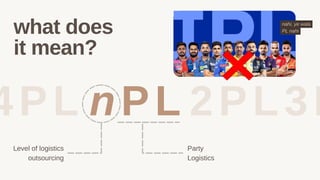
Level of logistics
outsourcing
nPL
Party
Logistics
what does
it mean?
nahi, ye wala
PL nahi
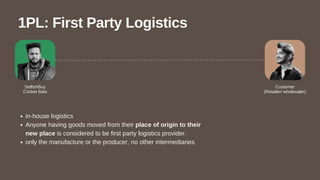
SelfishBuy
Cricket Bats
Customer
(Retailer/ wholesaler)
1PL: First Party Logistics
in-house logistics
Anyone having goods moved from their place of origin to their
new place is considered to be first party logistics provider.
only the manufacture or the producer, no other intermediaries
Customer
(Retailer/ wholesaler)
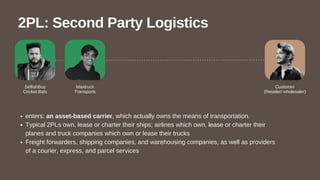
Maxtruck
Transports
2PL: Second Party Logistics
enters: an asset-based carrier, which actually owns the means of transportation.
Typical 2PLs own, lease or charter their ships; airlines which own, lease or charter their
planes and truck companies which own or lease their trucks
Freight forwarders, shipping companies, and warehousing companies, as well as providers
of a courier, express, and parcel services
SelfishBuy
Cricket Bats
Customer
(Retailer/ wholesaler)
Maxtruck
Transports
DeadForklift
Warehousing
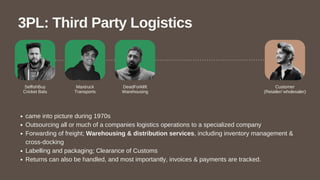
3PL: Third Party Logistics
came into picture during 1970s
Outsourcing all or much of a companies logistics operations to a specialized company
Forwarding of freight; Warehousing & distribution services, including inventory management &
cross-docking
Labelling and packaging; Clearance of Customs
Returns can also be handled, and most importantly, invoices & payments are tracked.
SelfishBuy
Cricket Bats
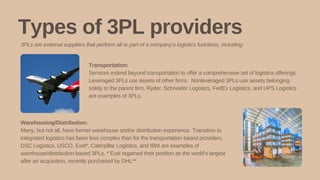
Types of 3PL providers
Transportation:
Services extend beyond transportation to offer a comprehensive set of logistics offerings.
Leveraged 3PLs use assets of other firms. Nonleveraged 3PLs use assets belonging
solely to the parent firm. Ryder, Schneider Logistics, FedEx Logistics, and UPS Logistics
are examples of 3PLs.
Warehousing/Distribution:
Many, but not all, have former warehouse and/or distribution experience. Transition to
integrated logistics has been less complex than for the transportation based providers.
DSC Logistics, USCO, Exel*, Caterpillar Logistics, and IBM are examples of
warehouse/distribution-based 3PLs. * Exel regained their position as the world’s largest
after an acquisition, recently purchased by DHL**
3PLs are external suppliers that perform all or part of a company’s logistics functions, including:
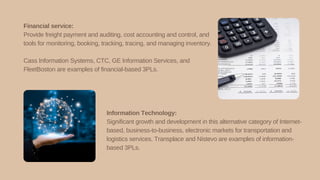
Information Technology:
Significant growth and development in this alternative category of Internet-
based, business-to-business, electronic markets for transportation and
logistics services. Transplace and Nistevo are examples of information-
based 3PLs.
Financial service:
Provide freight payment and auditing, cost accounting and control, and
tools for monitoring, booking, tracking, tracing, and managing inventory.
Cass Information Systems, CTC, GE Information Services, and
FleetBoston are examples of financial-based 3PLs.
Customer
(Retailer/ wholesaler)
Maxtruck
Transports
DeadForklift
Warehousing
Logveer
Solutions
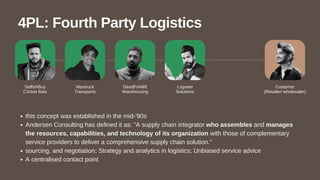
4PL: Fourth Party Logistics
this concept was established in the mid-'90s
Andersen Consulting has defined it as: "A supply chain integrator who assembles and manages
the resources, capabilities, and technology of its organization with those of complementary
service providers to deliver a comprehensive supply chain solution."
sourcing, and negotiation; Strategy and analytics in logistics; Unbiased service advice
A centralised contact point
SelfishBuy
Cricket Bats
1. Better Vendor Organization
A 4PL helps connect you with different logistics providers. That way, you don’t have to worry about the hassle of
talking to multiple partners. They’ll make sure everything runs smoothly between the 3PLs and you.
2. Solution-Oriented Process
4PLs come up with solutions that fit exactly what your business needs instead of relying on the existing
infrastructure of vendors. It’ll make it easier for you to meet the specific needs of your industry.
3. A Single View Of The Supply Chain
A 4PL will connect to multiple 3PLs and give you one view of important information like KPIs, inventory, order
status, shipment status, billing, and EDI. You’ll understand your supply chain better to adjust to market changes
quickly. Having this level of visibility also means you can meet customer demand quickly.
4. Advanced Technology
Fourth-party logistics providers have better technology. The goal of their technology is to ease communication
across the board and let you look at everything in real-time.
5. Higher Returns And Lower Expenses
You’ll likely save money using a 4PL because they’ll try and get you the lowest transportation rates possible.
Advantages of 4PL
1. Limited Control Over The Logistics Process
One drawback of using a 4PL is limited logistics and fulfillment process control. This is probably good if
you’re not an expert in this area. But it’s not a cheap option for smaller companies because their services will
be expensive.
2. Existing Prejudices Towards Other Companies
Some 3PLs may not like other companies that don’t rely on them, making it difficult for you to work in some
ways.
3. Limited Internal Capacity
Working with a 4PL will make it hard to go back to in-house logistics. You won’t have the experience, skills,
or ability to run your logistics.
4. Higher Costs
Hiring a 4PL can be expensive. They would handle the entire supply chain the same way an in-house team
would, which would be more expensive than other logistics management options
Disadvantages of 4PL
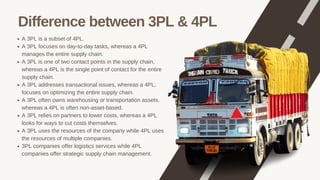
A 3PL is a subset of 4PL.
A 3PL focuses on day-to-day tasks, whereas a 4PL
manages the entire supply chain.
A 3PL is one of two contact points in the supply chain,
whereas a 4PL is the single point of contact for the entire
supply chain.
A 3PL addresses transactional issues, whereas a 4PL,
focuses on optimizing the entire supply chain.
A 3PL often owns warehousing or transportation assets,
whereas a 4PL is often non-asset-based.
A 3PL relies on partners to lower costs, whereas a 4PL
looks for ways to cut costs themselves.
A 3PL uses the resources of the company while 4PL uses
the resources of multiple companies.
3PL companies offer logistics services while 4PL
companies offer strategic supply chain management.
Difference between 3PL & 4PL
Examples of 3PL companies
Examples of 4PL companies
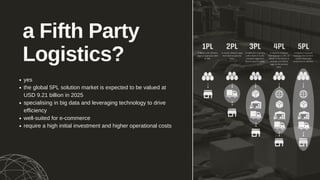
yes
the global 5PL solution market is expected to be valued at
USD 9.21 billion in 2025
specialising in big data and leveraging technology to drive
efficiency
well-suited for e-commerce
require a high initial investment and higher operational costs
a Fifth Party
Logistics?
Thankyou!
nothing else, all delivered

Third Party And Fourth Party Logistics.pdf

  • 2.
    4PL 2PL3P IPL Level oflogistics outsourcing nPL Party Logistics what does it mean? nahi, ye wala PL nahi
  • 3.
    SelfishBuy Cricket Bats Customer (Retailer/ wholesaler) 1PL:First Party Logistics in-house logistics Anyone having goods moved from their place of origin to their new place is considered to be first party logistics provider. only the manufacture or the producer, no other intermediaries
  • 4.
    Customer (Retailer/ wholesaler) Maxtruck Transports 2PL: SecondParty Logistics enters: an asset-based carrier, which actually owns the means of transportation. Typical 2PLs own, lease or charter their ships; airlines which own, lease or charter their planes and truck companies which own or lease their trucks Freight forwarders, shipping companies, and warehousing companies, as well as providers of a courier, express, and parcel services SelfishBuy Cricket Bats
  • 5.
    Customer (Retailer/ wholesaler) Maxtruck Transports DeadForklift Warehousing 3PL: ThirdParty Logistics came into picture during 1970s Outsourcing all or much of a companies logistics operations to a specialized company Forwarding of freight; Warehousing & distribution services, including inventory management & cross-docking Labelling and packaging; Clearance of Customs Returns can also be handled, and most importantly, invoices & payments are tracked. SelfishBuy Cricket Bats
  • 6.
    Types of 3PLproviders Transportation: Services extend beyond transportation to offer a comprehensive set of logistics offerings. Leveraged 3PLs use assets of other firms. Nonleveraged 3PLs use assets belonging solely to the parent firm. Ryder, Schneider Logistics, FedEx Logistics, and UPS Logistics are examples of 3PLs. Warehousing/Distribution: Many, but not all, have former warehouse and/or distribution experience. Transition to integrated logistics has been less complex than for the transportation based providers. DSC Logistics, USCO, Exel*, Caterpillar Logistics, and IBM are examples of warehouse/distribution-based 3PLs. * Exel regained their position as the world’s largest after an acquisition, recently purchased by DHL** 3PLs are external suppliers that perform all or part of a company’s logistics functions, including:
  • 7.
    Information Technology: Significant growthand development in this alternative category of Internet- based, business-to-business, electronic markets for transportation and logistics services. Transplace and Nistevo are examples of information- based 3PLs. Financial service: Provide freight payment and auditing, cost accounting and control, and tools for monitoring, booking, tracking, tracing, and managing inventory. Cass Information Systems, CTC, GE Information Services, and FleetBoston are examples of financial-based 3PLs.
  • 8.
    Customer (Retailer/ wholesaler) Maxtruck Transports DeadForklift Warehousing Logveer Solutions 4PL: FourthParty Logistics this concept was established in the mid-'90s Andersen Consulting has defined it as: "A supply chain integrator who assembles and manages the resources, capabilities, and technology of its organization with those of complementary service providers to deliver a comprehensive supply chain solution." sourcing, and negotiation; Strategy and analytics in logistics; Unbiased service advice A centralised contact point SelfishBuy Cricket Bats
  • 9.
    1. Better VendorOrganization A 4PL helps connect you with different logistics providers. That way, you don’t have to worry about the hassle of talking to multiple partners. They’ll make sure everything runs smoothly between the 3PLs and you. 2. Solution-Oriented Process 4PLs come up with solutions that fit exactly what your business needs instead of relying on the existing infrastructure of vendors. It’ll make it easier for you to meet the specific needs of your industry. 3. A Single View Of The Supply Chain A 4PL will connect to multiple 3PLs and give you one view of important information like KPIs, inventory, order status, shipment status, billing, and EDI. You’ll understand your supply chain better to adjust to market changes quickly. Having this level of visibility also means you can meet customer demand quickly. 4. Advanced Technology Fourth-party logistics providers have better technology. The goal of their technology is to ease communication across the board and let you look at everything in real-time. 5. Higher Returns And Lower Expenses You’ll likely save money using a 4PL because they’ll try and get you the lowest transportation rates possible. Advantages of 4PL
  • 10.
    1. Limited ControlOver The Logistics Process One drawback of using a 4PL is limited logistics and fulfillment process control. This is probably good if you’re not an expert in this area. But it’s not a cheap option for smaller companies because their services will be expensive. 2. Existing Prejudices Towards Other Companies Some 3PLs may not like other companies that don’t rely on them, making it difficult for you to work in some ways. 3. Limited Internal Capacity Working with a 4PL will make it hard to go back to in-house logistics. You won’t have the experience, skills, or ability to run your logistics. 4. Higher Costs Hiring a 4PL can be expensive. They would handle the entire supply chain the same way an in-house team would, which would be more expensive than other logistics management options Disadvantages of 4PL
  • 11.
    A 3PL isa subset of 4PL. A 3PL focuses on day-to-day tasks, whereas a 4PL manages the entire supply chain. A 3PL is one of two contact points in the supply chain, whereas a 4PL is the single point of contact for the entire supply chain. A 3PL addresses transactional issues, whereas a 4PL, focuses on optimizing the entire supply chain. A 3PL often owns warehousing or transportation assets, whereas a 4PL is often non-asset-based. A 3PL relies on partners to lower costs, whereas a 4PL looks for ways to cut costs themselves. A 3PL uses the resources of the company while 4PL uses the resources of multiple companies. 3PL companies offer logistics services while 4PL companies offer strategic supply chain management. Difference between 3PL & 4PL
  • 12.
    Examples of 3PLcompanies Examples of 4PL companies
  • 13.
    yes the global 5PLsolution market is expected to be valued at USD 9.21 billion in 2025 specialising in big data and leveraging technology to drive efficiency well-suited for e-commerce require a high initial investment and higher operational costs a Fifth Party Logistics?
  • 14.