Dr GAURAV SAXENA
SeniorTeaching Faculty ( Assoc Prof) &
HEAD OF DEPT. PHYSIOTHERAPY
M.L.B. PARAMEDICAL COLLEGE, JHANSI
Department of Physiotherapy
M.L.B Paramedical Training
College Jhansi
 Myology is a division of Anatomy which deals with the study of
Muscles and Muscular system
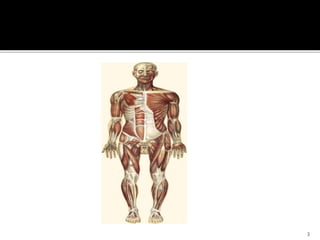
 Muscular system is a system which consist of all type of muscles
present in human body
 Main function of Muscle is to contract and produce movement ,
Maintenance of Posture and Helps in Blood Circulation
 Muscles provide strength, balance, posture, movement and heat
for the body to keep warm
Muscle is a band or bundle of contractile fibrous tissue in a human
or animal body that has the ability to contract, producing
movement in or maintaining the position of parts of the body.
2
3
 According to control
 Voluntary Muscles
▪ Which contracts with in voluntary control of human
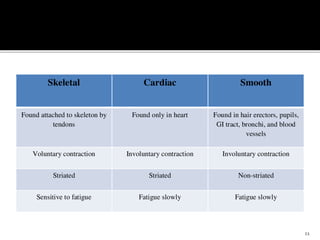
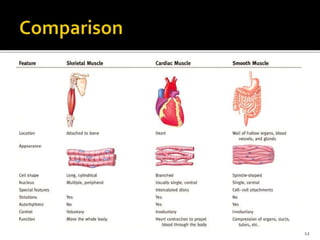
▪ Ex- Skeletal muscles- Biceps ,Triceps
 Involuntary
▪ Which contract outside the voluntary control of Human
body
▪ Cardiac, Intestinal Muscles etc
4
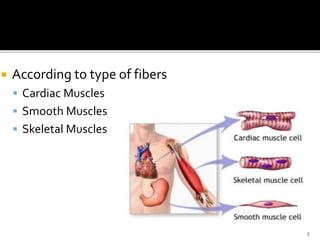
 According to type of fibers
 Cardiac Muscles
 Smooth Muscles
 Skeletal Muscles
5
 Located in and Around cardiac system only (Myocardium)
 Work in all or none law principle
 Works through out life with out tiring ( Birth to death)
 Contains sarcoplasm
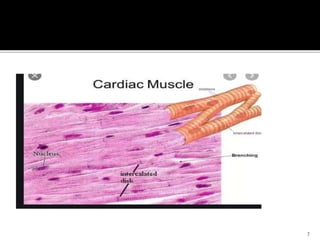
 Cardiac Muscle Characteristics:
 Involuntary control
 Striations
 Multinucleated
 Branched
 Speed of contraction:Variable
6
7
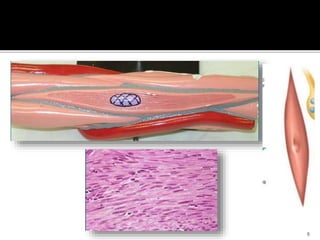
 Present in and around vicesra
 Trachea
 Intestine
 BloodVessles
 Smooth Muscle Characteristics
▪ Involuntary control
▪ Non Striate
▪ Uninucleated
▪ Spindle-shaped
▪ Speed of Contraction: slow and sustained; does not develop
an oxygen debt
8
9
 Located in and around Bones, Joints
 Provide support to Skeletal system
 Striate
 Voluntary
 Over 600 skeletal muscle in body
 40-50 % of total body weight
10
11
12
Skeletal muscle or “voluntary muscle” is anchored by
tendons (or by aponeuroses at a few places) to bone
and is used to effect skeletal movement such as
locomotion and in maintaining posture
 They are responsible for force production and
movement of limbs and axial skeleton,
maintaining body posture
 Work under voluntary control of human
13
 Accounts for at least 40% of body mass
 An average adult male is made up of 42% of skeletal
muscle
 An average adult female is made up of 36% of skeletal
muscles
 There are about 640 skeletal muscles in human boy
14
15
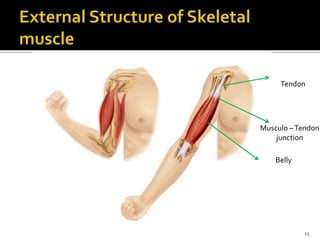
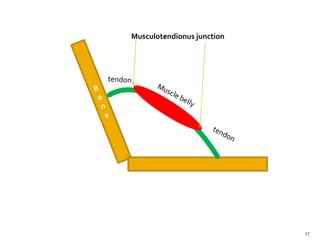
Tendon
Belly
Musculo –Tendon
junction
 Muscle Belly
 Central belly part , responsible for contrition
 Tendon
 Part which attaches a muscle to a bone
 02 in number , one proximal , one distal
 Musculo-Tendious junction
 Junction of Muscle Belly to tendon
 02 in number , one proximal , one distal
Musculotendionus junction
17
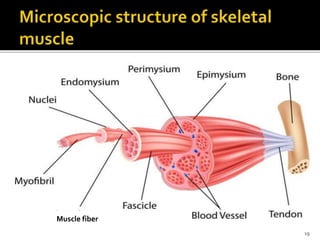
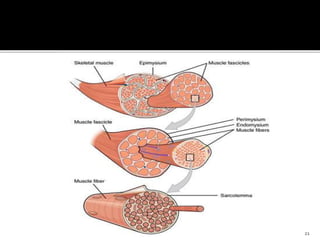
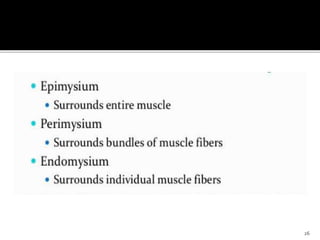
 There are multiple layer present in a muscle
 Epi-mycium Outer most layer
 Peri-mycium Middle Layer
 Endo-mycium Inner most layer
18
19
Muscle fiber
20
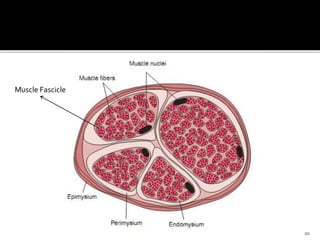
Muscle Fascicle
21
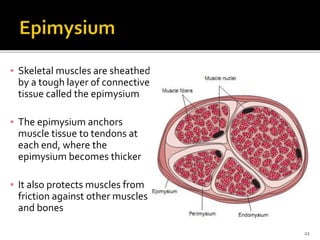
▪ Skeletal muscles are sheathed
by a tough layer of connective
tissue called the epimysium
▪ The epimysium anchors
muscle tissue to tendons at
each end, where the
epimysium becomes thicker
▪ It also protects muscles from
friction against other muscles
and bones
22
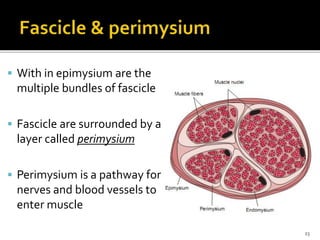
 With in epimysium are the
multiple bundles of fascicle
 Fascicle are surrounded by a
layer called perimysium
 Perimysium is a pathway for
nerves and blood vessels to
enter muscle
23
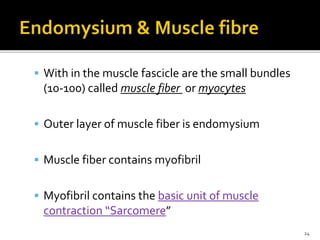
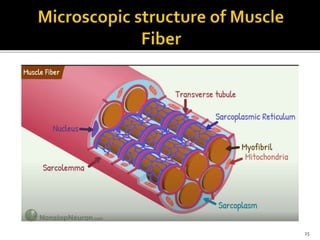
 With in the muscle fascicle are the small bundles
(10-100) called muscle fiber or myocytes
 Outer layer of muscle fiber is endomysium
 Muscle fiber contains myofibril
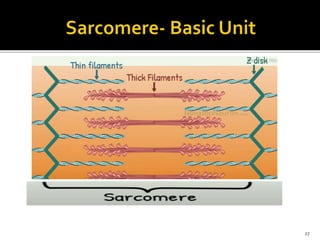
 Myofibril contains the basic unit of muscle
contraction “Sarcomere”
24
25
26
27
28
29
30
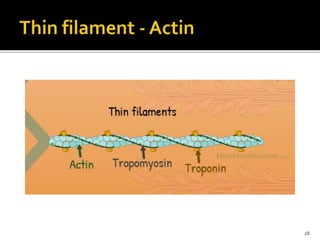
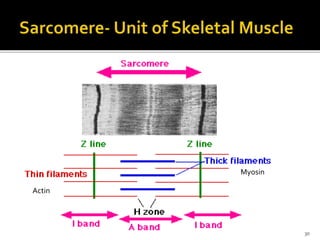
Actin
Myosin
31
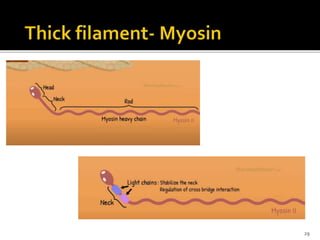
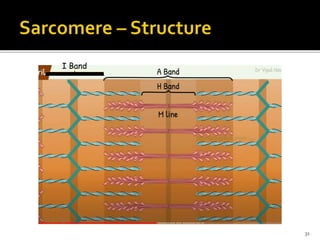
I Band
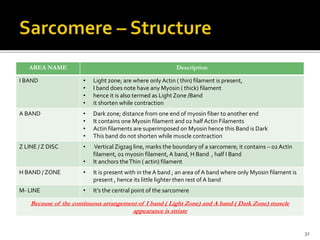
AREA NAME Description
I BAND • Light zone; are where only Actin ( thin) filament is present,
• I band does note have any Myosin ( thick) filament
• hence it is also termed as Light Zone /Band
• it shorten while contraction
A BAND • Dark zone; distance from one end of myosin fiber to another end
• It contains one Myosin filament and 02 half Actin Filaments
• Actin filaments are superimposed on Myosin hence this Band is Dark
• This band do not shorten while muscle contraction
Z LINE / Z DISC • Vertical Zigzag line, marks the boundary of a sarcomere; it contains – 02Actin
filament, 01 myosin filament, A band, H Band , half I Band
• It anchors theThin ( actin) filament
H BAND / ZONE • It is present with in theA band ; an area of A band where only Myosin filament is
present , hence its little lighter then rest of A band
M- LINE • It’s the central point of the sarcomere
Because of the continuous arrangement of I band ( Light Zone) and A band ( Dark Zone) muscle
appearance is striate
32
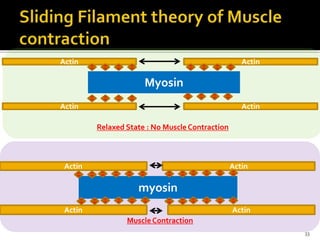
Relaxed State : No Muscle Contraction
Muscle Contraction
33
Actin
myosin
Actin
Actin
Actin
Actin
Myosin
Actin
Actin
Actin
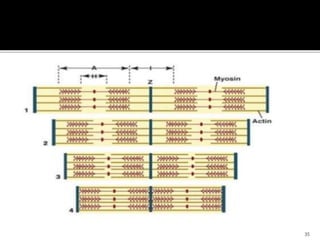
 force is Produced when actin filaments slide
past the myosin filaments, resulting in
contraction of an individual sarcomere.
 Creation of Actin Myosin Cross bridges
34
35
 Contractility
 Ability to contract ( reduce length )
 Elasticity
 Ability to regain Resting length after contraction , and to
stretch beyond resting length
 Excursion
 Ability of a Skeletal muscle to lengthen
 Irritability
 Ability of a muscle to respond to a stimuli ( Pain, Heat and
Cold, etc)
36
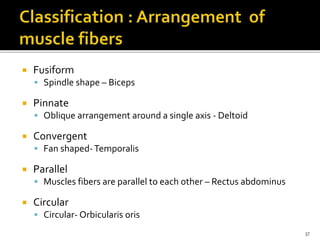
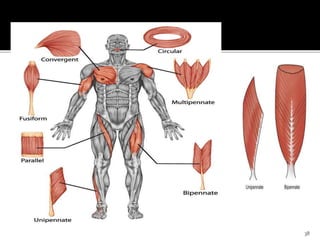
 Fusiform
 Spindle shape – Biceps
 Pinnate
 Oblique arrangement around a single axis - Deltoid
 Convergent
 Fan shaped-Temporalis
 Parallel
 Muscles fibers are parallel to each other – Rectus abdominus
 Circular
 Circular- Orbicularis oris
37
38

3. General Myology.pptx

  • 1.
    Dr GAURAV SAXENA SeniorTeachingFaculty ( Assoc Prof) & HEAD OF DEPT. PHYSIOTHERAPY M.L.B. PARAMEDICAL COLLEGE, JHANSI Department of Physiotherapy M.L.B Paramedical Training College Jhansi
  • 2.
     Myology isa division of Anatomy which deals with the study of Muscles and Muscular system  Muscular system is a system which consist of all type of muscles present in human body  Main function of Muscle is to contract and produce movement , Maintenance of Posture and Helps in Blood Circulation  Muscles provide strength, balance, posture, movement and heat for the body to keep warm Muscle is a band or bundle of contractile fibrous tissue in a human or animal body that has the ability to contract, producing movement in or maintaining the position of parts of the body. 2
  • 3.
  • 4.
     According tocontrol  Voluntary Muscles ▪ Which contracts with in voluntary control of human ▪ Ex- Skeletal muscles- Biceps ,Triceps  Involuntary ▪ Which contract outside the voluntary control of Human body ▪ Cardiac, Intestinal Muscles etc 4
  • 5.
     According totype of fibers  Cardiac Muscles  Smooth Muscles  Skeletal Muscles 5
  • 6.
     Located inand Around cardiac system only (Myocardium)  Work in all or none law principle  Works through out life with out tiring ( Birth to death)  Contains sarcoplasm  Cardiac Muscle Characteristics:  Involuntary control  Striations  Multinucleated  Branched  Speed of contraction:Variable 6
  • 7.
  • 8.
     Present inand around vicesra  Trachea  Intestine  BloodVessles  Smooth Muscle Characteristics ▪ Involuntary control ▪ Non Striate ▪ Uninucleated ▪ Spindle-shaped ▪ Speed of Contraction: slow and sustained; does not develop an oxygen debt 8
  • 9.
  • 10.
     Located inand around Bones, Joints  Provide support to Skeletal system  Striate  Voluntary  Over 600 skeletal muscle in body  40-50 % of total body weight 10
  • 11.
  • 12.
  • 13.
    Skeletal muscle or“voluntary muscle” is anchored by tendons (or by aponeuroses at a few places) to bone and is used to effect skeletal movement such as locomotion and in maintaining posture  They are responsible for force production and movement of limbs and axial skeleton, maintaining body posture  Work under voluntary control of human 13
  • 14.
     Accounts forat least 40% of body mass  An average adult male is made up of 42% of skeletal muscle  An average adult female is made up of 36% of skeletal muscles  There are about 640 skeletal muscles in human boy 14
  • 15.
  • 16.
     Muscle Belly Central belly part , responsible for contrition  Tendon  Part which attaches a muscle to a bone  02 in number , one proximal , one distal  Musculo-Tendious junction  Junction of Muscle Belly to tendon  02 in number , one proximal , one distal
  • 17.
  • 18.
     There aremultiple layer present in a muscle  Epi-mycium Outer most layer  Peri-mycium Middle Layer  Endo-mycium Inner most layer 18
  • 19.
  • 20.
  • 21.
  • 22.
    ▪ Skeletal musclesare sheathed by a tough layer of connective tissue called the epimysium ▪ The epimysium anchors muscle tissue to tendons at each end, where the epimysium becomes thicker ▪ It also protects muscles from friction against other muscles and bones 22
  • 23.
     With inepimysium are the multiple bundles of fascicle  Fascicle are surrounded by a layer called perimysium  Perimysium is a pathway for nerves and blood vessels to enter muscle 23
  • 24.
     With inthe muscle fascicle are the small bundles (10-100) called muscle fiber or myocytes  Outer layer of muscle fiber is endomysium  Muscle fiber contains myofibril  Myofibril contains the basic unit of muscle contraction “Sarcomere” 24
  • 25.
  • 26.
  • 27.
  • 28.
  • 29.
  • 30.
  • 31.
  • 32.
    AREA NAME Description IBAND • Light zone; are where only Actin ( thin) filament is present, • I band does note have any Myosin ( thick) filament • hence it is also termed as Light Zone /Band • it shorten while contraction A BAND • Dark zone; distance from one end of myosin fiber to another end • It contains one Myosin filament and 02 half Actin Filaments • Actin filaments are superimposed on Myosin hence this Band is Dark • This band do not shorten while muscle contraction Z LINE / Z DISC • Vertical Zigzag line, marks the boundary of a sarcomere; it contains – 02Actin filament, 01 myosin filament, A band, H Band , half I Band • It anchors theThin ( actin) filament H BAND / ZONE • It is present with in theA band ; an area of A band where only Myosin filament is present , hence its little lighter then rest of A band M- LINE • It’s the central point of the sarcomere Because of the continuous arrangement of I band ( Light Zone) and A band ( Dark Zone) muscle appearance is striate 32
  • 33.
    Relaxed State :No Muscle Contraction Muscle Contraction 33 Actin myosin Actin Actin Actin Actin Myosin Actin Actin Actin
  • 34.
     force isProduced when actin filaments slide past the myosin filaments, resulting in contraction of an individual sarcomere.  Creation of Actin Myosin Cross bridges 34
  • 35.
  • 36.
     Contractility  Abilityto contract ( reduce length )  Elasticity  Ability to regain Resting length after contraction , and to stretch beyond resting length  Excursion  Ability of a Skeletal muscle to lengthen  Irritability  Ability of a muscle to respond to a stimuli ( Pain, Heat and Cold, etc) 36
  • 37.
     Fusiform  Spindleshape – Biceps  Pinnate  Oblique arrangement around a single axis - Deltoid  Convergent  Fan shaped-Temporalis  Parallel  Muscles fibers are parallel to each other – Rectus abdominus  Circular  Circular- Orbicularis oris 37
  • 38.