AFRICA RESOURCES
INVESTMENT CONGRESS
Transparency in the Extractive Industries: New
Disclosure Rules for Publicly Listed Companies
Giulio Carini – Global Witness


IRONMONGERS’ HALL, CITY OF LONDON ● TUESDAY-WEDNESDAY, 14-15 JUN 2011
www.ObjectiveCapitalConferences.com
Transparency in the Extractive
 Industries: New Disclosure Rules
   for Publicly Listed Companies
June 14, 2011

www.globalwitness.org
www.publishwhatyoupay.org

                            global witness
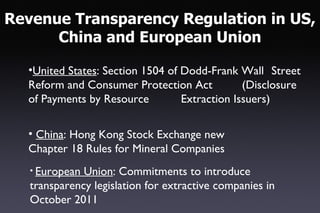
Revenue Transparency Regulation in US,
      China and European Union

  •United States: Section 1504 of Dodd-Frank Wall Street
  Reform and Consumer Protection Act           (Disclosure
  of Payments by Resource         Extraction Issuers)

  • China: Hong Kong Stock Exchange new
  Chapter 18 Rules for Mineral Companies
   • European Union: Commitments to introduce
   transparency legislation for extractive companies in
   October 2011
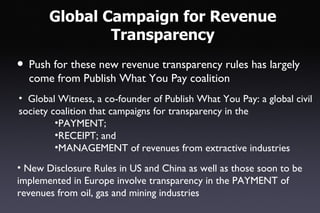
Global Campaign for Revenue
               Transparency
• Push for these new revenue transparency rules has largely
  come from Publish What You Pay coalition
• Global Witness, a co-founder of Publish What You Pay: a global civil
society coalition that campaigns for transparency in the
         •PAYMENT;
         •RECEIPT; and
         •MANAGEMENT of revenues from extractive industries
• New Disclosure Rules in US and China as well as those soon to be
implemented in Europe involve transparency in the PAYMENT of
revenues from oil, gas and mining industries
What Problems is Revenue
         Transparency Addressing?

•   Mismanagement and Misuse of Natural Resources: Oil, gas and
    mineral resources generate great wealth, but if poorly managed
    extractive revenues can also undermine economic growth and
    heighten corruption
•   The Resource Curse: many developing countries are rich in
    natural resources, but as a result of mismanagement and misuse
    of revenues received from these resources, these countries are
        •
    often mired in abject poverty and political instability
•   Lack of Transparency affects companies and investors as
    well: resulting poverty, instability and weakened rule of law
    are not only bad for local people, they can also damage
    company reputations and generate lower return for investors
Prime example of Resource Curse:
               Nigeria
•   Even though Nigeria is the world’s seventh-largest oil producer and Africa’s largest oil
    exporter, more than 50 percent of the population live on less than $1 a day.
•   Basic public services in Nigeria remain extremely poor, infrastructure is in bad shape
    and a country with huge energy reserves is subject to frequent power outages
    because of under-investment in its electricity grid.
•   Within Nigeria, this failure of development is widely blamed on misappropriation of
    public funds and assets by corrupt politicians.
      •   The Transparency International Corruptions Perceptions Index from 2010 ranks
          Nigeria as 134 out of 178 countries in its corruption scale.

•   The systemic looting of public funds in Nigeria has provided fodder for a violent
    insurrection. This conflict has provided a mask for organised extortion and theft of oil
    on an industrial scale and led to frequent guerrilla attacks on oil companies. Shell
    claimed in July 2009 that Nigeria had lost a staggering US$47 billion which the
    company would otherwise have paid in revenues, because these armed attacks had
    forced Shell to cut back its oil production
What is the Ultimate Aim of
          Revenue Transparency?
•   Extractive companies should disclose what they pay (PAYMENT) and
    governments should disclose their receipts of such natural resource revenues
    (RECEIPT)

•   Governments should publish their budgets so that civil society knows how natural
    resource revenues are spent (MANAGEMENT)

•   As a result, members of civil society in resource-rich countries will be able to
    compare the two sets of data and hold their government accountable for the
        •
    management of this valuable source of income.

•   Investors can judge whether extractive companies payments are appropriate for
    the resources gained and whether the government and companies are participating
    in a fair deal

•   Protect companies from allegations of complicity with corrupt governmental
    practices.
International Initiative for
          Revenue Transparency of
           Payments and Receipts
•   Extractive Industry Transparency Initiative (EITI), voluntary
    initiative launched by Tony Blair in 2002 in response to Publish
    What You Pay

•   Involves multi-stakeholder group compromised of governments,
    private sector companies, investors and investor groups to
    promote the public reporting of extractive industry payments and
        •
    receipts

•   Both governments and private and public companies disclose
    payment data, which allow civil society to compare data

•   Problem with EITI: Voluntary approach and reliability of data
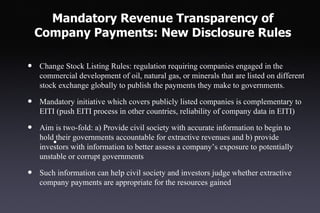
Mandatory Revenue Transparency of
    Company Payments: New Disclosure Rules

•   Change Stock Listing Rules: regulation requiring companies engaged in the
    commercial development of oil, natural gas, or minerals that are listed on different
    stock exchange globally to publish the payments they make to governments.

•   Mandatory initiative which covers publicly listed companies is complementary to
    EITI (push EITI process in other countries, reliability of company data in EITI)

•   Aim is two-fold: a) Provide civil society with accurate information to begin to
    hold their governments accountable for extractive revenues and b) provide
        • with information to better assess a company’s exposure to potentially
    investors
    unstable or corrupt governments

•   Such information can help civil society and investors judge whether extractive
    company payments are appropriate for the resources gained
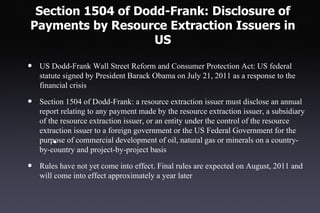
Section 1504 of Dodd-Frank: Disclosure of
Payments by Resource Extraction Issuers in
                    US

•   US Dodd-Frank Wall Street Reform and Consumer Protection Act: US federal
    statute signed by President Barack Obama on July 21, 2011 as a response to the
    financial crisis

•   Section 1504 of Dodd-Frank: a resource extraction issuer must disclose an annual
    report relating to any payment made by the resource extraction issuer, a subsidiary
    of the resource extraction issuer, or an entity under the control of the resource
    extraction issuer to a foreign government or the US Federal Government for the
    purpose of commercial development of oil, natural gas or minerals on a country-
         •
    by-country and project-by-project basis

•   Rules have not yet come into effect. Final rules are expected on August, 2011 and
    will come into effect approximately a year later
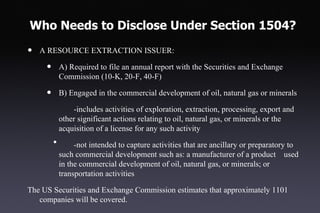
Who Needs to Disclose Under Section 1504?

•   A RESOURCE EXTRACTION ISSUER:

     •       A) Required to file an annual report with the Securities and Exchange
             Commission (10-K, 20-F, 40-F)

     •       B) Engaged in the commercial development of oil, natural gas or minerals

                 -includes activities of exploration, extraction, processing, export and
             other significant actions relating to oil, natural gas, or minerals or the
             acquisition of a license for any such activity
         •        -not intended to capture activities that are ancillary or preparatory to
             such commercial development such as: a manufacturer of a product used
             in the commercial development of oil, natural gas, or minerals; or
             transportation activities

The US Securities and Exchange Commission estimates that approximately 1101
   companies will be covered.
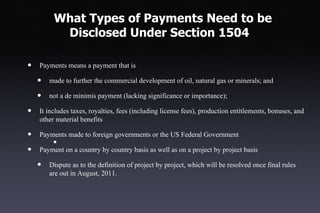
What Types of Payments Need to be
          Disclosed Under Section 1504

•   Payments means a payment that is

    •   made to further the commercial development of oil, natural gas or minerals; and

    •   not a de minimis payment (lacking significance or importance);

•   It includes taxes, royalties, fees (including license fees), production entitlements, bonuses, and
    other material benefits

•   Payments made to foreign governments or the US Federal Government
         •
•   Payment on a country by country basis as well as on a project by project basis

    •   Dispute as to the definition of project by project, which will be resolved once final rules
        are out in August, 2011.
What are the Costs for Companies as a
           Result of Section 1504?

•   Costs include costs related to tracking and collecting information about
    different types of payments across projects, governments, countries,
    subsidiaries and other controlled entities.

•   These tracking and collecting costs would vary depending upon how an
    issuer would need to modify its existing systems to track, collect, and
    report the proposed payment information.
Hong Kong Stock Exchange: new Chapter 18
      Rules for Mineral Companies

•   Disclosure Rule in effect on 3 June 2010 (no retrospective effect)

•   Newly applicant mineral companies will have to disclose payments made to host
    country governments.

•   Similar to Dodd-Frank as it cover payments in respect of tax, royalties and other
    significant payments

•   Differs from Section 1504 Dodd-Frank as it only covers payments on a country by
        •
    country basis and not on a project by project basis

•   Under Chapter 18 Rules, a Mineral Company must include not only in its annual
    report but also in its interim (half-yearly) reports details of its exploration,
    development and mining production activities and a summary of expenditure
    incurred on these activities during the period under review.
Who Needs to Disclose under Chapter 18 of
       Hong Kong Listing Rules?

•   Mineral Companies

    •   Mineral companies are those whose major activity (25 per cent
        or more of assets, revenue or operating expenses) is the
        exploration for and/or extraction of natural resources.

    •   Natural resources include various minerals, petroleum, and
        natural gas

•   Listed issuers that complete a major acquisition of natural
    resource assets will also be classified as mineral companies.
Are Mandatory Transparency Rules Coming
    for Companies Trading in EU stock
              Exchanges?

 • European Union has made a commitment to enact similar
 payment disclosure requirements

 •Most recently, President of the European Commission, José
 Manuel Barroso said :“The European Commission will table
 legislative proposals in October, which includes the obligation
 for companies to publish information about their activities.
 We do this in support of the Extractive Industries
 Transparency Initiative, which helps Africans increase their
 fiscal resources available to deliver public goods and services
 for their citizens.”
What’s the Next Step for Revenue
              Transparency?

• Stock listing requirements to oblige extractive companies to
disclose the payments they make to governments are only a
first step in checking corruption and mismanagement of
natural resources

•More is needed such as:
  •Expand EITI to cover more countries
  •Budget transparency: full disclosure of all relevant fiscal
  information in a timely and systemic manner to ensure that
  civil society knows how and where the funds from natural
  resources are spent

Transparency in the extractive industries

  • 1.
    AFRICA RESOURCES INVESTMENT CONGRESS Transparencyin the Extractive Industries: New Disclosure Rules for Publicly Listed Companies Giulio Carini – Global Witness IRONMONGERS’ HALL, CITY OF LONDON ● TUESDAY-WEDNESDAY, 14-15 JUN 2011 www.ObjectiveCapitalConferences.com
  • 2.
    Transparency in theExtractive Industries: New Disclosure Rules for Publicly Listed Companies June 14, 2011 www.globalwitness.org www.publishwhatyoupay.org global witness
  • 3.
    Revenue Transparency Regulationin US, China and European Union •United States: Section 1504 of Dodd-Frank Wall Street Reform and Consumer Protection Act (Disclosure of Payments by Resource Extraction Issuers) • China: Hong Kong Stock Exchange new Chapter 18 Rules for Mineral Companies • European Union: Commitments to introduce transparency legislation for extractive companies in October 2011
  • 4.
    Global Campaign forRevenue Transparency • Push for these new revenue transparency rules has largely come from Publish What You Pay coalition • Global Witness, a co-founder of Publish What You Pay: a global civil society coalition that campaigns for transparency in the •PAYMENT; •RECEIPT; and •MANAGEMENT of revenues from extractive industries • New Disclosure Rules in US and China as well as those soon to be implemented in Europe involve transparency in the PAYMENT of revenues from oil, gas and mining industries
  • 5.
    What Problems isRevenue Transparency Addressing? • Mismanagement and Misuse of Natural Resources: Oil, gas and mineral resources generate great wealth, but if poorly managed extractive revenues can also undermine economic growth and heighten corruption • The Resource Curse: many developing countries are rich in natural resources, but as a result of mismanagement and misuse of revenues received from these resources, these countries are • often mired in abject poverty and political instability • Lack of Transparency affects companies and investors as well: resulting poverty, instability and weakened rule of law are not only bad for local people, they can also damage company reputations and generate lower return for investors
  • 6.
    Prime example ofResource Curse: Nigeria • Even though Nigeria is the world’s seventh-largest oil producer and Africa’s largest oil exporter, more than 50 percent of the population live on less than $1 a day. • Basic public services in Nigeria remain extremely poor, infrastructure is in bad shape and a country with huge energy reserves is subject to frequent power outages because of under-investment in its electricity grid. • Within Nigeria, this failure of development is widely blamed on misappropriation of public funds and assets by corrupt politicians. • The Transparency International Corruptions Perceptions Index from 2010 ranks Nigeria as 134 out of 178 countries in its corruption scale. • The systemic looting of public funds in Nigeria has provided fodder for a violent insurrection. This conflict has provided a mask for organised extortion and theft of oil on an industrial scale and led to frequent guerrilla attacks on oil companies. Shell claimed in July 2009 that Nigeria had lost a staggering US$47 billion which the company would otherwise have paid in revenues, because these armed attacks had forced Shell to cut back its oil production
  • 7.
    What is theUltimate Aim of Revenue Transparency? • Extractive companies should disclose what they pay (PAYMENT) and governments should disclose their receipts of such natural resource revenues (RECEIPT) • Governments should publish their budgets so that civil society knows how natural resource revenues are spent (MANAGEMENT) • As a result, members of civil society in resource-rich countries will be able to compare the two sets of data and hold their government accountable for the • management of this valuable source of income. • Investors can judge whether extractive companies payments are appropriate for the resources gained and whether the government and companies are participating in a fair deal • Protect companies from allegations of complicity with corrupt governmental practices.
  • 8.
    International Initiative for Revenue Transparency of Payments and Receipts • Extractive Industry Transparency Initiative (EITI), voluntary initiative launched by Tony Blair in 2002 in response to Publish What You Pay • Involves multi-stakeholder group compromised of governments, private sector companies, investors and investor groups to promote the public reporting of extractive industry payments and • receipts • Both governments and private and public companies disclose payment data, which allow civil society to compare data • Problem with EITI: Voluntary approach and reliability of data
  • 9.
    Mandatory Revenue Transparencyof Company Payments: New Disclosure Rules • Change Stock Listing Rules: regulation requiring companies engaged in the commercial development of oil, natural gas, or minerals that are listed on different stock exchange globally to publish the payments they make to governments. • Mandatory initiative which covers publicly listed companies is complementary to EITI (push EITI process in other countries, reliability of company data in EITI) • Aim is two-fold: a) Provide civil society with accurate information to begin to hold their governments accountable for extractive revenues and b) provide • with information to better assess a company’s exposure to potentially investors unstable or corrupt governments • Such information can help civil society and investors judge whether extractive company payments are appropriate for the resources gained
  • 10.
    Section 1504 ofDodd-Frank: Disclosure of Payments by Resource Extraction Issuers in US • US Dodd-Frank Wall Street Reform and Consumer Protection Act: US federal statute signed by President Barack Obama on July 21, 2011 as a response to the financial crisis • Section 1504 of Dodd-Frank: a resource extraction issuer must disclose an annual report relating to any payment made by the resource extraction issuer, a subsidiary of the resource extraction issuer, or an entity under the control of the resource extraction issuer to a foreign government or the US Federal Government for the purpose of commercial development of oil, natural gas or minerals on a country- • by-country and project-by-project basis • Rules have not yet come into effect. Final rules are expected on August, 2011 and will come into effect approximately a year later
  • 11.
    Who Needs toDisclose Under Section 1504? • A RESOURCE EXTRACTION ISSUER: • A) Required to file an annual report with the Securities and Exchange Commission (10-K, 20-F, 40-F) • B) Engaged in the commercial development of oil, natural gas or minerals -includes activities of exploration, extraction, processing, export and other significant actions relating to oil, natural gas, or minerals or the acquisition of a license for any such activity • -not intended to capture activities that are ancillary or preparatory to such commercial development such as: a manufacturer of a product used in the commercial development of oil, natural gas, or minerals; or transportation activities The US Securities and Exchange Commission estimates that approximately 1101 companies will be covered.
  • 12.
    What Types ofPayments Need to be Disclosed Under Section 1504 • Payments means a payment that is • made to further the commercial development of oil, natural gas or minerals; and • not a de minimis payment (lacking significance or importance); • It includes taxes, royalties, fees (including license fees), production entitlements, bonuses, and other material benefits • Payments made to foreign governments or the US Federal Government • • Payment on a country by country basis as well as on a project by project basis • Dispute as to the definition of project by project, which will be resolved once final rules are out in August, 2011.
  • 13.
    What are theCosts for Companies as a Result of Section 1504? • Costs include costs related to tracking and collecting information about different types of payments across projects, governments, countries, subsidiaries and other controlled entities. • These tracking and collecting costs would vary depending upon how an issuer would need to modify its existing systems to track, collect, and report the proposed payment information.
  • 14.
    Hong Kong StockExchange: new Chapter 18 Rules for Mineral Companies • Disclosure Rule in effect on 3 June 2010 (no retrospective effect) • Newly applicant mineral companies will have to disclose payments made to host country governments. • Similar to Dodd-Frank as it cover payments in respect of tax, royalties and other significant payments • Differs from Section 1504 Dodd-Frank as it only covers payments on a country by • country basis and not on a project by project basis • Under Chapter 18 Rules, a Mineral Company must include not only in its annual report but also in its interim (half-yearly) reports details of its exploration, development and mining production activities and a summary of expenditure incurred on these activities during the period under review.
  • 15.
    Who Needs toDisclose under Chapter 18 of Hong Kong Listing Rules? • Mineral Companies • Mineral companies are those whose major activity (25 per cent or more of assets, revenue or operating expenses) is the exploration for and/or extraction of natural resources. • Natural resources include various minerals, petroleum, and natural gas • Listed issuers that complete a major acquisition of natural resource assets will also be classified as mineral companies.
  • 16.
    Are Mandatory TransparencyRules Coming for Companies Trading in EU stock Exchanges? • European Union has made a commitment to enact similar payment disclosure requirements •Most recently, President of the European Commission, José Manuel Barroso said :“The European Commission will table legislative proposals in October, which includes the obligation for companies to publish information about their activities. We do this in support of the Extractive Industries Transparency Initiative, which helps Africans increase their fiscal resources available to deliver public goods and services for their citizens.”
  • 17.
    What’s the NextStep for Revenue Transparency? • Stock listing requirements to oblige extractive companies to disclose the payments they make to governments are only a first step in checking corruption and mismanagement of natural resources •More is needed such as: •Expand EITI to cover more countries •Budget transparency: full disclosure of all relevant fiscal information in a timely and systemic manner to ensure that civil society knows how and where the funds from natural resources are spent