Risk management
 mengidentifikasi risiko
 menyusun rencana untuk meminimalkan efeknya pada
sebuah proyek.
2
Risk management…
Risiko adalah probabilitas bahwa beberapa
keadaan buruk akan terjadi
 Risiko proyek mempengaruhi jadwal atau sumber daya
 Risiko produk mempengaruhi kualitas atau kinerja dari
perangkat lunak yang dikembangkan
 Risiko usaha mempengaruhi organisasi
mengembangkan atau mengadakan software.
3
Example: Software risks
4
Risk Affects Description
Staff turnover Project Experienced staff will leave the
project before it is finished.
Management
change
Project There will be a change of
organisational management with
different priorities.
Hardware
unavailability
Project Hardware that is essential for the
project will not be delivered on
schedule.
Requirements
change
Project
and
product
There will be a larger number of
changes to the requirements than
anticipated.
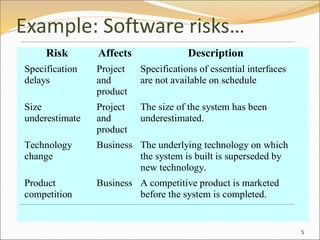
Example: Software risks…
5
Risk Affects Description
Specification
delays
Project
and
product
Specifications of essential interfaces
are not available on schedule
Size
underestimate
Project
and
product
The size of the system has been
underestimated.
Technology
change
Business The underlying technology on which
the system is built is superseded by
new technology.
Product
competition
Business A competitive product is marketed
before the system is completed.
The risk management process
 Risk identification
 Mengidentifikasi proyek, produk, dan risiko bisnis
 Risk analysis
 Menilai kemungkinan dan konsekuensi dari risiko
 Risk planning
 Buatlah rencana untuk menghindari atau meminimalkan
dampak risiko
 Risk monitoring
 Memantau risiko seluruh proyek
6
The risk management process
7
Risk identification
 Technology risks.
 People risks.
 Organisational risks.
 Requirements risks.
 Estimation risks.
8
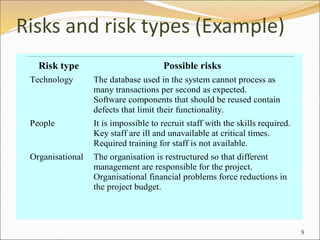
Risks and risk types (Example)
9
Risk type Possible risks
Technology The database used in the system cannot process as
many transactions per second as expected.
Software components that should be reused contain
defects that limit their functionality.
People It is impossible to recruit staff with the skills required.
Key staff are ill and unavailable at critical times.
Required training for staff is not available.
Organisational The organisation is restructured so that different
management are responsible for the project.
Organisational financial problems force reductions in
the project budget.
Risks and risk types… (Example)
10
Risk type Possible risks
Requirements Changes to requirements that require major design
rework are proposed.
Customers fail to understand the impact of
requirements changes.
Estimation The time required to develop the software is
underestimated.
The rate of defect repair is underestimated.
The size of the software is underestimated.
Risk analysis
 Menilai probabilitas dan keseriusan dari masing-
masing risiko.
 Probabilitas mungkin sangat rendah, rendah, sedang,
tinggi, atau sangat tinggi.
 Mungkin efek risiko bencana, serius, diterima atau
tidak signifikan.
11
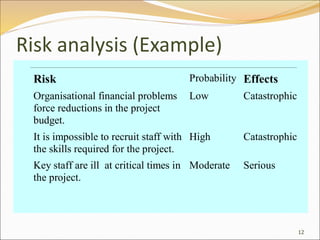
Risk analysis (Example)
12
Risk Probability Effects
Organisational financial problems
force reductions in the project
budget.
Low Catastrophic
It is impossible to recruit staff with
the skills required for the project.
High Catastrophic
Key staff are ill at critical times in
the project.
Moderate Serious
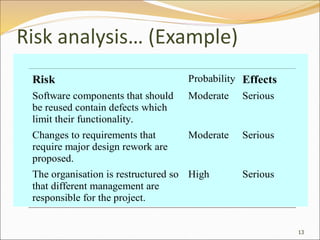
Risk analysis… (Example)
13
Risk Probability Effects
Software components that should
be reused contain defects which
limit their functionality.
Moderate Serious
Changes to requirements that
require major design rework are
proposed.
Moderate Serious
The organisation is restructured so
that different management are
responsible for the project.
High Serious
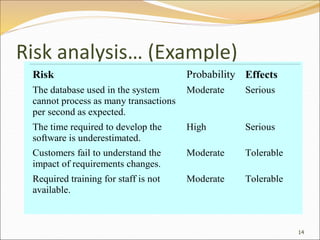
Risk analysis… (Example)
14
Risk Probability Effects
The database used in the system
cannot process as many transactions
per second as expected.
Moderate Serious
The time required to develop the
software is underestimated.
High Serious
Customers fail to understand the
impact of requirements changes.
Moderate Tolerable
Required training for staff is not
available.
Moderate Tolerable
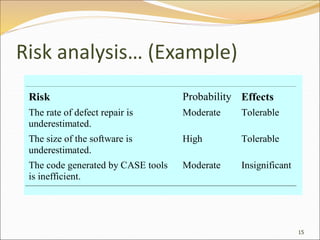
Risk analysis… (Example)
15
Risk Probability Effects
The rate of defect repair is
underestimated.
Moderate Tolerable
The size of the software is
underestimated.
High Tolerable
The code generated by CASE tools
is inefficient.
Moderate Insignificant
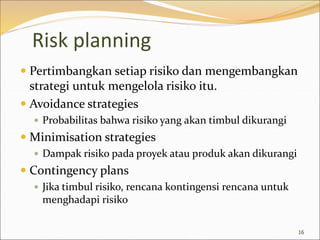
Risk planning
 Pertimbangkan setiap risiko dan mengembangkan
strategi untuk mengelola risiko itu.
 Avoidance strategies
 Probabilitas bahwa risiko yang akan timbul dikurangi
 Minimisation strategies
 Dampak risiko pada proyek atau produk akan dikurangi
 Contingency plans
 Jika timbul risiko, rencana kontingensi rencana untuk
menghadapi risiko
16
Risk management strategies (Example)
17
Risk Strategy
Organisational
financial
problems
Prepare a briefing document for senior
management showing how the project is
making a very important contribution to
the goals of the business.
Recruitment
problems
Alert customer of potential difficulties and
the possibility of delays, investigate
buying-in components.
Risk management strategies… (Example)
18
Risk Strategy
Staff illness Reorganise team so that there is more
overlap of work and people therefore
understand each other’s jobs.
Defective
components
Replace potentially defective components
with bought-in components of known
reliability.
Risk management strategies… (Example)
19
Risk Strategy
Requirements
changes
Derive traceability information to
assess requirements change impact,
maximise information hiding in the
design.
Organisational
restructuring
Prepare a briefing document for senior
management showing how the project
is making a very important
contribution to the goals of the
business.
Risk management strategies… (Example)
20
Risk Strategy
Database
performance
Investigate the possibility of buying a
higher-performance database.
Underestimate
d development
time
Investigate buying in components,
investigate use of a program generator
Risk monitoring
 Assess each identified risks regularly to decide
whether or not it is becoming less or more probable.
 Also assess whether the effects of the risk have
changed.
 Each key risk should be discussed at management
progress meetings.
21
Risk indicators
22
Risk type Potential indicators
Technology Late delivery of hardware or support
software, many reported technology
problems
People Poor staff morale, poor relationships
amongst team member, job availability
Organisational Organisational gossip, lack of action by
senior management
Requirements Many requirements change requests,
customer complaints
Estimation Failure to meet agreed schedule, failure to
clear reported defects
Key points
 Risk management is concerned with
 identifying risks which may affect the project and
 planning to ensure that these risks do not develop into
major threats.
23

2.Intro Risk.ppt

  • 2.
    Risk management  mengidentifikasirisiko  menyusun rencana untuk meminimalkan efeknya pada sebuah proyek. 2
  • 3.
    Risk management… Risiko adalahprobabilitas bahwa beberapa keadaan buruk akan terjadi  Risiko proyek mempengaruhi jadwal atau sumber daya  Risiko produk mempengaruhi kualitas atau kinerja dari perangkat lunak yang dikembangkan  Risiko usaha mempengaruhi organisasi mengembangkan atau mengadakan software. 3
  • 4.
    Example: Software risks 4 RiskAffects Description Staff turnover Project Experienced staff will leave the project before it is finished. Management change Project There will be a change of organisational management with different priorities. Hardware unavailability Project Hardware that is essential for the project will not be delivered on schedule. Requirements change Project and product There will be a larger number of changes to the requirements than anticipated.
  • 5.
    Example: Software risks… 5 RiskAffects Description Specification delays Project and product Specifications of essential interfaces are not available on schedule Size underestimate Project and product The size of the system has been underestimated. Technology change Business The underlying technology on which the system is built is superseded by new technology. Product competition Business A competitive product is marketed before the system is completed.
  • 6.
    The risk managementprocess  Risk identification  Mengidentifikasi proyek, produk, dan risiko bisnis  Risk analysis  Menilai kemungkinan dan konsekuensi dari risiko  Risk planning  Buatlah rencana untuk menghindari atau meminimalkan dampak risiko  Risk monitoring  Memantau risiko seluruh proyek 6
  • 7.
  • 8.
    Risk identification  Technologyrisks.  People risks.  Organisational risks.  Requirements risks.  Estimation risks. 8
  • 9.
    Risks and risktypes (Example) 9 Risk type Possible risks Technology The database used in the system cannot process as many transactions per second as expected. Software components that should be reused contain defects that limit their functionality. People It is impossible to recruit staff with the skills required. Key staff are ill and unavailable at critical times. Required training for staff is not available. Organisational The organisation is restructured so that different management are responsible for the project. Organisational financial problems force reductions in the project budget.
  • 10.
    Risks and risktypes… (Example) 10 Risk type Possible risks Requirements Changes to requirements that require major design rework are proposed. Customers fail to understand the impact of requirements changes. Estimation The time required to develop the software is underestimated. The rate of defect repair is underestimated. The size of the software is underestimated.
  • 11.
    Risk analysis  Menilaiprobabilitas dan keseriusan dari masing- masing risiko.  Probabilitas mungkin sangat rendah, rendah, sedang, tinggi, atau sangat tinggi.  Mungkin efek risiko bencana, serius, diterima atau tidak signifikan. 11
  • 12.
    Risk analysis (Example) 12 RiskProbability Effects Organisational financial problems force reductions in the project budget. Low Catastrophic It is impossible to recruit staff with the skills required for the project. High Catastrophic Key staff are ill at critical times in the project. Moderate Serious
  • 13.
    Risk analysis… (Example) 13 RiskProbability Effects Software components that should be reused contain defects which limit their functionality. Moderate Serious Changes to requirements that require major design rework are proposed. Moderate Serious The organisation is restructured so that different management are responsible for the project. High Serious
  • 14.
    Risk analysis… (Example) 14 RiskProbability Effects The database used in the system cannot process as many transactions per second as expected. Moderate Serious The time required to develop the software is underestimated. High Serious Customers fail to understand the impact of requirements changes. Moderate Tolerable Required training for staff is not available. Moderate Tolerable
  • 15.
    Risk analysis… (Example) 15 RiskProbability Effects The rate of defect repair is underestimated. Moderate Tolerable The size of the software is underestimated. High Tolerable The code generated by CASE tools is inefficient. Moderate Insignificant
  • 16.
    Risk planning  Pertimbangkansetiap risiko dan mengembangkan strategi untuk mengelola risiko itu.  Avoidance strategies  Probabilitas bahwa risiko yang akan timbul dikurangi  Minimisation strategies  Dampak risiko pada proyek atau produk akan dikurangi  Contingency plans  Jika timbul risiko, rencana kontingensi rencana untuk menghadapi risiko 16
  • 17.
    Risk management strategies(Example) 17 Risk Strategy Organisational financial problems Prepare a briefing document for senior management showing how the project is making a very important contribution to the goals of the business. Recruitment problems Alert customer of potential difficulties and the possibility of delays, investigate buying-in components.
  • 18.
    Risk management strategies…(Example) 18 Risk Strategy Staff illness Reorganise team so that there is more overlap of work and people therefore understand each other’s jobs. Defective components Replace potentially defective components with bought-in components of known reliability.
  • 19.
    Risk management strategies…(Example) 19 Risk Strategy Requirements changes Derive traceability information to assess requirements change impact, maximise information hiding in the design. Organisational restructuring Prepare a briefing document for senior management showing how the project is making a very important contribution to the goals of the business.
  • 20.
    Risk management strategies…(Example) 20 Risk Strategy Database performance Investigate the possibility of buying a higher-performance database. Underestimate d development time Investigate buying in components, investigate use of a program generator
  • 21.
    Risk monitoring  Assesseach identified risks regularly to decide whether or not it is becoming less or more probable.  Also assess whether the effects of the risk have changed.  Each key risk should be discussed at management progress meetings. 21
  • 22.
    Risk indicators 22 Risk typePotential indicators Technology Late delivery of hardware or support software, many reported technology problems People Poor staff morale, poor relationships amongst team member, job availability Organisational Organisational gossip, lack of action by senior management Requirements Many requirements change requests, customer complaints Estimation Failure to meet agreed schedule, failure to clear reported defects
  • 23.
    Key points  Riskmanagement is concerned with  identifying risks which may affect the project and  planning to ensure that these risks do not develop into major threats. 23