RISK MANAGEMENT IN SOFTWARE
ENGINEERING
Prepared by
Sneha Mudumba
• What is a risk?
• What is risk management ?
• What are the principles by which we can manage risks?
• How the Risk management is integrated in project management?
• How Risk management is implemented in small projects in a
company?
• How can we control the risks in a project?
What is Risk?
 Risk is an uncertainty.
 We don’t know whether a particular event will occur or no but if it
does has a negative impact on a project.
 An example would be that team is working on a project and the
developer walks out of project and other person is recruited n his
place and he doesn’t work on the same platform and converts it into
the platform he is comfortable with. Now the project has to yield the
same result in the same time span. Whether they will be able to
complete the project on time. That is the risk of schedule .
Definitions of Risks
 Risk is the probability of suffering loss.
 Risk provides an opportunity to develop the project better.
 Risk exposure= Size (loss)* probability of (loss)
 There is a difference between a Problem and Risk
 Problem is some event which has already occurred but risk is
something that is unpredictable.
Risk management
 The Risks we encounter in a project should be resolved so that we
are able to deliver the desired project to the customer.
 The project should be managed in such a way that the risks don’t
affect the project in a big way.
 The art of managing of the risks effectively so that the WIN-WIN
situation and friendly relationship is established between the team
and the customer is called Risk Management.
 By using various paradigms, principles we can manage the risks.
The Principles of Risk Management
 1.Global Perspective: In this we look at the larger system definitions, design and
implementation. We look at the opportunity and the impact the risk is going to have
.
 2.Forward Looking View: Looking at the possible uncertainties that might creep up.
We also think for the possible solutions for those risks that might occur in the future.
 3.Open Communication: This is to enable the free flow of communication between
in the customers and the team members so that they have clarity about the risks.
 4.Integrated management: In this phase risk management is made an integral part
of project management.
 5.Continous process :In this phase the risks are tracked continuously throughout
the risk management paradigm.
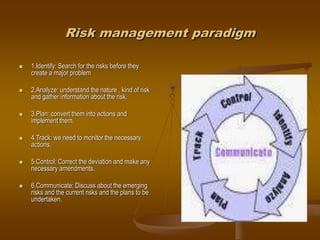
Risk management paradigm
 1.Identify: Search for the risks before they
create a major problem
 2.Analyze: understand the nature , kind of risk
and gather information about the risk.
 3.Plan: convert them into actions and
implement them.
 4.Track: we need to monitor the necessary
actions.
 5.Control: Correct the deviation and make any
necessary amendments.
 6.Communicate: Discuss about the emerging
risks and the current risks and the plans to be
undertaken.
Risk Management in Project management:
Basically project management deals with following :
 1. Planning: Looking for the desired results, the strategies to be
applied.
 2. Organizing: Getting all the things together so that the desired
results are obtained. By organizing the efficiency is increased and lot
of time is saved.
 3. Directing: Communication takes place and exchange of ideas is
formatted in this phase.
 4. Controlling: In the last phase feedback and evaluation is done.
Team Risk Management Principles
The two principles are:
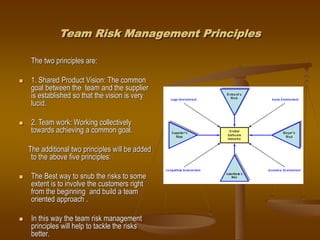
 1. Shared Product Vision: The common
goal between the team and the supplier
is established so that the vision is very
lucid.
 2. Team work: Working collectively
towards achieving a common goal.
The additional two principles will be added
to the above five principles:
 The Best way to snub the risks to some
extent is to involve the customers right
from the beginning and build a team
oriented approach .
 In this way the team risk management
principles will help to tackle the risks
better.
Risk Management In Small Project:
1.Preparing for Risks: Looking for the external and internal Risks :
 Uncertain requirements
 Unknown technology
 Infeasible Design
 Cost And Schedule uncertainty.
2.Identify and Analyze Risks: We need to identify the risks and
understand the nature of risks and prioritize the risks and try to solve
the risks.
3.Mitigate the risks: In this phase we have risk acceptance, risk
transfer, risk avoidance, risk control. We implement them in this
phase so that we can mitigate the risks.
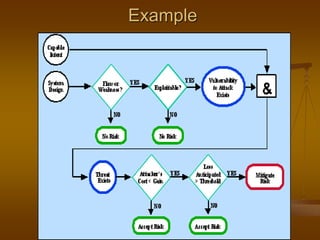
Example
How To Manage the Risks
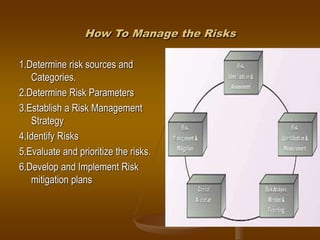
1.Determine risk sources and
Categories.
2.Determine Risk Parameters
3.Establish a Risk Management
Strategy
4.Identify Risks
5.Evaluate and prioritize the risks.
6.Develop and Implement Risk
mitigation plans
 To manage the risks we need to establish a strong bond between the
customers and the team members.
 A strong base about risk management would help a great deal in
tackling the risks.
 Software metrics and tools can be developed to manage the risks.
 Risk necessarily need not be negative and it can be viewed as an
opportunity to develop our projects in a better way.
Conclusion
Thank you

RISK MANAGEMENT IN SOFTWARE ENGINEERING.ppt

  • 1.
    RISK MANAGEMENT INSOFTWARE ENGINEERING Prepared by Sneha Mudumba
  • 2.
    • What isa risk? • What is risk management ? • What are the principles by which we can manage risks? • How the Risk management is integrated in project management? • How Risk management is implemented in small projects in a company? • How can we control the risks in a project?
  • 3.
    What is Risk? Risk is an uncertainty.  We don’t know whether a particular event will occur or no but if it does has a negative impact on a project.  An example would be that team is working on a project and the developer walks out of project and other person is recruited n his place and he doesn’t work on the same platform and converts it into the platform he is comfortable with. Now the project has to yield the same result in the same time span. Whether they will be able to complete the project on time. That is the risk of schedule .
  • 4.
    Definitions of Risks Risk is the probability of suffering loss.  Risk provides an opportunity to develop the project better.  Risk exposure= Size (loss)* probability of (loss)  There is a difference between a Problem and Risk  Problem is some event which has already occurred but risk is something that is unpredictable.
  • 5.
    Risk management  TheRisks we encounter in a project should be resolved so that we are able to deliver the desired project to the customer.  The project should be managed in such a way that the risks don’t affect the project in a big way.  The art of managing of the risks effectively so that the WIN-WIN situation and friendly relationship is established between the team and the customer is called Risk Management.  By using various paradigms, principles we can manage the risks.
  • 6.
    The Principles ofRisk Management  1.Global Perspective: In this we look at the larger system definitions, design and implementation. We look at the opportunity and the impact the risk is going to have .  2.Forward Looking View: Looking at the possible uncertainties that might creep up. We also think for the possible solutions for those risks that might occur in the future.  3.Open Communication: This is to enable the free flow of communication between in the customers and the team members so that they have clarity about the risks.  4.Integrated management: In this phase risk management is made an integral part of project management.  5.Continous process :In this phase the risks are tracked continuously throughout the risk management paradigm.
  • 7.
    Risk management paradigm 1.Identify: Search for the risks before they create a major problem  2.Analyze: understand the nature , kind of risk and gather information about the risk.  3.Plan: convert them into actions and implement them.  4.Track: we need to monitor the necessary actions.  5.Control: Correct the deviation and make any necessary amendments.  6.Communicate: Discuss about the emerging risks and the current risks and the plans to be undertaken.
  • 8.
    Risk Management inProject management: Basically project management deals with following :  1. Planning: Looking for the desired results, the strategies to be applied.  2. Organizing: Getting all the things together so that the desired results are obtained. By organizing the efficiency is increased and lot of time is saved.  3. Directing: Communication takes place and exchange of ideas is formatted in this phase.  4. Controlling: In the last phase feedback and evaluation is done.
  • 9.
    Team Risk ManagementPrinciples The two principles are:  1. Shared Product Vision: The common goal between the team and the supplier is established so that the vision is very lucid.  2. Team work: Working collectively towards achieving a common goal. The additional two principles will be added to the above five principles:  The Best way to snub the risks to some extent is to involve the customers right from the beginning and build a team oriented approach .  In this way the team risk management principles will help to tackle the risks better.
  • 10.
    Risk Management InSmall Project: 1.Preparing for Risks: Looking for the external and internal Risks :  Uncertain requirements  Unknown technology  Infeasible Design  Cost And Schedule uncertainty. 2.Identify and Analyze Risks: We need to identify the risks and understand the nature of risks and prioritize the risks and try to solve the risks. 3.Mitigate the risks: In this phase we have risk acceptance, risk transfer, risk avoidance, risk control. We implement them in this phase so that we can mitigate the risks.
  • 11.
  • 12.
    How To Managethe Risks 1.Determine risk sources and Categories. 2.Determine Risk Parameters 3.Establish a Risk Management Strategy 4.Identify Risks 5.Evaluate and prioritize the risks. 6.Develop and Implement Risk mitigation plans
  • 13.
     To managethe risks we need to establish a strong bond between the customers and the team members.  A strong base about risk management would help a great deal in tackling the risks.  Software metrics and tools can be developed to manage the risks.  Risk necessarily need not be negative and it can be viewed as an opportunity to develop our projects in a better way. Conclusion
  • 14.