28th
International Symposium on
Pediatric Surgical Research
ABSTRACT BOOK
DUBLIN, IRELAND – 24-26 SEPTEMBER, 2015
28th International Symposium on Pediatric Surgical Research
1
FRIDAY, 25TH SEPTEMBER, 2015
SCIENTIFIC SESSION I
(PRIZE SESSION)
28th International Symposium on Pediatric Surgical Research
2
THREE- AND FOUR-DIMENSIONAL ANALYSIS OF ALTERED BEHAVIOR OF ENTERIC NEURAL CREST
DERIVED CELLS IN THE HIRSCHSPRUNG’S DISEASE MOUSE MODEL
N Nakazawa-Tanaka1,2
, K Miyahara2
, N Fujiwara2
, M Urao1
, C Akazawa3
, G J. Lane2
, A Yamataka2
1
Department of Pediatric Surgery, Juntendo Nerima Hospital
2
Department of Pediatric Surgery, Juntendo University School of Medicine, 3
Department of
Biochemistry and Biophysics, Graduate School of Health Care Science, Tokyo Medical and Dental
University
Tokyo, Japan
Email address for correspondence: nana.nakazawa@gmail.com
PURPOSE
The behavior of enteric neural crest-derived cells (ENCC) during enteric nervous system (ENS)
development is being gradually understood by the introduction of live-cell imaging technique.
However, many of the analysis to date are two- dimensional and the precise multidirectional
migration of ENCC has been challenging to interpret. Mice lacking the endothelin-B receptor gene,
EDNRB(-/-) mice, are widely used as a model for Hirschsprung’s disease (HD). We have recently
developed a SOX10 transgenic mouse to visualize ENCC with enhanced green fluorescent protein
(VENUS). By breeding these two models, we have created a VENUS-positive, SOX10 transgenic
mouse with a deletion of the EDNRB gene, SOX10-VENUS(+)/EDNRB(-/-) mouse, to investigate the
ENS in HD. The aim of this study was to investigate the behavior of migrating ENCC in the hindgut of
the SOX10-VENUS(+)/EDNRB(-/-) mouse by using three-dimensional and 4-dimensional (3D/4D)
image analysis software.
METHODS
To compare the ENCC behavior when the wavefront of ENCC reaches the mid-hindgut between HD
mouse and control, we harvested the fetal hindguts from SOX10-VENUS(+)/EDNRB(-/-) mice on
D15.5 and SOX10-VENUS(+)/EDNRB(+/+) mice on D12.5, which was used as control. Dissected
hindguts were cultured for 360 minutes and the time-lapse images were obtained using a confocal
laser-scanning microscope. Each ENCC at the wavefront was tracked after adjusting the longitudinal
axis of the gut to the Y axis and analyzed by using Imaris software (Bitplane, Zurich, Switzerland).
28th International Symposium on Pediatric Surgical Research
3
RESULTS
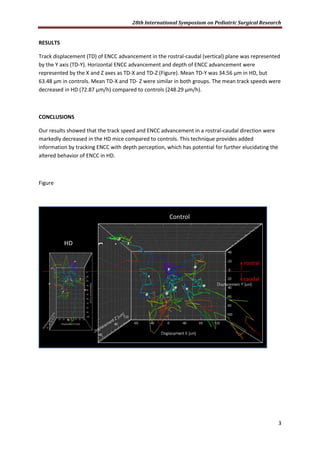
Track displacement (TD) of ENCC advancement in the rostral-caudal (vertical) plane was represented
by the Y axis (TD-Y). Horizontal ENCC advancement and depth of ENCC advancement were
represented by the X and Z axes as TD-X and TD-Z (Figure). Mean TD-Y was 34.56 µm in HD, but
63.48 µm in controls. Mean TD-X and TD- Z were similar in both groups. The mean track speeds were
decreased in HD (72.87 µm/h) compared to controls (248.29 µm/h).
CONCLUSIONS
Our results showed that the track speed and ENCC advancement in a rostral-caudal direction were
markedly decreased in the HD mice compared to controls. This technique provides added
information by tracking ENCC with depth perception, which has potential for further elucidating the
altered behavior of ENCC in HD.
Figure
Control
Control
28th International Symposium on Pediatric Surgical Research
4
CHARACTERIZATION OF VASCULOGENIC POTENTIAL OF HUMAN ADIPOSE-DERIVED ENDOTHELIAL
CELLS IN A THREE-DIMENSIONAL VASCULARIZED SKIN SUBSTITUTE
A. S. Klar1,2
, S. Güven3
, J. Zimoch1,2
, T. Biedermann1,2
, S. Böttcher-Haberzeth1,2,4
, C. Meuli-Simmen5
,
Ivan Martin3
, A. Scherberich3
, E. Reichmann1,2
, M. Meuli2,4
(1) Tissue Biology Research Unit, Department of Surgery, University Children’s Hospital Zurich,
Zurich, Switzerland
(2) Children’s Research Center, University Children’s Hospital Zurich, Zurich, Switzerland
(3) Department of Biomedicine, University Hospital of Basel, University of Basel, Basel, Switzerland
(4) Department of Surgery, University Children’s Hospital Zurich, Zurich, Switzerland
(5) Department of Plastic, Reconstructive, Esthetical and Hand Surgery, Kantonsspital Aarau, Aarau,
Switzerland
Corresponding author: Martin.Meuli@kispi.uzh.ch
Purpose: The clinical need for vascularized clinically applicable skin substitutes continues to grow. In
this study, we explored the use of human endothelial cells derived from freshly isolated adipose
stromal vascular fraction (SVF) in a 3D co-culture model of vascularized bio-engineered skin
substitute.
Methods: The SVF was isolated from human adipose tissue samples and keratinocytes from human
skin biopsies. The SVF, in particular endothelial cells were characterized using flow cytometry and
immuofluorescence analysis. Endothelial and mesenchymal progenitors from the SVF formed blood
capillaries after seeding into a 3D collagen type I hydrogel in vitro. Subsequently, human
keratinocytes were seeded on the top of those hydrogels to develop a vascularized dermo-epidermal
skin substitute.
Results: Flow cytometric analysis of surface markers of the freshly isolated SVF showed the
expression of mesenchymal/stromal cell-associated markers (CD44, CD73, CD90, CD105), stem cell
markers (CD133, CD49f), endothelial markers (CD31, CD34), and additionally hematopoietic markers
(CD14, CD45). Further analysis of adipose-derived endothelial cells (ECs) revealed the co-expression
of CD31, CD34, CD90, CD105, and partially CD146 on these cells. ECs were separated from adipose-
stromal cells (ASCs) using FACS sorting. ASCs and ECs cultured separately in a 3D hydrogel for 3
weeks did not form any vascular structures. Only if co-cultured, both cell types aligned to develop a
ramified vascular network in vitro with continuous endothelial lumen formation. Transplantation of
those 3D-hydrogels onto immuno-incompetent rats displayed a rapid connection of human
capillaries with the host vessels and formation of functional, blood-perfused mosaic human-rat
vessels within only 3-4 days.
Conclusions: Adipose tissue represents an attractive cell source due to the ease of isolation and
abundance of endothelial and mesenchymal cell lineages. Adipose-derived SVF cells exhibit the
ability to form microvascular structures in vitro and support the accelerated blood perfusion in skin
substitutes when transplanted.
Keywords: Adipose stem cells - Vascular network formation - Blood capillaries - Angiogenesis -
Stromal vascular fraction - Mesenchymal cells - Endothelial cells - Skin tissue engineering
28th International Symposium on Pediatric Surgical Research
5
Surfactant protein D attenuates lipopolysaccharide-induced inflammation in TLR-4-overexpressed
human intestinal cells
R Saka1) 2) 3)
, T Wakimoto3) 4)
, F Nishiumi3)
, T Sasaki1)
, S Nose1)
, M Fukuzawa5)
, T Oue1)
, I Yanagihara3)
, H
Okuyama2)
1) Department of Pediatric Surgery, Hyogo College of Medicine
2) Department of Pediatric Surgery, Osaka University Graduate School of Medicine
3) Department of Developmental Medicine, Osaka Medical Center and Research Institute for
Maternal and Child Health
4) Department of Obstetrics and Gynecology, Osaka University Graduate School of Medicine
5) Department of Pediatric Surgery, Osaka Medical Center and Research Institute for Maternal and
Child Health
Address correspondence;
Hiroomi Okuyama, MD, Ph. D
Department of Pediatric Surgery, Osaka University Graduate School of Medicine
Address: 2-2 Yamadaoka, Suita-shi, Osaka, Japan 5650871
E-mail: okuyama@pedsurg.med.osaka-u.ac.jp
Abstract
PURPOSE: Necrotizing enterocolitis (NEC) is a devastating disease specific to preterm infants.
Recently, it has been reported that overexpressed toll-like receptor (TLR)-4 in the immature intestine
is associated with the development of NEC. Surfactant protein (SP)-D is a member of the collectin
family and plays an important role in innate immunity, particularly in the airways. Although SP-D also
exists in the intestines, little is known about its function. The aim of this study was to investigate
whether SP-D attenuates inflammation in TLR4 overexpressed intestinal cells.
METHODS: All experimental procedures were performed using the human intestinal cell line INT407
originally derived from human embryonal intestines. Platelet activating factor (PAF), reported to be
elevated in NEC patients, was used to overexpress TLR-4 in this cell line to mimic an immature
intestine. Following stimulation with PAF, the TLR4 expression was measured using quantitative real-
time PCR (normalized to GAPDH). The degree of inflammation induced by PAF and
lipopolysaccharide (LPS) and the effects of SP-D were assessed with interleukin 8 (IL-8) measured by
enzyme-linked immunosorbent assay (ELISA). The results of the quantitative RT-PCR and ELISA
analyses are expressed as the mean ± SD.
RESULTS: Following treatment with 5 µM of PAF, the expression levels of TLR4 mRNA were
significantly upregulated (3.69+/-0.28) compared with that observed in the cells treated without PAF
stimulation (1.00+/-0.10) (p<0.001). Stimulation with 5 µM of PAF and 100ng/ml of LPS resulted in
significantly higher IL-8 production (1959.3+/-52.3 pg/ml) compared with control (141.2+/-12.4
pg/ml), LPS alone (167.3+/-65.8 pg/ml) and PAF alone (1527.2+/-129.4 pg/ml) (P<0.05) The IL-8
expression with the stimulation of PAF and LPS (1590.1+/-319.3 pg/ml) was attenuated by
pretreatment with 20µg/ml of SP-D (1161.6+/-131.6 pg/ml) (p<0.05).
28th International Symposium on Pediatric Surgical Research
6
CONCLUSION: SP-D attenuates LPS-induced IL-8 production in TLR4 overexpressed intestinal cells.
These findings suggest that SP-D may have a protective effect in the development of NEC in preterm
infants.
28th International Symposium on Pediatric Surgical Research
7
NOTOCHORD MANIPULATION DOES NOT IMPACT OESOPHAGEAL AND TRACHEAL FORMATION
FROM ISOLATED FOREGUT IN 3D EXPLANT CULTURE.
Danielle Mc Laughlin1, 2
, Paula Murphy1
, Prem Puri2
(1)
School of Natural Sciences, Trinity College Dublin,
(2)
National Children’s Research Centre, Our Lady’s Children’s Hospital Crumlin,
DUBLIN, IRELAND,
Background: Tracheo-oesophageal malformations result from disturbed foregut separation during
early development. The notochord, a specialised embryonic structure, forms immediately adjacent
to the dividing foregut. In the Adriamycin mouse model of oesophageal atresia, foregut and
notochord abnormalities co-exist, and the site and severity of foregut malformations closely
correlate to the position and extent of the notochord defects. Notochord and foregut abnormalities
also co-exist in the Noggin Knockout mouse as well in a small number of human cases. The
notochord is a source of powerful molecular signals during early embryogenesis, being particularly
important for neural crest development. The influence of the notochord signaling on the adjacent
foregut is not known. It was the purpose of this study to examine the impact of notochord
manipulation on foregut separation using a robust 3D explant method for culturing isolated foregut
which permits oeosphageal and tracheal formation in vitro.
Methods: Foregut was micro-dissected from embryonic day 9 mice (License B100/4447 Irish
Medicines Board), embedded in collagen and cultured for 48 hours with native notochord intact
(n=6), notochord removed (n=10) or additional notochord transplanted from stage matched controls
(n=8). Specimens were analysed for foregut morphology and molecular patterning using
immunohistochemistry for Hnf3b (an endoderm marker) and Sox2 (a notochord and oesophageal
marker) on cryosections.
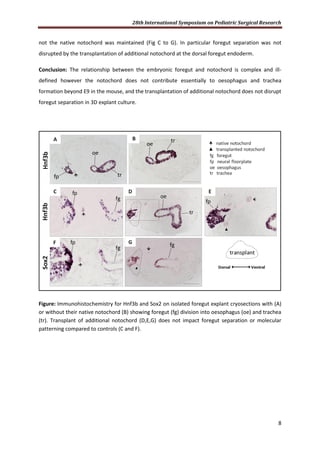
Results: Foregut separation into distinct oesophagus and trachea was observed in isolated foregut
specimens with or without their native notochord (Fig A,B). In specimens with additional notochord
transplants foregut morphology and molecular patterning was comparable to controls whether or
28th International Symposium on Pediatric Surgical Research
8
not the native notochord was maintained (Fig C to G). In particular foregut separation was not
disrupted by the transplantation of additional notochord at the dorsal foregut endoderm.
Conclusion: The relationship between the embryonic foregut and notochord is complex and ill-
defined however the notochord does not contribute essentially to oesophagus and trachea
formation beyond E9 in the mouse, and the transplantation of additional notochord does not disrupt
foregut separation in 3D explant culture.
Figure: Immunohistochemistry for Hnf3b and Sox2 on isolated foregut explant cryosections with (A)
or without their native notochord (B) showing foregut (fg) division into oesophagus (oe) and trachea
(tr). Transplant of additional notochord (D,E,G) does not impact foregut separation or molecular
patterning compared to controls (C and F).
28th International Symposium on Pediatric Surgical Research
9
IMPAIRED CYTOSKELETAL ARRANGEMENTS AND FAILURE OF VENTRAL BODY WALL CLOSURE IN
CHICK EMBRYOS TREATED WITH ROCK INHIBITOR (Y-27632)
Johannes W DUESS1,2
, Prem PURI1,2,3
, Jennifer THOMPSON1,2
(1)
National Children’s Research Centre, Our Lady’s Children’s Hospital, Dublin, Ireland
(2)
School of Medicine and Medical Science, University College Dublin, Ireland
(3)
Conway Institute of Biomolecular and Biomedical Research, University College Dublin, Ireland
Purpose: Rho-associated kinase (ROCK) signaling regulates numerous fundamental developmental
processes during embryogenesis, primarily by controlling actin-cytoskeleton assembly and cell
contractility. ROCK knockout mice exhibit a ventral body wall defect (VBWD) phenotype due to
disorganization of actin filaments at the umbilical ring. However, the exact molecular mechanisms
leading to VBWD still remain unclear. Improper somitogenesis has been hypothesized to contribute
to failure of VBW closure. Adhesion molecules and connexins are involved in multiple morphological
events, including somite formation, through cytoskeletal anchorage. Vinculin and microtubules are
crucial for normal cell migration by binding to adhesion molecules and connexins. We designed this
study to investigate the hypothesis that administration of ROCK inhibitor (Y-27632) disrupts
cytoskeletal arrangements in morphology during early chick embryogenesis, which may contribute
to the development of VBWD.
Methods: At 60h incubation, chick embryos were explanted into shell-less culture and treated with
50µL of vehicle for controls (n=33) or 50µL of 500µM of Y-27632 for the experimental group (Y-27,
n=56). At 8h post-treatment, RT-PCR was performed to evaluate mRNA levels of N-cadherin, E-
cadherin and connexin43. Immunofluorescence confocal microscopy was performed to analyze the
expression and distribution of actin, vinculin and microtubules in the neural tube and somites. A
further cohort of embryos was treated in ovo by dropping 50µL of vehicle or 50µL of 1000µM of Y-
27632 onto the embryo and allowing development to 14d for further assessment.
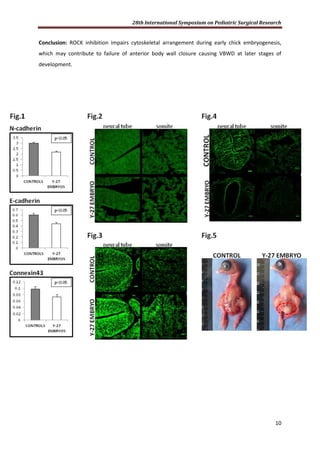
Results: Gene expression levels of N-cadherin, E-cadherin and connexin43 were significantly
decreased in treated embryos compared with controls (p<0.05) (Fig.1). Thickened actin filament
bundles were recorded in the neural tube of Y-27 embryos. In somites, cells were disorientated with
reduced actin distribution in affected embryos (Fig.2). Vinculin was over-expressed and clumped in
the neural tube and somites (Fig.3), whereas reduced expression of tubulin was observed in Y-27
embryos compared with controls (Fig.4). At 14d of development, affected embryos presented with
an enlarged umbilical ring and herniation of abdominal contents, associated with malformed lower
limbs (Fig.5).
28th International Symposium on Pediatric Surgical Research
10
Conclusion: ROCK inhibition impairs cytoskeletal arrangement during early chick embryogenesis,
which may contribute to failure of anterior body wall closure causing VBWD at later stages of
development.
28th International Symposium on Pediatric Surgical Research
11
INTESTINAL MICROBIOTA OF INFANTS REQUIRING SURGERY ANALYSIS USING NEXT-GENERATION
DNA SEQUENCING
H. Murakami1
, Y. Shimomura2
, M. Matsumoto2
, GJ.Lane1
, A. Yamataka1
, M. Okawada1
1) Department of Pediatric General and Urogenital Surgery
Juntendo University School of Medicine, Tokyo, Japan
2) Research Laboratories, Kyodo Milk Industry Co., Ltd, Tokyo, Japan
E-mail address of corresponding author: manabu-o@juntendo.ac.jp
PURPOSE: Development of the intestinal environment in infants is characterized by rapid, large
changes in the abundance, diversity, and composition of microbiota under the influence of various
factors that strongly influence both adult intestinal microbiota and development of the adult
intestinal immune system. Probiotic therapy has been proposed as an effective way to enhance the
intestinal environment during times of stress but there are few reports about probiotic use in
children. The aim of this study was to conduct a comprehensive investigation of the intestinal
microbiota of infants undergoing surgery using a next-generation DNA sequencing system and assess
the value of probiotic administration.
METHODS: We studied 8 infants requiring surgery. All were born at our institution. The probiotic
preparation used was Bifidobacterium lactis LKM512 (LKM) 1.0 g/day administered orally. The 8
subjects were divided into two groups according to LKM use; LKM+ (n=4) and LKM- (n=4). As controls
we included 2 infants who did not require surgery and who were not given LKM (C; n=2). Clinical
examinations were performed according to our standard postoperative protocol and stool
specimens (0.5g) were collected 5 times (after birth, and on days 3, 7, 10, and 14 after surgery).
Extracted fecal DNA underwent PCR amplification for 16S rRNA amplicon library preparation and all
stool specimens were sequenced with an Ion TorrentTM
PGMTM
Sequencer.
RESULTS: Clinical status and all laboratory data were similar for LKM+ and LKM-. All stool specimens
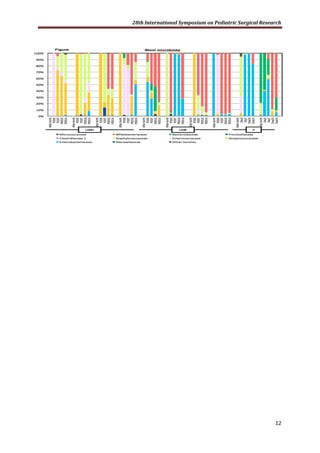
were successfully sequenced using only 20mg of stool. The microbiota in C stool was relatively
varied, with Enterobacteriaceae, Bacteroidaceae, Bifidobacteriaceae, and Streptococcaceae
identified in descending order of abundance. There were significantly more Enterococcaceae,
Streptococcaceae, and Staphylococcaceae in both LKM+ and LKM- compared with controls.
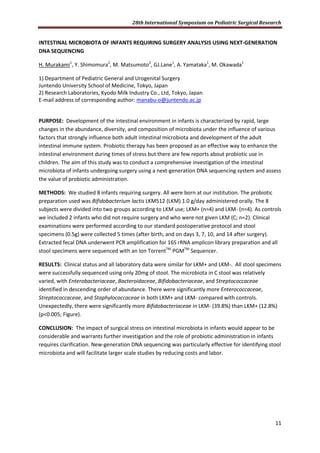
Unexpectedly, there were significantly more Bifidobacteriaceae in LKM- (39.8%) than LKM+ (12.8%)
(p<0.005; Figure).
CONCLUSION: The impact of surgical stress on intestinal microbiota in infants would appear to be
considerable and warrants further investigation and the role of probiotic administration in infants
requires clarification. New-generation DNA sequencing was particularly effective for identifying stool
microbiota and will facilitate larger scale studies by reducing costs and labor.
28th International Symposium on Pediatric Surgical Research
12
28th International Symposium on Pediatric Surgical Research
13
Intraoperative acidosis and hypercapnia during thoracoscopic repair of esophageal
atresia/tracheoesophageal fistula
Augusto Zani, Ruben Lamas-Pinheiro, Irene Paraboschi, Giovanni Cobellis, Justyna Wolinska, Elke
Zani-Ruttenstock, Agostino Pierro
Division of General and Thoracic Surgery, The Hospital for Sick Children, Toronto, Ontario, Canada
PURPOSE: It has been reported that thoracoscopic repair of esophageal atresia/tracheoesophageal
fistula (EA/TEF) is associated with severe intraoperative hypercapnia and acidosis. The aim of the
present study was to confirm this phenomenon in a larger population from a North-American
Institution.
METHODS: Following ethical approval (REB1000046653), we retrospectively reviewed the medical
charts of all neonates who underwent open or thoracoscopic EA/TEF repair between 2004 and 2014
at our Institution. Only patients with available intraoperative arterial gas values were included in this
analysis. Data were compared using paired/unpaired t-tests and linear regression analysis and are
reported as mean ± SD or median (range).
RESULTS: During the study period, 205 infants underwent open (n=180) or thoracoscopic (n=25)
EA/TEF repair. Intraoperative arterial gas values were recorded in 62 (34%) open and in 14 (56%)
thoracoscopic operations. There were no differences in birth weight (p=0.2) or gestational age
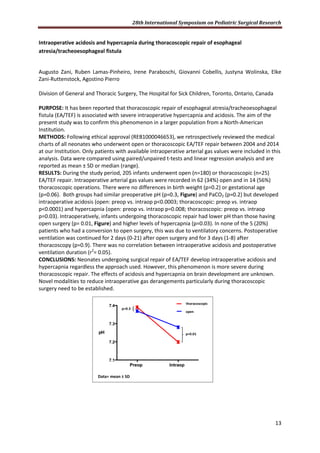
(p=0.06). Both groups had similar preoperative pH (p=0.3, Figure) and PaCO2 (p=0.2) but developed
intraoperative acidosis (open: preop vs. intraop p<0.0003; thoracoscopic: preop vs. intraop
p<0.0001) and hypercapnia (open: preop vs. intraop p=0.008; thoracoscopic: preop vs. intraop
p=0.03). Intraoperatively, infants undergoing thoracoscopic repair had lower pH than those having
open surgery (p= 0.01, Figure) and higher levels of hypercapnia (p=0.03). In none of the 5 (20%)
patients who had a conversion to open surgery, this was due to ventilatory concerns. Postoperative
ventilation was continued for 2 days (0-21) after open surgery and for 3 days (1-8) after
thoracoscopy (p=0.9). There was no correlation between intraoperative acidosis and postoperative
ventilation duration (r2
= 0.05).
CONCLUSIONS: Neonates undergoing surgical repair of EA/TEF develop intraoperative acidosis and
hypercapnia regardless the approach used. However, this phenomenon is more severe during
thoracoscopic repair. The effects of acidosis and hypercapnia on brain development are unknown.
Novel modalities to reduce intraoperative gas derangements particularly during thoracoscopic
surgery need to be established.
28th International Symposium on Pediatric Surgical Research
14
REDUCED EXPRESSION OF VOLTAGE-GATED KV11.1 (HERG) K+ CHANNELS IN AGANGLIONIC COLON
IN HIRSCHSPRUNG’S DISEASE
Tomuschat C, O’Donnell AM, Coyle D, Puri P
National Childrens Research Centre, Ireland, Dublin
Our Lady’s Children’s Hospital, Crumlin, Dublin
prem.puri@ncrc.ie
Purpose: The pathophysiology of Hirschsprung’s Disease (HD) is not fully understood. There is no
clear explanation for the occurrence of the spastic or tonically contracted aganglionic segment of
bowel. Kv11.1 (HERG) channels play a key role in the regulation of the resting membrane potential
as well as affecting either the force or frequency of contraction of smooth muscles. We designed this
study to investigate the expression and characterization of HERG channels in the normal colon and in
the colon of patients with HD.
Methods: We investigated Kv11.1 protein expression in both the ganglionic and aganglionic regions
of HD patients (n=10) versus normal control colon (n=10). The distribution was assessed by using
immunofluorescence and confocal microscopy. Gene and protein expression was quantified using
quantitative real-time polymerase chain reaction, western blot analysis and densitometry.
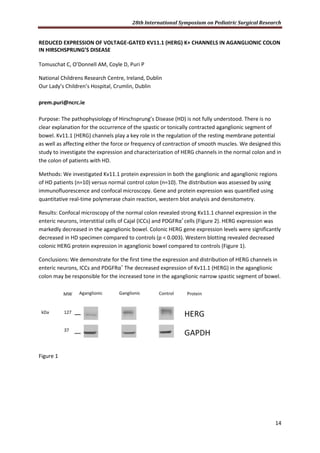
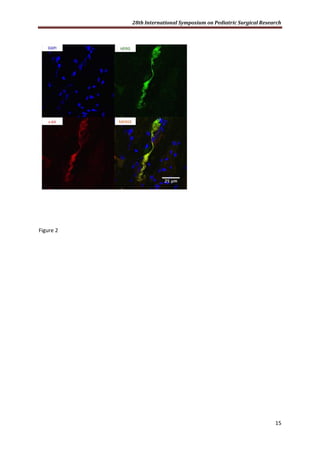
Results: Confocal microscopy of the normal colon revealed strong Kv11.1 channel expression in the
enteric neurons, interstitial cells of Cajal (ICCs) and PDGFRα+
cells (Figure 2). HERG expression was
markedly decreased in the aganglionic bowel. Colonic HERG gene expression levels were significantly
decreased in HD specimen compared to controls (p < 0.003). Western blotting revealed decreased
colonic HERG protein expression in aganglionic bowel compared to controls (Figure 1).
Conclusions: We demonstrate for the first time the expression and distribution of HERG channels in
enteric neurons, ICCs and PDGFRα+
The decreased expression of Kv11.1 (HERG) in the aganglionic
colon may be responsible for the increased tone in the aganglionic narrow spastic segment of bowel.
Figure 1
28th International Symposium on Pediatric Surgical Research
15
Figure 2
28th International Symposium on Pediatric Surgical Research
16
ENHANCED LIVER GENE EXPRESSION OF BILIARY ABC STEROL TRANSPORTERS IS LINKED WITH
DEVELOPMENT OF GALLSTONES IN CHILDREN
A Koivusalo, A Mutanen, MP Pakarinen
Section of pediatric surgery, Pediatric Liver and Gut Research Group, Children´s Hospital, University
of Helsinki, Finland
mikko.pakarinen@hus.fi
PURPOSE: To elucidate the pathogenesis of increasingly common pediatric cholelithiasis, we
assessed liver RNA expression of canalicular bile transporters and their upstream nuclear receptor
regulators in relation to gallstone sterol content and surrogate serum markers of cholesterol
synthesis (precursors) and absorption (plant sterols).
METHODS: After ethical approval, twenty children with gallstones (11 females), median age 11 (IQR
8.2) years and six with predisposing conditions underwent cholecystectomy, intraoperative liver
biopsy and serum sampling. Liver RNA expression of biliary sterol (ABCG5, ABCG8), phospholipid
(ABCB4), bile acid (ABCB11) and bilirubin (ABCC2) transporters and their upstream regulators (LXR
and FXR) was measured with real time RT-PCR (ΔΔCt method). Serum and gallstone concentrations
of cholesterol, cholesterol precursors (cholestenol and lathosterol) and plant sterols (stigmasterol,
avenasterol, sitosterol, and campesterol) were measured using gas-liquid chromatography.
Gallstones were classified as cholesterol gallstones (CGS, cholesterol > 35% of weight) or pigment
stones (PS). Liver biopsies of six healthy donor livers (n = 6), and serum from 82 healthy children
served as controls.
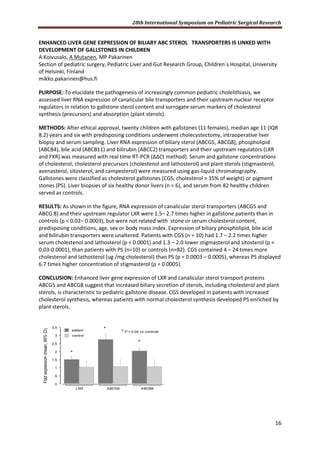
RESULTS: As shown in the figure, RNA expression of canalicular sterol transporters (ABCG5 and
ABCG 8) and their upstream regulator LXR were 1.5– 2.7 times higher in gallstone patients than in
controls (p < 0.02– 0.0003), but were not related with stone or serum cholesterol content,
predisposing conditions, age, sex or body mass index. Expression of biliary phospholipid, bile acid
and bilirubin transporters were unaltered. Patients with CGS (n = 10) had 1.7 – 2.2 times higher
serum cholestenol and lathosterol (p < 0.0001) and 1.3 – 2.0 lower stigmasterol and sitosterol (p <
0.03-0.0001), than patients with PS (n=10) or controls (n=82). CGS contained 4 – 24 times more
cholestenol and lathosterol (ug /mg cholesterol) than PS (p = 0.0003 – 0.0005), whereas PS displayed
6.7 times higher concentration of stigmasterol (p = 0.0005).
CONCLUSION: Enhanced liver gene expression of LXR and canalicular sterol transport proteins
ABCG5 and ABCG8 suggest that increased biliary secretion of sterols, including cholesterol and plant
sterols, is characteristic to pediatric gallstone disease. CGS developed in patients with increased
cholesterol synthesis, whereas patients with normal cholesterol synthesis developed PS enriched by
plant sterols.
0
,5
1
1,5
2
2,5
3
3,5
Foldexpression(mean,95%CI)
LXR ABCG5 ABCB8
control
patient
*
*
*
* P < 0.04 vs controls
28th International Symposium on Pediatric Surgical Research
17
BLADDER EXSTROPHY - A NATIONWIDE REGISTER STUDY ON MATERNAL AND FETAL FACTORS IN
SWEDEN 1973-2011
G R Engberg1,2
, Ä Mantel3
, M Fossum1,2
, A Nordenskjöld1,2
1.
Department of Women’s and Children’s Health and Center of Molecular Medicine, Karolinska
Institutet, Stockholm, Sweden
2.
Department of Pediatric Surgery, Urology Section, Astrid Lindgren Children’s Hospital, Karolinska
University Hospital, Stockholm, Sweden
3.
Clinical Epidemiology Unit, Department of Medicine, Solna (MedS), K2, Karolinska Institutet,
Stockholm, Sweden
gisela.reinfeldt.engberg@ki.se
PURPOSE
Bladder exstrophy is a rare congenital malformation where the underlying cause is largely unknown,
but both environmental and genetic mechanisms are involved. The malformation often require
multiple interventions by pediatric surgical teams from the newborn period into adolescence and
sometimes adulthood.
The aim of this study was to conduct a nationwide study related to maternal and fetal risk factors of
bladder exstrophy in Sweden 1973-2011.
METHODS
120 patients were identified in the Medical Birth Register with ICD codes; 753.50, 753F and Q64.1.
Cases were matched with 5 controls per patient for calendar year of delivery and sex. A case-control
study was performed by linkage of national registers. We studied additional malformations and
environmental factors such as maternal age, BMI, smoking, parity, seasonal differences and assisted
conception. We also studied delivery mode, birth weight, gestational week at birth, Apgar, survival
rate and length of hospital stay.
RESULTS
The prevalence was 2.98:100 000 live births with a male-to-female ratio 1.14:1. Bladder exstrophy
was an isolated malformation in 93% of the cases excluding inguinal hernia and cryptorchidism. 41%
had received surgery for inguinal hernia, 63% of the male and 16% of the female cases. In addition,
11% of the boys had undergone surgery for non-descended testis but none of them were born
premature or SGA.
There was a tendency of high maternal age, extremes of BMI and smoking as risk factors for bladder
exstrophy. Parity, seasonal differences and assisted conception showed no tendency of being risk
factors. Delivery mode, birth weight, gestational age at birth, Apgar and survival rate corresponded
to controls but patients stayed a few days longer at the hospital after birth.
CONCLUSIONS
This nationwide study demonstrates a prevalence of 3:100 000 live births with an almost equal sex
ratio. Maternal high age, extremes of BMI and smoking appear to be associated with higher risk. The
majority of the cases were isolated without major associated malformations. A high percentage of
the affected children received surgery for inguinal hernia and non-descended testis. Bladder
exstrophy did neither affect birth weight, gestational age at birth, Apgar nor survival rate.
28th International Symposium on Pediatric Surgical Research
18
FRIDAY, 25TH SEPTEMBER, 2015
SCIENTIFIC SESSION II
28th International Symposium on Pediatric Surgical Research
19
A NOVEL TREATMENT FOR HYPOPLASTIC LUNG ASSOCIATED WITH CONGENITAL DIAPHRAGMATIC
HERNIA BY PRENATAL MATERNAL ADMINISTRATION OF SLOW-RELEASE SYNTHETIC PROSTACYCLIN
AGONIST IN EXPERIMENTAL RAT MODEL
S. Umeda1
, S. Miyagawa2
, S. Fukushima2
, A. Harada2
, A. Saito2
, Y. Sakai2
, Y. Sawa2
, H. Okuyama1
1
Department of Pediatric Surgery
2
Department of Cardiovascular Surgery
Osaka University Graduate School of Medicine
2-2 Yamadaoka, Suita, Osaka, Japan
E-mail address of corresponding author; sumeda@pedsurg.med.osaka-u.ac.jp
PURPOSE: The major pathogenesis of congenital diaphragmatic hernia (CDH) is delayed lung
development during fetal period, which leads to postnatal lethal lung hypoplasia and pulmonary
hypertension (PH). It was recently reported that administration of sildenafil or vascular-endothelial
growth factor (VEGF) enhanced development of fetal hypoplastic lungs in a rat model of CDH. On the
other hand, ONO-1301, a synthetic prostacyclin receptor agonist, has been reported to upregulate
proangiogenic and anti-inflammatory factors in a variety of pathologies including a rat model of PH.
We therefore hypothesized that prenatal maternal administration of slow release form of ONO-1301
(ONO-1301SR), which is polylactic-co-glycolic acid copolymer (PLGA)-polymerized ONO-1301, would
attenuates lung hypoplasia and pulmonary vascular remodeling associated with nitrofen-induced
CDH.
METHODS: Pregnant Sprague-Dawley rats were gavage fed with nitrofen to produce a CDH-relating
lung hypoplasia model on embryonic day (E) 9.5, while control rats received vehicle only. At the
same day, ONO-1301SR and placebo were injected subcutaneously. Rats were randomized into 3
groups: control (n=4), nitrofen treatment (n=7), nitrofen+ONO1301SR treatment (n=5). At term
(E21.5), the fetal lungs were harvested for further pathobiological evaluation. In nitrofen and
nitrofen+ONO1301SR group, only those which developed CDH fetuses were analyzed.
RESULTS: The incidence of nitrofen-induced CDH was not influenced by prenatal ONO-1301SR
administration. One-seventh of maternal plasma concentration of ONO-1301 was transferred to
fetal plasma at E21.5, suggesting this molecule has an efficient placental permeability. Prostacyclin
receptor expression was localized in pulmonary arterial smooth muscle cells in the fetus. Lung-to-
body weight ratio (%) in the CDH+ONO group (1.88±0.07) was greater than that in the CDH group
(1.60±0.04, p<0.01). Histologically, medial wall thickness in the CDH+ONO group was two-third
thinner than that in the CDH group (p<0.01). In addition, mean linear intercept, an indicator of
pulmonary airspace, were 1.5 times greater in the CDH+ONO group than that in the CDH group
(p<0.05). These changes were associated with a greater expression of VEGF in the CDH+ONO group.
CONCLUSION: Prenatal ONO-1301SR treatment attenuated lung hypoplasia and pulmonary vascular
remodeling in experimental nitrofen-induced CDH, indicating potential of this treatment for
pathologies having lung hypoplasia associated with CDH.
28th International Symposium on Pediatric Surgical Research
20
Antenatal retinoic acid administration promotes lung growth by augmenting retinol levels in the
nitrofen model of congenital diaphragmatic hernia
Balazs Kutasy1
, Florian Friedmacher1
, Lara Pes2
, David Coyle1
, Takashi Doi1
, Francesca Paradisi2
, Prem
Puri1
1:Our Lady's Children's Hospital, National Children's Research Centre, Dublin, Ireland, 2:Centre for
Synthesis & Chemical Biology, School of Chemistry & Chemical Biology, University College Dublin,
Dublin, Ireland
Background: Low pulmonary retinol levels and disrupted retinoid signaling pathway (RSP) has been
implicated in the pathogenesis of congenital diaphragmatic hernia (CDH) and associated pulmonary
hypoplasia (PH). It has been demonstrated that nitrofen disturbs the retinol transport. Several
studies have demonstrated that prenatal treatment with retinoic acid (RA) can reverse PH in the
nitrofen-induced CDH model. We hypothesized that maternal administration of RA can increase fetal
serum and pulmonary retinol levels and the gene expression of main components of the RSP in a
nitrofen model of CDH.
Methods: Pregnant rats were exposed to either olive oil or nitrofen on day9 of gestation (D9) and
sacrificed on D21. RA was given intraperitoneally on D18,D19 and D20. Fetal left lungs were
dissected on D21 and divided into four groups: control, control+RA, CDH and CDH+RA. Lungs and
body weight were measured. Retinol levels were measured using HPLC. Expression levels of the
primary RSP-genes (RBPI, RALDH3, RARa, RARb, RXRa) were determined using qRT-PCR and
immunohistochemistry.
Results: The incidence rate of diaphragmatic hernia was similar in both CDH and CDH+RA group (
77/131, 58.7% vs 73/127, 57.4%). Both body and lungs weight were significantly higher in the
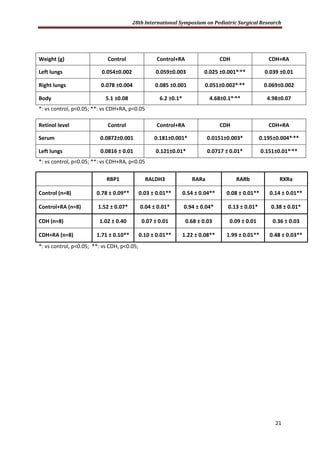
CDH+RA group compared to CDH group (p<0.05)(Table). Serum and pulmonary retinol levels were
significantly increased in control+RA compared to control (p<0.05)(Table) and in CDH+RA compared
to CDH (p<0.05)(Table). The relative mRNA expression levels of RSP genes were significantly
increased in control+RA compared to control (p<0.05) and in CDH+RA compared to CDH (p<0.05)
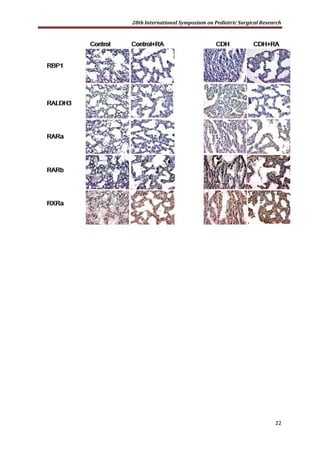
(Table). Markedly increased immunoreactivity of RSP was observed in control+RA and CDH+RA lungs
compared to control and CDH (Figure).
Conclusions: Our data shows that prenatal treatment with RA elevates fetal retinol levels in lungs
and serum. Enhanced retinol levels accompanied by the increased gene expression of main
components of RSP suggest that retinol triggered RSP-activation may result in reversal of pulmonary
hypoplasia in the nitrofen model.
28th International Symposium on Pediatric Surgical Research
21
Weight (g) Control Control+RA CDH CDH+RA
Left lungs 0.054±0.002 0.059±0.003 0.025 ±0.001*,
** 0.039 ±0.01
Right lungs 0.078 ±0.004 0.085 ±0.001 0.051±0.002*,
** 0.069±0.002
Body 5.1 ±0.08 6.2 ±0.1* 4.68±0.1*,
** 4.98±0.07
*: vs control, p<0.05; **: vs CDH+RA, p<0.05
Retinol level Control Control+RA CDH CDH+RA
Serum 0.0872±0.001 0.181±0.001* 0.0151±0.003* 0.195±0.004*,
**
Left lungs 0.0816 ± 0.01 0.121±0.01* 0.0717 ± 0.01* 0.151±0.01*,
**
*: vs control, p<0.05; **: vs CDH+RA, p<0.05
RBP1 RALDH3 RARa RARb RXRa
Control (n=8) 0.78 ± 0.09** 0.03 ± 0.01** 0.54 ± 0.04** 0.08 ± 0.01** 0.14 ± 0.01**
Control+RA (n=8) 1.52 ± 0.07* 0.04 ± 0.01* 0.94 ± 0.04* 0.13 ± 0.01* 0.38 ± 0.01*
CDH (n=8) 1.02 ± 0.40 0.07 ± 0.01 0.68 ± 0.03 0.09 ± 0.01 0.36 ± 0.03
CDH+RA (n=8) 1.71 ± 0.10** 0.10 ± 0.01** 1.22 ± 0.08** 1.99 ± 0.01** 0.48 ± 0.03**
*: vs control, p<0.05; **: vs CDH, p<0.05;
28th International Symposium on Pediatric Surgical Research
22
28th International Symposium on Pediatric Surgical Research
23
MESENCHYMAL EXPRESSION OF THE FRAS1/FREM2 GENE UNIT IS DECREASED IN THE DEVELOPING
DIAPHRAGM OF NITROFEN-INDUCED CONGENITAL DIAPHRAGMATIC HERNIA
T. Takahashi1
, F. Friedmacher1
, J. Zimmer1
, P. Puri1
1
National Children’s Research Centre, Our Lady’s Children’s Hospital, Crumlin, Dublin, Ireland
E-mail: prem.puri@ncrc.ie
PURPOSE: Developmental mutations that inhibit normal formation of extracellular matrix (ECM) in
fetal diaphragms have been identified in congenital diaphragmatic hernia (CDH). FRAS1 and FRAS1-
related extracellular matrix2 (FREM2), which encode important ECM proteins, are secreted by
mesenchymal cells during diaphragmatic development. The FRAS1/FREM2 gene unit has been
shown to form a ternary complex with FREM1, which plays a crucial role during formation of human
and rodent diaphragms. Furthermore, it has been demonstrated that the diaphragmatic expression
of FREM1 is decreased in the nitrofen-induced CDH model. We hypothesized that FRAS1 and FREM2
expression is decreased in developing diaphragms of fetal rats with nitrofen-induced CDH.
METHODS: Timed-pregnant rats were exposed to either nitrofen or vehicle on gestational day 9
(D9), and fetuses were harvested on selected time-points D13, D15 and D18. Dissected diaphragms
(n=72) were divided into two groups: control and nitrofen-exposed samples (n=12 per time-point
and experimental group, respectively). Diaphragmatic gene expression levels of FRAS1 and FREM2
were analyzed by qPCR. Immunofluorescence-double-staining for FRAS1 and FREM2 was combined
with the mesenchymal marker GATA4 in order to evaluate protein expression and localization in
developing fetal diaphragms.
RESULTS: Relative mRNA expression of FRAS1 and FREM2 were significantly reduced in
pleuroperitoneal folds of nitrofen-exposed fetuses on D13 (1.76±0.86 vs. 3.09±1.15; p<0.05 and
0.47±0.26 vs. 0.82±0.36; p<0.05), developing diaphragms of nitrofen-exposed fetuses on D15
(1.45±0.80 vs. 2.63±0.84; p<0.05 and 0.41±0.16 vs. 1.02±0.49; p<0.05) and fully muscularized
diaphragms of nitrofen-exposed fetuses on D18 (1.35±0.75 vs. 2.32±0.92; p<0.05 and 0.37±0.24 vs.
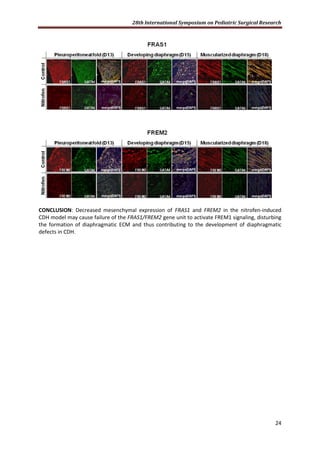
0.70±0.32; p<0.05) compared to controls. Confocal laser scanning microscopy revealed markedly
diminished diaphragmatic FRAS1 and FREM2 immunofluorescence, which was associated with
reduced proliferation of diaphragmatic mesenchymal cells in nitrofen-exposed fetuses on D13, D15
and D18 compared to controls (Figure).
28th International Symposium on Pediatric Surgical Research
24
CONCLUSION: Decreased mesenchymal expression of FRAS1 and FREM2 in the nitrofen-induced
CDH model may cause failure of the FRAS1/FREM2 gene unit to activate FREM1 signaling, disturbing
the formation of diaphragmatic ECM and thus contributing to the development of diaphragmatic
defects in CDH.
28th International Symposium on Pediatric Surgical Research
25
UPREGULATION OF S1P1 RECEPTOR IN THE PULMONARY VASCULATURE OF NITROFEN-INDUCED
CONGENITAL DIAPHRAGMATIC HERNIA
J. Zimmer1
, T. Takahashi1
, J. W. Duess1,2
, A.D. Hofmann1,3
, P. Puri1,2
1
National Children's Research Centre, Our Lady's Children's Hospital, Dublin,Ireland
2
School of Medicine and Medical Science and Conway Institute of Biomolecular and Biomedical
Research, University College Dublin, Ireland
3
Department of Pediatric Surgery, Hannover Medical School, Hannover, Germany
Purpose: The high morbidity and mortality in neonates with congenital diaphragmatic hernia (CDH)
is attributed to severe pulmonary hypoplasia and persistent pulmonary hypertension (PH).
Sphingolipids have been demonstrated to play a crucial role in pulmonary development. The
sphingosine kinase 1 (SphK1) is an oncogenic enzyme, which modulates the synthesis of sphingolipid
sphingosine-1-phosphate (S1P). S1P is a key mediator regulating cell proliferation, migration and
angiogenesis via different receptor subtypes, S1P1, S1P2 and S1P3. Recently, the SphK1/S1P
pathway has been shown to be involved in adult human pulmonary arterial hypertension by
promoting pulmonary artery smooth muscle cell (SMC) proliferation. The aim of this study was to
investigate which S1P receptors are responsible for S1P induced abnormal pulmonary vascular
remodelling in the nitrofen-induced CDH model.
Methods: Pregnant Sprague Dawley rats were exposed to nitrofen or vehicle on D9 of gestation.
Fetuses were sacrificed on D21 and divided into nitrofen and control group (n = 12). Pulmonary RNA
was extracted and mRNA levels of SphK1, S1P1, S1P2 and S1P3 were determined by quantitative
real-time PCR. Western blotting and confocal-immunofluorescence microscopy were performed to
determine pulmonary protein expression as well as vascular localization of expressed SphK1, S1P1,
S1P2 and S1P3.
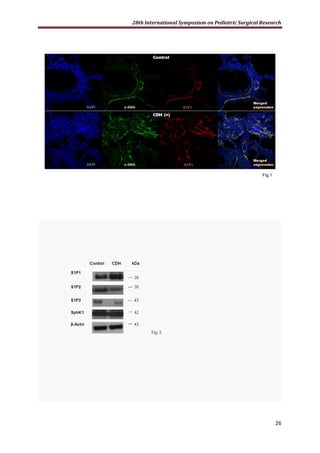
Results: Confocal-microscopy revealed an increased pulmonary vascular expression of S1P1 (Fig.1)
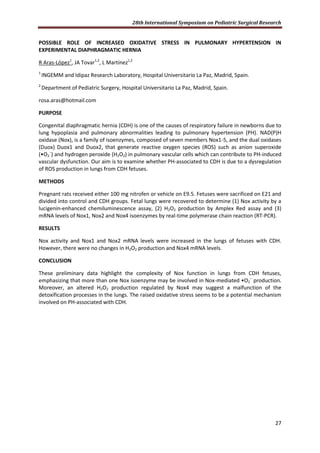
and a decreased expression of S1P2 and S1P3 in lungs of nitrofen-exposed fetuses compared to
controls. These results were confirmed by western blotting (Fig.2) and quantitative real-time PCR.
SpHK1 expression was not found to be altered in treated rats compared to controls.
Conclusion: We show for the first time the increased S1P1 receptor pulmonary vascular expression
in the nitrofen induced CDH. These results suggest that S1P1 receptor is involved in the S1P induced
pulmonary vascular remodeling resulting in PH in this model.
28th International Symposium on Pediatric Surgical Research
26
Fig.1
28th International Symposium on Pediatric Surgical Research
27
POSSIBLE ROLE OF INCREASED OXIDATIVE STRESS IN PULMONARY HYPERTENSION IN
EXPERIMENTAL DIAPHRAGMATIC HERNIA
R Aras-López1
, JA Tovar1,2
, L Martínez1,2
1
INGEMM and Idipaz Research Laboratory, Hospital Universitario La Paz, Madrid, Spain.
2
Department of Pediatric Surgery, Hospital Universitario La Paz, Madrid, Spain.
rosa.aras@hotmail.com
PURPOSE
Congenital diaphragmatic hernia (CDH) is one of the causes of respiratory failure in newborns due to
lung hypoplasia and pulmonary abnormalities leading to pulmonary hypertension (PH). NAD(P)H
oxidase (Nox), is a family of isoenzymes, composed of seven members Nox1-5, and the dual oxidases
(Duox) Duox1 and Duox2, that generate reactive oxygen species (ROS) such as anion superoxide
(•O2
−
) and hydrogen peroxide (H2O2) in pulmonary vascular cells which can contribute to PH-induced
vascular dysfunction. Our aim is to examine whether PH-associated to CDH is due to a dysregulation
of ROS production in lungs from CDH fetuses.
METHODS
Pregnant rats received either 100 mg nitrofen or vehicle on E9.5. Fetuses were sacrificed on E21 and
divided into control and CDH groups. Fetal lungs were recovered to determine (1) Nox activity by a
lucigenin-enhanced chemiluminescence assay, (2) H2O2 production by Amplex Red assay and (3)
mRNA levels of Nox1, Nox2 and Nox4 isoenzymes by real-time polymerase chain reaction (RT-PCR).
RESULTS
Nox activity and Nox1 and Nox2 mRNA levels were increased in the lungs of fetuses with CDH.
However, there were no changes in H2O2 production and Nox4 mRNA levels.
CONCLUSION
These preliminary data highlight the complexity of Nox function in lungs from CDH fetuses,
emphasizing that more than one Nox isoenzyme may be involved in Nox-mediated •O2
−
production.
Moreover, an altered H2O2 production regulated by Nox4 may suggest a malfunction of the
detoxification processes in the lungs. The raised oxidative stress seems to be a potential mechanism
involved on PH-associated with CDH.
28th International Symposium on Pediatric Surgical Research
28
MiRacles for babies with abnormal lungs: the story of miR-10a and lung development
R. Visser1, C. Fraser2, D. Mulhall2, F. Zhu2, C. Day2
, B. Iwasiow2, T. Mahood2,3, R. Keijzer1,2
1Department of General Surgery, University of Manitoba
2 Department of Pediatric Surgery and Child Health and Children’s Hospital Research Institute of
Manitoba, University of Manitoba; Winnipeg, MB, Canada
3 Department of Physiology and Pathophysiology, University of Manitoba; Winnipeg, MB, Canada
Corresponding author: richardkeijzer@gmail.com
Purpose
Worldwide, 150 babies are born every day with congenital diaphragmatic hernia (CDH). One
third of these infants will die from respiratory failure due to pulmonary hypoplasia.
MicroRNAs are essential epigenetic factors for lung development. We identified microRNA
miR-10a as a key regulator in CDH. We aimed to define the role of miR-10a in both normal and
abnormal lung development.
Methods
Using the nitrofen rat model to induce CDH, we employed real-time quantitative polymerase
chain reaction (RT-qPCR) and fluorescent in situ hybridization to study miR-10a expression
during development. Control- and nitrofen-treated fetal rat lungs were extracted for explant
cultures and treated with miR-10a inhibitors and mimics. We are investigating miR-10a’s
interaction with the retinoic acid signalling pathway using RT-qPCR and will confirm its
participation in vitro using a retinoic acid response element (RARE) dual luciferase assay.
Results
We found that miR-10a expression is localized in the mesenchyme of fetal lungs. Nitrofen
treatment reduces miR-10a’s expression, particularly early in gestation. Using nitrofen-treated
fetal rat lungs as explant cultures, we could reverse the hypoplastic phenotype by treating
lungs early in development with a miR-10a mimic. We are currently using RT-qPCR and the
RARE dual luciferase assay to confirm that miR-10a affects lung development through the
retinoic acid signalling pathway.
Conclusion
In CDH, reduced expression of miR-10a early in development contributes to pulmonary
hypoplasia. Treating developing lungs with miR-10a mimics can reverse the hypoplastic
phenotype. We believe this microRNA can help to develop a prenatal treatment to improve
the outcomes of CDH babies.
28th International Symposium on Pediatric Surgical Research
29
MiRacles for babies with abnormal lungs: the role of miR-200b in lung development
R. Visser1, N. Khoshgoo2, Vinaya Kumar Siragam2,3
, Barbara Iwasiow2,3
, Fuqin Zhu2,3
, Arzu Öztürk4,5
,
Sujata Basu3
, Molly Pind4,5
, Agnes Fresnosa4,5
, Gerald Stelmack3
, Geoff Hicks4,5
, Andrew Halayko3
,
Richard Keijzer1,2,3
1Department of General Surgery, University of Manitoba; Winnipeg, MB, Canada
2 Department of Pediatric Surgery and Child Health and Children’s Hospital Research Institute of
Manitoba, University of Manitoba; Winnipeg, MB, Canada 3Department of Physiology and
Pathophysiology, University of Manitoba; Winnipeg, MB, Canada
4
Manitoba Institute of Cell Biology University of Manitoba, Winnipeg, Canada,
5
Department of Biochemistry & Medical Genetics, University of Manitoba, Winnipeg, Canada
Corresponding author: richardkeijzer@gmail.com
Purpose
Respiratory failure is the leading cause of neonatal death in infants with congenital diaphragmatic
hernia (CDH). Reduced airway branching and a thickened layer of connective tissue characterize the
lungs of CDH babies. One explanation for the pathogenesis of CDH is defective epithelial-to-
mesenchymal interactions (EMT) during development. We have identified that miR200b is
abnormally expressed in CDH lungs. This microRNA is well known as an epigenetic moderator of EMT
in oncology. We aimed to define the effects of miR-200b on EMT during normal and abnormal lung
organogenesis.
Methods
We developed a miR-200b knockout mouse that allowed us to localized miR-200b expression with a
LacZ reporter gene. We then characterized both lung branching and pulmonary function in fetal and
newborn mice. By crossing our miR-200b knockout mice with CFP-ECadherin mice, we were able to
study the pulmonary epithelial phenotype in the presence and absence of miR-200b expression.
Results
LacZ staining revealed high miR-200b expression in fetal lungs. Heterozygous knockout lungs showed
reduced branching. Homozygous mice had decreased pulmonary function after birth. CFP-ECadherin
miR200b knockout lung explants indicated increased epithelial expression, consistent with altered
EMT signaling.
Conclusion
Epithelial-to-mesenchymal signaling is essential to proper lung development. Our findings support
that miR-200b is a key regulator of the crosstalk between the multiple pathways that participate in
this capacity. By altering the expression of miR-200b early in development, we believe this microRNA
could be the key to developing a prenatal treatment to improve the outcome in CDH babies.
28th International Symposium on Pediatric Surgical Research
30
DOWNREGULATION OF HEPATIC ADIPOSE DIFFERENTIATION-RELATED PROTEIN (ADRP) IN
NITROFEN INDUCED CONGENITAL DIAPHRAGMATIC HERNIA MODEL.
Takahashi H.1
, Friedmacher F.1
, Takahashi T.1
, Puri P.
1
National Children's Research Centre, Our Lady's Children's Hospital, Crumlin, Dublin, Ireland,
2
Conway Institue of Biomolecular and Biomedical Research, School of Medicine & Medical Science,
University College Dublin, Dublin, Ireland
Background: Vitamin A plays an essential role in biologic processes during embryogenesis.
Disruption of vitamin A homeostasis is a part of pathogenesis of congenital diaphragmatic hernia
accompanied by lung hypoplasia in mammalian and human cases. Since Vitamin A is not be
synthesized by the body, mammals absorb all Vitamin A from diet. After absorption, Vitamin A
transported to the lipid droplet in hepatic stellate cells for storage. Adipose differentiation-related
protein (ADRP) stabilize lipid droplet interface, which is a reliable and sensitive marker for lipid
droplets.
The teratogen induced nitrofen model has been widely used to investigate the CDH-associated
pathology in rodents. It has been reported that nitrofen disturbs the mobilization of retinoid from
placenta to fetus. However, retinoid storage in the hepatic lipid droplet in the CDH nitrofen model
remains unclear. We designed this study to test the hypothesis that the hepatic ADRP expression is
downregulated in the nitrofen-induced CDH model.
Methods: Pregnant rats were exposed to either olive oil or nitrofen on day 9 of gestation (D9).
Fetuses were harvested on D21, and livers were divided into two groups: controls and nitrofen (n =
24 at each time-point). ADRP gene expression level was analyzed by qRT-PCR.
Immunohistochemistry were performed to investigate ADRP protein expression.
Results: ADRP gene expression was significantly reduced in liver (ADRP: 1.72±0.19 vs. 0.99±0.10;
p=0.00721) and protein expression was markedly decreased in liver.
Conclusion: Our findings of downregulation of hepatic ADRP gene expression, suggest that the
retinoid storage in hepatic lipid droplets may be impaired in the nitrofen-induced CDH model.
28th International Symposium on Pediatric Surgical Research
31
Minimal invasive lung support via umbilical vein with a double-lumen cannula in a neonatal lamb
model: A proof of principle
F.Schmidt1
, J.Kuebler2
, M.Ganter3
, T.Jack1
, L.Meschenmoser4
, M.Sasse1
, M.Boehne1
, H.Bertram1
,
P.Beerbaum1
, H.Koeditz1
1 Department of Pediatric Cardiology and Intensive Care Medicine, Medical School Hannover, Carl-
Neuberg-Strasse 1, 30625, Hannover, Germany
2 Department of Pediatric Surgery, Medical School Hannover, Germany
3 University of Veterinary Medicine Hannover Foundation, Germany
4 Department of Cardiothoracic Surgery, Transplantation and Vascular Surgery, Medical School
Hannover, Germany
Corresponding author: Schmidt.florian@mh-hannover.de
Purpose: Acute respiratory distress syndrome, with the need for invasive mechanical ventilation
(MV), remains a major cause of neonatal mortality and morbidity. Although veno-venous
extracorporeal lung support (VV-ECLS) has become a standard of care procedure in neonatal
patients with acute pulmonary failure there are no reports regarding the use of a double-lumen
cannula for extracorporeal minimal invasive lung support via the umbilical vein.
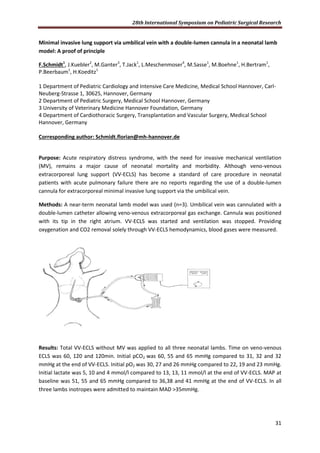
Methods: A near-term neonatal lamb model was used (n=3). Umbilical vein was cannulated with a
double-lumen catheter allowing veno-venous extracorporeal gas exchange. Cannula was positioned
with its tip in the right atrium. VV-ECLS was started and ventilation was stopped. Providing
oxygenation and CO2 removal solely through VV-ECLS hemodynamics, blood gases were measured.
Results: Total VV-ECLS without MV was applied to all three neonatal lambs. Time on veno-venous
ECLS was 60, 120 and 120min. Initial pCO2 was 60, 55 and 65 mmHg compared to 31, 32 and 32
mmHg at the end of VV-ECLS. Initial pO2 was 30, 27 and 26 mmHg compared to 22, 19 and 23 mmHg.
Initial lactate was 5, 10 and 4 mmol/l compared to 13, 13, 11 mmol/l at the end of VV-ECLS. MAP at
baseline was 51, 55 and 65 mmHg compared to 36,38 and 41 mmHg at the end of VV-ECLS. In all
three lambs inotropes were admitted to maintain MAD >35mmHg.
28th International Symposium on Pediatric Surgical Research
32
Conclusion: VV-ECLS using a double lumen catheter via the umbilical vein can sufficiently remove
pCO2 without MV in a neonatal lamb model for a period of at least 120min. pO2 were measured 22,
19 and 23mmHg respectively at the end of VV-ECLS. At least partially caused by recirculation
phenomena, which could possibly be improved by different cannula design. Inotropic support was
necessary during VV-ECLS to achieve targeted MAD > 35mmHg.
28th International Symposium on Pediatric Surgical Research
33
Outcome of esophageal atresia/tracheoesophageal fistula in extremely-low-birth-weight neonates
(<1000 grams)
Augusto Zani, Giovanni Cobellis, Justyna Wolinska, Priscilla Chiu, Agostino Pierro
Division of General and Thoracic Surgery, The Hospital for Sick Children, Toronto, Ontario, Canada
PURPOSE: Recent advances in intensive care have resulted in a high survival of extremely low birth
weight (ELBW, <1000 g) neonates. The management of ELBW infants born with esophageal
atresia/tracheoesophageal fistula (EA/TEF) remains challenging and controversial. In this study, we
reviewed our experience with the surgical management of these neonates at our institution over a
fifteen year period.
METHODS: Ethical approval was obtained (REB1000046653). Medical records of ELBW infants with
EA/TEF treated at our institution between 2000 and 2014 were reviewed. Demographics, associated
anomalies, operative approach and postoperative complications were reported. Data are reported
as median (range).
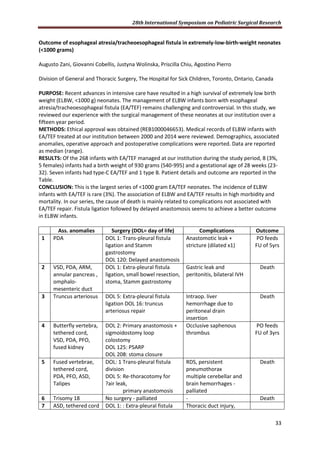
RESULTS: Of the 268 infants with EA/TEF managed at our institution during the study period, 8 (3%,
5 females) infants had a birth weight of 930 grams (540-995) and a gestational age of 28 weeks (23-
32). Seven infants had type-C EA/TEF and 1 type B. Patient details and outcome are reported in the
Table.
CONCLUSION: This is the largest series of <1000 gram EA/TEF neonates. The incidence of ELBW
infants with EA/TEF is rare (3%). The association of ELBW and EA/TEF results in high morbidity and
mortality. In our series, the cause of death is mainly related to complications not associated with
EA/TEF repair. Fistula ligation followed by delayed anastomosis seems to achieve a better outcome
in ELBW infants.
Ass. anomalies Surgery (DOL= day of life) Complications Outcome
1 PDA DOL 1: Trans-pleural fistula
ligation and Stamm
gastrostomy
DOL 120: Delayed anastomosis
Anastomotic leak +
stricture (dilated x1)
PO feeds
FU of 5yrs
2 VSD, PDA, ARM,
annular pancreas ,
omphalo-
mesenteric duct
DOL 1: Extra-pleural fistula
ligation, small bowel resection,
stoma, Stamm gastrostomy
Gastric leak and
peritonitis, bilateral IVH
Death
3 Truncus arteriosus DOL 5: Extra-pleural fistula
ligation DOL 16: truncus
arteriosus repair
Intraop. liver
hemorrhage due to
peritoneal drain
insertion
Death
4 Butterfly vertebra,
tethered cord,
VSD, PDA, PFO,
fused kidney
DOL 2: Primary anastomosis +
sigmoidostomy loop
colostomy
DOL 125: PSARP
DOL 208: stoma closure
Occlusive saphenous
thrombus
PO feeds
FU of 3yrs
5 Fused vertebrae,
tethered cord,
PDA, PFO, ASD,
Talipes
DOL: 1 Trans-pleural fistula
division
DOL 5: Re-thoracotomy for
?air leak,
primary anastomosis
RDS, persistent
pneumothorax
multiple cerebellar and
brain hemorrhages -
palliated
Death
6 Trisomy 18 No surgery - palliated - Death
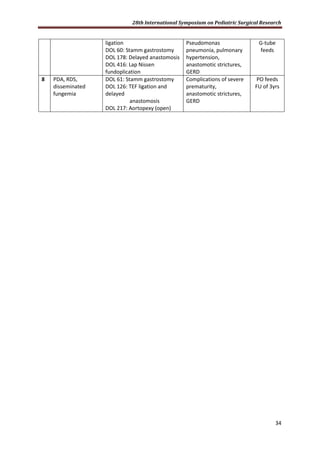
7 ASD, tethered cord DOL 1: : Extra-pleural fistula Thoracic duct injury,
28th International Symposium on Pediatric Surgical Research
34
ligation
DOL 60: Stamm gastrostomy
DOL 178: Delayed anastomosis
DOL 416: Lap Nissen
fundoplication
Pseudomonas
pneumonia, pulmonary
hypertension,
anastomotic strictures,
GERD
G-tube
feeds
8 PDA, RDS,
disseminated
fungemia
DOL 61: Stamm gastrostomy
DOL 126: TEF ligation and
delayed
anastomosis
DOL 217: Aortopexy (open)
Complications of severe
prematurity,
anastomotic strictures,
GERD
PO feeds
FU of 3yrs
28th International Symposium on Pediatric Surgical Research
35
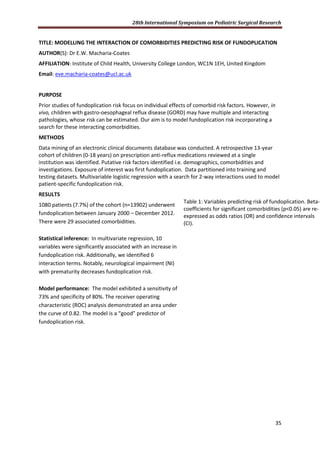
TITLE: MODELLING THE INTERACTION OF COMORBIDITIES PREDICTING RISK OF FUNDOPLICATION
AUTHOR(S): Dr E.W. Macharia-Coates
AFFILIATION: Institute of Child Health, University College London, WC1N 1EH, United Kingdom
Email: eve.macharia-coates@ucl.ac.uk
PURPOSE
Prior studies of fundoplication risk focus on individual effects of comorbid risk factors. However, in
vivo, children with gastro-oesophageal reflux disease (GORD) may have multiple and interacting
pathologies, whose risk can be estimated. Our aim is to model fundoplication risk incorporating a
search for these interacting comorbidities.
METHODS
Data mining of an electronic clinical documents database was conducted. A retrospective 13-year
cohort of children (0-18 years) on prescription anti-reflux medications reviewed at a single
institution was identified. Putative risk factors identified i.e. demographics, comorbidities and
investigations. Exposure of interest was first fundoplication. Data partitioned into training and
testing datasets. Multivariable logistic regression with a search for 2-way interactions used to model
patient-specific fundoplication risk.
RESULTS
1080 patients (7.7%) of the cohort (n=13902) underwent
fundoplication between January 2000 – December 2012.
There were 29 associated comorbidities.
Table 1: Variables predicting risk of fundoplication. Beta-
coefficients for significant comorbidities (p<0.05) are re-
expressed as odds ratios (OR) and confidence intervals
(CI).
Statistical inference: In multivariate regression, 10
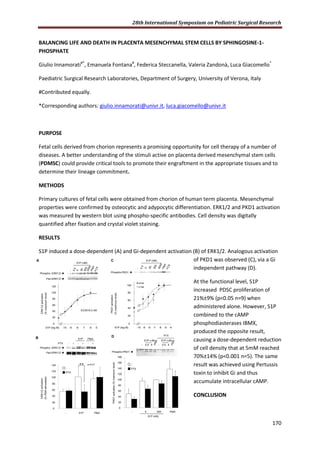
variables were significantly associated with an increase in
fundoplication risk. Additionally, we identified 6
interaction terms. Notably, neurological impairment (NI)
with prematurity decreases fundoplication risk.
Model performance: The model exhibited a sensitivity of
73% and specificity of 80%. The receiver operating
characteristic (ROC) analysis demonstrated an area under
the curve of 0.82. The model is a “good” predictor of
fundoplication risk.
28th International Symposium on Pediatric Surgical Research
36
Figure 1: ROC analysis for multivariate logistic regression
model incorporating 2-way interaction terms
Independent variables OR 2.5%CI 97.5%CI
ni 10.05 6.79 15.09
cdh 7.69 4.32 13.50
achalasia 7.18 2.28 19.88
renal 5.93 2.38 14.53
oatof 5.83 3.67 9.13
skeletal 5.66 2.44 13.43
prem 4.51 2.93 6.97
dental 3.76 0.99 13.31
cld 2.80 1.92 4.06
metabolic 1.81 1.04 3.07
Interaction terms
ni:cleft 108.51 9.53 4242.43
ni:swallow 12.80 3.00 91.39
ni:tracheal 10.79 3.16 45.72
cld:metabolic 7.38 1.15 47.16
ni:cardiac 3.36 1.99 5.69
ni:prem 0.40 0.24 0.68
CONCLUSION
We observe comorbidities with no individual effects that, in concert with NI, dramatically increase
fundoplication risk. Modelling to include a search for interactions reveals hidden risk factors. This
analysis demonstrates the importance of modelling with in vivo assumptions i.e. interacting
comorbidities.
28th International Symposium on Pediatric Surgical Research
37
Morphological changes and altered vascular measurements in the chick embryo model following
exposure to cadmium.
A Kaskova Gheorghescu, J. Thompson
School of Medicine and Medical Science, University College Dublin, Belfield, Dublin 4, Ireland
Abstract
Purpose: Chick embryos exposed to teratogenic doses of cadmium acetate (CdAc) at H-H stage 16-17
are known to develop abnormal body axes, with exaggerated lordosis in the lumbosacral region and
subsequent ventral body wall defect. It has been noted previously that cadmium causes abnormal
angiogenesis. The purpose of this study was to describe and quantify anti-angiogenic effect of Cd
utilizing the chick embryo model.
Methods: After 60 hours incubation, chicks were explanted according to Dugan’s method and
treated with 5, 25, 50, 75 and 100 µl of 50 µmol CdAc. Equimolar sodium acetate 50 µl was given to
controls. Embryos were returned to the incubator and re-examined at 4, 8, 24 and 48 hours later.
The dose at which Cd produces an anti-angiogenic effect was established. Morphological
abnormalities were observed. Vascular and embryo measurements (length of the sinus terminalis,
the size of the area vasculosa, vessel density and crown-rump length) were performed. Cadmium
uptake within the chick embryo was quantified. Quantitative real-time RT-PCR was used to
determine the relative expression of Ang-2 and VE-cadherin.
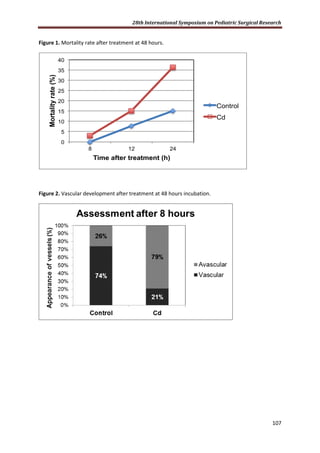
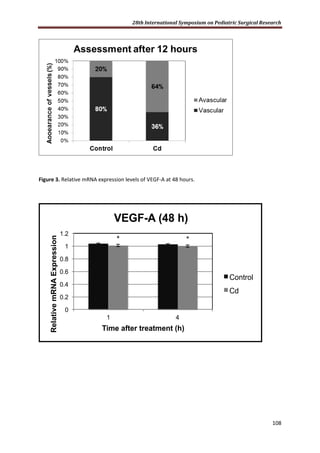
Results: 50 μL of 50 μM CdAc produced an anti-angiogenic effect. In Cd explants, extra-embryonic
vasculature was present in all treated explants, but a disturbed pattern was seen,
omphalomesenteric vessels appeared retarded with reduced branching. The sinus terminalis,
appeared tortuous and vascular development in the AV appeared suppressed generally. Complete
extra-embryonic avascularity wasn’t observed. The length of the sinus terminalis, the size of the area
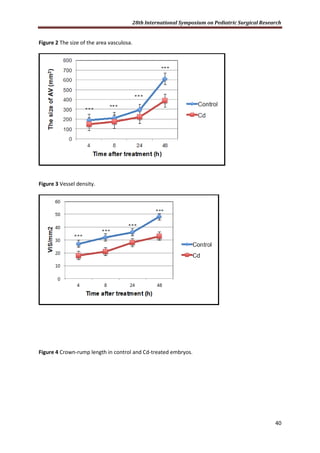
vasculosa, vessel density, and CRL of the embryos were significantly reduced in the Cd group at all
time points when compared with controls. Treatment with 50 μL of 50 μM of CdAc resulted in a
mean embryo (n=14) Cd concentration of 4.1 ± 1.2 μM and a mean concentration of 7.6 ± 1.0 μM in
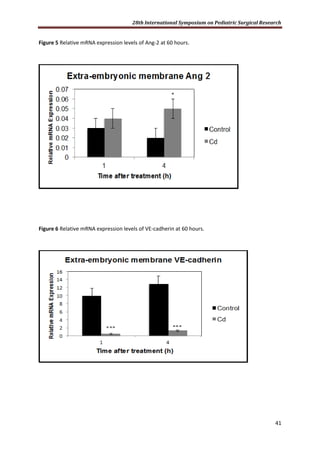
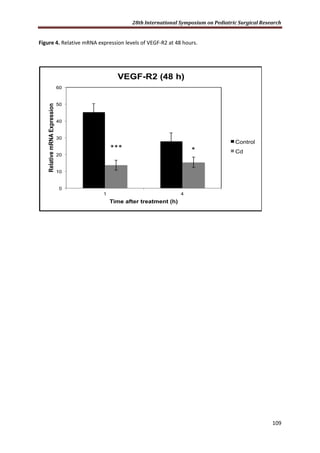
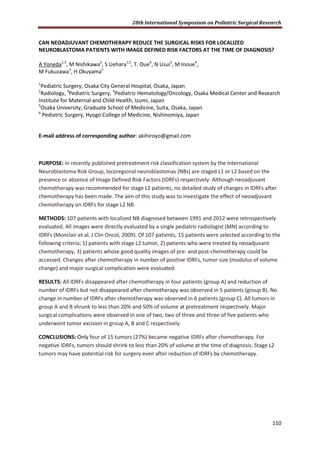
the extra-embryonic membranes (n=14) at 8 hours. The relative mRNA expression levels of Ang-2
were increased in the Cd group at 4 hours. VE-cadherin expression was significantly decreased in the
Cd group compared to controls at 1 hour and 4
Conclusion: Vascular endothelium is a target of Cd toxicity. Cadmium exposure impairs vascular
development, as evidenced by reduction in vascular and embryo measurements. Association
between abnormal vasculature and abnormal embryos was very strong. Results clearly indicate that
abnormal extra-embryonic vasculature is linearly associated with the growth retardation of the
embryo.
28th International Symposium on Pediatric Surgical Research
38
Table 1 Effects of cadmium dose on embryo survival and gross vascular abnormality after treatment
at 60 hours (Hamburger-Hamilton developmental stages 16-17).
Treatment (50 μL) N Dead at 60+24h Vascular abnormality 60+24h (%
of survivors)
5 μM CdAc 10 3 (30%) 0 (0%)
25 μM CdAc 10 4 (40%) 0 (0%)
50 μM CdAc 10 3 (30%) 4 (57.1%)*
75 μM CdAc 10 7 (70%) 3 (100%)
100 μM CdAc 10 7 (70%) 3 (100%)
NaAc 10 2 (20%) 0 (0%)
Table 2 The effects of Cd on vascular development in the chick area vasculosa.
TREATMENT N Dead Disturbed pattern
(% of survivors)
4 hours
Control (NaAc)
Cd (CdAc)
140
170
6 (4.2%)
16 (%)
0 (0%)
73 (47.4%)***
8 hours
Control (NaAc)
Cd (CdAc)
134
154
3 (2.2%)
14 (%)
0 (0%)
71 (50.7%)***
24 hours
Control (NaAc)
Cd (CdAc)
131
140
6 (4.5%)
27 (%)
0 (0%)
78 (77.9%)***
48 hours
Control (NaAc)
Cd (CdAc)
125
113
5 (4.0%)
26 (%)
0 (0%)
69 (79.3%)***
28th International Symposium on Pediatric Surgical Research
39
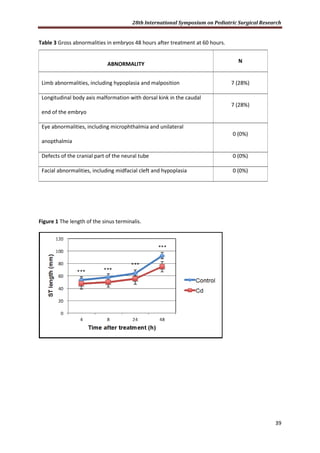
Table 3 Gross abnormalities in embryos 48 hours after treatment at 60 hours.
ABNORMALITY
N
Limb abnormalities, including hypoplasia and malposition 7 (28%)
Longitudinal body axis malformation with dorsal kink in the caudal
end of the embryo
7 (28%)
Eye abnormalities, including microphthalmia and unilateral
anopthalmia
0 (0%)
Defects of the cranial part of the neural tube 0 (0%)
Facial abnormalities, including midfacial cleft and hypoplasia 0 (0%)
Figure 1 The length of the sinus terminalis.
28th International Symposium on Pediatric Surgical Research
40
Figure 2 The size of the area vasculosa.
Figure 3 Vessel density.
Figure 4 Crown-rump length in control and Cd-treated embryos.
28th International Symposium on Pediatric Surgical Research
41
Figure 5 Relative mRNA expression levels of Ang-2 at 60 hours.
Figure 6 Relative mRNA expression levels of VE-cadherin at 60 hours.
28th International Symposium on Pediatric Surgical Research
42
FRIDAY, 25TH SEPTEMBER, 2015
SCIENTIFIC SESSION III
28th International Symposium on Pediatric Surgical Research
43
Non-Invasive Ablation of Fetal Rabbit Tissue In Utero Using Magnetic Resonance Guided High
Intensity Focused Ultrasound
K. Piorkowska1
, A.C. Waspe1
, C. Mougenot2
, T. Wang3
, J.T. Gerstle1,4
and J. Drake,1,5
.
1
Centre for Image Guided Innovation and Therapeutic Intervention, Hospital for Sick Children,
Toronto, Ontario, Canada.
2
Philips Healthcare, Toronto, Ontario, Canada.
3
Department of Laboratory Medicine and Pathobiology, University of Toronto, Toronto, Ontario,
Canada.
4
Department of General and Thoracic Surgery, Hospital for Sick Children, Toronto, Ontario, Canada.
5
Department of Neurosurgery, Hospital for Sick Children, Toronto, Ontario, Canada.
Email of Corresponding author: Karolina.Piorkowska@sickkids.ca
PURPOSE: Magnetic resonance guided high intensity focused ultrasound (MRgHIFU) is a potential
non-invasive therapy for fetal conditions including lung malformations and other solid organ lesions
requiring invasive surgical interventions. This acute study assessed feasibility and safety parameters
of in utero MRgHIFU delivery and determined accuracy and tissue response to treatment.
METHODS: High resolution 3T MR images were acquired in late gestation rabbits (~30 days, term =
32; n=5) to identify clinically relevant fetal targets. HIFU sonications were applied continuously for
~20 seconds to a specific target organ at various powers to achieve areas of necrosis guided by MR
and thermal imaging. HIFU exposures are presented as average acoustic power in Watts (Wac) ±
standard deviation reaching maximum temperatures, averaged over all exposures, in degrees
Celsius. Tissues were collected for histological analysis.
RESULTS: Lungs (n=8) were targeted with 85 ± 15 Wac reaching 74°C and livers (n=6) with 80 ± 15
Wac reaching 75°C. Histological changes for both tissue types showed distinct necrotic areas with
circumferential hemorrhage which transitioned to healthy tissue. In one fetus, a “banding pattern”
occurred due to rib interference. Kidneys (n=5) were treated with 100 Wac and reached 67°C: one
successful treatment resulted in a focal area of necrosis and surrounding vasodilation of arteries;
other treatments were less effective due to fetal movement and high perfusion of the kidney.
Necropsy revealed mild maternal skin burns (n=2) that was rectified by improved coupling and
increased skin cooling time; also, mild architectural changes in the smooth muscle of the external
uterine wall (n=3) not spanning the breadth of tissue layers to the internal surface. Examination of
the fetuses revealed focal epidermal vasodilation on the chest wall of fetus (n=8) associated with
lung targeting. Collateral organ damage ranged from mild vasodilation to diminutive necrosis and
was due to fetal size and overlapping orientation of organs. There was no apparent affect to
adjacent untreated fetuses.
CONCLUSION: MRgHIFU therapy can effectively target and thermally treat specific in utero organs in
this acute fetal rabbit model. Clinical MRgHIFU therapy for specific organ anomalies may improve
overall fetal outcome over traditional invasive surgical procedures.
28th International Symposium on Pediatric Surgical Research
44
HUMAN ADIPOSE MESENCHYMAL CELLS SUPPRESS MELANOCYTE FUNCTION AND SKIN
PIGMENTATION BY SECRETING TRANSFORMING GROWTH FACTOR β-1
A. S. Klar1,2
*, T. Biedermann1,2
*, K. Michalak1,2
, T. Michalczyk1,2
, C. Meuli-Simmen3
, M. Meuli2,4
, E.
Reichmann1,2
(1) Tissue Biology Research Unit, Department of Surgery, University Children’s Hospital Zurich,
Zurich, Switzerland
(2) Children’s Research Center, University Children’s Hospital Zurich, Zurich, Switzerland
(3) Department of Plastic, Reconstructive, Esthetical and Hand Surgery, Kantonsspital Aarau, Aarau,
Switzerland
(4) Department of Surgery, University Children’s Hospital Zurich, Zurich, Switzerland
*authors contributed equally
Correspondence should be addressed to: Ernst.Reichmann@kispi.uzh.ch
Purpose: We have previously shown that skin pigmentation is determined by mesenchymal-
epithelial interactions via the interplay of transcription factors and growth factors influencing skin
melanocytes. In this experimental study, we investigated the effect of adipose-derived stromal cells
(ASCs) on the melanocyte functions such as differentiation, proliferation, melanogenesis, and
dendritogenesis in dermo-epidemal skin substitutes.
Methods: Human epidermal melanocytes, keratinocytes, and fibroblasts were isolated from dark-
pigmented skin biopsies, whereas ASCs were isolated from human adipose tissue biopsies. After in
vitro cell expansion, bovine collagen hydrogels containing ASCs or fibroblasts were prepared, and
melanocytes and keratinocytes were seeded in a 1:5 ratio onto those hydrogels. The dermo-
epidermal skin substitutes were transplanted onto full-thickness wounds of immuno-deficient rats
and analyzed after 5 weeks.
Results: ASCs significantly suppressed the growth and pigmentation of melanocytes in dermo-
epidermal skin substitutes as compared with skin-fibroblasts. ELISA and western blot analyses
showed higher levels of TGFβ-1 in ASCs as compared to skin-fibroblasts. We showed that
melanocytes respond to TGFβ-1 in vitro and in vivo by suppressing cell proliferation and the
expression of melanosomal markers, such as tyrosinase and tyrosinase-related protein 1, which are
essential for maturation of melanosomes and melanin synthesis. Furthermore, the distribution of
melanin in the epidermis was also suppressed as demonstrated by Fontana Masson staining.
Conclusions: Our data suggest that mesenchymal cells of different tissue origin - adipose and skin -
used to construct pigmented dermo-epidermal skin substitutes, have distinct influences on the
melanocyte functions and skin pigmentation. Adipose-ASCs significantly decreased melanocyte
function that resulted in generation of light-pigmented skin substitutes, which did not correspond to
the dark-pigmented donor skin color.
Keywords: Melanocytes - Melanogenesis - Adipose-derived stromal cells - TGFβ-1 - Skin tissue
engineering - Pigmented skin substitutes - Rat model
28th International Symposium on Pediatric Surgical Research
45
Colonic epithelia disruption after maternal separation is rescued by corticotropin releasing
hormone
Bo Li1
, Tali Filler1
, Carol Lee1
, Augusto Zani1
, Elke Zani-Ruttenstock1
, Wan Ip2
, Tanja Gonska2
, Agostino
Pierro1
1
Division of General and Thoracic Surgery, The Hospital for Sick Children, Toronto, ON, Canada
2
Department of Pediatrics and Gastroenterology, The Hospital for Sick Children, Toronto, ON,
Canada
PURPOSE: Early maternal separation (MS) induced colonic disruption of morphology and
permeability, enhancing the risk of early intestinal disorders. This effect could be associated with
brain-gut interactions through the release of corticotropin releasing hormone (CRH) by
hypothalamus. The aim of the present study was to determine whether intestinal epithelial damage
could be restored by modulation of the CRH pathway.
METHODS: Following approval (license 32238), C57BL/6 neonatal mice underwent MS for 3 hours
daily between postnatal day 5 and 9. Mice were randomly assigned to receive an intraperitoneal
injection of: i) DMSO (MS+DMSO group, n=10), or ii) Antalarmin, a CRF antagonist (10
mg/kg/day, MS+Antalarmin group, n=10). MS was performed after treatment with DMSO
or Antalarmin. Untreated pups served as control. Proximal colon (most injured gut area) was
harvested and analyzed for goblet cell density per crypt (alcian blue), crypt length (H&E) and tissue
permeability. Ussing chamber was used to test tissue viability (trans-epithelial resistance) and trans-
cellular flux. Data was compared using one-way ANOVA with Bonferroni post-test; p<0.05 was
considered significant.
RESULTS: Morphology - Compared to controls, the number of goblet cells per crypt was reduced in
MS+DMSO mice (p<0.001), but increased by Antalarmin (p<0.01 to MS+DMSO; Figure 1a). Similarly,
colonic crypt length was decreased in MS+DMSO mice (p<0.01 to control), but returned to normal
levels after Antalarmin administration (p<0.05; Figure 1b). Permeability - Trans-epithelial resistance
remained unchanged across the groups confirming tissue viability of all samples. MS+DMSO
increased trans-cellular permeability compared to control (p<0.001) but MS+Antalarmin reduced it
to level observed in control (p<0.001) (Figure 1c).
CONCLUSION: Colonic mucosal damage and increased trans-cellular permeability induced by
maternal separation are rescued by Antalarmin, a CRH antagonist. These findings suggest that
maternal separation induced bowel damage could be due to a disruption of the gut-brain axis. This
provides insights on the development of new drugs that could be used for the treatments of
neonatal intestinal diseases, such as necrotizing enterocolitis.
28th International Symposium on Pediatric Surgical Research
46
AUTOPHAGY AS A CHARACTERISTIC FEATURE OF NEONATAL TISSUE MACROPHAGES
Authors: T. Winterberg1
, Y. Yu1
, S. Groos2
, J.K. Park1
, G. Vieten1
, B. Ure1
, JF. Kuebler1
Institutional affiliations
1
Department of Pediatric Surgery
2
Institute of Cell Biology in the Center of Anatomy
Hannover Medical School, Carl-Neuberg-Str. 1, 30625 Hannover
E-mail address
Kuebler.Joachim@mh-hannover.de
Purpose: Macrophage autophagy has been the focus of recent interest and a growing body of
evidence indicates that it is a key component of the innate immune response, involved in many
aspects of macrophage development and polarization. In former studies we observed distinct
phenotypic and functional features of neonatal tissue macrophages. The aim of this study was to
investigate the occurrence of autophagosomes in neonatal macrophages.
Methods: Peritoneal macrophages were gained by injury-free lavages of neonatal and adult C57/BL6
mice. Pelleted cells were investigated by electron microscopy. FACSorted, purified macrophages
were stained using standard May-Grünwald-Giemsa staining or further cultured and stimulated for
6h with TLR agonists. Total mRNA was extracted and detected using Agilent Micro Array Detection
System. After data normalization specific software was used to investigate primarily homeostatic,
pro- and anti inflammatory processes.
Results: Naive neonatal macrophages displayed a high amount of cytoplasmic vesicular structures
visible after staining (Fig.1). Electron microscopy of macrophages from neonatal mice regularly
showed autophagosomes (Fig. 2B). Microarray gene network analysis revealed that the increase in
autophagy was associated with a signature of increased homeostatic activity as well as a decrease in
genes responsible for resolving inflammation (Alox15, Tgfb2, Ikbkg).
Conclusion: Neonatal macrophages appear to display an increased autophagic activity in
combination with a tissue and developmental homeostatic “priming”. Although this seems to be
well adapted to the major changes in the tissue microenvironment after birth, these changes could
have adverse effects on the immunological balance by down regulation of pro-resolving and anti-
inflammatory mediators.
Fig.1 Fig.2
28th International Symposium on Pediatric Surgical Research
47
Fig.1 Naive neonatal (A) and adult (B) peritoneal macrophages (May-Grünwald-Giemsa staining; one
representative experiment of >8 experiments;
bars: 10 µm.
Fig.2 Thin sections of naive neonatal (A, B) and adult (C, D) peritoneal macrophages; (AP)
autophagosome, asterisks: Endoplasmic Reticulum, (G) Golgi stack, (M) Mitochondrium, (N) nucleus;
bars A, C: 2 µm; B, D: 1 µm.
28th International Symposium on Pediatric Surgical Research
48
Modified epidermal self renewal of engineered pigmented human skin after UVB exposure in an in
vivo assay
Teresa Michalczyk, Thomas Biedermann, Sophie Böttcher- Haberzeth,
Agnes Klar, Ernst Reichmann, Martin Meuli
T. Michalczyk, T. Biedermann, S. Böttcher- Haberzeth, A. Klar, E. Reichmann
Tissue Biology Research Unit, University Children’s Hospital Zurich, Zurich, Switzerland
S. Böttcher- Haberzeth, M. Meuli
Departement of Surgery, University Children’s Hospital Zurich, Zurich, Switzerland
T. Michalczyk, T. Biedermann, S. Böttcher- Haberzeth, A. Klar, E. Reichmann, M.Meuli
Children’s Research Center, University Children’s Hospital Zurich, Zurich, Switzerland
e-mail: Teresa.Michalczyk@kispi.uzh.ch
Abstract
Purpose The basal compartment of the human epidermis is constantly renewing, but still little is
known about the epidermal mechanism of maintaining and adapting its homeostasis, in particular
when exposed to external stress factors like UV irradiation. UVB light provokes tanning in human
skin. Also, it can lead to inflammation and can induce mutagenic events in the genome of skin cells.
We recently demonstrated successful engineering of pigmented dermo-epidermal skin substitutes,
with restoration of the original donor skin color in long-term in vivo experiments. In view of future
clinical application, we now studied the behavior of these tissue-engineered substitutes after
exposure to UVB irradiation.
Methods Human dermo-epidermal pigmented skin was engineered with keratinocytes, melanocytes
and fibroblasts originating of the same donor biopsy. Then, keratinocytes and melanocytes were
seeded on collagen type I hydrogels, previously populated with fibroblasts. Skin substitutes were
transplanted onto full-thickness wounds of immuno-incompetent rats and irradiated with a single
dose of 250mJ/cm2
UVB irradiation 4 weeks after transplantation. Punch biopsies were taken from
the grafts before and after irradiation for immunohistochemical staining.
Results After UVB irradiation transplanted skin substitutes showed physiological tanning properties.
Temporarily, Cytokeratin 16 and Desmoglein 3 were expressed in keratinocytes, indicating a wound
healing response. In engineered skin without UVB exposure, as well as in foreskin, few proliferating
keratinocytes were mostly located in the suprabasal layer, directly adjacent to the basal layer. After
UVB exposure proliferation of keratinocytes, but not melanocytes or fibroblasts, massively increased
notably in the basal layer and normalized 4 weeks after irradiation. The expression of the Wnt-
pathway inhibitors Dickkopf 3 and Wif 1 was lost in basal keratinocytes after UVB irradiation,
authorizing proliferation of keratinocytes. Interestingly, melanocytes continued to express Wnt-
Inhibitors after UVB treatment.
28th International Symposium on Pediatric Surgical Research
49
Conclusion These findings suggest that our engineered human skin is capable to maintain epidermal
homeostasis after external stress, via modified controlled proliferation of keratinocytes. This is
crucial regarding a future clinical application of tissue-engineered pigmented autologous skin
substitutes on patients. Furthermore, there is evidence that the basal compartment itself is
balancing inhibitors of the Wnt-pathway to initiate epidermal self-renewal.
28th International Symposium on Pediatric Surgical Research
50
Comparison of different methods of preservation to store decellularised oesophagi for tissue
engineering purposes
L. Urbani1
, P. Maghsoudlou1
, A. Milan1,2
, S. Eaton1
, P. De Coppi1
.
1
UCL Institute of Child Health and Great Ormond Street Hospital, UCL, London, UK
2
University of Padua, Padua, Italy
Corresponding author: l.urbani@ucl.ac.uk
Purpose
Several conditions may require esophageal tissue replacement. Tissue engineering of the
oesophagus (TEO) has been proposed as a therapeutic alternative to oesophageal substitution.
Acellular matrices are ideal for TEO because they are made up by tissue-specific extracellular matrix
(ECM). However, the appropriate preservation of the ECM components may significantly affect the
behavior of scaffolds in vivo. Thus far, there is no consensus on the most appropriate storage
methodology for decellularised scaffolds. Here we aim at establishing the best way to storage
oesophageal scaffolds from a large animal model and preserve the structure of their ECM.
Methods
Rabbit oesophagi were decellularized using detergent-enzymatic treatment (DET) and evaluated at 2
weeks, 1, 3 and 6 months of storage by means of histology, immunofluorescence, biomechanical
testing, ECM component quantification and angiogenic assay. Four different storage methods were
compared: A) phosphate-buffered saline solution at 4°C, B) at -20°C after a freeze-drying step, C) at -
80°C after snap-freezing in liquid nitrogen or D) in liquid nitrogen after cooling in medium with 10%
DMSO at -1°C/min then stored in liquid nitrogen.
Results
Efficient decellularization was achieved after 2 cycles of DET as evidenced by histology and DNA
quantification, with preservation of collagen, elastin and glycosaminoglycans levels. As a storage
methodology the PBS/4°C option (method A) led to the most structural destruction of the tissue,
whereas gradual freezing of the tissue (method D) was best at preserving the tissue for long term.
Scaffolds stored with method D had a preserved structure and orientation throughout all the time
points, showing intact layers and collagen and elastin fibers. Oesophagi stored at -80°C post snap-
freezing (method C) were substantially different compared to the rest, displaying irreversible
collapse and breaking up of the tissue.
Conclusion
Developing of an acellular scaffold for oesophageal tissue engineering that preserves the ECM
components and architecture of the original tissue is essential for therapy. Efficient storage allows
their use as an ‘off-the-shelf’ product. This study demonstrated that, similarly to cellular
cryopreservation, slow cooling in a DMSO/medium solution and subsequent storage in liquid
nitrogen allows long term storage of decellularized scaffolds.
28th International Symposium on Pediatric Surgical Research
51
Development of an Extracellular Matrix Hydrogel for use in Intestinal Tissue Engineering.
C.Crowley1
, L.Urbani1
, V.Gaillet1
, F.Onofri1
, L.Maughan1
, S.Eaton1
,P.Coppi1
.
1
UCL Institute of Child Health and Great Ormond Street Hospital, UCL, London, UK
Corresponding author: claire.crowley.09@ucl.ac.uk
Abstract:
Purpose: Irreversible intestinal failure (IF) is a condition that can lead to significant morbidity and
mortality and occurs as a result of anatomical or functional loss. Perenteral nutrition has been
shown to improve the condition substantially, however, there are many associated complications
with this approach. As a result, many patients eventually require an intestinal transplant, which is
unfortunately limited by the availability of donor organs and the need for aggressive
immunosuppression. Recent years have brought many advances to this field particularly regarding
isolation and culture of intestinal stem cells. However, their expansion for translational application
remains limited, so the discovery of alternative culturing methods is crucial. Here we investigate the
ability to create a hydrogel from the extracellular matrix (ECM) of intestinal tissue. ECM hydrogels
from other tissues have shown great potential for many different applications. This study aims to
develop and characterise an intestinal ECM hydrogel for eventual use in intestinal organoid culture
and as a hybrid scaffold for tissue engineered intestinal replacement.
Methods: A decellularisation protocol was developed specifically for newborn porcine intestinal
tissue. This method was assessed and characterised using SEM, histology and quantification of
collagen, elastin, GAG and DNA content after each cycle. The decellularised tissue was then
lyophilised, milled into a powder, pepsin digested and brought to a physiological pH and
temperature to produce a soluble ECM gel. The gel was characterised for its rheological properties
and gelation potential using spectrometry and oscillatory tests. Whole intestine containing both the
muscle and mucosa and the mucosa alone were compared, as this method can be highly tissue
specific.
Results:
One cycle of the decellularisation protocol was sufficient to successfully remove the nuclei and
reduce the DNA content of the intestinal tissue. Collagen, GAG and Elastin remained intact after
decellularisation. An ECM hydrogel was successfully produced and characterised. Optimal conditions
(pH, concentration, timing) for gel formation were established to obtain a hydrogel suitable for cell
culture and in vivo application.
Conclusion: In this study we established a tissue specific ECM-derived hydrogel for intestinal tissue
engineering. The applications for these gels is extensive, both for clinical and research purposes.
28th International Symposium on Pediatric Surgical Research
52
Quantitation of residual detergent in decellularised organs for tissue engineering with gas
chromatography-mass spectrometry
E. Maughan1
, C. Crowley1
, R. Bhondi1
, F. Tommasini1
, L. Urbani1
, C. Butler1
, M. Birchall1
, S. Eaton1
, P.
De Coppi1
.
1
Institute of Child Health and Great Ormond Street Hospital, UCL, London, UK
Corresponding author: claire.crowley.09@ucl.ac.uk
Purpose
Sodium deoxycholate (SDC) is a cytotoxic detergent widely used in organ decellularisation for tissue
engineering for the removal of cell membrane components. It has been reported that residual SDC
can compromise cell viability during subsequent recellularisation, 3D culture and implantation.
However, quantification of residual SDC in the tissue has not been optimized. This study was
designed to evaluate the use of Gas Chromatography-Mass Spectrometry (GC-MS) in determining
the efficacy of residual SDC removal following post-decellularisation washing.
Methods
Rat tracheae (n=16) were decellularised using a detergent-enzyme technique containing SDC over
three cycles. Following decellularisation, a washing step using double-distilled water (MilliQ) was
performed with agitation for 24 hours, 48 or 72 hours. Wash solutions were changed every 24 hours.
Samples were acidified, cholic acid added as an internal standard, extracted with diethyl ether,
derivatised to the pentaflurobenzyl, trimethylsilyl derivative, and analyzed by GC-MS.
Results
GC-MS proved a highly sensitive method for detection of very small residual concentrations of SDC
(as low as 2nmol). The concentration of residual SDC was cumulative with increasing cycle number
(1.64 vs 3.91 vs 9.56 nmol for cycles 1, 2 and 3 respectively). Increasing washing times resulted in a
demonstrable decrease in SDC concentration (e.g. 9.56 to 3.56 nmol from 24- to 72-hour
timepoints).
Conclusion
The novel use of GC-MS as a highly sensitive method for detecting and quantifying residual SDC
within decellularised tissue could enable the comparison of washing protocol efficacy. Further
validation of this analytical tool could enable its development as a GMP release criteria for
decellularised tissue in clinical trials.
28th International Symposium on Pediatric Surgical Research
53
CYTOREDUCTIVE SURGERY (CRS) AND HYPERTHERMIC INTRAPERITONEAL CHEMOTHERAPY (HIPEC)
IN PEDIATRIC OVARIAN TUMORS: A NOVEL TREATMENT APPROACH
A Hayes-Jordan 1
, CLopez2
, HL Green1
, LC Xiao3
, W Huh MD4
, C Herzog 4
ahjordan@mdanderson.org
1. University of Texas MD Anderson Cancer Center, Department of Surgical Oncology/Pediatric
Surgical Oncology, Houston, Texas, USA 2. University of Texas Houston Health Sciences Center 3.
University of Texas MD Anderson Cancer Center, Department of Biostatistics 4. University of Texas
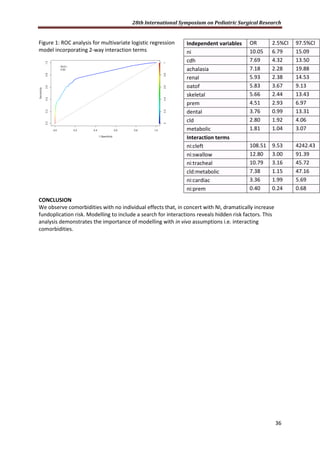
MD Anderson Cancer Center, Division of Pediatrics
Purpose: CRS and HIPEC have been used in adults with ovarian carcinoma proving overall survival
benefit in randomized trials, measured in months. Diffuse peritoneal disease from pediatric type
ovarian tumors is rare. We applied this approach to a select group of pediatric girls with diffuse
peritoneal disease. These patients were all included as part of a phase 1 or phase 2 clinical trial for
CRS and HIPEC in children.
Methods: In all patients complete cytoreduction followed by HIPEC using 100mg/M2 of Cisplatin for
90 minutes in a closed technique, was utilized. All patients were treated with the same strict peri--
operative management, as part of an investigator initiated clinical trial. All received neoadjuvant
chemotherapy. Patients with disease outside of the abdominal cavity were excluded.
Results: Of 101 pediatric CRS and HIPEC operations, 8 had ovarian primary tumors and multifocal
peritoneal disease. There were 3 yolk sac tumors( germ cell, mixed teratoma), one Sertoli-Leydig,
one PNET of the ovary, one choriocarcinoma, one juvenile granulosa cell tumor and one
adenocarcinoma. Age at diagnosis ranged from 4 to 18 years. Two of the 7 (28%) recurred and died.
The remaining 70% are disease free 2 to 8 years post HIPEC. Overall survival and relapse free
survival in this cohort was 64% and 62% respectively. [CI 0.64 (0.34,1 ); 0.62 ( 0.37, 1 )]
Complications included 2 wound infections, and 1 urinary tract infection and 1 enterocutaneous
fistula.
Conclusions: This is the first report of CRS and HIPEC in pediatric ovarian tumors. HIPEC is a safe
approach to diffuse peritoneal disease secondary to pediatric-type ovarian tumors. More treated
patients are required to determine efficacy of this approach.
28th International Symposium on Pediatric Surgical Research
54
FRIDAY, 25TH SEPTEMBER, 2015
SCIENTIFIC SESSION IV
28th International Symposium on Pediatric Surgical Research
55
PLATELET-LEUKOCYTE FIBRIN MEMBRANES AS POTENTIAL PLATFORMS FOR WOUND HEALING
*
F. Grandi1
, E. Stocco2,5
, S. Barbon2,5
, S. Capelli3
, A. Borean3
, A. Porzionato4
, V. Macchi4
, G. Albertin4
,
R. De Caro4
, PG. Gamba1
, P.P. Parnigotto5
, C. Grandi2
1
Pediatric Surgery, Department of Woman and Child Health, University of Padua, Padua, Italy
2
Department of Pharmaceutical an Pharmacological Sciences, University of Padua, Padua, Italy
3
Department of Immunohematology and Transfusion-Medicine of Belluno Hospital, Belluno, Italy
4
Section of Human Anatomy, Department of Molecular Medicine, University of Padua, Padua, Italy
5
Foundation for Biology and Regenerative Medicine, Tissue Engineering and Signaling (TES) ONLUS,
Caselle di Selvazzano Dentro, Padua, Italy
*
Corresponding and presenting author: Dr. F. Grandi francesca.grandi@studenti.unipd.it
PURPOSE Translational medicine has emerged as a new trend in medical practice; one of the main
topics deals with those therapies focused on enhancing tissue repair and regeneration. In particular,
the use of autologous haemocomponents as biomolecules delivering systems is gaining wide
attention. Recently, we developed a new method to collect haemocomponents for regenerative use,
obtaining gels rich in platelets, monocytes/macrophages, fibrinogen and CD34+
cells. Even though
these preparations are available today to stimulate tissue healing, they do not fully satisfy surgeons’
requests, looking for easily applicable and manipulable membranes. Hence, our aim was to
manufacture a novel Platelet-Leukocyte Fibrin membrane (PLFm) and to study its morpho-
mechanical properties as well as its attitude to act as a scaffold.
METHODS PLFms were prepared from a Platelet-Leukocyte concentrate/Plasma MIX as we
previously described(Caloprisco et al., Transfus Apher Sci. 2010;42:117-24) after activation with
calcium gluconate. The resulting PLFms were characterized haemocytometrically for cell
concentration in comparison with the MIX. To predict the in vivo behaviour of PLFms, supports were
incubated in PBS at 37 °C up to day 21, and their morphology/histoarchitecture were investigated by
histology, immunohistochemistry and SEM, at different end-points. In addition, contingent variations
in mechanical properties of PLFms were also assessed by tensile tests. Lastly, PLFms were used as
scaffolds to verify their ability in sustaining cell adhesion/proliferation.
RESULTS From a MIX volume of 11±2 ml were obtained membranes of 2.8±0.6 ml in volume with an
area of 8.9±1.4 cm2
and 0.31±0.06 cm in thickness. A significant increase in cell concentration was
observed for PLFms compared to the MIX. Histology and SEM showed that samples morphology
changed along with time, as the fibrin scaffold, previously masked by erythrocytes, became
progressively visible. The presence of cellular elements of interest was also assessed by
immunohystochemistry. Moreover, any significant difference in the maximum percentage of
deformation was observed within 10 days of incubation. Cell culture on PLFms showed the attitude
of these haemocomponents in sustaining cell adhesion/proliferation.
CONCLUSIONS Autologous PLFms represent a platform with structural and biological properties that
promote tissue healing and with a possible routinary application in surgery.
28th International Symposium on Pediatric Surgical Research
56
SPHINGOSINE-1-PHOSPHATE CONTROLS CELL MOTILITY OF PLACENTA MESENCHYMAL STEM CELLS
Giulio Innamorati#*
, Emanuela Fontana, Federica Steccanella, Giovanni Ridolfi, Kushal Gandhi, Luca
Giacomello*
Paediatric Surgical Research Laboratories, Department of Surgery, University of Verona, Italy
*Corresponding authors: giulio.innamorati@univr.it, luca.giacomello@univr.it
PURPOSE
A major concerns in using stem cells for therapeutic approaches is the very limited percent of
engraftment and, as a consequence, the large number of cells to be administered. Sphingosine 1
phosphate (S1P) is emerging as a crucial regulator of cell motility and chemotaxis acting in concert
with CXCL12 to regulate the egression immature progenitors. We explored the functional
implications of S1P signaling in placenta derived mesenchymal stem cells (PDMSC), a promising
opportunity for a number of diseases.
METHODS
Primary cultures of fetal cells were obtained from chorion of human term placenta. Mesenchymal
properties were confirmed by osteocytic and adypocytic differentiation. S1P receptors (S1PRs) gene
expression was assessed by RT-PCR utilizing specific primers for each of the 5 existing subtypes.
ERK1/2 and PKD1 activation was measured by western blot. Cell motility was monitored in DMEM
supplemented with 0.3% fetal calf serum, migration was digitally quantified after fixation and crystal
violet staining.
RESULTS
RT-PCR revealed mRNA expression of S1P receptors subtypes 1, 3, 4. Subtypes 2 and 5 were absent.
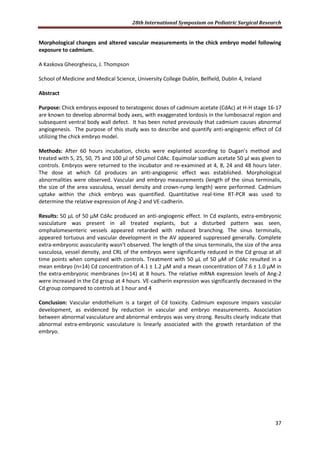
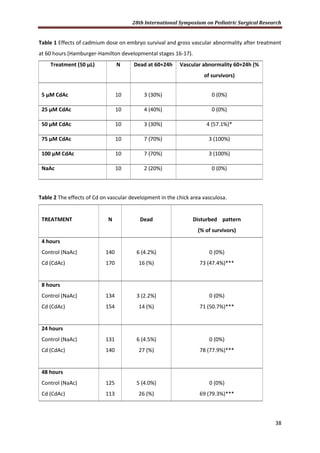
Consistently, SEW2871 and CYM50179 (selective agonists for S1P1R and S1P4R respectively) and
FTY-P (active on S1PR 1,3,5,4) induced ERK1/2 activation (A).
0%#
20%#
40%#
60%#
80%#
100%#
120%#
0# 60# 120# 180# 240# 300# 360# 420# 480# 540# 600# 660# 720#
0%#
20%#
40%#
60%#
80%#
100%#
120%#
SEW2871# CYM# FTY720# S1P#
C
YM
50179
S1P
**
**
**
FTY720PSEW2871
A
ERK1/2activation(%S1Pstimulated-basal)
FTY720P
SEW
2871
S1P
CYM 50179
B
ERK1/2activation
(%maximalstimulation-basal)
0%#
10%#
20%#
30%#
40%#
50%#
60%#
70%#
1.E-08# 1.E-07# 1.E-06# 1.E-05#
Woundclosure(%)
C
[S1P] (log M) -7 -6 -5Time (hours) 1 2 3 4 5 18 24
28th International Symposium on Pediatric Surgical Research
57
Addition of S1P promoted the transient activation of ERK1/2 (B). An analogous effect was observed
with PKD1. Wound healing assays revealed that increasing concentrations of S1P significantly and
progressively reduced PDMSC motility (C).
CONCLUSION
We demonstrated that PDMSC express more than one G protein coupled receptor specific for S1P.
S1P signaling inhibits cell migration and could be exploited to design novel approaches aimed to
promote PDMSC engraftment in the target tissues.
28th International Symposium on Pediatric Surgical Research
58
Effects of curcumin on a pediatric hepatocellular carcinoma model in vivo and curcuminoid
concentrations after oral application in mice
V. Ellerkamp1
, N. Bortl1
, J. Frank2
, C. Schiborr2
, S. Armeanu-Ebinger1
, E. Schmid1
, B. Kirchner1
, S.W.
Warmann1
, J. Fuchs1
University Children`s Hospital Tuebingen, Department for Pediatric Surgery and pediatric Urology,
Tuebingen, Germany
University Hohenheim, Institute of Biological Chemistry and Nutrition, Hohenheim, Germany
Abstract
In children with hepatocellular carcinoma (pHCC) the 5-year overall survival rate is poor. In adult HCC
several antitumor properties are described in in vitro models for the use of curcumin.
Methods: Orthotopic growth of the pediatric hepatocellular carcinoma cell line HC-AWF1 in
NOD/LtSz-scid/IL-2Rgamma(null)mice was induced. By the increase serum alpha fetoprotein AFP >5
U/mL mice were randomly assigned to one of four groups: control (no treatment); micellar
curcumin; cisplatin, and micellar curcumin + cisplatin. Curcuminoid levels in serum and organ lysates
as well as AFP serum levels were investigated.
Results: Serum curcumin decreased from 3513.89 ± 2791.84 nmol/L two hours after administration
to 769.74 ± 448.61 nmol/L after five hours. Curcumin concentrations significantly differed between
organs (p=0.000), highest concentrations were observed in the lungs 11.33 ± 9.17 nmol/Kg, lowest in
the brain 0.16 ± 0.24 nmol/Kg. The concentrations in the tumor tissue (2.57 ± 1.49 nmol/Kg) were
higher than in the liver (1.77 ± 1.50 nmol/Kg).
Combination therapy (micellar curcumin + cisplatin) significantly reduced AFP concentrations
compared to control group (week 3: 1.04 ± 0.67 vs. 2.73 ± 0.64, p = 0.004; week 4: 2.05 ± 1.01 vs.
3.35 ± 0.43, respectively, p = 0.02).
Conclusion: These data prove the potential of micellar curcumin as a complementary agent in
pediatric oncology to enhance the overall survival of patients with pediatric liver tumors.
28th International Symposium on Pediatric Surgical Research
59
THE MICRO-CT – A NEW TOOL FOR THE STUDY OF EMBRYOS
Brosig S.1
, Peukert N.1
, Metzger R.2
, Bühligen U.1
, Schneider H.3
, Kluth D.1
1
Department of Pediatric Surgery, University of Leipzig, Germany
2
Department of Pediatric Surgery, Paracelsus Medical University Salzburg, Austria
3
Department of Cariology, Endodontology and Periodontology, University of Leipzig, Germany
corresponding author: susann.brosig@medizin.uni-leipzig.de
Purpose: To investigate the potential of micro-CT scans in embryos. Traditionally, embryos are
studied by serial sections followed by various forms of staining. As 2-D images can be difficult to
understand, 3-D reconstructions are often helpful to visualize the findings. Another 3-D technique is
the scanning electron microscopy (SEM) which avoids sectioning but is time consuming and
destructive when organs of interest are exposed. Until now the micro-CT is mainly used to study
small bony structures, e.g. the inner ear or teeth. Therefore it is not clear, (1) whether embryos can
be studied using this technique, (2) if “wet” embryos provide better results than dry ones and (3)
whether the fixation technique has an impact.
Methods: Chicken, mouse and rat embryos were used in this study. While chicken embryos were
harvested fresh, rat and mouse embryos came from our huge collection of fixed embryos. Fresh
chicken embryos were fixed in glutaraldehyde or formalin and used as moist samples. All other
samples were dried using the “critical point” technique. The embryos were scanned using the micro-
CT system SkyScan 1172 (Bruker, Belgium) which reaches a spatial resolution of 5 μm corresponding
to near 1x10⁻⁷
mm3
voxel size.
Results: While moist probes showed no or minimal contrast, dry probes appeared with good to
excellent contrast. Fixation did not have any impact. Contrast varied between developmental stages
on the one hand and species on the other. According to our results, very young embryos (ED 2 in
chicken) and mice in general show less contrast than older chicken (> ED 4) and rats (> ED 13).
Structures such as trachea and esophagus, hindgut, biliary and pancreatic ducts and the liver can be
easily shown in these embryos. In two embryos with nitrofen induced diaphragmatic hernia, the
hernias are visualized in the micro-CT 3-D reconstructions.
Conclusions: Only dried probes showed good results in micro-CT scans. Compared to SEM, surface
images showed less detail (diaphragmatic hernias). However, as this technique is less destructive, it
is a good complementary research technique, especially as the probes prepared for the micro-CT can
be used for SEM and vice versa.
28th International Symposium on Pediatric Surgical Research
60
SALIVARY BOTULINUM TOXIN INJECTION FOR DROOLING
A. Alvarenga1
, M. Dias1
, L. Melão2
, M. Campos1
, J. Estevão-Costa1
1 - Department of Pediatric Surgery, Hospital São João, Oporto, Portugal;
2 - Department of Radiology, Hospital São João, Oporto, Portugal;
PURPOSE
Drooling is a challenging entity to manage. Botulinum toxin A (BOTOX-A) infiltration of salivary
glands has been studied as an alternative for the surgical treatment.
This prospective study aims to assess the efficacy and safety of BOTOX-A salivary glands infiltration
in patients with drooling.
METHODS
BOTOX-A was injected in the parotid (30UI) and submandibular glands (20UI) under ultrasound
control and general inhalational anaesthesia. We collected data from patients treated from January
2012 to March 2015 using the Drooling Severity and Frequency Scale (DSFS).
RESULTS
There were 17 patients with a mean age of 12.4 years [4-19], all the children had cerebral palsy.
After the first injection the majority of patients (76.5%)had a reduction of drooling, in 35.5% drooling
resolved completely.
Only one patient presented mild dysphasia and recovered spontaneously. All but two
parents/caregivers would repeat the treatment.
CONCLUSION
Botulinum toxin A is an effective minimal invasive alternative treatment for drooling with minimal
complications.
28th International Symposium on Pediatric Surgical Research
61
INVESTIGATION OF TESTICULAR DEVELOPMENT IN THE RAT FETUSES WITH INTRAUTERINE
GROWTH RETARDATION IN THE POSTNATAL PERIOD
Bilal Altan, Engin Burak Bulut, Bahadır Caliskan, Ahmet Guven, Ilhami Surer, Suzi Demirbag
Gulhane Military Medical Faculty, Department of Pediatric Surgery, Ankara, Turkey
baltan@gata.edu.tr
PURPOSE : Intrauterine growth retardation is a common problem in newborns all over the
world. It is responsible for the increase in perinatal mortality and morbidity, and according to the
fetal programming hypothesis, which is already recognized in the literature, continues its adverse
systemic effects on the fetus at the postnatal period due to the epigenetic changes. Depending on
the frequency of intrauterine growth retardation there are some diseases which are known to
increase, but any study that examines the negative effects on the testes has not been reported in
the literature. In this study, the possible adverse effects of intrauterine growth retardation on the
testes are investigated.
MATERIAL AND METHOD : In this study, 12 pregnant rats were divided into three groups: 6
rats in the group 1at 18 days of gestation were performed bilateral uterine artery ligation. 2 was
selected as the control group, and no action was taken during pregnancy. Group 3 were in order to
exclude the negative effects of the surgery, only laparotomy was performed at the 18th day of
pregnancy without uterine artery ligation. Later on day 21th of pregnancy, a cesarean section was
performed in all pregnant rats and the obtained testicular tissue of the offspring was evaluated
histologically. Testis diameter, the number of seminiferous tubules, seminiferous tubule diameter,
Sertoli cells and spermatogonia of each of the seminiferous tubules of the testis were considered as
criteria for development. Significance was set at p < 0.05, with a Bonferroni correction for multiple
comparisons.
RESULTS : The testes were significantly smaller in fetus with intrauterine growth retardation
than in the other groups. The number and diameter of seminiferous tubules, sertoli cell number and
spermatogonia number were also significantly lower (p < 0.05).
CONCLUSION: In conclusion, we can say that intrauterine growth retardation has an adverse
effect on testicular tissue atrophy, as well as it may be a systemic problem that affects all the fetus.
28th International Symposium on Pediatric Surgical Research
62
THE DISTRIBUTION OF GASTROSCHISIS IN MANITOBA, CANADA
M. Morris1
, L. Brezinsky2
, C. Ruth3
, M. Narvey3
University of Manitoba, Department of Pediatric Surgery
University of Manitoba, Physician Assistant Program
University of Manitoba, Department of Pediatrics
Purpose: There is a reported increase in prevalence of GS worldwide in recent years. In addition,
there have been a significant number of “hot spots” identified in the current literature with a
suspected “hot spot” in Northern Manitoba. The etiology for this increase is largely unknown at this
time.
Methods: Data was obtained from medical records at the Children’s Hospital, and St Boniface
Hospital in Winnipeg as well as Statistics Canada. We conducted a retrospective cohort study, where
cases of GS were identified using the SCD codes between the years of 2004 and 2011. We
subsequently identified birth rates per region in Manitoba and did a spatial comparison of incidence
of GS per region in Manitoba based on maternal postal codes and census division.
Results: Between the years of 2004 and 2011 we identified total yearly GS cases in Manitoba of 7,
10, 8, 16, 20, 19, and 21. When examining incidence by region, we found a disproportionate
increase in prevalence of GS when comparing Northern regions to rates in Southern Manitoba as
demonstrated in table 1.
Conclusion: We identified an increasing prevalence of GS throughout Manitoba from 2004 - 2011
with a disproportionate ratio in the Northern regions. This is the first paper to identify a “hot spot”
in Canada. Although many of the clearly identified risk factors are present in these populations, they
may possess additional characteristics that predispose these regions to an increased prevalence of
this structural developmental defect. It raises many questions upon which to build possible future
research, interventions and preventative strategies to address this issue.
28th International Symposium on Pediatric Surgical Research
63
TABLE 1: Rates of GS relative to birth rates in Winnipeg vs Northern Manitoba
FIGURE 1: Rates of total GS in Manitoba 2004-2011
Year GS / Live births Winnipeg GS / Live Births Northern Manitoba
2004 2 / 6950 1 / 220
2005 5 / 7130 1 / 220
2006 5 / 7225 1 / 205
2007 9 / 7465 1 / 245
2008 6 / 7505 2 / 250
2009 7 / 7805 3 / 250
2010 9 / 7675 2 / 255
2011 7 / 7530 2 / 230
28th International Symposium on Pediatric Surgical Research
64
INFLUENCE OF HYPOXIA DEPENDENT FACTORS ON THE PROGRESSION OF NEUROBLASTOMA
H. Ameis1
, A. Drenckhan2
, C. Supuran3
, J.R. Izbicki2
, K. Reinshagen1
, S. Holland-Cunz4
, S.J. Gros2,4
1 Department of Pediatric Surgery,University Medical Center Hamburg-Eppendorf, Hamburg,
Germany 2 Department of General,
Visceral and Thoracic Surgery, University Medical Center Hamburg-Eppendorf, Hamburg, Germany
3 Department Neurofarba, Sezione di Scienze farmaceutiche, University of Florence, Italy
4 Department of Pediatric Surgery, University Children's Hospital of Basel (UKBB), Basel, Switzerland
Corresponding Author: Stephanie J. Gros, stephanie.gros@ukbb.ch
Purpose
Several oxygen dependent factors e.g. CAIX (carbonic anhydrase IX) or phosphoglycerate kinase 1
(PGK1) interacting with the CXCR4/SDF1 axis (chemokine receptor 4/stromal cell derived factor 1)
have been shown to be involved in processes of tumor pathology including tumorgenicity, tumor cell
dissemination and poor survival in several solid tumor entities.
Methods
Pediatric neuroblastoma specimen as well as neuroblastoma cells were examined by
immunohistochemical staining for their expression of PGK1, CXCR4 and CAIX and correlated with
clinical parameters. The impact of the hypoxic environment was evaluated by proliferation assays
under targeted therapy.
Results
PGK1 and CAIX expression of neuroblastoma cell lines was upregulated by hypoxia. The expression
of the oxygen dependent factors PGK1 and CAIX was significantly associated with a negative impact
on survival in patients with neuroblastoma as previously reported. A significantly positive correlation
was found between the expression of the oxygen sensitive factor PGK1, CXCR4, CAIX and tumor
progression and survival. Moreover, proliferation of neuroblastoma cells was regulated by hypoxia
dependent factors PGK1 and CAIX.
Conclusions
The oxygen dependent factors CAIX and PGK1 appear to play an important role regarding survival
and tumor dissemination in neuroblastoma. Targeted therapy against these factors is highly effective
in vitro and makes them candidate targets for novel therapeutic strategies.
28th International Symposium on Pediatric Surgical Research
65
COMPLICATIONS AFTER SINGLE-STAGE PEDIATRIC PRIMARY HYPOSPADIAS REPAIR: A SYSTEMATIC
REVIEW AND META-ANALYSIS
JA Bechar1
, JT Hardwicke1,2,3
*, AJ Park1
1
Department of Plastic Surgery, University Hospitals Birmingham NHS Foundation Trust, Mindelsohn
Way, Edgbaston, Birmingham B15 2GW, UK.
2
Department of Plastic Surgery, University Hospitals of Coventry and Warwickshire, Clifford Bridge
Road, Coventry, CV2 2DX, UK;
3
School of Clinical and Experimental Medicine, University of Birmingham, Edgbaston, Birmingham,
B15 2TT, UK;
janakashwin.bechar@nhs.net
PURPOSE
The reporting of complications after hypospadias repair varies greatly in the worldwide literature,
with urethrocutaneous fistula incidence ranging from 0% to over 35%. With multiple techniques
employed within a highly variable patient cohort, to date, no “average” incidence of complications
has been reported.
METHODS
A systematic review of the contemporary English-language literature from 2005-2015 identifying
articles reporting complications after primary, single-stage hypospadias repair (the most commonly
performed hypospadias operation) was performed. Meta-analysis of this data allows patients and
their families to be better informed about complications, such as fistulae, stricture/stenosis or
dehiscence. We performed a critical review of PubMed, Medline, Embase, and the Cochrane Library
according to the Preferred Reporting Items for Systematic Review and Meta-analysis (PRISMA)
statement. Identified reports were reviewed according to the Consolidated Standards of Reporting
Trials (CONSORT) and the Methodological Index or Non-Randomized Studies (MINORS). A proportion
meta-analysis was performed and pooled proportions calculated with a random effects model and a
95% confidence interval (CI). A meta-regression based on a random-effects logistic model for
proportion of fistulae between different datasets was also performed
RESULTS
After application of inclusion and exclusion criteria, 44 articles progressed to the final analysis. A
total of 6,603 patients were included. The incidence of fistula was 7.5% (95% CI: 5.8 - 9.4), stricture
or stenosis 4.4% (95% CI: 3.1 – 5.8) and dehiscence 2.1% (95% CI: 1.3 – 3.1).
CONSLUSION
With pooled proportions of complications from over 6,600 patients over a 10-year period, a
standard can be set for outcomes after pediatric single-stage primary hypospadias repair for
surgeons to audit their own outcomes against.
28th International Symposium on Pediatric Surgical Research
66
ASSOCIATED CONDITIONS IN PATIENTS AFFECTED BY CONGENITAL LUNG LESIONS: PRELIMINARY
STUDY
S Costanzo1
, P Fontana2
, C Filisetti1
, C Vella1
, M Duci1
, M Rustico3
, S Zirpoli4
, G Riccipetitoni1
1
Paediatric Surgery Department, V Buzzi Children’s Hospital, Milan, Italy
2
Neonatal ICU, V Buzzi Children’s Hospital, Milan, Italy
3
Prenatal Diagnosis Centre, V Buzzi Children’s Hospital, Milan, Italy
4
Radiology Department, V Buzzi Children’s Hospital, Milan, Italy
E-mail address of corresponding author: saracostanzo@ymail.com
PURPOSE
Congenital lung lesions (CLL) are now being diagnosed with increasing frequency, due to the
improvements in prenatal imaging. There is no updated literature about the incidence of anomalies
and malformations associated to them. Aim of our study is to analyze a series of patients affected by
CLL to identify and classify associated conditions.
METHODS
We retrospectively reviewed the charts of patients born or admitted at our Institution with a
diagnosis of CLL in the period between January 2007 and June 2015. We specifically analyzed them
in order to identify the presence of prenatal and postnatal associated conditions.
RESULTS
A total of 48 patients were identified in the period of study, 24 (50%) males and 24 females. Four of
them died in the early postnatal period for severe prematurity and were excluded from the analysis.
Median gestational age was 38 weeks (range 35-41, mean 38.5±1.52). Median weight at birth was
3127 g (range 1720-4080, mean 3083±534), with 3 (7%) short for gestational age. Prenatal
associated conditions were: maternal infections 5 (11%), endocrine diseases 4 (9%, 3 gestational
diabetes, 1 maternal hypothyroidism), other 4 (3 twins – 2: twin died in utero, 1: twin not affected; 1
consanguinity; 1 heterologous in vitro fertilization). Type of CLL was CPAM (congenital pulmonary
airway malformation) in 23 (52%), pulmonary sequestration in 12 (27%), hybrid lesion in 3 (7%),
lobar emphysema in 5 (12%) and pleuropulmonary blastoma in 1 (2%). The lesion was left-sided in
21 (48%), right-sided in 20 (45%) and bilateral in 3 (7%). Cardiac and CNS screening was performed in
all patients. Cardiac malformations were detected in 5 (11%) while mild CNS anomalies in 8 (18%).
Information about audiology screening was available in 22 patients and about ophthalmology
evaluation in 17 of them, being positive in 1 (4.5%) and 2 (12%) patients respectively. Abdominal US,
orthopaedic and other evaluations were performed in selected cases only. Other conditions
detected were: genitourinary 9 (21%), skeletal 5 (12%), haemangiomas 2 (5%), other 3 (7% - 1
congenital diaphragmatic hernia).
CONCLUSION
Rate of prenatal and postnatal associated conditions seems to be higher in our series than in the
population of healthy term babies, although within the limits of a retrospective unicentric study.
Further prospective studies, based on wider series, could help us in elucidating the need of a more
thorough diagnostic work-up for this group of patients.
28th International Symposium on Pediatric Surgical Research
67
A RETROSPECTIVE MULTICENTER STUDY OF THE NATURAL HISTORY OF FETAL OVARIAN CYSTS
A Tyraskis1
, S Bakalis2
, A Syngelaki3
, C Scala5
, S Giuliani6
, B Thilaganathan5
, A L. David2
, M Davenport4
,
K Nicolaides3
, S Eaton1
, P De Coppi1
Purpose: To investigate the natural history of prenatally diagnosed ovarian cysts and estimate the
rates of spontaneous resolution and torsion for cysts of different sizes and ultrasonographic
appearance.
Method: Patients were identified using ultrasonographic databases of prenatal scans searching for
‘abdominal/pelvic/ovarian cysts’. We collected all available data on size and appearance from the
prenatal and postnatal scans until an endpoint of either: surgery, torsion, or regression of the cyst.
Fischer’s Exact test was used to test for statistical significance
Results: 38 patients were included in the study. In total 13 (34%) resolved spontaneously prior to
birth, 15 (39%) resolved spontaneously after birth without intervention. When comparing cysts less
than 40mm to 40 or greater, there is a statistically significantly higher rate of spontaneous resolution
in the smaller cysts (90% and 50% respectively, p=0.04). 7 (18%) patients underwent surgery
postnatally; of those patients 4 were found to have torted necrotic ovaries. There were 6 (16%)
cases of ovarian loss in total with increasing frequency with size from 0% in 0-20mm, 13% in 21-
30mm, 14% in 31-40mm, 20% in 41-50mm, and 33% in cysts greater than 50mm. At the time of
diagnosis 25 (66%) of the cysts were simple and 9 (24%)were complex and 4 (11%) were not stated.
Of the 25 which were simple, 18 (72%) resolved (8 prenatally and 10 postnatally), 3 had operative
de-roofing, and 2 torted after converting to complex prenatally. Of the 9 that were complex 4 (44%)
underwent torsion, and 5 (55%) in total resolved (3 prenatally and 2 postnatally). Of those cysts
which resolved postnatally, the median number of weeks to resolution was 8 (i.q.r. 4-39 weeks).
There is a statistically significant difference in rate of ovarian loss when comparing simple (8%) to
complex cysts (44%) at the time of diagnosis in utero (p=0.03).
28th International Symposium on Pediatric Surgical Research
68
Conclusion: Cysts of 40mm or greater are significantly less likely to resolve spontaneously. There is a
significantly increased chance of ovarian loss in ovaries with complex cysts at diagnosis. There seems
to be increasing risk of torsion with size but this was not statistically significant.
1. Surgery Unit, Institute of Child Health and Great Ormond Street Hospital, London, United
Kingdom
2. Institute for Women’s Health, University College London, London, United Kingdom
3. Harris Birthright Ceter, King’s College Hospital, London, United Kingdom
4. Paediatric Surgery Unit, King’s College Hospital, London, United Kingdom
5. Fetal Medicine Unit, St. George’s Hospital, London, United Kingdom
6. Paediatric Surgery Unit, St. George’s Hospital, London, United Kingdom
Corresponding email: thanos.tyraskis@nhs.net
28th International Symposium on Pediatric Surgical Research
69
Review of liver injuries in young children
Van As AB, Fester A, Banderker E, Millar AJ, Numanoglu A
Trauma Unit, Department of Paediatric Surgery, Red Cross War Memorial Children’s Hospital in Cape
Town, University of Cape Town
Purpose: This study on the management of blunt liver injury in children is based on the authors’
experience of 409 patients over a 32-year period.
Materials and Methods: All children presenting to our institution with confirmed blunt liver trauma
were studied retrospectively. Hospital folders of 409 patients were analysed. Information was
gathered about the clinical presentation, associated injuries, grade of injury, transfusion
requirements and haemodynamic stability to examine factors influencing outcome.
Results: The age of patients ranged between 3 weeks and 13 years (mean of 7 years). Overall, most
injuries were motor vehicle related, 303 pedestrian and 47 passenger, followed by 26 falls, 17 non-
accidental injury cases, 3 bicycle injuries, 3 crush injuries and 1 unknown cause. One-hundred-and-
sixty-three (163) patients sustained an isolated hepatic injury and 246 had multiple injuries.
Associated injuries included 160 head injuries, 163 fractures, 102 thoracic and 191 intra-abdominal
(96 spleen, 70 renal, 5 pancreatic and 5 hollow viscus). A total of 368 patients were managed non-
operatively, while 30 underwent laparotomy and 2 unfortunately died very briefly after arrival. The
total number of fatalities was three, one due to severe head injury and two due to injuries sustained
by the liver. A total of 146 patients required a transfusion, 31% of the non-operative group (mean
17ml/kg) and 100% of the operative group (mean 30.4ml/kg). There were 13 complications in the
non-operative group and in addition to the aforementioned avulsion include 2 ruptured subcapsular
haematomas, 7 abscesses, 1 pancreatic pseudocyst and one fat embolism syndrome.
Conclusion: The vast majority (93%) was successfully treated non-operatively with only 4% coming to
liver related laparotomy, complications were lower, transfusions less and the in-hospital occupancy
was shorter. Complication rate was 8% and mortality was 1%. We confirm the success selective non-
operative management of blunt liver trauma as adopted by our institution 32 years ago.
28th International Symposium on Pediatric Surgical Research
70
SATURDAY, 26TH SEPTEMBER, 2015
SCIENTIFIC SESSION V
28th International Symposium on Pediatric Surgical Research
71
ALTERED EXPRESSION OF ‘HECT’ PROTEIN IN THE AGANGLIONIC COLON
AM. O’Donnell, N. Dreher, D. Kelly, D. Coyle, C. Tomuschat, P. Puri
National Children’s Research Centre, Our Lady’s Children’s Hospital Crumlin, Dubllin, Ireland.
Purpose: Enteric nervous system (ENS) precursor proliferation is required to increase the ENS cell
number to fully populate the progressively expanding intestine. It has been reported that the
reduction of enteric progenitors in certain mutant mouse lines leads to a decrease in neuron number
throughout the length of the gut or to aganglionosis of the terminal gut. A recent study observed
that the proliferation of ENS precursors are impaired in ‘Homologous to the E6-AP Carboxyl
Terminus’ (HECT) mutant mice, and thus the number of ganglia were significantly reduced in their
small intestines and colons. HECT is a member of the E3 family of ubiquitin ligases, which play a vital
role in many physiological and pathological processes. We designed this study to investigate the
expression of HECT in the normal human colon and in Hirschsprung’s disease (HD).
Methods: HD tissue specimens (n=7) were collected at the time of pull-through surgery, while
colonic control samples were obtained at the time of colostomy closure in patients with imperforate
anus (n=7). Immunolabelling of HECT was visualized using confocal microscopy to assess protein
distribution, while Western blot analysis was undertaken to quantify HECT protein expression.
Results: Confocal microscopy revealed HECT-immunoreactive cells within the submucosa and
myenteric plexus in both normal controls and the ganglionic region of HD, with a marked reduction
in HECT-immunoreactive cells in aganglionic bowel. Western blotting revealed high levels of HECT
protein in both normal controls and the ganglionic region of HD, while there was a marked decrease
in HECT protein expression in the aganglionic region of HD colon.
Conclusion: Our results show, for the first time, the expression of HECT in the human colon, and a
decreased HECT expression in aganglionic bowel. These findings suggest that HECT may play a role in
the pathophysiology of HD.
28th International Symposium on Pediatric Surgical Research
72
ALTERED EXPRESSION OF ANNEXIN 2A IN CONGENITAL URETEROPELVIC JUNCTION OBSTRUCTION
Manuela Hunziker1,2
, Anne-Marie O’Donnell1
and Prem Puri1,2
1) National Children’s Research Centre, Our Lady’s Children’s Hospital, Dublin, Ireland
2) School of Medicine and Medical Science and Conway Institute of Biomolecular and
Biomedical Research, University College Dublin, Ireland
Purpose: Ureteropelvic junction (UPJ) obstruction is the most common cause of congenital
hydronephrosis in children. Failure of transmission of peristaltic waves across the UPJ leads to the
accumulation of urine in the kidney and dilatation of the renal pelvis. The exact mechanisms of
pelviureteral peristalsis are poorly understood. Coordinated contractions of smooth muscle cells
produce the motor pattern for transmission of peristaltic waves across the UPJ. It is well known that
various ion channels play an essential role in excitable cells. Annexin 2A is required for ion channel
formation and modulation of channel activity in a Ca2+
dependent manner. It has further been
demonstrated that annexin 2A undergoes a reorganization of its structure and function by
posttranslational modifications such as tyrosine phosphorylation. The aim of this study was to test
the hypothesis that annexin 2A is expressed in the human UPJ and that annexin 2A tyrosine
phosphorylation is altered in UPJ obstruction.
Methods: Following ethical approval, a total of 28 human intrinsic UPJ obstruction specimens and 20
control UPJ specimens were obtained. Immunoprecipitation with anti-phosphotyrosine antibody and
mass spectrometry was carried out to identify tyrosine phosphorylated annexin 2A. Western blot
was performed to evaluate annexin 2A expression and tyrosine phosphorylation patterns.
Cryosections were stained with anti-annexin 2A antibody and phalloidin, a ligand that labels
filamentous actin, and confocal-immunofluoresence-double staining including 3D-reconstruction
was performed.
Results: Western blot showed decreased protein expression levels of annexin 2A and markedly
increased annexin 2A tyrosine phosphorylation in UPJ obstruction compared to controls (Fig. 1A).
Annexin 2A positive cells were widely distributed in the lamina propria and in close association with
SMCs (Fig. 1B). Weak staining of annexin 2A was also observed in the urothelium.
Conclusion: We provide evidence, for the first time, of the decreased expression of annexin 2A in
the human UPJ. Most importantly we show that annexin 2A activity is controlled by posttranslational
modifications and that increased tyrosine phosphorylation observed in UPJ obstruction may have a
role in the failure of transmission of peristaltic waves in UPJ obstruction.
28th International Symposium on Pediatric Surgical Research
73
28th International Symposium on Pediatric Surgical Research
74
DO HIRSCHSPRUNG’S PATIENTS HAVE A COSTITUTIONALLY HIGHER RISK OF DEVELOPING
COLORECTAL CANCER? UPDATES.
A Pini Prato1
, M Mosconi1
, G Mattioli2
, S Costanzo3
, C Filisetti3
, G Riccipetitoni3
1
Giannina Gaslini Institute, Genoa, Italy
2
DINOGMI, University of Genoa, Italy
3
Istituti Clinici di Perfezionamento – Ospedale dei Bambini V. Buzzi, Milan, Italy
E-mail address of corresponding author: saracostanzo@ymail.com
PURPOSE – The major gene responsible for Hirschsprung’s disease (HSCR) is RET. In 2013, Luo and
co-workers demonstrated that RET acts as a tumor suppressor gene in colorectal cancer and
reported a number of somatic RET mutations in colorectal cancer cell lines. Interestingly, nearly half
of these mutations have also been reported as germinal mutations in patients with HSCR. Colorectal
cancer has never been systematically addressed in HSCR patients, so far. On the ground of these
considerations, we implemented a research project aimed at assessing if a genetic predisposition
towards the development of colorectal cancer in HSCR patients does exist.
METHODS – This is a prospective case-control study. All patients with HSCR admitted to the Giannina
Gaslini Institute and Istituti Clinici di Perfezionamento – Ospedale dei Bambini V. Buzzi between
November 2013 and June 2015 have been interviewed in order to determine the prevalence of
colorectal cancer in their close relatives. A number of patients without HSCR have been similarly
interviewed in order to implement an adequate control group. The prevalence of colorectal cancer
in relatives of HSCR patients was compared to that of control group in order to detect if a significant
difference does exist. A further multivariate analysis was performed in order to compare certain
subgroups of HSCR patients to control group representative of the normal population.
RESULTS – 179 HSCR patients and 163 controls have been enrolled and interviewed. Male to female
ratio of HSCR patients was 3,16:1. A total of 1707 relatives of HSCR patients and 1490 of controls
have been assessed. Nineteen HSCR patients (10,6%) and 23 controls (14,1%) proved to have 21 and
24 relatives with colorectal cancer, respectively (OR 0,72, 95%CI 0,38 to 1,38 and p=0,33).
Surprisingly, the incidence of colorectal cancer in relatives of patients carrying RET mutations was
significantly lower than controls (0% vs 14,1% - p = 0.041). On the other hand, relatives of HSCR
patients with chromosomal abnormalities (Down, Turner or Ondine Syndrome) turned out to have a
significantly higher incidence of colorectal cancer in relatives compared to controls (36% vs 14,1%
OR 3,79, 95%CI 1,17-12,31 – p = 0.049).
CONCLUSION – Our results suggest that overall HSCR patients do not have a higher risk of colorectal
cancer compared to normal population, basing on their genetic background. In particular, we could
even speculate that RET mutations have a protective effect over colorectal cancer. Anyway, taken
together with the predisposing effect of chromosomal abnormalities, this latter datum needs to be
confirmed in larger series, given the relatively low power of our statistical analysis. In fact, we should
collect at least a three-folds larger series to provide definitive results. As the environment can still
play a role towards tumors predisposition, we still have to investigate our patients in the long-term
in order to reassure families and apply population-based screening programmes.
28th International Symposium on Pediatric Surgical Research
75
USE OF ANOCTAMIN 1 (ANO1) TO EVALUATE INTERSTITIAL CELLS OF CAJAL IN HIRSCHSPRUNG’S
DISEASE
David Coyle1,2
, Danielle Kelly2
, John Gillick1
, Anne Marie O’Donnell2
, Prem Puri2#
1
Dept. of Paediatric Surgery, Temple Street Children’s University Hospital, Dublin, Ireland
2
National Children’s Research Centre, Our Lady’s Children’s Hospital, Dublin, Ireland
Purpose:
Interstitial cells of Cajal (ICCs) are mesenchyme-derived pacemaker cells, which act as pacemaker
cells, regulating electrical activity and motility in the colon. By labelling ICCs with c-kit, they have
previously been found to be deficient in the colon in Hirschsprung’s disease (HSCR) in both the
aganglionic and, in some studies, in the normally ganglionated bowel. It has been suggested that the
Ca2+
-activated Cl-
channel, anoctamin 1 (ANO1), which participates functionally in ICC pacemaker
activity, is a more reliable marker of ICCs than c-kit. We aimed to determine if the use of ANO1 to
label ICCs impacts upon current understanding of the distribution of ICCs in HSCR.
Methods:
We collected full-length resected pull-through specimens from children with HSCR (n=10) and
healthy controls from the proximal colostomy loop in children with anorectal malformations at the
time of stoma closure (n=6). The distribution of ANO1- and c-kit-labelled ICCs was evaluated using
immunofluorescence. ANO1 expression was quantified by western blot analysis (WB).
Results:
ANO1 reliably labelled intramuscular-ICC projections in the smooth muscle layers. Very few ANO1-
immunopositive fibres were seen in the aganglionic bowel. However, the distribution of ICC fibres
was also significantly sparser in the ganglionic bowel in HSCR compared to controls (Relative fibre
density 0.36 vs 0.56, p=0.044), although ANO1 protein expression was similar in the ganglionic bowel
compared to controls on WB. The pattern of ANO1 expression in the myenteric plexus (MP) differed
from that of c-kit, indicating its utility in labelling functionally significant MP-ICCs.
Conclusion:
ANO1 immuno-labelling of ICCs in HSCR allows specific identification of functionally important ICCs
in the MP and the deep smooth muscle layers. The distribution of ANO1 immuno-positive ICCs is
sparse in aganglionic bowel, but is also significantly reduced in the ganglionic bowel in HSCR
compared to healthy controls.
28th International Symposium on Pediatric Surgical Research
76
Figure 1:
28th International Symposium on Pediatric Surgical Research
77
ACETYLCHOLIN ACTIVITY IN MORBUS HIRSCHSPRUNG MODULATES MUCOSAL IMMUNE CELLS
S. Keck and S. Holland-Cunz
Department Pediatric Surgery, University Children`s Hospital Basel (UKBB), Basel, Switzerland
simone.keck@unibas.ch
Purpose:
Hirschsprung`s disease (HD) is diagnosed shortly after birth and is characterized by the absence of
enteric nerves in parts of colon. Following surgical correction many patients develop a life-
threatening HD-associated enterocolitis (HAEC). The absence of myenteric ganglia in Hirschsprung's
disease results in massively increased parasympathetic activity with abundant acetylcholine (ACh)
release in the distal colon. ACh is known to be involved in the cholinergic anti-inflammatory reflex,
where it lowers LPS induced inflammatory cytokine production of splenic macrophages. It has be
suggested that ACh favours an anti-inflammatory milieu and the generation of regulatory T cells
(Tregs). The mucosal immune system has to be tightly regulated between effector T cells, important
for clearing infections, and regulatory T cells, maintaining the tolerance towards commensal bacteria
and food antigens. Our preliminary data show that regulatory T cells increase gradually in the distal
colon of HD patients dependent on the increase in ACh.
Methods:
Mucosal lymphocytes were isolated from HD and control patients and their phenotype was assessed
by fluorescence-activated cell sorting (FACS) and quantitative reverse transcription PCR (RT-PCR).
Further, human colonic epithelial cell lines were stimulated with different bacterial ligands in the
presence and absence of different neurotransmitter. Epithelial cytokine secretion was measured by
ELISA and RT-PCR.
Results:
Compared to control tissue distal colonic T-cells from HD patients show an elevation of regulatory T
cells exclusively in the distal colon region. This increase is independent of the enteric nervous system
but comes along with the increase of ACh in the distal colon. Our in vitro data show that ACh is also
able to inhibit the inflammatory IL-8 response of Lipopolysaccharide stimulated epithelial cell lines
whereas neurotrophic factors from the enteric nervous system have no influence on the immune
response of epithelial cells.
Conclusion:
Our data show that the increased parasympathetic activity lead to accumulation of regulatory T cells
in the distal colon and might prevent an effective clearing of pathogens leading to the manifestation
of HAEC .
28th International Symposium on Pediatric Surgical Research
78
INCREASED EXPRESION OF SEMAPHORIN 3A
IN THE ENDOTHELIN-B NULL MOUSE MODEL OF HIRSCHSPRUNG’S DISEASE
Naho Fujiwara1
, Katsumi Miyahara1
, Nana Nakazawa2
, Geoffrey J. Lane1
Chihiro Akazawa3
and Atsuyuki Yamataka1
1
Department of Pediatric Surgery, Juntendo University School of Medicine, Tokyo, Japan
2
Department of Pediatric Surgery, Juntendo Nerima Hospital, Tokyo, Japan
3
Department of Biochemistry and Biophysics, Graduate School of Health Care Science,
Tokyo Medical and Dental University, Tokyo, Japan
Aims: Hirschsprung’s disease (HD) is caused by an absence of enteric neurons from varying lengths
of the gut due to a failure of enteric neural crest cell-derived cells (ENCC) colonizing the entire gut, a
process controlled by complex genetic signalling pathways. Previously, we succeeded in visualizing
ENCC migration in SOX10-Venus transgenic mice by labelling ENCC with green fluorescent protein.
The semaphorin family of proteins constitute one of the major cues for axonal guidance, regulating
many different developmental processes. Semaphorin 3A (SEMA3A) is a secreted type of
semaphorins that is recognized as the most potent repulsive or repelling neurite outgrowth of
central and peripheral nervous system. Previous studies suggested a role for SEMA3A in ENCC
development, differentiation, proliferation, and migration. Recently, increased SEMA3A expression
has been reported to be a possible risk factor for HD through its upregulation in the aganglionic
smooth muscle layer of the colon in HD patients. We designed this study to test the hypothesis that
expression of SEMA3A is upregulated during gut development in the Endothelin-B receptor (EDNRB)
null mouse model of HD.
Methods: Pregnant SOX10-VENUS+/EDNRB mice were sacrificed on days 13.5 and 15.5 of gestation
(E13.5 and E15.5, respectively). Gut specimens were dissected from embryos and divided into wild-
type (WT) littermates as control (n=8) and HD (n=8) groups. Immunofluorescent analyses using
DAPI, Venus, and SEMA3A were performed to evaluate protein expression/distribution of SEMA3A.
Slides were then examined using laser scanning microscopy.
Results: There was markedly increased muscle layer SEMA3A immunoreactivity observed In EDNRB
null mice specimens (both E13.5 and E15.5) compared with control mice (Figure).
28th International Symposium on Pediatric Surgical Research
79
Conclusion: Our results provide the first evidence that SEMA3A expression is increased in the EDNRB
null mouse HD model (both E13.5 and E15.5), suggesting that increased expression of SEMA3A may
interfere with ENCC development, resulting in absence of enteric neurons.
28th International Symposium on Pediatric Surgical Research
80
CLINICAL AND PATHOLOGICAL FEATURES OF ACQUIRED HYPOGANGLIONOSIS: RESULS FROM A
NATIONWIDE SURVEY IN JAPAN
T.Taguchi1,2
, S.Obata1,2
, S.Ieiri2
, A.Yamataka2
, T.Koshinaga2
, J.Iwai2
, H.Ikeda2
Institutional affiliations: 1)Department of Pediatric Surgery, Graduate School of Medical Science,
Kyushu University, 2)Japanese Study Group for Allied Disorders of Hirschsprung’s disease
E-mail corresponding author: taguchi@pedsurg.med.kyushu-u.ac.jp
Purpose: Hypoganglionosis has been proposed to be one of allied disorders of Hirschsprung’s
disease (ADHD). Previously, we reported that hypoganglionosis had two distinct entities, congenital
and acquired. Acquired hypoganglionosis is late onset, and showed the different pathological finding
from congenital hypoganglionosis. They showed degeneration and decrease in the number of
ganglion cells, and gliosis in Auerbach’s plexus. As the results of a Japanese nationwide survey for
ADHD between 2001 and 2010, we extracted 5 cases of pathologically proven acquired
hypoganglionosis.
Methods: As a nationwide retrospective cohort study, supported by Ministry of Health and Welfare,
Japan, the preliminary questionnaires asking the number of cases and the criteria of each disorder,
were sent to the 161 major institutes of pediatric surgery or gastroenterology in Japan, in order to
collect the cases of ADHD during 10 years from 2001 and 2010. Totally, 355 cases of ADHD were
collected. They included 5 acquired hypoganglionosis. The clinical and pathological data were
collected by the second questionnaires.
Results: The onset of symptom was between 13 to 17 year-old in 3 cases, 4 year-old in one case, and
4 month-old in one case. Initial symptoms were abdominal distension or chronic constipation in 4
out of 5 cases, whereas one case showed intestinal perforation. Affected lesions spread partially or
totally between rectum and stomach. All five cases underwent multiple operations (average: 4.6
times per case), such as enterostomy, resection of dilated intestines, and/or pull-through. All five
cases showed the degeneration and decrease of ganglion cells in the resected intestine. Two of 5
cases showed the number and size of ganglion cells were normal at the first resection. Currently, all
five cases were alive, almost all ingesting general diet without requiring parenteral feeding.
Conclusion: Acquired Hypoganglionosis is rare but distinct entity proved by pathological findings.
The pathological characteristics are the decrease of ganglion cells and gliosis. The symptoms start
after neonatal period. The outcome of the disease is considered to be favorable after a resection of
affected intestine which usually shows dilatation. They may require multiple operations due to the
variety of extent of lesion.
28th International Symposium on Pediatric Surgical Research
81
IMMUNOHISTOCHEMICAL ANALYSIS AND CLINICAL FEATURES OF IMMATURITY OF GANGLIA
K Miyoshi1)
, T Taguchi1)
, S Ieiri2)
, K Kohashi3)
, Y Oda3)
, T Yoshioka4)
, A Nakazawa4)
1) Department of Pediatric Surgery, Graduate School of Medical Science, Kyushu University,
Fukuoka, Japan
2) Department of Pediatric Surgery, Graduate School of Medical and Dental Sciences, Kagoshima
University, Kagoshima, Japan
3) Department of Anatomic Pathology, Graduate School of Medical Science, Kyushu University,
Fukuoka, Japan
4) Department of Pathology, National Center for Child Health and Development, Tokyo, Japan
E-mail corresponding author: taguchi@pedsurg.med.kyushu-u.ac.jp
Abstract
PURPOSE: Immaturity of ganglia (IG) is one of the allied disorders of Hirschsprung’s disease (ADHD)
which often causes intestinal obstruction in neonates. Most of the patients undergo exploratory
surgery followed by intestinal full-thickness biopsies and enterostomy. Despite the precipitous
onset, it presents with favorable prognosis and allow stoma closure within few months to first year
of life. Therefore, accurate histopathologic diagnosis is essential at the time of initial operative
procedure. Pathologically, the size of ganglion cells is small but the number is normal. P Puri
proposed its diagnosis was established by SDH reaction, although the differentiation between small
immature ganglion cells and enteric glial cells remain difficult in making pathologic diagnosis. Thus
the aim of this study is to review clinical features and pathological findings to prove further insights
into immaturity of ganglia
METHODS: Clinical data and pathological findings of IG cases experienced in our department from
2011 to 2015 were examined. Hematoxylin and eosin staining and immunohistochemical staining for
HuC/D, bcl-2, SOX10 and CD56 were performed to all intestinal full-thickness biopsies.
RESULTS: Nine cases of IG were diagnosed in 5 years. Sufficient clinical data and pathological
specimens were available in 6 cases. Patients profiles were as follows; 2 males and 4 females; 4/6
full-term; all of their birth weight were AGA; no case had antenatal diagnosis; initial symptoms were
abdominal distension or vomiting just after birth in all cases, of which one case presented with
intestinal perforation; all cases underwent ileostomy; median age at initial ileostomy was 2 day-old
(range, 1-10 day-old); 4 cases underwent simple stoma closure, one case had stoma closure with
tube ileostomy and one case has not yet closed the stoma; median age at stoma closure was 5
month-old (range, 4-13 month-old). Ganglion cells regardless of maturation were well distinguished
from enteric glial cells using HuC/D and SOX10 immunostaining. Bcl-2 seemed to stain strongly in
immature small ganglion cells. The area of nerve plexus measured by CD56 were within normal
range..
28th International Symposium on Pediatric Surgical Research
82
CONCLUSION: Introduction of immunohistochemistry of adequate neuronal markers, such as HuC/D,
bcl-2, SOX10 and CD56 are beneficial to diagnosis of immaturity of ganglia.
28th International Symposium on Pediatric Surgical Research
83
Expression of Th17-related Cytokines in Children with Hirschsprung-associated Enterocolitis
Xiaosong Li, Songlin Ren, Jiayu Gui, Chuntao Gao
Author from Beijing Children's Hospital, Beijing, China
[Abstract] Objective: To explore the expressions of Th17-related cytokines in peripheral blood and
intestinal mucosa of children with Hirschsprung-associated enterocolitis (HAEC) and investigate the
role of Th17-related cytokines in the pathogenesis of HACE. Methods: The clinical cases of
Hirschsprung’s disease (HD) confirmed by pathology were divided into HACE group (n=11) and non-
HACE group (n=13) according to Delphi criteria for HAEC diagnosis. 19 children including inguinal
hernia, hydrocele and cryptochidism were included as control. Serum levels of interleukin-17 and
interleukin-23 were measured by ELISA for different groups. The specimens of spastic and dilated
segment in HD patients were taken and the expressions of IL-17 and IL-23 at intestinal mucosa were
detected by immunohistochemistry. Results: In HACE group, the serum level of IL-17
(133.23±113.85pg/ml) was significantly higher than that of non-HACE (9.59±7.75pg/ml) and control
group (17.96±20.27pg/ml) (P<0.05). Meanwhile, the serum level of IL-23 in HACE group
(607.29±213.00pg/ml) was significantly higher than that of non-HACE (105.39±90.02pg/ml) and
control group (214.08±227.90pg/ml) (P<0.05). Immunohistochemistry demonstrated that the
positive cells of IL-17 and IL-23 in intestinal epithelium and lamina propria of dilated segment were
more intensely expressed than those in spastic segment. However, there was no significant
difference between groups (F=0.693&0.972, P>0.05). Conclusions: Th17-related cytokines (IL-17 and
IL-23) were up-regulated in peripheral blood in HACE patients. Th17-related cytokines might be
involved in the pathogenesis of HACE, and the assays of related cytokines could aid the early
diagnosis of HACE.
[Key words] Hirschsprung’s disease; Enterocolitis; IL-17; IL-23; Cytokines
28th International Symposium on Pediatric Surgical Research
84
EFFICACY OF CONCURRENT ACETYLCHOLINESTERASE STAINING, AND HEMATOXYLIN AND EOSINE
STAINING IN RECTAL MUCOSAL BIOPSY
Authors: K. Yoshimaru, S. Obata, T. Jimbo, T. Iwanaka, Y. Yanagi, G. Esumi, J. Miyata, and T.
Taguchi
Institutional affiliations: Department of Pediatric Surgery, Graduate School of Medical Science,
Kyushu University, Fukuoka, Japan.
E-mail of corresponding author: taguchi@pedsurg.med.kyushu-u.ac.jp
Abstract:
PURPOSE Acetylcholinesterase staining (AChE) for the diagnosis of Hirschsprung’s disease (HD) has
been performed widely. However, pseudo-negative case and pseudo-positive case were sometimes
encountered. Then, AChE combined with hematoxylin staining in frozen section (AChE+HE) and HE
staining in frozen section (HE-Fr) and paraffin-embedded section (HE-P) as well as AChE were started
from January 2014. The aim of this retrospective study is a comparison of the histological findings
among four staining techniques, and to evaluate the accuracy of each staining.
METHODS From January 2014 to June 2015, the patients with chronic constipation, who were
suspected to be HD and underwent rectal mucosal biopsy, were included. During this period, AChE,
AChE+HE, HE-Fr, HE-P were performed concurrently. The histopathological findings in each staining
procedure and their sensitivity and specificity of each staining were investigated retrospectively.
RESULTS Ninety-three patients who underwent rectal mucosal biopsy were identified. All four
stainings were performed in seventy-two cases including eight neonates. Median age was 3 months
(range, 3 days-73 years old). Thirteen specimens (18.1%) were diagnosed as HD, nineteen specimens
(26.4%) were diagnosed as intestinal neuronal dysplasia and it’s like lesion, forty specimens (55.6%)
were diagnosed as normal study. There was no undetermined or inappropriate specimen. AChE had
sensitivity and specificity of 100% in the diagnosis concerning HD. AChE+HE contributed the
distinction between ganglia and nerve bundle in submucosa. HE staining in paraffin-embedded
section contributed the confirmation of the presence and the distinct shape of ganglion cells and
nerve bundles in submucosa especially for neonate cases, whereas, the HE staining in frozen section
could not demonstrate visually because of submucosal fragility.
CONCLUSION AChE is best method for the diagnosis of HD in comparison to HE-Fr or HE-P. However,
AChE+HE is sometimes helpful to distinguish ganglion cells from nerve bundles. HE-P is the best
staining to observe the shape of ganglion cells.
28th International Symposium on Pediatric Surgical Research
85
BIOFILMS ASSOCIATED WITH BOWEL NECROSIS: A NEWLY RECOGNIZED PHENOMENON IN
INFANTS
G. Brisighelli1
, S. Cox2
, A. Theron2
, K. Pillay3
, H. Rode2
1. U.O.C. Chirurgia Pediatrica, Fondazione IRCCS Ca’ Granda Ospedale Maggiore Policlinico,
Milano, Italy
2. Department of Pediatric Surgery, Red Cross War Memorial Children’s Hospital, University of
Cape Town, Cape Town, South Africa
3. Department of Anatomical Pathology, National Health Laboratory Services, Red Cross War
Memorial Children’s Hospital, University of Cape Town, South Africa
Corresponding author: sharon.cox@uct.ac.za
Purpose:
A biofilm is a collection of organisms attached to a surface and surrounded by a matrix. The
organisms associated within it become highly resistant to antibiotics and to the host immune
system. The link between gastrointestinal infections and biofilms is unclear. We present three cases
of bowel necrosis coexisting with biofilm.
Methods:
At Red Cross War Memorial Children’s Hospital, the histological evaluation of necrotic resected
bowel is always performed. In the period between March 2014 and 2015 the presence of biofilm
was suspected and then confirmed in the specimens of three infants with bowel necrosis (after
Haematoxylin&Eosin, Sandiford, and Alcian-Blue-Periodic-Acid-Schiff stains). The medical records
from the three infants were analyzed.
Results:
Patient 1, male born at 34 weeks gestational age (GA), birth weight (BW) 1800 grams, underwent a
laparotomy for midgut volvulus with extensive small bowel necrosis. Postoperatively he remained
hypotensive, septic and demised.
Patient 2, male, 28 weeks GA, BW 1180 grams, recovered from hyaline membrane disease and
necrotizing enterocolitis but was readmitted with sepsis. He underwent laparotomy for a colonic
stricture and later required a relook laparotomy where extensive adhesions and multiple large
pockets of pus were found. Necrotic bowel was resected. Postoperatively he remained unstable and
demised with sepsis.
Patient 3, female, 31 weeks GA, BW 1180 grams, underwent a laparotomy and a subsequent relook
for a focal mid-jejunal perforation. Postoperatively she remained septic and demised.
Despite numerous blood cultures, Klebsiella was identified only in patient three.
Peritoneal pus swabs of all three patients showed an abundant growth of a very resistant extended
spectrum B-lactamase Klebsiella-pneumoniae species, and all demised despite appropriate
antibiotics. All resected specimens showed varying degrees of bowel necrosis and biofilms formed
by colonies of Gram-negative bacteria within a mucopolysaccharide matrix, as well as an organizing
acute peritoneal reaction.
Conclusions:
While biofilms are reported in many clinical settings, this is the first time that biofilms have been
recorded in resected necrotic bowel of infants. All three of the patients died. Further studies are
needed to evaluate all resected necrotic bowel in order to establish the clinical implications of the
presence of biofilms.
28th International Symposium on Pediatric Surgical Research
86
AN ALTERED STRATEGY FOR LYMPHANGIOMA
H Sato, S Furuta, S Manabe, S Tsuji, H Kitagawa (*)
Division of Paediatric Surgery, St.Marianna University Yokohama City Seibu Hospital, Yokohama,
Kanagawa, Japan
Division of Paediatric Surgery, St.Marianna University School of Medicine, Kawasaki, Kanagawa,
Japan (*)
PURPOSE
Sclerotherapy and/or resection are the 2 main therapeutic strategies used in the management of
lymphangioma. However, they have risks. Recently, we have focused on Kampo medicine, such as
the Japanese herbal medicine, Eppikajutsuto (TJ-28) as another therapeutic option because of its
safety and convenience. This paper aims to update our single instituttion’s experience.
METHODS
The records of the 47 patients undergoing therapy for lymphangioma from 1990-2014 were
reviewed comparing age, region, type of lymphangioma, size, and the therapies used.
RESULTS
TJ-28 therapy was started from 2012. For the whole series, the age range was from newborn to 21
years averaging 4.9 years. There were 17 cases with the lesion in the cervical region, 10 on the body,
17 extremity lesions, and 3 mesenteric. There were 17 cases of simple cysts, 21 multiple cysts, and 9
cavernous lesions. 15 cases were followed by observation and 13 cases had disappeared by 3 years.
7 cases, including the 3 mesenteric cases and those treated before 1992, received surgical resection.
Sclerotherapy was performed on 14 cases, 5 of whom required surgical resection within 2.8 years.
The other 9 cases received sclerotherapy for an average of 1.3 times over 6.7 months. TJ-28 was
administered to 11 cases and in10 of these, the lesions disappeared within an average of 7 months
without any side effects, sign of infection or recurrence. Especially in the cavernous type, cystic
components disappeared after using TJ-28. The cystic type of lymphangioma was classified by the
size of the cysts as: A)<30mm B)30-60mm C)>60mm. In Group A, the average duration to
disappearance of the lesion was 7.7 months in those observed against 6 months for those treated by
TJ-28. In group B, 25 months was needed for those observed or 9.5 months for those treated by
sclerotherapy against 5 months for those treated with TJ-28. In group C, 6.9 months was needed for
those treated by sclerotherapy against 4.5 month for those treated with TJ-28.
CONCLUSION
The Kampo medicine, TJ-28 should be the first option for treatment of lymphangioma rather than
sclerotherapy and/or surgical resection.
28th International Symposium on Pediatric Surgical Research
87
Update on Open Fetal Myelomeningocele Repair at the Zurich Center for Fetal Diagnosis and
Therapy: 24 Cases
U. Moehrlen (1,2), N. Ochsenbein (1,3), M. Huesler (1,3), F. Krähenmann (1,3), P. Biro (1,4), I. Scheer
(1,5), L. Mazzone (1,2), R. Zimmermann (1,3), M. Meuli (1,2)
The Zurich Center for Fetal Diagnosis and Therapy, Switzerland (1),
Department of Pediatric Surgery, University Children’s Hospital Zurich, Switzerland (2),
Department of Obstetrics, University Hospital Zurich, Switzerland (3),
Department of Anaesthesiology, University Hospital Zurich, Switzerland (4),
Department of Radiology, University Children’s Hospital Zurich, Switzerland (5),
martin.meuli@kispi.uzh.ch
Purpose
After the MOMS trial was published in 2011, open fetal surgery is considered the standard
treatment for selected fetuses with Myelomeningocele (MMC). We report our data on perinatal
outcome of the first 24 fetuses operated in utero.
Methods
The guidelines of the MOMS-Trial protocol were strictly adopted. Operative procedures and all pre-
and postoperative management regimens were basically the same as the ones used in Philadelphia.
Data were collected prospectively.
Results
Between December 2010 and July 2015, 24 fetal MMC repairs were performed (mean operation
time 131±20min). 19 of 21 fetuses (90%) showed complete reversal of hindbrain herniation within 4
weeks postoperatively. Until today, 19 babies were born via Caesarian section between 32+5 and
37+3 weeks of gestation (mean 36+0 weeks). One baby died postnatally due to lung hypoplasia and
respiratory failure. As of today, 9/19 babies (47%) needed a ventriculoperitoneal shunt for
hydrocephalus. Lower extremity function was better than predicted in 16 babies, two babies showed
a lower extremity function according to the anatomic level and one baby showed a lower extremity
function one level worse than expected. Maternal safety was preserved in all mothers.
Conclusion
Our data match those generated by the MOMS-Trial. Our experience demonstrates that, under
appropriate circumstances, benchmark results can be achieved outside the former US MOMS-Trial
Centers. Furthermore, these European outcome data confirm that select fetuses distinctly benefit
from in utero MMC repair.
28th International Symposium on Pediatric Surgical Research
88
SATURDAY, 26TH SEPTEMBER, 2015
SCIENTIFIC SESSION VI
28th International Symposium on Pediatric Surgical Research
89
PUBLICATION PATTERNS IN PEDIATRIC SURGERY: A COMPARATIVE BIBLIOMETRIC ANALYSIS OVER
A 10-YEAR TIME PERIOD
F. Friedmacher1,2
, P. Puri1,3
1
National Children’s Research Centre, Our Lady’s Children’s Hospital, Crumlin, Dublin, Ireland
2
Department of Pediatric and Adolescent Surgery, Medical University Graz, Graz, Austria
3
Conway Institute of Biomolecular and Biomedical Research, School of Medicine & Medical Science,
University College Dublin, Dublin, Ireland
PURPOSE: Over recent decades, the publication of research findings has become an integral
component in academic pediatric surgical departments. Hence, bibliometric benchmarks are
frequently used by institutional committees and grant authorities when ranking applicants for
appointments/promotions or determining eligibility for research funding. However, to date only a
few articles have focused on publication patterns in pediatric surgery and the true extent of the
scientific output in this field remains unclear. The objective of this study was to identify, analyze and
categorize publications by pediatric surgeons in pediatric surgical and non-pediatric surgical journals
in 2004 and 2014 using comparative bibliometric methodology.
METHODS: A PubMed®
and Web of ScienceTM
database search for all articles published by pediatric
surgeons in journals indexed by Science Citation IndexTM
and Science Citation Index ExpandedTM
in
2004 and 2014 was conducted using the search terms “pediat*” OR “paediat*” AND “surg*” in the
author’s affiliation field. Subject categories and the impact factor (IF) of the publishing journal were
assigned for each article, based on information contained in the ISI Web of KnowledgeSM
Journal
Citation Reports®
. Statistical analyses were performed comparing the number and proportion of
articles published as well as the IF of pediatric surgical and non-pediatric surgical journals between
the two time periods.
RESULTS: The overall number of publications by pediatric surgeons increased by 102.5% between
2004 (n=1108) and 2014 (n=2244). 633 of 1108 (57.1%) articles in 2004 and 1596 of 2244 (71.1%)
articles in 2014 were published in non-pediatric surgical journals (P<0.0001). These articles were
published in 259 and 610 non-pediatric surgical journals in 2004 and 2014, respectively. The mean IF
of the non-pediatric surgical journals was significantly higher than that of the pediatric surgical
journals (2.468 ± 0.202 vs. 0.570 ± 0.257 in 2004; P<0.0001 and 3.288 ± 0.160 vs. 1.398 ± 0.288 in
2014; P<0.0001). The scope of subject categories increased significantly between 2004 and 2014
(46/170 [27.1%] vs. 76/175 [43.4%]; P<0.0001) with “SURGERY” (17.5% and 24.0%, respectively),
“PEDIATRICS” (16.3% and 21.8%, respectively) and “UROLOGY&NEPHROLOGY” (9.5% and 12.2%,
respectively) accounting for the highest proportion of pediatric surgical publications in both time
periods.
CONCLUSION: Publication patterns of pediatric surgeons have changed significantly over the past 10
years. Articles in non-pediatric surgical journals have increased in terms of number, percentage,
journal IF and range of subject matter. These findings suggest an increasing interchange of
information across specialties, highlighting potential research collaborations and providing a useful
guide for pediatric surgical researchers to stay abreast of new research topics.
28th International Symposium on Pediatric Surgical Research
90
EFFECT OF TAURINE ON INTESTINAL RECOVERY FOLLOWING GUT ISCHEMIA-REPERFUSION INJURY
IN A RAT
I. Sukhotnik1,2
, I. Aranovich1,2
, Y. Ben Shahar1,3
, N. Bitterman1
, Y. Pollak1
,
J. Bejar4
, D. Chepurov4
, A.G. Coran5
, A. Bitterman3
1
Laboratory of intestinal adaptation and recovery, The Bruce Rappaport Faculty of Medicine,
Technion-Israel Institute of Technology, Haifa, Israel 2
Dept of Pediatric Surgery, Bnai Zion Medical
Center, Haifa, Israel
3
Dept of Surgery, Carmel Medical Center, Haifa, Israel
4
Dept of Pathology, Bnai Zion Medical Center, Haifa, Israel
5
Section of Pediatric Surgery, C.S. Mott Children’s Hospital, University of Michigan Medical School,
Ann Arbor, Michigan, United States
Correspondence
Sukhotnik I, MD
Dept Pediatric Surgery B, Bnai Zion Medical Center
Address 47 Golomb St., P.O.B. 4940, Haifa, 31048, Israel
E-Mail : igor-dr@internet-zahav.net
Phone Ph (h): 972-4-8256815, Ph (b): 972-4-8359647, Fax-972-4-8359620
ABSTRACT
PURPOSE: Taurine (TAU) is a sulfur-containing amino acid that is involved in a diverse array of
biological and physiological functions, including bile salt conjugation, osmoregulation, membrane
stabilization, calcium modulation, anti-oxidation, and immunomodulation. Several studies have
established that treatment with TAU significantly protects cerebral, cardiac and testicular injury from
ischemia-reperfusion (IR). The purpose of the present study was to examine the effect of TAU on
intestinal recovery and enterocyte turnover after intestinal IR injury in rats.
METHODS: Male Sprague-Dawley rats were divided into four experimental groups: 1) Sham rats
underwent laparotomy, 2) Sham-TAU rats underwent laparotomy and were treated with
intraperitoneal (IP) TAU (250mg/kg); 3) IR-rats underwent occlusion of both superior mesenteric
artery and portal vein for 30 minutes followed by 48 hours of reperfusion, and 4) IR-TAU rats
underwent IR and were treated with IP TAU (250mg/kg) immediately before abdominal closure.
Intestinal structural changes, Park's injury score, enterocyte proliferation and enterocyte apoptosis
were determined 24 hours following IR. The expression of Bax, Bcl-2, p-ERK and caspase-3 in the
intestinal mucosa was determined using real time PCR, Western blot and immunohistochemistry. A
non-parametric Kruskal-Wallis ANOVA test was used for statistical analysis with P less than 0.05
considered statistically significant.
RESULTS: Treatment with TAU resulted in a significant decrease in Park's injury score compared to IR
animals. IR-TAU rats also have demonstrated a significant increase in mucosal weight in jejunum
and ileum, villus height in jejunum and ileum and crypt depth in ileum compared to IR animals. IR-
TAU rats also experienced significantly proliferation rates as well as lower apoptotic indices in
jejunum and ileum which was accompanied by a higher Bcl-2 levels compared to IR animals.
CONCLUSIONS: Treatment with taurine prevents gut mucosal damage and stimulates intestinal
epithelial cell turnover following intestinal IR in a rat.
28th International Symposium on Pediatric Surgical Research
91
A SPECTRUM OF INTESTINAL INJURY IN NEONATAL MICE
Elke Zani-Ruttenstock, Augusto Zani, Forouhid Peyvandi, Carol Lee, Bo Li, Agostino Pierro
Division of General and Thoracic Surgery, The Hospital for Sick Children, Toronto, Ontario, Canada
PURPOSE: To study necrotizing enterocolitis (NEC), different animal models of intestinal injury have
been described. These models are based on stress factors similar to those of human neonates with
NEC. The aim of the present study was to compare the degree of intestinal damage under different
stress conditions in neonatal mice.
METHODS: Following approval (license #32238), 5-day-old C57BL/6 mice were assigned to one of
four groups: A) breastfed, subjected to no stress factors served as control; B) breastfed, subjected to
maternal separation for 3 hours a day; C) breastfed, subjected to hypoxia (5% O2 for 10 minutes, 3
times a day) and oral administration of lipopolysaccharide (LPS – 4 mg/kg/day); D) formula fed by
gavage (15g Similac + 75 ml Esbilac), subjected to hypoxia and LPS. All mice were sacrificed at 9 days
of life and ileum and colon tissues were harvested and stained for hematoxylin/eosin. Specimens
were blindly assessed by three independent investigators using a published scoring system. NEC was
considered if the scoring ≥2. Data were compared using one-way ANOVA with Bonferroni post-test
and are reported as median (range).
RESULTS: Ileum - Mucosal injury was mild in group B (0, 0-1; Figure). Hypoxia and LPS induced
greater injury in group C (1.6, 1-2.5; p<0.0001 to B) and D (2, 0.5-3.5 p<0.0001 to B). There were no
differences between group C and D (p= n.s.). There were no cases of NEC in group A or B, whereas
NEC was present in 36% of group C mice, and 68% of group D mice. Colon - A similar degree of
mucosal injury was observed among group B (2, 1-3), C (1.7, 0-3) and D (1.5, 1-3; p= n.s.; Figure). NEC
was present in 75% group B, 50% group C and 86% group D neonatal mice.
CONCLUSION: These three models establish a spectrum of intestinal injury among neonatal pups,
with the maternal separation model resulting in moderate injury and the gavage formula feeding
model resulting in the most severe degree. Mucosal damage is observed in the colon even in the
presence of minor stress as maternal separation. These three models are useful to investigate the
variability of neonatal intestinal diseases, such as NEC.
28th International Symposium on Pediatric Surgical Research
92
Oral administration of dextran sulphate sodium (DSS) in neonatal mice induces transmural
intestinal inflammation mimicking necrotizing enterocolitis (NEC)
Marco Ginzel1
, Yi Yu1
, Christian Klemann2
, Xiaoyan Feng1
, Reinhard von Wasielewski3
, Joon-Keun
Park1,4
, Mathias W. Hornef5
, Natalia Torow5
, Gertrud Vieten1
, Benno M. Ure1
, Joachim F. Kuebler1
,
Martin Lacher1
1. Center of Pediatric Surgery, Hannover Medical School, Hannover, Germany 2. Department of
Pediatrics, Hannover Medical School, Hannover, Germany 3. Institute of Pathology, KRH Hannover
Northern City Hospital, Hannover, Germany 4. Department of Nephrology, Hannover Medical
School, Hannover, Germany 5. Institute for Medical Microbiology, RWTH-Aachen, Aachen, Germany
Background: The clinical and histologic picture of mice subjected to established models of NEC is
heterogeneous. Many animals of these models lack typical features of human NEC such as
overexpression of proinflammatory cytokines, and gross necrotic lesions. Oral supplementation of
dextran sulphate sodium (DSS) is the most commonly used model of ulcerative colitis. In this study
we hypothesized that enteral feeding of DSS in neonatal mice would lead to inflammatory changes
in the small and large bowel and would induce typical features of human NEC.
Methods: 4-day-old C57BL/6J pups were stressed by asphyxia and hypothermia twice daily. Animals
were either fed by formula containing LPS or DSS every 3 h. Age-matched breast fed animals (BF)
served as controls. After 36 h and 72 h, mice were euthanized, intestines harvested, and the severity
of NEC graded according to an established intestinal tissue injury score. Moreover, enteral mRNA
expression of proinflammatory cytokines (MIP-2/CXCL2) and myeloid cells within the lamina propria
were analyzed. To prove an effect exclusively seen in neonates we compared these data to 8-week-
old (adult) mice which were treated with DSS dissolved in the drinking water for 8 days according to
a standard DSS-colitis model.
Results: Breast fed mice showed no evidence of NEC. After 36 hours severe NEC-like intestinal
lesions were exclusively seen in mice treated with 3% DSS but not in the LPS group. After 72 hours of
treatment the histologic NEC score was similar in both groups However, MIP-2 mRNA expression
levels of the whole intestine (jejunum, ileum, and colon) were found to be significant higher in 3%
DSS treated mice compared to BF and LPS treated animals. Furthermore, a significant increased
percentage of infiltrating monocytes/ macrophages was seen in DSS treated animals, which was not
seen in LPS treated mice. In contrast to neonatal mice, adult mice treated with DSS did not show any
signs of inflammation in the small intestine, but exclusively in the colon.
Conclusions: DSS has the potential to induce NEC like lesions in the small intestine of neonatal mice.
In contrast to the intestinal lesions induced by LPS an additional overexpression of MIP-2 and a
significantly higher amount of infiltrating monocytes/ macrophages is seen in DSS treated animals.
Therefore we conclude that DSS supplementation in neonatal mice could be a new, simple and
highly reproducible mouse model mimicking human NEC.
28th International Symposium on Pediatric Surgical Research
93
THE ROLE OF BMP-SIGNALING CASCADE IN REGULATION OF STEM CELL ACTIVITY FOLLOWING
MASSIVE SMALL BOWEL RESECTION IN A RAT
I. Sukhotnik1,2
, T.Dorfman1,2
, Salim Halabi1,3
, Y. Pollak1
,
J. Bejar4
, A. Bitterman3
, A.G. Coran5
1
Laboratory of intestinal adaptation and recovery, The Bruce Rappaport Faculty of Medicine,
Technion-Israel Institute of Technology, Haifa, Israel
2
Dept of Pediatric Surgery, Bnai Zion Medical Center, Haifa, Israel
3
Dept of Surgery and Emergency Medicine, Carmel Medical Center, Haifa, Israel
4
Dept of Pathology, Bnai Zion Medical Center, Haifa, Israel
5
Section of Pediatric Surgery, C.S. Mott Children’s Hospital, University of Michigan Medical School,
Ann Arbor, Michigan, United States
Correspondence
Sukhotnik I, MD
Dept Pediatric Surgery B, Bnai Zion Medical Center
Address 47 Golomb St., P.O.B. 4940, Haifa, 31048, Israel
E-Mail : igor-dr@internet-zahav.net
Phone Ph (h): 972-4-8256815, Ph (b): 972-4-8359647, Fax-972-4-8359620
Abstract
PURPOSE: Bone morphogenetic proteins (BMPs) are a group of growth factors that are implicated in
intestinal growth, morphogenesis, differentiation, and homeostasis. The role of the BMP signaling
cascade in stimulation of cell proliferation after massive small bowel resection is unknown. The
purpose of this study was to evaluate the role of BMP signaling during intestinal adaptation in a rat
model of short bowel syndrome (SBS).
METHODS: Male rats were divided into two groups: Sham rats underwent bowel transection and
SBS rats underwent a 75% bowel resection. Parameters of intestinal adaptation, enterocyte
proliferation and apoptosis were determined two weeks after operation. Illumina's Digital Gene
Expression (DGE) analysis was used to determine the BMP signaling gene expression profiling. BMP-
related genes and protein expression were determined using Real Time PCR, Western blotting and
immunohistochemistry.
RESULTS: From the total number of 20000 probes, 8 genes related to BMP signaling were
investigated. From these genes, 5 genes were found to be up-regulated in jejunum (BMP1-10%,
BMP2-2-fold increase, BMP3-10%, BMP2R-12% and STAT3-28%) and 4 genes to be up-regulated in
ileum (BMP1-16%, BMP2-27%, BMP3-10%, and STAT3-20%) in SBS vs sham animals with a relative
change in gene expression level of 10% or more. SBS rats also demonstrated a significant increase in
BMP2 and STAT3 mRNA and protein levels (determined by Real Time PCR and Western blot)
compared to control animals.
CONCLUSION: Two weeks following massive bowel resection in rats, the BMP signaling pathway is
stimulated. BMP signaling may serve as an important mediator of reciprocal interactions between
the epithelium and the underlying mesenchymal stroma during intestinal adaptation following
massive bowel resection in a rat..
28th International Symposium on Pediatric Surgical Research
94
Is Glucagon like peptide-2 production predictive of outcome in infants following intestinal
resection or repair of gastroschisis?
Authors: DL Sigalet1,2
, V Lam2
,M Brindle2
, D Boctor2
,B Hartman3
and JJ Holst3
Affiliations: 1
Department of Pediatric Surgery, Sidra Medical and Research Center, Doha Qatar, 2
Children’s Hospital Intestinal Rehabilitation Program, Alberta Children's Hospital, University of
Calgary, Calgary, AB, Canada. 3
NNF Center for Basic Metabolic Research, Department of Biomedical
Sciences, University of Copenhagen, Copenhagen, Denmark
Corresponding Author’s email address: dsigalet@sidra.org
Purpose: The enteroendocrine hormone glucagon-like peptide 2 (GLP-2) appears to play a role in the
regulation of intestinal function in adults but the effects in infants are unclear. This study
investigated the relationship between GLP-2 production, GLP-2 sensitivity and tolerance of enteral
nutrition in infants following resection or repair of gastroschisis.
Methods: With IRB approval, families of infants undergoing surgery (resection or gastroschisis
closure) were approached for prospective monitoring of nutritional status, GLP-2 levels, and where
possible, tissue sampling. Controls were solicited from inpatients admitted for non-intestinal illness.
Results: 66 subjects underwent 3 or more assessments of GLP-2 responses after surgery, 10 controls
underwent testing. Patients who weaned from parenteral nutrition (PN) within a year had
significantly increased production of GLP-2 (89±3 n= 24 vs controls:45±20 n=10 vs prolonged
PN:42±6 pM, n=10) and was maintained out to one year: weaned patients: 72±49 vs non-weaned:
35±15 pM. Data: mean±SD, p<0.05 via ANOVA). GLP-2 levels and time to wean from PN were
related to the length of remnant small intestine. Infants with gastroschisis (n=33) had decreased
GLP-2 levels until enteral function was achieved and then became elevated: (21±15 with first feeding
vs 102±60 at full feeds and 60±19 pM at one year). There were no changes in the density or
distribution of GLP-2 producing L-cells or in the expression of the GLP-2 receptor following resection.
There was an increase in both L-cell density and receptor expression in infants with gastroschisis.
Conclusion: Infants following major resection respond with an elevation in GLP-2 levels during the
initial re-feeding phase which is associated with the ability to wean from PN. Infants with
gastroschisis show an initially hypo-responsive enteric hormonal response to feeds, which then
becomes supra-physiologic as tolerance of enteral nutrition increases. GLP-2 productive capacity (L-
cell expression) and GLP-2 receptor expression did not vary with maturity or post-resection. These
findings suggest that GLP-2 may play a role in stimulating the adaptive increase in intestinal function
following resection in infants and in the delayed recovery of function in gastroschisis patients;
further study is suggested.
28th International Symposium on Pediatric Surgical Research
95
EVOLUTION OF LIVER HISTOLOGY IN PEDIATRIC INTESTINAL FAILURE IN RELATION TO PARENTERAL
NUTRITION
A Mutanen1
, J Lohi2
, P Heikkilä2
, MP Pakarinen1
1
Section of Pediatric Surgery, Pediatric Liver and Gut Research Group, Children’s Hospital, Helsinki
University Central Hospital, University of Helsinki, 2
Department of pathology, HUSLAB, Helsinki
University Central Hospital, Helsinki, Finland. Corresponding author: annika.mutanen@helsinki.fi.
Purpose. Intestinal failure associated liver disease (IFALD) is a major complication of intestinal failure
(IF). We performed detailed histological characterization of IFALD in relation to delivery of
parenteral nutrition (PN).
Methods. We assessed 96 liver biopsies from 63 IF patients at median age 3.1 (IQR 0.8-10) years. 31
patients were on PN [16 months (9-55), and 32 patients had weaned off PN 3.9 (0.8-11) years before
after 7.4 (3.2-18) months on PN. Standardized histological analyses for cholestasis (0-3), portal
inflammation (0-2), fibrosis (0-4) and steatosis (0-3) were performed.
Results. Overall, liver histology was abnormal in 97% of patients on PN and 66% of patients weaned
off PN (P=0.006). Cholestasis [mean grade 0.9 (0-3) vs 0.1 (0-1), P<0.001] and portal inflammation
[1.0 (0-3) vs 0.2 (0-2), P<0.001)] markedly reduced after weaning off PN, while fibrosis stage [1.5 (0-
4) vs 0.8 (0-3), P=0.005] remained elevated despite significant reduction. Steatosis was observed
similarly [0.5 (0-3) vs 0.6 (0-3), P=0.704] during and after PN. These findings were confirmed in a
subgroup of 33 patients with sequential biopsies.
Cholestasis primarily affected neonates receiving PN, reflected by a strong inverse correlation
between biopsy age and cholestasis grade (r=-0.598, P<0.001). In regression analysis, young biopsy
age predicted cholestasis (adjusted r=0.105, P=0.004). Liver fibrosis stage associated with remaining
ileum (r=-503, P<0.001), age-adjusted small bowel (r=-0.328, P=0.006) and proportional colon length
(r=-0.409, P<0.001), young PN start age (r=-0.367, P=0.002) and long duration of PN (P=0.309,
P=0.010). Patients without ileocaecal valve (ICV) had more often fibrosis (31/36, 86%) compared to
patients with preserved ICV (14/33, 42%, P<0.001). In multiple regression analysis, length of the
remaining ileum was an independent predictor of fibrosis stage (adjuster R2
=0.172, P<0.001). Liver
steatosis grade was associated with age-adjusted small bowel length (r=-0.273, P=0.022) and with
remaining ileum length in patients, who had weaned off PN (r=-0.384, P=0.019).
Conclusions. Liver cholestasis occurs primarily in neonates receiving PN, and largely resolves,
together with portal inflammation, after weaning off PN. Although resolution of liver fibrosis occurs
after weaning from PN, increased fibrosis and steatosis persists, which is closely related to loss of
the distal small bowel and ICV.
28th International Symposium on Pediatric Surgical Research
96
RISK OF NUTRITIONAL DISTURBANCE IN THE PATIENTS WITH NEUROLOGICAL IMPAIRMENT FROM
THE VIEW POINT OF PHASE ANGLE BY BIOELECTRICAL IMPEDANCE ANALYSIS.
Motomu Yoshida, Minoru Yagi, Naoki Hashizume, Suguru Fukahori, Kimio Asagiri, Yoshiaki Tanaka
Department of Pediatric Surgery, Kurume University School of Medicine, Fukuoka, Japan.
E-mail: yoshida_motomu@med.kurume-u.ac.jp
PURPOSE: Body composition data as measured by bioelectrical impedance analysis (BIA), have a
significant role in the evaluation of nutritional status.
The phase angle (PhA), which is a composite assessment of tissue resistance and reactance, is
currently measured via BIA. The PhA has been interpreted as an indicator of membrane integrity and
is used to predict body cell mass, It has also been used as a nutritional indicator. In healthy subjects,
the PhA usually ranged from 8°to15°. Several investigators have used the PhA to assess the body
composition in patients with various clinical conditions. It can be difficult to measure the
perioperative nutritional condition of patients with neurological impairment (NI). However, the use
of PhA to measure the nutritional status of patients with NI has not been described in the literature.
The purpose of this study was to evaluate relationship of PhA as nutritional status and serum
nutritional makers in patients with NI.
METHODS: The PhAs of 33 patients (male, n=18; female, n=15) were measured at a single frequency
(50 kHz) using a BIA system (In Body S20; Biospace, Tokyo, Japan). The mean age of the patients was
24.4±13.7 years (ranged from 6 to 54 years) and the mean BMI was 14.8±4.1 kg/m2
. The patients’
gender, age and the serum levels of nutritional makers including total protein (TP), albmin (Alb),
cholinesterase (ChE) and transthyretin (TTR) were included in the analysis.
RESULTS: The mean PhA of the 33 patients was 3.23 ± 0.87°. There was no significant difference in
the PhAs of males and females (mean: 3.25 ± 0.94° vs. 3.20±0.842° p=0.91). The correlation
coefficient between PhA and age was significant ( Peason’s Correlation Coefficient (PCC)=-0.44,
p<0.01 ). With regard to the serum nutrition makers, there were significant relationships between
PhA and TP, PhA and Alb (PCC=0.35, 0.37, p<0.05, <0.05, respectively ). There were no relationships
between PhA and ChE, and between PhA and TTR.
CONCLUSION: The PhAs in patients with NI were lower than those in healthy subjects. Potential risk
of nutritional disturbance might be taken into consideration in patients with NI.
28th International Symposium on Pediatric Surgical Research
97
Necrotizing enterocolitis in Canada: Population based analysis of treatment and outcome
Augusto Zani1
, Kyong-Soon Lee2
, Christopher Tomlinson2
, Hazel Pleasants1
, Simon Eaton3
Prakesh S
Shah4
, Agostino Pierro1
and the Canadian Neonatal Network
[1] Division of General and Thoracic Surgery, The Hospital for Sick Children, University of Toronto,
Toronto, Ontario, Canada
[2] Division of Neonatology, The Hospital for Sick Children, University of Toronto, Toronto, Ontario,
Canada
[3] UCL Institute of Child Health, London, United Kingdom
[4] Department of Pediatrics, Mount Sinai Hospital, University of Toronto, Toronto, Ontario, Canada
PURPOSE To analyze incidence, morbidity and mortality of necrotizing enterocolitis (NEC) in a national
cohort of infants.
METHODS We analyzed data of stage 2-3 NEC neonates from the Canadian Neonatal Network™ (CNN)
database (2004-2013). Type of surgical treatment (was classified as (i) drain alone, (ii) drain followed by
laparotomy, and (iii) laparotomy. Data were analyzed using Chi-square for trend or Mann Whitney U-test
and reported as median (interquartile range).
RESULTS Of the 112,303 neonates registered on CNN, 2262 (2%) had NEC. Of these, 264 (12%) NEC
infants had major congenital anomalies. From 2010 there were 873 infants with NEC of which 535 (61%)
received medical treatment and 338 (39%) surgical treatment (drain, n=61; drain + laparotomy, n=44;
laparotomy, n=233) [Figure1A]. Of the 105 (12%) patients that received a drain, 42% required also a
laparotomy.
Morbidity: At discharge, requirement for parenteral nutrition was influenced by type of treatment
(medical 22%, drain 61%; drain + laparotomy 41%; laparotomy 47%; p<0.0001). Recurrent NEC occurred
in 10% of infants and was more common in surgically treated infants (17%) than in medically treated ones
(6%; p<0.0001).
Mortality: The overall mortality rate for infants with NEC was 24%, with no difference between infants
with major congenital anomalies (23%) and without (24%, p= 0.57). The age at death was not different
between medically treated [21.5 (13, 42) days] and surgically treated infants [25(13,47) days; p=0.27].
Mortality between 2010 and 2013 was 28%. There was a difference in mortality according to the
treatment received (medical 18%, drain 66%; drain + laparotomy 48%; laparotomy 35%; p<0.0001)
[Figure1B]. Among the 596 infants who never received a laparotomy, 137 (23%) died.
CONCLUSION There is a high proportion (39%) of infants with stage 2 or 3 NEC who requires surgical
treatment. Morbidity is higher in surgical infants. Among infants with surgical NEC, a large proportion of
infants died without undergoing a laparotomy. A large proportion of infants (18%) die without receiving
28th International Symposium on Pediatric Surgical Research
98
any surgical intervention and approximately one fourth of the infants with NEC die without undergoing a
laparotomy. New strategies are required to reduce the morbidity and mortality in NEC infants.
28th International Symposium on Pediatric Surgical Research
99
DOES TIME TAKEN TO ACHIVE JAUNDICE-CLEARANCE INFLUENCE SURVIVAL OF NATIVE LIVER IN
POST-POSTENTEROSTOMY BILIARY ATRESIA PATIENTS: EXPERIENCE AT A SINGLE INSTITUTUION
H Koga, M Wada, H Nakamura, H Nakajima, Doi T, M Okawada, H Murakami, GJ Lane, A Yamataka
Department of Pediatric General and Urogenital Surgery, Juntendo University School of Medicine,
Tokyo, Japan
E-mail address of corresponding author: h-koga@juntendo.ac.jp
Purpose: We reviewed the time taken for post-portoenterostomy (PE) biliary atresia (BA) patients to
achieve jaundice-clearance (total bilirubin<1.2mg/dL; JC) post-PE to determine if JC time (JCT) is
prognostic for survival of the native liver (SNL).
Methods: Subjects were 67 BA patients treated by PE at our institute between 1989, when liver
transplantation (LTx) became available in Japan, and 2014. JCT was used to create 3 groups (<30
days: n=15; 31-60 days: n=30; >61 days: n=22). Medical records were reviewed retrospectively to
evaluate: age at onset of symptoms, duration of symptoms pre-PE, age and weight at PE, serum liver
function tests, incidence of cholangitis, and micro-bile duct size at PE.
Results: Age at onset of symptoms, age and weight at PE, duration of symptoms pre-PE, and micro-
bile duct size were similar for all groups. JCT and SNL appeared to be correlated because
preoperative T-bil (7.1, 9.6, 10.2 IU/L: p<.05) was significantly lower in the JCT<30 days group (p<.05)
while there was a significant decrease in SNL (p<.03) and a significant increase in LTx (p<.01) in the
JCT > 61 days group. All LTx subjects who achieve JC were found to have developed cholangitis
within 3 months of PE.
Conclusions: During follow-up of post-PE subjects, longer JCT and cholangitis within 3 months of PE
would appear to be negative prognostic factors for SNL while preoperative T-bil would appear to be
a positive prognostic factor for SNL.
28th International Symposium on Pediatric Surgical Research
100
SURGICAL INTERVENTION FOR CONGENITAL PULMONARY AIRWAY MALFORMATION PATIENTS
WITH PREOPERATIVE COMPICATIONS. OPEN VERSUS THORACOSCOPIC LOBECTOMY.
R. Sueyoshi1
, H. Koga1
, K. Suzuki2
, R. Kuwatsuru3
, G. Miyano1
, M. Okawada1
, T. Doi1
, GJ. Lane1
, A.
Yamataka1
1. Department of Pediatric General and Urogenital Surgery
Juntendo University School of Medicine, Tokyo, Japan
2. Department of General Thoracic Surgery
Juntendo University School of Medicine, Tokyo, Japan
3. Department of Radiology
Juntendo University School of Medicine, Tokyo, Japan
E-mail address of corresponding author: rsueyo@juntendo.ac.jp
PURPOSE: Thoracoscopic lobectomy (TL) and open lobectomy (OL) were compared for treating
congenital pulmonary airway malformation (CPAM) with preoperative pneumonia/abscess
formation (PA).
METHODS: The medical records of 46 CPAM patients treated by lobectomy at our institute from
1990-2014 were reviewed retrospectively. Four groups were created; TL for patients without PA
[TLPA(-);n=17], TL for patients with PA [TLPA(+);n=8], [OLPA(-);n=16], and [OLPA(+);n=5]. Age at
lobectomy, operative time, intra/postoperative complications, blood loss, duration of chest tube
insertion, postoperative C-reactive protein (CRP), postoperative analgesia, pre:postoperative white
blood cell (WBC) ratio, and duration of hospitalization were compared.
RESULTS: Operative time for TLPA(+) was longest, but not statistically significant. Incidences of
intra/postoperative complications were similar in all groups. Postoperative CRP was significantly
higher in TLPA(+) versus TLPA(-) (p<.01), and blood loss was significantly less for TLPA(+) versus
OLPA(+) (p<.05). WBC ratio was significantly lower in TLPA(+) versus OLPA(+) (p<.05), similar for
TLPA(+) and TLPA(-), and significantly higher in OLPA(+) versus OLPA(-) (p<.01). Chest tube insertion
was significantly longer in OLPA(-) versus TLPA(-) (p<.01).
CONCLUSION: There would appear to be no specific contraindications to performing TL in CPAM
with preoperative PA. TL is associated with less surgical stress than OL despite longer operative time.
28th International Symposium on Pediatric Surgical Research
101
COMPREHENSIVE ASSESSMENT OF PROGNOSIS AFTER LAPAROSCOPIC PORTOENTEROSTOMY FOR
BILIARY ATRESIA
H. Nakamura, H. Koga, J. Cazares, T. Okazaki, GJ. Lane, G. Miyano,
M. Okawada, T. Doi, M. Urao, A. Yamataka
Corresponding author: Atsuyuki Yamataka; E-Mail: yama@juntendo.ac.jp
Department of Pediatric General and Urogenital Surgery,
Juntendo University School of Medicine, Tokyo, Japan
Department of Pediatric Surgery,
Hospital Regional de Alta Especialidad Materno Infantil, Monterrey, Mexico
PURPOSE: Total bilirubin (T-bil) is used universally for monitoring post-portoenterostomy (PE) biliary
atresia (BA) patients although other biochemical markers [BM; AST/ALT and platelet count (PC)] are
also prognostic. We compared open PE (OPE) with laparoscopic PE (LPE) using T-bil, AST/ALT, and PC
(3BM) as more comprehensive indicators of postoperative clinical status.
METHODS: Subjects were 31 PE cases (LPE: n=17; OPE: n=14). Subjects were classified into 6 groups
according to postoperative biochemical data; group I: normal T-bil + normal AST/ALT+normal PC,
Group II: normal T-bil+normal AST/ALT+abnormal PC, group III: normal T-bil+abnormal
AST/ALT+normal PC, group IV: normal T-bil+abnormal AST/ALT+abnormal PC, group V: borderline T-
Bil only, and group VI: abnormal T-bil only. All data were obtained from outpatient clinic records and
collected prospectively; data for liver transplantation (LTx) subjects was pre-LTx data. T-bil was
defined as normal if T-bil≤1.2mg/dL, abnormal if T-bil>2.0, and borderline if 1.2<T-bil≤2.0,
respectively.
RESULTS: Mean ages and weights at PE were similar 65.5 days, 4.4kg (LPE) versus 69.3 days, 4.1kg
(OPE), and mean follow-up was 2.5 years for both LPE and OPE. Jaundice clearance (JC) was achieved
in 16/17 (94.1%) after LPE versus 10/14 (71.4%) after OPE (p=NS), but 3BM were closer to normal
after OPE. At the time of review, 13/17 LPE cases (76.5%) were alive with native livers and 4/17 had
received LTx (23.5%) and 10/14 OPE cases (71.4%) were alive with native livers and 4/14 had
received LTx (28.6%).
CONCLUSIONS: Although JC was better after LPE, 3BM were better after OPE. Further follow-up will
prove the comprehensive prognostic value of 3BM.
28th International Symposium on Pediatric Surgical Research
102
Vanishing Testis: Resect or Not To Resect the Testicular Nubbin?
Farhan Tareen1, Balazs Kutasy2 , Maria Menezes2, Yvonne McCartney3,
Michael McDermott1,2 , John Gillick1,3, Prem Puri1,2,3
1: Our Lady’s Children’s Hospital, Dublin, Ireland
2: National Children’s Hospital, Dublin, Ireland
3: Children’s University Hospital, Dublin, Ireland
Abstract
Background: The management of vanishing testis remains controversial. Some authors have
questioned the necessity for groin exploration when laparoscopy for non-palpable testes reveals vas
and hypoplastic spermatic vessels entering the internal ring. Others advocate resection of the
testicular nubbin to prevent the potential risk of malignancy in later life. We reviewed our
experience of managing vanishing testes over 19 year period, with particular emphasis on anatomic
and histologic findings.
Methods: The medical records of all patients presenting to three children’s hospitals with a diagnosis
of vanishing testes, between the years 1995-2013 were reviewed.
Results: During this period 277 boys ( 3months-16years of age) were found to have a vanishing testis
on groin exploration for impalpable testes. Groin exploration revealed vanishing testes on the left
side in 189(68.2%) patients, right side in 87(31.4%) patients and bilateral in 1(0.3%). The testicular
nubbin was found to be in the inguinal canal in 148(53.4%), at the external ring in 95(34.3%) cases
and in the scrotum in 34(12.2%). In all cases vas defferense or epidydyimis was presented on
histological examination. In 55 of 277(19.8%) cases viable testicular tissue, in 195(70.3%)
fibrovascular tissue, in 118(42.5%) dystrophic calcification and in 82(29.6%) patients haemosiderin
was detected.
Conclusion: The presence of testicular tissue in 19.8% of resected specimens suggests that groin
exploration of blind ending cord structures should be the treatment of choice in all patients with
vanishing testes. This argument is particularly compelling, considering that 53.4% of testicular
nubbins were located in an impalpable location and thus do not lend themselfvs to early detection
of neoplasia.
Key words: Testicular nubbin, Testicular remnant, Vanishing testis, Orchidectomy, Groin exploration
28th International Symposium on Pediatric Surgical Research
103
PYELOPLASTY UNDER SIX MONTHS OF AGE: IS THERE A DIFFERENCE IN OUTCOME?
R Hill, E O'Connor, N Fraser, A Williams, M Shenoy
Department of Paediatric Urology, Nottingham, United Kingdom
e-mail of corresponding author: richardehill@hotmail.com
Purpose. To evaluate outcomes following open pyeloplasty for pelvi-ureteric junction (PUJ)
obstruction in patients under six months of age and those over six months of age.
Methods. A retrospective case note analysis of all patients undergoing surgery between April 2004
and December 2012. Blood results and pre- and post- operative imaging were reviewed.
Laparoscopic procedures were excluded. Patients were divided into two groups according to age:
less than six months (group A) or greater than six months (group B). Primary outcome measures
were recurrence of PUJ obstruction post-operatively and improvement in postoperative imaging.
Secondary outcome measures were any other complications and problems requiring readmission to
hospital. Data were analysed using non-parametric statistical tests and a P-value ≤0.05 was
considered statistically significant.
Results. 96 renal units (94 patients, two bilateral) underwent a standard open pyeloplasty with stent
and post-operative antibiotics as per consultant preference during the study period. Of the 96, there
were 26 in group A and 70 in group B. Demographic data is shown in the table. Recurrent PUJ
obstruction occurred in 5% of our series and there was no significant difference between the two
groups (P=0.610). Post-operative USS measurements were improved in 84% in group A compared to
78% in group B (P=0.745). Radioisotope renography (MAG-3) results were also similar, being
improved in 63% (group A) versus 76% (group B) (P=0.356). When looking at secondary outcomes
post-operative urinary sepsis (positive culture on urine microbiology) was significantly more
common in group A (7 out of 26) versus group B (1 out of 70) (P=0.0004). There was no difference in
readmission rate (8% versus 11%, P=1.0).
Conclusion. Pyeloplasty under 6 months of age is a safe and effective operation for patients with PUJ
obstruction and age at surgery does not adversely affect outcome. As such, a young age should not
affect the decision to operate. However, it is important to be aware that urosepsis following
pyeloplasty can be more common in these younger patients and so careful consideration of the post-
operative antibiotic regime is required.
28th International Symposium on Pediatric Surgical Research
104
< 6 Months > 6 Months Total P-value
Demographics:
Number 26 70 96
Male 18 M (69%) 48 M (69%) 66 M (69%) P=1.00
Right Side 15 (58%) 34 (49%) 49 R (51%) P=0.49
Op Time (Mean+/-SE) mins 116.6+/-8.307 132.6+/- 4.155 P=0.07
Length Of Stay (Mean) 3.525+/- 0.1772 3.631+/- 0.2087 P=0.94
Days With Stent (Mean) 8.150+/-0.3992 7.828+/-0.1817 P=0.42
Complications:
Stent Problems 3 8 11 P=1.00
Recurrent PUJ Obstruction 2 3 5 P=0.61
Febrile UTI 7 1 8 P=0.0004
Re-admissions 2 8 10 P=0.72
Secondary Procedures 4 3 7 P=0.08
28th International Symposium on Pediatric Surgical Research
105
SATURDAY, 26TH SEPTEMBER, 2015
SCIENTIFIC SESSION VII
28th International Symposium on Pediatric Surgical Research
106
Cadmium impairs vasculogenesis in the chick embryo model
A. Kaskova Gheorghescu, J. Thompson
School of Medicine and Medical Science, University College Dublin, Belfield, Dublin 4, Ireland
Purpose: Vascular endothelium is an important target of cadmium (Cd) toxicity. Surprisingly little has
been published on the effects of Cd on the processes of vasculogenesis and angiogenesis. We
designed this study to investigate the effect of Cd for the first time on the growth and appearance of
vasculogenesis utilizing the chick embryo model.
Methods: Embryos incubated for 48 hours to developmental stage 13-14 were explanted according
to Dugan’s method. Experimental group received 50 μL of 50 μmol CdAc (n=33). Equimolar NaAc
(n=38) 50 μL was given to controls. The state of development of extra-embryonic blood vessels in
the area vasculosa was examined at 3 different time points after treatment. Paraffin histology was
performed to determine whether any changes in the vascular endothelium could be detected
histologically. Cadmium uptake quantification was carried out to establish Cd concentration in the
assay. The molecular effects of Cd exposure on vasculogenesis through the expression of mRNA
VEGF-A and VEGF-R2 were explored by RT-PCR
Results: Cadmium significantly suppressed extra-embryonic vasculogenesis 8 and 12 hours post
treatment when compared to controls. In the control group, 84.3% of embryos were alive and in the
experimental group, 63.7% of embryos were alive 24 hours after treatment. Histological examination
revealed well-defined extra-embryonic vasculature in controls and only haemangioblasts in Cd
treated culture. Cadmium uptake quantification revealed cumulative effect of Cd. The relative mRNA
expression levels of VEGF-A and VEGF-R2 were significantly decreased in the Cd group when
compared to controls.
Conclusion: Our study provides evidence that exposure of chick explants to Cd produced delayed
vasculogenesis. The present study shows that the yolk sac vasculature of the chick embryo is
vulnerable to Cd. The yolk sac is essential for nutrition in vertebrate embryos during organogenesis.
28th International Symposium on Pediatric Surgical Research
107
Figure 1. Mortality rate after treatment at 48 hours.
0
5
10
15
20
25
30
35
40
8 12 24
Mortalityrate(%)
Time after treatment (h)
Control
Cd
Figure 2. Vascular development after treatment at 48 hours incubation.
28th International Symposium on Pediatric Surgical Research
108
Figure 3. Relative mRNA expression levels of VEGF-A at 48 hours.
0
0.2
0.4
0.6
0.8
1
1.2
1 4
RelativemRNAExpression
Time after treatment (h)
VEGF-A (48 h)
Control
Cd
* *
28th International Symposium on Pediatric Surgical Research
109
Figure 4. Relative mRNA expression levels of VEGF-R2 at 48 hours.
0
10
20
30
40
50
60
1 4
RelativemRNAExpression
Time after treatment (h)
VEGF-R2 (48 h)
Control
Cd
*** *
28th International Symposium on Pediatric Surgical Research
110
CAN NEOADJUVANT CHEMOTHERAPY REDUCE THE SURGICAL RISKS FOR LOCALIZED
NEUROBLASTOMA PATIENTS WITH IMAGE DEFINED RISK FACTORS AT THE TIME OF DIAGNOSIS?
A Yoneda1,3
, M Nishikawa2
, S Uehara1,5
, T. Oue6
, N Usui3
, M Inoue4
,
M Fukuzawa3
, H Okuyama5
1
Pediatric Surgery, Osaka City General Hospital, Osaka, Japan
2
Radiology, 3
Pediatric Surgery, 4
Pediatric Hematology/Oncology, Osaka Medical Center and Research
Institute for Maternal and Child Health, Izumi, Japan
5
Osaka University, Graduate School of Medicine, Suita, Osaka, Japan
6
Pediatric Surgery, Hyogo College of Medicine, Nishinomiya, Japan
E-mail address of corresponding author: akihiroyo@gmail.com
PURPOSE: In recently published pretreatment risk classification system by the International
Neuroblastoma Risk Group, locoregional neuroblastomas (NBs) are staged L1 or L2 based on the
presence or absence of Image Defined Risk Factors (IDRFs) respectively. Although neoadjuvant
chemotherapy was recommended for stage L2 patients, no detailed study of changes in IDRFs after
chemotherapy has been made. The aim of this study was to investigate the effect of neoadjuvant
chemotherapy on IDRFs for stage L2 NB.
METHODS: 107 patients with localized NB diagnosed between 1991 and 2012 were retrospectively
evaluated. All images were directly evaluated by a single pediatric radiologist (MN) according to
IDRFs (Monclair et al. J Clin Oncol, 2009). Of 107 patients, 15 patients were selected according to the
following criteria; 1) patients with stage L2 tumor, 2) patients who were treated by neoadjuvant
chemotherapy, 3) patients whose good quality images of pre- and post-chemotherapy could be
accessed. Changes after chemotherapy in number of positive IDRFs, tumor size (modulus of volume
change) and major surgical complication were evaluated.
RESULTS: All IDRFs disappeared after chemotherapy in four patients (group A) and reduction of
number of IDRFs but not disappeared after chemotherapy was observed in 5 patients (group B). No
change in number of IDRFs after chemotherapy was observed in 6 patients (group C). All tumors in
group A and B shrunk to less than 20% and 50% of volume at pretreatment respectively. Major
surgical complications were observed in one of two, two of three and three of five patients who
underwent tumor excision in group A, B and C respectively.
CONCLUSIONS: Only four of 15 tumors (27%) became negative IDRFs after chemotherapy. For
negative IDRFs, tumors should shrink to less than 20% of volume at the time of diagnosis. Stage L2
tumors may have potential risk for surgery even after reduction of IDRFs by chemotherapy.
28th International Symposium on Pediatric Surgical Research
111
TRENDS, REGIONAL VARIATIONS AND QUALITY OF CARE IN APPENDECTOMIES IN GERMANY WITH SPECIAL REFERENCE
TO THE PAEDIATRIC AGE GROUP.
U. Rolle1
, C. Fahlenbach2
, C. Günster2
, C.D. Heidecke3
, G. Heller4
, K. Heyde2
, E. Jeschke2
, H.J. Meyer5
,
E. Schuler6
, B. Waibel7
, M. Maneck2
Affiliations: 1
Department of Paediatric Surgery, University Hospital Frankfurt
2
AOK Research Institute (WIdO), Berlin
3
Department of Surgery, University Hospital Greifswald
4
AQUA Institute
5
German Society of Surgery, Berlin
6
HELIOS Kliniken, Berlin
7
MDK, Baden Würtenberg
Corresponding Author: Udo Rolle, MD, Department of Paediatric Surgery, University Hospital
Frankfurt/M., Theodor-Stern-Kai 7, 60590 Frankfurt/M., Germany. (udo.rolle@kgu.de), +49 69 6301
6659
Purpose: Appendectomy is one of the most frequent surgeries in every age group.
Furthermore appendectomy is the most frequent abdominal emergency operation in children and
adolescents. Nevertheless, detailed data are missing on frequency and quality of care in
appendectomies, especially in children and adolescents.
Aim of the present study was to investigate the rate of appendectomies and quality of
appendectomies within insured population in the largest German health care insurance company
(Allgemeine Ortskrankenkassen = AOK) with special reference to children and adolescents. Quality of
care was rated using specific parameters for morbidity and complications.
Methods: Observational study using the data (2012) of the larges German health care
insurance AOK (around 24 million clients) was performed. All patients were included who underwent
appendectomy with the ICPM codes for appendicitis (K35.2; K35.30-32; K35.8, K36-38, R10) together
with the codes for appendectomy. Patients were excluded if simultaneous appendectomy was
performed. Patient’s characteristics such as age, gender, severity of appendicitis, surgical technique,
length of hospital stay and type of surgical department were analyzed. Surgical complications were
defined as unplanned surgical treatments within 90 postoperative days, surgical complications
during 90 postoperative days and mortality within 90 postoperative days.
Results:Highest rate of appendectomies was found in the age of 12-17 years (50,1/10000), followed
by 18-24 years (34,8/10000) and 6-11 years (27,8/10000). In most of the groups women and girls
have been operated more frequent then men and boys. The overall rate of appendectomies is
15,8/10000 in females compared to 13,5/10000 in males. Regional variations existed with parts of
Germany where the frequency of appendectomies was doubled (17,5-21/10000) compared to the
remaining 10-12,5/10000). This applied for the whole cohort as well as for children and adolescents.
The rate of complicated appendicitis was the highest in the age group of 1-5 years, followed by the
age group > 17 years. The rate of laparoscopic treated appendicitis increased with age, whereas the
number of children and adolescents treated by pediatric surgeons decreases rapidly. Length of
hospital stay is shorter overall in the paediatric age group. Complications, i.e. additional surgical
28th International Symposium on Pediatric Surgical Research
112
procedures and postoperative complications (wound infections, intraabdominal abscesses) are
reduced in the paediatric age group. Most complications occur after open appendectomy in
complicated appendicitis. Mortality is very rare in the whole cohort.
Conclusions: Laparoscopic appendectomy is the method of choice in un-complicated appendicitis
in children and adolescents. Most of the postoperative complications occur after open surgery in
complicated appendicitis. There is a pronounced regional variety in the rate of appendectomies in
children and adolescents in Germany.
28th International Symposium on Pediatric Surgical Research
113
CULTIVATION OF UROTHELIUM AND UROTHELIUM TOGETHER WITH DETRUSOR MUSCLE CELLS -
COMPARING IN VITRO TO IN VIVO IN A MINCED TISSUE MODEL
G R Engberg1,2
, C I Chamorro1
, S Zeiai1,2
, M Fossum1,2
1.
Department of Women's and Children's Health, Centre for Molecular Medicine, Karolinska
Institutet, Stockholm, Sweden
2.
Department of Pediatric Surgery, Urology Section, Astrid Lindgren Children's Hospital, Karolinska
University Hospital, Stockholm, Sweden
gisela.reinfeldt.engberg@ki.se
PURPOSE
In paediatric surgery, there is sometimes a lack of tissue for the surgical repair of severe congenital
malformations. In reconstructive urology, bladder reconstruction often includes augmentation of the
urinary bladder and creation of a stoma for emptying of the bladder.
ln previous studies, we created a urinary conduit in an in vivo animal model for bladder emptying
with minced autologous urothelium. To further develop the method, we wanted to compare cell
regeneration and tissue expansion with biografts consisting of urothelium alone or urothelium
together with detrusor muscle for tissue regeneration in vivo and in vitro.
METHODS
Minced tissue from a porcine bladder (0.3x0.3 mm), consisting of urothelium only or urothelium
together with detrusor muscle was seeded in collagen-biografts by plastic compression for in vitro
expansion for 2-3 weeks. ln vivo, we implanted the same type of minced tissue on 3D cylinder
moulds, 10 samples of each, under the subcutaneous fat of the pig abdominal wall as a one-step
procedure, By these means, the tissue harvesting, the preparation of the tissue biografts and the
transplanting back to the pig could take place in the same surgical procedure. Termination was
performed after 4-5 weeks. The expansion rate was 1:3. Outcome was measured by morphological
analyses of the luminal surface and underlying tissue. Shams without minced tissue were used as
controls.
RESULTS
In vitro cultivations demonstrated a single cell-layer of urothelium after 2 weeks. No other cells
could be detected. There were no morphological differences between samples when comparing
urothelium only, to urothelium with detrusor. ln in vivo transplantation studies, minced urothelium
only demonstrated a multi-layered
transitional urothelium but not when transplanting minced urothelium together with detrusor
muscle nor in shams.
CONCLUSION
Minced tissue models can be used to expand urothelium. It is easy and fast to perform in vitro or in
vivo. In vivo, there was no improvement on urothelial regeneration when seeding together with
detrusor muscle. In vitro, the detrusor muscle did not expand in this model and the outcome of the
urothelium was the same for seeding with or without detrusor muscle.
28th International Symposium on Pediatric Surgical Research
114
FOLLOW-UP OF CHILDREN WITH GASTROINTESTINAL MALFORMATIONS AND POSTNATAL SURGERY AND ANESTHESIA
A. Allendorf1
, N. Doberschütz1
, R. Dewitz2
, R. L. Schlößer1
, U. Rolle3
MD
Affiliations: 1
Department of Neonatology, University Hospital, Frankfurt/M. 2
Department of
Neuropediatrics, University Hospital, Frankfurt/M, 3
Department of Pediatric Surgery,
University Hospital, Frankfurt/M,
Germany
Corresponding author: Antje Allendorf, Department of Neonatology, J.W. Goethe University
Hospital, Theodor-Stern-Kai 7, 60590 Frankfurt/M, Germany, [antje.allendorf@kgu.de], +49 69
63015525
Purpose: The impact of general anesthesia is considered to be a risk factor for developmental
delay. Very few studies were performed to measure the neurodevelopmental outcome of patients
with selected malformations. This was a prospective case-control study.
Methods: Patients with congenital gastrointestinal tract malformation (GIM) born June 2008-
April 2011 were identified from our database. Inclusion criteria were gestational age > 32 completed
weeks, surgery performed < first 28 days of life. Neonatal characteristics and anesthesia data were
collected retrospectively.
Patients were tested at 24 months by Bayley Scales of Infant Development II Assessment (BSID-II).
Information was collected about socioeconomic background, assistance measures, siblings,
languages. A matched pair for each patient was tested at the age of 24 month.
Results:Outcome was split into psychomotor developmental index (PDI) and mental developmental
index (MDI). Patient group achieved a mean PDI index of 103 (76-121) and peer group 106 (84-121) -
not significant (p=0,24). The mean MDI in the patient group was 102 (70-127) and in the control
group 110 (68-128). This difference was significant (p=0,022). Detailed analysis of non-verbal and
verbal items showed no significance to non-verbal items (p=0,14), however there was a significant
difference in verbal items (p=0,029). The Spearman rank correlation coefficient showed no
correlation between patient´s age at first general anesthesia (p=0,56/p=0,20), number and duration
of surgical procedures (p=0,27/p=0,83).
Conclusion: The study demonstrated that children with congenital GIM showed
neurodevelopmental outcome within standard deviation of the normative population, but showed
higher risk of language retardation.
28th International Symposium on Pediatric Surgical Research
115
THE SIGNIFICANCE OF SOCIAL DETERMINANTS OF HEALTH ON THE OUTCOME OF SURGICAL NEONATES IN
A THIRD WORLD SETTING
Authors:
SG Cox1,2
S Warren1,2
AJW Millar1,2
1. Department of Paediatric Surgery, Red Cross War Memorial Children’s Hospital, Cape Town,
South Africa
2. University of Cape Town, Cape Town, South Africa
Email of corresponding author: sharon.cox@uct.ac.za
Abstract:
Purpose:
The aim of this study was to determine whether the outcome of general surgery patients, operated on as
neonates within our unit, was influenced by socio-economic status as measured by a selection of social
variables including Primary caregiver’s education level, Primary caregiver’s age, and Living Standards
Measure (LSM Score includes predictors including access to water, sanitation, electricity, telephone, asset
ownership, and rural or urban living choice and was used in this study as a marker of the socioeconomic
status). This study further aimed to determine the rate for each of the three levels of the outcome
measure: good outcome, poor outcome, and deceased.
Methods:
The study was carried out using a consecutive sampling strategy by including all subjects in our neonatal
data base with major surgical diagnoses operated on during the period 1st
July 2010 to 31 August 2011. The
primary caregiver of each included patient was questioned with respect to the variables being studied and
these results were analysed taking into account all clinical information from the patient records.
Multinomial logistic regression was used to answer both objectives one and two.
Results:
The final multinomial logistic model is highly significant indicates LSM as a predictor variable. As LSM
increases by one level, the risk of experiencing a poor outcome decreases by 82% as compared to those
patients experiencing a good outcome. As LSM increases by one level, the risk of neonatal death also
decreases by 88% as compared to those patients experiencing a good outcome.
Conclusion:
This study shows that the probability of a neonate having a good outcome increases with increasing LSM.
Hence, those neonates cared for by caregivers in a higher socio-economic class have improved outcomes
and better survival rates.
28th International Symposium on Pediatric Surgical Research
116
Analysis of Surgically Excised Breast Masses in 119 Pediatric Patients
J Knell1
, JL Koning2
, JE Grabowski3
1. Department of General Surgery, Brigham and Women’s Hospital, Boston, United States
2. Department of Radiology, University of California San Diego, La Jolla, CA, United States
3. Division of Pediatric Surgery, Ann and Robert Lurie Children’s Hospital of Chicago, Chicago, IL, United States
Corresponding Author: Julia Grabowski, MD jgrabowski@luriechildrens.org
PURPOSE: Breast masses in children and adolescents are uncommon and the vast majority are
benign. Despite the low risk of malignancy, a thorough workup is warranted, and surgical excision
may be recommended. In the current literature there are limited analyses of breast masses in the
pediatric population and management of breast masses in children and adolescents is highly
variable. The purpose of our study is to analyze the demographics, pathology and management of
119 pediatric patients with breast masses; one of the largest studies to date.
METHODS: We performed a retrospective review of all patients who underwent surgical excision of a
breast mass at a single pediatric tertiary care center from June 2009 to November 2013.
Demographic data, imaging, pathology results and management plans were reviewed.
RESULTS: Over the study period 135 masses were excised from 119 patients. 117 of the patients
were female, the average age of patients was 15.3 years, the average mass size was 3.15 cm and
20.3% had a family history of breast cancer. 68% of patients had a pre-operative ultrasound, and
31.9% underwent a period of observation recommended by either their primary physician or by their
surgeon. The most common documented indication for resection was patient anxiety. All breast
masses in this population were benign, with fibroadenoma being the most common histopathology
(75.2%).
CONCLUSION: Our study found no cases of malignancy, confirming published data that breast
malignancy is rare in the pediatric population. Only 31.9% of patients underwent some form of
observation prior to excision, and patient anxiety was documented as a reason for surgery in a
significant number of cases. Patient anxiety may be resulting in unnecessary operations in this
population. These data may help reassure patients and their family that the risk of malignancy is low
and could help develop a more optimal management strategy.
28th International Symposium on Pediatric Surgical Research
117
Effects of curcumin on pediatric solid tumors in vitro
V. Ellerkamp1
, N. Bortl1
, S. Armeanu-Ebinger1
, E. Schmid1
, B. Kirchner1
, S.W. Warmann1
, G. Seitz1
, J.
Fuchs1
University Children`s Hospital Tuebingen, Department for Pediatric Surgery and pediatric Urology,
Tuebingen, Germany
Abstract: While in adult tumor entities several studies describe the advantageous effects of
curcumin only very few analyses of curcumin in pediatric solid tumors exist.
Methods: The hepatoma cell lines (HuH6, HepT1, HepG2, HC-AFW1) as well as the
rhabdomyosarcoma cell links (RH30, RD, A204) were treated with curcumin, cultures were either
kept in the dark or exposed to blue light (480 nm, 300W, 10 seconds), MTT-tests were performed.
Cellular oxidative stress was analyzed measuring the production of reactive oxygen species.
Reduction of cancer stem cells (CSC) by cisplatin, by curcumin alone, or by curcumin with PDT, was
investigated with FACS analyses.
Results: In all cell lines IC50 were significantly lower after blue light exposure than after curcumin
alone (p < 0.001). Blue light exposure resulted in significant ROS production in all cell lines. Curcumin
alone reduced HEK-6D6 positive CSC not as effectively as CDDP alone or as curcumin with PDT.
Serum curcumin decreased from 3513.89 ± 2791.84 nmol/L two hours after administration to 769.74
± 448.61 nmol/L after five hours.
Conclusion: These data prove the potential of curcumin as a complementary agent in pediatric
oncology to enhance the overall survival of patients with solid tumors.
28th International Symposium on Pediatric Surgical Research
118
Effect of Childhood Obesity on the Enteric Nervous System of the Appendix
G Tani1
, AM O’Donnell1
, C Tomuschat1
, G Lakshmanadass2
, B. Kutasy1
, P Puri1
1
National Children’s Research Centre, Our Lady’s Children’s Hospital, Crumlin, Dublin
2
National Children’s Hospital, Tallaght, Dublin
Purpose: Obesity is a chronic heterogeneous disorder characterised by abnormal or excessive
adipose tissue deposition which presents a risk to health. The rate of childhood obesity has
increased more than threefold in the last 30 years. Childhood obesity has become an alarming
national health concern in Ireland. Childhood obesity is associated with insulin resistance, which in
turn leads to diabetes mellitus. In addition to metabolic consequences, a recent publication
involving animal models of obesity have, for the first time, provided alarming evidence of the effect
of obesity and gastrointestinal motility. A recent study shows that ingestion of a high fat diet
reduced the total number of neurons in the mouse duodenum. The aim of our study was to
investigate the effect of childhood obesity on the neuronal network in the histologically normal
appendix.
Methods: After obtaining approval from the local hospital ethical committee, appendix specimens
were resected from patients undergoing appendectomy. We investigated S100, Substance P and VIP
expression in the muscularis externa of histologically normal appendix in morbid obese patients
(n=3) and controls (n=4). The expression of neurotransmitters was assessed by using
immunohistochemistry. Protein expression was quantified using western blot analysis and
densitometry.
Results: There was a marked reduction of neurons expressing VIP in the appendices of obese
children compared with controls (Figure). Western blot analysis revealed a significant reduction of
VIP in obese children compared to controls. There were no differences detected in the expression of
S100 and Substance P in obese children compared to controls.
Conclusion: Our results show that the morbid childhood obesity associated with a VIP enteric
neuropathy may have implications for motility dysfunction in obese children.
28th International Symposium on Pediatric Surgical Research
119
CHRONIC CHOLECYSTITIS IN THE PEDIATRIC POPULATION: AN UNDERAPPRECIATED DISEASE
PROCESS
Chronic Cholecystitis in the Pediatric Population: An Underappreciated Disease
B.P. Blackwood M.D.1,2
, J. Grabowski M.D.1
1. Ann and Robert H. Lurie Children’s Hospital of Chicago
Department of Pediatric Surgery
Chicago, IL, USA
2. Rush University Medical Center
Department of General Surgery
Chicago, IL, USA
Corresponding Author Brian Blackwood: brian_p_blackwood@rush.edu
PURPOSE: Despite an increasing incidence of gallbladder disease, there is a paucity of data on
cholecystitis in the pediatric population. Studies within the pediatric literature focus on
cholelithiasis and biliary dyskinesia, rather than inflammatory disease of the gallbladder. Though
acute cholecystitis appears to be more common in the adult population, we have noted a
preponderance gallbladder specimen from our pediatric patients with evidence of chronic
inflammation. We; therefore, hypothesize that chronic cholecystitis makes up the majority of
inflammatory disease in the pediatric population and is difficult to predict with preoperative
ultrasound.
METHODS: After obtaining IRB approval, we performed a single center retrospective review of all
patients that underwent cholecystectomy from 1/1/10 – 1/1/15. Records were reviewed and
relevant data was extracted including age, sex, acute vs. chronic presentation, duration of
symptoms, preoperative imaging findings, and surgical pathology results.
RESULTS: We identified 170 patients that had undergone a cholecystectomy. There were 117
(68.8%) females and 31 (18.2%) males. The average age was 14 years old (range 4-23 years). All
patients presented with complaints of abdominal pain and had preoperative ultrasound. Sixty-four
patients presented with acute symptoms with an average duration of pain of 2 days. Eighty-four
patients presented with chronic symptoms and had an average duration of pain of 7.4 months. Only
8 patients (4%) had preoperative ultrasound that suggested inflammation, with the remaining
ultrasounds showing only cholelithiasis. Pathology, however, revealed chronic cholecystitis in 140
(87%) patients. Of those patients who had pathologic evidence of chronic cholecystitis, preoperative
inflammation was only seen in 5 patients (3.3%). The remaining pathology revealed normal
gallbladder (12 patients), acute cholecystitis (9 patients), and gallbladder polyp (1 patient).
CONCLUSION: In conclusion, in our experience, chronic cholecystitis makes up the majority of the
inflammatory disease seen in the pediatric patient population. These data suggest that most
pediatric patients experience episodes of inflammation prior to cholecystectomy. Underappreciated
inflammation of the gallbladder may delay surgical referrals and increase emergency department
and primary doctor visits. Furthermore, chronic inflammation can make operative intervention more
difficult, increasing the risk of complications. Surgeons should consider early cholecystectomy when
cholelithiasis and symptoms are present.
28th International Symposium on Pediatric Surgical Research
120
BILE DUCT LIGATURE IN YOUNG RATS: A REVISITED ANIMAL MODEL FOR BILIARY ATRESIA.
M. Garrido1, 2
, C. Escobar1
, C. Zamora1
, C. Rejas1
, J. Varas1
, M. Párraga1
, S. San Martín1
, S.
Montedonico1, 2
1
Centro de Investigaciones Biomédicas. Universidad de Valparaíso. Valparaíso, Chile.
2
Servicio de Cirugía Pediátrica. Hospital Carlos Van Buren. Valparaíso, Chile.
Email: sandra.montedonico@uv.cl
PURPOSE: Biliary atresia leads to liver cirrhosis in the vast majority of patients and constitutes the
first cause of paediatric liver transplantation. Animal models allow us to understand the molecular
basis and natural history of diseases. The aim of this study is to describe a surgically created animal
model of biliary atresia with emphasis in long-term liver function.
METHODS: Forty-two 3 weeks old Sprague-Dawley rats were randomly divided into two groups: bile
duct ligature (BDL) and control. The animals were sacrificed on the 2nd, 4th, and 6th weeks post-
operatory. Blood samples were collected for liver function analysis. The spleen to body weight ratio
was determined. Histopathological examination of liver tissue was performed by hematoxilyn-eosin
and Sirius red stainings. Collagen quantification was determined by using colorimetric digital image
analysis and was expressed as a percentage of total liver tissue area. Quantitative real-time
polymerase chain reaction was performed to analyse gene expression levels of transforming growth
factor-β1 (Tgfb1) and apeline (Apln) genes. Statistical analysis was performed where p <0.05 was
considered significant.
RESULTS: Animals from BDL group developed increasing cholestasis with clinical and laboratory
features. Splenomegaly was detected at 4th and 6th week (p <0.05). Histological evaluation showed
ductular reaction, portal fibrosis and bile plugs. Collagen area to total liver tissue area had a median
of 2.34% in the control group and 9.13%, 22.09% and 34.93% in BDL rats at 2nd, 4th and 6th weeks
respectively (p <0.001). Tgfb1 mRNA expression level was significantly higher at 6th week (p <0.001)
in BDL group when compared to control. Apln mRNA expression level was significantly higher at 4th
and 6th week (p <0.001) and showed a positive linear correlation (r = 0.975, p <0.05) in BDL group
when compared to control.
CONCLUSION: Bile duct ligature in young rats is a simple animal model that recreates clinical,
laboratory, histological and molecular findings in biliary atresia. Bile duct ligature constitutes a good
animal model to investigate therapeutic approaches for modifying the progression of liver fibrosis in
biliary atresia.
28th International Symposium on Pediatric Surgical Research
121
Tracheostomy- A 25 year experience from a single institution.
Current trends in pediatric tracheostomies.
M. Wakisaka, H. Kitagawa, H. Shima, H. Nagae, H. Kawase, S. Furuta*, H. Sato*
St. Marianna University School of Medicine, Division of Pediatric Surgery, Kawasaki, Japan
Sr. Marianna University Yokohama City Seibu Hospital*, Division of Pediatric Surgery, Yokohama,
Japan
Corresponding Author : H Kitagawa h2kita@marianna-u.ac.jp
Purpose: The improvements in perinatal outcomes for infants with what used to be a fatal
anomalies allows these patients to be discharged to their homes with special care. We reviewed our
experience with tracheostomy in a single institution and evaluated the changes in the age at
tracheostomy and the long-term outcome.
Materials and Methods: Children undergoing tracheostomy between 1990-2014 were identified.
Surgical indications, age at tracheostomy, complications and outcomes were evaluated.
Results: We reviewed the charts of 117 children receiving a tracheostomy in our hospital. Seventy
one (60%) survived. Six patients received their tracheostomy between 1990-1994 (Group A), 19
between 1995-1999 (Group B), 32 between 2000-2004 (Group C), 29 between 2005-2009 (Group D),
and 31 between 2010-2014 (Group E). The tracheostomy was created in 55 children < 1 year old
(47%), and 38 patients from 1-5 years of age. The percentage of children under one receiving a
tracheostomy was initially 6% in Group A but increased to 74% in Group D. Thirty two (62%) were <
2500g at birth and 12 (23%) were < 1000g. Indications for tracheostomy were Neurological
disorders; 56 (48%), Upper airway pathology; 30 (26%), Congenital anomaly; 14 (12%),
Neuromuscular disease; 9 (8%), and Cervical mass including lymphangioma; 4 (3%). Only 4 (3%)
were for emergency airway management. There were no acute hemorrhage or pneumothorax
complications. Fifteen (13%) tracheostomies were able to be closed but most were permanent.
Most of the neurological impairment patients went home after tracheostomy.
Conclusions: The most common indication for tracheostomy was cerebral palsy and most of them
were permanent tracheostomies. The number of tracheostomy patients is increasing and 62% of
them are born prematurely. This may be related to improved survival of extremely low birth-weight
infants with multiple congenital anomalies in our Neonatal Intensive Care Unit.
28th International Symposium on Pediatric Surgical Research
122
INSPISSATED BILE SYNDROME; SAFE AND EFFECTIVE MINIMALLY INVASIVE TREATMENT WITH
PERCUTANEOUS CHOLECYSTOSTOMY IN NEONATES AND INFANTS
BK Bollu¹, MJ Dawrant¹, K Thacker², G Thomas¹, M Chenapragadda³, K Gaskin², A Shun¹
¹Department of Paediatric Surgery, Children’s Hospital Westmead, Sydney, Australia
²Department of Gastroenterology, Children’s Hospital Westmead, Sydney Australia
³Department of Radiology, Children’s Hospital Westmead, Sydney, Australia
Corresponding Author – bapesh.bollu@health.nsw.gov.au
PURPOSE – Inspissated Bile Syndrome (IBS) is a rare cause of obstructive jaundice in neonates and
infants. There are several different treatment options described in the literature. We present our
experience with the use of minimally invasive ultrasound-guided percutaneous cholecystostomy
drain catheter placement with ongoing saline lavage in neonates and infants.
METHODS – Retrospective chart review of patients treated with percutaneous cholecystostomy,
from February 2010 till July 2015, was performed. Under general anaesthetic, patients had an
ultrasound-guided insertion of a transhepatic cholecystostomy drain (6.3Fr Dawson Muller) through
the bed of the gallbladder. Drains were flushed twice daily with 3-5ml saline until symptoms
resolved.
RESULTS – There were 6 patients (5 males), mean age of 17 weeks (range 4-40). 5 had significant risk
factors for IBS. 3 patients presented with symptoms of obstructive jaundice. 3 had deranged
biochemical markers whilst inpatients. All had biliary dilatation with sludge on ultrasound.
Ursodeoxycholic acid (15mg/kg/dose BD) was commenced. Technetium labelled
diisopropyliminodiacetic acid (DISIDA) scan showed no biliary excretion in 5 cases and partial in 1.
Technical success was defined as being able to cannulate the gallbladder directly for drain
placement. There were a total of 7 procedures performed on the 6 patients, with a technical success
rate of 6/7. One patient required cannulation of the intrahepatic biliary system due to difficulty
accessing the gallbladder. Drains were left in situ and regularly flushed for a median of 26 days (10-
70). We defined clinical success as resolution of the patient’s symptoms along with their biochemical
markers. All 6 achieved this outcome. Complications related to the procedure were minor in nature.
3 had displacement of the drain, with only 1 needing reinsertion of a drain. The technically difficult
patient developed a small sub-hepatic collection post procedure with pyrexia that responded to
antibiotics. On long term follow up one was found to have a choledochal cyst.
CONCLUSION – In centres with suitable interventional radiology services ultrasound-guided
percutaneous cholecystostomy drain catheter placement with ongoing saline lavage is a safe and
effective minimally invasive treatment for IBS in neonates and infants. It is important to follow up
and exclude choledochal malformations in these children.
28th International Symposium on Pediatric Surgical Research
123
The Role of Anorectal Manometry in Children with Postoperative Lower Gastrointestinal Problems
Following Anorectal Surgery: Single Institution Experience
Authors: Omar Nasher1
, Daniel W Colliver1
, Debbie Bush2
, Richard J Stewart1
, Shailinder J Singh1
Institutional affiliations:
1
Department of Paediatric Surgery, Queen's Medical Centre, Nottingham University Hospital NHS
Trust, Derby Road, Nottingham NG7 2UH, UK.
2
Nottingham Digestive Diseases Centre – GI Surgery, School of Medicine, University of Nottingham,
Queen’s Medical Centre, Derby Road, Nottingham NG7 2UH, UK.
Corresponding author: Mr Shailinder J Singh – Shailinder.singh@nuh.nhs.uk
Purpose:
The aim of this study was to evaluate the role of anorectal manometry (ARM) in children with
Hirshsprungs’s Disease or Anorectal Malformation presenting post-operatively with constipation
and/or faecal incontinence.
Methods:
A retrospective single-institution study on children affected by constipation and/or faecal
incontinence who underwent ARM over a period of 14 years (May 2001- April 2015) was performed.
All ARMs were performed under intravenous ketamine in the operating theatre using solid state
ARM catheters. The ARM catheter was a 5-channel solid-state catheter with 4 radial anal canal
sensors with equidistant spacing at 12, 3, 6 and 9 o’clock and 1 rectal sensor. The length of high
pressure zone was assessed using a station pull-through technique at 1cm increments. Normal anal
resting pressure was taken as 50-80 cmH2O. Data were analysed using non-parametric techniques
(Kruskal–Wallis test).
Results:
A total of 34 children (28 males, 6 females) were identified during the study period. The mean age at
the time of anorectal manometry study was 6.2 years (range: 1 – 15 years).
28th International Symposium on Pediatric Surgical Research
124
The rest of results are given in Table 1.
Constipation Constipation and faecal
incontinence
Faecal incontinence
Median
anal
resting
pressure
(cmH2O)
[n]
Mean
length of
high
pressure
zone (cm)
[n]
Median
anal resting
pressure
(cmH2O)
[n]
Mean
length of
high
pressure
zone (cm)
[n]
Median
anal resting
pressure
(cmH2O)
[n]
Mean
length of
high
pressure
zone (cm)
[n]
Duhamel’s
(N=14)
93.5* [2] 2.5Ŧ
[2] 42 [3] 2.3 [3] 23.5* [9] 1.6Ŧ
[9]
Soave’s
(N=10)
40Ɛ
[2] -- [0] [0] 57.5Ɛ
[8] 2.25 [8]
Anorectal
correction
(N=10)
8 [1] 1 [1] 33.5 [3] 3 [3] 19.5 [6] 3.25 [6]
Duhamel’s: *p=0.059; Ŧ
p=0.162
Soave’s: Ɛ
p=0.667
Conclusion:
In this study ARM was useful in patients who developed post-operative bowel symptoms following
Duhamel’s procedure. Those with constipation had higher median anal resting pressure with
borderline statistically significance and also a higher mean length of high pressure zone compared to
those who presented with faecal incontinence. This could be important information to guide further
surgical management.
The median anal resting pressure and mean length of high pressure zone were found to be not
discriminatory in the other two groups: 1) patients who underwent Soave’s procedure and 2)
patients who had correction of anorectal malformation, raising the question about the utility of ARM
in these groups of patients.
28th International Symposium on Pediatric Surgical Research
125
WHY ARE BABIES WITH GASTROSCHISIS BORN IN THE MIDDLE OF THE NIGHT?
C Healy1
, H Perry2
, C Keys1
, N Hall1
, M Drewett1
, D Burge1
1. Department Paediatric Surgery and Urology, Southampton Children’s Hospital, UK
2. Fetal Medicine, Southampton, UK
costa.healy@gmail.com
PURPOSE There is a widespread belief that babies with gastroschisis are born in the middle of the
night. This has implications for service delivery and resource use. We determined actual time of
delivery for infants with gastroschisis following induction of labour.
METHODS Babies with gastroschisis from 2002-2014 were identified from a prospectively
maintained database at a single institution. Only deliveries that followed a planned induction of
labour were included. Time of induction and actual delivery were retrieved. Data are median (IQR).
RESULTS Of a total of 180 babies with gastroschisis, 61 were born following planned induction of
labour. Maternity records were available for 56. Time of onset of induction and actual time of
delivery are shown in Figure 1. Forty-one (73%) inductions started in normal working hours yet only
ten babies (16%) were born in normal working hours. The most common time for delivery was
between midnight and 4am. Median time from onset of induction to delivery was 22.7 hours (IQR
12.2-33.1), with a peak incidence between 8 and 16 hours.
CONCLUSION This study confirms suspicion that current induction practice preferentially leads to
babies with gastroschisis being born outside normal working hours in our centre.
These data suggest that commencing induction at midnight may reverse this trend and potentially
allow management by a fully staffed unit.
28th International Symposium on Pediatric Surgical Research
126
Ultrasound guided reduction of intussusception – a safe and effective method performed by
paediatric surgeons
S. Gfoerer, H. Fiegel, U. Rolle
Department of Paediatric Surgery and Paediatric Urology, University Hospital Frankfurt/M., Germany
Corresponding author: Udo Rolle, MD, Department of Paediatric Surgery, University Hospital
Frankfurt/M., Theodor-Stern-Kai 7, 60590 Frankfurt/M., Germany. (udo.rolle@kgu.de), +49 69 6301
6659
Purpose: Ultrasound has been developed as the method of choice for the diagnosis of
intussusception. Ultrasound guided reduction is the standard method in the treatment of
intussusception in our unit.
We performed a retrospective study to evaluate the efficacy and safety of ultrasound guided
reduction of intussusception performed solely by paediatric surgeons in our department.
Methods: Retrospective study evaluating the charts of all patients treated for intussusception
in our unit within the years 2010 - 2014. Primary outcomes measure were the completeness of the
reduction, rate of surgical interventions and complications occurred.
Results:We included 38 patients in the retrospective study. The mean age was 16,7 months (+/- 15),
female to male ratio was 1:2.
Plain abdominal X-ray was performed in none of the patients. 29/38 patients underwent primary
ultrasound guided enema reduction in our institution. 3/38 patients were scheduled for immediate
surgery due to prolonged history of complete bowel obstruction with signs of lymphoma or meckel´s
divertikulum. 6/38 patients were referred after unsuccessful reduction elsewhere and underwent
repeated attempt of ultrasound guided reduction under our care.
Overall rate of successful ultrasound reduction was 24/35 (69%), with 5/24 patients with a
prolonged history. 11/35 underwent surgery after unsuccessful enema reduction, 8/11 with
prolonged history, 6/11 with a specific pathological lead point (3 Meckels, 2 Lymphome, 1
Adenomyoma). 3 patients underwent immediate surgery (1 Meckels, 1 Lymphoma)
Length of hospital stay was less than 2 days for patients after enema reduction, and median 4 days
for operated patients.
Recurrences were seen in three cases, all reduced in a subsequent ultrasound guided enema.
We did not observe any complication during enema reduction.
Conclusion: Ultrasound guided enema reduction for intussusception is safe and effective method
in the hand of paediatric surgeons. We recommend to include ultrasound in the paediatric surgical
training to enable the use of this diagnostic method independently from radiology.
28th International Symposium on Pediatric Surgical Research
127
FRIDAY, 25TH SEPTEMBER, 2015
POSTER WALK
28th International Symposium on Pediatric Surgical Research
128
INTERNAL ANAL SPHINCTER ACHALASIA – FROM A NATIONWIDE SURVEY OF ALLIED
DISORDERS OF HIRSCHSPRUNG’S DISEASE IN JAPAN-
T.Taguchi 1)2)
, M.Yagi 2)
, S.Fukahori2)
, S.Ueno2)
, K.Ushijima2)
, S.Obata 1)2)
Institutional affiliations: 1)Department of Pediatric Surgery, Graduate School of Medical Science,
Kyushu University, 2)Japanese Study Group for allied disorders of Hirschsprung’s disease
E-mail corresponding author: taguchi@pedsurg.med.kyushu-u.ac.jp
Abstracts:
Purpose: Internal Anal Sphincter Achalasia (IASA) has been categorized as one of the allied disorders
of Hirschsprung’s disease (ADHD) in which the concept of the functional obstruction of the intestine
with the presence of ganglion cells in the terminal rectum. Definite diagnosis of IASA has been
based on (1) the absence of the rectosphincteric reflex on rectal balloon inflation, and (2) the
presence of ganglion cells and normal acetylcholinesterase (AChE) activity in the rectal mucosal
biopsy. (Dooodnath R, Puri P: Seminars in Pediatric Surgery 18:246-248, 2009). However, the
incidence was various between several countries. We extracted IASA cases from the data of
nationwide retrospective cohort study of ADHD supported by Ministry of Health and Welfare, Japan.
Methods: As a nationwide retrospective cohort study, supported by Ministry of Health and Welfare,
Japan, the questionnaires asking the number of cases and the criteria of each disorder, were sent to
the 161 major institutes of pediatric surgery or gastroenterology in Japan, in order to collect the
cases of ADHD during 10 years from 2001 and 2010. Totally, 355 cases of ADHD were collected.
They included 3 IASA. Further efforts to collect IASA in abstracts book of Japanese literatures. As a
result, totally 7 cases of IASA were collected.
Results: All of them showed negative rectosphincteric reflex and the presence of ganglion cells by
either HE or AchE staining in mucosal biopsy. Three cases showed AchE positive fibers with the
presence of ganglion cells. Male to female ratio was 2:5, and the onset of symptom was neonate:2,
infant:3, early childhood:1, and schoolchildren:1. Clinical symtoms were abdominal distension and
severe constipation:6 and enterocolitis :1. Rectocolonography showed megarectum and no narrow
segment in most cases. Conservative medical treatment including anal dilatation were effective in 4
cases, and the injection of botulinum toxin was effective in 1 case, and 2 cases required anal
myotomy. Finally, survival rate was 100%.
Conclusion: IASA is considered to be rarely diagnosed in Japan. Seven cases of IASA were collected
in 10 years. Four were successfully treated by conservative treatment and 3 of them required
surgical therapies, and overall survival was good.
28th International Symposium on Pediatric Surgical Research
129
The Comparative Study of Prognosis Between Cystic and Non-Cystic Type III Biliary Atresia
Shen Qiulong, Chen Yajun, Zhang Tingchong, Peng Chunhui, Pang Wenbo, Wang Zengmeng, Wu
Dongyang, Xiao Guangkuo.
Department of General Surgery,
Beijing Children’s Hospital, Capital Medical University
Beijing 100045
China
Corresponding author email:chenyajunmd@aliyun.com
PURPOSE To compare the prognosis between cystic and non-cystic type III biliary atresia.
Methods From July 2008 to June 2011 98 patients diagnosed as type III biliary atresia were admitted
into general surgery department of Beijing Children’s Hospital affiliated to Capital Medical
University. There were 7 cystic and 91 non-cystic biliary atresia patients, and the data was
retrospectively analyzed. According to the interval between Kasai surgery and jaundice free, patients
were divided into excellent (<3 months), favorable (3-6months) and unfavorable (> 6months)
groups. Compare the constituent ratio of excellent, favorable and unfavorable groups between
cystic and non-cystic patients to estimate the postoperative jaundice free rate. Compare the native
liver survival rate between cystic and non-cystic patients with survival curve analysis.
Results Among 7 cystic biliary atresia patients, the male to female ratio is 2.5:1, and there were 2/7
excellent, 3/7 favorable and 2/7 unfavorable patients. Among 91 non-cystic biliary atresia patients,
the male to female ratio is 1.5:1, and there were 33/91 (36.3%) excellent, 26/91 (28.6%) favorable
and 32/91 (35.1%) unfavorable patients. The operation age of cystic and non-cystic patients was
98.14±47.42 days and 76.95±22.38 days respectively, with no statistical difference (p=0.284). There
were no statistical differences of the native liver survival rate between cystic and non-cystic patients,
with 1-year, 2-year and 3-year native liver survival rate 85.7% and 65.9%, 71.4% and 58.2%, 71.4%
and 52.8% respectively. The 3-year native liver survival rate of excellent, favorable and non-
favorable group between cystic and non-cystic patients were 100% and 75.8%, 100% and 69.2%, 0%
and 15.6% respectively, with no statistical differences.
Conclusion There are no differences of postoperative jaundice free rate and 3-year native liver
survival rate between cystic and non-cystic type III biliary atresia patients. Patients become jaundice
free within 6 months after Kasai procedure have good prognosis.
28th International Symposium on Pediatric Surgical Research
130
BOWEL WALL THICKENING AND PROLONGED TIME TO FULL ENTERAL FEEDS IN GASTROSCHISIS: A
NEW HYPOTHESIS FOR THE CAUSE OF GASTROSCHISIS-RELATED GUT DYSFUNCTION
H Carnaghan* 1
, A Virasami2
, A Pierro3
, P De Coppi1
, A Burns4
, N Sebire2
, S Eaton1
1
Department of Paediatric Surgery, UCL Institute of Child Health, 2
Department of Histopathology,
Great Ormond Street Hospital, London, United Kingdom, 3
Division of General and Thoracic Surgery,
Hospital for Sick Children, Toronto, Canada, 4
Developmental Biology Unit, UCL Institute of Child
Health, London, United Kingdom. E-mail: s.eaton@ucl.ac.uk
Purpose: Prolonged gut dysfunction in gastroschisis is a significant morbidity. At birth gastroschisis
bowel often appears thickened and covered with peel. Analysis of gastroschisis gut morphology
could provide insight into the cause of gastroschisis-related gut dysfunction. We aimed to compare
small bowel wall morphology of gastroschisis patients with controls.
Methods: This was an ethically approved retrospective archival gut tissue study comparing resected
small bowel from infants with gastroschisis and other pathologies. Specimens with normal
appearing resection margins were selected. Five H&E sections were imaged and two measurements
(µm) per section (blinded to diagnosis/clinical details) were taken for each gut layer. Clinical data
were collected on age at time of bowel resection and time to full enteral feeds. Data
(median[range]) were compared by Mann-Whitney and linear regression, p≤0.05 was considered
significant.
Results: 21 gastroschisis patients were included (age at resection 44[1-322]days) with small bowel
resection for atresia/stenosis, ischemia, perforation or persistently dysmotile gut and 27 controls
(age 6[1-378]days, p=ns) including atresia, volvulus, strangulated hernia, intussusception, isolated
perforation and meconium ileus. The gastroschisis bowel wall was grossly thickened compared to
controls (1284[755-2258]µm vs. 720[340-5437]µm, p=0.003) comprising significant proportional
thickening (Table) of the serosa and circular/longitudinal muscle layers, whereas submucosa and
mucosa were similar. Thicker bowel wall correlated with increased time to full enteral feeds in
gastroschisis patients (p=0.018, R2
=0.52), which was 62[18-204]days, excluding two patients who
died whilst on parenteral nutrition.
28th International Symposium on Pediatric Surgical Research
131
Bowel Wall
Thickness (µm)
Control (n=27)
Median [Range]
All Gastroschisis (n=21)
Median [Range]
p
Entire Wall 720 [320-5437] 1284 [755-2258] 0.0005
Serosal 78 [35-4531] 266 [80-1031] <0.0001
Entire Muscle 436 [199-1044] 644 [377-1344] 0.0002
Longitudinal Muscle 143 [63-395] 317 [131-675] <0.0001
Circular Muscle 242 [104-684] 308 [137-834] 0.0330
Submucosal 194 [49-971] 223 [67-843] 0.47
Villus Height 442 [161-771] 345.9 [67-783] 0.09
Crypt Depth 164 [111.7-231] 172 [127-320] 0.14
Conclusion: Gastroschisis small bowel is significantly thickened with proportional thickening of
serosal and muscle layers. Time to full feeds was prolonged in those patients with thicker bowel wall
suggesting that these morphological changes may cause gut dysfunction. Further work is needed to
investigate the causes and the consequences of this bowel thickening in order to develop
appropriate treatment.
28th International Symposium on Pediatric Surgical Research
132
The usefulness of Prevertebral Ligation of the Innominate Artery During Laryngotracheal
Separation in the treatment of Severe Motor and Intellectual Disabilities.
Authors: Hideki Shima, Hiroaki Kitagawa, Munechika Wakisaka, Shigeyuki Furuta, Hideaki Satou,
Hideki Nagae
Institution: Division of Pediatiric Surgery, St. Marianna University School of Medicine, Kanagawa
JAPAN
Abstract:
Purpose: Intractable aspiration is a life threatening medical problem in patients with severe motor
and intellectual disabilities (SMID). We recently reported the usefulness of laryngotracheal
separation (LTS) as a surgical procedure for the treatment of intractable aspiration, separating the
upper respiratory tract from the digestive tract. However, the most serious complication of LTS is a
lethal tracheo-innominate artery fistula (TIAF). If the thoracic inlet is narrow, the patients have a
high risk of TIAF.
Materials and Methods: We performed LTS for 21 patients with severe motor and intellectual
disabilities to prevent intractable aspiration. We have 5 cases with TIAF (2 of whom died) after LTS.
Results: Since 2009, we have performed prevertebral ligation of the innominate artery (PLIA) on 8
patients with a narrow thoracic inlet. 7 cases were done at the same time as the LTS and one case 2
years after LTS. We have had no further mortality due to TIAF after PLIA.
Conclusion: If the thoracic inlet is narrow, we recommend the division of the innominate artery at
the same time as the LTS.
Contact: Hideki Shima, MD, PhD
Division of Paediatiric Surgery, St. Marianna University School of Medicine,
2-16-1 Sugao, Miyamae-ku
Kawasaki-shi, Kanagawa 216-8511, Japan
h-shima@marianna-u.ac.jp
28th International Symposium on Pediatric Surgical Research
133
Total Colonic Aganglionosis in Hirschprung’s Disease: Is the appendix a reliable diagnostic tool?
T O’Hare1
, M McDermott2
, B Antao1
1
Department of Paediatric Surgery, Our Lady’s Children’s Hospital, Dublin, Ireland
2
Department of Histopathology, , Our Lady’s Children’s Hospital, Dublin, Ireland
Email of Corresponding Author: briceantao@doctors.org.uk
PURPOSE:
Hirschsprung’s disease (HSD) is characterized by a lack of ganglion cells in the myenteric and
submucosal plexus, associated with increased numbers of acetylcholinesterase positive nerve fibers.
In approximately 3% of patients with Hirschsprung’s disease the entire colon will be affected; a
condition known as Total Colonic Aganglionosis (TCA). Aganglionosis of the appendix has long been
considered to be an important finding in a patient in whom Total Colonic Aganglionosis (TCA) is
suspected, but its reliability for diagnosis has seldom been discussed. The aim of our study was to
evaluate the correlation between aganglionosis of the appendix and total colonic Hirschsprung’s
disease.
METHODS:
A retrospective analysis was performed of all pathological specimens of patients with confirmed
Hirschsprung’s disease in our instituition between 2006 and 2015.
RESULTS:
Out of a total of 83 patients identified, 14 patients also had histopathological analysis of the
appendix. Nine of these cases were confirmed as having Total Colonic Aganglionosis (TCA). The
remaining 5 patients had sub-total colonic aganglionosis involving the ascending colon, with
ganglionosis of the caecum. The appendix was removed in all the 14 cases. All 9 patients with
confirmed total colonic Hirschsprung’s disease had aganglionosis of the appendix as well. The
remaining 5 patient’s with sub-total colonic aganglionosis, demonstrated normal ganglionic cells
within the appendix. The sensitivity and specificity of the aganglionosis of the appendix in Total
Colonic Hirschsprung disease was 100% respectively.
CONCLUSSION:
Aganglionosis of the appendix is a reliable tool in the diagnosis of Total Colonic Hirschsprung’s
disease. The Authors recommend that at the time of leveling biopsies, if aganglionosis extends
beyond the mid-transverse colon, an ileostomy be performed and appendix sent for definitive
confirmation of total colonic Hirschsprung’s disease. However, at the time of definitive surgery, a
frozen section of pull-through segment of bowel is recommended to confirmed the presence of
ganglion cells.
28th International Symposium on Pediatric Surgical Research
134
The presence of pepsin in the saliva and its relationship to patients with neurological impairment
with gastroesophageal reflux disease
Naoki Hashizume, Minoru Yagi, Motomu Yoshida, Kimio Asagiri, Suguru Fukahori
Department of Pediatric Surgery, Kurume University School of Medicine, Fukuoka Japan
E-mail: hashidume_naoki@med.kurume-u.ac.jp
Purpose: The patients with neurological impairment (NI) account for the great majority of GERD
patients requiring anti-reflux surgery. However, the current diagnostic tests for GERD are costly and
invasive. Salivary pepsin has been a choice of biomarker in diagnosis of GERD in healthy subjects.
The aim of this study was to measure the salivary pepsin level with an objective assessment of GERD
by multichannel impedance-pH measurement (pH/MII) in patients with NI. Methods: Ninteen
patients with NI underwent 24h pH/MII and simultaneous saliva sampling. The age ranged from 8m-
51y (mean: 13.6±11.8y). Suctioned saliva was collected from each patient before and after enteral
nutrition. Pepsin was detected using a lateral flow test with two unique monoclonal antibodies to
pepsin (PeptestTM
RD Biomed Ltd, UK). The cut off value to determine pepsin positively was set at
16ng/ml according to the cut off value of healthy adults. Patients were divided into GERD patients or
normal patients according to the pH/MII results. The medication for GERD was stopped at least 3
days before the patients entered the study. GERD was defined as cases where the pH reflux index
exceeded 4.2% or the bolus exposure index exceeded 1.4 %. Results: Ten patients were classified as
having GERD and 9 patients were considered to be normal according to the pH/MII findings. Salivary
pepsin before and after enteral nutrition did not differ between GERD and normal patients
(before:60.1±85.5 vs .44.3±43.69 ng/ml p=0.9339,after:140±200 vs 150±165 ng/ml p=0.7694).
Overall, 17 patients had at least one saliva sample positive for pepsin in saliva (89.4%). The
sensitivity and specificity of pepsin in predicting the pathological reflux pH/MII was 100% and 22.2%
respectively .The positive and negative predicting value of pepsin in predicting the pathologic reflux
by pH/MII was 58.8% and 100% (p=0.115 by chi-square test). Conclusion: Our findings showed a
higher pepsin concentration in patients with NI compared with healthy subjects. Pepsin in saliva may
not be a biomarker to predict GERD patients with NI.
28th International Symposium on Pediatric Surgical Research
135
Role of Focused Abdominal Sonography in Trauma (FAST) as a screening tool for Blunt Abdominal
Trauma (BAT) in young children involved in high velocity trauma
Tummers WS, Langeveld H, van Schuppen J, Wilde JCH, van As AB, Millar AJ, Numanoglu A
Trauma Unit, Department of Paediatric Surgery, Red Cross War Memorial Children’s Hospital in Cape
Town, University of Cape Town
Purpose: To review the utility of Focussed Abdominal Sonography in Trauma (FAST) as screening tool
for blunt abdominal trauma on young children after sustaining high velocity trauma. The objectives
were to determine whether FAST added value after physical examination in the detection of intra-
abdominal injury and to determine the added value of FAST with reference to treatment.
Materials and methods: Patients who presented in the Trauma Unit of RXH after high velocity
trauma underwent both physical examination and FAST. With FAST, possible free fluid in abdomen
and pelvis was assessed. Sensitivity, specificity, positive, and negative predicting values for
identifying intra-abdominal injury were calculated for physical examination and FAST individually, or
combined when used together.
Results: Seventy-five (75) patients were included, n=46 were motor vehicle crash pedestrian, n=14
assault, n=9 fall from height, n=4 motor vehicle crash passenger, n=1 child hit by falling table, n=1
child hit by falling TV. Ages ranged from 3 months to 13 years. On physical examination the
sensitivity was 0.80, specificity 0.83, PPV 0.42, and NPV 0.96. On FAST the sensitivity 0.50, specificity
1.00, PPV 1.00, and NPV 0.93. Combined the sensitivity raised to 0.90. Regarding management, 73
patients were treated with non-operative management and two were operated.
Conclusion: Based on the results we suggest FAST is performed in combination with physical
examination on every paediatric patient involved in a high velocity trauma suspected of BAT. When
both are negative, non-operative management can be used without fear of missing clinically
significant injury. Lastly, FAST can be accurately performed by relatively inexperienced doctors after
a proper training for this purpose.
28th International Symposium on Pediatric Surgical Research
136
Abdominal radiography is not necessary in children with intussusception.
Farhan Tareen,1 Danielle Mc Laughlin,2,3 Fiona Cianci,1 Siobhan M Hoare,3
Alan Mortell,1,3 Prem Puri 2
1 Our Lady’s Children’s Hospital Crumlin, Dublin 12, Ireland
2 National Children’s Research Centre, Gate 5, Our Lady’s Children’s Hospital Crumlin,
Dublin 12, Ireland
3 Children’s University Hospital, Temple Street, Dublin 1, Ireland
ABSTRACT
Purpose:
Children with intussusception require rapid and accurate diagnosis to enable timely intervention for
a satisfactory outcome. Ultrasonography is widely recommended as the standard diagnostic
modality, however abdominal radiography (AR) persists inis still used as an initial investigation. The
aim of this study was to investigate the benefit of AR in intussusception by determining diagnostic
accuracy and analysing correlation of AR findings with outcome.
Methods:
Index cases of intussusception, presenting over a 15 year period (1998-2013) at 2 paediatric tertiary
referral centres, were retrospectively analysed for clinical presentation, imaging, treatment and
outcome. Patients who did or did not have AR were identified. Those who had AR performed were
allocated into groups with positive findings or normal findings. The outcome of pneumatic reduction
of intussusception (PRI) between these groups was compared. A literature search was performed of
the Pubmed® database with MeSH terms “intussusception” and “children” to identify reports of
occult pneumoperitoneum diagnosed by AR in cases of intussusception.
Results: 651 index cases of intussusception were identified, 412 (63%) had AR performed and 239
(37%) did not. 303 (74%) radiographs had positive findings and 109 (26%) were normal. PRI was
performed in 644 cases. The outcome of PRI did not differ between AR groups. Clinically suspected
pneumoperitoneum was confirmed by AR in 2 cases however occult pneumoperitoneum was not
detected in any patient by AR either in our cohort. or in the published literature.
Conclusion:
AR is not recommended for the diagnosis of intussusception in children, for the prediction of the
outcome of PRI or for the detection of occult pneumoperitoneum. AR should always be performed
when clinical peritonism is present but otherwise is not of any benefitnecessary in children with
suspected or confirmed intussusception.
28th International Symposium on Pediatric Surgical Research
137
AVATAR: Applying VAcuum to Accomplish Reduced Wound Infections in Laparoscopic Pediatric
Surgery
R. Visser1
, K. Milbrandt2
, S. Lum Min2
, N. Wiseman2
, BJ Hancock2
, M. Morris2
, and R. Keijzer2, *
1
Department of General Surgery, University of Manitoba; Winnipeg, MB, Canada
2
Department of Pediatric Surgery and Child Health and Children’s Hospital Research Institute of
Manitoba, University of Manitoba; Winnipeg, MB, Canada
Corresponding author: richardkeijzer@gmail.com
Purpose
Surgical site infections are the most common complication of surgery yet their prevention has
received very little attention in pediatric surgery. Negative pressure wound therapy is used to treat
complex wounds. We hypothesized that this principle can be applied to reduce the incidence of
wound infections following laparoscopic surgery. The aim of this study was to test this in a
randomized controlled clinical trial.
Methods
Pediatric patients with an umbilical port site from laparoscopic surgery were randomized to receive
either a standard dressing or a vacuum dressing following their operation. The dressings were
removed 48 hours after surgery. The umbilical wound was inspected between post-operative days
7-10 by a nurse unaware of the treatment arm. Surgical site infections were diagnosed using the
American Center for Disease Control criteria. Data comparison was performed using a Fisher exact
test with p<0.05 being set as significant.
Results
Ninety patients were recruited over 2 years; 35 were assigned to the vacuum dressing arm and 30
assigned to the control arm. We observed a 2.8% (n=1) infection rate in the vacuum dressing group
and 3.3% (n=1) in the control group (p = 1.0).
Conclusion
We ended our study early when an interim analysis showed an impractical number of patients would
be required to achieve sufficient power. While we did not find a statistically significant difference
between the control and vacuum dressings in reducing post-operative wound infections, we did
observe a trend towards benefit from the intervention.
28th International Symposium on Pediatric Surgical Research
138
LOW RATE OF CLOSTRIDIUM DIFFICILE IN PEDIATRIC PATIENTS TREATED FOR APPENDICITIS
K. Davenport 1
, J. Liebig 2
, S. Langness 3
, T. Fairbanks 1
, M. Henry 2
, R. Ignacio 2
, J. Grabowski 4
1
Department of Pediatric Surgery, Rady Children’s Hospital, San Diego CA, USA
2
Department of Surgery, Naval Medical Center San Diego, San Diego, CA, USA
3
Department of Surgery, University of California San Diego, San Diego CA, USA
4
Department of Pediatric Surgery, Lurie Children’s Hospital, Chicago IL, USA
Corresponding author: kdavenport@rchsd.org
PURPOSE
Acute appendicitis remains the most common cause of abdominal pain treated by pediatric
surgeons. Antibiotics are a part of the treatment algorithm and duration is determined by severity
of disease. Clostridium difficile (C. difficile) is the most common cause of health care–associated
diarrhea in children and is often precipitated by antibiotic usage. Despite the prevalence of
appendicitis, there is no recent data focused on C. difficile in children after appendectomy.
METHODS
Following Institutional Review Board approval, we reviewed the charts of 500 consecutive patients
who underwent appendectomy for appendicitis. We reviewed patient demographics and
perioperative course, including antibiotic treatment data. We identified patients who had been
tested for C. difficile post-operatively.
RESULTS
Five-hundred consecutive patients underwent appendectomy from 1/2013 through 7/2013. Of
these, 333 (67%) were treated for uncomplicated appendicitis with perioperative cefoxitin. The
remaining 167 (33%) underwent treatment for complicated appendicitis with meropenem for the
duration of their hospital stay. Upon discharge, 143/167 received home oral antibiotics for 5 days.
Nine patients underwent testing for C. difficile infection. All of these patients received antibiotics for
complicated appendicitis and were symptomatic with diarrhea. C. difficile testing occurred between
post-operative day 2-49 (avg 14.3). Only one patient was diagnosed with C. difficile. This diagnosis
was made on post-operative day 49 and she was treated as an outpatient. Overall rate of C. difficile
in patients post-appendectomy was 0.2%.
CONCLUSION
Despite an associated risk of antibiotic exposure and C. difficile, this high volume study shows a low
rate of C. difficile infection in post-appendectomy patients. No patients treated for uncomplicated
appendicitis were diagnosed with C. difficile and less than 1% of those treated for complicated
appendicitis developed the infection despite a longer course of antibiotics.
28th International Symposium on Pediatric Surgical Research
139
EFFICACY AND SAFETY OF K-PUNCH METHOD FOR RECTAL MUCOSAL BIOPSY IN THE DIAGOSIS OF
HIRSCHSPRUNG’S DISEASE.
Authors: K. Yoshimaru, S. Obata, T. Jimbo, T. Iwanaka, Y. Yanagi, G. Esumi, J. Miyata, and T.
Taguchi
Institutional affiliations: Department of Pediatric Surgery, Graduate School of Medical Science,
Kyushu University, Fukuoka, Japan.
E-mail of corresponding author: taguchi@pedsurg.med.kyushu-u.ac.jp
Abstract:
PURPOSE The original punch biopsy procedures named as ‘K-PUNCH’ has been performed for the
diagnosis of Hirschsprung’s disease from April 1986 (Hirose et al. J Pediar Surg 1993). Then, the
retrospective study concerning with our techniques was performed to elucidate the safety of our
original techniques.
METHODS The patients with chronic constipation, suspected Hirschsprung’s disease, underwent
rectal mucosal biopsy at our department or branch hospitals between April 1986 and June 2015
were included. The procedure of punch biopsy is mentioned; 1) patients were fixed lithotomy
position without using the sedative agents, except an anxious older children or uncooperative
toddler, 2) non-specific blood-collecting vessel with drilling a 6-mm hole at the top of tube was
gently inserted to rectum, 3) the mucosa was grasped and pulled off by using laryngeal S-moid
forceps with the operator’s full view was performed three to four times per patient, 4) the complete
hemostasis using a gauze packing, for 30 minutes, was performed at the end of this procedure.
Currently, we selected 1.5ml-micro tube for neonates and infants whose rectum was relatively small
and 15ml-centrifuge tube for older children instead of abovementioned tube according to the
patient’s rectal size if necessary. The complications concerning with this procedure is retrospectively
investigated.
RESULTS During this period, nine hundred patients underwent rectal mucosal biopsy. There was no
severe complication such as biopsy-related death, rectal perforation, infection and hemorrhage
required surgical hemostasis, whereas, one patient in the early period of present study who showed
liver dysfunction, portal hypertension, and thrombocytopenia received transfusion. In addition,
there were very few inappropriate specimens covered by squamous epithelium in this series.
CONCLUSION “K-PUNCH” biopsy procedure is safe and appropriate procedure with the operator’s
full view resulting in the confirmation of dental line and avoidance of biopsy from the anal squamous
epithelium. This current proper usage of inserted tube may contribute to avoid extreme rare
complications among the children of all ages. The comorbidity such as tendency of patient’s
potential hemorrhages should be always considered.
28th International Symposium on Pediatric Surgical Research
140
Does varies the abdominal circumference and intra-abdominal pressure depending on the stage of
NEC?
I. Meldere1,
A. Petersons2
, A. Engelis2
1-Riga Stradins University, Department of Paediatrics, Neonatal clinic, Riga, Latvia
2-Riga Stradins University, Department of Paediatric Surgery, Riga, Latvia
Purpose.
Clinical signs of the NEC is depend on the development stage of disease. Increasing of the
abdominal circumference and the intra-abdominal pressure (IAP) in the context of other NEC clinical
signs include of the diagnostic of necrotiziting enterocolitis.
The aim of study is determine the increasing of the abdominal circumference and increasing of the
IAP depending on the clinical stage of disease in the newborns with NEC
Methods:
The study included 23 preterm neonates with NEC. The abdominal circumference and IAP was set 3
times at 24-hour intervals after determination the NEC clinical stage by traditional NEC signs of the
disease , the child's abdominal circumference detected by a standardized methodology and
measurement of IAP using indirect pressure measurement method - intravesically with a closed
pressure transducer system. Data have been collected and processed in Microsoft Excel and STATA /
IC v.12.5 software.
Results:
The median of IAP is greater than 2.6 mmHg and mean abdominal circumference greater than 2.22
cm (p = 0.06) in patient with NEC compared with the control group of premature babies
A statistically significant increase of IAP of2.37 mmHg (p = 0.04) and statistically significant increase
of abdominal circumference of 3.78 cm (p = 0.027) observed in the 3 stage of NEC compared to the
first stage of NEC.
There is a statistically significant correlation between the abdominal circumference and IAP (r =
0.528; p = 0.001).
Conclusions:
The intra-abdominal pressure and the abdominal circumference increase in case of NEC
Statistically significant increase of both the IAP and the abdominal circumference observed in the 3
development stage of NEC compared to the first stage of NEC.
The abdominal circumference statistically significantly correlated with the average of the IAP,
increasing the IAP by 1 unit, the abdominal circumference increase by 0.528 cm (p <0.0001).
Increasing of the intra-abdominal pressure and the abdominal circumference in case of NEC is an
important diagnostic criterion.
Corresponding author:
ilze.meldere@rsu.lv
28th International Symposium on Pediatric Surgical Research
141
ADEQUATE NUTRITION FOR PATIENTS WITH ACUTE APPENDICITIS - IS APPROPRIATE SUPPORT
PROVIDED?
O Burdall1
, R Roberts1
, E Cusick1
1. Department of Paediatric Surgery, Bristol Children’s Hospital, UK
Contact: rebecca.roberts@doctors.org.uk
PURPOSE
To assess the nutritional intake of children who underwent surgery for acute appendicitis, including
the use of total parental nutrition (TPN) and central venous access.
METHODS
A case note review of patients who underwent appendicectomy for presumed acute appendicitis in
a single centre during a six month period (August 2014 - January 2015 inclusive) was performed. Two
groups were compared using a two-tailed t-test; those with complex appendicitis (gangrenous or
perforated appendix) and those with simple appendicitis (inflammed appendix or normal
intraoperative appearance).
RESULTS
Fifty-three patients were identified (31 male), mean age 10.2 years (range 3-14 years; SD 3.77). Of
the appendicectomies; 11 were open, 38 laparoscopic and 4 laparoscopic converted to open. Three
appendices appeared normal at time of theatre, 28 inflamed only, 7 gangrenous and 15 perforated.
Of the perforated cases one third (n=5) developed wound infections or collections and 8 had
nasogastric tubes inserted for a mean of five days. The mean total period of reduced oral intake for
all patients was 5.65 days (range 1-21; SD 4.56). 64% (n=14) of patients with complex appendicitis
had poor nutrition for seven days or more and had significantly longer periods of with reduced oral
intake; mean 9.19 vs 3.05 days (p=0.00004). This included significantly longer periods of poor
nutrition pre-operatively (mean 3.67 vs 1.77 days, p=0.012) and time spent nil-by-mouth
postoperatively (mean 3.96 vs 1.18 days, p=0.0004). Only one patient received TPN and only one had
central venous access.
CONCLUSION
Optimal nutrition is known to aid wound healing and recovery. 30% (n=16) of patients had a reduced
oral intake for seven days or more, yet only one patient received parenteral nutrition. Our results
show that an increased likelihood of poor peri-operative nutrition can be anticipated from the intra-
operative findings. We suggest insertion of central venous access at the time of surgery and early
TPN in patients with complex appendicitis.
28th International Symposium on Pediatric Surgical Research
142
BIPOLAR SEALING DEVICES VERSUS ENDOVASCULAR STAPLERS DURING LAPAROSCOPIC
SPLENECTOMY IN CHILDREN
Mohammad Gh. Khirallah, Nagi E. Eldessoky , Elsaied Hasballah , Mohammad Elsawaf, Akram
Elbatarny
Pediatric Surgery Department, Faculty of Medicine, Tanta University Hospitals
Tanta
Egypt
mohamed.khirallah@med.tanta.edu.eg
Abstract:
Purpose: Laparoscopic splenectomy(LS) is considered the standard approach for the treatment of
children with benign hematological diseases due to the advances in the minimal invasive surgery
over the conventional splenectomy(CS). Different techniques are involved in the operation to secure
the hilum including the use of bipolar sealing devices, the endovascular staplers, clipping of vessels
and the use of harmonic scalpel ligation of main vessels. We compare the use of endovascular
staplers with the use of bipolar sealing devices during LS.
methods: One hundred sixty children had been underwent LS. Of whom 65 were suffering from
refractory ITP( 40 girls and 25 boys) and 95 were suffering of B-thalassemia with mean age 11.3
years. Children with splenic span more than 15cm were excluded. They were divided into two
groups with closed envelop method. We assess the mean operative time, the overall rate of
conversion, estimated amount of blood loss, intraoperative visceral injuries and postoperative
complications.
Results: The mean operative time was less with using bipolar sealing device when compared to
staplers. 15 patients had postoperative subphrenic collections in staplers group compared to 5 cases
in bipolar sealing devices cases. There were three cases of colonic injury, one case of stomach injury
and 4 cases with pancreatic injury in the stapler group. None of these complications occurred with
bipolar sealing devices group. Pancreatitis developed in 6 patients in stapler group.
Conclusion: The use of bipolar sealing devices reduces the overall operative time, less complications
rate and less blood loss during operation if compared to the use of staplers.
28th International Symposium on Pediatric Surgical Research
143
ENHANCED NEUTROPHILIC LEUKOCYTOSIS IN ADVANCED APPENDICITIS
WITH FAMILIAL ASSOCIATION IN CHILDREN
M. Reismann1
, M.I. Minderjahn1
, S. Wächter1
, R. Dittrich1
, K. Rothe1
1
Department of Pediatric Surgery, Charité – Universitätsmedizin Berlin, Berlin, Germany
PURPOSE
Previous reports suggest different entities of appendicitis on the basis of different Th17-like cytokine
patterns. As Th17 cells have a central function in formation and activity of neutrophils, we
hypothesized that these most probably inheritable mechanisms must be detectable in blood counts
of patients with familial associated appendicitis.
METHODS
All patients with an age up to 17 years who underwent appendectomy from January 2010 till June
2015 were retrospectively reviewed. In addition to epidemiological, clinical and laboratory data first
grade familial associations of appendicitis were investigated via telephone survey. Level of
significance was p ≤ 0.01.
RESULTS
Complete data were available for 96 out of a total of 373 patients. 20 out of 45 patients with familial
associated appendicitis (FA) showed histologically advanced inflammation (gangrene or perforation)
(44.4%). In patients without familial association (control group, CG) 24 out of a total of 51 patients
had advanced appendicitis (47.0%). In case of gangrene or perforation, patients with familial
associations showed significantly higher leukocyte (FA 17.6 ± 3.2 x 10⁹
/L vs. CG 14.5 ± 3.6 x 10⁹
/L,
p=0.004) and neutrophil counts (FA 15.0 ± 3.1 x 10⁹
/L vs. CG 11.9 ± 3.6 x 10⁹
/L, p=0.005) than
patients without associations. There were no differences in case of uncomplicated (phlegmonous)
appendicitis.
CONCLUSION
The present findings strongly support the hypothesis of different inheritable entities of appendicitis
on basis of Th17 dependent mechanisms.
28th International Symposium on Pediatric Surgical Research
144
INDICATIONS FOR AND OUTCOMES OF TEMPORARY ABDOMINAL CLOSURE IN PEDIATRIC SURGERY
S. Langness1
, R. Lizardo2
, K. Davenport1
, T. Fairbanks1
, K. Kling1
, J. Grabowski3
1. Department of Pediatric Surgery, UC San Diego. San Diego, USA.
2. Department of Surgery, Naval Medical Center. San Diego, USA.
3. Department of Pediatric Surgery, Lurie Children’s Hospital. Chicago, USA
Purpose: The use of temporary abdominal closure (TAC) in adult trauma and acute care surgery has
risen dramatically over the last 10 years with demonstrated benefits of decreased mortality, ICU
days and blood products transfused. While the indications, benefits and drawbacks of this
technique are becoming recognized amongst adult patients, there is a paucity of information on the
subject in the pediatric population. We aimed to characterize the use of TAC in pediatric surgery.
Methods: We performed a retrospective chart review of all cases utilizing TAC from 2010-2015 at
our single academic institution. All patients undergoing “exploratory” or “decompressive
laparotomy” with return to surgery within 30 days were evaluated. Neonates who underwent TAC
for abdominal wall defects and necrotizing enterocolitis were excluded. Details on demographics,
history and TAC indication were obtained. Outcomes included time to final closure, closure
technique, mortality and length of stay (LOS).
Results: 14 cases of TAC were identified within the time period. Indication for TAC included sepsis-
induced abdominal compartment syndrome (57%), bowel ischemia (29%) and hemorrhagic shock
(14%) (Table 1). 11 patients had TAC performed at their original operation, 3 patients required TAC
after initial closure. Silastic sheets/silo was the most frequently used TAC technique. All patients
who survived their disease process were able to achieve primary closure without additional
procedures.
Conclusion: The use of TAC in the pediatric population is feasible for a variety of clinical scenarios
with promising potential of achieving primary closure without adjuvant techniques. Given these
encouraging results, future studies should address whether outcomes are improved with more
liberal use of TAC in the critically ill pediatric patient and which pre-operative markers may aid in
patient selection.
Corresponding Author: Simone Langness, slangness@ucsd.edu
28th International Symposium on Pediatric Surgical Research
145
Duodeno Tubular Flap – New Biliary Reconstructive Procedure
Zakaria Habib¹*, Mila Kolar¹
¹Department of Surgery, Division of Pediatric Surgery, King Faisal Specialist Hospital and Research
Centre, Riyadh, Kingdom Saudi Arabia
Abstract
Background: Although Roux-en-Y hepatico-jejunostomy (RYHJ) is considered the gold standard
procedure for biliary reconstruction after excision of choledochal cyst, hepatico-duodenostomy (HD)
is gaining popularity, mostly due to wider use of laparoscopy in biliary reconstructions. Technically
HD is simple, requires less operative time and provides physiologic bile drainage into the duodenum.
However, procedure is not without problems. Cholangitis and reflux bile gastritis are main concerns
attributed to this procedure. The aim of our prospective animal research study was to test feasibility
and safety of new biliary reconstructive procedure named “Duodeno Tubular Flap (DTF) – New
Biliary Reconstructive Procedure”, that integrates benefits of HD physiological bile flow into the
duodenum, technical simplicity of duodenal conduit construction, and ability of endoscopic
assessment in case of complications.
Method: DTF procedure consist of transection of the common bile duct (CBD), construction of DTF
from the second part of the duodenum, and biliary-enteric anastomosis. The procedure is performed
on a 10 healthy dogs under general endotracheal anesthesia.
The laparotomy is performed through the supraumbilical midline incision. Common bile duct is
transected and distal end is ligated. DTF is created from the mid segment of the second part of the
duodenum using 3.5mm Multi-fire Endo GIATM
30 stapler, followed by biliary enteric anastomosis.
First group of 6 dogs underwent reconstruction as a single surgical procedure. Second group of 4
underwent DTF procedure, after preparatory step of laparoscopic clipping of CBD (for 7 days) to
simulate pathology of the choledochal cyst, and ease anastomosis. Relevant laboratory analysis have
been performed pre and postoperatively.
Results: From the first group, two dogs developed postoperative leak, requiring emergency
exploration and redo anastomosis, with a complete recovery. In the first group one dog died
suddenly on 10th
postoperative day. Autopsy revealed incomplete disruption of biliaryenteric
anastomosis. From the second group three dogs had an uneventful recovery, while one died on 3rd
postoperative day. Autopsy revealed intraperitoneal bleeding with intact anastomotic and staple
sites. None of the dogs in both groups did not experience leak at the staple lines, and none of 8
survived dogs developed postoperative cholangitis during the follow up period from 15 to 20
months.
Conclusion: DTF procedure is feasible, simple, and quick, simulating well physiological anatomy.
Regarding the safety wide anastomosis seems to be core of success.
28th International Symposium on Pediatric Surgical Research
146
STAGED URETHROPLASTY FOR SCROTAL/PERINEAL HYPOSPADIAS
A Ishiyama1
• S Seo1
• H Murakami1
• T Ochi1
• M Okawada1
• T Doi1
•
G Miyano1
• H Koga1
• G J. Lane1
• A Yamataka1
1
Department of Pediatric General and Urogenital Surgery, Juntendo University School of Medicine,
Tokyo, Japan
E-mail address of corresponding author: yama@juntendo.ac.jp
PURPOSE: Repair of scrotal/perineal hypospadias (SPH) remains challenging because of a high
incidence of post-operative complications. We report the efficacy of staged urethroplasty (staged
UP: SUP) versus non-staged urethroplasty (NSUP) for treating SPH.
METHODS: Between 1997 and 2015, 27 SPH patients underwent UP (SUP: n=15; NSUP: n=12).
Postoperative incidences of urethrocutaneous fistula (UF), stenosis of the neourethra (SNU),
diverticula formation, and residual chordee (RC) were compared between SUP and NSUP. Statistical
significance was determined if p < .05.
RESULTS: The difference in median age at NSUP (2.8 years; range 2.2 to 6.7) and at the last UP in SUP
(4.8 years; range 3.3 to 12.0) was significant (p< .05). Mean operative time (min) in NSUP was
231.5±117.5 and mean total operative time (min) in SUP (1st
UP+2nd
UP) was 272.5±99.36, there
were no significant difference between the two groups. Incidence of postoperative complications
was significantly less in SUP; NSUP: n=6 (UF in 2, SNU in 3, and RC in 1) versus SUP: n=1 (UF) (p< .05).
Follow-up was significantly shorter in SUP: 1.3 (±SD 1.2) years versus 7.0 (±SD 4.5) years in NSUP (p<
.05).
CONCLUSION: Based on the fact that postoperative complications (UF, SNU and RC) arise most
frequently during the first postoperative year, SUP would appear to be effective for treating SPH
because of the significantly lower incidence of postoperative complications during the first
postoperative year in our series.
28th International Symposium on Pediatric Surgical Research
147
The Evaluation Of The Effectiveness Of Hypericum Perforatum Oil On Corrosive Esophageal
Stenosis In Comparison To Methylprednisolone
Akay MA1
, Akduman M2
, Tataroglu AC2
, Muti MN1
, Vural Ç3
, Trabzonlu L3
, Ekingen GE1
1 Department of Pediatric Surgery, Faculty of Medicine, University of Kocaeli, Turkey
2 Medical Student, Faculty of Medicine, University of Kocaeli, Turkey
3 Department of Pathology, University of Kocaeli, Turkey
Purpose : The aim of this study is to research effects of Hyperium Perforatum to wound healing and
formation of stenosis on comparative basis in esophageal burn rat model.
Methods: A total of fifty female Wistar albino rats, weighting 220–300 g, were divided into five
groups, which included the control (C), sham (S), prednisone (P), hypericum perforatum (HP) and
prednisone plus hypericum perforatum (P/HP) groups. Hypericum perforatum oil has been
administered during 21 days to HP group; intramusculer methil prednisone (MP) in addition to HP
has been administered to P/HP group 21 days and only MP has been administered to P group.
Stenosis indeks (SI) is used to determine the degree of stenosis in hollow organs and to determine
the severity of esophageal stenosis. Also compared loss of weight that induced corrosive esophagus
stenosis.
Results: The rate of stenosis is 100% in control group but no stenosis has been observed in Sham
group. The stenosis index in group C was significantly increased compared with group PHP and S
(P < 0.05). Treatment with prednisone plus hypericum perforatum decreased the stenosis index. In
median loss of weights of the rats, there were differences between a group HP and group S, P, C and
PHP (P < 0.05) (Table 1).
Conclusıon: It is concluded that Hypericum perforatum as only or with prednisone has a preventive
effect in the development of stenosis and decrease loss of weight in an experimental model of
corrosive esophagitis in rats.
Key Words: Hypericum Perforatum, Esophageal Burn, Stenosis
Table 1
Corresponding Author: Assist. Prof. Mustafa Alper AKAY
Email adress; pedcerr@gmail.com
alper.akay@kocaeli.edu.tr
Sham PHP P HP C p
Stenosis Index
(SI)
0,163605 0,238115 0,272750 0,278936 0,334861 0,001
Loss of Weight
(gr)
0.00 5,00
(2 - 20)
23.00
(4 - 29)
2.00
(4,75 - 25,5)
28,00
(18.5–83,5)
0,004
28th International Symposium on Pediatric Surgical Research
148
BALANITIS XEROTIC OBLITERANS IN BOYS UNDERGOING CIRCUMCISION: A 17-YEAR EXPERIENCE
BASED ON CLINICAL AND HISTOPATHOLOGICAL FINDINGS
M. Matcovici1,2
, F. Friedmacher1,3
, S. Awadalla1,2
1
National Children’s Hospital, Tallaght, Dublin, Ireland
2
University Children’s Hospital, Temple Street, Dublin, Ireland
3
Department of Pediatric and Adolescent Surgery, Medical University Graz, Graz, Austria
Purpose: Balanitis xerotica obliterans (BXO) is a chronic inflammatory disease of unknown aetiology,
which is considered as the male genital variant of lichen sclerosis atrophicus. In children and
adolescents, BXO is rarely described, as it is believed to be more an adult condition. The aim of this
study was to evaluate the incidence, clinical and histopathological features of BXO in a large
paediatric cohort over a 17-year period.
Methods: Hospital records of all paediatric patients that underwent circumcision at our tertiary
referral centre between 1998 and 2014 were reviewed. Information was collected on patient
demographics, referral diagnosis, medical history and postoperative outcome. For all cases with a
histological diagnosis of BXO, data was supplemented with results from the institutional pathological
database. Statistical analysis was performed using SPSS Statistics 22.0 software application and data
is presented using descriptive statistics.
Results: Between 1998 and 2014, a total of 5210 consecutive circumcisions were performed.
Reasons for referral were phimosis (n=3647; [70.0%]), recurrent episodes of balanitis (n=1303;
[25.0%]) and other preputial pathologies (n=260; [5.0%]). Preoperatively, BXO was clinically
suspected in 417 (8.0%) of these boys. Foreskin tissue were sent for 1019 (19.6%) of all patients and
BXO was diagnosed in 105 (10.3%) of all analysed samples, whereas normal histology was found in
914 (89.7%) cases. The mean age at BXO diagnosis was 3.7 years (range, 1-16 years). 91 (86.7%) of
them had curative circumcision without recurrence at a median follow-up of 1.5 months (range, 1-3
months). Overall, 14 (13.3%) BXO cases were readmitted for postoperative bleeding (n=5), wound
infection (n=5) and meathal stenosis (n=4).
Conclusion: Although the occurrence of BXO cases among our paediatric cohort seems to be lower
when compared with other studies, the true incidence in children and adolescents is clinically
underestimated. Therefore, foreskin biopsy after circumcision should be routinely performed taking
into account the potential complications when BXO is diagnosed.
28th International Symposium on Pediatric Surgical Research
149
Surgical Management of Rectourethral Fistula After An Anoplasty
Chen Yajun
Department of General Surgery
Beijing Children’s Hospital, Capital Medical University
Beijng
China
Corresponding author address: chenyajunmd@aliyun.com.cn
PURPOSE To present our experience with the challenging problem of rectourethral
fistula(RUF).
METHODS This was a retrospective study of patients treated from January 2008 to
December 2014. Forty-six patients (aged 1 year to 16 years, mean 5.6 years) were studied, and their
outcomes were assessed after surgical repair. The etiology was iatrogenic in 2, congenital in 44. All
patients presented with the passage of urine through the rectum or defecation through the urethra,
though the anal function was normal. They underwent retrograde urethrography and lower
digestive tract imaging routinely, which led to finding of fistula in 36 patients. Operation approach
was due to the distance between fistula and anal verge. Forty-four patients were treated using the
perineal approach, one patient with transanal approach, and the other underwent posterior sagittal
approach.
RESULTS RUF closure was successful firstly in 43 patients in a 6 months follow-up.
Among the three failed, a patient was cured after sitz bath with berberine for one month.
CONCLUDSIONS Perineal approach is associated with low morbidity and a high
success rate. It is the method of choice for most of the cases with fistula in a middle position.
Transanal approach is good for lower ones. There's no need for bowel diversion before the above
two procedures. For fistula in a high position, posterior sagittal approach is available and bowel
diversion is in need.
28th International Symposium on Pediatric Surgical Research
150
Right thoracotomy approach for patients with congenital tracheoesophageal fistula associated
with right side aortic arch (A multicentric study)
Dr Khalid Shreef ( the correspondent author)
Associate professor of pediatric surgery.
Pediatric surgery unit, Faculty of medicine, Zagazig University hospital. Egypt.
Dr Nabil el Sadeck
Assistant professor of cardiothoracic surgery. Faculty of medicine Zagazig University hospital. Egypt.
Dr Mervat Saleem
Assistant professor of pediatric surgery. Faculty of medicine Soba University hospital. Sudan.
Dr Mohamed khalifa
Assistant professor of pediatric surgery. Faculty of medicine Zagazig University hospital. Egypt.
Dr Rasha Kassem
Assistant professor of pediatric surgery. Faculty of medicine Zagazig University hospital. Egypt.
Background: A right aortic arch occurs in 5% of patients with esophageal atresia. Its presence has
significant surgical implications. Repair of the atresia has been considered difficult with the usual
approach through the right chest. We hereby report our experience with cases of esophageal atresia
and right aortic arch treated over the past 13 years in three pediatric surgical departments to
determine the optimal surgical approach.
Patients and Methods: This is a retrospective study which included all the patients with esophageal
atresia with tracheo-esophageal fistulas treated between January 2000 to September 2013 at four
pediatric surgery departments (Zagazig university hospital, Egypt, Assir central hospital, KSA, MCH
Najran, KSA and Soba university hospital, Sudan). The study compared a group of 22 patients who
had esophageal atresia with tracheo-esophageal fistulas with right sided aortic arch and had no
associated congenital with another group of 22 patients who had the same condition but with
normally situated left sided aortic arch.
Results: Forty four patients with esophageal atresia with fistula were included into this study. They
were divided into two groups according to the side of aortic arch; twenty two patients with left
aortic arch (Group L), and the other twenty two patients with right aortic arch (Group R). All patients
were approached through right thoracotomy. It was possible to achieve successful but difficult
management in all patients with right aortic arch through the right thoracotomy. There was
significant difference between the two groups of patients with regard to the operative time (104±9.8
versus 149±15.4 minutes).Twenty patients (45%) developed post-operative complications with the
morbidity rate 41% and 50% respectively with no significant difference between the two groups. No
mortality was recorded.
Conclusions: Repair of congenital tracheoesophageal fistula associated with right side aortic arch can
be done through right thoracotomy safely but with some difficulty and longer time.
28th International Symposium on Pediatric Surgical Research
151
SATURDAY, 26TH SEPTEMBER, 2015
POSTER WALK
28th International Symposium on Pediatric Surgical Research
152
Effectiveness of Oesophageal Balloon Dilatation for Oesophageal Stricture in Children
Shehryer Naqvi1
, Athanasios Diamanopoulos2
, Holly Tweddell1
, Rameez Rahman1
, Nicolas
Alexander1
, Catherine Richards1
, Dorothy Kufeji1
1
Department of Paediatric Surgery, Evelina London Children’s Hospital
2
Department of Interventional Radiology, St. Thomas’ Hospital, London
Aim
To determine the efficacy of oesophageal balloon dilatation in the management of children with
dysphagia secondary to oesophageal stricture.
Materials and Methods
Retrospective review of all patients who underwent balloon oesophageal dilatation between January
2010 and December 2014 for oesophageal stricture of any origin. Data collected included patient
demographics, diagnosis, stricture length and balloon size. Primary outcome measures were
technical success and Severity of symptoms before and after dilatation was assessed using a
validated grading system. Secondary outcomes were rate of complication; number of dilatations
required and need for further procedures. Statistical analysis was by paired t-test. A p value <0.05
was considered significant.
Results
55 dilatations (median 2.5 (range: 1-8)) were undertaken in 20 patients (13 male, median age 48
months (range: 3 – 166)) during this period. Median length of stay was 0 days (0-4). Oesophageal
atresia and trache-oesophageal fistula repair was the underlying diagnosis in 15/20 (75%) patients.
Median stricture length was 10mm (range: 5-20mm). Median balloon diameter and length were
14mm (range: 4-25mm) and 40mm (range: 20-60mm) respectively. Immediate technical success was
achieved in 51/55 patients (92.7%). Dysphagia scores were available in 23/55 dilatations. Pre
dilatation scores were median 2 (range: 0-4) and post dilatation median 0 (range: 0-4) (p <0.0001).
There were no complications related to the balloon dilatation in our series. 3/55 patients required
further surgery to treat the underlying cause.
Conclusion
We have used a validated dysphagia grading system to demonstrate that balloon oesophageal
dilatation is a safe and effective procedure for the treatment of oesophageal stricture in children.
28th International Symposium on Pediatric Surgical Research
153
THE FEASIBILITY AND EFFICACY OF MULTI-CHANNEL INTRALUMINAL IMPEDANCE MONITORING IN
CHILDREN
CT Lau, AG Carlie, KKY Wong*, P Tam
Department of Surgery, The University of Hong Kong, Queen Mary Hospital, Hong Kong
*Corresponding author: Dr KKY Wong
Email: kkywong@hku.hk
Abstract
Purpose:
The diagnosis of gastro-oesophageal reflux is currently based on clinical presentation and
oesophageal pH monitoring. In recent years the use of multi-channel intraluminal impedance (MII)
monitoring has gained increasing attention in the adult population. However, its use in the
paediatric population is still in the developing stage with only limited number of publications. This
study aims to review our early experience of MII application in children.
Methods:
A retrospective study of all patients who underwent MII monitoring between 2011 and 2014 at a
tertiary referral centre was performed. Patients’ medical records were reviewed with demographic
data extracted. Number of reflux episodes and other MII parameters were analyzed.
Results:
In total 34 patients were identified during the study period, with 20 males and 14 females. Indication
for study included previous aspiration pneumonia (n=13), persistent reflux or vomiting symptom
(n=10) and as part of routine assessment before gastrostomy (n=11). At the time of study the
average age was 69 months (range 9-216 months). 28 patients showed significant gastro-
oesophageal reflux. On average patient has 36.1 acidic and 22.3 non-acidic reflux episodes during
the 24 hour monitoring period. Non-acidic reflux accounts for 38.1% of the overall reflux episodes.
The sensitivity of MII monitoring to detect reflux was higher compared to conventional pH study (73
vs 50%, p=0.1).
Conclusion:
MII monitoring is safe and feasible in children. Non-acid reflux should not be underestimated in
paediatric population. MII appears to be more sensitive than conventional pH monitoring in our
study, but its true significance is yet to be confirmed by larger study in the future.
28th International Symposium on Pediatric Surgical Research
154
EFFICACY OF SURGICAL INTERVENTION FOR PATIENTS WITH TRISOMY 13
S Shibuya1
, T Kosho2
, E Nishi2
, T Nakamura3
, T Hiroma3
, and S Takamizawa1
1
Department of Surgery, Nagano Children’s Hospital, Azumino, Japan
2
Department of Medical Genetics, Nagano Children’s Hospital, Azumino, Japan
3
Department of Neonatology, Nagano Children’s Hospital, Azumino, Japan
Corresponding author
Soichi Shibuya
Department of Surgery, Nagano Children’s Hospital
3100 Toyoshina, Azumino-shi, Nagano, 399-8288, Japan
phone: +81-90-7873-0655
e-mail: soshibu@juntendo.ac.jp
PURPOSE: Trisomy 13 is a common chromosomal aberration syndrome. Intensive treatment for
patients with trisomy 13 has been avoided in most of institutes because of a short life span and
severe developmental delay in survivors. However, some recent studies have suggested its
effectiveness in longer survival.
We have provided intensive treatment including surgery for patients with trisomy 13 according to
their symptoms. The aim of this study is to evaluate the efficacy of surgical intervention for patients
with trisomy 13.
METHODS: Medical records of patients with trisomy 13 in a tertiary pediatric center from January
2000 to December 2014 were retrospectively reviewed and patients who underwent surgical
intervention were recruited for investigation. Information about surgery including methods, age,
complications, and outcome were retrieved.
RESULTS: During the period, 20 patients were diagnosed with trisomy 13, and 15 (75%) of them
underwent surgical intervention including tracheostomy (10 cases), gastrostomy (4 cases), repair of
omphalocele (3 cases), repair of cleft lip and cleft palate (2 cases), cholecystectomy (1 case), and
ileostomy for intestinal perforation (1 case). Surgical site infection occurred in a patient after
gastrostomy. There were no perioperative deaths or anesthetic complications.
Six patients were discharged home and are alive, and the median length of the first hospital stay was
241 days (range, 68 to 390). Eight patients could not be discharged home (three in the hospital, five
in local hospitals), and the median survival time of them was 263 days (range, 122 to 444). A patient
is alive in the hospital.
CONCLUSION: These results suggest that surgical intervention for patients with trisomy 13 could be
performed safely and effectively in view of being discharged home as well as longer survival.
28th International Symposium on Pediatric Surgical Research
155
CORROBORATION BETWEEN PEDIATRIC SURGEONS WITH SPECIALIST KNOWLEDGE OF BOWEL
INNERVATION HISTOPATHOLOGY AND PATHOLOGISTS ASSISTS IN IDENTIFYING THE TRANSITIONAL
SEGMENT IN HIRSCHSPRUNG’S DISEASE
M.Okawada1
, T. Doi1
, G.Miyano1
, H.Koga1
, GJ.Lane1
, T.Okazaki1
, H. Kobayashi1
, A.Yamataka1
1) Department of Pediatric General and Urogenital Surgery
Juntendo University School of Medicine, Tokyo, Japan
E-mail address of corresponding author : manabu-o@juntendo.ac.jp
PURPOSE: Unintentional transitional segment (TS) pull-through (PT) during surgery for
Hirschsprung’s disease (HD) is a cause of persistent HD symptoms (PHDS). We assessed if pediatric
surgeons with at least 3 published papers on HD histopathology as first author (HDPS; n=2) could
enhance identification of the TS in intra-operative frozen sections of bowel (IOFSB).
METHODS: We reviewed the medical records of all HD patients who had PT between 1987 and 2014
(n=142), dividing them according to who examined IOFSB; a single pathologist in group P (n=46), and
a pathologist and HDPS in group P+HDPS (n=96).
RESULTS: Mean age at PT was similar in both groups. All cases in group P+HDPS were initially
classified as normoganglionic before HDPS assessment whereupon 5 were revised to TS,
necessitating further IOFSB until HDPS could confirm normoganglionosis. In group P, further
investigation of PHDS cases diagnosed TSPT in 3/46 cases (6.52%). The incidence of TSPT was reduced
from a potential total of 3+5/142 (5.63%) to 0/96 (0%)(p<.03) by HDPS corroboration.
CONCLUSION: TS identification would appear to be significantly enhanced by HDPS corroboration.
We strongly recommend that HDPS be involved directly during IOFSB assessment to prevent TSPT.
28th International Symposium on Pediatric Surgical Research
156
Oral Propranolol versus Cryotherapy in Management of Hemangioma
Authors:
Almoutaz A Eltayeb MD
Assistant prof. of pediatric surgery, assiut university
Naglaa H Ibrahim MD
Assistant prof. of pediatrics, assiut university
Seham Moeen MD
Lecturer of anesthesiology, assiut university
Ragaa Hurdan MD
Lecturer of anesthesiology, assiut university
Abstract:
Objective: To evaluate the efficacy, adverse effects and the success rate after the use of oral
propranolol versus liquid nitrogen oxide gas cryotherapy for the management of infantile
hemangiomas (IHs).
Methods: A prospective study was conducted between March 2011 and May 2015 on 43 patients
with His. The 43 patients were treated either with oral propranolol (group A, 23 cases) or by liquid
nitrogen (cryotherapy) (group B, 20 cases). The outcome of treatment was evaluated clinically and
by serial photographs before starting treatment and monthly thereafter as regard size and color of
the lesion. Propranolol was given orally 2 mg/kgm per day in two divided doses for 4 to 6 months.
Cryotherapy settings were applied between 2 to 4 times for a period ranged from 2 to 6 months
under inhalation anesthesia using sevoflurane.
Results: With propranolol, complete involution of IH occurred in 78.2% and good response in 17.3%.
Regrowth of the lesion occurred after stopping propranolol occurred in 2 cases; their parents were
instructed to continue the treatment for further 3 months.
With cryotherapy complete involution of the lesions occurred in 65% of cases. No recurrence was
observed during the follow up period. Hypopigmentation at the site of the treated area was evident
in 8 cases.
Conclusion: Oral Propranolol could be considered safe and effective treatment for IH. Although
cryotherapy needs inhalational anesthesia for its application but it is safe in treatment of IH and has
minimal side effects. However a randomized controlled study on a large number of patients should
be conducted to reach solid conclusions.
Keywords: Infantile hemangioma (IH), propranolol, liquid nitrogen oxide gas, cryotherapy.
28th International Symposium on Pediatric Surgical Research
157
A NOVEL METHOD IN IRREDUCIBLE PEDIATRIC IDIOPATHIC ILEOCOLIC INTUSSUSCEPTION:
EXTERNAL MANUAL REDUCTION MANEUVER UNDER FLUOROSCOPY
Engin Burak Bulut, Bilal Altan, Yunus Burak Bayır, Bahadır Çalışkan, Ahmet Güven, Suzi Demirbağ,
İlhami Sürer
Gulhane Military Medical Faculty, Department of Pediatric Surgery, Ankara, Turkey
ebbulut@gata.edu.tr
PURPOSE
Intussusception is one of the most common causes of pediatric emergency. Fluoroscopy-guided
hydrostatic/air reduction is a common non-operative management strategy for the treatment. A
number of different approaches have been described to try to improve intussusception reduction on
enema that include sedation, anesthesia, use of glucagon and delayed repeat enema.The aim of this
study is to present the efficacy of external manual reduction under fluoroscopy in pediatric
irreducible ileocolic intussusception.
MATERIALS AND METHODS:
Children with the diagnosis of intussusception had properly fluid-resuscitation and antibiotics. Then
hydrostatic barium enema technique was used in reduction of intussusception. The barium colon
was started from a height of 3 ft, but it was slowly raised to higher level if necessary to see the
sudden rush of barium in to the terminal ileum. If this not happened after waiting 30 min, it was
assumed that the reduction was incomplete. In these cases, we started massaging with our right
hand, in an anti-clockwise direction, distal to the intussusception until meeting its apex. At this point,
we gradually increased pressure, from the apex to the base, according to the degree of resistance
provided by the intussusception and abdominal wall muscle tone. We intermittently checked with
fluoroscopy whether achieved reduction.
After 2012, the external manual reduction maneuver under fluoroscopy was carried out in 10
children with irreducible idiopathic ileocolic intussusception. The mean age was 12 months. (range
7-21 months). There was no morbidity in our cases.
CONCLUSION:
External manual reduction maneuver under fluoroscopy is a safe and effective procedure in
irreducible intussusception during hydrostatic barium enema technique.
28th International Symposium on Pediatric Surgical Research
158
OVEREXPRESSION OF AQUAPORIN 4 AND THE EFFECTIVENESS OF GOREISAN ON THE CYSTIC
REMNANTS IN A CASE OF CERVICAL LYMPHANGIOMA
T Doi, N Fujiwara, K Miyahara, M Okawada, G Miyano, H Koga, A Yamataka
Department of Pediatric General & Urogenital Surgery, Juntendo University School of Medicine,
Tokyo, Japan
Email address of Corresponding author: doi@juntendo.ac.jp
PURPOSE: Cervical lymphangioma is one of the most common congenital malformations of the
lymphatic system and manifested as large, deep, diffuse swelling. Although OK-432 injection and/or
surgical excision have been widely used in the management of cervical lymphangioma, the cystic
remnants are often seen due to its anatomical difficulty to allow complete surgical excision. The
strategy for the treatment of the cystic remnants post operatively still remains unclear and
challenging. The administration of Goreisan, traditional Japanese Kampo medicine, has been known
to improve edema, reducing water permeability in the cells of target tissue by inhibiting aquaporin
(AQP) molecules, especially AQP4. We report herewith a case of cervical lymphangioma with cystic
remnants after combined therapy of OK-432 injection and surgical excision successfully treated with
Goreisan administration. In addition, we also tested our hypothesis that AQP4 is overexpressed in
the cervical lymphangioma of our case.
METHODS: A girl with cervical lymphangioma was referred to our department when she was born.
Four times of OK-432 injections followed by surgical excision were performed. To diminish the cystic
remnants post operatively, Goreisan 1.5g/day was prescribed and it had been the sole treatment
this patient received since then. Immunofluorescence confocal microscopy was performed to
evaluate the protein expression/distribution of AQP4 in the lymphangioma of this case by
comparison to the appendix and the lung as control lymphatic tissues.
RESULTS: After 8months of Goreisan administration, MRI showed marked regression of the cystic
remnants of cervical lymphangioma. No side effect of Goreisan was observed. The intensity of AQP4-
labeled immunofluorescence was markedly increased in the cervical lymphangioma of our case,
whereas only weak immunoreactivity was seen in control lymphatic tissues.
CONCLUSIONS: We provide evidence that AQP4 expression is overexpressed in the cervical
lymphangioma. Overexpression of AQP4 may contribute to the severity and prognosis of the cervical
lymphangioma, accumulating lymphatic fluid in the cystic remnants. In addition, this is the first
report to demonstrate that Goreisan is effective for lymphangioma. Goreisan administration may be
a therapeutic option for the cystic remnants of difficult case of cervical lymphangioma, reducing
water permeability in the cystic remnants by inhibiting AQP4.
28th International Symposium on Pediatric Surgical Research
159
Incomplete duodenal obstruction: a rare and late presentation
Authors:
1- Almoutaz a eltayeb MD
Assistant prof. of pediatric surgery, assiut university
2- Ibrahim A Ibrahim MD
Prof. of pediatric surgery, assiut university
Abstract:
Purpose: Incomplete duodenal obstruction accounts for only 2% of all duodenal anomalies. Because
of its rarity it can easily be misdiagnosed and delayed in their presentation. The aim of this study is
to assess these rare conditions with its delayed presentation and their outcome.
Methods: nineteen cases presented with incomplete duodenal obstruction during the period from
January 2010 to January 2015. Cases with complete duodenal obstruction were excluded from the
study. None of those nineteen cases were diagnosed antenatal. The assessment parameters were;
their provisional preoperative diagnosis, definite post operative diagnosis, complications related to
miss or delayed diagnosis and their final outcome.
Results: All nineteen cases except six presented with persistent or recurrent attacks of vomiting
since birth. Their provisional clinical diagnosis was malrotation in 9 cases, duodenal stenosis in 6
cases and atresia in 4. Their final diagnosis was; duodenal stenosis or web in fifteen cases,
preduodenal portal vein in two, superior mesenteric artery syndrome in one case and duodenal
hematoma in one case. The cause of misdiagnosis was related to lack of experience that leads to
unsuccessful exploration or delayed surgical intervention. The post operative complications occurred
in 26.3% of cases. No mortality encountered in this study.
Conclusions: rare causes of incomplete duodenal obstruction are not uncommon and should be
looked for routinely to avoid delayed presentation, misdiagnosis and unsuccessful exploration.
Key words: incomplete duodenal obstruction, mucosal web, duodenal stenosis and preduodenal
portal vein.
28th International Symposium on Pediatric Surgical Research
160
Safety and efficacy of concentrated topical epinephrine use in male circumcisison
özkan cesur
karabuk universty medicine faculty pediatric surgery
Aim: Circumcision is the surgical removal of the foreskin (prepuce) that covers the tip of the penis.
The most common postoperative complication is bleeding. The aim of this study was to reduced this
complication and compare the results of bipolar diatermy(BD) and topical concentrated(1:1000)
epinephrine (TE).
Methods: Patients were divided into two groups; bipolar diatermy and concentrated epinephrine .
Circumcison procedures using intravenous sedation anesthesia and bipolar diatermy and
topical concentrated epinephrine performed on 180 male patients under 14 years) between 2014
and 2015 were evaluated prospectively. Demographic data and postoperative bleeding rates were
recorded.
Results: The mean patient age was 3.5 years (range 2 months-14 years) . Bipolar diatermy technique
was used in 50% (n = 90 ) of the patients, and concentrated epinephrine was used in 50% (n = 90).
The mean operation time was 15 ± 5 minutes on two groups. There was no difference between the
two groups in terms of time .(p >0.001). Postopeative bleeding of group BD were p (n = 1)
respectively. There was no difference between the two groups in terms of post circumcision
bleeding (p >0.001). There were rarely encountered . (One patient of BP group (n=1); one patient of
concentrated epinephrine group (n=1)).
CONCLUSION:
The use of topical TE is safe when performing circumcision procedures. TE was not associated with
any intraoperative complications. In our study using topical concentrated epinephrine found
diathermy as safe
28th International Symposium on Pediatric Surgical Research
161
The Role of Anorectal Manometry in Children with Idiopathic Constipation and/or Faecal
Incontinence: Single Institution Experience
Authors: Omar Nasher1
, Daniel W Colliver1
, Debbie Bush2
, Richard J Stewart1
, Shailinder J Singh1
Institutional affiliations:
1
Department of Paediatric Surgery, Queen's Medical Centre, Nottingham University Hospital NHS
Trust, Derby Road, Nottingham NG7 2UH, UK.
2
Nottingham Digestive Diseases Centre, School of Medicine, University of Nottingham, Queen’s
Medical Centre, Derby Road, Nottingham NG7 2UH, UK.
Corresponding author: Mr Shailinder J Singh – Shailinder.singh@nuh.nhs.uk
Purpose:
Children with idiopathic constipation are clinically challenging and are often referred for surgical
review and anorectal manometry (ARM). ARM can be a useful investigation to evaluate children with
lower gastrointestinal problems. The aim of this study was to evaluate the role of ARM in children
with idiopathic constipation and/or faecal incontinence.
Methods:
A retrospective single-institution study on normal children affected by constipation and/or faecal
incontinence who underwent ARM over a period of 14 years (May 2001- April 2015) was performed.
All ARMs were performed under intravenous ketamine in the operating theatre using solid state
ARM catheters. The ARM catheter was a 5-channel solid-state catheter with 4 radial anal canal
sensors with equidistant spacing at 12, 3, 6 and 9 o’clock and 1 rectal sensor. The length of high
pressure zone was assessed using a station pull-through technique at 1cm increments. Normal anal
resting pressure was taken as 50-80 cmH2O.
Results:
A total of 71 children (45 males, 26 females) were identified during the study period. The mean age
at the time of anorectal manometry study was 7.8 years (range: 4 months – 17 years).
The median anal resting pressure (cmH2O) and mean length of high pressure zone (cm) were 39 and
2.7 in patients whose indication of ARM was constipation (37/71); 34 and 3.6 in patients who had
faecal incontinence (6/71); 41.7 and 2.8 in patients who had a both constipation and faecal
incontinence (28/71).
28th International Symposium on Pediatric Surgical Research
162
Median anal
resting pressure
(cmH2O)
Mean length of
high pressure
zone (cm)
Constipation
(N=37)
39 2.7
Constipation and
faecal incontinence
(N=28)
42 2.8
Faecal incontinence
(N=6)
34 3.7
Conclusion:
The median anal resting pressure and mean length of high pressure zone were not found to be
discriminatory in patients with idiopathic constipation and/or faecal incontinence. Thus, rising the
questions whether manometry (an invasive procedure) provides useful in formation this group of
patients.
28th International Symposium on Pediatric Surgical Research
163
Intraabdominal Drainage is Unnecessary for an Intestinal Perforation in Neonates
K Tanaka1)
, N Takeda1)
, T Kakihara1)
, and M Watanabe2)
1)
Department of Pediatric Surgery, Kitasato University Hospital, Kanagawa, Japan
2)
Department of Surgery, Kitasato University Hospital, Kanagawa, Japan
Corresponding author
Kiyoshi Tanaka, MD, PhD
kiyotana@med.kitasato-u.ac.jp
PURPOSE
Intraabdominal drains are usually inserted at the operation for the intestinal perforation in
neonates. However, the exudate is always serous and the drains are removed within a few days.
Many kinds of complications related to drains are known. The purpose of this study is to evaluate
the necessity of the drain at the operation for the intestinal perforation in neonates.
METHODS
Retrospective chart review was conducted on 23 neonates who suffered from the intestinal
perforation between January 2004 and June 2015. We excluded the four patients for whom the
drains were inserted for the purpose of peritoneal dialysis or information of another perforation. We
divided the patients into two groups according to with (group A; n=10) or without drainage (group B;
n=9).
RESULTS
Birth weight of the patients in group A and B were 588 ~ 3,052 g, and 502 ~ 3,028 g, respectively.
The number of the patients of which the birth weight was less than 1,000g were seven in group A
and six in group B. The cause of perforation were necrotizing enterocolitis (NEC) 4, meconium
related ileus (MRI) 3, focal intestinal perforation (FIP) 2, and others 1 in group A, and NEC 2, MRI 1,
FIP 3, and others 3 in group B. The necrotic bowels or the perforation sites were resected or
exteriorized at the operation in both groups. Worsening of the peritonitis or intraabdominal abscess
formation did not occur in all of the patients. The drains were removed between two and 10 days
after the operation in group A. Decrease in CRP and start of enteral feeding were not different
between two groups. Four out of 10 in group A and two out of nine in group B were dead after the
operation, but the causes of their death were not related to the worsening of the infection in all
patients.
CONCLUSION
The results of our series demonstrate that the intraabdominal drainage is unnecessary at the
operation for an intestinal perforation in neonates.
28th International Symposium on Pediatric Surgical Research
164
CORRECTION OF CHORDEE IN PATIENTS WITH MINOR OR NO HYPOSPADIAS. A SINGLE SURGEON’S
EXPERIENCE OF 41 CASES.
S Seo1
, T Ochi1
, Y Yazaki1
, H Murakami1
, M Okawada1
, T Doi1
, G Miyano1
,
H Koga1
, G J. Lane1
, A Yamataka1
1
Department of Pediatric General and Urogenital Surgery, Juntendo University School of Medicine,
Tokyo, Japan
E-mail address of corresponding author: sseo@juntendo.ac.jp
PURPOSE: To report our experience of chordee correction (CC) with minor hypospadias (CC+H) and
without hypospadias (CC-H).
METHODS: We reviewed 41 chordee patients (CC+H; n=21) (CC-H; n=20) treated by a single surgeon
from 1997-2015. CC was customized using degloving, chordectomy, dorsal plication (DP), and tunica
albuginea incision (TAI). Outcome was confirmed by induced artificial erection and postoperative
appearance.
RESULT: Mean age at surgery was 3.2±2.6 years. CC was performed using degloving and
chordectomy (DC; n=17), DP after DC (n=14), and TAI after DC because of short hypoplastic urethra
(SHU) and ventral shortening with severe curvature (n=10). Other procedures required were primary
meatoplasty (n=4) or urethroplasty (UP; n=1) at CC, and UP after CC (n=11). Complications were
recurrence after DP (n=3/14; 21.4%) and urethral stenosis after UP with tubed peritoneum after TAI
(n=1/10; 10%). There was no recurrence in TAI cases. Parents reported penile cosmesis as being
good (n=36; 87.8%), acceptable (n=4; 9.8%), or poor (n=1; 2.4%).
CONCLUSION: We recommend TAI followed by UP for CC with SHU. Tubed peritoneum is not
recommended for UP.
28th International Symposium on Pediatric Surgical Research
165
The features of the intubation and anesthesia in newborn and young children with head and neck
masses
Iryna Benzar1
, Svetlana Yaroslavskaya2
Pediatric Surgery Department, Bogomolets National medical University, Kyiv, Ukraine
Anaesthesiology and Critical Care Department, Bogomolets National medical University, Kyiv,
Ukraine
The aim of the study is to create the algorithm of the preoperative tactics and anesthesia in children
younger 3 year with masses of the head and neck.
Methods. 25 patients with masses of the head and neck were enrolled between January 2011 and
December 2013. Age of patients is from 0 to 3 years. According the mass localization, patients are
divided into four groups: mass of the oral cavity (n=2), unilateral masses of the neck and the mouth
floor (n=7), bilateral masses of the neck, mouth floor and face (n=5), bilateral masses with
retropharengeal and mediastinal involvement (n=11). All masses are benign, most of them (n=23)
were lymphatic malformation, one was neurofibromatosis and one was vascular tumor.
Results. Before any interventions that need the anesthesia visualization of the upper airway by US or
CT performed. CT performed without any sedation and allows predicting anesthesia and intubation
problem. The most difficult complication of the sedation of this patient’s category is impossibility to
provide airway passability and emergency tracheostomy. The psychology problem of the doctor and
family is important. The main course of the possible conflict is the expectation of the immediate
excellent results. Masses of the head and neck the more tracheostomy are the complex
psychological problem for family. Thereby the participation of the psychologist is necessary in all
cases. Before each treatment session we performed psychological training performed with parents.
Patients need from 2 to 8 anesthesia events for diagnostic and therapeutic manipulations.
Ultrasound control during intralesion intervention decrease the time of treatment and accordingly
decrease the time of anesthesia. Considering the nothing per os before manipulation intravenous
saline solution injection began immediately after venous access. To prevent hypothermia we used
thermal mattress with temperature 37.5 -380
C in all patients. Special position of the head and neck
facilitates the airway visualization in most patients. To provide the optimal position bolsters and
manual rotation used in children from 2nd
and 3rd
group. In children with mass in oral cavity (group 1)
we used endoscopic control during intubation. Patients from 4th
group need prolonged intubation
and four of them need planned tracheostomy. We didn’t perform any urgent tracheostomy. So
psychologists have enough time to prepare parents for the change of the lifestyle of the child and his
family. This tactic promotes to prevent the tracheostomy complications, in particular pneumonia,
airway obstruction, aspiration.
Conclusion. Individual approach to anesthesia and intubation in newborn and young children
prevent complication in particular emergency tracheostomy. Psychologist’s consultation and special
training improve the life quality of child and his family.
28th International Symposium on Pediatric Surgical Research
166
RETROPERITONEAL FIBROSIS AND ACCOMPANYING HYDRONEPHROSIS IN ROSAI DORFMAN
SYNDROME
Engin Burak Bulut¹, Bilal Altan¹, Yunus Burak Bayır¹, Bahadır Çalışkan¹, Ahmet Güven¹, Suzi Demirbağ¹,
Serhat Kılıç², İlhami Sürer¹
¹Gulhane Military Medical Faculty, Department of Pediatric Surgery, Ankara, Turkey ²Gulhane
Military Medical Faculty, Department of Pediatry, Ankara, Turkey
ebbulut@gata.edu.tr
PURPOSE:
Rosai-Dorfman disease (RDD) is known as sinus histiocytosis with massive lymphadenopathy. It
involves the lymph nodes and the neck is the most common place of histiocyte accumulation in this
disease. The most common extranodal sites of involvement are upper respiratory tract, skin, and the
sinuses.Retroperitoneal fibrosis is rarely seen in the pediatric population and the etiology of this
nonspecific condition is unknown. Primary or idiopathic retroperitoneal fibrosis constitutes up 70%
of the cases. The etiology of secondary retroperitoneal fibrosis includes previous surgery, drugs,
malignant disorders, autoimmune diseases, infection, aneurysms, atherosclerosis.
In this text, a patient with a diagnosis RDD presenting with swelling in the left leg and left
hydronephrosis, finally diagnosed as retroperitoneal mass and fibrosis has been described.
CASE:
A 14-year-old male patient with a diagnosis of RDD presented with swelling in his left leg. In the
etiologic examination, a left-sided grade 4 hydronephrosis was observed in the patient's urinary
ultrasonography. MR urography revealed grade 3 hydronephrosis in the left. Left renal parenchymal
thickness was 9 mm. Also, in the presacral region, there was a 5x6x10 cm soft tissue with irregular
extensions, showing intense enhancement, limiting the vascular structures and left ureter, and
extending to the left common iliac artery bifurcation.
An-ultrasonography-guided percutaneous needle biopsy was performed. Pathology report was
apparently as normal muscle mass, and fat, so laparotomy was decided for mass biopsy. In the
laparotomy procedure, the mass was found to be quite hard at the left ureter, left external iliac
artery, left external iliac vein and the left internal iliac distinction. The left ureter was released, and
mass biopsy was taken. Mass biopsy was compatible with retroperitoneal fibrosis. With the existing
pathology, steroid treatment was introduced to the patient.
CONCLUSION:
Though RDD often involves the lymph nodes, it may also show atypical involvements. There is still
debate about whether it is a disease of immunological origin. Clinicians should be aware of
retroperitoneal fibrosis in patients with a diagnosis of RDD with symptoms of swelling in the legs and
hydronephrosis. It is also important to reveal retroperitoneal fibrosis in terms of guiding the
treatment.
28th International Symposium on Pediatric Surgical Research
167
CLOSURE OF AN ENTEROCUTANEOUS FISTULA WITH THE FIBRIN GLUE IN A BOY WITH BEHCET'S
DISEASE
Engin Burak Bulut¹, Bilal Altan¹, Yunus Burak Bayır¹, Bahadır Çalışkan¹, Ahmet Güven¹, Suzi Demirbağ¹,
Bülent Karaman², İlhami Sürer¹
¹Gulhane Military Medical Faculty, Department of Pediatric Surgery, Ankara, Turkey ²Gulhane
Military Medical Faculty, Department of Radiology, Ankara, Turkey
ebbulut@gata.edu.tr
PURPOSE
Behcet’s disease (BD) is a multisystemic vasculitic disorder which can affect a number of different
systems. It involves the gastrointestinal tract in 10%-50% of patients, manifesting as diarrhea,
nausea, anorexia and abdominal pain. Intestinal perforation is one of the common causes of death.
Here we present a case of BD with enterocutaneous fistula successfully treated with fibrin glue.
METHODS
A 6-year-old boy had diagnosis of BD presented with abdominal tenderness and hyperemia. He had
on treatment of colchicine, TNF-alpha inhibitors (infliximab), synthetic calcitriol, enoxaparin sodium
(for atrial thrombus) treatment. The abdominal ultrasonography and computerized tomography
showed air-filled fluid collection under skin without any connection with peritoneum. An explorative
laparotomy was revealed a huge subcutaneous cavity filled with purulent and bilious fluid, multiple
adhesions between intestines and an enterocutaneous fistula 40-cm distally to the Treitz ligament
and three isolated perforations on the antimesenteric site in transverse colon. The involved
segment was resected and a side to side anastomosis was performed. On postoperative day 8, he
had incisional infection treated with vacuum-assisted closure procedure. This procedure was
repeated once again after 4 days. Primer repair was performed 8 days after the initial surgery. Oral
feeding was started on same day. He was discharged 23 days after the first operation uneventfully.
25 days after being discharged the patient was readmitted with a enterocutaneous fistula in the left
lower quadrant. Medical treatment was started with octreotide and loperamide due to boy was not
suitable for surgery. Since daily discharge of fistula was not decrease on medical treatment, it was
decided to close the fistula by fibrin glue application.
The fistula was obstructed with guidance of 2,7 f microcatheter 2 cc fibrin glue+1 cc lipiodol fluide
under fluoroscopy. Enterocutaneous fistula flow was decreased gradually.
CONCLUSION
Intestinal involvement is an important concern in BD patients and enterocutaneus fistulas may be
life-threatening. The closure of enterocutaneous fistulas with fibrin glue under fluoroscopy can be a
successful treatment method for relapsing fistulas in BD and may avoid further surgery.
28th International Symposium on Pediatric Surgical Research
168
IMPACT OF THREE-DIMENSIONAL COMPUTERIZED TOMOGRAPHIC SCANNING ON PREOPERATIVE
PLANNING FOR THORACOSCOPIC PULMONARY LOBECTOMY IN CONGENITAL PULMONARY
AIRWAY MALFORMATION.
R. Sueyoshi1
, H. Koga1
, K. Suzuki2
, R. Kuwatsuru3
, G. Miyano1
, M. Okawada1
, T. Doi1
, H. Nakamura1
,
GJ. Lane1
, A. Yamataka1
1. Department of Pediatric General and Urogenital Surgery
Juntendo University School of Medicine, Tokyo, Japan
2. Department of General Thoracic Surgery
Juntendo University School of Medicine, Tokyo, Japan
3. Department of Radiology
Juntendo University School of Medicine, Tokyo, Japan
E-mail address of corresponding author: rsueyo@juntendo.ac.jp
PURPOSE: To present the results of three-dimensional computerized tomography (3D-CT) scanning
of the lungs prior to thoracoscopic pulmonary lobectomy (TPL) for congenital pulmonary airway
malformation (CPAM).
METHODS: Two girls with CPAM were referred to our institute for the surgical treatment of CPAM at
the ages of 2 and 3 years, respectively. Both had past histories of lung abscesses that had been
treated successfully elsewhere with intravenous antibiotics but progress was slow, requiring
hospitalization for 1 - 3 weeks. 3D-CT performed elsewhere was highly suggestive of CPAM in the
right lower lobe in both cases. CPAM was not diagnosed prenatally. 3D-CT also visualized
neovascularization associated with repeated lung infections that is not seen on 3D-CT of normal
lungs and intercostal arteries feeding the CPAM affected lung lobe. These findings prompted us to
be particularly meticulous during TPL.
RESULTS: In the first case, adhesions between the lung and thoracic cavity were very dense,
prolonging operative time to 445 minutes, however, blood loss was only 11mL. In the second case,
operative time was 264 minutes and blood loss was also only 2mL. Chest tubes inserted
intraoperatively could be removed within 3 days of surgery in both cases despite past histories of
multiple lung infections, allowing both to be discharged from hospital. Both are well at follow-up of
6 and 11 months, respectively.
CONCLUSION: 3D-CT provided excellent imaging for preoperative assessment allowing TPL to be
performed safely even in CPAM cases complicated by abscess formation.
28th International Symposium on Pediatric Surgical Research
169
LAPROSCOPIC APPENDECTOMY FOR UNCOMPLICATED AND COMPLICATED APPENDICITIS IN
CHILDREN
Mohammad Gh. Khirallah, Nagi E. Eldessoky
Department of Pediatric Surgery, Faculty of Medicine, Tanta University Hospitals
Tanta
Egypt
mohamed.khirallah@med.tanta.edu.eg
Abstract:
Purpose: Acute appendicitis represents one of the most common causes of urgent surgical
interventions in pediatric age group. With the advances in minimal invasive surgery laparoscopic
appendectomy has been introduced as a suitable line of treatment. We evaluate the efficacy of this
technique in management of different pathological types of acute appendicitis in pediatric age
group.
Methods: During the period from October 2009 to December 2014, 350 children with acute
appendicitis diagnosed clinically and laboratory and with available imaging studies were operated
using laparoscopy. Three ports technique was used. The operating table is shifted in Trendelinburg
position and towards the Lt side. The surgeon stands on the Lt side of the patient. The appendicular
mesoappendix was secured using electro cautery. The base was secured by extracorporeal ties and
the appendix was retrieval within the umbilical port. The wounds were closed.
Results: 350 children presented with acute appendicitis were operated using laparoscopic
appendectomy. The mean age was 11.8 years. 250 boys and 100 girls. 100 cases were perforated, 50
cases were gangrenous and 200 cases were catarrhal inflammation. The mean operative time for
uncomplicated cases was 30 minutes while for complicated was 60 minutes. Wound infection
occurred in 20 cases of uncomplicated group and 30 cases of complicated group. Mean hospital stay
was statistically insignificant.
Conclusion: Laparoscopic appendectomy was a suitable, effective and safe procedure even in
complicated cases that didn't involve the base. It was associated with lower complicated rates with
all the advances of minimal invasive surgery.
28th International Symposium on Pediatric Surgical Research
170
BALANCING LIFE AND DEATH IN PLACENTA MESENCHYMAL STEM CELLS BY SPHINGOSINE-1-
PHOSPHATE
Giulio Innamorati#*
, Emanuela Fontana#
, Federica Steccanella, Valeria Zandonà, Luca Giacomello*
Paediatric Surgical Research Laboratories, Department of Surgery, University of Verona, Italy
#Contributed equally.
*Corresponding authors: giulio.innamorati@univr.it, luca.giacomello@univr.it
PURPOSE
Fetal cells derived from chorion represents a promising opportunity for cell therapy of a number of
diseases. A better understanding of the stimuli active on placenta derived mesenchymal stem cells
(PDMSC) could provide critical tools to promote their engraftment in the appropriate tissues and to
determine their lineage commitment.
METHODS
Primary cultures of fetal cells were obtained from chorion of human term placenta. Mesenchymal
properties were confirmed by osteocytic and adypocytic differentiation. ERK1/2 and PKD1 activation
was measured by western blot using phospho-specific antibodies. Cell density was digitally
quantified after fixation and crystal violet staining.
RESULTS
S1P induced a dose-dependent (A) and Gi-dependent activation (B) of ERK1/2. Analogous activation
of PKD1 was observed (C), via a Gi
independent pathway (D).
At the functional level, S1P
increased PDSC proliferation of
21%±9% (p<0.05 n=9) when
administered alone. However, S1P
combined to the cAMP
phosphodiasterases IBMX,
produced the opposite result,
causing a dose-dependent reduction
of cell density that at 5mM reached
70%±14% (p<0.001 n=5). The same
result was achieved using Pertussis
toxin to inhibit Gi and thus
accumulate intracellular cAMP.
CONCLUSION
0%#
20%#
40%#
60%#
80%#
100%#
120%#
140%#
Basal# S1P#5#micM# PMA#
A
0%
20%
40%
60%
80%
100%
120%
1.E-11 1.E-10 1.E-09 1.E-08 1.E-07 1.E-06 1.E-05
ERK1/2activation
(%maximumlevel)
EC50=0.5 nM
S1P (log M) -10 -9 -8 -7 -6 -5
Phospho- ERK1/2 è
Pan-ERK1/2 è
S1P (nM)
FCS
5000
PMA
500
50
5
0.5
-
Phospho -ERK1/2 è
Pan-ERK1/2 è
-
S1P PMA
PTX
ERK1/2activation
(%PMAstimulated)
S1P PMA-
** p<0.01
+ - + - +
B
☐ -
☐ PTX
0%#
20%#
40%#
60%#
80%#
100%#
120%#
140%#
160%#
180%#
BAS# S1P# S1P# PMA#
PKD1activation(%maximumlevel)
Phospho-PKD1 è
PTX
S1P (mM)
PMA
0.5 5-
D
S1P (mM)
PMA
0.5 5-
0%#
20%#
40%#
60%#
80%#
100%#
0.01# 0.1# 1# 10# 100# 1000# 10000# 100000#
S910#
S738#
PKD1activation
(%maximumlevel)
S1P (log M) -10 -9 -8 -7 -6 -5 -4
C S1P (nM)
FCS
5000
PMA
500
50
5
0.5
-
Phospho-PKD1 è
140
120
100
80
60
40
20
0
120
100
80
60
40
20
0
100
80
60
40
20
0
180
160
140
120
100
80
60
40
20
0
5 500
S1P (nM)
PMA-
☐ -
☐ PTX
28th International Symposium on Pediatric Surgical Research
171
In PDMSC, S1P activates ERK1/2 and PKD1, two pleiotropic regulators of many cellular processes,
including cell migration and differentiation. In parallel, S1P can alternatively increase or reduce cell
number depending on the intracellular cAMP concentration. A better understanding of S1P
downstream signaling could provide novel keys to control cell fate during in vitro maturation,
particularly in adipogenic, neurogenic differentiation and other protocols involving the upregulation
of cAMP intracellular concentration.
28th International Symposium on Pediatric Surgical Research
172
A 12-YEAR EXPERIENCE WITH CONGENITAL MORGAGNI’S HERNIA AT A SINGLE CENTER IN KUWAIT.
W.Burhamah*, M.Khajah**, E.Taqi***
Purpose:
The aim of this study is to evaluate the demographics, management and the outcome of congenital
Morgagni’s hernia (CMH) in our center.
Methods:
Retrospective chart review (2003-2015). We evaluated patients with CMH at our center for
demographics, presentation, management and outcome.
Results:
During the study period 46 patients were diagnosed with CMH. Two were not operated on at our
center hence were excluded. From the 44 patients the male: female ratio was 4.5:1, the mean age of
presentation (17.43± 3.7 months). 70.4% of the patients are full term. The mean age at surgery was
10.84± 1.08 months. Chest infection was the main presenting complaint (50%), followed by
gastrointestinal symptoms (34%) and the rest were non-specific symptoms. All the patients went for
elective surgical repair except for one who had strangulated bowel obstruction hence was an
emergency case. Chest X-ray was the method of diagnosis in all the patients. Intra operative findings
show 29.5% right-sided CMH, 22.7% left-sided, 20.4% had a midline CMH and 11.36% had a bilateral
CMH. Forty-one patients had a hernia sac. The most common organ found at the sac was the colon
(72.7%), the liver was seen in 16%. Associated abnormalities were seen in 30 patients. Congenital
heart disease was seen in 50%, 27% had Down syndrome and 2 patients had malrotation (not all of
our patients had an upper GI study). 60% of our patients underwent laparoscopic repair while 40%
had an open repair. We had one case of recurrence and one case of mortality, which was a
consequence of bowel malrotation.
Conclusion:
CMH has a variety of presenting symptoms. Malrotation should be ruled out to avoid catastrophic
midgut volvulus. We are calling in our patients whom malrotation was not ruled out, for a contrast
study.
*Royal College of Surgeons, Dublin, Medicine.
** Kuwait University, Department of Pharmacology and Therapeutics.
*** Ibn Sina Hospital, Kuwait, Department of pediatric surgery.
28th International Symposium on Pediatric Surgical Research
173
The application of mesh plug technique in the repair of difficult cases of recurrent indirect inguinal
hernia in boys
Dr Khalid Shreef
Associate professor of pediatric surgery.
Pediatric surgery unit, Faculty of medicine, Zagazig University hospital. Egypt.
Background/purpose: The recurrence of indirect inguinal hernia remains high, vary from less than
0.5% to approximately 4%.Recurrence may be attributed to tearing of a friable sac, a slipped ligature
at the neck of the sac or failure to ligate the sac high at the internal ring. In boys, re-operations are
difficult and require tedious and careful dissection of the dense fibrous tissue resulting from the
earlier surgery. There are definite risks of damaging the vas deferens and testicular vessels. The aim
of this study is to evaluate the feasibility and outcome of using the mesh plug technique in the repair
of certain difficult cases of recurrent indirect inguinal hernia in male infants and children.
Patient and methods: This prospective study was carried out at the pediatric surgery unit, surgical
department, Zagazig University Hospitals, Egypt during the period from April 2008 to September
2009. The study included 10 boys with recurrent indirect inguinal hernia. Inclusion criteria applied
during surgery were: marked adhesions and fibrosis surrounding the cord, distorted anatomy of the
inguinal region and patulous internal ring.
Results: A total of 10 operations were performed. All patients were male presented with recurrent
indirect oblique inguinal hernia; their ages ranged from 3 months to 2 years with the mean age (12.1
months). All cases had severe adhesions surrounding the cord structure with marked distortion of
the anatomy. 2 cases had associated patulous internal ring. The operative time ranged from 20-30
minutes. The follow- up period ranged from one month to 11 months (mean 5.8 months), during the
follow-up period no major complications were noted.
Conclusion: The application of mesh plug technique in the repair of difficult cases of recurrent
indirect inguinal hernia in boys is easily applicable, safe and not expensive.

-28th ISPSR POSTER

  • 1.
    28th International Symposium on PediatricSurgical Research ABSTRACT BOOK DUBLIN, IRELAND – 24-26 SEPTEMBER, 2015
  • 2.
    28th International Symposiumon Pediatric Surgical Research 1 FRIDAY, 25TH SEPTEMBER, 2015 SCIENTIFIC SESSION I (PRIZE SESSION)
  • 3.
    28th International Symposiumon Pediatric Surgical Research 2 THREE- AND FOUR-DIMENSIONAL ANALYSIS OF ALTERED BEHAVIOR OF ENTERIC NEURAL CREST DERIVED CELLS IN THE HIRSCHSPRUNG’S DISEASE MOUSE MODEL N Nakazawa-Tanaka1,2 , K Miyahara2 , N Fujiwara2 , M Urao1 , C Akazawa3 , G J. Lane2 , A Yamataka2 1 Department of Pediatric Surgery, Juntendo Nerima Hospital 2 Department of Pediatric Surgery, Juntendo University School of Medicine, 3 Department of Biochemistry and Biophysics, Graduate School of Health Care Science, Tokyo Medical and Dental University Tokyo, Japan Email address for correspondence: nana.nakazawa@gmail.com PURPOSE The behavior of enteric neural crest-derived cells (ENCC) during enteric nervous system (ENS) development is being gradually understood by the introduction of live-cell imaging technique. However, many of the analysis to date are two- dimensional and the precise multidirectional migration of ENCC has been challenging to interpret. Mice lacking the endothelin-B receptor gene, EDNRB(-/-) mice, are widely used as a model for Hirschsprung’s disease (HD). We have recently developed a SOX10 transgenic mouse to visualize ENCC with enhanced green fluorescent protein (VENUS). By breeding these two models, we have created a VENUS-positive, SOX10 transgenic mouse with a deletion of the EDNRB gene, SOX10-VENUS(+)/EDNRB(-/-) mouse, to investigate the ENS in HD. The aim of this study was to investigate the behavior of migrating ENCC in the hindgut of the SOX10-VENUS(+)/EDNRB(-/-) mouse by using three-dimensional and 4-dimensional (3D/4D) image analysis software. METHODS To compare the ENCC behavior when the wavefront of ENCC reaches the mid-hindgut between HD mouse and control, we harvested the fetal hindguts from SOX10-VENUS(+)/EDNRB(-/-) mice on D15.5 and SOX10-VENUS(+)/EDNRB(+/+) mice on D12.5, which was used as control. Dissected hindguts were cultured for 360 minutes and the time-lapse images were obtained using a confocal laser-scanning microscope. Each ENCC at the wavefront was tracked after adjusting the longitudinal axis of the gut to the Y axis and analyzed by using Imaris software (Bitplane, Zurich, Switzerland).
  • 4.
    28th International Symposiumon Pediatric Surgical Research 3 RESULTS Track displacement (TD) of ENCC advancement in the rostral-caudal (vertical) plane was represented by the Y axis (TD-Y). Horizontal ENCC advancement and depth of ENCC advancement were represented by the X and Z axes as TD-X and TD-Z (Figure). Mean TD-Y was 34.56 µm in HD, but 63.48 µm in controls. Mean TD-X and TD- Z were similar in both groups. The mean track speeds were decreased in HD (72.87 µm/h) compared to controls (248.29 µm/h). CONCLUSIONS Our results showed that the track speed and ENCC advancement in a rostral-caudal direction were markedly decreased in the HD mice compared to controls. This technique provides added information by tracking ENCC with depth perception, which has potential for further elucidating the altered behavior of ENCC in HD. Figure Control Control
  • 5.
    28th International Symposiumon Pediatric Surgical Research 4 CHARACTERIZATION OF VASCULOGENIC POTENTIAL OF HUMAN ADIPOSE-DERIVED ENDOTHELIAL CELLS IN A THREE-DIMENSIONAL VASCULARIZED SKIN SUBSTITUTE A. S. Klar1,2 , S. Güven3 , J. Zimoch1,2 , T. Biedermann1,2 , S. Böttcher-Haberzeth1,2,4 , C. Meuli-Simmen5 , Ivan Martin3 , A. Scherberich3 , E. Reichmann1,2 , M. Meuli2,4 (1) Tissue Biology Research Unit, Department of Surgery, University Children’s Hospital Zurich, Zurich, Switzerland (2) Children’s Research Center, University Children’s Hospital Zurich, Zurich, Switzerland (3) Department of Biomedicine, University Hospital of Basel, University of Basel, Basel, Switzerland (4) Department of Surgery, University Children’s Hospital Zurich, Zurich, Switzerland (5) Department of Plastic, Reconstructive, Esthetical and Hand Surgery, Kantonsspital Aarau, Aarau, Switzerland Corresponding author: Martin.Meuli@kispi.uzh.ch Purpose: The clinical need for vascularized clinically applicable skin substitutes continues to grow. In this study, we explored the use of human endothelial cells derived from freshly isolated adipose stromal vascular fraction (SVF) in a 3D co-culture model of vascularized bio-engineered skin substitute. Methods: The SVF was isolated from human adipose tissue samples and keratinocytes from human skin biopsies. The SVF, in particular endothelial cells were characterized using flow cytometry and immuofluorescence analysis. Endothelial and mesenchymal progenitors from the SVF formed blood capillaries after seeding into a 3D collagen type I hydrogel in vitro. Subsequently, human keratinocytes were seeded on the top of those hydrogels to develop a vascularized dermo-epidermal skin substitute. Results: Flow cytometric analysis of surface markers of the freshly isolated SVF showed the expression of mesenchymal/stromal cell-associated markers (CD44, CD73, CD90, CD105), stem cell markers (CD133, CD49f), endothelial markers (CD31, CD34), and additionally hematopoietic markers (CD14, CD45). Further analysis of adipose-derived endothelial cells (ECs) revealed the co-expression of CD31, CD34, CD90, CD105, and partially CD146 on these cells. ECs were separated from adipose- stromal cells (ASCs) using FACS sorting. ASCs and ECs cultured separately in a 3D hydrogel for 3 weeks did not form any vascular structures. Only if co-cultured, both cell types aligned to develop a ramified vascular network in vitro with continuous endothelial lumen formation. Transplantation of those 3D-hydrogels onto immuno-incompetent rats displayed a rapid connection of human capillaries with the host vessels and formation of functional, blood-perfused mosaic human-rat vessels within only 3-4 days. Conclusions: Adipose tissue represents an attractive cell source due to the ease of isolation and abundance of endothelial and mesenchymal cell lineages. Adipose-derived SVF cells exhibit the ability to form microvascular structures in vitro and support the accelerated blood perfusion in skin substitutes when transplanted. Keywords: Adipose stem cells - Vascular network formation - Blood capillaries - Angiogenesis - Stromal vascular fraction - Mesenchymal cells - Endothelial cells - Skin tissue engineering
  • 6.
    28th International Symposiumon Pediatric Surgical Research 5 Surfactant protein D attenuates lipopolysaccharide-induced inflammation in TLR-4-overexpressed human intestinal cells R Saka1) 2) 3) , T Wakimoto3) 4) , F Nishiumi3) , T Sasaki1) , S Nose1) , M Fukuzawa5) , T Oue1) , I Yanagihara3) , H Okuyama2) 1) Department of Pediatric Surgery, Hyogo College of Medicine 2) Department of Pediatric Surgery, Osaka University Graduate School of Medicine 3) Department of Developmental Medicine, Osaka Medical Center and Research Institute for Maternal and Child Health 4) Department of Obstetrics and Gynecology, Osaka University Graduate School of Medicine 5) Department of Pediatric Surgery, Osaka Medical Center and Research Institute for Maternal and Child Health Address correspondence; Hiroomi Okuyama, MD, Ph. D Department of Pediatric Surgery, Osaka University Graduate School of Medicine Address: 2-2 Yamadaoka, Suita-shi, Osaka, Japan 5650871 E-mail: okuyama@pedsurg.med.osaka-u.ac.jp Abstract PURPOSE: Necrotizing enterocolitis (NEC) is a devastating disease specific to preterm infants. Recently, it has been reported that overexpressed toll-like receptor (TLR)-4 in the immature intestine is associated with the development of NEC. Surfactant protein (SP)-D is a member of the collectin family and plays an important role in innate immunity, particularly in the airways. Although SP-D also exists in the intestines, little is known about its function. The aim of this study was to investigate whether SP-D attenuates inflammation in TLR4 overexpressed intestinal cells. METHODS: All experimental procedures were performed using the human intestinal cell line INT407 originally derived from human embryonal intestines. Platelet activating factor (PAF), reported to be elevated in NEC patients, was used to overexpress TLR-4 in this cell line to mimic an immature intestine. Following stimulation with PAF, the TLR4 expression was measured using quantitative real- time PCR (normalized to GAPDH). The degree of inflammation induced by PAF and lipopolysaccharide (LPS) and the effects of SP-D were assessed with interleukin 8 (IL-8) measured by enzyme-linked immunosorbent assay (ELISA). The results of the quantitative RT-PCR and ELISA analyses are expressed as the mean ± SD. RESULTS: Following treatment with 5 µM of PAF, the expression levels of TLR4 mRNA were significantly upregulated (3.69+/-0.28) compared with that observed in the cells treated without PAF stimulation (1.00+/-0.10) (p<0.001). Stimulation with 5 µM of PAF and 100ng/ml of LPS resulted in significantly higher IL-8 production (1959.3+/-52.3 pg/ml) compared with control (141.2+/-12.4 pg/ml), LPS alone (167.3+/-65.8 pg/ml) and PAF alone (1527.2+/-129.4 pg/ml) (P<0.05) The IL-8 expression with the stimulation of PAF and LPS (1590.1+/-319.3 pg/ml) was attenuated by pretreatment with 20µg/ml of SP-D (1161.6+/-131.6 pg/ml) (p<0.05).
  • 7.
    28th International Symposiumon Pediatric Surgical Research 6 CONCLUSION: SP-D attenuates LPS-induced IL-8 production in TLR4 overexpressed intestinal cells. These findings suggest that SP-D may have a protective effect in the development of NEC in preterm infants.
  • 8.
    28th International Symposiumon Pediatric Surgical Research 7 NOTOCHORD MANIPULATION DOES NOT IMPACT OESOPHAGEAL AND TRACHEAL FORMATION FROM ISOLATED FOREGUT IN 3D EXPLANT CULTURE. Danielle Mc Laughlin1, 2 , Paula Murphy1 , Prem Puri2 (1) School of Natural Sciences, Trinity College Dublin, (2) National Children’s Research Centre, Our Lady’s Children’s Hospital Crumlin, DUBLIN, IRELAND, Background: Tracheo-oesophageal malformations result from disturbed foregut separation during early development. The notochord, a specialised embryonic structure, forms immediately adjacent to the dividing foregut. In the Adriamycin mouse model of oesophageal atresia, foregut and notochord abnormalities co-exist, and the site and severity of foregut malformations closely correlate to the position and extent of the notochord defects. Notochord and foregut abnormalities also co-exist in the Noggin Knockout mouse as well in a small number of human cases. The notochord is a source of powerful molecular signals during early embryogenesis, being particularly important for neural crest development. The influence of the notochord signaling on the adjacent foregut is not known. It was the purpose of this study to examine the impact of notochord manipulation on foregut separation using a robust 3D explant method for culturing isolated foregut which permits oeosphageal and tracheal formation in vitro. Methods: Foregut was micro-dissected from embryonic day 9 mice (License B100/4447 Irish Medicines Board), embedded in collagen and cultured for 48 hours with native notochord intact (n=6), notochord removed (n=10) or additional notochord transplanted from stage matched controls (n=8). Specimens were analysed for foregut morphology and molecular patterning using immunohistochemistry for Hnf3b (an endoderm marker) and Sox2 (a notochord and oesophageal marker) on cryosections. Results: Foregut separation into distinct oesophagus and trachea was observed in isolated foregut specimens with or without their native notochord (Fig A,B). In specimens with additional notochord transplants foregut morphology and molecular patterning was comparable to controls whether or
  • 9.
    28th International Symposiumon Pediatric Surgical Research 8 not the native notochord was maintained (Fig C to G). In particular foregut separation was not disrupted by the transplantation of additional notochord at the dorsal foregut endoderm. Conclusion: The relationship between the embryonic foregut and notochord is complex and ill- defined however the notochord does not contribute essentially to oesophagus and trachea formation beyond E9 in the mouse, and the transplantation of additional notochord does not disrupt foregut separation in 3D explant culture. Figure: Immunohistochemistry for Hnf3b and Sox2 on isolated foregut explant cryosections with (A) or without their native notochord (B) showing foregut (fg) division into oesophagus (oe) and trachea (tr). Transplant of additional notochord (D,E,G) does not impact foregut separation or molecular patterning compared to controls (C and F).
  • 10.
    28th International Symposiumon Pediatric Surgical Research 9 IMPAIRED CYTOSKELETAL ARRANGEMENTS AND FAILURE OF VENTRAL BODY WALL CLOSURE IN CHICK EMBRYOS TREATED WITH ROCK INHIBITOR (Y-27632) Johannes W DUESS1,2 , Prem PURI1,2,3 , Jennifer THOMPSON1,2 (1) National Children’s Research Centre, Our Lady’s Children’s Hospital, Dublin, Ireland (2) School of Medicine and Medical Science, University College Dublin, Ireland (3) Conway Institute of Biomolecular and Biomedical Research, University College Dublin, Ireland Purpose: Rho-associated kinase (ROCK) signaling regulates numerous fundamental developmental processes during embryogenesis, primarily by controlling actin-cytoskeleton assembly and cell contractility. ROCK knockout mice exhibit a ventral body wall defect (VBWD) phenotype due to disorganization of actin filaments at the umbilical ring. However, the exact molecular mechanisms leading to VBWD still remain unclear. Improper somitogenesis has been hypothesized to contribute to failure of VBW closure. Adhesion molecules and connexins are involved in multiple morphological events, including somite formation, through cytoskeletal anchorage. Vinculin and microtubules are crucial for normal cell migration by binding to adhesion molecules and connexins. We designed this study to investigate the hypothesis that administration of ROCK inhibitor (Y-27632) disrupts cytoskeletal arrangements in morphology during early chick embryogenesis, which may contribute to the development of VBWD. Methods: At 60h incubation, chick embryos were explanted into shell-less culture and treated with 50µL of vehicle for controls (n=33) or 50µL of 500µM of Y-27632 for the experimental group (Y-27, n=56). At 8h post-treatment, RT-PCR was performed to evaluate mRNA levels of N-cadherin, E- cadherin and connexin43. Immunofluorescence confocal microscopy was performed to analyze the expression and distribution of actin, vinculin and microtubules in the neural tube and somites. A further cohort of embryos was treated in ovo by dropping 50µL of vehicle or 50µL of 1000µM of Y- 27632 onto the embryo and allowing development to 14d for further assessment. Results: Gene expression levels of N-cadherin, E-cadherin and connexin43 were significantly decreased in treated embryos compared with controls (p<0.05) (Fig.1). Thickened actin filament bundles were recorded in the neural tube of Y-27 embryos. In somites, cells were disorientated with reduced actin distribution in affected embryos (Fig.2). Vinculin was over-expressed and clumped in the neural tube and somites (Fig.3), whereas reduced expression of tubulin was observed in Y-27 embryos compared with controls (Fig.4). At 14d of development, affected embryos presented with an enlarged umbilical ring and herniation of abdominal contents, associated with malformed lower limbs (Fig.5).
  • 11.
    28th International Symposiumon Pediatric Surgical Research 10 Conclusion: ROCK inhibition impairs cytoskeletal arrangement during early chick embryogenesis, which may contribute to failure of anterior body wall closure causing VBWD at later stages of development.
  • 12.
    28th International Symposiumon Pediatric Surgical Research 11 INTESTINAL MICROBIOTA OF INFANTS REQUIRING SURGERY ANALYSIS USING NEXT-GENERATION DNA SEQUENCING H. Murakami1 , Y. Shimomura2 , M. Matsumoto2 , GJ.Lane1 , A. Yamataka1 , M. Okawada1 1) Department of Pediatric General and Urogenital Surgery Juntendo University School of Medicine, Tokyo, Japan 2) Research Laboratories, Kyodo Milk Industry Co., Ltd, Tokyo, Japan E-mail address of corresponding author: manabu-o@juntendo.ac.jp PURPOSE: Development of the intestinal environment in infants is characterized by rapid, large changes in the abundance, diversity, and composition of microbiota under the influence of various factors that strongly influence both adult intestinal microbiota and development of the adult intestinal immune system. Probiotic therapy has been proposed as an effective way to enhance the intestinal environment during times of stress but there are few reports about probiotic use in children. The aim of this study was to conduct a comprehensive investigation of the intestinal microbiota of infants undergoing surgery using a next-generation DNA sequencing system and assess the value of probiotic administration. METHODS: We studied 8 infants requiring surgery. All were born at our institution. The probiotic preparation used was Bifidobacterium lactis LKM512 (LKM) 1.0 g/day administered orally. The 8 subjects were divided into two groups according to LKM use; LKM+ (n=4) and LKM- (n=4). As controls we included 2 infants who did not require surgery and who were not given LKM (C; n=2). Clinical examinations were performed according to our standard postoperative protocol and stool specimens (0.5g) were collected 5 times (after birth, and on days 3, 7, 10, and 14 after surgery). Extracted fecal DNA underwent PCR amplification for 16S rRNA amplicon library preparation and all stool specimens were sequenced with an Ion TorrentTM PGMTM Sequencer. RESULTS: Clinical status and all laboratory data were similar for LKM+ and LKM-. All stool specimens were successfully sequenced using only 20mg of stool. The microbiota in C stool was relatively varied, with Enterobacteriaceae, Bacteroidaceae, Bifidobacteriaceae, and Streptococcaceae identified in descending order of abundance. There were significantly more Enterococcaceae, Streptococcaceae, and Staphylococcaceae in both LKM+ and LKM- compared with controls. Unexpectedly, there were significantly more Bifidobacteriaceae in LKM- (39.8%) than LKM+ (12.8%) (p<0.005; Figure). CONCLUSION: The impact of surgical stress on intestinal microbiota in infants would appear to be considerable and warrants further investigation and the role of probiotic administration in infants requires clarification. New-generation DNA sequencing was particularly effective for identifying stool microbiota and will facilitate larger scale studies by reducing costs and labor.
  • 13.
    28th International Symposiumon Pediatric Surgical Research 12
  • 14.
    28th International Symposiumon Pediatric Surgical Research 13 Intraoperative acidosis and hypercapnia during thoracoscopic repair of esophageal atresia/tracheoesophageal fistula Augusto Zani, Ruben Lamas-Pinheiro, Irene Paraboschi, Giovanni Cobellis, Justyna Wolinska, Elke Zani-Ruttenstock, Agostino Pierro Division of General and Thoracic Surgery, The Hospital for Sick Children, Toronto, Ontario, Canada PURPOSE: It has been reported that thoracoscopic repair of esophageal atresia/tracheoesophageal fistula (EA/TEF) is associated with severe intraoperative hypercapnia and acidosis. The aim of the present study was to confirm this phenomenon in a larger population from a North-American Institution. METHODS: Following ethical approval (REB1000046653), we retrospectively reviewed the medical charts of all neonates who underwent open or thoracoscopic EA/TEF repair between 2004 and 2014 at our Institution. Only patients with available intraoperative arterial gas values were included in this analysis. Data were compared using paired/unpaired t-tests and linear regression analysis and are reported as mean ± SD or median (range). RESULTS: During the study period, 205 infants underwent open (n=180) or thoracoscopic (n=25) EA/TEF repair. Intraoperative arterial gas values were recorded in 62 (34%) open and in 14 (56%) thoracoscopic operations. There were no differences in birth weight (p=0.2) or gestational age (p=0.06). Both groups had similar preoperative pH (p=0.3, Figure) and PaCO2 (p=0.2) but developed intraoperative acidosis (open: preop vs. intraop p<0.0003; thoracoscopic: preop vs. intraop p<0.0001) and hypercapnia (open: preop vs. intraop p=0.008; thoracoscopic: preop vs. intraop p=0.03). Intraoperatively, infants undergoing thoracoscopic repair had lower pH than those having open surgery (p= 0.01, Figure) and higher levels of hypercapnia (p=0.03). In none of the 5 (20%) patients who had a conversion to open surgery, this was due to ventilatory concerns. Postoperative ventilation was continued for 2 days (0-21) after open surgery and for 3 days (1-8) after thoracoscopy (p=0.9). There was no correlation between intraoperative acidosis and postoperative ventilation duration (r2 = 0.05). CONCLUSIONS: Neonates undergoing surgical repair of EA/TEF develop intraoperative acidosis and hypercapnia regardless the approach used. However, this phenomenon is more severe during thoracoscopic repair. The effects of acidosis and hypercapnia on brain development are unknown. Novel modalities to reduce intraoperative gas derangements particularly during thoracoscopic surgery need to be established.
  • 15.
    28th International Symposiumon Pediatric Surgical Research 14 REDUCED EXPRESSION OF VOLTAGE-GATED KV11.1 (HERG) K+ CHANNELS IN AGANGLIONIC COLON IN HIRSCHSPRUNG’S DISEASE Tomuschat C, O’Donnell AM, Coyle D, Puri P National Childrens Research Centre, Ireland, Dublin Our Lady’s Children’s Hospital, Crumlin, Dublin prem.puri@ncrc.ie Purpose: The pathophysiology of Hirschsprung’s Disease (HD) is not fully understood. There is no clear explanation for the occurrence of the spastic or tonically contracted aganglionic segment of bowel. Kv11.1 (HERG) channels play a key role in the regulation of the resting membrane potential as well as affecting either the force or frequency of contraction of smooth muscles. We designed this study to investigate the expression and characterization of HERG channels in the normal colon and in the colon of patients with HD. Methods: We investigated Kv11.1 protein expression in both the ganglionic and aganglionic regions of HD patients (n=10) versus normal control colon (n=10). The distribution was assessed by using immunofluorescence and confocal microscopy. Gene and protein expression was quantified using quantitative real-time polymerase chain reaction, western blot analysis and densitometry. Results: Confocal microscopy of the normal colon revealed strong Kv11.1 channel expression in the enteric neurons, interstitial cells of Cajal (ICCs) and PDGFRα+ cells (Figure 2). HERG expression was markedly decreased in the aganglionic bowel. Colonic HERG gene expression levels were significantly decreased in HD specimen compared to controls (p < 0.003). Western blotting revealed decreased colonic HERG protein expression in aganglionic bowel compared to controls (Figure 1). Conclusions: We demonstrate for the first time the expression and distribution of HERG channels in enteric neurons, ICCs and PDGFRα+ The decreased expression of Kv11.1 (HERG) in the aganglionic colon may be responsible for the increased tone in the aganglionic narrow spastic segment of bowel. Figure 1
  • 16.
    28th International Symposiumon Pediatric Surgical Research 15 Figure 2
  • 17.
    28th International Symposiumon Pediatric Surgical Research 16 ENHANCED LIVER GENE EXPRESSION OF BILIARY ABC STEROL TRANSPORTERS IS LINKED WITH DEVELOPMENT OF GALLSTONES IN CHILDREN A Koivusalo, A Mutanen, MP Pakarinen Section of pediatric surgery, Pediatric Liver and Gut Research Group, Children´s Hospital, University of Helsinki, Finland mikko.pakarinen@hus.fi PURPOSE: To elucidate the pathogenesis of increasingly common pediatric cholelithiasis, we assessed liver RNA expression of canalicular bile transporters and their upstream nuclear receptor regulators in relation to gallstone sterol content and surrogate serum markers of cholesterol synthesis (precursors) and absorption (plant sterols). METHODS: After ethical approval, twenty children with gallstones (11 females), median age 11 (IQR 8.2) years and six with predisposing conditions underwent cholecystectomy, intraoperative liver biopsy and serum sampling. Liver RNA expression of biliary sterol (ABCG5, ABCG8), phospholipid (ABCB4), bile acid (ABCB11) and bilirubin (ABCC2) transporters and their upstream regulators (LXR and FXR) was measured with real time RT-PCR (ΔΔCt method). Serum and gallstone concentrations of cholesterol, cholesterol precursors (cholestenol and lathosterol) and plant sterols (stigmasterol, avenasterol, sitosterol, and campesterol) were measured using gas-liquid chromatography. Gallstones were classified as cholesterol gallstones (CGS, cholesterol > 35% of weight) or pigment stones (PS). Liver biopsies of six healthy donor livers (n = 6), and serum from 82 healthy children served as controls. RESULTS: As shown in the figure, RNA expression of canalicular sterol transporters (ABCG5 and ABCG 8) and their upstream regulator LXR were 1.5– 2.7 times higher in gallstone patients than in controls (p < 0.02– 0.0003), but were not related with stone or serum cholesterol content, predisposing conditions, age, sex or body mass index. Expression of biliary phospholipid, bile acid and bilirubin transporters were unaltered. Patients with CGS (n = 10) had 1.7 – 2.2 times higher serum cholestenol and lathosterol (p < 0.0001) and 1.3 – 2.0 lower stigmasterol and sitosterol (p < 0.03-0.0001), than patients with PS (n=10) or controls (n=82). CGS contained 4 – 24 times more cholestenol and lathosterol (ug /mg cholesterol) than PS (p = 0.0003 – 0.0005), whereas PS displayed 6.7 times higher concentration of stigmasterol (p = 0.0005). CONCLUSION: Enhanced liver gene expression of LXR and canalicular sterol transport proteins ABCG5 and ABCG8 suggest that increased biliary secretion of sterols, including cholesterol and plant sterols, is characteristic to pediatric gallstone disease. CGS developed in patients with increased cholesterol synthesis, whereas patients with normal cholesterol synthesis developed PS enriched by plant sterols. 0 ,5 1 1,5 2 2,5 3 3,5 Foldexpression(mean,95%CI) LXR ABCG5 ABCB8 control patient * * * * P < 0.04 vs controls
  • 18.
    28th International Symposiumon Pediatric Surgical Research 17 BLADDER EXSTROPHY - A NATIONWIDE REGISTER STUDY ON MATERNAL AND FETAL FACTORS IN SWEDEN 1973-2011 G R Engberg1,2 , Ä Mantel3 , M Fossum1,2 , A Nordenskjöld1,2 1. Department of Women’s and Children’s Health and Center of Molecular Medicine, Karolinska Institutet, Stockholm, Sweden 2. Department of Pediatric Surgery, Urology Section, Astrid Lindgren Children’s Hospital, Karolinska University Hospital, Stockholm, Sweden 3. Clinical Epidemiology Unit, Department of Medicine, Solna (MedS), K2, Karolinska Institutet, Stockholm, Sweden gisela.reinfeldt.engberg@ki.se PURPOSE Bladder exstrophy is a rare congenital malformation where the underlying cause is largely unknown, but both environmental and genetic mechanisms are involved. The malformation often require multiple interventions by pediatric surgical teams from the newborn period into adolescence and sometimes adulthood. The aim of this study was to conduct a nationwide study related to maternal and fetal risk factors of bladder exstrophy in Sweden 1973-2011. METHODS 120 patients were identified in the Medical Birth Register with ICD codes; 753.50, 753F and Q64.1. Cases were matched with 5 controls per patient for calendar year of delivery and sex. A case-control study was performed by linkage of national registers. We studied additional malformations and environmental factors such as maternal age, BMI, smoking, parity, seasonal differences and assisted conception. We also studied delivery mode, birth weight, gestational week at birth, Apgar, survival rate and length of hospital stay. RESULTS The prevalence was 2.98:100 000 live births with a male-to-female ratio 1.14:1. Bladder exstrophy was an isolated malformation in 93% of the cases excluding inguinal hernia and cryptorchidism. 41% had received surgery for inguinal hernia, 63% of the male and 16% of the female cases. In addition, 11% of the boys had undergone surgery for non-descended testis but none of them were born premature or SGA. There was a tendency of high maternal age, extremes of BMI and smoking as risk factors for bladder exstrophy. Parity, seasonal differences and assisted conception showed no tendency of being risk factors. Delivery mode, birth weight, gestational age at birth, Apgar and survival rate corresponded to controls but patients stayed a few days longer at the hospital after birth. CONCLUSIONS This nationwide study demonstrates a prevalence of 3:100 000 live births with an almost equal sex ratio. Maternal high age, extremes of BMI and smoking appear to be associated with higher risk. The majority of the cases were isolated without major associated malformations. A high percentage of the affected children received surgery for inguinal hernia and non-descended testis. Bladder exstrophy did neither affect birth weight, gestational age at birth, Apgar nor survival rate.
  • 19.
    28th International Symposiumon Pediatric Surgical Research 18 FRIDAY, 25TH SEPTEMBER, 2015 SCIENTIFIC SESSION II
  • 20.
    28th International Symposiumon Pediatric Surgical Research 19 A NOVEL TREATMENT FOR HYPOPLASTIC LUNG ASSOCIATED WITH CONGENITAL DIAPHRAGMATIC HERNIA BY PRENATAL MATERNAL ADMINISTRATION OF SLOW-RELEASE SYNTHETIC PROSTACYCLIN AGONIST IN EXPERIMENTAL RAT MODEL S. Umeda1 , S. Miyagawa2 , S. Fukushima2 , A. Harada2 , A. Saito2 , Y. Sakai2 , Y. Sawa2 , H. Okuyama1 1 Department of Pediatric Surgery 2 Department of Cardiovascular Surgery Osaka University Graduate School of Medicine 2-2 Yamadaoka, Suita, Osaka, Japan E-mail address of corresponding author; sumeda@pedsurg.med.osaka-u.ac.jp PURPOSE: The major pathogenesis of congenital diaphragmatic hernia (CDH) is delayed lung development during fetal period, which leads to postnatal lethal lung hypoplasia and pulmonary hypertension (PH). It was recently reported that administration of sildenafil or vascular-endothelial growth factor (VEGF) enhanced development of fetal hypoplastic lungs in a rat model of CDH. On the other hand, ONO-1301, a synthetic prostacyclin receptor agonist, has been reported to upregulate proangiogenic and anti-inflammatory factors in a variety of pathologies including a rat model of PH. We therefore hypothesized that prenatal maternal administration of slow release form of ONO-1301 (ONO-1301SR), which is polylactic-co-glycolic acid copolymer (PLGA)-polymerized ONO-1301, would attenuates lung hypoplasia and pulmonary vascular remodeling associated with nitrofen-induced CDH. METHODS: Pregnant Sprague-Dawley rats were gavage fed with nitrofen to produce a CDH-relating lung hypoplasia model on embryonic day (E) 9.5, while control rats received vehicle only. At the same day, ONO-1301SR and placebo were injected subcutaneously. Rats were randomized into 3 groups: control (n=4), nitrofen treatment (n=7), nitrofen+ONO1301SR treatment (n=5). At term (E21.5), the fetal lungs were harvested for further pathobiological evaluation. In nitrofen and nitrofen+ONO1301SR group, only those which developed CDH fetuses were analyzed. RESULTS: The incidence of nitrofen-induced CDH was not influenced by prenatal ONO-1301SR administration. One-seventh of maternal plasma concentration of ONO-1301 was transferred to fetal plasma at E21.5, suggesting this molecule has an efficient placental permeability. Prostacyclin receptor expression was localized in pulmonary arterial smooth muscle cells in the fetus. Lung-to- body weight ratio (%) in the CDH+ONO group (1.88±0.07) was greater than that in the CDH group (1.60±0.04, p<0.01). Histologically, medial wall thickness in the CDH+ONO group was two-third thinner than that in the CDH group (p<0.01). In addition, mean linear intercept, an indicator of pulmonary airspace, were 1.5 times greater in the CDH+ONO group than that in the CDH group (p<0.05). These changes were associated with a greater expression of VEGF in the CDH+ONO group. CONCLUSION: Prenatal ONO-1301SR treatment attenuated lung hypoplasia and pulmonary vascular remodeling in experimental nitrofen-induced CDH, indicating potential of this treatment for pathologies having lung hypoplasia associated with CDH.
  • 21.
    28th International Symposiumon Pediatric Surgical Research 20 Antenatal retinoic acid administration promotes lung growth by augmenting retinol levels in the nitrofen model of congenital diaphragmatic hernia Balazs Kutasy1 , Florian Friedmacher1 , Lara Pes2 , David Coyle1 , Takashi Doi1 , Francesca Paradisi2 , Prem Puri1 1:Our Lady's Children's Hospital, National Children's Research Centre, Dublin, Ireland, 2:Centre for Synthesis & Chemical Biology, School of Chemistry & Chemical Biology, University College Dublin, Dublin, Ireland Background: Low pulmonary retinol levels and disrupted retinoid signaling pathway (RSP) has been implicated in the pathogenesis of congenital diaphragmatic hernia (CDH) and associated pulmonary hypoplasia (PH). It has been demonstrated that nitrofen disturbs the retinol transport. Several studies have demonstrated that prenatal treatment with retinoic acid (RA) can reverse PH in the nitrofen-induced CDH model. We hypothesized that maternal administration of RA can increase fetal serum and pulmonary retinol levels and the gene expression of main components of the RSP in a nitrofen model of CDH. Methods: Pregnant rats were exposed to either olive oil or nitrofen on day9 of gestation (D9) and sacrificed on D21. RA was given intraperitoneally on D18,D19 and D20. Fetal left lungs were dissected on D21 and divided into four groups: control, control+RA, CDH and CDH+RA. Lungs and body weight were measured. Retinol levels were measured using HPLC. Expression levels of the primary RSP-genes (RBPI, RALDH3, RARa, RARb, RXRa) were determined using qRT-PCR and immunohistochemistry. Results: The incidence rate of diaphragmatic hernia was similar in both CDH and CDH+RA group ( 77/131, 58.7% vs 73/127, 57.4%). Both body and lungs weight were significantly higher in the CDH+RA group compared to CDH group (p<0.05)(Table). Serum and pulmonary retinol levels were significantly increased in control+RA compared to control (p<0.05)(Table) and in CDH+RA compared to CDH (p<0.05)(Table). The relative mRNA expression levels of RSP genes were significantly increased in control+RA compared to control (p<0.05) and in CDH+RA compared to CDH (p<0.05) (Table). Markedly increased immunoreactivity of RSP was observed in control+RA and CDH+RA lungs compared to control and CDH (Figure). Conclusions: Our data shows that prenatal treatment with RA elevates fetal retinol levels in lungs and serum. Enhanced retinol levels accompanied by the increased gene expression of main components of RSP suggest that retinol triggered RSP-activation may result in reversal of pulmonary hypoplasia in the nitrofen model.
  • 22.
    28th International Symposiumon Pediatric Surgical Research 21 Weight (g) Control Control+RA CDH CDH+RA Left lungs 0.054±0.002 0.059±0.003 0.025 ±0.001*, ** 0.039 ±0.01 Right lungs 0.078 ±0.004 0.085 ±0.001 0.051±0.002*, ** 0.069±0.002 Body 5.1 ±0.08 6.2 ±0.1* 4.68±0.1*, ** 4.98±0.07 *: vs control, p<0.05; **: vs CDH+RA, p<0.05 Retinol level Control Control+RA CDH CDH+RA Serum 0.0872±0.001 0.181±0.001* 0.0151±0.003* 0.195±0.004*, ** Left lungs 0.0816 ± 0.01 0.121±0.01* 0.0717 ± 0.01* 0.151±0.01*, ** *: vs control, p<0.05; **: vs CDH+RA, p<0.05 RBP1 RALDH3 RARa RARb RXRa Control (n=8) 0.78 ± 0.09** 0.03 ± 0.01** 0.54 ± 0.04** 0.08 ± 0.01** 0.14 ± 0.01** Control+RA (n=8) 1.52 ± 0.07* 0.04 ± 0.01* 0.94 ± 0.04* 0.13 ± 0.01* 0.38 ± 0.01* CDH (n=8) 1.02 ± 0.40 0.07 ± 0.01 0.68 ± 0.03 0.09 ± 0.01 0.36 ± 0.03 CDH+RA (n=8) 1.71 ± 0.10** 0.10 ± 0.01** 1.22 ± 0.08** 1.99 ± 0.01** 0.48 ± 0.03** *: vs control, p<0.05; **: vs CDH, p<0.05;
  • 23.
    28th International Symposiumon Pediatric Surgical Research 22
  • 24.
    28th International Symposiumon Pediatric Surgical Research 23 MESENCHYMAL EXPRESSION OF THE FRAS1/FREM2 GENE UNIT IS DECREASED IN THE DEVELOPING DIAPHRAGM OF NITROFEN-INDUCED CONGENITAL DIAPHRAGMATIC HERNIA T. Takahashi1 , F. Friedmacher1 , J. Zimmer1 , P. Puri1 1 National Children’s Research Centre, Our Lady’s Children’s Hospital, Crumlin, Dublin, Ireland E-mail: prem.puri@ncrc.ie PURPOSE: Developmental mutations that inhibit normal formation of extracellular matrix (ECM) in fetal diaphragms have been identified in congenital diaphragmatic hernia (CDH). FRAS1 and FRAS1- related extracellular matrix2 (FREM2), which encode important ECM proteins, are secreted by mesenchymal cells during diaphragmatic development. The FRAS1/FREM2 gene unit has been shown to form a ternary complex with FREM1, which plays a crucial role during formation of human and rodent diaphragms. Furthermore, it has been demonstrated that the diaphragmatic expression of FREM1 is decreased in the nitrofen-induced CDH model. We hypothesized that FRAS1 and FREM2 expression is decreased in developing diaphragms of fetal rats with nitrofen-induced CDH. METHODS: Timed-pregnant rats were exposed to either nitrofen or vehicle on gestational day 9 (D9), and fetuses were harvested on selected time-points D13, D15 and D18. Dissected diaphragms (n=72) were divided into two groups: control and nitrofen-exposed samples (n=12 per time-point and experimental group, respectively). Diaphragmatic gene expression levels of FRAS1 and FREM2 were analyzed by qPCR. Immunofluorescence-double-staining for FRAS1 and FREM2 was combined with the mesenchymal marker GATA4 in order to evaluate protein expression and localization in developing fetal diaphragms. RESULTS: Relative mRNA expression of FRAS1 and FREM2 were significantly reduced in pleuroperitoneal folds of nitrofen-exposed fetuses on D13 (1.76±0.86 vs. 3.09±1.15; p<0.05 and 0.47±0.26 vs. 0.82±0.36; p<0.05), developing diaphragms of nitrofen-exposed fetuses on D15 (1.45±0.80 vs. 2.63±0.84; p<0.05 and 0.41±0.16 vs. 1.02±0.49; p<0.05) and fully muscularized diaphragms of nitrofen-exposed fetuses on D18 (1.35±0.75 vs. 2.32±0.92; p<0.05 and 0.37±0.24 vs. 0.70±0.32; p<0.05) compared to controls. Confocal laser scanning microscopy revealed markedly diminished diaphragmatic FRAS1 and FREM2 immunofluorescence, which was associated with reduced proliferation of diaphragmatic mesenchymal cells in nitrofen-exposed fetuses on D13, D15 and D18 compared to controls (Figure).
  • 25.
    28th International Symposiumon Pediatric Surgical Research 24 CONCLUSION: Decreased mesenchymal expression of FRAS1 and FREM2 in the nitrofen-induced CDH model may cause failure of the FRAS1/FREM2 gene unit to activate FREM1 signaling, disturbing the formation of diaphragmatic ECM and thus contributing to the development of diaphragmatic defects in CDH.
  • 26.
    28th International Symposiumon Pediatric Surgical Research 25 UPREGULATION OF S1P1 RECEPTOR IN THE PULMONARY VASCULATURE OF NITROFEN-INDUCED CONGENITAL DIAPHRAGMATIC HERNIA J. Zimmer1 , T. Takahashi1 , J. W. Duess1,2 , A.D. Hofmann1,3 , P. Puri1,2 1 National Children's Research Centre, Our Lady's Children's Hospital, Dublin,Ireland 2 School of Medicine and Medical Science and Conway Institute of Biomolecular and Biomedical Research, University College Dublin, Ireland 3 Department of Pediatric Surgery, Hannover Medical School, Hannover, Germany Purpose: The high morbidity and mortality in neonates with congenital diaphragmatic hernia (CDH) is attributed to severe pulmonary hypoplasia and persistent pulmonary hypertension (PH). Sphingolipids have been demonstrated to play a crucial role in pulmonary development. The sphingosine kinase 1 (SphK1) is an oncogenic enzyme, which modulates the synthesis of sphingolipid sphingosine-1-phosphate (S1P). S1P is a key mediator regulating cell proliferation, migration and angiogenesis via different receptor subtypes, S1P1, S1P2 and S1P3. Recently, the SphK1/S1P pathway has been shown to be involved in adult human pulmonary arterial hypertension by promoting pulmonary artery smooth muscle cell (SMC) proliferation. The aim of this study was to investigate which S1P receptors are responsible for S1P induced abnormal pulmonary vascular remodelling in the nitrofen-induced CDH model. Methods: Pregnant Sprague Dawley rats were exposed to nitrofen or vehicle on D9 of gestation. Fetuses were sacrificed on D21 and divided into nitrofen and control group (n = 12). Pulmonary RNA was extracted and mRNA levels of SphK1, S1P1, S1P2 and S1P3 were determined by quantitative real-time PCR. Western blotting and confocal-immunofluorescence microscopy were performed to determine pulmonary protein expression as well as vascular localization of expressed SphK1, S1P1, S1P2 and S1P3. Results: Confocal-microscopy revealed an increased pulmonary vascular expression of S1P1 (Fig.1) and a decreased expression of S1P2 and S1P3 in lungs of nitrofen-exposed fetuses compared to controls. These results were confirmed by western blotting (Fig.2) and quantitative real-time PCR. SpHK1 expression was not found to be altered in treated rats compared to controls. Conclusion: We show for the first time the increased S1P1 receptor pulmonary vascular expression in the nitrofen induced CDH. These results suggest that S1P1 receptor is involved in the S1P induced pulmonary vascular remodeling resulting in PH in this model.
  • 27.
    28th International Symposiumon Pediatric Surgical Research 26 Fig.1
  • 28.
    28th International Symposiumon Pediatric Surgical Research 27 POSSIBLE ROLE OF INCREASED OXIDATIVE STRESS IN PULMONARY HYPERTENSION IN EXPERIMENTAL DIAPHRAGMATIC HERNIA R Aras-López1 , JA Tovar1,2 , L Martínez1,2 1 INGEMM and Idipaz Research Laboratory, Hospital Universitario La Paz, Madrid, Spain. 2 Department of Pediatric Surgery, Hospital Universitario La Paz, Madrid, Spain. rosa.aras@hotmail.com PURPOSE Congenital diaphragmatic hernia (CDH) is one of the causes of respiratory failure in newborns due to lung hypoplasia and pulmonary abnormalities leading to pulmonary hypertension (PH). NAD(P)H oxidase (Nox), is a family of isoenzymes, composed of seven members Nox1-5, and the dual oxidases (Duox) Duox1 and Duox2, that generate reactive oxygen species (ROS) such as anion superoxide (•O2 − ) and hydrogen peroxide (H2O2) in pulmonary vascular cells which can contribute to PH-induced vascular dysfunction. Our aim is to examine whether PH-associated to CDH is due to a dysregulation of ROS production in lungs from CDH fetuses. METHODS Pregnant rats received either 100 mg nitrofen or vehicle on E9.5. Fetuses were sacrificed on E21 and divided into control and CDH groups. Fetal lungs were recovered to determine (1) Nox activity by a lucigenin-enhanced chemiluminescence assay, (2) H2O2 production by Amplex Red assay and (3) mRNA levels of Nox1, Nox2 and Nox4 isoenzymes by real-time polymerase chain reaction (RT-PCR). RESULTS Nox activity and Nox1 and Nox2 mRNA levels were increased in the lungs of fetuses with CDH. However, there were no changes in H2O2 production and Nox4 mRNA levels. CONCLUSION These preliminary data highlight the complexity of Nox function in lungs from CDH fetuses, emphasizing that more than one Nox isoenzyme may be involved in Nox-mediated •O2 − production. Moreover, an altered H2O2 production regulated by Nox4 may suggest a malfunction of the detoxification processes in the lungs. The raised oxidative stress seems to be a potential mechanism involved on PH-associated with CDH.
  • 29.
    28th International Symposiumon Pediatric Surgical Research 28 MiRacles for babies with abnormal lungs: the story of miR-10a and lung development R. Visser1, C. Fraser2, D. Mulhall2, F. Zhu2, C. Day2 , B. Iwasiow2, T. Mahood2,3, R. Keijzer1,2 1Department of General Surgery, University of Manitoba 2 Department of Pediatric Surgery and Child Health and Children’s Hospital Research Institute of Manitoba, University of Manitoba; Winnipeg, MB, Canada 3 Department of Physiology and Pathophysiology, University of Manitoba; Winnipeg, MB, Canada Corresponding author: richardkeijzer@gmail.com Purpose Worldwide, 150 babies are born every day with congenital diaphragmatic hernia (CDH). One third of these infants will die from respiratory failure due to pulmonary hypoplasia. MicroRNAs are essential epigenetic factors for lung development. We identified microRNA miR-10a as a key regulator in CDH. We aimed to define the role of miR-10a in both normal and abnormal lung development. Methods Using the nitrofen rat model to induce CDH, we employed real-time quantitative polymerase chain reaction (RT-qPCR) and fluorescent in situ hybridization to study miR-10a expression during development. Control- and nitrofen-treated fetal rat lungs were extracted for explant cultures and treated with miR-10a inhibitors and mimics. We are investigating miR-10a’s interaction with the retinoic acid signalling pathway using RT-qPCR and will confirm its participation in vitro using a retinoic acid response element (RARE) dual luciferase assay. Results We found that miR-10a expression is localized in the mesenchyme of fetal lungs. Nitrofen treatment reduces miR-10a’s expression, particularly early in gestation. Using nitrofen-treated fetal rat lungs as explant cultures, we could reverse the hypoplastic phenotype by treating lungs early in development with a miR-10a mimic. We are currently using RT-qPCR and the RARE dual luciferase assay to confirm that miR-10a affects lung development through the retinoic acid signalling pathway. Conclusion In CDH, reduced expression of miR-10a early in development contributes to pulmonary hypoplasia. Treating developing lungs with miR-10a mimics can reverse the hypoplastic phenotype. We believe this microRNA can help to develop a prenatal treatment to improve the outcomes of CDH babies.
  • 30.
    28th International Symposiumon Pediatric Surgical Research 29 MiRacles for babies with abnormal lungs: the role of miR-200b in lung development R. Visser1, N. Khoshgoo2, Vinaya Kumar Siragam2,3 , Barbara Iwasiow2,3 , Fuqin Zhu2,3 , Arzu Öztürk4,5 , Sujata Basu3 , Molly Pind4,5 , Agnes Fresnosa4,5 , Gerald Stelmack3 , Geoff Hicks4,5 , Andrew Halayko3 , Richard Keijzer1,2,3 1Department of General Surgery, University of Manitoba; Winnipeg, MB, Canada 2 Department of Pediatric Surgery and Child Health and Children’s Hospital Research Institute of Manitoba, University of Manitoba; Winnipeg, MB, Canada 3Department of Physiology and Pathophysiology, University of Manitoba; Winnipeg, MB, Canada 4 Manitoba Institute of Cell Biology University of Manitoba, Winnipeg, Canada, 5 Department of Biochemistry & Medical Genetics, University of Manitoba, Winnipeg, Canada Corresponding author: richardkeijzer@gmail.com Purpose Respiratory failure is the leading cause of neonatal death in infants with congenital diaphragmatic hernia (CDH). Reduced airway branching and a thickened layer of connective tissue characterize the lungs of CDH babies. One explanation for the pathogenesis of CDH is defective epithelial-to- mesenchymal interactions (EMT) during development. We have identified that miR200b is abnormally expressed in CDH lungs. This microRNA is well known as an epigenetic moderator of EMT in oncology. We aimed to define the effects of miR-200b on EMT during normal and abnormal lung organogenesis. Methods We developed a miR-200b knockout mouse that allowed us to localized miR-200b expression with a LacZ reporter gene. We then characterized both lung branching and pulmonary function in fetal and newborn mice. By crossing our miR-200b knockout mice with CFP-ECadherin mice, we were able to study the pulmonary epithelial phenotype in the presence and absence of miR-200b expression. Results LacZ staining revealed high miR-200b expression in fetal lungs. Heterozygous knockout lungs showed reduced branching. Homozygous mice had decreased pulmonary function after birth. CFP-ECadherin miR200b knockout lung explants indicated increased epithelial expression, consistent with altered EMT signaling. Conclusion Epithelial-to-mesenchymal signaling is essential to proper lung development. Our findings support that miR-200b is a key regulator of the crosstalk between the multiple pathways that participate in this capacity. By altering the expression of miR-200b early in development, we believe this microRNA could be the key to developing a prenatal treatment to improve the outcome in CDH babies.
  • 31.
    28th International Symposiumon Pediatric Surgical Research 30 DOWNREGULATION OF HEPATIC ADIPOSE DIFFERENTIATION-RELATED PROTEIN (ADRP) IN NITROFEN INDUCED CONGENITAL DIAPHRAGMATIC HERNIA MODEL. Takahashi H.1 , Friedmacher F.1 , Takahashi T.1 , Puri P. 1 National Children's Research Centre, Our Lady's Children's Hospital, Crumlin, Dublin, Ireland, 2 Conway Institue of Biomolecular and Biomedical Research, School of Medicine & Medical Science, University College Dublin, Dublin, Ireland Background: Vitamin A plays an essential role in biologic processes during embryogenesis. Disruption of vitamin A homeostasis is a part of pathogenesis of congenital diaphragmatic hernia accompanied by lung hypoplasia in mammalian and human cases. Since Vitamin A is not be synthesized by the body, mammals absorb all Vitamin A from diet. After absorption, Vitamin A transported to the lipid droplet in hepatic stellate cells for storage. Adipose differentiation-related protein (ADRP) stabilize lipid droplet interface, which is a reliable and sensitive marker for lipid droplets. The teratogen induced nitrofen model has been widely used to investigate the CDH-associated pathology in rodents. It has been reported that nitrofen disturbs the mobilization of retinoid from placenta to fetus. However, retinoid storage in the hepatic lipid droplet in the CDH nitrofen model remains unclear. We designed this study to test the hypothesis that the hepatic ADRP expression is downregulated in the nitrofen-induced CDH model. Methods: Pregnant rats were exposed to either olive oil or nitrofen on day 9 of gestation (D9). Fetuses were harvested on D21, and livers were divided into two groups: controls and nitrofen (n = 24 at each time-point). ADRP gene expression level was analyzed by qRT-PCR. Immunohistochemistry were performed to investigate ADRP protein expression. Results: ADRP gene expression was significantly reduced in liver (ADRP: 1.72±0.19 vs. 0.99±0.10; p=0.00721) and protein expression was markedly decreased in liver. Conclusion: Our findings of downregulation of hepatic ADRP gene expression, suggest that the retinoid storage in hepatic lipid droplets may be impaired in the nitrofen-induced CDH model.
  • 32.
    28th International Symposiumon Pediatric Surgical Research 31 Minimal invasive lung support via umbilical vein with a double-lumen cannula in a neonatal lamb model: A proof of principle F.Schmidt1 , J.Kuebler2 , M.Ganter3 , T.Jack1 , L.Meschenmoser4 , M.Sasse1 , M.Boehne1 , H.Bertram1 , P.Beerbaum1 , H.Koeditz1 1 Department of Pediatric Cardiology and Intensive Care Medicine, Medical School Hannover, Carl- Neuberg-Strasse 1, 30625, Hannover, Germany 2 Department of Pediatric Surgery, Medical School Hannover, Germany 3 University of Veterinary Medicine Hannover Foundation, Germany 4 Department of Cardiothoracic Surgery, Transplantation and Vascular Surgery, Medical School Hannover, Germany Corresponding author: Schmidt.florian@mh-hannover.de Purpose: Acute respiratory distress syndrome, with the need for invasive mechanical ventilation (MV), remains a major cause of neonatal mortality and morbidity. Although veno-venous extracorporeal lung support (VV-ECLS) has become a standard of care procedure in neonatal patients with acute pulmonary failure there are no reports regarding the use of a double-lumen cannula for extracorporeal minimal invasive lung support via the umbilical vein. Methods: A near-term neonatal lamb model was used (n=3). Umbilical vein was cannulated with a double-lumen catheter allowing veno-venous extracorporeal gas exchange. Cannula was positioned with its tip in the right atrium. VV-ECLS was started and ventilation was stopped. Providing oxygenation and CO2 removal solely through VV-ECLS hemodynamics, blood gases were measured. Results: Total VV-ECLS without MV was applied to all three neonatal lambs. Time on veno-venous ECLS was 60, 120 and 120min. Initial pCO2 was 60, 55 and 65 mmHg compared to 31, 32 and 32 mmHg at the end of VV-ECLS. Initial pO2 was 30, 27 and 26 mmHg compared to 22, 19 and 23 mmHg. Initial lactate was 5, 10 and 4 mmol/l compared to 13, 13, 11 mmol/l at the end of VV-ECLS. MAP at baseline was 51, 55 and 65 mmHg compared to 36,38 and 41 mmHg at the end of VV-ECLS. In all three lambs inotropes were admitted to maintain MAD >35mmHg.
  • 33.
    28th International Symposiumon Pediatric Surgical Research 32 Conclusion: VV-ECLS using a double lumen catheter via the umbilical vein can sufficiently remove pCO2 without MV in a neonatal lamb model for a period of at least 120min. pO2 were measured 22, 19 and 23mmHg respectively at the end of VV-ECLS. At least partially caused by recirculation phenomena, which could possibly be improved by different cannula design. Inotropic support was necessary during VV-ECLS to achieve targeted MAD > 35mmHg.
  • 34.
    28th International Symposiumon Pediatric Surgical Research 33 Outcome of esophageal atresia/tracheoesophageal fistula in extremely-low-birth-weight neonates (<1000 grams) Augusto Zani, Giovanni Cobellis, Justyna Wolinska, Priscilla Chiu, Agostino Pierro Division of General and Thoracic Surgery, The Hospital for Sick Children, Toronto, Ontario, Canada PURPOSE: Recent advances in intensive care have resulted in a high survival of extremely low birth weight (ELBW, <1000 g) neonates. The management of ELBW infants born with esophageal atresia/tracheoesophageal fistula (EA/TEF) remains challenging and controversial. In this study, we reviewed our experience with the surgical management of these neonates at our institution over a fifteen year period. METHODS: Ethical approval was obtained (REB1000046653). Medical records of ELBW infants with EA/TEF treated at our institution between 2000 and 2014 were reviewed. Demographics, associated anomalies, operative approach and postoperative complications were reported. Data are reported as median (range). RESULTS: Of the 268 infants with EA/TEF managed at our institution during the study period, 8 (3%, 5 females) infants had a birth weight of 930 grams (540-995) and a gestational age of 28 weeks (23- 32). Seven infants had type-C EA/TEF and 1 type B. Patient details and outcome are reported in the Table. CONCLUSION: This is the largest series of <1000 gram EA/TEF neonates. The incidence of ELBW infants with EA/TEF is rare (3%). The association of ELBW and EA/TEF results in high morbidity and mortality. In our series, the cause of death is mainly related to complications not associated with EA/TEF repair. Fistula ligation followed by delayed anastomosis seems to achieve a better outcome in ELBW infants. Ass. anomalies Surgery (DOL= day of life) Complications Outcome 1 PDA DOL 1: Trans-pleural fistula ligation and Stamm gastrostomy DOL 120: Delayed anastomosis Anastomotic leak + stricture (dilated x1) PO feeds FU of 5yrs 2 VSD, PDA, ARM, annular pancreas , omphalo- mesenteric duct DOL 1: Extra-pleural fistula ligation, small bowel resection, stoma, Stamm gastrostomy Gastric leak and peritonitis, bilateral IVH Death 3 Truncus arteriosus DOL 5: Extra-pleural fistula ligation DOL 16: truncus arteriosus repair Intraop. liver hemorrhage due to peritoneal drain insertion Death 4 Butterfly vertebra, tethered cord, VSD, PDA, PFO, fused kidney DOL 2: Primary anastomosis + sigmoidostomy loop colostomy DOL 125: PSARP DOL 208: stoma closure Occlusive saphenous thrombus PO feeds FU of 3yrs 5 Fused vertebrae, tethered cord, PDA, PFO, ASD, Talipes DOL: 1 Trans-pleural fistula division DOL 5: Re-thoracotomy for ?air leak, primary anastomosis RDS, persistent pneumothorax multiple cerebellar and brain hemorrhages - palliated Death 6 Trisomy 18 No surgery - palliated - Death 7 ASD, tethered cord DOL 1: : Extra-pleural fistula Thoracic duct injury,
  • 35.
    28th International Symposiumon Pediatric Surgical Research 34 ligation DOL 60: Stamm gastrostomy DOL 178: Delayed anastomosis DOL 416: Lap Nissen fundoplication Pseudomonas pneumonia, pulmonary hypertension, anastomotic strictures, GERD G-tube feeds 8 PDA, RDS, disseminated fungemia DOL 61: Stamm gastrostomy DOL 126: TEF ligation and delayed anastomosis DOL 217: Aortopexy (open) Complications of severe prematurity, anastomotic strictures, GERD PO feeds FU of 3yrs
  • 36.
    28th International Symposiumon Pediatric Surgical Research 35 TITLE: MODELLING THE INTERACTION OF COMORBIDITIES PREDICTING RISK OF FUNDOPLICATION AUTHOR(S): Dr E.W. Macharia-Coates AFFILIATION: Institute of Child Health, University College London, WC1N 1EH, United Kingdom Email: eve.macharia-coates@ucl.ac.uk PURPOSE Prior studies of fundoplication risk focus on individual effects of comorbid risk factors. However, in vivo, children with gastro-oesophageal reflux disease (GORD) may have multiple and interacting pathologies, whose risk can be estimated. Our aim is to model fundoplication risk incorporating a search for these interacting comorbidities. METHODS Data mining of an electronic clinical documents database was conducted. A retrospective 13-year cohort of children (0-18 years) on prescription anti-reflux medications reviewed at a single institution was identified. Putative risk factors identified i.e. demographics, comorbidities and investigations. Exposure of interest was first fundoplication. Data partitioned into training and testing datasets. Multivariable logistic regression with a search for 2-way interactions used to model patient-specific fundoplication risk. RESULTS 1080 patients (7.7%) of the cohort (n=13902) underwent fundoplication between January 2000 – December 2012. There were 29 associated comorbidities. Table 1: Variables predicting risk of fundoplication. Beta- coefficients for significant comorbidities (p<0.05) are re- expressed as odds ratios (OR) and confidence intervals (CI). Statistical inference: In multivariate regression, 10 variables were significantly associated with an increase in fundoplication risk. Additionally, we identified 6 interaction terms. Notably, neurological impairment (NI) with prematurity decreases fundoplication risk. Model performance: The model exhibited a sensitivity of 73% and specificity of 80%. The receiver operating characteristic (ROC) analysis demonstrated an area under the curve of 0.82. The model is a “good” predictor of fundoplication risk.
  • 37.
    28th International Symposiumon Pediatric Surgical Research 36 Figure 1: ROC analysis for multivariate logistic regression model incorporating 2-way interaction terms Independent variables OR 2.5%CI 97.5%CI ni 10.05 6.79 15.09 cdh 7.69 4.32 13.50 achalasia 7.18 2.28 19.88 renal 5.93 2.38 14.53 oatof 5.83 3.67 9.13 skeletal 5.66 2.44 13.43 prem 4.51 2.93 6.97 dental 3.76 0.99 13.31 cld 2.80 1.92 4.06 metabolic 1.81 1.04 3.07 Interaction terms ni:cleft 108.51 9.53 4242.43 ni:swallow 12.80 3.00 91.39 ni:tracheal 10.79 3.16 45.72 cld:metabolic 7.38 1.15 47.16 ni:cardiac 3.36 1.99 5.69 ni:prem 0.40 0.24 0.68 CONCLUSION We observe comorbidities with no individual effects that, in concert with NI, dramatically increase fundoplication risk. Modelling to include a search for interactions reveals hidden risk factors. This analysis demonstrates the importance of modelling with in vivo assumptions i.e. interacting comorbidities.
  • 38.
    28th International Symposiumon Pediatric Surgical Research 37 Morphological changes and altered vascular measurements in the chick embryo model following exposure to cadmium. A Kaskova Gheorghescu, J. Thompson School of Medicine and Medical Science, University College Dublin, Belfield, Dublin 4, Ireland Abstract Purpose: Chick embryos exposed to teratogenic doses of cadmium acetate (CdAc) at H-H stage 16-17 are known to develop abnormal body axes, with exaggerated lordosis in the lumbosacral region and subsequent ventral body wall defect. It has been noted previously that cadmium causes abnormal angiogenesis. The purpose of this study was to describe and quantify anti-angiogenic effect of Cd utilizing the chick embryo model. Methods: After 60 hours incubation, chicks were explanted according to Dugan’s method and treated with 5, 25, 50, 75 and 100 µl of 50 µmol CdAc. Equimolar sodium acetate 50 µl was given to controls. Embryos were returned to the incubator and re-examined at 4, 8, 24 and 48 hours later. The dose at which Cd produces an anti-angiogenic effect was established. Morphological abnormalities were observed. Vascular and embryo measurements (length of the sinus terminalis, the size of the area vasculosa, vessel density and crown-rump length) were performed. Cadmium uptake within the chick embryo was quantified. Quantitative real-time RT-PCR was used to determine the relative expression of Ang-2 and VE-cadherin. Results: 50 μL of 50 μM CdAc produced an anti-angiogenic effect. In Cd explants, extra-embryonic vasculature was present in all treated explants, but a disturbed pattern was seen, omphalomesenteric vessels appeared retarded with reduced branching. The sinus terminalis, appeared tortuous and vascular development in the AV appeared suppressed generally. Complete extra-embryonic avascularity wasn’t observed. The length of the sinus terminalis, the size of the area vasculosa, vessel density, and CRL of the embryos were significantly reduced in the Cd group at all time points when compared with controls. Treatment with 50 μL of 50 μM of CdAc resulted in a mean embryo (n=14) Cd concentration of 4.1 ± 1.2 μM and a mean concentration of 7.6 ± 1.0 μM in the extra-embryonic membranes (n=14) at 8 hours. The relative mRNA expression levels of Ang-2 were increased in the Cd group at 4 hours. VE-cadherin expression was significantly decreased in the Cd group compared to controls at 1 hour and 4 Conclusion: Vascular endothelium is a target of Cd toxicity. Cadmium exposure impairs vascular development, as evidenced by reduction in vascular and embryo measurements. Association between abnormal vasculature and abnormal embryos was very strong. Results clearly indicate that abnormal extra-embryonic vasculature is linearly associated with the growth retardation of the embryo.
  • 39.
    28th International Symposiumon Pediatric Surgical Research 38 Table 1 Effects of cadmium dose on embryo survival and gross vascular abnormality after treatment at 60 hours (Hamburger-Hamilton developmental stages 16-17). Treatment (50 μL) N Dead at 60+24h Vascular abnormality 60+24h (% of survivors) 5 μM CdAc 10 3 (30%) 0 (0%) 25 μM CdAc 10 4 (40%) 0 (0%) 50 μM CdAc 10 3 (30%) 4 (57.1%)* 75 μM CdAc 10 7 (70%) 3 (100%) 100 μM CdAc 10 7 (70%) 3 (100%) NaAc 10 2 (20%) 0 (0%) Table 2 The effects of Cd on vascular development in the chick area vasculosa. TREATMENT N Dead Disturbed pattern (% of survivors) 4 hours Control (NaAc) Cd (CdAc) 140 170 6 (4.2%) 16 (%) 0 (0%) 73 (47.4%)*** 8 hours Control (NaAc) Cd (CdAc) 134 154 3 (2.2%) 14 (%) 0 (0%) 71 (50.7%)*** 24 hours Control (NaAc) Cd (CdAc) 131 140 6 (4.5%) 27 (%) 0 (0%) 78 (77.9%)*** 48 hours Control (NaAc) Cd (CdAc) 125 113 5 (4.0%) 26 (%) 0 (0%) 69 (79.3%)***
  • 40.
    28th International Symposiumon Pediatric Surgical Research 39 Table 3 Gross abnormalities in embryos 48 hours after treatment at 60 hours. ABNORMALITY N Limb abnormalities, including hypoplasia and malposition 7 (28%) Longitudinal body axis malformation with dorsal kink in the caudal end of the embryo 7 (28%) Eye abnormalities, including microphthalmia and unilateral anopthalmia 0 (0%) Defects of the cranial part of the neural tube 0 (0%) Facial abnormalities, including midfacial cleft and hypoplasia 0 (0%) Figure 1 The length of the sinus terminalis.
  • 41.
    28th International Symposiumon Pediatric Surgical Research 40 Figure 2 The size of the area vasculosa. Figure 3 Vessel density. Figure 4 Crown-rump length in control and Cd-treated embryos.
  • 42.
    28th International Symposiumon Pediatric Surgical Research 41 Figure 5 Relative mRNA expression levels of Ang-2 at 60 hours. Figure 6 Relative mRNA expression levels of VE-cadherin at 60 hours.
  • 43.
    28th International Symposiumon Pediatric Surgical Research 42 FRIDAY, 25TH SEPTEMBER, 2015 SCIENTIFIC SESSION III
  • 44.
    28th International Symposiumon Pediatric Surgical Research 43 Non-Invasive Ablation of Fetal Rabbit Tissue In Utero Using Magnetic Resonance Guided High Intensity Focused Ultrasound K. Piorkowska1 , A.C. Waspe1 , C. Mougenot2 , T. Wang3 , J.T. Gerstle1,4 and J. Drake,1,5 . 1 Centre for Image Guided Innovation and Therapeutic Intervention, Hospital for Sick Children, Toronto, Ontario, Canada. 2 Philips Healthcare, Toronto, Ontario, Canada. 3 Department of Laboratory Medicine and Pathobiology, University of Toronto, Toronto, Ontario, Canada. 4 Department of General and Thoracic Surgery, Hospital for Sick Children, Toronto, Ontario, Canada. 5 Department of Neurosurgery, Hospital for Sick Children, Toronto, Ontario, Canada. Email of Corresponding author: Karolina.Piorkowska@sickkids.ca PURPOSE: Magnetic resonance guided high intensity focused ultrasound (MRgHIFU) is a potential non-invasive therapy for fetal conditions including lung malformations and other solid organ lesions requiring invasive surgical interventions. This acute study assessed feasibility and safety parameters of in utero MRgHIFU delivery and determined accuracy and tissue response to treatment. METHODS: High resolution 3T MR images were acquired in late gestation rabbits (~30 days, term = 32; n=5) to identify clinically relevant fetal targets. HIFU sonications were applied continuously for ~20 seconds to a specific target organ at various powers to achieve areas of necrosis guided by MR and thermal imaging. HIFU exposures are presented as average acoustic power in Watts (Wac) ± standard deviation reaching maximum temperatures, averaged over all exposures, in degrees Celsius. Tissues were collected for histological analysis. RESULTS: Lungs (n=8) were targeted with 85 ± 15 Wac reaching 74°C and livers (n=6) with 80 ± 15 Wac reaching 75°C. Histological changes for both tissue types showed distinct necrotic areas with circumferential hemorrhage which transitioned to healthy tissue. In one fetus, a “banding pattern” occurred due to rib interference. Kidneys (n=5) were treated with 100 Wac and reached 67°C: one successful treatment resulted in a focal area of necrosis and surrounding vasodilation of arteries; other treatments were less effective due to fetal movement and high perfusion of the kidney. Necropsy revealed mild maternal skin burns (n=2) that was rectified by improved coupling and increased skin cooling time; also, mild architectural changes in the smooth muscle of the external uterine wall (n=3) not spanning the breadth of tissue layers to the internal surface. Examination of the fetuses revealed focal epidermal vasodilation on the chest wall of fetus (n=8) associated with lung targeting. Collateral organ damage ranged from mild vasodilation to diminutive necrosis and was due to fetal size and overlapping orientation of organs. There was no apparent affect to adjacent untreated fetuses. CONCLUSION: MRgHIFU therapy can effectively target and thermally treat specific in utero organs in this acute fetal rabbit model. Clinical MRgHIFU therapy for specific organ anomalies may improve overall fetal outcome over traditional invasive surgical procedures.
  • 45.
    28th International Symposiumon Pediatric Surgical Research 44 HUMAN ADIPOSE MESENCHYMAL CELLS SUPPRESS MELANOCYTE FUNCTION AND SKIN PIGMENTATION BY SECRETING TRANSFORMING GROWTH FACTOR β-1 A. S. Klar1,2 *, T. Biedermann1,2 *, K. Michalak1,2 , T. Michalczyk1,2 , C. Meuli-Simmen3 , M. Meuli2,4 , E. Reichmann1,2 (1) Tissue Biology Research Unit, Department of Surgery, University Children’s Hospital Zurich, Zurich, Switzerland (2) Children’s Research Center, University Children’s Hospital Zurich, Zurich, Switzerland (3) Department of Plastic, Reconstructive, Esthetical and Hand Surgery, Kantonsspital Aarau, Aarau, Switzerland (4) Department of Surgery, University Children’s Hospital Zurich, Zurich, Switzerland *authors contributed equally Correspondence should be addressed to: Ernst.Reichmann@kispi.uzh.ch Purpose: We have previously shown that skin pigmentation is determined by mesenchymal- epithelial interactions via the interplay of transcription factors and growth factors influencing skin melanocytes. In this experimental study, we investigated the effect of adipose-derived stromal cells (ASCs) on the melanocyte functions such as differentiation, proliferation, melanogenesis, and dendritogenesis in dermo-epidemal skin substitutes. Methods: Human epidermal melanocytes, keratinocytes, and fibroblasts were isolated from dark- pigmented skin biopsies, whereas ASCs were isolated from human adipose tissue biopsies. After in vitro cell expansion, bovine collagen hydrogels containing ASCs or fibroblasts were prepared, and melanocytes and keratinocytes were seeded in a 1:5 ratio onto those hydrogels. The dermo- epidermal skin substitutes were transplanted onto full-thickness wounds of immuno-deficient rats and analyzed after 5 weeks. Results: ASCs significantly suppressed the growth and pigmentation of melanocytes in dermo- epidermal skin substitutes as compared with skin-fibroblasts. ELISA and western blot analyses showed higher levels of TGFβ-1 in ASCs as compared to skin-fibroblasts. We showed that melanocytes respond to TGFβ-1 in vitro and in vivo by suppressing cell proliferation and the expression of melanosomal markers, such as tyrosinase and tyrosinase-related protein 1, which are essential for maturation of melanosomes and melanin synthesis. Furthermore, the distribution of melanin in the epidermis was also suppressed as demonstrated by Fontana Masson staining. Conclusions: Our data suggest that mesenchymal cells of different tissue origin - adipose and skin - used to construct pigmented dermo-epidermal skin substitutes, have distinct influences on the melanocyte functions and skin pigmentation. Adipose-ASCs significantly decreased melanocyte function that resulted in generation of light-pigmented skin substitutes, which did not correspond to the dark-pigmented donor skin color. Keywords: Melanocytes - Melanogenesis - Adipose-derived stromal cells - TGFβ-1 - Skin tissue engineering - Pigmented skin substitutes - Rat model
  • 46.
    28th International Symposiumon Pediatric Surgical Research 45 Colonic epithelia disruption after maternal separation is rescued by corticotropin releasing hormone Bo Li1 , Tali Filler1 , Carol Lee1 , Augusto Zani1 , Elke Zani-Ruttenstock1 , Wan Ip2 , Tanja Gonska2 , Agostino Pierro1 1 Division of General and Thoracic Surgery, The Hospital for Sick Children, Toronto, ON, Canada 2 Department of Pediatrics and Gastroenterology, The Hospital for Sick Children, Toronto, ON, Canada PURPOSE: Early maternal separation (MS) induced colonic disruption of morphology and permeability, enhancing the risk of early intestinal disorders. This effect could be associated with brain-gut interactions through the release of corticotropin releasing hormone (CRH) by hypothalamus. The aim of the present study was to determine whether intestinal epithelial damage could be restored by modulation of the CRH pathway. METHODS: Following approval (license 32238), C57BL/6 neonatal mice underwent MS for 3 hours daily between postnatal day 5 and 9. Mice were randomly assigned to receive an intraperitoneal injection of: i) DMSO (MS+DMSO group, n=10), or ii) Antalarmin, a CRF antagonist (10 mg/kg/day, MS+Antalarmin group, n=10). MS was performed after treatment with DMSO or Antalarmin. Untreated pups served as control. Proximal colon (most injured gut area) was harvested and analyzed for goblet cell density per crypt (alcian blue), crypt length (H&E) and tissue permeability. Ussing chamber was used to test tissue viability (trans-epithelial resistance) and trans- cellular flux. Data was compared using one-way ANOVA with Bonferroni post-test; p<0.05 was considered significant. RESULTS: Morphology - Compared to controls, the number of goblet cells per crypt was reduced in MS+DMSO mice (p<0.001), but increased by Antalarmin (p<0.01 to MS+DMSO; Figure 1a). Similarly, colonic crypt length was decreased in MS+DMSO mice (p<0.01 to control), but returned to normal levels after Antalarmin administration (p<0.05; Figure 1b). Permeability - Trans-epithelial resistance remained unchanged across the groups confirming tissue viability of all samples. MS+DMSO increased trans-cellular permeability compared to control (p<0.001) but MS+Antalarmin reduced it to level observed in control (p<0.001) (Figure 1c). CONCLUSION: Colonic mucosal damage and increased trans-cellular permeability induced by maternal separation are rescued by Antalarmin, a CRH antagonist. These findings suggest that maternal separation induced bowel damage could be due to a disruption of the gut-brain axis. This provides insights on the development of new drugs that could be used for the treatments of neonatal intestinal diseases, such as necrotizing enterocolitis.
  • 47.
    28th International Symposiumon Pediatric Surgical Research 46 AUTOPHAGY AS A CHARACTERISTIC FEATURE OF NEONATAL TISSUE MACROPHAGES Authors: T. Winterberg1 , Y. Yu1 , S. Groos2 , J.K. Park1 , G. Vieten1 , B. Ure1 , JF. Kuebler1 Institutional affiliations 1 Department of Pediatric Surgery 2 Institute of Cell Biology in the Center of Anatomy Hannover Medical School, Carl-Neuberg-Str. 1, 30625 Hannover E-mail address Kuebler.Joachim@mh-hannover.de Purpose: Macrophage autophagy has been the focus of recent interest and a growing body of evidence indicates that it is a key component of the innate immune response, involved in many aspects of macrophage development and polarization. In former studies we observed distinct phenotypic and functional features of neonatal tissue macrophages. The aim of this study was to investigate the occurrence of autophagosomes in neonatal macrophages. Methods: Peritoneal macrophages were gained by injury-free lavages of neonatal and adult C57/BL6 mice. Pelleted cells were investigated by electron microscopy. FACSorted, purified macrophages were stained using standard May-Grünwald-Giemsa staining or further cultured and stimulated for 6h with TLR agonists. Total mRNA was extracted and detected using Agilent Micro Array Detection System. After data normalization specific software was used to investigate primarily homeostatic, pro- and anti inflammatory processes. Results: Naive neonatal macrophages displayed a high amount of cytoplasmic vesicular structures visible after staining (Fig.1). Electron microscopy of macrophages from neonatal mice regularly showed autophagosomes (Fig. 2B). Microarray gene network analysis revealed that the increase in autophagy was associated with a signature of increased homeostatic activity as well as a decrease in genes responsible for resolving inflammation (Alox15, Tgfb2, Ikbkg). Conclusion: Neonatal macrophages appear to display an increased autophagic activity in combination with a tissue and developmental homeostatic “priming”. Although this seems to be well adapted to the major changes in the tissue microenvironment after birth, these changes could have adverse effects on the immunological balance by down regulation of pro-resolving and anti- inflammatory mediators. Fig.1 Fig.2
  • 48.
    28th International Symposiumon Pediatric Surgical Research 47 Fig.1 Naive neonatal (A) and adult (B) peritoneal macrophages (May-Grünwald-Giemsa staining; one representative experiment of >8 experiments; bars: 10 µm. Fig.2 Thin sections of naive neonatal (A, B) and adult (C, D) peritoneal macrophages; (AP) autophagosome, asterisks: Endoplasmic Reticulum, (G) Golgi stack, (M) Mitochondrium, (N) nucleus; bars A, C: 2 µm; B, D: 1 µm.
  • 49.
    28th International Symposiumon Pediatric Surgical Research 48 Modified epidermal self renewal of engineered pigmented human skin after UVB exposure in an in vivo assay Teresa Michalczyk, Thomas Biedermann, Sophie Böttcher- Haberzeth, Agnes Klar, Ernst Reichmann, Martin Meuli T. Michalczyk, T. Biedermann, S. Böttcher- Haberzeth, A. Klar, E. Reichmann Tissue Biology Research Unit, University Children’s Hospital Zurich, Zurich, Switzerland S. Böttcher- Haberzeth, M. Meuli Departement of Surgery, University Children’s Hospital Zurich, Zurich, Switzerland T. Michalczyk, T. Biedermann, S. Böttcher- Haberzeth, A. Klar, E. Reichmann, M.Meuli Children’s Research Center, University Children’s Hospital Zurich, Zurich, Switzerland e-mail: Teresa.Michalczyk@kispi.uzh.ch Abstract Purpose The basal compartment of the human epidermis is constantly renewing, but still little is known about the epidermal mechanism of maintaining and adapting its homeostasis, in particular when exposed to external stress factors like UV irradiation. UVB light provokes tanning in human skin. Also, it can lead to inflammation and can induce mutagenic events in the genome of skin cells. We recently demonstrated successful engineering of pigmented dermo-epidermal skin substitutes, with restoration of the original donor skin color in long-term in vivo experiments. In view of future clinical application, we now studied the behavior of these tissue-engineered substitutes after exposure to UVB irradiation. Methods Human dermo-epidermal pigmented skin was engineered with keratinocytes, melanocytes and fibroblasts originating of the same donor biopsy. Then, keratinocytes and melanocytes were seeded on collagen type I hydrogels, previously populated with fibroblasts. Skin substitutes were transplanted onto full-thickness wounds of immuno-incompetent rats and irradiated with a single dose of 250mJ/cm2 UVB irradiation 4 weeks after transplantation. Punch biopsies were taken from the grafts before and after irradiation for immunohistochemical staining. Results After UVB irradiation transplanted skin substitutes showed physiological tanning properties. Temporarily, Cytokeratin 16 and Desmoglein 3 were expressed in keratinocytes, indicating a wound healing response. In engineered skin without UVB exposure, as well as in foreskin, few proliferating keratinocytes were mostly located in the suprabasal layer, directly adjacent to the basal layer. After UVB exposure proliferation of keratinocytes, but not melanocytes or fibroblasts, massively increased notably in the basal layer and normalized 4 weeks after irradiation. The expression of the Wnt- pathway inhibitors Dickkopf 3 and Wif 1 was lost in basal keratinocytes after UVB irradiation, authorizing proliferation of keratinocytes. Interestingly, melanocytes continued to express Wnt- Inhibitors after UVB treatment.
  • 50.
    28th International Symposiumon Pediatric Surgical Research 49 Conclusion These findings suggest that our engineered human skin is capable to maintain epidermal homeostasis after external stress, via modified controlled proliferation of keratinocytes. This is crucial regarding a future clinical application of tissue-engineered pigmented autologous skin substitutes on patients. Furthermore, there is evidence that the basal compartment itself is balancing inhibitors of the Wnt-pathway to initiate epidermal self-renewal.
  • 51.
    28th International Symposiumon Pediatric Surgical Research 50 Comparison of different methods of preservation to store decellularised oesophagi for tissue engineering purposes L. Urbani1 , P. Maghsoudlou1 , A. Milan1,2 , S. Eaton1 , P. De Coppi1 . 1 UCL Institute of Child Health and Great Ormond Street Hospital, UCL, London, UK 2 University of Padua, Padua, Italy Corresponding author: l.urbani@ucl.ac.uk Purpose Several conditions may require esophageal tissue replacement. Tissue engineering of the oesophagus (TEO) has been proposed as a therapeutic alternative to oesophageal substitution. Acellular matrices are ideal for TEO because they are made up by tissue-specific extracellular matrix (ECM). However, the appropriate preservation of the ECM components may significantly affect the behavior of scaffolds in vivo. Thus far, there is no consensus on the most appropriate storage methodology for decellularised scaffolds. Here we aim at establishing the best way to storage oesophageal scaffolds from a large animal model and preserve the structure of their ECM. Methods Rabbit oesophagi were decellularized using detergent-enzymatic treatment (DET) and evaluated at 2 weeks, 1, 3 and 6 months of storage by means of histology, immunofluorescence, biomechanical testing, ECM component quantification and angiogenic assay. Four different storage methods were compared: A) phosphate-buffered saline solution at 4°C, B) at -20°C after a freeze-drying step, C) at - 80°C after snap-freezing in liquid nitrogen or D) in liquid nitrogen after cooling in medium with 10% DMSO at -1°C/min then stored in liquid nitrogen. Results Efficient decellularization was achieved after 2 cycles of DET as evidenced by histology and DNA quantification, with preservation of collagen, elastin and glycosaminoglycans levels. As a storage methodology the PBS/4°C option (method A) led to the most structural destruction of the tissue, whereas gradual freezing of the tissue (method D) was best at preserving the tissue for long term. Scaffolds stored with method D had a preserved structure and orientation throughout all the time points, showing intact layers and collagen and elastin fibers. Oesophagi stored at -80°C post snap- freezing (method C) were substantially different compared to the rest, displaying irreversible collapse and breaking up of the tissue. Conclusion Developing of an acellular scaffold for oesophageal tissue engineering that preserves the ECM components and architecture of the original tissue is essential for therapy. Efficient storage allows their use as an ‘off-the-shelf’ product. This study demonstrated that, similarly to cellular cryopreservation, slow cooling in a DMSO/medium solution and subsequent storage in liquid nitrogen allows long term storage of decellularized scaffolds.
  • 52.
    28th International Symposiumon Pediatric Surgical Research 51 Development of an Extracellular Matrix Hydrogel for use in Intestinal Tissue Engineering. C.Crowley1 , L.Urbani1 , V.Gaillet1 , F.Onofri1 , L.Maughan1 , S.Eaton1 ,P.Coppi1 . 1 UCL Institute of Child Health and Great Ormond Street Hospital, UCL, London, UK Corresponding author: claire.crowley.09@ucl.ac.uk Abstract: Purpose: Irreversible intestinal failure (IF) is a condition that can lead to significant morbidity and mortality and occurs as a result of anatomical or functional loss. Perenteral nutrition has been shown to improve the condition substantially, however, there are many associated complications with this approach. As a result, many patients eventually require an intestinal transplant, which is unfortunately limited by the availability of donor organs and the need for aggressive immunosuppression. Recent years have brought many advances to this field particularly regarding isolation and culture of intestinal stem cells. However, their expansion for translational application remains limited, so the discovery of alternative culturing methods is crucial. Here we investigate the ability to create a hydrogel from the extracellular matrix (ECM) of intestinal tissue. ECM hydrogels from other tissues have shown great potential for many different applications. This study aims to develop and characterise an intestinal ECM hydrogel for eventual use in intestinal organoid culture and as a hybrid scaffold for tissue engineered intestinal replacement. Methods: A decellularisation protocol was developed specifically for newborn porcine intestinal tissue. This method was assessed and characterised using SEM, histology and quantification of collagen, elastin, GAG and DNA content after each cycle. The decellularised tissue was then lyophilised, milled into a powder, pepsin digested and brought to a physiological pH and temperature to produce a soluble ECM gel. The gel was characterised for its rheological properties and gelation potential using spectrometry and oscillatory tests. Whole intestine containing both the muscle and mucosa and the mucosa alone were compared, as this method can be highly tissue specific. Results: One cycle of the decellularisation protocol was sufficient to successfully remove the nuclei and reduce the DNA content of the intestinal tissue. Collagen, GAG and Elastin remained intact after decellularisation. An ECM hydrogel was successfully produced and characterised. Optimal conditions (pH, concentration, timing) for gel formation were established to obtain a hydrogel suitable for cell culture and in vivo application. Conclusion: In this study we established a tissue specific ECM-derived hydrogel for intestinal tissue engineering. The applications for these gels is extensive, both for clinical and research purposes.
  • 53.
    28th International Symposiumon Pediatric Surgical Research 52 Quantitation of residual detergent in decellularised organs for tissue engineering with gas chromatography-mass spectrometry E. Maughan1 , C. Crowley1 , R. Bhondi1 , F. Tommasini1 , L. Urbani1 , C. Butler1 , M. Birchall1 , S. Eaton1 , P. De Coppi1 . 1 Institute of Child Health and Great Ormond Street Hospital, UCL, London, UK Corresponding author: claire.crowley.09@ucl.ac.uk Purpose Sodium deoxycholate (SDC) is a cytotoxic detergent widely used in organ decellularisation for tissue engineering for the removal of cell membrane components. It has been reported that residual SDC can compromise cell viability during subsequent recellularisation, 3D culture and implantation. However, quantification of residual SDC in the tissue has not been optimized. This study was designed to evaluate the use of Gas Chromatography-Mass Spectrometry (GC-MS) in determining the efficacy of residual SDC removal following post-decellularisation washing. Methods Rat tracheae (n=16) were decellularised using a detergent-enzyme technique containing SDC over three cycles. Following decellularisation, a washing step using double-distilled water (MilliQ) was performed with agitation for 24 hours, 48 or 72 hours. Wash solutions were changed every 24 hours. Samples were acidified, cholic acid added as an internal standard, extracted with diethyl ether, derivatised to the pentaflurobenzyl, trimethylsilyl derivative, and analyzed by GC-MS. Results GC-MS proved a highly sensitive method for detection of very small residual concentrations of SDC (as low as 2nmol). The concentration of residual SDC was cumulative with increasing cycle number (1.64 vs 3.91 vs 9.56 nmol for cycles 1, 2 and 3 respectively). Increasing washing times resulted in a demonstrable decrease in SDC concentration (e.g. 9.56 to 3.56 nmol from 24- to 72-hour timepoints). Conclusion The novel use of GC-MS as a highly sensitive method for detecting and quantifying residual SDC within decellularised tissue could enable the comparison of washing protocol efficacy. Further validation of this analytical tool could enable its development as a GMP release criteria for decellularised tissue in clinical trials.
  • 54.
    28th International Symposiumon Pediatric Surgical Research 53 CYTOREDUCTIVE SURGERY (CRS) AND HYPERTHERMIC INTRAPERITONEAL CHEMOTHERAPY (HIPEC) IN PEDIATRIC OVARIAN TUMORS: A NOVEL TREATMENT APPROACH A Hayes-Jordan 1 , CLopez2 , HL Green1 , LC Xiao3 , W Huh MD4 , C Herzog 4 ahjordan@mdanderson.org 1. University of Texas MD Anderson Cancer Center, Department of Surgical Oncology/Pediatric Surgical Oncology, Houston, Texas, USA 2. University of Texas Houston Health Sciences Center 3. University of Texas MD Anderson Cancer Center, Department of Biostatistics 4. University of Texas MD Anderson Cancer Center, Division of Pediatrics Purpose: CRS and HIPEC have been used in adults with ovarian carcinoma proving overall survival benefit in randomized trials, measured in months. Diffuse peritoneal disease from pediatric type ovarian tumors is rare. We applied this approach to a select group of pediatric girls with diffuse peritoneal disease. These patients were all included as part of a phase 1 or phase 2 clinical trial for CRS and HIPEC in children. Methods: In all patients complete cytoreduction followed by HIPEC using 100mg/M2 of Cisplatin for 90 minutes in a closed technique, was utilized. All patients were treated with the same strict peri-- operative management, as part of an investigator initiated clinical trial. All received neoadjuvant chemotherapy. Patients with disease outside of the abdominal cavity were excluded. Results: Of 101 pediatric CRS and HIPEC operations, 8 had ovarian primary tumors and multifocal peritoneal disease. There were 3 yolk sac tumors( germ cell, mixed teratoma), one Sertoli-Leydig, one PNET of the ovary, one choriocarcinoma, one juvenile granulosa cell tumor and one adenocarcinoma. Age at diagnosis ranged from 4 to 18 years. Two of the 7 (28%) recurred and died. The remaining 70% are disease free 2 to 8 years post HIPEC. Overall survival and relapse free survival in this cohort was 64% and 62% respectively. [CI 0.64 (0.34,1 ); 0.62 ( 0.37, 1 )] Complications included 2 wound infections, and 1 urinary tract infection and 1 enterocutaneous fistula. Conclusions: This is the first report of CRS and HIPEC in pediatric ovarian tumors. HIPEC is a safe approach to diffuse peritoneal disease secondary to pediatric-type ovarian tumors. More treated patients are required to determine efficacy of this approach.
  • 55.
    28th International Symposiumon Pediatric Surgical Research 54 FRIDAY, 25TH SEPTEMBER, 2015 SCIENTIFIC SESSION IV
  • 56.
    28th International Symposiumon Pediatric Surgical Research 55 PLATELET-LEUKOCYTE FIBRIN MEMBRANES AS POTENTIAL PLATFORMS FOR WOUND HEALING * F. Grandi1 , E. Stocco2,5 , S. Barbon2,5 , S. Capelli3 , A. Borean3 , A. Porzionato4 , V. Macchi4 , G. Albertin4 , R. De Caro4 , PG. Gamba1 , P.P. Parnigotto5 , C. Grandi2 1 Pediatric Surgery, Department of Woman and Child Health, University of Padua, Padua, Italy 2 Department of Pharmaceutical an Pharmacological Sciences, University of Padua, Padua, Italy 3 Department of Immunohematology and Transfusion-Medicine of Belluno Hospital, Belluno, Italy 4 Section of Human Anatomy, Department of Molecular Medicine, University of Padua, Padua, Italy 5 Foundation for Biology and Regenerative Medicine, Tissue Engineering and Signaling (TES) ONLUS, Caselle di Selvazzano Dentro, Padua, Italy * Corresponding and presenting author: Dr. F. Grandi francesca.grandi@studenti.unipd.it PURPOSE Translational medicine has emerged as a new trend in medical practice; one of the main topics deals with those therapies focused on enhancing tissue repair and regeneration. In particular, the use of autologous haemocomponents as biomolecules delivering systems is gaining wide attention. Recently, we developed a new method to collect haemocomponents for regenerative use, obtaining gels rich in platelets, monocytes/macrophages, fibrinogen and CD34+ cells. Even though these preparations are available today to stimulate tissue healing, they do not fully satisfy surgeons’ requests, looking for easily applicable and manipulable membranes. Hence, our aim was to manufacture a novel Platelet-Leukocyte Fibrin membrane (PLFm) and to study its morpho- mechanical properties as well as its attitude to act as a scaffold. METHODS PLFms were prepared from a Platelet-Leukocyte concentrate/Plasma MIX as we previously described(Caloprisco et al., Transfus Apher Sci. 2010;42:117-24) after activation with calcium gluconate. The resulting PLFms were characterized haemocytometrically for cell concentration in comparison with the MIX. To predict the in vivo behaviour of PLFms, supports were incubated in PBS at 37 °C up to day 21, and their morphology/histoarchitecture were investigated by histology, immunohistochemistry and SEM, at different end-points. In addition, contingent variations in mechanical properties of PLFms were also assessed by tensile tests. Lastly, PLFms were used as scaffolds to verify their ability in sustaining cell adhesion/proliferation. RESULTS From a MIX volume of 11±2 ml were obtained membranes of 2.8±0.6 ml in volume with an area of 8.9±1.4 cm2 and 0.31±0.06 cm in thickness. A significant increase in cell concentration was observed for PLFms compared to the MIX. Histology and SEM showed that samples morphology changed along with time, as the fibrin scaffold, previously masked by erythrocytes, became progressively visible. The presence of cellular elements of interest was also assessed by immunohystochemistry. Moreover, any significant difference in the maximum percentage of deformation was observed within 10 days of incubation. Cell culture on PLFms showed the attitude of these haemocomponents in sustaining cell adhesion/proliferation. CONCLUSIONS Autologous PLFms represent a platform with structural and biological properties that promote tissue healing and with a possible routinary application in surgery.
  • 57.
    28th International Symposiumon Pediatric Surgical Research 56 SPHINGOSINE-1-PHOSPHATE CONTROLS CELL MOTILITY OF PLACENTA MESENCHYMAL STEM CELLS Giulio Innamorati#* , Emanuela Fontana, Federica Steccanella, Giovanni Ridolfi, Kushal Gandhi, Luca Giacomello* Paediatric Surgical Research Laboratories, Department of Surgery, University of Verona, Italy *Corresponding authors: giulio.innamorati@univr.it, luca.giacomello@univr.it PURPOSE A major concerns in using stem cells for therapeutic approaches is the very limited percent of engraftment and, as a consequence, the large number of cells to be administered. Sphingosine 1 phosphate (S1P) is emerging as a crucial regulator of cell motility and chemotaxis acting in concert with CXCL12 to regulate the egression immature progenitors. We explored the functional implications of S1P signaling in placenta derived mesenchymal stem cells (PDMSC), a promising opportunity for a number of diseases. METHODS Primary cultures of fetal cells were obtained from chorion of human term placenta. Mesenchymal properties were confirmed by osteocytic and adypocytic differentiation. S1P receptors (S1PRs) gene expression was assessed by RT-PCR utilizing specific primers for each of the 5 existing subtypes. ERK1/2 and PKD1 activation was measured by western blot. Cell motility was monitored in DMEM supplemented with 0.3% fetal calf serum, migration was digitally quantified after fixation and crystal violet staining. RESULTS RT-PCR revealed mRNA expression of S1P receptors subtypes 1, 3, 4. Subtypes 2 and 5 were absent. Consistently, SEW2871 and CYM50179 (selective agonists for S1P1R and S1P4R respectively) and FTY-P (active on S1PR 1,3,5,4) induced ERK1/2 activation (A). 0%# 20%# 40%# 60%# 80%# 100%# 120%# 0# 60# 120# 180# 240# 300# 360# 420# 480# 540# 600# 660# 720# 0%# 20%# 40%# 60%# 80%# 100%# 120%# SEW2871# CYM# FTY720# S1P# C YM 50179 S1P ** ** ** FTY720PSEW2871 A ERK1/2activation(%S1Pstimulated-basal) FTY720P SEW 2871 S1P CYM 50179 B ERK1/2activation (%maximalstimulation-basal) 0%# 10%# 20%# 30%# 40%# 50%# 60%# 70%# 1.E-08# 1.E-07# 1.E-06# 1.E-05# Woundclosure(%) C [S1P] (log M) -7 -6 -5Time (hours) 1 2 3 4 5 18 24
  • 58.
    28th International Symposiumon Pediatric Surgical Research 57 Addition of S1P promoted the transient activation of ERK1/2 (B). An analogous effect was observed with PKD1. Wound healing assays revealed that increasing concentrations of S1P significantly and progressively reduced PDMSC motility (C). CONCLUSION We demonstrated that PDMSC express more than one G protein coupled receptor specific for S1P. S1P signaling inhibits cell migration and could be exploited to design novel approaches aimed to promote PDMSC engraftment in the target tissues.
  • 59.
    28th International Symposiumon Pediatric Surgical Research 58 Effects of curcumin on a pediatric hepatocellular carcinoma model in vivo and curcuminoid concentrations after oral application in mice V. Ellerkamp1 , N. Bortl1 , J. Frank2 , C. Schiborr2 , S. Armeanu-Ebinger1 , E. Schmid1 , B. Kirchner1 , S.W. Warmann1 , J. Fuchs1 University Children`s Hospital Tuebingen, Department for Pediatric Surgery and pediatric Urology, Tuebingen, Germany University Hohenheim, Institute of Biological Chemistry and Nutrition, Hohenheim, Germany Abstract In children with hepatocellular carcinoma (pHCC) the 5-year overall survival rate is poor. In adult HCC several antitumor properties are described in in vitro models for the use of curcumin. Methods: Orthotopic growth of the pediatric hepatocellular carcinoma cell line HC-AWF1 in NOD/LtSz-scid/IL-2Rgamma(null)mice was induced. By the increase serum alpha fetoprotein AFP >5 U/mL mice were randomly assigned to one of four groups: control (no treatment); micellar curcumin; cisplatin, and micellar curcumin + cisplatin. Curcuminoid levels in serum and organ lysates as well as AFP serum levels were investigated. Results: Serum curcumin decreased from 3513.89 ± 2791.84 nmol/L two hours after administration to 769.74 ± 448.61 nmol/L after five hours. Curcumin concentrations significantly differed between organs (p=0.000), highest concentrations were observed in the lungs 11.33 ± 9.17 nmol/Kg, lowest in the brain 0.16 ± 0.24 nmol/Kg. The concentrations in the tumor tissue (2.57 ± 1.49 nmol/Kg) were higher than in the liver (1.77 ± 1.50 nmol/Kg). Combination therapy (micellar curcumin + cisplatin) significantly reduced AFP concentrations compared to control group (week 3: 1.04 ± 0.67 vs. 2.73 ± 0.64, p = 0.004; week 4: 2.05 ± 1.01 vs. 3.35 ± 0.43, respectively, p = 0.02). Conclusion: These data prove the potential of micellar curcumin as a complementary agent in pediatric oncology to enhance the overall survival of patients with pediatric liver tumors.
  • 60.
    28th International Symposiumon Pediatric Surgical Research 59 THE MICRO-CT – A NEW TOOL FOR THE STUDY OF EMBRYOS Brosig S.1 , Peukert N.1 , Metzger R.2 , Bühligen U.1 , Schneider H.3 , Kluth D.1 1 Department of Pediatric Surgery, University of Leipzig, Germany 2 Department of Pediatric Surgery, Paracelsus Medical University Salzburg, Austria 3 Department of Cariology, Endodontology and Periodontology, University of Leipzig, Germany corresponding author: susann.brosig@medizin.uni-leipzig.de Purpose: To investigate the potential of micro-CT scans in embryos. Traditionally, embryos are studied by serial sections followed by various forms of staining. As 2-D images can be difficult to understand, 3-D reconstructions are often helpful to visualize the findings. Another 3-D technique is the scanning electron microscopy (SEM) which avoids sectioning but is time consuming and destructive when organs of interest are exposed. Until now the micro-CT is mainly used to study small bony structures, e.g. the inner ear or teeth. Therefore it is not clear, (1) whether embryos can be studied using this technique, (2) if “wet” embryos provide better results than dry ones and (3) whether the fixation technique has an impact. Methods: Chicken, mouse and rat embryos were used in this study. While chicken embryos were harvested fresh, rat and mouse embryos came from our huge collection of fixed embryos. Fresh chicken embryos were fixed in glutaraldehyde or formalin and used as moist samples. All other samples were dried using the “critical point” technique. The embryos were scanned using the micro- CT system SkyScan 1172 (Bruker, Belgium) which reaches a spatial resolution of 5 μm corresponding to near 1x10⁻⁷ mm3 voxel size. Results: While moist probes showed no or minimal contrast, dry probes appeared with good to excellent contrast. Fixation did not have any impact. Contrast varied between developmental stages on the one hand and species on the other. According to our results, very young embryos (ED 2 in chicken) and mice in general show less contrast than older chicken (> ED 4) and rats (> ED 13). Structures such as trachea and esophagus, hindgut, biliary and pancreatic ducts and the liver can be easily shown in these embryos. In two embryos with nitrofen induced diaphragmatic hernia, the hernias are visualized in the micro-CT 3-D reconstructions. Conclusions: Only dried probes showed good results in micro-CT scans. Compared to SEM, surface images showed less detail (diaphragmatic hernias). However, as this technique is less destructive, it is a good complementary research technique, especially as the probes prepared for the micro-CT can be used for SEM and vice versa.
  • 61.
    28th International Symposiumon Pediatric Surgical Research 60 SALIVARY BOTULINUM TOXIN INJECTION FOR DROOLING A. Alvarenga1 , M. Dias1 , L. Melão2 , M. Campos1 , J. Estevão-Costa1 1 - Department of Pediatric Surgery, Hospital São João, Oporto, Portugal; 2 - Department of Radiology, Hospital São João, Oporto, Portugal; PURPOSE Drooling is a challenging entity to manage. Botulinum toxin A (BOTOX-A) infiltration of salivary glands has been studied as an alternative for the surgical treatment. This prospective study aims to assess the efficacy and safety of BOTOX-A salivary glands infiltration in patients with drooling. METHODS BOTOX-A was injected in the parotid (30UI) and submandibular glands (20UI) under ultrasound control and general inhalational anaesthesia. We collected data from patients treated from January 2012 to March 2015 using the Drooling Severity and Frequency Scale (DSFS). RESULTS There were 17 patients with a mean age of 12.4 years [4-19], all the children had cerebral palsy. After the first injection the majority of patients (76.5%)had a reduction of drooling, in 35.5% drooling resolved completely. Only one patient presented mild dysphasia and recovered spontaneously. All but two parents/caregivers would repeat the treatment. CONCLUSION Botulinum toxin A is an effective minimal invasive alternative treatment for drooling with minimal complications.
  • 62.
    28th International Symposiumon Pediatric Surgical Research 61 INVESTIGATION OF TESTICULAR DEVELOPMENT IN THE RAT FETUSES WITH INTRAUTERINE GROWTH RETARDATION IN THE POSTNATAL PERIOD Bilal Altan, Engin Burak Bulut, Bahadır Caliskan, Ahmet Guven, Ilhami Surer, Suzi Demirbag Gulhane Military Medical Faculty, Department of Pediatric Surgery, Ankara, Turkey baltan@gata.edu.tr PURPOSE : Intrauterine growth retardation is a common problem in newborns all over the world. It is responsible for the increase in perinatal mortality and morbidity, and according to the fetal programming hypothesis, which is already recognized in the literature, continues its adverse systemic effects on the fetus at the postnatal period due to the epigenetic changes. Depending on the frequency of intrauterine growth retardation there are some diseases which are known to increase, but any study that examines the negative effects on the testes has not been reported in the literature. In this study, the possible adverse effects of intrauterine growth retardation on the testes are investigated. MATERIAL AND METHOD : In this study, 12 pregnant rats were divided into three groups: 6 rats in the group 1at 18 days of gestation were performed bilateral uterine artery ligation. 2 was selected as the control group, and no action was taken during pregnancy. Group 3 were in order to exclude the negative effects of the surgery, only laparotomy was performed at the 18th day of pregnancy without uterine artery ligation. Later on day 21th of pregnancy, a cesarean section was performed in all pregnant rats and the obtained testicular tissue of the offspring was evaluated histologically. Testis diameter, the number of seminiferous tubules, seminiferous tubule diameter, Sertoli cells and spermatogonia of each of the seminiferous tubules of the testis were considered as criteria for development. Significance was set at p < 0.05, with a Bonferroni correction for multiple comparisons. RESULTS : The testes were significantly smaller in fetus with intrauterine growth retardation than in the other groups. The number and diameter of seminiferous tubules, sertoli cell number and spermatogonia number were also significantly lower (p < 0.05). CONCLUSION: In conclusion, we can say that intrauterine growth retardation has an adverse effect on testicular tissue atrophy, as well as it may be a systemic problem that affects all the fetus.
  • 63.
    28th International Symposiumon Pediatric Surgical Research 62 THE DISTRIBUTION OF GASTROSCHISIS IN MANITOBA, CANADA M. Morris1 , L. Brezinsky2 , C. Ruth3 , M. Narvey3 University of Manitoba, Department of Pediatric Surgery University of Manitoba, Physician Assistant Program University of Manitoba, Department of Pediatrics Purpose: There is a reported increase in prevalence of GS worldwide in recent years. In addition, there have been a significant number of “hot spots” identified in the current literature with a suspected “hot spot” in Northern Manitoba. The etiology for this increase is largely unknown at this time. Methods: Data was obtained from medical records at the Children’s Hospital, and St Boniface Hospital in Winnipeg as well as Statistics Canada. We conducted a retrospective cohort study, where cases of GS were identified using the SCD codes between the years of 2004 and 2011. We subsequently identified birth rates per region in Manitoba and did a spatial comparison of incidence of GS per region in Manitoba based on maternal postal codes and census division. Results: Between the years of 2004 and 2011 we identified total yearly GS cases in Manitoba of 7, 10, 8, 16, 20, 19, and 21. When examining incidence by region, we found a disproportionate increase in prevalence of GS when comparing Northern regions to rates in Southern Manitoba as demonstrated in table 1. Conclusion: We identified an increasing prevalence of GS throughout Manitoba from 2004 - 2011 with a disproportionate ratio in the Northern regions. This is the first paper to identify a “hot spot” in Canada. Although many of the clearly identified risk factors are present in these populations, they may possess additional characteristics that predispose these regions to an increased prevalence of this structural developmental defect. It raises many questions upon which to build possible future research, interventions and preventative strategies to address this issue.
  • 64.
    28th International Symposiumon Pediatric Surgical Research 63 TABLE 1: Rates of GS relative to birth rates in Winnipeg vs Northern Manitoba FIGURE 1: Rates of total GS in Manitoba 2004-2011 Year GS / Live births Winnipeg GS / Live Births Northern Manitoba 2004 2 / 6950 1 / 220 2005 5 / 7130 1 / 220 2006 5 / 7225 1 / 205 2007 9 / 7465 1 / 245 2008 6 / 7505 2 / 250 2009 7 / 7805 3 / 250 2010 9 / 7675 2 / 255 2011 7 / 7530 2 / 230
  • 65.
    28th International Symposiumon Pediatric Surgical Research 64 INFLUENCE OF HYPOXIA DEPENDENT FACTORS ON THE PROGRESSION OF NEUROBLASTOMA H. Ameis1 , A. Drenckhan2 , C. Supuran3 , J.R. Izbicki2 , K. Reinshagen1 , S. Holland-Cunz4 , S.J. Gros2,4 1 Department of Pediatric Surgery,University Medical Center Hamburg-Eppendorf, Hamburg, Germany 2 Department of General, Visceral and Thoracic Surgery, University Medical Center Hamburg-Eppendorf, Hamburg, Germany 3 Department Neurofarba, Sezione di Scienze farmaceutiche, University of Florence, Italy 4 Department of Pediatric Surgery, University Children's Hospital of Basel (UKBB), Basel, Switzerland Corresponding Author: Stephanie J. Gros, stephanie.gros@ukbb.ch Purpose Several oxygen dependent factors e.g. CAIX (carbonic anhydrase IX) or phosphoglycerate kinase 1 (PGK1) interacting with the CXCR4/SDF1 axis (chemokine receptor 4/stromal cell derived factor 1) have been shown to be involved in processes of tumor pathology including tumorgenicity, tumor cell dissemination and poor survival in several solid tumor entities. Methods Pediatric neuroblastoma specimen as well as neuroblastoma cells were examined by immunohistochemical staining for their expression of PGK1, CXCR4 and CAIX and correlated with clinical parameters. The impact of the hypoxic environment was evaluated by proliferation assays under targeted therapy. Results PGK1 and CAIX expression of neuroblastoma cell lines was upregulated by hypoxia. The expression of the oxygen dependent factors PGK1 and CAIX was significantly associated with a negative impact on survival in patients with neuroblastoma as previously reported. A significantly positive correlation was found between the expression of the oxygen sensitive factor PGK1, CXCR4, CAIX and tumor progression and survival. Moreover, proliferation of neuroblastoma cells was regulated by hypoxia dependent factors PGK1 and CAIX. Conclusions The oxygen dependent factors CAIX and PGK1 appear to play an important role regarding survival and tumor dissemination in neuroblastoma. Targeted therapy against these factors is highly effective in vitro and makes them candidate targets for novel therapeutic strategies.
  • 66.
    28th International Symposiumon Pediatric Surgical Research 65 COMPLICATIONS AFTER SINGLE-STAGE PEDIATRIC PRIMARY HYPOSPADIAS REPAIR: A SYSTEMATIC REVIEW AND META-ANALYSIS JA Bechar1 , JT Hardwicke1,2,3 *, AJ Park1 1 Department of Plastic Surgery, University Hospitals Birmingham NHS Foundation Trust, Mindelsohn Way, Edgbaston, Birmingham B15 2GW, UK. 2 Department of Plastic Surgery, University Hospitals of Coventry and Warwickshire, Clifford Bridge Road, Coventry, CV2 2DX, UK; 3 School of Clinical and Experimental Medicine, University of Birmingham, Edgbaston, Birmingham, B15 2TT, UK; janakashwin.bechar@nhs.net PURPOSE The reporting of complications after hypospadias repair varies greatly in the worldwide literature, with urethrocutaneous fistula incidence ranging from 0% to over 35%. With multiple techniques employed within a highly variable patient cohort, to date, no “average” incidence of complications has been reported. METHODS A systematic review of the contemporary English-language literature from 2005-2015 identifying articles reporting complications after primary, single-stage hypospadias repair (the most commonly performed hypospadias operation) was performed. Meta-analysis of this data allows patients and their families to be better informed about complications, such as fistulae, stricture/stenosis or dehiscence. We performed a critical review of PubMed, Medline, Embase, and the Cochrane Library according to the Preferred Reporting Items for Systematic Review and Meta-analysis (PRISMA) statement. Identified reports were reviewed according to the Consolidated Standards of Reporting Trials (CONSORT) and the Methodological Index or Non-Randomized Studies (MINORS). A proportion meta-analysis was performed and pooled proportions calculated with a random effects model and a 95% confidence interval (CI). A meta-regression based on a random-effects logistic model for proportion of fistulae between different datasets was also performed RESULTS After application of inclusion and exclusion criteria, 44 articles progressed to the final analysis. A total of 6,603 patients were included. The incidence of fistula was 7.5% (95% CI: 5.8 - 9.4), stricture or stenosis 4.4% (95% CI: 3.1 – 5.8) and dehiscence 2.1% (95% CI: 1.3 – 3.1). CONSLUSION With pooled proportions of complications from over 6,600 patients over a 10-year period, a standard can be set for outcomes after pediatric single-stage primary hypospadias repair for surgeons to audit their own outcomes against.
  • 67.
    28th International Symposiumon Pediatric Surgical Research 66 ASSOCIATED CONDITIONS IN PATIENTS AFFECTED BY CONGENITAL LUNG LESIONS: PRELIMINARY STUDY S Costanzo1 , P Fontana2 , C Filisetti1 , C Vella1 , M Duci1 , M Rustico3 , S Zirpoli4 , G Riccipetitoni1 1 Paediatric Surgery Department, V Buzzi Children’s Hospital, Milan, Italy 2 Neonatal ICU, V Buzzi Children’s Hospital, Milan, Italy 3 Prenatal Diagnosis Centre, V Buzzi Children’s Hospital, Milan, Italy 4 Radiology Department, V Buzzi Children’s Hospital, Milan, Italy E-mail address of corresponding author: saracostanzo@ymail.com PURPOSE Congenital lung lesions (CLL) are now being diagnosed with increasing frequency, due to the improvements in prenatal imaging. There is no updated literature about the incidence of anomalies and malformations associated to them. Aim of our study is to analyze a series of patients affected by CLL to identify and classify associated conditions. METHODS We retrospectively reviewed the charts of patients born or admitted at our Institution with a diagnosis of CLL in the period between January 2007 and June 2015. We specifically analyzed them in order to identify the presence of prenatal and postnatal associated conditions. RESULTS A total of 48 patients were identified in the period of study, 24 (50%) males and 24 females. Four of them died in the early postnatal period for severe prematurity and were excluded from the analysis. Median gestational age was 38 weeks (range 35-41, mean 38.5±1.52). Median weight at birth was 3127 g (range 1720-4080, mean 3083±534), with 3 (7%) short for gestational age. Prenatal associated conditions were: maternal infections 5 (11%), endocrine diseases 4 (9%, 3 gestational diabetes, 1 maternal hypothyroidism), other 4 (3 twins – 2: twin died in utero, 1: twin not affected; 1 consanguinity; 1 heterologous in vitro fertilization). Type of CLL was CPAM (congenital pulmonary airway malformation) in 23 (52%), pulmonary sequestration in 12 (27%), hybrid lesion in 3 (7%), lobar emphysema in 5 (12%) and pleuropulmonary blastoma in 1 (2%). The lesion was left-sided in 21 (48%), right-sided in 20 (45%) and bilateral in 3 (7%). Cardiac and CNS screening was performed in all patients. Cardiac malformations were detected in 5 (11%) while mild CNS anomalies in 8 (18%). Information about audiology screening was available in 22 patients and about ophthalmology evaluation in 17 of them, being positive in 1 (4.5%) and 2 (12%) patients respectively. Abdominal US, orthopaedic and other evaluations were performed in selected cases only. Other conditions detected were: genitourinary 9 (21%), skeletal 5 (12%), haemangiomas 2 (5%), other 3 (7% - 1 congenital diaphragmatic hernia). CONCLUSION Rate of prenatal and postnatal associated conditions seems to be higher in our series than in the population of healthy term babies, although within the limits of a retrospective unicentric study. Further prospective studies, based on wider series, could help us in elucidating the need of a more thorough diagnostic work-up for this group of patients.
  • 68.
    28th International Symposiumon Pediatric Surgical Research 67 A RETROSPECTIVE MULTICENTER STUDY OF THE NATURAL HISTORY OF FETAL OVARIAN CYSTS A Tyraskis1 , S Bakalis2 , A Syngelaki3 , C Scala5 , S Giuliani6 , B Thilaganathan5 , A L. David2 , M Davenport4 , K Nicolaides3 , S Eaton1 , P De Coppi1 Purpose: To investigate the natural history of prenatally diagnosed ovarian cysts and estimate the rates of spontaneous resolution and torsion for cysts of different sizes and ultrasonographic appearance. Method: Patients were identified using ultrasonographic databases of prenatal scans searching for ‘abdominal/pelvic/ovarian cysts’. We collected all available data on size and appearance from the prenatal and postnatal scans until an endpoint of either: surgery, torsion, or regression of the cyst. Fischer’s Exact test was used to test for statistical significance Results: 38 patients were included in the study. In total 13 (34%) resolved spontaneously prior to birth, 15 (39%) resolved spontaneously after birth without intervention. When comparing cysts less than 40mm to 40 or greater, there is a statistically significantly higher rate of spontaneous resolution in the smaller cysts (90% and 50% respectively, p=0.04). 7 (18%) patients underwent surgery postnatally; of those patients 4 were found to have torted necrotic ovaries. There were 6 (16%) cases of ovarian loss in total with increasing frequency with size from 0% in 0-20mm, 13% in 21- 30mm, 14% in 31-40mm, 20% in 41-50mm, and 33% in cysts greater than 50mm. At the time of diagnosis 25 (66%) of the cysts were simple and 9 (24%)were complex and 4 (11%) were not stated. Of the 25 which were simple, 18 (72%) resolved (8 prenatally and 10 postnatally), 3 had operative de-roofing, and 2 torted after converting to complex prenatally. Of the 9 that were complex 4 (44%) underwent torsion, and 5 (55%) in total resolved (3 prenatally and 2 postnatally). Of those cysts which resolved postnatally, the median number of weeks to resolution was 8 (i.q.r. 4-39 weeks). There is a statistically significant difference in rate of ovarian loss when comparing simple (8%) to complex cysts (44%) at the time of diagnosis in utero (p=0.03).
  • 69.
    28th International Symposiumon Pediatric Surgical Research 68 Conclusion: Cysts of 40mm or greater are significantly less likely to resolve spontaneously. There is a significantly increased chance of ovarian loss in ovaries with complex cysts at diagnosis. There seems to be increasing risk of torsion with size but this was not statistically significant. 1. Surgery Unit, Institute of Child Health and Great Ormond Street Hospital, London, United Kingdom 2. Institute for Women’s Health, University College London, London, United Kingdom 3. Harris Birthright Ceter, King’s College Hospital, London, United Kingdom 4. Paediatric Surgery Unit, King’s College Hospital, London, United Kingdom 5. Fetal Medicine Unit, St. George’s Hospital, London, United Kingdom 6. Paediatric Surgery Unit, St. George’s Hospital, London, United Kingdom Corresponding email: thanos.tyraskis@nhs.net
  • 70.
    28th International Symposiumon Pediatric Surgical Research 69 Review of liver injuries in young children Van As AB, Fester A, Banderker E, Millar AJ, Numanoglu A Trauma Unit, Department of Paediatric Surgery, Red Cross War Memorial Children’s Hospital in Cape Town, University of Cape Town Purpose: This study on the management of blunt liver injury in children is based on the authors’ experience of 409 patients over a 32-year period. Materials and Methods: All children presenting to our institution with confirmed blunt liver trauma were studied retrospectively. Hospital folders of 409 patients were analysed. Information was gathered about the clinical presentation, associated injuries, grade of injury, transfusion requirements and haemodynamic stability to examine factors influencing outcome. Results: The age of patients ranged between 3 weeks and 13 years (mean of 7 years). Overall, most injuries were motor vehicle related, 303 pedestrian and 47 passenger, followed by 26 falls, 17 non- accidental injury cases, 3 bicycle injuries, 3 crush injuries and 1 unknown cause. One-hundred-and- sixty-three (163) patients sustained an isolated hepatic injury and 246 had multiple injuries. Associated injuries included 160 head injuries, 163 fractures, 102 thoracic and 191 intra-abdominal (96 spleen, 70 renal, 5 pancreatic and 5 hollow viscus). A total of 368 patients were managed non- operatively, while 30 underwent laparotomy and 2 unfortunately died very briefly after arrival. The total number of fatalities was three, one due to severe head injury and two due to injuries sustained by the liver. A total of 146 patients required a transfusion, 31% of the non-operative group (mean 17ml/kg) and 100% of the operative group (mean 30.4ml/kg). There were 13 complications in the non-operative group and in addition to the aforementioned avulsion include 2 ruptured subcapsular haematomas, 7 abscesses, 1 pancreatic pseudocyst and one fat embolism syndrome. Conclusion: The vast majority (93%) was successfully treated non-operatively with only 4% coming to liver related laparotomy, complications were lower, transfusions less and the in-hospital occupancy was shorter. Complication rate was 8% and mortality was 1%. We confirm the success selective non- operative management of blunt liver trauma as adopted by our institution 32 years ago.
  • 71.
    28th International Symposiumon Pediatric Surgical Research 70 SATURDAY, 26TH SEPTEMBER, 2015 SCIENTIFIC SESSION V
  • 72.
    28th International Symposiumon Pediatric Surgical Research 71 ALTERED EXPRESSION OF ‘HECT’ PROTEIN IN THE AGANGLIONIC COLON AM. O’Donnell, N. Dreher, D. Kelly, D. Coyle, C. Tomuschat, P. Puri National Children’s Research Centre, Our Lady’s Children’s Hospital Crumlin, Dubllin, Ireland. Purpose: Enteric nervous system (ENS) precursor proliferation is required to increase the ENS cell number to fully populate the progressively expanding intestine. It has been reported that the reduction of enteric progenitors in certain mutant mouse lines leads to a decrease in neuron number throughout the length of the gut or to aganglionosis of the terminal gut. A recent study observed that the proliferation of ENS precursors are impaired in ‘Homologous to the E6-AP Carboxyl Terminus’ (HECT) mutant mice, and thus the number of ganglia were significantly reduced in their small intestines and colons. HECT is a member of the E3 family of ubiquitin ligases, which play a vital role in many physiological and pathological processes. We designed this study to investigate the expression of HECT in the normal human colon and in Hirschsprung’s disease (HD). Methods: HD tissue specimens (n=7) were collected at the time of pull-through surgery, while colonic control samples were obtained at the time of colostomy closure in patients with imperforate anus (n=7). Immunolabelling of HECT was visualized using confocal microscopy to assess protein distribution, while Western blot analysis was undertaken to quantify HECT protein expression. Results: Confocal microscopy revealed HECT-immunoreactive cells within the submucosa and myenteric plexus in both normal controls and the ganglionic region of HD, with a marked reduction in HECT-immunoreactive cells in aganglionic bowel. Western blotting revealed high levels of HECT protein in both normal controls and the ganglionic region of HD, while there was a marked decrease in HECT protein expression in the aganglionic region of HD colon. Conclusion: Our results show, for the first time, the expression of HECT in the human colon, and a decreased HECT expression in aganglionic bowel. These findings suggest that HECT may play a role in the pathophysiology of HD.
  • 73.
    28th International Symposiumon Pediatric Surgical Research 72 ALTERED EXPRESSION OF ANNEXIN 2A IN CONGENITAL URETEROPELVIC JUNCTION OBSTRUCTION Manuela Hunziker1,2 , Anne-Marie O’Donnell1 and Prem Puri1,2 1) National Children’s Research Centre, Our Lady’s Children’s Hospital, Dublin, Ireland 2) School of Medicine and Medical Science and Conway Institute of Biomolecular and Biomedical Research, University College Dublin, Ireland Purpose: Ureteropelvic junction (UPJ) obstruction is the most common cause of congenital hydronephrosis in children. Failure of transmission of peristaltic waves across the UPJ leads to the accumulation of urine in the kidney and dilatation of the renal pelvis. The exact mechanisms of pelviureteral peristalsis are poorly understood. Coordinated contractions of smooth muscle cells produce the motor pattern for transmission of peristaltic waves across the UPJ. It is well known that various ion channels play an essential role in excitable cells. Annexin 2A is required for ion channel formation and modulation of channel activity in a Ca2+ dependent manner. It has further been demonstrated that annexin 2A undergoes a reorganization of its structure and function by posttranslational modifications such as tyrosine phosphorylation. The aim of this study was to test the hypothesis that annexin 2A is expressed in the human UPJ and that annexin 2A tyrosine phosphorylation is altered in UPJ obstruction. Methods: Following ethical approval, a total of 28 human intrinsic UPJ obstruction specimens and 20 control UPJ specimens were obtained. Immunoprecipitation with anti-phosphotyrosine antibody and mass spectrometry was carried out to identify tyrosine phosphorylated annexin 2A. Western blot was performed to evaluate annexin 2A expression and tyrosine phosphorylation patterns. Cryosections were stained with anti-annexin 2A antibody and phalloidin, a ligand that labels filamentous actin, and confocal-immunofluoresence-double staining including 3D-reconstruction was performed. Results: Western blot showed decreased protein expression levels of annexin 2A and markedly increased annexin 2A tyrosine phosphorylation in UPJ obstruction compared to controls (Fig. 1A). Annexin 2A positive cells were widely distributed in the lamina propria and in close association with SMCs (Fig. 1B). Weak staining of annexin 2A was also observed in the urothelium. Conclusion: We provide evidence, for the first time, of the decreased expression of annexin 2A in the human UPJ. Most importantly we show that annexin 2A activity is controlled by posttranslational modifications and that increased tyrosine phosphorylation observed in UPJ obstruction may have a role in the failure of transmission of peristaltic waves in UPJ obstruction.
  • 74.
    28th International Symposiumon Pediatric Surgical Research 73
  • 75.
    28th International Symposiumon Pediatric Surgical Research 74 DO HIRSCHSPRUNG’S PATIENTS HAVE A COSTITUTIONALLY HIGHER RISK OF DEVELOPING COLORECTAL CANCER? UPDATES. A Pini Prato1 , M Mosconi1 , G Mattioli2 , S Costanzo3 , C Filisetti3 , G Riccipetitoni3 1 Giannina Gaslini Institute, Genoa, Italy 2 DINOGMI, University of Genoa, Italy 3 Istituti Clinici di Perfezionamento – Ospedale dei Bambini V. Buzzi, Milan, Italy E-mail address of corresponding author: saracostanzo@ymail.com PURPOSE – The major gene responsible for Hirschsprung’s disease (HSCR) is RET. In 2013, Luo and co-workers demonstrated that RET acts as a tumor suppressor gene in colorectal cancer and reported a number of somatic RET mutations in colorectal cancer cell lines. Interestingly, nearly half of these mutations have also been reported as germinal mutations in patients with HSCR. Colorectal cancer has never been systematically addressed in HSCR patients, so far. On the ground of these considerations, we implemented a research project aimed at assessing if a genetic predisposition towards the development of colorectal cancer in HSCR patients does exist. METHODS – This is a prospective case-control study. All patients with HSCR admitted to the Giannina Gaslini Institute and Istituti Clinici di Perfezionamento – Ospedale dei Bambini V. Buzzi between November 2013 and June 2015 have been interviewed in order to determine the prevalence of colorectal cancer in their close relatives. A number of patients without HSCR have been similarly interviewed in order to implement an adequate control group. The prevalence of colorectal cancer in relatives of HSCR patients was compared to that of control group in order to detect if a significant difference does exist. A further multivariate analysis was performed in order to compare certain subgroups of HSCR patients to control group representative of the normal population. RESULTS – 179 HSCR patients and 163 controls have been enrolled and interviewed. Male to female ratio of HSCR patients was 3,16:1. A total of 1707 relatives of HSCR patients and 1490 of controls have been assessed. Nineteen HSCR patients (10,6%) and 23 controls (14,1%) proved to have 21 and 24 relatives with colorectal cancer, respectively (OR 0,72, 95%CI 0,38 to 1,38 and p=0,33). Surprisingly, the incidence of colorectal cancer in relatives of patients carrying RET mutations was significantly lower than controls (0% vs 14,1% - p = 0.041). On the other hand, relatives of HSCR patients with chromosomal abnormalities (Down, Turner or Ondine Syndrome) turned out to have a significantly higher incidence of colorectal cancer in relatives compared to controls (36% vs 14,1% OR 3,79, 95%CI 1,17-12,31 – p = 0.049). CONCLUSION – Our results suggest that overall HSCR patients do not have a higher risk of colorectal cancer compared to normal population, basing on their genetic background. In particular, we could even speculate that RET mutations have a protective effect over colorectal cancer. Anyway, taken together with the predisposing effect of chromosomal abnormalities, this latter datum needs to be confirmed in larger series, given the relatively low power of our statistical analysis. In fact, we should collect at least a three-folds larger series to provide definitive results. As the environment can still play a role towards tumors predisposition, we still have to investigate our patients in the long-term in order to reassure families and apply population-based screening programmes.
  • 76.
    28th International Symposiumon Pediatric Surgical Research 75 USE OF ANOCTAMIN 1 (ANO1) TO EVALUATE INTERSTITIAL CELLS OF CAJAL IN HIRSCHSPRUNG’S DISEASE David Coyle1,2 , Danielle Kelly2 , John Gillick1 , Anne Marie O’Donnell2 , Prem Puri2# 1 Dept. of Paediatric Surgery, Temple Street Children’s University Hospital, Dublin, Ireland 2 National Children’s Research Centre, Our Lady’s Children’s Hospital, Dublin, Ireland Purpose: Interstitial cells of Cajal (ICCs) are mesenchyme-derived pacemaker cells, which act as pacemaker cells, regulating electrical activity and motility in the colon. By labelling ICCs with c-kit, they have previously been found to be deficient in the colon in Hirschsprung’s disease (HSCR) in both the aganglionic and, in some studies, in the normally ganglionated bowel. It has been suggested that the Ca2+ -activated Cl- channel, anoctamin 1 (ANO1), which participates functionally in ICC pacemaker activity, is a more reliable marker of ICCs than c-kit. We aimed to determine if the use of ANO1 to label ICCs impacts upon current understanding of the distribution of ICCs in HSCR. Methods: We collected full-length resected pull-through specimens from children with HSCR (n=10) and healthy controls from the proximal colostomy loop in children with anorectal malformations at the time of stoma closure (n=6). The distribution of ANO1- and c-kit-labelled ICCs was evaluated using immunofluorescence. ANO1 expression was quantified by western blot analysis (WB). Results: ANO1 reliably labelled intramuscular-ICC projections in the smooth muscle layers. Very few ANO1- immunopositive fibres were seen in the aganglionic bowel. However, the distribution of ICC fibres was also significantly sparser in the ganglionic bowel in HSCR compared to controls (Relative fibre density 0.36 vs 0.56, p=0.044), although ANO1 protein expression was similar in the ganglionic bowel compared to controls on WB. The pattern of ANO1 expression in the myenteric plexus (MP) differed from that of c-kit, indicating its utility in labelling functionally significant MP-ICCs. Conclusion: ANO1 immuno-labelling of ICCs in HSCR allows specific identification of functionally important ICCs in the MP and the deep smooth muscle layers. The distribution of ANO1 immuno-positive ICCs is sparse in aganglionic bowel, but is also significantly reduced in the ganglionic bowel in HSCR compared to healthy controls.
  • 77.
    28th International Symposiumon Pediatric Surgical Research 76 Figure 1:
  • 78.
    28th International Symposiumon Pediatric Surgical Research 77 ACETYLCHOLIN ACTIVITY IN MORBUS HIRSCHSPRUNG MODULATES MUCOSAL IMMUNE CELLS S. Keck and S. Holland-Cunz Department Pediatric Surgery, University Children`s Hospital Basel (UKBB), Basel, Switzerland simone.keck@unibas.ch Purpose: Hirschsprung`s disease (HD) is diagnosed shortly after birth and is characterized by the absence of enteric nerves in parts of colon. Following surgical correction many patients develop a life- threatening HD-associated enterocolitis (HAEC). The absence of myenteric ganglia in Hirschsprung's disease results in massively increased parasympathetic activity with abundant acetylcholine (ACh) release in the distal colon. ACh is known to be involved in the cholinergic anti-inflammatory reflex, where it lowers LPS induced inflammatory cytokine production of splenic macrophages. It has be suggested that ACh favours an anti-inflammatory milieu and the generation of regulatory T cells (Tregs). The mucosal immune system has to be tightly regulated between effector T cells, important for clearing infections, and regulatory T cells, maintaining the tolerance towards commensal bacteria and food antigens. Our preliminary data show that regulatory T cells increase gradually in the distal colon of HD patients dependent on the increase in ACh. Methods: Mucosal lymphocytes were isolated from HD and control patients and their phenotype was assessed by fluorescence-activated cell sorting (FACS) and quantitative reverse transcription PCR (RT-PCR). Further, human colonic epithelial cell lines were stimulated with different bacterial ligands in the presence and absence of different neurotransmitter. Epithelial cytokine secretion was measured by ELISA and RT-PCR. Results: Compared to control tissue distal colonic T-cells from HD patients show an elevation of regulatory T cells exclusively in the distal colon region. This increase is independent of the enteric nervous system but comes along with the increase of ACh in the distal colon. Our in vitro data show that ACh is also able to inhibit the inflammatory IL-8 response of Lipopolysaccharide stimulated epithelial cell lines whereas neurotrophic factors from the enteric nervous system have no influence on the immune response of epithelial cells. Conclusion: Our data show that the increased parasympathetic activity lead to accumulation of regulatory T cells in the distal colon and might prevent an effective clearing of pathogens leading to the manifestation of HAEC .
  • 79.
    28th International Symposiumon Pediatric Surgical Research 78 INCREASED EXPRESION OF SEMAPHORIN 3A IN THE ENDOTHELIN-B NULL MOUSE MODEL OF HIRSCHSPRUNG’S DISEASE Naho Fujiwara1 , Katsumi Miyahara1 , Nana Nakazawa2 , Geoffrey J. Lane1 Chihiro Akazawa3 and Atsuyuki Yamataka1 1 Department of Pediatric Surgery, Juntendo University School of Medicine, Tokyo, Japan 2 Department of Pediatric Surgery, Juntendo Nerima Hospital, Tokyo, Japan 3 Department of Biochemistry and Biophysics, Graduate School of Health Care Science, Tokyo Medical and Dental University, Tokyo, Japan Aims: Hirschsprung’s disease (HD) is caused by an absence of enteric neurons from varying lengths of the gut due to a failure of enteric neural crest cell-derived cells (ENCC) colonizing the entire gut, a process controlled by complex genetic signalling pathways. Previously, we succeeded in visualizing ENCC migration in SOX10-Venus transgenic mice by labelling ENCC with green fluorescent protein. The semaphorin family of proteins constitute one of the major cues for axonal guidance, regulating many different developmental processes. Semaphorin 3A (SEMA3A) is a secreted type of semaphorins that is recognized as the most potent repulsive or repelling neurite outgrowth of central and peripheral nervous system. Previous studies suggested a role for SEMA3A in ENCC development, differentiation, proliferation, and migration. Recently, increased SEMA3A expression has been reported to be a possible risk factor for HD through its upregulation in the aganglionic smooth muscle layer of the colon in HD patients. We designed this study to test the hypothesis that expression of SEMA3A is upregulated during gut development in the Endothelin-B receptor (EDNRB) null mouse model of HD. Methods: Pregnant SOX10-VENUS+/EDNRB mice were sacrificed on days 13.5 and 15.5 of gestation (E13.5 and E15.5, respectively). Gut specimens were dissected from embryos and divided into wild- type (WT) littermates as control (n=8) and HD (n=8) groups. Immunofluorescent analyses using DAPI, Venus, and SEMA3A were performed to evaluate protein expression/distribution of SEMA3A. Slides were then examined using laser scanning microscopy. Results: There was markedly increased muscle layer SEMA3A immunoreactivity observed In EDNRB null mice specimens (both E13.5 and E15.5) compared with control mice (Figure).
  • 80.
    28th International Symposiumon Pediatric Surgical Research 79 Conclusion: Our results provide the first evidence that SEMA3A expression is increased in the EDNRB null mouse HD model (both E13.5 and E15.5), suggesting that increased expression of SEMA3A may interfere with ENCC development, resulting in absence of enteric neurons.
  • 81.
    28th International Symposiumon Pediatric Surgical Research 80 CLINICAL AND PATHOLOGICAL FEATURES OF ACQUIRED HYPOGANGLIONOSIS: RESULS FROM A NATIONWIDE SURVEY IN JAPAN T.Taguchi1,2 , S.Obata1,2 , S.Ieiri2 , A.Yamataka2 , T.Koshinaga2 , J.Iwai2 , H.Ikeda2 Institutional affiliations: 1)Department of Pediatric Surgery, Graduate School of Medical Science, Kyushu University, 2)Japanese Study Group for Allied Disorders of Hirschsprung’s disease E-mail corresponding author: taguchi@pedsurg.med.kyushu-u.ac.jp Purpose: Hypoganglionosis has been proposed to be one of allied disorders of Hirschsprung’s disease (ADHD). Previously, we reported that hypoganglionosis had two distinct entities, congenital and acquired. Acquired hypoganglionosis is late onset, and showed the different pathological finding from congenital hypoganglionosis. They showed degeneration and decrease in the number of ganglion cells, and gliosis in Auerbach’s plexus. As the results of a Japanese nationwide survey for ADHD between 2001 and 2010, we extracted 5 cases of pathologically proven acquired hypoganglionosis. Methods: As a nationwide retrospective cohort study, supported by Ministry of Health and Welfare, Japan, the preliminary questionnaires asking the number of cases and the criteria of each disorder, were sent to the 161 major institutes of pediatric surgery or gastroenterology in Japan, in order to collect the cases of ADHD during 10 years from 2001 and 2010. Totally, 355 cases of ADHD were collected. They included 5 acquired hypoganglionosis. The clinical and pathological data were collected by the second questionnaires. Results: The onset of symptom was between 13 to 17 year-old in 3 cases, 4 year-old in one case, and 4 month-old in one case. Initial symptoms were abdominal distension or chronic constipation in 4 out of 5 cases, whereas one case showed intestinal perforation. Affected lesions spread partially or totally between rectum and stomach. All five cases underwent multiple operations (average: 4.6 times per case), such as enterostomy, resection of dilated intestines, and/or pull-through. All five cases showed the degeneration and decrease of ganglion cells in the resected intestine. Two of 5 cases showed the number and size of ganglion cells were normal at the first resection. Currently, all five cases were alive, almost all ingesting general diet without requiring parenteral feeding. Conclusion: Acquired Hypoganglionosis is rare but distinct entity proved by pathological findings. The pathological characteristics are the decrease of ganglion cells and gliosis. The symptoms start after neonatal period. The outcome of the disease is considered to be favorable after a resection of affected intestine which usually shows dilatation. They may require multiple operations due to the variety of extent of lesion.
  • 82.
    28th International Symposiumon Pediatric Surgical Research 81 IMMUNOHISTOCHEMICAL ANALYSIS AND CLINICAL FEATURES OF IMMATURITY OF GANGLIA K Miyoshi1) , T Taguchi1) , S Ieiri2) , K Kohashi3) , Y Oda3) , T Yoshioka4) , A Nakazawa4) 1) Department of Pediatric Surgery, Graduate School of Medical Science, Kyushu University, Fukuoka, Japan 2) Department of Pediatric Surgery, Graduate School of Medical and Dental Sciences, Kagoshima University, Kagoshima, Japan 3) Department of Anatomic Pathology, Graduate School of Medical Science, Kyushu University, Fukuoka, Japan 4) Department of Pathology, National Center for Child Health and Development, Tokyo, Japan E-mail corresponding author: taguchi@pedsurg.med.kyushu-u.ac.jp Abstract PURPOSE: Immaturity of ganglia (IG) is one of the allied disorders of Hirschsprung’s disease (ADHD) which often causes intestinal obstruction in neonates. Most of the patients undergo exploratory surgery followed by intestinal full-thickness biopsies and enterostomy. Despite the precipitous onset, it presents with favorable prognosis and allow stoma closure within few months to first year of life. Therefore, accurate histopathologic diagnosis is essential at the time of initial operative procedure. Pathologically, the size of ganglion cells is small but the number is normal. P Puri proposed its diagnosis was established by SDH reaction, although the differentiation between small immature ganglion cells and enteric glial cells remain difficult in making pathologic diagnosis. Thus the aim of this study is to review clinical features and pathological findings to prove further insights into immaturity of ganglia METHODS: Clinical data and pathological findings of IG cases experienced in our department from 2011 to 2015 were examined. Hematoxylin and eosin staining and immunohistochemical staining for HuC/D, bcl-2, SOX10 and CD56 were performed to all intestinal full-thickness biopsies. RESULTS: Nine cases of IG were diagnosed in 5 years. Sufficient clinical data and pathological specimens were available in 6 cases. Patients profiles were as follows; 2 males and 4 females; 4/6 full-term; all of their birth weight were AGA; no case had antenatal diagnosis; initial symptoms were abdominal distension or vomiting just after birth in all cases, of which one case presented with intestinal perforation; all cases underwent ileostomy; median age at initial ileostomy was 2 day-old (range, 1-10 day-old); 4 cases underwent simple stoma closure, one case had stoma closure with tube ileostomy and one case has not yet closed the stoma; median age at stoma closure was 5 month-old (range, 4-13 month-old). Ganglion cells regardless of maturation were well distinguished from enteric glial cells using HuC/D and SOX10 immunostaining. Bcl-2 seemed to stain strongly in immature small ganglion cells. The area of nerve plexus measured by CD56 were within normal range..
  • 83.
    28th International Symposiumon Pediatric Surgical Research 82 CONCLUSION: Introduction of immunohistochemistry of adequate neuronal markers, such as HuC/D, bcl-2, SOX10 and CD56 are beneficial to diagnosis of immaturity of ganglia.
  • 84.
    28th International Symposiumon Pediatric Surgical Research 83 Expression of Th17-related Cytokines in Children with Hirschsprung-associated Enterocolitis Xiaosong Li, Songlin Ren, Jiayu Gui, Chuntao Gao Author from Beijing Children's Hospital, Beijing, China [Abstract] Objective: To explore the expressions of Th17-related cytokines in peripheral blood and intestinal mucosa of children with Hirschsprung-associated enterocolitis (HAEC) and investigate the role of Th17-related cytokines in the pathogenesis of HACE. Methods: The clinical cases of Hirschsprung’s disease (HD) confirmed by pathology were divided into HACE group (n=11) and non- HACE group (n=13) according to Delphi criteria for HAEC diagnosis. 19 children including inguinal hernia, hydrocele and cryptochidism were included as control. Serum levels of interleukin-17 and interleukin-23 were measured by ELISA for different groups. The specimens of spastic and dilated segment in HD patients were taken and the expressions of IL-17 and IL-23 at intestinal mucosa were detected by immunohistochemistry. Results: In HACE group, the serum level of IL-17 (133.23±113.85pg/ml) was significantly higher than that of non-HACE (9.59±7.75pg/ml) and control group (17.96±20.27pg/ml) (P<0.05). Meanwhile, the serum level of IL-23 in HACE group (607.29±213.00pg/ml) was significantly higher than that of non-HACE (105.39±90.02pg/ml) and control group (214.08±227.90pg/ml) (P<0.05). Immunohistochemistry demonstrated that the positive cells of IL-17 and IL-23 in intestinal epithelium and lamina propria of dilated segment were more intensely expressed than those in spastic segment. However, there was no significant difference between groups (F=0.693&0.972, P>0.05). Conclusions: Th17-related cytokines (IL-17 and IL-23) were up-regulated in peripheral blood in HACE patients. Th17-related cytokines might be involved in the pathogenesis of HACE, and the assays of related cytokines could aid the early diagnosis of HACE. [Key words] Hirschsprung’s disease; Enterocolitis; IL-17; IL-23; Cytokines
  • 85.
    28th International Symposiumon Pediatric Surgical Research 84 EFFICACY OF CONCURRENT ACETYLCHOLINESTERASE STAINING, AND HEMATOXYLIN AND EOSINE STAINING IN RECTAL MUCOSAL BIOPSY Authors: K. Yoshimaru, S. Obata, T. Jimbo, T. Iwanaka, Y. Yanagi, G. Esumi, J. Miyata, and T. Taguchi Institutional affiliations: Department of Pediatric Surgery, Graduate School of Medical Science, Kyushu University, Fukuoka, Japan. E-mail of corresponding author: taguchi@pedsurg.med.kyushu-u.ac.jp Abstract: PURPOSE Acetylcholinesterase staining (AChE) for the diagnosis of Hirschsprung’s disease (HD) has been performed widely. However, pseudo-negative case and pseudo-positive case were sometimes encountered. Then, AChE combined with hematoxylin staining in frozen section (AChE+HE) and HE staining in frozen section (HE-Fr) and paraffin-embedded section (HE-P) as well as AChE were started from January 2014. The aim of this retrospective study is a comparison of the histological findings among four staining techniques, and to evaluate the accuracy of each staining. METHODS From January 2014 to June 2015, the patients with chronic constipation, who were suspected to be HD and underwent rectal mucosal biopsy, were included. During this period, AChE, AChE+HE, HE-Fr, HE-P were performed concurrently. The histopathological findings in each staining procedure and their sensitivity and specificity of each staining were investigated retrospectively. RESULTS Ninety-three patients who underwent rectal mucosal biopsy were identified. All four stainings were performed in seventy-two cases including eight neonates. Median age was 3 months (range, 3 days-73 years old). Thirteen specimens (18.1%) were diagnosed as HD, nineteen specimens (26.4%) were diagnosed as intestinal neuronal dysplasia and it’s like lesion, forty specimens (55.6%) were diagnosed as normal study. There was no undetermined or inappropriate specimen. AChE had sensitivity and specificity of 100% in the diagnosis concerning HD. AChE+HE contributed the distinction between ganglia and nerve bundle in submucosa. HE staining in paraffin-embedded section contributed the confirmation of the presence and the distinct shape of ganglion cells and nerve bundles in submucosa especially for neonate cases, whereas, the HE staining in frozen section could not demonstrate visually because of submucosal fragility. CONCLUSION AChE is best method for the diagnosis of HD in comparison to HE-Fr or HE-P. However, AChE+HE is sometimes helpful to distinguish ganglion cells from nerve bundles. HE-P is the best staining to observe the shape of ganglion cells.
  • 86.
    28th International Symposiumon Pediatric Surgical Research 85 BIOFILMS ASSOCIATED WITH BOWEL NECROSIS: A NEWLY RECOGNIZED PHENOMENON IN INFANTS G. Brisighelli1 , S. Cox2 , A. Theron2 , K. Pillay3 , H. Rode2 1. U.O.C. Chirurgia Pediatrica, Fondazione IRCCS Ca’ Granda Ospedale Maggiore Policlinico, Milano, Italy 2. Department of Pediatric Surgery, Red Cross War Memorial Children’s Hospital, University of Cape Town, Cape Town, South Africa 3. Department of Anatomical Pathology, National Health Laboratory Services, Red Cross War Memorial Children’s Hospital, University of Cape Town, South Africa Corresponding author: sharon.cox@uct.ac.za Purpose: A biofilm is a collection of organisms attached to a surface and surrounded by a matrix. The organisms associated within it become highly resistant to antibiotics and to the host immune system. The link between gastrointestinal infections and biofilms is unclear. We present three cases of bowel necrosis coexisting with biofilm. Methods: At Red Cross War Memorial Children’s Hospital, the histological evaluation of necrotic resected bowel is always performed. In the period between March 2014 and 2015 the presence of biofilm was suspected and then confirmed in the specimens of three infants with bowel necrosis (after Haematoxylin&Eosin, Sandiford, and Alcian-Blue-Periodic-Acid-Schiff stains). The medical records from the three infants were analyzed. Results: Patient 1, male born at 34 weeks gestational age (GA), birth weight (BW) 1800 grams, underwent a laparotomy for midgut volvulus with extensive small bowel necrosis. Postoperatively he remained hypotensive, septic and demised. Patient 2, male, 28 weeks GA, BW 1180 grams, recovered from hyaline membrane disease and necrotizing enterocolitis but was readmitted with sepsis. He underwent laparotomy for a colonic stricture and later required a relook laparotomy where extensive adhesions and multiple large pockets of pus were found. Necrotic bowel was resected. Postoperatively he remained unstable and demised with sepsis. Patient 3, female, 31 weeks GA, BW 1180 grams, underwent a laparotomy and a subsequent relook for a focal mid-jejunal perforation. Postoperatively she remained septic and demised. Despite numerous blood cultures, Klebsiella was identified only in patient three. Peritoneal pus swabs of all three patients showed an abundant growth of a very resistant extended spectrum B-lactamase Klebsiella-pneumoniae species, and all demised despite appropriate antibiotics. All resected specimens showed varying degrees of bowel necrosis and biofilms formed by colonies of Gram-negative bacteria within a mucopolysaccharide matrix, as well as an organizing acute peritoneal reaction. Conclusions: While biofilms are reported in many clinical settings, this is the first time that biofilms have been recorded in resected necrotic bowel of infants. All three of the patients died. Further studies are needed to evaluate all resected necrotic bowel in order to establish the clinical implications of the presence of biofilms.
  • 87.
    28th International Symposiumon Pediatric Surgical Research 86 AN ALTERED STRATEGY FOR LYMPHANGIOMA H Sato, S Furuta, S Manabe, S Tsuji, H Kitagawa (*) Division of Paediatric Surgery, St.Marianna University Yokohama City Seibu Hospital, Yokohama, Kanagawa, Japan Division of Paediatric Surgery, St.Marianna University School of Medicine, Kawasaki, Kanagawa, Japan (*) PURPOSE Sclerotherapy and/or resection are the 2 main therapeutic strategies used in the management of lymphangioma. However, they have risks. Recently, we have focused on Kampo medicine, such as the Japanese herbal medicine, Eppikajutsuto (TJ-28) as another therapeutic option because of its safety and convenience. This paper aims to update our single instituttion’s experience. METHODS The records of the 47 patients undergoing therapy for lymphangioma from 1990-2014 were reviewed comparing age, region, type of lymphangioma, size, and the therapies used. RESULTS TJ-28 therapy was started from 2012. For the whole series, the age range was from newborn to 21 years averaging 4.9 years. There were 17 cases with the lesion in the cervical region, 10 on the body, 17 extremity lesions, and 3 mesenteric. There were 17 cases of simple cysts, 21 multiple cysts, and 9 cavernous lesions. 15 cases were followed by observation and 13 cases had disappeared by 3 years. 7 cases, including the 3 mesenteric cases and those treated before 1992, received surgical resection. Sclerotherapy was performed on 14 cases, 5 of whom required surgical resection within 2.8 years. The other 9 cases received sclerotherapy for an average of 1.3 times over 6.7 months. TJ-28 was administered to 11 cases and in10 of these, the lesions disappeared within an average of 7 months without any side effects, sign of infection or recurrence. Especially in the cavernous type, cystic components disappeared after using TJ-28. The cystic type of lymphangioma was classified by the size of the cysts as: A)<30mm B)30-60mm C)>60mm. In Group A, the average duration to disappearance of the lesion was 7.7 months in those observed against 6 months for those treated by TJ-28. In group B, 25 months was needed for those observed or 9.5 months for those treated by sclerotherapy against 5 months for those treated with TJ-28. In group C, 6.9 months was needed for those treated by sclerotherapy against 4.5 month for those treated with TJ-28. CONCLUSION The Kampo medicine, TJ-28 should be the first option for treatment of lymphangioma rather than sclerotherapy and/or surgical resection.
  • 88.
    28th International Symposiumon Pediatric Surgical Research 87 Update on Open Fetal Myelomeningocele Repair at the Zurich Center for Fetal Diagnosis and Therapy: 24 Cases U. Moehrlen (1,2), N. Ochsenbein (1,3), M. Huesler (1,3), F. Krähenmann (1,3), P. Biro (1,4), I. Scheer (1,5), L. Mazzone (1,2), R. Zimmermann (1,3), M. Meuli (1,2) The Zurich Center for Fetal Diagnosis and Therapy, Switzerland (1), Department of Pediatric Surgery, University Children’s Hospital Zurich, Switzerland (2), Department of Obstetrics, University Hospital Zurich, Switzerland (3), Department of Anaesthesiology, University Hospital Zurich, Switzerland (4), Department of Radiology, University Children’s Hospital Zurich, Switzerland (5), martin.meuli@kispi.uzh.ch Purpose After the MOMS trial was published in 2011, open fetal surgery is considered the standard treatment for selected fetuses with Myelomeningocele (MMC). We report our data on perinatal outcome of the first 24 fetuses operated in utero. Methods The guidelines of the MOMS-Trial protocol were strictly adopted. Operative procedures and all pre- and postoperative management regimens were basically the same as the ones used in Philadelphia. Data were collected prospectively. Results Between December 2010 and July 2015, 24 fetal MMC repairs were performed (mean operation time 131±20min). 19 of 21 fetuses (90%) showed complete reversal of hindbrain herniation within 4 weeks postoperatively. Until today, 19 babies were born via Caesarian section between 32+5 and 37+3 weeks of gestation (mean 36+0 weeks). One baby died postnatally due to lung hypoplasia and respiratory failure. As of today, 9/19 babies (47%) needed a ventriculoperitoneal shunt for hydrocephalus. Lower extremity function was better than predicted in 16 babies, two babies showed a lower extremity function according to the anatomic level and one baby showed a lower extremity function one level worse than expected. Maternal safety was preserved in all mothers. Conclusion Our data match those generated by the MOMS-Trial. Our experience demonstrates that, under appropriate circumstances, benchmark results can be achieved outside the former US MOMS-Trial Centers. Furthermore, these European outcome data confirm that select fetuses distinctly benefit from in utero MMC repair.
  • 89.
    28th International Symposiumon Pediatric Surgical Research 88 SATURDAY, 26TH SEPTEMBER, 2015 SCIENTIFIC SESSION VI
  • 90.
    28th International Symposiumon Pediatric Surgical Research 89 PUBLICATION PATTERNS IN PEDIATRIC SURGERY: A COMPARATIVE BIBLIOMETRIC ANALYSIS OVER A 10-YEAR TIME PERIOD F. Friedmacher1,2 , P. Puri1,3 1 National Children’s Research Centre, Our Lady’s Children’s Hospital, Crumlin, Dublin, Ireland 2 Department of Pediatric and Adolescent Surgery, Medical University Graz, Graz, Austria 3 Conway Institute of Biomolecular and Biomedical Research, School of Medicine & Medical Science, University College Dublin, Dublin, Ireland PURPOSE: Over recent decades, the publication of research findings has become an integral component in academic pediatric surgical departments. Hence, bibliometric benchmarks are frequently used by institutional committees and grant authorities when ranking applicants for appointments/promotions or determining eligibility for research funding. However, to date only a few articles have focused on publication patterns in pediatric surgery and the true extent of the scientific output in this field remains unclear. The objective of this study was to identify, analyze and categorize publications by pediatric surgeons in pediatric surgical and non-pediatric surgical journals in 2004 and 2014 using comparative bibliometric methodology. METHODS: A PubMed® and Web of ScienceTM database search for all articles published by pediatric surgeons in journals indexed by Science Citation IndexTM and Science Citation Index ExpandedTM in 2004 and 2014 was conducted using the search terms “pediat*” OR “paediat*” AND “surg*” in the author’s affiliation field. Subject categories and the impact factor (IF) of the publishing journal were assigned for each article, based on information contained in the ISI Web of KnowledgeSM Journal Citation Reports® . Statistical analyses were performed comparing the number and proportion of articles published as well as the IF of pediatric surgical and non-pediatric surgical journals between the two time periods. RESULTS: The overall number of publications by pediatric surgeons increased by 102.5% between 2004 (n=1108) and 2014 (n=2244). 633 of 1108 (57.1%) articles in 2004 and 1596 of 2244 (71.1%) articles in 2014 were published in non-pediatric surgical journals (P<0.0001). These articles were published in 259 and 610 non-pediatric surgical journals in 2004 and 2014, respectively. The mean IF of the non-pediatric surgical journals was significantly higher than that of the pediatric surgical journals (2.468 ± 0.202 vs. 0.570 ± 0.257 in 2004; P<0.0001 and 3.288 ± 0.160 vs. 1.398 ± 0.288 in 2014; P<0.0001). The scope of subject categories increased significantly between 2004 and 2014 (46/170 [27.1%] vs. 76/175 [43.4%]; P<0.0001) with “SURGERY” (17.5% and 24.0%, respectively), “PEDIATRICS” (16.3% and 21.8%, respectively) and “UROLOGY&NEPHROLOGY” (9.5% and 12.2%, respectively) accounting for the highest proportion of pediatric surgical publications in both time periods. CONCLUSION: Publication patterns of pediatric surgeons have changed significantly over the past 10 years. Articles in non-pediatric surgical journals have increased in terms of number, percentage, journal IF and range of subject matter. These findings suggest an increasing interchange of information across specialties, highlighting potential research collaborations and providing a useful guide for pediatric surgical researchers to stay abreast of new research topics.
  • 91.
    28th International Symposiumon Pediatric Surgical Research 90 EFFECT OF TAURINE ON INTESTINAL RECOVERY FOLLOWING GUT ISCHEMIA-REPERFUSION INJURY IN A RAT I. Sukhotnik1,2 , I. Aranovich1,2 , Y. Ben Shahar1,3 , N. Bitterman1 , Y. Pollak1 , J. Bejar4 , D. Chepurov4 , A.G. Coran5 , A. Bitterman3 1 Laboratory of intestinal adaptation and recovery, The Bruce Rappaport Faculty of Medicine, Technion-Israel Institute of Technology, Haifa, Israel 2 Dept of Pediatric Surgery, Bnai Zion Medical Center, Haifa, Israel 3 Dept of Surgery, Carmel Medical Center, Haifa, Israel 4 Dept of Pathology, Bnai Zion Medical Center, Haifa, Israel 5 Section of Pediatric Surgery, C.S. Mott Children’s Hospital, University of Michigan Medical School, Ann Arbor, Michigan, United States Correspondence Sukhotnik I, MD Dept Pediatric Surgery B, Bnai Zion Medical Center Address 47 Golomb St., P.O.B. 4940, Haifa, 31048, Israel E-Mail : igor-dr@internet-zahav.net Phone Ph (h): 972-4-8256815, Ph (b): 972-4-8359647, Fax-972-4-8359620 ABSTRACT PURPOSE: Taurine (TAU) is a sulfur-containing amino acid that is involved in a diverse array of biological and physiological functions, including bile salt conjugation, osmoregulation, membrane stabilization, calcium modulation, anti-oxidation, and immunomodulation. Several studies have established that treatment with TAU significantly protects cerebral, cardiac and testicular injury from ischemia-reperfusion (IR). The purpose of the present study was to examine the effect of TAU on intestinal recovery and enterocyte turnover after intestinal IR injury in rats. METHODS: Male Sprague-Dawley rats were divided into four experimental groups: 1) Sham rats underwent laparotomy, 2) Sham-TAU rats underwent laparotomy and were treated with intraperitoneal (IP) TAU (250mg/kg); 3) IR-rats underwent occlusion of both superior mesenteric artery and portal vein for 30 minutes followed by 48 hours of reperfusion, and 4) IR-TAU rats underwent IR and were treated with IP TAU (250mg/kg) immediately before abdominal closure. Intestinal structural changes, Park's injury score, enterocyte proliferation and enterocyte apoptosis were determined 24 hours following IR. The expression of Bax, Bcl-2, p-ERK and caspase-3 in the intestinal mucosa was determined using real time PCR, Western blot and immunohistochemistry. A non-parametric Kruskal-Wallis ANOVA test was used for statistical analysis with P less than 0.05 considered statistically significant. RESULTS: Treatment with TAU resulted in a significant decrease in Park's injury score compared to IR animals. IR-TAU rats also have demonstrated a significant increase in mucosal weight in jejunum and ileum, villus height in jejunum and ileum and crypt depth in ileum compared to IR animals. IR- TAU rats also experienced significantly proliferation rates as well as lower apoptotic indices in jejunum and ileum which was accompanied by a higher Bcl-2 levels compared to IR animals. CONCLUSIONS: Treatment with taurine prevents gut mucosal damage and stimulates intestinal epithelial cell turnover following intestinal IR in a rat.
  • 92.
    28th International Symposiumon Pediatric Surgical Research 91 A SPECTRUM OF INTESTINAL INJURY IN NEONATAL MICE Elke Zani-Ruttenstock, Augusto Zani, Forouhid Peyvandi, Carol Lee, Bo Li, Agostino Pierro Division of General and Thoracic Surgery, The Hospital for Sick Children, Toronto, Ontario, Canada PURPOSE: To study necrotizing enterocolitis (NEC), different animal models of intestinal injury have been described. These models are based on stress factors similar to those of human neonates with NEC. The aim of the present study was to compare the degree of intestinal damage under different stress conditions in neonatal mice. METHODS: Following approval (license #32238), 5-day-old C57BL/6 mice were assigned to one of four groups: A) breastfed, subjected to no stress factors served as control; B) breastfed, subjected to maternal separation for 3 hours a day; C) breastfed, subjected to hypoxia (5% O2 for 10 minutes, 3 times a day) and oral administration of lipopolysaccharide (LPS – 4 mg/kg/day); D) formula fed by gavage (15g Similac + 75 ml Esbilac), subjected to hypoxia and LPS. All mice were sacrificed at 9 days of life and ileum and colon tissues were harvested and stained for hematoxylin/eosin. Specimens were blindly assessed by three independent investigators using a published scoring system. NEC was considered if the scoring ≥2. Data were compared using one-way ANOVA with Bonferroni post-test and are reported as median (range). RESULTS: Ileum - Mucosal injury was mild in group B (0, 0-1; Figure). Hypoxia and LPS induced greater injury in group C (1.6, 1-2.5; p<0.0001 to B) and D (2, 0.5-3.5 p<0.0001 to B). There were no differences between group C and D (p= n.s.). There were no cases of NEC in group A or B, whereas NEC was present in 36% of group C mice, and 68% of group D mice. Colon - A similar degree of mucosal injury was observed among group B (2, 1-3), C (1.7, 0-3) and D (1.5, 1-3; p= n.s.; Figure). NEC was present in 75% group B, 50% group C and 86% group D neonatal mice. CONCLUSION: These three models establish a spectrum of intestinal injury among neonatal pups, with the maternal separation model resulting in moderate injury and the gavage formula feeding model resulting in the most severe degree. Mucosal damage is observed in the colon even in the presence of minor stress as maternal separation. These three models are useful to investigate the variability of neonatal intestinal diseases, such as NEC.
  • 93.
    28th International Symposiumon Pediatric Surgical Research 92 Oral administration of dextran sulphate sodium (DSS) in neonatal mice induces transmural intestinal inflammation mimicking necrotizing enterocolitis (NEC) Marco Ginzel1 , Yi Yu1 , Christian Klemann2 , Xiaoyan Feng1 , Reinhard von Wasielewski3 , Joon-Keun Park1,4 , Mathias W. Hornef5 , Natalia Torow5 , Gertrud Vieten1 , Benno M. Ure1 , Joachim F. Kuebler1 , Martin Lacher1 1. Center of Pediatric Surgery, Hannover Medical School, Hannover, Germany 2. Department of Pediatrics, Hannover Medical School, Hannover, Germany 3. Institute of Pathology, KRH Hannover Northern City Hospital, Hannover, Germany 4. Department of Nephrology, Hannover Medical School, Hannover, Germany 5. Institute for Medical Microbiology, RWTH-Aachen, Aachen, Germany Background: The clinical and histologic picture of mice subjected to established models of NEC is heterogeneous. Many animals of these models lack typical features of human NEC such as overexpression of proinflammatory cytokines, and gross necrotic lesions. Oral supplementation of dextran sulphate sodium (DSS) is the most commonly used model of ulcerative colitis. In this study we hypothesized that enteral feeding of DSS in neonatal mice would lead to inflammatory changes in the small and large bowel and would induce typical features of human NEC. Methods: 4-day-old C57BL/6J pups were stressed by asphyxia and hypothermia twice daily. Animals were either fed by formula containing LPS or DSS every 3 h. Age-matched breast fed animals (BF) served as controls. After 36 h and 72 h, mice were euthanized, intestines harvested, and the severity of NEC graded according to an established intestinal tissue injury score. Moreover, enteral mRNA expression of proinflammatory cytokines (MIP-2/CXCL2) and myeloid cells within the lamina propria were analyzed. To prove an effect exclusively seen in neonates we compared these data to 8-week- old (adult) mice which were treated with DSS dissolved in the drinking water for 8 days according to a standard DSS-colitis model. Results: Breast fed mice showed no evidence of NEC. After 36 hours severe NEC-like intestinal lesions were exclusively seen in mice treated with 3% DSS but not in the LPS group. After 72 hours of treatment the histologic NEC score was similar in both groups However, MIP-2 mRNA expression levels of the whole intestine (jejunum, ileum, and colon) were found to be significant higher in 3% DSS treated mice compared to BF and LPS treated animals. Furthermore, a significant increased percentage of infiltrating monocytes/ macrophages was seen in DSS treated animals, which was not seen in LPS treated mice. In contrast to neonatal mice, adult mice treated with DSS did not show any signs of inflammation in the small intestine, but exclusively in the colon. Conclusions: DSS has the potential to induce NEC like lesions in the small intestine of neonatal mice. In contrast to the intestinal lesions induced by LPS an additional overexpression of MIP-2 and a significantly higher amount of infiltrating monocytes/ macrophages is seen in DSS treated animals. Therefore we conclude that DSS supplementation in neonatal mice could be a new, simple and highly reproducible mouse model mimicking human NEC.
  • 94.
    28th International Symposiumon Pediatric Surgical Research 93 THE ROLE OF BMP-SIGNALING CASCADE IN REGULATION OF STEM CELL ACTIVITY FOLLOWING MASSIVE SMALL BOWEL RESECTION IN A RAT I. Sukhotnik1,2 , T.Dorfman1,2 , Salim Halabi1,3 , Y. Pollak1 , J. Bejar4 , A. Bitterman3 , A.G. Coran5 1 Laboratory of intestinal adaptation and recovery, The Bruce Rappaport Faculty of Medicine, Technion-Israel Institute of Technology, Haifa, Israel 2 Dept of Pediatric Surgery, Bnai Zion Medical Center, Haifa, Israel 3 Dept of Surgery and Emergency Medicine, Carmel Medical Center, Haifa, Israel 4 Dept of Pathology, Bnai Zion Medical Center, Haifa, Israel 5 Section of Pediatric Surgery, C.S. Mott Children’s Hospital, University of Michigan Medical School, Ann Arbor, Michigan, United States Correspondence Sukhotnik I, MD Dept Pediatric Surgery B, Bnai Zion Medical Center Address 47 Golomb St., P.O.B. 4940, Haifa, 31048, Israel E-Mail : igor-dr@internet-zahav.net Phone Ph (h): 972-4-8256815, Ph (b): 972-4-8359647, Fax-972-4-8359620 Abstract PURPOSE: Bone morphogenetic proteins (BMPs) are a group of growth factors that are implicated in intestinal growth, morphogenesis, differentiation, and homeostasis. The role of the BMP signaling cascade in stimulation of cell proliferation after massive small bowel resection is unknown. The purpose of this study was to evaluate the role of BMP signaling during intestinal adaptation in a rat model of short bowel syndrome (SBS). METHODS: Male rats were divided into two groups: Sham rats underwent bowel transection and SBS rats underwent a 75% bowel resection. Parameters of intestinal adaptation, enterocyte proliferation and apoptosis were determined two weeks after operation. Illumina's Digital Gene Expression (DGE) analysis was used to determine the BMP signaling gene expression profiling. BMP- related genes and protein expression were determined using Real Time PCR, Western blotting and immunohistochemistry. RESULTS: From the total number of 20000 probes, 8 genes related to BMP signaling were investigated. From these genes, 5 genes were found to be up-regulated in jejunum (BMP1-10%, BMP2-2-fold increase, BMP3-10%, BMP2R-12% and STAT3-28%) and 4 genes to be up-regulated in ileum (BMP1-16%, BMP2-27%, BMP3-10%, and STAT3-20%) in SBS vs sham animals with a relative change in gene expression level of 10% or more. SBS rats also demonstrated a significant increase in BMP2 and STAT3 mRNA and protein levels (determined by Real Time PCR and Western blot) compared to control animals. CONCLUSION: Two weeks following massive bowel resection in rats, the BMP signaling pathway is stimulated. BMP signaling may serve as an important mediator of reciprocal interactions between the epithelium and the underlying mesenchymal stroma during intestinal adaptation following massive bowel resection in a rat..
  • 95.
    28th International Symposiumon Pediatric Surgical Research 94 Is Glucagon like peptide-2 production predictive of outcome in infants following intestinal resection or repair of gastroschisis? Authors: DL Sigalet1,2 , V Lam2 ,M Brindle2 , D Boctor2 ,B Hartman3 and JJ Holst3 Affiliations: 1 Department of Pediatric Surgery, Sidra Medical and Research Center, Doha Qatar, 2 Children’s Hospital Intestinal Rehabilitation Program, Alberta Children's Hospital, University of Calgary, Calgary, AB, Canada. 3 NNF Center for Basic Metabolic Research, Department of Biomedical Sciences, University of Copenhagen, Copenhagen, Denmark Corresponding Author’s email address: dsigalet@sidra.org Purpose: The enteroendocrine hormone glucagon-like peptide 2 (GLP-2) appears to play a role in the regulation of intestinal function in adults but the effects in infants are unclear. This study investigated the relationship between GLP-2 production, GLP-2 sensitivity and tolerance of enteral nutrition in infants following resection or repair of gastroschisis. Methods: With IRB approval, families of infants undergoing surgery (resection or gastroschisis closure) were approached for prospective monitoring of nutritional status, GLP-2 levels, and where possible, tissue sampling. Controls were solicited from inpatients admitted for non-intestinal illness. Results: 66 subjects underwent 3 or more assessments of GLP-2 responses after surgery, 10 controls underwent testing. Patients who weaned from parenteral nutrition (PN) within a year had significantly increased production of GLP-2 (89±3 n= 24 vs controls:45±20 n=10 vs prolonged PN:42±6 pM, n=10) and was maintained out to one year: weaned patients: 72±49 vs non-weaned: 35±15 pM. Data: mean±SD, p<0.05 via ANOVA). GLP-2 levels and time to wean from PN were related to the length of remnant small intestine. Infants with gastroschisis (n=33) had decreased GLP-2 levels until enteral function was achieved and then became elevated: (21±15 with first feeding vs 102±60 at full feeds and 60±19 pM at one year). There were no changes in the density or distribution of GLP-2 producing L-cells or in the expression of the GLP-2 receptor following resection. There was an increase in both L-cell density and receptor expression in infants with gastroschisis. Conclusion: Infants following major resection respond with an elevation in GLP-2 levels during the initial re-feeding phase which is associated with the ability to wean from PN. Infants with gastroschisis show an initially hypo-responsive enteric hormonal response to feeds, which then becomes supra-physiologic as tolerance of enteral nutrition increases. GLP-2 productive capacity (L- cell expression) and GLP-2 receptor expression did not vary with maturity or post-resection. These findings suggest that GLP-2 may play a role in stimulating the adaptive increase in intestinal function following resection in infants and in the delayed recovery of function in gastroschisis patients; further study is suggested.
  • 96.
    28th International Symposiumon Pediatric Surgical Research 95 EVOLUTION OF LIVER HISTOLOGY IN PEDIATRIC INTESTINAL FAILURE IN RELATION TO PARENTERAL NUTRITION A Mutanen1 , J Lohi2 , P Heikkilä2 , MP Pakarinen1 1 Section of Pediatric Surgery, Pediatric Liver and Gut Research Group, Children’s Hospital, Helsinki University Central Hospital, University of Helsinki, 2 Department of pathology, HUSLAB, Helsinki University Central Hospital, Helsinki, Finland. Corresponding author: annika.mutanen@helsinki.fi. Purpose. Intestinal failure associated liver disease (IFALD) is a major complication of intestinal failure (IF). We performed detailed histological characterization of IFALD in relation to delivery of parenteral nutrition (PN). Methods. We assessed 96 liver biopsies from 63 IF patients at median age 3.1 (IQR 0.8-10) years. 31 patients were on PN [16 months (9-55), and 32 patients had weaned off PN 3.9 (0.8-11) years before after 7.4 (3.2-18) months on PN. Standardized histological analyses for cholestasis (0-3), portal inflammation (0-2), fibrosis (0-4) and steatosis (0-3) were performed. Results. Overall, liver histology was abnormal in 97% of patients on PN and 66% of patients weaned off PN (P=0.006). Cholestasis [mean grade 0.9 (0-3) vs 0.1 (0-1), P<0.001] and portal inflammation [1.0 (0-3) vs 0.2 (0-2), P<0.001)] markedly reduced after weaning off PN, while fibrosis stage [1.5 (0- 4) vs 0.8 (0-3), P=0.005] remained elevated despite significant reduction. Steatosis was observed similarly [0.5 (0-3) vs 0.6 (0-3), P=0.704] during and after PN. These findings were confirmed in a subgroup of 33 patients with sequential biopsies. Cholestasis primarily affected neonates receiving PN, reflected by a strong inverse correlation between biopsy age and cholestasis grade (r=-0.598, P<0.001). In regression analysis, young biopsy age predicted cholestasis (adjusted r=0.105, P=0.004). Liver fibrosis stage associated with remaining ileum (r=-503, P<0.001), age-adjusted small bowel (r=-0.328, P=0.006) and proportional colon length (r=-0.409, P<0.001), young PN start age (r=-0.367, P=0.002) and long duration of PN (P=0.309, P=0.010). Patients without ileocaecal valve (ICV) had more often fibrosis (31/36, 86%) compared to patients with preserved ICV (14/33, 42%, P<0.001). In multiple regression analysis, length of the remaining ileum was an independent predictor of fibrosis stage (adjuster R2 =0.172, P<0.001). Liver steatosis grade was associated with age-adjusted small bowel length (r=-0.273, P=0.022) and with remaining ileum length in patients, who had weaned off PN (r=-0.384, P=0.019). Conclusions. Liver cholestasis occurs primarily in neonates receiving PN, and largely resolves, together with portal inflammation, after weaning off PN. Although resolution of liver fibrosis occurs after weaning from PN, increased fibrosis and steatosis persists, which is closely related to loss of the distal small bowel and ICV.
  • 97.
    28th International Symposiumon Pediatric Surgical Research 96 RISK OF NUTRITIONAL DISTURBANCE IN THE PATIENTS WITH NEUROLOGICAL IMPAIRMENT FROM THE VIEW POINT OF PHASE ANGLE BY BIOELECTRICAL IMPEDANCE ANALYSIS. Motomu Yoshida, Minoru Yagi, Naoki Hashizume, Suguru Fukahori, Kimio Asagiri, Yoshiaki Tanaka Department of Pediatric Surgery, Kurume University School of Medicine, Fukuoka, Japan. E-mail: yoshida_motomu@med.kurume-u.ac.jp PURPOSE: Body composition data as measured by bioelectrical impedance analysis (BIA), have a significant role in the evaluation of nutritional status. The phase angle (PhA), which is a composite assessment of tissue resistance and reactance, is currently measured via BIA. The PhA has been interpreted as an indicator of membrane integrity and is used to predict body cell mass, It has also been used as a nutritional indicator. In healthy subjects, the PhA usually ranged from 8°to15°. Several investigators have used the PhA to assess the body composition in patients with various clinical conditions. It can be difficult to measure the perioperative nutritional condition of patients with neurological impairment (NI). However, the use of PhA to measure the nutritional status of patients with NI has not been described in the literature. The purpose of this study was to evaluate relationship of PhA as nutritional status and serum nutritional makers in patients with NI. METHODS: The PhAs of 33 patients (male, n=18; female, n=15) were measured at a single frequency (50 kHz) using a BIA system (In Body S20; Biospace, Tokyo, Japan). The mean age of the patients was 24.4±13.7 years (ranged from 6 to 54 years) and the mean BMI was 14.8±4.1 kg/m2 . The patients’ gender, age and the serum levels of nutritional makers including total protein (TP), albmin (Alb), cholinesterase (ChE) and transthyretin (TTR) were included in the analysis. RESULTS: The mean PhA of the 33 patients was 3.23 ± 0.87°. There was no significant difference in the PhAs of males and females (mean: 3.25 ± 0.94° vs. 3.20±0.842° p=0.91). The correlation coefficient between PhA and age was significant ( Peason’s Correlation Coefficient (PCC)=-0.44, p<0.01 ). With regard to the serum nutrition makers, there were significant relationships between PhA and TP, PhA and Alb (PCC=0.35, 0.37, p<0.05, <0.05, respectively ). There were no relationships between PhA and ChE, and between PhA and TTR. CONCLUSION: The PhAs in patients with NI were lower than those in healthy subjects. Potential risk of nutritional disturbance might be taken into consideration in patients with NI.
  • 98.
    28th International Symposiumon Pediatric Surgical Research 97 Necrotizing enterocolitis in Canada: Population based analysis of treatment and outcome Augusto Zani1 , Kyong-Soon Lee2 , Christopher Tomlinson2 , Hazel Pleasants1 , Simon Eaton3 Prakesh S Shah4 , Agostino Pierro1 and the Canadian Neonatal Network [1] Division of General and Thoracic Surgery, The Hospital for Sick Children, University of Toronto, Toronto, Ontario, Canada [2] Division of Neonatology, The Hospital for Sick Children, University of Toronto, Toronto, Ontario, Canada [3] UCL Institute of Child Health, London, United Kingdom [4] Department of Pediatrics, Mount Sinai Hospital, University of Toronto, Toronto, Ontario, Canada PURPOSE To analyze incidence, morbidity and mortality of necrotizing enterocolitis (NEC) in a national cohort of infants. METHODS We analyzed data of stage 2-3 NEC neonates from the Canadian Neonatal Network™ (CNN) database (2004-2013). Type of surgical treatment (was classified as (i) drain alone, (ii) drain followed by laparotomy, and (iii) laparotomy. Data were analyzed using Chi-square for trend or Mann Whitney U-test and reported as median (interquartile range). RESULTS Of the 112,303 neonates registered on CNN, 2262 (2%) had NEC. Of these, 264 (12%) NEC infants had major congenital anomalies. From 2010 there were 873 infants with NEC of which 535 (61%) received medical treatment and 338 (39%) surgical treatment (drain, n=61; drain + laparotomy, n=44; laparotomy, n=233) [Figure1A]. Of the 105 (12%) patients that received a drain, 42% required also a laparotomy. Morbidity: At discharge, requirement for parenteral nutrition was influenced by type of treatment (medical 22%, drain 61%; drain + laparotomy 41%; laparotomy 47%; p<0.0001). Recurrent NEC occurred in 10% of infants and was more common in surgically treated infants (17%) than in medically treated ones (6%; p<0.0001). Mortality: The overall mortality rate for infants with NEC was 24%, with no difference between infants with major congenital anomalies (23%) and without (24%, p= 0.57). The age at death was not different between medically treated [21.5 (13, 42) days] and surgically treated infants [25(13,47) days; p=0.27]. Mortality between 2010 and 2013 was 28%. There was a difference in mortality according to the treatment received (medical 18%, drain 66%; drain + laparotomy 48%; laparotomy 35%; p<0.0001) [Figure1B]. Among the 596 infants who never received a laparotomy, 137 (23%) died. CONCLUSION There is a high proportion (39%) of infants with stage 2 or 3 NEC who requires surgical treatment. Morbidity is higher in surgical infants. Among infants with surgical NEC, a large proportion of infants died without undergoing a laparotomy. A large proportion of infants (18%) die without receiving
  • 99.
    28th International Symposiumon Pediatric Surgical Research 98 any surgical intervention and approximately one fourth of the infants with NEC die without undergoing a laparotomy. New strategies are required to reduce the morbidity and mortality in NEC infants.
  • 100.
    28th International Symposiumon Pediatric Surgical Research 99 DOES TIME TAKEN TO ACHIVE JAUNDICE-CLEARANCE INFLUENCE SURVIVAL OF NATIVE LIVER IN POST-POSTENTEROSTOMY BILIARY ATRESIA PATIENTS: EXPERIENCE AT A SINGLE INSTITUTUION H Koga, M Wada, H Nakamura, H Nakajima, Doi T, M Okawada, H Murakami, GJ Lane, A Yamataka Department of Pediatric General and Urogenital Surgery, Juntendo University School of Medicine, Tokyo, Japan E-mail address of corresponding author: h-koga@juntendo.ac.jp Purpose: We reviewed the time taken for post-portoenterostomy (PE) biliary atresia (BA) patients to achieve jaundice-clearance (total bilirubin<1.2mg/dL; JC) post-PE to determine if JC time (JCT) is prognostic for survival of the native liver (SNL). Methods: Subjects were 67 BA patients treated by PE at our institute between 1989, when liver transplantation (LTx) became available in Japan, and 2014. JCT was used to create 3 groups (<30 days: n=15; 31-60 days: n=30; >61 days: n=22). Medical records were reviewed retrospectively to evaluate: age at onset of symptoms, duration of symptoms pre-PE, age and weight at PE, serum liver function tests, incidence of cholangitis, and micro-bile duct size at PE. Results: Age at onset of symptoms, age and weight at PE, duration of symptoms pre-PE, and micro- bile duct size were similar for all groups. JCT and SNL appeared to be correlated because preoperative T-bil (7.1, 9.6, 10.2 IU/L: p<.05) was significantly lower in the JCT<30 days group (p<.05) while there was a significant decrease in SNL (p<.03) and a significant increase in LTx (p<.01) in the JCT > 61 days group. All LTx subjects who achieve JC were found to have developed cholangitis within 3 months of PE. Conclusions: During follow-up of post-PE subjects, longer JCT and cholangitis within 3 months of PE would appear to be negative prognostic factors for SNL while preoperative T-bil would appear to be a positive prognostic factor for SNL.
  • 101.
    28th International Symposiumon Pediatric Surgical Research 100 SURGICAL INTERVENTION FOR CONGENITAL PULMONARY AIRWAY MALFORMATION PATIENTS WITH PREOPERATIVE COMPICATIONS. OPEN VERSUS THORACOSCOPIC LOBECTOMY. R. Sueyoshi1 , H. Koga1 , K. Suzuki2 , R. Kuwatsuru3 , G. Miyano1 , M. Okawada1 , T. Doi1 , GJ. Lane1 , A. Yamataka1 1. Department of Pediatric General and Urogenital Surgery Juntendo University School of Medicine, Tokyo, Japan 2. Department of General Thoracic Surgery Juntendo University School of Medicine, Tokyo, Japan 3. Department of Radiology Juntendo University School of Medicine, Tokyo, Japan E-mail address of corresponding author: rsueyo@juntendo.ac.jp PURPOSE: Thoracoscopic lobectomy (TL) and open lobectomy (OL) were compared for treating congenital pulmonary airway malformation (CPAM) with preoperative pneumonia/abscess formation (PA). METHODS: The medical records of 46 CPAM patients treated by lobectomy at our institute from 1990-2014 were reviewed retrospectively. Four groups were created; TL for patients without PA [TLPA(-);n=17], TL for patients with PA [TLPA(+);n=8], [OLPA(-);n=16], and [OLPA(+);n=5]. Age at lobectomy, operative time, intra/postoperative complications, blood loss, duration of chest tube insertion, postoperative C-reactive protein (CRP), postoperative analgesia, pre:postoperative white blood cell (WBC) ratio, and duration of hospitalization were compared. RESULTS: Operative time for TLPA(+) was longest, but not statistically significant. Incidences of intra/postoperative complications were similar in all groups. Postoperative CRP was significantly higher in TLPA(+) versus TLPA(-) (p<.01), and blood loss was significantly less for TLPA(+) versus OLPA(+) (p<.05). WBC ratio was significantly lower in TLPA(+) versus OLPA(+) (p<.05), similar for TLPA(+) and TLPA(-), and significantly higher in OLPA(+) versus OLPA(-) (p<.01). Chest tube insertion was significantly longer in OLPA(-) versus TLPA(-) (p<.01). CONCLUSION: There would appear to be no specific contraindications to performing TL in CPAM with preoperative PA. TL is associated with less surgical stress than OL despite longer operative time.
  • 102.
    28th International Symposiumon Pediatric Surgical Research 101 COMPREHENSIVE ASSESSMENT OF PROGNOSIS AFTER LAPAROSCOPIC PORTOENTEROSTOMY FOR BILIARY ATRESIA H. Nakamura, H. Koga, J. Cazares, T. Okazaki, GJ. Lane, G. Miyano, M. Okawada, T. Doi, M. Urao, A. Yamataka Corresponding author: Atsuyuki Yamataka; E-Mail: yama@juntendo.ac.jp Department of Pediatric General and Urogenital Surgery, Juntendo University School of Medicine, Tokyo, Japan Department of Pediatric Surgery, Hospital Regional de Alta Especialidad Materno Infantil, Monterrey, Mexico PURPOSE: Total bilirubin (T-bil) is used universally for monitoring post-portoenterostomy (PE) biliary atresia (BA) patients although other biochemical markers [BM; AST/ALT and platelet count (PC)] are also prognostic. We compared open PE (OPE) with laparoscopic PE (LPE) using T-bil, AST/ALT, and PC (3BM) as more comprehensive indicators of postoperative clinical status. METHODS: Subjects were 31 PE cases (LPE: n=17; OPE: n=14). Subjects were classified into 6 groups according to postoperative biochemical data; group I: normal T-bil + normal AST/ALT+normal PC, Group II: normal T-bil+normal AST/ALT+abnormal PC, group III: normal T-bil+abnormal AST/ALT+normal PC, group IV: normal T-bil+abnormal AST/ALT+abnormal PC, group V: borderline T- Bil only, and group VI: abnormal T-bil only. All data were obtained from outpatient clinic records and collected prospectively; data for liver transplantation (LTx) subjects was pre-LTx data. T-bil was defined as normal if T-bil≤1.2mg/dL, abnormal if T-bil>2.0, and borderline if 1.2<T-bil≤2.0, respectively. RESULTS: Mean ages and weights at PE were similar 65.5 days, 4.4kg (LPE) versus 69.3 days, 4.1kg (OPE), and mean follow-up was 2.5 years for both LPE and OPE. Jaundice clearance (JC) was achieved in 16/17 (94.1%) after LPE versus 10/14 (71.4%) after OPE (p=NS), but 3BM were closer to normal after OPE. At the time of review, 13/17 LPE cases (76.5%) were alive with native livers and 4/17 had received LTx (23.5%) and 10/14 OPE cases (71.4%) were alive with native livers and 4/14 had received LTx (28.6%). CONCLUSIONS: Although JC was better after LPE, 3BM were better after OPE. Further follow-up will prove the comprehensive prognostic value of 3BM.
  • 103.
    28th International Symposiumon Pediatric Surgical Research 102 Vanishing Testis: Resect or Not To Resect the Testicular Nubbin? Farhan Tareen1, Balazs Kutasy2 , Maria Menezes2, Yvonne McCartney3, Michael McDermott1,2 , John Gillick1,3, Prem Puri1,2,3 1: Our Lady’s Children’s Hospital, Dublin, Ireland 2: National Children’s Hospital, Dublin, Ireland 3: Children’s University Hospital, Dublin, Ireland Abstract Background: The management of vanishing testis remains controversial. Some authors have questioned the necessity for groin exploration when laparoscopy for non-palpable testes reveals vas and hypoplastic spermatic vessels entering the internal ring. Others advocate resection of the testicular nubbin to prevent the potential risk of malignancy in later life. We reviewed our experience of managing vanishing testes over 19 year period, with particular emphasis on anatomic and histologic findings. Methods: The medical records of all patients presenting to three children’s hospitals with a diagnosis of vanishing testes, between the years 1995-2013 were reviewed. Results: During this period 277 boys ( 3months-16years of age) were found to have a vanishing testis on groin exploration for impalpable testes. Groin exploration revealed vanishing testes on the left side in 189(68.2%) patients, right side in 87(31.4%) patients and bilateral in 1(0.3%). The testicular nubbin was found to be in the inguinal canal in 148(53.4%), at the external ring in 95(34.3%) cases and in the scrotum in 34(12.2%). In all cases vas defferense or epidydyimis was presented on histological examination. In 55 of 277(19.8%) cases viable testicular tissue, in 195(70.3%) fibrovascular tissue, in 118(42.5%) dystrophic calcification and in 82(29.6%) patients haemosiderin was detected. Conclusion: The presence of testicular tissue in 19.8% of resected specimens suggests that groin exploration of blind ending cord structures should be the treatment of choice in all patients with vanishing testes. This argument is particularly compelling, considering that 53.4% of testicular nubbins were located in an impalpable location and thus do not lend themselfvs to early detection of neoplasia. Key words: Testicular nubbin, Testicular remnant, Vanishing testis, Orchidectomy, Groin exploration
  • 104.
    28th International Symposiumon Pediatric Surgical Research 103 PYELOPLASTY UNDER SIX MONTHS OF AGE: IS THERE A DIFFERENCE IN OUTCOME? R Hill, E O'Connor, N Fraser, A Williams, M Shenoy Department of Paediatric Urology, Nottingham, United Kingdom e-mail of corresponding author: richardehill@hotmail.com Purpose. To evaluate outcomes following open pyeloplasty for pelvi-ureteric junction (PUJ) obstruction in patients under six months of age and those over six months of age. Methods. A retrospective case note analysis of all patients undergoing surgery between April 2004 and December 2012. Blood results and pre- and post- operative imaging were reviewed. Laparoscopic procedures were excluded. Patients were divided into two groups according to age: less than six months (group A) or greater than six months (group B). Primary outcome measures were recurrence of PUJ obstruction post-operatively and improvement in postoperative imaging. Secondary outcome measures were any other complications and problems requiring readmission to hospital. Data were analysed using non-parametric statistical tests and a P-value ≤0.05 was considered statistically significant. Results. 96 renal units (94 patients, two bilateral) underwent a standard open pyeloplasty with stent and post-operative antibiotics as per consultant preference during the study period. Of the 96, there were 26 in group A and 70 in group B. Demographic data is shown in the table. Recurrent PUJ obstruction occurred in 5% of our series and there was no significant difference between the two groups (P=0.610). Post-operative USS measurements were improved in 84% in group A compared to 78% in group B (P=0.745). Radioisotope renography (MAG-3) results were also similar, being improved in 63% (group A) versus 76% (group B) (P=0.356). When looking at secondary outcomes post-operative urinary sepsis (positive culture on urine microbiology) was significantly more common in group A (7 out of 26) versus group B (1 out of 70) (P=0.0004). There was no difference in readmission rate (8% versus 11%, P=1.0). Conclusion. Pyeloplasty under 6 months of age is a safe and effective operation for patients with PUJ obstruction and age at surgery does not adversely affect outcome. As such, a young age should not affect the decision to operate. However, it is important to be aware that urosepsis following pyeloplasty can be more common in these younger patients and so careful consideration of the post- operative antibiotic regime is required.
  • 105.
    28th International Symposiumon Pediatric Surgical Research 104 < 6 Months > 6 Months Total P-value Demographics: Number 26 70 96 Male 18 M (69%) 48 M (69%) 66 M (69%) P=1.00 Right Side 15 (58%) 34 (49%) 49 R (51%) P=0.49 Op Time (Mean+/-SE) mins 116.6+/-8.307 132.6+/- 4.155 P=0.07 Length Of Stay (Mean) 3.525+/- 0.1772 3.631+/- 0.2087 P=0.94 Days With Stent (Mean) 8.150+/-0.3992 7.828+/-0.1817 P=0.42 Complications: Stent Problems 3 8 11 P=1.00 Recurrent PUJ Obstruction 2 3 5 P=0.61 Febrile UTI 7 1 8 P=0.0004 Re-admissions 2 8 10 P=0.72 Secondary Procedures 4 3 7 P=0.08
  • 106.
    28th International Symposiumon Pediatric Surgical Research 105 SATURDAY, 26TH SEPTEMBER, 2015 SCIENTIFIC SESSION VII
  • 107.
    28th International Symposiumon Pediatric Surgical Research 106 Cadmium impairs vasculogenesis in the chick embryo model A. Kaskova Gheorghescu, J. Thompson School of Medicine and Medical Science, University College Dublin, Belfield, Dublin 4, Ireland Purpose: Vascular endothelium is an important target of cadmium (Cd) toxicity. Surprisingly little has been published on the effects of Cd on the processes of vasculogenesis and angiogenesis. We designed this study to investigate the effect of Cd for the first time on the growth and appearance of vasculogenesis utilizing the chick embryo model. Methods: Embryos incubated for 48 hours to developmental stage 13-14 were explanted according to Dugan’s method. Experimental group received 50 μL of 50 μmol CdAc (n=33). Equimolar NaAc (n=38) 50 μL was given to controls. The state of development of extra-embryonic blood vessels in the area vasculosa was examined at 3 different time points after treatment. Paraffin histology was performed to determine whether any changes in the vascular endothelium could be detected histologically. Cadmium uptake quantification was carried out to establish Cd concentration in the assay. The molecular effects of Cd exposure on vasculogenesis through the expression of mRNA VEGF-A and VEGF-R2 were explored by RT-PCR Results: Cadmium significantly suppressed extra-embryonic vasculogenesis 8 and 12 hours post treatment when compared to controls. In the control group, 84.3% of embryos were alive and in the experimental group, 63.7% of embryos were alive 24 hours after treatment. Histological examination revealed well-defined extra-embryonic vasculature in controls and only haemangioblasts in Cd treated culture. Cadmium uptake quantification revealed cumulative effect of Cd. The relative mRNA expression levels of VEGF-A and VEGF-R2 were significantly decreased in the Cd group when compared to controls. Conclusion: Our study provides evidence that exposure of chick explants to Cd produced delayed vasculogenesis. The present study shows that the yolk sac vasculature of the chick embryo is vulnerable to Cd. The yolk sac is essential for nutrition in vertebrate embryos during organogenesis.
  • 108.
    28th International Symposiumon Pediatric Surgical Research 107 Figure 1. Mortality rate after treatment at 48 hours. 0 5 10 15 20 25 30 35 40 8 12 24 Mortalityrate(%) Time after treatment (h) Control Cd Figure 2. Vascular development after treatment at 48 hours incubation.
  • 109.
    28th International Symposiumon Pediatric Surgical Research 108 Figure 3. Relative mRNA expression levels of VEGF-A at 48 hours. 0 0.2 0.4 0.6 0.8 1 1.2 1 4 RelativemRNAExpression Time after treatment (h) VEGF-A (48 h) Control Cd * *
  • 110.
    28th International Symposiumon Pediatric Surgical Research 109 Figure 4. Relative mRNA expression levels of VEGF-R2 at 48 hours. 0 10 20 30 40 50 60 1 4 RelativemRNAExpression Time after treatment (h) VEGF-R2 (48 h) Control Cd *** *
  • 111.
    28th International Symposiumon Pediatric Surgical Research 110 CAN NEOADJUVANT CHEMOTHERAPY REDUCE THE SURGICAL RISKS FOR LOCALIZED NEUROBLASTOMA PATIENTS WITH IMAGE DEFINED RISK FACTORS AT THE TIME OF DIAGNOSIS? A Yoneda1,3 , M Nishikawa2 , S Uehara1,5 , T. Oue6 , N Usui3 , M Inoue4 , M Fukuzawa3 , H Okuyama5 1 Pediatric Surgery, Osaka City General Hospital, Osaka, Japan 2 Radiology, 3 Pediatric Surgery, 4 Pediatric Hematology/Oncology, Osaka Medical Center and Research Institute for Maternal and Child Health, Izumi, Japan 5 Osaka University, Graduate School of Medicine, Suita, Osaka, Japan 6 Pediatric Surgery, Hyogo College of Medicine, Nishinomiya, Japan E-mail address of corresponding author: akihiroyo@gmail.com PURPOSE: In recently published pretreatment risk classification system by the International Neuroblastoma Risk Group, locoregional neuroblastomas (NBs) are staged L1 or L2 based on the presence or absence of Image Defined Risk Factors (IDRFs) respectively. Although neoadjuvant chemotherapy was recommended for stage L2 patients, no detailed study of changes in IDRFs after chemotherapy has been made. The aim of this study was to investigate the effect of neoadjuvant chemotherapy on IDRFs for stage L2 NB. METHODS: 107 patients with localized NB diagnosed between 1991 and 2012 were retrospectively evaluated. All images were directly evaluated by a single pediatric radiologist (MN) according to IDRFs (Monclair et al. J Clin Oncol, 2009). Of 107 patients, 15 patients were selected according to the following criteria; 1) patients with stage L2 tumor, 2) patients who were treated by neoadjuvant chemotherapy, 3) patients whose good quality images of pre- and post-chemotherapy could be accessed. Changes after chemotherapy in number of positive IDRFs, tumor size (modulus of volume change) and major surgical complication were evaluated. RESULTS: All IDRFs disappeared after chemotherapy in four patients (group A) and reduction of number of IDRFs but not disappeared after chemotherapy was observed in 5 patients (group B). No change in number of IDRFs after chemotherapy was observed in 6 patients (group C). All tumors in group A and B shrunk to less than 20% and 50% of volume at pretreatment respectively. Major surgical complications were observed in one of two, two of three and three of five patients who underwent tumor excision in group A, B and C respectively. CONCLUSIONS: Only four of 15 tumors (27%) became negative IDRFs after chemotherapy. For negative IDRFs, tumors should shrink to less than 20% of volume at the time of diagnosis. Stage L2 tumors may have potential risk for surgery even after reduction of IDRFs by chemotherapy.
  • 112.
    28th International Symposiumon Pediatric Surgical Research 111 TRENDS, REGIONAL VARIATIONS AND QUALITY OF CARE IN APPENDECTOMIES IN GERMANY WITH SPECIAL REFERENCE TO THE PAEDIATRIC AGE GROUP. U. Rolle1 , C. Fahlenbach2 , C. Günster2 , C.D. Heidecke3 , G. Heller4 , K. Heyde2 , E. Jeschke2 , H.J. Meyer5 , E. Schuler6 , B. Waibel7 , M. Maneck2 Affiliations: 1 Department of Paediatric Surgery, University Hospital Frankfurt 2 AOK Research Institute (WIdO), Berlin 3 Department of Surgery, University Hospital Greifswald 4 AQUA Institute 5 German Society of Surgery, Berlin 6 HELIOS Kliniken, Berlin 7 MDK, Baden Würtenberg Corresponding Author: Udo Rolle, MD, Department of Paediatric Surgery, University Hospital Frankfurt/M., Theodor-Stern-Kai 7, 60590 Frankfurt/M., Germany. (udo.rolle@kgu.de), +49 69 6301 6659 Purpose: Appendectomy is one of the most frequent surgeries in every age group. Furthermore appendectomy is the most frequent abdominal emergency operation in children and adolescents. Nevertheless, detailed data are missing on frequency and quality of care in appendectomies, especially in children and adolescents. Aim of the present study was to investigate the rate of appendectomies and quality of appendectomies within insured population in the largest German health care insurance company (Allgemeine Ortskrankenkassen = AOK) with special reference to children and adolescents. Quality of care was rated using specific parameters for morbidity and complications. Methods: Observational study using the data (2012) of the larges German health care insurance AOK (around 24 million clients) was performed. All patients were included who underwent appendectomy with the ICPM codes for appendicitis (K35.2; K35.30-32; K35.8, K36-38, R10) together with the codes for appendectomy. Patients were excluded if simultaneous appendectomy was performed. Patient’s characteristics such as age, gender, severity of appendicitis, surgical technique, length of hospital stay and type of surgical department were analyzed. Surgical complications were defined as unplanned surgical treatments within 90 postoperative days, surgical complications during 90 postoperative days and mortality within 90 postoperative days. Results:Highest rate of appendectomies was found in the age of 12-17 years (50,1/10000), followed by 18-24 years (34,8/10000) and 6-11 years (27,8/10000). In most of the groups women and girls have been operated more frequent then men and boys. The overall rate of appendectomies is 15,8/10000 in females compared to 13,5/10000 in males. Regional variations existed with parts of Germany where the frequency of appendectomies was doubled (17,5-21/10000) compared to the remaining 10-12,5/10000). This applied for the whole cohort as well as for children and adolescents. The rate of complicated appendicitis was the highest in the age group of 1-5 years, followed by the age group > 17 years. The rate of laparoscopic treated appendicitis increased with age, whereas the number of children and adolescents treated by pediatric surgeons decreases rapidly. Length of hospital stay is shorter overall in the paediatric age group. Complications, i.e. additional surgical
  • 113.
    28th International Symposiumon Pediatric Surgical Research 112 procedures and postoperative complications (wound infections, intraabdominal abscesses) are reduced in the paediatric age group. Most complications occur after open appendectomy in complicated appendicitis. Mortality is very rare in the whole cohort. Conclusions: Laparoscopic appendectomy is the method of choice in un-complicated appendicitis in children and adolescents. Most of the postoperative complications occur after open surgery in complicated appendicitis. There is a pronounced regional variety in the rate of appendectomies in children and adolescents in Germany.
  • 114.
    28th International Symposiumon Pediatric Surgical Research 113 CULTIVATION OF UROTHELIUM AND UROTHELIUM TOGETHER WITH DETRUSOR MUSCLE CELLS - COMPARING IN VITRO TO IN VIVO IN A MINCED TISSUE MODEL G R Engberg1,2 , C I Chamorro1 , S Zeiai1,2 , M Fossum1,2 1. Department of Women's and Children's Health, Centre for Molecular Medicine, Karolinska Institutet, Stockholm, Sweden 2. Department of Pediatric Surgery, Urology Section, Astrid Lindgren Children's Hospital, Karolinska University Hospital, Stockholm, Sweden gisela.reinfeldt.engberg@ki.se PURPOSE In paediatric surgery, there is sometimes a lack of tissue for the surgical repair of severe congenital malformations. In reconstructive urology, bladder reconstruction often includes augmentation of the urinary bladder and creation of a stoma for emptying of the bladder. ln previous studies, we created a urinary conduit in an in vivo animal model for bladder emptying with minced autologous urothelium. To further develop the method, we wanted to compare cell regeneration and tissue expansion with biografts consisting of urothelium alone or urothelium together with detrusor muscle for tissue regeneration in vivo and in vitro. METHODS Minced tissue from a porcine bladder (0.3x0.3 mm), consisting of urothelium only or urothelium together with detrusor muscle was seeded in collagen-biografts by plastic compression for in vitro expansion for 2-3 weeks. ln vivo, we implanted the same type of minced tissue on 3D cylinder moulds, 10 samples of each, under the subcutaneous fat of the pig abdominal wall as a one-step procedure, By these means, the tissue harvesting, the preparation of the tissue biografts and the transplanting back to the pig could take place in the same surgical procedure. Termination was performed after 4-5 weeks. The expansion rate was 1:3. Outcome was measured by morphological analyses of the luminal surface and underlying tissue. Shams without minced tissue were used as controls. RESULTS In vitro cultivations demonstrated a single cell-layer of urothelium after 2 weeks. No other cells could be detected. There were no morphological differences between samples when comparing urothelium only, to urothelium with detrusor. ln in vivo transplantation studies, minced urothelium only demonstrated a multi-layered transitional urothelium but not when transplanting minced urothelium together with detrusor muscle nor in shams. CONCLUSION Minced tissue models can be used to expand urothelium. It is easy and fast to perform in vitro or in vivo. In vivo, there was no improvement on urothelial regeneration when seeding together with detrusor muscle. In vitro, the detrusor muscle did not expand in this model and the outcome of the urothelium was the same for seeding with or without detrusor muscle.
  • 115.
    28th International Symposiumon Pediatric Surgical Research 114 FOLLOW-UP OF CHILDREN WITH GASTROINTESTINAL MALFORMATIONS AND POSTNATAL SURGERY AND ANESTHESIA A. Allendorf1 , N. Doberschütz1 , R. Dewitz2 , R. L. Schlößer1 , U. Rolle3 MD Affiliations: 1 Department of Neonatology, University Hospital, Frankfurt/M. 2 Department of Neuropediatrics, University Hospital, Frankfurt/M, 3 Department of Pediatric Surgery, University Hospital, Frankfurt/M, Germany Corresponding author: Antje Allendorf, Department of Neonatology, J.W. Goethe University Hospital, Theodor-Stern-Kai 7, 60590 Frankfurt/M, Germany, [antje.allendorf@kgu.de], +49 69 63015525 Purpose: The impact of general anesthesia is considered to be a risk factor for developmental delay. Very few studies were performed to measure the neurodevelopmental outcome of patients with selected malformations. This was a prospective case-control study. Methods: Patients with congenital gastrointestinal tract malformation (GIM) born June 2008- April 2011 were identified from our database. Inclusion criteria were gestational age > 32 completed weeks, surgery performed < first 28 days of life. Neonatal characteristics and anesthesia data were collected retrospectively. Patients were tested at 24 months by Bayley Scales of Infant Development II Assessment (BSID-II). Information was collected about socioeconomic background, assistance measures, siblings, languages. A matched pair for each patient was tested at the age of 24 month. Results:Outcome was split into psychomotor developmental index (PDI) and mental developmental index (MDI). Patient group achieved a mean PDI index of 103 (76-121) and peer group 106 (84-121) - not significant (p=0,24). The mean MDI in the patient group was 102 (70-127) and in the control group 110 (68-128). This difference was significant (p=0,022). Detailed analysis of non-verbal and verbal items showed no significance to non-verbal items (p=0,14), however there was a significant difference in verbal items (p=0,029). The Spearman rank correlation coefficient showed no correlation between patient´s age at first general anesthesia (p=0,56/p=0,20), number and duration of surgical procedures (p=0,27/p=0,83). Conclusion: The study demonstrated that children with congenital GIM showed neurodevelopmental outcome within standard deviation of the normative population, but showed higher risk of language retardation.
  • 116.
    28th International Symposiumon Pediatric Surgical Research 115 THE SIGNIFICANCE OF SOCIAL DETERMINANTS OF HEALTH ON THE OUTCOME OF SURGICAL NEONATES IN A THIRD WORLD SETTING Authors: SG Cox1,2 S Warren1,2 AJW Millar1,2 1. Department of Paediatric Surgery, Red Cross War Memorial Children’s Hospital, Cape Town, South Africa 2. University of Cape Town, Cape Town, South Africa Email of corresponding author: sharon.cox@uct.ac.za Abstract: Purpose: The aim of this study was to determine whether the outcome of general surgery patients, operated on as neonates within our unit, was influenced by socio-economic status as measured by a selection of social variables including Primary caregiver’s education level, Primary caregiver’s age, and Living Standards Measure (LSM Score includes predictors including access to water, sanitation, electricity, telephone, asset ownership, and rural or urban living choice and was used in this study as a marker of the socioeconomic status). This study further aimed to determine the rate for each of the three levels of the outcome measure: good outcome, poor outcome, and deceased. Methods: The study was carried out using a consecutive sampling strategy by including all subjects in our neonatal data base with major surgical diagnoses operated on during the period 1st July 2010 to 31 August 2011. The primary caregiver of each included patient was questioned with respect to the variables being studied and these results were analysed taking into account all clinical information from the patient records. Multinomial logistic regression was used to answer both objectives one and two. Results: The final multinomial logistic model is highly significant indicates LSM as a predictor variable. As LSM increases by one level, the risk of experiencing a poor outcome decreases by 82% as compared to those patients experiencing a good outcome. As LSM increases by one level, the risk of neonatal death also decreases by 88% as compared to those patients experiencing a good outcome. Conclusion: This study shows that the probability of a neonate having a good outcome increases with increasing LSM. Hence, those neonates cared for by caregivers in a higher socio-economic class have improved outcomes and better survival rates.
  • 117.
    28th International Symposiumon Pediatric Surgical Research 116 Analysis of Surgically Excised Breast Masses in 119 Pediatric Patients J Knell1 , JL Koning2 , JE Grabowski3 1. Department of General Surgery, Brigham and Women’s Hospital, Boston, United States 2. Department of Radiology, University of California San Diego, La Jolla, CA, United States 3. Division of Pediatric Surgery, Ann and Robert Lurie Children’s Hospital of Chicago, Chicago, IL, United States Corresponding Author: Julia Grabowski, MD jgrabowski@luriechildrens.org PURPOSE: Breast masses in children and adolescents are uncommon and the vast majority are benign. Despite the low risk of malignancy, a thorough workup is warranted, and surgical excision may be recommended. In the current literature there are limited analyses of breast masses in the pediatric population and management of breast masses in children and adolescents is highly variable. The purpose of our study is to analyze the demographics, pathology and management of 119 pediatric patients with breast masses; one of the largest studies to date. METHODS: We performed a retrospective review of all patients who underwent surgical excision of a breast mass at a single pediatric tertiary care center from June 2009 to November 2013. Demographic data, imaging, pathology results and management plans were reviewed. RESULTS: Over the study period 135 masses were excised from 119 patients. 117 of the patients were female, the average age of patients was 15.3 years, the average mass size was 3.15 cm and 20.3% had a family history of breast cancer. 68% of patients had a pre-operative ultrasound, and 31.9% underwent a period of observation recommended by either their primary physician or by their surgeon. The most common documented indication for resection was patient anxiety. All breast masses in this population were benign, with fibroadenoma being the most common histopathology (75.2%). CONCLUSION: Our study found no cases of malignancy, confirming published data that breast malignancy is rare in the pediatric population. Only 31.9% of patients underwent some form of observation prior to excision, and patient anxiety was documented as a reason for surgery in a significant number of cases. Patient anxiety may be resulting in unnecessary operations in this population. These data may help reassure patients and their family that the risk of malignancy is low and could help develop a more optimal management strategy.
  • 118.
    28th International Symposiumon Pediatric Surgical Research 117 Effects of curcumin on pediatric solid tumors in vitro V. Ellerkamp1 , N. Bortl1 , S. Armeanu-Ebinger1 , E. Schmid1 , B. Kirchner1 , S.W. Warmann1 , G. Seitz1 , J. Fuchs1 University Children`s Hospital Tuebingen, Department for Pediatric Surgery and pediatric Urology, Tuebingen, Germany Abstract: While in adult tumor entities several studies describe the advantageous effects of curcumin only very few analyses of curcumin in pediatric solid tumors exist. Methods: The hepatoma cell lines (HuH6, HepT1, HepG2, HC-AFW1) as well as the rhabdomyosarcoma cell links (RH30, RD, A204) were treated with curcumin, cultures were either kept in the dark or exposed to blue light (480 nm, 300W, 10 seconds), MTT-tests were performed. Cellular oxidative stress was analyzed measuring the production of reactive oxygen species. Reduction of cancer stem cells (CSC) by cisplatin, by curcumin alone, or by curcumin with PDT, was investigated with FACS analyses. Results: In all cell lines IC50 were significantly lower after blue light exposure than after curcumin alone (p < 0.001). Blue light exposure resulted in significant ROS production in all cell lines. Curcumin alone reduced HEK-6D6 positive CSC not as effectively as CDDP alone or as curcumin with PDT. Serum curcumin decreased from 3513.89 ± 2791.84 nmol/L two hours after administration to 769.74 ± 448.61 nmol/L after five hours. Conclusion: These data prove the potential of curcumin as a complementary agent in pediatric oncology to enhance the overall survival of patients with solid tumors.
  • 119.
    28th International Symposiumon Pediatric Surgical Research 118 Effect of Childhood Obesity on the Enteric Nervous System of the Appendix G Tani1 , AM O’Donnell1 , C Tomuschat1 , G Lakshmanadass2 , B. Kutasy1 , P Puri1 1 National Children’s Research Centre, Our Lady’s Children’s Hospital, Crumlin, Dublin 2 National Children’s Hospital, Tallaght, Dublin Purpose: Obesity is a chronic heterogeneous disorder characterised by abnormal or excessive adipose tissue deposition which presents a risk to health. The rate of childhood obesity has increased more than threefold in the last 30 years. Childhood obesity has become an alarming national health concern in Ireland. Childhood obesity is associated with insulin resistance, which in turn leads to diabetes mellitus. In addition to metabolic consequences, a recent publication involving animal models of obesity have, for the first time, provided alarming evidence of the effect of obesity and gastrointestinal motility. A recent study shows that ingestion of a high fat diet reduced the total number of neurons in the mouse duodenum. The aim of our study was to investigate the effect of childhood obesity on the neuronal network in the histologically normal appendix. Methods: After obtaining approval from the local hospital ethical committee, appendix specimens were resected from patients undergoing appendectomy. We investigated S100, Substance P and VIP expression in the muscularis externa of histologically normal appendix in morbid obese patients (n=3) and controls (n=4). The expression of neurotransmitters was assessed by using immunohistochemistry. Protein expression was quantified using western blot analysis and densitometry. Results: There was a marked reduction of neurons expressing VIP in the appendices of obese children compared with controls (Figure). Western blot analysis revealed a significant reduction of VIP in obese children compared to controls. There were no differences detected in the expression of S100 and Substance P in obese children compared to controls. Conclusion: Our results show that the morbid childhood obesity associated with a VIP enteric neuropathy may have implications for motility dysfunction in obese children.
  • 120.
    28th International Symposiumon Pediatric Surgical Research 119 CHRONIC CHOLECYSTITIS IN THE PEDIATRIC POPULATION: AN UNDERAPPRECIATED DISEASE PROCESS Chronic Cholecystitis in the Pediatric Population: An Underappreciated Disease B.P. Blackwood M.D.1,2 , J. Grabowski M.D.1 1. Ann and Robert H. Lurie Children’s Hospital of Chicago Department of Pediatric Surgery Chicago, IL, USA 2. Rush University Medical Center Department of General Surgery Chicago, IL, USA Corresponding Author Brian Blackwood: brian_p_blackwood@rush.edu PURPOSE: Despite an increasing incidence of gallbladder disease, there is a paucity of data on cholecystitis in the pediatric population. Studies within the pediatric literature focus on cholelithiasis and biliary dyskinesia, rather than inflammatory disease of the gallbladder. Though acute cholecystitis appears to be more common in the adult population, we have noted a preponderance gallbladder specimen from our pediatric patients with evidence of chronic inflammation. We; therefore, hypothesize that chronic cholecystitis makes up the majority of inflammatory disease in the pediatric population and is difficult to predict with preoperative ultrasound. METHODS: After obtaining IRB approval, we performed a single center retrospective review of all patients that underwent cholecystectomy from 1/1/10 – 1/1/15. Records were reviewed and relevant data was extracted including age, sex, acute vs. chronic presentation, duration of symptoms, preoperative imaging findings, and surgical pathology results. RESULTS: We identified 170 patients that had undergone a cholecystectomy. There were 117 (68.8%) females and 31 (18.2%) males. The average age was 14 years old (range 4-23 years). All patients presented with complaints of abdominal pain and had preoperative ultrasound. Sixty-four patients presented with acute symptoms with an average duration of pain of 2 days. Eighty-four patients presented with chronic symptoms and had an average duration of pain of 7.4 months. Only 8 patients (4%) had preoperative ultrasound that suggested inflammation, with the remaining ultrasounds showing only cholelithiasis. Pathology, however, revealed chronic cholecystitis in 140 (87%) patients. Of those patients who had pathologic evidence of chronic cholecystitis, preoperative inflammation was only seen in 5 patients (3.3%). The remaining pathology revealed normal gallbladder (12 patients), acute cholecystitis (9 patients), and gallbladder polyp (1 patient). CONCLUSION: In conclusion, in our experience, chronic cholecystitis makes up the majority of the inflammatory disease seen in the pediatric patient population. These data suggest that most pediatric patients experience episodes of inflammation prior to cholecystectomy. Underappreciated inflammation of the gallbladder may delay surgical referrals and increase emergency department and primary doctor visits. Furthermore, chronic inflammation can make operative intervention more difficult, increasing the risk of complications. Surgeons should consider early cholecystectomy when cholelithiasis and symptoms are present.
  • 121.
    28th International Symposiumon Pediatric Surgical Research 120 BILE DUCT LIGATURE IN YOUNG RATS: A REVISITED ANIMAL MODEL FOR BILIARY ATRESIA. M. Garrido1, 2 , C. Escobar1 , C. Zamora1 , C. Rejas1 , J. Varas1 , M. Párraga1 , S. San Martín1 , S. Montedonico1, 2 1 Centro de Investigaciones Biomédicas. Universidad de Valparaíso. Valparaíso, Chile. 2 Servicio de Cirugía Pediátrica. Hospital Carlos Van Buren. Valparaíso, Chile. Email: sandra.montedonico@uv.cl PURPOSE: Biliary atresia leads to liver cirrhosis in the vast majority of patients and constitutes the first cause of paediatric liver transplantation. Animal models allow us to understand the molecular basis and natural history of diseases. The aim of this study is to describe a surgically created animal model of biliary atresia with emphasis in long-term liver function. METHODS: Forty-two 3 weeks old Sprague-Dawley rats were randomly divided into two groups: bile duct ligature (BDL) and control. The animals were sacrificed on the 2nd, 4th, and 6th weeks post- operatory. Blood samples were collected for liver function analysis. The spleen to body weight ratio was determined. Histopathological examination of liver tissue was performed by hematoxilyn-eosin and Sirius red stainings. Collagen quantification was determined by using colorimetric digital image analysis and was expressed as a percentage of total liver tissue area. Quantitative real-time polymerase chain reaction was performed to analyse gene expression levels of transforming growth factor-β1 (Tgfb1) and apeline (Apln) genes. Statistical analysis was performed where p <0.05 was considered significant. RESULTS: Animals from BDL group developed increasing cholestasis with clinical and laboratory features. Splenomegaly was detected at 4th and 6th week (p <0.05). Histological evaluation showed ductular reaction, portal fibrosis and bile plugs. Collagen area to total liver tissue area had a median of 2.34% in the control group and 9.13%, 22.09% and 34.93% in BDL rats at 2nd, 4th and 6th weeks respectively (p <0.001). Tgfb1 mRNA expression level was significantly higher at 6th week (p <0.001) in BDL group when compared to control. Apln mRNA expression level was significantly higher at 4th and 6th week (p <0.001) and showed a positive linear correlation (r = 0.975, p <0.05) in BDL group when compared to control. CONCLUSION: Bile duct ligature in young rats is a simple animal model that recreates clinical, laboratory, histological and molecular findings in biliary atresia. Bile duct ligature constitutes a good animal model to investigate therapeutic approaches for modifying the progression of liver fibrosis in biliary atresia.
  • 122.
    28th International Symposiumon Pediatric Surgical Research 121 Tracheostomy- A 25 year experience from a single institution. Current trends in pediatric tracheostomies. M. Wakisaka, H. Kitagawa, H. Shima, H. Nagae, H. Kawase, S. Furuta*, H. Sato* St. Marianna University School of Medicine, Division of Pediatric Surgery, Kawasaki, Japan Sr. Marianna University Yokohama City Seibu Hospital*, Division of Pediatric Surgery, Yokohama, Japan Corresponding Author : H Kitagawa h2kita@marianna-u.ac.jp Purpose: The improvements in perinatal outcomes for infants with what used to be a fatal anomalies allows these patients to be discharged to their homes with special care. We reviewed our experience with tracheostomy in a single institution and evaluated the changes in the age at tracheostomy and the long-term outcome. Materials and Methods: Children undergoing tracheostomy between 1990-2014 were identified. Surgical indications, age at tracheostomy, complications and outcomes were evaluated. Results: We reviewed the charts of 117 children receiving a tracheostomy in our hospital. Seventy one (60%) survived. Six patients received their tracheostomy between 1990-1994 (Group A), 19 between 1995-1999 (Group B), 32 between 2000-2004 (Group C), 29 between 2005-2009 (Group D), and 31 between 2010-2014 (Group E). The tracheostomy was created in 55 children < 1 year old (47%), and 38 patients from 1-5 years of age. The percentage of children under one receiving a tracheostomy was initially 6% in Group A but increased to 74% in Group D. Thirty two (62%) were < 2500g at birth and 12 (23%) were < 1000g. Indications for tracheostomy were Neurological disorders; 56 (48%), Upper airway pathology; 30 (26%), Congenital anomaly; 14 (12%), Neuromuscular disease; 9 (8%), and Cervical mass including lymphangioma; 4 (3%). Only 4 (3%) were for emergency airway management. There were no acute hemorrhage or pneumothorax complications. Fifteen (13%) tracheostomies were able to be closed but most were permanent. Most of the neurological impairment patients went home after tracheostomy. Conclusions: The most common indication for tracheostomy was cerebral palsy and most of them were permanent tracheostomies. The number of tracheostomy patients is increasing and 62% of them are born prematurely. This may be related to improved survival of extremely low birth-weight infants with multiple congenital anomalies in our Neonatal Intensive Care Unit.
  • 123.
    28th International Symposiumon Pediatric Surgical Research 122 INSPISSATED BILE SYNDROME; SAFE AND EFFECTIVE MINIMALLY INVASIVE TREATMENT WITH PERCUTANEOUS CHOLECYSTOSTOMY IN NEONATES AND INFANTS BK Bollu¹, MJ Dawrant¹, K Thacker², G Thomas¹, M Chenapragadda³, K Gaskin², A Shun¹ ¹Department of Paediatric Surgery, Children’s Hospital Westmead, Sydney, Australia ²Department of Gastroenterology, Children’s Hospital Westmead, Sydney Australia ³Department of Radiology, Children’s Hospital Westmead, Sydney, Australia Corresponding Author – bapesh.bollu@health.nsw.gov.au PURPOSE – Inspissated Bile Syndrome (IBS) is a rare cause of obstructive jaundice in neonates and infants. There are several different treatment options described in the literature. We present our experience with the use of minimally invasive ultrasound-guided percutaneous cholecystostomy drain catheter placement with ongoing saline lavage in neonates and infants. METHODS – Retrospective chart review of patients treated with percutaneous cholecystostomy, from February 2010 till July 2015, was performed. Under general anaesthetic, patients had an ultrasound-guided insertion of a transhepatic cholecystostomy drain (6.3Fr Dawson Muller) through the bed of the gallbladder. Drains were flushed twice daily with 3-5ml saline until symptoms resolved. RESULTS – There were 6 patients (5 males), mean age of 17 weeks (range 4-40). 5 had significant risk factors for IBS. 3 patients presented with symptoms of obstructive jaundice. 3 had deranged biochemical markers whilst inpatients. All had biliary dilatation with sludge on ultrasound. Ursodeoxycholic acid (15mg/kg/dose BD) was commenced. Technetium labelled diisopropyliminodiacetic acid (DISIDA) scan showed no biliary excretion in 5 cases and partial in 1. Technical success was defined as being able to cannulate the gallbladder directly for drain placement. There were a total of 7 procedures performed on the 6 patients, with a technical success rate of 6/7. One patient required cannulation of the intrahepatic biliary system due to difficulty accessing the gallbladder. Drains were left in situ and regularly flushed for a median of 26 days (10- 70). We defined clinical success as resolution of the patient’s symptoms along with their biochemical markers. All 6 achieved this outcome. Complications related to the procedure were minor in nature. 3 had displacement of the drain, with only 1 needing reinsertion of a drain. The technically difficult patient developed a small sub-hepatic collection post procedure with pyrexia that responded to antibiotics. On long term follow up one was found to have a choledochal cyst. CONCLUSION – In centres with suitable interventional radiology services ultrasound-guided percutaneous cholecystostomy drain catheter placement with ongoing saline lavage is a safe and effective minimally invasive treatment for IBS in neonates and infants. It is important to follow up and exclude choledochal malformations in these children.
  • 124.
    28th International Symposiumon Pediatric Surgical Research 123 The Role of Anorectal Manometry in Children with Postoperative Lower Gastrointestinal Problems Following Anorectal Surgery: Single Institution Experience Authors: Omar Nasher1 , Daniel W Colliver1 , Debbie Bush2 , Richard J Stewart1 , Shailinder J Singh1 Institutional affiliations: 1 Department of Paediatric Surgery, Queen's Medical Centre, Nottingham University Hospital NHS Trust, Derby Road, Nottingham NG7 2UH, UK. 2 Nottingham Digestive Diseases Centre – GI Surgery, School of Medicine, University of Nottingham, Queen’s Medical Centre, Derby Road, Nottingham NG7 2UH, UK. Corresponding author: Mr Shailinder J Singh – Shailinder.singh@nuh.nhs.uk Purpose: The aim of this study was to evaluate the role of anorectal manometry (ARM) in children with Hirshsprungs’s Disease or Anorectal Malformation presenting post-operatively with constipation and/or faecal incontinence. Methods: A retrospective single-institution study on children affected by constipation and/or faecal incontinence who underwent ARM over a period of 14 years (May 2001- April 2015) was performed. All ARMs were performed under intravenous ketamine in the operating theatre using solid state ARM catheters. The ARM catheter was a 5-channel solid-state catheter with 4 radial anal canal sensors with equidistant spacing at 12, 3, 6 and 9 o’clock and 1 rectal sensor. The length of high pressure zone was assessed using a station pull-through technique at 1cm increments. Normal anal resting pressure was taken as 50-80 cmH2O. Data were analysed using non-parametric techniques (Kruskal–Wallis test). Results: A total of 34 children (28 males, 6 females) were identified during the study period. The mean age at the time of anorectal manometry study was 6.2 years (range: 1 – 15 years).
  • 125.
    28th International Symposiumon Pediatric Surgical Research 124 The rest of results are given in Table 1. Constipation Constipation and faecal incontinence Faecal incontinence Median anal resting pressure (cmH2O) [n] Mean length of high pressure zone (cm) [n] Median anal resting pressure (cmH2O) [n] Mean length of high pressure zone (cm) [n] Median anal resting pressure (cmH2O) [n] Mean length of high pressure zone (cm) [n] Duhamel’s (N=14) 93.5* [2] 2.5Ŧ [2] 42 [3] 2.3 [3] 23.5* [9] 1.6Ŧ [9] Soave’s (N=10) 40Ɛ [2] -- [0] [0] 57.5Ɛ [8] 2.25 [8] Anorectal correction (N=10) 8 [1] 1 [1] 33.5 [3] 3 [3] 19.5 [6] 3.25 [6] Duhamel’s: *p=0.059; Ŧ p=0.162 Soave’s: Ɛ p=0.667 Conclusion: In this study ARM was useful in patients who developed post-operative bowel symptoms following Duhamel’s procedure. Those with constipation had higher median anal resting pressure with borderline statistically significance and also a higher mean length of high pressure zone compared to those who presented with faecal incontinence. This could be important information to guide further surgical management. The median anal resting pressure and mean length of high pressure zone were found to be not discriminatory in the other two groups: 1) patients who underwent Soave’s procedure and 2) patients who had correction of anorectal malformation, raising the question about the utility of ARM in these groups of patients.
  • 126.
    28th International Symposiumon Pediatric Surgical Research 125 WHY ARE BABIES WITH GASTROSCHISIS BORN IN THE MIDDLE OF THE NIGHT? C Healy1 , H Perry2 , C Keys1 , N Hall1 , M Drewett1 , D Burge1 1. Department Paediatric Surgery and Urology, Southampton Children’s Hospital, UK 2. Fetal Medicine, Southampton, UK costa.healy@gmail.com PURPOSE There is a widespread belief that babies with gastroschisis are born in the middle of the night. This has implications for service delivery and resource use. We determined actual time of delivery for infants with gastroschisis following induction of labour. METHODS Babies with gastroschisis from 2002-2014 were identified from a prospectively maintained database at a single institution. Only deliveries that followed a planned induction of labour were included. Time of induction and actual delivery were retrieved. Data are median (IQR). RESULTS Of a total of 180 babies with gastroschisis, 61 were born following planned induction of labour. Maternity records were available for 56. Time of onset of induction and actual time of delivery are shown in Figure 1. Forty-one (73%) inductions started in normal working hours yet only ten babies (16%) were born in normal working hours. The most common time for delivery was between midnight and 4am. Median time from onset of induction to delivery was 22.7 hours (IQR 12.2-33.1), with a peak incidence between 8 and 16 hours. CONCLUSION This study confirms suspicion that current induction practice preferentially leads to babies with gastroschisis being born outside normal working hours in our centre. These data suggest that commencing induction at midnight may reverse this trend and potentially allow management by a fully staffed unit.
  • 127.
    28th International Symposiumon Pediatric Surgical Research 126 Ultrasound guided reduction of intussusception – a safe and effective method performed by paediatric surgeons S. Gfoerer, H. Fiegel, U. Rolle Department of Paediatric Surgery and Paediatric Urology, University Hospital Frankfurt/M., Germany Corresponding author: Udo Rolle, MD, Department of Paediatric Surgery, University Hospital Frankfurt/M., Theodor-Stern-Kai 7, 60590 Frankfurt/M., Germany. (udo.rolle@kgu.de), +49 69 6301 6659 Purpose: Ultrasound has been developed as the method of choice for the diagnosis of intussusception. Ultrasound guided reduction is the standard method in the treatment of intussusception in our unit. We performed a retrospective study to evaluate the efficacy and safety of ultrasound guided reduction of intussusception performed solely by paediatric surgeons in our department. Methods: Retrospective study evaluating the charts of all patients treated for intussusception in our unit within the years 2010 - 2014. Primary outcomes measure were the completeness of the reduction, rate of surgical interventions and complications occurred. Results:We included 38 patients in the retrospective study. The mean age was 16,7 months (+/- 15), female to male ratio was 1:2. Plain abdominal X-ray was performed in none of the patients. 29/38 patients underwent primary ultrasound guided enema reduction in our institution. 3/38 patients were scheduled for immediate surgery due to prolonged history of complete bowel obstruction with signs of lymphoma or meckel´s divertikulum. 6/38 patients were referred after unsuccessful reduction elsewhere and underwent repeated attempt of ultrasound guided reduction under our care. Overall rate of successful ultrasound reduction was 24/35 (69%), with 5/24 patients with a prolonged history. 11/35 underwent surgery after unsuccessful enema reduction, 8/11 with prolonged history, 6/11 with a specific pathological lead point (3 Meckels, 2 Lymphome, 1 Adenomyoma). 3 patients underwent immediate surgery (1 Meckels, 1 Lymphoma) Length of hospital stay was less than 2 days for patients after enema reduction, and median 4 days for operated patients. Recurrences were seen in three cases, all reduced in a subsequent ultrasound guided enema. We did not observe any complication during enema reduction. Conclusion: Ultrasound guided enema reduction for intussusception is safe and effective method in the hand of paediatric surgeons. We recommend to include ultrasound in the paediatric surgical training to enable the use of this diagnostic method independently from radiology.
  • 128.
    28th International Symposiumon Pediatric Surgical Research 127 FRIDAY, 25TH SEPTEMBER, 2015 POSTER WALK
  • 129.
    28th International Symposiumon Pediatric Surgical Research 128 INTERNAL ANAL SPHINCTER ACHALASIA – FROM A NATIONWIDE SURVEY OF ALLIED DISORDERS OF HIRSCHSPRUNG’S DISEASE IN JAPAN- T.Taguchi 1)2) , M.Yagi 2) , S.Fukahori2) , S.Ueno2) , K.Ushijima2) , S.Obata 1)2) Institutional affiliations: 1)Department of Pediatric Surgery, Graduate School of Medical Science, Kyushu University, 2)Japanese Study Group for allied disorders of Hirschsprung’s disease E-mail corresponding author: taguchi@pedsurg.med.kyushu-u.ac.jp Abstracts: Purpose: Internal Anal Sphincter Achalasia (IASA) has been categorized as one of the allied disorders of Hirschsprung’s disease (ADHD) in which the concept of the functional obstruction of the intestine with the presence of ganglion cells in the terminal rectum. Definite diagnosis of IASA has been based on (1) the absence of the rectosphincteric reflex on rectal balloon inflation, and (2) the presence of ganglion cells and normal acetylcholinesterase (AChE) activity in the rectal mucosal biopsy. (Dooodnath R, Puri P: Seminars in Pediatric Surgery 18:246-248, 2009). However, the incidence was various between several countries. We extracted IASA cases from the data of nationwide retrospective cohort study of ADHD supported by Ministry of Health and Welfare, Japan. Methods: As a nationwide retrospective cohort study, supported by Ministry of Health and Welfare, Japan, the questionnaires asking the number of cases and the criteria of each disorder, were sent to the 161 major institutes of pediatric surgery or gastroenterology in Japan, in order to collect the cases of ADHD during 10 years from 2001 and 2010. Totally, 355 cases of ADHD were collected. They included 3 IASA. Further efforts to collect IASA in abstracts book of Japanese literatures. As a result, totally 7 cases of IASA were collected. Results: All of them showed negative rectosphincteric reflex and the presence of ganglion cells by either HE or AchE staining in mucosal biopsy. Three cases showed AchE positive fibers with the presence of ganglion cells. Male to female ratio was 2:5, and the onset of symptom was neonate:2, infant:3, early childhood:1, and schoolchildren:1. Clinical symtoms were abdominal distension and severe constipation:6 and enterocolitis :1. Rectocolonography showed megarectum and no narrow segment in most cases. Conservative medical treatment including anal dilatation were effective in 4 cases, and the injection of botulinum toxin was effective in 1 case, and 2 cases required anal myotomy. Finally, survival rate was 100%. Conclusion: IASA is considered to be rarely diagnosed in Japan. Seven cases of IASA were collected in 10 years. Four were successfully treated by conservative treatment and 3 of them required surgical therapies, and overall survival was good.
  • 130.
    28th International Symposiumon Pediatric Surgical Research 129 The Comparative Study of Prognosis Between Cystic and Non-Cystic Type III Biliary Atresia Shen Qiulong, Chen Yajun, Zhang Tingchong, Peng Chunhui, Pang Wenbo, Wang Zengmeng, Wu Dongyang, Xiao Guangkuo. Department of General Surgery, Beijing Children’s Hospital, Capital Medical University Beijing 100045 China Corresponding author email:chenyajunmd@aliyun.com PURPOSE To compare the prognosis between cystic and non-cystic type III biliary atresia. Methods From July 2008 to June 2011 98 patients diagnosed as type III biliary atresia were admitted into general surgery department of Beijing Children’s Hospital affiliated to Capital Medical University. There were 7 cystic and 91 non-cystic biliary atresia patients, and the data was retrospectively analyzed. According to the interval between Kasai surgery and jaundice free, patients were divided into excellent (<3 months), favorable (3-6months) and unfavorable (> 6months) groups. Compare the constituent ratio of excellent, favorable and unfavorable groups between cystic and non-cystic patients to estimate the postoperative jaundice free rate. Compare the native liver survival rate between cystic and non-cystic patients with survival curve analysis. Results Among 7 cystic biliary atresia patients, the male to female ratio is 2.5:1, and there were 2/7 excellent, 3/7 favorable and 2/7 unfavorable patients. Among 91 non-cystic biliary atresia patients, the male to female ratio is 1.5:1, and there were 33/91 (36.3%) excellent, 26/91 (28.6%) favorable and 32/91 (35.1%) unfavorable patients. The operation age of cystic and non-cystic patients was 98.14±47.42 days and 76.95±22.38 days respectively, with no statistical difference (p=0.284). There were no statistical differences of the native liver survival rate between cystic and non-cystic patients, with 1-year, 2-year and 3-year native liver survival rate 85.7% and 65.9%, 71.4% and 58.2%, 71.4% and 52.8% respectively. The 3-year native liver survival rate of excellent, favorable and non- favorable group between cystic and non-cystic patients were 100% and 75.8%, 100% and 69.2%, 0% and 15.6% respectively, with no statistical differences. Conclusion There are no differences of postoperative jaundice free rate and 3-year native liver survival rate between cystic and non-cystic type III biliary atresia patients. Patients become jaundice free within 6 months after Kasai procedure have good prognosis.
  • 131.
    28th International Symposiumon Pediatric Surgical Research 130 BOWEL WALL THICKENING AND PROLONGED TIME TO FULL ENTERAL FEEDS IN GASTROSCHISIS: A NEW HYPOTHESIS FOR THE CAUSE OF GASTROSCHISIS-RELATED GUT DYSFUNCTION H Carnaghan* 1 , A Virasami2 , A Pierro3 , P De Coppi1 , A Burns4 , N Sebire2 , S Eaton1 1 Department of Paediatric Surgery, UCL Institute of Child Health, 2 Department of Histopathology, Great Ormond Street Hospital, London, United Kingdom, 3 Division of General and Thoracic Surgery, Hospital for Sick Children, Toronto, Canada, 4 Developmental Biology Unit, UCL Institute of Child Health, London, United Kingdom. E-mail: s.eaton@ucl.ac.uk Purpose: Prolonged gut dysfunction in gastroschisis is a significant morbidity. At birth gastroschisis bowel often appears thickened and covered with peel. Analysis of gastroschisis gut morphology could provide insight into the cause of gastroschisis-related gut dysfunction. We aimed to compare small bowel wall morphology of gastroschisis patients with controls. Methods: This was an ethically approved retrospective archival gut tissue study comparing resected small bowel from infants with gastroschisis and other pathologies. Specimens with normal appearing resection margins were selected. Five H&E sections were imaged and two measurements (µm) per section (blinded to diagnosis/clinical details) were taken for each gut layer. Clinical data were collected on age at time of bowel resection and time to full enteral feeds. Data (median[range]) were compared by Mann-Whitney and linear regression, p≤0.05 was considered significant. Results: 21 gastroschisis patients were included (age at resection 44[1-322]days) with small bowel resection for atresia/stenosis, ischemia, perforation or persistently dysmotile gut and 27 controls (age 6[1-378]days, p=ns) including atresia, volvulus, strangulated hernia, intussusception, isolated perforation and meconium ileus. The gastroschisis bowel wall was grossly thickened compared to controls (1284[755-2258]µm vs. 720[340-5437]µm, p=0.003) comprising significant proportional thickening (Table) of the serosa and circular/longitudinal muscle layers, whereas submucosa and mucosa were similar. Thicker bowel wall correlated with increased time to full enteral feeds in gastroschisis patients (p=0.018, R2 =0.52), which was 62[18-204]days, excluding two patients who died whilst on parenteral nutrition.
  • 132.
    28th International Symposiumon Pediatric Surgical Research 131 Bowel Wall Thickness (µm) Control (n=27) Median [Range] All Gastroschisis (n=21) Median [Range] p Entire Wall 720 [320-5437] 1284 [755-2258] 0.0005 Serosal 78 [35-4531] 266 [80-1031] <0.0001 Entire Muscle 436 [199-1044] 644 [377-1344] 0.0002 Longitudinal Muscle 143 [63-395] 317 [131-675] <0.0001 Circular Muscle 242 [104-684] 308 [137-834] 0.0330 Submucosal 194 [49-971] 223 [67-843] 0.47 Villus Height 442 [161-771] 345.9 [67-783] 0.09 Crypt Depth 164 [111.7-231] 172 [127-320] 0.14 Conclusion: Gastroschisis small bowel is significantly thickened with proportional thickening of serosal and muscle layers. Time to full feeds was prolonged in those patients with thicker bowel wall suggesting that these morphological changes may cause gut dysfunction. Further work is needed to investigate the causes and the consequences of this bowel thickening in order to develop appropriate treatment.
  • 133.
    28th International Symposiumon Pediatric Surgical Research 132 The usefulness of Prevertebral Ligation of the Innominate Artery During Laryngotracheal Separation in the treatment of Severe Motor and Intellectual Disabilities. Authors: Hideki Shima, Hiroaki Kitagawa, Munechika Wakisaka, Shigeyuki Furuta, Hideaki Satou, Hideki Nagae Institution: Division of Pediatiric Surgery, St. Marianna University School of Medicine, Kanagawa JAPAN Abstract: Purpose: Intractable aspiration is a life threatening medical problem in patients with severe motor and intellectual disabilities (SMID). We recently reported the usefulness of laryngotracheal separation (LTS) as a surgical procedure for the treatment of intractable aspiration, separating the upper respiratory tract from the digestive tract. However, the most serious complication of LTS is a lethal tracheo-innominate artery fistula (TIAF). If the thoracic inlet is narrow, the patients have a high risk of TIAF. Materials and Methods: We performed LTS for 21 patients with severe motor and intellectual disabilities to prevent intractable aspiration. We have 5 cases with TIAF (2 of whom died) after LTS. Results: Since 2009, we have performed prevertebral ligation of the innominate artery (PLIA) on 8 patients with a narrow thoracic inlet. 7 cases were done at the same time as the LTS and one case 2 years after LTS. We have had no further mortality due to TIAF after PLIA. Conclusion: If the thoracic inlet is narrow, we recommend the division of the innominate artery at the same time as the LTS. Contact: Hideki Shima, MD, PhD Division of Paediatiric Surgery, St. Marianna University School of Medicine, 2-16-1 Sugao, Miyamae-ku Kawasaki-shi, Kanagawa 216-8511, Japan h-shima@marianna-u.ac.jp
  • 134.
    28th International Symposiumon Pediatric Surgical Research 133 Total Colonic Aganglionosis in Hirschprung’s Disease: Is the appendix a reliable diagnostic tool? T O’Hare1 , M McDermott2 , B Antao1 1 Department of Paediatric Surgery, Our Lady’s Children’s Hospital, Dublin, Ireland 2 Department of Histopathology, , Our Lady’s Children’s Hospital, Dublin, Ireland Email of Corresponding Author: briceantao@doctors.org.uk PURPOSE: Hirschsprung’s disease (HSD) is characterized by a lack of ganglion cells in the myenteric and submucosal plexus, associated with increased numbers of acetylcholinesterase positive nerve fibers. In approximately 3% of patients with Hirschsprung’s disease the entire colon will be affected; a condition known as Total Colonic Aganglionosis (TCA). Aganglionosis of the appendix has long been considered to be an important finding in a patient in whom Total Colonic Aganglionosis (TCA) is suspected, but its reliability for diagnosis has seldom been discussed. The aim of our study was to evaluate the correlation between aganglionosis of the appendix and total colonic Hirschsprung’s disease. METHODS: A retrospective analysis was performed of all pathological specimens of patients with confirmed Hirschsprung’s disease in our instituition between 2006 and 2015. RESULTS: Out of a total of 83 patients identified, 14 patients also had histopathological analysis of the appendix. Nine of these cases were confirmed as having Total Colonic Aganglionosis (TCA). The remaining 5 patients had sub-total colonic aganglionosis involving the ascending colon, with ganglionosis of the caecum. The appendix was removed in all the 14 cases. All 9 patients with confirmed total colonic Hirschsprung’s disease had aganglionosis of the appendix as well. The remaining 5 patient’s with sub-total colonic aganglionosis, demonstrated normal ganglionic cells within the appendix. The sensitivity and specificity of the aganglionosis of the appendix in Total Colonic Hirschsprung disease was 100% respectively. CONCLUSSION: Aganglionosis of the appendix is a reliable tool in the diagnosis of Total Colonic Hirschsprung’s disease. The Authors recommend that at the time of leveling biopsies, if aganglionosis extends beyond the mid-transverse colon, an ileostomy be performed and appendix sent for definitive confirmation of total colonic Hirschsprung’s disease. However, at the time of definitive surgery, a frozen section of pull-through segment of bowel is recommended to confirmed the presence of ganglion cells.
  • 135.
    28th International Symposiumon Pediatric Surgical Research 134 The presence of pepsin in the saliva and its relationship to patients with neurological impairment with gastroesophageal reflux disease Naoki Hashizume, Minoru Yagi, Motomu Yoshida, Kimio Asagiri, Suguru Fukahori Department of Pediatric Surgery, Kurume University School of Medicine, Fukuoka Japan E-mail: hashidume_naoki@med.kurume-u.ac.jp Purpose: The patients with neurological impairment (NI) account for the great majority of GERD patients requiring anti-reflux surgery. However, the current diagnostic tests for GERD are costly and invasive. Salivary pepsin has been a choice of biomarker in diagnosis of GERD in healthy subjects. The aim of this study was to measure the salivary pepsin level with an objective assessment of GERD by multichannel impedance-pH measurement (pH/MII) in patients with NI. Methods: Ninteen patients with NI underwent 24h pH/MII and simultaneous saliva sampling. The age ranged from 8m- 51y (mean: 13.6±11.8y). Suctioned saliva was collected from each patient before and after enteral nutrition. Pepsin was detected using a lateral flow test with two unique monoclonal antibodies to pepsin (PeptestTM RD Biomed Ltd, UK). The cut off value to determine pepsin positively was set at 16ng/ml according to the cut off value of healthy adults. Patients were divided into GERD patients or normal patients according to the pH/MII results. The medication for GERD was stopped at least 3 days before the patients entered the study. GERD was defined as cases where the pH reflux index exceeded 4.2% or the bolus exposure index exceeded 1.4 %. Results: Ten patients were classified as having GERD and 9 patients were considered to be normal according to the pH/MII findings. Salivary pepsin before and after enteral nutrition did not differ between GERD and normal patients (before:60.1±85.5 vs .44.3±43.69 ng/ml p=0.9339,after:140±200 vs 150±165 ng/ml p=0.7694). Overall, 17 patients had at least one saliva sample positive for pepsin in saliva (89.4%). The sensitivity and specificity of pepsin in predicting the pathological reflux pH/MII was 100% and 22.2% respectively .The positive and negative predicting value of pepsin in predicting the pathologic reflux by pH/MII was 58.8% and 100% (p=0.115 by chi-square test). Conclusion: Our findings showed a higher pepsin concentration in patients with NI compared with healthy subjects. Pepsin in saliva may not be a biomarker to predict GERD patients with NI.
  • 136.
    28th International Symposiumon Pediatric Surgical Research 135 Role of Focused Abdominal Sonography in Trauma (FAST) as a screening tool for Blunt Abdominal Trauma (BAT) in young children involved in high velocity trauma Tummers WS, Langeveld H, van Schuppen J, Wilde JCH, van As AB, Millar AJ, Numanoglu A Trauma Unit, Department of Paediatric Surgery, Red Cross War Memorial Children’s Hospital in Cape Town, University of Cape Town Purpose: To review the utility of Focussed Abdominal Sonography in Trauma (FAST) as screening tool for blunt abdominal trauma on young children after sustaining high velocity trauma. The objectives were to determine whether FAST added value after physical examination in the detection of intra- abdominal injury and to determine the added value of FAST with reference to treatment. Materials and methods: Patients who presented in the Trauma Unit of RXH after high velocity trauma underwent both physical examination and FAST. With FAST, possible free fluid in abdomen and pelvis was assessed. Sensitivity, specificity, positive, and negative predicting values for identifying intra-abdominal injury were calculated for physical examination and FAST individually, or combined when used together. Results: Seventy-five (75) patients were included, n=46 were motor vehicle crash pedestrian, n=14 assault, n=9 fall from height, n=4 motor vehicle crash passenger, n=1 child hit by falling table, n=1 child hit by falling TV. Ages ranged from 3 months to 13 years. On physical examination the sensitivity was 0.80, specificity 0.83, PPV 0.42, and NPV 0.96. On FAST the sensitivity 0.50, specificity 1.00, PPV 1.00, and NPV 0.93. Combined the sensitivity raised to 0.90. Regarding management, 73 patients were treated with non-operative management and two were operated. Conclusion: Based on the results we suggest FAST is performed in combination with physical examination on every paediatric patient involved in a high velocity trauma suspected of BAT. When both are negative, non-operative management can be used without fear of missing clinically significant injury. Lastly, FAST can be accurately performed by relatively inexperienced doctors after a proper training for this purpose.
  • 137.
    28th International Symposiumon Pediatric Surgical Research 136 Abdominal radiography is not necessary in children with intussusception. Farhan Tareen,1 Danielle Mc Laughlin,2,3 Fiona Cianci,1 Siobhan M Hoare,3 Alan Mortell,1,3 Prem Puri 2 1 Our Lady’s Children’s Hospital Crumlin, Dublin 12, Ireland 2 National Children’s Research Centre, Gate 5, Our Lady’s Children’s Hospital Crumlin, Dublin 12, Ireland 3 Children’s University Hospital, Temple Street, Dublin 1, Ireland ABSTRACT Purpose: Children with intussusception require rapid and accurate diagnosis to enable timely intervention for a satisfactory outcome. Ultrasonography is widely recommended as the standard diagnostic modality, however abdominal radiography (AR) persists inis still used as an initial investigation. The aim of this study was to investigate the benefit of AR in intussusception by determining diagnostic accuracy and analysing correlation of AR findings with outcome. Methods: Index cases of intussusception, presenting over a 15 year period (1998-2013) at 2 paediatric tertiary referral centres, were retrospectively analysed for clinical presentation, imaging, treatment and outcome. Patients who did or did not have AR were identified. Those who had AR performed were allocated into groups with positive findings or normal findings. The outcome of pneumatic reduction of intussusception (PRI) between these groups was compared. A literature search was performed of the Pubmed® database with MeSH terms “intussusception” and “children” to identify reports of occult pneumoperitoneum diagnosed by AR in cases of intussusception. Results: 651 index cases of intussusception were identified, 412 (63%) had AR performed and 239 (37%) did not. 303 (74%) radiographs had positive findings and 109 (26%) were normal. PRI was performed in 644 cases. The outcome of PRI did not differ between AR groups. Clinically suspected pneumoperitoneum was confirmed by AR in 2 cases however occult pneumoperitoneum was not detected in any patient by AR either in our cohort. or in the published literature. Conclusion: AR is not recommended for the diagnosis of intussusception in children, for the prediction of the outcome of PRI or for the detection of occult pneumoperitoneum. AR should always be performed when clinical peritonism is present but otherwise is not of any benefitnecessary in children with suspected or confirmed intussusception.
  • 138.
    28th International Symposiumon Pediatric Surgical Research 137 AVATAR: Applying VAcuum to Accomplish Reduced Wound Infections in Laparoscopic Pediatric Surgery R. Visser1 , K. Milbrandt2 , S. Lum Min2 , N. Wiseman2 , BJ Hancock2 , M. Morris2 , and R. Keijzer2, * 1 Department of General Surgery, University of Manitoba; Winnipeg, MB, Canada 2 Department of Pediatric Surgery and Child Health and Children’s Hospital Research Institute of Manitoba, University of Manitoba; Winnipeg, MB, Canada Corresponding author: richardkeijzer@gmail.com Purpose Surgical site infections are the most common complication of surgery yet their prevention has received very little attention in pediatric surgery. Negative pressure wound therapy is used to treat complex wounds. We hypothesized that this principle can be applied to reduce the incidence of wound infections following laparoscopic surgery. The aim of this study was to test this in a randomized controlled clinical trial. Methods Pediatric patients with an umbilical port site from laparoscopic surgery were randomized to receive either a standard dressing or a vacuum dressing following their operation. The dressings were removed 48 hours after surgery. The umbilical wound was inspected between post-operative days 7-10 by a nurse unaware of the treatment arm. Surgical site infections were diagnosed using the American Center for Disease Control criteria. Data comparison was performed using a Fisher exact test with p<0.05 being set as significant. Results Ninety patients were recruited over 2 years; 35 were assigned to the vacuum dressing arm and 30 assigned to the control arm. We observed a 2.8% (n=1) infection rate in the vacuum dressing group and 3.3% (n=1) in the control group (p = 1.0). Conclusion We ended our study early when an interim analysis showed an impractical number of patients would be required to achieve sufficient power. While we did not find a statistically significant difference between the control and vacuum dressings in reducing post-operative wound infections, we did observe a trend towards benefit from the intervention.
  • 139.
    28th International Symposiumon Pediatric Surgical Research 138 LOW RATE OF CLOSTRIDIUM DIFFICILE IN PEDIATRIC PATIENTS TREATED FOR APPENDICITIS K. Davenport 1 , J. Liebig 2 , S. Langness 3 , T. Fairbanks 1 , M. Henry 2 , R. Ignacio 2 , J. Grabowski 4 1 Department of Pediatric Surgery, Rady Children’s Hospital, San Diego CA, USA 2 Department of Surgery, Naval Medical Center San Diego, San Diego, CA, USA 3 Department of Surgery, University of California San Diego, San Diego CA, USA 4 Department of Pediatric Surgery, Lurie Children’s Hospital, Chicago IL, USA Corresponding author: kdavenport@rchsd.org PURPOSE Acute appendicitis remains the most common cause of abdominal pain treated by pediatric surgeons. Antibiotics are a part of the treatment algorithm and duration is determined by severity of disease. Clostridium difficile (C. difficile) is the most common cause of health care–associated diarrhea in children and is often precipitated by antibiotic usage. Despite the prevalence of appendicitis, there is no recent data focused on C. difficile in children after appendectomy. METHODS Following Institutional Review Board approval, we reviewed the charts of 500 consecutive patients who underwent appendectomy for appendicitis. We reviewed patient demographics and perioperative course, including antibiotic treatment data. We identified patients who had been tested for C. difficile post-operatively. RESULTS Five-hundred consecutive patients underwent appendectomy from 1/2013 through 7/2013. Of these, 333 (67%) were treated for uncomplicated appendicitis with perioperative cefoxitin. The remaining 167 (33%) underwent treatment for complicated appendicitis with meropenem for the duration of their hospital stay. Upon discharge, 143/167 received home oral antibiotics for 5 days. Nine patients underwent testing for C. difficile infection. All of these patients received antibiotics for complicated appendicitis and were symptomatic with diarrhea. C. difficile testing occurred between post-operative day 2-49 (avg 14.3). Only one patient was diagnosed with C. difficile. This diagnosis was made on post-operative day 49 and she was treated as an outpatient. Overall rate of C. difficile in patients post-appendectomy was 0.2%. CONCLUSION Despite an associated risk of antibiotic exposure and C. difficile, this high volume study shows a low rate of C. difficile infection in post-appendectomy patients. No patients treated for uncomplicated appendicitis were diagnosed with C. difficile and less than 1% of those treated for complicated appendicitis developed the infection despite a longer course of antibiotics.
  • 140.
    28th International Symposiumon Pediatric Surgical Research 139 EFFICACY AND SAFETY OF K-PUNCH METHOD FOR RECTAL MUCOSAL BIOPSY IN THE DIAGOSIS OF HIRSCHSPRUNG’S DISEASE. Authors: K. Yoshimaru, S. Obata, T. Jimbo, T. Iwanaka, Y. Yanagi, G. Esumi, J. Miyata, and T. Taguchi Institutional affiliations: Department of Pediatric Surgery, Graduate School of Medical Science, Kyushu University, Fukuoka, Japan. E-mail of corresponding author: taguchi@pedsurg.med.kyushu-u.ac.jp Abstract: PURPOSE The original punch biopsy procedures named as ‘K-PUNCH’ has been performed for the diagnosis of Hirschsprung’s disease from April 1986 (Hirose et al. J Pediar Surg 1993). Then, the retrospective study concerning with our techniques was performed to elucidate the safety of our original techniques. METHODS The patients with chronic constipation, suspected Hirschsprung’s disease, underwent rectal mucosal biopsy at our department or branch hospitals between April 1986 and June 2015 were included. The procedure of punch biopsy is mentioned; 1) patients were fixed lithotomy position without using the sedative agents, except an anxious older children or uncooperative toddler, 2) non-specific blood-collecting vessel with drilling a 6-mm hole at the top of tube was gently inserted to rectum, 3) the mucosa was grasped and pulled off by using laryngeal S-moid forceps with the operator’s full view was performed three to four times per patient, 4) the complete hemostasis using a gauze packing, for 30 minutes, was performed at the end of this procedure. Currently, we selected 1.5ml-micro tube for neonates and infants whose rectum was relatively small and 15ml-centrifuge tube for older children instead of abovementioned tube according to the patient’s rectal size if necessary. The complications concerning with this procedure is retrospectively investigated. RESULTS During this period, nine hundred patients underwent rectal mucosal biopsy. There was no severe complication such as biopsy-related death, rectal perforation, infection and hemorrhage required surgical hemostasis, whereas, one patient in the early period of present study who showed liver dysfunction, portal hypertension, and thrombocytopenia received transfusion. In addition, there were very few inappropriate specimens covered by squamous epithelium in this series. CONCLUSION “K-PUNCH” biopsy procedure is safe and appropriate procedure with the operator’s full view resulting in the confirmation of dental line and avoidance of biopsy from the anal squamous epithelium. This current proper usage of inserted tube may contribute to avoid extreme rare complications among the children of all ages. The comorbidity such as tendency of patient’s potential hemorrhages should be always considered.
  • 141.
    28th International Symposiumon Pediatric Surgical Research 140 Does varies the abdominal circumference and intra-abdominal pressure depending on the stage of NEC? I. Meldere1, A. Petersons2 , A. Engelis2 1-Riga Stradins University, Department of Paediatrics, Neonatal clinic, Riga, Latvia 2-Riga Stradins University, Department of Paediatric Surgery, Riga, Latvia Purpose. Clinical signs of the NEC is depend on the development stage of disease. Increasing of the abdominal circumference and the intra-abdominal pressure (IAP) in the context of other NEC clinical signs include of the diagnostic of necrotiziting enterocolitis. The aim of study is determine the increasing of the abdominal circumference and increasing of the IAP depending on the clinical stage of disease in the newborns with NEC Methods: The study included 23 preterm neonates with NEC. The abdominal circumference and IAP was set 3 times at 24-hour intervals after determination the NEC clinical stage by traditional NEC signs of the disease , the child's abdominal circumference detected by a standardized methodology and measurement of IAP using indirect pressure measurement method - intravesically with a closed pressure transducer system. Data have been collected and processed in Microsoft Excel and STATA / IC v.12.5 software. Results: The median of IAP is greater than 2.6 mmHg and mean abdominal circumference greater than 2.22 cm (p = 0.06) in patient with NEC compared with the control group of premature babies A statistically significant increase of IAP of2.37 mmHg (p = 0.04) and statistically significant increase of abdominal circumference of 3.78 cm (p = 0.027) observed in the 3 stage of NEC compared to the first stage of NEC. There is a statistically significant correlation between the abdominal circumference and IAP (r = 0.528; p = 0.001). Conclusions: The intra-abdominal pressure and the abdominal circumference increase in case of NEC Statistically significant increase of both the IAP and the abdominal circumference observed in the 3 development stage of NEC compared to the first stage of NEC. The abdominal circumference statistically significantly correlated with the average of the IAP, increasing the IAP by 1 unit, the abdominal circumference increase by 0.528 cm (p <0.0001). Increasing of the intra-abdominal pressure and the abdominal circumference in case of NEC is an important diagnostic criterion. Corresponding author: ilze.meldere@rsu.lv
  • 142.
    28th International Symposiumon Pediatric Surgical Research 141 ADEQUATE NUTRITION FOR PATIENTS WITH ACUTE APPENDICITIS - IS APPROPRIATE SUPPORT PROVIDED? O Burdall1 , R Roberts1 , E Cusick1 1. Department of Paediatric Surgery, Bristol Children’s Hospital, UK Contact: rebecca.roberts@doctors.org.uk PURPOSE To assess the nutritional intake of children who underwent surgery for acute appendicitis, including the use of total parental nutrition (TPN) and central venous access. METHODS A case note review of patients who underwent appendicectomy for presumed acute appendicitis in a single centre during a six month period (August 2014 - January 2015 inclusive) was performed. Two groups were compared using a two-tailed t-test; those with complex appendicitis (gangrenous or perforated appendix) and those with simple appendicitis (inflammed appendix or normal intraoperative appearance). RESULTS Fifty-three patients were identified (31 male), mean age 10.2 years (range 3-14 years; SD 3.77). Of the appendicectomies; 11 were open, 38 laparoscopic and 4 laparoscopic converted to open. Three appendices appeared normal at time of theatre, 28 inflamed only, 7 gangrenous and 15 perforated. Of the perforated cases one third (n=5) developed wound infections or collections and 8 had nasogastric tubes inserted for a mean of five days. The mean total period of reduced oral intake for all patients was 5.65 days (range 1-21; SD 4.56). 64% (n=14) of patients with complex appendicitis had poor nutrition for seven days or more and had significantly longer periods of with reduced oral intake; mean 9.19 vs 3.05 days (p=0.00004). This included significantly longer periods of poor nutrition pre-operatively (mean 3.67 vs 1.77 days, p=0.012) and time spent nil-by-mouth postoperatively (mean 3.96 vs 1.18 days, p=0.0004). Only one patient received TPN and only one had central venous access. CONCLUSION Optimal nutrition is known to aid wound healing and recovery. 30% (n=16) of patients had a reduced oral intake for seven days or more, yet only one patient received parenteral nutrition. Our results show that an increased likelihood of poor peri-operative nutrition can be anticipated from the intra- operative findings. We suggest insertion of central venous access at the time of surgery and early TPN in patients with complex appendicitis.
  • 143.
    28th International Symposiumon Pediatric Surgical Research 142 BIPOLAR SEALING DEVICES VERSUS ENDOVASCULAR STAPLERS DURING LAPAROSCOPIC SPLENECTOMY IN CHILDREN Mohammad Gh. Khirallah, Nagi E. Eldessoky , Elsaied Hasballah , Mohammad Elsawaf, Akram Elbatarny Pediatric Surgery Department, Faculty of Medicine, Tanta University Hospitals Tanta Egypt mohamed.khirallah@med.tanta.edu.eg Abstract: Purpose: Laparoscopic splenectomy(LS) is considered the standard approach for the treatment of children with benign hematological diseases due to the advances in the minimal invasive surgery over the conventional splenectomy(CS). Different techniques are involved in the operation to secure the hilum including the use of bipolar sealing devices, the endovascular staplers, clipping of vessels and the use of harmonic scalpel ligation of main vessels. We compare the use of endovascular staplers with the use of bipolar sealing devices during LS. methods: One hundred sixty children had been underwent LS. Of whom 65 were suffering from refractory ITP( 40 girls and 25 boys) and 95 were suffering of B-thalassemia with mean age 11.3 years. Children with splenic span more than 15cm were excluded. They were divided into two groups with closed envelop method. We assess the mean operative time, the overall rate of conversion, estimated amount of blood loss, intraoperative visceral injuries and postoperative complications. Results: The mean operative time was less with using bipolar sealing device when compared to staplers. 15 patients had postoperative subphrenic collections in staplers group compared to 5 cases in bipolar sealing devices cases. There were three cases of colonic injury, one case of stomach injury and 4 cases with pancreatic injury in the stapler group. None of these complications occurred with bipolar sealing devices group. Pancreatitis developed in 6 patients in stapler group. Conclusion: The use of bipolar sealing devices reduces the overall operative time, less complications rate and less blood loss during operation if compared to the use of staplers.
  • 144.
    28th International Symposiumon Pediatric Surgical Research 143 ENHANCED NEUTROPHILIC LEUKOCYTOSIS IN ADVANCED APPENDICITIS WITH FAMILIAL ASSOCIATION IN CHILDREN M. Reismann1 , M.I. Minderjahn1 , S. Wächter1 , R. Dittrich1 , K. Rothe1 1 Department of Pediatric Surgery, Charité – Universitätsmedizin Berlin, Berlin, Germany PURPOSE Previous reports suggest different entities of appendicitis on the basis of different Th17-like cytokine patterns. As Th17 cells have a central function in formation and activity of neutrophils, we hypothesized that these most probably inheritable mechanisms must be detectable in blood counts of patients with familial associated appendicitis. METHODS All patients with an age up to 17 years who underwent appendectomy from January 2010 till June 2015 were retrospectively reviewed. In addition to epidemiological, clinical and laboratory data first grade familial associations of appendicitis were investigated via telephone survey. Level of significance was p ≤ 0.01. RESULTS Complete data were available for 96 out of a total of 373 patients. 20 out of 45 patients with familial associated appendicitis (FA) showed histologically advanced inflammation (gangrene or perforation) (44.4%). In patients without familial association (control group, CG) 24 out of a total of 51 patients had advanced appendicitis (47.0%). In case of gangrene or perforation, patients with familial associations showed significantly higher leukocyte (FA 17.6 ± 3.2 x 10⁹ /L vs. CG 14.5 ± 3.6 x 10⁹ /L, p=0.004) and neutrophil counts (FA 15.0 ± 3.1 x 10⁹ /L vs. CG 11.9 ± 3.6 x 10⁹ /L, p=0.005) than patients without associations. There were no differences in case of uncomplicated (phlegmonous) appendicitis. CONCLUSION The present findings strongly support the hypothesis of different inheritable entities of appendicitis on basis of Th17 dependent mechanisms.
  • 145.
    28th International Symposiumon Pediatric Surgical Research 144 INDICATIONS FOR AND OUTCOMES OF TEMPORARY ABDOMINAL CLOSURE IN PEDIATRIC SURGERY S. Langness1 , R. Lizardo2 , K. Davenport1 , T. Fairbanks1 , K. Kling1 , J. Grabowski3 1. Department of Pediatric Surgery, UC San Diego. San Diego, USA. 2. Department of Surgery, Naval Medical Center. San Diego, USA. 3. Department of Pediatric Surgery, Lurie Children’s Hospital. Chicago, USA Purpose: The use of temporary abdominal closure (TAC) in adult trauma and acute care surgery has risen dramatically over the last 10 years with demonstrated benefits of decreased mortality, ICU days and blood products transfused. While the indications, benefits and drawbacks of this technique are becoming recognized amongst adult patients, there is a paucity of information on the subject in the pediatric population. We aimed to characterize the use of TAC in pediatric surgery. Methods: We performed a retrospective chart review of all cases utilizing TAC from 2010-2015 at our single academic institution. All patients undergoing “exploratory” or “decompressive laparotomy” with return to surgery within 30 days were evaluated. Neonates who underwent TAC for abdominal wall defects and necrotizing enterocolitis were excluded. Details on demographics, history and TAC indication were obtained. Outcomes included time to final closure, closure technique, mortality and length of stay (LOS). Results: 14 cases of TAC were identified within the time period. Indication for TAC included sepsis- induced abdominal compartment syndrome (57%), bowel ischemia (29%) and hemorrhagic shock (14%) (Table 1). 11 patients had TAC performed at their original operation, 3 patients required TAC after initial closure. Silastic sheets/silo was the most frequently used TAC technique. All patients who survived their disease process were able to achieve primary closure without additional procedures. Conclusion: The use of TAC in the pediatric population is feasible for a variety of clinical scenarios with promising potential of achieving primary closure without adjuvant techniques. Given these encouraging results, future studies should address whether outcomes are improved with more liberal use of TAC in the critically ill pediatric patient and which pre-operative markers may aid in patient selection. Corresponding Author: Simone Langness, slangness@ucsd.edu
  • 146.
    28th International Symposiumon Pediatric Surgical Research 145 Duodeno Tubular Flap – New Biliary Reconstructive Procedure Zakaria Habib¹*, Mila Kolar¹ ¹Department of Surgery, Division of Pediatric Surgery, King Faisal Specialist Hospital and Research Centre, Riyadh, Kingdom Saudi Arabia Abstract Background: Although Roux-en-Y hepatico-jejunostomy (RYHJ) is considered the gold standard procedure for biliary reconstruction after excision of choledochal cyst, hepatico-duodenostomy (HD) is gaining popularity, mostly due to wider use of laparoscopy in biliary reconstructions. Technically HD is simple, requires less operative time and provides physiologic bile drainage into the duodenum. However, procedure is not without problems. Cholangitis and reflux bile gastritis are main concerns attributed to this procedure. The aim of our prospective animal research study was to test feasibility and safety of new biliary reconstructive procedure named “Duodeno Tubular Flap (DTF) – New Biliary Reconstructive Procedure”, that integrates benefits of HD physiological bile flow into the duodenum, technical simplicity of duodenal conduit construction, and ability of endoscopic assessment in case of complications. Method: DTF procedure consist of transection of the common bile duct (CBD), construction of DTF from the second part of the duodenum, and biliary-enteric anastomosis. The procedure is performed on a 10 healthy dogs under general endotracheal anesthesia. The laparotomy is performed through the supraumbilical midline incision. Common bile duct is transected and distal end is ligated. DTF is created from the mid segment of the second part of the duodenum using 3.5mm Multi-fire Endo GIATM 30 stapler, followed by biliary enteric anastomosis. First group of 6 dogs underwent reconstruction as a single surgical procedure. Second group of 4 underwent DTF procedure, after preparatory step of laparoscopic clipping of CBD (for 7 days) to simulate pathology of the choledochal cyst, and ease anastomosis. Relevant laboratory analysis have been performed pre and postoperatively. Results: From the first group, two dogs developed postoperative leak, requiring emergency exploration and redo anastomosis, with a complete recovery. In the first group one dog died suddenly on 10th postoperative day. Autopsy revealed incomplete disruption of biliaryenteric anastomosis. From the second group three dogs had an uneventful recovery, while one died on 3rd postoperative day. Autopsy revealed intraperitoneal bleeding with intact anastomotic and staple sites. None of the dogs in both groups did not experience leak at the staple lines, and none of 8 survived dogs developed postoperative cholangitis during the follow up period from 15 to 20 months. Conclusion: DTF procedure is feasible, simple, and quick, simulating well physiological anatomy. Regarding the safety wide anastomosis seems to be core of success.
  • 147.
    28th International Symposiumon Pediatric Surgical Research 146 STAGED URETHROPLASTY FOR SCROTAL/PERINEAL HYPOSPADIAS A Ishiyama1 • S Seo1 • H Murakami1 • T Ochi1 • M Okawada1 • T Doi1 • G Miyano1 • H Koga1 • G J. Lane1 • A Yamataka1 1 Department of Pediatric General and Urogenital Surgery, Juntendo University School of Medicine, Tokyo, Japan E-mail address of corresponding author: yama@juntendo.ac.jp PURPOSE: Repair of scrotal/perineal hypospadias (SPH) remains challenging because of a high incidence of post-operative complications. We report the efficacy of staged urethroplasty (staged UP: SUP) versus non-staged urethroplasty (NSUP) for treating SPH. METHODS: Between 1997 and 2015, 27 SPH patients underwent UP (SUP: n=15; NSUP: n=12). Postoperative incidences of urethrocutaneous fistula (UF), stenosis of the neourethra (SNU), diverticula formation, and residual chordee (RC) were compared between SUP and NSUP. Statistical significance was determined if p < .05. RESULTS: The difference in median age at NSUP (2.8 years; range 2.2 to 6.7) and at the last UP in SUP (4.8 years; range 3.3 to 12.0) was significant (p< .05). Mean operative time (min) in NSUP was 231.5±117.5 and mean total operative time (min) in SUP (1st UP+2nd UP) was 272.5±99.36, there were no significant difference between the two groups. Incidence of postoperative complications was significantly less in SUP; NSUP: n=6 (UF in 2, SNU in 3, and RC in 1) versus SUP: n=1 (UF) (p< .05). Follow-up was significantly shorter in SUP: 1.3 (±SD 1.2) years versus 7.0 (±SD 4.5) years in NSUP (p< .05). CONCLUSION: Based on the fact that postoperative complications (UF, SNU and RC) arise most frequently during the first postoperative year, SUP would appear to be effective for treating SPH because of the significantly lower incidence of postoperative complications during the first postoperative year in our series.
  • 148.
    28th International Symposiumon Pediatric Surgical Research 147 The Evaluation Of The Effectiveness Of Hypericum Perforatum Oil On Corrosive Esophageal Stenosis In Comparison To Methylprednisolone Akay MA1 , Akduman M2 , Tataroglu AC2 , Muti MN1 , Vural Ç3 , Trabzonlu L3 , Ekingen GE1 1 Department of Pediatric Surgery, Faculty of Medicine, University of Kocaeli, Turkey 2 Medical Student, Faculty of Medicine, University of Kocaeli, Turkey 3 Department of Pathology, University of Kocaeli, Turkey Purpose : The aim of this study is to research effects of Hyperium Perforatum to wound healing and formation of stenosis on comparative basis in esophageal burn rat model. Methods: A total of fifty female Wistar albino rats, weighting 220–300 g, were divided into five groups, which included the control (C), sham (S), prednisone (P), hypericum perforatum (HP) and prednisone plus hypericum perforatum (P/HP) groups. Hypericum perforatum oil has been administered during 21 days to HP group; intramusculer methil prednisone (MP) in addition to HP has been administered to P/HP group 21 days and only MP has been administered to P group. Stenosis indeks (SI) is used to determine the degree of stenosis in hollow organs and to determine the severity of esophageal stenosis. Also compared loss of weight that induced corrosive esophagus stenosis. Results: The rate of stenosis is 100% in control group but no stenosis has been observed in Sham group. The stenosis index in group C was significantly increased compared with group PHP and S (P < 0.05). Treatment with prednisone plus hypericum perforatum decreased the stenosis index. In median loss of weights of the rats, there were differences between a group HP and group S, P, C and PHP (P < 0.05) (Table 1). Conclusıon: It is concluded that Hypericum perforatum as only or with prednisone has a preventive effect in the development of stenosis and decrease loss of weight in an experimental model of corrosive esophagitis in rats. Key Words: Hypericum Perforatum, Esophageal Burn, Stenosis Table 1 Corresponding Author: Assist. Prof. Mustafa Alper AKAY Email adress; pedcerr@gmail.com alper.akay@kocaeli.edu.tr Sham PHP P HP C p Stenosis Index (SI) 0,163605 0,238115 0,272750 0,278936 0,334861 0,001 Loss of Weight (gr) 0.00 5,00 (2 - 20) 23.00 (4 - 29) 2.00 (4,75 - 25,5) 28,00 (18.5–83,5) 0,004
  • 149.
    28th International Symposiumon Pediatric Surgical Research 148 BALANITIS XEROTIC OBLITERANS IN BOYS UNDERGOING CIRCUMCISION: A 17-YEAR EXPERIENCE BASED ON CLINICAL AND HISTOPATHOLOGICAL FINDINGS M. Matcovici1,2 , F. Friedmacher1,3 , S. Awadalla1,2 1 National Children’s Hospital, Tallaght, Dublin, Ireland 2 University Children’s Hospital, Temple Street, Dublin, Ireland 3 Department of Pediatric and Adolescent Surgery, Medical University Graz, Graz, Austria Purpose: Balanitis xerotica obliterans (BXO) is a chronic inflammatory disease of unknown aetiology, which is considered as the male genital variant of lichen sclerosis atrophicus. In children and adolescents, BXO is rarely described, as it is believed to be more an adult condition. The aim of this study was to evaluate the incidence, clinical and histopathological features of BXO in a large paediatric cohort over a 17-year period. Methods: Hospital records of all paediatric patients that underwent circumcision at our tertiary referral centre between 1998 and 2014 were reviewed. Information was collected on patient demographics, referral diagnosis, medical history and postoperative outcome. For all cases with a histological diagnosis of BXO, data was supplemented with results from the institutional pathological database. Statistical analysis was performed using SPSS Statistics 22.0 software application and data is presented using descriptive statistics. Results: Between 1998 and 2014, a total of 5210 consecutive circumcisions were performed. Reasons for referral were phimosis (n=3647; [70.0%]), recurrent episodes of balanitis (n=1303; [25.0%]) and other preputial pathologies (n=260; [5.0%]). Preoperatively, BXO was clinically suspected in 417 (8.0%) of these boys. Foreskin tissue were sent for 1019 (19.6%) of all patients and BXO was diagnosed in 105 (10.3%) of all analysed samples, whereas normal histology was found in 914 (89.7%) cases. The mean age at BXO diagnosis was 3.7 years (range, 1-16 years). 91 (86.7%) of them had curative circumcision without recurrence at a median follow-up of 1.5 months (range, 1-3 months). Overall, 14 (13.3%) BXO cases were readmitted for postoperative bleeding (n=5), wound infection (n=5) and meathal stenosis (n=4). Conclusion: Although the occurrence of BXO cases among our paediatric cohort seems to be lower when compared with other studies, the true incidence in children and adolescents is clinically underestimated. Therefore, foreskin biopsy after circumcision should be routinely performed taking into account the potential complications when BXO is diagnosed.
  • 150.
    28th International Symposiumon Pediatric Surgical Research 149 Surgical Management of Rectourethral Fistula After An Anoplasty Chen Yajun Department of General Surgery Beijing Children’s Hospital, Capital Medical University Beijng China Corresponding author address: chenyajunmd@aliyun.com.cn PURPOSE To present our experience with the challenging problem of rectourethral fistula(RUF). METHODS This was a retrospective study of patients treated from January 2008 to December 2014. Forty-six patients (aged 1 year to 16 years, mean 5.6 years) were studied, and their outcomes were assessed after surgical repair. The etiology was iatrogenic in 2, congenital in 44. All patients presented with the passage of urine through the rectum or defecation through the urethra, though the anal function was normal. They underwent retrograde urethrography and lower digestive tract imaging routinely, which led to finding of fistula in 36 patients. Operation approach was due to the distance between fistula and anal verge. Forty-four patients were treated using the perineal approach, one patient with transanal approach, and the other underwent posterior sagittal approach. RESULTS RUF closure was successful firstly in 43 patients in a 6 months follow-up. Among the three failed, a patient was cured after sitz bath with berberine for one month. CONCLUDSIONS Perineal approach is associated with low morbidity and a high success rate. It is the method of choice for most of the cases with fistula in a middle position. Transanal approach is good for lower ones. There's no need for bowel diversion before the above two procedures. For fistula in a high position, posterior sagittal approach is available and bowel diversion is in need.
  • 151.
    28th International Symposiumon Pediatric Surgical Research 150 Right thoracotomy approach for patients with congenital tracheoesophageal fistula associated with right side aortic arch (A multicentric study) Dr Khalid Shreef ( the correspondent author) Associate professor of pediatric surgery. Pediatric surgery unit, Faculty of medicine, Zagazig University hospital. Egypt. Dr Nabil el Sadeck Assistant professor of cardiothoracic surgery. Faculty of medicine Zagazig University hospital. Egypt. Dr Mervat Saleem Assistant professor of pediatric surgery. Faculty of medicine Soba University hospital. Sudan. Dr Mohamed khalifa Assistant professor of pediatric surgery. Faculty of medicine Zagazig University hospital. Egypt. Dr Rasha Kassem Assistant professor of pediatric surgery. Faculty of medicine Zagazig University hospital. Egypt. Background: A right aortic arch occurs in 5% of patients with esophageal atresia. Its presence has significant surgical implications. Repair of the atresia has been considered difficult with the usual approach through the right chest. We hereby report our experience with cases of esophageal atresia and right aortic arch treated over the past 13 years in three pediatric surgical departments to determine the optimal surgical approach. Patients and Methods: This is a retrospective study which included all the patients with esophageal atresia with tracheo-esophageal fistulas treated between January 2000 to September 2013 at four pediatric surgery departments (Zagazig university hospital, Egypt, Assir central hospital, KSA, MCH Najran, KSA and Soba university hospital, Sudan). The study compared a group of 22 patients who had esophageal atresia with tracheo-esophageal fistulas with right sided aortic arch and had no associated congenital with another group of 22 patients who had the same condition but with normally situated left sided aortic arch. Results: Forty four patients with esophageal atresia with fistula were included into this study. They were divided into two groups according to the side of aortic arch; twenty two patients with left aortic arch (Group L), and the other twenty two patients with right aortic arch (Group R). All patients were approached through right thoracotomy. It was possible to achieve successful but difficult management in all patients with right aortic arch through the right thoracotomy. There was significant difference between the two groups of patients with regard to the operative time (104±9.8 versus 149±15.4 minutes).Twenty patients (45%) developed post-operative complications with the morbidity rate 41% and 50% respectively with no significant difference between the two groups. No mortality was recorded. Conclusions: Repair of congenital tracheoesophageal fistula associated with right side aortic arch can be done through right thoracotomy safely but with some difficulty and longer time.
  • 152.
    28th International Symposiumon Pediatric Surgical Research 151 SATURDAY, 26TH SEPTEMBER, 2015 POSTER WALK
  • 153.
    28th International Symposiumon Pediatric Surgical Research 152 Effectiveness of Oesophageal Balloon Dilatation for Oesophageal Stricture in Children Shehryer Naqvi1 , Athanasios Diamanopoulos2 , Holly Tweddell1 , Rameez Rahman1 , Nicolas Alexander1 , Catherine Richards1 , Dorothy Kufeji1 1 Department of Paediatric Surgery, Evelina London Children’s Hospital 2 Department of Interventional Radiology, St. Thomas’ Hospital, London Aim To determine the efficacy of oesophageal balloon dilatation in the management of children with dysphagia secondary to oesophageal stricture. Materials and Methods Retrospective review of all patients who underwent balloon oesophageal dilatation between January 2010 and December 2014 for oesophageal stricture of any origin. Data collected included patient demographics, diagnosis, stricture length and balloon size. Primary outcome measures were technical success and Severity of symptoms before and after dilatation was assessed using a validated grading system. Secondary outcomes were rate of complication; number of dilatations required and need for further procedures. Statistical analysis was by paired t-test. A p value <0.05 was considered significant. Results 55 dilatations (median 2.5 (range: 1-8)) were undertaken in 20 patients (13 male, median age 48 months (range: 3 – 166)) during this period. Median length of stay was 0 days (0-4). Oesophageal atresia and trache-oesophageal fistula repair was the underlying diagnosis in 15/20 (75%) patients. Median stricture length was 10mm (range: 5-20mm). Median balloon diameter and length were 14mm (range: 4-25mm) and 40mm (range: 20-60mm) respectively. Immediate technical success was achieved in 51/55 patients (92.7%). Dysphagia scores were available in 23/55 dilatations. Pre dilatation scores were median 2 (range: 0-4) and post dilatation median 0 (range: 0-4) (p <0.0001). There were no complications related to the balloon dilatation in our series. 3/55 patients required further surgery to treat the underlying cause. Conclusion We have used a validated dysphagia grading system to demonstrate that balloon oesophageal dilatation is a safe and effective procedure for the treatment of oesophageal stricture in children.
  • 154.
    28th International Symposiumon Pediatric Surgical Research 153 THE FEASIBILITY AND EFFICACY OF MULTI-CHANNEL INTRALUMINAL IMPEDANCE MONITORING IN CHILDREN CT Lau, AG Carlie, KKY Wong*, P Tam Department of Surgery, The University of Hong Kong, Queen Mary Hospital, Hong Kong *Corresponding author: Dr KKY Wong Email: kkywong@hku.hk Abstract Purpose: The diagnosis of gastro-oesophageal reflux is currently based on clinical presentation and oesophageal pH monitoring. In recent years the use of multi-channel intraluminal impedance (MII) monitoring has gained increasing attention in the adult population. However, its use in the paediatric population is still in the developing stage with only limited number of publications. This study aims to review our early experience of MII application in children. Methods: A retrospective study of all patients who underwent MII monitoring between 2011 and 2014 at a tertiary referral centre was performed. Patients’ medical records were reviewed with demographic data extracted. Number of reflux episodes and other MII parameters were analyzed. Results: In total 34 patients were identified during the study period, with 20 males and 14 females. Indication for study included previous aspiration pneumonia (n=13), persistent reflux or vomiting symptom (n=10) and as part of routine assessment before gastrostomy (n=11). At the time of study the average age was 69 months (range 9-216 months). 28 patients showed significant gastro- oesophageal reflux. On average patient has 36.1 acidic and 22.3 non-acidic reflux episodes during the 24 hour monitoring period. Non-acidic reflux accounts for 38.1% of the overall reflux episodes. The sensitivity of MII monitoring to detect reflux was higher compared to conventional pH study (73 vs 50%, p=0.1). Conclusion: MII monitoring is safe and feasible in children. Non-acid reflux should not be underestimated in paediatric population. MII appears to be more sensitive than conventional pH monitoring in our study, but its true significance is yet to be confirmed by larger study in the future.
  • 155.
    28th International Symposiumon Pediatric Surgical Research 154 EFFICACY OF SURGICAL INTERVENTION FOR PATIENTS WITH TRISOMY 13 S Shibuya1 , T Kosho2 , E Nishi2 , T Nakamura3 , T Hiroma3 , and S Takamizawa1 1 Department of Surgery, Nagano Children’s Hospital, Azumino, Japan 2 Department of Medical Genetics, Nagano Children’s Hospital, Azumino, Japan 3 Department of Neonatology, Nagano Children’s Hospital, Azumino, Japan Corresponding author Soichi Shibuya Department of Surgery, Nagano Children’s Hospital 3100 Toyoshina, Azumino-shi, Nagano, 399-8288, Japan phone: +81-90-7873-0655 e-mail: soshibu@juntendo.ac.jp PURPOSE: Trisomy 13 is a common chromosomal aberration syndrome. Intensive treatment for patients with trisomy 13 has been avoided in most of institutes because of a short life span and severe developmental delay in survivors. However, some recent studies have suggested its effectiveness in longer survival. We have provided intensive treatment including surgery for patients with trisomy 13 according to their symptoms. The aim of this study is to evaluate the efficacy of surgical intervention for patients with trisomy 13. METHODS: Medical records of patients with trisomy 13 in a tertiary pediatric center from January 2000 to December 2014 were retrospectively reviewed and patients who underwent surgical intervention were recruited for investigation. Information about surgery including methods, age, complications, and outcome were retrieved. RESULTS: During the period, 20 patients were diagnosed with trisomy 13, and 15 (75%) of them underwent surgical intervention including tracheostomy (10 cases), gastrostomy (4 cases), repair of omphalocele (3 cases), repair of cleft lip and cleft palate (2 cases), cholecystectomy (1 case), and ileostomy for intestinal perforation (1 case). Surgical site infection occurred in a patient after gastrostomy. There were no perioperative deaths or anesthetic complications. Six patients were discharged home and are alive, and the median length of the first hospital stay was 241 days (range, 68 to 390). Eight patients could not be discharged home (three in the hospital, five in local hospitals), and the median survival time of them was 263 days (range, 122 to 444). A patient is alive in the hospital. CONCLUSION: These results suggest that surgical intervention for patients with trisomy 13 could be performed safely and effectively in view of being discharged home as well as longer survival.
  • 156.
    28th International Symposiumon Pediatric Surgical Research 155 CORROBORATION BETWEEN PEDIATRIC SURGEONS WITH SPECIALIST KNOWLEDGE OF BOWEL INNERVATION HISTOPATHOLOGY AND PATHOLOGISTS ASSISTS IN IDENTIFYING THE TRANSITIONAL SEGMENT IN HIRSCHSPRUNG’S DISEASE M.Okawada1 , T. Doi1 , G.Miyano1 , H.Koga1 , GJ.Lane1 , T.Okazaki1 , H. Kobayashi1 , A.Yamataka1 1) Department of Pediatric General and Urogenital Surgery Juntendo University School of Medicine, Tokyo, Japan E-mail address of corresponding author : manabu-o@juntendo.ac.jp PURPOSE: Unintentional transitional segment (TS) pull-through (PT) during surgery for Hirschsprung’s disease (HD) is a cause of persistent HD symptoms (PHDS). We assessed if pediatric surgeons with at least 3 published papers on HD histopathology as first author (HDPS; n=2) could enhance identification of the TS in intra-operative frozen sections of bowel (IOFSB). METHODS: We reviewed the medical records of all HD patients who had PT between 1987 and 2014 (n=142), dividing them according to who examined IOFSB; a single pathologist in group P (n=46), and a pathologist and HDPS in group P+HDPS (n=96). RESULTS: Mean age at PT was similar in both groups. All cases in group P+HDPS were initially classified as normoganglionic before HDPS assessment whereupon 5 were revised to TS, necessitating further IOFSB until HDPS could confirm normoganglionosis. In group P, further investigation of PHDS cases diagnosed TSPT in 3/46 cases (6.52%). The incidence of TSPT was reduced from a potential total of 3+5/142 (5.63%) to 0/96 (0%)(p<.03) by HDPS corroboration. CONCLUSION: TS identification would appear to be significantly enhanced by HDPS corroboration. We strongly recommend that HDPS be involved directly during IOFSB assessment to prevent TSPT.
  • 157.
    28th International Symposiumon Pediatric Surgical Research 156 Oral Propranolol versus Cryotherapy in Management of Hemangioma Authors: Almoutaz A Eltayeb MD Assistant prof. of pediatric surgery, assiut university Naglaa H Ibrahim MD Assistant prof. of pediatrics, assiut university Seham Moeen MD Lecturer of anesthesiology, assiut university Ragaa Hurdan MD Lecturer of anesthesiology, assiut university Abstract: Objective: To evaluate the efficacy, adverse effects and the success rate after the use of oral propranolol versus liquid nitrogen oxide gas cryotherapy for the management of infantile hemangiomas (IHs). Methods: A prospective study was conducted between March 2011 and May 2015 on 43 patients with His. The 43 patients were treated either with oral propranolol (group A, 23 cases) or by liquid nitrogen (cryotherapy) (group B, 20 cases). The outcome of treatment was evaluated clinically and by serial photographs before starting treatment and monthly thereafter as regard size and color of the lesion. Propranolol was given orally 2 mg/kgm per day in two divided doses for 4 to 6 months. Cryotherapy settings were applied between 2 to 4 times for a period ranged from 2 to 6 months under inhalation anesthesia using sevoflurane. Results: With propranolol, complete involution of IH occurred in 78.2% and good response in 17.3%. Regrowth of the lesion occurred after stopping propranolol occurred in 2 cases; their parents were instructed to continue the treatment for further 3 months. With cryotherapy complete involution of the lesions occurred in 65% of cases. No recurrence was observed during the follow up period. Hypopigmentation at the site of the treated area was evident in 8 cases. Conclusion: Oral Propranolol could be considered safe and effective treatment for IH. Although cryotherapy needs inhalational anesthesia for its application but it is safe in treatment of IH and has minimal side effects. However a randomized controlled study on a large number of patients should be conducted to reach solid conclusions. Keywords: Infantile hemangioma (IH), propranolol, liquid nitrogen oxide gas, cryotherapy.
  • 158.
    28th International Symposiumon Pediatric Surgical Research 157 A NOVEL METHOD IN IRREDUCIBLE PEDIATRIC IDIOPATHIC ILEOCOLIC INTUSSUSCEPTION: EXTERNAL MANUAL REDUCTION MANEUVER UNDER FLUOROSCOPY Engin Burak Bulut, Bilal Altan, Yunus Burak Bayır, Bahadır Çalışkan, Ahmet Güven, Suzi Demirbağ, İlhami Sürer Gulhane Military Medical Faculty, Department of Pediatric Surgery, Ankara, Turkey ebbulut@gata.edu.tr PURPOSE Intussusception is one of the most common causes of pediatric emergency. Fluoroscopy-guided hydrostatic/air reduction is a common non-operative management strategy for the treatment. A number of different approaches have been described to try to improve intussusception reduction on enema that include sedation, anesthesia, use of glucagon and delayed repeat enema.The aim of this study is to present the efficacy of external manual reduction under fluoroscopy in pediatric irreducible ileocolic intussusception. MATERIALS AND METHODS: Children with the diagnosis of intussusception had properly fluid-resuscitation and antibiotics. Then hydrostatic barium enema technique was used in reduction of intussusception. The barium colon was started from a height of 3 ft, but it was slowly raised to higher level if necessary to see the sudden rush of barium in to the terminal ileum. If this not happened after waiting 30 min, it was assumed that the reduction was incomplete. In these cases, we started massaging with our right hand, in an anti-clockwise direction, distal to the intussusception until meeting its apex. At this point, we gradually increased pressure, from the apex to the base, according to the degree of resistance provided by the intussusception and abdominal wall muscle tone. We intermittently checked with fluoroscopy whether achieved reduction. After 2012, the external manual reduction maneuver under fluoroscopy was carried out in 10 children with irreducible idiopathic ileocolic intussusception. The mean age was 12 months. (range 7-21 months). There was no morbidity in our cases. CONCLUSION: External manual reduction maneuver under fluoroscopy is a safe and effective procedure in irreducible intussusception during hydrostatic barium enema technique.
  • 159.
    28th International Symposiumon Pediatric Surgical Research 158 OVEREXPRESSION OF AQUAPORIN 4 AND THE EFFECTIVENESS OF GOREISAN ON THE CYSTIC REMNANTS IN A CASE OF CERVICAL LYMPHANGIOMA T Doi, N Fujiwara, K Miyahara, M Okawada, G Miyano, H Koga, A Yamataka Department of Pediatric General & Urogenital Surgery, Juntendo University School of Medicine, Tokyo, Japan Email address of Corresponding author: doi@juntendo.ac.jp PURPOSE: Cervical lymphangioma is one of the most common congenital malformations of the lymphatic system and manifested as large, deep, diffuse swelling. Although OK-432 injection and/or surgical excision have been widely used in the management of cervical lymphangioma, the cystic remnants are often seen due to its anatomical difficulty to allow complete surgical excision. The strategy for the treatment of the cystic remnants post operatively still remains unclear and challenging. The administration of Goreisan, traditional Japanese Kampo medicine, has been known to improve edema, reducing water permeability in the cells of target tissue by inhibiting aquaporin (AQP) molecules, especially AQP4. We report herewith a case of cervical lymphangioma with cystic remnants after combined therapy of OK-432 injection and surgical excision successfully treated with Goreisan administration. In addition, we also tested our hypothesis that AQP4 is overexpressed in the cervical lymphangioma of our case. METHODS: A girl with cervical lymphangioma was referred to our department when she was born. Four times of OK-432 injections followed by surgical excision were performed. To diminish the cystic remnants post operatively, Goreisan 1.5g/day was prescribed and it had been the sole treatment this patient received since then. Immunofluorescence confocal microscopy was performed to evaluate the protein expression/distribution of AQP4 in the lymphangioma of this case by comparison to the appendix and the lung as control lymphatic tissues. RESULTS: After 8months of Goreisan administration, MRI showed marked regression of the cystic remnants of cervical lymphangioma. No side effect of Goreisan was observed. The intensity of AQP4- labeled immunofluorescence was markedly increased in the cervical lymphangioma of our case, whereas only weak immunoreactivity was seen in control lymphatic tissues. CONCLUSIONS: We provide evidence that AQP4 expression is overexpressed in the cervical lymphangioma. Overexpression of AQP4 may contribute to the severity and prognosis of the cervical lymphangioma, accumulating lymphatic fluid in the cystic remnants. In addition, this is the first report to demonstrate that Goreisan is effective for lymphangioma. Goreisan administration may be a therapeutic option for the cystic remnants of difficult case of cervical lymphangioma, reducing water permeability in the cystic remnants by inhibiting AQP4.
  • 160.
    28th International Symposiumon Pediatric Surgical Research 159 Incomplete duodenal obstruction: a rare and late presentation Authors: 1- Almoutaz a eltayeb MD Assistant prof. of pediatric surgery, assiut university 2- Ibrahim A Ibrahim MD Prof. of pediatric surgery, assiut university Abstract: Purpose: Incomplete duodenal obstruction accounts for only 2% of all duodenal anomalies. Because of its rarity it can easily be misdiagnosed and delayed in their presentation. The aim of this study is to assess these rare conditions with its delayed presentation and their outcome. Methods: nineteen cases presented with incomplete duodenal obstruction during the period from January 2010 to January 2015. Cases with complete duodenal obstruction were excluded from the study. None of those nineteen cases were diagnosed antenatal. The assessment parameters were; their provisional preoperative diagnosis, definite post operative diagnosis, complications related to miss or delayed diagnosis and their final outcome. Results: All nineteen cases except six presented with persistent or recurrent attacks of vomiting since birth. Their provisional clinical diagnosis was malrotation in 9 cases, duodenal stenosis in 6 cases and atresia in 4. Their final diagnosis was; duodenal stenosis or web in fifteen cases, preduodenal portal vein in two, superior mesenteric artery syndrome in one case and duodenal hematoma in one case. The cause of misdiagnosis was related to lack of experience that leads to unsuccessful exploration or delayed surgical intervention. The post operative complications occurred in 26.3% of cases. No mortality encountered in this study. Conclusions: rare causes of incomplete duodenal obstruction are not uncommon and should be looked for routinely to avoid delayed presentation, misdiagnosis and unsuccessful exploration. Key words: incomplete duodenal obstruction, mucosal web, duodenal stenosis and preduodenal portal vein.
  • 161.
    28th International Symposiumon Pediatric Surgical Research 160 Safety and efficacy of concentrated topical epinephrine use in male circumcisison özkan cesur karabuk universty medicine faculty pediatric surgery Aim: Circumcision is the surgical removal of the foreskin (prepuce) that covers the tip of the penis. The most common postoperative complication is bleeding. The aim of this study was to reduced this complication and compare the results of bipolar diatermy(BD) and topical concentrated(1:1000) epinephrine (TE). Methods: Patients were divided into two groups; bipolar diatermy and concentrated epinephrine . Circumcison procedures using intravenous sedation anesthesia and bipolar diatermy and topical concentrated epinephrine performed on 180 male patients under 14 years) between 2014 and 2015 were evaluated prospectively. Demographic data and postoperative bleeding rates were recorded. Results: The mean patient age was 3.5 years (range 2 months-14 years) . Bipolar diatermy technique was used in 50% (n = 90 ) of the patients, and concentrated epinephrine was used in 50% (n = 90). The mean operation time was 15 ± 5 minutes on two groups. There was no difference between the two groups in terms of time .(p >0.001). Postopeative bleeding of group BD were p (n = 1) respectively. There was no difference between the two groups in terms of post circumcision bleeding (p >0.001). There were rarely encountered . (One patient of BP group (n=1); one patient of concentrated epinephrine group (n=1)). CONCLUSION: The use of topical TE is safe when performing circumcision procedures. TE was not associated with any intraoperative complications. In our study using topical concentrated epinephrine found diathermy as safe
  • 162.
    28th International Symposiumon Pediatric Surgical Research 161 The Role of Anorectal Manometry in Children with Idiopathic Constipation and/or Faecal Incontinence: Single Institution Experience Authors: Omar Nasher1 , Daniel W Colliver1 , Debbie Bush2 , Richard J Stewart1 , Shailinder J Singh1 Institutional affiliations: 1 Department of Paediatric Surgery, Queen's Medical Centre, Nottingham University Hospital NHS Trust, Derby Road, Nottingham NG7 2UH, UK. 2 Nottingham Digestive Diseases Centre, School of Medicine, University of Nottingham, Queen’s Medical Centre, Derby Road, Nottingham NG7 2UH, UK. Corresponding author: Mr Shailinder J Singh – Shailinder.singh@nuh.nhs.uk Purpose: Children with idiopathic constipation are clinically challenging and are often referred for surgical review and anorectal manometry (ARM). ARM can be a useful investigation to evaluate children with lower gastrointestinal problems. The aim of this study was to evaluate the role of ARM in children with idiopathic constipation and/or faecal incontinence. Methods: A retrospective single-institution study on normal children affected by constipation and/or faecal incontinence who underwent ARM over a period of 14 years (May 2001- April 2015) was performed. All ARMs were performed under intravenous ketamine in the operating theatre using solid state ARM catheters. The ARM catheter was a 5-channel solid-state catheter with 4 radial anal canal sensors with equidistant spacing at 12, 3, 6 and 9 o’clock and 1 rectal sensor. The length of high pressure zone was assessed using a station pull-through technique at 1cm increments. Normal anal resting pressure was taken as 50-80 cmH2O. Results: A total of 71 children (45 males, 26 females) were identified during the study period. The mean age at the time of anorectal manometry study was 7.8 years (range: 4 months – 17 years). The median anal resting pressure (cmH2O) and mean length of high pressure zone (cm) were 39 and 2.7 in patients whose indication of ARM was constipation (37/71); 34 and 3.6 in patients who had faecal incontinence (6/71); 41.7 and 2.8 in patients who had a both constipation and faecal incontinence (28/71).
  • 163.
    28th International Symposiumon Pediatric Surgical Research 162 Median anal resting pressure (cmH2O) Mean length of high pressure zone (cm) Constipation (N=37) 39 2.7 Constipation and faecal incontinence (N=28) 42 2.8 Faecal incontinence (N=6) 34 3.7 Conclusion: The median anal resting pressure and mean length of high pressure zone were not found to be discriminatory in patients with idiopathic constipation and/or faecal incontinence. Thus, rising the questions whether manometry (an invasive procedure) provides useful in formation this group of patients.
  • 164.
    28th International Symposiumon Pediatric Surgical Research 163 Intraabdominal Drainage is Unnecessary for an Intestinal Perforation in Neonates K Tanaka1) , N Takeda1) , T Kakihara1) , and M Watanabe2) 1) Department of Pediatric Surgery, Kitasato University Hospital, Kanagawa, Japan 2) Department of Surgery, Kitasato University Hospital, Kanagawa, Japan Corresponding author Kiyoshi Tanaka, MD, PhD kiyotana@med.kitasato-u.ac.jp PURPOSE Intraabdominal drains are usually inserted at the operation for the intestinal perforation in neonates. However, the exudate is always serous and the drains are removed within a few days. Many kinds of complications related to drains are known. The purpose of this study is to evaluate the necessity of the drain at the operation for the intestinal perforation in neonates. METHODS Retrospective chart review was conducted on 23 neonates who suffered from the intestinal perforation between January 2004 and June 2015. We excluded the four patients for whom the drains were inserted for the purpose of peritoneal dialysis or information of another perforation. We divided the patients into two groups according to with (group A; n=10) or without drainage (group B; n=9). RESULTS Birth weight of the patients in group A and B were 588 ~ 3,052 g, and 502 ~ 3,028 g, respectively. The number of the patients of which the birth weight was less than 1,000g were seven in group A and six in group B. The cause of perforation were necrotizing enterocolitis (NEC) 4, meconium related ileus (MRI) 3, focal intestinal perforation (FIP) 2, and others 1 in group A, and NEC 2, MRI 1, FIP 3, and others 3 in group B. The necrotic bowels or the perforation sites were resected or exteriorized at the operation in both groups. Worsening of the peritonitis or intraabdominal abscess formation did not occur in all of the patients. The drains were removed between two and 10 days after the operation in group A. Decrease in CRP and start of enteral feeding were not different between two groups. Four out of 10 in group A and two out of nine in group B were dead after the operation, but the causes of their death were not related to the worsening of the infection in all patients. CONCLUSION The results of our series demonstrate that the intraabdominal drainage is unnecessary at the operation for an intestinal perforation in neonates.
  • 165.
    28th International Symposiumon Pediatric Surgical Research 164 CORRECTION OF CHORDEE IN PATIENTS WITH MINOR OR NO HYPOSPADIAS. A SINGLE SURGEON’S EXPERIENCE OF 41 CASES. S Seo1 , T Ochi1 , Y Yazaki1 , H Murakami1 , M Okawada1 , T Doi1 , G Miyano1 , H Koga1 , G J. Lane1 , A Yamataka1 1 Department of Pediatric General and Urogenital Surgery, Juntendo University School of Medicine, Tokyo, Japan E-mail address of corresponding author: sseo@juntendo.ac.jp PURPOSE: To report our experience of chordee correction (CC) with minor hypospadias (CC+H) and without hypospadias (CC-H). METHODS: We reviewed 41 chordee patients (CC+H; n=21) (CC-H; n=20) treated by a single surgeon from 1997-2015. CC was customized using degloving, chordectomy, dorsal plication (DP), and tunica albuginea incision (TAI). Outcome was confirmed by induced artificial erection and postoperative appearance. RESULT: Mean age at surgery was 3.2±2.6 years. CC was performed using degloving and chordectomy (DC; n=17), DP after DC (n=14), and TAI after DC because of short hypoplastic urethra (SHU) and ventral shortening with severe curvature (n=10). Other procedures required were primary meatoplasty (n=4) or urethroplasty (UP; n=1) at CC, and UP after CC (n=11). Complications were recurrence after DP (n=3/14; 21.4%) and urethral stenosis after UP with tubed peritoneum after TAI (n=1/10; 10%). There was no recurrence in TAI cases. Parents reported penile cosmesis as being good (n=36; 87.8%), acceptable (n=4; 9.8%), or poor (n=1; 2.4%). CONCLUSION: We recommend TAI followed by UP for CC with SHU. Tubed peritoneum is not recommended for UP.
  • 166.
    28th International Symposiumon Pediatric Surgical Research 165 The features of the intubation and anesthesia in newborn and young children with head and neck masses Iryna Benzar1 , Svetlana Yaroslavskaya2 Pediatric Surgery Department, Bogomolets National medical University, Kyiv, Ukraine Anaesthesiology and Critical Care Department, Bogomolets National medical University, Kyiv, Ukraine The aim of the study is to create the algorithm of the preoperative tactics and anesthesia in children younger 3 year with masses of the head and neck. Methods. 25 patients with masses of the head and neck were enrolled between January 2011 and December 2013. Age of patients is from 0 to 3 years. According the mass localization, patients are divided into four groups: mass of the oral cavity (n=2), unilateral masses of the neck and the mouth floor (n=7), bilateral masses of the neck, mouth floor and face (n=5), bilateral masses with retropharengeal and mediastinal involvement (n=11). All masses are benign, most of them (n=23) were lymphatic malformation, one was neurofibromatosis and one was vascular tumor. Results. Before any interventions that need the anesthesia visualization of the upper airway by US or CT performed. CT performed without any sedation and allows predicting anesthesia and intubation problem. The most difficult complication of the sedation of this patient’s category is impossibility to provide airway passability and emergency tracheostomy. The psychology problem of the doctor and family is important. The main course of the possible conflict is the expectation of the immediate excellent results. Masses of the head and neck the more tracheostomy are the complex psychological problem for family. Thereby the participation of the psychologist is necessary in all cases. Before each treatment session we performed psychological training performed with parents. Patients need from 2 to 8 anesthesia events for diagnostic and therapeutic manipulations. Ultrasound control during intralesion intervention decrease the time of treatment and accordingly decrease the time of anesthesia. Considering the nothing per os before manipulation intravenous saline solution injection began immediately after venous access. To prevent hypothermia we used thermal mattress with temperature 37.5 -380 C in all patients. Special position of the head and neck facilitates the airway visualization in most patients. To provide the optimal position bolsters and manual rotation used in children from 2nd and 3rd group. In children with mass in oral cavity (group 1) we used endoscopic control during intubation. Patients from 4th group need prolonged intubation and four of them need planned tracheostomy. We didn’t perform any urgent tracheostomy. So psychologists have enough time to prepare parents for the change of the lifestyle of the child and his family. This tactic promotes to prevent the tracheostomy complications, in particular pneumonia, airway obstruction, aspiration. Conclusion. Individual approach to anesthesia and intubation in newborn and young children prevent complication in particular emergency tracheostomy. Psychologist’s consultation and special training improve the life quality of child and his family.
  • 167.
    28th International Symposiumon Pediatric Surgical Research 166 RETROPERITONEAL FIBROSIS AND ACCOMPANYING HYDRONEPHROSIS IN ROSAI DORFMAN SYNDROME Engin Burak Bulut¹, Bilal Altan¹, Yunus Burak Bayır¹, Bahadır Çalışkan¹, Ahmet Güven¹, Suzi Demirbağ¹, Serhat Kılıç², İlhami Sürer¹ ¹Gulhane Military Medical Faculty, Department of Pediatric Surgery, Ankara, Turkey ²Gulhane Military Medical Faculty, Department of Pediatry, Ankara, Turkey ebbulut@gata.edu.tr PURPOSE: Rosai-Dorfman disease (RDD) is known as sinus histiocytosis with massive lymphadenopathy. It involves the lymph nodes and the neck is the most common place of histiocyte accumulation in this disease. The most common extranodal sites of involvement are upper respiratory tract, skin, and the sinuses.Retroperitoneal fibrosis is rarely seen in the pediatric population and the etiology of this nonspecific condition is unknown. Primary or idiopathic retroperitoneal fibrosis constitutes up 70% of the cases. The etiology of secondary retroperitoneal fibrosis includes previous surgery, drugs, malignant disorders, autoimmune diseases, infection, aneurysms, atherosclerosis. In this text, a patient with a diagnosis RDD presenting with swelling in the left leg and left hydronephrosis, finally diagnosed as retroperitoneal mass and fibrosis has been described. CASE: A 14-year-old male patient with a diagnosis of RDD presented with swelling in his left leg. In the etiologic examination, a left-sided grade 4 hydronephrosis was observed in the patient's urinary ultrasonography. MR urography revealed grade 3 hydronephrosis in the left. Left renal parenchymal thickness was 9 mm. Also, in the presacral region, there was a 5x6x10 cm soft tissue with irregular extensions, showing intense enhancement, limiting the vascular structures and left ureter, and extending to the left common iliac artery bifurcation. An-ultrasonography-guided percutaneous needle biopsy was performed. Pathology report was apparently as normal muscle mass, and fat, so laparotomy was decided for mass biopsy. In the laparotomy procedure, the mass was found to be quite hard at the left ureter, left external iliac artery, left external iliac vein and the left internal iliac distinction. The left ureter was released, and mass biopsy was taken. Mass biopsy was compatible with retroperitoneal fibrosis. With the existing pathology, steroid treatment was introduced to the patient. CONCLUSION: Though RDD often involves the lymph nodes, it may also show atypical involvements. There is still debate about whether it is a disease of immunological origin. Clinicians should be aware of retroperitoneal fibrosis in patients with a diagnosis of RDD with symptoms of swelling in the legs and hydronephrosis. It is also important to reveal retroperitoneal fibrosis in terms of guiding the treatment.
  • 168.
    28th International Symposiumon Pediatric Surgical Research 167 CLOSURE OF AN ENTEROCUTANEOUS FISTULA WITH THE FIBRIN GLUE IN A BOY WITH BEHCET'S DISEASE Engin Burak Bulut¹, Bilal Altan¹, Yunus Burak Bayır¹, Bahadır Çalışkan¹, Ahmet Güven¹, Suzi Demirbağ¹, Bülent Karaman², İlhami Sürer¹ ¹Gulhane Military Medical Faculty, Department of Pediatric Surgery, Ankara, Turkey ²Gulhane Military Medical Faculty, Department of Radiology, Ankara, Turkey ebbulut@gata.edu.tr PURPOSE Behcet’s disease (BD) is a multisystemic vasculitic disorder which can affect a number of different systems. It involves the gastrointestinal tract in 10%-50% of patients, manifesting as diarrhea, nausea, anorexia and abdominal pain. Intestinal perforation is one of the common causes of death. Here we present a case of BD with enterocutaneous fistula successfully treated with fibrin glue. METHODS A 6-year-old boy had diagnosis of BD presented with abdominal tenderness and hyperemia. He had on treatment of colchicine, TNF-alpha inhibitors (infliximab), synthetic calcitriol, enoxaparin sodium (for atrial thrombus) treatment. The abdominal ultrasonography and computerized tomography showed air-filled fluid collection under skin without any connection with peritoneum. An explorative laparotomy was revealed a huge subcutaneous cavity filled with purulent and bilious fluid, multiple adhesions between intestines and an enterocutaneous fistula 40-cm distally to the Treitz ligament and three isolated perforations on the antimesenteric site in transverse colon. The involved segment was resected and a side to side anastomosis was performed. On postoperative day 8, he had incisional infection treated with vacuum-assisted closure procedure. This procedure was repeated once again after 4 days. Primer repair was performed 8 days after the initial surgery. Oral feeding was started on same day. He was discharged 23 days after the first operation uneventfully. 25 days after being discharged the patient was readmitted with a enterocutaneous fistula in the left lower quadrant. Medical treatment was started with octreotide and loperamide due to boy was not suitable for surgery. Since daily discharge of fistula was not decrease on medical treatment, it was decided to close the fistula by fibrin glue application. The fistula was obstructed with guidance of 2,7 f microcatheter 2 cc fibrin glue+1 cc lipiodol fluide under fluoroscopy. Enterocutaneous fistula flow was decreased gradually. CONCLUSION Intestinal involvement is an important concern in BD patients and enterocutaneus fistulas may be life-threatening. The closure of enterocutaneous fistulas with fibrin glue under fluoroscopy can be a successful treatment method for relapsing fistulas in BD and may avoid further surgery.
  • 169.
    28th International Symposiumon Pediatric Surgical Research 168 IMPACT OF THREE-DIMENSIONAL COMPUTERIZED TOMOGRAPHIC SCANNING ON PREOPERATIVE PLANNING FOR THORACOSCOPIC PULMONARY LOBECTOMY IN CONGENITAL PULMONARY AIRWAY MALFORMATION. R. Sueyoshi1 , H. Koga1 , K. Suzuki2 , R. Kuwatsuru3 , G. Miyano1 , M. Okawada1 , T. Doi1 , H. Nakamura1 , GJ. Lane1 , A. Yamataka1 1. Department of Pediatric General and Urogenital Surgery Juntendo University School of Medicine, Tokyo, Japan 2. Department of General Thoracic Surgery Juntendo University School of Medicine, Tokyo, Japan 3. Department of Radiology Juntendo University School of Medicine, Tokyo, Japan E-mail address of corresponding author: rsueyo@juntendo.ac.jp PURPOSE: To present the results of three-dimensional computerized tomography (3D-CT) scanning of the lungs prior to thoracoscopic pulmonary lobectomy (TPL) for congenital pulmonary airway malformation (CPAM). METHODS: Two girls with CPAM were referred to our institute for the surgical treatment of CPAM at the ages of 2 and 3 years, respectively. Both had past histories of lung abscesses that had been treated successfully elsewhere with intravenous antibiotics but progress was slow, requiring hospitalization for 1 - 3 weeks. 3D-CT performed elsewhere was highly suggestive of CPAM in the right lower lobe in both cases. CPAM was not diagnosed prenatally. 3D-CT also visualized neovascularization associated with repeated lung infections that is not seen on 3D-CT of normal lungs and intercostal arteries feeding the CPAM affected lung lobe. These findings prompted us to be particularly meticulous during TPL. RESULTS: In the first case, adhesions between the lung and thoracic cavity were very dense, prolonging operative time to 445 minutes, however, blood loss was only 11mL. In the second case, operative time was 264 minutes and blood loss was also only 2mL. Chest tubes inserted intraoperatively could be removed within 3 days of surgery in both cases despite past histories of multiple lung infections, allowing both to be discharged from hospital. Both are well at follow-up of 6 and 11 months, respectively. CONCLUSION: 3D-CT provided excellent imaging for preoperative assessment allowing TPL to be performed safely even in CPAM cases complicated by abscess formation.
  • 170.
    28th International Symposiumon Pediatric Surgical Research 169 LAPROSCOPIC APPENDECTOMY FOR UNCOMPLICATED AND COMPLICATED APPENDICITIS IN CHILDREN Mohammad Gh. Khirallah, Nagi E. Eldessoky Department of Pediatric Surgery, Faculty of Medicine, Tanta University Hospitals Tanta Egypt mohamed.khirallah@med.tanta.edu.eg Abstract: Purpose: Acute appendicitis represents one of the most common causes of urgent surgical interventions in pediatric age group. With the advances in minimal invasive surgery laparoscopic appendectomy has been introduced as a suitable line of treatment. We evaluate the efficacy of this technique in management of different pathological types of acute appendicitis in pediatric age group. Methods: During the period from October 2009 to December 2014, 350 children with acute appendicitis diagnosed clinically and laboratory and with available imaging studies were operated using laparoscopy. Three ports technique was used. The operating table is shifted in Trendelinburg position and towards the Lt side. The surgeon stands on the Lt side of the patient. The appendicular mesoappendix was secured using electro cautery. The base was secured by extracorporeal ties and the appendix was retrieval within the umbilical port. The wounds were closed. Results: 350 children presented with acute appendicitis were operated using laparoscopic appendectomy. The mean age was 11.8 years. 250 boys and 100 girls. 100 cases were perforated, 50 cases were gangrenous and 200 cases were catarrhal inflammation. The mean operative time for uncomplicated cases was 30 minutes while for complicated was 60 minutes. Wound infection occurred in 20 cases of uncomplicated group and 30 cases of complicated group. Mean hospital stay was statistically insignificant. Conclusion: Laparoscopic appendectomy was a suitable, effective and safe procedure even in complicated cases that didn't involve the base. It was associated with lower complicated rates with all the advances of minimal invasive surgery.
  • 171.
    28th International Symposiumon Pediatric Surgical Research 170 BALANCING LIFE AND DEATH IN PLACENTA MESENCHYMAL STEM CELLS BY SPHINGOSINE-1- PHOSPHATE Giulio Innamorati#* , Emanuela Fontana# , Federica Steccanella, Valeria Zandonà, Luca Giacomello* Paediatric Surgical Research Laboratories, Department of Surgery, University of Verona, Italy #Contributed equally. *Corresponding authors: giulio.innamorati@univr.it, luca.giacomello@univr.it PURPOSE Fetal cells derived from chorion represents a promising opportunity for cell therapy of a number of diseases. A better understanding of the stimuli active on placenta derived mesenchymal stem cells (PDMSC) could provide critical tools to promote their engraftment in the appropriate tissues and to determine their lineage commitment. METHODS Primary cultures of fetal cells were obtained from chorion of human term placenta. Mesenchymal properties were confirmed by osteocytic and adypocytic differentiation. ERK1/2 and PKD1 activation was measured by western blot using phospho-specific antibodies. Cell density was digitally quantified after fixation and crystal violet staining. RESULTS S1P induced a dose-dependent (A) and Gi-dependent activation (B) of ERK1/2. Analogous activation of PKD1 was observed (C), via a Gi independent pathway (D). At the functional level, S1P increased PDSC proliferation of 21%±9% (p<0.05 n=9) when administered alone. However, S1P combined to the cAMP phosphodiasterases IBMX, produced the opposite result, causing a dose-dependent reduction of cell density that at 5mM reached 70%±14% (p<0.001 n=5). The same result was achieved using Pertussis toxin to inhibit Gi and thus accumulate intracellular cAMP. CONCLUSION 0%# 20%# 40%# 60%# 80%# 100%# 120%# 140%# Basal# S1P#5#micM# PMA# A 0% 20% 40% 60% 80% 100% 120% 1.E-11 1.E-10 1.E-09 1.E-08 1.E-07 1.E-06 1.E-05 ERK1/2activation (%maximumlevel) EC50=0.5 nM S1P (log M) -10 -9 -8 -7 -6 -5 Phospho- ERK1/2 è Pan-ERK1/2 è S1P (nM) FCS 5000 PMA 500 50 5 0.5 - Phospho -ERK1/2 è Pan-ERK1/2 è - S1P PMA PTX ERK1/2activation (%PMAstimulated) S1P PMA- ** p<0.01 + - + - + B ☐ - ☐ PTX 0%# 20%# 40%# 60%# 80%# 100%# 120%# 140%# 160%# 180%# BAS# S1P# S1P# PMA# PKD1activation(%maximumlevel) Phospho-PKD1 è PTX S1P (mM) PMA 0.5 5- D S1P (mM) PMA 0.5 5- 0%# 20%# 40%# 60%# 80%# 100%# 0.01# 0.1# 1# 10# 100# 1000# 10000# 100000# S910# S738# PKD1activation (%maximumlevel) S1P (log M) -10 -9 -8 -7 -6 -5 -4 C S1P (nM) FCS 5000 PMA 500 50 5 0.5 - Phospho-PKD1 è 140 120 100 80 60 40 20 0 120 100 80 60 40 20 0 100 80 60 40 20 0 180 160 140 120 100 80 60 40 20 0 5 500 S1P (nM) PMA- ☐ - ☐ PTX
  • 172.
    28th International Symposiumon Pediatric Surgical Research 171 In PDMSC, S1P activates ERK1/2 and PKD1, two pleiotropic regulators of many cellular processes, including cell migration and differentiation. In parallel, S1P can alternatively increase or reduce cell number depending on the intracellular cAMP concentration. A better understanding of S1P downstream signaling could provide novel keys to control cell fate during in vitro maturation, particularly in adipogenic, neurogenic differentiation and other protocols involving the upregulation of cAMP intracellular concentration.
  • 173.
    28th International Symposiumon Pediatric Surgical Research 172 A 12-YEAR EXPERIENCE WITH CONGENITAL MORGAGNI’S HERNIA AT A SINGLE CENTER IN KUWAIT. W.Burhamah*, M.Khajah**, E.Taqi*** Purpose: The aim of this study is to evaluate the demographics, management and the outcome of congenital Morgagni’s hernia (CMH) in our center. Methods: Retrospective chart review (2003-2015). We evaluated patients with CMH at our center for demographics, presentation, management and outcome. Results: During the study period 46 patients were diagnosed with CMH. Two were not operated on at our center hence were excluded. From the 44 patients the male: female ratio was 4.5:1, the mean age of presentation (17.43± 3.7 months). 70.4% of the patients are full term. The mean age at surgery was 10.84± 1.08 months. Chest infection was the main presenting complaint (50%), followed by gastrointestinal symptoms (34%) and the rest were non-specific symptoms. All the patients went for elective surgical repair except for one who had strangulated bowel obstruction hence was an emergency case. Chest X-ray was the method of diagnosis in all the patients. Intra operative findings show 29.5% right-sided CMH, 22.7% left-sided, 20.4% had a midline CMH and 11.36% had a bilateral CMH. Forty-one patients had a hernia sac. The most common organ found at the sac was the colon (72.7%), the liver was seen in 16%. Associated abnormalities were seen in 30 patients. Congenital heart disease was seen in 50%, 27% had Down syndrome and 2 patients had malrotation (not all of our patients had an upper GI study). 60% of our patients underwent laparoscopic repair while 40% had an open repair. We had one case of recurrence and one case of mortality, which was a consequence of bowel malrotation. Conclusion: CMH has a variety of presenting symptoms. Malrotation should be ruled out to avoid catastrophic midgut volvulus. We are calling in our patients whom malrotation was not ruled out, for a contrast study. *Royal College of Surgeons, Dublin, Medicine. ** Kuwait University, Department of Pharmacology and Therapeutics. *** Ibn Sina Hospital, Kuwait, Department of pediatric surgery.
  • 174.
    28th International Symposiumon Pediatric Surgical Research 173 The application of mesh plug technique in the repair of difficult cases of recurrent indirect inguinal hernia in boys Dr Khalid Shreef Associate professor of pediatric surgery. Pediatric surgery unit, Faculty of medicine, Zagazig University hospital. Egypt. Background/purpose: The recurrence of indirect inguinal hernia remains high, vary from less than 0.5% to approximately 4%.Recurrence may be attributed to tearing of a friable sac, a slipped ligature at the neck of the sac or failure to ligate the sac high at the internal ring. In boys, re-operations are difficult and require tedious and careful dissection of the dense fibrous tissue resulting from the earlier surgery. There are definite risks of damaging the vas deferens and testicular vessels. The aim of this study is to evaluate the feasibility and outcome of using the mesh plug technique in the repair of certain difficult cases of recurrent indirect inguinal hernia in male infants and children. Patient and methods: This prospective study was carried out at the pediatric surgery unit, surgical department, Zagazig University Hospitals, Egypt during the period from April 2008 to September 2009. The study included 10 boys with recurrent indirect inguinal hernia. Inclusion criteria applied during surgery were: marked adhesions and fibrosis surrounding the cord, distorted anatomy of the inguinal region and patulous internal ring. Results: A total of 10 operations were performed. All patients were male presented with recurrent indirect oblique inguinal hernia; their ages ranged from 3 months to 2 years with the mean age (12.1 months). All cases had severe adhesions surrounding the cord structure with marked distortion of the anatomy. 2 cases had associated patulous internal ring. The operative time ranged from 20-30 minutes. The follow- up period ranged from one month to 11 months (mean 5.8 months), during the follow-up period no major complications were noted. Conclusion: The application of mesh plug technique in the repair of difficult cases of recurrent indirect inguinal hernia in boys is easily applicable, safe and not expensive.