28
Designing a Total Rewards
Program 4
The following six processes have been identifi ed to assist with
formulating a total
rewards program.
STEP 1: ANALYZE AND ASSESS
The fi rst activity involved in developing a total rewards
program is to get a clear
understanding of the existing situation. This involves defi ning
the current state, in-
ventorying current rewards, assessing the current total rewards
mix in terms of both
people and dollars, and listening to what current and potential
employees regard
as important. Collectively, this data provides critical clues that
will help identify the
type of rewards that best suit an organization and how to use a
total rewards pro-
gram to full competitive advantage.
Why Conduct an Assessment?
While a natural reaction is to jump in and get started, it is
important to system-
atically create a total rewards program that supports an
organization’s current and
emerging business strategy. Why conduct an assessment?
• Avoid incomplete information. Moving too rapidly, forming
assumptions too
quickly, or shortchanging the process could be dangerous.
Succumbing to
temptations without suffi cient time and effort could result in a
total rewards
program with limited or no long-term business strategy.
• Substantiate your position. An assessment provides the
reasons why a total re-
wards program should be implemented and provides a
framework for build-
ing a total rewards program.
Copyright © 2007 John Wiley & Sons
Step 1: Analyze and Assess 29
• Increase credibility with management. Backup data provide
the ammunition needed to
sell the total rewards program. Assessments also are useful
when making changes
or introducing new programs because they provide a starting
point for compar-
ing the evaluation phase of the process. Improvements can be
documented.
• Assure compliance with the law. Certain laws require
recordkeeping and statisti-
cal analysis in defense of charges against the company. It is
important to not
lose sight of this as decisions are made about a total rewards
program.
How to Conduct an Assessment
An assessment provides a reality check about an organization’s
current practices
and values. It forces organizations to think about “what is” and
“what should be.”
The gap defi nes the elements to be addressed in the actual
design phase of the
project. So how is an assessment conducted? Essentially, an
assessment requires
the effective collection, organization, and analysis of data.
What exists needs to
be documented.
• Glean readily available internal and external data.
• Internal Data. Employee demographics (age, gender,
ethnicity, geographic
location, lifestyle), employee opinion surveys, performance
objectives, sal-
ary structures, benefi t options, employee contributions.
• External Data. Government statistics (Bureau of Labor
Statistics, Chamber of
Commerce), salary survey data, cost-of-living data, employment
data from
competitors, industry surveys, vendor reports from outsourced
functions,
court case law, data from professional associations.
• Benchmark the organization’s strategies, policies, and
practices against top-performing
companies. This will help gain a more in-depth understanding
of how specifi c
reward elements are used and integrated, and will provide a
picture of how
successful organizations use reward elements to support key
values, changes,
and results. For example, Fortune magazine conducts an
annual survey iden-
tifying the “100 Best Companies to Work For” in America.
Using benchmark
information from these organizations may provide data to assist
in attraction,
motivation, and retention issues.
• Collect additional data, both formal and informal.
Questions can be posed to se-
nior management via individual interviews. Input from line
managers can be
gathered using focus groups or through conversations with
various key lead-
ers, depending on the organization’s size and complexity.
Information from
employees can be obtained through focus groups, opinion
surveys, or other
questionnaires. It is helpful to ask what management most wants
employees to
know, do, and care about. That is what the rewards system
should reinforce.
It is helpful to ask employees what they value and how they
perceive their cur-
rent rewards package. Sample questions could include:
• What is the level of employee satisfaction with pay and
benefi ts?
• What makes employees satisfi ed in their jobs?
• Do employees plan to stay with the company? If not, when
do they plan to
leave?
• What factors are infl uencing their decisions to stay or go?
• Synthesize business data from various sources into an
accurate and thematic summary.
Is the company perceived to be a high, moderate, or low paying
employer? Are
Copyright © 2007 John Wiley & Sons
30 Designing a Total Rewards Program
employees generally satisfi ed with pay levels? Is there a strong
nonmonetary
recognition and rewards practice in place? To what extent is the
current focus
understood and valued by employees? Is there a statement of the
desired cul-
ture regarding employee involvement?
• Assess your current practice in light of the goal to create a
total rewards program. What
are the critical aspects of culture that should be reinforced by
the total rewards
structure/strategy? What values should total rewards reinforce?
Would employ-
ees be receptive to a total rewards approach? What factors could
limit success?
• Defi ne improvement opportunities and goals. The analysis
should conclude with
relevant implications and specifi c recommendations for change,
including fu-
ture intentions and needs wherever possible.
What to Consider in an Assessment
After learning the lay of the land, look at several other
considerations that could
signifi cantly impact the total rewards program.
• Organizational Culture. Understand the challenges facing
the organization.
What are the company’s internal and external strengths,
weaknesses, oppor-
tunities, and threats? Does your organization have a
bureaucratic or highly
entrepreneurial leadership style? Is management directive or
participative? Is
the company viewed as a great place to work? Does the
organization have
the talent it needs to be successful in the future? Does it have
the leadership
strength to be successful? Does the company create an engaging
environment
for employees?
• Role of Human Resources. Look closely at how HR is
viewed in the organization.
Is it perceived as:
• A business partner?
• An enabler to attracting and retaining top talent?
• Providing effective support systems to employees?
• Effi cient and effective with regard to processes and
transactions?
• Helping meet the needs of external customers?
• Being supported by company leadership to create an
environment that en-
courages integration and shared vision?
• Improving effi ciency through the use of technology?
• A propagator of competitive plans and programs?
• Cost-effective?
• Employer Needs. Know from the outset what the company
wants to accomplish
and how a total rewards program will get you there. For
example, is the or-
ganization moving from a domestic to a global business? From
manual to
automated production? From a knowledge- to technology-based
company?
Process map the organization’s way of doing business. Each
company is in a
different stage of development, and each has different needs and
resources.
Also, consider whether current employees’ competencies and
skills mesh
with current and future organizational needs. HR professionals
need to
balance the current state with the desired state. Employer
desires could
include:
• Improve recruitment.
• Retain and motivate.
Copyright © 2007 John Wiley & Sons
Step 2: Design 31
• Manage cost effectively.
• Increase competencies.
• Improve organizational performance.
• Support organizational change.
• Align behaviors with business strategy.
• Employee Needs. Determine why people join and remain
with the organization.
Retention plans fail when they are too complicated or the
rewards are not
meaningful to the intended group. Investigate what people
value, what
they enjoy, and what gets them excited. Explore employees’
“motivational
buttons” and learn how to push them. Employee wants and
needs could
include:
• Stock options or opportunities.
• More competitive salary.
• Positive work environment.
• Lower health care costs.
• Rewards and recognition.
• Increased fl exibility.
• Career opportunities.
• Budgetary Concerns. Conduct a cost analysis to examine
the company’s current
investment in total rewards programs. Can costs be eliminated
or combined?
What did it cost other organizations to implement total rewards
programs?
Are benchmark data on total rewards available from other
companies in the
industry, or does a benchmark investigation need to be
conducted?
• Administrative Process. Consider the current process for
administering rewards
programs. What kind of structure is in place to support a total
rewards pro-
gram? What changes might have to be made? A program that is
too complex
or labor-intensive may threaten success. Likewise, a program
could be des-
tined for failure if the proper resources are not available to
successfully main-
tain the plan. Are the fi nancial and human resources available
to administer
the program? If not, are they obtainable?
• Readiness for Change. Finally, assess the organization’s
readiness to implement a
new total rewards program. Timing is everything. Does the
capability or capac-
ity for change exist? Would the proposed program align with
organizational
and cultural shifts? Is a paradigm shift required? Are managers,
who may be
asked to increase their involvement in a given process, willing
and able to
make the adjustment? Know the odds of creating a winning
program before
venturing out the starting gate. Can the organization afford not
to consider a
total rewards approach?
STEP 2: DESIGN
A design process starts with the corporate mission, vision, and
business strategy.
The HR philosophy fl ows from this and serves as a guiding
light in the design of
all HR programs. Total rewards philosophy and strategy are
incorporated within
the HR philosophy and strategy. From this, strategies and
practices/programs are
developed within the fi ve facets of total rewards. Establishing a
total rewards strategy
helps ensure that rewards become a strategic driving force in
the accomplishment
Copyright © 2007 John Wiley & Sons
32 Designing a Total Rewards Program
of organizational goals. It also helps to align the rewards
system with the organiza-
tion’s culture and change efforts.
Defi ne the Corporate Mission and Vision
The corporate mission is an organization’s reason for existence
or purpose for
being. Some conglomerates have more than one mission to refl
ect different mis-
sions for different industry sectors. Knowing “what business
you are really in”
is key to an organization’s survival and growth. For example,
railroads stopped
growing because they defi ned themselves in the train business
instead of in the
transportation business. To create success, an organization
needs to defi ne itself
in terms of the market and the customer, rather than the
products or services it
offers.
The corporate vision delineates the organization’s aspirations
and goals. While
the mission concentrates on what the organization needs to do
in the immediate
future for growth and success, the vision provides a blueprint
for the organization’s
long-term viability. It’s how you see the organization 3, 5, even
10 years from now.
The corporate vision keeps you on course as you make decisions
and plans that af-
fect the company’s future.
Defi ne the Business Strategy
Business strategy is a company’s plan for competitively
positioning its products or
services with the intent to accomplish or support corporate
mission and vision goals.
Business strategy drives HR philosophy and total rewards
design. Business strategy
elements include:
• Pricing.
• Quality.
• Product innovation.
• Service excellence.
• Market responsiveness.
• Required rate of return.
• Cost structure.
• Target market.
• Marketing and sales.
• Production.
• Finance.
• Product design.
• Differentiation from competitors.
• Distribution.
Defi ne the HR Philosophy and Strategy
The HR philosophy consists of management’s values and
beliefs about its approach
to the employee relationship. Both HR philosophy and business
strategy are key
components to the development of an HR strategy. HR strategy
consists of the
organization’s overall plan for recruitment, retention, and
talent management of
Copyright © 2007 John Wiley & Sons
Step 2: Design 33
employees. The total rewards strategy follows from the HR
strategy. It consists of the
plans that will be used to support the organization’s HR
strategy.
Defi ne the Total Rewards Philosophy Statement
The total rewards philosophy statement expresses
management’s values and beliefs
about total rewards. The process of developing a statement unifi
es management’s
thoughts about total rewards programs. The total rewards
philosophy statement
serves many purposes:
• Communicate commitment and expectations to employees.
• Facilitate HR plan design.
• Serve as a reference point to measure the success of total
rewards programs.
• Reinforce company culture and goals.
A starting point to develop a total rewards philosophy
statement is to ask broad
questions about current rewards programs, the organization, its
culture, and its em-
ployees. Answering these questions thoroughly and
systematically can generate the
essential elements of the philosophy statement.
• What is the company culture and environment?
• What needs to be done to attract, motivate, retain, and engage
employees?
• What are your objectives? (In employment? Retention?)
• What is the role of HR? (Attracting employees? Retaining
employees? In-
creasing employee satisfaction? Achieving the organization’s
performance
goals?)
• What are the company’s performance goals?
• What cost constraints on the total rewards program can be
defi ned in terms of
profi t or revenue and expense?
Once these questions are answered, it’s time to begin putting
together the total
rewards philosophy statement. Components of that generally
include:
• Program objectives.
• Desired competitive position in the labor market (often
stated as a percentile
of the market).
• Values regarding factors that should be considered in
maintaining internal
equity (identifi cation of compensable job factors, the
relationship of pay and
performance and the relationship between pay and tenure).
• Values regarding total rewards communication (open versus
secretive).
• Values regarding benefi ts cost sharing.
• Desired mix of total rewards elements.
The total rewards philosophy statement should be
communicated widely and
regularly. Employees should understand the statement. They
should have the op-
portunity to discuss the philosophy, ask questions about it, and
give management
feedback.
Defi ne Your Total Rewards Strategy
The total rewards strategy determines detail beyond that
provided in the total re-
wards philosophy. It narrows the HR strategy to the specifi c
plan with regard to the
Copyright © 2007 John Wiley & Sons
34 Designing a Total Rewards Program
total rewards mix that supports the HR philosophy and strategy.
The total rewards
strategy identifi es:
• The optimal mix of total rewards elements for each employee
group. The mix
may be high in some elements and low in others. For example,
more organiza-
tions are moving toward placing a higher emphasis on work-life.
In addition,
the life cycle of the business can affect the mix. In a high-tech
startup, there
may be a cash shortage, so wages and benefi ts may be low, but
stock options
and work-life may be high.
• The manner in which each element will be earned and
allocated (performance
versus entitlement, individual versus group incentives, fi xed
versus fl exible
benefi ts).
• Appropriate labor market segments for each employee group
in which the
market is identifi ed according to industry, size, geographic
location, or
performance.
• Desired competitive position in the marketplace for each
employee group.
Many companies want to offer a rewards program targeted at
the 50th percentile
in the market. However, the average in one market may be
considered high or low
in another. Therefore, it is important to defi ne the marketplace
in which the orga-
nization operates. Without a sense of vision and overall
strategic direction, people
don’t feel as invested in what they’re doing. Therefore, as the
total rewards strategy
is defi ned, it is important to remember how it will be viewed
and embraced by key
players, both within and outside of your organization. (Chapter
3 elaborated on the
critical formulation of a total rewards strategy.)
Key stakeholders include:
• Senior management/board of directors. This group needs to
approve and be
willing to support the philosophy and strategy. They also are
important for
buy-in and ownership.
• HR leadership. This group articulates the HR philosophy and
strategy, while
its staff facilitates the process.
• Employees. Internal, external, or exit surveys may provide
guidance in iden-
tifying the relative importance of total rewards elements to
various employee
groups.
• Outside consultants. If outside consultants are used, they
should work closely
with HR to facilitate the process.
STEP 3: DEVELOP
Developing a total rewards program is both a science and an
art. The steps shown
constitute the general steps followed in the development
process. Organizations
may want to add steps. The key is to have a basic process and
adjust it to the organi-
zation’s culture, objectives, and specifi c needs. In general,
program design involves
the determination of:
• Purpose and objectives of the program.
• Eligibility of individual participants in specifi c aspects of
the program.
• Baseline for measurement and goals.
• Funding of program initiatives.
Copyright © 2007 John Wiley & Sons
Step 3: Develop 35
• Plan selection and structure.
• Course of action and timeline.
Program Purpose/Objectives
Rewards systems represent both a major cost to the
organization and a critical means
of linking employees to business performance. As such, total
rewards programs
should be strategically designed for the purpose they are
intended to plan and the
results they are trying to drive.
Your purpose statement should communicate why the program
is being developed
and how the company plans to gain a competitive advantage.
The purpose statement
normally identifi es critical organizational objectives and their
link to the program.
For example:
• To enhance recruitment and retention.
• To reduce the fi xed compensation element of the total
rewards opportunity.
• To help develop people so they can make greater
contributions to the
organization.
• To celebrate individual effort or group cooperation.
• To reward innovation and creativity.
• To reinforce performance improvements.
Guiding principles describe the program’s key attributes. For
example:
• Changes in the rewards system will support business
objectives and the desired
culture.
• Anticipated support from managers and participants will be
considered and
factored into the program design.
The program objectives give a clear description of what the
company wants to
achieve. It is recommended that the number of objectives be
limited to three or less
(no more than fi ve). Characteristics of objectives include:
• Link to corporate mission, vision, business strategy, and
total rewards philosophy.
• Identify specifi c performance areas and outcomes of program
targets.
• Complementary to objectives of other plans.
• Clear and easily understood.
• Measurable.
• Acceptable to stakeholders.
Eligibility
A key advantage to a total rewards program is its fl exibility.
In designing the pro-
gram’s structure, decisions need to be made about which
employees or organiza-
tional units will benefi t from different elements of the program
mix.
• Determine program criteria. Defi ne who will be offered
what and what the eligibil-
ity criteria will be.
• Consider the implications of exclusionary programs. For
employees not included,
will morale be affected (“haves” versus “have nots”)?
• Look at competitive practices. Do competitors offer similar
rewards to their em-
ployees? Does your rewards mix truly refl ect a competitive
advantage?
Copyright © 2007 John Wiley & Sons
36 Designing a Total Rewards Program
Baseline for Measurement
Two critical questions in program design involve how to defi
ne improvement and
how to measure it.
• What is improvement? There is no one correct answer. The
defi nition varies by
organization and the baselines established.
• How can improvements be measured? Once defi ned,
management must iden-
tify appropriate measures to collect improvement data.
Good measurement tools tend to have six characteristics in
common:
• Refl ect objectives. Send the appropriate message to
employees reinforcing
business unit objectives.
• Tangible, visible, complete measures that are clear and
unambiguous.
• Credible to all parties, free of undue infl uence by outside
factors.
• Verifi able and accurate.
• Understandable to eligible participants.
• Affected by participants (line of sight).
In designing the measurement process, consider the metrics and
targets by which
management will judge performance, the ease of administration
in evaluating the
program, and the credibility that the measures will carry with
the organization and
its employees. The three most common types of measurements
are fi nancial, busi-
ness process, and customer. Also, decisions need to be made
about what will be mea-
sured (retention, employee satisfaction, performance) and how
that data will be
reported.
Establishing a plan baseline for measurement varies signifi
cantly from organiza-
tion to organization. There are several options available
depending upon how per-
formance history is defi ned. Baselines and targets generally are
set using:
• Historical averages.
• Recent experience.
• Projected future performance.
• Internal reference points (e.g., equity in salary ranges and
midpoints).
• External reference points (e.g., competitors).
Funding
Funding will come from a combination of costs incurred and
savings derived from
the fi ve elements of total rewards. For example, productivity
improvements can be
converted to fi nancial savings based on increased production
and reduced labor
per unit produced.
• Develop an initial cost estimate. Estimate a worst-case
scenario.
• Set realistic budget constraints. Adequate funding of a new
total rewards pro-
gram should consider the allocation and reallocation of dollars
among the
components.
• Assign a price tag to each initiative. Keep an eye out for
pesky hidden costs. For
example, if you are considering a telework program, calculate
what it would
cost to purchase equipment supplies for a home offi ce.
Copyright © 2007 John Wiley & Sons
Step 3: Develop 37
• Determine appropriateness. Assess whether improvement,
no matter how techni-
cally profi cient, is cost justifi ed and value added. Sometimes a
change may be
needed, but could be too costly to make.
• Evaluate legal and tax implications. There may be a legal
necessity to change
something, even though costs may be excessive.
• Determine available alternatives to meet program goals and
budget constraints.
The Concept of Present Value
When projecting the program’s long-term cost, remember the
concept of present
value. A dollar is worth more today than it is in the future due
to infl ation and op-
portunity costs. Be sure to equate any capital expenses back to
today’s dollars.
Selection of Rewards Elements and Structure
Now, down to the nitty-gritty. Which elements will be offered
in the total rewards pro-
gram, and how will it be structured? Generally, the total
rewards equation should:
• Embrace the full range of things that employees value in
their work, so there’s a
suffi ciently compelling proposition for people to join and stay
with a company.
• Link with business objectives, so employees get the right
signals about desired
actions and behaviors and deliver the necessary return on
investment for the
organization.
• Track with projected shifts in demographics and labor market
patterns so the
company can position itself to become an employer of choice
for the types of
people who are critical to its future success.
Creating the Rewards Mix
Which rewards would most help to bring about the desired
behaviors in your
organization?
• Identify the behaviors desired by the organization. Link
rewards to these behaviors.
• Identify where overlaps and gaps exist in your current
programs. Do the programs
confl ict with one another? Do they all support the same
philosophy and de-
sired outcome?
• Explore various mixes. Map the interrelationships of the
components.
• Determine the appropriate mix to offer. The fi nal mix
should be the one with the
greatest cost-benefi t ratio for the individual and the
organization.
• Involve employees in the design and administration. Test
progress along the way to
ensure the program is understood and on the right track.
Global Considerations
Most employers can no longer view rewards programs solely
through U.S. glasses.
They need to offer rewards that are meaningful and valued
across cultures. When
developing a multinational total rewards program, remember:
Copyright © 2007 John Wiley & Sons
38 Designing a Total Rewards Program
• Be sensitive to cultural issues. Weigh rewards in the
context of the employees’
social, cultural, and geographic backgrounds. What motivates
U.S. employees
may not work for their counterparts in Latin America, Asia, or
Europe. Worse,
the same action might be inappropriate or produce negative
reactions. For
example, individual versus team incentives, communication
methods, and rec-
ognition styles all vary greatly from culture to culture.
• Know the laws. Each country has its own set of regulations,
policies, and customs.
• Balance external competitiveness (based on market
standards for geographic lo-
cale; e.g., the same country or region) with internal equity, such
as equal re-
wards for equal work regardless of geography.
• Don’t swerve too far off the map. The design should have
broad commonality
around the company’s global strategy and values.
Course of Action/Timeline
What is your planned course of action?
• Consider what the company is capable of managing. Some
organizations move
slowly, implementing changes over time. Others take a
progressive approach
and revamp their programs at one time.
• Develop a reasonable timeline. Include time for
management approval, pretesting
the program, and production of communication materials.
• Decide which individuals and departments will be in charge
of which areas and
responsibilities.
• Plan to continue tracking, monitoring, and assessing the
program periodically to ensure
that its measures and structure are still relevant.
STEP 4: IMPLEMENT
The implementation process is the “action” part of the plan.
It’s where the rubber
meets the road.
Obtain Senior Management Approval
You’ve done your homework. Now it’s time for the test. A
convincing case for total
rewards needs to be built, and it should be accepted and
supported by manage-
ment. Identify and communicate to management the following
elements:
• The strategic need for total rewards.
• What the competition is doing.
• Total rewards philosophy.
• The new program’s purpose/objectives.
• Proposed design (What are the changes to the current
program? How much
will the program cost?).
• Competitive market trends.
• Implementation schedule and timing of rollout.
• Key participants. (Who are the key players? Will you require
a top management
sponsor? Will you have a multifunctional team lead the effort?
Who is the
project coordinator?)
Copyright © 2007 John Wiley & Sons
Step 4: Implement 39
• Level of employee involvement (How much time will be
required for program
design and administration?).
• Communication plan to introduce the program.
• Evaluation plan.
When making a presentation to senior management, remember
to talk their
language. Executives have their own agenda and will support a
proposal for their
reasons, not yours. While a proposal may be great for the
company, it won’t go
anywhere unless the key decision makers accept your reasons as
valid. A few tips to
ensure the presentation is successful include:
• Do some prospecting. Find out what the needs are, then
provide the appropriate
solutions.
• Get to know the system and the “whys” behind company
policies and
practices.
• Develop a rapport with key decision makers. These can
include not only top
executives, but well-respected middle managers or other
“swing” people
who are infl uential in the organization.
• Understand the power structure and how decisions get made.
• Sketch a framework for the decision-making process.
• Identify the ultimate decision maker (it may not be the chief
executive
offi cer [CEO]) and who infl uences that person.
• Identify the reasons why various players would support or
oppose the
program.
• Understand why the program may (or may not) be personally
benefi cial for
each player.
• Weigh your credibility. Players who view the HR
professional as highly
credible will tend to accept recommendations more quickly.
• Assure management that there is a plan to follow up with
periodic reports highlighting
the new program’s impact.
Form an Implementation Team
To avoid having the program tagged as strictly another “HR
program,” involve
other employees in the implementation process. Don’t be a stage
hog; share the
spotlight. Convening a task team of employees to help with
design and implemen-
tation of the new program sets you up for success. Anytime
someone is asked to
accept a new program or policy change—even if it is for the
good—that person is
really being asked to change. The possibility that the
recommendation could be
viewed as threatening always exists. But when key players are
involved in the design
and implementation, most employees will look forward to new
programs. When
forming a team:
• Choose members with broad-based representation (including
key functional
groups and top management sponsor[s]).
• Defi ne the team’s role and support mechanisms
(expectations/deliver-
ables, resources/budget, authority and nature of
supervisors/degree of
autonomy).
• Provide training on what to do and how to do it.
• Defi ne the role of HR.
Copyright © 2007 John Wiley & Sons
40 Designing a Total Rewards Program
Finally, it is advisable to conduct a pilot test of the total
rewards program with a
small group of employees before going public.
• Are they receptive to the total rewards concept?
• What are their concerns?
• What do they like best about the program?
• Do they see the new program as a gain or a loss?
• What would they change?
• What suggestions do they have for communicating about total
rewards?
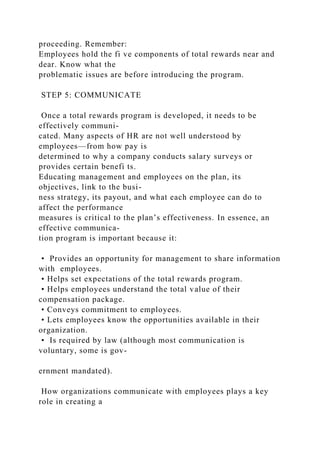
It is critical to check the organization’s pulse before
proceeding. Remember:
Employees hold the fi ve components of total rewards near and
dear. Know what the
problematic issues are before introducing the program.
STEP 5: COMMUNICATE
Once a total rewards program is developed, it needs to be
effectively communi-
cated. Many aspects of HR are not well understood by
employees—from how pay is
determined to why a company conducts salary surveys or
provides certain benefi ts.
Educating management and employees on the plan, its
objectives, link to the busi-
ness strategy, its payout, and what each employee can do to
affect the performance
measures is critical to the plan’s effectiveness. In essence, an
effective communica-
tion program is important because it:
• Provides an opportunity for management to share information
with employees.
• Helps set expectations of the total rewards program.
• Helps employees understand the total value of their
compensation package.
• Conveys commitment to employees.
• Lets employees know the opportunities available in their
organization.
• Is required by law (although most communication is
voluntary, some is gov-
ernment mandated).
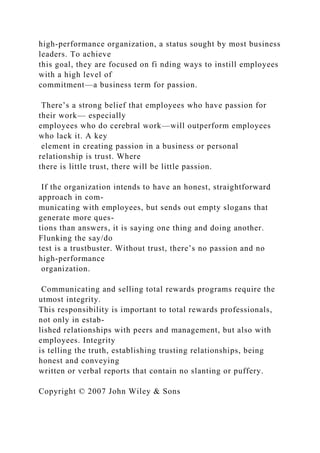
How organizations communicate with employees plays a key
role in creating a
high-performance organization, a status sought by most business
leaders. To achieve
this goal, they are focused on fi nding ways to instill employees
with a high level of
commitment—a business term for passion.
There’s a strong belief that employees who have passion for
their work— especially
employees who do cerebral work—will outperform employees
who lack it. A key
element in creating passion in a business or personal
relationship is trust. Where
there is little trust, there will be little passion.
If the organization intends to have an honest, straightforward
approach in com-
municating with employees, but sends out empty slogans that
generate more ques-
tions than answers, it is saying one thing and doing another.
Flunking the say/do
test is a trustbuster. Without trust, there’s no passion and no
high-performance
organization.
Communicating and selling total rewards programs require the
utmost integrity.
This responsibility is important to total rewards professionals,
not only in estab-
lished relationships with peers and management, but also with
employees. Integrity
is telling the truth, establishing trusting relationships, being
honest and conveying
written or verbal reports that contain no slanting or puffery.
Copyright © 2007 John Wiley & Sons
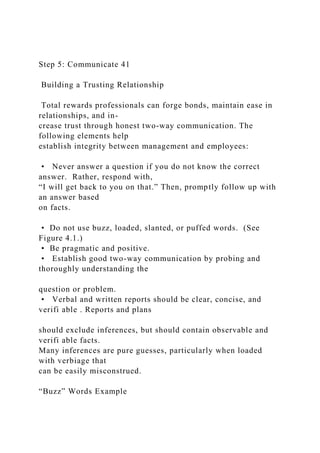
Step 5: Communicate 41
Building a Trusting Relationship
Total rewards professionals can forge bonds, maintain ease in
relationships, and in-
crease trust through honest two-way communication. The
following elements help
establish integrity between management and employees:
• Never answer a question if you do not know the correct
answer. Rather, respond with,
“I will get back to you on that.” Then, promptly follow up with
an answer based
on facts.
• Do not use buzz, loaded, slanted, or puffed words. (See
Figure 4.1.)
• Be pragmatic and positive.
• Establish good two-way communication by probing and
thoroughly understanding the
question or problem.
• Verbal and written reports should be clear, concise, and
verifi able . Reports and plans
should exclude inferences, but should contain observable and
verifi able facts.
Many inferences are pure guesses, particularly when loaded
with verbiage that
can be easily misconstrued.
“Buzz” Words Example
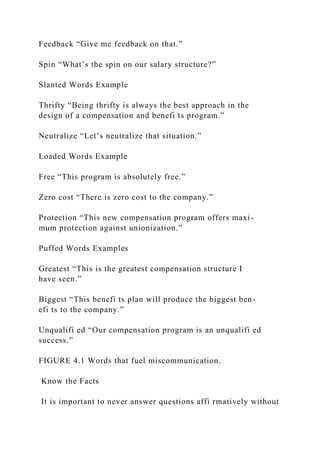
Feedback “Give me feedback on that.”
Spin “What’s the spin on our salary structure?”
Slanted Words Example
Thrifty “Being thrifty is always the best approach in the
design of a compensation and benefi ts program.”
Neutralize “Let’s neutralize that situation.”
Loaded Words Example
Free “This program is absolutely free.”
Zero cost “There is zero cost to the company.”
Protection “This new compensation program offers maxi-
mum protection against unionization.”
Puffed Words Examples
Greatest “This is the greatest compensation structure I
have seen.”
Biggest “This benefi ts plan will produce the biggest ben-
efi ts to the company.”
Unqualifi ed “Our compensation program is an unqualifi ed
success.”
FIGURE 4.1 Words that fuel miscommunication.
Know the Facts
It is important to never answer questions affi rmatively without
knowing the answer.
This is one reason why total rewards professionals should
continually read, under-
stand, and educate themselves about:
Copyright © 2007 John Wiley & Sons
42 Designing a Total Rewards Program
• Current outside practices, such as competitors’ compensation
practices and
salary and benefi ts trends.
• Current federal and state laws, including the Fair Labor
Standards Act of 1938
(FLSA), the Employee Retirement Income Security Act of 1974
(ERISA), the
Consolidated Omnibus Budget Reconciliation Act of 1985
(COBRA), and In-
ternal Revenue Service case decisions.
• The organization’s current situation.
Crystal Clear Communication
Total rewards professionals should communicate to
management and employees
in a candid manner. Also, by “walking the talk” through words,
actions, policies,
practices, and procedures, their communication efforts will be
more effective and
meaningful.
Employee benefi ts plans should be conveyed as legally
required. By adopting a
full disclosure policy, both good and not-so-good information is
shared. This ap-
proach helps eliminate rumor and speculation.
From the communicator’s perspective, total rewards
professionals need to under-
stand what they are communicating, learn from written and
verbal communication,
and, lastly, dispose of or decide the issue under consideration.
The receiver needs
to fully trust and expect all information to be accurate and
verifi able.
Honesty: The Best Policy
Being honest pays huge dividends. Employees at all levels will
understand
and appreciate a straight shooter and modify or mend their own
behavior, if nec-
essary. Truthfulness also will increase employees’ appreciation
and loyalty to the
organization.
Conversely, communicating inaccurate information to
employees can lead to
mistrust, diminishing loyalty, collective bargaining efforts, and
increased employee
turnover. Employees have a need for security and affi liation
with the organization
and are not prepared or willing to accept messages from
management until a trust-
ing relationship exists.
Audience
In developing a communication plan, it is important to consider
specifi c employee
audiences, the key messages to convey, how those messages
will be disseminated,
the amount of money available, the timeline for implementation,
and how to gather
employee feedback. Orientation and education are needed to
ensure that partici-
pants understand the plan, know how they can affect
measurements, and what
advantages the new program provides. It’s time to communicate,
communicate,
communicate!
Communications should be tailored to specifi c audiences. For
example, one
might start with an executive-level briefi ng, followed by a
manager orientation and
planning session, supervisor workshops, and fi nally a
widespread employee educa-
tion and orientation program. The key is that all employees at
all levels are able to
comprehend the new rewards system.
Copyright © 2007 John Wiley & Sons
Step 5: Communicate 43
Management
Different communications may need to be planned for different
levels of manage-
ment. Plan to communicate details about the total rewards
process and any an-
ticipated obstacles. Provide exercises on how management can
get their employees
engaged and provide a list of messages to be communicated.
Also, outline manage-
ment’s role in the implementation process. Good employee
communication typi-
cally starts with clarifi cation of the organization’s mission and
vision—and that must
come from top executives.
Front-Line Supervisors
Front-line supervisors are perhaps the most critical element to
success. When com-
munication breaks down, it’s usually at this level either because
messages don’t
make it down from the top or they are misconstrued. Avoid this
by holding separate
group meetings with front-line managers and ensuring they are
informed about the
process from the beginning.
Employees
Who are they? What are their interests, needs, and concerns?
Demographic infor-
mation on age, sex, education, marital status, income, job type,
length of service,
and geographic location helps determine how messages should
be delivered. Face-
to-face communications usually are the best because this
ensures that employees
are receiving consistent messages, and it enhances credibility.
But this simply may
not be realistic, especially for multinational companies with
numerous locations.
Decide what would be most appropriate for each employee
group.
External Audiences
How will you announce the new program to shareholders?
Customers? Vendors?
Are there other groups outside the organization who have a
“need to know” about
the program changes?
Key Messages
Effective communication starts with a clear vision of what you
want to accomplish.
Let employees know what’s in it for them and what’s in it for
the company. Messages
should help employees see the advantages of the new approach,
instill a new mind-
set, and secure their tie-in and commitment. Tips to remember
include:
• Keep messages simple, consistent, and timely.
• Begin communication at the time of concept approval.
• Don’t let up; communicate frequently.
• Continue as long as the program is in effect (amount and
intensity of com-
munication should vary with need).
• Focus on the plan’s main elements: how it works, the
advantages to the em-
ployee and employer, and the timeline for implementation.
Copyright © 2007 John Wiley & Sons
44 Designing a Total Rewards Program
Media
In today’s fast-paced, multichannel communications
environment, it’s not enough
to convey a message one time through one medium. The
audience and level of
complexity in the message should determine the methods used.
For example,
some employees prefer to read information on a printed page;
others prefer to
access the information online; and still others prefer the
message be delivered
face-to-face in team meetings. In some companies, the message
may need to be de-
livered in a language other than English, or communicated by
using sign language
or Braille.
The best communication campaign involves multiple messages
delivered in a
variety of ways over a long period of time. By reinforcing
messages using multiple
channels, you help to ensure that the program is understood.
(See Figure 4.2.) The
broken-record syndrome has to be the name of the game.
Audiovisual • Flip charts
• Overhead transparencies
• Slides
• Films/movies
• Videotapes
• Audiotapes
• Teleconferences
Print • Brochures
• Booklets or handbooks
• Articles in employee newsletters or other company
publications
• Letters
• Memos
• News bulletins
• Summary plan descriptions
• Compensation manuals
• Paycheck stuffers
• Personalized total rewards statements
• Posters
• Bulletin boards
• Question-and-answer columns
• Reply cards
• Special interest bulletins
Personal • Large meetings
• Small gatherings
• One-on-one counseling
• Manager/employee sessions
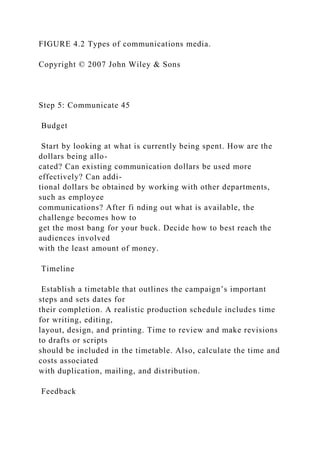
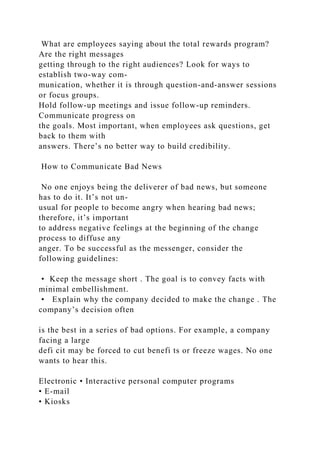
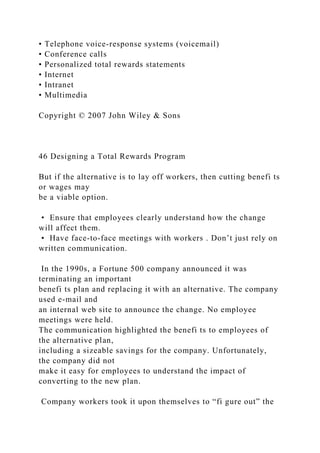
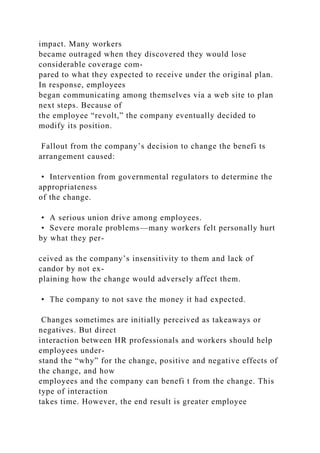
FIGURE 4.2 Types of communications media.
Copyright © 2007 John Wiley & Sons
Step 5: Communicate 45
Budget
Start by looking at what is currently being spent. How are the
dollars being allo-
cated? Can existing communication dollars be used more
effectively? Can addi-
tional dollars be obtained by working with other departments,
such as employee
communications? After fi nding out what is available, the
challenge becomes how to
get the most bang for your buck. Decide how to best reach the
audiences involved
with the least amount of money.
Timeline
Establish a timetable that outlines the campaign’s important
steps and sets dates for
their completion. A realistic production schedule includes time
for writing, editing,
layout, design, and printing. Time to review and make revisions
to drafts or scripts
should be included in the timetable. Also, calculate the time and
costs associated
with duplication, mailing, and distribution.
Feedback
What are employees saying about the total rewards program?
Are the right messages
getting through to the right audiences? Look for ways to
establish two-way com-
munication, whether it is through question-and-answer sessions
or focus groups.
Hold follow-up meetings and issue follow-up reminders.
Communicate progress on
the goals. Most important, when employees ask questions, get
back to them with
answers. There’s no better way to build credibility.
How to Communicate Bad News
No one enjoys being the deliverer of bad news, but someone
has to do it. It’s not un-
usual for people to become angry when hearing bad news;
therefore, it’s important
to address negative feelings at the beginning of the change
process to diffuse any
anger. To be successful as the messenger, consider the
following guidelines:
• Keep the message short . The goal is to convey facts with
minimal embellishment.
• Explain why the company decided to make the change . The
company’s decision often
is the best in a series of bad options. For example, a company
facing a large
defi cit may be forced to cut benefi ts or freeze wages. No one
wants to hear this.
Electronic • Interactive personal computer programs
• E-mail
• Kiosks
• Telephone voice-response systems (voicemail)
• Conference calls
• Personalized total rewards statements
• Internet
• Intranet
• Multimedia
Copyright © 2007 John Wiley & Sons
46 Designing a Total Rewards Program
But if the alternative is to lay off workers, then cutting benefi ts
or wages may
be a viable option.
• Ensure that employees clearly understand how the change
will affect them.
• Have face-to-face meetings with workers . Don’t just rely on
written communication.
In the 1990s, a Fortune 500 company announced it was
terminating an important
benefi ts plan and replacing it with an alternative. The company
used e-mail and
an internal web site to announce the change. No employee
meetings were held.
The communication highlighted the benefi ts to employees of
the alternative plan,
including a sizeable savings for the company. Unfortunately,
the company did not
make it easy for employees to understand the impact of
converting to the new plan.
Company workers took it upon themselves to “fi gure out” the
impact. Many workers
became outraged when they discovered they would lose
considerable coverage com-
pared to what they expected to receive under the original plan.
In response, employees
began communicating among themselves via a web site to plan
next steps. Because of
the employee “revolt,” the company eventually decided to
modify its position.
Fallout from the company’s decision to change the benefi ts
arrangement caused:
• Intervention from governmental regulators to determine the
appropriateness
of the change.
• A serious union drive among employees.
• Severe morale problems—many workers felt personally hurt
by what they per-
ceived as the company’s insensitivity to them and lack of
candor by not ex-
plaining how the change would adversely affect them.
• The company to not save the money it had expected.
Changes sometimes are initially perceived as takeaways or
negatives. But direct
interaction between HR professionals and workers should help
employees under-
stand the “why” for the change, positive and negative effects of
the change, and how
employees and the company can benefi t from the change. This
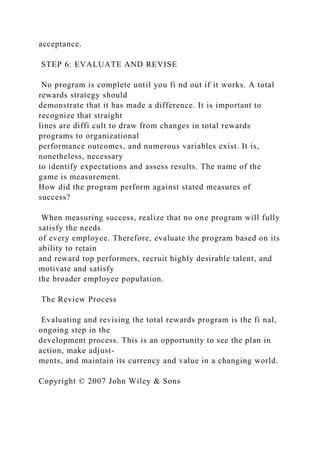
type of interaction
takes time. However, the end result is greater employee
acceptance.
STEP 6: EVALUATE AND REVISE
No program is complete until you fi nd out if it works. A total
rewards strategy should
demonstrate that it has made a difference. It is important to
recognize that straight
lines are diffi cult to draw from changes in total rewards
programs to organizational
performance outcomes, and numerous variables exist. It is,
nonetheless, necessary
to identify expectations and assess results. The name of the
game is measurement.
How did the program perform against stated measures of
success?
When measuring success, realize that no one program will fully
satisfy the needs
of every employee. Therefore, evaluate the program based on its
ability to retain
and reward top performers, recruit highly desirable talent, and
motivate and satisfy
the broader employee population.
The Review Process
Evaluating and revising the total rewards program is the fi nal,
ongoing step in the
development process. This is an opportunity to see the plan in
action, make adjust-
ments, and maintain its currency and value in a changing world.
Copyright © 2007 John Wiley & Sons
Step 6: Evaluate and Revise 47
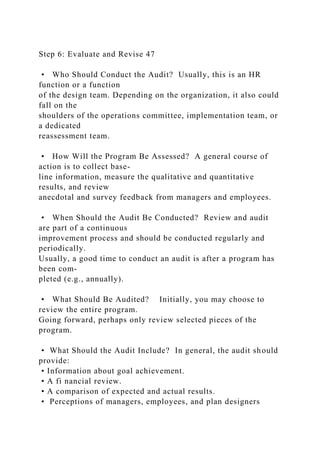
• Who Should Conduct the Audit? Usually, this is an HR
function or a function
of the design team. Depending on the organization, it also could
fall on the
shoulders of the operations committee, implementation team, or
a dedicated
reassessment team.
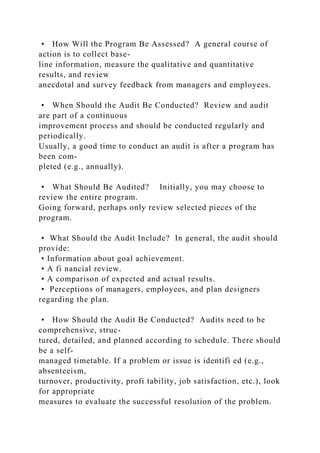
• How Will the Program Be Assessed? A general course of
action is to collect base-
line information, measure the qualitative and quantitative
results, and review
anecdotal and survey feedback from managers and employees.
• When Should the Audit Be Conducted? Review and audit
are part of a continuous
improvement process and should be conducted regularly and
periodically.
Usually, a good time to conduct an audit is after a program has
been com-
pleted (e.g., annually).
• What Should Be Audited? Initially, you may choose to
review the entire program.
Going forward, perhaps only review selected pieces of the
program.
• What Should the Audit Include? In general, the audit should
provide:
• Information about goal achievement.
• A fi nancial review.
• A comparison of expected and actual results.
• Perceptions of managers, employees, and plan designers
regarding the plan.
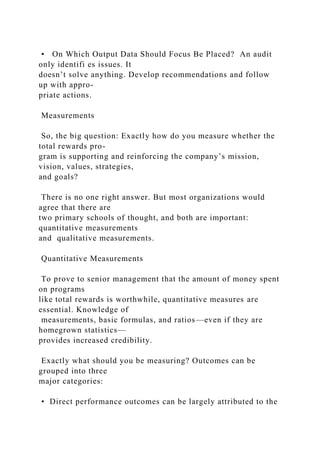
• How Should the Audit Be Conducted? Audits need to be
comprehensive, struc-
tured, detailed, and planned according to schedule. There should
be a self-
managed timetable. If a problem or issue is identifi ed (e.g.,
absenteeism,
turnover, productivity, profi tability, job satisfaction, etc.), look
for appropriate
measures to evaluate the successful resolution of the problem.
• On Which Output Data Should Focus Be Placed? An audit
only identifi es issues. It
doesn’t solve anything. Develop recommendations and follow
up with appro-
priate actions.
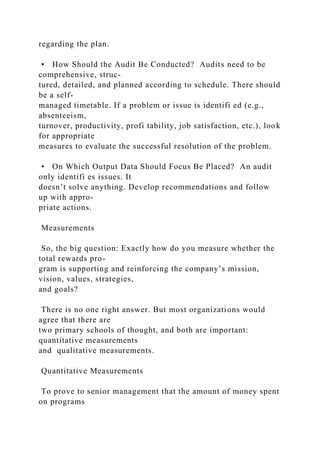
Measurements
So, the big question: Exactly how do you measure whether the
total rewards pro-
gram is supporting and reinforcing the company’s mission,
vision, values, strategies,
and goals?
There is no one right answer. But most organizations would
agree that there are
two primary schools of thought, and both are important:
quantitative measurements
and qualitative measurements.
Quantitative Measurements
To prove to senior management that the amount of money spent
on programs
like total rewards is worthwhile, quantitative measures are
essential. Knowledge of
measurements, basic formulas, and ratios—even if they are
homegrown statistics—
provides increased credibility.
Exactly what should you be measuring? Outcomes can be
grouped into three
major categories:
• Direct performance outcomes can be largely attributed to the
impact of an
organization’s total rewards strategy, such as reduced turnover
and recruiting
acceptance rates.
Copyright © 2007 John Wiley & Sons
48 Designing a Total Rewards Program
• Evaluative outcomes are objective conclusions that result
from a total rewards
design, such as the organization’s competitive market position,
its total re-
wards cost per employee, and its rewards mix.
• Indirect performance outcomes may be partially attributable
to an organi-
zation’s total rewards strategy, such as revenue per employee,
profi t per em-
ployee, productivity, customer retention, and various ratio
measures.
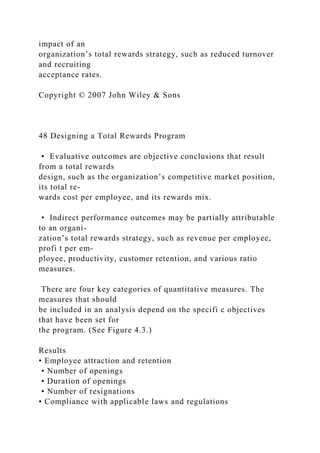
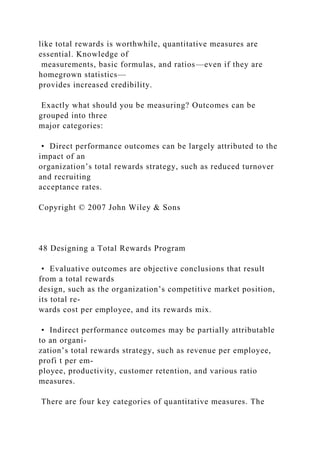
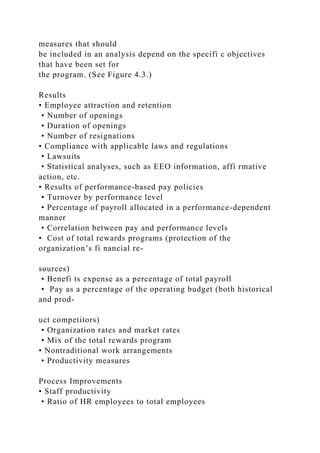
There are four key categories of quantitative measures. The
measures that should
be included in an analysis depend on the specifi c objectives
that have been set for
the program. (See Figure 4.3.)
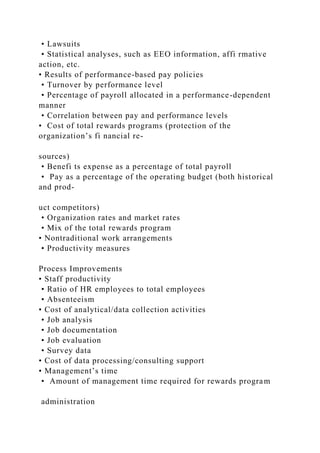
Results
• Employee attraction and retention
• Number of openings
• Duration of openings
• Number of resignations
• Compliance with applicable laws and regulations
• Lawsuits
• Statistical analyses, such as EEO information, affi rmative
action, etc.
• Results of performance-based pay policies
• Turnover by performance level
• Percentage of payroll allocated in a performance-dependent
manner
• Correlation between pay and performance levels
• Cost of total rewards programs (protection of the
organization’s fi nancial re-
sources)
• Benefi ts expense as a percentage of total payroll
• Pay as a percentage of the operating budget (both historical
and prod-
uct competitors)
• Organization rates and market rates
• Mix of the total rewards program
• Nontraditional work arrangements
• Productivity measures
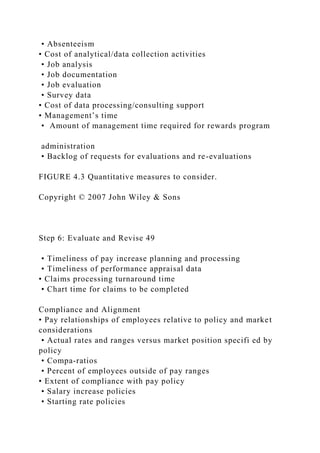
Process Improvements
• Staff productivity
• Ratio of HR employees to total employees
• Absenteeism
• Cost of analytical/data collection activities
• Job analysis
• Job documentation
• Job evaluation
• Survey data
• Cost of data processing/consulting support
• Management’s time
• Amount of management time required for rewards program
administration
• Backlog of requests for evaluations and re-evaluations
FIGURE 4.3 Quantitative measures to consider.
Copyright © 2007 John Wiley & Sons
Step 6: Evaluate and Revise 49
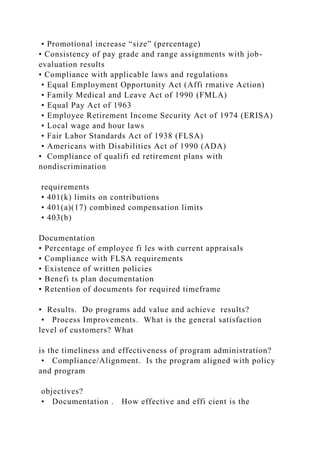
• Timeliness of pay increase planning and processing
• Timeliness of performance appraisal data
• Claims processing turnaround time
• Chart time for claims to be completed
Compliance and Alignment
• Pay relationships of employees relative to policy and market
considerations
• Actual rates and ranges versus market position specifi ed by
policy
• Compa-ratios
• Percent of employees outside of pay ranges
• Extent of compliance with pay policy
• Salary increase policies
• Starting rate policies
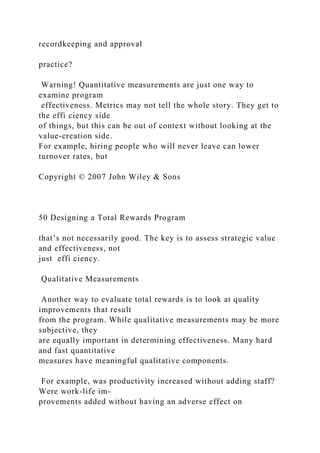
• Promotional increase “size” (percentage)
• Consistency of pay grade and range assignments with job-
evaluation results
• Compliance with applicable laws and regulations
• Equal Employment Opportunity Act (Affi rmative Action)
• Family Medical and Leave Act of 1990 (FMLA)
• Equal Pay Act of 1963
• Employee Retirement Income Security Act of 1974 (ERISA)
• Local wage and hour laws
• Fair Labor Standards Act of 1938 (FLSA)
• Americans with Disabilities Act of 1990 (ADA)
• Compliance of qualifi ed retirement plans with
nondiscrimination
requirements
• 401(k) limits on contributions
• 401(a)(17) combined compensation limits
• 403(b)
Documentation
• Percentage of employee fi les with current appraisals
• Compliance with FLSA requirements
• Existence of written policies
• Benefi ts plan documentation
• Retention of documents for required timeframe
• Results. Do programs add value and achieve results?
• Process Improvements. What is the general satisfaction
level of customers? What
is the timeliness and effectiveness of program administration?
• Compliance/Alignment. Is the program aligned with policy
and program
objectives?
• Documentation . How effective and effi cient is the
recordkeeping and approval
practice?
Warning! Quantitative measurements are just one way to
examine program
effectiveness. Metrics may not tell the whole story. They get to
the effi ciency side
of things, but this can be out of context without looking at the
value-creation side.
For example, hiring people who will never leave can lower
turnover rates, but
Copyright © 2007 John Wiley & Sons
50 Designing a Total Rewards Program
that’s not necessarily good. The key is to assess strategic value
and effectiveness, not
just effi ciency.
Qualitative Measurements
Another way to evaluate total rewards is to look at quality
improvements that result
from the program. While qualitative measurements may be more
subjective, they
are equally important in determining effectiveness. Many hard
and fast quantitative
measures have meaningful qualitative components.
For example, was productivity increased without adding staff?
Were work-life im-
provements added without having an adverse effect on
productivity? Do employees
say they are more likely to stay with the company? Are they
willing to go the extra
mile to meet business needs? What is this worth?
One way to look at qualitative measures is to go back to the
assessment and de-
sign phases. Look at where the organization started and what
objectives were set for
the total rewards program. Examine where the baseline
measurements were and
compare them against where the company wants to be. Did the
program work? Did
it do what it was intended to do? Qualitative measures help
provide explanations on
why the numbers look the way they do. Ask the tough questions.
Did the program
accomplish the following?
• Foster and reward the “right” behaviors that are consistent
with the total re-
wards strategy?
• Offer the “right” incentives?
• Adequate?
• Equitable?
• Competitive?
• Appropriate (for employer and employees)?
• Valued?
• Attract and retain the “right” people?
• Facilitate changes in the workforce?
• Help develop the skills needed to remain competitive?
• Move the organization closer to its desired culture?
• Receive a positive response from employees as well as
middle to top
management?
• Drop old measures? Add new measures? Offer a well-
integrated approach?
• Provide communication that created a high level of
awareness? Understanding?
• Align employees’ interests with the organization’s business
objectives?
• Deliver a meaningful return on investment for the money
spent?
Evaluative Outcomes
After collecting and assembling all of this information, what do
you do with it? The
program review and audit provide the validation step in the total
rewards cycle.
(See Figure 4.4.) Some major issues are going to identify
themselves (i.e., those
parties with issues will let you know). However, other venues
for gathering data on
the success and/or challenges of the program should be
considered. These include
employee surveys, focus groups, or questionnaires.
Copyright © 2007 John Wiley & Sons
Step 6: Evaluate and Revise 51
Some possible groups to poll in the postimplementation phase
include recruiters
and HR staff, management, supervisory personnel, a general
sampling of employ-
ees. Some questions include:
• In general, what went well and what did not go well in the
total rewards
implementation?
• On a scale of 1 to 10 (1 being “inadequate” and 10 being
“terrifi c”), how would
you rate our implementation of total rewards?
• Overall, what do you think of the total rewards approach?
• What do you think are the advantages to the organization by
doing this?
• What aspects of the program are problematic?
• What ideas or suggestions do you have for the future?
• In general, how satisfi ed are you with the total rewards
program?
A total rewards program needs to be reviewed to ensure that it
meets the organi-
zation’s goals and is still aligned with mission, vision, and
strategy. In the fi nal analy-
sis, the program should be able to be evaluated by comparing
the value attributed to
the program with the costs incurred by the program. The
importance of this ratio-
nale is to justify the program to management and provide an
overall measurement
of its effectiveness. Factors to consider include:
• Plan costs.
• Value of performance improvements.
• Financial value.
• Operational value.
• Nonfi nancial value.
• Ratio of value to costs.
Based on the information collected and the program’s results,
it’s time to make
a decision on whether to:
• Continue the program as it stands and celebrate its success.
• Refi ne the program, building on progress made. (Examine
what happened
and what was learned. Introduce “new” plans or adjustments to
measures,
baselines, targets, etc.)
• Terminate the program (only as a last resort).
• The program has a clear link to the organization’s philosophy
and core values.
• The program is supported and championed by senior
management.
• Unit and front-line managers own the plan.
• The program is viewed as an investment, not an expense.
• The program is tailored to recognize cultural differences.
Different forms of
recognition motivate employees from different cultures. The
program should
be fl exible enough to make adjustments for these differences.
• A high level of communication and education exist
throughout the organiza-
tion. Employees are engaged in making processes better.
• Any good program is continuously evaluated and renewed for
improvement.
FIGURE 4.4 Principles for evaluating success.
Copyright © 2007 John Wiley & Sons
52 Designing a Total Rewards Program
In most cases, modifi cations will be necessary. The evaluation
should help de-
velop a list of recommendations for improvement. As times
change and issues arise
(e.g., demographics, new/modifi ed legislation, internal/external
issues, premium
increases, etc.), the program will need to be revised to keep
current. The design, de-
velopment, and implementation strategies should mirror those
explained earlier.
Copyright © 2007 John Wiley & Sons
28
Designing a Total Rewards
Program 4
The following six processes have been identifi ed to assist with
formulating a total
rewards program.
STEP 1: ANALYZE AND ASSESS
The fi rst activity involved in developing a total rewards
program is to get a clear
understanding of the existing situation. This involves defi ning
the current state, in-
ventorying current rewards, assessing the current total rewards
mix in terms of both
people and dollars, and listening to what current and potential
employees regard
as important. Collectively, this data provides critical clues that
will help identify the
type of rewards that best suit an organization and how to use a
total rewards pro-
gram to full competitive advantage.
Why Conduct an Assessment?
While a natural reaction is to jump in and get started, it is
important to system-
atically create a total rewards program that supports an
organization’s current and
emerging business strategy. Why conduct an assessment?
• Avoid incomplete information. Moving too rapidly, forming
assumptions too
quickly, or shortchanging the process could be dangerous.
Succumbing to
temptations without suffi cient time and effort could result in a
total rewards
program with limited or no long-term business strategy.
• Substantiate your position. An assessment provides the
reasons why a total re-
wards program should be implemented and provides a
framework for build-
ing a total rewards program.
Copyright © 2007 John Wiley & Sons
Step 1: Analyze and Assess 29
• Increase credibility with management. Backup data provide
the ammunition needed to
sell the total rewards program. Assessments also are useful
when making changes
or introducing new programs because they provide a starting
point for compar-
ing the evaluation phase of the process. Improvements can be
documented.
• Assure compliance with the law. Certain laws require
recordkeeping and statisti-
cal analysis in defense of charges against the company. It is
important to not
lose sight of this as decisions are made about a total rewards
program.
How to Conduct an Assessment
An assessment provides a reality check about an organization’s
current practices
and values. It forces organizations to think about “what is” and
“what should be.”
The gap defi nes the elements to be addressed in the actual
design phase of the
project. So how is an assessment conducted? Essentially, an
assessment requires
the effective collection, organization, and analysis of data.
What exists needs to
be documented.
• Glean readily available internal and external data.
• Internal Data. Employee demographics (age, gender,
ethnicity, geographic
location, lifestyle), employee opinion surveys, performance
objectives, sal-
ary structures, benefi t options, employee contributions.
• External Data. Government statistics (Bureau of Labor
Statistics, Chamber of
Commerce), salary survey data, cost-of-living data, employment
data from
competitors, industry surveys, vendor reports from outsourced
functions,
court case law, data from professional associations.
• Benchmark the organization’s strategies, policies, and
practices against top-performing
companies. This will help gain a more in-depth understanding
of how specifi c
reward elements are used and integrated, and will provide a
picture of how
successful organizations use reward elements to support key
values, changes,
and results. For example, Fortune magazine conducts an
annual survey iden-
tifying the “100 Best Companies to Work For” in America.
Using benchmark
information from these organizations may provide data to assist
in attraction,
motivation, and retention issues.
• Collect additional data, both formal and informal.
Questions can be posed to se-
nior management via individual interviews. Input from line
managers can be
gathered using focus groups or through conversations with
various key lead-
ers, depending on the organization’s size and complexity.
Information from
employees can be obtained through focus groups, opinion
surveys, or other
questionnaires. It is helpful to ask what management most wants
employees to
know, do, and care about. That is what the rewards system
should reinforce.
It is helpful to ask employees what they value and how they
perceive their cur-
rent rewards package. Sample questions could include:
• What is the level of employee satisfaction with pay and
benefi ts?
• What makes employees satisfi ed in their jobs?
• Do employees plan to stay with the company? If not, when
do they plan to
leave?
• What factors are infl uencing their decisions to stay or go?
• Synthesize business data from various sources into an
accurate and thematic summary.
Is the company perceived to be a high, moderate, or low paying
employer? Are
Copyright © 2007 John Wiley & Sons
30 Designing a Total Rewards Program
employees generally satisfi ed with pay levels? Is there a strong
nonmonetary
recognition and rewards practice in place? To what extent is the
current focus
understood and valued by employees? Is there a statement of the
desired cul-
ture regarding employee involvement?
• Assess your current practice in light of the goal to create a
total rewards program. What
are the critical aspects of culture that should be reinforced by
the total rewards
structure/strategy? What values should total rewards reinforce?
Would employ-
ees be receptive to a total rewards approach? What factors could
limit success?
• Defi ne improvement opportunities and goals. The analysis
should conclude with
relevant implications and specifi c recommendations for change,
including fu-
ture intentions and needs wherever possible.
What to Consider in an Assessment
After learning the lay of the land, look at several other
considerations that could
signifi cantly impact the total rewards program.
• Organizational Culture. Understand the challenges facing
the organization.
What are the company’s internal and external strengths,
weaknesses, oppor-
tunities, and threats? Does your organization have a
bureaucratic or highly
entrepreneurial leadership style? Is management directive or
participative? Is
the company viewed as a great place to work? Does the
organization have
the talent it needs to be successful in the future? Does it have
the leadership
strength to be successful? Does the company create an engaging
environment
for employees?
• Role of Human Resources. Look closely at how HR is
viewed in the organization.
Is it perceived as:
• A business partner?
• An enabler to attracting and retaining top talent?
• Providing effective support systems to employees?
• Effi cient and effective with regard to processes and
transactions?
• Helping meet the needs of external customers?
• Being supported by company leadership to create an
environment that en-
courages integration and shared vision?
• Improving effi ciency through the use of technology?
• A propagator of competitive plans and programs?
• Cost-effective?
• Employer Needs. Know from the outset what the company
wants to accomplish
and how a total rewards program will get you there. For
example, is the or-
ganization moving from a domestic to a global business? From
manual to
automated production? From a knowledge- to technology-based
company?
Process map the organization’s way of doing business. Each
company is in a
different stage of development, and each has different needs and
resources.
Also, consider whether current employees’ competencies and
skills mesh
with current and future organizational needs. HR professionals
need to
balance the current state with the desired state. Employer
desires could
include:
• Improve recruitment.
• Retain and motivate.
Copyright © 2007 John Wiley & Sons
Step 2: Design 31
• Manage cost effectively.
• Increase competencies.
• Improve organizational performance.
• Support organizational change.
• Align behaviors with business strategy.
• Employee Needs. Determine why people join and remain
with the organization.
Retention plans fail when they are too complicated or the
rewards are not
meaningful to the intended group. Investigate what people
value, what
they enjoy, and what gets them excited. Explore employees’
“motivational
buttons” and learn how to push them. Employee wants and
needs could
include:
• Stock options or opportunities.
• More competitive salary.
• Positive work environment.
• Lower health care costs.
• Rewards and recognition.
• Increased fl exibility.
• Career opportunities.
• Budgetary Concerns. Conduct a cost analysis to examine
the company’s current
investment in total rewards programs. Can costs be eliminated
or combined?
What did it cost other organizations to implement total rewards
programs?
Are benchmark data on total rewards available from other
companies in the
industry, or does a benchmark investigation need to be
conducted?
• Administrative Process. Consider the current process for
administering rewards
programs. What kind of structure is in place to support a total
rewards pro-
gram? What changes might have to be made? A program that is
too complex
or labor-intensive may threaten success. Likewise, a program
could be des-
tined for failure if the proper resources are not available to
successfully main-
tain the plan. Are the fi nancial and human resources available
to administer
the program? If not, are they obtainable?
• Readiness for Change. Finally, assess the organization’s
readiness to implement a
new total rewards program. Timing is everything. Does the
capability or capac-
ity for change exist? Would the proposed program align with
organizational
and cultural shifts? Is a paradigm shift required? Are managers,
who may be
asked to increase their involvement in a given process, willing
and able to
make the adjustment? Know the odds of creating a winning
program before
venturing out the starting gate. Can the organization afford not
to consider a
total rewards approach?
STEP 2: DESIGN
A design process starts with the corporate mission, vision, and
business strategy.
The HR philosophy fl ows from this and serves as a guiding
light in the design of
all HR programs. Total rewards philosophy and strategy are
incorporated within
the HR philosophy and strategy. From this, strategies and
practices/programs are
developed within the fi ve facets of total rewards. Establishing a
total rewards strategy
helps ensure that rewards become a strategic driving force in
the accomplishment
Copyright © 2007 John Wiley & Sons
32 Designing a Total Rewards Program
of organizational goals. It also helps to align the rewards
system with the organiza-
tion’s culture and change efforts.
Defi ne the Corporate Mission and Vision
The corporate mission is an organization’s reason for existence
or purpose for
being. Some conglomerates have more than one mission to refl
ect different mis-
sions for different industry sectors. Knowing “what business
you are really in”
is key to an organization’s survival and growth. For example,
railroads stopped
growing because they defi ned themselves in the train business
instead of in the
transportation business. To create success, an organization
needs to defi ne itself
in terms of the market and the customer, rather than the
products or services it
offers.
The corporate vision delineates the organization’s aspirations
and goals. While
the mission concentrates on what the organization needs to do
in the immediate
future for growth and success, the vision provides a blueprint
for the organization’s
long-term viability. It’s how you see the organization 3, 5, even
10 years from now.
The corporate vision keeps you on course as you make decisions
and plans that af-
fect the company’s future.
Defi ne the Business Strategy
Business strategy is a company’s plan for competitively
positioning its products or
services with the intent to accomplish or support corporate
mission and vision goals.
Business strategy drives HR philosophy and total rewards
design. Business strategy
elements include:
• Pricing.
• Quality.
• Product innovation.
• Service excellence.
• Market responsiveness.
• Required rate of return.
• Cost structure.
• Target market.
• Marketing and sales.
• Production.
• Finance.
• Product design.
• Differentiation from competitors.
• Distribution.
Defi ne the HR Philosophy and Strategy
The HR philosophy consists of management’s values and
beliefs about its approach
to the employee relationship. Both HR philosophy and business
strategy are key
components to the development of an HR strategy. HR strategy
consists of the
organization’s overall plan for recruitment, retention, and
talent management of
Copyright © 2007 John Wiley & Sons
Step 2: Design 33
employees. The total rewards strategy follows from the HR
strategy. It consists of the
plans that will be used to support the organization’s HR
strategy.
Defi ne the Total Rewards Philosophy Statement
The total rewards philosophy statement expresses
management’s values and beliefs
about total rewards. The process of developing a statement unifi
es management’s
thoughts about total rewards programs. The total rewards
philosophy statement
serves many purposes:
• Communicate commitment and expectations to employees.
• Facilitate HR plan design.
• Serve as a reference point to measure the success of total
rewards programs.
• Reinforce company culture and goals.
A starting point to develop a total rewards philosophy
statement is to ask broad
questions about current rewards programs, the organization, its
culture, and its em-
ployees. Answering these questions thoroughly and
systematically can generate the
essential elements of the philosophy statement.
• What is the company culture and environment?
• What needs to be done to attract, motivate, retain, and engage
employees?
• What are your objectives? (In employment? Retention?)
• What is the role of HR? (Attracting employees? Retaining
employees? In-
creasing employee satisfaction? Achieving the organization’s
performance
goals?)
• What are the company’s performance goals?
• What cost constraints on the total rewards program can be
defi ned in terms of
profi t or revenue and expense?
Once these questions are answered, it’s time to begin putting
together the total
rewards philosophy statement. Components of that generally
include:
• Program objectives.
• Desired competitive position in the labor market (often
stated as a percentile
of the market).
• Values regarding factors that should be considered in
maintaining internal
equity (identifi cation of compensable job factors, the
relationship of pay and
performance and the relationship between pay and tenure).
• Values regarding total rewards communication (open versus
secretive).
• Values regarding benefi ts cost sharing.
• Desired mix of total rewards elements.
The total rewards philosophy statement should be
communicated widely and
regularly. Employees should understand the statement. They
should have the op-
portunity to discuss the philosophy, ask questions about it, and
give management
feedback.
Defi ne Your Total Rewards Strategy
The total rewards strategy determines detail beyond that
provided in the total re-
wards philosophy. It narrows the HR strategy to the specifi c
plan with regard to the
Copyright © 2007 John Wiley & Sons
34 Designing a Total Rewards Program
total rewards mix that supports the HR philosophy and strategy.
The total rewards
strategy identifi es:
• The optimal mix of total rewards elements for each employee
group. The mix
may be high in some elements and low in others. For example,
more organiza-
tions are moving toward placing a higher emphasis on work-life.
In addition,
the life cycle of the business can affect the mix. In a high-tech
startup, there
may be a cash shortage, so wages and benefi ts may be low, but
stock options
and work-life may be high.
• The manner in which each element will be earned and
allocated (performance
versus entitlement, individual versus group incentives, fi xed
versus fl exible
benefi ts).
• Appropriate labor market segments for each employee group
in which the
market is identifi ed according to industry, size, geographic
location, or
performance.
• Desired competitive position in the marketplace for each
employee group.
Many companies want to offer a rewards program targeted at
the 50th percentile
in the market. However, the average in one market may be
considered high or low
in another. Therefore, it is important to defi ne the marketplace
in which the orga-
nization operates. Without a sense of vision and overall
strategic direction, people
don’t feel as invested in what they’re doing. Therefore, as the
total rewards strategy
is defi ned, it is important to remember how it will be viewed
and embraced by key
players, both within and outside of your organization. (Chapter
3 elaborated on the
critical formulation of a total rewards strategy.)
Key stakeholders include:
• Senior management/board of directors. This group needs to
approve and be
willing to support the philosophy and strategy. They also are
important for
buy-in and ownership.
• HR leadership. This group articulates the HR philosophy and
strategy, while
its staff facilitates the process.
• Employees. Internal, external, or exit surveys may provide
guidance in iden-
tifying the relative importance of total rewards elements to
various employee
groups.
• Outside consultants. If outside consultants are used, they
should work closely
with HR to facilitate the process.
STEP 3: DEVELOP
Developing a total rewards program is both a science and an
art. The steps shown
constitute the general steps followed in the development
process. Organizations
may want to add steps. The key is to have a basic process and
adjust it to the organi-
zation’s culture, objectives, and specifi c needs. In general,
program design involves
the determination of:
• Purpose and objectives of the program.
• Eligibility of individual participants in specifi c aspects of
the program.
• Baseline for measurement and goals.
• Funding of program initiatives.
Copyright © 2007 John Wiley & Sons
Step 3: Develop 35
• Plan selection and structure.
• Course of action and timeline.
Program Purpose/Objectives
Rewards systems represent both a major cost to the
organization and a critical means
of linking employees to business performance. As such, total
rewards programs
should be strategically designed for the purpose they are
intended to plan and the
results they are trying to drive.
Your purpose statement should communicate why the program
is being developed
and how the company plans to gain a competitive advantage.
The purpose statement
normally identifi es critical organizational objectives and their
link to the program.
For example:
• To enhance recruitment and retention.
• To reduce the fi xed compensation element of the total
rewards opportunity.
• To help develop people so they can make greater
contributions to the
organization.
• To celebrate individual effort or group cooperation.
• To reward innovation and creativity.
• To reinforce performance improvements.
Guiding principles describe the program’s key attributes. For
example:
• Changes in the rewards system will support business
objectives and the desired
culture.
• Anticipated support from managers and participants will be
considered and
factored into the program design.
The program objectives give a clear description of what the
company wants to
achieve. It is recommended that the number of objectives be
limited to three or less
(no more than fi ve). Characteristics of objectives include:
• Link to corporate mission, vision, business strategy, and
total rewards philosophy.
• Identify specifi c performance areas and outcomes of program
targets.
• Complementary to objectives of other plans.
• Clear and easily understood.
• Measurable.
• Acceptable to stakeholders.
Eligibility
A key advantage to a total rewards program is its fl exibility.
In designing the pro-
gram’s structure, decisions need to be made about which
employees or organiza-
tional units will benefi t from different elements of the program
mix.
• Determine program criteria. Defi ne who will be offered
what and what the eligibil-
ity criteria will be.
• Consider the implications of exclusionary programs. For
employees not included,
will morale be affected (“haves” versus “have nots”)?
• Look at competitive practices. Do competitors offer similar
rewards to their em-
ployees? Does your rewards mix truly refl ect a competitive
advantage?
Copyright © 2007 John Wiley & Sons
36 Designing a Total Rewards Program
Baseline for Measurement
Two critical questions in program design involve how to defi
ne improvement and
how to measure it.
• What is improvement? There is no one correct answer. The
defi nition varies by
organization and the baselines established.
• How can improvements be measured? Once defi ned,
management must iden-
tify appropriate measures to collect improvement data.
Good measurement tools tend to have six characteristics in
common:
• Refl ect objectives. Send the appropriate message to
employees reinforcing
business unit objectives.
• Tangible, visible, complete measures that are clear and
unambiguous.
• Credible to all parties, free of undue infl uence by outside
factors.
• Verifi able and accurate.
• Understandable to eligible participants.
• Affected by participants (line of sight).
In designing the measurement process, consider the metrics and
targets by which
management will judge performance, the ease of administration
in evaluating the
program, and the credibility that the measures will carry with
the organization and
its employees. The three most common types of measurements
are fi nancial, busi-
ness process, and customer. Also, decisions need to be made
about what will be mea-
sured (retention, employee satisfaction, performance) and how
that data will be
reported.
Establishing a plan baseline for measurement varies signifi
cantly from organiza-
tion to organization. There are several options available
depending upon how per-
formance history is defi ned. Baselines and targets generally are
set using:
• Historical averages.
• Recent experience.
• Projected future performance.
• Internal reference points (e.g., equity in salary ranges and
midpoints).
• External reference points (e.g., competitors).
Funding
Funding will come from a combination of costs incurred and
savings derived from
the fi ve elements of total rewards. For example, productivity
improvements can be
converted to fi nancial savings based on increased production
and reduced labor
per unit produced.
• Develop an initial cost estimate. Estimate a worst-case
scenario.
• Set realistic budget constraints. Adequate funding of a new
total rewards pro-
gram should consider the allocation and reallocation of dollars
among the
components.
• Assign a price tag to each initiative. Keep an eye out for
pesky hidden costs. For
example, if you are considering a telework program, calculate
what it would
cost to purchase equipment supplies for a home offi ce.
Copyright © 2007 John Wiley & Sons
Step 3: Develop 37
• Determine appropriateness. Assess whether improvement,
no matter how techni-
cally profi cient, is cost justifi ed and value added. Sometimes a
change may be
needed, but could be too costly to make.
• Evaluate legal and tax implications. There may be a legal
necessity to change
something, even though costs may be excessive.
• Determine available alternatives to meet program goals and
budget constraints.
The Concept of Present Value
When projecting the program’s long-term cost, remember the
concept of present
value. A dollar is worth more today than it is in the future due
to infl ation and op-
portunity costs. Be sure to equate any capital expenses back to
today’s dollars.
Selection of Rewards Elements and Structure
Now, down to the nitty-gritty. Which elements will be offered
in the total rewards pro-
gram, and how will it be structured? Generally, the total
rewards equation should:
• Embrace the full range of things that employees value in
their work, so there’s a
suffi ciently compelling proposition for people to join and stay
with a company.
• Link with business objectives, so employees get the right
signals about desired
actions and behaviors and deliver the necessary return on
investment for the
organization.
• Track with projected shifts in demographics and labor market
patterns so the
company can position itself to become an employer of choice
for the types of
people who are critical to its future success.
Creating the Rewards Mix
Which rewards would most help to bring about the desired
behaviors in your
organization?
• Identify the behaviors desired by the organization. Link
rewards to these behaviors.
• Identify where overlaps and gaps exist in your current
programs. Do the programs
confl ict with one another? Do they all support the same
philosophy and de-
sired outcome?
• Explore various mixes. Map the interrelationships of the
components.
• Determine the appropriate mix to offer. The fi nal mix
should be the one with the
greatest cost-benefi t ratio for the individual and the
organization.
• Involve employees in the design and administration. Test
progress along the way to
ensure the program is understood and on the right track.
Global Considerations
Most employers can no longer view rewards programs solely
through U.S. glasses.
They need to offer rewards that are meaningful and valued
across cultures. When
developing a multinational total rewards program, remember:
Copyright © 2007 John Wiley & Sons
38 Designing a Total Rewards Program
• Be sensitive to cultural issues. Weigh rewards in the
context of the employees’
social, cultural, and geographic backgrounds. What motivates
U.S. employees
may not work for their counterparts in Latin America, Asia, or
Europe. Worse,
the same action might be inappropriate or produce negative
reactions. For
example, individual versus team incentives, communication
methods, and rec-
ognition styles all vary greatly from culture to culture.
• Know the laws. Each country has its own set of regulations,
policies, and customs.
• Balance external competitiveness (based on market
standards for geographic lo-
cale; e.g., the same country or region) with internal equity, such
as equal re-
wards for equal work regardless of geography.
• Don’t swerve too far off the map. The design should have
broad commonality
around the company’s global strategy and values.
Course of Action/Timeline
What is your planned course of action?
• Consider what the company is capable of managing. Some
organizations move
slowly, implementing changes over time. Others take a
progressive approach
and revamp their programs at one time.
• Develop a reasonable timeline. Include time for
management approval, pretesting
the program, and production of communication materials.
• Decide which individuals and departments will be in charge
of which areas and
responsibilities.
• Plan to continue tracking, monitoring, and assessing the
program periodically to ensure
that its measures and structure are still relevant.
STEP 4: IMPLEMENT
The implementation process is the “action” part of the plan.
It’s where the rubber
meets the road.
Obtain Senior Management Approval
You’ve done your homework. Now it’s time for the test. A
convincing case for total
rewards needs to be built, and it should be accepted and
supported by manage-
ment. Identify and communicate to management the following
elements:
• The strategic need for total rewards.
• What the competition is doing.
• Total rewards philosophy.
• The new program’s purpose/objectives.
• Proposed design (What are the changes to the current
program? How much
will the program cost?).
• Competitive market trends.
• Implementation schedule and timing of rollout.
• Key participants. (Who are the key players? Will you require
a top management
sponsor? Will you have a multifunctional team lead the effort?
Who is the
project coordinator?)
Copyright © 2007 John Wiley & Sons
Step 4: Implement 39
• Level of employee involvement (How much time will be
required for program
design and administration?).
• Communication plan to introduce the program.
• Evaluation plan.
When making a presentation to senior management, remember
to talk their
language. Executives have their own agenda and will support a
proposal for their
reasons, not yours. While a proposal may be great for the
company, it won’t go
anywhere unless the key decision makers accept your reasons as
valid. A few tips to
ensure the presentation is successful include:
• Do some prospecting. Find out what the needs are, then
provide the appropriate
solutions.
• Get to know the system and the “whys” behind company
policies and
practices.
• Develop a rapport with key decision makers. These can
include not only top
executives, but well-respected middle managers or other
“swing” people
who are infl uential in the organization.
• Understand the power structure and how decisions get made.
• Sketch a framework for the decision-making process.
• Identify the ultimate decision maker (it may not be the chief
executive
offi cer [CEO]) and who infl uences that person.
• Identify the reasons why various players would support or
oppose the
program.
• Understand why the program may (or may not) be personally
benefi cial for
each player.
• Weigh your credibility. Players who view the HR
professional as highly
credible will tend to accept recommendations more quickly.
• Assure management that there is a plan to follow up with
periodic reports highlighting
the new program’s impact.
Form an Implementation Team
To avoid having the program tagged as strictly another “HR
program,” involve
other employees in the implementation process. Don’t be a stage
hog; share the
spotlight. Convening a task team of employees to help with
design and implemen-
tation of the new program sets you up for success. Anytime
someone is asked to
accept a new program or policy change—even if it is for the
good—that person is
really being asked to change. The possibility that the
recommendation could be
viewed as threatening always exists. But when key players are
involved in the design
and implementation, most employees will look forward to new
programs. When
forming a team:
• Choose members with broad-based representation (including
key functional
groups and top management sponsor[s]).
• Defi ne the team’s role and support mechanisms
(expectations/deliver-
ables, resources/budget, authority and nature of
supervisors/degree of
autonomy).
• Provide training on what to do and how to do it.
• Defi ne the role of HR.
Copyright © 2007 John Wiley & Sons
40 Designing a Total Rewards Program
Finally, it is advisable to conduct a pilot test of the total
rewards program with a
small group of employees before going public.
• Are they receptive to the total rewards concept?
• What are their concerns?
• What do they like best about the program?
• Do they see the new program as a gain or a loss?
• What would they change?
• What suggestions do they have for communicating about total
rewards?
It is critical to check the organization’s pulse before
proceeding. Remember:
Employees hold the fi ve components of total rewards near and
dear. Know what the
problematic issues are before introducing the program.
STEP 5: COMMUNICATE
Once a total rewards program is developed, it needs to be
effectively communi-
cated. Many aspects of HR are not well understood by
employees—from how pay is
determined to why a company conducts salary surveys or
provides certain benefi ts.
Educating management and employees on the plan, its
objectives, link to the busi-
ness strategy, its payout, and what each employee can do to
affect the performance
measures is critical to the plan’s effectiveness. In essence, an
effective communica-
tion program is important because it:
• Provides an opportunity for management to share information
with employees.
• Helps set expectations of the total rewards program.
• Helps employees understand the total value of their
compensation package.
• Conveys commitment to employees.
• Lets employees know the opportunities available in their
organization.
• Is required by law (although most communication is
voluntary, some is gov-
ernment mandated).
How organizations communicate with employees plays a key
role in creating a
high-performance organization, a status sought by most business
leaders. To achieve
this goal, they are focused on fi nding ways to instill employees
with a high level of
commitment—a business term for passion.
There’s a strong belief that employees who have passion for
their work— especially
employees who do cerebral work—will outperform employees
who lack it. A key
element in creating passion in a business or personal
relationship is trust. Where
there is little trust, there will be little passion.
If the organization intends to have an honest, straightforward
approach in com-
municating with employees, but sends out empty slogans that
generate more ques-
tions than answers, it is saying one thing and doing another.
Flunking the say/do
test is a trustbuster. Without trust, there’s no passion and no
high-performance
organization.
Communicating and selling total rewards programs require the
utmost integrity.
This responsibility is important to total rewards professionals,
not only in estab-
lished relationships with peers and management, but also with
employees. Integrity
is telling the truth, establishing trusting relationships, being
honest and conveying
written or verbal reports that contain no slanting or puffery.
Copyright © 2007 John Wiley & Sons
Step 5: Communicate 41
Building a Trusting Relationship
Total rewards professionals can forge bonds, maintain ease in
relationships, and in-
crease trust through honest two-way communication. The
following elements help
establish integrity between management and employees:
• Never answer a question if you do not know the correct
answer. Rather, respond with,
“I will get back to you on that.” Then, promptly follow up with
an answer based
on facts.
• Do not use buzz, loaded, slanted, or puffed words. (See
Figure 4.1.)
• Be pragmatic and positive.
• Establish good two-way communication by probing and
thoroughly understanding the
question or problem.
• Verbal and written reports should be clear, concise, and
verifi able . Reports and plans
should exclude inferences, but should contain observable and
verifi able facts.
Many inferences are pure guesses, particularly when loaded
with verbiage that
can be easily misconstrued.
“Buzz” Words Example
Feedback “Give me feedback on that.”
Spin “What’s the spin on our salary structure?”
Slanted Words Example
Thrifty “Being thrifty is always the best approach in the
design of a compensation and benefi ts program.”
Neutralize “Let’s neutralize that situation.”
Loaded Words Example
Free “This program is absolutely free.”
Zero cost “There is zero cost to the company.”
Protection “This new compensation program offers maxi-
mum protection against unionization.”
Puffed Words Examples
Greatest “This is the greatest compensation structure I
have seen.”
Biggest “This benefi ts plan will produce the biggest ben-
efi ts to the company.”
Unqualifi ed “Our compensation program is an unqualifi ed
success.”
FIGURE 4.1 Words that fuel miscommunication.
Know the Facts
It is important to never answer questions affi rmatively without
knowing the answer.
This is one reason why total rewards professionals should
continually read, under-
stand, and educate themselves about:
Copyright © 2007 John Wiley & Sons
42 Designing a Total Rewards Program
• Current outside practices, such as competitors’ compensation
practices and
salary and benefi ts trends.
• Current federal and state laws, including the Fair Labor
Standards Act of 1938
(FLSA), the Employee Retirement Income Security Act of 1974
(ERISA), the
Consolidated Omnibus Budget Reconciliation Act of 1985
(COBRA), and In-
ternal Revenue Service case decisions.
• The organization’s current situation.
Crystal Clear Communication
Total rewards professionals should communicate to
management and employees
in a candid manner. Also, by “walking the talk” through words,
actions, policies,
practices, and procedures, their communication efforts will be
more effective and
meaningful.
Employee benefi ts plans should be conveyed as legally
required. By adopting a
full disclosure policy, both good and not-so-good information is
shared. This ap-
proach helps eliminate rumor and speculation.
From the communicator’s perspective, total rewards
professionals need to under-
stand what they are communicating, learn from written and
verbal communication,
and, lastly, dispose of or decide the issue under consideration.
The receiver needs
to fully trust and expect all information to be accurate and
verifi able.
Honesty: The Best Policy
Being honest pays huge dividends. Employees at all levels will
understand
and appreciate a straight shooter and modify or mend their own
behavior, if nec-
essary. Truthfulness also will increase employees’ appreciation
and loyalty to the
organization.
Conversely, communicating inaccurate information to
employees can lead to
mistrust, diminishing loyalty, collective bargaining efforts, and
increased employee
turnover. Employees have a need for security and affi liation
with the organization
and are not prepared or willing to accept messages from
management until a trust-
ing relationship exists.
Audience
In developing a communication plan, it is important to consider
specifi c employee
audiences, the key messages to convey, how those messages
will be disseminated,
the amount of money available, the timeline for implementation,
and how to gather
employee feedback. Orientation and education are needed to
ensure that partici-
pants understand the plan, know how they can affect
measurements, and what
advantages the new program provides. It’s time to communicate,
communicate,
communicate!
Communications should be tailored to specifi c audiences. For
example, one
might start with an executive-level briefi ng, followed by a
manager orientation and
planning session, supervisor workshops, and fi nally a
widespread employee educa-
tion and orientation program. The key is that all employees at
all levels are able to
comprehend the new rewards system.
Copyright © 2007 John Wiley & Sons
Step 5: Communicate 43
Management
Different communications may need to be planned for different
levels of manage-
ment. Plan to communicate details about the total rewards
process and any an-
ticipated obstacles. Provide exercises on how management can
get their employees
engaged and provide a list of messages to be communicated.
Also, outline manage-
ment’s role in the implementation process. Good employee
communication typi-
cally starts with clarifi cation of the organization’s mission and
vision—and that must
come from top executives.
Front-Line Supervisors
Front-line supervisors are perhaps the most critical element to
success. When com-
munication breaks down, it’s usually at this level either because
messages don’t
make it down from the top or they are misconstrued. Avoid this
by holding separate
group meetings with front-line managers and ensuring they are
informed about the
process from the beginning.
Employees
Who are they? What are their interests, needs, and concerns?
Demographic infor-
mation on age, sex, education, marital status, income, job type,
length of service,
and geographic location helps determine how messages should
be delivered. Face-
to-face communications usually are the best because this
ensures that employees
are receiving consistent messages, and it enhances credibility.
But this simply may
not be realistic, especially for multinational companies with
numerous locations.
Decide what would be most appropriate for each employee
group.
External Audiences
How will you announce the new program to shareholders?
Customers? Vendors?
Are there other groups outside the organization who have a
“need to know” about
the program changes?
Key Messages
Effective communication starts with a clear vision of what you
want to accomplish.
Let employees know what’s in it for them and what’s in it for
the company. Messages
should help employees see the advantages of the new approach,
instill a new mind-
set, and secure their tie-in and commitment. Tips to remember
include:
• Keep messages simple, consistent, and timely.
• Begin communication at the time of concept approval.
• Don’t let up; communicate frequently.
• Continue as long as the program is in effect (amount and
intensity of com-
munication should vary with need).
• Focus on the plan’s main elements: how it works, the
advantages to the em-
ployee and employer, and the timeline for implementation.
Copyright © 2007 John Wiley & Sons
44 Designing a Total Rewards Program
Media
In today’s fast-paced, multichannel communications
environment, it’s not enough
to convey a message one time through one medium. The
audience and level of
complexity in the message should determine the methods used.
For example,
some employees prefer to read information on a printed page;
others prefer to
access the information online; and still others prefer the
message be delivered
face-to-face in team meetings. In some companies, the message
may need to be de-
livered in a language other than English, or communicated by
using sign language
or Braille.
The best communication campaign involves multiple messages
delivered in a
variety of ways over a long period of time. By reinforcing
messages using multiple
channels, you help to ensure that the program is understood.
(See Figure 4.2.) The
broken-record syndrome has to be the name of the game.
Audiovisual • Flip charts
• Overhead transparencies
• Slides
• Films/movies
• Videotapes
• Audiotapes
• Teleconferences
Print • Brochures
• Booklets or handbooks
• Articles in employee newsletters or other company
publications
• Letters
• Memos
• News bulletins
• Summary plan descriptions
• Compensation manuals
• Paycheck stuffers
• Personalized total rewards statements
• Posters
• Bulletin boards
• Question-and-answer columns
• Reply cards
• Special interest bulletins
Personal • Large meetings
• Small gatherings
• One-on-one counseling
• Manager/employee sessions
FIGURE 4.2 Types of communications media.
Copyright © 2007 John Wiley & Sons
Step 5: Communicate 45
Budget
Start by looking at what is currently being spent. How are the
dollars being allo-
cated? Can existing communication dollars be used more
effectively? Can addi-
tional dollars be obtained by working with other departments,
such as employee
communications? After fi nding out what is available, the
challenge becomes how to
get the most bang for your buck. Decide how to best reach the
audiences involved
with the least amount of money.
Timeline
Establish a timetable that outlines the campaign’s important
steps and sets dates for
their completion. A realistic production schedule includes time
for writing, editing,
layout, design, and printing. Time to review and make revisions
to drafts or scripts
should be included in the timetable. Also, calculate the time and
costs associated
with duplication, mailing, and distribution.
Feedback
What are employees saying about the total rewards program?
Are the right messages
getting through to the right audiences? Look for ways to
establish two-way com-
munication, whether it is through question-and-answer sessions
or focus groups.
Hold follow-up meetings and issue follow-up reminders.
Communicate progress on
the goals. Most important, when employees ask questions, get
back to them with
answers. There’s no better way to build credibility.
How to Communicate Bad News
No one enjoys being the deliverer of bad news, but someone
has to do it. It’s not un-
usual for people to become angry when hearing bad news;
therefore, it’s important
to address negative feelings at the beginning of the change
process to diffuse any
anger. To be successful as the messenger, consider the
following guidelines:
• Keep the message short . The goal is to convey facts with
minimal embellishment.
• Explain why the company decided to make the change . The
company’s decision often
is the best in a series of bad options. For example, a company
facing a large
defi cit may be forced to cut benefi ts or freeze wages. No one
wants to hear this.
Electronic • Interactive personal computer programs
• E-mail
• Kiosks
• Telephone voice-response systems (voicemail)
• Conference calls
• Personalized total rewards statements
• Internet
• Intranet
• Multimedia
Copyright © 2007 John Wiley & Sons
46 Designing a Total Rewards Program
But if the alternative is to lay off workers, then cutting benefi ts
or wages may
be a viable option.
• Ensure that employees clearly understand how the change
will affect them.
• Have face-to-face meetings with workers . Don’t just rely on
written communication.
In the 1990s, a Fortune 500 company announced it was
terminating an important
benefi ts plan and replacing it with an alternative. The company
used e-mail and
an internal web site to announce the change. No employee
meetings were held.
The communication highlighted the benefi ts to employees of
the alternative plan,
including a sizeable savings for the company. Unfortunately,
the company did not
make it easy for employees to understand the impact of
converting to the new plan.
Company workers took it upon themselves to “fi gure out” the
impact. Many workers
became outraged when they discovered they would lose
considerable coverage com-
pared to what they expected to receive under the original plan.
In response, employees
began communicating among themselves via a web site to plan
next steps. Because of
the employee “revolt,” the company eventually decided to
modify its position.
Fallout from the company’s decision to change the benefi ts
arrangement caused:
• Intervention from governmental regulators to determine the
appropriateness
of the change.
• A serious union drive among employees.
• Severe morale problems—many workers felt personally hurt
by what they per-
ceived as the company’s insensitivity to them and lack of
candor by not ex-
plaining how the change would adversely affect them.
• The company to not save the money it had expected.
Changes sometimes are initially perceived as takeaways or
negatives. But direct
interaction between HR professionals and workers should help
employees under-
stand the “why” for the change, positive and negative effects of
the change, and how
employees and the company can benefi t from the change. This
type of interaction
takes time. However, the end result is greater employee
acceptance.
STEP 6: EVALUATE AND REVISE
No program is complete until you fi nd out if it works. A total
rewards strategy should
demonstrate that it has made a difference. It is important to
recognize that straight
lines are diffi cult to draw from changes in total rewards
programs to organizational
performance outcomes, and numerous variables exist. It is,
nonetheless, necessary
to identify expectations and assess results. The name of the
game is measurement.
How did the program perform against stated measures of
success?
When measuring success, realize that no one program will fully
satisfy the needs
of every employee. Therefore, evaluate the program based on its
ability to retain
and reward top performers, recruit highly desirable talent, and
motivate and satisfy
the broader employee population.
The Review Process
Evaluating and revising the total rewards program is the fi nal,
ongoing step in the
development process. This is an opportunity to see the plan in
action, make adjust-
ments, and maintain its currency and value in a changing world.
Copyright © 2007 John Wiley & Sons
Step 6: Evaluate and Revise 47
• Who Should Conduct the Audit? Usually, this is an HR
function or a function
of the design team. Depending on the organization, it also could
fall on the
shoulders of the operations committee, implementation team, or
a dedicated
reassessment team.
• How Will the Program Be Assessed? A general course of
action is to collect base-
line information, measure the qualitative and quantitative
results, and review
anecdotal and survey feedback from managers and employees.
• When Should the Audit Be Conducted? Review and audit
are part of a continuous
improvement process and should be conducted regularly and
periodically.
Usually, a good time to conduct an audit is after a program has
been com-
pleted (e.g., annually).
• What Should Be Audited? Initially, you may choose to
review the entire program.
Going forward, perhaps only review selected pieces of the
program.
• What Should the Audit Include? In general, the audit should
provide:
• Information about goal achievement.
• A fi nancial review.
• A comparison of expected and actual results.
• Perceptions of managers, employees, and plan designers
regarding the plan.
• How Should the Audit Be Conducted? Audits need to be
comprehensive, struc-
tured, detailed, and planned according to schedule. There should
be a self-
managed timetable. If a problem or issue is identifi ed (e.g.,
absenteeism,
turnover, productivity, profi tability, job satisfaction, etc.), look
for appropriate
measures to evaluate the successful resolution of the problem.
• On Which Output Data Should Focus Be Placed? An audit
only identifi es issues. It
doesn’t solve anything. Develop recommendations and follow
up with appro-
priate actions.
Measurements
So, the big question: Exactly how do you measure whether the
total rewards pro-
gram is supporting and reinforcing the company’s mission,
vision, values, strategies,
and goals?
There is no one right answer. But most organizations would
agree that there are
two primary schools of thought, and both are important:
quantitative measurements
and qualitative measurements.
Quantitative Measurements
To prove to senior management that the amount of money spent
on programs
like total rewards is worthwhile, quantitative measures are
essential. Knowledge of
measurements, basic formulas, and ratios—even if they are
homegrown statistics—
provides increased credibility.
Exactly what should you be measuring? Outcomes can be
grouped into three
major categories:
• Direct performance outcomes can be largely attributed to the
impact of an
organization’s total rewards strategy, such as reduced turnover
and recruiting
acceptance rates.
Copyright © 2007 John Wiley & Sons
48 Designing a Total Rewards Program
• Evaluative outcomes are objective conclusions that result
from a total rewards
design, such as the organization’s competitive market position,
its total re-
wards cost per employee, and its rewards mix.
• Indirect performance outcomes may be partially attributable
to an organi-
zation’s total rewards strategy, such as revenue per employee,
profi t per em-
ployee, productivity, customer retention, and various ratio
measures.
There are four key categories of quantitative measures. The
measures that should
be included in an analysis depend on the specifi c objectives
that have been set for
the program. (See Figure 4.3.)
Results
• Employee attraction and retention
• Number of openings
• Duration of openings
• Number of resignations
• Compliance with applicable laws and regulations
• Lawsuits
• Statistical analyses, such as EEO information, affi rmative
action, etc.
• Results of performance-based pay policies
• Turnover by performance level
• Percentage of payroll allocated in a performance-dependent
manner
• Correlation between pay and performance levels
• Cost of total rewards programs (protection of the
organization’s fi nancial re-
sources)
• Benefi ts expense as a percentage of total payroll
• Pay as a percentage of the operating budget (both historical
and prod-
uct competitors)
• Organization rates and market rates
• Mix of the total rewards program
• Nontraditional work arrangements
• Productivity measures
Process Improvements
• Staff productivity
• Ratio of HR employees to total employees
• Absenteeism
• Cost of analytical/data collection activities
• Job analysis
• Job documentation
• Job evaluation
• Survey data
• Cost of data processing/consulting support
• Management’s time
• Amount of management time required for rewards program
administration
• Backlog of requests for evaluations and re-evaluations
FIGURE 4.3 Quantitative measures to consider.
Copyright © 2007 John Wiley & Sons
Step 6: Evaluate and Revise 49
• Timeliness of pay increase planning and processing
• Timeliness of performance appraisal data
• Claims processing turnaround time
• Chart time for claims to be completed
Compliance and Alignment
• Pay relationships of employees relative to policy and market
considerations
• Actual rates and ranges versus market position specifi ed by
policy
• Compa-ratios
• Percent of employees outside of pay ranges
• Extent of compliance with pay policy
• Salary increase policies
• Starting rate policies
• Promotional increase “size” (percentage)
• Consistency of pay grade and range assignments with job-
evaluation results
• Compliance with applicable laws and regulations
• Equal Employment Opportunity Act (Affi rmative Action)
• Family Medical and Leave Act of 1990 (FMLA)
• Equal Pay Act of 1963
• Employee Retirement Income Security Act of 1974 (ERISA)
• Local wage and hour laws
• Fair Labor Standards Act of 1938 (FLSA)
• Americans with Disabilities Act of 1990 (ADA)
• Compliance of qualifi ed retirement plans with
nondiscrimination
requirements
• 401(k) limits on contributions
• 401(a)(17) combined compensation limits
• 403(b)
Documentation
• Percentage of employee fi les with current appraisals
• Compliance with FLSA requirements
• Existence of written policies
• Benefi ts plan documentation
• Retention of documents for required timeframe
• Results. Do programs add value and achieve results?
• Process Improvements. What is the general satisfaction
level of customers? What
is the timeliness and effectiveness of program administration?
• Compliance/Alignment. Is the program aligned with policy
and program
objectives?
• Documentation . How effective and effi cient is the
recordkeeping and approval
practice?
Warning! Quantitative measurements are just one way to
examine program
effectiveness. Metrics may not tell the whole story. They get to
the effi ciency side
of things, but this can be out of context without looking at the
value-creation side.
For example, hiring people who will never leave can lower
turnover rates, but
Copyright © 2007 John Wiley & Sons
50 Designing a Total Rewards Program
that’s not necessarily good. The key is to assess strategic value
and effectiveness, not
just effi ciency.
Qualitative Measurements
Another way to evaluate total rewards is to look at quality
improvements that result
from the program. While qualitative measurements may be more
subjective, they
are equally important in determining effectiveness. Many hard
and fast quantitative
measures have meaningful qualitative components.
For example, was productivity increased without adding staff?
Were work-life im-
provements added without having an adverse effect on
productivity? Do employees
say they are more likely to stay with the company? Are they
willing to go the extra
mile to meet business needs? What is this worth?
One way to look at qualitative measures is to go back to the
assessment and de-
sign phases. Look at where the organization started and what
objectives were set for
the total rewards program. Examine where the baseline
measurements were and
compare them against where the company wants to be. Did the
program work? Did
it do what it was intended to do? Qualitative measures help
provide explanations on
why the numbers look the way they do. Ask the tough questions.
Did the program
accomplish the following?
• Foster and reward the “right” behaviors that are consistent
with the total re-
wards strategy?
• Offer the “right” incentives?
• Adequate?
• Equitable?
• Competitive?
• Appropriate (for employer and employees)?
• Valued?
• Attract and retain the “right” people?
• Facilitate changes in the workforce?
• Help develop the skills needed to remain competitive?
• Move the organization closer to its desired culture?
• Receive a positive response from employees as well as
middle to top
management?
• Drop old measures? Add new measures? Offer a well-
integrated approach?
• Provide communication that created a high level of
awareness? Understanding?
• Align employees’ interests with the organization’s business
objectives?
• Deliver a meaningful return on investment for the money
spent?
Evaluative Outcomes
After collecting and assembling all of this information, what do
you do with it? The
program review and audit provide the validation step in the total
rewards cycle.
(See Figure 4.4.) Some major issues are going to identify
themselves (i.e., those
parties with issues will let you know). However, other venues
for gathering data on
the success and/or challenges of the program should be
considered. These include
employee surveys, focus groups, or questionnaires.
Copyright © 2007 John Wiley & Sons
Step 6: Evaluate and Revise 51
Some possible groups to poll in the postimplementation phase
include recruiters
and HR staff, management, supervisory personnel, a general
sampling of employ-
ees. Some questions include:
• In general, what went well and what did not go well in the
total rewards
implementation?
• On a scale of 1 to 10 (1 being “inadequate” and 10 being
“terrifi c”), how would
you rate our implementation of total rewards?
• Overall, what do you think of the total rewards approach?
• What do you think are the advantages to the organization by
doing this?
• What aspects of the program are problematic?
• What ideas or suggestions do you have for the future?
• In general, how satisfi ed are you with the total rewards
program?
A total rewards program needs to be reviewed to ensure that it
meets the organi-
zation’s goals and is still aligned with mission, vision, and
strategy. In the fi nal analy-
sis, the program should be able to be evaluated by comparing
the value attributed to
the program with the costs incurred by the program. The
importance of this ratio-
nale is to justify the program to management and provide an
overall measurement
of its effectiveness. Factors to consider include:
• Plan costs.
• Value of performance improvements.
• Financial value.
• Operational value.
• Nonfi nancial value.
• Ratio of value to costs.
Based on the information collected and the program’s results,
it’s time to make
a decision on whether to:
• Continue the program as it stands and celebrate its success.
• Refi ne the program, building on progress made. (Examine
what happened
and what was learned. Introduce “new” plans or adjustments to
measures,
baselines, targets, etc.)
• Terminate the program (only as a last resort).
• The program has a clear link to the organization’s philosophy
and core values.
• The program is supported and championed by senior
management.
• Unit and front-line managers own the plan.
• The program is viewed as an investment, not an expense.
• The program is tailored to recognize cultural differences.
Different forms of
recognition motivate employees from different cultures. The
program should
be fl exible enough to make adjustments for these differences.
• A high level of communication and education exist
throughout the organiza-
tion. Employees are engaged in making processes better.
• Any good program is continuously evaluated and renewed for
improvement.
FIGURE 4.4 Principles for evaluating success.
Copyright © 2007 John Wiley & Sons
52 Designing a Total Rewards Program
In most cases, modifi cations will be necessary. The evaluation
should help de-
velop a list of recommendations for improvement. As times
change and issues arise
(e.g., demographics, new/modifi ed legislation, internal/external
issues, premium
increases, etc.), the program will need to be revised to keep
current. The design, de-
velopment, and implementation strategies should mirror those
explained earlier.
Copyright © 2007 John Wiley & Sons
18
Developing a Total Rewards
Strategy 3
While many companies agree with the idea of total rewards,
they often don’t actually
put a total rewards strategy into practice. The compensation
department may de-
sign a sales force compensation program separately from the
benefi ts department
that revises the 401(k) program. This piecemeal approach is
common, but it’s akin
to building a state-of-the-art skyscraper on top of the
foundation of a 30-year-old,
mid-rise offi ce building. That skyscraper isn’t going to be
structurally sound using
a base that wasn’t designed to support it. The same thing can
happen when new or
revised benefi ts are built without regard to the overall
compensation and benefi ts
structure.
THE TOTAL REWARDS BLUEPRINT
Starting a total rewards program off on the right foot is a
matter of taking a com-
plete inventory of the programs already in place, ranking each
program’s effective-
ness and fi nding the linkages between the rewards and the
business strategy.
• Inventory. Find out what’s already in the mix—every
program, plan, and perk,
even those not currently in use.
• Rank. Determine the effectiveness of each program and how
close it is to being
a best practice in the industry. Effectiveness can be defi ned
several ways. For
instance, low participation can mean low interest, or possibly
low understand-
ing of a particular program. Ask line managers to list the top fi
ve and bottom
fi ve programs in the current package.
• Link. This is a diffi cult step, but an important one. Take a
look at the company
business strategy and map where rewards complement or help to
drive the
specifi cs of the strategy.
Copyright © 2007 John Wiley & Sons
Five Common Ways a Total Rewards Strategy Can Go Astray 19
For example, consider an organization that developed a
business strategy that
focused on providing an integrated customer service experience
to its clients. If the
company tried to blend 10 separate products and three different
sales groups into
one seamless offering, the structure of the company’s sales
force and the compensa-
tion programs likely would not support this collaborative
approach. In fact, the pay
structure for the sales force, customer service personnel, and
sales support team
could be inconsistent and actually motivate people not to work
together. Good com-
pensation programs are important, but linking total rewards to
business strategy is
essential.
FIVE COMMON WAYS A TOTAL REWARDS
STRATEGY CAN GO ASTRAY
1. Trying to re-engineer programs in pieces. When moving
to a total rewards ap-
proach, review and re-engineer the entire program. Don’t re-
engineer the
short-term variable pay programs this year and take on base
salary programs
next year. This defeats the purpose of making sure all the
programs are
working together to deliver the business results necessary for
success.
2. Trying to implement changes all at once. Yes, re-
engineering the entire program
is essential; however, implementing the changes all at once can
have a det-
rimental effect. It’s much better to phase in new rules and new
programs
over time. There’s only so much change that employees can
absorb and
adapt to at once. In addition, it is necessary to build in time for
managers
and employees alike to move through the learning curve. When
planning
to implement radical changes to a total rewards program, it’s
advisable to
allow a two- to fi ve-year timeline.
3. Limiting the number of people involved. A broad
coalition of people should
be involved in a total rewards effort. All stakeholders need a
place at the
table—human resources, executives, fi nance, employees, board
of directors,
customers. While it may be easier to exclude some groups for
the sake of
simplicity, it’s far too easy to overlook key elements without
input of every
group that will be impacted by the programs.
4. Not doing a thorough impact analysis. Before
implementing any piece of the
total rewards program, do a thorough analysis of the fi nancial,
organiza-
tional, employee, and customer impact of the plans. View these
impacts both
today and into the future. Don’t forget to look at the full range
of outcomes.
What happens to the total rewards program if company profi ts
drop by
50 percent, or sales and revenues increase threefold? It’s a huge
disservice
not to know how the program elements will behave at different
points in the
company’s life cycle.
5. Not communicating effectively. Many times when
companies make these kinds
of large-scale changes to their compensation and benefi ts
programs, they
communicate too much, too early, to employees, creating a
workforce that
gets full on hype and expectations. The fl ipside,
communicating too little,
too late, also is a problem because employees don’t understand
the business
reasons for the changes or how these changes will impact their
individual
situations. Proper communication of total rewards changes is
essential to
success. (See Chapter 5.) Determine the right amount of
information, the
right time to deliver it, and the right format to use for delivery.
Copyright © 2007 John Wiley & Sons
20 Developing a Total Rewards Strategy
CRYSTALLIZING THE SPIRIT OF YOUR
TOTAL REWARDS PLAN
When carefully evaluated, developed, and woven into a
comprehensive total re-
wards strategy, the elements of the total rewards puzzle work
together to produce
an impact on employee attraction and retention that is greater
than any of the ele-
ments considered individually. It is truly a strategy whose
whole is greater than the
sum of its parts.
In addition, a total rewards strategy maximizes the
organization’s return on com-
pensation, benefi ts, and other rewards dollars invested;
provides managers with
multiple tools for encouraging employee development and
rewarding performance;
and creates a rewards package that meets or exceeds the value
of a competitor’s
total rewards offerings. As with any effective, competitive HR
program or initiative,
a total rewards strategy should not be created in a vacuum. (See
Figure 3.1.)
FIGURE 3.1 Embracing total rewards: 10 rules of the road.
Consider these 10 essential rules of the road that came out of
the Hewitt Total
Rewards Research Forum (April 2003). The forum was attended
by senior HR
leaders from 27 of the world’s largest organizations,
representing more than
$1 trillion in revenues, more than $200 billion in total annual
spending on people
programs, and more than 10 million employees and their
dependents.
1. Focus on the broad concept of total rewards, however you
defi ne it, what-
ever you call it. Push yourself to defi ne total rewards broadly
rather than
narrowly. Conveying the total value of work experience is
always more
compelling to your employees.
2. Clarify the business direction fi rst. A total rewards
program and strategy needs
to support a clearly defi ned business strategy. It is impossible
to motivate
and reward the right behaviors and results unless you know
what they are.
3. Articulate a clear, compelling, and specifi c strategy.
Generic reward strategies
are a waste of time. They do not help leaders see how reward
programs
can help drive the business forward. They do not help HR
professionals to
focus the design or administration of reward programs. They do
not help
employees see what is expected of them and what they can
expect in return.
Well-conceived strategies force organizations to make choices.
You can be
broad in your defi nition of what total rewards is, and specifi c
in your posi-
tions on what the strategy is and what each reward element
represents.
4. Communicate with quality, not quantity. Employees who
understand the true
value of their total rewards package are more likely to
appreciate the invest-
ment their employer is making in them, to stay with the
company, and to
deliver business results. Focus on delivering targeted rewards
information
to employees that is accessible, up-to-date, and meaningful.
5. Seek to manage the whole value. As pay becomes more
competitive at the
same time that we have fewer dollars to spend, and as equity
becomes less
of an option while the choices become more narrow, it is
important to
leverage the whole as opposed to one segment. The more you
work the
whole package, the more the perceived value of each element
rises.
Copyright © 2007 John Wiley & Sons
Crystallizing the Spirit of Your Total Rewards Plan 21
Factors to consider when developing the strategy include:
• The desired level of external competitiveness (i.e., market
leading, market
competitive, or market following).
• The programs that will be offered to various employee
groups to achieve orga-
nizational objectives while also maintaining appropriate internal
equity.
• How the total rewards strategy will support the achievement
of key organiza-
tional objectives.
• Ensuring that all elements developed or enhanced comply
with state and fed-
eral regulations.
Also, effective communication is imperative for a total rewards
strategy to be suc-
cessful. Given that the message is more complex than the
traditional focus on base
pay only, a strong communication campaign that clearly identifi
es the value of the
additional components of the total rewards package is essential.
Creating a total rewards program that is unique to an
organization and based in
competitive practices is not a simple task, but one that requires
signifi cant thought,
analysis, and refi nement. (See Figure 3.2.)
6. Balance between fl exibility and adherence to the core. As
you think about making
choices in defi ning a total rewards strategy, recognize the need
for core
values and principles that are unifying and distinguishing. How
is it that
IBM is still IBM and GE is still GE, even as these organizations
provide
fl exibility in their total rewards approaches across the globe?
The answer
lies in each company’s ability to balance the two sides—
offering enough
fl exibility so the needs of differing populations are met and
defi ning
common principles that anchor the company.
7. Manage what you can measure. The breadth of a total
rewards strategy is its
value to organizations. Yet companies need to make sure they
are equipped
to manage such an inclusive approach. This means an ability to
mea-
sure and track the inputs into and results from a total rewards
program.
Including every reward element possible in a plan may sound
appeal-
ing, but is ultimately useless if the value of such an approach
cannot be
demonstrated to the business.
8. Recognize that the recipient defi nes value. The value of
any reward element will
vary by population segment whether by geography, business
unit, gender,
age, or tenure. Only recipients can defi ne the value of the
rewards they
receive. Think about individuals fi rst, and then see if they can
be clustered
into groups.
9. Beware of simple solutions. We tend to put in place things
that are easy to
execute and the hard stuff is left for another day. Most of us
focus on
things that are important but somewhat incremental. In time, the
harder,
transformational things need to be tackled.
10. Copy how great companies think, not what they do. Think
about how great
companies become great and what are the things that make
sense for
them and why they do the things they do. Don’t copy the
practices that
they put in place. Try to emulate their thinking.
Copyright © 2007 John Wiley & Sons
22 Developing a Total Rewards Strategy
FIGURE 3.2 10 steps to a more effective total rewards
program.
Following are 10 steps that employers can take to better design
and implement
their total rewards programs and maximize their effectiveness
(conclusions drawn
from 2005 Strategic Rewards Study, Watson Wyatt and
WorldatWork):
1. Focus on Alignment. High-performing companies are more
successful at
aligning employee behavior with company goals than low-
performing
companies are.
2. Ask Employees What They Want. Rewards only work if they
are meaningful to
employees and infl uence their affi liation with the
organization. Study data
show more companies need to ask employees about their
rewards prefer-
ences and use their input to shape program offerings. Too many
companies
are missing the opportunity to understand whether their
investments in dif-
ferent rewards plans are valued by employees and support the
company’s at-
traction, motivation, and retention goals.
3. Measure and Manage Costs and Risks. Successful rewards
plans strike a balance
between effectiveness and cost. However, too small a
percentage of employ-
ers formally measure the cost-effectiveness of their total
rewards program to
a moderate or great extent. The lack of information means
companies are
missing opportunities to make changes to boost program
performance.
Companies also need to identify and manage total rewards–
related risks.
They should, for example, have a plan to manage fi nancing
risks related to
defi ned benefi t or stock plans. They need to understand time-
based risks
such as costs escalating over time for skill-based pay. And they
have to be pre-
pared if rewards don’t infl uence employees’ behaviors in
intended ways.
4. Strengthen Performance Management Systems. While many
companies have
adopted designs that feature best practices, their managers are
not faithfully
or effectively carrying them out.
Just as important are the perception gaps related to pay for
performance
and performance improvement. Most employers say they link
pay decisions
to the results of the review process, but not enough employees
see the link-
age for themselves. Even more troubling, most employers say
they help poor
performers improve, but few poor performers would agree.
One way to strengthen the connection between performance
management
and rewards is by investing in formal training for managers.
Managers are the
linchpins of the system—if they don’t understand and aren’t
comfortable with
their organizations’ total rewards strategies, they won’t send the
right message
to employees. Organizations that formally train managers to
manage em-
ployee performance rate more favorably on key performance
management
measures than organizations that do not formally train their
supervisors.
5. Sharply Differentiate between Top Performers and Everyone
Else. Employers need to
identify their critical skills groups and their best-performing
employees, let
these employees know they are considered top performers, and
reward them
with signifi cantly better salary increases, recognition and
incentive awards,
and opportunities for learning and development.
6. Make Greater Use of Incentive-Based Pay. One of the best
ways to reward top
performers and spur them to greater achievement is to make
incentive-based
pay a key element of the total rewards strategy. Companies that
use incentive-
based pay to motivate performance benefi t fi nancially.
Copyright © 2007 John Wiley & Sons
Crystallizing the Spirit of Your Total Rewards Plan 23
7. Review Incentive Funding Metrics and Targets. Funding
metrics for short-term
incentives are important. Higher-performing fi rms fund short-
term incen-
tive plans at higher rates than low-performing fi rms. They also
are slightly
more focused on revenue growth, while low-performing fi rms
focus more
on operating income growth and cash fl ow. In addition, high-
performing
fi rms are slightly more likely to include nonfi nancial measures
that drive
fi nancial performance, such as customer satisfaction and
quality outcomes.
Finally, incentive targets should be updated regularly to refl
ect new com-
pany priorities and goals.
8. Make Communication and Education a Priority. Total
rewards strategies only
work if employees understand and support them. Unfortunately,
employers
and employees alike agree that such understanding is missing.
Poor communication has real consequences. Most
employees, for exam-
ple, continue to value small annual pay increases over other
compensation
structures that could result in larger rewards.
9. Use Long-Term Incentives throughout the Organization.
Long-term incentives
continue to be important rewards vehicles for executives and
nonexecutives
alike. In fact, organizations with broad eligibility for stock-
based programs
signifi cantly outperform organizations with limited eligibility.
In light of
decreased eligibility of other stock-based programs, companies
should con-
sider maintaining Employee Stock Purchase Plans (ESPP),
despite the unfa-
vorable accounting treatment.
10. Manage Rewards in a Truly Integrated Way. Many
companies are not making a
connection between compensation, benefi ts, fi nance, and other
functions.
This absence of integration means many companies are missing
the op-
portunities true total rewards approaches offer, such as effi
ciencies in plan
design and administration and a detailed understanding of
current and
projected costs and risk profi les across all components of their
total rewards
programs.
A total rewards strategy statement helps crystallize the spirit of
a total rewards
plan. It should provide specifi c, motivating direction when
choosing what to focus
on (and choosing what not to focus on). Rewards strategies
should follow two
primary aims:
• To articulate a distinctive value proposition for current and
prospective em-
ployees that attracts and retains employees who have the
capabilities and val-
ues the employer needs.
• To provide a framework from which the employer designs,
administers, and
communicates rewards programs with the maximum
motivational impact to
drive desired behaviors.
The total rewards strategy should ensure that the rewards
framework matches the
strategic needs of the business, and that the mechanics of the
total rewards struc-
ture reinforce the desired corporate culture and management
style. Also, it should
help structure the components of the rewards system to infl
uence and motivate
employee behavior in the right direction.
Copyright © 2007 John Wiley & Sons
24 Developing a Total Rewards Strategy
ISSUES THAT A TOTAL REWARDS STRATEGY
SHOULD ADDRESS
A well-conceived strategy should address several elements:
• Strategic Perspective. A total rewards strategy begins with
an articulation of the
company’s values and business strategies. The link to business
needs and aims
should be spelled out right up front. The total rewards strategy
is the place
to be clear about where, when, and how the links between
business goals and
rewards should and should not be made.
• Statement of Overall Objectives. The strategy should
include statements that de-
scribe how the rewards system will support the needs of the
business and the
company’s customers, employees, shareholders, and other key
stakeholders.
This typically includes a delineation of the role of each reward
element. If you
cannot clearly defi ne a role for any given element of total
rewards, then you
should question why it is being offered at all.
• Prominence. The strategy should describe the overall
importance of rewards
relative to other tools that can focus and affect actions and
decisions (e.g.,
shared values, cool products, inspiring leadership, etc.). One
way to think
about prominence is to imagine an employee talking to a friend
about work-
ing for the company. As the employee relates what is great
about the company,
prominence involves two key questions:
• At what stage in the conversation would you like the
employee to mention
the rewards package (as opposed to things such as the culture,
quality of
leadership, focus on customers, etc.)? This helps defi ne the
importance of
total rewards in the context of the total employee experience.
Do you lead
with total rewards, or is it a supporting component?
• Which elements of the package would you like to hear
mentioned fi rst,
and which should be mentioned last—or not at all? What does
your com-
pany want to be famous for? What is the signature program?
These ques-
tions are aimed at culling the handful of reward elements that
deserve
80 percent or 90 percent of your attention in design,
administration, and
communication.
• Performance Measures. The strategy should clearly identify
the performance cri-
teria to be rewarded, the appropriate level of measurement for
each (e.g., cor-
porate, business unit, region, work group, individual, etc.) and
which reward
elements will be linked to which measures. Also, the strategy
should describe
the degree to which rewards are expected to drive employee
actions and deci-
sions through variability, infl uence over outcomes
(controllability), and the
explicitness of the pay-performance link.
• Competitive Market Reference Points. The total rewards
strategy should de-
scribe the types of companies, industries, or other reference
points that
will be used as the basis for determining the competitiveness of
the rewards
package. What are the comparators? Do they differ among
business units?
Why?
A common response to the question about comparators is that
they should
be composed of companies against which we compete for talent.
It’s a sound ap-
proach, usually resulting in a list dominated by companies in
the same industry or
geography. Another angle to consider is what you want the
company to be famous
Copyright © 2007 John Wiley & Sons
Issues That a Total Rewards Strategy Should Address 25
for. Perhaps benchmark the company’s signature program
against companies that
already are famous in that area, even if it means looking beyond
the industry or
geography.
• Competitive Positioning. The strategy should clearly
describe the desired com-
petitive position relative to the competitive reference points in
the labor mar-
ket. Ideally, it should defi ne how the competitive positioning is
expected to
vary with performance or other criteria.
It is worth noting that many companies defi ne the median as
the desired com-
petitive benchmark for all components of rewards with
increasing frequency. This
raises a question: If you position all elements at the median,
how will you differenti-
ate? Defi ning a “signature” program is one way to avoid the
creation of a plain set of
rewards that looks like what every other company offers.
• Degree of Internal Equity and Consistency. The statement
should address the extent
to which the total rewards strategy will be applied uniformly
throughout the
company, both horizontally and vertically. To take the view that
both internal
and external relativities are important is fi ne, but defi ning a
strategy is about
making choices. A good strategy clearly defi nes which is more
important when
the two are in confl ict.
• Communication and Involvement. The strategy should defi
ne how much infor-
mation about the rewards programs will be disclosed and
explained to em-
ployees. It also should outline the degree of participation that
employees
will have in the design and ongoing administration of the
rewards programs.
This includes a clear delineation of where HR’s responsibility
for designing
and managing rewards ends and management’s accountability
begins. It also
should include the company’s policy toward employee unions,
works councils,
and other representative or collective bargaining units.
• Governance. While core principles governing the rewards
program should
remain fairly constant, the underlying programs need to be
revised and re-
freshed periodically to ensure that they are competitive and
compelling. The
rewards strategy should delineate how frequently such reviews
will occur, and
who plays which roles in carrying out the review and redesign.
• Data and Information Management. The rewards strategy
should specify guide-
lines for data management, information sources, collection and
reporting
methodologies, and processes for using data for decision
support. The strat-
egy also should include an overall process for measuring the
effi cacy of the
total rewards program, and the supporting data.
What do the results of such an exercise normally look like?
Typically, results are
refl ected in a written report that is anywhere from 8 to 20
pages in length. Though
involving a lot of work, it’s worth the effort for three reasons.
1. Clear, Compelling Strategies Help People Make Good
Decisions Faster
Clear and compelling strategies defi ne what is in bounds and
what is out of bounds.
They help employees and prospective employees make their
own choices with re-
gard to whether the company is the right place for them.
Finally, clear strategies
help the people who design and administer programs to operate
with clarity and
Copyright © 2007 John Wiley & Sons
26 Developing a Total Rewards Strategy
confi dence. Consider these statements from companies that
have developed clear
and compelling strategies:
• “We will be market driven. Market competitiveness will be
given priority over
internal equity.”
• “We will avoid reinforcing status distinctions via the
provision of perquisites
and other visible status symbols that are not based on business
needs.”
• “We do not seek to use benefi ts as a strong differentiator in
our rewards
package.”
• “We aim to differentiate ourselves in recruiting and retaining
talent by focus-
ing on the opportunities we provide, particularly in the form of
variable pay
and developmental and career growth. We provide competitive
pay and ben-
efi ts, but we do not seek to differentiate ourselves through
these elements of
the total rewards package.”
• “We actively develop our reputation as a desirable place to
grow profession-
ally. We provide employees with opportunities for personal
growth, capability
improvements, organizational advancement and employment
security. Em-
ployees are responsible for driving their own professional
growth with sup-
port from managers. They are encouraged to take a proactive
approach to
developing and planning their careers. Managers who develop
people well
are recognized and rewarded. Managers who do not develop
people well are
coached and, if needed, replaced.”
• “To help employees manage the demands of their work and
personal lives, we
create an environment in which we are open to fl exible work
arrangements,
exhibit leadership behaviors that support our employees in
times of high de-
mand on them, and continue to examine work content and job
design to
ensure appropriate work-life balance.”
2. Clear, Compelling Strategies Help Identify
Potential Friction Points
One company worked with a consulting fi rm to develop a
global total rewards strat-
egy that included roughly 130 statements similar to the
preceding statements. The
statements were placed in a matrix alongside the client’s major
geographic regions.
Representatives from the company’s global HR function took
20 minutes to an-
swer “yes” or “no” for each of the 130 strategy statements and
how they relate to
their particular region. By doing this, the consulting fi rm was
able to determine
the degree of alignment between current state and desired state.
The exercise un-
covered a potential friction point relating to the section of
strategy dealing with
recognition: Most Anglo-Saxon cultures answered “yes,” while
most of the rest of
the world answered, “no.” This forced a re-examination of the
relevance and ap-
plicability of some of the statements, and whether the
articulated strategy was “too
Anglo-Saxon.”
3. Clear, Compelling Strategies Help Provide Supporting
Architecture
Some companies create a supporting framework or architecture
to help audit and im-
plement the strategy worldwide. Such architectures can provide
enough clarity to be
Copyright © 2007 John Wiley & Sons
The Bottom Line 27
used to evaluate whether the current approach is in line with the
articulated strategy,
and, if not, where the work needs to be done to bring the
rewards program in line.
The use of an architecture model goes beyond evaluation of
total rewards. It
provides broad specifi cations that can be used to design
programs. In this sense, the
rewards strategy provides the broad description of the type of
house we are build-
ing, and the architecture provides a blueprint that the craftsmen
can follow.
With the strategy clearly defi ned, attention can be turned to
the other challenges:
execution and communication.
THE BOTTOM LINE
Effectively executing an appropriate total rewards strategy can
increase a company’s
market premium. Unfortunately, weak execution means many
companies are leav-
ing at least some of this money on the table.
Problems with execution are understandable. Many rewards and
benefi ts pro-
grams evolved in a fragmented way, without consideration for
how the parts fi t to-
gether or whether they reinforce business goals. Even in
organizations with truly
integrated designs, effective delivery depends on successful
implementation of
performance management, change management, communication,
and the use of
technology.
Every organization has the ability to develop and execute a
superior total rewards
solution. By taking a step back and analyzing the design and
delivery of each com-
ponent of their total rewards strategy, companies can identify
the steps they need to
take to maximize its effectiveness.
Copyright © 2007 John Wiley & Sons
18
Developing a Total Rewards
Strategy 3
While many companies agree with the idea of total rewards,
they often don’t actually
put a total rewards strategy into practice. The compensation
department may de-
sign a sales force compensation program separately from the
benefi ts department
that revises the 401(k) program. This piecemeal approach is
common, but it’s akin
to building a state-of-the-art skyscraper on top of the
foundation of a 30-year-old,
mid-rise offi ce building. That skyscraper isn’t going to be
structurally sound using
a base that wasn’t designed to support it. The same thing can
happen when new or
revised benefi ts are built without regard to the overall
compensation and benefi ts
structure.
THE TOTAL REWARDS BLUEPRINT
Starting a total rewards program off on the right foot is a
matter of taking a com-
plete inventory of the programs already in place, ranking each
program’s effective-
ness and fi nding the linkages between the rewards and the
business strategy.
• Inventory. Find out what’s already in the mix—every
program, plan, and perk,
even those not currently in use.
• Rank. Determine the effectiveness of each program and how
close it is to being
a best practice in the industry. Effectiveness can be defi ned
several ways. For
instance, low participation can mean low interest, or possibly
low understand-
ing of a particular program. Ask line managers to list the top fi
ve and bottom
fi ve programs in the current package.
• Link. This is a diffi cult step, but an important one. Take a
look at the company
business strategy and map where rewards complement or help to
drive the
specifi cs of the strategy.
Copyright © 2007 John Wiley & Sons
Five Common Ways a Total Rewards Strategy Can Go Astray 19
For example, consider an organization that developed a
business strategy that
focused on providing an integrated customer service experience
to its clients. If the
company tried to blend 10 separate products and three different
sales groups into
one seamless offering, the structure of the company’s sales
force and the compensa-
tion programs likely would not support this collaborative
approach. In fact, the pay
structure for the sales force, customer service personnel, and
sales support team
could be inconsistent and actually motivate people not to work
together. Good com-
pensation programs are important, but linking total rewards to
business strategy is
essential.
FIVE COMMON WAYS A TOTAL REWARDS
STRATEGY CAN GO ASTRAY
1. Trying to re-engineer programs in pieces. When moving
to a total rewards ap-
proach, review and re-engineer the entire program. Don’t re-
engineer the
short-term variable pay programs this year and take on base
salary programs
next year. This defeats the purpose of making sure all the
programs are
working together to deliver the business results necessary for
success.
2. Trying to implement changes all at once. Yes, re-
engineering the entire program
is essential; however, implementing the changes all at once can
have a det-
rimental effect. It’s much better to phase in new rules and new
programs
over time. There’s only so much change that employees can
absorb and
adapt to at once. In addition, it is necessary to build in time for
managers
and employees alike to move through the learning curve. When
planning
to implement radical changes to a total rewards program, it’s
advisable to
allow a two- to fi ve-year timeline.
3. Limiting the number of people involved. A broad
coalition of people should
be involved in a total rewards effort. All stakeholders need a
place at the
table—human resources, executives, fi nance, employees, board
of directors,
customers. While it may be easier to exclude some groups for
the sake of
simplicity, it’s far too easy to overlook key elements without
input of every
group that will be impacted by the programs.
4. Not doing a thorough impact analysis. Before
implementing any piece of the
total rewards program, do a thorough analysis of the fi nancial,
organiza-
tional, employee, and customer impact of the plans. View these
impacts both
today and into the future. Don’t forget to look at the full range
of outcomes.
What happens to the total rewards program if company profi ts
drop by
50 percent, or sales and revenues increase threefold? It’s a huge
disservice
not to know how the program elements will behave at different
points in the
company’s life cycle.
5. Not communicating effectively. Many times when
companies make these kinds
of large-scale changes to their compensation and benefi ts
programs, they
communicate too much, too early, to employees, creating a
workforce that
gets full on hype and expectations. The fl ipside,
communicating too little,
too late, also is a problem because employees don’t understand
the business
reasons for the changes or how these changes will impact their
individual
situations. Proper communication of total rewards changes is
essential to
success. (See Chapter 5.) Determine the right amount of
information, the
right time to deliver it, and the right format to use for delivery.
Copyright © 2007 John Wiley & Sons
20 Developing a Total Rewards Strategy
CRYSTALLIZING THE SPIRIT OF YOUR
TOTAL REWARDS PLAN
When carefully evaluated, developed, and woven into a
comprehensive total re-
wards strategy, the elements of the total rewards puzzle work
together to produce
an impact on employee attraction and retention that is greater
than any of the ele-
ments considered individually. It is truly a strategy whose
whole is greater than the
sum of its parts.
In addition, a total rewards strategy maximizes the
organization’s return on com-
pensation, benefi ts, and other rewards dollars invested;
provides managers with
multiple tools for encouraging employee development and
rewarding performance;
and creates a rewards package that meets or exceeds the value
of a competitor’s
total rewards offerings. As with any effective, competitive HR
program or initiative,
a total rewards strategy should not be created in a vacuum. (See
Figure 3.1.)
FIGURE 3.1 Embracing total rewards: 10 rules of the road.
Consider these 10 essential rules of the road that came out of
the Hewitt Total
Rewards Research Forum (April 2003). The forum was attended
by senior HR
leaders from 27 of the world’s largest organizations,
representing more than
$1 trillion in revenues, more than $200 billion in total annual
spending on people
programs, and more than 10 million employees and their
dependents.
1. Focus on the broad concept of total rewards, however you
defi ne it, what-
ever you call it. Push yourself to defi ne total rewards broadly
rather than
narrowly. Conveying the total value of work experience is
always more
compelling to your employees.
2. Clarify the business direction fi rst. A total rewards
program and strategy needs
to support a clearly defi ned business strategy. It is impossible
to motivate
and reward the right behaviors and results unless you know
what they are.
3. Articulate a clear, compelling, and specifi c strategy.
Generic reward strategies
are a waste of time. They do not help leaders see how reward
programs
can help drive the business forward. They do not help HR
professionals to
focus the design or administration of reward programs. They do
not help
employees see what is expected of them and what they can
expect in return.
Well-conceived strategies force organizations to make choices.
You can be
broad in your defi nition of what total rewards is, and specifi c
in your posi-
tions on what the strategy is and what each reward element
represents.
4. Communicate with quality, not quantity. Employees who
understand the true
value of their total rewards package are more likely to
appreciate the invest-
ment their employer is making in them, to stay with the
company, and to
deliver business results. Focus on delivering targeted rewards
information
to employees that is accessible, up-to-date, and meaningful.
5. Seek to manage the whole value. As pay becomes more
competitive at the
same time that we have fewer dollars to spend, and as equity
becomes less
of an option while the choices become more narrow, it is
important to
leverage the whole as opposed to one segment. The more you
work the
whole package, the more the perceived value of each element
rises.
Copyright © 2007 John Wiley & Sons
Crystallizing the Spirit of Your Total Rewards Plan 21
Factors to consider when developing the strategy include:
• The desired level of external competitiveness (i.e., market
leading, market
competitive, or market following).
• The programs that will be offered to various employee
groups to achieve orga-
nizational objectives while also maintaining appropriate internal
equity.
• How the total rewards strategy will support the achievement
of key organiza-
tional objectives.
• Ensuring that all elements developed or enhanced comply
with state and fed-
eral regulations.
Also, effective communication is imperative for a total rewards
strategy to be suc-
cessful. Given that the message is more complex than the
traditional focus on base
pay only, a strong communication campaign that clearly identifi
es the value of the
additional components of the total rewards package is essential.
Creating a total rewards program that is unique to an
organization and based in
competitive practices is not a simple task, but one that requires
signifi cant thought,
analysis, and refi nement. (See Figure 3.2.)
6. Balance between fl exibility and adherence to the core. As
you think about making
choices in defi ning a total rewards strategy, recognize the need
for core
values and principles that are unifying and distinguishing. How
is it that
IBM is still IBM and GE is still GE, even as these organizations
provide
fl exibility in their total rewards approaches across the globe?
The answer
lies in each company’s ability to balance the two sides—
offering enough
fl exibility so the needs of differing populations are met and
defi ning
common principles that anchor the company.
7. Manage what you can measure. The breadth of a total
rewards strategy is its
value to organizations. Yet companies need to make sure they
are equipped
to manage such an inclusive approach. This means an ability to
mea-
sure and track the inputs into and results from a total rewards
program.
Including every reward element possible in a plan may sound
appeal-
ing, but is ultimately useless if the value of such an approach
cannot be
demonstrated to the business.
8. Recognize that the recipient defi nes value. The value of
any reward element will
vary by population segment whether by geography, business
unit, gender,
age, or tenure. Only recipients can defi ne the value of the
rewards they
receive. Think about individuals fi rst, and then see if they can
be clustered
into groups.
9. Beware of simple solutions. We tend to put in place things
that are easy to
execute and the hard stuff is left for another day. Most of us
focus on
things that are important but somewhat incremental. In time, the
harder,
transformational things need to be tackled.
10. Copy how great companies think, not what they do. Think
about how great
companies become great and what are the things that make
sense for
them and why they do the things they do. Don’t copy the
practices that
they put in place. Try to emulate their thinking.
Copyright © 2007 John Wiley & Sons
22 Developing a Total Rewards Strategy
FIGURE 3.2 10 steps to a more effective total rewards
program.
Following are 10 steps that employers can take to better design
and implement
their total rewards programs and maximize their effectiveness
(conclusions drawn
from 2005 Strategic Rewards Study, Watson Wyatt and
WorldatWork):
1. Focus on Alignment. High-performing companies are more
successful at
aligning employee behavior with company goals than low-
performing
companies are.
2. Ask Employees What They Want. Rewards only work if they
are meaningful to
employees and infl uence their affi liation with the
organization. Study data
show more companies need to ask employees about their
rewards prefer-
ences and use their input to shape program offerings. Too many
companies
are missing the opportunity to understand whether their
investments in dif-
ferent rewards plans are valued by employees and support the
company’s at-
traction, motivation, and retention goals.
3. Measure and Manage Costs and Risks. Successful rewards
plans strike a balance
between effectiveness and cost. However, too small a
percentage of employ-
ers formally measure the cost-effectiveness of their total
rewards program to
a moderate or great extent. The lack of information means
companies are
missing opportunities to make changes to boost program
performance.
Companies also need to identify and manage total rewards–
related risks.
They should, for example, have a plan to manage fi nancing
risks related to
defi ned benefi t or stock plans. They need to understand time-
based risks
such as costs escalating over time for skill-based pay. And they
have to be pre-
pared if rewards don’t infl uence employees’ behaviors in
intended ways.
4. Strengthen Performance Management Systems. While many
companies have
adopted designs that feature best practices, their managers are
not faithfully
or effectively carrying them out.
Just as important are the perception gaps related to pay for
performance
and performance improvement. Most employers say they link
pay decisions
to the results of the review process, but not enough employees
see the link-
age for themselves. Even more troubling, most employers say
they help poor
performers improve, but few poor performers would agree.
One way to strengthen the connection between performance
management
and rewards is by investing in formal training for managers.
Managers are the
linchpins of the system—if they don’t understand and aren’t
comfortable with
their organizations’ total rewards strategies, they won’t send the
right message
to employees. Organizations that formally train managers to
manage em-
ployee performance rate more favorably on key performance
management
measures than organizations that do not formally train their
supervisors.
5. Sharply Differentiate between Top Performers and Everyone
Else. Employers need to
identify their critical skills groups and their best-performing
employees, let
these employees know they are considered top performers, and
reward them
with signifi cantly better salary increases, recognition and
incentive awards,
and opportunities for learning and development.
6. Make Greater Use of Incentive-Based Pay. One of the best
ways to reward top
performers and spur them to greater achievement is to make
incentive-based
pay a key element of the total rewards strategy. Companies that
use incentive-
based pay to motivate performance benefi t fi nancially.
Copyright © 2007 John Wiley & Sons
Crystallizing the Spirit of Your Total Rewards Plan 23
7. Review Incentive Funding Metrics and Targets. Funding
metrics for short-term
incentives are important. Higher-performing fi rms fund short-
term incen-
tive plans at higher rates than low-performing fi rms. They also
are slightly
more focused on revenue growth, while low-performing fi rms
focus more
on operating income growth and cash fl ow. In addition, high-
performing
fi rms are slightly more likely to include nonfi nancial measures
that drive
fi nancial performance, such as customer satisfaction and
quality outcomes.
Finally, incentive targets should be updated regularly to refl
ect new com-
pany priorities and goals.
8. Make Communication and Education a Priority. Total
rewards strategies only
work if employees understand and support them. Unfortunately,
employers
and employees alike agree that such understanding is missing.
Poor communication has real consequences. Most
employees, for exam-
ple, continue to value small annual pay increases over other
compensation
structures that could result in larger rewards.
9. Use Long-Term Incentives throughout the Organization.
Long-term incentives
continue to be important rewards vehicles for executives and
nonexecutives
alike. In fact, organizations with broad eligibility for stock-
based programs
signifi cantly outperform organizations with limited eligibility.
In light of
decreased eligibility of other stock-based programs, companies
should con-
sider maintaining Employee Stock Purchase Plans (ESPP),
despite the unfa-
vorable accounting treatment.
10. Manage Rewards in a Truly Integrated Way. Many
companies are not making a
connection between compensation, benefi ts, fi nance, and other
functions.
This absence of integration means many companies are missing
the op-
portunities true total rewards approaches offer, such as effi
ciencies in plan
design and administration and a detailed understanding of
current and
projected costs and risk profi les across all components of their
total rewards
programs.
A total rewards strategy statement helps crystallize the spirit of
a total rewards
plan. It should provide specifi c, motivating direction when
choosing what to focus
on (and choosing what not to focus on). Rewards strategies
should follow two
primary aims:
• To articulate a distinctive value proposition for current and
prospective em-
ployees that attracts and retains employees who have the
capabilities and val-
ues the employer needs.
• To provide a framework from which the employer designs,
administers, and
communicates rewards programs with the maximum
motivational impact to
drive desired behaviors.
The total rewards strategy should ensure that the rewards
framework matches the
strategic needs of the business, and that the mechanics of the
total rewards struc-
ture reinforce the desired corporate culture and management
style. Also, it should
help structure the components of the rewards system to infl
uence and motivate
employee behavior in the right direction.
Copyright © 2007 John Wiley & Sons
24 Developing a Total Rewards Strategy
ISSUES THAT A TOTAL REWARDS STRATEGY
SHOULD ADDRESS
A well-conceived strategy should address several elements:
• Strategic Perspective. A total rewards strategy begins with
an articulation of the
company’s values and business strategies. The link to business
needs and aims
should be spelled out right up front. The total rewards strategy
is the place
to be clear about where, when, and how the links between
business goals and
rewards should and should not be made.
• Statement of Overall Objectives. The strategy should
include statements that de-
scribe how the rewards system will support the needs of the
business and the
company’s customers, employees, shareholders, and other key
stakeholders.
This typically includes a delineation of the role of each reward
element. If you
cannot clearly defi ne a role for any given element of total
rewards, then you
should question why it is being offered at all.
• Prominence. The strategy should describe the overall
importance of rewards
relative to other tools that can focus and affect actions and
decisions (e.g.,
shared values, cool products, inspiring leadership, etc.). One
way to think
about prominence is to imagine an employee talking to a friend
about work-
ing for the company. As the employee relates what is great
about the company,
prominence involves two key questions:
• At what stage in the conversation would you like the
employee to mention
the rewards package (as opposed to things such as the culture,
quality of
leadership, focus on customers, etc.)? This helps defi ne the
importance of
total rewards in the context of the total employee experience.
Do you lead
with total rewards, or is it a supporting component?
• Which elements of the package would you like to hear
mentioned fi rst,
and which should be mentioned last—or not at all? What does
your com-
pany want to be famous for? What is the signature program?
These ques-
tions are aimed at culling the handful of reward elements that
deserve
80 percent or 90 percent of your attention in design,
administration, and
communication.
• Performance Measures. The strategy should clearly identify
the performance cri-
teria to be rewarded, the appropriate level of measurement for
each (e.g., cor-
porate, business unit, region, work group, individual, etc.) and
which reward
elements will be linked to which measures. Also, the strategy
should describe
the degree to which rewards are expected to drive employee
actions and deci-
sions through variability, infl uence over outcomes
(controllability), and the
explicitness of the pay-performance link.
• Competitive Market Reference Points. The total rewards
strategy should de-
scribe the types of companies, industries, or other reference
points that
will be used as the basis for determining the competitiveness of
the rewards
package. What are the comparators? Do they differ among
business units?
Why?
A common response to the question about comparators is that
they should
be composed of companies against which we compete for talent.
It’s a sound ap-
proach, usually resulting in a list dominated by companies in
the same industry or
geography. Another angle to consider is what you want the
company to be famous
Copyright © 2007 John Wiley & Sons
Issues That a Total Rewards Strategy Should Address 25
for. Perhaps benchmark the company’s signature program
against companies that
already are famous in that area, even if it means looking beyond
the industry or
geography.
• Competitive Positioning. The strategy should clearly
describe the desired com-
petitive position relative to the competitive reference points in
the labor mar-
ket. Ideally, it should defi ne how the competitive positioning is
expected to
vary with performance or other criteria.
It is worth noting that many companies defi ne the median as
the desired com-
petitive benchmark for all components of rewards with
increasing frequency. This
raises a question: If you position all elements at the median,
how will you differenti-
ate? Defi ning a “signature” program is one way to avoid the
creation of a plain set of
rewards that looks like what every other company offers.
• Degree of Internal Equity and Consistency. The statement
should address the extent
to which the total rewards strategy will be applied uniformly
throughout the
company, both horizontally and vertically. To take the view that
both internal
and external relativities are important is fi ne, but defi ning a
strategy is about
making choices. A good strategy clearly defi nes which is more
important when
the two are in confl ict.
• Communication and Involvement. The strategy should defi
ne how much infor-
mation about the rewards programs will be disclosed and
explained to em-
ployees. It also should outline the degree of participation that
employees
will have in the design and ongoing administration of the
rewards programs.
This includes a clear delineation of where HR’s responsibility
for designing
and managing rewards ends and management’s accountability
begins. It also
should include the company’s policy toward employee unions,
works councils,
and other representative or collective bargaining units.
• Governance. While core principles governing the rewards
program should
remain fairly constant, the underlying programs need to be
revised and re-
freshed periodically to ensure that they are competitive and
compelling. The
rewards strategy should delineate how frequently such reviews
will occur, and
who plays which roles in carrying out the review and redesign.
• Data and Information Management. The rewards strategy
should specify guide-
lines for data management, information sources, collection and
reporting
methodologies, and processes for using data for decision
support. The strat-
egy also should include an overall process for measuring the
effi cacy of the
total rewards program, and the supporting data.
What do the results of such an exercise normally look like?
Typically, results are
refl ected in a written report that is anywhere from 8 to 20
pages in length. Though
involving a lot of work, it’s worth the effort for three reasons.
1. Clear, Compelling Strategies Help People Make Good
Decisions Faster
Clear and compelling strategies defi ne what is in bounds and
what is out of bounds.
They help employees and prospective employees make their
own choices with re-
gard to whether the company is the right place for them.
Finally, clear strategies
help the people who design and administer programs to operate
with clarity and
Copyright © 2007 John Wiley & Sons
26 Developing a Total Rewards Strategy
confi dence. Consider these statements from companies that
have developed clear
and compelling strategies:
• “We will be market driven. Market competitiveness will be
given priority over
internal equity.”
• “We will avoid reinforcing status distinctions via the
provision of perquisites
and other visible status symbols that are not based on business
needs.”
• “We do not seek to use benefi ts as a strong differentiator in
our rewards
package.”
• “We aim to differentiate ourselves in recruiting and retaining
talent by focus-
ing on the opportunities we provide, particularly in the form of
variable pay
and developmental and career growth. We provide competitive
pay and ben-
efi ts, but we do not seek to differentiate ourselves through
these elements of
the total rewards package.”
• “We actively develop our reputation as a desirable place to
grow profession-
ally. We provide employees with opportunities for personal
growth, capability
improvements, organizational advancement and employment
security. Em-
ployees are responsible for driving their own professional
growth with sup-
port from managers. They are encouraged to take a proactive
approach to
developing and planning their careers. Managers who develop
people well
are recognized and rewarded. Managers who do not develop
people well are
coached and, if needed, replaced.”
• “To help employees manage the demands of their work and
personal lives, we
create an environment in which we are open to fl exible work
arrangements,
exhibit leadership behaviors that support our employees in
times of high de-
mand on them, and continue to examine work content and job
design to
ensure appropriate work-life balance.”
2. Clear, Compelling Strategies Help Identify
Potential Friction Points
One company worked with a consulting fi rm to develop a
global total rewards strat-
egy that included roughly 130 statements similar to the
preceding statements. The
statements were placed in a matrix alongside the client’s major
geographic regions.
Representatives from the company’s global HR function took
20 minutes to an-
swer “yes” or “no” for each of the 130 strategy statements and
how they relate to
their particular region. By doing this, the consulting fi rm was
able to determine
the degree of alignment between current state and desired state.
The exercise un-
covered a potential friction point relating to the section of
strategy dealing with
recognition: Most Anglo-Saxon cultures answered “yes,” while
most of the rest of
the world answered, “no.” This forced a re-examination of the
relevance and ap-
plicability of some of the statements, and whether the
articulated strategy was “too
Anglo-Saxon.”
3. Clear, Compelling Strategies Help Provide Supporting
Architecture
Some companies create a supporting framework or architecture
to help audit and im-
plement the strategy worldwide. Such architectures can provide
enough clarity to be
Copyright © 2007 John Wiley & Sons
The Bottom Line 27
used to evaluate whether the current approach is in line with the
articulated strategy,
and, if not, where the work needs to be done to bring the
rewards program in line.
The use of an architecture model goes beyond evaluation of
total rewards. It
provides broad specifi cations that can be used to design
programs. In this sense, the
rewards strategy provides the broad description of the type of
house we are build-
ing, and the architecture provides a blueprint that the craftsmen
can follow.
With the strategy clearly defi ned, attention can be turned to
the other challenges:
execution and communication.
THE BOTTOM LINE
Effectively executing an appropriate total rewards strategy can
increase a company’s
market premium. Unfortunately, weak execution means many
companies are leav-
ing at least some of this money on the table.
Problems with execution are understandable. Many rewards and
benefi ts pro-
grams evolved in a fragmented way, without consideration for
how the parts fi t to-
gether or whether they reinforce business goals. Even in
organizations with truly
integrated designs, effective delivery depends on successful
implementation of
performance management, change management, communication,
and the use of
technology.
Every organization has the ability to develop and execute a
superior total rewards
solution. By taking a step back and analyzing the design and
delivery of each com-
ponent of their total rewards strategy, companies can identify
the steps they need to
take to maximize its effectiveness.
Copyright © 2007 John Wiley & Sons
14
Why the Total Rewards
Approach Works2
Throughout the decades, there has been compelling evidence
showing that the best
way to attract, engage, and retain employees is to focus on total
rewards, not just pay
and benefits.
In the 1950s, Frederick Hertzberg conducted his famous study
of factors affect-
ing job attitudes. He identified 16 factors and categorized them
into 10 “hygiene
factors” and 6 motivators (growth, advancement, responsibility,
work itself, recogni-
tion, and achievement). Note that the motivators do not include
pay and benefits—
these are hygiene factors. To motivate, a total rewards approach
must be taken.
Since the 1960s, psychologists (including Abraham Maslow)
stressed how less
tangible needs, such as growth and self-actualization, were
equally important to in-
dividuals’ sense of worth. Figure 2.1 illustrates how total
rewards maps to Maslow’s
famous hierarchy. This message has been reinforced over the
years by other leading
thinkers and management gurus, including Maslow, Ed Lawler,
Peter Drucker, and
Edward Demming.
Most data show that work and career opportunities, leadership,
and recognition
are leading drivers in employee engagement and retention—not
pay.
What do you do when you get a job offer? Take a sheet of
paper, draw a vertical
line down the middle, label one column “stay” and the other
“take the offer.” Then
fill in the columns with a list of the total rewards associated
with each opportunity. If
a total rewards mindset is used to make this individual decision,
shouldn’t the same
mindset be applied when thinking about how to attract, retain,
and motivate the
broader workforce?
In today’s environment, the case for a total rewards approach is
stronger than ever:
• Total rewards addresses today’s business needs for managing
costs and growth. Re-
search suggests that a more limited view of rewards can be more
costly, because
organizations tend to respond to every situation with cash.
Total rewards
supports moving away from ineffective programs toward those
that help drive
the business forward.
Copyright © 2007 John Wiley & Sons
The Top Five Advantages of a Total Rewards Approach 15
• Total rewards meets the evolving needs of today’s
employees. As the workforce contin-
ues to diversify, employees’ expectations change. For example,
there is stron-
ger emphasis on job enrichment, flexible work schedules, and
the overall work
environment. A total rewards approach better addresses many of
these varying
employee needs.
• Total rewards fits with a movement away from cash and
stock. As the role of stock
becomes deemphasized in most companies, the hunt is on for
other items that
help redefine a compelling and differentiated offer in the market
for talent.
Total rewards can help do this.
The Top Five AdvAnTAges oF A ToTAl
RewARds AppRoAch
1. Increased Flexibility
With the one-size-fits-all approach essentially gone, the twenty-
first century may well
become the “rewards your way” era. Just as companies create
niche products and
services to cater to small consumer segments (micromarketing),
employers need
to start creating different blends of rewards packages for
different workforce seg-
ments. This is particularly true in a global labor market where
workforce diversity is
the rule, not the exception, and when specific skills are in short
supply.
A total rewards approach—which combines transactional and
relational awards—
offers tremendous flexibility because it allows awards to be
mixed and remixed
to meet the different emotional and motivational needs of
employees. Indeed,
flexibility is a two-way street. Both employers and employees
want more of it.
Transactional Rewards
(Affection, Identification with a Group)
Cognitive Needs
(Knowledge and Understanding
Financial Security,
Health and Welfare
Hourly Wage,
Base Salary
Affiliation and
Coworkers
Recognition, Promotion,
Performance Feedback
Advancement/Growth/
Affiliation
Safety and Security Needs
(Long -Term Survival)
Physiological Needs
(Short-Term Survival)
Belonging and Love
Esteem Needs
(Positive Self -Image)
Aesthetic Needs
(Order and Beauty)
Self-Actualization
(Reaching Full Potential)
Learning and
Development
Interesting,
Challenging Work
FIgure 2.1 The link between total rewards and
maslow’s hierarchy
of needs.
Copyright © 2007 John Wiley & Sons
16 Why the Total Rewards Approach Works
As the importance of flexibility has become more understood,
more companies
are allowing employees to determine when they work, where
they work, and how
they work. Total rewards recognizes that employees want, and
in many instances
demand, the ability to integrate their lifestyle and their work.
2. Improved recruitment and retention
Organizations are facing key shortages of best-in-class workers
(top performers),
Information Technology (IT) workers with hot skills, and
workers for entry-level,
unskilled jobs. The classic initial solution to a recruitment and
retention dilemma is
to throw money at the problem. But because this solution is so
overused, it does not
offer a competitive advantage. Furthermore, it immediately
raises costs.
A total rewards strategy is critical to addressing the issues
created by recruitment
and retention. It can help create a work experience that meets
the needs of em-
ployees and encourages them to contribute extra effort—
developing a deal that
addresses a broad range of issues and spending rewards dollars
where they will be
most effective in addressing workers’ shifting values.
Indeed, today’s workers are looking beyond the “big picture” in
deciding where
they want to work. Work and personal life should be seen as
complementary priori-
ties, not competing ones. When a company helps its employees
effectively run both
their personal and work lives, the employees feel a stronger
commitment to the
organization. In addition, numerous studies show that
employees look at the total
rewards package when deciding whether to join or stay with an
organization.
An actual summary statement can be prepared for potential
employees, enabling
them to see the whole value of being employed by a company.
As such, as highly
desirable job candidates explore their options with various
companies, companies
with total rewards have a competitive advantage because they
are able to show the
“total value” of their employment packages.
3. reduced Labor Costs/Cost of Turnover
The cost of turnover—often the driver of recruitment and
retention—is sometimes
invisible. In reality, it’s far from cheap. Estimates of the total
cost of losing a single
position to turnover range from 30 percent of the yearly salary
of the position for
hourly employees (Cornell University) to 150 percent, as
estimated by the Saratoga
Institute, and independently by Hewitt Associates (Lermusiaux
2003). In addition,
the cost of turnover includes indirect costs such as losses from
customers and sales,
as well as decreased efficiencies as productive employees leave
and the remaining
workers are distracted.
4. Heightened Visibility in a Tight Labor market
Talent shortages have become a chronic condition of business
life, and experts
agree that the tight labor market is going to get tighter. As a
result, employers can
no longer afford to simply view their employees as
interchangeable parts. Organiza-
tions quickly are realizing that every employee matters even
more when there are
not enough employees to fill the available jobs.
Copyright © 2007 John Wiley & Sons
In addition, demographic shifts (e.g., the increasing number of
women in the
workforce) coupled with new economic forces (e.g., global
competition) have
changed the employment landscape, creating an unprecedented
need for commit-
ted employees at a time when loyalty is low. If people can find
an environment that’s
more in sync with their needs, they will make changes for that.
Likewise, they will
stay put when they feel their needs are being met.
By gaining a clear understanding of what employees value, and
mixing and
matching rewards within a comprehensive framework,
companies can reallocate
their investment dollars to match what employees say they value
most, and can com-
municate the total package versus a patchwork of individual
components.
5. enhanced Profitability
Aside from the high costs of technology, HR professionals also
are saddled with
escalating benefits costs and changes in health care coverage
and medical proto-
cols. Employees want a “new deal” at the same time that
companies—struggling to
deliver their financial targets—are readily cutting programs to
trim costs. How to
balance these two realities? Change the mix.
A big misconception about total rewards packages is that they
are more expen-
sive. That’s because a number of companies equate the notion
of rewards with
“more”—more pay, more benefits, and more combinations of
rewards. What com-
panies need to realize is that by remixing their rewards in a
more cost-effective way,
they can strengthen their programs and improve employees’
perception of value
without necessarily increasing their overall investment. It’s
largely a matter of real-
locating dollars rather than finding more dollars.
Indeed, as companies discover the power of targeted
reallocation of rewards and
begin promoting the total value of their programs, they are
abandoning the practice
of setting pay, benefits, and other budgets in isolation, without
reference to broad
strategic and cost objectives. As they begin understanding their
true aggregate costs—
often for the first time—they are in a position to measure the
extent to which their
expenditures are in line with, over, or under competitive
practice. And they can then
measure whether they’re getting a reasonable return on their
overall investment.
In addition, today’s workforce includes several distinct
generations, each with a dif-
ferent perspective of the employer-employee relationship. Most
employee research in-
dicates that younger employees place a far higher priority on
work environment and
learning and development than on the traditional rewards
components. In contrast,
older workers put more emphasis on pay and benefits. All
employees are concerned
with health care, wealth accumulation, career development, and
time off. It simply is
no longer possible to create a set of rewards that is universally
appealing to all employ-
ees or to address a series of complex business issues through a
single set of solutions.
The challenge is to develop and implement a flexible program
that capitalizes on
this diverse workforce. Valuing each employee includes
understanding that every-
one does not want to work the same way or be rewarded the
same way. To achieve
excellence, employers need a portfolio of total rewards plans.
ReFeRence
Lermusiaux, Yves. Calculating the High Cost of Employee
Turnover. Taleo Research, 2003.
www.taleo.com.
Reference 17
Copyright © 2007 John Wiley & Sons
1
Total Rewards: Everything
That Employees Value in the
Employment Relationship 1
Fifty years ago, when a group of visionary professionals
formed what was to become
WorldatWork, the world of work and the world of pay were
much simpler than
they are today. Compensation was the primary “reward” and
benefi ts, still in their
infancy, were a separate and seemingly low-cost supplement for
employees. The
concept of combining these things—let alone using them with
still other “rewards”
to infl uence employee behavior on the job—was decades away.
Today we are only partially through an evolution from a largely
industrialized
business environment to a far more virtual, knowledge- and
service-based environ-
ment, at least in North America and Europe. Among some major
shifts:
• Business increasingly operates as a global village, with work
moving to different
parts of the world to take advantage of lower-cost labor and
address skill gaps.
• Technology continues to revolutionize work, not only in
terms of automating
more jobs, but also in enabling the virtual workplace as more
professionals
conduct business in home offi ces or remote locations.
• Women are equally represented in the overall workforce, if
not yet fully in the
ranks of senior management.
• Traditional hierarchical distinctions have eroded in the name
of faster de-
cision making and speed to market. Teamwork is one of the
most common
behaviors rated in performance reviews.
• More businesses and business units in the United States are
owned by Euro-
pean or Asian parents, which expect their practices and norms
to be followed
and respected in the workplace.
• Job mobility is taken for granted, with workers averaging six
employers over
the course of a career.
• Gender, race, and religious differences are a common part of
most work en-
vironments. Diversity has become a respected value,
demonstrated through a
range of specifi c programs.
Copyright © 2007 John Wiley & Sons
2 Everything That Employees Value in the Employment
Relationship
• Business leaders increasingly regard employees as drivers of
productivity,
rather than as relatively interchangeable cogs in a larger wheel.
Along with these changes have come dramatically different
views about the na-
ture of rewards. In the shift toward a more knowledge- and
service-based economy,
the relationship, or deal, between employer and employee began
to evolve as well.
Viewing employees as performance drivers meant thinking
differently about what
it would take to attract, keep, and engage them in giving
discretionary effort on the
job. And so total rewards entered the lexicon to address these
needs.
BROADENING THE DEFINITION OF TOTAL REWARDS
The defi nition of total rewards always sparks debate. For
example, Figure 1.1 in-
cludes a comprehensive list of items that have shown up at one
time or another in
one company’s defi nition of total rewards. From this, it is easy
to see how people
can use the term in conversation only to fi nd that they are
referring to very differ-
ent notions.
Generally speaking, there are two prevailing camps of defi
nitions:
• Narrow defi nitions . These virtually always comprise
compensation and benefi ts,
and sometimes include other tangible elements (e.g.,
development). This
sometimes is referred to as total compensation or total
remuneration.
• Broad defi nitions . These can expand to encompass
everything that is “reward-
ing” about working for a particular employer or everything
employees get as a
result of their employment. Sometimes terms such as value
proposition or total
value are used interchangeably with total rewards .
While the narrower defi nitions have been around for a long
time, it is the broader
notion that is generating buzz. (See Sidebar 1.1.) Indeed, much
of the current activ-
ity in total rewards involves companies moving to a broader
defi nition. There are
several reasons for this:
• Erosion of the “core” elements of the package . The
traditional elements of rewards—
pay, benefi ts, and stock awards—are no longer differentiating
factors for orga-
nizations. The competitive position for pay is trending toward
median or mean.
Benefi ts costs continue to rise. Stock programs, such as the
distribution of op-
tions, do not offer the appeal they once did. Given all of this, a
logical response
is to broaden what companies provide for the overall
employment package.
• Pressure for operational effi ciency and effectiveness .
Total rewards can represent a
major cost element. As companies seek to manage costs tightly,
there is more
emphasis on ensuring that all costs are counted and managed.
By redefi ning
rewards more broadly and focusing on those elements that
achieve the biggest
payoff, organizations can drive toward effi ciency.
• Catering to diverse needs . Companies today are managing
a much more het-
erogeneous population. For the diverse workforce, no single
component be-
comes a value driver. Employees have choices to make and a
need for greater
fl exibility. A broad defi nition of total rewards helps employers
show how their
slate of rewards responds to the broad needs of today’s global
workforce.
• Need to more strongly reinforce business strategy .
Companies are concerned about
sending clear business messages to employees. A properly
structured total
Copyright © 2007 John Wiley & Sons
Broadening the Defi nition of Total Rewards 3
FIGURE 1.1 Total rewards: different things to different
employers.
Direct Financial
Base Salary
Bonus
Cash Profi t Sharing
Employee Referral
Program (Cash)
Stock Programs
Suggestion Program
(Cash for Ideas)
Indirect Financial
Adoption Assistance
College Savings Plan
College Tuition and
Fees
Commuter Reimburse-
ment (Pre-tax)
Company Cafeteria
Company Store
Dependent Care
Dependent Scholarships
Discount Tickets
Educational Assistance
Fitness Facilities Dis-
counts
Health and Welfare
Benefi ts
Incremental Dependent
Care (Travel)
Insurance (Auto/Home)
via Payroll Deduction
Long-Term Care Insur-
ance
Matching Gifts
Relocation Program
Retirement Plan(s)
Saving Bonds via Payroll
Deductions
Scholarships
Stock Purchase Program
Student Loans
Tuition Reimbursement
Work
Autonomy
Casual Dress Policy
Challenging Work
Constructive Feedback
Covered Parking
Ergonomics/Comfortable
Workstations
Flexible Work Schedules
Free Parking
Interesting Work
Job Skills Training
Modern, Well-Maintained
Workspace
Open Communication
Performance Manage-
ment
Promotion
Opportunities
Safe Work Environment
Suggestion Program
(No Cash)
Telecommuting
Opportunities
Uniforms/Uniform
Allowance
Workshops
Career
360º Skills Assessment
Career Advancement
Coaching
Lunch and Learn Series
Management
Development
Mentoring Program
Open Job Posting
Preretirement
Counseling
Service Awards
Training and
Development
Affi liation
Athletic Leagues
Community
Involvement
Diversity Programs
Employee Celebrations
Employee Clubs
Professional Associations
Seminars
Spring and Holiday
Parties
Support Groups
Volunteer Connection
Other/Convenience
ATMs Onsite
Carpooling/Van
Pooling/Shuttles
Car Seat Vouchers
(for Newborns)
Child Care Resources
Credit Union
Employee Assistance
Program
Employee Card and Gift
Shop
Expectant Parent Pro
gram
Legal Services
Medical Center
Military Deployment
Support
Online Services
Onsite Dry Cleaning
Pickup
Onsite Flu Shots
Onsite Food Services
Onsite Post Offi ce
Personal Travel Agency
Wellness Program
Worldwide Travel
Assistance
Copyright © 2007 John Wiley & Sons
4 Everything That Employees Value in the Employment
Relationship
rewards package sends a key message—by aligning all the
components of total
rewards with the overall business vision, a company ensures its
workforce is on
the same page.
Given these factors, it is not surprising that a broader defi
nition is gaining favor
in the marketplace. Companies still need to decide how broadly
they want to defi ne
total rewards, based on what they can adequately measure and
manage.
Sidebar 1.1: How We Defi ne It
For the purposes of this book, the term total rewards refers to
everything that
employees value in the employment relationship (i.e.,
everything an employee
gets as a result of working for the company).
WorldatWork defi nes total rewards as the monetary and
nonmonetary re-
turn provided to employees in exchange for their time, talents,
efforts, and
results. It involves the deliberate integration of fi ve key
elements that effec-
tively attract, motivate, and retain the talent required to achieve
desired busi-
ness results. The fi ve key rewards elements are:
• Compensation.
• Benefi ts .
• Work-Life.
• Performance and Recognition.
• Development and Career Opportunities.
Total rewards strategy is the art of combining these fi ve
elements into
tailored packages designed to achieve optimal motivation. (See
Figure 1.2:
Components of total rewards.)
For a total rewards strategy to be successful, employees must
perceive mon-
etary and nonmonetary rewards as valuable.
FIGURE 1.2 Components of total rewards.
Copyright © 2007 John Wiley & Sons
Evolution of the WorldatWork Total Rewards Model 5
EVOLUTION OF THE WORLDATWORK TOTAL
REWARDS MODEL
In 2000, when the American Compensation Association
changed its name to
WorldatWork, the association affi rmed its commitment to the
concept of total re-
wards as a more comprehensive model refl ecting the value
employees receive from
their employment.
In the same year, after facilitating discussion with leading
thinkers in the fi eld,
WorldatWork introduced a total rewards framework intended to
advance the con-
cept and help practitioners think and execute in new ways. The
model focused on
three elements:
• Compensation (e.g., pay, incentives).
• Benefi ts (e.g., health care, retirement funding).
• The Work Experience .
• Acknowledgment .
• Balance (of work and life).
• Culture .
• Development (career/professional).
• Environment (workplace).
Up to this point, the association had focused solely on
compensation and benefi ts.
Yet, specialists and generalists alike agreed that compensation
and benefi ts—while
foundational and representing the lion’s share of human capital
costs—cannot be
fully effective unless they are part of an integrated strategy of
other programs and
practices to attract, motivate, and retain top talent.
Thus, “the work experience” aspect of the fi rst WorldatWork
total rewards model
included aspects of employment that may be programmatic or
just part of the over-
all experience of working. For instance, acknowledgment may
be part of a formal
rewards program or may be as simple as a “thank you” from the
boss or a coworker.
Workplace fl exibility (part of work-life) may manifest itself as
a formal telework pro-
gram or as having a culture or practice that embraces work-life
fl exibility.
From 2000 to 2005, the bodies of knowledge associated with
total rewards became
more robust as practitioners experienced the power of integrated
strategies. Orga-
nizational and departmental structure changes allowed for better
integration, and
professional understanding improved, as well. Advanced
literature, research, and
case studies accelerated visibility for total rewards beyond the
Human Resources
(HR) profession, garnering notice from line managers, and,
indeed, the C-suite.
Given this advanced thinking and the increased importance of
total rewards as
a core business strategy, WorldatWork convened teams of
leading professionals in
the fi eld to create an enhanced view of total rewards. The
result: a comprehensive
model that demonstrates the context, components, and
contributions of total re-
wards as part of an integrated business strategy. (See Figure
1.3.)
There are fi ve elements of total rewards, each of which
includes programs, prac-
tices, elements, and dimensions that collectively defi ne an
organization’s strategy to
attract, motivate, and retain employees. These elements are:
• Compensation.
• Benefi ts .
• Work-Life.
• Performance and Recognition.
• Development and Career Opportunities.
Copyright © 2007 John Wiley & Sons
6 Everything That Employees Value in the Employment
Relationship
The elements represent the toolkit from which an organization
chooses to offer
and align a value proposition that creates value for both the
organization and the
employee. An effective total rewards strategy results in satisfi
ed, engaged, and pro-
ductive employees who, in turn, create desired business
performance and results.
As defi ned here, the elements are neither mutually exclusive
nor intended to rep-
resent the ways that companies organize or deploy programs and
elements within
them. For instance, performance management may be a
compensation-function–
driven activity, or decentralized in line organizations; it can be
managed formally or
informally. Likewise, recognition could be considered an
element of compensation,
benefi ts, and work-life.
The WorldatWork model recognizes that total rewards operates
in the context of
overall business strategy, organizational culture, and HR
strategy. Indeed, a compa-
ny’s exceptional culture or external brand value may be
considered a critical com-
ponent of the total employment value proposition. The backdrop
of the model is
a globe, representing the external infl uences on business, such
as legal/regulatory
issues, cultural infl uences and practices, and competition.
Finally, an important dimension of the model is the “exchange
relationship” be-
tween the employer and employee. Successful companies realize
that productive
employees create value for their organizations in return for
tangible and intangible
value that enriches their lives.
EXPLORING THE KEY AREAS
Following is a brief description of the fi ve elements of the
WorldatWork total re-
wards model. (See Figure 1.4 and Figure 1.5.)
FIGURE 1.3 WorldatWork total rewards model.
Copyright © 2007 John Wiley & Sons
Exploring the Key Areas 7
Total Rewards Component Defi nition
Compensation Pay provided by an employer to an
employee for services rendered (i.e.,
time, effort, and skill). Includes both
fi xed and variable pay tied to levels of
performance.
Benefi ts Programs an employer uses to
supplement the cash compensation
that employees receive. These health,
income protection, savings, and
retirement programs provide security
for employees and their families.
Work-Life A specifi c set of organizational
practices, policies, and programs plus
a philosophy that actively supports
efforts to help employees achieve
success at both work and home.
Performance and Recognition Performance: The alignment of
organizational, team, and individual
efforts toward the achievement of
business goals and organizational
success. It includes establishing
expectations, skill demonstration,
assessment, feedback, and continuous
improvement.
Recognition: Acknowledges or gives
special attention to employee actions,
efforts, behavior, or performance. It
meets an intrinsic psychological need
for appreciation for one’s efforts
and can support business strategy by
reinforcing certain behaviors (e.g.,
extraordinary accomplishments) that
contribute to organizational success.
Whether formal or informal, recogni-
tion programs acknowledge employee
contributions immediately after the
fact, usually without predetermined
goals or performance levels that the
employee is expected to achieve.
Awards can be cash or noncash (e.g.,
verbal recognition, trophies, certifi -
cates, plaques, dinners, tickets, etc.).
FIGURE 1.4 Total rewards defi nitions.
(continued)
Copyright © 2007 John Wiley & Sons
8 Everything That Employees Value in the Employment
Relationship
Development and Career
Opportunities
Development: A set of learning experi-
ences designed to enhance employees’
applied skills and competencies. Devel-
opment engages employees to perform
better and engages leaders to advance
their organizations’ people strategies.
Career opportunities: A plan for employ-
ees to advance their career goals. May
include advancement into a more re-
sponsible position in an organization.
The organization supports career op-
portunities internally so that talented
employees are deployed in positions
that enable them to deliver their great-
est value to their organization.
FIGURE 1.4 (Continued)
FIGURE 1.5 Model defi nitions.
Total Rewards
Total rewards is the monetary and nonmonetary return provided
to employees in
exchange for their time, talents, efforts, and results. It involves
the deliberate inte-
gration of fi ve key elements that effectively attract, motivate,
and retain the talent
required to achieve desired business results. The fi ve key
rewards elements are:
• Compensation.
• Benefi ts.
• Work-Life.
• Performance and Recognition.
• Development and Career Opportunities.
Total rewards strategy is the art of combining these fi ve
elements into tailored
packages designed to achieve optimal motivation. For a total
rewards strategy to
be successful, employees must perceive monetary and
nonmonetary rewards as
valuable.
Compensation
Pay provided by an employer to an employee for services
rendered (i.e., time, ef-
fort, and skill). Compensation comprises four core elements:
• Fixed pay: Also known as “base pay,” fi xed pay is
nondiscretionary compensa-
tion that does not vary according to performance or results
achieved. It usu-
ally is determined by the organization’s pay philosophy and
structure.
• Variable pay: Also known as “pay at risk,” variable pay
changes directly with the
level of performance or results achieved. It is a one-time
payment that must
be re-established and re-earned each performance period.
Copyright © 2007 John Wiley & Sons
Exploring the Key Areas 9
• Short-term incentive pay: A form of variable pay, short-term
incentive pay is
designed to focus and reward performance over a period of one
year or less.
• Long-term incentive pay: A form of variable pay, long-term
incentive pay is de-
signed to focus and reward performance over a period longer
than one year.
Typical forms include stock options, restricted stock,
performance shares,
performance units, and cash.
Benefi ts
Programs an employer uses to supplement the cash
compensation that employees
receive. These programs are designed to protect the employee
and his or her fam-
ily from fi nancial risks and can be categorized into the
following three elements:
• Social Insurance
• Unemployment.
• Workers’ compensation.
• Social Security.
• Disability (occupational).
• Group Insurance
• Medical.
• Dental.
• Vision.
• Prescription drug.
• Mental health.
• Life insurance.
• AD&D insurance.
• Disability.
• Retirement.
• Savings.
• Pay for Time Not Worked: These programs are designed to
protect the
employee’s income fl ow when not actively engaged at work.
• At work (breaks, clean-up time, uniform changing time).
• Away from work (vacation, company holidays, personal
days).
Work-Life
A specifi c set of organizational practices, policies, programs,
plus a philosophy,
which actively supports efforts to help employees achieve
success at both work and
home. There are seven major categories of organizational
support for work-life ef-
fectiveness in the workplace. These categories encompass
compensation, benefi ts,
and other HR programs. In combination, they address the key
intersections of the
worker, his or her family, the community, and the workplace.
The seven major cat-
egories are:
• Workplace fl exibility.
• Paid and unpaid time off.
• Health and well-being.
• Caring for dependents.
• Financial support.
• Community involvement.
• Management involvement/culture change interventions.
(continued)
Copyright © 2007 John Wiley & Sons
10 Everything That Employees Value in the Employment
Relationship
Performance and Recognition
Performance
A key component of organizational success, performance is
assessed in order to
understand what was accomplished, and how it was
accomplished. Performance
involves the alignment of organizational, team, and individual
effort toward the
achievement of business goals and organizational success.
• Performance planning is a process whereby expectations are
established link-
ing individual with team and organizational goals. Care is taken
to ensure
goals at all levels are aligned and there is a clear line of sight
from perfor-
mance expectations of individual employees all the way up to
organizational
objectives and strategies set at the highest levels of the
organization.
• Performance is the manner of demonstrating a skill or
capacity.
• Performance feedback communicates how well people do a
job or task com-
pared to expectations, performance standards, and goals.
Performance feed-
back can motivate employees to improve performance.
Recognition
Acknowledges or gives special attention to employee actions,
efforts, behavior, or per-
formance. It meets an intrinsic psychological need for
appreciation for one’s efforts
and can support business strategy by reinforcing certain
behaviors (e.g., extraordi-
nary accomplishments) that contribute to organizational
success. Whether formal or
informal, recognition programs acknowledge employee
contributions immediately
after the fact, usually without predetermined goals or
performance levels that the
employee is expected to achieve. Awards can be cash or
noncash (e.g., verbal recogni-
tion, trophies, certifi cates, plaques, dinners, tickets, etc.).
The value of recognition plans is that they:
• Reinforce the value of performance improvement.
• Foster continued improvement, although it is not guaranteed.
• Formalize the process of showing appreciation.
• Provide positive and immediate feedback.
• Foster communication of valued behavior and activities.
Development and Career Opportunities
Development
A set of learning experiences designed to enhance employees’
applied skills and
competencies; development engages employees to perform
better and leaders to
advance their organizations’ people strategies.
Career Opportunities
A plan for employees to advance their own career goals and
may include advance-
ment into a more responsible position in an organization. The
organization sup-
ports career opportunities internally so that talented employees
are deployed in
positions that enable them to deliver their greatest value to their
organization.
Development and career opportunities include the following:
• Learning Opportunities
• Tuition assistance.
• Corporate universities.
FIGURE 1.5 (Continued)
Copyright © 2007 John Wiley & Sons
Exploring the Key Areas 11
• New technology training.
• Attendance at outside seminars, conferences, virtual
education, etc.
• Self-development tools and techniques.
• On-the-job learning; rotational assignments at a progressively
higher level.
• Sabbaticals with the express purpose of acquiring specifi c
skills, knowledge,
or experience.
• Coaching/Mentoring
• Leadership training.
• Access to experts/information networks—association
memberships, atten-
dance and/or presentation at conferences outside of one’s area
of expertise.
• Exposure to resident experts.
• Formal or informal mentoring programs; in or outside one’s
own
organization.
• Advancement Opportunities
• Internships.
• Apprenticeships with experts.
• Overseas assignments.
• Internal job postings.
• Job advancement/promotion.
• Career ladders and pathways.
• Succession planning.
• Providing defi ned and respectable “on and off ramps”
throughout the ca-
reer life cycle.
An Integrated Total Rewards Strategy
Culture
Culture consists of the collective attitudes and behaviors that
infl uence how indi-
viduals behave. Culture determines how and why a company
operates in the way
it does. Typically, it comprises a set of often unspoken
expectations, behavioral
norms, and performance standards to which the organization has
become accus-
tomed. Culture change is diffi cult to achieve because it
involves changing attitudes
and behaviors by altering their fundamental beliefs and values.
Organizational
culture is subject to internal and external infl uences; thus,
culture is depicted as a
contextual element of the total rewards model, overlapping
within and outside the
organization.
Source: Schein, E. “Organizational Culture.” American
Psychologist 43, no. 2 (Febru-
ary 1990): 109–19.
Environment
Environment is the total cluster of observable physical,
psychological, and behav-
ioral elements in the workplace. It is the tangible manifestation
of organizational
culture. Environment sets the tone, as everyone who enters the
workplace reacts
to it, either consciously or unconsciously. Because they are
directly observable
and often measurable, specifi c elements of the environment can
be deliberately
manipulated or changed. The external environment in which an
organization op-
erates can infl uence the internal environment; thus,
environment is depicted as a
contextual element of the total rewards model, overlapping
within and outside the
organization.
(continued)
Copyright © 2007 John Wiley & Sons
12 Everything That Employees Value in the Employment
Relationship
Attraction
The ability an organization has to draw the right kind of talent
necessary to
achieve organizational success. Attraction of an adequate (and
perpetual) supply
of qualifi ed talent is essential for the organization’s survival.
One way an organi-
zation can address this issue is to determine which “attractors”
within the total
rewards programs bring the kind of talent that will drive
organizational success. A
deliberate strategy to attract the quantity and quality of
employees needed to drive
organizational success is one of the key planks of business
strategy.
Retention
An organization’s ability to keep employees who are valued
contributors to orga-
nizational success for as long as is mutually benefi cial. Desired
talent can be kept
on-staff by using a dynamic blend of elements from the total
rewards package as
employees move through their career life cycles. However, not
all retention is de-
sirable, which is why a formal retention strategy with
appropriate steps is essential.
Motivation
The ability to cause employees to behave in a way that achieves
the highest perfor-
mance levels. Motivation comprises two types:
• Intrinsic Motivation: Linked to factors that include an
employee’s sense of
achievement, respect for the whole person, trust, appropriate
advancement
opportunities, and others, intrinsic motivation consistently
results in higher
performance levels.
• Extrinsic Motivation: Extrinsic motivation is most frequently
associated with
rewards that are tangible such as pay.
There also are defi ned levels of intensity with regard to
motivation:
• Satisfaction: How much I like things here.
• Commitment: How much I want to be here.
• Engagement: How much I will actually do to improve
business results.
Another key plank of the business strategy, motivation can
drive organizational
success.
FIGURE 1.5 (Continued)
Compensation
This includes fi xed pay (base pay) and variable pay (pay at
risk). It also includes
several forms of variable pay including short-term incentive pay
and long-term in-
centive pay. While one of the most traditional elements of total
rewards, it remains
a necessity for business success.
Benefi ts
While this area seems to be continuously challenged during this
time of shrinking
health care benefi ts and expanding health care premiums,
businesses are trying to
redefi ne the traditional benefi ts program. In basic form, benefi
ts programs pro-
tect employees and their families from fi nancial risks. This
area includes traditional
Copyright © 2007 John Wiley & Sons
Exploring the Key Areas 13
programs such as Social Security, medical and dental
insurance, but also nontradi-
tional programs such as identity theft insurance and pet
insurance.
Work-Life
This area refers to any programs that help employees do their
jobs effectively, such
as fl exible scheduling, telecommuting, child-care programs,
etc. One of the most
talked about areas of late, work-life has become the “secret
sauce” in many organiza-
tions’ recipes for business success.
In 2003, Alliance for Work-Life Progress (AWLP) joined the
WorldatWork family
of organizations, refl ecting work-life as an integral component
of total rewards.
Performance and Recognition
Perhaps one of the anchors in talent management, performance
involves the align-
ment of organizational and individual goals toward business
success.
Recognition is a way for employers to pay special attention to
workers for their
accomplishments, behaviors, and successes. Recognition is a
necessity in order to re-
inforce the value of performance improvement and foster
positive communication
and feedback. It can be programmatic or simply cultural in
execution.
Development and Career Opportunities
This key area focuses on the concept that motivating and
engaging the workforce
entails planning for the advancement and/or change in
responsibilities to best suit
individual skills, talents, and desires. In this way, both the
business and the employee
benefi t from this symbiotic relationship. Tuition assistance,
professional develop-
ment, sabbaticals, coaching and mentoring opportunities,
succession planning, and
apprenticeships are all examples of career enhancement
programs.
Copyright © 2007 John Wiley & Sons

28 Designing a Total Rewards Program 4 The followi.docx

  • 1.
    28 Designing a TotalRewards Program 4 The following six processes have been identifi ed to assist with formulating a total rewards program. STEP 1: ANALYZE AND ASSESS The fi rst activity involved in developing a total rewards program is to get a clear understanding of the existing situation. This involves defi ning the current state, in- ventorying current rewards, assessing the current total rewards mix in terms of both people and dollars, and listening to what current and potential employees regard as important. Collectively, this data provides critical clues that will help identify the type of rewards that best suit an organization and how to use a total rewards pro- gram to full competitive advantage. Why Conduct an Assessment? While a natural reaction is to jump in and get started, it is important to system- atically create a total rewards program that supports an organization’s current and emerging business strategy. Why conduct an assessment?
  • 2.
    • Avoid incompleteinformation. Moving too rapidly, forming assumptions too quickly, or shortchanging the process could be dangerous. Succumbing to temptations without suffi cient time and effort could result in a total rewards program with limited or no long-term business strategy. • Substantiate your position. An assessment provides the reasons why a total re- wards program should be implemented and provides a framework for build- ing a total rewards program. Copyright © 2007 John Wiley & Sons Step 1: Analyze and Assess 29 • Increase credibility with management. Backup data provide the ammunition needed to sell the total rewards program. Assessments also are useful when making changes or introducing new programs because they provide a starting point for compar- ing the evaluation phase of the process. Improvements can be documented. • Assure compliance with the law. Certain laws require recordkeeping and statisti- cal analysis in defense of charges against the company. It is important to not lose sight of this as decisions are made about a total rewards program.
  • 3.
    How to Conductan Assessment An assessment provides a reality check about an organization’s current practices and values. It forces organizations to think about “what is” and “what should be.” The gap defi nes the elements to be addressed in the actual design phase of the project. So how is an assessment conducted? Essentially, an assessment requires the effective collection, organization, and analysis of data. What exists needs to be documented. • Glean readily available internal and external data. • Internal Data. Employee demographics (age, gender, ethnicity, geographic location, lifestyle), employee opinion surveys, performance objectives, sal- ary structures, benefi t options, employee contributions. • External Data. Government statistics (Bureau of Labor Statistics, Chamber of Commerce), salary survey data, cost-of-living data, employment data from competitors, industry surveys, vendor reports from outsourced functions, court case law, data from professional associations. • Benchmark the organization’s strategies, policies, and practices against top-performing companies. This will help gain a more in-depth understanding of how specifi c reward elements are used and integrated, and will provide a
  • 4.
    picture of how successfulorganizations use reward elements to support key values, changes, and results. For example, Fortune magazine conducts an annual survey iden- tifying the “100 Best Companies to Work For” in America. Using benchmark information from these organizations may provide data to assist in attraction, motivation, and retention issues. • Collect additional data, both formal and informal. Questions can be posed to se- nior management via individual interviews. Input from line managers can be gathered using focus groups or through conversations with various key lead- ers, depending on the organization’s size and complexity. Information from employees can be obtained through focus groups, opinion surveys, or other questionnaires. It is helpful to ask what management most wants employees to know, do, and care about. That is what the rewards system should reinforce. It is helpful to ask employees what they value and how they perceive their cur- rent rewards package. Sample questions could include: • What is the level of employee satisfaction with pay and benefi ts? • What makes employees satisfi ed in their jobs? • Do employees plan to stay with the company? If not, when do they plan to leave?
  • 5.
    • What factorsare infl uencing their decisions to stay or go? • Synthesize business data from various sources into an accurate and thematic summary. Is the company perceived to be a high, moderate, or low paying employer? Are Copyright © 2007 John Wiley & Sons 30 Designing a Total Rewards Program employees generally satisfi ed with pay levels? Is there a strong nonmonetary recognition and rewards practice in place? To what extent is the current focus understood and valued by employees? Is there a statement of the desired cul- ture regarding employee involvement? • Assess your current practice in light of the goal to create a total rewards program. What are the critical aspects of culture that should be reinforced by the total rewards structure/strategy? What values should total rewards reinforce? Would employ- ees be receptive to a total rewards approach? What factors could limit success? • Defi ne improvement opportunities and goals. The analysis should conclude with relevant implications and specifi c recommendations for change, including fu- ture intentions and needs wherever possible.
  • 6.
    What to Considerin an Assessment After learning the lay of the land, look at several other considerations that could signifi cantly impact the total rewards program. • Organizational Culture. Understand the challenges facing the organization. What are the company’s internal and external strengths, weaknesses, oppor- tunities, and threats? Does your organization have a bureaucratic or highly entrepreneurial leadership style? Is management directive or participative? Is the company viewed as a great place to work? Does the organization have the talent it needs to be successful in the future? Does it have the leadership strength to be successful? Does the company create an engaging environment for employees? • Role of Human Resources. Look closely at how HR is viewed in the organization. Is it perceived as: • A business partner? • An enabler to attracting and retaining top talent? • Providing effective support systems to employees? • Effi cient and effective with regard to processes and transactions? • Helping meet the needs of external customers? • Being supported by company leadership to create an environment that en- courages integration and shared vision? • Improving effi ciency through the use of technology?
  • 7.
    • A propagatorof competitive plans and programs? • Cost-effective? • Employer Needs. Know from the outset what the company wants to accomplish and how a total rewards program will get you there. For example, is the or- ganization moving from a domestic to a global business? From manual to automated production? From a knowledge- to technology-based company? Process map the organization’s way of doing business. Each company is in a different stage of development, and each has different needs and resources. Also, consider whether current employees’ competencies and skills mesh with current and future organizational needs. HR professionals need to balance the current state with the desired state. Employer desires could include: • Improve recruitment. • Retain and motivate. Copyright © 2007 John Wiley & Sons Step 2: Design 31 • Manage cost effectively. • Increase competencies. • Improve organizational performance. • Support organizational change. • Align behaviors with business strategy.
  • 8.
    • Employee Needs.Determine why people join and remain with the organization. Retention plans fail when they are too complicated or the rewards are not meaningful to the intended group. Investigate what people value, what they enjoy, and what gets them excited. Explore employees’ “motivational buttons” and learn how to push them. Employee wants and needs could include: • Stock options or opportunities. • More competitive salary. • Positive work environment. • Lower health care costs. • Rewards and recognition. • Increased fl exibility. • Career opportunities. • Budgetary Concerns. Conduct a cost analysis to examine the company’s current investment in total rewards programs. Can costs be eliminated or combined? What did it cost other organizations to implement total rewards programs? Are benchmark data on total rewards available from other companies in the industry, or does a benchmark investigation need to be conducted? • Administrative Process. Consider the current process for administering rewards programs. What kind of structure is in place to support a total rewards pro- gram? What changes might have to be made? A program that is
  • 9.
    too complex or labor-intensivemay threaten success. Likewise, a program could be des- tined for failure if the proper resources are not available to successfully main- tain the plan. Are the fi nancial and human resources available to administer the program? If not, are they obtainable? • Readiness for Change. Finally, assess the organization’s readiness to implement a new total rewards program. Timing is everything. Does the capability or capac- ity for change exist? Would the proposed program align with organizational and cultural shifts? Is a paradigm shift required? Are managers, who may be asked to increase their involvement in a given process, willing and able to make the adjustment? Know the odds of creating a winning program before venturing out the starting gate. Can the organization afford not to consider a total rewards approach? STEP 2: DESIGN A design process starts with the corporate mission, vision, and business strategy. The HR philosophy fl ows from this and serves as a guiding light in the design of all HR programs. Total rewards philosophy and strategy are incorporated within the HR philosophy and strategy. From this, strategies and practices/programs are developed within the fi ve facets of total rewards. Establishing a
  • 10.
    total rewards strategy helpsensure that rewards become a strategic driving force in the accomplishment Copyright © 2007 John Wiley & Sons 32 Designing a Total Rewards Program of organizational goals. It also helps to align the rewards system with the organiza- tion’s culture and change efforts. Defi ne the Corporate Mission and Vision The corporate mission is an organization’s reason for existence or purpose for being. Some conglomerates have more than one mission to refl ect different mis- sions for different industry sectors. Knowing “what business you are really in” is key to an organization’s survival and growth. For example, railroads stopped growing because they defi ned themselves in the train business instead of in the transportation business. To create success, an organization needs to defi ne itself in terms of the market and the customer, rather than the products or services it offers. The corporate vision delineates the organization’s aspirations and goals. While the mission concentrates on what the organization needs to do in the immediate
  • 11.
    future for growthand success, the vision provides a blueprint for the organization’s long-term viability. It’s how you see the organization 3, 5, even 10 years from now. The corporate vision keeps you on course as you make decisions and plans that af- fect the company’s future. Defi ne the Business Strategy Business strategy is a company’s plan for competitively positioning its products or services with the intent to accomplish or support corporate mission and vision goals. Business strategy drives HR philosophy and total rewards design. Business strategy elements include: • Pricing. • Quality. • Product innovation. • Service excellence. • Market responsiveness. • Required rate of return. • Cost structure. • Target market. • Marketing and sales. • Production. • Finance. • Product design. • Differentiation from competitors. • Distribution. Defi ne the HR Philosophy and Strategy The HR philosophy consists of management’s values and
  • 12.
    beliefs about itsapproach to the employee relationship. Both HR philosophy and business strategy are key components to the development of an HR strategy. HR strategy consists of the organization’s overall plan for recruitment, retention, and talent management of Copyright © 2007 John Wiley & Sons Step 2: Design 33 employees. The total rewards strategy follows from the HR strategy. It consists of the plans that will be used to support the organization’s HR strategy. Defi ne the Total Rewards Philosophy Statement The total rewards philosophy statement expresses management’s values and beliefs about total rewards. The process of developing a statement unifi es management’s thoughts about total rewards programs. The total rewards philosophy statement serves many purposes: • Communicate commitment and expectations to employees. • Facilitate HR plan design. • Serve as a reference point to measure the success of total rewards programs. • Reinforce company culture and goals. A starting point to develop a total rewards philosophy
  • 13.
    statement is toask broad questions about current rewards programs, the organization, its culture, and its em- ployees. Answering these questions thoroughly and systematically can generate the essential elements of the philosophy statement. • What is the company culture and environment? • What needs to be done to attract, motivate, retain, and engage employees? • What are your objectives? (In employment? Retention?) • What is the role of HR? (Attracting employees? Retaining employees? In- creasing employee satisfaction? Achieving the organization’s performance goals?) • What are the company’s performance goals? • What cost constraints on the total rewards program can be defi ned in terms of profi t or revenue and expense? Once these questions are answered, it’s time to begin putting together the total rewards philosophy statement. Components of that generally include: • Program objectives. • Desired competitive position in the labor market (often stated as a percentile of the market). • Values regarding factors that should be considered in maintaining internal
  • 14.
    equity (identifi cationof compensable job factors, the relationship of pay and performance and the relationship between pay and tenure). • Values regarding total rewards communication (open versus secretive). • Values regarding benefi ts cost sharing. • Desired mix of total rewards elements. The total rewards philosophy statement should be communicated widely and regularly. Employees should understand the statement. They should have the op- portunity to discuss the philosophy, ask questions about it, and give management feedback. Defi ne Your Total Rewards Strategy The total rewards strategy determines detail beyond that provided in the total re- wards philosophy. It narrows the HR strategy to the specifi c plan with regard to the Copyright © 2007 John Wiley & Sons 34 Designing a Total Rewards Program total rewards mix that supports the HR philosophy and strategy. The total rewards strategy identifi es: • The optimal mix of total rewards elements for each employee
  • 15.
    group. The mix maybe high in some elements and low in others. For example, more organiza- tions are moving toward placing a higher emphasis on work-life. In addition, the life cycle of the business can affect the mix. In a high-tech startup, there may be a cash shortage, so wages and benefi ts may be low, but stock options and work-life may be high. • The manner in which each element will be earned and allocated (performance versus entitlement, individual versus group incentives, fi xed versus fl exible benefi ts). • Appropriate labor market segments for each employee group in which the market is identifi ed according to industry, size, geographic location, or performance. • Desired competitive position in the marketplace for each employee group. Many companies want to offer a rewards program targeted at the 50th percentile in the market. However, the average in one market may be considered high or low in another. Therefore, it is important to defi ne the marketplace in which the orga- nization operates. Without a sense of vision and overall strategic direction, people don’t feel as invested in what they’re doing. Therefore, as the total rewards strategy
  • 16.
    is defi ned,it is important to remember how it will be viewed and embraced by key players, both within and outside of your organization. (Chapter 3 elaborated on the critical formulation of a total rewards strategy.) Key stakeholders include: • Senior management/board of directors. This group needs to approve and be willing to support the philosophy and strategy. They also are important for buy-in and ownership. • HR leadership. This group articulates the HR philosophy and strategy, while its staff facilitates the process. • Employees. Internal, external, or exit surveys may provide guidance in iden- tifying the relative importance of total rewards elements to various employee groups. • Outside consultants. If outside consultants are used, they should work closely with HR to facilitate the process. STEP 3: DEVELOP Developing a total rewards program is both a science and an art. The steps shown constitute the general steps followed in the development process. Organizations may want to add steps. The key is to have a basic process and adjust it to the organi-
  • 17.
    zation’s culture, objectives,and specifi c needs. In general, program design involves the determination of: • Purpose and objectives of the program. • Eligibility of individual participants in specifi c aspects of the program. • Baseline for measurement and goals. • Funding of program initiatives. Copyright © 2007 John Wiley & Sons Step 3: Develop 35 • Plan selection and structure. • Course of action and timeline. Program Purpose/Objectives Rewards systems represent both a major cost to the organization and a critical means of linking employees to business performance. As such, total rewards programs should be strategically designed for the purpose they are intended to plan and the results they are trying to drive. Your purpose statement should communicate why the program is being developed and how the company plans to gain a competitive advantage. The purpose statement normally identifi es critical organizational objectives and their link to the program. For example:
  • 18.
    • To enhancerecruitment and retention. • To reduce the fi xed compensation element of the total rewards opportunity. • To help develop people so they can make greater contributions to the organization. • To celebrate individual effort or group cooperation. • To reward innovation and creativity. • To reinforce performance improvements. Guiding principles describe the program’s key attributes. For example: • Changes in the rewards system will support business objectives and the desired culture. • Anticipated support from managers and participants will be considered and factored into the program design. The program objectives give a clear description of what the company wants to achieve. It is recommended that the number of objectives be limited to three or less (no more than fi ve). Characteristics of objectives include: • Link to corporate mission, vision, business strategy, and total rewards philosophy. • Identify specifi c performance areas and outcomes of program targets. • Complementary to objectives of other plans. • Clear and easily understood. • Measurable.
  • 19.
    • Acceptable tostakeholders. Eligibility A key advantage to a total rewards program is its fl exibility. In designing the pro- gram’s structure, decisions need to be made about which employees or organiza- tional units will benefi t from different elements of the program mix. • Determine program criteria. Defi ne who will be offered what and what the eligibil- ity criteria will be. • Consider the implications of exclusionary programs. For employees not included, will morale be affected (“haves” versus “have nots”)? • Look at competitive practices. Do competitors offer similar rewards to their em- ployees? Does your rewards mix truly refl ect a competitive advantage? Copyright © 2007 John Wiley & Sons 36 Designing a Total Rewards Program Baseline for Measurement Two critical questions in program design involve how to defi ne improvement and how to measure it.
  • 20.
    • What isimprovement? There is no one correct answer. The defi nition varies by organization and the baselines established. • How can improvements be measured? Once defi ned, management must iden- tify appropriate measures to collect improvement data. Good measurement tools tend to have six characteristics in common: • Refl ect objectives. Send the appropriate message to employees reinforcing business unit objectives. • Tangible, visible, complete measures that are clear and unambiguous. • Credible to all parties, free of undue infl uence by outside factors. • Verifi able and accurate. • Understandable to eligible participants. • Affected by participants (line of sight). In designing the measurement process, consider the metrics and targets by which management will judge performance, the ease of administration in evaluating the program, and the credibility that the measures will carry with the organization and its employees. The three most common types of measurements are fi nancial, busi- ness process, and customer. Also, decisions need to be made about what will be mea- sured (retention, employee satisfaction, performance) and how that data will be reported.
  • 21.
    Establishing a planbaseline for measurement varies signifi cantly from organiza- tion to organization. There are several options available depending upon how per- formance history is defi ned. Baselines and targets generally are set using: • Historical averages. • Recent experience. • Projected future performance. • Internal reference points (e.g., equity in salary ranges and midpoints). • External reference points (e.g., competitors). Funding Funding will come from a combination of costs incurred and savings derived from the fi ve elements of total rewards. For example, productivity improvements can be converted to fi nancial savings based on increased production and reduced labor per unit produced. • Develop an initial cost estimate. Estimate a worst-case scenario. • Set realistic budget constraints. Adequate funding of a new total rewards pro- gram should consider the allocation and reallocation of dollars among the components. • Assign a price tag to each initiative. Keep an eye out for pesky hidden costs. For
  • 22.
    example, if youare considering a telework program, calculate what it would cost to purchase equipment supplies for a home offi ce. Copyright © 2007 John Wiley & Sons Step 3: Develop 37 • Determine appropriateness. Assess whether improvement, no matter how techni- cally profi cient, is cost justifi ed and value added. Sometimes a change may be needed, but could be too costly to make. • Evaluate legal and tax implications. There may be a legal necessity to change something, even though costs may be excessive. • Determine available alternatives to meet program goals and budget constraints. The Concept of Present Value When projecting the program’s long-term cost, remember the concept of present value. A dollar is worth more today than it is in the future due to infl ation and op- portunity costs. Be sure to equate any capital expenses back to today’s dollars. Selection of Rewards Elements and Structure Now, down to the nitty-gritty. Which elements will be offered in the total rewards pro-
  • 23.
    gram, and howwill it be structured? Generally, the total rewards equation should: • Embrace the full range of things that employees value in their work, so there’s a suffi ciently compelling proposition for people to join and stay with a company. • Link with business objectives, so employees get the right signals about desired actions and behaviors and deliver the necessary return on investment for the organization. • Track with projected shifts in demographics and labor market patterns so the company can position itself to become an employer of choice for the types of people who are critical to its future success. Creating the Rewards Mix Which rewards would most help to bring about the desired behaviors in your organization? • Identify the behaviors desired by the organization. Link rewards to these behaviors. • Identify where overlaps and gaps exist in your current programs. Do the programs confl ict with one another? Do they all support the same philosophy and de- sired outcome? • Explore various mixes. Map the interrelationships of the
  • 24.
    components. • Determine theappropriate mix to offer. The fi nal mix should be the one with the greatest cost-benefi t ratio for the individual and the organization. • Involve employees in the design and administration. Test progress along the way to ensure the program is understood and on the right track. Global Considerations Most employers can no longer view rewards programs solely through U.S. glasses. They need to offer rewards that are meaningful and valued across cultures. When developing a multinational total rewards program, remember: Copyright © 2007 John Wiley & Sons 38 Designing a Total Rewards Program • Be sensitive to cultural issues. Weigh rewards in the context of the employees’ social, cultural, and geographic backgrounds. What motivates U.S. employees may not work for their counterparts in Latin America, Asia, or Europe. Worse, the same action might be inappropriate or produce negative reactions. For example, individual versus team incentives, communication methods, and rec- ognition styles all vary greatly from culture to culture.
  • 25.
    • Know thelaws. Each country has its own set of regulations, policies, and customs. • Balance external competitiveness (based on market standards for geographic lo- cale; e.g., the same country or region) with internal equity, such as equal re- wards for equal work regardless of geography. • Don’t swerve too far off the map. The design should have broad commonality around the company’s global strategy and values. Course of Action/Timeline What is your planned course of action? • Consider what the company is capable of managing. Some organizations move slowly, implementing changes over time. Others take a progressive approach and revamp their programs at one time. • Develop a reasonable timeline. Include time for management approval, pretesting the program, and production of communication materials. • Decide which individuals and departments will be in charge of which areas and responsibilities. • Plan to continue tracking, monitoring, and assessing the program periodically to ensure that its measures and structure are still relevant.
  • 26.
    STEP 4: IMPLEMENT Theimplementation process is the “action” part of the plan. It’s where the rubber meets the road. Obtain Senior Management Approval You’ve done your homework. Now it’s time for the test. A convincing case for total rewards needs to be built, and it should be accepted and supported by manage- ment. Identify and communicate to management the following elements: • The strategic need for total rewards. • What the competition is doing. • Total rewards philosophy. • The new program’s purpose/objectives. • Proposed design (What are the changes to the current program? How much will the program cost?). • Competitive market trends. • Implementation schedule and timing of rollout. • Key participants. (Who are the key players? Will you require a top management sponsor? Will you have a multifunctional team lead the effort? Who is the project coordinator?) Copyright © 2007 John Wiley & Sons
  • 27.
    Step 4: Implement39 • Level of employee involvement (How much time will be required for program design and administration?). • Communication plan to introduce the program. • Evaluation plan. When making a presentation to senior management, remember to talk their language. Executives have their own agenda and will support a proposal for their reasons, not yours. While a proposal may be great for the company, it won’t go anywhere unless the key decision makers accept your reasons as valid. A few tips to ensure the presentation is successful include: • Do some prospecting. Find out what the needs are, then provide the appropriate solutions. • Get to know the system and the “whys” behind company policies and practices. • Develop a rapport with key decision makers. These can include not only top executives, but well-respected middle managers or other “swing” people who are infl uential in the organization. • Understand the power structure and how decisions get made. • Sketch a framework for the decision-making process.
  • 28.
    • Identify theultimate decision maker (it may not be the chief executive offi cer [CEO]) and who infl uences that person. • Identify the reasons why various players would support or oppose the program. • Understand why the program may (or may not) be personally benefi cial for each player. • Weigh your credibility. Players who view the HR professional as highly credible will tend to accept recommendations more quickly. • Assure management that there is a plan to follow up with periodic reports highlighting the new program’s impact. Form an Implementation Team To avoid having the program tagged as strictly another “HR program,” involve other employees in the implementation process. Don’t be a stage hog; share the spotlight. Convening a task team of employees to help with design and implemen- tation of the new program sets you up for success. Anytime someone is asked to accept a new program or policy change—even if it is for the good—that person is really being asked to change. The possibility that the recommendation could be viewed as threatening always exists. But when key players are involved in the design
  • 29.
    and implementation, mostemployees will look forward to new programs. When forming a team: • Choose members with broad-based representation (including key functional groups and top management sponsor[s]). • Defi ne the team’s role and support mechanisms (expectations/deliver- ables, resources/budget, authority and nature of supervisors/degree of autonomy). • Provide training on what to do and how to do it. • Defi ne the role of HR. Copyright © 2007 John Wiley & Sons 40 Designing a Total Rewards Program Finally, it is advisable to conduct a pilot test of the total rewards program with a small group of employees before going public. • Are they receptive to the total rewards concept? • What are their concerns? • What do they like best about the program? • Do they see the new program as a gain or a loss? • What would they change? • What suggestions do they have for communicating about total rewards? It is critical to check the organization’s pulse before
  • 30.
    proceeding. Remember: Employees holdthe fi ve components of total rewards near and dear. Know what the problematic issues are before introducing the program. STEP 5: COMMUNICATE Once a total rewards program is developed, it needs to be effectively communi- cated. Many aspects of HR are not well understood by employees—from how pay is determined to why a company conducts salary surveys or provides certain benefi ts. Educating management and employees on the plan, its objectives, link to the busi- ness strategy, its payout, and what each employee can do to affect the performance measures is critical to the plan’s effectiveness. In essence, an effective communica- tion program is important because it: • Provides an opportunity for management to share information with employees. • Helps set expectations of the total rewards program. • Helps employees understand the total value of their compensation package. • Conveys commitment to employees. • Lets employees know the opportunities available in their organization. • Is required by law (although most communication is voluntary, some is gov- ernment mandated). How organizations communicate with employees plays a key role in creating a
  • 31.
    high-performance organization, astatus sought by most business leaders. To achieve this goal, they are focused on fi nding ways to instill employees with a high level of commitment—a business term for passion. There’s a strong belief that employees who have passion for their work— especially employees who do cerebral work—will outperform employees who lack it. A key element in creating passion in a business or personal relationship is trust. Where there is little trust, there will be little passion. If the organization intends to have an honest, straightforward approach in com- municating with employees, but sends out empty slogans that generate more ques- tions than answers, it is saying one thing and doing another. Flunking the say/do test is a trustbuster. Without trust, there’s no passion and no high-performance organization. Communicating and selling total rewards programs require the utmost integrity. This responsibility is important to total rewards professionals, not only in estab- lished relationships with peers and management, but also with employees. Integrity is telling the truth, establishing trusting relationships, being honest and conveying written or verbal reports that contain no slanting or puffery. Copyright © 2007 John Wiley & Sons
  • 32.
    Step 5: Communicate41 Building a Trusting Relationship Total rewards professionals can forge bonds, maintain ease in relationships, and in- crease trust through honest two-way communication. The following elements help establish integrity between management and employees: • Never answer a question if you do not know the correct answer. Rather, respond with, “I will get back to you on that.” Then, promptly follow up with an answer based on facts. • Do not use buzz, loaded, slanted, or puffed words. (See Figure 4.1.) • Be pragmatic and positive. • Establish good two-way communication by probing and thoroughly understanding the question or problem. • Verbal and written reports should be clear, concise, and verifi able . Reports and plans should exclude inferences, but should contain observable and verifi able facts. Many inferences are pure guesses, particularly when loaded with verbiage that can be easily misconstrued. “Buzz” Words Example
  • 33.
    Feedback “Give mefeedback on that.” Spin “What’s the spin on our salary structure?” Slanted Words Example Thrifty “Being thrifty is always the best approach in the design of a compensation and benefi ts program.” Neutralize “Let’s neutralize that situation.” Loaded Words Example Free “This program is absolutely free.” Zero cost “There is zero cost to the company.” Protection “This new compensation program offers maxi- mum protection against unionization.” Puffed Words Examples Greatest “This is the greatest compensation structure I have seen.” Biggest “This benefi ts plan will produce the biggest ben- efi ts to the company.” Unqualifi ed “Our compensation program is an unqualifi ed success.” FIGURE 4.1 Words that fuel miscommunication. Know the Facts It is important to never answer questions affi rmatively without
  • 34.
    knowing the answer. Thisis one reason why total rewards professionals should continually read, under- stand, and educate themselves about: Copyright © 2007 John Wiley & Sons 42 Designing a Total Rewards Program • Current outside practices, such as competitors’ compensation practices and salary and benefi ts trends. • Current federal and state laws, including the Fair Labor Standards Act of 1938 (FLSA), the Employee Retirement Income Security Act of 1974 (ERISA), the Consolidated Omnibus Budget Reconciliation Act of 1985 (COBRA), and In- ternal Revenue Service case decisions. • The organization’s current situation. Crystal Clear Communication Total rewards professionals should communicate to management and employees in a candid manner. Also, by “walking the talk” through words, actions, policies, practices, and procedures, their communication efforts will be more effective and meaningful. Employee benefi ts plans should be conveyed as legally
  • 35.
    required. By adoptinga full disclosure policy, both good and not-so-good information is shared. This ap- proach helps eliminate rumor and speculation. From the communicator’s perspective, total rewards professionals need to under- stand what they are communicating, learn from written and verbal communication, and, lastly, dispose of or decide the issue under consideration. The receiver needs to fully trust and expect all information to be accurate and verifi able. Honesty: The Best Policy Being honest pays huge dividends. Employees at all levels will understand and appreciate a straight shooter and modify or mend their own behavior, if nec- essary. Truthfulness also will increase employees’ appreciation and loyalty to the organization. Conversely, communicating inaccurate information to employees can lead to mistrust, diminishing loyalty, collective bargaining efforts, and increased employee turnover. Employees have a need for security and affi liation with the organization and are not prepared or willing to accept messages from management until a trust- ing relationship exists. Audience
  • 36.
    In developing acommunication plan, it is important to consider specifi c employee audiences, the key messages to convey, how those messages will be disseminated, the amount of money available, the timeline for implementation, and how to gather employee feedback. Orientation and education are needed to ensure that partici- pants understand the plan, know how they can affect measurements, and what advantages the new program provides. It’s time to communicate, communicate, communicate! Communications should be tailored to specifi c audiences. For example, one might start with an executive-level briefi ng, followed by a manager orientation and planning session, supervisor workshops, and fi nally a widespread employee educa- tion and orientation program. The key is that all employees at all levels are able to comprehend the new rewards system. Copyright © 2007 John Wiley & Sons Step 5: Communicate 43 Management Different communications may need to be planned for different levels of manage- ment. Plan to communicate details about the total rewards process and any an-
  • 37.
    ticipated obstacles. Provideexercises on how management can get their employees engaged and provide a list of messages to be communicated. Also, outline manage- ment’s role in the implementation process. Good employee communication typi- cally starts with clarifi cation of the organization’s mission and vision—and that must come from top executives. Front-Line Supervisors Front-line supervisors are perhaps the most critical element to success. When com- munication breaks down, it’s usually at this level either because messages don’t make it down from the top or they are misconstrued. Avoid this by holding separate group meetings with front-line managers and ensuring they are informed about the process from the beginning. Employees Who are they? What are their interests, needs, and concerns? Demographic infor- mation on age, sex, education, marital status, income, job type, length of service, and geographic location helps determine how messages should be delivered. Face- to-face communications usually are the best because this ensures that employees are receiving consistent messages, and it enhances credibility. But this simply may not be realistic, especially for multinational companies with numerous locations.
  • 38.
    Decide what wouldbe most appropriate for each employee group. External Audiences How will you announce the new program to shareholders? Customers? Vendors? Are there other groups outside the organization who have a “need to know” about the program changes? Key Messages Effective communication starts with a clear vision of what you want to accomplish. Let employees know what’s in it for them and what’s in it for the company. Messages should help employees see the advantages of the new approach, instill a new mind- set, and secure their tie-in and commitment. Tips to remember include: • Keep messages simple, consistent, and timely. • Begin communication at the time of concept approval. • Don’t let up; communicate frequently. • Continue as long as the program is in effect (amount and intensity of com- munication should vary with need). • Focus on the plan’s main elements: how it works, the advantages to the em- ployee and employer, and the timeline for implementation. Copyright © 2007 John Wiley & Sons
  • 39.
    44 Designing aTotal Rewards Program Media In today’s fast-paced, multichannel communications environment, it’s not enough to convey a message one time through one medium. The audience and level of complexity in the message should determine the methods used. For example, some employees prefer to read information on a printed page; others prefer to access the information online; and still others prefer the message be delivered face-to-face in team meetings. In some companies, the message may need to be de- livered in a language other than English, or communicated by using sign language or Braille. The best communication campaign involves multiple messages delivered in a variety of ways over a long period of time. By reinforcing messages using multiple channels, you help to ensure that the program is understood. (See Figure 4.2.) The broken-record syndrome has to be the name of the game. Audiovisual • Flip charts • Overhead transparencies • Slides • Films/movies • Videotapes • Audiotapes
  • 40.
    • Teleconferences Print •Brochures • Booklets or handbooks • Articles in employee newsletters or other company publications • Letters • Memos • News bulletins • Summary plan descriptions • Compensation manuals • Paycheck stuffers • Personalized total rewards statements • Posters • Bulletin boards • Question-and-answer columns • Reply cards • Special interest bulletins Personal • Large meetings • Small gatherings • One-on-one counseling • Manager/employee sessions FIGURE 4.2 Types of communications media. Copyright © 2007 John Wiley & Sons Step 5: Communicate 45 Budget Start by looking at what is currently being spent. How are the
  • 41.
    dollars being allo- cated?Can existing communication dollars be used more effectively? Can addi- tional dollars be obtained by working with other departments, such as employee communications? After fi nding out what is available, the challenge becomes how to get the most bang for your buck. Decide how to best reach the audiences involved with the least amount of money. Timeline Establish a timetable that outlines the campaign’s important steps and sets dates for their completion. A realistic production schedule includes time for writing, editing, layout, design, and printing. Time to review and make revisions to drafts or scripts should be included in the timetable. Also, calculate the time and costs associated with duplication, mailing, and distribution. Feedback What are employees saying about the total rewards program? Are the right messages getting through to the right audiences? Look for ways to establish two-way com- munication, whether it is through question-and-answer sessions or focus groups. Hold follow-up meetings and issue follow-up reminders. Communicate progress on the goals. Most important, when employees ask questions, get back to them with answers. There’s no better way to build credibility.
  • 42.
    How to CommunicateBad News No one enjoys being the deliverer of bad news, but someone has to do it. It’s not un- usual for people to become angry when hearing bad news; therefore, it’s important to address negative feelings at the beginning of the change process to diffuse any anger. To be successful as the messenger, consider the following guidelines: • Keep the message short . The goal is to convey facts with minimal embellishment. • Explain why the company decided to make the change . The company’s decision often is the best in a series of bad options. For example, a company facing a large defi cit may be forced to cut benefi ts or freeze wages. No one wants to hear this. Electronic • Interactive personal computer programs • E-mail • Kiosks • Telephone voice-response systems (voicemail) • Conference calls • Personalized total rewards statements • Internet • Intranet • Multimedia Copyright © 2007 John Wiley & Sons
  • 43.
    46 Designing aTotal Rewards Program But if the alternative is to lay off workers, then cutting benefi ts or wages may be a viable option. • Ensure that employees clearly understand how the change will affect them. • Have face-to-face meetings with workers . Don’t just rely on written communication. In the 1990s, a Fortune 500 company announced it was terminating an important benefi ts plan and replacing it with an alternative. The company used e-mail and an internal web site to announce the change. No employee meetings were held. The communication highlighted the benefi ts to employees of the alternative plan, including a sizeable savings for the company. Unfortunately, the company did not make it easy for employees to understand the impact of converting to the new plan. Company workers took it upon themselves to “fi gure out” the impact. Many workers became outraged when they discovered they would lose considerable coverage com- pared to what they expected to receive under the original plan. In response, employees began communicating among themselves via a web site to plan next steps. Because of the employee “revolt,” the company eventually decided to modify its position. Fallout from the company’s decision to change the benefi ts
  • 44.
    arrangement caused: • Interventionfrom governmental regulators to determine the appropriateness of the change. • A serious union drive among employees. • Severe morale problems—many workers felt personally hurt by what they per- ceived as the company’s insensitivity to them and lack of candor by not ex- plaining how the change would adversely affect them. • The company to not save the money it had expected. Changes sometimes are initially perceived as takeaways or negatives. But direct interaction between HR professionals and workers should help employees under- stand the “why” for the change, positive and negative effects of the change, and how employees and the company can benefi t from the change. This type of interaction takes time. However, the end result is greater employee acceptance. STEP 6: EVALUATE AND REVISE No program is complete until you fi nd out if it works. A total rewards strategy should demonstrate that it has made a difference. It is important to recognize that straight lines are diffi cult to draw from changes in total rewards programs to organizational performance outcomes, and numerous variables exist. It is,
  • 45.
    nonetheless, necessary to identifyexpectations and assess results. The name of the game is measurement. How did the program perform against stated measures of success? When measuring success, realize that no one program will fully satisfy the needs of every employee. Therefore, evaluate the program based on its ability to retain and reward top performers, recruit highly desirable talent, and motivate and satisfy the broader employee population. The Review Process Evaluating and revising the total rewards program is the fi nal, ongoing step in the development process. This is an opportunity to see the plan in action, make adjust- ments, and maintain its currency and value in a changing world. Copyright © 2007 John Wiley & Sons Step 6: Evaluate and Revise 47 • Who Should Conduct the Audit? Usually, this is an HR function or a function of the design team. Depending on the organization, it also could fall on the shoulders of the operations committee, implementation team, or a dedicated reassessment team.
  • 46.
    • How Willthe Program Be Assessed? A general course of action is to collect base- line information, measure the qualitative and quantitative results, and review anecdotal and survey feedback from managers and employees. • When Should the Audit Be Conducted? Review and audit are part of a continuous improvement process and should be conducted regularly and periodically. Usually, a good time to conduct an audit is after a program has been com- pleted (e.g., annually). • What Should Be Audited? Initially, you may choose to review the entire program. Going forward, perhaps only review selected pieces of the program. • What Should the Audit Include? In general, the audit should provide: • Information about goal achievement. • A fi nancial review. • A comparison of expected and actual results. • Perceptions of managers, employees, and plan designers regarding the plan. • How Should the Audit Be Conducted? Audits need to be comprehensive, struc- tured, detailed, and planned according to schedule. There should be a self- managed timetable. If a problem or issue is identifi ed (e.g., absenteeism, turnover, productivity, profi tability, job satisfaction, etc.), look for appropriate measures to evaluate the successful resolution of the problem.
  • 47.
    • On WhichOutput Data Should Focus Be Placed? An audit only identifi es issues. It doesn’t solve anything. Develop recommendations and follow up with appro- priate actions. Measurements So, the big question: Exactly how do you measure whether the total rewards pro- gram is supporting and reinforcing the company’s mission, vision, values, strategies, and goals? There is no one right answer. But most organizations would agree that there are two primary schools of thought, and both are important: quantitative measurements and qualitative measurements. Quantitative Measurements To prove to senior management that the amount of money spent on programs like total rewards is worthwhile, quantitative measures are essential. Knowledge of measurements, basic formulas, and ratios—even if they are homegrown statistics— provides increased credibility. Exactly what should you be measuring? Outcomes can be grouped into three major categories: • Direct performance outcomes can be largely attributed to the
  • 48.
    impact of an organization’stotal rewards strategy, such as reduced turnover and recruiting acceptance rates. Copyright © 2007 John Wiley & Sons 48 Designing a Total Rewards Program • Evaluative outcomes are objective conclusions that result from a total rewards design, such as the organization’s competitive market position, its total re- wards cost per employee, and its rewards mix. • Indirect performance outcomes may be partially attributable to an organi- zation’s total rewards strategy, such as revenue per employee, profi t per em- ployee, productivity, customer retention, and various ratio measures. There are four key categories of quantitative measures. The measures that should be included in an analysis depend on the specifi c objectives that have been set for the program. (See Figure 4.3.) Results • Employee attraction and retention • Number of openings • Duration of openings • Number of resignations • Compliance with applicable laws and regulations
  • 49.
    • Lawsuits • Statisticalanalyses, such as EEO information, affi rmative action, etc. • Results of performance-based pay policies • Turnover by performance level • Percentage of payroll allocated in a performance-dependent manner • Correlation between pay and performance levels • Cost of total rewards programs (protection of the organization’s fi nancial re- sources) • Benefi ts expense as a percentage of total payroll • Pay as a percentage of the operating budget (both historical and prod- uct competitors) • Organization rates and market rates • Mix of the total rewards program • Nontraditional work arrangements • Productivity measures Process Improvements • Staff productivity • Ratio of HR employees to total employees • Absenteeism • Cost of analytical/data collection activities • Job analysis • Job documentation • Job evaluation • Survey data • Cost of data processing/consulting support • Management’s time • Amount of management time required for rewards program administration
  • 50.
    • Backlog ofrequests for evaluations and re-evaluations FIGURE 4.3 Quantitative measures to consider. Copyright © 2007 John Wiley & Sons Step 6: Evaluate and Revise 49 • Timeliness of pay increase planning and processing • Timeliness of performance appraisal data • Claims processing turnaround time • Chart time for claims to be completed Compliance and Alignment • Pay relationships of employees relative to policy and market considerations • Actual rates and ranges versus market position specifi ed by policy • Compa-ratios • Percent of employees outside of pay ranges • Extent of compliance with pay policy • Salary increase policies • Starting rate policies • Promotional increase “size” (percentage) • Consistency of pay grade and range assignments with job- evaluation results • Compliance with applicable laws and regulations • Equal Employment Opportunity Act (Affi rmative Action) • Family Medical and Leave Act of 1990 (FMLA) • Equal Pay Act of 1963 • Employee Retirement Income Security Act of 1974 (ERISA) • Local wage and hour laws • Fair Labor Standards Act of 1938 (FLSA) • Americans with Disabilities Act of 1990 (ADA)
  • 51.
    • Compliance ofqualifi ed retirement plans with nondiscrimination requirements • 401(k) limits on contributions • 401(a)(17) combined compensation limits • 403(b) Documentation • Percentage of employee fi les with current appraisals • Compliance with FLSA requirements • Existence of written policies • Benefi ts plan documentation • Retention of documents for required timeframe • Results. Do programs add value and achieve results? • Process Improvements. What is the general satisfaction level of customers? What is the timeliness and effectiveness of program administration? • Compliance/Alignment. Is the program aligned with policy and program objectives? • Documentation . How effective and effi cient is the recordkeeping and approval practice? Warning! Quantitative measurements are just one way to examine program effectiveness. Metrics may not tell the whole story. They get to the effi ciency side of things, but this can be out of context without looking at the value-creation side. For example, hiring people who will never leave can lower
  • 52.
    turnover rates, but Copyright© 2007 John Wiley & Sons 50 Designing a Total Rewards Program that’s not necessarily good. The key is to assess strategic value and effectiveness, not just effi ciency. Qualitative Measurements Another way to evaluate total rewards is to look at quality improvements that result from the program. While qualitative measurements may be more subjective, they are equally important in determining effectiveness. Many hard and fast quantitative measures have meaningful qualitative components. For example, was productivity increased without adding staff? Were work-life im- provements added without having an adverse effect on productivity? Do employees say they are more likely to stay with the company? Are they willing to go the extra mile to meet business needs? What is this worth? One way to look at qualitative measures is to go back to the assessment and de- sign phases. Look at where the organization started and what objectives were set for the total rewards program. Examine where the baseline measurements were and
  • 53.
    compare them againstwhere the company wants to be. Did the program work? Did it do what it was intended to do? Qualitative measures help provide explanations on why the numbers look the way they do. Ask the tough questions. Did the program accomplish the following? • Foster and reward the “right” behaviors that are consistent with the total re- wards strategy? • Offer the “right” incentives? • Adequate? • Equitable? • Competitive? • Appropriate (for employer and employees)? • Valued? • Attract and retain the “right” people? • Facilitate changes in the workforce? • Help develop the skills needed to remain competitive? • Move the organization closer to its desired culture? • Receive a positive response from employees as well as middle to top management? • Drop old measures? Add new measures? Offer a well- integrated approach? • Provide communication that created a high level of awareness? Understanding? • Align employees’ interests with the organization’s business objectives? • Deliver a meaningful return on investment for the money spent?
  • 54.
    Evaluative Outcomes After collectingand assembling all of this information, what do you do with it? The program review and audit provide the validation step in the total rewards cycle. (See Figure 4.4.) Some major issues are going to identify themselves (i.e., those parties with issues will let you know). However, other venues for gathering data on the success and/or challenges of the program should be considered. These include employee surveys, focus groups, or questionnaires. Copyright © 2007 John Wiley & Sons Step 6: Evaluate and Revise 51 Some possible groups to poll in the postimplementation phase include recruiters and HR staff, management, supervisory personnel, a general sampling of employ- ees. Some questions include: • In general, what went well and what did not go well in the total rewards implementation? • On a scale of 1 to 10 (1 being “inadequate” and 10 being “terrifi c”), how would you rate our implementation of total rewards? • Overall, what do you think of the total rewards approach? • What do you think are the advantages to the organization by
  • 55.
    doing this? • Whataspects of the program are problematic? • What ideas or suggestions do you have for the future? • In general, how satisfi ed are you with the total rewards program? A total rewards program needs to be reviewed to ensure that it meets the organi- zation’s goals and is still aligned with mission, vision, and strategy. In the fi nal analy- sis, the program should be able to be evaluated by comparing the value attributed to the program with the costs incurred by the program. The importance of this ratio- nale is to justify the program to management and provide an overall measurement of its effectiveness. Factors to consider include: • Plan costs. • Value of performance improvements. • Financial value. • Operational value. • Nonfi nancial value. • Ratio of value to costs. Based on the information collected and the program’s results, it’s time to make a decision on whether to: • Continue the program as it stands and celebrate its success. • Refi ne the program, building on progress made. (Examine what happened and what was learned. Introduce “new” plans or adjustments to
  • 56.
    measures, baselines, targets, etc.) •Terminate the program (only as a last resort). • The program has a clear link to the organization’s philosophy and core values. • The program is supported and championed by senior management. • Unit and front-line managers own the plan. • The program is viewed as an investment, not an expense. • The program is tailored to recognize cultural differences. Different forms of recognition motivate employees from different cultures. The program should be fl exible enough to make adjustments for these differences. • A high level of communication and education exist throughout the organiza- tion. Employees are engaged in making processes better. • Any good program is continuously evaluated and renewed for improvement. FIGURE 4.4 Principles for evaluating success. Copyright © 2007 John Wiley & Sons 52 Designing a Total Rewards Program In most cases, modifi cations will be necessary. The evaluation should help de- velop a list of recommendations for improvement. As times
  • 57.
    change and issuesarise (e.g., demographics, new/modifi ed legislation, internal/external issues, premium increases, etc.), the program will need to be revised to keep current. The design, de- velopment, and implementation strategies should mirror those explained earlier. Copyright © 2007 John Wiley & Sons 28 Designing a Total Rewards Program 4 The following six processes have been identifi ed to assist with formulating a total rewards program. STEP 1: ANALYZE AND ASSESS The fi rst activity involved in developing a total rewards program is to get a clear understanding of the existing situation. This involves defi ning the current state, in- ventorying current rewards, assessing the current total rewards mix in terms of both people and dollars, and listening to what current and potential employees regard as important. Collectively, this data provides critical clues that will help identify the
  • 58.
    type of rewardsthat best suit an organization and how to use a total rewards pro- gram to full competitive advantage. Why Conduct an Assessment? While a natural reaction is to jump in and get started, it is important to system- atically create a total rewards program that supports an organization’s current and emerging business strategy. Why conduct an assessment? • Avoid incomplete information. Moving too rapidly, forming assumptions too quickly, or shortchanging the process could be dangerous. Succumbing to temptations without suffi cient time and effort could result in a total rewards program with limited or no long-term business strategy. • Substantiate your position. An assessment provides the reasons why a total re- wards program should be implemented and provides a framework for build- ing a total rewards program. Copyright © 2007 John Wiley & Sons Step 1: Analyze and Assess 29 • Increase credibility with management. Backup data provide the ammunition needed to sell the total rewards program. Assessments also are useful when making changes
  • 59.
    or introducing newprograms because they provide a starting point for compar- ing the evaluation phase of the process. Improvements can be documented. • Assure compliance with the law. Certain laws require recordkeeping and statisti- cal analysis in defense of charges against the company. It is important to not lose sight of this as decisions are made about a total rewards program. How to Conduct an Assessment An assessment provides a reality check about an organization’s current practices and values. It forces organizations to think about “what is” and “what should be.” The gap defi nes the elements to be addressed in the actual design phase of the project. So how is an assessment conducted? Essentially, an assessment requires the effective collection, organization, and analysis of data. What exists needs to be documented. • Glean readily available internal and external data. • Internal Data. Employee demographics (age, gender, ethnicity, geographic location, lifestyle), employee opinion surveys, performance objectives, sal- ary structures, benefi t options, employee contributions. • External Data. Government statistics (Bureau of Labor Statistics, Chamber of
  • 60.
    Commerce), salary surveydata, cost-of-living data, employment data from competitors, industry surveys, vendor reports from outsourced functions, court case law, data from professional associations. • Benchmark the organization’s strategies, policies, and practices against top-performing companies. This will help gain a more in-depth understanding of how specifi c reward elements are used and integrated, and will provide a picture of how successful organizations use reward elements to support key values, changes, and results. For example, Fortune magazine conducts an annual survey iden- tifying the “100 Best Companies to Work For” in America. Using benchmark information from these organizations may provide data to assist in attraction, motivation, and retention issues. • Collect additional data, both formal and informal. Questions can be posed to se- nior management via individual interviews. Input from line managers can be gathered using focus groups or through conversations with various key lead- ers, depending on the organization’s size and complexity. Information from employees can be obtained through focus groups, opinion surveys, or other questionnaires. It is helpful to ask what management most wants employees to know, do, and care about. That is what the rewards system should reinforce.
  • 61.
    It is helpfulto ask employees what they value and how they perceive their cur- rent rewards package. Sample questions could include: • What is the level of employee satisfaction with pay and benefi ts? • What makes employees satisfi ed in their jobs? • Do employees plan to stay with the company? If not, when do they plan to leave? • What factors are infl uencing their decisions to stay or go? • Synthesize business data from various sources into an accurate and thematic summary. Is the company perceived to be a high, moderate, or low paying employer? Are Copyright © 2007 John Wiley & Sons 30 Designing a Total Rewards Program employees generally satisfi ed with pay levels? Is there a strong nonmonetary recognition and rewards practice in place? To what extent is the current focus understood and valued by employees? Is there a statement of the desired cul- ture regarding employee involvement? • Assess your current practice in light of the goal to create a total rewards program. What are the critical aspects of culture that should be reinforced by the total rewards
  • 62.
    structure/strategy? What valuesshould total rewards reinforce? Would employ- ees be receptive to a total rewards approach? What factors could limit success? • Defi ne improvement opportunities and goals. The analysis should conclude with relevant implications and specifi c recommendations for change, including fu- ture intentions and needs wherever possible. What to Consider in an Assessment After learning the lay of the land, look at several other considerations that could signifi cantly impact the total rewards program. • Organizational Culture. Understand the challenges facing the organization. What are the company’s internal and external strengths, weaknesses, oppor- tunities, and threats? Does your organization have a bureaucratic or highly entrepreneurial leadership style? Is management directive or participative? Is the company viewed as a great place to work? Does the organization have the talent it needs to be successful in the future? Does it have the leadership strength to be successful? Does the company create an engaging environment for employees? • Role of Human Resources. Look closely at how HR is viewed in the organization. Is it perceived as:
  • 63.
    • A businesspartner? • An enabler to attracting and retaining top talent? • Providing effective support systems to employees? • Effi cient and effective with regard to processes and transactions? • Helping meet the needs of external customers? • Being supported by company leadership to create an environment that en- courages integration and shared vision? • Improving effi ciency through the use of technology? • A propagator of competitive plans and programs? • Cost-effective? • Employer Needs. Know from the outset what the company wants to accomplish and how a total rewards program will get you there. For example, is the or- ganization moving from a domestic to a global business? From manual to automated production? From a knowledge- to technology-based company? Process map the organization’s way of doing business. Each company is in a different stage of development, and each has different needs and resources. Also, consider whether current employees’ competencies and skills mesh with current and future organizational needs. HR professionals need to balance the current state with the desired state. Employer desires could include: • Improve recruitment. • Retain and motivate.
  • 64.
    Copyright © 2007John Wiley & Sons Step 2: Design 31 • Manage cost effectively. • Increase competencies. • Improve organizational performance. • Support organizational change. • Align behaviors with business strategy. • Employee Needs. Determine why people join and remain with the organization. Retention plans fail when they are too complicated or the rewards are not meaningful to the intended group. Investigate what people value, what they enjoy, and what gets them excited. Explore employees’ “motivational buttons” and learn how to push them. Employee wants and needs could include: • Stock options or opportunities. • More competitive salary. • Positive work environment. • Lower health care costs. • Rewards and recognition. • Increased fl exibility. • Career opportunities. • Budgetary Concerns. Conduct a cost analysis to examine the company’s current investment in total rewards programs. Can costs be eliminated or combined? What did it cost other organizations to implement total rewards
  • 65.
    programs? Are benchmark dataon total rewards available from other companies in the industry, or does a benchmark investigation need to be conducted? • Administrative Process. Consider the current process for administering rewards programs. What kind of structure is in place to support a total rewards pro- gram? What changes might have to be made? A program that is too complex or labor-intensive may threaten success. Likewise, a program could be des- tined for failure if the proper resources are not available to successfully main- tain the plan. Are the fi nancial and human resources available to administer the program? If not, are they obtainable? • Readiness for Change. Finally, assess the organization’s readiness to implement a new total rewards program. Timing is everything. Does the capability or capac- ity for change exist? Would the proposed program align with organizational and cultural shifts? Is a paradigm shift required? Are managers, who may be asked to increase their involvement in a given process, willing and able to make the adjustment? Know the odds of creating a winning program before venturing out the starting gate. Can the organization afford not to consider a total rewards approach?
  • 66.
    STEP 2: DESIGN Adesign process starts with the corporate mission, vision, and business strategy. The HR philosophy fl ows from this and serves as a guiding light in the design of all HR programs. Total rewards philosophy and strategy are incorporated within the HR philosophy and strategy. From this, strategies and practices/programs are developed within the fi ve facets of total rewards. Establishing a total rewards strategy helps ensure that rewards become a strategic driving force in the accomplishment Copyright © 2007 John Wiley & Sons 32 Designing a Total Rewards Program of organizational goals. It also helps to align the rewards system with the organiza- tion’s culture and change efforts. Defi ne the Corporate Mission and Vision The corporate mission is an organization’s reason for existence or purpose for being. Some conglomerates have more than one mission to refl ect different mis- sions for different industry sectors. Knowing “what business you are really in” is key to an organization’s survival and growth. For example, railroads stopped growing because they defi ned themselves in the train business
  • 67.
    instead of inthe transportation business. To create success, an organization needs to defi ne itself in terms of the market and the customer, rather than the products or services it offers. The corporate vision delineates the organization’s aspirations and goals. While the mission concentrates on what the organization needs to do in the immediate future for growth and success, the vision provides a blueprint for the organization’s long-term viability. It’s how you see the organization 3, 5, even 10 years from now. The corporate vision keeps you on course as you make decisions and plans that af- fect the company’s future. Defi ne the Business Strategy Business strategy is a company’s plan for competitively positioning its products or services with the intent to accomplish or support corporate mission and vision goals. Business strategy drives HR philosophy and total rewards design. Business strategy elements include: • Pricing. • Quality. • Product innovation. • Service excellence. • Market responsiveness. • Required rate of return. • Cost structure.
  • 68.
    • Target market. •Marketing and sales. • Production. • Finance. • Product design. • Differentiation from competitors. • Distribution. Defi ne the HR Philosophy and Strategy The HR philosophy consists of management’s values and beliefs about its approach to the employee relationship. Both HR philosophy and business strategy are key components to the development of an HR strategy. HR strategy consists of the organization’s overall plan for recruitment, retention, and talent management of Copyright © 2007 John Wiley & Sons Step 2: Design 33 employees. The total rewards strategy follows from the HR strategy. It consists of the plans that will be used to support the organization’s HR strategy. Defi ne the Total Rewards Philosophy Statement The total rewards philosophy statement expresses management’s values and beliefs about total rewards. The process of developing a statement unifi es management’s
  • 69.
    thoughts about totalrewards programs. The total rewards philosophy statement serves many purposes: • Communicate commitment and expectations to employees. • Facilitate HR plan design. • Serve as a reference point to measure the success of total rewards programs. • Reinforce company culture and goals. A starting point to develop a total rewards philosophy statement is to ask broad questions about current rewards programs, the organization, its culture, and its em- ployees. Answering these questions thoroughly and systematically can generate the essential elements of the philosophy statement. • What is the company culture and environment? • What needs to be done to attract, motivate, retain, and engage employees? • What are your objectives? (In employment? Retention?) • What is the role of HR? (Attracting employees? Retaining employees? In- creasing employee satisfaction? Achieving the organization’s performance goals?) • What are the company’s performance goals? • What cost constraints on the total rewards program can be defi ned in terms of profi t or revenue and expense? Once these questions are answered, it’s time to begin putting
  • 70.
    together the total rewardsphilosophy statement. Components of that generally include: • Program objectives. • Desired competitive position in the labor market (often stated as a percentile of the market). • Values regarding factors that should be considered in maintaining internal equity (identifi cation of compensable job factors, the relationship of pay and performance and the relationship between pay and tenure). • Values regarding total rewards communication (open versus secretive). • Values regarding benefi ts cost sharing. • Desired mix of total rewards elements. The total rewards philosophy statement should be communicated widely and regularly. Employees should understand the statement. They should have the op- portunity to discuss the philosophy, ask questions about it, and give management feedback. Defi ne Your Total Rewards Strategy The total rewards strategy determines detail beyond that provided in the total re- wards philosophy. It narrows the HR strategy to the specifi c plan with regard to the
  • 71.
    Copyright © 2007John Wiley & Sons 34 Designing a Total Rewards Program total rewards mix that supports the HR philosophy and strategy. The total rewards strategy identifi es: • The optimal mix of total rewards elements for each employee group. The mix may be high in some elements and low in others. For example, more organiza- tions are moving toward placing a higher emphasis on work-life. In addition, the life cycle of the business can affect the mix. In a high-tech startup, there may be a cash shortage, so wages and benefi ts may be low, but stock options and work-life may be high. • The manner in which each element will be earned and allocated (performance versus entitlement, individual versus group incentives, fi xed versus fl exible benefi ts). • Appropriate labor market segments for each employee group in which the market is identifi ed according to industry, size, geographic location, or performance. • Desired competitive position in the marketplace for each employee group.
  • 72.
    Many companies wantto offer a rewards program targeted at the 50th percentile in the market. However, the average in one market may be considered high or low in another. Therefore, it is important to defi ne the marketplace in which the orga- nization operates. Without a sense of vision and overall strategic direction, people don’t feel as invested in what they’re doing. Therefore, as the total rewards strategy is defi ned, it is important to remember how it will be viewed and embraced by key players, both within and outside of your organization. (Chapter 3 elaborated on the critical formulation of a total rewards strategy.) Key stakeholders include: • Senior management/board of directors. This group needs to approve and be willing to support the philosophy and strategy. They also are important for buy-in and ownership. • HR leadership. This group articulates the HR philosophy and strategy, while its staff facilitates the process. • Employees. Internal, external, or exit surveys may provide guidance in iden- tifying the relative importance of total rewards elements to various employee groups. • Outside consultants. If outside consultants are used, they
  • 73.
    should work closely withHR to facilitate the process. STEP 3: DEVELOP Developing a total rewards program is both a science and an art. The steps shown constitute the general steps followed in the development process. Organizations may want to add steps. The key is to have a basic process and adjust it to the organi- zation’s culture, objectives, and specifi c needs. In general, program design involves the determination of: • Purpose and objectives of the program. • Eligibility of individual participants in specifi c aspects of the program. • Baseline for measurement and goals. • Funding of program initiatives. Copyright © 2007 John Wiley & Sons Step 3: Develop 35 • Plan selection and structure. • Course of action and timeline. Program Purpose/Objectives Rewards systems represent both a major cost to the organization and a critical means of linking employees to business performance. As such, total rewards programs
  • 74.
    should be strategicallydesigned for the purpose they are intended to plan and the results they are trying to drive. Your purpose statement should communicate why the program is being developed and how the company plans to gain a competitive advantage. The purpose statement normally identifi es critical organizational objectives and their link to the program. For example: • To enhance recruitment and retention. • To reduce the fi xed compensation element of the total rewards opportunity. • To help develop people so they can make greater contributions to the organization. • To celebrate individual effort or group cooperation. • To reward innovation and creativity. • To reinforce performance improvements. Guiding principles describe the program’s key attributes. For example: • Changes in the rewards system will support business objectives and the desired culture. • Anticipated support from managers and participants will be considered and factored into the program design. The program objectives give a clear description of what the company wants to
  • 75.
    achieve. It isrecommended that the number of objectives be limited to three or less (no more than fi ve). Characteristics of objectives include: • Link to corporate mission, vision, business strategy, and total rewards philosophy. • Identify specifi c performance areas and outcomes of program targets. • Complementary to objectives of other plans. • Clear and easily understood. • Measurable. • Acceptable to stakeholders. Eligibility A key advantage to a total rewards program is its fl exibility. In designing the pro- gram’s structure, decisions need to be made about which employees or organiza- tional units will benefi t from different elements of the program mix. • Determine program criteria. Defi ne who will be offered what and what the eligibil- ity criteria will be. • Consider the implications of exclusionary programs. For employees not included, will morale be affected (“haves” versus “have nots”)? • Look at competitive practices. Do competitors offer similar rewards to their em- ployees? Does your rewards mix truly refl ect a competitive advantage? Copyright © 2007 John Wiley & Sons
  • 76.
    36 Designing aTotal Rewards Program Baseline for Measurement Two critical questions in program design involve how to defi ne improvement and how to measure it. • What is improvement? There is no one correct answer. The defi nition varies by organization and the baselines established. • How can improvements be measured? Once defi ned, management must iden- tify appropriate measures to collect improvement data. Good measurement tools tend to have six characteristics in common: • Refl ect objectives. Send the appropriate message to employees reinforcing business unit objectives. • Tangible, visible, complete measures that are clear and unambiguous. • Credible to all parties, free of undue infl uence by outside factors. • Verifi able and accurate. • Understandable to eligible participants. • Affected by participants (line of sight). In designing the measurement process, consider the metrics and targets by which
  • 77.
    management will judgeperformance, the ease of administration in evaluating the program, and the credibility that the measures will carry with the organization and its employees. The three most common types of measurements are fi nancial, busi- ness process, and customer. Also, decisions need to be made about what will be mea- sured (retention, employee satisfaction, performance) and how that data will be reported. Establishing a plan baseline for measurement varies signifi cantly from organiza- tion to organization. There are several options available depending upon how per- formance history is defi ned. Baselines and targets generally are set using: • Historical averages. • Recent experience. • Projected future performance. • Internal reference points (e.g., equity in salary ranges and midpoints). • External reference points (e.g., competitors). Funding Funding will come from a combination of costs incurred and savings derived from the fi ve elements of total rewards. For example, productivity improvements can be converted to fi nancial savings based on increased production and reduced labor per unit produced.
  • 78.
    • Develop aninitial cost estimate. Estimate a worst-case scenario. • Set realistic budget constraints. Adequate funding of a new total rewards pro- gram should consider the allocation and reallocation of dollars among the components. • Assign a price tag to each initiative. Keep an eye out for pesky hidden costs. For example, if you are considering a telework program, calculate what it would cost to purchase equipment supplies for a home offi ce. Copyright © 2007 John Wiley & Sons Step 3: Develop 37 • Determine appropriateness. Assess whether improvement, no matter how techni- cally profi cient, is cost justifi ed and value added. Sometimes a change may be needed, but could be too costly to make. • Evaluate legal and tax implications. There may be a legal necessity to change something, even though costs may be excessive. • Determine available alternatives to meet program goals and budget constraints. The Concept of Present Value
  • 79.
    When projecting theprogram’s long-term cost, remember the concept of present value. A dollar is worth more today than it is in the future due to infl ation and op- portunity costs. Be sure to equate any capital expenses back to today’s dollars. Selection of Rewards Elements and Structure Now, down to the nitty-gritty. Which elements will be offered in the total rewards pro- gram, and how will it be structured? Generally, the total rewards equation should: • Embrace the full range of things that employees value in their work, so there’s a suffi ciently compelling proposition for people to join and stay with a company. • Link with business objectives, so employees get the right signals about desired actions and behaviors and deliver the necessary return on investment for the organization. • Track with projected shifts in demographics and labor market patterns so the company can position itself to become an employer of choice for the types of people who are critical to its future success. Creating the Rewards Mix Which rewards would most help to bring about the desired behaviors in your organization?
  • 80.
    • Identify thebehaviors desired by the organization. Link rewards to these behaviors. • Identify where overlaps and gaps exist in your current programs. Do the programs confl ict with one another? Do they all support the same philosophy and de- sired outcome? • Explore various mixes. Map the interrelationships of the components. • Determine the appropriate mix to offer. The fi nal mix should be the one with the greatest cost-benefi t ratio for the individual and the organization. • Involve employees in the design and administration. Test progress along the way to ensure the program is understood and on the right track. Global Considerations Most employers can no longer view rewards programs solely through U.S. glasses. They need to offer rewards that are meaningful and valued across cultures. When developing a multinational total rewards program, remember: Copyright © 2007 John Wiley & Sons 38 Designing a Total Rewards Program
  • 81.
    • Be sensitiveto cultural issues. Weigh rewards in the context of the employees’ social, cultural, and geographic backgrounds. What motivates U.S. employees may not work for their counterparts in Latin America, Asia, or Europe. Worse, the same action might be inappropriate or produce negative reactions. For example, individual versus team incentives, communication methods, and rec- ognition styles all vary greatly from culture to culture. • Know the laws. Each country has its own set of regulations, policies, and customs. • Balance external competitiveness (based on market standards for geographic lo- cale; e.g., the same country or region) with internal equity, such as equal re- wards for equal work regardless of geography. • Don’t swerve too far off the map. The design should have broad commonality around the company’s global strategy and values. Course of Action/Timeline What is your planned course of action? • Consider what the company is capable of managing. Some organizations move slowly, implementing changes over time. Others take a progressive approach and revamp their programs at one time. • Develop a reasonable timeline. Include time for
  • 82.
    management approval, pretesting theprogram, and production of communication materials. • Decide which individuals and departments will be in charge of which areas and responsibilities. • Plan to continue tracking, monitoring, and assessing the program periodically to ensure that its measures and structure are still relevant. STEP 4: IMPLEMENT The implementation process is the “action” part of the plan. It’s where the rubber meets the road. Obtain Senior Management Approval You’ve done your homework. Now it’s time for the test. A convincing case for total rewards needs to be built, and it should be accepted and supported by manage- ment. Identify and communicate to management the following elements: • The strategic need for total rewards. • What the competition is doing. • Total rewards philosophy. • The new program’s purpose/objectives. • Proposed design (What are the changes to the current program? How much will the program cost?). • Competitive market trends. • Implementation schedule and timing of rollout.
  • 83.
    • Key participants.(Who are the key players? Will you require a top management sponsor? Will you have a multifunctional team lead the effort? Who is the project coordinator?) Copyright © 2007 John Wiley & Sons Step 4: Implement 39 • Level of employee involvement (How much time will be required for program design and administration?). • Communication plan to introduce the program. • Evaluation plan. When making a presentation to senior management, remember to talk their language. Executives have their own agenda and will support a proposal for their reasons, not yours. While a proposal may be great for the company, it won’t go anywhere unless the key decision makers accept your reasons as valid. A few tips to ensure the presentation is successful include: • Do some prospecting. Find out what the needs are, then provide the appropriate solutions. • Get to know the system and the “whys” behind company policies and
  • 84.
    practices. • Develop arapport with key decision makers. These can include not only top executives, but well-respected middle managers or other “swing” people who are infl uential in the organization. • Understand the power structure and how decisions get made. • Sketch a framework for the decision-making process. • Identify the ultimate decision maker (it may not be the chief executive offi cer [CEO]) and who infl uences that person. • Identify the reasons why various players would support or oppose the program. • Understand why the program may (or may not) be personally benefi cial for each player. • Weigh your credibility. Players who view the HR professional as highly credible will tend to accept recommendations more quickly. • Assure management that there is a plan to follow up with periodic reports highlighting the new program’s impact. Form an Implementation Team To avoid having the program tagged as strictly another “HR program,” involve other employees in the implementation process. Don’t be a stage
  • 85.
    hog; share the spotlight.Convening a task team of employees to help with design and implemen- tation of the new program sets you up for success. Anytime someone is asked to accept a new program or policy change—even if it is for the good—that person is really being asked to change. The possibility that the recommendation could be viewed as threatening always exists. But when key players are involved in the design and implementation, most employees will look forward to new programs. When forming a team: • Choose members with broad-based representation (including key functional groups and top management sponsor[s]). • Defi ne the team’s role and support mechanisms (expectations/deliver- ables, resources/budget, authority and nature of supervisors/degree of autonomy). • Provide training on what to do and how to do it. • Defi ne the role of HR. Copyright © 2007 John Wiley & Sons 40 Designing a Total Rewards Program Finally, it is advisable to conduct a pilot test of the total rewards program with a
  • 86.
    small group ofemployees before going public. • Are they receptive to the total rewards concept? • What are their concerns? • What do they like best about the program? • Do they see the new program as a gain or a loss? • What would they change? • What suggestions do they have for communicating about total rewards? It is critical to check the organization’s pulse before proceeding. Remember: Employees hold the fi ve components of total rewards near and dear. Know what the problematic issues are before introducing the program. STEP 5: COMMUNICATE Once a total rewards program is developed, it needs to be effectively communi- cated. Many aspects of HR are not well understood by employees—from how pay is determined to why a company conducts salary surveys or provides certain benefi ts. Educating management and employees on the plan, its objectives, link to the busi- ness strategy, its payout, and what each employee can do to affect the performance measures is critical to the plan’s effectiveness. In essence, an effective communica- tion program is important because it: • Provides an opportunity for management to share information with employees. • Helps set expectations of the total rewards program. • Helps employees understand the total value of their
  • 87.
    compensation package. • Conveyscommitment to employees. • Lets employees know the opportunities available in their organization. • Is required by law (although most communication is voluntary, some is gov- ernment mandated). How organizations communicate with employees plays a key role in creating a high-performance organization, a status sought by most business leaders. To achieve this goal, they are focused on fi nding ways to instill employees with a high level of commitment—a business term for passion. There’s a strong belief that employees who have passion for their work— especially employees who do cerebral work—will outperform employees who lack it. A key element in creating passion in a business or personal relationship is trust. Where there is little trust, there will be little passion. If the organization intends to have an honest, straightforward approach in com- municating with employees, but sends out empty slogans that generate more ques- tions than answers, it is saying one thing and doing another. Flunking the say/do test is a trustbuster. Without trust, there’s no passion and no high-performance organization. Communicating and selling total rewards programs require the
  • 88.
    utmost integrity. This responsibilityis important to total rewards professionals, not only in estab- lished relationships with peers and management, but also with employees. Integrity is telling the truth, establishing trusting relationships, being honest and conveying written or verbal reports that contain no slanting or puffery. Copyright © 2007 John Wiley & Sons Step 5: Communicate 41 Building a Trusting Relationship Total rewards professionals can forge bonds, maintain ease in relationships, and in- crease trust through honest two-way communication. The following elements help establish integrity between management and employees: • Never answer a question if you do not know the correct answer. Rather, respond with, “I will get back to you on that.” Then, promptly follow up with an answer based on facts. • Do not use buzz, loaded, slanted, or puffed words. (See Figure 4.1.) • Be pragmatic and positive. • Establish good two-way communication by probing and thoroughly understanding the question or problem.
  • 89.
    • Verbal andwritten reports should be clear, concise, and verifi able . Reports and plans should exclude inferences, but should contain observable and verifi able facts. Many inferences are pure guesses, particularly when loaded with verbiage that can be easily misconstrued. “Buzz” Words Example Feedback “Give me feedback on that.” Spin “What’s the spin on our salary structure?” Slanted Words Example Thrifty “Being thrifty is always the best approach in the design of a compensation and benefi ts program.” Neutralize “Let’s neutralize that situation.” Loaded Words Example Free “This program is absolutely free.” Zero cost “There is zero cost to the company.” Protection “This new compensation program offers maxi- mum protection against unionization.” Puffed Words Examples Greatest “This is the greatest compensation structure I have seen.”
  • 90.
    Biggest “This benefits plan will produce the biggest ben- efi ts to the company.” Unqualifi ed “Our compensation program is an unqualifi ed success.” FIGURE 4.1 Words that fuel miscommunication. Know the Facts It is important to never answer questions affi rmatively without knowing the answer. This is one reason why total rewards professionals should continually read, under- stand, and educate themselves about: Copyright © 2007 John Wiley & Sons 42 Designing a Total Rewards Program • Current outside practices, such as competitors’ compensation practices and salary and benefi ts trends. • Current federal and state laws, including the Fair Labor Standards Act of 1938 (FLSA), the Employee Retirement Income Security Act of 1974 (ERISA), the Consolidated Omnibus Budget Reconciliation Act of 1985 (COBRA), and In- ternal Revenue Service case decisions. • The organization’s current situation.
  • 91.
    Crystal Clear Communication Totalrewards professionals should communicate to management and employees in a candid manner. Also, by “walking the talk” through words, actions, policies, practices, and procedures, their communication efforts will be more effective and meaningful. Employee benefi ts plans should be conveyed as legally required. By adopting a full disclosure policy, both good and not-so-good information is shared. This ap- proach helps eliminate rumor and speculation. From the communicator’s perspective, total rewards professionals need to under- stand what they are communicating, learn from written and verbal communication, and, lastly, dispose of or decide the issue under consideration. The receiver needs to fully trust and expect all information to be accurate and verifi able. Honesty: The Best Policy Being honest pays huge dividends. Employees at all levels will understand and appreciate a straight shooter and modify or mend their own behavior, if nec- essary. Truthfulness also will increase employees’ appreciation and loyalty to the organization. Conversely, communicating inaccurate information to
  • 92.
    employees can leadto mistrust, diminishing loyalty, collective bargaining efforts, and increased employee turnover. Employees have a need for security and affi liation with the organization and are not prepared or willing to accept messages from management until a trust- ing relationship exists. Audience In developing a communication plan, it is important to consider specifi c employee audiences, the key messages to convey, how those messages will be disseminated, the amount of money available, the timeline for implementation, and how to gather employee feedback. Orientation and education are needed to ensure that partici- pants understand the plan, know how they can affect measurements, and what advantages the new program provides. It’s time to communicate, communicate, communicate! Communications should be tailored to specifi c audiences. For example, one might start with an executive-level briefi ng, followed by a manager orientation and planning session, supervisor workshops, and fi nally a widespread employee educa- tion and orientation program. The key is that all employees at all levels are able to comprehend the new rewards system. Copyright © 2007 John Wiley & Sons
  • 93.
    Step 5: Communicate43 Management Different communications may need to be planned for different levels of manage- ment. Plan to communicate details about the total rewards process and any an- ticipated obstacles. Provide exercises on how management can get their employees engaged and provide a list of messages to be communicated. Also, outline manage- ment’s role in the implementation process. Good employee communication typi- cally starts with clarifi cation of the organization’s mission and vision—and that must come from top executives. Front-Line Supervisors Front-line supervisors are perhaps the most critical element to success. When com- munication breaks down, it’s usually at this level either because messages don’t make it down from the top or they are misconstrued. Avoid this by holding separate group meetings with front-line managers and ensuring they are informed about the process from the beginning. Employees Who are they? What are their interests, needs, and concerns?
  • 94.
    Demographic infor- mation onage, sex, education, marital status, income, job type, length of service, and geographic location helps determine how messages should be delivered. Face- to-face communications usually are the best because this ensures that employees are receiving consistent messages, and it enhances credibility. But this simply may not be realistic, especially for multinational companies with numerous locations. Decide what would be most appropriate for each employee group. External Audiences How will you announce the new program to shareholders? Customers? Vendors? Are there other groups outside the organization who have a “need to know” about the program changes? Key Messages Effective communication starts with a clear vision of what you want to accomplish. Let employees know what’s in it for them and what’s in it for the company. Messages should help employees see the advantages of the new approach, instill a new mind- set, and secure their tie-in and commitment. Tips to remember include: • Keep messages simple, consistent, and timely. • Begin communication at the time of concept approval. • Don’t let up; communicate frequently.
  • 95.
    • Continue aslong as the program is in effect (amount and intensity of com- munication should vary with need). • Focus on the plan’s main elements: how it works, the advantages to the em- ployee and employer, and the timeline for implementation. Copyright © 2007 John Wiley & Sons 44 Designing a Total Rewards Program Media In today’s fast-paced, multichannel communications environment, it’s not enough to convey a message one time through one medium. The audience and level of complexity in the message should determine the methods used. For example, some employees prefer to read information on a printed page; others prefer to access the information online; and still others prefer the message be delivered face-to-face in team meetings. In some companies, the message may need to be de- livered in a language other than English, or communicated by using sign language or Braille. The best communication campaign involves multiple messages delivered in a variety of ways over a long period of time. By reinforcing
  • 96.
    messages using multiple channels,you help to ensure that the program is understood. (See Figure 4.2.) The broken-record syndrome has to be the name of the game. Audiovisual • Flip charts • Overhead transparencies • Slides • Films/movies • Videotapes • Audiotapes • Teleconferences Print • Brochures • Booklets or handbooks • Articles in employee newsletters or other company publications • Letters • Memos • News bulletins • Summary plan descriptions • Compensation manuals • Paycheck stuffers • Personalized total rewards statements • Posters • Bulletin boards • Question-and-answer columns • Reply cards • Special interest bulletins Personal • Large meetings • Small gatherings • One-on-one counseling • Manager/employee sessions
  • 97.
    FIGURE 4.2 Typesof communications media. Copyright © 2007 John Wiley & Sons Step 5: Communicate 45 Budget Start by looking at what is currently being spent. How are the dollars being allo- cated? Can existing communication dollars be used more effectively? Can addi- tional dollars be obtained by working with other departments, such as employee communications? After fi nding out what is available, the challenge becomes how to get the most bang for your buck. Decide how to best reach the audiences involved with the least amount of money. Timeline Establish a timetable that outlines the campaign’s important steps and sets dates for their completion. A realistic production schedule includes time for writing, editing, layout, design, and printing. Time to review and make revisions to drafts or scripts should be included in the timetable. Also, calculate the time and costs associated with duplication, mailing, and distribution. Feedback
  • 98.
    What are employeessaying about the total rewards program? Are the right messages getting through to the right audiences? Look for ways to establish two-way com- munication, whether it is through question-and-answer sessions or focus groups. Hold follow-up meetings and issue follow-up reminders. Communicate progress on the goals. Most important, when employees ask questions, get back to them with answers. There’s no better way to build credibility. How to Communicate Bad News No one enjoys being the deliverer of bad news, but someone has to do it. It’s not un- usual for people to become angry when hearing bad news; therefore, it’s important to address negative feelings at the beginning of the change process to diffuse any anger. To be successful as the messenger, consider the following guidelines: • Keep the message short . The goal is to convey facts with minimal embellishment. • Explain why the company decided to make the change . The company’s decision often is the best in a series of bad options. For example, a company facing a large defi cit may be forced to cut benefi ts or freeze wages. No one wants to hear this. Electronic • Interactive personal computer programs • E-mail • Kiosks
  • 99.
    • Telephone voice-responsesystems (voicemail) • Conference calls • Personalized total rewards statements • Internet • Intranet • Multimedia Copyright © 2007 John Wiley & Sons 46 Designing a Total Rewards Program But if the alternative is to lay off workers, then cutting benefi ts or wages may be a viable option. • Ensure that employees clearly understand how the change will affect them. • Have face-to-face meetings with workers . Don’t just rely on written communication. In the 1990s, a Fortune 500 company announced it was terminating an important benefi ts plan and replacing it with an alternative. The company used e-mail and an internal web site to announce the change. No employee meetings were held. The communication highlighted the benefi ts to employees of the alternative plan, including a sizeable savings for the company. Unfortunately, the company did not make it easy for employees to understand the impact of converting to the new plan. Company workers took it upon themselves to “fi gure out” the
  • 100.
    impact. Many workers becameoutraged when they discovered they would lose considerable coverage com- pared to what they expected to receive under the original plan. In response, employees began communicating among themselves via a web site to plan next steps. Because of the employee “revolt,” the company eventually decided to modify its position. Fallout from the company’s decision to change the benefi ts arrangement caused: • Intervention from governmental regulators to determine the appropriateness of the change. • A serious union drive among employees. • Severe morale problems—many workers felt personally hurt by what they per- ceived as the company’s insensitivity to them and lack of candor by not ex- plaining how the change would adversely affect them. • The company to not save the money it had expected. Changes sometimes are initially perceived as takeaways or negatives. But direct interaction between HR professionals and workers should help employees under- stand the “why” for the change, positive and negative effects of the change, and how employees and the company can benefi t from the change. This type of interaction takes time. However, the end result is greater employee
  • 101.
    acceptance. STEP 6: EVALUATEAND REVISE No program is complete until you fi nd out if it works. A total rewards strategy should demonstrate that it has made a difference. It is important to recognize that straight lines are diffi cult to draw from changes in total rewards programs to organizational performance outcomes, and numerous variables exist. It is, nonetheless, necessary to identify expectations and assess results. The name of the game is measurement. How did the program perform against stated measures of success? When measuring success, realize that no one program will fully satisfy the needs of every employee. Therefore, evaluate the program based on its ability to retain and reward top performers, recruit highly desirable talent, and motivate and satisfy the broader employee population. The Review Process Evaluating and revising the total rewards program is the fi nal, ongoing step in the development process. This is an opportunity to see the plan in action, make adjust- ments, and maintain its currency and value in a changing world. Copyright © 2007 John Wiley & Sons
  • 102.
    Step 6: Evaluateand Revise 47 • Who Should Conduct the Audit? Usually, this is an HR function or a function of the design team. Depending on the organization, it also could fall on the shoulders of the operations committee, implementation team, or a dedicated reassessment team. • How Will the Program Be Assessed? A general course of action is to collect base- line information, measure the qualitative and quantitative results, and review anecdotal and survey feedback from managers and employees. • When Should the Audit Be Conducted? Review and audit are part of a continuous improvement process and should be conducted regularly and periodically. Usually, a good time to conduct an audit is after a program has been com- pleted (e.g., annually). • What Should Be Audited? Initially, you may choose to review the entire program. Going forward, perhaps only review selected pieces of the program. • What Should the Audit Include? In general, the audit should provide: • Information about goal achievement. • A fi nancial review. • A comparison of expected and actual results. • Perceptions of managers, employees, and plan designers
  • 103.
    regarding the plan. •How Should the Audit Be Conducted? Audits need to be comprehensive, struc- tured, detailed, and planned according to schedule. There should be a self- managed timetable. If a problem or issue is identifi ed (e.g., absenteeism, turnover, productivity, profi tability, job satisfaction, etc.), look for appropriate measures to evaluate the successful resolution of the problem. • On Which Output Data Should Focus Be Placed? An audit only identifi es issues. It doesn’t solve anything. Develop recommendations and follow up with appro- priate actions. Measurements So, the big question: Exactly how do you measure whether the total rewards pro- gram is supporting and reinforcing the company’s mission, vision, values, strategies, and goals? There is no one right answer. But most organizations would agree that there are two primary schools of thought, and both are important: quantitative measurements and qualitative measurements. Quantitative Measurements To prove to senior management that the amount of money spent on programs
  • 104.
    like total rewardsis worthwhile, quantitative measures are essential. Knowledge of measurements, basic formulas, and ratios—even if they are homegrown statistics— provides increased credibility. Exactly what should you be measuring? Outcomes can be grouped into three major categories: • Direct performance outcomes can be largely attributed to the impact of an organization’s total rewards strategy, such as reduced turnover and recruiting acceptance rates. Copyright © 2007 John Wiley & Sons 48 Designing a Total Rewards Program • Evaluative outcomes are objective conclusions that result from a total rewards design, such as the organization’s competitive market position, its total re- wards cost per employee, and its rewards mix. • Indirect performance outcomes may be partially attributable to an organi- zation’s total rewards strategy, such as revenue per employee, profi t per em- ployee, productivity, customer retention, and various ratio measures. There are four key categories of quantitative measures. The
  • 105.
    measures that should beincluded in an analysis depend on the specifi c objectives that have been set for the program. (See Figure 4.3.) Results • Employee attraction and retention • Number of openings • Duration of openings • Number of resignations • Compliance with applicable laws and regulations • Lawsuits • Statistical analyses, such as EEO information, affi rmative action, etc. • Results of performance-based pay policies • Turnover by performance level • Percentage of payroll allocated in a performance-dependent manner • Correlation between pay and performance levels • Cost of total rewards programs (protection of the organization’s fi nancial re- sources) • Benefi ts expense as a percentage of total payroll • Pay as a percentage of the operating budget (both historical and prod- uct competitors) • Organization rates and market rates • Mix of the total rewards program • Nontraditional work arrangements • Productivity measures Process Improvements • Staff productivity • Ratio of HR employees to total employees
  • 106.
    • Absenteeism • Costof analytical/data collection activities • Job analysis • Job documentation • Job evaluation • Survey data • Cost of data processing/consulting support • Management’s time • Amount of management time required for rewards program administration • Backlog of requests for evaluations and re-evaluations FIGURE 4.3 Quantitative measures to consider. Copyright © 2007 John Wiley & Sons Step 6: Evaluate and Revise 49 • Timeliness of pay increase planning and processing • Timeliness of performance appraisal data • Claims processing turnaround time • Chart time for claims to be completed Compliance and Alignment • Pay relationships of employees relative to policy and market considerations • Actual rates and ranges versus market position specifi ed by policy • Compa-ratios • Percent of employees outside of pay ranges • Extent of compliance with pay policy • Salary increase policies • Starting rate policies
  • 107.
    • Promotional increase“size” (percentage) • Consistency of pay grade and range assignments with job- evaluation results • Compliance with applicable laws and regulations • Equal Employment Opportunity Act (Affi rmative Action) • Family Medical and Leave Act of 1990 (FMLA) • Equal Pay Act of 1963 • Employee Retirement Income Security Act of 1974 (ERISA) • Local wage and hour laws • Fair Labor Standards Act of 1938 (FLSA) • Americans with Disabilities Act of 1990 (ADA) • Compliance of qualifi ed retirement plans with nondiscrimination requirements • 401(k) limits on contributions • 401(a)(17) combined compensation limits • 403(b) Documentation • Percentage of employee fi les with current appraisals • Compliance with FLSA requirements • Existence of written policies • Benefi ts plan documentation • Retention of documents for required timeframe • Results. Do programs add value and achieve results? • Process Improvements. What is the general satisfaction level of customers? What is the timeliness and effectiveness of program administration? • Compliance/Alignment. Is the program aligned with policy and program objectives? • Documentation . How effective and effi cient is the
  • 108.
    recordkeeping and approval practice? Warning!Quantitative measurements are just one way to examine program effectiveness. Metrics may not tell the whole story. They get to the effi ciency side of things, but this can be out of context without looking at the value-creation side. For example, hiring people who will never leave can lower turnover rates, but Copyright © 2007 John Wiley & Sons 50 Designing a Total Rewards Program that’s not necessarily good. The key is to assess strategic value and effectiveness, not just effi ciency. Qualitative Measurements Another way to evaluate total rewards is to look at quality improvements that result from the program. While qualitative measurements may be more subjective, they are equally important in determining effectiveness. Many hard and fast quantitative measures have meaningful qualitative components. For example, was productivity increased without adding staff? Were work-life im- provements added without having an adverse effect on
  • 109.
    productivity? Do employees saythey are more likely to stay with the company? Are they willing to go the extra mile to meet business needs? What is this worth? One way to look at qualitative measures is to go back to the assessment and de- sign phases. Look at where the organization started and what objectives were set for the total rewards program. Examine where the baseline measurements were and compare them against where the company wants to be. Did the program work? Did it do what it was intended to do? Qualitative measures help provide explanations on why the numbers look the way they do. Ask the tough questions. Did the program accomplish the following? • Foster and reward the “right” behaviors that are consistent with the total re- wards strategy? • Offer the “right” incentives? • Adequate? • Equitable? • Competitive? • Appropriate (for employer and employees)? • Valued? • Attract and retain the “right” people? • Facilitate changes in the workforce? • Help develop the skills needed to remain competitive? • Move the organization closer to its desired culture? • Receive a positive response from employees as well as middle to top
  • 110.
    management? • Drop oldmeasures? Add new measures? Offer a well- integrated approach? • Provide communication that created a high level of awareness? Understanding? • Align employees’ interests with the organization’s business objectives? • Deliver a meaningful return on investment for the money spent? Evaluative Outcomes After collecting and assembling all of this information, what do you do with it? The program review and audit provide the validation step in the total rewards cycle. (See Figure 4.4.) Some major issues are going to identify themselves (i.e., those parties with issues will let you know). However, other venues for gathering data on the success and/or challenges of the program should be considered. These include employee surveys, focus groups, or questionnaires. Copyright © 2007 John Wiley & Sons Step 6: Evaluate and Revise 51 Some possible groups to poll in the postimplementation phase include recruiters and HR staff, management, supervisory personnel, a general sampling of employ- ees. Some questions include:
  • 111.
    • In general,what went well and what did not go well in the total rewards implementation? • On a scale of 1 to 10 (1 being “inadequate” and 10 being “terrifi c”), how would you rate our implementation of total rewards? • Overall, what do you think of the total rewards approach? • What do you think are the advantages to the organization by doing this? • What aspects of the program are problematic? • What ideas or suggestions do you have for the future? • In general, how satisfi ed are you with the total rewards program? A total rewards program needs to be reviewed to ensure that it meets the organi- zation’s goals and is still aligned with mission, vision, and strategy. In the fi nal analy- sis, the program should be able to be evaluated by comparing the value attributed to the program with the costs incurred by the program. The importance of this ratio- nale is to justify the program to management and provide an overall measurement of its effectiveness. Factors to consider include: • Plan costs. • Value of performance improvements. • Financial value. • Operational value. • Nonfi nancial value.
  • 112.
    • Ratio ofvalue to costs. Based on the information collected and the program’s results, it’s time to make a decision on whether to: • Continue the program as it stands and celebrate its success. • Refi ne the program, building on progress made. (Examine what happened and what was learned. Introduce “new” plans or adjustments to measures, baselines, targets, etc.) • Terminate the program (only as a last resort). • The program has a clear link to the organization’s philosophy and core values. • The program is supported and championed by senior management. • Unit and front-line managers own the plan. • The program is viewed as an investment, not an expense. • The program is tailored to recognize cultural differences. Different forms of recognition motivate employees from different cultures. The program should be fl exible enough to make adjustments for these differences. • A high level of communication and education exist throughout the organiza- tion. Employees are engaged in making processes better. • Any good program is continuously evaluated and renewed for improvement.
  • 113.
    FIGURE 4.4 Principlesfor evaluating success. Copyright © 2007 John Wiley & Sons 52 Designing a Total Rewards Program In most cases, modifi cations will be necessary. The evaluation should help de- velop a list of recommendations for improvement. As times change and issues arise (e.g., demographics, new/modifi ed legislation, internal/external issues, premium increases, etc.), the program will need to be revised to keep current. The design, de- velopment, and implementation strategies should mirror those explained earlier. Copyright © 2007 John Wiley & Sons 18 Developing a Total Rewards Strategy 3 While many companies agree with the idea of total rewards, they often don’t actually put a total rewards strategy into practice. The compensation department may de- sign a sales force compensation program separately from the
  • 114.
    benefi ts department thatrevises the 401(k) program. This piecemeal approach is common, but it’s akin to building a state-of-the-art skyscraper on top of the foundation of a 30-year-old, mid-rise offi ce building. That skyscraper isn’t going to be structurally sound using a base that wasn’t designed to support it. The same thing can happen when new or revised benefi ts are built without regard to the overall compensation and benefi ts structure. THE TOTAL REWARDS BLUEPRINT Starting a total rewards program off on the right foot is a matter of taking a com- plete inventory of the programs already in place, ranking each program’s effective- ness and fi nding the linkages between the rewards and the business strategy. • Inventory. Find out what’s already in the mix—every program, plan, and perk, even those not currently in use. • Rank. Determine the effectiveness of each program and how close it is to being a best practice in the industry. Effectiveness can be defi ned several ways. For instance, low participation can mean low interest, or possibly low understand- ing of a particular program. Ask line managers to list the top fi ve and bottom fi ve programs in the current package.
  • 115.
    • Link. Thisis a diffi cult step, but an important one. Take a look at the company business strategy and map where rewards complement or help to drive the specifi cs of the strategy. Copyright © 2007 John Wiley & Sons Five Common Ways a Total Rewards Strategy Can Go Astray 19 For example, consider an organization that developed a business strategy that focused on providing an integrated customer service experience to its clients. If the company tried to blend 10 separate products and three different sales groups into one seamless offering, the structure of the company’s sales force and the compensa- tion programs likely would not support this collaborative approach. In fact, the pay structure for the sales force, customer service personnel, and sales support team could be inconsistent and actually motivate people not to work together. Good com- pensation programs are important, but linking total rewards to business strategy is essential. FIVE COMMON WAYS A TOTAL REWARDS STRATEGY CAN GO ASTRAY 1. Trying to re-engineer programs in pieces. When moving to a total rewards ap- proach, review and re-engineer the entire program. Don’t re-
  • 116.
    engineer the short-term variablepay programs this year and take on base salary programs next year. This defeats the purpose of making sure all the programs are working together to deliver the business results necessary for success. 2. Trying to implement changes all at once. Yes, re- engineering the entire program is essential; however, implementing the changes all at once can have a det- rimental effect. It’s much better to phase in new rules and new programs over time. There’s only so much change that employees can absorb and adapt to at once. In addition, it is necessary to build in time for managers and employees alike to move through the learning curve. When planning to implement radical changes to a total rewards program, it’s advisable to allow a two- to fi ve-year timeline. 3. Limiting the number of people involved. A broad coalition of people should be involved in a total rewards effort. All stakeholders need a place at the table—human resources, executives, fi nance, employees, board of directors, customers. While it may be easier to exclude some groups for the sake of simplicity, it’s far too easy to overlook key elements without input of every group that will be impacted by the programs.
  • 117.
    4. Not doinga thorough impact analysis. Before implementing any piece of the total rewards program, do a thorough analysis of the fi nancial, organiza- tional, employee, and customer impact of the plans. View these impacts both today and into the future. Don’t forget to look at the full range of outcomes. What happens to the total rewards program if company profi ts drop by 50 percent, or sales and revenues increase threefold? It’s a huge disservice not to know how the program elements will behave at different points in the company’s life cycle. 5. Not communicating effectively. Many times when companies make these kinds of large-scale changes to their compensation and benefi ts programs, they communicate too much, too early, to employees, creating a workforce that gets full on hype and expectations. The fl ipside, communicating too little, too late, also is a problem because employees don’t understand the business reasons for the changes or how these changes will impact their individual situations. Proper communication of total rewards changes is essential to success. (See Chapter 5.) Determine the right amount of information, the right time to deliver it, and the right format to use for delivery. Copyright © 2007 John Wiley & Sons
  • 118.
    20 Developing aTotal Rewards Strategy CRYSTALLIZING THE SPIRIT OF YOUR TOTAL REWARDS PLAN When carefully evaluated, developed, and woven into a comprehensive total re- wards strategy, the elements of the total rewards puzzle work together to produce an impact on employee attraction and retention that is greater than any of the ele- ments considered individually. It is truly a strategy whose whole is greater than the sum of its parts. In addition, a total rewards strategy maximizes the organization’s return on com- pensation, benefi ts, and other rewards dollars invested; provides managers with multiple tools for encouraging employee development and rewarding performance; and creates a rewards package that meets or exceeds the value of a competitor’s total rewards offerings. As with any effective, competitive HR program or initiative, a total rewards strategy should not be created in a vacuum. (See Figure 3.1.) FIGURE 3.1 Embracing total rewards: 10 rules of the road. Consider these 10 essential rules of the road that came out of the Hewitt Total Rewards Research Forum (April 2003). The forum was attended by senior HR
  • 119.
    leaders from 27of the world’s largest organizations, representing more than $1 trillion in revenues, more than $200 billion in total annual spending on people programs, and more than 10 million employees and their dependents. 1. Focus on the broad concept of total rewards, however you defi ne it, what- ever you call it. Push yourself to defi ne total rewards broadly rather than narrowly. Conveying the total value of work experience is always more compelling to your employees. 2. Clarify the business direction fi rst. A total rewards program and strategy needs to support a clearly defi ned business strategy. It is impossible to motivate and reward the right behaviors and results unless you know what they are. 3. Articulate a clear, compelling, and specifi c strategy. Generic reward strategies are a waste of time. They do not help leaders see how reward programs can help drive the business forward. They do not help HR professionals to focus the design or administration of reward programs. They do not help employees see what is expected of them and what they can expect in return. Well-conceived strategies force organizations to make choices. You can be broad in your defi nition of what total rewards is, and specifi c in your posi-
  • 120.
    tions on whatthe strategy is and what each reward element represents. 4. Communicate with quality, not quantity. Employees who understand the true value of their total rewards package are more likely to appreciate the invest- ment their employer is making in them, to stay with the company, and to deliver business results. Focus on delivering targeted rewards information to employees that is accessible, up-to-date, and meaningful. 5. Seek to manage the whole value. As pay becomes more competitive at the same time that we have fewer dollars to spend, and as equity becomes less of an option while the choices become more narrow, it is important to leverage the whole as opposed to one segment. The more you work the whole package, the more the perceived value of each element rises. Copyright © 2007 John Wiley & Sons Crystallizing the Spirit of Your Total Rewards Plan 21 Factors to consider when developing the strategy include: • The desired level of external competitiveness (i.e., market leading, market competitive, or market following).
  • 121.
    • The programsthat will be offered to various employee groups to achieve orga- nizational objectives while also maintaining appropriate internal equity. • How the total rewards strategy will support the achievement of key organiza- tional objectives. • Ensuring that all elements developed or enhanced comply with state and fed- eral regulations. Also, effective communication is imperative for a total rewards strategy to be suc- cessful. Given that the message is more complex than the traditional focus on base pay only, a strong communication campaign that clearly identifi es the value of the additional components of the total rewards package is essential. Creating a total rewards program that is unique to an organization and based in competitive practices is not a simple task, but one that requires signifi cant thought, analysis, and refi nement. (See Figure 3.2.) 6. Balance between fl exibility and adherence to the core. As you think about making choices in defi ning a total rewards strategy, recognize the need for core values and principles that are unifying and distinguishing. How is it that IBM is still IBM and GE is still GE, even as these organizations provide fl exibility in their total rewards approaches across the globe?
  • 122.
    The answer lies ineach company’s ability to balance the two sides— offering enough fl exibility so the needs of differing populations are met and defi ning common principles that anchor the company. 7. Manage what you can measure. The breadth of a total rewards strategy is its value to organizations. Yet companies need to make sure they are equipped to manage such an inclusive approach. This means an ability to mea- sure and track the inputs into and results from a total rewards program. Including every reward element possible in a plan may sound appeal- ing, but is ultimately useless if the value of such an approach cannot be demonstrated to the business. 8. Recognize that the recipient defi nes value. The value of any reward element will vary by population segment whether by geography, business unit, gender, age, or tenure. Only recipients can defi ne the value of the rewards they receive. Think about individuals fi rst, and then see if they can be clustered into groups. 9. Beware of simple solutions. We tend to put in place things that are easy to execute and the hard stuff is left for another day. Most of us focus on things that are important but somewhat incremental. In time, the
  • 123.
    harder, transformational things needto be tackled. 10. Copy how great companies think, not what they do. Think about how great companies become great and what are the things that make sense for them and why they do the things they do. Don’t copy the practices that they put in place. Try to emulate their thinking. Copyright © 2007 John Wiley & Sons 22 Developing a Total Rewards Strategy FIGURE 3.2 10 steps to a more effective total rewards program. Following are 10 steps that employers can take to better design and implement their total rewards programs and maximize their effectiveness (conclusions drawn from 2005 Strategic Rewards Study, Watson Wyatt and WorldatWork): 1. Focus on Alignment. High-performing companies are more successful at aligning employee behavior with company goals than low- performing companies are. 2. Ask Employees What They Want. Rewards only work if they are meaningful to employees and infl uence their affi liation with the
  • 124.
    organization. Study data showmore companies need to ask employees about their rewards prefer- ences and use their input to shape program offerings. Too many companies are missing the opportunity to understand whether their investments in dif- ferent rewards plans are valued by employees and support the company’s at- traction, motivation, and retention goals. 3. Measure and Manage Costs and Risks. Successful rewards plans strike a balance between effectiveness and cost. However, too small a percentage of employ- ers formally measure the cost-effectiveness of their total rewards program to a moderate or great extent. The lack of information means companies are missing opportunities to make changes to boost program performance. Companies also need to identify and manage total rewards– related risks. They should, for example, have a plan to manage fi nancing risks related to defi ned benefi t or stock plans. They need to understand time- based risks such as costs escalating over time for skill-based pay. And they have to be pre- pared if rewards don’t infl uence employees’ behaviors in intended ways. 4. Strengthen Performance Management Systems. While many companies have adopted designs that feature best practices, their managers are
  • 125.
    not faithfully or effectivelycarrying them out. Just as important are the perception gaps related to pay for performance and performance improvement. Most employers say they link pay decisions to the results of the review process, but not enough employees see the link- age for themselves. Even more troubling, most employers say they help poor performers improve, but few poor performers would agree. One way to strengthen the connection between performance management and rewards is by investing in formal training for managers. Managers are the linchpins of the system—if they don’t understand and aren’t comfortable with their organizations’ total rewards strategies, they won’t send the right message to employees. Organizations that formally train managers to manage em- ployee performance rate more favorably on key performance management measures than organizations that do not formally train their supervisors. 5. Sharply Differentiate between Top Performers and Everyone Else. Employers need to identify their critical skills groups and their best-performing employees, let these employees know they are considered top performers, and reward them with signifi cantly better salary increases, recognition and incentive awards,
  • 126.
    and opportunities forlearning and development. 6. Make Greater Use of Incentive-Based Pay. One of the best ways to reward top performers and spur them to greater achievement is to make incentive-based pay a key element of the total rewards strategy. Companies that use incentive- based pay to motivate performance benefi t fi nancially. Copyright © 2007 John Wiley & Sons Crystallizing the Spirit of Your Total Rewards Plan 23 7. Review Incentive Funding Metrics and Targets. Funding metrics for short-term incentives are important. Higher-performing fi rms fund short- term incen- tive plans at higher rates than low-performing fi rms. They also are slightly more focused on revenue growth, while low-performing fi rms focus more on operating income growth and cash fl ow. In addition, high- performing fi rms are slightly more likely to include nonfi nancial measures that drive fi nancial performance, such as customer satisfaction and quality outcomes. Finally, incentive targets should be updated regularly to refl ect new com- pany priorities and goals. 8. Make Communication and Education a Priority. Total
  • 127.
    rewards strategies only workif employees understand and support them. Unfortunately, employers and employees alike agree that such understanding is missing. Poor communication has real consequences. Most employees, for exam- ple, continue to value small annual pay increases over other compensation structures that could result in larger rewards. 9. Use Long-Term Incentives throughout the Organization. Long-term incentives continue to be important rewards vehicles for executives and nonexecutives alike. In fact, organizations with broad eligibility for stock- based programs signifi cantly outperform organizations with limited eligibility. In light of decreased eligibility of other stock-based programs, companies should con- sider maintaining Employee Stock Purchase Plans (ESPP), despite the unfa- vorable accounting treatment. 10. Manage Rewards in a Truly Integrated Way. Many companies are not making a connection between compensation, benefi ts, fi nance, and other functions. This absence of integration means many companies are missing the op- portunities true total rewards approaches offer, such as effi ciencies in plan design and administration and a detailed understanding of current and projected costs and risk profi les across all components of their
  • 128.
    total rewards programs. A totalrewards strategy statement helps crystallize the spirit of a total rewards plan. It should provide specifi c, motivating direction when choosing what to focus on (and choosing what not to focus on). Rewards strategies should follow two primary aims: • To articulate a distinctive value proposition for current and prospective em- ployees that attracts and retains employees who have the capabilities and val- ues the employer needs. • To provide a framework from which the employer designs, administers, and communicates rewards programs with the maximum motivational impact to drive desired behaviors. The total rewards strategy should ensure that the rewards framework matches the strategic needs of the business, and that the mechanics of the total rewards struc- ture reinforce the desired corporate culture and management style. Also, it should help structure the components of the rewards system to infl uence and motivate employee behavior in the right direction. Copyright © 2007 John Wiley & Sons
  • 129.
    24 Developing aTotal Rewards Strategy ISSUES THAT A TOTAL REWARDS STRATEGY SHOULD ADDRESS A well-conceived strategy should address several elements: • Strategic Perspective. A total rewards strategy begins with an articulation of the company’s values and business strategies. The link to business needs and aims should be spelled out right up front. The total rewards strategy is the place to be clear about where, when, and how the links between business goals and rewards should and should not be made. • Statement of Overall Objectives. The strategy should include statements that de- scribe how the rewards system will support the needs of the business and the company’s customers, employees, shareholders, and other key stakeholders. This typically includes a delineation of the role of each reward element. If you cannot clearly defi ne a role for any given element of total rewards, then you should question why it is being offered at all. • Prominence. The strategy should describe the overall importance of rewards relative to other tools that can focus and affect actions and decisions (e.g., shared values, cool products, inspiring leadership, etc.). One way to think
  • 130.
    about prominence isto imagine an employee talking to a friend about work- ing for the company. As the employee relates what is great about the company, prominence involves two key questions: • At what stage in the conversation would you like the employee to mention the rewards package (as opposed to things such as the culture, quality of leadership, focus on customers, etc.)? This helps defi ne the importance of total rewards in the context of the total employee experience. Do you lead with total rewards, or is it a supporting component? • Which elements of the package would you like to hear mentioned fi rst, and which should be mentioned last—or not at all? What does your com- pany want to be famous for? What is the signature program? These ques- tions are aimed at culling the handful of reward elements that deserve 80 percent or 90 percent of your attention in design, administration, and communication. • Performance Measures. The strategy should clearly identify the performance cri- teria to be rewarded, the appropriate level of measurement for each (e.g., cor- porate, business unit, region, work group, individual, etc.) and which reward elements will be linked to which measures. Also, the strategy should describe
  • 131.
    the degree towhich rewards are expected to drive employee actions and deci- sions through variability, infl uence over outcomes (controllability), and the explicitness of the pay-performance link. • Competitive Market Reference Points. The total rewards strategy should de- scribe the types of companies, industries, or other reference points that will be used as the basis for determining the competitiveness of the rewards package. What are the comparators? Do they differ among business units? Why? A common response to the question about comparators is that they should be composed of companies against which we compete for talent. It’s a sound ap- proach, usually resulting in a list dominated by companies in the same industry or geography. Another angle to consider is what you want the company to be famous Copyright © 2007 John Wiley & Sons Issues That a Total Rewards Strategy Should Address 25 for. Perhaps benchmark the company’s signature program against companies that already are famous in that area, even if it means looking beyond the industry or geography.
  • 132.
    • Competitive Positioning.The strategy should clearly describe the desired com- petitive position relative to the competitive reference points in the labor mar- ket. Ideally, it should defi ne how the competitive positioning is expected to vary with performance or other criteria. It is worth noting that many companies defi ne the median as the desired com- petitive benchmark for all components of rewards with increasing frequency. This raises a question: If you position all elements at the median, how will you differenti- ate? Defi ning a “signature” program is one way to avoid the creation of a plain set of rewards that looks like what every other company offers. • Degree of Internal Equity and Consistency. The statement should address the extent to which the total rewards strategy will be applied uniformly throughout the company, both horizontally and vertically. To take the view that both internal and external relativities are important is fi ne, but defi ning a strategy is about making choices. A good strategy clearly defi nes which is more important when the two are in confl ict. • Communication and Involvement. The strategy should defi ne how much infor- mation about the rewards programs will be disclosed and explained to em- ployees. It also should outline the degree of participation that
  • 133.
    employees will have inthe design and ongoing administration of the rewards programs. This includes a clear delineation of where HR’s responsibility for designing and managing rewards ends and management’s accountability begins. It also should include the company’s policy toward employee unions, works councils, and other representative or collective bargaining units. • Governance. While core principles governing the rewards program should remain fairly constant, the underlying programs need to be revised and re- freshed periodically to ensure that they are competitive and compelling. The rewards strategy should delineate how frequently such reviews will occur, and who plays which roles in carrying out the review and redesign. • Data and Information Management. The rewards strategy should specify guide- lines for data management, information sources, collection and reporting methodologies, and processes for using data for decision support. The strat- egy also should include an overall process for measuring the effi cacy of the total rewards program, and the supporting data. What do the results of such an exercise normally look like? Typically, results are refl ected in a written report that is anywhere from 8 to 20 pages in length. Though involving a lot of work, it’s worth the effort for three reasons.
  • 134.
    1. Clear, CompellingStrategies Help People Make Good Decisions Faster Clear and compelling strategies defi ne what is in bounds and what is out of bounds. They help employees and prospective employees make their own choices with re- gard to whether the company is the right place for them. Finally, clear strategies help the people who design and administer programs to operate with clarity and Copyright © 2007 John Wiley & Sons 26 Developing a Total Rewards Strategy confi dence. Consider these statements from companies that have developed clear and compelling strategies: • “We will be market driven. Market competitiveness will be given priority over internal equity.” • “We will avoid reinforcing status distinctions via the provision of perquisites and other visible status symbols that are not based on business needs.” • “We do not seek to use benefi ts as a strong differentiator in our rewards package.”
  • 135.
    • “We aimto differentiate ourselves in recruiting and retaining talent by focus- ing on the opportunities we provide, particularly in the form of variable pay and developmental and career growth. We provide competitive pay and ben- efi ts, but we do not seek to differentiate ourselves through these elements of the total rewards package.” • “We actively develop our reputation as a desirable place to grow profession- ally. We provide employees with opportunities for personal growth, capability improvements, organizational advancement and employment security. Em- ployees are responsible for driving their own professional growth with sup- port from managers. They are encouraged to take a proactive approach to developing and planning their careers. Managers who develop people well are recognized and rewarded. Managers who do not develop people well are coached and, if needed, replaced.” • “To help employees manage the demands of their work and personal lives, we create an environment in which we are open to fl exible work arrangements, exhibit leadership behaviors that support our employees in times of high de- mand on them, and continue to examine work content and job design to ensure appropriate work-life balance.”
  • 136.
    2. Clear, CompellingStrategies Help Identify Potential Friction Points One company worked with a consulting fi rm to develop a global total rewards strat- egy that included roughly 130 statements similar to the preceding statements. The statements were placed in a matrix alongside the client’s major geographic regions. Representatives from the company’s global HR function took 20 minutes to an- swer “yes” or “no” for each of the 130 strategy statements and how they relate to their particular region. By doing this, the consulting fi rm was able to determine the degree of alignment between current state and desired state. The exercise un- covered a potential friction point relating to the section of strategy dealing with recognition: Most Anglo-Saxon cultures answered “yes,” while most of the rest of the world answered, “no.” This forced a re-examination of the relevance and ap- plicability of some of the statements, and whether the articulated strategy was “too Anglo-Saxon.” 3. Clear, Compelling Strategies Help Provide Supporting Architecture Some companies create a supporting framework or architecture to help audit and im- plement the strategy worldwide. Such architectures can provide enough clarity to be
  • 137.
    Copyright © 2007John Wiley & Sons The Bottom Line 27 used to evaluate whether the current approach is in line with the articulated strategy, and, if not, where the work needs to be done to bring the rewards program in line. The use of an architecture model goes beyond evaluation of total rewards. It provides broad specifi cations that can be used to design programs. In this sense, the rewards strategy provides the broad description of the type of house we are build- ing, and the architecture provides a blueprint that the craftsmen can follow. With the strategy clearly defi ned, attention can be turned to the other challenges: execution and communication. THE BOTTOM LINE Effectively executing an appropriate total rewards strategy can increase a company’s market premium. Unfortunately, weak execution means many companies are leav- ing at least some of this money on the table. Problems with execution are understandable. Many rewards and benefi ts pro- grams evolved in a fragmented way, without consideration for how the parts fi t to-
  • 138.
    gether or whetherthey reinforce business goals. Even in organizations with truly integrated designs, effective delivery depends on successful implementation of performance management, change management, communication, and the use of technology. Every organization has the ability to develop and execute a superior total rewards solution. By taking a step back and analyzing the design and delivery of each com- ponent of their total rewards strategy, companies can identify the steps they need to take to maximize its effectiveness. Copyright © 2007 John Wiley & Sons 18 Developing a Total Rewards Strategy 3 While many companies agree with the idea of total rewards, they often don’t actually put a total rewards strategy into practice. The compensation department may de- sign a sales force compensation program separately from the benefi ts department that revises the 401(k) program. This piecemeal approach is common, but it’s akin to building a state-of-the-art skyscraper on top of the
  • 139.
    foundation of a30-year-old, mid-rise offi ce building. That skyscraper isn’t going to be structurally sound using a base that wasn’t designed to support it. The same thing can happen when new or revised benefi ts are built without regard to the overall compensation and benefi ts structure. THE TOTAL REWARDS BLUEPRINT Starting a total rewards program off on the right foot is a matter of taking a com- plete inventory of the programs already in place, ranking each program’s effective- ness and fi nding the linkages between the rewards and the business strategy. • Inventory. Find out what’s already in the mix—every program, plan, and perk, even those not currently in use. • Rank. Determine the effectiveness of each program and how close it is to being a best practice in the industry. Effectiveness can be defi ned several ways. For instance, low participation can mean low interest, or possibly low understand- ing of a particular program. Ask line managers to list the top fi ve and bottom fi ve programs in the current package. • Link. This is a diffi cult step, but an important one. Take a look at the company business strategy and map where rewards complement or help to drive the
  • 140.
    specifi cs ofthe strategy. Copyright © 2007 John Wiley & Sons Five Common Ways a Total Rewards Strategy Can Go Astray 19 For example, consider an organization that developed a business strategy that focused on providing an integrated customer service experience to its clients. If the company tried to blend 10 separate products and three different sales groups into one seamless offering, the structure of the company’s sales force and the compensa- tion programs likely would not support this collaborative approach. In fact, the pay structure for the sales force, customer service personnel, and sales support team could be inconsistent and actually motivate people not to work together. Good com- pensation programs are important, but linking total rewards to business strategy is essential. FIVE COMMON WAYS A TOTAL REWARDS STRATEGY CAN GO ASTRAY 1. Trying to re-engineer programs in pieces. When moving to a total rewards ap- proach, review and re-engineer the entire program. Don’t re- engineer the short-term variable pay programs this year and take on base salary programs next year. This defeats the purpose of making sure all the
  • 141.
    programs are working togetherto deliver the business results necessary for success. 2. Trying to implement changes all at once. Yes, re- engineering the entire program is essential; however, implementing the changes all at once can have a det- rimental effect. It’s much better to phase in new rules and new programs over time. There’s only so much change that employees can absorb and adapt to at once. In addition, it is necessary to build in time for managers and employees alike to move through the learning curve. When planning to implement radical changes to a total rewards program, it’s advisable to allow a two- to fi ve-year timeline. 3. Limiting the number of people involved. A broad coalition of people should be involved in a total rewards effort. All stakeholders need a place at the table—human resources, executives, fi nance, employees, board of directors, customers. While it may be easier to exclude some groups for the sake of simplicity, it’s far too easy to overlook key elements without input of every group that will be impacted by the programs. 4. Not doing a thorough impact analysis. Before implementing any piece of the total rewards program, do a thorough analysis of the fi nancial, organiza-
  • 142.
    tional, employee, andcustomer impact of the plans. View these impacts both today and into the future. Don’t forget to look at the full range of outcomes. What happens to the total rewards program if company profi ts drop by 50 percent, or sales and revenues increase threefold? It’s a huge disservice not to know how the program elements will behave at different points in the company’s life cycle. 5. Not communicating effectively. Many times when companies make these kinds of large-scale changes to their compensation and benefi ts programs, they communicate too much, too early, to employees, creating a workforce that gets full on hype and expectations. The fl ipside, communicating too little, too late, also is a problem because employees don’t understand the business reasons for the changes or how these changes will impact their individual situations. Proper communication of total rewards changes is essential to success. (See Chapter 5.) Determine the right amount of information, the right time to deliver it, and the right format to use for delivery. Copyright © 2007 John Wiley & Sons 20 Developing a Total Rewards Strategy
  • 143.
    CRYSTALLIZING THE SPIRITOF YOUR TOTAL REWARDS PLAN When carefully evaluated, developed, and woven into a comprehensive total re- wards strategy, the elements of the total rewards puzzle work together to produce an impact on employee attraction and retention that is greater than any of the ele- ments considered individually. It is truly a strategy whose whole is greater than the sum of its parts. In addition, a total rewards strategy maximizes the organization’s return on com- pensation, benefi ts, and other rewards dollars invested; provides managers with multiple tools for encouraging employee development and rewarding performance; and creates a rewards package that meets or exceeds the value of a competitor’s total rewards offerings. As with any effective, competitive HR program or initiative, a total rewards strategy should not be created in a vacuum. (See Figure 3.1.) FIGURE 3.1 Embracing total rewards: 10 rules of the road. Consider these 10 essential rules of the road that came out of the Hewitt Total Rewards Research Forum (April 2003). The forum was attended by senior HR leaders from 27 of the world’s largest organizations, representing more than $1 trillion in revenues, more than $200 billion in total annual spending on people
  • 144.
    programs, and morethan 10 million employees and their dependents. 1. Focus on the broad concept of total rewards, however you defi ne it, what- ever you call it. Push yourself to defi ne total rewards broadly rather than narrowly. Conveying the total value of work experience is always more compelling to your employees. 2. Clarify the business direction fi rst. A total rewards program and strategy needs to support a clearly defi ned business strategy. It is impossible to motivate and reward the right behaviors and results unless you know what they are. 3. Articulate a clear, compelling, and specifi c strategy. Generic reward strategies are a waste of time. They do not help leaders see how reward programs can help drive the business forward. They do not help HR professionals to focus the design or administration of reward programs. They do not help employees see what is expected of them and what they can expect in return. Well-conceived strategies force organizations to make choices. You can be broad in your defi nition of what total rewards is, and specifi c in your posi- tions on what the strategy is and what each reward element represents. 4. Communicate with quality, not quantity. Employees who
  • 145.
    understand the true valueof their total rewards package are more likely to appreciate the invest- ment their employer is making in them, to stay with the company, and to deliver business results. Focus on delivering targeted rewards information to employees that is accessible, up-to-date, and meaningful. 5. Seek to manage the whole value. As pay becomes more competitive at the same time that we have fewer dollars to spend, and as equity becomes less of an option while the choices become more narrow, it is important to leverage the whole as opposed to one segment. The more you work the whole package, the more the perceived value of each element rises. Copyright © 2007 John Wiley & Sons Crystallizing the Spirit of Your Total Rewards Plan 21 Factors to consider when developing the strategy include: • The desired level of external competitiveness (i.e., market leading, market competitive, or market following). • The programs that will be offered to various employee groups to achieve orga- nizational objectives while also maintaining appropriate internal equity.
  • 146.
    • How thetotal rewards strategy will support the achievement of key organiza- tional objectives. • Ensuring that all elements developed or enhanced comply with state and fed- eral regulations. Also, effective communication is imperative for a total rewards strategy to be suc- cessful. Given that the message is more complex than the traditional focus on base pay only, a strong communication campaign that clearly identifi es the value of the additional components of the total rewards package is essential. Creating a total rewards program that is unique to an organization and based in competitive practices is not a simple task, but one that requires signifi cant thought, analysis, and refi nement. (See Figure 3.2.) 6. Balance between fl exibility and adherence to the core. As you think about making choices in defi ning a total rewards strategy, recognize the need for core values and principles that are unifying and distinguishing. How is it that IBM is still IBM and GE is still GE, even as these organizations provide fl exibility in their total rewards approaches across the globe? The answer lies in each company’s ability to balance the two sides— offering enough fl exibility so the needs of differing populations are met and
  • 147.
    defi ning common principlesthat anchor the company. 7. Manage what you can measure. The breadth of a total rewards strategy is its value to organizations. Yet companies need to make sure they are equipped to manage such an inclusive approach. This means an ability to mea- sure and track the inputs into and results from a total rewards program. Including every reward element possible in a plan may sound appeal- ing, but is ultimately useless if the value of such an approach cannot be demonstrated to the business. 8. Recognize that the recipient defi nes value. The value of any reward element will vary by population segment whether by geography, business unit, gender, age, or tenure. Only recipients can defi ne the value of the rewards they receive. Think about individuals fi rst, and then see if they can be clustered into groups. 9. Beware of simple solutions. We tend to put in place things that are easy to execute and the hard stuff is left for another day. Most of us focus on things that are important but somewhat incremental. In time, the harder, transformational things need to be tackled. 10. Copy how great companies think, not what they do. Think
  • 148.
    about how great companiesbecome great and what are the things that make sense for them and why they do the things they do. Don’t copy the practices that they put in place. Try to emulate their thinking. Copyright © 2007 John Wiley & Sons 22 Developing a Total Rewards Strategy FIGURE 3.2 10 steps to a more effective total rewards program. Following are 10 steps that employers can take to better design and implement their total rewards programs and maximize their effectiveness (conclusions drawn from 2005 Strategic Rewards Study, Watson Wyatt and WorldatWork): 1. Focus on Alignment. High-performing companies are more successful at aligning employee behavior with company goals than low- performing companies are. 2. Ask Employees What They Want. Rewards only work if they are meaningful to employees and infl uence their affi liation with the organization. Study data show more companies need to ask employees about their rewards prefer- ences and use their input to shape program offerings. Too many
  • 149.
    companies are missing theopportunity to understand whether their investments in dif- ferent rewards plans are valued by employees and support the company’s at- traction, motivation, and retention goals. 3. Measure and Manage Costs and Risks. Successful rewards plans strike a balance between effectiveness and cost. However, too small a percentage of employ- ers formally measure the cost-effectiveness of their total rewards program to a moderate or great extent. The lack of information means companies are missing opportunities to make changes to boost program performance. Companies also need to identify and manage total rewards– related risks. They should, for example, have a plan to manage fi nancing risks related to defi ned benefi t or stock plans. They need to understand time- based risks such as costs escalating over time for skill-based pay. And they have to be pre- pared if rewards don’t infl uence employees’ behaviors in intended ways. 4. Strengthen Performance Management Systems. While many companies have adopted designs that feature best practices, their managers are not faithfully or effectively carrying them out. Just as important are the perception gaps related to pay for
  • 150.
    performance and performance improvement.Most employers say they link pay decisions to the results of the review process, but not enough employees see the link- age for themselves. Even more troubling, most employers say they help poor performers improve, but few poor performers would agree. One way to strengthen the connection between performance management and rewards is by investing in formal training for managers. Managers are the linchpins of the system—if they don’t understand and aren’t comfortable with their organizations’ total rewards strategies, they won’t send the right message to employees. Organizations that formally train managers to manage em- ployee performance rate more favorably on key performance management measures than organizations that do not formally train their supervisors. 5. Sharply Differentiate between Top Performers and Everyone Else. Employers need to identify their critical skills groups and their best-performing employees, let these employees know they are considered top performers, and reward them with signifi cantly better salary increases, recognition and incentive awards, and opportunities for learning and development. 6. Make Greater Use of Incentive-Based Pay. One of the best ways to reward top
  • 151.
    performers and spurthem to greater achievement is to make incentive-based pay a key element of the total rewards strategy. Companies that use incentive- based pay to motivate performance benefi t fi nancially. Copyright © 2007 John Wiley & Sons Crystallizing the Spirit of Your Total Rewards Plan 23 7. Review Incentive Funding Metrics and Targets. Funding metrics for short-term incentives are important. Higher-performing fi rms fund short- term incen- tive plans at higher rates than low-performing fi rms. They also are slightly more focused on revenue growth, while low-performing fi rms focus more on operating income growth and cash fl ow. In addition, high- performing fi rms are slightly more likely to include nonfi nancial measures that drive fi nancial performance, such as customer satisfaction and quality outcomes. Finally, incentive targets should be updated regularly to refl ect new com- pany priorities and goals. 8. Make Communication and Education a Priority. Total rewards strategies only work if employees understand and support them. Unfortunately, employers and employees alike agree that such understanding is missing.
  • 152.
    Poor communication hasreal consequences. Most employees, for exam- ple, continue to value small annual pay increases over other compensation structures that could result in larger rewards. 9. Use Long-Term Incentives throughout the Organization. Long-term incentives continue to be important rewards vehicles for executives and nonexecutives alike. In fact, organizations with broad eligibility for stock- based programs signifi cantly outperform organizations with limited eligibility. In light of decreased eligibility of other stock-based programs, companies should con- sider maintaining Employee Stock Purchase Plans (ESPP), despite the unfa- vorable accounting treatment. 10. Manage Rewards in a Truly Integrated Way. Many companies are not making a connection between compensation, benefi ts, fi nance, and other functions. This absence of integration means many companies are missing the op- portunities true total rewards approaches offer, such as effi ciencies in plan design and administration and a detailed understanding of current and projected costs and risk profi les across all components of their total rewards programs. A total rewards strategy statement helps crystallize the spirit of
  • 153.
    a total rewards plan.It should provide specifi c, motivating direction when choosing what to focus on (and choosing what not to focus on). Rewards strategies should follow two primary aims: • To articulate a distinctive value proposition for current and prospective em- ployees that attracts and retains employees who have the capabilities and val- ues the employer needs. • To provide a framework from which the employer designs, administers, and communicates rewards programs with the maximum motivational impact to drive desired behaviors. The total rewards strategy should ensure that the rewards framework matches the strategic needs of the business, and that the mechanics of the total rewards struc- ture reinforce the desired corporate culture and management style. Also, it should help structure the components of the rewards system to infl uence and motivate employee behavior in the right direction. Copyright © 2007 John Wiley & Sons 24 Developing a Total Rewards Strategy ISSUES THAT A TOTAL REWARDS STRATEGY
  • 154.
    SHOULD ADDRESS A well-conceivedstrategy should address several elements: • Strategic Perspective. A total rewards strategy begins with an articulation of the company’s values and business strategies. The link to business needs and aims should be spelled out right up front. The total rewards strategy is the place to be clear about where, when, and how the links between business goals and rewards should and should not be made. • Statement of Overall Objectives. The strategy should include statements that de- scribe how the rewards system will support the needs of the business and the company’s customers, employees, shareholders, and other key stakeholders. This typically includes a delineation of the role of each reward element. If you cannot clearly defi ne a role for any given element of total rewards, then you should question why it is being offered at all. • Prominence. The strategy should describe the overall importance of rewards relative to other tools that can focus and affect actions and decisions (e.g., shared values, cool products, inspiring leadership, etc.). One way to think about prominence is to imagine an employee talking to a friend about work- ing for the company. As the employee relates what is great about the company,
  • 155.
    prominence involves twokey questions: • At what stage in the conversation would you like the employee to mention the rewards package (as opposed to things such as the culture, quality of leadership, focus on customers, etc.)? This helps defi ne the importance of total rewards in the context of the total employee experience. Do you lead with total rewards, or is it a supporting component? • Which elements of the package would you like to hear mentioned fi rst, and which should be mentioned last—or not at all? What does your com- pany want to be famous for? What is the signature program? These ques- tions are aimed at culling the handful of reward elements that deserve 80 percent or 90 percent of your attention in design, administration, and communication. • Performance Measures. The strategy should clearly identify the performance cri- teria to be rewarded, the appropriate level of measurement for each (e.g., cor- porate, business unit, region, work group, individual, etc.) and which reward elements will be linked to which measures. Also, the strategy should describe the degree to which rewards are expected to drive employee actions and deci- sions through variability, infl uence over outcomes (controllability), and the
  • 156.
    explicitness of thepay-performance link. • Competitive Market Reference Points. The total rewards strategy should de- scribe the types of companies, industries, or other reference points that will be used as the basis for determining the competitiveness of the rewards package. What are the comparators? Do they differ among business units? Why? A common response to the question about comparators is that they should be composed of companies against which we compete for talent. It’s a sound ap- proach, usually resulting in a list dominated by companies in the same industry or geography. Another angle to consider is what you want the company to be famous Copyright © 2007 John Wiley & Sons Issues That a Total Rewards Strategy Should Address 25 for. Perhaps benchmark the company’s signature program against companies that already are famous in that area, even if it means looking beyond the industry or geography. • Competitive Positioning. The strategy should clearly describe the desired com- petitive position relative to the competitive reference points in
  • 157.
    the labor mar- ket.Ideally, it should defi ne how the competitive positioning is expected to vary with performance or other criteria. It is worth noting that many companies defi ne the median as the desired com- petitive benchmark for all components of rewards with increasing frequency. This raises a question: If you position all elements at the median, how will you differenti- ate? Defi ning a “signature” program is one way to avoid the creation of a plain set of rewards that looks like what every other company offers. • Degree of Internal Equity and Consistency. The statement should address the extent to which the total rewards strategy will be applied uniformly throughout the company, both horizontally and vertically. To take the view that both internal and external relativities are important is fi ne, but defi ning a strategy is about making choices. A good strategy clearly defi nes which is more important when the two are in confl ict. • Communication and Involvement. The strategy should defi ne how much infor- mation about the rewards programs will be disclosed and explained to em- ployees. It also should outline the degree of participation that employees will have in the design and ongoing administration of the rewards programs. This includes a clear delineation of where HR’s responsibility
  • 158.
    for designing and managingrewards ends and management’s accountability begins. It also should include the company’s policy toward employee unions, works councils, and other representative or collective bargaining units. • Governance. While core principles governing the rewards program should remain fairly constant, the underlying programs need to be revised and re- freshed periodically to ensure that they are competitive and compelling. The rewards strategy should delineate how frequently such reviews will occur, and who plays which roles in carrying out the review and redesign. • Data and Information Management. The rewards strategy should specify guide- lines for data management, information sources, collection and reporting methodologies, and processes for using data for decision support. The strat- egy also should include an overall process for measuring the effi cacy of the total rewards program, and the supporting data. What do the results of such an exercise normally look like? Typically, results are refl ected in a written report that is anywhere from 8 to 20 pages in length. Though involving a lot of work, it’s worth the effort for three reasons. 1. Clear, Compelling Strategies Help People Make Good Decisions Faster
  • 159.
    Clear and compellingstrategies defi ne what is in bounds and what is out of bounds. They help employees and prospective employees make their own choices with re- gard to whether the company is the right place for them. Finally, clear strategies help the people who design and administer programs to operate with clarity and Copyright © 2007 John Wiley & Sons 26 Developing a Total Rewards Strategy confi dence. Consider these statements from companies that have developed clear and compelling strategies: • “We will be market driven. Market competitiveness will be given priority over internal equity.” • “We will avoid reinforcing status distinctions via the provision of perquisites and other visible status symbols that are not based on business needs.” • “We do not seek to use benefi ts as a strong differentiator in our rewards package.” • “We aim to differentiate ourselves in recruiting and retaining talent by focus- ing on the opportunities we provide, particularly in the form of variable pay
  • 160.
    and developmental andcareer growth. We provide competitive pay and ben- efi ts, but we do not seek to differentiate ourselves through these elements of the total rewards package.” • “We actively develop our reputation as a desirable place to grow profession- ally. We provide employees with opportunities for personal growth, capability improvements, organizational advancement and employment security. Em- ployees are responsible for driving their own professional growth with sup- port from managers. They are encouraged to take a proactive approach to developing and planning their careers. Managers who develop people well are recognized and rewarded. Managers who do not develop people well are coached and, if needed, replaced.” • “To help employees manage the demands of their work and personal lives, we create an environment in which we are open to fl exible work arrangements, exhibit leadership behaviors that support our employees in times of high de- mand on them, and continue to examine work content and job design to ensure appropriate work-life balance.” 2. Clear, Compelling Strategies Help Identify Potential Friction Points One company worked with a consulting fi rm to develop a
  • 161.
    global total rewardsstrat- egy that included roughly 130 statements similar to the preceding statements. The statements were placed in a matrix alongside the client’s major geographic regions. Representatives from the company’s global HR function took 20 minutes to an- swer “yes” or “no” for each of the 130 strategy statements and how they relate to their particular region. By doing this, the consulting fi rm was able to determine the degree of alignment between current state and desired state. The exercise un- covered a potential friction point relating to the section of strategy dealing with recognition: Most Anglo-Saxon cultures answered “yes,” while most of the rest of the world answered, “no.” This forced a re-examination of the relevance and ap- plicability of some of the statements, and whether the articulated strategy was “too Anglo-Saxon.” 3. Clear, Compelling Strategies Help Provide Supporting Architecture Some companies create a supporting framework or architecture to help audit and im- plement the strategy worldwide. Such architectures can provide enough clarity to be Copyright © 2007 John Wiley & Sons
  • 162.
    The Bottom Line27 used to evaluate whether the current approach is in line with the articulated strategy, and, if not, where the work needs to be done to bring the rewards program in line. The use of an architecture model goes beyond evaluation of total rewards. It provides broad specifi cations that can be used to design programs. In this sense, the rewards strategy provides the broad description of the type of house we are build- ing, and the architecture provides a blueprint that the craftsmen can follow. With the strategy clearly defi ned, attention can be turned to the other challenges: execution and communication. THE BOTTOM LINE Effectively executing an appropriate total rewards strategy can increase a company’s market premium. Unfortunately, weak execution means many companies are leav- ing at least some of this money on the table. Problems with execution are understandable. Many rewards and benefi ts pro- grams evolved in a fragmented way, without consideration for how the parts fi t to- gether or whether they reinforce business goals. Even in organizations with truly integrated designs, effective delivery depends on successful implementation of
  • 163.
    performance management, changemanagement, communication, and the use of technology. Every organization has the ability to develop and execute a superior total rewards solution. By taking a step back and analyzing the design and delivery of each com- ponent of their total rewards strategy, companies can identify the steps they need to take to maximize its effectiveness. Copyright © 2007 John Wiley & Sons 14 Why the Total Rewards Approach Works2 Throughout the decades, there has been compelling evidence showing that the best way to attract, engage, and retain employees is to focus on total rewards, not just pay and benefits. In the 1950s, Frederick Hertzberg conducted his famous study of factors affect- ing job attitudes. He identified 16 factors and categorized them into 10 “hygiene factors” and 6 motivators (growth, advancement, responsibility, work itself, recogni- tion, and achievement). Note that the motivators do not include
  • 164.
    pay and benefits— theseare hygiene factors. To motivate, a total rewards approach must be taken. Since the 1960s, psychologists (including Abraham Maslow) stressed how less tangible needs, such as growth and self-actualization, were equally important to in- dividuals’ sense of worth. Figure 2.1 illustrates how total rewards maps to Maslow’s famous hierarchy. This message has been reinforced over the years by other leading thinkers and management gurus, including Maslow, Ed Lawler, Peter Drucker, and Edward Demming. Most data show that work and career opportunities, leadership, and recognition are leading drivers in employee engagement and retention—not pay. What do you do when you get a job offer? Take a sheet of paper, draw a vertical line down the middle, label one column “stay” and the other “take the offer.” Then fill in the columns with a list of the total rewards associated with each opportunity. If a total rewards mindset is used to make this individual decision, shouldn’t the same mindset be applied when thinking about how to attract, retain, and motivate the broader workforce? In today’s environment, the case for a total rewards approach is stronger than ever:
  • 165.
    • Total rewardsaddresses today’s business needs for managing costs and growth. Re- search suggests that a more limited view of rewards can be more costly, because organizations tend to respond to every situation with cash. Total rewards supports moving away from ineffective programs toward those that help drive the business forward. Copyright © 2007 John Wiley & Sons The Top Five Advantages of a Total Rewards Approach 15 • Total rewards meets the evolving needs of today’s employees. As the workforce contin- ues to diversify, employees’ expectations change. For example, there is stron- ger emphasis on job enrichment, flexible work schedules, and the overall work environment. A total rewards approach better addresses many of these varying employee needs. • Total rewards fits with a movement away from cash and stock. As the role of stock becomes deemphasized in most companies, the hunt is on for other items that help redefine a compelling and differentiated offer in the market for talent. Total rewards can help do this. The Top Five AdvAnTAges oF A ToTAl RewARds AppRoAch
  • 166.
    1. Increased Flexibility Withthe one-size-fits-all approach essentially gone, the twenty- first century may well become the “rewards your way” era. Just as companies create niche products and services to cater to small consumer segments (micromarketing), employers need to start creating different blends of rewards packages for different workforce seg- ments. This is particularly true in a global labor market where workforce diversity is the rule, not the exception, and when specific skills are in short supply. A total rewards approach—which combines transactional and relational awards— offers tremendous flexibility because it allows awards to be mixed and remixed to meet the different emotional and motivational needs of employees. Indeed, flexibility is a two-way street. Both employers and employees want more of it. Transactional Rewards (Affection, Identification with a Group) Cognitive Needs (Knowledge and Understanding Financial Security, Health and Welfare
  • 167.
    Hourly Wage, Base Salary Affiliationand Coworkers Recognition, Promotion, Performance Feedback Advancement/Growth/ Affiliation Safety and Security Needs (Long -Term Survival) Physiological Needs (Short-Term Survival) Belonging and Love Esteem Needs (Positive Self -Image) Aesthetic Needs (Order and Beauty) Self-Actualization (Reaching Full Potential) Learning and Development
  • 168.
    Interesting, Challenging Work FIgure 2.1The link between total rewards and maslow’s hierarchy of needs. Copyright © 2007 John Wiley & Sons 16 Why the Total Rewards Approach Works As the importance of flexibility has become more understood, more companies are allowing employees to determine when they work, where they work, and how they work. Total rewards recognizes that employees want, and in many instances demand, the ability to integrate their lifestyle and their work. 2. Improved recruitment and retention Organizations are facing key shortages of best-in-class workers (top performers), Information Technology (IT) workers with hot skills, and workers for entry-level, unskilled jobs. The classic initial solution to a recruitment and retention dilemma is to throw money at the problem. But because this solution is so overused, it does not offer a competitive advantage. Furthermore, it immediately raises costs. A total rewards strategy is critical to addressing the issues created by recruitment
  • 169.
    and retention. Itcan help create a work experience that meets the needs of em- ployees and encourages them to contribute extra effort— developing a deal that addresses a broad range of issues and spending rewards dollars where they will be most effective in addressing workers’ shifting values. Indeed, today’s workers are looking beyond the “big picture” in deciding where they want to work. Work and personal life should be seen as complementary priori- ties, not competing ones. When a company helps its employees effectively run both their personal and work lives, the employees feel a stronger commitment to the organization. In addition, numerous studies show that employees look at the total rewards package when deciding whether to join or stay with an organization. An actual summary statement can be prepared for potential employees, enabling them to see the whole value of being employed by a company. As such, as highly desirable job candidates explore their options with various companies, companies with total rewards have a competitive advantage because they are able to show the “total value” of their employment packages. 3. reduced Labor Costs/Cost of Turnover The cost of turnover—often the driver of recruitment and retention—is sometimes invisible. In reality, it’s far from cheap. Estimates of the total
  • 170.
    cost of losinga single position to turnover range from 30 percent of the yearly salary of the position for hourly employees (Cornell University) to 150 percent, as estimated by the Saratoga Institute, and independently by Hewitt Associates (Lermusiaux 2003). In addition, the cost of turnover includes indirect costs such as losses from customers and sales, as well as decreased efficiencies as productive employees leave and the remaining workers are distracted. 4. Heightened Visibility in a Tight Labor market Talent shortages have become a chronic condition of business life, and experts agree that the tight labor market is going to get tighter. As a result, employers can no longer afford to simply view their employees as interchangeable parts. Organiza- tions quickly are realizing that every employee matters even more when there are not enough employees to fill the available jobs. Copyright © 2007 John Wiley & Sons In addition, demographic shifts (e.g., the increasing number of women in the workforce) coupled with new economic forces (e.g., global competition) have changed the employment landscape, creating an unprecedented need for commit- ted employees at a time when loyalty is low. If people can find
  • 171.
    an environment that’s morein sync with their needs, they will make changes for that. Likewise, they will stay put when they feel their needs are being met. By gaining a clear understanding of what employees value, and mixing and matching rewards within a comprehensive framework, companies can reallocate their investment dollars to match what employees say they value most, and can com- municate the total package versus a patchwork of individual components. 5. enhanced Profitability Aside from the high costs of technology, HR professionals also are saddled with escalating benefits costs and changes in health care coverage and medical proto- cols. Employees want a “new deal” at the same time that companies—struggling to deliver their financial targets—are readily cutting programs to trim costs. How to balance these two realities? Change the mix. A big misconception about total rewards packages is that they are more expen- sive. That’s because a number of companies equate the notion of rewards with “more”—more pay, more benefits, and more combinations of rewards. What com- panies need to realize is that by remixing their rewards in a more cost-effective way, they can strengthen their programs and improve employees’ perception of value
  • 172.
    without necessarily increasingtheir overall investment. It’s largely a matter of real- locating dollars rather than finding more dollars. Indeed, as companies discover the power of targeted reallocation of rewards and begin promoting the total value of their programs, they are abandoning the practice of setting pay, benefits, and other budgets in isolation, without reference to broad strategic and cost objectives. As they begin understanding their true aggregate costs— often for the first time—they are in a position to measure the extent to which their expenditures are in line with, over, or under competitive practice. And they can then measure whether they’re getting a reasonable return on their overall investment. In addition, today’s workforce includes several distinct generations, each with a dif- ferent perspective of the employer-employee relationship. Most employee research in- dicates that younger employees place a far higher priority on work environment and learning and development than on the traditional rewards components. In contrast, older workers put more emphasis on pay and benefits. All employees are concerned with health care, wealth accumulation, career development, and time off. It simply is no longer possible to create a set of rewards that is universally appealing to all employ- ees or to address a series of complex business issues through a single set of solutions.
  • 173.
    The challenge isto develop and implement a flexible program that capitalizes on this diverse workforce. Valuing each employee includes understanding that every- one does not want to work the same way or be rewarded the same way. To achieve excellence, employers need a portfolio of total rewards plans. ReFeRence Lermusiaux, Yves. Calculating the High Cost of Employee Turnover. Taleo Research, 2003. www.taleo.com. Reference 17 Copyright © 2007 John Wiley & Sons 1 Total Rewards: Everything That Employees Value in the Employment Relationship 1 Fifty years ago, when a group of visionary professionals formed what was to become WorldatWork, the world of work and the world of pay were much simpler than they are today. Compensation was the primary “reward” and benefi ts, still in their infancy, were a separate and seemingly low-cost supplement for employees. The
  • 174.
    concept of combiningthese things—let alone using them with still other “rewards” to infl uence employee behavior on the job—was decades away. Today we are only partially through an evolution from a largely industrialized business environment to a far more virtual, knowledge- and service-based environ- ment, at least in North America and Europe. Among some major shifts: • Business increasingly operates as a global village, with work moving to different parts of the world to take advantage of lower-cost labor and address skill gaps. • Technology continues to revolutionize work, not only in terms of automating more jobs, but also in enabling the virtual workplace as more professionals conduct business in home offi ces or remote locations. • Women are equally represented in the overall workforce, if not yet fully in the ranks of senior management. • Traditional hierarchical distinctions have eroded in the name of faster de- cision making and speed to market. Teamwork is one of the most common behaviors rated in performance reviews. • More businesses and business units in the United States are owned by Euro- pean or Asian parents, which expect their practices and norms to be followed
  • 175.
    and respected inthe workplace. • Job mobility is taken for granted, with workers averaging six employers over the course of a career. • Gender, race, and religious differences are a common part of most work en- vironments. Diversity has become a respected value, demonstrated through a range of specifi c programs. Copyright © 2007 John Wiley & Sons 2 Everything That Employees Value in the Employment Relationship • Business leaders increasingly regard employees as drivers of productivity, rather than as relatively interchangeable cogs in a larger wheel. Along with these changes have come dramatically different views about the na- ture of rewards. In the shift toward a more knowledge- and service-based economy, the relationship, or deal, between employer and employee began to evolve as well. Viewing employees as performance drivers meant thinking differently about what it would take to attract, keep, and engage them in giving discretionary effort on the job. And so total rewards entered the lexicon to address these needs.
  • 176.
    BROADENING THE DEFINITIONOF TOTAL REWARDS The defi nition of total rewards always sparks debate. For example, Figure 1.1 in- cludes a comprehensive list of items that have shown up at one time or another in one company’s defi nition of total rewards. From this, it is easy to see how people can use the term in conversation only to fi nd that they are referring to very differ- ent notions. Generally speaking, there are two prevailing camps of defi nitions: • Narrow defi nitions . These virtually always comprise compensation and benefi ts, and sometimes include other tangible elements (e.g., development). This sometimes is referred to as total compensation or total remuneration. • Broad defi nitions . These can expand to encompass everything that is “reward- ing” about working for a particular employer or everything employees get as a result of their employment. Sometimes terms such as value proposition or total value are used interchangeably with total rewards . While the narrower defi nitions have been around for a long time, it is the broader notion that is generating buzz. (See Sidebar 1.1.) Indeed, much of the current activ- ity in total rewards involves companies moving to a broader defi nition. There are
  • 177.
    several reasons forthis: • Erosion of the “core” elements of the package . The traditional elements of rewards— pay, benefi ts, and stock awards—are no longer differentiating factors for orga- nizations. The competitive position for pay is trending toward median or mean. Benefi ts costs continue to rise. Stock programs, such as the distribution of op- tions, do not offer the appeal they once did. Given all of this, a logical response is to broaden what companies provide for the overall employment package. • Pressure for operational effi ciency and effectiveness . Total rewards can represent a major cost element. As companies seek to manage costs tightly, there is more emphasis on ensuring that all costs are counted and managed. By redefi ning rewards more broadly and focusing on those elements that achieve the biggest payoff, organizations can drive toward effi ciency. • Catering to diverse needs . Companies today are managing a much more het- erogeneous population. For the diverse workforce, no single component be- comes a value driver. Employees have choices to make and a need for greater fl exibility. A broad defi nition of total rewards helps employers show how their slate of rewards responds to the broad needs of today’s global workforce.
  • 178.
    • Need tomore strongly reinforce business strategy . Companies are concerned about sending clear business messages to employees. A properly structured total Copyright © 2007 John Wiley & Sons Broadening the Defi nition of Total Rewards 3 FIGURE 1.1 Total rewards: different things to different employers. Direct Financial Base Salary Bonus Cash Profi t Sharing Employee Referral Program (Cash) Stock Programs Suggestion Program (Cash for Ideas) Indirect Financial Adoption Assistance College Savings Plan College Tuition and Fees Commuter Reimburse- ment (Pre-tax) Company Cafeteria Company Store Dependent Care Dependent Scholarships Discount Tickets
  • 179.
    Educational Assistance Fitness FacilitiesDis- counts Health and Welfare Benefi ts Incremental Dependent Care (Travel) Insurance (Auto/Home) via Payroll Deduction Long-Term Care Insur- ance Matching Gifts Relocation Program Retirement Plan(s) Saving Bonds via Payroll Deductions Scholarships Stock Purchase Program Student Loans Tuition Reimbursement Work Autonomy Casual Dress Policy Challenging Work Constructive Feedback Covered Parking Ergonomics/Comfortable Workstations Flexible Work Schedules Free Parking Interesting Work Job Skills Training Modern, Well-Maintained Workspace Open Communication
  • 180.
    Performance Manage- ment Promotion Opportunities Safe WorkEnvironment Suggestion Program (No Cash) Telecommuting Opportunities Uniforms/Uniform Allowance Workshops Career 360º Skills Assessment Career Advancement Coaching Lunch and Learn Series Management Development Mentoring Program Open Job Posting Preretirement Counseling Service Awards Training and Development Affi liation Athletic Leagues Community Involvement Diversity Programs Employee Celebrations Employee Clubs Professional Associations
  • 181.
    Seminars Spring and Holiday Parties SupportGroups Volunteer Connection Other/Convenience ATMs Onsite Carpooling/Van Pooling/Shuttles Car Seat Vouchers (for Newborns) Child Care Resources Credit Union Employee Assistance Program Employee Card and Gift Shop Expectant Parent Pro gram Legal Services Medical Center Military Deployment Support Online Services Onsite Dry Cleaning Pickup Onsite Flu Shots Onsite Food Services Onsite Post Offi ce Personal Travel Agency Wellness Program Worldwide Travel Assistance Copyright © 2007 John Wiley & Sons
  • 182.
    4 Everything ThatEmployees Value in the Employment Relationship rewards package sends a key message—by aligning all the components of total rewards with the overall business vision, a company ensures its workforce is on the same page. Given these factors, it is not surprising that a broader defi nition is gaining favor in the marketplace. Companies still need to decide how broadly they want to defi ne total rewards, based on what they can adequately measure and manage. Sidebar 1.1: How We Defi ne It For the purposes of this book, the term total rewards refers to everything that employees value in the employment relationship (i.e., everything an employee gets as a result of working for the company). WorldatWork defi nes total rewards as the monetary and nonmonetary re- turn provided to employees in exchange for their time, talents, efforts, and results. It involves the deliberate integration of fi ve key elements that effec- tively attract, motivate, and retain the talent required to achieve desired busi- ness results. The fi ve key rewards elements are:
  • 183.
    • Compensation. • Benefits . • Work-Life. • Performance and Recognition. • Development and Career Opportunities. Total rewards strategy is the art of combining these fi ve elements into tailored packages designed to achieve optimal motivation. (See Figure 1.2: Components of total rewards.) For a total rewards strategy to be successful, employees must perceive mon- etary and nonmonetary rewards as valuable. FIGURE 1.2 Components of total rewards. Copyright © 2007 John Wiley & Sons Evolution of the WorldatWork Total Rewards Model 5 EVOLUTION OF THE WORLDATWORK TOTAL REWARDS MODEL In 2000, when the American Compensation Association changed its name to WorldatWork, the association affi rmed its commitment to the concept of total re- wards as a more comprehensive model refl ecting the value employees receive from their employment.
  • 184.
    In the sameyear, after facilitating discussion with leading thinkers in the fi eld, WorldatWork introduced a total rewards framework intended to advance the con- cept and help practitioners think and execute in new ways. The model focused on three elements: • Compensation (e.g., pay, incentives). • Benefi ts (e.g., health care, retirement funding). • The Work Experience . • Acknowledgment . • Balance (of work and life). • Culture . • Development (career/professional). • Environment (workplace). Up to this point, the association had focused solely on compensation and benefi ts. Yet, specialists and generalists alike agreed that compensation and benefi ts—while foundational and representing the lion’s share of human capital costs—cannot be fully effective unless they are part of an integrated strategy of other programs and practices to attract, motivate, and retain top talent. Thus, “the work experience” aspect of the fi rst WorldatWork total rewards model included aspects of employment that may be programmatic or just part of the over- all experience of working. For instance, acknowledgment may be part of a formal rewards program or may be as simple as a “thank you” from the boss or a coworker.
  • 185.
    Workplace fl exibility(part of work-life) may manifest itself as a formal telework pro- gram or as having a culture or practice that embraces work-life fl exibility. From 2000 to 2005, the bodies of knowledge associated with total rewards became more robust as practitioners experienced the power of integrated strategies. Orga- nizational and departmental structure changes allowed for better integration, and professional understanding improved, as well. Advanced literature, research, and case studies accelerated visibility for total rewards beyond the Human Resources (HR) profession, garnering notice from line managers, and, indeed, the C-suite. Given this advanced thinking and the increased importance of total rewards as a core business strategy, WorldatWork convened teams of leading professionals in the fi eld to create an enhanced view of total rewards. The result: a comprehensive model that demonstrates the context, components, and contributions of total re- wards as part of an integrated business strategy. (See Figure 1.3.) There are fi ve elements of total rewards, each of which includes programs, prac- tices, elements, and dimensions that collectively defi ne an organization’s strategy to attract, motivate, and retain employees. These elements are: • Compensation.
  • 186.
    • Benefi ts. • Work-Life. • Performance and Recognition. • Development and Career Opportunities. Copyright © 2007 John Wiley & Sons 6 Everything That Employees Value in the Employment Relationship The elements represent the toolkit from which an organization chooses to offer and align a value proposition that creates value for both the organization and the employee. An effective total rewards strategy results in satisfi ed, engaged, and pro- ductive employees who, in turn, create desired business performance and results. As defi ned here, the elements are neither mutually exclusive nor intended to rep- resent the ways that companies organize or deploy programs and elements within them. For instance, performance management may be a compensation-function– driven activity, or decentralized in line organizations; it can be managed formally or informally. Likewise, recognition could be considered an element of compensation, benefi ts, and work-life. The WorldatWork model recognizes that total rewards operates in the context of overall business strategy, organizational culture, and HR
  • 187.
    strategy. Indeed, acompa- ny’s exceptional culture or external brand value may be considered a critical com- ponent of the total employment value proposition. The backdrop of the model is a globe, representing the external infl uences on business, such as legal/regulatory issues, cultural infl uences and practices, and competition. Finally, an important dimension of the model is the “exchange relationship” be- tween the employer and employee. Successful companies realize that productive employees create value for their organizations in return for tangible and intangible value that enriches their lives. EXPLORING THE KEY AREAS Following is a brief description of the fi ve elements of the WorldatWork total re- wards model. (See Figure 1.4 and Figure 1.5.) FIGURE 1.3 WorldatWork total rewards model. Copyright © 2007 John Wiley & Sons Exploring the Key Areas 7 Total Rewards Component Defi nition Compensation Pay provided by an employer to an employee for services rendered (i.e., time, effort, and skill). Includes both
  • 188.
    fi xed andvariable pay tied to levels of performance. Benefi ts Programs an employer uses to supplement the cash compensation that employees receive. These health, income protection, savings, and retirement programs provide security for employees and their families. Work-Life A specifi c set of organizational practices, policies, and programs plus a philosophy that actively supports efforts to help employees achieve success at both work and home. Performance and Recognition Performance: The alignment of organizational, team, and individual efforts toward the achievement of business goals and organizational success. It includes establishing expectations, skill demonstration, assessment, feedback, and continuous improvement. Recognition: Acknowledges or gives special attention to employee actions, efforts, behavior, or performance. It meets an intrinsic psychological need for appreciation for one’s efforts and can support business strategy by reinforcing certain behaviors (e.g., extraordinary accomplishments) that contribute to organizational success. Whether formal or informal, recogni- tion programs acknowledge employee contributions immediately after the
  • 189.
    fact, usually withoutpredetermined goals or performance levels that the employee is expected to achieve. Awards can be cash or noncash (e.g., verbal recognition, trophies, certifi - cates, plaques, dinners, tickets, etc.). FIGURE 1.4 Total rewards defi nitions. (continued) Copyright © 2007 John Wiley & Sons 8 Everything That Employees Value in the Employment Relationship Development and Career Opportunities Development: A set of learning experi- ences designed to enhance employees’ applied skills and competencies. Devel- opment engages employees to perform better and engages leaders to advance their organizations’ people strategies. Career opportunities: A plan for employ- ees to advance their career goals. May include advancement into a more re- sponsible position in an organization. The organization supports career op- portunities internally so that talented employees are deployed in positions that enable them to deliver their great- est value to their organization.
  • 190.
    FIGURE 1.4 (Continued) FIGURE1.5 Model defi nitions. Total Rewards Total rewards is the monetary and nonmonetary return provided to employees in exchange for their time, talents, efforts, and results. It involves the deliberate inte- gration of fi ve key elements that effectively attract, motivate, and retain the talent required to achieve desired business results. The fi ve key rewards elements are: • Compensation. • Benefi ts. • Work-Life. • Performance and Recognition. • Development and Career Opportunities. Total rewards strategy is the art of combining these fi ve elements into tailored packages designed to achieve optimal motivation. For a total rewards strategy to be successful, employees must perceive monetary and nonmonetary rewards as valuable. Compensation Pay provided by an employer to an employee for services rendered (i.e., time, ef- fort, and skill). Compensation comprises four core elements: • Fixed pay: Also known as “base pay,” fi xed pay is
  • 191.
    nondiscretionary compensa- tion thatdoes not vary according to performance or results achieved. It usu- ally is determined by the organization’s pay philosophy and structure. • Variable pay: Also known as “pay at risk,” variable pay changes directly with the level of performance or results achieved. It is a one-time payment that must be re-established and re-earned each performance period. Copyright © 2007 John Wiley & Sons Exploring the Key Areas 9 • Short-term incentive pay: A form of variable pay, short-term incentive pay is designed to focus and reward performance over a period of one year or less. • Long-term incentive pay: A form of variable pay, long-term incentive pay is de- signed to focus and reward performance over a period longer than one year. Typical forms include stock options, restricted stock, performance shares, performance units, and cash. Benefi ts Programs an employer uses to supplement the cash compensation that employees receive. These programs are designed to protect the employee and his or her fam-
  • 192.
    ily from financial risks and can be categorized into the following three elements: • Social Insurance • Unemployment. • Workers’ compensation. • Social Security. • Disability (occupational). • Group Insurance • Medical. • Dental. • Vision. • Prescription drug. • Mental health. • Life insurance. • AD&D insurance. • Disability. • Retirement. • Savings. • Pay for Time Not Worked: These programs are designed to protect the employee’s income fl ow when not actively engaged at work. • At work (breaks, clean-up time, uniform changing time). • Away from work (vacation, company holidays, personal days). Work-Life A specifi c set of organizational practices, policies, programs, plus a philosophy, which actively supports efforts to help employees achieve success at both work and home. There are seven major categories of organizational support for work-life ef- fectiveness in the workplace. These categories encompass
  • 193.
    compensation, benefi ts, andother HR programs. In combination, they address the key intersections of the worker, his or her family, the community, and the workplace. The seven major cat- egories are: • Workplace fl exibility. • Paid and unpaid time off. • Health and well-being. • Caring for dependents. • Financial support. • Community involvement. • Management involvement/culture change interventions. (continued) Copyright © 2007 John Wiley & Sons 10 Everything That Employees Value in the Employment Relationship Performance and Recognition Performance A key component of organizational success, performance is assessed in order to understand what was accomplished, and how it was accomplished. Performance involves the alignment of organizational, team, and individual effort toward the achievement of business goals and organizational success. • Performance planning is a process whereby expectations are
  • 194.
    established link- ing individualwith team and organizational goals. Care is taken to ensure goals at all levels are aligned and there is a clear line of sight from perfor- mance expectations of individual employees all the way up to organizational objectives and strategies set at the highest levels of the organization. • Performance is the manner of demonstrating a skill or capacity. • Performance feedback communicates how well people do a job or task com- pared to expectations, performance standards, and goals. Performance feed- back can motivate employees to improve performance. Recognition Acknowledges or gives special attention to employee actions, efforts, behavior, or per- formance. It meets an intrinsic psychological need for appreciation for one’s efforts and can support business strategy by reinforcing certain behaviors (e.g., extraordi- nary accomplishments) that contribute to organizational success. Whether formal or informal, recognition programs acknowledge employee contributions immediately after the fact, usually without predetermined goals or performance levels that the employee is expected to achieve. Awards can be cash or noncash (e.g., verbal recogni- tion, trophies, certifi cates, plaques, dinners, tickets, etc.). The value of recognition plans is that they:
  • 195.
    • Reinforce thevalue of performance improvement. • Foster continued improvement, although it is not guaranteed. • Formalize the process of showing appreciation. • Provide positive and immediate feedback. • Foster communication of valued behavior and activities. Development and Career Opportunities Development A set of learning experiences designed to enhance employees’ applied skills and competencies; development engages employees to perform better and leaders to advance their organizations’ people strategies. Career Opportunities A plan for employees to advance their own career goals and may include advance- ment into a more responsible position in an organization. The organization sup- ports career opportunities internally so that talented employees are deployed in positions that enable them to deliver their greatest value to their organization. Development and career opportunities include the following: • Learning Opportunities • Tuition assistance. • Corporate universities. FIGURE 1.5 (Continued) Copyright © 2007 John Wiley & Sons
  • 196.
    Exploring the KeyAreas 11 • New technology training. • Attendance at outside seminars, conferences, virtual education, etc. • Self-development tools and techniques. • On-the-job learning; rotational assignments at a progressively higher level. • Sabbaticals with the express purpose of acquiring specifi c skills, knowledge, or experience. • Coaching/Mentoring • Leadership training. • Access to experts/information networks—association memberships, atten- dance and/or presentation at conferences outside of one’s area of expertise. • Exposure to resident experts. • Formal or informal mentoring programs; in or outside one’s own organization. • Advancement Opportunities • Internships. • Apprenticeships with experts. • Overseas assignments. • Internal job postings. • Job advancement/promotion. • Career ladders and pathways. • Succession planning. • Providing defi ned and respectable “on and off ramps”
  • 197.
    throughout the ca- reerlife cycle. An Integrated Total Rewards Strategy Culture Culture consists of the collective attitudes and behaviors that infl uence how indi- viduals behave. Culture determines how and why a company operates in the way it does. Typically, it comprises a set of often unspoken expectations, behavioral norms, and performance standards to which the organization has become accus- tomed. Culture change is diffi cult to achieve because it involves changing attitudes and behaviors by altering their fundamental beliefs and values. Organizational culture is subject to internal and external infl uences; thus, culture is depicted as a contextual element of the total rewards model, overlapping within and outside the organization. Source: Schein, E. “Organizational Culture.” American Psychologist 43, no. 2 (Febru- ary 1990): 109–19. Environment Environment is the total cluster of observable physical, psychological, and behav- ioral elements in the workplace. It is the tangible manifestation of organizational culture. Environment sets the tone, as everyone who enters the workplace reacts to it, either consciously or unconsciously. Because they are
  • 198.
    directly observable and oftenmeasurable, specifi c elements of the environment can be deliberately manipulated or changed. The external environment in which an organization op- erates can infl uence the internal environment; thus, environment is depicted as a contextual element of the total rewards model, overlapping within and outside the organization. (continued) Copyright © 2007 John Wiley & Sons 12 Everything That Employees Value in the Employment Relationship Attraction The ability an organization has to draw the right kind of talent necessary to achieve organizational success. Attraction of an adequate (and perpetual) supply of qualifi ed talent is essential for the organization’s survival. One way an organi- zation can address this issue is to determine which “attractors” within the total rewards programs bring the kind of talent that will drive organizational success. A deliberate strategy to attract the quantity and quality of employees needed to drive organizational success is one of the key planks of business strategy.
  • 199.
    Retention An organization’s abilityto keep employees who are valued contributors to orga- nizational success for as long as is mutually benefi cial. Desired talent can be kept on-staff by using a dynamic blend of elements from the total rewards package as employees move through their career life cycles. However, not all retention is de- sirable, which is why a formal retention strategy with appropriate steps is essential. Motivation The ability to cause employees to behave in a way that achieves the highest perfor- mance levels. Motivation comprises two types: • Intrinsic Motivation: Linked to factors that include an employee’s sense of achievement, respect for the whole person, trust, appropriate advancement opportunities, and others, intrinsic motivation consistently results in higher performance levels. • Extrinsic Motivation: Extrinsic motivation is most frequently associated with rewards that are tangible such as pay. There also are defi ned levels of intensity with regard to motivation: • Satisfaction: How much I like things here. • Commitment: How much I want to be here. • Engagement: How much I will actually do to improve business results.
  • 200.
    Another key plankof the business strategy, motivation can drive organizational success. FIGURE 1.5 (Continued) Compensation This includes fi xed pay (base pay) and variable pay (pay at risk). It also includes several forms of variable pay including short-term incentive pay and long-term in- centive pay. While one of the most traditional elements of total rewards, it remains a necessity for business success. Benefi ts While this area seems to be continuously challenged during this time of shrinking health care benefi ts and expanding health care premiums, businesses are trying to redefi ne the traditional benefi ts program. In basic form, benefi ts programs pro- tect employees and their families from fi nancial risks. This area includes traditional Copyright © 2007 John Wiley & Sons Exploring the Key Areas 13 programs such as Social Security, medical and dental insurance, but also nontradi-
  • 201.
    tional programs suchas identity theft insurance and pet insurance. Work-Life This area refers to any programs that help employees do their jobs effectively, such as fl exible scheduling, telecommuting, child-care programs, etc. One of the most talked about areas of late, work-life has become the “secret sauce” in many organiza- tions’ recipes for business success. In 2003, Alliance for Work-Life Progress (AWLP) joined the WorldatWork family of organizations, refl ecting work-life as an integral component of total rewards. Performance and Recognition Perhaps one of the anchors in talent management, performance involves the align- ment of organizational and individual goals toward business success. Recognition is a way for employers to pay special attention to workers for their accomplishments, behaviors, and successes. Recognition is a necessity in order to re- inforce the value of performance improvement and foster positive communication and feedback. It can be programmatic or simply cultural in execution. Development and Career Opportunities
  • 202.
    This key areafocuses on the concept that motivating and engaging the workforce entails planning for the advancement and/or change in responsibilities to best suit individual skills, talents, and desires. In this way, both the business and the employee benefi t from this symbiotic relationship. Tuition assistance, professional develop- ment, sabbaticals, coaching and mentoring opportunities, succession planning, and apprenticeships are all examples of career enhancement programs. Copyright © 2007 John Wiley & Sons