EWS
SEPTEMBER 2011
THE MAGAZINE OF THE INTERNATIONAL PUBLIC MANAGEMENT ASSOCIATION FOR HUMAN RESOURCES
HRN
Strategic
Planning
Makeacommitmentto
investinyourfuture.
HR Resources
Publications and Research
Professional Development
and Certification
Government Affairs Updates
OnlineMembershipDirectory
Assessment Products
& Services
Networking
The Solution for Public
HR Excellence!
www.ipma-hr.org
Become a member of IPMA-HR
today. Simply download
the application form at
www.ipma-hr.org and mail or
fax it to (703) 684-0948. For
more information, contact us at
membership@ipma-hr.org.
Enjoy all the benefits of
membership including:
The premier nonprofit organiza-
tion representing the interests
of human resource professionals
at all levels of federal, state and
local government
JoinIPMA-HR!
ternmenval goloc
ederels of ft all leva
e prcesourof human r
ting the ineseneprtion r
emier nonprhe prT
AMPInioJ
e andt, staaleder
essionalsofofessionalse pr
estsertting the in
-ganizaofit oremier nonpr
!RH-A
nipihsrebmem
ebehtllayojnE
evessional Dofofessional DrP
tions and ResearaublicP
escHR Resour
:gnidulcn
fostfiene
telopmenev
chtions and Resear
esvicer& S
oducrt PssessmenA
rebmeMenilnO
ffairs Updat AernmenvoG
tionatificerand C
evessional Dofofessional DrP
tsoduc
yrotceriDpihsr
estffairs Upda
tion
telopmenev
g and mail or.or.ipma-hrwww
orm ation ftion form aathe applic
wnloadimply do. Syodat
ome a member of IPMecB
gnikrotweN
g and mail or
torm a
wnload
A-HRome a member of IPM
membership@ipma-hr
tion, cormae infe informamor
(703) 684-0948ofax it t
.g.ormembership@ipma-hrmembership@ipma-hr.or
tt us atacontion, c
or. F(703) 684-0948
.rh-ampi.www
!ecnellecxERH
ofnoituloSehT
gro
cilbuPro
WWW.IPMA-HR.ORG
AdvertiserIndex
Company Page
CPS HR Consulting ............................................................................................2
Eastern Kentucky University............................................................................25
Fox Lawson &Associates................................................................................29
I/O Solutions......................................................................................................4
IPMA-HR Membership ....................................................................................C2
IPMA-HR Professional Development ..............................................................31
IPMA-HRTest Products & Services....................................................32,C3,C4
Liebert CassidyWhitmore..................................................................................9
NEOGOV....................................................................................................16,17
Springsted........................................................................................................32
Workforce and succession planning and strategic planning—this
is the focus of this month’s issue of HR News. Authors Paula
M. Singer, Laura Francisco and Brian Schott, Patrick Ibarra and
Amanda Cuda tackle this focus in their articles, “The Best Laid
Plans: How Strategic Planning Can Move Your Organization
Toward Success,” “Succession Planning: The Sequel” and
“Succession Planning: Providing a Road Map for Your
Organization.”
Singer, Francisco and Schott define “strategic planning” in their
article as “a set of tools to allow an organization’s mission to be
fulfilled with maximum effectiveness and efficiency” (page 6).
“Perhaps the most critical concept to keep in mind about strategic
planning is that one size does not fit all,” they write. “Each...
(organization) has different needs that must be addressed in order to
make their own visions reality. However, the adoption of staff and
stakeholder involvement, communications and external relations,
goal tracking and performance management and succession planning
may make strategic planning more successful—and widespread—in
the future.”
FROM THE EDITOR
Cuda, who takes on succession planning in her article, which starts
on page 14, begins by stating the obvious. “Change is a frightening
thing,” she writes. “No one likes to think about what will happen
after a cherished employee leaves his or her position to retire or take
a new job. We like to think our workers will always be there and will
always be able to perform at the level we require.” But of course that
isn’t the case. And, Cuda continues, “with the sizable baby boomer
population aging, succession planning…has taken on added
importance.”
Ibarra also takes on the subject of succession planning in his article
(page 10). He provides a list of specific actions that organizations
can take immediately to offset the impact that’s created when
employees leave.
Also in this month’s issue, don’t miss Terrence McCrossan’s article,
“Reducing Public Sector Operating Costs Through Outsourcing”
(page 22). In it, McCrossan suggests that “(b)y automating and off-
loading certain human capital management functions to a third
party, organizations (can take) significant costs out and (free) their
staff up to focus on direct constituent services.”
And, read Elizabeth Newman’s article (page 24), “Is Your
Organization Ready for ERP?” Newman writes, “One of the fastest
and most complete ways to transform HR business processes is to
implement an ERP system. Some public sector legacy systems are
just too old to offer workforces, customers and constituents the
information and dynamic services they expect today.” But, she
continues, decisions about enterprise resource planning should be
made “with eyes wide open.”
In addition to all of this, be sure to read this month’s Labor
Relations column (page 26), in which IPMA-HR Senior Director of
Government Affairs and Communications Tina Ott Chiappetta,
CAE, discusses several court cases, including one in which a court
ruled that an employee who was fired under a Last Chance
Agreement (LCA) has a right to a pre-termination hearing, and
another in which the Second Circuit Court of Appeals ruled that a
government employee, who was fired for refusing to falsify a report
at the request of his superiors, is protected by the First Amendment.
In this month’s issue, you’ll also read about the recipients of IPMA-
HR Graduate Study Fellowships and Scholarships, as well as about
the winners of the IPMA-HR Honorary Life Membership and the
Agency Awards for Excellence.
Read about all this and more in this issue of HR News. We hope you
enjoy it!
Elizabeth Kirkland
SEPTEMBER 2011 | 1 |
A Fresh New
CPS HR.
Over the last 25 years, the workforce has evolved and so has HR management.
Likewise, we changed with the times to help public agencies hire, train and retain
the best employees. As a result, CPS HR remains on the leading edge of human
resources, tackling HR challenges that are more complex than ever.
In order to reflect our more advanced consulting capabilities and enhanced products and
services, we’ve updated our look, name and brand image. CPS Human Resource Services is
now CPS HR Consulting. Of course, while our name and logo have changed, our focus has
not. With CPS HR Consulting, you can always count on a strategic and integrated HR systems
approach to increasing organizational performance in public agencies.
To see our updated website, go to cps.ca.gov
Your Path to Performance.
WWW.IPMA-HR.ORG SEPTEMBER 2011 | 3 |
TABLE OF CONTENTS
SEPTEMBER 2011 | VOLUME 77 NO 9
COLUMNS
26 LABOR RELATIONS
DEPARTMENTS
23 MEMBERSHIP MATTERS
30 RECRUITER SERVICE
32 CALENDAR
32 PRODUCTS AND SERVICES
THE BEST LAID PLANS
How Strategic Planning
Can Move Your Organization
Toward Success
FEATURES
6
1 From the Editor
9 IPMA-HR Job Postings: A Great Recruitment Tool
12 Fall 2011 Issue of Public Personnel Management
Now Available Online
13 HR Forum Held in Chicago
18 Recipients of IPMA-HR Graduate Study
Fellowship, Scholarship Named
20 IPMA-HR Names Award Recipients
22 Reducing Public Sector Operating Costs
Through Outsourcing
24 Is Your Organization Ready for ERP?
27 HR News Needs Contributions from
State, Local Agencies
NEWS
28 New HR Certificate Program
Unveiled by IPMA-HR
SUCCESSION PLANNING:
The Sequel10
SUCCESSION PLANNING:
Providing a Road Map
for Your Organization14
SELECYTSAFEPUBLICTHE ™
STSIALIECPSIONTSELECSELECYTSAFEPUBLICTHE STSIALIECPSIONTSELEC
1617 Duke Street
Alexandria, VA 22314
phone: (703) 549-7100
fax: (703) 684-0948
www.ipma-hr.org
Call (703) 549-7100 and ask for the following departments
for questions regarding:
HR Resources IPMA-HR offers free research, sample policies, articles
and more to members. Included in the member-only area of the Web site
are sample policies on more than 60 topics including use of social
networking, FMLA and many more. Contact the research department for
the latest surveys, innovations and trends at (800) 220-IPMA or e-mail
gov@ipma-hr.org.
IPMA-HR Assessment Services Call (800) 381-TEST (8378) for
all test- and test product-related questions, test ordering and shipping,
technical test development and validation questions; all others call (703)
549-7100 or e-mail assessment@ipma-hr.org.
Government Affairs For information on legislation or court decisions,
e-mail gov@ipma-hr.org.
Membership For membership, address and name changes, and for
chapter-related information and all dues invoice inquiries, e-mail
membership@ipma-hr.org.
Meetings For registration and information about conferences and
seminars, e-mail meetings@ipma-hr.org.
Publications To place an order for publications, find pricing information,
find out about shipping options, verify nonmember subscriptions, obtain
reprint permission, get guidelines for submissions to Public Personnel
Management, or to ask all advertising-related questions, e-mail
publications@ipma-hr.org.
Web For all questions relating to the Web site, e-mail web@ipma-hr.org.
IPMA-HR Staff Telephone Extensions
and E-mail
Neil E. Reichenberg, Executive Director, ext. 251, nreichenberg@ipma-hr.org
Irina Bowyer, Associate Director of Membership, ext. 249, ibowyer@ipma-hr.org
Tina Ott Chiappetta, Sr. Dir. of Govt.Affairs & Comm., ext. 244, tchiappetta@ipma-hr.org
Heather Corbin, Prof. Dev. & Research Coordinator, ext. 242, hcorbin@ipma-hr.org
Sima Hassassian, Chief Operating Officer, ext. 254, shassassian@ipma-hr.org
Jacob Jackovich, Assessment Services Coordinator, ext. 258, jjackovich@ipma-hr.org
Elizabeth Kirkland, Director of Publications, ext. 243, ekirkland@ipma-hr.org
Lynette Martin, Customer Service Representative, ext. 200, lmartin@ipma-hr.org
Andrey Pankov, Research Associate, ext. 252, apankov@ipma-hr.org
Brian Roser, Web Development Manager, ext. 241, broser@ipma-hr.org
Bob Sewell, Mailroom Manager, ext. 240, bsewell@ipma-hr.org
Joanne Sisson, Accounting Manager, ext. 257, jsisson@ipma-hr.org
Robert Svihla, Assessment Services Fulfillment Manager, ext. 256, rsvihla@ipma-hr.org
Debbie Tankersely-Snook, Special Assistant, ext. 250, tankersely@ipma-hr.org
Gabrielle Voorhees, Controller, gvoorhees@ipma-hr.org
Suggestions or comments? Please e-mail us at customerservice@ipma-hr.org.
WWW.IPMA-HR.ORG SEPTEMBER 2011 | 5 |
IN TOUCH WITH IPMA-HR
Editor, Elizabeth Kirkland
Graphics, Alison Dixon/ImagePrep Studio
IPMA-HR Executive Director, Neil Reichenberg
HR News is published monthly by the International Public Management
Association for Human Resources, 1617 Duke Street,Alexandria,Virginia 22314;
(703) 549-7100. Copyright ©2011.The September issue is volume seventy-
seven, number nine of the monthly magazine of IPMA-HR.
Article contributions are welcome and range from 500-2,000 words. HR News
reserves the right to refuse and/or edit manuscripts submitted for publication.
Article contributions are encouraged on disk or via e-mail. For further information,
please contact Elizabeth Kirkland, ekirkland@ipma-hr.org or (703) 549-7100,
ext. 243.
Submission of notices of changes in employment, special awards or honors,
or other member news of interest are encouraged, and should be directed to
Elizabeth Kirkland, along with black-and-white photographs, if applicable.
Change of address notices should be sent to the IPMA-HR Membership
Department at membership@ipma-hr.org.
IPMA-HR mailing labels are available at a base rate of $105 per 1,000 names or
at a fraction thereof for one time rental (no retention or reproduction is allowed in
any form). Key coding and selection sorts are available at additional cost. For
further information, please go to www.GreatLists.com, or contact GreatLists.com
by mail at 21351 Gentry Dr., Suite 135, Dulles,VA 20166, by phone at (703)
821-8130, by fax at (703) 821-8243, or by e-mail at info@greatlists.com.
IPMA-HR Membership Information
Join IPMA-HR today and receive IPMA-HR News for free as part of your
membership. Join online at www.ipma-hr.org, or contact the Membership
Department at membership@ipma-hr.org or (703) 549-7100.
Advertising Information
HR News accepts both classified and display advertising. For complete advertising
information, please contact Elizabeth Kirkland, publications manager, at (703)
549-7100, ext. 243, or e-mail ekirkland@ipma-hr.org.
IPMA-HR is a nonprofit, membership organization dedicated to providing
resources and advocacy for public human resource professionals at all levels.
Comprised of four U.S. regions and more than 50 chapters, IPMA-HR represents
individuals and agencies in local, state and federal levels of government
worldwide. IPMA-HR provides a focus and forum for the discussion and exchange
of views and best practices among public sector human resource professionals
throughout the United States and abroad.
EWSN
Coming up in the October issue of
HR NEWS
HR as a Strategic
Business Partner
HR
HR NEWS MAGAZINE
■ w o r k f o r c e / s u c c e s s i o n p l a n n i n g & s t r a t e g i c p l a n n i n g ■
| 6 | SEPTEMBER 2011
THE BEST
LAID PLANS
How Strategic Planning
Can Move Your
Organization Toward
Success
By Paula M. Singer, PhD and Laura Francisco, With Contribution by Brian Schott
D
urham County Public Library needed a vision. Like many
domestic and international municipal departments, this
North Carolina public library system found itself straying
from its original goal of being a citizen-focused organization,
according to former library director Hampton “Skip” Auld. It
needed to regain its connection with the community through
appropriate, cost-effective programs. In order to revitalize the
system’s libraries and better meet the needs of its populace, Durham
County officials developed and implemented a strategic plan.
There seems to be no better time than today for municipalities to
adapt their own strategic plan, which, according to the Foundation
for Community Association Research, is all about envisioning and
projecting where your organization expects to be in five, 10, or 15
years—and then identifying how you will get there. With budget
cuts looming in most U.S. states and politicians eager to trim the
fat, an organization with commitment and a well-surveyed direction
can retain funding and employees and meet its overall objectives by
successfully drafting and implementing a strategic plan.
Yet despite offering benefits like increased collaboration among
government officials and citizens, a renewed sense of purpose for
citizens, management and staff, and cost savings, strategic planning
has not enjoyed widespread adoption over the last 25 years. Accord-
ing to an article in the January-February 2005 edition of Public
Administration Review, federal agencies are required to implement
strategic plans, and many states have laws in place that encourage
the practice. This has led to 60 percent of state government agen-
cies enacting strategic plans. However, local governments by and
large lack these requirements, leading to only 40 percent of munici-
palities from 2000 to 2005 engaging in formal, citywide strategic
planning.
That’s why strategic planning success stories feature refined tech-
niques for developing, monitoring and implementing their strategic
plans. Through focusing on community input, controlling the allo-
cation of scarce resources, creating clear performance metrics and
devising a succession plan to keep things on track in the event of
staff turnover, a strategic plan can be an effective tool for driving
your organization toward its shared vision—instead of being placed
in a filing cabinet and forgotten.
What exactly is strategic planning? It’s a set of tools to allow an
organization’s mission to be fulfilled with maximum effectiveness
and efficiency. While strategic plans can take a variety of
approaches (depending on the realities of that organization’s
region), there are several essential, common characteristics of a
successful plan. Perhaps the most important is what the New
Jersey State League of Municipalities also labels as one of the first
steps of an effective plan: the development of a vision statement.
Between one to two sentences, this statement encompasses an ideal
picture of the local government and its future, giving all stakeholders
WWW.IPMA-HR.ORG SEPTEMBER 2011 | 7 |
■ w o r k f o r c e / s u c c e s s i o n p l a n n i n g & s t r a t e g i c p l a n n i n g ■
Who’s Involved?
Perhaps the biggest difference between a strategic plan that’s an
effective and useful tool for driving your organization to success—
and one that’s just a laminated paperweight—is to make the strate-
gic planning process a collective one. According to Public
Administration Review, while 80 percent of municipalities directly
involved the mayor and city council in strategic planning, only 60
percent engaged the citizenry and 40 percent factored in staff.
Instead of having a strategic plan that is something that only
management can see and control, feedback and development of the
strategic plan should be a job for citizens and government staff as
well.
When Montgomery County, Md., a local government just outside of
Washington, D.C., instituted its 2004 strategic planning process, it
made sure that everyone could question the development and imple-
mentation of the plan. According to Montgomery County HR
Director Joseph Adler, IPMA-CP, SPHR, management assigned
leaders to specifically monitor and implement one goal each. In turn
they filtered this knowledge through to the entire organization and
generated periodic reports on their progress. A comprehensive,
successful strategic plan cannot succeed without management view-
ing that plan as a tool toward which they need to allocate time, staff,
something to strive for.
From that vision statement, long-term goals can be developed.
Having acknowledged their vision of a customer-centered library,
Durham County devised four primary and three supporting goals.
Their primary goals:
■ Make the library a customer-centered and welcoming place for
the Durham community,
■ Support literacy by preparing children for school success and
helping teens to develop skills they need to become productive,
well-informed citizens,
■ Become a leader in providing residents with information tech-
nology resources for academic, business, social networking, and
leisure purposes and
■ Embrace and support Durham’s cultural heritage for a vibrant
community.
Management devised objectives for meeting these goals with clear
metrics to measure their success. For instance, one objective of
Durham’s goal of making a customer-centered library: 95 percent of
patrons by June 30, 2011, should report that staff members are
“knowledgeable, friendly, accessible, and attentive to their needs.”
These definitive measurements helped the Durham County Library
to stay on track, meet all of its goals, and succeed in its four-year
strategic plan. CONTINUED ON PAGE 8
| 8 | SEPTEMBER 2011 HR NEWS MAGAZINE
■ w o r k f o r c e / s u c c e s s i o n p l a n n i n g & s t r a t e g i c p l a n n i n g ■
money and other resources in order to realize those goals. Strategic
management also requires that organization leaders monitor
performance and results, as well as drive the plan through the budg-
etary process to ensure proper funding.This is not to say that staff
should be given free reign to make decisions on the plan. Input
should be sought, collected and welcomed, then factored into strate-
gic planning as appropriate.
Colorado Springs, Colo., involved citizens in its strategic plan by
creating a citizen committee to review aspects of city governance.
The committee made suggestions on the city’s taxpayer’s bill of
rights, revenue and expenditures and the city adopted the majority of
those recommendations, according to Colorado Springs Senior
Budget Analyst Angela Hoffman.This sustainable funding commit-
tee fulfilled a strategic plan goal and also served as a way to
contribute citizen input to other goals, such as improved quality of
life, civic engagement and economic vitality.
Performance management and review techniques are also an impor-
tant aspect of an effective strategic management approach. Perform-
ance reviews should be conducted regularly, allowing for immediate
feedback on how an employee’s work has contributed positively and
where it needs improvement. In addition, broader strategic planning
reviews should be held several times a year—not bunched up into an
annual retreat—so that an organization can stay on top of its plan-
ning and modify or update as necessary.
In addition to staff involvement, a strategic plan cannot succeed
without the support of those outside of the organization. Involving
stakeholders of all types—from elected officials to citizens—is often
neglected yet crucial for keeping the plan on course.This process was
essential to Durham County when they decided to involve all stake-
holders in the development of the strategic plan. Meeting for a “day
of visioning,” Auld and the rest of staff asked all involved to project
what Durham County Library could become.They made group
visits to other area libraries for ideas and support and identified 25
stakeholder groups and 150 individual stakeholders whose support
was essential to carrying out the strategic plan.This perspective
allowed Durham to specifically target these individuals and groups
for support and have them involved from the start.
With the help of HR consulting firm The Singer Group, Durham
County then held a future search conference to develop goals for
their vision.They laid out a time period of four years to accomplish
their major objectives and rolled out a wiki, a collaborative website,
to keep everyone informed on the plan’s steps and progress.
Throughout this time, Auld emphasized that management took a
“two-pronged approach to valuing both staff and the public.” With a
systemic, focused outreach for the community and attention to staff,
Durham County was able to drive their program to success.
But Can We Afford This?
Budget cuts can certainly create barriers to effective strategic plan-
ning. Too often fiscal pains at the state and federal level trickle down
to local government. State governments such as those in California
have borrowed money from local governments, putting a further
strain on the implementation of a strategic plan. Adler found Mont-
gomery County’s strategic HR plan stymied by both personnel and
financial downsizing. “Reality has intruded on the process,” Adler
remarked in a recent interview.
Funding issues can even be seen in the governments of Mali and
Cameroon, two West African nations undergoing a process of
decentralization, essentially putting more power in the hands of
regional governments. Several African relief organizations provided
training and resources to implement strategic planning for their local
and regional governments. While the Swiss Association for Interna-
tional Cooperation reported that municipalities were enthusiastic
about the collaborative features of strategic planning, they cited the
time, cost, and expense of involving many stakeholders in the devel-
opment of their plans as a major concern.
However, according to allBusiness contributor Michael DeAngelis,
these issues can be mitigated by management driving the strategic
planning through the budgetary process in order to ensure that the
operations are sufficiently funded enough to meet strategic goals. By
closely connecting these often-separate areas of a municipality,
strategic goals can be realized. Coupled with an external relations
effort to stakeholders in order to engage them in this important
process and the support of elected officials and citizens can ease the
process of securing funding for a strategic plan.
When layoffs of approximately 1,000 workers and other important
priorities hit Montgomery County during the recent fiscal crisis, it
seemed that Montgomery County’s strategic plan was in jeopardy.
Adler indicated that Montgomery County’s HR department
prevented straying off course by developing a broad, flexible strategic
plan that could account for decreased staff and a change in priorities.
Adler suggested their method would ease reimplementation by
decreasing the amount of initial visioning and planning required.
Similarly, Colorado Springs ran into difficulties implementing many
points of its strategic plan after the 2009 financial crisis.Their solu-
tion: focus on strategic goals that solved these issues. By reprioritiz-
ing to a focus on fiscal sustainability, the organization has put itself
into a better position to develop a more comprehensive strategic
plan during the next fiscal year, according to Hoffman.
Thinking Beyond the Plan
Effective succession planning and management is another way to
ensure that more pressing priorities do not affect the implementa-
tion of a strategic plan.To prevent a major “brain drain,” a local
government can make sure that knowledge transfer and capable
successors are available, trained and developed appropriately to take
important roles. Adler stated that Montgomery County planned for
Plans CONTINUED FROM PAGE 7
WWW.IPMA-HR.ORG SEPTEMBER 2011 | 9 |
■ w o r k f o r c e / s u c c e s s i o n p l a n n i n g & s t r a t e g i c p l a n n i n g ■
these issues by having HR plan for emergency succession planning—
key leaders leaving at an inopportune time—deciding ahead of time
which staff could best fill that role. A competitive interview and
training process for staff also serves to fast-track ambitious employ-
ees while adequately preparing them for management roles should
they be needed.
Perhaps the most critical concept to keep in mind about strategic
planning is that one size does not fit all. Each local government has
different needs that must be addressed in order to make their own
visions reality. However, the adoption of staff and stakeholder
involvement, communications and external relations, goal tracking
and performance management and succession planning may make
strategic planning more successful—and widespread—in the future.
LCW Liebert Cassidy Whitmore
F earse than 30 yor mor
vided the highest qualitoe prvha
ngelesos AL
310.981.2000
anciscFS
sneyortt, our aears
yvided the highest qualit
ngeles
310.981.2000
W iebertLLC
Employment Law | Labor Relations | E
ticalaction and prtaeseneprr
's public agenciesniaoralifor Csolutions f
ts ofin all aspec ymenemplo
tionselar , and managemen
isitV ymenom/emplo.cwlegal.lcwww
ticace about our prmor
ehitmorWdyassiC
tions | Education Law | Management Training
anciscrFanS
415.512.3000
esnorF
559.256.7800
an DiegoS
619.400.4955
om.cwlegallc
om.cflsaaudit
etivea, crtical
's public agencies
wt laymen , orlab
ainingt trmanagemen .
w-latymen no leart
ea.e artic
aining
oancisc
415.512.3000
559.256.7800
an Diego
619.400.4955
om
om
Laura Francisco is a senior consultant with The Singer Group. She
helps governments, libraries and other organizations figure out their
compensation and classification issues, and then helps them explain
it all to employees. Francisco can be reached by e-mail at
LFrancisco@singergrp.com.
Paula Singer, Ph.D., is the president and owner of The Singer Group.
Singer believes HR should take a strategic seat at the grownups’ table
in governments, libraries and other organizations and she has written
several books to back that up. Singer can be reached by
e-mail at pmsinger@singergrp.com.
To subscribe to The Singer Group’s monthly e-newsletter targeted to
local government, visit their Web site at www.singergrp.com. —N
IPMA-HR’s Web site and the Recruiter Services section of
IPMA-HR’s monthly magazine, HR News, are both great
places for your job postings. Anyone anywhere can access
IPMA-HR’s online job postings page, online at
http://www.ipma-hr.org/public-sector-hr-community/job-
listings, and the magazine is sent out to all IPMA-HR
members and subscribers at the beginning of each month,
which puts your job in front of roughly 7,000 qualified
candidates.
Online job postings are posted for 30 days, while the print
classified postings will appear in one issue of HR News maga-
zine. (Currently, IPMA-HR is accepting submissions for the
October 2011 issue, which will be sent to members on or
about October 1. The deadline for inclusion in the October
2011 issue is September 6. To submit a job posting for the
November issue, place your posting on or before October 5.)
The cost to post your job, either online, or in HR News maga-
zine, or both, is just $300 for members of IPMA-HR, or
$400 for nonmembers. For more information or to post your
job opening, visit http://www.ipma-hr.org/public-sector-hr-
community/job-listings/post-job-listing. —N
IPMA-HR Job Postings:A
Great Recruitment Tool
| 10 | SEPTEMBER 2011
T
he year 2008 seems like an eter-
nity ago as it relates to economic
prosperity and healthy budgets.
During the years leading up to that
time, government leaders at all levels
were experiencing significant impacts
resulting from the “baby boomer” genera-
tion retirement trend, but had the dollars
to counteract the “brain drain” occurring
within their workforce. Case in point: while
employees were departing, the ability to
replace and sometimes even backfill posi-
tions was occurring fairly regularly. Addi-
tionally, funds were available to equip your
future leaders and managers with skills
needed to continue the high level of
performance to which folks had become
accustomed.
Flash forward to this year, 2011. Significant budget
limitations are the “new normal.” Contrary to fore-
casts, public sector employees continue to retire. With
public pension reform gaining traction, the retirement
trend will continue since pensioners want to be “grand-
fathered in” under the current system and not be
HR NEWS MAGAZINE
■ w o r k f o r c e / s u c c e s s i o n p l a n n i n g & s t r a t e g i c p l a n n i n g ■
SUCCESSION
PLANNING:
The Sequel
By Patrick Ibarra
adversely impacted by any changes to the system. Additionally,
young employees remain quite mobile since talented people always
have options, regardless of the state of the economy.The departure
of seasoned, knowledgeable employees places your organization at a
critical juncture: the need for experienced and seasoned professional
staff members has never been greater and the trend shows these
organizational members as the most likely to be leaving the organi-
zation in the very near future.
As a result of the “brain drain” underway and constrained budgets,
the public sector is facing a number of specific challenges, including:
■ A reduction in the workforce and the likely subsequent decrease
in productivity.
■ Primarily due to budget limitations, serious difficulty to replace
an employee when he or she departs and a vacancy is created.
■ The loss of knowledge, experience and institutional memory of
retirees.
■ A limited pool of employees qualified to replace retirees because
of past reductions in force or budgetary cutbacks on training and
development opportunities.
■ A limited pool of potential candidates because of a national
decline in the number of workers in the 25- to 44-year-old age
range.
■ Stiff competition with other employers to keep talented
employees who are not retiring from seeking advancement
opportunities elsewhere.
What can you do to respond to these challenges? There are specific
actions government leaders can immediately take to offset the
impacts from employees who are departing.
First, though, a quick background on succession planning, the
concept and its application. Succession planning can be a sensitive
issue in that it includes some people and excludes others. Challeng-
ing the assumption that “seniority translates to competence,” succes-
sion planning is not about preselecting employees or playing
favorites when it comes to promoting employees. What it is, in fact,
is an effort to increase the likelihood that current members of your
workforce will be competitive when promotional opportunities occur
and to ensure the pipeline of talent is abundant with qualified candi-
dates. After all, the overall purpose is for your organization to
(continue to) execute its mission, so consider succession planning as
a tool to ensure the continuity of service delivery. Essentially, succes-
sion planning is a proven strategy to ensure your workforce members
are prepared to handle service demands, ever-shifting priorities and
emerging challenges.
An effective succession planning process must include: 1) a system-
atic rather than anecdotal way of identifying employees poised for
promotion; 2) leadership that rewards managers for promoting
rather than holding onto their best employees; 3) career ladders; 4)
progressive recruitment and selection practices; 5) human resource
policies that reflect a contemporary workplace; 6) training that
focuses on competency development, is accessible to employees and
is well-designed and delivered; 7) frequent opportunities for
employees to accept new challenges; and 8) recognition that
employees have a stake in the organization and share its successes.
Consequently, effective succession planning requires a comprehen-
sive strategy of multiple tactics.
Five targeted actions you can immediately implement to activate
“Succession Planning: The Sequel” in your organization:
1. Partner with other government agencies and bring in top-flight,
quality trainers imparting powerful tools and techniques to
members of your workforce. We’re way past still trying to teach
employees software skills, and building capacity in your work-
force isn’t strictly about employees’ technical proficiency; quite
the contrary. Developing more effective leaders and better
managers is what’s needed. Training around healthy work prac-
tices like leading change, managing employee performance, and
fostering an innovative workplace culture are the skills and
approaches your employees need to obtain.
2. Beyond a democratic institution, you’re an employer! You’re
competing for talent. People today aren’t simply looking for a
job, they want meaning and impact, and local government is all
about employees having an impact on the quality of life for your
residents. While you may have a hiring freeze in place and think
recruitment of employees is something off in the distance, take
this opportunity to refresh your entire recruitment practices.
Redesign your agency’s Web site with more curb appeal
including a Web-based application process. Feature testimonials
from current employees about what a wonderful organization
yours is and how the work is so challenging. Build your own
pipeline by convening your seasonal employees; those college
students who spend the summers serving as lifeguards and
mowing your parks. Capture their names, e-mail addresses,
colleges or universities they’re attending, and courses of study.
Share with them the power of a career in local government and,
whatever you do, when summer ends, stay in touch with them so
they remain connected to your organization.
3. Revise the minimum qualifications (MQs) for positions in infor-
mation technology, finance and engineering by decreasing the
emphasis placed on local government experience. There is an
abundance of qualified professionals in the job pool today for
these professions, but archaic MQs unwittingly deter strong
candidates without public sector experience from even applying
for a position with your organization. It’s time to discard the
myth that a candidate possessing local government experience is
a predictor of his/her high performance. While there are several
FTE positions in which local government experience is neces-
sary, drop the “one-size-fits-all” approach and adjust your MQs
to reflect changing trends in the workforce. You can teach
WWW.IPMA-HR.ORG SEPTEMBER 2011 | 11 |
■ w o r k f o r c e / s u c c e s s i o n p l a n n i n g & s t r a t e g i c p l a n n i n g ■
CONTINUED ON PAGE 12
| 12 | SEPTEMBER 2011 HR NEWS MAGAZINE
“...knowledge transfer
is a crucial element
of any succession
planning effort...”
newbies about the public sector, but you can’t teach them good
work habits and a desire to have a positive impact.
4. Assemble what I refer to as your “blue chip” group of current
employees in the 25- to 40-year-old age category and ask them
one simple question: “What more can we (i.e. agency leadership)
do to keep you actively engaged in your work?” Then sit back
and listen. Don’t try to convert or correct them; just pay attention
to what you’re actually hearing. People from this generation are
vocal and will share with you that they need to be fully engaged
in their work; it’s not always about more money. Usually, it’s
about them wanting more challenging work, having more access
to key decision makers to see evidence of their contributions in
bettering the community, new stretch assignments; you know,
inexpensive solutions like that. Don’t make the mistake of
administering a written survey to this group since they’ve grown
up valuing in-person interactions.
5. Capture the “highlight reel” of how employees execute their role
and complete tasks, using what’s referred to as tacit knowledge,
before they leave your organization. Recently, the Utilities
Department of the City of Fort Collins, Colo., undertook a
comprehensive, systematic and practical knowledge transfer
program. With more than 400 employees delivering water,
wastewater, electric and storm water services and several with
more than 30 years of service, the retirement wave is about to
crest. When these highly experienced and long tenured veterans
depart, the risk is real that the “Fort Collins Way of Doing
Business” may be diluted and not carried forward by successors.
Consequently, a highlight reel of how a number of employees
execute their role and responsibilities, and a recording of this
tacit knowledge in a format that will help their successors begin
performing at a high level shortly after their hired or promoted,
are necessary. The transfer of key contextual knowledge in such a
way that it can be used by other employees is essential. In short,
knowledge transfer is a crucial element of any succession plan-
ning effort, so don’t wait until your veteran employees leave
before you extract the valuable knowledge about how things are
done in your organization.
Those are five straightforward steps you can immediately implement
to achieve significant and sustainable benefits. Now is the time to
pursue Succession Planning: The Sequel as a powerful tool to help
you ensure the delivery of high quality public services.
Patrick Ibarra, a former city manager and HR director, owns and
operates a consulting practice, The Mejorando Group
(www.gettingbetterallthetime.com), and is one of the country’s
leading experts on succession planning for the public sector.
Mejorando is Spanish for “getting better all the time,” and Ibarra’s firm
partners with governments, helping them increase employees’
performance and organizational effectiveness by providing
consultation, facilitation and training. Ibarra is an author, speaker,
blogger and educator who translates headwinds government leaders
are facing into a tailwind with practical, impactful and sustainable
results. For those seeking additional information, Ibarra can be
reached, either by phone at (925) 518-0187, or by e-mail at
patrick@gettingbetterallthetime.com. —N
Sequel CONTINUED FROM PAGE 11
■ w o r k f o r c e / s u c c e s s i o n p l a n n i n g & s t r a t e g i c p l a n n i n g ■
The Vol. 40, No. 3 Fall 2011 issue of Public Personnel Management is now available online. To access it, visit www.ipma-hr.org, log
in using your membership or subscription ID number, click on the Publications tab at the top of the page, and then select Public
Personnel Management. Select 2011 Fall PPM from the list of archived issues. (Please note that the PDF file is 5 MB.) Contact us by
e-mail at publications@ipma-hr.org or by phone at (703) 549-7100 with any questions. —N
Fall 2011 Issue of Public Personnel Management
Now Available Online
WWW.IPMA-HR.ORG SEPTEMBER 2011 | 13 |
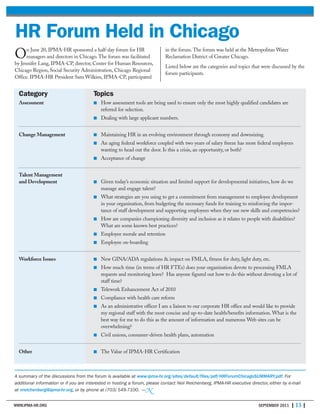
On June 20, IPMA-HR sponsored a half-day forum for HR
managers and directors in Chicago. The forum was facilitated
by Jennifer Lang, IPMA-CP, director, Center for Human Resources,
Chicago Region, Social Security Administration, Chicago Regional
Office. IPMA-HR President Sam Wilkins, IPMA-CP, participated
in the forum. The forum was held at the Metropolitan Water
Reclamation District of Greater Chicago.
Listed below are the categories and topics that were discussed by the
forum participants.
HR Forum Held in Chicago
Category Topics
Assessment ■ How assessment tools are being used to ensure only the most highly qualified candidates are
referred for selection.
■ Dealing with large applicant numbers.
Change Management ■ Maintaining HR in an evolving environment through economy and downsizing.
■ An aging federal workforce coupled with two years of salary freeze has more federal employees
wanting to head out the door. Is this a crisis, an opportunity, or both?
■ Acceptance of change
Talent Management
and Development ■ Given today’s economic situation and limited support for developmental initiatives, how do we
manage and engage talent?
■ What strategies are you using to get a commitment from management to employee development
in your organization, from budgeting the necessary funds for training to reinforcing the impor-
tance of staff development and supporting employees when they use new skills and competencies?
■ How are companies championing diversity and inclusion as it relates to people with disabilities?
What are some known best practices?
■ Employee morale and retention
■ Employee on-boarding
Workforce Issues ■ New GINA/ADA regulations & impact on FMLA, fitness for duty, light duty, etc.
■ How much time (in terms of HR FTEs) does your organization devote to processing FMLA
requests and monitoring leave? Has anyone figured out how to do this without devoting a lot of
staff time?
■ Telework Enhancement Act of 2010
■ Compliance with health care reform
■ As an administrative officer I am a liaison to our corporate HR office and would like to provide
my regional staff with the most concise and up-to-date health/benefits information. What is the
best way for me to do this as the amount of information and numerous Web sites can be
overwhelming?
■ Civil unions, consumer-driven health plans, automation
Other ■ The Value of IPMA-HR Certification
A summary of the discussions from the forum is available at www.ipma-hr.org/sites/default/files/pdf/HRForumChicagoSUMMARY.pdf. For
additional information or if you are interested in hosting a forum, please contact Neil Reichenberg, IPMA-HR executive director, either by e-mail
at nreichenberg@ipma-hr.org, or by phone at (703) 549-7100. —N
| 14 | SEPTEMBER 2011 HR NEWS MAGAZINE
■ w o r k f o r c e / s u c c e s s i o n p l a n n i n g & s t r a t e g i c p l a n n i n g ■
C
hange is a frightening thing. No one likes to think about
what will happen after a cherished employee leaves his or
her position to retire or take a new job. We like to think
our workers will always be there and will always be able to perform
at the level we require.
But with the sizable baby boomer population aging, succession plan-
ning—the process of grooming promising workers to one day fill the
shoes of those likely to move on—has taken on added importance.
“I think the attitudes toward succession planning have gone from ‘we
need to develop a plan’ to panic in some cases, because companies are
seeing huge gaps in experience that cannot be easily filled by younger
generations unless a plan was in place to prepare the potential
replacements,” said Bonnie Curran Jones, IPMA-CP, human
resources consultant at the University of Tennessee Institute for
Public Service. Jones is particularly familiar with the topic, having
recently done her masters’ degree project on it. During her research,
Jones found that, unless things change, workplaces—particularly
those in the public sector—could have a rough time as the leaders of
today’s workforce age out of their jobs. “Boomers are indeed retiring
and it is an inevitable part of a generational shift that will occur
whether a company is ready or not,” she said.
A Retiring Generation?
The baby boom generation is typically defined as those born
between the years of 1946 and 1964.There are about 75 million
baby boomers in the United States, and the oldest members of that
generation began turning 65 (which is typically considered retire-
ment age) this year. When Jones did her project in 2009, boomers
accounted for 28 percent of the population and 45 percent of the
workforce.There’s also research to suggest that this demographic is
relatively fast-growing, especially compared to younger groups. Jones
cites statistics showing that, from 1996 to 2006, the number of
people between the ages of 55 and 64 in the country increased by 54
percent. However, those in the age range of 25 to 34 decreased
nearly nine percent.
In fact, Jones said, even by the most conservative estimates, Genera-
tion X, the next up and coming demographic group, has at least 30
million fewer people than the boomer generation.That likely means
that unless there’s some sort of forethought on the part of employers,
there could be a major shortage of experienced workers in the years
ahead.
“In some cases, we now have about half the workforce ‘eligible’ for
SUCCESSION
PLANNING:
Providing a Road Map
for Your Organization
By Amanda Cuda
WWW.IPMA-HR.ORG SEPTEMBER 2011 | 15 |
retirement,” Jones said. “There are simply not enough experienced
people out there to fill these positions which will ultimately leave a
huge gap in our workforce.”
According to the Pew Research Center, 10,000 baby boomers will
turn 65 every day for the next 19 years. Jones called that a “stagger-
ing statistic” that shows that succession planning is even more
important than it was just a few years ago, and will continue to be
critical to employers in the years ahead. Indeed, those in the leading
edge of the baby boomer generation are already starting to leave
their jobs for the greener pastures of retirement. Late last year, the
AARP released the results of a telephone poll of about 800 people
who will be turning 65 this year. Of those, more than half said they
had already retired.The (sort of) good news is that, of those still
working, 29 percent said they planned to continue working until
they reach the age of at least 70. About 27 percent of the employed
people polled said they planned to retire between the ages of 66 and
69, and only 15 percent said they planned to retire on or before their
65th birthday this year.
But even the boomers who are delaying retirement can’t work
forever, and Jones said there’s some concern that there won’t be
enough qualified younger workers to fill the hole the boomers will
eventually leave.
Jones said the aging of the population will likely be a bigger concern
for the public sector than the private sector. According to her proj-
ect, in 2008, 46 percent of local government employees were 45
years of age or older, compared with 31 percent in the private sector.
In the federal government, the situation was even direr, with more
than 50 percent of employees in those jobs eligible to retire. Statis-
tics in Tennessee seem to reflect those national numbers. In her
research, Jones found that the average age of a city manager in the
state was 52.53 and the average age of an assistant was 48.54.
Preparing for the Inevitable
Jones said her master’s project has convinced her that organizations
need to start thinking ahead. One thing that disturbed her was that
many cities and towns don’t seem to have a solid succession plan in
place. Indeed, different organizations all seem to approach the idea
of succession in their own ways. For instance, at the University of
Tennessee, where Jones works, there isn’t a formal succession plan in
place, though there is a focus on grooming younger employees to
assume leadership positions, said Mary Jinks, vice president of public
service at the institute. One way in which they’ve done this is to
establish the IPS Leadership Academy, a two-year program that
educates selected mid-level employees on the business side of the
institute and the University of Tennessee system.The program
includes classroom work, group projects, site visits and a mentoring
relationship, among other aspects.The institute has also encouraged
its newest executive directors to participate in the university’s leader-
ship programs and has a formal supervisors’ training program.
At the Oregon Judicial Department, from which Gary Martin,
IPMA-CP, recently retired as human resources director, the focus is
on decentralized succession planning, with the assistance of central
HR and training units. Under this approach, the local leadership is
expected to identify local internal talent and to develop those candi-
dates in keeping with the retirement calendars of their current local
leaders. Martin said, in his experience, this is the best approach to
choosing new leaders.
“It is very difficult to centrally administer a succession planning
program, especially in the public sector where every vacancy is filled
using merit-based selection,” Martin said. “I have always been
concerned that the succession planning approaches which centrally
create a cadre of ‘favored’ candidates—even if those candidates were
selected in a merit-based manner—can engender expectations
among that cadre that does not match reality when the time comes
to actually fill the position.”
But even the decentralized system can’t always identify an ideal
candidate. For instance, Martin said nobody within his organization
wanted his job, and external recruitment was needed.Though that
process yielded a successful candidate, that person decided to stay
with his current employer, so Martin’s job remains open for now.
Still, Martin remains a believer in the concept of succession planning
and talent development in general. “I see succession planning as the
responsibility of every manager,” he said. “They should always be
thinking of how and from where (internal or external) they will fill
their next vacancy.”
Through the course of her research, Jones came up with a few
options for staunching the oncoming hemorrhage of experienced
employees, many of which involve trying to hang onto the boomer
workforce in some capacity. “I think where we are headed from a
human resources perspective is to look at creative options such as
retaining those that are retiring on a part-time basis to assist in fill-
ing the gaps in knowledge, skills, abilities and experience,” she said.
Jones said this may mean changing benefits to meet the needs of the
part-time boomer workforce and allowing them to participate in
benefits while working part-time.This also may mean hiring or
rehiring boomers in a temporary or consultative capacity to help fill
the voids in the workplace.
When you can’t keep your aging workers, Jones said, use them to
prepare the next generation of leaders. She suggests having workers
on the cusp of retirement age engage in training or mentoring those
who could one day move up into their jobs.Though this won’t neces-
sarily bridge the gap in volume between boomers and Generation X,
Jones said it could help fill the gap in experience between the two
demographic groups. “Boomers have knowledge and experience that
cannot be filled with textbooks, so mentoring and cross training is
critical to the success of organizations,” Jones said.
Amanda Cuda is a full-time general assignment reporter for the
Connecticut Post newspaper in Bridgeport, Conn. She also freelances
for several publications, including HR News. —N
■ w o r k f o r c e / s u c c e s s i o n p l a n n i n g & s t r a t e g i c p l a n n i n g ■
chua County (FL) Alameda County (CA) Albany City (GA) Allen City (TX) Anne Arundel County (M
unty (MD) Clark County (NV) Clovis City (NM) Cobb County (GA) Contra Costa County (CA) Da
unty (GA) Gainesville City (FL) Goodyear City (AZ) Gwinnett County (GA) Hampton City (VA) H
City (TX) Jefferson Parish (LA) King County (WA) Lee County (FL) LA Superior Court (CA) Mccar
t Beach City (CA) OC Fire Authority (CA) Orange County (CA) Palm Bay City (FL) Pasco County (
ramento City (CA) Sacramento County (CA) San Bernardino County (CA) San Diego County (CA)
Louis County (MO) Malibu School District (CA) Savannah City (GA) Schaumburg Village (IL) Spots
e of Tenneesee Texas Education Agency (TX) Union County (NC) Ventura County (CA) State of W
(TX) Anne Arundel County (MD) Anoka County (MN) Arapahoe County (CO) Arlington County (
) Contra Costa County (CA) Dakota County (MN) Davenport City (IA) Delray Beach Police Dept.
unty (GA) Hampton City (VA) Hawaii Dept. of Edu. (HI) State of Hawaii Hennepin County (MN)
LA Superior Court (CA) Mccarran Airport (NV) Multnomah County (OR) Napa County (CA) Na
m Bay City (FL) Pasco County (FL) Prince George’s County (MD) Reno City (NV) Rochester City (M
) San Diego County (CA) San Mateo County (CA) Santa Barbara County (CA) Santa Clara County
aumburg Village (IL) Spotsylvania County (VA) Stafford County (VA) Stearns County (MN) Surpris
tura County (CA) State of West Virginia Westerville City (OH) Alachua County (FL) Alameda Count
unty (CO) Arlington County (VA) Atlanta City (GA) Baltimore County (MD) Clark County (NV) C
Delray Beach Police Dept. (FL) Eugene City (OR) Fulton County (GA) Gainesville City (FL) Go
nnepin County (MN) Honolulu City & County (HI) HoustonCity (TX) Jefferson Parish (LA) King Cou
pa County (CA) Nashville & Davidson Cty. (TN) Newport Beach City (CA) OC Fire Authority (CA)
) Rochester City (MN) Rockford Police Dept. (IL) Sacramento City (CA) Sacramento County (CA)
) Santa Clara County (CA) Santa Monica City(CA) St. Louis County (MO) Malibu School District (C
arns County (MN) Surprise City (AZ) Tarrant County (TX) State of Tenneesee Texas Education Age
a County (FL) Alameda County (CA) Albany City (GA) Allen City (TX) Anne Arundel County (MD)
unty (MD) Clark County (NV) Clovis City (NM) Cobb County (GA) Contra Costa County (CA) Da
unty (GA) Gainesville City (FL) Goodyear City (AZ) Gwinnett County (GA) Hampton City (VA) H
City (TX) Jefferson Parish (LA) King County (WA) Lee County (FL) LA Superior Court (CA) Mccar
t Beach City (CA) OC Fire Authority (CA) Orange County (CA) Palm Bay City (FL) Pasco County (
ramento City (CA) Sacramento County (CA) San Bernardino County (CA) San Diego County (CA)
Louis County (MO) Malibu School District (CA) Savannah City (GA) Schaumburg Village (IL) Spots
e of Tenneesee Texas Education Agency (TX) Union County (NC) Ventura County (CA) State of W
(TX) Anne Arundel County (MD) Anoka County (MN) Arapahoe County (CO) Arlington County (
) Contra Costa County (CA) Dakota County (MN) Davenport City (IA) Delray Beach Police Dept.
unty (GA) Hampton City (VA) Hawaii Dept. of Edu. (HI) State of Hawaii Hennepin County (MN)
LA Superior Court (CA) Mccarran Airport (NV) Multnomah County (OR) Napa County (CA) Na
m Bay City (FL) Pasco County (FL) Prince George’s County (MD) Reno City (NV) Rochester City (M
) San Diego County (CA) San Mateo County (CA) Santa Barbara County (CA) Santa Clara County
aumburg Village (IL) Spotsylvania County (VA) Stafford County (VA) Stearns County (MN) Surpris
tura County (CA) State of West Virginia Westerville City (OH) Alachua County (FL) Alameda County
unty (CO) Arlington County (VA) Atlanta City (GA) Baltimore County (MD) Clark County (NV) C
Delray Beach Police Dept. (FL) Eugene City (OR) Fulton County (GA) Gainesville City (FL) Go
nnepin County (MN) Honolulu City & County (HI) HoustonCity (TX) Jefferson Parish (LA) King Cou
pa County (CA) Nashville & Davidson Cty. (TN) Newport Beach City (CA) OC Fire Authority (CA)
) Rochester City (MN) Rockford Police Dept. (IL) Sacramento City (CA) Sacramento County (CA)
) Santa Clara County (CA) Santa Monica City(CA) St. Louis County (MO) Malibu School District (C
arns County (MN) Surprise City (AZ) Tarrant County (TX) State of Tenneesee Texas Education Age
wport Beach City (CA) OC Fire Authority (CA) Orange County (CA) Palm Bay City (FL) Pasco Cou
ramento City (CA) Sacramento County (CA) San Bernardino County (CA) San Diego County (CA)
Louis County (MO) Malibu School District (CA) Savannah City (GA) Schaumburg Village (IL) Spots
e of Tenneesee Texas Education Agency (TX) Union County (NC) Ventura County (CA) State of W
(TX) Anne Arundel County (MD) Anoka County (MN) Arapahoe County (CO) Arlington County (
rundel County (M
County (CA) Da
on City (VA) H
urt (CA) Mccar
Pasco County (
o County (CA)
llage (IL) Spots
(CA) State of W
rlington County (
ach Police Dept.
n County (MN)
County (CA) Na
Rochester City (M
nta Clara County
y (MN) Surpris
Alameda Count
County (NV) C
le City (FL) Go
h (LA) King Cou
Authority (CA)
nto County (CA)
School District (C
as Education Age
del County (MD)
County (CA) Da
on City (VA) H
urt (CA) Mccaaaaaaaaaaaaaaaaa
Pasco County (((((((((((((
o County (CAAAAAAAAAAAAAAAAAAA))))))))))))))))))
ll (IL) S
y ( )
School District (C
as Education Age
FL) Pasco Cou
o County (CA)
llage (IL) Spots
(CA) State of W
rlington County (
Louis Countyy ((MO)) Malibu School District ((CA)) Savannah Cityy ((GA)) Schaumburgg Vil
eeee ooooffffff TTTTTTeeeennnnnnnneeeeeeeesssseeeeeeee TTTTTTeeeexxxxaaaassss EEEEEEdddddduuuuccccaaaatttttiiiiiioooonnnn AAAAAAgggggeeeennnnccccyyyyy (((((((TTTTTTXXXXXX))))))) UUUUUUnnnniiiiiioooonnnn CCCCCCoooouuuunnnntttttyyyyy (((((((NNNNNNCCCCCC))))))) VVVVVVeeeennnntttttuuuurrrraaaa CCCCCCoooouuuunnnntttttyyyyy (((((((
(TX) Anne Arundel County (MD) Anoka County (MN) Arapahoe County (CO) Ar
) Contra Costa County (CA) Dakota County (MN) Davenport City (IA) Delray Bea
unty (GA) Hampton City (VA) Hawaii Dept. of Edu. (HI) State of Hawaii Hennepin
LA Superior Court (CA) Mccarran Airport (NV) Multnomah County (OR) Napa C
m Bay City (FL) Pasco County (FL) Prince George’s County (MD) Reno City (NV) R
) San Diego County (CA) San Mateo County (CA) Santa Barbara County (CA) Sa
aumburg Village (IL) Spotsylvania County (VA) Stafford County (VA) Stearns County
tura County (CA) State of West Virginia Westerville City (OH) Alachua County (FL) A
unty (CO) Arlington County (VA) Atlanta City (GA) Baltimore County (MD) Clark C
Delray Beach Police Dept. (FL) Eugene City (OR) Fulton County (GA) Gainesvill
nnepin County (MN) Honolulu City & County (HI) HoustonCity (TX) Jefferson Parish
ppppppaaaa CCCCCoooouuuunnnntttttyyyyyy ((((((CCCCCAAAAA)))))) NNNNNaaaasssshhhhhvvvviiiiilllllllllleeee &&&&& DDDDDaaaavvvviiiiidddddssssoooonnnn CCCCCtttttyyyyyy... ((((((TTTTTNNNNN)))))) NNNNNeeeewwwwppppppoooorrrrttttt BBBBBeeeeaaaacccchhhhh CCCCCiiiiitttttyyyyyy ((((((CCCCCAAAAA)))))) OOOOOCCCCC FFFFFiiiiirrrreeee AAAAA
)) RRochhestter CCiitty ((MMNN)) RRockkffordd PPolliice DDeptt. ((IILL)) SSacramentto CCiitty ((CCAA)) SSacramen
llagge ((IL)) Sppppppppppppppppppppp
(((((((CCCCCCAAAAAA))))))) SSSSSStttttaaaattttteeee ooooooooooooooooooooooooooooooooooooooooooooooooooooooooooooooooooooooooooooo
rlington Counnnnnnnnnnnnnnnnnnnnnnnntt
ach Police Deeeeeeeeeeeeeeeeeeeeeeeeepppppppppppppp
n County (MNNNNNNNNN))))))))))))))))))))))))))
County (CA) NNNNNNNNNNNNNNNNNNNNN
Rochester Citttttttttttttttttttyyyyyyyyyyyyyyyyyyyyyyyyyyyyyyy
nta Clara Cou
y (MN) Surppppppppppp
Alameda Coooooooouuuuuuuuuuu
County (NV))))))))))))))))))))))))
le City (FL)
h (LA) Kingg CCCCCCCCCCCCCCCCCCCCCCCCC
AAAAAuuuuttttthhhhhoooorrrriiiiitttttyyyyyy ((((((CCCCCAAAAA))))))
ntto CCountty ((CCAA))
your (PE)ople
For more information visit
www.neogov.com/PE
Well-defined performance evaluation process is critical in
improving workforce productivity and reducing employee
turnover. Measuring and optimizing your people’s performance
across the agency is one of the best investments you can make to
guarantee the most effective use of tax-payer money and to
maximize the services delivered to your constituents.
NEOGOV’s (PE) PERFORMANCE EVALUATION
Performance Evaluation product allows government agencies to align agency-wide objective with day-to-day operations to
ensure the efficient use of public resources, as well as providing visibility into the agency’s performance on all levels –
agency-wide, departmental, and individual.
» Align departmental and individual performance with strategic agency-wide goals
» Define performance standards & measurable goals
» Motivate and retain high performing employees
» Identify and communicate organizational expectations
» Avoid litigation by providing justification for personnel actions
» Maximize services your agency delivers to the community
MD) Anoka County (MN) Arapahoe County (CO) Arlington County (VA) Atlanta City (GA) Balti
akota County (MN) Davenport City (IA) Delray Beach Police Dept. (FL) Eugene City (OR) Fulton
Hawaii Dept. of Edu. (HI) State of Hawaii Hennepin County (MN) Honolulu City & County (HI) Hou
rran Airport (NV) Multnomah County (OR) Napa County (CA) Nashville & Davidson Cty. (TN) Ne
(FL) Prince George’s County (MD) Reno City (NV) Rochester City (MN) Rockford Police Dept. (IL)
San Mateo County (CA) Santa Barbara County (CA) Santa Clara County (CA) Santa Monica City(C
sylvania County (VA) Stafford County (VA) Stearns County (MN) Surprise City (AZ) Tarrant County
West Virginia Westerville City (OH) Alachua County (FL) Alameda County (CA) Albany City (GA) A
(VA) Atlanta City (GA) Baltimore County (MD) Clark County (NV) Clovis City (NM) Cobb Coun
(FL) Eugene City (OR) Fulton County (GA) Gainesville City (FL) Goodyear City (AZ) Gwinnett
Honolulu City & County (HI) HoustonCity (TX) Jefferson Parish (LA) King County (WA) Lee Coun
ashville & Davidson Cty. (TN) Newport Beach City (CA) OC Fire Authority (CA) Orange County (CA
MN) Rockford Police Dept. (IL) Sacramento City (CA) Sacramento County (CA) San Bernardino C
y (CA) Santa Monica City(CA) St. Louis County (MO) Malibu School District (CA) Savannah City (G
se City (AZ) Tarrant County (TX) State of Tenneesee Texas Education Agency (TX) Union County (
ty (CA) Albany City (GA) Allen City (TX) Anne Arundel County (MD) Anoka County (MN) Arapa
Clovis City (NM) Cobb County (GA) Contra Costa County (CA) Dakota County (MN) Davenport C
oodyear City (AZ) Gwinnett County (GA) Hampton City (VA) Hawaii Dept. of Edu. (HI) State of Ha
unty (WA) Lee County (FL) LA Superior Court (CA) Mccarran Airport (NV) Multnomah County (O
Orange County (CA) Palm Bay City (FL) Pasco County (FL) Prince George’s County (MD) Reno C
San Bernardino County (CA) San Diego County (CA) San Mateo County (CA) Santa Barbara Cou
CA) Savannah City (GA) Schaumburg Village (IL) Spotsylvania County (VA) Stafford County (VA)
ency (TX) Union County (NC) Ventura County (CA) State of West Virginia Westerville City (OH) A
) Anoka County (MN) Arapahoe County (CO) Arlington County (VA) Atlanta City (GA) Baltimo
akota County (MN) Davenport City (IA) Delray Beach Police Dept. (FL) Eugene City (OR) Fulton
Hawaii Dept. of Edu. (HI) State of Hawaii Hennepin County (MN) Honolulu City & County (HI) Hou
rran Airport (NV) Multnomah County (OR) Napa County (CA) Nashville & Davidson Cty. (TN) Ne
(FL) Prince George’s County (MD) Reno City (NV) Rochester City (MN) Rockford Police Dept. (IL)
San Mateo County (CA) Santa Barbara County (CA) Santa Clara County (CA) Santa Monica City(C
sylvania County (VA) Stafford County (VA) Stearns County (MN) Surprise City (AZ) Tarrant County
West Virginia Westerville City (OH) Alachua County (FL) Alameda County (CA) Albany City (GA)
(VA) Atlanta City (GA) Baltimore County (MD) Clark County (NV) Clovis City (NM) Cobb Coun
. (FL) Eugene City (OR) Fulton County (GA) Gainesville City (FL) Goodyear City (AZ) Gwinnett
Honolulu City & County (HI) HoustonCity (TX) Jefferson Parish (LA) King County (WA) Lee Coun
ashville & Davidson Cty. (TN) Newport Beach City (CA) OC Fire Authority (CA) Orange County (CA
MN) Rockford Police Dept. (IL) Sacramento City (CA) Sacramento County (CA) San Bernardino C
y (CA) Santa Monica City(CA) St. Louis County (MO) Malibu School District (CA) Savannah City (G
se City (AZ) Tarrant County (TX) State of Tenneesee Texas Education Agency (TX) Union County (
y (CA) Albany City (GA) Allen City (TX) Anne Arundel County (MD) Anoka County (MN) Arapa
Clovis City (NM) Cobb County (GA) Contra Costa County (CA) Dakota County (MN) Davenport C
oodyear City (AZ) Gwinnett County (GA) Hampton City (VA) Hawaii Dept. of Edu. (HI) State of Ha
unty (WA) Lee County (FL) LA Superior Court (CA) Mccarran Airport (NV) Multnomah County (O
Orange County (CA) Palm Bay City (FL) Pasco County (FL) Prince George’s County (MD) Reno C
San Bernardino County (CA) San Diego County (CA) San Mateo County (CA) Santa Barbara Cou
CA) Savannah City (GA) Schaumburg Village (IL) Spotsylvania County (VA) Stafford County (VA)
ency (TX) Union County (NC) Ventura County (CA) State of West Virginia Westerville City (OH)
unty (FL) Prince George’s County (MD) Reno City (NV) Rochester City (MN) Rockford Police Dept
San Mateo County (CA) Santa Barbara County (CA) Santa Clara County (CA) Santa Monica City(C
sylvania County (VA) Stafford County (VA) Stearns County (MN) Surprise City (AZ) Tarrant County
West Virginia Westerville City (OH) Alachua County (FL) Alameda County (CA) Albany City (GA) A
(VA) Atlanta City (GA) Baltimore County (MD) Clark County (NV) Clovis City (NM) Cobb Coun
MD) Anoka Count ppppaaaaaaaaaaaaaaaaaaaaaaaaaaaaaaaaaaaaaaaaaaaaaaaaaaaaaaaaaaaaaaaaaaaaaaaaaaaaaaaaaaaaaaaaaaaaaaaaaaaaaaaaaaaaaaaaaaaaaaaaaahhhhhhhhhhhhhhhhhhhhhhhhhhhhhhhhhhhhhhhhhhhhhhhhhhhhhhhhhhhhhhhhhhhhhhhhhhhhhhhhhhhhhhhhhhhhhhhhhhhhhhhhhhhhhhhhhhhhhhhhooooooooooooe County (CO) Arlington County (VA) Atlanta City (GA) Balti
akota County (MNN) (((((((((((((IIA) Delray Beach Police Dept. (FL) Eugene City (OR) Fulton
Hawaii Dept. of Eduu aaaii Hennepin County (MN) Honolulu City & County (HI) Hou
rran Airport (NV) OOOOOOOOOOOOOOOOOOOR) Napa County (CA) Nashville & Davidson Cty. (TN) Ne
(FL) Prince Geoooooooooooooooooooooooooooooooooooooooooooooooooooooooooooooooooooooooooooooooooooooooooooooo eeeeeeeeeeeeeeeeeeeeeeeeeeeeeeeeeeeeeeeeeeeeeeeeeeeeeeeeeeeeeeeeeeeeeeeeeeeeeeeeeeennnnnnnnnnnnnnnnnnnnnnnnnnnnnnnnnnnnnnnnnnnnnnnnnnnnnnnnnnnnnnnnnnnnnnnnnnnnnnnnnnnnnnnnnnnnnnnnnnnnnnnnnnnnnnnnnnnnnnnnnnnnnnnnnnnnnnnnnnnooooooooooooooooooooooooooooooooooooooooooooooooooooooooooooooooooooooooooooooooooooooooooooooooooooooooooooooooooooooooooooo City (NV) Rochester City (MN) Rockford Police Dept. (IL)
San Mateo Couuuuuuuuuuuuuuuuuuuuuuuuuuuuuuuuuuuuuuuuuuuuuuuuuuuuuuuuuuuuuuuuuuuuuuuuuuuuuuuuuuuuuuuuuuuuuuuuuuuuuuuuuuuuuuuuuuuuuuuuuuuuuuuuuuuuuuuuuuuuuuuuuuuuuuuuuuuu aaaaaaaaaaaaaaaaaaaaaaaaaaaaaaaaaaaaaaaaaaaaaaaaaaaaaaaaaaaaaaaaaaaaaaaaaaaaaaaaaaaaaaaaaaaaaaaaaaaaaaaaaaaaa CCCCCCCCCCCCCCCCCCCCCCCCCCCCCCCCCCCCCCCCCCCCCCCCCCCCCCCCCCCCCCCCCCCCCCCCCCCCCCCCCCCCCCCCCCCCCCCCCCCCCCCCCCCCCCCCCCCCCCCCCCCCCCCCCCCCCCCCCCCCCCCCCCCCCCCCCCCCCCCCCCCCCCCCCCCCCCCCCCCCCCCCCCCCCCCCCCCCCCCCCCCCCCCCCCCCCCCCCCCCCCCCCCCCCCCCCCCCCCCCCCCCCCCCCCCCCCCCCCCCCCCCCCCCCCCCCCCCCCCCCCCCCCCCCCCCCCCCCounty (CA) Santa Clara County (CA) Santa Monica City(C
sylvania County AAAAAAAAAAAAAAAAAAAAAAAAAAAAAAAAAAAAAAAAAAAAAAAAAAAAAAAAAAAAAAAAAAAAAAAAAAA))))))))))))))))))))))))))))))))))))))))))))))))))))))))))))))))))))))))))))))))))))))))))))))))))))))))))))))))))))))))))))))))))))))))))))))))))))))))))))))))))))))))))))))))))))))))))))))))))))) Stearns County (MN) Surprise City (AZ) Tarrant County
West Virginia WWWWWWWWWWWWWWWWWWWWWWWWWWWWWWWWWWWWWWWWWWWWWWWWWWWWWWWWWWWWWWWWWWWWWWWWWWWWWWWWWWWWWWWWWWWWWWWWWWWWWWWWWWWWWWWWWWWWWWWWWWWWWWWWWWWWWWWWWWWWWWWWWWWWWWWWWWWWWWWWWWWWWWWWWWWWWWWWWWWWWWWWWWWWWWWWWWWWWWWWWWWWWWWWWWWWWWWWWWWWWWWWWWWWWWWWWWWWWWWWWWeeeeeeeeeeeeeeeeeeeeeeeeeeeeeeeeeeeeeeee uuuuuuuuuuuuuuuuuuuuuuuuuuuuuuuuuuuuuuuuuuuuuuaaaaaaaaaaaaaaaaaaaaaaaaaaaaaaaaaaaaaaaaaaaaaaaaaaa County (FL) Alameda County (CA) Albany City (GA) A
(VA) Atlanta Cittttttttttttttttttttttttttttttttttttttttttttttttttyyyyyyyyyyyyyyyyyyyyyyyyyyyyyyyyyyyyyyyyyyyyyyyyyyyyyyyyyyyyyyyyyyyyyyyyyyyyyyyyyyyyy ttttttttttttttttttttttttttttttyyy (MD) Clark County (NV) Clovis City (NM) Cobb Coun
(FL) Eugene Cittttttttttttttttttttttttttttttttttttttttttttttttttttttttttttttttyyyyyyyyyyyyyyyyyyyyyyyyyyyyyyyyyyyyyyyyyyyyyyyyyyy yyyyyyyyyyyyyyyyyyyyyyyyyyyyyyyyyyyyyyyyyyyyyyyyyyyyyyyyyyyyyyyyyyyyyyyyyyyyyyyyyyyyyyyyyy ((((((((((((((((((((((((((((((((((((((((((((((GA) Gainesville City (FL) Goodyear City (AZ) Gwinnett
Honolulu City & Cooouuuuuuuuuuuuuuuuuu CCCCCCCCCCCCCCCCCCCCCCCCCCCCCCCity (TX) Jefferson Parish (LA) King County (WA) Lee Coun
ashville & Davidson CCCCCCCCCCCCCCCCCCCCCCCCCCCCCCCCCCCCCCCCCCC rrrrrrrrrrrrrrrrrrrrrrrrrrrrttttttttttttttttttttttttttttttttttttttttttttttttttt Beach City (CA) OC Fire Authority (CA) Orange County (CA
MN) Rockford Policeeeeeeeeeeeeeeeee rrrrrrrrrrrrrrrrrrrrrrraaamento City (CA) Sacramento County (CA) San Bernardino C
y (CA) Santa Monica CCCCCCCCCCCCCCCCCCCCCCCC oooooooooooooooouuis County (MO) Malibu School District (CA) Savannah City (G
se City (AZ) Tarrant CCCCCCCCCCCCCCCCCCCCCCCCCCCCCCCCCCCCCCoooooooooooooooooooooooooooooo ttttttttttttttttttttttttttttttttttttttttttttttteeeeeeeeeeeeeeeeeeeeeeeeeeeeeeeeeeeeeeeeeeeeeeeeeeeeeeeeeeeeeeeeeeeeeeeeeeeeeeeeeeeeee oooooooooooooooooooooooooooooooooof Tenneesee Texas Education Agency (TX) Union County (
ty (CA) Albanyyyyyyyyyyyyyyyy CCCCCCCCCCCCCCCCCCCCCCCiiiiiiiiiiiiiiiiiitttttttttttttttttttttyyyyyyyyyyy XXXXXXXXXXXXXXXXXXXXXXXXXXXXXXXXXXXXXXXXXXXXXXXXXXXXXXXXXXXXXXXXXXXXXXXX)))))))))))))))))))))))))))))))))))))))))) AAAAAAAAAAAAAAAAAAAAAAnne Arundel County (MD) Anoka County (MN) Arapa
Clovis CCCCCCCCCCCCCCCCCCiiiiiiiiiiiiiiiiittttttttttttttttt CCCCCCCCCCCCCCCCCCCCoooooooooooooooooooooooooooooooosssssssssssssssssssssssssssssssssssssssstttttttttttttttttttttttttttttttttttttaaaaaaaaaaaaaaaaaaaaaaaaaaaaaa CCCCCCCCCCCCCCCCCCCCCCCCCCCCCCCCCCCCCCCCCoooooooooooooooooooooooooooooooooooooooooouuuuuuuuuuuuuuuuuuuuuuuuuuuuuuuuuuuuuuuuuuuuuuuuuuuuuuuuuuuuuuuuuuuuuuuuuuunnnnnnnnnnnnnnnnnnnnnnnnnnnnnnnnnnnnnnnnnnnnnnnnnnnnnnnnnnnnnnnnnnnnntttttttttttttttttttttttttyyyyyyyyyyyyy (CA) Dakota County (MN) Davenport C
oodyyyyyyyyyeeeeeeeeeeeeeee (((((((((((((((((((((((((((((((((VVVVVVVVVVVVVVVVVVVVVVVVVVVVVVVVVVVVVVVVVVVVVVVVVVVVVVVVVVVVVVVVVVVVVVVVVVVVVVVAAAAAAAAAAAAAAAAAAAAAAAAAAAAAAAAAAAAAAAAAAA) Hawaii Dept. of Edu. (HI) State of Ha
untyyyyyyyyyyyyyyyy cccccccccccccccccccccccccccccccccccccccccccccccccccccccccccccccaaaaaaaaaaaaaaaaaaaaaaaaaaaaaaaaaaaaaaaaaaaaaaaaaaaaaaaaaaaaaaaaaaaaaaaaaaaaaaaaaaaaaaaaaarran Airport (NV) Multnomah County (O
Oraaaaaaaaaaaaaaaaaaaaaaaaa LLLL))))))))))))))))))))))))))))))))))))))))))))))))))))))))))))))))))))))))))))))))))))))))))))))))))))))))))))))))))))) Prince George’s County (MD) Reno C
SSSSSSSSSSSSSSSSSSSSSSSSSSSSSS aaaaaaaaaaaaaannnnnnnnnnnnnnnnnnnnnnnnnnnnnnnnnnnnnnnnnnnnnnnnnnnnnnnnnnnnnnnnnnnnnnnnnnnnnnnnnnnnnnnnnnnn Mateo County (CA) Santa Barbara Cou
CA)))))))))))))) aaaaaaaaaaaaaaaaaaaaaaaaaaaaaaaaaaaaaaaaaaaaaaannnnnnnnnnnnnnnnnnnnnnnnnnnnnnnnnnnnnnnnnnnnnnnnnnnnnnnnnnnnnnnnnia County (VA) Stafford County (VA)
enccccccccccccccccccccccccccyyyyyyyy WWWeest Virginia Westerville City (OH) A
) (((((((((((((((((((((((((((((((((((((((((((((((((((((((((((((((((((((((VVVVVVVVVVVA) Atlanta City (GA) Baltimo
ak ((((((((((((((((((((((((((((((((((((((((((((((((((((((((((((((((((((((((((((((((((((((((((((((((((((((((((((((((((((((((((((((((((((((((((((((((((FFFFFFFFFFFFFFFFFFFFFFFFFFFFFFFFFFFFFFFFFFFFFFFFFFFFFFFFFFFFFFFFFFFFFFFFFFFFFFFFFFFFFFFFFFFFFFFFFFFFFFFFFFFFFFFFFFFFFFFFFFFFFFFLLLLLLLLL) Eugene City (OR) Fulton
Haaaaaaaaaaaa f Edu. (HI) S HHHHHHHHHHHHHHHHHHHHHHHHHHHHHHHHHHHHHHHHHHHHHHHHHHHHHHHHHHHHHHHHHHHHHHooooooooooooooooooooooooooooooooooooooooooooooooooooooooooooooooooooooooooooooooooooooooooooooooooooooooooooooooooooooooooooooooooooooooooooooooooooooooooooooooooooooooooooooooonnnnnnnnnnnnnnnnnnnnnnnnnnnnnnnnnnnnnnnnnnnnnnnnnnnnnnnnnnnnnnnnnnnnnnnnnnnnnnnnnnnnnnnnnnnnnnnnnnnnnnnnnnnnnnnnnnnnnnnnnnnnnnnnnnnnnnnnnnnnnnnnnnnnnnnnnnnnnnnnnnnnnoooooooooooooooooooooooooooooooooooooooooooooooooooooooooooooooooooooooooooooooooooooooooolulu City & County (HI) Hou
rrrrrrr NV) Multno vvvvvvvvvvvvvvvvvvvvvvvvvvvvvvvvvvvvvvvvvvvvvvvvvvvvvvvvvvvvvvvvvvvvvvvvvvvvvvvvvvvvvvvvvvvviiiiiiiiiiiiiiiiiiiiiiiiiiiiiiiiiiiiiiiiiiiiiiiiiiiiiiiiiiiiiiiiiiiiiiiiiiiiiiiiiiiiiiiiiiiiiiiiiiiiiiilllllllllllllllllllllllllllllllllllllllllllllllllllllllllllllllllllllllllllllllllllllllllllllllllllllllllllllllllllllllllllllllllllllllllllllllllllllllllllllllllllllllllllllllllllllllllllllllllllllllllllllllllllllllllllllllllllllllllllllllllllllllllllllllllllllllllllllleeeeeeeeeeeeeeeeeeeeeeeeeeeeeeeeeeeeeeeeeeeeeeeeeeeeeeeeeeeeeeeeeeeeeeeeeeeeeeeeeeeeeeeeeeeeeeeeeeeeeeeeeeeeeeeeeeeeeeeeeeeeeeeeeeeeeeeeeeeeeeeeeeeeeeeeeeeeeeeee &&&&& Davidson Cty. (TN) Ne
eo e’s Co ))))))))))))))))))))))))))))))))))))))))))))))))))))))))))))))))))))) RRRRRRRRRRRRRRRRRRRRRRRRRRRRRRRRRRRRRockford Police Dept. (IL)
S CCCCCCCCCCCCCCCCCCCCCCCCCCCCCCCCCCCCCCCCCCCCCCCCCCCCCCCCCCCCCCCCCCCCCCCCCCCCCCCCCCCCCCCCCCCCCCCCCCCCCCCCCCCCCCCCCCCCCCAAAAAAAAAAAAAAAAAAAAAAAAAAAAAAAAAAAAAAAAAAAAAAAAAAAAAAAAAAAAAAAAAAAAAAAAAAAAAAAAAAAAAAAAAAAAAAAAAAAAAAAAAAAAAAAAAAAAAAAAAAAAAAAAAAAAAAAAAAAAAAAAAAAAAAAAAAAAAAAAAAAAAAAAAAAAAAAAAAAAAAAAAAAAAAAAAAAAAAAAAAAAAAAAAAAAAAAAAAAAAAAAAAAAAAAAAAAAAAAAA)))))))))))))))))))))))))))))))))))))))))))))))))))))))))))))))))))))))))))))))))))))))))))))))))))))))))))))))) Santa Monica City(C
C t CCCCCCCCCCCCCCCCCiiiiiiiiiiiiiiiiiiiiiiiiiiiiiiiiiiiiiiiiiiiiiiiiiiiiiiiiiiiiiiiiiiiiiiiiiiiiiittttttttttttttttttttttttttttttttttttttttttttttttttttttttttttttttttttttttttt (AZ) T t C t
))))))))))))) y ( )
CCCCCCCCCCCCCCCCCCCCCCCCCCCCCCCCCCCCCCCCCCCCCCCCCCCCCCCCCCCCCCCCCCCCCCCCCCAAAAAAAAAAAAAAAAAAAAAAAAAAAAAAAAAAAAAAAAAAAAAAAAAAAAAA potsylvania County (VA) Stafford County (VA)
encccccccccccccccccccccccccccccccccccccyyyyyyyyyyyyyyyyyyyyyyyyyyyyyyyyyyyyyyyyyyyyyyyyyyyyyyyyyyyyyyyyyyyyyyyyyyyyyyyyyyyy ((((((((((((((((((((( State of West Virginia Westerville City (OH)
untyyyyyyyyyyyyyyyyyyyyyyyyyyy (((((((((((((((((((((((FFFFFF yyyyyyyyyyyyyyyyyyyyyyyyy ((((((((((((((((((((((((((((((NNNNNNNNNNNNNNNNNNV) Rochester City (MN) Rockford Police Dept
Saaaaaaaaaaaaaaaaaaaaaaaaaannnnnnnnnnnnnnnnnnnn MMMMMMM ttttttttttttttttttttttttttttttttttttttttttttttttttttttttyyyyyyyyyyyyyyyyyyyyyyyyyyyyyyyyyyyyyyyyyyyyyyyyyyyyyyyyyyyyyyyyyyyyyyyyyyyyyyyyyyyyyyyyyyyyyyyyyyyyyyyyyyyyyyyyyyyyyyyyyyyyyyyyyyyyyyyyyyyyyyyyyyyyyyyyyyyyyyyyyyyyyyyyyy ((((((((((((((((((((((((((((((((((((((((((((((((((((((((((((((((((((((((((((((((((((((((((((((((((((((((((((((((((((((((((((((CCCCCCCCCCCCCCCCCCCCCCCCCCCCCCCCCCCCCCCCCCCCCCCCCCCCCCCCCCCCCCCCCCCCCCCCCCCCCCCCCCCCCCCCCCCCCCCCCCCCCCCCCCCCCCCCCCCCCCCCCCCCCCCCCCCCCCCCCCCCCCCCCCCCCCCCCCCCCCCCCCCCCCCCCCCAAAAAAAAAAAAAAAAAAAAAAAAAAAAAAAAAAAAAAAAAAAAAAAAAAAAAAAAAAAAAAAAAAAAAAAAAAAAAAAAAAAA)))))))))))))))))))))))))))))))))))))) Santa Clara County (CA) Santa Monica City(C
syllvvvvvvvvvvvvvvvvvvvvvvvvvvvvvaaaaaaaaaaaaaaaaaaaaaaaannnnnnnnnnnnnnnnnnnnnnnnnnnnnnnnnnnnnnniiiiiiiiiiiiiiiiiiiiiiiiiiiiiiiiiiiiaaaaaaaaaaaaaaaaaaaaaaaaaaaaaaaaaaaaaa CCCCCCCCCCCCCCCCCCCCCCCCCCCCCC )))) SSSSSSSSSSSSSSSSSSSSSSSSSSSSSSSSSSSSSSSSSSSSSSSSSSSSSSSSSSSSSSSSSSSSSSSSSSSSSSSSSSSSSSSSSSSSSSSSSSSSSSSSSSSSSSSSSSSSSSSSSSSSSSSSSSSSSSSSSSSSSSSSSSSSSSSSSSSSSSSSSSSSSSSSSSSSSSSSSSSSSSSSSSSSSSSSSSSSSSSStttttttttttttttttttttttttttttttttttttttttttttttttttttttttttttttttttttttttttttttttttttttttttttttttttttttttttttttttttttttttttttttttttttttttttttttttttttttttttttttttttttttttttttttttttttttttttttttttttttttttttttttteeeeeeeeeeeeeeeeeeeeeeeeeeeeeeeeeeeeeeeeeeeeeeeeeeeeeeeeeeeeeeeeeeeeeeeeeeeeeeeeeeeeeeeeeeeeeeeeeeeeeeeeeeeeeeeeeeeeeeeeeeeeeeeeeeeeeeeeeeeeeeeeeeeeeeeeeeeeeeeeeeeeeeeeeeeeeeeeeeeeeeeeeeeeeeeeeeeeaaaaaaaaaaaaaaaaaaaaaaaaaaaaaaaaaaaaaaaaaaaaaaaaaaaaaaaaaaaaaaaaaaaaaaaaaaaaaaaaaaaaaaaaaaaaaaaaaaaaaaaaaaaaaaaaaaaaaaaaaaaaaaaaaaaaaaaaaaaaaaaaaaaaaaaaaarrrrrrrrrrrrrrrrrrrrrrrrrrrrrrrrrrrrrrrrrrrrrrrrrrrrrrrrrrrrrrrrrrrrrrrrrrrrrrrrrrrrrrrrrrrrrrrrrrrrrrrrrrrrrrrrrrrrrrrrrrrrrrrrrrrrrrrrrrrrrrrrrrrrrrrrrrnnnnnnnnnnnnnnnnnnnnnnnnnnnnnnnnnnnnnnnnnnnnnnnnnnnnnnnnnnnnnnnnnnnnnnnnnnnnnnnnnnnnnnnnnnnnnnnnnnnnnnnnnnnnnnnnnnnnnnnnnnsssssssssssssssssssssssssssssssssssssssssssssssssssssssssssssssssssssssssssssss CCCCCCCCCCCCCCCCCCCCCCCCCCCCCCCounty (MN) Surprise City (AZ) Tarrant County
Weeeeeeeeeeeeeeeeeeeeeeeeeeeeeeeeeesssssssssssssssssssssssssssssssssssssssssttttttttttttttttttttt VVVVVVVVVVVVVVVVVVVVVVVVVVVVVVVVVVVVVVVVVVVVVVVVVVVVVVVVVVVVVVVVVVVVVVVVVVVVVVVVVVVVVVVVVVVVVVVVVVVVVVVVVVVVVVVVVVVVVVVVVVVVVVVVVVVVVVVVVVViiiiiiiiiiiiiiiiiiiiiiiiiiiiiiiiiiiiiiiiiiiiiiiiiiiiiiiiiiiiiiiiiiiiiiiiiiiiiiiiiiiiiiiiiiiirrrrrrrrrrrrrrrrrrrrrrrrrrrrrrrrrrrrrrrrrrgggggggggggggggggggggggggggggggggggggggggggggggggggggiiiiiiiiiiiiiiiiiiiiiiiiiiiiiiiiiiiiiiiiiiiiiiiiiiiiiiiiiiiiiiiiiiiiiiiiiiiiiiiiiiinnnnnnnnnnnnnnnnnnnnnnnnnnnnnnnnnnnnnnnnnnnnnnnnnnnnnnnnnnnnnnnnnnnnnnnnnnnnnnniiiiiiiiiiiiiiiiiiiiiiiiiiiiiiiiiiiiiiiiiiiiiiiiiiiiiiiiiiiiiiiiiiiiiiiiiiiiiiiiiiiiiiiiiiiaaaaaaaaaaaaaaaaaaaaaaaaaaaaaaaaaaaaaaaaaaaaaaaaaaaaaaaaaaaaaaaaaaaaaaaa WWWWWWWWWWWWWWWWWWWWWWWWWWWWWWWWWWWWWWWWWWWWWWWWWWWWWWWWWWWWWWWWWWWWWWWWWWWWWWWWWWWWWWWWWWWWWWWWWWWWWWWWWWWWWWWWWWWWWWWWWWWWWWWWWWWWWWWWWWWWWWWWWWWWWWWWWWWWWWWWWWWWWWWWWWWWWWWWWWWWWWWWWWWWWWWeeeeeeeeeeeeeeeeeeeeeeeeeeeeeeeeeeeeeeeeeeeeeeeeeeeeeeeeeeeeeeeeeeeeeeeeeeeeeeeeeeeeeeeeeeeeeeeeeeeeeeeeeeeeeeeeeeeeeeeeeeeeeeeeeeeeeeeeeeeesssssssssssssssssssssssssssssssssssssssssssssssssssssssssssssssssssssssssssssssssssssssssssssssssssssssssssssssstttttttttttttttttttttttttttttttttttttttttttttttttttttttttttttttttttttttttttttttttttttttttttttttttttttttttttttttttttttttttttttttttttttttttttttttttttttttttteeeeeeeeeeeeeeeeeeeeeeeeeeeeeeeeeeeeeeeeeeeeeeeeeeeeeeeeeeeeeeeeeeeeeeeeeeeeeeeeeeeeeeeeeeeeeeeeeeeeeeeeeeeeeeeeeeeeeeeeeeeeeeeeeeeerrrrrrrrrrrrrrrrrrrrrrrrrrrrrrrrrrrrrrrrrrrrrrrrrrrrrrrrrrrrrrrrrrrrrrrrrrrrrrrrrrrrrrrrrrrrrrrrrrrrrvvvvvvvvvvvvvvvvvvvvvvvvvvvvvvvvvvvvvvvvvvvvvvvvvvvvvvvvvvvvvvvvvvvvvvvvvvvvvvvvvvvvvvvvvvvvvvvvvvvvvvvvvvvvvvvvvvvvvvvvvvvvvvvvvvvvvvvvvvvvvvvvvvvvvvvvvvvvvvvvvvvvvvvvvvvvvvvvvvvvvvvvvvvviiiiiiiiiiiiiiiiiiiiiiiiiiiiiiiiiiiiiiiiiiiiiiiillllllllllllllllllllllllllllllllllllllllllllllllllllllllllllllllllllllllllllllllllllllllllllleeeeeeeeeeeeeeeeeeeeeeeeeeeeeeeeeeeeeeeeeeeeeeeeeeeeeeeeeeeeeeeeeeeeeeee CCCCCCCCCCCCCCCCCCCCCCCCCCCCCCCCCCCCCCCCCCCCCCCCCCCCCCCCCCCCCCCCCCCCCCCCCCCCCCCCCCCCCCCCCCCCCCCCCCCCCCCCCCCiiiiiiiiiiiiiiiiiiiiiiiiiiiiiiiiiiiiiiiiiiiiiiiiiiiiiiiiiiiiiiiiiiiiiiiiiiiiiiiiiiiiiiiiiiiiiiiiiiiiiiiiittttttttttttttttttttttttttttttttttttttttttttttttttttttttttttttttttttttttttttttttttttttttttttttyyyyyyyyyyyyyyyyyyyyyyyyyyyyyyyyyyyyyyyyyyyyyyyyyyyyyyyyyyyyyyyyyyyyyyyyyyyyyyyyyyyyyyyyyyyyyyyyyyyyyyyyyyyyyyyyyyyyyyyyyyyyyyyyyyyyyyyyyyyyyyyyyyyyyyyyyyyyyyyyyyyyyyyyyyyyyyyyyyyyyyyyyyyyyyyyyyyyyyyyyyyyyyyyyyyyyyyyyyyyyyyyyyyyyyyyyyyyyyyyyy (((((((((((((((((((((((((((((((((((((((((((((((((((((((((((((((((((((((((((((((((((((((((((((((((((((((((((((((((((((((((((((((((((((((((((((((((((((((((((((((((((((((((((((((((((((((OOOOOOOOOOOOOOOOOOOOOOOOOOOOOOOOOOOOOOOOOOOOOOOOOOOOOOOOOOOOOOOOOOOOOOOOOOOOOOOOOOOOOOOOOOOOOOOOOOOOOOOOOOOOOOOOOOOOOOOOOOOOOOOOOOOOOOOOOOOOOOOOOOOOOOOOOOOOOOOOOOOOOOOOOOOOOOOOOOOOOOOOOOOOOOOOOOOOOOOOOOOOOOOOOOOOOOOOOOOOOOOOOOOOOOOOOOOOOOOOOOOOOOOOOOOOOOOOOOOOOOOOOOOOOOOOOOOOOOOOOOOOOOOOOOOOOOOOOOOOOOOOOOOOOHHHHHHHHHHHHHHHHHHHHHHHHHHHHHHHHHHHHHHHHHHHHHHHHHHHHHHHHHHHHHHHHHHHHHHHHHHHHHHHHHHHHHHHHHHHHHHHHHHHHHHHHHHHHHHHHHHHHHHHHHHHHHHHHHHHHHHHHHHHHHHHHHHHHHHHHHHHHHHHHHHHHHHHHHHHHHHHHHHHHHHHHHHHHHHHHHHHHHHHHHHHHHHHHHHHHHHHHHHHHHHHHHHHHHHHHHHHHHHHHHHHHHHHHHHHHHHHHHHHHHHHHHHHHHHHHHHHHHHHHHHHHHHHHHHHHHHHHHHHHHHHHHHHHHHHHHHHHHHHHHHHHHHHHHHHHHHHHHHHHHHH))))))))))))))))))))))))))))))))))))))))))))))))))))))))))))))))))))))))))))))))))))))))))))))))))))))))))))))))))))))))))))))))))))))))))))))))))))))))))))))))))))))))))))))))))))))))))))))))))))))))))))))))))))))))))))))))))))))))))))))) AAAAAAAAAAAAAAAAAAAAAAAAAAAAAAAAAAAAAAAAAAAAAAAAAAAAAAAAAAAAAAAAAAAAAAAAAAAAAAAAAAAAAAAAAAAAAAAAAAAAAAAAAAAAAAAAAAAAAAAAAAAAAAAAAAAAAAAAAAAAAAAAAAAAAAAAAAAAAAAAAAAAAAAAAAAAAAAAAAAAAAAAAAAAAAAAAAAAAAAAAAAAAAAAAAAAAAAAAAAAAAAAAAAAAAAAAAAAAAAAAAAAAAAAAAAAAAAAAAAAAAAAAAAAAAAAAAAAAAAAAAAAAAAAAAAAAAAAAAAAAAAAAAAAAAAAAllllllllllllllllllllllllllllllllllllllllllllllllllllllllllllllllllllllllllllllllllllllllllllllllllllllllllllllllaaaaaaaaaaaaaaaaaaaaaaaaaaaaaaaaaaaaaaaaaaaaaaaaaaaaaaaaaaaaaaaaaaaaaaaaaaaaaaaaaaaaaaaaaaaaaaaaaaaaaaaaaaaaaaaaaaaaaaaaaaaaacccccccccccccccccccccccccccccccccccccccccccccccccccccccccccccccccccccccccccccccccccccccccccccccccccccccccccccccccccccchhhhhhhhhhhhhhhhhhhhhhhhhhhhhhhhhhhhhhhhhhhhhhhhhhhhhhhhhhhhhhhhhhhhhhhhhhhhhhhhhhhhhhhhhhhhhhhhhhhhhhhhhhhhhhhhhhhhhhhhhhhhhhhhhhhhhhuuuuuuuuuuuuuuuuuuuuuuuuuuuuuuuuuuuuuuuuuuuuuuuuuuuuuuuuuuuuuuuuuuuuuuuuuuuuuuuuuuuuuuuuuuuuuuuuuuuuuuuuuuuuuuuaaaaaaaaaaaaaaaaaaaaaaaaaaaaaaaaaaaaaaaaaaaaaaaaaaaaaaaaaaaaaaaaaaaaaaaaaaaaaaaaaaaaaaaaaaaaaaaaaaaaaaaaaaaaaaaaaaaaaaaaaaa CCCCCCCCCCCCCCCCCCCCCCCCCCCCCCCCCCCCCCCCCCCCCCCCCCCCCCCCCCCCCCCCCCCCCCCCCCCCCCCCCCCCCCCCCCCCCCCCCCCCCCCCCCCCCCCCCCCCCCCCCCCCCCCCCCCCCCCCCCCCCCCCCCCCCCCCCCCCCCCCCCCCCCCCCCCCCCCCCCCCCCCCCCCCCCCCCCCCCCCCCCCCCCCCCCCCCCCCCCooooooooooooooooooooooooooooooooooooooooooooooooooooooooooooooooooooooooooooooooooooooooooooooooooooooooooooooooooooooooooooooooooooooooooooooooooooooooooooooooooooooooooooooooooooouuuuuuuuuuuuuuuuuuuuuuuuuuuuuuuuuuuuuuuuuuuuuuuuuuuuuuuuuuuuuuuuuuuuuuuuuuuuuuuuuuuuuuuuuuuuuuuuuuuuuuuuuuuuuuuuuuuuuuuuuuuuuuuuuuuuuuuuuuuuuuuuuuuuuuuuuuuuuuuuuuuuuuuuuuuuuuuuuuuuuuuuuuuuuuuuuuuuuuuuuuuuuuunnnnnnnnnnnnnnnnnnnnnnnnnnnnnnnnnnnnnnnnnnnnnnnnnnnnnnnnnnnnnnnnnnnnnnnnnnnnnnnnnnnnnnnnnnnnnnnnnnnnnnnnnnnnnnnnnnnnnnnnnnnnnnnnnnnnnnnnnnnnnnnnnnnnnnnnnnnnnnnnnnnnnnnnnnnnnnnnnnnnnnnnnnnnnnnnnnnnnnnnnnnnnnnnttttttttttttttttttttttttttttttttttttttttttttttttttttttttttttttttttttttttttttttttttttttttttttttttttttttttttttttttttttttttttttttttttttttttttttttttttttttttttttttttttttttttttttttttttttttttttttttttttttttttttttttttttttttttttttyyyyyyyyyyyyyyyyyyyyyyyyyyyyyyyyyyyyyyyyyyyyyyyyyyyyyyyyyyyyyyyyyyyyyyyyyyyyyyyyyyyyyyyyyyyyyyyyyyyyyyyyyyyyyyyyyyyyyyyyyyyyyyyyyyyyyyyyyyyyyyyyyyyyyyyyyyyyyyyyyyyyyyyyyyyyyyyyyyyyyyyyyyyyyyyyyyyyyyyy (((((((((((((((((((((((((((((((((((((((((((((((((((((((((((((((((((((((((((((((((((((((((((((((((((((((((((((((((FFFFFFFFFFFFFFFFFFFFFFFFFFFFFFFFFFFFFFFFFFFFFFFLLL) Alameda County (CA) Albany City (GA) A
(VVVVVVVVVVVVVVVVVVVVVVVVVVVVVVVVAAAAAAAAAAAAAAAAAAAAAAAAAAAAAAAAAAAAAAAAAAAAAAAAAAAAAAAAAAAAAAAAAAA))))))))))))))))))))))))))))))))))))))))))))))))))))))))))))))))))))))))))))))))))) AAAAAAAAAAAAAAAAAAAAAAAAAAAAAAAAAAAAAAAAAAAAAAAAAAAAAAAAAAAAAAAAAAAAAAAAAAAAAAAAAAAAAAAAAAAAAAAAAAAAAAAAAAAAAAAAAAAAAAAAAAAAAtttttttttttttttttttttttttttttttttttttttttttttttttttttttttttttttttttttttttttttttttttttttttttttttttttttttlllllllllllllllllllllllllllllllllllllllllllllllllllllllllaaaaaaaaaaaaaaaaaaaaaaaaaaaaaaaaaaaaaaaaaaaaaaaaaaaaaaaaaaaaaaaaaaaaaaaaaaaaaaaaaaaaaaaannnnnnnnnnnnnnnnnnnnnnnnnnnnnnnnnnnnnnnnnnnnnnnnnnnnnnttttttttttttttttttttttttttttttttttttttttttttttttttttttttttttttttttttttttttttttttttttttttttttttaaaaaaaaaaaaaaaaaaaaaaaaaaaaaaaaaaaaaaaaaaaaaaaaaaaaaaaaaaaaaaaaaaaaaaaaaaaaaaaaaaaaaaaaaaa CCCCCCCCCCCCCCCCCCCCCCCCCCCCCCCCCCCCCCCCCCCCCCCCCCCCCCCCCCCCCCCCCCCCCCCCCCCCCCCCCCCCCCCCCCCCCCCCCCCCCCCCCCCCCCCCCCCCCCCCCCCCCCCCCCCCCCCCCCCCCCCCCCCCCCCCCCCCCCCCCCCCCCCCCCCCCCCCCCCCCCiiiiiiiiiiiiiiiiiiiiiiiiiiiiiiiiiiiiiiiiiiiiiiiiiiiiiiiiiiiiiiiiiiiiiiiiiiiiiiiiiiiiiiiiiiiiiiiiitttttttttttttttttttttttttttttttttttttttttttttttttttttttttttttttttttttttttttttttttttttttttttttttttttttttttttttttttttttttttttttttttttttttttttttttttttttttttttttttttttttyyyyyyyyyyyyyyyyyyyyyyyyyyyyyyyyyyyyyyyyyyyyyyyyyyyyyyyyyyyyyyyyyyyyyyyyyyyyyyyyyyyyyyyyyyyyyyyyyyyyyyyyyyyyyyyyyyyyyyyyyyyyyyyyyyyyyyyyyyyyyyyyyyyyyyyyyyyyyyyyyyyyyyyyyyyyyyyyyyyyyyyyyyyyyyyyyyyyyyyyyyyyyyyyyyyyyyyyyyyyy ((((((((((((((((((((((((((((((((((((((((((((((((((((((((((((((((((((((((((((((((((((((((((((((((((((((((((((((((((((((((((((((((((((((((((((((((((((((((((((((((GGGGGGGGGGGGGGGGGGGGGGGGGGGGGGGGGGGGGGGGGGGGGGGGGGGGGGGGGGGGGGGGGGGGGGGGGGGGGGGGGGGGGGGGGGGGGGGGGGGGGGGGGGGGGGGGGGGGGGGGGGGGGGGGGGGGGGGGGGGGGGGGGGGGGGGGGGGGGGGGGGGGGGGGGGGGGGGGGGGGGGGGGGGGAAAAAAAAAAAAAAAAAAAAAAAAAAAAAAAAAAAAAAAAAAAAAAAAAAAAAAAAAAAAAAAAAAAAAAAAAAAAAAAAAAAAAAAAAAAAAAAAAAAAAAAAAAAAAAAAAAAAAAAAAAAAAAAAAAAAAAAAAAAAAAAAAAAAAAAAAAAAAAAAAAAAAAAAAAAAAA))))))))))))))))))))))))))))))))))))))))))))))))))))))))))))))))))))))))))))))))) BBBBBBBBBBBBBBBBBBBBBBBBBBBBBBBBBBBBBBBBBBBBBBBBBBBBBBBBBBBBBBBBBBBBBBBBBBBBBBBBBBBBBBBBBBBBBBBBBBBBBBBBBBBBBBBBBBBBBBBBBBBaaaaaaaaaaaaaaaaaaaaaaaaaaaaaaaaaaaaaaaaaaaaaaaaaaaaaaaaaaaaaaaaaaaaaaaaaaaaaaaaaaaaaaaaaaaaaaaaaaaaaaaaaaaaaaaaaaaaaaaaaaaaaaaaaaaaaaaaaaaaaaaaaaaaaaaaaaaalllllllllllllllllllllllllllllllllllllllllllllllllllllllllllllllllllllllllllllllllllllllllllllllllllllltttttttttttttttttttttttttttttttttttttttttttttttttttttttttttttttttttttttttttttttttttttttttttttttttttttttttttttttttttttttttttttttttttttttttttttttttttttttttttttttttttttttttttttttttttttttttttttttttttttttttttttttttttiiiiiiiiiiiiiiiiiiiiiiiiiiiiiiiiiiiiiiiiiiiiiiiiiiiiiiiiiiiiiiiiiiiiiiiiiiiiiiiiiiiiiiiiiiiiiiiiiiiiiiiiiiiiiiiiiiiiiiiiiiiiiiimmmmmmmmmmmmmmmmmmmmmmmmmmmmmmmmmmmmmmmmmmmmmmmmmmmmmmmmmmmmmmmmmmmmmmmmmmmmmmmmmmmmmmmmmmmmmmmmmmmmmmmmmmmmmmmmmmmmmmmmmmmmmmmmmmmmmmmmmmmmmmmmmmmmmmmmmmmmmmmmmmmmmmmmmmmmmmmmmmmmmmmmmmmmmmmmmmmmmmmmmmmmmmmmmmmmmmmmmmmmmmmmmmmmmmmmmmmmooooooooooooooooooooooooooooooooooooooooooooooooooooooooooooooooooooooooooooooooooooooooooooooooooooooooooooooooooooooooooooooooooooooooooooooooooooooooooooooooooooooooooooooooooooooooooooooooooorrrrrrrrrrrrrrrrrrrrrrrrrrrrrrrrrrrrrrrrrrrrrrrrrrrrrrrrrrrrrrrrrrrrrrrrrrrrrrrrrrrrrrrrrrrrrrrrrrrrrrrrrrrrrrrrrrrrrrrrrrrrrrrrrrrrrrrrrrrrrrrrrrrrrreeeeeeeeeeeeeeeeeeeeeeeeeeeeeeeeeeeeeeeeeeeeeeeeeeeeeeeeeeeeeeeeeeeeeeeeeeeeeeeeeeeeeeeeeeeeeeeeeeeeeeeeeeeeeeeeeeeeeeeeeeeeeeeeeeeeeeeeeeeeeeeeeeeeeeeeeeeeeeeeeeeeeeeeeeeeeeeeeeeeeeeeeeeeeeeeee CCCCCCCCCCCCCCCCCCCCCCCCCCCCCCCCCCCCCCCCCCCCCCCCCCCCCCCCCCCCCCCCCCCCCCCCCCCCCCCCCCCCCCCCCCCCCCCCCCCCCCCCCCCCCCCCCCCCCCCCCCCCCCCCCCCCCCCCCCCCCCCCCCCCCCCCCCCCCCCCCCCCCCCCCCCCCCCCCCCCCCCCCCCCCCCooooooooooooooooooooooooooooooooooooooooooooooooooooooooooooooooooooooooooooooooooooooooooooooooooooooooooooouuuuuuuuuuuuuuuuuuuuuuuuuuuuuuuuuuuuuuuuuuuuuuuuuuuuuuuuuuuuuuuuuuuuuuuuuuuuuuuuuuuuuuuuuuuuuuuuuunnnnnnnnnnnnnnnnnnnnnnnnnnnnnnnnnnnnnnnnnnnnnnnnnnnnnnnnnnnnnnnnnnnnnnnnnnnnnnnnnnnnnnnnnnnnnnnnnnnntttttttttttttttttttttttttttttttttttttttttttttttttttttttttttttttttttttttttttttttyyyyyyyyyyyyyyyyyyyyyyyyyyyyyyyyyyyyyyyyyyyyyyyyyyyyyyyyyyyyyyyyyyyyyyyyyyyyyyyyyyyyyyyyyyyyyyyyyyyyyyyyyyyyyyyyyyyyy (((((((((((((((((((((((((((((((((((((((((((((((((((((((((((((((((((((((((((((((((((((((((((((((((((((((((((((((((((((((((((((((((MMMMMMMMMMMMMMMMMMMMMMMMMMMMMMMMMMMMMMMMMMMMMMMMMMMMMMMMMMMMMMMMMMMMMMMMMMMMMMMMMMMMMMMMMMMMMMMMMMMMMMMMMMMMMMMMMMMMMMMMMMMMMMMMMMMMMMMMMMMMMMMMMMMMMMMMMMMMMMMMMMMMMMMMMMMMMMMMMMMMMMMMMMMMMMMMMMMMMMMMMMMMMMMMMMMMMMMMMMMMMMMMMMMMMMMMMDDDDDDDDDDDDDDDDDDDDDDDDDDDDDDDDDDDDDDDDDDDDDDDDDDDDDDDDDDDDDDDDDDDDDDDDDDDDDDDDDDDDDDDDDDDDDDDDDDDDDDDDDDDDDDDDDDDDDDDDDDDDDDDDDDDDDDDDDDDDDDDDDDDDDDDDDDDDDDDDDDDDDDDDDDDDDDDDDDDDDDDDDDDDDDDDDDDDDDDDDDDDDDDDDDDDDDDDDDDDDDDDDDDDDDDDDDDDDDDDDDDDDDDDDDDDDDDDDDD)))))))))))))))))))))))))))))))))))))))))))))))))))))))))))))))))))))))))))))))))))))))))))))))))))))))))))))))))))))))))))))))))))))))))))))))))))))))))))))))))))))))))))))))))))))))))))))))))))))))))))))))))))))))))))))))))))))))))) CCCCCCCCCCCCCCCCCCCCCCCCCCCCCCCCCCCCCCCCCCCCCCCCCCCCCCCCCCCCCCCCCCCCCCCCCCCCCCCCCCCCCCCCCCCCCCCCCCCCCCCCCCCCCCCCCCCCCCCCCCCCCCCCCCCCCCCCCCCCCCCCCCCCCCCCCCCCCCCCCCCCCCCCCCCCCCCCCCCllllllllllllllllllllllllllllllllllllllllllllaaaaaaaaaaaaaaaaaaaaaaaaaaaaaaaaaaaaaaaaaaaaaaaaaaaark County (NV) Clovis City (NM) Cobb Coun
iiiiiiiiiiiiiiiiiiiiiiiiiiiiitttttttttttttttttttttttttttttttttttttttttttttttttttttttttttttttttttttttttttttttttttttttttttttttttttttttttttttttttttttttyyyyyyyyyyyyyyyyyyyyyyyyyyyyyyyyyyyyyyyyyyyyyyyyyyyyyyyyyyyyyyyyyyyyyyyyyyyyyyyyyyyyyyyyyyyyyyyyyyyyyyyyyyyyyyyyyyyyyyyyyyyyyyyyyyyyyyyyyyyyyyyyyyyyyyyyyyyyyyyyyyyyyyyyyyyyyyyyyyyyyyyyyyyyyyyyyyyyyyyyyyyyyyyyyyyyyyy ((((((((((((((((((((AZ)) Tarrant Countyy
AAAAAAAAllllllbbbbbbaaaannnnyyyyy CCCCCCiiiiiitttttyyyyy (((((((GGGGGGAAAAAA)))))))
(((((((((((((((((((((((((((((((((((((((((((((((((((((((((((((((((((((((((((((((NNNNNNNNNNNNNNNNNNNNNNNNNNNNNNNNNNNNNNNNNNNNNNNNNNNNNNNM) Cobb Coun
CCCCCCCCCCCCCCCCCCCCCCCCCCCCCCCCCCCCCCCCCCCCCCCCCCCCCCCCCCCCCCCCCCCCCCCCCCiiiiiiiiiiiiiiiiiiiiiiiiiiiiiiiiitttttttttty (AZ) Gwinnett
ooooooooooooooooooooooooooooooooooooooooooooooooooooooooooooooooooooooouuuuuuuuuuuuuuuuuuuuuuuuuuuuuuuuuuuuuuuuuuuuuuuuuuuuuuuuuuuuuuuuuuuuuuuuuuuuuuuuuuuuuuuuuuuuuuuuuuuuuuuuuuuuuuuuuuuuuuuuuuuuuuuuuuuuuuuuuuunnnnnnnnnnnnnnnnnty (WA) Lee Coun
AAAAAAAAAAAAAAAAAAAAAAAAAAAAAAAAAAAAAAAAAAAAAAAAAAAAAAAAAAAAAAAAAAAAAAAAAAAAAAAAAAAAAAAAAAAAAAAAAAAAAAAAAAAAAAAAAAAAAAAAAAAAAAAAAAAAAAAAAAAAAAAAAAAAAA))))))))))))))))))))))))))))))))))))))))))))))))))))))))))))))))))))))))))))))))))))))))))))))))))))))))))))))))))))))))))))))))))))))))))))))))))))))) Orange County (CA
(((((((((((((((((((((((((((((((((((((((((((((((((((((((((((((((((((((((((((CCCCCCCCCCCCCCCCCCCCCCCCCCCCCCCCCCCCCCCCCCCCCCCCCCCCCCCA) San Bernardino C
rict (CA) Savannah City (G
gency (TX) Union County (
Anoka County (MN) Arapa
kota County (MN) Davenport C
aaaaaaaaaaaaaaaaaaaaaaaaaaaaaaaaaaaaaaaaaaaaaaaaawwwwwwwwwwwwwwwwwwwwwwwwwwwwwwwwwwwwwwwwwwwwwwwwwwwwwaii Dept. of Edu. (HI) State of Ha
rrrrrrrrrraaaaaaaaaaaaaaaaaaaaaaaaaaaaaaaaaaaaaaaaaaaaaaaaaaaaaaaaaaaaaaaaaaaaaaaaaaaaaaaaaaaaaaaaaaaaaaaaaannnnnnnnnnnnnnnnnnnnnnnnnnnnnnnnnnnnnnnnnnnnnnnnnnnnnnnnnnnnnnnnnnnnnnnnnnnnnnnnnnnnnnnnnnnnnnnnnnnnnnnnnnnnnnnnnnnnnnnnnnnnnnnnnnnnnnnn AAAAAAAAAAAAAAAAAAAAAAAAAAAAirport (NV) Multnomah County (O
yyyyyyyyyyyyyyyyyyyyyyyyyy (((((((((((((((((((((((((((((((((((((((((((((((((((((((((((((((((((((((((((((((((((((((((((FFFFFFFFFFFFFFFFFFFFFFFFFFFFFFFFFFFFFFFFFFFFFFFFFFFFFFFFFFFFFFFFFFFFFFFFFFFFFFFFFFFFFFFFFFFFFFFFFFFFFFFFFFFFFFFFFFFFFFFFFFFFFFFFFFFFFFFFFFFFFFFFFFFFFFFFFFFFFFFFFFFFFLLLLLLLLLLLLLLLLLLLLLLLLLLLLLLLLLLLLLLLLLLLLLLLLLLLLLLLLLLLLLLLLLLLLLLLLLLLLLLLLLLLLLLLLLLLLLLLLLLLLLLLLLLLLLLLLLLLLLLLLLLLLLLLLLLLLLLLLLLLLLLLLLLLLLLLLLLLLLLLLLLLLLLLLLLLLLLLLLLLLLLLLLLLLLLLLLLLLLLLLLLLLLLLLLLLLLLLLLLLLLL)))))))))))))))))))))))))))))))))))))))))))))))))))))))))))))))))))))))))))))))))))))))))))))))))))))))))))))))))) PPPPPrrrriiiiinnnncccceeee GGGGGeeeeoooorrrrggggggeeee’’ssss CCCCCoooouuuunnnntttttyyyyyy ((((((MMMMMDDDDD)))))) RRRRReeeennnnoooo CCCCC
)))))))) SSSan MMatteo CCountty ((CCAA)) SSantta BBarbbara CCou
at their best
www.neogov.com
» Automated Performance Evaluation Process
» Goal Management and Progress Tracking
» Competency Modelling and Skill Assessment
» Development Planning
» Configurable Workflow with automated process flow
» Configurable Appraisal Templates
» Configurable Reporting and Dashboards
» Configurable Rating Scales
» Writing Assistant
» 360 Feedback
» Organizational Charts
» Cross Functional Teams
FEATURES & BENEFITS
| 18 | SEPTEMBER 2011 HR NEWS MAGAZINE
Every year, IPMA-HR, provides graduate fellowships to members
seeking graduate degrees and college scholarships to the children
of members seeking undergraduate degrees. This year, two members
of IPMA-HR—Cheryl Cepelak,IPMA-CS, deputy commissioner,
administration, for the State of Connecticut Department of
Correction in Wethersfield, Conn., and Anita Asher,IPMA-CP,
SPHR, director of the Bay Area Employee Relations Service in San
Jose, Calif.—were selected to receive IPMA-HR Graduate Study
Fellowships. Grant Hunter, the son of IPMA-HR member Stacye
Hunter, and Charles Morffi, the son of IPMA-HR member Cassie
Morffi, were selected to receive IPMA-HR Scholarships.
Cepelak, who is studying to earn a
master of science in organizational
leadership at Quinnipiac University,
began her career with the State of
Connecticut’s Department of
Administrative Services (DAS), where
she worked for more than 17 years in
almost every unit/division, which
gave her an overview of how state
government works.
“I still rely on those experiences,”
Cepelak wrote in her IPMA-HR
Graduate Study Fellowship
application.
After her time with DAS, Cepelak went to work, for two years, for
the University of Connecticut Health Center in their Organizational
and Staff Development Unit. Following her time with the University
of Connecticut Health Care Center, Cepelak took a job with the
State of Connecticut Department of Correction. There, she’s had the
opportunity to serve as the director of organizational development,
the director of the Maloney Center for Training and Staff
Development, and, later, as the acting director of administration (she
is now deputy commissioner, administration, for the organization).
“While many see the DOC as a place of paramilitary culture oper-
ated by administrative directives and post orders (which it is),” wrote
Cepelak, “it is also a place filled with forward-thinking, smart people
who want to make that agency the best (which it is).”
Cepelak’s career goals include obtaining a permanent deputy
commissioner position—something she recently accomplished.
Beyond state service, she hopes someday to teach, and to become an
executive director of a nonprofit organization or a consultant to
public service and/or nonprofit entities.
“Change naturally brings uncertainty to those involved, but it also
brings opportunity for those willing to embrace it and look forward,”
Cepelak wrote. “In times of great change, I hope to continue to be
one of the latter while helping others do the same.
Cepelak has been an IPMA-HR member for 10 years, and has
served the organization in a variety of positions during that time, at
the chapter, region and national levels, including, to name a few,
president of the Connecticut Chapter (2000-2001), Eastern Region
president (2003-2004) Executive Council Eastern Region represen-
tative (2006-2008) and chairperson of the IPMA-HR Member
Communications Taskforce (2006).
Asher, who, as she put it, “fell into
public service,” said she has found her
calling, having served the public for
nearly 15 years now.
“My collegiate experience began at the
University of Southern California
where I achieved a bachelor of science
degree in astronomy,” Asher explained
in her IPMA-HR Graduate Study
Fellowship application. “Struggling
through two semesters of quantum
mechanics helped me realize that my
passion lay in other directions.” The
summer between her quantum mechanics semesters, Asher went to
work for the Santa Clara County Recorder’s Office, and what was
supposed to be a part-time job led to a nine-year career with Santa
Clara County, first in the recorder’s office, then as a recruiter for
Santa Clara County, where as a management analyst for the county’s
Employee Services Agency, she supported the Finance Agency,
Assessor’s Office and Information Services Department in the full
range of recruitment activities. After her career with Santa Clara
County ended, Asher went to work for nearly four years as the
Recipients of IPMA-HR
Graduate Study Fellowship,
Scholarship Named
Anita Asher, IPMA-CP
Cheryl Cepelak, IPMA-CS
senior human resources analyst for the San Jose Redevelopment
Agency. She recently returned to her roots as the director of the Bay
Area Employee Relations Service.
“I have learned a wide variety of skills and obtained a significant
amount of knowledge with my work on the local (Northern
California Chapter of IPMA-HR) board, (IPMA-HR Western
Region) and (IPMA-HR Technology Taskforce); however, I did not
have formal education in public sector management,” Asher said.
“My intent in pursuing a master’s in public administration at San
Jose State University is to round out my education and continue my
career in the public sector.”
Asher has served as a board member for the Northern California
Chapter of IPMA-HR since 2007. As the membership chairperson,
Asher networks with HR professionals in all walks of local govern-
ment. She coordinates the annual membership drive, handles the
chapter contact list (more than 700 strong), and creates and distrib-
utes all electronic communication to chapter subscribers. Asher has
also coordinated two of the chapter’s networking socials, which kick
off the chapter’s annual event calendar and provide an opportunity
for chapter members and other interested parties to network.
In addition to her duties as membership chair, Asher is also the
chapter’s webmaster. She also serves as a member of the IPMA-HR
Western Region Website and Technology Committee, and is one of
only two representatives from the Western Region serving on
IPMA-HR Technology Taskforce.
Hunter is a sophomore this year at
Hastings College in Nebraska
majoring in business administration
and human resources management,
and expects to graduate in 2014. In his
personal essay, which he submitted in
May to IPMA-HR, he wrote, “All of
my life I have been surrounded by
family who work in the public sector,
which has enabled me to understand
the significance of public service. I
credit those in my family to inspire me
and motivate me to pursue degrees in
business administration and human resources management, and after
one year in college I feel as if those degrees will offer me success in
the future.”
Hunter described his educational goals and objectives as “rigorous”
and “demanding.” “Hastings College is known for challenging its
students while providing an atmosphere in which students can thrive
in the classroom under the careful guidance of professors and
administration,” he said.
After graduation, Hunter hopes to pursue a career in the public
sector; long term, he’d like to work for a municipality leading a
human resources department or serve in a similar capacity.
“It is my strong feeling that without a good education, success in the
world is difficult to achieve,” Hunter said. “It is my hope that
receiving the IPMA-HR scholarship will help me to achieve my
goals.”
Morffi, a sophomore at Fordham
University, hasn’t yet declared a major.
In his personal essay, which he
submitted to IPMA-HR in May, he
wrote, “I have always wanted to work
towards something that will impact
the lives of others, but discovering
specifically how my strengths can
accomplish that objective has not
proven the easiest of tasks.
“In our society there are endless
opportunities for one to make a living
out of helping others: medicine, social
work, human resources, nonprofit organizations, etc.,” continued
Morffi. “I have always been a talkative person with a passion for
problem solving, and I believe these skills point my current interests
towards a career in employment law. For the majority, we are all
employees of a company or organization. So, it seems fitting to
change the lives of others for the better by using my charisma and
problem solving skills to influence the way we all interact with
companies and organizations through our employment.”
Morffi looks forward to completing his degree at Fordham and
continuing his education in law school, where he can work toward
enforcing, as he put it, “equal opportunities in all workplaces.”
IPMA-HR provides up to $2,000 per year to two individuals
pursuing a J.D. or master’s degree in public administration, business
administration or a related field from an accredited post-graduate
degree program. The fellowship is renewable for one year. The
following requirements have been established for the IPMA-HR
Graduate Study Fellowship:
■ A minimum of five years of full-time experience of excellent
quality and depth
■ Strong academic record
■ Demonstrated leadership abilities
■ Strong commitment to public service
■ At least one year of membership in the association
The association provides a maximum of two $1,000 non-renewable
scholarships per year to the children of IPMA-HR members
seeking undergraduate degrees. Preference is given to students
pursuing human resources or public administration degrees. A
parent or legal guardian of a student applying for the scholarship
must be a current IPMA-HR member and have maintained
membership for the previous three years. —N
WWW.IPMA-HR.ORG SEPTEMBER 2011 | 19 |
Charles Morffi
Grant Hunter
| 20 | SEPTEMBER 2011
IPMA-HR sponsors several recogni-
tion programs at the national level
for outstanding service, contribution,
and accomplishments in the public
sector human resources field. This year,
Pam Kannady, IPMA-CP; Coconino
County, Ariz., Human Resources
Department; Johnson County, Kansas;
and the County of Los Angeles’
Department of Human Resources were
chosen by the IPMA-HR Executive
Council to receive awards, which will
be given out during the IPMA-HR
International Training Conference this month.
Kannady, who serves as the director of human resources for the
Kansas City Public Library in Kansas City, Mo., is the recipient of
the IPMA-HR Honorary Life Membership, which recognizes and
honors persons who have rendered distinguished service in advancing
or upholding the purposes of the Association. These members have,
at no fee, all the rights and privileges of individual members,
including the right to hold Association office and to vote on all
issues requiring a decision by the membership.
“I feel very excited and honored to be selected to receive this award,”
said Kannady, who has been active in IPMA-HR since 1993, when
she became involved in the Greater Kansas City Chapter. With the
Greater Kansas City Chapter, Kannady has served as at-large
chapter board member and as the chapter’s president.
In addition to her involvement with the Greater Kansas City
Chapter, Kannady has also been active in IPMA-HR’s Central
Region, having served as secretary-treasurer of the region from 1998-
1999, vice president from 1999-2000, president-elect from 2000-
2001, president from 2001-2002, and IPMA-HR Executive Council
representative from 2003-2004. She has also served as host
committee chair for the Central Region Conference.
Kannady has also been active on the national level, having served on
the Executive Council from 2003-2009, and as president-elect in
2007, then president in 2008 and past-president in 2009. She has
also served on numerous IPMA-HR committees, including the
IPMA-HR Nominating Committee, the IPMA-HR Certification
Advisory Board, the IPMA-HR Professional Development
Committee and the IPMA-HR Finance Committee. She served as
the chairperson for the IPMA-HR Finance Committee.
Professional awards Kannady has received include the Central
Region’s Carl K. Wettengal Achievement Award (the Central
Region’s highest individual achievement award) and the Greater
Kansas City Chapter’s Tom F. Lewinsohn Award. She was also
named Honorary Life Member by the Greater Kansas City Chapter,
and was chosen to participate in the IPMA-HR Personnel
Managers’ Exchange Program.
Coconino County, Ariz., Human Resources
Department, Johnson County, Kansas and
County of Los Angeles’ Department of
Human Resources Chosen to Receive
Agency Awards for Excellence
The IPMA-HR Agency Awards for Excellence recognize the overall
quality, accomplishments, and contributions of an agency personnel
program that exceeds the normal operation of a “good government
personnel program.” The award is based on agency program initia-
tives, accomplishments, and contributions within a three-year time
period. Awards may be given in small, medium and large agency
categories, based on the number of employees covered by one’s
human resource program.
The Coconino County, Ariz., Human
Resources Department
The Coconino County, Ariz., Human Resources Department, which
serves approximately 1,000 regular-status and 600 temporary-status
employees ranging from clerical/administrative to professional/
managerial, received the Agency Award for Excellence – Small
Agency. The department covers public safety, health and social
service environments, just to name a few.
Geographically the second largest county in the nation, Coconino
County’s population exceeds 130,000. The jurisdiction is comprised
of a multitude of national parks, monuments, forests and tribal
homelands that draw countless visitors. The county’s full-time posi-
tions have fluctuated over the past 10 years due to program additions
and changes. In total, the number of full-time employees in the
county has grown by three percent over the last 10 years. FY 2011
budget reductions resulted in the general fund reduction of 17 FTEs,
although a hiring “frost” implemented in FY 2009 kept enough posi-
tions vacant that Coconino County was able to eliminate all 17
FTEs while only issuing three layoff notices. Of the three layoff
notices issued after the FY 2011 budget adoption, all but one FTE
was able to be transferred to another open county position.
Over the past three years, Coconino County has been particularly
hard hit by the economy while, as a jurisdiction of the state of
Arizona, also reeling from significant state program cuts and cost
shifts. In response to the challenges created by the economy since
2008, the Human Resources Department, with support and in
collaboration with the county manager’s office, developed a multi-
tude of innovative programs geared not only to keep the organization
whole, but also to retain employees during a time in which they
HR NEWS MAGAZINE
IPMA-HR Names Award Recipients
Pam Kannady, IPMA-CP
WWW.IPMA-HR.ORG SEPTEMBER 2011 | 21 |
would not be able to provide them with salary increases. While many
other public sector organizations through the state were enacting pay
cuts, furlough days, hiring freezes and layoffs, Coconino County was
able to avoid such devastating measures. Of several cost-saving initia-
tives implemented, there were three major efforts so successful that
they are now part of regular business at Coconino County: the
“PEC” (Premier Employer Committee), which assists HR in devel-
oping strategies for attracting and retaining a high quality workforce
and, as a result, elevating the organization to one widely recognized
as the place to work; the “Personal Day Purchase Program,” which
provides employees the ability to purchase up to 10 personal days
and provides more flexibility in scheduling time off while allowing
them to pay quarterly or divide the cost across all 26 paydays
throughout the fiscal year; and an enhanced safety program.
These three programs have not only helped Coconino County navi-
gate through difficult economic times but, more so, employees appre-
ciate the county’s efforts to maintain service levels to the citizens in
the communities that make up Coconino County, while not forget-
ting the valued employees who have been so devoted to the organi-
zation through good times and bad.
The results of the programs instituted by Coconino County are
demonstrated in improved bottom line performance statistics.
Moreover, they are good for the “family” culture within the county
organization and the retention of valued employees.
Johnson County, Kan.
The Johnson County, Kan., Government, which operates approxi-
mately 40 departments and agencies, is the winner of the IPMA-HR
Agency Award for Excellence – Medium Agency. Services delivered
by the county range from traditional operations such as public health
and safety to discretionary, value-added services, such as museums
and public transit. The Central Human Resources Department
supports all 40 departments and agencies and approximately 4,000
employees.
Johnson County implemented a countywide employee performance
management (EPM) system that aligns with the county’s values and
strategic goals. The system adopted defined behavioral competencies
that apply to all employees, a consistent rating scale and a standard-
ized appraisal format. While the structure of the appraisal tool is
consistent countywide, there are elements that are tailored within
each department/agency to reflect the uniqueness of each employee’s
job. The system provides consistency while offering flexibility.
The EPM system was developed based on input from employees
regarding what they viewed as most important for effective perform-
ance and evaluation. The system, which takes advantage of tech-
nology by using an automated process, includes mechanisms for
ongoing employee involvement. In addition, a focal point review
schedule has been adopted where all employees receive performance
reviews at a set time during the y ear, a change from the previous
anniversary date review schedule. An automated tool and the shift to
a focal point review schedule created the ability to more effectively
ensure that reviews are completed in a timely manner and enable
funds set aside for merit increases to be effectively distributed.
All these elements created a system and tool that is easy for
employees to use and understand while promoting consistency in
rating employee performance.
County of Los Angeles Department of
Human Resources
The County of Los Angeles, with 101,296 budgeted positions and
37 departments, is the largest employer in the five-county region
within Southern California. Most county departments report directly
to the chief executive officer, including the Department of Human
Resources (DHR). The CEO oversees the operation of the county
and the preparation of the budget.
Like many other governmental agencies, Los Angeles County is still
coping with the lingering effects of the recession. The county’s
current economic situation includes a budget that requires ongoing
operational spending reductions and the elimination of many vacant,
budgeted positions. These actions have resulted, on average, in a 17
percent reduction from county department budgets.
DHR is a central agency managing the county’s human resources
policy development and implementation in the areas of recruitment
and selection, promotion, discipline, appeals, salary and benefits
administration including countywide wellness programs. The director
of personnel is responsible for all human resources functions;
however, some are delegated to human resources operations in
county departments.
Like other departments in Los Angeles County, DHR has limited
resources and no budget for new wellness program creation; however,
the county employee population has experienced disturbing trends
with obesity and diabetes that have led to increasing health care costs
in county health plans. According to the county’s largest HMO
offered to employees represented by county unions, more than 76
percent of employees and their families are overweight or obese and
7.7 percent have been diagnosed with diabetes. These statistics are
similar for the county’s management employees with 73 percent over-
weight or obese and 7.2 percent diagnosed with diabetes. These statis-
tics are significantly higher than their other Southern California
employers, which led the county to expand its workplace disease
prevention and wellness programs to improve employee health and
lower costs.
Although DHR has provided a wellness program since the early
1990s, it had not evolved in its ability to engage employees in taking
responsibility for their own health. The program consisted of wellness
fairs, lunch and learns, and exercise classes that most employees did
not have access to. Much of the problem had to do with limited
resources and no funding for wellness programs in the budget.
In 2008, DHR began to design easy-to-deploy wellness initiatives,
CONTINUED ON PAGE 32
| 22 | SEPTEMBER 2011 HR NEWS MAGAZINE
Tough times often lead to new measures and new approaches. As
a result, some local governments in the U.S. have been diligent in
exploring new ways to operate more efficiently. One particularly
effective strategy being employed by some in order to help contain
costs and reduce inefficiencies has been partnering with third party
service providers for the delivery of administrative functions, such as
payroll and human resources. By automating and off-loading certain
human capital management functions to a third party, these organiza-
tions are taking significant costs out and freeing their staff up to focus
on direct constituent services.
For example, ADP worked with Maricopa County in Arizona to
implement an outsourced human capital management solution that
recently automated key HR functions including payroll, time and
labor management, and benefits administration serving approxi-
mately 13,000 county employees. As a result, Maricopa County offi-
cials anticipate the new solution will save the county approximately
$8.2 million over the next five years. A similar project with Larimer
County in Colorado will help streamline and automate the majority
of its HR functions serving approximately 2,000 employees.
The true expense of processing payroll, administering employee
health and welfare benefits and managing other key HR systems and
functions is often underestimated by organizations. While most
consider costs such as a payroll department’s staff or the costs of
acquiring a new enterprise resource planning solution, many fail to
recognize certain “hidden” costs necessary for operating and inte-
grating these interdependent processes. Additionally, organizations
often apply separate technology and process solutions to these indi-
vidual administrative functions without considering how those solu-
tions work with each other. This fragmentation drives up
administration costs through task overlap and other inefficiencies.
Recently, a PricewaterhouseCoopers study titled “The Hidden
Reality of Payroll and HR Administration Costs” (online at
http://www.adp.com/tco2011), sponsored by ADP, revealed that
outsourcing multiple HR functions to a single vendor can actually
reduce an organization’s costs by 24 percent, on average. The study
also found that for organizations that decide to move towards
outsourcing, and not simply switching to SaaS (Software as a
Reducing Public Sector
Operating Costs
Through Outsourcing
By Terrence McCrossan
Service) tech-
nology models, are
able to produce greater
efficiencies and cost savings
in the HR function.
Streamlining core human
resources, payroll, benefits, and other
processes by utilizing an outsourced solution allows organizations to
significantly reduce manual efforts, improve compliance processes, as
well as free up time and budget dollars. That time and money can
then be refocused to enhance constituent services and execute other
strategic initiatives.
The need for seamless integration of payroll and HR administration
functions will also become necessary in the coming years. As organi-
zations add additional solutions to their mix for effectively managing
their workforce, such as recruiting and talent management solutions,
the existence of a common platform will result in additional cost effi-
ciencies. Moving forward, a comprehensive evaluation of the integra-
tion needs across payroll, workforce administration, time and
attendance, and health and welfare benefits administration rather
than individual process assessments, will allow organizations to iden-
tify interdependencies that can result in reduced costs and improved
service delivery for the overall solution. Better understanding the
hidden costs within an organization, as well as the potential options
for reducing them, is clearly one way that state and local govern-
ments can take positive steps toward reducing spending and
addressing their budget deficits.
Terrence McCrossan is vice president of National Account Services at
ADP®, a leading provider of human resource outsourcing, payroll
services, benefits administration and integrated computing solutions
for vehicle dealers. He can be reached by e-mail at
terrence_mccrossan@adp.com. —N
WWW.IPMA-HR.ORG SEPTEMBER 2011 | 23 |
MEMBERSHIP MATTERS
Certification Corner
Congratulations to these newly
certified individuals!
Sheila Balog, IPMA-CP
Performance Consultant
City of Austin, Texas
Dean Barnes, IPMA-CP
Human Resources Director
Seattle Housing Authority
Seattle, Wash.
Jeanne Batey, IPMA-CP
Senior Director of Classified
Personnel
Compton Unified School
District
Crompton, Calif.
Patty Booker, IPMA-CP
Personnel Analyst
County of Ventura – HR
Department
Ventura, Calif.
MJ Endres, IPMA-CP
Corporate Performance
Consultant
City of Austin, Texas
Laura Fisk, IPMA-CP
Human Resources Manager
University of Wisconsin –
Madison
Madison, Wis.
Christa Gilbert, IPMA-CP
HR Specialist
City of College Park
College Park, Ga.
Van Johnson, IPMA-CP
Employee Service and Training
Manager
Chatham County Government
Savannah, Ga.
Marilyn Leamer, IPMA-CP
Human Resources Director
Saline County
Salina, Kan.
Elaine Molignoni, IPMA-CP
Human Resources Director
Twin Falls, Idaho
Jennifer Poirrier, IPMA-CP
Personnel Director
City of Treasure Island, Fla.
Susan Schreiber, IPMA-CP
Employee Resources
Specialist
Marathon County Employee
Resources
Wausau, Wis.
Kay Sverha, IPMA-CP
Human Resources Analyst III
Merced County
Merced, Calif.
Member News
Congratulations to Christa Gilbert, IPMA-CP, human resources
specialist, City of College Park, Ga., on earning her master’s degree
in public administration from Troy University.
Congratulations to Lawrence Miskell, II, human resources
specialist II, City of St. Louis, and Ashley Stracke, management
assistant, City of Los Angeles, who were selected as the recipients
of the Ronald Gabriel New HR Professionals’ Conference Schol-
arship. The scholarship recipients will participate in the 2011
IPMA-HR International Training Conference in Chicago.
Donald Turko is the new human resources director in San Diego
County, Calif. He worked previously as the human resources direc-
tor for Solano County, Calif.
Fred Shwaery, IPMA-CP, IPMA-CS (organizational and
employer development), SPHR, who retired recently from his job
as chief of learning and development with the Federal Highway
Administration, has become the first national correspondent –
human resources for Examiner.com. —N
New Agency
Members
City of Jennings, Mo.
Idaho State HR Division
ADP – National Account
Services (Georgia)
New Individual
Members
Janeth Smith, IPMA-CP
Durham, N.C.
Victoria Robertson
City of Milwaukee, Wis.
Sheila Nichols
NIST
Gaithersburg, Md.
Olivia Zavala
Metropolitan Water District
of Southern California
Los Angeles, Calif.
Cheryl Crozier Garcia
Hawaii Pacific University
Honolulu, Hawaii
Christina Francino
Maryland Transit
Administration/Department
of Transportation
Baltimore, Md.
Patrick Cann
City of Wilton Manors, Fla.
Vincent Pacileo, III
Town of Stonington, Conn.
Yvonne Yancy
City of Atlanta, Ga., Human
Resources
Cindy O’Haver
Tucson City Court
Tucson, Ariz.
Megan Gardner
Riverside, Calif.
Wynette DeGroot
New Hampshire Local
Government Center
Concord, N.H.
Monika Bowles
Village of Royal
Palm Beach, Fla.
Tamika Bass
Prince George’s County
Government
Largo, Md.
Mary Morris
San Juan Water District
Granite Bay, Calif.
Lynn Sopolosky
Abbeville County
Abbeville, S.C.
Tricia Mahoney
Town of Wake Forest, N.C.
Kathryn Sinnott, Ph.D.
Oro Valley, Ariz. —N
IPMA-HR Recognizes
New Members
IPMA-HR would like to recognize the following individuals and
agencies for recently becoming members.
| 24 | SEPTEMBER 2011 HR NEWS MAGAZINE
One of the fastest and most complete ways to transform HR
business processes is to implement an ERP system. Some
public sector legacy systems are just too old to offer workforces,
customers and constituents the information and dynamic services
they expect today. But before making any decision about ERP, it’s
important to go into it with eyes wide open, learning valuable
lessons from others who have been there or are undergoing the
transition now.
Human Factors Abound
ERP systems can help deliver significant advantage, cost savings,
productivity boosts and efficiency gains. But historically, their
implementation is fraught with challenges; technical challenges for
sure, but they are also highly disruptive to core business processes,
and they are notorious for extreme budget and timeline overruns.
Human factors such as change management, willingness to realign
process and practice, skills and acceptance, all play an important
role in successful implementation. At its heart, ERP is more about
people than technology. To shed some light on the matter, a study
was undertaken of large public sector organizations that had
recently implemented, were in the midst of implementing, or were
planning an ERP implementation. Here are our major findings.
The Timeline – Seventy percent of respondents stated their ERP
project timeline was inadequate, and inexperience with large IT
projects was a commonly cited root cause. Their recommenda-
tions:
■ During planning, consider your entire IT landscape, including
current and planned projects.
■ Establish a contingency fund to support unforeseen changes or
issues along the way.
■ Develop a structured and manageable approach endorsed by
implementation partners.
Is Your Organization
Ready for ERP?
By Elizabeth Newman, KPMG Senior Manager, Advisory
WWW.IPMA-HR.ORG SEPTEMBER 2011 | 25 |
■ Clearly outline decision authority in your governance structure.
■ Build in ongoing assessments to enable constant project plan
refinement.
Change Management – While 77 percent of respondents
reported their organization established some degree of change
management during their ERP implementation, more than half
cited failure or weakness in their approach. Their recommenda-
tions:
■ Visible executive sponsorship is the key to building project
momentum and engaging stakeholders.
■ Communications must be comprehensive, consistent and
tailored to a variety of target audiences.
■ The impact on end users cannot be underestimated, and you
must carefully evaluate if a “big bang” approach makes sense
for your organization.
■ Mitigate resistance by prioritizing and meeting project dead-
lines.
Software Customizations – Seventy-nine percent of respondents
stated their organization attempted to minimize ERP software
customization and reengineered business processes to align with
selected off-the-shelf solution. Their recommendations:
■ Determine, upfront, the extent to which the software can
handle your organization’s complexities.
■ During the procurement process, identify early on the neces-
sary customizations where software cannot be configured.
■ Be cognizant of the long-term consequences of customizations,
especially the impact on future upgrades.
■ Tap the executive sponsor to strengthen the commitment.
The People Factor – Fifty-two percent of respondents acknowl-
edged challenges in identifying the requisite skills sets for ERP
system implementation. Their recommendations:
■ Leaders are most likely to volunteer valuable talent if they
understand the value of ERP.
■ Foster project staff continuity on both the organization and
vendor/system integrator side.
■ The availability of resources is not as important as their skills
and experience.
■ Structure the project team (internal and external) for dual
accountability.
After All, It’s about the Entire Enterprise
As with any major program, change can be difficult. When
considering ERP, make sure not to leave things up to the technol-
ogists alone. To get the most out of your implementation, develop
an overall enterprise approach to governance, communications and
The Department of Government at Eastern Kentucky University seeks a
tenure-track Assistant or Associate Professor with expertise in public
administration to serve as Director of its NASPAA-accredited Master of
Public Administration Program, beginning during the fall 2012 semes-
ter. The Department also houses undergraduate majors in Political
Science and Paralegal Science, a post-baccalaureate certificate in
Paralegal Science, and the Institute for Public Governance and Civic
Engagement. A Ph.D. in political science, public administration, or a
related public service field, from a regionally accredited or international-
ly recognized institution is required by the time of appointment. Three
years of teaching experience are also required. All interested applicants
must apply via EKU’s online employment system at jobs.eku.edu
(search requisition # 0609791).
All offers of employment are contingent on completion of a satisfactory
background check. Eastern Kentucky University is an EEO/AA institution that
values diversity in its faculty, staff, and student body. In keeping with this
commitment, the University welcomes applications from diverse
candidates and candidates who support diversity.
EASTERN KENTUCKY
UNIVERSITY
Tenure-Track Assistant/
Associate Professor
Department of Government
processes while building organizational knowledge and acceptance
throughout the program.
To see an expanded report and to learn about KPMG’s approach,
visit www.equaterra.com/Industries/ERP-and-the-Public-Sector-
Useful-Implementation-Insights-from-Peers-That-Have-Been-
There-Done-That-2256C17.html?LayoutID=32.
Elizabeth Newman is a senior manager in KPMG’s Shared Services
and Outsourcing Advisory Practice and has more than 10 years of
experience in leading and supporting strategic initiatives in complex
environments that help clients achieve lasting change, increased
efficiency, streamlined operations and cost reductions. Newman’s
current and past clients include federal, state and major local
government entities. Newman can be reached either by phone at
(216) 875-8234, or by e-mail at enewman@kpmg.com. —N
| 26 | SEPTEMBER 2011 HR NEWS MAGAZINE
LABOR RELATIONS
Court Rules that
Employee Fired
Under Last Chance
Agreement Had a
Right to a Pre-
Termination Hearing
The United States Court of Appeals for
the Ninth Circuit ruled on Aug. 3, 2011,
that a bus driver reinstated under a Last
Chance Agreement (LCA) was entitled to
a pre-termination hearing. The court
found the post-termination grievance
process did not satisfy due process.
(Kerry Walls v. Central Contra Costa
Transit Authority, Docket No. 10-15967.)
Kerry Walls was employed as a bus
driver for the Central Contra Costa
Transit Authority (CCCTA) when he was
fired in Jan. 27, 2006. Following a griev-
ance process he was reinstated on
March 2, 2006 after signing the LCA.
The LCA states that “non-compliance
with the stipulations of the LCA will
result in your immediate and final termi-
nation.”
On March 3, one day after signing the
LCA, Walls was absent, violating the
LCA. He was promptly fired and the
CCCTA provided a post-termination
hearing. Walls argues that the termina-
tion violates the Family and Medical
Leave Act (FMLA) and that he was
denied due process because he was not
provided with a pre-termination hearing.
The Ninth Circuit ruled that the CCCTA
did not violate the FMLA because Walls
made the request for FMLA leave on
March 1, 2006, one day before he
signed the LCA. Therefore, on March 1,
he was not an employee and not entitled
to the law’s protections.
The court agreed with Wall, however, on
his due process complaint. The court
said that both the U.S. Constitution and
California state law require a pre-termi-
nation notice and opportunity to be
heard. Wall was afforded only a post-
termination hearing.
The court dismissed CCCTA’s claim that
the LCA’s language calling for “imme-
diate” termination in the event of a viola-
tion was sufficient to waive due process
protections. Because Wall was denied
the opportunity to present his side of
the facts before he was fired, the CCCTA
violated the constitution. The court
remanded to the lower court to deter-
mine an appropriate remedy “if one
exists.”
Second Circuit Rules
First Amendment
Protects Officer’s
Right Not to File a
False Allegation
A government employee who is fired for
refusing to falsify a report at the request
of his superiors is protected by the First
Amendment, ruled the Second Circuit
Court of Appeals in Jason Jackler v.
Police Chief Matthew T. Byrne, et al,
Docket No. 10-0859, July 22, 2011.
At the time of termination, Jason Jackler
was a probationary police officer for the
city of Middletown, N.Y. He was
dispatched to a convenience store to
assist police sergeant Gregory Metakes
in the arrest and transportation of
Zachary Jones. While being arrested,
Jones called Sergeant Metakes a name,
and Metakes, in the process of closing
the police cruiser door with Jones inside,
reopened the door and punched
Metakes in the face. In the car, Jones
asked Jackler if Metakes was allowed to
do that. Jackler told Jones to discuss it
at the police station.
Once at the station, the desk officer on
duty, Officer Garretto, asked Jones about
a large bump on his head. Jones told
him that Metakes smashed his head
into the ground and punched him after
he was inside the car. Jones told
Garretto that he wanted to file a
complaint against Metakes. Garretto and
Middletown PD Lieutenant Warycka
assisted Jones in filing a civilian
complaint against Metakes for the use
of excessive force.
MPD Lieutenant Patrick Freeman
directed Jackler to file a supplementary
report detailing what occurred in connec-
tion with Jones’s arrest. Jackler did so,
describing the punching incident, which
he witnessed. In the meantime,
Metakes was promoted to lieutenant.
Two days after filing the report, Freeman
and MPD Lieutenant Rickard met with
Jackler and threatened him if he did not
withdraw his report and file and a false
one. Several more meetings of a similar
nature were held but Jackler refused to
change his report. Ten days later, at the
monthly meeting of the board of police
commissioners, MPD Chief Byrne recom-
mended that Jackler’s employment as a
probationary officer be terminated.
Jackler sued arguing that the termina-
tion was in retaliation for exercising his
first amendment rights. The District
Court dismissed the claim finding that
the Supreme Court’s ruling in Garcetti
controlled and that since Jackler’s
speech (the report) was conducted as
part of his regular duties, he was not
protected by the constitution. In Garcetti
v. Ceballos, the U.S. Supreme Court
ruled that an assistant district attorney
was not entitled to First Amendment
protection following his termination for
writing a memorandum recommending a
case’s dismissal. The Court reasoned
that the memorandum was written as
part of his regular job duties and was
not speech on a matter of public
concern.
The Second Circuit reversed, stating “In
sum, it is clear that the First
Amendment protects the rights of a
citizen to refuse to retract a report to
the police that he believes is true, to
refuse to make a statement that he
believes is false, and to refuse to
engage in unlawful conduct by filing a
false report with the police.
“We conclude that Jackler’s refusal to
comply with orders to retract his truthful
report and file one that was false has a
clear civilian analogue and that Jackler
was not simply doing his job in refusing
to obey those orders from the depart-
ment's top administrative officers and
the chief of police.”
By Tina Ott Chiappetta
IPMA-HR Senior Director of Government
Affairs and Communications
WWW.IPMA-HR.ORG SEPTEMBER 2011 | 27 |
LABOR RELATIONS
Second Circuit Rules
Police Sergeants
Non-Exempt
The United States Court of Appeals for
the Second Circuit recently ruled that
police sergeants are non-exempt under
the FLSA and are entitled to receive over-
time pay. (Edward D. Mullins, et al. v. City
of New York, August 5, 2011, Docket No.
09-3435.)
Plaintiffs are 4,000 police sergeants
working for the New York City Police
Department (NYPD) who argue that they
were improperly denied overtime pay
from April 19, 2001 to the present. The
officers argue that as police sergeants
their primary duty is performing police
work in the field, not managing the busi-
ness of the NYPD.
The sergeants argued successfully that
although they direct the work of two or
more officers in the field, they do this
while simultaneously performing the type
of non-exempt first responder activity
explicitly described in section
541.3(b)(1) of the Department of
Labor’s regulations under the Fair Labor
Standards Act (FLSA).
Section 541.3(b)(1) states that the exec-
utive exemption does not apply to
“police officers...regardless of rank or
pay level, who perform work such
as...preventing or detecting crimes;
conducting investigations or inspections
for violations of law; performing surveil-
lance; pursuing; restraining and appre-
hending suspects; detaining or
supervising suspected and convicted
criminals; including those on probation
or parole; interviewing witnesses; interro-
gating and fingerprinting suspects;
preparing investigative reports or other
similar work.”
The court paid particular attention to the
language “regardless of rank or pay
level” in deciding that the sergeants are
non-exempt. Although ranked higher than
officers and given some supervisory
duties in the field, they primarily perform
the work described in the regulation
above.
The court noted that the regulations
were changed in August 2004 but found
in favor of the plaintiffs on their claims
benefit of the sergeants to the NYPD is
in performing field work and not in
managing the “enterprise in which the
employee is employed” 29 CFR Section
541.100(a).
Contact IPMA-HR Senior Director of
Government Affairs and Communications
Tina Ott Chiappetta, either by e-mail at
tchiappetta@ipma-hr.org, or by phone at
for overtime from 2001 to 2004
because the Secretary of Labor argued
and the court agreed that the regula-
tions simply made official what several
courts had already decided—that
sergeants performing field work were
non-exempt whether or not they also had
supervisory duties.
The city was unsuccessful in arguing that
the supervisory role combined with
participating in management decisions
relating to discipline were important
factors. The court found that the primary
IPMA-HR represents public sector human resources professionals at all levels—
federal, state and local. You rely on our publications and especially on the
monthly HR News and weekly HR Bulletin—to keep informed about what’s
happening in the industry and to gain knowledge to help establish and promote
your own programs. We want your voice to be heard.
HR News covers topics and issues of interest to all public sector agencies, and we
include case studies from all levels of government. We believe that even an example
from the largest federal agency has some practical application for the smallest
locality and we hope our readers value such content.
However, sometimes we get feedback from our local and state agencies that they’d
like to see more content specifically relevant to them. We want to provide that
content, and we need to hear from you!
We hope you will share with us your experiences, discuss new or innovative
programs and relate challenges your agency has faced. Your firsthand report on your
agency’s own experience may provide ideas or solutions for other agencies. We
encourage all agencies to contact the editor, Elizabeth Kirkland, at
ekirkland@ipma-hr.org and submit a case study to be published in HR News.
Beyond that, we need authors for all of our editorial calendar topics. This year,
we’ve covered such topics as compensation and benefits, workforce/succession plan-
ning, and HR legal issues. Yet to come are issues covering HR as a strategic busi-
ness partner (October 2011), building diversity (November 2011) and managing
conflict (December 2011). (Visit www.ipma-hr.org/publications/hr-news and click
on “2011 IPMA-HR Media Kit and HR News magazine editorial calendar” for a
complete listing of editorial topics and deadlines.) If someone in your agency has
the expertise to address any of our editorial calendar topics, contact us.
Let your voice be heard, and share your experiences with your fellow practitioners
by submitting an article for publication in HR News magazine. Contact Elizabeth
Kirkland, editor, either by e-mail at ekirkland@ipma-hr.org, or by phone at (703)
549-7100, ext. 243, for more information or to discuss a topic. —N
HR News Needs Contributions
from State, Local Agencies
| 28 | SEPTEMBER 2011 HR NEWS MAGAZINE
Whether you are a new human resources professional or an
experienced HR specialist new to the public sector, the
IPMA-HR Certificate Program will give you the in-depth knowl-
edge and expertise you need to succeed.
If you are a government executive, this is the perfect program to
recommend to your front line to mid-level human resources staff.
The expertise, strategies, and professional network they’ll gain will
benefit your organization for years to come.
Flexible Online Format to Meet Your
Demanding Schedule
The HR Certificate Program is delivered online with your busy
schedule in mind. Each of the eight modules:
■ Has a duration of two to four weeks.
■ Includes interactive learning through a conference call and online
discussions with your expert facilitator and peers
■ Provides online materials and written assignments to reinforce the
principles and concepts.
A program calendar and facilitator will guide you through the
process seamlessly. Upon completion of the eight modules, a final
exam will qualify you to receive the prestigious HR Certificate.
Learn from THE Experts in Public Sector HR
You’ll benefit from the expertise of top public sector HR profes-
sionals who understand the unique issues, challenges, and opportuni-
ties of human resources in the government environment. A public
sector HR expert will serve as facilitator and teacher of each module.
Renowned HR consultant Richard Heil, IPMA-CP, helped write
and develop the courses and will teach the first module which kicks
off on October 3. Heil will give you personal feedback on your
written assignments, answer your questions, and facilitate online
discussions.
Cost-Effective Training Without the Travel
Early Bird Discount!
Register by September 16 and get $100 off the full certificate
program price of $950 for IPMA-HR members or $1299 for
nonmembers. This includes all eight modules of online learning, the
final exam, the support of your expert instructor/facilitator, and the
prestigious certificate. The first module class begins on October 3.
Or register for just the first module for $75 for members/$100
nonmembers. (You can then register separately for Modules 2
through 8 for $100 each for members/$200 nonmembers.)
Sign up Now!
Visit http://www.ipma-hr.org/sites/default/files/2011-
12%20Registration%20Form.pdf to download the registration form
or call (703) 549-7100 for more information.
Nonmembers are invited to join IPMA-HR now (visit
http://www.ipma-hr.org/membership/member-benefits to learn
more about IPMA-HR’s membership benefits or to become a
member) to receive the special member rate for the HR Certificate
program plus all the other many benefits of membership in the
premier association for public sector HR professionals.
Tested by Your Peers
A group of your peers pilot tested the program to ensure the highest
quality learning environment.
“The new IPMA-HR Certificate online program touches all
elements of the HR environment. It also demonstrates the
relationship of HR in both public and private sectors. After
New HR Certificate Program Unveiled
by IPMA-HR
Designed to Meet the Unique Needs of the Public Sector
HR Professional
NEWS
NEW!
WWW.IPMA-HR.ORG SEPTEMBER 2011 | 29 |
Solutions for people who pay people.
Job Classification
Compensation
Performance Pay
Salary Surveys
1335 County Road D Circle East
St. Paul, MN 55109-5260
Phone: (651) 635-0976 Fax: (651) 635-0980
P.O. Box 32985 • Phoenix, AZ 85064-2985
Phone: (602) 840-1070 Fax: (602) 840-1071
www.foxlawson.com
NEWS
evaluating the program, I decided to encourage my HR staff
to enroll and benefit from the comprehensive training and
online convenience.”
— Marcia Lowry
Human Resources Manager, SPHR, IPMA-CP
Columbia County, Georgia
About Your Instructor/Facilitator, Richard
C. Heil, IPMA-CP
Richard (Dick) Heil is the founder and president of The Curtis
Group, a private consulting firm that specializes in human resource
and management issues in public and non-profit organizations. He
has conducted training sessions on behalf of IPMA-HR for
numerous U.S. governmental organizations, as well as for the Asian
Development Bank in the Philippines, the Peoples’ Republic of
China, the Government of Thailand, the Iraqi Ministries of Interior
and Defense and the federal government of the United Arab
Emirates.
Prior to his retirement in 1999, Heil served as director of employee
relations and development and director of personnel for the
Pennsylvania Department of Public Welfare. As director of
personnel, he directed the entire human resource operation for one of
the largest public organizations in the country, with over 23,000 full
time and 2,400 part time employees.
Heil received his master's degree in governmental administration
from the Wharton School, University of Pennsylvania.
“The goal of IPMA-HR’s HR Certificate Program is to build
understanding and competence in all of the functional compo-
nents that comprise a modern, public human resource opera-
tion. The HR Certificate Program allows busy HR
professionals to complete the modules on their schedule,
without incurring travel expenses, while ensuring the transfer
of knowledge and information through use of an interactive
format that encourages the exchange of information and
ideas.”
— Richard Heil, IPMA-CP
Founder and President
The Curtis Group
—N
| 30 | SEPTEMBER 2011 HR NEWS MAGAZINE
RECRUITER SERVICE
HR Manager
U.S. Bankruptcy Court
Los Angeles, Calif.
Salary Range: $61,294 - $118,516
Job Description: The U.S. Bankruptcy Court, Central District of
California, is seeking a dynamic and accomplished human
resources manager to serve the largest bankruptcy court in the
country, with 24 judges and over 350 Court staff in five locations
in Southern California. The Court is looking for an individual with
significant experience in the areas of recruitment and selection,
benefits, classification and compensation, wellness, employee
relations, workforce and succession planning, and performance
management, including performance-based pay. The successful
candidate must: demonstrate a thorough knowledge of current HR
issues, including legislative mandates impacting human
resources management and development; be an effective
communicator who uses collaborative approaches in leading
cohesive and systematic changes; thrive in a culture of high
performance expectations and personal accountability; be a
champion for fair and equitable treatment of all employees and an
effective coach and counselor for improving performance of all
staff; and be an advocate for best practices who can confidently
and persuasively present options to the Court’s leadership team.
The position is based in Los Angeles with travel to divisional
offices in Santa Ana, Riverside, Woodland Hills, and Santa
Barbara as needed. The human resources manager reports to the
officer, Planning and Personnel Management.
Job Requirements: To qualify for the position of human resources
manager, an applicant must possess a minimum of two (2) years
specialized experience which includes HR management
responsibilities; six (6) years of specialized experience is highly
desirable. Specialized experience is progressively responsible
experience in at least one, but preferably two or more, functional
areas of human resources management and administration
(classification, staffing, training, employee relations, etc.) that
provided knowledge of the rules, regulations, terminology, etc. of
the area of human resources administration. Knowledge of human
resources staffing and budget requirements and ability to
implement automated HR systems required.
To Apply: Applications should be submitted to the Human
Resources Department located at 255 East Temple Street, 10th
Floor, Los Angeles, CA 90012. Applications may be obtained in
the Human Resources Department at the address listed above, or
by calling the 24-hour job information line at (213) 894-3129 or
by visiting our website at www.cacb.uscourts.gov. Applications and
resumes may be faxed to (213) 894-7498.
Director of Human Resources and
Labor Relations
City of Hartford, Conn.
Salary Range: $103,400 -$156,800 with excellent
benefits
Job Description: This position plans and directs citywide human
resources programs including: civil service recruitment and
testing, classification and compensation, training and
professional development, benefits administration and labor
relations (including contract negotiations).
Job Requirements: The successful candidate must have civil
service and labor relations experience to be considered. Must
have a bachelor’s degree (master’s preferred) and eight years of
progressively responsible human resources experience including
five years of supervision. City residency required within six months
of appointment.
To Apply: Interested candidates should submit application found
at http://www.hartford.gov/personnel/. Along with a completed
application, please include a letter of interest and resume to the
Office of Corporation Counsel, 550 Main Street, Hartford, CT
06103, or fax to (860) 722-8114, attention Ms. Saundra Kee-
Borges, and copy Mr. Miguel J. Matos, Chief Executive’s Office,
550 Main Street, Hartford, CT 06103. For additional information,
contact Ms. Randi Frank at rfrank05@snet.net. Qualified minorities
and women are encouraged to apply. AA/EOE Employer
Director of Human Resources
Southeastern Louisiana University
Hammond, La.
Salary Range:The salary is commensurate with
education, experience, and qualifications
Job Description: The director of human resources is responsible
for directing human resources policy and practice for the
university. Provides leadership in development, interpretation, and
administration of university employment policies and practices.
Directs the implementation of human resources objectives of
major significance to the university. Provides comprehensive
recruitment and employment programs. Ensures faculty and staff
understand the legal requirements for hiring. Ensures that
employment software meets the needs of the university
community. Oversees and administers the university benefits
program by providing leadership in development and coordination
of fringe benefits activities. Serves as a liaison with insurance
vendors or to state agencies to provide university benefits.
Ensures that staff positions are classified properly. Conducts
periodic compensation reviews and works with Institutional
Research and Assessment to provide upper management with
salary benchmarking information. Assists both management and
employees with a range of employee related issues. Helps to
resolve work place problems and administers the university
grievance process for classified staff. Directs the maintenance of
job descriptions and performance appraisals for university
employees. Directs the interpretation of and compliance with
federal and state law governing wage and hour compliance as well
as other labor related laws regulating the workplace. Directs and
manages the human resources’ module of the university ERP
information system (PeopleSoft), and serves as a member of the
PeopleSoft Core Team. Manages an office staff of approximately
sixteen (16) employees. Supervisory functions include
interviewing, hiring, training employees, benefits management,
and job classification; planning, assigning, and directing work; and
appraising performance. Works closely with the university
EEO/ADA Officer. Must be committed to working with diversity.
Job Requirements: Bachelor’s degree from an accredited
university. Seven (7) years of professional-level human resources
WWW.IPMA-HR.ORG SEPTEMBER 2011 | 31 |
experience, including three (3) years in supervision of staff.
Knowledge of state and federal legislation and regulations
pertaining to personnel matters. Knowledge of computer based
human resources information systems. Working knowledge of
Microsoft Office Software to include Word, Excel, and PowerPoint.
The ability to present facts and recommendations effectively in
oral and written form.
Preferred Qualifications: Graduate or professional degree in areas
such as business administration, public administration, human
resources/personnel, industrial/organizational psychology or
organizational behavior. Professional HR certification and
involvement in various HR professional organizations. Thorough
understanding of the organization of and the culture of an
institution of higher education. Working knowledge of PeopleSoft.
To Apply: This position was posted on August 4, 2011, and will
remain open until filled. Apply online at https://jobs.selu.edu/
applicants/Central?quickFind=54137. Be sure to complete the
entire application online and include all education, work
experience, and the names and contact information for at least
three references. In addition, be prepared to attach an electronic
copy of your letter of application addressing qualifications and
experience, resume, and copies of transcripts from all
colleges/universities attended (official transcripts required upon
employment). —N
RECRUITER SERVICE
IPMA-HR Developing Competencies for
HR SUCCESS Online Training
Developing Competencies for HR Success is a
comprehensive training program that
teaches the benefits of understanding HR
competencies, how to apply them, and how to
integrate them into business plans. As a standalone
training program, this course is the best way to become a
strategic player within your organization. This course will help
you and your staff shift from managing “people issues” to managing “people-related
business issues.”
The online training consists of 11 weekly sessions. Benefits of the online course
include the following:
• You decide when and where to take your classes – any place, any time
• You can complete the program in just 11 short weeks
• You can continue to work full-time while participating in the course
• Leads to the IPMA-CP and IPMA-CS certification for qualified individuals
The IPMA-HR Developing Competencies for HR Success course is also available as a
seminar at your location. Visit www.ipma-hr.org to learn more about IPMA-HR’s
Developing Competences for HR Success course, or contact the IPMA-HR
Professional Development Department by email at meetings@ipma-hr.org, or by
phone at (703) 549-7100. The entire program costs just $795 for IPMA-HR
members and $995 for non-members.
Register today at www.ipma-hr.org
UPCOMING
TRAININGS
Sept. 21 –
Dec. 6, 2011
| 32 | SEPTEMBER 2011 HR NEWS MAGAZINE
PRODUCTS & SERVICES
Entry-level and promotional
test products, services, and
publications for public safety
and non-public safety personnel.
CALENDAR
September 21- Online Course: Developing
December 6 Competencies for HR Success
Conference & Expo
For more information, visit www.ipma-hr.org/
professional-development/online-courses/
developing-competencies-hr-success-online-
training, or contact IPMA-HR Professional
Development and Research Coordinator
Heather Corbin, either by phone at (703) 549-
7100, or by e-mail at hcorbin@ipma-hr.org.
September 24-28 2011 IPMA-HR International Training
Conference & Expo
Marriott Downtown Chicago Magnificent
Mile Hotel
Chicago, Ill.
For more information, visit www.ipma-
hr.org/professional-development/conferences,
or contact IPMA-HR Professional
Development and Research Coordinator
Heather Corbin, either by phone at (703) 549-
7100, or by e-mail at hcorbin@ipma-hr.org.
Oct. 3 - May 2012 HR Certificate Program - online only
Eight-module program designed for new to HR
or new to public sector HR professionals
For more information, visit www.ipma-
hr.org/node/21596 or contact IPMA-HR
Professional Development and Research
Coordinator Heather Corbin, either by phone
at (703) 549-7100, or by e-mail at
hcorbin@ipma-hr.org.
October 16-19 Eastern Region IPMA-HR Conference
Queensbury Hotel
Glens Falls, N.Y.
For more information, e-mail Mike Coury,
IPMA-CP, at mcoury@cityofnewport.com.
Watch the HR Bulletin and our Web site—www.ipma-hr.org—
for more information on educational opportunities.
Awards CONTINUED FROM PAGE 21
such as walking programs, on-site lunch and learns, on-site medical
carrier presentations, webinars to be watched in a group or at an
employee’s computer, and various other ready-to-rollout programs in
an effort to provide county departments with tools and resources that
engage employees in improving their health status.
In November 2009, the county joined forces with the American
Cancer Society and CIGNA to launch “Active for Life,” a 10-week
American Cancer Society program that uses individual and group
strategies to help employees become more physically active.
In June 2010, DHR developed and implemented the “Countywide
Fitness Challenge,” a DHR-sponsored five-month wellness program
that was championed by the Board of Supervisors and department
heads. A countywide eight-week “Biggest Loser” campaign—a
DHR-coordinated competition between county departments
resulting in the formation of 773 teams—was also launched in June
2010. During the June to October 2010 program, 6,441 employees in
773 teams from 36 county departments lost a collective 11.4 tons. In
addition, more than 3,200 people attended the fitness events during
non-work hours. The challenge also created a sense of community.
Employees who were surveyed at the end of the program expressed
that it afforded them an opportunity to create a support network with
their fellow employees and “Biggest Loser” teammates.
This sentiment carried over to the wellness managers. What they
could not do alone, DHR assisted them in accomplishing. County
departmental human resources managers or personnel officers serve
as wellness managers in addition to their demanding duties and dead-
lines. One reason that the Countywide Fitness Challenge netted such
high participation and outcomes was the ease with which it could be
deployed. DHR designed the campaigns and events, created all
communication collateral including e-mail blasts, posters and RSVP
and “Biggest Loser” surveys, held trainings to familiarize wellness
managers with all aspects of the program, and provided follow-up
and encouragement every step of the way.
In an environment of limited resources and no budget for new
campaigns, it required innovation to create a robust wellness program
that garnered such high employee participation. The success that the
2010 Countywide Fitness Challenge experienced and its positive
impact on employees and their families makes this a truly amazing
achievement. County departments have stepped up to support the
2011 Countywide Fitness Challenge and new collaborative partners
for 2011 will include county-sponsored life, accidental death and
dismemberment, and dental plans, and the American Diabetes
Association and American Lung Association.
In these tough economic times, DHR used existing strategies,
cemented collaborative partnerships and built on them in order to
take the wellness program to the next level. They plan to maintain
the success constructed by the goals and momentum that they
created. As the Countywide Fitness Challenge proved, with critical
support from the top and thinking outside the box, even with mone-
tary constraints, a best in class program can be developed. —N
Start preparing your first-line supervisors for success—call IPMA-HR at
(800) 381-8378 (TEST) or visit us at www.ipma-hr.org/assessment.
CF-FLS 102 Correctional Facility
First-Line Supervisor Test
Choosing your first line of supervision is a critical
decision. It not only affects day-to-day operations,
but also has far-reaching impact on the future manage-
ment of your entire organization.
Candidates for promotion study for the CF-FLS 102 from
a reading list of relevant textbooks and publications.
In addition to preparing for success on the test, your
candidates will gain valuable knowledge in
the realm of supervision. By using our test,
you ensure that the officers promoted to
first-line supervisory positions have the
building blocks required for success on
the job.
NEW!
With the CF-FLS 102 you get...
● A promotional test based on a thorough job analysis of correctional
facility personnel in a first-line supervisory position.
● Test questions further reviewed by subject-matter experts.
● Test supported by content validation study.
● Technical report detailing the job analysis, test development and test
validation processes used.
The test measures...
CONTENT ITEMS
Concepts of supervision 23
Correctional facility operation 21
Concepts for writing and reviewing reports and paperwork 16
Concepts of evaluating subordinate performance 14
Concepts of training 14
Concepts of administration 12
TOTAL 100
Someone who will burn bright. Let
us illuminate your path to finding the
brightest candidates. With high quality
tests at low per-candidate costs, we can help
meet your agency’s hiring and promotional
needs every step of the way. To find out
how our tests, publications and assessment
tools can guide you, visit us on the web at
www.ipma-hr.org/assessment.
www.ipma-hr.org | 800.381.TEST

27673.hr-news-2011-09

  • 1.
    EWS SEPTEMBER 2011 THE MAGAZINEOF THE INTERNATIONAL PUBLIC MANAGEMENT ASSOCIATION FOR HUMAN RESOURCES HRN Strategic Planning
  • 2.
    Makeacommitmentto investinyourfuture. HR Resources Publications andResearch Professional Development and Certification Government Affairs Updates OnlineMembershipDirectory Assessment Products & Services Networking The Solution for Public HR Excellence! www.ipma-hr.org Become a member of IPMA-HR today. Simply download the application form at www.ipma-hr.org and mail or fax it to (703) 684-0948. For more information, contact us at membership@ipma-hr.org. Enjoy all the benefits of membership including: The premier nonprofit organiza- tion representing the interests of human resource professionals at all levels of federal, state and local government JoinIPMA-HR! ternmenval goloc ederels of ft all leva e prcesourof human r ting the ineseneprtion r emier nonprhe prT AMPInioJ e andt, staaleder essionalsofofessionalse pr estsertting the in -ganizaofit oremier nonpr !RH-A nipihsrebmem ebehtllayojnE evessional Dofofessional DrP tions and ResearaublicP escHR Resour :gnidulcn fostfiene telopmenev chtions and Resear esvicer& S oducrt PssessmenA rebmeMenilnO ffairs Updat AernmenvoG tionatificerand C evessional Dofofessional DrP tsoduc yrotceriDpihsr estffairs Upda tion telopmenev g and mail or.or.ipma-hrwww orm ation ftion form aathe applic wnloadimply do. Syodat ome a member of IPMecB gnikrotweN g and mail or torm a wnload A-HRome a member of IPM membership@ipma-hr tion, cormae infe informamor (703) 684-0948ofax it t .g.ormembership@ipma-hrmembership@ipma-hr.or tt us atacontion, c or. F(703) 684-0948 .rh-ampi.www !ecnellecxERH ofnoituloSehT gro cilbuPro
  • 3.
    WWW.IPMA-HR.ORG AdvertiserIndex Company Page CPS HRConsulting ............................................................................................2 Eastern Kentucky University............................................................................25 Fox Lawson &Associates................................................................................29 I/O Solutions......................................................................................................4 IPMA-HR Membership ....................................................................................C2 IPMA-HR Professional Development ..............................................................31 IPMA-HRTest Products & Services....................................................32,C3,C4 Liebert CassidyWhitmore..................................................................................9 NEOGOV....................................................................................................16,17 Springsted........................................................................................................32 Workforce and succession planning and strategic planning—this is the focus of this month’s issue of HR News. Authors Paula M. Singer, Laura Francisco and Brian Schott, Patrick Ibarra and Amanda Cuda tackle this focus in their articles, “The Best Laid Plans: How Strategic Planning Can Move Your Organization Toward Success,” “Succession Planning: The Sequel” and “Succession Planning: Providing a Road Map for Your Organization.” Singer, Francisco and Schott define “strategic planning” in their article as “a set of tools to allow an organization’s mission to be fulfilled with maximum effectiveness and efficiency” (page 6). “Perhaps the most critical concept to keep in mind about strategic planning is that one size does not fit all,” they write. “Each... (organization) has different needs that must be addressed in order to make their own visions reality. However, the adoption of staff and stakeholder involvement, communications and external relations, goal tracking and performance management and succession planning may make strategic planning more successful—and widespread—in the future.” FROM THE EDITOR Cuda, who takes on succession planning in her article, which starts on page 14, begins by stating the obvious. “Change is a frightening thing,” she writes. “No one likes to think about what will happen after a cherished employee leaves his or her position to retire or take a new job. We like to think our workers will always be there and will always be able to perform at the level we require.” But of course that isn’t the case. And, Cuda continues, “with the sizable baby boomer population aging, succession planning…has taken on added importance.” Ibarra also takes on the subject of succession planning in his article (page 10). He provides a list of specific actions that organizations can take immediately to offset the impact that’s created when employees leave. Also in this month’s issue, don’t miss Terrence McCrossan’s article, “Reducing Public Sector Operating Costs Through Outsourcing” (page 22). In it, McCrossan suggests that “(b)y automating and off- loading certain human capital management functions to a third party, organizations (can take) significant costs out and (free) their staff up to focus on direct constituent services.” And, read Elizabeth Newman’s article (page 24), “Is Your Organization Ready for ERP?” Newman writes, “One of the fastest and most complete ways to transform HR business processes is to implement an ERP system. Some public sector legacy systems are just too old to offer workforces, customers and constituents the information and dynamic services they expect today.” But, she continues, decisions about enterprise resource planning should be made “with eyes wide open.” In addition to all of this, be sure to read this month’s Labor Relations column (page 26), in which IPMA-HR Senior Director of Government Affairs and Communications Tina Ott Chiappetta, CAE, discusses several court cases, including one in which a court ruled that an employee who was fired under a Last Chance Agreement (LCA) has a right to a pre-termination hearing, and another in which the Second Circuit Court of Appeals ruled that a government employee, who was fired for refusing to falsify a report at the request of his superiors, is protected by the First Amendment. In this month’s issue, you’ll also read about the recipients of IPMA- HR Graduate Study Fellowships and Scholarships, as well as about the winners of the IPMA-HR Honorary Life Membership and the Agency Awards for Excellence. Read about all this and more in this issue of HR News. We hope you enjoy it! Elizabeth Kirkland SEPTEMBER 2011 | 1 |
  • 4.
    A Fresh New CPSHR. Over the last 25 years, the workforce has evolved and so has HR management. Likewise, we changed with the times to help public agencies hire, train and retain the best employees. As a result, CPS HR remains on the leading edge of human resources, tackling HR challenges that are more complex than ever. In order to reflect our more advanced consulting capabilities and enhanced products and services, we’ve updated our look, name and brand image. CPS Human Resource Services is now CPS HR Consulting. Of course, while our name and logo have changed, our focus has not. With CPS HR Consulting, you can always count on a strategic and integrated HR systems approach to increasing organizational performance in public agencies. To see our updated website, go to cps.ca.gov Your Path to Performance.
  • 5.
    WWW.IPMA-HR.ORG SEPTEMBER 2011| 3 | TABLE OF CONTENTS SEPTEMBER 2011 | VOLUME 77 NO 9 COLUMNS 26 LABOR RELATIONS DEPARTMENTS 23 MEMBERSHIP MATTERS 30 RECRUITER SERVICE 32 CALENDAR 32 PRODUCTS AND SERVICES THE BEST LAID PLANS How Strategic Planning Can Move Your Organization Toward Success FEATURES 6 1 From the Editor 9 IPMA-HR Job Postings: A Great Recruitment Tool 12 Fall 2011 Issue of Public Personnel Management Now Available Online 13 HR Forum Held in Chicago 18 Recipients of IPMA-HR Graduate Study Fellowship, Scholarship Named 20 IPMA-HR Names Award Recipients 22 Reducing Public Sector Operating Costs Through Outsourcing 24 Is Your Organization Ready for ERP? 27 HR News Needs Contributions from State, Local Agencies NEWS 28 New HR Certificate Program Unveiled by IPMA-HR SUCCESSION PLANNING: The Sequel10 SUCCESSION PLANNING: Providing a Road Map for Your Organization14
  • 6.
  • 7.
    1617 Duke Street Alexandria,VA 22314 phone: (703) 549-7100 fax: (703) 684-0948 www.ipma-hr.org Call (703) 549-7100 and ask for the following departments for questions regarding: HR Resources IPMA-HR offers free research, sample policies, articles and more to members. Included in the member-only area of the Web site are sample policies on more than 60 topics including use of social networking, FMLA and many more. Contact the research department for the latest surveys, innovations and trends at (800) 220-IPMA or e-mail gov@ipma-hr.org. IPMA-HR Assessment Services Call (800) 381-TEST (8378) for all test- and test product-related questions, test ordering and shipping, technical test development and validation questions; all others call (703) 549-7100 or e-mail assessment@ipma-hr.org. Government Affairs For information on legislation or court decisions, e-mail gov@ipma-hr.org. Membership For membership, address and name changes, and for chapter-related information and all dues invoice inquiries, e-mail membership@ipma-hr.org. Meetings For registration and information about conferences and seminars, e-mail meetings@ipma-hr.org. Publications To place an order for publications, find pricing information, find out about shipping options, verify nonmember subscriptions, obtain reprint permission, get guidelines for submissions to Public Personnel Management, or to ask all advertising-related questions, e-mail publications@ipma-hr.org. Web For all questions relating to the Web site, e-mail web@ipma-hr.org. IPMA-HR Staff Telephone Extensions and E-mail Neil E. Reichenberg, Executive Director, ext. 251, nreichenberg@ipma-hr.org Irina Bowyer, Associate Director of Membership, ext. 249, ibowyer@ipma-hr.org Tina Ott Chiappetta, Sr. Dir. of Govt.Affairs & Comm., ext. 244, tchiappetta@ipma-hr.org Heather Corbin, Prof. Dev. & Research Coordinator, ext. 242, hcorbin@ipma-hr.org Sima Hassassian, Chief Operating Officer, ext. 254, shassassian@ipma-hr.org Jacob Jackovich, Assessment Services Coordinator, ext. 258, jjackovich@ipma-hr.org Elizabeth Kirkland, Director of Publications, ext. 243, ekirkland@ipma-hr.org Lynette Martin, Customer Service Representative, ext. 200, lmartin@ipma-hr.org Andrey Pankov, Research Associate, ext. 252, apankov@ipma-hr.org Brian Roser, Web Development Manager, ext. 241, broser@ipma-hr.org Bob Sewell, Mailroom Manager, ext. 240, bsewell@ipma-hr.org Joanne Sisson, Accounting Manager, ext. 257, jsisson@ipma-hr.org Robert Svihla, Assessment Services Fulfillment Manager, ext. 256, rsvihla@ipma-hr.org Debbie Tankersely-Snook, Special Assistant, ext. 250, tankersely@ipma-hr.org Gabrielle Voorhees, Controller, gvoorhees@ipma-hr.org Suggestions or comments? Please e-mail us at customerservice@ipma-hr.org. WWW.IPMA-HR.ORG SEPTEMBER 2011 | 5 | IN TOUCH WITH IPMA-HR Editor, Elizabeth Kirkland Graphics, Alison Dixon/ImagePrep Studio IPMA-HR Executive Director, Neil Reichenberg HR News is published monthly by the International Public Management Association for Human Resources, 1617 Duke Street,Alexandria,Virginia 22314; (703) 549-7100. Copyright ©2011.The September issue is volume seventy- seven, number nine of the monthly magazine of IPMA-HR. Article contributions are welcome and range from 500-2,000 words. HR News reserves the right to refuse and/or edit manuscripts submitted for publication. Article contributions are encouraged on disk or via e-mail. For further information, please contact Elizabeth Kirkland, ekirkland@ipma-hr.org or (703) 549-7100, ext. 243. Submission of notices of changes in employment, special awards or honors, or other member news of interest are encouraged, and should be directed to Elizabeth Kirkland, along with black-and-white photographs, if applicable. Change of address notices should be sent to the IPMA-HR Membership Department at membership@ipma-hr.org. IPMA-HR mailing labels are available at a base rate of $105 per 1,000 names or at a fraction thereof for one time rental (no retention or reproduction is allowed in any form). Key coding and selection sorts are available at additional cost. For further information, please go to www.GreatLists.com, or contact GreatLists.com by mail at 21351 Gentry Dr., Suite 135, Dulles,VA 20166, by phone at (703) 821-8130, by fax at (703) 821-8243, or by e-mail at info@greatlists.com. IPMA-HR Membership Information Join IPMA-HR today and receive IPMA-HR News for free as part of your membership. Join online at www.ipma-hr.org, or contact the Membership Department at membership@ipma-hr.org or (703) 549-7100. Advertising Information HR News accepts both classified and display advertising. For complete advertising information, please contact Elizabeth Kirkland, publications manager, at (703) 549-7100, ext. 243, or e-mail ekirkland@ipma-hr.org. IPMA-HR is a nonprofit, membership organization dedicated to providing resources and advocacy for public human resource professionals at all levels. Comprised of four U.S. regions and more than 50 chapters, IPMA-HR represents individuals and agencies in local, state and federal levels of government worldwide. IPMA-HR provides a focus and forum for the discussion and exchange of views and best practices among public sector human resource professionals throughout the United States and abroad. EWSN Coming up in the October issue of HR NEWS HR as a Strategic Business Partner HR
  • 8.
    HR NEWS MAGAZINE ■w o r k f o r c e / s u c c e s s i o n p l a n n i n g & s t r a t e g i c p l a n n i n g ■ | 6 | SEPTEMBER 2011 THE BEST LAID PLANS How Strategic Planning Can Move Your Organization Toward Success By Paula M. Singer, PhD and Laura Francisco, With Contribution by Brian Schott D urham County Public Library needed a vision. Like many domestic and international municipal departments, this North Carolina public library system found itself straying from its original goal of being a citizen-focused organization, according to former library director Hampton “Skip” Auld. It needed to regain its connection with the community through appropriate, cost-effective programs. In order to revitalize the system’s libraries and better meet the needs of its populace, Durham County officials developed and implemented a strategic plan. There seems to be no better time than today for municipalities to adapt their own strategic plan, which, according to the Foundation for Community Association Research, is all about envisioning and projecting where your organization expects to be in five, 10, or 15 years—and then identifying how you will get there. With budget cuts looming in most U.S. states and politicians eager to trim the fat, an organization with commitment and a well-surveyed direction can retain funding and employees and meet its overall objectives by successfully drafting and implementing a strategic plan. Yet despite offering benefits like increased collaboration among government officials and citizens, a renewed sense of purpose for citizens, management and staff, and cost savings, strategic planning has not enjoyed widespread adoption over the last 25 years. Accord- ing to an article in the January-February 2005 edition of Public Administration Review, federal agencies are required to implement strategic plans, and many states have laws in place that encourage the practice. This has led to 60 percent of state government agen- cies enacting strategic plans. However, local governments by and large lack these requirements, leading to only 40 percent of munici- palities from 2000 to 2005 engaging in formal, citywide strategic planning. That’s why strategic planning success stories feature refined tech- niques for developing, monitoring and implementing their strategic plans. Through focusing on community input, controlling the allo- cation of scarce resources, creating clear performance metrics and devising a succession plan to keep things on track in the event of staff turnover, a strategic plan can be an effective tool for driving your organization toward its shared vision—instead of being placed in a filing cabinet and forgotten. What exactly is strategic planning? It’s a set of tools to allow an organization’s mission to be fulfilled with maximum effectiveness and efficiency. While strategic plans can take a variety of approaches (depending on the realities of that organization’s region), there are several essential, common characteristics of a successful plan. Perhaps the most important is what the New Jersey State League of Municipalities also labels as one of the first steps of an effective plan: the development of a vision statement. Between one to two sentences, this statement encompasses an ideal picture of the local government and its future, giving all stakeholders
  • 9.
    WWW.IPMA-HR.ORG SEPTEMBER 2011| 7 | ■ w o r k f o r c e / s u c c e s s i o n p l a n n i n g & s t r a t e g i c p l a n n i n g ■ Who’s Involved? Perhaps the biggest difference between a strategic plan that’s an effective and useful tool for driving your organization to success— and one that’s just a laminated paperweight—is to make the strate- gic planning process a collective one. According to Public Administration Review, while 80 percent of municipalities directly involved the mayor and city council in strategic planning, only 60 percent engaged the citizenry and 40 percent factored in staff. Instead of having a strategic plan that is something that only management can see and control, feedback and development of the strategic plan should be a job for citizens and government staff as well. When Montgomery County, Md., a local government just outside of Washington, D.C., instituted its 2004 strategic planning process, it made sure that everyone could question the development and imple- mentation of the plan. According to Montgomery County HR Director Joseph Adler, IPMA-CP, SPHR, management assigned leaders to specifically monitor and implement one goal each. In turn they filtered this knowledge through to the entire organization and generated periodic reports on their progress. A comprehensive, successful strategic plan cannot succeed without management view- ing that plan as a tool toward which they need to allocate time, staff, something to strive for. From that vision statement, long-term goals can be developed. Having acknowledged their vision of a customer-centered library, Durham County devised four primary and three supporting goals. Their primary goals: ■ Make the library a customer-centered and welcoming place for the Durham community, ■ Support literacy by preparing children for school success and helping teens to develop skills they need to become productive, well-informed citizens, ■ Become a leader in providing residents with information tech- nology resources for academic, business, social networking, and leisure purposes and ■ Embrace and support Durham’s cultural heritage for a vibrant community. Management devised objectives for meeting these goals with clear metrics to measure their success. For instance, one objective of Durham’s goal of making a customer-centered library: 95 percent of patrons by June 30, 2011, should report that staff members are “knowledgeable, friendly, accessible, and attentive to their needs.” These definitive measurements helped the Durham County Library to stay on track, meet all of its goals, and succeed in its four-year strategic plan. CONTINUED ON PAGE 8
  • 10.
    | 8 |SEPTEMBER 2011 HR NEWS MAGAZINE ■ w o r k f o r c e / s u c c e s s i o n p l a n n i n g & s t r a t e g i c p l a n n i n g ■ money and other resources in order to realize those goals. Strategic management also requires that organization leaders monitor performance and results, as well as drive the plan through the budg- etary process to ensure proper funding.This is not to say that staff should be given free reign to make decisions on the plan. Input should be sought, collected and welcomed, then factored into strate- gic planning as appropriate. Colorado Springs, Colo., involved citizens in its strategic plan by creating a citizen committee to review aspects of city governance. The committee made suggestions on the city’s taxpayer’s bill of rights, revenue and expenditures and the city adopted the majority of those recommendations, according to Colorado Springs Senior Budget Analyst Angela Hoffman.This sustainable funding commit- tee fulfilled a strategic plan goal and also served as a way to contribute citizen input to other goals, such as improved quality of life, civic engagement and economic vitality. Performance management and review techniques are also an impor- tant aspect of an effective strategic management approach. Perform- ance reviews should be conducted regularly, allowing for immediate feedback on how an employee’s work has contributed positively and where it needs improvement. In addition, broader strategic planning reviews should be held several times a year—not bunched up into an annual retreat—so that an organization can stay on top of its plan- ning and modify or update as necessary. In addition to staff involvement, a strategic plan cannot succeed without the support of those outside of the organization. Involving stakeholders of all types—from elected officials to citizens—is often neglected yet crucial for keeping the plan on course.This process was essential to Durham County when they decided to involve all stake- holders in the development of the strategic plan. Meeting for a “day of visioning,” Auld and the rest of staff asked all involved to project what Durham County Library could become.They made group visits to other area libraries for ideas and support and identified 25 stakeholder groups and 150 individual stakeholders whose support was essential to carrying out the strategic plan.This perspective allowed Durham to specifically target these individuals and groups for support and have them involved from the start. With the help of HR consulting firm The Singer Group, Durham County then held a future search conference to develop goals for their vision.They laid out a time period of four years to accomplish their major objectives and rolled out a wiki, a collaborative website, to keep everyone informed on the plan’s steps and progress. Throughout this time, Auld emphasized that management took a “two-pronged approach to valuing both staff and the public.” With a systemic, focused outreach for the community and attention to staff, Durham County was able to drive their program to success. But Can We Afford This? Budget cuts can certainly create barriers to effective strategic plan- ning. Too often fiscal pains at the state and federal level trickle down to local government. State governments such as those in California have borrowed money from local governments, putting a further strain on the implementation of a strategic plan. Adler found Mont- gomery County’s strategic HR plan stymied by both personnel and financial downsizing. “Reality has intruded on the process,” Adler remarked in a recent interview. Funding issues can even be seen in the governments of Mali and Cameroon, two West African nations undergoing a process of decentralization, essentially putting more power in the hands of regional governments. Several African relief organizations provided training and resources to implement strategic planning for their local and regional governments. While the Swiss Association for Interna- tional Cooperation reported that municipalities were enthusiastic about the collaborative features of strategic planning, they cited the time, cost, and expense of involving many stakeholders in the devel- opment of their plans as a major concern. However, according to allBusiness contributor Michael DeAngelis, these issues can be mitigated by management driving the strategic planning through the budgetary process in order to ensure that the operations are sufficiently funded enough to meet strategic goals. By closely connecting these often-separate areas of a municipality, strategic goals can be realized. Coupled with an external relations effort to stakeholders in order to engage them in this important process and the support of elected officials and citizens can ease the process of securing funding for a strategic plan. When layoffs of approximately 1,000 workers and other important priorities hit Montgomery County during the recent fiscal crisis, it seemed that Montgomery County’s strategic plan was in jeopardy. Adler indicated that Montgomery County’s HR department prevented straying off course by developing a broad, flexible strategic plan that could account for decreased staff and a change in priorities. Adler suggested their method would ease reimplementation by decreasing the amount of initial visioning and planning required. Similarly, Colorado Springs ran into difficulties implementing many points of its strategic plan after the 2009 financial crisis.Their solu- tion: focus on strategic goals that solved these issues. By reprioritiz- ing to a focus on fiscal sustainability, the organization has put itself into a better position to develop a more comprehensive strategic plan during the next fiscal year, according to Hoffman. Thinking Beyond the Plan Effective succession planning and management is another way to ensure that more pressing priorities do not affect the implementa- tion of a strategic plan.To prevent a major “brain drain,” a local government can make sure that knowledge transfer and capable successors are available, trained and developed appropriately to take important roles. Adler stated that Montgomery County planned for Plans CONTINUED FROM PAGE 7
  • 11.
    WWW.IPMA-HR.ORG SEPTEMBER 2011| 9 | ■ w o r k f o r c e / s u c c e s s i o n p l a n n i n g & s t r a t e g i c p l a n n i n g ■ these issues by having HR plan for emergency succession planning— key leaders leaving at an inopportune time—deciding ahead of time which staff could best fill that role. A competitive interview and training process for staff also serves to fast-track ambitious employ- ees while adequately preparing them for management roles should they be needed. Perhaps the most critical concept to keep in mind about strategic planning is that one size does not fit all. Each local government has different needs that must be addressed in order to make their own visions reality. However, the adoption of staff and stakeholder involvement, communications and external relations, goal tracking and performance management and succession planning may make strategic planning more successful—and widespread—in the future. LCW Liebert Cassidy Whitmore F earse than 30 yor mor vided the highest qualitoe prvha ngelesos AL 310.981.2000 anciscFS sneyortt, our aears yvided the highest qualit ngeles 310.981.2000 W iebertLLC Employment Law | Labor Relations | E ticalaction and prtaeseneprr 's public agenciesniaoralifor Csolutions f ts ofin all aspec ymenemplo tionselar , and managemen isitV ymenom/emplo.cwlegal.lcwww ticace about our prmor ehitmorWdyassiC tions | Education Law | Management Training anciscrFanS 415.512.3000 esnorF 559.256.7800 an DiegoS 619.400.4955 om.cwlegallc om.cflsaaudit etivea, crtical 's public agencies wt laymen , orlab ainingt trmanagemen . w-latymen no leart ea.e artic aining oancisc 415.512.3000 559.256.7800 an Diego 619.400.4955 om om Laura Francisco is a senior consultant with The Singer Group. She helps governments, libraries and other organizations figure out their compensation and classification issues, and then helps them explain it all to employees. Francisco can be reached by e-mail at LFrancisco@singergrp.com. Paula Singer, Ph.D., is the president and owner of The Singer Group. Singer believes HR should take a strategic seat at the grownups’ table in governments, libraries and other organizations and she has written several books to back that up. Singer can be reached by e-mail at pmsinger@singergrp.com. To subscribe to The Singer Group’s monthly e-newsletter targeted to local government, visit their Web site at www.singergrp.com. —N IPMA-HR’s Web site and the Recruiter Services section of IPMA-HR’s monthly magazine, HR News, are both great places for your job postings. Anyone anywhere can access IPMA-HR’s online job postings page, online at http://www.ipma-hr.org/public-sector-hr-community/job- listings, and the magazine is sent out to all IPMA-HR members and subscribers at the beginning of each month, which puts your job in front of roughly 7,000 qualified candidates. Online job postings are posted for 30 days, while the print classified postings will appear in one issue of HR News maga- zine. (Currently, IPMA-HR is accepting submissions for the October 2011 issue, which will be sent to members on or about October 1. The deadline for inclusion in the October 2011 issue is September 6. To submit a job posting for the November issue, place your posting on or before October 5.) The cost to post your job, either online, or in HR News maga- zine, or both, is just $300 for members of IPMA-HR, or $400 for nonmembers. For more information or to post your job opening, visit http://www.ipma-hr.org/public-sector-hr- community/job-listings/post-job-listing. —N IPMA-HR Job Postings:A Great Recruitment Tool
  • 12.
    | 10 |SEPTEMBER 2011 T he year 2008 seems like an eter- nity ago as it relates to economic prosperity and healthy budgets. During the years leading up to that time, government leaders at all levels were experiencing significant impacts resulting from the “baby boomer” genera- tion retirement trend, but had the dollars to counteract the “brain drain” occurring within their workforce. Case in point: while employees were departing, the ability to replace and sometimes even backfill posi- tions was occurring fairly regularly. Addi- tionally, funds were available to equip your future leaders and managers with skills needed to continue the high level of performance to which folks had become accustomed. Flash forward to this year, 2011. Significant budget limitations are the “new normal.” Contrary to fore- casts, public sector employees continue to retire. With public pension reform gaining traction, the retirement trend will continue since pensioners want to be “grand- fathered in” under the current system and not be HR NEWS MAGAZINE ■ w o r k f o r c e / s u c c e s s i o n p l a n n i n g & s t r a t e g i c p l a n n i n g ■ SUCCESSION PLANNING: The Sequel By Patrick Ibarra
  • 13.
    adversely impacted byany changes to the system. Additionally, young employees remain quite mobile since talented people always have options, regardless of the state of the economy.The departure of seasoned, knowledgeable employees places your organization at a critical juncture: the need for experienced and seasoned professional staff members has never been greater and the trend shows these organizational members as the most likely to be leaving the organi- zation in the very near future. As a result of the “brain drain” underway and constrained budgets, the public sector is facing a number of specific challenges, including: ■ A reduction in the workforce and the likely subsequent decrease in productivity. ■ Primarily due to budget limitations, serious difficulty to replace an employee when he or she departs and a vacancy is created. ■ The loss of knowledge, experience and institutional memory of retirees. ■ A limited pool of employees qualified to replace retirees because of past reductions in force or budgetary cutbacks on training and development opportunities. ■ A limited pool of potential candidates because of a national decline in the number of workers in the 25- to 44-year-old age range. ■ Stiff competition with other employers to keep talented employees who are not retiring from seeking advancement opportunities elsewhere. What can you do to respond to these challenges? There are specific actions government leaders can immediately take to offset the impacts from employees who are departing. First, though, a quick background on succession planning, the concept and its application. Succession planning can be a sensitive issue in that it includes some people and excludes others. Challeng- ing the assumption that “seniority translates to competence,” succes- sion planning is not about preselecting employees or playing favorites when it comes to promoting employees. What it is, in fact, is an effort to increase the likelihood that current members of your workforce will be competitive when promotional opportunities occur and to ensure the pipeline of talent is abundant with qualified candi- dates. After all, the overall purpose is for your organization to (continue to) execute its mission, so consider succession planning as a tool to ensure the continuity of service delivery. Essentially, succes- sion planning is a proven strategy to ensure your workforce members are prepared to handle service demands, ever-shifting priorities and emerging challenges. An effective succession planning process must include: 1) a system- atic rather than anecdotal way of identifying employees poised for promotion; 2) leadership that rewards managers for promoting rather than holding onto their best employees; 3) career ladders; 4) progressive recruitment and selection practices; 5) human resource policies that reflect a contemporary workplace; 6) training that focuses on competency development, is accessible to employees and is well-designed and delivered; 7) frequent opportunities for employees to accept new challenges; and 8) recognition that employees have a stake in the organization and share its successes. Consequently, effective succession planning requires a comprehen- sive strategy of multiple tactics. Five targeted actions you can immediately implement to activate “Succession Planning: The Sequel” in your organization: 1. Partner with other government agencies and bring in top-flight, quality trainers imparting powerful tools and techniques to members of your workforce. We’re way past still trying to teach employees software skills, and building capacity in your work- force isn’t strictly about employees’ technical proficiency; quite the contrary. Developing more effective leaders and better managers is what’s needed. Training around healthy work prac- tices like leading change, managing employee performance, and fostering an innovative workplace culture are the skills and approaches your employees need to obtain. 2. Beyond a democratic institution, you’re an employer! You’re competing for talent. People today aren’t simply looking for a job, they want meaning and impact, and local government is all about employees having an impact on the quality of life for your residents. While you may have a hiring freeze in place and think recruitment of employees is something off in the distance, take this opportunity to refresh your entire recruitment practices. Redesign your agency’s Web site with more curb appeal including a Web-based application process. Feature testimonials from current employees about what a wonderful organization yours is and how the work is so challenging. Build your own pipeline by convening your seasonal employees; those college students who spend the summers serving as lifeguards and mowing your parks. Capture their names, e-mail addresses, colleges or universities they’re attending, and courses of study. Share with them the power of a career in local government and, whatever you do, when summer ends, stay in touch with them so they remain connected to your organization. 3. Revise the minimum qualifications (MQs) for positions in infor- mation technology, finance and engineering by decreasing the emphasis placed on local government experience. There is an abundance of qualified professionals in the job pool today for these professions, but archaic MQs unwittingly deter strong candidates without public sector experience from even applying for a position with your organization. It’s time to discard the myth that a candidate possessing local government experience is a predictor of his/her high performance. While there are several FTE positions in which local government experience is neces- sary, drop the “one-size-fits-all” approach and adjust your MQs to reflect changing trends in the workforce. You can teach WWW.IPMA-HR.ORG SEPTEMBER 2011 | 11 | ■ w o r k f o r c e / s u c c e s s i o n p l a n n i n g & s t r a t e g i c p l a n n i n g ■ CONTINUED ON PAGE 12
  • 14.
    | 12 |SEPTEMBER 2011 HR NEWS MAGAZINE “...knowledge transfer is a crucial element of any succession planning effort...” newbies about the public sector, but you can’t teach them good work habits and a desire to have a positive impact. 4. Assemble what I refer to as your “blue chip” group of current employees in the 25- to 40-year-old age category and ask them one simple question: “What more can we (i.e. agency leadership) do to keep you actively engaged in your work?” Then sit back and listen. Don’t try to convert or correct them; just pay attention to what you’re actually hearing. People from this generation are vocal and will share with you that they need to be fully engaged in their work; it’s not always about more money. Usually, it’s about them wanting more challenging work, having more access to key decision makers to see evidence of their contributions in bettering the community, new stretch assignments; you know, inexpensive solutions like that. Don’t make the mistake of administering a written survey to this group since they’ve grown up valuing in-person interactions. 5. Capture the “highlight reel” of how employees execute their role and complete tasks, using what’s referred to as tacit knowledge, before they leave your organization. Recently, the Utilities Department of the City of Fort Collins, Colo., undertook a comprehensive, systematic and practical knowledge transfer program. With more than 400 employees delivering water, wastewater, electric and storm water services and several with more than 30 years of service, the retirement wave is about to crest. When these highly experienced and long tenured veterans depart, the risk is real that the “Fort Collins Way of Doing Business” may be diluted and not carried forward by successors. Consequently, a highlight reel of how a number of employees execute their role and responsibilities, and a recording of this tacit knowledge in a format that will help their successors begin performing at a high level shortly after their hired or promoted, are necessary. The transfer of key contextual knowledge in such a way that it can be used by other employees is essential. In short, knowledge transfer is a crucial element of any succession plan- ning effort, so don’t wait until your veteran employees leave before you extract the valuable knowledge about how things are done in your organization. Those are five straightforward steps you can immediately implement to achieve significant and sustainable benefits. Now is the time to pursue Succession Planning: The Sequel as a powerful tool to help you ensure the delivery of high quality public services. Patrick Ibarra, a former city manager and HR director, owns and operates a consulting practice, The Mejorando Group (www.gettingbetterallthetime.com), and is one of the country’s leading experts on succession planning for the public sector. Mejorando is Spanish for “getting better all the time,” and Ibarra’s firm partners with governments, helping them increase employees’ performance and organizational effectiveness by providing consultation, facilitation and training. Ibarra is an author, speaker, blogger and educator who translates headwinds government leaders are facing into a tailwind with practical, impactful and sustainable results. For those seeking additional information, Ibarra can be reached, either by phone at (925) 518-0187, or by e-mail at patrick@gettingbetterallthetime.com. —N Sequel CONTINUED FROM PAGE 11 ■ w o r k f o r c e / s u c c e s s i o n p l a n n i n g & s t r a t e g i c p l a n n i n g ■ The Vol. 40, No. 3 Fall 2011 issue of Public Personnel Management is now available online. To access it, visit www.ipma-hr.org, log in using your membership or subscription ID number, click on the Publications tab at the top of the page, and then select Public Personnel Management. Select 2011 Fall PPM from the list of archived issues. (Please note that the PDF file is 5 MB.) Contact us by e-mail at publications@ipma-hr.org or by phone at (703) 549-7100 with any questions. —N Fall 2011 Issue of Public Personnel Management Now Available Online
  • 15.
    WWW.IPMA-HR.ORG SEPTEMBER 2011| 13 | On June 20, IPMA-HR sponsored a half-day forum for HR managers and directors in Chicago. The forum was facilitated by Jennifer Lang, IPMA-CP, director, Center for Human Resources, Chicago Region, Social Security Administration, Chicago Regional Office. IPMA-HR President Sam Wilkins, IPMA-CP, participated in the forum. The forum was held at the Metropolitan Water Reclamation District of Greater Chicago. Listed below are the categories and topics that were discussed by the forum participants. HR Forum Held in Chicago Category Topics Assessment ■ How assessment tools are being used to ensure only the most highly qualified candidates are referred for selection. ■ Dealing with large applicant numbers. Change Management ■ Maintaining HR in an evolving environment through economy and downsizing. ■ An aging federal workforce coupled with two years of salary freeze has more federal employees wanting to head out the door. Is this a crisis, an opportunity, or both? ■ Acceptance of change Talent Management and Development ■ Given today’s economic situation and limited support for developmental initiatives, how do we manage and engage talent? ■ What strategies are you using to get a commitment from management to employee development in your organization, from budgeting the necessary funds for training to reinforcing the impor- tance of staff development and supporting employees when they use new skills and competencies? ■ How are companies championing diversity and inclusion as it relates to people with disabilities? What are some known best practices? ■ Employee morale and retention ■ Employee on-boarding Workforce Issues ■ New GINA/ADA regulations & impact on FMLA, fitness for duty, light duty, etc. ■ How much time (in terms of HR FTEs) does your organization devote to processing FMLA requests and monitoring leave? Has anyone figured out how to do this without devoting a lot of staff time? ■ Telework Enhancement Act of 2010 ■ Compliance with health care reform ■ As an administrative officer I am a liaison to our corporate HR office and would like to provide my regional staff with the most concise and up-to-date health/benefits information. What is the best way for me to do this as the amount of information and numerous Web sites can be overwhelming? ■ Civil unions, consumer-driven health plans, automation Other ■ The Value of IPMA-HR Certification A summary of the discussions from the forum is available at www.ipma-hr.org/sites/default/files/pdf/HRForumChicagoSUMMARY.pdf. For additional information or if you are interested in hosting a forum, please contact Neil Reichenberg, IPMA-HR executive director, either by e-mail at nreichenberg@ipma-hr.org, or by phone at (703) 549-7100. —N
  • 16.
    | 14 |SEPTEMBER 2011 HR NEWS MAGAZINE ■ w o r k f o r c e / s u c c e s s i o n p l a n n i n g & s t r a t e g i c p l a n n i n g ■ C hange is a frightening thing. No one likes to think about what will happen after a cherished employee leaves his or her position to retire or take a new job. We like to think our workers will always be there and will always be able to perform at the level we require. But with the sizable baby boomer population aging, succession plan- ning—the process of grooming promising workers to one day fill the shoes of those likely to move on—has taken on added importance. “I think the attitudes toward succession planning have gone from ‘we need to develop a plan’ to panic in some cases, because companies are seeing huge gaps in experience that cannot be easily filled by younger generations unless a plan was in place to prepare the potential replacements,” said Bonnie Curran Jones, IPMA-CP, human resources consultant at the University of Tennessee Institute for Public Service. Jones is particularly familiar with the topic, having recently done her masters’ degree project on it. During her research, Jones found that, unless things change, workplaces—particularly those in the public sector—could have a rough time as the leaders of today’s workforce age out of their jobs. “Boomers are indeed retiring and it is an inevitable part of a generational shift that will occur whether a company is ready or not,” she said. A Retiring Generation? The baby boom generation is typically defined as those born between the years of 1946 and 1964.There are about 75 million baby boomers in the United States, and the oldest members of that generation began turning 65 (which is typically considered retire- ment age) this year. When Jones did her project in 2009, boomers accounted for 28 percent of the population and 45 percent of the workforce.There’s also research to suggest that this demographic is relatively fast-growing, especially compared to younger groups. Jones cites statistics showing that, from 1996 to 2006, the number of people between the ages of 55 and 64 in the country increased by 54 percent. However, those in the age range of 25 to 34 decreased nearly nine percent. In fact, Jones said, even by the most conservative estimates, Genera- tion X, the next up and coming demographic group, has at least 30 million fewer people than the boomer generation.That likely means that unless there’s some sort of forethought on the part of employers, there could be a major shortage of experienced workers in the years ahead. “In some cases, we now have about half the workforce ‘eligible’ for SUCCESSION PLANNING: Providing a Road Map for Your Organization By Amanda Cuda
  • 17.
    WWW.IPMA-HR.ORG SEPTEMBER 2011| 15 | retirement,” Jones said. “There are simply not enough experienced people out there to fill these positions which will ultimately leave a huge gap in our workforce.” According to the Pew Research Center, 10,000 baby boomers will turn 65 every day for the next 19 years. Jones called that a “stagger- ing statistic” that shows that succession planning is even more important than it was just a few years ago, and will continue to be critical to employers in the years ahead. Indeed, those in the leading edge of the baby boomer generation are already starting to leave their jobs for the greener pastures of retirement. Late last year, the AARP released the results of a telephone poll of about 800 people who will be turning 65 this year. Of those, more than half said they had already retired.The (sort of) good news is that, of those still working, 29 percent said they planned to continue working until they reach the age of at least 70. About 27 percent of the employed people polled said they planned to retire between the ages of 66 and 69, and only 15 percent said they planned to retire on or before their 65th birthday this year. But even the boomers who are delaying retirement can’t work forever, and Jones said there’s some concern that there won’t be enough qualified younger workers to fill the hole the boomers will eventually leave. Jones said the aging of the population will likely be a bigger concern for the public sector than the private sector. According to her proj- ect, in 2008, 46 percent of local government employees were 45 years of age or older, compared with 31 percent in the private sector. In the federal government, the situation was even direr, with more than 50 percent of employees in those jobs eligible to retire. Statis- tics in Tennessee seem to reflect those national numbers. In her research, Jones found that the average age of a city manager in the state was 52.53 and the average age of an assistant was 48.54. Preparing for the Inevitable Jones said her master’s project has convinced her that organizations need to start thinking ahead. One thing that disturbed her was that many cities and towns don’t seem to have a solid succession plan in place. Indeed, different organizations all seem to approach the idea of succession in their own ways. For instance, at the University of Tennessee, where Jones works, there isn’t a formal succession plan in place, though there is a focus on grooming younger employees to assume leadership positions, said Mary Jinks, vice president of public service at the institute. One way in which they’ve done this is to establish the IPS Leadership Academy, a two-year program that educates selected mid-level employees on the business side of the institute and the University of Tennessee system.The program includes classroom work, group projects, site visits and a mentoring relationship, among other aspects.The institute has also encouraged its newest executive directors to participate in the university’s leader- ship programs and has a formal supervisors’ training program. At the Oregon Judicial Department, from which Gary Martin, IPMA-CP, recently retired as human resources director, the focus is on decentralized succession planning, with the assistance of central HR and training units. Under this approach, the local leadership is expected to identify local internal talent and to develop those candi- dates in keeping with the retirement calendars of their current local leaders. Martin said, in his experience, this is the best approach to choosing new leaders. “It is very difficult to centrally administer a succession planning program, especially in the public sector where every vacancy is filled using merit-based selection,” Martin said. “I have always been concerned that the succession planning approaches which centrally create a cadre of ‘favored’ candidates—even if those candidates were selected in a merit-based manner—can engender expectations among that cadre that does not match reality when the time comes to actually fill the position.” But even the decentralized system can’t always identify an ideal candidate. For instance, Martin said nobody within his organization wanted his job, and external recruitment was needed.Though that process yielded a successful candidate, that person decided to stay with his current employer, so Martin’s job remains open for now. Still, Martin remains a believer in the concept of succession planning and talent development in general. “I see succession planning as the responsibility of every manager,” he said. “They should always be thinking of how and from where (internal or external) they will fill their next vacancy.” Through the course of her research, Jones came up with a few options for staunching the oncoming hemorrhage of experienced employees, many of which involve trying to hang onto the boomer workforce in some capacity. “I think where we are headed from a human resources perspective is to look at creative options such as retaining those that are retiring on a part-time basis to assist in fill- ing the gaps in knowledge, skills, abilities and experience,” she said. Jones said this may mean changing benefits to meet the needs of the part-time boomer workforce and allowing them to participate in benefits while working part-time.This also may mean hiring or rehiring boomers in a temporary or consultative capacity to help fill the voids in the workplace. When you can’t keep your aging workers, Jones said, use them to prepare the next generation of leaders. She suggests having workers on the cusp of retirement age engage in training or mentoring those who could one day move up into their jobs.Though this won’t neces- sarily bridge the gap in volume between boomers and Generation X, Jones said it could help fill the gap in experience between the two demographic groups. “Boomers have knowledge and experience that cannot be filled with textbooks, so mentoring and cross training is critical to the success of organizations,” Jones said. Amanda Cuda is a full-time general assignment reporter for the Connecticut Post newspaper in Bridgeport, Conn. She also freelances for several publications, including HR News. —N ■ w o r k f o r c e / s u c c e s s i o n p l a n n i n g & s t r a t e g i c p l a n n i n g ■
  • 18.
    chua County (FL)Alameda County (CA) Albany City (GA) Allen City (TX) Anne Arundel County (M unty (MD) Clark County (NV) Clovis City (NM) Cobb County (GA) Contra Costa County (CA) Da unty (GA) Gainesville City (FL) Goodyear City (AZ) Gwinnett County (GA) Hampton City (VA) H City (TX) Jefferson Parish (LA) King County (WA) Lee County (FL) LA Superior Court (CA) Mccar t Beach City (CA) OC Fire Authority (CA) Orange County (CA) Palm Bay City (FL) Pasco County ( ramento City (CA) Sacramento County (CA) San Bernardino County (CA) San Diego County (CA) Louis County (MO) Malibu School District (CA) Savannah City (GA) Schaumburg Village (IL) Spots e of Tenneesee Texas Education Agency (TX) Union County (NC) Ventura County (CA) State of W (TX) Anne Arundel County (MD) Anoka County (MN) Arapahoe County (CO) Arlington County ( ) Contra Costa County (CA) Dakota County (MN) Davenport City (IA) Delray Beach Police Dept. unty (GA) Hampton City (VA) Hawaii Dept. of Edu. (HI) State of Hawaii Hennepin County (MN) LA Superior Court (CA) Mccarran Airport (NV) Multnomah County (OR) Napa County (CA) Na m Bay City (FL) Pasco County (FL) Prince George’s County (MD) Reno City (NV) Rochester City (M ) San Diego County (CA) San Mateo County (CA) Santa Barbara County (CA) Santa Clara County aumburg Village (IL) Spotsylvania County (VA) Stafford County (VA) Stearns County (MN) Surpris tura County (CA) State of West Virginia Westerville City (OH) Alachua County (FL) Alameda Count unty (CO) Arlington County (VA) Atlanta City (GA) Baltimore County (MD) Clark County (NV) C Delray Beach Police Dept. (FL) Eugene City (OR) Fulton County (GA) Gainesville City (FL) Go nnepin County (MN) Honolulu City & County (HI) HoustonCity (TX) Jefferson Parish (LA) King Cou pa County (CA) Nashville & Davidson Cty. (TN) Newport Beach City (CA) OC Fire Authority (CA) ) Rochester City (MN) Rockford Police Dept. (IL) Sacramento City (CA) Sacramento County (CA) ) Santa Clara County (CA) Santa Monica City(CA) St. Louis County (MO) Malibu School District (C arns County (MN) Surprise City (AZ) Tarrant County (TX) State of Tenneesee Texas Education Age a County (FL) Alameda County (CA) Albany City (GA) Allen City (TX) Anne Arundel County (MD) unty (MD) Clark County (NV) Clovis City (NM) Cobb County (GA) Contra Costa County (CA) Da unty (GA) Gainesville City (FL) Goodyear City (AZ) Gwinnett County (GA) Hampton City (VA) H City (TX) Jefferson Parish (LA) King County (WA) Lee County (FL) LA Superior Court (CA) Mccar t Beach City (CA) OC Fire Authority (CA) Orange County (CA) Palm Bay City (FL) Pasco County ( ramento City (CA) Sacramento County (CA) San Bernardino County (CA) San Diego County (CA) Louis County (MO) Malibu School District (CA) Savannah City (GA) Schaumburg Village (IL) Spots e of Tenneesee Texas Education Agency (TX) Union County (NC) Ventura County (CA) State of W (TX) Anne Arundel County (MD) Anoka County (MN) Arapahoe County (CO) Arlington County ( ) Contra Costa County (CA) Dakota County (MN) Davenport City (IA) Delray Beach Police Dept. unty (GA) Hampton City (VA) Hawaii Dept. of Edu. (HI) State of Hawaii Hennepin County (MN) LA Superior Court (CA) Mccarran Airport (NV) Multnomah County (OR) Napa County (CA) Na m Bay City (FL) Pasco County (FL) Prince George’s County (MD) Reno City (NV) Rochester City (M ) San Diego County (CA) San Mateo County (CA) Santa Barbara County (CA) Santa Clara County aumburg Village (IL) Spotsylvania County (VA) Stafford County (VA) Stearns County (MN) Surpris tura County (CA) State of West Virginia Westerville City (OH) Alachua County (FL) Alameda County unty (CO) Arlington County (VA) Atlanta City (GA) Baltimore County (MD) Clark County (NV) C Delray Beach Police Dept. (FL) Eugene City (OR) Fulton County (GA) Gainesville City (FL) Go nnepin County (MN) Honolulu City & County (HI) HoustonCity (TX) Jefferson Parish (LA) King Cou pa County (CA) Nashville & Davidson Cty. (TN) Newport Beach City (CA) OC Fire Authority (CA) ) Rochester City (MN) Rockford Police Dept. (IL) Sacramento City (CA) Sacramento County (CA) ) Santa Clara County (CA) Santa Monica City(CA) St. Louis County (MO) Malibu School District (C arns County (MN) Surprise City (AZ) Tarrant County (TX) State of Tenneesee Texas Education Age wport Beach City (CA) OC Fire Authority (CA) Orange County (CA) Palm Bay City (FL) Pasco Cou ramento City (CA) Sacramento County (CA) San Bernardino County (CA) San Diego County (CA) Louis County (MO) Malibu School District (CA) Savannah City (GA) Schaumburg Village (IL) Spots e of Tenneesee Texas Education Agency (TX) Union County (NC) Ventura County (CA) State of W (TX) Anne Arundel County (MD) Anoka County (MN) Arapahoe County (CO) Arlington County ( rundel County (M County (CA) Da on City (VA) H urt (CA) Mccar Pasco County ( o County (CA) llage (IL) Spots (CA) State of W rlington County ( ach Police Dept. n County (MN) County (CA) Na Rochester City (M nta Clara County y (MN) Surpris Alameda Count County (NV) C le City (FL) Go h (LA) King Cou Authority (CA) nto County (CA) School District (C as Education Age del County (MD) County (CA) Da on City (VA) H urt (CA) Mccaaaaaaaaaaaaaaaaa Pasco County ((((((((((((( o County (CAAAAAAAAAAAAAAAAAAA)))))))))))))))))) ll (IL) S y ( ) School District (C as Education Age FL) Pasco Cou o County (CA) llage (IL) Spots (CA) State of W rlington County ( Louis Countyy ((MO)) Malibu School District ((CA)) Savannah Cityy ((GA)) Schaumburgg Vil eeee ooooffffff TTTTTTeeeennnnnnnneeeeeeeesssseeeeeeee TTTTTTeeeexxxxaaaassss EEEEEEdddddduuuuccccaaaatttttiiiiiioooonnnn AAAAAAgggggeeeennnnccccyyyyy (((((((TTTTTTXXXXXX))))))) UUUUUUnnnniiiiiioooonnnn CCCCCCoooouuuunnnntttttyyyyy (((((((NNNNNNCCCCCC))))))) VVVVVVeeeennnntttttuuuurrrraaaa CCCCCCoooouuuunnnntttttyyyyy ((((((( (TX) Anne Arundel County (MD) Anoka County (MN) Arapahoe County (CO) Ar ) Contra Costa County (CA) Dakota County (MN) Davenport City (IA) Delray Bea unty (GA) Hampton City (VA) Hawaii Dept. of Edu. (HI) State of Hawaii Hennepin LA Superior Court (CA) Mccarran Airport (NV) Multnomah County (OR) Napa C m Bay City (FL) Pasco County (FL) Prince George’s County (MD) Reno City (NV) R ) San Diego County (CA) San Mateo County (CA) Santa Barbara County (CA) Sa aumburg Village (IL) Spotsylvania County (VA) Stafford County (VA) Stearns County tura County (CA) State of West Virginia Westerville City (OH) Alachua County (FL) A unty (CO) Arlington County (VA) Atlanta City (GA) Baltimore County (MD) Clark C Delray Beach Police Dept. (FL) Eugene City (OR) Fulton County (GA) Gainesvill nnepin County (MN) Honolulu City & County (HI) HoustonCity (TX) Jefferson Parish ppppppaaaa CCCCCoooouuuunnnntttttyyyyyy ((((((CCCCCAAAAA)))))) NNNNNaaaasssshhhhhvvvviiiiilllllllllleeee &&&&& DDDDDaaaavvvviiiiidddddssssoooonnnn CCCCCtttttyyyyyy... ((((((TTTTTNNNNN)))))) NNNNNeeeewwwwppppppoooorrrrttttt BBBBBeeeeaaaacccchhhhh CCCCCiiiiitttttyyyyyy ((((((CCCCCAAAAA)))))) OOOOOCCCCC FFFFFiiiiirrrreeee AAAAA )) RRochhestter CCiitty ((MMNN)) RRockkffordd PPolliice DDeptt. ((IILL)) SSacramentto CCiitty ((CCAA)) SSacramen llagge ((IL)) Sppppppppppppppppppppp (((((((CCCCCCAAAAAA))))))) SSSSSStttttaaaattttteeee ooooooooooooooooooooooooooooooooooooooooooooooooooooooooooooooooooooooooooooo rlington Counnnnnnnnnnnnnnnnnnnnnnnntt ach Police Deeeeeeeeeeeeeeeeeeeeeeeeepppppppppppppp n County (MNNNNNNNNN)))))))))))))))))))))))))) County (CA) NNNNNNNNNNNNNNNNNNNNN Rochester Citttttttttttttttttttyyyyyyyyyyyyyyyyyyyyyyyyyyyyyyy nta Clara Cou y (MN) Surppppppppppp Alameda Coooooooouuuuuuuuuuu County (NV)))))))))))))))))))))))) le City (FL) h (LA) Kingg CCCCCCCCCCCCCCCCCCCCCCCCC AAAAAuuuuttttthhhhhoooorrrriiiiitttttyyyyyy ((((((CCCCCAAAAA)))))) ntto CCountty ((CCAA)) your (PE)ople For more information visit www.neogov.com/PE Well-defined performance evaluation process is critical in improving workforce productivity and reducing employee turnover. Measuring and optimizing your people’s performance across the agency is one of the best investments you can make to guarantee the most effective use of tax-payer money and to maximize the services delivered to your constituents. NEOGOV’s (PE) PERFORMANCE EVALUATION Performance Evaluation product allows government agencies to align agency-wide objective with day-to-day operations to ensure the efficient use of public resources, as well as providing visibility into the agency’s performance on all levels – agency-wide, departmental, and individual. » Align departmental and individual performance with strategic agency-wide goals » Define performance standards & measurable goals » Motivate and retain high performing employees » Identify and communicate organizational expectations » Avoid litigation by providing justification for personnel actions » Maximize services your agency delivers to the community
  • 19.
    MD) Anoka County(MN) Arapahoe County (CO) Arlington County (VA) Atlanta City (GA) Balti akota County (MN) Davenport City (IA) Delray Beach Police Dept. (FL) Eugene City (OR) Fulton Hawaii Dept. of Edu. (HI) State of Hawaii Hennepin County (MN) Honolulu City & County (HI) Hou rran Airport (NV) Multnomah County (OR) Napa County (CA) Nashville & Davidson Cty. (TN) Ne (FL) Prince George’s County (MD) Reno City (NV) Rochester City (MN) Rockford Police Dept. (IL) San Mateo County (CA) Santa Barbara County (CA) Santa Clara County (CA) Santa Monica City(C sylvania County (VA) Stafford County (VA) Stearns County (MN) Surprise City (AZ) Tarrant County West Virginia Westerville City (OH) Alachua County (FL) Alameda County (CA) Albany City (GA) A (VA) Atlanta City (GA) Baltimore County (MD) Clark County (NV) Clovis City (NM) Cobb Coun (FL) Eugene City (OR) Fulton County (GA) Gainesville City (FL) Goodyear City (AZ) Gwinnett Honolulu City & County (HI) HoustonCity (TX) Jefferson Parish (LA) King County (WA) Lee Coun ashville & Davidson Cty. (TN) Newport Beach City (CA) OC Fire Authority (CA) Orange County (CA MN) Rockford Police Dept. (IL) Sacramento City (CA) Sacramento County (CA) San Bernardino C y (CA) Santa Monica City(CA) St. Louis County (MO) Malibu School District (CA) Savannah City (G se City (AZ) Tarrant County (TX) State of Tenneesee Texas Education Agency (TX) Union County ( ty (CA) Albany City (GA) Allen City (TX) Anne Arundel County (MD) Anoka County (MN) Arapa Clovis City (NM) Cobb County (GA) Contra Costa County (CA) Dakota County (MN) Davenport C oodyear City (AZ) Gwinnett County (GA) Hampton City (VA) Hawaii Dept. of Edu. (HI) State of Ha unty (WA) Lee County (FL) LA Superior Court (CA) Mccarran Airport (NV) Multnomah County (O Orange County (CA) Palm Bay City (FL) Pasco County (FL) Prince George’s County (MD) Reno C San Bernardino County (CA) San Diego County (CA) San Mateo County (CA) Santa Barbara Cou CA) Savannah City (GA) Schaumburg Village (IL) Spotsylvania County (VA) Stafford County (VA) ency (TX) Union County (NC) Ventura County (CA) State of West Virginia Westerville City (OH) A ) Anoka County (MN) Arapahoe County (CO) Arlington County (VA) Atlanta City (GA) Baltimo akota County (MN) Davenport City (IA) Delray Beach Police Dept. (FL) Eugene City (OR) Fulton Hawaii Dept. of Edu. (HI) State of Hawaii Hennepin County (MN) Honolulu City & County (HI) Hou rran Airport (NV) Multnomah County (OR) Napa County (CA) Nashville & Davidson Cty. (TN) Ne (FL) Prince George’s County (MD) Reno City (NV) Rochester City (MN) Rockford Police Dept. (IL) San Mateo County (CA) Santa Barbara County (CA) Santa Clara County (CA) Santa Monica City(C sylvania County (VA) Stafford County (VA) Stearns County (MN) Surprise City (AZ) Tarrant County West Virginia Westerville City (OH) Alachua County (FL) Alameda County (CA) Albany City (GA) (VA) Atlanta City (GA) Baltimore County (MD) Clark County (NV) Clovis City (NM) Cobb Coun . (FL) Eugene City (OR) Fulton County (GA) Gainesville City (FL) Goodyear City (AZ) Gwinnett Honolulu City & County (HI) HoustonCity (TX) Jefferson Parish (LA) King County (WA) Lee Coun ashville & Davidson Cty. (TN) Newport Beach City (CA) OC Fire Authority (CA) Orange County (CA MN) Rockford Police Dept. (IL) Sacramento City (CA) Sacramento County (CA) San Bernardino C y (CA) Santa Monica City(CA) St. Louis County (MO) Malibu School District (CA) Savannah City (G se City (AZ) Tarrant County (TX) State of Tenneesee Texas Education Agency (TX) Union County ( y (CA) Albany City (GA) Allen City (TX) Anne Arundel County (MD) Anoka County (MN) Arapa Clovis City (NM) Cobb County (GA) Contra Costa County (CA) Dakota County (MN) Davenport C oodyear City (AZ) Gwinnett County (GA) Hampton City (VA) Hawaii Dept. of Edu. (HI) State of Ha unty (WA) Lee County (FL) LA Superior Court (CA) Mccarran Airport (NV) Multnomah County (O Orange County (CA) Palm Bay City (FL) Pasco County (FL) Prince George’s County (MD) Reno C San Bernardino County (CA) San Diego County (CA) San Mateo County (CA) Santa Barbara Cou CA) Savannah City (GA) Schaumburg Village (IL) Spotsylvania County (VA) Stafford County (VA) ency (TX) Union County (NC) Ventura County (CA) State of West Virginia Westerville City (OH) unty (FL) Prince George’s County (MD) Reno City (NV) Rochester City (MN) Rockford Police Dept San Mateo County (CA) Santa Barbara County (CA) Santa Clara County (CA) Santa Monica City(C sylvania County (VA) Stafford County (VA) Stearns County (MN) Surprise City (AZ) Tarrant County West Virginia Westerville City (OH) Alachua County (FL) Alameda County (CA) Albany City (GA) A (VA) Atlanta City (GA) Baltimore County (MD) Clark County (NV) Clovis City (NM) Cobb Coun MD) Anoka Count ppppaaaaaaaaaaaaaaaaaaaaaaaaaaaaaaaaaaaaaaaaaaaaaaaaaaaaaaaaaaaaaaaaaaaaaaaaaaaaaaaaaaaaaaaaaaaaaaaaaaaaaaaaaaaaaaaaaaaaaaaaaahhhhhhhhhhhhhhhhhhhhhhhhhhhhhhhhhhhhhhhhhhhhhhhhhhhhhhhhhhhhhhhhhhhhhhhhhhhhhhhhhhhhhhhhhhhhhhhhhhhhhhhhhhhhhhhhhhhhhhhhooooooooooooe County (CO) Arlington County (VA) Atlanta City (GA) Balti akota County (MNN) (((((((((((((IIA) Delray Beach Police Dept. (FL) Eugene City (OR) Fulton Hawaii Dept. of Eduu aaaii Hennepin County (MN) Honolulu City & County (HI) Hou rran Airport (NV) OOOOOOOOOOOOOOOOOOOR) Napa County (CA) Nashville & Davidson Cty. (TN) Ne (FL) Prince Geoooooooooooooooooooooooooooooooooooooooooooooooooooooooooooooooooooooooooooooooooooooooooooooo eeeeeeeeeeeeeeeeeeeeeeeeeeeeeeeeeeeeeeeeeeeeeeeeeeeeeeeeeeeeeeeeeeeeeeeeeeeeeeeeeeennnnnnnnnnnnnnnnnnnnnnnnnnnnnnnnnnnnnnnnnnnnnnnnnnnnnnnnnnnnnnnnnnnnnnnnnnnnnnnnnnnnnnnnnnnnnnnnnnnnnnnnnnnnnnnnnnnnnnnnnnnnnnnnnnnnnnnnnnnooooooooooooooooooooooooooooooooooooooooooooooooooooooooooooooooooooooooooooooooooooooooooooooooooooooooooooooooooooooooooooo City (NV) Rochester City (MN) Rockford Police Dept. (IL) San Mateo Couuuuuuuuuuuuuuuuuuuuuuuuuuuuuuuuuuuuuuuuuuuuuuuuuuuuuuuuuuuuuuuuuuuuuuuuuuuuuuuuuuuuuuuuuuuuuuuuuuuuuuuuuuuuuuuuuuuuuuuuuuuuuuuuuuuuuuuuuuuuuuuuuuuuuuuuuuuu aaaaaaaaaaaaaaaaaaaaaaaaaaaaaaaaaaaaaaaaaaaaaaaaaaaaaaaaaaaaaaaaaaaaaaaaaaaaaaaaaaaaaaaaaaaaaaaaaaaaaaaaaaaaa CCCCCCCCCCCCCCCCCCCCCCCCCCCCCCCCCCCCCCCCCCCCCCCCCCCCCCCCCCCCCCCCCCCCCCCCCCCCCCCCCCCCCCCCCCCCCCCCCCCCCCCCCCCCCCCCCCCCCCCCCCCCCCCCCCCCCCCCCCCCCCCCCCCCCCCCCCCCCCCCCCCCCCCCCCCCCCCCCCCCCCCCCCCCCCCCCCCCCCCCCCCCCCCCCCCCCCCCCCCCCCCCCCCCCCCCCCCCCCCCCCCCCCCCCCCCCCCCCCCCCCCCCCCCCCCCCCCCCCCCCCCCCCCCCCCCCCCCCounty (CA) Santa Clara County (CA) Santa Monica City(C sylvania County AAAAAAAAAAAAAAAAAAAAAAAAAAAAAAAAAAAAAAAAAAAAAAAAAAAAAAAAAAAAAAAAAAAAAAAAAAA))))))))))))))))))))))))))))))))))))))))))))))))))))))))))))))))))))))))))))))))))))))))))))))))))))))))))))))))))))))))))))))))))))))))))))))))))))))))))))))))))))))))))))))))))))))))))))))))))))) Stearns County (MN) Surprise City (AZ) Tarrant County West Virginia WWWWWWWWWWWWWWWWWWWWWWWWWWWWWWWWWWWWWWWWWWWWWWWWWWWWWWWWWWWWWWWWWWWWWWWWWWWWWWWWWWWWWWWWWWWWWWWWWWWWWWWWWWWWWWWWWWWWWWWWWWWWWWWWWWWWWWWWWWWWWWWWWWWWWWWWWWWWWWWWWWWWWWWWWWWWWWWWWWWWWWWWWWWWWWWWWWWWWWWWWWWWWWWWWWWWWWWWWWWWWWWWWWWWWWWWWWWWWWWWWWeeeeeeeeeeeeeeeeeeeeeeeeeeeeeeeeeeeeeeee uuuuuuuuuuuuuuuuuuuuuuuuuuuuuuuuuuuuuuuuuuuuuuaaaaaaaaaaaaaaaaaaaaaaaaaaaaaaaaaaaaaaaaaaaaaaaaaaa County (FL) Alameda County (CA) Albany City (GA) A (VA) Atlanta Cittttttttttttttttttttttttttttttttttttttttttttttttttyyyyyyyyyyyyyyyyyyyyyyyyyyyyyyyyyyyyyyyyyyyyyyyyyyyyyyyyyyyyyyyyyyyyyyyyyyyyyyyyyyyyy ttttttttttttttttttttttttttttttyyy (MD) Clark County (NV) Clovis City (NM) Cobb Coun (FL) Eugene Cittttttttttttttttttttttttttttttttttttttttttttttttttttttttttttttttyyyyyyyyyyyyyyyyyyyyyyyyyyyyyyyyyyyyyyyyyyyyyyyyyyy yyyyyyyyyyyyyyyyyyyyyyyyyyyyyyyyyyyyyyyyyyyyyyyyyyyyyyyyyyyyyyyyyyyyyyyyyyyyyyyyyyyyyyyyyy ((((((((((((((((((((((((((((((((((((((((((((((GA) Gainesville City (FL) Goodyear City (AZ) Gwinnett Honolulu City & Cooouuuuuuuuuuuuuuuuuu CCCCCCCCCCCCCCCCCCCCCCCCCCCCCCCity (TX) Jefferson Parish (LA) King County (WA) Lee Coun ashville & Davidson CCCCCCCCCCCCCCCCCCCCCCCCCCCCCCCCCCCCCCCCCCC rrrrrrrrrrrrrrrrrrrrrrrrrrrrttttttttttttttttttttttttttttttttttttttttttttttttttt Beach City (CA) OC Fire Authority (CA) Orange County (CA MN) Rockford Policeeeeeeeeeeeeeeeee rrrrrrrrrrrrrrrrrrrrrrraaamento City (CA) Sacramento County (CA) San Bernardino C y (CA) Santa Monica CCCCCCCCCCCCCCCCCCCCCCCC oooooooooooooooouuis County (MO) Malibu School District (CA) Savannah City (G se City (AZ) Tarrant CCCCCCCCCCCCCCCCCCCCCCCCCCCCCCCCCCCCCCoooooooooooooooooooooooooooooo ttttttttttttttttttttttttttttttttttttttttttttttteeeeeeeeeeeeeeeeeeeeeeeeeeeeeeeeeeeeeeeeeeeeeeeeeeeeeeeeeeeeeeeeeeeeeeeeeeeeeeeeeeeeee oooooooooooooooooooooooooooooooooof Tenneesee Texas Education Agency (TX) Union County ( ty (CA) Albanyyyyyyyyyyyyyyyy CCCCCCCCCCCCCCCCCCCCCCCiiiiiiiiiiiiiiiiiitttttttttttttttttttttyyyyyyyyyyy XXXXXXXXXXXXXXXXXXXXXXXXXXXXXXXXXXXXXXXXXXXXXXXXXXXXXXXXXXXXXXXXXXXXXXXX)))))))))))))))))))))))))))))))))))))))))) AAAAAAAAAAAAAAAAAAAAAAnne Arundel County (MD) Anoka County (MN) Arapa Clovis CCCCCCCCCCCCCCCCCCiiiiiiiiiiiiiiiiittttttttttttttttt CCCCCCCCCCCCCCCCCCCCoooooooooooooooooooooooooooooooosssssssssssssssssssssssssssssssssssssssstttttttttttttttttttttttttttttttttttttaaaaaaaaaaaaaaaaaaaaaaaaaaaaaa CCCCCCCCCCCCCCCCCCCCCCCCCCCCCCCCCCCCCCCCCoooooooooooooooooooooooooooooooooooooooooouuuuuuuuuuuuuuuuuuuuuuuuuuuuuuuuuuuuuuuuuuuuuuuuuuuuuuuuuuuuuuuuuuuuuuuuuuunnnnnnnnnnnnnnnnnnnnnnnnnnnnnnnnnnnnnnnnnnnnnnnnnnnnnnnnnnnnnnnnnnnnntttttttttttttttttttttttttyyyyyyyyyyyyy (CA) Dakota County (MN) Davenport C oodyyyyyyyyyeeeeeeeeeeeeeee (((((((((((((((((((((((((((((((((VVVVVVVVVVVVVVVVVVVVVVVVVVVVVVVVVVVVVVVVVVVVVVVVVVVVVVVVVVVVVVVVVVVVVVVVVVVVVVVAAAAAAAAAAAAAAAAAAAAAAAAAAAAAAAAAAAAAAAAAAA) Hawaii Dept. of Edu. (HI) State of Ha untyyyyyyyyyyyyyyyy cccccccccccccccccccccccccccccccccccccccccccccccccccccccccccccccaaaaaaaaaaaaaaaaaaaaaaaaaaaaaaaaaaaaaaaaaaaaaaaaaaaaaaaaaaaaaaaaaaaaaaaaaaaaaaaaaaaaaaaaaarran Airport (NV) Multnomah County (O Oraaaaaaaaaaaaaaaaaaaaaaaaa LLLL))))))))))))))))))))))))))))))))))))))))))))))))))))))))))))))))))))))))))))))))))))))))))))))))))))))))))))))))))))) Prince George’s County (MD) Reno C SSSSSSSSSSSSSSSSSSSSSSSSSSSSSS aaaaaaaaaaaaaannnnnnnnnnnnnnnnnnnnnnnnnnnnnnnnnnnnnnnnnnnnnnnnnnnnnnnnnnnnnnnnnnnnnnnnnnnnnnnnnnnnnnnnnnnn Mateo County (CA) Santa Barbara Cou CA)))))))))))))) aaaaaaaaaaaaaaaaaaaaaaaaaaaaaaaaaaaaaaaaaaaaaaannnnnnnnnnnnnnnnnnnnnnnnnnnnnnnnnnnnnnnnnnnnnnnnnnnnnnnnnnnnnnnnnia County (VA) Stafford County (VA) enccccccccccccccccccccccccccyyyyyyyy WWWeest Virginia Westerville City (OH) A ) (((((((((((((((((((((((((((((((((((((((((((((((((((((((((((((((((((((((VVVVVVVVVVVA) Atlanta City (GA) Baltimo ak ((((((((((((((((((((((((((((((((((((((((((((((((((((((((((((((((((((((((((((((((((((((((((((((((((((((((((((((((((((((((((((((((((((((((((((((((((FFFFFFFFFFFFFFFFFFFFFFFFFFFFFFFFFFFFFFFFFFFFFFFFFFFFFFFFFFFFFFFFFFFFFFFFFFFFFFFFFFFFFFFFFFFFFFFFFFFFFFFFFFFFFFFFFFFFFFFFFFFFFFFLLLLLLLLL) Eugene City (OR) Fulton Haaaaaaaaaaaa f Edu. (HI) S HHHHHHHHHHHHHHHHHHHHHHHHHHHHHHHHHHHHHHHHHHHHHHHHHHHHHHHHHHHHHHHHHHHHHHooooooooooooooooooooooooooooooooooooooooooooooooooooooooooooooooooooooooooooooooooooooooooooooooooooooooooooooooooooooooooooooooooooooooooooooooooooooooooooooooooooooooooooooooonnnnnnnnnnnnnnnnnnnnnnnnnnnnnnnnnnnnnnnnnnnnnnnnnnnnnnnnnnnnnnnnnnnnnnnnnnnnnnnnnnnnnnnnnnnnnnnnnnnnnnnnnnnnnnnnnnnnnnnnnnnnnnnnnnnnnnnnnnnnnnnnnnnnnnnnnnnnnnnnnnnnnoooooooooooooooooooooooooooooooooooooooooooooooooooooooooooooooooooooooooooooooooooooooooolulu City & County (HI) Hou rrrrrrr NV) Multno vvvvvvvvvvvvvvvvvvvvvvvvvvvvvvvvvvvvvvvvvvvvvvvvvvvvvvvvvvvvvvvvvvvvvvvvvvvvvvvvvvvvvvvvvvvviiiiiiiiiiiiiiiiiiiiiiiiiiiiiiiiiiiiiiiiiiiiiiiiiiiiiiiiiiiiiiiiiiiiiiiiiiiiiiiiiiiiiiiiiiiiiiiiiiiiiiilllllllllllllllllllllllllllllllllllllllllllllllllllllllllllllllllllllllllllllllllllllllllllllllllllllllllllllllllllllllllllllllllllllllllllllllllllllllllllllllllllllllllllllllllllllllllllllllllllllllllllllllllllllllllllllllllllllllllllllllllllllllllllllllllllllllllllllleeeeeeeeeeeeeeeeeeeeeeeeeeeeeeeeeeeeeeeeeeeeeeeeeeeeeeeeeeeeeeeeeeeeeeeeeeeeeeeeeeeeeeeeeeeeeeeeeeeeeeeeeeeeeeeeeeeeeeeeeeeeeeeeeeeeeeeeeeeeeeeeeeeeeeeeeeeeeeeee &&&&& Davidson Cty. (TN) Ne eo e’s Co ))))))))))))))))))))))))))))))))))))))))))))))))))))))))))))))))))))) RRRRRRRRRRRRRRRRRRRRRRRRRRRRRRRRRRRRRockford Police Dept. (IL) S CCCCCCCCCCCCCCCCCCCCCCCCCCCCCCCCCCCCCCCCCCCCCCCCCCCCCCCCCCCCCCCCCCCCCCCCCCCCCCCCCCCCCCCCCCCCCCCCCCCCCCCCCCCCCCCCCCCCCCAAAAAAAAAAAAAAAAAAAAAAAAAAAAAAAAAAAAAAAAAAAAAAAAAAAAAAAAAAAAAAAAAAAAAAAAAAAAAAAAAAAAAAAAAAAAAAAAAAAAAAAAAAAAAAAAAAAAAAAAAAAAAAAAAAAAAAAAAAAAAAAAAAAAAAAAAAAAAAAAAAAAAAAAAAAAAAAAAAAAAAAAAAAAAAAAAAAAAAAAAAAAAAAAAAAAAAAAAAAAAAAAAAAAAAAAAAAAAAAAA)))))))))))))))))))))))))))))))))))))))))))))))))))))))))))))))))))))))))))))))))))))))))))))))))))))))))))))))) Santa Monica City(C C t CCCCCCCCCCCCCCCCCiiiiiiiiiiiiiiiiiiiiiiiiiiiiiiiiiiiiiiiiiiiiiiiiiiiiiiiiiiiiiiiiiiiiiiiiiiiiiittttttttttttttttttttttttttttttttttttttttttttttttttttttttttttttttttttttttttt (AZ) T t C t ))))))))))))) y ( ) CCCCCCCCCCCCCCCCCCCCCCCCCCCCCCCCCCCCCCCCCCCCCCCCCCCCCCCCCCCCCCCCCCCCCCCCCCAAAAAAAAAAAAAAAAAAAAAAAAAAAAAAAAAAAAAAAAAAAAAAAAAAAAAA potsylvania County (VA) Stafford County (VA) encccccccccccccccccccccccccccccccccccccyyyyyyyyyyyyyyyyyyyyyyyyyyyyyyyyyyyyyyyyyyyyyyyyyyyyyyyyyyyyyyyyyyyyyyyyyyyyyyyyyyyy ((((((((((((((((((((( State of West Virginia Westerville City (OH) untyyyyyyyyyyyyyyyyyyyyyyyyyyy (((((((((((((((((((((((FFFFFF yyyyyyyyyyyyyyyyyyyyyyyyy ((((((((((((((((((((((((((((((NNNNNNNNNNNNNNNNNNV) Rochester City (MN) Rockford Police Dept Saaaaaaaaaaaaaaaaaaaaaaaaaannnnnnnnnnnnnnnnnnnn MMMMMMM ttttttttttttttttttttttttttttttttttttttttttttttttttttttttyyyyyyyyyyyyyyyyyyyyyyyyyyyyyyyyyyyyyyyyyyyyyyyyyyyyyyyyyyyyyyyyyyyyyyyyyyyyyyyyyyyyyyyyyyyyyyyyyyyyyyyyyyyyyyyyyyyyyyyyyyyyyyyyyyyyyyyyyyyyyyyyyyyyyyyyyyyyyyyyyyyyyyyyyy ((((((((((((((((((((((((((((((((((((((((((((((((((((((((((((((((((((((((((((((((((((((((((((((((((((((((((((((((((((((((((((((CCCCCCCCCCCCCCCCCCCCCCCCCCCCCCCCCCCCCCCCCCCCCCCCCCCCCCCCCCCCCCCCCCCCCCCCCCCCCCCCCCCCCCCCCCCCCCCCCCCCCCCCCCCCCCCCCCCCCCCCCCCCCCCCCCCCCCCCCCCCCCCCCCCCCCCCCCCCCCCCCCCCCCCCCCCAAAAAAAAAAAAAAAAAAAAAAAAAAAAAAAAAAAAAAAAAAAAAAAAAAAAAAAAAAAAAAAAAAAAAAAAAAAAAAAAAAAA)))))))))))))))))))))))))))))))))))))) Santa Clara County (CA) Santa Monica City(C syllvvvvvvvvvvvvvvvvvvvvvvvvvvvvvaaaaaaaaaaaaaaaaaaaaaaaannnnnnnnnnnnnnnnnnnnnnnnnnnnnnnnnnnnnnniiiiiiiiiiiiiiiiiiiiiiiiiiiiiiiiiiiiaaaaaaaaaaaaaaaaaaaaaaaaaaaaaaaaaaaaaa CCCCCCCCCCCCCCCCCCCCCCCCCCCCCC )))) SSSSSSSSSSSSSSSSSSSSSSSSSSSSSSSSSSSSSSSSSSSSSSSSSSSSSSSSSSSSSSSSSSSSSSSSSSSSSSSSSSSSSSSSSSSSSSSSSSSSSSSSSSSSSSSSSSSSSSSSSSSSSSSSSSSSSSSSSSSSSSSSSSSSSSSSSSSSSSSSSSSSSSSSSSSSSSSSSSSSSSSSSSSSSSSSSSSSSSSStttttttttttttttttttttttttttttttttttttttttttttttttttttttttttttttttttttttttttttttttttttttttttttttttttttttttttttttttttttttttttttttttttttttttttttttttttttttttttttttttttttttttttttttttttttttttttttttttttttttttttttttteeeeeeeeeeeeeeeeeeeeeeeeeeeeeeeeeeeeeeeeeeeeeeeeeeeeeeeeeeeeeeeeeeeeeeeeeeeeeeeeeeeeeeeeeeeeeeeeeeeeeeeeeeeeeeeeeeeeeeeeeeeeeeeeeeeeeeeeeeeeeeeeeeeeeeeeeeeeeeeeeeeeeeeeeeeeeeeeeeeeeeeeeeeeeeeeeeeeaaaaaaaaaaaaaaaaaaaaaaaaaaaaaaaaaaaaaaaaaaaaaaaaaaaaaaaaaaaaaaaaaaaaaaaaaaaaaaaaaaaaaaaaaaaaaaaaaaaaaaaaaaaaaaaaaaaaaaaaaaaaaaaaaaaaaaaaaaaaaaaaaaaaaaaaaarrrrrrrrrrrrrrrrrrrrrrrrrrrrrrrrrrrrrrrrrrrrrrrrrrrrrrrrrrrrrrrrrrrrrrrrrrrrrrrrrrrrrrrrrrrrrrrrrrrrrrrrrrrrrrrrrrrrrrrrrrrrrrrrrrrrrrrrrrrrrrrrrrrrrrrrrrnnnnnnnnnnnnnnnnnnnnnnnnnnnnnnnnnnnnnnnnnnnnnnnnnnnnnnnnnnnnnnnnnnnnnnnnnnnnnnnnnnnnnnnnnnnnnnnnnnnnnnnnnnnnnnnnnnnnnnnnnnsssssssssssssssssssssssssssssssssssssssssssssssssssssssssssssssssssssssssssssss CCCCCCCCCCCCCCCCCCCCCCCCCCCCCCCounty (MN) Surprise City (AZ) Tarrant County Weeeeeeeeeeeeeeeeeeeeeeeeeeeeeeeeeesssssssssssssssssssssssssssssssssssssssssttttttttttttttttttttt VVVVVVVVVVVVVVVVVVVVVVVVVVVVVVVVVVVVVVVVVVVVVVVVVVVVVVVVVVVVVVVVVVVVVVVVVVVVVVVVVVVVVVVVVVVVVVVVVVVVVVVVVVVVVVVVVVVVVVVVVVVVVVVVVVVVVVVVVVViiiiiiiiiiiiiiiiiiiiiiiiiiiiiiiiiiiiiiiiiiiiiiiiiiiiiiiiiiiiiiiiiiiiiiiiiiiiiiiiiiiiiiiiiiiirrrrrrrrrrrrrrrrrrrrrrrrrrrrrrrrrrrrrrrrrrgggggggggggggggggggggggggggggggggggggggggggggggggggggiiiiiiiiiiiiiiiiiiiiiiiiiiiiiiiiiiiiiiiiiiiiiiiiiiiiiiiiiiiiiiiiiiiiiiiiiiiiiiiiiiinnnnnnnnnnnnnnnnnnnnnnnnnnnnnnnnnnnnnnnnnnnnnnnnnnnnnnnnnnnnnnnnnnnnnnnnnnnnnnniiiiiiiiiiiiiiiiiiiiiiiiiiiiiiiiiiiiiiiiiiiiiiiiiiiiiiiiiiiiiiiiiiiiiiiiiiiiiiiiiiiiiiiiiiiaaaaaaaaaaaaaaaaaaaaaaaaaaaaaaaaaaaaaaaaaaaaaaaaaaaaaaaaaaaaaaaaaaaaaaaa WWWWWWWWWWWWWWWWWWWWWWWWWWWWWWWWWWWWWWWWWWWWWWWWWWWWWWWWWWWWWWWWWWWWWWWWWWWWWWWWWWWWWWWWWWWWWWWWWWWWWWWWWWWWWWWWWWWWWWWWWWWWWWWWWWWWWWWWWWWWWWWWWWWWWWWWWWWWWWWWWWWWWWWWWWWWWWWWWWWWWWWWWWWWWWWeeeeeeeeeeeeeeeeeeeeeeeeeeeeeeeeeeeeeeeeeeeeeeeeeeeeeeeeeeeeeeeeeeeeeeeeeeeeeeeeeeeeeeeeeeeeeeeeeeeeeeeeeeeeeeeeeeeeeeeeeeeeeeeeeeeeeeeeeeeesssssssssssssssssssssssssssssssssssssssssssssssssssssssssssssssssssssssssssssssssssssssssssssssssssssssssssssssstttttttttttttttttttttttttttttttttttttttttttttttttttttttttttttttttttttttttttttttttttttttttttttttttttttttttttttttttttttttttttttttttttttttttttttttttttttttttteeeeeeeeeeeeeeeeeeeeeeeeeeeeeeeeeeeeeeeeeeeeeeeeeeeeeeeeeeeeeeeeeeeeeeeeeeeeeeeeeeeeeeeeeeeeeeeeeeeeeeeeeeeeeeeeeeeeeeeeeeeeeeeeeeeerrrrrrrrrrrrrrrrrrrrrrrrrrrrrrrrrrrrrrrrrrrrrrrrrrrrrrrrrrrrrrrrrrrrrrrrrrrrrrrrrrrrrrrrrrrrrrrrrrrrrvvvvvvvvvvvvvvvvvvvvvvvvvvvvvvvvvvvvvvvvvvvvvvvvvvvvvvvvvvvvvvvvvvvvvvvvvvvvvvvvvvvvvvvvvvvvvvvvvvvvvvvvvvvvvvvvvvvvvvvvvvvvvvvvvvvvvvvvvvvvvvvvvvvvvvvvvvvvvvvvvvvvvvvvvvvvvvvvvvvvvvvvvvvviiiiiiiiiiiiiiiiiiiiiiiiiiiiiiiiiiiiiiiiiiiiiiiillllllllllllllllllllllllllllllllllllllllllllllllllllllllllllllllllllllllllllllllllllllllllllleeeeeeeeeeeeeeeeeeeeeeeeeeeeeeeeeeeeeeeeeeeeeeeeeeeeeeeeeeeeeeeeeeeeeeee CCCCCCCCCCCCCCCCCCCCCCCCCCCCCCCCCCCCCCCCCCCCCCCCCCCCCCCCCCCCCCCCCCCCCCCCCCCCCCCCCCCCCCCCCCCCCCCCCCCCCCCCCCCiiiiiiiiiiiiiiiiiiiiiiiiiiiiiiiiiiiiiiiiiiiiiiiiiiiiiiiiiiiiiiiiiiiiiiiiiiiiiiiiiiiiiiiiiiiiiiiiiiiiiiiiittttttttttttttttttttttttttttttttttttttttttttttttttttttttttttttttttttttttttttttttttttttttttttttyyyyyyyyyyyyyyyyyyyyyyyyyyyyyyyyyyyyyyyyyyyyyyyyyyyyyyyyyyyyyyyyyyyyyyyyyyyyyyyyyyyyyyyyyyyyyyyyyyyyyyyyyyyyyyyyyyyyyyyyyyyyyyyyyyyyyyyyyyyyyyyyyyyyyyyyyyyyyyyyyyyyyyyyyyyyyyyyyyyyyyyyyyyyyyyyyyyyyyyyyyyyyyyyyyyyyyyyyyyyyyyyyyyyyyyyyyyyyyyyyy (((((((((((((((((((((((((((((((((((((((((((((((((((((((((((((((((((((((((((((((((((((((((((((((((((((((((((((((((((((((((((((((((((((((((((((((((((((((((((((((((((((((((((((((((((((((OOOOOOOOOOOOOOOOOOOOOOOOOOOOOOOOOOOOOOOOOOOOOOOOOOOOOOOOOOOOOOOOOOOOOOOOOOOOOOOOOOOOOOOOOOOOOOOOOOOOOOOOOOOOOOOOOOOOOOOOOOOOOOOOOOOOOOOOOOOOOOOOOOOOOOOOOOOOOOOOOOOOOOOOOOOOOOOOOOOOOOOOOOOOOOOOOOOOOOOOOOOOOOOOOOOOOOOOOOOOOOOOOOOOOOOOOOOOOOOOOOOOOOOOOOOOOOOOOOOOOOOOOOOOOOOOOOOOOOOOOOOOOOOOOOOOOOOOOOOOOOOOOOOOOHHHHHHHHHHHHHHHHHHHHHHHHHHHHHHHHHHHHHHHHHHHHHHHHHHHHHHHHHHHHHHHHHHHHHHHHHHHHHHHHHHHHHHHHHHHHHHHHHHHHHHHHHHHHHHHHHHHHHHHHHHHHHHHHHHHHHHHHHHHHHHHHHHHHHHHHHHHHHHHHHHHHHHHHHHHHHHHHHHHHHHHHHHHHHHHHHHHHHHHHHHHHHHHHHHHHHHHHHHHHHHHHHHHHHHHHHHHHHHHHHHHHHHHHHHHHHHHHHHHHHHHHHHHHHHHHHHHHHHHHHHHHHHHHHHHHHHHHHHHHHHHHHHHHHHHHHHHHHHHHHHHHHHHHHHHHHHHHHHHHHHH))))))))))))))))))))))))))))))))))))))))))))))))))))))))))))))))))))))))))))))))))))))))))))))))))))))))))))))))))))))))))))))))))))))))))))))))))))))))))))))))))))))))))))))))))))))))))))))))))))))))))))))))))))))))))))))))))))))))))))))) AAAAAAAAAAAAAAAAAAAAAAAAAAAAAAAAAAAAAAAAAAAAAAAAAAAAAAAAAAAAAAAAAAAAAAAAAAAAAAAAAAAAAAAAAAAAAAAAAAAAAAAAAAAAAAAAAAAAAAAAAAAAAAAAAAAAAAAAAAAAAAAAAAAAAAAAAAAAAAAAAAAAAAAAAAAAAAAAAAAAAAAAAAAAAAAAAAAAAAAAAAAAAAAAAAAAAAAAAAAAAAAAAAAAAAAAAAAAAAAAAAAAAAAAAAAAAAAAAAAAAAAAAAAAAAAAAAAAAAAAAAAAAAAAAAAAAAAAAAAAAAAAAAAAAAAAAllllllllllllllllllllllllllllllllllllllllllllllllllllllllllllllllllllllllllllllllllllllllllllllllllllllllllllllllaaaaaaaaaaaaaaaaaaaaaaaaaaaaaaaaaaaaaaaaaaaaaaaaaaaaaaaaaaaaaaaaaaaaaaaaaaaaaaaaaaaaaaaaaaaaaaaaaaaaaaaaaaaaaaaaaaaaaaaaaaaaacccccccccccccccccccccccccccccccccccccccccccccccccccccccccccccccccccccccccccccccccccccccccccccccccccccccccccccccccccccchhhhhhhhhhhhhhhhhhhhhhhhhhhhhhhhhhhhhhhhhhhhhhhhhhhhhhhhhhhhhhhhhhhhhhhhhhhhhhhhhhhhhhhhhhhhhhhhhhhhhhhhhhhhhhhhhhhhhhhhhhhhhhhhhhhhhhuuuuuuuuuuuuuuuuuuuuuuuuuuuuuuuuuuuuuuuuuuuuuuuuuuuuuuuuuuuuuuuuuuuuuuuuuuuuuuuuuuuuuuuuuuuuuuuuuuuuuuuuuuuuuuuaaaaaaaaaaaaaaaaaaaaaaaaaaaaaaaaaaaaaaaaaaaaaaaaaaaaaaaaaaaaaaaaaaaaaaaaaaaaaaaaaaaaaaaaaaaaaaaaaaaaaaaaaaaaaaaaaaaaaaaaaaa CCCCCCCCCCCCCCCCCCCCCCCCCCCCCCCCCCCCCCCCCCCCCCCCCCCCCCCCCCCCCCCCCCCCCCCCCCCCCCCCCCCCCCCCCCCCCCCCCCCCCCCCCCCCCCCCCCCCCCCCCCCCCCCCCCCCCCCCCCCCCCCCCCCCCCCCCCCCCCCCCCCCCCCCCCCCCCCCCCCCCCCCCCCCCCCCCCCCCCCCCCCCCCCCCCCCCCCCCCooooooooooooooooooooooooooooooooooooooooooooooooooooooooooooooooooooooooooooooooooooooooooooooooooooooooooooooooooooooooooooooooooooooooooooooooooooooooooooooooooooooooooooooooooooouuuuuuuuuuuuuuuuuuuuuuuuuuuuuuuuuuuuuuuuuuuuuuuuuuuuuuuuuuuuuuuuuuuuuuuuuuuuuuuuuuuuuuuuuuuuuuuuuuuuuuuuuuuuuuuuuuuuuuuuuuuuuuuuuuuuuuuuuuuuuuuuuuuuuuuuuuuuuuuuuuuuuuuuuuuuuuuuuuuuuuuuuuuuuuuuuuuuuuuuuuuuuuunnnnnnnnnnnnnnnnnnnnnnnnnnnnnnnnnnnnnnnnnnnnnnnnnnnnnnnnnnnnnnnnnnnnnnnnnnnnnnnnnnnnnnnnnnnnnnnnnnnnnnnnnnnnnnnnnnnnnnnnnnnnnnnnnnnnnnnnnnnnnnnnnnnnnnnnnnnnnnnnnnnnnnnnnnnnnnnnnnnnnnnnnnnnnnnnnnnnnnnnnnnnnnnnttttttttttttttttttttttttttttttttttttttttttttttttttttttttttttttttttttttttttttttttttttttttttttttttttttttttttttttttttttttttttttttttttttttttttttttttttttttttttttttttttttttttttttttttttttttttttttttttttttttttttttttttttttttttttttyyyyyyyyyyyyyyyyyyyyyyyyyyyyyyyyyyyyyyyyyyyyyyyyyyyyyyyyyyyyyyyyyyyyyyyyyyyyyyyyyyyyyyyyyyyyyyyyyyyyyyyyyyyyyyyyyyyyyyyyyyyyyyyyyyyyyyyyyyyyyyyyyyyyyyyyyyyyyyyyyyyyyyyyyyyyyyyyyyyyyyyyyyyyyyyyyyyyyyyy (((((((((((((((((((((((((((((((((((((((((((((((((((((((((((((((((((((((((((((((((((((((((((((((((((((((((((((((((FFFFFFFFFFFFFFFFFFFFFFFFFFFFFFFFFFFFFFFFFFFFFFFLLL) Alameda County (CA) Albany City (GA) A (VVVVVVVVVVVVVVVVVVVVVVVVVVVVVVVVAAAAAAAAAAAAAAAAAAAAAAAAAAAAAAAAAAAAAAAAAAAAAAAAAAAAAAAAAAAAAAAAAAA))))))))))))))))))))))))))))))))))))))))))))))))))))))))))))))))))))))))))))))))))) AAAAAAAAAAAAAAAAAAAAAAAAAAAAAAAAAAAAAAAAAAAAAAAAAAAAAAAAAAAAAAAAAAAAAAAAAAAAAAAAAAAAAAAAAAAAAAAAAAAAAAAAAAAAAAAAAAAAAAAAAAAAAtttttttttttttttttttttttttttttttttttttttttttttttttttttttttttttttttttttttttttttttttttttttttttttttttttttttlllllllllllllllllllllllllllllllllllllllllllllllllllllllllaaaaaaaaaaaaaaaaaaaaaaaaaaaaaaaaaaaaaaaaaaaaaaaaaaaaaaaaaaaaaaaaaaaaaaaaaaaaaaaaaaaaaaaannnnnnnnnnnnnnnnnnnnnnnnnnnnnnnnnnnnnnnnnnnnnnnnnnnnnnttttttttttttttttttttttttttttttttttttttttttttttttttttttttttttttttttttttttttttttttttttttttttttttaaaaaaaaaaaaaaaaaaaaaaaaaaaaaaaaaaaaaaaaaaaaaaaaaaaaaaaaaaaaaaaaaaaaaaaaaaaaaaaaaaaaaaaaaaa CCCCCCCCCCCCCCCCCCCCCCCCCCCCCCCCCCCCCCCCCCCCCCCCCCCCCCCCCCCCCCCCCCCCCCCCCCCCCCCCCCCCCCCCCCCCCCCCCCCCCCCCCCCCCCCCCCCCCCCCCCCCCCCCCCCCCCCCCCCCCCCCCCCCCCCCCCCCCCCCCCCCCCCCCCCCCCCCCCCCCCiiiiiiiiiiiiiiiiiiiiiiiiiiiiiiiiiiiiiiiiiiiiiiiiiiiiiiiiiiiiiiiiiiiiiiiiiiiiiiiiiiiiiiiiiiiiiiiiitttttttttttttttttttttttttttttttttttttttttttttttttttttttttttttttttttttttttttttttttttttttttttttttttttttttttttttttttttttttttttttttttttttttttttttttttttttttttttttttttttttyyyyyyyyyyyyyyyyyyyyyyyyyyyyyyyyyyyyyyyyyyyyyyyyyyyyyyyyyyyyyyyyyyyyyyyyyyyyyyyyyyyyyyyyyyyyyyyyyyyyyyyyyyyyyyyyyyyyyyyyyyyyyyyyyyyyyyyyyyyyyyyyyyyyyyyyyyyyyyyyyyyyyyyyyyyyyyyyyyyyyyyyyyyyyyyyyyyyyyyyyyyyyyyyyyyyyyyyyyyyy ((((((((((((((((((((((((((((((((((((((((((((((((((((((((((((((((((((((((((((((((((((((((((((((((((((((((((((((((((((((((((((((((((((((((((((((((((((((((((((((((GGGGGGGGGGGGGGGGGGGGGGGGGGGGGGGGGGGGGGGGGGGGGGGGGGGGGGGGGGGGGGGGGGGGGGGGGGGGGGGGGGGGGGGGGGGGGGGGGGGGGGGGGGGGGGGGGGGGGGGGGGGGGGGGGGGGGGGGGGGGGGGGGGGGGGGGGGGGGGGGGGGGGGGGGGGGGGGGGGGGGGGGGGGGAAAAAAAAAAAAAAAAAAAAAAAAAAAAAAAAAAAAAAAAAAAAAAAAAAAAAAAAAAAAAAAAAAAAAAAAAAAAAAAAAAAAAAAAAAAAAAAAAAAAAAAAAAAAAAAAAAAAAAAAAAAAAAAAAAAAAAAAAAAAAAAAAAAAAAAAAAAAAAAAAAAAAAAAAAAAAA))))))))))))))))))))))))))))))))))))))))))))))))))))))))))))))))))))))))))))))))) BBBBBBBBBBBBBBBBBBBBBBBBBBBBBBBBBBBBBBBBBBBBBBBBBBBBBBBBBBBBBBBBBBBBBBBBBBBBBBBBBBBBBBBBBBBBBBBBBBBBBBBBBBBBBBBBBBBBBBBBBBBaaaaaaaaaaaaaaaaaaaaaaaaaaaaaaaaaaaaaaaaaaaaaaaaaaaaaaaaaaaaaaaaaaaaaaaaaaaaaaaaaaaaaaaaaaaaaaaaaaaaaaaaaaaaaaaaaaaaaaaaaaaaaaaaaaaaaaaaaaaaaaaaaaaaaaaaaaaalllllllllllllllllllllllllllllllllllllllllllllllllllllllllllllllllllllllllllllllllllllllllllllllllllllltttttttttttttttttttttttttttttttttttttttttttttttttttttttttttttttttttttttttttttttttttttttttttttttttttttttttttttttttttttttttttttttttttttttttttttttttttttttttttttttttttttttttttttttttttttttttttttttttttttttttttttttttttiiiiiiiiiiiiiiiiiiiiiiiiiiiiiiiiiiiiiiiiiiiiiiiiiiiiiiiiiiiiiiiiiiiiiiiiiiiiiiiiiiiiiiiiiiiiiiiiiiiiiiiiiiiiiiiiiiiiiiiiiiiiiiimmmmmmmmmmmmmmmmmmmmmmmmmmmmmmmmmmmmmmmmmmmmmmmmmmmmmmmmmmmmmmmmmmmmmmmmmmmmmmmmmmmmmmmmmmmmmmmmmmmmmmmmmmmmmmmmmmmmmmmmmmmmmmmmmmmmmmmmmmmmmmmmmmmmmmmmmmmmmmmmmmmmmmmmmmmmmmmmmmmmmmmmmmmmmmmmmmmmmmmmmmmmmmmmmmmmmmmmmmmmmmmmmmmmmmmmmmmmooooooooooooooooooooooooooooooooooooooooooooooooooooooooooooooooooooooooooooooooooooooooooooooooooooooooooooooooooooooooooooooooooooooooooooooooooooooooooooooooooooooooooooooooooooooooooooooooooorrrrrrrrrrrrrrrrrrrrrrrrrrrrrrrrrrrrrrrrrrrrrrrrrrrrrrrrrrrrrrrrrrrrrrrrrrrrrrrrrrrrrrrrrrrrrrrrrrrrrrrrrrrrrrrrrrrrrrrrrrrrrrrrrrrrrrrrrrrrrrrrrrrrrreeeeeeeeeeeeeeeeeeeeeeeeeeeeeeeeeeeeeeeeeeeeeeeeeeeeeeeeeeeeeeeeeeeeeeeeeeeeeeeeeeeeeeeeeeeeeeeeeeeeeeeeeeeeeeeeeeeeeeeeeeeeeeeeeeeeeeeeeeeeeeeeeeeeeeeeeeeeeeeeeeeeeeeeeeeeeeeeeeeeeeeeeeeeeeeeee CCCCCCCCCCCCCCCCCCCCCCCCCCCCCCCCCCCCCCCCCCCCCCCCCCCCCCCCCCCCCCCCCCCCCCCCCCCCCCCCCCCCCCCCCCCCCCCCCCCCCCCCCCCCCCCCCCCCCCCCCCCCCCCCCCCCCCCCCCCCCCCCCCCCCCCCCCCCCCCCCCCCCCCCCCCCCCCCCCCCCCCCCCCCCCCooooooooooooooooooooooooooooooooooooooooooooooooooooooooooooooooooooooooooooooooooooooooooooooooooooooooooooouuuuuuuuuuuuuuuuuuuuuuuuuuuuuuuuuuuuuuuuuuuuuuuuuuuuuuuuuuuuuuuuuuuuuuuuuuuuuuuuuuuuuuuuuuuuuuuuuunnnnnnnnnnnnnnnnnnnnnnnnnnnnnnnnnnnnnnnnnnnnnnnnnnnnnnnnnnnnnnnnnnnnnnnnnnnnnnnnnnnnnnnnnnnnnnnnnnnntttttttttttttttttttttttttttttttttttttttttttttttttttttttttttttttttttttttttttttttyyyyyyyyyyyyyyyyyyyyyyyyyyyyyyyyyyyyyyyyyyyyyyyyyyyyyyyyyyyyyyyyyyyyyyyyyyyyyyyyyyyyyyyyyyyyyyyyyyyyyyyyyyyyyyyyyyyyy (((((((((((((((((((((((((((((((((((((((((((((((((((((((((((((((((((((((((((((((((((((((((((((((((((((((((((((((((((((((((((((((((MMMMMMMMMMMMMMMMMMMMMMMMMMMMMMMMMMMMMMMMMMMMMMMMMMMMMMMMMMMMMMMMMMMMMMMMMMMMMMMMMMMMMMMMMMMMMMMMMMMMMMMMMMMMMMMMMMMMMMMMMMMMMMMMMMMMMMMMMMMMMMMMMMMMMMMMMMMMMMMMMMMMMMMMMMMMMMMMMMMMMMMMMMMMMMMMMMMMMMMMMMMMMMMMMMMMMMMMMMMMMMMMMMMMMMMMMDDDDDDDDDDDDDDDDDDDDDDDDDDDDDDDDDDDDDDDDDDDDDDDDDDDDDDDDDDDDDDDDDDDDDDDDDDDDDDDDDDDDDDDDDDDDDDDDDDDDDDDDDDDDDDDDDDDDDDDDDDDDDDDDDDDDDDDDDDDDDDDDDDDDDDDDDDDDDDDDDDDDDDDDDDDDDDDDDDDDDDDDDDDDDDDDDDDDDDDDDDDDDDDDDDDDDDDDDDDDDDDDDDDDDDDDDDDDDDDDDDDDDDDDDDDDDDDDDDD)))))))))))))))))))))))))))))))))))))))))))))))))))))))))))))))))))))))))))))))))))))))))))))))))))))))))))))))))))))))))))))))))))))))))))))))))))))))))))))))))))))))))))))))))))))))))))))))))))))))))))))))))))))))))))))))))))))))))) CCCCCCCCCCCCCCCCCCCCCCCCCCCCCCCCCCCCCCCCCCCCCCCCCCCCCCCCCCCCCCCCCCCCCCCCCCCCCCCCCCCCCCCCCCCCCCCCCCCCCCCCCCCCCCCCCCCCCCCCCCCCCCCCCCCCCCCCCCCCCCCCCCCCCCCCCCCCCCCCCCCCCCCCCCCCCCCCCCCllllllllllllllllllllllllllllllllllllllllllllaaaaaaaaaaaaaaaaaaaaaaaaaaaaaaaaaaaaaaaaaaaaaaaaaaaark County (NV) Clovis City (NM) Cobb Coun iiiiiiiiiiiiiiiiiiiiiiiiiiiiitttttttttttttttttttttttttttttttttttttttttttttttttttttttttttttttttttttttttttttttttttttttttttttttttttttttttttttttttttttttyyyyyyyyyyyyyyyyyyyyyyyyyyyyyyyyyyyyyyyyyyyyyyyyyyyyyyyyyyyyyyyyyyyyyyyyyyyyyyyyyyyyyyyyyyyyyyyyyyyyyyyyyyyyyyyyyyyyyyyyyyyyyyyyyyyyyyyyyyyyyyyyyyyyyyyyyyyyyyyyyyyyyyyyyyyyyyyyyyyyyyyyyyyyyyyyyyyyyyyyyyyyyyyyyyyyyyy ((((((((((((((((((((AZ)) Tarrant Countyy AAAAAAAAllllllbbbbbbaaaannnnyyyyy CCCCCCiiiiiitttttyyyyy (((((((GGGGGGAAAAAA))))))) (((((((((((((((((((((((((((((((((((((((((((((((((((((((((((((((((((((((((((((((NNNNNNNNNNNNNNNNNNNNNNNNNNNNNNNNNNNNNNNNNNNNNNNNNNNNNNNM) Cobb Coun CCCCCCCCCCCCCCCCCCCCCCCCCCCCCCCCCCCCCCCCCCCCCCCCCCCCCCCCCCCCCCCCCCCCCCCCCCiiiiiiiiiiiiiiiiiiiiiiiiiiiiiiiiitttttttttty (AZ) Gwinnett ooooooooooooooooooooooooooooooooooooooooooooooooooooooooooooooooooooooouuuuuuuuuuuuuuuuuuuuuuuuuuuuuuuuuuuuuuuuuuuuuuuuuuuuuuuuuuuuuuuuuuuuuuuuuuuuuuuuuuuuuuuuuuuuuuuuuuuuuuuuuuuuuuuuuuuuuuuuuuuuuuuuuuuuuuuuuuunnnnnnnnnnnnnnnnnty (WA) Lee Coun AAAAAAAAAAAAAAAAAAAAAAAAAAAAAAAAAAAAAAAAAAAAAAAAAAAAAAAAAAAAAAAAAAAAAAAAAAAAAAAAAAAAAAAAAAAAAAAAAAAAAAAAAAAAAAAAAAAAAAAAAAAAAAAAAAAAAAAAAAAAAAAAAAAAAA))))))))))))))))))))))))))))))))))))))))))))))))))))))))))))))))))))))))))))))))))))))))))))))))))))))))))))))))))))))))))))))))))))))))))))))))))))))) Orange County (CA (((((((((((((((((((((((((((((((((((((((((((((((((((((((((((((((((((((((((((CCCCCCCCCCCCCCCCCCCCCCCCCCCCCCCCCCCCCCCCCCCCCCCCCCCCCCCA) San Bernardino C rict (CA) Savannah City (G gency (TX) Union County ( Anoka County (MN) Arapa kota County (MN) Davenport C aaaaaaaaaaaaaaaaaaaaaaaaaaaaaaaaaaaaaaaaaaaaaaaaawwwwwwwwwwwwwwwwwwwwwwwwwwwwwwwwwwwwwwwwwwwwwwwwwwwwwaii Dept. of Edu. (HI) State of Ha rrrrrrrrrraaaaaaaaaaaaaaaaaaaaaaaaaaaaaaaaaaaaaaaaaaaaaaaaaaaaaaaaaaaaaaaaaaaaaaaaaaaaaaaaaaaaaaaaaaaaaaaaaannnnnnnnnnnnnnnnnnnnnnnnnnnnnnnnnnnnnnnnnnnnnnnnnnnnnnnnnnnnnnnnnnnnnnnnnnnnnnnnnnnnnnnnnnnnnnnnnnnnnnnnnnnnnnnnnnnnnnnnnnnnnnnnnnnnnnnn AAAAAAAAAAAAAAAAAAAAAAAAAAAAirport (NV) Multnomah County (O yyyyyyyyyyyyyyyyyyyyyyyyyy (((((((((((((((((((((((((((((((((((((((((((((((((((((((((((((((((((((((((((((((((((((((((((FFFFFFFFFFFFFFFFFFFFFFFFFFFFFFFFFFFFFFFFFFFFFFFFFFFFFFFFFFFFFFFFFFFFFFFFFFFFFFFFFFFFFFFFFFFFFFFFFFFFFFFFFFFFFFFFFFFFFFFFFFFFFFFFFFFFFFFFFFFFFFFFFFFFFFFFFFFFFFFFFFFFFLLLLLLLLLLLLLLLLLLLLLLLLLLLLLLLLLLLLLLLLLLLLLLLLLLLLLLLLLLLLLLLLLLLLLLLLLLLLLLLLLLLLLLLLLLLLLLLLLLLLLLLLLLLLLLLLLLLLLLLLLLLLLLLLLLLLLLLLLLLLLLLLLLLLLLLLLLLLLLLLLLLLLLLLLLLLLLLLLLLLLLLLLLLLLLLLLLLLLLLLLLLLLLLLLLLLLLLLLLLLLL)))))))))))))))))))))))))))))))))))))))))))))))))))))))))))))))))))))))))))))))))))))))))))))))))))))))))))))))))) PPPPPrrrriiiiinnnncccceeee GGGGGeeeeoooorrrrggggggeeee’’ssss CCCCCoooouuuunnnntttttyyyyyy ((((((MMMMMDDDDD)))))) RRRRReeeennnnoooo CCCCC )))))))) SSSan MMatteo CCountty ((CCAA)) SSantta BBarbbara CCou at their best www.neogov.com » Automated Performance Evaluation Process » Goal Management and Progress Tracking » Competency Modelling and Skill Assessment » Development Planning » Configurable Workflow with automated process flow » Configurable Appraisal Templates » Configurable Reporting and Dashboards » Configurable Rating Scales » Writing Assistant » 360 Feedback » Organizational Charts » Cross Functional Teams FEATURES & BENEFITS
  • 20.
    | 18 |SEPTEMBER 2011 HR NEWS MAGAZINE Every year, IPMA-HR, provides graduate fellowships to members seeking graduate degrees and college scholarships to the children of members seeking undergraduate degrees. This year, two members of IPMA-HR—Cheryl Cepelak,IPMA-CS, deputy commissioner, administration, for the State of Connecticut Department of Correction in Wethersfield, Conn., and Anita Asher,IPMA-CP, SPHR, director of the Bay Area Employee Relations Service in San Jose, Calif.—were selected to receive IPMA-HR Graduate Study Fellowships. Grant Hunter, the son of IPMA-HR member Stacye Hunter, and Charles Morffi, the son of IPMA-HR member Cassie Morffi, were selected to receive IPMA-HR Scholarships. Cepelak, who is studying to earn a master of science in organizational leadership at Quinnipiac University, began her career with the State of Connecticut’s Department of Administrative Services (DAS), where she worked for more than 17 years in almost every unit/division, which gave her an overview of how state government works. “I still rely on those experiences,” Cepelak wrote in her IPMA-HR Graduate Study Fellowship application. After her time with DAS, Cepelak went to work, for two years, for the University of Connecticut Health Center in their Organizational and Staff Development Unit. Following her time with the University of Connecticut Health Care Center, Cepelak took a job with the State of Connecticut Department of Correction. There, she’s had the opportunity to serve as the director of organizational development, the director of the Maloney Center for Training and Staff Development, and, later, as the acting director of administration (she is now deputy commissioner, administration, for the organization). “While many see the DOC as a place of paramilitary culture oper- ated by administrative directives and post orders (which it is),” wrote Cepelak, “it is also a place filled with forward-thinking, smart people who want to make that agency the best (which it is).” Cepelak’s career goals include obtaining a permanent deputy commissioner position—something she recently accomplished. Beyond state service, she hopes someday to teach, and to become an executive director of a nonprofit organization or a consultant to public service and/or nonprofit entities. “Change naturally brings uncertainty to those involved, but it also brings opportunity for those willing to embrace it and look forward,” Cepelak wrote. “In times of great change, I hope to continue to be one of the latter while helping others do the same. Cepelak has been an IPMA-HR member for 10 years, and has served the organization in a variety of positions during that time, at the chapter, region and national levels, including, to name a few, president of the Connecticut Chapter (2000-2001), Eastern Region president (2003-2004) Executive Council Eastern Region represen- tative (2006-2008) and chairperson of the IPMA-HR Member Communications Taskforce (2006). Asher, who, as she put it, “fell into public service,” said she has found her calling, having served the public for nearly 15 years now. “My collegiate experience began at the University of Southern California where I achieved a bachelor of science degree in astronomy,” Asher explained in her IPMA-HR Graduate Study Fellowship application. “Struggling through two semesters of quantum mechanics helped me realize that my passion lay in other directions.” The summer between her quantum mechanics semesters, Asher went to work for the Santa Clara County Recorder’s Office, and what was supposed to be a part-time job led to a nine-year career with Santa Clara County, first in the recorder’s office, then as a recruiter for Santa Clara County, where as a management analyst for the county’s Employee Services Agency, she supported the Finance Agency, Assessor’s Office and Information Services Department in the full range of recruitment activities. After her career with Santa Clara County ended, Asher went to work for nearly four years as the Recipients of IPMA-HR Graduate Study Fellowship, Scholarship Named Anita Asher, IPMA-CP Cheryl Cepelak, IPMA-CS
  • 21.
    senior human resourcesanalyst for the San Jose Redevelopment Agency. She recently returned to her roots as the director of the Bay Area Employee Relations Service. “I have learned a wide variety of skills and obtained a significant amount of knowledge with my work on the local (Northern California Chapter of IPMA-HR) board, (IPMA-HR Western Region) and (IPMA-HR Technology Taskforce); however, I did not have formal education in public sector management,” Asher said. “My intent in pursuing a master’s in public administration at San Jose State University is to round out my education and continue my career in the public sector.” Asher has served as a board member for the Northern California Chapter of IPMA-HR since 2007. As the membership chairperson, Asher networks with HR professionals in all walks of local govern- ment. She coordinates the annual membership drive, handles the chapter contact list (more than 700 strong), and creates and distrib- utes all electronic communication to chapter subscribers. Asher has also coordinated two of the chapter’s networking socials, which kick off the chapter’s annual event calendar and provide an opportunity for chapter members and other interested parties to network. In addition to her duties as membership chair, Asher is also the chapter’s webmaster. She also serves as a member of the IPMA-HR Western Region Website and Technology Committee, and is one of only two representatives from the Western Region serving on IPMA-HR Technology Taskforce. Hunter is a sophomore this year at Hastings College in Nebraska majoring in business administration and human resources management, and expects to graduate in 2014. In his personal essay, which he submitted in May to IPMA-HR, he wrote, “All of my life I have been surrounded by family who work in the public sector, which has enabled me to understand the significance of public service. I credit those in my family to inspire me and motivate me to pursue degrees in business administration and human resources management, and after one year in college I feel as if those degrees will offer me success in the future.” Hunter described his educational goals and objectives as “rigorous” and “demanding.” “Hastings College is known for challenging its students while providing an atmosphere in which students can thrive in the classroom under the careful guidance of professors and administration,” he said. After graduation, Hunter hopes to pursue a career in the public sector; long term, he’d like to work for a municipality leading a human resources department or serve in a similar capacity. “It is my strong feeling that without a good education, success in the world is difficult to achieve,” Hunter said. “It is my hope that receiving the IPMA-HR scholarship will help me to achieve my goals.” Morffi, a sophomore at Fordham University, hasn’t yet declared a major. In his personal essay, which he submitted to IPMA-HR in May, he wrote, “I have always wanted to work towards something that will impact the lives of others, but discovering specifically how my strengths can accomplish that objective has not proven the easiest of tasks. “In our society there are endless opportunities for one to make a living out of helping others: medicine, social work, human resources, nonprofit organizations, etc.,” continued Morffi. “I have always been a talkative person with a passion for problem solving, and I believe these skills point my current interests towards a career in employment law. For the majority, we are all employees of a company or organization. So, it seems fitting to change the lives of others for the better by using my charisma and problem solving skills to influence the way we all interact with companies and organizations through our employment.” Morffi looks forward to completing his degree at Fordham and continuing his education in law school, where he can work toward enforcing, as he put it, “equal opportunities in all workplaces.” IPMA-HR provides up to $2,000 per year to two individuals pursuing a J.D. or master’s degree in public administration, business administration or a related field from an accredited post-graduate degree program. The fellowship is renewable for one year. The following requirements have been established for the IPMA-HR Graduate Study Fellowship: ■ A minimum of five years of full-time experience of excellent quality and depth ■ Strong academic record ■ Demonstrated leadership abilities ■ Strong commitment to public service ■ At least one year of membership in the association The association provides a maximum of two $1,000 non-renewable scholarships per year to the children of IPMA-HR members seeking undergraduate degrees. Preference is given to students pursuing human resources or public administration degrees. A parent or legal guardian of a student applying for the scholarship must be a current IPMA-HR member and have maintained membership for the previous three years. —N WWW.IPMA-HR.ORG SEPTEMBER 2011 | 19 | Charles Morffi Grant Hunter
  • 22.
    | 20 |SEPTEMBER 2011 IPMA-HR sponsors several recogni- tion programs at the national level for outstanding service, contribution, and accomplishments in the public sector human resources field. This year, Pam Kannady, IPMA-CP; Coconino County, Ariz., Human Resources Department; Johnson County, Kansas; and the County of Los Angeles’ Department of Human Resources were chosen by the IPMA-HR Executive Council to receive awards, which will be given out during the IPMA-HR International Training Conference this month. Kannady, who serves as the director of human resources for the Kansas City Public Library in Kansas City, Mo., is the recipient of the IPMA-HR Honorary Life Membership, which recognizes and honors persons who have rendered distinguished service in advancing or upholding the purposes of the Association. These members have, at no fee, all the rights and privileges of individual members, including the right to hold Association office and to vote on all issues requiring a decision by the membership. “I feel very excited and honored to be selected to receive this award,” said Kannady, who has been active in IPMA-HR since 1993, when she became involved in the Greater Kansas City Chapter. With the Greater Kansas City Chapter, Kannady has served as at-large chapter board member and as the chapter’s president. In addition to her involvement with the Greater Kansas City Chapter, Kannady has also been active in IPMA-HR’s Central Region, having served as secretary-treasurer of the region from 1998- 1999, vice president from 1999-2000, president-elect from 2000- 2001, president from 2001-2002, and IPMA-HR Executive Council representative from 2003-2004. She has also served as host committee chair for the Central Region Conference. Kannady has also been active on the national level, having served on the Executive Council from 2003-2009, and as president-elect in 2007, then president in 2008 and past-president in 2009. She has also served on numerous IPMA-HR committees, including the IPMA-HR Nominating Committee, the IPMA-HR Certification Advisory Board, the IPMA-HR Professional Development Committee and the IPMA-HR Finance Committee. She served as the chairperson for the IPMA-HR Finance Committee. Professional awards Kannady has received include the Central Region’s Carl K. Wettengal Achievement Award (the Central Region’s highest individual achievement award) and the Greater Kansas City Chapter’s Tom F. Lewinsohn Award. She was also named Honorary Life Member by the Greater Kansas City Chapter, and was chosen to participate in the IPMA-HR Personnel Managers’ Exchange Program. Coconino County, Ariz., Human Resources Department, Johnson County, Kansas and County of Los Angeles’ Department of Human Resources Chosen to Receive Agency Awards for Excellence The IPMA-HR Agency Awards for Excellence recognize the overall quality, accomplishments, and contributions of an agency personnel program that exceeds the normal operation of a “good government personnel program.” The award is based on agency program initia- tives, accomplishments, and contributions within a three-year time period. Awards may be given in small, medium and large agency categories, based on the number of employees covered by one’s human resource program. The Coconino County, Ariz., Human Resources Department The Coconino County, Ariz., Human Resources Department, which serves approximately 1,000 regular-status and 600 temporary-status employees ranging from clerical/administrative to professional/ managerial, received the Agency Award for Excellence – Small Agency. The department covers public safety, health and social service environments, just to name a few. Geographically the second largest county in the nation, Coconino County’s population exceeds 130,000. The jurisdiction is comprised of a multitude of national parks, monuments, forests and tribal homelands that draw countless visitors. The county’s full-time posi- tions have fluctuated over the past 10 years due to program additions and changes. In total, the number of full-time employees in the county has grown by three percent over the last 10 years. FY 2011 budget reductions resulted in the general fund reduction of 17 FTEs, although a hiring “frost” implemented in FY 2009 kept enough posi- tions vacant that Coconino County was able to eliminate all 17 FTEs while only issuing three layoff notices. Of the three layoff notices issued after the FY 2011 budget adoption, all but one FTE was able to be transferred to another open county position. Over the past three years, Coconino County has been particularly hard hit by the economy while, as a jurisdiction of the state of Arizona, also reeling from significant state program cuts and cost shifts. In response to the challenges created by the economy since 2008, the Human Resources Department, with support and in collaboration with the county manager’s office, developed a multi- tude of innovative programs geared not only to keep the organization whole, but also to retain employees during a time in which they HR NEWS MAGAZINE IPMA-HR Names Award Recipients Pam Kannady, IPMA-CP
  • 23.
    WWW.IPMA-HR.ORG SEPTEMBER 2011| 21 | would not be able to provide them with salary increases. While many other public sector organizations through the state were enacting pay cuts, furlough days, hiring freezes and layoffs, Coconino County was able to avoid such devastating measures. Of several cost-saving initia- tives implemented, there were three major efforts so successful that they are now part of regular business at Coconino County: the “PEC” (Premier Employer Committee), which assists HR in devel- oping strategies for attracting and retaining a high quality workforce and, as a result, elevating the organization to one widely recognized as the place to work; the “Personal Day Purchase Program,” which provides employees the ability to purchase up to 10 personal days and provides more flexibility in scheduling time off while allowing them to pay quarterly or divide the cost across all 26 paydays throughout the fiscal year; and an enhanced safety program. These three programs have not only helped Coconino County navi- gate through difficult economic times but, more so, employees appre- ciate the county’s efforts to maintain service levels to the citizens in the communities that make up Coconino County, while not forget- ting the valued employees who have been so devoted to the organi- zation through good times and bad. The results of the programs instituted by Coconino County are demonstrated in improved bottom line performance statistics. Moreover, they are good for the “family” culture within the county organization and the retention of valued employees. Johnson County, Kan. The Johnson County, Kan., Government, which operates approxi- mately 40 departments and agencies, is the winner of the IPMA-HR Agency Award for Excellence – Medium Agency. Services delivered by the county range from traditional operations such as public health and safety to discretionary, value-added services, such as museums and public transit. The Central Human Resources Department supports all 40 departments and agencies and approximately 4,000 employees. Johnson County implemented a countywide employee performance management (EPM) system that aligns with the county’s values and strategic goals. The system adopted defined behavioral competencies that apply to all employees, a consistent rating scale and a standard- ized appraisal format. While the structure of the appraisal tool is consistent countywide, there are elements that are tailored within each department/agency to reflect the uniqueness of each employee’s job. The system provides consistency while offering flexibility. The EPM system was developed based on input from employees regarding what they viewed as most important for effective perform- ance and evaluation. The system, which takes advantage of tech- nology by using an automated process, includes mechanisms for ongoing employee involvement. In addition, a focal point review schedule has been adopted where all employees receive performance reviews at a set time during the y ear, a change from the previous anniversary date review schedule. An automated tool and the shift to a focal point review schedule created the ability to more effectively ensure that reviews are completed in a timely manner and enable funds set aside for merit increases to be effectively distributed. All these elements created a system and tool that is easy for employees to use and understand while promoting consistency in rating employee performance. County of Los Angeles Department of Human Resources The County of Los Angeles, with 101,296 budgeted positions and 37 departments, is the largest employer in the five-county region within Southern California. Most county departments report directly to the chief executive officer, including the Department of Human Resources (DHR). The CEO oversees the operation of the county and the preparation of the budget. Like many other governmental agencies, Los Angeles County is still coping with the lingering effects of the recession. The county’s current economic situation includes a budget that requires ongoing operational spending reductions and the elimination of many vacant, budgeted positions. These actions have resulted, on average, in a 17 percent reduction from county department budgets. DHR is a central agency managing the county’s human resources policy development and implementation in the areas of recruitment and selection, promotion, discipline, appeals, salary and benefits administration including countywide wellness programs. The director of personnel is responsible for all human resources functions; however, some are delegated to human resources operations in county departments. Like other departments in Los Angeles County, DHR has limited resources and no budget for new wellness program creation; however, the county employee population has experienced disturbing trends with obesity and diabetes that have led to increasing health care costs in county health plans. According to the county’s largest HMO offered to employees represented by county unions, more than 76 percent of employees and their families are overweight or obese and 7.7 percent have been diagnosed with diabetes. These statistics are similar for the county’s management employees with 73 percent over- weight or obese and 7.2 percent diagnosed with diabetes. These statis- tics are significantly higher than their other Southern California employers, which led the county to expand its workplace disease prevention and wellness programs to improve employee health and lower costs. Although DHR has provided a wellness program since the early 1990s, it had not evolved in its ability to engage employees in taking responsibility for their own health. The program consisted of wellness fairs, lunch and learns, and exercise classes that most employees did not have access to. Much of the problem had to do with limited resources and no funding for wellness programs in the budget. In 2008, DHR began to design easy-to-deploy wellness initiatives, CONTINUED ON PAGE 32
  • 24.
    | 22 |SEPTEMBER 2011 HR NEWS MAGAZINE Tough times often lead to new measures and new approaches. As a result, some local governments in the U.S. have been diligent in exploring new ways to operate more efficiently. One particularly effective strategy being employed by some in order to help contain costs and reduce inefficiencies has been partnering with third party service providers for the delivery of administrative functions, such as payroll and human resources. By automating and off-loading certain human capital management functions to a third party, these organiza- tions are taking significant costs out and freeing their staff up to focus on direct constituent services. For example, ADP worked with Maricopa County in Arizona to implement an outsourced human capital management solution that recently automated key HR functions including payroll, time and labor management, and benefits administration serving approxi- mately 13,000 county employees. As a result, Maricopa County offi- cials anticipate the new solution will save the county approximately $8.2 million over the next five years. A similar project with Larimer County in Colorado will help streamline and automate the majority of its HR functions serving approximately 2,000 employees. The true expense of processing payroll, administering employee health and welfare benefits and managing other key HR systems and functions is often underestimated by organizations. While most consider costs such as a payroll department’s staff or the costs of acquiring a new enterprise resource planning solution, many fail to recognize certain “hidden” costs necessary for operating and inte- grating these interdependent processes. Additionally, organizations often apply separate technology and process solutions to these indi- vidual administrative functions without considering how those solu- tions work with each other. This fragmentation drives up administration costs through task overlap and other inefficiencies. Recently, a PricewaterhouseCoopers study titled “The Hidden Reality of Payroll and HR Administration Costs” (online at http://www.adp.com/tco2011), sponsored by ADP, revealed that outsourcing multiple HR functions to a single vendor can actually reduce an organization’s costs by 24 percent, on average. The study also found that for organizations that decide to move towards outsourcing, and not simply switching to SaaS (Software as a Reducing Public Sector Operating Costs Through Outsourcing By Terrence McCrossan Service) tech- nology models, are able to produce greater efficiencies and cost savings in the HR function. Streamlining core human resources, payroll, benefits, and other processes by utilizing an outsourced solution allows organizations to significantly reduce manual efforts, improve compliance processes, as well as free up time and budget dollars. That time and money can then be refocused to enhance constituent services and execute other strategic initiatives. The need for seamless integration of payroll and HR administration functions will also become necessary in the coming years. As organi- zations add additional solutions to their mix for effectively managing their workforce, such as recruiting and talent management solutions, the existence of a common platform will result in additional cost effi- ciencies. Moving forward, a comprehensive evaluation of the integra- tion needs across payroll, workforce administration, time and attendance, and health and welfare benefits administration rather than individual process assessments, will allow organizations to iden- tify interdependencies that can result in reduced costs and improved service delivery for the overall solution. Better understanding the hidden costs within an organization, as well as the potential options for reducing them, is clearly one way that state and local govern- ments can take positive steps toward reducing spending and addressing their budget deficits. Terrence McCrossan is vice president of National Account Services at ADP®, a leading provider of human resource outsourcing, payroll services, benefits administration and integrated computing solutions for vehicle dealers. He can be reached by e-mail at terrence_mccrossan@adp.com. —N
  • 25.
    WWW.IPMA-HR.ORG SEPTEMBER 2011| 23 | MEMBERSHIP MATTERS Certification Corner Congratulations to these newly certified individuals! Sheila Balog, IPMA-CP Performance Consultant City of Austin, Texas Dean Barnes, IPMA-CP Human Resources Director Seattle Housing Authority Seattle, Wash. Jeanne Batey, IPMA-CP Senior Director of Classified Personnel Compton Unified School District Crompton, Calif. Patty Booker, IPMA-CP Personnel Analyst County of Ventura – HR Department Ventura, Calif. MJ Endres, IPMA-CP Corporate Performance Consultant City of Austin, Texas Laura Fisk, IPMA-CP Human Resources Manager University of Wisconsin – Madison Madison, Wis. Christa Gilbert, IPMA-CP HR Specialist City of College Park College Park, Ga. Van Johnson, IPMA-CP Employee Service and Training Manager Chatham County Government Savannah, Ga. Marilyn Leamer, IPMA-CP Human Resources Director Saline County Salina, Kan. Elaine Molignoni, IPMA-CP Human Resources Director Twin Falls, Idaho Jennifer Poirrier, IPMA-CP Personnel Director City of Treasure Island, Fla. Susan Schreiber, IPMA-CP Employee Resources Specialist Marathon County Employee Resources Wausau, Wis. Kay Sverha, IPMA-CP Human Resources Analyst III Merced County Merced, Calif. Member News Congratulations to Christa Gilbert, IPMA-CP, human resources specialist, City of College Park, Ga., on earning her master’s degree in public administration from Troy University. Congratulations to Lawrence Miskell, II, human resources specialist II, City of St. Louis, and Ashley Stracke, management assistant, City of Los Angeles, who were selected as the recipients of the Ronald Gabriel New HR Professionals’ Conference Schol- arship. The scholarship recipients will participate in the 2011 IPMA-HR International Training Conference in Chicago. Donald Turko is the new human resources director in San Diego County, Calif. He worked previously as the human resources direc- tor for Solano County, Calif. Fred Shwaery, IPMA-CP, IPMA-CS (organizational and employer development), SPHR, who retired recently from his job as chief of learning and development with the Federal Highway Administration, has become the first national correspondent – human resources for Examiner.com. —N New Agency Members City of Jennings, Mo. Idaho State HR Division ADP – National Account Services (Georgia) New Individual Members Janeth Smith, IPMA-CP Durham, N.C. Victoria Robertson City of Milwaukee, Wis. Sheila Nichols NIST Gaithersburg, Md. Olivia Zavala Metropolitan Water District of Southern California Los Angeles, Calif. Cheryl Crozier Garcia Hawaii Pacific University Honolulu, Hawaii Christina Francino Maryland Transit Administration/Department of Transportation Baltimore, Md. Patrick Cann City of Wilton Manors, Fla. Vincent Pacileo, III Town of Stonington, Conn. Yvonne Yancy City of Atlanta, Ga., Human Resources Cindy O’Haver Tucson City Court Tucson, Ariz. Megan Gardner Riverside, Calif. Wynette DeGroot New Hampshire Local Government Center Concord, N.H. Monika Bowles Village of Royal Palm Beach, Fla. Tamika Bass Prince George’s County Government Largo, Md. Mary Morris San Juan Water District Granite Bay, Calif. Lynn Sopolosky Abbeville County Abbeville, S.C. Tricia Mahoney Town of Wake Forest, N.C. Kathryn Sinnott, Ph.D. Oro Valley, Ariz. —N IPMA-HR Recognizes New Members IPMA-HR would like to recognize the following individuals and agencies for recently becoming members.
  • 26.
    | 24 |SEPTEMBER 2011 HR NEWS MAGAZINE One of the fastest and most complete ways to transform HR business processes is to implement an ERP system. Some public sector legacy systems are just too old to offer workforces, customers and constituents the information and dynamic services they expect today. But before making any decision about ERP, it’s important to go into it with eyes wide open, learning valuable lessons from others who have been there or are undergoing the transition now. Human Factors Abound ERP systems can help deliver significant advantage, cost savings, productivity boosts and efficiency gains. But historically, their implementation is fraught with challenges; technical challenges for sure, but they are also highly disruptive to core business processes, and they are notorious for extreme budget and timeline overruns. Human factors such as change management, willingness to realign process and practice, skills and acceptance, all play an important role in successful implementation. At its heart, ERP is more about people than technology. To shed some light on the matter, a study was undertaken of large public sector organizations that had recently implemented, were in the midst of implementing, or were planning an ERP implementation. Here are our major findings. The Timeline – Seventy percent of respondents stated their ERP project timeline was inadequate, and inexperience with large IT projects was a commonly cited root cause. Their recommenda- tions: ■ During planning, consider your entire IT landscape, including current and planned projects. ■ Establish a contingency fund to support unforeseen changes or issues along the way. ■ Develop a structured and manageable approach endorsed by implementation partners. Is Your Organization Ready for ERP? By Elizabeth Newman, KPMG Senior Manager, Advisory
  • 27.
    WWW.IPMA-HR.ORG SEPTEMBER 2011| 25 | ■ Clearly outline decision authority in your governance structure. ■ Build in ongoing assessments to enable constant project plan refinement. Change Management – While 77 percent of respondents reported their organization established some degree of change management during their ERP implementation, more than half cited failure or weakness in their approach. Their recommenda- tions: ■ Visible executive sponsorship is the key to building project momentum and engaging stakeholders. ■ Communications must be comprehensive, consistent and tailored to a variety of target audiences. ■ The impact on end users cannot be underestimated, and you must carefully evaluate if a “big bang” approach makes sense for your organization. ■ Mitigate resistance by prioritizing and meeting project dead- lines. Software Customizations – Seventy-nine percent of respondents stated their organization attempted to minimize ERP software customization and reengineered business processes to align with selected off-the-shelf solution. Their recommendations: ■ Determine, upfront, the extent to which the software can handle your organization’s complexities. ■ During the procurement process, identify early on the neces- sary customizations where software cannot be configured. ■ Be cognizant of the long-term consequences of customizations, especially the impact on future upgrades. ■ Tap the executive sponsor to strengthen the commitment. The People Factor – Fifty-two percent of respondents acknowl- edged challenges in identifying the requisite skills sets for ERP system implementation. Their recommendations: ■ Leaders are most likely to volunteer valuable talent if they understand the value of ERP. ■ Foster project staff continuity on both the organization and vendor/system integrator side. ■ The availability of resources is not as important as their skills and experience. ■ Structure the project team (internal and external) for dual accountability. After All, It’s about the Entire Enterprise As with any major program, change can be difficult. When considering ERP, make sure not to leave things up to the technol- ogists alone. To get the most out of your implementation, develop an overall enterprise approach to governance, communications and The Department of Government at Eastern Kentucky University seeks a tenure-track Assistant or Associate Professor with expertise in public administration to serve as Director of its NASPAA-accredited Master of Public Administration Program, beginning during the fall 2012 semes- ter. The Department also houses undergraduate majors in Political Science and Paralegal Science, a post-baccalaureate certificate in Paralegal Science, and the Institute for Public Governance and Civic Engagement. A Ph.D. in political science, public administration, or a related public service field, from a regionally accredited or international- ly recognized institution is required by the time of appointment. Three years of teaching experience are also required. All interested applicants must apply via EKU’s online employment system at jobs.eku.edu (search requisition # 0609791). All offers of employment are contingent on completion of a satisfactory background check. Eastern Kentucky University is an EEO/AA institution that values diversity in its faculty, staff, and student body. In keeping with this commitment, the University welcomes applications from diverse candidates and candidates who support diversity. EASTERN KENTUCKY UNIVERSITY Tenure-Track Assistant/ Associate Professor Department of Government processes while building organizational knowledge and acceptance throughout the program. To see an expanded report and to learn about KPMG’s approach, visit www.equaterra.com/Industries/ERP-and-the-Public-Sector- Useful-Implementation-Insights-from-Peers-That-Have-Been- There-Done-That-2256C17.html?LayoutID=32. Elizabeth Newman is a senior manager in KPMG’s Shared Services and Outsourcing Advisory Practice and has more than 10 years of experience in leading and supporting strategic initiatives in complex environments that help clients achieve lasting change, increased efficiency, streamlined operations and cost reductions. Newman’s current and past clients include federal, state and major local government entities. Newman can be reached either by phone at (216) 875-8234, or by e-mail at enewman@kpmg.com. —N
  • 28.
    | 26 |SEPTEMBER 2011 HR NEWS MAGAZINE LABOR RELATIONS Court Rules that Employee Fired Under Last Chance Agreement Had a Right to a Pre- Termination Hearing The United States Court of Appeals for the Ninth Circuit ruled on Aug. 3, 2011, that a bus driver reinstated under a Last Chance Agreement (LCA) was entitled to a pre-termination hearing. The court found the post-termination grievance process did not satisfy due process. (Kerry Walls v. Central Contra Costa Transit Authority, Docket No. 10-15967.) Kerry Walls was employed as a bus driver for the Central Contra Costa Transit Authority (CCCTA) when he was fired in Jan. 27, 2006. Following a griev- ance process he was reinstated on March 2, 2006 after signing the LCA. The LCA states that “non-compliance with the stipulations of the LCA will result in your immediate and final termi- nation.” On March 3, one day after signing the LCA, Walls was absent, violating the LCA. He was promptly fired and the CCCTA provided a post-termination hearing. Walls argues that the termina- tion violates the Family and Medical Leave Act (FMLA) and that he was denied due process because he was not provided with a pre-termination hearing. The Ninth Circuit ruled that the CCCTA did not violate the FMLA because Walls made the request for FMLA leave on March 1, 2006, one day before he signed the LCA. Therefore, on March 1, he was not an employee and not entitled to the law’s protections. The court agreed with Wall, however, on his due process complaint. The court said that both the U.S. Constitution and California state law require a pre-termi- nation notice and opportunity to be heard. Wall was afforded only a post- termination hearing. The court dismissed CCCTA’s claim that the LCA’s language calling for “imme- diate” termination in the event of a viola- tion was sufficient to waive due process protections. Because Wall was denied the opportunity to present his side of the facts before he was fired, the CCCTA violated the constitution. The court remanded to the lower court to deter- mine an appropriate remedy “if one exists.” Second Circuit Rules First Amendment Protects Officer’s Right Not to File a False Allegation A government employee who is fired for refusing to falsify a report at the request of his superiors is protected by the First Amendment, ruled the Second Circuit Court of Appeals in Jason Jackler v. Police Chief Matthew T. Byrne, et al, Docket No. 10-0859, July 22, 2011. At the time of termination, Jason Jackler was a probationary police officer for the city of Middletown, N.Y. He was dispatched to a convenience store to assist police sergeant Gregory Metakes in the arrest and transportation of Zachary Jones. While being arrested, Jones called Sergeant Metakes a name, and Metakes, in the process of closing the police cruiser door with Jones inside, reopened the door and punched Metakes in the face. In the car, Jones asked Jackler if Metakes was allowed to do that. Jackler told Jones to discuss it at the police station. Once at the station, the desk officer on duty, Officer Garretto, asked Jones about a large bump on his head. Jones told him that Metakes smashed his head into the ground and punched him after he was inside the car. Jones told Garretto that he wanted to file a complaint against Metakes. Garretto and Middletown PD Lieutenant Warycka assisted Jones in filing a civilian complaint against Metakes for the use of excessive force. MPD Lieutenant Patrick Freeman directed Jackler to file a supplementary report detailing what occurred in connec- tion with Jones’s arrest. Jackler did so, describing the punching incident, which he witnessed. In the meantime, Metakes was promoted to lieutenant. Two days after filing the report, Freeman and MPD Lieutenant Rickard met with Jackler and threatened him if he did not withdraw his report and file and a false one. Several more meetings of a similar nature were held but Jackler refused to change his report. Ten days later, at the monthly meeting of the board of police commissioners, MPD Chief Byrne recom- mended that Jackler’s employment as a probationary officer be terminated. Jackler sued arguing that the termina- tion was in retaliation for exercising his first amendment rights. The District Court dismissed the claim finding that the Supreme Court’s ruling in Garcetti controlled and that since Jackler’s speech (the report) was conducted as part of his regular duties, he was not protected by the constitution. In Garcetti v. Ceballos, the U.S. Supreme Court ruled that an assistant district attorney was not entitled to First Amendment protection following his termination for writing a memorandum recommending a case’s dismissal. The Court reasoned that the memorandum was written as part of his regular job duties and was not speech on a matter of public concern. The Second Circuit reversed, stating “In sum, it is clear that the First Amendment protects the rights of a citizen to refuse to retract a report to the police that he believes is true, to refuse to make a statement that he believes is false, and to refuse to engage in unlawful conduct by filing a false report with the police. “We conclude that Jackler’s refusal to comply with orders to retract his truthful report and file one that was false has a clear civilian analogue and that Jackler was not simply doing his job in refusing to obey those orders from the depart- ment's top administrative officers and the chief of police.” By Tina Ott Chiappetta IPMA-HR Senior Director of Government Affairs and Communications
  • 29.
    WWW.IPMA-HR.ORG SEPTEMBER 2011| 27 | LABOR RELATIONS Second Circuit Rules Police Sergeants Non-Exempt The United States Court of Appeals for the Second Circuit recently ruled that police sergeants are non-exempt under the FLSA and are entitled to receive over- time pay. (Edward D. Mullins, et al. v. City of New York, August 5, 2011, Docket No. 09-3435.) Plaintiffs are 4,000 police sergeants working for the New York City Police Department (NYPD) who argue that they were improperly denied overtime pay from April 19, 2001 to the present. The officers argue that as police sergeants their primary duty is performing police work in the field, not managing the busi- ness of the NYPD. The sergeants argued successfully that although they direct the work of two or more officers in the field, they do this while simultaneously performing the type of non-exempt first responder activity explicitly described in section 541.3(b)(1) of the Department of Labor’s regulations under the Fair Labor Standards Act (FLSA). Section 541.3(b)(1) states that the exec- utive exemption does not apply to “police officers...regardless of rank or pay level, who perform work such as...preventing or detecting crimes; conducting investigations or inspections for violations of law; performing surveil- lance; pursuing; restraining and appre- hending suspects; detaining or supervising suspected and convicted criminals; including those on probation or parole; interviewing witnesses; interro- gating and fingerprinting suspects; preparing investigative reports or other similar work.” The court paid particular attention to the language “regardless of rank or pay level” in deciding that the sergeants are non-exempt. Although ranked higher than officers and given some supervisory duties in the field, they primarily perform the work described in the regulation above. The court noted that the regulations were changed in August 2004 but found in favor of the plaintiffs on their claims benefit of the sergeants to the NYPD is in performing field work and not in managing the “enterprise in which the employee is employed” 29 CFR Section 541.100(a). Contact IPMA-HR Senior Director of Government Affairs and Communications Tina Ott Chiappetta, either by e-mail at tchiappetta@ipma-hr.org, or by phone at for overtime from 2001 to 2004 because the Secretary of Labor argued and the court agreed that the regula- tions simply made official what several courts had already decided—that sergeants performing field work were non-exempt whether or not they also had supervisory duties. The city was unsuccessful in arguing that the supervisory role combined with participating in management decisions relating to discipline were important factors. The court found that the primary IPMA-HR represents public sector human resources professionals at all levels— federal, state and local. You rely on our publications and especially on the monthly HR News and weekly HR Bulletin—to keep informed about what’s happening in the industry and to gain knowledge to help establish and promote your own programs. We want your voice to be heard. HR News covers topics and issues of interest to all public sector agencies, and we include case studies from all levels of government. We believe that even an example from the largest federal agency has some practical application for the smallest locality and we hope our readers value such content. However, sometimes we get feedback from our local and state agencies that they’d like to see more content specifically relevant to them. We want to provide that content, and we need to hear from you! We hope you will share with us your experiences, discuss new or innovative programs and relate challenges your agency has faced. Your firsthand report on your agency’s own experience may provide ideas or solutions for other agencies. We encourage all agencies to contact the editor, Elizabeth Kirkland, at ekirkland@ipma-hr.org and submit a case study to be published in HR News. Beyond that, we need authors for all of our editorial calendar topics. This year, we’ve covered such topics as compensation and benefits, workforce/succession plan- ning, and HR legal issues. Yet to come are issues covering HR as a strategic busi- ness partner (October 2011), building diversity (November 2011) and managing conflict (December 2011). (Visit www.ipma-hr.org/publications/hr-news and click on “2011 IPMA-HR Media Kit and HR News magazine editorial calendar” for a complete listing of editorial topics and deadlines.) If someone in your agency has the expertise to address any of our editorial calendar topics, contact us. Let your voice be heard, and share your experiences with your fellow practitioners by submitting an article for publication in HR News magazine. Contact Elizabeth Kirkland, editor, either by e-mail at ekirkland@ipma-hr.org, or by phone at (703) 549-7100, ext. 243, for more information or to discuss a topic. —N HR News Needs Contributions from State, Local Agencies
  • 30.
    | 28 |SEPTEMBER 2011 HR NEWS MAGAZINE Whether you are a new human resources professional or an experienced HR specialist new to the public sector, the IPMA-HR Certificate Program will give you the in-depth knowl- edge and expertise you need to succeed. If you are a government executive, this is the perfect program to recommend to your front line to mid-level human resources staff. The expertise, strategies, and professional network they’ll gain will benefit your organization for years to come. Flexible Online Format to Meet Your Demanding Schedule The HR Certificate Program is delivered online with your busy schedule in mind. Each of the eight modules: ■ Has a duration of two to four weeks. ■ Includes interactive learning through a conference call and online discussions with your expert facilitator and peers ■ Provides online materials and written assignments to reinforce the principles and concepts. A program calendar and facilitator will guide you through the process seamlessly. Upon completion of the eight modules, a final exam will qualify you to receive the prestigious HR Certificate. Learn from THE Experts in Public Sector HR You’ll benefit from the expertise of top public sector HR profes- sionals who understand the unique issues, challenges, and opportuni- ties of human resources in the government environment. A public sector HR expert will serve as facilitator and teacher of each module. Renowned HR consultant Richard Heil, IPMA-CP, helped write and develop the courses and will teach the first module which kicks off on October 3. Heil will give you personal feedback on your written assignments, answer your questions, and facilitate online discussions. Cost-Effective Training Without the Travel Early Bird Discount! Register by September 16 and get $100 off the full certificate program price of $950 for IPMA-HR members or $1299 for nonmembers. This includes all eight modules of online learning, the final exam, the support of your expert instructor/facilitator, and the prestigious certificate. The first module class begins on October 3. Or register for just the first module for $75 for members/$100 nonmembers. (You can then register separately for Modules 2 through 8 for $100 each for members/$200 nonmembers.) Sign up Now! Visit http://www.ipma-hr.org/sites/default/files/2011- 12%20Registration%20Form.pdf to download the registration form or call (703) 549-7100 for more information. Nonmembers are invited to join IPMA-HR now (visit http://www.ipma-hr.org/membership/member-benefits to learn more about IPMA-HR’s membership benefits or to become a member) to receive the special member rate for the HR Certificate program plus all the other many benefits of membership in the premier association for public sector HR professionals. Tested by Your Peers A group of your peers pilot tested the program to ensure the highest quality learning environment. “The new IPMA-HR Certificate online program touches all elements of the HR environment. It also demonstrates the relationship of HR in both public and private sectors. After New HR Certificate Program Unveiled by IPMA-HR Designed to Meet the Unique Needs of the Public Sector HR Professional NEWS NEW!
  • 31.
    WWW.IPMA-HR.ORG SEPTEMBER 2011| 29 | Solutions for people who pay people. Job Classification Compensation Performance Pay Salary Surveys 1335 County Road D Circle East St. Paul, MN 55109-5260 Phone: (651) 635-0976 Fax: (651) 635-0980 P.O. Box 32985 • Phoenix, AZ 85064-2985 Phone: (602) 840-1070 Fax: (602) 840-1071 www.foxlawson.com NEWS evaluating the program, I decided to encourage my HR staff to enroll and benefit from the comprehensive training and online convenience.” — Marcia Lowry Human Resources Manager, SPHR, IPMA-CP Columbia County, Georgia About Your Instructor/Facilitator, Richard C. Heil, IPMA-CP Richard (Dick) Heil is the founder and president of The Curtis Group, a private consulting firm that specializes in human resource and management issues in public and non-profit organizations. He has conducted training sessions on behalf of IPMA-HR for numerous U.S. governmental organizations, as well as for the Asian Development Bank in the Philippines, the Peoples’ Republic of China, the Government of Thailand, the Iraqi Ministries of Interior and Defense and the federal government of the United Arab Emirates. Prior to his retirement in 1999, Heil served as director of employee relations and development and director of personnel for the Pennsylvania Department of Public Welfare. As director of personnel, he directed the entire human resource operation for one of the largest public organizations in the country, with over 23,000 full time and 2,400 part time employees. Heil received his master's degree in governmental administration from the Wharton School, University of Pennsylvania. “The goal of IPMA-HR’s HR Certificate Program is to build understanding and competence in all of the functional compo- nents that comprise a modern, public human resource opera- tion. The HR Certificate Program allows busy HR professionals to complete the modules on their schedule, without incurring travel expenses, while ensuring the transfer of knowledge and information through use of an interactive format that encourages the exchange of information and ideas.” — Richard Heil, IPMA-CP Founder and President The Curtis Group —N
  • 32.
    | 30 |SEPTEMBER 2011 HR NEWS MAGAZINE RECRUITER SERVICE HR Manager U.S. Bankruptcy Court Los Angeles, Calif. Salary Range: $61,294 - $118,516 Job Description: The U.S. Bankruptcy Court, Central District of California, is seeking a dynamic and accomplished human resources manager to serve the largest bankruptcy court in the country, with 24 judges and over 350 Court staff in five locations in Southern California. The Court is looking for an individual with significant experience in the areas of recruitment and selection, benefits, classification and compensation, wellness, employee relations, workforce and succession planning, and performance management, including performance-based pay. The successful candidate must: demonstrate a thorough knowledge of current HR issues, including legislative mandates impacting human resources management and development; be an effective communicator who uses collaborative approaches in leading cohesive and systematic changes; thrive in a culture of high performance expectations and personal accountability; be a champion for fair and equitable treatment of all employees and an effective coach and counselor for improving performance of all staff; and be an advocate for best practices who can confidently and persuasively present options to the Court’s leadership team. The position is based in Los Angeles with travel to divisional offices in Santa Ana, Riverside, Woodland Hills, and Santa Barbara as needed. The human resources manager reports to the officer, Planning and Personnel Management. Job Requirements: To qualify for the position of human resources manager, an applicant must possess a minimum of two (2) years specialized experience which includes HR management responsibilities; six (6) years of specialized experience is highly desirable. Specialized experience is progressively responsible experience in at least one, but preferably two or more, functional areas of human resources management and administration (classification, staffing, training, employee relations, etc.) that provided knowledge of the rules, regulations, terminology, etc. of the area of human resources administration. Knowledge of human resources staffing and budget requirements and ability to implement automated HR systems required. To Apply: Applications should be submitted to the Human Resources Department located at 255 East Temple Street, 10th Floor, Los Angeles, CA 90012. Applications may be obtained in the Human Resources Department at the address listed above, or by calling the 24-hour job information line at (213) 894-3129 or by visiting our website at www.cacb.uscourts.gov. Applications and resumes may be faxed to (213) 894-7498. Director of Human Resources and Labor Relations City of Hartford, Conn. Salary Range: $103,400 -$156,800 with excellent benefits Job Description: This position plans and directs citywide human resources programs including: civil service recruitment and testing, classification and compensation, training and professional development, benefits administration and labor relations (including contract negotiations). Job Requirements: The successful candidate must have civil service and labor relations experience to be considered. Must have a bachelor’s degree (master’s preferred) and eight years of progressively responsible human resources experience including five years of supervision. City residency required within six months of appointment. To Apply: Interested candidates should submit application found at http://www.hartford.gov/personnel/. Along with a completed application, please include a letter of interest and resume to the Office of Corporation Counsel, 550 Main Street, Hartford, CT 06103, or fax to (860) 722-8114, attention Ms. Saundra Kee- Borges, and copy Mr. Miguel J. Matos, Chief Executive’s Office, 550 Main Street, Hartford, CT 06103. For additional information, contact Ms. Randi Frank at rfrank05@snet.net. Qualified minorities and women are encouraged to apply. AA/EOE Employer Director of Human Resources Southeastern Louisiana University Hammond, La. Salary Range:The salary is commensurate with education, experience, and qualifications Job Description: The director of human resources is responsible for directing human resources policy and practice for the university. Provides leadership in development, interpretation, and administration of university employment policies and practices. Directs the implementation of human resources objectives of major significance to the university. Provides comprehensive recruitment and employment programs. Ensures faculty and staff understand the legal requirements for hiring. Ensures that employment software meets the needs of the university community. Oversees and administers the university benefits program by providing leadership in development and coordination of fringe benefits activities. Serves as a liaison with insurance vendors or to state agencies to provide university benefits. Ensures that staff positions are classified properly. Conducts periodic compensation reviews and works with Institutional Research and Assessment to provide upper management with salary benchmarking information. Assists both management and employees with a range of employee related issues. Helps to resolve work place problems and administers the university grievance process for classified staff. Directs the maintenance of job descriptions and performance appraisals for university employees. Directs the interpretation of and compliance with federal and state law governing wage and hour compliance as well as other labor related laws regulating the workplace. Directs and manages the human resources’ module of the university ERP information system (PeopleSoft), and serves as a member of the PeopleSoft Core Team. Manages an office staff of approximately sixteen (16) employees. Supervisory functions include interviewing, hiring, training employees, benefits management, and job classification; planning, assigning, and directing work; and appraising performance. Works closely with the university EEO/ADA Officer. Must be committed to working with diversity. Job Requirements: Bachelor’s degree from an accredited university. Seven (7) years of professional-level human resources
  • 33.
    WWW.IPMA-HR.ORG SEPTEMBER 2011| 31 | experience, including three (3) years in supervision of staff. Knowledge of state and federal legislation and regulations pertaining to personnel matters. Knowledge of computer based human resources information systems. Working knowledge of Microsoft Office Software to include Word, Excel, and PowerPoint. The ability to present facts and recommendations effectively in oral and written form. Preferred Qualifications: Graduate or professional degree in areas such as business administration, public administration, human resources/personnel, industrial/organizational psychology or organizational behavior. Professional HR certification and involvement in various HR professional organizations. Thorough understanding of the organization of and the culture of an institution of higher education. Working knowledge of PeopleSoft. To Apply: This position was posted on August 4, 2011, and will remain open until filled. Apply online at https://jobs.selu.edu/ applicants/Central?quickFind=54137. Be sure to complete the entire application online and include all education, work experience, and the names and contact information for at least three references. In addition, be prepared to attach an electronic copy of your letter of application addressing qualifications and experience, resume, and copies of transcripts from all colleges/universities attended (official transcripts required upon employment). —N RECRUITER SERVICE IPMA-HR Developing Competencies for HR SUCCESS Online Training Developing Competencies for HR Success is a comprehensive training program that teaches the benefits of understanding HR competencies, how to apply them, and how to integrate them into business plans. As a standalone training program, this course is the best way to become a strategic player within your organization. This course will help you and your staff shift from managing “people issues” to managing “people-related business issues.” The online training consists of 11 weekly sessions. Benefits of the online course include the following: • You decide when and where to take your classes – any place, any time • You can complete the program in just 11 short weeks • You can continue to work full-time while participating in the course • Leads to the IPMA-CP and IPMA-CS certification for qualified individuals The IPMA-HR Developing Competencies for HR Success course is also available as a seminar at your location. Visit www.ipma-hr.org to learn more about IPMA-HR’s Developing Competences for HR Success course, or contact the IPMA-HR Professional Development Department by email at meetings@ipma-hr.org, or by phone at (703) 549-7100. The entire program costs just $795 for IPMA-HR members and $995 for non-members. Register today at www.ipma-hr.org UPCOMING TRAININGS Sept. 21 – Dec. 6, 2011
  • 34.
    | 32 |SEPTEMBER 2011 HR NEWS MAGAZINE PRODUCTS & SERVICES Entry-level and promotional test products, services, and publications for public safety and non-public safety personnel. CALENDAR September 21- Online Course: Developing December 6 Competencies for HR Success Conference & Expo For more information, visit www.ipma-hr.org/ professional-development/online-courses/ developing-competencies-hr-success-online- training, or contact IPMA-HR Professional Development and Research Coordinator Heather Corbin, either by phone at (703) 549- 7100, or by e-mail at hcorbin@ipma-hr.org. September 24-28 2011 IPMA-HR International Training Conference & Expo Marriott Downtown Chicago Magnificent Mile Hotel Chicago, Ill. For more information, visit www.ipma- hr.org/professional-development/conferences, or contact IPMA-HR Professional Development and Research Coordinator Heather Corbin, either by phone at (703) 549- 7100, or by e-mail at hcorbin@ipma-hr.org. Oct. 3 - May 2012 HR Certificate Program - online only Eight-module program designed for new to HR or new to public sector HR professionals For more information, visit www.ipma- hr.org/node/21596 or contact IPMA-HR Professional Development and Research Coordinator Heather Corbin, either by phone at (703) 549-7100, or by e-mail at hcorbin@ipma-hr.org. October 16-19 Eastern Region IPMA-HR Conference Queensbury Hotel Glens Falls, N.Y. For more information, e-mail Mike Coury, IPMA-CP, at mcoury@cityofnewport.com. Watch the HR Bulletin and our Web site—www.ipma-hr.org— for more information on educational opportunities. Awards CONTINUED FROM PAGE 21 such as walking programs, on-site lunch and learns, on-site medical carrier presentations, webinars to be watched in a group or at an employee’s computer, and various other ready-to-rollout programs in an effort to provide county departments with tools and resources that engage employees in improving their health status. In November 2009, the county joined forces with the American Cancer Society and CIGNA to launch “Active for Life,” a 10-week American Cancer Society program that uses individual and group strategies to help employees become more physically active. In June 2010, DHR developed and implemented the “Countywide Fitness Challenge,” a DHR-sponsored five-month wellness program that was championed by the Board of Supervisors and department heads. A countywide eight-week “Biggest Loser” campaign—a DHR-coordinated competition between county departments resulting in the formation of 773 teams—was also launched in June 2010. During the June to October 2010 program, 6,441 employees in 773 teams from 36 county departments lost a collective 11.4 tons. In addition, more than 3,200 people attended the fitness events during non-work hours. The challenge also created a sense of community. Employees who were surveyed at the end of the program expressed that it afforded them an opportunity to create a support network with their fellow employees and “Biggest Loser” teammates. This sentiment carried over to the wellness managers. What they could not do alone, DHR assisted them in accomplishing. County departmental human resources managers or personnel officers serve as wellness managers in addition to their demanding duties and dead- lines. One reason that the Countywide Fitness Challenge netted such high participation and outcomes was the ease with which it could be deployed. DHR designed the campaigns and events, created all communication collateral including e-mail blasts, posters and RSVP and “Biggest Loser” surveys, held trainings to familiarize wellness managers with all aspects of the program, and provided follow-up and encouragement every step of the way. In an environment of limited resources and no budget for new campaigns, it required innovation to create a robust wellness program that garnered such high employee participation. The success that the 2010 Countywide Fitness Challenge experienced and its positive impact on employees and their families makes this a truly amazing achievement. County departments have stepped up to support the 2011 Countywide Fitness Challenge and new collaborative partners for 2011 will include county-sponsored life, accidental death and dismemberment, and dental plans, and the American Diabetes Association and American Lung Association. In these tough economic times, DHR used existing strategies, cemented collaborative partnerships and built on them in order to take the wellness program to the next level. They plan to maintain the success constructed by the goals and momentum that they created. As the Countywide Fitness Challenge proved, with critical support from the top and thinking outside the box, even with mone- tary constraints, a best in class program can be developed. —N
  • 35.
    Start preparing yourfirst-line supervisors for success—call IPMA-HR at (800) 381-8378 (TEST) or visit us at www.ipma-hr.org/assessment. CF-FLS 102 Correctional Facility First-Line Supervisor Test Choosing your first line of supervision is a critical decision. It not only affects day-to-day operations, but also has far-reaching impact on the future manage- ment of your entire organization. Candidates for promotion study for the CF-FLS 102 from a reading list of relevant textbooks and publications. In addition to preparing for success on the test, your candidates will gain valuable knowledge in the realm of supervision. By using our test, you ensure that the officers promoted to first-line supervisory positions have the building blocks required for success on the job. NEW! With the CF-FLS 102 you get... ● A promotional test based on a thorough job analysis of correctional facility personnel in a first-line supervisory position. ● Test questions further reviewed by subject-matter experts. ● Test supported by content validation study. ● Technical report detailing the job analysis, test development and test validation processes used. The test measures... CONTENT ITEMS Concepts of supervision 23 Correctional facility operation 21 Concepts for writing and reviewing reports and paperwork 16 Concepts of evaluating subordinate performance 14 Concepts of training 14 Concepts of administration 12 TOTAL 100
  • 36.
    Someone who willburn bright. Let us illuminate your path to finding the brightest candidates. With high quality tests at low per-candidate costs, we can help meet your agency’s hiring and promotional needs every step of the way. To find out how our tests, publications and assessment tools can guide you, visit us on the web at www.ipma-hr.org/assessment. www.ipma-hr.org | 800.381.TEST