The millennial generation
have their sights on the top jobs
NOW IS THE TIME TO BACK
TALENT IN UK BUSINESSES
MARCH OF THE
MILLENNIALS
DATA CAN IMPROVE
YOUR STAFFING
IT TAKES ALL SORTS
TO MAKE A TEAM
Diversity at work is a strength
when it is managed wellRecruiting and retaining talented staff is the key to business success
Companies are turning to
data analytics for HR insights
03 04 08 15
10 / 03 / 2016INDEPENDENT PUBLICATION BY #0365raconteur.net
TALENT MANAGEMENT
T
he oil industry knows
better than most the im-
portance of operational
efficiency as it struggles
to manage the impact of a ten-year
low in crude oil prices.
It is a sector with executive
boards that know the importance
of investing in new blood to help
grow the talent pools required to
plug skills gaps being created by
increasing numbers of employees
approaching retirement.
But not all sectors face such des-
perate measures. In fact, the drive
for operational efficiency, or future
survival as in the case of many oil
companies, need not be at the price
of talent. However, many executive
directors fail to engage in the talent
management debate, let alone agree
with this conjecture.
Christopher Johnson, European
and Pacific region business leader
for talent at Mercer, believes that
part of the cause of many execu-
tive directors’ disengagement in
the talent debate is because of a
failure by their management to
explain the skills required to help
grow the business.
This, he suggests, is due to the dif-
ficulty involved in presenting a clear
story about the underlying employee
issues at play around, for example,
career development, gender and age
diversity, and succession planning.
“Where boards are failing is in rec-
ognising in the broader workforce
those huge talent issues they should
be facing up to,” he says. “For exam-
ple, the ageing workforce is a big is-
sue, and some organisations aren’t
thinking beyond this to the fact
that they’re getting a more complex
workforce with a broader age range
and employees staying on in work.”
But how does management pres-
ent to a board member a simple
dashboard of data?
Human resource functions can
prove instrumental in engaging ex-
ecutive board members in the talent
management debate, persuading
them of the importance of prioritis-
ing talent and, crucially, helping
them to view it as a long-term invest-
ment rather than a
short-term cost.
But this requires
good-quality anal-
ysis of workforce
demographics by
human resource
staff equipped with
the appropriate an-
alytical skill sets.
“It’s about
them providing
good-quality and
clean data, pre-
sented quickly in
a way that allows
boards to have con-
fidence that things
in the business are
fine or to recognise that things need
to change,” says Mr Johnson.
Uninterested and unengaged ex-
ecutives can equate to uninterested
and unengaged employees. Employ-
ers may suffer employee presentee-
ism, whereby staff attend work but
are unproductive while there.
Worse still, errors may be made,
which could result in dissatisfied
customers and even workplace ac-
cidents, with unfortunate injuries
to employees, creating unnecessary
costs for employers through lost
business, sickness absence, medical
bills and, potentially, litigation.
Peter Reilly, principal associate at
the Institute for Employment Stud-
ies, says: “Errors will vary from in-
dustry to industry, but truly disen-
gaged and disaffected staff can do
enormous damage to organisations.”
This is particularly the case when
talented employees leave their or-
ganisation to join a competitor.
Professor Maury Peiperl, director
of Cranfield School of Management,
believes the latter could prove a key
catalyst for change
in executives’ inter-
est and engagement
in the talent man-
agement debate.
“The biggest cat-
alyst for change
would be organisa-
tions’ competition
coming from small
startups, from out-
side their usual
frame of compet-
itors, and execu-
tives starting to
recognise there is
no permanence in
size,” he says.
But Professor
Peiperl also acknowledges the
challenges present for executive
boards across all industry sectors.
“We’re increasingly looking at a
workforce where people expect to
be paid attention, rewarded and
developed or they just aren’t inter-
ested,” he says.
“At the same time, organisations
have to stay in business and spend
what little money they have staying
afloat, so there’s a perennial tug of
war between short-term and long-
term issues.”
This is why many human resource
teams face an uphill battle in get-
ting talent management on to their
board agenda, particularly when it
appears they deem the issue more
important than most.
The Chartered Institute of Per-
sonnel and Development’s latest
HR Outlook Report, which polls or-
ganisations about their current and
future business priorities, reveals
that human resource staff are more
concerned with talent management
than non-human resource leaders,
who are more preoccupied with in-
creasing customer focus.
The report also reveals that 76
per cent of human resource lead-
ers agree that their current people
strategy will help their organisation
achieve its future priorities, com-
pared with just 26 per cent of other
business leaders.
So, perhaps the credibility of the
human resource function is the first
major barrier businesses must over-
come to enable talent management
to become a future boardroom agen-
da item of importance.
This is likely to happen with the
ever-changing nature of the hu-
man resource function, which is
slowly evolving to become more
commercial and strategic in
its outlook.
But executives also need to wake
up to the fact that growth in market
share will remain out of reach as
long as they fail to implement and
invest in a robust talent manage-
ment programme, which engages
and develops staff, enabling them
to move the organisation forward.
DISTRIBUTED IN
CLARE
BETTELLEY
Associate editor of
Employee Benefits
magazine, she has held
editorships at Financial
Times Business and
Centaur Media.
PETER CRUSH
Freelance business
journalist, specialising
in human resources and
management issues, he
was deputy editor of
HR magazine.
HAZEL DAVIS
Freelance business writer,
she contributes to The
Times, Financial Times,
The Daily Telegraph and
The Guardian.
CATH EVERETT
Freelance journalist
specialising in workplace
and employment issues, she
also writes on the impact
of technology on society
and culture.
KAREN
HIGGINBOTTOM
Freelance journalist, she
has written on a range of
issues, including talent
management, for national
newspapers and
Thomson Reuters.
NICK MARTINDALE
Award-winning writer and
editor, he contributes to
national business and trade
press on a wide range of
business issues.
RACONTEUR
PUBLISHING MANAGER
Senem Boyaci
DIGITAL CONTENT MANAGER
Sarah Allidina
HEAD OF PRODUCTION
Natalia Rosek
DESIGN
Samuele Motta
Grant Chapman
Kellie Jerrard
PRODUCTION EDITOR
Benjamin Chiou
MANAGING EDITOR
Peter Archer
BUSINESS CULTURE FINANCE HEALTHCARE LIFESTYLE SUSTAINABILITY TECHNOLOGY INFOGRAPHICS raconteur.net/talent-management-2016
CONTRIBUTORS
Although this publication is funded through advertising and
sponsorship,alleditorialiswithoutbiasandsponsoredfeatures
are clearly labelled. For an upcoming schedule, partnership in-
quiries orfeedback, please call +44 (0)20 8616 7400 ore-mail
info@raconteur.net
Raconteur is a leading publisher of special-interest content
and research. Its publications and articles cover a wide range
of topics, including business, finance, sustainability, health-
care, lifestyle and technology. Raconteur special reports are
published exclusively in The Times and The Sunday Times as well
as online at raconteur.net
The information contained in this publication has been ob-
tained from sources the Proprietors believe to be correct.
However, no legal liability can be accepted for any errors. No
part of this publication may be reproduced without the prior
consent of the Publisher. © Raconteur Media
Now’s the time
to back talent
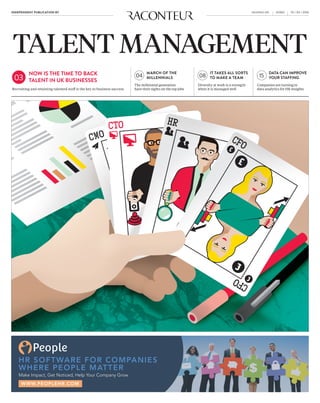
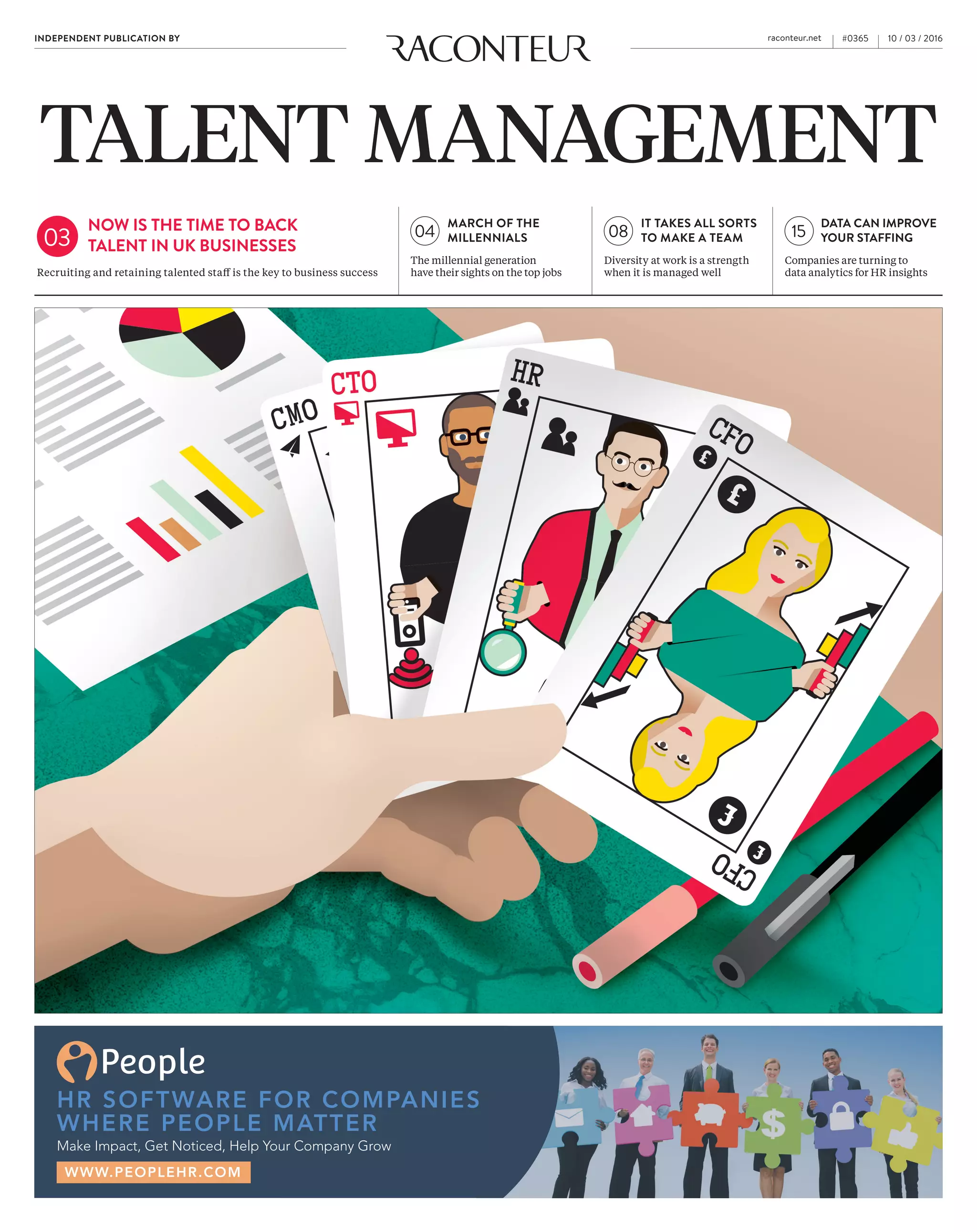
Recruiting and retaining talented staff is key to business
success, but can be seen as a short-term distraction
rather than long-term necessity
OVERVIEW
CLARE BETTELLEY
Share this article online via
Raconteur.net
Getty
The credibility of
the human resource
function is the
first major barrier
businesses must
overcome to enable
talent management
to become a future
boardroom agenda
item of importance
RACONTEUR raconteur.net 03TALENT MANAGEMENT10 / 03 / 2016
The art of telling the story; The science of marginal gains.
That’s YOCTO.
16TH MARCH 2016
YOCTOTHINKING
TMP, well-known for recruitment marketing and communications.
Less well-known as a serious and seasoned RPO operator.
Our RPO client base has grown organically from fantastic relationships.
And by design through formal processes driven by an excellent reputation.
Picture the tiniest measurement there is. It’s just one quadrillionth of a metre long.
That’s how we’ve honed our solution, down to the last ‘yoctometre’.
Leveraging a heritage in employer branding and attraction.
And extensive experience in resourcing and talent management.
The result is Yocto: a differentiated offer in the crowded RPO market.
For more information contact:
Jon Porter
Managing Director
jonathan.porter@yocto-rpo.com
020 7268 9110
www.yocto-rpo.com
@yoctorpo Yocto RPO
TALENT
MANAGEMENT
DISTRIBUTION PARTNER
T
he oil industry knows
better than most the im-
portance of operational
efficiency as it struggles
to manage the impact of a ten-year
low in crude oil prices.
It is a sector with executive
boards that know the importance
of investing in new blood to help
grow the talent pools required to
plug skills gaps being created by
increasing numbers of employees
approaching retirement.
But not all sectors face such des-
perate measures. In fact, the drive
for operational efficiency, or future
survival as in the case of many oil
companies, need not be at the price
of talent. However, many executive
directors fail to engage in the talent
management debate, let alone agree
with this conjecture.
Christopher Johnson, European
and Pacific region business leader
for talent at Mercer, believes that
part of the cause of many execu-
tive directors’ disengagement in
the talent debate is because of a
failure by their management to
explain the skills required to help
grow the business.
This, he suggests, is due to the dif-
ficulty involved in presenting a clear
story about the underlying employee
issues at play around, for example,
career development, gender and age
diversity, and succession planning.
“Where boards are failing is in rec-
ognising in the broader workforce
those huge talent issues they should
be facing up to,” he says. “For exam-
ple, the ageing workforce is a big is-
sue, and some organisations aren’t
thinking beyond this to the fact
that they’re getting a more complex
workforce with a broader age range
and employees staying on in work.”
But how does management pres-
ent to a board member a simple
dashboard of data?
Human resource functions can
prove instrumental in engaging ex-
ecutive board members in the talent
management debate, persuading
them of the importance of prioritis-
ing talent and, crucially, helping
them to view it as a long-term invest-
ment rather than a
short-term cost.
But this requires
good-quality anal-
ysis of workforce
demographics by
human resource
staff equipped with
the appropriate an-
alytical skill sets.
“It’s about
them providing
good-quality and
clean data, pre-
sented quickly in
a way that allows
boards to have con-
fidence that things
in the business are
fine or to recognise that things need
to change,” says Mr Johnson.
Uninterested and unengaged ex-
ecutives can equate to uninterested
and unengaged employees. Employ-
ers may suffer employee presentee-
ism, whereby staff attend work but
are unproductive while there.
Worse still, errors may be made,
which could result in dissatisfied
customers and even workplace ac-
cidents, with unfortunate injuries
to employees, creating unnecessary
costs for employers through lost
business, sickness absence, medical
bills and, potentially, litigation.
Peter Reilly, principal associate at
the Institute for Employment Stud-
ies, says: “Errors will vary from in-
dustry to industry, but truly disen-
gaged and disaffected staff can do
enormous damage to organisations.”
This is particularly the case when
talented employees leave their or-
ganisation to join a competitor.
Professor Maury Peiperl, director
of Cranfield School of Management,
believes the latter could prove a key
catalyst for change
in executives’ inter-
est and engagement
in the talent man-
agement debate.
“The biggest cat-
alyst for change
would be organisa-
tions’ competition
coming from small
startups, from out-
side their usual
frame of compet-
itors, and execu-
tives starting to
recognise there is
no permanence in
size,” he says.
But Professor
Peiperl also acknowledges the
challenges present for executive
boards across all industry sectors.
“We’re increasingly looking at a
workforce where people expect to
be paid attention, rewarded and
developed or they just aren’t inter-
ested,” he says.
“At the same time, organisations
have to stay in business and spend
what little money they have staying
afloat, so there’s a perennial tug of
war between short-term and long-
term issues.”
This is why many human resource
teams face an uphill battle in get-
ting talent management on to their
board agenda, particularly when it
appears they deem the issue more
important than most.
The Chartered Institute of Per-
sonnel and Development’s latest
HR Outlook Report, which polls or-
ganisations about their current and
future business priorities, reveals
that human resource staff are more
concerned with talent management
than non-human resource leaders,
who are more preoccupied with in-
creasing customer focus.
The report also reveals that 76
per cent of human resource lead-
ers agree that their current people
strategy will help their organisation
achieve its future priorities, com-
pared with just 26 per cent of other
business leaders.
So, perhaps the credibility of the
human resource function is the first
major barrier businesses must over-
come to enable talent management
to become a future boardroom agen-
da item of importance.
This is likely to happen with the
ever-changing nature of the hu-
man resource function, which is
slowly evolving to become more
commercial and strategic in
its outlook.
But executives also need to wake
up to the fact that growth in market
share will remain out of reach as
long as they fail to implement and
invest in a robust talent manage-
ment programme, which engages
and develops staff, enabling them
to move the organisation forward.
DISTRIBUTED IN
CLARE
BETTELLEY
Associate editor of
Employee Benefits
magazine, she has held
editorships at Financial
Times Business and
Centaur Media.
PETER CRUSH
Freelance business
journalist, specialising
in human resources and
management issues, he
was deputy editor of
HR magazine.
HAZEL DAVIS
Freelance business writer,
she contributes to The
Times, Financial Times,
The Daily Telegraph and
The Guardian.
CATH EVERETT
Freelance journalist
specialising in workplace
and employment issues, she
also writes on the impact
of technology on society
and culture.
KAREN
HIGGINBOTTOM
Freelance journalist, she
has written on a range of
issues, including talent
management, for national
newspapers and
Thomson Reuters.
NICK MARTINDALE
Award-winning writer and
editor, he contributes to
national business and trade
press on a wide range of
business issues.
RACONTEUR
PUBLISHING MANAGER
Senem Boyaci
DIGITAL CONTENT MANAGER
Sarah Allidina
HEAD OF PRODUCTION
Natalia Rosek
DESIGN
Samuele Motta
Grant Chapman
Kellie Jerrard
PRODUCTION EDITOR
Benjamin Chiou
MANAGING EDITOR
Peter Archer
BUSINESS CULTURE FINANCE HEALTHCARE LIFESTYLE SUSTAINABILITY TECHNOLOGY INFOGRAPHICS raconteur.net/talent-management-2016
CONTRIBUTORS
Although this publication is funded through advertising and
sponsorship,alleditorialiswithoutbiasandsponsoredfeatures
are clearly labelled. For an upcoming schedule, partnership in-
quiries orfeedback, please call +44 (0)20 8616 7400 ore-mail
info@raconteur.net
Raconteur is a leading publisher of special-interest content
and research. Its publications and articles cover a wide range
of topics, including business, finance, sustainability, health-
care, lifestyle and technology. Raconteur special reports are
published exclusively in The Times and The Sunday Times as well
as online at raconteur.net
The information contained in this publication has been ob-
tained from sources the Proprietors believe to be correct.
However, no legal liability can be accepted for any errors. No
part of this publication may be reproduced without the prior
consent of the Publisher. © Raconteur Media
Now’s the time
to back talent
Recruiting and retaining talented staff is key to business
success, but can be seen as a short-term distraction
rather than long-term necessity
OVERVIEW
CLARE BETTELLEY
Share this article online via
Raconteur.net
Getty
The credibility of
the human resource
function is the
first major barrier
businesses must
overcome to enable
talent management
to become a future
boardroom agenda
item of importance
RACONTEUR raconteur.net 03TALENT MANAGEMENT10 / 03 / 2016
The art of telling the story; The science of marginal gains.
That’s YOCTO.
16TH MARCH 2016
YOCTOTHINKING
TMP, well-known for recruitment marketing and communications.
Less well-known as a serious and seasoned RPO operator.
Our RPO client base has grown organically from fantastic relationships.
And by design through formal processes driven by an excellent reputation.
Picture the tiniest measurement there is. It’s just one quadrillionth of a metre long.
That’s how we’ve honed our solution, down to the last ‘yoctometre’.
Leveraging a heritage in employer branding and attraction.
And extensive experience in resourcing and talent management.
The result is Yocto: a differentiated offer in the crowded RPO market.
For more information contact:
Jon Porter
Managing Director
jonathan.porter@yocto-rpo.com
020 7268 9110
www.yocto-rpo.com
@yoctorpo Yocto RPO
TALENT
MANAGEMENT
DISTRIBUTION PARTNER
CASE STUDY: PwC
PwC, the largest professional
services firm in the world and
one of the big four auditors,
employs some 20,000 people
in the UK of whom 66 per cent
are millennials.
“We know that our millennials
want to be invested in, and
their development needs to be
relevant and personalised for
them,” says Louise Brownhill,
PwC’s chief learning officer.
“There is a big increase in
gamification and mobile
learning, and we know our
millennial population want to
learn on the go.”
As a result, PwC has
developed an online game,
to be launched in April, for
its employees to be able
to experiment with their
leadership style and approach
within a simulated environment.
“We’ve developed project
management simulation to
allow our learners to be project
management leaders and the
simulation provides feedback
relevant to the learner,” says
Ms Brownhill.
PwC is investing in leadership
capability at an early point in
the millennial’s career as this
reflects the complexity and
pace of change that people will
have to deal with at all levels of
the organisation.
Ms Brownhill adds: “The
technical skills within
professional services are
critical, but we’re also
focusing on softer skills such
as leadership.”
This year, the firm developed
an 18-month leadership
programme for its newly
promoted staff to provide
them with a strong foundation
in leadership skills and help
millennials pro-actively plan
their careers.
“Part of the emphasis is on
our people building broader
networks and also focusing
on developing their own
resilience, which is increasingly
an issue because of the
complex world we live in,” Ms
Brownhill concludes.
Share this article online via
raconteur.net
I
f you look at the profile of sen-
ior leadership in publicly listed
companies, the picture is pre-
dominantly of men in their 50s
and 60s, a generation defined as
baby boomers.
The NormanBroadbent2014Board
Review of 1,700 quoted companies
found that chairman and non-ex-
ecutive directors tend to be in their
60s. However, in ten to fifteen years’
time, many of the top positions will
be occupied by
millennials, those
born between the
early-80s to ear-
ly-2000s. In fact,
in some tech and
startup businesses,
millennials such as
Facebook’s Mark
Zuckerberg already
occupy leadership
positions.
The dominance of
the old-school chief
executive is on the
wane, predicts Jon-
athan Hime, group
managing partner
at leadership ad-
visory firm Marlin Hawk. “Board-
rooms will look very different in five
years’ time as the millennials rise
through the ranks and challenge
the management culture in many
organisations,” he says.
Why does the march of the millen-
nials matter? Deloitte estimate mil-
lennials will comprise 75 per cent of
the global workforce by 2025, so it’s
critical firms get to grips with the
talent management of this genera-
tional cohort. In the UK, millenni-
als currently form 35 per cent of the
UK workforce and this figure can
only increase.
Organisations ignore the develop-
ment of millennials in their work-
place at their peril, warns Dimple
Agarwal, a partner at Deloitte. “In
most global companies, 40 to 50
per cent of their workforce are mil-
lennials. If you’re not taking care of
a big chunk of your workforce now,
then you’re already behind your
competitors,” she says.
“It’s a big cultural shift as people in
the top positions in large, consumer
businesses are not millennials, but
if you look at the technology and
startup sector, then millennials are
already in leadership positions.”
The 2016 Deloitte Millennial Sur-
vey of 7,700 millennials in full-time
employment and drawn from 29
countries found that nearly two-
thirds of millennials say their lead-
ership skills are not being fully de-
veloped. This was despite the fact
that millennials believed business
placed the highest value on lead-
March of the mil lennials seems unstoppable
They are already in charge of successful tech and startup busi nesses, but the millennial generation have their sights on other top corporate jobs
NEW LEADERS
KAREN HIGGINBOTTOM
Mark Zuckerberg,
the 32-year-old
chief executive of
Facebook, is one
of the most well-
known millennial
business leaders
ership as a skill in a 2015 Deloitte
survey. “There is a big gap in expec-
tations with millennials believing
that organisations are not investing
enough in them,” says Ms Agarwal.
A lot of organisations will spend
large sums of money on leadership
development, but it’s usually target-
ed at the top two to three layers of
the organisation. She says: “Organ-
isations aren’t investing across the
whole workforce, which is why they
need to redirect their investment.”
The 2016 Deloitte survey also re-
veals that the millennial generation
aren’t particularly loyal to their em-
ployer as two in
three millennials
expect to leave their
organisation by
2020. This presents
a big talent man-
agement challenge
for organisations
striving to retain
a large segment of
their workforce.
M i l l e n n i a l s
change jobs more
frequently than
previous gener-
ations, says Sue
Honoré, associate
research consult-
ant at Ashridge Ex-
ecutive Education. “Therefore, they
are constantly seeking interesting
and challenging work, and have less
patience for drudgery. They value
coaching and mentoring highly,
and expect those more experienced
people around them to provide that
freely,” says Dr Honoré.
But what type of development do
millennials crave in the workplace,
particularly for leadership roles?
Ms Agarwal says: “There may be
parts of the organisation that are
not convinced they have the expe-
rience, but it’s about taking risks.
It’s about creating opportunities to
give them leadership roles early on
and skills, such as how to manage
senior stakeholders and how to de-
velop your ability to envisage where
the business is going.”
This generation is nomadic, and
open to working and living abroad,
says Mr Hime. “They want expo-
sure to new cultures and geogra-
phies. This will be a leader who
wants to be truly cross-cultural and
embed themselves into a different
environment, so their style is much
more global,” he says.
Another factor that distinguishes
millennials from other generations
is their preference for technology,
says Ksenia Zheltoukhova, research
adviser for the Chartered Institute
of Personnel and Development.
Leadership
development needs
to change not just due
to the expectations
of the millennial
generation, but as a
result of the volatile
economic conditions
in which businesses
operate
TALENT MANAGEMENT raconteur.net04 RACONTEUR RACONTEUR raconteur.net 05TALENT MANAGEMENT10 / 03 / 2016 10 / 03 / 2016
Getty
“They want to access information
quickly and want more real-time
feedback, so organisations need to
develop learning on the job rather
than going on a course,” she says.
The development of millennials
needs to resonate with them and
not just be linked to financial per-
formance, Omid Aschari, profes-
sor of strategic management at the
Institute of Management, Univer-
sity of St Gallen, in Switzerland,
observes. “They don’t buy into the
fairy tale that as long as the balance
sheet is fine, direct and indirect
stakeholders benefit as well,” he
says. “Millennials are more sensi-
tive to the way the organisations
assume responsibility beyond its
own wellbeing. They want to see
the wider impact on society and the
wider environment.”
However, it’s important not to
push away other generations by
catering solely to the needs of your
millennial workforce, warns Nico-
la McQueen, managing director of
Capita Resourcing. “One size does
not fit all,” she says. “While they
may require a different approach,
it’s important not to alienate other
generations in the business and in-
stead use millennials as agents for
change in the leadership develop-
ment process. Talent identification
programmes should be mapped
across all generations in the busi-
ness in order to be effective.”
Leadership development needs to
change not just due to the expecta-
tions of the millennial generation,
but as a result of the volatile eco-
nomic conditions in which busi-
nesses operate, says Dr Bernd Vogel,
associate professor of leadership
and organisational behaviour at
Henley Business School. “It’s about
more stretch assignments and on-
the-job learning especially if you
have a business environment that
is ambiguous and volatile,” he says.
The rapid pace of change in the
business world will mean that mil-
lennial leaders, in fact any business
leader, will have to be adaptable
and inclusive, argues Ms Agarwal.
“One of the crucial leadership qual-
ities needed by future leaders will
be the ability to embrace different
cultures and diversity of thinking,
and the ability to change.”
The millennial generation is all
about “mindful” leadership with a
focus on values, conduct and peo-
ple, says Mr Hime. “They thrive
on building and motivating teams.
They want to develop themselves
and their colleagues. They are con-
structive agitators, with a remark-
able ability to achieve goals in a
shifting environment.”
Ms Zheltoukhova believes that
millennial leaders will be interest-
ed in a wide range of outcomes from
leadership, not purely financial.
“Millennials are much more inclu-
sive in their approach and they’re
not just thinking about the bot-
tom-line outcomes, but the social
outcomes as well,” she says.
This preference for ethical leader-
ship is reflected in the 2016 Deloitte
Millennial Survey which found that
87 per cent of millennials believe
that the success of a business should
be measured in terms of more than
just its financial performance.
Millennial leaders will be highly
networked and far more entrepre-
neurial, Dr Honoré predicts. “They
will look for personal value in any
role and probably switch loyalties
quickly if they feel they are not
gaining from their work,” she says.
“They may be less skilled at face-to-
face people skills and the commu-
nication of tough messages, which
may impact their effectiveness as
leaders. However, the best of this
generation will be very successful
and exploit the skills they have de-
veloped in their lives, and pick up
those they may have missed out on
compared to previous generations.”
One of the challenges facing mil-
lennial leaders is that there will
be multiple generations in a work-
place, Ms Agarwal points out. She
says: “Leaders will have to be ad-
aptable and inclusive as they will
have to deal with four generations
in the workplace. A lot of older
workers are rejoining the work-
force, and organisations need to
think about multiple ways of de-
livering learning and development
as it’s not just about developing the
millennial generation.”
Mr Hime believes that the emer-
gence of millennial leaders will
challenge organisations’ talent
management practices. “Organ-
isations will need to adapt to the
emergence of these millennial lead-
ers otherwise they will struggle to
pass on the baton,” he says. “Some
boards already look and feel com-
pletely renewed. Others have recog-
nised the need for change and are
taking action. The ego-obsessed,
hierarchical boards of old are sim-
ply not suited to the post-recession
culture of businesses today.”
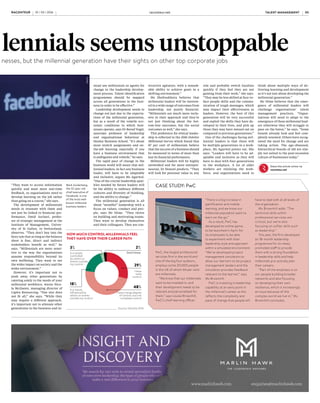
HOW MUCH CONTROL MILLENNIALS FEEL
THEY HAVE OVER THEIR CAREER PATH
Source: Deloitte 2016
Don’t know
2%
It is totally
controlled
by others or
events outside
my control
3%
It is mainly
influenced by
others or events
outside my control
18%
I have a large degree
of control, but not
complete control
48%
I have
total
control
29%
HOW SUPPORTING LEADERSHIP AMBITIONS BUILDS
LOYALTY AMONG MILLENNIALS
Source: Deloitte 2016
There is a lot of
support for those
wishing to take on
leadership roles
My leadership
skills are not
being fully
developed
Younger employees
are actively
encouraged to aim
for leadership roles
I feel that I’m
being overlooked
for potential
leadership
positions
68%
Those planning to stay for more than five years
Those planning to leave within two years
52%
54%
71%
68%
52%
42%
57%
CASE STUDY: PwC
PwC, the largest professional
services firm in the world and
one of the big four auditors,
employs some 20,000 people
in the UK of whom 66 per cent
are millennials.
“We know that our millennials
want to be invested in, and
their development needs to be
relevant and personalised for
them,” says Louise Brownhill,
PwC’s chief learning officer.
“There is a big increase in
gamification and mobile
learning, and we know our
millennial population want to
learn on the go.”
As a result, PwC has
developed an online game,
to be launched in April, for
its employees to be able
to experiment with their
leadership style and approach
within a simulated environment.
“We’ve developed project
management simulation to
allow our learners to be project
management leaders and the
simulation provides feedback
relevant to the learner,” says
Ms Brownhill.
PwC is investing in leadership
capability at an early point in
the millennial’s career as this
reflects the complexity and
pace of change that people will
have to deal with at all levels of
the organisation.
Ms Brownhill adds: “The
technical skills within
professional services are
critical, but we’re also
focusing on softer skills such
as leadership.”
This year, the firm developed
an 18-month leadership
programme for its newly
promoted staff to provide
them with a strong foundation
in leadership skills and help
millennials pro-actively plan
their careers.
“Part of the emphasis is on
our people building broader
networks and also focusing
on developing their own
resilience, which is increasingly
an issue because of the
complex world we live in,” Ms
Brownhill concludes.
Share this article online via
raconteur.net
I
f you look at the profile of sen-
ior leadership in publicly listed
companies, the picture is pre-
dominantly of men in their 50s
and 60s, a generation defined as
baby boomers.
The NormanBroadbent2014Board
Review of 1,700 quoted companies
found that chairman and non-ex-
ecutive directors tend to be in their
60s. However, in ten to fifteen years’
time, many of the top positions will
be occupied by
millennials, those
born between the
early-80s to ear-
ly-2000s. In fact,
in some tech and
startup businesses,
millennials such as
Facebook’s Mark
Zuckerberg already
occupy leadership
positions.
The dominance of
the old-school chief
executive is on the
wane, predicts Jon-
athan Hime, group
managing partner
at leadership ad-
visory firm Marlin Hawk. “Board-
rooms will look very different in five
years’ time as the millennials rise
through the ranks and challenge
the management culture in many
organisations,” he says.
Why does the march of the millen-
nials matter? Deloitte estimate mil-
lennials will comprise 75 per cent of
the global workforce by 2025, so it’s
critical firms get to grips with the
talent management of this genera-
tional cohort. In the UK, millenni-
als currently form 35 per cent of the
UK workforce and this figure can
only increase.
Organisations ignore the develop-
ment of millennials in their work-
place at their peril, warns Dimple
Agarwal, a partner at Deloitte. “In
most global companies, 40 to 50
per cent of their workforce are mil-
lennials. If you’re not taking care of
a big chunk of your workforce now,
then you’re already behind your
competitors,” she says.
“It’s a big cultural shift as people in
the top positions in large, consumer
businesses are not millennials, but
if you look at the technology and
startup sector, then millennials are
already in leadership positions.”
The 2016 Deloitte Millennial Sur-
vey of 7,700 millennials in full-time
employment and drawn from 29
countries found that nearly two-
thirds of millennials say their lead-
ership skills are not being fully de-
veloped. This was despite the fact
that millennials believed business
placed the highest value on lead-
March of the mil lennials seems unstoppable
They are already in charge of successful tech and startup busi nesses, but the millennial generation have their sights on other top corporate jobs
NEW LEADERS
KAREN HIGGINBOTTOM
Mark Zuckerberg,
the 32-year-old
chief executive of
Facebook, is one
of the most well-
known millennial
business leaders
ership as a skill in a 2015 Deloitte
survey. “There is a big gap in expec-
tations with millennials believing
that organisations are not investing
enough in them,” says Ms Agarwal.
A lot of organisations will spend
large sums of money on leadership
development, but it’s usually target-
ed at the top two to three layers of
the organisation. She says: “Organ-
isations aren’t investing across the
whole workforce, which is why they
need to redirect their investment.”
The 2016 Deloitte survey also re-
veals that the millennial generation
aren’t particularly loyal to their em-
ployer as two in
three millennials
expect to leave their
organisation by
2020. This presents
a big talent man-
agement challenge
for organisations
striving to retain
a large segment of
their workforce.
M i l l e n n i a l s
change jobs more
frequently than
previous gener-
ations, says Sue
Honoré, associate
research consult-
ant at Ashridge Ex-
ecutive Education. “Therefore, they
are constantly seeking interesting
and challenging work, and have less
patience for drudgery. They value
coaching and mentoring highly,
and expect those more experienced
people around them to provide that
freely,” says Dr Honoré.
But what type of development do
millennials crave in the workplace,
particularly for leadership roles?
Ms Agarwal says: “There may be
parts of the organisation that are
not convinced they have the expe-
rience, but it’s about taking risks.
It’s about creating opportunities to
give them leadership roles early on
and skills, such as how to manage
senior stakeholders and how to de-
velop your ability to envisage where
the business is going.”
This generation is nomadic, and
open to working and living abroad,
says Mr Hime. “They want expo-
sure to new cultures and geogra-
phies. This will be a leader who
wants to be truly cross-cultural and
embed themselves into a different
environment, so their style is much
more global,” he says.
Another factor that distinguishes
millennials from other generations
is their preference for technology,
says Ksenia Zheltoukhova, research
adviser for the Chartered Institute
of Personnel and Development.
Leadership
development needs
to change not just due
to the expectations
of the millennial
generation, but as a
result of the volatile
economic conditions
in which businesses
operate
TALENT MANAGEMENT raconteur.net04 RACONTEUR RACONTEUR raconteur.net 05TALENT MANAGEMENT10 / 03 / 2016 10 / 03 / 2016
Getty
“They want to access information
quickly and want more real-time
feedback, so organisations need to
develop learning on the job rather
than going on a course,” she says.
The development of millennials
needs to resonate with them and
not just be linked to financial per-
formance, Omid Aschari, profes-
sor of strategic management at the
Institute of Management, Univer-
sity of St Gallen, in Switzerland,
observes. “They don’t buy into the
fairy tale that as long as the balance
sheet is fine, direct and indirect
stakeholders benefit as well,” he
says. “Millennials are more sensi-
tive to the way the organisations
assume responsibility beyond its
own wellbeing. They want to see
the wider impact on society and the
wider environment.”
However, it’s important not to
push away other generations by
catering solely to the needs of your
millennial workforce, warns Nico-
la McQueen, managing director of
Capita Resourcing. “One size does
not fit all,” she says. “While they
may require a different approach,
it’s important not to alienate other
generations in the business and in-
stead use millennials as agents for
change in the leadership develop-
ment process. Talent identification
programmes should be mapped
across all generations in the busi-
ness in order to be effective.”
Leadership development needs to
change not just due to the expecta-
tions of the millennial generation,
but as a result of the volatile eco-
nomic conditions in which busi-
nesses operate, says Dr Bernd Vogel,
associate professor of leadership
and organisational behaviour at
Henley Business School. “It’s about
more stretch assignments and on-
the-job learning especially if you
have a business environment that
is ambiguous and volatile,” he says.
The rapid pace of change in the
business world will mean that mil-
lennial leaders, in fact any business
leader, will have to be adaptable
and inclusive, argues Ms Agarwal.
“One of the crucial leadership qual-
ities needed by future leaders will
be the ability to embrace different
cultures and diversity of thinking,
and the ability to change.”
The millennial generation is all
about “mindful” leadership with a
focus on values, conduct and peo-
ple, says Mr Hime. “They thrive
on building and motivating teams.
They want to develop themselves
and their colleagues. They are con-
structive agitators, with a remark-
able ability to achieve goals in a
shifting environment.”
Ms Zheltoukhova believes that
millennial leaders will be interest-
ed in a wide range of outcomes from
leadership, not purely financial.
“Millennials are much more inclu-
sive in their approach and they’re
not just thinking about the bot-
tom-line outcomes, but the social
outcomes as well,” she says.
This preference for ethical leader-
ship is reflected in the 2016 Deloitte
Millennial Survey which found that
87 per cent of millennials believe
that the success of a business should
be measured in terms of more than
just its financial performance.
Millennial leaders will be highly
networked and far more entrepre-
neurial, Dr Honoré predicts. “They
will look for personal value in any
role and probably switch loyalties
quickly if they feel they are not
gaining from their work,” she says.
“They may be less skilled at face-to-
face people skills and the commu-
nication of tough messages, which
may impact their effectiveness as
leaders. However, the best of this
generation will be very successful
and exploit the skills they have de-
veloped in their lives, and pick up
those they may have missed out on
compared to previous generations.”
One of the challenges facing mil-
lennial leaders is that there will
be multiple generations in a work-
place, Ms Agarwal points out. She
says: “Leaders will have to be ad-
aptable and inclusive as they will
have to deal with four generations
in the workplace. A lot of older
workers are rejoining the work-
force, and organisations need to
think about multiple ways of de-
livering learning and development
as it’s not just about developing the
millennial generation.”
Mr Hime believes that the emer-
gence of millennial leaders will
challenge organisations’ talent
management practices. “Organ-
isations will need to adapt to the
emergence of these millennial lead-
ers otherwise they will struggle to
pass on the baton,” he says. “Some
boards already look and feel com-
pletely renewed. Others have recog-
nised the need for change and are
taking action. The ego-obsessed,
hierarchical boards of old are sim-
ply not suited to the post-recession
culture of businesses today.”
HOW MUCH CONTROL MILLENNIALS FEEL
THEY HAVE OVER THEIR CAREER PATH
Source: Deloitte 2016
Don’t know
2%
It is totally
controlled
by others or
events outside
my control
3%
It is mainly
influenced by
others or events
outside my control
18%
I have a large degree
of control, but not
complete control
48%
I have
total
control
29%
HOW SUPPORTING LEADERSHIP AMBITIONS BUILDS
LOYALTY AMONG MILLENNIALS
Source: Deloitte 2016
There is a lot of
support for those
wishing to take on
leadership roles
My leadership
skills are not
being fully
developed
Younger employees
are actively
encouraged to aim
for leadership roles
I feel that I’m
being overlooked
for potential
leadership
positions
68%
Those planning to stay for more than five years
Those planning to leave within two years
52%
54%
71%
68%
52%
42%
57%
I
f there’s one thing employers
fear most about an improving
economy it’s the very real spec-
tre of employees recognising
this too and deciding to up-sticks
and look for pastures new.
According to the Bank of England,
wages grew by just under 2 per cent
in 2015 and recent research by CV
Library, the UK’s largest online job-
site, revealed what many bosses
have already felt that thanks to a
surge of new vacancies – up 15.8 per
cent compared to the same time a
year ago – staff are looking to quit in
growing numbers.
Employees are downloading
around 220 applications every sec-
ond, says CV Library, and it predicts
seven million will be actively seeking
new job opportunities this year.
According to workplace experts,
the driver for employees think-
ing the grass is greener can be ex-
plained by one word – engagement
or rather the lack of it staff feel to-
wards their companies.
Engagement is often described as
people’s willingness to go the extra
mile, but just 16 per cent of UK em-
ployees say they are willing to put
in extra effort at work, the lowest
it’s been for four years, according to
CEB’s December 2015 Global Talent
Monitor. Employees feel demotivat-
ed, with the psychological contract
between employer and employee hit-
ting new lows.
Boosting engagement has been the
Holy Grail for some time, but human
resources experts will also be the
first to admit it’s an elusive thing to
pin down. So much so that some now
actively dislike the word entirely.
“So-called motivational away-days,
chocolates left on desks – it’s all
COMMERCIAL FEATURE
How to engage and
retain your top staff
Losing staff is a costly business, but there are ways of
winning loyalty through engaging employees who then
give their best
branded under the banner of staff
engagement and motivation,” says
Mike Greatwood, former HR direc-
tor at Computacenter, now chief
executive of the Dream Manager
Programme. “The problem is staff
see these as unauthentic behaviours
that are in the organisations’ inter-
est, not the employees’.”
So convinced was he that there
must be something better that
he flew to America after reading
New York Times bestselling author
Matthew Kelly’s Dream Manag-
er book and is now launching the
book’s methodology in the UK
under the Dream Manager Pro-
gramme banner.
CHURN
PETER CRUSH
“The basic philosophy is that true
motivation and engagement is creat-
ed when firms put their people – not
the company – first,” he says. “Em-
ployers need to give staff the tools to
be better versions of themselves and,
crucially, this doesn’t just have to be
in their professional development; it
can be in their personal lives too.
“Firms using the methodology –
and several FTSE clients already are
– help staff rediscover their dreams
and then help them achieve the
dreams. It’s proven that those who
feel more positive about their future
are 50 per cent more likely to be hap-
pier with their ‘now’. This is the mo-
tivation employers need to tap into.”
Bosses might baulk at involving
themselves with their employees’
“outside”lives,butmoreandmorethe
notion is catching on that motivation
and engagement is as much about
how people can manage themselves
outside, as much as inside, work.
“Three months ago we invested
£100,000 building a free on-site,
24-hour gym,” says Charlie Mullins,
boss of Pimlico Plumbers. “I think
it’s been the biggest boost to staff
engagement for years. It’s not some-
thing to try and get staff to work
harder, it’s just for them. As a result
we know it’s valued.
“Staff come in on their days off just
because they want to work out and
people say they’ve cancelled their
existing gym membership, so they
also have more money in their back
pockets too.”
By having this staff-matter-first
approach, Mr Mullins says addition-
al perks, such as monthly best em-
ployee awards, rewarded with a £200
Langham Hotel voucher, can be the
icing on the cake, rather than the be-
all and end-all. Plumbing is one of
the most highly sought-after trades,
but Mr Mullins says he no longer wor-
ries about retention and argues that
the beauty of this approach is firms
can do whatever works best for them.
For some firms it’s providing fi-
nancial education to staff. Accord-
ing to research by the Social Market
Foundation, one in eight workers
worry so much about their finances,
it stops them concentrating at work,
while for others, it’s helping their
physical wellbeing.
At Danone UK, for example, in 2013
the company decided to put health
at the centre of how it could help cre-
ate an environment where staff felt
valued, to bring its external “health
through food” brand internally to
staff. Part of this has included paying
for an annual health MOT.
“The checks are wide-ranging and
include areas that aren’t covered as
standard by the NHS,” explains John
Mayor, Danone’s head of UK rewards.
“They include atrial fibrillation or AF
and peripheral artery disease screen-
ing, which we feel is especially im-
portant as an estimated 20 per cent
of AF cases go undiagnosed.”
Little can be more engaging for
staff than their employer uncovering
potential health problems early, and
already Danone has identified work-
ers with potential coeliac disease
and diabetes. A surprise finding was
vitamin D deficiencies in staff, so vi-
tamin D sprays and supplements are
available to all, and a walking club
has been set up.
For those who feel motivation still
comes from giving professional de-
velopment too, at cinema chain ODE-
ON & UCI, having a holistic approach
is how Kathryn Pritchard sees the
perfect relationship being struck.
“We feel work is a partnership –
about setting out a two-way relation-
ship,” she says of the new initiative
ODEON has developed that recog-
nises seven phases in an employees’
career. “We know we won’t hold on to
everyone, but it doesn’t change the
fact we want to give people skills for
life, such as confidence to our young-
er staff. All managers are training in
giving ‘be better’ feedback, so staff
are encouraged to do more of what
they’re brilliant at.
“In return, we’ve set out clear ca-
reer paths for those who want that
and provide flexible working to help
people manage their outside lives.
The more people feel good about
themselves, the more they feel good
about work. When everyone is clear
about expectations from both sides,
and our values are lived by execu-
tives, people’s best self follows. We
don’t say to staff ‘you fit into our
world’; we make work a partnership
and by doing so feel we create a sweet
spot where everyone is happy.”
Share this article online via
raconteur.net
IMAGE
London offices
of Google,
which provides
numerous em-
ployee benefits,
including on-site
medical care and
free legal advice
Getty
True motivation
and engagement is
created when firms
put their people – not
the company – first
TALENT MANAGEMENT raconteur.net06 RACONTEUR RACONTEUR raconteur.net 07TALENT MANAGEMENT10 / 03 / 2016 10 / 03 / 2016
EMPLOYEE LOYALTY AND EFFORT
GLOBAL LABOUR MARKET SURVEY OF CURRENT EMPLOYMENT
Source: CEB 2015
Intent to stay Willingness to go above and beyond
2009 2010 2011 2012 2013 2014 2015
40%
10%
25%
35.1%
17.5%
39%
16%
of UK workers reported
a strong intent to stay
with their current
employers
were prepared to go
above and beyond to
help their colleagues
and volunteer for addi-
tional workloads
RACONTEUR raconteur.net 2XXXXxx xx xxxx
COMMERCIAL FEATURE
DEVELOP TALENT TO SCORE BUSINESS GOALS
Neil Davidson, vice president of enterprise at Deltek, explains how organisations that align their talent plans and business
operation can thrive
W
hen you hear the words
“people are our greatest
assets”it’sbecausenowadays
they really are. Thankfully, in today’s
competitive landscape, business
leaders increasingly understand that
organisational success has less to
do with the things they make and
much more to do with the people
they have, and the strength of the
relationships they are able to develop
with clients. In no industry is this
more pronounced than professional
services where people and expertise
are the values on offer.
But talent management – the
process for making sure these well-
meant words are actually day-to-
day reality – is so much more than
simply recruiting the right people,
retaining them, and giving them the
skills and experience to succeed.
These elements are critical, but we
believe it’s how this is ingrained
within all corners of the business
that really matters.
Talent management can’t just
live as a concept within the human
resources department; it needs to
be fully aligned to the operations
and day-to-day service delivery
in order for a firm and its people
to prosper. For talent to truly feel
engaged and listened to, there
needs to be two-way conversations
about what they want, where
they’re deployed and how they can
go to the next level. Not only must
these conversations happen, they
must be founded on data and so
ingrained into a company’s culture
it should no longer be something
only HR does.
So why doesn’t this always happen?
Talent management programmes
can sometimes be knee-jerk.
Programmes can be introduced
because firms identify, say, a
retention problem and think that a
talent initiative will remedy it without
fully appreciating how to unite it
within their culture and operations.
But a notional idea that talent
must be the focus is only half the
answer. Think about this: has the
business really looked at why staff
might be leaving? Maybe they’re
simply not recruiting the right
people. Maybe line managers are
not diverting the right people into
the right roles. Maybe there are
too few or too many badly timed
conversations about upcoming
opportunities within the project
pipeline. Maybe highly skilled
people are being assigned to low-
skilled projects. Maybe people
don’t know where and what they
will be working on one day to
the next.
It’s only when all parts of the
organisation start asking these sorts
of questions that silo mentalities
are finally broken down.
The antidote to this is talent
management that takes the holistic
view; talent management that is
data-led and where the activities
of people can be linked so they
are bound up with the operational
strategy of the business.
To apply a sporting analogy, think
of this approach of using data to
align operational and people goals
as applying Opta Stats to your firm.
But it is not about the metres run,
number of assists or goals scored;
it’s about projects completed,
margins achieved, utilisation
and client retention rates. Think
about what this intelligence can
mean to the individual, team
and organisation in terms of
performance and development.
Withmarginsunderpressure,clients
demanding more and competitors
ready to pounce, the professional
services industry needs to stay at
the forefront of this transformation.
Research from IDC shows that firms
without a human capital management
or talent programme see a dramatic
decline in staff utilisation, project win-
rates and revenues.
This reinforces that operational
goals can’t be achieved without
investment in your people and their
development. To achieve this, talent
needs to be championed right from
the very top.
Evidence shows most employees
want a say in how they can satisfy
themselves as individuals, as well as
the needs of the organisation. It’s
often assumed talent is peripatetic,
always ready to up sticks and leave,
but actually employees mainly want
to feel engaged. Staff today expect
more dialogue about how their careers
are going; they need to be given this
reassurance. The once-a-year appraisal
will soon be a thing of the past and
already firms like Deloitte, and indeed
Deltek, are dropping it in favour of
more regular feedback discussions.
There’s no reason staff have to
leave if organisations can align
the wants and needs of both staff
and the business. Employees and
line managers simply need to be
open with each other. When they
are, we find both parties tend to
feel part of, and take ownership of,
their own trajectories.
Sowhataretheremainingbarriers?
It’s often said the way businesses
have to organise themselves means
true collaboration is difficult. But we
disagree. Business structure is not a
constraint in itself. Managers simply
need to be able to uncover the right
insights. When stakeholders receive
the insight they need, they can act
and make critical decisions.
Talent management is much less
about organisational complexity,
and much more about measuring
key performance indicators, and
then putting these into the context
of your recruitment, retention and
career development strategies.
It’s clear talent is very much the
issue of our time. While finding
talent may not be any more
important than it ever was, what
is different is there is a shortage
of good talent. What firms need
to realise is that this good talent
is often already within their ranks;
it just needs to be developed to
align to the future of the business
and client needs. People want
purpose from their work; they want
to know that what they are doing is
Talent management is much less
about organisational complexity, and
much more about measuring key
performance indicators, and then
putting these into the context of your
recruitment, retention and career
development strategies
Talent management
can’t just live as a
concept within the
human resources
department; it needs to
be fully aligned to the
operations and day-to-
day service delivery in
order for a firm and its
people to prosper adding value to their organisation.
And they also want to know that in
doing so they are meeting their own
personal needs for advancement
and skills development.
When organisations have strong
alignment between their talent plans
and their business operations, then
they really do have the foundation to
be best in class. A recent IDC survey
found hiring and retaining talent
was firms’ second-biggest priority
at the moment. Yet, at the same
time, IDC also found 60 per cent of
organisations didn’t yet have a talent
management system. Organisations
cannot have a coherent talent
strategy without the systems and
culture to facilitate it.
And remember, systems aren’t
just about IT. They help bring
fact to the sometimes awkward
conversations that managers need
to have about talent. When people
are mentally on board, you’ll soon
see they’re physically on board too.
For more infomation visit
www.deltek.co.uk
I
f there’s one thing employers
fear most about an improving
economy it’s the very real spec-
tre of employees recognising
this too and deciding to up-sticks
and look for pastures new.
According to the Bank of England,
wages grew by just under 2 per cent
in 2015 and recent research by CV
Library, the UK’s largest online job-
site, revealed what many bosses
have already felt that thanks to a
surge of new vacancies – up 15.8 per
cent compared to the same time a
year ago – staff are looking to quit in
growing numbers.
Employees are downloading
around 220 applications every sec-
ond, says CV Library, and it predicts
seven million will be actively seeking
new job opportunities this year.
According to workplace experts,
the driver for employees think-
ing the grass is greener can be ex-
plained by one word – engagement
or rather the lack of it staff feel to-
wards their companies.
Engagement is often described as
people’s willingness to go the extra
mile, but just 16 per cent of UK em-
ployees say they are willing to put
in extra effort at work, the lowest
it’s been for four years, according to
CEB’s December 2015 Global Talent
Monitor. Employees feel demotivat-
ed, with the psychological contract
between employer and employee hit-
ting new lows.
Boosting engagement has been the
Holy Grail for some time, but human
resources experts will also be the
first to admit it’s an elusive thing to
pin down. So much so that some now
actively dislike the word entirely.
“So-called motivational away-days,
chocolates left on desks – it’s all
COMMERCIAL FEATURE
How to engage and
retain your top staff
Losing staff is a costly business, but there are ways of
winning loyalty through engaging employees who then
give their best
branded under the banner of staff
engagement and motivation,” says
Mike Greatwood, former HR direc-
tor at Computacenter, now chief
executive of the Dream Manager
Programme. “The problem is staff
see these as unauthentic behaviours
that are in the organisations’ inter-
est, not the employees’.”
So convinced was he that there
must be something better that
he flew to America after reading
New York Times bestselling author
Matthew Kelly’s Dream Manag-
er book and is now launching the
book’s methodology in the UK
under the Dream Manager Pro-
gramme banner.
CHURN
PETER CRUSH
“The basic philosophy is that true
motivation and engagement is creat-
ed when firms put their people – not
the company – first,” he says. “Em-
ployers need to give staff the tools to
be better versions of themselves and,
crucially, this doesn’t just have to be
in their professional development; it
can be in their personal lives too.
“Firms using the methodology –
and several FTSE clients already are
– help staff rediscover their dreams
and then help them achieve the
dreams. It’s proven that those who
feel more positive about their future
are 50 per cent more likely to be hap-
pier with their ‘now’. This is the mo-
tivation employers need to tap into.”
Bosses might baulk at involving
themselves with their employees’
“outside”lives,butmoreandmorethe
notion is catching on that motivation
and engagement is as much about
how people can manage themselves
outside, as much as inside, work.
“Three months ago we invested
£100,000 building a free on-site,
24-hour gym,” says Charlie Mullins,
boss of Pimlico Plumbers. “I think
it’s been the biggest boost to staff
engagement for years. It’s not some-
thing to try and get staff to work
harder, it’s just for them. As a result
we know it’s valued.
“Staff come in on their days off just
because they want to work out and
people say they’ve cancelled their
existing gym membership, so they
also have more money in their back
pockets too.”
By having this staff-matter-first
approach, Mr Mullins says addition-
al perks, such as monthly best em-
ployee awards, rewarded with a £200
Langham Hotel voucher, can be the
icing on the cake, rather than the be-
all and end-all. Plumbing is one of
the most highly sought-after trades,
but Mr Mullins says he no longer wor-
ries about retention and argues that
the beauty of this approach is firms
can do whatever works best for them.
For some firms it’s providing fi-
nancial education to staff. Accord-
ing to research by the Social Market
Foundation, one in eight workers
worry so much about their finances,
it stops them concentrating at work,
while for others, it’s helping their
physical wellbeing.
At Danone UK, for example, in 2013
the company decided to put health
at the centre of how it could help cre-
ate an environment where staff felt
valued, to bring its external “health
through food” brand internally to
staff. Part of this has included paying
for an annual health MOT.
“The checks are wide-ranging and
include areas that aren’t covered as
standard by the NHS,” explains John
Mayor, Danone’s head of UK rewards.
“They include atrial fibrillation or AF
and peripheral artery disease screen-
ing, which we feel is especially im-
portant as an estimated 20 per cent
of AF cases go undiagnosed.”
Little can be more engaging for
staff than their employer uncovering
potential health problems early, and
already Danone has identified work-
ers with potential coeliac disease
and diabetes. A surprise finding was
vitamin D deficiencies in staff, so vi-
tamin D sprays and supplements are
available to all, and a walking club
has been set up.
For those who feel motivation still
comes from giving professional de-
velopment too, at cinema chain ODE-
ON & UCI, having a holistic approach
is how Kathryn Pritchard sees the
perfect relationship being struck.
“We feel work is a partnership –
about setting out a two-way relation-
ship,” she says of the new initiative
ODEON has developed that recog-
nises seven phases in an employees’
career. “We know we won’t hold on to
everyone, but it doesn’t change the
fact we want to give people skills for
life, such as confidence to our young-
er staff. All managers are training in
giving ‘be better’ feedback, so staff
are encouraged to do more of what
they’re brilliant at.
“In return, we’ve set out clear ca-
reer paths for those who want that
and provide flexible working to help
people manage their outside lives.
The more people feel good about
themselves, the more they feel good
about work. When everyone is clear
about expectations from both sides,
and our values are lived by execu-
tives, people’s best self follows. We
don’t say to staff ‘you fit into our
world’; we make work a partnership
and by doing so feel we create a sweet
spot where everyone is happy.”
Share this article online via
raconteur.net
IMAGE
London offices
of Google,
which provides
numerous em-
ployee benefits,
including on-site
medical care and
free legal advice
Getty
True motivation
and engagement is
created when firms
put their people – not
the company – first
TALENT MANAGEMENT raconteur.net06 RACONTEUR RACONTEUR raconteur.net 07TALENT MANAGEMENT10 / 03 / 2016 10 / 03 / 2016
EMPLOYEE LOYALTY AND EFFORT
GLOBAL LABOUR MARKET SURVEY OF CURRENT EMPLOYMENT
Source: CEB 2015
Intent to stay Willingness to go above and beyond
2009 2010 2011 2012 2013 2014 2015
40%
10%
25%
35.1%
17.5%
39%
16%
of UK workers reported
a strong intent to stay
with their current
employers
were prepared to go
above and beyond to
help their colleagues
and volunteer for addi-
tional workloads
RACONTEUR raconteur.net 2XXXXxx xx xxxx
COMMERCIAL FEATURE
DEVELOP TALENT TO SCORE BUSINESS GOALS
Neil Davidson, vice president of enterprise at Deltek, explains how organisations that align their talent plans and business
operation can thrive
W
hen you hear the words
“people are our greatest
assets”it’sbecausenowadays
they really are. Thankfully, in today’s
competitive landscape, business
leaders increasingly understand that
organisational success has less to
do with the things they make and
much more to do with the people
they have, and the strength of the
relationships they are able to develop
with clients. In no industry is this
more pronounced than professional
services where people and expertise
are the values on offer.
But talent management – the
process for making sure these well-
meant words are actually day-to-
day reality – is so much more than
simply recruiting the right people,
retaining them, and giving them the
skills and experience to succeed.
These elements are critical, but we
believe it’s how this is ingrained
within all corners of the business
that really matters.
Talent management can’t just
live as a concept within the human
resources department; it needs to
be fully aligned to the operations
and day-to-day service delivery
in order for a firm and its people
to prosper. For talent to truly feel
engaged and listened to, there
needs to be two-way conversations
about what they want, where
they’re deployed and how they can
go to the next level. Not only must
these conversations happen, they
must be founded on data and so
ingrained into a company’s culture
it should no longer be something
only HR does.
So why doesn’t this always happen?
Talent management programmes
can sometimes be knee-jerk.
Programmes can be introduced
because firms identify, say, a
retention problem and think that a
talent initiative will remedy it without
fully appreciating how to unite it
within their culture and operations.
But a notional idea that talent
must be the focus is only half the
answer. Think about this: has the
business really looked at why staff
might be leaving? Maybe they’re
simply not recruiting the right
people. Maybe line managers are
not diverting the right people into
the right roles. Maybe there are
too few or too many badly timed
conversations about upcoming
opportunities within the project
pipeline. Maybe highly skilled
people are being assigned to low-
skilled projects. Maybe people
don’t know where and what they
will be working on one day to
the next.
It’s only when all parts of the
organisation start asking these sorts
of questions that silo mentalities
are finally broken down.
The antidote to this is talent
management that takes the holistic
view; talent management that is
data-led and where the activities
of people can be linked so they
are bound up with the operational
strategy of the business.
To apply a sporting analogy, think
of this approach of using data to
align operational and people goals
as applying Opta Stats to your firm.
But it is not about the metres run,
number of assists or goals scored;
it’s about projects completed,
margins achieved, utilisation
and client retention rates. Think
about what this intelligence can
mean to the individual, team
and organisation in terms of
performance and development.
Withmarginsunderpressure,clients
demanding more and competitors
ready to pounce, the professional
services industry needs to stay at
the forefront of this transformation.
Research from IDC shows that firms
without a human capital management
or talent programme see a dramatic
decline in staff utilisation, project win-
rates and revenues.
This reinforces that operational
goals can’t be achieved without
investment in your people and their
development. To achieve this, talent
needs to be championed right from
the very top.
Evidence shows most employees
want a say in how they can satisfy
themselves as individuals, as well as
the needs of the organisation. It’s
often assumed talent is peripatetic,
always ready to up sticks and leave,
but actually employees mainly want
to feel engaged. Staff today expect
more dialogue about how their careers
are going; they need to be given this
reassurance. The once-a-year appraisal
will soon be a thing of the past and
already firms like Deloitte, and indeed
Deltek, are dropping it in favour of
more regular feedback discussions.
There’s no reason staff have to
leave if organisations can align
the wants and needs of both staff
and the business. Employees and
line managers simply need to be
open with each other. When they
are, we find both parties tend to
feel part of, and take ownership of,
their own trajectories.
Sowhataretheremainingbarriers?
It’s often said the way businesses
have to organise themselves means
true collaboration is difficult. But we
disagree. Business structure is not a
constraint in itself. Managers simply
need to be able to uncover the right
insights. When stakeholders receive
the insight they need, they can act
and make critical decisions.
Talent management is much less
about organisational complexity,
and much more about measuring
key performance indicators, and
then putting these into the context
of your recruitment, retention and
career development strategies.
It’s clear talent is very much the
issue of our time. While finding
talent may not be any more
important than it ever was, what
is different is there is a shortage
of good talent. What firms need
to realise is that this good talent
is often already within their ranks;
it just needs to be developed to
align to the future of the business
and client needs. People want
purpose from their work; they want
to know that what they are doing is
Talent management is much less
about organisational complexity, and
much more about measuring key
performance indicators, and then
putting these into the context of your
recruitment, retention and career
development strategies
Talent management
can’t just live as a
concept within the
human resources
department; it needs to
be fully aligned to the
operations and day-to-
day service delivery in
order for a firm and its
people to prosper adding value to their organisation.
And they also want to know that in
doing so they are meeting their own
personal needs for advancement
and skills development.
When organisations have strong
alignment between their talent plans
and their business operations, then
they really do have the foundation to
be best in class. A recent IDC survey
found hiring and retaining talent
was firms’ second-biggest priority
at the moment. Yet, at the same
time, IDC also found 60 per cent of
organisations didn’t yet have a talent
management system. Organisations
cannot have a coherent talent
strategy without the systems and
culture to facilitate it.
And remember, systems aren’t
just about IT. They help bring
fact to the sometimes awkward
conversations that managers need
to have about talent. When people
are mentally on board, you’ll soon
see they’re physically on board too.
For more infomation visit
www.deltek.co.uk
It takes all sorts and careful handling to manage a team
Long gone are the days of a room full of lookalike salespeople following the same robotic spiel and working towards the same goals – diversity is a strength when managed well
INTROVERT
In her 2012 book, Quiet: The Power of In-
troverts in a World That Can’t Stop Talk-
ing, author Susan Cain defines intro-
verts as having a preference for a quiet,
more minimally stimulating environ-
ment. She also suggests that introverts
listen more than they talk, think before
they speak and have a more circum-
spect and cautious approach to risk. She
says that expecting introverts to act as
extroverts can be damaging. So how
do you get the best from them if they
won’t speak up? Jim Whitehurst, chief
executive of tech company Red Hat,
says: “I’ve noticed that while introverts
are not always as eager to speak up in a
meeting, that doesn’t mean they don’t
want to share their great ideas. Encour-
age them to use a different outlet, like
e-mail or an online forum, where they
can process and engage in issues they
are passionate about.”
EXTROVERT
“An extrovert has an awful tendency to
judge others as per themselves,” says
Henry Daglish, managing director of
Arena Media. He suggests playing to
an extrovert’s ego: “If you openly un-
dermine them, they tend to collapse,”
he says. “Help them understand how to
work with others and listen. They love
fame, so give it to them if they deserve
it.” Mr Whitehurst adds: “Extroverts
really feed off of the energy of others
and tend to shine when the spotlight
is on them. That’s why it’s important
to create social and teamwork-oriented
opportunities for them as a way to keep
them engaged and motivated.”
ANALYTICAL
Studying customer behaviour and data
capturing is becoming more and more
essential to modern business as it ena-
bles us to understand better how compa-
nies and individuals use services. Jason
Downes, managing director of confer-
ence call service provider Powwownow,
which conducts personality tests on its
staff, says: “Managing analytical types
is certainly an aspect of the job that I
have had to learn and learn quickly since
joining Powwownow. Setting firm dead-
lines and targets is something I have
found effective, as generally analysts
work predominantly with numbers and
that’s the language they communicate
best with. Analytical people don’t like
empty phrases and business buzzwords
so use direct communication. Most ana-
lysts, although working as part of a team,
will perform a lot of tasks individually so
it’s important to create a sense of free-
dom, avoid micro-managing and allow
them time to work away from the office
to think more laterally should they want
or need it.”
CREATIVE
“Creative people tend to be considered
by analytic types as dreamers, yet cre-
ative people can see beyond the current
trends,” says executive coach Marielena
Sabatier, chief executive of Inspiring
Potential, which specialises in team and
leadership coaching. Working together
with them is key. She says: “With great-
er understanding, instead of shutting
down creative ideas, analytics could
use their strengths in critical thinking
and analysis to make the dreamers’
idea more robust and help turn the idea
into a reality.”
INDIVIDUALIST
“Individualists don’t care what oth-
er people think,” says organisational
psychotherapist Joan Kingsley. “They
are not easy to manage, but you abso-
lutely want all kinds of diverse peo-
ple on your team because if everyone
you have is the same, you have what
is called ‘group-think’. Individualists
are often creative so when managing
them it’s important not to interfere
with those creative processes because,
as soon as you do start interfering, you
block their creativity. You’re very like-
ly to shut someone down if you try to
control them so you need to manage
individualists carefully.” However, she
warns: “It’s important to set bounda-
ries and the rules of the game, which
are the same for everybody.” The best
way, she says, is to come up with an
agreement on how to work together and
how they’re going to work within the
confines of a team.
WORKAHOLIC
It’s another loaded word, especially
with the current trend for improving
work-life balance, but the fact is that
some people will always be workahol-
ics. This trait can be used positively,
however, says Martin Woolley, group
managing director at marketing agen-
cy The Specialist Works. “There are
some people who are called worka-
holics who are actually hard-working
individuals who are ambitious and en-
gaged,” he says. “There are probably
no easier people to manage.” However,
he warns: “Real workaholics treat work
like an addiction, and in some cases
will need therapy to help them regain
perspective and deal with underlying
issues.” If workaholics are managers
themselves, there can be strain on their
teams who can feel under pressure to
be available outside office hours or they
simply cannot keep up with the volume
of requests or the pace that a workaholic
can set. “By definition, workaholics can
cover a lot of ground,” says Mr Wool-
ley. “They spend more time working
than most. This can mean they will go
outside the parameters of their brief so
it is important to make sure these are
clear and you are aware of what they
are doing. If they start down the wrong
path, they might be a long way up it by
the time you realise. And not all worka-
holics are as good as they like to think,
which means they can do a lot of dam-
age very quickly.”
MILLENNIAL
Sometimes how you behave at work is
more about when you were born and
how this affects your expectations. Mil-
lennials are those born between the
early-80s and early-2000s. Phil Jones,
managing director of communication
and technology company Brother UK,
says: “Millennials crave variety, pace
and knowledge.” To that end, Brother
UK’s review structures take impact as
well as performance into account. “Mil-
lennials seek purpose,” he says, “This
relates to both the business in terms of
collective goals, but also being part of a
wider social purpose by getting involved
with community charity initiatives.
We’ve aligned our citizenship-based ini-
tiatives even further in response to this.”
Author and trainer Rob Brown, adds:
“To get the most out of millennials, em-
ployers really do need to pull out the
stops with technology and workplace
comforts. Whether it’s BYOD [bring your
own device] or ensuring there is genuine
fun and engagement taking place in the
office, millennials value relationships,
collaboration and creativity, and like to
see work as a second home so employers
need to ensure there is flexibility and
wellbeing perks.”
KNOWING YOUR PEOPLE
However, classifications such as these
should be used with caveats, says Tony
Nicholls at organisational change
company White Stone OD. “Adapting
one’s style to suit those in front of you
is a great strength,” he says, “However,
if done badly, it can lead to a break-
down in communication and trust.
“Start by studying the research on
each trait and group. Find out what be-
haviours are likely to be demonstrat-
ed in different situations. Note that
each individual may carry more than
one trait and polar-opposite traits can
show up depending on context.” For
example, he adds: “I’m an introvert
by nature, but have learnt to be extro-
verted at work. Put me in a boardroom
and I will hold my own. Put me in a
social setting where I don’t know an-
yone and I struggle not to run out the
door.” Complexities like this, says Mr
Nicholls, can make it difficult for man-
agers to read the situation, particular-
ly with staff they have known only for
a short time.
“Being clumsy or overt about this
‘reading’ is what really irritates peo-
ple and makes them feel they are be-
ing manipulated. So avoid the temp-
tation to jump to conclusions when
first seeing particular traits. Each
person needs to feel they are being
treated as an individual, not just an-
other example of a particular group,”
he concludes.
Successfully managing a diverse work-
force is about discovering, developing
and using every employee’s individual
potential. And key to this is realising
that potential differs. Jane Asscher,
chief executive and founding partner at
creative communications agency 23red,
says: “Recognising that there is no ‘one-
size-fits-all’ solution to managing indi-
viduals is the first step to ensuring an
engaged, productive workforce.
“Getting to know the individuals you
manage by finding out what motivates
them, how they like to receive feedback
and how they want their careers to de-
velop will enable you to tailor your man-
agement style, and enable the kind of
open and honest conversations that will
facilitate the achievement of both com-
pany and individual goals.”
TECHNOPHOBE
The very word “technophobe” is some-
what loaded. But those who purport to
fear technology often have, and can be
encouraged to use, other skills, even in a
digital age. Mr Daglish says: “I find that
technophobes are actually pretty good
‘people’ people and can provide a good
balance in the modern workplace.” He
talks of one employee who insisted on
closing his e-mail before he did anything
else on his computer. “We tried to get him
to change his ways, but it didn’t work,”
says Mr Daglish, “and the fact was that he
was great with his clients and his people
because he virtually refused to do much
more than talk to his team or clients and
pick up the phone if he really had to. His
refusal to use e-mail, personal messagers
and ‘Tweeter’, as he used to call it, was
massively refreshing, strangely enough.”
DIVERSITY
HAZEL DAVIS
TALENT MANAGEMENT raconteur.net08 RACONTEUR RACONTEUR raconteur.net 09TALENT MANAGEMENT10 / 03 / 2016 10 / 03 / 2016
It takes all sorts and careful handling to manage a team
Long gone are the days of a room full of lookalike salespeople following the same robotic spiel and working towards the same goals – diversity is a strength when managed well
INTROVERT
In her 2012 book, Quiet: The Power of In-
troverts in a World That Can’t Stop Talk-
ing, author Susan Cain defines intro-
verts as having a preference for a quiet,
more minimally stimulating environ-
ment. She also suggests that introverts
listen more than they talk, think before
they speak and have a more circum-
spect and cautious approach to risk. She
says that expecting introverts to act as
extroverts can be damaging. So how
do you get the best from them if they
won’t speak up? Jim Whitehurst, chief
executive of tech company Red Hat,
says: “I’ve noticed that while introverts
are not always as eager to speak up in a
meeting, that doesn’t mean they don’t
want to share their great ideas. Encour-
age them to use a different outlet, like
e-mail or an online forum, where they
can process and engage in issues they
are passionate about.”
EXTROVERT
“An extrovert has an awful tendency to
judge others as per themselves,” says
Henry Daglish, managing director of
Arena Media. He suggests playing to
an extrovert’s ego: “If you openly un-
dermine them, they tend to collapse,”
he says. “Help them understand how to
work with others and listen. They love
fame, so give it to them if they deserve
it.” Mr Whitehurst adds: “Extroverts
really feed off of the energy of others
and tend to shine when the spotlight
is on them. That’s why it’s important
to create social and teamwork-oriented
opportunities for them as a way to keep
them engaged and motivated.”
ANALYTICAL
Studying customer behaviour and data
capturing is becoming more and more
essential to modern business as it ena-
bles us to understand better how compa-
nies and individuals use services. Jason
Downes, managing director of confer-
ence call service provider Powwownow,
which conducts personality tests on its
staff, says: “Managing analytical types
is certainly an aspect of the job that I
have had to learn and learn quickly since
joining Powwownow. Setting firm dead-
lines and targets is something I have
found effective, as generally analysts
work predominantly with numbers and
that’s the language they communicate
best with. Analytical people don’t like
empty phrases and business buzzwords
so use direct communication. Most ana-
lysts, although working as part of a team,
will perform a lot of tasks individually so
it’s important to create a sense of free-
dom, avoid micro-managing and allow
them time to work away from the office
to think more laterally should they want
or need it.”
CREATIVE
“Creative people tend to be considered
by analytic types as dreamers, yet cre-
ative people can see beyond the current
trends,” says executive coach Marielena
Sabatier, chief executive of Inspiring
Potential, which specialises in team and
leadership coaching. Working together
with them is key. She says: “With great-
er understanding, instead of shutting
down creative ideas, analytics could
use their strengths in critical thinking
and analysis to make the dreamers’
idea more robust and help turn the idea
into a reality.”
INDIVIDUALIST
“Individualists don’t care what oth-
er people think,” says organisational
psychotherapist Joan Kingsley. “They
are not easy to manage, but you abso-
lutely want all kinds of diverse peo-
ple on your team because if everyone
you have is the same, you have what
is called ‘group-think’. Individualists
are often creative so when managing
them it’s important not to interfere
with those creative processes because,
as soon as you do start interfering, you
block their creativity. You’re very like-
ly to shut someone down if you try to
control them so you need to manage
individualists carefully.” However, she
warns: “It’s important to set bounda-
ries and the rules of the game, which
are the same for everybody.” The best
way, she says, is to come up with an
agreement on how to work together and
how they’re going to work within the
confines of a team.
WORKAHOLIC
It’s another loaded word, especially
with the current trend for improving
work-life balance, but the fact is that
some people will always be workahol-
ics. This trait can be used positively,
however, says Martin Woolley, group
managing director at marketing agen-
cy The Specialist Works. “There are
some people who are called worka-
holics who are actually hard-working
individuals who are ambitious and en-
gaged,” he says. “There are probably
no easier people to manage.” However,
he warns: “Real workaholics treat work
like an addiction, and in some cases
will need therapy to help them regain
perspective and deal with underlying
issues.” If workaholics are managers
themselves, there can be strain on their
teams who can feel under pressure to
be available outside office hours or they
simply cannot keep up with the volume
of requests or the pace that a workaholic
can set. “By definition, workaholics can
cover a lot of ground,” says Mr Wool-
ley. “They spend more time working
than most. This can mean they will go
outside the parameters of their brief so
it is important to make sure these are
clear and you are aware of what they
are doing. If they start down the wrong
path, they might be a long way up it by
the time you realise. And not all worka-
holics are as good as they like to think,
which means they can do a lot of dam-
age very quickly.”
MILLENNIAL
Sometimes how you behave at work is
more about when you were born and
how this affects your expectations. Mil-
lennials are those born between the
early-80s and early-2000s. Phil Jones,
managing director of communication
and technology company Brother UK,
says: “Millennials crave variety, pace
and knowledge.” To that end, Brother
UK’s review structures take impact as
well as performance into account. “Mil-
lennials seek purpose,” he says, “This
relates to both the business in terms of
collective goals, but also being part of a
wider social purpose by getting involved
with community charity initiatives.
We’ve aligned our citizenship-based ini-
tiatives even further in response to this.”
Author and trainer Rob Brown, adds:
“To get the most out of millennials, em-
ployers really do need to pull out the
stops with technology and workplace
comforts. Whether it’s BYOD [bring your
own device] or ensuring there is genuine
fun and engagement taking place in the
office, millennials value relationships,
collaboration and creativity, and like to
see work as a second home so employers
need to ensure there is flexibility and
wellbeing perks.”
KNOWING YOUR PEOPLE
However, classifications such as these
should be used with caveats, says Tony
Nicholls at organisational change
company White Stone OD. “Adapting
one’s style to suit those in front of you
is a great strength,” he says, “However,
if done badly, it can lead to a break-
down in communication and trust.
“Start by studying the research on
each trait and group. Find out what be-
haviours are likely to be demonstrat-
ed in different situations. Note that
each individual may carry more than
one trait and polar-opposite traits can
show up depending on context.” For
example, he adds: “I’m an introvert
by nature, but have learnt to be extro-
verted at work. Put me in a boardroom
and I will hold my own. Put me in a
social setting where I don’t know an-
yone and I struggle not to run out the
door.” Complexities like this, says Mr
Nicholls, can make it difficult for man-
agers to read the situation, particular-
ly with staff they have known only for
a short time.
“Being clumsy or overt about this
‘reading’ is what really irritates peo-
ple and makes them feel they are be-
ing manipulated. So avoid the temp-
tation to jump to conclusions when
first seeing particular traits. Each
person needs to feel they are being
treated as an individual, not just an-
other example of a particular group,”
he concludes.
Successfully managing a diverse work-
force is about discovering, developing
and using every employee’s individual
potential. And key to this is realising
that potential differs. Jane Asscher,
chief executive and founding partner at
creative communications agency 23red,
says: “Recognising that there is no ‘one-
size-fits-all’ solution to managing indi-
viduals is the first step to ensuring an
engaged, productive workforce.
“Getting to know the individuals you
manage by finding out what motivates
them, how they like to receive feedback
and how they want their careers to de-
velop will enable you to tailor your man-
agement style, and enable the kind of
open and honest conversations that will
facilitate the achievement of both com-
pany and individual goals.”
TECHNOPHOBE
The very word “technophobe” is some-
what loaded. But those who purport to
fear technology often have, and can be
encouraged to use, other skills, even in a
digital age. Mr Daglish says: “I find that
technophobes are actually pretty good
‘people’ people and can provide a good
balance in the modern workplace.” He
talks of one employee who insisted on
closing his e-mail before he did anything
else on his computer. “We tried to get him
to change his ways, but it didn’t work,”
says Mr Daglish, “and the fact was that he
was great with his clients and his people
because he virtually refused to do much
more than talk to his team or clients and
pick up the phone if he really had to. His
refusal to use e-mail, personal messagers
and ‘Tweeter’, as he used to call it, was
massively refreshing, strangely enough.”
DIVERSITY
HAZEL DAVIS
TALENT MANAGEMENT raconteur.net08 RACONTEUR RACONTEUR raconteur.net 09TALENT MANAGEMENT10 / 03 / 2016 10 / 03 / 2016
Should you let
them go or
counter-offer?
Sometimes when a member of staff
says they are leaving, it’s best to let
them go without offering a pay rise in
the hope they will stay
COUNTER-OFFERS
PETER CRUSH
Share this article online via
raconteur.net
O
f all the tools in a line
manager’s armoury, this
is the one labelled “use
in case of emergency”
– the mention of a counter-offer
to appease those who have or are
about to hand in their notice.
With a few more grand in their
pocket, potential leavers should
be persuaded to stay and the
whole thing can be forgotten.
Well, that’s the theory anyway.
But why do this at all? Isn’t it best
to simply let them leave?
“Nine times out of ten, firms
should never try
to keep staff who
clearly want to
go,” says Gareth
Mann, managing
partner at execu-
tive headhunters
Barrington Hib-
bert Associates.
“Our own research
finds 71 per cent of
those given coun-
ter-offers to stay
will leave with-
in the next six
months anyway.
More cash or responsibility sel-
dom changes the fact people want
a change of scenery. Managers
must resist the urge to use coun-
ter-offers.”
According to Simon Gott, organi-
sational development programme
director at leadership institute
Roffey Park, it’s easy to see why
they’re the default response to
keep talent. “Firstly, it can come
as a shock when people want to
leave – it’s almost like the break-
up of a relationship, because one
person is saying they’ve outgrown
you,” he says.
“Managers are also under opera-
tional pressures too. It takes time
and money to find replacements,
which can be hard in sectors with
skills shortages, and it takes time
to get new people up to speed.
“Also, pride plays a part too.
Managers don’t want to be seen as
the person nobody wants to work
for. A bit more money to avoid all
this can seem like the best solu-
tion, but it seldom is.”
The only way to stop the coun-
ter-offer habit is to form a new
one and accept people’s intention
to leave, says Asif Mullan, man-
aging director at global reward
consultancy Mallon Errington.
“It might hurt at first, but let-
ting people go can be the lesser
of two evils. We recently worked
with a FTSE 100 company where
a person’s pay was improved from
£100,000 to £160,000 to stop
them going,” he says.
“But in the end we advised it was
better they withdraw this rise be-
cause the person involved was more
interested in money than a career.
“Accepting people’s intention to
leave will be hard, but it sends out
a powerful mes-
sage. People talk
and as soon as
someone says they
got a big pay rise
by threatening to
move, others will
be queuing up to
do the same. Man-
agers can use this
same rumour-mill
to their bene-
fit, to spread the
word this doesn’t
a u t o m a t i c a l l y
happen.”
Mr Gott adds: “Not succumbing
to making counter-offers simply
requires confidence. It’s about
knowing you’re playing the long
game, accepting that people leav-
ing is a fact of life and that it hap-
pens all the time.”
Mr Mann concludes: “Not coun-
ter-offering prevents most bad
consequences happening. A few
months of pain finding someone
new is nothing compared to the
reputational damage from being
known as a company that pays to
keep staff, whatever the cost.
“Instead of creating the situation
where for six months someone was
paid to stay, but is disengaged and
unproductive, managers can better
spend that time training someone
up who’s really keen and willing to
learn and contribute. Attrition is
good. Firms must fight the urge to
stop it happening.”
Disruptive changes
in digital technolo-
gies, business models
and workforce demographics
are rocking the foundations
of organisations around the
world. To survive and thrive in
the new digital world of work,
companies now need to change
fundamentally the way they
are structured.
Those are the findings of our
new Deloitte Global Human
Capital Trends
2016 study.
Unveiled this
month, it is
one of the larg-
est-ever stud-
ies of talent
c h a l l e n g e s
in business.
More than
7,000 com-
panies from
more than 100
countries took
the time to
answer survey
and the findings were striking.
While nearly every talent chal-
lenge from last year became
more acute, the number-one
topic on people’s minds is how
do I organise my company ef-
fectively to meet the digital de-
mands of today?
Responding to the technolo-
gy and business disruptions,
92 per cent of companies sur-
veyed told us that their or-
ganisation structure wasn’t
working. Today only 34 per
cent of respondents from large
organisations are organised by
function – sales, marketing, fi-
nance, engineering – and more
than half have multiple forms
of product, geographic or mar-
ket-facing structures, accord-
ing to the study.
Our conclusion, after nearly
a year of research and dozens
of interviews,
is that compa-
nies are shift-
ing rapidly
from top-down
hierarchies to
networks of
teams where
people work
in smaller
groups, ded-
icated to a
local mission,
bound through
culture, lead-
ership, shared
values, and transparent goals
and information.
This organisational shift,
which we see happening in
every industry from retail
to healthcare to technology,
is forcing human resources
and business leaders to re-
think how we lead and reward
people, redesign the careers
models we offer, and focus on
building a
meaningful
and cohe-
sive cul-
ture that
d r i v e s
c o m m u -
nication,
alignment
and en-
gagement.
Last month
I met with repre-
sentatives from two of
the fastest growing companies
in the world, one a six-year-old
multi-billion-dollar unicorn
and the other a 20-year-old
well-established consumer
technology company. Both told
me that their number-one
chief executive-driven issue is
culture – how can they build
an exciting, collaborative and
unique culture that helps us
tie together the rapidly grow-
ing teams we are empowering
around the world?
This issue of organisation
design is not a new topic. Com-
panies have been building org
charts, and doing spans and
layers analysis for years. But
traditional thinking no longer
applies: our research shows
that people do not have the pa-
tience to traverse the pyramid
anymore; decision-making in
the hierarchy
is too slow;
and digital
tools let us
communi-
cate in real
time from
team to
team. We as
people thrive
in small-group
environments,
as long as the com-
pany promotes inclusion,
shared values and holds us ac-
countable for our goals.
The number-two issue this
year is building a new pipeline
of leaders, which 57 per cent
of companies rated as urgent.
It’s clear that a new model of
leadership is needed, one that
rewards leaders who create
followers, people who operate
across many teams effectively,
and leaders who know how to
drive innovation, dynamical-
ly move people where needed
and inspire others to rally
around a common mission.
These leaders are often stifled
in the old hierarchy, held back
by senior people who hold
their status because of their
job title or position.
The way we build leaders,
how we develop people, and
how we measure and drive cul-
ture is going to have to change.
Our research shows that all
these softer people issues have
now become hard and, among
these 7,000
c o m p a n i e s ,
an amazingly
large number
believe they
are busi-
ness-critical.
The re-
search also
shows other
exciting de-
velopment s;
people an-
alytics, the
process of
using data to make better
management decisions, is
growing rapidly. This year
more than 30 per cent of the
companies we surveyed are
building predictive models
of behaviour and the matu-
rity of organisations doing
people analytics almost dou-
bled. Radical changes are also
taking place in the world of
always-on learning, as com-
panies embrace MOOCs (mas-
sive open online courses) and
other forms of video-learning
like never before.
The world of human resource
management is
going through
rapid change.
D i s c i p l i n e s
including de-
s i g n - t h i n k -
ing, real-time
feedback and
e n g a g e m e n t
systems, and
the new world
of behavioural
economics are
transforming
our organisa-
tions so they can flourish in
this new digital age.
The digital world of work clear-
ly is here. Watch for these trends
–theyhavethepotentialtoshake
the foundation of your
company in exciting
and positive ways.
New human resources trends
are reshaping business
Radical changes to organisational structure, talent strategies and
models of leadership top the Global Human Capital Trends for 2016
OPINION COLUMN
JOSH BERSIN
Principal
Bersin by Deloitte
Deloitte Consulting
People talk and as
soon as someone
says they got a
big pay rise by
threatening to
move, others will
be queuing up to do
the same
COMMERCIAL FEATURE
raconteur.net 2XXXX
W
hether your company sells
cars, cabinets, cosmetics
or consulting services, all
strategic change in an organisation
is driven through projects and
programmes. Organisations that have
the right talent for executing strategic
initiatives have a critical capability that
gives them a competitive advantage.
Excellence in attracting, training and
retaining talent is the key to unlocking
that capability.
The need is critical. Project
Management Institute (PMI) has
projected that 1.5 million new project
management roles will be created
each year through 2020. However,
many companies will have difficulty
filling these positions with truly
qualified candidates.
Talent deficiencies hamper strategy
implementation efforts 40 per cent of
the time, according to the Economist
Intelligence Unit and PMI study Rally
the Talent to Win. Only 23 per cent
of respondents in the study believe
senior leadership gives project and
programme talent management
the priority it deserves. This lack of
attention is cited as a significant barrier
to achieving organisational objectives.
According to Brian Weiss, vice
president of practitioner career
developmentforPMI:“Effectivetalent
management for project professionals
begins even before the planning
stages of a project with selective
recruitment, ongoing training and
advanced career development.”
While approaches to talent
management for project professionals
vary across organisations, the skills
required by today’s project managers
are clear. Well-rounded project
managers encompass the multiple
skills that make up PMI’s Talent
Triangle™
, with the requisite technical
project management skills, strategic
and business management skills, and
leadership skills to make projects work
from the ground up.
In additional to proven technical
acumen, they have the business
experience and real-world perspective
necessary to align projects with an
organisation’s long-term goals. More
importantly, they’re able to maintain
collaborative relationships with the
leaders who are driving that strategy.
Leadership skills make the third side
of the talent triangle and leadership is
the catalyst that takes a project from
the boardroom table to the showroom
floor. Successful project managers must
wearmanyhatsandunderstandmultiple
SUCCESSFUL PROJECTS
START WITH TOP TALENT
Effective talent management to recruit, retain and nurture project
professions is the key to unlocking success
business “dialects” to communicate
effectively with stakeholders from all
areas of the org chart.
“Talentdevelopmentisahighpriority
for us and our Project and Programme
Management Development Needs
Analysis (PPMDNA) programme
has won top industry awards for its
capability to help project management
professionals improve,” says Dave
Gunner, head of PPM Academy,
Hewlett Packard Enterprise.
“Additionally, PMI’s Project
Management Professional (PMP)®
certification provides us with a
consistent framework and knowledge
base for our project managers across
the globe who embody the qualities
of the PMI Talent Triangle. Our project
managers, equipped with these skills,
are able to execute successfully
against projects and programmes, and
contribute to accomplishing overall
strategic goals.”
A variety of factors affect the
complex equation of project
management talent, talent
management, and executing strategy
through projects and programmes.
And these factors, external or internal,
universal or unique, require attention
and action from all stakeholders.
As organisations continue to make
complex, higher-stakes initiatives
their top priority and place a greater
premium on those who can execute,
the need for ongoing development
of project talent will become more
apparent and more acute.
Mr Gunner sees this first-hand: “As
initiatives continueto grow, so doesthe
challenge of effectively managing an
expanding range of project elements.
In a global climate where speed and
precision are essential to success, we
leverage PMI’s standards to help keep
key initiatives on track amid shifting
market conditions and across multiple
departments, divisions, regions and
time zones.”
PMI.org.uk
COMMERCIAL FEATURE
Brian Weiss
Vice president
Practitioner career development
Dave Gunner
Head of PPM Academy
Hewlett Packard Enterprise
TALENT MANAGEMENT raconteur.net10 RACONTEUR RACONTEUR raconteur.net 11TALENT MANAGEMENT10 / 03 / 2016 10 / 03 / 2016
92%of global companies
said their organisational
structure wasn’t working
Source:
Deloitte 2016
IMPORTANT HUMAN CAPITAL TRENDS
FOR GLOBAL BUSINESSES
Source: Deloitte 2016
Organisational
Leadership
Culture
Engagement
Learning
Design-thinking
SkillsofHR
organisation
Peopleanalytics
DigitalHR
Workforce
management
Companies are
shifting rapidly
from top-down
hierarchies to
networks of teams
where people work
in smaller groups
Disruptive changes
in digital technolo-
gies, business models
and workforce demographics
are rocking the foundations
of organisations around the
world. To survive and thrive in
the new digital world of work,
companies now need to change
fundamentally the way they
are structured.
Those are the findings of our
new Deloitte Global Human
Capital Trends
2016 study.
Unveiled this
month, it is
one of the larg-
est-ever stud-
ies of talent
c h a l l e n g e s
in business.
More than
7,000 com-
panies from
more than 100
countries took
the time to
answer survey
and the findings were striking.
While nearly every talent chal-
lenge from last year became
more acute, the number-one
topic on people’s minds is how
do I organise my company ef-
fectively to meet the digital de-
mands of today?
Responding to the technolo-
gy and business disruptions,
92 per cent of companies sur-
veyed told us that their or-
ganisation structure wasn’t
working. Today only 34 per
cent of respondents from large
organisations are organised by
function – sales, marketing, fi-
nance, engineering – and more
than half have multiple forms
of product, geographic or mar-
ket-facing structures, accord-
ing to the study.
Our conclusion, after nearly
a year of research and dozens
of interviews,
is that compa-
nies are shift-
ing rapidly
from top-down
hierarchies to
networks of
teams where
people work
in smaller
groups, ded-
icated to a
local mission,
bound through
culture, lead-
ership, shared
values, and transparent goals
and information.
This organisational shift,
which we see happening in
every industry from retail
to healthcare to technology,
is forcing human resources
and business leaders to re-
think how we lead and reward
people, redesign the careers
models we offer, and focus on
building a
meaningful
and cohe-
sive cul-
ture that
d r i v e s
c o m m u -
nication,
alignment
and en-
gagement.
Last month
I met with repre-
sentatives from two of
the fastest growing companies
in the world, one a six-year-old
multi-billion-dollar unicorn
and the other a 20-year-old
well-established consumer
technology company. Both told
me that their number-one
chief executive-driven issue is
culture – how can they build
an exciting, collaborative and
unique culture that helps us
tie together the rapidly grow-
ing teams we are empowering
around the world?
This issue of organisation
design is not a new topic. Com-
panies have been building org
charts, and doing spans and
layers analysis for years. But
traditional thinking no longer
applies: our research shows
that people do not have the pa-
tience to traverse the pyramid
anymore; decision-making in
the hierarchy
is too slow;
and digital
tools let us
communi-
cate in real
time from
team to
team. We as
people thrive
in small-group
environments,
as long as the com-
pany promotes inclusion,
shared values and holds us ac-
countable for our goals.
The number-two issue this
year is building a new pipeline
of leaders, which 57 per cent
of companies rated as urgent.
It’s clear that a new model of
leadership is needed, one that
rewards leaders who create
followers, people who operate
across many teams effectively,
and leaders who know how to
drive innovation, dynamical-
ly move people where needed
and inspire others to rally
around a common mission.
These leaders are often stifled
in the old hierarchy, held back
by senior people who hold
their status because of their
job title or position.
The way we build leaders,
how we develop people, and
how we measure and drive cul-
ture is going to have to change.
Our research shows that all
these softer people issues have
now become hard and, among
these 7,000
c o m p a n i e s ,
an amazingly
large number
believe they
are busi-
ness-critical.
The re-
search also
shows other
exciting de-
velopment s;
people an-
alytics, the
process of
using data to make better
management decisions, is
growing rapidly. This year
more than 30 per cent of the
companies we surveyed are
building predictive models
of behaviour and the matu-
rity of organisations doing
people analytics almost dou-
bled. Radical changes are also
taking place in the world of
always-on learning, as com-
panies embrace MOOCs (mas-
sive open online courses) and
other forms of video-learning
like never before.
The world of human resource
management is
going through
rapid change.
D i s c i p l i n e s
including de-
s i g n - t h i n k -
ing, real-time
feedback and
e n g a g e m e n t
systems, and
the new world
of behavioural
economics are
transforming
our organisa-
tions so they can flourish in
this new digital age.
The digital world of work clear-
ly is here. Watch for these trends
–theyhavethepotentialtoshake
the foundation of your
company in exciting
and positive ways.
New human resources trends
are reshaping business
Radical changes to organisational structure, talent strategies and
models of leadership top the Global Human Capital Trends for 2016
OPINION COLUMN
JOSH BERSIN
Principal
Bersin by Deloitte
Deloitte Consulting
RACONTEUR raconteur.net 11TALENT MANAGEMENT10 / 03 / 2016
92%of global companies
said their organisational
structure wasn’t working
Source:
Deloitte 2016
IMPORTANT HUMAN CAPITAL TRENDS
FOR GLOBAL BUSINESSES
Source: Deloitte 2016
Organisational
Leadership
Culture
Engagement
Learning
Design-thinking
SkillsofHR
organisation
Peopleanalytics
DigitalHR
Workforce
management
Companies are
shifting rapidly
from top-down
hierarchies to
networks of teams
where people work
in smaller groups
COMMERCIAL FEATURE
I
t may sound too good to be
true, but experts believe there
is a clear causal link between
training provision, staff en-
gagement and retention levels.
In fact, according to Tania Len-
non, head of leadership and talent
at people and organisational ad-
visory firm Korn Ferry Hay Group
(KFHG), providing access to learn-
ing and development (L&D) can
improve retention rates by as much
as 12 per cent, although other fac-
tors such as workers’ relationship
with their line managers also come
into play.
A survey, entitled Best Compa-
nies for Leadership, conducted by
the firm among 17,000 employees
across 2,100 organisations around
the world revealed that 65 per cent
believe L&D enhances both feel-
ings of engagement and the wider
organisational climate. The figure
jumped to 85 per cent among the
20 highest performing companies.
“The situation
has two faces –
the enabling face,
which is ‘do I feel
the organisation is
equipping me for
success and pro-
viding me with the
necessary tools,
skills and capabil-
ities?’ and the en-
gaging face, which
is ‘to what extent
do I feel valued
and invested in?’ and both make a
difference,” Ms Lennon explains.
Interestingly, 59 per cent of
those questioned also said L&D
provision improved customer sat-
isfaction levels as staff felt them-
selves better equipped to deal
with their requirements.
Dimple Agarwal, global organi-
sation transformation and talent
leader at management consultan-
Different ways of developing your people
One of the most effective ways to engage employees and retain high performers, as the global competition
for talent continues to mount, is to provide learning and development
cy Deloitte, agrees that L&D has an
important role to play in the “psy-
chological contract” between an
employer and their workers.
“Employees expect the company
to invest in them, and they give
back in terms of better produc-
tivity and innovation – and good
learning companies have found
there’s a direct correlation be-
tween the two,” she says.
As to how much money is be-
ing invested in L&D during these
times of austerity, the picture ac-
tually looks quite positive. About
half of those surveyed by KFHG
said their budgets had increased
by either a lot or a little over the
last year, while 26 per cent said
they had stayed the same – figures
that imply most organisations un-
derstand the value of such activity.
In terms of where they are spend-
ing this money, the key focus tends
to be on leadership development
for managers and people in super-
visory roles, followed by sector or
industry-specific training to try to
close skills gaps.
Although Ms Agarwal points out
that spreading ex-
penditure too thin-
ly across the entire
workforce is still a
common mistake.
Instead it is much
more effective to
invest in a very
targeted way by
developing skills
in areas where
future growth is
most likely to come
from. “I don’t think
more money needs to be spent as
such. It just needs to be spent dif-
ferently,” she says.
As for leadership development,
KFHG’s Ms Lennon says that most
companies are doing well in pro-
viding L&D for newly recruited
high performers and employees
with high potential. But the pic-
ture is much less rosy in relation
to supporting and preparing inter-
DEVELOPMENT
CATH EVERETT
nal staff for promotion or internal
transfers, for example by offering
them relevant assignments or pro-
jects in advance. This is despite the
proportionately high costs of re-
cruiting new personnel and wait-
ing for them to come up to speed.
A further challenge is that, while
senior executives may pay lip
service to staff development in a
broad sense to underpin long-term
business growth, the pressure put
on middle managers to hit short-
term targets often means they sim-
ply feel unable to take time out of
their daily routine to actually do it.
But as the world of work continues
to change in line with demograph-
ic shifts and a progressive move
to digital, leading to more flexible
working and a growing use of con-
tingent labour such as freelancers,
there is an increasing need to move
from old command-and-control
forms of management to new ap-
proaches based on collaboration,
partnership and mentoring.
This scenario requires higher
levels of strategic thinking and
emotional intelligence than in the
past as the focus moves to worker
output rather than input, some-
thing that requires training in
so-called “soft” skills, which for
many are not intuitive.
Another key area in which many
employers are currently falling
down is in aligning L&D activi-
ties with their business goals and
strategy. According to research
by the Chartered Institute of Per-
sonnel and Development (CIPD), a
mere 25 per cent of companies take
this approach, although things
are slowly starting to change.
But it is an important consider-
ation to get right because as Andy
Lancaster, CIPD’s head of L&D,
points out: “The closer that L&D is
to business performance goals, the
easier it is to measure outcomes
and the more likely you are to get
value for money. So if customer
service employees have particular
learning requirements, it becomes
much easier to measure whether
customer service has improved as
a result of the intervention.”
An important trend here is the
increasing move to integrate so-
called “in-flow” learning activi-
ties such as on-the-job training,
coaching by line managers and
peers, and digital learning into
everyday work practices on a just-
in-time basis.
“These approaches tend to be
very effective as they relate di-
rectly to work performance and,
because the intervention can hap-
pen spontaneously, they’re more
likely to have an immediate im-
pact rather than someone having
to wait to go on a course,” Mr Lan-
caster says.
Other increasingly popular and
low-cost practices include provid-
ing a library of links to useful re-
sources on the corporate intranet,
and encouraging employees to
generate their own content, for
example by creating videos using
their mobile phones for knowl-
edge-sharing purposes.
Mr Lancaster acknowledges that
classroom-based learning is un-
likely to go away any time soon,
and still has an important role to
play in areas such as management
training where the aim is to change
behaviour and develop attitudes.
But for knowledge and skills trans-
fer, he believes that coaching and
the use of digital technology, such
as webinars and digital class-
rooms, make more sense, both in
terms of cost-effectiveness and
because learners prefer it.
“One of the key trends we’re
seeing is the desire for people to
undertake self-directed learning,
which often revolves around the
fact they want to learn in the flow
of work rather than go on a course.
Employers are grappling to provide
this in an accessible way, but it is
starting to happen,” he concludes.
Share this article online via
raconteur.net
Getty
Employees expect
the company to invest
in them, and they
give back in terms of
better productivity
and innovation
RACONTEUR raconteur.net 2XXXXxx xx xxxx
COMMERCIAL FEATURE
LEADERS MUST LEARN TO BEHAVE BETTER
TO BOOST ENGAGEMENT
To engage employees effectively, businesses need to understand what makes them tick and to boost leaders’ emotional
intelligence, says Professor Tomas Chamorro-Premuzic
S
cientific data clearly indicates
that employee engagement
drives organisational profitability;
nonetheless, only a minority of
employees in most organisations
are engaged. Indeed, the evidence
suggeststhat disengagement is not just
the norm, but a worldwide epidemic.
Global surveys show that many
employees dislike their jobs.i
LinkedIn
and other recruitment firms estimate
that 70 per cent of the workforce
consists of passive jobseekers
– people who are not actively
looking for jobs, yet still hopeful for
better alternatives. In the realm of
relationships, this would equate to
70 per cent of married people being
open to replacing their spouse.
Moreover, even in economies with
low unemployment such as the UK,
many people are ditching traditional
employment to start their own
business. And while an increase in
entrepreneurial activity has collective
benefits, most startups fail and the
majority of people who switch from
traditional to self-employment end
up working more to earn less.
Clearly, then, disengagement
is a problem, but why are so
many employees disengaged?
Scientific studies highlight two
main reasons. First, organisations
don’t understand what people really
want from work. And second, a
substantial proportion of existing
managers are incompetent leaders.
David Sirota, a pioneer of
engagement research, notes that
employees hope to fulfil three major
needs at work. The first is a need
for achievement – they are satisfied
when they are given important and
challenging work, and their work is
recognised. The second is a need for
camaraderie, met when people are
able to build relationships and bond
with others. The third is a need for
equity, fulfilled when people think
they are treated fairly.
It follows that employees
will be more engaged if their
accomplishments are valued by
the organisation, if they can form
meaningful relationships with
their colleagues, and if the rules
of conduct are transparent and
enforced fairly. Conversely, if they
feel unappreciated, isolated or
treated unfairly, they will become
disengaged, alienated and burnt out.
While these needs are universal,
different people may value some
more than others and these individual
differences have salient career
implications. For example, when
employees value camaraderie over
achievement, they will prioritise
getting along over getting ahead.
And when they care more about
achievement than equity, they will
tolerate unfairness as long as they
can attain status.
Furthermore, the same needs may
beexpressedindifferentterms.Indeed,
some people may fulfil their need for
achievementthroughfinancialrewards,
while others may define it in terms of
recognition – promotions, publicityand
fancy job titles, for example. Likewise,
some employees may fulfil their need
for camaraderie by helping their
colleagues – expressing an altruistic
need – whereas others may do this
by partying with them – expressing a
need for hedonism. Clearly, one size
does not fit all. To motivate employees,
organisations must learn to decode
their individual values and needs at a
granular level.
Although leaders own the job
of engaged employees, they are
generally ill-prepared for the task.
One reason is that the wrong people
are often promoted into leadership
positions. Among wrong people
are those who perform well as
individual contributors because of
their technical expertise, but lack the
necessary people skills to manage
teams; people who are politically
savvy and good at managing upwards,
but too greedy to attend to their
subordinates’ wellbeing; and people
who are good at faking competence,
for instance seeming confident and/or
taking creditforothers’ achievements,
but are actually talentless.
A second reason many leaders are
unable to create engagement is that
leadership development programmes
tend to help those who need it the
least. Humble and self-critical leaders
typically sign up for training and
coaching sessions, while arrogant and
self-deceived bullies are prisoners of
their own self-belief.
Leading organisational psychologists,
such as Robert Hogan, estimate
the baseline for managerial
incompetence is at least 50 per
cent and that may be a conservative
estimate. You need only to google
“my boss is…”, “my manager is…” or
“my supervisor is…” and read the most
popular auto-completion options
to understand how most people
regard their leaders. Unsurprisingly,
research shows that most people quit
their jobs because of their bosses and
around 35 per cent of the variability
in team engagement levels can be
attributed to leaders.
In order to fix their engagement
problems, organisations should start
by selecting and developing better
leaders. Contrary to popular belief,
the most engaging leaders are not
confident and flamboyant like Donald
Trump. They are modest, self-aware and
empathic, meaning theyhave emotional
intelligence. They fly under the radar,
while helping their teams perform. They
are trustworthy and understand their
limitations. In other words, the most
engaging leaders are rather boring
– think German Chancellor Angela
Merkel or Apple’s Tim Cook rather than
Tony Blair or SteveJobs.
More importantly, whatever their
own value orientation, leaders must
understand what motivates their
employees. To develop leaders largely
requires enhancing their emotional
intelligence so they can improve their
ability to understand people.
At Hogan Assessments, we create
scientifically defensible personality
assessments to profile leaders and
their teams. Our assessments don’t
just predict performance – they also
explain it. When leaders and teams
go through them, they receive
valuable information about their
style, values and limitations. This
information can help leaders create
engagement and, in turn, be more
effective at work.
Over the past 30 years, we have
assessed more than five million
leaders and employees in more than
400 jobs and 50 countries. Our tools
are used by two thirds of Fortune
500 companies, as well as thousands
of small businesses, to select and
develop employees and leaders.
You can think of us as the arms
manufacturers in the war for talent
– we create the “weapons” that help
organisations attract the right people
and develop their full potential,
particularly by teaching them how to
behave better.
Dr Tomas Chamorro-Premuzic is
professor of business psychology
at University College London, chief
executive of Hogan Assessments
and a visiting professor at Columbia
University, New York
i
Pfeffer, J. (2016). Leadership BS: Fixing
workplaces and careers one truth at the time.
Harper Business
Variable 1
To motivate employees, organisations
must learn to decode their individual
values and needs at a granular level
LEAD
Take leadership
to the next level
DEVELOP
Optimise your
key talent
SELECT
Make informed
hiring decisions
Leadership value chain
PERSONALITY
VALUES
REWARDS AND
SANCTIONS
STAFFING AND
STRATEGY
STRUCTURE AND
CONSIDERATION
CULTURE DECISIONSTRUST
JUDGMENTBEHAVIOUR
ENGAGEMENT
BUSINESS UNIT
PERFORMANCE
BRIGHT SIDE INSIDE DARK SIDE
Everyday strengths
and weaknesses
Personal goals,
interests and drivers
Overused strengths
that derail careers
Can you do
the job?
Will you like
the job?
What will get in
your way?
H D SM V P IH P I
Core assessments
TALENT MANAGEMENT raconteur.net12 RACONTEUR RACONTEUR raconteur.net 13TALENT MANAGEMENT10 / 03 / 2016 10 / 03 / 2016
LEARNING TECHNOLOGIES THAT WILL HAVE
THE GREATEST IMPACT ON L&D IN THE NEXT
FIVE YEARS
Source: CIPD 2015
Mobile
learning
57%
Virtual
classrooms
40%
Social
media
30%
Webinars
25%
17%
20%
THREE MOST COMMONLY USED AND MOST EFFECTIVE L&D PRACTICES
SURVEY OF L&D SPECIALISTS AND SENIOR MANAGERS AT GLOBAL COMPANIES
Source: CIPD 2015
On-the-job
training
In-house
development
programmes
Coaching by
line managers
or peers
E-learning
courses
External
conferences,
workshops
and events
Instructor-
led training
delivered
off the job
Formal
education
courses
Blended
learning
Coaching
by external
practitioners
48% 47% 46%
34%
32%
40%
29%
12%
27%
16%
27%
15%
19% 19%
12% 12%
Three most used
Three most effective
COMMERCIAL FEATURE
I
t may sound too good to be
true, but experts believe there
is a clear causal link between
training provision, staff en-
gagement and retention levels.
In fact, according to Tania Len-
non, head of leadership and talent
at people and organisational ad-
visory firm Korn Ferry Hay Group
(KFHG), providing access to learn-
ing and development (L&D) can
improve retention rates by as much
as 12 per cent, although other fac-
tors such as workers’ relationship
with their line managers also come
into play.
A survey, entitled Best Compa-
nies for Leadership, conducted by
the firm among 17,000 employees
across 2,100 organisations around
the world revealed that 65 per cent
believe L&D enhances both feel-
ings of engagement and the wider
organisational climate. The figure
jumped to 85 per cent among the
20 highest performing companies.
“The situation
has two faces –
the enabling face,
which is ‘do I feel
the organisation is
equipping me for
success and pro-
viding me with the
necessary tools,
skills and capabil-
ities?’ and the en-
gaging face, which
is ‘to what extent
do I feel valued
and invested in?’ and both make a
difference,” Ms Lennon explains.
Interestingly, 59 per cent of
those questioned also said L&D
provision improved customer sat-
isfaction levels as staff felt them-
selves better equipped to deal
with their requirements.
Dimple Agarwal, global organi-
sation transformation and talent
leader at management consultan-
Different ways of developing your people
One of the most effective ways to engage employees and retain high performers, as the global competition
for talent continues to mount, is to provide learning and development
cy Deloitte, agrees that L&D has an
important role to play in the “psy-
chological contract” between an
employer and their workers.
“Employees expect the company
to invest in them, and they give
back in terms of better produc-
tivity and innovation – and good
learning companies have found
there’s a direct correlation be-
tween the two,” she says.
As to how much money is be-
ing invested in L&D during these
times of austerity, the picture ac-
tually looks quite positive. About
half of those surveyed by KFHG
said their budgets had increased
by either a lot or a little over the
last year, while 26 per cent said
they had stayed the same – figures
that imply most organisations un-
derstand the value of such activity.
In terms of where they are spend-
ing this money, the key focus tends
to be on leadership development
for managers and people in super-
visory roles, followed by sector or
industry-specific training to try to
close skills gaps.
Although Ms Agarwal points out
that spreading ex-
penditure too thin-
ly across the entire
workforce is still a
common mistake.
Instead it is much
more effective to
invest in a very
targeted way by
developing skills
in areas where
future growth is
most likely to come
from. “I don’t think
more money needs to be spent as
such. It just needs to be spent dif-
ferently,” she says.
As for leadership development,
KFHG’s Ms Lennon says that most
companies are doing well in pro-
viding L&D for newly recruited
high performers and employees
with high potential. But the pic-
ture is much less rosy in relation
to supporting and preparing inter-
DEVELOPMENT
CATH EVERETT
nal staff for promotion or internal
transfers, for example by offering
them relevant assignments or pro-
jects in advance. This is despite the
proportionately high costs of re-
cruiting new personnel and wait-
ing for them to come up to speed.
A further challenge is that, while
senior executives may pay lip
service to staff development in a
broad sense to underpin long-term
business growth, the pressure put
on middle managers to hit short-
term targets often means they sim-
ply feel unable to take time out of
their daily routine to actually do it.
But as the world of work continues
to change in line with demograph-
ic shifts and a progressive move
to digital, leading to more flexible
working and a growing use of con-
tingent labour such as freelancers,
there is an increasing need to move
from old command-and-control
forms of management to new ap-
proaches based on collaboration,
partnership and mentoring.
This scenario requires higher
levels of strategic thinking and
emotional intelligence than in the
past as the focus moves to worker
output rather than input, some-
thing that requires training in
so-called “soft” skills, which for
many are not intuitive.
Another key area in which many
employers are currently falling
down is in aligning L&D activi-
ties with their business goals and
strategy. According to research
by the Chartered Institute of Per-
sonnel and Development (CIPD), a
mere 25 per cent of companies take
this approach, although things
are slowly starting to change.
But it is an important consider-
ation to get right because as Andy
Lancaster, CIPD’s head of L&D,
points out: “The closer that L&D is
to business performance goals, the
easier it is to measure outcomes
and the more likely you are to get
value for money. So if customer
service employees have particular
learning requirements, it becomes
much easier to measure whether
customer service has improved as
a result of the intervention.”
An important trend here is the
increasing move to integrate so-
called “in-flow” learning activi-
ties such as on-the-job training,
coaching by line managers and
peers, and digital learning into
everyday work practices on a just-
in-time basis.
“These approaches tend to be
very effective as they relate di-
rectly to work performance and,
because the intervention can hap-
pen spontaneously, they’re more
likely to have an immediate im-
pact rather than someone having
to wait to go on a course,” Mr Lan-
caster says.
Other increasingly popular and
low-cost practices include provid-
ing a library of links to useful re-
sources on the corporate intranet,
and encouraging employees to
generate their own content, for
example by creating videos using
their mobile phones for knowl-
edge-sharing purposes.
Mr Lancaster acknowledges that
classroom-based learning is un-
likely to go away any time soon,
and still has an important role to
play in areas such as management
training where the aim is to change
behaviour and develop attitudes.
But for knowledge and skills trans-
fer, he believes that coaching and
the use of digital technology, such
as webinars and digital class-
rooms, make more sense, both in
terms of cost-effectiveness and
because learners prefer it.
“One of the key trends we’re
seeing is the desire for people to
undertake self-directed learning,
which often revolves around the
fact they want to learn in the flow
of work rather than go on a course.
Employers are grappling to provide
this in an accessible way, but it is
starting to happen,” he concludes.
Share this article online via
raconteur.net
Getty
Employees expect
the company to invest
in them, and they
give back in terms of
better productivity
and innovation
RACONTEUR raconteur.net 2XXXXxx xx xxxx
COMMERCIAL FEATURE
LEADERS MUST LEARN TO BEHAVE BETTER
TO BOOST ENGAGEMENT
To engage employees effectively, businesses need to understand what makes them tick and to boost leaders’ emotional
intelligence, says Professor Tomas Chamorro-Premuzic
S
cientific data clearly indicates
that employee engagement
drives organisational profitability;
nonetheless, only a minority of
employees in most organisations
are engaged. Indeed, the evidence
suggeststhat disengagement is not just
the norm, but a worldwide epidemic.
Global surveys show that many
employees dislike their jobs.i
LinkedIn
and other recruitment firms estimate
that 70 per cent of the workforce
consists of passive jobseekers
– people who are not actively
looking for jobs, yet still hopeful for
better alternatives. In the realm of
relationships, this would equate to
70 per cent of married people being
open to replacing their spouse.
Moreover, even in economies with
low unemployment such as the UK,
many people are ditching traditional
employment to start their own
business. And while an increase in
entrepreneurial activity has collective
benefits, most startups fail and the
majority of people who switch from
traditional to self-employment end
up working more to earn less.
Clearly, then, disengagement
is a problem, but why are so
many employees disengaged?
Scientific studies highlight two
main reasons. First, organisations
don’t understand what people really
want from work. And second, a
substantial proportion of existing
managers are incompetent leaders.
David Sirota, a pioneer of
engagement research, notes that
employees hope to fulfil three major
needs at work. The first is a need
for achievement – they are satisfied
when they are given important and
challenging work, and their work is
recognised. The second is a need for
camaraderie, met when people are
able to build relationships and bond
with others. The third is a need for
equity, fulfilled when people think
they are treated fairly.
It follows that employees
will be more engaged if their
accomplishments are valued by
the organisation, if they can form
meaningful relationships with
their colleagues, and if the rules
of conduct are transparent and
enforced fairly. Conversely, if they
feel unappreciated, isolated or
treated unfairly, they will become
disengaged, alienated and burnt out.
While these needs are universal,
different people may value some
more than others and these individual
differences have salient career
implications. For example, when
employees value camaraderie over
achievement, they will prioritise
getting along over getting ahead.
And when they care more about
achievement than equity, they will
tolerate unfairness as long as they
can attain status.
Furthermore, the same needs may
beexpressedindifferentterms.Indeed,
some people may fulfil their need for
achievementthroughfinancialrewards,
while others may define it in terms of
recognition – promotions, publicityand
fancy job titles, for example. Likewise,
some employees may fulfil their need
for camaraderie by helping their
colleagues – expressing an altruistic
need – whereas others may do this
by partying with them – expressing a
need for hedonism. Clearly, one size
does not fit all. To motivate employees,
organisations must learn to decode
their individual values and needs at a
granular level.
Although leaders own the job
of engaged employees, they are
generally ill-prepared for the task.
One reason is that the wrong people
are often promoted into leadership
positions. Among wrong people
are those who perform well as
individual contributors because of
their technical expertise, but lack the
necessary people skills to manage
teams; people who are politically
savvy and good at managing upwards,
but too greedy to attend to their
subordinates’ wellbeing; and people
who are good at faking competence,
for instance seeming confident and/or
taking creditforothers’ achievements,
but are actually talentless.
A second reason many leaders are
unable to create engagement is that
leadership development programmes
tend to help those who need it the
least. Humble and self-critical leaders
typically sign up for training and
coaching sessions, while arrogant and
self-deceived bullies are prisoners of
their own self-belief.
Leading organisational psychologists,
such as Robert Hogan, estimate
the baseline for managerial
incompetence is at least 50 per
cent and that may be a conservative
estimate. You need only to google
“my boss is…”, “my manager is…” or
“my supervisor is…” and read the most
popular auto-completion options
to understand how most people
regard their leaders. Unsurprisingly,
research shows that most people quit
their jobs because of their bosses and
around 35 per cent of the variability
in team engagement levels can be
attributed to leaders.
In order to fix their engagement
problems, organisations should start
by selecting and developing better
leaders. Contrary to popular belief,
the most engaging leaders are not
confident and flamboyant like Donald
Trump. They are modest, self-aware and
empathic, meaning theyhave emotional
intelligence. They fly under the radar,
while helping their teams perform. They
are trustworthy and understand their
limitations. In other words, the most
engaging leaders are rather boring
– think German Chancellor Angela
Merkel or Apple’s Tim Cook rather than
Tony Blair or SteveJobs.
More importantly, whatever their
own value orientation, leaders must
understand what motivates their
employees. To develop leaders largely
requires enhancing their emotional
intelligence so they can improve their
ability to understand people.
At Hogan Assessments, we create
scientifically defensible personality
assessments to profile leaders and
their teams. Our assessments don’t
just predict performance – they also
explain it. When leaders and teams
go through them, they receive
valuable information about their
style, values and limitations. This
information can help leaders create
engagement and, in turn, be more
effective at work.
Over the past 30 years, we have
assessed more than five million
leaders and employees in more than
400 jobs and 50 countries. Our tools
are used by two thirds of Fortune
500 companies, as well as thousands
of small businesses, to select and
develop employees and leaders.
You can think of us as the arms
manufacturers in the war for talent
– we create the “weapons” that help
organisations attract the right people
and develop their full potential,
particularly by teaching them how to
behave better.
Dr Tomas Chamorro-Premuzic is
professor of business psychology
at University College London, chief
executive of Hogan Assessments
and a visiting professor at Columbia
University, New York
i
Pfeffer, J. (2016). Leadership BS: Fixing
workplaces and careers one truth at the time.
Harper Business
Variable 1
To motivate employees, organisations
must learn to decode their individual
values and needs at a granular level
LEAD
Take leadership
to the next level
DEVELOP
Optimise your
key talent
SELECT
Make informed
hiring decisions
Leadership value chain
PERSONALITY
VALUES
REWARDS AND
SANCTIONS
STAFFING AND
STRATEGY
STRUCTURE AND
CONSIDERATION
CULTURE DECISIONSTRUST
JUDGMENTBEHAVIOUR
ENGAGEMENT
BUSINESS UNIT
PERFORMANCE
BRIGHT SIDE INSIDE DARK SIDE
Everyday strengths
and weaknesses
Personal goals,
interests and drivers
Overused strengths
that derail careers
Can you do
the job?
Will you like
the job?
What will get in
your way?
H D SM V P IH P I
Core assessments
TALENT MANAGEMENT raconteur.net12 RACONTEUR RACONTEUR raconteur.net 13TALENT MANAGEMENT10 / 03 / 2016 10 / 03 / 2016
LEARNING TECHNOLOGIES THAT WILL HAVE
THE GREATEST IMPACT ON L&D IN THE NEXT
FIVE YEARS
Source: CIPD 2015
Mobile
learning
57%
Virtual
classrooms
40%
Social
media
30%
Webinars
25%
17%
20%
THREE MOST COMMONLY USED AND MOST EFFECTIVE L&D PRACTICES
SURVEY OF L&D SPECIALISTS AND SENIOR MANAGERS AT GLOBAL COMPANIES
Source: CIPD 2015
On-the-job
training
In-house
development
programmes
Coaching by
line managers
or peers
E-learning
courses
External
conferences,
workshops
and events
Instructor-
led training
delivered
off the job
Formal
education
courses
Blended
learning
Coaching
by external
practitioners
48% 47% 46%
34%
32%
40%
29%
12%
27%
16%
27%
15%
19% 19%
12% 12%
Three most used
Three most effective
Time to use data to improve your staffing
Companies are turning to data analytics to gain insights into personnel trends which can aid staff recruitment,
retention, development and performance
PEOPLE ANALYTICS
NICK MARTINDALE
P
eople analytics are the
latest buzzwords to hit hu-
man resources and talent
management. But these
two words shouldn’t be dismissed
as just another piece of manage-
ment speak as they sum up the
potential for businesses to drive
decisions based on the use of data,
drawing on insight that has up to
now been unattainable.
“In its advanced form, it enables
predictions to be made,” explains Di-
lys Robinson, principal research fel-
low at the Institute for Employment
Studies. “It is used to gain a greater
understanding of key business ques-
tions or problems, so it is more than
people metrics or management in-
formation. But the majority of organ-
isations, even those producing good
quality people metrics, do not use
people analytics in this way.”
Data can be drawn from a varie-
ty of sources, including employee
engagement surveys, absence re-
cords, training information and
work scheduling, she adds.
While many are not using this to
its full extent yet, most organisa-
tions are at least
engaging in some
kind of analysis of
their people data,
says Tom Mars-
den, chief execu-
tive of people an-
alytics company
Saberr. What they
are not doing,
however, is using
this to make for-
ward predictions.
“It’s estimated
that the number of
businesses doing
this is as low as 5
per cent,” he says.
Examples of or-
ganisations that are include Google,
which has changed its recruitment
criteria based on identifying par-
ticular characteristics of successful
hires, and McKinsey and JetBlue,
which have spotted some of the
causes of attrition in key staff, re-
ducing attrition by up to 25 per cent.
One issue slowing down the up-
take of people analytics is human
resources departments’ lack of
natural instinct
for data, Brian
Kropp, HR prac-
tice leader at CEB,
believes. “A useful
question to pose is
what can HR learn
from marketing?
Marketing have
developed analyt-
ics capabilities,
including how to
analyse unstruc-
tured data, how
to segment their
data and how to
target analysis on
customer needs,
as well as outcome
metrics to show the impact of deci-
sions and actions,” he says.
HR is also hampered by the qual-
ity of data it has, which tends to be
around volumes rather than qual-
ity, as well as the old issue of data
being kept on disparate technolo-
gy platforms.
Jo Harley, managing director at
engagement technology firm Purple
Cubed, advises HR to keep things
simple in the early days. “Start by
understanding what is right for your
organisation and its culture,” she
says. “Then adopt a few easy-to-ac-
cess measures and increase over
time. A few quick wins, demonstrat-
ing how people analytics can add
real value to the business, will ena-
ble buy-in at the top.”
She identifies four main areas
where HR should look to make use
of data as talent management, re-
cruitment, learning and develop-
ment, and engagement.
One of the biggest potential areas
is workforce planning, helping or-
ganisations assess future require-
ments and match these to avail-
able talent. “Organisations can
determine which existing workers
they want to secure or nurture in
which locations, the likelihood of
people considering a change and
then accurately inform the hiring
process about the type of person
they should be hiring,” says Belin-
da Johnson, owner of employment
research consultancy Worklab.
“Within this hiring capability,
employers should have truly en-
gaged talent pools through which
they are identifying potential new
hires based on building up a profile
of their credentials but, again, this
is not a widespread capability yet.”
Some organisations, such as HCL
Technologies, are making use of
people analytics in this space. “It
helps us to balance our workforce
to ensure we have access and avail-
ability of the right skills, at the
right time, in the right place and at
the right cost,” says Prithvi Sher-
gill, chief HR officer. “We have also
used people analytics for predict-
ing employee retention and talent
fulfilment, as well as profiling tal-
ent to enhance performance.”
At a more simplistic level, the
concept can also be used to track
how happy and engaged employ-
ees are; data which can then be
used to identify any underlying
issues with staff. “Usually in the
form of survey questions, busi-
nesses are looking for employee
feedback on the human factors
which affect their work, so the
extent to which
they are happy,
inspired, and em-
powered,” says
Jody Aked, head
of service design
at Happiness
Works. “They also
touch on relation-
ships: how are
teams working to-
gether and what
can this tell us
about efficiency,
productivity and
staff retention.”
The principle
could even be ex-
tended to helping to identify po-
tential risks to the business from
employees, through monitoring
people’s digital interactions, says
Scott Weber, managing director
of Stroz Friedberg. “Employees
intent on damaging an organisa-
tion typically share psychological
traits, which are often expressed
through the employee’s choice of
language,” he says. “By recognis-
ing patterns in word choice, exist-
ing at-risk employees can be iden-
tified before an incident.”
Such analysis need not be solely in-
ward-looking, either. Luxury hotel
operator The Dorchester Collection
uses data from staff and customers
to help shape both its employee of-
fering and guest experiences.
“We know that the hotels where
employee engagement is highest
are also where guests are the most
engaged,” says Eugenio Pirri, vice
president, people and organisation-
al development of the hotel chain.
“Heightened engagement on both
parts results in improved customer
focus, business performance and
revenues. We’re also able to recruit
better, finding the right people
based on our culture and fit, and
then placing them in the right roles
with clear development tailored to
their needs and ambitions.”
Edward Houghton, CIPD’s research
adviser, human capital and metrics,
believes data an-
alytics could have
a positive effect
on HR’s own role
in the business.
“The growth of HR
analytics could
provide HR with
greater persuasive
evidence to both
inform organisa-
tional strategy and
demonstrate their
value-adding con-
tribution to busi-
ness performance,”
he says. “But first
they need to make a
strong business case for investment
in the area.”
It’s a point also made by Giles
Slinger, director at data analytics
firm Concentra. “HR needs to get
very good at telling a clear story,”
he says. “It is not enough to say ‘our
six-month rolling attrition rate is
down 0.1 per cent’. You need to be
able to point to a chart and say ‘this
area had the highest level of attri-
tion in top performers in 2015 and
it also had the lowest engagement
scores – that cost us $3 million in
replacing staff and 2,000 dissatis-
fied customers’.”
It helps us to
balance our
workforce to ensure
we have access and
availability of the
right skills, at the
right time, in the
right place and at
the right cost
Share this article online via
raconteur.net
Getty
COMMERCIAL FEATURE
It is used to
gain a greater
understanding
of key business
questions or
problems, so
it is more than
people metrics
or management
information
TALENT MANAGEMENT raconteur.net14 RACONTEUR RACONTEUR raconteur.net 15TALENT MANAGEMENT10 / 03 / 2016 10 / 03 / 2016
MOST VALUABLE BENEFITS OF WORKFORCE ANALYTICS
Source: SAP
COMMON USES OF WORKFORCE ANALYTICS
GLOBAL SURVEY OF ORGANISATIONS WITH ADVANCED ANALYTICS
Source: Harvard Business Review
Plan and measure outcomes
of executive leadership
development
39%
Create a pipeline of
successors for high
performers
52%
Design and build career paths
for valued employees
55%
Develop workforce
skills in key areas
79%
Identify and develop
high-potential
employees
66%
Understand and plan for
future talent needs
65%
Improved
business
performance
Higher
employee
retention
Fast,
reliable data
aggregation
and access
YOUR TALENT PLAN WILL ADDRESS THE WIDENING TALENT GAP
BUSINESS OBJECTIVES
SKILLSNEEDED
Workforce
capability
Employer
requirements
GAP
INCREASING
RACONTEUR raconteur.net 2XXXXxx xx xxxx
GROW YOUR OWN WITH A TALENT PLAN
Is talent management the secret to success in a turbulent business world?
W
e are living through times of
great change as the world
of business becomes more
complex and competitive every day.
Trade is becoming progressively
globalised and organisations are
working with external suppliers,
partners and customers around
the world as never before. Tech-
savvy new players are disrupting
established markets by introducing
innovative new business models
with increased regularity. Growing
numbers of workers are affected
by legislative and regulatory
compliance issues, ranging from
finance to health and safety.
This situation is creating a gap
between what skills employers have
available to them and what they
need to remain competitive. In turn,
this is leading to a war for talent
and resulting in unfilled vacancies
across nearly all sectors.
Therefore, in order to prosper
it is vital that employers learn to
adapt. They also need to support
and prepare their workers to do
the same so they can meet the
current and future requirements
of the business effectively. This is
where the art and science of talent
management comes in.
Talent management is about
identifying the strategic and tactical
requirements of the business in
people terms, and linking them to
the organisation’s long-term future
goals and opportunities. The aim
here is to ensure they align in order
to benefit both the organisation
and individual employees too.
For business leaders, adopting
this kind of approach is fundamental
to success because their workers
are nothing short of critical to
the prosperity and success of the
company. It is people who are at the
heart of the business and people
who will achieve those essential
business objectives. So talent
management needs to be at the
centre of everything you do.
The problem is that too many
employers waste time and money
recruiting new staff rather than
developingtheirown. Butthis kind of
recruitment is counterproductive.
It causes frustration among existing
employees who could have done
the role just as effectively as a
new recruit if they had been given
training and a bit of encouragement.
So they become unhappy and
are more likely to leave, creating
an endless cycle of staff turnover
followed by recruitment to fill
gaps. But too few staff leaving the
organisation may not be a positive
thing either. The danger is that if
people stay put for too long, they
can become stuck in their ways.
This situation stifles innovation and
holds back long-term growth.
While talent management
applications help organisations collect
and organise their people data, to use
this data effectively, it is necessary
to adopt a strategic approach to
analysing and reporting on it.
This does not mean working with
tactical information, such as how
many courses each employee has
completed, for example. Instead
it means focusing on how the
company’s people development plan
is helping to achieve business goals.
Doing this will enable
organisations to understand what
skills are required to meet both
their short and long-term business
aims. It will also help them evaluate
ways to fill any gaps, ideally by
identifying and developing suitable
internal candidates.
To get it right requires creating
a talent plan based on the business
strategy, which will link key areas
of talent management such
as recruitment, performance
management, and learning and
development to business objectives.
Strategic consultants like
Bluewater, with offices in the
United States and Europe, help
businesses map what their current
and future skills needs are likely
to be and what training will be
required to help employees
achieve company goals. This
process involves measuring
performance against individual
competencies, which are linked to
the real requirements of different
jobs and roles.
Your talent plan will, of course,
need to be reviewed regularly and
updated as business objectives
change. Having it in place will
make it easier to come up with key
metrics to analyse your people data
and understand what elements of
your strategy are working or not
working, and where any gaps lie.
Working with learning and talent
management consultants that have
a track record of delivering real
results with global clients will help
you find a clear way forward, no
matter how confused you are in
these turbulent times.
Bluewater believes you need
very practical but sustainable tools
and methodologies to close the
talent gap, “because licenses don’t
solve business problems”. A tech-
first approach will not help solve
your organisational challenges.
Rather, the secret to success is to
have the confidence gained from
partnering with consultants such
as Bluewater.
An experienced consultancy,
such as Bluewater, will support you
through every stage of your journey
from formulating a sound talent
strategy to ensuring its successful
implementation and the ongoing
mapping of skills development to
changing business goals. It’s “the
promise of learning and talent
management, fully realised”.
For more infomation contact
globalsales@bluewaterlearning.com
Too many employers waste time
and money recruiting new staff
rather than developing their own
COMMERCIAL FEATURE
Chris Bond, president and chief executive of Bluewater, emphasises the need to develop a
talent plan based on the business strategy, linking talent management to business objectives
Source: Bluewater
Time to use data to improve your staffing
Companies are turning to data analytics to gain insights into personnel trends which can aid staff recruitment,
retention, development and performance
PEOPLE ANALYTICS
NICK MARTINDALE
P
eople analytics are the
latest buzzwords to hit hu-
man resources and talent
management. But these
two words shouldn’t be dismissed
as just another piece of manage-
ment speak as they sum up the
potential for businesses to drive
decisions based on the use of data,
drawing on insight that has up to
now been unattainable.
“In its advanced form, it enables
predictions to be made,” explains Di-
lys Robinson, principal research fel-
low at the Institute for Employment
Studies. “It is used to gain a greater
understanding of key business ques-
tions or problems, so it is more than
people metrics or management in-
formation. But the majority of organ-
isations, even those producing good
quality people metrics, do not use
people analytics in this way.”
Data can be drawn from a varie-
ty of sources, including employee
engagement surveys, absence re-
cords, training information and
work scheduling, she adds.
While many are not using this to
its full extent yet, most organisa-
tions are at least
engaging in some
kind of analysis of
their people data,
says Tom Mars-
den, chief execu-
tive of people an-
alytics company
Saberr. What they
are not doing,
however, is using
this to make for-
ward predictions.
“It’s estimated
that the number of
businesses doing
this is as low as 5
per cent,” he says.
Examples of or-
ganisations that are include Google,
which has changed its recruitment
criteria based on identifying par-
ticular characteristics of successful
hires, and McKinsey and JetBlue,
which have spotted some of the
causes of attrition in key staff, re-
ducing attrition by up to 25 per cent.
One issue slowing down the up-
take of people analytics is human
resources departments’ lack of
natural instinct
for data, Brian
Kropp, HR prac-
tice leader at CEB,
believes. “A useful
question to pose is
what can HR learn
from marketing?
Marketing have
developed analyt-
ics capabilities,
including how to
analyse unstruc-
tured data, how
to segment their
data and how to
target analysis on
customer needs,
as well as outcome
metrics to show the impact of deci-
sions and actions,” he says.
HR is also hampered by the qual-
ity of data it has, which tends to be
around volumes rather than qual-
ity, as well as the old issue of data
being kept on disparate technolo-
gy platforms.
Jo Harley, managing director at
engagement technology firm Purple
Cubed, advises HR to keep things
simple in the early days. “Start by
understanding what is right for your
organisation and its culture,” she
says. “Then adopt a few easy-to-ac-
cess measures and increase over
time. A few quick wins, demonstrat-
ing how people analytics can add
real value to the business, will ena-
ble buy-in at the top.”
She identifies four main areas
where HR should look to make use
of data as talent management, re-
cruitment, learning and develop-
ment, and engagement.
One of the biggest potential areas
is workforce planning, helping or-
ganisations assess future require-
ments and match these to avail-
able talent. “Organisations can
determine which existing workers
they want to secure or nurture in
which locations, the likelihood of
people considering a change and
then accurately inform the hiring
process about the type of person
they should be hiring,” says Belin-
da Johnson, owner of employment
research consultancy Worklab.
“Within this hiring capability,
employers should have truly en-
gaged talent pools through which
they are identifying potential new
hires based on building up a profile
of their credentials but, again, this
is not a widespread capability yet.”
Some organisations, such as HCL
Technologies, are making use of
people analytics in this space. “It
helps us to balance our workforce
to ensure we have access and avail-
ability of the right skills, at the
right time, in the right place and at
the right cost,” says Prithvi Sher-
gill, chief HR officer. “We have also
used people analytics for predict-
ing employee retention and talent
fulfilment, as well as profiling tal-
ent to enhance performance.”
At a more simplistic level, the
concept can also be used to track
how happy and engaged employ-
ees are; data which can then be
used to identify any underlying
issues with staff. “Usually in the
form of survey questions, busi-
nesses are looking for employee
feedback on the human factors
which affect their work, so the
extent to which
they are happy,
inspired, and em-
powered,” says
Jody Aked, head
of service design
at Happiness
Works. “They also
touch on relation-
ships: how are
teams working to-
gether and what
can this tell us
about efficiency,
productivity and
staff retention.”
The principle
could even be ex-
tended to helping to identify po-
tential risks to the business from
employees, through monitoring
people’s digital interactions, says
Scott Weber, managing director
of Stroz Friedberg. “Employees
intent on damaging an organisa-
tion typically share psychological
traits, which are often expressed
through the employee’s choice of
language,” he says. “By recognis-
ing patterns in word choice, exist-
ing at-risk employees can be iden-
tified before an incident.”
Such analysis need not be solely in-
ward-looking, either. Luxury hotel
operator The Dorchester Collection
uses data from staff and customers
to help shape both its employee of-
fering and guest experiences.
“We know that the hotels where
employee engagement is highest
are also where guests are the most
engaged,” says Eugenio Pirri, vice
president, people and organisation-
al development of the hotel chain.
“Heightened engagement on both
parts results in improved customer
focus, business performance and
revenues. We’re also able to recruit
better, finding the right people
based on our culture and fit, and
then placing them in the right roles
with clear development tailored to
their needs and ambitions.”
Edward Houghton, CIPD’s research
adviser, human capital and metrics,
believes data an-
alytics could have
a positive effect
on HR’s own role
in the business.
“The growth of HR
analytics could
provide HR with
greater persuasive
evidence to both
inform organisa-
tional strategy and
demonstrate their
value-adding con-
tribution to busi-
ness performance,”
he says. “But first
they need to make a
strong business case for investment
in the area.”
It’s a point also made by Giles
Slinger, director at data analytics
firm Concentra. “HR needs to get
very good at telling a clear story,”
he says. “It is not enough to say ‘our
six-month rolling attrition rate is
down 0.1 per cent’. You need to be
able to point to a chart and say ‘this
area had the highest level of attri-
tion in top performers in 2015 and
it also had the lowest engagement
scores – that cost us $3 million in
replacing staff and 2,000 dissatis-
fied customers’.”
It helps us to
balance our
workforce to ensure
we have access and
availability of the
right skills, at the
right time, in the
right place and at
the right cost
Share this article online via
raconteur.net
Getty
COMMERCIAL FEATURE
It is used to
gain a greater
understanding
of key business
questions or
problems, so
it is more than
people metrics
or management
information
TALENT MANAGEMENT raconteur.net14 RACONTEUR RACONTEUR raconteur.net 15TALENT MANAGEMENT10 / 03 / 2016 10 / 03 / 2016
MOST VALUABLE BENEFITS OF WORKFORCE ANALYTICS
Source: SAP
COMMON USES OF WORKFORCE ANALYTICS
GLOBAL SURVEY OF ORGANISATIONS WITH ADVANCED ANALYTICS
Source: Harvard Business Review
Plan and measure outcomes
of executive leadership
development
39%
Create a pipeline of
successors for high
performers
52%
Design and build career paths
for valued employees
55%
Develop workforce
skills in key areas
79%
Identify and develop
high-potential
employees
66%
Understand and plan for
future talent needs
65%
Improved
business
performance
Higher
employee
retention
Fast,
reliable data
aggregation
and access
YOUR TALENT PLAN WILL ADDRESS THE WIDENING TALENT GAP
BUSINESS OBJECTIVES
SKILLSNEEDED
Workforce
capability
Employer
requirements
GAP
INCREASING
RACONTEUR raconteur.net 2XXXXxx xx xxxx
GROW YOUR OWN WITH A TALENT PLAN
Is talent management the secret to success in a turbulent business world?
W
e are living through times of
great change as the world
of business becomes more
complex and competitive every day.
Trade is becoming progressively
globalised and organisations are
working with external suppliers,
partners and customers around
the world as never before. Tech-
savvy new players are disrupting
established markets by introducing
innovative new business models
with increased regularity. Growing
numbers of workers are affected
by legislative and regulatory
compliance issues, ranging from
finance to health and safety.
This situation is creating a gap
between what skills employers have
available to them and what they
need to remain competitive. In turn,
this is leading to a war for talent
and resulting in unfilled vacancies
across nearly all sectors.
Therefore, in order to prosper
it is vital that employers learn to
adapt. They also need to support
and prepare their workers to do
the same so they can meet the
current and future requirements
of the business effectively. This is
where the art and science of talent
management comes in.
Talent management is about
identifying the strategic and tactical
requirements of the business in
people terms, and linking them to
the organisation’s long-term future
goals and opportunities. The aim
here is to ensure they align in order
to benefit both the organisation
and individual employees too.
For business leaders, adopting
this kind of approach is fundamental
to success because their workers
are nothing short of critical to
the prosperity and success of the
company. It is people who are at the
heart of the business and people
who will achieve those essential
business objectives. So talent
management needs to be at the
centre of everything you do.
The problem is that too many
employers waste time and money
recruiting new staff rather than
developingtheirown. Butthis kind of
recruitment is counterproductive.
It causes frustration among existing
employees who could have done
the role just as effectively as a
new recruit if they had been given
training and a bit of encouragement.
So they become unhappy and
are more likely to leave, creating
an endless cycle of staff turnover
followed by recruitment to fill
gaps. But too few staff leaving the
organisation may not be a positive
thing either. The danger is that if
people stay put for too long, they
can become stuck in their ways.
This situation stifles innovation and
holds back long-term growth.
While talent management
applications help organisations collect
and organise their people data, to use
this data effectively, it is necessary
to adopt a strategic approach to
analysing and reporting on it.
This does not mean working with
tactical information, such as how
many courses each employee has
completed, for example. Instead
it means focusing on how the
company’s people development plan
is helping to achieve business goals.
Doing this will enable
organisations to understand what
skills are required to meet both
their short and long-term business
aims. It will also help them evaluate
ways to fill any gaps, ideally by
identifying and developing suitable
internal candidates.
To get it right requires creating
a talent plan based on the business
strategy, which will link key areas
of talent management such
as recruitment, performance
management, and learning and
development to business objectives.
Strategic consultants like
Bluewater, with offices in the
United States and Europe, help
businesses map what their current
and future skills needs are likely
to be and what training will be
required to help employees
achieve company goals. This
process involves measuring
performance against individual
competencies, which are linked to
the real requirements of different
jobs and roles.
Your talent plan will, of course,
need to be reviewed regularly and
updated as business objectives
change. Having it in place will
make it easier to come up with key
metrics to analyse your people data
and understand what elements of
your strategy are working or not
working, and where any gaps lie.
Working with learning and talent
management consultants that have
a track record of delivering real
results with global clients will help
you find a clear way forward, no
matter how confused you are in
these turbulent times.
Bluewater believes you need
very practical but sustainable tools
and methodologies to close the
talent gap, “because licenses don’t
solve business problems”. A tech-
first approach will not help solve
your organisational challenges.
Rather, the secret to success is to
have the confidence gained from
partnering with consultants such
as Bluewater.
An experienced consultancy,
such as Bluewater, will support you
through every stage of your journey
from formulating a sound talent
strategy to ensuring its successful
implementation and the ongoing
mapping of skills development to
changing business goals. It’s “the
promise of learning and talent
management, fully realised”.
For more infomation contact
globalsales@bluewaterlearning.com
Too many employers waste time
and money recruiting new staff
rather than developing their own
COMMERCIAL FEATURE
Chris Bond, president and chief executive of Bluewater, emphasises the need to develop a
talent plan based on the business strategy, linking talent management to business objectives
Source: Bluewater
TALENT MANAGEMENT raconteur.net16 RACONTEUR10 / 03 / 2016
Borro officid molupta dolupta spedicidenis aperum qui corest, ullore offictatur, qui as
aliquodi re nosa nonserf erferro berspit endiorerro et deria quibusant, cum re praepre,
cum iur. Uria dolorerum eum endeles aut evelique aut doleseque nos as unt eaquis es
nesci corit vel. Intem im restemque non re voluptam fugit eosandi oribusc ipsandae sum.
About Lumesse
Lumesse provides Talent Solutions to more than 2,300 organisations in over 70 countries
enabling them to engage and nurture the best talent in an ever-changing and demanding
global environment. With our unique and highly adaptable Talent Solutions our customers
are well prepared to capitalise on the fast evolution of new technologies and disruptive
business conditions, while meeting all business needs locally and globally.
For further information visit www2.lumesse.com/morethantech
Talent Acquisition Talent Management Learning
We put humans at the centre of everything we do
Many HR solutions optimise processes but forget the people who use them. We take a different path.
We design first for user experience and then work our way back to the process.
We do this for one reason.
Technology is only a useful tool, when it genuinely helps those who use it.
We deliver simple-to-use, mobile enabled, HR tools that are built for people, by people;
who understand your challenges and care about the success of your business.

TM

  • 1.
    The millennial generation havetheir sights on the top jobs NOW IS THE TIME TO BACK TALENT IN UK BUSINESSES MARCH OF THE MILLENNIALS DATA CAN IMPROVE YOUR STAFFING IT TAKES ALL SORTS TO MAKE A TEAM Diversity at work is a strength when it is managed wellRecruiting and retaining talented staff is the key to business success Companies are turning to data analytics for HR insights 03 04 08 15 10 / 03 / 2016INDEPENDENT PUBLICATION BY #0365raconteur.net TALENT MANAGEMENT
  • 2.
    T he oil industryknows better than most the im- portance of operational efficiency as it struggles to manage the impact of a ten-year low in crude oil prices. It is a sector with executive boards that know the importance of investing in new blood to help grow the talent pools required to plug skills gaps being created by increasing numbers of employees approaching retirement. But not all sectors face such des- perate measures. In fact, the drive for operational efficiency, or future survival as in the case of many oil companies, need not be at the price of talent. However, many executive directors fail to engage in the talent management debate, let alone agree with this conjecture. Christopher Johnson, European and Pacific region business leader for talent at Mercer, believes that part of the cause of many execu- tive directors’ disengagement in the talent debate is because of a failure by their management to explain the skills required to help grow the business. This, he suggests, is due to the dif- ficulty involved in presenting a clear story about the underlying employee issues at play around, for example, career development, gender and age diversity, and succession planning. “Where boards are failing is in rec- ognising in the broader workforce those huge talent issues they should be facing up to,” he says. “For exam- ple, the ageing workforce is a big is- sue, and some organisations aren’t thinking beyond this to the fact that they’re getting a more complex workforce with a broader age range and employees staying on in work.” But how does management pres- ent to a board member a simple dashboard of data? Human resource functions can prove instrumental in engaging ex- ecutive board members in the talent management debate, persuading them of the importance of prioritis- ing talent and, crucially, helping them to view it as a long-term invest- ment rather than a short-term cost. But this requires good-quality anal- ysis of workforce demographics by human resource staff equipped with the appropriate an- alytical skill sets. “It’s about them providing good-quality and clean data, pre- sented quickly in a way that allows boards to have con- fidence that things in the business are fine or to recognise that things need to change,” says Mr Johnson. Uninterested and unengaged ex- ecutives can equate to uninterested and unengaged employees. Employ- ers may suffer employee presentee- ism, whereby staff attend work but are unproductive while there. Worse still, errors may be made, which could result in dissatisfied customers and even workplace ac- cidents, with unfortunate injuries to employees, creating unnecessary costs for employers through lost business, sickness absence, medical bills and, potentially, litigation. Peter Reilly, principal associate at the Institute for Employment Stud- ies, says: “Errors will vary from in- dustry to industry, but truly disen- gaged and disaffected staff can do enormous damage to organisations.” This is particularly the case when talented employees leave their or- ganisation to join a competitor. Professor Maury Peiperl, director of Cranfield School of Management, believes the latter could prove a key catalyst for change in executives’ inter- est and engagement in the talent man- agement debate. “The biggest cat- alyst for change would be organisa- tions’ competition coming from small startups, from out- side their usual frame of compet- itors, and execu- tives starting to recognise there is no permanence in size,” he says. But Professor Peiperl also acknowledges the challenges present for executive boards across all industry sectors. “We’re increasingly looking at a workforce where people expect to be paid attention, rewarded and developed or they just aren’t inter- ested,” he says. “At the same time, organisations have to stay in business and spend what little money they have staying afloat, so there’s a perennial tug of war between short-term and long- term issues.” This is why many human resource teams face an uphill battle in get- ting talent management on to their board agenda, particularly when it appears they deem the issue more important than most. The Chartered Institute of Per- sonnel and Development’s latest HR Outlook Report, which polls or- ganisations about their current and future business priorities, reveals that human resource staff are more concerned with talent management than non-human resource leaders, who are more preoccupied with in- creasing customer focus. The report also reveals that 76 per cent of human resource lead- ers agree that their current people strategy will help their organisation achieve its future priorities, com- pared with just 26 per cent of other business leaders. So, perhaps the credibility of the human resource function is the first major barrier businesses must over- come to enable talent management to become a future boardroom agen- da item of importance. This is likely to happen with the ever-changing nature of the hu- man resource function, which is slowly evolving to become more commercial and strategic in its outlook. But executives also need to wake up to the fact that growth in market share will remain out of reach as long as they fail to implement and invest in a robust talent manage- ment programme, which engages and develops staff, enabling them to move the organisation forward. DISTRIBUTED IN CLARE BETTELLEY Associate editor of Employee Benefits magazine, she has held editorships at Financial Times Business and Centaur Media. PETER CRUSH Freelance business journalist, specialising in human resources and management issues, he was deputy editor of HR magazine. HAZEL DAVIS Freelance business writer, she contributes to The Times, Financial Times, The Daily Telegraph and The Guardian. CATH EVERETT Freelance journalist specialising in workplace and employment issues, she also writes on the impact of technology on society and culture. KAREN HIGGINBOTTOM Freelance journalist, she has written on a range of issues, including talent management, for national newspapers and Thomson Reuters. NICK MARTINDALE Award-winning writer and editor, he contributes to national business and trade press on a wide range of business issues. RACONTEUR PUBLISHING MANAGER Senem Boyaci DIGITAL CONTENT MANAGER Sarah Allidina HEAD OF PRODUCTION Natalia Rosek DESIGN Samuele Motta Grant Chapman Kellie Jerrard PRODUCTION EDITOR Benjamin Chiou MANAGING EDITOR Peter Archer BUSINESS CULTURE FINANCE HEALTHCARE LIFESTYLE SUSTAINABILITY TECHNOLOGY INFOGRAPHICS raconteur.net/talent-management-2016 CONTRIBUTORS Although this publication is funded through advertising and sponsorship,alleditorialiswithoutbiasandsponsoredfeatures are clearly labelled. For an upcoming schedule, partnership in- quiries orfeedback, please call +44 (0)20 8616 7400 ore-mail info@raconteur.net Raconteur is a leading publisher of special-interest content and research. Its publications and articles cover a wide range of topics, including business, finance, sustainability, health- care, lifestyle and technology. Raconteur special reports are published exclusively in The Times and The Sunday Times as well as online at raconteur.net The information contained in this publication has been ob- tained from sources the Proprietors believe to be correct. However, no legal liability can be accepted for any errors. No part of this publication may be reproduced without the prior consent of the Publisher. © Raconteur Media Now’s the time to back talent Recruiting and retaining talented staff is key to business success, but can be seen as a short-term distraction rather than long-term necessity OVERVIEW CLARE BETTELLEY Share this article online via Raconteur.net Getty The credibility of the human resource function is the first major barrier businesses must overcome to enable talent management to become a future boardroom agenda item of importance RACONTEUR raconteur.net 03TALENT MANAGEMENT10 / 03 / 2016 The art of telling the story; The science of marginal gains. That’s YOCTO. 16TH MARCH 2016 YOCTOTHINKING TMP, well-known for recruitment marketing and communications. Less well-known as a serious and seasoned RPO operator. Our RPO client base has grown organically from fantastic relationships. And by design through formal processes driven by an excellent reputation. Picture the tiniest measurement there is. It’s just one quadrillionth of a metre long. That’s how we’ve honed our solution, down to the last ‘yoctometre’. Leveraging a heritage in employer branding and attraction. And extensive experience in resourcing and talent management. The result is Yocto: a differentiated offer in the crowded RPO market. For more information contact: Jon Porter Managing Director jonathan.porter@yocto-rpo.com 020 7268 9110 www.yocto-rpo.com @yoctorpo Yocto RPO TALENT MANAGEMENT DISTRIBUTION PARTNER
  • 3.
    T he oil industryknows better than most the im- portance of operational efficiency as it struggles to manage the impact of a ten-year low in crude oil prices. It is a sector with executive boards that know the importance of investing in new blood to help grow the talent pools required to plug skills gaps being created by increasing numbers of employees approaching retirement. But not all sectors face such des- perate measures. In fact, the drive for operational efficiency, or future survival as in the case of many oil companies, need not be at the price of talent. However, many executive directors fail to engage in the talent management debate, let alone agree with this conjecture. Christopher Johnson, European and Pacific region business leader for talent at Mercer, believes that part of the cause of many execu- tive directors’ disengagement in the talent debate is because of a failure by their management to explain the skills required to help grow the business. This, he suggests, is due to the dif- ficulty involved in presenting a clear story about the underlying employee issues at play around, for example, career development, gender and age diversity, and succession planning. “Where boards are failing is in rec- ognising in the broader workforce those huge talent issues they should be facing up to,” he says. “For exam- ple, the ageing workforce is a big is- sue, and some organisations aren’t thinking beyond this to the fact that they’re getting a more complex workforce with a broader age range and employees staying on in work.” But how does management pres- ent to a board member a simple dashboard of data? Human resource functions can prove instrumental in engaging ex- ecutive board members in the talent management debate, persuading them of the importance of prioritis- ing talent and, crucially, helping them to view it as a long-term invest- ment rather than a short-term cost. But this requires good-quality anal- ysis of workforce demographics by human resource staff equipped with the appropriate an- alytical skill sets. “It’s about them providing good-quality and clean data, pre- sented quickly in a way that allows boards to have con- fidence that things in the business are fine or to recognise that things need to change,” says Mr Johnson. Uninterested and unengaged ex- ecutives can equate to uninterested and unengaged employees. Employ- ers may suffer employee presentee- ism, whereby staff attend work but are unproductive while there. Worse still, errors may be made, which could result in dissatisfied customers and even workplace ac- cidents, with unfortunate injuries to employees, creating unnecessary costs for employers through lost business, sickness absence, medical bills and, potentially, litigation. Peter Reilly, principal associate at the Institute for Employment Stud- ies, says: “Errors will vary from in- dustry to industry, but truly disen- gaged and disaffected staff can do enormous damage to organisations.” This is particularly the case when talented employees leave their or- ganisation to join a competitor. Professor Maury Peiperl, director of Cranfield School of Management, believes the latter could prove a key catalyst for change in executives’ inter- est and engagement in the talent man- agement debate. “The biggest cat- alyst for change would be organisa- tions’ competition coming from small startups, from out- side their usual frame of compet- itors, and execu- tives starting to recognise there is no permanence in size,” he says. But Professor Peiperl also acknowledges the challenges present for executive boards across all industry sectors. “We’re increasingly looking at a workforce where people expect to be paid attention, rewarded and developed or they just aren’t inter- ested,” he says. “At the same time, organisations have to stay in business and spend what little money they have staying afloat, so there’s a perennial tug of war between short-term and long- term issues.” This is why many human resource teams face an uphill battle in get- ting talent management on to their board agenda, particularly when it appears they deem the issue more important than most. The Chartered Institute of Per- sonnel and Development’s latest HR Outlook Report, which polls or- ganisations about their current and future business priorities, reveals that human resource staff are more concerned with talent management than non-human resource leaders, who are more preoccupied with in- creasing customer focus. The report also reveals that 76 per cent of human resource lead- ers agree that their current people strategy will help their organisation achieve its future priorities, com- pared with just 26 per cent of other business leaders. So, perhaps the credibility of the human resource function is the first major barrier businesses must over- come to enable talent management to become a future boardroom agen- da item of importance. This is likely to happen with the ever-changing nature of the hu- man resource function, which is slowly evolving to become more commercial and strategic in its outlook. But executives also need to wake up to the fact that growth in market share will remain out of reach as long as they fail to implement and invest in a robust talent manage- ment programme, which engages and develops staff, enabling them to move the organisation forward. DISTRIBUTED IN CLARE BETTELLEY Associate editor of Employee Benefits magazine, she has held editorships at Financial Times Business and Centaur Media. PETER CRUSH Freelance business journalist, specialising in human resources and management issues, he was deputy editor of HR magazine. HAZEL DAVIS Freelance business writer, she contributes to The Times, Financial Times, The Daily Telegraph and The Guardian. CATH EVERETT Freelance journalist specialising in workplace and employment issues, she also writes on the impact of technology on society and culture. KAREN HIGGINBOTTOM Freelance journalist, she has written on a range of issues, including talent management, for national newspapers and Thomson Reuters. NICK MARTINDALE Award-winning writer and editor, he contributes to national business and trade press on a wide range of business issues. RACONTEUR PUBLISHING MANAGER Senem Boyaci DIGITAL CONTENT MANAGER Sarah Allidina HEAD OF PRODUCTION Natalia Rosek DESIGN Samuele Motta Grant Chapman Kellie Jerrard PRODUCTION EDITOR Benjamin Chiou MANAGING EDITOR Peter Archer BUSINESS CULTURE FINANCE HEALTHCARE LIFESTYLE SUSTAINABILITY TECHNOLOGY INFOGRAPHICS raconteur.net/talent-management-2016 CONTRIBUTORS Although this publication is funded through advertising and sponsorship,alleditorialiswithoutbiasandsponsoredfeatures are clearly labelled. For an upcoming schedule, partnership in- quiries orfeedback, please call +44 (0)20 8616 7400 ore-mail info@raconteur.net Raconteur is a leading publisher of special-interest content and research. Its publications and articles cover a wide range of topics, including business, finance, sustainability, health- care, lifestyle and technology. Raconteur special reports are published exclusively in The Times and The Sunday Times as well as online at raconteur.net The information contained in this publication has been ob- tained from sources the Proprietors believe to be correct. However, no legal liability can be accepted for any errors. No part of this publication may be reproduced without the prior consent of the Publisher. © Raconteur Media Now’s the time to back talent Recruiting and retaining talented staff is key to business success, but can be seen as a short-term distraction rather than long-term necessity OVERVIEW CLARE BETTELLEY Share this article online via Raconteur.net Getty The credibility of the human resource function is the first major barrier businesses must overcome to enable talent management to become a future boardroom agenda item of importance RACONTEUR raconteur.net 03TALENT MANAGEMENT10 / 03 / 2016 The art of telling the story; The science of marginal gains. That’s YOCTO. 16TH MARCH 2016 YOCTOTHINKING TMP, well-known for recruitment marketing and communications. Less well-known as a serious and seasoned RPO operator. Our RPO client base has grown organically from fantastic relationships. And by design through formal processes driven by an excellent reputation. Picture the tiniest measurement there is. It’s just one quadrillionth of a metre long. That’s how we’ve honed our solution, down to the last ‘yoctometre’. Leveraging a heritage in employer branding and attraction. And extensive experience in resourcing and talent management. The result is Yocto: a differentiated offer in the crowded RPO market. For more information contact: Jon Porter Managing Director jonathan.porter@yocto-rpo.com 020 7268 9110 www.yocto-rpo.com @yoctorpo Yocto RPO TALENT MANAGEMENT DISTRIBUTION PARTNER
  • 4.
    CASE STUDY: PwC PwC,the largest professional services firm in the world and one of the big four auditors, employs some 20,000 people in the UK of whom 66 per cent are millennials. “We know that our millennials want to be invested in, and their development needs to be relevant and personalised for them,” says Louise Brownhill, PwC’s chief learning officer. “There is a big increase in gamification and mobile learning, and we know our millennial population want to learn on the go.” As a result, PwC has developed an online game, to be launched in April, for its employees to be able to experiment with their leadership style and approach within a simulated environment. “We’ve developed project management simulation to allow our learners to be project management leaders and the simulation provides feedback relevant to the learner,” says Ms Brownhill. PwC is investing in leadership capability at an early point in the millennial’s career as this reflects the complexity and pace of change that people will have to deal with at all levels of the organisation. Ms Brownhill adds: “The technical skills within professional services are critical, but we’re also focusing on softer skills such as leadership.” This year, the firm developed an 18-month leadership programme for its newly promoted staff to provide them with a strong foundation in leadership skills and help millennials pro-actively plan their careers. “Part of the emphasis is on our people building broader networks and also focusing on developing their own resilience, which is increasingly an issue because of the complex world we live in,” Ms Brownhill concludes. Share this article online via raconteur.net I f you look at the profile of sen- ior leadership in publicly listed companies, the picture is pre- dominantly of men in their 50s and 60s, a generation defined as baby boomers. The NormanBroadbent2014Board Review of 1,700 quoted companies found that chairman and non-ex- ecutive directors tend to be in their 60s. However, in ten to fifteen years’ time, many of the top positions will be occupied by millennials, those born between the early-80s to ear- ly-2000s. In fact, in some tech and startup businesses, millennials such as Facebook’s Mark Zuckerberg already occupy leadership positions. The dominance of the old-school chief executive is on the wane, predicts Jon- athan Hime, group managing partner at leadership ad- visory firm Marlin Hawk. “Board- rooms will look very different in five years’ time as the millennials rise through the ranks and challenge the management culture in many organisations,” he says. Why does the march of the millen- nials matter? Deloitte estimate mil- lennials will comprise 75 per cent of the global workforce by 2025, so it’s critical firms get to grips with the talent management of this genera- tional cohort. In the UK, millenni- als currently form 35 per cent of the UK workforce and this figure can only increase. Organisations ignore the develop- ment of millennials in their work- place at their peril, warns Dimple Agarwal, a partner at Deloitte. “In most global companies, 40 to 50 per cent of their workforce are mil- lennials. If you’re not taking care of a big chunk of your workforce now, then you’re already behind your competitors,” she says. “It’s a big cultural shift as people in the top positions in large, consumer businesses are not millennials, but if you look at the technology and startup sector, then millennials are already in leadership positions.” The 2016 Deloitte Millennial Sur- vey of 7,700 millennials in full-time employment and drawn from 29 countries found that nearly two- thirds of millennials say their lead- ership skills are not being fully de- veloped. This was despite the fact that millennials believed business placed the highest value on lead- March of the mil lennials seems unstoppable They are already in charge of successful tech and startup busi nesses, but the millennial generation have their sights on other top corporate jobs NEW LEADERS KAREN HIGGINBOTTOM Mark Zuckerberg, the 32-year-old chief executive of Facebook, is one of the most well- known millennial business leaders ership as a skill in a 2015 Deloitte survey. “There is a big gap in expec- tations with millennials believing that organisations are not investing enough in them,” says Ms Agarwal. A lot of organisations will spend large sums of money on leadership development, but it’s usually target- ed at the top two to three layers of the organisation. She says: “Organ- isations aren’t investing across the whole workforce, which is why they need to redirect their investment.” The 2016 Deloitte survey also re- veals that the millennial generation aren’t particularly loyal to their em- ployer as two in three millennials expect to leave their organisation by 2020. This presents a big talent man- agement challenge for organisations striving to retain a large segment of their workforce. M i l l e n n i a l s change jobs more frequently than previous gener- ations, says Sue Honoré, associate research consult- ant at Ashridge Ex- ecutive Education. “Therefore, they are constantly seeking interesting and challenging work, and have less patience for drudgery. They value coaching and mentoring highly, and expect those more experienced people around them to provide that freely,” says Dr Honoré. But what type of development do millennials crave in the workplace, particularly for leadership roles? Ms Agarwal says: “There may be parts of the organisation that are not convinced they have the expe- rience, but it’s about taking risks. It’s about creating opportunities to give them leadership roles early on and skills, such as how to manage senior stakeholders and how to de- velop your ability to envisage where the business is going.” This generation is nomadic, and open to working and living abroad, says Mr Hime. “They want expo- sure to new cultures and geogra- phies. This will be a leader who wants to be truly cross-cultural and embed themselves into a different environment, so their style is much more global,” he says. Another factor that distinguishes millennials from other generations is their preference for technology, says Ksenia Zheltoukhova, research adviser for the Chartered Institute of Personnel and Development. Leadership development needs to change not just due to the expectations of the millennial generation, but as a result of the volatile economic conditions in which businesses operate TALENT MANAGEMENT raconteur.net04 RACONTEUR RACONTEUR raconteur.net 05TALENT MANAGEMENT10 / 03 / 2016 10 / 03 / 2016 Getty “They want to access information quickly and want more real-time feedback, so organisations need to develop learning on the job rather than going on a course,” she says. The development of millennials needs to resonate with them and not just be linked to financial per- formance, Omid Aschari, profes- sor of strategic management at the Institute of Management, Univer- sity of St Gallen, in Switzerland, observes. “They don’t buy into the fairy tale that as long as the balance sheet is fine, direct and indirect stakeholders benefit as well,” he says. “Millennials are more sensi- tive to the way the organisations assume responsibility beyond its own wellbeing. They want to see the wider impact on society and the wider environment.” However, it’s important not to push away other generations by catering solely to the needs of your millennial workforce, warns Nico- la McQueen, managing director of Capita Resourcing. “One size does not fit all,” she says. “While they may require a different approach, it’s important not to alienate other generations in the business and in- stead use millennials as agents for change in the leadership develop- ment process. Talent identification programmes should be mapped across all generations in the busi- ness in order to be effective.” Leadership development needs to change not just due to the expecta- tions of the millennial generation, but as a result of the volatile eco- nomic conditions in which busi- nesses operate, says Dr Bernd Vogel, associate professor of leadership and organisational behaviour at Henley Business School. “It’s about more stretch assignments and on- the-job learning especially if you have a business environment that is ambiguous and volatile,” he says. The rapid pace of change in the business world will mean that mil- lennial leaders, in fact any business leader, will have to be adaptable and inclusive, argues Ms Agarwal. “One of the crucial leadership qual- ities needed by future leaders will be the ability to embrace different cultures and diversity of thinking, and the ability to change.” The millennial generation is all about “mindful” leadership with a focus on values, conduct and peo- ple, says Mr Hime. “They thrive on building and motivating teams. They want to develop themselves and their colleagues. They are con- structive agitators, with a remark- able ability to achieve goals in a shifting environment.” Ms Zheltoukhova believes that millennial leaders will be interest- ed in a wide range of outcomes from leadership, not purely financial. “Millennials are much more inclu- sive in their approach and they’re not just thinking about the bot- tom-line outcomes, but the social outcomes as well,” she says. This preference for ethical leader- ship is reflected in the 2016 Deloitte Millennial Survey which found that 87 per cent of millennials believe that the success of a business should be measured in terms of more than just its financial performance. Millennial leaders will be highly networked and far more entrepre- neurial, Dr Honoré predicts. “They will look for personal value in any role and probably switch loyalties quickly if they feel they are not gaining from their work,” she says. “They may be less skilled at face-to- face people skills and the commu- nication of tough messages, which may impact their effectiveness as leaders. However, the best of this generation will be very successful and exploit the skills they have de- veloped in their lives, and pick up those they may have missed out on compared to previous generations.” One of the challenges facing mil- lennial leaders is that there will be multiple generations in a work- place, Ms Agarwal points out. She says: “Leaders will have to be ad- aptable and inclusive as they will have to deal with four generations in the workplace. A lot of older workers are rejoining the work- force, and organisations need to think about multiple ways of de- livering learning and development as it’s not just about developing the millennial generation.” Mr Hime believes that the emer- gence of millennial leaders will challenge organisations’ talent management practices. “Organ- isations will need to adapt to the emergence of these millennial lead- ers otherwise they will struggle to pass on the baton,” he says. “Some boards already look and feel com- pletely renewed. Others have recog- nised the need for change and are taking action. The ego-obsessed, hierarchical boards of old are sim- ply not suited to the post-recession culture of businesses today.” HOW MUCH CONTROL MILLENNIALS FEEL THEY HAVE OVER THEIR CAREER PATH Source: Deloitte 2016 Don’t know 2% It is totally controlled by others or events outside my control 3% It is mainly influenced by others or events outside my control 18% I have a large degree of control, but not complete control 48% I have total control 29% HOW SUPPORTING LEADERSHIP AMBITIONS BUILDS LOYALTY AMONG MILLENNIALS Source: Deloitte 2016 There is a lot of support for those wishing to take on leadership roles My leadership skills are not being fully developed Younger employees are actively encouraged to aim for leadership roles I feel that I’m being overlooked for potential leadership positions 68% Those planning to stay for more than five years Those planning to leave within two years 52% 54% 71% 68% 52% 42% 57%
  • 5.
    CASE STUDY: PwC PwC,the largest professional services firm in the world and one of the big four auditors, employs some 20,000 people in the UK of whom 66 per cent are millennials. “We know that our millennials want to be invested in, and their development needs to be relevant and personalised for them,” says Louise Brownhill, PwC’s chief learning officer. “There is a big increase in gamification and mobile learning, and we know our millennial population want to learn on the go.” As a result, PwC has developed an online game, to be launched in April, for its employees to be able to experiment with their leadership style and approach within a simulated environment. “We’ve developed project management simulation to allow our learners to be project management leaders and the simulation provides feedback relevant to the learner,” says Ms Brownhill. PwC is investing in leadership capability at an early point in the millennial’s career as this reflects the complexity and pace of change that people will have to deal with at all levels of the organisation. Ms Brownhill adds: “The technical skills within professional services are critical, but we’re also focusing on softer skills such as leadership.” This year, the firm developed an 18-month leadership programme for its newly promoted staff to provide them with a strong foundation in leadership skills and help millennials pro-actively plan their careers. “Part of the emphasis is on our people building broader networks and also focusing on developing their own resilience, which is increasingly an issue because of the complex world we live in,” Ms Brownhill concludes. Share this article online via raconteur.net I f you look at the profile of sen- ior leadership in publicly listed companies, the picture is pre- dominantly of men in their 50s and 60s, a generation defined as baby boomers. The NormanBroadbent2014Board Review of 1,700 quoted companies found that chairman and non-ex- ecutive directors tend to be in their 60s. However, in ten to fifteen years’ time, many of the top positions will be occupied by millennials, those born between the early-80s to ear- ly-2000s. In fact, in some tech and startup businesses, millennials such as Facebook’s Mark Zuckerberg already occupy leadership positions. The dominance of the old-school chief executive is on the wane, predicts Jon- athan Hime, group managing partner at leadership ad- visory firm Marlin Hawk. “Board- rooms will look very different in five years’ time as the millennials rise through the ranks and challenge the management culture in many organisations,” he says. Why does the march of the millen- nials matter? Deloitte estimate mil- lennials will comprise 75 per cent of the global workforce by 2025, so it’s critical firms get to grips with the talent management of this genera- tional cohort. In the UK, millenni- als currently form 35 per cent of the UK workforce and this figure can only increase. Organisations ignore the develop- ment of millennials in their work- place at their peril, warns Dimple Agarwal, a partner at Deloitte. “In most global companies, 40 to 50 per cent of their workforce are mil- lennials. If you’re not taking care of a big chunk of your workforce now, then you’re already behind your competitors,” she says. “It’s a big cultural shift as people in the top positions in large, consumer businesses are not millennials, but if you look at the technology and startup sector, then millennials are already in leadership positions.” The 2016 Deloitte Millennial Sur- vey of 7,700 millennials in full-time employment and drawn from 29 countries found that nearly two- thirds of millennials say their lead- ership skills are not being fully de- veloped. This was despite the fact that millennials believed business placed the highest value on lead- March of the mil lennials seems unstoppable They are already in charge of successful tech and startup busi nesses, but the millennial generation have their sights on other top corporate jobs NEW LEADERS KAREN HIGGINBOTTOM Mark Zuckerberg, the 32-year-old chief executive of Facebook, is one of the most well- known millennial business leaders ership as a skill in a 2015 Deloitte survey. “There is a big gap in expec- tations with millennials believing that organisations are not investing enough in them,” says Ms Agarwal. A lot of organisations will spend large sums of money on leadership development, but it’s usually target- ed at the top two to three layers of the organisation. She says: “Organ- isations aren’t investing across the whole workforce, which is why they need to redirect their investment.” The 2016 Deloitte survey also re- veals that the millennial generation aren’t particularly loyal to their em- ployer as two in three millennials expect to leave their organisation by 2020. This presents a big talent man- agement challenge for organisations striving to retain a large segment of their workforce. M i l l e n n i a l s change jobs more frequently than previous gener- ations, says Sue Honoré, associate research consult- ant at Ashridge Ex- ecutive Education. “Therefore, they are constantly seeking interesting and challenging work, and have less patience for drudgery. They value coaching and mentoring highly, and expect those more experienced people around them to provide that freely,” says Dr Honoré. But what type of development do millennials crave in the workplace, particularly for leadership roles? Ms Agarwal says: “There may be parts of the organisation that are not convinced they have the expe- rience, but it’s about taking risks. It’s about creating opportunities to give them leadership roles early on and skills, such as how to manage senior stakeholders and how to de- velop your ability to envisage where the business is going.” This generation is nomadic, and open to working and living abroad, says Mr Hime. “They want expo- sure to new cultures and geogra- phies. This will be a leader who wants to be truly cross-cultural and embed themselves into a different environment, so their style is much more global,” he says. Another factor that distinguishes millennials from other generations is their preference for technology, says Ksenia Zheltoukhova, research adviser for the Chartered Institute of Personnel and Development. Leadership development needs to change not just due to the expectations of the millennial generation, but as a result of the volatile economic conditions in which businesses operate TALENT MANAGEMENT raconteur.net04 RACONTEUR RACONTEUR raconteur.net 05TALENT MANAGEMENT10 / 03 / 2016 10 / 03 / 2016 Getty “They want to access information quickly and want more real-time feedback, so organisations need to develop learning on the job rather than going on a course,” she says. The development of millennials needs to resonate with them and not just be linked to financial per- formance, Omid Aschari, profes- sor of strategic management at the Institute of Management, Univer- sity of St Gallen, in Switzerland, observes. “They don’t buy into the fairy tale that as long as the balance sheet is fine, direct and indirect stakeholders benefit as well,” he says. “Millennials are more sensi- tive to the way the organisations assume responsibility beyond its own wellbeing. They want to see the wider impact on society and the wider environment.” However, it’s important not to push away other generations by catering solely to the needs of your millennial workforce, warns Nico- la McQueen, managing director of Capita Resourcing. “One size does not fit all,” she says. “While they may require a different approach, it’s important not to alienate other generations in the business and in- stead use millennials as agents for change in the leadership develop- ment process. Talent identification programmes should be mapped across all generations in the busi- ness in order to be effective.” Leadership development needs to change not just due to the expecta- tions of the millennial generation, but as a result of the volatile eco- nomic conditions in which busi- nesses operate, says Dr Bernd Vogel, associate professor of leadership and organisational behaviour at Henley Business School. “It’s about more stretch assignments and on- the-job learning especially if you have a business environment that is ambiguous and volatile,” he says. The rapid pace of change in the business world will mean that mil- lennial leaders, in fact any business leader, will have to be adaptable and inclusive, argues Ms Agarwal. “One of the crucial leadership qual- ities needed by future leaders will be the ability to embrace different cultures and diversity of thinking, and the ability to change.” The millennial generation is all about “mindful” leadership with a focus on values, conduct and peo- ple, says Mr Hime. “They thrive on building and motivating teams. They want to develop themselves and their colleagues. They are con- structive agitators, with a remark- able ability to achieve goals in a shifting environment.” Ms Zheltoukhova believes that millennial leaders will be interest- ed in a wide range of outcomes from leadership, not purely financial. “Millennials are much more inclu- sive in their approach and they’re not just thinking about the bot- tom-line outcomes, but the social outcomes as well,” she says. This preference for ethical leader- ship is reflected in the 2016 Deloitte Millennial Survey which found that 87 per cent of millennials believe that the success of a business should be measured in terms of more than just its financial performance. Millennial leaders will be highly networked and far more entrepre- neurial, Dr Honoré predicts. “They will look for personal value in any role and probably switch loyalties quickly if they feel they are not gaining from their work,” she says. “They may be less skilled at face-to- face people skills and the commu- nication of tough messages, which may impact their effectiveness as leaders. However, the best of this generation will be very successful and exploit the skills they have de- veloped in their lives, and pick up those they may have missed out on compared to previous generations.” One of the challenges facing mil- lennial leaders is that there will be multiple generations in a work- place, Ms Agarwal points out. She says: “Leaders will have to be ad- aptable and inclusive as they will have to deal with four generations in the workplace. A lot of older workers are rejoining the work- force, and organisations need to think about multiple ways of de- livering learning and development as it’s not just about developing the millennial generation.” Mr Hime believes that the emer- gence of millennial leaders will challenge organisations’ talent management practices. “Organ- isations will need to adapt to the emergence of these millennial lead- ers otherwise they will struggle to pass on the baton,” he says. “Some boards already look and feel com- pletely renewed. Others have recog- nised the need for change and are taking action. The ego-obsessed, hierarchical boards of old are sim- ply not suited to the post-recession culture of businesses today.” HOW MUCH CONTROL MILLENNIALS FEEL THEY HAVE OVER THEIR CAREER PATH Source: Deloitte 2016 Don’t know 2% It is totally controlled by others or events outside my control 3% It is mainly influenced by others or events outside my control 18% I have a large degree of control, but not complete control 48% I have total control 29% HOW SUPPORTING LEADERSHIP AMBITIONS BUILDS LOYALTY AMONG MILLENNIALS Source: Deloitte 2016 There is a lot of support for those wishing to take on leadership roles My leadership skills are not being fully developed Younger employees are actively encouraged to aim for leadership roles I feel that I’m being overlooked for potential leadership positions 68% Those planning to stay for more than five years Those planning to leave within two years 52% 54% 71% 68% 52% 42% 57%
  • 6.
    I f there’s onething employers fear most about an improving economy it’s the very real spec- tre of employees recognising this too and deciding to up-sticks and look for pastures new. According to the Bank of England, wages grew by just under 2 per cent in 2015 and recent research by CV Library, the UK’s largest online job- site, revealed what many bosses have already felt that thanks to a surge of new vacancies – up 15.8 per cent compared to the same time a year ago – staff are looking to quit in growing numbers. Employees are downloading around 220 applications every sec- ond, says CV Library, and it predicts seven million will be actively seeking new job opportunities this year. According to workplace experts, the driver for employees think- ing the grass is greener can be ex- plained by one word – engagement or rather the lack of it staff feel to- wards their companies. Engagement is often described as people’s willingness to go the extra mile, but just 16 per cent of UK em- ployees say they are willing to put in extra effort at work, the lowest it’s been for four years, according to CEB’s December 2015 Global Talent Monitor. Employees feel demotivat- ed, with the psychological contract between employer and employee hit- ting new lows. Boosting engagement has been the Holy Grail for some time, but human resources experts will also be the first to admit it’s an elusive thing to pin down. So much so that some now actively dislike the word entirely. “So-called motivational away-days, chocolates left on desks – it’s all COMMERCIAL FEATURE How to engage and retain your top staff Losing staff is a costly business, but there are ways of winning loyalty through engaging employees who then give their best branded under the banner of staff engagement and motivation,” says Mike Greatwood, former HR direc- tor at Computacenter, now chief executive of the Dream Manager Programme. “The problem is staff see these as unauthentic behaviours that are in the organisations’ inter- est, not the employees’.” So convinced was he that there must be something better that he flew to America after reading New York Times bestselling author Matthew Kelly’s Dream Manag- er book and is now launching the book’s methodology in the UK under the Dream Manager Pro- gramme banner. CHURN PETER CRUSH “The basic philosophy is that true motivation and engagement is creat- ed when firms put their people – not the company – first,” he says. “Em- ployers need to give staff the tools to be better versions of themselves and, crucially, this doesn’t just have to be in their professional development; it can be in their personal lives too. “Firms using the methodology – and several FTSE clients already are – help staff rediscover their dreams and then help them achieve the dreams. It’s proven that those who feel more positive about their future are 50 per cent more likely to be hap- pier with their ‘now’. This is the mo- tivation employers need to tap into.” Bosses might baulk at involving themselves with their employees’ “outside”lives,butmoreandmorethe notion is catching on that motivation and engagement is as much about how people can manage themselves outside, as much as inside, work. “Three months ago we invested £100,000 building a free on-site, 24-hour gym,” says Charlie Mullins, boss of Pimlico Plumbers. “I think it’s been the biggest boost to staff engagement for years. It’s not some- thing to try and get staff to work harder, it’s just for them. As a result we know it’s valued. “Staff come in on their days off just because they want to work out and people say they’ve cancelled their existing gym membership, so they also have more money in their back pockets too.” By having this staff-matter-first approach, Mr Mullins says addition- al perks, such as monthly best em- ployee awards, rewarded with a £200 Langham Hotel voucher, can be the icing on the cake, rather than the be- all and end-all. Plumbing is one of the most highly sought-after trades, but Mr Mullins says he no longer wor- ries about retention and argues that the beauty of this approach is firms can do whatever works best for them. For some firms it’s providing fi- nancial education to staff. Accord- ing to research by the Social Market Foundation, one in eight workers worry so much about their finances, it stops them concentrating at work, while for others, it’s helping their physical wellbeing. At Danone UK, for example, in 2013 the company decided to put health at the centre of how it could help cre- ate an environment where staff felt valued, to bring its external “health through food” brand internally to staff. Part of this has included paying for an annual health MOT. “The checks are wide-ranging and include areas that aren’t covered as standard by the NHS,” explains John Mayor, Danone’s head of UK rewards. “They include atrial fibrillation or AF and peripheral artery disease screen- ing, which we feel is especially im- portant as an estimated 20 per cent of AF cases go undiagnosed.” Little can be more engaging for staff than their employer uncovering potential health problems early, and already Danone has identified work- ers with potential coeliac disease and diabetes. A surprise finding was vitamin D deficiencies in staff, so vi- tamin D sprays and supplements are available to all, and a walking club has been set up. For those who feel motivation still comes from giving professional de- velopment too, at cinema chain ODE- ON & UCI, having a holistic approach is how Kathryn Pritchard sees the perfect relationship being struck. “We feel work is a partnership – about setting out a two-way relation- ship,” she says of the new initiative ODEON has developed that recog- nises seven phases in an employees’ career. “We know we won’t hold on to everyone, but it doesn’t change the fact we want to give people skills for life, such as confidence to our young- er staff. All managers are training in giving ‘be better’ feedback, so staff are encouraged to do more of what they’re brilliant at. “In return, we’ve set out clear ca- reer paths for those who want that and provide flexible working to help people manage their outside lives. The more people feel good about themselves, the more they feel good about work. When everyone is clear about expectations from both sides, and our values are lived by execu- tives, people’s best self follows. We don’t say to staff ‘you fit into our world’; we make work a partnership and by doing so feel we create a sweet spot where everyone is happy.” Share this article online via raconteur.net IMAGE London offices of Google, which provides numerous em- ployee benefits, including on-site medical care and free legal advice Getty True motivation and engagement is created when firms put their people – not the company – first TALENT MANAGEMENT raconteur.net06 RACONTEUR RACONTEUR raconteur.net 07TALENT MANAGEMENT10 / 03 / 2016 10 / 03 / 2016 EMPLOYEE LOYALTY AND EFFORT GLOBAL LABOUR MARKET SURVEY OF CURRENT EMPLOYMENT Source: CEB 2015 Intent to stay Willingness to go above and beyond 2009 2010 2011 2012 2013 2014 2015 40% 10% 25% 35.1% 17.5% 39% 16% of UK workers reported a strong intent to stay with their current employers were prepared to go above and beyond to help their colleagues and volunteer for addi- tional workloads RACONTEUR raconteur.net 2XXXXxx xx xxxx COMMERCIAL FEATURE DEVELOP TALENT TO SCORE BUSINESS GOALS Neil Davidson, vice president of enterprise at Deltek, explains how organisations that align their talent plans and business operation can thrive W hen you hear the words “people are our greatest assets”it’sbecausenowadays they really are. Thankfully, in today’s competitive landscape, business leaders increasingly understand that organisational success has less to do with the things they make and much more to do with the people they have, and the strength of the relationships they are able to develop with clients. In no industry is this more pronounced than professional services where people and expertise are the values on offer. But talent management – the process for making sure these well- meant words are actually day-to- day reality – is so much more than simply recruiting the right people, retaining them, and giving them the skills and experience to succeed. These elements are critical, but we believe it’s how this is ingrained within all corners of the business that really matters. Talent management can’t just live as a concept within the human resources department; it needs to be fully aligned to the operations and day-to-day service delivery in order for a firm and its people to prosper. For talent to truly feel engaged and listened to, there needs to be two-way conversations about what they want, where they’re deployed and how they can go to the next level. Not only must these conversations happen, they must be founded on data and so ingrained into a company’s culture it should no longer be something only HR does. So why doesn’t this always happen? Talent management programmes can sometimes be knee-jerk. Programmes can be introduced because firms identify, say, a retention problem and think that a talent initiative will remedy it without fully appreciating how to unite it within their culture and operations. But a notional idea that talent must be the focus is only half the answer. Think about this: has the business really looked at why staff might be leaving? Maybe they’re simply not recruiting the right people. Maybe line managers are not diverting the right people into the right roles. Maybe there are too few or too many badly timed conversations about upcoming opportunities within the project pipeline. Maybe highly skilled people are being assigned to low- skilled projects. Maybe people don’t know where and what they will be working on one day to the next. It’s only when all parts of the organisation start asking these sorts of questions that silo mentalities are finally broken down. The antidote to this is talent management that takes the holistic view; talent management that is data-led and where the activities of people can be linked so they are bound up with the operational strategy of the business. To apply a sporting analogy, think of this approach of using data to align operational and people goals as applying Opta Stats to your firm. But it is not about the metres run, number of assists or goals scored; it’s about projects completed, margins achieved, utilisation and client retention rates. Think about what this intelligence can mean to the individual, team and organisation in terms of performance and development. Withmarginsunderpressure,clients demanding more and competitors ready to pounce, the professional services industry needs to stay at the forefront of this transformation. Research from IDC shows that firms without a human capital management or talent programme see a dramatic decline in staff utilisation, project win- rates and revenues. This reinforces that operational goals can’t be achieved without investment in your people and their development. To achieve this, talent needs to be championed right from the very top. Evidence shows most employees want a say in how they can satisfy themselves as individuals, as well as the needs of the organisation. It’s often assumed talent is peripatetic, always ready to up sticks and leave, but actually employees mainly want to feel engaged. Staff today expect more dialogue about how their careers are going; they need to be given this reassurance. The once-a-year appraisal will soon be a thing of the past and already firms like Deloitte, and indeed Deltek, are dropping it in favour of more regular feedback discussions. There’s no reason staff have to leave if organisations can align the wants and needs of both staff and the business. Employees and line managers simply need to be open with each other. When they are, we find both parties tend to feel part of, and take ownership of, their own trajectories. Sowhataretheremainingbarriers? It’s often said the way businesses have to organise themselves means true collaboration is difficult. But we disagree. Business structure is not a constraint in itself. Managers simply need to be able to uncover the right insights. When stakeholders receive the insight they need, they can act and make critical decisions. Talent management is much less about organisational complexity, and much more about measuring key performance indicators, and then putting these into the context of your recruitment, retention and career development strategies. It’s clear talent is very much the issue of our time. While finding talent may not be any more important than it ever was, what is different is there is a shortage of good talent. What firms need to realise is that this good talent is often already within their ranks; it just needs to be developed to align to the future of the business and client needs. People want purpose from their work; they want to know that what they are doing is Talent management is much less about organisational complexity, and much more about measuring key performance indicators, and then putting these into the context of your recruitment, retention and career development strategies Talent management can’t just live as a concept within the human resources department; it needs to be fully aligned to the operations and day-to- day service delivery in order for a firm and its people to prosper adding value to their organisation. And they also want to know that in doing so they are meeting their own personal needs for advancement and skills development. When organisations have strong alignment between their talent plans and their business operations, then they really do have the foundation to be best in class. A recent IDC survey found hiring and retaining talent was firms’ second-biggest priority at the moment. Yet, at the same time, IDC also found 60 per cent of organisations didn’t yet have a talent management system. Organisations cannot have a coherent talent strategy without the systems and culture to facilitate it. And remember, systems aren’t just about IT. They help bring fact to the sometimes awkward conversations that managers need to have about talent. When people are mentally on board, you’ll soon see they’re physically on board too. For more infomation visit www.deltek.co.uk
  • 7.
    I f there’s onething employers fear most about an improving economy it’s the very real spec- tre of employees recognising this too and deciding to up-sticks and look for pastures new. According to the Bank of England, wages grew by just under 2 per cent in 2015 and recent research by CV Library, the UK’s largest online job- site, revealed what many bosses have already felt that thanks to a surge of new vacancies – up 15.8 per cent compared to the same time a year ago – staff are looking to quit in growing numbers. Employees are downloading around 220 applications every sec- ond, says CV Library, and it predicts seven million will be actively seeking new job opportunities this year. According to workplace experts, the driver for employees think- ing the grass is greener can be ex- plained by one word – engagement or rather the lack of it staff feel to- wards their companies. Engagement is often described as people’s willingness to go the extra mile, but just 16 per cent of UK em- ployees say they are willing to put in extra effort at work, the lowest it’s been for four years, according to CEB’s December 2015 Global Talent Monitor. Employees feel demotivat- ed, with the psychological contract between employer and employee hit- ting new lows. Boosting engagement has been the Holy Grail for some time, but human resources experts will also be the first to admit it’s an elusive thing to pin down. So much so that some now actively dislike the word entirely. “So-called motivational away-days, chocolates left on desks – it’s all COMMERCIAL FEATURE How to engage and retain your top staff Losing staff is a costly business, but there are ways of winning loyalty through engaging employees who then give their best branded under the banner of staff engagement and motivation,” says Mike Greatwood, former HR direc- tor at Computacenter, now chief executive of the Dream Manager Programme. “The problem is staff see these as unauthentic behaviours that are in the organisations’ inter- est, not the employees’.” So convinced was he that there must be something better that he flew to America after reading New York Times bestselling author Matthew Kelly’s Dream Manag- er book and is now launching the book’s methodology in the UK under the Dream Manager Pro- gramme banner. CHURN PETER CRUSH “The basic philosophy is that true motivation and engagement is creat- ed when firms put their people – not the company – first,” he says. “Em- ployers need to give staff the tools to be better versions of themselves and, crucially, this doesn’t just have to be in their professional development; it can be in their personal lives too. “Firms using the methodology – and several FTSE clients already are – help staff rediscover their dreams and then help them achieve the dreams. It’s proven that those who feel more positive about their future are 50 per cent more likely to be hap- pier with their ‘now’. This is the mo- tivation employers need to tap into.” Bosses might baulk at involving themselves with their employees’ “outside”lives,butmoreandmorethe notion is catching on that motivation and engagement is as much about how people can manage themselves outside, as much as inside, work. “Three months ago we invested £100,000 building a free on-site, 24-hour gym,” says Charlie Mullins, boss of Pimlico Plumbers. “I think it’s been the biggest boost to staff engagement for years. It’s not some- thing to try and get staff to work harder, it’s just for them. As a result we know it’s valued. “Staff come in on their days off just because they want to work out and people say they’ve cancelled their existing gym membership, so they also have more money in their back pockets too.” By having this staff-matter-first approach, Mr Mullins says addition- al perks, such as monthly best em- ployee awards, rewarded with a £200 Langham Hotel voucher, can be the icing on the cake, rather than the be- all and end-all. Plumbing is one of the most highly sought-after trades, but Mr Mullins says he no longer wor- ries about retention and argues that the beauty of this approach is firms can do whatever works best for them. For some firms it’s providing fi- nancial education to staff. Accord- ing to research by the Social Market Foundation, one in eight workers worry so much about their finances, it stops them concentrating at work, while for others, it’s helping their physical wellbeing. At Danone UK, for example, in 2013 the company decided to put health at the centre of how it could help cre- ate an environment where staff felt valued, to bring its external “health through food” brand internally to staff. Part of this has included paying for an annual health MOT. “The checks are wide-ranging and include areas that aren’t covered as standard by the NHS,” explains John Mayor, Danone’s head of UK rewards. “They include atrial fibrillation or AF and peripheral artery disease screen- ing, which we feel is especially im- portant as an estimated 20 per cent of AF cases go undiagnosed.” Little can be more engaging for staff than their employer uncovering potential health problems early, and already Danone has identified work- ers with potential coeliac disease and diabetes. A surprise finding was vitamin D deficiencies in staff, so vi- tamin D sprays and supplements are available to all, and a walking club has been set up. For those who feel motivation still comes from giving professional de- velopment too, at cinema chain ODE- ON & UCI, having a holistic approach is how Kathryn Pritchard sees the perfect relationship being struck. “We feel work is a partnership – about setting out a two-way relation- ship,” she says of the new initiative ODEON has developed that recog- nises seven phases in an employees’ career. “We know we won’t hold on to everyone, but it doesn’t change the fact we want to give people skills for life, such as confidence to our young- er staff. All managers are training in giving ‘be better’ feedback, so staff are encouraged to do more of what they’re brilliant at. “In return, we’ve set out clear ca- reer paths for those who want that and provide flexible working to help people manage their outside lives. The more people feel good about themselves, the more they feel good about work. When everyone is clear about expectations from both sides, and our values are lived by execu- tives, people’s best self follows. We don’t say to staff ‘you fit into our world’; we make work a partnership and by doing so feel we create a sweet spot where everyone is happy.” Share this article online via raconteur.net IMAGE London offices of Google, which provides numerous em- ployee benefits, including on-site medical care and free legal advice Getty True motivation and engagement is created when firms put their people – not the company – first TALENT MANAGEMENT raconteur.net06 RACONTEUR RACONTEUR raconteur.net 07TALENT MANAGEMENT10 / 03 / 2016 10 / 03 / 2016 EMPLOYEE LOYALTY AND EFFORT GLOBAL LABOUR MARKET SURVEY OF CURRENT EMPLOYMENT Source: CEB 2015 Intent to stay Willingness to go above and beyond 2009 2010 2011 2012 2013 2014 2015 40% 10% 25% 35.1% 17.5% 39% 16% of UK workers reported a strong intent to stay with their current employers were prepared to go above and beyond to help their colleagues and volunteer for addi- tional workloads RACONTEUR raconteur.net 2XXXXxx xx xxxx COMMERCIAL FEATURE DEVELOP TALENT TO SCORE BUSINESS GOALS Neil Davidson, vice president of enterprise at Deltek, explains how organisations that align their talent plans and business operation can thrive W hen you hear the words “people are our greatest assets”it’sbecausenowadays they really are. Thankfully, in today’s competitive landscape, business leaders increasingly understand that organisational success has less to do with the things they make and much more to do with the people they have, and the strength of the relationships they are able to develop with clients. In no industry is this more pronounced than professional services where people and expertise are the values on offer. But talent management – the process for making sure these well- meant words are actually day-to- day reality – is so much more than simply recruiting the right people, retaining them, and giving them the skills and experience to succeed. These elements are critical, but we believe it’s how this is ingrained within all corners of the business that really matters. Talent management can’t just live as a concept within the human resources department; it needs to be fully aligned to the operations and day-to-day service delivery in order for a firm and its people to prosper. For talent to truly feel engaged and listened to, there needs to be two-way conversations about what they want, where they’re deployed and how they can go to the next level. Not only must these conversations happen, they must be founded on data and so ingrained into a company’s culture it should no longer be something only HR does. So why doesn’t this always happen? Talent management programmes can sometimes be knee-jerk. Programmes can be introduced because firms identify, say, a retention problem and think that a talent initiative will remedy it without fully appreciating how to unite it within their culture and operations. But a notional idea that talent must be the focus is only half the answer. Think about this: has the business really looked at why staff might be leaving? Maybe they’re simply not recruiting the right people. Maybe line managers are not diverting the right people into the right roles. Maybe there are too few or too many badly timed conversations about upcoming opportunities within the project pipeline. Maybe highly skilled people are being assigned to low- skilled projects. Maybe people don’t know where and what they will be working on one day to the next. It’s only when all parts of the organisation start asking these sorts of questions that silo mentalities are finally broken down. The antidote to this is talent management that takes the holistic view; talent management that is data-led and where the activities of people can be linked so they are bound up with the operational strategy of the business. To apply a sporting analogy, think of this approach of using data to align operational and people goals as applying Opta Stats to your firm. But it is not about the metres run, number of assists or goals scored; it’s about projects completed, margins achieved, utilisation and client retention rates. Think about what this intelligence can mean to the individual, team and organisation in terms of performance and development. Withmarginsunderpressure,clients demanding more and competitors ready to pounce, the professional services industry needs to stay at the forefront of this transformation. Research from IDC shows that firms without a human capital management or talent programme see a dramatic decline in staff utilisation, project win- rates and revenues. This reinforces that operational goals can’t be achieved without investment in your people and their development. To achieve this, talent needs to be championed right from the very top. Evidence shows most employees want a say in how they can satisfy themselves as individuals, as well as the needs of the organisation. It’s often assumed talent is peripatetic, always ready to up sticks and leave, but actually employees mainly want to feel engaged. Staff today expect more dialogue about how their careers are going; they need to be given this reassurance. The once-a-year appraisal will soon be a thing of the past and already firms like Deloitte, and indeed Deltek, are dropping it in favour of more regular feedback discussions. There’s no reason staff have to leave if organisations can align the wants and needs of both staff and the business. Employees and line managers simply need to be open with each other. When they are, we find both parties tend to feel part of, and take ownership of, their own trajectories. Sowhataretheremainingbarriers? It’s often said the way businesses have to organise themselves means true collaboration is difficult. But we disagree. Business structure is not a constraint in itself. Managers simply need to be able to uncover the right insights. When stakeholders receive the insight they need, they can act and make critical decisions. Talent management is much less about organisational complexity, and much more about measuring key performance indicators, and then putting these into the context of your recruitment, retention and career development strategies. It’s clear talent is very much the issue of our time. While finding talent may not be any more important than it ever was, what is different is there is a shortage of good talent. What firms need to realise is that this good talent is often already within their ranks; it just needs to be developed to align to the future of the business and client needs. People want purpose from their work; they want to know that what they are doing is Talent management is much less about organisational complexity, and much more about measuring key performance indicators, and then putting these into the context of your recruitment, retention and career development strategies Talent management can’t just live as a concept within the human resources department; it needs to be fully aligned to the operations and day-to- day service delivery in order for a firm and its people to prosper adding value to their organisation. And they also want to know that in doing so they are meeting their own personal needs for advancement and skills development. When organisations have strong alignment between their talent plans and their business operations, then they really do have the foundation to be best in class. A recent IDC survey found hiring and retaining talent was firms’ second-biggest priority at the moment. Yet, at the same time, IDC also found 60 per cent of organisations didn’t yet have a talent management system. Organisations cannot have a coherent talent strategy without the systems and culture to facilitate it. And remember, systems aren’t just about IT. They help bring fact to the sometimes awkward conversations that managers need to have about talent. When people are mentally on board, you’ll soon see they’re physically on board too. For more infomation visit www.deltek.co.uk
  • 8.
    It takes allsorts and careful handling to manage a team Long gone are the days of a room full of lookalike salespeople following the same robotic spiel and working towards the same goals – diversity is a strength when managed well INTROVERT In her 2012 book, Quiet: The Power of In- troverts in a World That Can’t Stop Talk- ing, author Susan Cain defines intro- verts as having a preference for a quiet, more minimally stimulating environ- ment. She also suggests that introverts listen more than they talk, think before they speak and have a more circum- spect and cautious approach to risk. She says that expecting introverts to act as extroverts can be damaging. So how do you get the best from them if they won’t speak up? Jim Whitehurst, chief executive of tech company Red Hat, says: “I’ve noticed that while introverts are not always as eager to speak up in a meeting, that doesn’t mean they don’t want to share their great ideas. Encour- age them to use a different outlet, like e-mail or an online forum, where they can process and engage in issues they are passionate about.” EXTROVERT “An extrovert has an awful tendency to judge others as per themselves,” says Henry Daglish, managing director of Arena Media. He suggests playing to an extrovert’s ego: “If you openly un- dermine them, they tend to collapse,” he says. “Help them understand how to work with others and listen. They love fame, so give it to them if they deserve it.” Mr Whitehurst adds: “Extroverts really feed off of the energy of others and tend to shine when the spotlight is on them. That’s why it’s important to create social and teamwork-oriented opportunities for them as a way to keep them engaged and motivated.” ANALYTICAL Studying customer behaviour and data capturing is becoming more and more essential to modern business as it ena- bles us to understand better how compa- nies and individuals use services. Jason Downes, managing director of confer- ence call service provider Powwownow, which conducts personality tests on its staff, says: “Managing analytical types is certainly an aspect of the job that I have had to learn and learn quickly since joining Powwownow. Setting firm dead- lines and targets is something I have found effective, as generally analysts work predominantly with numbers and that’s the language they communicate best with. Analytical people don’t like empty phrases and business buzzwords so use direct communication. Most ana- lysts, although working as part of a team, will perform a lot of tasks individually so it’s important to create a sense of free- dom, avoid micro-managing and allow them time to work away from the office to think more laterally should they want or need it.” CREATIVE “Creative people tend to be considered by analytic types as dreamers, yet cre- ative people can see beyond the current trends,” says executive coach Marielena Sabatier, chief executive of Inspiring Potential, which specialises in team and leadership coaching. Working together with them is key. She says: “With great- er understanding, instead of shutting down creative ideas, analytics could use their strengths in critical thinking and analysis to make the dreamers’ idea more robust and help turn the idea into a reality.” INDIVIDUALIST “Individualists don’t care what oth- er people think,” says organisational psychotherapist Joan Kingsley. “They are not easy to manage, but you abso- lutely want all kinds of diverse peo- ple on your team because if everyone you have is the same, you have what is called ‘group-think’. Individualists are often creative so when managing them it’s important not to interfere with those creative processes because, as soon as you do start interfering, you block their creativity. You’re very like- ly to shut someone down if you try to control them so you need to manage individualists carefully.” However, she warns: “It’s important to set bounda- ries and the rules of the game, which are the same for everybody.” The best way, she says, is to come up with an agreement on how to work together and how they’re going to work within the confines of a team. WORKAHOLIC It’s another loaded word, especially with the current trend for improving work-life balance, but the fact is that some people will always be workahol- ics. This trait can be used positively, however, says Martin Woolley, group managing director at marketing agen- cy The Specialist Works. “There are some people who are called worka- holics who are actually hard-working individuals who are ambitious and en- gaged,” he says. “There are probably no easier people to manage.” However, he warns: “Real workaholics treat work like an addiction, and in some cases will need therapy to help them regain perspective and deal with underlying issues.” If workaholics are managers themselves, there can be strain on their teams who can feel under pressure to be available outside office hours or they simply cannot keep up with the volume of requests or the pace that a workaholic can set. “By definition, workaholics can cover a lot of ground,” says Mr Wool- ley. “They spend more time working than most. This can mean they will go outside the parameters of their brief so it is important to make sure these are clear and you are aware of what they are doing. If they start down the wrong path, they might be a long way up it by the time you realise. And not all worka- holics are as good as they like to think, which means they can do a lot of dam- age very quickly.” MILLENNIAL Sometimes how you behave at work is more about when you were born and how this affects your expectations. Mil- lennials are those born between the early-80s and early-2000s. Phil Jones, managing director of communication and technology company Brother UK, says: “Millennials crave variety, pace and knowledge.” To that end, Brother UK’s review structures take impact as well as performance into account. “Mil- lennials seek purpose,” he says, “This relates to both the business in terms of collective goals, but also being part of a wider social purpose by getting involved with community charity initiatives. We’ve aligned our citizenship-based ini- tiatives even further in response to this.” Author and trainer Rob Brown, adds: “To get the most out of millennials, em- ployers really do need to pull out the stops with technology and workplace comforts. Whether it’s BYOD [bring your own device] or ensuring there is genuine fun and engagement taking place in the office, millennials value relationships, collaboration and creativity, and like to see work as a second home so employers need to ensure there is flexibility and wellbeing perks.” KNOWING YOUR PEOPLE However, classifications such as these should be used with caveats, says Tony Nicholls at organisational change company White Stone OD. “Adapting one’s style to suit those in front of you is a great strength,” he says, “However, if done badly, it can lead to a break- down in communication and trust. “Start by studying the research on each trait and group. Find out what be- haviours are likely to be demonstrat- ed in different situations. Note that each individual may carry more than one trait and polar-opposite traits can show up depending on context.” For example, he adds: “I’m an introvert by nature, but have learnt to be extro- verted at work. Put me in a boardroom and I will hold my own. Put me in a social setting where I don’t know an- yone and I struggle not to run out the door.” Complexities like this, says Mr Nicholls, can make it difficult for man- agers to read the situation, particular- ly with staff they have known only for a short time. “Being clumsy or overt about this ‘reading’ is what really irritates peo- ple and makes them feel they are be- ing manipulated. So avoid the temp- tation to jump to conclusions when first seeing particular traits. Each person needs to feel they are being treated as an individual, not just an- other example of a particular group,” he concludes. Successfully managing a diverse work- force is about discovering, developing and using every employee’s individual potential. And key to this is realising that potential differs. Jane Asscher, chief executive and founding partner at creative communications agency 23red, says: “Recognising that there is no ‘one- size-fits-all’ solution to managing indi- viduals is the first step to ensuring an engaged, productive workforce. “Getting to know the individuals you manage by finding out what motivates them, how they like to receive feedback and how they want their careers to de- velop will enable you to tailor your man- agement style, and enable the kind of open and honest conversations that will facilitate the achievement of both com- pany and individual goals.” TECHNOPHOBE The very word “technophobe” is some- what loaded. But those who purport to fear technology often have, and can be encouraged to use, other skills, even in a digital age. Mr Daglish says: “I find that technophobes are actually pretty good ‘people’ people and can provide a good balance in the modern workplace.” He talks of one employee who insisted on closing his e-mail before he did anything else on his computer. “We tried to get him to change his ways, but it didn’t work,” says Mr Daglish, “and the fact was that he was great with his clients and his people because he virtually refused to do much more than talk to his team or clients and pick up the phone if he really had to. His refusal to use e-mail, personal messagers and ‘Tweeter’, as he used to call it, was massively refreshing, strangely enough.” DIVERSITY HAZEL DAVIS TALENT MANAGEMENT raconteur.net08 RACONTEUR RACONTEUR raconteur.net 09TALENT MANAGEMENT10 / 03 / 2016 10 / 03 / 2016
  • 9.
    It takes allsorts and careful handling to manage a team Long gone are the days of a room full of lookalike salespeople following the same robotic spiel and working towards the same goals – diversity is a strength when managed well INTROVERT In her 2012 book, Quiet: The Power of In- troverts in a World That Can’t Stop Talk- ing, author Susan Cain defines intro- verts as having a preference for a quiet, more minimally stimulating environ- ment. She also suggests that introverts listen more than they talk, think before they speak and have a more circum- spect and cautious approach to risk. She says that expecting introverts to act as extroverts can be damaging. So how do you get the best from them if they won’t speak up? Jim Whitehurst, chief executive of tech company Red Hat, says: “I’ve noticed that while introverts are not always as eager to speak up in a meeting, that doesn’t mean they don’t want to share their great ideas. Encour- age them to use a different outlet, like e-mail or an online forum, where they can process and engage in issues they are passionate about.” EXTROVERT “An extrovert has an awful tendency to judge others as per themselves,” says Henry Daglish, managing director of Arena Media. He suggests playing to an extrovert’s ego: “If you openly un- dermine them, they tend to collapse,” he says. “Help them understand how to work with others and listen. They love fame, so give it to them if they deserve it.” Mr Whitehurst adds: “Extroverts really feed off of the energy of others and tend to shine when the spotlight is on them. That’s why it’s important to create social and teamwork-oriented opportunities for them as a way to keep them engaged and motivated.” ANALYTICAL Studying customer behaviour and data capturing is becoming more and more essential to modern business as it ena- bles us to understand better how compa- nies and individuals use services. Jason Downes, managing director of confer- ence call service provider Powwownow, which conducts personality tests on its staff, says: “Managing analytical types is certainly an aspect of the job that I have had to learn and learn quickly since joining Powwownow. Setting firm dead- lines and targets is something I have found effective, as generally analysts work predominantly with numbers and that’s the language they communicate best with. Analytical people don’t like empty phrases and business buzzwords so use direct communication. Most ana- lysts, although working as part of a team, will perform a lot of tasks individually so it’s important to create a sense of free- dom, avoid micro-managing and allow them time to work away from the office to think more laterally should they want or need it.” CREATIVE “Creative people tend to be considered by analytic types as dreamers, yet cre- ative people can see beyond the current trends,” says executive coach Marielena Sabatier, chief executive of Inspiring Potential, which specialises in team and leadership coaching. Working together with them is key. She says: “With great- er understanding, instead of shutting down creative ideas, analytics could use their strengths in critical thinking and analysis to make the dreamers’ idea more robust and help turn the idea into a reality.” INDIVIDUALIST “Individualists don’t care what oth- er people think,” says organisational psychotherapist Joan Kingsley. “They are not easy to manage, but you abso- lutely want all kinds of diverse peo- ple on your team because if everyone you have is the same, you have what is called ‘group-think’. Individualists are often creative so when managing them it’s important not to interfere with those creative processes because, as soon as you do start interfering, you block their creativity. You’re very like- ly to shut someone down if you try to control them so you need to manage individualists carefully.” However, she warns: “It’s important to set bounda- ries and the rules of the game, which are the same for everybody.” The best way, she says, is to come up with an agreement on how to work together and how they’re going to work within the confines of a team. WORKAHOLIC It’s another loaded word, especially with the current trend for improving work-life balance, but the fact is that some people will always be workahol- ics. This trait can be used positively, however, says Martin Woolley, group managing director at marketing agen- cy The Specialist Works. “There are some people who are called worka- holics who are actually hard-working individuals who are ambitious and en- gaged,” he says. “There are probably no easier people to manage.” However, he warns: “Real workaholics treat work like an addiction, and in some cases will need therapy to help them regain perspective and deal with underlying issues.” If workaholics are managers themselves, there can be strain on their teams who can feel under pressure to be available outside office hours or they simply cannot keep up with the volume of requests or the pace that a workaholic can set. “By definition, workaholics can cover a lot of ground,” says Mr Wool- ley. “They spend more time working than most. This can mean they will go outside the parameters of their brief so it is important to make sure these are clear and you are aware of what they are doing. If they start down the wrong path, they might be a long way up it by the time you realise. And not all worka- holics are as good as they like to think, which means they can do a lot of dam- age very quickly.” MILLENNIAL Sometimes how you behave at work is more about when you were born and how this affects your expectations. Mil- lennials are those born between the early-80s and early-2000s. Phil Jones, managing director of communication and technology company Brother UK, says: “Millennials crave variety, pace and knowledge.” To that end, Brother UK’s review structures take impact as well as performance into account. “Mil- lennials seek purpose,” he says, “This relates to both the business in terms of collective goals, but also being part of a wider social purpose by getting involved with community charity initiatives. We’ve aligned our citizenship-based ini- tiatives even further in response to this.” Author and trainer Rob Brown, adds: “To get the most out of millennials, em- ployers really do need to pull out the stops with technology and workplace comforts. Whether it’s BYOD [bring your own device] or ensuring there is genuine fun and engagement taking place in the office, millennials value relationships, collaboration and creativity, and like to see work as a second home so employers need to ensure there is flexibility and wellbeing perks.” KNOWING YOUR PEOPLE However, classifications such as these should be used with caveats, says Tony Nicholls at organisational change company White Stone OD. “Adapting one’s style to suit those in front of you is a great strength,” he says, “However, if done badly, it can lead to a break- down in communication and trust. “Start by studying the research on each trait and group. Find out what be- haviours are likely to be demonstrat- ed in different situations. Note that each individual may carry more than one trait and polar-opposite traits can show up depending on context.” For example, he adds: “I’m an introvert by nature, but have learnt to be extro- verted at work. Put me in a boardroom and I will hold my own. Put me in a social setting where I don’t know an- yone and I struggle not to run out the door.” Complexities like this, says Mr Nicholls, can make it difficult for man- agers to read the situation, particular- ly with staff they have known only for a short time. “Being clumsy or overt about this ‘reading’ is what really irritates peo- ple and makes them feel they are be- ing manipulated. So avoid the temp- tation to jump to conclusions when first seeing particular traits. Each person needs to feel they are being treated as an individual, not just an- other example of a particular group,” he concludes. Successfully managing a diverse work- force is about discovering, developing and using every employee’s individual potential. And key to this is realising that potential differs. Jane Asscher, chief executive and founding partner at creative communications agency 23red, says: “Recognising that there is no ‘one- size-fits-all’ solution to managing indi- viduals is the first step to ensuring an engaged, productive workforce. “Getting to know the individuals you manage by finding out what motivates them, how they like to receive feedback and how they want their careers to de- velop will enable you to tailor your man- agement style, and enable the kind of open and honest conversations that will facilitate the achievement of both com- pany and individual goals.” TECHNOPHOBE The very word “technophobe” is some- what loaded. But those who purport to fear technology often have, and can be encouraged to use, other skills, even in a digital age. Mr Daglish says: “I find that technophobes are actually pretty good ‘people’ people and can provide a good balance in the modern workplace.” He talks of one employee who insisted on closing his e-mail before he did anything else on his computer. “We tried to get him to change his ways, but it didn’t work,” says Mr Daglish, “and the fact was that he was great with his clients and his people because he virtually refused to do much more than talk to his team or clients and pick up the phone if he really had to. His refusal to use e-mail, personal messagers and ‘Tweeter’, as he used to call it, was massively refreshing, strangely enough.” DIVERSITY HAZEL DAVIS TALENT MANAGEMENT raconteur.net08 RACONTEUR RACONTEUR raconteur.net 09TALENT MANAGEMENT10 / 03 / 2016 10 / 03 / 2016
  • 10.
    Should you let themgo or counter-offer? Sometimes when a member of staff says they are leaving, it’s best to let them go without offering a pay rise in the hope they will stay COUNTER-OFFERS PETER CRUSH Share this article online via raconteur.net O f all the tools in a line manager’s armoury, this is the one labelled “use in case of emergency” – the mention of a counter-offer to appease those who have or are about to hand in their notice. With a few more grand in their pocket, potential leavers should be persuaded to stay and the whole thing can be forgotten. Well, that’s the theory anyway. But why do this at all? Isn’t it best to simply let them leave? “Nine times out of ten, firms should never try to keep staff who clearly want to go,” says Gareth Mann, managing partner at execu- tive headhunters Barrington Hib- bert Associates. “Our own research finds 71 per cent of those given coun- ter-offers to stay will leave with- in the next six months anyway. More cash or responsibility sel- dom changes the fact people want a change of scenery. Managers must resist the urge to use coun- ter-offers.” According to Simon Gott, organi- sational development programme director at leadership institute Roffey Park, it’s easy to see why they’re the default response to keep talent. “Firstly, it can come as a shock when people want to leave – it’s almost like the break- up of a relationship, because one person is saying they’ve outgrown you,” he says. “Managers are also under opera- tional pressures too. It takes time and money to find replacements, which can be hard in sectors with skills shortages, and it takes time to get new people up to speed. “Also, pride plays a part too. Managers don’t want to be seen as the person nobody wants to work for. A bit more money to avoid all this can seem like the best solu- tion, but it seldom is.” The only way to stop the coun- ter-offer habit is to form a new one and accept people’s intention to leave, says Asif Mullan, man- aging director at global reward consultancy Mallon Errington. “It might hurt at first, but let- ting people go can be the lesser of two evils. We recently worked with a FTSE 100 company where a person’s pay was improved from £100,000 to £160,000 to stop them going,” he says. “But in the end we advised it was better they withdraw this rise be- cause the person involved was more interested in money than a career. “Accepting people’s intention to leave will be hard, but it sends out a powerful mes- sage. People talk and as soon as someone says they got a big pay rise by threatening to move, others will be queuing up to do the same. Man- agers can use this same rumour-mill to their bene- fit, to spread the word this doesn’t a u t o m a t i c a l l y happen.” Mr Gott adds: “Not succumbing to making counter-offers simply requires confidence. It’s about knowing you’re playing the long game, accepting that people leav- ing is a fact of life and that it hap- pens all the time.” Mr Mann concludes: “Not coun- ter-offering prevents most bad consequences happening. A few months of pain finding someone new is nothing compared to the reputational damage from being known as a company that pays to keep staff, whatever the cost. “Instead of creating the situation where for six months someone was paid to stay, but is disengaged and unproductive, managers can better spend that time training someone up who’s really keen and willing to learn and contribute. Attrition is good. Firms must fight the urge to stop it happening.” Disruptive changes in digital technolo- gies, business models and workforce demographics are rocking the foundations of organisations around the world. To survive and thrive in the new digital world of work, companies now need to change fundamentally the way they are structured. Those are the findings of our new Deloitte Global Human Capital Trends 2016 study. Unveiled this month, it is one of the larg- est-ever stud- ies of talent c h a l l e n g e s in business. More than 7,000 com- panies from more than 100 countries took the time to answer survey and the findings were striking. While nearly every talent chal- lenge from last year became more acute, the number-one topic on people’s minds is how do I organise my company ef- fectively to meet the digital de- mands of today? Responding to the technolo- gy and business disruptions, 92 per cent of companies sur- veyed told us that their or- ganisation structure wasn’t working. Today only 34 per cent of respondents from large organisations are organised by function – sales, marketing, fi- nance, engineering – and more than half have multiple forms of product, geographic or mar- ket-facing structures, accord- ing to the study. Our conclusion, after nearly a year of research and dozens of interviews, is that compa- nies are shift- ing rapidly from top-down hierarchies to networks of teams where people work in smaller groups, ded- icated to a local mission, bound through culture, lead- ership, shared values, and transparent goals and information. This organisational shift, which we see happening in every industry from retail to healthcare to technology, is forcing human resources and business leaders to re- think how we lead and reward people, redesign the careers models we offer, and focus on building a meaningful and cohe- sive cul- ture that d r i v e s c o m m u - nication, alignment and en- gagement. Last month I met with repre- sentatives from two of the fastest growing companies in the world, one a six-year-old multi-billion-dollar unicorn and the other a 20-year-old well-established consumer technology company. Both told me that their number-one chief executive-driven issue is culture – how can they build an exciting, collaborative and unique culture that helps us tie together the rapidly grow- ing teams we are empowering around the world? This issue of organisation design is not a new topic. Com- panies have been building org charts, and doing spans and layers analysis for years. But traditional thinking no longer applies: our research shows that people do not have the pa- tience to traverse the pyramid anymore; decision-making in the hierarchy is too slow; and digital tools let us communi- cate in real time from team to team. We as people thrive in small-group environments, as long as the com- pany promotes inclusion, shared values and holds us ac- countable for our goals. The number-two issue this year is building a new pipeline of leaders, which 57 per cent of companies rated as urgent. It’s clear that a new model of leadership is needed, one that rewards leaders who create followers, people who operate across many teams effectively, and leaders who know how to drive innovation, dynamical- ly move people where needed and inspire others to rally around a common mission. These leaders are often stifled in the old hierarchy, held back by senior people who hold their status because of their job title or position. The way we build leaders, how we develop people, and how we measure and drive cul- ture is going to have to change. Our research shows that all these softer people issues have now become hard and, among these 7,000 c o m p a n i e s , an amazingly large number believe they are busi- ness-critical. The re- search also shows other exciting de- velopment s; people an- alytics, the process of using data to make better management decisions, is growing rapidly. This year more than 30 per cent of the companies we surveyed are building predictive models of behaviour and the matu- rity of organisations doing people analytics almost dou- bled. Radical changes are also taking place in the world of always-on learning, as com- panies embrace MOOCs (mas- sive open online courses) and other forms of video-learning like never before. The world of human resource management is going through rapid change. D i s c i p l i n e s including de- s i g n - t h i n k - ing, real-time feedback and e n g a g e m e n t systems, and the new world of behavioural economics are transforming our organisa- tions so they can flourish in this new digital age. The digital world of work clear- ly is here. Watch for these trends –theyhavethepotentialtoshake the foundation of your company in exciting and positive ways. New human resources trends are reshaping business Radical changes to organisational structure, talent strategies and models of leadership top the Global Human Capital Trends for 2016 OPINION COLUMN JOSH BERSIN Principal Bersin by Deloitte Deloitte Consulting People talk and as soon as someone says they got a big pay rise by threatening to move, others will be queuing up to do the same COMMERCIAL FEATURE raconteur.net 2XXXX W hether your company sells cars, cabinets, cosmetics or consulting services, all strategic change in an organisation is driven through projects and programmes. Organisations that have the right talent for executing strategic initiatives have a critical capability that gives them a competitive advantage. Excellence in attracting, training and retaining talent is the key to unlocking that capability. The need is critical. Project Management Institute (PMI) has projected that 1.5 million new project management roles will be created each year through 2020. However, many companies will have difficulty filling these positions with truly qualified candidates. Talent deficiencies hamper strategy implementation efforts 40 per cent of the time, according to the Economist Intelligence Unit and PMI study Rally the Talent to Win. Only 23 per cent of respondents in the study believe senior leadership gives project and programme talent management the priority it deserves. This lack of attention is cited as a significant barrier to achieving organisational objectives. According to Brian Weiss, vice president of practitioner career developmentforPMI:“Effectivetalent management for project professionals begins even before the planning stages of a project with selective recruitment, ongoing training and advanced career development.” While approaches to talent management for project professionals vary across organisations, the skills required by today’s project managers are clear. Well-rounded project managers encompass the multiple skills that make up PMI’s Talent Triangle™ , with the requisite technical project management skills, strategic and business management skills, and leadership skills to make projects work from the ground up. In additional to proven technical acumen, they have the business experience and real-world perspective necessary to align projects with an organisation’s long-term goals. More importantly, they’re able to maintain collaborative relationships with the leaders who are driving that strategy. Leadership skills make the third side of the talent triangle and leadership is the catalyst that takes a project from the boardroom table to the showroom floor. Successful project managers must wearmanyhatsandunderstandmultiple SUCCESSFUL PROJECTS START WITH TOP TALENT Effective talent management to recruit, retain and nurture project professions is the key to unlocking success business “dialects” to communicate effectively with stakeholders from all areas of the org chart. “Talentdevelopmentisahighpriority for us and our Project and Programme Management Development Needs Analysis (PPMDNA) programme has won top industry awards for its capability to help project management professionals improve,” says Dave Gunner, head of PPM Academy, Hewlett Packard Enterprise. “Additionally, PMI’s Project Management Professional (PMP)® certification provides us with a consistent framework and knowledge base for our project managers across the globe who embody the qualities of the PMI Talent Triangle. Our project managers, equipped with these skills, are able to execute successfully against projects and programmes, and contribute to accomplishing overall strategic goals.” A variety of factors affect the complex equation of project management talent, talent management, and executing strategy through projects and programmes. And these factors, external or internal, universal or unique, require attention and action from all stakeholders. As organisations continue to make complex, higher-stakes initiatives their top priority and place a greater premium on those who can execute, the need for ongoing development of project talent will become more apparent and more acute. Mr Gunner sees this first-hand: “As initiatives continueto grow, so doesthe challenge of effectively managing an expanding range of project elements. In a global climate where speed and precision are essential to success, we leverage PMI’s standards to help keep key initiatives on track amid shifting market conditions and across multiple departments, divisions, regions and time zones.” PMI.org.uk COMMERCIAL FEATURE Brian Weiss Vice president Practitioner career development Dave Gunner Head of PPM Academy Hewlett Packard Enterprise TALENT MANAGEMENT raconteur.net10 RACONTEUR RACONTEUR raconteur.net 11TALENT MANAGEMENT10 / 03 / 2016 10 / 03 / 2016 92%of global companies said their organisational structure wasn’t working Source: Deloitte 2016 IMPORTANT HUMAN CAPITAL TRENDS FOR GLOBAL BUSINESSES Source: Deloitte 2016 Organisational Leadership Culture Engagement Learning Design-thinking SkillsofHR organisation Peopleanalytics DigitalHR Workforce management Companies are shifting rapidly from top-down hierarchies to networks of teams where people work in smaller groups
  • 11.
    Disruptive changes in digitaltechnolo- gies, business models and workforce demographics are rocking the foundations of organisations around the world. To survive and thrive in the new digital world of work, companies now need to change fundamentally the way they are structured. Those are the findings of our new Deloitte Global Human Capital Trends 2016 study. Unveiled this month, it is one of the larg- est-ever stud- ies of talent c h a l l e n g e s in business. More than 7,000 com- panies from more than 100 countries took the time to answer survey and the findings were striking. While nearly every talent chal- lenge from last year became more acute, the number-one topic on people’s minds is how do I organise my company ef- fectively to meet the digital de- mands of today? Responding to the technolo- gy and business disruptions, 92 per cent of companies sur- veyed told us that their or- ganisation structure wasn’t working. Today only 34 per cent of respondents from large organisations are organised by function – sales, marketing, fi- nance, engineering – and more than half have multiple forms of product, geographic or mar- ket-facing structures, accord- ing to the study. Our conclusion, after nearly a year of research and dozens of interviews, is that compa- nies are shift- ing rapidly from top-down hierarchies to networks of teams where people work in smaller groups, ded- icated to a local mission, bound through culture, lead- ership, shared values, and transparent goals and information. This organisational shift, which we see happening in every industry from retail to healthcare to technology, is forcing human resources and business leaders to re- think how we lead and reward people, redesign the careers models we offer, and focus on building a meaningful and cohe- sive cul- ture that d r i v e s c o m m u - nication, alignment and en- gagement. Last month I met with repre- sentatives from two of the fastest growing companies in the world, one a six-year-old multi-billion-dollar unicorn and the other a 20-year-old well-established consumer technology company. Both told me that their number-one chief executive-driven issue is culture – how can they build an exciting, collaborative and unique culture that helps us tie together the rapidly grow- ing teams we are empowering around the world? This issue of organisation design is not a new topic. Com- panies have been building org charts, and doing spans and layers analysis for years. But traditional thinking no longer applies: our research shows that people do not have the pa- tience to traverse the pyramid anymore; decision-making in the hierarchy is too slow; and digital tools let us communi- cate in real time from team to team. We as people thrive in small-group environments, as long as the com- pany promotes inclusion, shared values and holds us ac- countable for our goals. The number-two issue this year is building a new pipeline of leaders, which 57 per cent of companies rated as urgent. It’s clear that a new model of leadership is needed, one that rewards leaders who create followers, people who operate across many teams effectively, and leaders who know how to drive innovation, dynamical- ly move people where needed and inspire others to rally around a common mission. These leaders are often stifled in the old hierarchy, held back by senior people who hold their status because of their job title or position. The way we build leaders, how we develop people, and how we measure and drive cul- ture is going to have to change. Our research shows that all these softer people issues have now become hard and, among these 7,000 c o m p a n i e s , an amazingly large number believe they are busi- ness-critical. The re- search also shows other exciting de- velopment s; people an- alytics, the process of using data to make better management decisions, is growing rapidly. This year more than 30 per cent of the companies we surveyed are building predictive models of behaviour and the matu- rity of organisations doing people analytics almost dou- bled. Radical changes are also taking place in the world of always-on learning, as com- panies embrace MOOCs (mas- sive open online courses) and other forms of video-learning like never before. The world of human resource management is going through rapid change. D i s c i p l i n e s including de- s i g n - t h i n k - ing, real-time feedback and e n g a g e m e n t systems, and the new world of behavioural economics are transforming our organisa- tions so they can flourish in this new digital age. The digital world of work clear- ly is here. Watch for these trends –theyhavethepotentialtoshake the foundation of your company in exciting and positive ways. New human resources trends are reshaping business Radical changes to organisational structure, talent strategies and models of leadership top the Global Human Capital Trends for 2016 OPINION COLUMN JOSH BERSIN Principal Bersin by Deloitte Deloitte Consulting RACONTEUR raconteur.net 11TALENT MANAGEMENT10 / 03 / 2016 92%of global companies said their organisational structure wasn’t working Source: Deloitte 2016 IMPORTANT HUMAN CAPITAL TRENDS FOR GLOBAL BUSINESSES Source: Deloitte 2016 Organisational Leadership Culture Engagement Learning Design-thinking SkillsofHR organisation Peopleanalytics DigitalHR Workforce management Companies are shifting rapidly from top-down hierarchies to networks of teams where people work in smaller groups
  • 12.
    COMMERCIAL FEATURE I t maysound too good to be true, but experts believe there is a clear causal link between training provision, staff en- gagement and retention levels. In fact, according to Tania Len- non, head of leadership and talent at people and organisational ad- visory firm Korn Ferry Hay Group (KFHG), providing access to learn- ing and development (L&D) can improve retention rates by as much as 12 per cent, although other fac- tors such as workers’ relationship with their line managers also come into play. A survey, entitled Best Compa- nies for Leadership, conducted by the firm among 17,000 employees across 2,100 organisations around the world revealed that 65 per cent believe L&D enhances both feel- ings of engagement and the wider organisational climate. The figure jumped to 85 per cent among the 20 highest performing companies. “The situation has two faces – the enabling face, which is ‘do I feel the organisation is equipping me for success and pro- viding me with the necessary tools, skills and capabil- ities?’ and the en- gaging face, which is ‘to what extent do I feel valued and invested in?’ and both make a difference,” Ms Lennon explains. Interestingly, 59 per cent of those questioned also said L&D provision improved customer sat- isfaction levels as staff felt them- selves better equipped to deal with their requirements. Dimple Agarwal, global organi- sation transformation and talent leader at management consultan- Different ways of developing your people One of the most effective ways to engage employees and retain high performers, as the global competition for talent continues to mount, is to provide learning and development cy Deloitte, agrees that L&D has an important role to play in the “psy- chological contract” between an employer and their workers. “Employees expect the company to invest in them, and they give back in terms of better produc- tivity and innovation – and good learning companies have found there’s a direct correlation be- tween the two,” she says. As to how much money is be- ing invested in L&D during these times of austerity, the picture ac- tually looks quite positive. About half of those surveyed by KFHG said their budgets had increased by either a lot or a little over the last year, while 26 per cent said they had stayed the same – figures that imply most organisations un- derstand the value of such activity. In terms of where they are spend- ing this money, the key focus tends to be on leadership development for managers and people in super- visory roles, followed by sector or industry-specific training to try to close skills gaps. Although Ms Agarwal points out that spreading ex- penditure too thin- ly across the entire workforce is still a common mistake. Instead it is much more effective to invest in a very targeted way by developing skills in areas where future growth is most likely to come from. “I don’t think more money needs to be spent as such. It just needs to be spent dif- ferently,” she says. As for leadership development, KFHG’s Ms Lennon says that most companies are doing well in pro- viding L&D for newly recruited high performers and employees with high potential. But the pic- ture is much less rosy in relation to supporting and preparing inter- DEVELOPMENT CATH EVERETT nal staff for promotion or internal transfers, for example by offering them relevant assignments or pro- jects in advance. This is despite the proportionately high costs of re- cruiting new personnel and wait- ing for them to come up to speed. A further challenge is that, while senior executives may pay lip service to staff development in a broad sense to underpin long-term business growth, the pressure put on middle managers to hit short- term targets often means they sim- ply feel unable to take time out of their daily routine to actually do it. But as the world of work continues to change in line with demograph- ic shifts and a progressive move to digital, leading to more flexible working and a growing use of con- tingent labour such as freelancers, there is an increasing need to move from old command-and-control forms of management to new ap- proaches based on collaboration, partnership and mentoring. This scenario requires higher levels of strategic thinking and emotional intelligence than in the past as the focus moves to worker output rather than input, some- thing that requires training in so-called “soft” skills, which for many are not intuitive. Another key area in which many employers are currently falling down is in aligning L&D activi- ties with their business goals and strategy. According to research by the Chartered Institute of Per- sonnel and Development (CIPD), a mere 25 per cent of companies take this approach, although things are slowly starting to change. But it is an important consider- ation to get right because as Andy Lancaster, CIPD’s head of L&D, points out: “The closer that L&D is to business performance goals, the easier it is to measure outcomes and the more likely you are to get value for money. So if customer service employees have particular learning requirements, it becomes much easier to measure whether customer service has improved as a result of the intervention.” An important trend here is the increasing move to integrate so- called “in-flow” learning activi- ties such as on-the-job training, coaching by line managers and peers, and digital learning into everyday work practices on a just- in-time basis. “These approaches tend to be very effective as they relate di- rectly to work performance and, because the intervention can hap- pen spontaneously, they’re more likely to have an immediate im- pact rather than someone having to wait to go on a course,” Mr Lan- caster says. Other increasingly popular and low-cost practices include provid- ing a library of links to useful re- sources on the corporate intranet, and encouraging employees to generate their own content, for example by creating videos using their mobile phones for knowl- edge-sharing purposes. Mr Lancaster acknowledges that classroom-based learning is un- likely to go away any time soon, and still has an important role to play in areas such as management training where the aim is to change behaviour and develop attitudes. But for knowledge and skills trans- fer, he believes that coaching and the use of digital technology, such as webinars and digital class- rooms, make more sense, both in terms of cost-effectiveness and because learners prefer it. “One of the key trends we’re seeing is the desire for people to undertake self-directed learning, which often revolves around the fact they want to learn in the flow of work rather than go on a course. Employers are grappling to provide this in an accessible way, but it is starting to happen,” he concludes. Share this article online via raconteur.net Getty Employees expect the company to invest in them, and they give back in terms of better productivity and innovation RACONTEUR raconteur.net 2XXXXxx xx xxxx COMMERCIAL FEATURE LEADERS MUST LEARN TO BEHAVE BETTER TO BOOST ENGAGEMENT To engage employees effectively, businesses need to understand what makes them tick and to boost leaders’ emotional intelligence, says Professor Tomas Chamorro-Premuzic S cientific data clearly indicates that employee engagement drives organisational profitability; nonetheless, only a minority of employees in most organisations are engaged. Indeed, the evidence suggeststhat disengagement is not just the norm, but a worldwide epidemic. Global surveys show that many employees dislike their jobs.i LinkedIn and other recruitment firms estimate that 70 per cent of the workforce consists of passive jobseekers – people who are not actively looking for jobs, yet still hopeful for better alternatives. In the realm of relationships, this would equate to 70 per cent of married people being open to replacing their spouse. Moreover, even in economies with low unemployment such as the UK, many people are ditching traditional employment to start their own business. And while an increase in entrepreneurial activity has collective benefits, most startups fail and the majority of people who switch from traditional to self-employment end up working more to earn less. Clearly, then, disengagement is a problem, but why are so many employees disengaged? Scientific studies highlight two main reasons. First, organisations don’t understand what people really want from work. And second, a substantial proportion of existing managers are incompetent leaders. David Sirota, a pioneer of engagement research, notes that employees hope to fulfil three major needs at work. The first is a need for achievement – they are satisfied when they are given important and challenging work, and their work is recognised. The second is a need for camaraderie, met when people are able to build relationships and bond with others. The third is a need for equity, fulfilled when people think they are treated fairly. It follows that employees will be more engaged if their accomplishments are valued by the organisation, if they can form meaningful relationships with their colleagues, and if the rules of conduct are transparent and enforced fairly. Conversely, if they feel unappreciated, isolated or treated unfairly, they will become disengaged, alienated and burnt out. While these needs are universal, different people may value some more than others and these individual differences have salient career implications. For example, when employees value camaraderie over achievement, they will prioritise getting along over getting ahead. And when they care more about achievement than equity, they will tolerate unfairness as long as they can attain status. Furthermore, the same needs may beexpressedindifferentterms.Indeed, some people may fulfil their need for achievementthroughfinancialrewards, while others may define it in terms of recognition – promotions, publicityand fancy job titles, for example. Likewise, some employees may fulfil their need for camaraderie by helping their colleagues – expressing an altruistic need – whereas others may do this by partying with them – expressing a need for hedonism. Clearly, one size does not fit all. To motivate employees, organisations must learn to decode their individual values and needs at a granular level. Although leaders own the job of engaged employees, they are generally ill-prepared for the task. One reason is that the wrong people are often promoted into leadership positions. Among wrong people are those who perform well as individual contributors because of their technical expertise, but lack the necessary people skills to manage teams; people who are politically savvy and good at managing upwards, but too greedy to attend to their subordinates’ wellbeing; and people who are good at faking competence, for instance seeming confident and/or taking creditforothers’ achievements, but are actually talentless. A second reason many leaders are unable to create engagement is that leadership development programmes tend to help those who need it the least. Humble and self-critical leaders typically sign up for training and coaching sessions, while arrogant and self-deceived bullies are prisoners of their own self-belief. Leading organisational psychologists, such as Robert Hogan, estimate the baseline for managerial incompetence is at least 50 per cent and that may be a conservative estimate. You need only to google “my boss is…”, “my manager is…” or “my supervisor is…” and read the most popular auto-completion options to understand how most people regard their leaders. Unsurprisingly, research shows that most people quit their jobs because of their bosses and around 35 per cent of the variability in team engagement levels can be attributed to leaders. In order to fix their engagement problems, organisations should start by selecting and developing better leaders. Contrary to popular belief, the most engaging leaders are not confident and flamboyant like Donald Trump. They are modest, self-aware and empathic, meaning theyhave emotional intelligence. They fly under the radar, while helping their teams perform. They are trustworthy and understand their limitations. In other words, the most engaging leaders are rather boring – think German Chancellor Angela Merkel or Apple’s Tim Cook rather than Tony Blair or SteveJobs. More importantly, whatever their own value orientation, leaders must understand what motivates their employees. To develop leaders largely requires enhancing their emotional intelligence so they can improve their ability to understand people. At Hogan Assessments, we create scientifically defensible personality assessments to profile leaders and their teams. Our assessments don’t just predict performance – they also explain it. When leaders and teams go through them, they receive valuable information about their style, values and limitations. This information can help leaders create engagement and, in turn, be more effective at work. Over the past 30 years, we have assessed more than five million leaders and employees in more than 400 jobs and 50 countries. Our tools are used by two thirds of Fortune 500 companies, as well as thousands of small businesses, to select and develop employees and leaders. You can think of us as the arms manufacturers in the war for talent – we create the “weapons” that help organisations attract the right people and develop their full potential, particularly by teaching them how to behave better. Dr Tomas Chamorro-Premuzic is professor of business psychology at University College London, chief executive of Hogan Assessments and a visiting professor at Columbia University, New York i Pfeffer, J. (2016). Leadership BS: Fixing workplaces and careers one truth at the time. Harper Business Variable 1 To motivate employees, organisations must learn to decode their individual values and needs at a granular level LEAD Take leadership to the next level DEVELOP Optimise your key talent SELECT Make informed hiring decisions Leadership value chain PERSONALITY VALUES REWARDS AND SANCTIONS STAFFING AND STRATEGY STRUCTURE AND CONSIDERATION CULTURE DECISIONSTRUST JUDGMENTBEHAVIOUR ENGAGEMENT BUSINESS UNIT PERFORMANCE BRIGHT SIDE INSIDE DARK SIDE Everyday strengths and weaknesses Personal goals, interests and drivers Overused strengths that derail careers Can you do the job? Will you like the job? What will get in your way? H D SM V P IH P I Core assessments TALENT MANAGEMENT raconteur.net12 RACONTEUR RACONTEUR raconteur.net 13TALENT MANAGEMENT10 / 03 / 2016 10 / 03 / 2016 LEARNING TECHNOLOGIES THAT WILL HAVE THE GREATEST IMPACT ON L&D IN THE NEXT FIVE YEARS Source: CIPD 2015 Mobile learning 57% Virtual classrooms 40% Social media 30% Webinars 25% 17% 20% THREE MOST COMMONLY USED AND MOST EFFECTIVE L&D PRACTICES SURVEY OF L&D SPECIALISTS AND SENIOR MANAGERS AT GLOBAL COMPANIES Source: CIPD 2015 On-the-job training In-house development programmes Coaching by line managers or peers E-learning courses External conferences, workshops and events Instructor- led training delivered off the job Formal education courses Blended learning Coaching by external practitioners 48% 47% 46% 34% 32% 40% 29% 12% 27% 16% 27% 15% 19% 19% 12% 12% Three most used Three most effective
  • 13.
    COMMERCIAL FEATURE I t maysound too good to be true, but experts believe there is a clear causal link between training provision, staff en- gagement and retention levels. In fact, according to Tania Len- non, head of leadership and talent at people and organisational ad- visory firm Korn Ferry Hay Group (KFHG), providing access to learn- ing and development (L&D) can improve retention rates by as much as 12 per cent, although other fac- tors such as workers’ relationship with their line managers also come into play. A survey, entitled Best Compa- nies for Leadership, conducted by the firm among 17,000 employees across 2,100 organisations around the world revealed that 65 per cent believe L&D enhances both feel- ings of engagement and the wider organisational climate. The figure jumped to 85 per cent among the 20 highest performing companies. “The situation has two faces – the enabling face, which is ‘do I feel the organisation is equipping me for success and pro- viding me with the necessary tools, skills and capabil- ities?’ and the en- gaging face, which is ‘to what extent do I feel valued and invested in?’ and both make a difference,” Ms Lennon explains. Interestingly, 59 per cent of those questioned also said L&D provision improved customer sat- isfaction levels as staff felt them- selves better equipped to deal with their requirements. Dimple Agarwal, global organi- sation transformation and talent leader at management consultan- Different ways of developing your people One of the most effective ways to engage employees and retain high performers, as the global competition for talent continues to mount, is to provide learning and development cy Deloitte, agrees that L&D has an important role to play in the “psy- chological contract” between an employer and their workers. “Employees expect the company to invest in them, and they give back in terms of better produc- tivity and innovation – and good learning companies have found there’s a direct correlation be- tween the two,” she says. As to how much money is be- ing invested in L&D during these times of austerity, the picture ac- tually looks quite positive. About half of those surveyed by KFHG said their budgets had increased by either a lot or a little over the last year, while 26 per cent said they had stayed the same – figures that imply most organisations un- derstand the value of such activity. In terms of where they are spend- ing this money, the key focus tends to be on leadership development for managers and people in super- visory roles, followed by sector or industry-specific training to try to close skills gaps. Although Ms Agarwal points out that spreading ex- penditure too thin- ly across the entire workforce is still a common mistake. Instead it is much more effective to invest in a very targeted way by developing skills in areas where future growth is most likely to come from. “I don’t think more money needs to be spent as such. It just needs to be spent dif- ferently,” she says. As for leadership development, KFHG’s Ms Lennon says that most companies are doing well in pro- viding L&D for newly recruited high performers and employees with high potential. But the pic- ture is much less rosy in relation to supporting and preparing inter- DEVELOPMENT CATH EVERETT nal staff for promotion or internal transfers, for example by offering them relevant assignments or pro- jects in advance. This is despite the proportionately high costs of re- cruiting new personnel and wait- ing for them to come up to speed. A further challenge is that, while senior executives may pay lip service to staff development in a broad sense to underpin long-term business growth, the pressure put on middle managers to hit short- term targets often means they sim- ply feel unable to take time out of their daily routine to actually do it. But as the world of work continues to change in line with demograph- ic shifts and a progressive move to digital, leading to more flexible working and a growing use of con- tingent labour such as freelancers, there is an increasing need to move from old command-and-control forms of management to new ap- proaches based on collaboration, partnership and mentoring. This scenario requires higher levels of strategic thinking and emotional intelligence than in the past as the focus moves to worker output rather than input, some- thing that requires training in so-called “soft” skills, which for many are not intuitive. Another key area in which many employers are currently falling down is in aligning L&D activi- ties with their business goals and strategy. According to research by the Chartered Institute of Per- sonnel and Development (CIPD), a mere 25 per cent of companies take this approach, although things are slowly starting to change. But it is an important consider- ation to get right because as Andy Lancaster, CIPD’s head of L&D, points out: “The closer that L&D is to business performance goals, the easier it is to measure outcomes and the more likely you are to get value for money. So if customer service employees have particular learning requirements, it becomes much easier to measure whether customer service has improved as a result of the intervention.” An important trend here is the increasing move to integrate so- called “in-flow” learning activi- ties such as on-the-job training, coaching by line managers and peers, and digital learning into everyday work practices on a just- in-time basis. “These approaches tend to be very effective as they relate di- rectly to work performance and, because the intervention can hap- pen spontaneously, they’re more likely to have an immediate im- pact rather than someone having to wait to go on a course,” Mr Lan- caster says. Other increasingly popular and low-cost practices include provid- ing a library of links to useful re- sources on the corporate intranet, and encouraging employees to generate their own content, for example by creating videos using their mobile phones for knowl- edge-sharing purposes. Mr Lancaster acknowledges that classroom-based learning is un- likely to go away any time soon, and still has an important role to play in areas such as management training where the aim is to change behaviour and develop attitudes. But for knowledge and skills trans- fer, he believes that coaching and the use of digital technology, such as webinars and digital class- rooms, make more sense, both in terms of cost-effectiveness and because learners prefer it. “One of the key trends we’re seeing is the desire for people to undertake self-directed learning, which often revolves around the fact they want to learn in the flow of work rather than go on a course. Employers are grappling to provide this in an accessible way, but it is starting to happen,” he concludes. Share this article online via raconteur.net Getty Employees expect the company to invest in them, and they give back in terms of better productivity and innovation RACONTEUR raconteur.net 2XXXXxx xx xxxx COMMERCIAL FEATURE LEADERS MUST LEARN TO BEHAVE BETTER TO BOOST ENGAGEMENT To engage employees effectively, businesses need to understand what makes them tick and to boost leaders’ emotional intelligence, says Professor Tomas Chamorro-Premuzic S cientific data clearly indicates that employee engagement drives organisational profitability; nonetheless, only a minority of employees in most organisations are engaged. Indeed, the evidence suggeststhat disengagement is not just the norm, but a worldwide epidemic. Global surveys show that many employees dislike their jobs.i LinkedIn and other recruitment firms estimate that 70 per cent of the workforce consists of passive jobseekers – people who are not actively looking for jobs, yet still hopeful for better alternatives. In the realm of relationships, this would equate to 70 per cent of married people being open to replacing their spouse. Moreover, even in economies with low unemployment such as the UK, many people are ditching traditional employment to start their own business. And while an increase in entrepreneurial activity has collective benefits, most startups fail and the majority of people who switch from traditional to self-employment end up working more to earn less. Clearly, then, disengagement is a problem, but why are so many employees disengaged? Scientific studies highlight two main reasons. First, organisations don’t understand what people really want from work. And second, a substantial proportion of existing managers are incompetent leaders. David Sirota, a pioneer of engagement research, notes that employees hope to fulfil three major needs at work. The first is a need for achievement – they are satisfied when they are given important and challenging work, and their work is recognised. The second is a need for camaraderie, met when people are able to build relationships and bond with others. The third is a need for equity, fulfilled when people think they are treated fairly. It follows that employees will be more engaged if their accomplishments are valued by the organisation, if they can form meaningful relationships with their colleagues, and if the rules of conduct are transparent and enforced fairly. Conversely, if they feel unappreciated, isolated or treated unfairly, they will become disengaged, alienated and burnt out. While these needs are universal, different people may value some more than others and these individual differences have salient career implications. For example, when employees value camaraderie over achievement, they will prioritise getting along over getting ahead. And when they care more about achievement than equity, they will tolerate unfairness as long as they can attain status. Furthermore, the same needs may beexpressedindifferentterms.Indeed, some people may fulfil their need for achievementthroughfinancialrewards, while others may define it in terms of recognition – promotions, publicityand fancy job titles, for example. Likewise, some employees may fulfil their need for camaraderie by helping their colleagues – expressing an altruistic need – whereas others may do this by partying with them – expressing a need for hedonism. Clearly, one size does not fit all. To motivate employees, organisations must learn to decode their individual values and needs at a granular level. Although leaders own the job of engaged employees, they are generally ill-prepared for the task. One reason is that the wrong people are often promoted into leadership positions. Among wrong people are those who perform well as individual contributors because of their technical expertise, but lack the necessary people skills to manage teams; people who are politically savvy and good at managing upwards, but too greedy to attend to their subordinates’ wellbeing; and people who are good at faking competence, for instance seeming confident and/or taking creditforothers’ achievements, but are actually talentless. A second reason many leaders are unable to create engagement is that leadership development programmes tend to help those who need it the least. Humble and self-critical leaders typically sign up for training and coaching sessions, while arrogant and self-deceived bullies are prisoners of their own self-belief. Leading organisational psychologists, such as Robert Hogan, estimate the baseline for managerial incompetence is at least 50 per cent and that may be a conservative estimate. You need only to google “my boss is…”, “my manager is…” or “my supervisor is…” and read the most popular auto-completion options to understand how most people regard their leaders. Unsurprisingly, research shows that most people quit their jobs because of their bosses and around 35 per cent of the variability in team engagement levels can be attributed to leaders. In order to fix their engagement problems, organisations should start by selecting and developing better leaders. Contrary to popular belief, the most engaging leaders are not confident and flamboyant like Donald Trump. They are modest, self-aware and empathic, meaning theyhave emotional intelligence. They fly under the radar, while helping their teams perform. They are trustworthy and understand their limitations. In other words, the most engaging leaders are rather boring – think German Chancellor Angela Merkel or Apple’s Tim Cook rather than Tony Blair or SteveJobs. More importantly, whatever their own value orientation, leaders must understand what motivates their employees. To develop leaders largely requires enhancing their emotional intelligence so they can improve their ability to understand people. At Hogan Assessments, we create scientifically defensible personality assessments to profile leaders and their teams. Our assessments don’t just predict performance – they also explain it. When leaders and teams go through them, they receive valuable information about their style, values and limitations. This information can help leaders create engagement and, in turn, be more effective at work. Over the past 30 years, we have assessed more than five million leaders and employees in more than 400 jobs and 50 countries. Our tools are used by two thirds of Fortune 500 companies, as well as thousands of small businesses, to select and develop employees and leaders. You can think of us as the arms manufacturers in the war for talent – we create the “weapons” that help organisations attract the right people and develop their full potential, particularly by teaching them how to behave better. Dr Tomas Chamorro-Premuzic is professor of business psychology at University College London, chief executive of Hogan Assessments and a visiting professor at Columbia University, New York i Pfeffer, J. (2016). Leadership BS: Fixing workplaces and careers one truth at the time. Harper Business Variable 1 To motivate employees, organisations must learn to decode their individual values and needs at a granular level LEAD Take leadership to the next level DEVELOP Optimise your key talent SELECT Make informed hiring decisions Leadership value chain PERSONALITY VALUES REWARDS AND SANCTIONS STAFFING AND STRATEGY STRUCTURE AND CONSIDERATION CULTURE DECISIONSTRUST JUDGMENTBEHAVIOUR ENGAGEMENT BUSINESS UNIT PERFORMANCE BRIGHT SIDE INSIDE DARK SIDE Everyday strengths and weaknesses Personal goals, interests and drivers Overused strengths that derail careers Can you do the job? Will you like the job? What will get in your way? H D SM V P IH P I Core assessments TALENT MANAGEMENT raconteur.net12 RACONTEUR RACONTEUR raconteur.net 13TALENT MANAGEMENT10 / 03 / 2016 10 / 03 / 2016 LEARNING TECHNOLOGIES THAT WILL HAVE THE GREATEST IMPACT ON L&D IN THE NEXT FIVE YEARS Source: CIPD 2015 Mobile learning 57% Virtual classrooms 40% Social media 30% Webinars 25% 17% 20% THREE MOST COMMONLY USED AND MOST EFFECTIVE L&D PRACTICES SURVEY OF L&D SPECIALISTS AND SENIOR MANAGERS AT GLOBAL COMPANIES Source: CIPD 2015 On-the-job training In-house development programmes Coaching by line managers or peers E-learning courses External conferences, workshops and events Instructor- led training delivered off the job Formal education courses Blended learning Coaching by external practitioners 48% 47% 46% 34% 32% 40% 29% 12% 27% 16% 27% 15% 19% 19% 12% 12% Three most used Three most effective
  • 14.
    Time to usedata to improve your staffing Companies are turning to data analytics to gain insights into personnel trends which can aid staff recruitment, retention, development and performance PEOPLE ANALYTICS NICK MARTINDALE P eople analytics are the latest buzzwords to hit hu- man resources and talent management. But these two words shouldn’t be dismissed as just another piece of manage- ment speak as they sum up the potential for businesses to drive decisions based on the use of data, drawing on insight that has up to now been unattainable. “In its advanced form, it enables predictions to be made,” explains Di- lys Robinson, principal research fel- low at the Institute for Employment Studies. “It is used to gain a greater understanding of key business ques- tions or problems, so it is more than people metrics or management in- formation. But the majority of organ- isations, even those producing good quality people metrics, do not use people analytics in this way.” Data can be drawn from a varie- ty of sources, including employee engagement surveys, absence re- cords, training information and work scheduling, she adds. While many are not using this to its full extent yet, most organisa- tions are at least engaging in some kind of analysis of their people data, says Tom Mars- den, chief execu- tive of people an- alytics company Saberr. What they are not doing, however, is using this to make for- ward predictions. “It’s estimated that the number of businesses doing this is as low as 5 per cent,” he says. Examples of or- ganisations that are include Google, which has changed its recruitment criteria based on identifying par- ticular characteristics of successful hires, and McKinsey and JetBlue, which have spotted some of the causes of attrition in key staff, re- ducing attrition by up to 25 per cent. One issue slowing down the up- take of people analytics is human resources departments’ lack of natural instinct for data, Brian Kropp, HR prac- tice leader at CEB, believes. “A useful question to pose is what can HR learn from marketing? Marketing have developed analyt- ics capabilities, including how to analyse unstruc- tured data, how to segment their data and how to target analysis on customer needs, as well as outcome metrics to show the impact of deci- sions and actions,” he says. HR is also hampered by the qual- ity of data it has, which tends to be around volumes rather than qual- ity, as well as the old issue of data being kept on disparate technolo- gy platforms. Jo Harley, managing director at engagement technology firm Purple Cubed, advises HR to keep things simple in the early days. “Start by understanding what is right for your organisation and its culture,” she says. “Then adopt a few easy-to-ac- cess measures and increase over time. A few quick wins, demonstrat- ing how people analytics can add real value to the business, will ena- ble buy-in at the top.” She identifies four main areas where HR should look to make use of data as talent management, re- cruitment, learning and develop- ment, and engagement. One of the biggest potential areas is workforce planning, helping or- ganisations assess future require- ments and match these to avail- able talent. “Organisations can determine which existing workers they want to secure or nurture in which locations, the likelihood of people considering a change and then accurately inform the hiring process about the type of person they should be hiring,” says Belin- da Johnson, owner of employment research consultancy Worklab. “Within this hiring capability, employers should have truly en- gaged talent pools through which they are identifying potential new hires based on building up a profile of their credentials but, again, this is not a widespread capability yet.” Some organisations, such as HCL Technologies, are making use of people analytics in this space. “It helps us to balance our workforce to ensure we have access and avail- ability of the right skills, at the right time, in the right place and at the right cost,” says Prithvi Sher- gill, chief HR officer. “We have also used people analytics for predict- ing employee retention and talent fulfilment, as well as profiling tal- ent to enhance performance.” At a more simplistic level, the concept can also be used to track how happy and engaged employ- ees are; data which can then be used to identify any underlying issues with staff. “Usually in the form of survey questions, busi- nesses are looking for employee feedback on the human factors which affect their work, so the extent to which they are happy, inspired, and em- powered,” says Jody Aked, head of service design at Happiness Works. “They also touch on relation- ships: how are teams working to- gether and what can this tell us about efficiency, productivity and staff retention.” The principle could even be ex- tended to helping to identify po- tential risks to the business from employees, through monitoring people’s digital interactions, says Scott Weber, managing director of Stroz Friedberg. “Employees intent on damaging an organisa- tion typically share psychological traits, which are often expressed through the employee’s choice of language,” he says. “By recognis- ing patterns in word choice, exist- ing at-risk employees can be iden- tified before an incident.” Such analysis need not be solely in- ward-looking, either. Luxury hotel operator The Dorchester Collection uses data from staff and customers to help shape both its employee of- fering and guest experiences. “We know that the hotels where employee engagement is highest are also where guests are the most engaged,” says Eugenio Pirri, vice president, people and organisation- al development of the hotel chain. “Heightened engagement on both parts results in improved customer focus, business performance and revenues. We’re also able to recruit better, finding the right people based on our culture and fit, and then placing them in the right roles with clear development tailored to their needs and ambitions.” Edward Houghton, CIPD’s research adviser, human capital and metrics, believes data an- alytics could have a positive effect on HR’s own role in the business. “The growth of HR analytics could provide HR with greater persuasive evidence to both inform organisa- tional strategy and demonstrate their value-adding con- tribution to busi- ness performance,” he says. “But first they need to make a strong business case for investment in the area.” It’s a point also made by Giles Slinger, director at data analytics firm Concentra. “HR needs to get very good at telling a clear story,” he says. “It is not enough to say ‘our six-month rolling attrition rate is down 0.1 per cent’. You need to be able to point to a chart and say ‘this area had the highest level of attri- tion in top performers in 2015 and it also had the lowest engagement scores – that cost us $3 million in replacing staff and 2,000 dissatis- fied customers’.” It helps us to balance our workforce to ensure we have access and availability of the right skills, at the right time, in the right place and at the right cost Share this article online via raconteur.net Getty COMMERCIAL FEATURE It is used to gain a greater understanding of key business questions or problems, so it is more than people metrics or management information TALENT MANAGEMENT raconteur.net14 RACONTEUR RACONTEUR raconteur.net 15TALENT MANAGEMENT10 / 03 / 2016 10 / 03 / 2016 MOST VALUABLE BENEFITS OF WORKFORCE ANALYTICS Source: SAP COMMON USES OF WORKFORCE ANALYTICS GLOBAL SURVEY OF ORGANISATIONS WITH ADVANCED ANALYTICS Source: Harvard Business Review Plan and measure outcomes of executive leadership development 39% Create a pipeline of successors for high performers 52% Design and build career paths for valued employees 55% Develop workforce skills in key areas 79% Identify and develop high-potential employees 66% Understand and plan for future talent needs 65% Improved business performance Higher employee retention Fast, reliable data aggregation and access YOUR TALENT PLAN WILL ADDRESS THE WIDENING TALENT GAP BUSINESS OBJECTIVES SKILLSNEEDED Workforce capability Employer requirements GAP INCREASING RACONTEUR raconteur.net 2XXXXxx xx xxxx GROW YOUR OWN WITH A TALENT PLAN Is talent management the secret to success in a turbulent business world? W e are living through times of great change as the world of business becomes more complex and competitive every day. Trade is becoming progressively globalised and organisations are working with external suppliers, partners and customers around the world as never before. Tech- savvy new players are disrupting established markets by introducing innovative new business models with increased regularity. Growing numbers of workers are affected by legislative and regulatory compliance issues, ranging from finance to health and safety. This situation is creating a gap between what skills employers have available to them and what they need to remain competitive. In turn, this is leading to a war for talent and resulting in unfilled vacancies across nearly all sectors. Therefore, in order to prosper it is vital that employers learn to adapt. They also need to support and prepare their workers to do the same so they can meet the current and future requirements of the business effectively. This is where the art and science of talent management comes in. Talent management is about identifying the strategic and tactical requirements of the business in people terms, and linking them to the organisation’s long-term future goals and opportunities. The aim here is to ensure they align in order to benefit both the organisation and individual employees too. For business leaders, adopting this kind of approach is fundamental to success because their workers are nothing short of critical to the prosperity and success of the company. It is people who are at the heart of the business and people who will achieve those essential business objectives. So talent management needs to be at the centre of everything you do. The problem is that too many employers waste time and money recruiting new staff rather than developingtheirown. Butthis kind of recruitment is counterproductive. It causes frustration among existing employees who could have done the role just as effectively as a new recruit if they had been given training and a bit of encouragement. So they become unhappy and are more likely to leave, creating an endless cycle of staff turnover followed by recruitment to fill gaps. But too few staff leaving the organisation may not be a positive thing either. The danger is that if people stay put for too long, they can become stuck in their ways. This situation stifles innovation and holds back long-term growth. While talent management applications help organisations collect and organise their people data, to use this data effectively, it is necessary to adopt a strategic approach to analysing and reporting on it. This does not mean working with tactical information, such as how many courses each employee has completed, for example. Instead it means focusing on how the company’s people development plan is helping to achieve business goals. Doing this will enable organisations to understand what skills are required to meet both their short and long-term business aims. It will also help them evaluate ways to fill any gaps, ideally by identifying and developing suitable internal candidates. To get it right requires creating a talent plan based on the business strategy, which will link key areas of talent management such as recruitment, performance management, and learning and development to business objectives. Strategic consultants like Bluewater, with offices in the United States and Europe, help businesses map what their current and future skills needs are likely to be and what training will be required to help employees achieve company goals. This process involves measuring performance against individual competencies, which are linked to the real requirements of different jobs and roles. Your talent plan will, of course, need to be reviewed regularly and updated as business objectives change. Having it in place will make it easier to come up with key metrics to analyse your people data and understand what elements of your strategy are working or not working, and where any gaps lie. Working with learning and talent management consultants that have a track record of delivering real results with global clients will help you find a clear way forward, no matter how confused you are in these turbulent times. Bluewater believes you need very practical but sustainable tools and methodologies to close the talent gap, “because licenses don’t solve business problems”. A tech- first approach will not help solve your organisational challenges. Rather, the secret to success is to have the confidence gained from partnering with consultants such as Bluewater. An experienced consultancy, such as Bluewater, will support you through every stage of your journey from formulating a sound talent strategy to ensuring its successful implementation and the ongoing mapping of skills development to changing business goals. It’s “the promise of learning and talent management, fully realised”. For more infomation contact globalsales@bluewaterlearning.com Too many employers waste time and money recruiting new staff rather than developing their own COMMERCIAL FEATURE Chris Bond, president and chief executive of Bluewater, emphasises the need to develop a talent plan based on the business strategy, linking talent management to business objectives Source: Bluewater
  • 15.
    Time to usedata to improve your staffing Companies are turning to data analytics to gain insights into personnel trends which can aid staff recruitment, retention, development and performance PEOPLE ANALYTICS NICK MARTINDALE P eople analytics are the latest buzzwords to hit hu- man resources and talent management. But these two words shouldn’t be dismissed as just another piece of manage- ment speak as they sum up the potential for businesses to drive decisions based on the use of data, drawing on insight that has up to now been unattainable. “In its advanced form, it enables predictions to be made,” explains Di- lys Robinson, principal research fel- low at the Institute for Employment Studies. “It is used to gain a greater understanding of key business ques- tions or problems, so it is more than people metrics or management in- formation. But the majority of organ- isations, even those producing good quality people metrics, do not use people analytics in this way.” Data can be drawn from a varie- ty of sources, including employee engagement surveys, absence re- cords, training information and work scheduling, she adds. While many are not using this to its full extent yet, most organisa- tions are at least engaging in some kind of analysis of their people data, says Tom Mars- den, chief execu- tive of people an- alytics company Saberr. What they are not doing, however, is using this to make for- ward predictions. “It’s estimated that the number of businesses doing this is as low as 5 per cent,” he says. Examples of or- ganisations that are include Google, which has changed its recruitment criteria based on identifying par- ticular characteristics of successful hires, and McKinsey and JetBlue, which have spotted some of the causes of attrition in key staff, re- ducing attrition by up to 25 per cent. One issue slowing down the up- take of people analytics is human resources departments’ lack of natural instinct for data, Brian Kropp, HR prac- tice leader at CEB, believes. “A useful question to pose is what can HR learn from marketing? Marketing have developed analyt- ics capabilities, including how to analyse unstruc- tured data, how to segment their data and how to target analysis on customer needs, as well as outcome metrics to show the impact of deci- sions and actions,” he says. HR is also hampered by the qual- ity of data it has, which tends to be around volumes rather than qual- ity, as well as the old issue of data being kept on disparate technolo- gy platforms. Jo Harley, managing director at engagement technology firm Purple Cubed, advises HR to keep things simple in the early days. “Start by understanding what is right for your organisation and its culture,” she says. “Then adopt a few easy-to-ac- cess measures and increase over time. A few quick wins, demonstrat- ing how people analytics can add real value to the business, will ena- ble buy-in at the top.” She identifies four main areas where HR should look to make use of data as talent management, re- cruitment, learning and develop- ment, and engagement. One of the biggest potential areas is workforce planning, helping or- ganisations assess future require- ments and match these to avail- able talent. “Organisations can determine which existing workers they want to secure or nurture in which locations, the likelihood of people considering a change and then accurately inform the hiring process about the type of person they should be hiring,” says Belin- da Johnson, owner of employment research consultancy Worklab. “Within this hiring capability, employers should have truly en- gaged talent pools through which they are identifying potential new hires based on building up a profile of their credentials but, again, this is not a widespread capability yet.” Some organisations, such as HCL Technologies, are making use of people analytics in this space. “It helps us to balance our workforce to ensure we have access and avail- ability of the right skills, at the right time, in the right place and at the right cost,” says Prithvi Sher- gill, chief HR officer. “We have also used people analytics for predict- ing employee retention and talent fulfilment, as well as profiling tal- ent to enhance performance.” At a more simplistic level, the concept can also be used to track how happy and engaged employ- ees are; data which can then be used to identify any underlying issues with staff. “Usually in the form of survey questions, busi- nesses are looking for employee feedback on the human factors which affect their work, so the extent to which they are happy, inspired, and em- powered,” says Jody Aked, head of service design at Happiness Works. “They also touch on relation- ships: how are teams working to- gether and what can this tell us about efficiency, productivity and staff retention.” The principle could even be ex- tended to helping to identify po- tential risks to the business from employees, through monitoring people’s digital interactions, says Scott Weber, managing director of Stroz Friedberg. “Employees intent on damaging an organisa- tion typically share psychological traits, which are often expressed through the employee’s choice of language,” he says. “By recognis- ing patterns in word choice, exist- ing at-risk employees can be iden- tified before an incident.” Such analysis need not be solely in- ward-looking, either. Luxury hotel operator The Dorchester Collection uses data from staff and customers to help shape both its employee of- fering and guest experiences. “We know that the hotels where employee engagement is highest are also where guests are the most engaged,” says Eugenio Pirri, vice president, people and organisation- al development of the hotel chain. “Heightened engagement on both parts results in improved customer focus, business performance and revenues. We’re also able to recruit better, finding the right people based on our culture and fit, and then placing them in the right roles with clear development tailored to their needs and ambitions.” Edward Houghton, CIPD’s research adviser, human capital and metrics, believes data an- alytics could have a positive effect on HR’s own role in the business. “The growth of HR analytics could provide HR with greater persuasive evidence to both inform organisa- tional strategy and demonstrate their value-adding con- tribution to busi- ness performance,” he says. “But first they need to make a strong business case for investment in the area.” It’s a point also made by Giles Slinger, director at data analytics firm Concentra. “HR needs to get very good at telling a clear story,” he says. “It is not enough to say ‘our six-month rolling attrition rate is down 0.1 per cent’. You need to be able to point to a chart and say ‘this area had the highest level of attri- tion in top performers in 2015 and it also had the lowest engagement scores – that cost us $3 million in replacing staff and 2,000 dissatis- fied customers’.” It helps us to balance our workforce to ensure we have access and availability of the right skills, at the right time, in the right place and at the right cost Share this article online via raconteur.net Getty COMMERCIAL FEATURE It is used to gain a greater understanding of key business questions or problems, so it is more than people metrics or management information TALENT MANAGEMENT raconteur.net14 RACONTEUR RACONTEUR raconteur.net 15TALENT MANAGEMENT10 / 03 / 2016 10 / 03 / 2016 MOST VALUABLE BENEFITS OF WORKFORCE ANALYTICS Source: SAP COMMON USES OF WORKFORCE ANALYTICS GLOBAL SURVEY OF ORGANISATIONS WITH ADVANCED ANALYTICS Source: Harvard Business Review Plan and measure outcomes of executive leadership development 39% Create a pipeline of successors for high performers 52% Design and build career paths for valued employees 55% Develop workforce skills in key areas 79% Identify and develop high-potential employees 66% Understand and plan for future talent needs 65% Improved business performance Higher employee retention Fast, reliable data aggregation and access YOUR TALENT PLAN WILL ADDRESS THE WIDENING TALENT GAP BUSINESS OBJECTIVES SKILLSNEEDED Workforce capability Employer requirements GAP INCREASING RACONTEUR raconteur.net 2XXXXxx xx xxxx GROW YOUR OWN WITH A TALENT PLAN Is talent management the secret to success in a turbulent business world? W e are living through times of great change as the world of business becomes more complex and competitive every day. Trade is becoming progressively globalised and organisations are working with external suppliers, partners and customers around the world as never before. Tech- savvy new players are disrupting established markets by introducing innovative new business models with increased regularity. Growing numbers of workers are affected by legislative and regulatory compliance issues, ranging from finance to health and safety. This situation is creating a gap between what skills employers have available to them and what they need to remain competitive. In turn, this is leading to a war for talent and resulting in unfilled vacancies across nearly all sectors. Therefore, in order to prosper it is vital that employers learn to adapt. They also need to support and prepare their workers to do the same so they can meet the current and future requirements of the business effectively. This is where the art and science of talent management comes in. Talent management is about identifying the strategic and tactical requirements of the business in people terms, and linking them to the organisation’s long-term future goals and opportunities. The aim here is to ensure they align in order to benefit both the organisation and individual employees too. For business leaders, adopting this kind of approach is fundamental to success because their workers are nothing short of critical to the prosperity and success of the company. It is people who are at the heart of the business and people who will achieve those essential business objectives. So talent management needs to be at the centre of everything you do. The problem is that too many employers waste time and money recruiting new staff rather than developingtheirown. Butthis kind of recruitment is counterproductive. It causes frustration among existing employees who could have done the role just as effectively as a new recruit if they had been given training and a bit of encouragement. So they become unhappy and are more likely to leave, creating an endless cycle of staff turnover followed by recruitment to fill gaps. But too few staff leaving the organisation may not be a positive thing either. The danger is that if people stay put for too long, they can become stuck in their ways. This situation stifles innovation and holds back long-term growth. While talent management applications help organisations collect and organise their people data, to use this data effectively, it is necessary to adopt a strategic approach to analysing and reporting on it. This does not mean working with tactical information, such as how many courses each employee has completed, for example. Instead it means focusing on how the company’s people development plan is helping to achieve business goals. Doing this will enable organisations to understand what skills are required to meet both their short and long-term business aims. It will also help them evaluate ways to fill any gaps, ideally by identifying and developing suitable internal candidates. To get it right requires creating a talent plan based on the business strategy, which will link key areas of talent management such as recruitment, performance management, and learning and development to business objectives. Strategic consultants like Bluewater, with offices in the United States and Europe, help businesses map what their current and future skills needs are likely to be and what training will be required to help employees achieve company goals. This process involves measuring performance against individual competencies, which are linked to the real requirements of different jobs and roles. Your talent plan will, of course, need to be reviewed regularly and updated as business objectives change. Having it in place will make it easier to come up with key metrics to analyse your people data and understand what elements of your strategy are working or not working, and where any gaps lie. Working with learning and talent management consultants that have a track record of delivering real results with global clients will help you find a clear way forward, no matter how confused you are in these turbulent times. Bluewater believes you need very practical but sustainable tools and methodologies to close the talent gap, “because licenses don’t solve business problems”. A tech- first approach will not help solve your organisational challenges. Rather, the secret to success is to have the confidence gained from partnering with consultants such as Bluewater. An experienced consultancy, such as Bluewater, will support you through every stage of your journey from formulating a sound talent strategy to ensuring its successful implementation and the ongoing mapping of skills development to changing business goals. It’s “the promise of learning and talent management, fully realised”. For more infomation contact globalsales@bluewaterlearning.com Too many employers waste time and money recruiting new staff rather than developing their own COMMERCIAL FEATURE Chris Bond, president and chief executive of Bluewater, emphasises the need to develop a talent plan based on the business strategy, linking talent management to business objectives Source: Bluewater
  • 16.
    TALENT MANAGEMENT raconteur.net16RACONTEUR10 / 03 / 2016 Borro officid molupta dolupta spedicidenis aperum qui corest, ullore offictatur, qui as aliquodi re nosa nonserf erferro berspit endiorerro et deria quibusant, cum re praepre, cum iur. Uria dolorerum eum endeles aut evelique aut doleseque nos as unt eaquis es nesci corit vel. Intem im restemque non re voluptam fugit eosandi oribusc ipsandae sum. About Lumesse Lumesse provides Talent Solutions to more than 2,300 organisations in over 70 countries enabling them to engage and nurture the best talent in an ever-changing and demanding global environment. With our unique and highly adaptable Talent Solutions our customers are well prepared to capitalise on the fast evolution of new technologies and disruptive business conditions, while meeting all business needs locally and globally. For further information visit www2.lumesse.com/morethantech Talent Acquisition Talent Management Learning We put humans at the centre of everything we do Many HR solutions optimise processes but forget the people who use them. We take a different path. We design first for user experience and then work our way back to the process. We do this for one reason. Technology is only a useful tool, when it genuinely helps those who use it. We deliver simple-to-use, mobile enabled, HR tools that are built for people, by people; who understand your challenges and care about the success of your business.