Business Process Master List (BPML)
Management Guide
Version 1.0 • December 2003
Business Process Master List (BPML) Management Guide
Version 1.0  December 2003
2
Document Information
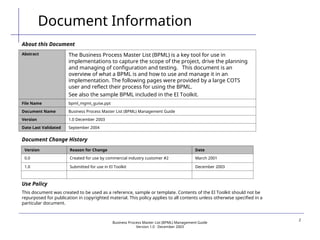
Abstract The Business Process Master List (BPML) is a key tool for use in
implementations to capture the scope of the project, drive the planning
and managing of configuration and testing. This document is an
overview of what a BPML is and how to use and manage it in an
implementation. The following pages were provided by a large COTS
user and reflect their process for using the BPML.
See also the sample BPML included in the EI Toolkit.
File Name bpml_mgmt_guise.ppt
Document Name Business Process Master List (BPML) Management Guide
Version 1.0 December 2003
Date Last Validated September 2004
About this Document
Use Policy
This document was created to be used as a reference, sample or template. Contents of the EI Toolkit should not be
repurposed for publication in copyrighted material. This policy applies to all contents unless otherwise specified in a
particular document.
Document Change History
Version Reason for Change Date
0.0 Created for use by commercial industry customer #2 March 2001
1.0 Submitted for use in EI Toolkit December 2003
Business Process Master List (BPML) Management Guide
Version 1.0  December 2003
Table of Contents
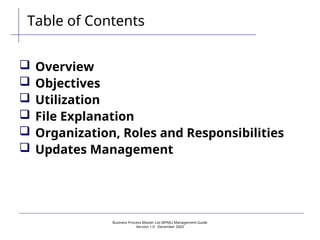
 Overview
 Objectives
 Utilization
 File Explanation
 Organization, Roles and Responsibilities
 Updates Management
Business Process Master List (BPML) Management Guide
Version 1.0  December 2003
Overview
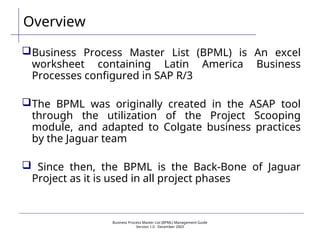
Business Process Master List (BPML) is An excel
worksheet containing Latin America Business
Processes configured in SAP R/3
The BPML was originally created in the ASAP tool
through the utilization of the Project Scooping
module, and adapted to Colgate business practices
by the Jaguar team
 Since then, the BPML is the Back-Bone of Jaguar
Project as it is used in all project phases
Business Process Master List (BPML) Management Guide
Version 1.0  December 2003
Overview
BPML is enriched after each implementation
with the new functionality delivered to the
subsidiary
Business Process Master List (BPML) Management Guide
Version 1.0  December 2003
Objectives
Repository of Colgate Latin America Business
Processes, Practices and Variants
Repository of Country Specific Functionality
Configuration and Test Management
Support other Key Project Activities, such as,
Change Management and Security
Business Process Master List (BPML) Management Guide
Version 1.0  December 2003
Utilization
The BPML is used through out the
implementation phases to support key
project activities, such as:
 Implementation Team Training
 Business Workshops
 Business Variants Documentation
 Configuration Management
 GAP Analysis
 Integration and Day in the Life Tests
 Security
 Roles & Responsibilities.
Business Process Master List (BPML) Management Guide
Version 1.0  December 2003
Utilization Implementatio
n Team
Training
Implementation Team is trained to execute
all business processes supported by the Latin
America Application Framework
As well as the business logic behind each
piece of configuration
Therefore, the BPML is used as training
program
Business Process Master List (BPML) Management Guide
Version 1.0  December 2003
Utilization
Business
Workshops
Implementation team presents to Subsidiary
Management all the Business Processes
configured in the Latin America Application
Framework
The BPML is used to build up the BW-
Agendas and therefore a business cycle
sequence
Business Process Master List (BPML) Management Guide
Version 1.0  December 2003
Utilization
Business
Variants
Implementation team has to identify and document
all the Business Variants that occurs in their
Subsidiary Processes
These Business Variants are documented in the
BPML and Used:
 By the Core Team to track Configuration
 By the Implementation team to duplicate Subsidiary
Business Process in SAP R/3
With this approach both Configuration and Testing
activities are efficiently managed and
implementation progress objectively measured
Business Process Master List (BPML) Management Guide
Version 1.0  December 2003
Utilization
Business
Variants
 All Business Variants are documented in the
MASTER LIST section of the BPML in RED
 The Core Team MARKS the functionality and
business variants that will be available for a giving
configuration Cycle
 Implementation team generates the test cycle from
MASTER LIST
 Implementation team prints out the cycle n from C
n section
 Implementation team assign testers in Cycle n
Business Process Master List (BPML) Management Guide
Version 1.0  December 2003
Utilization Business
Variants
Implementation team documents test results in
Cycle n section
 If Variant is successfully tested and approved by end users,
it is marked in Blue in both Master List & Cycle n Sections

And the OK Word in TESTING DATE / Column ACTUAL
Business Process Master List (BPML) Management Guide
Version 1.0  December 2003
Utilization Business
Variants
 Implementation team document test results in
Cycle n section
 If Variant or Business Process Procedure-BPP are not
successfully tested, error is documented in Integration Test
Tracking Sheet-ITTS and BPP or Variant will remain in RED

And the ERROR ID in TESTING DATE / Column ACTUAL
Business Process Master List (BPML) Management Guide
Version 1.0  December 2003
Utilization Configuration
Management
 The Core Team delivers subsidiary configuration in a specific
dates along the implementation calendar, these dates are
identified as Configuration Cycles in the High Level Plan
 The MASTER LIST sheet has a FINAL CONFIGURATION
CYCLES section with Four C columns that represents
Configuration Cycles
 Core Team Leaders marks with an X the configuration /
variants that will be delivered in each configuration cycle
Business Process Master List (BPML) Management Guide
Version 1.0  December 2003
Utilization GAP Analysis
Once the Configuration available for each cycle is
identified the implementation team documents the
corresponding business variants
During GAP Analysis implementation team develops
the necessaries business conditions to replicate
their business processes in SAP R/3, AND
Evaluate the FIT of the Latin America Application
Framework in their business
Business Process Master List (BPML) Management Guide
Version 1.0  December 2003
Utilization
Integration
Tests
After GAP Analysis, there will be several
integration test, each of them with specific
objectives
IT-Agendas will be based in functionality / business
variants available for a giving cycle
BPML will be used to keep teams focus to achieve
test objectives
Business Process Master List (BPML) Management Guide
Version 1.0  December 2003
Utilization
Security
In the Area of Security the BPML is used to
document all the transactions that are used
for a specific profile.
The BPML assures no T-Code is missing for a
specific role
Business Process Master List (BPML) Management Guide
Version 1.0  December 2003
Utilization
Roles &
Responsibilities
End user procedures and business
procedures defined and linked
Job roles assigned
May be linked to Security profiles
Business Process Master List (BPML) Management Guide
Version 1.0  December 2003
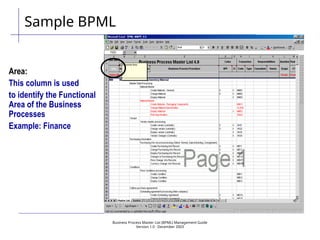
Area:
This column is used
to identify the Functional
Area of the Business
Processes
Example: Finance
Sample BPML
Business Process Master List (BPML) Management Guide
Version 1.0  December 2003
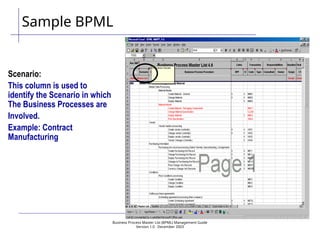
Scenario:
This column is used to
identify the Scenario in which
The Business Processes are
Involved.
Example: Contract
Manufacturing
Sample BPML
Business Process Master List (BPML) Management Guide
Version 1.0  December 2003
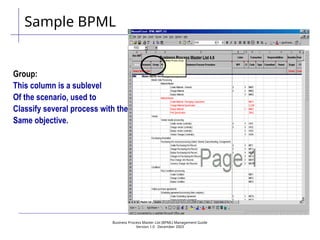
Group:
This column is a sublevel
Of the scenario, used to
Classify several process with the
Same objective.
Sample BPML
Business Process Master List (BPML) Management Guide
Version 1.0  December 2003
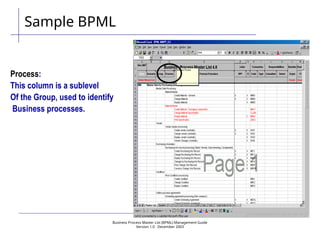
Process:
This column is a sublevel
Of the Group, used to identify
Business processes.
Sample BPML
Business Process Master List (BPML) Management Guide
Version 1.0  December 2003
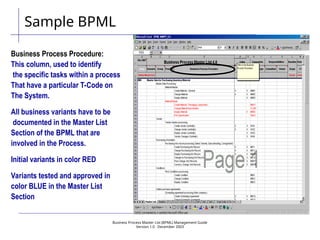
Business Process Procedure:
This column, used to identify
the specific tasks within a process
That have a particular T-Code on
The System.
All business variants have to be
documented in the Master List
Section of the BPML that are
involved in the Process.
Initial variants in color RED
Variants tested and approved in
color BLUE in the Master List
Section
Sample BPML
Business Process Master List (BPML) Management Guide
Version 1.0  December 2003
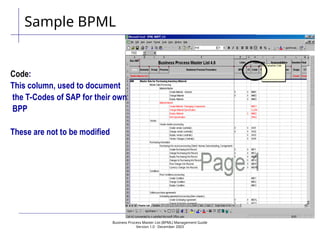
Code:
This column, used to document
the T-Codes of SAP for their own
BPP
These are not to be modified
Sample BPML
Business Process Master List (BPML) Management Guide
Version 1.0  December 2003
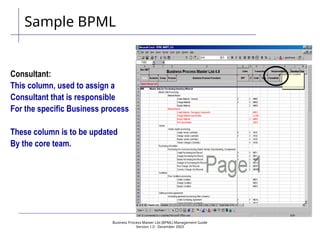
Consultant:
This column, used to assign a
Consultant that is responsible
For the specific Business process
These column is to be updated
By the core team.
Sample BPML
Business Process Master List (BPML) Management Guide
Version 1.0  December 2003
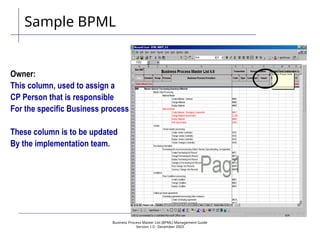
Owner:
This column, used to assign a
CP Person that is responsible
For the specific Business process
These column is to be updated
By the implementation team.
Sample BPML
Business Process Master List (BPML) Management Guide
Version 1.0  December 2003
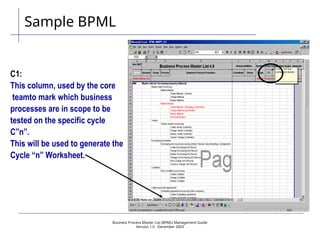
C1:
This column, used by the core
teamto mark which business
processes are in scope to be
tested on the specific cycle
C”n”.
This will be used to generate the
Cycle “n” Worksheet.
Sample BPML
Business Process Master List (BPML) Management Guide
Version 1.0  December 2003
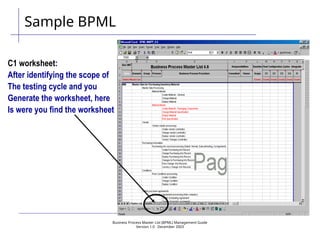
C1 worksheet:
After identifying the scope of
The testing cycle and you
Generate the worksheet, here
Is were you find the worksheet
Sample BPML
Business Process Master List (BPML) Management Guide
Version 1.0  December 2003
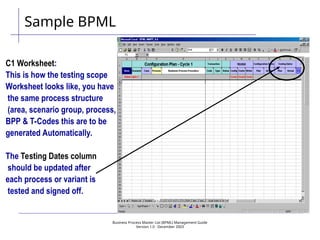
C1 Worksheet:
This is how the testing scope
Worksheet looks like, you have
the same process structure
(area, scenario group, process,
BPP & T-Codes this are to be
generated Automatically.
The Testing Dates column
should be updated after
each process or variant is
tested and signed off.
Sample BPML
Business Process Master List (BPML) Management Guide
Version 1.0  December 2003
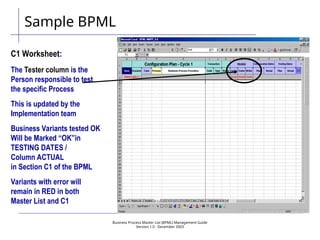
C1 Worksheet:
The Tester column is the
Person responsible to test
the specific Process
This is updated by the
Implementation team
Business Variants tested OK
Will be Marked “OK”in
TESTING DATES /
Column ACTUAL
in Section C1 of the BPML
Variants with error will
remain in RED in both
Master List and C1
Sample BPML
Business Process Master List (BPML) Management Guide
Version 1.0  December 2003
Organisation, Roles and Responsibilities
Business Process Master List (BPML) Management Guide
Version 1.0  December 2003
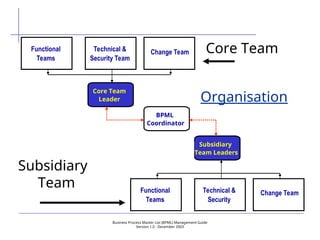
Organisation
Functional
Teams
Technical &
Security Team
Change Team
Functional
Teams
Technical &
Security
Core Team
Subsidiary
Team
Core Team
Leader
BPML
Coordinator
Subsidiary
Team Leaders
Change Team
Business Process Master List (BPML) Management Guide
Version 1.0  December 2003
Organisation : Roles and Responsibilities
BPML
Coordinator
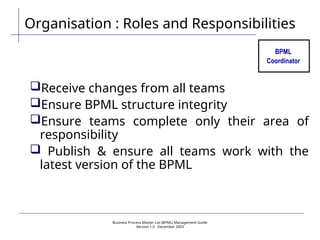
Receive changes from all teams
Ensure BPML structure integrity
Ensure teams complete only their area of
responsibility
 Publish & ensure all teams work with the
latest version of the BPML
Business Process Master List (BPML) Management Guide
Version 1.0  December 2003
Organisation : Roles and Responsibilities
Core Team
Leaders
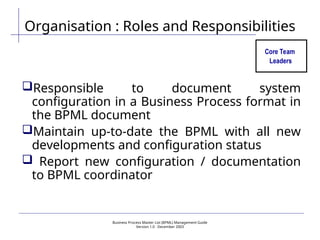
Responsible to document system
configuration in a Business Process format in
the BPML document
Maintain up-to-date the BPML with all new
developments and configuration status
 Report new configuration / documentation
to BPML coordinator
Business Process Master List (BPML) Management Guide
Version 1.0  December 2003
Organisation : Roles and Responsibilities
Subsidiary
Team Leaders
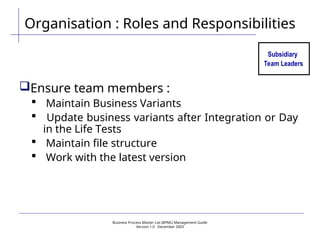
Ensure team members :
 Maintain Business Variants
 Update business variants after Integration or Day
in the Life Tests
 Maintain file structure
 Work with the latest version
Business Process Master List (BPML) Management Guide
Version 1.0  December 2003
Organisation : Roles and Responsibilities
Functional
Team
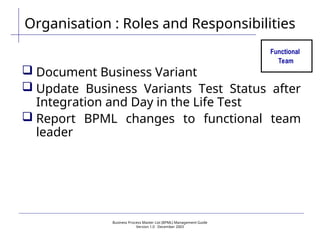
 Document Business Variant
 Update Business Variants Test Status after
Integration and Day in the Life Test
 Report BPML changes to functional team
leader
Business Process Master List (BPML) Management Guide
Version 1.0  December 2003
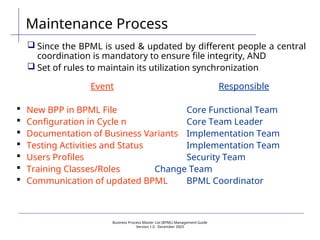
Maintenance Process
 Since the BPML is used & updated by different people a central
coordination is mandatory to ensure file integrity, AND
 Set of rules to maintain its utilization synchronization
Event Responsible
 New BPP in BPML File Core Functional Team
 Configuration in Cycle n Core Team Leader
 Documentation of Business Variants Implementation Team
 Testing Activities and Status Implementation Team
 Users Profiles Security Team
 Training Classes/Roles Change Team
 Communication of updated BPML BPML Coordinator
Business Process Master List (BPML) Management Guide
Version 1.0  December 2003
Management : Updating Approach
 BPML update conditions and responsibilities :
 Core Configuration Team

Translate new functionality into BPML Business Processes

Update configuration status

Communicate updates to Core Team Leaders
 Core Team Leaders
 It is controlled centrally by the BPML Manager :
 The Core Team might update the BPML in this events

Include a new process

New Transaction

Identify process to be tested in specific cycles
 The subsidiary might update the BPML in this events:

Include new Business Variants

Assign Owner of the Process

Update the Tested Variants
Business Process Master List (BPML) Management Guide
Version 1.0  December 2003
Maintenance Flow - Core Team
Business Process Master List (BPML) Management Guide
Version 1.0  December 2003
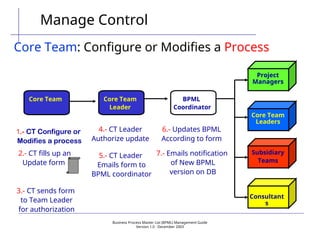
Manage Control
Core Team: Configure or Modifies a Process
1.- CT Configure or
Modifies a process
2.- CT fills up an
Update form
3.- CT sends form
to Team Leader
for authorization
4.- CT Leader
Authorize update
5.- CT Leader
Emails form to
BPML coordinator
6.- Updates BPML
According to form
7.- Emails notification
of New BPML
version on DB
Consultant
s
Subsidiary
Teams
Core Team
Leaders
Project
Managers
Core Team Core Team
Leader
BPML
Coordinator
Business Process Master List (BPML) Management Guide
Version 1.0  December 2003
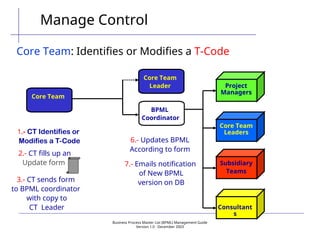
Manage Control
Core Team: Identifies or Modifies a T-Code
1.- CT Identifies or
Modifies a T-Code
2.- CT fills up an
Update form
3.- CT sends form
to BPML coordinator
with copy to
CT Leader
6.- Updates BPML
According to form
7.- Emails notification
of New BPML
version on DB
Consultant
s
Subsidiary
Teams
Core Team
Leaders
Project
Managers
Core Team
Core Team
Leader
BPML
Coordinator
Business Process Master List (BPML) Management Guide
Version 1.0  December 2003
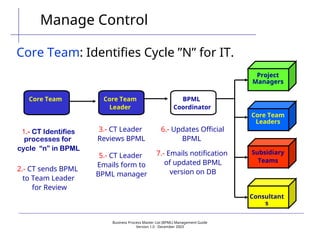
Manage Control
Core Team: Identifies Cycle ”N” for IT.
1.- CT Identifies
processes for
cycle “n” in BPML
2.- CT sends BPML
to Team Leader
for Review
3.- CT Leader
Reviews BPML
5.- CT Leader
Emails form to
BPML manager
6.- Updates Official
BPML
7.- Emails notification
of updated BPML
version on DB
Consultant
s
Subsidiary
Teams
Core Team
Leaders
Project
Managers
Core Team Core Team
Leader
BPML
Coordinator
Business Process Master List (BPML) Management Guide
Version 1.0  December 2003
Maintenance Flow - Implementation Team
Business Process Master List (BPML) Management Guide
Version 1.0  December 2003
Manage Control
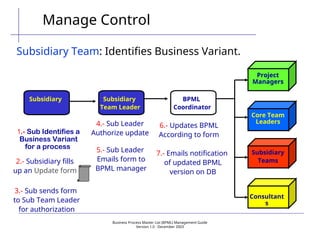
Subsidiary Team: Identifies Business Variant.
1.- Sub Identifies a
Business Variant
for a process
7.- Emails notification
of updated BPML
version on DB
Consultant
s
Subsidiary
Teams
Core Team
Leaders
Project
Managers
Subsidiary Subsidiary
Team Leader
BPML
Coordinator
3.- Sub sends form
to Sub Team Leader
for authorization
2.- Subsidiary fills
up an Update form
4.- Sub Leader
Authorize update
5.- Sub Leader
Emails form to
BPML manager
6.- Updates BPML
According to form
Business Process Master List (BPML) Management Guide
Version 1.0  December 2003
Manage Control
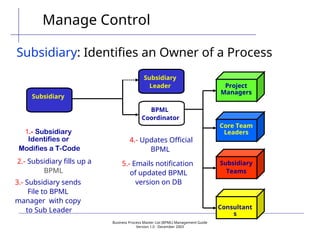
Subsidiary: Identifies an Owner of a Process
1.- Subsidiary
Identifies or
Modifies a T-Code
2.- Subsidiary fills up a
BPML
3.- Subsidiary sends
File to BPML
manager with copy
to Sub Leader
4.- Updates Official
BPML
5.- Emails notification
of updated BPML
version on DB
Consultant
s
Subsidiary
Teams
Core Team
Leaders
Project
Managers
Subsidiary
Subsidiary
Leader
BPML
Coordinator
Business Process Master List (BPML) Management Guide
Version 1.0  December 2003
Manage Control
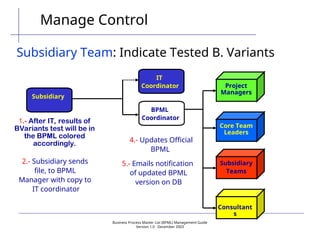
Subsidiary Team: Indicate Tested B. Variants
1.- After IT, results of
BVariants test will be in
the BPML colored
accordingly.
2.- Subsidiary sends
file, to BPML
Manager with copy to
IT coordinator
4.- Updates Official
BPML
5.- Emails notification
of updated BPML
version on DB
Consultant
s
Subsidiary
Teams
Core Team
Leaders
Project
Managers
Subsidiary
IT
Coordinator
BPML
Coordinator

268050773-SAP-BPML.ppt..................

  • 1.
    Business Process MasterList (BPML) Management Guide Version 1.0 • December 2003
  • 2.
    Business Process MasterList (BPML) Management Guide Version 1.0  December 2003 2 Document Information Abstract The Business Process Master List (BPML) is a key tool for use in implementations to capture the scope of the project, drive the planning and managing of configuration and testing. This document is an overview of what a BPML is and how to use and manage it in an implementation. The following pages were provided by a large COTS user and reflect their process for using the BPML. See also the sample BPML included in the EI Toolkit. File Name bpml_mgmt_guise.ppt Document Name Business Process Master List (BPML) Management Guide Version 1.0 December 2003 Date Last Validated September 2004 About this Document Use Policy This document was created to be used as a reference, sample or template. Contents of the EI Toolkit should not be repurposed for publication in copyrighted material. This policy applies to all contents unless otherwise specified in a particular document. Document Change History Version Reason for Change Date 0.0 Created for use by commercial industry customer #2 March 2001 1.0 Submitted for use in EI Toolkit December 2003
  • 3.
    Business Process MasterList (BPML) Management Guide Version 1.0  December 2003 Table of Contents  Overview  Objectives  Utilization  File Explanation  Organization, Roles and Responsibilities  Updates Management
  • 4.
    Business Process MasterList (BPML) Management Guide Version 1.0  December 2003 Overview Business Process Master List (BPML) is An excel worksheet containing Latin America Business Processes configured in SAP R/3 The BPML was originally created in the ASAP tool through the utilization of the Project Scooping module, and adapted to Colgate business practices by the Jaguar team  Since then, the BPML is the Back-Bone of Jaguar Project as it is used in all project phases
  • 5.
    Business Process MasterList (BPML) Management Guide Version 1.0  December 2003 Overview BPML is enriched after each implementation with the new functionality delivered to the subsidiary
  • 6.
    Business Process MasterList (BPML) Management Guide Version 1.0  December 2003 Objectives Repository of Colgate Latin America Business Processes, Practices and Variants Repository of Country Specific Functionality Configuration and Test Management Support other Key Project Activities, such as, Change Management and Security
  • 7.
    Business Process MasterList (BPML) Management Guide Version 1.0  December 2003 Utilization The BPML is used through out the implementation phases to support key project activities, such as:  Implementation Team Training  Business Workshops  Business Variants Documentation  Configuration Management  GAP Analysis  Integration and Day in the Life Tests  Security  Roles & Responsibilities.
  • 8.
    Business Process MasterList (BPML) Management Guide Version 1.0  December 2003 Utilization Implementatio n Team Training Implementation Team is trained to execute all business processes supported by the Latin America Application Framework As well as the business logic behind each piece of configuration Therefore, the BPML is used as training program
  • 9.
    Business Process MasterList (BPML) Management Guide Version 1.0  December 2003 Utilization Business Workshops Implementation team presents to Subsidiary Management all the Business Processes configured in the Latin America Application Framework The BPML is used to build up the BW- Agendas and therefore a business cycle sequence
  • 10.
    Business Process MasterList (BPML) Management Guide Version 1.0  December 2003 Utilization Business Variants Implementation team has to identify and document all the Business Variants that occurs in their Subsidiary Processes These Business Variants are documented in the BPML and Used:  By the Core Team to track Configuration  By the Implementation team to duplicate Subsidiary Business Process in SAP R/3 With this approach both Configuration and Testing activities are efficiently managed and implementation progress objectively measured
  • 11.
    Business Process MasterList (BPML) Management Guide Version 1.0  December 2003 Utilization Business Variants  All Business Variants are documented in the MASTER LIST section of the BPML in RED  The Core Team MARKS the functionality and business variants that will be available for a giving configuration Cycle  Implementation team generates the test cycle from MASTER LIST  Implementation team prints out the cycle n from C n section  Implementation team assign testers in Cycle n
  • 12.
    Business Process MasterList (BPML) Management Guide Version 1.0  December 2003 Utilization Business Variants Implementation team documents test results in Cycle n section  If Variant is successfully tested and approved by end users, it is marked in Blue in both Master List & Cycle n Sections  And the OK Word in TESTING DATE / Column ACTUAL
  • 13.
    Business Process MasterList (BPML) Management Guide Version 1.0  December 2003 Utilization Business Variants  Implementation team document test results in Cycle n section  If Variant or Business Process Procedure-BPP are not successfully tested, error is documented in Integration Test Tracking Sheet-ITTS and BPP or Variant will remain in RED  And the ERROR ID in TESTING DATE / Column ACTUAL
  • 14.
    Business Process MasterList (BPML) Management Guide Version 1.0  December 2003 Utilization Configuration Management  The Core Team delivers subsidiary configuration in a specific dates along the implementation calendar, these dates are identified as Configuration Cycles in the High Level Plan  The MASTER LIST sheet has a FINAL CONFIGURATION CYCLES section with Four C columns that represents Configuration Cycles  Core Team Leaders marks with an X the configuration / variants that will be delivered in each configuration cycle
  • 15.
    Business Process MasterList (BPML) Management Guide Version 1.0  December 2003 Utilization GAP Analysis Once the Configuration available for each cycle is identified the implementation team documents the corresponding business variants During GAP Analysis implementation team develops the necessaries business conditions to replicate their business processes in SAP R/3, AND Evaluate the FIT of the Latin America Application Framework in their business
  • 16.
    Business Process MasterList (BPML) Management Guide Version 1.0  December 2003 Utilization Integration Tests After GAP Analysis, there will be several integration test, each of them with specific objectives IT-Agendas will be based in functionality / business variants available for a giving cycle BPML will be used to keep teams focus to achieve test objectives
  • 17.
    Business Process MasterList (BPML) Management Guide Version 1.0  December 2003 Utilization Security In the Area of Security the BPML is used to document all the transactions that are used for a specific profile. The BPML assures no T-Code is missing for a specific role
  • 18.
    Business Process MasterList (BPML) Management Guide Version 1.0  December 2003 Utilization Roles & Responsibilities End user procedures and business procedures defined and linked Job roles assigned May be linked to Security profiles
  • 19.
    Business Process MasterList (BPML) Management Guide Version 1.0  December 2003 Area: This column is used to identify the Functional Area of the Business Processes Example: Finance Sample BPML
  • 20.
    Business Process MasterList (BPML) Management Guide Version 1.0  December 2003 Scenario: This column is used to identify the Scenario in which The Business Processes are Involved. Example: Contract Manufacturing Sample BPML
  • 21.
    Business Process MasterList (BPML) Management Guide Version 1.0  December 2003 Group: This column is a sublevel Of the scenario, used to Classify several process with the Same objective. Sample BPML
  • 22.
    Business Process MasterList (BPML) Management Guide Version 1.0  December 2003 Process: This column is a sublevel Of the Group, used to identify Business processes. Sample BPML
  • 23.
    Business Process MasterList (BPML) Management Guide Version 1.0  December 2003 Business Process Procedure: This column, used to identify the specific tasks within a process That have a particular T-Code on The System. All business variants have to be documented in the Master List Section of the BPML that are involved in the Process. Initial variants in color RED Variants tested and approved in color BLUE in the Master List Section Sample BPML
  • 24.
    Business Process MasterList (BPML) Management Guide Version 1.0  December 2003 Code: This column, used to document the T-Codes of SAP for their own BPP These are not to be modified Sample BPML
  • 25.
    Business Process MasterList (BPML) Management Guide Version 1.0  December 2003 Consultant: This column, used to assign a Consultant that is responsible For the specific Business process These column is to be updated By the core team. Sample BPML
  • 26.
    Business Process MasterList (BPML) Management Guide Version 1.0  December 2003 Owner: This column, used to assign a CP Person that is responsible For the specific Business process These column is to be updated By the implementation team. Sample BPML
  • 27.
    Business Process MasterList (BPML) Management Guide Version 1.0  December 2003 C1: This column, used by the core teamto mark which business processes are in scope to be tested on the specific cycle C”n”. This will be used to generate the Cycle “n” Worksheet. Sample BPML
  • 28.
    Business Process MasterList (BPML) Management Guide Version 1.0  December 2003 C1 worksheet: After identifying the scope of The testing cycle and you Generate the worksheet, here Is were you find the worksheet Sample BPML
  • 29.
    Business Process MasterList (BPML) Management Guide Version 1.0  December 2003 C1 Worksheet: This is how the testing scope Worksheet looks like, you have the same process structure (area, scenario group, process, BPP & T-Codes this are to be generated Automatically. The Testing Dates column should be updated after each process or variant is tested and signed off. Sample BPML
  • 30.
    Business Process MasterList (BPML) Management Guide Version 1.0  December 2003 C1 Worksheet: The Tester column is the Person responsible to test the specific Process This is updated by the Implementation team Business Variants tested OK Will be Marked “OK”in TESTING DATES / Column ACTUAL in Section C1 of the BPML Variants with error will remain in RED in both Master List and C1 Sample BPML
  • 31.
    Business Process MasterList (BPML) Management Guide Version 1.0  December 2003 Organisation, Roles and Responsibilities
  • 32.
    Business Process MasterList (BPML) Management Guide Version 1.0  December 2003 Organisation Functional Teams Technical & Security Team Change Team Functional Teams Technical & Security Core Team Subsidiary Team Core Team Leader BPML Coordinator Subsidiary Team Leaders Change Team
  • 33.
    Business Process MasterList (BPML) Management Guide Version 1.0  December 2003 Organisation : Roles and Responsibilities BPML Coordinator Receive changes from all teams Ensure BPML structure integrity Ensure teams complete only their area of responsibility  Publish & ensure all teams work with the latest version of the BPML
  • 34.
    Business Process MasterList (BPML) Management Guide Version 1.0  December 2003 Organisation : Roles and Responsibilities Core Team Leaders Responsible to document system configuration in a Business Process format in the BPML document Maintain up-to-date the BPML with all new developments and configuration status  Report new configuration / documentation to BPML coordinator
  • 35.
    Business Process MasterList (BPML) Management Guide Version 1.0  December 2003 Organisation : Roles and Responsibilities Subsidiary Team Leaders Ensure team members :  Maintain Business Variants  Update business variants after Integration or Day in the Life Tests  Maintain file structure  Work with the latest version
  • 36.
    Business Process MasterList (BPML) Management Guide Version 1.0  December 2003 Organisation : Roles and Responsibilities Functional Team  Document Business Variant  Update Business Variants Test Status after Integration and Day in the Life Test  Report BPML changes to functional team leader
  • 37.
    Business Process MasterList (BPML) Management Guide Version 1.0  December 2003 Maintenance Process  Since the BPML is used & updated by different people a central coordination is mandatory to ensure file integrity, AND  Set of rules to maintain its utilization synchronization Event Responsible  New BPP in BPML File Core Functional Team  Configuration in Cycle n Core Team Leader  Documentation of Business Variants Implementation Team  Testing Activities and Status Implementation Team  Users Profiles Security Team  Training Classes/Roles Change Team  Communication of updated BPML BPML Coordinator
  • 38.
    Business Process MasterList (BPML) Management Guide Version 1.0  December 2003 Management : Updating Approach  BPML update conditions and responsibilities :  Core Configuration Team  Translate new functionality into BPML Business Processes  Update configuration status  Communicate updates to Core Team Leaders  Core Team Leaders  It is controlled centrally by the BPML Manager :  The Core Team might update the BPML in this events  Include a new process  New Transaction  Identify process to be tested in specific cycles  The subsidiary might update the BPML in this events:  Include new Business Variants  Assign Owner of the Process  Update the Tested Variants
  • 39.
    Business Process MasterList (BPML) Management Guide Version 1.0  December 2003 Maintenance Flow - Core Team
  • 40.
    Business Process MasterList (BPML) Management Guide Version 1.0  December 2003 Manage Control Core Team: Configure or Modifies a Process 1.- CT Configure or Modifies a process 2.- CT fills up an Update form 3.- CT sends form to Team Leader for authorization 4.- CT Leader Authorize update 5.- CT Leader Emails form to BPML coordinator 6.- Updates BPML According to form 7.- Emails notification of New BPML version on DB Consultant s Subsidiary Teams Core Team Leaders Project Managers Core Team Core Team Leader BPML Coordinator
  • 41.
    Business Process MasterList (BPML) Management Guide Version 1.0  December 2003 Manage Control Core Team: Identifies or Modifies a T-Code 1.- CT Identifies or Modifies a T-Code 2.- CT fills up an Update form 3.- CT sends form to BPML coordinator with copy to CT Leader 6.- Updates BPML According to form 7.- Emails notification of New BPML version on DB Consultant s Subsidiary Teams Core Team Leaders Project Managers Core Team Core Team Leader BPML Coordinator
  • 42.
    Business Process MasterList (BPML) Management Guide Version 1.0  December 2003 Manage Control Core Team: Identifies Cycle ”N” for IT. 1.- CT Identifies processes for cycle “n” in BPML 2.- CT sends BPML to Team Leader for Review 3.- CT Leader Reviews BPML 5.- CT Leader Emails form to BPML manager 6.- Updates Official BPML 7.- Emails notification of updated BPML version on DB Consultant s Subsidiary Teams Core Team Leaders Project Managers Core Team Core Team Leader BPML Coordinator
  • 43.
    Business Process MasterList (BPML) Management Guide Version 1.0  December 2003 Maintenance Flow - Implementation Team
  • 44.
    Business Process MasterList (BPML) Management Guide Version 1.0  December 2003 Manage Control Subsidiary Team: Identifies Business Variant. 1.- Sub Identifies a Business Variant for a process 7.- Emails notification of updated BPML version on DB Consultant s Subsidiary Teams Core Team Leaders Project Managers Subsidiary Subsidiary Team Leader BPML Coordinator 3.- Sub sends form to Sub Team Leader for authorization 2.- Subsidiary fills up an Update form 4.- Sub Leader Authorize update 5.- Sub Leader Emails form to BPML manager 6.- Updates BPML According to form
  • 45.
    Business Process MasterList (BPML) Management Guide Version 1.0  December 2003 Manage Control Subsidiary: Identifies an Owner of a Process 1.- Subsidiary Identifies or Modifies a T-Code 2.- Subsidiary fills up a BPML 3.- Subsidiary sends File to BPML manager with copy to Sub Leader 4.- Updates Official BPML 5.- Emails notification of updated BPML version on DB Consultant s Subsidiary Teams Core Team Leaders Project Managers Subsidiary Subsidiary Leader BPML Coordinator
  • 46.
    Business Process MasterList (BPML) Management Guide Version 1.0  December 2003 Manage Control Subsidiary Team: Indicate Tested B. Variants 1.- After IT, results of BVariants test will be in the BPML colored accordingly. 2.- Subsidiary sends file, to BPML Manager with copy to IT coordinator 4.- Updates Official BPML 5.- Emails notification of updated BPML version on DB Consultant s Subsidiary Teams Core Team Leaders Project Managers Subsidiary IT Coordinator BPML Coordinator