PSALM 1 COMMENTARY 
Written and edited by Glenn Pease 
PREFACE 
In this commentary I quote many old and new authors. Sometimes I do not know the author I 
quote, and I will give credit if any author is identified to me. If any who are quoted do not wish 
their words of wisdom to be included in this study, let me know, and I will delete it. My e-mail is 
glenn_p86@yahoo.com 
INTRODUCTION 
1. Hampton Keathley, “Psalm one is a wisdom Psalm. There are praise Psalms, lament Psalms, 
and enthronement Psalms and all contain wisdom, of course, but as an introduction and door to 
the rest of the Psalms, this Psalm declares in just a few words some of the most basic but 
profound truths and propositions of the Bible. In essence, God says there are two ways of life 
open to us: one means blessedness, happiness, and fruitfulness, but the other means cursedness, 
unhappiness, and judgment. The choice is ours. Blessedness is a choice, but to be blessed, one 
must by faith obey the conditions; he must pursue the way of blessedness as described in this 
Psalm.” 
2. Bob Deffinbaugh, “Having just completed a study in the Book of Proverbs, we can easily see 
that Psalm 1 is remarkably similar to Proverbs in form and content. As Perowne has observed, 
“In form it is little more than the expansion of a proverb.” We find in this Psalm the “two ways” 
which are so prominent in Proverbs. The similarity of this Psalm to the book of Proverbs marks 
it out as one of several unique Psalms which have been classified as “wisdom Psalms.” Here, the 
psalmist is not addressing God as much as he is men, yet in God’s presence. This Psalm is not 
strictly a prayer, nor would it be quickly identified as worship. Yet, as an introduction to the 
Psalter, it addresses several areas which are prerequisites to worship and prayer. 
As introductory Psalms, both Psalm 1 and Psalm 2 are somewhat unique when compared to the 
others which make up Book I of the Psalms (Pss. 1–41) because they contain no superscription 
and David is not identified in either psalm as the author. Because of the similarity of the first 
Psalm to Proverbs, some have suggested that it may have been Solomon who wrote it, placing it 
before his father’s Psalm (Psalm 2) as an introduction to the entire Psalter.60 It would not be 
unusual for a son to gather the writings of his father, nor would he necessarily be inclined to give 
his own name as a superscription.” 
3. J. J. Stewart Perowne, “This Psalm seems to have been placed first in 
the collection because, from its general character and subject, it formed a suitable 
introduction to the rest. It treats of the blessedness of the righteous and the 
misery of the wicked, topics which constantly recur in the Psalms, but it treats of 
them as if all experience pointed only in one direction. The moral problem which, 
in other Psalms, troubles the ancient poets of Israel, when they see the evil 
prospering and the good oppressed, has here no place. The poet rests calmly in the
truth that it is well with the righteous. He is not vexed with those passionate 
questionings of heart which meet us in such Psalms as the 37th and 73rd. Hence 
we may probably conclude that his lot was cast in happier and more peaceful times. 
The close of the Psalm is, however, as Ewald remarks, truly prophetical, perpetually 
in force, and consequently descriptive of what is to be expected at all times in the 
course of the world's history.” 
4. Thomas Watson, “ As the book of the Canticles is called the Song of Songs by a Hebraism, it 
being the most excellent, so this Psalm may not unfitly be entitled, the Psalm of Psalms, for it 
contains in it the very pith and quintessence of Christianity. What Jerome saith on St. Paul's 
epistles, the same may I say of this Psalm; it is short as to the composure, but full of length and 
strength as to the matter. This Psalm carries blessedness in the front piece; it begins where we all 
hope to end: it may well be called a Christian's Guide, for it discovers the quicksands where the 
wicked sink down in perdition, and the firm ground on which the saints tread to glory.” 
5. Spurgeon, “This Psalm may be regarded as THE PREFACE PSALM, having in it a 
notification of the contents of the entire Book. It is the psalmists's desire to teach us the way to 
blessedness, and to warn us of the sure destruction of sinners. This, then, is the matter of the first 
Psalm, which may be looked upon, in some respects, as the text upon which the whole of the 
Psalms make up a divine sermon.” 
6. Eugene Peterson's translation of Psalm 1 in The Message: 
How well God must like you 
you don't hang out at Sin Saloon 
you don't slink along Dead End Road 
you don't go to Smart-Mouth College. 
Instead you thrill to God's Word, 
you chew on Scripture day and night. 
You're a tree replanted in Eden, 
bearing fresh fruit every month, 
Never dropping a leaf, 
always in blossom. 
You're not at all like the wicked, 
who are mere windblown dust - 
Without defense in court,
unfit company for innocent people. 
God charts the road you take. 
The road they take is Skid Row. 
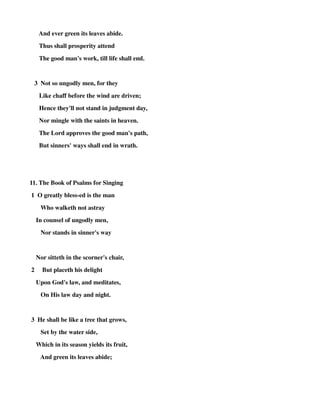
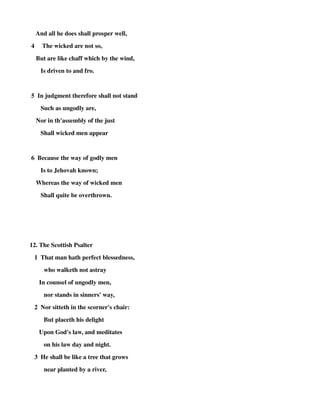
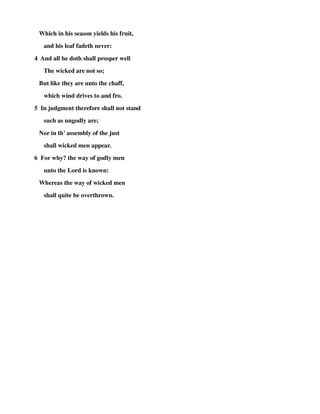
Psalm 1 
1. Blessed is the man 
who does not walk in the counsel of the wicked 
or stand in the way of sinners 
or sit in the seat of mockers. 
1. We often hear messages about how we ought to do this or that to be happy, but here is a 
different slant on the matter. David is saying you not only can find happiness in what you do, but 
in what you don't do. There is a back door to the road of being blessed, or better yet, there is 
reclining chair where you just sit still and don't move, and that can be the way to blessings. You 
may be tempted to listen to the way some people make a lot of money. It is easy to deceive people 
and get some of their wealth to flow to your bank account, and this Psalm is saying blessed are 
you if you just sit still and refuse to walk in the counsel of those who are enticing you. Doing 
nothing can sometimes be the best way to advance in the kingdom of God. God is please with 
those who sit still and do not take that walk that leads the to be unloving to others by crooked 
ways to take from them without a value returned. Life is filled with opportunities to be unloving 
in our actions, and when we just stay put and refuse to walk in those ways we are blessed. We 
need to be fully aware that there is a negative as well as a positive way to please God. I am 
reminded of the joke where a man comes home and announces to his wife that he saved 50 bucks 
today. When she asked him how he did that, he told her that the sign on the bus said 50 dollar 
fine if you spit on the floor, and I didn't spit. When there is a bad thing to do, and you don't do it, 
you are on the right path. Doing nothing when you have a choice to go the wrong way is the best 
choice you can make. 
1B. Pink stresses separation as the key idea here. “How very significant it is to note—how 
searching for our hearts—the first characteristic of the “blessed man” to which the Spirit here 
called attention is his walk, a walk in separation from the wicked! Ah, my reader, it is there, and 
nowhere else, that personal piety begins. There can be no walking with God, no following of 
Christ, no treading of the way of peace, till we separate from the world, forsake the paths of sin, 
turn our backs upon the “far country.” “The ungodly are ever ready to “counsel” the believer, 
seeming to be very solicitous of his welfare. They will warn him against being too strict and 
extreme, advising him to be broadminded and to “make the best of both worlds.” But the policy 
of the “ungodly”— i.e., of those who leave God out of their lives, who have not His “fear” before 
their eyes—is regulated by self-will and self-pleasing, and is dominated by what they call 
“common sense.” Alas, how many professing Christians regulate their lives by the advice and
suggestions of ungodly friends and relatives: heeding such “counsel” in their business career, 
their social life, the furnishing and decorating of their homes, their dress and diet, the choice of 
school or avocation for their children.” 
1C. “Walks not after the advice of the wicked. A happy man is one who knows where he is going 
and does not follow directions of those who do not. The opposite is also true-miserable is the man 
who does follow the advice of the ungodly. The ungodly are full of advice and so all need to be 
discerning in where they get their advice. In an evil world much of life is a battle to avoid bad 
advice. Goodness does not consist in not doing evil, but it is a basic requirement. What you don’t 
do is not the essence of the good life but it is still essential. The ability to say no is basic in the life 
of happiness. God will not ask in the judgment how much evil you have not done, but what good 
you have done, but one cannot do good if not first of all avoiding evil. The godly are known by 
the counsel they follow, the company they keep and the character they display. Jesus did walk 
with an eat with sinners but never did he follow their counsel.” author unknown 
1D. Ray Stedman, “This Psalm is a description of the wicked and the righteous. It describes the 
God-centered life and the self-centered life. When the Psalm talks about the wicked it is not 
referring to murderers, rapists, or dope pushers, the kind of people we usually think of as 
wicked. We often think of some notorious person, such as a gangster or hoodlum, as being 
wicked. But the Psalmist does not mean that. The term really means the ungodly, the man who 
has little or no time for God in his life; someone who has ruled God out of his affairs and his 
thinking even though God is the greatest Being in the universe, the One who makes sense out of 
life, the One around whom all of life revolves. To eliminate such a Being from your thinking is to 
be wicked, to be ungodly. But in contrast, the God-centered life is set before us, and the results 
which come from godliness.” “This word for sinners is a most interesting word in the Hebrew. It 
is a word which means, "to make a loud noise," or "to cause a tumult." It is the idea of provoking 
a riot, of creating a disturbance, making trouble, etc. The Psalmist says you can recognize the 
godly man in that he does not make trouble. He does not provoke riots, he is not at work causing 
disturbances; he is obedient to the laws of life and of the land. He does not "stand in the way of" 
those who live to cause trouble.” 
1E. One more note on the importance of what you don't do. If this first verse was just positive 
and said the blessed man walks in the way of the godly, it would leave open the fact that he might 
also walk in the way of the ungodly. The negative makes it more clear that he is righteous by 
eliminating that alternative. He does not walk in that negative way, and that is an absolute 
description of being blessed. Sir Richard Baker Knight wrote, “But are not these strange marks 
to begin withal, as though he could know a godly man by negatives, or that godliness consisted in 
negation? as if virtue were only vitium fugere [the avoiding vice] ? Indeed, the first godliness that 
ever was that is, the first commandment of God was delivered to our first parents in a negative : 
"Of the tree of good and evil, ye shall not eat;" and if they had well observed this negative, they 
should never have sinned in any affirmative. As long as it could be said of Adam, " There goes a 
man that never eat of the forbidden tree," so long it might as well be said of him, " There goes a 
perfect, righteous man." And even the first written Law of Commandments was delivered 
likewise, in a manner, all in negatives: "Thou shalt not kill ^ Thou shalt not steal," and the rest, 
in which so much godliness is contained.” The point is, what you don't do is a vital part of being 
righteous. 
1E2. Sir Knight also has a comment on the issue of which is the worst; the walking, the standing, 
or the sitting. Many chose the opposite end of the three as the worst, but he makes it obvious that
all are equally the worst. He wrote, “The ascent may be briefly thus : that walking expresseth less 
resolution than standing, and standing than sitting; but in sin, the more resolute, the more 
dissolute : therefore sitting is the worst. The descent thus : that walking expresseth more strength 
than standing, and standing than sitting; for a child can sit when he cannot stand, and stand 
when he cannot walk ; but the stronger in sin, the worse; therefore walking is the worst. Many 
such ways there are of conceiving diversity, either in ascending or descending ; but it needs be no 
question which is the worse, because, without question, they are all stark nought : they are three 
rocks, whereof the least is enough to make a shipwreck ; they are three pestilential airs, whereof 
the best is enough to poison the heart.” “then there will not be either ascent or descent in the sins 
themselves, but only a diversity in their causes ; as that the first is a sin caused by ill counsel ; the 
second, a sin caused by ill example ; the third, a sin caused by the innate corruption of our own 
hearts. And so we shall have the three principal heads or springs from which all sins do flow, and 
may probably be exemplified by the three first persons that were in the world : the first, 
committed by Eve, in following the counsel of that ungodly one, the serpent ; the second, 
committed by Adam, in following the example of the sinful Eve ; the third, committed by Cain, 
who sinned not either by any ill counsel or by any ill ex ample, but only by the inbred corruption 
of his own heart. And in this we may observe the wonderful proneness of our nature to sin, seeing 
the three first persons in the world had every one of them a several spring-head of sin of their 
own opening.” 
1E3. Sir Richard Knight goes on to give another interpretation: “Or is it that the Prophet alludes 
here to the three principal ages of our life, which have every one of them their proper vices, as it 
were, retainers to them ? and therefore the vices of youth, which is the vigor of life, and 
delights most in motion and society, he expresseth by walking in the counsel of the ungodly ; the 
vices of the middle age, which is stata cetas [the steadfast age], he expresseth by standing in the 
way of sinners ; the vices of old age, which, being weak and feeble, is scarce able to go, he 
expresseth by sitting in the chair of scorners, and it is as if he had said, " Blessed is the man that 
hath passed through all the ages of his life, and hath kept himself untainted of the vices that are 
incident unto them ; that hath passed the days of his youth as it were the morning of his life, and 
is not tainted with the stirring vices of voluptuousness and prodigality ; that hath passed his 
middle age as it were the noon of his life, and is not tainted with the more elevated vices of 
ambition and vain-glory ; that hath passed his old age as it were the evening of his life, and is not 
tainted with the sluggish vices of covetousness and avarice." 
1F. Spurgeon, ““Blessed,” says David, is such and such a man”; and the word which he uses is, in 
the original, exceedingly expressive. It implies a sort of plurality of blessedness-”Blessednesses 
are to the man; “ and it is scarcely known whether the word is an adjective or a noun; as if the 
blessedness qualified the whole of life, and was, in itself, better even than life itself. The very 
highest degree of happiness is blessedness, “these blessednesses,’’ as Ainsworth says, “heaped up 
one upon the other.” 
1G. An unknown author wrote, “Happiness in the bible has little to do with the emotional state 
we often associate the word with. The happy man is one who enjoys God’s blessing here, and 
looks forward to its fullness in the future. It is interesting to note that the Hebrew word for 
happy, asre, is derived from a Semitic stem which in its verb form means “walk” or “go 
forward”; and in its noun form means “a footstep”. Our life then is conceived of as a pilgrimage, 
a religious journey towards God and full happiness. This accounts for the journey motif which 
dominates this Psalm.”
2. It is funny how life gets so paradoxical, for you need to do just the opposite with this second 
sinner who comes into your life. The first entices you to walk, but you need to stand still and just 
sit on this guys advice and enticement. However, the next guy comes along and with him you need 
to get walking. You are not to stand with this sinner, and be associated with him in his sin. Get 
moving away from him and his crowd, and don't look back. Standing in his company means to be 
in agreement with his way of life. You want no hint that this is your conviction, and so you do not 
associate with them in their lifestyle. The same is true of the third guy who wants you to join him 
as he sits and mocks other people, and especially believers in God. He is loud mouth blasphemer 
of righteous people, and you dare not join him in his folly, or you will be out of God's will. So, 
again, you walk away from him and his kind, or better yet, you run and let nobody ever assume 
that you are connected with this obnoxious character. So sometimes you sit, and other times you 
walk away or run, but in every case with those who want to make you partners in their evil, you 
disassociate yourself. This is what Paul was saying in II Cor. 6, "What fellowship hath 
righteousness with unrighteousness? And what communion hath light with darkness?” 
2B. We need to teach young people and new believers that there are many things we cannot 
afford if we are going to please our heavenly Father, and be fruitful in his service. Someone 
wrote- 
We can't afford to win the gain that means another's loss; 
We can't afford to miss the crown by stumbling at the cross. 
We can't afford the heedless jest that robs us of a friend; 
We can't afford the race that comes to tragic bitter end. 
We can't afford to play with fire, or tempt a serpent's bite 
We can't afford to think that sin brings any true delight. 
We can't afford with serious heed to treat the cynic's sneer, 
We can't afford to use man's words to turn a careless ear. 
We can't afford for hate to give like hatred in return; 
We can't afford to feed a flame and make it fiercer burn. 
We can't afford to lose the soul for this world's fleeting breath; 
We can't afford to barter life in mad exchange for death. 
How blind are we apart from thee, our great all-seeing Lord; 
Oh, grant us light that we may know the things we can't afford. 
3. Gill stresses the happiness of this man. “This psalm begins in like manner as Christ's sermon 
on the mount, (Matthew 5:3) ; setting forth the praises and expressing the happiness of the man 
who is described in this verse and (Psalms 1:2) . The words may be rendered, "O, the 
blessednesses of the man", or "of this man"; he is doubly blessed, a thrice happy and blessed 
man; blessed in things temporal and spiritual; happy in this world, and in that to come. He is to 
be praised and commended as a good man, so the Targum: ``the goodness, or, Oh, the goodness of 
the man;'' or as others, ``Oh, the right goings or happy progress, or prosperous success of the 
man.'' All people seek for happiness, and God gives us the key to it right here as he begins his gift 
of a hymn book to his people. The Psalms cover every imaginable subject including all of the 
negative emotions as well as the positive, but there is both a happy beginning and happy ending 
because God lays out the road to walk in to find the kind of happiness that makes him happy 
with you.
3B. Moffatt, “Happy the man who never takes the sinner’s road.” Someone else put it, “Blessed 
is translated 27 times as blessed and 18 as happy. This is a believer’s handbook for happiness.” 
The only man who ever completely fulfilled this ideal was Jesus, and so Jesus was, in fact, the 
happiest man who ever lived. Only as we follow him in his choices can we be happy on his level. If 
we look at the many Psalms where the word blessed is used, we see the life of Jesus, and we learn 
the way of true happiness. Arthur W. Pink wrote, “The word “Blessed” has here, as in so many 
places in Scripture (like Matt. 5:3-11), a double force. First and primarily. it signifies that the 
Divine benediction—in contrast from God’s curse, rests upon this man. Second and consequently, 
it denotes that he is a happy man.” Look at how it is used in other Psalms- 
Psalm 32:2 Blessed is the man whose sin the LORD does not count against him and in whose 
spirit is no deceit. 
Psalm 34:8 Taste and see that the LORD is good; blessed is the man who takes refuge in him. 
Psalm 40:4 Blessed is the man who makes the LORD his trust, who does not look to the proud, to 
those who turn aside to false gods. [ Or to falsehood ] 
Psalm 41:1 Blessed is he who has regard for the weak; the LORD delivers him in times of trouble. 
Psalm 65:4 Blessed are those you choose and bring near to live in your courts! We are filled with 
the good things of your house, of your holy temple. 
Psalm 84:4 Blessed are those who dwell in your house; they are ever praising you. Selah 
Psalm 84:5 Blessed are those whose strength is in you, who have set their hearts on pilgrimage. 
Psalm 84:12 O LORD Almighty, blessed is the man who trusts in you. 
Psalm 89:15 Blessed are those who have learned to acclaim you, who walk in the light of your 
presence, O LORD. 
Psalm 94:12 Blessed is the man you discipline, O LORD, the man you teach from your law; 
Psalm 106:3 Blessed are they who maintain justice, who constantly do what is right. 
Psalm 112:1 Blessed is the man who fears the LORD, who finds great delight in his commands. 
Psalm 119:1 Blessed are they whose ways are blameless, who walk according to the law of the 
LORD. 
Psalm 119:2 Blessed are they who keep his statutes and seek him with all their heart. 
Psalm 128:1 Blessed are all who fear the LORD, who walk in his ways. 
Psalm 128:4Thus is the man blessed who fears the LORD. 
Psalm 146:5 Blessed is he whose help is the God of Jacob, whose hope is in the LORD his God, 
4. Jim Stephenson struggles with the issue of how this verse fits the ministry of Jesus, and how we
are to relate to the lost. He wrote, “Did Jesus put up a tent in Jerusalem and advertise a Revival 
Meeting and say “Ya’ll Come”? No, he went to where the sinners were - the places regarded as 
“off limits.” He went to Samaria – a place normally avoided by good Jews. He engaged in 
conversation with a “bad women” who had been married 5 times and was shacking up at the 
time he met her (John 4). On another occasion he crossed the Sea of Galilee to an “unclean” 
Gentile territory known as Decapolis. There he healed a man who was possessed by a demon 
(Mark 5). 
His religious detractors accused him of being a friend of drunks and whores. Why did they do 
that? Because he did in fact befriend sinners and talk about the way of life. So the Bible warns us 
that we are to Duck the Danger while Loving the Lost. Jesus’ example for us was to go to where 
sinners are, and talk language they will understand. The woman at the well understood “water,” 
so Jesus talked “water” with her. Did Jesus violate the Psalmist’s admonition? Did he stand in the 
way of the wicked? I think it is important to understand that the primary feature of Hebrew 
poetry is what we call “parallelism.” These 3 aspects of believing, behaving, and belonging 
basically refer to the same thing - buying into a lie. Jesus never did that. He never compromised 
the truth or ever once sinned. But he did engage sinners.” 
4B. Jesus could hang out with sinners with far less danger of being contaminated than we can, 
and so it does not mean that all believers can do what Jesus did. Some have a calling to minister 
to prostitutes, but most men ought not to risk such a ministry. The same goes for all sorts of 
specialized ministries that seek to win various kinds of sinful people to Christ. Not everyone is 
made with the ability to withstand temptations, and so each believer needs to know their 
weaknesses and limitations. However, all believers have contact with the sinful world to some 
degree, and they need to beware of being influenced by them to depart from what God reveals as 
his will. They need, instead, to have an impact on the sinners they confront from day to day by 
their walk and witness. We can be like Jesus and relate in love to the lost, and at the same time 
have no partnership with them in any of their behavior that is displeasing to God. The New 
Testament warns over and over of the danger of worldliness, and of loving the world. That is 
what this verse is all about, and it is the clear message of both testaments that God's people are to 
be different from the world, and not conformed to the way of the world. Paul wrote, ““Do not be 
bound together with unbelievers, for what partnership have righteousness and lawlessness, or 
what fellowship has light with darkness? Or what harmony has Christ with Belial, or what has a 
believer in common with an unbeliever?”(2 Cor. 6:14-15). 
5. Ray Pritchard, “Lest I be misunderstood, let me make myself clear: If you sleep with the pigs, 
eat with the pigs, run with the pigs, hang out with the pigs, talk like the pigs, walk like the pigs, 
laugh like the pigs, and dress like the pigs, in short, if you basically do what the pigs do, you 
shouldn’t be surprised that you end up smelling like the pigs, sounding like the pigs, and looking 
like the pigs. In the end, you will be indistinguishable from the pigs. You’re going to become like 
the people around you. This is true whether they are good or evil. Now as soon as I put it that 
way, I can hear someone object: “But how are we going to reach the lost if we don’t spend time 
with them?” Good question. The answer goes like this. You do not win the lost by living like the 
lost. You win the lost by loving the lost and living like the saved. If you adopt the lifestyle of those 
who don’t know the Lord, why would they want what you have? If your life is just the same as 
theirs, why should they want your Jesus?” 
6. I conclude this verse with verse of my own.
Take not the path that sinners tread, 
But follow instead what God has said. 
Find his Word your chief delight, 
And walk in its revealing light. 
Avoid the path of those who walk 
In godless ways with godless talk. 
Walk persistently all of your days 
With hearts and voices filled with praise. 
Praise to God who shows the way 
To walk the path to endless day, 
Where we with him will ever dwell 
In glory beyond what words can tell. 
2 But his delight is in the law of the LORD, 
and on his law he meditates day and night. 
1. We often assume that a “but” means a negative thing, but here it is a positive transition from a 
negative form of being righteous, to a very positive form. In the negative you avoid, and pass by, 
but here you pursue what is good. Here you do not disassociate yourself, but just the opposite, for 
here you delight in the law of God. You walk in its light; you stand in its light, and you sit in its 
light. Whatever your position, you are to be delighting in the greatest written word ever given to 
mankind. In the Old Testament it was the writings of Moses, the prophets and the poets, and in 
the New Testament it was the Gospels and Epistles, plus Acts and Revelation. You cannot love 
God with all your heart, soul and mind without delighting in His Word. 
1B. Martin Luther, “But his will is in the law of the Lord. The "will," which is here signified, is 
that delight of heart, and that certain pleasure, in the law, which does not look at what the law 
promises, nor at what it threatens, but at this only; that "the law is holy, and just, and good." 
Hence it is not only a love of the law, but that loving delight in the law which no prosperity, nor 
adversity, nor the world, nor the prince of it, can either take away or destroy; for it victoriously 
bursts its way through poverty, evil report, the cross, death, and hell, and in the midst of 
adversities, shines the brightest.” 
1C. Luther has an unusual comment on meditating. “To meditate, as it is generally understood, 
signifies to discuss, to dispute; and its meaning is always confined to a being employed in words, 
as in Psalms 37:30, "The mouth of the righteous shall meditate wisdom." Hence Augustine has, in 
his translation, "chatter;" and a beautiful metaphor it is -- as chattering is the employment of 
birds, so a continual conversing in the law of the Lord (for talking is peculiar to man), ought to 
be the employment of man. But I cannot worthily and fully set forth the gracious meaning and 
force of this word; for this "meditating" consists first in an intent observing of the words of the 
law, and then in a comparing of the different Scriptures; which is a certain delightful hunting, 
nay, rather a playing with stags in a forest, where the Lord furnishes us with the stags, and opens
to us their secret coverts. And from this kind of employment, there comes forth at length a man 
well instructed in the law of the Lord to speak unto the people.” 
1D. Erwin Lutzer, “In Europe a couple bought a jewelry box that they were told would glow all 
night. When they brought it home, they were disappointed because it did not seem to glow at all. 
Then they sought a friend who was able to read French and told them that the instructions read, 
"Put me in the sunshine all day and I will glow in the night." They discovered that the box was as 
good as the promises made about it. The truths that we absorb into our minds and hearts will 
stick with us throughout the day if we absorb God's promises and principles.” This illustrates 
the need to expose your mind to the truths of God in the daylight so that it will be available to 
shine in the night. It is study of God's Word when all is going well, and there are no serious 
problems in your life that will benefit you when the problems come. Absorb the light of God's 
Word in the good times so that they will be shining in the dark bad times when you need the 
encouragement. It is often too late if you wait until you are in the darkness of depression to seek 
for light. Get the light when it is shining bright, and it will glow when comes the night. 
1E. The Pulpit Commentary, “The written Word is dear to him. The primary reference is, of 
course, to the Law of Moses, of which every letter was dear and sacred to the devout Israelite. 
How much dearer should the completed Scriptures be to the Christian (1 John i. 17) ! 2. The deep 
spiritual truth of God's Word engages his profound study, is " the rejoicing of his heart " (Jer. xv. 
16 ; Col. iii. 1C). Take Ps. cxix. as the consummate expression of the value of God's Law to a 
mind taught by God's Spirit. Note the great principles •embodied—that God rules by law; that 
each of us stands in direct relation to God, subject to his Law ; that this Law is plainly revealed. 
N.B.—No Israelite, however •ungodly,-could call in question the fact that God spake to and by 
Moses, without pouring contempt on the law and constitution of his country ; this was the 
cornerstone. 3. He loves God's Law as the practical guide of his life ( John viii. 12, 31, 32). 
2. Verse one tells us the things to avoid, and verse two tells us the things to acquire, for they are 
all in the Word of God. All the tools you need to live the life that is blessed are in God's Word. It 
is not enough that you avoid bad books if you do not pursue good books. It is not enough to avoid 
evil, for you must also pursue good, and the way to all that is good is in God's revelation of the 
way to walk, stand and sit. Someone made the strong statement that happiness is in direct 
proportion to our delight in the Word. Pink makes a distinction between interest and delight. He 
wrote, “It is not simply that he is interested in “the Law of the LORD,” but he delights therein. 
There are thousands of people, like Russellites, and Christadelphians, and, we may add, in the 
more orthodox sections of Christendom, who are keen students of Scripture, who delight in its 
prophecies, types, and mysteries, and who eagerly grasp at its promises; yet are they far from 
delighting in the authority of its Author and in being subject to His revealed will. The “blessed” 
man delights in its precepts. There is a “delight” —a peace, joy, and satisfaction of soul—pure 
and stable, to be found in subjection to God’s will, which is obtainable nowhere else. As John tells 
us “His commandments are not grievous” (1 John 5:3), and as David declares “in keeping of 
them there is great reward” (Psa. 19:11).” 
3. Delight is manifested in meditation, for there can be no delight for anything that does not lead 
to devoting a good deal of time to it. You have no delight in poetry if you never read it; or delight 
in sports if you never play them or watch them; or delight in fellowship if you are antisocial and 
seldom get together with others. We could give endless illustrations of how inconsistent it would
be to say you delight in something that you take no serious interest in. Delight in God's law 
demands that you devote time to it, and a lot of time. If you do not do so, you may like the law, 
and approve of the law, but you do not delight in it, for delight is a strong emotion and desire that 
cannot be maintained without action. Many believer the Bible who seldom read it, and because 
they have no delight in it, the will end up like the horsemen in the following story from Our Daily 
Bread. 
We were told of an old legend about three men crossing a desert on horseback at night. 
Approaching a dried-up pond bed, they heard a voice commanding them to stop and dismount, 
pick up some pebbles, put them in their pockets, and not look at them until the morning. The 
men were also promised that if they obeyed they would be both glad and sad. They obeyed, 
mounted their horses and went on their way. As the light of dawn breaks, the men reached into 
their pockets to pull out the pebbles. To their great surprise, they had been transformed into 
diamonds, rubies, and other precious gems. It was then that they realized the significance of the 
promise that they would be both glad and sad. They were happy that they had picked up as many 
pebbles as they did, but sorry-so sorry- that they had not collected more.” It will be a time of 
regret to grow old and realize you could have gathered so much more of the wisdom of God's 
Word had you given it the meditation that it rightly deserves. 
3B. Those who do not delight in the Word, and who are content with being ignorant of God's 
promises and wisdom for guidance are robbers and thieves of their own treasure. They fall into 
the same category of those who have great wealth, but who never appropriate it for living. For 
example, “It was 1916, and Hattie Green was dead. Hattie's life is a sad demonstration of what it 
is like to be among the living dead. When Hattie died, her estate was valued at over $100 million; 
yet Hattie lived in poverty. She ate cold oatmeal because it cost money to heat it. When her son's 
leg became infected, Hattie wouldn't get it treated until she could find a clinic that wouldn't 
charge her. By then, her son's leg had to be amputated. Hattie died arguing over the value of 
drinking skim milk. She had money to meet her every need, but she chose to live as if it didn't 
exist.” Turning Point, March, 1993 
3C. Another example is, “A poor old widow, living in the Scottish Highlands, was called upon one 
day by a gentleman who had heard that she was in need. The old lady complained of her 
condition, and remarked that her son was in Australia and doing well. "But does he do nothing to 
help you?" inquired the visitor. "No, nothing," was the reply. "He writes me regularly once a 
month, but only sends me a little picture with his letter." The gentleman asked to see one of the 
pictures that she had received, and found each one of them to be a draft for ten pounds.” Here 
was a lady with money coming in on a regular basis, and yet she lived in poverty because she did 
not know what she had, and did not appropriate it for her benefit. Believers have treasure 
beyond measure in God's Word, but due to ignorance, laziness and choice let it go unused. They 
are not the blessed ones, even though they have salvation. They miss so much that God wants to 
give them, and so they fall short of the picture we have in this first Psalm. 
4. Christians who take the Bible seriously, and who will seek to know it as much as possible are 
exalted to a different level than the average. They are called more noble. Acts 17:11 “These were 
more noble than those in Thessalonica, in that they received the word with ALL READINESS OF 
MIND, and SEARCHED (STUDIED) the scriptures daily, whether those things were so. ...” If 
you want to kick it up a notch in your Christian life, you need to spend more time in the Word. 
You are either more noble or less noble in the eyes of God depending on your devotion to his 
revelation.
5. Meditating on the Word not only lifts you to a higher level, it may just lead others to that 
higher level as well, as we see in this testimony of Henry Ward Beecher. Our Daily Bread tells the 
story. “Preacher Henry Ward Beecher said that one of the great influences in his life was a black 
man named Charles Smith. He was a hired man on the farm that belonged to Beecher’s father. 
Beecher said, "Charles Smith did not try to influence me. He didn’t know he did it and I didn’t 
know it until some time later. He used to lie on his bed and read the New Testament, not knowing 
I was listening to him. He would talk about the Scripture out loud and chuckle over it as he read 
it. I had never heard anything like that before..." How you treat the Word will influence both you 
and all who know your habits concerning it. 
6. Meditation is a common theme in the Psalms, and that is because you cannot really come to 
know God, his works, and his Word without being one who thinks about these things on a regular 
basis. Someone wrote, “Meditate” is a very figurative word. It pictures a cow chewing on her cud. 
I’m told that the cow has several compartments in her tummy. She can go out in the morning, 
graze on the grass, when the dew is out in the cool of the day. Then when it gets hot in the middle 
of the day, she lies down under a tree and begins to chew the cud. She moves the grass she had in 
the morning back up and now she masticates it, she goes over it again. That is what we do when 
we meditate. We go over what we have read again and again.” Warren Wiersbe said, “"What 
digestion is to the body, meditation is to the soul." Nathanael Ranew wrote of it, “It helps 
judgment, wisdom, and faith to ponder, discern, and credit the things which reading and hearing 
supply and furnish. It assists the memory to lock up the jewels of divine truth in her sure 
treasury. It has a digesting power, and turns special truth into spiritual nourishment; and lastly, 
it helps the renewed heart to grow upward and increase its power to know the things which are 
freely given to us of God.” 
Psalms 77:12 I will MEDITATE also of all thy WORKS: and talk of thy doings. 
Psalms 119:15 I will MEDITATE in thy PRECEPTS.... 
Psalms 119:23 I will MEDITATE in thy STATUES .... 
Psalms 119:48 I will MEDITATE in thy WORD .... 
Psalms 143:5 I will MEDITATE on all thy WORKS ... 
6B. Pink, “Thy Words were found, and I did eat them; and Thy Word was unto me the joy and 
rejoicing of mine heart” (Jer. 15:16). What is meant by “did eat them”? Appropriation, 
mastication, assimilation. Meditation stands to reading as mastication does to eating. It is as 
God’s Word is pondered by the mind, turned over and over in the thoughts, and mixed with faith, 
that we assimilate it. That which most occupies the mind and most constantly engages our 
thoughts, is what we most “delight” in. Here is a grand cure for loneliness (as the writer has 
many times proved): to meditate on God’s Law day and night. But real “meditation” in God’s 
Law is an act of obedience: “Thou shalt meditate therein day and night, that thou mayest observe 
to do according to all that is written therein” (Josh. 1:8). The Psalmist could thus appeal to God 
—can you: “Give ear to my words, O LORD; consider my meditation” (Psa. 5:1).” 
7. I know it is quite common for men to never read another book once they get out of school, but 
this is not acceptable as Christian behavior. The Bible is a book that is never finished no matter 
how many times you read it and study it. It is alive, and it feeds you with fresh truth and 
inspiration every time you read it. It is a lifetime project, and the Bible should be the last thing 
you read before you die. He who reads the Bible once, is not much brighter than the dunce. It is
the one book that God gave to mankind, and that should make it obvious that it is the most 
important book anyone can ever read. Look at some other Scripture that makes this clear. 
8. Proverbs 15:28 The heart of the righteous STUDIETH to answer: but the mouth of the wicked 
poureth out evil things. 
2 Timothy 2:15 Study to shew thyself approved unto God, a workman that needeth not to be 
ashamed, rightly dividing the word of truth. 
Psalms 119:165 Great peace have they which LOVE (STUDY) thy law, and nothing shall offend 
them. 
Psalms 119:11 Thy word have I hid in mine heart, that I might not sin against Thee. 
Psa. 119:105 Thy word is a lamp unto my feet, and a light unto my path. 
Matt 22:29 Jesus answered and said unto them, YE DO ERR, NOT KNOWING THE 
SCRIPTURES, NOR THE POWER OF GOD. 
Wiersbe points out that we must be separated from the world, and saturated with the Word. 
8B. What is clear too, is that the Bible is not always easy to understand. If it was, we could be 
done with our study of it by the time we get out of high school. There would be no point in 
meditating on it day and night, for we would have it all memorized like the alphabet. The Bible is 
too profound to ever be done with like other books. They have a message, and when we know it, 
we can move on to still other books. The Bible does not work like that, for it has new messages all 
the time. Every time we read it we are in a different stage of life, and it will speak to us in 
different ways that we did not see the last time we read it. It deals with all of life, and we do not 
live all of life at once. We live it in stages, and each stage has it own issues and problems and 
blessings. That is why it is a never finished book, and pity the believer who thinks because he has 
read through it that he is finished with it. Anyone who thinks he has finished the Bible reveals 
just how little he has grasped of the Bible. I have studied the Bible hard for 54 years, and I am far 
from finished. I can never live long enough to finish this book of wisdom and guidance that has 
more truth to reveal than all the literature of mankind combined. It takes never ending study to 
always be walking in the council of the godly; standing in the way of the righteous, and sitting in 
the seat of those who are perpetually praising. You need a lot of wisdom and guidance to live a 
life completely opposite of those in verse one who would lead you astray. If you are going to detest 
evil and delight in good, then you need a clear understanding of what God says about each. 
9. Lt. General William K. Harrison was the most decorated soldier in the 30th infantry division. 
He received every decoration for valor except the Congressional Medal of Honor - being honored 
with the Distinguished Silver Cross, the Silver Star, the Bronze Star for Valor, and the Purple 
Heart (he was one of few generals to be wounded in action). General Harrison was a soldier’s 
soldier who led a busy life, but he was also an amazing man of the Word. When he was a twenty-year- 
old West Point Cadet, he began reading the Old Testament through once a year and the New 
Testament four times. General Harrison did this until the end of his life. Even in the thick of war 
he maintained his commitment by catching up during the two and three day rests for 
replacement and refitting which followed battles, so that when the war ended he was right on 
schedule. General Harrison’s story tells me that even the busiest person can systematically feed 
on God’s Word. No one can be busier or lead a more demanding life than General Harrison. 
10. General Harrison was a man who illustrated what delight in the law of the Lord looks like. 
Keathley in his study of the word delight wrote, “The Theological Word Book of the Old 
Testament points out this word may be used for that which a person wishes strongly to do or 
have. It means “to feel great favor toward something.” The emphasis of this word is that the
desire is caused in the subject by the intrinsic qualities that are found in the object desired (cf. 
Isa. 54:12, “precious, delightful stones,” and Mal. 3:12, “delightful land”). The Hebrew verb form 
of this noun is used several times of a man taking pleasure or finding delight in the woman he 
loves. In the Old Testament, Israel was viewed as the wife of yahweh and in the New Testament 
the church is the bride of Jesus Christ. The written Word is God’s love letter to us and we are to 
have a love affair with God through His Word. Just as one would read the love letters of his or 
her sweetheart, so are we to read and study God’s Word with the same delight.” 
10B. Many great men and women have recognized the importance of reading and meditating on 
the Word of God, and here are just a few examples. “That book, sir, is the rock on which our 
republic rests.” Andrew Jackson; “The N.T. is the very best book that was or ever will be known 
in the world.” Charles Dickens; “It is impossible to righteously govern the world without God 
and the Bible...” George Washington; “Within the covers of one single book, the Bible, are all the 
answers to all the problems that face us today--if only we would read and believe.” Ronald 
Reagan; “God is everywhere. However, He does not want you to reach out for Him everywhere 
but only in the Word. Reach out for it and you will grasp Him aright. Otherwise you are 
tempting God and setting up idolatry. That is why He has established a certain method for us. 
This teaches us how and where we are to look for Him and find Him, namely, in the Word.” 
--Martin Luther 
11. The day and night does not mean 24 hours a day, but in regular and consistent fashion. It is 
not to be a hit and miss affair, but a habit that you develop so that what God has revealed to you 
becomes a part of your daily life the whole day through. In every situation of life from morning 
till night, you are to strive to think about what God has said, and apply it to your life. You need to 
ask yourself constantly, is my attitude in this situation consistent with the will of God? Is the way 
I reacted to that negative situation similar to what Jesus likely would have done? It is being 
conscious of the truth of God's Word in our lives that will keep us from going down the wrong 
path, and motivate us to go down the right one. Every time we fail, it is because we were not 
considering what God revealed to us in the reading of his Word. What does God demand that we 
prohibit in our behavior, and what does he demand that we pursue in our behavior? These are 
the questions that we need to be asking all the time to keep us on the right path. 
12. Leupold’s translation of the first two verses is interesting: “O how happy is the person who 
has not shaped his conduct after the principles of the ungodly, Nor taken his stand in the way of 
sinners, Nor taken his seat in the assembly of scoffers! But it is in the law of the Lord that he 
takes his delight; And on His law he keeps pondering day and night.” Instead of devoting his time 
to worldly and godless matters, he devotes his time to what delights him, and the Lord, for he 
ponders and meditates on those things that matter to God. The blessed man is one who sets his 
affections on things above, and not on the things that will soon pass away. His focus is on what 
will never pass away. 
12B. An unknown author wrote, “...when it comes to a knowledge of Scripture, the current 
generation as well as the one that preceded it is dumber than a sack of hammers. We may have 
the air of serious students of the Bible, but, as they say in Texas about cowboy wannabes: “Big 
hat, no cattle.” No surprise then that when Jay Leno moved into his audience one night to ask 
them some questions about the Bible, they didn’t fare so well. 
“Name one of the Ten Commandments,” he said.
“God helps those who help themselves?” someone ventured. 
“Name one of the apostles,” Leno told them. No one could. 
Finally, he asked them to name the Beatles. The answer came ringing from throughout the 
crowd: George, Paul, John and Ringo. Granted, this crowd is not your typical church crowd. But 
would our congregations do much better?One study reported recently that fewer than 16 percent 
of Christians read the Bible every day.” 
13. Mark Copeland outlined this first Psalm as simple as possible. 
Avoidance of Godless ways 
Acceptance of God’s ways. 
14. An unknown author gives us this outline: “Psalm one tells us what we must do in order to be 
blessed by God. 
1- We must be separated from the world 
2- We must be saturated with the word 
3- We must be situated by the waters 
14B. My poetic outline of the first two verses is- 
Blessed. Blessed is the man who 
Will not walk in wicked ways. 
Likewise, he will never plan to 
Stand or sit with all such strays. 
He will make it his great delight 
To enjoy God’s precious law. 
Of it he will both day and night 
Meditate on what he saw. 
15. Jerry Bouey wrote this poem dedicated to faithful preachers of the Word: 
Blessed is that man whose trust is in the Lord, 
Whose heart is wholly yielded to God's Holy Word, 
Whose faith rests upon a solid foundation, 
Who has trusted Jesus Christ alone for salvation. 
Blessed is that man who delights himself in God's Word, 
Who wields the same as a sharp double-edged sword, 
Has a mind for the battle, is willing to fight, 
That brave warrior who stands in the strength of His might.
Blessed is that man whose mind is on eternity, 
Who stands faithfully in the gap for you and me, 
Fighting spiritual battles in the whole armour of God, 
Following in the footsteps that other saints have trod. 
That good soldier of Christ, that mighty man of God, 
Blessed is that man… 
16. Dr. Amos R. Wells wrote, 
When I am tired, the Bible is my bed; 
Or in the dark, the Bible is my light; 
When I am hungry, it is vital bread; 
Or fearful, it is armor for the fight; 
When I am sick, 'tis healing medicine; 
Or lonely, thronging friends I find therein. 
If I would work, the Bible is my tool; 
Or play, it is a harp of happy sound. 
If I am ignorant, it is my school; 
If I am sinking, it is solid ground. 
If I am cold, the Bible is my fire; 
And wings, if boldly I aspire. 
Should I be lost, the Bible is my guide; 
Or naked, it is raiment, rich and warm. 
Am I imprisoned, it is ranges wide; 
Or tempest-tossed, a shelter from the storm. 
Would I adventure, 'tis a gallant sea; 
Or would I rest, it is a flowery lea. 
3. He is like a tree planted by streams of water, 
which yields its fruit in season 
and whose leaf does not wither. 
Whatever he does prospers. 
1. When you plant a tree by streams of water, you can be quite certain that it will be a fruitful 
tree. It is assumed that it is a fruit tree, of course, for a non-fruit bearing tree will not produce 
fruit no matter how rich the supply of water. Give a fruit tree an abundance of water, and you 
will have an abundance of fruit. The blessed man is fruitful because he is ever drinking of the 
water of life. He lets the water of God's word flow into his mind daily, and such living water will 
by its very nature make this man one who produces the fruit of the Spirit. His leaf does not
wither because it is ever supplied with fresh water, for he meditates on the Word day and night. 
Others who read God's Word only on rare occasions will discover a wilting procedure taking 
place, and if continued their leaf will dry up and even fall off. This will never be the case with the 
blessed man, for he will never cease to supply his leaf with fresh water. “The righteous man will 
flourish like the palm tree, he will grow like a cedar in Lebanon. Planted in the house of the 
LORD, they will flourish in the courts of our God. They will still yield fruit in old age; They shall 
be full of sap and very green” (Psalm 92:12-14). 
1B. The Pulpit Commentary, “" He shall be like a tree," etc. Among the costly works in which 
King Solomon exercised his wisdom and displayed his magnificence were gardens rich in fruit 
trees and watered by channels and reservoirs (Eccles. i. 5,6). Among these would be citrons and 
oranges, with their lustrous evergreen leaves and golden fruit ; palms also, which love water and 
soil free from all foul decay and refuse. Some have fancied the similitude taken from the 
oleanders abounding by the streams of Canaan ; but its fruit is poison ; no one cares to plant it. 
An evergreen, fruit-bearing tree is here the bright image of the prosperous soul. (Solomon very 
possibly the author.)” 
2. You will notice that this tree did not just blow in by the wind, nor was it dropped by a bird, or 
any other force of nature. It was planted by the streams, and so it was a deliberate and thought 
out location by one with wisdom. The most famous tree planter was God himself, for he planted 
the first trees in the Garden of Eden, and he is the one who takes the blessed man and plants him 
where he will grow and thrive. Long before man, God was on to the key to growth-location, 
location, location. God plants literal trees by many forces, but he takes a personal interest in 
planting people where they will grow. We read in Isa. 61:3, “To appoint unto those who mourn in 
Zion, to give unto them beauty for ashes, the oil of joy for mourning, the garment of praise for 
the spirit of heaviness, that they might be called trees of righteousness the planting of the Lord, 
that He might be glorified.” God loves trees, and he wants his people to be like them, and be 
called trees of righteousness. God had his garden of Eden with its awesome trees, but sin put an 
end to that garden, and so God is applying his green thumb in a new direction so as to produce a 
garden of people who are beautiful trees that will bring glory to his name. The blessed man will 
be one of those trees. 
3. God's trees are not wild trees, but planted trees designed to be in the best place for growth, and 
be the best resources for the fruit that will enhance the glory of God. When you see an orchard 
with delicious fruit in abundance on each tree, you know you are seeing the work of a dedicated 
gardener who takes great pride in his work. You can count on him, and trust him to deliver what 
he promises. That is what God expects to happen with his trees of righteousness. These trees are 
the blessed people who are devoted to the Word of God, and are allowing its truths to produce the 
fruit of the Spirit. Their beautiful life will attract the attention and admiration of the world, and 
they will want to have a relationship with this gardener who can produce such trees and such 
amazing crops. It is all analogy about what Jesus said in another way when he said we are to let 
our light shine so men can see our good works and glorify our Father who is in heaven. When we 
are happy and fruitful because of our loyalty to the Word, we will be the best advertisement for 
God's tree making business, and others will want to surrender to him to be made one of his trees 
of righteousness. Another way of saying it is, when you walk in the light of God's Word you 
become a beacon that attracts the lost to the source of your beauty, and they will want to also 
receive Jesus as Lord and Savior of their lives. Trees produce other trees, and this is what God 
desires to see in his trees of righteousness.
4. An unknown author gives us these comments: “Also notice that this tree is “planted” and not 
growing wild. From what I understand, this word “plant” in the Hebrew language means “to 
transplant.” Transplant means to take a plant out of one environment and place it in another. 
Like taking a wild tree growing in desert like conditions and carefully transplanting it in rich 
prepared soil by streams of water. Before we were saved we were in Adam, dead in sin, but God 
in His grace has transplanted us into Jesus Christ. He has taken us out of Satan’s domain of 
darkness and placed us into the kingdom of His Son. With this new position also comes the 
provisions and resources of life - the Holy Spirit and the Word - both of which are life streams of 
water.” 
5. Jeremiah writes of these trees also. In Jer. 17:7-8 we read, "But blessed is the man who trusts 
in the LORD, whose confidence is in him. He will be like a tree planted by the water that sends 
out its roots by the stream. It does not fear when heat comes; its leaves are always green. It has no 
worries in a year of drought and never fails to bear fruit.” Someone said that God only plants 
evergreens, and by this meant what Jeremiah is referring to about the leaves always being fresh 
and alive with the healthiness of continuous green. God was into green long before men caught on 
to the idea. Success and prosperity is directly connected to ones knowledge of God's Word. 
Joshua 1:8 says, “This book of the law shall not depart out of thy mouth; but thou shalt meditate 
therein day and night, that thou mayest observe to do according to all that is written therein: for 
then thou shalt make thy way prosperous, and then thou shalt have good success.” 
6. When we are God's trees, we have all we need to be prosperous and fruitful. This is not 
necessarily a promise that we will have a trunk full of money, but that we will be rich in the only 
way that matters, for we will be rich in the resources that please God, and which matter most for 
time and eternity. These riches make us the kind of people that are also often rich in the physical 
realm so that we can have the resources to be generous in meeting the needs of others. God's 
promise is that his trees with be successful and prosperous in whatever they endeavor to achieve, 
and the reason he can do so is because they will be pursuing the very things in life that he wills 
for them to be pursuing. His Word will be their guide, and his Word will not return to him void, 
meaning that it will always achieve its purpose in some way, and so those who walk in its light 
will certainly be successful in what really matters to God. Christians fail and go bankrupt all the 
time. They have every imaginable problem and trial in life as some time, but if they go through 
all this tribulation with a Christ-like spirit, and the fruit of the Holy Spirit, they will still be 
successful and prosperous in the way that God wills for his trees of righteousness. 
6B. F. B. Meyer, “"If a man abide not in Me," said our Lord, "he is cast forth as a branch, and is 
withered." The same thought is here. Thrust down your rootlets to the oozy river bed, and there 
is no doubt about your continuing earnest, patient, God-filled. The sun of temptation may strike 
you with sword-like beams, but you will have a source of supply which they cannot exhaust. The 
secret of an unwithering beauty is in the Word of God, delighted in and meditated upon day and 
night. And what is the Word of God, but the life of God. translated into human speech? Wean 
yourself from all beside, and learn to feed on God. Withdraw your rootlets from men and things, 
and let them travel to the river of God, which is full of water. Close other doors, and open those 
that. lead out on to the terrace, whence you may behold the far-spread landscape of what He is, 
and says, and is willing to be to us all. 
Note that word meditate (Meditate). The root must lie in contact with the stream, and the soul 
must steep itself in the Word of God. We must give the truth time to enter and pervade our souls. 
We must have retreats, shut away from the rush of life, up and down the glades of which we may
tread. These retreats are oftener found within the soul than without. Just as in the temple of old, 
there was Solomon's porch, where Jesus walked, so in the temple within there are closes and 
cloisters, where we may commune with our heart, and be still.” 
7. Pink, “...just as a tree derives life and fruitfulness from the adjacent river, so the believer, by 
communion, draws from the fullness there is for him in Christ. “That bringeth forth his fruit in 
his season.” This is an essential character of a gracious man, for there are no fruitless branches in 
the true Vine. “In his season,” for all fruits do not appear in the same month, neither are all the 
graces of the Spirit produced simultaneously. Trial calls for faith, suffering for the exercise of 
patience, disappointment for meekness, danger for courage, blessings for thanksgiving, 
prosperity for joy; and so on. This word “in season” is a timely one: we must not expect the fruits 
of maturity in those who are but babes.” 
7B. The Pulpit Commentary, “The comparison of a man to a tree is frequent in the Book of Job 
(viii. 16, 17 ; xiv. 7—10 ; xv. 32, 33, etc.), and occurs once in the Pentateuch (Numb. xxiv. 6). We 
find it again in Ps. xcii. 12—14, and frequently in the prophets. The " rivers of water " spoken of 
are undoubtedly the "streams" (Revised Version) or "canals of irrigation" so common both in 
Egypt and in Babylonia, by which fruit trees were planted, as especially date-palms, which need 
the vicinity of water. That such planting of trees by the waterside was known to the Israelites is 
evident, both from this passage and from several others, as Numb. xxiv. C; Eccles. ii. 5; Jer. xvii. 
8; Ezek. xvii. 5, 8, etc. It is misplaced ingenuity to attempt to decide what particular tree the 
writer had in his mind, whether the palm, or the oleander, or any other, since he may not have 
been thinking of any particular tree. That brings forth his fruit in his season. Therefore not the 
oleander, which has no fruit, and is never planted in the East, but grows naturally along the 
congress of streams. His leaf also shall not wither.” 
8. All the blessings of the blessed man are not immediate, nor are they easy to achieve, and so the 
sooner one gets on the path of light and continues to walk in it, the greater will be their reward in 
this picture of the abundant life. Many years ago Fulton J. Sheen wrote, " There is a legend of the 
sybil offering to sell the king of Rome three volumes of oracles. The price for the three were so 
high that the king refused to pay it. She, in his presence burned one of the volumes. He returned 
later on and asked for the price of the two, only to discover that the price for the two was the 
same as the price for the three. Having been again refused the price, she burned the second. 
Later on, feeling that the price of the surviving volume would be less than the other two, he was 
surprised to learn that it was the price of the three. The three volumes had to deal with youth, 
manhood and old age. Men are apt to think that the price for happiness is to high in youth. They 
feel that it might mean giving up the carnal life, and so they refuse, and one third of their life is 
consumed. For manhood, the same price is asked, namely the renunciation, the denial of self, the 
vision of eternity and the goal. When that is refused, then there is only old age which is left. Here 
renunciation becomes more difficult and seems harder because of fixed habits. If the price were 
paid at the beginning, one would have had the three volumes and happiness." 
9. “The godly is blessed in three ways. First he lives a useful life, producing the fruits of the spirit. 
Secondly he is perennially fresh and vigorous. And thirdly he ultimately succeeds in his 
endeavors. As the tree is rooted in the solid earth and draws its moisture from the ever-flowing 
stream, so the godly man sends his roots and derives sustenance from the water springs of 
salvation. He is steadfast, fixed and anchored. Thus, though he may be assailed by trouble and 
temptation, he stands firm; and the greater the trial, the deeper the root, and the stronger his
hold on God. In whatever enterprise the good man engages, he prospers. Regardless of the 
success or failure of the undertaking, his trust in God empowers him to draw life from the eternal 
Source and ultimately to reach his goal.” author unknown 
9B. Ray Pritchard, “Don’t jump to the conclusion that prosperity refers only or mainly to 
material success (though that is not excluded). They prosper in the sense that no matter what 
happens, they find strength for the day and hope in the midst of the hardest difficulties. They 
bring forth godly fruit in good times and bad times. Why? Because they are planted deep in the 
good soil and their roots reach out to the water of the Word of God. Finding constant 
nourishment therein, they can face whatever life throws at them. The thought here is similar to 
Romans 8:37 where in the midst of struggles, sorrow, persecution, famine, distress, nakedness 
and the sword, those who know Jesus are “more than conquerors” through his divine power. And 
that triumphant deliverance comes to us in large part through the Word of God.” 
10. A blessed beginning, the future looks bright 
This time I pray I do everything right. 
My journey was clouded I didn’t truly see, 
My eyes are now open to the road ahead of me. 
A blessed beginning before me this day, 
The Spirit has come to show me the way. 
The Book of Psalms contains the key, 
Delight in His Word and be like a tree. 
Whatever I do, will come out all right, 
If I meditate on God’s Word day and night. 
A blessed beginning the Lord’s given me, 
If I live by His Word, Oh how happy~happy I’ll be! 
~Teri Church~ 
11. Sir Richard Knight, “And now, if we cannot choose but think it a blessed thing to be such a 
tree, we cannot, as little, choose but think it a blessed thing to be a godly man; for whatsoever is 
seen or said of this tree, is true, and more true, of a godly man. He is more fixed and immovable 
than this tree, for where this tree is rooted but in the earth, a godly man is founded upon a rock. 
He is planted by a better gardener than this tree, for where this tree is planted but by Adam, a 
natural man, a godly man is planted by Paul, 1 or rather, as Christ saith, by God himself. He is 
moistened with better waters than this tree, for where this tree is watered but by springs from the 
earth, a godly man is watered with the dew of heaven. He riseth to a greater height than this tree, 
for where this tree is stinted in its rising, and stays in the air, a godly man riseth up, and never 
stays till he come at heaven. He bears more fruit than this tree, for where this tree hath many 
leaves besides fruits, the very leaves of a godly man are themselves fruits. He is longer in season 
than this tree ; for where this tree is in season but some part of the year, godliness is in season all 
the year long. This tree is in season but for a time, but godliness is in season to all eternity." 
12. Sir Knight also deals with the concept of prospering, for it is obvious that in our culture there 
are many believers who struggle in many ways and do not have anything like what we call 
prosperity. He wrote, “And as a man may have many blessings, and yet not be blessed, so he may 
want many blessings, and nevertheless be perfectly blessed. He may want the riches of worldly 
pomp, and yet be blessed; for "Blessed are the poor in spirit ; " and this was David s case with 
Michal. He may want a quiet life, and yet be blessed ; for " Blessed are they that are persecuted
for righteousness sake ; " and this was David s case with Saul. He may want good report, and yet 
be blessed ; for Blessed are ye when men rail upon you and revile you; and this was David s case 
with ShimeL* But is not this strange, that a man should want, and yet be perfect? should want 
blessings, and yet be perfectly blessed? Indeed, no more strange than that Adam should 
lose one of his ribs, and yet continue a perfect body still ; for these temporal blessings are to a 
godly man as the rib was to Adam of which Eve was made, not superfluous to him when he had 
it, nor making him defective when he wanted it ; and so are all temporal blessings, not 
superfluous to a godly man to have them, because he can make good use of having them ; nor 
making him defective to want them because he can make good use of wanting them. And this, 
perhaps, might make St. Paul to say, I can want, and I can abound; as much as to say, I can have 
a rib more or a rib less, and yet in both estates continue perfect still.” Paul said, " I am instructed 
both to be full and to be hungry, both to abound and to suffer need." 
13. Henry Law, “Behold the tree on the brook's verdant bank, whose roots drink constantly the 
flowing stream! The laden branches bend with plenteous fruit. Unfading freshness decks the 
leaves. No lovelier object adorns nature's field. It is a picture of the godly man. Deep springs of 
grace supply his inner life. The fruits of righteousness, which are the Spirit's work, abound. His 
fertility of holiness is rich, and large, and real. The Lord is truly with him; and where the Lord is, 
there is every good. Of Joseph it is sweetly said, "The Lord made all that he did to prosper in his 
hand." Of David we read, "He went on and grew great, and the Lord God of hosts was with 
him." 
14. A tree by the river will grow tall and develop a deep foundation for stability. Dr. Ray 
Pritchard comments, “About seven years ago we cut down a large elm tree on our church 
property that had been growing for over 100 years. At the time I was told that it was a Chinese 
elm tree that had been attacked by Japanese beetles carrying Dutch elm disease. We had an 
international incident in the tree and that’s why we had to cut it down! When the men cut into it, 
80 gallons of water gushed out. They later discovered that its root system reached under our west 
parking lot all the way to Lake Street, a distance of over 100 feet. No wonder the tree lasted for 
more than a century. That’s what a good root system will do for you. How do you know when a 
tree has good roots? Answer: When the storms come. All the trees look pretty much alike when 
the sun is shining or a gentle rain is falling, but let a mighty storm with fierce rain and howling 
winds pass through. Then the true difference is apparent. The trees with few roots are blown 
over, but the trees with deep roots are still standing when the storm has passed. So it is for the 
child of God. You won’t know how good your root system is until the storms of life crash against 
you. Only then will you discover the strength of your spiritual foundation. The only way to be 
ready for the storm is to spend time now delighting in God’s Word day by day, meditating on its 
truth, and building a foundation deep and strong for whatever may come your way.” 
4. Not so the wicked! 
They are like chaff 
that the wind blows away. 
1. Unlike the stable roots and trunk of the tree planted by the water, the wicked are more like the
rootless tumbleweed blown by the wind. They have no stability, for they are not rooted, and they 
have no value like the seed, but are like the chaff that is blown away so as not to be mixed with 
the grain that will be used to make bread and other products for consumption. In the kingdom of 
God where the Word of God is the bread of life, these wicked people have nothing to add, but are 
a nuisance that has to be cast away so that the bread can be made pure and uncontaminated by 
their wicked walk and words. All good ways, and all good words are a part of the kingdom way, 
but words and ways of the wicked are products that need to be excluded. It is sad that any life 
can be so worthless that there is no redeeming value, but when people reject God's Word and live 
for the flesh only, the become a liability that calls for exclusion. They have nothing to contribute 
to the bread of life, for they are a waste product. Many a waste product has been found to be 
useful and profitable, and by God's grace and a positive response, even these worthless chaff can 
become a valued part of the kingdom of God. But without the choice on the part of the wicked to 
repent, they will remain waste forever. 
2. The wicked are like chaff in two ways. Chaff is worthless, and chaff is burned. This pictures 
the futile, empty, worthless life of the godless, as well as their future judgment. Matt.3:12 says, 
“His winnowing fork is in His hand and He will clear His threshing floor, gathering his wheat into 
the barn and burning up the chaff with unquenchable fire.” 
3. Henry, “Those that, by their own sin and folly, make themselves as chaff, will be found so 
before the whirlwind and fire of Divine wrath. The doom of the ungodly is fixed, but whenever 
the sinner becomes sensible of this guilt and misery, he may be admitted into the company of the 
righteous by Christ the living way, and become in Christ a new creature. He has new desires, new 
pleasures, hopes, fears, sorrows, companions, and employments. His thoughts, words, and actions 
are changed. He enters on a new state, and bears a new character. Behold, all things are become 
new by Divine grace, which changes his soul into the image of the Redeemer. How different the 
character and end of the ungodly!” 
4. Keathley, “With verse 4 we come to a very strong contrast. The way of the righteous is 
contrasted with the way of the unrighteous. In the original Hebrew text, this contrast is strongly 
emphasized by the lack of a connective between these sections called asyndeton, and by the word 
order. Literally, “not so, the wicked.” This is an emphatic denial; the way of the wicked is nothing 
like the way of the righteous. They have completely different sources for living, different 
purposes, different character, and very different results both temporally and eternally.” “The 
wicked.” This is a key word in the Psalms. In our passage it occurs four times (verses 1, 4, 5, and 
6). This is the primary word by which the Psalmist describes the unrighteous. The Hebrew word 
is r`sh`u. We saw in verse 1 that one of the basic ideas of this word was to be loose or unstable, 
and so it means to be loose ethically. But loose morals occur only because one was first negative to 
God; loose from Him, cut loose and excluded from a life with God and the control and stability 
that God brings into the lives of men when they have fellowship with Him. But there is more. 
Included in this word is the idea of restless activity. It refers to a restless, unquiet condition 
which, in its agitation and unquieted passions, runs from one thing to another seeking happiness 
and peace, often at the hurt of others.” 
4B. Spurgeon, “The vulgate Latin version, the Arabic and Septuagint, read this first sentence 
thus:?"Not so the ungodly, not so;" for according to their version there is a double negative 
here?"Not so the ungodly, not so." Now in order to understand what is meant by this negative 
you must read the third verse. The righteous man is said to be "like a tree planted by the rivers of 
water, that bringeth forth his fruit in his season; his leaf also shall not wither; and whatsoever he
doeth shall prosper;"?"Not so the ungodly, not so." 
“Again, the wicked are compared to chaff because it is base and worthless. Who will buy it? Who 
cares for it? In the East at least it is of no good, no use whatever can be made of it. They are 
content to burn it up and get rid of it, and the sooner they are rid of it, the better pleased are 
they. So is it with the wicked. They are good for nothing, useless in this world, useless in the world 
to come. They are the dross, the offal of all creation. The man who is ungodly, however much he 
may value himself, is as nothing in the estimation of God. Put a gold chain round his neck, put a 
star upon his breast, put a crown upon his head, and what is he but a crowned heap of dust, 
useless, perhaps worse than useless. Base in God's sight, he tramples them beneath his feet. The 
potter's vessel hath some service, and even the broken potsherd might be used. Some Job might 
scrape himself with it. But what shall be done with the chaff? It is of no use anywhere, and no one 
careth for it. See, then, your value, my hearers, if you fear not God. Cast up your accounts and 
look at yourselves in the right light. You think, perhaps, that you are good for much, but God 
saith you are good for nothing.” 
5. Deffinbaugh, “The nature and destiny of the wicked are contrasted with that of the righteous 
by a change of figures from trees to chaff. Trees and chaff differ in several significant ways. First, 
the tree is different from chaff in its nature, for the tree has life. The reason why water benefits 
trees is because trees are alive. You can water chaff day and night, and it will not grow. It cannot 
grow because it has no life. Just so, the Word of God has hardly any beneficial effect on the 
wicked, for they have rejected not only the Word, but the God who revealed it. The only thing 
water does to chaff is make it wet. 
Second, chaff differs from trees in its value. Trees are of great value. My parents own some 
property which has beautiful fir trees on it. The value of that property takes into account the 
value of the trees it contains. This is even more so in a land which has a scarcity of trees—a land 
such as Israel. I have read that the verbal contract between a buyer and seller of land in the 
Ancient Near East included an enumeration of the trees, which adds interest to our reading of 
Genesis 23:17. Because trees serve to break the force of the wind, offer us shade, cooler 
temperatures and fruit, we value them. Chaff, on the other hand, is considered a nuisance. It is 
the waste or residue remaining from the harvesting and winnowing of grain. Our only concern is 
to get rid of it. When grain was winnowed it was often done on a hilltop so the wind could blow 
the chaff away. This is the picture which is drawn in verse 4.” 
6. Ray Stedman, “It is like chaff. Oh, it may be very impressive in the eyes of the world. Such a 
man may have a beautiful home, drive several big cars, have many luxuries, and be regarded as a 
wheel and thus go around in circles. But in God's evaluation, his life is worthless. He has never 
fulfilled a single thing for which God put him here in this world. His life is so much wasted time 
as far as God is concerned, worthless, like the chaff which the wind drives away.” 
5. Therefore the wicked will not stand in the judgment, 
nor sinners in the assembly of the righteous.
1. We did not stand with them in their sins, and now they cannot stand with us in our salvation. 
They must face the judge with no one to pay for their sins, and so they must pay themselves, and 
the wages of sin is death, and that means separation from God. They chose not to separate 
themselves from what God forbid in his law, and so now they must pay the full cost of rebellion. 
They are now separated from the assembly of the righteous because, like the blessed man, they 
would not separate themselves from the assembly of the sinners. You choose the group you stand 
with, and each has a radically different destiny, for one goes to be with God forever, and the other 
goes to be without God forever. The wicked do now often stand in the assembly of the righteous, 
for almost every church has non-believers in their midst, and sometimes real rebels, but there will 
be no such mixture in the final assembly, for it will be pure with no contamination. Hell is a sad 
reality, but there could be no heaven without it. All souls are eternal, and if the wicked were in 
the same realm as the righteous, there would be no difference from what we have in time, and 
heaven would be lost forever. Hell is a necessary reality for heaven to be heaven, for without it 
heaven would just be another hell on earth repeated on a higher level. 
1B. The Pulpit Commentary, " Therefore," as being chaff, i.e. " destitute of spiritual vitality " 
(Kay), " the wicked shall not stand," or shall not rise up, " in the judgment," i.e. in the judgment 
of the last day. So the Targum, Ilashi, Dr. Kay, Canon Cook, and others. It is certainly not 
conceivable that any human judgment is intended by "the judgment", and though possibly " all 
manifestations of God's punitive righteousness are comprehended " (Hengstenberg), yet the main 
idea must be that the wicked shall not be able to " stand," or " rise up," i.e. " hold up their 
heads" (Aglen), in the last day. Nor sinners in the congregation of the righteous. Here the human 
judgment comes in. Sinners will be cast out, not only from heaven, but also from the Church, or " 
congregation of the righteous," if not before, at any rate when the " congregation " is finally 
made up.” 
2. God always gives people a choice. He did this for his own people, and all people are treated the 
same. “This day I call heaven and earth as witness against you that I have set before you life and 
death, blessings and curses. Now choose life, so that you and your children may live and that you 
may love the Lord your God, listen to his voice, and hold fast to him. For the Lord is your life, 
and he will give you many years in the land he swore to give to your fathers, Abraham, Isaac and 
Jacob.” (Deut. 30:19-20, NIV). God wants all to choose life, but if they choose death, he will not 
stop them, but grant their final rebellious wish. 
3. Deffinbaugh, “Psalm 1 summarizes the essence of the law, which puts before men the choice of 
following God through obedience to His Word and receiving His blessings, or rejecting Him and 
His Word and facing His judgment. The psalm, while not what might be thought of as worship, 
certainly tells us the kind of person who is qualified to worship. Just as 1 Timothy 3 lays down 
the qualifications for church leaders, Psalm 1 sets down the qualifications for a worshiper. While 
the other psalms provide us with the material for worship, this psalm describes for us the one 
who is able to worship. Worship, then, is not just a matter of what we say and do, but of what 
kind of person we are. The wicked will not be in the congregation of the righteous, which is the 
very place where the psalms were used for corporate worship. If we must be in “the way of the 
righteous” to be blessed, we must also be in this “way” to worship “in spirit and in truth” (John 
4:23-24). 
4. Henry Law, “The Judge stands at the door. The great white throne will soon be set. The dead 
shall be judged out of those things which are written in the books according to their works. They
cannot flee the dread tribunal. There is no escape. No mask can hide their guilt. Their sins are all 
recorded. No blood blots out the stains. They plead no Savior's merit. They have no interest in the 
saving cross. No solid ground sustains their feet. They cannot stand. Undefended, they receive the 
dreadful sentence, 'Depart! you cursed ones!' Thus they are cast far from the congregation of the 
righteous. May we live ever with this last scene before us, and never rest until clear evidence is 
ours that we have happy place in "the general assembly and church of the first-born, who are 
written in heaven." 
5. Ray Pritchard, “When the time for judgment comes, the wicked will not stand because they 
have no roots. Everything about them is blow and show, froth and worldly pomp, bluster and 
brag, and ego. But there is nothing of lasting value. With one breath, the Lord will blow all the 
wicked into hell. Meanwhile, the righteous will stand because they are like trees by the stream, 
with deep roots in the Word of God. The tree stands, the chaff disappears. That’s why sinners 
won’t be in the assembly of the righteous. They won’t be there because the winds of judgment 
will already have removed them.” 
6. For the LORD watches over the way of the righteous, 
but the way of the wicked will perish. 
1. God is not different from us in that he likes to watch what makes him feel good, and it is 
watching those who walk in the way of righteousness that give him this delight. He is pleased to 
follow the path of those who go about like Jesus, who went about doing good. He loves to watch 
the fruit of the Spirit in action as his godly followers fulfill his plan by doing his will on earth as it 
is in heaven. On the other hand, God does not like to follow along with those who walk in 
darkness and follow a path of folly. They have rejected the Word of God that showed them the 
way to walk in light, and so God allows them to keep right on walking into the darkness of 
damnation. They have refused to believe the warning sign that says the bridge is out ahead. They 
will not turn back, and so they are allowed to go their stubborn way of disobedience, and plunge 
over the precipice to their destruction. It is not God's will, for he is not willing that any should 
perish, and he made a way for all to escape destruction, but if they refuse his gift of grace in 
Christ, he will not prevent them from falling into the fires of judgment. 
2. Herrick, “Concerning the wicked, Anderson says: Since the godless have no regard for the Law 
of God, God cannot have a real regard for their way, because the Law is the God-given guide to 
his people, and consequently those who reject that guidance also repudiate God’s concern for 
them, and thereby they cut the very ground from under their own feet.” 
2B. Deffinbaugh, “Did you notice something unusual about the statement in verse 6? It does not 
say that the Lord watches over the righteous and punishes the wicked. It says, rather, “… the 
Lord watches over the way of the righteous, but the way of the wicked will perish.” Why this 
emphasis on the ways of the two rather than on the people themselves? I believe the answer is 
simple, yet profound in its implications. Men are blessed or condemned on the basis of only one 
decision—the way in which they have chosen to walk. There are only two ways from which to 
choose and every person is in one way or the other. The judgment some will receive is the result 
of their decision to walk in the way of the wicked. The blessings others will obtain are the result 
of their decision to walk in the way of righteousness.
While some of the particular signs along these two ways have changed, the same two ways exist 
today, along with the same two destinies. If the way of righteousness was chosen by a rejection of 
evil men and obedience to the Word of God in the Old Testament, men from the time of Christ 
until now choose to walk in the way of life by obedience to the living Word, Jesus Christ, who 
said, “I am the way and the truth and the life. No one comes to the Father except through me” 
(John 14:6). Men choose to remain in the way of the wicked by rejecting the Lord Jesus Christ 
and His atoning death.” 
2C. Sir Robert Knight, “For the Lord knoweth the way of the righteous. For this indeed is the 
true reason of all the blessings that are or ever shall be to the godly; all their praises that went 
before, their delighting in the law of God, their exercising themselves in it, and whatsoever else. 
They are good conditions necessarily required in them that must make this congregation ; but the 
true cause and reason of making it is this which the Prophet brings here, because the Lord 
knoweth the way of the righteous. For though it were a good likely reason to say, The godly shall 
rise in the judgment, and make a congregation by themselves, because they are like a tree; yet it 
may be asked, What makes them like a tree? Godliness indeed procures them to be made like a 
tree, but what makes them? For that which makes a thing is a superior cause to that which 
procures it to be made ; and this superior cause the Prophet alleges here, For the Lord knoweth 
the way of the righteous. And though it were a likely reason to say, The ungodly shall not be of 
the congregation of the righteous, because they are like to chaff which the wind scatters, yet it 
may be asked, what makes them like to chaff? Wickedness, indeed, procures them to be made 
like chaff, but what makes them? Here the Prophet is silent, and says nothing, and by saying 
nothing seems to acknowledge there is nothing to be said. Wickedness both procures them to be 
made like chaff, and makes them like chaff; they are both their own ruin and their own ruinous-ness. 
God in this kind hath no hand at all in it ; it is all their own doing.” 
2D. Sir Knight end his commentary thus: “And may it not now be truly said that the Prophet 
hath performed both his prizes to the full ? for as before he did not leave a godly man till he had 
brought him to receive his portion in heaven, so now he hath not left a wicked man till he hath 
brought him to receive his portion in hell. For the wicked have a portion too, though they were 
better be without it ; a miserable portion, to have misery for a portion; yet so the Prophet in 
another place calls it. This is their portion : fire and brimstone, and a stormy tempest. 3 And now 
we may indeed say the Prophet hath well ended his task, and we might say happily, but that he 
ends it miserably ; for he hath delivered his Psalm, as it were, in a tragical form, making it to 
begin with blessedness and to end with perishing ; but yet he hath so framed it that we may easily 
reduce it, by help of the law of contraries, into a more comical form (if I may so speak), making it 
to begin with misery and to end wi th blessedness ; and this, perhaps, will be a form more capable 
of a plaudite from our hands, and of an Jopaan* from our tongues, and may thus be framed : 
Miserable and wretched are the men that have walked in the counsel of the ungodly, and have 
stood in the way of sinners, and have sat in the chair of scorners ; but have no delight in the law 
of the Lord, nor in his law will exercise themselves, either day or night ; and they shall be like to 
chaff which the wind scatters. The godly are not so; but they are like a tree planted by the water s 
side, which will give its fruit in its time ; the leaves also shall not wither, and whatsoever they do 
it shall prosper. Therefore the godly shall rise in the judgment, and (parted from the wicked) 
shall make a congregation by themselves. For the Lord knoweth not the way of the wicked, and 
the way of the godly shall be established.” 
2E. Spurgeon, “"_But the way of the ungodly shall perish_."Not only shall _they_ perish
themselves, but _their way_ shall perish too. The righteous carves his name upon the rock, but 
the wicked writes his remembrance in the sand. The righteous man ploughs the furrows of earth, 
and sows a harvest here, which shall never be fully reaped till he enters the enjoyments of 
eternity; but as for the wicked, he ploughs the sea, and though there may seem to be a shining 
trail behind his keel, yet the waves shall pass over it, and the place that knew him shall know 
him no more for ever. The very "way" of the ungodly shall perish. If it exist in remembrance, it 
shall be in the remembrance of the bad; for the Lord will cause the name of the wicked to rot, to 
become a stench in the nostrils of the good, and to be only known to the wicked themselves by its 
putridity. May the Lord cleanse our hearts and our ways, that we may escape the doom of the 
ungodly, and enjoy the blessedness of the righteous!” 
2F. Gill, “... the Lord "knows"; not merely as he is omniscient, for by his omniscience his eyes are 
upon the ways of all men; he knows the way of the wicked as well as the way of the righteous; but 
the sense is, that the Lord approves of and is well pleased with his way of faith and holiness; he 
knows this person, so as to love him and take delight and pleasure in him; his countenance 
beholds him with a smile; he is well pleased with him in Christ and for his sake, on whose account 
he has respect to him and to his offerings, to his service and duty, to his ways and works; and 
hence he is a blessed man, is in a happy situation, and all he does prospers, for he and his ways 
please the Lord: and hence also it is that neither he nor his way shall perish; the way he is in 
leads to everlasting life, and he being a follower of the Lord in a way pleasing to him, he shall 
never perish, but have eternal life.” 
3. They do not perish for lack of knowledge, but for ignoring the knowledge that God has given in 
his Word. He is self-sufficient and respects no one; not even God. He scorns the claims of the 
believer as folly and superstition. His delight has been to mock all that believers hold as precious. 
G. C. Lodge put it in poetry: 
They are as writing on the snow, 
That pass and leave no trace behind; 
They mocked the sun, for they were blind, 
The truth, because they could not know. 
4. Another poet sums it up like this: 
Many go down life's path with lofty plans 
To amass a great fortune of houses and lands 
And to live a life of pleasure and ease, 
Thinking happiness can be found in these. 
Others pursue power and worldwide fame 
To be known by all and win their acclaim. 
But those without Christ who attain these goals 
Soon find emptiness remains in their souls. 
They could not find true happiness 
Because life's void cannot be filled with this. 
If only they realized this will not last 
For life is fleeting and will soon be past. 
Wealth, worldly pleasure, fame, and power
Will all be gone at death's dark hour. 
And beyond the grave when eternity begins 
Those unsaved will be judged for their sins! 
If only they would believe in God's Son 
And repent of the sinful deeds they've done, 
Then they could go down life's path 
Not needing to worry about God's wrath. 
They would have the joy they longed for, 
Inner peace, contentment, and much more 
For when their lives come to an end 
An eternity in Heaven they would spend! 
—Perry Boardman 
5. Briscoe has this outline of the Psalm: 
The Happy Man 
1. His path...three things he avoids (1) 
2. His pleasure...meditation in God’s law (2) 
3. His position...like a tree by the river (3a) 
4. His productivity...bringing forth fruit (3b) 
5. His progress...his unwithering leaf (3c) 
6. His prosperity...whatever he does (3d) 
7. His peace...the Lord knows his way (6) 
6. Sternhold and Hopkins 
1 The man is blest that hath not lent
to wicked men his ear, 
Nor led his life as sinners do, 
nor sat in scorner's chair. 
2 But in the law of God the Lord 
doth set his whole delight, 
And in the same doth exercise 
himself both day and night. 
3 He shall be like a tree that is 
planted the rivers nigh, 
Which in due season bringeth forth 
its fruit abundantly; 
4 Whose leaf shall never fade nor fall, 
but flourishing shall stand: 
E'en so all things shall prosper well 
that this man takes in hand. 
5 As for ungodly men, with them 
it shall be nothing so; 
But as the chaff, which by the wind 
is driven to and fro. 
6 Therefore the wicked men shall not 
in judgment stand upright, 
Nor in th' assembly of the just 
shall sinners come in sight. 
7 For why? The way of godly men 
unto the Lord is known: 
Whereas the way of wicked men 
shall quite be overthrown.
7. The Bay Psalm Book 
1 O blessed man, that in th'advice 
of wicked doth not walk 
Nor stand in sinners way nor sit 
in chayre of scornfull folk. 
2 But in the law of Jehova, 
is his longing delight; 
and in his law doth meditate 
by day and ere by night. 
3 And he shall be like to a tree 
planted by water-rivers: 
That in his season yields his fruit 
And his leafe never withers. 
4 And all he doth, shall prosper well, 
the wicked are not so: 
But they are like unto the chaffe 
which winde drives to and fro. 
5 Therefore shall not ungodly men, 
rise to stand in the doome, 
Nor shall the sinners with the just, 
in their assemblie come.
6 For of the righteous men, the Lord 
aknowledgeth the way: 
but the way of ungodly men, 
shall utterly decay. 
8. Brady and Tate 
1 How blest is he who ne'er consents 
by ill advice to walk; 
Nor stands in sinners' ways nor sits 
where men profanely talk. 
2 But makes the perfect law of God 
his business and delight; 
Devoutly reads therein by day, 
and meditates by night. 
3 Like some fair tree, which, fed by streams, 
with timely fruit does bend, 
He still shall flourish, and success 
all his designs attend. 
4 Ungodly men and their attempts 
no lasting root shall find; 
Untimely blasted, and dispers'd 
like chaff before the wind. 
5 Their guilt shall strike the wicked dumb
before their Judge's face; 
No formal hypocrite shall then 
amongst the saints have place. 
6 For God approves the just man's ways, 
to happiness they tend; 
But sinners, and the paths they tread, 
shall both in ruin, end. 
9. Isaac Watts 
1 The man is ever bless'd 
Who shuns the sinners' ways, 
Among their councils never stands, 
Nor takes the scorner's place; 
2 But makes the law of God 
His study and delight, 
Amidst the labours of the day, 
And watches of the night. 
3 He like a tree shall thrive, 
With waters near the root; 
Fresh as the leaf his name shall live; 
His works are heav'nly fruit. 
4 Not so the ungoodly race, 
They no such blessings find;
Their hopes shall flee, like empty chaff 
Before the driving wind. 
5 How will they bear to stand 
Before that judgement-seat, 
When all the saints, at Christ's right hand, 
In full assembly meet. 
6 He knows, and he approves, 
The way the righteous go; 
But sinners and their works shall meet 
A dreadful overthrow. 
10. The Psalter of the United Presbyterian Church of North America. 
1 How blest and happy is the man 
Who walketh not astray 
In counsel of ungodly men, 
Nor stands in sinners' way. 
2 Nor sittetb in the scorner's chair, 
But places his delight 
Upon God's law, and meditates 
On his law day and night. 
3 He shall be like a tree that grows 
Set by a river's side, 
Which in its season yields its fruit,
And green its leaves abide. 
4 And all he does shall prosper well: 
The wicked are not so, 
But like the chaff before the wind, 
Are driven to and fro. 
5 In judgment therefore shall not stand 
Such as ungodly are; 
Nor in th' assembly of the just 
Shall wicked men appear. 
6 Because the way of godly men 
Is to Jehovah known; 
Whereas the way of wicked men 
Shall quite be overthrown. 
(6 lines) 
1 How blest the man that doth not stray 
Where wicked counsel tempts his feet; 
Who, stands not in the sinner's way, 
And sits not in the scorner's seat, 
But in God's law he takes delight, 
And meditates both day and night. 
2 He shall be like the tree that springs 
Where streams of water gently glide; 
Which plenteous fruit in season brings,
And ever green its leaves abide. 
Thus shall prosperity attend 
The good man's work, till life shall end. 
3 Not so ungodly men, for they 
Like chaff before the wind are driven; 
Hence they'll not stand in judgment day, 
Nor mingle with the saints in heaven. 
The Lord approves the good man's path, 
But sinners' ways shall end in wrath. 
11. The Book of Psalms for Singing 
1 O greatly bless-ed is the man 
Who walketh not astray 
In counsel of ungodly men, 
Nor stands in sinner's way 
Nor sitteth in the scorner's chair, 
2 But placeth his delight 
Upon God's law, and meditates, 
On His law day and night. 
3 He shall be like a tree that grows, 
Set by the water side, 
Which in its season yields its fruit, 
And green its leaves abide;
And all he does shall prosper well, 
4 The wicked are not so, 
But are like chaff which by the wind, 
Is driven to and fro. 
5 In judgment therefore shall not stand 
Such as ungodly are, 
Nor in th'assembly of the just 
Shall wicked men appear 
6 Because the way of godly men 
Is to Jehovah known; 
Whereas the way of wicked men 
Shall quite be overthrown. 
12. The Scottish Psalter 
1 That man hath perfect blessedness, 
who walketh not astray 
In counsel of ungodly men, 
nor stands in sinners' way, 
2 Nor sitteth in the scorner's chair: 
But placeth his delight 
Upon God's law, and meditates 
on his law day and night. 
3 He shall be like a tree that grows 
near planted by a river,
Which in his season yields his fruit, 
and his leaf fadeth never: 
4 And all he doth shall prosper well 
The wicked are not so; 
But like they are unto the chaff, 
which wind drives to and fro. 
5 In judgment therefore shall not stand 
such as ungodly are; 
Nor in th' assembly of the just 
shall wicked men appear. 
6 For why? the way of godly men 
unto the Lord is known: 
Whereas the way of wicked men 
shall quite be overthrown.

24158536 psalm-1-commentary

  • 1.
    PSALM 1 COMMENTARY Written and edited by Glenn Pease PREFACE In this commentary I quote many old and new authors. Sometimes I do not know the author I quote, and I will give credit if any author is identified to me. If any who are quoted do not wish their words of wisdom to be included in this study, let me know, and I will delete it. My e-mail is glenn_p86@yahoo.com INTRODUCTION 1. Hampton Keathley, “Psalm one is a wisdom Psalm. There are praise Psalms, lament Psalms, and enthronement Psalms and all contain wisdom, of course, but as an introduction and door to the rest of the Psalms, this Psalm declares in just a few words some of the most basic but profound truths and propositions of the Bible. In essence, God says there are two ways of life open to us: one means blessedness, happiness, and fruitfulness, but the other means cursedness, unhappiness, and judgment. The choice is ours. Blessedness is a choice, but to be blessed, one must by faith obey the conditions; he must pursue the way of blessedness as described in this Psalm.” 2. Bob Deffinbaugh, “Having just completed a study in the Book of Proverbs, we can easily see that Psalm 1 is remarkably similar to Proverbs in form and content. As Perowne has observed, “In form it is little more than the expansion of a proverb.” We find in this Psalm the “two ways” which are so prominent in Proverbs. The similarity of this Psalm to the book of Proverbs marks it out as one of several unique Psalms which have been classified as “wisdom Psalms.” Here, the psalmist is not addressing God as much as he is men, yet in God’s presence. This Psalm is not strictly a prayer, nor would it be quickly identified as worship. Yet, as an introduction to the Psalter, it addresses several areas which are prerequisites to worship and prayer. As introductory Psalms, both Psalm 1 and Psalm 2 are somewhat unique when compared to the others which make up Book I of the Psalms (Pss. 1–41) because they contain no superscription and David is not identified in either psalm as the author. Because of the similarity of the first Psalm to Proverbs, some have suggested that it may have been Solomon who wrote it, placing it before his father’s Psalm (Psalm 2) as an introduction to the entire Psalter.60 It would not be unusual for a son to gather the writings of his father, nor would he necessarily be inclined to give his own name as a superscription.” 3. J. J. Stewart Perowne, “This Psalm seems to have been placed first in the collection because, from its general character and subject, it formed a suitable introduction to the rest. It treats of the blessedness of the righteous and the misery of the wicked, topics which constantly recur in the Psalms, but it treats of them as if all experience pointed only in one direction. The moral problem which, in other Psalms, troubles the ancient poets of Israel, when they see the evil prospering and the good oppressed, has here no place. The poet rests calmly in the
  • 2.
    truth that itis well with the righteous. He is not vexed with those passionate questionings of heart which meet us in such Psalms as the 37th and 73rd. Hence we may probably conclude that his lot was cast in happier and more peaceful times. The close of the Psalm is, however, as Ewald remarks, truly prophetical, perpetually in force, and consequently descriptive of what is to be expected at all times in the course of the world's history.” 4. Thomas Watson, “ As the book of the Canticles is called the Song of Songs by a Hebraism, it being the most excellent, so this Psalm may not unfitly be entitled, the Psalm of Psalms, for it contains in it the very pith and quintessence of Christianity. What Jerome saith on St. Paul's epistles, the same may I say of this Psalm; it is short as to the composure, but full of length and strength as to the matter. This Psalm carries blessedness in the front piece; it begins where we all hope to end: it may well be called a Christian's Guide, for it discovers the quicksands where the wicked sink down in perdition, and the firm ground on which the saints tread to glory.” 5. Spurgeon, “This Psalm may be regarded as THE PREFACE PSALM, having in it a notification of the contents of the entire Book. It is the psalmists's desire to teach us the way to blessedness, and to warn us of the sure destruction of sinners. This, then, is the matter of the first Psalm, which may be looked upon, in some respects, as the text upon which the whole of the Psalms make up a divine sermon.” 6. Eugene Peterson's translation of Psalm 1 in The Message: How well God must like you you don't hang out at Sin Saloon you don't slink along Dead End Road you don't go to Smart-Mouth College. Instead you thrill to God's Word, you chew on Scripture day and night. You're a tree replanted in Eden, bearing fresh fruit every month, Never dropping a leaf, always in blossom. You're not at all like the wicked, who are mere windblown dust - Without defense in court,
  • 3.
    unfit company forinnocent people. God charts the road you take. The road they take is Skid Row. Psalm 1 1. Blessed is the man who does not walk in the counsel of the wicked or stand in the way of sinners or sit in the seat of mockers. 1. We often hear messages about how we ought to do this or that to be happy, but here is a different slant on the matter. David is saying you not only can find happiness in what you do, but in what you don't do. There is a back door to the road of being blessed, or better yet, there is reclining chair where you just sit still and don't move, and that can be the way to blessings. You may be tempted to listen to the way some people make a lot of money. It is easy to deceive people and get some of their wealth to flow to your bank account, and this Psalm is saying blessed are you if you just sit still and refuse to walk in the counsel of those who are enticing you. Doing nothing can sometimes be the best way to advance in the kingdom of God. God is please with those who sit still and do not take that walk that leads the to be unloving to others by crooked ways to take from them without a value returned. Life is filled with opportunities to be unloving in our actions, and when we just stay put and refuse to walk in those ways we are blessed. We need to be fully aware that there is a negative as well as a positive way to please God. I am reminded of the joke where a man comes home and announces to his wife that he saved 50 bucks today. When she asked him how he did that, he told her that the sign on the bus said 50 dollar fine if you spit on the floor, and I didn't spit. When there is a bad thing to do, and you don't do it, you are on the right path. Doing nothing when you have a choice to go the wrong way is the best choice you can make. 1B. Pink stresses separation as the key idea here. “How very significant it is to note—how searching for our hearts—the first characteristic of the “blessed man” to which the Spirit here called attention is his walk, a walk in separation from the wicked! Ah, my reader, it is there, and nowhere else, that personal piety begins. There can be no walking with God, no following of Christ, no treading of the way of peace, till we separate from the world, forsake the paths of sin, turn our backs upon the “far country.” “The ungodly are ever ready to “counsel” the believer, seeming to be very solicitous of his welfare. They will warn him against being too strict and extreme, advising him to be broadminded and to “make the best of both worlds.” But the policy of the “ungodly”— i.e., of those who leave God out of their lives, who have not His “fear” before their eyes—is regulated by self-will and self-pleasing, and is dominated by what they call “common sense.” Alas, how many professing Christians regulate their lives by the advice and
  • 4.
    suggestions of ungodlyfriends and relatives: heeding such “counsel” in their business career, their social life, the furnishing and decorating of their homes, their dress and diet, the choice of school or avocation for their children.” 1C. “Walks not after the advice of the wicked. A happy man is one who knows where he is going and does not follow directions of those who do not. The opposite is also true-miserable is the man who does follow the advice of the ungodly. The ungodly are full of advice and so all need to be discerning in where they get their advice. In an evil world much of life is a battle to avoid bad advice. Goodness does not consist in not doing evil, but it is a basic requirement. What you don’t do is not the essence of the good life but it is still essential. The ability to say no is basic in the life of happiness. God will not ask in the judgment how much evil you have not done, but what good you have done, but one cannot do good if not first of all avoiding evil. The godly are known by the counsel they follow, the company they keep and the character they display. Jesus did walk with an eat with sinners but never did he follow their counsel.” author unknown 1D. Ray Stedman, “This Psalm is a description of the wicked and the righteous. It describes the God-centered life and the self-centered life. When the Psalm talks about the wicked it is not referring to murderers, rapists, or dope pushers, the kind of people we usually think of as wicked. We often think of some notorious person, such as a gangster or hoodlum, as being wicked. But the Psalmist does not mean that. The term really means the ungodly, the man who has little or no time for God in his life; someone who has ruled God out of his affairs and his thinking even though God is the greatest Being in the universe, the One who makes sense out of life, the One around whom all of life revolves. To eliminate such a Being from your thinking is to be wicked, to be ungodly. But in contrast, the God-centered life is set before us, and the results which come from godliness.” “This word for sinners is a most interesting word in the Hebrew. It is a word which means, "to make a loud noise," or "to cause a tumult." It is the idea of provoking a riot, of creating a disturbance, making trouble, etc. The Psalmist says you can recognize the godly man in that he does not make trouble. He does not provoke riots, he is not at work causing disturbances; he is obedient to the laws of life and of the land. He does not "stand in the way of" those who live to cause trouble.” 1E. One more note on the importance of what you don't do. If this first verse was just positive and said the blessed man walks in the way of the godly, it would leave open the fact that he might also walk in the way of the ungodly. The negative makes it more clear that he is righteous by eliminating that alternative. He does not walk in that negative way, and that is an absolute description of being blessed. Sir Richard Baker Knight wrote, “But are not these strange marks to begin withal, as though he could know a godly man by negatives, or that godliness consisted in negation? as if virtue were only vitium fugere [the avoiding vice] ? Indeed, the first godliness that ever was that is, the first commandment of God was delivered to our first parents in a negative : "Of the tree of good and evil, ye shall not eat;" and if they had well observed this negative, they should never have sinned in any affirmative. As long as it could be said of Adam, " There goes a man that never eat of the forbidden tree," so long it might as well be said of him, " There goes a perfect, righteous man." And even the first written Law of Commandments was delivered likewise, in a manner, all in negatives: "Thou shalt not kill ^ Thou shalt not steal," and the rest, in which so much godliness is contained.” The point is, what you don't do is a vital part of being righteous. 1E2. Sir Knight also has a comment on the issue of which is the worst; the walking, the standing, or the sitting. Many chose the opposite end of the three as the worst, but he makes it obvious that
  • 5.
    all are equallythe worst. He wrote, “The ascent may be briefly thus : that walking expresseth less resolution than standing, and standing than sitting; but in sin, the more resolute, the more dissolute : therefore sitting is the worst. The descent thus : that walking expresseth more strength than standing, and standing than sitting; for a child can sit when he cannot stand, and stand when he cannot walk ; but the stronger in sin, the worse; therefore walking is the worst. Many such ways there are of conceiving diversity, either in ascending or descending ; but it needs be no question which is the worse, because, without question, they are all stark nought : they are three rocks, whereof the least is enough to make a shipwreck ; they are three pestilential airs, whereof the best is enough to poison the heart.” “then there will not be either ascent or descent in the sins themselves, but only a diversity in their causes ; as that the first is a sin caused by ill counsel ; the second, a sin caused by ill example ; the third, a sin caused by the innate corruption of our own hearts. And so we shall have the three principal heads or springs from which all sins do flow, and may probably be exemplified by the three first persons that were in the world : the first, committed by Eve, in following the counsel of that ungodly one, the serpent ; the second, committed by Adam, in following the example of the sinful Eve ; the third, committed by Cain, who sinned not either by any ill counsel or by any ill ex ample, but only by the inbred corruption of his own heart. And in this we may observe the wonderful proneness of our nature to sin, seeing the three first persons in the world had every one of them a several spring-head of sin of their own opening.” 1E3. Sir Richard Knight goes on to give another interpretation: “Or is it that the Prophet alludes here to the three principal ages of our life, which have every one of them their proper vices, as it were, retainers to them ? and therefore the vices of youth, which is the vigor of life, and delights most in motion and society, he expresseth by walking in the counsel of the ungodly ; the vices of the middle age, which is stata cetas [the steadfast age], he expresseth by standing in the way of sinners ; the vices of old age, which, being weak and feeble, is scarce able to go, he expresseth by sitting in the chair of scorners, and it is as if he had said, " Blessed is the man that hath passed through all the ages of his life, and hath kept himself untainted of the vices that are incident unto them ; that hath passed the days of his youth as it were the morning of his life, and is not tainted with the stirring vices of voluptuousness and prodigality ; that hath passed his middle age as it were the noon of his life, and is not tainted with the more elevated vices of ambition and vain-glory ; that hath passed his old age as it were the evening of his life, and is not tainted with the sluggish vices of covetousness and avarice." 1F. Spurgeon, ““Blessed,” says David, is such and such a man”; and the word which he uses is, in the original, exceedingly expressive. It implies a sort of plurality of blessedness-”Blessednesses are to the man; “ and it is scarcely known whether the word is an adjective or a noun; as if the blessedness qualified the whole of life, and was, in itself, better even than life itself. The very highest degree of happiness is blessedness, “these blessednesses,’’ as Ainsworth says, “heaped up one upon the other.” 1G. An unknown author wrote, “Happiness in the bible has little to do with the emotional state we often associate the word with. The happy man is one who enjoys God’s blessing here, and looks forward to its fullness in the future. It is interesting to note that the Hebrew word for happy, asre, is derived from a Semitic stem which in its verb form means “walk” or “go forward”; and in its noun form means “a footstep”. Our life then is conceived of as a pilgrimage, a religious journey towards God and full happiness. This accounts for the journey motif which dominates this Psalm.”
  • 6.
    2. It isfunny how life gets so paradoxical, for you need to do just the opposite with this second sinner who comes into your life. The first entices you to walk, but you need to stand still and just sit on this guys advice and enticement. However, the next guy comes along and with him you need to get walking. You are not to stand with this sinner, and be associated with him in his sin. Get moving away from him and his crowd, and don't look back. Standing in his company means to be in agreement with his way of life. You want no hint that this is your conviction, and so you do not associate with them in their lifestyle. The same is true of the third guy who wants you to join him as he sits and mocks other people, and especially believers in God. He is loud mouth blasphemer of righteous people, and you dare not join him in his folly, or you will be out of God's will. So, again, you walk away from him and his kind, or better yet, you run and let nobody ever assume that you are connected with this obnoxious character. So sometimes you sit, and other times you walk away or run, but in every case with those who want to make you partners in their evil, you disassociate yourself. This is what Paul was saying in II Cor. 6, "What fellowship hath righteousness with unrighteousness? And what communion hath light with darkness?” 2B. We need to teach young people and new believers that there are many things we cannot afford if we are going to please our heavenly Father, and be fruitful in his service. Someone wrote- We can't afford to win the gain that means another's loss; We can't afford to miss the crown by stumbling at the cross. We can't afford the heedless jest that robs us of a friend; We can't afford the race that comes to tragic bitter end. We can't afford to play with fire, or tempt a serpent's bite We can't afford to think that sin brings any true delight. We can't afford with serious heed to treat the cynic's sneer, We can't afford to use man's words to turn a careless ear. We can't afford for hate to give like hatred in return; We can't afford to feed a flame and make it fiercer burn. We can't afford to lose the soul for this world's fleeting breath; We can't afford to barter life in mad exchange for death. How blind are we apart from thee, our great all-seeing Lord; Oh, grant us light that we may know the things we can't afford. 3. Gill stresses the happiness of this man. “This psalm begins in like manner as Christ's sermon on the mount, (Matthew 5:3) ; setting forth the praises and expressing the happiness of the man who is described in this verse and (Psalms 1:2) . The words may be rendered, "O, the blessednesses of the man", or "of this man"; he is doubly blessed, a thrice happy and blessed man; blessed in things temporal and spiritual; happy in this world, and in that to come. He is to be praised and commended as a good man, so the Targum: ``the goodness, or, Oh, the goodness of the man;'' or as others, ``Oh, the right goings or happy progress, or prosperous success of the man.'' All people seek for happiness, and God gives us the key to it right here as he begins his gift of a hymn book to his people. The Psalms cover every imaginable subject including all of the negative emotions as well as the positive, but there is both a happy beginning and happy ending because God lays out the road to walk in to find the kind of happiness that makes him happy with you.
  • 7.
    3B. Moffatt, “Happythe man who never takes the sinner’s road.” Someone else put it, “Blessed is translated 27 times as blessed and 18 as happy. This is a believer’s handbook for happiness.” The only man who ever completely fulfilled this ideal was Jesus, and so Jesus was, in fact, the happiest man who ever lived. Only as we follow him in his choices can we be happy on his level. If we look at the many Psalms where the word blessed is used, we see the life of Jesus, and we learn the way of true happiness. Arthur W. Pink wrote, “The word “Blessed” has here, as in so many places in Scripture (like Matt. 5:3-11), a double force. First and primarily. it signifies that the Divine benediction—in contrast from God’s curse, rests upon this man. Second and consequently, it denotes that he is a happy man.” Look at how it is used in other Psalms- Psalm 32:2 Blessed is the man whose sin the LORD does not count against him and in whose spirit is no deceit. Psalm 34:8 Taste and see that the LORD is good; blessed is the man who takes refuge in him. Psalm 40:4 Blessed is the man who makes the LORD his trust, who does not look to the proud, to those who turn aside to false gods. [ Or to falsehood ] Psalm 41:1 Blessed is he who has regard for the weak; the LORD delivers him in times of trouble. Psalm 65:4 Blessed are those you choose and bring near to live in your courts! We are filled with the good things of your house, of your holy temple. Psalm 84:4 Blessed are those who dwell in your house; they are ever praising you. Selah Psalm 84:5 Blessed are those whose strength is in you, who have set their hearts on pilgrimage. Psalm 84:12 O LORD Almighty, blessed is the man who trusts in you. Psalm 89:15 Blessed are those who have learned to acclaim you, who walk in the light of your presence, O LORD. Psalm 94:12 Blessed is the man you discipline, O LORD, the man you teach from your law; Psalm 106:3 Blessed are they who maintain justice, who constantly do what is right. Psalm 112:1 Blessed is the man who fears the LORD, who finds great delight in his commands. Psalm 119:1 Blessed are they whose ways are blameless, who walk according to the law of the LORD. Psalm 119:2 Blessed are they who keep his statutes and seek him with all their heart. Psalm 128:1 Blessed are all who fear the LORD, who walk in his ways. Psalm 128:4Thus is the man blessed who fears the LORD. Psalm 146:5 Blessed is he whose help is the God of Jacob, whose hope is in the LORD his God, 4. Jim Stephenson struggles with the issue of how this verse fits the ministry of Jesus, and how we
  • 8.
    are to relateto the lost. He wrote, “Did Jesus put up a tent in Jerusalem and advertise a Revival Meeting and say “Ya’ll Come”? No, he went to where the sinners were - the places regarded as “off limits.” He went to Samaria – a place normally avoided by good Jews. He engaged in conversation with a “bad women” who had been married 5 times and was shacking up at the time he met her (John 4). On another occasion he crossed the Sea of Galilee to an “unclean” Gentile territory known as Decapolis. There he healed a man who was possessed by a demon (Mark 5). His religious detractors accused him of being a friend of drunks and whores. Why did they do that? Because he did in fact befriend sinners and talk about the way of life. So the Bible warns us that we are to Duck the Danger while Loving the Lost. Jesus’ example for us was to go to where sinners are, and talk language they will understand. The woman at the well understood “water,” so Jesus talked “water” with her. Did Jesus violate the Psalmist’s admonition? Did he stand in the way of the wicked? I think it is important to understand that the primary feature of Hebrew poetry is what we call “parallelism.” These 3 aspects of believing, behaving, and belonging basically refer to the same thing - buying into a lie. Jesus never did that. He never compromised the truth or ever once sinned. But he did engage sinners.” 4B. Jesus could hang out with sinners with far less danger of being contaminated than we can, and so it does not mean that all believers can do what Jesus did. Some have a calling to minister to prostitutes, but most men ought not to risk such a ministry. The same goes for all sorts of specialized ministries that seek to win various kinds of sinful people to Christ. Not everyone is made with the ability to withstand temptations, and so each believer needs to know their weaknesses and limitations. However, all believers have contact with the sinful world to some degree, and they need to beware of being influenced by them to depart from what God reveals as his will. They need, instead, to have an impact on the sinners they confront from day to day by their walk and witness. We can be like Jesus and relate in love to the lost, and at the same time have no partnership with them in any of their behavior that is displeasing to God. The New Testament warns over and over of the danger of worldliness, and of loving the world. That is what this verse is all about, and it is the clear message of both testaments that God's people are to be different from the world, and not conformed to the way of the world. Paul wrote, ““Do not be bound together with unbelievers, for what partnership have righteousness and lawlessness, or what fellowship has light with darkness? Or what harmony has Christ with Belial, or what has a believer in common with an unbeliever?”(2 Cor. 6:14-15). 5. Ray Pritchard, “Lest I be misunderstood, let me make myself clear: If you sleep with the pigs, eat with the pigs, run with the pigs, hang out with the pigs, talk like the pigs, walk like the pigs, laugh like the pigs, and dress like the pigs, in short, if you basically do what the pigs do, you shouldn’t be surprised that you end up smelling like the pigs, sounding like the pigs, and looking like the pigs. In the end, you will be indistinguishable from the pigs. You’re going to become like the people around you. This is true whether they are good or evil. Now as soon as I put it that way, I can hear someone object: “But how are we going to reach the lost if we don’t spend time with them?” Good question. The answer goes like this. You do not win the lost by living like the lost. You win the lost by loving the lost and living like the saved. If you adopt the lifestyle of those who don’t know the Lord, why would they want what you have? If your life is just the same as theirs, why should they want your Jesus?” 6. I conclude this verse with verse of my own.
  • 9.
    Take not thepath that sinners tread, But follow instead what God has said. Find his Word your chief delight, And walk in its revealing light. Avoid the path of those who walk In godless ways with godless talk. Walk persistently all of your days With hearts and voices filled with praise. Praise to God who shows the way To walk the path to endless day, Where we with him will ever dwell In glory beyond what words can tell. 2 But his delight is in the law of the LORD, and on his law he meditates day and night. 1. We often assume that a “but” means a negative thing, but here it is a positive transition from a negative form of being righteous, to a very positive form. In the negative you avoid, and pass by, but here you pursue what is good. Here you do not disassociate yourself, but just the opposite, for here you delight in the law of God. You walk in its light; you stand in its light, and you sit in its light. Whatever your position, you are to be delighting in the greatest written word ever given to mankind. In the Old Testament it was the writings of Moses, the prophets and the poets, and in the New Testament it was the Gospels and Epistles, plus Acts and Revelation. You cannot love God with all your heart, soul and mind without delighting in His Word. 1B. Martin Luther, “But his will is in the law of the Lord. The "will," which is here signified, is that delight of heart, and that certain pleasure, in the law, which does not look at what the law promises, nor at what it threatens, but at this only; that "the law is holy, and just, and good." Hence it is not only a love of the law, but that loving delight in the law which no prosperity, nor adversity, nor the world, nor the prince of it, can either take away or destroy; for it victoriously bursts its way through poverty, evil report, the cross, death, and hell, and in the midst of adversities, shines the brightest.” 1C. Luther has an unusual comment on meditating. “To meditate, as it is generally understood, signifies to discuss, to dispute; and its meaning is always confined to a being employed in words, as in Psalms 37:30, "The mouth of the righteous shall meditate wisdom." Hence Augustine has, in his translation, "chatter;" and a beautiful metaphor it is -- as chattering is the employment of birds, so a continual conversing in the law of the Lord (for talking is peculiar to man), ought to be the employment of man. But I cannot worthily and fully set forth the gracious meaning and force of this word; for this "meditating" consists first in an intent observing of the words of the law, and then in a comparing of the different Scriptures; which is a certain delightful hunting, nay, rather a playing with stags in a forest, where the Lord furnishes us with the stags, and opens
  • 10.
    to us theirsecret coverts. And from this kind of employment, there comes forth at length a man well instructed in the law of the Lord to speak unto the people.” 1D. Erwin Lutzer, “In Europe a couple bought a jewelry box that they were told would glow all night. When they brought it home, they were disappointed because it did not seem to glow at all. Then they sought a friend who was able to read French and told them that the instructions read, "Put me in the sunshine all day and I will glow in the night." They discovered that the box was as good as the promises made about it. The truths that we absorb into our minds and hearts will stick with us throughout the day if we absorb God's promises and principles.” This illustrates the need to expose your mind to the truths of God in the daylight so that it will be available to shine in the night. It is study of God's Word when all is going well, and there are no serious problems in your life that will benefit you when the problems come. Absorb the light of God's Word in the good times so that they will be shining in the dark bad times when you need the encouragement. It is often too late if you wait until you are in the darkness of depression to seek for light. Get the light when it is shining bright, and it will glow when comes the night. 1E. The Pulpit Commentary, “The written Word is dear to him. The primary reference is, of course, to the Law of Moses, of which every letter was dear and sacred to the devout Israelite. How much dearer should the completed Scriptures be to the Christian (1 John i. 17) ! 2. The deep spiritual truth of God's Word engages his profound study, is " the rejoicing of his heart " (Jer. xv. 16 ; Col. iii. 1C). Take Ps. cxix. as the consummate expression of the value of God's Law to a mind taught by God's Spirit. Note the great principles •embodied—that God rules by law; that each of us stands in direct relation to God, subject to his Law ; that this Law is plainly revealed. N.B.—No Israelite, however •ungodly,-could call in question the fact that God spake to and by Moses, without pouring contempt on the law and constitution of his country ; this was the cornerstone. 3. He loves God's Law as the practical guide of his life ( John viii. 12, 31, 32). 2. Verse one tells us the things to avoid, and verse two tells us the things to acquire, for they are all in the Word of God. All the tools you need to live the life that is blessed are in God's Word. It is not enough that you avoid bad books if you do not pursue good books. It is not enough to avoid evil, for you must also pursue good, and the way to all that is good is in God's revelation of the way to walk, stand and sit. Someone made the strong statement that happiness is in direct proportion to our delight in the Word. Pink makes a distinction between interest and delight. He wrote, “It is not simply that he is interested in “the Law of the LORD,” but he delights therein. There are thousands of people, like Russellites, and Christadelphians, and, we may add, in the more orthodox sections of Christendom, who are keen students of Scripture, who delight in its prophecies, types, and mysteries, and who eagerly grasp at its promises; yet are they far from delighting in the authority of its Author and in being subject to His revealed will. The “blessed” man delights in its precepts. There is a “delight” —a peace, joy, and satisfaction of soul—pure and stable, to be found in subjection to God’s will, which is obtainable nowhere else. As John tells us “His commandments are not grievous” (1 John 5:3), and as David declares “in keeping of them there is great reward” (Psa. 19:11).” 3. Delight is manifested in meditation, for there can be no delight for anything that does not lead to devoting a good deal of time to it. You have no delight in poetry if you never read it; or delight in sports if you never play them or watch them; or delight in fellowship if you are antisocial and seldom get together with others. We could give endless illustrations of how inconsistent it would
  • 11.
    be to sayyou delight in something that you take no serious interest in. Delight in God's law demands that you devote time to it, and a lot of time. If you do not do so, you may like the law, and approve of the law, but you do not delight in it, for delight is a strong emotion and desire that cannot be maintained without action. Many believer the Bible who seldom read it, and because they have no delight in it, the will end up like the horsemen in the following story from Our Daily Bread. We were told of an old legend about three men crossing a desert on horseback at night. Approaching a dried-up pond bed, they heard a voice commanding them to stop and dismount, pick up some pebbles, put them in their pockets, and not look at them until the morning. The men were also promised that if they obeyed they would be both glad and sad. They obeyed, mounted their horses and went on their way. As the light of dawn breaks, the men reached into their pockets to pull out the pebbles. To their great surprise, they had been transformed into diamonds, rubies, and other precious gems. It was then that they realized the significance of the promise that they would be both glad and sad. They were happy that they had picked up as many pebbles as they did, but sorry-so sorry- that they had not collected more.” It will be a time of regret to grow old and realize you could have gathered so much more of the wisdom of God's Word had you given it the meditation that it rightly deserves. 3B. Those who do not delight in the Word, and who are content with being ignorant of God's promises and wisdom for guidance are robbers and thieves of their own treasure. They fall into the same category of those who have great wealth, but who never appropriate it for living. For example, “It was 1916, and Hattie Green was dead. Hattie's life is a sad demonstration of what it is like to be among the living dead. When Hattie died, her estate was valued at over $100 million; yet Hattie lived in poverty. She ate cold oatmeal because it cost money to heat it. When her son's leg became infected, Hattie wouldn't get it treated until she could find a clinic that wouldn't charge her. By then, her son's leg had to be amputated. Hattie died arguing over the value of drinking skim milk. She had money to meet her every need, but she chose to live as if it didn't exist.” Turning Point, March, 1993 3C. Another example is, “A poor old widow, living in the Scottish Highlands, was called upon one day by a gentleman who had heard that she was in need. The old lady complained of her condition, and remarked that her son was in Australia and doing well. "But does he do nothing to help you?" inquired the visitor. "No, nothing," was the reply. "He writes me regularly once a month, but only sends me a little picture with his letter." The gentleman asked to see one of the pictures that she had received, and found each one of them to be a draft for ten pounds.” Here was a lady with money coming in on a regular basis, and yet she lived in poverty because she did not know what she had, and did not appropriate it for her benefit. Believers have treasure beyond measure in God's Word, but due to ignorance, laziness and choice let it go unused. They are not the blessed ones, even though they have salvation. They miss so much that God wants to give them, and so they fall short of the picture we have in this first Psalm. 4. Christians who take the Bible seriously, and who will seek to know it as much as possible are exalted to a different level than the average. They are called more noble. Acts 17:11 “These were more noble than those in Thessalonica, in that they received the word with ALL READINESS OF MIND, and SEARCHED (STUDIED) the scriptures daily, whether those things were so. ...” If you want to kick it up a notch in your Christian life, you need to spend more time in the Word. You are either more noble or less noble in the eyes of God depending on your devotion to his revelation.
  • 12.
    5. Meditating onthe Word not only lifts you to a higher level, it may just lead others to that higher level as well, as we see in this testimony of Henry Ward Beecher. Our Daily Bread tells the story. “Preacher Henry Ward Beecher said that one of the great influences in his life was a black man named Charles Smith. He was a hired man on the farm that belonged to Beecher’s father. Beecher said, "Charles Smith did not try to influence me. He didn’t know he did it and I didn’t know it until some time later. He used to lie on his bed and read the New Testament, not knowing I was listening to him. He would talk about the Scripture out loud and chuckle over it as he read it. I had never heard anything like that before..." How you treat the Word will influence both you and all who know your habits concerning it. 6. Meditation is a common theme in the Psalms, and that is because you cannot really come to know God, his works, and his Word without being one who thinks about these things on a regular basis. Someone wrote, “Meditate” is a very figurative word. It pictures a cow chewing on her cud. I’m told that the cow has several compartments in her tummy. She can go out in the morning, graze on the grass, when the dew is out in the cool of the day. Then when it gets hot in the middle of the day, she lies down under a tree and begins to chew the cud. She moves the grass she had in the morning back up and now she masticates it, she goes over it again. That is what we do when we meditate. We go over what we have read again and again.” Warren Wiersbe said, “"What digestion is to the body, meditation is to the soul." Nathanael Ranew wrote of it, “It helps judgment, wisdom, and faith to ponder, discern, and credit the things which reading and hearing supply and furnish. It assists the memory to lock up the jewels of divine truth in her sure treasury. It has a digesting power, and turns special truth into spiritual nourishment; and lastly, it helps the renewed heart to grow upward and increase its power to know the things which are freely given to us of God.” Psalms 77:12 I will MEDITATE also of all thy WORKS: and talk of thy doings. Psalms 119:15 I will MEDITATE in thy PRECEPTS.... Psalms 119:23 I will MEDITATE in thy STATUES .... Psalms 119:48 I will MEDITATE in thy WORD .... Psalms 143:5 I will MEDITATE on all thy WORKS ... 6B. Pink, “Thy Words were found, and I did eat them; and Thy Word was unto me the joy and rejoicing of mine heart” (Jer. 15:16). What is meant by “did eat them”? Appropriation, mastication, assimilation. Meditation stands to reading as mastication does to eating. It is as God’s Word is pondered by the mind, turned over and over in the thoughts, and mixed with faith, that we assimilate it. That which most occupies the mind and most constantly engages our thoughts, is what we most “delight” in. Here is a grand cure for loneliness (as the writer has many times proved): to meditate on God’s Law day and night. But real “meditation” in God’s Law is an act of obedience: “Thou shalt meditate therein day and night, that thou mayest observe to do according to all that is written therein” (Josh. 1:8). The Psalmist could thus appeal to God —can you: “Give ear to my words, O LORD; consider my meditation” (Psa. 5:1).” 7. I know it is quite common for men to never read another book once they get out of school, but this is not acceptable as Christian behavior. The Bible is a book that is never finished no matter how many times you read it and study it. It is alive, and it feeds you with fresh truth and inspiration every time you read it. It is a lifetime project, and the Bible should be the last thing you read before you die. He who reads the Bible once, is not much brighter than the dunce. It is
  • 13.
    the one bookthat God gave to mankind, and that should make it obvious that it is the most important book anyone can ever read. Look at some other Scripture that makes this clear. 8. Proverbs 15:28 The heart of the righteous STUDIETH to answer: but the mouth of the wicked poureth out evil things. 2 Timothy 2:15 Study to shew thyself approved unto God, a workman that needeth not to be ashamed, rightly dividing the word of truth. Psalms 119:165 Great peace have they which LOVE (STUDY) thy law, and nothing shall offend them. Psalms 119:11 Thy word have I hid in mine heart, that I might not sin against Thee. Psa. 119:105 Thy word is a lamp unto my feet, and a light unto my path. Matt 22:29 Jesus answered and said unto them, YE DO ERR, NOT KNOWING THE SCRIPTURES, NOR THE POWER OF GOD. Wiersbe points out that we must be separated from the world, and saturated with the Word. 8B. What is clear too, is that the Bible is not always easy to understand. If it was, we could be done with our study of it by the time we get out of high school. There would be no point in meditating on it day and night, for we would have it all memorized like the alphabet. The Bible is too profound to ever be done with like other books. They have a message, and when we know it, we can move on to still other books. The Bible does not work like that, for it has new messages all the time. Every time we read it we are in a different stage of life, and it will speak to us in different ways that we did not see the last time we read it. It deals with all of life, and we do not live all of life at once. We live it in stages, and each stage has it own issues and problems and blessings. That is why it is a never finished book, and pity the believer who thinks because he has read through it that he is finished with it. Anyone who thinks he has finished the Bible reveals just how little he has grasped of the Bible. I have studied the Bible hard for 54 years, and I am far from finished. I can never live long enough to finish this book of wisdom and guidance that has more truth to reveal than all the literature of mankind combined. It takes never ending study to always be walking in the council of the godly; standing in the way of the righteous, and sitting in the seat of those who are perpetually praising. You need a lot of wisdom and guidance to live a life completely opposite of those in verse one who would lead you astray. If you are going to detest evil and delight in good, then you need a clear understanding of what God says about each. 9. Lt. General William K. Harrison was the most decorated soldier in the 30th infantry division. He received every decoration for valor except the Congressional Medal of Honor - being honored with the Distinguished Silver Cross, the Silver Star, the Bronze Star for Valor, and the Purple Heart (he was one of few generals to be wounded in action). General Harrison was a soldier’s soldier who led a busy life, but he was also an amazing man of the Word. When he was a twenty-year- old West Point Cadet, he began reading the Old Testament through once a year and the New Testament four times. General Harrison did this until the end of his life. Even in the thick of war he maintained his commitment by catching up during the two and three day rests for replacement and refitting which followed battles, so that when the war ended he was right on schedule. General Harrison’s story tells me that even the busiest person can systematically feed on God’s Word. No one can be busier or lead a more demanding life than General Harrison. 10. General Harrison was a man who illustrated what delight in the law of the Lord looks like. Keathley in his study of the word delight wrote, “The Theological Word Book of the Old Testament points out this word may be used for that which a person wishes strongly to do or have. It means “to feel great favor toward something.” The emphasis of this word is that the
  • 14.
    desire is causedin the subject by the intrinsic qualities that are found in the object desired (cf. Isa. 54:12, “precious, delightful stones,” and Mal. 3:12, “delightful land”). The Hebrew verb form of this noun is used several times of a man taking pleasure or finding delight in the woman he loves. In the Old Testament, Israel was viewed as the wife of yahweh and in the New Testament the church is the bride of Jesus Christ. The written Word is God’s love letter to us and we are to have a love affair with God through His Word. Just as one would read the love letters of his or her sweetheart, so are we to read and study God’s Word with the same delight.” 10B. Many great men and women have recognized the importance of reading and meditating on the Word of God, and here are just a few examples. “That book, sir, is the rock on which our republic rests.” Andrew Jackson; “The N.T. is the very best book that was or ever will be known in the world.” Charles Dickens; “It is impossible to righteously govern the world without God and the Bible...” George Washington; “Within the covers of one single book, the Bible, are all the answers to all the problems that face us today--if only we would read and believe.” Ronald Reagan; “God is everywhere. However, He does not want you to reach out for Him everywhere but only in the Word. Reach out for it and you will grasp Him aright. Otherwise you are tempting God and setting up idolatry. That is why He has established a certain method for us. This teaches us how and where we are to look for Him and find Him, namely, in the Word.” --Martin Luther 11. The day and night does not mean 24 hours a day, but in regular and consistent fashion. It is not to be a hit and miss affair, but a habit that you develop so that what God has revealed to you becomes a part of your daily life the whole day through. In every situation of life from morning till night, you are to strive to think about what God has said, and apply it to your life. You need to ask yourself constantly, is my attitude in this situation consistent with the will of God? Is the way I reacted to that negative situation similar to what Jesus likely would have done? It is being conscious of the truth of God's Word in our lives that will keep us from going down the wrong path, and motivate us to go down the right one. Every time we fail, it is because we were not considering what God revealed to us in the reading of his Word. What does God demand that we prohibit in our behavior, and what does he demand that we pursue in our behavior? These are the questions that we need to be asking all the time to keep us on the right path. 12. Leupold’s translation of the first two verses is interesting: “O how happy is the person who has not shaped his conduct after the principles of the ungodly, Nor taken his stand in the way of sinners, Nor taken his seat in the assembly of scoffers! But it is in the law of the Lord that he takes his delight; And on His law he keeps pondering day and night.” Instead of devoting his time to worldly and godless matters, he devotes his time to what delights him, and the Lord, for he ponders and meditates on those things that matter to God. The blessed man is one who sets his affections on things above, and not on the things that will soon pass away. His focus is on what will never pass away. 12B. An unknown author wrote, “...when it comes to a knowledge of Scripture, the current generation as well as the one that preceded it is dumber than a sack of hammers. We may have the air of serious students of the Bible, but, as they say in Texas about cowboy wannabes: “Big hat, no cattle.” No surprise then that when Jay Leno moved into his audience one night to ask them some questions about the Bible, they didn’t fare so well. “Name one of the Ten Commandments,” he said.
  • 15.
    “God helps thosewho help themselves?” someone ventured. “Name one of the apostles,” Leno told them. No one could. Finally, he asked them to name the Beatles. The answer came ringing from throughout the crowd: George, Paul, John and Ringo. Granted, this crowd is not your typical church crowd. But would our congregations do much better?One study reported recently that fewer than 16 percent of Christians read the Bible every day.” 13. Mark Copeland outlined this first Psalm as simple as possible. Avoidance of Godless ways Acceptance of God’s ways. 14. An unknown author gives us this outline: “Psalm one tells us what we must do in order to be blessed by God. 1- We must be separated from the world 2- We must be saturated with the word 3- We must be situated by the waters 14B. My poetic outline of the first two verses is- Blessed. Blessed is the man who Will not walk in wicked ways. Likewise, he will never plan to Stand or sit with all such strays. He will make it his great delight To enjoy God’s precious law. Of it he will both day and night Meditate on what he saw. 15. Jerry Bouey wrote this poem dedicated to faithful preachers of the Word: Blessed is that man whose trust is in the Lord, Whose heart is wholly yielded to God's Holy Word, Whose faith rests upon a solid foundation, Who has trusted Jesus Christ alone for salvation. Blessed is that man who delights himself in God's Word, Who wields the same as a sharp double-edged sword, Has a mind for the battle, is willing to fight, That brave warrior who stands in the strength of His might.
  • 16.
    Blessed is thatman whose mind is on eternity, Who stands faithfully in the gap for you and me, Fighting spiritual battles in the whole armour of God, Following in the footsteps that other saints have trod. That good soldier of Christ, that mighty man of God, Blessed is that man… 16. Dr. Amos R. Wells wrote, When I am tired, the Bible is my bed; Or in the dark, the Bible is my light; When I am hungry, it is vital bread; Or fearful, it is armor for the fight; When I am sick, 'tis healing medicine; Or lonely, thronging friends I find therein. If I would work, the Bible is my tool; Or play, it is a harp of happy sound. If I am ignorant, it is my school; If I am sinking, it is solid ground. If I am cold, the Bible is my fire; And wings, if boldly I aspire. Should I be lost, the Bible is my guide; Or naked, it is raiment, rich and warm. Am I imprisoned, it is ranges wide; Or tempest-tossed, a shelter from the storm. Would I adventure, 'tis a gallant sea; Or would I rest, it is a flowery lea. 3. He is like a tree planted by streams of water, which yields its fruit in season and whose leaf does not wither. Whatever he does prospers. 1. When you plant a tree by streams of water, you can be quite certain that it will be a fruitful tree. It is assumed that it is a fruit tree, of course, for a non-fruit bearing tree will not produce fruit no matter how rich the supply of water. Give a fruit tree an abundance of water, and you will have an abundance of fruit. The blessed man is fruitful because he is ever drinking of the water of life. He lets the water of God's word flow into his mind daily, and such living water will by its very nature make this man one who produces the fruit of the Spirit. His leaf does not
  • 17.
    wither because itis ever supplied with fresh water, for he meditates on the Word day and night. Others who read God's Word only on rare occasions will discover a wilting procedure taking place, and if continued their leaf will dry up and even fall off. This will never be the case with the blessed man, for he will never cease to supply his leaf with fresh water. “The righteous man will flourish like the palm tree, he will grow like a cedar in Lebanon. Planted in the house of the LORD, they will flourish in the courts of our God. They will still yield fruit in old age; They shall be full of sap and very green” (Psalm 92:12-14). 1B. The Pulpit Commentary, “" He shall be like a tree," etc. Among the costly works in which King Solomon exercised his wisdom and displayed his magnificence were gardens rich in fruit trees and watered by channels and reservoirs (Eccles. i. 5,6). Among these would be citrons and oranges, with their lustrous evergreen leaves and golden fruit ; palms also, which love water and soil free from all foul decay and refuse. Some have fancied the similitude taken from the oleanders abounding by the streams of Canaan ; but its fruit is poison ; no one cares to plant it. An evergreen, fruit-bearing tree is here the bright image of the prosperous soul. (Solomon very possibly the author.)” 2. You will notice that this tree did not just blow in by the wind, nor was it dropped by a bird, or any other force of nature. It was planted by the streams, and so it was a deliberate and thought out location by one with wisdom. The most famous tree planter was God himself, for he planted the first trees in the Garden of Eden, and he is the one who takes the blessed man and plants him where he will grow and thrive. Long before man, God was on to the key to growth-location, location, location. God plants literal trees by many forces, but he takes a personal interest in planting people where they will grow. We read in Isa. 61:3, “To appoint unto those who mourn in Zion, to give unto them beauty for ashes, the oil of joy for mourning, the garment of praise for the spirit of heaviness, that they might be called trees of righteousness the planting of the Lord, that He might be glorified.” God loves trees, and he wants his people to be like them, and be called trees of righteousness. God had his garden of Eden with its awesome trees, but sin put an end to that garden, and so God is applying his green thumb in a new direction so as to produce a garden of people who are beautiful trees that will bring glory to his name. The blessed man will be one of those trees. 3. God's trees are not wild trees, but planted trees designed to be in the best place for growth, and be the best resources for the fruit that will enhance the glory of God. When you see an orchard with delicious fruit in abundance on each tree, you know you are seeing the work of a dedicated gardener who takes great pride in his work. You can count on him, and trust him to deliver what he promises. That is what God expects to happen with his trees of righteousness. These trees are the blessed people who are devoted to the Word of God, and are allowing its truths to produce the fruit of the Spirit. Their beautiful life will attract the attention and admiration of the world, and they will want to have a relationship with this gardener who can produce such trees and such amazing crops. It is all analogy about what Jesus said in another way when he said we are to let our light shine so men can see our good works and glorify our Father who is in heaven. When we are happy and fruitful because of our loyalty to the Word, we will be the best advertisement for God's tree making business, and others will want to surrender to him to be made one of his trees of righteousness. Another way of saying it is, when you walk in the light of God's Word you become a beacon that attracts the lost to the source of your beauty, and they will want to also receive Jesus as Lord and Savior of their lives. Trees produce other trees, and this is what God desires to see in his trees of righteousness.
  • 18.
    4. An unknownauthor gives us these comments: “Also notice that this tree is “planted” and not growing wild. From what I understand, this word “plant” in the Hebrew language means “to transplant.” Transplant means to take a plant out of one environment and place it in another. Like taking a wild tree growing in desert like conditions and carefully transplanting it in rich prepared soil by streams of water. Before we were saved we were in Adam, dead in sin, but God in His grace has transplanted us into Jesus Christ. He has taken us out of Satan’s domain of darkness and placed us into the kingdom of His Son. With this new position also comes the provisions and resources of life - the Holy Spirit and the Word - both of which are life streams of water.” 5. Jeremiah writes of these trees also. In Jer. 17:7-8 we read, "But blessed is the man who trusts in the LORD, whose confidence is in him. He will be like a tree planted by the water that sends out its roots by the stream. It does not fear when heat comes; its leaves are always green. It has no worries in a year of drought and never fails to bear fruit.” Someone said that God only plants evergreens, and by this meant what Jeremiah is referring to about the leaves always being fresh and alive with the healthiness of continuous green. God was into green long before men caught on to the idea. Success and prosperity is directly connected to ones knowledge of God's Word. Joshua 1:8 says, “This book of the law shall not depart out of thy mouth; but thou shalt meditate therein day and night, that thou mayest observe to do according to all that is written therein: for then thou shalt make thy way prosperous, and then thou shalt have good success.” 6. When we are God's trees, we have all we need to be prosperous and fruitful. This is not necessarily a promise that we will have a trunk full of money, but that we will be rich in the only way that matters, for we will be rich in the resources that please God, and which matter most for time and eternity. These riches make us the kind of people that are also often rich in the physical realm so that we can have the resources to be generous in meeting the needs of others. God's promise is that his trees with be successful and prosperous in whatever they endeavor to achieve, and the reason he can do so is because they will be pursuing the very things in life that he wills for them to be pursuing. His Word will be their guide, and his Word will not return to him void, meaning that it will always achieve its purpose in some way, and so those who walk in its light will certainly be successful in what really matters to God. Christians fail and go bankrupt all the time. They have every imaginable problem and trial in life as some time, but if they go through all this tribulation with a Christ-like spirit, and the fruit of the Holy Spirit, they will still be successful and prosperous in the way that God wills for his trees of righteousness. 6B. F. B. Meyer, “"If a man abide not in Me," said our Lord, "he is cast forth as a branch, and is withered." The same thought is here. Thrust down your rootlets to the oozy river bed, and there is no doubt about your continuing earnest, patient, God-filled. The sun of temptation may strike you with sword-like beams, but you will have a source of supply which they cannot exhaust. The secret of an unwithering beauty is in the Word of God, delighted in and meditated upon day and night. And what is the Word of God, but the life of God. translated into human speech? Wean yourself from all beside, and learn to feed on God. Withdraw your rootlets from men and things, and let them travel to the river of God, which is full of water. Close other doors, and open those that. lead out on to the terrace, whence you may behold the far-spread landscape of what He is, and says, and is willing to be to us all. Note that word meditate (Meditate). The root must lie in contact with the stream, and the soul must steep itself in the Word of God. We must give the truth time to enter and pervade our souls. We must have retreats, shut away from the rush of life, up and down the glades of which we may
  • 19.
    tread. These retreatsare oftener found within the soul than without. Just as in the temple of old, there was Solomon's porch, where Jesus walked, so in the temple within there are closes and cloisters, where we may commune with our heart, and be still.” 7. Pink, “...just as a tree derives life and fruitfulness from the adjacent river, so the believer, by communion, draws from the fullness there is for him in Christ. “That bringeth forth his fruit in his season.” This is an essential character of a gracious man, for there are no fruitless branches in the true Vine. “In his season,” for all fruits do not appear in the same month, neither are all the graces of the Spirit produced simultaneously. Trial calls for faith, suffering for the exercise of patience, disappointment for meekness, danger for courage, blessings for thanksgiving, prosperity for joy; and so on. This word “in season” is a timely one: we must not expect the fruits of maturity in those who are but babes.” 7B. The Pulpit Commentary, “The comparison of a man to a tree is frequent in the Book of Job (viii. 16, 17 ; xiv. 7—10 ; xv. 32, 33, etc.), and occurs once in the Pentateuch (Numb. xxiv. 6). We find it again in Ps. xcii. 12—14, and frequently in the prophets. The " rivers of water " spoken of are undoubtedly the "streams" (Revised Version) or "canals of irrigation" so common both in Egypt and in Babylonia, by which fruit trees were planted, as especially date-palms, which need the vicinity of water. That such planting of trees by the waterside was known to the Israelites is evident, both from this passage and from several others, as Numb. xxiv. C; Eccles. ii. 5; Jer. xvii. 8; Ezek. xvii. 5, 8, etc. It is misplaced ingenuity to attempt to decide what particular tree the writer had in his mind, whether the palm, or the oleander, or any other, since he may not have been thinking of any particular tree. That brings forth his fruit in his season. Therefore not the oleander, which has no fruit, and is never planted in the East, but grows naturally along the congress of streams. His leaf also shall not wither.” 8. All the blessings of the blessed man are not immediate, nor are they easy to achieve, and so the sooner one gets on the path of light and continues to walk in it, the greater will be their reward in this picture of the abundant life. Many years ago Fulton J. Sheen wrote, " There is a legend of the sybil offering to sell the king of Rome three volumes of oracles. The price for the three were so high that the king refused to pay it. She, in his presence burned one of the volumes. He returned later on and asked for the price of the two, only to discover that the price for the two was the same as the price for the three. Having been again refused the price, she burned the second. Later on, feeling that the price of the surviving volume would be less than the other two, he was surprised to learn that it was the price of the three. The three volumes had to deal with youth, manhood and old age. Men are apt to think that the price for happiness is to high in youth. They feel that it might mean giving up the carnal life, and so they refuse, and one third of their life is consumed. For manhood, the same price is asked, namely the renunciation, the denial of self, the vision of eternity and the goal. When that is refused, then there is only old age which is left. Here renunciation becomes more difficult and seems harder because of fixed habits. If the price were paid at the beginning, one would have had the three volumes and happiness." 9. “The godly is blessed in three ways. First he lives a useful life, producing the fruits of the spirit. Secondly he is perennially fresh and vigorous. And thirdly he ultimately succeeds in his endeavors. As the tree is rooted in the solid earth and draws its moisture from the ever-flowing stream, so the godly man sends his roots and derives sustenance from the water springs of salvation. He is steadfast, fixed and anchored. Thus, though he may be assailed by trouble and temptation, he stands firm; and the greater the trial, the deeper the root, and the stronger his
  • 20.
    hold on God.In whatever enterprise the good man engages, he prospers. Regardless of the success or failure of the undertaking, his trust in God empowers him to draw life from the eternal Source and ultimately to reach his goal.” author unknown 9B. Ray Pritchard, “Don’t jump to the conclusion that prosperity refers only or mainly to material success (though that is not excluded). They prosper in the sense that no matter what happens, they find strength for the day and hope in the midst of the hardest difficulties. They bring forth godly fruit in good times and bad times. Why? Because they are planted deep in the good soil and their roots reach out to the water of the Word of God. Finding constant nourishment therein, they can face whatever life throws at them. The thought here is similar to Romans 8:37 where in the midst of struggles, sorrow, persecution, famine, distress, nakedness and the sword, those who know Jesus are “more than conquerors” through his divine power. And that triumphant deliverance comes to us in large part through the Word of God.” 10. A blessed beginning, the future looks bright This time I pray I do everything right. My journey was clouded I didn’t truly see, My eyes are now open to the road ahead of me. A blessed beginning before me this day, The Spirit has come to show me the way. The Book of Psalms contains the key, Delight in His Word and be like a tree. Whatever I do, will come out all right, If I meditate on God’s Word day and night. A blessed beginning the Lord’s given me, If I live by His Word, Oh how happy~happy I’ll be! ~Teri Church~ 11. Sir Richard Knight, “And now, if we cannot choose but think it a blessed thing to be such a tree, we cannot, as little, choose but think it a blessed thing to be a godly man; for whatsoever is seen or said of this tree, is true, and more true, of a godly man. He is more fixed and immovable than this tree, for where this tree is rooted but in the earth, a godly man is founded upon a rock. He is planted by a better gardener than this tree, for where this tree is planted but by Adam, a natural man, a godly man is planted by Paul, 1 or rather, as Christ saith, by God himself. He is moistened with better waters than this tree, for where this tree is watered but by springs from the earth, a godly man is watered with the dew of heaven. He riseth to a greater height than this tree, for where this tree is stinted in its rising, and stays in the air, a godly man riseth up, and never stays till he come at heaven. He bears more fruit than this tree, for where this tree hath many leaves besides fruits, the very leaves of a godly man are themselves fruits. He is longer in season than this tree ; for where this tree is in season but some part of the year, godliness is in season all the year long. This tree is in season but for a time, but godliness is in season to all eternity." 12. Sir Knight also deals with the concept of prospering, for it is obvious that in our culture there are many believers who struggle in many ways and do not have anything like what we call prosperity. He wrote, “And as a man may have many blessings, and yet not be blessed, so he may want many blessings, and nevertheless be perfectly blessed. He may want the riches of worldly pomp, and yet be blessed; for "Blessed are the poor in spirit ; " and this was David s case with Michal. He may want a quiet life, and yet be blessed ; for " Blessed are they that are persecuted
  • 21.
    for righteousness sake; " and this was David s case with Saul. He may want good report, and yet be blessed ; for Blessed are ye when men rail upon you and revile you; and this was David s case with ShimeL* But is not this strange, that a man should want, and yet be perfect? should want blessings, and yet be perfectly blessed? Indeed, no more strange than that Adam should lose one of his ribs, and yet continue a perfect body still ; for these temporal blessings are to a godly man as the rib was to Adam of which Eve was made, not superfluous to him when he had it, nor making him defective when he wanted it ; and so are all temporal blessings, not superfluous to a godly man to have them, because he can make good use of having them ; nor making him defective to want them because he can make good use of wanting them. And this, perhaps, might make St. Paul to say, I can want, and I can abound; as much as to say, I can have a rib more or a rib less, and yet in both estates continue perfect still.” Paul said, " I am instructed both to be full and to be hungry, both to abound and to suffer need." 13. Henry Law, “Behold the tree on the brook's verdant bank, whose roots drink constantly the flowing stream! The laden branches bend with plenteous fruit. Unfading freshness decks the leaves. No lovelier object adorns nature's field. It is a picture of the godly man. Deep springs of grace supply his inner life. The fruits of righteousness, which are the Spirit's work, abound. His fertility of holiness is rich, and large, and real. The Lord is truly with him; and where the Lord is, there is every good. Of Joseph it is sweetly said, "The Lord made all that he did to prosper in his hand." Of David we read, "He went on and grew great, and the Lord God of hosts was with him." 14. A tree by the river will grow tall and develop a deep foundation for stability. Dr. Ray Pritchard comments, “About seven years ago we cut down a large elm tree on our church property that had been growing for over 100 years. At the time I was told that it was a Chinese elm tree that had been attacked by Japanese beetles carrying Dutch elm disease. We had an international incident in the tree and that’s why we had to cut it down! When the men cut into it, 80 gallons of water gushed out. They later discovered that its root system reached under our west parking lot all the way to Lake Street, a distance of over 100 feet. No wonder the tree lasted for more than a century. That’s what a good root system will do for you. How do you know when a tree has good roots? Answer: When the storms come. All the trees look pretty much alike when the sun is shining or a gentle rain is falling, but let a mighty storm with fierce rain and howling winds pass through. Then the true difference is apparent. The trees with few roots are blown over, but the trees with deep roots are still standing when the storm has passed. So it is for the child of God. You won’t know how good your root system is until the storms of life crash against you. Only then will you discover the strength of your spiritual foundation. The only way to be ready for the storm is to spend time now delighting in God’s Word day by day, meditating on its truth, and building a foundation deep and strong for whatever may come your way.” 4. Not so the wicked! They are like chaff that the wind blows away. 1. Unlike the stable roots and trunk of the tree planted by the water, the wicked are more like the
  • 22.
    rootless tumbleweed blownby the wind. They have no stability, for they are not rooted, and they have no value like the seed, but are like the chaff that is blown away so as not to be mixed with the grain that will be used to make bread and other products for consumption. In the kingdom of God where the Word of God is the bread of life, these wicked people have nothing to add, but are a nuisance that has to be cast away so that the bread can be made pure and uncontaminated by their wicked walk and words. All good ways, and all good words are a part of the kingdom way, but words and ways of the wicked are products that need to be excluded. It is sad that any life can be so worthless that there is no redeeming value, but when people reject God's Word and live for the flesh only, the become a liability that calls for exclusion. They have nothing to contribute to the bread of life, for they are a waste product. Many a waste product has been found to be useful and profitable, and by God's grace and a positive response, even these worthless chaff can become a valued part of the kingdom of God. But without the choice on the part of the wicked to repent, they will remain waste forever. 2. The wicked are like chaff in two ways. Chaff is worthless, and chaff is burned. This pictures the futile, empty, worthless life of the godless, as well as their future judgment. Matt.3:12 says, “His winnowing fork is in His hand and He will clear His threshing floor, gathering his wheat into the barn and burning up the chaff with unquenchable fire.” 3. Henry, “Those that, by their own sin and folly, make themselves as chaff, will be found so before the whirlwind and fire of Divine wrath. The doom of the ungodly is fixed, but whenever the sinner becomes sensible of this guilt and misery, he may be admitted into the company of the righteous by Christ the living way, and become in Christ a new creature. He has new desires, new pleasures, hopes, fears, sorrows, companions, and employments. His thoughts, words, and actions are changed. He enters on a new state, and bears a new character. Behold, all things are become new by Divine grace, which changes his soul into the image of the Redeemer. How different the character and end of the ungodly!” 4. Keathley, “With verse 4 we come to a very strong contrast. The way of the righteous is contrasted with the way of the unrighteous. In the original Hebrew text, this contrast is strongly emphasized by the lack of a connective between these sections called asyndeton, and by the word order. Literally, “not so, the wicked.” This is an emphatic denial; the way of the wicked is nothing like the way of the righteous. They have completely different sources for living, different purposes, different character, and very different results both temporally and eternally.” “The wicked.” This is a key word in the Psalms. In our passage it occurs four times (verses 1, 4, 5, and 6). This is the primary word by which the Psalmist describes the unrighteous. The Hebrew word is r`sh`u. We saw in verse 1 that one of the basic ideas of this word was to be loose or unstable, and so it means to be loose ethically. But loose morals occur only because one was first negative to God; loose from Him, cut loose and excluded from a life with God and the control and stability that God brings into the lives of men when they have fellowship with Him. But there is more. Included in this word is the idea of restless activity. It refers to a restless, unquiet condition which, in its agitation and unquieted passions, runs from one thing to another seeking happiness and peace, often at the hurt of others.” 4B. Spurgeon, “The vulgate Latin version, the Arabic and Septuagint, read this first sentence thus:?"Not so the ungodly, not so;" for according to their version there is a double negative here?"Not so the ungodly, not so." Now in order to understand what is meant by this negative you must read the third verse. The righteous man is said to be "like a tree planted by the rivers of water, that bringeth forth his fruit in his season; his leaf also shall not wither; and whatsoever he
  • 23.
    doeth shall prosper;"?"Notso the ungodly, not so." “Again, the wicked are compared to chaff because it is base and worthless. Who will buy it? Who cares for it? In the East at least it is of no good, no use whatever can be made of it. They are content to burn it up and get rid of it, and the sooner they are rid of it, the better pleased are they. So is it with the wicked. They are good for nothing, useless in this world, useless in the world to come. They are the dross, the offal of all creation. The man who is ungodly, however much he may value himself, is as nothing in the estimation of God. Put a gold chain round his neck, put a star upon his breast, put a crown upon his head, and what is he but a crowned heap of dust, useless, perhaps worse than useless. Base in God's sight, he tramples them beneath his feet. The potter's vessel hath some service, and even the broken potsherd might be used. Some Job might scrape himself with it. But what shall be done with the chaff? It is of no use anywhere, and no one careth for it. See, then, your value, my hearers, if you fear not God. Cast up your accounts and look at yourselves in the right light. You think, perhaps, that you are good for much, but God saith you are good for nothing.” 5. Deffinbaugh, “The nature and destiny of the wicked are contrasted with that of the righteous by a change of figures from trees to chaff. Trees and chaff differ in several significant ways. First, the tree is different from chaff in its nature, for the tree has life. The reason why water benefits trees is because trees are alive. You can water chaff day and night, and it will not grow. It cannot grow because it has no life. Just so, the Word of God has hardly any beneficial effect on the wicked, for they have rejected not only the Word, but the God who revealed it. The only thing water does to chaff is make it wet. Second, chaff differs from trees in its value. Trees are of great value. My parents own some property which has beautiful fir trees on it. The value of that property takes into account the value of the trees it contains. This is even more so in a land which has a scarcity of trees—a land such as Israel. I have read that the verbal contract between a buyer and seller of land in the Ancient Near East included an enumeration of the trees, which adds interest to our reading of Genesis 23:17. Because trees serve to break the force of the wind, offer us shade, cooler temperatures and fruit, we value them. Chaff, on the other hand, is considered a nuisance. It is the waste or residue remaining from the harvesting and winnowing of grain. Our only concern is to get rid of it. When grain was winnowed it was often done on a hilltop so the wind could blow the chaff away. This is the picture which is drawn in verse 4.” 6. Ray Stedman, “It is like chaff. Oh, it may be very impressive in the eyes of the world. Such a man may have a beautiful home, drive several big cars, have many luxuries, and be regarded as a wheel and thus go around in circles. But in God's evaluation, his life is worthless. He has never fulfilled a single thing for which God put him here in this world. His life is so much wasted time as far as God is concerned, worthless, like the chaff which the wind drives away.” 5. Therefore the wicked will not stand in the judgment, nor sinners in the assembly of the righteous.
  • 24.
    1. We didnot stand with them in their sins, and now they cannot stand with us in our salvation. They must face the judge with no one to pay for their sins, and so they must pay themselves, and the wages of sin is death, and that means separation from God. They chose not to separate themselves from what God forbid in his law, and so now they must pay the full cost of rebellion. They are now separated from the assembly of the righteous because, like the blessed man, they would not separate themselves from the assembly of the sinners. You choose the group you stand with, and each has a radically different destiny, for one goes to be with God forever, and the other goes to be without God forever. The wicked do now often stand in the assembly of the righteous, for almost every church has non-believers in their midst, and sometimes real rebels, but there will be no such mixture in the final assembly, for it will be pure with no contamination. Hell is a sad reality, but there could be no heaven without it. All souls are eternal, and if the wicked were in the same realm as the righteous, there would be no difference from what we have in time, and heaven would be lost forever. Hell is a necessary reality for heaven to be heaven, for without it heaven would just be another hell on earth repeated on a higher level. 1B. The Pulpit Commentary, " Therefore," as being chaff, i.e. " destitute of spiritual vitality " (Kay), " the wicked shall not stand," or shall not rise up, " in the judgment," i.e. in the judgment of the last day. So the Targum, Ilashi, Dr. Kay, Canon Cook, and others. It is certainly not conceivable that any human judgment is intended by "the judgment", and though possibly " all manifestations of God's punitive righteousness are comprehended " (Hengstenberg), yet the main idea must be that the wicked shall not be able to " stand," or " rise up," i.e. " hold up their heads" (Aglen), in the last day. Nor sinners in the congregation of the righteous. Here the human judgment comes in. Sinners will be cast out, not only from heaven, but also from the Church, or " congregation of the righteous," if not before, at any rate when the " congregation " is finally made up.” 2. God always gives people a choice. He did this for his own people, and all people are treated the same. “This day I call heaven and earth as witness against you that I have set before you life and death, blessings and curses. Now choose life, so that you and your children may live and that you may love the Lord your God, listen to his voice, and hold fast to him. For the Lord is your life, and he will give you many years in the land he swore to give to your fathers, Abraham, Isaac and Jacob.” (Deut. 30:19-20, NIV). God wants all to choose life, but if they choose death, he will not stop them, but grant their final rebellious wish. 3. Deffinbaugh, “Psalm 1 summarizes the essence of the law, which puts before men the choice of following God through obedience to His Word and receiving His blessings, or rejecting Him and His Word and facing His judgment. The psalm, while not what might be thought of as worship, certainly tells us the kind of person who is qualified to worship. Just as 1 Timothy 3 lays down the qualifications for church leaders, Psalm 1 sets down the qualifications for a worshiper. While the other psalms provide us with the material for worship, this psalm describes for us the one who is able to worship. Worship, then, is not just a matter of what we say and do, but of what kind of person we are. The wicked will not be in the congregation of the righteous, which is the very place where the psalms were used for corporate worship. If we must be in “the way of the righteous” to be blessed, we must also be in this “way” to worship “in spirit and in truth” (John 4:23-24). 4. Henry Law, “The Judge stands at the door. The great white throne will soon be set. The dead shall be judged out of those things which are written in the books according to their works. They
  • 25.
    cannot flee thedread tribunal. There is no escape. No mask can hide their guilt. Their sins are all recorded. No blood blots out the stains. They plead no Savior's merit. They have no interest in the saving cross. No solid ground sustains their feet. They cannot stand. Undefended, they receive the dreadful sentence, 'Depart! you cursed ones!' Thus they are cast far from the congregation of the righteous. May we live ever with this last scene before us, and never rest until clear evidence is ours that we have happy place in "the general assembly and church of the first-born, who are written in heaven." 5. Ray Pritchard, “When the time for judgment comes, the wicked will not stand because they have no roots. Everything about them is blow and show, froth and worldly pomp, bluster and brag, and ego. But there is nothing of lasting value. With one breath, the Lord will blow all the wicked into hell. Meanwhile, the righteous will stand because they are like trees by the stream, with deep roots in the Word of God. The tree stands, the chaff disappears. That’s why sinners won’t be in the assembly of the righteous. They won’t be there because the winds of judgment will already have removed them.” 6. For the LORD watches over the way of the righteous, but the way of the wicked will perish. 1. God is not different from us in that he likes to watch what makes him feel good, and it is watching those who walk in the way of righteousness that give him this delight. He is pleased to follow the path of those who go about like Jesus, who went about doing good. He loves to watch the fruit of the Spirit in action as his godly followers fulfill his plan by doing his will on earth as it is in heaven. On the other hand, God does not like to follow along with those who walk in darkness and follow a path of folly. They have rejected the Word of God that showed them the way to walk in light, and so God allows them to keep right on walking into the darkness of damnation. They have refused to believe the warning sign that says the bridge is out ahead. They will not turn back, and so they are allowed to go their stubborn way of disobedience, and plunge over the precipice to their destruction. It is not God's will, for he is not willing that any should perish, and he made a way for all to escape destruction, but if they refuse his gift of grace in Christ, he will not prevent them from falling into the fires of judgment. 2. Herrick, “Concerning the wicked, Anderson says: Since the godless have no regard for the Law of God, God cannot have a real regard for their way, because the Law is the God-given guide to his people, and consequently those who reject that guidance also repudiate God’s concern for them, and thereby they cut the very ground from under their own feet.” 2B. Deffinbaugh, “Did you notice something unusual about the statement in verse 6? It does not say that the Lord watches over the righteous and punishes the wicked. It says, rather, “… the Lord watches over the way of the righteous, but the way of the wicked will perish.” Why this emphasis on the ways of the two rather than on the people themselves? I believe the answer is simple, yet profound in its implications. Men are blessed or condemned on the basis of only one decision—the way in which they have chosen to walk. There are only two ways from which to choose and every person is in one way or the other. The judgment some will receive is the result of their decision to walk in the way of the wicked. The blessings others will obtain are the result of their decision to walk in the way of righteousness.
  • 26.
    While some ofthe particular signs along these two ways have changed, the same two ways exist today, along with the same two destinies. If the way of righteousness was chosen by a rejection of evil men and obedience to the Word of God in the Old Testament, men from the time of Christ until now choose to walk in the way of life by obedience to the living Word, Jesus Christ, who said, “I am the way and the truth and the life. No one comes to the Father except through me” (John 14:6). Men choose to remain in the way of the wicked by rejecting the Lord Jesus Christ and His atoning death.” 2C. Sir Robert Knight, “For the Lord knoweth the way of the righteous. For this indeed is the true reason of all the blessings that are or ever shall be to the godly; all their praises that went before, their delighting in the law of God, their exercising themselves in it, and whatsoever else. They are good conditions necessarily required in them that must make this congregation ; but the true cause and reason of making it is this which the Prophet brings here, because the Lord knoweth the way of the righteous. For though it were a good likely reason to say, The godly shall rise in the judgment, and make a congregation by themselves, because they are like a tree; yet it may be asked, What makes them like a tree? Godliness indeed procures them to be made like a tree, but what makes them? For that which makes a thing is a superior cause to that which procures it to be made ; and this superior cause the Prophet alleges here, For the Lord knoweth the way of the righteous. And though it were a likely reason to say, The ungodly shall not be of the congregation of the righteous, because they are like to chaff which the wind scatters, yet it may be asked, what makes them like to chaff? Wickedness, indeed, procures them to be made like chaff, but what makes them? Here the Prophet is silent, and says nothing, and by saying nothing seems to acknowledge there is nothing to be said. Wickedness both procures them to be made like chaff, and makes them like chaff; they are both their own ruin and their own ruinous-ness. God in this kind hath no hand at all in it ; it is all their own doing.” 2D. Sir Knight end his commentary thus: “And may it not now be truly said that the Prophet hath performed both his prizes to the full ? for as before he did not leave a godly man till he had brought him to receive his portion in heaven, so now he hath not left a wicked man till he hath brought him to receive his portion in hell. For the wicked have a portion too, though they were better be without it ; a miserable portion, to have misery for a portion; yet so the Prophet in another place calls it. This is their portion : fire and brimstone, and a stormy tempest. 3 And now we may indeed say the Prophet hath well ended his task, and we might say happily, but that he ends it miserably ; for he hath delivered his Psalm, as it were, in a tragical form, making it to begin with blessedness and to end with perishing ; but yet he hath so framed it that we may easily reduce it, by help of the law of contraries, into a more comical form (if I may so speak), making it to begin with misery and to end wi th blessedness ; and this, perhaps, will be a form more capable of a plaudite from our hands, and of an Jopaan* from our tongues, and may thus be framed : Miserable and wretched are the men that have walked in the counsel of the ungodly, and have stood in the way of sinners, and have sat in the chair of scorners ; but have no delight in the law of the Lord, nor in his law will exercise themselves, either day or night ; and they shall be like to chaff which the wind scatters. The godly are not so; but they are like a tree planted by the water s side, which will give its fruit in its time ; the leaves also shall not wither, and whatsoever they do it shall prosper. Therefore the godly shall rise in the judgment, and (parted from the wicked) shall make a congregation by themselves. For the Lord knoweth not the way of the wicked, and the way of the godly shall be established.” 2E. Spurgeon, “"_But the way of the ungodly shall perish_."Not only shall _they_ perish
  • 27.
    themselves, but _theirway_ shall perish too. The righteous carves his name upon the rock, but the wicked writes his remembrance in the sand. The righteous man ploughs the furrows of earth, and sows a harvest here, which shall never be fully reaped till he enters the enjoyments of eternity; but as for the wicked, he ploughs the sea, and though there may seem to be a shining trail behind his keel, yet the waves shall pass over it, and the place that knew him shall know him no more for ever. The very "way" of the ungodly shall perish. If it exist in remembrance, it shall be in the remembrance of the bad; for the Lord will cause the name of the wicked to rot, to become a stench in the nostrils of the good, and to be only known to the wicked themselves by its putridity. May the Lord cleanse our hearts and our ways, that we may escape the doom of the ungodly, and enjoy the blessedness of the righteous!” 2F. Gill, “... the Lord "knows"; not merely as he is omniscient, for by his omniscience his eyes are upon the ways of all men; he knows the way of the wicked as well as the way of the righteous; but the sense is, that the Lord approves of and is well pleased with his way of faith and holiness; he knows this person, so as to love him and take delight and pleasure in him; his countenance beholds him with a smile; he is well pleased with him in Christ and for his sake, on whose account he has respect to him and to his offerings, to his service and duty, to his ways and works; and hence he is a blessed man, is in a happy situation, and all he does prospers, for he and his ways please the Lord: and hence also it is that neither he nor his way shall perish; the way he is in leads to everlasting life, and he being a follower of the Lord in a way pleasing to him, he shall never perish, but have eternal life.” 3. They do not perish for lack of knowledge, but for ignoring the knowledge that God has given in his Word. He is self-sufficient and respects no one; not even God. He scorns the claims of the believer as folly and superstition. His delight has been to mock all that believers hold as precious. G. C. Lodge put it in poetry: They are as writing on the snow, That pass and leave no trace behind; They mocked the sun, for they were blind, The truth, because they could not know. 4. Another poet sums it up like this: Many go down life's path with lofty plans To amass a great fortune of houses and lands And to live a life of pleasure and ease, Thinking happiness can be found in these. Others pursue power and worldwide fame To be known by all and win their acclaim. But those without Christ who attain these goals Soon find emptiness remains in their souls. They could not find true happiness Because life's void cannot be filled with this. If only they realized this will not last For life is fleeting and will soon be past. Wealth, worldly pleasure, fame, and power
  • 28.
    Will all begone at death's dark hour. And beyond the grave when eternity begins Those unsaved will be judged for their sins! If only they would believe in God's Son And repent of the sinful deeds they've done, Then they could go down life's path Not needing to worry about God's wrath. They would have the joy they longed for, Inner peace, contentment, and much more For when their lives come to an end An eternity in Heaven they would spend! —Perry Boardman 5. Briscoe has this outline of the Psalm: The Happy Man 1. His path...three things he avoids (1) 2. His pleasure...meditation in God’s law (2) 3. His position...like a tree by the river (3a) 4. His productivity...bringing forth fruit (3b) 5. His progress...his unwithering leaf (3c) 6. His prosperity...whatever he does (3d) 7. His peace...the Lord knows his way (6) 6. Sternhold and Hopkins 1 The man is blest that hath not lent
  • 29.
    to wicked menhis ear, Nor led his life as sinners do, nor sat in scorner's chair. 2 But in the law of God the Lord doth set his whole delight, And in the same doth exercise himself both day and night. 3 He shall be like a tree that is planted the rivers nigh, Which in due season bringeth forth its fruit abundantly; 4 Whose leaf shall never fade nor fall, but flourishing shall stand: E'en so all things shall prosper well that this man takes in hand. 5 As for ungodly men, with them it shall be nothing so; But as the chaff, which by the wind is driven to and fro. 6 Therefore the wicked men shall not in judgment stand upright, Nor in th' assembly of the just shall sinners come in sight. 7 For why? The way of godly men unto the Lord is known: Whereas the way of wicked men shall quite be overthrown.
  • 30.
    7. The BayPsalm Book 1 O blessed man, that in th'advice of wicked doth not walk Nor stand in sinners way nor sit in chayre of scornfull folk. 2 But in the law of Jehova, is his longing delight; and in his law doth meditate by day and ere by night. 3 And he shall be like to a tree planted by water-rivers: That in his season yields his fruit And his leafe never withers. 4 And all he doth, shall prosper well, the wicked are not so: But they are like unto the chaffe which winde drives to and fro. 5 Therefore shall not ungodly men, rise to stand in the doome, Nor shall the sinners with the just, in their assemblie come.
  • 31.
    6 For ofthe righteous men, the Lord aknowledgeth the way: but the way of ungodly men, shall utterly decay. 8. Brady and Tate 1 How blest is he who ne'er consents by ill advice to walk; Nor stands in sinners' ways nor sits where men profanely talk. 2 But makes the perfect law of God his business and delight; Devoutly reads therein by day, and meditates by night. 3 Like some fair tree, which, fed by streams, with timely fruit does bend, He still shall flourish, and success all his designs attend. 4 Ungodly men and their attempts no lasting root shall find; Untimely blasted, and dispers'd like chaff before the wind. 5 Their guilt shall strike the wicked dumb
  • 32.
    before their Judge'sface; No formal hypocrite shall then amongst the saints have place. 6 For God approves the just man's ways, to happiness they tend; But sinners, and the paths they tread, shall both in ruin, end. 9. Isaac Watts 1 The man is ever bless'd Who shuns the sinners' ways, Among their councils never stands, Nor takes the scorner's place; 2 But makes the law of God His study and delight, Amidst the labours of the day, And watches of the night. 3 He like a tree shall thrive, With waters near the root; Fresh as the leaf his name shall live; His works are heav'nly fruit. 4 Not so the ungoodly race, They no such blessings find;
  • 33.
    Their hopes shallflee, like empty chaff Before the driving wind. 5 How will they bear to stand Before that judgement-seat, When all the saints, at Christ's right hand, In full assembly meet. 6 He knows, and he approves, The way the righteous go; But sinners and their works shall meet A dreadful overthrow. 10. The Psalter of the United Presbyterian Church of North America. 1 How blest and happy is the man Who walketh not astray In counsel of ungodly men, Nor stands in sinners' way. 2 Nor sittetb in the scorner's chair, But places his delight Upon God's law, and meditates On his law day and night. 3 He shall be like a tree that grows Set by a river's side, Which in its season yields its fruit,
  • 34.
    And green itsleaves abide. 4 And all he does shall prosper well: The wicked are not so, But like the chaff before the wind, Are driven to and fro. 5 In judgment therefore shall not stand Such as ungodly are; Nor in th' assembly of the just Shall wicked men appear. 6 Because the way of godly men Is to Jehovah known; Whereas the way of wicked men Shall quite be overthrown. (6 lines) 1 How blest the man that doth not stray Where wicked counsel tempts his feet; Who, stands not in the sinner's way, And sits not in the scorner's seat, But in God's law he takes delight, And meditates both day and night. 2 He shall be like the tree that springs Where streams of water gently glide; Which plenteous fruit in season brings,
  • 35.
    And ever greenits leaves abide. Thus shall prosperity attend The good man's work, till life shall end. 3 Not so ungodly men, for they Like chaff before the wind are driven; Hence they'll not stand in judgment day, Nor mingle with the saints in heaven. The Lord approves the good man's path, But sinners' ways shall end in wrath. 11. The Book of Psalms for Singing 1 O greatly bless-ed is the man Who walketh not astray In counsel of ungodly men, Nor stands in sinner's way Nor sitteth in the scorner's chair, 2 But placeth his delight Upon God's law, and meditates, On His law day and night. 3 He shall be like a tree that grows, Set by the water side, Which in its season yields its fruit, And green its leaves abide;
  • 36.
    And all hedoes shall prosper well, 4 The wicked are not so, But are like chaff which by the wind, Is driven to and fro. 5 In judgment therefore shall not stand Such as ungodly are, Nor in th'assembly of the just Shall wicked men appear 6 Because the way of godly men Is to Jehovah known; Whereas the way of wicked men Shall quite be overthrown. 12. The Scottish Psalter 1 That man hath perfect blessedness, who walketh not astray In counsel of ungodly men, nor stands in sinners' way, 2 Nor sitteth in the scorner's chair: But placeth his delight Upon God's law, and meditates on his law day and night. 3 He shall be like a tree that grows near planted by a river,
  • 37.
    Which in hisseason yields his fruit, and his leaf fadeth never: 4 And all he doth shall prosper well The wicked are not so; But like they are unto the chaff, which wind drives to and fro. 5 In judgment therefore shall not stand such as ungodly are; Nor in th' assembly of the just shall wicked men appear. 6 For why? the way of godly men unto the Lord is known: Whereas the way of wicked men shall quite be overthrown.