L4: Lenses
Thin lenses are those whose thickness is small compared
to their radius of curvature. They may be either
converging (a) or diverging (b).
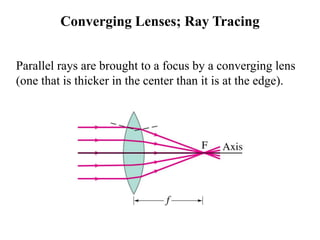
Converging Lenses; Ray Tracing
Parallel rays are brought to a focus by a converging lens
(one that is thicker in the center than it is at the edge).
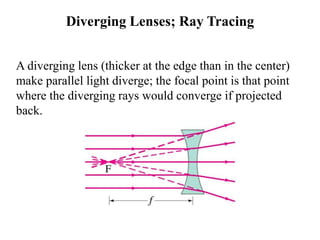
Diverging Lenses; Ray Tracing
A diverging lens (thicker at the edge than in the center)
make parallel light diverge; the focal point is that point
where the diverging rays would converge if projected
back.
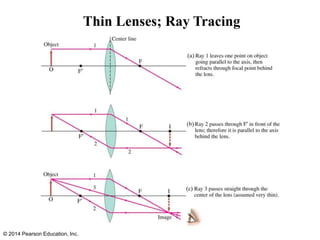
Thin Lenses; Ray Tracing
© 2014 Pearson Education, Inc.
Thin Lenses; Ray Tracing
For a diverging lens, we can use the same three rays; the
image is upright and virtual.
© 2014 Pearson Education, Inc.
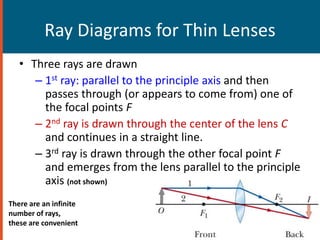
Ray Diagrams for Thin Lenses
• Three rays are drawn
– 1st ray: parallel to the principle axis and then
passes through (or appears to come from) one of
the focal points F
– 2nd ray is drawn through the center of the lens C
and continues in a straight line.
– 3rd ray is drawn through the other focal point F
and emerges from the lens parallel to the principle
axis (not shown)
There are an infinite
number of rays,
these are convenient
Ray Diagram Examples
• Note the changes in the image as the object
moves through the focal point
Ray Diagram for Converging Lens, p > f
• The image is real
• The image is inverted
• The image is
on the back
side of the lens
Ray Diagram for Converging Lens, p < f
• The image is virtual
• The image is upright
• The image is
on the front side
of the lens
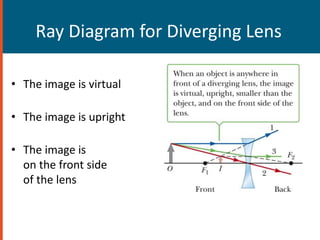
Ray Diagram for Diverging Lens
• The image is virtual
• The image is upright
• The image is
on the front side
of the lens
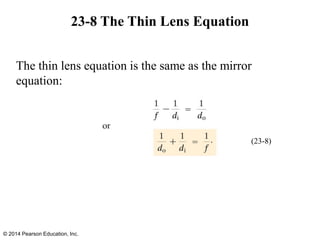
23-8 The Thin Lens Equation
The thin lens equation is the same as the mirror
equation:
© 2014 Pearson Education, Inc.
(23-8)
23-8 The Thin Lens Equation
The sign conventions are slightly different:
1. The focal length is positive for converging lenses and negative
for diverging.
2. The object distance is positive when the object is on the same
side as the light entering the lens (not an issue except in
compound systems); otherwise it is negative.
3. The image distance is positive if the image is on the opposite
side from the light entering the lens; otherwise it is negative.
4. The height of the image is positive if the image is upright and
negative otherwise.
© 2014 Pearson Education, Inc.
23-8 The Thin Lens Equation
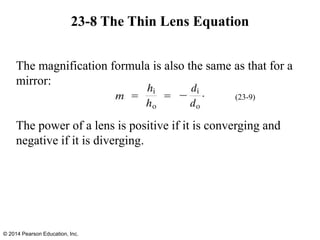
The magnification formula is also the same as that for a
mirror:
The power of a lens is positive if it is converging and
negative if it is diverging.
© 2014 Pearson Education, Inc.
(23-9)
23-8 The Thin Lens Equation
Problem Solving: Thin Lenses
1. Draw a ray diagram. The image is located where the
key rays intersect.
2. Solve for unknowns.
3. Follow the sign conventions.
4. Check that your answers are consistent with the ray
diagram.
© 2014 Pearson Education, Inc.
Summary
• A diverging lens spreads incoming rays so that they
appear to come from a point
• Power of a lens:
• Thin lens equation:
• Magnification:
© 2014 Pearson Education, Inc.

23_LectureOutline.pptx

  • 1.
    L4: Lenses Thin lensesare those whose thickness is small compared to their radius of curvature. They may be either converging (a) or diverging (b).
  • 2.
    Converging Lenses; RayTracing Parallel rays are brought to a focus by a converging lens (one that is thicker in the center than it is at the edge).
  • 3.
    Diverging Lenses; RayTracing A diverging lens (thicker at the edge than in the center) make parallel light diverge; the focal point is that point where the diverging rays would converge if projected back.
  • 4.
    Thin Lenses; RayTracing © 2014 Pearson Education, Inc.
  • 5.
    Thin Lenses; RayTracing For a diverging lens, we can use the same three rays; the image is upright and virtual. © 2014 Pearson Education, Inc.
  • 6.
    Ray Diagrams forThin Lenses • Three rays are drawn – 1st ray: parallel to the principle axis and then passes through (or appears to come from) one of the focal points F – 2nd ray is drawn through the center of the lens C and continues in a straight line. – 3rd ray is drawn through the other focal point F and emerges from the lens parallel to the principle axis (not shown) There are an infinite number of rays, these are convenient
  • 7.
    Ray Diagram Examples •Note the changes in the image as the object moves through the focal point
  • 8.
    Ray Diagram forConverging Lens, p > f • The image is real • The image is inverted • The image is on the back side of the lens
  • 9.
    Ray Diagram forConverging Lens, p < f • The image is virtual • The image is upright • The image is on the front side of the lens
  • 10.
    Ray Diagram forDiverging Lens • The image is virtual • The image is upright • The image is on the front side of the lens
  • 11.
    23-8 The ThinLens Equation The thin lens equation is the same as the mirror equation: © 2014 Pearson Education, Inc. (23-8)
  • 12.
    23-8 The ThinLens Equation The sign conventions are slightly different: 1. The focal length is positive for converging lenses and negative for diverging. 2. The object distance is positive when the object is on the same side as the light entering the lens (not an issue except in compound systems); otherwise it is negative. 3. The image distance is positive if the image is on the opposite side from the light entering the lens; otherwise it is negative. 4. The height of the image is positive if the image is upright and negative otherwise. © 2014 Pearson Education, Inc.
  • 13.
    23-8 The ThinLens Equation The magnification formula is also the same as that for a mirror: The power of a lens is positive if it is converging and negative if it is diverging. © 2014 Pearson Education, Inc. (23-9)
  • 14.
    23-8 The ThinLens Equation Problem Solving: Thin Lenses 1. Draw a ray diagram. The image is located where the key rays intersect. 2. Solve for unknowns. 3. Follow the sign conventions. 4. Check that your answers are consistent with the ray diagram. © 2014 Pearson Education, Inc.
  • 15.
    Summary • A diverginglens spreads incoming rays so that they appear to come from a point • Power of a lens: • Thin lens equation: • Magnification: © 2014 Pearson Education, Inc.