DOMAIN NAME
SERVICE
HOW DNS WORKS - OVERVIEW
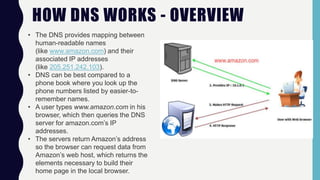
• The DNS provides mapping between
human-readable names
(like www.amazon.com) and their
associated IP addresses
(like 205.251.242.103).
• DNS can be best compared to a
phone book where you look up the
phone numbers listed by easier-to-
remember names.
• A user types www.amazon.com in his
browser, which then queries the DNS
server for amazon.com’s IP
addresses.
• The servers return Amazon’s address
so the browser can request data from
Amazon’s web host, which returns the
elements necessary to build their
home page in the local browser.
https://www.iana.org/assignments/as-numbers/as-numbers.xh
DOMAIN NAME SYSTEM TERMINOLOGY
• Domain Names
– A domain name is a human-readable name—like amazon.com—that we type in a web browser URL field.
– The Internet Corporation for Assigned Names and Numbers (IANN) manages these domain names
• Top-Level Domains (TLD)
– TLD refers to the last part of a domain name.
– For example, the .com in amazon.com is the Top Level Domain.
– The most common TLDs include .com, .net, org, and .info.
– Country code TLDs represent specific geographic locations. For example: .in represents India. Here are
some more examples:
• com – Commercial businesses.
• gov – U.S. government agencies.
• edu – Educational institutions such as universities.
• org – Organizations (mostly non-profit).
• mil – Military.
• net – Network organizations.
• eu – European Union.
DOMAIN NAME SYSTEM
Second Level Domain
• This is the part of a domain name which
comes right before the TLD—amazon.com—
for example.
Sub Domain
• A subdomain can be created to identify unique
content areas of a web site. For example, the
aws of aws.amazon.com.
Domain Name Registrar
• By managing domain name reservations,
name registrars are critical to how DNS works.
• ICANN currently grants permission to
organizations to act as domain name
registrars for specific higher level domains.
Name Server
• Like a phone book, the name server is
a collection of domain names matched to IP
addresses.
DOMAIN NAME SYSTEM
RECORD TYPES
A Record - Address record
– A Records map server IP addresses to domain names. For example, 72.21.206.6 to
amazon.com.
CNAME - Canonical Name record
– A CNAME record establishes one domain as an alias to another (thereby routing all traffic
addressed to the alias to the target; the canonical address).
Alias Record
– Like a CNAME record, Alias records can be used to map one address to another. But Aliases can
coexist with other records using the same name.
MX Record - Mail Exchange Record
– These records will redirect a domain’s email to the servers hosting the domain’s user accounts.
Mail exchange records are used for determining the priority of email servers for a domain.
DOMAIN NAME RESOLUTION
HOW DNS WORKS – IN DETAIL
• When a user types a human-readable address into the browser, the operating system’s
DNS client will check for information in a local cache.
• If the requested address isn’t there, it will look for a Domain Name System server in the
local area network (LAN).
• When the local DNS server receives the query, and the requested domain name is found,
it will return the result.
• If the name is not found, the local server will forward the query to a DNS cache server,
often provided by the Internet Service Provider (ISP).
• Since the DNS server’s cache contains a temporary store of DNS records, it will quickly
respond to requests.
• These DNS cache servers are called not authoritative DNS servers as they provide
request resolution based in a cached value acquired from authoritative DNS servers.
https://www.iana.org/domains/idn-
tables
REFERENCES
• https://cloudacademy.com/blog/how-dns-works/
• https://www.cloudflare.com/learning/dns/glossary/dns-zone/

2.2 DNS.pptx

  • 1.
  • 2.
    HOW DNS WORKS- OVERVIEW • The DNS provides mapping between human-readable names (like www.amazon.com) and their associated IP addresses (like 205.251.242.103). • DNS can be best compared to a phone book where you look up the phone numbers listed by easier-to- remember names. • A user types www.amazon.com in his browser, which then queries the DNS server for amazon.com’s IP addresses. • The servers return Amazon’s address so the browser can request data from Amazon’s web host, which returns the elements necessary to build their home page in the local browser.
  • 3.
  • 5.
    DOMAIN NAME SYSTEMTERMINOLOGY • Domain Names – A domain name is a human-readable name—like amazon.com—that we type in a web browser URL field. – The Internet Corporation for Assigned Names and Numbers (IANN) manages these domain names • Top-Level Domains (TLD) – TLD refers to the last part of a domain name. – For example, the .com in amazon.com is the Top Level Domain. – The most common TLDs include .com, .net, org, and .info. – Country code TLDs represent specific geographic locations. For example: .in represents India. Here are some more examples: • com – Commercial businesses. • gov – U.S. government agencies. • edu – Educational institutions such as universities. • org – Organizations (mostly non-profit). • mil – Military. • net – Network organizations. • eu – European Union.
  • 6.
    DOMAIN NAME SYSTEM SecondLevel Domain • This is the part of a domain name which comes right before the TLD—amazon.com— for example. Sub Domain • A subdomain can be created to identify unique content areas of a web site. For example, the aws of aws.amazon.com. Domain Name Registrar • By managing domain name reservations, name registrars are critical to how DNS works. • ICANN currently grants permission to organizations to act as domain name registrars for specific higher level domains. Name Server • Like a phone book, the name server is a collection of domain names matched to IP addresses.
  • 7.
    DOMAIN NAME SYSTEM RECORDTYPES A Record - Address record – A Records map server IP addresses to domain names. For example, 72.21.206.6 to amazon.com. CNAME - Canonical Name record – A CNAME record establishes one domain as an alias to another (thereby routing all traffic addressed to the alias to the target; the canonical address). Alias Record – Like a CNAME record, Alias records can be used to map one address to another. But Aliases can coexist with other records using the same name. MX Record - Mail Exchange Record – These records will redirect a domain’s email to the servers hosting the domain’s user accounts. Mail exchange records are used for determining the priority of email servers for a domain.
  • 8.
  • 9.
    HOW DNS WORKS– IN DETAIL • When a user types a human-readable address into the browser, the operating system’s DNS client will check for information in a local cache. • If the requested address isn’t there, it will look for a Domain Name System server in the local area network (LAN). • When the local DNS server receives the query, and the requested domain name is found, it will return the result. • If the name is not found, the local server will forward the query to a DNS cache server, often provided by the Internet Service Provider (ISP). • Since the DNS server’s cache contains a temporary store of DNS records, it will quickly respond to requests. • These DNS cache servers are called not authoritative DNS servers as they provide request resolution based in a cached value acquired from authoritative DNS servers. https://www.iana.org/domains/idn- tables
  • 10.