21st
CENTURY SKILL
CATEGORIES
t
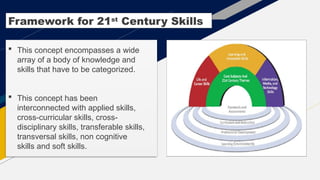
 This concept encompasses a wide
array of a body of knowledge and
skills that have to be categorized.
 This concept has been
interconnected with applied skills,
cross-curricular skills, cross-
disciplinary skills, transferable skills,
transversal skills, non cognitive
skills and soft skills.
Framework for 21st
Century Skills
Add a footer
FR
3
• The 21st
century skills is grounded on the belief that
students must be educated in a more relevant, useful,
in-demand and universally applicable manner.
• Students need to be taught different skills and reflect
on the specific demands.
• 21st
century education addresses the whole child or
the whole person.
Add a footer
FR
4
SEVEN SURVIVAL SKILLS
- Tony Wagner, The Global Achievement Gap
1. Critical Thinking and problem solving
2. Collaboration across networks and leading by influence
3. Agility and Adaptability
4. Initiative and Entrepreneurialism
5. Effective oral and written communication
6. Accessing and analyzing information
7. Curiosity and imagination
Add a footer 5
FR
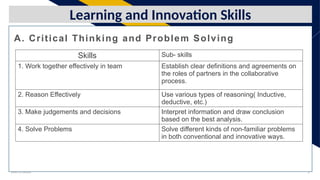
A. Critical Thinking and Problem Solving
Learning and Innovation Skills
Skills Sub- skills
1. Work together effectively in team Establish clear definitions and agreements on
the roles of partners in the collaborative
process.
2. Reason Effectively Use various types of reasoning( Inductive,
deductive, etc.)
3. Make judgements and decisions Interpret information and draw conclusion
based on the best analysis.
4. Solve Problems Solve different kinds of non-familiar problems
in both conventional and innovative ways.
Add a footer 6
FR
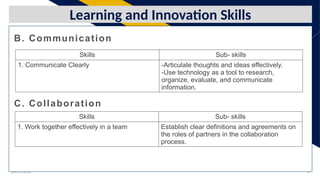
B. Communication
Learning and Innovation Skills
Skills Sub- skills
1. Communicate Clearly -Articulate thoughts and ideas effectively.
-Use technology as a tool to research,
organize, evaluate, and communicate
information.
C. Collaboration
Skills Sub- skills
1. Work together effectively in a team Establish clear definitions and agreements on
the roles of partners in the collaboration
process.
Add a footer 7
FR
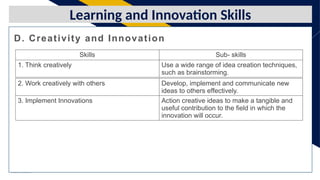
D. Creativity and Innovation
Learning and Innovation Skills
Skills Sub- skills
1. Think creatively Use a wide range of idea creation techniques,
such as brainstorming.
2. Work creatively with others Develop, implement and communicate new
ideas to others effectively.
3. Implement Innovations Action creative ideas to make a tangible and
useful contribution to the field in which the
innovation will occur.
Add a footer 8
INFORMATION, MEDIA
AND TECHNOLOGY SKILLS
Add a footer 9
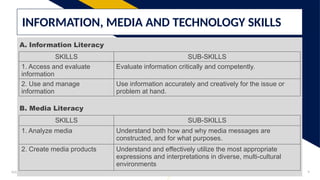
INFORMATION, MEDIA AND TECHNOLOGY SKILLS
SKILLS SUB-SKILLS
1. Access and evaluate
information
Evaluate information critically and competently.
2. Use and manage
information
Use information accurately and creatively for the issue or
problem at hand.
A. Information Literacy
B. Media Literacy
SKILLS SUB-SKILLS
1. Analyze media Understand both how and why media messages are
constructed, and for what purposes.
2. Create media products Understand and effectively utilize the most appropriate
expressions and interpretations in diverse, multi-cultural
environments
Add a footer 10
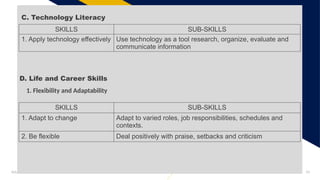
SKILLS SUB-SKILLS
1. Apply technology effectively Use technology as a tool research, organize, evaluate and
communicate information
C. Technology Literacy
D. Life and Career Skills
1. Flexibility and Adaptability
SKILLS SUB-SKILLS
1. Adapt to change Adapt to varied roles, job responsibilities, schedules and
contexts.
2. Be flexible Deal positively with praise, setbacks and criticism
Add a footer 11
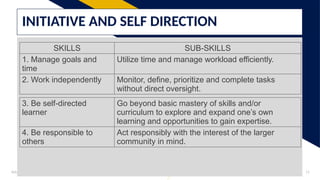
INITIATIVE AND SELF DIRECTION
SKILLS SUB-SKILLS
1. Manage goals and
time
Utilize time and manage workload efficiently.
2. Work independently Monitor, define, prioritize and complete tasks
without direct oversight.
3. Be self-directed
learner
Go beyond basic mastery of skills and/or
curriculum to explore and expand one’s own
learning and opportunities to gain expertise.
4. Be responsible to
others
Act responsibly with the interest of the larger
community in mind.
Add a footer 12
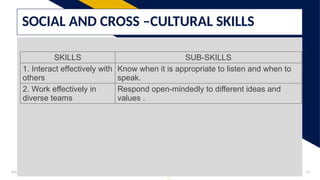
SOCIAL AND CROSS –CULTURAL SKILLS
SKILLS SUB-SKILLS
1. Interact effectively with
others
Know when it is appropriate to listen and when to
speak.
2. Work effectively in
diverse teams
Respond open-mindedly to different ideas and
values .
Add a footer 13
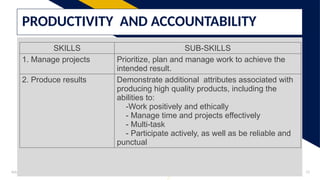
PRODUCTIVITY AND ACCOUNTABILITY
SKILLS SUB-SKILLS
1. Manage projects Prioritize, plan and manage work to achieve the
intended result.
2. Produce results Demonstrate additional attributes associated with
producing high quality products, including the
abilities to:
-Work positively and ethically
- Manage time and projects effectively
- Multi-task
- Participate actively, as well as be reliable and
punctual
Add a footer 14
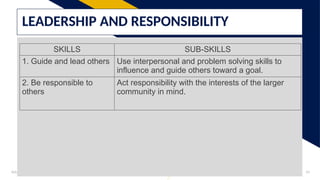
LEADERSHIP AND RESPONSIBILITY
SKILLS SUB-SKILLS
1. Guide and lead others Use interpersonal and problem solving skills to
influence and guide others toward a goal.
2. Be responsible to
others
Act responsibility with the interests of the larger
community in mind.
FR
Add a footer 15
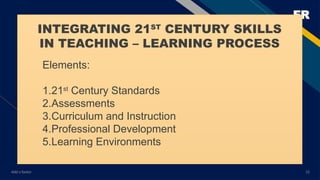
INTEGRATING 21ST
CENTURY SKILLS
IN TEACHING – LEARNING PROCESS
Elements:
1.21st
Century Standards
2.Assessments
3.Curriculum and Instruction
4.Professional Development
5.Learning Environments
FR
Add a footer 16
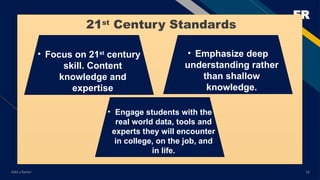
• Focus on 21st
century
skill. Content
knowledge and
expertise
• Emphasize deep
understanding rather
than shallow
knowledge.
• Engage students with the
real world data, tools and
experts they will encounter
in college, on the job, and
in life.
21st
Century Standards
FR
Add a footer 17
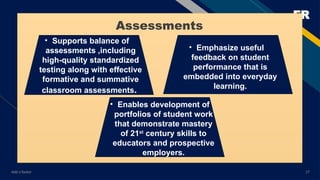
• Supports balance of
assessments ,including
high-quality standardized
testing along with effective
formative and summative
classroom assessments.
• Emphasize useful
feedback on student
performance that is
embedded into everyday
learning.
• Enables development of
portfolios of student work
that demonstrate mastery
of 21st
century skills to
educators and prospective
employers.
Assessments
FR
Add a footer 18
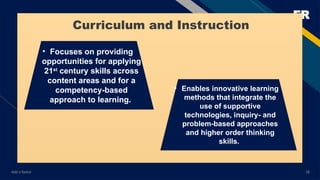
• Focuses on providing
opportunities for applying
21st
century skills across
content areas and for a
competency-based
approach to learning.
• Enables innovative learning
methods that integrate the
use of supportive
technologies, inquiry- and
problem-based approaches
and higher order thinking
skills.
Curriculum and Instruction
FR
Add a footer 19
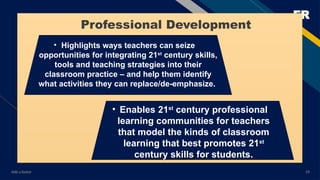
• Highlights ways teachers can seize
opportunities for integrating 21st
century skills,
tools and teaching strategies into their
classroom practice – and help them identify
what activities they can replace/de-emphasize.
• Enables 21st
century professional
learning communities for teachers
that model the kinds of classroom
learning that best promotes 21st
century skills for students.
Professional Development
FR
Add a footer 20
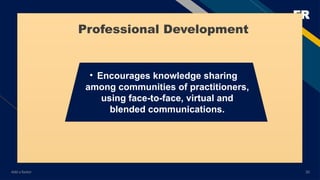
• Encourages knowledge sharing
among communities of practitioners,
using face-to-face, virtual and
blended communications.
Professional Development
FR
Add a footer 21
• Support professional learning
communities that enable educators to
collaborate , share best practices and
integrate 21st
century skills into classroom
practice.
Learning Environments
FR
Add a footer 22
IMPLICATIONS TO PRE-SERVICE
TEACHER PREPARATION
An effective 21st
century skills approach to curriculum is
designed for understanding. The program curriculum will
be most beneficial to pre-service teachers if it is design
to produced deep understanding and authentic
application of 21st
century skills in all subject areas.
FR
Add a footer 23
A. Instructional Models
1. Integrating “teach for understanding principles”
2. Creating rich practice teaching experiences
3. Creating dynamic learning communities and peer
mentoring networks
4. Examining the role content, pedagogy, and technologies
in developing higher-order thinking skills
B. Learning Environments
C. Partnerships
D. Continuous Improvements
FR
Add a footer 24
To Succeed in life and in their future
career , students must engage
themselves with learning and
innovation skills, information, media
and technology skills, life and
career skills, and social and cross-
cultural skills.
FR
Add a footer 25
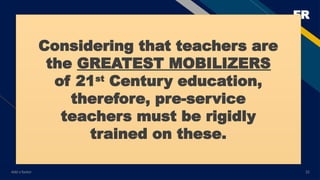
Considering that teachers are
the GREATEST MOBILIZERS
of 21st
Century education,
therefore, pre-service
teachers must be rigidly
trained on these.
FR
Add a footer 26
THANK YOU FOR
LISTENING!

21st-CENTURY-SKILL-CATEGORIES-REPORT.pptx

  • 1.
  • 2.
    t  This conceptencompasses a wide array of a body of knowledge and skills that have to be categorized.  This concept has been interconnected with applied skills, cross-curricular skills, cross- disciplinary skills, transferable skills, transversal skills, non cognitive skills and soft skills. Framework for 21st Century Skills
  • 3.
    Add a footer FR 3 •The 21st century skills is grounded on the belief that students must be educated in a more relevant, useful, in-demand and universally applicable manner. • Students need to be taught different skills and reflect on the specific demands. • 21st century education addresses the whole child or the whole person.
  • 4.
    Add a footer FR 4 SEVENSURVIVAL SKILLS - Tony Wagner, The Global Achievement Gap 1. Critical Thinking and problem solving 2. Collaboration across networks and leading by influence 3. Agility and Adaptability 4. Initiative and Entrepreneurialism 5. Effective oral and written communication 6. Accessing and analyzing information 7. Curiosity and imagination
  • 5.
    Add a footer5 FR A. Critical Thinking and Problem Solving Learning and Innovation Skills Skills Sub- skills 1. Work together effectively in team Establish clear definitions and agreements on the roles of partners in the collaborative process. 2. Reason Effectively Use various types of reasoning( Inductive, deductive, etc.) 3. Make judgements and decisions Interpret information and draw conclusion based on the best analysis. 4. Solve Problems Solve different kinds of non-familiar problems in both conventional and innovative ways.
  • 6.
    Add a footer6 FR B. Communication Learning and Innovation Skills Skills Sub- skills 1. Communicate Clearly -Articulate thoughts and ideas effectively. -Use technology as a tool to research, organize, evaluate, and communicate information. C. Collaboration Skills Sub- skills 1. Work together effectively in a team Establish clear definitions and agreements on the roles of partners in the collaboration process.
  • 7.
    Add a footer7 FR D. Creativity and Innovation Learning and Innovation Skills Skills Sub- skills 1. Think creatively Use a wide range of idea creation techniques, such as brainstorming. 2. Work creatively with others Develop, implement and communicate new ideas to others effectively. 3. Implement Innovations Action creative ideas to make a tangible and useful contribution to the field in which the innovation will occur.
  • 8.
    Add a footer8 INFORMATION, MEDIA AND TECHNOLOGY SKILLS
  • 9.
    Add a footer9 INFORMATION, MEDIA AND TECHNOLOGY SKILLS SKILLS SUB-SKILLS 1. Access and evaluate information Evaluate information critically and competently. 2. Use and manage information Use information accurately and creatively for the issue or problem at hand. A. Information Literacy B. Media Literacy SKILLS SUB-SKILLS 1. Analyze media Understand both how and why media messages are constructed, and for what purposes. 2. Create media products Understand and effectively utilize the most appropriate expressions and interpretations in diverse, multi-cultural environments
  • 10.
    Add a footer10 SKILLS SUB-SKILLS 1. Apply technology effectively Use technology as a tool research, organize, evaluate and communicate information C. Technology Literacy D. Life and Career Skills 1. Flexibility and Adaptability SKILLS SUB-SKILLS 1. Adapt to change Adapt to varied roles, job responsibilities, schedules and contexts. 2. Be flexible Deal positively with praise, setbacks and criticism
  • 11.
    Add a footer11 INITIATIVE AND SELF DIRECTION SKILLS SUB-SKILLS 1. Manage goals and time Utilize time and manage workload efficiently. 2. Work independently Monitor, define, prioritize and complete tasks without direct oversight. 3. Be self-directed learner Go beyond basic mastery of skills and/or curriculum to explore and expand one’s own learning and opportunities to gain expertise. 4. Be responsible to others Act responsibly with the interest of the larger community in mind.
  • 12.
    Add a footer12 SOCIAL AND CROSS –CULTURAL SKILLS SKILLS SUB-SKILLS 1. Interact effectively with others Know when it is appropriate to listen and when to speak. 2. Work effectively in diverse teams Respond open-mindedly to different ideas and values .
  • 13.
    Add a footer13 PRODUCTIVITY AND ACCOUNTABILITY SKILLS SUB-SKILLS 1. Manage projects Prioritize, plan and manage work to achieve the intended result. 2. Produce results Demonstrate additional attributes associated with producing high quality products, including the abilities to: -Work positively and ethically - Manage time and projects effectively - Multi-task - Participate actively, as well as be reliable and punctual
  • 14.
    Add a footer14 LEADERSHIP AND RESPONSIBILITY SKILLS SUB-SKILLS 1. Guide and lead others Use interpersonal and problem solving skills to influence and guide others toward a goal. 2. Be responsible to others Act responsibility with the interests of the larger community in mind.
  • 15.
    FR Add a footer15 INTEGRATING 21ST CENTURY SKILLS IN TEACHING – LEARNING PROCESS Elements: 1.21st Century Standards 2.Assessments 3.Curriculum and Instruction 4.Professional Development 5.Learning Environments
  • 16.
    FR Add a footer16 • Focus on 21st century skill. Content knowledge and expertise • Emphasize deep understanding rather than shallow knowledge. • Engage students with the real world data, tools and experts they will encounter in college, on the job, and in life. 21st Century Standards
  • 17.
    FR Add a footer17 • Supports balance of assessments ,including high-quality standardized testing along with effective formative and summative classroom assessments. • Emphasize useful feedback on student performance that is embedded into everyday learning. • Enables development of portfolios of student work that demonstrate mastery of 21st century skills to educators and prospective employers. Assessments
  • 18.
    FR Add a footer18 • Focuses on providing opportunities for applying 21st century skills across content areas and for a competency-based approach to learning. • Enables innovative learning methods that integrate the use of supportive technologies, inquiry- and problem-based approaches and higher order thinking skills. Curriculum and Instruction
  • 19.
    FR Add a footer19 • Highlights ways teachers can seize opportunities for integrating 21st century skills, tools and teaching strategies into their classroom practice – and help them identify what activities they can replace/de-emphasize. • Enables 21st century professional learning communities for teachers that model the kinds of classroom learning that best promotes 21st century skills for students. Professional Development
  • 20.
    FR Add a footer20 • Encourages knowledge sharing among communities of practitioners, using face-to-face, virtual and blended communications. Professional Development
  • 21.
    FR Add a footer21 • Support professional learning communities that enable educators to collaborate , share best practices and integrate 21st century skills into classroom practice. Learning Environments
  • 22.
    FR Add a footer22 IMPLICATIONS TO PRE-SERVICE TEACHER PREPARATION An effective 21st century skills approach to curriculum is designed for understanding. The program curriculum will be most beneficial to pre-service teachers if it is design to produced deep understanding and authentic application of 21st century skills in all subject areas.
  • 23.
    FR Add a footer23 A. Instructional Models 1. Integrating “teach for understanding principles” 2. Creating rich practice teaching experiences 3. Creating dynamic learning communities and peer mentoring networks 4. Examining the role content, pedagogy, and technologies in developing higher-order thinking skills B. Learning Environments C. Partnerships D. Continuous Improvements
  • 24.
    FR Add a footer24 To Succeed in life and in their future career , students must engage themselves with learning and innovation skills, information, media and technology skills, life and career skills, and social and cross- cultural skills.
  • 25.
    FR Add a footer25 Considering that teachers are the GREATEST MOBILIZERS of 21st Century education, therefore, pre-service teachers must be rigidly trained on these.
  • 26.
    FR Add a footer26 THANK YOU FOR LISTENING!