1 OOAD/ UNIT-IV
PEC / CSE
UNIT IV - DESIGN PATTERNS
GRASP: Designing objects with responsibilities – Creator – Information expert – Low
Coupling – High Cohesion – Controller Design Patterns – creational – factory method –
structural – Bridge – Adapter – behavioural – Strategy – observer –Applying GoF design
patterns – Mapping design to code
PANIMALAR ENGINEERING COLLEGE
DEPARTMENT OF CSE
21CS1501 - OBJECT ORIENTED ANALYSIS AND DESIGN
4.1 INTRODUCTION
 One way to describe object design “After identifying your requirements and creating
a domain model, then add methods to the software classes, and define the messaging
between the objects to fulfill the requirements”
 Not really- Answer the following questions:
o What methods belong to where?
o How the objects should interact?
 GRASP as Methodical Approach to Learning Basic Object Design
UML versus Design Principles
 The UML is simply a standard visual modeling language, knowing its details
doesn’t teach you how to think in objects – that is the theme of this course
 The critical design tool for software development is a mind well educated in design
principles. It is not the UML or any other technology
Object Design
After the requirements identification, add the methods to the classes and define the message
between the objects. The designing of object starts with
 Inputs
 Activities
 Outputs
Inputs to object design
 Use case model
 Domain Model
 System Sequence Diagrams
 Operation Contracts
PEC / CSE OOAD/ UNIT-IV
2
 Supplementary Specification
Activities of object design
 Dynamic and static modeling (draw both interaction and complementary
class diagrams)
 Applying various OOD principles
o GRASP- General Responsibility Assignment Software Patterns
o GoF (Gang of Four)design patterns
o Responsibility-Driven Design (RDD)
Outputs of object design
 Modeling for the difficult part of the design that we wished to explore before coding
 Specifically for object design,
o UML Interaction diagrams
o Class diagrams
o Package diagrams
 UI sketches and prototypes
 Database models Report sketches and prototypes
4.2 RDD
 RDD is a general metaphor for thinking about OO software design.
 Thinking of software objects as having responsibilities an abstraction of what
they do. Responsibility means a contract or obligation of a classifier.
 RDD is a general metaphor for thinking about object oriented design.
Responsibilities are related to the obligation of an object in terms of its behavior
o what an object should know?
o what an object should do?
Responsibilities is of two types : Doing , Knowing
1. Knowing responsibilities:
o knowing about private encapsulated data
o knowing about related objects
o knowing about things it can derive or calculate
2. Doing responsibilities:
a. doing something itself, such as creating an object or doing a calculation
b. initiating action in other objects
c. controlling and coordinating activities in other objects.
What's the Connection Between Responsibilities, GRASP, and UML Diagrams?
PEC / CSE OOAD/ UNIT-IV
3
assigning responsibilities to objects while coding or while modeling. Within the UML,
drawing interaction diagrams becomes the occasion for considering these responsibilities.
Responsibilities are implemented using methods
What are Patterns?
A pattern is a named description of a problem and solution that can be applied to new
contexts; ideally, a pattern advises us on how to apply its solution in varying circumstances
and considers the forces and trade-offs.
Many patterns, given a specific category of problem, guide the assignment of
responsibilities to objects.
Example : The format is
Pattern Name : Information Expert
Problem : What is a basic principle by which to assign responsibilities to objects?
Solution : Assign a responsibility to the class that has the information needed to
fulfill it.
4.3 APPLYING GRASP TO OBJECT DESIGN
GRASP stands for “General Responsibility Assignment Software Patterns”
 It is a Learning Aid for OO Design with Responsibilities. This approach to
understanding and using design principles is based on patterns of assigning
responsibilities.
 We can apply the GRASP principles while drawing UML interaction diagrams, and
also while coding where we deciding on responsibly assignments.
 GRASP defines nine basic OO design principles or basic building blocks in
design.
 They are
1. Information Expert
2. Creator
3. Controller
4. Low Coupling
5. High Cohesion
6. Polymorphism
7. Pure Fabrication
8. Indirection
9.Protected Variations.
PEC / CSE OOAD/ UNIT-IV
4
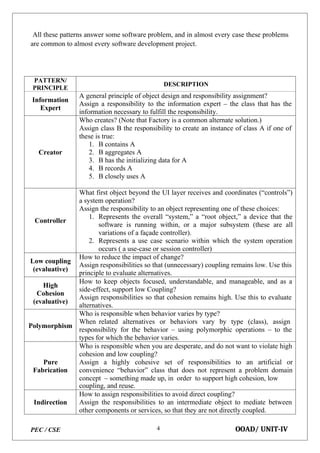
All these patterns answer some software problem, and in almost every case these problems
are common to almost every software development project.
PATTERN/
PRINCIPLE
DESCRIPTION
Information
Expert
A general principle of object design and responsibility assignment?
Assign a responsibility to the information expert – the class that has the
information necessary to fulfill the responsibility.
Creator
Who creates? (Note that Factory is a common alternate solution.)
Assign class B the responsibility to create an instance of class A if one of
these is true:
1. B contains A
2. B aggregates A
3. B has the initializing data for A
4. B records A
5. B closely uses A
Controller
What first object beyond the UI layer receives and coordinates (“controls”)
a system operation?
Assign the responsibility to an object representing one of these choices:
1. Represents the overall “system,” a “root object,” a device that the
software is running within, or a major subsystem (these are all
variations of a façade controller).
2. Represents a use case scenario within which the system operation
occurs ( a use-case or session controller)
Low coupling
(evaluative)
How to reduce the impact of change?
Assign responsibilities so that (unnecessary) coupling remains low. Use this
principle to evaluate alternatives.
High
Cohesion
(evaluative)
How to keep objects focused, understandable, and manageable, and as a
side-effect, support low Coupling?
Assign responsibilities so that cohesion remains high. Use this to evaluate
alternatives.
Polymorphism
Who is responsible when behavior varies by type?
When related alternatives or behaviors vary by type (class), assign
responsibility for the behavior – using polymorphic operations – to the
types for which the behavior varies.
Pure
Fabrication
Who is responsible when you are desperate, and do not want to violate high
cohesion and low coupling?
Assign a highly cohesive set of responsibilities to an artificial or
convenience “behavior” class that does not represent a problem domain
concept – something made up, in order to support high cohesion, low
coupling, and reuse.
Indirection
How to assign responsibilities to avoid direct coupling?
Assign the responsibilities to an intermediate object to mediate between
other components or services, so that they are not directly coupled.
PEC / CSE OOAD/ UNIT-IV
5
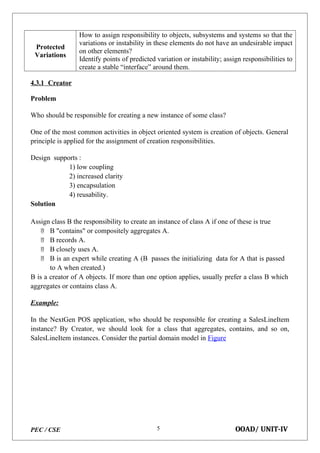
Protected
Variations
How to assign responsibility to objects, subsystems and systems so that the
variations or instability in these elements do not have an undesirable impact
on other elements?
Identify points of predicted variation or instability; assign responsibilities to
create a stable “interface” around them.
4.3.1 Creator
Problem
Who should be responsible for creating a new instance of some class?
One of the most common activities in object oriented system is creation of objects. General
principle is applied for the assignment of creation responsibilities.
Design supports :
1) low coupling
2) increased clarity
3) encapsulation
4) reusability.
Solution
Assign class B the responsibility to create an instance of class A if one of these is true
 B "contains" or compositely aggregates A.
 B records A.
 B closely uses A.
 B is an expert while creating A (B passes the initializing data for A that is passed
to A when created.)
B is a creator of A objects. If more than one option applies, usually prefer a class B which
aggregates or contains class A.
Example:
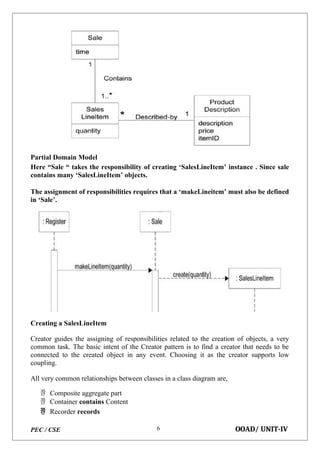
In the NextGen POS application, who should be responsible for creating a SalesLineItem
instance? By Creator, we should look for a class that aggregates, contains, and so on,
SalesLineItem instances. Consider the partial domain model in Figure
PEC / CSE OOAD/ UNIT-IV
6
Partial Domain Model
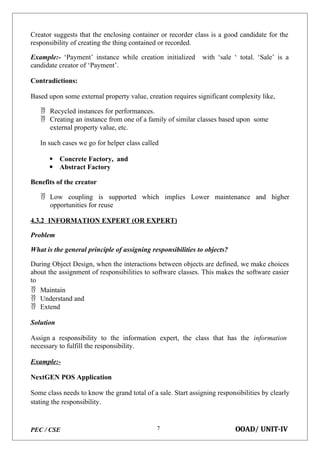
Here “Sale “ takes the responsibility of creating ‘SalesLineItem’ instance . Since sale
contains many ‘SalesLineItem’ objects.
The assignment of responsibilities requires that a ‘makeLineitem’ must also be defined
in ‘Sale’.
Creating a SalesLineItem
Creator guides the assigning of responsibilities related to the creation of objects, a very
common task. The basic intent of the Creator pattern is to find a creator that needs to be
connected to the created object in any event. Choosing it as the creator supports low
coupling.
All very common relationships between classes in a class diagram are,
 Composite aggregate part
 Container contains Content
 Recorder records
PEC / CSE OOAD/ UNIT-IV
7
Creator suggests that the enclosing container or recorder class is a good candidate for the
responsibility of creating the thing contained or recorded.
Example:- ‘Payment’ instance while creation initialized with ‘sale ‘ total. ‘Sale’ is a
candidate creator of ‘Payment’.
Contradictions:
Based upon some external property value, creation requires significant complexity like,
 Recycled instances for performances.
 Creating an instance from one of a family of similar classes based upon some
external property value, etc.
In such cases we go for helper class called
 Concrete Factory, and
 Abstract Factory
Benefits of the creator
 Low coupling is supported which implies Lower maintenance and higher
opportunities for reuse
4.3.2 INFORMATION EXPERT (OR EXPERT)
Problem
What is the general principle of assigning responsibilities to objects?
During Object Design, when the interactions between objects are defined, we make choices
about the assignment of responsibilities to software classes. This makes the software easier
to
 Maintain
 Understand and
 Extend
Solution
Assign a responsibility to the information expert, the class that has the information
necessary to fulfill the responsibility.
Example:-
NextGEN POS Application
Some class needs to know the grand total of a sale. Start assigning responsibilities by clearly
stating the responsibility.
PEC / CSE OOAD/ UNIT-IV
8
1. Look at relevant classes in the Design Model if available,
2. Otherwise, look in the Domain Model
Example:-
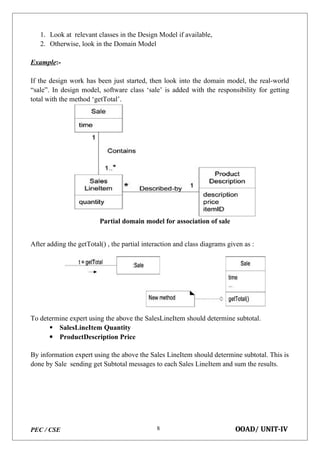
If the design work has been just started, then look into the domain model, the real-world
“sale”. In design model, software class ‘sale’ is added with the responsibility for getting
total with the method ‘getTotal’.
Partial domain model for association of sale
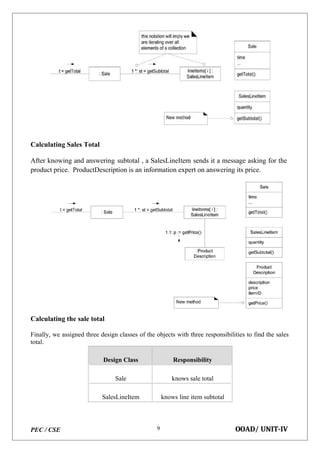
After adding the getTotal() , the partial interaction and class diagrams given as :
To determine expert using the above the SalesLineItem should determine subtotal.
 SalesLineItem Quantity
 ProductDescription Price
By information expert using the above the Sales LineItem should determine subtotal. This is
done by Sale sending get Subtotal messages to each Sales LineItem and sum the results.
PEC / CSE OOAD/ UNIT-IV
9
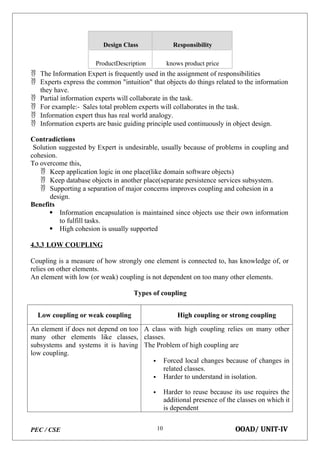
Calculating Sales Total
After knowing and answering subtotal , a SalesLineItem sends it a message asking for the
product price. ProductDescription is an information expert on answering its price.
Calculating the sale total
Finally, we assigned three design classes of the objects with three responsibilities to find the sales
total.
Design Class Responsibility
Sale knows sale total
SalesLineItem knows line item subtotal
PEC / CSE OOAD/ UNIT-IV
10
Design Class Responsibility
ProductDescription knows product price
 The Information Expert is frequently used in the assignment of responsibilities
 Experts express the common "intuition" that objects do things related to the information
they have.
 Partial information experts will collaborate in the task.
 For example:- Sales total problem experts will collaborates in the task.
 Information expert thus has real world analogy.
 Information experts are basic guiding principle used continuously in object design.
Contradictions
Solution suggested by Expert is undesirable, usually because of problems in coupling and
cohesion.
To overcome this,
 Keep application logic in one place(like domain software objects)
 Keep database objects in another place(separate persistence services subsystem.
 Supporting a separation of major concerns improves coupling and cohesion in a
design.
Benefits
 Information encapsulation is maintained since objects use their own information
to fulfill tasks.
 High cohesion is usually supported
4.3.3 LOW COUPLING
Coupling is a measure of how strongly one element is connected to, has knowledge of, or
relies on other elements.
An element with low (or weak) coupling is not dependent on too many other elements.
Types of coupling
Low coupling or weak coupling High coupling or strong coupling
An element if does not depend on too
many other elements like classes,
subsystems and systems it is having
low coupling.
A class with high coupling relies on many other
classes.
The Problem of high coupling are
 Forced local changes because of changes in
related classes.
 Harder to understand in isolation.
 Harder to reuse because its use requires the
additional presence of the classes on which it
is dependent
PEC / CSE OOAD/ UNIT-IV
11
Problem :
How to support low dependency, low change impact, and increased reuse?
Solution :
Assign a responsibility so that coupling remains low. Use this principle to evaluate
alternatives.
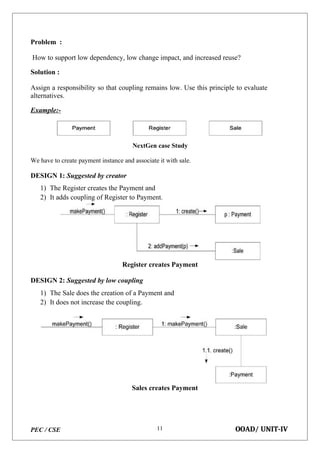
Example:-
NextGen case Study
We have to create payment instance and associate it with sale.
DESIGN 1: Suggested by creator
1) The Register creates the Payment and
2) It adds coupling of Register to Payment.
Register creates Payment
DESIGN 2: Suggested by low coupling
1) The Sale does the creation of a Payment and
2) It does not increase the coupling.
Sales creates Payment
PEC / CSE OOAD/ UNIT-IV
12
Low coupling is an evaluation principle for evaluating all designs decisions. In object-
oriented languages such as C++, Java, and C#, common forms of coupling from TypeX to
TypeY include the following:
 TypeX has an attribute (data member or instance variable) that refers to a TypeY
instance, or TypeY itself.
 A TypeX object calls on services of a TypeY object.
 TypeX has a method that references an instance of TypeY, or TypeY itself, by any
means. These typically include a parameter or local variable of type TypeY, or the
object returned from a message being an instance of TypeY.
 TypeX is a direct or indirect subclass of TypeY.
 TypeY is an interface, and TypeX implements that interface.
Contradictions
High coupling to stable elements and to pervasive elements is a problem. For example, a
J2EE application can safely couple itself to the Java libraries
Benefits
 Not affected by changes in other components
 Simple to understand in isolation
 Convenient to reuse
4.3.4 CONTROLLER
Problem
What first object beyond the UI layer receives and coordinates ("controls") a system
operation?
System operations were first explored during the analysis of SSD. These are the major input
events upon our system.
Example:-
1) When a cashier using a POS terminal presses the "End Sale" button indicating “sale has
ended”.
2) When a writer using a word processor presses the "spell check" button to perform
checking of spelling.
A controller is the first object beyond the User Interface (UI) layer that is responsible for
receiving or handling a system operation message.
PEC / CSE OOAD/ UNIT-IV
13
Solution
Assign the responsibility to one of the following
 Represents the overall "system," a "root object,"
- These are all variations of a facade controller.
 Represents a use case scenario called
- <UseCaseName>Handler,
- <UseCaseName>Coordinator, or
- <UseCaseName>Session
o Use the same controller class for all system events in the same use case
scenario.
o Informally, a session is an instance of a conversation with an actor.
Sessions can be of any length but are often organized in terms of use cases
(use case sessions)
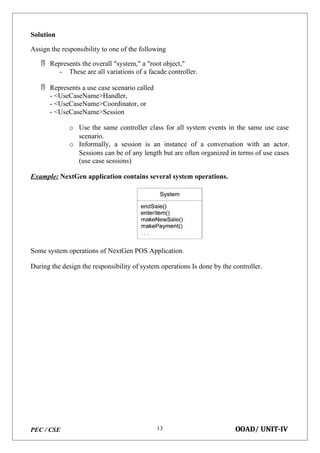
Example: NextGen application contains several system operations.
Some system operations of NextGen POS Application.
During the design the responsibility of system operations Is done by the controller.
PEC / CSE OOAD/ UNIT-IV
14
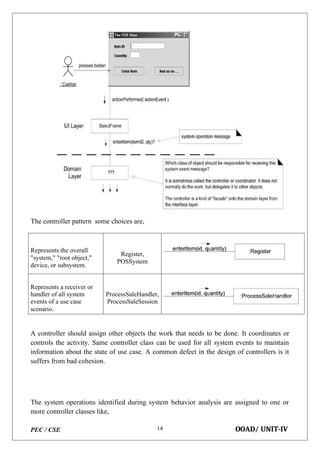
The controller pattern some choices are,
Represents the overall
"system," "root object,"
device, or subsystem.
Register,
POSSystem
Represents a receiver or
handler of all system ProcessSaleHandler,
events of a use case ProcessSaleSession
scenario.
A controller should assign other objects the work that needs to be done. It coordinates or
controls the activity. Same controller class can be used for all system events to maintain
information about the state of use case. A common defect in the design of controllers is it
suffers from bad cohesion.
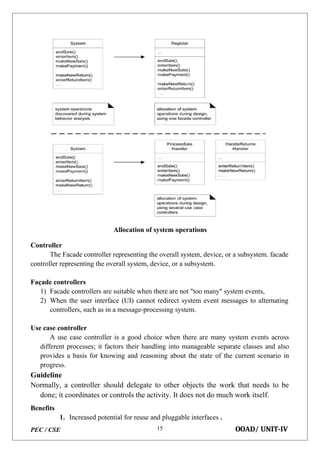
The system operations identified during system behavior analysis are assigned to one or
more controller classes like,
PEC / CSE OOAD/ UNIT-IV
15
Allocation of system operations
Controller
The Facade controller representing the overall system, device, or a subsystem. facade
controller representing the overall system, device, or a subsystem.
Façade controllers
1) Facade controllers are suitable when there are not "too many" system events,
2) When the user interface (UI) cannot redirect system event messages to alternating
controllers, such as in a message-processing system.
Use case controller
A use case controller is a good choice when there are many system events across
different processes; it factors their handling into manageable separate classes and also
provides a basis for knowing and reasoning about the state of the current scenario in
progress.
Guideline
Normally, a controller should delegate to other objects the work that needs to be
done; it coordinates or controls the activity. It does not do much work itself.
Benefits
1. Increased potential for reuse and pluggable interfaces .
PEC / CSE OOAD/ UNIT-IV
16
2. Opportunity to reason about the state of the use case.
Implementation
The code has
 Process JFrame window referring to domain controller object – Register.
 Define handler for button click.
 Show key message – sending enterItem message to the controller.
Code
public class ProcessSaleJFrame extends JFrame
{
// the window has a reference to the 'controller' domain object
(1) private Register register;
// the window is passed the register, on creation
public ProcessSaleJFrame(Register _register)
{
register = _register;
}
// this button is clicked to perform the
// system operation "enterItem"
private JButton BTN_ENTER_ITEM;
(2) BTN_ENTER_ITEM.addActionListener(new ActionListener()
{
public void actionPerformed(ActionEvent e)
{
// utility class
---
---
---
(3) register.enterItem(id, qty);
}
} ); // end of the addActionListener call
return BTN_ENTER_ITEM;
} // end of method
// …
} // end of class
Bloated Controllers
Issues and Solutions
Poorly designed, a controller class will have low cohesion unfocused and handling too many
areas of responsibility; this is called a bloated controller.
Signs of bloating are:
PEC / CSE OOAD/ UNIT-IV
17
 There is only a single controller class receiving all system events in the system, and
there are many of them. This sometimes happens if a facade controller is chosen.
 The controller itself performs many of the tasks necessary to fulfill the system event,
without delegating the work. This usually involves a violation of Information Expert
and High Cohesion.
 A controller has many attributes, and it maintains significant information about the
system or domain, which should have been distributed to other objects, or it
duplicates information found elsewhere.
Among the Cures for a bloated controller are these two:
1. Add more controllers a system does not have to need only one. For example, consider an
application with many system events, such as an airline reservation system.
2. Design the controller so that it primarily delegates the fulfillment of each system
operation responsibility to other objects.
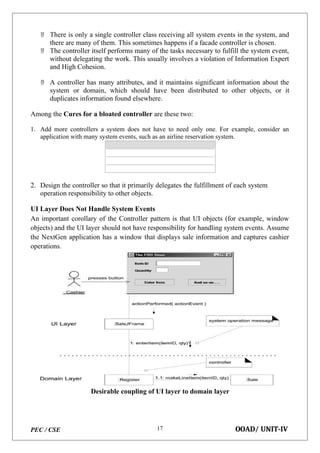
UI Layer Does Not Handle System Events
An important corollary of the Controller pattern is that UI objects (for example, window
objects) and the UI layer should not have responsibility for handling system events. Assume
the NextGen application has a window that displays sale information and captures cashier
operations.
Desirable coupling of UI layer to domain layer
PEC / CSE OOAD/ UNIT-IV
18
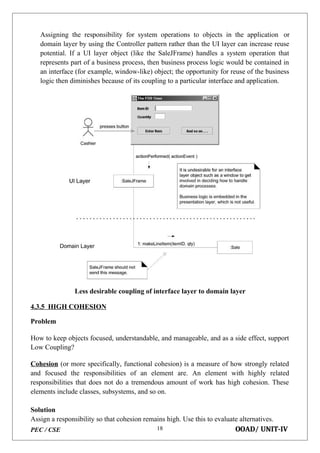
Assigning the responsibility for system operations to objects in the application or
domain layer by using the Controller pattern rather than the UI layer can increase reuse
potential. If a UI layer object (like the SaleJFrame) handles a system operation that
represents part of a business process, then business process logic would be contained in
an interface (for example, window-like) object; the opportunity for reuse of the business
logic then diminishes because of its coupling to a particular interface and application.
Less desirable coupling of interface layer to domain layer
4.3.5 HIGH COHESION
Problem
How to keep objects focused, understandable, and manageable, and as a side effect, support
Low Coupling?
Cohesion (or more specifically, functional cohesion) is a measure of how strongly related
and focused the responsibilities of an element are. An element with highly related
responsibilities that does not do a tremendous amount of work has high cohesion. These
elements include classes, subsystems, and so on.
Solution
Assign a responsibility so that cohesion remains high. Use this to evaluate alternatives.
PEC / CSE OOAD/ UNIT-IV
19
A class with low cohesion does many unrelated things or does too much work. Such classes
are undesirable; they suffer from the following problems:
 hard to comprehend
 hard to reuse
 hard to maintain
 delicate; constantly affected by change
Low cohesion classes often represent a very "large grain" of abstraction or have taken on
responsibilities that should have been delegated to other objects.
Example
Create a payment instance and associate it with sale
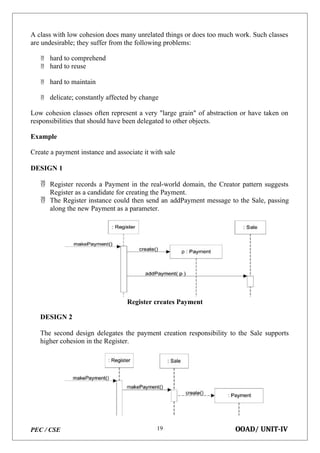
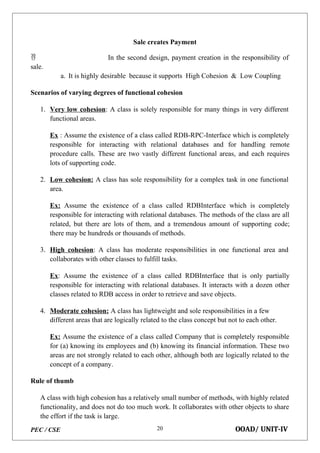
DESIGN 1
 Register records a Payment in the real-world domain, the Creator pattern suggests
Register as a candidate for creating the Payment.
 The Register instance could then send an addPayment message to the Sale, passing
along the new Payment as a parameter.
Register creates Payment
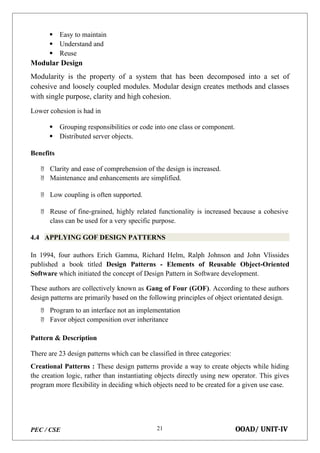
DESIGN 2
The second design delegates the payment creation responsibility to the Sale supports
higher cohesion in the Register.
PEC / CSE OOAD/ UNIT-IV
20
Sale creates Payment
 In the second design, payment creation in the responsibility of
sale.
a. It is highly desirable because it supports High Cohesion & Low Coupling
Scenarios of varying degrees of functional cohesion
1. Very low cohesion: A class is solely responsible for many things in very different
functional areas.
Ex : Assume the existence of a class called RDB-RPC-Interface which is completely
responsible for interacting with relational databases and for handling remote
procedure calls. These are two vastly different functional areas, and each requires
lots of supporting code.
2. Low cohesion: A class has sole responsibility for a complex task in one functional
area.
Ex: Assume the existence of a class called RDBInterface which is completely
responsible for interacting with relational databases. The methods of the class are all
related, but there are lots of them, and a tremendous amount of supporting code;
there may be hundreds or thousands of methods.
3. High cohesion: A class has moderate responsibilities in one functional area and
collaborates with other classes to fulfill tasks.
Ex: Assume the existence of a class called RDBInterface that is only partially
responsible for interacting with relational databases. It interacts with a dozen other
classes related to RDB access in order to retrieve and save objects.
4. Moderate cohesion: A class has lightweight and sole responsibilities in a few
different areas that are logically related to the class concept but not to each other.
Ex: Assume the existence of a class called Company that is completely responsible
for (a) knowing its employees and (b) knowing its financial information. These two
areas are not strongly related to each other, although both are logically related to the
concept of a company.
Rule of thumb
A class with high cohesion has a relatively small number of methods, with highly related
functionality, and does not do too much work. It collaborates with other objects to share
the effort if the task is large.
PEC / CSE OOAD/ UNIT-IV
21
 Easy to maintain
 Understand and
 Reuse
Modular Design
Modularity is the property of a system that has been decomposed into a set of
cohesive and loosely coupled modules. Modular design creates methods and classes
with single purpose, clarity and high cohesion.
Lower cohesion is had in
 Grouping responsibilities or code into one class or component.
 Distributed server objects.
Benefits
 Clarity and ease of comprehension of the design is increased.
 Maintenance and enhancements are simplified.
 Low coupling is often supported.
 Reuse of fine-grained, highly related functionality is increased because a cohesive
class can be used for a very specific purpose.
4.4 APPLYING GOF DESIGN PATTERNS
In 1994, four authors Erich Gamma, Richard Helm, Ralph Johnson and John Vlissides
published a book titled Design Patterns - Elements of Reusable Object-Oriented
Software which initiated the concept of Design Pattern in Software development.
These authors are collectively known as Gang of Four (GOF). According to these authors
design patterns are primarily based on the following principles of object orientated design.
 Program to an interface not an implementation
 Favor object composition over inheritance
Pattern & Description
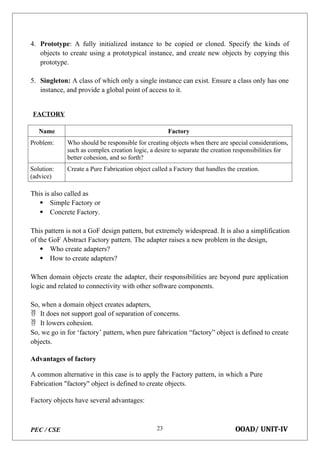
There are 23 design patterns which can be classified in three categories:
Creational Patterns : These design patterns provide a way to create objects while hiding
the creation logic, rather than instantiating objects directly using new operator. This gives
program more flexibility in deciding which objects need to be created for a given use case.
PEC / CSE OOAD/ UNIT-IV
22
Structural Patterns : These design patterns concern class and object composition. Concept
of inheritance is used to compose interfaces and define ways to compose objects to obtain
new functionalities.
Behavioral Patterns : These design patterns are specifically concerned with
communication between objects.
The 23 design patterns are listed below:
4.4.1 Creational Patterns
 Make the system independent of how objects are created composed and represented
 Abstract the instantiation process
o Hide how instances of these classes are created and assembled
o Hide references to concrete classed used in the system
 Govern the what, when, who , how object creation
1. Abstract Factory: Creates an instance of several families of classes. Provide an
interface for creating families of related or dependent objects without specifying their
concrete classes.
2. Builder: Separates object construction from its representation. Separate the construction
of a complex object from its representation so that the same construction processes can
create different representations.
3. Factory Method: Creates an instance of several derived classes. Define an interface for
creating an object, but let subclasses decide which class to instantiate. Factory Method
lets a class defer instantiation to subclasses.
PEC / CSE OOAD/ UNIT-IV
23
4. Prototype: A fully initialized instance to be copied or cloned. Specify the kinds of
objects to create using a prototypical instance, and create new objects by copying this
prototype.
5. Singleton: A class of which only a single instance can exist. Ensure a class only has one
instance, and provide a global point of access to it.
FACTORY
Name Factory
Problem: Who should be responsible for creating objects when there are special considerations,
such as complex creation logic, a desire to separate the creation responsibilities for
better cohesion, and so forth?
Solution:
(advice)
Create a Pure Fabrication object called a Factory that handles the creation.
This is also called as
 Simple Factory or
 Concrete Factory.
This pattern is not a GoF design pattern, but extremely widespread. It is also a simplification
of the GoF Abstract Factory pattern. The adapter raises a new problem in the design,
 Who create adapters?
 How to create adapters?
When domain objects create the adapter, their responsibilities are beyond pure application
logic and related to connectivity with other software components.
So, when a domain object creates adapters,
 It does not support goal of separation of concerns.
 It lowers cohesion.
So, we go in for ‘factory’ pattern, when pure fabrication “factory” object is defined to create
objects.
Advantages of factory
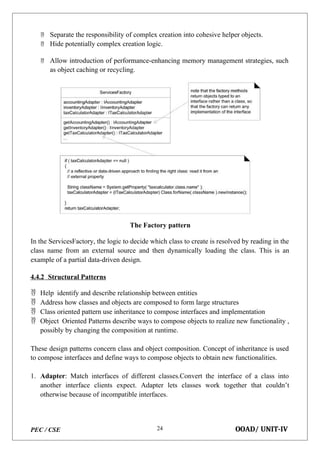
A common alternative in this case is to apply the Factory pattern, in which a Pure
Fabrication "factory" object is defined to create objects.
Factory objects have several advantages:
PEC / CSE OOAD/ UNIT-IV
24
 Separate the responsibility of complex creation into cohesive helper objects.
 Hide potentially complex creation logic.
 Allow introduction of performance-enhancing memory management strategies, such
as object caching or recycling.
The Factory pattern
In the ServicesFactory, the logic to decide which class to create is resolved by reading in the
class name from an external source and then dynamically loading the class. This is an
example of a partial data-driven design.
4.4.2 Structural Patterns
 Help identify and describe relationship between entities
 Address how classes and objects are composed to form large structures
 Class oriented pattern use inheritance to compose interfaces and implementation
 Object Oriented Patterns describe ways to compose objects to realize new functionality ,
possibly by changing the composition at runtime.
These design patterns concern class and object composition. Concept of inheritance is used
to compose interfaces and define ways to compose objects to obtain new functionalities.
1. Adapter: Match interfaces of different classes.Convert the interface of a class into
another interface clients expect. Adapter lets classes work together that couldn’t
otherwise because of incompatible interfaces.
25 OOAD/ UNIT-IV
2. Bridge: Separates an object’s interface from its implementation. Decouple an
abstraction from its implementation so that the two can vary independently.
3. Composite: A tree structure of simple and composite objects. Compose objects into tree
structures to represent part-whole hierarchies. Composite lets clients treat I ndividual
objects and compositions of objects uniformly.
4. Decorator: Add responsibilities to objects dynamically. Attach additional
responsibilities to an object dynamically. Decorators provide a flexible
alternative to subclassing for extending functionality.
5. Facade: A single class that represents an entire subsystem. Provide a unified interface to
a set of interfaces in a system. Facade defines a higher-level interface that makes the
subsystem easier to use.
6. Flyweight: A fine-grained instance used for efficient sharing. Use sharing to support
large numbers of fine-grained objects efficiently. A flyweight is a shared object that can
be used in multiple contexts simultaneously. The flyweight acts as an independent object
in each context — it’s indistinguishable from an instance of the object that’s not shared.
7. Proxy: An object representing another object. Provide a surrogate or placeholder for
another object to control access to it.
ADAPTER
Name Adapter
Problem:
How to resolve incompatible interfaces, or provide a stable interface to
similar components with different interfaces?
Solution:
(advice)
Convert the original interface of a component into another interface, through
an intermediate adapter object.
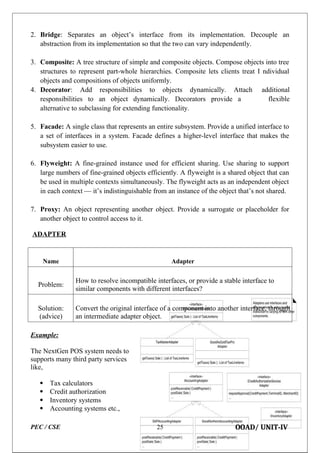
Example:
The NextGen POS system needs to
supports many third party services
like,
 Tax calculators
 Credit authorization
 Inventory systems
 Accounting systems etc.,
PEC / CSE
PEC / CSE OOAD/ UNIT-IV
26
Add a level of indirection with objects to adapt to the solution.
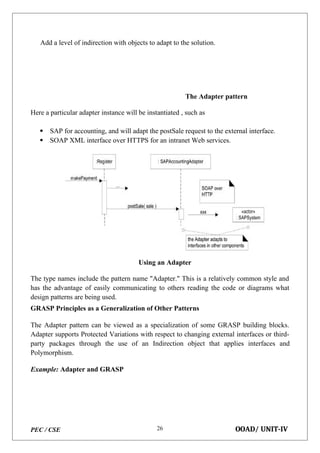
The Adapter pattern
Here a particular adapter instance will be instantiated , such as
 SAP for accounting, and will adapt the postSale request to the external interface.
 SOAP XML interface over HTTPS for an intranet Web services.
Using an Adapter
The type names include the pattern name "Adapter." This is a relatively common style and
has the advantage of easily communicating to others reading the code or diagrams what
design patterns are being used.
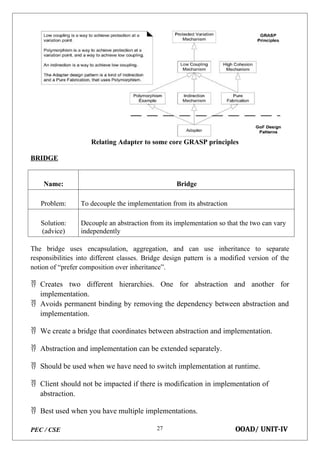
GRASP Principles as a Generalization of Other Patterns
The Adapter pattern can be viewed as a specialization of some GRASP building blocks.
Adapter supports Protected Variations with respect to changing external interfaces or third-
party packages through the use of an Indirection object that applies interfaces and
Polymorphism.
Example: Adapter and GRASP
PEC / CSE OOAD/ UNIT-IV
27
Relating Adapter to some core GRASP principles
BRIDGE
Name: Bridge
Problem: To decouple the implementation from its abstraction
Solution:
(advice)
Decouple an abstraction from its implementation so that the two can vary
independently
The bridge uses encapsulation, aggregation, and can use inheritance to separate
responsibilities into different classes. Bridge design pattern is a modified version of the
notion of “prefer composition over inheritance”.
 Creates two different hierarchies. One for abstraction and another for
implementation.
 Avoids permanent binding by removing the dependency between abstraction and
implementation.
 We create a bridge that coordinates between abstraction and implementation.
 Abstraction and implementation can be extended separately.
 Should be used when we have need to switch implementation at runtime.
 Client should not be impacted if there is modification in implementation of
abstraction.
 Best used when you have multiple implementations.
PEC / CSE OOAD/ UNIT-IV
28
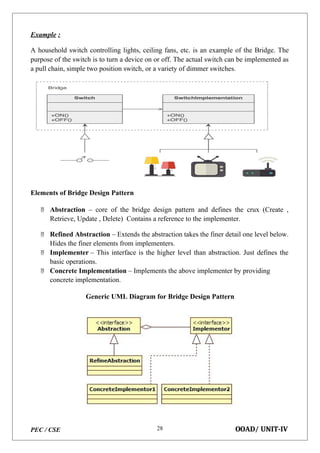
Example :
A household switch controlling lights, ceiling fans, etc. is an example of the Bridge. The
purpose of the switch is to turn a device on or off. The actual switch can be implemented as
a pull chain, simple two position switch, or a variety of dimmer switches.
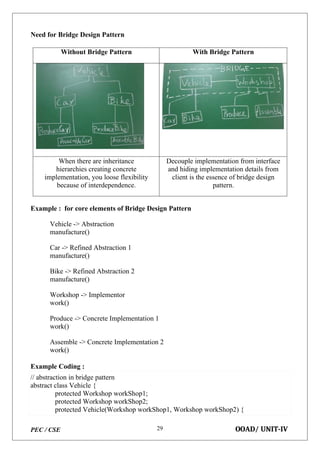
Elements of Bridge Design Pattern
 Abstraction – core of the bridge design pattern and defines the crux (Create ,
Retrieve, Update , Delete) Contains a reference to the implementer.
 Refined Abstraction – Extends the abstraction takes the finer detail one level below.
Hides the finer elements from implementers.
 Implementer – This interface is the higher level than abstraction. Just defines the
basic operations.
 Concrete Implementation – Implements the above implementer by providing
concrete implementation.
Generic UML Diagram for Bridge Design Pattern
// abstraction in bridge pattern
abstract class Vehicle {
protected Workshop workShop1;
protected Workshop workShop2;
protected Vehicle(Workshop workShop1, Workshop workShop2) {
PEC / CSE OOAD/ UNIT-IV
29
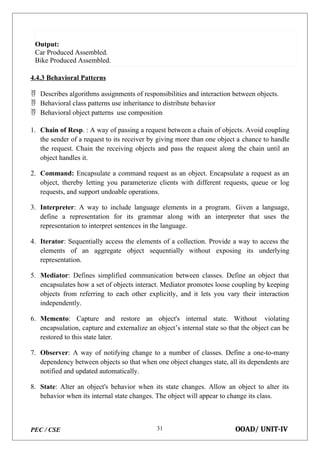
Need for Bridge Design Pattern
Without Bridge Pattern With Bridge Pattern
When there are inheritance
hierarchies creating concrete
implementation, you loose flexibility
because of interdependence.
Decouple implementation from interface
and hiding implementation details from
client is the essence of bridge design
pattern.
Example : for core elements of Bridge Design Pattern
Vehicle -> Abstraction
manufacture()
Car -> Refined Abstraction 1
manufacture()
Bike -> Refined Abstraction 2
manufacture()
Workshop -> Implementor
work()
Produce -> Concrete Implementation 1
work()
Assemble -> Concrete Implementation 2
work()
Example Coding :
PEC / CSE OOAD/ UNIT-IV
30
this.workShop1 = workShop1;
this.workShop2 = workShop2;
}
abstract public void manufacture();
}
// Refine abstraction 1 in bridge pattern
public class Car extends Vehicle {
public Car(Workshop workShop1, Workshop workShop2) {
super(workShop1, workShop2);
}
public void manufacture() {
System.out.print("Car ");
workShop1.work();
workShop2.work();
} }
public class Bike extends Vehicle {
public Bike(Workshop workShop1, Workshop workShop2) {
super(workShop1, workShop2);
}
public void manufacture() {
System.out.print("Bike ");
workShop1.work();
workShop2.work();
} }
// Implementor for bridge pattern
public interface Workshop {
abstract public void work();
}
//Concrete implementation 1 for bridge pattern
public class Produce implements Workshop {
public void work() {
System.out.print("Produced"); }}
public class Assemble implements Workshop {
public void work() {
System.out.println(" Assembled.");
}}
//Demonstration of bridge design pattern
public class BridgePattern {
public static void main(String[] args) {
Vehicle vehicle1 = new Car(new Produce(), new Assemble());
vehicle1.manufacture();
Vehicle vehicle2 = new Bike(new Produce(), new Assemble());
vehicle2.manufacture();
}
}
PEC / CSE OOAD/ UNIT-IV
31
Output:
Car Produced Assembled.
Bike Produced Assembled.
4.4.3 Behavioral Patterns
 Describes algorithms assignments of responsibilities and interaction between objects.
 Behavioral class patterns use inheritance to distribute behavior
 Behavioral object patterns use composition
1. Chain of Resp. : A way of passing a request between a chain of objects. Avoid coupling
the sender of a request to its receiver by giving more than one object a chance to handle
the request. Chain the receiving objects and pass the request along the chain until an
object handles it.
2. Command: Encapsulate a command request as an object. Encapsulate a request as an
object, thereby letting you parameterize clients with different requests, queue or log
requests, and support undoable operations.
3. Interpreter: A way to include language elements in a program. Given a language,
define a representation for its grammar along with an interpreter that uses the
representation to interpret sentences in the language.
4. Iterator: Sequentially access the elements of a collection. Provide a way to access the
elements of an aggregate object sequentially without exposing its underlying
representation.
5. Mediator: Defines simplified communication between classes. Define an object that
encapsulates how a set of objects interact. Mediator promotes loose coupling by keeping
objects from referring to each other explicitly, and it lets you vary their interaction
independently.
6. Memento: Capture and restore an object's internal state. Without violating
encapsulation, capture and externalize an object’s internal state so that the object can be
restored to this state later.
7. Observer: A way of notifying change to a number of classes. Define a one-to-many
dependency between objects so that when one object changes state, all its dependents are
notified and updated automatically.
8. State: Alter an object's behavior when its state changes. Allow an object to alter its
behavior when its internal state changes. The object will appear to change its class.
PEC / CSE OOAD/ UNIT-IV
32
9. Strategy: Encapsulates an algorithm inside a class. Define a family of algorithms,
encapsulate each one, and make them interchangeable. Strategy lets the algorithm
vary independently from clients that use it.
10.Template: Defer the exact steps of an algorithm to a subclass. Define the skeleton of an
algorithm in an operation, deferring some steps to subclasses. Template Method lets
subclasses redefine certain steps of an algorithm without changing the algorithm’s
structure.
11.Visitor: Defines a new operation to a class without change. Represent an operation to be
performed on the elements of an object structure. Visitor lets you define a new operation
without changing the classes of the elements on which it operates
STRATEGY
Name Strategy
Problem: How to design for varying, but related, algorithms or policies? How to design
for the ability to change these algorithms or policies?
Solution:
(advice)
Define each algorithm/policy/strategy in a separate class, with a common
interface.
Example
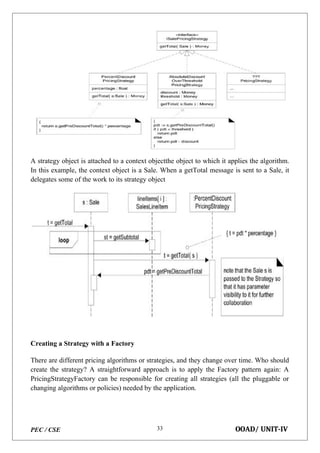
Since the behavior of pricing varies by the strategy (or algorithm), we create multiple
SalePricingStrategy classes, each with a polymorphic getTotal method . Each getTotal
method takes the Sale object as a parameter, so that the pricing strategy object can find the
pre-discount price from the Sale, and then apply the discounting rule. The implementation
of each getTotal method will be different: PercentDiscountPricingStrategy will discount by
a percentage, and so on.
PEC / CSE OOAD/ UNIT-IV
33
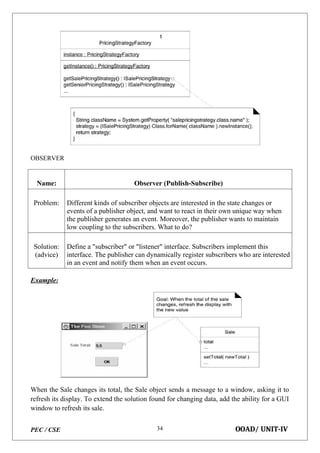
A strategy object is attached to a context objectthe object to which it applies the algorithm.
In this example, the context object is a Sale. When a getTotal message is sent to a Sale, it
delegates some of the work to its strategy object
Creating a Strategy with a Factory
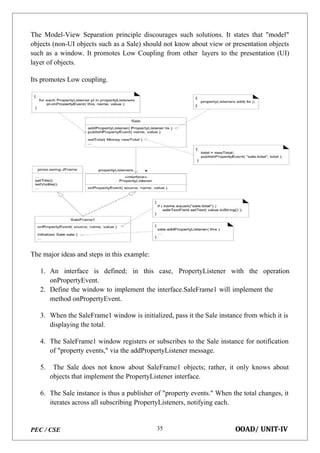
There are different pricing algorithms or strategies, and they change over time. Who should
create the strategy? A straightforward approach is to apply the Factory pattern again: A
PricingStrategyFactory can be responsible for creating all strategies (all the pluggable or
changing algorithms or policies) needed by the application.
PEC / CSE OOAD/ UNIT-IV
34
OBSERVER
Name: Observer (Publish-Subscribe)
Problem: Different kinds of subscriber objects are interested in the state changes or
events of a publisher object, and want to react in their own unique way when
the publisher generates an event. Moreover, the publisher wants to maintain
low coupling to the subscribers. What to do?
Solution:
(advice)
Define a "subscriber" or "listener" interface. Subscribers implement this
interface. The publisher can dynamically register subscribers who are interested
in an event and notify them when an event occurs.
Example:
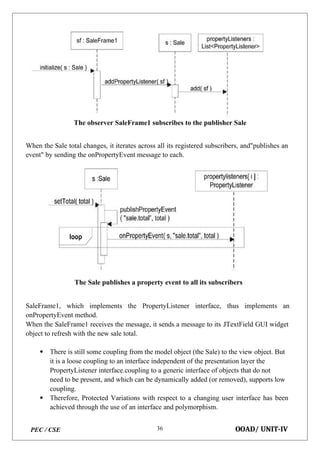
When the Sale changes its total, the Sale object sends a message to a window, asking it to
refresh its display. To extend the solution found for changing data, add the ability for a GUI
window to refresh its sale.
PEC / CSE OOAD/ UNIT-IV
35
The Model-View Separation principle discourages such solutions. It states that "model"
objects (non-UI objects such as a Sale) should not know about view or presentation objects
such as a window. It promotes Low Coupling from other layers to the presentation (UI)
layer of objects.
Its promotes Low coupling.
The major ideas and steps in this example:
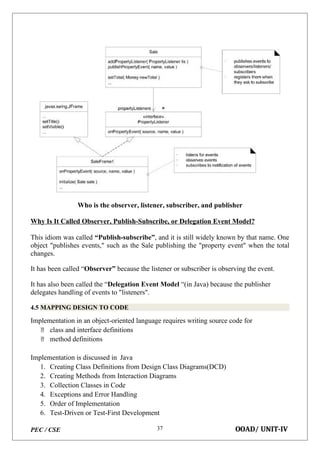
1. An interface is defined; in this case, PropertyListener with the operation
onPropertyEvent.
2. Define the window to implement the interface.SaleFrame1 will implement the
method onPropertyEvent.
3. When the SaleFrame1 window is initialized, pass it the Sale instance from which it is
displaying the total.
4. The SaleFrame1 window registers or subscribes to the Sale instance for notification
of "property events," via the addPropertyListener message.
5. The Sale does not know about SaleFrame1 objects; rather, it only knows about
objects that implement the PropertyListener interface.
6. The Sale instance is thus a publisher of "property events." When the total changes, it
iterates across all subscribing PropertyListeners, notifying each.
PEC / CSE OOAD/ UNIT-IV
36
The observer SaleFrame1 subscribes to the publisher Sale
When the Sale total changes, it iterates across all its registered subscribers, and"publishes an
event" by sending the onPropertyEvent message to each.
The Sale publishes a property event to all its subscribers
SaleFrame1, which implements the PropertyListener interface, thus implements an
onPropertyEvent method.
When the SaleFrame1 receives the message, it sends a message to its JTextField GUI widget
object to refresh with the new sale total.
 There is still some coupling from the model object (the Sale) to the view object. But
it is a loose coupling to an interface independent of the presentation layer the
PropertyListener interface.coupling to a generic interface of objects that do not
need to be present, and which can be dynamically added (or removed), supports low
coupling.
 Therefore, Protected Variations with respect to a changing user interface has been
achieved through the use of an interface and polymorphism.
PEC / CSE OOAD/ UNIT-IV
37
Who is the observer, listener, subscriber, and publisher
Why Is It Called Observer, Publish-Subscribe, or Delegation Event Model?
This idiom was called “Publish-subscribe”, and it is still widely known by that name. One
object "publishes events," such as the Sale publishing the "property event" when the total
changes.
It has been called “Observer” because the listener or subscriber is observing the event.
It has also been called the “Delegation Event Model “(in Java) because the publisher
delegates handling of events to "listeners".
4.5 MAPPING DESIGN TO CODE
Implementation in an object-oriented language requires writing source code for
 class and interface definitions
 method definitions
Implementation is discussed in Java
1. Creating Class Definitions from Design Class Diagrams(DCD)
2. Creating Methods from Interaction Diagrams
3. Collection Classes in Code
4. Exceptions and Error Handling
5. Order of Implementation
6. Test-Driven or Test-First Development
PEC / CSE OOAD/ UNIT-IV
38
1.Creating Class Definitions from DCDs
DCDs depict the class or interface name, superclasses, operation signatures, and attributes
of a class. If the DCD was drawn in a UML tool, it can generate the basic class definition
from the diagrams.
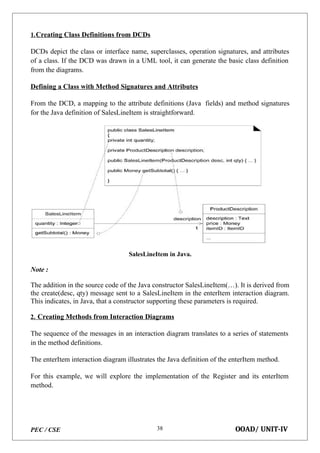
Defining a Class with Method Signatures and Attributes
From the DCD, a mapping to the attribute definitions (Java fields) and method signatures
for the Java definition of SalesLineItem is straightforward.
SalesLineItem in Java.
Note :
The addition in the source code of the Java constructor SalesLineItem(…). It is derived from
the create(desc, qty) message sent to a SalesLineItem in the enterItem interaction diagram.
This indicates, in Java, that a constructor supporting these parameters is required.
2. Creating Methods from Interaction Diagrams
The sequence of the messages in an interaction diagram translates to a series of statements
in the method definitions.
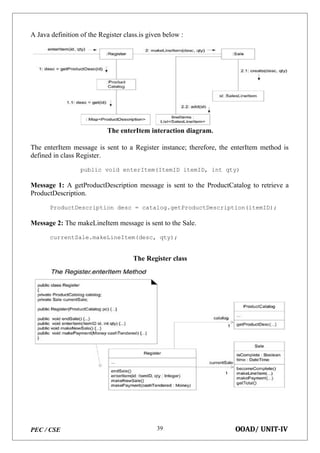
The enterItem interaction diagram illustrates the Java definition of the enterItem method.
For this example, we will explore the implementation of the Register and its enterItem
method.
PEC / CSE OOAD/ UNIT-IV
39
A Java definition of the Register class.is given below :
The enterItem interaction diagram.
The enterItem message is sent to a Register instance; therefore, the enterItem method is
defined in class Register.
public void enterItem(ItemID itemID, int qty)
Message 1: A getProductDescription message is sent to the ProductCatalog to retrieve a
ProductDescription.
ProductDescription desc = catalog.getProductDescription(itemID);
Message 2: The makeLineItem message is sent to the Sale.
currentSale.makeLineItem(desc, qty);
The Register class
PEC / CSE OOAD/ UNIT-IV
40
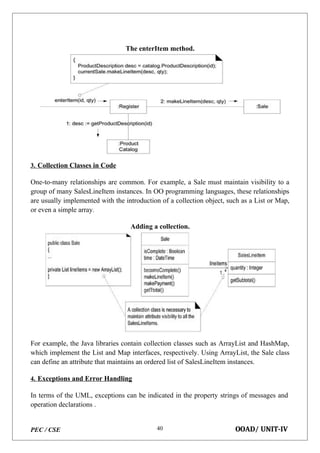
The enterItem method.
3. Collection Classes in Code
One-to-many relationships are common. For example, a Sale must maintain visibility to a
group of many SalesLineItem instances. In OO programming languages, these relationships
are usually implemented with the introduction of a collection object, such as a List or Map,
or even a simple array.
Adding a collection.
For example, the Java libraries contain collection classes such as ArrayList and HashMap,
which implement the List and Map interfaces, respectively. Using ArrayList, the Sale class
can define an attribute that maintains an ordered list of SalesLineItem instances.
4. Exceptions and Error Handling
In terms of the UML, exceptions can be indicated in the property strings of messages and
operation declarations .
PEC / CSE OOAD/ UNIT-IV
41
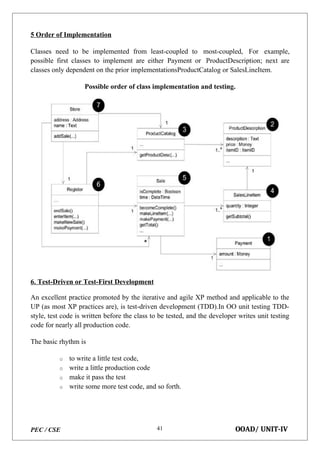
5 Order of Implementation
Classes need to be implemented from least-coupled to most-coupled, For example,
possible first classes to implement are either Payment or ProductDescription; next are
classes only dependent on the prior implementationsProductCatalog or SalesLineItem.
Possible order of class implementation and testing.
6. Test-Driven or Test-First Development
An excellent practice promoted by the iterative and agile XP method and applicable to the
UP (as most XP practices are), is test-driven development (TDD).In OO unit testing TDD-
style, test code is written before the class to be tested, and the developer writes unit testing
code for nearly all production code.
The basic rhythm is
o to write a little test code,
o write a little production code
o make it pass the test
o write some more test code, and so forth.
PEC / CSE OOAD/ UNIT-IV
42
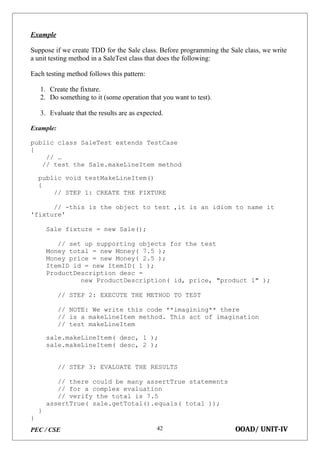
Example
Suppose if we create TDD for the Sale class. Before programming the Sale class, we write
a unit testing method in a SaleTest class that does the following:
Each testing method follows this pattern:
1. Create the fixture.
2. Do something to it (some operation that you want to test).
3. Evaluate that the results are as expected.
Example:
public class SaleTest extends TestCase
{
// …
// test the Sale.makeLineItem method
public void testMakeLineItem()
{
// STEP 1: CREATE THE FIXTURE
// -this is the object to test ,it is an idiom to name it
'fixture'
Sale fixture = new Sale();
// set up supporting objects for the test
Money total = new Money( 7.5 );
Money price = new Money( 2.5 );
ItemID id = new ItemID( 1 );
ProductDescription desc =
new ProductDescription( id, price, "product 1" );
// STEP 2: EXECUTE THE METHOD TO TEST
// NOTE: We write this code **imagining** there
// is a makeLineItem method. This act of imagination
// test makeLineItem
sale.makeLineItem( desc, 1 );
sale.makeLineItem( desc, 2 );
// STEP 3: EVALUATE THE RESULTS
// there could be many assertTrue statements
// for a complex evaluation
// verify the total is 7.5
assertTrue( sale.getTotal().equals( total ));
}
}
PEC / CSE OOAD/ UNIT-IV
43
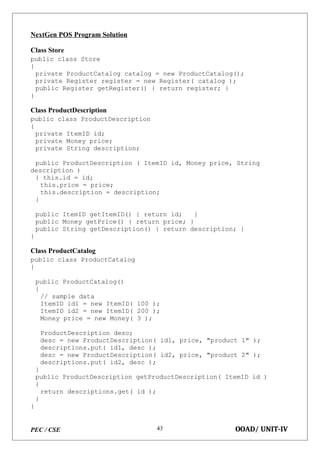
NextGen POS Program Solution
Class Store
public class Store
{
private ProductCatalog catalog = new ProductCatalog();
private Register register = new Register( catalog );
public Register getRegister() { return register; }
}
Class ProductDescription
public class ProductDescription
{
private ItemID id;
private Money price;
private String description;
public ProductDescription ( ItemID id, Money price, String
description )
{ this.id = id;
this.price = price;
this.description = description;
}
public ItemID getItemID() { return id; }
public Money getPrice() { return price; }
public String getDescription() { return description; }
}
Class ProductCatalog
public class ProductCatalog
{
public ProductCatalog()
{
// sample data
ItemID id1 = new ItemID( 100 );
ItemID id2 = new ItemID( 200 );
Money price = new Money( 3 );
ProductDescription desc;
desc = new ProductDescription( id1, price, "product 1" );
descriptions.put( id1, desc );
desc = new ProductDescription( id2, price, "product 2" );
descriptions.put( id2, desc );
}
public ProductDescription getProductDescription( ItemID id )
{
return descriptions.get( id );
}
}
PEC / CSE OOAD/ UNIT-IV
44
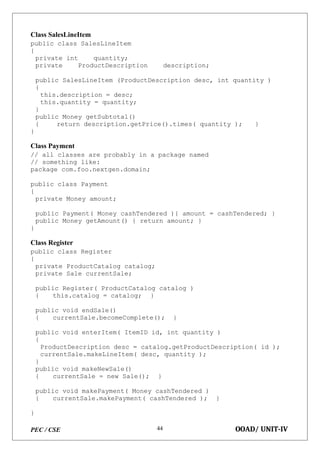
Class SalesLineItem
public class SalesLineItem
{
private int quantity;
private ProductDescription description;
public SalesLineItem (ProductDescription desc, int quantity )
{
this.description = desc;
this.quantity = quantity;
}
public Money getSubtotal()
{ return description.getPrice().times( quantity ); }
}
Class Payment
// all classes are probably in a package named
// something like:
package com.foo.nextgen.domain;
public class Payment
{
private Money amount;
public Payment( Money cashTendered ){ amount = cashTendered; }
public Money getAmount() { return amount; }
}
Class Register
public class Register
{
private ProductCatalog catalog;
private Sale currentSale;
public Register( ProductCatalog catalog )
{ this.catalog = catalog; }
public void endSale()
{ currentSale.becomeComplete(); }
public void enterItem( ItemID id, int quantity )
{
ProductDescription desc = catalog.getProductDescription( id );
currentSale.makeLineItem( desc, quantity );
}
public void makeNewSale()
{ currentSale = new Sale(); }
public void makePayment( Money cashTendered )
{ currentSale.makePayment( cashTendered ); }
}
PEC / CSE OOAD/ UNIT-IV
45
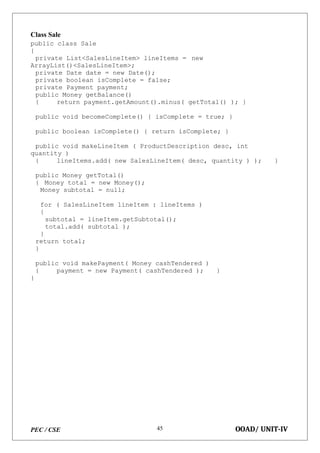
Class Sale
public class Sale
{
private List<SalesLineItem> lineItems = new
ArrayList()<SalesLineItem>;
private Date date = new Date();
private boolean isComplete = false;
private Payment payment;
public Money getBalance()
{ return payment.getAmount().minus( getTotal() ); }
public void becomeComplete() { isComplete = true; }
public boolean isComplete() { return isComplete; }
public void makeLineItem ( ProductDescription desc, int
quantity )
{ lineItems.add( new SalesLineItem( desc, quantity ) ); }
public Money getTotal()
{ Money total = new Money();
Money subtotal = null;
for ( SalesLineItem lineItem : lineItems )
{
subtotal = lineItem.getSubtotal();
total.add( subtotal );
}
return total;
}
public void makePayment( Money cashTendered )
{ payment = new Payment( cashTendered ); }
}

21CS1501 OBJECT ORIENTED ANALYSIS AND DESIGN UNIT IV NOTES.docx

  • 1.
    1 OOAD/ UNIT-IV PEC/ CSE UNIT IV - DESIGN PATTERNS GRASP: Designing objects with responsibilities – Creator – Information expert – Low Coupling – High Cohesion – Controller Design Patterns – creational – factory method – structural – Bridge – Adapter – behavioural – Strategy – observer –Applying GoF design patterns – Mapping design to code PANIMALAR ENGINEERING COLLEGE DEPARTMENT OF CSE 21CS1501 - OBJECT ORIENTED ANALYSIS AND DESIGN 4.1 INTRODUCTION  One way to describe object design “After identifying your requirements and creating a domain model, then add methods to the software classes, and define the messaging between the objects to fulfill the requirements”  Not really- Answer the following questions: o What methods belong to where? o How the objects should interact?  GRASP as Methodical Approach to Learning Basic Object Design UML versus Design Principles  The UML is simply a standard visual modeling language, knowing its details doesn’t teach you how to think in objects – that is the theme of this course  The critical design tool for software development is a mind well educated in design principles. It is not the UML or any other technology Object Design After the requirements identification, add the methods to the classes and define the message between the objects. The designing of object starts with  Inputs  Activities  Outputs Inputs to object design  Use case model  Domain Model  System Sequence Diagrams  Operation Contracts
  • 2.
    PEC / CSEOOAD/ UNIT-IV 2  Supplementary Specification Activities of object design  Dynamic and static modeling (draw both interaction and complementary class diagrams)  Applying various OOD principles o GRASP- General Responsibility Assignment Software Patterns o GoF (Gang of Four)design patterns o Responsibility-Driven Design (RDD) Outputs of object design  Modeling for the difficult part of the design that we wished to explore before coding  Specifically for object design, o UML Interaction diagrams o Class diagrams o Package diagrams  UI sketches and prototypes  Database models Report sketches and prototypes 4.2 RDD  RDD is a general metaphor for thinking about OO software design.  Thinking of software objects as having responsibilities an abstraction of what they do. Responsibility means a contract or obligation of a classifier.  RDD is a general metaphor for thinking about object oriented design. Responsibilities are related to the obligation of an object in terms of its behavior o what an object should know? o what an object should do? Responsibilities is of two types : Doing , Knowing 1. Knowing responsibilities: o knowing about private encapsulated data o knowing about related objects o knowing about things it can derive or calculate 2. Doing responsibilities: a. doing something itself, such as creating an object or doing a calculation b. initiating action in other objects c. controlling and coordinating activities in other objects. What's the Connection Between Responsibilities, GRASP, and UML Diagrams?
  • 3.
    PEC / CSEOOAD/ UNIT-IV 3 assigning responsibilities to objects while coding or while modeling. Within the UML, drawing interaction diagrams becomes the occasion for considering these responsibilities. Responsibilities are implemented using methods What are Patterns? A pattern is a named description of a problem and solution that can be applied to new contexts; ideally, a pattern advises us on how to apply its solution in varying circumstances and considers the forces and trade-offs. Many patterns, given a specific category of problem, guide the assignment of responsibilities to objects. Example : The format is Pattern Name : Information Expert Problem : What is a basic principle by which to assign responsibilities to objects? Solution : Assign a responsibility to the class that has the information needed to fulfill it. 4.3 APPLYING GRASP TO OBJECT DESIGN GRASP stands for “General Responsibility Assignment Software Patterns”  It is a Learning Aid for OO Design with Responsibilities. This approach to understanding and using design principles is based on patterns of assigning responsibilities.  We can apply the GRASP principles while drawing UML interaction diagrams, and also while coding where we deciding on responsibly assignments.  GRASP defines nine basic OO design principles or basic building blocks in design.  They are 1. Information Expert 2. Creator 3. Controller 4. Low Coupling 5. High Cohesion 6. Polymorphism 7. Pure Fabrication 8. Indirection 9.Protected Variations.
  • 4.
    PEC / CSEOOAD/ UNIT-IV 4 All these patterns answer some software problem, and in almost every case these problems are common to almost every software development project. PATTERN/ PRINCIPLE DESCRIPTION Information Expert A general principle of object design and responsibility assignment? Assign a responsibility to the information expert – the class that has the information necessary to fulfill the responsibility. Creator Who creates? (Note that Factory is a common alternate solution.) Assign class B the responsibility to create an instance of class A if one of these is true: 1. B contains A 2. B aggregates A 3. B has the initializing data for A 4. B records A 5. B closely uses A Controller What first object beyond the UI layer receives and coordinates (“controls”) a system operation? Assign the responsibility to an object representing one of these choices: 1. Represents the overall “system,” a “root object,” a device that the software is running within, or a major subsystem (these are all variations of a façade controller). 2. Represents a use case scenario within which the system operation occurs ( a use-case or session controller) Low coupling (evaluative) How to reduce the impact of change? Assign responsibilities so that (unnecessary) coupling remains low. Use this principle to evaluate alternatives. High Cohesion (evaluative) How to keep objects focused, understandable, and manageable, and as a side-effect, support low Coupling? Assign responsibilities so that cohesion remains high. Use this to evaluate alternatives. Polymorphism Who is responsible when behavior varies by type? When related alternatives or behaviors vary by type (class), assign responsibility for the behavior – using polymorphic operations – to the types for which the behavior varies. Pure Fabrication Who is responsible when you are desperate, and do not want to violate high cohesion and low coupling? Assign a highly cohesive set of responsibilities to an artificial or convenience “behavior” class that does not represent a problem domain concept – something made up, in order to support high cohesion, low coupling, and reuse. Indirection How to assign responsibilities to avoid direct coupling? Assign the responsibilities to an intermediate object to mediate between other components or services, so that they are not directly coupled.
  • 5.
    PEC / CSEOOAD/ UNIT-IV 5 Protected Variations How to assign responsibility to objects, subsystems and systems so that the variations or instability in these elements do not have an undesirable impact on other elements? Identify points of predicted variation or instability; assign responsibilities to create a stable “interface” around them. 4.3.1 Creator Problem Who should be responsible for creating a new instance of some class? One of the most common activities in object oriented system is creation of objects. General principle is applied for the assignment of creation responsibilities. Design supports : 1) low coupling 2) increased clarity 3) encapsulation 4) reusability. Solution Assign class B the responsibility to create an instance of class A if one of these is true  B "contains" or compositely aggregates A.  B records A.  B closely uses A.  B is an expert while creating A (B passes the initializing data for A that is passed to A when created.) B is a creator of A objects. If more than one option applies, usually prefer a class B which aggregates or contains class A. Example: In the NextGen POS application, who should be responsible for creating a SalesLineItem instance? By Creator, we should look for a class that aggregates, contains, and so on, SalesLineItem instances. Consider the partial domain model in Figure
  • 6.
    PEC / CSEOOAD/ UNIT-IV 6 Partial Domain Model Here “Sale “ takes the responsibility of creating ‘SalesLineItem’ instance . Since sale contains many ‘SalesLineItem’ objects. The assignment of responsibilities requires that a ‘makeLineitem’ must also be defined in ‘Sale’. Creating a SalesLineItem Creator guides the assigning of responsibilities related to the creation of objects, a very common task. The basic intent of the Creator pattern is to find a creator that needs to be connected to the created object in any event. Choosing it as the creator supports low coupling. All very common relationships between classes in a class diagram are,  Composite aggregate part  Container contains Content  Recorder records
  • 7.
    PEC / CSEOOAD/ UNIT-IV 7 Creator suggests that the enclosing container or recorder class is a good candidate for the responsibility of creating the thing contained or recorded. Example:- ‘Payment’ instance while creation initialized with ‘sale ‘ total. ‘Sale’ is a candidate creator of ‘Payment’. Contradictions: Based upon some external property value, creation requires significant complexity like,  Recycled instances for performances.  Creating an instance from one of a family of similar classes based upon some external property value, etc. In such cases we go for helper class called  Concrete Factory, and  Abstract Factory Benefits of the creator  Low coupling is supported which implies Lower maintenance and higher opportunities for reuse 4.3.2 INFORMATION EXPERT (OR EXPERT) Problem What is the general principle of assigning responsibilities to objects? During Object Design, when the interactions between objects are defined, we make choices about the assignment of responsibilities to software classes. This makes the software easier to  Maintain  Understand and  Extend Solution Assign a responsibility to the information expert, the class that has the information necessary to fulfill the responsibility. Example:- NextGEN POS Application Some class needs to know the grand total of a sale. Start assigning responsibilities by clearly stating the responsibility.
  • 8.
    PEC / CSEOOAD/ UNIT-IV 8 1. Look at relevant classes in the Design Model if available, 2. Otherwise, look in the Domain Model Example:- If the design work has been just started, then look into the domain model, the real-world “sale”. In design model, software class ‘sale’ is added with the responsibility for getting total with the method ‘getTotal’. Partial domain model for association of sale After adding the getTotal() , the partial interaction and class diagrams given as : To determine expert using the above the SalesLineItem should determine subtotal.  SalesLineItem Quantity  ProductDescription Price By information expert using the above the Sales LineItem should determine subtotal. This is done by Sale sending get Subtotal messages to each Sales LineItem and sum the results.
  • 9.
    PEC / CSEOOAD/ UNIT-IV 9 Calculating Sales Total After knowing and answering subtotal , a SalesLineItem sends it a message asking for the product price. ProductDescription is an information expert on answering its price. Calculating the sale total Finally, we assigned three design classes of the objects with three responsibilities to find the sales total. Design Class Responsibility Sale knows sale total SalesLineItem knows line item subtotal
  • 10.
    PEC / CSEOOAD/ UNIT-IV 10 Design Class Responsibility ProductDescription knows product price  The Information Expert is frequently used in the assignment of responsibilities  Experts express the common "intuition" that objects do things related to the information they have.  Partial information experts will collaborate in the task.  For example:- Sales total problem experts will collaborates in the task.  Information expert thus has real world analogy.  Information experts are basic guiding principle used continuously in object design. Contradictions Solution suggested by Expert is undesirable, usually because of problems in coupling and cohesion. To overcome this,  Keep application logic in one place(like domain software objects)  Keep database objects in another place(separate persistence services subsystem.  Supporting a separation of major concerns improves coupling and cohesion in a design. Benefits  Information encapsulation is maintained since objects use their own information to fulfill tasks.  High cohesion is usually supported 4.3.3 LOW COUPLING Coupling is a measure of how strongly one element is connected to, has knowledge of, or relies on other elements. An element with low (or weak) coupling is not dependent on too many other elements. Types of coupling Low coupling or weak coupling High coupling or strong coupling An element if does not depend on too many other elements like classes, subsystems and systems it is having low coupling. A class with high coupling relies on many other classes. The Problem of high coupling are  Forced local changes because of changes in related classes.  Harder to understand in isolation.  Harder to reuse because its use requires the additional presence of the classes on which it is dependent
  • 11.
    PEC / CSEOOAD/ UNIT-IV 11 Problem : How to support low dependency, low change impact, and increased reuse? Solution : Assign a responsibility so that coupling remains low. Use this principle to evaluate alternatives. Example:- NextGen case Study We have to create payment instance and associate it with sale. DESIGN 1: Suggested by creator 1) The Register creates the Payment and 2) It adds coupling of Register to Payment. Register creates Payment DESIGN 2: Suggested by low coupling 1) The Sale does the creation of a Payment and 2) It does not increase the coupling. Sales creates Payment
  • 12.
    PEC / CSEOOAD/ UNIT-IV 12 Low coupling is an evaluation principle for evaluating all designs decisions. In object- oriented languages such as C++, Java, and C#, common forms of coupling from TypeX to TypeY include the following:  TypeX has an attribute (data member or instance variable) that refers to a TypeY instance, or TypeY itself.  A TypeX object calls on services of a TypeY object.  TypeX has a method that references an instance of TypeY, or TypeY itself, by any means. These typically include a parameter or local variable of type TypeY, or the object returned from a message being an instance of TypeY.  TypeX is a direct or indirect subclass of TypeY.  TypeY is an interface, and TypeX implements that interface. Contradictions High coupling to stable elements and to pervasive elements is a problem. For example, a J2EE application can safely couple itself to the Java libraries Benefits  Not affected by changes in other components  Simple to understand in isolation  Convenient to reuse 4.3.4 CONTROLLER Problem What first object beyond the UI layer receives and coordinates ("controls") a system operation? System operations were first explored during the analysis of SSD. These are the major input events upon our system. Example:- 1) When a cashier using a POS terminal presses the "End Sale" button indicating “sale has ended”. 2) When a writer using a word processor presses the "spell check" button to perform checking of spelling. A controller is the first object beyond the User Interface (UI) layer that is responsible for receiving or handling a system operation message.
  • 13.
    PEC / CSEOOAD/ UNIT-IV 13 Solution Assign the responsibility to one of the following  Represents the overall "system," a "root object," - These are all variations of a facade controller.  Represents a use case scenario called - <UseCaseName>Handler, - <UseCaseName>Coordinator, or - <UseCaseName>Session o Use the same controller class for all system events in the same use case scenario. o Informally, a session is an instance of a conversation with an actor. Sessions can be of any length but are often organized in terms of use cases (use case sessions) Example: NextGen application contains several system operations. Some system operations of NextGen POS Application. During the design the responsibility of system operations Is done by the controller.
  • 14.
    PEC / CSEOOAD/ UNIT-IV 14 The controller pattern some choices are, Represents the overall "system," "root object," device, or subsystem. Register, POSSystem Represents a receiver or handler of all system ProcessSaleHandler, events of a use case ProcessSaleSession scenario. A controller should assign other objects the work that needs to be done. It coordinates or controls the activity. Same controller class can be used for all system events to maintain information about the state of use case. A common defect in the design of controllers is it suffers from bad cohesion. The system operations identified during system behavior analysis are assigned to one or more controller classes like,
  • 15.
    PEC / CSEOOAD/ UNIT-IV 15 Allocation of system operations Controller The Facade controller representing the overall system, device, or a subsystem. facade controller representing the overall system, device, or a subsystem. Façade controllers 1) Facade controllers are suitable when there are not "too many" system events, 2) When the user interface (UI) cannot redirect system event messages to alternating controllers, such as in a message-processing system. Use case controller A use case controller is a good choice when there are many system events across different processes; it factors their handling into manageable separate classes and also provides a basis for knowing and reasoning about the state of the current scenario in progress. Guideline Normally, a controller should delegate to other objects the work that needs to be done; it coordinates or controls the activity. It does not do much work itself. Benefits 1. Increased potential for reuse and pluggable interfaces .
  • 16.
    PEC / CSEOOAD/ UNIT-IV 16 2. Opportunity to reason about the state of the use case. Implementation The code has  Process JFrame window referring to domain controller object – Register.  Define handler for button click.  Show key message – sending enterItem message to the controller. Code public class ProcessSaleJFrame extends JFrame { // the window has a reference to the 'controller' domain object (1) private Register register; // the window is passed the register, on creation public ProcessSaleJFrame(Register _register) { register = _register; } // this button is clicked to perform the // system operation "enterItem" private JButton BTN_ENTER_ITEM; (2) BTN_ENTER_ITEM.addActionListener(new ActionListener() { public void actionPerformed(ActionEvent e) { // utility class --- --- --- (3) register.enterItem(id, qty); } } ); // end of the addActionListener call return BTN_ENTER_ITEM; } // end of method // … } // end of class Bloated Controllers Issues and Solutions Poorly designed, a controller class will have low cohesion unfocused and handling too many areas of responsibility; this is called a bloated controller. Signs of bloating are:
  • 17.
    PEC / CSEOOAD/ UNIT-IV 17  There is only a single controller class receiving all system events in the system, and there are many of them. This sometimes happens if a facade controller is chosen.  The controller itself performs many of the tasks necessary to fulfill the system event, without delegating the work. This usually involves a violation of Information Expert and High Cohesion.  A controller has many attributes, and it maintains significant information about the system or domain, which should have been distributed to other objects, or it duplicates information found elsewhere. Among the Cures for a bloated controller are these two: 1. Add more controllers a system does not have to need only one. For example, consider an application with many system events, such as an airline reservation system. 2. Design the controller so that it primarily delegates the fulfillment of each system operation responsibility to other objects. UI Layer Does Not Handle System Events An important corollary of the Controller pattern is that UI objects (for example, window objects) and the UI layer should not have responsibility for handling system events. Assume the NextGen application has a window that displays sale information and captures cashier operations. Desirable coupling of UI layer to domain layer
  • 18.
    PEC / CSEOOAD/ UNIT-IV 18 Assigning the responsibility for system operations to objects in the application or domain layer by using the Controller pattern rather than the UI layer can increase reuse potential. If a UI layer object (like the SaleJFrame) handles a system operation that represents part of a business process, then business process logic would be contained in an interface (for example, window-like) object; the opportunity for reuse of the business logic then diminishes because of its coupling to a particular interface and application. Less desirable coupling of interface layer to domain layer 4.3.5 HIGH COHESION Problem How to keep objects focused, understandable, and manageable, and as a side effect, support Low Coupling? Cohesion (or more specifically, functional cohesion) is a measure of how strongly related and focused the responsibilities of an element are. An element with highly related responsibilities that does not do a tremendous amount of work has high cohesion. These elements include classes, subsystems, and so on. Solution Assign a responsibility so that cohesion remains high. Use this to evaluate alternatives.
  • 19.
    PEC / CSEOOAD/ UNIT-IV 19 A class with low cohesion does many unrelated things or does too much work. Such classes are undesirable; they suffer from the following problems:  hard to comprehend  hard to reuse  hard to maintain  delicate; constantly affected by change Low cohesion classes often represent a very "large grain" of abstraction or have taken on responsibilities that should have been delegated to other objects. Example Create a payment instance and associate it with sale DESIGN 1  Register records a Payment in the real-world domain, the Creator pattern suggests Register as a candidate for creating the Payment.  The Register instance could then send an addPayment message to the Sale, passing along the new Payment as a parameter. Register creates Payment DESIGN 2 The second design delegates the payment creation responsibility to the Sale supports higher cohesion in the Register.
  • 20.
    PEC / CSEOOAD/ UNIT-IV 20 Sale creates Payment  In the second design, payment creation in the responsibility of sale. a. It is highly desirable because it supports High Cohesion & Low Coupling Scenarios of varying degrees of functional cohesion 1. Very low cohesion: A class is solely responsible for many things in very different functional areas. Ex : Assume the existence of a class called RDB-RPC-Interface which is completely responsible for interacting with relational databases and for handling remote procedure calls. These are two vastly different functional areas, and each requires lots of supporting code. 2. Low cohesion: A class has sole responsibility for a complex task in one functional area. Ex: Assume the existence of a class called RDBInterface which is completely responsible for interacting with relational databases. The methods of the class are all related, but there are lots of them, and a tremendous amount of supporting code; there may be hundreds or thousands of methods. 3. High cohesion: A class has moderate responsibilities in one functional area and collaborates with other classes to fulfill tasks. Ex: Assume the existence of a class called RDBInterface that is only partially responsible for interacting with relational databases. It interacts with a dozen other classes related to RDB access in order to retrieve and save objects. 4. Moderate cohesion: A class has lightweight and sole responsibilities in a few different areas that are logically related to the class concept but not to each other. Ex: Assume the existence of a class called Company that is completely responsible for (a) knowing its employees and (b) knowing its financial information. These two areas are not strongly related to each other, although both are logically related to the concept of a company. Rule of thumb A class with high cohesion has a relatively small number of methods, with highly related functionality, and does not do too much work. It collaborates with other objects to share the effort if the task is large.
  • 21.
    PEC / CSEOOAD/ UNIT-IV 21  Easy to maintain  Understand and  Reuse Modular Design Modularity is the property of a system that has been decomposed into a set of cohesive and loosely coupled modules. Modular design creates methods and classes with single purpose, clarity and high cohesion. Lower cohesion is had in  Grouping responsibilities or code into one class or component.  Distributed server objects. Benefits  Clarity and ease of comprehension of the design is increased.  Maintenance and enhancements are simplified.  Low coupling is often supported.  Reuse of fine-grained, highly related functionality is increased because a cohesive class can be used for a very specific purpose. 4.4 APPLYING GOF DESIGN PATTERNS In 1994, four authors Erich Gamma, Richard Helm, Ralph Johnson and John Vlissides published a book titled Design Patterns - Elements of Reusable Object-Oriented Software which initiated the concept of Design Pattern in Software development. These authors are collectively known as Gang of Four (GOF). According to these authors design patterns are primarily based on the following principles of object orientated design.  Program to an interface not an implementation  Favor object composition over inheritance Pattern & Description There are 23 design patterns which can be classified in three categories: Creational Patterns : These design patterns provide a way to create objects while hiding the creation logic, rather than instantiating objects directly using new operator. This gives program more flexibility in deciding which objects need to be created for a given use case.
  • 22.
    PEC / CSEOOAD/ UNIT-IV 22 Structural Patterns : These design patterns concern class and object composition. Concept of inheritance is used to compose interfaces and define ways to compose objects to obtain new functionalities. Behavioral Patterns : These design patterns are specifically concerned with communication between objects. The 23 design patterns are listed below: 4.4.1 Creational Patterns  Make the system independent of how objects are created composed and represented  Abstract the instantiation process o Hide how instances of these classes are created and assembled o Hide references to concrete classed used in the system  Govern the what, when, who , how object creation 1. Abstract Factory: Creates an instance of several families of classes. Provide an interface for creating families of related or dependent objects without specifying their concrete classes. 2. Builder: Separates object construction from its representation. Separate the construction of a complex object from its representation so that the same construction processes can create different representations. 3. Factory Method: Creates an instance of several derived classes. Define an interface for creating an object, but let subclasses decide which class to instantiate. Factory Method lets a class defer instantiation to subclasses.
  • 23.
    PEC / CSEOOAD/ UNIT-IV 23 4. Prototype: A fully initialized instance to be copied or cloned. Specify the kinds of objects to create using a prototypical instance, and create new objects by copying this prototype. 5. Singleton: A class of which only a single instance can exist. Ensure a class only has one instance, and provide a global point of access to it. FACTORY Name Factory Problem: Who should be responsible for creating objects when there are special considerations, such as complex creation logic, a desire to separate the creation responsibilities for better cohesion, and so forth? Solution: (advice) Create a Pure Fabrication object called a Factory that handles the creation. This is also called as  Simple Factory or  Concrete Factory. This pattern is not a GoF design pattern, but extremely widespread. It is also a simplification of the GoF Abstract Factory pattern. The adapter raises a new problem in the design,  Who create adapters?  How to create adapters? When domain objects create the adapter, their responsibilities are beyond pure application logic and related to connectivity with other software components. So, when a domain object creates adapters,  It does not support goal of separation of concerns.  It lowers cohesion. So, we go in for ‘factory’ pattern, when pure fabrication “factory” object is defined to create objects. Advantages of factory A common alternative in this case is to apply the Factory pattern, in which a Pure Fabrication "factory" object is defined to create objects. Factory objects have several advantages:
  • 24.
    PEC / CSEOOAD/ UNIT-IV 24  Separate the responsibility of complex creation into cohesive helper objects.  Hide potentially complex creation logic.  Allow introduction of performance-enhancing memory management strategies, such as object caching or recycling. The Factory pattern In the ServicesFactory, the logic to decide which class to create is resolved by reading in the class name from an external source and then dynamically loading the class. This is an example of a partial data-driven design. 4.4.2 Structural Patterns  Help identify and describe relationship between entities  Address how classes and objects are composed to form large structures  Class oriented pattern use inheritance to compose interfaces and implementation  Object Oriented Patterns describe ways to compose objects to realize new functionality , possibly by changing the composition at runtime. These design patterns concern class and object composition. Concept of inheritance is used to compose interfaces and define ways to compose objects to obtain new functionalities. 1. Adapter: Match interfaces of different classes.Convert the interface of a class into another interface clients expect. Adapter lets classes work together that couldn’t otherwise because of incompatible interfaces.
  • 25.
    25 OOAD/ UNIT-IV 2.Bridge: Separates an object’s interface from its implementation. Decouple an abstraction from its implementation so that the two can vary independently. 3. Composite: A tree structure of simple and composite objects. Compose objects into tree structures to represent part-whole hierarchies. Composite lets clients treat I ndividual objects and compositions of objects uniformly. 4. Decorator: Add responsibilities to objects dynamically. Attach additional responsibilities to an object dynamically. Decorators provide a flexible alternative to subclassing for extending functionality. 5. Facade: A single class that represents an entire subsystem. Provide a unified interface to a set of interfaces in a system. Facade defines a higher-level interface that makes the subsystem easier to use. 6. Flyweight: A fine-grained instance used for efficient sharing. Use sharing to support large numbers of fine-grained objects efficiently. A flyweight is a shared object that can be used in multiple contexts simultaneously. The flyweight acts as an independent object in each context — it’s indistinguishable from an instance of the object that’s not shared. 7. Proxy: An object representing another object. Provide a surrogate or placeholder for another object to control access to it. ADAPTER Name Adapter Problem: How to resolve incompatible interfaces, or provide a stable interface to similar components with different interfaces? Solution: (advice) Convert the original interface of a component into another interface, through an intermediate adapter object. Example: The NextGen POS system needs to supports many third party services like,  Tax calculators  Credit authorization  Inventory systems  Accounting systems etc., PEC / CSE
  • 26.
    PEC / CSEOOAD/ UNIT-IV 26 Add a level of indirection with objects to adapt to the solution. The Adapter pattern Here a particular adapter instance will be instantiated , such as  SAP for accounting, and will adapt the postSale request to the external interface.  SOAP XML interface over HTTPS for an intranet Web services. Using an Adapter The type names include the pattern name "Adapter." This is a relatively common style and has the advantage of easily communicating to others reading the code or diagrams what design patterns are being used. GRASP Principles as a Generalization of Other Patterns The Adapter pattern can be viewed as a specialization of some GRASP building blocks. Adapter supports Protected Variations with respect to changing external interfaces or third- party packages through the use of an Indirection object that applies interfaces and Polymorphism. Example: Adapter and GRASP
  • 27.
    PEC / CSEOOAD/ UNIT-IV 27 Relating Adapter to some core GRASP principles BRIDGE Name: Bridge Problem: To decouple the implementation from its abstraction Solution: (advice) Decouple an abstraction from its implementation so that the two can vary independently The bridge uses encapsulation, aggregation, and can use inheritance to separate responsibilities into different classes. Bridge design pattern is a modified version of the notion of “prefer composition over inheritance”.  Creates two different hierarchies. One for abstraction and another for implementation.  Avoids permanent binding by removing the dependency between abstraction and implementation.  We create a bridge that coordinates between abstraction and implementation.  Abstraction and implementation can be extended separately.  Should be used when we have need to switch implementation at runtime.  Client should not be impacted if there is modification in implementation of abstraction.  Best used when you have multiple implementations.
  • 28.
    PEC / CSEOOAD/ UNIT-IV 28 Example : A household switch controlling lights, ceiling fans, etc. is an example of the Bridge. The purpose of the switch is to turn a device on or off. The actual switch can be implemented as a pull chain, simple two position switch, or a variety of dimmer switches. Elements of Bridge Design Pattern  Abstraction – core of the bridge design pattern and defines the crux (Create , Retrieve, Update , Delete) Contains a reference to the implementer.  Refined Abstraction – Extends the abstraction takes the finer detail one level below. Hides the finer elements from implementers.  Implementer – This interface is the higher level than abstraction. Just defines the basic operations.  Concrete Implementation – Implements the above implementer by providing concrete implementation. Generic UML Diagram for Bridge Design Pattern
  • 29.
    // abstraction inbridge pattern abstract class Vehicle { protected Workshop workShop1; protected Workshop workShop2; protected Vehicle(Workshop workShop1, Workshop workShop2) { PEC / CSE OOAD/ UNIT-IV 29 Need for Bridge Design Pattern Without Bridge Pattern With Bridge Pattern When there are inheritance hierarchies creating concrete implementation, you loose flexibility because of interdependence. Decouple implementation from interface and hiding implementation details from client is the essence of bridge design pattern. Example : for core elements of Bridge Design Pattern Vehicle -> Abstraction manufacture() Car -> Refined Abstraction 1 manufacture() Bike -> Refined Abstraction 2 manufacture() Workshop -> Implementor work() Produce -> Concrete Implementation 1 work() Assemble -> Concrete Implementation 2 work() Example Coding :
  • 30.
    PEC / CSEOOAD/ UNIT-IV 30 this.workShop1 = workShop1; this.workShop2 = workShop2; } abstract public void manufacture(); } // Refine abstraction 1 in bridge pattern public class Car extends Vehicle { public Car(Workshop workShop1, Workshop workShop2) { super(workShop1, workShop2); } public void manufacture() { System.out.print("Car "); workShop1.work(); workShop2.work(); } } public class Bike extends Vehicle { public Bike(Workshop workShop1, Workshop workShop2) { super(workShop1, workShop2); } public void manufacture() { System.out.print("Bike "); workShop1.work(); workShop2.work(); } } // Implementor for bridge pattern public interface Workshop { abstract public void work(); } //Concrete implementation 1 for bridge pattern public class Produce implements Workshop { public void work() { System.out.print("Produced"); }} public class Assemble implements Workshop { public void work() { System.out.println(" Assembled."); }} //Demonstration of bridge design pattern public class BridgePattern { public static void main(String[] args) { Vehicle vehicle1 = new Car(new Produce(), new Assemble()); vehicle1.manufacture(); Vehicle vehicle2 = new Bike(new Produce(), new Assemble()); vehicle2.manufacture(); } }
  • 31.
    PEC / CSEOOAD/ UNIT-IV 31 Output: Car Produced Assembled. Bike Produced Assembled. 4.4.3 Behavioral Patterns  Describes algorithms assignments of responsibilities and interaction between objects.  Behavioral class patterns use inheritance to distribute behavior  Behavioral object patterns use composition 1. Chain of Resp. : A way of passing a request between a chain of objects. Avoid coupling the sender of a request to its receiver by giving more than one object a chance to handle the request. Chain the receiving objects and pass the request along the chain until an object handles it. 2. Command: Encapsulate a command request as an object. Encapsulate a request as an object, thereby letting you parameterize clients with different requests, queue or log requests, and support undoable operations. 3. Interpreter: A way to include language elements in a program. Given a language, define a representation for its grammar along with an interpreter that uses the representation to interpret sentences in the language. 4. Iterator: Sequentially access the elements of a collection. Provide a way to access the elements of an aggregate object sequentially without exposing its underlying representation. 5. Mediator: Defines simplified communication between classes. Define an object that encapsulates how a set of objects interact. Mediator promotes loose coupling by keeping objects from referring to each other explicitly, and it lets you vary their interaction independently. 6. Memento: Capture and restore an object's internal state. Without violating encapsulation, capture and externalize an object’s internal state so that the object can be restored to this state later. 7. Observer: A way of notifying change to a number of classes. Define a one-to-many dependency between objects so that when one object changes state, all its dependents are notified and updated automatically. 8. State: Alter an object's behavior when its state changes. Allow an object to alter its behavior when its internal state changes. The object will appear to change its class.
  • 32.
    PEC / CSEOOAD/ UNIT-IV 32 9. Strategy: Encapsulates an algorithm inside a class. Define a family of algorithms, encapsulate each one, and make them interchangeable. Strategy lets the algorithm vary independently from clients that use it. 10.Template: Defer the exact steps of an algorithm to a subclass. Define the skeleton of an algorithm in an operation, deferring some steps to subclasses. Template Method lets subclasses redefine certain steps of an algorithm without changing the algorithm’s structure. 11.Visitor: Defines a new operation to a class without change. Represent an operation to be performed on the elements of an object structure. Visitor lets you define a new operation without changing the classes of the elements on which it operates STRATEGY Name Strategy Problem: How to design for varying, but related, algorithms or policies? How to design for the ability to change these algorithms or policies? Solution: (advice) Define each algorithm/policy/strategy in a separate class, with a common interface. Example Since the behavior of pricing varies by the strategy (or algorithm), we create multiple SalePricingStrategy classes, each with a polymorphic getTotal method . Each getTotal method takes the Sale object as a parameter, so that the pricing strategy object can find the pre-discount price from the Sale, and then apply the discounting rule. The implementation of each getTotal method will be different: PercentDiscountPricingStrategy will discount by a percentage, and so on.
  • 33.
    PEC / CSEOOAD/ UNIT-IV 33 A strategy object is attached to a context objectthe object to which it applies the algorithm. In this example, the context object is a Sale. When a getTotal message is sent to a Sale, it delegates some of the work to its strategy object Creating a Strategy with a Factory There are different pricing algorithms or strategies, and they change over time. Who should create the strategy? A straightforward approach is to apply the Factory pattern again: A PricingStrategyFactory can be responsible for creating all strategies (all the pluggable or changing algorithms or policies) needed by the application.
  • 34.
    PEC / CSEOOAD/ UNIT-IV 34 OBSERVER Name: Observer (Publish-Subscribe) Problem: Different kinds of subscriber objects are interested in the state changes or events of a publisher object, and want to react in their own unique way when the publisher generates an event. Moreover, the publisher wants to maintain low coupling to the subscribers. What to do? Solution: (advice) Define a "subscriber" or "listener" interface. Subscribers implement this interface. The publisher can dynamically register subscribers who are interested in an event and notify them when an event occurs. Example: When the Sale changes its total, the Sale object sends a message to a window, asking it to refresh its display. To extend the solution found for changing data, add the ability for a GUI window to refresh its sale.
  • 35.
    PEC / CSEOOAD/ UNIT-IV 35 The Model-View Separation principle discourages such solutions. It states that "model" objects (non-UI objects such as a Sale) should not know about view or presentation objects such as a window. It promotes Low Coupling from other layers to the presentation (UI) layer of objects. Its promotes Low coupling. The major ideas and steps in this example: 1. An interface is defined; in this case, PropertyListener with the operation onPropertyEvent. 2. Define the window to implement the interface.SaleFrame1 will implement the method onPropertyEvent. 3. When the SaleFrame1 window is initialized, pass it the Sale instance from which it is displaying the total. 4. The SaleFrame1 window registers or subscribes to the Sale instance for notification of "property events," via the addPropertyListener message. 5. The Sale does not know about SaleFrame1 objects; rather, it only knows about objects that implement the PropertyListener interface. 6. The Sale instance is thus a publisher of "property events." When the total changes, it iterates across all subscribing PropertyListeners, notifying each.
  • 36.
    PEC / CSEOOAD/ UNIT-IV 36 The observer SaleFrame1 subscribes to the publisher Sale When the Sale total changes, it iterates across all its registered subscribers, and"publishes an event" by sending the onPropertyEvent message to each. The Sale publishes a property event to all its subscribers SaleFrame1, which implements the PropertyListener interface, thus implements an onPropertyEvent method. When the SaleFrame1 receives the message, it sends a message to its JTextField GUI widget object to refresh with the new sale total.  There is still some coupling from the model object (the Sale) to the view object. But it is a loose coupling to an interface independent of the presentation layer the PropertyListener interface.coupling to a generic interface of objects that do not need to be present, and which can be dynamically added (or removed), supports low coupling.  Therefore, Protected Variations with respect to a changing user interface has been achieved through the use of an interface and polymorphism.
  • 37.
    PEC / CSEOOAD/ UNIT-IV 37 Who is the observer, listener, subscriber, and publisher Why Is It Called Observer, Publish-Subscribe, or Delegation Event Model? This idiom was called “Publish-subscribe”, and it is still widely known by that name. One object "publishes events," such as the Sale publishing the "property event" when the total changes. It has been called “Observer” because the listener or subscriber is observing the event. It has also been called the “Delegation Event Model “(in Java) because the publisher delegates handling of events to "listeners". 4.5 MAPPING DESIGN TO CODE Implementation in an object-oriented language requires writing source code for  class and interface definitions  method definitions Implementation is discussed in Java 1. Creating Class Definitions from Design Class Diagrams(DCD) 2. Creating Methods from Interaction Diagrams 3. Collection Classes in Code 4. Exceptions and Error Handling 5. Order of Implementation 6. Test-Driven or Test-First Development
  • 38.
    PEC / CSEOOAD/ UNIT-IV 38 1.Creating Class Definitions from DCDs DCDs depict the class or interface name, superclasses, operation signatures, and attributes of a class. If the DCD was drawn in a UML tool, it can generate the basic class definition from the diagrams. Defining a Class with Method Signatures and Attributes From the DCD, a mapping to the attribute definitions (Java fields) and method signatures for the Java definition of SalesLineItem is straightforward. SalesLineItem in Java. Note : The addition in the source code of the Java constructor SalesLineItem(…). It is derived from the create(desc, qty) message sent to a SalesLineItem in the enterItem interaction diagram. This indicates, in Java, that a constructor supporting these parameters is required. 2. Creating Methods from Interaction Diagrams The sequence of the messages in an interaction diagram translates to a series of statements in the method definitions. The enterItem interaction diagram illustrates the Java definition of the enterItem method. For this example, we will explore the implementation of the Register and its enterItem method.
  • 39.
    PEC / CSEOOAD/ UNIT-IV 39 A Java definition of the Register class.is given below : The enterItem interaction diagram. The enterItem message is sent to a Register instance; therefore, the enterItem method is defined in class Register. public void enterItem(ItemID itemID, int qty) Message 1: A getProductDescription message is sent to the ProductCatalog to retrieve a ProductDescription. ProductDescription desc = catalog.getProductDescription(itemID); Message 2: The makeLineItem message is sent to the Sale. currentSale.makeLineItem(desc, qty); The Register class
  • 40.
    PEC / CSEOOAD/ UNIT-IV 40 The enterItem method. 3. Collection Classes in Code One-to-many relationships are common. For example, a Sale must maintain visibility to a group of many SalesLineItem instances. In OO programming languages, these relationships are usually implemented with the introduction of a collection object, such as a List or Map, or even a simple array. Adding a collection. For example, the Java libraries contain collection classes such as ArrayList and HashMap, which implement the List and Map interfaces, respectively. Using ArrayList, the Sale class can define an attribute that maintains an ordered list of SalesLineItem instances. 4. Exceptions and Error Handling In terms of the UML, exceptions can be indicated in the property strings of messages and operation declarations .
  • 41.
    PEC / CSEOOAD/ UNIT-IV 41 5 Order of Implementation Classes need to be implemented from least-coupled to most-coupled, For example, possible first classes to implement are either Payment or ProductDescription; next are classes only dependent on the prior implementationsProductCatalog or SalesLineItem. Possible order of class implementation and testing. 6. Test-Driven or Test-First Development An excellent practice promoted by the iterative and agile XP method and applicable to the UP (as most XP practices are), is test-driven development (TDD).In OO unit testing TDD- style, test code is written before the class to be tested, and the developer writes unit testing code for nearly all production code. The basic rhythm is o to write a little test code, o write a little production code o make it pass the test o write some more test code, and so forth.
  • 42.
    PEC / CSEOOAD/ UNIT-IV 42 Example Suppose if we create TDD for the Sale class. Before programming the Sale class, we write a unit testing method in a SaleTest class that does the following: Each testing method follows this pattern: 1. Create the fixture. 2. Do something to it (some operation that you want to test). 3. Evaluate that the results are as expected. Example: public class SaleTest extends TestCase { // … // test the Sale.makeLineItem method public void testMakeLineItem() { // STEP 1: CREATE THE FIXTURE // -this is the object to test ,it is an idiom to name it 'fixture' Sale fixture = new Sale(); // set up supporting objects for the test Money total = new Money( 7.5 ); Money price = new Money( 2.5 ); ItemID id = new ItemID( 1 ); ProductDescription desc = new ProductDescription( id, price, "product 1" ); // STEP 2: EXECUTE THE METHOD TO TEST // NOTE: We write this code **imagining** there // is a makeLineItem method. This act of imagination // test makeLineItem sale.makeLineItem( desc, 1 ); sale.makeLineItem( desc, 2 ); // STEP 3: EVALUATE THE RESULTS // there could be many assertTrue statements // for a complex evaluation // verify the total is 7.5 assertTrue( sale.getTotal().equals( total )); } }
  • 43.
    PEC / CSEOOAD/ UNIT-IV 43 NextGen POS Program Solution Class Store public class Store { private ProductCatalog catalog = new ProductCatalog(); private Register register = new Register( catalog ); public Register getRegister() { return register; } } Class ProductDescription public class ProductDescription { private ItemID id; private Money price; private String description; public ProductDescription ( ItemID id, Money price, String description ) { this.id = id; this.price = price; this.description = description; } public ItemID getItemID() { return id; } public Money getPrice() { return price; } public String getDescription() { return description; } } Class ProductCatalog public class ProductCatalog { public ProductCatalog() { // sample data ItemID id1 = new ItemID( 100 ); ItemID id2 = new ItemID( 200 ); Money price = new Money( 3 ); ProductDescription desc; desc = new ProductDescription( id1, price, "product 1" ); descriptions.put( id1, desc ); desc = new ProductDescription( id2, price, "product 2" ); descriptions.put( id2, desc ); } public ProductDescription getProductDescription( ItemID id ) { return descriptions.get( id ); } }
  • 44.
    PEC / CSEOOAD/ UNIT-IV 44 Class SalesLineItem public class SalesLineItem { private int quantity; private ProductDescription description; public SalesLineItem (ProductDescription desc, int quantity ) { this.description = desc; this.quantity = quantity; } public Money getSubtotal() { return description.getPrice().times( quantity ); } } Class Payment // all classes are probably in a package named // something like: package com.foo.nextgen.domain; public class Payment { private Money amount; public Payment( Money cashTendered ){ amount = cashTendered; } public Money getAmount() { return amount; } } Class Register public class Register { private ProductCatalog catalog; private Sale currentSale; public Register( ProductCatalog catalog ) { this.catalog = catalog; } public void endSale() { currentSale.becomeComplete(); } public void enterItem( ItemID id, int quantity ) { ProductDescription desc = catalog.getProductDescription( id ); currentSale.makeLineItem( desc, quantity ); } public void makeNewSale() { currentSale = new Sale(); } public void makePayment( Money cashTendered ) { currentSale.makePayment( cashTendered ); } }
  • 45.
    PEC / CSEOOAD/ UNIT-IV 45 Class Sale public class Sale { private List<SalesLineItem> lineItems = new ArrayList()<SalesLineItem>; private Date date = new Date(); private boolean isComplete = false; private Payment payment; public Money getBalance() { return payment.getAmount().minus( getTotal() ); } public void becomeComplete() { isComplete = true; } public boolean isComplete() { return isComplete; } public void makeLineItem ( ProductDescription desc, int quantity ) { lineItems.add( new SalesLineItem( desc, quantity ) ); } public Money getTotal() { Money total = new Money(); Money subtotal = null; for ( SalesLineItem lineItem : lineItems ) { subtotal = lineItem.getSubtotal(); total.add( subtotal ); } return total; } public void makePayment( Money cashTendered ) { payment = new Payment( cashTendered ); } }