Lesson 3
Red Sea:
Standing Firm
Exodus 14:1–31
October 19, 2025
Exodus 14:1-31
Exodus 14:1-31 (NIV)
1 Then the LORD said to Moses, 2 "Tell the
Israelites to turn back and encamp near
Pi Hahiroth, between Migdol and the sea.
They are to encamp by the sea, directly
opposite Baal Zephon.
3 Pharaoh will think, 'The Israelites are
wandering around the land in confusion,
hemmed in by the desert.' 4 And I will
harden Pharaoh's heart, and he will
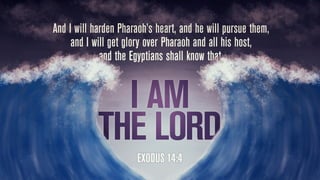
pursue them. But I will gain glory for
myself through Pharaoh and all his army,
and the Egyptians will know that I am the
LORD." So the Israelites did this.
5 When the king of Egypt was told that
the people had fled, Pharaoh and his
officials changed their minds about them
and said, "What have we done? We have
let the Israelites go and have lost their
services!" 6 So he had his chariot made
ready and took his army with him. 7 He
took six hundred of the best chariots,
along with all the other chariots of Egypt,
with officers over all of them.
8 The LORD hardened the heart of
Pharaoh king of Egypt, so that he pursued
the Israelites, who were marching out
boldly. 9 The Egyptians—all Pharaoh's
horses and chariots, horsemen and
troops—pursued the Israelites and
overtook them as they camped by the sea
near Pi Hahiroth, opposite Baal Zephon.
10 As Pharaoh approached, the Israelites
looked up, and there were the Egyptians,
marching after them. They were terrified
and cried out to the LORD.
11 They said to Moses, "Was it because
there were no graves in Egypt that you
brought us to the desert to die? What
have you done to us by bringing us out of
Egypt? 12 Didn't we say to you in Egypt,
'Leave us alone; let us serve the
Egyptians'? It would have been better for
us to serve the Egyptians than to die in
the desert!"
13 Moses answered the people, "Do not
be afraid. Stand firm and you will see the
deliverance the LORD will bring you
today. The Egyptians you see today you
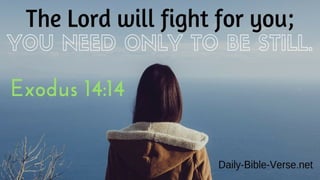
will never see again. 14 The LORD will
fight for you; you need only to be still."
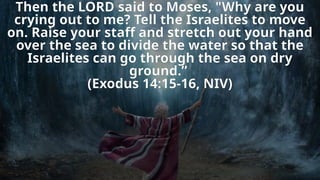
15 Then the LORD said to Moses, "Why are
you crying out to me? Tell the Israelites to
move on. 16 Raise your staff and stretch
out your hand over the sea to divide the
water so that the Israelites can go
through the sea on dry ground.
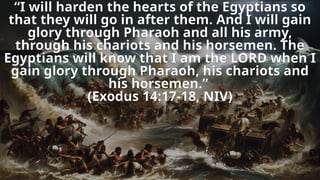
17 I will harden the hearts of the
Egyptians so that they will go in after
them. And I will gain glory through
Pharaoh and all his army, through his
chariots and his horsemen. 18 The
Egyptians will know that I am the LORD
when I gain glory through Pharaoh, his
chariots and his horsemen."
19 Then the angel of God, who had been
traveling in front of Israel's army,
withdrew and went behind them. The
pillar of cloud also moved from in front
and stood behind them, 20 coming
between the armies of Egypt and Israel.
Throughout the night the cloud brought
darkness to the one side and light to the
other side; so neither went near the other
all night long.
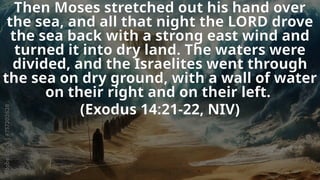
21 Then Moses stretched out his hand
over the sea, and all that night the LORD
drove the sea back with a strong east
wind and turned it into dry land. The
waters were divided, 22 and the Israelites
went through the sea on dry ground, with
a wall of water on their right and on their
left.
23 The Egyptians pursued them, and all
Pharaoh's horses and chariots and
horsemen followed them into the sea. 24
During the last watch of the night the
LORD looked down from the pillar of fire
and cloud at the Egyptian army and
threw it into confusion.
25 He jammed the wheels of their
chariots so that they had difficulty
driving. And the Egyptians said, "Let's get
away from the Israelites! The LORD is
fighting for them against Egypt."
26 Then the LORD said to Moses, "Stretch
out your hand over the sea so that the
waters may flow back over the Egyptians
and their chariots and horsemen."
27 Moses stretched out his hand over the
sea, and at daybreak the sea went back
to its place. The Egyptians were fleeing
toward it, and the LORD swept them into
the sea. 28 The water flowed back and
covered the chariots and horsemen—the
entire army of Pharaoh that had followed
the Israelites into the sea. Not one of
them survived.
29 But the Israelites went through the
sea on dry ground, with a wall of water
on their right and on their left.
30 That day the LORD saved Israel from
the hands of the Egyptians, and Israel
saw the Egyptians lying dead on the
shore. 31 And when the Israelites saw the
mighty hand of the LORD displayed
against the Egyptians, the people feared
the LORD and put their trust in him and
in Moses his servant.
Question 1
1. Why did God give Moses
precise directions? When have
you seen God get glory over his
enemies using unconventional
means? (14:1–4)
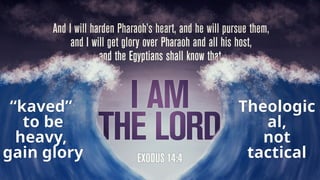
“kaved”
to be
heavy,
gain glory
Theologic
al,
not
tactical
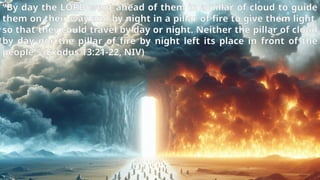
“By day the LORD went ahead of them in a pillar of cloud to guide
them on their way and by night in a pillar of fire to give them light,
so that they could travel by day or night. Neither the pillar of cloud
by day nor the pillar of fire by night left its place in front of the
people.” (Exodus 13:21-22, NIV)
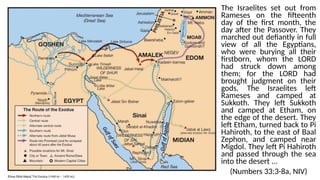
The Israelites set out from
Rameses on the fifteenth
day of the first month, the
day after the Passover. They
marched out defiantly in full
view of all the Egyptians,
who were burying all their
firstborn, whom the LORD
had struck down among
them; for the LORD had
brought judgment on their
gods. The Israelites left
Rameses and camped at
Sukkoth. They left Sukkoth
and camped at Etham, on
the edge of the desert. They
left Etham, turned back to Pi
Hahiroth, to the east of Baal
Zephon, and camped near
Migdol. They left Pi Hahiroth
and passed through the sea
into the desert ...
(Numbers 33:3-8a, NIV)
G
u
l
f
o
f
S
u
e
z
G
u
l
f
o
f
A
q
a
b
a
Question 2
2. How did Pharaoh react when
he was told that the Israelites
had left? Why didn’t he just cut
his losses and let them go?
(14:5–9)
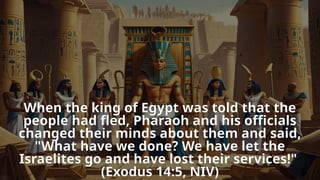
When the king of Egypt was told that the
people had fled, Pharaoh and his officials
changed their minds about them and said,
"What have we done? We have let the
Israelites go and have lost their services!"
(Exodus 14:5, NIV)
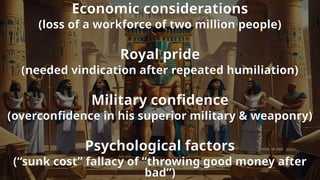
Economic considerations
(loss of a workforce of two million people)
Royal pride
(needed vindication after repeated humiliation)
Military confidence
(overconfidence in his superior military & weaponry)
Psychological factors
(“sunk cost” fallacy of “throwing good money after
bad”)
Question 3
3. How did the Israelites cope
with their fears when the
Egyptian army came after them?
When have you ever felt
hopeless? (14:10–12)
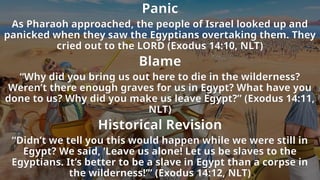
Panic
As Pharaoh approached, the people of Israel looked up and
panicked when they saw the Egyptians overtaking them. They
cried out to the LORD (Exodus 14:10, NLT)
Blame
“Why did you bring us out here to die in the wilderness?
Weren’t there enough graves for us in Egypt? What have you
done to us? Why did you make us leave Egypt?” (Exodus 14:11,
NLT)
Historical Revision
“Didn’t we tell you this would happen while we were still in
Egypt? We said, ‘Leave us alone! Let us be slaves to the
Egyptians. It’s better to be a slave in Egypt than a corpse in
the wilderness!’” (Exodus 14:12, NLT)
Question 4
4. How did Moses respond
when the Egyptians were
bearing down on the Israelites?
(14:13–14)
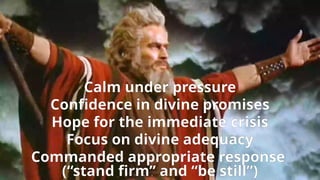
Calm under pressure
Confidence in divine promises
Hope for the immediate crisis
Focus on divine adequacy
Commanded appropriate response
(“stand firm” and “be still”)
Question 5
5. What did God say to Moses
to get the Israelites moving?
(14:15–18)
Then the LORD said to Moses, "Why are you
crying out to me? Tell the Israelites to move
on. Raise your staff and stretch out your hand
over the sea to divide the water so that the
Israelites can go through the sea on dry
ground.”
(Exodus 14:15-16, NIV)
“I will harden the hearts of the Egyptians so
that they will go in after them. And I will gain
glory through Pharaoh and all his army,
through his chariots and his horsemen. The
Egyptians will know that I am the LORD when I
gain glory through Pharaoh, his chariots and
his horsemen.”
(Exodus 14:17-18, NIV)
Question 6
6. Moses tells the people that
they are to “stand firm,” while
God tells Moses to have them
“move on.” How is it possible
to do both at the same time?
(14:13, 15).
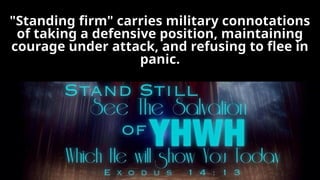
"Standing firm" carries military connotations
of taking a defensive position, maintaining
courage under attack, and refusing to flee in
panic.
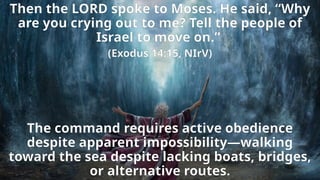
Then the LORD spoke to Moses. He said, “Why
are you crying out to me? Tell the people of
Israel to move on.”
(Exodus 14:15, NIrV)
The command requires active obedience
despite apparent impossibility—walking
toward the sea despite lacking boats, bridges,
or alternative routes.
Question 7
7. Who protected the Israelites
from the Egyptian army?
(14:19–20)
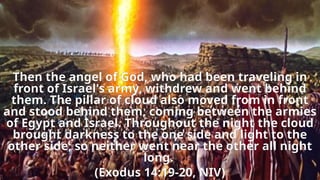
Then the angel of God, who had been traveling in
front of Israel's army, withdrew and went behind
them. The pillar of cloud also moved from in front
and stood behind them, coming between the armies
of Egypt and Israel. Throughout the night the cloud
brought darkness to the one side and light to the
other side; so neither went near the other all night
long.
(Exodus 14:19-20, NIV)
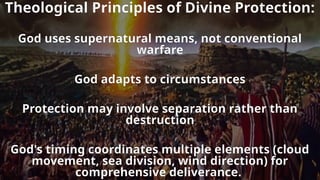
Theological Principles of Divine Protection:
God uses supernatural means, not conventional
warfare
God adapts to circumstances
Protection may involve separation rather than
destruction
God's timing coordinates multiple elements (cloud
movement, sea division, wind direction) for
comprehensive deliverance.
Question 8
8. What miraculous events took
place at the Red Sea? (14:21–31)
Then Moses stretched out his hand over
the sea, and all that night the LORD drove
the sea back with a strong east wind and
turned it into dry land. The waters were
divided, and the Israelites went through
the sea on dry ground, with a wall of water
on their right and on their left.
(Exodus 14:21-22, NIV)
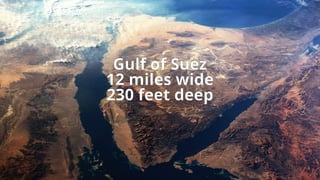
Gulf of Suez
12 miles wide
230 feet deep
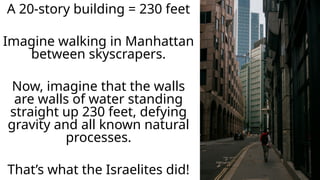
A 20-story building = 230 feet
Imagine walking in Manhattan
between skyscrapers.
Now, imagine that the walls
are walls of water standing
straight up 230 feet, defying
gravity and all known natural
processes.
That’s what the Israelites did!
Multiple elements:
Wind duration throughout the night
Complete water removal (vertical walls)
Israelites crossing on dry ground during
darkness while maintaining visibility
Precise timing of water return
as Egyptians reached mid-sea
Archaeological evidence from various
periods shows Egyptian military records
typically excluded defeats, making this
complete annihilation historically
significant. The phrase “not one of them
remained” emphasizes the totality of
divine judgment while highlighting Israel's
complete preservation.
Kenneth A. Kitchen
Question 9
9. While God does the fighting
for Israel, Moses is required to
stretch out his hand. What
insights does this provide for
standing firm?
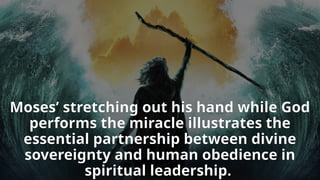
Moses’ stretching out his hand while God
performs the miracle illustrates the
essential partnership between divine
sovereignty and human obedience in
spiritual leadership.
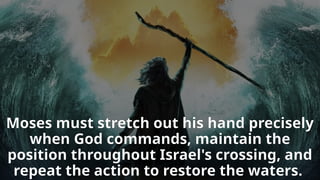
Moses must stretch out his hand precisely
when God commands, maintain the
position throughout Israel's crossing, and
repeat the action to restore the waters.
Question 10
10. If you had been one of the
Israelites who experienced this
event, how would you have
described it to someone who
wasn’t there?
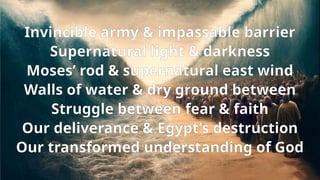
Invincible army & impassable barrier
Supernatural light & darkness
Moses’ rod & supernatural east wind
Walls of water & dry ground between
Struggle between fear & faith
Our deliverance & Egypt’s destruction
Our transformed understanding of God
Lesson 3
Red Sea:
Standing Firm
Exodus 14:1–31
October 19, 2025
Lesson 4
Mount Sinai:
Meeting with God
Exodus 19:1–25
October 26, 2025
2025-10-19 Moses 03 (shared slides).pptx

2025-10-19 Moses 03 (shared slides).pptx

  • 1.
    Lesson 3 Red Sea: StandingFirm Exodus 14:1–31 October 19, 2025
  • 2.
  • 3.
    Exodus 14:1-31 (NIV) 1Then the LORD said to Moses, 2 "Tell the Israelites to turn back and encamp near Pi Hahiroth, between Migdol and the sea. They are to encamp by the sea, directly opposite Baal Zephon.
  • 4.
    3 Pharaoh willthink, 'The Israelites are wandering around the land in confusion, hemmed in by the desert.' 4 And I will harden Pharaoh's heart, and he will pursue them. But I will gain glory for myself through Pharaoh and all his army, and the Egyptians will know that I am the LORD." So the Israelites did this.
  • 5.
    5 When theking of Egypt was told that the people had fled, Pharaoh and his officials changed their minds about them and said, "What have we done? We have let the Israelites go and have lost their services!" 6 So he had his chariot made ready and took his army with him. 7 He took six hundred of the best chariots, along with all the other chariots of Egypt, with officers over all of them.
  • 6.
    8 The LORDhardened the heart of Pharaoh king of Egypt, so that he pursued the Israelites, who were marching out boldly. 9 The Egyptians—all Pharaoh's horses and chariots, horsemen and troops—pursued the Israelites and overtook them as they camped by the sea near Pi Hahiroth, opposite Baal Zephon.
  • 7.
    10 As Pharaohapproached, the Israelites looked up, and there were the Egyptians, marching after them. They were terrified and cried out to the LORD.
  • 8.
    11 They saidto Moses, "Was it because there were no graves in Egypt that you brought us to the desert to die? What have you done to us by bringing us out of Egypt? 12 Didn't we say to you in Egypt, 'Leave us alone; let us serve the Egyptians'? It would have been better for us to serve the Egyptians than to die in the desert!"
  • 9.
    13 Moses answeredthe people, "Do not be afraid. Stand firm and you will see the deliverance the LORD will bring you today. The Egyptians you see today you will never see again. 14 The LORD will fight for you; you need only to be still."
  • 10.
    15 Then theLORD said to Moses, "Why are you crying out to me? Tell the Israelites to move on. 16 Raise your staff and stretch out your hand over the sea to divide the water so that the Israelites can go through the sea on dry ground.
  • 11.
    17 I willharden the hearts of the Egyptians so that they will go in after them. And I will gain glory through Pharaoh and all his army, through his chariots and his horsemen. 18 The Egyptians will know that I am the LORD when I gain glory through Pharaoh, his chariots and his horsemen."
  • 12.
    19 Then theangel of God, who had been traveling in front of Israel's army, withdrew and went behind them. The pillar of cloud also moved from in front and stood behind them, 20 coming between the armies of Egypt and Israel. Throughout the night the cloud brought darkness to the one side and light to the other side; so neither went near the other all night long.
  • 13.
    21 Then Mosesstretched out his hand over the sea, and all that night the LORD drove the sea back with a strong east wind and turned it into dry land. The waters were divided, 22 and the Israelites went through the sea on dry ground, with a wall of water on their right and on their left.
  • 14.
    23 The Egyptianspursued them, and all Pharaoh's horses and chariots and horsemen followed them into the sea. 24 During the last watch of the night the LORD looked down from the pillar of fire and cloud at the Egyptian army and threw it into confusion.
  • 15.
    25 He jammedthe wheels of their chariots so that they had difficulty driving. And the Egyptians said, "Let's get away from the Israelites! The LORD is fighting for them against Egypt."
  • 16.
    26 Then theLORD said to Moses, "Stretch out your hand over the sea so that the waters may flow back over the Egyptians and their chariots and horsemen."
  • 17.
    27 Moses stretchedout his hand over the sea, and at daybreak the sea went back to its place. The Egyptians were fleeing toward it, and the LORD swept them into the sea. 28 The water flowed back and covered the chariots and horsemen—the entire army of Pharaoh that had followed the Israelites into the sea. Not one of them survived.
  • 18.
    29 But theIsraelites went through the sea on dry ground, with a wall of water on their right and on their left.
  • 19.
    30 That daythe LORD saved Israel from the hands of the Egyptians, and Israel saw the Egyptians lying dead on the shore. 31 And when the Israelites saw the mighty hand of the LORD displayed against the Egyptians, the people feared the LORD and put their trust in him and in Moses his servant.
  • 20.
    Question 1 1. Whydid God give Moses precise directions? When have you seen God get glory over his enemies using unconventional means? (14:1–4)
  • 21.
  • 22.
    “By day theLORD went ahead of them in a pillar of cloud to guide them on their way and by night in a pillar of fire to give them light, so that they could travel by day or night. Neither the pillar of cloud by day nor the pillar of fire by night left its place in front of the people.” (Exodus 13:21-22, NIV)
  • 23.
    The Israelites setout from Rameses on the fifteenth day of the first month, the day after the Passover. They marched out defiantly in full view of all the Egyptians, who were burying all their firstborn, whom the LORD had struck down among them; for the LORD had brought judgment on their gods. The Israelites left Rameses and camped at Sukkoth. They left Sukkoth and camped at Etham, on the edge of the desert. They left Etham, turned back to Pi Hahiroth, to the east of Baal Zephon, and camped near Migdol. They left Pi Hahiroth and passed through the sea into the desert ... (Numbers 33:3-8a, NIV) G u l f o f S u e z G u l f o f A q a b a
  • 28.
    Question 2 2. Howdid Pharaoh react when he was told that the Israelites had left? Why didn’t he just cut his losses and let them go? (14:5–9)
  • 29.
    When the kingof Egypt was told that the people had fled, Pharaoh and his officials changed their minds about them and said, "What have we done? We have let the Israelites go and have lost their services!" (Exodus 14:5, NIV)
  • 30.
    Economic considerations (loss ofa workforce of two million people) Royal pride (needed vindication after repeated humiliation) Military confidence (overconfidence in his superior military & weaponry) Psychological factors (“sunk cost” fallacy of “throwing good money after bad”)
  • 33.
    Question 3 3. Howdid the Israelites cope with their fears when the Egyptian army came after them? When have you ever felt hopeless? (14:10–12)
  • 34.
    Panic As Pharaoh approached,the people of Israel looked up and panicked when they saw the Egyptians overtaking them. They cried out to the LORD (Exodus 14:10, NLT) Blame “Why did you bring us out here to die in the wilderness? Weren’t there enough graves for us in Egypt? What have you done to us? Why did you make us leave Egypt?” (Exodus 14:11, NLT) Historical Revision “Didn’t we tell you this would happen while we were still in Egypt? We said, ‘Leave us alone! Let us be slaves to the Egyptians. It’s better to be a slave in Egypt than a corpse in the wilderness!’” (Exodus 14:12, NLT)
  • 37.
    Question 4 4. Howdid Moses respond when the Egyptians were bearing down on the Israelites? (14:13–14)
  • 40.
    Calm under pressure Confidencein divine promises Hope for the immediate crisis Focus on divine adequacy Commanded appropriate response (“stand firm” and “be still”)
  • 43.
    Question 5 5. Whatdid God say to Moses to get the Israelites moving? (14:15–18)
  • 44.
    Then the LORDsaid to Moses, "Why are you crying out to me? Tell the Israelites to move on. Raise your staff and stretch out your hand over the sea to divide the water so that the Israelites can go through the sea on dry ground.” (Exodus 14:15-16, NIV)
  • 45.
    “I will hardenthe hearts of the Egyptians so that they will go in after them. And I will gain glory through Pharaoh and all his army, through his chariots and his horsemen. The Egyptians will know that I am the LORD when I gain glory through Pharaoh, his chariots and his horsemen.” (Exodus 14:17-18, NIV)
  • 48.
    Question 6 6. Mosestells the people that they are to “stand firm,” while God tells Moses to have them “move on.” How is it possible to do both at the same time? (14:13, 15).
  • 49.
    "Standing firm" carriesmilitary connotations of taking a defensive position, maintaining courage under attack, and refusing to flee in panic.
  • 50.
    Then the LORDspoke to Moses. He said, “Why are you crying out to me? Tell the people of Israel to move on.” (Exodus 14:15, NIrV) The command requires active obedience despite apparent impossibility—walking toward the sea despite lacking boats, bridges, or alternative routes.
  • 54.
    Question 7 7. Whoprotected the Israelites from the Egyptian army? (14:19–20)
  • 55.
    Then the angelof God, who had been traveling in front of Israel's army, withdrew and went behind them. The pillar of cloud also moved from in front and stood behind them, coming between the armies of Egypt and Israel. Throughout the night the cloud brought darkness to the one side and light to the other side; so neither went near the other all night long. (Exodus 14:19-20, NIV)
  • 57.
    Theological Principles ofDivine Protection: God uses supernatural means, not conventional warfare God adapts to circumstances Protection may involve separation rather than destruction God's timing coordinates multiple elements (cloud movement, sea division, wind direction) for comprehensive deliverance.
  • 59.
    Question 8 8. Whatmiraculous events took place at the Red Sea? (14:21–31)
  • 60.
    Then Moses stretchedout his hand over the sea, and all that night the LORD drove the sea back with a strong east wind and turned it into dry land. The waters were divided, and the Israelites went through the sea on dry ground, with a wall of water on their right and on their left. (Exodus 14:21-22, NIV)
  • 61.
    Gulf of Suez 12miles wide 230 feet deep
  • 62.
    A 20-story building= 230 feet Imagine walking in Manhattan between skyscrapers. Now, imagine that the walls are walls of water standing straight up 230 feet, defying gravity and all known natural processes. That’s what the Israelites did!
  • 63.
    Multiple elements: Wind durationthroughout the night Complete water removal (vertical walls) Israelites crossing on dry ground during darkness while maintaining visibility Precise timing of water return as Egyptians reached mid-sea
  • 64.
    Archaeological evidence fromvarious periods shows Egyptian military records typically excluded defeats, making this complete annihilation historically significant. The phrase “not one of them remained” emphasizes the totality of divine judgment while highlighting Israel's complete preservation. Kenneth A. Kitchen
  • 66.
    Question 9 9. WhileGod does the fighting for Israel, Moses is required to stretch out his hand. What insights does this provide for standing firm?
  • 67.
    Moses’ stretching outhis hand while God performs the miracle illustrates the essential partnership between divine sovereignty and human obedience in spiritual leadership.
  • 68.
    Moses must stretchout his hand precisely when God commands, maintain the position throughout Israel's crossing, and repeat the action to restore the waters.
  • 71.
    Question 10 10. Ifyou had been one of the Israelites who experienced this event, how would you have described it to someone who wasn’t there?
  • 72.
    Invincible army &impassable barrier Supernatural light & darkness Moses’ rod & supernatural east wind Walls of water & dry ground between Struggle between fear & faith Our deliverance & Egypt’s destruction Our transformed understanding of God
  • 74.
    Lesson 3 Red Sea: StandingFirm Exodus 14:1–31 October 19, 2025
  • 75.
    Lesson 4 Mount Sinai: Meetingwith God Exodus 19:1–25 October 26, 2025

Editor's Notes

  • #1 Lesson 3 of 13 Moses: Face to Face with God 03 Red Sea: Standing Firm - Exodus 14:1–31 – October 19, 2025 Heritage Bible Master Class is a non-denominational group of senior adults who love the Lord and His word. We meet at Heritage Palms Country Club, South of Fred Waring, East of Jefferson, Indio, 10:15 Sunday morning. We’d love to have you join us. Just let them know at the gate that you’re there for the Bible study and the guard will let you right in. Feel free to comment, If you find these videos helpful, help me out by hitting Like, Subscribe to be notified when I post new material. 03 Red Sea: Standing Firm - Exodus 14:1–31 – October 19, 2025 1. Why did God give Moses precise directions? When have you seen God get glory over his enemies using unconventional means? (14:1–4) 2. How did Pharaoh react when he was told that the Israelites had left? Why didn’t he just cut his losses and let them go? (14:5–9) 3. How did the Israelites cope with their fears when the Egyptian army came after them? When have you ever felt hopeless? (14:10–12) 4. How did Moses respond when the Egyptians were bearing down on the Israelites? (14:13–14) 5. What did God say to Moses to get the Israelites moving? (14:15–18) 6. Moses tells the people that they are to “stand firm,” while God tells Moses to have them “move on.” How is it possible to do both at the same time? (14:13, 15). 7. Who protected the Israelites from the Egyptian army? (14:19–20) 8. What miraculous events took place at the Red Sea? (14:21–31) 9. While God does the fighting for Israel, Moses is required to stretch out his hand. What insights does this provide for standing firm? 10. If you had been one of the Israelites who experienced this event, how would you have described it to someone who wasn’t there?
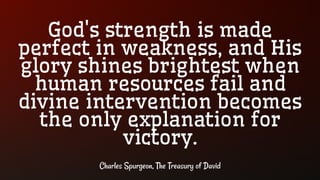
  • #20 1. Why did God give Moses precise directions? When have you seen God get glory over his enemies using unconventional means? (14:1–4) God gave Moses specific directions to orchestrate a strategic entrapment that would maximize divine glory while demonstrating his absolute sovereignty over Egypt's military might. The Hebrew verb כָּבֵד (kaved, "to be heavy/to gain glory") appears in verse 4: "I will gain glory for myself through Pharaoh and all his army" (NIV 2011). This same root appears in verse 17-18, emphasizing that the primary purpose was theological rather than merely tactical—to reveal God's character and power to both Israel and Egypt. The specific positioning instructions—camping by Pi Hahiroth, between Migdol and the sea, opposite Baal Zephon (v. 2)—created an apparent tactical error that would entice Pharaoh to pursue. The Hebrew phrase (nevukhim hem ba-aretz, "they are wandering around the land in confusion," v. 3) describes how the Israelites would appear to Egyptian intelligence—trapped by geography and vulnerable to cavalry attack. This divine strategy transforms apparent weakness into the stage for unprecedented supernatural intervention. The unconventional means involved using Israel's apparent vulnerability as bait, employing natural elements (wind and water) as weapons, and timing the destruction to maximize psychological impact. Unlike conventional military victories achieved through superior tactics or numbers, this deliverance would be unmistakably divine in origin and scope. The ESV renders verse 4: "I will get glory over Pharaoh and all his host, and the Egyptians shall know that I am the LORD." Historical parallels to God's unconventional methods include Gideon's 300 men defeating Midianite thousands through confusion rather than combat (Judges 7), David's sling conquering Goliath's armor (1 Samuel 17), and Jehoshaphat's victory through worship rather than warfare (2 Chronicles 20). Each demonstrates that divine glory emerges most clearly when human resources prove inadequate and supernatural intervention becomes the only explanation for victory (Durham, John I. Exodus: Word Biblical Commentary. Waco: Word Books, 1987, pp. 191-205). Block quote: "God's strength is made perfect in weakness, and His glory shines brightest when human resources fail and divine intervention becomes the only explanation for victory." - Charles Spurgeon, The Treasury of David (Spurgeon, Charles H. The Treasury of David. London: Passmore & Alabaster, 1870) • Durham, John I. Exodus: Word Biblical Commentary. Waco: Word Books, 1987. • Fretheim, Terence E. Exodus: Interpretation Commentary. Louisville: John Knox Press, 1991. • Stuart, Douglas K. Exodus: New American Commentary. Nashville: Broadman & Holman, 2006.
  • #21 God gave Moses specific directions to orchestrate a strategic entrapment that would maximize divine glory while demonstrating his absolute sovereignty over Egypt's military might. The Hebrew verb (kaved, "to be heavy/to gain glory") appears in verse 4: "I will get glory over Pharaoh and all his host" (ESV). This same root appears in verse 17-18, emphasizing that the primary purpose was theological rather than merely tactical—to reveal God's character and power to both Israel and Egypt. “I will harden the hearts of the Egyptians so that they will go in after them. And I will gain glory through Pharaoh and all his army, through his chariots and his horsemen. The Egyptians will know that I am the LORD when I gain glory through Pharaoh, his chariots and his horsemen."” (Exodus 14:17-18, NIV)
  • #22 “By day the LORD went ahead of them in a pillar of cloud to guide them on their way and by night in a pillar of fire to give them light, so that they could travel by day or night. Neither the pillar of cloud by day nor the pillar of fire by night left its place in front of the people.” (Exodus 13:21-22, NIV)
  • #23 Scholars differ on the route the Israelites took out of Egypt. Numbers 33:3-8 says they went from Rameses to Succoth, then to Etham, then to Pi-hahiroth, east of Baal Zephon, near Migdol. The problem is that we do not know for certain where any of those locations are, other than Rameses. Some propose a northern route, as is depicted by the red line on this map. Others propose a central route, as depicted by the green lines. The traditional view is that they traveled a southern route, as depicted by the teal line. If that is the case, which I believe is likely, they headed southeast, along the western side of the Gulf of Suez, which is an arm of the Red Sea, and the crossing would have taken place somewhere along the Gulf of Suez. According to Jewish tradition (specifically mentioned in The ArtScroll Stone Edition Chumash commentary on Exodus 14:8), the crossing occurred on Nisan 21, which is the last day of the Feast of Unleavened Bread. The Jewish sages deduce this from the chronology of events: On Nisan 15, Israel left Egypt and traveled from Rameses to Succoth. On the 16th, they traveled from Succoth to Etham, and on the 17th from Etham to Pi-hahiroth. Then on the 18th it was reported to Pharaoh that Israel had been gone for three days. On the 19th and 20th Pharaoh mustered his army and pursued Israel, and on the 21st day of the first month Israel crossed the Red Sea. The ArtScroll Stone Edition Chumash is a widely respected Jewish commentary that presents traditional rabbinic interpretations, so this would be considered an authoritative source for Jewish tradition on this matter. This makes the elapsed time between Passover (Nisan 14/15) and the Red Sea crossing 6-7 days. The specific positioning instructions—camping by Pi Hahiroth, between Migdol and the sea, opposite Baal Zephon (Exodus 14:2)—created an apparent tactical error that would entice Pharaoh to pursue. The phrase "they are wandering around the land in confusion," (Exodus 14:3) describes how the Israelites would appear to Egyptian intelligence—trapped by geography and vulnerable to cavalry attack. This divine strategy transforms apparent weakness into the stage for unprecedented supernatural intervention.
  • #24 We do not know where Migdol, Pi Hahiroth, or Baal Zephon are. The traditional route of the Exodus takes the Israelites north of the Gulf of Suez (an arm of the Red Sea). The problem is that there is no water to impede them nor to drown the Egyptians. (The Suez Canal, connecting the Gulf of Suez to the Mediterranean Sea wasn’t completed until 1869 AD!) So, either the Israelites traveled along the west side of the Gulf of Suez and crossed over somewhere along that arm of the Red Seak or, and I think more likely, they traveled down the Sinai Peninsula along the east side of the Gulf of Suez until they came to the Red Sea. Then the Egyptians chased them to there. They were surrounded on three sides by water and on the fourth by the Egyptian Army. If that’s the case, they would have crossed the Gulf of Aqaba, another arm of the Red Sea. In either case the specific positioning instructions—camping by Pi Hahiroth, between Migdol and the sea, opposite Baal Zephon (v. 2)—created an apparent tactical error that would entice Pharaoh to pursue. The phrase "they are wandering around the land in confusion," (v. 3) describes how the Israelites would appear to Egyptian intelligence—trapped by geography and vulnerable to cavalry attack. This divine strategy transforms apparent weakness into the stage for unprecedented supernatural intervention.
  • #25 The unconventional means involved using Israel's apparent vulnerability as bait, employing natural elements (wind and water) as weapons, and timing the destruction to maximize psychological impact. Unlike conventional military victories achieved through superior tactics or numbers, this deliverance would be unmistakably divine in origin and scope. The ESV renders verse 4: "I will get glory over Pharaoh and all his host, and the Egyptians shall know that I am the LORD."
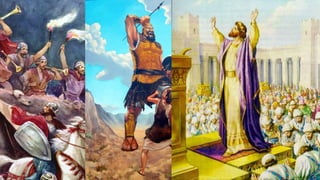
  • #26 Historical parallels to God's unconventional methods include Gideon's 300 men defeating Midianite thousands through confusion rather than combat (Judges 7), David's sling conquering Goliath's armor (1 Samuel 17), and Jehoshaphat's victory through worship rather than warfare (2 Chronicles 20).
  • #27 Each demonstrates that divine glory emerges most clearly when human resources prove inadequate and supernatural intervention becomes the only explanation for victory (Durham, John I. Exodus: Word Biblical Commentary. Waco: Word Books, 1987, pp. 191-205).
  • #28 Block quote: "God's strength is made perfect in weakness, and His glory shines brightest when human resources fail and divine intervention becomes the only explanation for victory." - Charles Spurgeon, The Treasury of David (Spurgeon, Charles H. The Treasury of David. London: Passmore & Alabaster, 1870) • Durham, John I. Exodus: Word Biblical Commentary. Waco: Word Books, 1987. • Fretheim, Terence E. Exodus: Interpretation Commentary. Louisville: John Knox Press, 1991. • Stuart, Douglas K. Exodus: New American Commentary. Nashville: Broadman & Holman, 2006.
  • #29 2. How did Pharaoh react when he was told that the Israelites had left? Why didn't just cut his losses and let them go? (14:5–9) Pharaoh's reaction was swift and decisive: "his heart and the heart of his officials were changed toward the people" (v. 5). The Hebrew verb נֶהְפַּךְ (nehpakh, "was changed/turned") indicates a complete reversal of attitude, suggesting that his previous consent to Israel's departure was either insincere or quickly regretted. The phrase "What have we done?" (מָה־זֹּאת עָשִׂינוּ, mah-zot asinu) expresses immediate remorse and incredulity at their economic and political decision. Several factors prevented Pharaoh from accepting his losses. First, economic considerations dominated: losing approximately two million slaves represented catastrophic labor shortage affecting agriculture, construction, and military projects. The phrase "we have lost our slaves" (v. 5) uses the Hebrew אִבַּדְנוּ (avadnu, "we have lost/destroyed"), suggesting permanent rather than temporary loss. Second, his royal pride demanded vindication after repeated humiliation through the plagues. Egyptian pharaohs claimed divine status, making their defeat by a foreign god politically and theologically intolerable. Third, military confidence in Egyptian cavalry and chariot forces led to overconfidence. Verse 7 describes Pharaoh taking "six hundred of the best chariots, along with all the other chariots of Egypt, with officers over all of them." The Hebrew phrase שָׁלִשִׁם (shalishim, "officers") refers to elite chariot crews, indicating this represented Egypt's finest military units rather than hastily assembled forces. Fourth, psychological factors including sunk cost fallacy—having invested so much in resisting Moses, surrender felt like admitting total defeat. The hardening of Pharaoh's heart (v. 8) represents both divine judicial action and human stubborn pride refusing to accept divine sovereignty. Ancient Near Eastern royal ideology required rulers to demonstrate strength and never appear weak before subjects or foreign powers (Kitchen, Kenneth A. On the Reliability of the Old Testament. Grand Rapids: Eerdmans, 2003, pp. 255-270). Block quote: "Pride goes before destruction, a haughty spirit before a fall, and Pharaoh's pursuit of Israel exemplifies how earthly power often destroys itself through refusing to acknowledge divine authority." - Matthew Henry, Matthew Henry's Commentary on the Whole Bible (Henry, Matthew. Commentary on the Whole Bible. London: Marshall Brothers, 1706) • Kitchen, Kenneth A. On the Reliability of the Old Testament. Grand Rapids: Eerdmans, 2003. • Hoffmeier, James K. Israel in Egypt: The Evidence for the Authenticity of the Exodus Tradition. Oxford: Oxford University Press, 1997. • Childs, Brevard S. The Book of Exodus: A Critical, Theological Commentary. Philadelphia: Westminster Press, 1974.
  • #30 Pharaoh's reaction was swift and decisive: ”Pharaoh and his officials changed their minds about them" (v. 5). He had a complete reversal of attitude, suggesting that his previous consent to Israel's departure was either insincere or quickly regretted. The phrase "What have we done?” expresses immediate remorse and incredulity at their economic and political decision.
  • #31 Several factors prevented Pharaoh from accepting his losses. First, economic considerations dominated: losing approximately two million slaves represented catastrophic labor shortage affecting agriculture, construction, and military projects. The phrase "we have lost our slaves" (v. 5) uses the Hebrew (avadnu, "we have lost/destroyed"), suggesting permanent rather than temporary loss. Second, his royal pride demanded vindication after repeated humiliation through the plagues. Egyptian pharaohs claimed divine status, making their defeat by a foreign god politically and theologically intolerable. Third, military confidence in Egyptian cavalry and chariot forces led to overconfidence. Verse 7 describes Pharaoh taking "six hundred of the best chariots, along with all the other chariots of Egypt, with officers over all of them." The Hebrew phrase (shalishim, "officers") refers to elite chariot crews, indicating this represented Egypt's finest military units rather than hastily assembled forces. Fourth, psychological factors including sunk cost fallacy—having invested so much in resisting Moses, surrender felt like admitting total defeat. (The sunk cost fallacy is a common reasoning error where people continue investing time, money, or effort into something because of what they've already invested, rather than evaluating whether it makes sense to continue based on future costs and benefits. The hardening of Pharaoh's heart (v. 8) represents both divine judicial action and human stubborn pride refusing to accept divine sovereignty.
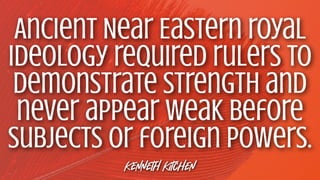
  • #32 Ancient Near Eastern royal ideology required rulers to demonstrate strength and never appear weak before subjects or foreign powers (Kitchen, Kenneth A. On the Reliability of the Old Testament. Grand Rapids: Eerdmans, 2003, pp. 255-270).
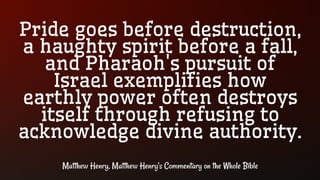
  • #33 Block quote: "Pride goes before destruction, a haughty spirit before a fall, and Pharaoh's pursuit of Israel exemplifies how earthly power often destroys itself through refusing to acknowledge divine authority." - Matthew Henry, Matthew Henry's Commentary on the Whole Bible (Henry, Matthew. Commentary on the Whole Bible. London: Marshall Brothers, 1706) • Kitchen, Kenneth A. On the Reliability of the Old Testament. Grand Rapids: Eerdmans, 2003. • Hoffmeier, James K. Israel in Egypt: The Evidence for the Authenticity of the Exodus Tradition. Oxford: Oxford University Press, 1997. • Childs, Brevard S. The Book of Exodus: A Critical, Theological Commentary. Philadelphia: Westminster Press, 1974.
  • #34 3. How did the Israelites cope with their fears when the Egyptian army came after them? When have you ever felt hopeless? (14:10–12) The Israelites coped with fear through immediate panic, blame-shifting, and nostalgic revisionism rather than faith-based responses. Upon seeing Egyptian forces, "they were terrified and cried out to the LORD" (v. 10). The Hebrew phrase וַיִּיְרְאוּ מְאֹד (vayir'u me'od, "they feared greatly") indicates overwhelming terror, while וַיִּצְעֲקוּ (vayitz'aku, "they cried out") suggests desperate screaming rather than confident prayer. Their fear quickly transformed into accusatory complaints against Moses: "Was it because there were no graves in Egypt that you brought us to the desert to die?" (v. 11). This sarcastic question employs Hebrew irony—Egypt was famous for elaborate burial practices and tombs, making the complaint both bitter and culturally pointed. The phrase הֲמִבְּלִי אֵין־קְבָרִים (ha-mibli ein-qvarim, "because there are no graves") uses emphatic negative construction for maximum rhetorical effect. Most revealing is their idealization of Egyptian slavery: "It would have been better for us to serve the Egyptians than to die in the wilderness" (v. 12). The Hebrew verb עָבַד (avad, "to serve") euphemistically describes their brutal oppression, while the phrase טוֹב לָנוּ (tov lanu, "it is better for us") demonstrates how crisis can distort memory and perspective. They preferred certain slavery to uncertain freedom, known oppression to unknown deliverance. This response pattern—fear leading to blame, blame to nostalgia for previous bondage—reflects common human coping mechanisms under extreme stress. When facing overwhelming circumstances, people often: romanticize past difficulties as preferable to present uncertainties, seek someone to blame rather than seeking solutions, allow fear to override faith despite previous evidences of divine faithfulness, and prefer familiar misery to unfamiliar hope. The Israelites had witnessed ten miraculous plagues demonstrating God's power over Egypt, yet three days into wilderness travel, they assumed abandonment and death. This illustrates how quickly crisis can eclipse faith and how fear can make slavery appear preferable to freedom when freedom requires trusting divine provision rather than human security (Brueggemann, Walter. Exodus: Interpretation Commentary. Louisville: Westminster John Knox Press, 2009, pp. 145-158). Block quote: "Fear makes us forget God's faithfulness and makes slavery seem better than the uncertainty of freedom, but divine deliverance often comes when human hope is exhausted." - Oswald Chambers, My Utmost for His Highest (Chambers, Oswald. My Utmost for His Highest. London: Simpkin Marshall, 1927) • Brueggemann, Walter. Exodus: Interpretation Commentary. Louisville: Westminster John Knox Press, 2009. • Dozeman, Thomas B. Commentary on Exodus. Grand Rapids: Eerdmans, 2009. • Propp, William H.C. Exodus 1-18: Anchor Bible Commentary. New York: Doubleday, 1999.
  • #35 The Israelites coped with fear through immediate panic, blame-shifting, and nostalgic revisionism rather than faith-based responses. Upon seeing Egyptian forces, "they were terrified and cried out to the LORD" (v. 10). The phrase "they feared greatly" indicates overwhelming terror, while "they cried out" suggests desperate screaming rather than confident prayer. Their fear quickly transformed into accusatory complaints against Moses: ”Weren’t there enough graves for us in Egypt?" (v. 11). This sarcastic question employs Hebrew irony—Egypt was famous for elaborate burial practices and tombs, making the complaint both bitter and culturally pointed. The phrase "because there are no graves" uses emphatic negative construction for maximum rhetorical effect. Most revealing is their idealization of Egyptian slavery: "It would have been better for us to serve the Egyptians than to die in the wilderness" (v. 12). Crisis can distort memory and perspective. They preferred certain slavery to uncertain freedom, known oppression to unknown deliverance. This response pattern—fear leading to blame, blame to nostalgia for previous bondage—reflects common human coping mechanisms under extreme stress. When facing overwhelming circumstances, people often: romanticize past difficulties as preferable to present uncertainties, seek someone to blame rather than seeking solutions, allow fear to override faith despite previous evidences of divine faithfulness, and prefer familiar misery to unfamiliar hope.
  • #36 The Israelites had witnessed ten miraculous plagues demonstrating God's power over Egypt, yet three days into wilderness travel, they assumed abandonment and death. This illustrates how quickly crisis can eclipse faith and how fear can make slavery appear preferable to freedom when freedom requires trusting divine provision rather than human security (Brueggemann, Walter. Exodus: Interpretation Commentary. Louisville: Westminster John Knox Press, 2009, pp. 145-158).
  • #37 Block quote: "Fear makes us forget God's faithfulness and makes slavery seem better than the uncertainty of freedom, but divine deliverance often comes when human hope is exhausted." - Oswald Chambers, My Utmost for His Highest (Chambers, Oswald. My Utmost for His Highest. London: Simpkin Marshall, 1927) • Brueggemann, Walter. Exodus: Interpretation Commentary. Louisville: Westminster John Knox Press, 2009. • Dozeman, Thomas B. Commentary on Exodus. Grand Rapids: Eerdmans, 2009. • Propp, William H.C. Exodus 1-18: Anchor Bible Commentary. New York: Doubleday, 1999.
  • #38 4. How did Moses respond when the Egyptians were bearing down on the Israelites? (14:13–14) Moses responded with remarkable calm and faith-based leadership, offering both reassurance and theological perspective to the panicking Israelites. His response began with the command אַל־תִּירָאוּ (al-tir'u, "Do not fear"), using emphatic Hebrew construction that could be translated "Stop being afraid!" This imperative directly counters their terror with authoritative confidence in divine protection. He then provided a threefold promise: "Stand firm and you will see the deliverance the LORD will bring you today" (v. 13). The Hebrew verb הִתְיַצְּבוּ (hityatzvu, "stand firm/take your stand") suggests military positioning despite lacking weapons or tactical advantage. The phrase יְשׁוּעַת יְהוָה (yeshu'at YHWH, "salvation/deliverance of the LORD") emphasizes divine rather than human action as the source of rescue. The theological climax appears in Moses' declaration: "The Egyptians you see today you will never see again" (v. 13). This prophecy demonstrates Moses' complete confidence in God's promise and provides specific, verifiable hope to sustain faith during crisis. The Hebrew phrase לֹא תֹסִיפוּ לִרְאֹתָם (lo tosifu lir'otam, "you will not continue to see them") indicates permanent rather than temporary relief. Verse 14 contains the essential principle of divine warfare: "The LORD will fight for you; you need only to be still." The Hebrew verb יִלָּחֵם (yilachem, "will fight") uses active imperfect tense indicating ongoing divine military action, while וְאַתֶּם תַּחֲרִישׁוּן (v'atem tacharishun, "you will be silent/still") commands human restraint from interference. Moses' response demonstrates several leadership principles: he remained calm under pressure, communicated confidence in divine promises, provided specific hope for immediate crisis, shifted focus from human inadequacy to divine adequacy, and commanded appropriate human response (standing firm while remaining still). His faith-based leadership transformed panic into patient expectation of supernatural intervention (Hamilton, Victor P. Exodus: An Exegetical Commentary. Grand Rapids: Baker Academic, 2011, pp. 205-218). Block quote: "True leadership in crisis means standing firm in faith while remaining still enough to let God fight the battles that are beyond human ability to win." - John Maxwell, The 21 Irrefutable Laws of Leadership (Maxwell, John C. The 21 Irrefutable Laws of Leadership. Nashville: Thomas Nelson, 1998) • Hamilton, Victor P. Exodus: An Exegetical Commentary. Grand Rapids: Baker Academic, 2011. • Sarna, Nahum M. Exploring Exodus: The Heritage of Biblical Israel. New York: Schocken Books, 1996. • Janzen, J. Gerald. Exodus: Westminster Bible Companion. Louisville: Westminster John Knox Press, 1997.
  • #39 Moses responded with remarkable calm and faith-based leadership, offering both reassurance and theological perspective to the panicking Israelites. His response began with the command "Do not fear", using emphatic Hebrew construction that could be translated "Stop being afraid!" This imperative directly counters their terror with authoritative confidence in divine protection. He then provided a threefold promise: "Stand firm and you will see the deliverance the LORD will bring you today" (v. 13). The verb "stand firm/take your stand" suggests military positioning despite lacking weapons or tactical advantage. The phrase "salvation/deliverance of the LORD" emphasizes divine rather than human action as the source of rescue. The theological climax appears in Moses' declaration: "The Egyptians you see today you will never see again" (v. 13). This prophecy demonstrates Moses' complete confidence in God's promise and provides specific, verifiable hope to sustain faith during crisis. The phrase "you will not continue to see them" indicates permanent rather than temporary relief.
  • #40 Verse 14 contains the essential principle of divine warfare: "The LORD will fight for you; you need only to be still." The verb "will fight" uses active imperfect tense indicating ongoing divine military action, while "you will be silent/still" commands human restraint from interference.
  • #41 Moses' response demonstrates several leadership principles: he remained calm under pressure, communicated confidence in divine promises, provided specific hope for immediate crisis, shifted focus from human inadequacy to divine adequacy, and commanded appropriate human response (standing firm while remaining still).
  • #42 His faith-based leadership transformed panic into patient expectation of supernatural intervention (Hamilton, Victor P. Exodus: An Exegetical Commentary. Grand Rapids: Baker Academic, 2011, pp. 205-218).
  • #43 Block quote: "True leadership in crisis means standing firm in faith while remaining still enough to let God fight the battles that are beyond human ability to win." - John Maxwell, The 21 Irrefutable Laws of Leadership (Maxwell, John C. The 21 Irrefutable Laws of Leadership. Nashville: Thomas Nelson, 1998) • Hamilton, Victor P. Exodus: An Exegetical Commentary. Grand Rapids: Baker Academic, 2011. • Sarna, Nahum M. Exploring Exodus: The Heritage of Biblical Israel. New York: Schocken Books, 1996. • Janzen, J. Gerald. Exodus: Westminster Bible Companion. Louisville: Westminster John Knox Press, 1997.
  • #44 5. What did God say to Moses to get the Israelites moving? (14:15–18) God's response to Moses revealed that while the people needed to "stand firm," they also needed to "move forward" into active obedience. The divine question "Why are you crying out to me?" (v. 15) suggests that Moses had joined the people in desperate prayer rather than implementing divine instructions. The Hebrew phrase מַה־תִּצְעַק אֵלָי (mah-titz'aq elai, "why do you cry out to me?") indicates that the time for prayer had passed and the moment for action had arrived. The command וְדַבֵּר אֶל־בְּנֵי יִשְׂרָאֵל וְיִסָּעוּ (v'daber el-b'nei Yisra'el v'yissa'u, "tell the Israelites to move forward," v. 15) uses the Hebrew verb נָסַע (nasa, "to journey/break camp"), the same term used throughout the wilderness narratives for divinely directed travel. This wasn't merely physical movement but covenant obedience to divine guidance despite seemingly impossible circumstances. God then provided Moses with specific actions to facilitate the miracle: "Raise your staff and stretch out your hand over the sea to divide the water" (v. 16). The Hebrew verb נְטֵה (neteh, "stretch out") had appeared throughout the plague narratives, establishing Moses' rod as the instrument of divine power. The phrase בְּקַע אֶת־הַיָּם (beqa et-ha-yam, "divide the sea") uses terminology suggesting violent splitting rather than gentle parting. The purpose statement appears in verses 17-18: "I will gain glory through Pharaoh and all his army, his chariots and his horsemen. The Egyptians will know that I am the LORD when I gain glory through Pharaoh, his chariots and his horsemen." The repetition of אֶכָּבְדָה (ekavdah, "I will be glorified") emphasizes that Israel's deliverance serves the larger purpose of revealing divine character to the nations. God's instructions combined divine action (splitting the sea) with human obedience (moving forward), supernatural intervention (hardening Egyptian hearts) with natural consequences (their destruction), and immediate rescue (crossing safely) with eternal purpose (divine glory). The balance between "standing firm" in faith and "moving forward" in obedience illustrates that biblical faith requires both trust and action, patience and progress (Meyers, Carol L. Exodus: New Cambridge Bible Commentary. Cambridge: Cambridge University Press, 2005, pp. 112-125). Block quote: "Faith is not a passive waiting for God to act, but an active stepping forward in obedience when God has spoken, even when the path seems impossible." - Hudson Taylor, A Retrospect (Taylor, Hudson. A Retrospect. London: Religious Tract Society, 1894) • Meyers, Carol L. Exodus: New Cambridge Bible Commentary. Cambridge: Cambridge University Press, 2005. • Stuart, Douglas K. Exodus: New American Commentary. Nashville: Broadman & Holman, 2006. • Fretheim, Terence E. Exodus: Interpretation Commentary. Louisville: John Knox Press, 1991.
  • #45 God's response to Moses revealed that while the people needed to "stand firm," they also needed to "move forward" into active obedience. The divine question "Why are you crying out to me?" (v. 15) suggests that Moses had joined the people in desperate prayer rather than implementing divine instructions. The phrase "why do you cry out to me?" indicates that the time for prayer had passed and the moment for action had arrived. The command "tell the Israelites to move forward," (v. 15) uses the Hebrew verb (nasa, "to journey/break camp"), the same term used throughout the wilderness narratives for divinely directed travel. This wasn't merely physical movement but covenant obedience to divine guidance despite seemingly impossible circumstances. God then provided Moses with specific actions to facilitate the miracle: "Raise your staff and stretch out your hand over the sea to divide the water" (v. 16). The Hebrew verb (neteh, "stretch out") had appeared throughout the plague narratives, establishing Moses' rod as the instrument of divine power. The phrase "divide the sea" uses terminology suggesting violent splitting rather than gentle parting.
  • #46 The purpose statement appears in verses 17-18: "I will gain glory through Pharaoh and all his army, his chariots and his horsemen. The Egyptians will know that I am the LORD when I gain glory through Pharaoh, his chariots and his horsemen." The repetition of "I will be glorified" emphasizes that Israel's deliverance serves the larger purpose of revealing divine character to the nations.
  • #47 God's instructions combined divine action (splitting the sea) with human obedience (moving forward), supernatural intervention (hardening Egyptian hearts) with natural consequences (their destruction), and immediate rescue (crossing safely) with eternal purpose (divine glory). The balance between "standing firm" in faith and "moving forward" in obedience illustrates that biblical faith requires both trust and action, patience and progress (Meyers, Carol L. Exodus: New Cambridge Bible Commentary. Cambridge: Cambridge University Press, 2005, pp. 112-125).
  • #48 Block quote: "Faith is not a passive waiting for God to act, but an active stepping forward in obedience when God has spoken, even when the path seems impossible." - Hudson Taylor, A Retrospect (Taylor, Hudson. A Retrospect. London: Religious Tract Society, 1894) • Meyers, Carol L. Exodus: New Cambridge Bible Commentary. Cambridge: Cambridge University Press, 2005. • Stuart, Douglas K. Exodus: New American Commentary. Nashville: Broadman & Holman, 2006. • Fretheim, Terence E. Exodus: Interpretation Commentary. Louisville: John Knox Press, 1991.
  • #49 6. Moses tells the people that they are to "stand firm" while God tells Moses to have them "move on." How is it possible to do both at the same time? (14:13, 15) The apparent contradiction between "standing firm" (הִתְיַצְּבוּ, hityatzvu, v. 13) and "moving on" (וְיִסָּעוּ, v'yissa'u, v. 15) resolves when understanding these commands as sequential phases of faith-based action rather than simultaneous contradictory instructions. The Hebrew verbs address different aspects of faithful response to crisis: inner spiritual posture and outer obedient action. "Standing firm" (הִתְיַצְּבוּ) carries military connotations of taking a defensive position, maintaining courage under attack, and refusing to flee in panic. The Hithpael stem indicates reflexive action—the Israelites must actively position themselves for divine intervention rather than passively waiting. This involves spiritual resolve, emotional stability, and confidence in God's promises despite overwhelming circumstances. The NLT captures this sense: "Stand still and watch the LORD rescue you today." "Moving on" (וְיִסָּעוּ) describes the covenant community's characteristic response to divine guidance throughout the wilderness period. This verb appears over 150 times in the Pentateuch, indicating divinely directed travel according to cloud and fire manifestations. The command requires active obedience despite apparent impossibility—walking toward the sea despite lacking boats, bridges, or alternative routes. The synthesis emerges in understanding that spiritual "standing firm" enables physical "moving forward." Inner confidence in divine faithfulness provides the foundation for outer obedience to divine commands. The Hebrew concept encompasses both dimensions: רוח נכון (ruach nakhon, "steadfast spirit") that maintains hope during crisis, and הליכה באמונה (halakhah be-emunah, "walking in faith") that translates trust into action. Contemporary application involves similar integration: standing firm in biblical truth while moving forward in ministry opportunities, maintaining doctrinal convictions while adapting methods to changing circumstances, holding fast to core values while embracing necessary change, and preserving spiritual stability while pursuing growth. The Red Sea paradigm teaches that effective Christian living requires both rootedness and responsiveness, firmness and flexibility, conviction and courage to advance when God opens doors (Childs, Brevard S. The Book of Exodus. Philadelphia: Westminster Press, 1974, pp. 220-235). Block quote: "Faith is a living, daring confidence in God's grace, so sure and certain that one could stake his life on it a thousand times." - Martin Luther, Preface to the Epistle to the Romans (Luther, Martin. Preface to the Epistle to the Romans. Wittenberg: 1522) • Childs, Brevard S. The Book of Exodus: A Critical, Theological Commentary. Philadelphia: Westminster Press, 1974. • Durham, John I. Exodus: Word Biblical Commentary. Waco: Word Books, 1987. • Hoffmeier, James K. Israel in Egypt: The Evidence for the Authenticity of the Exodus Tradition. Oxford: Oxford University Press, 1997.
  • #50 The apparent contradiction between "standing firm" (v. 13) and "moving on" (v. 15) resolves when understanding these commands as sequential phases of faith-based action rather than simultaneous contradictory instructions. The Hebrew verbs address different aspects of faithful response to crisis: inner spiritual posture and outer obedient action. "Standing firm" carries military connotations of taking a defensive position, maintaining courage under attack, and refusing to flee in panic. The Israelites must actively position themselves for divine intervention rather than passively waiting. This involves spiritual resolve, emotional stability, and confidence in God's promises despite overwhelming circumstances. The NLT captures this sense: "Stand still and watch the LORD rescue you today."
  • #51 "Moving on" describes the covenant community's characteristic response to divine guidance throughout the wilderness period. This verb appears over 150 times in the Pentateuch, indicating divinely directed travel according to cloud and fire manifestations. The command requires active obedience despite apparent impossibility—walking toward the sea despite lacking boats, bridges, or alternative routes.
  • #52 The synthesis emerges in understanding that spiritual "standing firm" enables physical "moving forward.” Inner confidence in divine faithfulness provides the foundation for outer obedience to divine commands. The Hebrew concept encompasses both dimensions: "steadfast spirit" that maintains hope during crisis, and "walking in faith" that translates trust into action.
  • #53 Contemporary application involves similar integration: standing firm in biblical truth while moving forward in ministry opportunities, maintaining doctrinal convictions while adapting methods to changing circumstances, holding fast to core values while embracing necessary change, and preserving spiritual stability while pursuing growth. The Red Sea paradigm teaches that effective Christian living requires both rootedness and responsiveness, firmness and flexibility, conviction and courage to advance when God opens doors (Childs, Brevard S. The Book of Exodus. Philadelphia: Westminster Press, 1974, pp. 220-235).
  • #54 Block quote: "Faith is a living, daring confidence in God's grace, so sure and certain that one could stake his life on it a thousand times." - Martin Luther, Preface to the Epistle to the Romans (Luther, Martin. Preface to the Epistle to the Romans. Wittenberg: 1522) • Childs, Brevard S. The Book of Exodus: A Critical, Theological Commentary. Philadelphia: Westminster Press, 1974. • Durham, John I. Exodus: Word Biblical Commentary. Waco: Word Books, 1987. • Hoffmeier, James K. Israel in Egypt: The Evidence for the Authenticity of the Exodus Tradition. Oxford: Oxford University Press, 1997.
  • #55 7. Who protected the Israelites from the Egyptian army? (14:19–20) The angel of God (מַלְאַךְ הָאֱלֹהִים, mal'akh ha-Elohim) and the pillar of cloud (עַמּוּד הֶעָנָן, ammud he-anan) provided divine protection by repositioning themselves between Israel and Egypt's advancing army. The Hebrew verb וַיִּסַּע (vayissa, "moved/journeyed") indicates deliberate relocation rather than random movement, demonstrating strategic divine intervention at the crucial moment. The "angel of God" represents a theophanic manifestation—divine presence in accessible form rather than an ordinary heavenly messenger. Throughout the Pentateuch, this figure appears at critical moments providing guidance, protection, and divine communication (Genesis 16:7-14; 22:11-18; Exodus 3:2-6). The ESV maintains "angel of God" while the NET Bible clarifies: "The angel of God, who was going before the camp of Israel, moved and went behind them." The pillar of cloud served multiple protective functions: it provided physical barrier preventing Egyptian approach, created darkness on Egypt's side while maintaining light for Israel, and demonstrated visible divine presence encouraging Israelite faith. The Hebrew phrase וַיָּבֹא בֵּין מַחֲנֵה מִצְרַיִם וּבֵין מַחֲנֵה יִשְׂרָאֵל (vayavo bein machaneh Mitzrayim u-vein machaneh Yisra'el, "came between the camp of Egypt and the camp of Israel") emphasizes divine positioning as protector and separator. Verse 20 describes the supernatural light-darkness division: "Throughout the night the cloud brought darkness to the one side and light to the other side." The Hebrew phrase וַיְהִי הֶחֹשֶׁךְ וְהָאוֹר (vayhi ha-choshekh v'ha-or, "there was darkness and light") indicates simultaneous opposing conditions affecting the same geographic area but different armies. This miracle parallels the ninth plague's "darkness that can be felt" (10:21) while maintaining illumination for God's people. The divine protection strategy demonstrates several theological principles: God fights for his people through supernatural means rather than conventional warfare, divine presence adapts to circumstances requiring different types of intervention, protection often involves separation from hostile forces rather than their destruction, and God's timing coordinates multiple elements (cloud movement, sea division, wind direction) for comprehensive deliverance (Propp, William H.C. Exodus 1-18: Anchor Bible Commentary. New York: Doubleday, 1999, pp. 485-498). Block quote: "The same God who guides us forward also guards us from behind, positioning himself between his people and their enemies with perfect timing and absolute power." - Charles Spurgeon, The Treasury of David (Spurgeon, Charles H. The Treasury of David. London: Passmore & Alabaster, 1870) • Propp, William H.C. Exodus 1-18: Anchor Bible Commentary. New York: Doubleday, 1999. • Dozeman, Thomas B. Commentary on Exodus. Grand Rapids: Eerdmans, 2009. • Sarna, Nahum M. Exploring Exodus: The Heritage of Biblical Israel. New York: Schocken Books, 1996.
  • #56 The “angel of God” and the “pillar of cloud” provided divine protection by repositioning themselves between Israel and Egypt's advancing army. The verb "moved/journeyed" indicates deliberate relocation rather than random movement, demonstrating strategic divine intervention at the crucial moment. The "angel of God" represents a theophanic manifestation—divine presence in accessible form rather than an ordinary heavenly messenger. Throughout the Pentateuch, this figure appears at critical moments providing guidance, protection, and divine communication (Genesis 16:7-14; 22:11-18; Exodus 3:2-6). The ESV maintains "angel of God" while the NET Bible clarifies: "The angel of God, who was going before the camp of Israel, moved and went behind them." The pillar of cloud served multiple protective functions: it provided physical barrier preventing Egyptian approach, created darkness on Egypt's side while maintaining light for Israel, and demonstrated visible divine presence encouraging Israelite faith. The phrase "came between the camp of Egypt and the camp of Israel" emphasizes divine positioning as protector and separator.
  • #57 Verse 20 describes the supernatural light-darkness division: "Throughout the night the cloud brought darkness to the one side and light to the other side." The phrase "there was darkness and light" indicates simultaneous opposing conditions affecting the same geographic area but different armies. This miracle parallels the ninth plague's "darkness that can be felt" (10:21) while maintaining illumination for God's people.
  • #58 The divine protection strategy demonstrates several theological principles: God fights for his people through supernatural means rather than conventional warfare, Divine presence adapts to circumstances requiring different types of intervention, Protection often involves separation from hostile forces rather than their destruction, and God's timing coordinates multiple elements (cloud movement, sea division, wind direction) for comprehensive deliverance (Propp, William H.C. Exodus 1-18: Anchor Bible Commentary. New York: Doubleday, 1999, pp. 485-498).
  • #59 Block quote: "The same God who guides us forward also guards us from behind, positioning himself between his people and their enemies with perfect timing and absolute power." - Charles Spurgeon, The Treasury of David (Spurgeon, Charles H. The Treasury of David. London: Passmore & Alabaster, 1870) • Propp, William H.C. Exodus 1-18: Anchor Bible Commentary. New York: Doubleday, 1999. • Dozeman, Thomas B. Commentary on Exodus. Grand Rapids: Eerdmans, 2009. • Sarna, Nahum M. Exploring Exodus: The Heritage of Biblical Israel. New York: Schocken Books, 1996.
  • #60 8. What miraculous events took place at the Red Sea? (14:21–31) The Red Sea crossing involved multiple interconnected miracles demonstrating unprecedented divine control over natural elements. The primary miracle was the sea division itself: "Moses stretched out his hand over the sea, and all that night the LORD drove the sea back with a strong east wind and turned it into dry ground" (v. 21). The Hebrew phrase רוּחַ קָדִים עַזָּה (ruach qadim azzah, "strong east wind") describes supernatural wind intensity and duration that exposed sea bottom as dry land (חָרָבָה, charavah). The water formation created protective walls: "The water was a wall to them on their right and on their left" (v. 22). The Hebrew חוֹמָה (chomah, "wall") typically describes city fortifications, suggesting vertical water masses rather than gradual slopes. This terminology emphasizes the supernatural nature of the event—water maintained structural integrity despite defying gravitational forces. The repetition in verse 29 reinforces this miraculous aspect. The timing miracle coordinated multiple elements: wind duration throughout the night, complete water removal before Egyptian pursuit, Israelite crossing during darkness while maintaining visibility, and precise timing of water return as Egyptians reached mid-sea. The Hebrew phrase בַּבֹּקֶר אֶל־נְכוֹן הַיָּם (baboqer el-nekhon ha-yam, "toward morning the sea returned to its normal depth," v. 27) indicates supernatural timing rather than coincidental natural phenomena. The Egyptian destruction involved divine warfare: "The LORD threw the Egyptians into the sea" (v. 27). The Hebrew verb וַיְנַעֵר (vayena'er, "shook off/threw") suggests violent action, while verse 24 describes divine confusion in Egyptian ranks: "he jammed the wheels of their chariots so that they had difficulty driving." This supernatural interference with Egyptian military equipment demonstrates direct divine intervention in the battle. The comprehensive result was total Egyptian military destruction: "Not one of them survived" (v. 28). Archaeological evidence from various periods shows Egyptian military records typically excluded defeats, making this complete annihilation historically significant. The Hebrew phrase לֹא־נִשְׁאַר בָּהֶם עַד־אֶחָד (lo-nish'ar bahem ad-echad, "not one of them remained") emphasizes the totality of divine judgment while highlighting Israel's complete preservation (Kitchen, Kenneth A. On the Reliability of the Old Testament. Grand Rapids: Eerdmans, 2003, pp. 261-275). Block quote: "The Red Sea crossing demonstrates that when God intervenes in history, natural laws become servants of divine purposes rather than obstacles to divine plans." - John Calvin, Commentary on Exodus (Calvin, John. Commentary on the Four Last Books of Moses. Grand Rapids: Eerdmans, 1950) • Kitchen, Kenneth A. On the Reliability of the Old Testament. Grand Rapids: Eerdmans, 2003. • Hamilton, Victor P. Exodus: An Exegetical Commentary. Grand Rapids: Baker Academic, 2011. • Brueggemann, Walter. Exodus: Interpretation Commentary. Louisville: Westminster John Knox Press, 2009.
  • #61 The Red Sea crossing involved multiple interconnected miracles demonstrating unprecedented divine control over natural elements. The primary miracle was the sea division itself: "Moses stretched out his hand over the sea, and all that night the LORD drove the sea back with a strong east wind and turned it into dry ground" (v. 21). The phrase "strong east wind" describes supernatural wind intensity and duration that exposed sea bottom as dry land. The water formation created protective walls: "The water was a wall to them on their right and on their left" (v. 22). The Hebrew (chomah, "wall") typically describes city fortifications, suggesting vertical water masses rather than gradual slopes. This terminology emphasizes the supernatural nature of the event—water maintained structural integrity despite defying gravitational forces. The repetition in verse 29 reinforces this miraculous aspect.
  • #62 The Gulf of Aqaba is approximately 4-5 miles (6-8 kilometers) wide at its narrowest point, which occurs at the Straits of Tiran at its southern entrance where it connects to the Red Sea. At the Tiran Strait, the Gulf of Aqaba is 950 feet deep.
  • #63 The Gulf of Aqaba is 6070 feet deep at its deepest point. That’s 1.15 miles deep Commercial buildings calculate 14 feet per story. That means the walls may have been as high as 433 stories. The Gulf of Suez is relatively shallow at 230 feet. The Gulf of Aqaba is approximately 4-5 miles (6-8 kilometers) wide at its narrowest point, which occurs at the Straits of Tiran at its southern entrance where it connects to the Red Sea. At the Tiran Strait, the Gulf of Aqaba is 950 feet deep.
  • #64 The Gulf of Suez is 12 miles wide and 230 feet deep at its narrowest point
  • #65 A standard 20 story building would be about 230 feet high. Imagine walking in Manhattan between skyscrapers. Now, imagine that the walls of the skyscrapers are walls of water standing straight up 230 feet, defying gravity and all known natural processes. That’s what the Israelites did!
  • #66 The tallest building in the world is the Burj Khalifa in Dubai, which has 163 floors and reaches 2,717 feet. These walls of water would be 2.5 times as tall as the Burj Khalifa.
  • #67 The Stratosphere in Las Vegas has an observation deck at 920 feet, making it a near perfect match for the depth of the Gulf of Aqaba at the Tiran Strait.
  • #68 The timing miracle coordinated multiple elements: Wind duration throughout the night, Complete water removal before Egyptian pursuit, Israelite crossing on dry ground during darkness while maintaining visibility, and Precise timing of water return as Egyptians reached mid-sea. The phrase "toward morning the sea returned to its normal depth,” (v. 27) indicates supernatural timing rather than coincidental natural phenomena. The Egyptian destruction involved divine warfare: "The LORD threw the Egyptians into the sea" (v. 27). The verb "shook off/threw" suggests violent action, while verse 24 describes divine confusion in Egyptian ranks: "he jammed the wheels of their chariots so that they had difficulty driving." This supernatural interference with Egyptian military equipment demonstrates direct divine intervention in the battle.
  • #69 The comprehensive result was total Egyptian military destruction: "Not one of them survived" (v. 28). Archaeological evidence from various periods shows Egyptian military records typically excluded defeats, making this complete annihilation historically significant. The phrase "not one of them remained” emphasizes the totality of divine judgment while highlighting Israel's complete preservation (Kitchen, Kenneth A. On the Reliability of the Old Testament. Grand Rapids: Eerdmans, 2003, pp. 261-275).
  • #70 Block quote: "The Red Sea crossing demonstrates that when God intervenes in history, natural laws become servants of divine purposes rather than obstacles to divine plans." - John Calvin, Commentary on Exodus (Calvin, John. Commentary on the Four Last Books of Moses. Grand Rapids: Eerdmans, 1950) • Kitchen, Kenneth A. On the Reliability of the Old Testament. Grand Rapids: Eerdmans, 2003. • Hamilton, Victor P. Exodus: An Exegetical Commentary. Grand Rapids: Baker Academic, 2011. • Brueggemann, Walter. Exodus: Interpretation Commentary. Louisville: Westminster John Knox Press, 2009.
  • #71 9. While God does the fighting for Israel, Moses is required stretch out his hand. What insights does this provide for standing firm? Moses' role of stretching out his hand while God performs the miracle illustrates the essential partnership between divine sovereignty and human obedience in spiritual leadership. The Hebrew phrase נְטֵה אֶת־יָדְךָ (neteh et-yadkha, "stretch out your hand") appears at crucial moments throughout the narrative (vv. 16, 21, 26, 27), indicating that human action serves as the trigger for divine intervention while God provides all the power. The rod in Moses' hand (מַטֶּה, matteh) represents delegated divine authority rather than inherent human power. Throughout Exodus, this same rod produces miracles before Pharaoh, brings plagues upon Egypt, and now divides the sea—but only when wielded in obedience to divine command. The rod symbolizes that spiritual leadership effectiveness depends upon divine anointing rather than human skill, training, or natural ability. The timing aspect proves crucial: Moses must stretch out his hand precisely when God commands, maintain the position throughout Israel's crossing, and repeat the action to restore the waters. This requires sustained obedience under pressure, faith when circumstances appear unchanged, and persistence despite physical strain. The Hebrew narrative emphasizes these repeated actions rather than treating them as single events. The visibility of Moses' actions provided encouragement to two million crossing Israelites and terror to pursuing Egyptians. When people see spiritual leaders actively depending upon God through prayer, worship, and obedient action, their faith increases. Conversely, when leaders try to accomplish ministry through purely human methods, divine power becomes absent and efforts fail. Several leadership principles emerge: spiritual leaders must act in faith while recognizing God as the source of all results; human obedience triggers divine intervention but never controls or manipulates it; leadership requires sustained faithful action rather than momentary heroic gestures; visible dependence upon God encourages others while building their confidence in divine power; and effective ministry combines human responsibility with divine sovereignty rather than replacing one with the other. Contemporary application involves pastors preaching faithfully while trusting God for transformation, missionaries sharing the gospel while depending upon the Spirit for conversion, counselors providing biblical wisdom while relying upon divine healing, and teachers instructing students while praying for spiritual understanding (Janzen, J. Gerald. Exodus: Westminster Bible Companion. Louisville: Westminster John Knox Press, 1997, pp. 98-112). Block quote: "The leader's hand must be raised in dependence while God's hand moves in power, for ministry is neither purely divine action that ignores human responsibility nor purely human action that ignores divine sovereignty." - A.W. Tozer, The Knowledge of the Holy (Tozer, A.W. The Knowledge of the Holy. New York: Harper & Row, 1961) • Janzen, J. Gerald. Exodus: Westminster Bible Companion. Louisville: Westminster John Knox Press, 1997. • Fretheim, Terence E. Exodus: Interpretation Commentary. Louisville: John Knox Press, 1991. • Stuart, Douglas K. Exodus: New American Commentary. Nashville: Broadman & Holman, 2006.
  • #72 Moses' role of stretching out his hand while God performs the miracle illustrates the essential partnership between divine sovereignty and human obedience in spiritual leadership. The phrase "stretch out your hand" appears at crucial moments throughout the narrative (vv. 16, 21, 26, 27), indicating that human action serves as the trigger for divine intervention while God provides all the power. The rod in Moses' hand represents delegated divine authority rather than inherent human power. Throughout Exodus, this same rod produces miracles before Pharaoh, brings plagues upon Egypt, and now divides the sea—but only when wielded in obedience to divine command. The rod symbolizes that spiritual leadership effectiveness depends upon divine anointing rather than human skill, training, or natural ability.
  • #73 The timing aspect proves crucial: Moses must stretch out his hand precisely when God commands, maintain the position throughout Israel's crossing, and repeat the action to restore the waters. This requires sustained obedience under pressure, faith when circumstances appear unchanged, and persistence despite physical strain. The Hebrew narrative emphasizes these repeated actions rather than treating them as single events. (BTW, The Gulf of Aqaba is approximately 4-5 miles (6-8 kilometers) wide at its narrowest point, which occurs at the Straits of Tiran at its southern entrance where it connects to the Red Sea.) The visibility of Moses' actions provided encouragement to two million crossing Israelites and terror to pursuing Egyptians. When people see spiritual leaders actively depending upon God through prayer, worship, and obedient action, their faith increases. Conversely, when leaders try to accomplish ministry through purely human methods, divine power becomes absent and efforts fail. Several leadership principles emerge: spiritual leaders must act in faith while recognizing God as the source of all results; human obedience triggers divine intervention but never controls or manipulates it; leadership requires sustained faithful action rather than momentary heroic gestures; visible dependence upon God encourages others while building their confidence in divine power; and effective ministry combines human responsibility with divine sovereignty rather than replacing one with the other.
  • #74 Contemporary application involves pastors preaching faithfully while trusting God for transformation, missionaries sharing the gospel while depending upon the Spirit for conversion, counselors providing biblical wisdom while relying upon divine healing, and teachers instructing students while praying for spiritual understanding (Janzen, J. Gerald. Exodus: Westminster Bible Companion. Louisville: Westminster John Knox Press, 1997, pp. 98-112).
  • #75 Block quote: "The leader's hand must be raised in dependence while God's hand moves in power, for ministry is neither purely divine action that ignores human responsibility nor purely human action that ignores divine sovereignty." - A.W. Tozer, The Knowledge of the Holy (Tozer, A.W. The Knowledge of the Holy. New York: Harper & Row, 1961) • Janzen, J. Gerald. Exodus: Westminster Bible Companion. Louisville: Westminster John Knox Press, 1997. • Fretheim, Terence E. Exodus: Interpretation Commentary. Louisville: John Knox Press, 1991. • Stuart, Douglas K. Exodus: New American Commentary. Nashville: Broadman & Holman, 2006.
  • #76 10. If you had been one of the Israelites who experienced this event, how would you have described it to someone who wasn't there? As an Israelite eyewitness, I would describe the Red Sea crossing as the most terrifying and magnificent event in human history—a night when the God of Abraham literally fought Egypt's army and won. I would begin by explaining the impossible situation: six hundred Egyptian chariots pursuing us with nowhere to flee, the sea blocking our path, and our children crying as death approached from behind. I would describe the supernatural darkness that separated us from the Egyptians—how we could see clearly while they groped in midnight blackness just yards away. The Hebrew phrase would echo in my memory: מַלְאַךְ הָאֱלֹהִים (mal'akh ha-Elohim, "the angel of God") literally stood between us and annihilation, protecting us through the cloud that brought light to us and darkness to our enemies. I would try to convey the impossibility of what we witnessed: Moses stretching his rod toward the sea while an east wind of supernatural strength began howling, water slowly receding until massive walls of sea stood upright on both sides, and dry ground appearing where moments before lay deep water. The Hebrew term חוֹמָה (chomah, "wall") cannot capture the reality—imagine city walls made of water, towering above our heads, held in place by invisible divine power. I would describe our hesitation—who wants to walk between liquid walls that could collapse at any moment?—followed by our desperate faith as Egyptian war cries grew closer. Two million people, with livestock and possessions, walking across what had been sea bottom just hours before. The ground was firm, not muddy, as if God had prepared our pathway for generations. I would tell them about the Egyptian destruction: how we heard their chariots pursuing us into the sea bed, the confusion in their ranks as God jammed their wheels, their screams as water walls collapsed precisely when the last Israelite reached safety. By morning, bodies of our oppressors washed onto the shore—"not one of them survived." But most importantly, I would describe how this experience transformed our understanding of God. We had heard stories about Abraham's faith and Jacob's wrestling, but we witnessed the God of our fathers demonstrating his absolute power over the greatest empire on earth. The Hebrew phrase וַיַּאֲמִינוּ בַּיהוָה וּבְמֹשֶׁה עַבְדּוֹ (vaya'aminu ba-YHWH u-v'Mosheh avdo, "they believed in the LORD and in Moses his servant," v. 31) captures our response—faith born from overwhelming evidence of divine love and power (Meyers, Carol L. Exodus: New Cambridge Bible Commentary. Cambridge: Cambridge University Press, 2005, pp. 125-140). Block quote: "There are moments in history when heaven touches earth so powerfully that all who witness can only fall in worship, knowing they have seen the hand of God reshape reality itself." - Frederick Buechner, The Magnificent Defeat (Buechner, Frederick. The Magnificent Defeat. New York: Seabury Press, 1966) • Meyers, Carol L. Exodus: New Cambridge Bible Commentary. Cambridge: Cambridge University Press, 2005. • Childs, Brevard S. The Book of Exodus: A Critical, Theological Commentary. Philadelphia: Westminster Press, 1974. • Hoffmeier, James K. Israel in Egypt: The Evidence for the Authenticity of the Exodus Tradition. Oxford: Oxford University Press, 1997.
  • #77 As an Israelite eyewitness, I would describe the Red Sea crossing as the most terrifying and magnificent event in human history—a night when the God of Abraham literally fought Egypt's army and won. I would begin by explaining the impossible situation: six hundred Egyptian chariots pursuing us with nowhere to flee, the sea blocking our path, and our children crying as death approached from behind. I would describe the supernatural darkness that separated us from the Egyptians—how we could see clearly while they groped in midnight blackness just yards away. The Hebrew phrase would echo in my memory: (mal'akh ha-Elohim, "the angel of God") literally stood between us and annihilation, protecting us through the cloud that brought light to us and darkness to our enemies. I would try to convey the impossibility of what we witnessed: Moses stretching his rod toward the sea while an east wind of supernatural strength began howling, water slowly receding until massive walls of sea stood upright on both sides, and dry ground appearing where moments before lay deep water. The Hebrew term (chomah, "wall") cannot capture the reality—imagine city walls made of water, towering above our heads, held in place by invisible divine power. I would describe our hesitation—who wants to walk between liquid walls that could collapse at any moment?—followed by our desperate faith as Egyptian war cries grew closer. Two million people, with livestock and possessions, walking across what had been sea bottom just hours before. The ground was firm, not muddy, as if God had prepared our pathway for generations. I would tell them about the Egyptian destruction: how we heard their chariots pursuing us into the sea bed, the confusion in their ranks as God jammed their wheels, their screams as water walls collapsed precisely when the last Israelite reached safety. By morning, bodies of our oppressors washed onto the shore—"not one of them survived." But most importantly, I would describe how this experience transformed our understanding of God. We had heard stories about Abraham's faith and Jacob's wrestling, but we witnessed the God of our fathers demonstrating his absolute power over the greatest empire on earth. The phrase "they believed in the LORD and in Moses his servant," (v. 31) captures our response—faith born from overwhelming evidence of divine love and power (Meyers, Carol L. Exodus: New Cambridge Bible Commentary. Cambridge: Cambridge University Press, 2005, pp. 125-140).
  • #78 Block quote: "There are moments in history when heaven touches earth so powerfully that all who witness can only fall in worship, knowing they have seen the hand of God reshape reality itself." - Frederick Buechner, The Magnificent Defeat (Buechner, Frederick. The Magnificent Defeat. New York: Seabury Press, 1966) • Meyers, Carol L. Exodus: New Cambridge Bible Commentary. Cambridge: Cambridge University Press, 2005. • Childs, Brevard S. The Book of Exodus: A Critical, Theological Commentary. Philadelphia: Westminster Press, 1974. • Hoffmeier, James K. Israel in Egypt: The Evidence for the Authenticity of the Exodus Tradition. Oxford: Oxford University Press, 1997.
  • #79 Lesson 1 of 13 Moses: Face to Face with God Heritage Bible Master Class is a non-denominational group of senior adults who love the Lord and His word. We meet at Heritage Palms Country Club, South of Fred Waring, East of Jefferson, Indio, 10:15 Sunday morning. We’d love to have you join us. Just let them know at the gate that you’re there for the Bible study and the guard will let you right in. Feel free to comment, If you find these videos helpful, help me out by hitting Like, Subscribe to be notified when I post new material. 03 Red Sea: Standing Firm - Exodus 14:1–31 – October 19, 2025 1. Why did God give Moses precise directions? When have you seen God get glory over his enemies using unconventional means? (14:1–4) 2. How did Pharaoh react when he was told that the Israelites had left? Why didn’t he just cut his losses and let them go? (14:5–9) 3. How did the Israelites cope with their fears when the Egyptian army came after them? When have you ever felt hopeless? (14:10–12) 4. How did Moses respond when the Egyptians were bearing down on the Israelites? (14:13–14) 5. What did God say to Moses to get the Israelites moving? (14:15–18) 6. Moses tells the people that they are to “stand firm,” while God tells Moses to have them “move on.” How is it possible to do both at the same time? (14:13, 15). 7. Who protected the Israelites from the Egyptian army? (14:19–20) 8. What miraculous events took place at the Red Sea? (14:21–31) 9. While God does the fighting for Israel, Moses is required to stretch out his hand. What insights does this provide for standing firm? 10. If you had been one of the Israelites who experienced this event, how would you have described it to someone who wasn’t there?
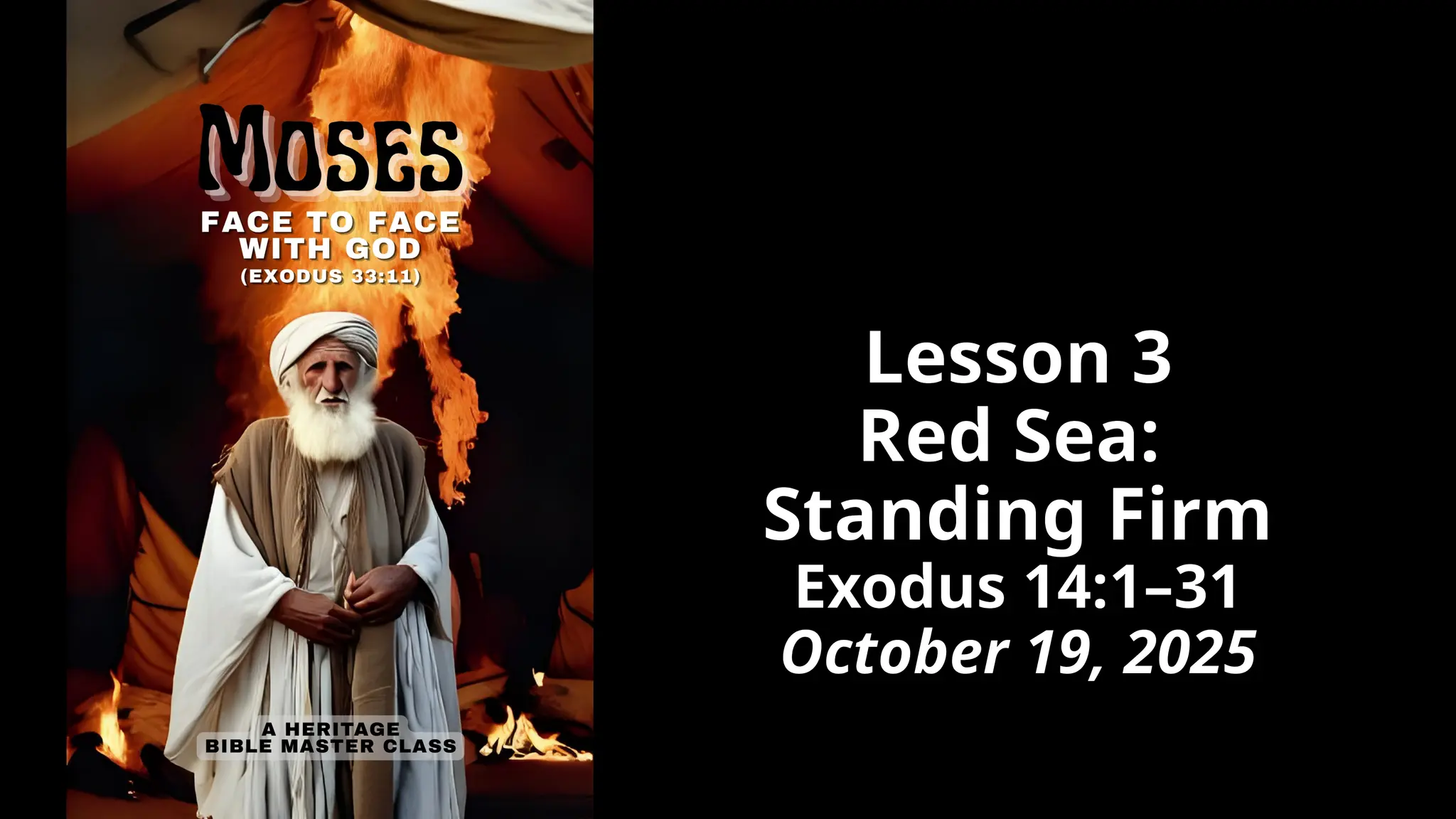
  • #80 Lesson 1 of 13 Moses: Face to Face with God Heritage Bible Master Class is a non-denominational group of senior adults who love the Lord and His word. We meet at Heritage Palms Country Club, South of Fred Waring, East of Jefferson, Indio, 10:15 Sunday morning. We’d love to have you join us. Just let them know at the gate that you’re there for the Bible study and the guard will let you right in. Feel free to comment, If you find these videos helpful, help me out by hitting Like, Subscribe to be notified when I post new material. 04 Mount Sinai: Meeting with God - Exodus 19:1–25 – October 26, 2025 1. What is Moses’ role throughout this encounter between God and his people? 2. God invites Israel into a covenant relationship, a binding legal agreement. What are the conditions of the covenant, and what benefits does it provide? How does a covenant change a relationship? (19:3–6) 3. What does it reveal about God that he forms a covenant with those he has chosen and delivered? 4. Over a thousand years later, on the night before Jesus dies, he offers a new covenant that will become the heart and soul of the church. What is that new covenant? What does it say about God that he has provided a new covenant? (see Mark 14:22–25) 5. What did God say to Moses? Why? (19:9) 6. What specific instructions did God want the Israelites to follow? Why? (19:10–15) 7. Describe the incredible sights and sounds that God orchestrates as he reveals himself to the Israelites. Why do you think he chooses to create such an awesome experience for this historic encounter? (19:16-19) 8. What impression do you think the people have of both God and Moses as God descends to the top of the mountain and Moses ascends the mountain? (19:20–25) 9. Whom did God tell Moses to go down the mountain and bring back? Why him and no one else? (19:24) 10. Moses leads the people out to meet with God. How are you involved in leading people to meet with God?
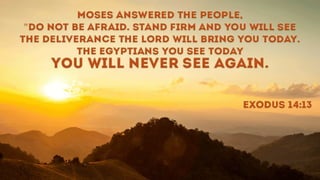
  • #81 May the God of hope fill you with all joy and peace as you trust in him, so that you may overflow with hope by the power of the Holy Spirit. (Romans 15:13, NIV)