Lesson 2
The Burning Bush:
Hearing God’s Call
Exodus 3:1–4:17
October 12, 2025
Exodus 3:1-14
Exodus 3:1-14 (NIV)
Now Moses was tending the flock of
Jethro his father-in-law, the priest of
Midian, and he led the flock to the far
side of the wilderness and came to Horeb,
the mountain of God.
2 There the angel of the LORD appeared
to him in flames of fire from within a
bush. Moses saw that though the bush
was on fire it did not burn up. 3 So Moses
thought, "I will go over and see this
strange sight—why the bush does not
burn up."
4 When the LORD saw that he had gone
over to look, God called to him from
within the bush, "Moses! Moses!" And
Moses said, "Here I am." 5 "Do not come
any closer," God said. "Take off your
sandals, for the place where you are
standing is holy ground."
6 Then he said, "I am the God of your
father, the God of Abraham, the God of
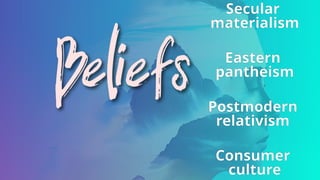
Isaac and the God of Jacob." At this,
Moses hid his face, because he was afraid
to look at God.
7 The LORD said, "I have indeed seen the
misery of my people in Egypt. I have
heard them crying out because of their
slave drivers, and I am concerned about
their suffering.
8 So I have come down to rescue them
from the hand of the Egyptians and to
bring them up out of that land into a
good and spacious land, a land flowing
with milk and honey—the home of the
Canaanites, Hittites, Amorites, Perizzites,
Hivites and Jebusites.
9 And now the cry of the Israelites has
reached me, and I have seen the way the
Egyptians are oppressing them. 10 So
now, go. I am sending you to Pharaoh to
bring my people the Israelites out of
Egypt."
11 But Moses said to God, "Who am I that
I should go to Pharaoh and bring the
Israelites out of Egypt?" 12 And God said,
"I will be with you. And this will be the
sign to you that it is I who have sent you:
When you have brought the people out of
Egypt, you will worship God on this
mountain."
13 Moses said to God, "Suppose I go to
the Israelites and say to them, 'The God
of your fathers has sent me to you,' and
they ask me, 'What is his name?' Then
what shall I tell them?" 14 God said to
Moses, "I AM WHO I AM. This is what you
are to say to the Israelites: 'I AM has sent
me to you.'"
Question 1
1. How does God’s call to Moses
make him both a servant and a
leader?
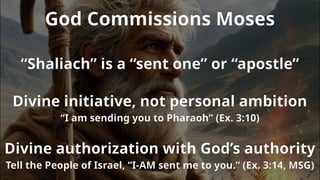
God Commissions Moses
“Shaliach” is a “sent one” or “apostle”
Divine initiative, not personal ambition
“I am sending you to Pharaoh” (Ex. 3:10)
Divine authorization with God’s authority
Tell the People of Israel, “I-AM sent me to you.” (Ex. 3:14, MSG)
Question 2
2. Moses is a shepherd tending
his father-in-law’s sheep in the
desert. What struggles might
this new vocation have raised
for him, after having been an
Egyptian prince?
(see Acts 7:20–29)
Question 3
3. How does God miraculously
appear to Moses? How did God
first get your attention, and how
has that shaped your
relationship with him? (3:1-4)
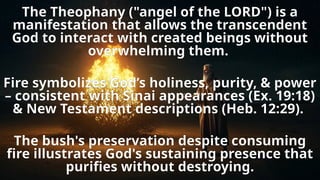
The Theophany ("angel of the LORD") is a
manifestation that allows the transcendent
God to interact with created beings without
overwhelming them.
Fire symbolizes God’s holiness, purity, & power
– consistent with Sinai appearances (Ex. 19:18)
& New Testament descriptions (Heb. 12:29).
The bush's preservation despite consuming
fire illustrates God's sustaining presence that
purifies without destroying.
Question 4
4. God identifies himself as the God of
Abraham, Isaac, and Jacob (3:6). How
might Moses’ view of God have been
influenced by growing up as a Hebrew
in an Egyptian household, among
people who worshiped many different
gods? What are some common belief
systems today, and how do they
shape your understanding of God?
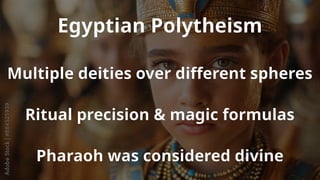
Egyptian Polytheism
Multiple deities over different spheres
Ritual precision & magic formulas
Pharaoh was considered divine
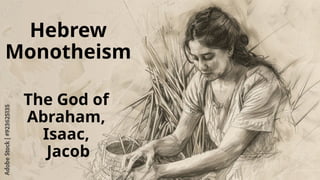
Hebrew
Monotheism
The God of
Abraham,
Isaac,
Jacob
Secular
materialism
Eastern
pantheism
Postmodern
relativism
Consumer
culture
Question 5
5. What did God tell Moses to
do? (3:7-10)
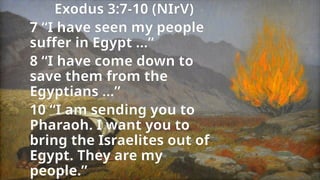
Exodus 3:7-10 (NIrV)
7 “I have seen my people
suffer in Egypt ...”
8 “I have come down to
save them from the
Egyptians …”
10 “I am sending you to
Pharaoh. I want you to
bring the Israelites out of
Egypt. They are my
people.”
Question 6
6. After hearing of God’s care
for the Israelites and being
commissioned by God to be
their leader, Moses asks, “Who
am I?” What, essentially, is he
asking God? How does God
answer that? (3:11-14)
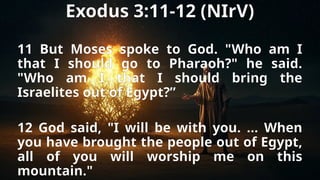
Exodus 3:11-12 (NIrV)
11 But Moses spoke to God. "Who am I
that I should go to Pharaoh?" he said.
"Who am I that I should bring the
Israelites out of Egypt?”
12 God said, "I will be with you. … When
you have brought the people out of Egypt,
all of you will worship me on this
mountain."
Question 7
7. What useful or unique skills
and experiences does Moses
bring to his calling? (see Exodus
2:7–10 and Hebrews 11:23–26)
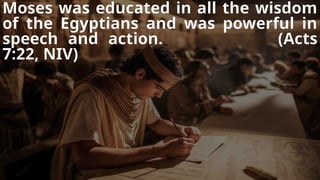
Moses was educated in all the wisdom
of the Egyptians and was powerful in
speech and action. (Acts
7:22, NIV)
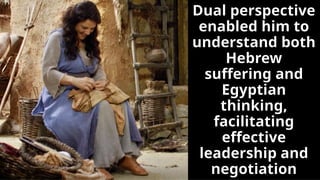
Dual perspective
enabled him to
understand both
Hebrew
suffering and
Egyptian
thinking,
facilitating
effective
leadership and
negotiation
Exodus 4:1-17
Exodus 4:1-17 (NIV)
Moses answered, "What if they do not
believe me or listen to me and say, 'The
LORD did not appear to you'?" 2 Then the
LORD said to him, "What is that in your
hand?" "A staff," he replied. 3 The LORD
said, "Throw it on the ground." Moses
threw it on the ground and it became a
snake, and he ran from it.
4 Then the LORD said to him, "Reach out
your hand and take it by the tail." So
Moses reached out and took hold of the
snake and it turned back into a staff in
his hand. 5 "This," said the LORD, "is so
that they may believe that the LORD, the
God of their fathers—the God of
Abraham, the God of Isaac and the God of
Jacob—has appeared to you."
6 Then the LORD said, "Put your hand
inside your cloak." So Moses put his hand
into his cloak, and when he took it out,
the skin was leprous—it had become as
white as snow. 7 "Now put it back into
your cloak," he said. So Moses put his
hand back into his cloak, and when he
took it out, it was restored, like the rest
of his flesh.
8 Then the LORD said, "If they do not
believe you or pay attention to the first
sign, they may believe the second. 9 But if
they do not believe these two signs or
listen to you, take some water from the
Nile and pour it on the dry ground. The
water you take from the river will
become blood on the ground."
10 Moses said to the LORD, "Pardon your
servant, Lord. I have never been
eloquent, neither in the past nor since
you have spoken to your servant. I am
slow of speech and tongue."
11 The LORD said to him, "Who gave
human beings their mouths? Who makes
them deaf or mute? Who gives them sight
or makes them blind? Is it not I, the
LORD? 12 Now go; I will help you speak
and will teach you what to say."
13 But Moses said, "Pardon your servant,
Lord. Please send someone else." 14 Then
the LORD's anger burned against Moses
and he said, "What about your brother,
Aaron the Levite? I know he can speak
well. He is already on his way to meet
you, and he will be glad to see you.
15 You shall speak to him and put words
in his mouth; I will help both of you speak
and will teach you what to do. 16 He will
speak to the people for you, and it will be
as if he were your mouth and as if you
were God to him. 17 But take this staff in
your hand so you can perform the signs
with it."
Question 8
8. What excuses did Moses give
God? Why is it easy to make
excuses? What are some of
yours? (4:1-17)
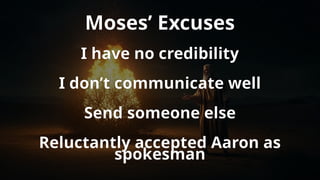
Moses’ Excuses
I have no credibility
I don’t communicate well
Send someone else
Reluctantly accepted Aaron as
spokesman
Question 9
9. How did God respond to each
of Moses’ excuses? (4:1-17)
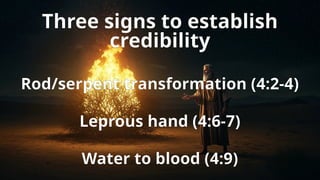
Three signs to establish
credibility
Rod/serpent transformation (4:2-4)
Leprous hand (4:6-7)
Water to blood (4:9)
Regarding speech difficulties:
Exodus 4:11-12 (NIV)
11 The LORD said to him, “Who gave
human beings their mouths? Who makes
them deaf or mute? Who gives them sight
or makes them blind? Is it not I, the
LORD?”
12 “Now go; I will help you speak and will
teach you what to say.”
Regarding an alternative candidate:
Exodus 4:14-16 (NIV)
14 “What about your brother, Aaron the
Levite? …15 You shall speak to him and
put words in his mouth; I will help both of
you speak and will teach you what to do.”
16 “He will speak to the people for you,
and it will be as if he were your mouth
and as if you were God to him.”
Text
Question 10
10. Spiritual leadership
incorporates both the character
of a leader and God’s calling.
How would you describe your
character? How would you
describe your calling?
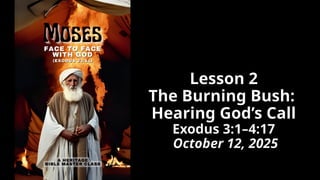
Lesson 2
The Burning Bush:
Hearing God’s Call
Exodus 3:1–4:17
October 12, 2025
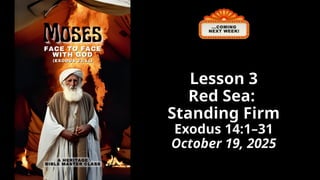
Lesson 3
Red Sea:
Standing Firm
Exodus 14:1–31
October 19, 2025
2025-10-12 Moses 02 (shared slides).pptx

2025-10-12 Moses 02 (shared slides).pptx

  • 1.
    Lesson 2 The BurningBush: Hearing God’s Call Exodus 3:1–4:17 October 12, 2025
  • 2.
  • 3.
    Exodus 3:1-14 (NIV) NowMoses was tending the flock of Jethro his father-in-law, the priest of Midian, and he led the flock to the far side of the wilderness and came to Horeb, the mountain of God.
  • 4.
    2 There theangel of the LORD appeared to him in flames of fire from within a bush. Moses saw that though the bush was on fire it did not burn up. 3 So Moses thought, "I will go over and see this strange sight—why the bush does not burn up."
  • 5.
    4 When theLORD saw that he had gone over to look, God called to him from within the bush, "Moses! Moses!" And Moses said, "Here I am." 5 "Do not come any closer," God said. "Take off your sandals, for the place where you are standing is holy ground."
  • 6.
    6 Then hesaid, "I am the God of your father, the God of Abraham, the God of Isaac and the God of Jacob." At this, Moses hid his face, because he was afraid to look at God.
  • 7.
    7 The LORDsaid, "I have indeed seen the misery of my people in Egypt. I have heard them crying out because of their slave drivers, and I am concerned about their suffering.
  • 8.
    8 So Ihave come down to rescue them from the hand of the Egyptians and to bring them up out of that land into a good and spacious land, a land flowing with milk and honey—the home of the Canaanites, Hittites, Amorites, Perizzites, Hivites and Jebusites.
  • 9.
    9 And nowthe cry of the Israelites has reached me, and I have seen the way the Egyptians are oppressing them. 10 So now, go. I am sending you to Pharaoh to bring my people the Israelites out of Egypt."
  • 10.
    11 But Mosessaid to God, "Who am I that I should go to Pharaoh and bring the Israelites out of Egypt?" 12 And God said, "I will be with you. And this will be the sign to you that it is I who have sent you: When you have brought the people out of Egypt, you will worship God on this mountain."
  • 11.
    13 Moses saidto God, "Suppose I go to the Israelites and say to them, 'The God of your fathers has sent me to you,' and they ask me, 'What is his name?' Then what shall I tell them?" 14 God said to Moses, "I AM WHO I AM. This is what you are to say to the Israelites: 'I AM has sent me to you.'"
  • 12.
    Question 1 1. Howdoes God’s call to Moses make him both a servant and a leader?
  • 13.
    God Commissions Moses “Shaliach”is a “sent one” or “apostle” Divine initiative, not personal ambition “I am sending you to Pharaoh” (Ex. 3:10) Divine authorization with God’s authority Tell the People of Israel, “I-AM sent me to you.” (Ex. 3:14, MSG)
  • 16.
    Question 2 2. Mosesis a shepherd tending his father-in-law’s sheep in the desert. What struggles might this new vocation have raised for him, after having been an Egyptian prince? (see Acts 7:20–29)
  • 20.
    Question 3 3. Howdoes God miraculously appear to Moses? How did God first get your attention, and how has that shaped your relationship with him? (3:1-4)
  • 21.
    The Theophany ("angelof the LORD") is a manifestation that allows the transcendent God to interact with created beings without overwhelming them. Fire symbolizes God’s holiness, purity, & power – consistent with Sinai appearances (Ex. 19:18) & New Testament descriptions (Heb. 12:29). The bush's preservation despite consuming fire illustrates God's sustaining presence that purifies without destroying.
  • 24.
    Question 4 4. Godidentifies himself as the God of Abraham, Isaac, and Jacob (3:6). How might Moses’ view of God have been influenced by growing up as a Hebrew in an Egyptian household, among people who worshiped many different gods? What are some common belief systems today, and how do they shape your understanding of God?
  • 25.
    Egyptian Polytheism Multiple deitiesover different spheres Ritual precision & magic formulas Pharaoh was considered divine
  • 26.
  • 28.
  • 31.
    Question 5 5. Whatdid God tell Moses to do? (3:7-10)
  • 32.
    Exodus 3:7-10 (NIrV) 7“I have seen my people suffer in Egypt ...” 8 “I have come down to save them from the Egyptians …” 10 “I am sending you to Pharaoh. I want you to bring the Israelites out of Egypt. They are my people.”
  • 35.
    Question 6 6. Afterhearing of God’s care for the Israelites and being commissioned by God to be their leader, Moses asks, “Who am I?” What, essentially, is he asking God? How does God answer that? (3:11-14)
  • 36.
    Exodus 3:11-12 (NIrV) 11But Moses spoke to God. "Who am I that I should go to Pharaoh?" he said. "Who am I that I should bring the Israelites out of Egypt?” 12 God said, "I will be with you. … When you have brought the people out of Egypt, all of you will worship me on this mountain."
  • 40.
    Question 7 7. Whatuseful or unique skills and experiences does Moses bring to his calling? (see Exodus 2:7–10 and Hebrews 11:23–26)
  • 41.
    Moses was educatedin all the wisdom of the Egyptians and was powerful in speech and action. (Acts 7:22, NIV)
  • 42.
    Dual perspective enabled himto understand both Hebrew suffering and Egyptian thinking, facilitating effective leadership and negotiation
  • 47.
  • 48.
    Exodus 4:1-17 (NIV) Mosesanswered, "What if they do not believe me or listen to me and say, 'The LORD did not appear to you'?" 2 Then the LORD said to him, "What is that in your hand?" "A staff," he replied. 3 The LORD said, "Throw it on the ground." Moses threw it on the ground and it became a snake, and he ran from it.
  • 49.
    4 Then theLORD said to him, "Reach out your hand and take it by the tail." So Moses reached out and took hold of the snake and it turned back into a staff in his hand. 5 "This," said the LORD, "is so that they may believe that the LORD, the God of their fathers—the God of Abraham, the God of Isaac and the God of Jacob—has appeared to you."
  • 50.
    6 Then theLORD said, "Put your hand inside your cloak." So Moses put his hand into his cloak, and when he took it out, the skin was leprous—it had become as white as snow. 7 "Now put it back into your cloak," he said. So Moses put his hand back into his cloak, and when he took it out, it was restored, like the rest of his flesh.
  • 51.
    8 Then theLORD said, "If they do not believe you or pay attention to the first sign, they may believe the second. 9 But if they do not believe these two signs or listen to you, take some water from the Nile and pour it on the dry ground. The water you take from the river will become blood on the ground."
  • 52.
    10 Moses saidto the LORD, "Pardon your servant, Lord. I have never been eloquent, neither in the past nor since you have spoken to your servant. I am slow of speech and tongue."
  • 53.
    11 The LORDsaid to him, "Who gave human beings their mouths? Who makes them deaf or mute? Who gives them sight or makes them blind? Is it not I, the LORD? 12 Now go; I will help you speak and will teach you what to say."
  • 54.
    13 But Mosessaid, "Pardon your servant, Lord. Please send someone else." 14 Then the LORD's anger burned against Moses and he said, "What about your brother, Aaron the Levite? I know he can speak well. He is already on his way to meet you, and he will be glad to see you.
  • 55.
    15 You shallspeak to him and put words in his mouth; I will help both of you speak and will teach you what to do. 16 He will speak to the people for you, and it will be as if he were your mouth and as if you were God to him. 17 But take this staff in your hand so you can perform the signs with it."
  • 56.
    Question 8 8. Whatexcuses did Moses give God? Why is it easy to make excuses? What are some of yours? (4:1-17)
  • 57.
    Moses’ Excuses I haveno credibility I don’t communicate well Send someone else Reluctantly accepted Aaron as spokesman
  • 60.
    Question 9 9. Howdid God respond to each of Moses’ excuses? (4:1-17)
  • 61.
    Three signs toestablish credibility Rod/serpent transformation (4:2-4) Leprous hand (4:6-7) Water to blood (4:9)
  • 62.
    Regarding speech difficulties: Exodus4:11-12 (NIV) 11 The LORD said to him, “Who gave human beings their mouths? Who makes them deaf or mute? Who gives them sight or makes them blind? Is it not I, the LORD?” 12 “Now go; I will help you speak and will teach you what to say.”
  • 63.
    Regarding an alternativecandidate: Exodus 4:14-16 (NIV) 14 “What about your brother, Aaron the Levite? …15 You shall speak to him and put words in his mouth; I will help both of you speak and will teach you what to do.” 16 “He will speak to the people for you, and it will be as if he were your mouth and as if you were God to him.”
  • 64.
  • 66.
    Question 10 10. Spiritualleadership incorporates both the character of a leader and God’s calling. How would you describe your character? How would you describe your calling?
  • 71.
    Lesson 2 The BurningBush: Hearing God’s Call Exodus 3:1–4:17 October 12, 2025
  • 72.
    Lesson 3 Red Sea: StandingFirm Exodus 14:1–31 October 19, 2025

Editor's Notes

  • #1 Lesson 2 of 13 Moses: Face to Face with God Heritage Bible Master Class is a non-denominational group of senior adults who love the Lord and His word. We meet at Heritage Palms Country Club, South of Fred Waring, East of Jefferson, Indio, 10:15 Sunday morning. We’d love to have you join us. Just let them know at the gate that you’re there for the Bible study and the guard will let you right in. Feel free to comment, If you find these videos helpful, help me out by hitting Like, Subscribe to be notified when I post new material. 02 The Burning Bush: Hearing God’s Call - Exodus 3:1–4:17 – October 12, 2025 1. How does God’s call to Moses make him both a servant and a leader? 2. Moses is a shepherd tending his father-in-law’s sheep in the desert. What struggles might this new vocation have raised for him, after having been an Egyptian prince? (see Acts 7:20–29) 3. How does God miraculously appear to Moses? How did God first get your attention, and how has that shaped your relationship with him? (3:1-4) 4. God identifies himself as the God of Abraham, Isaac, and Jacob (3:6). How might Moses’ view of God have been influenced by growing up as a Hebrew in an Egyptian household, among people who worshiped many different gods? What are some common belief systems today, and how do they shape your understanding of God? 5. What did God tell Moses to do? (3:7-10) 6. After hearing of God’s care for the Israelites and being commissioned by God to be their leader, Moses asks, “Who am I?” What, essentially, is he asking God? How does God answer that? (3:11-14) 7. What useful or unique skills and experiences does Moses bring to his calling? (see Exodus 2:7–10 and Hebrews 11:23–26) 8. What excuses did Moses give God? Why is it easy to make excuses? What are some of yours? (4:1-17) 9. How did God respond to each of Moses’ excuses? (4:1-17) 10. Spiritual leadership incorporates both the character of a leader and God’s calling. How would you describe your character? How would you describe your calling?
  • #12 1. How does God's call to Moses make him both a servant and a leader? God's call to Moses in Exodus 3:1-4:17 uniquely positions him as both servant and leader through a divine commissioning that emphasizes service before authority. The Hebrew term שָׁלַח (shalach, "to send") appears repeatedly throughout the passage (3:10, 12, 13, 14, 15; 4:13), establishing Moses as God's שָׁלִיחַ (shaliach, "sent one" or "apostle") – one who represents another with delegated authority while remaining accountable to the sender. As a servant, Moses receives his commission through divine initiative rather than personal ambition. God declares, "I am sending you to Pharaoh to bring my people the Israelites out of Egypt" (3:10). The Hebrew construction emphasizes God as the active agent while Moses serves as the instrument. This servant role is reinforced by God's promise, "I will be with you" (3:12), using the Hebrew אֶהְיֶה עִמָּךְ (ehyeh immakh), which indicates ongoing divine presence enabling human obedience rather than independent action. Simultaneously, Moses becomes a leader through divine authorization to act with God's authority. He receives the sacred name יהוה (YHWH, "I AM WHO I AM," 3:14), granting him access to covenant identity and power. God authorizes him to perform signs (4:1-9), speak divine words (4:12), and represent God before both Israelites and Egyptians. The combination of rod and serpent (4:2-4), leprous and healed hand (4:6-7), and water-to-blood (4:9) demonstrates supernatural authority accompanying his leadership role. Biblical leadership consistently combines service and authority, as Jesus later articulated: "Whoever wants to become great among you must be your servant" (Mark 10:43). Moses embodies this principle by exercising divinely delegated authority while remaining subordinate to God's will and accountable for Israel's welfare (Fretheim, Terence E. Exodus: Interpretation Commentary. Louisville: John Knox Press, 1991, pp. 78-95). Block quote: "The highest type of leader is one who helps people to stand on their own two feet and to become themselves leaders." – Douglas Hyde, Dedication and Leadership (Hyde, Douglas. Dedication and Leadership. Notre Dame: University of Notre Dame Press, 1966) • Fretheim, Terence E. Exodus: Interpretation Commentary. Louisville: John Knox Press, 1991. • Childs, Brevard S. The Book of Exodus: A Critical, Theological Commentary. Philadelphia: Westminster Press, 1974. • Durham, John I. Exodus: Word Biblical Commentary. Waco: Word Books, 1987.
  • #13 God's call to Moses in Exodus 3:1-4:17 uniquely positions him as both servant and leader through a divine commissioning that emphasizes service before authority. The Hebrew term (shalach, "to send") appears repeatedly throughout the passage (3:10, 12, 13, 14, 15; 4:13), establishing Moses as God's (shaliach, "sent one" or "apostle") – one who represents another with delegated authority while remaining accountable to the sender. As a servant, Moses receives his commission through divine initiative rather than personal ambition. God declares, "I am sending you to Pharaoh to bring my people the Israelites out of Egypt" (3:10). The Hebrew construction emphasizes God as the active agent while Moses serves as the instrument. This servant role is reinforced by God's promise, "I will be with you" (3:12), using the Hebrew (ehyeh immakh), which indicates ongoing divine presence enabling human obedience rather than independent action. Simultaneously, Moses becomes a leader through divine authorization to act with God's authority. He receives the sacred name (YHWH, "I AM WHO I AM," 3:14), granting him access to covenant identity and power. God authorizes him to perform signs (4:1-9), speak divine words (4:12), and represent God before both Israelites and Egyptians. The combination of rod and serpent (4:2-4), leprous and healed hand (4:6-7), and water-to-blood (4:9) demonstrates supernatural authority accompanying his leadership role.
  • #14 Biblical leadership consistently combines service and authority, as Jesus later articulated: "Whoever wants to become great among you must be your servant" (Mark 10:43). Moses embodies this principle by exercising divinely delegated authority while remaining subordinate to God's will and accountable for Israel's welfare (Fretheim, Terence E. Exodus: Interpretation Commentary. Louisville: John Knox Press, 1991, pp. 78-95).
  • #15 Block quote: "The highest type of leader is one who helps people to stand on their own two feet and to become themselves leaders." – Douglas Hyde, Dedication and Leadership (Hyde, Douglas. Dedication and Leadership. Notre Dame: University of Notre Dame Press, 1966) • Fretheim, Terence E. Exodus: Interpretation Commentary. Louisville: John Knox Press, 1991. • Childs, Brevard S. The Book of Exodus: A Critical, Theological Commentary. Philadelphia: Westminster Press, 1974. • Durham, John I. Exodus: Word Biblical Commentary. Waco: Word Books, 1987.
  • #16 2. Moses is a shepherd tending his father-in-law’s sheep in the desert. What struggles might this new vocation have raised for him, after having been an Egyptian prince? (see Acts 7:20–29) The transition from Egyptian royalty to Midianite shepherd represented a radical vocational and social descent that likely created profound psychological struggles for Moses. Acts 7:22 describes Moses as "educated in all the wisdom of the Egyptians and was powerful in speech and action," indicating elite training in administration, military arts, literature, and religious practice. Egyptian princes typically commanded armies, governed provinces, and lived in luxury – making sheep herding a dramatic reversal of fortune. The Hebrew term רֹעֶה (ro'eh, "shepherd") carried different connotations in Egyptian versus Hebrew culture. While Egyptians considered shepherds ritually unclean (Genesis 46:34), Hebrew tradition honored shepherding as preparation for leadership, as seen with David (1 Samuel 16:11-13). Moses likely struggled with this cultural dissonance – his Egyptian upbringing would have viewed his occupation as degrading, while his Hebrew heritage gradually revealed its nobility. The isolation of desert shepherding contrasts sharply with royal court life. Where Moses once influenced political decisions affecting thousands, he now protected sheep from predators and sought pasture. The Hebrew phrase אַחַר הַמִּדְבָּר (achar ha-midbar, "behind/beyond the wilderness," 3:1) suggests remote locations far from civilization, emphasizing his separation from centers of power and influence. However, this apparent demotion served as divine preparation. Shepherding developed skills essential for leading Israel through wilderness: knowledge of desert survival, water sources, seasonal migration patterns, and protection from threats. The Hebrew root רעה (r-'-h) means both "to shepherd" and "to feed/care for," indicating that Moses learned nurturing leadership through animal husbandry that later transferred to human guidance. His experience as both privileged insider and marginalized outsider equipped him to understand both Egyptian power structures and Hebrew suffering (Hoffmeier, James K. Israel in Egypt. Oxford: Oxford University Press, 1997, pp. 145-162). Block quote: "God often uses our deepest pain as the launching pad into our highest calling." – Kris Vallotton, Heavy Rain (Vallotton, Kris. Heavy Rain: How to Flood Your World with God's Transforming Power. Minneapolis: Chosen Books, 2010) • Hoffmeier, James K. Israel in Egypt: The Evidence for the Authenticity of the Exodus Tradition. Oxford: Oxford University Press, 1997. • Sarna, Nahum M. Exploring Exodus: The Heritage of Biblical Israel. New York: Schocken Books, 1996. • Hamilton, Victor P. Exodus: An Exegetical Commentary. Grand Rapids: Baker Academic, 2011.
  • #17 The transition from Egyptian royalty to Midianite shepherd represented a radical vocational and social descent that likely created profound psychological struggles for Moses. Acts 7:22 describes Moses as "educated in all the wisdom of the Egyptians and was powerful in speech and action," indicating elite training in administration, military arts, literature, and religious practice. Egyptian princes typically commanded armies, governed provinces, and lived in luxury – making sheep herding a dramatic reversal of fortune. The Hebrew term (ro'eh, "shepherd") carried different connotations in Egyptian versus Hebrew culture. While Egyptians considered shepherds ritually unclean (Genesis 46:34), Hebrew tradition honored shepherding as preparation for leadership, as seen with David (1 Samuel 16:11-13). Moses likely struggled with this cultural dissonance – his Egyptian upbringing would have viewed his occupation as degrading, while his Hebrew heritage gradually revealed its nobility. The isolation of desert shepherding contrasts sharply with royal court life. Where Moses once influenced political decisions affecting thousands, he now protected sheep from predators and sought pasture. The Hebrew phrase (achar ha-midbar, "behind/beyond the wilderness," 3:1) suggests remote locations far from civilization, emphasizing his separation from centers of power and influence. However, this apparent demotion served as divine preparation. Shepherding developed skills essential for leading Israel through wilderness: knowledge of desert survival, water sources, seasonal migration patterns, and protection from threats. The Hebrew root (r-'-h) means both "to shepherd" and "to feed/care for," indicating that Moses learned nurturing leadership through animal husbandry that later transferred to human guidance.
  • #18 Moses’ experience as both privileged insider and marginalized outsider equipped him to understand both Egyptian power structures and Hebrew suffering (Hoffmeier, James K. Israel in Egypt. Oxford: Oxford University Press, 1997, pp. 145-162).
  • #19 Block quote: "God often uses our deepest pain as the launching pad into our highest calling." – Kris Vallotton, Heavy Rain (Vallotton, Kris. Heavy Rain: How to Flood Your World with God's Transforming Power. Minneapolis: Chosen Books, 2010) • Hoffmeier, James K. Israel in Egypt: The Evidence for the Authenticity of the Exodus Tradition. Oxford: Oxford University Press, 1997. • Sarna, Nahum M. Exploring Exodus: The Heritage of Biblical Israel. New York: Schocken Books, 1996. • Hamilton, Victor P. Exodus: An Exegetical Commentary. Grand Rapids: Baker Academic, 2011.
  • #20 3. How does God miraculously appear to Moses? How did God first get your attention, and how has that shaped your relationship with him? (3:1-4) God appears to Moses through a burning bush that defies natural law – "the bush was on fire but it did not burn up" (3:2). The Hebrew term סְנֶה (seneh, "bush") likely refers to a thorny desert shrub, while the phrase בֹּעֵר בָּאֵשׁ (bo'er ba-esh, "burning with fire") emphasizes ongoing combustion without consumption. This miraculous phenomenon represents divine presence that transcends natural limitations while remaining accessible to human observation. The theophany employs מַלְאַךְ יהוה (mal'akh YHWH, "angel of the LORD"), a manifestation that allows the transcendent God to interact with created beings without overwhelming them. The fire symbolizes divine holiness, purity, and power – consistent with later Sinai appearances (Exodus 19:18) and New Testament descriptions (Hebrews 12:29). The bush's preservation despite consuming fire illustrates God's sustaining presence that purifies without destroying. Moses' response demonstrates proper curiosity balanced with reverence. The Hebrew phrase אָסֻרָה־נָּא וְאֶרְאֶה (asurah-na v'er'eh, "I will turn aside and see") shows deliberate investigation rather than casual observation, while his removal of sandals at God's command acknowledges sacred space. The ground becomes קֹדֶשׁ (qodesh, "holy") through divine presence rather than inherent properties, teaching that God can sanctify ordinary locations through his manifestation. The vision serves multiple purposes: it captures Moses' attention without overwhelming him, demonstrates God's power over natural elements, symbolizes his presence with Israel amid Egyptian oppression (the bush suffers fire but survives), and prepares Moses for leading a people who will experience God's presence through fire and cloud. The miraculous sign also validates Moses' later authority when recounting this encounter to skeptical Israelites (Stuart, Douglas K. Exodus: New American Commentary. Nashville: Broadman & Holman, 2006, pp. 98-112). Block quote: "The place where God calls you is the place where your deep gladness and the world's deep hunger meet." – Frederick Buechner, Wishful Thinking (Buechner, Frederick. Wishful Thinking: A Theological ABC. New York: Harper & Row, 1973) • Stuart, Douglas K. Exodus: New American Commentary. Nashville: Broadman & Holman, 2006. • Dozeman, Thomas B. Commentary on Exodus. Grand Rapids: Eerdmans, 2009. • Propp, William H.C. Exodus 1-18: Anchor Bible Commentary. New York: Doubleday, 1999.
  • #21 God appears to Moses through a burning bush that defies natural law – "the bush was on fire but it did not burn up" (3:2). The Hebrew term (seneh, "bush") likely refers to a thorny desert shrub, while the phrase (bo'er ba-esh, "burning with fire") emphasizes ongoing combustion without consumption. This miraculous phenomenon represents divine presence that transcends natural limitations while remaining accessible to human observation. The theophany employs (mal'akh YHWH, "angel of the LORD"), a manifestation that allows the transcendent God to interact with created beings without overwhelming them. The fire symbolizes divine holiness, purity, and power – consistent with later Sinai appearances (Exodus 19:18) and New Testament descriptions (Hebrews 12:29). The bush's preservation despite consuming fire illustrates God's sustaining presence that purifies without destroying. Moses' response demonstrates proper curiosity balanced with reverence. The Hebrew phrase (asurah-na v'er'eh, "I will turn aside and see") shows deliberate investigation rather than casual observation, while his removal of sandals at God's command acknowledges sacred space. The ground becomes (qodesh, "holy") through divine presence rather than inherent properties, teaching that God can sanctify ordinary locations through his manifestation.
  • #22 The vision serves multiple purposes: it captures Moses' attention without overwhelming him, demonstrates God's power over natural elements, symbolizes his presence with Israel amid Egyptian oppression (the bush suffers fire but survives), and prepares Moses for leading a people who will experience God's presence through fire and cloud. The miraculous sign also validates Moses' later authority when recounting this encounter to skeptical Israelites (Stuart, Douglas K. Exodus: New American Commentary. Nashville: Broadman & Holman, 2006, pp. 98-112).
  • #23 Block quote: "The place where God calls you is the place where your deep gladness and the world's deep hunger meet." – Frederick Buechner, Wishful Thinking (Buechner, Frederick. Wishful Thinking: A Theological ABC. New York: Harper & Row, 1973) • Stuart, Douglas K. Exodus: New American Commentary. Nashville: Broadman & Holman, 2006. • Dozeman, Thomas B. Commentary on Exodus. Grand Rapids: Eerdmans, 2009. • Propp, William H.C. Exodus 1-18: Anchor Bible Commentary. New York: Doubleday, 1999.
  • #24 4. God identifies himself as the God of Abraham, Isaac and Jacob (3:6). How might Moses' view of God have been influenced by growing up as a Hebrew in an Egyptian household, among people who worshiped many different gods? What are some common belief systems today, and how do they shape your understanding of God? Moses' upbringing in Pharaoh's household exposed him to Egyptian polytheism, where multiple deities governed different spheres of existence: Ra (sun god), Ptah (creator), Isis (magic and motherhood), Osiris (afterlife), and dozens of others. Egyptian religious practice emphasized ritual precision, magical formulas, and priestly mediation between gods and humans. The pharaoh himself was considered divine, making Moses' challenge to Pharaoh theologically revolutionary as well as politically dangerous. However, Moses also received Hebrew religious instruction through his mother Jochebed during his nursing years (2:7-9), learning about אֱלֹהֵי אַבְרָהָם אֱלֹהֵי יִצְחָק וֵאלֹהֵי יַעֲקֹב (Elohei Avraham Elohei Yitzchak v'Elohei Ya'akov, "the God of Abraham, the God of Isaac, and the God of Jacob"). This covenant formula emphasizes personal relationship rather than cosmic function, ongoing faithfulness across generations, and exclusive worship of one deity. The tension between these worldviews likely created internal conflict for Moses. Egyptian gods required elaborate temples, professional priests, and complex rituals, while the Hebrew God established covenants with individuals, appeared in ordinary locations (burning bush), and demanded moral obedience rather than ceremonial precision. The Hebrew concept of monotheism – worship of one God who created and governs all reality – contrasted sharply with Egyptian departmentalized divinity. Contemporary belief systems similarly shape modern understanding of God. Secular materialism views reality as purely physical, making divine intervention impossible. Eastern pantheism sees God as identical with the universe, eliminating transcendence and personal relationship. Postmodern relativism claims all religious paths are equally valid, undermining truth claims about God's nature. Consumer culture treats God as a product to meet personal needs rather than as sovereign Lord deserving worship. Each system influences how people understand divine attributes, human responsibility, prayer effectiveness, and eternal destiny (Kitchen, Kenneth A. On the Reliability of the Old Testament. Grand Rapids: Eerdmans, 2003, pp. 295-321). Block quote: "The God who made the world and everything in it is the Lord of heaven and earth and does not live in temples built by human hands." – Acts 17:24 (New International Version, 2011) • Kitchen, Kenneth A. On the Reliability of the Old Testament. Grand Rapids: Eerdmans, 2003. • Brueggemann, Walter. Exodus: Interpretation Commentary. Louisville: Westminster John Knox Press, 2009. • Meyers, Carol L. Exodus: New Cambridge Bible Commentary. Cambridge: Cambridge University Press, 2005.
  • #25 Moses' upbringing in Pharaoh's household exposed him to Egyptian polytheism, Multiple deities governed different spheres of existence: Ra (sun god), Ptah (creator), Isis (magic and motherhood), Osiris (afterlife), and dozens of others. Egyptian religious practice emphasized ritual precision, magical formulas, and priestly mediation between gods and humans. The pharaoh himself was considered divine, making Moses' challenge to Pharaoh theologically revolutionary as well as politically dangerous.
  • #26 However, Moses also received Hebrew religious instruction through his mother Jochebed during his nursing years (2:7-9), learning about (Elohei Avraham Elohei Yitzchak v'Elohei Ya'akov, "the God of Abraham, the God of Isaac, and the God of Jacob"). This covenant formula emphasizes personal relationship rather than cosmic function, ongoing faithfulness across generations, and exclusive worship of one deity.
  • #27 The tension between these worldviews likely created internal conflict for Moses. Egyptian gods required elaborate temples, professional priests, and complex rituals, while the Hebrew God established covenants with individuals, appeared in ordinary locations (burning bush), and demanded moral obedience rather than ceremonial precision. The Hebrew concept of monotheism – worship of one God who created and governs all reality – contrasted sharply with Egyptian departmentalized divinity. Contemporary belief systems similarly shape modern understanding of God. Secular materialism views reality as purely physical, making divine intervention impossible. Eastern pantheism sees God as identical with the universe, eliminating transcendence and personal relationship. Postmodern relativism claims all religious paths are equally valid, undermining truth claims about God's nature. Consumer culture treats God as a product to meet personal needs rather than as sovereign Lord deserving worship.
  • #28 Contemporary belief systems similarly shape modern understanding of God. Secular materialism views reality as purely physical, making divine intervention impossible. Eastern pantheism sees God as identical with the universe, eliminating transcendence and personal relationship. Postmodern relativism claims all religious paths are equally valid, undermining truth claims about God's nature. Consumer culture treats God as a product to meet personal needs rather than as sovereign Lord deserving worship.
  • #29 Each system influences how people understand divine attributes, human responsibility, prayer effectiveness, and eternal destiny (Kitchen, Kenneth A. On the Reliability of the Old Testament. Grand Rapids: Eerdmans, 2003, pp. 295-321).
  • #30 Block quote: "The God who made the world and everything in it is the Lord of heaven and earth and does not live in temples built by human hands." – Acts 17:24 (New International Version, 2011) • Kitchen, Kenneth A. On the Reliability of the Old Testament. Grand Rapids: Eerdmans, 2003. • Brueggemann, Walter. Exodus: Interpretation Commentary. Louisville: Westminster John Knox Press, 2009. • Meyers, Carol L. Exodus: New Cambridge Bible Commentary. Cambridge: Cambridge University Press, 2005.
  • #31 5. What did God tell Moses to do? (3:7-10) God commissioned Moses with a specific rescue mission involving multiple phases and clear objectives. First, God declared his awareness of Israel's suffering: "I have indeed seen the misery of my people in Egypt. I have heard them crying out because of their slave drivers, and I am concerned about their suffering" (3:7). The Hebrew verbs רָאֹה רָאִיתִי (ra'oh ra'iti, "seeing I have seen") and שָׁמֹעַ שָׁמַעְתִּי (shamo'a shama'ti, "hearing I have heard") use intensive constructions emphasizing divine attention and emotional engagement. Second, God announced his intervention: "So I have come down to rescue them from the hand of the Egyptians and to bring them up out of that land into a good and spacious land, a land flowing with milk and honey" (3:8). The Hebrew verb נָצַל (natzal, "to rescue/deliver") appears throughout Exodus describing divine salvation, while עָלָה (alah, "to bring up") contrasts with יָרַד (yarad, "to go down") – Israel will ascend from slavery to freedom, from oppression to promise. Third, God appointed Moses as his agent: "So now, go. I am sending you to Pharaoh to bring my people the Israelites out of Egypt" (3:10). The Hebrew לֵךְ (lekh, "go") echoes God's call to Abraham (Genesis 12:1), establishing Moses within the covenant tradition. The commission involves confronting Pharaoh directly – the most powerful ruler on earth – and demanding release of Egypt's slave labor force. The mission's scope encompasses political negotiation (approaching Pharaoh), community leadership (organizing Israelite departure), and geographical relocation (guiding wilderness travel to Canaan). God provides both the ultimate goal (reaching the promised land) and immediate steps (confronting Egyptian authority), while promising divine presence throughout the process (3:12). This comprehensive calling transforms Moses from fugitive shepherd to covenant mediator (Janzen, J. Gerald. Exodus: Westminster Bible Companion. Louisville: Westminster John Knox Press, 1997, pp. 35-48). Block quote: "God's work done in God's way will never lack God's supply." – Hudson Taylor, quoted in Spiritual Secrets of Hudson Taylor (Taylor, Dr. and Mrs. Howard. Spiritual Secrets of Hudson Taylor. Chicago: Moody Press, 1932) • Janzen, J. Gerald. Exodus: Westminster Bible Companion. Louisville: Westminster John Knox Press, 1997. • Durham, John I. Exodus: Word Biblical Commentary. Waco: Word Books, 1987. • Fretheim, Terence E. Exodus: Interpretation Commentary. Louisville: John Knox Press, 1991.
  • #32 God commissioned Moses with a specific rescue mission involving multiple phases and clear objectives. First, God declared his awareness of Israel's suffering: "I have indeed seen the misery of my people in Egypt. I have heard them crying out because of their slave drivers, and I am concerned about their suffering" (3:7). The Hebrew verbs (ra'oh ra'iti, "seeing I have seen") and (shamo'a shama'ti, "hearing I have heard") use intensive constructions emphasizing divine attention and emotional engagement. Second, God announced his intervention: "So I have come down to rescue them from the hand of the Egyptians and to bring them up out of that land into a good and spacious land, a land flowing with milk and honey" (3:8). The Hebrew verb (natzal, "to rescue/deliver") appears throughout Exodus describing divine salvation, while (alah, "to bring up") contrasts with (yarad, "to go down") – Israel will ascend from slavery to freedom, from oppression to promise. Third, God appointed Moses as his agent: "So now, go. I am sending you to Pharaoh to bring my people the Israelites out of Egypt" (3:10). The Hebrew (lekh, "go") echoes God's call to Abraham (Genesis 12:1), establishing Moses within the covenant tradition. The commission involves confronting Pharaoh directly – the most powerful ruler on earth – and demanding release of Egypt's slave labor force. The mission's scope encompasses political negotiation (approaching Pharaoh), community leadership (organizing Israelite departure), and geographical relocation (guiding wilderness travel to Canaan).
  • #33 God provides both the ultimate goal (reaching the promised land) and immediate steps (confronting Egyptian authority), while promising divine presence throughout the process (3:12). This comprehensive calling transforms Moses from fugitive shepherd to covenant mediator (Janzen, J. Gerald. Exodus: Westminster Bible Companion. Louisville: Westminster John Knox Press, 1997, pp. 35-48).
  • #34 Block quote: "God's work done in God's way will never lack God's supply." – Hudson Taylor, quoted in Spiritual Secrets of Hudson Taylor (Taylor, Dr. and Mrs. Howard. Spiritual Secrets of Hudson Taylor. Chicago: Moody Press, 1932) • Janzen, J. Gerald. Exodus: Westminster Bible Companion. Louisville: Westminster John Knox Press, 1997. • Durham, John I. Exodus: Word Biblical Commentary. Waco: Word Books, 1987. • Fretheim, Terence E. Exodus: Interpretation Commentary. Louisville: John Knox Press, 1991.
  • #35 6. After hearing of God's care for the Israelites and being commissioned by God to be their leader, Moses asks, "Who am I?" What, essentially, is he asking God? How does God answer that? (3:11-14) Moses' question מִי אָנֹכִי (mi anokhi, "Who am I?") expresses both humility and inadequacy rather than seeking personal identity. Given the magnitude of confronting Pharaoh and liberating approximately two million enslaved people, Moses essentially asks: "What qualifications do I possess for this impossible task?" His forty years as a fugitive shepherd hardly prepared him for diplomatic negotiations with world powers or mass population movements through hostile territory. The question reflects legitimate self-assessment rather than false modesty. Moses recognizes the enormous gap between his current position (desert nomad) and his assigned role (national liberator). His previous attempt at Hebrew leadership ended in failure and exile (2:11-15), making this divine commission appear unrealistic. The Hebrew phrase כִּי אֵלֵךְ אֶל־פַּרְעֹה (ki elekh el-Par'oh, "that I should go to Pharaoh") emphasizes the audacity of confronting Egypt's divine-king. God's response shifts focus from Moses' qualifications to divine presence: "I will be with you" (3:12). The Hebrew אֶהְיֶה עִמָּךְ (ehyeh immakh) uses the same verb form later revealed as the divine name אֶהְיֶה אֲשֶׁר אֶהְיֶה (ehyeh asher ehyeh, "I AM WHO I AM," 3:14). This construction emphasizes ongoing divine presence rather than human adequacy as the foundation for success. God provides both immediate assurance and future validation: the sign will be Israel's worship at this mountain after the exodus succeeds (3:12). This circular confirmation requires faith – Moses must trust God's presence now to receive proof later. The answer transforms the question from "Who am I?" to "Who is with me?" Divine presence, not human capability, enables impossible tasks. God's self-revelation as יהוה (YHWH, "the LORD") establishes his covenant faithfulness and eternal existence as sufficient guarantee for mission success (Childs, Brevard S. The Book of Exodus. Philadelphia: Westminster Press, 1974, pp. 63-75). Block quote: "God does not call the qualified; He qualifies the called." – Rick Warren, The Purpose Driven Life (Warren, Rick. The Purpose Driven Life. Grand Rapids: Zondervan, 2002) • Childs, Brevard S. The Book of Exodus: A Critical, Theological Commentary. Philadelphia: Westminster Press, 1974. • Hamilton, Victor P. Exodus: An Exegetical Commentary. Grand Rapids: Baker Academic, 2011. • Sarna, Nahum M. Exploring Exodus: The Heritage of Biblical Israel. New York: Schocken Books, 1996.
  • #36 Moses' question (mi anokhi, "Who am I?") expresses both humility and inadequacy rather than seeking personal identity. Given the magnitude of confronting Pharaoh and liberating approximately two million enslaved people, Moses essentially asks: "What qualifications do I possess for this impossible task?" His forty years as a fugitive shepherd hardly prepared him for diplomatic negotiations with world powers or mass population movements through hostile territory. The question reflects legitimate self-assessment rather than false modesty. Moses recognizes the enormous gap between his current position (desert nomad) and his assigned role (national liberator). His previous attempt at Hebrew leadership ended in failure and exile (2:11-15), making this divine commission appear unrealistic. The Hebrew phrase (ki elekh el-Par'oh, "that I should go to Pharaoh") emphasizes the audacity of confronting Egypt's divine-king. God's response shifts focus from Moses' qualifications to divine presence: "I will be with you" (3:12). The Hebrew (ehyeh immakh) uses the same verb form later revealed as the divine name (ehyeh asher ehyeh, "I AM WHO I AM," 3:14). This construction emphasizes ongoing divine presence rather than human adequacy as the foundation for success.
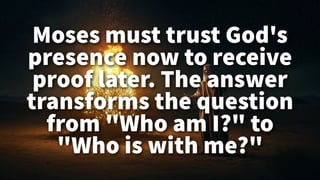
  • #37 God provides both immediate assurance and future validation: the sign will be Israel's worship at this mountain after the exodus succeeds (3:12). This circular confirmation requires faith – Moses must trust God's presence now to receive proof later. The answer transforms the question from "Who am I?" to "Who is with me?"
  • #38 Divine presence, not human capability, enables impossible tasks. God's self-revelation as YHWH ("the LORD") establishes his covenant faithfulness and eternal existence as sufficient guarantee for mission success (Childs, Brevard S. The Book of Exodus. Philadelphia: Westminster Press, 1974, pp. 63-75).
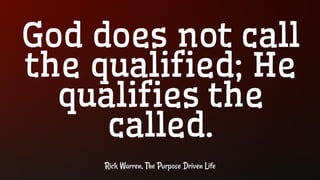
  • #39 Block quote: "God does not call the qualified; He qualifies the called." – Rick Warren, The Purpose Driven Life (Warren, Rick. The Purpose Driven Life. Grand Rapids: Zondervan, 2002) • Childs, Brevard S. The Book of Exodus: A Critical, Theological Commentary. Philadelphia: Westminster Press, 1974. • Hamilton, Victor P. Exodus: An Exegetical Commentary. Grand Rapids: Baker Academic, 2011. • Sarna, Nahum M. Exploring Exodus: The Heritage of Biblical Israel. New York: Schocken Books, 1996.
  • #40 7. What useful or unique skills and experiences does Moses bring to his calling? (see Exodus 2:7–10 and Hebrews 11:23–26) Moses possessed an extraordinary combination of cultural, educational, and experiential qualifications that uniquely prepared him for leading Israel's exodus. His adoption by Pharaoh's daughter (2:10) provided access to Egyptian royal education, which Acts 7:22 describes as making him "powerful in speech and action." This education included military strategy, administrative procedures, legal systems, diplomatic protocols, and religious practices – knowledge essential for confronting Egyptian power structures and organizing mass population movements. His bicultural upbringing created invaluable advantages. Through his Hebrew mother Jochebed's nursing care (2:7-9), Moses learned covenant traditions, Hebrew language, and Israelite identity, while his Egyptian palace education provided insider knowledge of enemy strategies and weaknesses. This dual perspective enabled him to understand both Hebrew suffering and Egyptian thinking, facilitating effective leadership and negotiation. Hebrews 11:24-26 reveals Moses' character development: "By faith Moses, when he had grown up, refused to be known as the son of Pharaoh's daughter. He chose to be mistreated along with the people of God rather than to enjoy the fleeting pleasures of sin. He regarded disgrace for the sake of Christ as of greater value than the treasures of Egypt." This moral choice demonstrates the principled decision-making and sacrificial commitment required for covenant leadership. His forty-year exile in Midian (Acts 7:30) provided additional preparation through shepherding experience, desert survival skills, tribal leadership patterns, and familiarity with Sinai geography. Marriage into Jethro's family connected him with Midianite tribes who later served as wilderness guides (Numbers 10:29-32). His experience of personal failure, exile, and redemption created empathy for Israel's suffering and hope for divine restoration. Most significantly, Moses combined royal authority with servant humility, Egyptian education with Hebrew faith, and leadership experience with personal brokenness – preparing him to mediate between divine holiness and human weakness (Propp, William H.C. Exodus 1-18: Anchor Bible Commentary. New York: Doubleday, 1999, pp. 198-215). Block quote: "God can use anybody, but there are prerequisites: you have to be broken, available, and usable." – A.W. Tozer, The Pursuit of God (Tozer, A.W. The Pursuit of God. Harrisburg: Christian Publications, 1948) • Propp, William H.C. Exodus 1-18: Anchor Bible Commentary. New York: Doubleday, 1999. • Hoffmeier, James K. Israel in Egypt: The Evidence for the Authenticity of the Exodus Tradition. Oxford: Oxford University Press, 1997. • Stuart, Douglas K. Exodus: New American Commentary. Nashville: Broadman & Holman, 2006.
  • #41 Moses possessed an extraordinary combination of cultural, educational, and experiential qualifications that uniquely prepared him for leading Israel's exodus. His adoption by Pharaoh's daughter (2:10) provided access to Egyptian royal education, which Acts 7:22 describes as making him "powerful in speech and action." This education included military strategy, administrative procedures, legal systems, diplomatic protocols, and religious practices – knowledge essential for confronting Egyptian power structures and organizing mass population movements.
  • #42 His bicultural upbringing created invaluable advantages. Through his Hebrew mother Jochebed's nursing care (2:7-9), Moses learned covenant traditions, Hebrew language, and Israelite identity, while his Egyptian palace education provided insider knowledge of enemy strategies and weaknesses. This dual perspective enabled him to understand both Hebrew suffering and Egyptian thinking, facilitating effective leadership and negotiation.
  • #43 Hebrews 11:24-26 reveals Moses' character development: "By faith Moses, when he had grown up, refused to be known as the son of Pharaoh's daughter. He chose to be mistreated along with the people of God rather than to enjoy the fleeting pleasures of sin. He regarded disgrace for the sake of Christ as of greater value than the treasures of Egypt." This moral choice demonstrates the principled decision-making and sacrificial commitment required for covenant leadership.
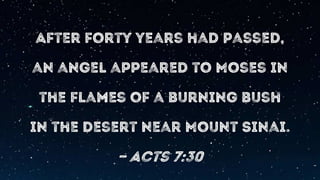
  • #44 His forty-year exile in Midian (Acts 7:30) provided additional preparation through shepherding experience, desert survival skills, tribal leadership patterns, and familiarity with Sinai geography. Marriage into Jethro's family connected him with Midianite tribes who later served as wilderness guides (Numbers 10:29-32). His experience of personal failure, exile, and redemption created empathy for Israel's suffering and hope for divine restoration.
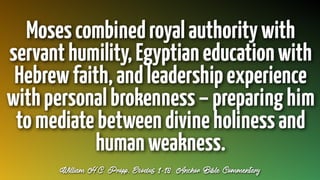
  • #45 Most significantly, Moses combined royal authority with servant humility, Egyptian education with Hebrew faith, and leadership experience with personal brokenness – preparing him to mediate between divine holiness and human weakness (Propp, William H.C. Exodus 1-18: Anchor Bible Commentary. New York: Doubleday, 1999, pp. 198-215).
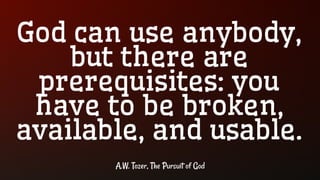
  • #46 Block quote: "God can use anybody, but there are prerequisites: you have to be broken, available, and usable." – A.W. Tozer, The Pursuit of God (Tozer, A.W. The Pursuit of God. Harrisburg: Christian Publications, 1948) • Propp, William H.C. Exodus 1-18: Anchor Bible Commentary. New York: Doubleday, 1999. • Hoffmeier, James K. Israel in Egypt: The Evidence for the Authenticity of the Exodus Tradition. Oxford: Oxford University Press, 1997. • Stuart, Douglas K. Exodus: New American Commentary. Nashville: Broadman & Holman, 2006.
  • #56 8. What excuses did Moses give God? Why is it easy to make excuses? What are some of yours? (4:1-17) Moses presented four sequential excuses to avoid his divine calling, each revealing deeper levels of reluctance and self-doubt. First, he questioned his credibility: "What if they do not believe me or listen to me and say, 'The LORD did not appear to you'?" (4:1). This excuse focuses on anticipated rejection by those he was called to serve, reflecting fear of public humiliation and leadership failure. Second, he claimed inadequate communication skills: "Pardon your servant, Lord. I have never been eloquent, neither in the past nor since you have spoken to your servant. I am slow of speech and tongue" (4:10). The Hebrew phrase כְבַד־פֶּה וּכְבַד לָשׁוֹן (khvad-peh u-khvad lashon, "heavy of mouth and heavy of tongue") suggests either speech impediment or lack of eloquence. This excuse emphasizes personal limitation rather than divine empowerment. Third, he requested an alternative candidate: "Pardon your servant, Lord. Please send someone else" (4:13). The Hebrew שְׁלַח־נָא בְיַד־תִּשְׁלָח (shelach-na v'yad-tishlach, "send by the hand of whomever you will send") represents direct refusal disguised as polite deference. This excuse abandons all pretense and asks for complete replacement. Finally, when God's anger burned against him (4:14), Moses reluctantly accepted Aaron as spokesperson while maintaining his role as primary leader. Each excuse reflected legitimate concerns but overlooked divine enablement. Excuse-making comes easily because it protects self-image while avoiding risk. Fear of failure, inadequacy feelings, comfort zone attachment, and responsibility avoidance all contribute to reluctance. Modern excuses often include: "I'm not qualified enough," "I don't have time," "Someone else could do it better," "I've failed before," "I'm too old/young," or "God probably means someone else." However, Moses' excuses reveal that God often calls people who feel inadequate, ensuring his power rather than human ability receives credit for success. Divine calling typically involves growth beyond current capabilities, requiring faith rather than confidence (Dozeman, Thomas B. Commentary on Exodus. Grand Rapids: Eerdmans, 2009, pp. 123-140). Block quote: "Ninety-nine percent of failures come from people who have the habit of making excuses." – George Washington Carver, quoted in George Washington Carver: A Biography (McMurry, Linda O. George Washington Carver: A Biography. New York: Oxford University Press, 1981) • Dozeman, Thomas B. Commentary on Exodus. Grand Rapids: Eerdmans, 2009. • Brueggemann, Walter. Exodus: Interpretation Commentary. Louisville: Westminster John Knox Press, 2009. • Meyers, Carol L. Exodus: New Cambridge Bible Commentary. Cambridge: Cambridge University Press, 2005.
  • #57 Moses presented three sequential excuses to avoid his divine calling, each revealing deeper levels of reluctance and self-doubt. First, he questioned his credibility: "What if they do not believe me or listen to me and say, 'The LORD did not appear to you'?" (4:1). This excuse focuses on anticipated rejection by those he was called to serve, reflecting fear of public humiliation and leadership failure. Second, he claimed inadequate communication skills: "Pardon your servant, Lord. I have never been eloquent, neither in the past nor since you have spoken to your servant. I am slow of speech and tongue" (4:10). The Hebrew phrase (khvad-peh u-khvad lashon, "heavy of mouth and heavy of tongue") suggests either speech impediment or lack of eloquence. This excuse emphasizes personal limitation rather than divine empowerment. Third, he requested an alternative candidate: "Pardon your servant, Lord. Please send someone else" (4:13). The Hebrew (shelach-na v'yad-tishlach, "send by the hand of whomever you will send") represents direct refusal disguised as polite deference. This excuse abandons all pretense and asks for complete replacement. Finally, when God's anger burned against him (4:14), Moses reluctantly accepted Aaron as spokesperson while maintaining his role as primary leader. Each excuse reflected legitimate concerns but overlooked divine enablement. Excuse-making comes easily because it protects self-image while avoiding risk. Fear of failure, inadequacy feelings, comfort zone attachment, and responsibility avoidance all contribute to reluctance. Modern excuses often include: "I'm not qualified enough," "I don't have time," "Someone else could do it better," "I've failed before," "I'm too old/young," or "God probably means someone else."
  • #58 However, Moses' excuses reveal that God often calls people who feel inadequate, ensuring his power rather than human ability receives credit for success. Divine calling typically involves growth beyond current capabilities, requiring faith rather than confidence (Dozeman, Thomas B. Commentary on Exodus. Grand Rapids: Eerdmans, 2009, pp. 123-140).
  • #59 Block quote: "Ninety-nine percent of failures come from people who have the habit of making excuses." – George Washington Carver, quoted in George Washington Carver: A Biography (McMurry, Linda O. George Washington Carver: A Biography. New York: Oxford University Press, 1981) • Dozeman, Thomas B. Commentary on Exodus. Grand Rapids: Eerdmans, 2009. • Brueggemann, Walter. Exodus: Interpretation Commentary. Louisville: Westminster John Knox Press, 2009. • Meyers, Carol L. Exodus: New Cambridge Bible Commentary. Cambridge: Cambridge University Press, 2005.
  • #60 9. How did God respond to each of Moses' excuses? (4:1-17) God responded to Moses' credibility concerns (4:1) by providing three miraculous signs to validate his authority. The rod-to-serpent transformation (4:2-4) demonstrated power over nature and connected with Egyptian serpent symbolism, where pharaohs wore cobra emblems representing divine authority. When Moses grasped the snake's tail – normally dangerous – it returned to a rod, showing divine protection and control. The leprous hand sign (4:6-7) revealed power over health and disease. Leprosy rendered people ritually unclean and socially isolated, while instant healing demonstrated divine authority over life and death. The Hebrew term צָרַעַת (tzara'at) encompasses various skin conditions considered divine judgment, making miraculous healing particularly significant for establishing prophetic credentials. The water-to-blood sign (4:9) targeted Egyptian religious beliefs, since the Nile was worshipped as the god Hapi and considered sacred. Transforming life-giving water into blood symbolized divine judgment on Egyptian gods while foreshadowing the first plague (7:14-24). These signs progressed from natural manipulation to health restoration to religious confrontation. Regarding Moses' speech difficulties (4:10), God asked rhetorically, "Who gave human beings their mouths? Who makes them deaf or mute? Who gives them sight or makes them blind? Is it not I, the LORD?" (4:11). This response emphasizes divine sovereignty over human limitations while promising, "I will help you speak and will teach you what to say" (4:12). God offers enablement rather than replacement. When Moses requested an alternative candidate (4:13), God's anger burned but he provided Aaron as spokesman while maintaining Moses' primary leadership role (4:14-16). God accommodated Moses' weakness while ensuring mission completion. Aaron would speak Moses' words to the people, while Moses would speak God's words to Aaron, creating a prophetic chain of communication. Each response demonstrates that God works through human weakness rather than around it, providing supernatural assistance while requiring faithful obedience (Hamilton, Victor P. Exodus: An Exegetical Commentary. Grand Rapids: Baker Academic, 2011, pp. 89-105). Block quote: "God's grace is sufficient for all our weaknesses, but only if we are willing to be weak enough to receive it." – Charles Spurgeon, Morning and Evening (Spurgeon, Charles H. Morning and Evening. London: Passmore & Alabaster, 1869) • Hamilton, Victor P. Exodus: An Exegetical Commentary. Grand Rapids: Baker Academic, 2011. • Janzen, J. Gerald. Exodus: Westminster Bible Companion. Louisville: Westminster John Knox Press, 1997. • Fretheim, Terence E. Exodus: Interpretation Commentary. Louisville: John Knox Press, 1991.
  • #61 God responded to Moses' credibility concerns (4:1) by providing three miraculous signs to validate his authority. The rod-to-serpent transformation (4:2-4) demonstrated power over nature and connected with Egyptian serpent symbolism, where pharaohs wore cobra emblems representing divine authority. When Moses grasped the snake's tail – normally dangerous – it returned to a rod, showing divine protection and control. The leprous hand sign (4:6-7) revealed power over health and disease. Leprosy rendered people ritually unclean and socially isolated, while instant healing demonstrated divine authority over life and death. The Hebrew term (tzara'at) encompasses various skin conditions considered divine judgment, making miraculous healing particularly significant for establishing prophetic credentials. The water-to-blood sign (4:9) targeted Egyptian religious beliefs, since the Nile was worshipped as the god Hapi and considered sacred. Transforming life-giving water into blood symbolized divine judgment on Egyptian gods while foreshadowing the first plague (7:14-24). These signs progressed from natural manipulation to health restoration to religious confrontation.
  • #62 Regarding Moses' speech difficulties (4:10), God asked rhetorically, "Who gave human beings their mouths? Who makes them deaf or mute? Who gives them sight or makes them blind? Is it not I, the LORD?" (4:11). This response emphasizes divine sovereignty over human limitations while promising, "I will help you speak and will teach you what to say" (4:12). God offers enablement rather than replacement.
  • #63 When Moses requested an alternative candidate (4:13), God's anger burned but he provided Aaron as spokesman while maintaining Moses' primary leadership role (4:14-16). God accommodated Moses' weakness while ensuring mission completion. Aaron would speak Moses' words to the people, while Moses would speak God's words to Aaron, creating a prophetic chain of communication.
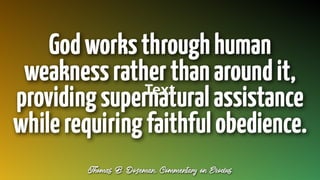
  • #64 Each response demonstrates that God works through human weakness rather than around it, providing supernatural assistance while requiring faithful obedience (Hamilton, Victor P. Exodus: An Exegetical Commentary. Grand Rapids: Baker Academic, 2011, pp. 89-105).
  • #65 Block quote: "God's grace is sufficient for all our weaknesses, but only if we are willing to be weak enough to receive it." – Charles Spurgeon, Morning and Evening (Spurgeon, Charles H. Morning and Evening. London: Passmore & Alabaster, 1869) • Hamilton, Victor P. Exodus: An Exegetical Commentary. Grand Rapids: Baker Academic, 2011. • Janzen, J. Gerald. Exodus: Westminster Bible Companion. Louisville: Westminster John Knox Press, 1997. • Fretheim, Terence E. Exodus: Interpretation Commentary. Louisville: John Knox Press, 1991.
  • #66 10. Spiritual leadership incorporates both the character of a leader and God's calling. How would you describe your character? How would you describe your calling? This question invites personal reflection on the intersection between divine calling and human character development as demonstrated in Moses' experience. Biblical leadership requires both divine initiative (calling) and human response (character formation), working together to accomplish God's purposes through human instruments. Character development involves conformity to divine attributes such as integrity, humility, compassion, courage, and faithfulness. Moses' character journey illustrates this progression: from impulsive violence (2:11-12) to patient shepherding (3:1), from royal privilege to servant humility, from self-reliance to divine dependence. His forty-year wilderness preparation refined character traits essential for leading Israel through similar terrain and trials. The Hebrew concept of קְרִיאָה (kri'ah, "calling") encompasses both divine summons and human vocation, suggesting that God's calling often aligns with natural abilities, life experiences, and acquired skills while transcending human limitations. Moses' calling integrated his bicultural background, leadership experience, and desert knowledge while requiring supernatural enablement for success. Character and calling intersect in several ways: calling without character leads to moral failure and ministry damage; character without calling results in human effort lacking divine power; together they create effective spiritual leadership that glorifies God while serving others. The burning bush experience shows that God's calling often comes during ordinary activities (shepherding) but transforms them into extraordinary purposes (national liberation). Personal character assessment requires honest evaluation of strengths, weaknesses, spiritual growth patterns, and areas needing development. Calling discernment involves recognizing how God has shaped life experiences, spiritual gifts, and burden areas to serve his purposes. Both require ongoing surrender to divine will and commitment to character development throughout the leadership journey. The text suggests that effective spiritual leadership emerges from the intersection of divine calling with surrendered human character, creating vessels suitable for God's use in accomplishing his purposes through ordinary people empowered by extraordinary grace (Durham, John I. Exodus: Word Biblical Commentary. Waco: Word Books, 1987, pp. 85-98). Block quote: "Leadership is not about being in charge. Leadership is about taking care of those in your charge." – Simon Sinek, Leaders Eat Last (Sinek, Simon. Leaders Eat Last. New York: Portfolio, 2014) • Durham, John I. Exodus: Word Biblical Commentary. Waco: Word Books, 1987. • Stuart, Douglas K. Exodus: New American Commentary. Nashville: Broadman & Holman, 2006. • Childs, Brevard S. The Book of Exodus: A Critical, Theological Commentary. Philadelphia: Westminster Press, 1974.
  • #67 This question invites personal reflection on the intersection between divine calling and human character development as demonstrated in Moses' experience. Biblical leadership requires both divine initiative (calling) and human response (character formation), working together to accomplish God's purposes through human instruments. Character development involves conformity to divine attributes such as integrity, humility, compassion, courage, and faithfulness. Moses' character journey illustrates this progression: from impulsive violence (2:11-12) to patient shepherding (3:1), from royal privilege to servant humility, from self-reliance to divine dependence. His forty-year wilderness preparation refined character traits essential for leading Israel through similar terrain and trials. The Hebrew concept of (kri'ah, "calling") encompasses both divine summons and human vocation, suggesting that God's calling often aligns with natural abilities, life experiences, and acquired skills while transcending human limitations. Moses' calling integrated his bicultural background, leadership experience, and desert knowledge while requiring supernatural enablement for success.
  • #68 Character and calling intersect in several ways: calling without character leads to moral failure and ministry damage; character without calling results in human effort lacking divine power; together they create effective spiritual leadership that glorifies God while serving others. The burning bush experience shows that God's calling often comes during ordinary activities (shepherding) but transforms them into extraordinary purposes (national liberation). Personal character assessment requires honest evaluation of strengths, weaknesses, spiritual growth patterns, and areas needing development. Calling discernment involves recognizing how God has shaped life experiences, spiritual gifts, and burden areas to serve his purposes. Both require ongoing surrender to divine will and commitment to character development throughout the leadership journey.
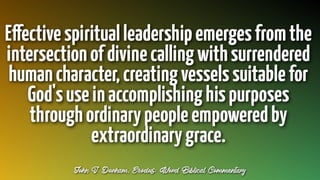
  • #69 The text suggests that effective spiritual leadership emerges from the intersection of divine calling with surrendered human character, creating vessels suitable for God's use in accomplishing his purposes through ordinary people empowered by extraordinary grace (Durham, John I. Exodus: Word Biblical Commentary. Waco: Word Books, 1987, pp. 85-98).
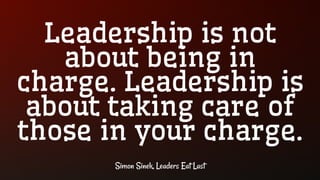
  • #70 Block quote: "Leadership is not about being in charge. Leadership is about taking care of those in your charge." – Simon Sinek, Leaders Eat Last (Sinek, Simon. Leaders Eat Last. New York: Portfolio, 2014) • Durham, John I. Exodus: Word Biblical Commentary. Waco: Word Books, 1987. • Stuart, Douglas K. Exodus: New American Commentary. Nashville: Broadman & Holman, 2006. • Childs, Brevard S. The Book of Exodus: A Critical, Theological Commentary. Philadelphia: Westminster Press, 1974.
  • #71 Lesson 1 of 13 Moses: Face to Face with God Heritage Bible Master Class is a non-denominational group of senior adults who love the Lord and His word. We meet at Heritage Palms Country Club, South of Fred Waring, East of Jefferson, Indio, 10:15 Sunday morning. We’d love to have you join us. Just let them know at the gate that you’re there for the Bible study and the guard will let you right in. Feel free to comment, If you find these videos helpful, help me out by hitting Like, Subscribe to be notified when I post new material. 02 The Burning Bush: Hearing God’s Call - Exodus 3:1–4:17 – October 12, 2025 1. How does God’s call to Moses make him both a servant and a leader? 2. Moses is a shepherd tending his father-in-law’s sheep in the desert. What struggles might this new vocation have raised for him, after having been an Egyptian prince? (see Acts 7:20–29) 3. How does God miraculously appear to Moses? How did God first get your attention, and how has that shaped your relationship with him? (3:1-4) 4. God identifies himself as the God of Abraham, Isaac, and Jacob (3:6). How might Moses’ view of God have been influenced by growing up as a Hebrew in an Egyptian household, among people who worshiped many different gods? What are some common belief systems today, and how do they shape your understanding of God? 5. What did God tell Moses to do? (3:7-10) 6. After hearing of God’s care for the Israelites and being commissioned by God to be their leader, Moses asks, “Who am I?” What, essentially, is he asking God? How does God answer that? (3:11-14) 7. What useful or unique skills and experiences does Moses bring to his calling? (see Exodus 2:7–10 and Hebrews 11:23–26) 8. What excuses did Moses give God? Why is it easy to make excuses? What are some of yours? (4:1-17) 9. How did God respond to each of Moses’ excuses? (4:1-17) 10. Spiritual leadership incorporates both the character of a leader and God’s calling. How would you describe your character? How would you describe your calling?
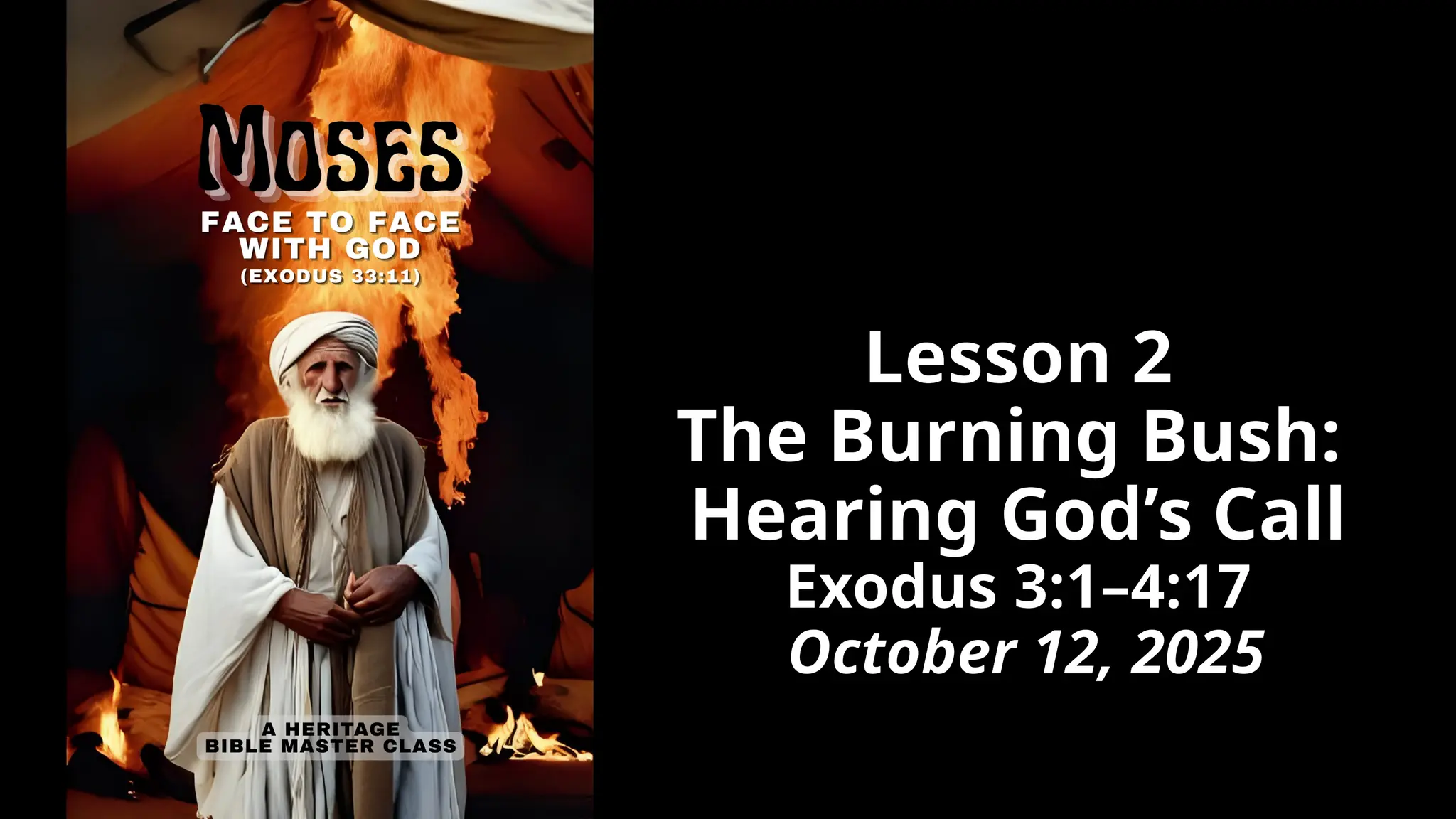
  • #72 Lesson 1 of 13 Moses: Face to Face with God Heritage Bible Master Class is a non-denominational group of senior adults who love the Lord and His word. We meet at Heritage Palms Country Club, South of Fred Waring, East of Jefferson, Indio, 10:15 Sunday morning. We’d love to have you join us. Just let them know at the gate that you’re there for the Bible study and the guard will let you right in. Feel free to comment, If you find these videos helpful, help me out by hitting Like, Subscribe to be notified when I post new material. 03 Red Sea: Standing Firm - Exodus 14:1–31 – October 19, 2025 1. Why did God give Moses precise directions? When have you seen God get glory over his enemies using unconventional means? (14:1–4) 2. How did Pharaoh react when he was told that the Israelites had left? Why didn’t he just cut his losses and let them go? (14:5–9) 3. How did the Israelites cope with their fears when the Egyptian army came after them? When have you ever felt hopeless? (14:10–12) 4. How did Moses respond when the Egyptians were bearing down on the Israelites? (14:13–14) 5. What did God say to Moses to get the Israelites moving? (14:15–18) 6. Moses tells the people that they are to “stand firm,” while God tells Moses to have them “move on.” How is it possible to do both at the same time? (14:13, 15). 7. Who protected the Israelites from the Egyptian army? (14:19–20) 8. What miraculous events took place at the Red Sea? (14:21–31) 9. While God does the fighting for Israel, Moses is required to stretch out his hand. What insights does this provide for standing firm? 10. If you had been one of the Israelites who experienced this event, how would you have described it to someone who wasn’t there?
  • #73 May the God of hope fill you with all joy and peace as you trust in him, so that you may overflow with hope by the power of the Holy Spirit. (Romans 15:13, NIV)