Quantum Fax Machine
QFM010: Elixir Reading List March
2024
quantumfaxmachine.com
1
QFM010: Elixir Reading List March
2024
Here is everything I found interesting about Elixir Programming Ecosytem during March 2024.
The March Edition Quantum Fax Machine's Elixir Reading List starts with a discussion on the Doctest
Formatter plugin for enhancing code readability, then dives into practical solutions for developers, such
as managing environment-specific configurations efficiently without external dependencies as
discussed in Simple .env-like configuration in Elixir.
We then look at Elixir's GenServer in What is Elixir GenServer?, reflecting on the language's capabilities
handling complex asynchronous operations. We also take a look at architectural principles, comparing
the Phoenix and Rails frameworks in "Phoenix is not your application (unlike Rails)".
We also look at error handling within Elixir projects as well as integration with large language models
(LLMs) through the thmsmlr / instructor_ex library, which makes generating regular and
programmatically workable output from LLMs much easier.
Security practices and tools like Semgrep are discussed, offering insights into protecting Elixir code,
highlighted by a Fireside chat with Holden Oullette on secure coding practices. We take a quick look at
Credo for static analysis, linting, and code quality improvements in "Credo rules you’ve been sleeping on".
Among other links, this month's collection also looks at a very practical guide for integrating GraphQL
with the Phoenix Framework via Absinthe.
As always, the Quantum Fax Machine Propellor Hat Key will guide your browsing. Enjoy!
Key:
: Mentions Elixir and related technologies
: Talks about the Elixir ecosystem in real-world use cases
: Talks about technical details of Elixir ecosystem components
: Using and working with Elixir ecosystem technologies in software
: Programming new Elixir technology concepts and implementations
Source: Photo by Michael Dziedzic on Unsplash
2
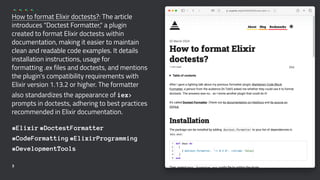
How to format Elixir doctests?: The article
introduces "Doctest Formatter," a plugin
created to format Elixir doctests within
documentation, making it easier to maintain
clean and readable code examples. It details
installation instructions, usage for
formatting .ex files and doctests, and mentions
the plugin's compatibility requirements with
Elixir version 1.13.2 or higher. The formatter
also standardizes the appearance of iex>
prompts in doctests, adhering to best practices
recommended in Elixir documentation.
#Elixir #DoctestFormatter
#CodeFormatting #ElixirProgramming
#DevelopmentTools
3
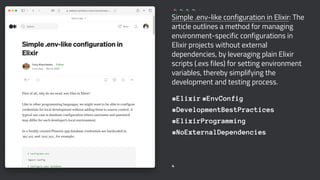
Simple .env-like configuration in Elixir: The
article outlines a method for managing
environment-specific configurations in
Elixir projects without external
dependencies, by leveraging plain Elixir
scripts (.exs files) for setting environment
variables, thereby simplifying the
development and testing process.
#Elixir #EnvConfig
#DevelopmentBestPractices
#ElixirProgramming
#NoExternalDependencies
4
What is Elixir GenServer?: This article
describes Elixir's GenServer as a behavior
module for building concurrent and stateful
processes in a more idiomatic and user-
friendly way than its Erlang counterpart. It
provides an overview of implementing
GenServer with practical examples and
discusses when to use or not use it for
specific applications.
#Elixir #GenServer
`#ConcurrentProgramming #ErlangOTP
#FunctionalProgramming
5
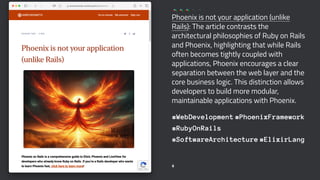
Phoenix is not your application (unlike
Rails): The article contrasts the
architectural philosophies of Ruby on Rails
and Phoenix, highlighting that while Rails
often becomes tightly coupled with
applications, Phoenix encourages a clear
separation between the web layer and the
core business logic. This distinction allows
developers to build more modular,
maintainable applications with Phoenix.
#WebDevelopment #PhoenixFramework
#RubyOnRails
#SoftwareArchitecture #ElixirLang
6
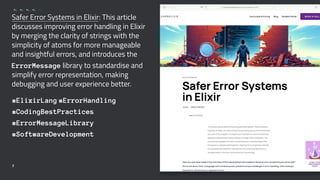
Safer Error Systems in Elixir: This article
discusses improving error handling in Elixir
by merging the clarity of strings with the
simplicity of atoms for more manageable
and insightful errors, and introduces the
ErrorMessage library to standardise and
simplify error representation, making
debugging and user experience better.
#ElixirLang #ErrorHandling
#CodingBestPractices
#ErrorMessageLibrary
#SoftwareDevelopment
7
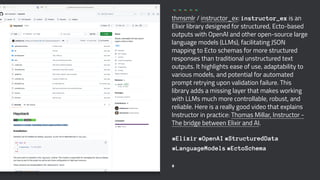
thmsmlr / instructor_ex: instructor_ex is an
Elixir library designed for structured, Ecto-based
outputs with OpenAI and other open-source large
language models (LLMs), facilitating JSON
mapping to Ecto schemas for more structured
responses than traditional unstructured text
outputs. It highlights ease of use, adaptability to
various models, and potential for automated
prompt retrying upon validation failure. This
library adds a missing layer that makes working
with LLMs much more controllable, robust, and
reliable. Here is a really good video that explains
Instructor in practice: Thomas Millar, Instructor -
The bridge between Elixir and AI.
#Elixir #OpenAI #StructuredData
#LanguageModels #EctoSchema
8
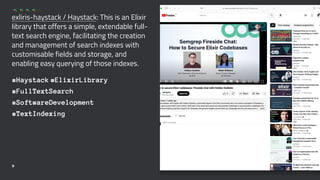
exliris-haystack / Haystack: This is an Elixir
library that offers a simple, extendable full-
text search engine, facilitating the creation
and management of search indexes with
customisable fields and storage, and
enabling easy querying of those indexes.
#Haystack #ElixirLibrary
#FullTextSearch
#SoftwareDevelopment
#TextIndexing
9
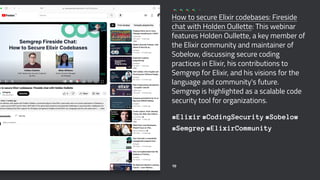
How to secure Elixir codebases: Fireside
chat with Holden Oullette: This webinar
features Holden Oullette, a key member of
the Elixir community and maintainer of
Sobelow, discussing secure coding
practices in Elixir, his contributions to
Semgrep for Elixir, and his visions for the
language and community's future.
Semgrep is highlighted as a scalable code
security tool for organizations.
#Elixir #CodingSecurity #Sobelow
#Semgrep #ElixirCommunity
10
Credo rules you’ve been sleeping on: This
article discusses optimising Elixir projects
by adjusting Credo settings for better code
quality, highlighting enabling strict mode,
disabling certain checks like AliasOrder,
and activating others like MixEnv and
PassAsyncInTestCases. It suggests a
balanced approach to using Credo for
linting/static analysis in Phoenix projects.
#Elixir #Credo #CodeQuality
#PhoenixFramework
#SoftwareDevelopment
11
Absinthe with Phoenix Framework - a
guide to properly get started with GraphQL
using Elixir: This article is a comprehensive
tutorial on setting up a GraphQL server
using the Elixir Phoenix Framework with
Absinthe, covering everything from basic
setup and configuration to defining
queries, mutations, and subscriptions. It
assumes basic knowledge of Phoenix and
GraphQL.
#Absinthe #PhoenixFramework
#GraphQL #Elixir #APIDevelopment
12
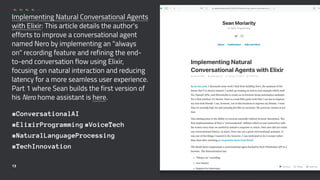
Implementing Natural Conversational Agents
with Elixir: This article details the author's
efforts to improve a conversational agent
named Nero by implementing an "always
on" recording feature and refining the end-
to-end conversation flow using Elixir,
focusing on natural interaction and reducing
latency for a more seamless user experience.
Part 1 where Sean builds the first version of
his Nero home assistant is here.
#ConversationalAI
#ElixirProgramming #VoiceTech
#NaturalLanguageProcessing
#TechInnovation
13
Thankyou!
hello@matthewsinclair.com
matthewsinclair.com
masto.ai/@matthewsinclair
medium.com/@matthewsinclair
twitter.com/@matthewsinclair
Originally published on
quantumfaxmachine.com
If you’d like to sign up for this content as an
email, click here to join the mailing list.
Image: Photo by Austin Chan on Unsplash
14

20240412 QFM010 Elixir Reading List March 2024

  • 1.
    Quantum Fax Machine QFM010:Elixir Reading List March 2024 quantumfaxmachine.com 1
  • 2.
    QFM010: Elixir ReadingList March 2024 Here is everything I found interesting about Elixir Programming Ecosytem during March 2024. The March Edition Quantum Fax Machine's Elixir Reading List starts with a discussion on the Doctest Formatter plugin for enhancing code readability, then dives into practical solutions for developers, such as managing environment-specific configurations efficiently without external dependencies as discussed in Simple .env-like configuration in Elixir. We then look at Elixir's GenServer in What is Elixir GenServer?, reflecting on the language's capabilities handling complex asynchronous operations. We also take a look at architectural principles, comparing the Phoenix and Rails frameworks in "Phoenix is not your application (unlike Rails)". We also look at error handling within Elixir projects as well as integration with large language models (LLMs) through the thmsmlr / instructor_ex library, which makes generating regular and programmatically workable output from LLMs much easier. Security practices and tools like Semgrep are discussed, offering insights into protecting Elixir code, highlighted by a Fireside chat with Holden Oullette on secure coding practices. We take a quick look at Credo for static analysis, linting, and code quality improvements in "Credo rules you’ve been sleeping on". Among other links, this month's collection also looks at a very practical guide for integrating GraphQL with the Phoenix Framework via Absinthe. As always, the Quantum Fax Machine Propellor Hat Key will guide your browsing. Enjoy! Key: : Mentions Elixir and related technologies : Talks about the Elixir ecosystem in real-world use cases : Talks about technical details of Elixir ecosystem components : Using and working with Elixir ecosystem technologies in software : Programming new Elixir technology concepts and implementations Source: Photo by Michael Dziedzic on Unsplash 2
  • 3.
    How to formatElixir doctests?: The article introduces "Doctest Formatter," a plugin created to format Elixir doctests within documentation, making it easier to maintain clean and readable code examples. It details installation instructions, usage for formatting .ex files and doctests, and mentions the plugin's compatibility requirements with Elixir version 1.13.2 or higher. The formatter also standardizes the appearance of iex> prompts in doctests, adhering to best practices recommended in Elixir documentation. #Elixir #DoctestFormatter #CodeFormatting #ElixirProgramming #DevelopmentTools 3
  • 4.
    Simple .env-like configurationin Elixir: The article outlines a method for managing environment-specific configurations in Elixir projects without external dependencies, by leveraging plain Elixir scripts (.exs files) for setting environment variables, thereby simplifying the development and testing process. #Elixir #EnvConfig #DevelopmentBestPractices #ElixirProgramming #NoExternalDependencies 4
  • 5.
    What is ElixirGenServer?: This article describes Elixir's GenServer as a behavior module for building concurrent and stateful processes in a more idiomatic and user- friendly way than its Erlang counterpart. It provides an overview of implementing GenServer with practical examples and discusses when to use or not use it for specific applications. #Elixir #GenServer `#ConcurrentProgramming #ErlangOTP #FunctionalProgramming 5
  • 6.
    Phoenix is notyour application (unlike Rails): The article contrasts the architectural philosophies of Ruby on Rails and Phoenix, highlighting that while Rails often becomes tightly coupled with applications, Phoenix encourages a clear separation between the web layer and the core business logic. This distinction allows developers to build more modular, maintainable applications with Phoenix. #WebDevelopment #PhoenixFramework #RubyOnRails #SoftwareArchitecture #ElixirLang 6
  • 7.
    Safer Error Systemsin Elixir: This article discusses improving error handling in Elixir by merging the clarity of strings with the simplicity of atoms for more manageable and insightful errors, and introduces the ErrorMessage library to standardise and simplify error representation, making debugging and user experience better. #ElixirLang #ErrorHandling #CodingBestPractices #ErrorMessageLibrary #SoftwareDevelopment 7
  • 8.
    thmsmlr / instructor_ex:instructor_ex is an Elixir library designed for structured, Ecto-based outputs with OpenAI and other open-source large language models (LLMs), facilitating JSON mapping to Ecto schemas for more structured responses than traditional unstructured text outputs. It highlights ease of use, adaptability to various models, and potential for automated prompt retrying upon validation failure. This library adds a missing layer that makes working with LLMs much more controllable, robust, and reliable. Here is a really good video that explains Instructor in practice: Thomas Millar, Instructor - The bridge between Elixir and AI. #Elixir #OpenAI #StructuredData #LanguageModels #EctoSchema 8
  • 9.
    exliris-haystack / Haystack:This is an Elixir library that offers a simple, extendable full- text search engine, facilitating the creation and management of search indexes with customisable fields and storage, and enabling easy querying of those indexes. #Haystack #ElixirLibrary #FullTextSearch #SoftwareDevelopment #TextIndexing 9
  • 10.
    How to secureElixir codebases: Fireside chat with Holden Oullette: This webinar features Holden Oullette, a key member of the Elixir community and maintainer of Sobelow, discussing secure coding practices in Elixir, his contributions to Semgrep for Elixir, and his visions for the language and community's future. Semgrep is highlighted as a scalable code security tool for organizations. #Elixir #CodingSecurity #Sobelow #Semgrep #ElixirCommunity 10
  • 11.
    Credo rules you’vebeen sleeping on: This article discusses optimising Elixir projects by adjusting Credo settings for better code quality, highlighting enabling strict mode, disabling certain checks like AliasOrder, and activating others like MixEnv and PassAsyncInTestCases. It suggests a balanced approach to using Credo for linting/static analysis in Phoenix projects. #Elixir #Credo #CodeQuality #PhoenixFramework #SoftwareDevelopment 11
  • 12.
    Absinthe with PhoenixFramework - a guide to properly get started with GraphQL using Elixir: This article is a comprehensive tutorial on setting up a GraphQL server using the Elixir Phoenix Framework with Absinthe, covering everything from basic setup and configuration to defining queries, mutations, and subscriptions. It assumes basic knowledge of Phoenix and GraphQL. #Absinthe #PhoenixFramework #GraphQL #Elixir #APIDevelopment 12
  • 13.
    Implementing Natural ConversationalAgents with Elixir: This article details the author's efforts to improve a conversational agent named Nero by implementing an "always on" recording feature and refining the end- to-end conversation flow using Elixir, focusing on natural interaction and reducing latency for a more seamless user experience. Part 1 where Sean builds the first version of his Nero home assistant is here. #ConversationalAI #ElixirProgramming #VoiceTech #NaturalLanguageProcessing #TechInnovation 13
  • 14.
    Thankyou! hello@matthewsinclair.com matthewsinclair.com masto.ai/@matthewsinclair medium.com/@matthewsinclair twitter.com/@matthewsinclair Originally published on quantumfaxmachine.com Ifyou’d like to sign up for this content as an email, click here to join the mailing list. Image: Photo by Austin Chan on Unsplash 14