LESSON 6:
TRANSFORMED BY
HABIT
JULY 7, 2024
Your habits can draw you closer to God
or drag you further away from him.
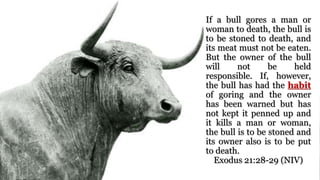
If a bull gores a man or
woman to death, the bull is
to be stoned to death, and
its meat must not be eaten.
But the owner of the bull
will not be held
responsible. If, however,
the bull has had the habit
of goring and the owner
has been warned but has
not kept it penned up and
it kills a man or woman,
the bull is to be stoned and
its owner also is to be put
to death.
Exodus 21:28-29 (NIV)
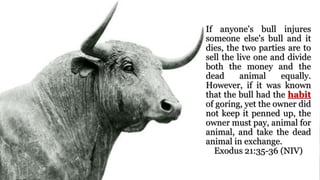
If anyone's bull injures
someone else's bull and it
dies, the two parties are to
sell the live one and divide
both the money and the
dead animal equally.
However, if it was known
that the bull had the habit
of goring, yet the owner did
not keep it penned up, the
owner must pay, animal for
animal, and take the dead
animal in exchange.
Exodus 21:35-36 (NIV)
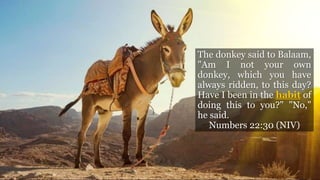
The donkey said to Balaam,
"Am I not your own
donkey, which you have
always ridden, to this day?
Have I been in the habit of
doing this to you?" "No,"
he said.
Numbers 22:30 (NIV)
Besides, they get into the
habit of being idle and
going about from house to
house. And not only do
they become idlers, but
also busybodies who talk
nonsense, saying things
they ought not to.
1 Timothy 5:13 (NIV)
You must exercise self-discipline to form good habits.
But, once they are formed, they become automatic.
You don’t even think about them.
Listen, O Israel! The LORD is our God,
the LORD alone. And you must love the
LORD your God with all your heart, all
your soul, and all your strength. And you
must commit yourselves wholeheartedly
to these commands that I am giving you
today. Repeat them again and again to
your children. Talk about them when you
are at home and when you are on the
road, when you are going to bed and
when you are getting up. Tie them to
your hands and wear them on your
forehead as reminders. Write them on
the doorposts of your house and on your
gates.
Deuteronomy 6:4-9 (NLT)
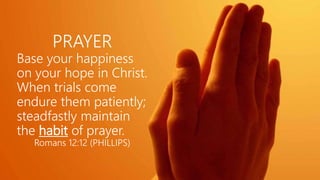
PRAYER
Base your happiness
on your hope in Christ.
When trials come
endure them patiently;
steadfastly maintain
the habit of prayer.
Romans 12:12 (PHILLIPS)
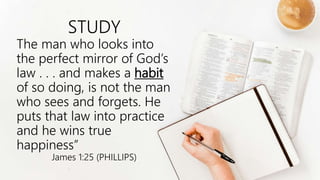
STUDY
The man who looks into
the perfect mirror of God’s
law . . . and makes a habit
of so doing, is not the man
who sees and forgets. He
puts that law into practice
and he wins true
happiness”
James 1:25 (PHILLIPS)
GIVING
Every Sunday each of
you make an offering
and put it in
safekeeping. Be as
generous as you can.
When I get there
you'll have it ready,
and I won't have to
make a special
appeal.
1 Corinthians 16:2 (MSG)
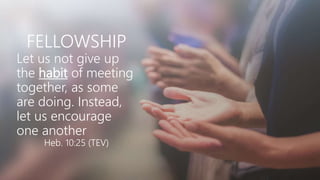
FELLOWSHIP
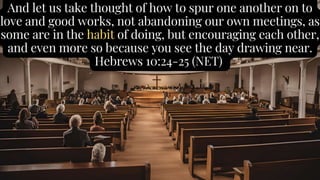
Let us not give up
the habit of meeting
together, as some
are doing. Instead,
let us encourage
one another
Heb. 10:25 (TEV)
Thought
Self-talk
Decision
Action
Repetition
Habit
Attitude
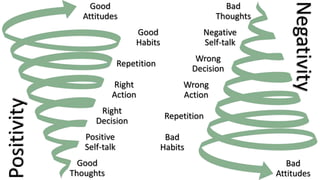
From Thought
to Attitude
Bad
Thoughts
Negative
Self-talk
Wrong
Decision
Wrong
Action
Repetition
Bad
Habits
Bad
Attitudes
Good
Thoughts
Positive
Self-talk
Right
Decision
Right
Action
Repetition
Good
Habits
Good
Attitudes
Positivity
Negativity
Support
Groups
Work
LESSON 6:
TRANSFORMED BY
HABIT
JULY 7, 2024
LESSON 7:
TRANSFORMED BY
THE SPIRIT
JULY 14, 2024
2024-07-07 Transformed 06 (shared slides).pptx

2024-07-07 Transformed 06 (shared slides).pptx

  • 1.
  • 10.
    Your habits candraw you closer to God or drag you further away from him.
  • 14.
    If a bullgores a man or woman to death, the bull is to be stoned to death, and its meat must not be eaten. But the owner of the bull will not be held responsible. If, however, the bull has had the habit of goring and the owner has been warned but has not kept it penned up and it kills a man or woman, the bull is to be stoned and its owner also is to be put to death. Exodus 21:28-29 (NIV)
  • 15.
    If anyone's bullinjures someone else's bull and it dies, the two parties are to sell the live one and divide both the money and the dead animal equally. However, if it was known that the bull had the habit of goring, yet the owner did not keep it penned up, the owner must pay, animal for animal, and take the dead animal in exchange. Exodus 21:35-36 (NIV)
  • 16.
    The donkey saidto Balaam, "Am I not your own donkey, which you have always ridden, to this day? Have I been in the habit of doing this to you?" "No," he said. Numbers 22:30 (NIV)
  • 17.
    Besides, they getinto the habit of being idle and going about from house to house. And not only do they become idlers, but also busybodies who talk nonsense, saying things they ought not to. 1 Timothy 5:13 (NIV)
  • 20.
    You must exerciseself-discipline to form good habits. But, once they are formed, they become automatic. You don’t even think about them.
  • 24.
    Listen, O Israel!The LORD is our God, the LORD alone. And you must love the LORD your God with all your heart, all your soul, and all your strength. And you must commit yourselves wholeheartedly to these commands that I am giving you today. Repeat them again and again to your children. Talk about them when you are at home and when you are on the road, when you are going to bed and when you are getting up. Tie them to your hands and wear them on your forehead as reminders. Write them on the doorposts of your house and on your gates. Deuteronomy 6:4-9 (NLT)
  • 27.
    PRAYER Base your happiness onyour hope in Christ. When trials come endure them patiently; steadfastly maintain the habit of prayer. Romans 12:12 (PHILLIPS)
  • 28.
    STUDY The man wholooks into the perfect mirror of God’s law . . . and makes a habit of so doing, is not the man who sees and forgets. He puts that law into practice and he wins true happiness” James 1:25 (PHILLIPS)
  • 29.
    GIVING Every Sunday eachof you make an offering and put it in safekeeping. Be as generous as you can. When I get there you'll have it ready, and I won't have to make a special appeal. 1 Corinthians 16:2 (MSG)
  • 30.
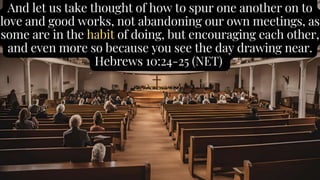
    FELLOWSHIP Let us notgive up the habit of meeting together, as some are doing. Instead, let us encourage one another Heb. 10:25 (TEV)
  • 38.
  • 40.
  • 44.
  • 54.
  • 55.
    LESSON 7: TRANSFORMED BY THESPIRIT JULY 14, 2024

Editor's Notes

  • #2 Transformed by 1. Invitation (Matt. 11:28-30) 2. Thinking (Rom. 12:1-2) 3. Training (1 Tim. 4:7-8) 4. Worship (Psalm 100; 1 Jn. 3:1-2; 2 Cor. 3:18) 5. Community (Heb. 10:24-25; Eph. 4:15-16; Eph. 2:21-22; Col. 2:19) 6. Habit (Another closer look at one aspect of Heb. 10:24-25)
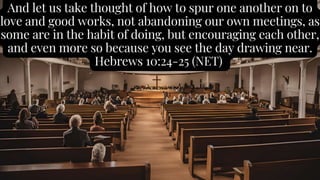
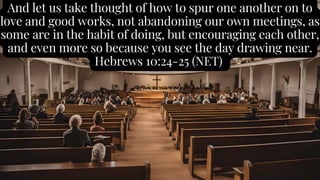
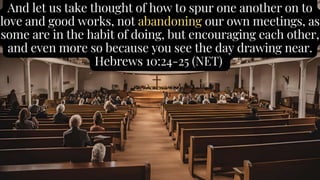
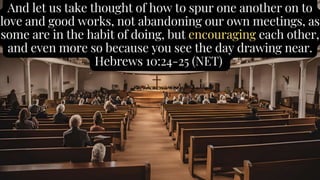
  • #5 The book of Hebrews speaks of people who don’t go to church much. From reading some translations you might get the idea that some congregations had stopped meeting together. “not giving up meeting together ...” (Hebrews 10:25, NIV, ESV) The writer of Hebrews says that we are not to “abandon” (NET) our meetings
  • #6 The NET & MSG gives a clearer sense. “not abandoning our own meetings ...” (Hebrews 10:25, NET) “not avoiding worshiping together ...” (Hebrews 10:25, MSG) The churches were meeting, but some Christians weren’t showing up. Have you ever been to a church service like this one – where there are far more empty seats than occupied ones?
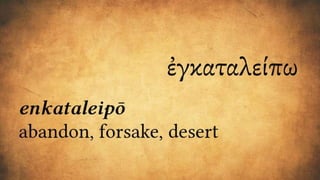
  • #7 ἐγκαταλείπω enkataleipō has the idea of “abandon, forsake, desert”
  • #8 The writer of Hebrews says that “some are in the habit of” abandoning, forsaking, or deserting the church gatherings.
  • #9 ἔθος ethos reflects the idea of custom, or habit – in other words, a person’s usual practice.
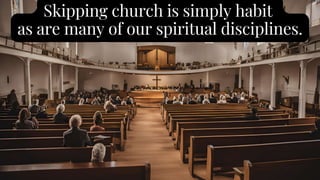
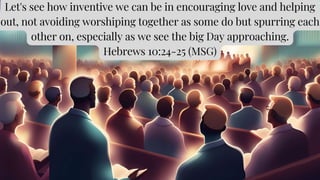
  • #10 According to the writer of Hebrews, skipping church is a matter of habit. I might add that attending church is also a matter of habit. In fact, most of our spiritual disciplines are matters of habit.
  • #11 If you’re in the habit of reading your Bible every morning, I’ll bet you read it this morning. You probably never even thought about it. If you’re not in the habit of reading your Bible every morning, you probably didn’t read it this morning. You probably didn’t think too much about that either. That’s because Bible reading is a habit. Your habits can either draw you closer to God or drag you further away.
  • #12 The reason the writer of Hebrews gives for encouraging the habit of attending church meetings is not just what I get out of it, but what I can give YOU! When you go to a meeting with a lot of empty seats, that’s DISCOURAGING When you go to a meeting with few empty seats, that’s ENCOURAGING
  • #13 παρακαλέω parakaleō – urge, encourage, exhort, admonish When you come to our Heritage Bible Master Class meetings where the room is packed and people are engaged in the fellowship and study, there’s just not much that is more encouraging than that!
  • #15 The first two deal with the same thing. If your bull hurts someone, you are not responsible. Not unless the bull has been in the habit of doing this. Then, you are responsible. The habit of the bull makes the difference of whether you are punished. ‌
  • #16 The same thing is true if your bull kills someone else’s animal. You’re not responsible unless you were aware of the bull’s habitual behavior.
  • #17 The next one is from one of the most humorous stories in the Bible. It is the place where Balaam’s donkey talks to him. Balaam corrects the donkey and the donkey speaks back to him, asking the rhetorical question, “Have I been in the habit of doing this?” You gotta love the Bible! Great story. ‌
  • #18 The first New Testament instance of the word habit had to do with the church’s benevolence program. The church cared for widows, but was very careful about who did and did not get on the list. Specifically, Paul instructs Timothy not put young widows on the list. The reason had to do with their habits. Paul says that they were in the habit of being idle and being busybodies. Because of her habits, they should be kept off the list. I’ll bet we men will have a hard time getting an audience with Paul when we see him in heaven. We’ll be standing at the end of a very long line of ticked-off women!
  • #19 The last one is a classic, and one we referred to earlier. It has to do with habit of meeting with the church or not. By the way, notice the habit is not to sit in straight rows and watch the same event happen on the same stage. The habit is to encourage one another. I encourage you; you encourage me. It is a habit. We do it every day. ‌
  • #21 You need to exercise self-discipline to form good habits. But, once they are formed, they become automatic. You don’t even think about them. Disciples don’t think about whether to have a Quiet Time; this is just how they start their day. They have done it so consistently for so long that they don’t think about it. It is who they are. It is what they do. It is their normal. If having a Quiet Time is not a habit, you probably didn’t have a Quiet Time this morning. If we think of discipline as forcing yourself to do something, a startling truth arises: discipline has a very small place in true Christian living. Habit is a huge part of Christian living. ‌ — adapted from Josh Hunt, The Habit of Discipleship (Pulpit Press, 2015).
  • #23 Most of the choices we make each day may feel like the products of well-considered decision making, but they’re not. They’re habits. And though each habit means relatively little on its own, over time, the meals we order, what we say to our kids each night, whether we save or spend, how often we exercise, and the way we organize our thoughts and work routines have enormous impacts on our health, productivity, financial security, and happiness.
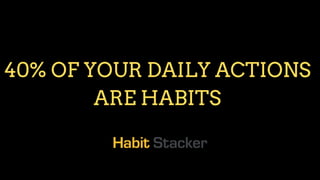
  • #24 One paper published by a Duke University researcher in 2006 found that more than 40 percent of the actions people performed each day weren’t actual decisions, but habits. ‌— The Power of Habit: Why We Do What We Do in Life and Business by Charles Duhigg
  • #25 Remember the Shema – that affirmation every Israelite is expected to make several times a day. Notice how important habit is to raising the next generation. Most of the choices we make each day may feel like the products of well-considered decision making, but they’re not. They’re habits. And though each habit means relatively little on its own, over time, the meals we order, what we say to our kids each night, whether we save or spend, how often we exercise, and the way we organize our thoughts and work routines have enormous impacts on our health, productivity, financial security, and happiness. ‌— The Power of Habit: Why We Do What We Do in Life and Business by Charles Duhigg
  • #27 The truth is, you don’t break a bad habit; you replace it with a good one. – Dennis Waitley. Max Lucado: I’M A NEW CHRISTIAN. OVER THE YEARS I’VE DEVELOPED A LOT OF BAD HABITS. HOW DO I GET RID OF THEM NOW? By developing good ones. Here are four to start with:
  • #28 First, the habit of prayer: “Base your happiness on your hope in Christ. When trials come endure them patiently; steadfastly maintain the habit of prayer” (Rom. 12:12 PHILLIPS, emphasis mine). Posture, tone, and place are personal matters. Select the form that works for you. But don’t think about it too much. Better to pray awkwardly than not at all.
  • #29 Second, the habit of study: “The man who looks into the perfect mirror of God’s law . . . and makes a habit of so doing, is not the man who sees and forgets. He puts that law into practice and he wins true happiness” (James 1:25 PHILLIPS, emphasis mine).
  • #30 Third, the habit of giving: “Every Sunday each of you make an offering and put it in safekeeping. Be as generous as you can. When I get there you'll have it ready, and I won't have to make a special appeal. 1 Corinthians 16:2 (MSG)). You don’t give for God’s sake. You give for your sake. “The purpose of tithing is to teach you always to put God first in your lives” (Deut. 14:23 TLB).
  • #31 And last of all, the habit of fellowship: “Let us not give up the habit of meeting together, as some are doing. Instead, let us encourage one another” (Heb. 10:25 TEV, emphasis mine). You need support. You need what the Bible calls fellowship. And you need it every week. ‌Four habits worth having. Isn’t it good to know that some habits are good for you? ‌— Max Lucado, Max on Life: Answers and Inspiration for Today’s Questions (Nashville: Thomas Nelson, 2011).
  • #33 One habit at a time. Because habits are so hard to form, we do well to work on one at a time. The reason we fail to keep New Year’s Resolutions comes down to one letter—s. If we would work on one New Year’s Resolution (no s) we would have much better success. We need to have the humility to appreciate the difficulty of forming a habit and marshal all of our effort and skill toward one habit. Diffusing our effort across multiple domains will almost guarantee failure in all of them. Take, for instance, studies from the past decade examining the impacts of exercise on daily routines.4.10 When people start habitually exercising, even as infrequently as once a week, they start changing other, unrelated patterns in their lives, often unknowingly. Typically, people who exercise start eating better and becoming more productive at work. They smoke less and show more patience with colleagues and family. They use their credit cards less frequently and say they feel less stressed. It’s not completely clear why. But for many people, exercise is a keystone habit that triggers widespread change.
  • #34 “Exercise spills over,” said James Prochaska, a University of Rhode Island researcher. “There’s something about it that makes other good habits easier.” ‌— The Power of Habit: Why We Do What We Do in Life and Business by Charles Duhigg
  • #35 Every New Year we are going to start reading our Bibles, start exercising, start eating better and lose some weight. Well, we might start. The goal is to finish. If you want to finish, concentrate on one habit at a time. Concentrate on the habit of having a Quiet Time, and don’t be distracted by any other difficult life changes. When you get this habit down, a multitude of life changes will flow out of it. There are many spiritual disciplines discussed in the literature: silence, service, solitude and fasting to name a few. These may come later. As you spend time alone with God, He may move you into all these things and more.
  • #36 By concentrating single-mindedly on the one discipline of a daily Quiet Time, you maximize your probability of success. ‌— Josh Hunt, The Habit of Discipleship (Pulpit Press, 2015).
  • #38 Attitudes are nothing more than habits of thought.
  • #39 This chart will help you form proper habits.
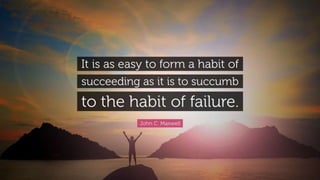
  • #40 ‌This cycle can be positive or negative. The process for developing habits, good or bad, is the same. It is as easy to form a habit of succeeding as it is to succumb to the habit of failure.
  • #41 Observe these two cycles and see the difference.
  • #43 ‌Habits aren’t instincts; they’re acquired actions or reactions. They don’t just happen; they are caused. Once the original cause of a habit is determined, it is within your power to accept or reject it. Most people allow their habits to control them. When those habits are hurtful, they damage our attitudes. ‌— John C. Maxwell, The Winning Attitude (Nashville, TN: Thomas Nelson, 1993), 153–154.
  • #45 Science and the Bible agree: we are profoundly influenced by the behavior of the people we consider to be “our people.” If you want to develop a new habit, take a friend with you. There is a reason why Weight Watchers works. And it is not because the diet itself is an amazing diet. It is easier to lose weight if you do so with a friend. The same thing is true of Celebrate Recovery. It’s easier to address dysfunctional and addictive behaviors in company of others who are also struggling with dysfunctional and addictive behaviors. If you want to develop the habit of a Quiet Time, bring a friend with you. Maybe start by participating in a weekly a small group Bible study, where you can encourage one another to have a daily Quiet Time. Maybe get together in groups of two or three once a week for accountability. But the key is to keep the small group small. There’s a reason Jesus worked with a group of twelve men and even within that small group, he even had a smaller group of three or four – Peter, James and John (and sometimes Andrew). Maybe meet in a small space. My Wednesday small group meets at Aspen Mills Bakery which has a small room that can only accommodate eight – forcing us to divide when we get too big for the space. Everyone in the group reads the same section of Scripture. This is a great way to apply the principle of bringing a friend with you. If you go it alone, you are almost certain to fail. ‌ — adapted from Josh Hunt, The Habit of Discipleship (Pulpit Press, 2015).
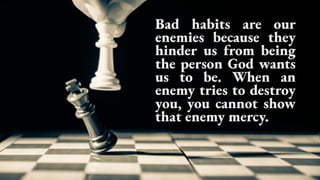
  • #47 The bad habits in our lives are our enemies because they hinder us from being the person God wants us to be. When an enemy is trying to destroy you, you cannot show that enemy mercy.
  • #48 God was leading the Israelites to possess the land He had promised them, just as He is leading us into the good life He has promised us. Many enemy nations were coming against them, just as the devil is against us. God told the Israelites to utterly destroy the enemy nations and to make no covenants with them and not to show them mercy, and we must do the same thing with the bad habits we have that are stealing our destiny (Deuteronomy 7:1–2).
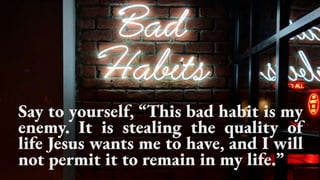
  • #49 Deal with bad habits relentlessly and without mercy. Find ways to help yourself do the good things that you truly want to do. ‌Don’t fail to realize that bad habits steal the destiny God has ordained for you. Don’t think, “Oh, it’s just a bad habit, it’s not that big a deal.” If you think like that, you will more than likely never deal with that habit. Say to yourself instead, “This bad habit is my enemy. It is stealing the quality of life that Jesus wants me to have, and I am not going to permit it to remain in my life.” ‌— Making Good Habits, Breaking Bad Habits: 14 New Behaviors That Will Energize Your Lifeby Joyce Meyer ‌

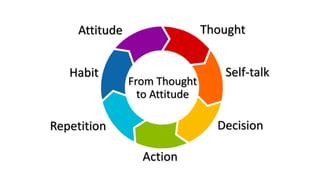
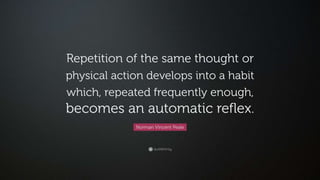
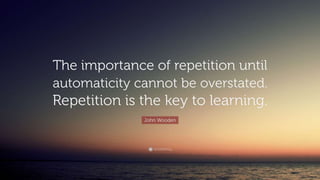
  • #51 Repetition is the key to forming habits, good or bad.
  • #53 When working toward forming a good habit, you may have to leave notes for yourself to remind you to do the good thing you desire. Ask the Holy Spirit to remind you, too. The Bible says that He will bring all things to our remembrance when we need them (John 14:26). Sometimes a simple mechanism such as automatic reminders is the best way to start creating a new habit. ‌— Making Good Habits, Breaking Bad Habits: 14 New Behaviors That Will Energize Your Life by Joyce Meyer