Resource-efficient quantum communications
using all-photonic graph state generated
from a few matter qubits.
Paul Hilaire, Edwin Barnes, and Sophia Economou
2
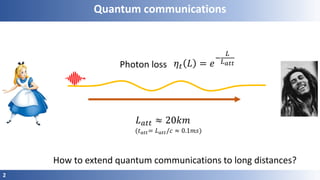
Quantum communications
Photon loss 𝜂 𝑡 𝐿 = 𝑒
−
𝐿
𝐿 𝑎𝑡𝑡
(𝑡 𝑎𝑡𝑡= 𝐿 𝑎𝑡𝑡/𝑐 ≈ 0.1𝑚𝑠)
How to extend quantum communications to long distances?
𝐿 𝑎𝑡𝑡 ≈ 20𝑘𝑚
3
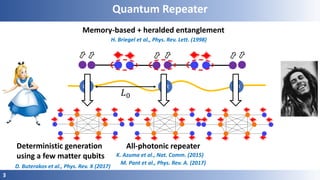
𝐿0
Quantum Repeater
Memory-based + heralded entanglement
H. Briegel et al., Phys. Rev. Lett. (1998)
K. Azuma et al., Nat. Comm. (2015)
All-photonic repeater
M. Pant et al., Phys. Rev. A. (2017)
QR QRQR
Deterministic generation
using a few matter qubits
D. Buterakos et al., Phys. Rev. X (2017)
4
𝐿0
Quantum Repeater
Memory-based + heralded entanglement
H. Briegel et al., Phys. Rev. Lett. (1998)
K. Azuma et al., Nat. Comm. (2015)
All-photonic repeater
M. Pant et al., Phys. Rev. A. (2017)
QR QRQR
Deterministic generation
using a few matter qubits
D. Buterakos et al., Phys. Rev. X (2017)
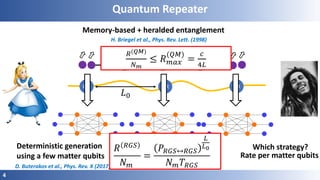
Rate per matter qubits
Which strategy?
𝑅(𝑄𝑀)
𝑁 𝑚
≤ 𝑅 𝑚𝑎𝑥
(𝑄𝑀)
=
𝑐
4𝐿
𝑅 𝑅𝐺𝑆
𝑁 𝑚
=
𝑃𝑅𝐺𝑆↔𝑅𝐺𝑆
𝐿
𝐿0
𝑁 𝑚 𝑇𝑅𝐺𝑆
5
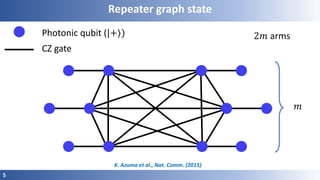
Repeater graph state
CZ gate
2𝑚 arms
K. Azuma et al., Nat. Comm. (2015)
Photonic qubit (|+⟩)
𝑚
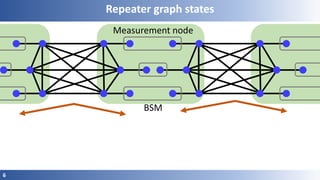
6
Measurement node
Repeater graph states
BSM
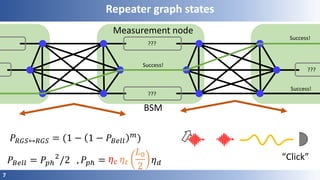
7
Measurement node
Repeater graph states
???
???
Success!
???
Success!
Success!
𝑃𝑅𝐺𝑆↔𝑅𝐺𝑆 = (1 − 1 − 𝑃𝐵𝑒𝑙𝑙
𝑚
)
, 𝑃𝑝ℎ =𝑃𝐵𝑒𝑙𝑙 = 𝑃𝑝ℎ
2
/2
BSM
“Click”𝜂 𝑑𝜂 𝑐 𝜂 𝑡
𝐿0
2
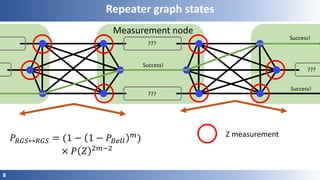
8
Measurement node
Repeater graph states
???
???
Success!
???
Success!
Success!
Z measurement
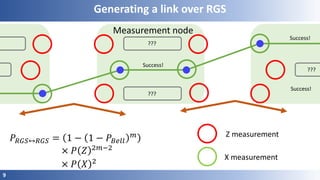
𝑃𝑅𝐺𝑆↔𝑅𝐺𝑆 = (1 − 1 − 𝑃𝐵𝑒𝑙𝑙
𝑚
)
× 𝑃 𝑍 2𝑚−2
9
Measurement node
Generating a link over RGS
???
???
Success!
???
Success!
Success!
X measurement
Z measurement
𝑃𝑅𝐺𝑆↔𝑅𝐺𝑆 = 1 − 1 − 𝑃𝐵𝑒𝑙𝑙
𝑚
× 𝑃 𝑋 2
× 𝑃 𝑍 2𝑚−2
10
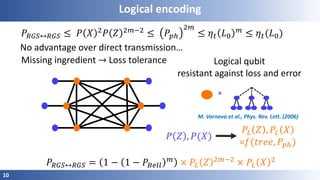
Logical encoding
Missing ingredient → Loss tolerance
𝑃𝑅𝐺𝑆↔𝑅𝐺𝑆 ≤ 𝑃 𝑋 2
𝑃 𝑍 2𝑚−2
≤ 𝑃𝑝ℎ
2𝑚
≤ 𝜂 𝑡 𝐿0
𝑚
≤ 𝜂 𝑡(𝐿0)
No advantage over direct transmission…
=
M. Varnava et al., Phys. Rev. Lett. (2006)
Logical qubit
resistant against loss and error
𝑃𝑅𝐺𝑆↔𝑅𝐺𝑆 = 1 − 1 − 𝑃𝐵𝑒𝑙𝑙
𝑚
× 𝑃𝐿 𝑍 2𝑚−2
× 𝑃𝐿 𝑋 2
𝑃𝐿 𝑍 , 𝑃𝐿 𝑋
=𝑓(𝑡𝑟𝑒𝑒, 𝑃𝑝ℎ)
𝑃 𝑍 , 𝑃(𝑋)
11
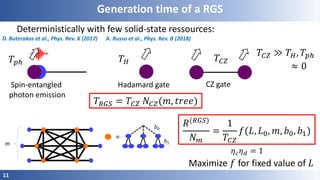
Generation time of a RGS
A. Russo et al., Phys. Rev. B (2018)
Deterministically with few solid-state ressources:
D. Buterakos et al., Phys. Rev. X (2017)
Spin-entangled
photon emission
CZ gateHadamard gate
𝑇𝑝ℎ 𝑇 𝐻 𝑇𝐶𝑍
𝑇𝐶𝑍 ≫ 𝑇 𝐻, 𝑇𝑝ℎ
≈ 0
𝑅(𝑅𝐺𝑆)
𝑁 𝑚
=
1
𝑇𝐶𝑍
𝑓(𝐿, 𝐿0, 𝑚, 𝑏0, 𝑏1)
𝜂 𝑐 𝜂 𝑑 = 1
= 𝑏1
𝑏0
𝑚
Maximize 𝑓 for fixed value of 𝐿
𝑇𝑅𝐺𝑆 = 𝑇𝐶𝑍 𝑁𝐶𝑍(𝑚, 𝑡𝑟𝑒𝑒)
12
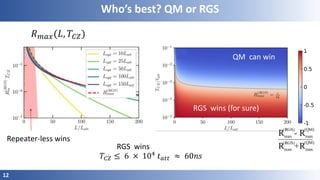
Who’s best? QM or RGS
𝑅 𝑚𝑎𝑥(𝐿, 𝑇𝐶𝑍)
Repeater-less wins
RGS wins (for sure)
QM can win
𝑇𝐶𝑍 ≤ 6 × 10⁴
𝑡 𝑎𝑡𝑡 ≈ 60𝑛𝑠
RGS wins
13
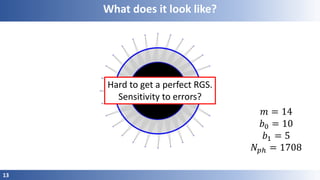
What does it look like?
𝑚 = 14
𝑏0 = 10
𝑏1 = 5
𝑁𝑝ℎ = 1708
Hard to get a perfect RGS.
Sensitivity to errors?
14
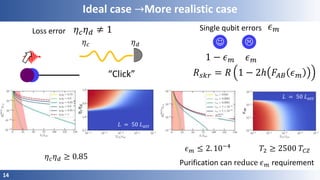
Ideal case →More realistic case
Loss error
𝜂 𝑑𝜂 𝑐
𝑅 𝑠𝑘𝑟 = 𝑅 1 − 2ℎ 𝐹𝐴𝐵 𝜖 𝑚
𝜂 𝑐 𝜂 𝑑 ≠ 1
“Click”

1 − 𝜖 𝑚 𝜖 𝑚
Single qubit errors 𝜖 𝑚
𝜂 𝑐 𝜂 𝑑 ≥ 0.85
𝑇2 ≥ 2500 𝑇𝐶𝑍𝜖 𝑚 ≤ 2. 10−4
Purification can reduce 𝜖 𝑚 requirement
𝜖𝑚
𝜂𝑐𝜂𝑑
𝐿 = 50 𝐿 𝑎𝑡𝑡
𝐿 = 50 𝐿 𝑎𝑡𝑡
15
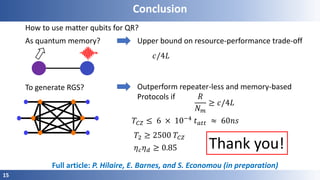
Conclusion
𝑅
𝑁 𝑚
≥ 𝑐/4𝐿
How to use matter qubits for QR?
To generate RGS? Outperform repeater-less and memory-based
Protocols if
𝑐/4𝐿
Upper bound on resource-performance trade-off
𝑇𝐶𝑍 ≤ 6 × 10⁻⁴
𝑡 𝑎𝑡𝑡 ≈ 60𝑛𝑠
𝜂 𝑐 𝜂 𝑑 ≥ 0.85
𝑇2 ≥ 2500 𝑇𝐶𝑍
As quantum memory?
Full article: P. Hilaire, E. Barnes, and S. Economou (in preparation)
Thank you!

2020_hilaire march_meeting

  • 1.
    Resource-efficient quantum communications usingall-photonic graph state generated from a few matter qubits. Paul Hilaire, Edwin Barnes, and Sophia Economou
  • 2.
    2 Quantum communications Photon loss𝜂 𝑡 𝐿 = 𝑒 − 𝐿 𝐿 𝑎𝑡𝑡 (𝑡 𝑎𝑡𝑡= 𝐿 𝑎𝑡𝑡/𝑐 ≈ 0.1𝑚𝑠) How to extend quantum communications to long distances? 𝐿 𝑎𝑡𝑡 ≈ 20𝑘𝑚
  • 3.
    3 𝐿0 Quantum Repeater Memory-based +heralded entanglement H. Briegel et al., Phys. Rev. Lett. (1998) K. Azuma et al., Nat. Comm. (2015) All-photonic repeater M. Pant et al., Phys. Rev. A. (2017) QR QRQR Deterministic generation using a few matter qubits D. Buterakos et al., Phys. Rev. X (2017)
  • 4.
    4 𝐿0 Quantum Repeater Memory-based +heralded entanglement H. Briegel et al., Phys. Rev. Lett. (1998) K. Azuma et al., Nat. Comm. (2015) All-photonic repeater M. Pant et al., Phys. Rev. A. (2017) QR QRQR Deterministic generation using a few matter qubits D. Buterakos et al., Phys. Rev. X (2017) Rate per matter qubits Which strategy? 𝑅(𝑄𝑀) 𝑁 𝑚 ≤ 𝑅 𝑚𝑎𝑥 (𝑄𝑀) = 𝑐 4𝐿 𝑅 𝑅𝐺𝑆 𝑁 𝑚 = 𝑃𝑅𝐺𝑆↔𝑅𝐺𝑆 𝐿 𝐿0 𝑁 𝑚 𝑇𝑅𝐺𝑆
  • 5.
    5 Repeater graph state CZgate 2𝑚 arms K. Azuma et al., Nat. Comm. (2015) Photonic qubit (|+⟩) 𝑚
  • 6.
  • 7.
    7 Measurement node Repeater graphstates ??? ??? Success! ??? Success! Success! 𝑃𝑅𝐺𝑆↔𝑅𝐺𝑆 = (1 − 1 − 𝑃𝐵𝑒𝑙𝑙 𝑚 ) , 𝑃𝑝ℎ =𝑃𝐵𝑒𝑙𝑙 = 𝑃𝑝ℎ 2 /2 BSM “Click”𝜂 𝑑𝜂 𝑐 𝜂 𝑡 𝐿0 2
  • 8.
    8 Measurement node Repeater graphstates ??? ??? Success! ??? Success! Success! Z measurement 𝑃𝑅𝐺𝑆↔𝑅𝐺𝑆 = (1 − 1 − 𝑃𝐵𝑒𝑙𝑙 𝑚 ) × 𝑃 𝑍 2𝑚−2
  • 9.
    9 Measurement node Generating alink over RGS ??? ??? Success! ??? Success! Success! X measurement Z measurement 𝑃𝑅𝐺𝑆↔𝑅𝐺𝑆 = 1 − 1 − 𝑃𝐵𝑒𝑙𝑙 𝑚 × 𝑃 𝑋 2 × 𝑃 𝑍 2𝑚−2
  • 10.
    10 Logical encoding Missing ingredient→ Loss tolerance 𝑃𝑅𝐺𝑆↔𝑅𝐺𝑆 ≤ 𝑃 𝑋 2 𝑃 𝑍 2𝑚−2 ≤ 𝑃𝑝ℎ 2𝑚 ≤ 𝜂 𝑡 𝐿0 𝑚 ≤ 𝜂 𝑡(𝐿0) No advantage over direct transmission… = M. Varnava et al., Phys. Rev. Lett. (2006) Logical qubit resistant against loss and error 𝑃𝑅𝐺𝑆↔𝑅𝐺𝑆 = 1 − 1 − 𝑃𝐵𝑒𝑙𝑙 𝑚 × 𝑃𝐿 𝑍 2𝑚−2 × 𝑃𝐿 𝑋 2 𝑃𝐿 𝑍 , 𝑃𝐿 𝑋 =𝑓(𝑡𝑟𝑒𝑒, 𝑃𝑝ℎ) 𝑃 𝑍 , 𝑃(𝑋)
  • 11.
    11 Generation time ofa RGS A. Russo et al., Phys. Rev. B (2018) Deterministically with few solid-state ressources: D. Buterakos et al., Phys. Rev. X (2017) Spin-entangled photon emission CZ gateHadamard gate 𝑇𝑝ℎ 𝑇 𝐻 𝑇𝐶𝑍 𝑇𝐶𝑍 ≫ 𝑇 𝐻, 𝑇𝑝ℎ ≈ 0 𝑅(𝑅𝐺𝑆) 𝑁 𝑚 = 1 𝑇𝐶𝑍 𝑓(𝐿, 𝐿0, 𝑚, 𝑏0, 𝑏1) 𝜂 𝑐 𝜂 𝑑 = 1 = 𝑏1 𝑏0 𝑚 Maximize 𝑓 for fixed value of 𝐿 𝑇𝑅𝐺𝑆 = 𝑇𝐶𝑍 𝑁𝐶𝑍(𝑚, 𝑡𝑟𝑒𝑒)
  • 12.
    12 Who’s best? QMor RGS 𝑅 𝑚𝑎𝑥(𝐿, 𝑇𝐶𝑍) Repeater-less wins RGS wins (for sure) QM can win 𝑇𝐶𝑍 ≤ 6 × 10⁴ 𝑡 𝑎𝑡𝑡 ≈ 60𝑛𝑠 RGS wins
  • 13.
    13 What does itlook like? 𝑚 = 14 𝑏0 = 10 𝑏1 = 5 𝑁𝑝ℎ = 1708 Hard to get a perfect RGS. Sensitivity to errors?
  • 14.
    14 Ideal case →Morerealistic case Loss error 𝜂 𝑑𝜂 𝑐 𝑅 𝑠𝑘𝑟 = 𝑅 1 − 2ℎ 𝐹𝐴𝐵 𝜖 𝑚 𝜂 𝑐 𝜂 𝑑 ≠ 1 “Click”  1 − 𝜖 𝑚 𝜖 𝑚 Single qubit errors 𝜖 𝑚 𝜂 𝑐 𝜂 𝑑 ≥ 0.85 𝑇2 ≥ 2500 𝑇𝐶𝑍𝜖 𝑚 ≤ 2. 10−4 Purification can reduce 𝜖 𝑚 requirement 𝜖𝑚 𝜂𝑐𝜂𝑑 𝐿 = 50 𝐿 𝑎𝑡𝑡 𝐿 = 50 𝐿 𝑎𝑡𝑡
  • 15.
    15 Conclusion 𝑅 𝑁 𝑚 ≥ 𝑐/4𝐿 Howto use matter qubits for QR? To generate RGS? Outperform repeater-less and memory-based Protocols if 𝑐/4𝐿 Upper bound on resource-performance trade-off 𝑇𝐶𝑍 ≤ 6 × 10⁻⁴ 𝑡 𝑎𝑡𝑡 ≈ 60𝑛𝑠 𝜂 𝑐 𝜂 𝑑 ≥ 0.85 𝑇2 ≥ 2500 𝑇𝐶𝑍 As quantum memory? Full article: P. Hilaire, E. Barnes, and S. Economou (in preparation) Thank you!