1
Trusted Care:
Just Culture Scenarios
Team Aerospace Begins Here!
22
Objectives
 Given an AFMS Just Culture Algorithm/Case Study,
determine type of event and response to the
associated act
 Given a moral or ethical dilemma, demonstrate
appropriate application of the AF core values
 Given past mishap examples, identify human-factors
“common causes”
Team Aerospace Begins Here!
33
Overview
Definition
Just Culture
Accountability
Adverse Event Overview
Scenarios
Team Aerospace Begins Here!
44
Definition
“Just Culture” is a culture in which
staff are not punished for actions,
omissions or decisions taken by
them which are commensurate with their
experience and training, but where
gross negligence, willful violations,
and destructive acts are not tolerated.
www.eurocontrol.int/articles/just-culture
Team Aerospace Begins Here!
Fair and Just Culture
5
What Is It?
An atmosphere of trust in which people are
encouraged to provide, and even rewarded for
providing, essential safety-related information, but in
which they are clear about where the line must be
drawn between acceptable and unacceptable
behavior.
James Reason
Managing the Risks of Organizational Accidents (1997)
Team Aerospace Begins Here! 6
Scenario
Amn X comes in for annual cleaning/visit
It is a new clinic with construction and it causes the Airman to be late
Doc Y sees a cavity needs to be filled--patient schedules are limited
Front desk can't book the apt (0 apts)
Doc Y says "come back Thursday during physical fitness time“
Patient walks in Thursday with no scheduled apt
There was no huddle for them to expect the patient
Doc Y is waiting for the patient, his technician SSgt L is surprised and in PT
uniform
Team Aerospace Begins Here! 7
Scenario
Civ tech says she will cover
This is not her normal room
There is no standardization between rooms
There are no surgical kits in the cabinet
Civ tech goes to the Dental sterilization area but the lead tech is on the phone,
she waves her in to get a kit
Carts are not clearly labeled and she grabs a kit
Returns to the room/hurriedly fills the cavity because she is late for her next apt
Later-tech realizes it was not sterilized due to the color of the strip
Team Aerospace Begins Here! 8
Scenario
This is an example of the swiss cheese model
Did one event cause the blocks to tumble?
Was it the last person's fault?
Trying to pinpoint blame--can we ID missing pegs?
Team Aerospace Begins Here!
99
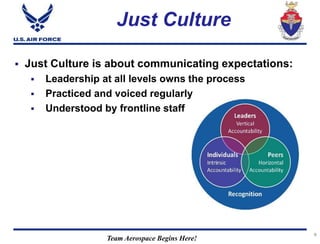
Just Culture
 Just Culture is about communicating expectations:
 Leadership at all levels owns the process
 Practiced and voiced regularly
 Understood by frontline staff
Team Aerospace Begins Here!
1111
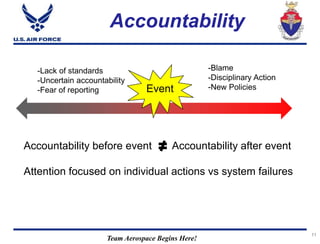
Accountability
Event
-Blame
-Disciplinary Action
-New Policies
-Lack of standards
-Uncertain accountability
-Fear of reporting
Accountability before event Accountability after event
Attention focused on individual actions vs system failures
Team Aerospace Begins Here!
1212
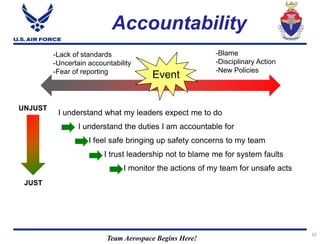
Accountability
Event
-Blame
-Disciplinary Action
-New Policies
-Lack of standards
-Uncertain accountability
-Fear of reporting
I understand what my leaders expect me to do
I understand the duties I am accountable for
I feel safe bringing up safety concerns to my team
I trust leadership not to blame me for system faults
I monitor the actions of my team for unsafe acts
UNJUST
JUST
Team Aerospace Begins Here!
1313
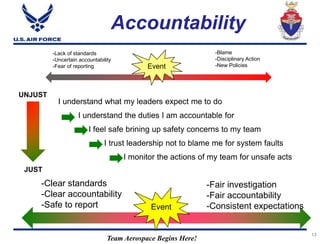
Accountability
Event
-Blame
-Disciplinary Action
-New Policies
-Lack of standards
-Uncertain accountability
-Fear of reporting
I understand what my leaders expect me to do
I understand the duties I am accountable for
I feel safe brining up safety concerns to my team
I trust leadership not to blame me for system faults
I monitor the actions of my team for unsafe acts
UNJUST
JUST
Event
-Clear standards
-Clear accountability
-Safe to report
-Fair investigation
-Fair accountability
-Consistent expectations
Team Aerospace Begins Here! 14
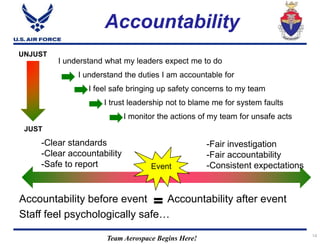
Accountability
I understand what my leaders expect me to do
I understand the duties I am accountable for
I feel safe bringing up safety concerns to my team
I trust leadership not to blame me for system faults
I monitor the actions of my team for unsafe acts
UNJUST
JUST
Event
-Clear standards
-Clear accountability
-Safe to report
-Fair investigation
-Fair accountability
-Consistent expectations
Accountability before event Accountability after event
Staff feel psychologically safe…
Team Aerospace Begins Here!
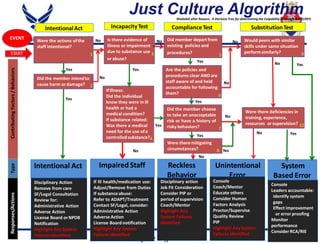
IncapacityTest ComplianceTest SubstitutionTest
Were the actions ofthe
staff intentional?
Did the member intendto
cause harm ordamage?
IntentionalAct
Did member depart from
existing policies and
procedures?
Are the policies and
procedures clear AND are
staff aware of and held
accountable for following
them?
Did the member choose
to take an unacceptable
risk or have a history of
risky behaviors?
Would peers with similar
skills under same situation
performsimilarly?
Were there deficiencies in
training, experience,
resources orsupervision?
Were there mitigating
circumstances?
No
No
Yes
No
No
Yes
No
No
Yes
Yes
Yes
Yes
Yes
Yes
Modeled after Reason, A Decision Tree for determining the Culpability of Unsafe Acts(1997)
Disciplinary Action
Remove from care
SF/Legal Consultation
Review for:
Administrative Action
Adverse Action
License Board orNPDB
Notification
Highlight AnySystem
Failures identified
Intentional Act ImpairedStaff
If Ill health/medication use:
Adjust/Remove from Duties
If substance abuse:
Refer to ADAPT/Treatment
Contact SF/Legal, consider:
Administrative Action
Adverse Action
License Board notification
Highlight Any System
Failures identified
System
Based Error
Console
Leaders accountable:
Identify system
gaps
Effect improvement
or error proofing
Monitor
performance
Consider RCA/RIE
Unintentional
Error
Disciplinary action
Job Fit Consideration
Consider PIP or
period of supervision
Coach/Mentor
Highlight Any
System Failures
identified
Reckless
Behavior
Console
Coach/Mentor
Educate others
Consider Human
Factors Analysis
Proctor/Supervise
Quality Review
PIP
Highlight Any System
Failures identified
Responses/ActionsTypeContributingFactors/Behaviors
No
EVENT
START
No
No
1
2
Is there evidence of
illness or impairment
due to substance use 3
orabuse?
Ifillness:
Did the individual
know they were in ill
health or had a
medical condition?
If substance related:
Was there a medical
need for the use ofa
controlled substance?4
5
6
7
8 Yes
9
10
No
Yes
Just Culture Algorithm
Team Aerospace Begins Here!
Adverse Event Overview
Female patient is being worked up for transient
equilibrium imbalance in an outpatient diagnostic /
treatment procedure room in Radiology (Rad). The testing /
treatment required conscious sedation and pressurized IV
solution into carotid (neck – central line) artery.
During the procedure, the radiology team was
unaware that the patient’s pressurized IV fluid line ran dry.
The patient was inadvertently injected with a large amount
of air (instead of IV fluid) and sustained an air embolism in
the brain, resulting in a stroke.
Patient received rapid assessment and interventions
to successfully treat the embolism. These actions saved
the patient’s life but harm was caused because the patient
sustained irreversible cognitive short-term memory loss.
16
Team Aerospace Begins Here!
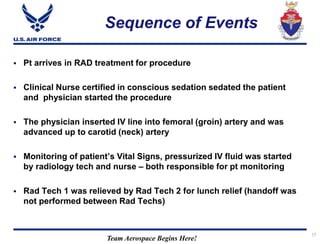
Sequence of Events
 Pt arrives in RAD treatment for procedure
 Clinical Nurse certified in conscious sedation sedated the patient
and physician started the procedure
 The physician inserted IV line into femoral (groin) artery and was
advanced up to carotid (neck) artery
 Monitoring of patient’s Vital Signs, pressurized IV fluid was started
by radiology tech and nurse – both responsible for pt monitoring
 Rad Tech 1 was relieved by Rad Tech 2 for lunch relief (handoff was
not performed between Rad Techs)
17
Team Aerospace Begins Here!
Sequence of Events
 Near end of procedure RN noticed pt’s vital signs became
unstable and she displayed seizure-like activity
 The physician was in the room conducting the procedure and
validated the pt’s instability and seizure-like activity
 During management of seizure, the team noted the pressurized IV
bag was empty & IV line was filled with air
 Assessment / treatment for air embolus was initiated
 Patient transferred from Rad to ICU for care
 Before RAD procedure room was closed, the tech erased all
clinical data from the patient monitoring equipment
18
Team Aerospace Begins Here!
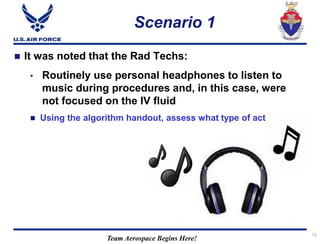
Scenario 1
19
 It was noted that the Rad Techs:
• Routinely use personal headphones to listen to
music during procedures and, in this case, were
not focused on the IV fluid
 Using the algorithm handout, assess what type of act / error?
Team Aerospace Begins Here!
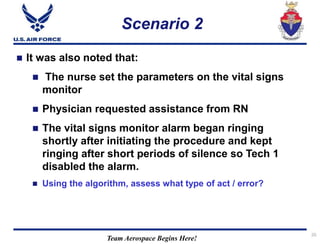
 It was also noted that:
 The nurse set the parameters on the vital signs
monitor
 Physician requested assistance from RN
 The vital signs monitor alarm began ringing
shortly after initiating the procedure and kept
ringing after short periods of silence so Tech 1
disabled the alarm.
 Using the algorithm, assess what type of act / error?
Scenario 2
20
Team Aerospace Begins Here!
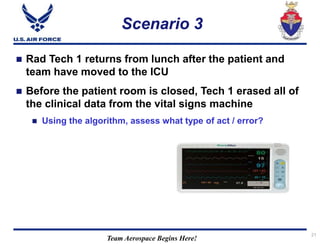
 Rad Tech 1 returns from lunch after the patient and
team have moved to the ICU
 Before the patient room is closed, Tech 1 erased all of
the clinical data from the vital signs machine
 Using the algorithm, assess what type of act / error?
Scenario 3
21
Team Aerospace Begins Here!
Final Exercise:
Messaging Just Culture
At your tables, discuss and write
down how you will address these
3 points when you return to your
MTF:
 What can I say to my flight
personnel to foster a Just
Culture?
 How can I get the message out to
them?
 When can I get the message out
to them?
24
Team Aerospace Begins Here!
2525
Objectives
 Given an AFMS Just Culture Algorithm/Case Study,
determine type of event and response to the
associated act
 Given a moral or ethical dilemma, demonstrate
appropriate application of the AF core values
 Given past mishap examples, identify human-factors
“common causes”
Team Aerospace Begins Here!
2626
Summary
Definition
Just Culture
Accountability
Adverse Event Overview
Scenarios

201801221 just culture_blast

  • 1.
  • 2.
    Team Aerospace BeginsHere! 22 Objectives  Given an AFMS Just Culture Algorithm/Case Study, determine type of event and response to the associated act  Given a moral or ethical dilemma, demonstrate appropriate application of the AF core values  Given past mishap examples, identify human-factors “common causes”
  • 3.
    Team Aerospace BeginsHere! 33 Overview Definition Just Culture Accountability Adverse Event Overview Scenarios
  • 4.
    Team Aerospace BeginsHere! 44 Definition “Just Culture” is a culture in which staff are not punished for actions, omissions or decisions taken by them which are commensurate with their experience and training, but where gross negligence, willful violations, and destructive acts are not tolerated. www.eurocontrol.int/articles/just-culture
  • 5.
    Team Aerospace BeginsHere! Fair and Just Culture 5 What Is It? An atmosphere of trust in which people are encouraged to provide, and even rewarded for providing, essential safety-related information, but in which they are clear about where the line must be drawn between acceptable and unacceptable behavior. James Reason Managing the Risks of Organizational Accidents (1997)
  • 6.
    Team Aerospace BeginsHere! 6 Scenario Amn X comes in for annual cleaning/visit It is a new clinic with construction and it causes the Airman to be late Doc Y sees a cavity needs to be filled--patient schedules are limited Front desk can't book the apt (0 apts) Doc Y says "come back Thursday during physical fitness time“ Patient walks in Thursday with no scheduled apt There was no huddle for them to expect the patient Doc Y is waiting for the patient, his technician SSgt L is surprised and in PT uniform
  • 7.
    Team Aerospace BeginsHere! 7 Scenario Civ tech says she will cover This is not her normal room There is no standardization between rooms There are no surgical kits in the cabinet Civ tech goes to the Dental sterilization area but the lead tech is on the phone, she waves her in to get a kit Carts are not clearly labeled and she grabs a kit Returns to the room/hurriedly fills the cavity because she is late for her next apt Later-tech realizes it was not sterilized due to the color of the strip
  • 8.
    Team Aerospace BeginsHere! 8 Scenario This is an example of the swiss cheese model Did one event cause the blocks to tumble? Was it the last person's fault? Trying to pinpoint blame--can we ID missing pegs?
  • 9.
    Team Aerospace BeginsHere! 99 Just Culture  Just Culture is about communicating expectations:  Leadership at all levels owns the process  Practiced and voiced regularly  Understood by frontline staff
  • 10.
    Team Aerospace BeginsHere! 1111 Accountability Event -Blame -Disciplinary Action -New Policies -Lack of standards -Uncertain accountability -Fear of reporting Accountability before event Accountability after event Attention focused on individual actions vs system failures
  • 11.
    Team Aerospace BeginsHere! 1212 Accountability Event -Blame -Disciplinary Action -New Policies -Lack of standards -Uncertain accountability -Fear of reporting I understand what my leaders expect me to do I understand the duties I am accountable for I feel safe bringing up safety concerns to my team I trust leadership not to blame me for system faults I monitor the actions of my team for unsafe acts UNJUST JUST
  • 12.
    Team Aerospace BeginsHere! 1313 Accountability Event -Blame -Disciplinary Action -New Policies -Lack of standards -Uncertain accountability -Fear of reporting I understand what my leaders expect me to do I understand the duties I am accountable for I feel safe brining up safety concerns to my team I trust leadership not to blame me for system faults I monitor the actions of my team for unsafe acts UNJUST JUST Event -Clear standards -Clear accountability -Safe to report -Fair investigation -Fair accountability -Consistent expectations
  • 13.
    Team Aerospace BeginsHere! 14 Accountability I understand what my leaders expect me to do I understand the duties I am accountable for I feel safe bringing up safety concerns to my team I trust leadership not to blame me for system faults I monitor the actions of my team for unsafe acts UNJUST JUST Event -Clear standards -Clear accountability -Safe to report -Fair investigation -Fair accountability -Consistent expectations Accountability before event Accountability after event Staff feel psychologically safe…
  • 14.
    Team Aerospace BeginsHere! IncapacityTest ComplianceTest SubstitutionTest Were the actions ofthe staff intentional? Did the member intendto cause harm ordamage? IntentionalAct Did member depart from existing policies and procedures? Are the policies and procedures clear AND are staff aware of and held accountable for following them? Did the member choose to take an unacceptable risk or have a history of risky behaviors? Would peers with similar skills under same situation performsimilarly? Were there deficiencies in training, experience, resources orsupervision? Were there mitigating circumstances? No No Yes No No Yes No No Yes Yes Yes Yes Yes Yes Modeled after Reason, A Decision Tree for determining the Culpability of Unsafe Acts(1997) Disciplinary Action Remove from care SF/Legal Consultation Review for: Administrative Action Adverse Action License Board orNPDB Notification Highlight AnySystem Failures identified Intentional Act ImpairedStaff If Ill health/medication use: Adjust/Remove from Duties If substance abuse: Refer to ADAPT/Treatment Contact SF/Legal, consider: Administrative Action Adverse Action License Board notification Highlight Any System Failures identified System Based Error Console Leaders accountable: Identify system gaps Effect improvement or error proofing Monitor performance Consider RCA/RIE Unintentional Error Disciplinary action Job Fit Consideration Consider PIP or period of supervision Coach/Mentor Highlight Any System Failures identified Reckless Behavior Console Coach/Mentor Educate others Consider Human Factors Analysis Proctor/Supervise Quality Review PIP Highlight Any System Failures identified Responses/ActionsTypeContributingFactors/Behaviors No EVENT START No No 1 2 Is there evidence of illness or impairment due to substance use 3 orabuse? Ifillness: Did the individual know they were in ill health or had a medical condition? If substance related: Was there a medical need for the use ofa controlled substance?4 5 6 7 8 Yes 9 10 No Yes Just Culture Algorithm
  • 15.
    Team Aerospace BeginsHere! Adverse Event Overview Female patient is being worked up for transient equilibrium imbalance in an outpatient diagnostic / treatment procedure room in Radiology (Rad). The testing / treatment required conscious sedation and pressurized IV solution into carotid (neck – central line) artery. During the procedure, the radiology team was unaware that the patient’s pressurized IV fluid line ran dry. The patient was inadvertently injected with a large amount of air (instead of IV fluid) and sustained an air embolism in the brain, resulting in a stroke. Patient received rapid assessment and interventions to successfully treat the embolism. These actions saved the patient’s life but harm was caused because the patient sustained irreversible cognitive short-term memory loss. 16
  • 16.
    Team Aerospace BeginsHere! Sequence of Events  Pt arrives in RAD treatment for procedure  Clinical Nurse certified in conscious sedation sedated the patient and physician started the procedure  The physician inserted IV line into femoral (groin) artery and was advanced up to carotid (neck) artery  Monitoring of patient’s Vital Signs, pressurized IV fluid was started by radiology tech and nurse – both responsible for pt monitoring  Rad Tech 1 was relieved by Rad Tech 2 for lunch relief (handoff was not performed between Rad Techs) 17
  • 17.
    Team Aerospace BeginsHere! Sequence of Events  Near end of procedure RN noticed pt’s vital signs became unstable and she displayed seizure-like activity  The physician was in the room conducting the procedure and validated the pt’s instability and seizure-like activity  During management of seizure, the team noted the pressurized IV bag was empty & IV line was filled with air  Assessment / treatment for air embolus was initiated  Patient transferred from Rad to ICU for care  Before RAD procedure room was closed, the tech erased all clinical data from the patient monitoring equipment 18
  • 18.
    Team Aerospace BeginsHere! Scenario 1 19  It was noted that the Rad Techs: • Routinely use personal headphones to listen to music during procedures and, in this case, were not focused on the IV fluid  Using the algorithm handout, assess what type of act / error?
  • 19.
    Team Aerospace BeginsHere!  It was also noted that:  The nurse set the parameters on the vital signs monitor  Physician requested assistance from RN  The vital signs monitor alarm began ringing shortly after initiating the procedure and kept ringing after short periods of silence so Tech 1 disabled the alarm.  Using the algorithm, assess what type of act / error? Scenario 2 20
  • 20.
    Team Aerospace BeginsHere!  Rad Tech 1 returns from lunch after the patient and team have moved to the ICU  Before the patient room is closed, Tech 1 erased all of the clinical data from the vital signs machine  Using the algorithm, assess what type of act / error? Scenario 3 21
  • 21.
    Team Aerospace BeginsHere! Final Exercise: Messaging Just Culture At your tables, discuss and write down how you will address these 3 points when you return to your MTF:  What can I say to my flight personnel to foster a Just Culture?  How can I get the message out to them?  When can I get the message out to them? 24
  • 22.
    Team Aerospace BeginsHere! 2525 Objectives  Given an AFMS Just Culture Algorithm/Case Study, determine type of event and response to the associated act  Given a moral or ethical dilemma, demonstrate appropriate application of the AF core values  Given past mishap examples, identify human-factors “common causes”
  • 23.
    Team Aerospace BeginsHere! 2626 Summary Definition Just Culture Accountability Adverse Event Overview Scenarios