2018 TRENDS IN CYBERSECURITY
BUILDING EFFECTIVE SECURITY TEAMS
September 2018
The complete 2018 Trends in Cybersecurity research report can be viewed free of charge at CompTIA.org (with simple registration)
Copyright (c) 2018 CompTIA Properties, LLC, All Rights Reserved | CompTIA.org | research@comptia.org
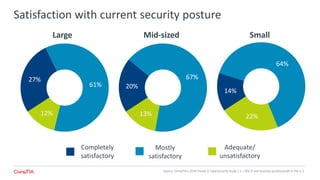
Satisfaction with current security posture
Source: CompTIA’s 2018 Trends in Cybersecurity study | n = 402 IT and business professionals in the U.S.
27%
61%
12%
20%
67%
13%
Large Mid-sized Small
Completely
satisfactory
Adequate/
unsatisfactory
Mostly
satisfactory
14%
64%
22%
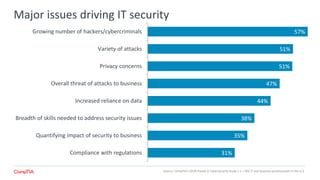
Major issues driving IT security
31%
35%
38%
44%
47%
51%
51%
57%
Compliance with regulations
Quantifying impact of security to business
Breadth of skills needed to address security issues
Increased reliance on data
Overall threat of attacks to business
Privacy concerns
Variety of attacks
Growing number of hackers/cybercriminals
Source: CompTIA’s 2018 Trends in Cybersecurity study | n = 402 IT and business professionals in the U.S.
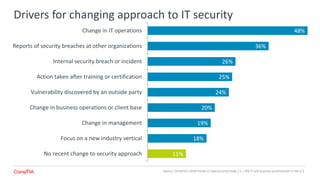
Drivers for changing approach to IT security
11%
18%
19%
20%
24%
25%
26%
36%
48%
No recent change to security approach
Focus on a new industry vertical
Change in management
Change in business operations or client base
Vulnerability discovered by an outside party
Action taken after training or certification
Internal security breach or incident
Reports of security breaches at other organizations
Change in IT operations
Source: CompTIA’s 2018 Trends in Cybersecurity study | n = 402 IT and business professionals in the U.S.
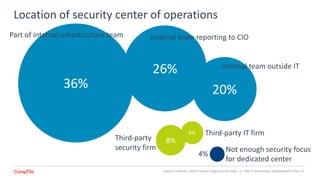
Location of security center of operations
Source: CompTIA’s 2018 Trends in Cybersecurity study | n = 402 IT and business professionals in the U.S.
36%
26%
20%
8%
6%
Part of internal infrastructure team Internal team reporting to CIO
Internal team outside IT
Third-party
security firm Not enough security focus
for dedicated center
4%
Third-party IT firm
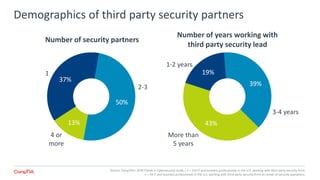
Demographics of third party security partners
37%
50%
13%
Number of security partners
4 or
more
19%
39%
43%
1-2 years
3-4 years
More than
5 years
2-3
1
Number of years working with
third party security lead
Source: CompTIA’s 2018 Trends in Cybersecurity study | n = 314 IT and business professionals in the U.S. working with third party security firms
n = 54 IT and business professionals in the U.S. working with third party security firms as center of security operations
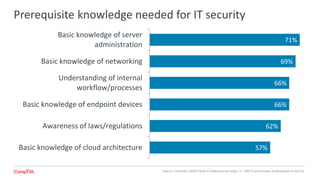
Prerequisite knowledge needed for IT security
57%
62%
66%
66%
69%
71%
Basic knowledge of cloud architecture
Awareness of laws/regulations
Basic knowledge of endpoint devices
Understanding of internal
workflow/processes
Basic knowledge of networking
Basic knowledge of server
administration
Source: CompTIA’s 2018 Trends in Cybersecurity study | n = 402 IT and business professionals in the U.S.
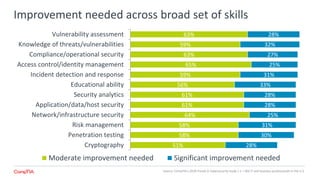
Improvement needed across broad set of skills
Source: CompTIA’s 2018 Trends in Cybersecurity study | n = 402 IT and business professionals in the U.S.
51%
58%
58%
64%
61%
61%
56%
59%
65%
63%
59%
63%
28%
30%
31%
25%
28%
28%
33%
31%
25%
27%
32%
28%
Cryptography
Penetration testing
Risk management
Network/infrastructure security
Application/data/host security
Security analytics
Educational ability
Incident detection and response
Access control/identity management
Compliance/operational security
Knowledge of threats/vulnerabilities
Vulnerability assessment
Moderate improvement needed Significant improvement needed
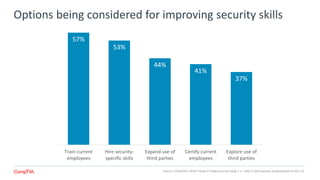
Options being considered for improving security skills
57%
53%
44%
41%
37%
Train current
employees
Hire security-
specific skills
Expand use of
third parties
Certify current
employees
Explore use of
third parties
Source: CompTIA’s 2018 Trends in Cybersecurity study | n = 402 IT and business professionals in the U.S.
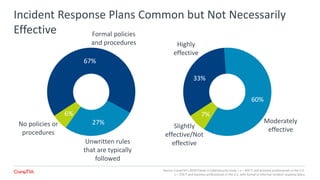
67%
27%
6%
Formal policies
and procedures
Unwritten rules
that are typically
followed
Incident Response Plans Common but Not Necessarily
Effective
No policies or
procedures
33%
60%
7%
Highly
effective
Moderately
effectiveSlightly
effective/Not
effective
Source: CompTIA’s 2018 Trends in Cybersecurity study | n = 402 IT and business professionals in the U.S.
n = 376 IT and business professionals in the U.S. with formal or informal incident response plans
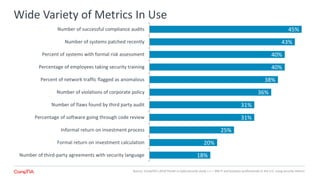
Wide Variety of Metrics In Use
18%
20%
25%
31%
31%
36%
38%
40%
40%
43%
45%
Number of third-party agreements with security language
Formal return on investment calculation
Informal return on investment process
Percentage of software going through code review
Number of flaws found by third party audit
Number of violations of corporate policy
Percent of network traffic flagged as anomalous
Percentage of employees taking security training
Percent of systems with formal risk assessment
Number of systems patched recently
Number of successful compliance audits
Source: CompTIA’s 2018 Trends in Cybersecurity study | n = 366 IT and business professionals in the U.S. using security metrics

2018 Trends in Cybersecurity: Building Effective Security Teams

  • 1.
    2018 TRENDS INCYBERSECURITY BUILDING EFFECTIVE SECURITY TEAMS September 2018 The complete 2018 Trends in Cybersecurity research report can be viewed free of charge at CompTIA.org (with simple registration) Copyright (c) 2018 CompTIA Properties, LLC, All Rights Reserved | CompTIA.org | research@comptia.org
  • 2.
    Satisfaction with currentsecurity posture Source: CompTIA’s 2018 Trends in Cybersecurity study | n = 402 IT and business professionals in the U.S. 27% 61% 12% 20% 67% 13% Large Mid-sized Small Completely satisfactory Adequate/ unsatisfactory Mostly satisfactory 14% 64% 22%
  • 3.
    Major issues drivingIT security 31% 35% 38% 44% 47% 51% 51% 57% Compliance with regulations Quantifying impact of security to business Breadth of skills needed to address security issues Increased reliance on data Overall threat of attacks to business Privacy concerns Variety of attacks Growing number of hackers/cybercriminals Source: CompTIA’s 2018 Trends in Cybersecurity study | n = 402 IT and business professionals in the U.S.
  • 4.
    Drivers for changingapproach to IT security 11% 18% 19% 20% 24% 25% 26% 36% 48% No recent change to security approach Focus on a new industry vertical Change in management Change in business operations or client base Vulnerability discovered by an outside party Action taken after training or certification Internal security breach or incident Reports of security breaches at other organizations Change in IT operations Source: CompTIA’s 2018 Trends in Cybersecurity study | n = 402 IT and business professionals in the U.S.
  • 5.
    Location of securitycenter of operations Source: CompTIA’s 2018 Trends in Cybersecurity study | n = 402 IT and business professionals in the U.S. 36% 26% 20% 8% 6% Part of internal infrastructure team Internal team reporting to CIO Internal team outside IT Third-party security firm Not enough security focus for dedicated center 4% Third-party IT firm
  • 6.
    Demographics of thirdparty security partners 37% 50% 13% Number of security partners 4 or more 19% 39% 43% 1-2 years 3-4 years More than 5 years 2-3 1 Number of years working with third party security lead Source: CompTIA’s 2018 Trends in Cybersecurity study | n = 314 IT and business professionals in the U.S. working with third party security firms n = 54 IT and business professionals in the U.S. working with third party security firms as center of security operations
  • 7.
    Prerequisite knowledge neededfor IT security 57% 62% 66% 66% 69% 71% Basic knowledge of cloud architecture Awareness of laws/regulations Basic knowledge of endpoint devices Understanding of internal workflow/processes Basic knowledge of networking Basic knowledge of server administration Source: CompTIA’s 2018 Trends in Cybersecurity study | n = 402 IT and business professionals in the U.S.
  • 8.
    Improvement needed acrossbroad set of skills Source: CompTIA’s 2018 Trends in Cybersecurity study | n = 402 IT and business professionals in the U.S. 51% 58% 58% 64% 61% 61% 56% 59% 65% 63% 59% 63% 28% 30% 31% 25% 28% 28% 33% 31% 25% 27% 32% 28% Cryptography Penetration testing Risk management Network/infrastructure security Application/data/host security Security analytics Educational ability Incident detection and response Access control/identity management Compliance/operational security Knowledge of threats/vulnerabilities Vulnerability assessment Moderate improvement needed Significant improvement needed
  • 9.
    Options being consideredfor improving security skills 57% 53% 44% 41% 37% Train current employees Hire security- specific skills Expand use of third parties Certify current employees Explore use of third parties Source: CompTIA’s 2018 Trends in Cybersecurity study | n = 402 IT and business professionals in the U.S.
  • 10.
    67% 27% 6% Formal policies and procedures Unwrittenrules that are typically followed Incident Response Plans Common but Not Necessarily Effective No policies or procedures 33% 60% 7% Highly effective Moderately effectiveSlightly effective/Not effective Source: CompTIA’s 2018 Trends in Cybersecurity study | n = 402 IT and business professionals in the U.S. n = 376 IT and business professionals in the U.S. with formal or informal incident response plans
  • 11.
    Wide Variety ofMetrics In Use 18% 20% 25% 31% 31% 36% 38% 40% 40% 43% 45% Number of third-party agreements with security language Formal return on investment calculation Informal return on investment process Percentage of software going through code review Number of flaws found by third party audit Number of violations of corporate policy Percent of network traffic flagged as anomalous Percentage of employees taking security training Percent of systems with formal risk assessment Number of systems patched recently Number of successful compliance audits Source: CompTIA’s 2018 Trends in Cybersecurity study | n = 366 IT and business professionals in the U.S. using security metrics

Editor's Notes